Lost Water: Towards a Phenomenology of the Kyle Centre

skylight.jpg

A crumpled local newspaper, ink bleeding in the rain, a tattoo of useless words on the Styrofoam takeaway. A case of stacked metaphors, every sentence weighted with the freight of muscle, plunge, pressing ahead. Snowflakes of unbreakable material make their way across bladderwrack pavements. Words like eateries and retail melt through the cracks and what’s left is the skeletal possibility of what could be, mulched in quicksand, the mall revamped with luscious funds and pumped to the brim with glass, tiles of parquet impression, leisure. The Kyle Centre mall, as understood in American English (O to cue Idlewild forever in the longing for that sensitive, Irvine drawl), once boasted a fountain where you tossed in your lucky pennies. There was a genuine, operating foodcourt. In the summer, tents would be erected upstairs for sale; a bouncy castle provided cheap joy for children and teenagers bored by another washout July. Many of us stole first kisses in the warm, polyester glow of those tents. We’d take caffeinated beverages and go browsing, the way you do now with the ease of a thumb and the screen, the virtual checkout. The semiology of colour in familiar high street stores, from Next to Topshop, functioned as landmarks in the crisscross abyss of ersatz environs, scaled to micro.

What comes next, next, next—a panoply of signage directs the flow of bodies. There were four entrances and exits, but only locals mastered the correct orientations. Kids drifted aimlessly up and down the escalators, shouting to friends who clustered on the floor below, sharing meal deals purloined from Superdrug, dropping fake grated cheese on the sallow floor. Medievals feeding their daily, carpeted fodder; a spin-cycle draining the pockets of millennials. All was amalgamation, consumerism in miniature. There was the looping belt of process that brought each person’s return on a Saturday afternoon. You might say bustling, even, if you were a journalist running out of words. You felt the bloat, the awkward accrual of bags, the jostle towards actual sunlight fizzled in the imminent night. Evening came quicker by the sea, shaded by islands and cloudy bars. Making impulse decisions, drawing back to the thing that comes without thinking.

To return ten years on is to witness the boom and bust cycle’s distilled effect. Scrunched out remnants of culture, expendable income bleached to regret. Towns throughout Britain, of course, lay waste to the whims of the market; but few as strong as this one. A smattering of bookies, charity shops, pawnbrokers and dingy discount stores spring up where cafés and clothes shops used to be. The supermarkets teem with the deranged ennui of the drifters. Old folks carry their bags to and fro, not gathering—not even picking the fruit of occasional Watt Brothers lipsticks. Their gums sink with cheap mints, the quality of the buskers slackens to fraught renditions of ‘All of Me’. As if the comprehensive self were still a myth to be chased. Pill poppers make the rounds quite openly, TKMaxx installs vein-resistant violet lighting in its bathrooms to stave off addicts. The establishment dwindles. Woolworths closed an age ago; they are slowly getting used to it.

As operational concept, the town brings out its humming despair. Gulls swoop in circles, waiting to descend on their carrion, the fag butts flicked into new oblivions. When dropped from a four-storey carpark, nutmeg stoned, you practise the art of temporal refusal—stepping literally into the upswept dust of the times. Trying out the bone-shattering acrobatics. Something glimpsed on telly. Creating a whirl of delusion which staves off the fear, if only for three hours with side effect headaches. You sit in the sticky dark of the Odeon, chewing peanuts, waiting for the arrival of those who won’t come. A shower runs on in the back of your mind; numeric paranoias flourish like dog daisies in June-green meadows. All of a sweetness, lingering aspartame. River Island being that literalised metaphor for outdoor fashion, something exotic in the lurid schemes. New tribes stranded on the traffic islands of their adolescent years, calling for help but only serving to prompt more crashes. The roadsides fill up with scrap metal, coke cans, broken dreams. Only the criminals pick litter and weeds. Somebody stops you on the street to ask about your pension, your PPI. In trackies you concoct some lie of an income. It feels better to exist beyond form, chewing a pack of mucilaginous candy, taming the jaw towards process. I run, I run, I run.

Practitioners of parkour and skaters clatter up the common walkways, alleys–backflipping normality. In that violent clack or fall of trainers, they emit fresh wavelengths on the general orbit. They are trying to avoid, like all of us, the inevitable, hullabaloo pull of the Kyle Centre, its middling void drawing us back to terrible origins. Returning after years, I found the mall to be almost utterly empty. The floor tiles coated with a fine layer of dust. I could almost hear the tinny echoes of Macintosh Plus resonate in the brain as I glided around, glancing into the charnel grounds of abandoned shop windows. Was this the mall of yesterday, snagged in its vividly bland, retro-futurity? Tacky goods, novelty toys and festive decorations were stacked up without sale, all in a jumble, asynchronic. There was an elegiac quality to the silence, the desolation, the click of my heels on the tiles. Usually, a curated selection of galling chart bangers would blast from some unseen stereo, but this has been replaced by a low-level, Lynchian electrical hum. There’s almost a sense that the whole setup could explode; something of J. G. Ballard’s comment that ‘reality itself’ feels like some kind of elaborate ‘stage set’, one that ‘could be dismantled at any moment’. Who would do the dismantling–and how violently? An irritated, private developer, snuffling the truffles of riches buried beneath crumbling plaster? When I touch shop signs, the tarnish comes apart in my fingers, along with all youthful glitz of faith. Consumerism comes here to evade its afterlife. I consider the rent rates of a gamble.

April 2017, a fresh visit. The only shop that appeared to be open—beyond a curious popup tent with a sunglass stand of neon hairbands—sold vapes in all sorts of flavours. Oddly appropriate that the vaporisation business flourished under recession. Ye olde Marx strikes again: ‘All that is solid melts into air’. The material basis of capital, of physical living–structures defined and hardened over years of labour relations–is eventually dissipated under the strain of its own regime. Our cloying desires rent free and exhaled as vapour, the flavours of youth recreated with chemical enhancements. Cookies and cream, strawberry sundae, cherry cola; all the treats once devoured in these hallowed walls provide now the scented mists of our caustic lungs. We choke on the smallness of the shrinking world, distracted by flickering images.

Quite satisfying, really, to find oneself wandering around in the new vacuity. Less sincerity than simple dwelling in abstraction, a reminder that such clear plexiglass canvases once held the false cheer of advertisements. Stalking the old trajectories, attempting to align memories of space, place, movement. By posing at the broken fruit machine, sticking post-its upon the locked bathroom doors, peering into grime-smeared windows, are we enacting a form of détournement, constructing a new milieu, hijacking a bland, capitalist reality? EAT ME/DISCOUNTS/SALES/NEW DEALS (Tony Blair’s Cheshire cat grin suspended in symptomatic darkness). The devouring logic of the overdraft reigns, gasps, struggles for land. We snap for Instagram, slathering everything with inevitable millennial humour, a soft irony tinged with longing. These washed-out, fluorine filters; do they augment the dreaminess or merely expose the inherently bland, detached, trifling logic of the fetish? For all love for material is only immaterial. What you trade on a wage, the price of petrol; a burnout dependence, the chalky velocity.

I once saw my friend play guitar here, his voice resonating with surprising boom in the faux-brick cavern. It was a Sunday, no-one around but other hoodies, pensioners, lovers on their way between worlds. More than ever, the c e n t r e becomes transit zone, the overlap of other non-places. Time exists perpetually at four o’clock, the imminent closing of the shops, the light spilling in so grey and serene from tiny windows. It could be any time, in dreichest summer or dimmest winter. With sloganeered t-shirts, devoid of irony (“I Love to Shop Til I Drop”), we depart from resistance and give ourselves freely to the tide of tabloid iconography. It sweeps us inside its beige dripping media, sickly vanilla, till we are left like baby in the corner, picking dirt from beneath our milky nails. Waiting. People stop buying us ice-creams, frappuccinos, smoothies. All sugar departs by the lore of the body’s exhaustion. The inner world of the subject meets its flux in the antique plasticity of a once blazing commercialism. The streets shriek with bird-shit, pollutant buses, football hooligans and irate teenagers. Always there is the sharp, iodine smell of the sea. Someone stuck their disposable fork in an apple, set rotten upon a statue, as if waiting to be struck by lightning, lottery, something. A bottle of vodka is thrown from the luminous heights of White City, the same old hood in its twilight sleep.

The new silver screen dream was deemed a ‘multiplex’, a grand unveiling with the rich promise of quick progress, an ambitious proposal; a snip off the cash boost economy, a successful investment. Two years on and the ghosts still roam the walls, the bleak clichés of everything must go. Go where? Capitalism, in the age of waste, strips us of former ideals for nowhere, elsewhere. We know all the junk floats back somehow; we’ve seen the debris, the bottles, the latex remains washed up on the shore. You can just about hear the dull roar of an old hairdryer, blasting away the years in what once was a trendy hair salon. Temporary beauty, a pencil full of noxious lead. Nobody leaves Yelp reviews for the dead. The eighties decor, the depression of spirit. We circle back round, take the westerly entrance out towards honey-drip sunsets. Nobody weeps for the high street store, nor sheds a penny for the sake of nostalgia. Soon all will be gone, sodium dissolved; as sure as your new emporium, the vapours coming in through the walls, coating each residue thing with virulent mists. For reminiscence, for seconds caught static in the gleam of the fountain, an imaginary power sweeps us northward, drawn to other versions of lost dreams, lost treats, the endless catacomb concrete.

Long Hair: A Love Story

A long time ago, far out in the constellations of mythology, Rapunzel let down her hair. And what lovely hair it was, a waterfall of gold, spilling from the window of her tower. Answering the call of her keeper or lover, she unravelled her braids to form a rope. Rapunzel’s hair, then, provided the connecting threshold, the thread that stitched together her turreted psyche and the world outside. It was also her downfall, allowing her to have illicitly a lover. Her keeper, Dame Gothel, became jealous and cut her hair, and left her to live a withered existence out in the desert. The tale takes us from the lush beauty of a ‘splendid garden’ to the arid desert, where eventually Rapunzel and her lover reunite and find happiness. It’s a peculiar tale of desire, entrapment, revenge, femininity; a tale which sets the scene for wider cultural mythologising of long hair. It’s a mythology that we’re still fascinated with, as the popularity of the Disney adaptation of Rapunzal’s tale, Tangled (2010), attests.

History and myth are glutted with references to the power of lengthy tresses. Take Samson, the Israelite leader who lost the source of his strength when his lover Delilah betrayed him and cut off his long hair. Or the Sif, the wife of Thor, whose wheat-coloured locks were cut off and stolen in her sleep by the malevolent god Loki. After Sif’s husband entered a threatening rage about the hair theft, Loki ordered dwarves to weave Sif a new mane of hair out of threads of gold, more long and beautiful than before. There’s also, of course, Medusa; the monstrous Greek guardian whose hair famously consisted of venomous snakes, and whose eyes turned their onlookers to stone. In his essay, ‘Medusa’s Head’ (1922), Freud suggests that her snaky mane is linked to the castration complex, the (male) fear of having one’s genitals effectively guillotined. Freud’s typically eyebrow-raising essay links Medusa’s head to the female genitals, and the supposed threat of castration a boy experiences if he catches sight of these genitals. Well, apparently, Medusa’s snakes also alleviate the terror of castration, since they provide supplementary figures for the penis, thus filling in the implied absence of castration. And of course, Freud throws in a cheeky sexual pun, as Medusa’s head makes her ‘spectator stiff with terror’, and thus not only turns him to stone but also arouses him: ‘[f]or becoming stiff means an erection. Thus in the original situation it offers consolation to the spectator: he is still in possession of a penis, and the stiffening reassures him of the fact’. Yes, quite.

http://www.google.co.uk/url?sa=i&rct=j&q=&esrc=s&source=images&cd=&ved=0CAcQjRw&url=http%3A%2F%2Frap.genius.com%2F821579%2FAesop-rock-the-mayor-and-the-crook%2FThen-rock-like-medusa-glances&ei=hgxSVMKiNZDwaN3qgMAI&bvm=bv.78597519,d.d2s&psig=AFQjCNEsGHzxRr7-50RvUoDaEL2wpaitkw&ust=1414749689575329
Medusa.

Well, it’s undeniable that literature has tended to represent a woman’s long hair with desire, sexuality and beauty. Take this passage from Book IV of Ovid’s Metamorphoses:

Medusa was astonishingly fair;
She was desired and contended for–
So many jealous suitors hoped to win her.
Her form was graced by many splendors, yet
There was no other beauty she possessed
That could surpass the splendor of her hair–

Yet while her hair made her an object of desire, a thing to be ‘contended for’, the ‘splendor’ of her snake hair also symbolises her multiplicity. As the snakes are full of a life of their own, Medusa cannot be pinned down, her personality is multiple, endless. Her hair is its own being, extending in legend and through history. It is slippery, but also a symbol of her power. Indeed, Hélène Cixous reclaimed Freud’s psychoanalytic pinning of Medusa to advance her feminist call-to-arms for women to rethink their sexuality in relation to language. In ‘The Laugh of the Medusa’ (1975) Cixous critiques the way Freud’s castration complex reinforces the mythologising of Woman as hysterical, as the Unknowable, ’dark continent’. As weak, passive, mysterious. Through writing (extending the lines of multiplicity that we find in Medusa’s hair), women may reclaim themselves, reach out and produce their desires and being through writing. Just as Cixous herself reclaims the mythical figure of Medusa from Freud’s cigar-stained fingers: ‘she’s not deadly’, Cixous argues, ‘she’s beautiful and she’s laughing’.

There is something joyful and exuberant about long hair. Think of the connotations: a young girl skipping through a field of wheat, streaming behind her a cherry red ribbon. An Austen heroine waiting to be the belle of the ball, or the flame of The Little Mermaid’s rippling tresses. It is a distinctly youthful trait, too; a symbol of childish innocence. In Victorian society, only children tended to let their hair down in public; if a girl wished to be seen as a woman or ‘lady’, she must pin up her locks, dress them in ornaments and braids. Letting one’s hair loose as a woman was seen as a sign of wantonness. Thus, the artistic portrayal of woman with their tresses flowing free represented a kind of back-to-nature aesthetic, a fetishising of the body, the long locks relishing a kind of originary femininity and sensuality. Perhaps also a wildness, a breaking forth from repressive societal values – the kind of constructed femininity that kept women as the domestic ‘angels of the house’. Think of the young Cathy in Emily Brontë’s Wuthering Heights (1847), her hair streaming behind her as she gallantly trails the ‘savage’ Heathcliff over the hillsides, or the iconography of the ‘fallen woman’ as depicted in Dante Gabriel Rossetti’s Pre-Raphaelite paintings. Women who did not look in the mirror and reflect back the pale perfection of the chaste Victorian angel, but positively glowed with their own matter – their glorious hair – their sensuality. There is something in that: the glorious feeling of standing on a cliff edge, letting the wind whip your hair across your face and fill it with billowing energy. Just don’t try it when you’re trying to eat ice cream.

Rosetti's 'Lady Lillith'. Source: http://arts.brighton.ac.uk/study/english-literature-studies-brighton/brightonline/issue-number-two/the-fetishization-and-objectification-of-the-female-body-in-victorian-culture
Rosetti’s ‘Lady Lillith’. Source: http://arts.brighton.ac.uk/study/english-literature-studies-brighton/brightonline/issue-number-two/the-fetishization-and-objectification-of-the-female-body-in-victorian-culture

Today, like everything else long hair has been sucked into the commercial imperative. Perhaps that is why long hair has been associated with anti-capitalist and consumerist movements: the lengthy tresses of 1960s hippies, Marx with his wild white beard and mane, the fluffy mop of Che Guevara. Long hair (especially the unkempt dreads of the hippies) was never really a friend of the drone-like demands of the job market. A short sharp haircut symbolises ‘cool’, edginess, the new freedoms enabled by consumption (think of the bobbed Flappers of the 1920s). Advertising impels us to buy products, perfect your femininity, express yourself through a new style; a new cut, spray, or shampoo. ‘The latest hair trends’, the V05 website proclaims, ‘help you express yourself’. Every day is a decision about how one will adorn oneself, about one’s performance; hair becomes a web of possible signifiers, waiting to be decoded by an image-consuming public, or at least by that stranger across the street. Femininity is a performance, but the secrets of self lie in the hair. There is Kim Kardashian, that postmodern queen of the feminine, a patchwork of skin and plastic flesh, of shiny dye and hair extensions. Websites will spend considerable time and space unpicking the details of Kim’s hairstyles, as she shifts chameleon-like from blonde to black to ombre. It seems that still we read a women through the strands of her hair, as if they were lines of text.

authentic flappers!
authentic flappers!

In Greek mythology, the long-haired Sirens were alluring femme fatales who seduced sailors with their bewitching singing, leading them to perish and shipwreck on their islands. The beauty of these long-haired beings is thus inherently linked to danger, a threat to the freedom and power of masculinity. We might make a connection to the emasculating anxiety of becoming trapped in feminised domestic space. We might also make a connection to the contemporary use of the word siren in relation to (often long-haired) actresses: she’s a real screen siren, we say. Again, these sirens are beguiling, but often perilous in luring their spectators into the isolated islands of their cinematic fantasies.

Yet in addition to these chains of mythology, hair at its most basic component is protein: an element of our body which symbolises nurturance and life. Like our hair, we are always changing, growing. If we look after our bodies with sleep, good food and exercise, it shows in the glow of our hair. A quick flick through a photo album will reveal a history of hairstyles, which reflect not only on the (dodgy or not) cultural trends of the period, but also on ourselves. Who we are and were.

the mermaid in Splash. Source: http://mermaidinengland.files.wordpress.com/2012/10/mermaid-splash-darryl-hannah1.jpg

My own hair history is a fairly interesting one. I’ve always loved long hair, ever since (perhaps even before) I watched a rented VHS copy of Splash (1984) and decided I wanted to be a mermaid. Refusing my mother’s futile attempts to brush my hair, I went to school with a witchy mane which was only sometimes contained in double, Heidi-like braids. There’s a picture of me at my seventh birthday party, with it all crimped as I grin at the camera, wearing 90s-style Baby-Spice white leggings. It would’ve looked almost cute, if I didn’t have a full-fringe which took over half of my skull. Safe to say I’m not such a fan of primary school photos…

fierce crimping. source: pinterest

At least I earned the comparisons I (still) get to Hermione from Harry Potter (and not just through the geekery department). Kids at school would ask me if I ever bothered to straighten my hair (or at least brush it, one girl sighed) – this was back when everyone had to wear their hair poker-straight and smooth as if it had been recently ironed, Bridget Jones style. All that static flattened out; everyone a clone. You could almost smell the whiff of burnt heat spray as the other girls glided past. I wanted GHD straighteners for so long, that by the time I got them (a joint present for me and my brother, who was then going through his wee 12-year-old emo phase), I quite liked my hair a bit wavy or curly. I still have and use that same pair of trusty straighteners, incidentally.

Hair was always a contentious issue in my schooldays. The P.E. teacher would warn us every week that if we didn’t have it tied up in class, we’d be forced to wear rubber bands to pull it back. I’d always imagine the excruciating sensation of pulling a rubber band out a ponytail (along with half of my hair), every nerve searing with dread. By the time I was thirteen my hair was pretty long and for Halloween I bought some of that wonderful Stargazer semi-permanent dye and made a half-successful job of my hair. I think I got that sort of ethereal/faerie/cyborg look, as I dyed the top half pink and the bottom half blue, and my bad dyeing skills meant I actually got quite a cool ombre effect as the shades blended into each other. I wasn’t so good at clearing up the spattered mess of the bathroom, which resembled a mediocre Jackson Pollock painting by the time I was finished.

Me with pink hair for the Halloween Disco...and a Carrick Academy tie.
Me with pink hair for the Halloween Disco…and a Carrick Academy tie.

Oh, and with said blue dye I also did my brother’s hair once. My friend and I bought him some cheap permanent blonde stuff from Semi-Chem, thinking that because his hair was so naturally dark it would need a bleached out base. I didn’t think the blonde would do much at all, maybe only lighten the brown a bit. Somehow, however, it worked a treat and he had the most, um, skunk-like streaks of yellow in his hair. Diligently, we applied the blue dye, forbidding him to look in the mirror until it was finished. With everything all rinsed out, I suppose he looked more like Sonic the Hedgehog than the Billie Joe Armstrong look he was probably going for. It also didn’t help much that I also let my friend cut his hair in the Debenham’s family toilets (while I sipped warm wine mixed with whisky from a plastic sports bottle – classay!), leaving chunks of it over the floor like it was the detritus of some old, innocent self. After a few week’s of swimming lessons, the chlorine made the blue bleed out into a measly green, and he’ll probably never forgive me for that.

The best hair I ever had was platinum blonde. I loved it so much. I guess it was my failed scene-kid phase, when I wanted hair that was long and spiky and backcombed like a rat’s nest, a white canvas to set off my black liner and neon eyeshadow. The bleach process took over three hours for the hairdresser to do, and probably cost all my birthday money and a month or so’s worth of EMA, but it was worth it. I was born a bonnie wee blonde, but cursed with the family trait of having this fade. Having bright blonde hair makes you literally dazzle. Anita Loos was the first to say that ‘gentleman prefer blondes’, and it’s become an adage that blondes have more fun. I don’t know about all that, but you do feel like you’ve become some diamond in a sea of dull, radiating a new light. It fades though. The roots cut in like black leeches and the strands dry out like straw. You get bored. I let the blonde grow out and kept the tips as a kind of proto-ombre (I swear I got there before Alexa Chung et al), which remained as a kind of limp homage to my teen years pretty much until about a year ago, when I went the whole way with the brunette thing.

blonde tips!
blonde tips!
blonde tips again!
blonde tips again!
the blonde days...
on holiday in Italy…
looking blonde and melancholy
me all blonde and melancholy

And now I just wished I was ginger, or at least half ginger. That’s my plan now: gradually get more ginger. There’s something special about ginger hair; the way people try to hide it with lovely euphemisms – strawberry blonde – the way it’s linked to a fresh freckled face, or strange stereotypes (ginger people don’t have souls, I’ve been told). Its Celtic connotations. I want the amber and russet tones of Pre-Raphaelite tresses, that look gorgeous in autumn. It’s a sort of long term life plan, but probably achievable, although it’s one of the hardest colours to get right. You could end up with some cat-vomit orange, or a lustreless red, if you’re not precise with your dye. Yeah, I’ll do it gradually. It took me a while to get my hair as long and strong as it is now, so in spite of that saying ‘it’s hair: it’ll grow back’, I’m not risking my mane anytime soon.

Lily Cole in all her gorgeousness for Vogue Italia (source: pinterest)
The best hair colour and freckles ever. source: pinterest

Sure, I love the idea of hair makeovers. Get several inches lopped off and highlights put in and maybe an undercut. It looks cool on loads of people. But I’m definitely one of those strange souls who finds their hair a total comfort blanket, a scarf in the winter, something to chew on idly when I’m staring at a computer screen. I like being able to hide my face in awkward situations, or conceal the fact that I’ve made no effort with my makeup. It becomes a kind of signature, and people remember you by your hair. It would be hard to lose that, like shedding a self.

However, I’m not denying that long hair, rich with sensuous mythology though it is, isn’t a proper pain in the arse. The brushing, painful detangling, the half-hour plus hair-washing, the problem of it getting stuck in the door when you’re trying to clean the microwave. How to wear it for work; nobody wants a spaghetti strand of hair in their £18 steak. You do come up with a good routine though and it becomes manageable. I promise, it’s worth it.

Desire, jealousy, strength – all things long hair represents in myth. Sure, everyone has bad hair days, but maybe a bad hair day with long hair is more a ‘I just came out of the ocean’ look rather than ‘I just woke up’. Long live the mermaids.

meee 2014
meee 2014

Long hair-care tips:

  • Wash as little as possible. I wash about once a week with a teaspoon of shampoo and a heap of conditioner.
  • Good diet! Eat all your greens: kale, spinach, celery, avocado and broccoli are best.
  • Coconut oil: heat some up and slather your hair in it and leave overnight for a nourishing hot oil treatment.
  • Buy a tangle-teezer and make your life 50 x easier.
  • Try to sleep with it in a braid.
  • Wash it in the coldest water you can stand, and only start to blow dry it when it’s about 80% dry, so it’s getting less heat damage.
  • Soft scrunchies are better than harsh bands!
  • Give yourself or get someone else to give you regular almond oil scalp massages. A splash of peppermint oil mixed in also stimulates growth.
  • Regular trims will not make it grow longer (myth myth myth!) but obviously keep your ends in good shape.
  • Try using colour-depositing shampoos and conditioners as a less damaging colour upkeep as opposed to layering up permanent dye. Henna can also be good, although it doesn’t ever wash out, so be careful and do a strand test.
a drawing I did of 'scene hair' me. (oh god)
a drawing I did of ‘scene hair’ me. (oh god)

‘Be Right Back’… Charlie Brooker’s Black Mirror, Simulacra and the Uncanny

Source: blogs.independent.co.uk

Freud published his essay on the ‘uncanny’ in 1919, almost a hundred years before Brooker’s captivating TV series was created. The essay and its related concept’s influence on film, literature and psychoanalysis has been hugely important. But what exactly is ‘the uncanny’? It is a term inherently bound up with the ‘disturbance of the familiar’, with upsetting conventional definitions and perceptions of reality and truth, of feeling and thought. The creation of uncertainty, unease; the dissonant feeling of being simultaneously repelled and attracted to something. Freud defined the uncanny as a paradoxical sense of unfamiliarity growing out of the familiar; the term in German is ‘Das unheimliche’ – which literally translates to ‘the opposite of what is familiar’.

Black Mirror. Even the title is uncanny. How can a mirror be black, when the necessary function of a mirror is to reflect light, reflect a clear image? Black connotes darkness, murkiness, obscurity – hardly the silvery coating of a looking-glass, reflecting the airy features of a Victorian drawing room, or beaming back the blue sky and clouds from the gleaming ceiling of a city office block.

And yet: paradox. The mirror is subverted, turned away from reality into the black chasm we have created in our ultra-mediated lives. Brooker’s series presents a startlingly chilly vision of a near-future society, one where mirrors no longer reflect back on reality, but on representations of reality. The paradox of the real in Brooker’s dystopian vision is that feeling what is real depends more and more on images of the real, rather than experience itself. The most catastrophic events of the show – I’m thinking the bizarre terror of Episode 1, Series 1 where a Prime Minister is led into having intercourse with a farmyard animal, live on TV to the gawping nation – are caused by an overflow of media messages and images, which impact reality in a hyper-real way. In this world, where real events are simulated first in the media, and then permeate reality, reality itself has become its own obscurity; a mise-en-abyme or hall-of-mirrors effect where we are constantly recording, representing and replaying ourselves in the abyss of cyberspace and media technology. A disturbance of the familiar, certainly: a disturbance of the real.

Over thirty years ago, the French philosopher Jean Baudrillard made a similar point in his text Simulacra and Simulation. Baudrillard argued that reality was being dissolved into a simulacrum. In past ages, signs had a fixed referent to something real. Yet with the explosion of mass-produced goods, the commodity was born. This relates to Marx’s idea of the ‘commodity fetish’: as goods become mass-marketed, no longer are they bought for their ‘use-value’: when a material item, even something as mundane as a bottle of water, becomes a commodity, it ‘changes into a thing that transcends sensuousness’. Value becomes linked to the product itself, rather than the cost of its production. Sign-value replaces use-value. The value of a bottle of water is linked not to its use-function as a quencher of thirst but because of the shape of the bottle, the style of the branding, the allure of the image portrayed in advertising campaigns. In contemporary society, Baudrillard argues, this has escalated to the point whereby signs and reality have become blurred, replacing a relatively simple distinction between signs and signifieds (the advertisement and the real product, for example) with a ‘simulacrum’: ‘the truth that conceals that there is none’. In the entirety of our experience, meaning and reality have become usurped by a hyper-reality of symbols and signs, which point not to a real object, but to more signs – they conceal the relevance of reality to everyday experience. We are then truly living in an unreal world.

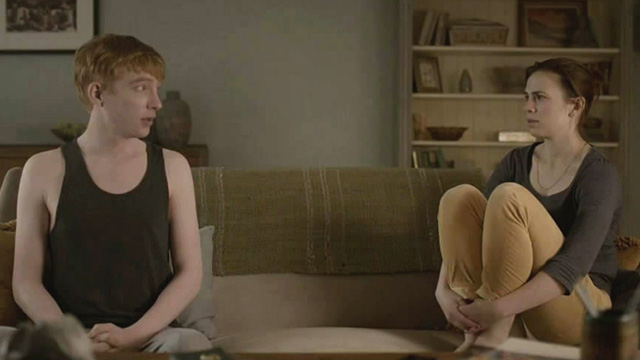
Brooker addresses this idea in the opening episode to Series 2, ‘Be Right Back’. It asks: what happens when the effect of reproduction is enacted upon humans? When the human body and individual personality itself is subjected to fetishism; when the self is fragmented into the myriad traces of text it has trailed in its online life? Jacques Derrida defined the trace as ‘the sign of the presence of an absence’: the uncanny occupation of a liminal position between the real and the imaginary, between the sign and the signified – a rift tearing up the easy system of metaphysics, of our knowledge of what exists, and how.

In Brooker’s fiction (fictional, or half-fictional? Genre itself eludes simple definition – the series lingers between dystopia, horror, realism…hyper-realism), it is possible for a woman to order a cyborg replica of her dead husband. At first, she interacts with an online version rather than a corporeal one. Through instant messenger and phone conversations, she literally contacts her dead husband. And yet it is not really her dead husband, or is it? An assemblage of all the data her social-media-obsessed husband left in traces online, his presence is itself a trace: an uncanny ghost voice constructed from dead voices.

This is the uncanny resonance of the title: ‘be right back’. It hauntingly resonates with the much-used phrase familiar to all users of instant messengers, the signal that one’s physical presence will briefly be absent, although they are not fully ‘gone’ – they haven’t logged offline. ‘Be right back’, you say, when you are going to make a cup of coffee, when you change your status; a signal that your face is no longer behind the screen. ‘Be right back’ is that queer sense of presence/absence that seems to rupture ordinary human interaction, where the interlocutors know each other as corporeal figures and not avatars. The avatar is always present, but it is the mark of an absence: the mark of the speaker’s physical absence. When we talk online, there is always a strangeness, a distance, a whiff of the hyper-real; as if we are playing a game, talking to someone who is quite but not quite the person they are.

Source: m.espn.go.com

When the protagonist takes the next step in ordering the robotic facsimile of her beloved deceased, the strangeness is taken to a whole new level. We have the signs of the commodity fetish: delivered in a box, complete with instruction manual and shiny robotic skin. The human body made perfect, made into product. This of course is not itself an innovation: countless sci-fi books and TV series and films have portrayed the human robot, the automaton. What is particularly intriguing is the reproduction of the dead husband’s personality from text. Not handwriting, not speech, but the representation of voice through text.

At times, the robot’s speech is stunted. He tries his best to say the things that ‘Ash’, the former husband, would say. Yet the robot cannot completely replicate the human. ‘Ash’, as the name suggests, is dust, a powdery scattering of human traces, shimmering in the protagonist’s memory, in the character’s online presence, elusive and ethereal. Perpetually present, but not fully there. The mechanical creation cannot assume the body of the deceased; it can only simulate the fragments of his words. The movement of his face, his eyes, or his synthetic limbs will never wholly replicate what once was there. Ash cannot be resurrected, Ash is ash.

The robot’s automatism is primarily recalled when there is a gap between the woman’s memory of her husband and the robot’s personality. The protagonist is painfully reminded of the fact that it is not a real, living thing – not the warm body she once loved, still loves – but a mechanical product. Watching the woman interact with her robotic husband, touching his flawless synthetic skin, listening to the replicated voice of the deceased – at one point even having sex with him – was a disturbing experience. I felt unsettled; certainly I was experiencing the uncanny. The most carnal of human experiences – actual physical contact – simulated by a robot, with another human, completely explodes all notions of the natural by opening up so many strange possibilities.

Yet, as the show reminds us, technology cannot fully replicate reality. It may attempt to deflect our attention from truth – from the truth of death – with its simulations, but there are always points of rupture, where the fabric of the virtual is torn. At one point, the protagonist experiences distress and asks the robot to leave the room when his words don’t match up to her memory: “Ash would have argued” she says.

This uncertainty about the human and the machine haunts throughout Brooker’s award-winning series. How much of our lives has become merely the voices we leave on answer-phones, in text-messages and Facebook statuses? As communication becomes increasingly mediated, do our personalities become more constructed, more performative? With the advantage of anonymity, or the avatar concealment of the face allowed by the internet, people have time to carefully construct their responses, to portray a certain self-image, to play with the unfamiliar. ‘Be Right Back’ highlights the inadequacy of technology to embody – literally – the highly complex, fractured and fluid nature of the human self. Living more and more online, Black Mirror suggests in general, we creep closer and closer to the edge that demarcates our fundamental perceptions – our notions of truth, reality, existence, humanity itself. Brooker says of his show:

Each episode has a different cast, a different setting, even a different reality. But they’re all about the way we live now – and the way we might be living in 10 minutes’ time if we’re clumsy.’

It is this notion of ‘difference’ that creates the uncanny effect. What is the difference between things? The series poses more questions, perhaps, than it answers. Another uncanny effect. Brooker provides multiple possible realities, and thus renders the future with an inherent sense of what Derrida would call ‘undecidability’. It is not like a conventional dystopia, presenting a single, glaring vision warning of the future; instead, it troubles our expectations, it presents numerous ideas of what the next decade, or tomorrow, may hold. The show holds up a mirror to our society, one that is black – foreboding, sinister – and, fundamentally, refracted into different possible outcomes. Yet it is also a void, in the sense that Black Mirror itself is a fiction, where we may lose our sense of the real – collapsing the ever-familiar world of technology portrayed onscreen with our present everyday lives. It is in this threshold between today and tomorrow, between reality and fiction, that Black Mirror lies. And it is in this threshold that we lose our subjectivity, in the overwhelming threat of our own behaviour and the ghostly online world that could collapse our sense of existence.

Works Cited/further reading:

Baudrillard, J. (2006) Simulacra and Simulation, translated by Sheila Faria Glaser, University of Michigan Press.

Bennett, A. and N. Royle (2004) ‘The Uncanny’ in An Introduction to Literature, Criticism and Theory (Harlow: Pearson Education), pp. 34-42.

Black Mirror – Be Right Back [Season 2, Episode 1] by Charlie Brooker.

Felluga, Dino. ‘Modules on Marx: On Fetishism.’ Introductory Guide to Critical Theory. Purdue University. Available at: http://www.purdue.edu/guidetotheory/marxism/modules/marxfetishism.html. Accessed 30/4/13.

The Guardian. (2011). Charlie Brooker: the dark side of our gadget addiction. Available: http://www.guardian.co.uk/technology/2011/dec/01/charlie-brooker-dark-side-gadget-addiction-black-mirror. Last accessed 30/04/13.

Reynolds, J. (2010) ‘Jacques Derrida’. Available at: http://www.iep.utm.edu/derrida/#SH3d. Last accessed 30/04/13.