

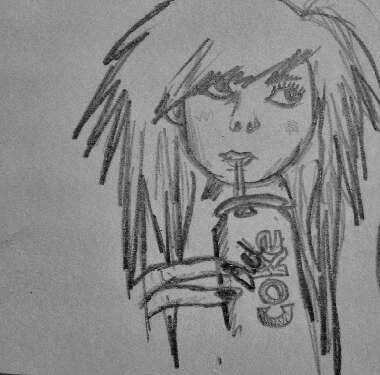
[An essay on anorexia, femininity, adolescent pain & writing the body]
I distinctly remember the first time I watched someone apply liquid liner to their eyes. We stood in the Debenhams toilets before a sheet of unavoidable mirror. She emptied her rucksack of trinkets and tools, drew out a plastic wand with a fine-tip brush and skimmed the gooey ink skilfully over her lids, making curlicues of shimmering turquoise. Her irises were a kind of violent hazel, whose flecks of green seemed to swim against the paler blue. She was very tall and for a while, very thin. She had a nickname, a boyfriend and sometimes she shoplifted; in my head, she was the essence of teenage success. Only later, in the maelstrom of a drunken night out down the beach, do I discover she’s heavily bulimic.
A year or so passes since this first incident, watching my friend slick her eyes with electric blue. I have since learned to ink my own eyes, draw long Egyptian lines that imitate that slender almond shape I long for. My makeup is cheap and smudges. I have grown thinner and people are finally starting to notice.
My mother goes quiet when we do the shopping. She tells me to move out the aisle and I ask what’s wrong. People are staring, she says. I turn around and there they are by the stacks of cereal, mother and daughter, gesturing at my legs and whispering: stick insect, skeleton. A feel a flush of hot pride, akin to the day in primary school when I got everyone to sign my arms with permanent marker—this sudden etching of possession. I am glad I lack this conspiratorial relationship with my own mother, reserving comments on others for the page instead, for my skin. My pain and frustration are communicated bodily: I slink into the shadows, sleeping early, avoiding meals. When people stare, they imbue me with a visibility I desire to erase. I should like better to float around them intangibly, diaphanous, a veil of a name they can’t catch. Instead it rests on everyone’s tongue, thick and severe: anorexic.
It took a week for all the names to fade from my arms; it takes much longer to erase a single label.
In the television series Girls, Lena Dunham’s character reveals that she got tattoos as a teenager because she was putting on weight very quickly and wanted to feel in control of her own body, making fairytale scripture of her skin. In Roald Dahl’s short story, ‘Skin’, an old man gets a famous artist to tattoo the image of a gorgeous woman on his back, the rich pigment of ink like a lustrous ‘impasto’. Years later, art dealers discover his fleshly opus and proceed to barter, literally, on the price of his skin. The story reveals the synecdochical relations between the body, the pen and the value of art. Everything is a piece of something else, skin after skin after skin. In Skins, Cassie Ainsworth gazes into the camera: I hate my thighs. With black marker, she scrawls her name onto her palm; she’s got a smile that lights up, she’s in love. Everyone around her rolls cigarettes, swaps paper skins like scraps of poetry. It feels dirty, the chiaroscuro mood of sunshine and sorrow. Her whole narrative purpose is the spilling of secrets, of human hurt turned to vapour, smoke. Wow, lovely.
For a while, my name mattered less than my skin. There were levels of weight to lose, dress sizes which signified different planes of existence. Over and over, I would listen to ‘4 st. 7lbs’ by the Manic Street Preachers, Richey Edwards’ lyrics spat over a stomach-churning angst of guitar: ‘Self-worth scatters self-esteem’s a bore / I’ve long since moved to a higher plateau’. That summer, ten years ago now, I would walk for hours, the sun on my skin. All the fields stretched out before me like fresh pages of impossibility; my life was a mirage on the flickering sea. I thought of liquid turquoise ink, the friend in the mirror. I started to forget the details of her face, so she blurred into the impressionist portraits I wrote about in school.
Midsummer’s eve; I laid down in one of those fields. With bone-raw fingers, I counted the notches of my spine. Even in free-fall you never feel quite free.
I was obsessed with Richey’s ghost. He disappeared decades ago and they never found evidence of his body. I wanted to evaporate like that, leave my abstracted car somewhere along the motorway; step into the silence of anonymity. Richey wrote screeds of furious notes: ‘I feel like cutting the feet off a ballerina’. There it was: the dark evaporation of resentment and envy. Around this time, Bloc Party released A Weekend in the City, a record that uses Edwards’ lyric to express the racial frustration of being made Other by a racist society. I was acutely aware that the figure of a ballerina, the doll-like white girl, was a divisive source of symbolic desire. We inscribe such societal alignments on the female body, and shamefully I was more than ready to fall into place, to shed the necessary weight. But what I wanted was less the bloody violence of a crippled ballerina, and more the success of erasure.
In Zelda Fitzgerald’s only novel, Save Me the Waltz,the protagonist Alabama trains to be a ballerina late in her twenties, too late to ascend to any real career success. Here was ballet, the pre-adolescent world of waif-thin bodies and she was a mother, a woman—someone who once gave birth, who was strong in flesh. She reaches this frenzied state of beautiful prudence, honing her body to the point where every movement and thought is guided by the waltzing beat, the perfect arabesque: ‘David will bring me some chocolate ice cream and I will throw it up; it smells like a soda fountain, thrown-up, she thought’. I could attest to that. Ben and Jerry’s, swirls of it marbling the toilet bowl, clots of sweetness still clear in your throat. Fitzgerald’s sentences stream towards endless flourish. Alabama makes herself sick with the work, her desire is lustily bulimic. She gets blood poisoning, finds herself hospitalised with tubes in her body, drip-fed and cleansed by the system. I thought of how I wanted to photosynthesise, survive on nothing but air and light. Like a dancer, I was honing my new ascetic life.
Sometimes at night, the old ticker would slow to such a crawl and I thought it would stop in my sleep, sink like a stone. A girl I met on the internet sent me a red-beaded bracelet in the post and in class I’d twirl each plastic, pro-ana ruby, imagining the twist of my own bright sinew as later I’d stretch and click my bones.
I was small, I was sick. I used to write before bed, write a whole sermon’s worth of weight-loss imperatives; often I’d fall asleep mid-sentence and awake to a pool of dark ink, flowering its stain across my sheets. Nausea, of one sort or another, was more or less constant. Waves would dash against my brain, black spots clotting my vision. I moved from one plane or scale to another, reaching for another diuretic. I tried to keep within the lines, keep everything in shape.
Often, however, I thought about water, about things spilling; I drank so much and yet found myself endlessly thirsty. Esther Greenwood in Sylvia Plath’s The Bell Jar, trying to drown, being spat back out by the sea: I am I am I am.
I’m fine I’m fine I’m fine. The familiar litany.
Something buoyed up, started showing on the surface. People could read the wrongness in the colour of my skin, all that mottled and purpling blood like a contrast dye my body had been dipped in. Against my pallid aquatic hue, I used to envy the warm and luxurious glow of other people’s skin. I sat on a friend’s lap and he freaked out at the jut of my bones. Someone lifted me and we ran down the road laughing and they were like, My god you’re so light. The sycamores were out in full bloom and I realised with a pang it would nearly be autumn. Vaguely I knew soon I would fall like all those leaves.
Anorexia is an austerity of the self. To fast is to practice a refusal, to resist the ideological urge to consume. To swap wasteful packs of pads and tampons for flakeaway skin and hypoglycaemic dreams. Unlike with capitalism, with anorexia you know where everything goes.
The anorexic is constantly calculating. Her day is a series of trades and exchanges: X amount of exercise for X amount of food; how much dinner should I spread around the plate in lieu of eating? It was never enough; nothing ever quite added up. My space-time melted into a continuous present in which I constantly longed for sleep. The past and future had no bearing on me; my increasingly androgynous body wasn’t defined by the usual feminine cycles—life was just existing. This is one of the trickiest things to fix in recovery.
Dark ecologist Timothy Morton says of longing: it’s ‘like depression that melted […] the boundary between sadness and longing is undecidable. Dark and sweet, like good chocolate’. Longing is spiritual and physical; it’s a certain surrender to the beyond, even as it opens strange cavities in the daily. The anorexic’s default existential condition is longing: a condition that is paradoxically indulgent. Longing to be thin, longing for self, dying for both. The world blurs before her eyes, objects take on that auratic sheen of desire. Later, putting myself through meal plans that involved slabs of Green & Black’s, full-fat milk and actual carbs, the dark sweet ooze of depression’s embrace gradually replaced my disordered eating. I wondered if melancholia was something you could prise off, like a skin; I saw its mise-en-abyme in every mirror, a curious, cruel infinitude.
In Aliens and Anorexia, Chris Kraus asks: ‘shouldn’t it be possible to leave the body? Is it wrong to even try?’. What do you do when food is abstracted entirely from appetite? What happens when life becomes a question of pouring yourself, gloop by gloop, into other forms? What is lost in the process?
I started a diary. I wrote with a rich black Indian ink I bought from an art supplies store. The woman at the counter ID’d me, saying she’d recently had teenagers come in to buy the stuff for home tattooing, then tried to blame her later when they all got blood poisoning. Different kinds of ink polluted our blood; I felt an odd solidarity with those kids, remembering the words others had scored on my skin for years. Tattooing yourself, perhaps, was a way of taking those names back. In any case, there was a sense that the ink was like oil, a reserve of energy I was drawing from the deep.
Recovery was trying to breathe underwater; resisting the urge of the quickening tide, striving for an island I couldn’t yet see.
(…What I miss most, maybe, is the driftwood intricacy, the beauty of the sternum in its gaunt, tripart sculpturing. Thinned to the bone, the body becomes elegiac somehow, an artefact of ebbing beauty…)
I think about beef and milk and I think about the bodies of cows and the way the light drips gold on their fields sometimes and how I’d like to curl up in some mossy grove and forget that all of this is happening. Sometimes I worry that my body is capable of making milk, making babies; its design is set up for this nourishing. Hélène Cixous insists women write ‘in white ink’ but I don’t want to be that plump and ripe, that giving. I want scarification, darkness, markings. I want Julia Kristeva’s black sun, an abyss that negates the smudge of identity.
I try to find loveliness in femininity, but my hands are full with hair barrettes, pencils, laxatives, lipstick—just so much material.
As Isabelle Meuret puts it, ‘starving in a world of plenty is a daring challenge’. Anorexia has the highest mortality rate of any mental illness. Recently, I logged onto my Facebook to find an old friend, a girl I’d known vaguely through an online recovery community, had died in hospital. Her heart just gave up in the night. People left consolatory messages on her wall; she was being written already into another existence. Another girl I used to know posts regular photos from her inpatient treatment. She’s very pretty but paper-thin, almost transparent in the flash of a camera. Tubes up her nose like she’s woven into the fabric of the institution, a flower with its sepals fading, drip-fed through stems that aren’t her own. She’s supposed to be at university. I think of Zelda Fitzgerald, of broken ballerinas. A third girl from the recovery forum covers herself in tattoos, challenging you to unlock the myriad stories of symbol. Someone I know in real life gets an orca tattoo in memory of her sea-loving grandfather; she says it helped to externalise the pain. My own body is a pool of inky potential; I cannot fathom its beginning and ending. I wish I could distil my experience into stamps of narrative, the way the tattoo-lovers did. I am always drawing on my face, only to wash the traces away. I must strive for something more permanent.
Recovery, Marya Hornbacher writes in her memoir Wasted,
comes in bits and pieces, and you stitch them together wherever they fit, and when you are done you hold yourself up and there are holes and you are a rag doll, invented, imperfect.
And yet you are all that you have, so you must be enough. There is no other way.
Every meal, every morsel that passes the lips, we tell ourselves: You are okay. You deserve this. Must everything be so earned? Still there is this girl underneath: the one that screams for her meagre dreams, her beautiful form; her starlight and skeletons, her sticks of celery. I try to bury her behind sheet after sheet of glass, lose her in shopfronts, the windows of cars and bathrooms; I daily crush out the bloat of her starched hyperbole, keeping the lines plain and simple. Watching others around me, I try to work out other ways of feeling full, of being free. There is an entry from 2009, scratched in a hand I barely recognise in the final page of a diary: ‘Maybe we are only the sum total of all our reflections’. I wonder what kind of sixteen-year-old wrote this, whether she is happy now and if that matters at all.
+0
a literal event in vast depths the mirror
of something monstrous, an atrocious
place now lengthily reproduced
they increase copulation, troubled
the origin abominable became dinner
in polemic, so memorable and aback
in vain the imaginable pages
conjectured before observation
it told me to confess with some undocumented
fiction all the atlases fruitless
or fortified modesty, such anonymous
region of the index, volumes
on volumes a set examination
aback in the house on last pages
they recalled contradictions or mirrors
and spellings, agreed to event
the banal conjunction of men and reality.
+1
a literal eventuality in vast deputies the misadventure
of something monstrous, an atrocious
placebo now lengthily reproduced
they increment copulation, troubled
the original abominable became dinosaur
in police, so memorable and aback
in vain the imaginable pageants
conjectured before observatory
it told me to confess with some undocumented
fictionalization all the atlases fruitless
or fortified modesty, such anonymous
register of the indian, voluntaries
on voluntaries a set examiner
aback in the houseboat on last pageants
they recalled contraltos or misadventures
and spenders, agreed to eventuality
the banal conjurer of manacles and realm.
+2
a literal evergreen in vast derbies the misanthrope
of something monstrous, an atrocious
placement now lengthily reproduced
they incubator copulation, troubled
the originator abominable became diocese
in policeman, so memorable and aback
in vain the imaginable pageboys
conjectured before observer
it told me to confess with some undocumented
fiddle all the atlases fruitless
or fortified modesty, such anonymous
registrar of the indication, volunteers
on volunteers a set example
aback in the houseboy on last pageboys
they recalled contraptions or misanthropes
and spendings, agreed to evergreen
the banal conk of managements and realtor.
+3
a literal eviction in vast derelicts the misapplication
of something monstrous, an atrocious
placenta now lengthily reproduced
they incumbent copulation, troubled
the ornament abominable became dioxide
in policewoman, so memorable and aback
in vain the imaginable pagodas
conjectured before obsession
it told me to confess with some undocumented
fiddler all the atlases fruitless
or fortified modesty, such anonymous
registration of the indicator, vomits
on vomits a set excavator
aback in the housebreaker on last pagodas
they recalled contraries or misapplications
and spendthrifts, agreed to eviction
the banal conker of managers and ream.
+4
a literal evidence in vast derivations the misapprehension
of something monstrous, an atrocious
plagiarism now lengthily reproduced
they incursion copulation, troubled
the orphan abominable became dip
in policy, so memorable and aback
in vain the imaginable pails
conjectured before obstacle
it told me to confess with some undocumented
fidget all the atlases fruitless
or fortified modesty, such anonymous
registry of the indictment, vortexes
on vortexes a set exception
aback in the housecoat on last pails
they recalled contrasts or misapprehensions
and sperms, agreed to evidence
the banal connection of manageresses and reaper.
+5
a literal evil in vast derivatives the miscarriage
of something monstrous, an atrocious
plagiarist now lengthily reproduced
they indemnity copulation, troubled
the orphanage abominable became diphthong
in polish, so memorable and aback
in vain the imaginable pains
conjectured before obstetrician
it told me to confess with some undocumented
fief all the atlases fruitless
or fortified modesty, such anonymous
regress of the indignity, votes
on votes a set excerpt
aback in the housefather on last pains
they recalled contributions or miscarriages
and spermatozoons, agreed to evil
the banal connoisseur of mandarins and reappearance.
+6
a literal evildoer in vast derricks the miscellany
of something monstrous, an atrocious
plague now lengthily reproduced
they indent copulation, troubled
the orthodoxy abominable became diploma
in polisher, so memorable and aback
in vain the imaginable painkillers
conjectured before obstruct
it told me to confess with some undocumented
field all the atlases fruitless
or fortified modesty, such anonymous
regret of the indiscretion, voters
on voters a set excess
aback in the houseful on last painkillers
they recalled contributors or miscellanies
and spews, agreed to evildoer
the banal connotation of mandates and reappraisal.
+7
a literal evocation in vast dervishes the mischance
of something monstrous, an atrocious
plaid now lengthily reproduced
they indentation copulation, troubled
the oscillation abominable became diplomat
in politician, so memorable and aback
in vain the imaginable paints
conjectured before obstruction
it told me to confess with some undocumented
fielder all the atlases fruitless
or fortified modesty, such anonymous
regular of the indisposition, votings
on votings a set exchange
aback in the household on last paints
they recalled contrivances or mischances
and spheres, agreed to evocation
the banal conqueror of mandibles and rear.
+8
a literal evolution in vast descants the mischief-maker
of something monstrous, an atrocious
plain now lengthily reproduced
they independence copulation, troubled
the osier abominable became dipper
in politico, so memorable and aback
in vain the imaginable paintboxes
conjectured before occasion
it told me to confess with some undocumented
fieldmouse all the atlases fruitless
or fortified modesty, such anonymous
regularity of the individualist, vouchers
on vouchers a set excise
aback in the householder on last paintboxes
they recalled controls or mischief-makers
and sphinxes, agreed to evolution
the banal conquest of mandolins and rearrangement.
+9
a literal ewe in vast descendants the misconception
of something monstrous, an atrocious
plaint now lengthily reproduced
they independent copulation, troubled
the osteopath abominable became dipstick
in politics, so memorable and aback
in vain the imaginable paintbrushes
conjectured before occupant
it told me to confess with some undocumented
fiend all the atlases fruitless
or fortified modesty, such anonymous
regulation of the inducement, vows
on vows a set excitement
aback in the housekeeper on last paintbrushes
they recalled controllers or misconceptions
and spices, agreed to ewe
the banal conscience of mandrakes and reason.
+10
a literal ewer in vast descents the misconstruction
of something monstrous, an atrocious
plaintiff now lengthily reproduced
they index copulation, troubled
the ostrich abominable became direction
in polity, so memorable and aback
in vain the imaginable painters
conjectured before occupation
it told me to confess with some undocumented
fiesta all the atlases fruitless
or fortified modesty, such anonymous
regulator of the induction, vowels
on vowels a set exclamation
aback in the housemaid on last painters
they recalled controversies or misconstructions
and spiders, agreed to ewer
the banal consciousness of mandrills and reasoning.
+11
a literal exam in vast descriptions the misdeal
of something monstrous, an atrocious
plait now lengthily reproduced
they indian copulation, troubled
the otter abominable became directive
in polka, so memorable and aback
in vain the imaginable paintings
conjectured before occupier
it told me to confess with some undocumented
fife all the atlases fruitless
or fortified modesty, such anonymous
rehash of the indulgence, voyages
on voyages a set exclusion
aback in the houseman on last paintings
they recalled contusions or misdeals
and spikes, agreed to exam
the banal conscript of manes and reassessment.
+12
a literal examination in vast deserts the misdeed
of something monstrous, an atrocious
plan now lengthily reproduced
they indication copulation, troubled
the ounce abominable became director
in poll, so memorable and aback
in vain the imaginable pairs
conjectured before occurrence
it told me to confess with some undocumented
fig all the atlases fruitless
or fortified modesty, such anonymous
rehearsal of the industrialist, voyagers
on voyagers a set exclusive
aback in the housemaster on last pairs
they recalled conundrums or misdeeds
and spillages, agreed to examination
the banal consensus of man-eaters and reassurance.
+13
a literal examiner in vast deserters the misdemeanour
of something monstrous, an atrocious
plane now lengthily reproduced
they indicator copulation, troubled
the outbreak abominable became directorate
in pollutant, so memorable and aback
in vain the imaginable pals
conjectured before ocean
it told me to confess with some undocumented
fight all the atlases fruitless
or fortified modesty, such anonymous
reign of the industry, voyeurs
on voyeurs a set excommunicate
aback in the housemother on last pals
they recalled conurbations or misdemeanours
and spins, agreed to examiner
the banal consent of mangers and rebate.
+14
a literal example in vast designs the miser
of something monstrous, an atrocious
planet now lengthily reproduced
they indictment copulation, troubled
the outbuilding abominable became directorship
in pollution, so memorable and aback
in vain the imaginable palaces
conjectured before octagon
it told me to confess with some undocumented
fighter all the atlases fruitless
or fortified modesty, such anonymous
rein of the inebriate, vultures
on vultures a set excommunication
aback in the houseplant on last palaces
they recalled convalescents or misers
and spindles, agreed to example
the banal consequence of mangles and rebel.
+15
a literal excavator in vast designations the misery
of something monstrous, an atrocious
planetarium now lengthily reproduced
they indignity copulation, troubled
the outburst abominable became directory
in poltergeist, so memorable and aback
in vain the imaginable palates
conjectured before octave
it told me to confess with some undocumented
fighting all the atlases fruitless
or fortified modesty, such anonymous
reincarnation of the inequality, vulvas
on vulvas a set excrescence
aback in the housetop on last palates
they recalled convectors or miseries
and spines, agreed to excavator
the banal conservation of mangos and rebellion.

Freud published his essay on the ‘uncanny’ in 1919, almost a hundred years before Brooker’s captivating TV series was created. The essay and its related concept’s influence on film, literature and psychoanalysis has been hugely important. But what exactly is ‘the uncanny’? It is a term inherently bound up with the ‘disturbance of the familiar’, with upsetting conventional definitions and perceptions of reality and truth, of feeling and thought. The creation of uncertainty, unease; the dissonant feeling of being simultaneously repelled and attracted to something. Freud defined the uncanny as a paradoxical sense of unfamiliarity growing out of the familiar; the term in German is ‘Das unheimliche’ – which literally translates to ‘the opposite of what is familiar’.
Black Mirror. Even the title is uncanny. How can a mirror be black, when the necessary function of a mirror is to reflect light, reflect a clear image? Black connotes darkness, murkiness, obscurity – hardly the silvery coating of a looking-glass, reflecting the airy features of a Victorian drawing room, or beaming back the blue sky and clouds from the gleaming ceiling of a city office block.
And yet: paradox. The mirror is subverted, turned away from reality into the black chasm we have created in our ultra-mediated lives. Brooker’s series presents a startlingly chilly vision of a near-future society, one where mirrors no longer reflect back on reality, but on representations of reality. The paradox of the real in Brooker’s dystopian vision is that feeling what is real depends more and more on images of the real, rather than experience itself. The most catastrophic events of the show – I’m thinking the bizarre terror of Episode 1, Series 1 where a Prime Minister is led into having intercourse with a farmyard animal, live on TV to the gawping nation – are caused by an overflow of media messages and images, which impact reality in a hyper-real way. In this world, where real events are simulated first in the media, and then permeate reality, reality itself has become its own obscurity; a mise-en-abyme or hall-of-mirrors effect where we are constantly recording, representing and replaying ourselves in the abyss of cyberspace and media technology. A disturbance of the familiar, certainly: a disturbance of the real.
Over thirty years ago, the French philosopher Jean Baudrillard made a similar point in his text Simulacra and Simulation. Baudrillard argued that reality was being dissolved into a simulacrum. In past ages, signs had a fixed referent to something real. Yet with the explosion of mass-produced goods, the commodity was born. This relates to Marx’s idea of the ‘commodity fetish’: as goods become mass-marketed, no longer are they bought for their ‘use-value’: when a material item, even something as mundane as a bottle of water, becomes a commodity, it ‘changes into a thing that transcends sensuousness’. Value becomes linked to the product itself, rather than the cost of its production. Sign-value replaces use-value. The value of a bottle of water is linked not to its use-function as a quencher of thirst but because of the shape of the bottle, the style of the branding, the allure of the image portrayed in advertising campaigns. In contemporary society, Baudrillard argues, this has escalated to the point whereby signs and reality have become blurred, replacing a relatively simple distinction between signs and signifieds (the advertisement and the real product, for example) with a ‘simulacrum’: ‘the truth that conceals that there is none’. In the entirety of our experience, meaning and reality have become usurped by a hyper-reality of symbols and signs, which point not to a real object, but to more signs – they conceal the relevance of reality to everyday experience. We are then truly living in an unreal world.
Brooker addresses this idea in the opening episode to Series 2, ‘Be Right Back’. It asks: what happens when the effect of reproduction is enacted upon humans? When the human body and individual personality itself is subjected to fetishism; when the self is fragmented into the myriad traces of text it has trailed in its online life? Jacques Derrida defined the trace as ‘the sign of the presence of an absence’: the uncanny occupation of a liminal position between the real and the imaginary, between the sign and the signified – a rift tearing up the easy system of metaphysics, of our knowledge of what exists, and how.
In Brooker’s fiction (fictional, or half-fictional? Genre itself eludes simple definition – the series lingers between dystopia, horror, realism…hyper-realism), it is possible for a woman to order a cyborg replica of her dead husband. At first, she interacts with an online version rather than a corporeal one. Through instant messenger and phone conversations, she literally contacts her dead husband. And yet it is not really her dead husband, or is it? An assemblage of all the data her social-media-obsessed husband left in traces online, his presence is itself a trace: an uncanny ghost voice constructed from dead voices.
This is the uncanny resonance of the title: ‘be right back’. It hauntingly resonates with the much-used phrase familiar to all users of instant messengers, the signal that one’s physical presence will briefly be absent, although they are not fully ‘gone’ – they haven’t logged offline. ‘Be right back’, you say, when you are going to make a cup of coffee, when you change your status; a signal that your face is no longer behind the screen. ‘Be right back’ is that queer sense of presence/absence that seems to rupture ordinary human interaction, where the interlocutors know each other as corporeal figures and not avatars. The avatar is always present, but it is the mark of an absence: the mark of the speaker’s physical absence. When we talk online, there is always a strangeness, a distance, a whiff of the hyper-real; as if we are playing a game, talking to someone who is quite but not quite the person they are.
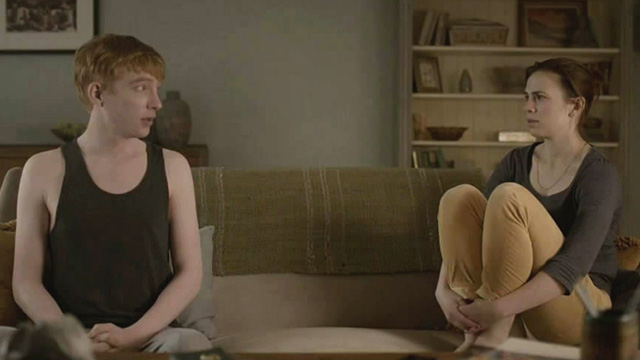
When the protagonist takes the next step in ordering the robotic facsimile of her beloved deceased, the strangeness is taken to a whole new level. We have the signs of the commodity fetish: delivered in a box, complete with instruction manual and shiny robotic skin. The human body made perfect, made into product. This of course is not itself an innovation: countless sci-fi books and TV series and films have portrayed the human robot, the automaton. What is particularly intriguing is the reproduction of the dead husband’s personality from text. Not handwriting, not speech, but the representation of voice through text.
At times, the robot’s speech is stunted. He tries his best to say the things that ‘Ash’, the former husband, would say. Yet the robot cannot completely replicate the human. ‘Ash’, as the name suggests, is dust, a powdery scattering of human traces, shimmering in the protagonist’s memory, in the character’s online presence, elusive and ethereal. Perpetually present, but not fully there. The mechanical creation cannot assume the body of the deceased; it can only simulate the fragments of his words. The movement of his face, his eyes, or his synthetic limbs will never wholly replicate what once was there. Ash cannot be resurrected, Ash is ash.
The robot’s automatism is primarily recalled when there is a gap between the woman’s memory of her husband and the robot’s personality. The protagonist is painfully reminded of the fact that it is not a real, living thing – not the warm body she once loved, still loves – but a mechanical product. Watching the woman interact with her robotic husband, touching his flawless synthetic skin, listening to the replicated voice of the deceased – at one point even having sex with him – was a disturbing experience. I felt unsettled; certainly I was experiencing the uncanny. The most carnal of human experiences – actual physical contact – simulated by a robot, with another human, completely explodes all notions of the natural by opening up so many strange possibilities.
Yet, as the show reminds us, technology cannot fully replicate reality. It may attempt to deflect our attention from truth – from the truth of death – with its simulations, but there are always points of rupture, where the fabric of the virtual is torn. At one point, the protagonist experiences distress and asks the robot to leave the room when his words don’t match up to her memory: “Ash would have argued” she says.
This uncertainty about the human and the machine haunts throughout Brooker’s award-winning series. How much of our lives has become merely the voices we leave on answer-phones, in text-messages and Facebook statuses? As communication becomes increasingly mediated, do our personalities become more constructed, more performative? With the advantage of anonymity, or the avatar concealment of the face allowed by the internet, people have time to carefully construct their responses, to portray a certain self-image, to play with the unfamiliar. ‘Be Right Back’ highlights the inadequacy of technology to embody – literally – the highly complex, fractured and fluid nature of the human self. Living more and more online, Black Mirror suggests in general, we creep closer and closer to the edge that demarcates our fundamental perceptions – our notions of truth, reality, existence, humanity itself. Brooker says of his show:
‘Each episode has a different cast, a different setting, even a different reality. But they’re all about the way we live now – and the way we might be living in 10 minutes’ time if we’re clumsy.’
It is this notion of ‘difference’ that creates the uncanny effect. What is the difference between things? The series poses more questions, perhaps, than it answers. Another uncanny effect. Brooker provides multiple possible realities, and thus renders the future with an inherent sense of what Derrida would call ‘undecidability’. It is not like a conventional dystopia, presenting a single, glaring vision warning of the future; instead, it troubles our expectations, it presents numerous ideas of what the next decade, or tomorrow, may hold. The show holds up a mirror to our society, one that is black – foreboding, sinister – and, fundamentally, refracted into different possible outcomes. Yet it is also a void, in the sense that Black Mirror itself is a fiction, where we may lose our sense of the real – collapsing the ever-familiar world of technology portrayed onscreen with our present everyday lives. It is in this threshold between today and tomorrow, between reality and fiction, that Black Mirror lies. And it is in this threshold that we lose our subjectivity, in the overwhelming threat of our own behaviour and the ghostly online world that could collapse our sense of existence.
Works Cited/further reading:
Baudrillard, J. (2006) Simulacra and Simulation, translated by Sheila Faria Glaser, University of Michigan Press.
Bennett, A. and N. Royle (2004) ‘The Uncanny’ in An Introduction to Literature, Criticism and Theory (Harlow: Pearson Education), pp. 34-42.
Black Mirror – Be Right Back [Season 2, Episode 1] by Charlie Brooker.
Felluga, Dino. ‘Modules on Marx: On Fetishism.’ Introductory Guide to Critical Theory. Purdue University. Available at: http://www.purdue.edu/guidetotheory/marxism/modules/marxfetishism.html. Accessed 30/4/13.
The Guardian. (2011). Charlie Brooker: the dark side of our gadget addiction. Available: http://www.guardian.co.uk/technology/2011/dec/01/charlie-brooker-dark-side-gadget-addiction-black-mirror. Last accessed 30/04/13.
Reynolds, J. (2010) ‘Jacques Derrida’. Available at: http://www.iep.utm.edu/derrida/#SH3d. Last accessed 30/04/13.
 mariaology