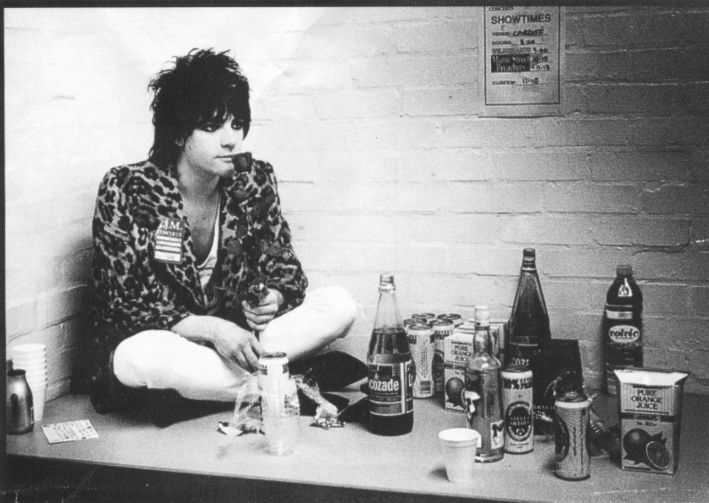
One of my earliest memories is being at my dad’s old flat and messing with the hi-fi player to get attention. It would’ve been around about 1998, the year the Manic Street Preachers released their album, This is My Truth, Tell Me Yours. Maybe my dad and my brother were watching rugby on T.V or something, and I’d read all the books I’d brought with me. Well anyway, I thought of a keen plan to wind them up. I turned on the hi-fi and skipped to my dad’s favourite song (at least, his favourite song that wasn’t anything by U2!) and let it play. Loudly. And then I put it on repeat. And then I stopped letting it play out; I just played the first bar or so then pressed repeat and played it again, as if it were on a loop, inducing hypnosis. Incidentally, those first few notes are inscribed into my memory. The song was ‘You Stole the Sun from My Heart’.
Since then, I’ve drifted through life with the Manics not far from my consciousness. When I was about fourteen, I discovered some of the darker tracks from The Holy Bible online and basically that was me sorted for emotional outlet. What better lyrics do you need as an existentially-frustrated teenager than: ‘self-worth scatters, self-esteem’s a bore’? However, it’s only this summer that I’ve come to properly listen to the album in full. By pure coincidence, it just so happens that this year marks the 20th anniversary of The Holy Bible’s release. I was one year old when it came out. Funny, how it still rasps with fresh energy, all these years later when a whole new generation are beginning to appreciate it. It has songs about capital punishment, anorexia, the Holocaust, prostitution, aching nostalgia, suicide and (metaphorical) political sex scandals. At times it can be painful to listen to, with its throbbing, angry bass-lines, and packed-in lyrics which scream razor-sharp poetry: ‘Your idols speak so much of the abyss / Yet your morals only run as deep as the surface’ (‘IfwhiteAmericatoldthetruthforonedayitsworldwouldfallapart’). James Dean Bradfield is a master at the smashing (in the literal sense of smashing), punkish guitar rhythms and sailing solos that almost make your brain hurt. At the same time as being able to throw out all those lines, a million a minute. It’s brilliant. I can only imagine how amazing it must’ve felt, back then, to go out and buy this brand new album and listen to it on a Walkman and feel, more than ever, electric and alive. And angry at everything.
The Holy Bible is now considered an early 1990s classic, to be filed alongside the (considerably cheerier) offerings of 90s Britpop; for example, Oasis’s Definitely Maybe (1994) and (What’s the Story) Morning Glory? (1995), and the holy bible of grunge, Nirvana’s Nevermind (1991). While the rest of British music was penning the likes of ‘Live Forever’, ‘Rock and Roll Star’ and ‘Park Life’ – drunk anthems for the boozy masses (and still we love them, if only in secret) – the Manics were deconstructing contemporary society (class, political injustice, historical trauma) and existential crisis through the spike-edged modes of punk, pessimism and fury.
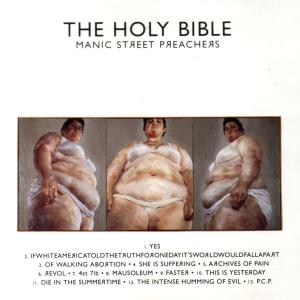
Moreover, as its title suggests, The Holy Bible is more than just an album: it’s also a text. A network of references and quotes, provocative enough to set you on a trail of philosophical and literary discovery. The voracious listener is able to devour even more information by following up the sources scattered over its songs, learning at the same time as participating in this performance of knowledge. Camus, Foucault, Plath and others haunt this album, through direct references but also aesthetics. There’s Plath’s visceral emphasis on the body and its various contortions and distortions, its ruptures and vulnerabilities: ‘a tiny animal curled into a quarter circle’ (‘Die in the Summertime’). The title of track ‘Archives of Pain’ pays homage a chapter in David Macey’s 1993 biography of French philosopher Michel Foucault (who wrote Discipline and Punish), and the song itself considers changing societal values with regards to punishment, although it is ambiguous as to whether the song advocates a return to capital punishment, or a refusal of the glorification of serial killers. Lyrics such as ‘prisons must bring their pain’ and ‘the centre of humanity is cruelty’ offer a bleak, Lord of the Flies rendering of humankind’s essential lust for destruction, its need for revenge. While Nicky Wire and Richey Edwards collaborated on its lyrics, Richey seems to claim it as a ‘pro-capital punishment song’ (see Harris 2004), while Nicky told music magazine Melody Maker: ‘everyone gets a self destructive urge to kill, but I don’t particularly like the glorification of it. The song isn’t a right-wing statement, it’s just against this fascination with people who kill’ (cited in Power 2010). The ethical ambiguity of this song adds to its disturbing quality, its fury that cannot quite be pinned down.
The album also crackles with various audio samples, a ghost chamber of voices which include a fragment from an interview with the mother of a victim of Peter Sutcliffe (the 1946 so-called ‘Yorkshire Ripper’):
I wonder who you think you are
You damn well think you’re God or something
God give life, God taketh it away, not you
I think you are the Devil itself
And when you hear it, you’re chilled to the bone, before being thrown into the savage world of ‘Archives of Pain’. There’s also a quote from the author J. G. Ballard talking about his controversial novel Crash (1973), which flashes in as a soundbite on ‘Mausoleum’: ‘I wanted to rub the human face in its own vomit, force it to look in the mirror’. Mausoleum is a song inspired by a visit to Auschwitz, to the barren landscapes where concentration camps once existed, but still linger. The chorus is simply:
No birds – no birds
The sky is swollen black
No birds – no birds
Holy mass of dead insect
It’s painful and bare, so that listening to it, you imagine a dark carcass of a sky, heavy with the traumatic void of its past. The ‘dead insect’ which serves not only as an image of the barren remainders of death, but also perhaps as a reference to those swarms of people who were so brutally dehumanised during World War Two. And Ballard’s quote captures everything about The Holy Bible: it’s visceral, it forces you to confront the shadows of your own self, and of humanity. It provokes an abject reaction, through its images of self-harm, dismemberment, corrupt sex and violence. At the same time, it ‘obliterates your meaning’ (‘Mausoleum’); it shatters all attempts to make sense of the traumatic events it references. The conventional linear progression of melody and song and perhaps even narrative in an album is broken up with intertexts and ghosts, and perhaps that’s why it still lives on today. Unlike, perhaps, an Oasis album, which is nostalgically evocative of more simpler, hopeful times, it doesn’t feel in the least bit dated. Its endless trail of references add shadow and depth to its meaning.

But perhaps, listening to it now, you feel that it’s haunted most by Richey Edwards himself, the band’s fourth member who penned (Nicky Wire has claim to the other quarter) 75% of the lyrics. Following bouts of depression, self-harm and an eating disorder, Richie disappeared one morning in January 1995, just before he and James were due to visit the U.S. on a promotional tour. In February, his car was found abandoned at a service station near the Severn Bridge. Since then, almost twenty years on, still no evidence or trace of Edwards has been found. Even though he was pronounced officially ‘presumed dead’ a few years ago, the aporia of his disappearance remains. Of course, this allows fans to string mythological tales about his reappearances around the world. The lack of closure is perhaps what is most distressing: the not-knowing, the sense that at any time he could come back into his friend’s and family’s lives. Listening to The Holy Bible, Richey’s personal suffering is of course inscribed in every line, even though most of the lyrics reach a universal, almost transcendental pain at times: ‘I’ve long since moved to a higher plateau’ (‘4st. 7lbs’). And then you hear him when listening to the Manics’ later albums, which are still full of Richey’s presence/non-presence in the band: ‘You keep giving me your free air miles / What would I give just for one of your smiles’ (‘Nobody Loved You’), and ‘As holy as the soil that buries your skin / As holy as the love we’ll never give / As holy as the time that drifted away / I love you so will you please come home’ (‘As Holy as the Soil (That Buries Your Skin)’). Richey’s bandmates even dug out his old notebooks, with permission from his family, to use as the lyrics for their 2009 album, Journal for Plague Lovers. Maybe the most painfully intimate Richey track is the final song on this album, ‘William’s Last Words’. Arranged by Wire, it features soft guitar strokes and his crooning, deep voice singing about voyeurism over lines of loss and death that almost sound a melancholy joy:
Isn’t it lovely, when the dawn brings the dew?
I’ll be watching over you
Isn’t it lovely, when the dawn brings the dew
I’ll be watching over you
It ends with the bittersweet lines: ‘I’d love to go to sleep and wake up happy, / Wake up happy’. It’s a stripped-back Manics; it’s simple but stays with you, innocent and chilling, like the blood-spattered Jenny Saville artwork that adorns Journal’s cover:

In this album we also see again that familiar combination of theory and fiery politics, as the opening track references Noam Chomsky’s book, Rethinking Camelot: JFK, The Vietnam War, and US Political Culture (1993):
Riderless horses on Chomsky’s Camelot
Bruises on my hands from digging my nails out
A series of images, against you and me
Trespass your torment if you are what you want to be
The sense of our powerlessness to media and mediated disaster is captured here in just a few frenzied lines. ‘A series of images’: the sense of personal and political conflict flashes past us in handfuls of words, just like the way that war plays out through the flickering light of our television screens. Chomsky’s book documented a critique of Kennedy’s foreign policy in Vietnam, and these themes of military funerals, fallen soldiers, geo-political conflicts and human sacrifice in war are all invoked in a handful of words, powerfully delivered as ever by Bradfield. We might think also of ‘Kevin Carter’, the trumpet-tinged single from Everything Must Go (1996) which documents the story of ‘Bang Bang Club’ and Pulitzer Prize-winning photographer, Kevin Carter, who famously suffered from the haunting scenes of all the killings and suffering he had witnessed (and indeed photographed) and eventually committed suicide. The Manics, not just with their military-inspired outfits, are consistently attuned to themes of war and death.
The mysterious story of Richey and the Manics is of course seductive, and perhaps part of the enshrinement of pain that goes with their mythology, but they are also an incredibly uplifting band. They kick the listener into political engagement, which is refreshing in a time of political apathy (or the complete neglect of politics in most pop and rock music, with the exception, perhaps, of Muse’s Matt Bellamy and his crazy conspiracy theories). Songs like ‘The Masses Against the Classes’ and ‘Design for Life’ are songs about working-class experience and class politics in the post-Thatcher era. Of course, being from Blackwood, an ex-mining town in Wales, the Manics are all familiar with the catastrophic effects of deindustrialisation upon communities. Seeing the life and soul of a town being lain to waste after the rich won the class-wars of the miners’ strikes. Their eleventh studio album, Rewind the Film, closes with the song ’30-Year War’, which references the Battle of Orgreave, the Hillsborough disaster, coverups at the BBC (and oh how there are many – from Savile to Scottish Independence) and has the refrain, ‘the old-boy network won the war again’. It’s depressing, but realistic in our time of austerity. Has much has really changed from the Thatcherite legacies of the early 1990s, when the Manics came into being? Arguably, with the rise of UKIP and a weakening Labour party, the ‘working-class’ opposition to neoliberalism faces an even deeper well of apathy.

On the subject of far right politics, funnily enough last year the far-right English Defence League (EDL) tried to appropriate the Manics’ 1998 hit ‘If You Tolerate This Your Children Will Be Next’ for promoting a demonstration in Birmingham. The song features the pretty much crystal clear lyrics: ‘So if I can shoot rabbits / Then I can shoot fascists’. As well as a lesson in irony, it is probably a reflection on the EDL’s stupidity as much as anything else to choose a song inspired by an anti-fascist slogan used during the Spanish Civil War. The Manics have always been associated with political controversy, from Nicky Wire’s sharpish (‘remember, all men should castrate themselves’) quotes to the band’s iconography (famously, a 1994 performance on Top of the Pops featured Bradfield wearing a ‘terrorist style’ balaclava, albeit with his name scrawled across it playfully like a name sewn onto a school jumper), but in this case, the EDL’s appropriate was too ridiculous and they had to sue.
***
This autumn, the Manics announced that they were finally ready to do a Holy Bible anniversary tour. Although my dad and I jumped on Ticketmaster at 9am, we were unable to grab any tickets for the elusive Barrowlands date, which apparently sold out in two minutes. I’m really gutted (especially as it would have been a welcome reward for finishing uni coursework), as I can’t really imagine a gig that would have quite the same emotional resonance. Nevertheless, the fact that they’re now touring the album means they’re playing it more in general across various forms of media, which is always a great thing. I must admit, it was very satisfying to see James, Nicky and Sean performing ‘Revol’ on Later…With Jools Holland. When Jools interviewed them about the song they were going to play from the Holy Bible, Nicky sort of giggles and says it’s about dictators engaged in metaphorical sex games, some clever idea of Richey’s. There’s an irony that he’s certainly aware of. How commercialised music’s become, how such a song just doesn’t have its place in today’s music world. It’s telling that the two songs chosen to broadcast on the evening show were the poppier (but no less the better!) offerings from their new album, Futurology (2014). The new album is bold, flamboyantly European and even features that rare delight of Nicky singing on the chorus of a leading single, ‘Futurology’. It’s bold – maybe even bombastic – but the boldness is put into relief by the acoustic introspection and self-deprecation that characterised their previous album, Rewind the Film. They just keep reinventing themselves, and that’s the best thing about the Manics: they don’t do paltry repetitions, or parodies of their former selves. Their lyrics stick with you and gather new meanings as each album throws your deepest assumptions into question.
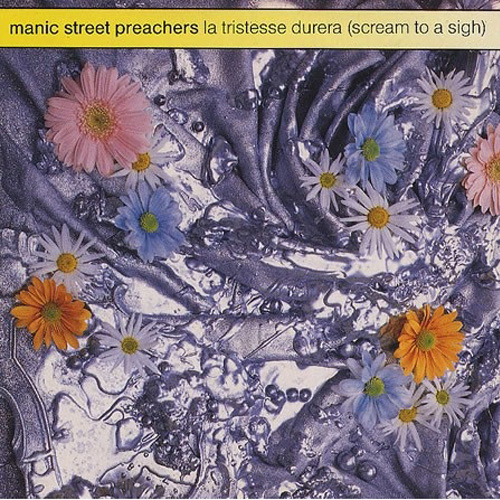
You could argue that the Manics have the paradoxical personality of a child: that strange urge to both disappear and gain all the attention in the world. To ‘walk in the snow and not leave a footprint’ (‘4st. 7lbs’) but also pen the extroverted Krautrock of ‘Europa Geht Durch Mich’, which throws itself into electronic music but also the increasingly frenzied political debates surrounding Europe in Britain right now. And like the child that I once was, trying to break my dad’s CD player by endlessly repeating one of their most successful songs, they go for attention. Their confidence isn’t the laddish arrogance of their Britpop bedfellows, but the endearing ambition and glam aesthetic of their early years and the strong direction that characterises most of their career (maybe Lifeblood was a slip-up, but I think it deserves more than straight dismissal…). It’s an oft-forgotten fact that the Manics’ single ‘The Masses Against the Classes’, was the first British chart No. 1 in the new millennium. It’s a single that begins with Chomsky: ‘The primary role of the government is to protect property from the majority and so it remains’ and ends with Camus: ‘A slave begins by demanding justice and ends by wanting to wear a crown’. Maybe this vicious cycle of capitalist desire and inequality will continue through the millennium, but by god let’s hope there’s still artists like the Manics around to do all they can to critique it. And if that’s not enough for you, then the fact that Nicky Wire went to the Brit Awards wearing an ‘I Love Hoovering’ t-shirt (and the man seriously does love housework) really should. What could be cooler than a Situationist statement which isn’t for once pure hipster irony?
***
Harris, John, 2004. ‘The commitments’ in The Guardian, Available at: http://www.theguardian.com/music/2004/nov/21/popandrock [Accessed 7.11.14].
NME, 2013. ‘Manic Street Preachers take legal action against the English Defence League’ , Available at: http://www.nme.com/news/manic-street-preachers/71397 [Accessed 7.11.14].
Power, Martin, 2010. Manic Street Preachers: Nailed to History (London: Omnibus Press).


 mariaology