The Greatest Loss: Lana Del Rey’s Anthropocene Softcore 

Screenshot 2019-09-08 at 11.26.09.png

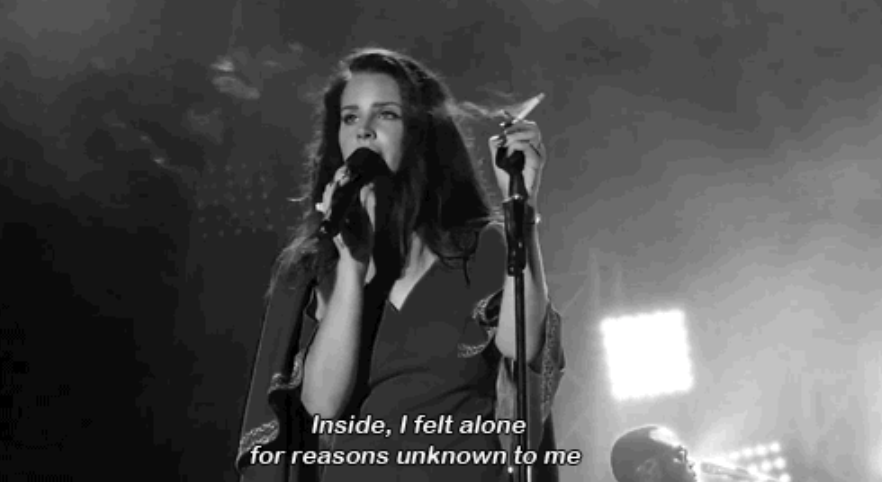
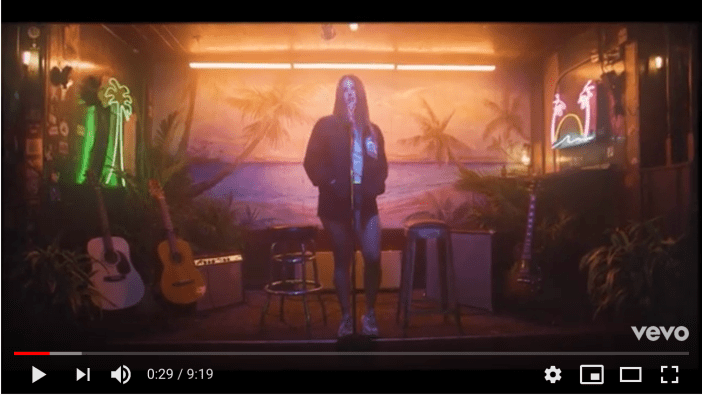
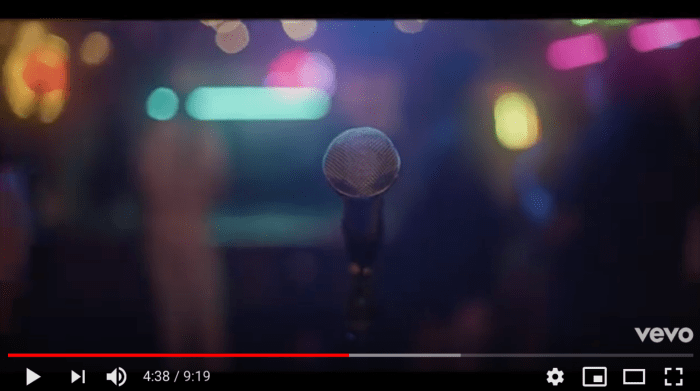
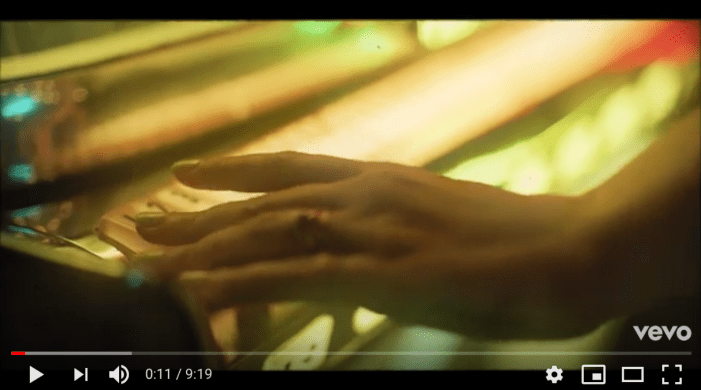
There is a scenario in which the jukebox is equivalent to the poet and some elaborate analogy is to be made between intertextuality and the limited catalogue whose selectional form produces play. The scenario only survives in video. It needs this urge of duration, not to mention the tenderness of a touch. Where fingers brush keys like notes, there is something to add to the story. A social space in demand of ambience; on flickering alongside off. When Lana is alone on stage, hands stuffed into a bomber jacket, singing ‘Fuck it, I love you’, swaying almost nervously, I want to think about what she is doing there and who she is speaking to and from where she is speaking. She is not really speaking but singing. The lone girl on the stage is the open mic dreamer, with nothing but lines. She is scattered across june-dreams of multiple personality: ‘The I which speaks out from only one place is simultaneously everyone’s everywhere; it’s the linguistic mother of rarity but is always also aggressively democratic’ (Riley 2000: 57-58). We mother our solipsism with words but in doing so there’s an opening. So to say fuck it and state the interruption with syncope, sincerity. Lana Del Rey was born on the cusp of Gemini and Cancer season, which more than explains that statement: ‘Fuck it, I love you’. With her sails to the wind. To say it over and smooth into plural refrain, you could even say chorus. For a chorus wants to be shared. It is a commodious mother, fed by the keys of the jukebox baby. There is a constant reversal of nourishing; the democracy of lyric utterance, the milky feed that streams.

Denise Riley argues that any ‘initial “I love you” is barely possible to enunciate without its implicit—however unwilled—claim for reciprocation’ (2000: 23). But what is reciprocation in a song? Is it just the urge to be sung with? And this ‘fuck it’, the pervasive millennial injunction to just be, to move on, as the tag which erases the expectant price of the utterance? Riley argues that I love you ‘must at once circulate as coinage within the relentless economy of utterance as exchange’ (2000: 24), but in a pop song it bears the leaden weight of so many prior expressions. The irony is that to cut through that with a simple fuck it, Lana can attain something like sincerity in the very pop mode whose lineage of commercialised love would surely undermine her feeling. Fuck it, in spite of saying I love you I really do. The pop song becomes this space for the staged epiphany of repeated assurance, I really do. It is a softcore admission of the self in its burning limit. 
Screenshot 2019-09-08 at 11.26.37.png

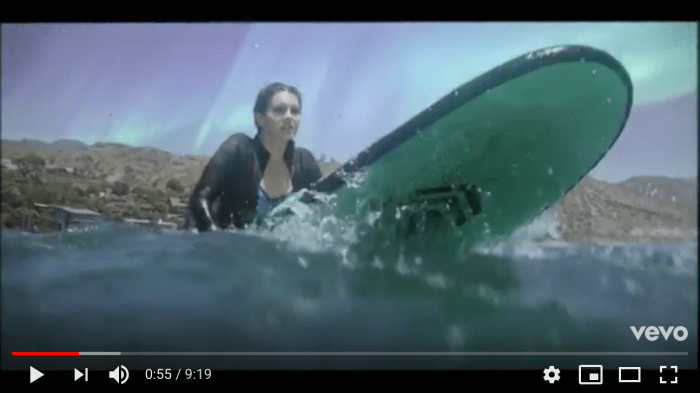
‘Fuck it I love you’ is soaked in lights, but they’re fading. ‘I like to see everything in neon’, is the line that opens the song. To see everything in neon is to fluoresce what is haunted and gone. I think of Sia dragging rainbow dust down her tearful cheeks in the video for ‘The Greatest’ — tragedy’s shimmer as fugitive mark on the body. Lana offers herself up as sugar dust, cliché in honour of Doris Day: ‘Dream a little dream of me / Make me into something sweet’; she acknowledges ‘dancing to a pop song’, but it’s not clear if this is her or the character or the one she loves. ‘Turn the radio on’ could be a reflection or an imperative. The reader is hailed between these positions of love and the loved and the effect is saturating, warm, delirious. Separation is that ‘it’, the spacing. In the video, we watch Lana painting and then suddenly she’s surfing with the aurora borealis in the background. She’s on a swing, her jean shorts caressed by the camera, she’s the sexualised pop icon again. She’s on a surfboard, green-screened, young. She’s choosing a shade of yellow from the palette, singing ‘Killing me slowly’. What is this ‘it’, killing her slowly: 

I’ll return to the unknown part of myself and when I am born shall speak of “he” or “she.” For now, what sustains me is the “that” that is an “it.” To create a being out of oneself is very serious. I am creating myself. And walking in complete darkness in search of ourselves is what we do. It hurts. […] a thing is born that is. Is itself. It is hard as a dry stone. But the core is soft and alive, perishable, perilous it. Life of elementary matter.

(Lispector 2014: 39)

I want slyly to argue that this is a kind of anthropocene existentialism. Recognition of the self as this ‘hard’, ‘dry stone’ thing of geologic mattering, reflexive species. This is what it is to be ‘Human’ right now. And yet the agential spark within, the ‘core’ that is being alive in a world where we have deposited those sedimentary layers. Creating ourselves in the stone, often with the tarnish of the very products we chose and developed to beautify, excoriate and cleanse ourselves, to remain forever young. So there is this oscillating temporality at work between desired infinity and the trace of our fugitive place on earth. The very earth minerals that would ruin humanity, mine our bodies of endless labour. But to go back to the song, with its idea of a gradual dying. I want to call this something like anthropocene softcore: the unnamed presence of species being within Lispector’s slender novel from the early seventies, or the Mamas and the Papas brand of late-sixties ‘sunshine pop’ whose solarity derives from the perishability of that energy, utopian commons, cascade of flowers — that serotonin glow of selves in streams and streams. 

Lana’s anthropocene poetics are not of the hardline, direct call to action. You would not say of her cultural presence, eco-warrior or nature goddess. You would not brand her Miss Anthropocene in a kind of demonic marketing gimmick. You would say most often she is a siren, per se, leisurely supplicating us towards death on the rocks. Desirous flow. This is anthropocene softcore. This is what it is to challenge the act of self-description itself, and in doing so questioning those generalisations that arise from the ‘we’ of humankind, not to mention the ‘I’ of pop’s delectable, mainstream lyric. Alchemically, Clarice Lispector and Lana make of these malleable pronouns the ‘perilous it’. The it, the feeling, the speaking self which is nothing much more than a bundle of affects, sensations, atoms. To be cast over and crested by the wave. Significant that ‘Fuck it I love you’ ends with the rising bubbles of this wave, the one that spills us through the fourth wall and into the studio. This song slams together pop’s saccharine mythos of California as dreamland, a late-summer song as the former was written, surely, for autumn. California: ‘it’s just a state of mind’. She could be talking about the self or the state, or the state of the self. 
Screenshot 2019-09-09 at 20.44.25.png

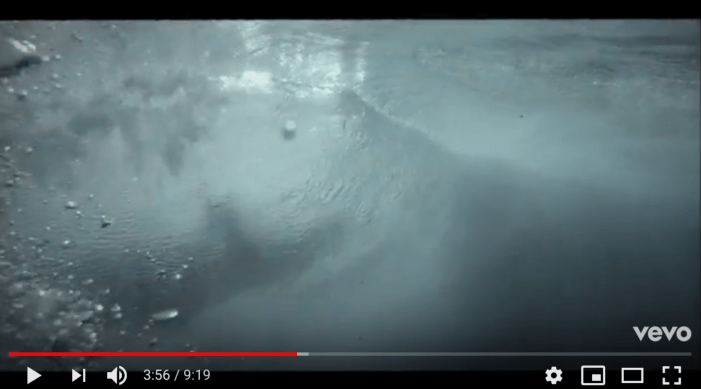
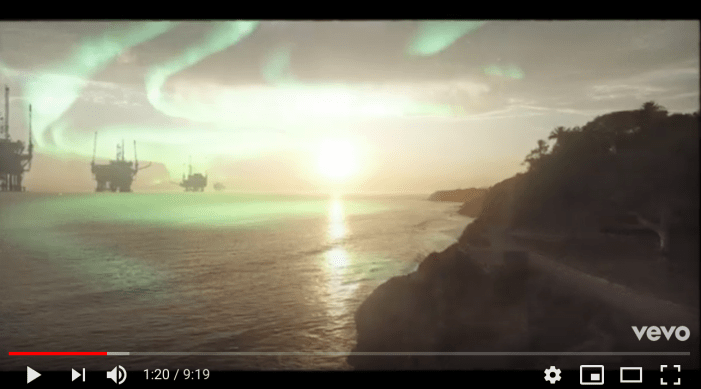
What happens next? The shot drifts over the cliffs, the coast, to a strip of palms and a distant view of the LA skyline. That shining love in the previous track is replaced by a minor key, a glimpse of the jukebox whose songs include The Eagles, Bon Iver, The National. Artists whose Americana is the melancholy of generations moved from political despair to something like the glitch of the times as a basic fact of intimacy. One of the Bon Iver songs shown in the video is ‘22 (OVER S∞∞N)’, and if that title was not rife with implicit apocalypse, what is, what is. A stammering into language, pitch-shifting the fragile space of utterance. There’s a spiritual glimpse to the sky and the infinite quality of the stars: 

There I find you marked in constellation (two, two)
There isn’t ceiling in our garden
And then I draw an ear on you
So I can speak into the silence
It might be over soon (two, do, two, do, two)

(Bon Iver, ‘22 (OVER S∞∞N)’)

I don’t know what the maths is doing. I don’t want to know that the song ‘was inspired in part by Bon Iver mainman Justin Vernon’s unsuccessful attempt to find himself during a vacation’. I am however interested in the hubris within this term ‘vacation’ at all. Do we now live in a world where you can take ‘time out’? There is nothing of the world we know that could be switched off. There is no ‘away’ of complete erasure or original presence. Deconstruction caught up with our living. Vernon describing this song as a gesture towards what might end of his emptiness could just as easily be flipped: its relief is equal to a mortal sense of loss. The impending erasures. It ‘does’ or acts the accretional event of extinction that is speaking into the silence, to those who could not speak back. 

Fragments and snatches: the neon green lining Lana’s eyes, the aurora borealis, the neon green palm in the club where she sings alone. A season by yourself. The love of the couple together surfing is cardboard, Hollywood. It is a trembling symbol. It is almost ridicule.
Screenshot 2019-09-08 at 10.27.46.png

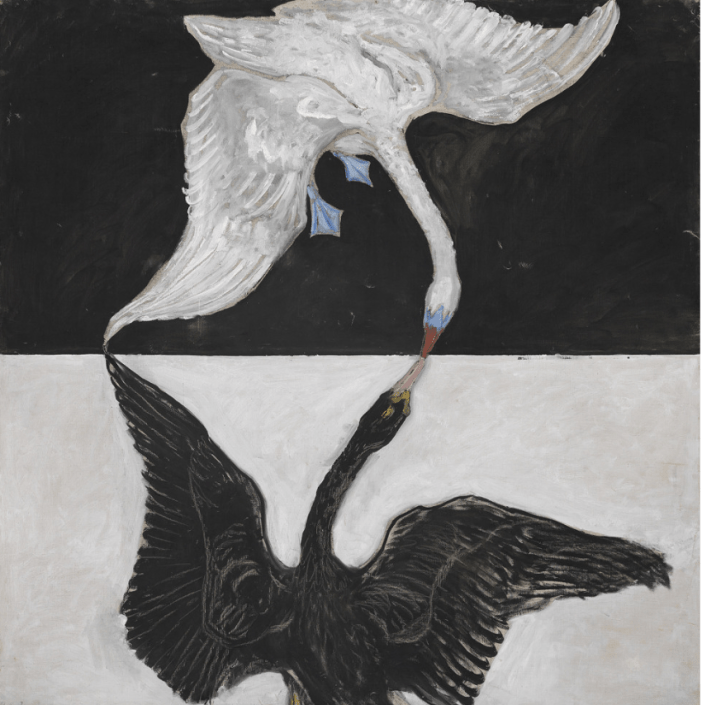
What is Justin Vernon looking for in the constellation? When he sings ‘two two’ I think of Hilma af Klint’s nose-touching swans, or the hours of the day chipped at the edge — two of them stolen by tragic event. I think of a mic check, two, two, ch, ch. Click. Near-enough-presence of speech. A white swan on black background; a black swan on white background. Flip. The swans are geometry, signets of signature, they move towards abstraction. Growth. I love them. Fuck it I love them. The way they are just it. Inversions of colour and a monochrome mood splashed with cornflower blue, the tiny excess we can treasure. It is the cornflower blue, the little webbed feet, which make the swan in question unique. So we can care for it, figuratively as it swells through grey-white waters of memory. The swans we have lost in our shit. Royal iterations freed from belonging. This painting is from af Klint’s series Paintings for the Temple, works derived from spiritual communication. The abstraction of the swan / renders us stark in frame / for we were Lana or Leda / before we were animal. Sufjan Stevens’ ‘Seven Swans’: ‘All of the trees were in light’, ‘a sign in the sky’; ‘My father burned into coal’. And all of our sadness was carbon neutral before this. We plunge into whatever remains of the water, its plasticky thickness.

I keep pausing the video as it transitions. ‘Fuck it I love you’ twinned with ‘The greatest’. When The National sing It’s a terrible love and I’m walking with spiders, what exactly is the ‘quiet company’ of the ‘it’? It could just as well be spiders. Maybe it’s the web itself, the web between the human and the more than human, the gossamer moment where metaphoric articulation becomes more than feeling and gleams material. ‘It’s a terrible love that I’m walking with spiders’ — what is the grammatical transition done by that ‘that’ and who is to blame. Walking with spiders might just be that love. Transitional, subject/object logic is reversed in this song: ‘Wait til the past?’ is sung, then ‘It takes an ocean not to break’ when surely the ocean itself would break you. Soon the ‘terrible love’ is a substance, something ‘I’m walking in’ — to feel it is an act of immersion. It is to let that wave crest over, the ‘lyric auto-explosion’ (Moten 2017: 3) of the wave that would break you. 

In ‘The Greatest’, Cat Power sings of former ambition now cast to nostalgic regret. There is a sense of time slowing to delay, laconic strings, relaxed drums, the balladic sleep of a once-held fault. It is a parade slowing down in the rain. To say ‘Once I wanted to be’ is to hold this question of ‘the greatest’ as a generalised desire itself. The hunger we lose in time, whose primary colours soften. I hold to that precious, cornflower blue of a swan’s foot. ‘Two fists of solid rock / With brains that could explain / Any feeling’. This solid rock that would box you into the future, that would harden the edges of self. A thing is born, as Clarice puts it, ‘hard as as dry stone’. This is the thing born ‘that is’. To exist is to be this hard thing, protein ligament, to kick out in lines; but then in time there is the plasmatic self inside that, like some fatty animal byproduct, sticks to the others it loves, it needs, it leaks. Gelatinous, softly sticky love. The ‘it’ that needs saving. Anthropocene softcore; soapy inside of all geologic agency. Who we are and what we regret. The turning of the outside-in, the inside-out. Kathleen Jamie, in Sightlines, asks: ‘What is it that we’re just not seeing?’ (2012: 37). 

A sightline is a hypothetical line, from someone’s eye to what is seen. Is it clear or blurred, bad or good? Anthropos recedes in its very own scene as the ocean continues and we howl in the dark like a lossy-compressed version of species. We are the sirens and wolves. We are at the great concert of the Earth. We have to resist what Bernard Stiegler calls the ‘proletarianization of the senses’ (2017); we have to find longform ballads of what’s happening, pass them down the line, resist the short-circuiting of thought that occurs between screens and machines. We have to send letters back to our consciousness, our elders and children. This is the work of lyric. It could be the work of dance. I think of Zelda Fitzgerald’s protagonist, Alabama, learning to be a ballerina too late in her life: ‘Her body was so full of static from the constant whip of her work that she could get no clear communication with herself. She said to herself that human beings have no right to fail’ (2001: 180). Alabama barely eats; her energy is all the zeal of will. The dance of lyric as reduction, lack, as static and chased success whose collapse lands as Alabama will eventually do on the event of inevitable break. Grapefruit squeezed on the gritty turmeric shot of the future. And a brake, a screech. And yet we write, we cast out limbs and materials, we work towards this loss; we imbibe it. 

This is an ugly type of writing in which the outside is always imagined from the inside. Horizons are fictional and buildings are barred. I have no sightlines. I’m fucking cutting the corners of someone else’s desire. All paths are the continuation of a pre-existing line. This is a city from which I send myself postcards wherein I wish I was here. Flying letters. Words stolen from myself. I refuse to recognise that I have not composed them unintentionally

(Bolland 2019: 78).

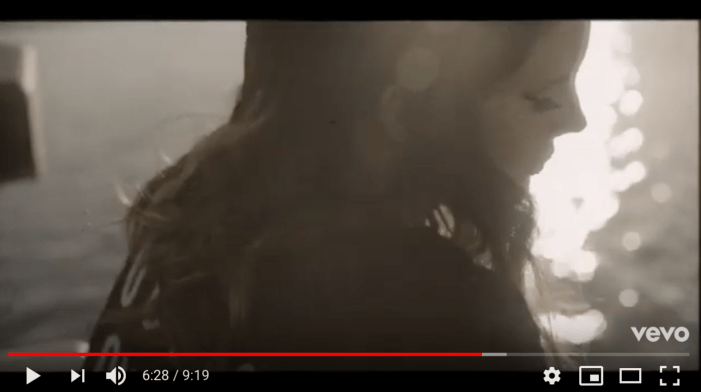
The videos for Lana’s ‘Fuck it I love you’ and ‘The greatest’ swerve between inside and outside. We find ourselves in rooms we don’t remember entering. Writing the anthropocene has an ugly, masturbatory quality of fucking yourself with the rush of elaborate doom. Okay, so. Constructing fortresses of lines which would make a valiant destination. When I listen to Lana, I’m accessing shortcuts to ‘someone else’s desire’ which is the opening up of presence. ‘This is a city’; ‘I wish I was here’. I have never been to LA. We plagiarise our very own diaries to get back that sense of the once-intentional, the greatest declaration on Earth. That we were here, and we loved. She wrote that lit, forgot. The papers curled up and rolled away in a sultry air that was summer, 2012. The year of failed apocalypse, the year Lana released her debut album, Born to Die. We saw her campaign of fashion smoking through plexiglass bus shelters. Remember all ‘horizons are fictional’: they tell a narrative, they bleed and tilt and set like ice. Towards them we stupidly drift: the lived throb of our softcore skins, our hungers and rhythms.
Screenshot 2019-09-09 at 20.44.50.png

Drifting in colour like H.D.’s Leda, the rape of the land and the body and bodies engendering bodies. Worlds ending around us. And so I could say, but this is just one song, a phrase, a white woman of fame lamenting her world. But this self-conscious cinematics is a gesture towards the western world itself as this haunted, tragic protagonist: ‘The culture is lit and if this is it, I had a ball / I guess that I’m burned out after all’ (‘The greatest’). So you could say, anthropocene softcore speaks to the lyric I in its state of orphaned exception, which in turn is the loss felt by us all unequally. If we make of Lana a sort of anthropocenic siren, we must recognise the distinctions within our longing. For we all lose worlds differently; harm is striated along lines of class, gender, race, ethnicity, geographical distribution — of course. That wave that closes the video could elsewhere be a tsunami. I like to think its place on the edge is a deliberated hint to what could or is even already happening here or elsewhere. And maybe the colour, the aurora, is this streak of need for an excess beyond static blank, ‘human’ planet, standardised canvas; the need to splash something more of blur and blue. Flood the structure. 

When we say something is ‘lit’, we mean it is hot, on fire. We mean it is turned on, ignited, intoxicated, drunk, excellent. Lit is the past simple and past participle of light. Isn’t that line alone just lit? Maybe we are in the twilight of a former Enlightenment, recognising our species hubris as this alien green that tinges every familiar horizon, upsets the normalised green of pastoral. Is it toxicity, the elsewhere within ourselves? It is a radar showing who we are and where we have been. Those material metaphors cook on a smoulder, and this is the softcore coming to knowledge about what is happening.
Screenshot 2019-09-08 at 11.27.08.png

What does it mean to sing: ‘I’m facing the greatest / The greatest loss of them all’. To sing this on the brink of a hyperreal sunset, to chase a solar excess among loss. This loss could be a love but it is more like a culture; it is more like a voice and the condition from which to speak or sing it. The loss of lyric, its possibilities of address, and the loss or deferral or ruination of place itself. Maybe this is Lana’s lyric maturity, a generational acceptance that ‘young and beautiful’ is no longer the apex state of what we should strive for. Absence tenders complexity. Is this, as Roy Scranton puts it, Learning to Die in the Anthropocene? This question of mutability, the green-winged eye that sees a darkening world, a lack of birds along the bay, an edge. In the video for ‘The greatest’, Lana’s jacket reads LOCALS ONLY on the back. I google the phrase and find a hipster restaurant in Toronto with the slogan, LET’s PRETEND THIS NEVER HAPPENED. There’s a kind of parochial nihilism that glisters like the light on the sea, but the sea can never be local only. There’s a boat in the video whose name is WIPEOUT. It’s all happening; the signals are obvious. How we are practicing the absent-presence of the name’s erasure. My tongue gets twisted when I say anthropos; I want to say mess, I fall into ‘guest’ and ‘gesture’. With its glaring cinematics, LA offers the hospitality of light. But it is an exclusionary light. For now, only some of us get lit, get to the mic.
Screenshot 2019-09-09 at 20.46.01.png
Lana sings from within the metallic architectures of LA’s coastal infrastructure, the port. In the bar, she throws a dart and misses her target by a nonchalant smidge, knocks the 8-ball towards its pocket. I keep thinking about exports and imports, what we put out, take in and trade. Economies of luck and depth and surface. Maybe Lana is a hydrofeminist, her soaring lyric gesture recalling a hauntology of America as that dreamscape of what lies beyond or in the deep. And now we know it is further extinction, precarity, hardened borders. What do we do with that looming closure? Lana has shrugged off her jacket now, she’s smoking in the kitchen where the lid slides off the pan to let the steam out. I’m not saying we’re sitting on a pressure cooker here. There’s simply work to do, mouths to feed, ears to fill. This is a ballad, a paean to the transient, fragile beauty of everything. The songs shown again on the jukebox are songs of a type of blues specific to oceanic or cosmic consciousness, to hunger, the time of lost summer or that of a broken love:

Janis Joplin — ‘Kozmic Blues’

Dennis Wilson — ‘Pacific Ocean Blue’

Sublime — ‘Doin’ Time’ 

David Bowie — ‘Ashes to Ashes’

Jeff Buckley — ‘Last Goodbye’

Leonard Cohen — ‘Chelsea Hotel #2’

I’ve spoken before of what ‘anthropocene sadcore’ might look like in poetry. I’m still working through that. It comes from the common phrase used to describe Lana’s music, ‘Hollywood sadcore’. I’m interested in how that emphasis on mediation, transmission and cinema plays out in our understanding of ecological emergency, but more generally the existential condition of the anthropocene, which places us as geologic agents under the generalised, gendered rubric of Man. Maybe Anna Tsing’s feminist work on the ‘patchy Anthropocene’ could be applied to the cut scenes of a glossy Los Angeles caught on video. A patch is also a software update, where comprised code is ‘patched’ into the code of an executable program. Maybe the patchy anthropocene involves this kind of cultural patchwork: the lament to a love or a culture is patched to include this bug of ecological consciousness — the patch is a kind of coded pharmakon, poison and cure for apocalypse blues. But Lana paints in shades of yellow too. Blue and yellow making aurora borealis green. A cosmic gesture to what lies beyond thought. And what of those oil rigs in the distance, glistening. They form an audience to the siren’s lament; they are part of this story, and we are mutually complicit. Where the magnetism of the male gaze is often part of Lana’s canon, here it is mostly replaced by oil rigs — supplementary Man as the infrastructure of anthropos, looking back at its melancholic, warning siren. Softcore is less affective than sadcore; it is the ambient hum of climax coming. Its cousin is the slowcore, luminous melancholia of a band like Red House Painters, perhaps: Purple nights and yellow days / Neon signs and silver lakes / LA took a part of me / LA gave this gift to me’. 
Screenshot 2019-09-09 at 20.43.42.png

In Bluets (2009), Maggie Nelson writes of a restaurant she used to work in, where the walls were ‘incredibly orange’. After each shift, collapsing exhausted in her own home, ‘the dining room’ of the restaurant ‘reappeared in my dreams as pale blue’:

For quite some time I thought this was luck, or wish fulfilment— naturally my dreams would convert everything to blue, because of my love for the colour. But now I realise that it was more likely the result of spending ten hours or more staring at saturated orange, blue’s spectral opposite. 

(Nelson 2009: 43)

Orange and blue, water and flame. The mind’s alchemical transformations reveal the way colour works chiastically upon us. I think of Freud’s mystic writing pad, the waxen surface of memories allowing for palimpsest versions of stories that trace and erase. ‘This is a simple story’, Nelson writes, ‘but it spooks me, insofar as it reminds me that the eye is simply a recorder, with or without our will. Perhaps the same could be said of the heart’ (2009: 43). ‘Fuck it I love you’, sung to the blue-orange wall until something comes off that surface like a static or fizz. Irn bru, ironed blue. There is quinine in my dreams of hungover labour. Surely there is a violence to this particular love, that is staring, necessary. The love of what must be limitless hurts.

Screenshot 2019-09-08 at 11.27.23.png

Janis Joplin’s ‘Kozmic Blues’ rises to a swell, a jostling of guitar licks and urgent, assured vocals. A sonic thickening. ‘So mastered by the brute blood of the air’, H.D. writes in ‘Leda and the Swan’. Held in that vascular shudder that acclimatises to a manmade world, what happens next is a loosening, a shimmer, a shrug of the garment. In the poem or song, in the painting or film, in the collapse of that wave into a bluer future. To incur a kind of erosion and yet live on in those terminals. ‘There’s a fire inside of everyone of us’, Joplin sings, and I think not of flames but of cinders. ‘At what temperature do words burst into flame?’, asks Ned Lukacher in the introduction to Derrida’s Cinders (1987), ‘Is language itself what remains of a burning? Is language the effect of an inner vibration, an effect of light and heat upon certain kinds of matter?’ (Lukacher 1987: 3). I know if I did not write I would smoke. These acts of temporality in its material extinguishing. What makes the remembered restaurant blue, not orange, is something of this transmogrified smoulder — an inversion akin to af Klint’s swans, demanding that splash of blue. When I write, am I pursuing the absent space of that skyward blue?Blue is the colour of the planet from the view above, Lana swoons in a song (‘Beautiful People Beautiful Problems’) from her previous album, Lust for Life (2017). But in Norman Fucking Rockwell, Lana’s California album for 2019, it’s less of this ‘above’ we see. We are held within the infrastructure, cinema, the end of summer. The dreamlike logic of How did she get on that boat? When did she enter that room? Who put that song on the jukebox, baby?

I want to say:

It takes an ocean not to break a planet.
It takes not a planet to break a species. 

Lana’s voice grows wispier as she sings of that burnout. There’s this imperative that okay we could enjoy this with American flags, we could pour communal Jack and go down in flames. We could riff the history of our culture in archives of song, gestures and nods of reference. Ladies of the Canyon, Cinnamon Girl, Norman Fucking Rockwell. We could keep laughing or dancing while the world is or was at war. Lana is both behind and at the bar, the sightline of where we go to be ‘served’. Intoxication is the order of the day and we call it ‘fun’ to put the fucking of other people’s desires under erasure, strikeout, as Bolland does.

If this is it, I’m signing off
Miss doing nothing, the most of all
Oh I just missed a fireball
L.A. is in flames, it’s getting hot
Kanye West is blond and gone
“Life on Mars” ain’t just a song
Oh, the lifestream’s almost on

(Lana Del Rey, ‘The greatest’)

Miss doing nothing’: post-recessional ennui becomes the paradoxical happiness of living in static, not working as a kind of work that resists the future as set out by capitalist horizons of accumulation. We used to just ‘hang out’ and several other dreams of youthful nostalgia. Kids of today can’t even touch that innocence. We know so much; maybe or probably they know more. We are all variously entranced by the softcore unfold of this happening; we are all variously called upon to be complicit, to recycle, act, resist. To speak or not-speak. To be in one of many different levels of rising heat. The conditional state of being’s value, ‘If this is it’, in the anthropocene raises its pitch to a charge. To sign off is a form of surrender that gives up the name for the blur of species. I think of Lars von Trier’s Melancholia, the planet that would smash us and yet somehow Lana dodges it, that

The audience in the bar where she sings are mostly men, but their gaze is not sexual, as in much of Lana’s prior visual oeuvre. Rather, their longing gaze, often filtered through further glass, is something like the profound melancholy of a multi-generational sense of this loss. These old men have lost the planet, the one they grew up with, just like Lana’s siren, come from some other time, a life ahead of her steered by the changing climate, the hurt and vengeful seas. The camera holds close ups on their staring faces. The song holds the long durée of a loss that spans generations, damages and is damaged by elders, sparks in the present-tense of cultural tendency. In Lana these men look to a future hurt whose cause was partly theirs, as inheritors of industry: she is both victim and heroine, singing and swinging. The shot opens out to reveal her smiling with younger friends, her own generation. These intimacies are what we have left. The next shot shows some kind of factory or refinery leaking smog into a cloudy, overcast skyline, sulphured yellow. Once again the boat appears with its title, WIPEOUT. Lana is supine on the bow at sunset. She is golden, angelic, silhouette. It’s like she missed the fireball but melted it, cooked it up for tea, apocalypse syrup. Things are going down around us. She hugs her arms, later standing, laughing with a dreamlike intimation of imagined elsewhere, closing her eyes. Be hospitable to yourself and others. The reel of the jukebox keeps ever turning: this is our ever faith in culture. We have to take care of what’s left in whatever space we can make of song, duration. 

But the mainstream disciples and idols of Hollywood are failing, Kanye West is ‘gone’. Surely a reference to Elon Musk’s plans to save us by colonising Mars, ‘“Life on Mars” ain’t just a song’ is sung with a melancholy matter-of-factness, a kind of sigh which implies the banality of techno-utopia in a time of extinction. The thrill of such dreams is lost now. We lost our faith in Hollywood, lost our faith in the movies and the scale of those solutions. In a world without books, we’d be ‘bound to that summer’, addicted to one of many narcissistic ‘counterfeit[s]’ to make love to nightly in futile repetition — that would be, as Weyes Blood sings, the ‘Movies’. 
Screenshot 2019-09-08 at 16.56.01.png

What we look back with: 

The trauma is not, in the Freudian lexicon, this or that violation from the world (such as war), but the ill and trauma of this originary installation of “the cave”—what could properly be called the cin-anthropocene epoch, particularly given that the era of modern cinema is to be regarded merely as an episode: that of the machinal exteriorization of the cinematic apparatus, given that it coincides with the era of oil (artefacted “light”), given that its arc coincides with that hyperconsumptive acceleration leading to mass extinction events, ecocide, and an emerging politics of (managed) extinction

(Cohen 2017: 246)

The trauma of greatness as such is this accelerated promise of the dream, the event, capitalist growth, the movie itself — whose imperative is towards scene, closure, episodic narrative in demand of the next. But the drinks in this video are barely drunk; they are more like props. Everyone is aware of their place in the tableau vivant of the anthropocene, even in its softcore, consumerist pop expression: the iconography of oil rigs, downbeat affect and intergenerational longing. Not a violation from the world so much as the stream, and where its accumulative logic would eventually come to crisis, even as corporations beyond our imagining were already plotting that logic of a break within archival excess: the feverish incineration of the present, the smoulder and melt that smogs and spreads and streams. 

Fire is there or it is not there. […] But surely there is a word for that moment when a fire log, beneath its bark, has become one immanent ember, winking like a City or a circuit board; for that moment when you know only the desire, no, the need to stir it up. What is on fire, you ask yourself, staring into that waiting. What is that moment. What is that word. 

(Lennon 2003: 434)

The nights ‘on fire’ that Lana sings of are those of the Beach Boys, reprieve of the sixties; the bar on Long Beach that served as a ‘last stop’ before the tiny island retreat of Kokomo. Frank O’Hara died on Fire Island. Fire is presence or absence, but there is a moment before it is both. A slippage between the extinct and extinguished. And the world was lit up as before. I wonder if the word Brian Lennon looks for is simply ‘sleep’, the title of his essay which I first read in John D’Agata’s anthology, The Next American Essay — with intimations of that Lana song, ‘The Next Best American Record’. What is with America and the positioning of the next. A constant state of pressurised imminence that streams and streams: ‘We lost track of space / We lost track of time’ (‘The Next Best American Record’). We sleep into death or spirit. My first legal drink was a fireball whisky, in a pub by the sea they built in a church. That moment when you know only the ‘need to stir it up’, fanning the flames. That impulse towards blitz feels extra political in these contexts. We need something of relief that would stream, and in that flow be more than a question. Something of cinders, drifting. 

In Lana’s song, I’m interested in this word ‘lifestream’, which seems like a slippage from the more familiar internet-lingo, the ‘livestream’: the coming live that seems provisional to digital retro-future, the promise of satellites beaming the present, simultaneously. Lifestream, instead, is a vascular imaginary of bodies flowing together. ‘LifeStream’ is actually the name of a blood bank serving the Inland Empire and its surrounding areas. Lifestreaming is, Wikipedia tells me, ‘the act of documenting and sharing aspects of one’s daily social experiences online’. It is the flow of the timeline, akin to the wall, the blogroll, the feed. But here, at the end of the song, the promise of information’s overflow is in a liminal state — ‘almost on’. Extinction’s monetised data cast as the simultaneity of thick presence spread by millioning participants. We are here and we said something, our words were atoms, splashes of blue. We stream towards a life, cut ourselves short on the fragments of others’ desires. Mortality’s softcore contingent. The fear of missing out is assuaged by the narcotising work of cinema. And if this is it, Lana has already signed off. It’s something more like her spirit that’s here for us, the stream of an echo, fold of a song that we could replay, continue voicing. Hope lies in the circadian rhythm, the lived time of a pause in the anthropocene’s ceaseless, cinematic duration — that which we see and drown our hearts in. As Jean Rhys’ drunken, depressed protagonist of Good Morning, Midnight (1939 – the year WWII began) muses, ‘Well, sometimes it’s a fine day, isn’t it? Sometimes the skies are blue. Sometimes the air is light, easy to breathe. And there is always tomorrow….’ (Rhys 2000: 121). And what if tomorrow was the greatest loss of them all? 

~

Screenshot 2019-09-08 at 11.56.26.png

All screen grabs taken from here (Director: Rich Lee) and here (Director: Natalie Mering). 

~

Works Cited: 

Bolland, Emma, 2019. Over, In, and Under (Manchester: Dostoyevsky Wannabe). 

Cohen, Tom, 2017. ‘Arche-Cinema and the Politics of Extinction’, boundary 2, Vol. 44, No. 1, pp. 239-265.

Fitzgerald, Zelda, 2001. Save Me the Waltz (London: Vintage). 

Jamie, Kathleen, 2012. Sightlines (London: Sort of Books). 

Lennon, Brian, 2003. ‘Sleep’, The Next American Essay, ed. by John D’Agata, (Minneapolis: Gray Wolf Press), pp. 427-234.

Lispector, Clarice, 2014. Agua Viva (London: Penguin). 

Lukacher, Ned, 1987. ‘Introduction: Mourning Becomes Telepathy’, Cinders, trans. by Ned Lukacher, (Lincoln: University of Nebraska Press), pp. 1-18. 

Moten, Fred, 2017. Black and Blur (consent not to be a single being) (Durham: Duke University Press). 

Nelson, Maggie, 2009. Bluets (Seattle: Wave Books). 

Rhys, Jean, 2000. Good Morning, Midnight (London: Penguin). 

Riley, Denise, 2000. The Words of Selves: Identification: Solidarity, Irony (Stanford: Stanford University Press). 

Scranton, Roy, 2015. Learning to Die in the Anthropocene: Reflections on the End of a Civilisation (San Francisco: City Lights Books).

Stiegler, Bernard, 2017. ‘The Proletarianization of Sensibility’, boundary 2, Vol. 44, No,. 1, pp. 5-18. 


Playlist: August 2019

IMG_8216.JPG

I felt the only thing to do was to write a Book of Rain. I was reading all these San Francisco poets. Sure, you can get detailed climate data on more or less whatever you like, but it meant nothing on its own to me. I looked at the annual hours of sunshine, average precipitation. How many days of rain. I mean you could say Glasgow was like 329 or something. How many days in a year again. I have never been to San Francisco, let alone lost my mind there. Or maybe I have, the latter I mean. I googled what’s a box of rain and it started relaying info on radio access networks, because I’d left out the ‘i’ in rain. Access all radio until the signals run streams in your mind forever. We ran out of the box and into the street. I had a dream someone was coming for me in the bathroom of a restaurant and I had to escape but the floor was ridden with rats. They were beautiful rats made of iridescent glass, and I was nervous about shattering them. Beautiful soundless rats all around. You could drop a box and break them all. The waitress was crying outside because the boss had discovered her glass menagerie. “How beautiful it is and how easily it can be broken” I was murmuring to her, quoting Williams in some echo of what I had wrote in some essay, forever ago. Not for Emma. She was like, “But what is that it of which you speak?” She had a thick Polish accent and the tone of her breath was like full-fat butter, melting inside me, running down the side of the walls of the box. Animal ashes. I tried to give her a key, a single silver key to my office. I was like, you can hide in here and bring all the plants. The plants were also made of glass. There were avocado glasses, lemon glasses, aloe glasses, spider glasses. I’m not saying it was “unrealistic”. She carried them with such tenderness I remembered the names of many friends I’d abandoned to youth. Everything we said in the street outside was set to music. These kind of Vivaldi swoons of violin, with pizzicato flutes from the boys by the roadside, doing parkour. I felt stupid and reached for my cello. She was like, “do you not have a viola d’amore” and I had to demure I did not know. “It’s okay,” she said, “summer is in G minor.” I took off my dress and walked down the street, shrinking. I was waiting for a bracket to scoop me up. Something of her molten voice had shattered the glass heart trembling inside me. But where, but where! Where would I go. Summer is so stressful, those bloody erratic strings. I needed something that felt more like the rain. Soft rain pouring a chord inside me. What they say of the viola d’amore: with sympathetic strings. Whose love are we even soft for. The extra resonance of the rain lent weight to the future. The future auxiliary is. What did he die for. At the end of the rain, the air is composed of cinders. I missed Edinburgh before the Fringe. I was in a bathtub drained of water, lighting cigarette after cigarette and letting the ash pop the bubbles of thought. When I ask the internet of cinders, People also ask: ‘How did Derrida die?’, ‘How many languages did Derrida speak?’.  I want the resilient self-presentation of all this nothing. My mother goes out in relentless rain. I composed a sonnet of the city, it went like All devices lying down and already I’d fucked up the iambs. So I googled it properly, what’s a box of rain. Any morning, any evening, any day. The box of rain is what this is not. I put pressure on the ash to summon a dormitory, the many-bedded archives of sleep. The world is a box of rain. The world is as fugitive as the bubbles of a sad geometry. Whose idea to play. They blew of our world a glass with walls and lid and corners. The rainbowed edges of slender aporia. Container for rain. You could prise open the box, its sticky lid, as though inside you’d find the most opulent yoghurt in the world. Imagine a yoghurt that would fill your belly with billions of tiny, glassy eels. I made of my guts the Hudson River. A lyrical gesture of elements came to count. I can’t listen to the song that makes me so happy I am instantly sad, like being stuck in a dream of a dream where all you can touch is reflection. I had all these stupid lines about gemstones, trying to hold that feeling. Cleavage. It’s existence, you idiot. ‘The reflection / itself’ (Cedar Sigo). They were all swimming inside me and I had a dream about swimming and chlorine depression and all the red sucked clean from my hair. The water would leave me a mousy self to crawl into her former corner. I would let the glass mice eat me like sugar. In the aquarium a sea mouse is pushed quite cruelly towards the water filter by a petulant scampi. Nobody puts baby in the corner but scampi. He was cute though, bug-eyed and orange-pink. Crustaceous slice of sunset, all feelers and limbs. They sometimes add colour to salmon, there’s a whole gradient of petrochemical pellet effects. A dark wild salmon is best. Dark a wildness, swimming. Pure aesthetic pigments. In the café, she spoke of how octopuses feel with colour and then I remembered everything. Everything I loved of your ruddy shade. Politics talking. Glass rats and pint glasses brimming with gold. A clip of the soft, panicky salt of the dark. Then morning relief. I sensed the light through my skin which was also glass, shaved glass reformed into something more convincingly epidermal. I was camouflaged, cold-blooded, cuttled into daily life. I cradled a corner. The eels propelled to the surface and left tiny blots like shingles. I’ve let them swum. I felt sick with all that had happened. In the salon, I read Plath’s Letters Home with my hair in shiny, sci-fi foils. ‘I plan to build up into the lovely creature I really am during the next two weeks’. First blush of ‘“champagne ambrosia”’. The herbal tea in Largs was better. Everyone crusted with salt & waves & exhaustion. Little roses among the leaves, expenses. The silver quality of island light fell on a speech. Someone recited the seasons in tiny, seed-like stanzas. I was handed a hazelnut shaken from the roadside fresh, cracked at the back of my mouth a green sort of sweetness. Yes, Sylvia, it all ‘bear[s] a whirl’. August is almost over. The sympathy of your cephalo-strings. A low kind of aching tremolo, plows through the intertidal zone, the reef, the abyssal depths of later. Paradise froze on a brooch. I had opened the blinds to nothing like light. Your diamonds are studded on tentacles, prodding their way through the window. They were sticky with yesterday’s circadian tears. When I dream, I wake up wanting to see the person. Palm oil on toast. My cutlery grief. People are having sex in swimming pools at Christmas. Tinsel of lindens lining the parks where cats enjoy their kill. A river runs into the sea. I am touched by a terrible language, the jellyfish trying to erase me. There was this wasp, we were trying to eat lunch. My fingers were black with tapenade and wine. You cannot swat this call away. I was a lover in the telephonic sonnet. I need a scholarship to write my Book of Rain. The kind of money that weeps from a nourishing prairie, melts like chocolate. I needed a whole milk scholarship. How to prove I was worth it. There was a green banana, a frazzled conscience, island jealousy. False green money, emoji, insomnia. There was all this ink on my sheets, like an oil spill. I was nobody’s refinery in the dead of the night where life was a story poured out on my shoulder. Oh you are lovely. We have our boxes of rain now, so many. I had not thought the rain would undo so many. Rain overflows its glass. Once again, sand again. It is a crisp apple rain. Held in the ampersand between days. I drew one on my wrist to mark that night where the colours were heavy inside me. I singed the fledgling arrivals of chorus, red-skinned greens. After ‘The Gilded Cunt’, I never looked at a bin-man the same. They are doing the rubbish in the garden in sync. I flung syrup from the window to tint the rain, and all the black bags would glow with gold. We had too much, it was sodden. Woke up at 8:am to find my laptop was streaming a video on pyramids. I watched Lana Del Rey step out of the screen and shake up the car where the cheats make out. Everything became an off-peak day return to the sea. Sunday of twenty-seven degrees. Triangulate clouds to a future point. In my Book of Rain, it’s stopped raining. ‘It’s stopped raining. My fingers graze the yellow flowers beneath my window as I turn back to my desk and write. These past two years have been difficult. I keep thinking of the time I’ve wasted. I was the undergrowth—always underneath taller trees, always wanting’ (Rae Armantrout). I was wearing white and not crying. If you could see my bones underneath. The order mattered not like an emptiness. A sculpted classic of ashes. The rat let out in singular, rain afresh. On your mother’s instruction I hiked in the wild farmland around your dreamhouse to find the Marsh Library, the Library of Marshes. The air smelled of opium incense and late summer pollen and I sat with my brushes, painting false dreams inside the dreams of the movies, and then the dream that held me melted. Directive. Natalie says, I felt cheated. I missed the marshes, required an Air. The broken hyperlink became a book by Nicholas Royle about the plaza of bootleg pdfs and I opened the book which was a sandwich, leaking sweet potato mush onto brown lunch paper. That was so disappointing. I would feed it to the rats; the rain had melted the words into gluten. End of the box of the endless rain. How do we say an object is ‘teeming’. I would bite the brittle stars of September. 


~

Angel Olsen — All Mirrors

Björk — Virus 

Tropic of Cancer — I Woke Up And The Storm Was Over

The Velvet Underground — Venus in Furs (Demo)

Cat Power — Blue (Joni Mitchell cover)

Leonard Cohen — Master Song 

Fionn Regan — Riverside Heights 

Silver Jews — Room Games and Diamond Rain

Sufjan Stevens — All Delighted People

Four Tet — She Moves She

Gross Net — Of Late Capitalism 

Slowdive — Changes (Demo version)

DIIV — Taker

Black Country, New Road — Sunglasses 

Swans — Blind

The Grateful Dead — Box of Rain

Anna Meredith — moonmoons

Big Thief — Not 

Pinegrove — Moment

(Sandy) Alex G — Southern Sky

Nick Drake — Northern Sky 

Lana Del Rey — Bartender 

Red House Painters — Medicine Bottle

Jeff Buckley — Sky Blue Skin

Weyes Blood — Away Above

Playlist: June 2019

IMG_E7155.JPG

This time last year, ‘I would look up, intermittently, through a canopy of light-filled leaves’. The unrealism of a momentary viridian, admitting I could not partake in. The nights went on and on in those days, there was a quality of sorry-not-sorry to the usual erasures. And asking for numbers, and watching shambolic ones fall into chairs and windows; the ceiling tilted.

Serotonin is my friend. I want to invent a character. The pressure front hurts my head.

We enter the gallery and there are the nymphs, the lilypads. You have told me a dream in which you ascended the lilypad stairs to heaven, was it heaven, and each one made a satisfying sound and sway when stepped on. I am thinking of Deku leaves and swirls in the ochre night. Here we go with synonyms. ‘There may be lunch’, Anne Carson says, ‘Or we would eat / many more paintings’. As it stands, I order jasmine tea. The paint drips green from the edge of the lilypad, chromium oxide staining the lake. At some point I refused to live without sleep. I surrendered to what its depth could do. A man told me, every time you blink, you refresh your thoughts. I have my muscles set to Command+R with cool deliberation, but all that fluttering won’t get me served. The rain washed all the mascara away. So I order into warmth again. Tequila Maria, something bloody with spice and celery, black pepper’s vast and negentropic heart. Did I mean to say negative calories. Tom McCarthy has this essay about Toussaint called ‘Stabbing the Olive’: ‘We don’t want plot, depth or content; we want angles, arcs and intervals; we want patterns’. A flat asymmetry of energies. I used my pinkie to lick the rim of red dust from the glass, like the last of a meal. Circumferential intimations of love. I was hungry, the night was not warm. Moments of aloneness. Who is McCarthy’s ‘we’? All these lit-critics, clamouring to borrow the spirographs of the twentieth century. I lose a pen.

Thom Yorke is getting on a subway somewhere. 

I thought that taste itself formed an interval, a thickening of presence. Crocheted objects appear on my wall like the lacery of untranslatable dreams. Red, blue and yellow. These are the primary materials of my current research: 

  • Instagram
  • Gifted books with signatures
  • Colours of sky and cloud
  • Seagull transposition 
  • Conference sandwiches
  • The question of ambience in poetry
  • Oil pastels
  • Clay
  • Absences in friendship
  • Tropical levels 
  • The inbox
  • Scotrail

Paranoia is former. As if I could not align the tulips to the complementary turquoise wall, the lilt, the residual. The animals depart when we start writing, a narcissism for darkest_. 


~


In the late Tesco he jumped me, the former doorman, halfway through a dj shift with the Haribo fizz and the bottles of whisky. I wondered what music he would play nextdoor. If you could make a vinyl of sunlight, how I would live for the interminable patterns of notches, solarity catching and catching on loop. Fingers tracing sugar dust over the records, a sourness in his mouth. I was wearing this purple-pleated skirt, five years ago, and a man outside Tesco, another Tesco, asked if I was pregnant. I only wanted the placenta of his mean stare and I wanted to salt it and eat it hard. My twenties recede without drop.

She describes the effects of gluten as a sanding down, an erasure; inside her the tangles made desert. We want clustering, sway of villi, performance. I eat bread and think less; my head fills up with fog.

Soreness in coccyx equals aporia. I awoke to the pent-up throb of the washing machine. Let’s talk about the arbitrary constraint of 30 days. Clusters of black tights as the serpentine symbols in Turner.


~


Something from a solar poem, a thing for the solstice: 

if I go

grassily

drunk in June

it’s just sky

in our lungs

What I meant was, maybe something in the difference between the length of our breaths, and is this a question of the daylight hours, a quantified tiredness, or is it the smoke. My laconic lungs suck in. The grass comes away in tufts where we pull it, like the fluff from a dog’s back in moulting season. I have this dream about reaching the end of a lawn, like I’m staying in a house where the garden is seen from the window only, it looks unreal. You could not exhaust it. Anne Carson says a pilgrim always seeks a horizon, is never satisfied. The dog I had would run round and round, until the grass wore down into dirt. There would be a ring, a halo of ruined earth. She was not looking for anything particular. Instead, she ran around.

I remember the basement party where I sat between two boys, holding a sparkler and watching the smoke trails recede.

I am thinking about foam, immortality, fractal gifs. Coffee opens me up, so I don’t have to look. 

No-one knows. On Fridays I listen to Gardeners’ Question Time, I cut rice cakes into quarters.


~


There was this girl, she lived in the orange-painted room. Her name sounds something like citrus. A long time ago, I wrote a story about her. I was in the library with a stack of philosophy books. I can’t do it. She skips ballet class to eat blueberry muffins in the local café, to flirt with the waiter. She wears a yellow raincoat, even when it’s sunny, and he calls it her famous raincoat. She never gets the joke but she likes how he twists a smile at the same time as he twists his break-time cigarette into something thin and perfect. He always wears blue, regardless of uniform. She wants to be that cigarette, she wants to be rolled into one straight line, but she likes her sugar too much. His smile, surely, is for her alone;  it looks delicious. She imagines the taste of ash, smouldering in her mouth if she kissed him and the trace of the cigarette and the one before that would glow like the orange in her room. 

Adrianne Lenker sings of ‘fragile orange wind in the garden’. 

Should we go outside? And for what.

There was a time when every story had to end, which was fiction. Poetry is getting to have your loops, to sweeten and eat them profusely with silver spoons: imitation privilege. I could keep stirring and stirring until they melt into milk, this miasma of found words, of nourishing. 

Kathleen Fraser: 

Everything is so agreeable, tangential, so light

of foot.

               Tangerine, all pungent with its leaves intact.

The way the egg yolks look when they split, the shit on a watch face, the intimate pixels of a harp up close, a part song. Selective arpeggio carriage to morning. I’m so grateful I’m basically grapefruit, this single devourable bauble of flesh. My skin is thick and explicit. It’s a time in the month. That there, that’s not me. You can peel off the sticker to see. 

In the park, the weekdays fill up with hormones.


~


I played Everything. I was a mushroom, a jet-ski, a palm tree, a planet, a hawk and an oil rig. I rolled and shuffled; scale itself became a sort of music. At once, I soared in threes and sevens. My favourite world was streaked with pink, cacti and celadon rivers. Time was a trick of the hard-drive. 

We collect the cherry-chocolate cake. Later he says something like, The ocean is an orca. Which is much better than, We are all Earth; or, I am what I eat. The literalism is looping its way around cornfields and train delays, better to solder the evening with marmalade light and a buttery spread of new messages. 


~


I have hardly been listening to music at all.


~


The weather was briefly incidental.
Vague plans to read Plato’s Timaeus
scarpered by the way the roses look
in ache, my dream alarm of cascade
is softened by limbs and transport.
We take a lot of time to take the river
in us, hungering girls in old movies
as though they could speak the end
of a call, prior to numbers. We eat
plainly in several vegetal airs, our
cutlery shines like a weather vane.
The intermediary function of skin
is just this much. You glow inside
a tentative plan, the sparkle of re-
grettable voice. I paint my nails a
venus flytrap green. Who decides
what grows inside you. Should eat. 


~

We reply, that it is the receptacle, and in a manner the nurse, of all generation. I have spoken the truth; but I must express myself in clearer language, and this will be an arduous task for many reasons, and in particular because I must first raise questions concerning fire and the other elements, and determine what each of them is; for to say, with any probability or certitude, which of them should be called water rather than fire, and which should be called any of them rather than all or some one of them, is a difficult matter. 

Socrates

The secret mysticism of nicknames
and particle physics. If we are just water.
And what if this water never smells like shame.
And what if the water turns red
like Topshop lipstick, or the gilded cover
of my Kathleen Fraser. Chili flakes assemble
upon the soft lawn of your fruit, a stone
falls out in lieu of the heart. I try particulars:
99p filter coffee, office politics, the milk
chocolate bunnies on campus. I mean they were real
as morning. Star power. When the beach breaks out
to cure, the lovely scrambling of a darkness shared.
Say a soundtrack feels special because it bristles.
I fell asleep in the workshop. My hair all huge
in the hotel mirror. We collect red words for green
and call it geometry. The trad effects of earnestness
and other lyric qualities of indie
I tried to recede like my twenties
I tried halloumi, salt, breakfast vodka.
The longest day of the year
was shorter than anything
I could bother to write. 


~


On my birthday we visited the island, eight of us on the ferry. Kitsch displays of gifts without crystals, trying to fit ourselves into the minigolf. We shared red wine on a jetty, alas not spiralled; we wrote a poem, according to the economy of one red word for a sip. 

sultry walks seem elusive to those players of croquet taking milliseconds out of capitalism or inducing epilepsy, throwing linguini into darkness and leaving finite symphorophilia to the gannets

The water was cold and clear, the barnacles softened the soles of my feet. The sky broke an almost symmetry of peachy leakings, yellow colours spilled on the sea. Gloria stood with her scarf to the wind; we brushed the horizon on the swings. I sang and sang. We ran for the last ferry, in usual fashion, salt and Tennents. The tide came in. 

We sat on the picnic bench of the terminal, singing ethereal Judee lyrics. Heavy in my throat, a halo; the mists. A pleasurable tiredness.


~

A. describes how the glaciers are moving. The surface of the planet rearranges itself, and my impression of the continents sinks like wax. I melt the very edge of a tectonics, craving stories. The citrus girl is so much older and younger, she exists as though only in song. Her raincoat is made of honeybees.

A rushing sound I attributed to rain but then not

She sits in three kinds of tree and fingers her decorative suggestion of dawn, worn as a necklace. I can’t sleep for the gulls and the lines of unmannered flight, the concept of ‘politics’ filling the air of my kitchen. The pearls burst everywhere. I draw a radio silence around each project, I try to choose. 


~


Never have I ever asked Siri. 


I get stuck on a train. We move south, but only gradually.


~

Pip Blom – Daddy Issues

Holiday Ghosts – Thinking of You

Bat for Lashes – Kids in the Dark

Katie Dey – Solipsisting 

Jay Som – Superbike

Beach Fossils – Be Nothing

Hop Along – Waitress

(Sandy) Alex G – Gretel

Jai Paul – Do You Love Her Now

Thom Yorke – Twist

Gross Net – Gentrification 

Sylvan Esso – Die Young

DOPE LEMON – Salt & Pepper

Crake – Glycerin

Big Thief – Orange 

Silver Jews – The Wild Kindness 

Jessica Pratt – Mother Big River

Claire Cronin – Wolfman 

Yo La Tengo – Green Arrow

Galaxie 500 – Summertime

Kelly Moran – Water Music

Yohuna – Fades to Blue

Karen Dalton – Something on Your Mind

Judee Sill – The Kiss

Manchester Orchestra – My Backwards Walk (Frightened Rabbit cover)

Playlist: May 2019

IMG_6986.JPG

“I know I slept then though I can’t remember how I got to sleep & you’ll laugh when I tell you I had a great dream about sex in which it was raining milk because of the snow in a movie & next morning when I saw the sun I knew I remembered something that should fill me with either pleasure or fear but I felt like I do in dreams all the time & I couldnt be scared or notice any other sensations in my body, I just felt even like a body with a mind moving”

(Bernadette Mayer, Utopia).

The cleaving occurred one soft April night, with the Meadows all blossomed and calm, evening smell of other people’s auroras. The year will only be as specific as it will be. It was in the thwack of the tennis players twisting their muscles, the smell of yesterday’s rain. In an instant, I lost a sense of how hungry I was, bound to this sense of unfolding. It was in the air and the grass and the warm, elastic muscles that tightened inside me. There I was, moving forward, around, backwards; I became liquid in the split that tore, slowly, one portion of sky from the next. It was in the peach and the lilac, the reddish tinge of a blood I’d not recognised before, tainting each streak of cirrus. It was a vegetarian feeling, delirious and light; I wanted to taste the air and the grass and the new elastic muscles, which were hardly mine.

It was labyrinthine over, with an extra syllable.

It soon became sore, the raw sensation of this change, this tearing. Like when you start to eat and can’t stop, and the eating becomes something that is done to you, an automatic pull that works by a tensile hunger whose origins refuse to shake or cease. I would fill my mouth with snow and sigh, naming the curious pastel works which shimmered their way from existence. I would be hot then cold.

~

Time passed as it may into May, I forgot the French word for gold and ate less chocolate.

Every pin on the map looks like a jewel, but these destinations aren’t mine. I find myself in the Tower again, lonely and drinking tulsi tea. A false moss wall of a semi-colonic eve, the time before the time I can see you.

The slow train tastes less of its names, we drink things pale & bubbled & tall in the fading eve where everything around us starts to riot. Someone breaks glass, then breaks it again. Why is anything happening.

Mind the gap between paragraphs. She didn’t say please.

What do we think when we cannot think beyond each other.

~

We left all the art in the garden to melt, but wax resists water. Time was measured in sultry smokes. All of the paper became dessicated rainbow, a very good slug line. I was so sure of the day ahead that I drank all day to be further inside it. If you could just swish me around and around, I would spit foam on the grass, a blueish blot of it, like brushing your teeth at festivals.

Brushing the dark with your teeth in UV.

I felt a sort of grief at the edge of my senses, the vaguest outcome of the three-hour workshop in which they implored us to think very quickly in numerous phases. Do your worst to yourself, the woman said. I drew a diagram of knots and whorls and archipelagic clots of line; that was my PhD. Drawing felt more like flicking my wrist for performance’s sake. Okay so there may have been purpose. I saw a man on the Lothian bus, reading a catalogue of diagrams pertaining to pipes. He must’ve been some sort of plumber in training. His long silver ponytail reminded me of cat’s drool and other liquid enthusiasms.

‘I was interested in the silence of writing’, ‘We stopped talking about the poem as though someone were inside it’ (Renee Gladman).

Some of this month was not typed, but written. Especially dreams. This marked a deviation. I bought a new laptop but did not open it, for fear the words would not come within clear windows.

The months before the months that happened, happened.

Afterwards, I went to the waves.

~

The air here smells different. Hyperbole of salt and sand-scrunched toes, a whole new hunger. Short dark coffee of morning, cats around, slinky trees. What did I sketch of the sunset, the clouds you liked?

The month was something of a dream conundrum. I go to see the advanced practitioner.

~

Something happened!

A GLITTERING QUINTET.

Who calls out the lyric word for petrol? & all biodegradable tears and things?

~

All changes saved is the litany I could only respect.

~

This is a story about a girl called Brie. She is the erased one, but all girls tend full pelt towards that status. So anyone said, soft and milky. Brie would shoot holes in the blow-up dolphins to make the children shriek. Her exposed neck, with a fluttering of love-bites. Brie dropped pills in the pond to clear the water, so everyone else could swim in its fizz. Her friends knew all about the marks, the club, the dumb jazz soundtracks. Brie drank strawberry shakes that matched her cheeks; she did not go to the gym. On beautiful, vintage blouses, she’d hemorrhage money. Out on the porch in dragonfly season, the weekend, she was everyone’s hero. Brie could slip off a ring and swallow it. She knew what they meant when they mentioned halos or heros, the neighbourhood kids dealing hash on the side. She could sing the high notes alongside Joni Mitchell. The village green replies with hostile bunting. Everyone lies down by the fountain, regardless. It’s like it never gets warm here. She’s always finding rhymes for cunt and it’s funny. The story bisects with a strip of light, gilded circle that caught my glasses in the library toilets. Sliver of visible lashes, spiderlegs, shortbread of sugary spectral. Deja vu in the palace of plastic trees. It all made Brie want to puke. Let us breathe between neutral errors; Facebook says Create. I had to say sorry about the way I knew this. Anyone could sink their teeth into her, add ten pounds to their bellies. The dolphins existed in lieu of a virus. I mean they insisted. None of the children could actually swim, but they bobbed along in the watery dark like stars. Brie could care less; we all could more.

~

The playlist does not exist. A lavender-coloured succulent instead.

I thought of my body as a nexus of enzymes, a fricative intersection. Many little collisions buoyed the days, and sleep became a pharmakon.

What I dream of is poison or cure for you, or anyone really. There is the limerence I’d scrawl only on the back of an index card, the card to a fruit I could not write.

Some of us wear out the vacuum better.

~

She would soften between bread and ventricles. The yeast creeps into your sleep again, departures of salt and sweat. My nails grow long and strong again.

Brie sings, Sometimes I think you’re a filler. She dyes her hair blue to look like mould.

Why were there oranges all over the table?

Oranges split
full throat of constancy.

One of many several triplets.

~

“I was just so happy.”

My alarm goes off at 09:09.

~

He ate a whole grapefruit on the train, sticky excess of determination. The hills swept green and unreal behind us, I wanted to fuck up the clouds again. Where is my lilac pencil, a lack of regret

(Old friends bond over yonic fruit).

Love is a kind of echolocation.

~

Sometimes what we say or send is only what we could not know.

~

I remember last year when Scott died, A. messaged me a picture of the Finnish sunset, from her forest residency. It was good to know there were other places to be, places where news like this set on ice and spread into beautiful pinks and citruses and tiny changes.

I feel like I glow around you.

There has to be a word for increment, sweetness, immediacy; this 1975 song that uses the word ‘entropy’, why is it always stuck in my head?

~

Sync.sync.sync
Ope(n).

Why are we arguing about the intensity of cinnamon?

~

Futurity looks crinkle-cut, thick and delicious.
It is fucking cold, man. I bleed out
something cardinal and sigh.
I like this, I like this;
maybe just gladness.
You enter a door
and forget the internet.
Every hour devours this sand.
I was sending these messages
like frisbees or something,
pop hooks. The aeroplane
we love ascends from the sea.
You can shake out the salt crumbs,
pour gold on me. Forever is silent
so awkwardly sweet.

~

‘[I]n this time song holds loss. […] It travels as something layered, infiltrated, unconfused’ (Juliana Spahr).

Something to believe is a baritone, a pack of miniature bricks; expensive cigarettes, a crest of summer dawn.

~

So we sucked the sky back together again. It stuck in your teeth. Time hardly even passed. There was this cocktail called ‘Lollipop’, there was this oddly specific green tinge to the light, an almost-velvet, collapsible sleep…

*

Snapped Ankles – I Want My Minutes Back

Metronomy – The Look

Aisha Devi – I’m Not Always Where My Body Is

Lana Del Rey – Doin’ Time

Amen Dunes – Sixteen

Devendra Banhart – Daniel

Cate Le Bon – Daylight Matters

Karen Dalton – Something On your Mind

Frightened Rabbit – Holy

Alexi Murdoch – Orange Sky

Jessica Pratt – Back, Baby

Bob Dylan – I Threw It All Away

Gengahr – I’m So Tired

Elliott Smith – The Biggest Lie

The Pastels – I’m Alright With You

Angie McMahon – Pasta

Joanna Sternberg – This is Not Who I Want To Be

Weyes Blood – Seven Words

Rhye – Save Me

Talk Talk – After the Flood

The 1975 – I Always Wanna Die (Sometimes)

Playlist: April 2019

IMG_6303.JPG

I remained on the alert to seize those vagrant moments which seemed to me in quest, as a lost soul is in quest of a body, of a consciousness to register and feel them

— Jean Genet.


I’m in a Caffe Nero in Central Manchester, and they’re playing Joni Mitchell’s ‘A Case of You’, a song I love dearly but haven’t heard in a while. People nearby are talking Italian, Portuguese, French; the coffee smells of a job I left behind. I kept dozing on the train heading south, the way you only doze as a teenager, as if falling asleep was its own laconic rebellion. As if your cares were minor enough to warrant a worldly suspension. There is something bittersweet I can’t name, for fact of the secret and something new coursing through me. I forget to spell, to brush my hair. I check in, and then out. I walk until my feet are sore. Along the canal the water glitters, a quintet of goslings tap at the grass. These shoes don’t fit yet. I’m collecting images for later, holding off the impulse to open my phone. Everything good is a little green light, an almost constancy.

There are bits of wax pastel under my nails I can’t scrape out, the blues and greens. Late at night I sketch mountains, undulating lines that mean something unnameable of time and place. This is where we are when we can’t hold it clearly. I need a selection of scenes. As if you could peel the line from the form. I do this over and over when I struggle to write. It all looks kitsch.

Transferable lines betray their futures.

As though you had to draw to think the drawing hand, the soul behind it. I could drink so much more of this thing that we are. Little symbol of something merlot. We talk of luminous substances, cinema.

*

I buy a badass topless postcard of Sappho. I do the splits at a poetry reading.

An elderly man from Cumbria relays a potted history of the railways between Preston and Carlisle. He tips his hat to me upon leaving the carriage; I go back to Clarice, reeling.

Suited lads order Carling till everything stops and we slump back into the city.

Fade out.

*

We do doubles and discuss our thievery; we’re not counting exactly, the hours just melt into amber, slosh after slosh and the sting of it. He says lovely hurt things, plus the syntax of limbs and rhythms. Weeks before, I snap glow-sticks onstage, follow the blue dot flash on the map. April feels sweet and easy. The blossoms are gone from the trees already. We are vaguely north. I want to hand you something precious that can’t be replaced.

We smash his plates at six in the morning, as though the heart were a sacred amphora.

Every few days I flip open Derrida’s Glas at random. I am caught on this gl, this glimmer and glyph. The only good thing we learned on that course was the runes, I see more of the runes in the church in Govan. I want to wrap my hands round a genuine sunstone, we discuss evolution at dusk and somebody is always interrupting us. The weather is clear and mild, like a symbol. Elsewhere I write the phrase, life is just stars refusing to die, and I don’t know why.

*

“We talked of the sun and moon, of what makes an earnest Instagram.”

*

I called it good air and used more cobalt to imply the sky. A man on my train resembled Mark Fisher and later I dreamt I asked him a question. Plexiglass demands a certain click. I scrolled on my iPod to find the playlist with all the rainbows, there was this chat of garage shanty and April showers. I tell your dad about the legendary felling of the lilac tree. Sometimes we think in firewood and catch sparks in the kitchen. If you want me I’ll be in the bar

*

Cixous: ‘It is as if I were a fish and I wondered: “How can I be too much for the sea? How can I drown the sea?”’.

What is it we said of the question itself. ‘We never die enough’, she writes. Currently obsessed with excess, against lack. I die into the writing and it gets so I can’t even write! But that’s beautiful too, because the not-writing is the veer of the pen that leaks on my bed and the sleep that made it happen. I walked so far it was all I could do. Something turned over with pale deliberation; we had to elide the sea from each scene. And the gulls fell away like punctuation.

The fish drowns the sea with interminable shimmer! ABSOLUTE selenium. It is a vodka taste of pearlescent tendrils, it is everywhere you want to go of the road. We trundle into London at minimal expense. The air is mega.

*

Out in the dark, I lost the necklace with the ‘M’ on it, the one I’ve had since I was a child. I bore the loss quietly, which seemed to befit initial extinction. Later, I’d buy a watch with a face of pearl to replace it. I saw there was a value in time again.

*

Sincerely I wished to be a reader of science-fiction, but that was an effect of the store with all  the metallic covers, the pop music. And of Messenger, ever. Some things you can’t parse from a future, but certain emotions grant you investment. There is finally something to want of tomorrow.

The day is all pinstriped and sunny, I can’t see through it.

*

Scientists are finding shrimps that are laced with cocaine. We’re geared up for anything, they scream in journals. I eat my way through loops, wake shiny without comedowns. Something translucent twangs of the skin.

*

I taste a nearly virtual plain, with lavender milk.

*

In her poem ‘April 23rd’, Bernadette Mayer writes of a ‘cardinal’. I keep thinking of that song with the butterfly and the dogwood, the shades drawn down. It just appears, almost without comments excepting the greyness. Cixous notes, ‘The things that happen are too beautiful to be written’. This is all true and maybe why mostly the lines elude, or weigh too rich on the page these days. I am grateful for small indefinite phrases that come, and the pretty ones that even sometimes land. You can cry if you find the right canopy.

*

He wore green velvet.

*

There is all this tender intuition. The expressions of vanishing in Permanent Green Light. The protagonist who lies in a sleeping bag on this soft suburban lawn, a piñata hanging in the tree above him. Prior serenities of sleeping on trampolines through summery twilight. Blinded we’d swipe at the sky to beat the last of the leaves into tinder. Explosion is what happens to the sun all the time. It’s kind of delicious to think of that, like romance as solarity and the space between us. Measured days and days, held breath.  

…What changed?

*

Dream of Sibylle Baier’s colour-green sweater. It’s made of angora and makes me sleep into the sleep of itself, as though sleep were exactly what you drew about your shoulders. And you did.

They were playing Bright Eyes in Nice ‘n’ Sleazy’s, a good omen if ever I know one. First with your hands, then with your mouth

*

Alone on the stairwell, dropping slips of snowy paper. Enjambed cacophony of the neighbours smoking, and a blue light that isn’t mine, the massive tv I pass each night in familiar windows. I love to be alone in hotel rooms, the soft mood of the light. The endless sense of mirror and sleep. When you played, you wanted to see to touch. I tried to remember the beautiful email, to make it better. Little confused thing, said so simple, sorting papers.

Sometime in April a letter I wrote.

Last edit was seven hours ago and boy can you feel it, a critical hit.

*

What I drew had no obvious form. I’d stopped bothering to look for permanence. There’s a new kind of ring to the rain, the smell of green leaves and the river’s illegibility. Most extravagant violet marks, a watched ellipsis. Here.

~

Sibylle Baier — Colour Green

Yohuna — The Moon Hangs in the Sky Like Nothing Hangs in the Sky

Pinegrove — Skylight

Hand Habits — what’s the use

Twain — Solar Pilgrim

Frankie Cosmos — On the Lips

The Bellybuttons — Mannequins, Gr.

Aldous Harding — Fixture Picture

Thee Oh Sees — Island Raiders

Youth Lagoon — 17

Buck Meek — Halo Light

Cate le Bon — Home to You

Joni Mitchell — Little Green

Weyes Blood — Something to Believe

The Cure — Plainsong

Galaxie 500 — Hearing Voices

Four Tet — Teenage Birdsong

Robert Sotelo — Orangerie

King Gizzard & The Lizard Wizard — Planet B

PUP — Full Blown Meltdown

Better Oblivion Community Centre — Exception to the Rule

FKA Twigs — Cellophane

Princess Chelsea — I Love My Boyfriend

Sky Ferreira — Voices Carry (‘Til Tuesday cover)

Big Thief — Orange

Talk Talk — New Grass

Yo La Tengo — Green Arrow

Playlist: February 2019

As I was a permanent client of stars, awaiting that moment before contract to fold back, edge of the page that was prior to birth. The sky is that page where everything saucy happens. If I feel ‘switched on’ it’s in fear of the light, scraping cutlery together to start fires with little intention of correct extinguishing. This is just an indulgent way of saying ‘fuck you’ to the spinney where I dropped a whole packet of sour cherry sweets that day after school with the song in my head. ‘Fuck you’ to the trees, like they own me forever. As I was defined by the willow I cried by, circa 2009. You only say ‘fuck you’, truly, to these sorts of vicarious parents, dragging their entrails along the water. They come in plurals; they have to eat each other just to exist. Something Eileen Myles says of a person, they can’t fully flourish till the mother tree falls. What was the one I saw by the golf course, Maybole, spear of the monument? Granite is war is radiation.

Someone replaced their tongue with a leaf of mint. They spoke in sprigs.

Things written in lieu of a nature poem:

  • A letter to washing machines all over the world
  • The lyrics to ‘Florida Kilos’
  • A list of snoring faces
  • Imitations of archived Twitter
  • Requiem for a useless wedding
  • Things I once wanted from the Argos catalogue
  • An inventory of much-despised artificial flavours
  • Amnesia’s archive of MySpace bulletins
  • Plagiarised ‘Daffodils’
  • Impressions of Shoreditch
  • An amateur walkthrough to ‘Star Light Zone: Act 3’
  • Homage to retro screensavers
  • Flyers for drugs
  • Hieroglyphs of ring-collecting sound effects
  • Many novelisable addictions
  • Screeds of abrasive html
  • Reasons why X should get paid more
  • Moderate to good assortment of sexual confessions

___The night in the casino felt like gold was butter, gold bars of the house we were chipping apart from the ingot. We hadn’t spoken in a very long time, so it seemed, galaxies of the year had passed already. In a land where I only reserve soft lyrics, hoard Milky Ways, know nothing of your suffering in that time except what you showed.

Taxidermic language, wrapping up the undead for the accidental. Reels of my body, scented magnolia layers beneath. ‘As for love’, Clarice says, ‘they weren’t in love, of course’. This is ‘The Message’.

Off the train the air was clear, smelled manicured. Click of the tape deck. He scorns me at the checkout, 2:am, buying my lightbulb. I could not live through the night without light. Haggard in Tesco blue he called me a moth and bared his teeth; I smiled and stepped into temperate February. Just flick the switch before you leave, that’s all. I’ll be a while, it’s no use waiting. My 1:09 Transpennine got stuck at Bellshill for hours and hours. I drank with a woman who did not know my name, as I lacked hers; we laughed at the pensioner commentaries, ordered drinks. We learned so much about trains in that time. I arrived back in the grey and longed for LED, Cornish horizons, the shape of his jaw like the edge of a country I might not visit.  

It seemed impossible that I would ever fall asleep again. Veers of the wrist[?]


My sick heart is a small blue swollen ball. 

In the novel I read there were always these nocturnal women, pacing around in foreign cities. They stayed in hotel rooms but could not last the night, they would slip softly into Parisian spring and trail the streets. It was often Paris, which rose in the back of my mind like something unfinished. It needed rendering. All I remembered was the razoring cold, the leers of buildings, needing to piss for hours and hours. The taste of cow’s milk, morning ache. Sometimes fancying the accordion song, impossible to exorcise.

[ The wreck contained mustard and scarlet, teal and rose.
We wriggled a little. Missed a bit. ]

John Hall: ‘Can’t you see why I couldn’t be doing anything else?’

Tracing such palimpsests of light, we ask of the week a question. Will you stay this mild forever? Little interlude, it’s okay to feel nice for a while. That’s what he said, this is nice. The daffodils are out. Kneading the dough of a belly, I over-sleep each day until the hollows of my eyes smooth into cream. Life is a cheeky rose. Perhaps no one is in love as James on his album. Picture him at the window, clipping the extraneous stems from various houseplants, watching the syrup drip onto the leaves. Think of this synthwise. Maybe that is a loneliness, so absolute in your feeling. Imagine him paring his Joycean fingernails, the man at the window whose name was Blake with a kytten for history. There was nothing so bright as that. You could not say, hailing it, kytten, kytten! It was extra literary. It was sooo much of everything before even alive, hey.

__The kytten was made of milk. It was bound to leak out someday.

We’ve not had a chance at everything yet. We’ve burned it all! At dawn we drank algorithms and the well-bronzed man still kissing away on the fire escape. As if all of this happened, expensive drams and learning the words for variable clouds. We enter the storage facility. Your da, your da, your da sells—That bit where Don Draper gets all misty-eyed over Hershey’s. At the end I’m crumbling a little white cookie, Karen is wailing the way she feels, the inward razoring, and it’s all I can do to remember the bees.

[…]

Dyeing my hair with fresh cherries, yayo yayo, yeah they say it’s excess to do this again. She runs the punnet under a cold tap, rubs them clean with her fingers then scrunches them, crushes them luxuriously over my scalp till it all runs down and I’m shining again. There’s a baby at the back of my eye that screams and screams, maybe I pretend I don’t know her. The cherry girl in the bar was trapped in a basket. Lana says nobody dies in Miami! I remember the harsh sunsets of your Playstation 2, smashing ourselves into several pixelated seas. Rank best to worst our beliefs, this night that got away again. We looked up the cheats and looked into the future, pressed x’s and triangles together. I mixed up my consoles, remembering it. A hook, a hook.

It took me six months to write and then I scrunched that mess back into a planet!

Notes from my diary:

Today I’m heading south to learn about trees
I could easily sit in a spoons and weep. 

Goddamn stars what am I supposed to owe you! Held sequins in palm to insufflate, insitu. There was so much oil in my salad it looked unethical. Walking through the park at night, say this is balmy, so warm for the season but I don’t want to say unseasonable, and so feel like the narrator of another bored and beautiful New York novel. Don’t like the tonic in gin. Pay without debit; display songs in nested form. There are so many themes up my sleeve! Leave your key at front desk, darling I’m trying to reach it; white lines on the road wherever the silkworms—

~

Aldous Harding — The Barrel

Julia Holter — Les Jeux to You

Weyes Blood — Andromeda

Todd Rundgren — I Saw The Light

Judee Sill — Enchanted Sky Machines

hand habits — placeholder

Red House Painters — Golden

Big Thief — UFOF

Tiny Ruins — Cold Enough to Climb

Karen Dalton — Katie Cruel

Arthur Russell — Not Checking Up

The Tammys — His Actions Speak Louder than Words


Lana Del Rey & Hope’s New Dangerous Lyric

Screenshot 2019-01-11 at 14.29.32.png

hope is a dangerous thing for a woman like me to have…

She walks through the monochrome film like its skin were a gauze, but as she walks, nay drifts, the film acquires technicolour, it flushes. You see there is a mirror, a chokepoint where the lipstick comes off or else thickens, the crater fills with lavic fluid, the watery eyes well up with green. And she speaks, the wax sticks words to red and pink. It is what it is to be utterly possessed by lust, lost in the Himalayas where chasms of location push the self from itself. This is the film Black Narcissus but it is also the new Lana song, which plays on the meaning of black as the word for depression, and the void we draw into with insucking chorus, YouTube wormhole. The title names hope as the treacherous entity {}. Hope is a dangerous thing in a world which makes of hope a scornful pharmakon at the centre of living, its molten centre that elides wherever you bite too hard and bleed a little. Is it dangerous to the self or the world, something wielded or something wounding? Can I anticipate the narrative arc of Lana’s new album? Closing my eyes for Gemini affect, pure intuition, telepathy maybe. Butterfly smudge of your lipstick is the end of the movie. This is the first small caps Lana; it bears the modesty of a b-side even, but it is so much more, lost ballad preempted. She delivers it for her fans, who eat into the brocade of its soft, fragile fabric like so many moths. I cannot help my own devouring.
Screenshot 2019-01-11 at 14.29.39.png

I’ll say that Lana’s piano is smooth and minimal, it belongs in the country, to a realm of only ardent followers. Perhaps I meant flowers. It is the piano you imagine at the concert arena where the scale of the concert itself is a country, because it is contained just there, because everyone breathes on the equal pause forever. There will be an inevitable release and collapse. And silent adoring. Her song is ‘for a woman like me to have’, and who is the woman like, a woman with ‘my past’, a woman who is only like a woman, not the ur-woman, sad girl of ‘quiet collusion’ who sits in her gender wanting to weep with the sleep monsters under her sleep. What does it mean to have a song? Somewhere in my heart the possession. ‘I’ve been tearing around in my fucking nightgown / 24/7 Sylvia Plath’. This Plath that Lana summons is, I can’t help thinking, the Plath portrayed by Gwyneth Paltrow in Christine Jeffs’ Sylvia (2003): sex scene Plath in all-American drag among pale English ghosts; Plath in Cambridge plus satchel; screaming Plath with the hairband and honeyed curls and all the fat cakes in the oven, the jealousy and gild. Pearl necklace and cigarettes, essentialism. Plath as product. This woman we have.

This hope Lana sings of, she sings between I have it, I had it, I have. What is the tense of this hope. It is less to-come than simultaneous. We have been waiting all winter for our powers to return. To have and to hold this hope, to taper off into quiet. People are calling it her NEW MINIMALIST TRACK, and the replicated figures in white dresses, yes the turquoise yacht continuum, the usual LDR aesthetic; poolside photography of Slim Aarons, who gets name dropped in line one with the insouciance of The Bell Jar’s opening line, of course, ‘It was a queer, sultry summer, the summer they electrocuted the Rosenbergs…’ which still gives me chills, like a midsummer comedown, like strangling yourself in the sheets again, each of memory’s creased reflections, a separate sleep. I didn’t know what I was doing in New York, in Maryhill, in Hyndland, Woodlands, insitu. She wants this to be country and century and certainly there is sufficient polish, and I think of all the new soft songs on vinyl, and sharing her old stuff, the MermaidMotel fan vids that we share in small hours via WhatsApp convos. Collage of all flickering source image, coverlet for my painted dreams.

Grief is the thing, hope is the thing. If Lust for Life was a compendium of hope, the happiness turn in Lana’s career, now we have a fresh reflexivity. At the bridge she sings of revolution, evolution; it’s a generational awakening and all that jazz, and all that messy spirit she tried to conjure before, and yet being a modern day woman, the one we all want. The producer says ‘listen at night alone’, I walk home from the south side listening, listening. Single beautiful vocal take: ‘Don’t ask if I’m happy, you know that I’m not / But at best, I can say I’m not sad’. This is the Disney lyric, the princess in the tower relaying her liminal condition, the Angela Carter heroine forever admitting her addiction to poisoned love and morphine dreams that keep her buoyant, baby blue. She writes in blood on the walls and scorns her notepad, like all the ink in the world had run out of work. It is not nearly enough to contain us.

A womanly scream from the body, akin to the way it feels up all night screaming with menstrual cramps, unable to scream to enact one word of how it feels, like to just write is to tweeze the remnant congealing of pain. This little ink blot, this little image. But also like simply the imperative to write everything repressed that goes on in the body, especially desire, yes, Molly Bloom of Ulysses in her writhing array of yesses, Hélène Cixous’ beautiful écriture féminine: ‘woman must write her self: must write about women and bring women to writing, from which they have been driven away as violently as from their bodies’ (‘The Laugh of the Medusa’, 1975). We require pop heroines that bring women, those who identify as such, to writing. Cixous says we should write in white ink, mother’s milk; Lana says she writes on the walls in blood. Well, if anything, it makes things pop. 

Sorrow, for Lana, was always ever a semiotic affair. It was always of the body, always of culture, culturation; it was that which is written on the skin, something you cover with luxury but you can’t uncontinue. That grows among things. So she paints herself a gothic heroine, ‘fucking white gown’, Plath on heroin, Plath on the painkilling charge of writing, domestic dwelling. This painkiller is different to the heavy, sweet-dreaming Topanga one on Lust for Life, the one described in ‘Heroin’: ‘I’m flying to the moon again / Dreaming about marzipan / Taking all my medicine / To take my thoughts away’. If there’s anything that happens in ‘hope is a dangerous thing…’ it’s the grim certitude of domesticity, beautiful microcastle in which the heroine dwells, circling platitudes of hope you can mull in repetition of lyric. Quiet collusion in all that contains us, we secrete our mutual conspiracy. It’s not the silver needle that opens sidereal blooms of the future, it’s ‘Servin’ up God in a burnt coffee pot’, recalling both AA meetings and fraternising in practical terms with gangsters, ‘for the triad’.


Screenshot 2019-01-11 at 14.30.07.png

When I said Grief is the thing, I was of course kinda referring to Max Porter’s Grief is the Thing with Feathers (2015), which is a book about the unbearable melancholy of losing your mother at a young age, and follows the father’s attempt to console his motherless boys and himself. The father is a Ted Hughes scholar. This is one half of whatever pairing we make of the starcored twentieth-century literati, the Plath/Hughes mythos that enters into the strip of a Hollywood drama, fifty years later (I think of that Neutral Milk Hotel lyric, talking to Anne Frank, ‘Will she remember me, fifty years later / I wish I could save her in some sort of time machine’). In ‘Edge’, Plath begins: ‘The woman is perfected’. What woman is she, with her coiled dead children and ‘Pitcher of milk, now empty’? What bodily fluids do we still have to write with, do we wither in toxic futures? Reproduction’s entangled chemical reality. A woman like me, a woman like me. Is Lana asking for empathy? She is the model unto herself, while the woman as such continues.

She sings ‘Hello, it’s the most famous woman you know on the iPad / Calling from beyond the grave, I just wanna say “Hi Dad”’. This simple admission for a longing for connection indicates a state of grief, but it’s also the crisis of adulthood, and it’s this distilling of all the daddy issues Lana ever sung about into something beautiful, quotidian, sweet. Pick up the call say hi now. We are moving towards a wholesome turn in Lana’s career, where yes she pens songs about flower-crowned girls at commercial festivals trying to survive another shitty year, but she still sings about heroin, there is this chiaroscuro texture through all her paeans to hope, the darkness remains, it is modern America, it is the fault lines in lyric we might claw for resolution but will yet slip with our fingernails gleaming. ‘Hello’, well of course it is Adele in 2015 with her flip phone, her heartbreak. The soft piano is the size of a stadium or a bedroom at once, this tardis expressiveness of porous emotion. The dust comes off when you shout loud enough. But the irony is there are no phones, just the smooth texture of screens, she is dead and she talks through pixels, she is always already the perishing heroine, and would that be Sylvia haunting the walls, Emily Dickinson maybe; or some actress’s paltry impression, best attempt yes, linen and pearls. Words can dry up like milk, but as long as they are sung this way they are syrup, they are golden, soft-popping inside starry-eyed imbibed celestials, celebrity. I think of Marianne Morris’ gorgeous, golden poem ‘KO’:

Gold falls out of my bra when I stoop to pick up the gold
that fell out of my hair. My skin is gold, my fingernails, ideas
are gold my refusal is gold, my refusal is gold, it goes
from rock to gold to golden, the path I am walking
         along is golden

This constant slippage and shift between noun and quality, adjective yearning in the gilding of language, wanting to become all form, preservation, sheen of riches and health. Golden girls, the ideal image of Plath in her beach bikini, Lana draped over a motorbike, gold California sunrise. Katy Perry on holiday. Do you say gold or golden, do you say hello this way, when you speak is your voice of cash or of credit, does it jangle? What is it Jay Gatsby said about Daisy, her voice is ‘full of money’? She was a golden girl as well. But all this gold we can’t contain, we women, we leak, we are weeping gold, it falls out of our bras, we bronze and burn, we are darker than you could ever imagine; it is the gold iPhone lost under our pillows, the gold in our voices we wanted to convey to you, molten in the night; our skins are multiple; gold multiplicity of time that watches in furnished piece; it is the beam of hope on the path that is golden; it is Dorothy’s Kansas; it tries to resist shadow, it refuses; it is so different from the gilded palaces of the Trumpocene, it is not the same capitalist gold as all that, it is solidarity, gold as solid, it is not white by any necessity; it is what, as Morris puts it, ‘leads to gold’, it is mineral transformation everywhere; it is the liquid qualities we need to be strong in this world that would crush us. I would say every chord is sprayed with gold, and then it is knock out.

Screenshot 2019-01-11 at 14.30.16.png

Lying down splicing the self on a morphine dream, which is the infinite conjurations of a possible future, which is the way you feel drunk and beside someone in a sleep that feels truly like falling, consciousness making a latticework of itself through indigo hours; this most beautiful sleep is golden also. Seek an equation to the crying that occurs in the sheen of gold, which is the climate at limit, the climactic lyric. Remember Ariel was light as heat, fever 103 degrees. Forever young and young forever. I pick over the lines that define the figure, like the body of a woman made perfume bottle, glissando of scent and curve. Spritzing us back to originary innocence. Tasting whole rainbow memory futures. Skittle the knockout, KO over.

Someone on YouTube writes: ‘Lana Del Rey makes me mourn for childhood memories I literally do not have’. Someone else is crying while high as they type. To admit this, to just write it. We exist simultaneous upon the bright webpage, acquiring a million plus. I literally lack, I lack the literal memory. So Lana is always conjuring; I’m dying everyday, I wanted to say thank you for everything. Fall through the comments section until you hit the beautiful loophole. Hope hope hope is a hope and I have it the hope. Hope is a thing that I have and it has me. It is a Steinian ring that you wear like a rose round the finger long scarred by the rose again. It it it, it shifts. To say hi to the father but turn towards self, to just make the gesture, and home is performance, is hope from the stage; hope seen from the stage, the lights shone back at you; the photographic as one capturing of rainbow to the next, liquid and light, resolved on the glass of the iPad, which is fairy-tale portal, twenty-first century, FaceTime continuum. Summon one memory as sleep paralysis, suspend, end song. This could sting. To light this, smoke, the wisps around your eyes are time. It is just a little descent of piano, it is sweet and sore at once.


Radical Tenderness: An Interview with Kiran Leonard

Image result for kiran leonard western culture album

‘Radical tenderness’, Dani D’Emilia and Daniel B. Chávez write in their 2015 manifesto of the same title, ‘is to be critical and loving, at the same time’, it ‘is to not allow our existential demons to become permanent cynicism’. In the world we find ourselves in — call it the Trumpocene, the Anthropocene or simply late fucking capitalism — it’s difficult to resist this cynicism, to find productive ways of channelling the angst and frustrations that belong to us but also seem much more than us, that link our smallest actions to global feedback loops. How do we productively engage with events whose scales elude our usual modes of expression? Naming his latest album Western Culture, Kiran Leonard could be forgiven for falling short of doing justice to such a sweeping title, but that would be missing the point. As Leonard says:

as a phrase I think [Western Culture] is really funny, because when somebody says it it’s got these heavy grandiose connotations, like they’re drawing at the roots of something — but the phrase has no concrete meaning in itself. Any attribute you can apply to it, there are hundreds of examples throughout history where you can undermine it as a term. It’s not consistent.

The term Western Culture is one of many problematic signifiers that Leonard unpicks across the ten songs of his new record. With deft combinations of subtlety and sweep, Western Culture explores the poetry and politics that are possible in the present moment, casting a nuanced, historical long-view over the conflicts many other indie practitioners seem ill-equipped to sing about, let alone talk about. But maybe the lyric mode is its own conversation.

After reviewing Western Culture for GoldFlakePaint, I sit down to chat to the Saddleworth songwriter ahead of his gig at Glasgow’s The Hug and Pint, with support from mesmerising Heir of the Cursed (based in Glasgow via Dumfries and Kenya) and the otherworldly Ubaldo, hailing from Spain. What’s striking about the support acts is the stark intensity of their work: Heir of the Cursed weaving stories with her crystalline voice and guitar, Ubaldo sending the bustling crowd into trance with his splintering, almost meteorological arrangements. Leonard’s own performance explodes that intensity with a full band, shaking the room up with an irresistible sense that this was something to see. I find myself jotting odd tuning commentary on my phone: ‘Tom from MySpace this goes out to you, to a happier internet’.

I ask Leonard what kinds of crowds he typically gets at his gigs, and aside from the reliable 6 Music Dad demographic, there’s definite interest from younger audiences who find themselves drawn to what seems different. He mentions going to see Norwich duo Let’s Eat Grandma in London and being delighted to find ‘an amazing cross section between queer teenagers and 6 Music Dads’. It’s nice to see the demographics of gig-going crowds evolving alongside supportive stalwarts. Aside from the general enthusiasm of youth, part of this, I suggest, is due to a bit of innovation in the kinds of gigs folk are putting on now. In March, Leonard had a break before uni exams and ran his own solo tour. I caught him playing Mono alongside local artist/poet Jessica Higgins and experimental guitarist Jon Collin, an event billed as ‘late start feel good sit down heavy listening/viewing after hours party’. He’s also done the rounds of pubs and arts collectives, as well as Manchester Central Library.

Although Leonard admits it can be tricky to get people to respond in-depth to his lyrics, there’s something of a latent DIY energy in his work that crowds definitely respond to. The care he takes with his lyrics (you can read them, lovingly presented, for free here) is basically akin to poetry; but with the energy of math-rock rhythms and tendencies towards epic or eccentric riffs, even the more intricate or ‘difficult’ lines deliver a universal punch. It’s important to highlight this word lyric, because what Leonard does is play with voice, and I don’t just mean those Jeff Buckley-esque leaps of octave: he inhabits the lives of other characters, marries marginalised experiences with structural forces, pulls us into the harmony of chorus, makes literary use of his academic background. There’s a sublime quality throughout Western Culture that is nevertheless controlled by a narrative arc, where clamour is followed by quiet reflection, walls of noise by careful intricacy, suspension by release. You can tell Leonard has thought long and hard about the challenges involved in singing about the morass of chaos and apathy that we are faced with as millennials, human beings, selves and others, innocents and actants all at once. He writes about the sad decline of a man who loses his job and struggles to ask for help (‘Working People’) with the same deftness used to tackle a lecture delivered by a human rights lawyer (‘Exactitude and Science’). There’s a timeliness and timelessness across the album, which makes it as rousing as it is reflective. It offers both the noise and stillness we need in a time of insidious, pervasive war, migrant crisis, media confusion and mass extinction. With so many people and species and values lost on this planet, sometimes it’s all you can do to cling to a single voice, bask awhile in its quiet wisdom, which rises sometimes to a shout.

For it’s the ‘Radical Tenderness Manifesto’ that Leonard points me to when I ask him about the role of empathy in his work. D’Emilia and Chávez, both transfeminist activists and performance artists, describe the ‘Radical Tenderness Manifesto’ as an ‘embodied poetic exercise of resistance’, and you might say the same about tonight’s cathartic performance at The Hug. I sense that tenderness, for Leonard, is not just affective choice, but an ethical position to take as a maker of culture, a way of being radically self-reflexive, conscious and careful of one’s positioning and power in a world that demands immediate expression and response, a crowded echochamber where we fight to be heard. Radical tenderness asks for space, consideration, which isn’t always easy for anyone who spends a lot of time online.

For Leonard, the song that most engages with this idea of radical tenderness is ‘Unreflective Life’:

‘Unreflective Life’ is the song on the record most to do with [radical tenderness], but a lot of that is to do with misconceptions around internet use. The internet not as this thing that magnifies the self but instead the thing that disintegrates it. The metaphor I came up with to describe it was: if we think of narcissus as a figure that looks into the lake and sees his reflection, the computer sees every particle in the water and loses a sense of themselves. So there are strands I try to follow in that song: the first is the individual anaesthetised by the weight of history, they can see and access everything so how can there be a capacity for activity; the second strand is fascism — if we want to make a neutral generalisation of what fascism is, it’s an extremist desire for things to make sense. […] What I wanted to get across is that there’s almost like a desire to find something beyond this complete exhaustion by violence.

And of course violence is there in that search for meaning, it’s the wrench that stings in lyric, it’s the painful awareness of one’s complicity, one’s own frustrations, one’s disintegrated identity. But there’s an ancient, philosophical beauty in that search for meaning, even when manifested in the fraught conditions of the contemporary. While many musicians respond with sheer anger or apathy, aggressive walls of sound that do little but mimic the frustrated commuter’s journey on the London Underground, Leonard is striving for something genuinely different. He’s writing from the heart, he’s writing from the history of literature, he’s writing sensitively from different languages and cultures (Leonard studied Spanish and Portuguese at university); I’d wager that he’s making genuine attempts to swerve the passage of the western indie canon. And he does it with a humbleness, eloquence and care that inspires me to try harder with my own writing.

We talk about the lyric ‘fiction in leverage’ from ‘Exactitude and Science’ and Leonard suggests that ultimately the song is about how much of the Israel and Palestine conflict is

a question of maps and lines: how do we redraw, who drew what. That supplants the very real murderers and human beings. That’s an aspect of the Borges story [from which the song takes its title] that I think is very true, especially if you think about the way representation now more than ever preempts everything, the way that things are framed becomes reality.

Going back to his previous thoughts on the internet’s disintegration of identity, I suggest this is what web 2.0 does: maybe social media is a sort of map that constantly remakes itself and the world through targeted ads and data dissemination, these endless feedback loops that we navigate in the map, rather than with it. So all questions of identity and conflict, from something as individual as cultural selfhood or ‘brand’ to geopolitical conflict, are all about framing, the tailoring of fictions.

When asked if he writes consciously within a cultural context, Leonard responds:   

I feel like in terms of what I’m trying to do, maybe it’s not a question of communicating something but instead to assess what the value of that communication is. A lot of the songs on Western Culture are to do with this difficult paradox within art-making in the context of general communication and articulation. On the one hand, writing something in response to an event is — from most pragmatic points of view — a waste of time, and I think you see this in a lot of post-Trump art: a lot of it’s really bad, pointless and coming from an arrogant place. Being anti-Trump is the easiest thing in the world; organising against him is difficult but writing against him is a complete performance. One of the things ‘Exactitude in Science’ is about is that these kind of verbal responses are almost doomed to fail because they lack a physical activity in the world, yet at the same time it’s impossible to deny that the way these things are framed within language both changes the way that we interact within reality and also changes the way that that reality happens.

Art, then, has the power to structure reality. We can’t escape ideology, we can’t write from some ideal non-partisan position, we can’t deny that every little event in culture is contributing to the way politics, identity and such abstractions as space or time are framed. We can’t dismiss the complex identity politics of a pop song with ‘Oh it’s just a song, it doesn’t mean anything’. Even as this process becomes increasingly diffused with the internet, the album is a form that, like the lyric poem, bears a cultural weight. People still talk about albums on the radio; Leonard admits most of his gig-going audience is probably owed to coverage from BBC 6 Music. This isn’t an admission of hubris around the importance of music, but a humble statement about a cultural artifact and its wider dissemination. And hopefully a statement of hope. Albums express things, they are containers of multiple points of view, they provide escape from reality while changing the way we experience reality. They are points of contact, contrast, friction. Leonard elaborates:  

The central thing in ‘Exactitude in Science’ is a talk I went to given by an international human rights lawyer, which leads him into work around Israel and Palestine. Inevitably when he’s invited to talk about these things, he’s saying he’s doing all these things but he’s mostly failing, admitting that we’re not getting further with this. If there are active attempts to amend oppressive activities, what’s the point of verbal responses? It shows an interesting juxtaposition between framing the world through language and how that impacts on the world, especially with that incredibly complex and sad issue, which is totally a question about how we verbalise what genocide is. And the difference between that has an impact on the extent to which that genocide is perpetuated. So yeah, especially if we’re dealing with any of the big-2016 nonsense — it’s about thinking through when I’m speaking in the world, speaking against a thing, what world am I looking at, what world am I creating when I say these things, and what worlds are other people creating.

It strikes me that this is more succinctly and eloquently put than many of the academic perspectives I’ve come into contact with during my five years of higher arts education. Stepping back from who might be ‘right’ or ‘wrong’ in a complex, entangled, deeply historical issue, we should ask ourselves what we are doing when we comment on something we might be involved in, or otherwise ‘simply observing’. What world do our opinions and comments contribute to? It resonates with so much about what we do when we make art of any kind, when we express anything in this cultural sphere or that. This admission of the gravitas of the speech act; awareness that what I am saying has impact, accumulates within a wider discourse, ripples across the water, does something.

I was curious to find out if Leonard had much experience with a sense of cultural commons within the music industry. While his first two LPs were recorded at his parents’ house (Leonard grew up in a ‘really old farm, so the neighbours were never really an issue’), after label Hand of Glory picked that work up he had the opportunity to participate more in the Manchester scene, on a somewhat tangential basis. Leonard is clearly comfortable with making music on his own, and while he admits most of his attempts to form bands ‘never really worked out’, it’s clear he gels well with the musicians that play with him on this tour. What’s more interesting, however, in his response to this question, is a point he makes about representation in arts communities:

Music is often less receptive than other art communities to think about the contextual importance of their scene and representation within their scene. In Manchester there was quite a big debate around a venue which had an all-dude bill on a night, and when someone called them out and started a boycott it was surprising how that concept developed — the gig was eventually pulled and replaced with an open panel discussion on the day. I often feel like in art communities, because it’s grounded in theory from the get-go, people get it.

It will be interesting to see how this progresses in the next few years, whether the music industry will continue to take representation seriously and how this plays out in terms of the politics of promotion and access around diverse identities. Does DIY and self-release culture present a formidable challenge to the mainstream, whose macho Gallagher avatars still haunt the walls of many a Manchester pub?

Aside from this nuanced, socially responsible approach to music and lyric expression, we also talk about bands who do provocation in more direct ways. Specifically, our shared love of Death Grips. Leonard mentions a quote from Mark Fisher’s K-Punk about how Kurt Cobain is a symbolic embodiment of ‘the person who’s completely exasperated by the thing in culture where the best thing to play on MTV is a thing that’s against MTV’. If consumer capitalism subsumes all postmodern attempts at irony and critique, maybe we need something that’s ‘reactionary in the right way’, rather than simply ‘hostile and alienating’, as Leonard puts it. As an all-male band making noise rock, it’s important, he admits, to be aware of what the ‘imperative’ is here. For Leonard, Death Grips seem to get this spot on. He refers to their work as ‘genuinely funny and provocative, the real deal’: ‘they manage to make something on paper that could be incredibly macho and annoying, but I kinda like the character of MC Ride – I like his words, he’s a vulnerable figure in his lyrics, incredibly intelligent’. Not to mention the fact of the band crossing the line of business, and deliberately getting dropped from their label.

Maybe what we need in a time of crisis and fragmentation is a turn to something maximalist or long-form, sensorially and intellectually challenging, or (with regards to mainstream culture) simply ‘imperfect’ in some sense. Leonard agrees that there’s probably

a hunger for people to see a process where you work stuff out. I think art’s very prone to answering, because a lot of artists are very arrogant and think they have the answers, to say it in a plateau kinda way. But I think that’s really important — going back to what we were saying at the beginning of this conversation — to be against atrocity and fascism in a verbal way is easy, but it’s often more helpful, especially with something like the Brexit vote, to properly engage with the reasons for that, to take in the history. The way we think about the European vote is riddled with amnesia; I find it funny that nobody talks about the miners’ strike around this issue.

We’re almost out of time, and there’s still so much to unpack here. Kiran Leonard is someone you could share many a pint with and learn a lot from, but I’m also content listening to him as we sip water in the venue basement, the ethereal sounds of Ubaldo’s soundcheck leaking from upstairs. I ask him what’s next, now that he’s got his degree and some solid album reviews under his belt. I’m especially interested in whether he’s considered working with poetry or translation. Leonard tells me he’s ‘hoping to put a pamphlet out next which year which is a load of very short essays which are tangentially relevant to songs on this last record’ and also an exciting new double-CD release, which promises one side of ‘long abstract’, ‘kinda My Bloody Valentine but more through-composed’ songs and the other ‘more sparse acoustic songs’. ‘Something that’s got more space in it’. It’s only been about forty minutes and already I feel a lot of my worldly cynicism dissipate. There is still so much to be said for the world, and I want to hear it.

~

Western Culture is out now via Moshi Moshi.


Album Review: Josh Thorpe, Scrappy Art Rock You Can Dance To

ian-wallace-image-for-album-cover2000_orig.jpg

It’s quite something when a record makes you want to reach across your lazy morning lie-in for a Frank O’Hara poem and a cup of coffee. Canadian artist, painter and songwriter Josh Thorpe has made good use of his relocation to Glasgow and put together an album of rock songs, that isn’t really just an album of rock songs: Scrappy Art Rock You Can Dance To reflects the city’s DIY, collaborative impulse with creative input from a long list of artists (Ian Wallace, Sandra Meigs, Geoffrey Farmer, Trevor Shimizu, Shaun Gladwell, Lily Ross-Millard, and Renée Lear), with fellow musicians Mike Overton on bass and Jay Anderson of Comet Control on drums. Thorpe uses the pared-down concept of a rock album to open a space for accessing myriad moods, imaginary landscapes, memories and musings. 

Lead single ‘The Light’, for instance, is a soft-sung ode to likeable things, the kind of shimmering residues of daily life, reflected in the ‘underwater disco world’ of Sandra Meig’s accompanying video. The O’Hara poem I reach for, naturally, is ‘Now It Is Light…’, with its lulling enjambment and lines like ‘the cadenza of dull things / which the moon had summoned with / its guitar-like gutters’. If the moon had a voice on such nonchalant nights, maybe it would sound like Thorpe’s, clear and silver with just enough gravel to betray a degree of terrestrial experience. If Lou Reed smoked less cigarettes. Throughout Scrappy Art Rock…, there’s a sense of things refracting: the feeling of being in love, being high, being fast, being fascinated, being in a rush, being laconically slow, being in time. Thorpe’s dynamic tones and kinetic guitar-playing take us veering between moments of brightness and sheer oddness, joy, reflection. In songs like ‘I Can’t Slow Down’, he makes us dwell in steady friction, then rewards us with a good crunchy solo. I think of airy rooms and an open evening, early summer. The prospect of prospects. Looking out to the park, noticing, taking time: ‘I see seasons in the sky / They’re spinning around’ (‘Time’).

While masquerading as a straight-up rock album, among the light-touch slacker sentiment there’s a diversity of influence: from the Feelies to Sonic Youth, PJ Harvey, Mary Margaret O’Hara and experimental composer Robert Ashley. That combination of sugary melodies, strong rhythms, romantic but often sharp, witty lyrics (a la Scritti Politti) and simple noise is backed by a very Canadian sense of play and space (the album was recorded in a single day in Toronto, at Palace Studios). A touch of post-punk toned down to make way for the suaveness and light, retaining a little grit, a little mess.

Mostly it’s the off-kilter spirit that makes this record seductive. Whether experimenting with flat major thirds or lines nicked from Deleuze and Guattari’s philosophical epic A Thousand Plateaus — ‘God is a lobster’ (‘Lobsters’) — Thorpe really pushes the scale and scope of what can be achieved with a rock project, splashing psychedelic hues without upsetting the laidback jangle of a decent beat. There’s a summertime nostalgia that runs throughout (‘Turn up the gas baby’), but rather than paralyse the music, it instead frees up lyrically the listener’s indulgence. It makes you want to notice the good things, smell the roses, strike a conversation, kiss someone you might like, enjoy the rhythm of just walking on concrete.

~


Playlist: December 2018

IMG_4926.JPG

Like: then I began making portraits, not just portraits in colours in designs in styles, in blue, in patterns, in abstraction, but this, & I’m trying to describe to you what it was that I was doing. Portraits of the right thickness or thinness, portraits I could retrieve in a moment from my mind, portraits with false bottoms & receding backdrops, false perspectives, like memory, with layers & layers in different shades, in different states of decay, & a whole picture of all of it, first strung out in sections, as though it were on the floor, then pieced together, with some rearranging, and recorded, or put in a place, whatever you like, but in such a way that I then had to again cover & review each part, and handled, taken from place to place, until the right situation was found, as this is the only way to remember where you put something, as you already know, and then, and this is all so obvious, waiting to find out what I had done, so I could begin again. And each portrait, if I can now still describe them that way, each one had some elements which seemed to feed back into the next one. And that this for a while was becoming the most important part of the process. And these portraits, as I’ve tried to describe them, were what was going on in my mind, as far as I can say.

— Bernadette Mayer, Studying Hunger (1975)

In Studying Hunger, Bernadette Mayer writes of the feedback loops of writing that also comprise a sort of feeding. Reciprocity of materials, bodies that give and are giving, that expel and consume. How different our words might look in hunger. The month brimmed over. Designing these words you could eat, with breath of sweet pastilles, marijuana — scents arise at specific districts. Is this the green haze of Finnieston. I tried portraits too, crazed lines of abstraction, tangles that tugged me into sleep as though sleep were a kindness, a simple feeling. The month brimmed over, it was so much. I lost my appetite, fell into stasis. It was the first December in five years where I had not worked my exhausted ass off, serving tables, sick. I was sick but I wrote instead, through the guilt. I opened your letter.

Most vital when the ink bleeds through the page and the drawings stick together. We drove through the dark with Amnesiac blaring, there was a hot red halo on the night that tasted of whisky, and was empty elsewhere, the emptying streets, the plasma tv.

In Ruchill lies a store called Bammy Beverages, beneath whose armoured shutters lie many dusted bottles of tonic wine, and a key to unlock the sullen underwater future.

‘Pyramid Song’, and the field dark green, last summer’s stoned apparitions of light. A girl beside me just vomiting, vomiting. We stand tall as we can in the glare of it all, watching his hair flicks, the shuddering riffs. I dream of a train ride south and we walk home sick. July is a month impossible now.

(It seems that what I am trying to do with these playlist pieces is akin to Mayer’s portraits. How to depict the month, eking around it, associative entrails. Sketch into negative space the purple lines, the lime green silence. Salad of flavoured sentences, turn over leaf, blogging duration. December with all its aporia, were you good to me?)

I dream of a cooling desert at night, crisp prose like the fronds of a palm tree.

December fills the streets with Christmas, which had come early as early does, November fat on lights already. I write bad things about neoliberalites. I drift around looking at lights in other people’s houses, the extravagance of Park Circus; the way of the Kelvingrove trees, such eerie silhouettes at dusk in the park. An old man stops to tell me where I can find superior trees, more interesting trees. He mansplains arboreal aesthetics to me. I take pictures regardless and slip on my headphones with Spiritualized blaring. He is still muttering about the spirit tree, the one by the Kelvin. I will photograph this tree also, later.

They are selling fir trees in the street, carpets of sweet-smelling needles that haunt the air even after the vendors and their wares are gone. I think of Kyle MacLachlan saying with relish, Douglas firs! down the telephone. 

What if a phone call is just millioning ellipses into the night?

So much frustrated reading in annexes, waiting for my little head to just bob into sleep. Avoiding coffee and feeling high on a similar, delirious prose that was not mine. Seek a settling. The stylish oblique mode of writing around your feelings with theory. It is like candy, it won’t dissolve; it is so much about the rush and texture. Bevel my paragraphs, curve all messages.

What cusp of the year is this, or this?

He said he’d flown through the night of a trafficless Amsterdam, four in the morning, eyes like saucers. I could not think of a more perfect event; I need to start cycling again. He said it shaves years off your life, by which he meant it drives you to youth. Sleep does it other ways.

Everything written in the month of August, so vicious. Rejections all round. Flashback to 1998, a date on a chalkboard, the scratch of the white and crumb of time. The playground was a wind-trap and we’d go flying, bearing our jackets as sails. The short day comes, folds itself into the smallest, most elusive square of white. It is a tab I can’t take, so I stay inside; languish in dark, think vodka.

Everyone is on their myriad trajectories, which the lines might fail to capture. Flicker online, line of online over. Try to see y’all before y’all go away. The elsewhere families, unfamiliar.

I felt blessed to have that sliver of access to his mind awhile. After the meeting. It is nice to see the trees like this, enviable spindles of branchware. Sip eucalyptus tea of an evening.

These unheated attics, silicone coffee.

The weather is powder and pretty today, it is so rare I must get outside. Experimental series.

As far as I can say, I want to set tables forever and ever. The people keep coming, it is astounding how many of them exist. As though I could not remember, but then the stamp of each one returned like a flurry of letters, bills, demands of me. They want our stories, bloodthirsty they open their mouths for politeness, performance. They want drinks, pepper grinders, napkins, salt. I take cetirizine because of the dust. I set foot into the building thrice this month. I make cards with pens that ooze gold glitter, smear with black ink my thoughts.

When Christmas lights are blurred in the rain and make me sad, of course I think of ‘Cody’.

A carousel of shoppers and a chance encounter, and we hide upstairs with cups of tea and you teach me how to buy shares on your phone. I watch the little lines zigzag up and down, a portrait of financial temporality. There is this stupid line from a 1975 song I can’t get out of my head: ‘Collapse my veins wearing beautiful shoes / It’s not living if it’s not with you’. Boy whose veins are green not blue. You never require a polish; you are shine. There is heroin in the world again.

Björk’s Vespertine is probably the only festive record we need. It glisters and cocoons me. A friend says it is the Christmas hit for cancers everywhere. I love the harp, the frailest cry, the video with pearls that lace her skin. I want to be lain in a field of dewdrop clover.

It did not snow as promised but it rained a lot. We sat in the cafe for hours and bought little pins with animals on them. There were these gifts. I ate something because it had the word ‘acai’ in it.

Quite a horror to see office workers unleashed in the streets, the drunken invitation to tables, lying about my name to strangers.

That hot needle feeling when you go inside and the heat rushes back to the tips of your fingers. When you wake up late and cough and cough your way through a spinal landscape.

Losing my taste buds. Mustard is recovery flavour.

I am handling the place I miss most. Something about these emails helps me think like a child again. The place where the floor just fell away, exposing that sloshing, hot springs water. And we say one thing, we feel creaturely, we made a wish to capture. It was Ash’s wish to be a trainer forever. Someone says I look like an anime character, the high-waisted jeans thing, luminous t-shirt. Read old notes and the only good line I wrote last year: ‘a breath rent asunder by mystic cat Pokemon’. So much still to recapture.

IMG_4984.JPG

I think about Carrie & Lowell I think about William’s Last Words I think about A Silkworm of One’s Own. There is a funeral, an offer for coffee, a small admission, a kiss on the cheek.

Excruciation at personal mannerism, listening back to the interview.

We sat by the fire and talked awhile.
We sat by the fire with wine.
We sat by the fire and it rained outside.

She didn’t even buy me flowers, she didn’t even think twice.

My mother swears so much better these days.

An expansive hamper arrives in the post.

When you leave, and the air hits your face.

The city is emptying. True nocturnalism is listening to Jason Molina in grim mist of rain, on your way to Maryhill Tesco at 2am. The workers sit smoking in the carpark, scrolling on phones. It was funny to leave with bagfuls of vegetables, ache in my chest, ironically playing ‘Perfect Day’. When he said we looked stunning and suddenly it was Christmas again.

The air just smelled of fish and chips. Comfort of a town I used to call home.

I awoke to my alarm clock, which wasn’t a pop song and it wasn’t that loud. We walk along the river, catching the fog. It was so nice to see you! Victorian bridges house numberless ghosts, and we pass between. I leave my green scarf in a bar and rush to retrieve it the following morning. It is never loud enough, warm enough. I write this essay about lines and Derrida and the work of crying. Nobody drinks Sangria round here.

Sauchiehall hellscape.

If I live to your age and in what situation.

Listen to the Morvern Callar soundtrack on Christmas Day, paint my toenails blood red like a call. We trade solstice poems online. Full moon energy of weekends, and how we sat in Category Is on Saturday reading from Midwinter Day, this quiet ritual of voice and warmth. Homemade treats and spiced orange tea. Passing the book around. Catching myself on the science vocabulary, lush words of reaction, wishing I could roll my r’s like him. You should just write, just write everything.

It is so nice to see you all. Candid photograph, conversation.

One hand
Loves the other
So much on me

Try to write to make myself hungry. I learn this word petrichor, which feels like a word I already knew — I can taste it. Softest, resonant earth elsewhere. Takes shape in your message. Remember teenage wanders, unruly longing, misdirection. Sweetness.

I walk north, west, home. I walk through the rain and my brain is sparkling. The year does not simply ‘close’. It is a recurring dream. The city just shimmers as temporary portrait, and I add the blue to accentuate insomnia — a little violet around the eyes, significance of the Clyde as a river. How to write about those I miss? What a year it’s been, we say each year. Christmas, so we’ll stop, surely. The way the BBC lights looked, pregnant in fog in the picture. The river drags through us, the ones it swallowed. Everything just streaming and streaming, the way winter goes.


~

The 1975 — It’s Not Living (If It’s Not With You)

Let’s Eat Grandma — Falling Into Me

Perko — Rounded

Sharon Van Etten — Jupiter 4

Deerhunter — Element

Stereolab — Blue Milk

Björk — Heirloom

Oneohtrix Point Never — Last Known Image Of A Song (Ryuichi Sakamoto rework)

aYia — Ruins

Mogwai — Mogwai Fear Satan

Swans — Oxygen

Peter Broderick — Carried

Kathryn Joseph — Cold

Conor Oberst — The Rockaways

Frightened Rabbit — It’s Christmas So We’ll Stop

Sufjan Stevens — Lonely Man of Winter

Angel Olsen — If It’s Alive, It Will

Damien Jurado — Over Rainbows and Rainier

Penguin Cafe Orchestra – Thorn Tree Wind

William Tyler — Call Me When I’m Breathing Again

Phoebe Bridgers — Friday I’m In Love (the Cure cover)

The Delgados — Coming In From The Cold

The Verve — Virtual World

Spiritualized — Cop Shoot Cop