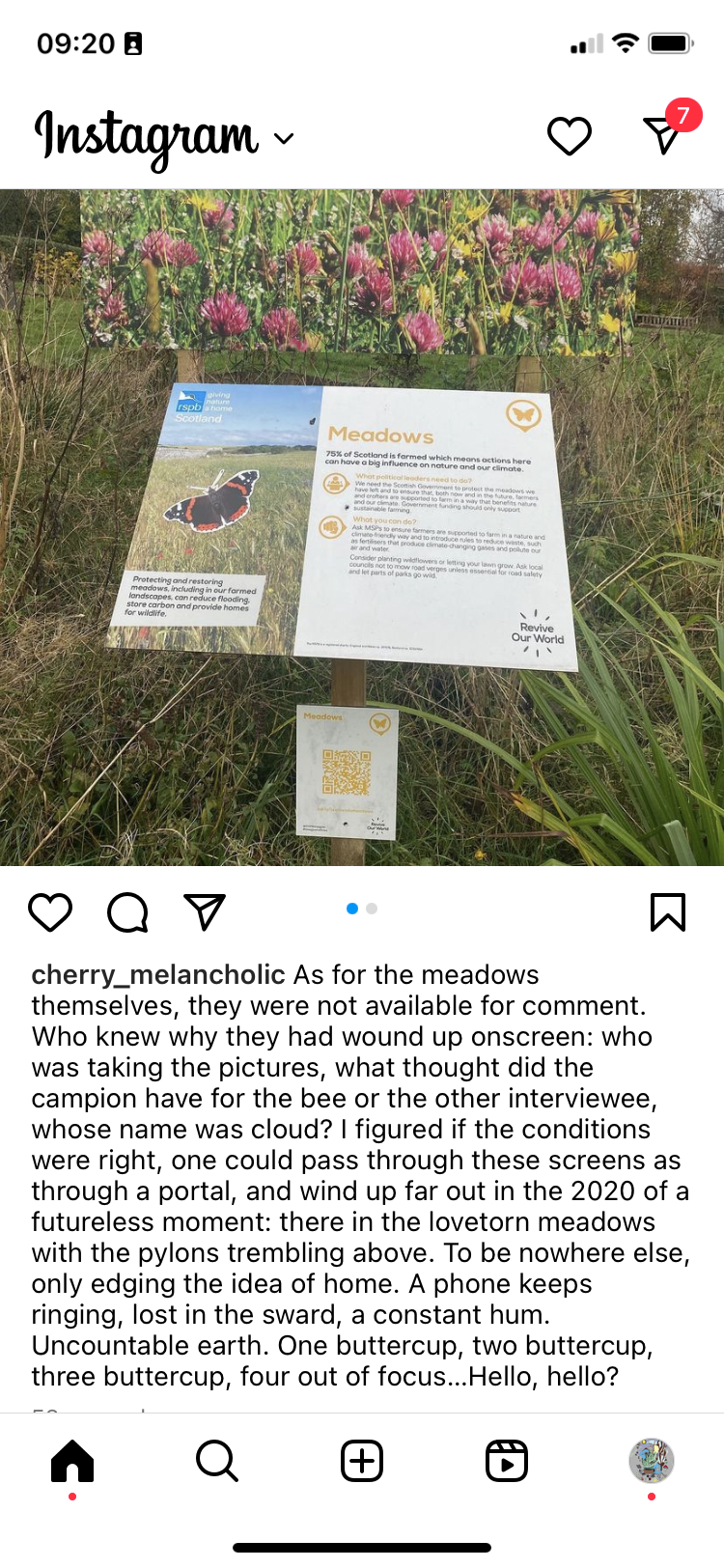
This is a talk about meadows. A meadow is a place of expanse and exposure, where Man shoots the mother deer in the Disney classic Bambi (1942). It is a site of slag heaps, fly-tipping, wild and opportunistic overgrowth; the edge land between industrial estates sprung up with buddleia against the odds. Ambling between creative and critical approaches, this talk makes a case for the gerund meadowing as a conceptual and methodological imperative for porous and cross-pollinating consciousness. The excesses of meadows suggest how we might glean forms of abundance and ongoingness from the discards of capitalist efficiency. We will take seriously the imperative ‘go touch grass’, not as pastoral consolation or escape but rather as a cultivating logic of regeneration. The aesthetic tendencies of meadowing — dense citation practise, polyrhythmia, borrowing from the im/possibilities of dream — are entwined with an ecological ethic of entanglement and suspension.
Tomorrow I’m giving a paper on Caspar Heinemann, Sophia Dahlin and Callie Gardner at ‘Imagining Queer Ecologies’, a one-day online symposium hosted by the British Society for Literature and Science and the University of Oxford. [online]
Here’s the abstract:
‘In contrast to biodiversity’, argues Karlheinz A. Geißler, ‘“chronodiversity” is terra incognita’. This paper takes up the challenge to explore chronodiversity (the extent to which individuals have differing experiences of temporality) in a queer ecological context. Following Catriona Sandilands’ call for queer ecology to stress ‘an articulatory practice in which sex and nature are understood in light of multiple trajectories of power and matter’, I will look at contemporary poets whose negotiation of pastoral and lyrical modes offers a temporal experience of embodied difference. I am concerned with how queer poetry intervenes in modes of temporalisation which bind existence to a standardised temporal logic of consumption, expenditure, reproduction and labour. While pastoral is often associated with nostalgic and reactionary structures of feeling, I consider poets whose engagement with pastoral tendencies constitutes an ‘allergic’ aesthetic/ethic. Given that ‘allergy’ is rooted in both allos (‘other, different, or strange’) and ergon (‘activity’), it is fruitful to examine how poets reactivate pastoral modes through a queer and critical reimagining of desire and time. Reading poems by Sophia Dahlin, Callie Gardner and Caspar Heinemann, I consider formal strategies such as complex sentences, lists, imagery, lyrical present tense, citation and space, to dramatise the emotional and temporal conundrums of queer pastoral. I argue that these poets explore the possibilities of ‘queer asynchronies’ (Elizabeth Freeman, Time Binds) to rethink environmental consciousness in terms of (allergic) pastoral erotics which variously reflect and refuse the organising logics of heterocapitalist chrononormativity.
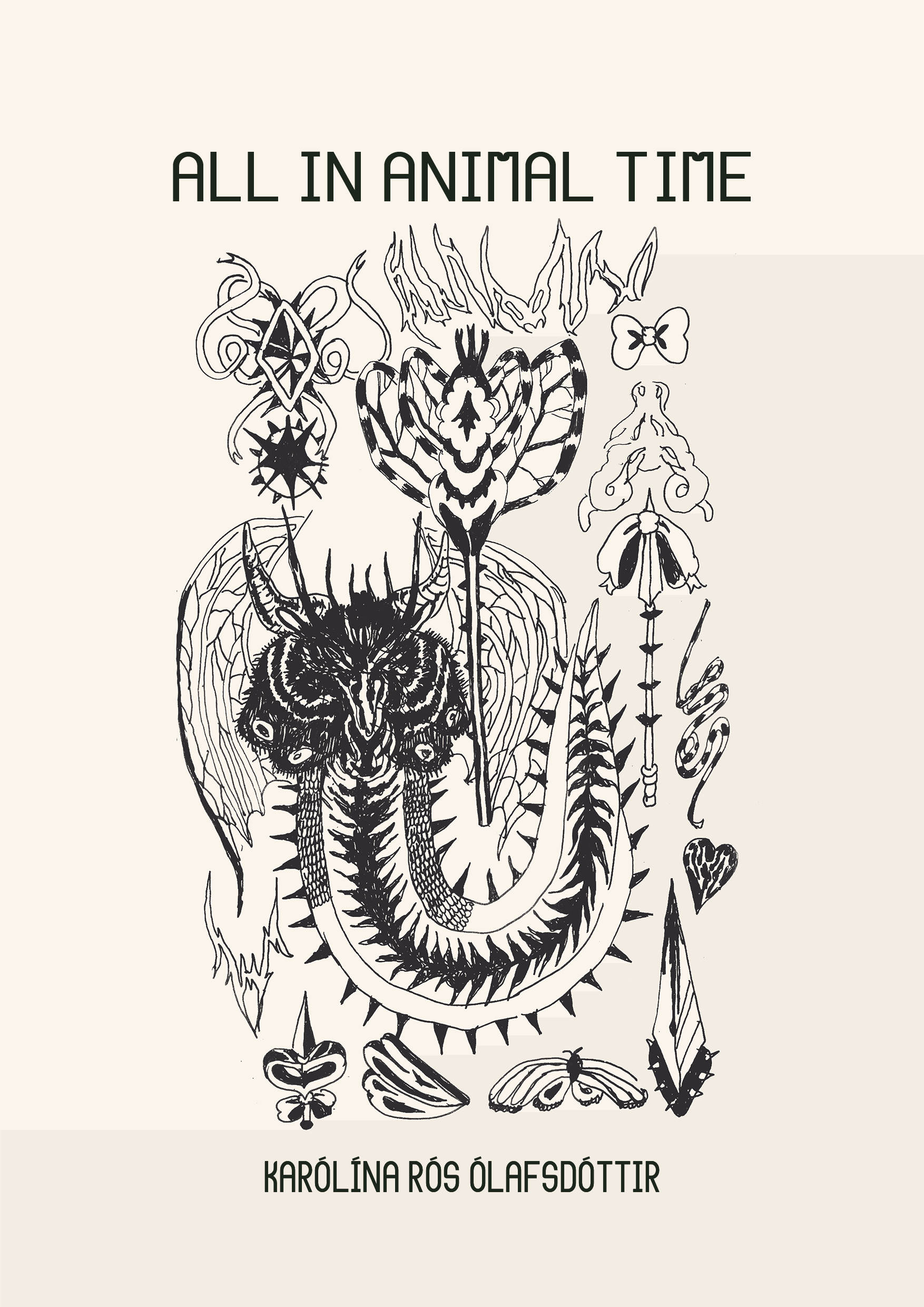
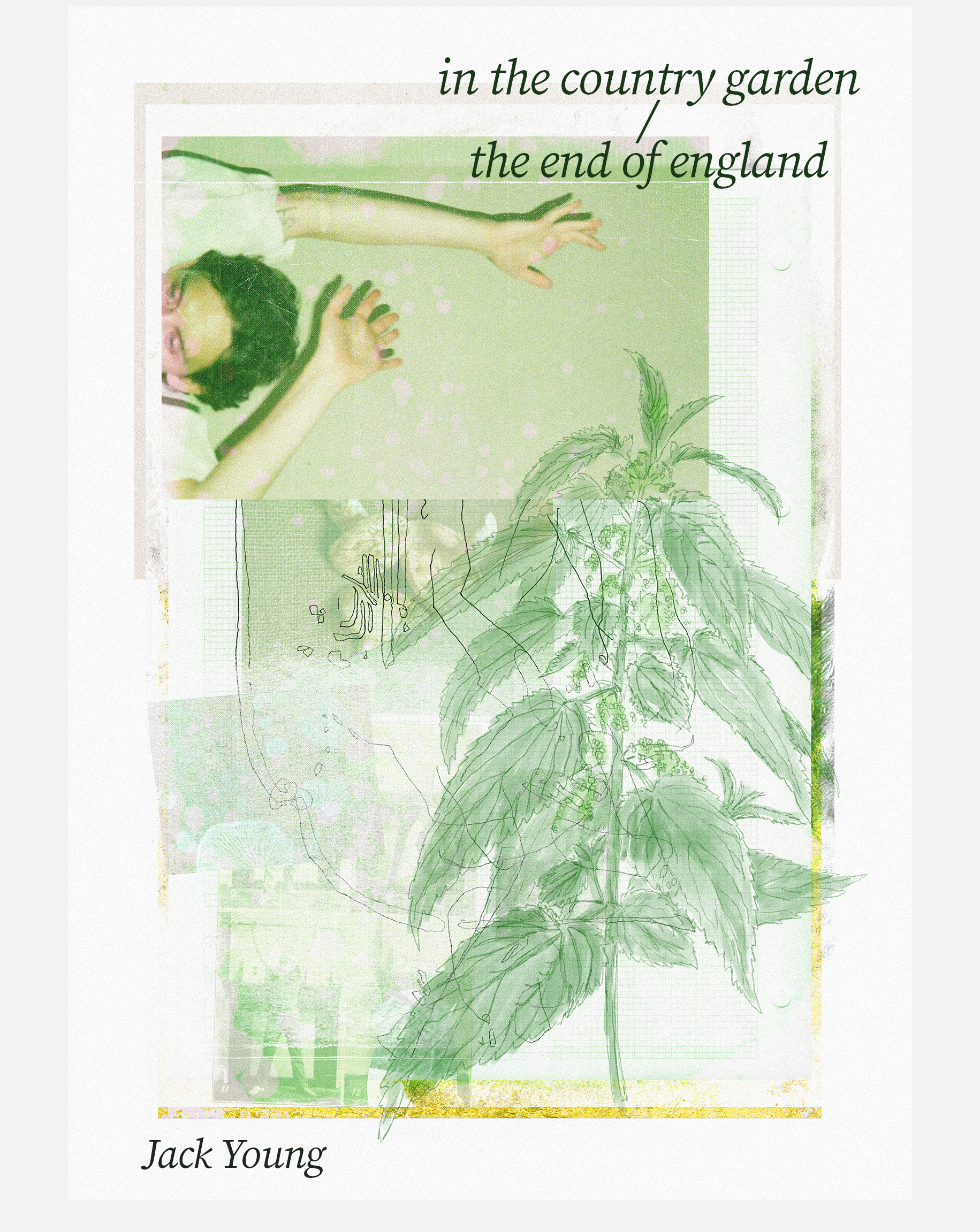
Over the past few months I’ve had the pleasure of working with two excellent poets, Jack Young and Karólína Rós Ólafsdóttir, on bringing to life their pamphlets in the country garden /the end of england and All in Animal Time. It’s been a fair few months since SPAM published anything physical (our most recent print publication was Cocoa and Nothing back in February) and coordinating everything for season 7 reminded me why I love doing this in the first place. There is something magical and alchemical that happens in the process of getting something from email to book in a series of whirlwind zoom(ies) and frantic whatsapps and editorial ping pong and delicious in-depth reading. I love figuring out solutions to a design problem, shunting things around, letting things bleed into the edges or splash into place, phone calls about word choice and line breaks. Generous margins and snaky wee texts / embarking upon font quests.
We got to know our authors, who are based in Bristol and Iceland, variously over the pandemic through Zoom workshops and the great poetry boulevard that is gmail. You can read one of Jack’s poems in SPAM005 and one of Karó’s in SPAM004. The SPAM editors are big fans of their work and we were delighted that both authors had pamphlets that kind of grew out of the poems in the magazine. This season has a lil rainbow-shrouded eco flavour: poems of the anthropocene everyday, poems of queer pastoral, poems in animal time (as per David Berman’s advice). J&K are poets with a real interest in the scholarly work of poetry as much as the playful. These are really thoughtful works which traverse everything from decolonising botany to Commander Keen, the dietary needs of black holes and the sonnets of rats and punctuation marks. Ugh I really love them! Thinking about these pamphlets is like coming up on coffee with sunlight pouring through the morning and having adequate sleep and remembering why the little things really fucking matter. It’s like the libido of the knotweed exerting pressure to break concrete and escape the walled garden which is like beautiful open source software. I am so lucky to have worked with these poets and also to have collabed with my co-editors Mau Baiocco, Kirsty Dunlop and Ian Macartney in bringing them to fruition. Long live SPAM!
Coordinating this pamphlet series also reminded me that publishing is an act of worldbuilding, brick by paper brick, pixel by pixel. It’s like: how do we give birth constantly to the word-pearls of what you wanted by accident of so many factors to have an idea for ~ ~ it’s like……a gift, a life-changing conversation, a journal entry for the language of flowers, a frolic through girl city’s sugar cubes and the delicious lumpencoal of the poem. Stop to admire the ‘four-star review sycamore’ (KRO) while you’re at it.
We worked with two v talented artists, Maura Sappilo and Sam Williams on cover design. Thank you Jack and Maura!!!
If you’re in Glasgow, please come along to our launch on the 10th November, where we’ll also have a reading from Edinburgh poet Murid L. Keshtmand and there will be many a pamphlet on sale and a lil wine & snack to be had.
PEOPLE OF THE PRESS! If you’d like to review the book, interview one of the authors, have them on your podcast or stock copies of the pamphlets in your store, please email spamzine.editors@gmail.com.
You can preorder the books at inflation-resistant prices => spamzine.co.uk/shop.
You can watch two Instagram live sessions with Jack and Karó here, where we talk about the thinking behind the pamphlets, inspirations and the craft of writing.
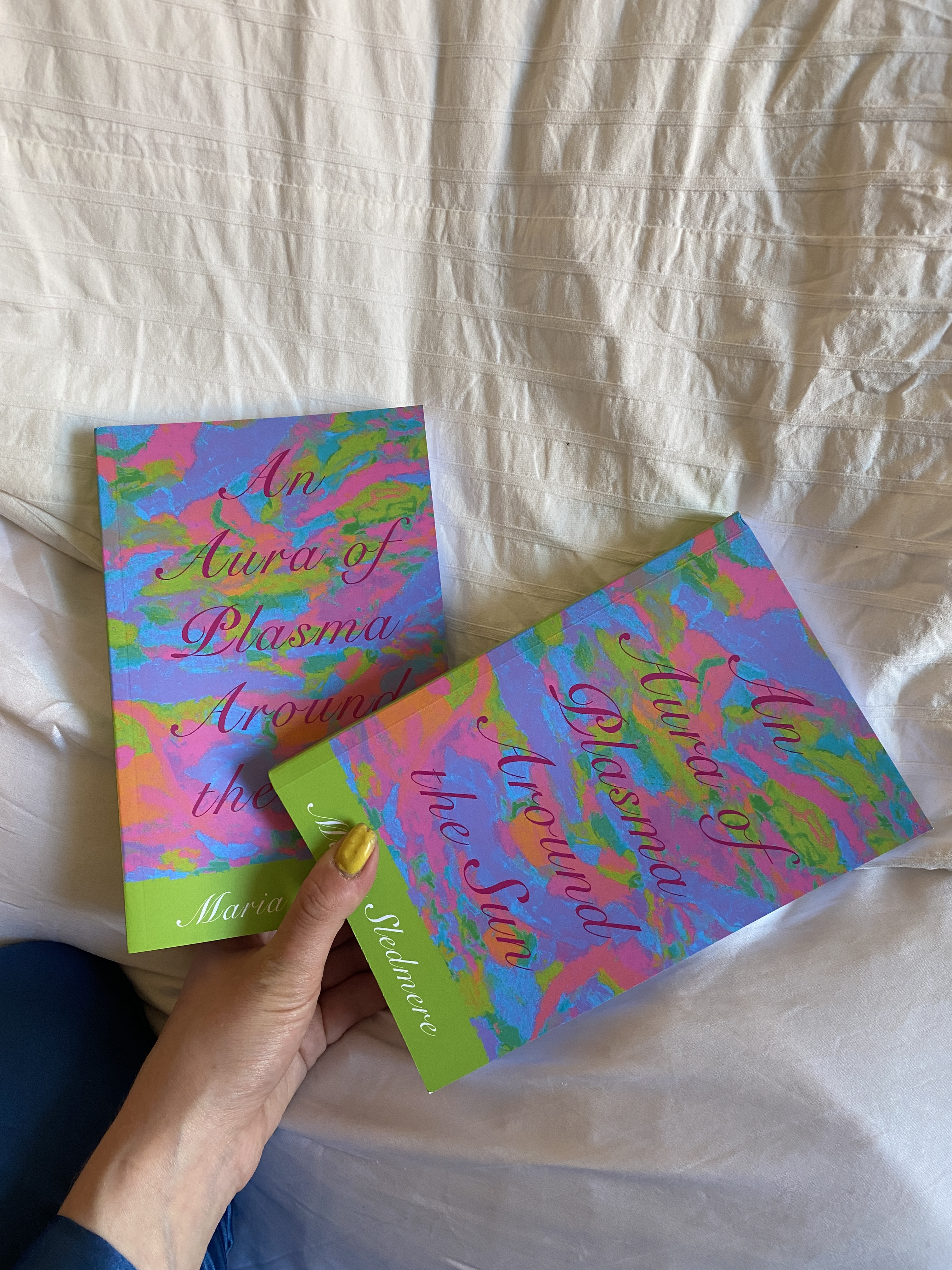
Blending oneiric memoir, experimental fiction and glitched verse, An Aura of Plasma Around the Sun swirls narratives of adolescence, occulted textual topographies and Scotland’s pandemic lockdown. Sweet, funny, heartbreaking, clever and ridiculous, often sentence-by-sentence, Maria Sledmere doesn’t guide readers through these whirlwinds so much as throw them in. Yet her spliced reveries and decadent languages are always underpinned by a celebration of community, as radiant and permeating as the sun.
198 x 129 mm / 254 pages with illustrations and photographs
Grating ginger from spoon feeling, lambent idea of no lucre to save, nothing at all, deposit of warmth – start using joy as a doing, you said I was joy, joying, unjoyed, a joyride ~ this belongs to you!
My first day at language was painful – wasn’t yours?
Comprehension passages were my forest experience, sexual discovery etc. Why was that girl stealing seeds?
First day as a tree, first day as a ginger. Quality of energy and tying your laces at crotch-level or solar adornment. Ugh. I never did learn to tan. I was always raining.
First day as a patient.
Write a detailed analysis of the means by which the writer captures a moment in time.
Aye for an aye.
Frozen trachea. Osteoporosis of form.
Don’t you understand the poem has to mean something? I mean it always does?
You are lucky if you wrote your name on a tree in 1993 because now it is nearly thirty years old and the wound persists a loose idea.
I began life calloused on the thumb of the family. All my life I ate chalk. My first memory was volunteering the date in class. “It’s the 12th September miss”. What’s the year? They made me stand up to write it. That morning a bee had stung me behind the knee, in that very soft spot, and I hadn’t told anyone. I winced and limped to the board and wrote 12/09/1998. It was the summer the ash tree was felled and then the oak, and we all made nests from the heaps of cut grass and I tried not to cry when scolded for grass stains, my skirt too short, my sting. Did I not understand the task at hand? You need to help the boys beside you, they said, when you’re finished your work there’s always more to be done. I wanted to be done with it all at once, and to never do it again and bask in the slow, drawn-out time of my earned oblivion. Then I discovered coffee and had all these memories rushing to the loch where I learned the name of a baby swan, a cygnet, which sounded like a form of jewellery or grammar. “That bread has stones in it”, I would say when presented with brown slices of something seeded. Throw it all to the swans. The mothers did not know what to do with me. I would not eat the slabs of pink trembling on dinner plates, so I ate the sleepover candy, all of it, and slept through the films, the first to want to sleep in their company. The mothers were vicious with hairbrushes. Do you know what happened that day in 1998? I licked white powder off my forefinger, then my green thumb. I felt funny. Under the table, the boys showed me their easy-peelers, their cigarettes, their rusty little knives. Somebody telling me to focus. To stop. At any moment, I’d feel the ash, the wax, the writing all over me. I was in the birdshit deep in the loch, my sediment; I was a lot of work.
A workshop exploring Strathprints through creative practice with Dr Maria Sledmere (School of Humanities) & Dr Karen Veitch (Scholarly Publications and Research Data).
Was really fun jumping into the Strathclyde repository on Monday with Karen and students from across the university. The whole worksheet accompanying the workshop is now available open access via Strathprints. We looked at the relationship between open access and open forms, ecopoetics and recomposition, collage, cut-up, erasures and wildcards – with examples from Chloë Proctor, Caleb Parkin, Caroline Bergvall, Kendrick Loo and others.



 mariaology