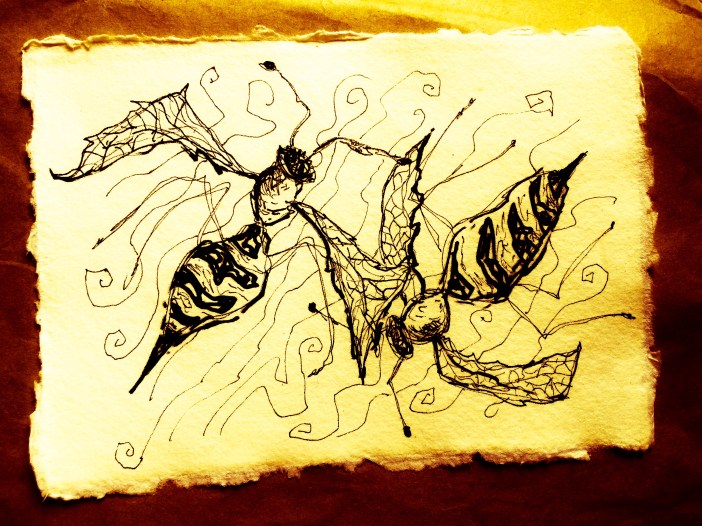
narcopastoral ///

N A R C O     P A S T O R A L
(written between 1-4am, in the mood of Gilded Dirt)

‘No shepherd, no pastoral’ — Leo Marx

Let us begin at the dawn of the internet. A story of packet networking, government departments, protocol suites and business decisions made in the cloaked, air-conditioned hum of boardrooms. No, this is boring. Let us fall three stories through the hyperlinked portals of a Tumblr archive, our minds caught in the dopamine rush; nothing comparable. These colours, the bronzed flesh of beautiful strangers (who aren’t even models!)! A doubling of exclamation, a doubling of desire. I have crushed many harmless cartons of Ribena while thinking of your sweetly dripping smile. Talk to me O Web, nobody else will; I see only a shrouded reality, the silken flickers of a screen-bleached veil. Who leads the flock of the blind and hungry teenagers? What possible elaboration of data could draw them to utopias lost like that early neutrality of the net? Innocence perhaps is always (already?) fallen.

Why haven’t you replied to my text?
Derrida says everything is text. There is no outside-text. Look around you.
You know what I fucking mean.

All interaction is destined for a meme. History is full of them. Literature is interaction; the inevitable touching of finger and ink, perception and paper. Barthes says: ‘Language is a skin: I rub my language against the other. It is as if I had words instead of fingers, or fingers at the tip of my words. My language trembles with desire.’ I wish I’d written it on a postcard, instead of an internet bulletin. My god as if they even still called it that. Nothing one has to say earns the vital status of ‘bulletin’. It is all just discourse, levelled out, dank reality. Everything feels intimate and yet completely odd, alien, pointless. What was it Barthes found so sexy about language? A literal ache that feels like love, drawn to some other’s inward beam, the first brush against them, the leaf-like trembling. I’m writing crazy amounts and what brings me back to that electric surface is perhaps realising that everything underneath, every word I type, is basically at the core just binary. Night and day, will he notice me? Night and day, the rhythm passing through me, oozing.

🕊

Hell, I’m a millennial with minimum job security; whatever a quotidian rhythm is I’ve long since lost it with the bleed of light that steals through my blinds as I make my way into sleep. Too much coffee. The room an indigo blue of burst-through dawn. The birds are all around me, a whole garden full of them. One last time, checking twitter…

The little voices clutter the fields. Nobody is there to guide them; we are bound instead by characters, algorithms. You can’t write about pastoral unless the text in question deals with shepherds. Who are the shepherds of the internet? Perhaps we are, perhaps it is the panoptic site where we all gather, Pagan-like, earnest embrace of all illusory interfaces. Are we blind, clad in white, always in the service of our sheep? Endlessly tempting…We play lyres and sing earnestly of our unrequited love; we do it in the hallowed gardens of YouTube, where Blake would write of our purest impulses. We used to play quite happily among the shallow folds, so sweet in our greenness, uploading silly videos; we used to play before everything was just fucking advertising: ‘binding with briars, my joys & desires’. An ad for perfume, a woman’s throat in a chain-link choker. Advert for absinthe. Poison ivy crawls all over us and language just feels like a virus; I guess it’s because I’m well-acquainted with the dark work of coding. Underneath every word is the binary bleep, and I can’t help but think of sheep lost out in the cold. Life/death; the trajectories of rebirth. White and black; white on black, little white bodies in the black of the night. She will have a lamb and call it Microsoft.

What?
You know what I…mean. (?)
🌒

Our generation are all lost sheep. How many times have the fences broken in the fields of the internet? What we crave isn’t freedom exactly—O how passé the frontier motif!—but some sort of comfort, a shelter from the barbed experience of the IRL everyday. Unstable jobs, cackling media, unrealistic body image etc etc. I made a list but every time the words compressed into et al, like I no longer needed the details. I wanted to draw back into something simpler; the garden of Eden being this nostalgic collection of nineties net art and noughties graphics, the kind of vibrant geometries you might find plastered over somebody’s Geocities. I gave up thinking my shepherd was Julian Assange, or some other white-faced genius set to wreck the world with his erasable visions of freedom.

We are in need of soothing. Gosh, Laura Marling even wrote a song about it. My God is brooding. I have lost the God. He or she is in a sulk. I retreat into a rhombus, the equilateral remembrance of shadow. My identity was never clear but soon I let it divulge further the strange truths of illusory discourse; let it slip into the sinkholes of forums and chatrooms, all these virtual spaces whose presence filtered through my everyday life. The whole experience overwhelming, of course. The amounting of so many avatars, each one a horcrux scattered beyond the bounds of thought. Becoming monstrous, evolving from beyond consciousness.

We continue to smoke, in defiance of death. How we study with interest the gore that plasters each anonymous cigarette packet: the foetus made of fag ashes, the man curled in cancerous agony upon a hospital bed, the baby absorbing its secondhand pathogens. We campaign for action on climate change yet continue to smoke. We are in this oscillating space; a recognised irony, the metallic taste of hypocrisy stinging our tongues even as we try to move beyond it.

There is a willing naivety in our longing for certain environments. What lush oasis amid the din of our dull city living? What ancient standing stone circle, what temple or gorgeous cathedral? The Hollywood canyons, the plastic palms of a Lana Del Rey video?

There must be also a willing imbibing of the polluted dream. Recognition that this is the Anthropocene; that the world is ending already and we are playing out the last vestiges of our human, our species’ mortality. Living with a kind of negative capability, accepting the state of corrupted beauty. What about the atmospheric acids that streak the sky with alluring tints? How we immortalise, fetishise that pink and orange, even as it signals our climate’s destruction? The damage to the earth moves slow, sinks through the soil, evolves with distorted DNA coding. The trick is to slow down with it, to ease into so many starry, imitation futures.

We must deliver empathy for other beings. We are both shepherd and sheep, guiding the world but also being guided by it; thrown awry at every turn by some new storm or war, some side effect of our reckless living. Consumerism secretly blasts the binary of subject/object, self/environment; quite literally, we become what we eat. I am an ice lolly, melting cherryade on the concrete heat of this too-warm city; my sticky residue is the sexless blood of the starved teenager, the catwalk model, the fearsome and damned. And yet sometimes I stand and smoke and think it means nothing. Saint Jimmy, O endearing memory of Green Day. The photographs on the packet do not remind me of death, but some abstraction of the body at its limits; an art exhibit poised to lift daily habit into the realm of the transmundane. I have waited at so many bus stops, cash points, queued in supermarkets for this.

Every time you snort cocaine I watch the blood burst in tiny wires, the inward capillaries. Somewhere someone is spraying pesticides on a field of coca plants in Mexico. How many times have I helped you with your goddamn nosebleeds?

For I have learned to look on nature, not as in the hour
of my foolish youth, face in the window without name
without name. What was it Wordsworth said
about humanity? That still sad music is the soundtrack
to each brittle burst in the star of my heart. God knows
even in forests and rivers I miss you. Not even wine
is what it once was. Every sunset the colour of salsa,
and each night my tongue burns on the memory of chilli
while you are out there, susurrations of grass
and all the smashed glass you shoved in your fists
was silver petals and the edges crushed with the sap
of my love and I wanted to stick them together again.

Instead, I think about the stomachs of young boys, knotted with wire–iron and barbed. There are too many hormones in the milk they drink. Nobody bothered to nourish the cows. They were too busy caught up in period cramps. Pointless cycles of (un)reproduction.

 🍒

Narcotic. Narco. That which has a tranquillising effect. Lorde on her new album singing in that sugary octave leap: the rush at the beginning. None of us can sleep without pills, without sex, without ASMR videos. These soothing colours and shapes; the ambient drag of background music, distorting our sense of imploding foreground, dissipating those ugly memories of time and space. All is levelled, all is darkness. We crave oblivion. Sometimes stranger, sometimes easy. We flirt with the past, have this mild addiction to nostalgia. We’re just looking for things to transcend with.

There are times when what is to be said looks out of the past at you—looks out like someone at a window and you in the street as you walk along. Past hours, past acts, take on an uncanny isolation; between them and you who look back on them now there is no continuity.

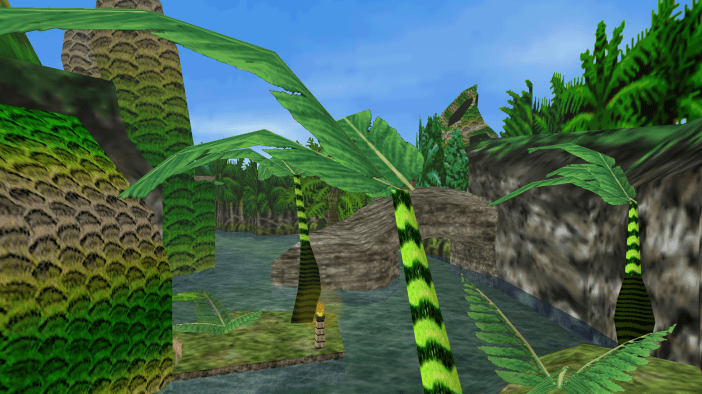
So begins Alexander Trocchi’s Young Adam (1954). Trocchi was a heroin-addict. He knew the all-consuming tranquility of drugs, knew how writing could perform that strange inner split of self. When we write in the mode of the narco pastoral we are being chased by some older version, the 1.0 to our 2.0 dreams. When these memories hover, the girl that floats is never quite yourself. There is the sudden realisation of distinction. How far you have come, how low you plummeted. I am guided by the soporific waltz of a nineties video game. With its labyrinthine pathways I reach for the future–

 😈

Here, there’s this new podcast. Follow me. What follows:

Recipe for vapourwave: add the reverb, the transparent semiotics of the checkerboard floor (I fall four stories just to join you in bed), the swaying gif of exotic indoor aloes, the unfinished loop. Resounding, distorting. Casino glitches. Skin-cleansing, refreshing. Try out your luck. Cooper could run for a hundred jackpots. Pick a colour and follow a moodboard of sounds and slowly flowering samples. Imagine the Black Lodge. Watch disembodied relics from the eighties melt on the vinyl floor, down the plexiglass walls, the long-drowning faces superimposed on posters of pop-punk club nights and every neon a symbol for rave’s revival. The first time I listened to Aphex Twin was a bourbon-soaked kiss and somebody had burst glowsticks and flicked the liquid all over my bedroom, so when the lights went out it looked like so many pink and green stars. O holy dibutyl phthlalate, flurophore with your brilliant emission. The clicks and bleeps lived on in the pale yellow stains and in the morning I was suffering.

Early soundtrack of our forebears: Eels – Novacaine for the Soul. Oh my darling / Will you be here? Presentness is in deferral. We wait for each other, always aroused as the constant shivering upsets our nervous system. We crave things that ease the switched on quality, things that split apart the binary, leave us to the oblivion of off, if only temporarily. At least half of us are insomniac, up late waiting for the object of desire to make itself present. When red goes green.

Always online and yet never replies. Everything is text. I read his stream of thought in the run of my bath tap, calculating the relative water wastage in comparison to a daily shower. I wash my hair less and less. Mysterious pains pulse and twist in my ovaries like radio signals struggling to push out to the ether. There will be no fertility here. No flesh or grease. You gave me a pear wrapped in brown paper; but it soured on the window, grew a layer of fairy fur and I offered it to the shrine in my father’s garden—which already I have forgotten. I miss you, it’s clear. Not the grass, not the fine rich taste of its loam. Once I wore daisies in my hair, a long ago dream of a girl from something written by Laurie Lee. The girls then, they were clean and apple-sweet.

 🌿

Solastalgia: ‘the pain or sickness caused by the loss of, or inability to derive, solace connected to the present state of one’s home environment’ (Glenn Albrecht). I am home, I am centred. My mother’s chair, or whatever. Yet nothing makes sense. I feel this network already filled up with death; I know every moment to be painfully imminent, displaced, the always-already. Even the mice in the piano, the jackdaws cawing in the chimney. Why can I not experience the present? My own soul feels washed up from the future; sometimes I glimpse a world underwater. I glaze over the orbital space of Google Maps, zoom up my street, see a light sabre left in the front garden. Someone flew over before me. The tree is gone; there are brambles sprawled in the driveway, the squashed pampas grass. I know this to be home.
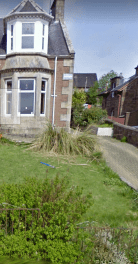
Screen Shot 2017-06-24 at 12.18.08

We will move through twelve states to get there again. Hence, 12th World. This was concocted at the age of seven, under the influence of various toxic E numbers and a book of amateur spells. If you press the white keys of my keyboard, your fingers will burn a bright acid green. This isn’t my beautiful house, my beautiful room, my beautiful toys. Man, how I’ve missed you. The last time I cried in the garden it was May and so sunny, under the lilac tree I wept for my childhood clutching a miniature bottle of whisky.
How can one have pastoral when even home—even one’s roots—feel displaced, already lost, slipping away beneath one’s feet? Pastoral was never present. Pastoral was always the idealised space, the green and gold of a romanticised past or a future vision. To reach it you had to call on the Muses.

💉

In the Anthropocene: corrupted pastoral. A druggy, chemical haze of the paradise garden. Everything spoiled, but the spoiling starting to manifest its long-term effect. Rocks made of plastic, all that washed-up sea glass replacing the ocean’s organic silt. Sand turned to glass and back to sand again, smoother wash of eternal form. For Terry Gifford, the pastoral is ‘an ancient cultural tool’; a form of ‘textual mediation’ which transmits something of our relationship to the world. Quite grandiosely he claims: ‘Today the very survival of our species depends upon, not just this debate itself, but our ability to find the right images to represent our way of living with, and within, what we variously characterise as “nature,” “earth,” “land,” “place,” “our global environment”’. Yes, it’s quite possible the pH levels of our souls are out of whack. But it isn’t as if we’ve lost the primal ability to connect with the nonhuman. Throw me out into the Lake District and I’ll melt quicker than my teenage self listening to her first Fionn Regan song; throw me in the Hollywood canyons and I’ll be that sparkle on a dust track highway to dreamland. Oh, is that Lana, tossing back her hair? I close my eyes (hello, Arthur Russell, I’m listening) and I see little dolphins leap through those huge silver hoops.

Somebody once said dub is spiritual music. Somewhere the Nirvana-drenched dreamlands of the fin de siecle found themselves washed up, an acid-tinged pastel they called seapunk. Parma Violets, the lilac flesh. A yin yang is sucked into a whirlpool; this an accurate portrayal of my heart’s trajectory when I think of you on a summer evening and the smell of garlic and violets and rollup cigarettes…Sun crisping the deep horizon. You can’t, I mean. There are chemicals in the water, poisoned sushi. Hormones. Her blue lips don’t signify illness, but something alien. There are pyramids on all the cassette tape covers, each one symbolising the ancient. Deep time, deep horizons, deep hot lust. Nobody has a deck on which to play them. This is all very beautiful, very visual; but we lack the machinery. The correct array of objects, severed from context on the transparent grid. The slow, elusive pulse of electronic beats. Tropocalypse, barnacle-studded skin. Lilac flesh, lilac rhinestones. Follow the arrows to the tender disco, smash out your tastebuds on packets of clean white chalk.

🌅

It’s Missingno, somewhere afloat on a stillborn ocean. I kept every one of those 99 Rare Candies. I thought maybe I’d see you one day, have the chance to catch you.

Hologram memory: swooooooon.

It was all fun until someone famous put our iconography in their music video. That’s the problem with narco pastoral; it’s pretty damn close to pop. There’s already enough sugar in the diet. Stuff you can’t just flush out with salt. It’s always on the radio.

Someone had a face cream made out of mussels. The inward silk cream, lightly scented with brine. It was nice, it kept everything smooth; it made the person smell very much like a wet sea rock. But none of this is much to do with shepherds. What is the dream? What keeps it pastoral?

Temptation of animals. Lana in her garden of Tropico, writhing around in repurposed imagery of Eden. Ginsberg richly lisping sin on her lips. I saw the best minds of my generation. Well pal I saw the best minds of my generation serving tables to rich octogenarians with straight faces and genuine kindness in their eyes. They drank and they tried to describe the ontological shift that characterised their seaborne being. The misty look. Here, have some Talisker whisky. As if something was always missing, the way they would look across the room, straight through every single one of those tables. Slight shaft of light, golden beam. Sundown. Everything always setting. Someone messing with their settings. I made every element turn black.

🐑

The sheep crossed my path and each one spotted the rubies that studded the rings of my eyes. Had I been crying, purging? For what were they searching, with their dead dark stares? Some expelling of matter on a vacuous Sunday morning. The summer wind bristled the broken pores of my skin. I was all that insignificant, even the farmer laughed at me. Pale-clothed, a red bracelet slipped from my wrist. I thought of myself as pure metonymy, this endless series of objects and how I hated the need to consume them. Every act of consuming was like eating an ending except there was never a divinity to the outside, the afterward. Just that sick lump in the stomach, the recalcitrance of matter unfortunate in its obstinate return. Why am I always reminded of what I have eaten? What is this rubbish that haunts me? The nastiness, the chewing and mulching? The burning?

Narco pastoral is friendly with trash. What is the wasted hour after the morphine hits? What smoulder…Forgotten hour destined to be unremembered, to lie suspended in the space between two moments. Consciousness as stream, severed or diverted. Lonesome tributaries. How this sunset will look purer because I’m certain to forget it. Sheep cannot cross water, not properly. There’s a tendency to sink. We linger in the shallows, swap vague cuds of data. Italo Calvino deems it ‘our dark cornucopia’, these leftovers we throw out, that vital gesture of abjection that allows me to divide one day from the next. But everything has already collapsed into one, become mulch. Will you lift me? I fear I have lost my name to a certain ceremony.

🌵

Narco pastoral: craving that soothing, that tranquillising return to what brightens the mood in the manner of childhood. If I roll over, mull around in the canyons of junk. They call this awe, they call this an uplift of personality. I think about the cactuses photographed for episodes of Breaking Bad and it makes me thirsty, all that aloe vera. The luxuriant dust of the desert, rising slowly at dawn when the wind lifts and something hangs in the air, about to happen. When I played SimCity2, my neighbourhoods got hit with brutal whirlpools. I guess that was Gaia. Gorgeous or vengeful, vixen of the frenzied, hurting Earth. I guess I’m always cheating and eventually the universe finds out. Decadence of the Edenic is irrevocably alien. You see I have spent so much time lying on my bedroom floor it has started to feel like a hay bale or a barn or a hillside or something. Needles hidden. I can almost smell the breeze, hear the unimpressed mews of sheep. I’m heartsick for farmer land, for a world I do not quite understand. You begged me to watch Glue because there was a murder and a slightly attractive character. I longed to plunge in a pool of grains and be sucked so slowly away. You are, you are…

When Lana trills I sing the body electric and somewhere in time Whitman is loafing under a willow tree. There’s Ben in Lerner’s 10:04, ‘already falling out of time’, reading an ‘American edition of Whitman, its paper so thin you could use it to roll cigarettes’. Trace textuality, turn to ashes. When Isobella Rossellini is beaten to an inch of her life and still looks beautiful and that’s the tragedy. All my moods hued in blue. When the rasping sounds come from beyond the door, when all my lust for you feels useless and primitive, remnants of text message severed by missed connections. I move down the hill, steadfast as any rare sheep. The dawn is my shepherd. It’s 4am, past that even, and still I’m up writing. I’m winding my way through the hours already. This is summer and the very melding of day and night is a process narcotic. I wouldn’t be all that sad if you pressed me from bed and made every patch of me bright as your favourite rubbish. It isn’t all that. It isn’t. You could have a future. I’ll melt for you; I’ll shed for you. There’s something you just follow. The shepherd’s trajectories. He drips glitter and sings Grimes songs and knows the value of decent female production. It’s that easy. Soft qualities.

💧

He cut his tongue on the teeth of a selkie and calls it seapunk; there’s a gap where the whistle would be. The blue aroma, the blue chord, the melancholy blue of my body. When someone smashes a car in Vice City a frown forms on the underbelly of the sun. This is an old polaroid, the light leak very alien indeed. This is my collage of all that has been and will be. Blue skies, green grass, white sheep. I suppose it’s a good enough time now as any to reveal that I’m rainbow. I look like something a kid would vomit at a sleepover; this disgusting array of E numbers. Upshot: no stranger to the internet. The starry pixellation which on second thought could perhaps be freckles. How I loved him more for that, the warm skin feels soft on the back of the neck (net). Narco pastoral is soft porn, Hegelian dialectics, a fistful of dreams, a bump of mandy. You just want that ecodelic happiness, pure joy in the spin of your dusty shoes. If you drop all the drugs, consider me clean in the light I will love you. I’ve never been certain of anything. I just follow.

:: : the toxic lush pastoral
:: : the physiognomic, urban transcendental
:: : the stop-dust of carbon
:: : the fluid quotidian
:: : the endless chain of what once was (N)ature

/ World of Awe, A Stopped Ontography. / 🗑

It is important, according to Timothy Morton (2007), to harness the powers of kitsch.

I am with you, I am plastic-wrapped
and still just breathing…

..
.

c626560b45f0edcba8f4e580662f5f64
LDR in the short film, Tropico (2013). 


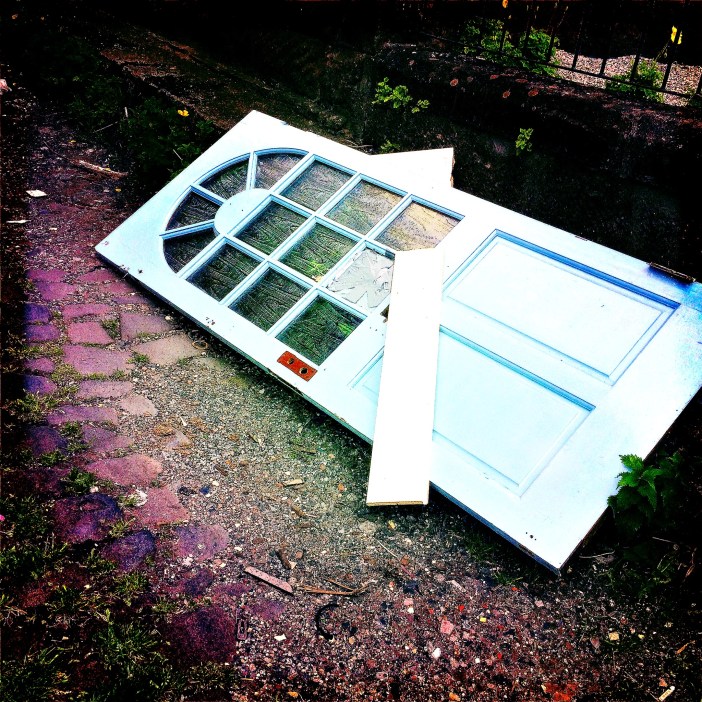
The Door

IMG_0158.JPG

She laughed at that, her maraschino heart would sweeten the moment with its tender syrup of lies.

“It’s just a door,” he said. The pair of them made a couple of magpies. She was green-hued, he was jewelled with blue.

They made their way through the suburbs, so easy the way they rolled along concrete with those slender legs. I have made a pinball of their trajectories. Soon they realised their mistake.

“We have to go back for the door,” she said. She was insisting. He admitted her this.

They carried the door along many streets. It was painted the colour of duck eggs, a pale blue paint that flaked in places. People stared, assuming they were a lovely young couple setting up their new home. Sometimes, she patted her pocket to make sure the stuff was still there. Later, they would huddle under the lilac in the rich person’s garden and count their dreams beneath panoplies of blackbirds. For now, there was the door.

“What shall we do with it?” he asked.

“It has a purpose.” She propped it up against the red brick wall of the old agora. It had beautiful windows, the kind of windows you imagine on doors in twee country houses, where nice mothers served sugar-bread to doorstep strangers.

“We could do anything with it.” They flirted with the idea of hacking it to bits, chopping for firewood. The forest was not far away; though really it was just a copse of trees, the undergrowth littered with cigarettes, sweet wrappers, needles. Not enough space to get lost in. You could hardly build a fire without alarming the neighbours.

When we are drawn out of nothing we are drawn into possibility. The couple knew the door was their portal, knew it as sure in their blood as they knew their daily hunger. Sometimes at night, she would let him scratch the sores on her skin, sending her off to sleep. She knew he spent those nights awake, scraping the bark off any hide he could, clotting the soil in his nails. They borrowed a suitcase, abandoned at a bus stop. An old lady’s worldly possessions treated them briefly to cardigans, palma violets, little nips of hip-flask whisky. They were warm for weeks, till the wool unravelled in winter’s first storm, till the liquor ran out one cold dark night.

Combustion or invitation. He gripped her arms and tried to shake her from every undulate leafy trembling. Her blood was beyond human; she had set up her fix long before sundown and this was wrong. He stayed with her through the worst of it, the 4am rattles and the toothache. If only the medicine worked, if only. Night-blooming flowers made cheap companions. An amazing array of skinny women would pass through the copse, the side alley that led to the 24 hour Spar, the petrol station. Cars would always pass regardless. The wholeness of the city was a great sprawl of this transitive passing.

And then the door.

She twisted the brass handle. The screw screamed in its lock, but nobody heard it.

(Can we always be stuck like this, honeycombing our bodies?)

It felt magnificent, holding him in the darkness as she always did, the frost forming rime on the skin of their lips. Somehow they knew the door was a separation. A transmutation of the flesh would occur in its fold, the way the pull-back of a hinge would sweep away time as they knew it. This was okay somehow, almost reassurance.

[…& continue].

Playlist: April 2017

IMG_4879April… the practically non-existent month in general temporal terms (I wrote the last one of these yesterday it seems) and yet so rich you were, plump with blossoms: like only this evening I stood in a snow swirl of pale pink flakes which felt like Paris or Japan, trace imagery of semiotic foreignness whirling around us as if weather had been borrowed from another place, a lovelier time. Love blossoms. I love April. April rain; it’s sweet and very quiet almost like a rustle, the silk crease in your jacket, how I imagine the pillow of the sky clouds to crease or maybe they fold like lightning and it’s more of a shattering, a bit like sheets of ice cracking with the sound all resonant rich in pain. Stay up late to cheat time or find hours abandoned in the first flashes of daylight which alleviate their airy orange through a bright red sieve or am I getting mixed up with sunsets? I have followed the resonant crescendos of synths until every loop is a transference of frequency through various slot machine ratios which fall on the clinking chance of ice in my glass my mouth all misted clearness of vision dissipating vision upon vision, red lights and the cherries glister with money & abstract value which is nice O so nice. ( ( ekphrastic reveries mould quicker in memory) ) You can hesitate on an omen, I spent weeks writing astrological reports in attempted reflection on a bitterer future which needed a sugar cube of lumpen conversation or hours as proletariat spent plate-washing tray-carrying performance of eloquent emotional labour for strangers. His wide eyes, asking about plaits in my hair and clogs. The schmoozes gathered at funerals as I served dark liquid in watery transference of mass into white cups made for the purpose. Wishing for the red room effect where the stuff hardens to strong viscosity then elasticates its way back to fluid to spill on the carpet burn the bourgeois toes through the patent shoes. (my crush on dale cooper lives still uncured). Mine had holes, grazed through by contact with broken glass. I love
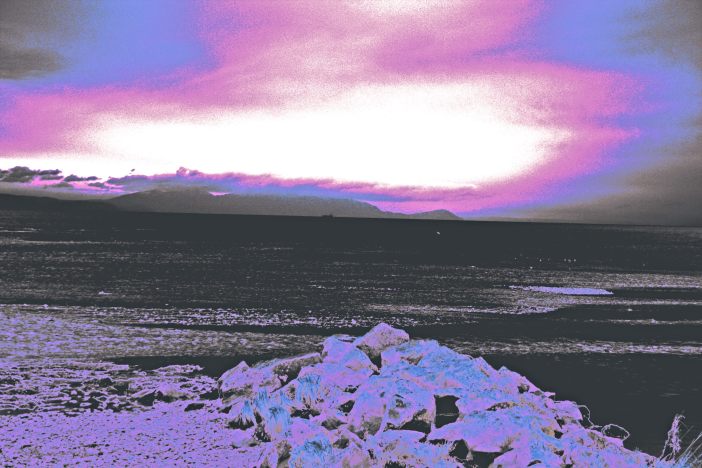
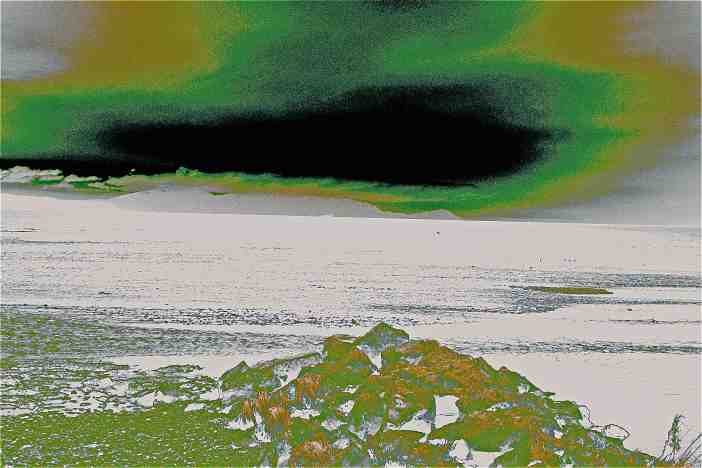
April rain. Tree rustles. It’s funny, leaves again; just being leaves. Green in the park and a gilded quality of the light on bark. I listen to music which quickens the senses. Clarity shattering synthetic beats. Very eclectic moments of hovering wanting confusing mixing the feelings which feeling makes feeling a feeling again not quite feeling but experience, touch, brief encounter with the liquid mirror of l-l-l trapped tongue on the moment can’t quite control or a button of the air to switch there’s a second you can stare through the window through viscid glassy matter or wishing for tears or the sound of pavement heels to cut through soft mulching rain you can’t see how the nightclub crashed with fire or how I lost a trail in the night to a newer location. creeps coming out of the grasses. thin leafy pages of choice discourse. Fallen have I in hexagon aromas of steamed vegetables, steamed cigarettes, the little vanish of an innocence, the widening eyes. April, pear-smelling nostalgia for autumn gone to the fresher ecstasies of the air and the sadness of wisping daffodil haircuts or the cloyingly poisoned imminent deadline. (we are not in May already) maybe.

The Cure – ‘The Top’

Anna Meredith – ‘Nautilus’

Joni Mitchell – ‘Amelia’

Belle & Sebastian – ‘Marx and Engels’

Eels – ‘Love of the Loveless’

Bob Dylan – ‘Up to Me’

Nirvana – ‘Dumb’

Radiohead – ‘Lucky’

Melody’s Echo Chamber – ‘I Follow You’

Mooncreatures – ‘Guilt Chills’

Hazel English – ‘More Like You’

Beck – ‘Can’t Help Falling in Love’

Fazerdaze – ‘Jennifer’

Slow Dive – Star Roving

Bonobo, Rhye – Break Apart

Father John Misty – ‘So I’m Growing Old on Magic Mountain’


Record Ekphrasis: The Long Ocean

IMG_34162IMG_341611

~ https://thelongocean.bandcamp.com/album/the-long-ocean

There is a struggle, the suspension of hoar frost crusts time itself as it trickles over the sea. At first light we watch for an opening. Even in attics and city bedsits, the sea remains in our blood. We feel it cold as ice at the illness times: how darkly we sink into the sheets, hoping the pain in our skins will dissolve back to lucent matter, the night wisps of somebody else’s aura.

A voice enters soft and lo-fi, filling the interludes that swirl around haunted piano arpeggios, the silver streaks that spill on the ocean’s tides. I am afloat in muted clicks that keep me close to the surface, where the sound echoes in drips, as in a swimming pool. I listen for his voice as it mists the glass of the window. I inhabit that glass in the silence, waiting for some melody to sparkle with any dissonance sufficient to crack my crystal prison. Percussion is slightly hard, a clack, clacking. Crackle. Predictive appearance, seductive. “I’m under your spell / and I’m under under”. Subaquatic passion, staring at the world from beneath, behind, the film of its surface. See how everything shimmers. It’s quantum physics. You can’t peel off the surface of reality, its candy sprinkles, its gilt, to see what darkness and delight lies beneath; you’re already deep under, withdrawing, closing.

There’s the haunted aesthetic we find in Burial. Something more organic, elusive; the rural alternative to Burial’s empty midnight metropolis. On ‘Raindrops’ the muted sound of gulls weaves in and out of a DJ Shadow, Entroducing…..-era riff and the shimmering playful jazz of a brighter piano, a celeste of some sort…the sound of wind chimes through the minuscule ears of insects, so very high-pitched, so very sweet. You can imagine the tinkle of glass as you toast your favourite jellyfish, spirit animal that sucks its seven temporalities tentacular around it, moving them in sweeping undulations that rupture the cyclical moon-time of the waves. You open your flesh to the ocean, every salt crystal forming a bead in your pores. Desire is the fulfilling of absent substance, the spacing of the gap between lack and attainment. The passage of sailing, not knowing what darkness, what deep blue, you are setting off into, heart curved sharp by the cut of a crescent moon.

If Burial is, as Mark Fisher puts it, ‘London after the rave’, The Long Ocean is the abandoned nightclub pavilion, the sea’s dull roar mingling with those shadowy echoes of ecstasy. The slowed-down groans of a former generation’s momentary joy. Angels caught in the sand of an hour glass, being tipped, a largo mode of clock-ticking, grains of time slipping endlessly over the rasp of voices. I set this album to cassette tape, allowing the crackles to augment and mingle. I could be in the murmuring belly of a ship, hearing the rasps of a radio mix with this transcendent, nowhere music. It’s the sound of twilight set to reflections of quartz made bright momentarily by deepwater bioluminescence. What is that whine, that eerie peal? The sound of lost dolphins, the painful song of a lonesome whale? The whale is a heart’s darkness, a shadow-side of waking reality. You can lose yourself inside it, feel dreams close over you, prised from the wax, the oil-black skin.

Four Tet at his most otherworldly. Hypnotic loops, the soft distortion, the natural ambience. I am walking down an abandoned street, where weird green plants sprawl through the smashed-in windows of Brutalist buildings. Night birds chirp the tart remnants of forgotten songs. I am hooked on the wave-like rhythmic pulse of his words. My footsteps echo, down the street, down the passage, down the shallows to the deep where tarmac melts into oil-black sea.

There’s a sense of dark, spreading space, interpenetrated by twinkling scintillations; not unlike the plaza-like ambience of mallsoft and certain variations of vapourwave. Think: diamonds in the tarry pavement, stars reflected on the ebony surface of the midnight sea. A more crystalline James Ferraro, Marble Surf; The Long Ocean swaps those choir-like, ice-cream van speaker crackles for a more precise intricacy of lattice parameters, cross-rhythms of tinkling percussion and soaring, yet always subtle, beats. Think also of something like GOLDEN LIVING ROOM’s New Nostalgia, its eerie shimmers of late night lo-fi mixed with the bright sound files of near-future cyberspace, everything sounding slightly subterranean, that tinniness of dissonance. On The Long Ocean, however, instead of the glitch effects of hardware, the sounds chosen here are derived from natural materials and technics. The hollow click of driftwood, billows of cooling wind, cave-like echoes, the clinking of a necklace of shells with every percussive sprinkle (‘The Crest’). There’s a collector’s sense of amassed trinkets, effortlessly slinking along intricately simple bass-lines, hardened by industrial beats which burn in the weird space between background and foreground. What this music shares with vapourwave is a sense of slow, careful build towards the internal coherence of a detailed and evocative theme. The sadness and the beauty leaves its ghost stains on your brain, tugs at the blood which is full of the sea, makes you want to walk forever, or forever dream—rhythmic, contorted, returning serene.

Some of these tracks are totally devourable jams, the minimal intrusion of sampling giving way to those lusciously percussive beats, twists of lo-fi brass, crooning sexily over the building peal of mysterious beats (‘Gold Dust’). I’m reminded of a video game casino, an interlude space suspended in a three-dimensional, virtual world, where the colours and lights are all for our ersatz pleasure. On an island over an ocean we are sharing expensive littoral whiskies, toasting the way our skin glitters in its vitrics. Soon every vein will resurface, a curious craquelure marking time on the skin. Here we are, vacant, absent, deliciously distant.

Sometimes a roar of white noise, of wind rushing through a tunnel, subtly infiltrates a track (see the end of ‘The Crest’), reminding us that the space we’re inhabiting here is adorned by darkness and distance, is always deferring from itself. There’s definitely that Boards of Canada minimalism, the seamless weaving of samples in a way that seems hazy, reflective, a little haunted. A childlike naivety, a curious innocence; shadowed by the weight of a trembling void.

But there’s also a certain romance, even magic, to this record that I can’t quite pin to anything else. Not in the same way. Maybe it’s something to do with the celestial resonance of much of the track names, from ‘Star Light’ to ‘Gold Dust’ to closing beauty, ‘Stella Maris’. Latin for Star of the Sea, ‘Stella Maris’ is the feminine spirit, a protector who guides the soul at sea. This song is the album’s North Star, guiding us back through the waft and heft of its silvery, elusive currents. It sounds somehow out of time, built around the melancholy minimalism of a piano, sustaining its slow and careful path over the abyss of crackle, the tremors of the underworld, the ocean’s darkest depths. In the ‘Desecration Phrasebook’, a glossary collecting Anthropocene-related words, there’s a word, ‘shadow-time’, for ‘the sense of living in two or more orders of temporal scale simultaneously, an acknowledgement of the multiple out-of-jointnesses provoked by Anthropocene awareness’ (The Bureau of Linguistical Reality). We have to accept we are already living in the end of the world; it’s just that our sense of its time-scale is far beyond human comprehension. The fluid, amniotic ambience of ‘Stella Maris’, coupled with its fin-de-siecle, 1990s-style exploratory piano (think: Aphex Twin, DJ Shadow), creates this haunted sense of dual temporality, of always being on the cusp of something to-come at the same time as being homesick, nostalgic for a dreamland that came before but perhaps never was at all.

There’s something in the way this album romanticises the sea that suggests Glenn Albrecht’s word solastalgia: a form of existential distress caused by environmental change, global warming being the obvious example, as well as coastal erosion and the weather manifestations of climate change. Solastalgia derives from both ‘nostalgia’ and ‘solace’. Whereas nostalgia denotes a feeling of homesickness for a place and time we are no longer present in, solastalgia evokes that sense of distress caused by our home changing as we inhabit it, the affective impact of huge global shifts upon our individual, local experiences of landscape. The Long Ocean doesn’t leave us washed up at the end of the world, but suspended in the glittery salvation of its dark and strange and shimmering beauties. We come close to the weird and the terrifying, the dissonant samples of unrecognisable times, of creatures whose tremors rise up from the deep. Think of the pleasure and slight terror of binaural beats, the sublime understanding of our human insignificance as we gaze at the stars.

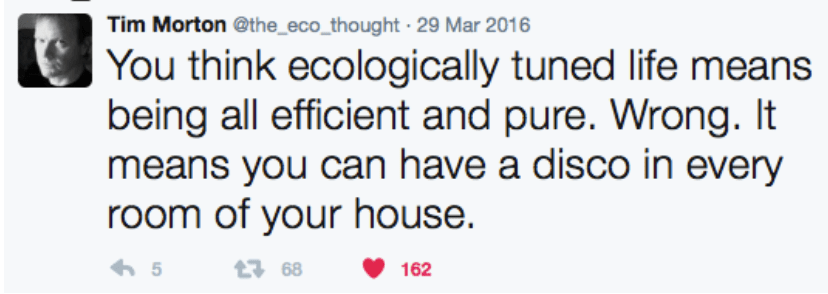
The beauty of an ecological thought is that it doesn’t have to be clogged with guilt, it can create something even lovelier before in its collective, technological and temporal possibilities. What would happen if you filled every room with solar panels, invited the creatures in, suspended your desire forever in those flickering, dancing refractions of light and sound and colour and life?

Screen Shot 2017-04-07 at 13.14.21.png

The Bog Girl’s Dark Ecology

red-desert-43
Red Desert ~ Source

My body was braille

for the creeping influences:

Seamus Heaney, ‘The Bog Queen’ (1975)

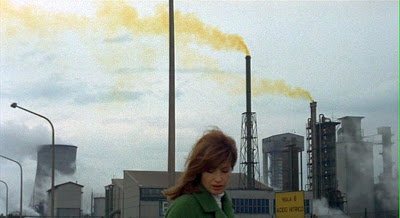
In Michelangelo Antonioni’s 1964 film Red Desert, loosely inspired by Rachel Carson’s groundbreaking ecological text, Silent Spring (1962), one of the characters complains that he was at a restaurant and the ‘eel tasted of petroleum’. This is a film landscaped by oil rigs, the persistent murmur of a dull grey dying sea, industrial structures whirring with eerie electricity. While there is a distinct sense of disconnection between characters, between humans and their environment, one connection that persists is between excess, waste and the body. While nowadays fish change genders due to oestrogen from the Pill being excreted and pumped from sewage into rivers, in Antonioni’s film, haunted by the apocalyptic backdrop of the Cold War, the characters worry about their food getting cloaked in some essence of what gets dumped and yet is also extracted from the sea. A perverse cycle of waste, energy, wasted energy.

plate08.jpg
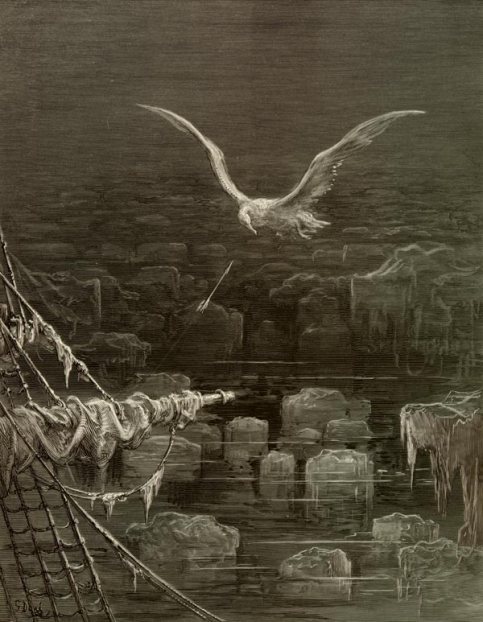
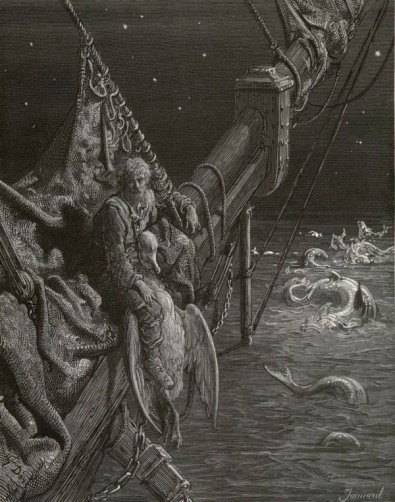
The mariner shoots the albatross, plate by Gustave Doré


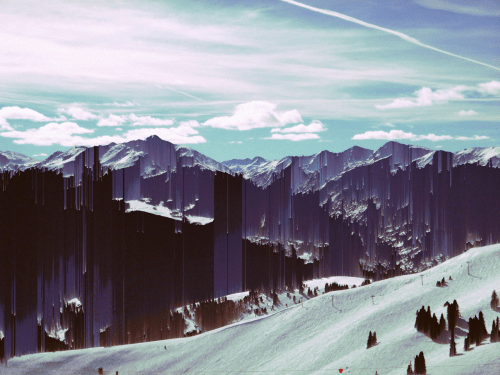
This early expression of ecological disaster as embedded in a fear of contamination, of sliminess mixing with toxic sliminess, has its roots even further back, in Samuel Taylor Coleridge’s poem The Rime of the Ancient Mariner (1798). After shooting the albatross and overcoming a terrible, supernatural (super as in extra nature, nature made unnatural by being its full strong self) storm, the mariner finds himself suspended in the aftermath, ‘as idle as a painted ship / Upon a painted ocean’ (Coleridge 2015). This sense of time frozen, of the environment refusing to yield to human command, is uncanny, a reminder that the land isn’t just something we can divide and conquer. The image of idleness and a ‘painted ocean’ recalls the experience of a crashed computer screen, hung or ‘frozen’ as the mariner is in the sheets of ice ‘green as emerald’ (Coleridge 2015). Think of a typical glitch, that which overlaps colour, blends unrelated materials together in a random, patchwork image. The ice is the colour of grass, yet still we are in the ocean. This is an environment without location, an ‘anywhere’ of strange displacement. This is the place of the ecological glitch.

tumblr_npqtors3nr1r6a43wo1_500
glitched landscape ~ Source

Rosa Menkman describes a glitch as ‘a (actual and/or simulated) break from an expected or conventional flow of information or meaning within (digital) communication systems that results in a perceived accident (2011: 9). While we are dealing in poems like Coleridge’s with a ‘natural’ system as opposed to a digital one, the strange effect of ‘accident’ persists. ‘Nature’ is never as it seems, never ‘natural’ but always unexpected, strange. Systems follow patterns which glitch; the patterns themselves, like evolution, proceed often by a logic of chance, randomness. The weather in The Ancient Mariner is not just climate, a conventional flow of data to be charted and forecasted; but it is positively weird. Weird in the etymological sense identified by Timothy Morton as ‘a turn or twist or loop, a turn of events’, the ‘flickers [of] a dark pathway between causality and the aesthetic dimension, between doing and appearing’ (2016: 5). We question whether the crime of shooting the albatross instigates this ecological horror, which culminates in the monstrous appearance of ‘a million million slimy things’ which the mariner sees surrounding the ship. Like Antonioni’s petroleum eels, these slimy things are stuck with the human character, they have by proximity or digestion become enmeshed, to borrow another term from Morton, the idea that ‘nothing exists by itself, and so nothing is fully “itself”’ (2010: 15). The mariner realises his own surprising mortality, just as the slimy things ‘liv’d on – so did I’. His attempt to lump the slimy things as one gelatinous mass of gross matter leaves him realising that he can’t distance himself from the ugly parts of nature, because he himself is part of the mass, that mesh of beings.

windeby_5
Source

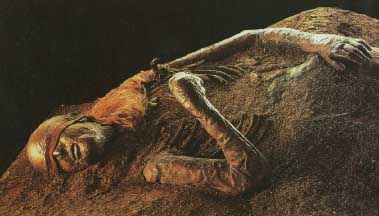
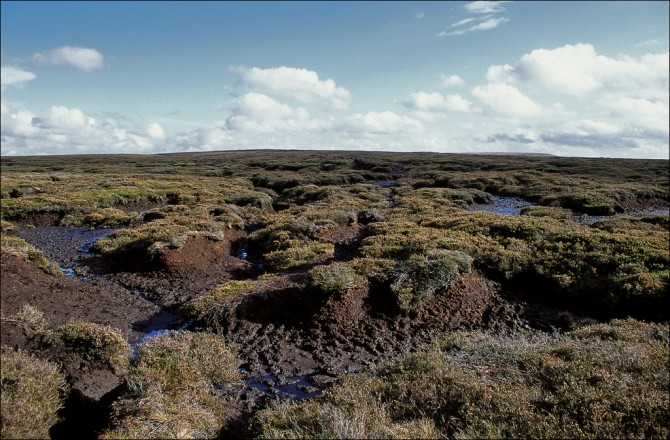
We might now describe Coleridge’s flirtation with the supernatural as a kind of magical realism, and the trend of using such weird elements to render ecological themes continues in a short story written by Karen Russell and published in the New Yorker in 2016. ‘The Bog Girl’ tells the story of a fifteen-year-old boy, Cillian, who works as a turf-cutter in the peatlands of some ambiguous ‘green island off the coast of northern Europe’, inflected with hints of Heaney’s hardy Irish pastoralism. Cillian falls in love with a young girl pulled from the bog; she is ‘whole and intact, cocooned in peat, curled like a sleeping child’ with ‘lustrous hair’ dyed ‘wild red-orange’ by the ‘bog acids’ (Russell 2016a). Crucially, there is a noose round her neck. She is young in appearance but probably 2000 years old; her flame-haired  and gaunt appearance recalls Celtic/Pictish origins as well as a ragged Pre-Raphaelitism, which hints at Cillian’s weird fetishisation of her beauty. The story that unfolds can be read as a love story, a tale of caution against projecting your ideal fantasies onto ‘the mask of another person’s face’ (Russell 2016b); but here I will read it as a tale of ecological horror that warns of the dangers of industry and celebrates the sensuous mysteries of the peatlands as something that deserves preserving.

Our current era, the Anthropocene, is one of distorted scale, where constantly we deposit chemicals into the atmosphere and earth whose afterlife beyond our own we can barely even gauge as mortal humans. Russell’s story explores this (im)possible meeting of temporalities through an encounter with strangeness which allows us to mull upon our relationship with the earth, to realise our absolute enmeshment with the environment. No matter the narratives we construct through history and science, all human theory is at best the ‘most speculative fiction’; while improvements in science (‘radiocarbon dating, DNA testing’) allow us to trace the ‘material fragments’ as ‘clues’ about our ancestors’ experience, ‘their inner lives remain true blanks’ (Russell 2016b). At one point, Cillian decides it’s time he met the Bog Girl’s family, so he takes a ferry from the island to a museum. He scans the museum’s labels, which attempt to give context to the ‘pickled bodies from the Iron Age’, but is unsatisfied by these attempts to ‘surmise’ details about the ancestors’ lives based on material detail alone (Russell 2016:a). Their bodies are ‘fetally scrolled’ (Russell 2016a), suggesting that screeds more of history are inscribed on their skin like ink upon scrolls, a literal blending of flesh and text. The inadequacy of the museum labels allows Cillian to continue his fantasy that the Bog Girl appeared for him alone, that she ‘was an alien from a planet that nobody alive could visit—the planet Earth, in the first century A.D.’ (Russell 2016a); none of the other ancestors stir the same emotion as the Bog Girl. Love becomes a token, a talisman of magical power: ‘He told no one his theory but polished it inside his mind like an amulet: it was his love that was protecting her’ (Russell 2016a).

Russell’s narrative sustains this fantasy, resisting the natural outcome which would be the Bog Girl’s rapid decomposition upon exposure to air. This commitment to a magical realist effect allows her to explore problems of intimacy and otherness, which relate deeply to ecological issues. Take the bog itself. Russell describes it as a primitive hole, the ‘watery mires where the earth yawns open’, a place where time is suspended by a ‘spell of chemical protection’ which prevents the decomposition of matter: ‘Growth is impossible, and death cannot complete her lean work’ (2016a). Her rendering of the bog is crucial to the story for its associations with the suspended temporality embodied in the Bog Girl. We are told that much of the peat is cut away to turf, a key energy source still used by the islanders, and ‘nobody gives much thought to the fuel’s mortuary origins’ (Russell 2016a). Death, a haunting presence seemingly without telos, lingers in the earth, in the home; the Bog Girl weirdly embodies our paradoxical relationship to natural fuel sources: we consume them to produce energy, but our consuming instigates the loop of destruction—de-energising the earth—pumping poisons and coagulating into new forms of deadly matter. The peat bogs are a kind of charnel ground, already containing the detritus of bodies and time in a ‘disturbing intimacy […] that exists beyond being and non-being’ (Morton 2009: 76). The bogs are both ‘shit’ and ‘fuel’ (Russell 2016a), embodying the waste we must expel to maintain presence and order; but also refusing this separation, stickily gluing us through interdependence (the islanders need it for fuel) just like those slimy things reminding the mariner of mortality.

Moreover, the introduction to the bog includes the narrator’s address to the reader, the only such address in the story. The narrator remarks of the island, ‘it’s unlikely that you’ve ever visited. It’s not really on the circuit’. This seemingly throwaway comment interpellates  (in Althusser’s sense of the word as a ‘hailing’ of subjectivity within ideology) the reader as a global consumer, whose ‘circuit’ references a sort of capitalist freeway (the places we drift through for pleasure) as much as it slyly hints at the cycles of life/death which are interrupted in the text. From the start, we are made to feel as outsiders in this community, which is self-consciously established as a wasteland of sorts, off the circuit, the beaten track; a charnel ground for exploring the mystical possibilities of strangeness and ecological intimacy.

What’s more, her association with primitivism and death links the Bog Girl to the past in a way that is queer, that disrupts the reproductive logic of heteronormative capitalism, a disruption that Cillian welcomes. Cillian ‘imagined, with a strange joy, the narrow life’ he and the Bog Girl ‘would lead. No children, no sex, no messy nights vomiting outside bars, no unintended pregnancies […] no promises’ (Russell 2016a). Note again that word, ‘strange’. The Bog Girl’s body is bounded; she will never consume nor produce waste, will never reproduce to bring more consumers upon the earth; with her, Cillian shrugs off the lusty masculinity of the ‘mouth-breathers’ (Russell 2016a) who help dig up the Bog Girl, he deviates from the established gender norms. Indeed, Cillian’s docility, his placid detachment from the rugged rural manliness of those who surround him (personified most perfectly in his uncle, who refers to the Bog Girl as a ‘cougar’ and has ‘a thousand beers’ laid out for himself at dinner) renders Cillian a queer figure, ‘so kind, so intelligent, so unusual, so sensitive—such an outlier in the Eddowis family that his aunts had paid him the modern compliment of assuming that he was gay’ (Russell 2016a).

Yet while the Bog Girl embodies a queer backwardness, more specifically she offers an openness of temporality, a strange oscillation between past and future rather than an obsessional projection towards the future. Derrida (1994) explains the promise as bound up in the logic of messianism, the guarantee of the future to-come of some saving force that would sweep up history. Remember the religious breathlessness which narrates Cillian’s discovery of the Bog Girl: ‘The bog had confessed her’ (Russell 2016a), as if she were a message passed on from a Neolithic age. Yet Cillian is oblivious to the fact that his love is itself the promise of an (unspeakable) secret, a promise of a present without future, a seamless overlapping of present and a past that can never again be as time demands its rupture, the Event of her eventual, unexpected awakening. The silence between them, the Bog Girl’s inability to speak, indicates his sense that love can be their pre-linguistic communication, an avowal without trace; but this originary language is impossible:

Invented for the genealogy of what has not happened and the event of which will have been absent, leaving only negative traces of itself in what makes history, such a pre-originary language does not exist. It is not even a preface, a foreword, a lost language of origin. It can only be a language of arrival or rather of the future (une langue d’arrivée ou plutôt d’avenir), a promised sentence, a language of the other, again, but entirely other than the language of the other as language of master or coloniser [and now I emphasise], although the two of them can sometimes announce between them, keeping them in secret or holding them in reserve, so many troubling resemblances.

(Derrida 1998: 61)

This ‘language of the other’ breaks down the classically patriarchal imposition of telos and closure upon the Bog Girl: she will be his forever faithful silent Angel in the House; that is, until she starts speaking. Cillian’s aphasia, ‘a stutter that had been corrected at the state’s expense’ (Russell 2016a), hints at his own problematised presence in the text, since commonly we associate speech with presence. He lacks the authoritative Word, is himself described as a queerish glitch in (human) nature, a ‘thin, strange boy’, ‘once a bug-eyed toddler’, whose grownup, ‘celery-green eyes’ (Russell 2016a) bely an inherent connection to both land and water—there’s a suggestion of his slightness, his precarious and translucent appearance in the world. The mutuality of recognised love he comprehends with the Bog Girl is this ‘secret’ which excludes his mother and friends, which makes others jealous; and yet it is also a source of troubling disruption, the threat that emerges in the master/servant dynamic symbolised by the noose round the Bog Girl’s neck, which Cillian tightens as his ‘fantasy life’ grows deeper (Russell 2016a). And what is ‘the language of arrival’? It is the Bog Girl’s coming-to-life, her messianic resurrection into present existence.

The irony of the story is that Cillian and indeed all the human characters in the story failed to predict this resurrection. The Bog Girl is adored or feared precisely because she skims with death; the body-conscious girls at Cillian’s school are ‘jealous of how little she ate’, the vice-principal sees her as shedding ‘an exciting new perspective on our modern life’ through her contrasting connection to the past (at this moment, the Bog Girl ‘had slumped into his aloe planter’), the fear among Cillian’s mother and aunts is that she will drag him away from the safety net of respectable surveillance: ‘“I’m afraid,”’ Gillian, the mother, confesses, ‘“if I put her out of the house, he’ll leave with her”’ (Russell 2016a). There is no suggestion of the Bog Girl’s autonomy here; rather, she is seen as embodying a terrifying strangeness that might contaminate ‘innocent’ Cillian. But then she wakes up. Her ‘radish-red’ lashes are vegetable (in the sense of passivity and organic matter) companions to Cillian’s ‘celery-green eyes’ (Russell 2016a); she too is an earthling, bound to the bog in an inexplicably deep, mournful way. Her awakening is erotic, marked by ‘a blush of primal satisfaction’; it is only at this point that their relationship emerges fully into what Donna Haraway calls that of companion species, whose interdependence is based on mutuality, in ‘forbidden conversation’ (Haraway 2008: 16). Haraway says of her relationship to her canine friend:

I’m sure our genomes are more alike than they should be. Some molecular record of our touch in the codes of living will surely leave traces in the world, no matter that we are each reproductively silenced females, one by age and choice, one by surgery without consultation. […] We have had forbidden conversation; we have had oral intercourse; we are bound in telling story on story with nothing but the facts. We are training each other in acts of communication we barely understand. We are, constitutively, companion species. We make each other up, in the flesh. Significantly other to each other, in specific difference, we signify in the flesh a nasty developmental infection called love. This love is a historical aberration and a naturalcultural legacy

(Haraway 2008: 16).

It is only when the Bog Girl awakens that the relationship becomes properly ‘in the flesh’; she has learned the communion of erotic love, is ‘tugging at his boxers’, but at this point Cillian is tipped into the abyss of signifying rupture: ‘something truly terrifying had happened: she loved him back’ (Russell 2016a). The nasty developmental infection called love’ rips apart his perfect communion of static silence. The Bog Girl’s language ‘was no longer spoken anywhere on earth’, it is a primitive cry from the depths of the peatlands, which Cillian cannot answer because he is indifferent to the Other as anything more than his own anthropocentric projection: ‘The past, with its monstrous depth and span, reached toward him, demanding an understanding that he simply could not give’ (Russell 2016a). We might think of the title from Jonathan Bate’s crucial ecological polemic, The Song of the Earth (2000), or a strange, aberrant passage from Virginia Woolf’s Mrs Dalloway (1925), where a vagrant woman whose ‘rude’ mouth is a ‘rusty pump’ (signifying, perhaps, the decay of industry, its material crudeness) singing a song of ‘love which has lasted a million years’ (Woolf 2004: 70-71). The idea of song suggests an ambient music that stretches onwards without climax and fall, echoing past and future in its rasping cry. The eerie, anthropomorphic crackles, growls, roars and howls that come from the ice in The Ancient Mariner. What would the earth sound like, speaking back? Surely it would be our own cry, endlessly deferred; the echolalia of life forms caught in this experience together, entangled in the rendering of a dark and dying world.

296287094_7aa36bf57c_b.jpg
Source

In many ways, the Bog Girl is animal, Other; she is not quite human. Better then to think of her as someone who embodies the terrifying intimacy of all life-forms, which brush up against one another, bearing their various sensations and temporalities. While the mariner comes to admire those gross ‘slimy things’, noting their ‘rich attire’ and blessing them with a whiff of Romantic kitsch as ‘happy living things!’ (Coleridge 2015), Cillian finds himself caught between the Bog Girl’s world and his own, ‘struggling to pay attention to his droning contemporaries in the cramped classroom’ (Russell 2016a). Referring to his classmates as ‘contemporaries’ reinforces their association with the present; juxtaposing with Cillian’s mournful retracing of steps, back ‘to the lip of the bog’ (Russell 2016a), the word ‘lip’ suggesting both spatial liminality and the erotic possibility of the temporal and primordial lacuna that lies within. We can think of the Bog Girl as what Morton (2010: 41) calls the ‘strange stranger’, a word for all life-forms which encapsulates the way that even those closest to us are inherently weird, because they remind us that we are not wholly ourselves, that we too are composites of life-forms, viral code, enmeshments of DNA.

Although the Bog Girl always seems close—we get vivid details of her ‘rhinestone barettes’, her ‘face which was void of all judgement’ (Russell 2016a))—indeed she becomes a vital component of Cillian’s life, ultimately he is forced to realise her absolute strangeness. Unlike the mariner he is unable to overcome that gap of Otherness and make peace with the uncanny experience of the ecological mesh. He goes down, enticed by the ‘lip’ of the bog, listening for the ‘primitive eloquence’ of ‘the air-galloping insects continu[ing] to speak the million syllables of [the Bog Girl’s] name’ (Russell 2016a). At the end, the narrative becomes ambient, with a distortion of inside/outside, self/other:

“Ma! Ma! Ma!” That night, Cillian came roaring out of the dark, pistoning his knees as he ran for the light, for his home at the edge of the boglands. “Who was that?”

(Russell 2016a)

My immediate assumption here is that Cillian is calling “Ma!” for his mother, a riff on the Irish references of the piece which are probably a nod to Seamus Heaney’s Bog Poems (1975). However, it’s not clear; elsewhere she is usually referred to with the Americanism, “Mom”. Cillian himself has adopted a primitive roar, which rips through the resonant chorus of insects as if refusing their incantations of the Bog Girl’s presence. The call for the mother seems vaguely directed, a generalised cry for help rising from pure terror as he runs for the light. ‘“Who was that?”’, embedded in the same line, seems to come from Cillian, but equally it could come from his mother back home, or even the boglands themselves, watching this skinny boy run off from the darkness. A mutual sharing of strangeness. This is an affective, fleshly and sensuous experience of horror that the written texts, the museum labels, cannot document. There is always a possible slippage, which Russell literalises in the Bog Girls’ figure. Nature has betrayed its accident, the glitched intrusion of the prehistoric past upon a modern present. While Red Desert more overtly projects the ecological breakdown of the external world through the increasingly disordered mind of its female protagonist, ‘The Bog Girl’ leaves us with an unsettling vision of lingering presence: the insects singing the elegy of her name, a name which tremors, sends nightmares to Cillian, which resonates with the bog, itself a microcosm of a wasting, gurgling, plundered world. Is this a haunted logic for future coexistence? We’ll have to take the plunge to find out…it’s going to be dark, sticky and maybe dangerous…

mariner_watersnakes.jpg
I looked upon the rotting sea, and drew my eyes away ~ Gustave Doré.

Bibliography

Bennington, Geoffrey, 2004. Other Analyses: Reading Philosophy (Bennington Books).

Coleridge, Samuel Taylor, 2015. The Rime of the Ancient Mariner. Available at: <http://www.bartleby.com/101/549.html> [Accessed 1/3/17].

Derrida, Jacques, 1994. Spectres of Marx: The State of the Debt, the Work of Mourning, & the New International, trans. by Peggy Kamuf, (London: Routledge).

Derrida, Jacques, 1996. Le monolinguisme de l’autre ou le prothèse d’origine (Paris: Galilée). [The translations I use from this text are Geoffrey Bennington, cited in Bennington, 2004.

Haraway, Donna J., 2008. When Species Meet (Minneapolis: University of Minnesota Press).

Menkman, Rosa, 2011. The Glitch Moment(um) (Amsterdam: Institute of Network Cultures).

Morton, Timothy, 2010. The Ecological Thought (London: Harvard University Press).

Morton, Timothy, 2013. ‘Thinking the Charnel Ground (The Charnel Ground Thinking): Auto-Commentary and Death in Esoteric Buddhism’, Glossator, Vol. 7, pp. 73-94.

Morton, Timothy, 2016. Dark Ecology: For a Logic of Future Coexistence (New York: Columbia University Press).

Red Desert, 1963. Directed by Michelangelo Antonioni [Film] (Milan: Rizzoli).

Russell, Karen, 2016a. ‘The Bog Girl, The New Yorker. Available at: <http://www.newyorker.com/magazine/2016/06/20/bog-girl-by-karen-russell> [Accessed 1/3/17].

Russell, Karen, 2016b. ‘This Week in Fiction: Karen Russell on Balancing Humour and Horror’, Interview by Willing Davidson in The New Yorker. Available at: <http://www.newyorker.com/books/page-turner/fiction-this-week-karen-russell-2016-06-20> [Accessed 1/3/17].

Woolf, Virginia, 2004. Mrs Dalloway (London: Vintage).

Haunting the Capitalist Plaza: Making Sense of Vapourwave

16d
Lindsheaven Virtual Plaza – Daily Night Euphoria. Source.

The resonance is a tinny vintage, anachronistic; tinselled with eighties synths and a vocal sample that never quite begins. That baggy voice, normally soft as milk, becomes jagged, inhuman. Creepily crystallised. Your aunty’s favourite easy-listening is stripped of all coherence and synthesis; the tacky detritus of Steve Wright’s Sunday Lovesongs repackaged for an ersatz world of sulphurous sunsets and crumbling metropolises imploding like the plastic dust of an Arizonan dead mall. Back to the dark desert highway, purple-skied and dripped in molten neon. This isn’t what you’d enjoy on a leisurely car trip to the drive through…Or is it?

Listen to : : :

death’s dynamic shroud.wmv // I’m at the point in the level where the road narrows, curves, swirls upside down. Death is imminent. You can see the gloved fingers slipping a compact disc into the slot of a monster, borrowed straight from the architectures of Digimon. I’m thinking: Elizabeth Fraser’s sweetly haunting soprano (imagine being ghosted by the purest aural distillation of beauty); the chilled techno-ambience resurrected from the nineties. There’s heartbreak ahead. If you jump too far—and you will, won’t you—the space around you will glitch. There you’ll be, suspended in the space twinkles. An empty swimming pool. Climb into the cracks. Why is everything so gleaming, so white? I’m obsessed with getting back to matter. The music restores the filth, the glitch. There’s a vast acceleration of beautiful colour. The soprano grows warped, the orb-like contortions are glowing off kilter, off rhythm. The seven lumps of Galaxy chocolate I’ve just eaten melt sticky bits of sugar in my mouth, refuse to dissolve. They’ll coat my teeth like that.

Vapourwave coats your teeth. God knows how or why you should define it. It’s like cheap candy, utterly sugary but filled with mysterious ingredients, mystic chemicals from another dimension. One minute I’m being instructed about the start of a sequence (it’s the eerie echoes of a sci-fi style video game)- – – loading loading loading  – –  – and then trap style beats come bouncing slowly in, delayed as if strained through some outpouring of weird gravity. There’s a purity to some of it, which feels more like an original composition; the ambient atmosphere of something along the lines of Aphex Twin’s Selected Ambient Works…There’s a sense of distortion, disorientation. Hyperreal landscapes lit in luminous pinks and purples. What’s that gleam, is it rain? Tokyo on a postcard, dipped in cross-processing chemicals, in violet acid. Then you’ve got a vague array of p a r a d i s e lighting up the screen. Palms and sand and cerulean sea.

ddeb386ad43001484a6221559eec0d94
Source

As soon as you get attached to a sample, you’re away. Rarely does the beat resolve. You’re like, totally always stuck on the pre-beat. To the point that human expression becomes a technological fault, a beep, a burp. Sometimes it sounds like waves are being pulsed through your brain, blurred in a malfunction of some tacky machinery cooked up for a pulp movie of the nineties. Do scanners really look like that? Coated in rhinestones, bathed in pink. Some of it’s dreamier. Arpeggios of bell-scented keyboards (what do bells smell like? Not musty old church bells, but the sonorous chimes of noughties computers). Arpeggios climbing and climbing, dissolving, rising. A pop melody shining through. I’m in a rainforest of futurist skyscrapers, cloud-surrounded, everything drenched in pastel-hued pixels. It’s so serene. 

Vapourwave. What a joke, an internet meme. Didn’t it die a couple of years ago?

I’m so confused. What is this monstrosity that’s eked itself into my life like a viral code luxuriating in my brain? At once disdainfully ironic, crass, tacky as hell; but also painfully sincere, nostalgic, full of a misplaced longing. The metamodern paradox of postmodern irony and modernist authenticity cooking up an endless loop of misplaced longing. I find myself thirsty for shopping malls from the seventies, for grotesque cups of Diet Pepsi, for the glossy pop of the eighties and the apocalyptic reveries of the nineties. I’m drifting through a city stripped of its glitz and left with patches of bright matte colour, refusing to reflect the glass through which dreams have appeared and got lost. I remember polishing a CD with the back of my sleeve, watching the lines of rainbows beam. Slotting it into a computer that hummed and whirred at my touch. I remember when technology felt somehow homely. 

a0279566532_10.jpg
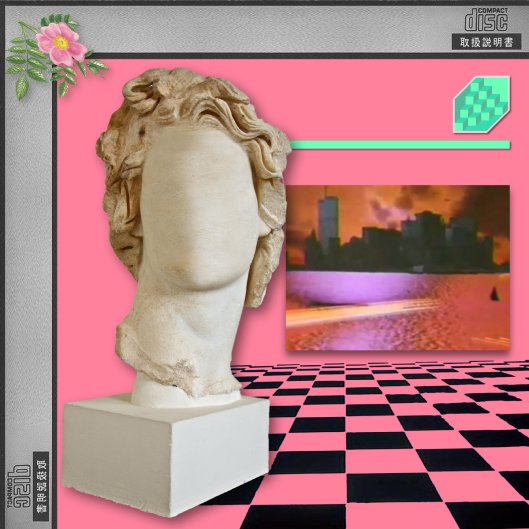
Macintosh Plus – Floral Shoppe. Source.

That comforting little Windows XP flourish, how friendly it was compared to the blasé boom of Apple’s triumphant C chord. Glitch, glitch, glitch. I pick the pixels out with my fingertips. The eerie keyed chords of MACINTOSH PLUS’ 地理 fill me with a sinister sense of urgency. It’s an entropic catastrophe of dissonance.

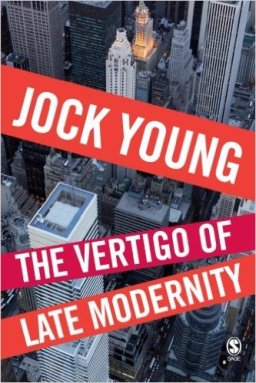
At the heart of vapourwave is a tension between the sweet and disturbing, between satisfyingly vacuous muzak and dissonant, deliberate glitching. This is related to its deterritorialising impulse, by which I mean (borrowing from Deleuze and Guattari lingo), the way it extracts and recontextualises some element of a thing, then placing it elsewhere in a different environment. Vapourwave is a sort of bulimic, abject, rhizomatic discourse. It gorges on the symbols of late capitalism (the glossy muzak and soft rock of the eighties, international brands like Nike or Microsoft, the aesthetics of corporate advertising and so on) and then expels them in a gross reinterpretation that seems to purge them of their original, seamless facade. It might be useful here to mention that sociologist/criminologist Jock Young (2007) once described late modernity as a ‘bulimic society’, where we are all (internationally) included in the dreamlike semiotics of the rich through the opulence and availability of global branding, advertising and popular culture, but increasingly we are structurally excluded from the means which would allow us to achieve such dizzying heights ourselves. This social anomie is jarringly rendered in vapourwave’s shameless embrace of corporate culture; at once poking fun at it but also monumentalising it in an ambiguous way. It’s by no means a didactic movement, but as Grafton Tanner tends to argue in his excellent book Babbling Corpse: Vapourwave and the Commodification of Ghosts (2016), it’s symptomatic of its times. The very poetics of vapourwave reflect the uneasy experience of being unable to escape the system, the uncanny effects of our perpetual cultural nostalgia—the celebration and denigration of late capitalist modernity and all its forms of post (post (post) post).

51jlr4xfsml-_sx331_bo1204203200_
Source.

Outside of their usual contexts, corporate and commercial visuals (the vapourwave a e s t h e t i c) seem absurd, funny, strange, alienating. It hollows out the imagined ‘core’ of the brand and replaces it with a sort of free-floating lack of functionality, a disembodied eeriness. Chuck a logo in with a pastel-hued painting of palms and corny dolphins lifted from a SNES game and there you have it. Old Apple logos might be hovering over a pixellated ocean, waiting to plunge inexorably. Not only the aesthetics, but also the music itself, creates this sense of fragmented capitalism. Tanner talks briefly about the relevance of Derrida’s idea of hauntology to understanding the politics of vapourwave and this seems to me very astute. It’s the idea that the future is irrevocably haunted by the past; that culture and politics are also spooked with spectres from the past—from communism (Derrida’s book is called Spectres of Marx) to old technologies. It’s the idea that things are always-already obsolete, that there’s a sense of being itself as displaced and never quite fully present. It’s an ontology of difference, deferral, doubling, of objects which become ‘a little mad, weird, unsettled, “out of joint”’ (Derrida 1994). Derrida’s gloss on Marx’s analysis of the commodity-table gives us a sense on the ghostliness of consumer objects:

For example — and here is where the table comes on stage — the wood remains wooden when it is made into a table: it is then “an ordinary, sensuous thing [ein ordindäres, sinnliches Ding]”. It is quite different when it becomes a commodity, when the curtain goes up on the market and the table plays actor and character at the same time, when the commodity-table, says Marx, comes on stage (auftritt), begins to walk around and to put itself forward as a market value. Coup de theatre: the ordinary, sensuous thing is transfigured (verwandelt sich), it becomes someone, it assumes a figure. This woody and headstrong denseness is metamorphosed into a supernatural thing, a sensuous non-sensuous thing, sensuous but non-sensuous, sensuously supersensible (verwandelt er sich in ein sinnlich übersinnliches Ding). The ghostly schema now appears indispensable. The commodity is a “thing” without phenomenon, a thing in flight that surpasses the senses (it is invisible, intangible, inaudible, and odourless); but this transcendence is not altogether spiritual, it retains that bodiless body which we have recognised as making the difference between spectre and spirit. What surpasses the senses still passes before us in the silhouette of the sensuous body that it nevertheless lacks or that remains inaccessible to us.

(Derrida 1994)

Vapourwave, of course, exploits this ‘ghostly schema’ of consumer objects. ‘Woody and headstrong denseness’, the sheer materiality of the thing is ordinarily supplanted by its mystical, transcendent value as a commodified good or brand. When we think of Nike trainers, rarely do we care for their actual material structure; usually it is the symbolic resonance of the brand that captures us. In Vapourwave, materiality comes back, vicious and strange. Fredric Jameson laments the way that postmodernism presents us with a meaningless concatenation of cultural nostalgia, often without context—BuzzFeed’s noughties nostalgia lists perhaps being a case in point. Vapourwave takes this ‘out of context’ randomness and runs with it. Art objects, textures, corporate iconography and screen-saturated colours combine in a collage of irony and contrasts. The mishmash quality of the vapourwave aesthetic lends it to easy manipulation and re-creation. This is the DIY ethic of the movement, its impulse towards constant theft, the cut and paste fun of sampling, the wilful shredding of distortion which creates a contemporary rendering of William Burroughs’ literary cut-up method or the random-making ‘recipes’ of Dada poetry, as described by Tristan Tzara.

13422823_261081637591822_2099392307_n
Vapourwave Collage (note the hashtags on the link). Source.

Now, the effects of this mixed-bag of internet treats aren’t just weird and humorous, but weird also in an unsettling way. The samples become points of focus in a manner that strips away the normal cultural values of the original song; the easy soft-rock of the eighties becomes haunted with lo-fi feedback and interruption, compression and echoes. It sounds like it’s being heard through a cave or the underwater atrium of an abandoned mall, after the apocalypse. One of vapourwave’s most prominent releases to this day remains Macintosh Plus’ Floral Shoppe (2011) and on this record the production warps its soul music with a surrealist synth-driven dreamscape, in which R&B beats become slow and trippy and human voices are dehumanised into drawls and robotic calls. Often a sample starts but never resolves its line, constantly stumbling over itself. Tempos are spliced and no song follows conventional structure, but instead runs on repetitions, overlaps, interruptions; completely jarring changes in rhythm and key with no transition. Funk and soul from the eighties are no longer smooth and satisfying radio filler, but are turned inside out, their inherent weirdness exposed. Some of the highlights include ‘It’s Your Move’ by Diana Ross and ‘You Need a Hero’ by Pages. The effect of listening to this album is sort of like pushing a shopping cart round a supermarket and gazing around in wonder at the saturated pastels, the pointless products, the detritus of cluttered consumer madness. Glitches, twinkles, the beats of unsteady feet. Random tannoy announcements like a call from some parallel universe, the underground, the flickers of the internet ether.

Tanner’s Babbling Corpse usefully makes a connection between the dehumanisation of human voices in vapourwave music and contemporary philosophical movements such as speculative realism and object-orientated ontology. Both movements share the fundamental rejection of correlationism (the dominant, anthropocentric idea in Western philosophy that views reality only in relation to and projection from the human perspective). Instead, they turn to the world experience of the nonhuman, the sentient and foreign perspective of matter and objects. They expose the contrived nature of our distinction between self and world, showing how we are world, entangled in a way that is inextricable and disturbing (Timothy Morton, for instance, points to the crustaceans that live in our eyelashes or the bacteria in our gut as examples of how we are the environment, rather than self-complete and separate beings). Vapourwave in some way manages to evoke this weird world of objects, at a level only barely accessible to humans. Its use of glitches and looped samples disrupts the ordering of people and things. As Tanner puts it,

Glitches interrupt our expectations while deceiving and annoying us. They undermine our notion of what the machine is supposed to do for us, not without us. In this way, our electronic machines take on lives of their own and appear capable of functioning perfectly well without humans – a complete transcendence into other-worldly sentience.

 (2016: 11)

We might consider this in relation to Martin Heidegger’s (2008) idea that we only notice a tool as a thing when it stops working. A broken hammer suddenly becomes a strange entity in its own right, rather than just one chain link in the process of a means to an end. Chuck Persons Eccojams Vol. 1, for starters. The very name: Eccojams. It implies the jams are a product of this Other: the ecco, ecology, echo…The title derives from an old Sega Megadrive game called Ecco the Dolphin, an action adventure game which featured dreamy music and a very minimalist gameplay narrative. You made Ecco sing to attract and interact with other objects and cetaceans; you could evoke echolocation in order to unfold a map of your oceanic surroundings; you could call to special crystals (glyphs) which in various ways controlled Ecco’s access to different levels. There is a beautiful otherworldliness to this game, and not just because Ecco ends up at the City of Atlantis. It’s created its own mythology, and the emphasis on song (like The Legend of Zelda’s ocarina melodies, which initiate effects in the game) opens up the possibilities for a nonhuman conscious or logic. Music, perhaps more than language, has effects on nonhuman consciousness. At a certain pitch, it can shatter a glass, or cause buildings to rumble with bass. It opens up its own logic of cause and effect.

maxresdefault.jpg
Source.

Hauntology, in a sense, is about being stuck on the loop of the end of history.  Technology constantly dislocates our awareness of time and space, so that linearity is replaced with instancy, repetition and reiteration, the constant recycling of former styles and events. Repetition is uncanny partly because, as Freud argues in ‘The Uncanny’, it’s the structure of the unconscious. When we notice repetition, we notice how our whole psyches are built on the compulsion to repeat even that which is most traumatic to us. It also violates our sense of identity and experience as singular and unique (an idea that liberal democracy and consumer capitalism likes to perpetuate). Identical twins are uncanny for this reason, as is deja vu. We feel that the normal order of time and space has been distorted (this is of course made explicit in films like Donnie Darko, which deal with parallel universe theorems). Repetition is also uncanny because it suggests that things we thought were unique to a moment, imbued with their apparent transience, are actually lingering and potentially eternal. It’s unsettling to have the buried constantly disinterred and broken out into the open present. Tom McCarthy’s Remainder (2005) is a novel which explores the logic of repetition in relation to a trauma narrative in which the protagonist becomes obsessed with re-enacting events to the point of absurdity and violent conclusion. It’s that overlap of the real, where dreamlike remembrance meets actual performed repetition, that is the orgasmic satisfaction of the psyche.

Listening to vapourwave enacts this perfectly. We might start to recognise the songs from which these samples were drawn, but our recognition is distorted along with the samples themselves. The past floats uncannily into the future. Eccojams Vol. 1 drops its tinkling beats on a loop and the vocals from eighties ballads are stripped of their velvet and become mournful, minor, distorted. Inhuman, odd. There’s a sense in which our contemporary experience of reality in the face of apocalypse and pathological nostalgia is both dark and sweet. Morton’s branch of object-orientated ontology, dark ecology, perfectly captures this experience (in fact, in Dark Ecology (2016) he describes the process of dealing with this ‘grief’ as sharing the structure of a ‘dark ecological chocolate’). Vapourwave is at times incredibly saccharine, mapping itself through the cheerfully smooth loops of Muzak; but it is also jarring, dissonant, deeply unsettling. It takes dirty club techno, the complex tempos of intelligent dance music, and puts them through the cheap production of the GarageBand blender. Vocals echo like a broken tannoy machine. Vapourwave, as both visual and musical aesthetic, fundamentally opens an aural space in which past, present and future become a haunting echo chamber of one another. No longer is this the mere surface play of postmodern collage, but instead it’s the material manifestation of a specific cultural hauntology. As Tanner puts it, hauntology ‘is unlike Jameson’s pastiche in that it complicates the past (specifically, the past’s image of the future) in order to call attention to capitalism’s destructive nature as a subjugating force that only fools others into thinking it came to eradicate “history”’ (2016: 35-36). Capitalism is hollowed out, its signature brands become lost echoes in a vaguely recognisable, a hypnotically attractive yet alarming vision of our near-present future; blended with the figures of mall culture, the colours of early aughts internet webspaces and the abyssal possibilities of a Tumblr scroll.

I’m interested in how vapourwave re-enacts a different form of consciousness and how this might be ecological, even though the movement’s only obvious engagement with Nature as Such is through the proliferation of palms and potted plants that drift incongruously as consumer goods through some of its artwork. To get at its ecological sweetness, it’s like cracking open a crystal to see its lattice parameters (what a beautiful phrase), the places where the material cleaves (its lines of weakness), its cubic structure. The interplay between structure and embedded weakness is what motivates vapourwave; it contains its own failure, the undeveloped samples, the way a tiny snatch of a song is unfolded into a tranquil sequence of soporific, nonsensical sound. This is not music with a coherent logic. You look for lines and trends and vague traces of structure, but a song will become something more fluid and fragmented. Vapourwave’s material metaphors cannot be coherent; it’s at once free-floating, vaporous, seeping, gelatinous, oozing, splitting, cracking, choking, pulsing, dissolving. Hard matter, soft matter, chemical, vapour, waves and glitches and tiny explosions.

Sometimes, the structure is completely frustrating. On Person’s Eccojams Vol. 1, for example, the slowed-down, reverb-heavy sample from Gerry Rafferty’s ‘Baker Street’ repeats endlessly and never resolves itself into the next line: ‘another year and then we’ll be happy / just one more year and then we’ll be happy’. The twinkle signifies the glimpse of a transition and there’s a blip of the ‘b’ which should resolve into ‘but you’re crying, you’re crying now’ and yet here never does. Instead the song becomes an endless loop of implied futurity, the future conditional, ‘we’ll be happy’ that doesn’t get to complete itself but instead hangs. We’re taken out of time and left in this limbo. Here, the repetition isn’t soothing, it’s unsettling—mesmerising in a disturbing way. We question our longing for the song to resolve and before we have a chance it’s skipped to the next track. So we go back, search out the original version. Is it satisfying? Listening to Raferty’s original now feels weird in a way it didn’t before. It’s like this lost artefact from the past, spliced across the future ether rendered by Person’s eerie and hypnagogic album. While ‘Baker Street’ implies a specific place, now it’s thoroughly displaced, an effect of the internet’s rhizomatic possibilities.

As Morton puts it, ‘in order to have environmental awareness, one must be aware of space as more than just a vacuum. One must start taking note of, taking care of, one’s world’ (2002: 54). Ambient poetics disturb our assumed distinction between inside/outside, self/other; they show how we are entangled in a shared space of coexistence (Morton 2002: 54). Ambient music, in its sensuousness, its borrowing from the world—for example, by using samples of music concrète and field recordings from both nature and urban spaces—embeds us inside an environment in a way that is at once comforting and disturbing. It literally surrounds our senses. Brian Eno famously sets out a manifesto for ambient music by describing ambience as ‘an atmosphere, or a surrounding influence, a tint’, and ‘whereas conventional background music [i.e. Muzak] is produced by stripping away all sense of doubt and uncertainty […] from the music, Ambient Music retains these qualities. […] Ambient Music is intended to induce calm and a space to think’. As Morton puts it, ambient music as figured by Eno deconstructs the ‘opposition between foreground and background, or more precisely, between figure and ground’. In this sense, ‘ambience could be shown to resist the reification of space in capitalism’, ‘at once fill[ing] and overspill[ing] the ideological frame intended for it by the social structure in which it emerged’ (Morton 2001).

hqdefault-2
Abandoned mall / / Source.

Think of it this way: could you get away with playing vapourwave in a mall or a supermarket or diner? Sure, it would ‘fill’ the space in one sense, but also exceed it, rendering all our cultural and material associations with this space uncanny and distorted. It would become a sci-fi space, a space displaced into the future. We would be inhabiting a doubled world, a doubled temporality. I tried playing Floral Shoppe in the restaurant where I work once (obviously when there were no customers) and the effect was actually very comforting. I felt like I wasn’t trapped in the familiar twenty-something existential limbo and instead inhabiting a plane of dreamlike contemplation, like the Rainbow Road level on MarioKart: Double Dash. I close my eyes and the scratched wooden floor spills out into a highway of colour; the tables I’m bumping against are bright yellow stars and fragments of unknown matter. I’m back in the supermarket, trolleys wheeling away from me and products falling off the shelf. I open my eyes and there’s the mirror and a reflection of someone that might be me, wearing a uniform, the chairs and tables flashing around me like holograms. I’m not exactly sure where that association sprung from (it’s been a long time since I’ve turned on the old GameCube), but I guess that’s the free associative impact of the music itself.

Double_Dash_Rainbow_Road.png
Rainbow Road / / Source.

Like Jean-Jacques Rousseau’s Reveries of the Solitary Walker (1782), vapourwave is about an experience of travel and movement without necessarily describing that movement itself. Crucially, the emphasis is on slowing down, on dwelling in a moment; a moment which is looped, repeated, pondered over, exhausted, reflected on. ‘I undertook to subject my life to a severe examination that would order it for the rest of my days in such a way as I wished to find it at the time of my death’ (Rousseau 2011: 24). Vapourwave subjects the e v e r y t h i n g of capitalist late modernity to such self-reflexive inner scrutiny. This scrutiny enacts a slowing down of perception, a sense of looking around and absorbing one’s place in the environment. Through an uncanny distortion, doubling back and becoming the environment. Vapourwave allows us to adopt both a blasé and a highly perceptive attitude to the ad-saturated world in which we exist; the metropolis of the internet becoming some great labyrinth in which we linger at every turn, mesmerised by the neon palms swaying in time to the untimely music, to cans of diet coke and the universal resonance of that bold tick logo. Everything surrounds and coagulates, connects.

This aesthetic dwelling is crucial for ecology because it forces a recognition of the world which we are and in which we live, a recognition that notices patterns of interconnectedness and coexistence. For Gregory Bateson (2016), aesthetics means ‘responsiveness to the pattern which connects. The pattern which connects is a meta-pattern’; both cities and their parts form part of this pattern, of the patterned aesthetic of vapourwave. The metropolis, the mall, the fountain plaza, the computer screen, the window of a building, the burnished, pixellated sunset. All are the environs of sound and vision, the movement between figure and ground, the deconstruction of synecdoche. The part and the whole are constantly supplementing each other (the song, the sample; the symbolism, the surface aesthetic). It’s a bewildering, shape-shifting experience. It forces us to take notice of our world. There’s something about vapourwave which always suggests to me a sort of endless highway, where the vehicles move as if through some viscous substance that drags the experience of time and space. Our perception becomes blurred and starry, with blips of unconsciousness and moments of epiphanic reverie. Things around us fade or glow. The radio rumbles in the darkest cavity of our chest. Am I even breathing? I don’t feel human. Is this freedom?

homepage_large-be7a4fbb
Source.

Alongside this dwelling is a certain playfulness of a way unique to vapourwave. James Ferraro’s Far Side Virtual (2011) might be the classic here. It blends together the inane and cornily flourishing samples from Muzak with automated audio speech stolen from corporate contexts and sound effects from everyday tech life—the message-send swoop, a mouse click, laptop crashing sounds and start-up tunes. The result is something that might reflect Jean-Francois Lyotard’s famous definition of postmodernism as ‘eclecticism’, the ‘degree zero of contemporary general culture [where] one listens to reggae, watches Westerns, eats MacDonald’s for lunch and local cuisine for dinner, wears Paris perfume in Tokyo and retro clothing in Hong Kong; knowledge is a matter for TV games’ (2004: 76). This eclecticism is made playfully manifest in Ferraro’s lively, atmospheric and at times downright trippy record, where twinkles of commercially-drenched, techy synths give way to stuttering keyboards, ringtone effects and twirls of familiar message noises which become maddeningly synced with finger clicks and conversations between robotic voices. A CONUNDRUM article argues that ‘since vapourwave functions namely as commentary, it loops, pitch-shifts and “screws” the utopia of the virtual plaza, creating a harsh, grating sound in away that brings each muzak sample’s faults to the forefront of the track’. This is certainly true of Ferraro, but I’d also suggest that vapourwave is more than mere commentary; Ferraro especially revels in the silliness of corporate culture (check out ‘Pixarnia and the Future of Norman Rockwell’, with its drink slurping sound effects and jingly, kids tv-worthy melody), at the same time as revealing its peculiar utopian unreality, a world of shimmering sound and holograms. There’s a self-consciously affective and pleasurable aspect to the music. Sometimes it sounds like the demonstration music on an art channel, to the point where I’m expecting some beautiful, sellotaped creation to materialise with every musical flourish.

On the other hand, there’s the total weirdness of ‘Palm Trees, Wi-Fi and Dream Sushi’, which takes us through a scintillatingly bizarre encounter with a ‘touchscreen waiter’ who explains the ordering process at a sushi restaurant—apparently in Times Square, with Gordon Ramsay as chef—to the backdrop of exuberant synths and glitchy effects which sound like a Windows 95 laptop gone haywire, or merely said customer making her selections from the menu software. The result is to render a future where restaurants and coffeehouses are devoid of human interaction, becoming impersonal encounters with creepily enthusiastic machine waiters (creepy not just because they’d put me out of a job). The contrast between this manic happiness, this constant focus on choice, with the maddening music is to create a deep sense of unease, to reveal the artifice of such utopian tech constructions. Do we really have a choice? Is life being boiled down to a series of computer menus? Is the future bound to the unsettling intonations of such robotic encounters? I can’t help but escape into the absurdity of the music and try to forget this hauntological disaster is always-already constantly happening…

The comparatively meditative ‘Bags’ weaves its entrancing ambience from an early Windows startup theme, dipping into sonorous caverns of sparkling synths and lifting for air bubbles and irregular, incongruous finger clicks. I am reminded here of a beautiful essay by Steven Connor on the magic of objects, specifically here bags: ‘because they are in essence such fleshly or bodily things, bags enact as nothing else does our sense of the relation between inside and outside. We are creatures who find it easy and pleasurable to imagine living on the inside of another body’. There’s an amniotic vibe to Ferarro’s ‘Bags’; the swaying, dreamy pace that makes us feel as though we are inside those palms, or encased within a glossy plastic number, bouncing away against some glamorous knee. Just as humans have a sort of supplementary, life-giving association with bags, we also have this relationship with the plazas of capitalism and the affective world they render. Ferarro has said that he conceived of Far Side Virtual as a series of ringtones, a musical form which inherently suggests consumer transience, tackiness, kitsch, the whims of passing fashions (not least because the polyphonic presets change with each phone upgrade). He’s also said that he loves the idea of the album being ‘performed b a Philharmonic Orchestra […] Imagining an orchestra given X-Box controllers instead of mallets, iPhones instead of violins, ring tones instead of Tubular bells, Starbucks cups instead of cymbals. All streamed online, viewable on a megascreen in Times Square’. That’s what’s special about vapourwave: its commitment to the endurance of art and the a e s t h e t i c alongside an ambiguous relationship with the ephemerality of corporate kitsch. The artistic rearrangement of these samples, alongside their visual presentation and marketing as alt music through sites like Bandcamp, completely reterritorialises their original framework of meaning.

There’s a sense in which this music—with its self-conscious materiality, the recognisably tacky mattering of its samples, its embrace of the ambient disruption of foreground and background—is inherently committed to some kind of hauntological ecological project, the kind advocated by Tim Morton’s dark ecological poetics. As Ferarro himself says of his album, it’s a ‘rubbery plastic symphony for global warming, dedicated to the Great Pacific Garbage Patch’. Vapourwave recycles culture, proliferates both beauty and trash, endlessly parodies itself and its references. It renders explicitly what Marc Augé calls the ‘non-places’ of supermodernity: the anonymous malls, airports, offices and stations where cultures blend and collide and become foreign places of blank existence, of non-place, of disembodied temporality and physical and social experience. Places emptied out of cultural specificity. Places where one might eat Japanese sushi in a New York airport restaurant, concocted by a holographic rendition of a grumpy English chef and served by a robot developed and programmed by a Chinese tech company. Vapourwave is melancholy and strangely displaced. The frequent use of anonymity by many of its prominent artists (Xavier, for example, is responsible for more than just Macintosh Plus), alongside the Eastern characters for song titles, creates again a dehumanised, uncanny and culturally displaced understanding of identity. It weaves an almost Orientalist mystery through its art, so that we can’t quite geographically place the origins and players of this musical movement. It’s all about dissemination, reappropriation, the instancy of recycled production; but it’s also about slowing down to notice the flaws inherent in our everyday, consumer lives. The heavily sampled, rhizomatic nature of vapourwave forces you to become a more active consumer of both music and other forms of material pleasure, from picking your morning coffee to choosing your desktop screensaver. Perhaps it’s this recognition that gives vapourwave the vague trace of disruptive impulse; the way it strips away the uneasy pleasures and pink mist of the late capitalist plaza and replaces it with a mystique that haunts us back from the future. Objects and humans withdraw from our grasp and we are left with the surface detritus of crushed coke cans, defunct MacBooks, coffee cups and robot voices stuck on repeat, cleaning the floor of the mall to a vicious gleam that threatens to bounce back like a screen and remind us that we haven’t left the room at all – we’re still on the internet, chasing our dreams.

tumblr_mysm59oylp1t5u0gko1_250
#existentialwave / / Source.

Bibliography

Augé, Marc, 2009. Non-places: Introduction to an Anthropology of Supermodernity (London: Verso).

Bateson, Gregory, 2016. Mind and Nature: A Necessary Unity. Available at: http://www.oikos.org/mind&nature.htm. [Accessed 22.1.17].

Derrida, Jacques, 1994. Spectres of Marx. Extracts available at: https://www.marxists.org/reference/subject/philosophy/works/fr/derrida2.htm [Accessed 22.1.17].

Eno, Brian, 1978. ’Music for Airports liner notes’. Available at: http://music.hyperreal.org/artists/brian_eno/MFA-txt.html [Accessed 22.1.17].

Freud, Sigmund, 2003. The Uncanny, trans. by David McLintock, (London: Penguin).

Heidegger, Martin, 2008. Being and Time, trans. by John Macquarrie and Edward Robinson, (New York: Harper Perennial).

Jameson, Fredric, 1991. Postmodernism: Or, the Cultural Logic of Late Capitalism (Durham: Duke University Press).

Lyotard, Jean-Francois, 2004. Postmodern Condition: A Report on Knowledge, trans. by Geoff Bennington and Brian Massumi, (Manchester: Manchester University Press).

Morton, Timothy, 2001. ‘“Twinkle, Twinkle, Little Star” as an Ambient Poem; a Study of a Dialectical Image; with Some Remarks on Coleridge and Wordsworth’, https://www.rc.umd.edu/praxis/ecology/morton/morton.html

Morton, Timothy, 2002. ‘Why Ambient Poetics? Outline for a Depthless Ecology’, The Wordsworth Circle, Vol. 33, No. 1, pp. 52-56.

Morton, Timothy, 2016. Dark Ecology: For a Logic of Future Coexistence (New York: Columbia University Press).

Rousseau, Jean-Jacques 2011. Reveries of the Solitary Walker, trans. by Russell Goulbourne, (Oxford: Oxford World’s Classics).

Tanner, Grafton, 2016. Babbling Corpse: Vapourwave and the Commodification of Ghosts (Winchester: Zero Books).

Young, Jock, 2007. The Vertigo of Late Modernity (London: SAGE).

Moira Buchanan Exhibition: All Washed Up

img_0118

Last Thursday I had the pleasure of a day trip to Irvine to check about Moira Buchanan’s exhibition ‘All Washed Up’ down at the Harbour Arts Centre. Now I must say, although I was brought up in South Ayrshire I haven’t actually been down to Irvine since I was a kid – the days when we used to go swimming at the Magnum, or on school trips to the Big Idea (which is now sadly closed).

It was a bright and breezy wintery day and as soon as I stepped off the train that lovely clean briny smell filled my lungs and it was a bit like coming home. Irvine’s a fair pleasant town, once a port. You can walk along the harbour where ships still rest and along the front there are little gift shops and cafes with tinsel in the windows and the smell of coffee wafting out onto the street. I unzipped my jacket to feel the sun on my skin. It was midday and hardly anyone was around, but when I got to the Harbour Arts Centre there was a nice wee bustle about the place.

img_0119

img_0120
Took a photo of the hair left behind by a ginger mermaid.

The focus for Moira Buchanan’s exhibition is, as the title suggests, things which are washed up onshore. There is a pleasing openness to the exhibition. It’s light and airy, the pieces nicely balance a white sparseness with the intricate details of natural forms splayed upon the (handmade) page. Actually, it’s quite difficult to differentiate the natural from the unnatural here. Buchanan uses materials found along the beach to make her art, from plastic to twine and string, to seaweed and driftwood. Instead of simply presenting such materials as found objects, Buchanan’s reworking of their unique structures emphasises the beautiful details and aesthetic value of that which we might consider waste – environmental, human or otherwise. She uses an understated, organic palette and a combination of wispy, delicate lines and bold ink blurs to suggest perhaps the swirls of the tide and the sense of being washed out. 

The exhibition has a pleasing, nostalgic feel to it; a favouring of simplicity and the fragile loveliness of form, the childlike excitement in finding beauty amongst tiny, insignificant things. Dotted around the exhibition are little poetry chapbooks made from handmade parchment. Each poem feels like a miniature gift, a token gleaned from the coast and the sea and someone else’s memory. I think in today’s world, where global warming feels like something vast, incomprehensible, beyond our understanding, it’s so important to focus on the little things. The material details that remind us that we are part of this environment, that the ocean gives back what we put into it. There’s a feeling of salvage to the pieces, whose composition seems to perfectly balance the artful openness to chance at the same time as reflecting a careful attention to arrangement and applied form and texture. Everything seems precious.

The more monochromatic tones of the video exhibit suggest something starker, more emotionally arresting. The poems on display recount strange dreams, the changing weather and shape of the coastline, the turbulence of time and human perception. Between the poems are black-and-white closeups of items washed up on the shore. There’s a sense of borders overlapping, of the lush fronds of the clear water coming up to drag back the wisps of shadows and words and memories. I think of black ink pouring on a page, printing through layers of paper like the epidermis of skin. Sinking, achieving a kind of sticky permanence. I think of oil spills coating the northwards ocean. Each poem afloat on the water, the black background of oil, achieving purity in white ink as if blanched that way by the sun and the waves, as seashells are bleached by the tide. Moonlight pouring on still waters at night.

Responding to an ad on Creative Scotland, I sent in a poem I wrote called ‘Fort of the Yew Tree’. It’s kind of channelling a few of the mythical elements of a novel I wrote which is set in South Ayrshire (titled, with some irony, West Coast Forever). ‘Fort of the Yew Tree’ is said to be the Celtic derivation of the name ‘Dunure’, which is a fishing village on Scotland’s south west coast.

I feel very privileged that one of my poems is on that video. This thing that I wrote, a strange and baroque wee baby, has floated out to sea and there it is, somehow washed up in Irvine, travelled through the channels of WiFi and email and typed back out onto some distant slideshow, time cycling in loops and repeating, each image and word again returning like a message in a bottle tossed out to the waves. I wonder who will find it.

Anyway, you can check out my poem along with many others in the video below, made by Moira Buchanan and existing as part of her exhibition. ‘Fort of the Yew Tree’ starts at 2:35 and it spans four slides.

You can find out more about Moira Buchanan’s work on her website.

Wasps

IMG_1457.JPG

Wasps 

I heard a dull, sizzling thump and a wasp fell into my room. It fell through a crack at the top of my window and disappeared among the sunflowers, shivering, then stopped dead, seemingly. I was not bothered at first, because I thought the thump was merely a moth, or a postcard dropped off from the wall. Then the wasp appeared again. I saw it whizzing out of the flowers and it hovered round the glow of my computer. It was inches from my face.

Naturally, I panicked. I stepped back as if someone in front of me was holding a gun.

Seconds later, six more wasps swarmed at my window, pelting themselves against the glass. I could hear their angry buzzing humming in my ears, which were already ringing from a gig that night. Quickly I leapt up to shut the window, but another two got in somehow.

I ran out the room. Everywhere I looked, I could see things flitting around me. I don’t know if they were real or imagined. It was like standing in a forest, surrounded by the glitter motes of midges, only not half as pretty and in fact pretty freaky. I thought I was hallucinating. I could feel the flutter in my chest, like the insects themselves had gotten into my ribcage and were seething to get out. I was only a little bit drunk.

Gutted my flat for the fly spray. Thank god I found it.

They were crawling about in my lampshade when I tentatively opened the door. Three of them, glutted on light, their tiny bodies blown up to absurd proportion through the illuminated paper. I stood stock still and waited. They didn’t seem to want to leave; they’d found their paradise up their in that giant orb, lovers of sun that they are, like the elderly expats of Benidorm. So I pounced with the spray, gushing it upon them, tearing through the paper with all those solvent chemicals.

I thought how kids might sniff this stuff to get high.

I thought how I might kill the plants by accident.

How one wasp was still lingering, so close to a pot of aloe vera.

Then it joined the rest.

Could I smell the burning of their furless bodies?

They fizzled out, drunkenly, from the lampshade, stumbling through the air and dropping to the carpet, one by one. Brutally I crushed their writhing bodies with the bottom of a mug, mashing them into the pieces of notepad that covered my floor. The stains of their deaths would remain, irrevocably, tiny, upon those pages, like just so many slight smears of grease. Traces of vague terror, like a half-remembered dream.

Is it bad to kill animals? Even these pointless, evil creatures? Of course it is. I felt guilty, but there you are, survival of the fittest. 

My head swam from the smell of the fly spray, just so much butane and strong perfume.

I thought: why is it that we humans are so frightened by things so little? I was stung many times as a child, but you’d think I’d get over the fear, the same way I got over my terror of talking on the phone or eating olive oil or standing up in class to give a presentation. Maybe it’s like death, a fear you can’t shake off. I see a miniature demon in the matte black eyes of each of those wasps. It’s like they’re from another world, sent here to torture us. Whole lunchtimes at school we spent trying to slay the bastards, usually to no avail. They just descend on you in September and August, haunt the bins like a bad smell.

They came into my room, the three wasps, confronting me with their strangeness. How ugly they are, shrivelled and wispy and probably a bit crunchy if you dared eat one. Where do they come from? What mulch is chewed in the elaboration of their nests?

I had to scoop up the triptych of their carcasses from my carpet, toss them in with the compost.

Every prickle of skin, each brush of hair or fibre on my bare limbs, I thought was another one, crawling along my pores.

What does it feel like, to have your whole body shudder with the intoxication of pyrethrins? Odour of chrysanthemums. Surely they were only looking for the sun, diving for my window at 2am which was the only lit window in the block? Did my human habits deceive them, fools that they are, for an early sunrise, a portal to a new dawn? Did they want the delicious, golden sap of my desktop sunflowers? I hate them, I hate them. Is it so very bad to hate them?

Maybe somewhere there is a very pure and generous person, who nourishes wasps with banquets of aphids and caterpillars, who smiles at the yellow-black beasties and lets them inside. Who maybe even harvests their nests, provides comfort for the queens in winter, makes good use of the moulded warmth of a soft, unused loft. Who tries to welcome them to their city.

In another life, there’s a feral child of the forest or street, letting them creep up and down her arms; welcoming their buzzing, contrapuntal to her own sweet breathing. She’s not me.

I wouldn’t harm a fly, I wouldn’t touch a bee. Maybe I’d even feed it honey. My friend used to nurse them back to life when they were dying on the pavement.

Wasps though, wasps are something else entirely.

They can cling to the carrion of the suburbs and schoolyards all they like, enjoy the spoils of autumn’s decay, the fading of other insects among fallen leaves and shrunken bracken, the tattered remains of crisp packets. Still, if they come in my room again I will kill them with spray. I am that sincere in my cruelty, that human, that absolutely succumbed to stupid, distorted fear.

And will I ever open my window again; create that rectangle of air that forges its gateway to the morning rain, the telephone wires, the birdsong and greenery of the garden?

Homesick

Daisybank

Homesick

ONE need not be a chamber to be haunted,
One need not be a house;
The brain has corridors surpassing
Material place.

—Emily Dickinson

It seems silly to write about one’s love for a house. After all, houses are inanimate things; they can’t feel or think, can’t love you back. It’s a bit materialistic, a bit capitalist perhaps, to love one’s property. Still, houses aren’t just houses. We are brought up in this world to experience ourselves through things. Not only is this the sociological and psychological consequence of living in a world where we define ourselves through the symbolic order of possessions, but it is also the personal, lived experience of assigning meaning to that which surrounds us, the structures and spaces in which we spill our being. What’s more, the very act of dwelling is charged with the problem of desire. We constantly pursue ownership and control over that which we occupy; constantly assigning possession, marking territory. As Karl Marx said, ‘the felt need for a thing is the most obvious, irrefutable proof that the thing is part of my essence, that its being is for me and that its property is the property, the particular quality peculiar to my essence’: we are, through and through, the things that we own, desire, lose. Maybe it is our seemingly irrevocable need for things that dooms us to a certain emptiness, a loss that prevents the fulfilment of the self.

The old Lacanian equation of desire as relying on lack. Maybe we love things more when we lose them. We start to think if we ever really had them in the first place; we question the possibility of possession altogether. In the void we clasp at meaning, like a baby blindly seeking nourishment.

When I was just three years old, my parents, my brother and I left a cramped cottage in leafy, small-town Hertfordshire for a three-bedroom, two-garden semi-detached house in Ayrshire, Scotland. Land of agriculture, Burns, Buckfast and teenage pregnancy. My first day at school, a couple years later, and I did not understand why everyone kept saying aye, still thinking they were making bizarre expressions of the first person pronoun, rather than simply saying yes. Ken was another strange one. Scotland was foreign and I was even more foreign. I spent most of my childhood trying to grapple with my Englishness, working out who the hell I was and what’s more, who did I want to be? Toning things down to avoid being bullied…but really, deep down, did I want to be different from anyone else? Slowly, the older I got, I felt the bright Scots words trickle into my vocabulary: hanek, gads, glaikit, wee, Ned, jakey. When my cousins visited, I found myself wishing I had the purity of that sweet, Hampshire accent, instead of my own brand of weird hybridity. When friends at school made jokes about Scotland’s superiority, their hatred of the English, the need for their country’s freedom, I felt that wavering sense of otherness, an instinctive need to protect my ‘origins’. As a child, England meant family; it meant going home and being ‘free’. Days out in the summer holidays to the sun-sparkly cities of Brighton and London; the suburban beauty of Milton Keynes in autumn. I liked how I was the only one in my primary school class who wasn’t born in Irvine hospital. When you’re a kid, you kind of like to be special.

Maybe it’s terribly ironic that I would grow up to become a pretty staunch supporter of Scottish independence; someone who works in a whisky bar and identifies more with the social milieu of Kevin Bridges’ standup than that of Austen novels, who cut their teeth drinking Frosty Jacks instead of White Lightning, who fell in love with a wasted seaside town instead of London, and spent inordinate amounts of time listening to endearingly miserable Scottish folk bands over whatever was ‘hip’ in Hoxton. When did the change happen? At what point did I stop mourning my lost English childhood, with its (probably false) promise of sunny summers, middle-class comforts and extra bank holidays? It was long before I started to associate much of England with the heartlands of UKIP and Brexit, long before I realised that Scotland did things differently (socially and politically) to the rest of Britain, and that this was a very good thing.

I guess part of it was realising I didn’t really belong in England either. I couldn’t play the cool and demure English rose, not all the way. For one, with the lack of sun up north, my naturally blonde hair faded, and I’ve now settled on a Celtic shade of copper red. Back then family members would point out queer things I said, like when I relayed stories about folk ‘battering’ each other at school, or how it was ‘pishin’’ it down with rain, or my periodic and derisive expressions of ‘haneck’ whenever anything unfortunate happened. My brother and I would amp up our ‘Scottish’ banter whenever we were down south, cracking jokes and putting on our rough Ayrshire accents the same way any Brit does abroad. I started to realise that I sort of loved the strangeness of Scotland: the Ceilidh dancing we had to learn in P.E, the pervasive aura of folktales, of haggis and kelpies; bottles of Irn Bru that I was forbidden from drinking as a kid, the stern broad Scots of the man on the tape who announced the beginning of every French Listening paper. I wasn’t sure how well I fit in, but I liked it anyway. It started to feel like home.

IMG_2030
Home. The year before I left for uni.

***

In my hometown of Maybole, there is a strict policing of difference. The smoke plume of neds at every bus stop will be the adjudicators of any risqué fashion you choose to indulge in. If you wore black and a slick of thick eyeliner, for example, they were sure to enquire whether you ‘shagged deed folk’; if you wore a miniskirt you were a ‘wee hoore’; if you were a guy who had slightly long hair you were a ‘poof’; skinny jeans made you – perhaps the ultimate insult – ‘an emo’. In our school, there was the Mosher’s Corner, the Farmer’s Corner, the Smoker’s Corner, to name just a handful of territories whose policing often bordered on the militant. In first year, I witnessed a friend being shoved headfirst into a spiky hedge because he tried to ‘invade’ the Farmer’s Corner. At the Mosher’s Corner, which took a couple of years to gain full acceptance, you were pelted with stones by bored and angry first years, or scolded by irate P.E. teachers, who had to pass through the area and always liked to pull you up on inane details of uniform. Don’t tell me I can’t wear my stripy knee socks to school when that guy’s cutting about in a tracksuit.

In the midst of this battlefield of identities, is it any wonder I loved my house? The one place where I could be whatever I wanted? Whenever we had to write our address down at school, I relished scribbling down the house name, Daisybank, with all its pastoral resonance. Compared to all the places I have lived in Glasgow (room such and such, flat 1, 2, 3 etc), having a house name is a proper luxury. It was on the road to Turnberry Golf Course; ten minutes walk from the Ranch caravan park. I had a pal who owned a dairy farm nearby, and the woman a few doors down bred collie dogs. For some reason, we always seemed to live beside ministers. In a way, Maybole is the epitome of rural quaintness: it is famous mostly for its former glory as a cobbler’s paradise, for being the meeting place of Rabbie Burns’ parents, for having a relatively crap golf course, a sixteenth-century castle and once upon a time a couple of lemonade factories. You’re ten minutes drive from the sea and surrounded by vibrant green hills studded with pretty villages. The air is fresh and the water tastes great. There’s even a train line.

Still, it’s difficult to appreciate all that stuff as a teenager. I started to dream of Glasgow as this mythical solution to all my problems: a place of cosmopolitanism, where people read poetry, played in bands, and didn’t care what anyone thought of them.

It was only when I moved away from home, got a flat in the city, that I realised the extent of my weird sense of belonging to this silly wee town where technically I had no roots.

***

The last time I properly cried was the day I said goodbye to Daisybank and Maybole for the last time. I paced round the empty rooms, hearing the silent creak of the floorboards, memories passing by me as fleetingly as moths, leaving me with this overwhelming sense of grief. It was like saying goodbye to the entirety of childhood, the last eighteen years of my life, all at once. Unlike most people, we didn’t move around much and this was our home all that time, through thick and thin, good times and bad. I realised how protected I had felt by the presence of the house, its strong sandstone walls, the elaborate latticework of memories that had wove themselves into every structure, every smell and texture and object.

I sat on the train back to Glasgow, staring at the late summer scenery pass behind me, feeling like I had severed a limb.

I don’t know what it is that made me feel that way. Maybe it was the garden: the pond we made with water reeds and frogspawn pinched from the lake at Culzean (the pond in which at my sixteenth birthday party, my friend lost his Buckfast bottle), the faint scent of the lilac tree and its treasure trove of bluebells in May, the memories of bonfire nights, Easter egg hunts, performing original plays; the August weekend when a friend and I climbed the rowan tree and picked every red, gleaming berry – each one to our childish eyes as precious as a ruby. Maybe it was the peace sign my Mum’s ex-boyfriend mowed into the front lawn. The lingering whiff of failed baking experiments that still haunted the kitchen, popcorn burnt to the bottom of the pan, bowls dissolved in liquid heat, vague explosions in  the oven (the door of which had to be constantly propped open by a chair). The mice that lived in the piano, the washing machine that shook so violently we had to put a brick in it.

SAM_1412
Maybole Golf Course & The Memorial monument. Winter 2014.

The bike rides up into the Carrick hills; the hysterical impersonations of bleating sheep, chasing chickens and pheasants off the roads. Feeding lambs in spring, horse-riding and jumping off hay bales. Long walks with friends, where we deconstructed the universe as the sun bled its final light behind the Kildoon monument.

The summer we painted the wall of the den at the back of the garden, purple and orange, and I got black floor paint, thick as molasses, on my brother’s leg. He was about six and it didn’t come off for weeks. The concrete steps I fell down once and grazed my side so badly I could hardly move. The cities we drew with chalk on the patio, until the rain came the next day to wash them away again. The nights of mild teenage trauma, when I crawled into the space beneath my bed to calm myself down. All the people that came and went, who knocked on the back door or else rang the bell at the front. Afternoons alone in the corner of my room, hunched over chord sheets and trying to play Paramore songs on guitar. Parties with gin served in secondhand teacups, with contraband vodka smuggled in Coke bottles, with the perpetual background flicker of my frozen iTunes library, which everyone cracked a shot at.

Halloween parties with ersatz cobwebs strung from every surface, bowls of punch and fistfuls of body glitter; dubstep thundering from the upstairs study.

The secret room next door to the bathroom which we never discovered, because you had to knock the wall through. Sometimes, when I was lying in the bath, I liked to think about what was on the other side. What wild and weird stories I could fathom from that dark place of possibility? You could see the skylight in the garden and I thought maybe someone had died in there and the previous owners had decided to seal it in.

Previous owners. It’s strange, when you settle so deeply into a house, you think you are the only person to have ever lived there. I remember being about six years old and finding a little plastic doll under the gas fire once and thinking how disturbing it was to think of another young girl playing on the floor of the living room, as I was. The mere thought of her presence could only be a ghost to me, as transient and fantastical as the people on tv.

There was the man next-door who thought we were dirty hippies, but still gifted us with various vegetables grown in his greenhouse, and murmured a gruff hello when we were in the garden.

The long grass meadows out front across the road, where once we made snow angels in winter and walked the dog, where now there’s an estate of houses.

IMG_1253
My wee bro and I hanging out on the patio. Don’t think I have aged at all to be honest.

The home videos from when we first moved in: plastic toys scattering the grubby carpet, school friends garbed in 90s fashion (lilac or orange crop tops, white peddle pushers and velvet hairbands) draped over the ugly, velcro sofa. The dent in the wall from a misfired golf ball; the scorch mark on the carpet where someone dropped char from a shisha pipe. Places on my bedroom wall, behind the plaster, where I scrawled Green Day, then Cat Power lyrics; ‘star pupil’ and various Kerrang stickers that couldn’t be peeled off the wardrobe (also the Metal as Fuck sticker we stuck on the lamp, which I’m sure still lingers, irrevocably); the cupboard under the stairs with the camping gear, the old washing machine and the pervasive smell of must. As soon as you opened the door, you were simultaneously attacked by a falling hoover, a bag of tent pegs and a canopy of jackets.

Whole evenings and afternoons, lost to playing Sim City on the old computer. Waiting patiently for dialup to connect, doodling on wee notepads that my dad brought back from hotels on his business trips. Sifting through stacks of Standard Grade artwork, band posters, electric guitars, music stands, golf clubs, tennis rackets and folders of homework.

I could go on forever listing details. I guess it’s the nature of missing something that you link things together, this endless concatenation of memories. You think it would be claustrophobic, living in a small town, but one of the things I’ve always missed since moving out was the space. You could run up and down the stairs, pretend the floor was lava and jump from sofa to sofa in the living room, stare out the big bay windows not at a yard of bins and more buildings but at the rolling, sprawling countryside. Hear the jackdaws in the chimney, watch the butterflies flutter around the Buddleja, the sunflowers bloom in June after the dying of the tulips. Life had a rhythm; you paid more attention to nature: the creeping in of the spiders in September, the wasps in August that nested constantly outside my mother’s bedroom, to the point where her windowsill was a nasty holocaust of their dying bodies.

My childhood home was flawed. There was the icy drafts that blew in through the floorboards, the lack of a shower, the grit that sometimes spat out the taps, the sound of lorries trundling past, the toilet that struggled to flush, the kids out back that belted JLS songs as they bounced on their trampoline. Sometimes the roof leaked, we had to clean the gutters, the hot water stopped working, the carpet always slipped on the top step of the stairs. Somehow though, despite their irritation, these flaws were endearing. It’s different, I think, when you own a property compared to when you rent: when you own it, the flaws are just something you sort of live with, rather than demand your landlord to fix. When you explain them to guests, you’re only ever semi-apologetic. The embarrassing parts (the Alan Partridge lap dance postcard on the fridge, the broken oven, the cracks in the kitchen tiles which our friends and I used to take apart and reassemble like puzzle pieces, the precarious stability of the garden wall) become something you’re sort of proud of. It seems kind of absurd now to think that one time, in the middle of the night, our garden wall literally just collapsed, blasting bricks across the patio and shattering the wooden bench, sending its splinters as far afield as the neighbour’s garden.

Maybe it’s that shambolic charm that drew me again and again to Dodie Smith’s novel, I Capture the Castle, as a preteen. I wasn’t just obsessed with the lucidly beautiful voice of the young heroine, her story of unrequited love and the struggle to grow up amidst slightly meagre and crazy circumstances, but also her descriptions of the crumbling castle which her family called home. She describes her first impressions thus:

How strange and beautiful it looked in the late afternoon light! I can still recapture that first glimpse – see the sheer grey stone walls and towers against the pale yellow sky, the reflected castle stretching towards us on the brimming moat, the floating patch son emerald-green water-weed. No breath of wind ruffled the looking-glass water, no sound of any kind came to us. Our excited voices only made the castle seem more silent.

The image is imprinted on her memory, relayed back through her diary; as still as a flower pressed between the pages of a book, as the motionless water, a reflection of a very specific and idealised point in time, the fresh perception of this place that would become the crumbling though romantic ruin of a poverty-stricken home. It is clear that much of Cassandra’s descriptions of the castle are filtered through the discourse of fairytale, though in a knowing, reflexive way, that recognises the flaws of such fantasies. Her sister, Rose, will not be the perfect princess, English Rose though perfect she is; neither will she be the perfectly objective narrator. I just adore the scene when they are drinking outside the village pub: cherry brandy for Cassandra, bright green creme de menthe for Rose, to bring out the russet shades in her hair.

Sitting outside in the comparative paradise of my own garden, I enjoyed the traditional Scottish though equally vibrant liquor of Mad Dog 20/20 to season my youthful palette (unlike Rose, I don’t think my choice of tipple ever worked very well to seduce rich and handsome American suitors). I had the smell of woodsmoke in my hair, the wind coming in off the near-distant sea with a faint and familiar saltiness, the taste of health. There’s something so lovely about that nostalgia, when you can see yourself outside of yourself, picturesque in your childhood surroundings.

IMG_2728
The den beneath the sycamore tree and all its long-faded paint.

In a way, I guess I sort of thought as Daisybank as my castle. We didn’t have a mote, or a crumbling turret, but we had a garden of long grass and dog daisies and a steep drive that kept the floodwater out and the crazed night dwellers away (once, my mother parked the car on the road and some random jakes literally tipped it on its side, so she woke up in the morning to it pouring oil all down the street, like it was weeping sadness and blood). It’s hard to recreate that sense of absolute safety, of home — where all your memories have long seeped into the walls, where you first wept at a book, kissed a boy, got blackout drunk on whisky. All the birthday cakes and candles, the mean words said and the reparations. It’s like the house has witnessed the sweetest and darkest parts of ourselves and god knows it must be a burden to bear those secrets.

It’s kind of impossible for me to imagine the house with new people living in it. It’s even difficult to imagine Maybole without my family living there. You sort of stay in touch via Facebook pages, you have the odd dream about walking down the high street or buying a roll in the deli or sitting on the swings at Miller Park, but you can’t really imagine it just going on being. Like a kind of clockwork village, it stops in your mind when you’re no longer there; when your roots are sort of severed. When people I’d known a long time found out we’d sold the house, they talked about it with the almost the same level of sadness and compassion they would on discovering a close relative had died.

It was a bloody good house; I don’t think I’ll ever live somewhere as nice and homely again – or at least it’ll never be quite the same. There’s just something about the place you grow up in, a magical and elusive quality. I can start to describe it, the pink and orange light seen from the patio on winter mornings, the daffodils on the kitchen table, steam from the iron, the flicker of Sonic the Hedgehog games on the old television, the space under the desk where my dog used to hide on fireworks night; but then here I am again, slipping back into details. You can’t grasp it; it’s in all of these things. Like love. It’s supplementary, in the Derridean sense that it has no inherent presence or meaning: it’s just all the things you try to hold in place for a moment, the mesh of connections and space of interplay that forms, pliably, impermanently, when you try to grasp at the meaning.

IMG_2733

Houses are, perhaps, more than houses. Every writer, every intellectual discipline under the sun has spent centuries debating the meaning of ‘home’, but perhaps houses themselves are equally strange and uncanny. What does a house mean to us after we have vacated it, stripped it of all the stuff that made it personal to us? Can it still be a home? I must admit, I don’t imagine myself living in my old house anymore; I can only see it as it was before. I can recall myself standing in particular locations: the feeling of waking up in my bed, or standing at the sink, washing up on a Sunday evening, watching the birds out the window. Yet when I try to think about how it might be decorated now, what the people inside are doing, I draw a blank. You can’t picture it like in the the Sims; can’t just imagine the drama of the lives within.

Many authors have anthropomorphised the houses in their books. They become characters in themselves, or at least acquire some kind of emotional or physical sensitivity to what goes on in and around them. Toni Morrison, in Beloved, describes the house, from Denver’s perspective, as ‘a person rather than a structure. A person that wept, sighed, trembled and fell into fits’: the domestic space is as much a character as Denver herself, it takes on the qualities of and indeed reacts to the events which take place within it. You know that eerie sense of dust settling, of silence and weightiness that falls upon a house after an argument? There’s something to it. An ethereal feeling, a kind of knowingness; as if the house itself could somehow be conscious.

Perhaps the most famous instance of an anthropomorphised house is that of the Ramsay’s holiday home on the isle of Skye in Virginia Woolf’s novel, To the Lighthouse. Woolf takes a hefty chunk out of her narrative to describe the process of decay that unravels the household in the Ramsay’s absence. Significant family events, such as marriage, childbirth and death, are confined to parentheses, while intensely lyrical descriptions of the details of the changing conditions of the household are given centre stage:

[Prue Ramsay died that summer in some illness connected with childbirth, which was indeed a tragedy, people said, everything, they said, had promised so well.]

And now in the heat of summer the wind sent its spies about the house again. Flies wove a web in the sunny rooms; weeds that had grown close to the glass in the night tapped methodically at the window pane. When darkness fell, the stroke of the Lighthouse, which had laid itself with such authority upon the carpet in the darkness, tracing its pattern, came now in the softer light of spring mixed with moonlight gliding gently as if it laid its caress and lingered stealthily and looked and came lovingly again. But in the very lull of this loving caress, as the long stroke leant upon the bed, the rock was rent asunder; another fold of the shawl loosened; there it hung, and swayed. Through the short summer nights and the long summer days, when the empty rooms seemed to murmur with the echoes of the fields and the hum of flies, the long streamer waved gently, swayed aimlessly; while the sun so striped and barred the rooms and filled them with yellow haze that Mrs. McNab, when she broke in and lurched about, dusting, sweeping, looked like a tropical fish oaring its way through sun-lanced waters.

I just adore this passage for several reasons. It’s full of poetic devices which bring the house itself to life: all the personification which renders objects and shadows and light into living, breathing things. The recurring consonance of the l sound which leads us, liltingly, through all sensory encounters; as if we, occupying and flying through the sentences, were as light as air, a travelling dust mote, surveying the situation. L is a flickering kind of sound, fluttering, leading onwards, somehow soporific. A line like this sends tingles up your spine: ‘the stroke of the Lighthouse […] came now in the softer light of spring mixed with moonlight gliding gently as if it laid its caress and lingered stealthily and looked and came lovingly again’. The sentences and descriptions flit between movement and stasis: the loving caress and the sudden shift of a rock, followed by a hanging, a loosening, a suspension. Everything seems to be swinging, swaying; the material of the house unfolds and unravels like a shawl. The zanily surreal image of the housekeeper Mrs. McNab trying to control the chaos in the manner of a ‘tropical fish oaring its way through sun-lanced waters’ is deliciously both amusing and vivid, conjuring a sense of the beauty of this interplay of order and decay. It’s a clashing sort of image, the vibrancy juxtaposed with the dulling surroundings, but the effect is to exoticise, just ever so slightly, the whole scene. We are invited to look closer, as if peering through a fish tank. This is more than just a house laying to waste in its owners’ absence. Real empathy is stirred for the house itself: all the ghosts that inhabit the walls, the absence that tears at everything. Objects and noises, the vacant trails where once human footsteps made their passage. Mrs. McNab, in all her matronly cleanliness, is but a colourful fish, pulling itself fleetingly through the reeds. All our efforts to clean up the world, to annihilate its disorder, are perhaps similarly slightly futile.

Throughout Time Passes, Woolf contrasts and holds together opposites: day/night, abstract/specific, growth/decay, movement/stasis, beauty/waste, absence/presence and life/death, to name a few. At once we lament the abandoned house, while also marvelling at the ‘power’ of nature’s ‘fertility’ and ‘insensibility’: the way in which dahlias, giant artichokes, cabbages and carnations continue to flourish amongst the house’s decline. She might as well be describing the inconsistencies and tensions within the psyche of an actual human character. Time veers between eternities and instances; the sheer significance of a death (here, Prue’s) is passed by fleetingly, another stain upon the already well-blotched backdrop of war, a different trauma to the slow, inevitable decline of the house. The writing here is both photographic and cinematic: moving through the stillness of random snapshots to the build-up and unravelling of a time-lapse. Isn’t that like life, like memory itself?

***

‘Some days in late August at home are like this, the air thin and eager like this, with something in it sad and nostalgic and familiar’

— William Faulkner, The Sound and the Fury

Maybe home is all about the seductiveness of boredom, the comfort of merely occupying space. Maybe its familiarity is what contains an inherent sadness: a sense of loss stemming from that which we cannot regain, despite our close spatial proximity. Like someone you love but who has changed, irrevocably, drifted out far beyond your reach. Like lost innocence and joy, the way we were before we knew certain things; before life happened, in all its terrible narrative beauty. Quentin’s reflections in The Sound and the Fury have a degree of universal application. Late summer and early autumn; the turning of the seasons, the fading of the year. We spend more time indoors as the air thins to a coolness; we retreat into the safety of houses. Each year, we think back to blackberry picking in gardens, cooking soup on the stove, going back to school. One of my favourite (and pleasantly simple) opening lyrics, from Stornoway’s song ‘Zorbing’: ‘Conkers shining on the ground / the air is cooler / and I feel like I just started uni’. It’s details like that that send us home. Reminders that time moves in loops; that constantly we are living through our memories, mixing the strange and new with familiarity. You don’t necessarily need a specific physical location to be ‘home’. Maybe it’s more complex and slippery than that. Sure, I miss Daisybank like hell, but it’s the details I miss most, and like everything else, with age they acquire that golden, treacly glow of nostalgia. Maybe I don’t need to be Scottish or English or anything at all. I just need to find home. Then I can begin again.

Home is where one starts from. As we grow older
the world becomes stranger, the pattern more complicated
Of dead and living. Not the intense moment
Isolated, with no before and after,
But a lifetime burning in every moment
And not the lifetime of one man only
But of old stones that cannot be deciphered.
There is a time for the evening under starlight,
A time for the evening under lamplight
(The evening with the photograph album).
Love is most nearly itself
When here and now cease to matter.

— T. S. Eliot, Four Quartets

IMG_1252
My wee bro & what was probably my first bike in the kitchen, 1997.
IMG_1389
Christmas 2014 in the kitchen
IMG_1884
2011