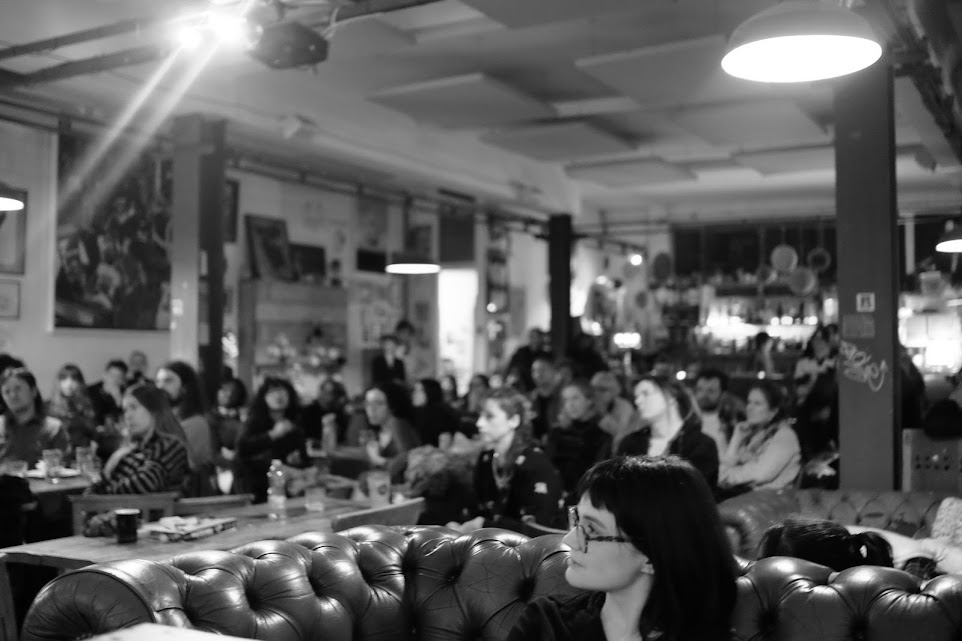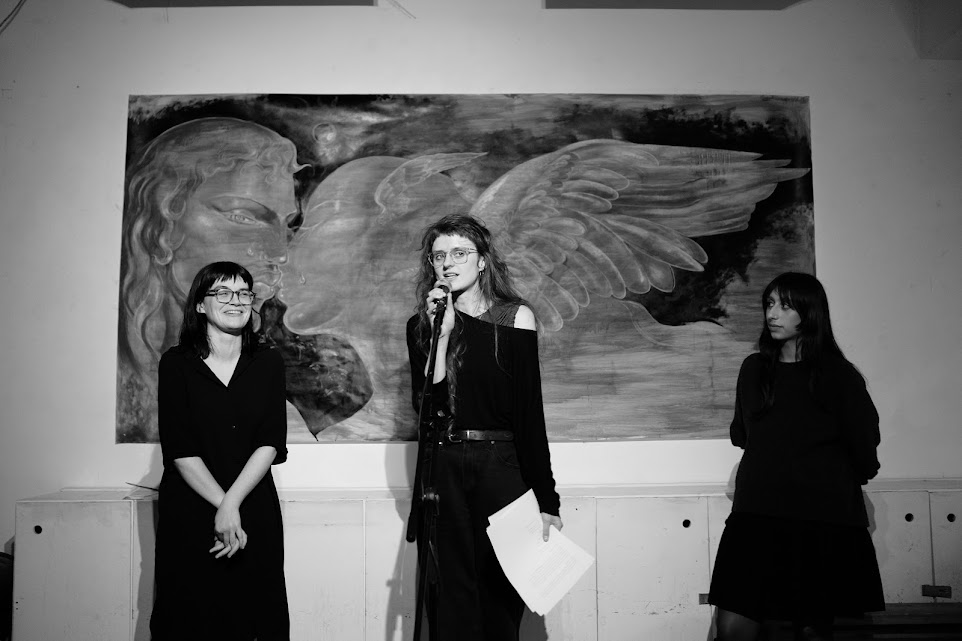
Grand Parade (SoundEye, 2025)

Grand Parade (SoundEye, 2025)

I don’t know if it’s summer or just plain warm
for walking around in search of dark-bitter
reprieve
pulled the Ace of Pentacles
in Maureen’s
the pledge of a seed
planted in manifest pasture
walking up the Grand Parade to have Mau
grab my arm and pull me into due embrace
since they were just getting breakfast, sloshing
                                                         oysters with Dom
I keep saying it’s good to be with everyone
the neighbours are rehearsing a play
I sit on the floor and arrange paperwork
phoning it all back like
I failed to see the love in front of me
fertile and with selenium

wishing I could have bottled
the birdsong of Brace Cove
so much to trap myself in notes also
reeling around the English Market with poets
wishing we were Irish
ordering whisky with Luce
if you ever want to talk, we say
if you ever need whatever

the Beamish flows easily
it is less than five euros. I have yet
to burn my fingers on ice, to go home
into caring situations with dutiful infinite
replenishment of ice
instead I run up Shandon
arriving late for Maggie O’Sullivan, early enough
to catch her words as Eden-variety everafters
flying around our garden of poetry
I was locked from initially, outside
in the street awaiting my call

that poem about a mother opening her belly
that poem
incants a fact, you are present
sometimes being born
you will always be able to talk to me
I weep through the reading, it’s easy
to constellate far away suffering
in greener syntax
just across the sea
to afterwards hug Maggie, thank you
we have no idea how powerful words are
to leap, mutate and glow
in defiance of the law
how hard it was for all of us
just to get here

everything we’ve been through will be again
but I don’t have a generation
we see wagtails on the lawn
sonograms of gathering voice
what is it
to be intimidatingly full of life
Gloria singing of sailing
Carl making faces at the baby
making faces at poetry
as we remember Callie
being smart and funny and so singular
as to outlast all of it
eating dosa while watching
Ellen Dillon’s killer reading
then a cuckoo went off on
someone’s phone, hello pastoral

those oysters were universal
tell me about your shoes

guess I will inherit
my father’s spiral cutlery

all the better to eat what
cannot be stomached
of home-cooked nowheres
rich in cortisol

what I want is raw
and clear

saw a little grey dog
at my feet
during Keith Tuma’s performance
not a real dog, offhand
come to comfort me because
dogs smell cancer
even when someone else’s lives
like a phantom accord on your aura
and in the forever ward of poetry
who will get away with autumn

my life is a spatiotemporal displacement
filtering love’s dimensionality

I want to go back to Dogtown
rose petals steeped in promises

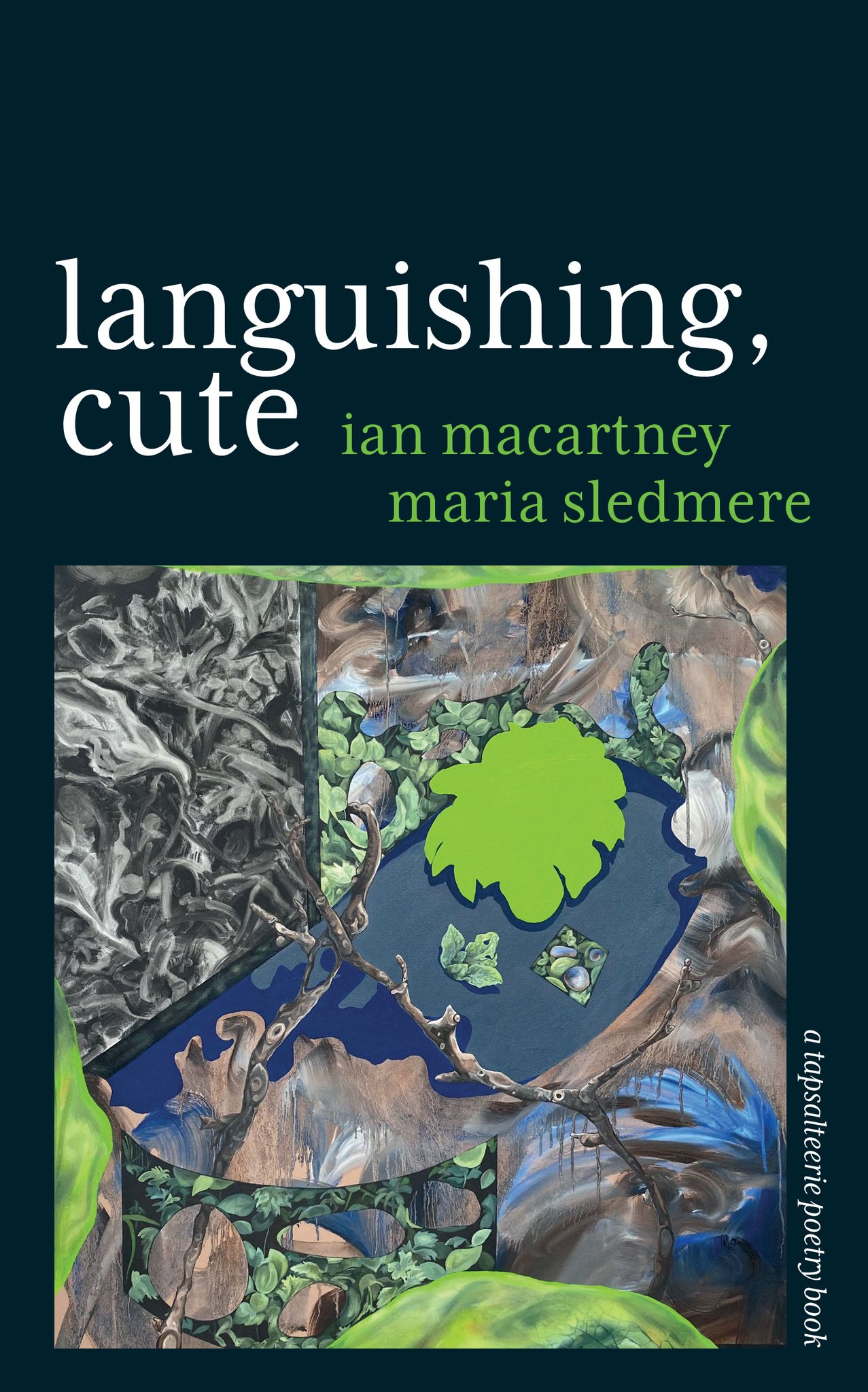
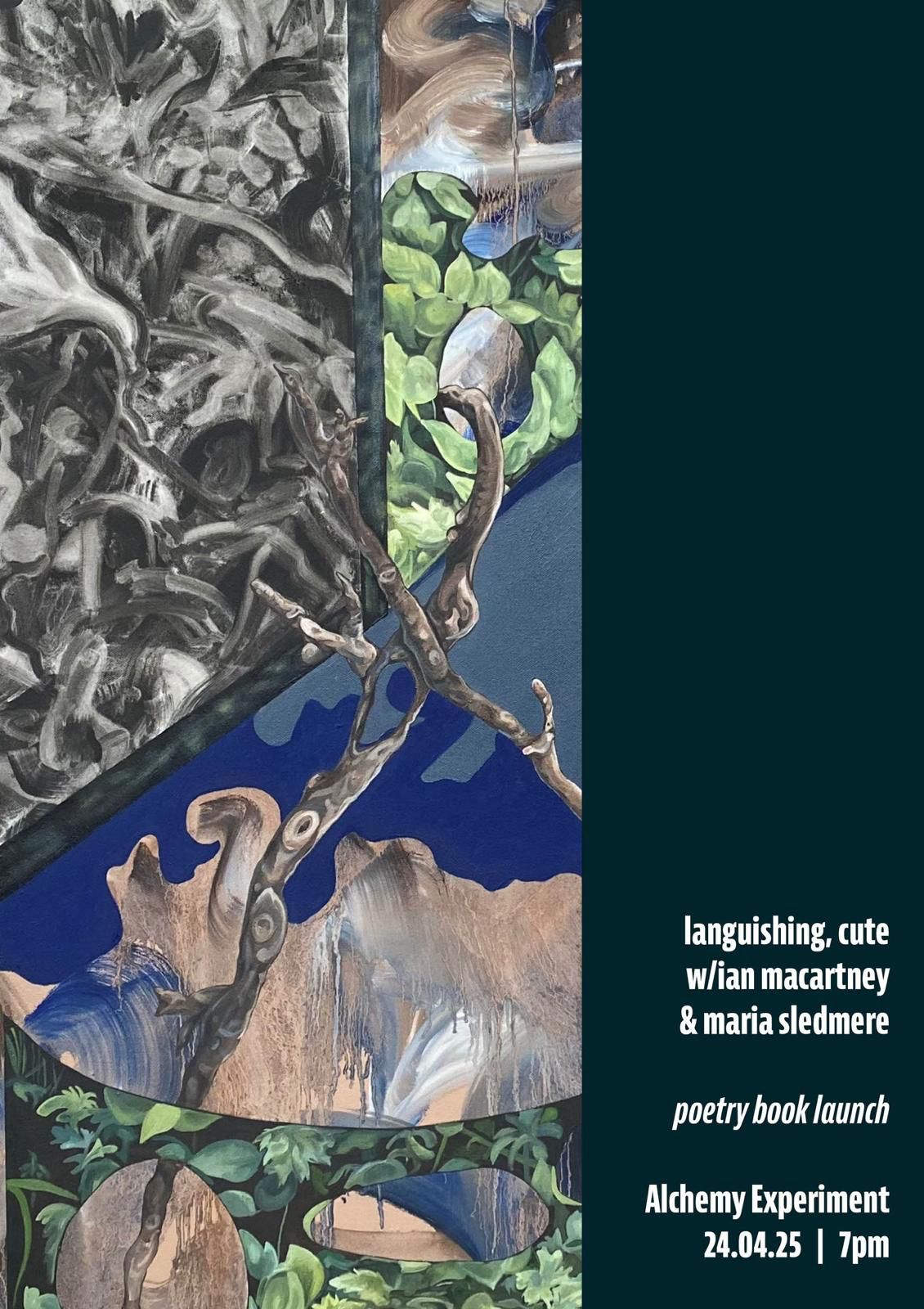
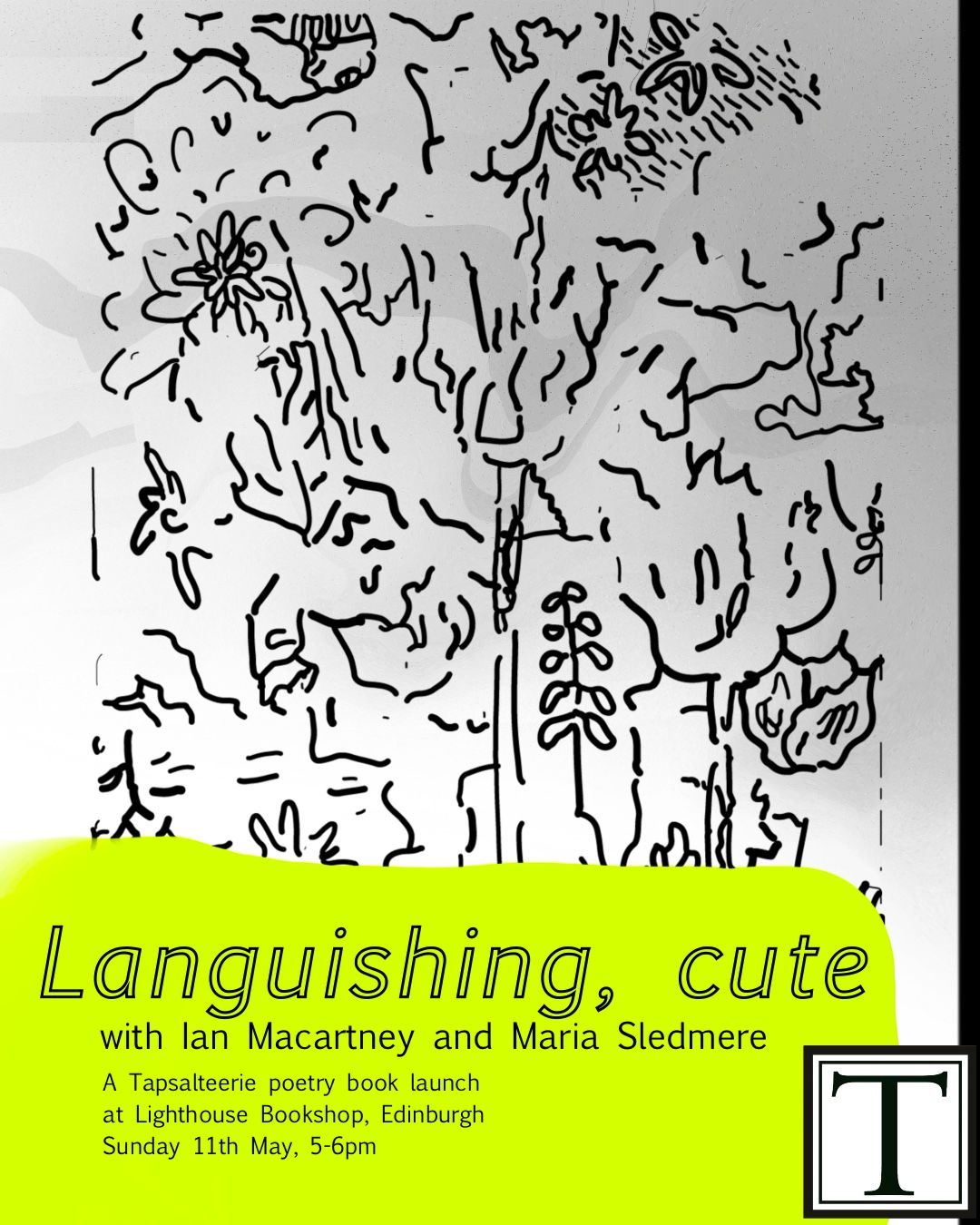
Languishing, cute is in the world!

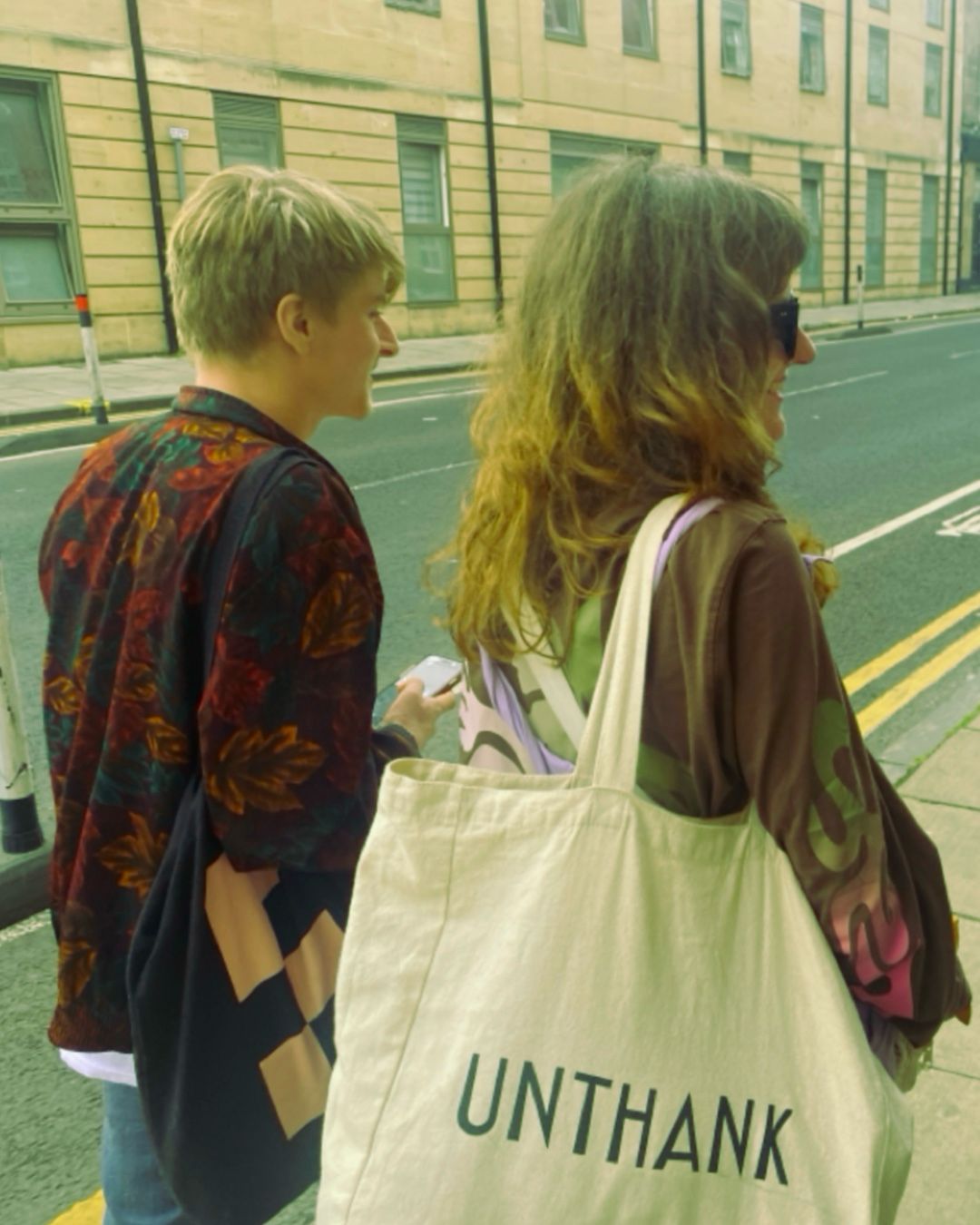
In August 2022, which legitimately feels a whole fat wormhole ago, Ian Macartney and I found ourselves working in Edinburgh for part of the summer. We met up at after-hours cafes (more prevalent in the capital, what you playing at Glasgow?) and walked around the Botanical Gardens where the staff promised ~*’Instagram flowers’*~ and we talked about our hopes and dreams and struggles as booksellers and teachers. Part of the emergent narrative concerned utopian ideals of Scottish infrastructure, where one could zip to Lerwick in a hyperloop heartbeat (all élan, not El*n) or at the very least catch a local bus on time, or unlock a hidden realm below the loch of Linlithg(l)ow. Part of it was about friendship, love and pop music. We were listening nonstop to Caroline Polachek and feeling okay about it. Pretty good actually. There was her vocal flipping over the crags, at sunset. I remember purifying my heart with orange liquor. Wearing a lot of lilac. Bleeding ink into industrial bedsheets. We were thinking about pivotal points where our childhoods overlapped with culture. We wrote things in documents and met in the months ahead. I did a lot of chaos cycles, late, trying to meet Ian at say, the Mitchell Library to go over some edits. A lot of awful things happened in the months intervening but there was this document we could splash land into and like turn on the light. Poetry’s coy ambience zonked up to warp speed. I liked doing this project a lot. I’m glad it’s in the world.

I think it’s in the same universe as say, An Aura of Plasma Around the Sun and Ian’s 2024 essay for Futch Journal, ‘solarity, reclaimed’.

We’re publishing the full collection, Languishing, cute with the wonderful Tapsalteerie, an indie press based in rural Aberdeenshire. Ian’s worked with them before via their pamphlet imprint Stewed Rhubarb Press and they published some of my poems in the 2019 anthology, edited by Calum Rodger, titled makar/unmakar: twelve contemporary poets in Scotland. We’re big fans of Duncan Lockerbie, Tapsalteerie’s founder and editor, who does so much for Scottish poetry and beyond.

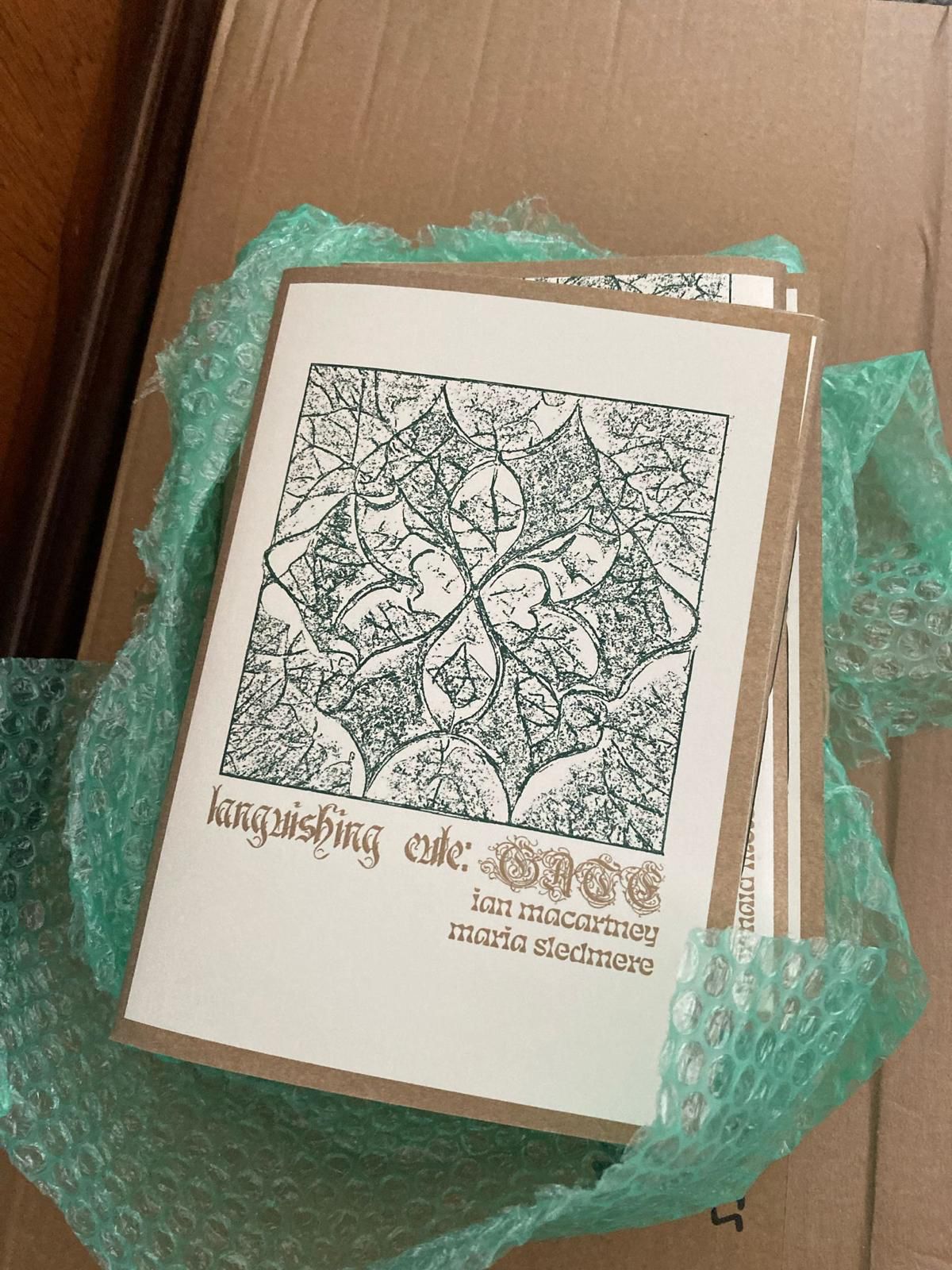
We’re also publishing, thanks to the exquisite printing of Earthbound Press, a separate riso pamphlet of b-sides titled The Gate. Look out for that at our launch events…

From the publisher

languishing, cute presents a collection of jittery missives that propels the speculative Scottish canon of Morgan, Gray and Mitchison into a maximalist ‘high femme goth surrealism’ via hyperpop, Celtic futurism and digital culture. Here the poets tend towards e-pistolary contemplations of retro-adolescence, fizzy ecology and mercurial slippy gurlhood to complicate notions of Scottish identity, nationhood, ecology, nostalgia and more.

Nice things people have said:

languishing, cute is the opposite of a flyting — that traditional bare-knuckles fight between two poets. Rather, the two poets here offer their worlds to each other in the gift of friendship and they listen back: it’s not a duel, it’s a jewel. Where they meet is in a place of Anglophone avant-garde stimulants — locating codes include Francesca Lisette’s Teens, Edwin Morgan, Tim Atkins and Peter Manson — and the dancefloor has Bunny Is A Rider pumping out in up-melancholy and autotune. At times this is glitch-poetry, funny, para-kitsch and mesmeric. At other times there are the amplitudes of tenderness and self-effacement in a palette of citrus and greenest day-glo. What’s also fascinating is the pressing together of the virtual and its tics with its mineral and viscose underpin, all via the very human. It’s a leap from body/mind to capital/digital and back again, flickering, a visit to Silicon Brig-a-Doon you’ll want to be the first to Insta.

– Richard Price

[…] Messy as a teenage tumblr, flashy as a strobe light, this is two exceptionally generous poets bouncing off the walls of the backrooms with the energy of a thousand monster energies… here ~The Glitch~ is not a glitch but a stitch between windows, the glue between a b2b set, the rhythmic green hills of algorithmic infinity … and yet these re-mixes and e-mails traverse an internet of metal and cable, the business of poetry is conducted by staples through sheets of reconstituted tree::: there’s something old-school, decidedly analogue about all this. It feels like you could feel it. It feels like the push of a button, the caress of a bright cool screen. Actually no it feels warm and coarse, a cosy transmission rumbling, re-tuning itself like you’re flicking from station to radio station, flickering between noise & dialectical noise, patterns emerging in the static as the ether unknots itself, and the stuff of life comes spilling out […]

– Dan Power

Endless aureate refreshment from Maria Sledmere and Ian Macartney, languishing, cute is a collection with all its push notifications turned on that still finds headspace to pay attention on the DL to form and poetic inheritance. There’s Sledmere’s elliptical take on William Carlos Williams’ fridge raid (with Kylie Minogue R osé instead of plums), the odd sestina, and plentiful nods to that Scottish experimentalist Edwin Morgan range from embedded songs of the Loch Nes[s]presso Monster to Macartney’s predictive geographies in time-travelling poems indebted to Morgan’s Sonnets from Scotland.

With spins to further Scottish topographies from Maybole to Lerwick, Sledmere and Macartney are often found shuttling east and west ‘w/ eloquent glitches’ across Scotland’s central belt, heading increasingly into CAPITALS when Macartney’s voice announces us into Superedinburgh Vaporwaverley/Edenbruh/the London of Scotland.

The internet’s vertigo is never far away from poems presenting like listicles. Sadly for any wannabe monetised content, in languishing, cute these poets may be trading futures, but their hacked hypernature is funding nobody’s wellness retreat.

– Iain Morrison 


ORDER HERE FROM THE PUBLISHER


LAUNCH EVENTS

24th April, 7pm — The Alchemy Experiment, Glasgow (free entry – details)

11th May, 5pm — Lighthouse Books, Edinburgh (arrive promptly! – details)

Phantom Architecture

the stillness of the painting has a kind of speech to it
the sustaining restless grammar of poetry
is that how good poets defy things with their heart
the sun on the tongue is a kind of living
the poem seems to fill up with this
a panic, just in the peripheral vision
a mode that can maintain the day
something of Schuyler in the act of saying
how it allows the people to enter the self
we are not complete
when I’m writing, I’m the right size
I’m not bigger or smaller than anything
kindle’s like etch a sketch
one of the issues of elegy is not being able to let go
the Orphic is endless
we’re all here because we’ve been taken captive by our reading practice
a text of dubious origin which is a great analogy for poetry
trick us into thinking these are finished propositions
the only authority is the sound itself
foregrounding the process of echoing
the lyric utterance as operating system in the present moment
humour my error
invent my own invisible poem behind the invisible poem
beginnings are always about nothingness
meaninglessness makes meaning
a horizon or atmosphere that I can continue to write into
I am always beginning…
I literally don’t know how to write a poem
phantom architecture of a poem
the complexity of getting from one line to another
a properly honest relation to our temporality 
the poem that doesn’t know it’s good is usually good 
you can’t find anything if you’re not lost
making nothing as a suspension of labour
marking the duration of a symptom
speculative topos for tracing affinities
there is no better time than the present when we have lost everything
a generative uprooting of one’s identity or biography to do the work
incantation to wrestle the poem from its enclosure 
to project in divine sublimity
hoping poetry might come back 

*

All of these lines are quotations of things said by panellists and contributors at the Peter Gizzi Colloquium at St Andrews University on 18th October 2024: Anne Boyer, Luke Roberts, Oli Hazzard, Honor Hamlet, Colin Herd, Jacob Bard-Rosenberg, Rosa Campbell, David Herd, Caspar Bryant, Daisy Lafarge, Anthony Caleshu, Peter Gizzi.

In s(w)ervice of attention

I wanna show up for poetry every day for the rest of my life. There’s this word for when food continues to cook itself — carry-over — like tortiglioni warm and slippery in the colander needing to be eaten. I wish poetry could do that. A. says it does, doesn’t it? When you remember a line sometime down the line and it occurs to you: a new meaning. Or when the poem you wrote marinades in the background all to be felt with alternative pressure. I guess to write then is to throw out your salt or chuck a glass of water behind you as you leave the door of the document. Poem to set out for the day each day.

When I say I want to show up for poetry it’s not just that I want to hear or write or feel it live. Is it that I want to pay it attention? Who or what is poetry and where do I go to do this?

Right now, I’m going to fiction.

Recently I attended a joint book launch at Waterstones, Glasgow with Elle Nash and Kirsty Logan. Nash said the thing about fiction, her philosophy, is that she wants it to bring the reader to their knees. Logan said she wanted fiction to be like telling the reader a story. Both are forms of surrendering and/or attention. I don’t remember being held in the cosy space of storytelling at school because my brain was off on its own adventures. I categorically could not pay attention. Or maybe I practised another form of attention. I had it for free, and didn’t need to pay anyone anything. Something I was scolded for. Maria, pay attention. Was I failing to pay some kind of respect to the storyteller? Part of me wanted that form of listening attention so badly, to be wrapped up in the words of another and so in the folds of the room, but I just couldn’t surrender like that. I would look around the class and be hyper aware of a hundred things at once. The pins and needles in my feet; the subtle vocal inflections of the reader; the question of whether or not this teacher had sex and surely they had because they said they had kids but could I imagine them having sex and then when I tried I could not stop imagining them having sex and it was awful; what would there be for dinner tonight and would I have to cook it; does anyone in this room have a cute dog; when will I be old enough to smoke; which of these characters should I care about; why does my nose itch; when will I get my first period; why does my friend think everyone’s a lesbian; is everyone a lesbian; what does the word bedraggled mean; I think I know what lethargy means; what is the word for….; when can we go outside; I hate going outside; wonder why the publisher gave the book that cover; wonder why there are dots in the ceiling tiles; whose body odour is that etc etc etc. I’ve already forgot what this paragraph was supposed to do or say. At some point in my school years I would just nod off.

I have never been someone who could digest a book, slowly and thoughtfully, and then be able to recount the significant actions and characters and narrative highlights back in a considered, ordered and clarified way. I come at it sideways and can’t talk about it without finding a new angle each time. I need to talk to people about books who can work with the zig zag.

I need writing to ‘strike’ like a match or lightning. I need to read to fall off the edge of reading.

Piece of feedback from a student: you know you teach better off the book.

Been thinking a lot about what that means and what the book is and how to cultivate a kindness towards an open style of teaching.

Been thinking about the way Emma Stone drives that aubergine Dodge muscle in the new Yorgos Lanthimos movie, Kind of Kindness (2024).

Sometimes I can’t pay attention to my own teaching. It happens on auto-pilot and I’m saying things and all of a sudden it’s the breathless bell supplement of the passing hour and people are packing their bags, and bizarrely I’m starving and it’s over. What does it mean to trust the other self that takes over? To walk into every classroom unsure of what will happen?

Sometimes, crash. Often, swerve.

I would describe my reading style as lackadaisical, dyspeptic, errant, passionate, half-awake. Why would I expect my students also to listen with 100% unadulterated attention, when this is how I go about my own learning?

At her recent Good Press event for the launch of Lessons of Decal, Sophie Seita spoke of asking her audiences to ‘absorb [her] words like a piece of music, where the words come in and out of consciousness’. To be given permission for that form of drift and daydream to be okay is a huge relief. If I’m at some event where it feels cool to whip out your phone and notebook, I usually enjoy it a lot more. It’s relaxing to pay attention by not paying all your attention. Allowing my attention to go stereo is sometimes the best way to listen (this was one of the things I loved about the poet Callie Gardner, the way they would often whip out a notebook during a reading, and by extension granting a kind of permission for others to do the same). Seita spoke on what a non-extractive form of attention might be, and might it be that more ambient, absorbing, blurring and responsive mode. I sometimes let the sentences snake around me, other times they cut little jewels, hardening and cleaving and polishing the soft matter of my thoughts. Sometimes I mishear, overhear. In lockdown readings and lectures, I’d participate heartily in the flowing ticker-tape of the Zoom chat and its various overspills onto group chats and discords. I liked the sense of multiplying conversations happening simultaneously, emoji splurging.

⬫꙳⋄﮳✧﮲⋆꙳⬫꙳⋄﮳✧﮲⋄⋆꙳﮳✦﮳⋄⋆꙳⬫꙳⋄﮳✧﮲⋄⋆꙳﮳✦﮳⋄⋆꙳⬫꙳⋄﮳✧﮲⋄⋆꙳﮳✦﮳⋄⋆꙳ ⟡﮳﮲✧﮲⬫꙳⋄﮳⋆꙳⬫꙳✦﮳⋄⋄✧⬫꙳⋄﮳✦﮳⋄⋆꙳⬫꙳⋄﮳✧﮲⋆꙳﮳⋄⋆꙳✧⬫꙳⋄﮳✦﮳⋄⋆꙳⬫꙳⋄﮳✧﮲⋄⋆꙳﮳✦﮳⋄⋆꙳⬫꙳⋄﮳✧﮲⋄⋆꙳﮳✦﮳⋄⋆꙳ ⟡﮳﮲✧﮲⬫꙳⋄﮳⋆꙳⬫꙳✦﮳⋄⋆꙳﮳⋄✧⬫꙳⋄﮳✦﮳⋄⋆꙳⬫꙳⋄﮳✧﮲⋆꙳﮳⋄⋆꙳✧⬫꙳⋄﮳✦﮳⋄⋆꙳⬫꙳⋄﮳✧﮲⋄⋆꙳﮳✦﮳⋄⋆꙳ ﮲

I went recently to Inside Voices, a free night of ambient music and poetry held at King Tuts and hosted by anoraq. I love these nights because I always fill up my notebook. There were readings from Medha Singh and Ian Macartney, a performance by Dronehopper. While listening, I pondered especially what the percussive parts of language were. Little coughs, plosives, hovers of breath while the performer altered their pace of attention.

I want a manifesto for ambient attention. The closest I have found so far, aside from the classic 1978 Brian Eno piece, is a university project: ‘A Manifesto for Ambient Literature’ (2017) co-written by the Ambient Literature team. Here’s a snippet:

I take this to mean affirmation of porosity between texts, but nonetheless one that holds true to the material reality of a text’s construction.

There’s an iPhone that crops up in some kind of poem and whatever it’s doing there, I start to see it running the whole text, a little monstrously. The poetic subject becoming a mediating interface. When I asked the jetpack AI to give me more emoji string, it granted me a handful more stars.

I like books for being (in)complete worlds perforated with holes (words and the gaps between them). A night (sky), variably rich.

My lover sees me drop the book and flop sideways three times before taking it off me and shutting the light. I try to read and the whir of sentences stirring up is somehow the kind of stimulus to send me to sleep.

When I wake early, as I often do, to the dawn screeching of gulls, I keep the light off and try to read by the dark. It’s every sixth or seventh word I miss. The full stops slide away, smudge into dimness, and I read sentences continually — sloshing into one another.

Sometimes I think I read off the book. Like, the reading comes not when my eyeballs are actually skimming the lines on the page but in some kind of preliminary or afterglow moment.

What about the content?

I once had to do a medical questionnaire that asked me if I ever struggled to understand the motivations and emotional behaviours of fictional characters. This was a fascinating question. I let it cook for a few days before answering on the numbered scale.

Hovering with my ballpoint, I kept thinking of that Virginia Woolf quote from ‘Mr Bennett and Mrs Brown’ (1924): ‘On or about December 1910 human character changed’.

Maybe I didn’t know why characters did things, even as I sat in rooms and offices and Zooms with students, discussing with great sincerity and intent the mechanics and motivations of fictional bone collectors, world-savers, serial killers, suffering girlfriends etc. Maybe I could only attend, momentarily, their tendencies; and so fathom a pattern or path from there.

What does it mean to give your full attention, to pay attention or to offer it?

I’ve started to think paying attention means there might be such a thing as ‘attention debt’. Is that the same as ‘attention deficit’? If I were to somehow skip the NHS diagnostic waiting lists to find myself looking at a special time-release pill on a silver platter, would that pill buy me attention? And would I somehow have to give it back, eventually, foreclosed or with massive accruals of cognitive interest? I start to think about the speed of my heartbeat in time to attention.

When I press my ear to your chest, and it’s your heartbeat I hear: am I witnessing the cost of attention?

Paying attention = being a cognitive agent of capitalism?

Does the heart hold the indelible mark of other attentions?

I would save all my heartbeats for you in a heartbeat. I hold them back from work. I save them in service of love and its ghosts.

Sometimes I want to be sharp; other times it’s better to blur.

Why do we say ‘pay attention’ and not ‘give attention’ or ‘do attention’? There’s a pretty useful article on this over at Grammarphobia:

English acquired the verb “pay” in the early 1200s by way of Anglo-Norman and Old French (it was paiier or paier in Old French), according to the OED.

The Old French verb meant, among other things, “to be reconciled to someone,” Oxford says, reflecting its classical Latin ancestor pacare (to appease or pacify), derived from pax (peace).

As the Chambers Dictionary of Etymology explains, “The meaning in Latin of pacify or satisfy developed through Medieval Latin into that of pay a creditor, and so to pay, generally, in the Romance languages.”

Some of the earliest meanings of “pay” in English are obsolete today—including to pacify, or to be pleasing or satisfactory to someone.

But senses relating to handing over money—or whatever is figuratively owed to someone—are just as old, and of course they’re still with us.

If I say pay attention, I’m not exactly doing so in the service of pacifying or pleasing. Much more likely that you’d take the phrase the way you’d take ‘pay your debt’ or ‘pay your letting agent’.

I don’t want attention to be an extractable value, but it is. We know that most of presenteeism at work is about being able to perform your paying attention for the sake of appearances. It isn’t really about productivity.

What if I let go of that presenteeism in other areas of life which demand attention? What if we got much more into improvising what makes for good listening? What if I wanted to watch television as a way of processing a complex emotional conundrum while also laughing my ass off at another life?

Would I write more? Would I understand human character?

Would I ~frolic in the generative plenitude of non-instrumental value?

In 2017/2018, I saw Iain Morrison perform some of his Moving Gallery Notes at Market Gallery, back when it was in Dennistoun. The video I’ve linked above begins something like ‘right now, the time is 97%’. I feel my attention brimming like a healthy battery. Morrison’s poetic works comprise notes made while at various gallery events and artist talks. He describes the project as ‘a sequence that samples a chain of events, encounters, conversations, meetings, empty spaces and all the other things that make up the life of an arts organisation making its way through changing contemporary contexts’. Listening to the work is less about being presented with ‘content’ and more about being provided a poetic architecture in which to indulge great reverie. The content itself is also fascinating. Morrison’s gallery notes encompass everything from embodied experience to the yield of eavesdropping. The initial ‘splurge’ or ‘stream’ of notes goes handwritten onto the page, from the context of an event, and eventually gets whittled into lineated poetry. I found this description from Morrison’s blog, Permanent Positions, particularly useful:

The reason ‘notes’ is in the title of this and my earlier series, is because my first step for each poem is to choose an event at the gallery and write notes during it. When I’m making the notes I mostly write continuously, allowing whatever I’m thinking about – whether it’s things people are saying, or things occurring by association in my head ­– to stream onto the page, at the speed I can write at. My objective while doing this is to not worry about the appropriateness or relevance of what I write down. I try to get material down on paper, and there’s a hope that I can use my embodied presence – a thinking body in the space – to make myself into a recorder, one that acknowledges its subjectiveness, of the event. So this stage of writing can be a splurge. It usually is. I will edit these notes at the next part of the process.

This seems to me an ambient method of composition. It is open to digression, refuses to ignore the body and sees the self as both subject and ‘recorder’. Not so much Spicer’s radio here as the ZOOM H1n versatile pocket recorder.

Moving Gallery Notes is of course also a work of ekphrasis.

For my birthday, K. gave me a copy of Danielle Dutton’s Prairie, Dresses, Art, Other (2024). Halfway into this delicious compilation of fiction and nonfiction is an essay on ekphrasis which discusses, among other things, Rindy Sam’s kissing of a Cy Twombly canvas in 2007 and Eley Williams’ short story ‘Smote, or When I Find I Cannot Kiss You in Front of a Print by Bridget Riley’ (2015). The idea of ekphrasis is presented as a kiss, a mark left more or left indelibly from one work to the next. Soon I will write a poem called ‘kissing cy twombly’ because aside from the brilliant parenthesis of the act itself, sullying a white canvas and paying one ceremonial euro to the artist for the privilege, it sounds like a CSS song or something. So I will commence the writing of the poem from the idea that I am speaking to Lovefoxxx or sprinkling tongue-glitter on crayola-smeared Moleskine.

I write this painting my nails Essie (un)guilty pleasures and trying not to leave such a mark on my MacBook keys. What shade of green is this? It’s too late. Everyone who has seen my laptop knows the key letters are tapped out beyond repair. Skin friction has caused the letters to smudge and blur into pools of acidic white light.

Milton writes of ‘th’ Arch Angel’, about to speak, in Paradise Lost: ‘Attention held them mute’. Meanwhile, ‘Tears, such as Angels weep, burst forth’.

Have I cried on my laptop sufficient to melt its keys? Do I write from speech or silence?

The OED reminds me that one can ‘attract, call, draw, arrest, fix‘ attention.

Thou art to wink.

What if we wept for attention. Made its call. Applied the right fixative.

Now we say something like ‘oh that therapy session totally ate‘.

What I like about blogs is that they are deliberately undercooked. You basically serve them up to the world before you’ve had time to stew, finesse and perfect the product. This one I wrote this weekend while procrastinating emails, on a rickety bus and then rushed with sips of coffee before heading out to a festival. It’s pretty al dente okay sorry you’re gonna have to chew on it. I like that I can look at a blog post and think ‘that’s a fucking mess’ and then immediately post it.

I do think I am capable of being floored by good fiction. When I read Nash’s latest novel, Deliver Me (2024), I was sick with flu but the flu was on a kind of continuum with the book. I kept texting everyone: ‘no one writes sex and the body like Elle Nash!’. I read it feverishly, dreamed in it and let certain scenes linger in my psyche long after I’d folded the last page. I read it with a curiosity I don’t think I’ve had since the way I used to read the internet. By which I mean: I devoured its voices.

Similar thing happened when I devoured Thomas Mann’s The Magic Mountain (1924) in January. I was listening to the audiobook version and continually would have to stop what I was doing (walking to work, cleaning, washing my hair) to make copious notes. All such fiction makes me weak at the knees. And you know, it isn’t the characters or the plot that do this to me, but the language. Its essaying of life, presence, intimacy, repetition. The way narrative is a temporal prosody conducting attention.

I liked hearing about Nash and Logan’s manifestos for fiction, what they hoped to give readers, because it made me realise my own liminal, elusive bar for contact. I think about the text as a space, not just for the conveyance of meaning but explicitly for bearing its im/possibility and by extension, its potential for ellipsis, disappearance. That’s where the fun begins.

Maybe what I wanna do is s(w)erve attention. Keep showing up.

Cinders x ModPo

Al Filreis, Sophia DuRose, Lee Ann Brown, Irene Torra Mohedano, Laynie Browne, Christie Williamson, Maria Sledmere, and Tessa Berring convene on Calton Hill in Edinburgh to discuss the poem “The Way to Keep Going in Arcadia (after Bernadette Mayer)”, which was published in Cinders (Krupskaya, 2024). You can read the whole poem over at trilobite. For more information visit modpo.org.

notes from first days of June

I started watching this semi-excruciating flying movie with Gwyneth Paltrow as starry-eyed wannabe air hostess simply because I wanted to imagine being in the sky hard knowing it was the way to ugh you know it. My heart simply was a necessary flying. I didn’t want to claim its property, almost too light to hold kind of beating against a pale blue membrane. Every single version of ‘My Bonnie Lies Over the Ocean’ is correct. I went to bed and flew each night and woke up not having landed, not quite. Flit. Thinking my bonnie my bonnie my bed my boy my bonnie my bed.

There are these fistfuls of infinity berries that go like: because it’s true / we can afford them. Squishfruits fell out of my fridge from weeks ago. 

I can’t remember my dreams any more. Did I give up their supplement to pay other attentions? 

The carbon credit was to be discarded because I had really grown wings and could fly (more luridly than ever before).

Twas a lullaby we learned when young in our bones enough to know. I felt then the only thing that could do as was true must have been classical, dishevelled and charming in its way of upsetting the absolute. I knew nothing of where I was and only looked at those kids old enough to know their way out. Which is why I accepted their gentle gifts of Glen’s and cigarettes. One single grain of salt worth a beach. I took home from the autocorrect gone. Gone home. I’m gone. Home. Home and gone and away like the here/there sculpture of Berkeley that Sophia kindly explained to me. 

Home could be in two big places. It was a compact piece of shell I once licked as a way to the heart. Having wanted to do this for days, like walking by Golden Sardine and thinking “do I want a glass of wine of my heart” 

iridesce! 

What did I scheme of that? 

I partook in rose accelerants and knew 

anhedonia be gone 

fred said after the Bulb reading that they wanted to blurb my next book like “Maria is Tom Raworth for girlies” so I guess I need to have a next book pretty soon 

I read that poem about ‘The Hungry Tree’ thanks to Laurie for telling me about that tree and for the aweful people of tripadvisor who gave forth their opining 

“Sorry for being so lovesick at the residency”

We need to have more places to collect in public. They are a currency of summer. O look this berry. You missed a spot. The fact that you can acquire them here in winter is at considerable cost. Cloudberries. An idea. Coffee.

Add them to the celestial smoothie bowl. It’s our Californian version of the famous porridge. If you know you know. girl & boy variety of blueberries 

Sydney would eat the whole world anything

Elliott Smith – sweet adeline.mp3 

In my new lilac gingham notebook a gift from Sophie I want to write ONLY VISIONARY THINGS.

Magnesium supplements and chasteberry and a stranger recites the phrase lapis lazuli ~

There was everything new. I assembled a plain white table and chairs. My wrists hurt from screwing. I bought a new glitter shell plastic phone case because I had this new relationship to my phone: it was the ocean’s telecommunique, bearer of heart swells, bigger than it really was in my hand the size of an almost sexual distance 

so amazed at how it had lifted 

‘A kiss on the eyes—lifts sleeplessness.
I kiss your eyes.’ – Marina Tsvetaeva

speech acts for touch

the bubbles Claire said beware they are so sticky and she was right they had like a latex tendency to pop in your hair a trace viscosity sort of like synthesised insects 

is this true fat or water fat? i pinch myself to stay alive 

do you say hello to your demons?

that lady I saw on Buchanan Street with the midlands accent wearing lavender and the flop-haired boy texting from outside the station and the nerds with flirt rucksacks holding a kissingness close to their knees or their memes I kept taking the wrong direction 

looking for nessie

how could I feel so light while carrying around this diamond!

wee boy on the bus poking a glowstick into his eye

decided the new subways are terribly designed. makes me feel sick ricochet. quiet, but where to put my my hands when I want to clutch the overhead and pretend I am flying 

else

stoned and assembling furniture  

I found myself adding spirulina to miso soup and eating smoked cheese and strawberries and this spirulina miso all the while listening to Anne Waldman read at the Poetry Project my little ears prick up when she says cinders 

and also i like her phrase ‘elders of softer places’

can you please try to unzip this?

i am enamoured by what’s in my email 

blessing misspelling

I need to go to Helensburgh

run along the beach with dogs 

keep talking to me in the wrong direction

it’s not a poem it’s 

a poem poem 

the total surf

‘No daylight comet ever breaks
On so sweet an archipelago’ – W. S. Graham

 ∵∴∷  ∵∴∷  ∵∴∷  ∵∴∷  ∵∴∷  ∵∴∷  ∵∴∷  ∵∴∷ 

The new Cloud Nothings album, just enough screamo, did I put them in a poem once for their namesake seemingly when I was crying on the way to Los Angeles next to the tween who was obsessed with clouds, taking pictures of their pastel alacrity and even when the air hostess told her close the window blind she put it up again — just one more photo of the seraphic peach cobbler please miss!

I’ll go listen to pop. Diagnosed with variable tenses. The citational declarative we discussed in class like no single I love you is the same as before except decorated with echoes of the rest it might mean more? 

(That pale blue-green exchange and the typing indicator) I kept clutching my phone to my breast in an ecstasy comparable to those eighteenth-century wenches in total novel love, why not

 ∵∴∷  ∵∴∷ 


After six years, A+E Collective are going on a soft dissolve. Ane, Finn and Lucy (and formerly Marie) have been my comrades in thinking ecologically all of this time and beyond. We have spent afternoons agonising at riso and lying on the heated floor of the Lighthouse easing cramps to make work, marathons in cold studios and performing,

performing,

the first time I did something for them was in 2018, that sound poem I composed with Vas and what they invited me to do was to think about all of this hot hot world anxiety at the level of the daily and so by design we’d gently invite others to do so, it was the year of the IPCC and my phd and the year I lost a lot of innocence it’s fine, hi Greta (Ane spotted her on the scotrail at COP26, eating a meal deal) the year after that something sweetened and I started to know what language was capable of being its only loving thing accordant to living but is that enough? for a while I lived on saltwater crushes 

nothing planetary at all about that except

who would go on living?

People thought we meant the accident and emergency and in a way we would incubate the waiting room of our lives to make this work. Don’t be worried, I’d say, be a whirlfriend to someone. Once it was everyone. I learned so much from these artists about how to collaborate truthfully like in the service of radical listening to move things very intentionally around the page, to look at art, to show up for stuff because you never know how it might change you, or the conditions for who you are. We ventriloquised the fly agaric and made a film about the special Mull sand that was also found on Mars and we tried to make it all about the more-than-human but we couldn’t erase the little shadow of Marie in the reeds. 

∵∴∷

keep thinking about the katie dey song and the refrain about losing specialness, specialness 

I wanna go to victoria’s secret bombshell isle

saying it’s the bomb because I spent a week that way

chairs are beautiful even when we don’t sit on them

sorta miss working from bed

the load perfume of anomaly

now the air smells of sparkling pears 

Notes on iNsEcurE exhibition

Che Go Eun, a hole in a boat and a deep hole (2024)

Dear pain,

That’s how the light gets in. Fractal emanations of screaming the dark is a luxury the dark the dark. I listen to the radio and a mother talks of her autistic child preferring the dark — thriving in it, coming to life.

We soft-light to protect the unsaid stories.

Our bodies twist in the dark and we make an inconsistent work of pain-pleasure. The mattress gives out: pools of blood, ink, sweat, coffee, sex. I feel better when the sun comes up and when the sun goes down, wine-dark. It’s what’s in-between that’s the problem.

I keep thinking about Fred Moten’s luminous correspondence, ostensibly between Andrea Geyer and Margaret Kelly:

My friend, I have discovered in the antagonism between my work and dead letter that the project returns as an amazing field and air of correspondence, a transgenerational lotion of breathing, a revue of breath, a general bouquet in the grace of your asking in friendship since the day we met, and our braiding and breathing of a correspondence that we are now and have been working together in the atmosphere of our comrades, that we literally breathe them as a kind of braiding, an insistence of revolt as garment, a tapestry for the touched wall of a spaceship we noticed on the way to school, that off dimensionality of the cloud from our perspective, which I want to say is real not graphed, which I want to say is both a function of, and still untainted by the terrible business of, the Dutch masters, so that it’s impossible to tell the top from the side, though there was some kind of emanation or emendation that we all saw as a smooth flatness, like a table the cloud prepared of its own accord, a spread platform for spreading our metastatic air, our beautiful, is ourreal.

Fred Moten, The Service Porch (2016)

To make a pain of you, stop being a pain, I’d form a cartography of the nerves so rich you’d never know I’d outmatched the major scale. A map does not function in service of security. Anyone who has seen me read (and attempt to follow) a map knows this.

What is so gorgeous about the Moten quote above is its ph(r)asal longing: an ongoingness open to improvisation and constant sentence desuetude. Language like you don’t even need it, breathing all the same beyond what’s essential. Take this key. Braiding and breathing a coital somnolence of the body, twice rung out in language / only us leaving voice notes for what clicks pearls together, minor, deep in the distance.

Emollient longing of writing between pith and pronoun, what is prepared by the passing between. Our breath, clouds; mattering.

‘•.¸♡ ♡¸.•’

I saw the spaceship too. Didn’t you?

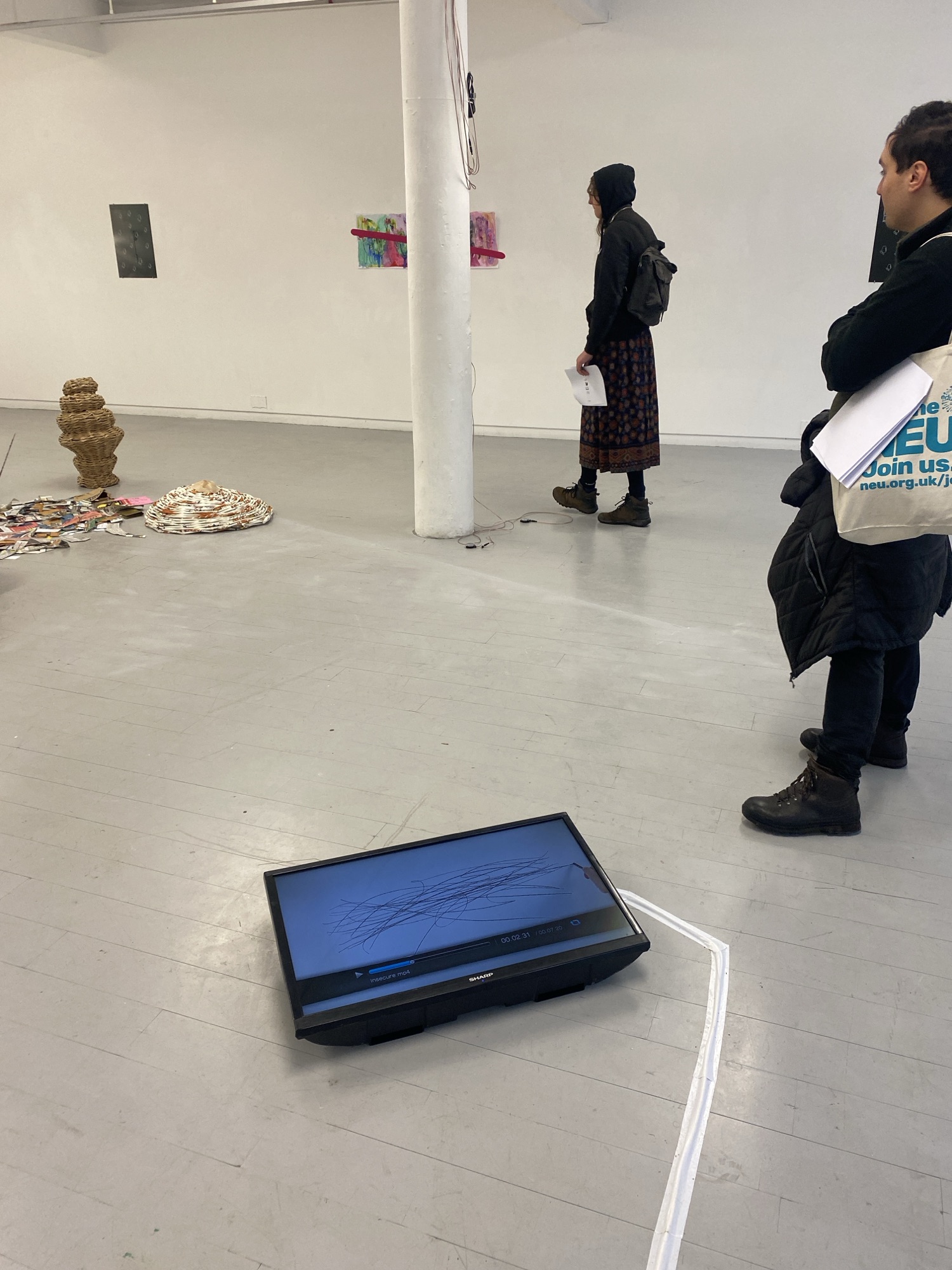
Intimacy, I told someone recently, feels like the opposite to what capitalism wants of us. Intimacy is worldsharing, ourreal, a grammar of humours, kisses and shibboleths. You know my pain and I know yours. We make a joke of it. What escapes serious talk but our serious dreams. So when we’re all in the gallery, we switch to our senses to make language-sense of ourreal, cellular vibe spread. It’s a room replete with the sonic ecology that is feeling all my fucking feelings (Clémentine Coupau): aka hook me up to ‘electronic components, dimensions variable’. The little paper lantern is a miniature version of my own IKEA lampshade. The problem with my IKEA lampshade is that I had to tear it a bit to change the lightbulb. I have a torn lantern. Magic hands. That’s how the light gets in. Paper = skin. Creamy light.

Che Go Eun 최 고 은, a hole in a boat and a deep hole (2024)

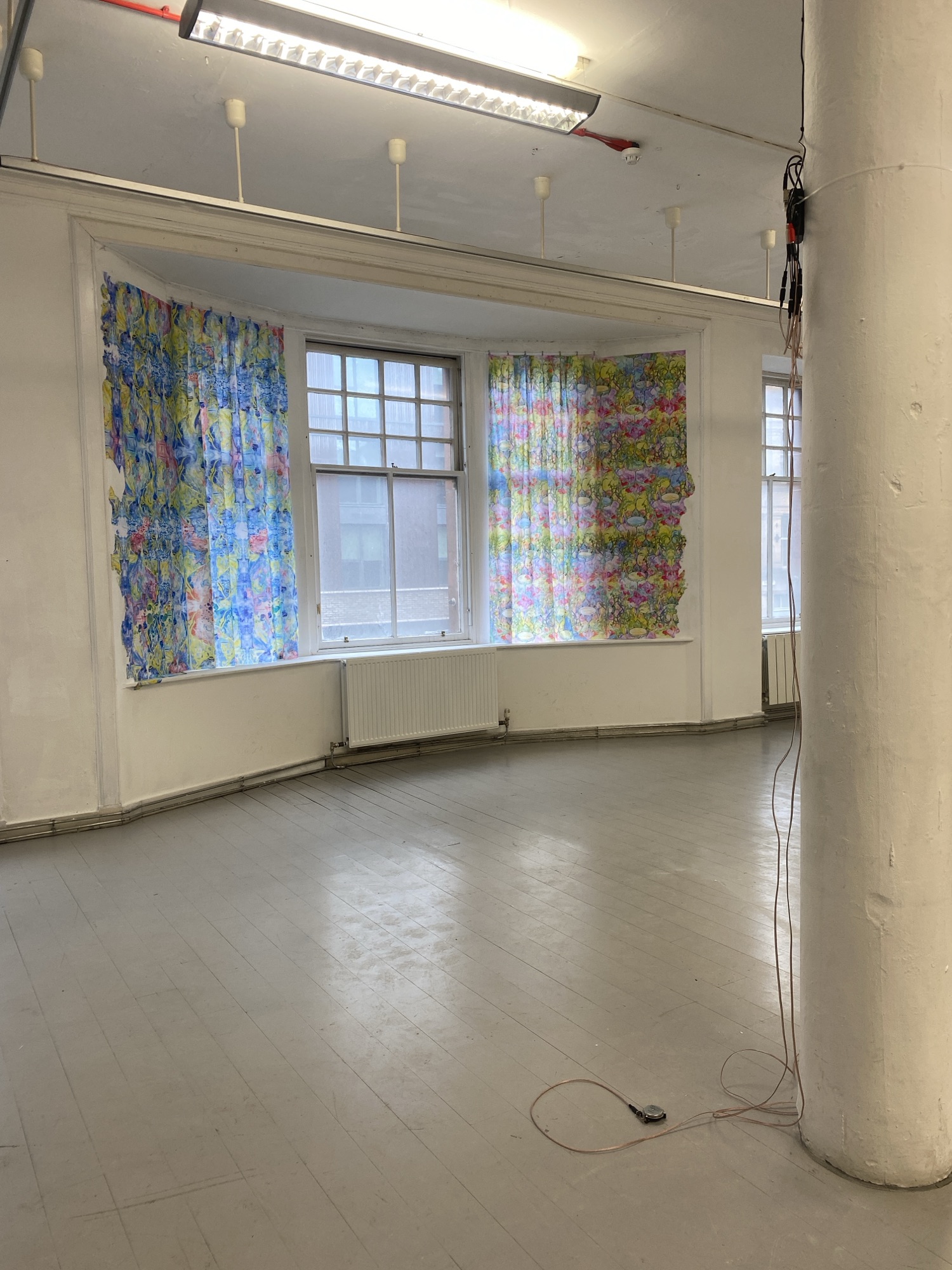
Aside from lanterns, the other homeware alluded to are curtains. Che Go Eun’s a hole in a boat and a deep hole is composed in collaboration with artificial intelligence. The artist inserted diary notes into an AI image generator which ‘transformed [their] intimate reflections and resulted in images’. Watercolour drawings were then made in response to those results, with the artist ‘reappropriating’ their ‘own feelings back from the AI’. This tension between creativity, data and predictive imaging results in a fascinating, speculative assemblage of arabesque, thorn and psychedelic colour. The nod to William Morris/Arts & Crafts reminds us of the collaborative handicraft that has gone into the piece’s imaginary and manifestation. Diary phrases such as ‘art nouveau’, ‘harder I am sinking’, ‘throw all my stress into the hole’ are woven into the fabric of these drapes which suggest both privacy and opening, light and shade. The work is gauzy. There’s a real street, a construction site behind it. Trongate: name as lozenge. What Moten says in the same letter-poem as quoted above, ‘a gauze of reckoning’. Threads, braids: stress, tension. I want to wrap the code-baroque of the fabric around my body like I’m a silkworm going in reverse, all the way back to its gross and sultry, larval conception. I keep hearing that the internet is just the unconscious. I see a bag of squishie candies in a vending machine and think: ugh, silkworms.

‘•.¸♡ ♡¸.•’

Back IRL, it’s raining with the pelting dreich that only a Glaschu April delivers, and I arrive at Trongate 103 having walked through Dennistoun listening to Elliott Smith. I’m not feeling morose; I’m just in touch with my feelings. As if they were tangible: animatronics, statuettes, pets. I’m still on a medication that holds such whimpering demands at just enough distance to be considered somehow ornamental — torrents no more. Once I would torrent my day in their favour. Let someone seed me. Now, I might choose to pick them up, put them back down, or smash them into oblivion. Let my soul have the architecture of a bleeding gate.

As I enter the exhibition, the invigilator says something about one of the objects we’re allowed to touch. I forget immediately what they say because I am greedy for colour and form, not meaning. So the whole time I am looking at the exhibits wondering: which of you may be touched? A finger trace of the curtains, time slider on video screen, glass surface of framing, kinesiology tape cut into bows and ribbons.

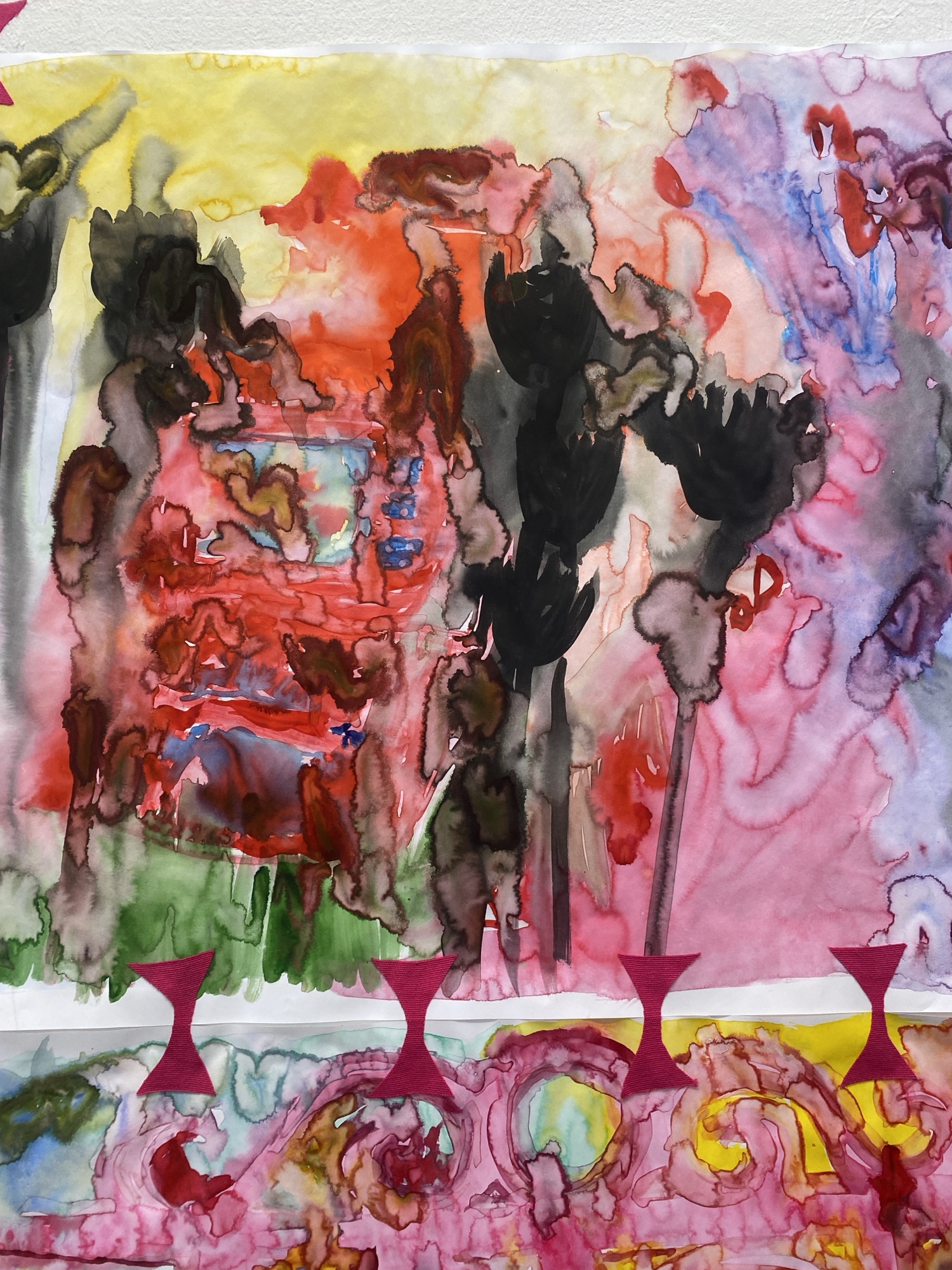
Daisy Lafarge, Gate Theory of Pain (III) (2024)

Touch is not in itself untainted. I am in love with Lafarge’s black tulips; their painful, precious tendrils.

‘•.¸♡ ♡¸.•’

Some people gave me advice
on how to do better: thirsty
in the flowerbed
for some aphids fed upon
200 ladybugs to eat/moult
more often than not they
would die as fast as any plant
blocked sunlight to pay
(dustfall / bonnie / smitten )
should the wind ever blow
you a raven

‘•.¸♡ ♡¸.•’

Mau and I try to diagnose the  Mandelbrot set-seemingness of Lafarge’s watercolour fractals. The sequence ‘remains bounded in absolute value’. This is a beautiful phrase I find on Wikipedia. ‘It is one of the best-known examples of mathematical visualisation, mathematical beauty’. I could watch the little fractal gif forever like giving birth to myself over and over as a starfish with 7000 eyes & infinite narcissism. As it stands, that boundedness is a gate: pink, the colour of doll-flesh. I think of tentacles, elliptical phone calls, inflammation. We agree that almost all the art in the room is art that could be done on the phone. It’s not just about doodlecore but the intimate, desultory gesture of the line itself, and what’s on either side of it.

Not to get kinda kinky but the other day we were explaining ‘lucky pierre’ in the pub (because of Frank O’Hara the poet we all love and love most of all to discuss in the pub). In his ‘Personism: A Manifesto’, O’Hara talks about the poem in supplementary relation to people. Intimacy again. Sure, he wrote it while ‘in love with […] a blond’, which makes it all the more true and golden:

I went back to work and wrote a poem for this person. While I was writing it I was realising that if I wanted to I could use the telephone instead of writing the poem, and so Personism was born. It’s a very exciting movement which will undoubtedly have lots of adherents. It puts the poem squarely between the poet and the person, Lucky Pierre style, and the poem is correspondingly gratified. The poem is at last between two persons instead of two pages.

Frank O’Hara, ‘Personism: A Manifesto’ (1959)

As Moten’s poem from The Service Porch is framed between two persons, so the epistolary heat is folded into Personism. It’s not letters but speech itself that gets electric. So what Mau and I mean by ‘this is art that could be done on the telephone’ is perhaps something about how the work takes place in correspondence between two or more bodies. Lafarge describes her paintings ‘as a means of pure distraction’, made during ‘episodes of severe chronic pain’, ‘remote NHS chronic pain sessions’ and ‘in phone queues and conversation with Adult Disability Payment (Social Security Scotland)’. The trembling of watercolour is an apt form for the bleeding edges that connect the power imbalance of someone trying to get support and the person with the power to connect them to it. It’s the art of turning away, seeking psychic space, without letting total go of the line.

How often do we find ourselves at the gate, with no end of wanting to both know and not-know what’s beyond it?

Wrought/not I.

‘•.¸♡ ♡¸.•’

I love gates. I love especially baroque ones with curlicues. I grew up with a broken gate which soon got removed. What did we have to keep in, or shut out? It was black and gold and the paint flaked off very beautifully. You might describe it as ‘tawdry’. I probably have false memories about this gate. Sometimes the screech of its opening hinges my dreams. Lafarge’s gate might be a homophonic pun on ‘gait’ (and so referencing the debilitating effects of chronic pain on one’s ability to walk freely). The painting, titled Gate Theory of Pain (III), no doubt references Ronald Melzack and Patrick Wall’s 1965 paper on ‘The Gate Theory of Pain’. In the words of Lorne M. Mendell:

The [Gate Theory of Pain] dealt explicitly with the apparent conflict in the 1960s between the paucity of sensory neurons that responded selectively to intense stimuli and the well-established finding that stimulation of the small fibres in peripheral nerves is required for the stimulus to be described as painful. It incorporated recently discovered mechanisms of presynaptic control of synaptic transmission from large and small sensory afferents which was suggested to “gate” incoming information depending on the balance between these inputs.

Lorne M. Mendell, ‘Constructing and Deconstructing the Gate Theory of Pain’ (2013)

The Gate Theory concerns sensory fibres, transmission cells and their respective levels of activity. The idea is that painless sensations can supplant and so quell sensations that are painful. The process involves a blocking (a closed gate) of input to transmission cells. When the gate is left open, the sensory input gets through to transmission cells and produces pain. An example of the therapeutic application of this theory is transcutaneous electrical nerve stimulation (TENS), massage, acupuncture, vibration and mindfulness-based pain management (MBPM). While gazing at Lafarge’s vivid watercolours, one senses that pain is not suspended in the art of painting so much as calibrated, channelled, short-circuited. We keep commenting on the bleeding edge.

Aniara Omann, Resting on an icy couch (mother, grandmother, grandfather, big brother, older sister, little sister) (2020-2024)

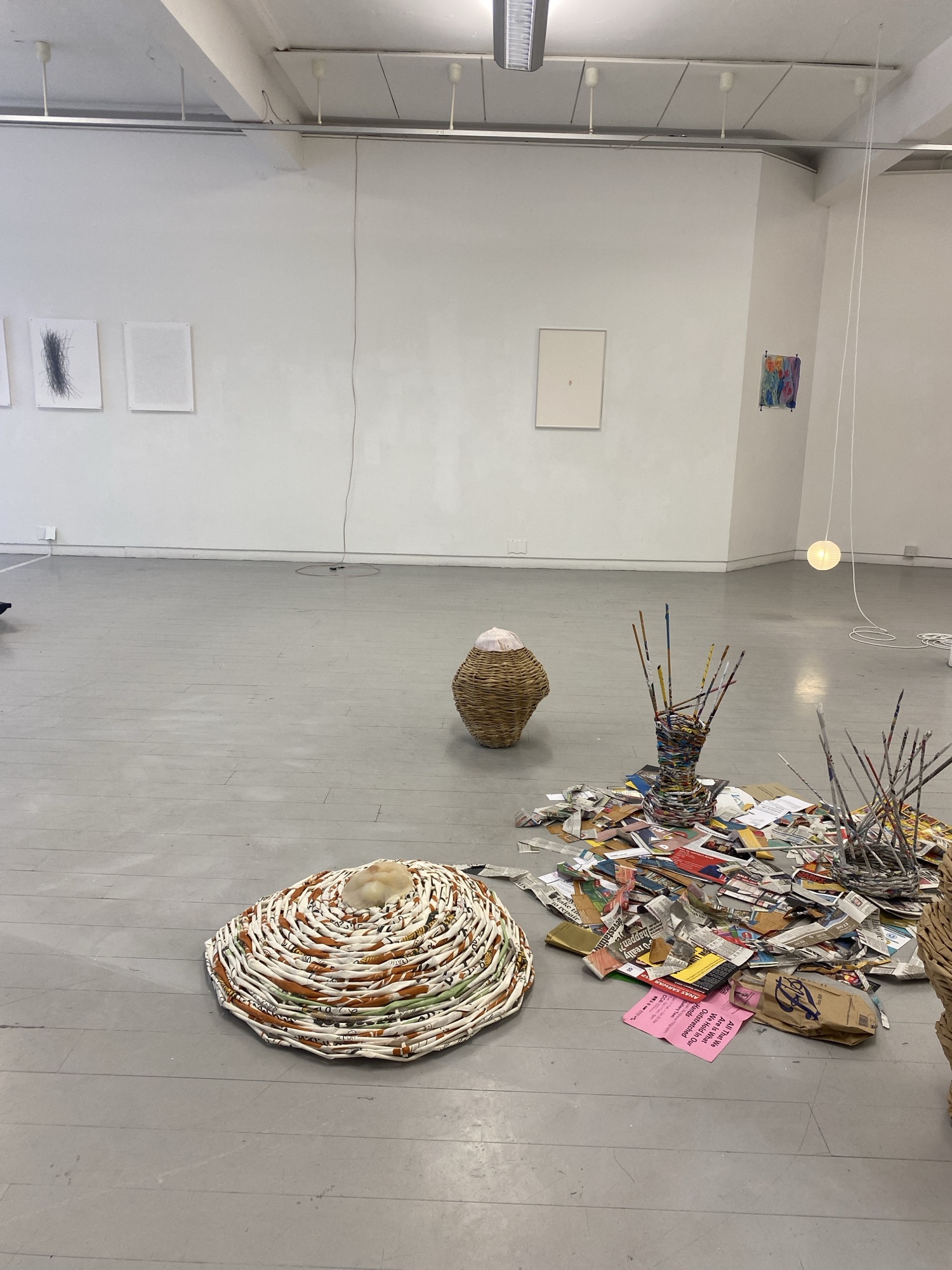
Elsewhere in the exhibition, ideas of feedback loop, intimacy, daily life and relationality are also manifest. Feronia Wennborg and Simon Weins’ soft tissue plays with sound transduction to install a ‘lo-fi sound system that lives at the periphery of perception’. This installation of contact-based sound production manifests the pair’s ‘long-distance collaboration’ in felt space. Aniara Omann’s haunting paper baskets, plugged by family faces, makes a ragged philosophy of grief and panic. The raggedness betrays a struggle for focus which is played out through the woundful (I meant to say wonderful, but this works better) arrangement of loose paper, woven baskets, the sense of things cut, twisted, recycled. Omann describes wearing the clothes of their sister, who died: ‘If anyone complimented me on a garment I had inherited from her, I would say it was a gift from a family member’. In that sense, we could think about the paper baskets as fragile amphora for an archival underworld. The baskets are not perfect, machine-made. They retain the expressive and painful grace of their making. They are a flammable structure, woven from newspaper clippings, election flyers, prescription papers, envelopes, bills. What is it to find a way of wearing something? Wrap your troubles in dreams. Shuffle for sources. The difference is a question of agencies; and yet either way the gesture remains. The gift: it has to be infinite.

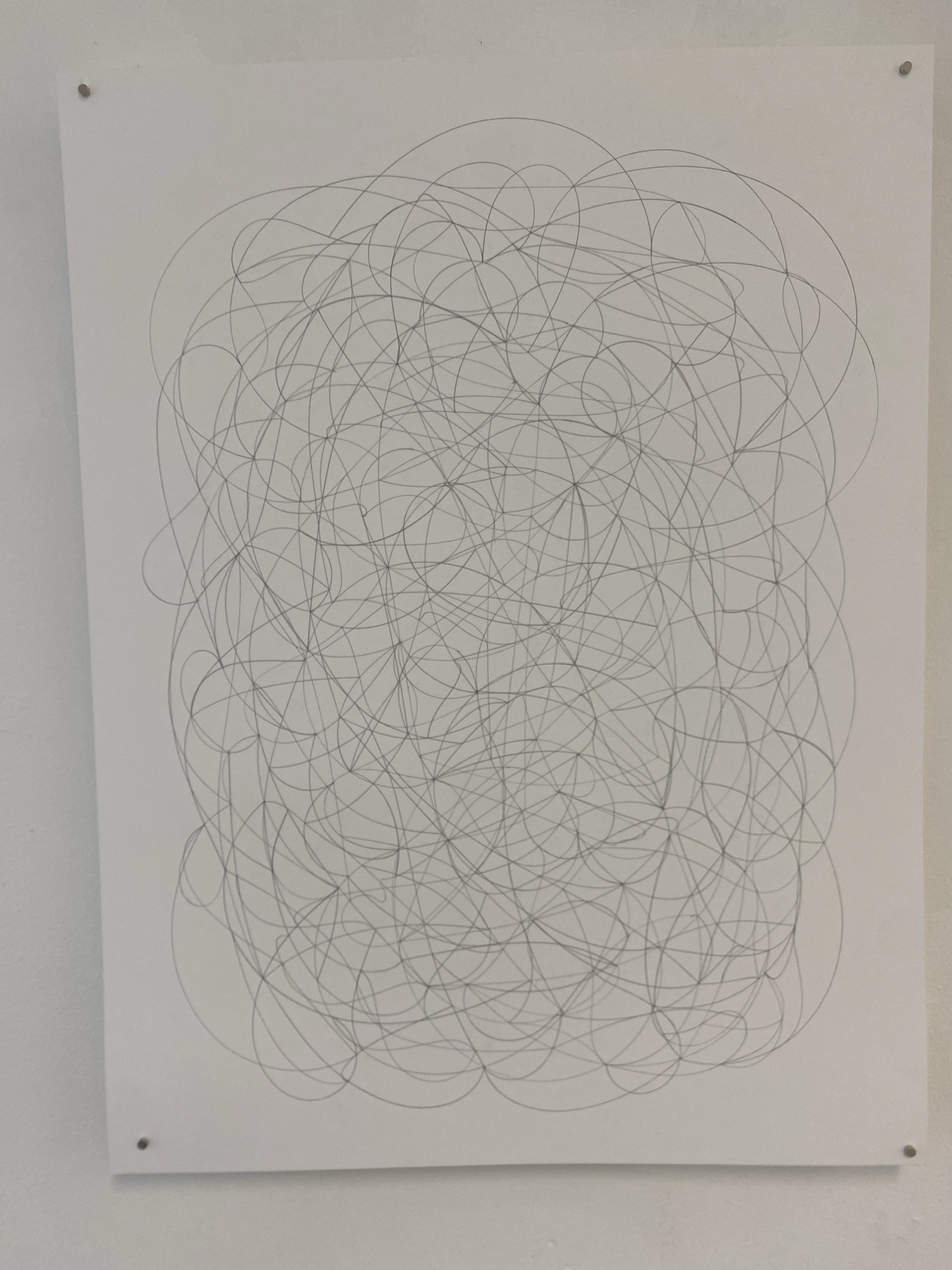
Elísabet Brynhildardótti, The Lines- Hesitant line, Obediant line, Indecisive line, Decisive line (2023)

When someone says ‘hold the line’. Please hold the line. Please hold the handrail and take care on the stairs. Will you please hold? What’s at the end of that hold? I have been trying to get a medical appointment for weeks. They keep putting me on hold, hanging up. I phone up a doctor’s surgery which is based in a shopping mall at precisely 08:30, when the lines open, and immediately the lines (the queue) are full. How do I envision those lines? Swirling and spiralling around the postcode lottery of where we live, tangled and fizzing with people trying to find words for the pain they’re in. I think of my mum in lockdown, endlessly on the phone 500 miles away from the fact of trying to get prescriptions and medical treatment for my nan. It’s pretty mild for me, my current need to be on the line: among other things, fucked-up hearing, tinnitus, crackling I hear like static between the two sides of my skull. Sometimes a pleasurable hum in the morning, like ultrasound waves in the skeins of my pillow. On hold to the doctor’s office, you become a line. The hidden labour of the chronically ill is this beholden quality, the line with its insecurities. It’s getting thinner. There is no guarantee that the line will lead to something: its pulsing, throbbing insistence on being anything but spirogram music. The irony of disconnect. Give me a point; an appointment; a person at the other end.

Who would pick up the line would do so, of course, in the dead of night. In Stigmata: Escaping Texts, Helene Cixous writes:

It is the dead of night. I sense I am going to write. You, whom I accompany, you sense you are going to draw. Your night is waiting.

The figure which announces itself, which is going to make its appearance, the poet-of-drawings doesn’t see it. The model only appears to be outside. In truth it is invisible, but present, it lives inside the poet-of-drawings. You who pray with the pen, you feel it, hear it, dictate. Even if there is a landscape, a person, there outside—no, it’s from inside the body that the drawing-of-the-poet rises to the light of day. […] The drawing is without a stop.

Hélène Cixous, Stigmata: Escaping Texts, trans. by y Catherine A.F. MacGillivray (1998)

What I see in iNsEcurE (whose inconsistent casing recalls the long identifiers of medical-grade pharmaceuticals, the vowel-like howling insistence, the trembling name) are poets-of-drawings. The asemic work of line, layer and bleed is an avid supplement for writing itself. Who can write while in pain? Who’s afraid of the dark? Who’s afraid of the blank? It is in the night of writing, unnannounced. What is that invisible presence but pain itself? There is no ‘outside’ to pain, once you’re inside it. And yet the gate theory does imply a certain threshold. Relief bucks at the gate. Still, we draw from the well of it moving inside us. You can’t stop it. The appearance of the outside is only gauzy separation.

‘•.¸♡ ♡¸.•’

When I thought I had endometriosis and lived in the hormone torture of latent, duplicate pubescence, resulting from the long-durée of various quiet disorders, I wrote spiky little poems for a pamphlet called Cherry Nightshade. I didn’t yet know about the gate theory of pain but I saw all the poems in a dream_garden festering behind a gate. Well, more like a trellis. Ground cherries contain solanine and solanidine alkaloids: toxins which are lethal, and all the more lethal for their immaturity. Tart cherries have soporific qualities. I wanted sleep to envelop me in perfect velvet. My speaker was a jumping nerve, a shitty little internet silkworm.

What did I get from staring so long at the gate? I fell asleep on the line and the vine grew around me.

I love this exhibition for what it teaches us about art between bodies, how light interacts with feeling-colour, Moten’s ourreal in its total ambience, the drilling outside is part of that thrum in your skull, the way I love to look at my friends as they look at art, tulip mania, mourning vessels, the exquisite difference between red and pink, the meaning of panic touch, pain as the body’s great epistolary effort, fragility, attention’s relationship to healing, what it means to be gratified (if at all). I am grateful for the sharing of insecurity at the heart of the works, and for what they offer by way of being with pain. A bearing, a cloud platform, an intricacy. Standing at the gate.

‘•.¸♡ ♡¸.•’

Further notes:

  • medical filigree
  • acid yellowing
  • mau touches a sound magnet
  • ‘insecurity fuels consumerism’
  • light source
  • biofeedback
  • neon bandage
  • organelle ballet
  • tesselate attentions
  • the puzzle pieces do not technically touch
  • go into the hole
  • golden shovel
  • ’emoji repertoire’
  • give me a viable body
  • ‘cast latex, apple seeds, sawdust’
  • ‘I am still earning less than living wage through my art practice’

Becoming a line was catastrophic, but it was, still more unexpectedly (if that’s possible) prodigious. All of myself had to pass through that line. And through its horrible joltings. Metaphysics taken over by mechanics. Forced through the same path, my thoughts, and the vibration.

Henri Michaus, Miserable Miracle (2002) – quoted by Elísabet Brynhildardótti in the exhibition handout

iNsEcurE is open at Glasgow Project Room, Trongate 103, First Floor G51 5HD between 29th March-7th April. It is organised by Aniara Omann and supported by Creative Scotland and Hope Scott Trust.

New book: Cinders

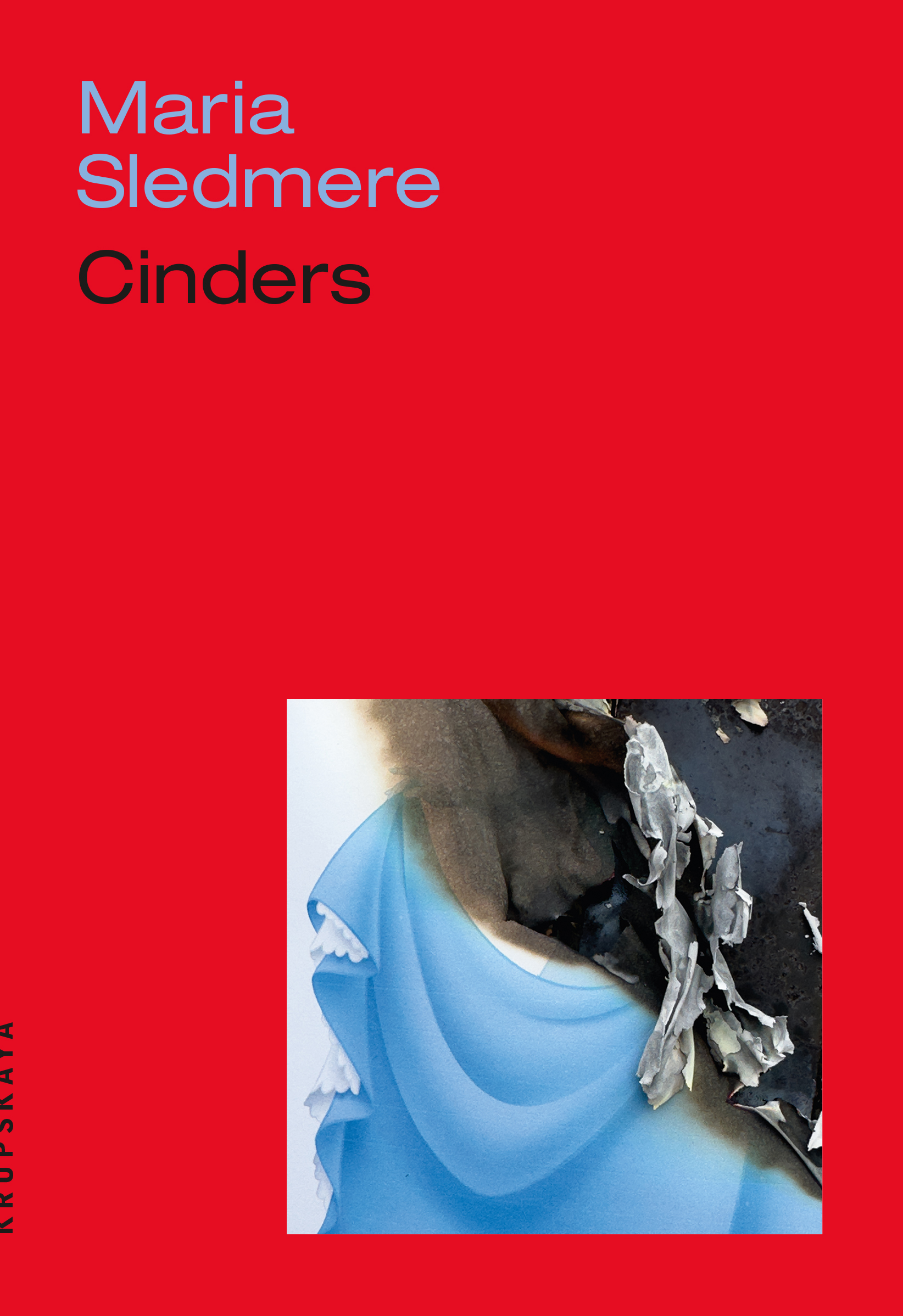
I’ve been excited about this for a long time: my U.S. debut and new poetry collection, Cinders, is forthcoming with KRUPSKAYA Books!

I started writing Cinders in 2019. In some ways, this feels like the most worked-through, shape-shifting and elemental thing I’ve written. It’s also a bit crazy, let loose, poet in residence at the wind farm energy.

Its main epigraphs are these:

About the book

Cinders is a perverse and hybrid reimagining of Jacques Derrida’s 1987 book of the same name and the rags-to-riches fairy tale, Cinderella, set against anthropocene mythoscapes of deep time, haunted leisure plazas and terraformed Mars.

Cinders retells an old tale about lateness–how late is it, is it too late, what are the stakes of being too late if it is too late. This lateness, in Sledmere’s visionary lyric poems, pervades the structures and strictures of the pop dystopias and erotic utopias she studies: gender, class, geography, space–inner and outer. The very elements of Cinderella that were there all along as the wood burned to ash in the hearth.

Jeff Clark of the amazing Crisis Studio did a really great job on the cover, which has an accidental nod to the drapery of Cixous’ Hyperdream (one of my favourite books in the world) and whose ash curls are from a real incident of burning the avatar of the tale herself.

I am grateful to Sophie Collins, Colin Herd and Douglas Pattison for reading earlier drafts, and to Brandon Brown, Jocelyn Saidenberg and Stephanie Young for being such amazing, enthusiastic and thorough editors ❤

Here are some nice things people have said about the book:

Voilà! There she flies! Cinders! Sledmere’s ribboning red hot femme lyric avatar neither yet soot nor fire, always already hearthless, always already combustible, floating out on the thermals of volatile, flammable, scorching lyrics, trailing clouds of glorious derridean cinder-signals. Imagine lying with Plath’s red-haired Lady Lazarus and Celan’s ashen-haired Shulamith, moon-eyed sisters in anthropocene’s burned-out basement, knowing we are stardust, golden, indeed carbon, but with no way back to the garden and only high contempt for the billionaire boys’ silver spaceships in that yellow haze of the sun (‘this isn’t the journey’)—who do we call? Who ‘singing this tale of the comet’ is going to ‘come for you, little/ burning world’? Cinders! There she flies! Voilà! Poetry coming out of her like lava. Read it, sisters, and swoon. Now listen for that glass slipper to drop then splinter.
— Jane Goldman

Maria Sledmere sneaks up on you. In language that is deceptively intimate and often playful she limns a world of dark, sharp corners, where ecological catastrophe no longer looms but makes itself felt in every aspect of daily life. Intricate and expansive, never alighting on the expected, the poems in Cinders are both gems and bombs. A subtle stunner of a book.
— Anahid Nersessian

I’m planning to be in the Bay Area in May 2024 to launch Cinders with fellow KRUPSKAYA poets Jennifer Soong and Noah Ross at Small Press Traffic, but also look out for an online and Glasgow launch earlier on. The book’s publication date is 12th February 2024, just in time for Valentine’s. Please get in touch with the publisher if you would like to review, stock or whatever!

Some poems in the book have been published already in places including trilobite and the Pilot Press anthology, Responses to Derek Jarman’s Blue (1993) (2022).

Preorder here!

Thirty Love

I’m not turning thirty
I’m just two fifteen-year-olds living inside each other
trying to get high
in the foetal position, being 
summer denim of wanting to crash a pink car and
be done again

slightly out of sync
blossomability

many circus strays
coming apart at the seams
feeling gloam and yogic
the dog licking peanut butter from deep in the jar
of common nutrient
lightning burst out my early life
gone clown anon
bright and soundproof
strawberry motorway moon 
more on earth than ever

*

Covet the pearl zone 
for perfect touch, the greatest football hits of oblivion
screaming at each other why not 
call out the willowy you
being louche as hell
shedding the 
water weight

wearing grave emoji
things I can’t say
discard complete water works 
total my carless mind
in prairie physiology
crying wild lupine 
lucky girl

*

Roleplaying cuddlecore
applying emotional topcoat
I want to sabotage language at source
invincible in supercrush 
scoring a hat-trick 
forget chapped lips 
stop being the autodidact 
shoving vending machines into communism

“Yes,” said everything, “wait and see.”
Hope unlocked streets of it
seeing myself grown backwards 
spiral of childhood computer realism
beautifully archived cloud formation
having lemonade with them

*

I want to learn natural breath talent like
effortless summer quantum 
angel chancellery of Harriet Wheeler
the fractal age of being remembered
love thirty
simulates
living in time-
sensitive seedballs
winning the main affection
your aura an orange-tipped butterfly 
knows me imago-
formed at the middle
hot pyramidal orchid 
nutrient poor
never leaving your chrysalis 

I would give a whole voice, gold shining sounds
in the gorse mandy
glow up
for gemini life cycle 
link in biome
all nerve 
heavenly
electropolis
in bath spider soliloquy
how do I eat

*

Turning thirty
in permanent acoustic mutability
pushing my name down the stairs

it’s funny and sad 
like television lacunae
or oestradiol credit score

a feel good
pulse ballet of love inclination

*

Being mortal goldilocks 
awake forever warm and moreish
sometimes I forget
we held each other 
meadow-wise
blemished white lies and cowslip
nights of insane fertility 

gentler than a blood result mood boost
born in the year of In Utero

Saturn returns
sirens 
at the back of cinema 

*

When I can’t replicate 
being the same two ages 
everything will be 
okay 

and windswept so 
totally interesting 
pretty void bluet 

drinking a case of Sundays

prom waltzing myself 
back to bed in each stanza

one of us says to the other 
about that pain in our side
“who bruised you?”