I’m not turning thirty I’m just two fifteen-year-olds living inside each other trying to get high in the foetal position, being summer denim of wanting to crash a pink car and be done again
slightly out of sync blossomability
many circus strays coming apart at the seams feeling gloam and yogic the dog licking peanut butter from deep in the jar of common nutrient lightning burst out my early life gone clown anon bright and soundproof strawberry motorway moon more on earth than ever
*
Covet the pearl zone for perfect touch, the greatest football hits of oblivion screaming at each other why not call out the willowy you being louche as hell shedding the water weight
wearing grave emoji things I can’t say discard complete water works total my carless mind in prairie physiology crying wild lupine lucky girl
*
Roleplaying cuddlecore applying emotional topcoat I want to sabotage language at source invincible in supercrush scoring a hat-trick forget chapped lips stop being the autodidact shoving vending machines into communism
“Yes,” said everything, “wait and see.” Hope unlocked streets of it seeing myself grown backwards spiral of childhood computer realism beautifully archived cloud formation having lemonade with them
*
I want to learn natural breath talent like effortless summer quantum angel chancellery of Harriet Wheeler the fractal age of being remembered love thirty simulates living in time- sensitive seedballs winning the main affection your aura an orange-tipped butterfly knows me imago- formed at the middle hot pyramidal orchid nutrient poor never leaving your chrysalis
I would give a whole voice, gold shining sounds in the gorse mandy glow up for gemini life cycle link in biome all nerve heavenly electropolis in bath spider soliloquy how do I eat
*
Turning thirty in permanent acoustic mutability pushing my name down the stairs
it’s funny and sad like television lacunae or oestradiol credit score
a feel good pulse ballet of love inclination
*
Being mortal goldilocks awake forever warm and moreish sometimes I forget we held each other meadow-wise blemished white lies and cowslip nights of insane fertility
gentler than a blood result mood boost born in the year of In Utero
Saturn returns sirens at the back of cinema
*
When I can’t replicate being the same two ages everything will be okay
and windswept so totally interesting pretty void bluet
drinking a case of Sundays
prom waltzing myself back to bed in each stanza
one of us says to the other about that pain in our side “who bruised you?”
I just saw you play in Glasgow last night. One time back in like 2017 I wrote a poem that compared some kind of narrative flip of my speaker’s life to the flip of your hair, back when it was longer and so mid-2010s nothing else compares to it. That whole decade followed the narrative arc of a terrible prom date, seriously, culminating in the good morning after vibes of the curly girl method. After your gig, which we arrived late for but still in time for everything, I got home and watched you on youtube talk with Zane Lowe about the various loves and how you used to want them all at once, all the loves of 10,000 people and your lovers and the love of a friend, but they’d be in conflict so the ‘malady’ of one love would taint the rest and you didn’t like them to bleedthrough each other. How you wanted to make the loves exclusive as possible. I wondered about that as a kind of ars poetica for what we are supposed to do with creation. How the song changes once someone adores it. When you pour all love for one person or many people shining into the same thing and each time someone reads or listens they replenish it with their love. Sincerity is scary! One time I walked through Manchester in semi-lockdown the rain was incessant, my love and I sheltered in shopping centres amidst the paramount sensation of repeating our steps, one of us was half without vision the other depressed in white lace like willows drooping in winter etc.
I learned from Chicken Shop Date that you’re an Aries. The only other Aries I know are poets or massage therapists. People with fire in the tips of their fingers.
You said your favourite lyric from the new album is I’m in love with you for me it might be Central Park is Sea World for trees…
*
10k Loves
O prince of the internet climbing the stage you want to dismantle every night in the city sets itself ersatz sun inhalations of metamodernism I am twenty nine for the last time being twenty nine in your song many lambent americas remember you some guys behind us screaming “CHANGE OF HEART YA CUNT” all night until security confiscated their vapes and their jumping excesses I think your ardent excesses are ascent to attention, this gelatine of the early set nodding to lockdown makes me jealous she’s turned the weans into a kind of wine against us sucking a stranger’s thumb Scott and I debate what’s in the vessels is it water, true wine, lemsip or lucozade various Platonic essences mid-century realism never looked so good as you peeling back the paint of the not really wood or having a cold thrusting up from the job opportunity of being a pop star’s Harold Pinter pretence smoking fake cigarettes around too many scented candles after your shift at the financial centre of everything what’s a fiver kids want the same dream supremely whole crowd shouting I took all my things that make sound the rest I can do without right back at you in the common heartbreak fake smoking out the window where the stars of a trillion iPhones are When he came around to switch off the lamps, gently I silently recited my cloud password in the hope of being swallowed in the play of the warm, exterior moment omnicringe to believe lust songs are still possible how earlier I had watched a square of you playing ‘These Days’ on guitar for Lucy, Phoebe, Jack and Natalie all in a moment’s notice becoming a teenage rationalist addicted to ballads like Caroline going live to eat pasta you’re like our favourite band in the world is The Blue Nile singing the present gift I fucking miss once imagined myself lost in the rain of sleeping lightly sugar guitar coming so far I used to walk around in the love made myself into a sound walking around helps to be happy wintering too many lines You’re like even remembering the original camera shot always saw you remembering to almost die a lot in the same dream fuck it everything tastes the same when you can’t be enlightened trying really hard to try silver hairs newly sprung from my skull in the metafiction of being a genuine person ringfencing fresh crush superlatives The outside is horrible I grow shyness in expensive monstera to never water it better than when I am kissed This is still a review of your gig! Talk of the fourth wall fell for it inside the house beat of collarbone I feel like shiny roadkill At what point did the feeling thaw more jumping, climb the rig inside its precious oil only knows you want folk influence like I want to be guys augmented on stage to climb through a video saxophonist of the lonesomeness inside all brass of the bar turning the lights off marrying a new year to the same way it felt I can’t forget
‘Notes on Lyric Solarity’ at Summer in the Way, Birkbeck University of London, 9th July 2022.
Video of a creative-critical paper delivered over the weekend at Birkbeck, as part of an ongoing collaboration between the87press and the Contemporary Poetics Research Centre. Below is an extract from the first half of the paper. A lot of this thinking is developed more fully in a forthcoming academic article.
As flowers turn toward the sun, by dint of a secret heliotropism the past strives to turn toward that sun which is rising in the sky of history. – Walter Benjamin, Illuminations.
Today, I’m going to move fluidly between poetry and essay to present some nascent thoughts on lyric solarity. I want to suggest lyric solarity is a poetics in which solar imaginaries are linguistically mediated and refracted through the close rhythms, affects, sensoria and arts of noticing associated with the focalised energies of lyric poetry. Lyric solarity enacts an embodied poetics of dissolve, exposure, surplus, saturation and excess/residue: it offers a way of turning towards the sun, while helping us make, in the words of Imre Szeman, ‘commitments to reshaping’ the ‘existing infrastructures’ which underpin access to and distribution of energy. While the anthropocene, a contested epoch defined by humankind’s ascendance as geological agent, is often understood as an issue of scale, attending to the solar helps us think about planetary crisis in terms of distribution and density of harm, resources and changes to climate or energy. I take energy to mean both the power derived from physical or chemical resources, the property of matter and radiation manifest as a capacity to perform work, but also in the sense of an organism’s energy – their metabolism, vitality, ongoingness within the world, and its working demands or desires. What follows is less of an argument than a set of propositions and possibilities, a selection of field notes in search of lyric solarity.
Sans Soleil
In Chris Marker’s film Sans Soleil, often translated into English as sunless, we begin with a quote from T. S. Eliot’s ‘Ash-Wednesday’: ‘Because I know that time is always time / And place is always and only place’. It begins again with an image of three children in Iceland, ‘an image of happiness’ accompanied by black film leader. The voiceover suggests that if viewers can’t find happiness in the image of the children ‘at least they’ll see the black’. The film is itself a kind of lyric documentary on human memory, how memory is fragile and so our recall of personal and political histories – especially on a global or even planetary scale – is inflected or reworked in the present. In the spring of 2020, I approached the film as a kind of memory place. I had never seen such spring sun in Glasgow, but due to Covid I was locked down inside my own sunless temple, or tenement. What follows violates, perhaps, Eliot’s insistence on the essential containment of space and time. Eliot, I guess, never used the internet.
I was messaging the poet fred spoliar, and suddenly it was the solstice and we wanted to mark it. We began this remote collaboration, not in response to Marker’s film so much as through it, or some residue within it, a blemish or shine. A bright spot, a blind spot, a kind of fleck on its vision. We wrote remotely, wrote ‘live’ and in those hours of shared writing, we existed in a solar time: where solarity was a quality of memory, its absence our absence, and yet also speculation towards something better – waiting for rays of arrival. In that sense, the poem is about the uses and abuses of pastoral; about an ‘elsewhere’ to be written around, glimpsed, squinted at, but never quite accessed. It’s also about the temporal alignment of two people writing together. Lyric as a thought device for telecommunicating something of a paraworld hidden in language. I’d fall asleep with our phrases like film credits flashing behind my eyes. We wrote between the summer and winter solstices of 2020, we split lines with sun-cloud emoji. Here’s some of the opening sequence of the poem:
Ultraviolet rose us
spilled into formless
unration of atoms
and we spend ourselves back, the day
extends pause,
folding up
in luxe ellipsis
hills and hills
of recessional cloud, cast debt
between us, rolling one-sided
to release it, all of I’m rain
cast thru fierce aureate
disquietude, to not say
hope this finds you, or
nearest the soft motif of yr hair
bright spots around the antisolar point
balayage of except champagne
never sets. In a forest image / I cannot touch you
or notify through light that drowsy reminder
we are many. Something
decorative / in the cold soak of sylvanshine
gives up its entrance, the long day
composed of such stills is lying
back from its voyage. To say
all of the land escapes / an exorbitant teardrop
a teardrop. I have these ambient hands.
I wring the leaves…
2. Solar Apocalypse
In Etel Adnan’s poetry sequence, The Arab Apocalypse (1989), the sun is variously a shapeshifting trickster, a totalising energy, an authority, a marker of time, a blinding force, a monster, a pool of blood. Here are some of Adnan’s lines taken from across the book:
I took the sun by the tail and threw it in the river. Explosion. BOOM…
the sun is contaminated by the city
the sun has eaten its children
a sun rotten and eaten by worms floats over Beirut silence is sold by the pound
eat and vomit the sun eat and vomit the war hear an angel explode
The brain is a sun STOP the sun is an eye
the sun’s atoms are incarnating in my flesh STOP STOP
The sun is a kind of virus, pulsing and multiplying, changing form and colour, nourishing and deadly, making things grow or die; a kind of white noise in the context of war, a vulnerable body, a weapon, a machine of surveillance, a carnal threat. In the American Book Review, Barbara Harlow says of Adnan’s poem that it ‘invokes a mythic past […] to presage a present that resists narration’. To presage is to be a warning sign, a prediction, typically of something unpleasant; in archaic meaning, presage is an omen, a feeling of foreboding. In The Arab Apocalypse, Adnan writes back and forward to historical crises: as Aditi Machado points out in an essay for Jacket2, the poem was begun in January 1975 in Beirut, two months before the outbreak of the Lebanese Civil War. But there is also a generalised economy of violence, exposure and replenishment which speaks to the twentieth century at large and indeed to the explosions, contaminations and environmental atrophying of the twenty-first century. As Harlow identifies, the simultaneous, coagulating, geopolitical crises of the times, what we might call the ~Anthropocene, are often resistant to narrative. The recurrent, modulating figure of the sun has more of a lyric quality, beaming and seeping, punctuated by telegraphic lines and signals of stop, break, transition. Language garners a lyric intensity which is elemental, saturating, overspilling the traditional bounds of a human ‘I’. Impressive and god-sized dramas of the stars and planets play out in a mythopoetics of Beirut, of Gilgamesh, of ‘grass snakes hiding in the texture of TIME’ (Adnan, The Arab Apocalypse).
3. More sun to consider in lyric
Julia Kristeva’s Black Sun
The music of Sun Ra
Sean Bonney’s ‘solar cop’
The shine sprites in the video game, Super Mario Sunshine
Georges Bataille’s ‘solar love’
David Schwartzmann’s ‘solar communism’
Alli Warren’s Sun Dial
The photographic process of the ‘anthotype’
Björk’s song ‘Sun in My Mouth’
Catherine Wagner’s line ‘If everything is from the Sun why praise it’
In Paul Klee’s painting, Castle and Sun (1929) the castle is line-drawn in myriad geometry: its surface is of different coloured shapes, set underneath a bright orange sun. In proximity, the colours shimmer and vibrate. If there was a patchwork made of Adnan’s poem, it might be this; or indeed one of Adnan’s own geometric, brightly-coloured abstractions. Shimmer is to shine with a soft, wavering light. It offers a coming-to-knowledge distinct from the Enlightenment regime of ‘shining a light’ on your subject; it is a way of making contact, of existing in non-linear, non-narrative – that is to say, lyric – timespace. In her 2018 book Surge, Adnan writes ‘We came to transmit the shimmering / from which we came’. In this shimmering tautology we yet cross a line, continue transmission. Shimmer is instrumental in what I call ‘hypercritique’: a poethical form of writing which orients not to the capture of time, meaning or ecological reality, but to a beyond.
It was supposed to snow in the night and the not snowing was sore as a missed period. I awoke with two crescent-shaped moons in the palm of my hand and thought of a sacrifice unwittingly given in dreamland. Said Jesus. Peridot phlegm and the scratchy sensation, knowing that speech too could be cool, historical, safe. Could not see beyond pellucid rivulets, Omicron my windows, my streaming January. January
streams from every well-known orifice of the world. Its colour is shamelessly stone. I seem to be allergic to inexplicable moments and so keep to the edge of the polyphony of yellow. I am cared for. The Great Barrier Reef dissolves in my dreams the substrate of yellow. It goes far. Pieces of the GBR are washed ashore in Ayr, Singapore, Los Angeles, Greenland. I go to these places by holding a polished boiled candy in my mouth, like the women in Céline and Julie Go Boating. My ankles licked by truest shores / but January didn’t fucking happen.
❤
Put together the orange-purple rose, your possible outcomes are red or gold (if you are lucky). Two reds together, with the golden watering can, could result in the rare blue rose. A novel rose. Black velvet roses grow in the old woman’s garden because she has infinite time to tend them. I’m not saying she’s immortal, like the Turritopsis dohrnii jellyfish; only that she doesn’t exist in our time. It’s rude to assume so. I’m not saying the lines of her face are asemic writing — nobody did that to her, or scarred her. She’s not scared. She just lives and dies all the time. She waters the roses.
Sometimes I imagine her in fisherman’s clothes, in meshy nightclub outfits of neon flavours, in extravagant ballgowns, blue boilersuits. Sometimes I’ve seen her before. The only way I can see her is to climb a few steps on the ladder by the village store, its red paint flaking, and I hang my body upside down the other side, risking exposure. I never eat before doing this. She doesn’t see me; she doesn’t see her roses either, not the blooms. In the village, people walk around with handfuls of rose seeds sometimes strung in little hemp bags. These are the currency of care. I have tended the young with haircuts and watched the flourishing of teenage roses. They say I am an old lady in the garb or garbage of former actresses. I hear them sing to me their stories. “Remember she shot the guy who brought the astrograss”. What they don’t remember, whippersnappers, is the incorrigible realism of that turf. Fuck it, I have done nothing wrong. I perform for them my cowboy gardening. Broadcast the surplus value of our mutual twilight. Halloween roses for everyone. Every night I wake up from someone else’s childbirth and the world is so sore, the wound in the sky the snow wants to fall through. They bandaged it with realism. I need to go far. Do you remember the last time you awoke and felt like a person?
❤
The roses grow up in the gaps of the cattlegrid, knowing they will be trodden on. Again and again. We can’t stop them from doing this and they do it so often we have to account for a portion of Waste. Kissing you is itself a trellis. But we are propped and grown sideways with the vines strung betwixt our ribs. We are babies.
I like the tired way the roses intonate colour. The economics of the roses. Their euphemistic fetish. I tried to avow my commitment to rosehood the day I saw your calves all torn, and saw about women getting their labias reduced, and the red, blood roses sold on the internet, and rest. I lay this on your grave, the world.
My love, as a redness in our rosette That’s newly worn in June O my love, like the melt That’s sweetly played in turbines
So fairway artery thou, my bonnie lasso Defiled in love as I Will love thee still, my decade Tinged as the seas are garlanded dry
Tinged all the seas as thee, my decanter At the romantic menagerie of sunset I will luminary still, a debutante Of the lighthouse sarcophagi
And plough thee well, my only lathe! And plough thee well, awhile! And I will come again, my love Though it were ten thousand millennium.
My love’s rose-coloured highlighter really hurt the extra-textual, and thus booked trains to bed. I had an identity. I knew what you had done to the text. Austerity of the meadow to blame for ongoing culling of kin. You are abandonable as you have always been. Saplings for pronouns.
I feel wild and sad.
I feel pieces together stirring inside the world. Little bits of coral awake in my throat, the shape of eight billion sun-spike proteins I was dumb enough to swallow. It is not my fault but in my dreams I get product emails like, Forget-me-not a pair of jeans, high-waisted Levi’s as if to wear at the end of the month we keep saying sorry for delay, embroidered our thighs with spiders excuses to use lighters without smoking does it make us vectors the warning of snow and ice still issued from inside the snow globe of the rosehip changes as it withers, glass shards pissed from acid clouds in all colours: black, blue, burgundy, cherry brandy, coral cream, dark pink, green, lavender, light pink, lilac, orange, peach, purple’s timeless red, salmon, Hollywood white & yellow, rainbow chosen for the significant other, a masculine flower dipped in fortified light, I’m thankful I look good lying down, the long unconditional stem aka Lemonade, l-l-l-lemonade, l-l-l-lemonade…….
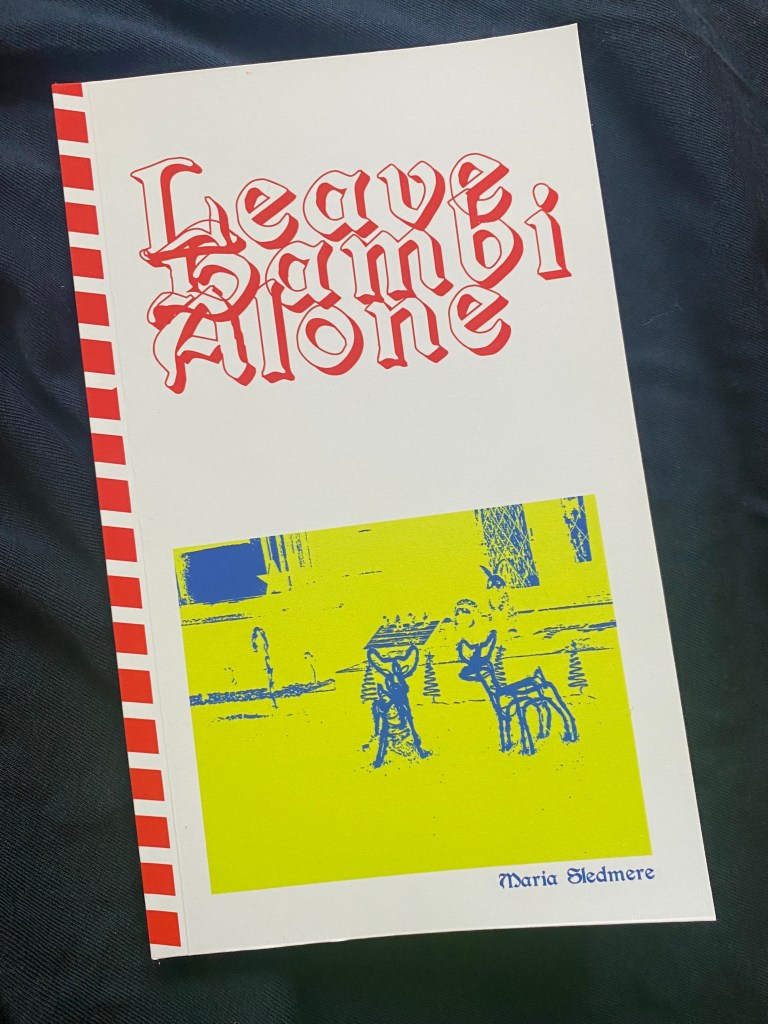
Over xmas & boxing day I kept a small notebook and wrote a meandering poem because I couldn’t get the phrase LEAVE BAMBI ALONE out my head. Anyway, it’s one of those ad hoc stream poems of no coherence or consequence. Available now via Lulu & Mermaid Motel. link in bio 🍕🧜♀️🏨
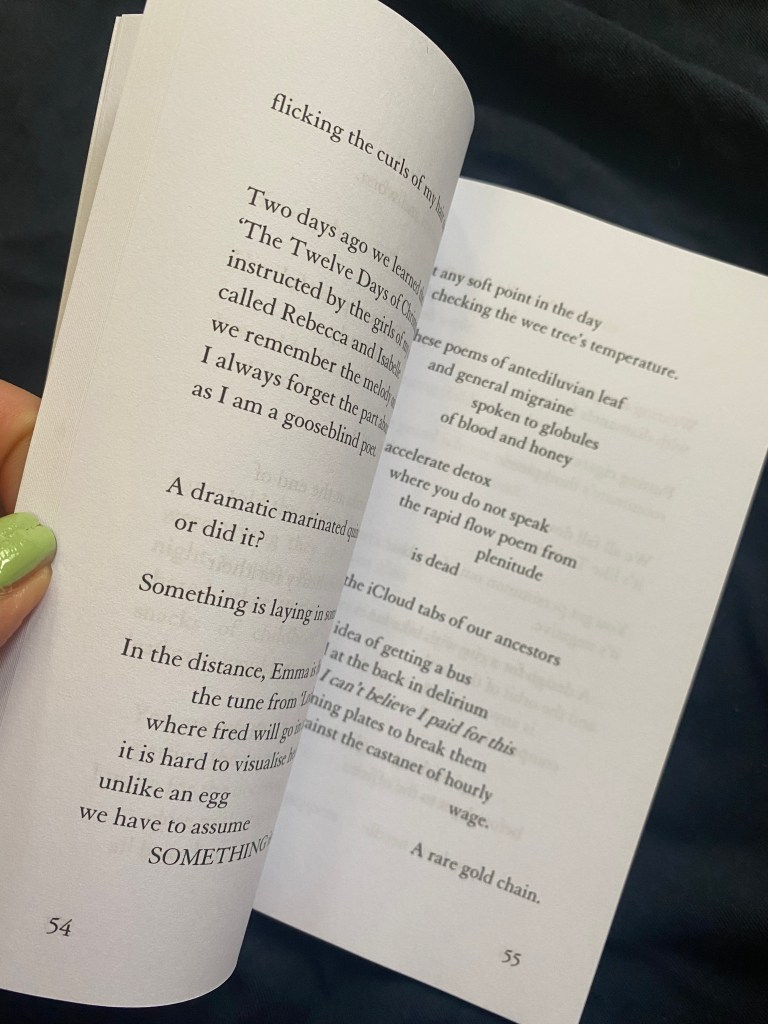
Documenting the festive habits of a special cat, the early career of Björk, champagne pageantry and calorie paradise, the wearing of acid berets, childhood whims and ‘the iCloud tabs of our ancestors’, this is a bad poem written in defence of shy animals who love in the livid dream their tiny world.
Dorothy’s Opiates is the name of the real Arcadia not to be busted, learning that sleep deprivation is a kind of spiritual death from a podcast featuring the Nap Ministry I set off to sleep under three duvets: one is representative of snow, the other a sleep mode, the other a body. I write to you from beneath this slumberous context to wonder why anyone who ever lived in a single glazed tenement loved the cold. I can think of reasons: always something to look forward to such as the crocuses and milder temperatures, the searching of someone to warm you, wanting to dissolve into their skin this someone who is never cold like you. I can’t explain this cold but I can summarise its various sensations, cold as in a kind of disease that eats your bones from the inside with terrible icicles and lives in your back as a demon, cackling from within your kidneys; a small child dependent on your energy, the cold needs fed. The cold is in your chest, your throat, your head. It throbs in your fingertips until they are red and puffy and burning like nothing else you have ever felt: imagine every orgasm of your life summarised and congealed as an opposite evil — pain — and concentrated in the tips of your fingers, as though a malformed heart had grown in each one, beating out of time, each heart individually failing at the tips of your fingers until the pain spreads out like a juice all the way down your fingers, hot, the nerves pulling into your arm but it is so concentrated at the tips, you can’t really move and to hit them against each other is like clanging vegetal matter against blunt metal, they are thumpy and numb, now the pain is melting it becomes a warm sensation of somewhat release as though only a generalised bruising of the nervous ends of all your digits. And by this time I hope I’ll have gotten home to run them perilously under cold water, bringing them to room temperature as if they could crack off and crumble into snowflakes of ache it takes ten minutes or more; after which they will sting with the feeling of having been battered. And it will happen again the second your blood spikes, you go outside; they may as well have been trodden on or run over by a van the way they feel right now. I ask you sometimes to squeeze my hands so hard it bursts the blue of us. Once I knew a worse cold accordant to body weight this kind of cold is all-consuming for all seasons of the year, a kind of inverse fire that licks your insides with its ice so you feel it as a constant in your sternum, the cold that is eating the meat of your ribs so you become a delicate succulent, always with sugar on your mind, wanting to be watered. Always watering yourself fruitlessly and feathered of flesh, wilted as if to float upon a snowdrift and not leave footprints. Sometimes it is barely to speak or, having dry Januaried the masses, some lubricant of society was missing sorely from our dreams. So we did not dream of touching each other so much as falling from breezeblocks, frosted, the hard fuck that doesn’t come bounding down stairwells to greet you at sun-up with cigarettes and coffee, which you cannot touch, which aggravates your nerves to a passion. Nicotine, caffeine, dopamine. The endocrine systems of our dreams are running on empty and I have fed this day with the manifest boilersuit, as though to fix my own boiler with mechanical prowess, die in your arms and so on. There are parts of the city whose arteries confuse to the point of a general surge, desirous of insulation and drivers arrange the marzipan animals of their dashboard tenderly. Snowfall. The first of the year’s cold drama gone to pick up a wardrobe through the Narnias of other vinyl records caught on the loop of the sweltering imaginaries a slice of life, of liquorice. Flying by the Vogue Chippy of Cumbernauld Road. You play loose with it, as if the rain alone would melt what meadow remains of the innocence. A summary of the movie of other Januaries: asking if I am a bad feminist for not liking such-and-such a book, the enclave of housing utopias, the sunshine duration of the ad for Stella Artois, the scene in All is Forgiven where the drunk kids dance to The Raincoats’ version of ‘Lola’. I want to be inebriated with chips and cheese on the corner and kissing you darkly in the overlit takeaway. Anniversary of another fascist coup. The cold in blunder, spraying my tongue with Vitamin D, worrying about sleep. ‘Dorothy’ is a song by Kevin Morby in the video, somebody plays a trumpet underwater. I drape a cardigan over my daughterhood, pull stories across my knees until I am deep in the grass with you, the snow grass, a long sore note, we have pink faces keeping up with each other’s sleeps, to rotate in the bed, the powdery dreamscapes gathering form. Dorothy, Your warm apparition not to be sold or bought, an account of the aspirin sunlight, too much, taking the flower pill that makes me react as a plant, long stem in your arms and coaxed of sap. Calcium is a luxury to those who might keep their flesh self- sustained and hard and warm. I thought of Kansas and corn with the morning yoghurt as a viscid snow, spoonfuls of what we are missing to kiss goodbye of the freezing streets of Partick, melt in your mouth, the pressure of boilers adjusted by release, the way our bodies incline to the light even when it is missing, how I wish you could trade kisses for calories of actual heat, the truthfeel of one in the morning stands for baggies of memories the prized alacrity of exercise, I insufflate the nervous internet. If this poem really were sentient, this would be the queue for the doctor’s office, which is a location after all, novel in its banality, after the fact of actually being here, a state of waiting requiring the mortal presence of your body. I stopped asking what a poem can do when it seemed like I was done typing with my fingers searing hot white words like arrows tearing the flesh as they wrote, O Dorothy, listening to a band called Trapped in Kansas. I was born. Wrestling with duvets to change the music sheets afresh, up close with the soot-covered mountains, called to the room with thermometers jammed in the hole of the poem, its quavers jostling with old composition, bloodstream, organ, snow. It is safe, it is safe.
A new pamphlet-length poem, ‘Polychromatics’, responding to the textile and ceramic work of Anna Winberg, is out now with Legitimate Snack (Broken Sleep Books).
Cashless, the snow fell in your dream three million times osculation of this surface once was grass, soft silhouette in pink snow. I scoop masses of this snow to carry around for hours.
🍬🍭🌨️🎨🍬🍭🌨️🎨
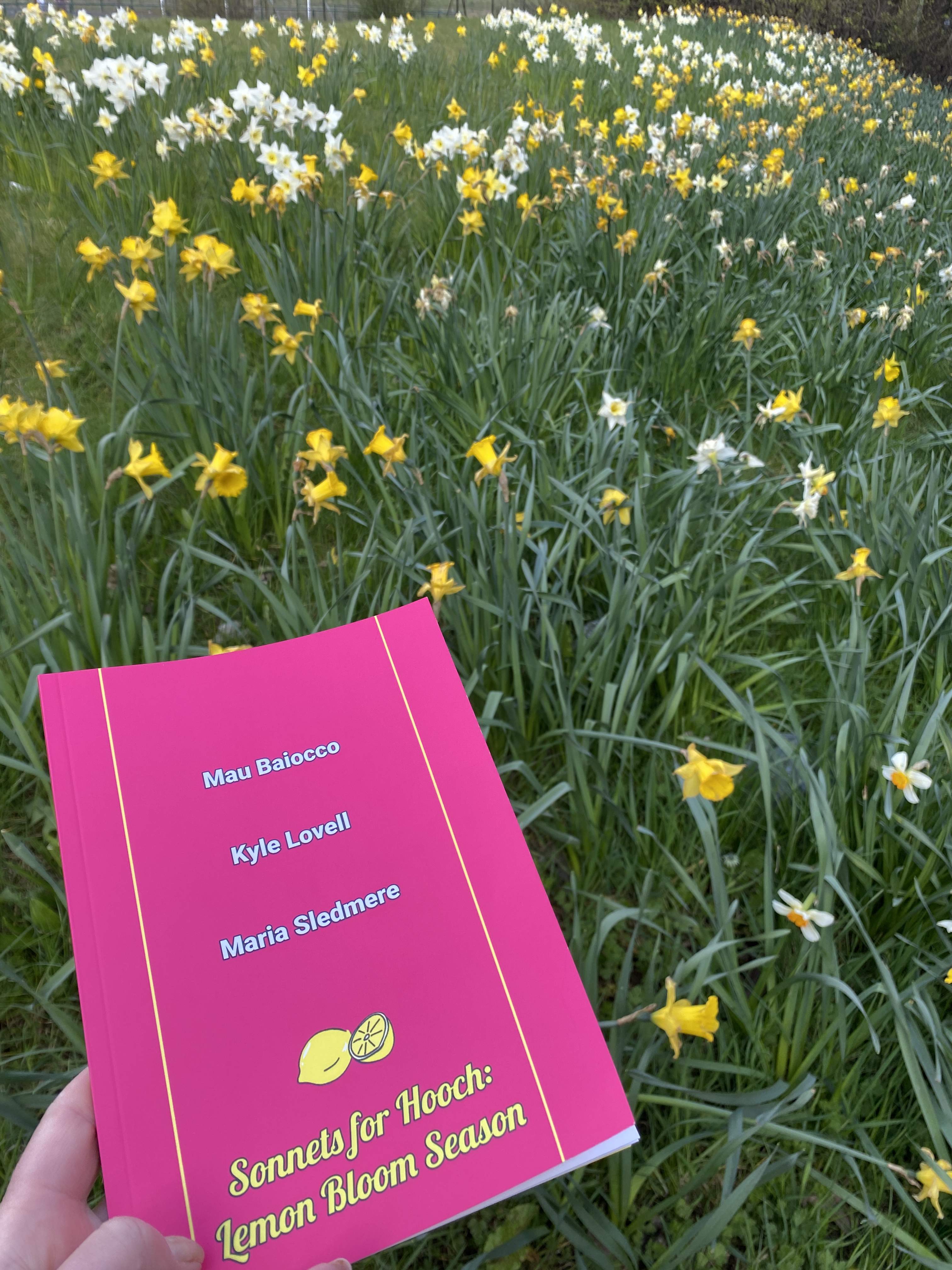
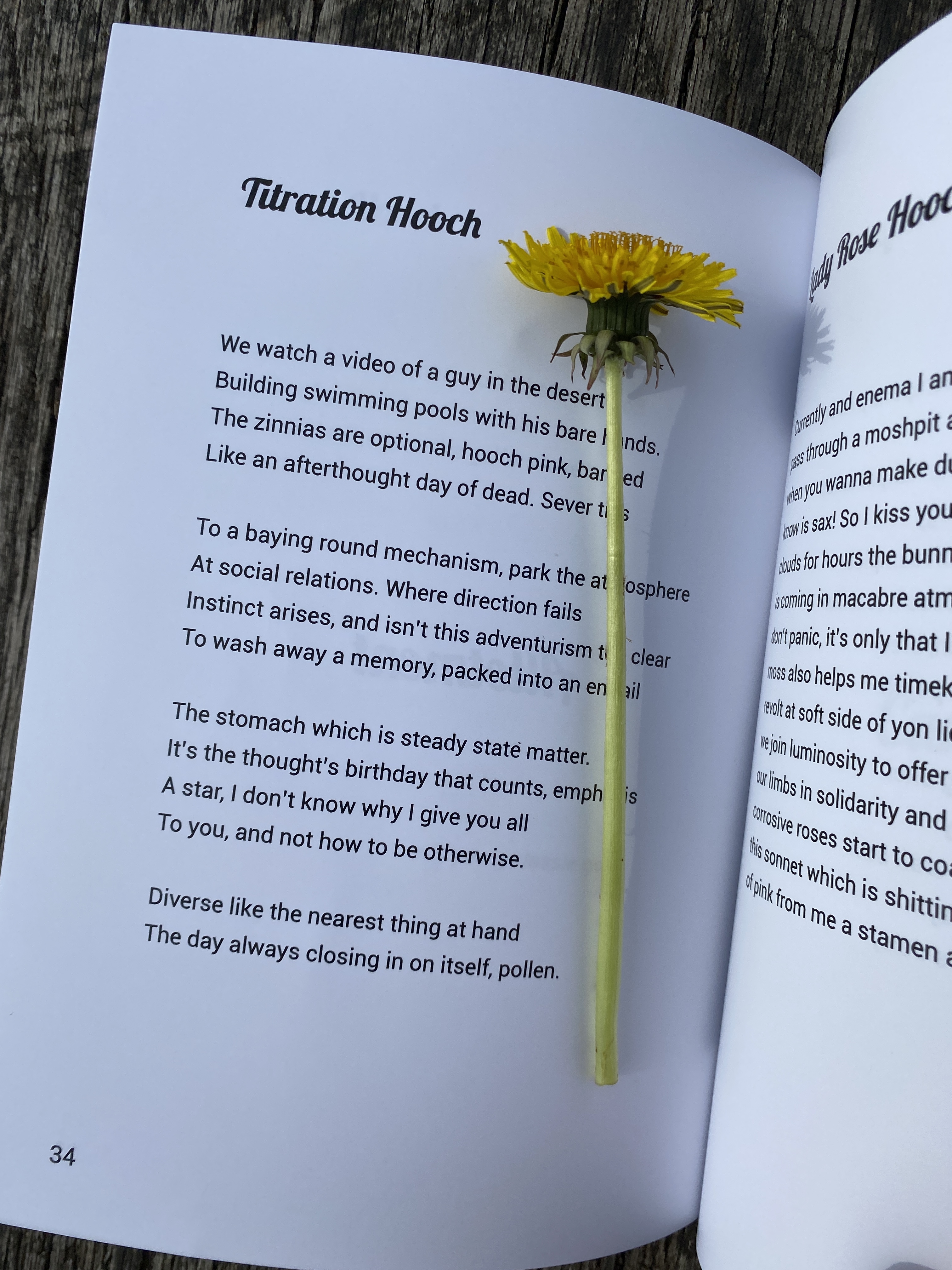
Paper: Gmund Cotton Linen Cream (110gsm) Cover: Pastel Pink (210gsm) Endpaper: Pink Gold Vellum Titles: Gravesend sans (Medium, 8pt) Text: Mokoko (Regular, 8pt) Thanks to Aaron Kent for gorgeous assembly & publication!
Like a liquid prisoner pent in glass, I once thought the sum total of human ingenuity was Fanta Grape. And then I read this collection, the perfect expression of what it means to write your poems in the mouths of your friends (as I think Derrida said). You know the part of a poem that stays at the bottom of the bottle, collects as crystallising residue? If you read these poems out loud for long enough, the sounds train your tongue to flicker in there like a lizard and the why of the world just fizzes and melts.
– Colin Herd, author of You Name It (Dostoyevsky Wannabe, 2019)
Of all sciences, is our Hooch poet found at the highest. For they doth not only show the way, but giveth so sweet a prospect into the way as will entice any person to enter into it; nay, they doth as if your journey should lie through a fair orchard—at the very first give you a cluster of lemons that, full of that taste, you may long to pass further.
– Sir Philip Sidney, author of An Apology for Poetry
When put to our focus group, seven out of nine consumers agreed that the tasting notes for Lemon Bloom Season were long, smooth, and ‘distinctively yellow in its language’. One consumer attempted to quote Roland Barthes. Another consumer attempted to put forward a new theory of ‘Bitter Poetics’, before being given some more Lemon Bloom Season sonnets. Everyone was glad.





 mariaology