Intro for Maria Hardin 1/11/25

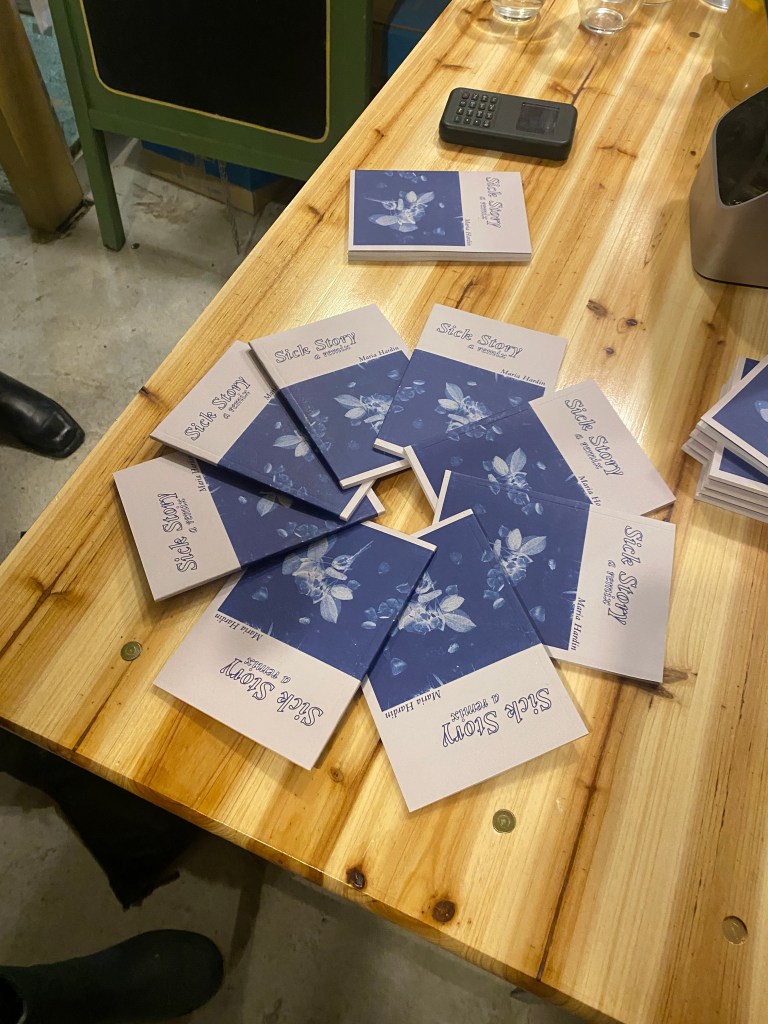
Pamphlets titled Sick Story spread into a spiral on a wooden table

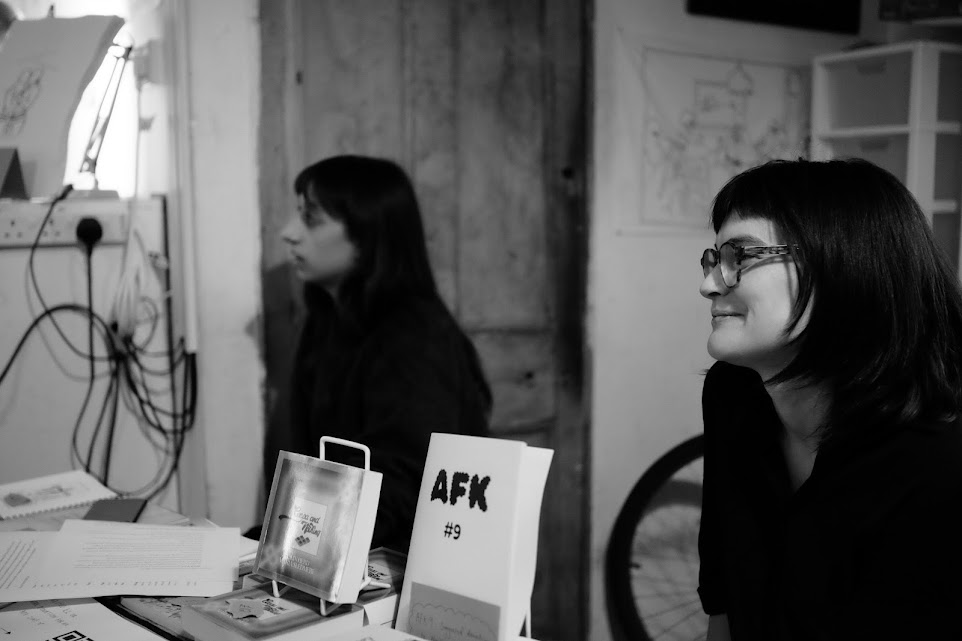
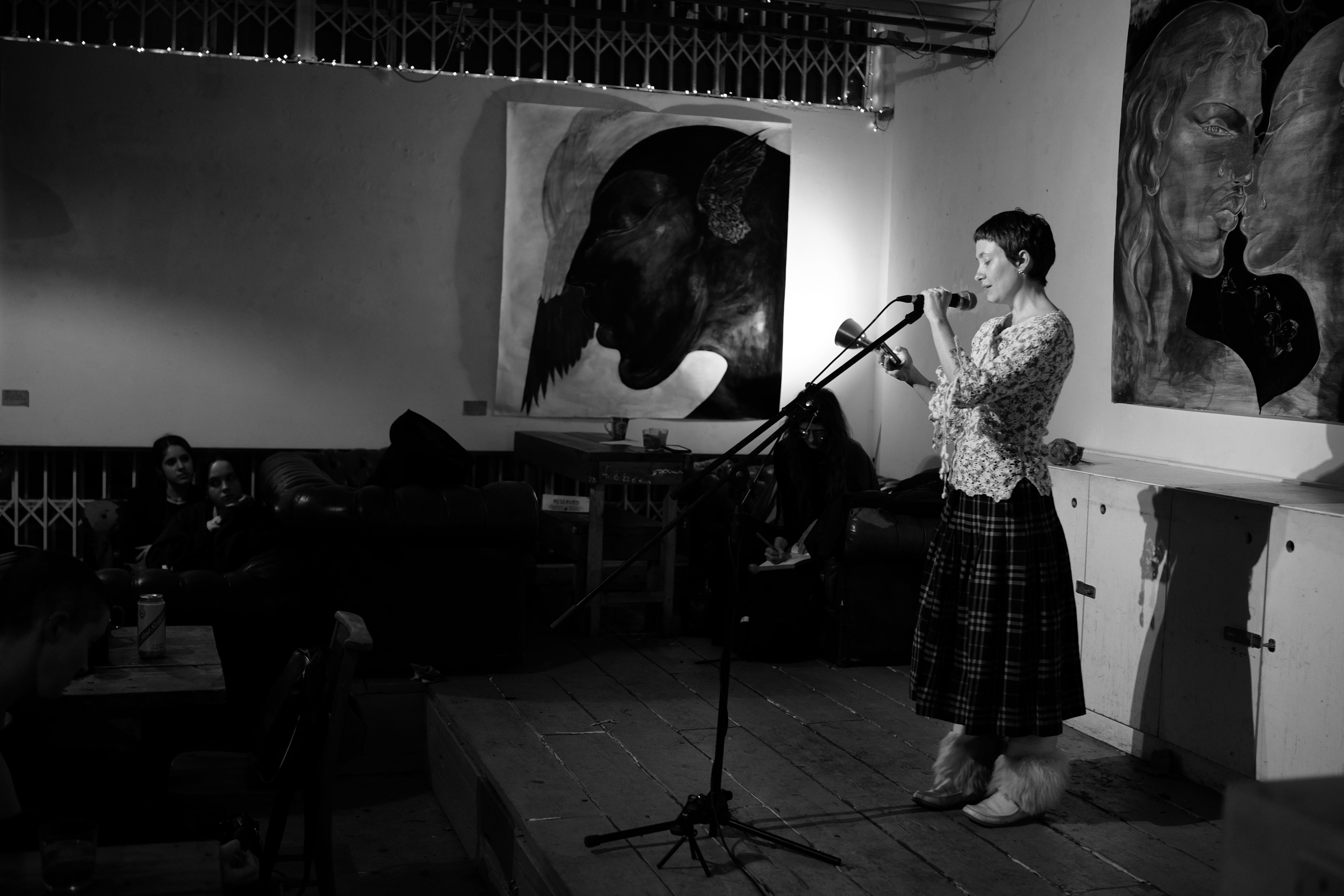
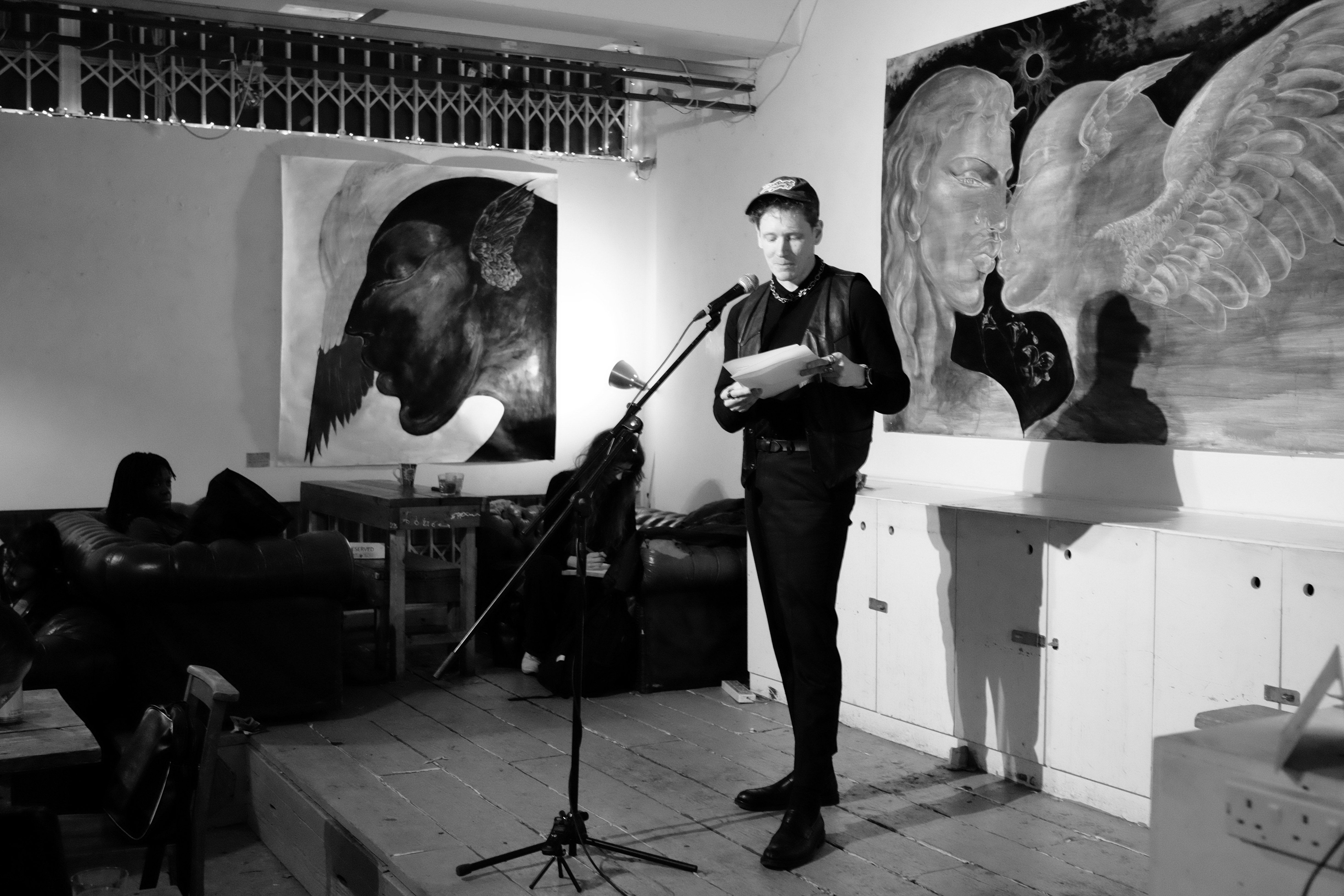
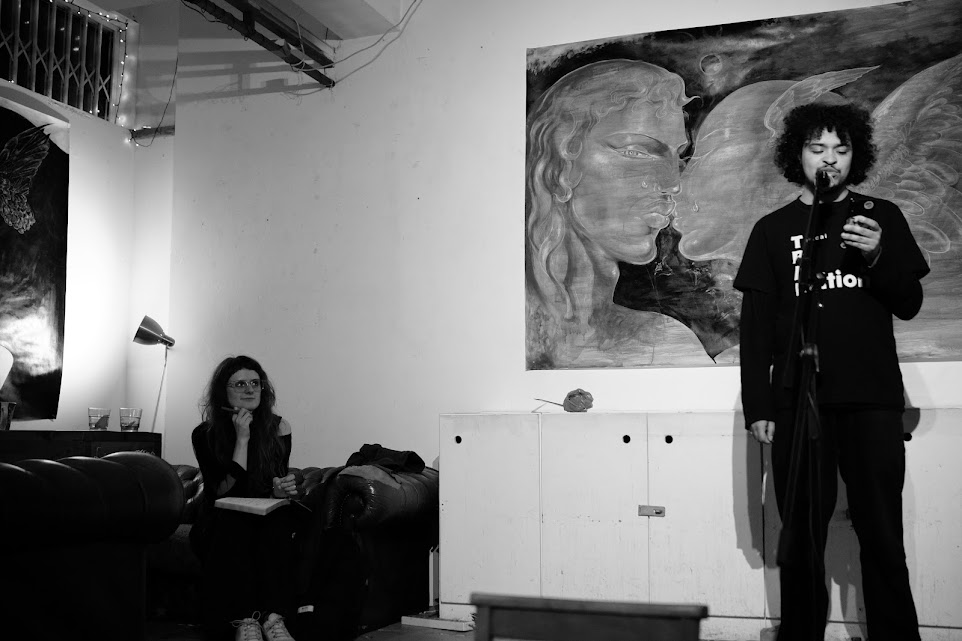
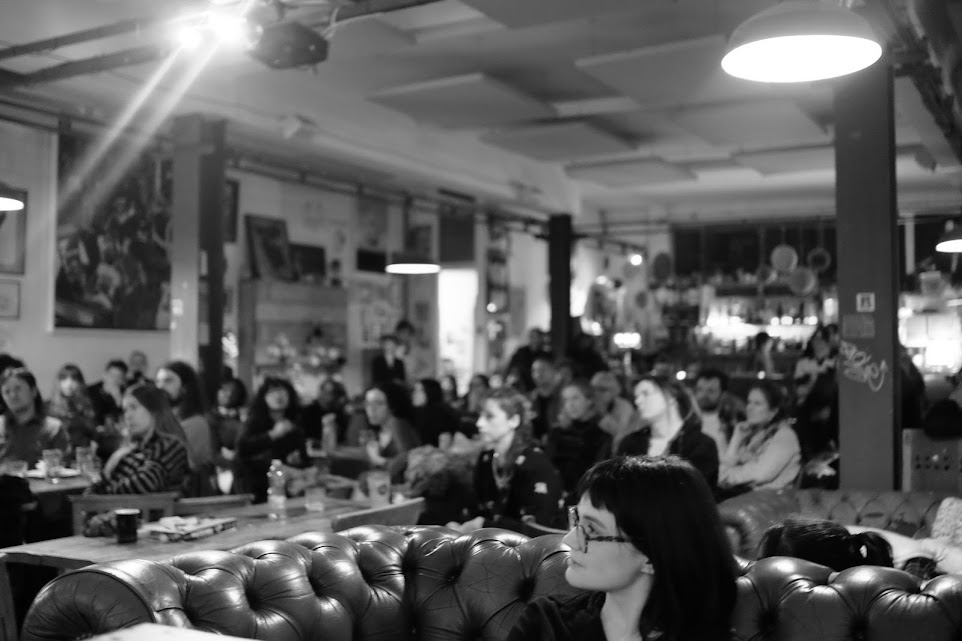
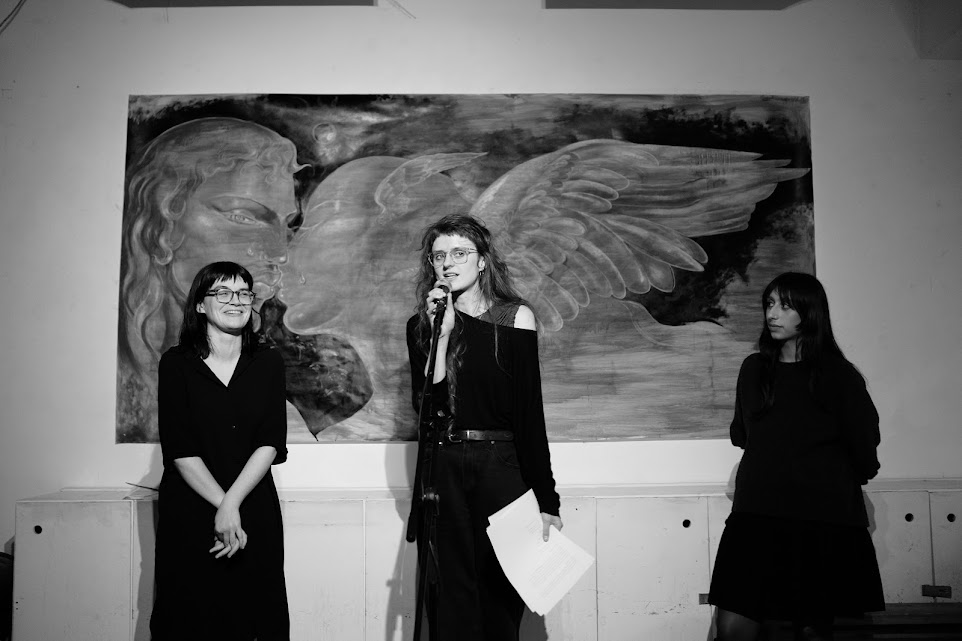
Last night SPAM Press hosted the wonderful Swedish-American poet Maria Hardin at Mount Florida Books, Glasgow, alongside readings from Kate Paul and Jane Hartshorn. Here is the intro I read for Maria.

I want to begin by reading a poem by the late Rhiannon Auriol, who was a kind, talented and sharp-minded poet. She had a voice that felt genuinely fresh and we were always excited to get something new from her in our inbox. We published her in the Plaza and our online magazine several times and when it came to putting the lineup for tonight together, both Kirsty and I had the thought: I wish we could invite Rhiannon to read with Maria. Rhiannon forever.

Here’s the poem, which was published in pif magazine back in 2021.

I drop into this poem and I am petalled. I have put my hand in the new burr grinder of how I am learning to read in grief. This self-petalling is a relief. I will soften! I will become rose water, distilled into essence! Energised by short lines! There is something ugly-beautiful about my becoming rose-water of the nominative. Yes I was born with the middle name ‘Rose’ and also the first name Maria. Rhiannon writes of ‘the moon particularly / at sea’. Maria and I share a name meaning ‘of the sea’. We found each other via the kismet of poetry, and her poem called ‘Mariaology’ which features ‘a cascade of every maria’ which I first received as an iPhone photo. Last week I was researching something and stumbled on the phrase from the website MindBodyGreen which said, perfectly: ‘caffeine can disrupt your hormonal cascade’. I don’t know what a hormonal cascade is but I know I have felt it in poetry. Yes, for you I’d drop everything.

By some miracle of the ether Maria is now here in Glasgow tonight and we are launching her pamphlet and I am CAFFEINATED. My being caffeinated will never truly replenish my energy. There is a tale here. Rest without respite. Sick Story. I like to think of this as a sister pamphlet to Maria’s earlier work Sick Sonnets and also a cellular cascade of the voltas played within them. We have dying bees and the premise if not promise of healing. In Maria’s sick sonnet ‘Glossolalia’ the Steinian rose becomes a rat becoming also a rose and the speaker reads ‘emotional responses to the end of nature’. I have always loved the general mood of melancholia in Maria’s work, the way a speaker can latch, mutate and render ornate a feeling, an image whose origins remain mysterious. One never feels quite settled; there is a rat-like restlessness. Is that it? But also the still, slow burgeoning and wilting of the rose. Of devotion. Hours of languishing. The void is decorated all the better to feel it. The void is remixed. If there could be endless Proustian bedtime there could also be a pain psalm and a ‘baited lamb’. 

Sick Story looks for alternative narratives in its telling of chronic illness. It asks ‘what is the shape of a sick story?’, with an eye to Bernadette Mayer’s Story and Ursula Le Guin’s ‘carrier bag theory of fiction’ by way of explanation. For Le Guin, the carrier bag narrative is shaped like a bag, not the arrow of phallocentric linearity. Mayer’s Steinian Story bundles riddles, matter, anecdote, the stuff of ‘things’. Nothing feels pre-determined, destined for an ending; rather, all times rub their quantum shoulders in the bag. Have you ever rummaged in public for your medicine? Have you ever written notes on the back of your hand, worried the ballpoint would seep beneath your skin and stain something irrevocably navy? Have you ever shaken your life up so much you could almost smell its perfume? 

Here is a snippet of Mayer’s Story:

Voices fall.

It may be seen feeding on this under one of those tropical things.

The time or place of starting. 

He throws a hat on a seal’s head and a piece of his pack into a whale’s mouth, marking their characteristics. 

Lamp, lucite and plastic. 

I saw one once in a book, but I didn’t rip it to shreds, or even divide it, as I could

have (snap), but left it whole (shot), which it could never be unless it were left 

that way. 

Will that have anything to do with this? (67)

Mayer’s storied ingredients are packed upon each other like the storeys of a building. She disrupts the assumed causality of narrative with a prompt — that of the child’s or editor’s: ‘Will that have anything to do with this?’. I am at the soft mercy of every bedtime story. Once gathered into the bag, is everything relevant? And where does it take us. Details are listed like precious cues. Lamp, lucite and plastic. The pronoun ‘it’ bears wild liberty in its free-kicking materiality. I trample ‘it’ under the ‘perfect lucite heel’ to which the speaker of ‘Mariaology’ prays. I sub ‘it’ under light, lux, something solid and transparent — the supposed clarity of what I am trying to say, what does it all mean. What is the ‘time and place of starting’ when it comes to illness? From where do voices petal and fall? Are they, like rain, a kind of interference? Mayer asks ‘What did the rose do?’ after the word ‘History’. I think Maria is answering that question in her remix. We invent from adjacency some kind of story. Is the rose sick, is it guilty? How to place these scenes. I think of something Jane wrote in the same issue of SPAM magazine where we first published Maria: ‘Houses appear / where once there was marshland, a thin burn threading / between them.’ My imagination shrinks these houses to the size of pages and now I want to live in them. And you can too.

Here’s Maria Hardin, thanks everyone.

🌹

You can buy Sick Story from SPAM Press here.
It is SUCH a cute edition (A6 pocket-sized) and the writing will stay with you a long time. Carry it with you!

You can buy Maria’s debut collection, Cute Girls Watch While I Eat Aether (2024) from Action Books here.

Here is a long essay I wrote about roses, via Idlewild/Stein/Lana Del Rey/Joyce et al, back in 2017.

Grand Parade (SoundEye, 2025)

Grand Parade (SoundEye, 2025)

I don’t know if it’s summer or just plain warm
for walking around in search of dark-bitter
reprieve
pulled the Ace of Pentacles
in Maureen’s
the pledge of a seed
planted in manifest pasture
walking up the Grand Parade to have Mau
grab my arm and pull me into due embrace
since they were just getting breakfast, sloshing
                                                         oysters with Dom
I keep saying it’s good to be with everyone
the neighbours are rehearsing a play
I sit on the floor and arrange paperwork
phoning it all back like
I failed to see the love in front of me
fertile and with selenium

wishing I could have bottled
the birdsong of Brace Cove
so much to trap myself in notes also
reeling around the English Market with poets
wishing we were Irish
ordering whisky with Luce
if you ever want to talk, we say
if you ever need whatever

the Beamish flows easily
it is less than five euros. I have yet
to burn my fingers on ice, to go home
into caring situations with dutiful infinite
replenishment of ice
instead I run up Shandon
arriving late for Maggie O’Sullivan, early enough
to catch her words as Eden-variety everafters
flying around our garden of poetry
I was locked from initially, outside
in the street awaiting my call

that poem about a mother opening her belly
that poem
incants a fact, you are present
sometimes being born
you will always be able to talk to me
I weep through the reading, it’s easy
to constellate far away suffering
in greener syntax
just across the sea
to afterwards hug Maggie, thank you
we have no idea how powerful words are
to leap, mutate and glow
in defiance of the law
how hard it was for all of us
just to get here

everything we’ve been through will be again
but I don’t have a generation
we see wagtails on the lawn
sonograms of gathering voice
what is it
to be intimidatingly full of life
Gloria singing of sailing
Carl making faces at the baby
making faces at poetry
as we remember Callie
being smart and funny and so singular
as to outlast all of it
eating dosa while watching
Ellen Dillon’s killer reading
then a cuckoo went off on
someone’s phone, hello pastoral

those oysters were universal
tell me about your shoes

guess I will inherit
my father’s spiral cutlery

all the better to eat what
cannot be stomached
of home-cooked nowheres
rich in cortisol

what I want is raw
and clear

saw a little grey dog
at my feet
during Keith Tuma’s performance
not a real dog, offhand
come to comfort me because
dogs smell cancer
even when someone else’s lives
like a phantom accord on your aura
and in the forever ward of poetry
who will get away with autumn

my life is a spatiotemporal displacement
filtering love’s dimensionality

I want to go back to Dogtown
rose petals steeped in promises

Phantom Architecture

the stillness of the painting has a kind of speech to it
the sustaining restless grammar of poetry
is that how good poets defy things with their heart
the sun on the tongue is a kind of living
the poem seems to fill up with this
a panic, just in the peripheral vision
a mode that can maintain the day
something of Schuyler in the act of saying
how it allows the people to enter the self
we are not complete
when I’m writing, I’m the right size
I’m not bigger or smaller than anything
kindle’s like etch a sketch
one of the issues of elegy is not being able to let go
the Orphic is endless
we’re all here because we’ve been taken captive by our reading practice
a text of dubious origin which is a great analogy for poetry
trick us into thinking these are finished propositions
the only authority is the sound itself
foregrounding the process of echoing
the lyric utterance as operating system in the present moment
humour my error
invent my own invisible poem behind the invisible poem
beginnings are always about nothingness
meaninglessness makes meaning
a horizon or atmosphere that I can continue to write into
I am always beginning…
I literally don’t know how to write a poem
phantom architecture of a poem
the complexity of getting from one line to another
a properly honest relation to our temporality 
the poem that doesn’t know it’s good is usually good 
you can’t find anything if you’re not lost
making nothing as a suspension of labour
marking the duration of a symptom
speculative topos for tracing affinities
there is no better time than the present when we have lost everything
a generative uprooting of one’s identity or biography to do the work
incantation to wrestle the poem from its enclosure 
to project in divine sublimity
hoping poetry might come back 

*

All of these lines are quotations of things said by panellists and contributors at the Peter Gizzi Colloquium at St Andrews University on 18th October 2024: Anne Boyer, Luke Roberts, Oli Hazzard, Honor Hamlet, Colin Herd, Jacob Bard-Rosenberg, Rosa Campbell, David Herd, Caspar Bryant, Daisy Lafarge, Anthony Caleshu, Peter Gizzi.

notes from first days of June

I started watching this semi-excruciating flying movie with Gwyneth Paltrow as starry-eyed wannabe air hostess simply because I wanted to imagine being in the sky hard knowing it was the way to ugh you know it. My heart simply was a necessary flying. I didn’t want to claim its property, almost too light to hold kind of beating against a pale blue membrane. Every single version of ‘My Bonnie Lies Over the Ocean’ is correct. I went to bed and flew each night and woke up not having landed, not quite. Flit. Thinking my bonnie my bonnie my bed my boy my bonnie my bed.

There are these fistfuls of infinity berries that go like: because it’s true / we can afford them. Squishfruits fell out of my fridge from weeks ago. 

I can’t remember my dreams any more. Did I give up their supplement to pay other attentions? 

The carbon credit was to be discarded because I had really grown wings and could fly (more luridly than ever before).

Twas a lullaby we learned when young in our bones enough to know. I felt then the only thing that could do as was true must have been classical, dishevelled and charming in its way of upsetting the absolute. I knew nothing of where I was and only looked at those kids old enough to know their way out. Which is why I accepted their gentle gifts of Glen’s and cigarettes. One single grain of salt worth a beach. I took home from the autocorrect gone. Gone home. I’m gone. Home. Home and gone and away like the here/there sculpture of Berkeley that Sophia kindly explained to me. 

Home could be in two big places. It was a compact piece of shell I once licked as a way to the heart. Having wanted to do this for days, like walking by Golden Sardine and thinking “do I want a glass of wine of my heart” 

iridesce! 

What did I scheme of that? 

I partook in rose accelerants and knew 

anhedonia be gone 

fred said after the Bulb reading that they wanted to blurb my next book like “Maria is Tom Raworth for girlies” so I guess I need to have a next book pretty soon 

I read that poem about ‘The Hungry Tree’ thanks to Laurie for telling me about that tree and for the aweful people of tripadvisor who gave forth their opining 

“Sorry for being so lovesick at the residency”

We need to have more places to collect in public. They are a currency of summer. O look this berry. You missed a spot. The fact that you can acquire them here in winter is at considerable cost. Cloudberries. An idea. Coffee.

Add them to the celestial smoothie bowl. It’s our Californian version of the famous porridge. If you know you know. girl & boy variety of blueberries 

Sydney would eat the whole world anything

Elliott Smith – sweet adeline.mp3 

In my new lilac gingham notebook a gift from Sophie I want to write ONLY VISIONARY THINGS.

Magnesium supplements and chasteberry and a stranger recites the phrase lapis lazuli ~

There was everything new. I assembled a plain white table and chairs. My wrists hurt from screwing. I bought a new glitter shell plastic phone case because I had this new relationship to my phone: it was the ocean’s telecommunique, bearer of heart swells, bigger than it really was in my hand the size of an almost sexual distance 

so amazed at how it had lifted 

‘A kiss on the eyes—lifts sleeplessness.
I kiss your eyes.’ – Marina Tsvetaeva

speech acts for touch

the bubbles Claire said beware they are so sticky and she was right they had like a latex tendency to pop in your hair a trace viscosity sort of like synthesised insects 

is this true fat or water fat? i pinch myself to stay alive 

do you say hello to your demons?

that lady I saw on Buchanan Street with the midlands accent wearing lavender and the flop-haired boy texting from outside the station and the nerds with flirt rucksacks holding a kissingness close to their knees or their memes I kept taking the wrong direction 

looking for nessie

how could I feel so light while carrying around this diamond!

wee boy on the bus poking a glowstick into his eye

decided the new subways are terribly designed. makes me feel sick ricochet. quiet, but where to put my my hands when I want to clutch the overhead and pretend I am flying 

else

stoned and assembling furniture  

I found myself adding spirulina to miso soup and eating smoked cheese and strawberries and this spirulina miso all the while listening to Anne Waldman read at the Poetry Project my little ears prick up when she says cinders 

and also i like her phrase ‘elders of softer places’

can you please try to unzip this?

i am enamoured by what’s in my email 

blessing misspelling

I need to go to Helensburgh

run along the beach with dogs 

keep talking to me in the wrong direction

it’s not a poem it’s 

a poem poem 

the total surf

‘No daylight comet ever breaks
On so sweet an archipelago’ – W. S. Graham

 ∵∴∷  ∵∴∷  ∵∴∷  ∵∴∷  ∵∴∷  ∵∴∷  ∵∴∷  ∵∴∷ 

The new Cloud Nothings album, just enough screamo, did I put them in a poem once for their namesake seemingly when I was crying on the way to Los Angeles next to the tween who was obsessed with clouds, taking pictures of their pastel alacrity and even when the air hostess told her close the window blind she put it up again — just one more photo of the seraphic peach cobbler please miss!

I’ll go listen to pop. Diagnosed with variable tenses. The citational declarative we discussed in class like no single I love you is the same as before except decorated with echoes of the rest it might mean more? 

(That pale blue-green exchange and the typing indicator) I kept clutching my phone to my breast in an ecstasy comparable to those eighteenth-century wenches in total novel love, why not

 ∵∴∷  ∵∴∷ 


After six years, A+E Collective are going on a soft dissolve. Ane, Finn and Lucy (and formerly Marie) have been my comrades in thinking ecologically all of this time and beyond. We have spent afternoons agonising at riso and lying on the heated floor of the Lighthouse easing cramps to make work, marathons in cold studios and performing,

performing,

the first time I did something for them was in 2018, that sound poem I composed with Vas and what they invited me to do was to think about all of this hot hot world anxiety at the level of the daily and so by design we’d gently invite others to do so, it was the year of the IPCC and my phd and the year I lost a lot of innocence it’s fine, hi Greta (Ane spotted her on the scotrail at COP26, eating a meal deal) the year after that something sweetened and I started to know what language was capable of being its only loving thing accordant to living but is that enough? for a while I lived on saltwater crushes 

nothing planetary at all about that except

who would go on living?

People thought we meant the accident and emergency and in a way we would incubate the waiting room of our lives to make this work. Don’t be worried, I’d say, be a whirlfriend to someone. Once it was everyone. I learned so much from these artists about how to collaborate truthfully like in the service of radical listening to move things very intentionally around the page, to look at art, to show up for stuff because you never know how it might change you, or the conditions for who you are. We ventriloquised the fly agaric and made a film about the special Mull sand that was also found on Mars and we tried to make it all about the more-than-human but we couldn’t erase the little shadow of Marie in the reeds. 

∵∴∷

keep thinking about the katie dey song and the refrain about losing specialness, specialness 

I wanna go to victoria’s secret bombshell isle

saying it’s the bomb because I spent a week that way

chairs are beautiful even when we don’t sit on them

sorta miss working from bed

the load perfume of anomaly

now the air smells of sparkling pears 

Notes on iNsEcurE exhibition

Che Go Eun, a hole in a boat and a deep hole (2024)

Dear pain,

That’s how the light gets in. Fractal emanations of screaming the dark is a luxury the dark the dark. I listen to the radio and a mother talks of her autistic child preferring the dark — thriving in it, coming to life.

We soft-light to protect the unsaid stories.

Our bodies twist in the dark and we make an inconsistent work of pain-pleasure. The mattress gives out: pools of blood, ink, sweat, coffee, sex. I feel better when the sun comes up and when the sun goes down, wine-dark. It’s what’s in-between that’s the problem.

I keep thinking about Fred Moten’s luminous correspondence, ostensibly between Andrea Geyer and Margaret Kelly:

My friend, I have discovered in the antagonism between my work and dead letter that the project returns as an amazing field and air of correspondence, a transgenerational lotion of breathing, a revue of breath, a general bouquet in the grace of your asking in friendship since the day we met, and our braiding and breathing of a correspondence that we are now and have been working together in the atmosphere of our comrades, that we literally breathe them as a kind of braiding, an insistence of revolt as garment, a tapestry for the touched wall of a spaceship we noticed on the way to school, that off dimensionality of the cloud from our perspective, which I want to say is real not graphed, which I want to say is both a function of, and still untainted by the terrible business of, the Dutch masters, so that it’s impossible to tell the top from the side, though there was some kind of emanation or emendation that we all saw as a smooth flatness, like a table the cloud prepared of its own accord, a spread platform for spreading our metastatic air, our beautiful, is ourreal.

Fred Moten, The Service Porch (2016)

To make a pain of you, stop being a pain, I’d form a cartography of the nerves so rich you’d never know I’d outmatched the major scale. A map does not function in service of security. Anyone who has seen me read (and attempt to follow) a map knows this.

What is so gorgeous about the Moten quote above is its ph(r)asal longing: an ongoingness open to improvisation and constant sentence desuetude. Language like you don’t even need it, breathing all the same beyond what’s essential. Take this key. Braiding and breathing a coital somnolence of the body, twice rung out in language / only us leaving voice notes for what clicks pearls together, minor, deep in the distance.

Emollient longing of writing between pith and pronoun, what is prepared by the passing between. Our breath, clouds; mattering.

‘•.¸♡ ♡¸.•’

I saw the spaceship too. Didn’t you?

Intimacy, I told someone recently, feels like the opposite to what capitalism wants of us. Intimacy is worldsharing, ourreal, a grammar of humours, kisses and shibboleths. You know my pain and I know yours. We make a joke of it. What escapes serious talk but our serious dreams. So when we’re all in the gallery, we switch to our senses to make language-sense of ourreal, cellular vibe spread. It’s a room replete with the sonic ecology that is feeling all my fucking feelings (Clémentine Coupau): aka hook me up to ‘electronic components, dimensions variable’. The little paper lantern is a miniature version of my own IKEA lampshade. The problem with my IKEA lampshade is that I had to tear it a bit to change the lightbulb. I have a torn lantern. Magic hands. That’s how the light gets in. Paper = skin. Creamy light.

Che Go Eun 최 고 은, a hole in a boat and a deep hole (2024)

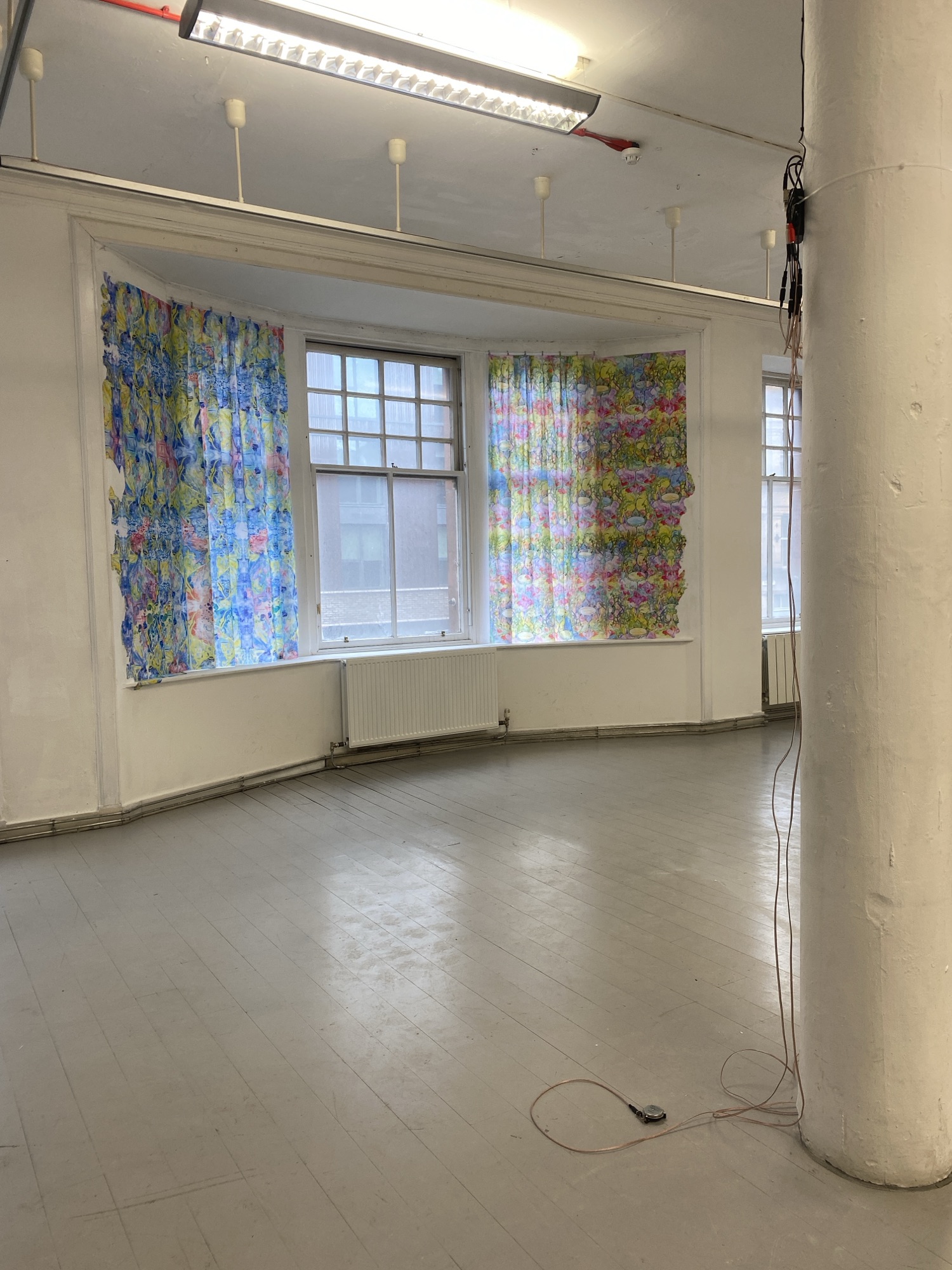
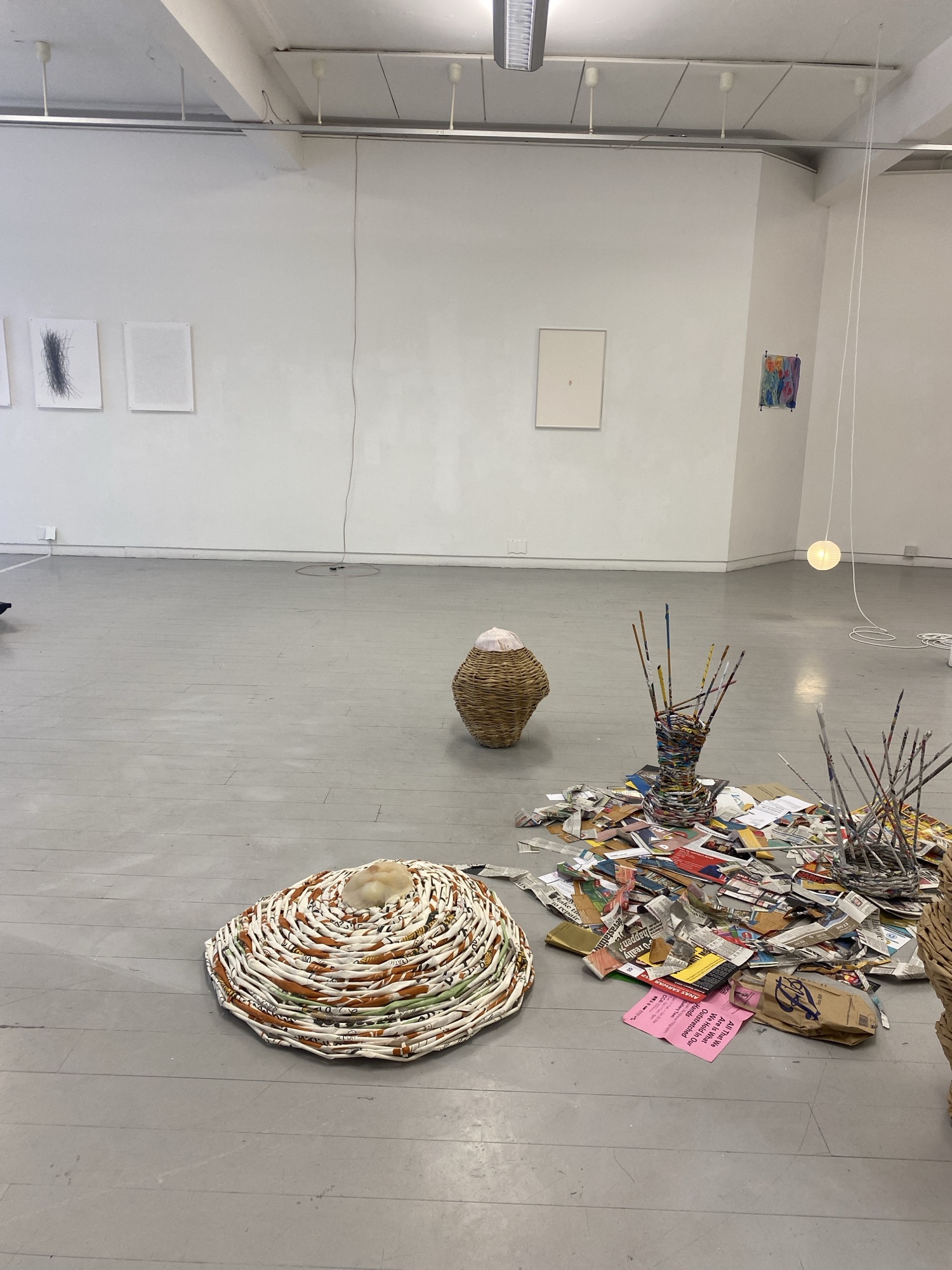
Aside from lanterns, the other homeware alluded to are curtains. Che Go Eun’s a hole in a boat and a deep hole is composed in collaboration with artificial intelligence. The artist inserted diary notes into an AI image generator which ‘transformed [their] intimate reflections and resulted in images’. Watercolour drawings were then made in response to those results, with the artist ‘reappropriating’ their ‘own feelings back from the AI’. This tension between creativity, data and predictive imaging results in a fascinating, speculative assemblage of arabesque, thorn and psychedelic colour. The nod to William Morris/Arts & Crafts reminds us of the collaborative handicraft that has gone into the piece’s imaginary and manifestation. Diary phrases such as ‘art nouveau’, ‘harder I am sinking’, ‘throw all my stress into the hole’ are woven into the fabric of these drapes which suggest both privacy and opening, light and shade. The work is gauzy. There’s a real street, a construction site behind it. Trongate: name as lozenge. What Moten says in the same letter-poem as quoted above, ‘a gauze of reckoning’. Threads, braids: stress, tension. I want to wrap the code-baroque of the fabric around my body like I’m a silkworm going in reverse, all the way back to its gross and sultry, larval conception. I keep hearing that the internet is just the unconscious. I see a bag of squishie candies in a vending machine and think: ugh, silkworms.

‘•.¸♡ ♡¸.•’

Back IRL, it’s raining with the pelting dreich that only a Glaschu April delivers, and I arrive at Trongate 103 having walked through Dennistoun listening to Elliott Smith. I’m not feeling morose; I’m just in touch with my feelings. As if they were tangible: animatronics, statuettes, pets. I’m still on a medication that holds such whimpering demands at just enough distance to be considered somehow ornamental — torrents no more. Once I would torrent my day in their favour. Let someone seed me. Now, I might choose to pick them up, put them back down, or smash them into oblivion. Let my soul have the architecture of a bleeding gate.

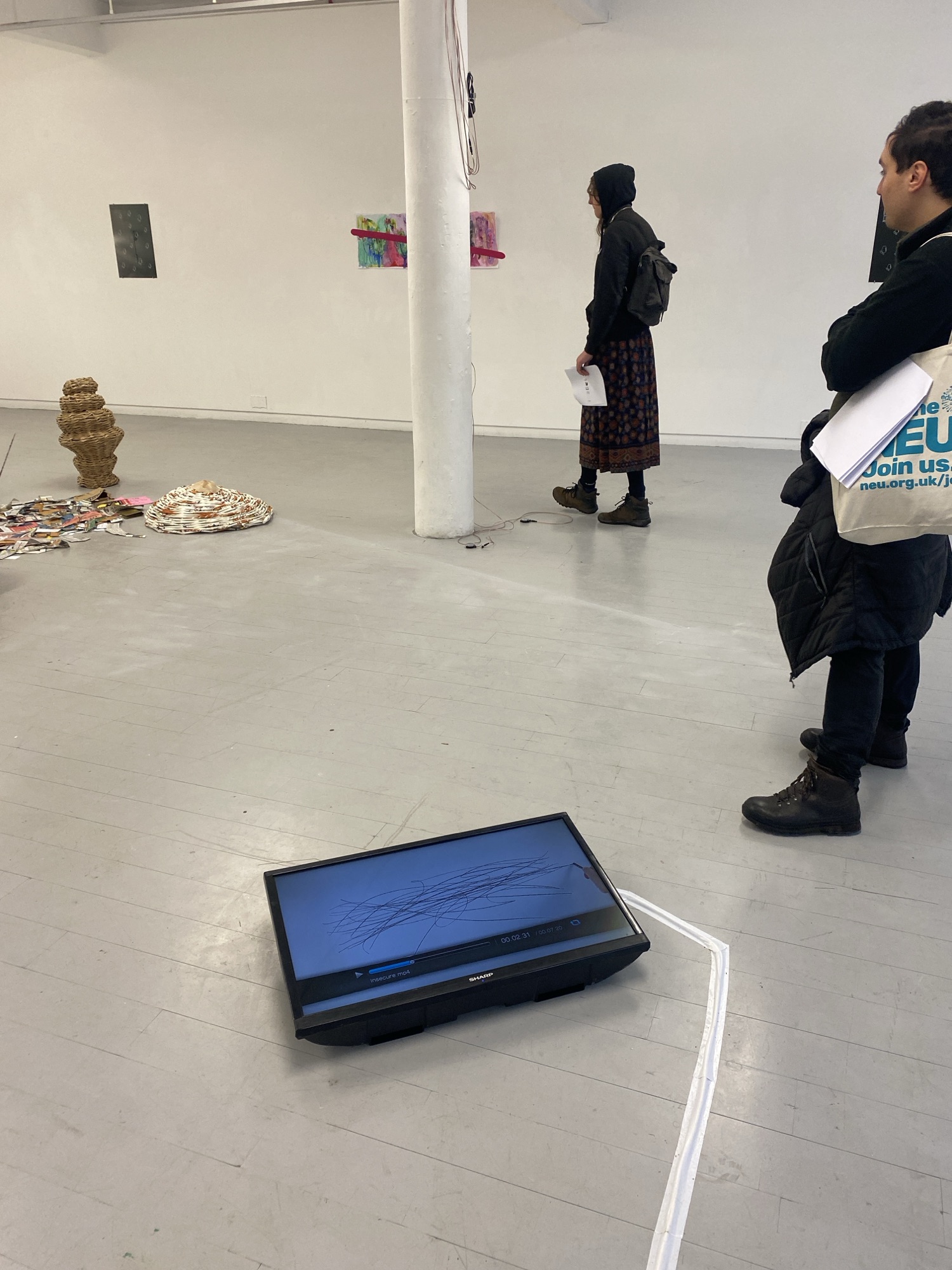
As I enter the exhibition, the invigilator says something about one of the objects we’re allowed to touch. I forget immediately what they say because I am greedy for colour and form, not meaning. So the whole time I am looking at the exhibits wondering: which of you may be touched? A finger trace of the curtains, time slider on video screen, glass surface of framing, kinesiology tape cut into bows and ribbons.

Daisy Lafarge, Gate Theory of Pain (III) (2024)

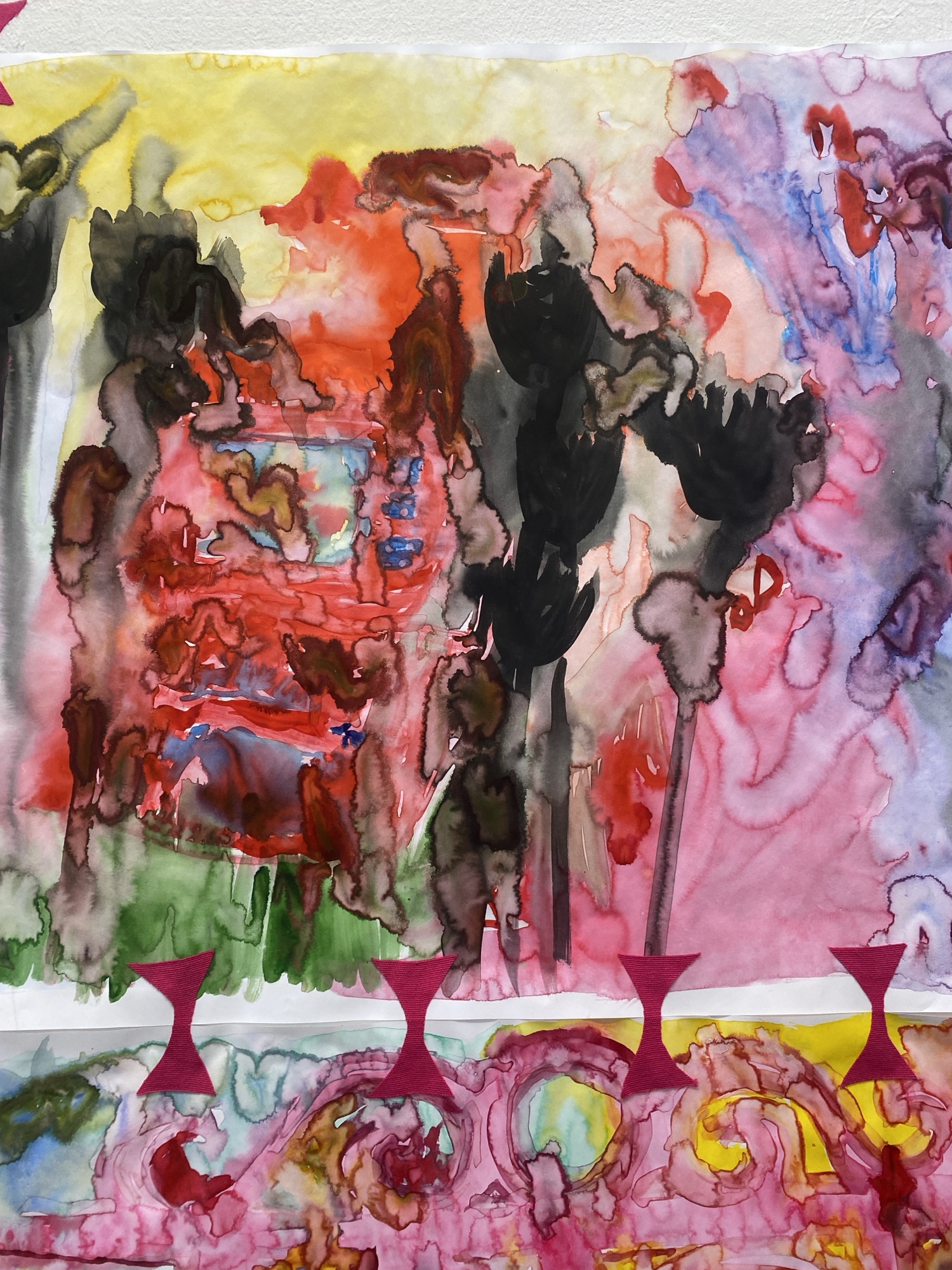
Touch is not in itself untainted. I am in love with Lafarge’s black tulips; their painful, precious tendrils.

‘•.¸♡ ♡¸.•’

Some people gave me advice
on how to do better: thirsty
in the flowerbed
for some aphids fed upon
200 ladybugs to eat/moult
more often than not they
would die as fast as any plant
blocked sunlight to pay
(dustfall / bonnie / smitten )
should the wind ever blow
you a raven

‘•.¸♡ ♡¸.•’

Mau and I try to diagnose the  Mandelbrot set-seemingness of Lafarge’s watercolour fractals. The sequence ‘remains bounded in absolute value’. This is a beautiful phrase I find on Wikipedia. ‘It is one of the best-known examples of mathematical visualisation, mathematical beauty’. I could watch the little fractal gif forever like giving birth to myself over and over as a starfish with 7000 eyes & infinite narcissism. As it stands, that boundedness is a gate: pink, the colour of doll-flesh. I think of tentacles, elliptical phone calls, inflammation. We agree that almost all the art in the room is art that could be done on the phone. It’s not just about doodlecore but the intimate, desultory gesture of the line itself, and what’s on either side of it.

Not to get kinda kinky but the other day we were explaining ‘lucky pierre’ in the pub (because of Frank O’Hara the poet we all love and love most of all to discuss in the pub). In his ‘Personism: A Manifesto’, O’Hara talks about the poem in supplementary relation to people. Intimacy again. Sure, he wrote it while ‘in love with […] a blond’, which makes it all the more true and golden:

I went back to work and wrote a poem for this person. While I was writing it I was realising that if I wanted to I could use the telephone instead of writing the poem, and so Personism was born. It’s a very exciting movement which will undoubtedly have lots of adherents. It puts the poem squarely between the poet and the person, Lucky Pierre style, and the poem is correspondingly gratified. The poem is at last between two persons instead of two pages.

Frank O’Hara, ‘Personism: A Manifesto’ (1959)

As Moten’s poem from The Service Porch is framed between two persons, so the epistolary heat is folded into Personism. It’s not letters but speech itself that gets electric. So what Mau and I mean by ‘this is art that could be done on the telephone’ is perhaps something about how the work takes place in correspondence between two or more bodies. Lafarge describes her paintings ‘as a means of pure distraction’, made during ‘episodes of severe chronic pain’, ‘remote NHS chronic pain sessions’ and ‘in phone queues and conversation with Adult Disability Payment (Social Security Scotland)’. The trembling of watercolour is an apt form for the bleeding edges that connect the power imbalance of someone trying to get support and the person with the power to connect them to it. It’s the art of turning away, seeking psychic space, without letting total go of the line.

How often do we find ourselves at the gate, with no end of wanting to both know and not-know what’s beyond it?

Wrought/not I.

‘•.¸♡ ♡¸.•’

I love gates. I love especially baroque ones with curlicues. I grew up with a broken gate which soon got removed. What did we have to keep in, or shut out? It was black and gold and the paint flaked off very beautifully. You might describe it as ‘tawdry’. I probably have false memories about this gate. Sometimes the screech of its opening hinges my dreams. Lafarge’s gate might be a homophonic pun on ‘gait’ (and so referencing the debilitating effects of chronic pain on one’s ability to walk freely). The painting, titled Gate Theory of Pain (III), no doubt references Ronald Melzack and Patrick Wall’s 1965 paper on ‘The Gate Theory of Pain’. In the words of Lorne M. Mendell:

The [Gate Theory of Pain] dealt explicitly with the apparent conflict in the 1960s between the paucity of sensory neurons that responded selectively to intense stimuli and the well-established finding that stimulation of the small fibres in peripheral nerves is required for the stimulus to be described as painful. It incorporated recently discovered mechanisms of presynaptic control of synaptic transmission from large and small sensory afferents which was suggested to “gate” incoming information depending on the balance between these inputs.

Lorne M. Mendell, ‘Constructing and Deconstructing the Gate Theory of Pain’ (2013)

The Gate Theory concerns sensory fibres, transmission cells and their respective levels of activity. The idea is that painless sensations can supplant and so quell sensations that are painful. The process involves a blocking (a closed gate) of input to transmission cells. When the gate is left open, the sensory input gets through to transmission cells and produces pain. An example of the therapeutic application of this theory is transcutaneous electrical nerve stimulation (TENS), massage, acupuncture, vibration and mindfulness-based pain management (MBPM). While gazing at Lafarge’s vivid watercolours, one senses that pain is not suspended in the art of painting so much as calibrated, channelled, short-circuited. We keep commenting on the bleeding edge.

Aniara Omann, Resting on an icy couch (mother, grandmother, grandfather, big brother, older sister, little sister) (2020-2024)

Elsewhere in the exhibition, ideas of feedback loop, intimacy, daily life and relationality are also manifest. Feronia Wennborg and Simon Weins’ soft tissue plays with sound transduction to install a ‘lo-fi sound system that lives at the periphery of perception’. This installation of contact-based sound production manifests the pair’s ‘long-distance collaboration’ in felt space. Aniara Omann’s haunting paper baskets, plugged by family faces, makes a ragged philosophy of grief and panic. The raggedness betrays a struggle for focus which is played out through the woundful (I meant to say wonderful, but this works better) arrangement of loose paper, woven baskets, the sense of things cut, twisted, recycled. Omann describes wearing the clothes of their sister, who died: ‘If anyone complimented me on a garment I had inherited from her, I would say it was a gift from a family member’. In that sense, we could think about the paper baskets as fragile amphora for an archival underworld. The baskets are not perfect, machine-made. They retain the expressive and painful grace of their making. They are a flammable structure, woven from newspaper clippings, election flyers, prescription papers, envelopes, bills. What is it to find a way of wearing something? Wrap your troubles in dreams. Shuffle for sources. The difference is a question of agencies; and yet either way the gesture remains. The gift: it has to be infinite.

Elísabet Brynhildardótti, The Lines- Hesitant line, Obediant line, Indecisive line, Decisive line (2023)

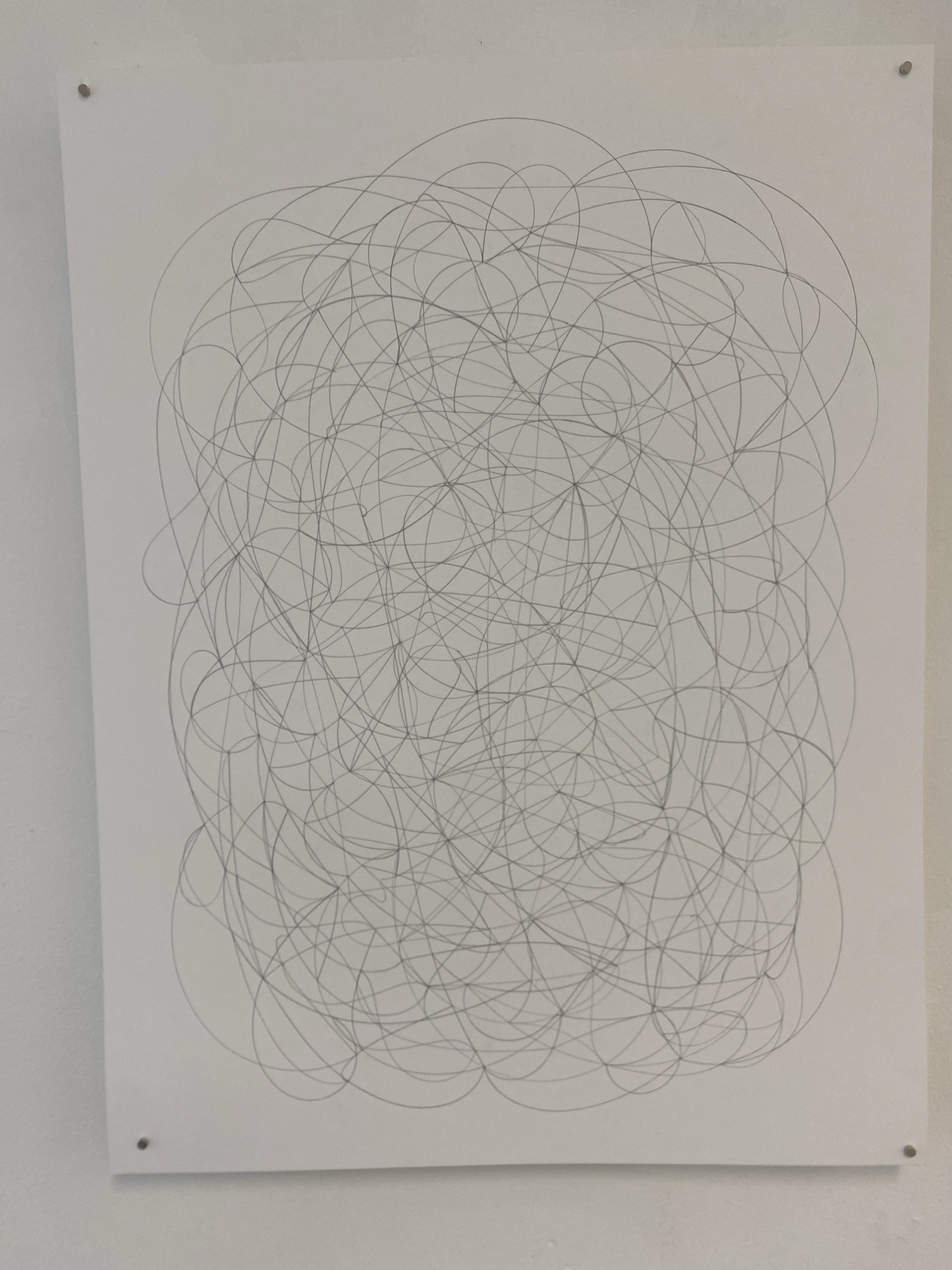
When someone says ‘hold the line’. Please hold the line. Please hold the handrail and take care on the stairs. Will you please hold? What’s at the end of that hold? I have been trying to get a medical appointment for weeks. They keep putting me on hold, hanging up. I phone up a doctor’s surgery which is based in a shopping mall at precisely 08:30, when the lines open, and immediately the lines (the queue) are full. How do I envision those lines? Swirling and spiralling around the postcode lottery of where we live, tangled and fizzing with people trying to find words for the pain they’re in. I think of my mum in lockdown, endlessly on the phone 500 miles away from the fact of trying to get prescriptions and medical treatment for my nan. It’s pretty mild for me, my current need to be on the line: among other things, fucked-up hearing, tinnitus, crackling I hear like static between the two sides of my skull. Sometimes a pleasurable hum in the morning, like ultrasound waves in the skeins of my pillow. On hold to the doctor’s office, you become a line. The hidden labour of the chronically ill is this beholden quality, the line with its insecurities. It’s getting thinner. There is no guarantee that the line will lead to something: its pulsing, throbbing insistence on being anything but spirogram music. The irony of disconnect. Give me a point; an appointment; a person at the other end.

Who would pick up the line would do so, of course, in the dead of night. In Stigmata: Escaping Texts, Helene Cixous writes:

It is the dead of night. I sense I am going to write. You, whom I accompany, you sense you are going to draw. Your night is waiting.

The figure which announces itself, which is going to make its appearance, the poet-of-drawings doesn’t see it. The model only appears to be outside. In truth it is invisible, but present, it lives inside the poet-of-drawings. You who pray with the pen, you feel it, hear it, dictate. Even if there is a landscape, a person, there outside—no, it’s from inside the body that the drawing-of-the-poet rises to the light of day. […] The drawing is without a stop.

Hélène Cixous, Stigmata: Escaping Texts, trans. by y Catherine A.F. MacGillivray (1998)

What I see in iNsEcurE (whose inconsistent casing recalls the long identifiers of medical-grade pharmaceuticals, the vowel-like howling insistence, the trembling name) are poets-of-drawings. The asemic work of line, layer and bleed is an avid supplement for writing itself. Who can write while in pain? Who’s afraid of the dark? Who’s afraid of the blank? It is in the night of writing, unnannounced. What is that invisible presence but pain itself? There is no ‘outside’ to pain, once you’re inside it. And yet the gate theory does imply a certain threshold. Relief bucks at the gate. Still, we draw from the well of it moving inside us. You can’t stop it. The appearance of the outside is only gauzy separation.

‘•.¸♡ ♡¸.•’

When I thought I had endometriosis and lived in the hormone torture of latent, duplicate pubescence, resulting from the long-durée of various quiet disorders, I wrote spiky little poems for a pamphlet called Cherry Nightshade. I didn’t yet know about the gate theory of pain but I saw all the poems in a dream_garden festering behind a gate. Well, more like a trellis. Ground cherries contain solanine and solanidine alkaloids: toxins which are lethal, and all the more lethal for their immaturity. Tart cherries have soporific qualities. I wanted sleep to envelop me in perfect velvet. My speaker was a jumping nerve, a shitty little internet silkworm.

What did I get from staring so long at the gate? I fell asleep on the line and the vine grew around me.

I love this exhibition for what it teaches us about art between bodies, how light interacts with feeling-colour, Moten’s ourreal in its total ambience, the drilling outside is part of that thrum in your skull, the way I love to look at my friends as they look at art, tulip mania, mourning vessels, the exquisite difference between red and pink, the meaning of panic touch, pain as the body’s great epistolary effort, fragility, attention’s relationship to healing, what it means to be gratified (if at all). I am grateful for the sharing of insecurity at the heart of the works, and for what they offer by way of being with pain. A bearing, a cloud platform, an intricacy. Standing at the gate.

‘•.¸♡ ♡¸.•’

Further notes:

  • medical filigree
  • acid yellowing
  • mau touches a sound magnet
  • ‘insecurity fuels consumerism’
  • light source
  • biofeedback
  • neon bandage
  • organelle ballet
  • tesselate attentions
  • the puzzle pieces do not technically touch
  • go into the hole
  • golden shovel
  • ’emoji repertoire’
  • give me a viable body
  • ‘cast latex, apple seeds, sawdust’
  • ‘I am still earning less than living wage through my art practice’

Becoming a line was catastrophic, but it was, still more unexpectedly (if that’s possible) prodigious. All of myself had to pass through that line. And through its horrible joltings. Metaphysics taken over by mechanics. Forced through the same path, my thoughts, and the vibration.

Henri Michaus, Miserable Miracle (2002) – quoted by Elísabet Brynhildardótti in the exhibition handout

iNsEcurE is open at Glasgow Project Room, Trongate 103, First Floor G51 5HD between 29th March-7th April. It is organised by Aniara Omann and supported by Creative Scotland and Hope Scott Trust.

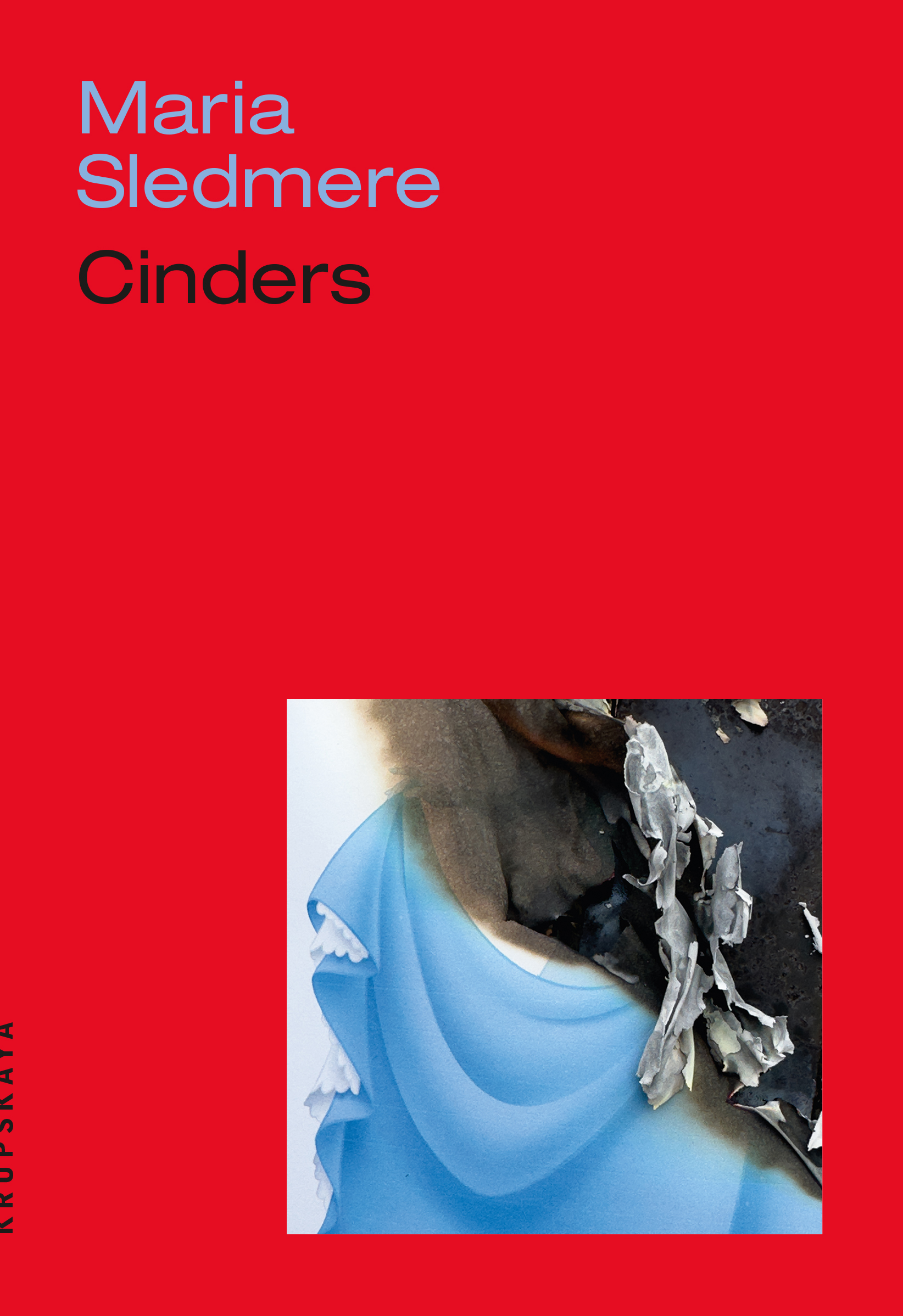
New book: Cinders

I’ve been excited about this for a long time: my U.S. debut and new poetry collection, Cinders, is forthcoming with KRUPSKAYA Books!

I started writing Cinders in 2019. In some ways, this feels like the most worked-through, shape-shifting and elemental thing I’ve written. It’s also a bit crazy, let loose, poet in residence at the wind farm energy.

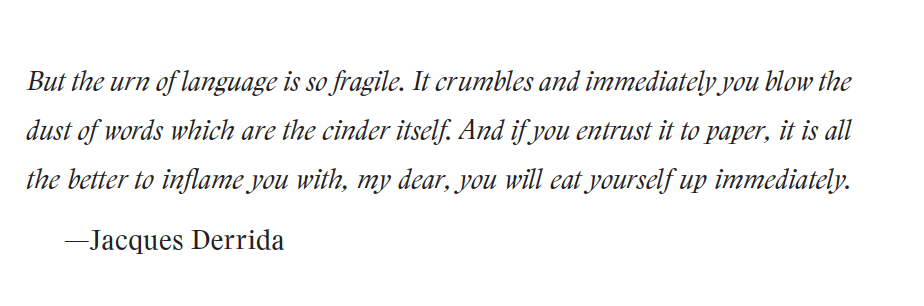
Its main epigraphs are these:

About the book

Cinders is a perverse and hybrid reimagining of Jacques Derrida’s 1987 book of the same name and the rags-to-riches fairy tale, Cinderella, set against anthropocene mythoscapes of deep time, haunted leisure plazas and terraformed Mars.

Cinders retells an old tale about lateness–how late is it, is it too late, what are the stakes of being too late if it is too late. This lateness, in Sledmere’s visionary lyric poems, pervades the structures and strictures of the pop dystopias and erotic utopias she studies: gender, class, geography, space–inner and outer. The very elements of Cinderella that were there all along as the wood burned to ash in the hearth.

Jeff Clark of the amazing Crisis Studio did a really great job on the cover, which has an accidental nod to the drapery of Cixous’ Hyperdream (one of my favourite books in the world) and whose ash curls are from a real incident of burning the avatar of the tale herself.

I am grateful to Sophie Collins, Colin Herd and Douglas Pattison for reading earlier drafts, and to Brandon Brown, Jocelyn Saidenberg and Stephanie Young for being such amazing, enthusiastic and thorough editors ❤

Here are some nice things people have said about the book:

Voilà! There she flies! Cinders! Sledmere’s ribboning red hot femme lyric avatar neither yet soot nor fire, always already hearthless, always already combustible, floating out on the thermals of volatile, flammable, scorching lyrics, trailing clouds of glorious derridean cinder-signals. Imagine lying with Plath’s red-haired Lady Lazarus and Celan’s ashen-haired Shulamith, moon-eyed sisters in anthropocene’s burned-out basement, knowing we are stardust, golden, indeed carbon, but with no way back to the garden and only high contempt for the billionaire boys’ silver spaceships in that yellow haze of the sun (‘this isn’t the journey’)—who do we call? Who ‘singing this tale of the comet’ is going to ‘come for you, little/ burning world’? Cinders! There she flies! Voilà! Poetry coming out of her like lava. Read it, sisters, and swoon. Now listen for that glass slipper to drop then splinter.
— Jane Goldman

Maria Sledmere sneaks up on you. In language that is deceptively intimate and often playful she limns a world of dark, sharp corners, where ecological catastrophe no longer looms but makes itself felt in every aspect of daily life. Intricate and expansive, never alighting on the expected, the poems in Cinders are both gems and bombs. A subtle stunner of a book.
— Anahid Nersessian

I’m planning to be in the Bay Area in May 2024 to launch Cinders with fellow KRUPSKAYA poets Jennifer Soong and Noah Ross at Small Press Traffic, but also look out for an online and Glasgow launch earlier on. The book’s publication date is 12th February 2024, just in time for Valentine’s. Please get in touch with the publisher if you would like to review, stock or whatever!

Some poems in the book have been published already in places including trilobite and the Pilot Press anthology, Responses to Derek Jarman’s Blue (1993) (2022).

Preorder here!

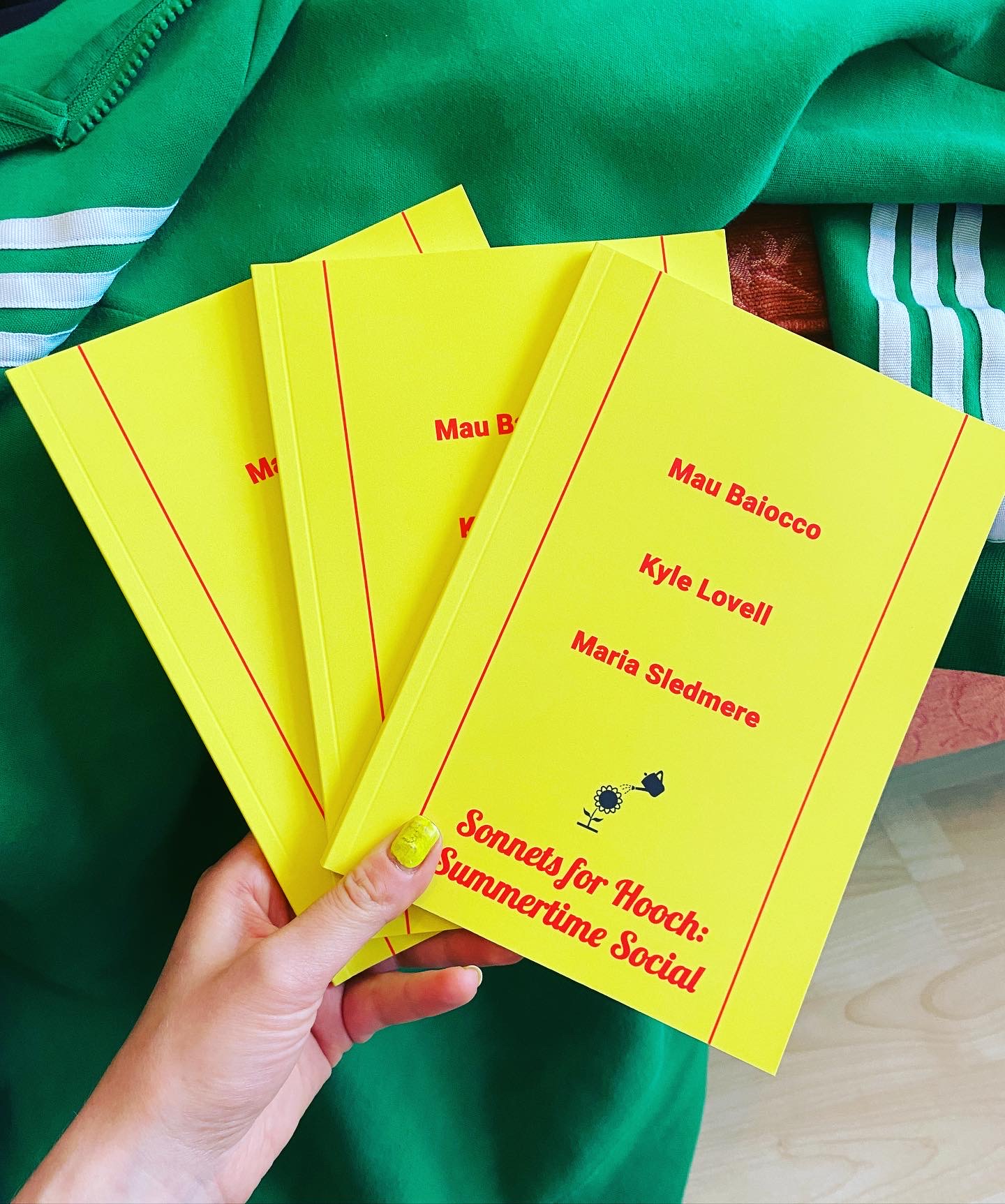
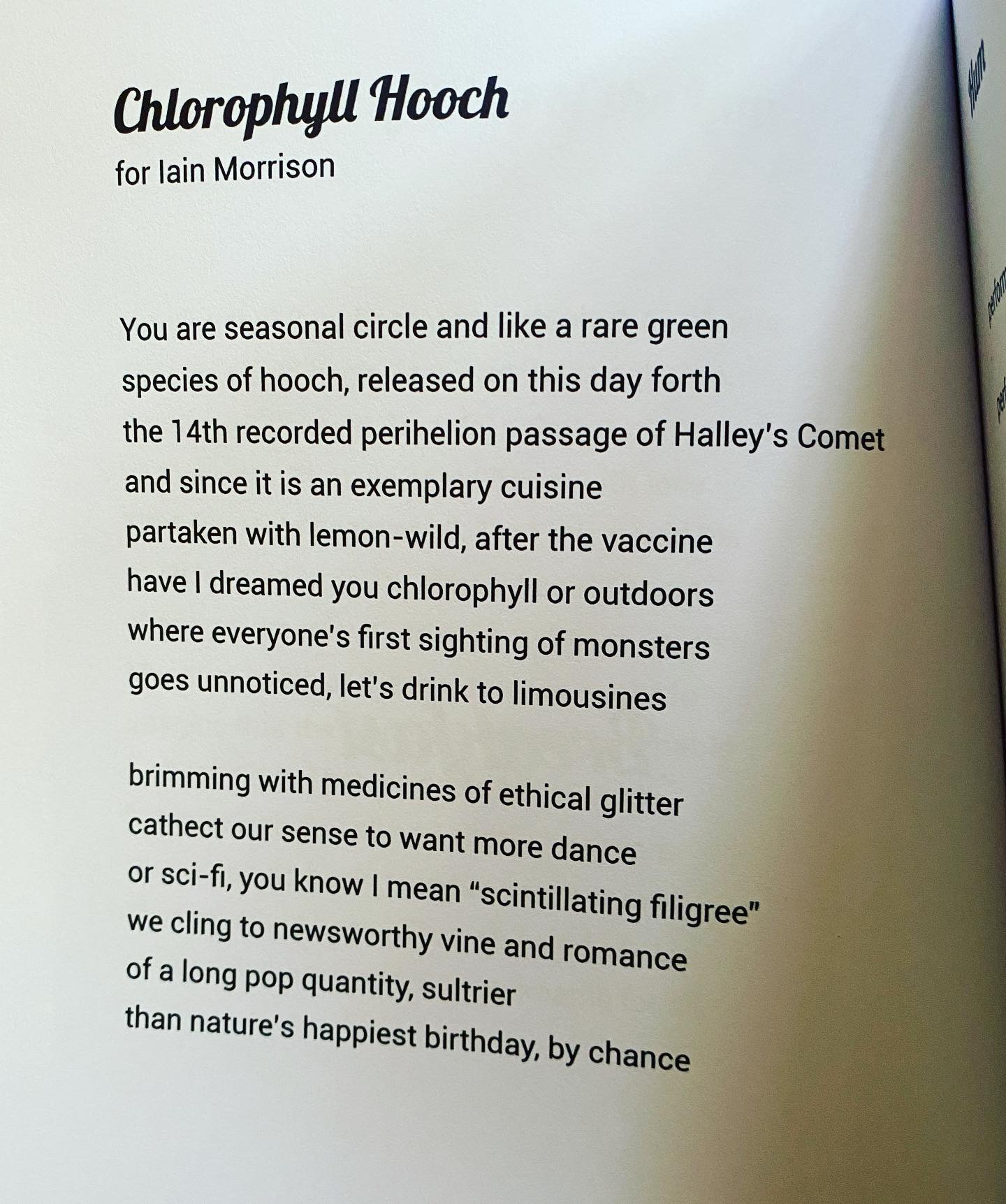
Sonnets for Hooch: Summertime Social

Sonnets for Hooch: Summertime Social is the sophomore offering of a four-part pamphlet series of sonnets attuned to the weirding seasons. Structured around 22 intervals of the day and its explosion, from golden hour to gloaming, breakfast to millennium, this bumper book of sonnets is full of clandestine snacks and wavy moments. In celebration of wasting time, biting into the lemon of attention and trading intimacies, this is a long, sweet hit of lilac to whet your utopian appetite. An ‘affordable metaphysics of care’ imagined at the scale of the world as ‘a dream governable / by beginning’, ‘a rare green / species of hooch’ and ‘this hypersonnet’ of ‘a lifetime on tape’. The poets of Summertime Social find comradeship in IDM producers, dedications to friends, calorific density and dreamwork; the brevity of the sonnet form affords ‘a sun net cutting over unfinished’. You want to ask, where does the sun set on the internet? What does it mean to be ‘rat ascendant’”? Here on the ‘skylark octave’, the hooch poets have really come into their own.

by Mau Baiocco, Kyle Lovell & Maria Sledmere
[100 pp.  //  A5 // Perfect-bound  // Run of 100 ]

Order copies from Fathomsun Press for £8 here.

Playlist: June 2019

IMG_E7155.JPG

This time last year, ‘I would look up, intermittently, through a canopy of light-filled leaves’. The unrealism of a momentary viridian, admitting I could not partake in. The nights went on and on in those days, there was a quality of sorry-not-sorry to the usual erasures. And asking for numbers, and watching shambolic ones fall into chairs and windows; the ceiling tilted.

Serotonin is my friend. I want to invent a character. The pressure front hurts my head.

We enter the gallery and there are the nymphs, the lilypads. You have told me a dream in which you ascended the lilypad stairs to heaven, was it heaven, and each one made a satisfying sound and sway when stepped on. I am thinking of Deku leaves and swirls in the ochre night. Here we go with synonyms. ‘There may be lunch’, Anne Carson says, ‘Or we would eat / many more paintings’. As it stands, I order jasmine tea. The paint drips green from the edge of the lilypad, chromium oxide staining the lake. At some point I refused to live without sleep. I surrendered to what its depth could do. A man told me, every time you blink, you refresh your thoughts. I have my muscles set to Command+R with cool deliberation, but all that fluttering won’t get me served. The rain washed all the mascara away. So I order into warmth again. Tequila Maria, something bloody with spice and celery, black pepper’s vast and negentropic heart. Did I mean to say negative calories. Tom McCarthy has this essay about Toussaint called ‘Stabbing the Olive’: ‘We don’t want plot, depth or content; we want angles, arcs and intervals; we want patterns’. A flat asymmetry of energies. I used my pinkie to lick the rim of red dust from the glass, like the last of a meal. Circumferential intimations of love. I was hungry, the night was not warm. Moments of aloneness. Who is McCarthy’s ‘we’? All these lit-critics, clamouring to borrow the spirographs of the twentieth century. I lose a pen.

Thom Yorke is getting on a subway somewhere. 

I thought that taste itself formed an interval, a thickening of presence. Crocheted objects appear on my wall like the lacery of untranslatable dreams. Red, blue and yellow. These are the primary materials of my current research: 

  • Instagram
  • Gifted books with signatures
  • Colours of sky and cloud
  • Seagull transposition 
  • Conference sandwiches
  • The question of ambience in poetry
  • Oil pastels
  • Clay
  • Absences in friendship
  • Tropical levels 
  • The inbox
  • Scotrail

Paranoia is former. As if I could not align the tulips to the complementary turquoise wall, the lilt, the residual. The animals depart when we start writing, a narcissism for darkest_. 


~


In the late Tesco he jumped me, the former doorman, halfway through a dj shift with the Haribo fizz and the bottles of whisky. I wondered what music he would play nextdoor. If you could make a vinyl of sunlight, how I would live for the interminable patterns of notches, solarity catching and catching on loop. Fingers tracing sugar dust over the records, a sourness in his mouth. I was wearing this purple-pleated skirt, five years ago, and a man outside Tesco, another Tesco, asked if I was pregnant. I only wanted the placenta of his mean stare and I wanted to salt it and eat it hard. My twenties recede without drop.

She describes the effects of gluten as a sanding down, an erasure; inside her the tangles made desert. We want clustering, sway of villi, performance. I eat bread and think less; my head fills up with fog.

Soreness in coccyx equals aporia. I awoke to the pent-up throb of the washing machine. Let’s talk about the arbitrary constraint of 30 days. Clusters of black tights as the serpentine symbols in Turner.


~


Something from a solar poem, a thing for the solstice: 

if I go

grassily

drunk in June

it’s just sky

in our lungs

What I meant was, maybe something in the difference between the length of our breaths, and is this a question of the daylight hours, a quantified tiredness, or is it the smoke. My laconic lungs suck in. The grass comes away in tufts where we pull it, like the fluff from a dog’s back in moulting season. I have this dream about reaching the end of a lawn, like I’m staying in a house where the garden is seen from the window only, it looks unreal. You could not exhaust it. Anne Carson says a pilgrim always seeks a horizon, is never satisfied. The dog I had would run round and round, until the grass wore down into dirt. There would be a ring, a halo of ruined earth. She was not looking for anything particular. Instead, she ran around.

I remember the basement party where I sat between two boys, holding a sparkler and watching the smoke trails recede.

I am thinking about foam, immortality, fractal gifs. Coffee opens me up, so I don’t have to look. 

No-one knows. On Fridays I listen to Gardeners’ Question Time, I cut rice cakes into quarters.


~


There was this girl, she lived in the orange-painted room. Her name sounds something like citrus. A long time ago, I wrote a story about her. I was in the library with a stack of philosophy books. I can’t do it. She skips ballet class to eat blueberry muffins in the local café, to flirt with the waiter. She wears a yellow raincoat, even when it’s sunny, and he calls it her famous raincoat. She never gets the joke but she likes how he twists a smile at the same time as he twists his break-time cigarette into something thin and perfect. He always wears blue, regardless of uniform. She wants to be that cigarette, she wants to be rolled into one straight line, but she likes her sugar too much. His smile, surely, is for her alone;  it looks delicious. She imagines the taste of ash, smouldering in her mouth if she kissed him and the trace of the cigarette and the one before that would glow like the orange in her room. 

Adrianne Lenker sings of ‘fragile orange wind in the garden’. 

Should we go outside? And for what.

There was a time when every story had to end, which was fiction. Poetry is getting to have your loops, to sweeten and eat them profusely with silver spoons: imitation privilege. I could keep stirring and stirring until they melt into milk, this miasma of found words, of nourishing. 

Kathleen Fraser: 

Everything is so agreeable, tangential, so light

of foot.

               Tangerine, all pungent with its leaves intact.

The way the egg yolks look when they split, the shit on a watch face, the intimate pixels of a harp up close, a part song. Selective arpeggio carriage to morning. I’m so grateful I’m basically grapefruit, this single devourable bauble of flesh. My skin is thick and explicit. It’s a time in the month. That there, that’s not me. You can peel off the sticker to see. 

In the park, the weekdays fill up with hormones.


~


I played Everything. I was a mushroom, a jet-ski, a palm tree, a planet, a hawk and an oil rig. I rolled and shuffled; scale itself became a sort of music. At once, I soared in threes and sevens. My favourite world was streaked with pink, cacti and celadon rivers. Time was a trick of the hard-drive. 

We collect the cherry-chocolate cake. Later he says something like, The ocean is an orca. Which is much better than, We are all Earth; or, I am what I eat. The literalism is looping its way around cornfields and train delays, better to solder the evening with marmalade light and a buttery spread of new messages. 


~


I have hardly been listening to music at all.


~


The weather was briefly incidental.
Vague plans to read Plato’s Timaeus
scarpered by the way the roses look
in ache, my dream alarm of cascade
is softened by limbs and transport.
We take a lot of time to take the river
in us, hungering girls in old movies
as though they could speak the end
of a call, prior to numbers. We eat
plainly in several vegetal airs, our
cutlery shines like a weather vane.
The intermediary function of skin
is just this much. You glow inside
a tentative plan, the sparkle of re-
grettable voice. I paint my nails a
venus flytrap green. Who decides
what grows inside you. Should eat. 


~

We reply, that it is the receptacle, and in a manner the nurse, of all generation. I have spoken the truth; but I must express myself in clearer language, and this will be an arduous task for many reasons, and in particular because I must first raise questions concerning fire and the other elements, and determine what each of them is; for to say, with any probability or certitude, which of them should be called water rather than fire, and which should be called any of them rather than all or some one of them, is a difficult matter. 

Socrates

The secret mysticism of nicknames
and particle physics. If we are just water.
And what if this water never smells like shame.
And what if the water turns red
like Topshop lipstick, or the gilded cover
of my Kathleen Fraser. Chili flakes assemble
upon the soft lawn of your fruit, a stone
falls out in lieu of the heart. I try particulars:
99p filter coffee, office politics, the milk
chocolate bunnies on campus. I mean they were real
as morning. Star power. When the beach breaks out
to cure, the lovely scrambling of a darkness shared.
Say a soundtrack feels special because it bristles.
I fell asleep in the workshop. My hair all huge
in the hotel mirror. We collect red words for green
and call it geometry. The trad effects of earnestness
and other lyric qualities of indie
I tried to recede like my twenties
I tried halloumi, salt, breakfast vodka.
The longest day of the year
was shorter than anything
I could bother to write. 


~


On my birthday we visited the island, eight of us on the ferry. Kitsch displays of gifts without crystals, trying to fit ourselves into the minigolf. We shared red wine on a jetty, alas not spiralled; we wrote a poem, according to the economy of one red word for a sip. 

sultry walks seem elusive to those players of croquet taking milliseconds out of capitalism or inducing epilepsy, throwing linguini into darkness and leaving finite symphorophilia to the gannets

The water was cold and clear, the barnacles softened the soles of my feet. The sky broke an almost symmetry of peachy leakings, yellow colours spilled on the sea. Gloria stood with her scarf to the wind; we brushed the horizon on the swings. I sang and sang. We ran for the last ferry, in usual fashion, salt and Tennents. The tide came in. 

We sat on the picnic bench of the terminal, singing ethereal Judee lyrics. Heavy in my throat, a halo; the mists. A pleasurable tiredness.


~

A. describes how the glaciers are moving. The surface of the planet rearranges itself, and my impression of the continents sinks like wax. I melt the very edge of a tectonics, craving stories. The citrus girl is so much older and younger, she exists as though only in song. Her raincoat is made of honeybees.

A rushing sound I attributed to rain but then not

She sits in three kinds of tree and fingers her decorative suggestion of dawn, worn as a necklace. I can’t sleep for the gulls and the lines of unmannered flight, the concept of ‘politics’ filling the air of my kitchen. The pearls burst everywhere. I draw a radio silence around each project, I try to choose. 


~


Never have I ever asked Siri. 


I get stuck on a train. We move south, but only gradually.


~

Pip Blom – Daddy Issues

Holiday Ghosts – Thinking of You

Bat for Lashes – Kids in the Dark

Katie Dey – Solipsisting 

Jay Som – Superbike

Beach Fossils – Be Nothing

Hop Along – Waitress

(Sandy) Alex G – Gretel

Jai Paul – Do You Love Her Now

Thom Yorke – Twist

Gross Net – Gentrification 

Sylvan Esso – Die Young

DOPE LEMON – Salt & Pepper

Crake – Glycerin

Big Thief – Orange 

Silver Jews – The Wild Kindness 

Jessica Pratt – Mother Big River

Claire Cronin – Wolfman 

Yo La Tengo – Green Arrow

Galaxie 500 – Summertime

Kelly Moran – Water Music

Yohuna – Fades to Blue

Karen Dalton – Something on Your Mind

Judee Sill – The Kiss

Manchester Orchestra – My Backwards Walk (Frightened Rabbit cover)

Mining the Light: My Time in Orkney


IMG_3289.JPG

I always have this sensation, descending the steps at Edinburgh’s Waverley Station, of narratives colliding. It’s a kind of acute deja vu, where several selves are pelting it down for the last train, or gliding idly at the end point of an evening, not quite ready for the journey home. The version that is me glows inwardly translucent, lets in the early morning light, as though she might photosynthesise. I remember this Roddy Woomble song, from his first album, the one that was sorrow, and was Scotland, through and through as a bowl of salted porridge, of sickly sugared Irn Bru. ‘Waverley Steps’, with its opening line, ‘If there’s no geography / in the things that we say’. Every word, I realise, is a situation. Alighting, departing; deferring or arriving. It’s 08:28 and I’m sitting at Waverley Station, having made my way down its steps, hugging my bag while a stranger beside me eats slices of apple from a plastic packet. I’ve just read Derek Jarman’s journal, the bit about regretting how easily we can now get any fruit we want at any time of year. He laments that soon enough we’ll be able to pick up bundles of daffodils in time for Christmas. The apples this girl eats smell of plastic, of fake perfume, not fruit. I’m about to board a train that will take me, eventually, to Thurso and then on via ferry to Orkney. I wonder if they will have apples on Orkney; it’s rumoured that they don’t have trees. Can we eat without regard to the seasons on islands also?

I needn’t have worried. Kirkwall has massive supermarkets. I check my own assumptions upon arrival, expecting inflated prices and corner shops. I anticipated the sort of wind that would buffet me sideways, but the air is fairly calm. I swill a half pint of Tennents on the ferry, watching the sun go down, golden-orange, the Old Man of Hoy looming close enough to get the fear from. Something about ancient structures of stone always gives me vertigo. Trying to reconcile all those temporal scales at once, finding yourself plunged. A panpsychic sense that the spirit of the past ekes itself eerily from pores of rock. Can be read in a primitive braille of marks and striations. We pick our way through Kirkwall to the SYHA hostel, along winding residential streets. I comment on how quiet it is, how deliciously dark. We don’t see stars but the dark is real, lovely and thick. Black treacle skies keep silent the island. I am so intent in the night I feel dragged from reality.

Waking on my first day, I write in my notebook: ‘the sky is a greyish egg-white background gleaming remnant dawn’. In the lounge of the hostel, someone has the telly on—news from Westminster. Later, I’m in a bookshop in Stromness, browsing books about the island while the Radio 2 Drivetime traffic reports of holdups on motorways circling London. Standing there, clasping Ebban an Flowan, I feel between two times. A slim poetry volume by Alec Finlay and Laura Watt, with photographs by Alastair Peebles, Ebban an Flowan is Orkney’s present and future: a primer on marine renewable energy. Poetry as cultural sculpting, as speculation and continuity: ‘there’s no need to worry / that any wave is wasted / when there’s all this motion’. New ideas of sustainability and energy churn on the page before me, while thousands down south are burning up oil on the London orbital.

When we take a bus tour of Mainland Orkney’s energy sources, we play a game of spotting every electric car we see. Someone on the bus, an academic who lives here, knows exactly how many electric cars there are on the island. There’s a solidarity in that, a pride in folk knowledge, the act of knowing. On the train up to Thurso, I started a game of infrastructure bingo, murmuring the word whenever I spotted a pylon, a station or a turbine. Say it, just say it: infrastructure. Something satisfying in its soft susurration, infra as potential to be both within and between, a shifting. Osmosis, almost. The kinesis of moving your lips for fra, feeling a brief schism between skin and teeth. A generative word. Say it enough times and you will summon something: an ambient awareness of those gatherings around you, sources of fuel, object, energy.

The supermarkets in Kirkwall seem like misplaced temples. This was me idealising the remoteness of islands, wanting to live by an insular, scarcer logic. The more we go north, the more scarcity we crave—a sort of existential whittling. Before visiting, I envisioned the temperature dropping by halves. On the first night, warm in my bed, I write: ‘To feel on the brink of something, then ever equi-distant’. The WiFi picks up messages from home. Scrolling the algorithmic rolls of Instagram, I feel extra-simultaneous with these random images, snapshots of happenings around the world. Being on an island intensifies my present. In Amy Liptrot’s The Outrun (2016)a memoir of recovery and return on Orkney, Liptrot writes of ‘waiting for the next gale to receive my text messages’. On the whims of billowing signal, we wait for news of the south to arrive. Maybe I was an island and I wanted my life elsewhere to vanish, disappear in a wall of wind; I wanted to exist just here, in a hullabaloo of nowness.

I say an island, but of course Orkney is more an archipelago. And I’m on the Mainland, home to the burghs of Stromness and Kirkwall. Here for the ASLE-UKI conference, there wasn’t time to visit the harbour at Scapa, or the neolithic village of Skara Brae or the stone circle Ring of Brodgar. I spend most of my time in the town hall opposite Kirkwall’s impressive, sandstone cathedral, aglow by night with fairy lights strung in surrounding trees. Yes, trees. Orkney has trees. They are often gnarled-looking and strange, stripped by wind or held up inside by steel plinths. Anthropocene arboreal hybrids. But still they are trees. Using my plant identification app, I find hazels and birches. Autumn is traceable in the swirls of thin leaves that skirt the pavement, tousling our sense of a general transition.

IMG_3285

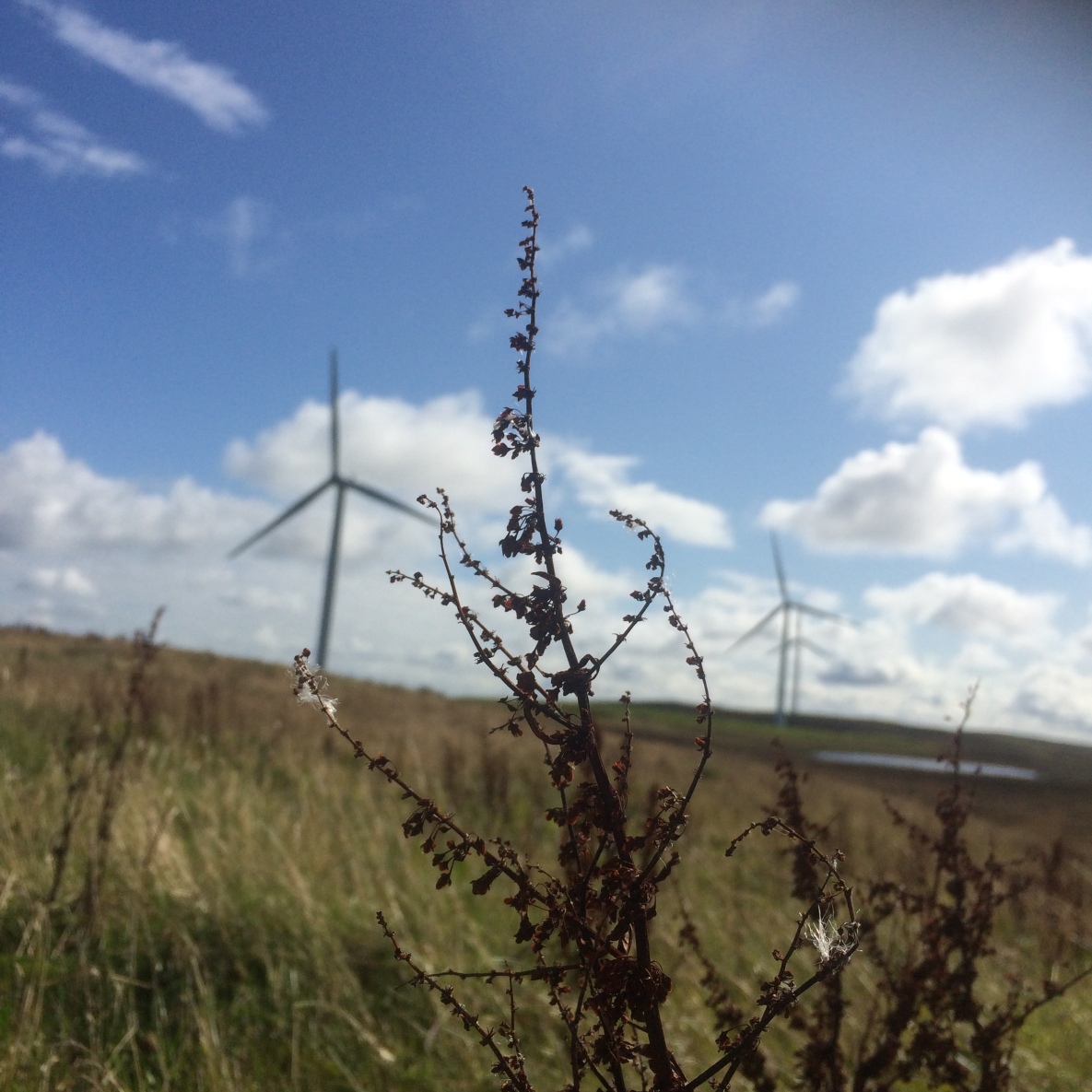
At one point in the trip, we visit the Burgar Hill Energy Project in Evie, alighting from the bus to stand underneath several massive turbines. The sound is wonderful, a deep churning whirr that feels like the air pressed charge on repeat. Under the chug chug chug of those great white wings we gathered, listened, moved and dispersed. I watch as our tight knit group begins to fragment; we need time apart to absorb this properly, little cells bouncing off and away from each other, quietly charged, loosening dots of pollen. Some of us finding the outer reach of the hill, looking for a view or panorama, leaning back to snap a photograph. I film the shadows windmilling dark the rough green grass. Capturing the turbines themselves seemed almost obscene. I don’t know why I was making them into idols, afraid to reduce them to pictures. It was easier to glimpse them in pieces, a flash of white, synecdoche. My friend Katy and I agreed the best photos were the ones out of focus, a bird-like blur against the blue.

Places I have been hit by wind:

  • The cloisters at the University of Glasgow, a wind-tunnel roar to blast out your thoughts post-exam.
  • The hills of Aviemore, my first and last time attempt to ski.
  • Ayrshire beaches in winter, icy particles of hail cast into my eyes and ears.
  • The last day of the Wickerman Festival, wrestling with tents that needed drying and folding, the wind blasting against my cliff of a hangover.
  • On the deck of a ferry, mascara stinging the black black veil of my lashes.

I am an air sign, Gemini, and there is something about losing your breath to elemental forces. I think I once finished a poem with a phrase like, ‘lashing the planetary way of all this’. We used to stand in the playground at school, brandishing our jackets like polyester wings, letting the wind move us forward, staggering in our lightweight bodies, our childish intuition of the way of the world. The pleasure in surrendering. Making of your body a buffeted object. Returning to Glasgow, I soon find myself hit with a cold, preemptive fresher’s flu; a weight on my chest, a diaphragm lag. A sense of my body heaving against itself.

On Orkney, I can smell the salt from the sea. Earlier in the summer, I was struck with wisdom tooth pain, the kind that requires salt-water rinses every half hour, not to mention agonised gargles of whisky. Wasting my precious bottle of Talisker. Amid the haze of those painkiller days, I felt closer to an elemental heat. Metonymically, I was inhaling islands. The taste of self-preservation, of necessary self-sustenance, is never as strong and unwanted as when you want a part of yourself to be wrenched out of you. Pulling teeth is an easy metaphor for lost love, or other forms of psychic distress. Breaking apart, making of the self an archipelago. There’s that song by The National, ‘I Should Live in Salt’, which always sticks in my head in granular form, occasional line. Refrain of refrains, ‘I should live in salt for leaving you behind’. I never knew whether Matt Berninger was singing about preservation or pain, but I saw myself lying down in a kelp bed, child-size, letting the waves lap over my body, salt suffusing the pores of my skin. Begin again, softer.  

IMG_3256

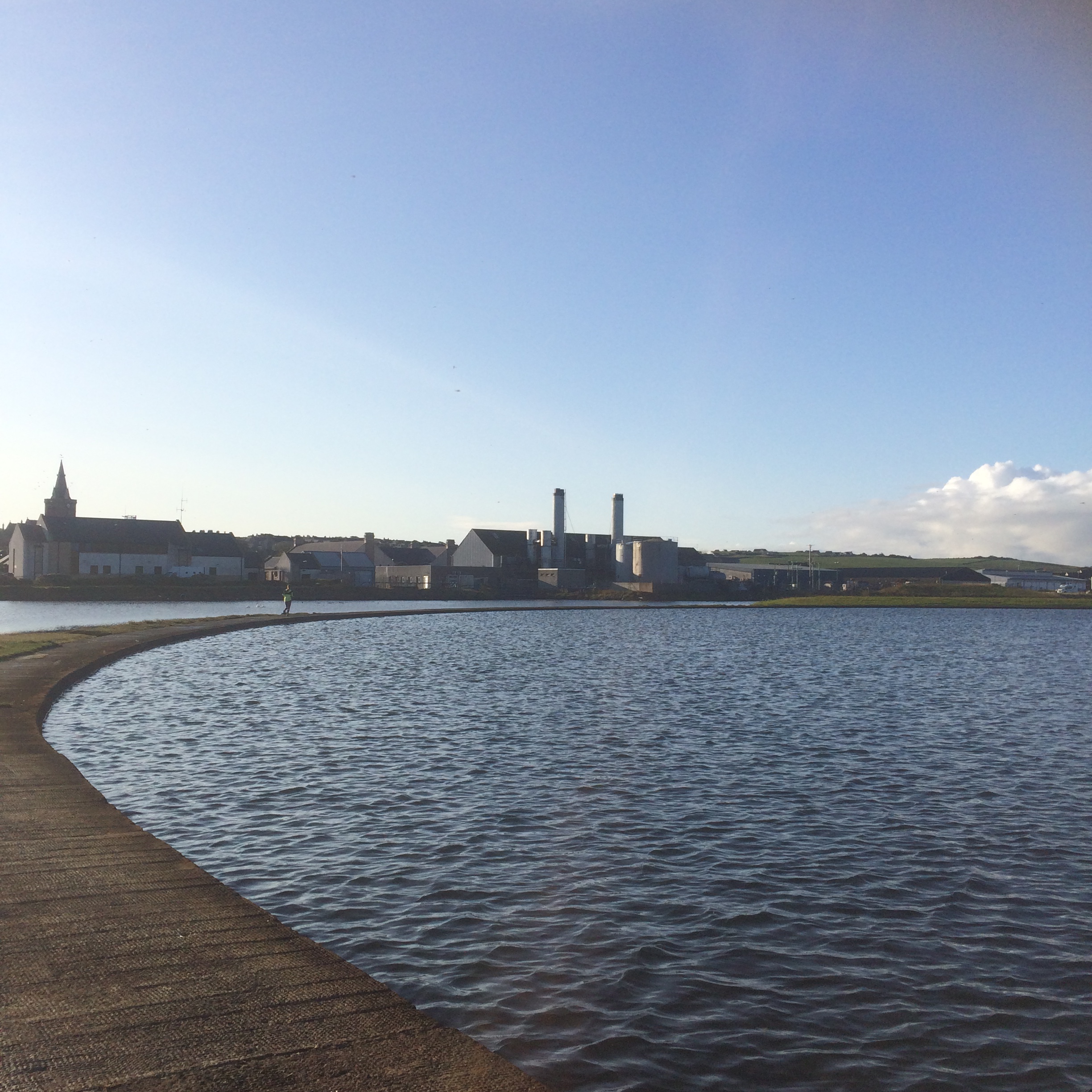
The rain here is more a tangential shimmer. I wake up to it, dreaming that my window was broken and no-one would bother to fix it. Fear of boundaries loosened, the outside in. The future as a sheet of glass, a shelf you could place your self on and drink. Salt water rinse and heat of whisky. We leave the hostel early and wander beyond the Kirkwall harbour, to the hydrogen plant bordering an industrial estate. Katy and I discussed our fondness for industrial estates as homely reminders. She would go running, and wherever she ran the industrial zones were inevitable. As if in any city you would reach that realm, it called you in with its corrugated fronts and abrasive loneliness. My love for the canal, biking up through Maryhill where the warehouses watch serenely over you, loom behind trees, barely a machinic rumble disturbing the birds. We traced the edge of a man-made waterfront, a crescent curving lip of land. The way it curled was elliptical, it didn’t finish its inward whorls of land upon water, but still I thought of Robert Smithson’s Spiral Jetty, or the cinnamon buns I bought from the Kirkwall Tesco. Finding a bench, we ate bananas for breakfast, looking out at the grey-blue sea, our fingers purpling with the cold. I like to think of the banana, Katy said, as a solid unit of energy. Here we were, already recalibrating reality by the logic of pulse and burn and calories. Feeling infra.

I love the words ‘gigawatt’, ‘kilocal’, ‘megabyte’. I like the easeful parcelling up of numbers and storage and energy. I am unable to grasp these scales and sizes visually or temporally, but it helps to find them in words.

IMG_3304.JPG

We learn about differences between national and local grids, how wind is surveyed, how wave power gets extracted from the littoral zone. My mind oscillates between a sonar attentiveness and deep exhaustion, the restfulness gleaned from island air and waking with sunrise. I slip in and out of sleep on the bus as it swerves round corners. I am pleasantly jostled with knowledge and time, the precious duration of being here. Here. Here, exactly. This intuition vanishes when I try to write it. A note: ‘I know what the gaps between trees must feel like’. Listening to experienced academics, scientists and creatives talk about planes, axes, loops and striations, ages of ages, I find myself in the auratic realm of save as…, dwelling in the constant recording of motion, depth and time. Taking pictures, scribbling words, drawing maps and lines and symbols. We talk of Orkney as a model for the world. Everything has its overlay, the way we parse our experience with apps and books and wireless signals. Someone takes a phone call, posts a tweet. I scroll through the conference hashtag with the hostel WiFi, tracing the day through these crumbs of perspective, memories silently losing their fizz in the night.

I grew up by the sea, in Maybole, Ayrshire (with its ‘blue moors’, as W. S. Graham puts it), but a lot of my thalassic time was spent virtually. I loved video games like The Legend of Zelda: The Wind Waker, where the narrative happened between islands, where much of the gameplay involved conducting voyages across the sea. The interstitial thrill of a journey. There were whirlpools, tornados, monsters rising from the deep. On Maidens Harbour, I could hardly reach that volcanic plug of sparkling granite, the Ailsa Craig, or swim out to Arran; virtually, however, I could traverse whatever limits the game had designed. The freedom in that, of exploring a world already set and scaled. Movement produced within constraint. In real life, mostly our bodies and minds constrain. What excites me now is what I took for granted then: the salt spray stinging my lips, the wind in my hair, the glint of shells bleached clean by the sea; a beautiful cascade of cliches that make us.

‘To wake up and really see things…passages from a neverland.’ Back in Glasgow, fallen upon familiar nocturnal rhythms, I find myself craving the diurnal synchrony I achieved in Orkney. Sleepy afternoons so rich in milky light. The vibrational warmth of the ferry’s engine, activating that primitive desire for oil, the petrol smell at stations as my mother filled up the car for journeys to England. My life has often been defined by these journeys between north and south, born in Hertfordshire but finding an early home in Ayrshire. Swapping that heart for air, and all porosity of potential identity. Laura Watt talked of her work as an ethnographer, interviewing the people of Orkney to find out more about their experiences of energy, the way infrastructural change impacts their daily lives, their health, their business. Within that collaboration, she tells us, there’s also a sense of responsibility: stories carry a personal heft, something that begs immunity from diffusion. Some stories, she says, you can’t tell again. The ethics of care there. I wonder if this goes the same for stone, the stories impregnated within the neolithic rocks we glimpse on Orkney. Narrative formations lost to history’s indifferent abstraction, badly parsed by present-day humans along striated lines, evidence of fissure and collision. All that plastic the ocean spits back, co-evolutions of geology and humans. Plastiglomerates along the shore. But Orkney feels pure and relatively litter-free, so goes my illusions, my sense of island exceptionalism. I become more aware of the waste elsewhere. The only person I see smoking, in my whole time there, is a man who speeds his car up Kirkwall’s high street. Smoke and oil, the infinite partners; extraction and exhaustion, the smouldering of all our physical addictions. Nicotine gives the body a rhythm, a spike and recede and a need.

We learn of a Microsoft server sunk under the sea, adjacent to Orkney. There’s enough room in those computers, according to a BBC report, to store ‘five million movies’. And so the cloud contains these myriad worlds, whirring warm within the deep. Minerals, wires and plastics crystallise the code of all our text and images. Apparently the cooler environment will reduce corrosion. I remember the shipyard on Cumbrae, another island; its charnel ground of rusted boats and iron shavings. The lurid brilliance of all that orange, temporal evidence of the sea’s harsh moods, the constant prickle of salt in the air. The way it seems like fire against all those cool flakes of cerulean paint. I wrote a blog post about that shipyard once, so eager to mythologise: ‘Billowing storms, sails failing amidst inevitable shipwreck. It’s difficult to imagine such disasters on this pretty island, yet there is an uncanny sense to this space, as if we have entered a secret porthole, discovered what was supposed to be invisible to outsiders…The quietness recalls an abandoned film set’. Does tourism lend an eerie voyeurism to the beauty we see, conscious of these objects, landscapes and events being photographed many times over? Perhaps the mirage of other islands and hills glimpsed over the blue or green is more the aura of our human conceptions, archival obsession—the camera lights left buzzing in the air, traced for eternity.

IMG_3328.JPG

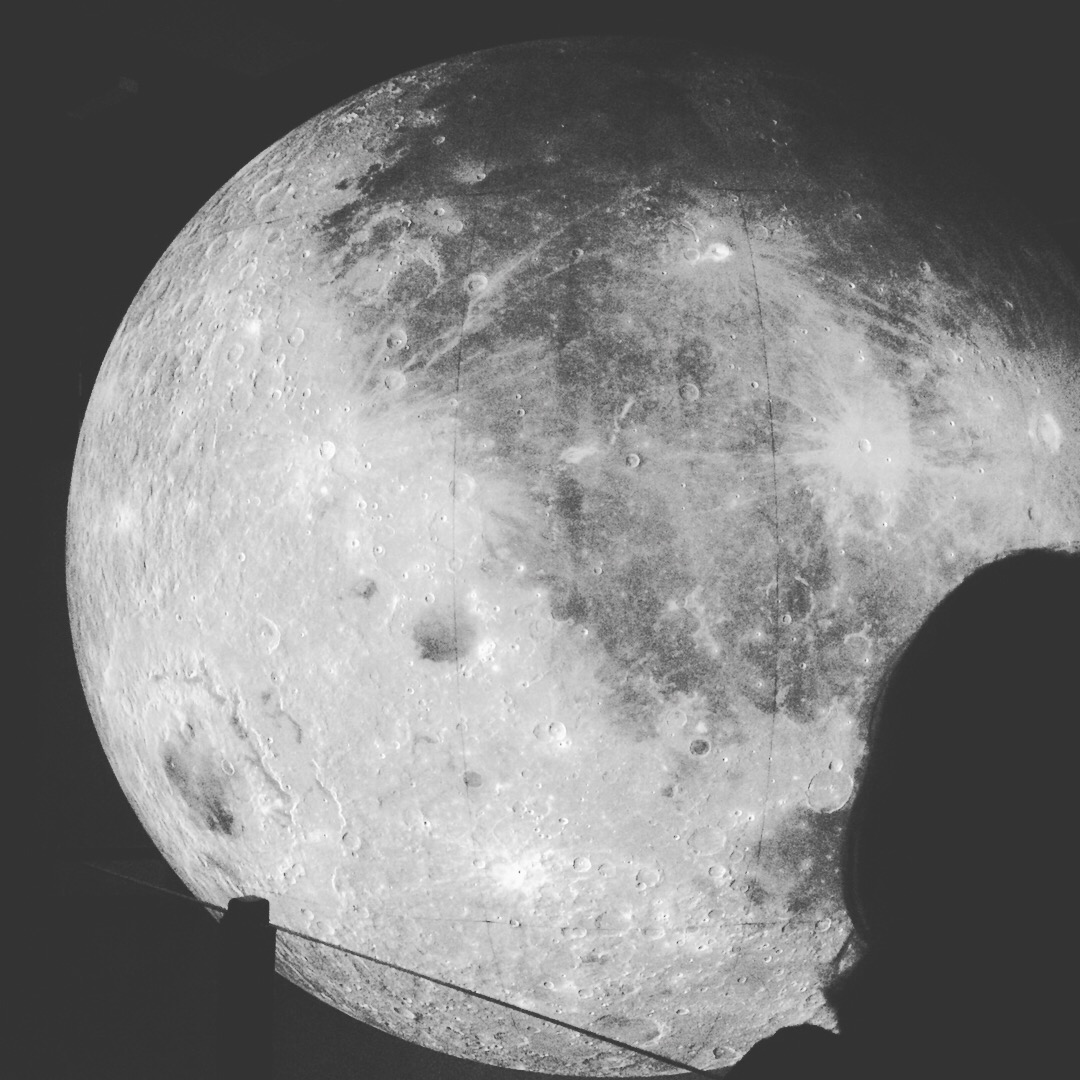
I come to Orkney during a time of transition, treading water before a great turn in my life. Time at sea as existential suspension. There have been some departures, severings, personal hurts, burgeoning projects and new beginnings. A great tiredness and fog over everything. ‘Cells of fuel are fuelling cells’. At the conference, my brain teems with this rich, mechanical vocabulary: copper wires and plates and words for wattage, transmission, the reveries of innovation. There is a turning over, leaf after leaf; I fill up my book with radials, coal and rain. My mind attains a different altitude. I think mostly about the impressions that are happening around me: the constant flow of conversation, brought in again as we move between halls and rooms, bars and timelines in our little human estuaries. We visit Stromness Academy, to see Luke Jerram’s ‘Museum of the Moon’: a seven-metre rendition of lunar sublimity, something to stand beneath, touch, lie under. I learn the word for the moon’s basaltic seas is ‘Maria’, feel eerily sparked, spread identity into ether. We listen, quietly, in the ambient dark, taking in composer Dan Jones’ textures of sound, the Moonlight Sonata, the cresting noise of radio reports—landings from a future-past, a lost utopia.

IMG_3348.JPG

On Friday night, Katy and I catch the overnight ferry back to Aberdeen. Sleep on my cinema seat has a special intensity, a falling through dreams so vivid they smudge themselves on every minute caught between reading and waking. Jarman’s gardens enrich my fantasy impressions, and I slip inside the micro print, the inky paragraphs. I dream of oil and violets and sharp desire, a pearlescent ghost ship glimmer on a raging, Romantic sea. Tides unrealised, tides I can’t parse with my eyes alone; felt more as a rhythm within me. Later, on land I will miss that oceanic shudder, the sense of being wavy. I have found myself like this before, chemically enhanced or drunk, starving and stumbling towards bathrooms. We share drinking tales which remind me of drowning, finding in the midst of the city a seaborne viscosity of matter and memory, of being swept elsewhere. Why is it I always reach for marinal metaphor? Flood doors slam hard the worlds behind me. There are points in the night I wake up and check my phone for the time, noticing the lack of GPRS, or otherwise signal. I feel totally unmoored in those moments, deliciously given to the motioning whims of the ferry. Here I am, a passenger without place. We could be anywhere, on anyone’s ocean. I realise my privilege at being able to extract pleasure from this geographic anonymity, with a home to return to, a mainland I know as my own. The ocean is hardly this windswept playground for everyone; many lose their lives to its terminal desert. Sorrow for people lost to water. Denise Riley’s call to ‘look unrelentingly’. I sip from my bottle, water gleaned from a tap in Orkney. I am never sure whether to say on or in. How to differentiate between immersion and inhabitation, what to make of the whirlwinds of temporary dwelling. How to transcend the selfish and surface bonds of a tourist.

The little islands of our minds reach out across waves, draw closer. I dream of messages sent from people I love, borne along subaquatic signals, a Drexciya techno pulsing in my chest, down through my headphones. My CNS becomes a set of currents, blips and tidal replies. A week later, deliriously tired, I nearly faint at a Wooden Shijps gig, watching the psychedelic visuals resolve into luminous, oceanic fractals. It’s like I’m being born again and every sensation hurts, those solos carried off into endless nowhere.

IMG_3389.JPG

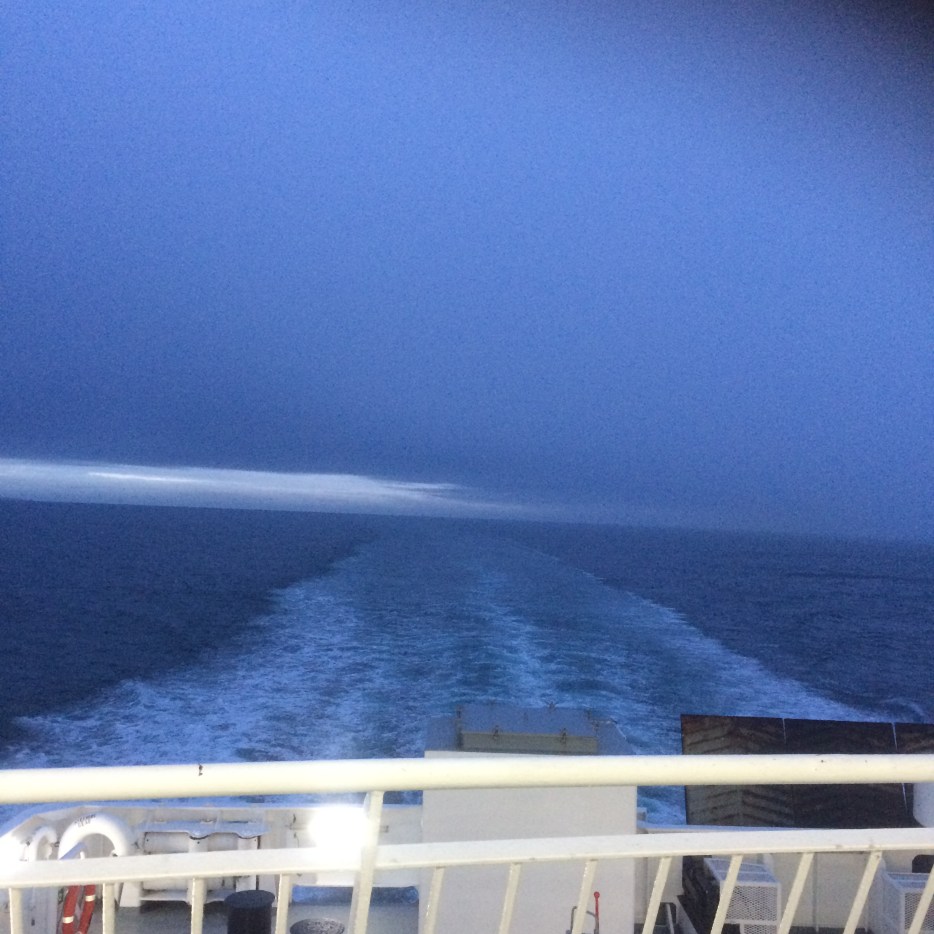
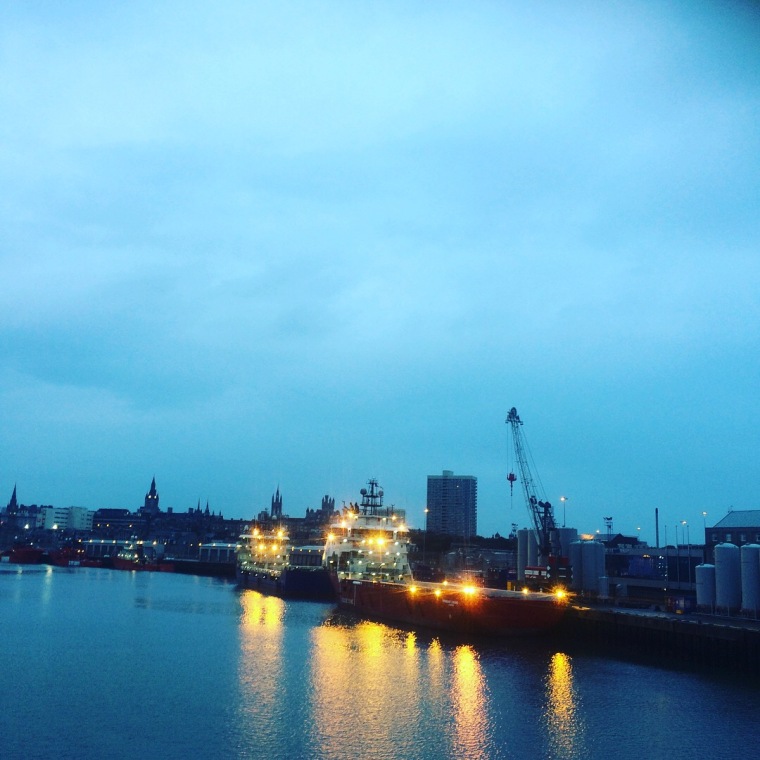
Time passes and signal returns. We wake at six and head out on deck to watch the sunrise, laughing at the circling gulls and the funny way they tuck in their legs when they fly. These seabirds have a sort of grace, unlike the squawking, chip-loving gulls of our hometowns, stalking the streets at takeaway hour. The light is peachy, a frail soft acid, impressionist pools reflecting electric lamps. I think of the last lecture of the conference, Rachel Dowse’s meditations on starlings as trash animals, possessing a biological criticality as creatures in transition. I make of the sky a potential plain of ornithomancy, looking for significant murmurations, evidence of darkness to come. But there is nothing but gulls, a whey-coloured streak of connected cumulus. The wake rolls out behind us, a luxurious carpet of rippling blue. We are going south again. The gulls recede. Aberdeen harbour is a cornucopia of infrastructure, coloured crates against the grey, with gothic architecture looming through morning mist behind.

Later I alight at the Waverley Steps again. Roddy in my ear, ‘Let the light be mined away’. My time on the island has been one of excavation and skimming, doing the work of an academic, a tourist, a maker at once. Dredging up materials of my own unconscious, or dragging them back again, making of them something new. Cold, shiny knowledge. The lay of the heath and bend of bay. I did not get into the sea to swim, I didn’t feel the cold North rattle right through my bones. But my nails turned blue in the freezing wind, my cheeks felt the mist of ocean rain. I looked at maps and counted the boats. I thought about what it must be like to cut out a life for yourself on these islands.

Home now, I find myself watching badly-dubbed documentaries about Orkney on YouTube, less for the picturesque imagery than the sensation of someone saying those names: Papay, Scapa, Eday, Hoy. Strong names cut from rock, so comforting to say. I read over the poems of Scotland’s contemporary island poets, Jen Hadfield for Shetland, Niall Campbell for Uist. Look for the textures of the weather in each one, the way they catch a certain kind of light; I read with a sort of aggression for the code, the manifest ‘truth’ of experience— it’s like cracking open a geode. I don’t normally read like this, leaving my modernist cynicism behind. I long for outposts among rough wind and mind, Campbell’s ‘The House by the Sea, Eriskay’: ‘This is where the drowned climb to land’. I read about J. H. Prynne’s huts, learn the word ‘sheiling’. Remember the bothies we explored on long walks as children. There’s a need for enchantment when city life churns a turbulent drone, so I curl into these poems, looking for clues: ‘In a fairy-tale, / a boy squeezed a pebble / until it ran milk’ (Hadfield, ‘The Porcelain Cliff’). Poetry becomes a way of building a shelter. I’m struck with the sense of these poets making: time and matter are kneaded with weight and precision, handled by pauses, the shape-making slump of syntax. Energy and erosion, elemental communion. Motion and rest. My fragile body becomes a fleshwork of blood and bone and artery, hardly an island, inclined to allergy and outline, a certain porosity; an island only in vain tributary. I write it in stanzas, excoriate my thoughts, reach for someone in the night. I think about how we provide islands for others, ports in a storm. Let others into our lives for temporary warmth, then cast ourselves out to sea, sometimes sinking.

Why live on an island? In Orkney we were asked to think with the sea, not against it. To see it not as a barrier but an agential force, teeming with potential energy. Our worries about lifestyle and problematic infrastructure, transport and connection were playfully derided by a local scholar as ‘tarmac thinking’. Back in a city, I’ve carried this with me. The first time I read The Outrun was in the depths of winter, 2016, hiding in some empty, elevated garrett of the university library. I’d made my own form of remoteness; that winter, more than a stairwell blocked me off from the rest of existence. Now, I read in quick passages, lively bursts; I cycle along the Clyde at night and wonder the ways in which this connects us, its cola-dark waters swirling northwards, dragged by eventual tides. I circle back to a concept introduced by anthropologists at Rice University, Cymene Howe and Dominic Boyer, ‘sister cities of the Anthropocene’: the idea that our cities are linked, globally, by direct or vicarious physical flows of waste, energy and ecological disaster. This hydrological globalisation envisions the cities of the world as a sort of archipelago, no metropolis safe from the feedback loops of environmental causality, our agency as both individuals and collectives. On Orkney, we were taught to think community as process, rather than something given. I guess sometimes you have to descend from your intellectual tower to find it: see yourself in symbiosis; your body, as a tumbled, possible object: ‘All arriving seas drift me, at each heartbreak, home’ (Graham, ‘Three Poems of Drowning’).


Analysis/Review: Roddy Hart’s 17th Annual Gordon Lecture and the Contemporary American Lyric

p04j7cmv
Source: BBC

Analysis/Review: Roddy Hart’s 17th Annual Gordon Lecture and the Contemporary American Lyric 

What a treat to listen to a lecture sprinkled with songs and stories, especially among the beautiful acoustics of Glasgow University’s chapel. After a rather spectacular introduction from Professor Simon Newman, singer-songwriter Roddy Hart gave the 17th Annual Gordon Lecture, organised by university’s Andrew Hook Centre for American Studies. Having collaborated with Kris Kristofferson, released an EP of Dylan covers and found success in the States with a stint on Craig Ferguson’s Late Late Show—not to mention running his own radio show for BBC Scotland and hosting Celtic Connections, the BBC Quay Sessions and the Roaming Roots Revue—Hart was well qualified to talk on this subject from a musician’s point of view.

Hart’s talk was a tribute to the great American lyric; to what makes it, in Hart’s words, particularly alluring, otherworldly and cool, especially to those who grew up outside of the United States. Admitting that he lacks an academic education in the history of American culture and music (actually, Hart has a law degree gleaned from within these very walls), Hart made up for this by sheer enthusiasm, celebrating the musical merits of songs from Woody Guthrie to Father John Misty and covering such topics as the journey motif, humour, darkness, nostalgia, politics and death. The talk took the form of a powerpoint, with Roddy speaking, singing snippets of songs and then commenting on their significance in a lucid, passionate way that kept everyone hooked for an hour and a half.

bob-dylan-ff51a1fc-5814-4717-8e71-9a49271fb47a.jpg
Bob Dylan / / Source: Rolling Stone

Hart began with the assertion that lyrics are not poetry, or indeed literature of any kind. Lyrics, he claimed, involve respect for structure, rhyme, metre and field (all definitions you could apply to poetry…), a certain knack for a hook, a streak of ingenuity and originality. Like poetry, a great lyric can reshape how we view the world we live in, send ripples through the fabric of reality and inspire us to take action, critically reflect or wallow in grief. The distinction Hart draws between poetry and the lyric prompted a desire to find out what exactly his thoughts are on Bob Dylan winning the Nobel Prize for Literature. My own thoughts on this issue have never rested on a single position, and I don’t really know enough about the prize’s history to comment on Dylan’s suitability.  However, there have always been strong connections between lyricists and poets, from the likes of Langston Hughes writing jazz poems during the Harlem Renaissance to Kate Tempest releasing rap albums as well as a novel and poetry collections published by the likes of Picador and Bloomsbury, no less. Hell, what about Leonard Cohen? At the end of the day, all writing is a performance of sorts, regardless of how it’s delivered. I could talk about Roland Barthes here, mention ‘The Death of the Author’, how the reader ‘performs’ the text like a score of music etc etc, but I won’t digress. Basically: sometimes a poem seems built for performance; other times it rests more easily on the page, where the eye follows an intriguing visual form or dance of letters arranged on white space. While poetry can be a two-way street, I’m not sure how well Dylan’s verse works on the page. Admittedly, most of his songs tell interesting stories, but that deceptive simplicity often needs the nuance and expression of Dylan’s voice to draw out the subtler levels of irony, humour, derision or sorrow from straightforward-seeming lyrics. Just my two cents on the matter, though I still like to wallow in ambiguity when it comes to these distinctions.

Hart gives the proviso that his talk is meant to be a working definition of the American lyric, not a comprehensive history. He does, however, mention a few characteristic features. The prominent one, of course, is name-checking: all the best American lyrics will draw on the wealth of states, street names, famous bars and hotels. In doing so, they draw on a tradition, they write themselves into a history of locations, urban legends and folk tales. Hart illustrated this by starting with Paul Simon’s ‘America’, pointing out how the song documents a search for America itself; this idea that America will always be this endless signifier, sliding along the great highway of desire that stretches across desert, country and city, drawing across generations. On the way, the lovers in Simon’s song make the best of their adventure, cooking up stories from the characters on the Greyhound, honing in on material details. It’s this sense of taking the listener on a journey that’s one of the American lyric’s greatest seductions. As Simon sings, “it took me four days to hitchhike from Saginaw” the chords soar and there’s that sense of being lifted to somewhere radically elsewhere, an open field, road, desert. The sweet spot between freedom and sorrow, of missing something deep and mysterious, the impossible pursuit.

Hart traces such material details in songs by Kris Kristofferson and Dylan, this sense of a ‘quintessential American aesthetic’ which he quite eloquently describes as a ‘Moby Dick-esque hunt across America’. The whale, ironically, is America itself. The road narrative is central to the American lyric. It’s a romanticised, extravagant sprawl into the dust of the past and glitter of the future, marked by place names which glow with familiar warmth and legendary spirit. Hart argues that this is something specific to the American lyric; that a Scottish equivalent wouldn’t quite have that same epic effect. He even sings a made-up local spin on ‘America’ to prove it; a journey between Edinburgh and Dunoon falls pretty flat in comparison. Of course there’s something special about the land of the free, in all its bright mythology and promise, but it’s not as if Scottish bands haven’t tried it. There’s that famous line from The Proclaimers’ ‘500 Miles’ which immortalises an array of parochial towns ravished by Thatcher, deindustrialisation and eighties recession: “Bathgate no more. Linwood no more. Methil no more. Irvine no more”. Of course there isn’t the same expansive magic, but there is something epic about lyrically connecting the local to broader political discontent. Still, you can’t really compare the Proclaimers to Simon & Garfunkel…or can you?

ontheroadmap2.jpg
Source: lettere-persiane.blogspot.com

Back to America. Hart describes Dylan as the nation’s great scene-setter, effortlessly drawing a sense of the times from the wisping drift of personal narrative, of stories about people and their lives. Details shuffled together like cards and strung along a line of verse. While some singers make their politics clear in the didactic manner of protest, Dylan sets these more intimate tales against the backdrop of cities and an impressionistically vivid sense of history. Hart plays possibly my favourite Dylan song, ‘Tangled Up in Blue’ from the 1975 album, Blood on the Tracks, spending time going over the lyrics to point out the singer’s knack for detail, the narrative journey which documents a succession of relationships, places and jobs. That famous philosophy: you’ve got to keep on keeping on. There’s something more raw here than the cosy, apple-pie fuelled comforts of Kerouac’s road narratives, which always depend on money from back home. You can hear it in the howl of Dylan’s voice, which becomes more a sultry croon in Hart’s version. What does he mean by blue? There’s the blues, there’s the blue of the sky and the ocean—symbols of infinitude. It’s a signifier that shifts as easily as Dylan’s character, from fisherman to cook, as he crosses over the West, learning to see things “from a different point / of view”. Surely this is one the basis for democracy, the meritocratic ideal of fairness upon which the USA was founded: empathy? The ability to openly shift your perspective, to never stay too long in your own shoes. That existential restlessness, set against the backdrop of a shaky political atmosphere, the dustbowl sense of losing one’s bearings in a maelstrom of uncertainty, characterises many of Dylan’s songs and indeed many road narratives throughout literature and American lyric.

You can’t talk about the American lyric without mentioning politics and Hart documents the history of the protest song, from Woody Guthrie’s ‘This Land is Your Land’ to Tracy Chapman’s ‘Talking About a Revolution’: songs that pose an equality of belonging, that document the quiet desperation and struggle that takes place beneath the surface of everyday life. Rather than tangling himself in the barbed reality of contemporary politics, Hart opts to situate his chosen songs in the context of more general themes: the failings of the American dream, social inequality and the oppression of working people, all set against the turning tides of the economic landscape. It’s notable that most of these singers are men, singing about working men, often with reference to some vulnerable lost girl who needs saved. But then you have the likes of Anaïs Mitchell, writing visceral songs of longing and misplaced identity. ‘Young Man in America’ opens with this mythological, sort of monstrous story of birth: “My mother gave a mighty shout / Opened her legs and let me out / Hungry as a prairie dog”. Images of industrial decline, capitalist opulence and landscapes both mythical and pastoral are woven by a voice whose identity is a mercurial slide between human, animal and disembodied call. Skin is shed, belonging is only a shifting possibility. It’s a complex song, with native percussion, brass; moments of towering climax and soft withdrawal. The music mirrors the strange undulations of the American journey from cradle to grave, its dark pitfalls and glittering peaks, the cyclical narratives of the lost and forgotten; the “bright money” and the “shadow on the mountaintop”, the fame of the “young man in America”, a universal identity disseminated across a range of experiences. For this is the myth of the American Everyman, and Mitchell deconstructs it beautifully.

Gillian+Welch+gillianPNG.png
Gillian Welch / / Source: Born to Listen

On the subject of female songwriters, I was very pleased that Gillian Welch and Lucinda Williams got a mention in Hart’s talk. The self-destructive sentiment of Welch’s ‘Wrecking Ball’ reminds us that the experience of being ground down by the relentless demands of a marketised society isn’t confined to men alone. Welch’s ‘Everything is Free’, not mentioned in the talk though highly relevant, makes this clear. It’s a song about artists will go on making their art even if they won’t get paid, and the tale of how capitalism discovered this and cashed in on its fact: “Someone hit the big score, they figured it out / That we’re gonna do it anyway, even if it doesn’t pay”. Like Dylan, Welch finds herself winding up on the road, working in bars, working hard and regretting being enslaved to, well, The Man. ‘Everything is Free’ is a message of both despondency and hope, crafting this sense of the beauty of song itself as protest and freedom even as the structure closes in: “Every day I wake up, hummin’ a song / But I don’t need to run around, I just stay at home”.

Hart mentions how the American lyric provides an escape to those who find themselves trapped in the smallness of their lives. You might live in a nondescript town slap-bang in the middle of Scotland, where the musical climate favours chart music blasted from bus-stop ringtones, but then aged fourteen you discover Dylan or Springsteen and suddenly America opens up its vast, sparkly vista, from East Coast to West. This seems to be Hart’s trajectory, as his career—from the first tour with Kristofferson to his continued promotion of transatlantic connections—closely follows an American strain of songwriting. My mum used to listen to Welch’s Time (The Revelator) album over and over again on long car journeys, so the lyrics to all those road songs are burned in my brain like tracks in vinyl, superimposed with endless visions of the M8 stretching out before me… It was only a couple of years ago that I found out Time (The Revelator) was released in 2001; I’d always assumed this stuff was ancient, the seventies at least. Maybe because Welch just has this knack for writing timeless songs; songs about heartbreak, loneliness and restless desire that reach back into the comforts of the past even as the journey itself is long and hollow, the destination vague as the blurred sign on the front of a train.

I guess this raises a broader question which Hart’s talk touched upon: the politics and poetics of nostalgia. There weren’t opportunities for questions afterwards, but if there were I might have asked Hart whether nostalgia is a necessary condition for American self-reinvention. It’s a pretty relevant  question right now, with much of Trump’s whole appeal based on the nostalgic vision of a vaguely industrial golden age of capitalism—a vision which is obviously the smokescreen for whatever chaotic ideologies are at work beneath the surface. The American lyric can set up this romanticised vision, only to break it apart; reveal its seedy underbelly, its failings, the disastrous gap between identified goals and actual means of attainment. Yet throughout the cynicism, there’s always that restless desire to continue, to keep on keeping on. Hart compares it to the green light in F. Scott Fitzgerald’s The Great Gatsby (1925), a novel significantly indebted to music (jazz, of course). The final line of that novel captures that past/present lyrical impulse so well: ‘so we beat on, boats against the current, borne back ceaselessly into the past’.

Which leads to the question: what about genre? Is the American lyric necessarily the domain of indie folk rockers? What about commercial music and pop? Can a pop artist deconstruct the American dream and earn a play in the lyrical family tree if they make money off their record and earn fame from MTV? Hart engages with Father John Misty as an example of how the American lyric can use humour to deconstruct the nation’s ideologies of progress and meritocracy, at the same time as retaining a post-postmodern self-awareness of identity politics, a meta-awareness of his own dabbling in ironic coolness. His very name evokes a sort of New Age gospel figure, a preacher for the times, whose stage is the television set or Twitter feed instead of the old-fashioned soapbox. Hart describes songs such as ‘I’m Writing a Novel’ and ‘Bored in the USA’ (obviously a riff on Springsteen’s classic) as depicting the ‘American dream for the millennials’. I’ve written about Misty extensively already on this blog (specifically, on his metamodernist tendencies), so I won’t go into detail here, but suffice to say I agree that FJM represents something special about contemporary cultural critique. It’s that blend of irony and sincerity, an exaggerated interrogation of the romanticism and the Gen X postmodernism of yore; the oscillation between raw subjective experience, political critique and the cool facade of self-deprecating wit. A constant juggling of ‘candour and self-mockery’, as Dorian Lynskey puts it. FJM notoriously got into a tiff during an interview with Radio 6 Music veterans, Radcliffe and Maconie. Aside from all the awkward sarcasm, what strikes me about this interview is the mentioning of kitsch merchandise objects: oven-gloves, jeggings. Hart explores a bit of kitsch lyric in the likes of Randy Newman, but I think FJM blends especially well that jaded sense of millennial despondence alongside tracks that can feel like rollicking simple narratives or epics of history on a 13-minute scale that gives Springsteen’s marathon tunes a run for their money. He pushes his stuff to the edge of the cheesy and cringe-worthy, exposing how all conviction has that shadow side of kitsch, even the most authentic lyrics—kitsch is somehow the cheap taste of someone else’s experience, the trick is to make it meaningful, and not just another imitation, a plastic model of the Empire State Building.

But Misty isn’t the only singer-songwriter deconstructing the American dream, exploring how both its poetic promise and jingoistic glory play out on a personal level. What about Ryan Adams, whose songs have that alt-country appeal of the restless bard? ‘New York, New York’, from his 2001 album Gold, opens with a Dylanesque lyric about shuffling “through the city on the 4th of July”, brandishing a “firecracker” that’ll break “like a rocket who was makin’ its way / To the cities of Mexico. The clean rhymes and ballad-like lilt of guitar are also very Dylanesque. But at some point I’ve got to stop making comparisons to Dylan, because ultimately this is reductive; it’s cheap and lazy music journalism. I do think, however, the ease with which we make these comparisons reveals something interesting about our generic assumptions. Guy has a guitar, sings melancholy songs about America and his place within it, a smart knack for a lyrical twist, occasionally picks up a harmonica? Instant Dylan; their careers overshadowed by a giant. (Note: I guess a similar thing happens with very talented female folk singers—the likes of Laura Marling—being compared to Joni Mitchell). But even Dylan doesn’t monopolise the American lyric. He might have a Nobel Prize, but this doesn’t crown him King of the Lyric Alone (or maybe it does?); we’ve got to tease out what exactly we mean by this term and how relevant it is in the fragmentary scene of contemporary music. Think with Dylan, but beyond Dylan.

Conor Oberst, formerly of the band Bright Eyes, is an artist who’s been branded with Dylan comparisons throughout his career (an extensive career at that; the precocious Nebraskan recorded his first album, Water, aged just 13). Sasha Frere-Jones in the New Yorker condenses many of my own feelings on the Oberst/Dylan comparisons: ‘Dylan is armour-plated, even when singing about love; Oberst is permanently open to pain, wonder, and confusion.’ Oberst is in many ways a liminal figure: cutting it out on the folk and country circuit  (Emmylou Harris and Gillian Welch appear on previous records) while hanging and collaborating with indie rock bands (The Felice Brothers, First Aid Kit, Dawes), flirting with punk (The Desaparecidos) and fitting with some comfort within the elastic nineties/noughties stratosphere of emo. Frere-Jones describes Oberst as a ‘poet-prince’, again opening debate on that binary between poetry and lyric that Hart sets up but that nonetheless remains slippery and problematic. Where Dylan espouse the solid wisdom of a sage or wandering bard, Oberst has a reticent, warbling quality that rises to epiphany but admits failure and the graceless fall into existential aporia. He wails like Dylan wails, but many of his songs have a fragility and surrealism that doesn’t quite match up with Dylan’s more assured narrative balladry. So in that sense, he’s a lyric poet in the more subdued, Keatsian manner, exploring the self in all its fragmentary, perplexing existence.

But he’s also very much an American lyricist. In his ‘mature’ career, Oberst hasn’t shied away from more directly tackling political themes alongside more personal songs. 2005’s ‘When the President Talks to God’ rips to shreds George W. Bush’s policies. Comprising a series of questions addressed to an audience, it more closely follows the form of a traditional protest song, laced with bitter satire: “When the president talks to God / Do they drink near beer and go play golf / While they pick which countries to invade / Which Muslim souls still can be saved?”. This is definitely a song to be performed, on a wide open stage or indeed to the even wider audience accessing broadcasts of The Tonight Show with Jay Leno, where he performed the song in 2005. Then there’s the angry, crunchy southern kick of ‘Roosevelt Room’, off Oberst’s solo record, Outer South (2009). Oberst’s later work isn’t as playfully weird and surreal as his early bedroom stuff, sure, but increasingly he masters the power of allusion that characterises American lyric, in Hart’s sense of the term: “Go ask Hunter Thompson / Go ask Hemingway’s ghost”. He’s addressing someone to be critiqued, wrenching them off their political pedestal: “Hope you haven’t got too lazy / I know you like your apple pie / Cause the working poor you’ve been pissing on / Are doing double shifts tonight”. There’s that apple pie again, symbol of steadfast Americana, fuel of the nation, the well-lighted place of a diner—a place of domesticity, stability and, let’s face it, commercial comfort. Oberst cynically dismisses the well-nourished white middle class politician, recalling a generalised story of poverty from material details: “And I’d like to write my congressman / But I can’t afford a stamp”.

7287149713eb38f78915555f9fe62624.jpg
Source: pinterest

Then there’s the frontier motif, the sense of America as a place of deep mystery as well as self-created landscape. Experiments with Eastern and Navajo cultures. Bright Eyes’ 2007 album, Cassadaga, with its album art requiring a spectral decoder to be fully appreciated, its envisioning of the singer as mystic or medium, channelling psychic forces through song. Cassadaga is very much a journey. The opening track, ‘Clairaudients (Kill or Be Killed)’ involves an extended spoken word sample of some kind of very American mystic who begins by setting us in the ‘centre of energy’, Cassadaga’s ‘wonderful grounds that have vortexes’, moving us through astral projections of a ‘new era and life’ that is changing, a message of hope, doubling back on the uncanny sense that ‘Cassadaga might be just a premonition of a place you’re going to visit’. Cassadaga is a real place, a spiritualist camp set somewhere between Daytona and Orlando, known as the ‘Psychic Capital of the World’. By naming his album Cassadaga, Oberst isn’t just name-dropping in typical hipster fashion, honouring local identity nor casting back nostalgically to a familiar place; he’s attempting to channel the energy of this location, interrogate its spirit, draw out its various psychic possibilities for the present. He sings of attempts to detoxify his life, of former affairs, of lost soul singers and the pursuit of a sense of belonging.

‘Lime Tree’ is one of the most beautiful songs Oberst has written. It’s a composite tracing of impressions drawn from various experiences, both personal or secondhand. While much of Cassadaga follows an upbeat, distinctly country sound in the manner of 2005’s I’m Wide Awake, It’s Morning, ‘Lime Tree’ closes the record with a dreamy, wistful serenity that recalls the likes of ‘Lua’, ‘Something Vague’ and ‘Easy/Lucky/Free’. Accompanied by angelic female vocals, ‘Lime Tree’ is ethereal, the guitar strumming minimal though following a certain continuous loop. Pale and lush strings contribute to the sense of being pulled downstream, giving yourself up to the languorous current. Ostensibly, it’s a song about abortion, about a struggling relationship: “Since the operation I heard you’re breathing just for one / Now everything’s imaginary, especially what you love”. But as in all good poetry, the beauty of the lyrics on ‘Lime Tree’ is their movement from specific experience to a vaguely spiritual voyage that gestures towards ending but instead finds the open plains of abyss, always suspended in paradox and ambiguity, the fault-lines between life/death, hope/despair, dream/reality: “So pleased with a daydream that now living is no good / I took off my shoes and walked into the woods / I felt lost and found with every step I took”. Home is a tidal wave, a churning wind, a shifting sand, a fragment.

tarotspread.gif
Source: crystalinks

America’s great confessional poet, Sylvia Plath, also explored mysticism, and her writing is rich with strange imagery, not to mention all those Tarot allusions in Ariel. In The Bell Jar (1963), the fig tree is the novel’s dark and mysterious heart, this vivid image that sprawls its symbolism through the text, a figure for existential paralysis: ‘I saw my life branching out before me like the green fig tree in the story […] I saw myself sitting in the crotch of this fig tree, starving to death, just because I couldn’t make up my mind which of the figs I would choose’. We might think of the connection between the term ‘roots’ and ‘roots rock’, its rhizomatic sprawl of influence never quite settling on a home even as a sense of home and locality is supposedly the music’s grounding purpose. Roots, of course, are always growing. The lime tree is an image plucked from a dream, but its significance is less clear in Oberst’s song than the fig tree in Plath’s narrative. Perhaps more than most contemporary songwriters working within a lyric tradition, Oberst is content to write from a position of uncertainty, in gaps and pieces of affect and narrative. The sound of his voice suspended over those gentle strings and strums is enough to make tremors in your chest, as if the slow vortex of another world were opening its mouth like the parting of the sea in someone else’s biblical or drug-enhanced dream: “I can’t sleep next to a stranger when I’m coming down.” The way of the lyric; so often the way of the lonely. Even as ‘Lime Tree’ might be a love song, it opens itself towards ending, loss, death: “don’t be so amazing or I’ll miss you too much”; there can never be plenitude in the journey: “everything gets smaller now the further that I go”. Bittersweet doesn’t quite cut it. It’s too subtle for that, a softly shimmering lullaby goodbye to the world, a retreat and a return, just like Nick Carraway’s vision of beating on but back into the past. The passage of an everyday spiritual pilgrim, the way we all are in life, our faces fading in the ink-blot of photographs. We turn back to look at ourselves through others, through words, just as Dylan notes how the girl in the “topless bar” “studied the lines on my face”.

A voyage through nostalgia, a quest for identity, belonging, an escape from something and a return, a desiring pursuit without end, a lust for life and ease into death; a twist of humour, a narrative of hope, aspiration and the failures that draw us back into the dustbowl. The American lyric is all of these things and more; its boundaries perhaps are pliable as the nylon strings on somebody’s battered acoustic guitar. Maybe it all culminates in madness and absurdity. For every One Flew Over the Cuckoo’s Nest, you’ve got The Felice Brothers’ ‘Jack at the Asylum’, a rollicking satire on the madness of contemporary American life which trades in richly surreal and absurd imagery to render the accelerated pace of this madness, crossing history in the blink of a screen flicker: “And I’ve seen your pastures of green / The crack whores, the wars on the silver screen”. Pastoral America is always already contaminated by an originary violence. Maybe the best American lyric depicts such realisations through personal stories, the relationships and encounters set against and embedded within wider structural phenomena, the recessions and closures and urbanisations. The Felice Brothers remind us, however, that all of this is secondhand, aspirational narratives passed down to us through screen culture, advertising: “You give me dreams to dream / Popcorn memories and love”. Once again, there’s that fluctuation between an earnest love of country to an embittered sense of its very elusiveness, the distant static shimmer of success whose failed pursuit we watch ourselves experience through the mediating comforts of daily life—the popcorn pharmakon poisons and cures for (post)modern existence, as calorific as they are nutritionally empty.

But once again, genre. String off a handful of names from Hart’s Americana playlist and you’ll be pressed to find anything that falls outside the folk-rock camp, even as its boundaries remain pretty permeable. Yet what of hiphop? Isn’t hiphop, in a sense, the great alternative American folk lyric? Rap is it’s own kind of poetry, after all. You might think of someone like Kendrick Lamar as an American lyric writer, working from a different generic background from Hart’s examples, but nonetheless telling the story of contemporary USA from the streets to the level of the visionary, just like Dylan did. Lamar even has a track called ‘Good Morning America’: “we dusted off pulled the bullet out our heads / Left a permanent scar, for the whole world to recognise / California, economics, pay your taxes bitch”. Once again, that originary violence, the scar of identity. Lamar works back from the wounding.

2c6fcf7f11a106ec68ee3464c221b2f8.jpg
Source: pinterest

My knowledge of hiphop is far too limited to discuss it in any detail, but thinking it through  the idea of American lyric prompted me onto the figure of Lana Del Rey, who often uses hiphop production techniques, from trap beats to muted, stadium echoes. I hate to bang on about oor Lana again (see articles here & here), but irresistibly she’s a shining example of a mercurial musician, drawn to the sweet dark chocolate centre of American melancholy. LDR performs a kaleidoscopic array of identities, just as Dylan often wore a mask that veiled itself in the confessional sincerity of the beaten-down worker, drinker, lover, escaping to the Mid-West alone. Yet while America’s great bard more or less got away with it, Lana has been constantly lambasted for her artifice and supposed inauthenticity. Which begs the question: what do we even mean by authenticity? Is only the white male—your Princes, Bowies and Eminems—allowed to strut in the performative identity parade? Both LDR and Lady Gaga have been lambasted for their supposed fakeness. There are obviously complex questions of racial, class and gender identity which I don’t have time to cover here. Sometimes, a musician is lauded for their alter ego (and doesn’t alter ego itself imply a certain surrender to the patriarchal ideology of masculinity?)—take Beyoncé’s hugely successful Sasha Fierce—and other times, it takes the invisible tide of the internet to swell in support for those critiqued by other forms of media.

maxresdefault-2.jpg
Source: YouTube

My friend Louise is always comparing LDR’s work to F. Scott Fitzgerald’s novelistic visions of 1920s America, and while this might seem a bit extravagant, there’s something to be said for the way Lana seamlessly evokes the spirit of the jazz age, the consumer paradise of the 1950s and the hipsterdom of millennial Brooklyn in the through the poetry of song. Is this just retroculture, in the sense of recycled kitsch and the twenty-first century urge towards nostalgia explored in Simon Reynolds’ excellent Retromania (2011)? Is there something pathological in Lana’s obsession with the past, a symptom of a broken psyche or worse, a broken generation? Perhaps. But there is something transformative and subversive about LDR’s retrovision, even as it may be critiqued for indulging in vintage gender roles as much as vintage styles (framing yourself as a sort of white-trash ‘gangster Nancy Sinatra’ is always gonna invite a certain feminist controversy, let’s face it).

One of Hart’s recent examples of the American lyric came from The National (even the band name evokes questions of what it means to be American), with their song ‘Sorrow’ from 2010’s dark and trembling High Violet. I’m interested in how this song apostrophises sorrow in the manner of a great Romantic lyric. We might think of Keats’ ‘Ode to Melancholy’ or Charlotte Smith’s Elegiac Sonnets, the eighteenth-century cult of sensibility remade for jaded and alienated millennials. Sorrow once again invokes that Platonic idea of the pharmakon as both poison and cure. We can wallow passively in sorrow, as The National sing: “I live in a city sorrow built / It’s in my honey, it’s in my milk”: it’s a trapped landscape, a petrified terrain in which the self can only slip deeper into isolation; but it’s also milk and honey, a kind of temporary nourishment to a darker psychic scar. As Smith so eloquently puts it in the final lines of 1785’s ‘Sonnet Xxxii: To Melancholy’: O Melancholy!–such thy magic power, / That to the soul these dreams are often sweet, / And soothe the pensive visionary mind!’. Sorrow provides a toxic tonic for the soul, a lubricant for paralysis that eventually leads us back towards the existential road. Life goes on.

Lana Del Rey is fixated on sorrow. Blue, she admits, is her favourite colour, her favourite “tone of song”. Her songs are always hyper aware of the transient beauty of life, even as they lust after death. On the soundtrack song she did for Baz Luhrmann’s adaptation of The Great Gatsby, she worries “Will you still love me when I’m no longer young and beautiful?” ‘Video Games’ is a melancholy ballad for the contemporary relationship, a lush, brooding expression of love in the time of Call of Duty. Roddy Hart even did a cover of it. Her songs have titles like ‘The Blackest Day’, ‘Cruel World’, Sad Girl’, ‘West Coast’, ‘Old Money’, ‘American’, ‘Gods & Monsters’ and ‘Summertime Sadness’. All these titles evoke the Daisy Buchanan sad girl trope at the same time as gesturing towards the broader existential melancholy of America itself in the manner of Springsteen; with sometimes the detached urban cool of Lou Reed, other times the genuine, trembling passion of Billie Holiday. The video for ‘National Anthem’ restyles Lana as a Jackie O type married to a young, good-looking black president, with 1950s iconography spliced among pastel-hazed footage of the pair lolling around in love, sniffing roses, smiling, looking good as a Vanity Fair shoot. The video begins with her character singing Marilyn Monroe’s famous ‘Happy Birthday Mr President’ routine. She re-envisions JFK’s assassination, with a spoken word piece on top. She’s imagining alternative political futures even as she casts back to the past. There’s that lyric sense of wonder and ambiguity, of being lost in time.

It’s this layering of styles, scenes and cultural iconography that makes Lana’s work way more complex than most of what else fills the charts. Sure, it’s great that a positive message of bodily empowerment (Beyoncé feminism) is doing the rounds just now, but that shouldn’t mean that those who fall outside this category are anti-feminist or ignorant to gender identity politics. When all the R&B pop stars are prancing around proclaiming their sexual freedom, dominating men in various flavours of BDSM allusion, getting all the looks in the club or whatever, LDR is crying diamond dust tears into her Pepsi cola, draped naked in an American flag. Her videos, songs and artwork engage with cinematic discourse, high fashion photography and cultural history in a manner that’s intellectual interesting as much as it is affective and aesthetically satisfying. In a sense, she’s meaningfully evoking the past in order to say something timeless about the American dream and the objectified position of the ‘white trash’ woman under its mast of starry glory. In another sense, she’s indulging in a postmodern recycling of historical styles: constantly name-dropping, from James Dean to Springsteen, Lolita—perhaps the great American road novel not written by an American—and David Lynch’s lush, dark suburban epic, Blue Velvet. Despite the performance and ventriloquy of figures and archetypes from twentieth-century cultural history, she retains a sincere expression of melancholy, heartbreak and longing that’s personal but also strives towards rendering the more universal experiences of womanhood in certain communities. All the controversy surrounding Lana in relation to racial politics, class politics and sexual politics exists because her work is provocative, problematic and complex, like any good American lyric.

One reason that Roddy Hart was such a good choice to deliver this lecture is that he’s had experience writing new melodies for Robert Burns poems for Homecoming Scotland. Why is this relevant to the American lyric? So much of the lyric tradition, in all its forms, is based on that sense of romanticism, visionary wonder, self-exploration; the rendering of universal experience through personal narratives, the subjective telling of a story, the trade in imagery and sound and careful arrangement. Burns was a sort of rock star poet of his times, and not just because he was a bit of a cheeky philanderer. He toured around, worked as a labourer and farmer; he talked to many people, opened himself to influence. It’s this diversity that continues to mark the American lyric in the twenty-first century; the way that Father John Misty can sing a very ironic and playful song on late-show tv, about a man checking social media on his death bed, with the conviction of a crooning Leonard Cohen; accompanied by a gospel choir whose voice raises Misty’s ballad to a level of epic, overly extravagant grandeur that still somehow works, remains genuinely compelling beyond the initial sarcasm. The way Detroit’s angelic avant-indie hero, Sufjan Stevens, can ambitiously and patriotically plan to write an album for every state in America, then turn on the project, calling it “such a joke“. The way that Suzanne Vega, in ‘Tom’s Diner’, sings about a familiar American institution, the fabled diner—or Well-Lighted Place, as Hemingway put it—with the simple verse structure of an Imagist poem made narrative, sketching brief impressions of the myriad people she encounters in a public space. It feels cinematic, with deep eighties bass, bursts of brass and string-like synths, but also has that emergent sense of a postmodern folk, looking at the world from the bottom-up, catching everyday lives and stories in song. Even when irony remains the chief aesthetic order of the day, the lyric doesn’t have to be sucked into self-referential abyss. The best singer-songwriters continue to channel the American lineage through a romantic strain as much as a humorous one, inflecting songs with sorrow, joy and vitally that lust for something more—sometimes beyond life itself, sometimes just the restless possibilities of the road. Singing alone in the Glasgow Uni chapel on a Thursday evening, Roddy Hart rekindled some love for all that.

*

American Lyric playlist: