In 2022, SPAM Press obtained some funding from the Edwin Morgan Trust’s Second Life Award to run a year-long project titled Brilliant Vibrating Interface: Queering the Post-internet through Poetry and Practice. My co-investigators on the project were Kirsty Dunlop (SPAM’s current editor-in-chief), Alice Hill-Woods and Loll Jung, with Ian Macartney later joining to co-edit our print publication. We squeezed a lot of activity out of that money: community workshops online and in Glasgow, a few reading events, print publication, ‘digital sibling’ and physical installation, podcasts and an online magazine interview with contemporary sonneteers.
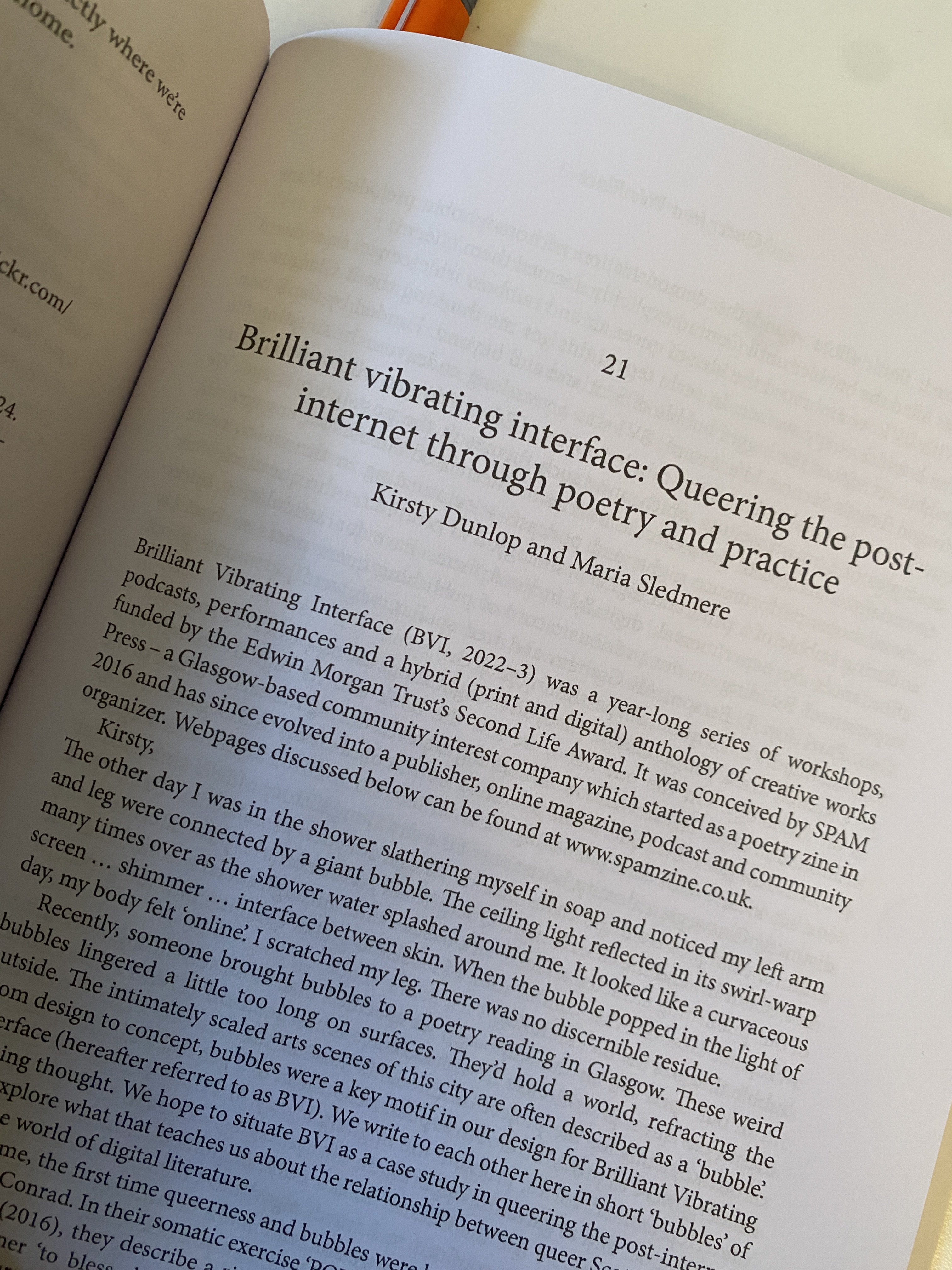
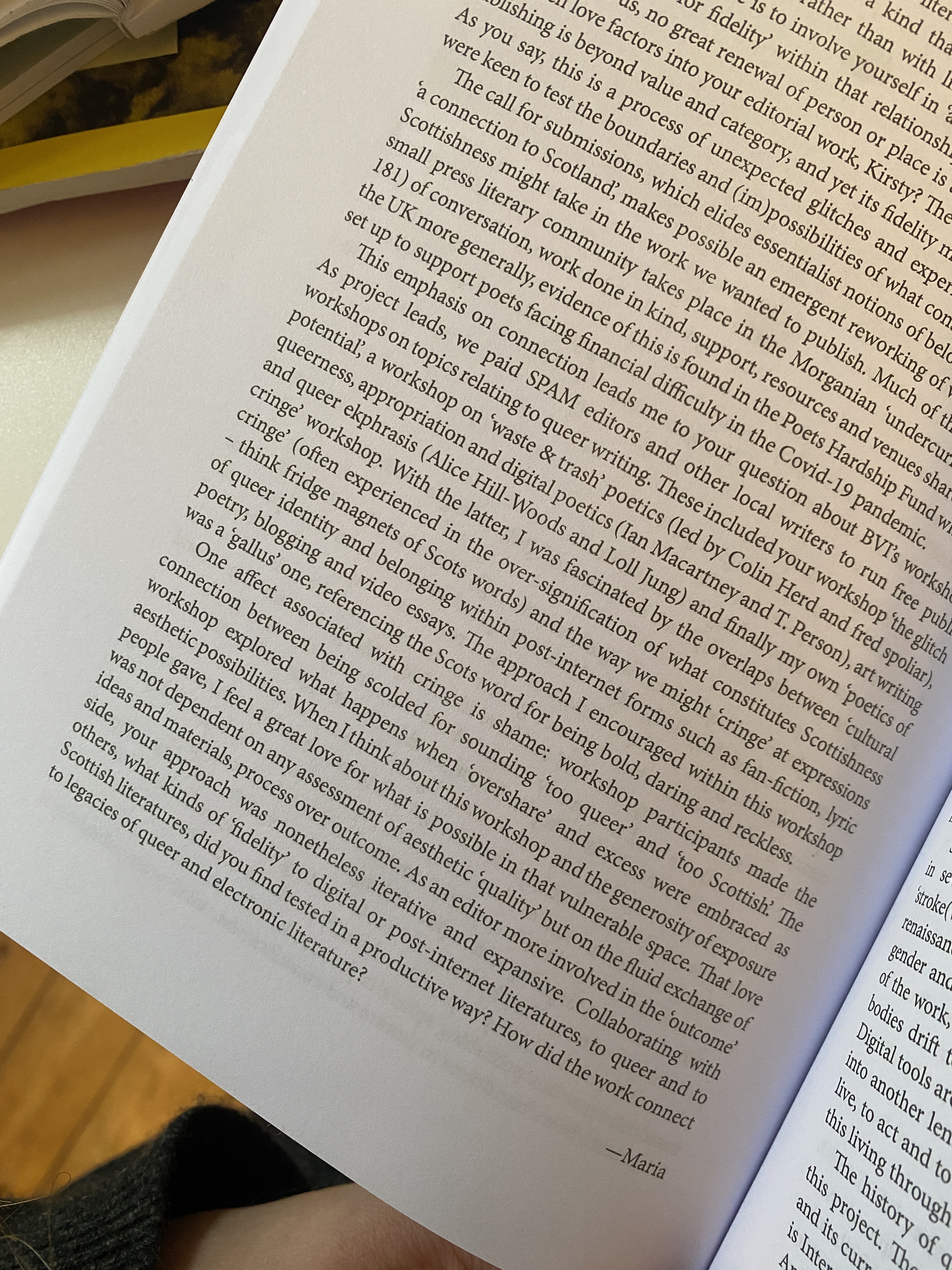
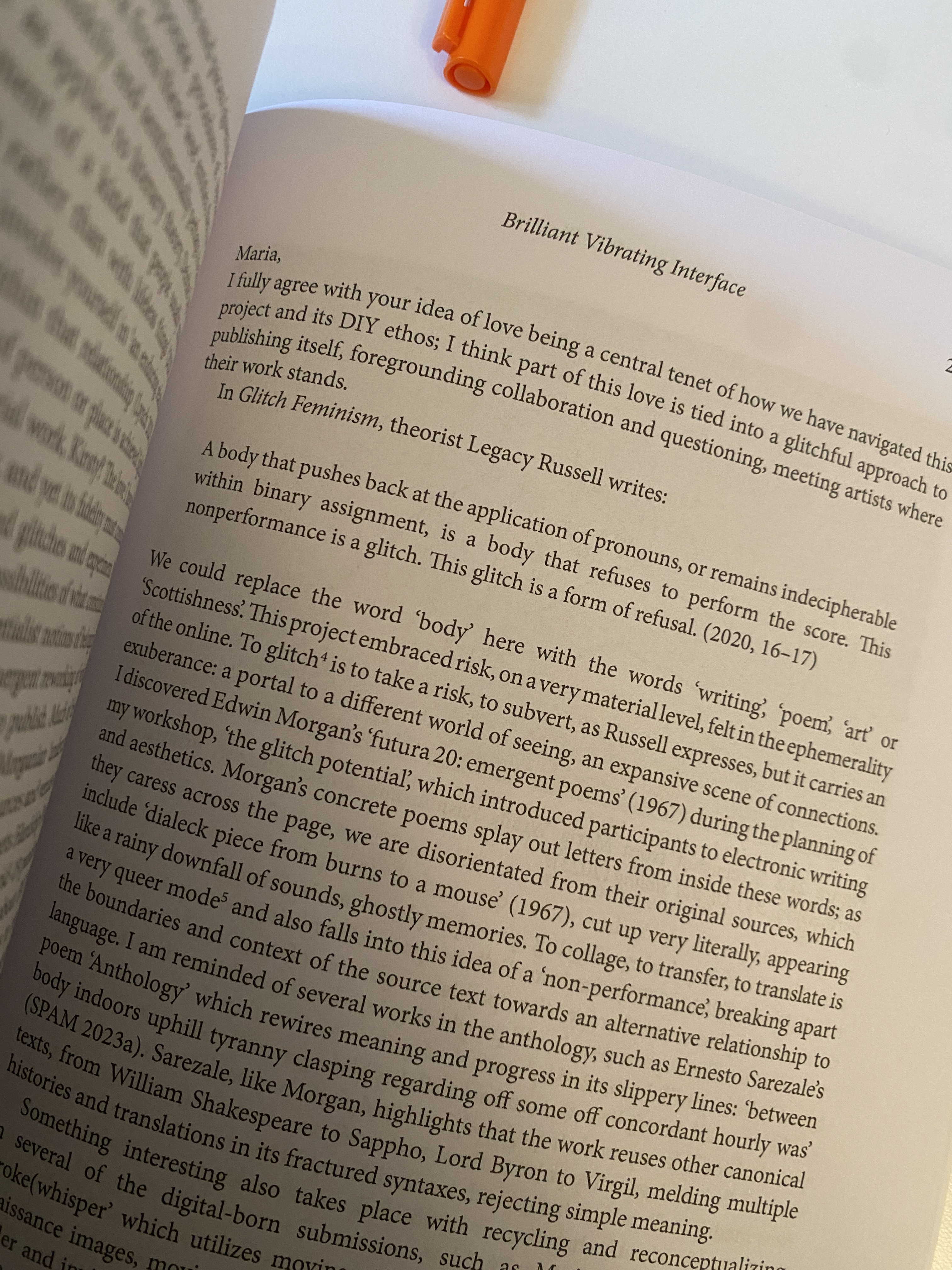
Recently, Kirsty and I wrote an epistolary chapter reflecting on the project and its significance in terms of identity, inequality, belonging, poetry scenes, queerness, Glasgow and the labour of love that is small press publishing. In our chapter we talk about the format of the project, Scottish literary scenes from the nineties to present day and the challenges and rewards of moving between print and digital (what we call SPAM’s ‘resolutely hybrid project’). We explore in more depth the poetry and visual art which found a home in our project and proffer up some poetics for how to think about queerness in the context of ‘small nations’ such as Scotland. This takes us everywhere from CAConrad’s bubbles to Legacy Russell’s glitch feminism to Edwin Morgan’s sumptuous strawberries.
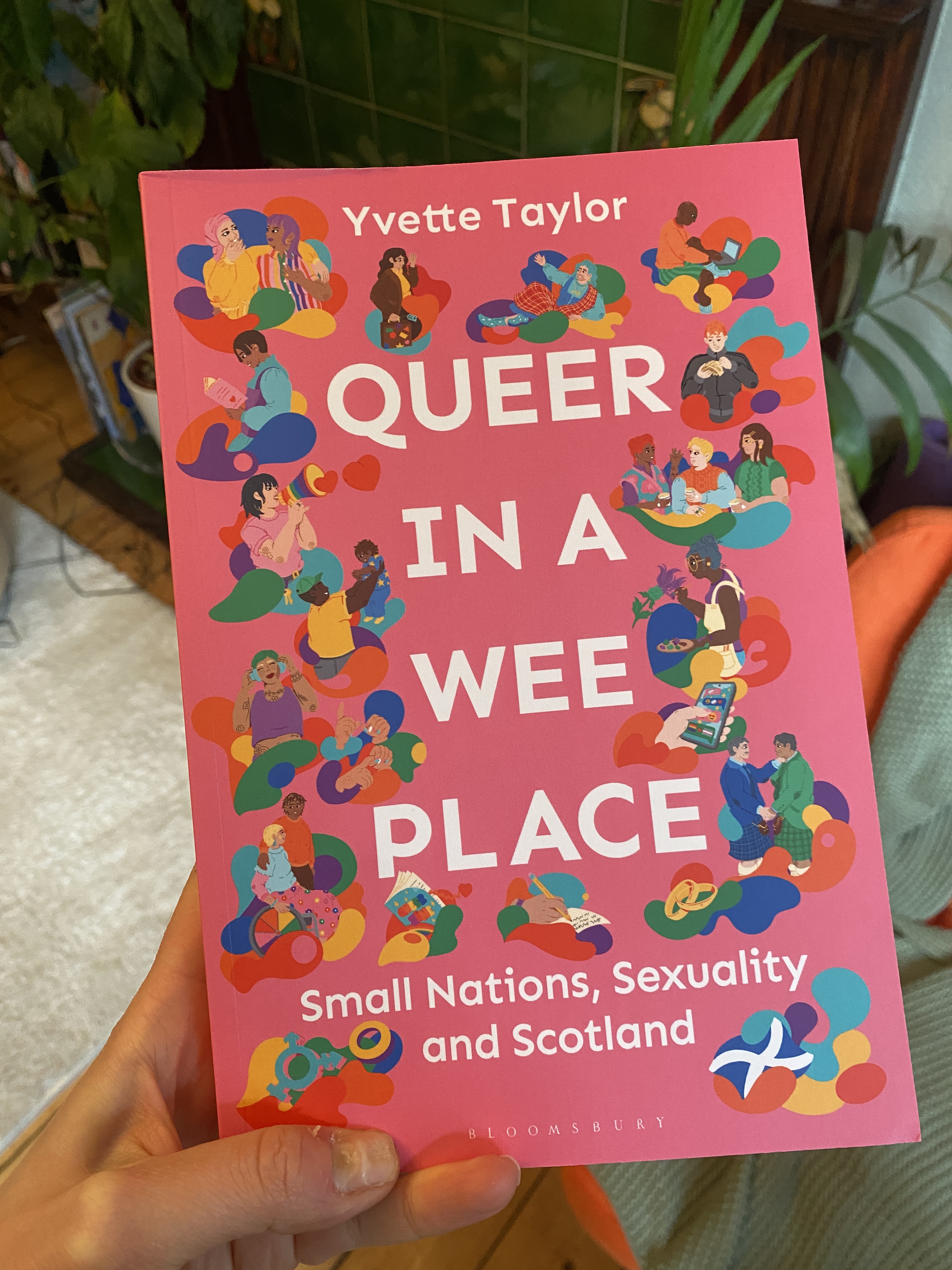
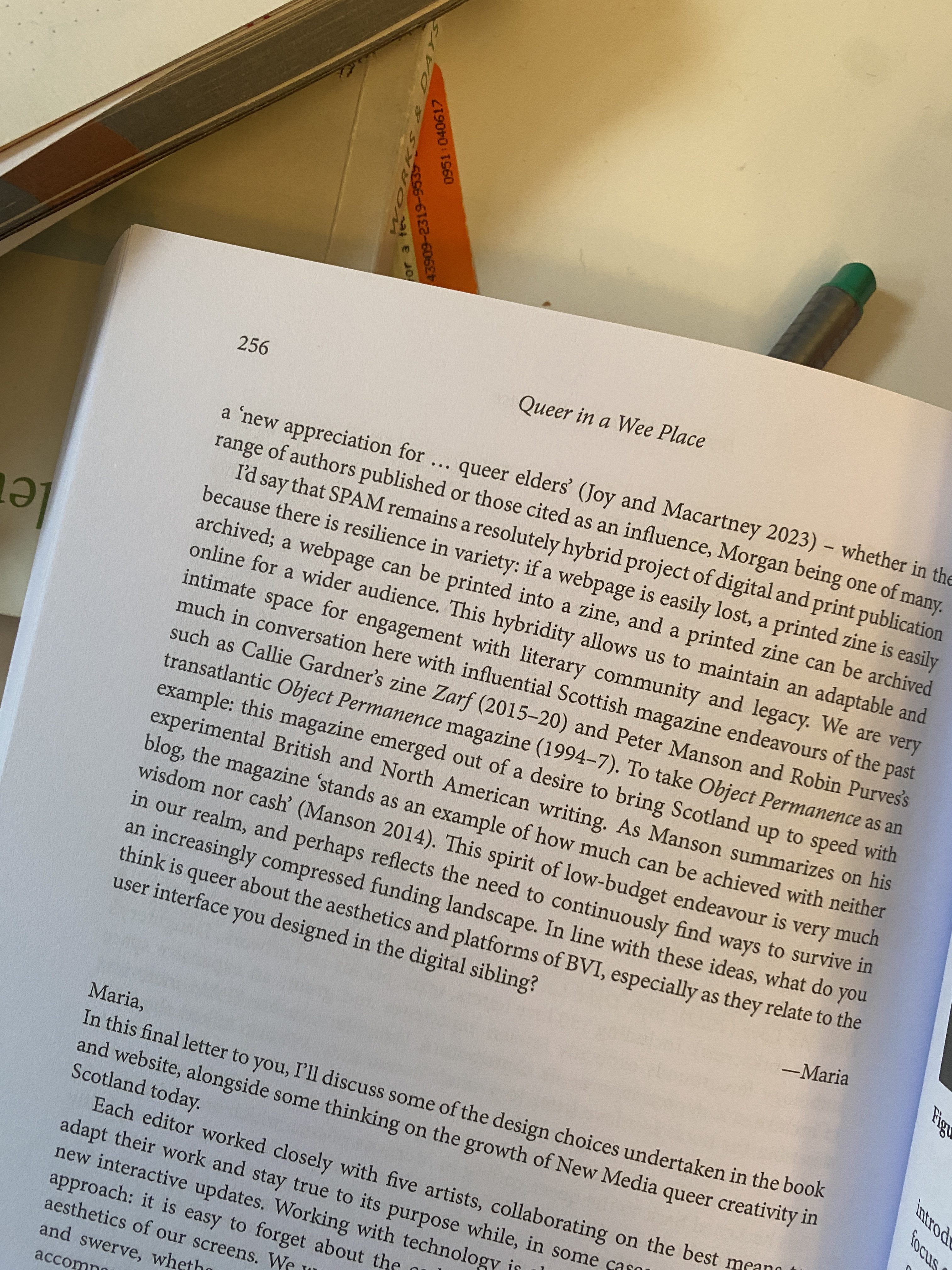
The chapter is out now as part of an anthology, Queer in a Wee Place: Small Nations, Sexuality & Scotland. To quote from the publisher’s website, the book ‘explores identity, inequality and belonging in animated conversations about how queerness moves through place – and how place, in turn, shapes queer lives’. Queer in a Wee Place contains chapters written by researchers of many disciplines and practices – from sociologists to poets – on subjects ranging from the utopic gaze on queer film to legacy and queer elders, disabled queer student experiences of higher education, Scotland’s menstrual landscape, hate crime and queer provincialisms.
The book is available in paperback form for what is a very reasonable price (for an academic book!) from Bloomsbury. You can ask your library to order it in for you 🙂
You can also read it for free via Bloomsbury’s Open Access service here.
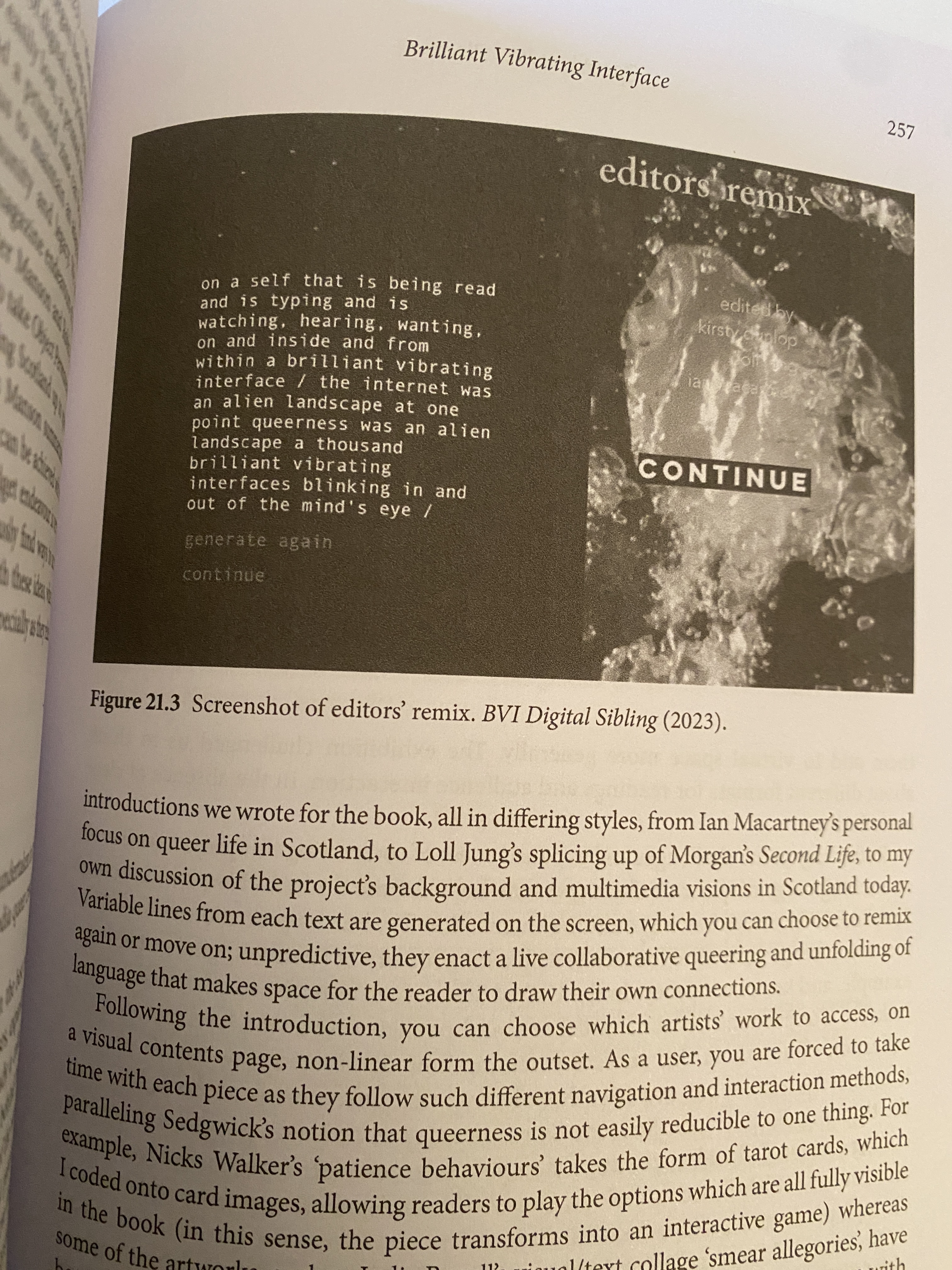
Our archive of materials relating to Brilliant Vibrating Interface, including workshop handouts, podcast episodes, interviews and the online exhibition (what we called a ‘Digital Sibling’) can all be found at http://www.spamzine.co.uk and on the EMT website.
It’s terrifying to write about love as someone who’s grown up with extreme behaviors in relationships that would always send me on an emotional rush. The lyrics explain the anxiety of a relationship having no end point and thinking, ‘Oh my god, this might work out.’ I wanted to capture that feeling that I’m finally safe.
Nursing their bleeding stars at the outskirts of asylum, Jazmin Bean plays nurse. Their bicycle is mint green and their hair is turquoise and they carry a box of medicine. When cleaning tables in my service job, I’d lip sync for real at the songs I’d play in my head to escape the music that was actually playing. When you fall in love it’s like bundling your stars into a bicycle and laying them all beside one another to clean them up, clean off the blood. Take them on a boat on the lake. Administer the painkiller to let them float back off to space. I listened to this song, Spotify tells me, more than any other in 2024.
The second song is ‘How to Rent a Room’ by Silver Jews. So when I’m listening reflectively to the Top Songs of 2024 in the linear unfold of a diary, the transition goes from three-minute perfect slice of zoomer britpop – Bean’s ‘I’m terrified / Sun in my eyes / I’m terrified / terrified’ – to Berman’s ‘I don’t really wanna die / I only wanna die in your eyes’ and the assonance of eyes/die/terrified collapses into the string section of mortal swoon. In ‘Terrified’, Bean sings about their first healthy relationship following a history of abuse and struggle in love. I’ve been following their work ever since Audrey Lindemann wrote about ‘Jazmin Bean’s Instagram’ for SPAM Cuts back in 2020. I kept thinking about that phrase ‘Imprisoned by Flesh’ as the locatedness of a room where men grasp at bedsheets and the elven blonde remains hugging their knees and grimacing. Lindemann described Bean’s aesthetic as ‘stradd[ling] a Butler-ian understanding of performativity and a Zoomer drive for authenticity’. The editorial implication of this piece is that we are reading Bean’s Instagram not just as art but also a kind of visual poetry. All of the gurlesque extremity channels into the emotional circuitboard through which I listen to ‘Terrified’. The transformation from this post-internet monsterkin to alt-pop star is pretty cool. The songs are bigger and more free. There’s space for the feeling to breathe.
Can we call this zoomer britpop? Atwood Magazine commented on the song’s ‘eruption of ’90s-era Britpop warmth’. I’ve been reassessing Britpop (capitalised here for History) with the Americans via the recent series of Bandsplain, where Yasi Salek and pals take on bands like the Happy Mondays, Blur and Oasis (and try valiantly to pronounce the various dialects associated with these bands). Britpop for me is the music that played as I nodded off in the back of my dad’s car, looking out the window or reading a book, looking for something else to do. Britpop, in its purest form, to me represents an emotional prototype for projecting personal excess and intensity. The actual lyrics should be fairly general and simple, with one striking detail. Your ‘wonderwall’ or ‘champagne supernova’, kind of like the novum of the song whose weirdness transforms all the ordinary detail like putting violet dye in an otherwise neutral lake. It also comes along with simple chord structures, homophony, melodic hooks, a compelling chorus or build towards it. EXUBERANCE (that is either swaggering or just a little unsure of itself). I am not trying to give a history of britpop I am just trying to get at how it currently resonates for me as a genre or perhaps more like a mode of music.
Another contemporary example of post-internet-leaning britpop for me was Grimes’ 2020 midi-acoustic elegy, ‘Delete Forever’ [‘I got super triggered when Lil’ Peep died’]. A song about addiction and dying that feels raw in comparison to the maximalism of Miss Anthropocene. I only just realised the line at the end of the chorus is ‘More lines on the mirror than a sonnet’. Sonnet = little song. Britpop anthems are sort of like little songs put through the maximalist ringer, or vice versa. When I walk through dawn listening to ‘Terrified’, what is it I’m feeling? Some proximity to that tunnel feeling of coming out the other side, coming into the light
and finding it utterly fucking scary.
I had some news in 2023 which changed the way I felt about life. I found out that by a 50/50 draw, I hadn’t inherited a harmful gene mutation which greatly increases your risk of cancer. This gene variant is responsible for breast and ovarian cancer is multiple family members, some living and some not. I’m still learning how to write all about this and I find it easier to do so through song. What rips you to shreds but melody in some of these moments? But the ripping when cast to melody is more like a ribbon. And I tie it around my wrist and I get on with it. Is the ribbon pink? I don’t know / it is more like a mirror or mobius trip. When Bean writes about ‘Terrified’ as capturing ‘the anxiety of a relationship having no end point and thinking, “Oh my god, this might work out”‘ she hits the real heart nerve. I feel like this about my whole life. For various reasons, I didn’t think I’d live past fifteen, then I didn’t think I’d live past thirty. By ‘live’ I mean literally and figuratively. It was hard to imagine pushing past those milestones into further life, existence, going on. Then I was given this gift in the form of a medical letter. It trickled into everything. It was real in the moment but long-term really just a symbol or sign (I will get sick like everyone else, my stars will still bleed). At the start of 2024 I walked around listening to this perfect three-minute song because it was a homeopathic dose of the new scared-hope I was administering myself. A tiny infinity. I let a few of those stars back up. They’ll return for me.
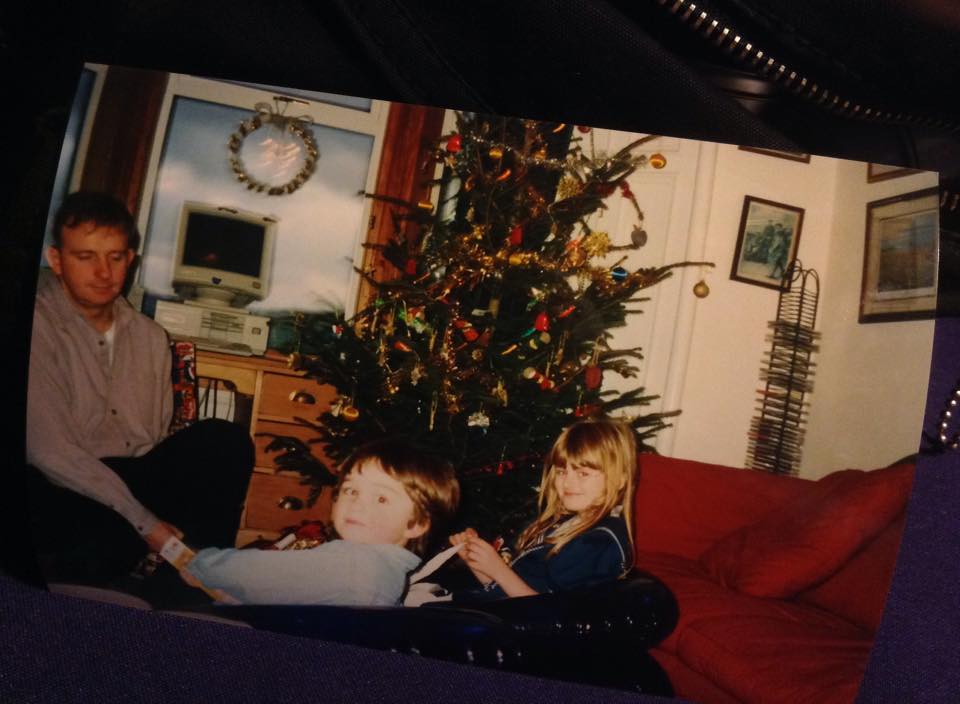
My dad, brother and I at home in the 1990s, overlooked by a magisterial PC
In 1993, the World Wide Web was released into the public domain. There are many histories of the internet and this one is pretty idiosyncratic. I like asking people when they got their first desktop computer. The internet of 1993 could be navigated through bright blue hyperlinks and you would drift between websites. You would type stuff into AskJeeves and have no idea what to expect. At school we had a ‘passport to the Web’ certificate that could be obtained by completing numerous training activities on a twee little software whose name I forgot. It was something like ‘CyberKids’ though surely that is a New York City raver subculture from a time not yet captured by the sleazification of all things indie 2000s. I imagine it was superior to the present Cyber Security Training on offer, in which actors pretend to discover pen drives in the street, gleefully insert them into work desktops only to find their screen literally blowing up in front of them. Nowadays, cyber security training is less about don’t talk to strangers and more about change your passwords regularly. I have a lot of floaty metaphors for the password changing which seem to all include underwear or car parts. Passwords though are pretty boring, clunky things but they’re also gauzy ephemera. Pieces of secret unlocking. Recently I spent an entire Sunday trying to unlock a 2011 MacBook. The password, when I found it again, accessing the deepest recesses of abstract memory, was unforgivably cherishable. I’ll keep it forever like a pet (I’ve already forgotten it).
I keep thinking about ressentiment as a sensation produced by the internet. I mean the internet’s failure. When I was a child, I adored the internet. Once we’d upgraded from dial-up, I would spend upwards of 12-14 hours almost nonstop on forums, games, LiveJournal, websites. I gravitated naturally from the virtual worlds of the Game Boy to the bigger screen of the laptop. Before I was even allowed internet access, I would simulate them by making endlessly complicated Powerpoints and Microsoft Publisher pages which connected to one another like a crude open world. I was beset by RAM crashes and Wi-Fi outages. We didn’t have broadband for a very very long time. My dad was one of the first in the village to have it. I would write letters to the broadband guy pretending to be my dad complaining about the speed of the internet. When I go back to the Shire now, I say things like ‘the internet here is ass’. I can’t get 4G at the semi-demolished and barely functioning station. We can’t find out if our train will come or not. We communicate as a brooding micro crowd, frowning and looking anxiously towards digitised screens whose flicker says only ‘delay’. There are no staff. The staff hide in a crisis. I can relate.
Ressentiment – deep hostility combined with powerlessness. The promise of an open world, a generous future, seems rotten. We hate it. It’s failed us. The sheen of that; it keeps nicking us like a pen knife writing sentences on the skin of our hard-worn feet. We can’t even quit the platforms, can we? The implied ‘we’ of a web community is now an absurdity. What have we seen of the Web in thirty years? Unimaginable horrors. Nevertheless, the perambulations continue.
Right now, I’m deeply interested in the dissonance between how we feel the internet ought to be structured, how it almost was, and what it’s become. The dream metaphors we might use for how it once felt to drift between websites, stumbling upon weirdness after weirdness, unlocking more zones of reality. This versus the algorithmic governmentality and corporate monopolies, ‘technofeudalism’ (Varoufakis) and the appification of it all. I think I got interested in poetry right around the time I fell out of love with the internet (2015). I would memorise passages of Charlotte Smith’s sonnets and learn to swoon over Keats. I felt there was something in the shifting stanzas, the intricacies of form, the dazzling surprises it produced and the infuriating difficulties of grasping the source code — a connection.
I still use the term ‘post-internet’ because I want to believe you can take what Tavi Gevinson in 2018 called ‘The utopian ideal of the internet’ and polish its ‘antiquated’ remains. You can still feel the affective charge of every Web-related signifier that has brushed your life. You can be desensitised to ‘internet discourse’ through the media proliferation of tales of digitality, its foreclosures of democracy, its moral flops, its proliferating conspiracies. But there are parts of you irrevocably brought alive by the internet. I am haunted by digital solastalgia. As a child who felt out of place, abjected from the beginning, I sought the Web as a place not for social belonging exactly but something more like beauty, information, elsewhere. I found little pockets of home all over the place. The web (I’ll stop capitalising now and step out of History) was an extension of the fictional landscapes I found in my dreams or when walking around, making up novels in my head which I did every day until I hit puberty and hormones ruined my brain forever (or whatever). I don’t really know where to find those places any more. They weren’t just artefacts and I know this because you can’t produce a screenshot of a website from 2003 and experience a sweet pleasing nostalgia in the way you could with say, a beanie baby. It was something about the world of it all, the navigation, the desire paths forged to get there. The post-internet, for me, is a lifelong quest in understanding that melancholia and homesickness of what comes after. What do I do with the feeling of ‘we can’t go back there, where do we go now?’. All this time, have I used the web itself as some elaborate metaphor for wanting more than a hostile, futile reality? It’s why I like infrastructure, databases, libraries: the promises of systems which take you somewhere. Which transit something. I also love loops, links and non-linearity.
What was the poetry that got me into poetry? It was Romantic in flavour, sometimes in era. Something between the locatedness and dislocatedness, the attention to daily life, the catapulting scale logic of the sublime, the dogged attempt to render the brain on Nature, the melancholy and mourning, the quiet adoringness, the slow accumulation of elements, the sense of quest, pilgrimage, the unexpected visitor at the door. The everpresence of something more mysterious than could easily be folded into waking life. The delicious fug of opium and promise of a language capable of killing pain. The shimmering excess. The imaginative extremities and morbid dullness of Romanticism were necessary supplements to what the web had done for my childhood.
I’ve been dwelling on this quote awhile, from a Spikearticle about ‘What’s after Post-Internet Art?’:
The technoromantic reimagines posting as liturgy, algorithms as messengers, and artists as saints. They reach into a glorified past for motifs and meaning that invoke the aura of life before memes.Their aesthetic flirtation with the materiality of technology is a double-edged sword, however, that blurs the lines between critique and commodity fetishization. The stakes for this ambivalence are high at a time when capitalist technology is threatening human dignity and agency. Do we really want to engender an emotional attachment to the internet?
Is the function of art to engender the emotional attachment or to transmute its energies into something other? In my day job, I spend almost a whole day a week dealing with academic misconduct cases relating to the plagiarism and hallucinations of Generative-AI. I am supposed to come up with ethical and interesting ways to engage new technology in the classroom, but I fantasise about whole server forms blowing up or quietly being sucked back into the toothpaste tube of Silicon Valley, as if none of this ever happened. At the same time, with two close family members currently undergoing heavy duty cancer treatment, I marvel at the wonders of modern medicine. I think about what Tracey Emin said when asked by Louis Theroux what she thought of AI, or whether there was room for AI art in the world. She says ‘thanks to robots […] that’s another reason why I’m still sitting here’ [presumably due to AI’s role in innovations in cancer treatment and her own recent experience of this]. She’s also like, ‘In terms of art, AI doesn’t really sit well with me, especially when I’m a compulsive, passionate, hot-blooded person who paints’. The contradictions of my feelings about machines get more extreme by the week. I feel born into this contradiction. It’s maybe why my former work twin Nigel would always leave old copies of Wired at my desk.
Does all poetry written after the ‘post-internet moment’ also risk the commodity fetishisation mentioned above? Insofar as it betrays its own lovingness towards the technology it otherwise seeks to critique? Do we want an archness of superior distance or can we do something else with that self-awareness? I think the affect touched upon by Kat Kitay’s piece in Spike is Romantic irony, you know when you realise the narrator is caught up in the situation being described. The Romantic poet speaker discovers they are also a character in the poem. There’s a kind of turn. Timothy Morton uses Blade Runner as a classic example of this, you know when Deckard realises he’s a replicant. Being asked the question, what do you know about the year you were born, for me is like being asked what do you know about what happened to the web? My life is a character in the web’s and the web is a character in my life. What’s the poem here? The continuous mess of everything enmeshed, written, performed, dialogued, deleted, drawn and coded in my lifetime. I have a hot-blooded relationship to the internet. It makes my fucking eyes twitch.
Is transmutation an alternative to merely engendering feeling? I like the word transmutation because I learned it from the great poet Will Alexander. It’s also used by Ariana Reines a lot. We’re thinking here about alchemical transformations in the realm of language, feeling, sensing. I want a poetry that is able to metabolise impossible feelings and in doing so, fuel its reader to think anew. Do I reassign the pain of childhood, the loss of some otherworldly dream, onto the external scapegoat of an enshitified internet? Is that okay? I think about all the times our art teacher made us sit at PCs unconnected to WiFi writing about the design of vintage radios and speaker technology. We had no access to books, the web or other resources to find out more about the designs displayed to us. So in lieu of history or context, we wrote acute, proliferating descriptions of what we saw. What it reminded us of. We found endless vocabularies for edges, colours, surfaces, affordances. This mind-numbing two hours a week was a little oasis from digital supplementarity. A cool, replenishing retreat from external stimulation. We sat on hard, tall stools and typed on clacky keyboards. A tiny little art factory. I had only my brain and the image. I didn’t know it at the time but I was learning that ekphrasis can have a communicative and transformative function. I wrote through the notion of writing about radios to escape the moment where I was supposed to be writing about radios. This did not prepare me for my Art & Design exam so much as it prepared me for poetry.
What do I do with my hatred of the internet? My yearning for it? I write poetry because poetry is a cheap form of that dream architecture I so longed for, all of my life, and I felt good making/using/playing. Marie Buck has a poem that says ‘The point of reading is asynchronous intimacy, and hopefully it works forever’. I said this to my colleague Rodge last week, when we were having one of our regular moments of private despair, and he prints it out and now it’s on the wall of my office. When I look at it I think about all the books out there and all the interesting things I’ve read on the internet and how connected I feel to other worlds. I just have to keep that connection going. I will never know what it’s like to have not been online.
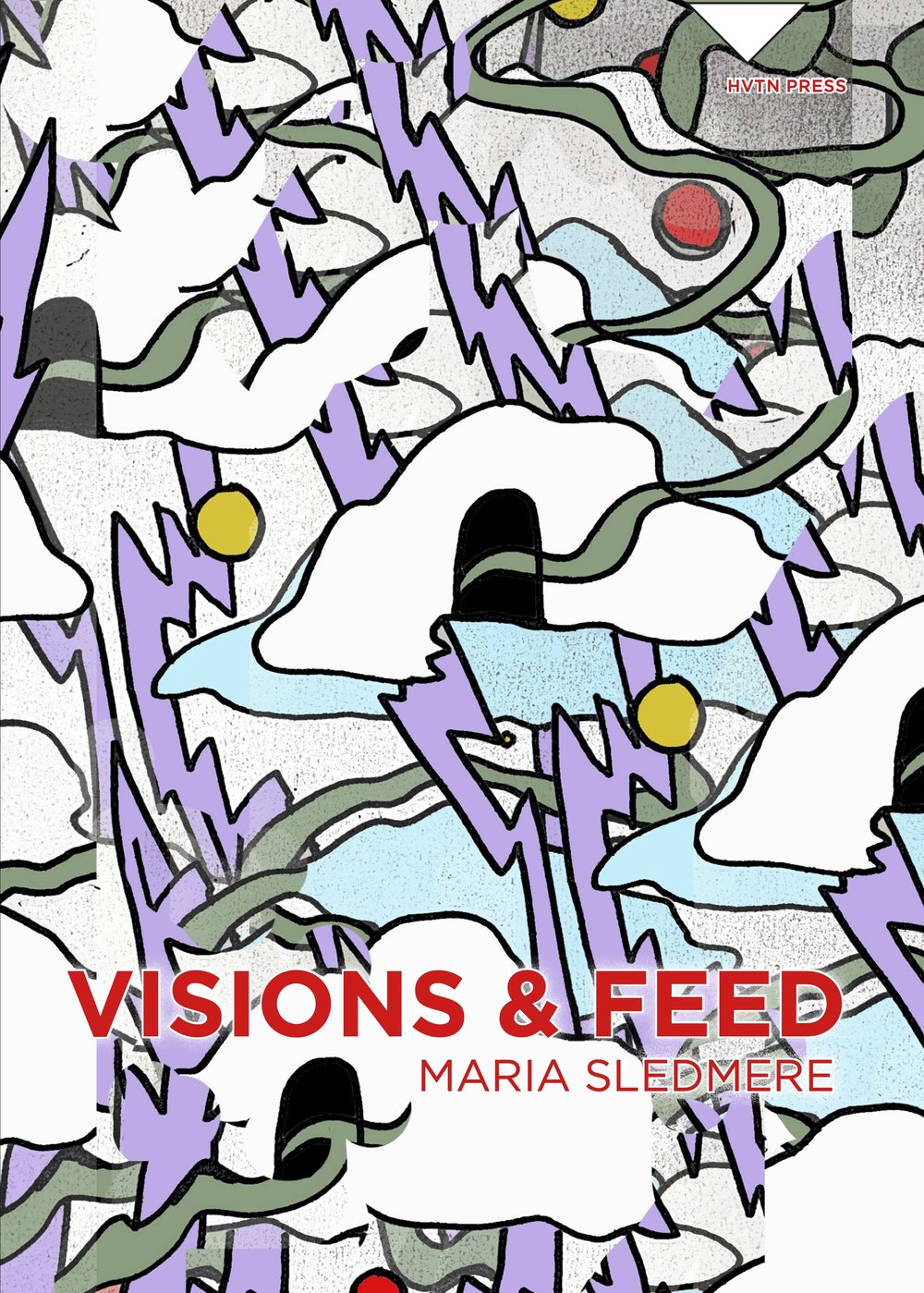
Visions & Feed is a collection that spans over two years of work brought together under the mirror phase of an anthropocene lyric filtered through crises of femininity, disordered eating, dysmorphia, labour and loss.
Sledmere asks: what does it mean to be a body in one of many dying worlds, what forms of work are done to endure it, what desires and pleasures are still possible and which are breaking down? Adopting playful and associative registers of ascent, while exploring devotion, metabolism, magic, domesticity and the ambience of dream forms, this is an intimate poetics of song and hormone, isolation and longing, fashion and pop, colour and vision in the saturated live feed of post-internet lyric. Amidst the reverb of climate melancholia and oestrogen blues, the speakers of Visions & Feed morph between depth and surface, film and music, myth and play to weather the days. Between epistolary, elegiac, confessional, ekphrastic, prose-poetic, processual, discursive and long-form cascades, the book offers iterative, experimental and fractal modes for exploring ecological entanglement within daily life.
This is my second full-length collection, following 2021’s The Luna Erratum. Many of these poems were written during lockdown or in the stretch of long afternoons at the tail end of big critical work that had occupied me for several years. I was immersed in dream and the idea of symbolic disclosure in poetry, lyrical shatterings and seeing oneself forever through glass, never clearly. Through a glass redly, purply, wrong. It begins with an epigraph from Maggie O’Sullivan’s Palace of Reptiles (2003): ‘A glazier walks through the earth calling the ruins strapped / on his back an angel’. How can poetry fit ruins into any transcendent firmament when the shards are still stuck in its back? I was admiring the glazier from afar wanting him to fix me. Suzanna Slack writes in The Shedding (2022) of ‘trying to have angel surgery’. In this book, my speaker seems to want a stomach replaced by clouds and to rain forever, why is that? I was born in a lightning storm with a lilac tongue and ate the suns like smarties. Fine. Very mild, even warm. To become glint in general felicity. Giving a zoo charm. Zooming.
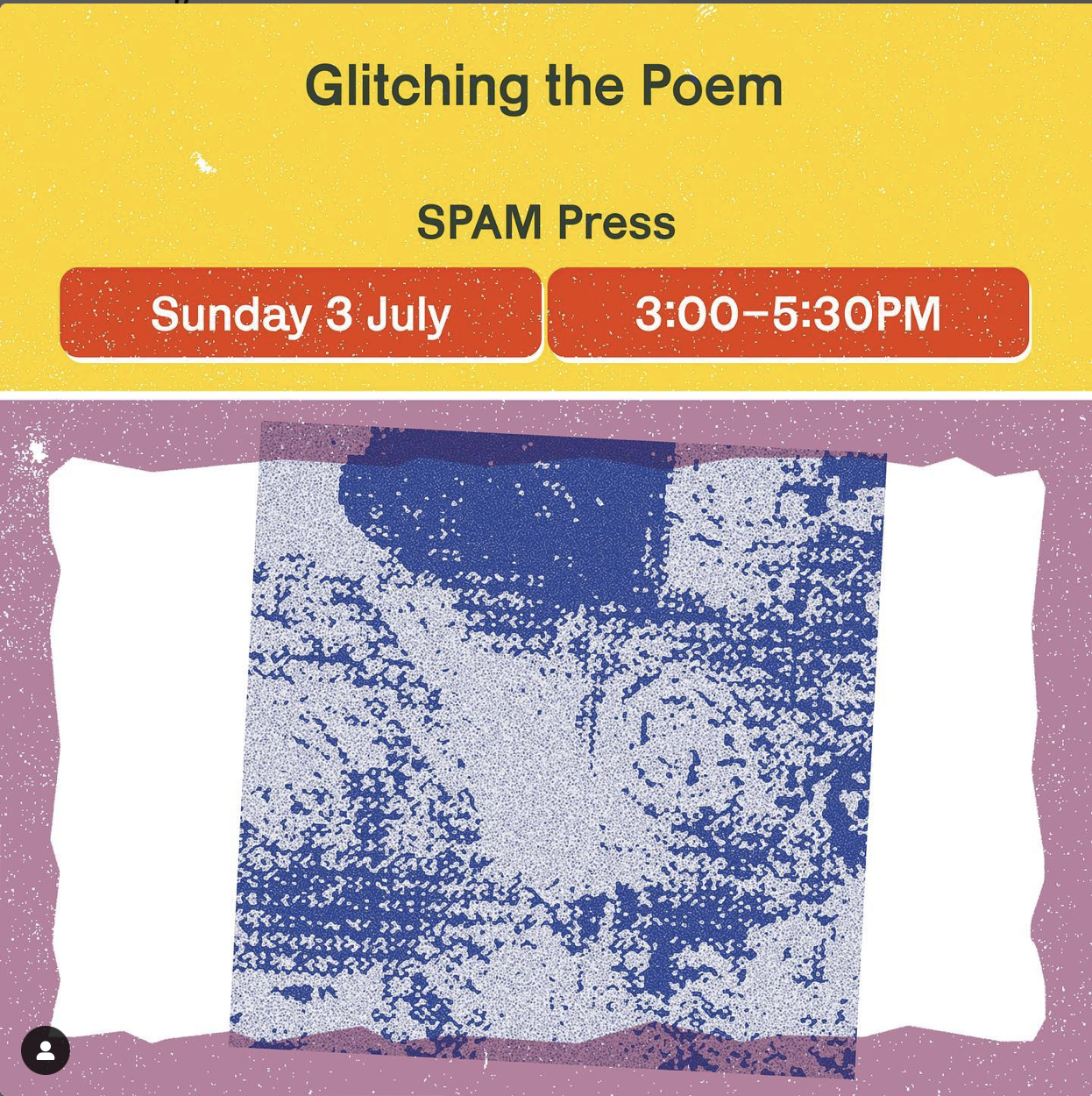
In Glitch Feminism (2020), Legacy Russell hones in on the sudden error of the glitch as ‘a form of refusal’. As our social, intimate and professional lives become increasingly directed by the commercial algorithms of everyday media platforms, how can poetry intervene in the cognitive minefield of Web 2.0? Playing with text-mixing, collage and procedural forms, we’ll consider ways of glitching between interfaces of browsing/writing in virtual space and print, with time for questions and discussion.
Through cookies, advertisements and terms and conditions, digital capitalism constantly demands that we affirm the ‘yes’ of its systems. In this workshop, poetry will offer something alternative. We’ll break through the junk space of virtual realms and create innovative works within and beyond them, while exploring the world of SPAM Press. Asking what it means to be post-internet, to write from error, to envision the poem as an interactive environment. Let’s glitch!
This event will include: group discussions, reading out loud, reading alone, writing, sharing work that has been created in the workshop.
Writing in the gloaming I would even call meadow, its scorched-out centre you can probably see from a helicopter, a drone, should you choose the option of aerial photography and remote capture in a time of social distancing. Should you have access to that tech, perhaps in a speculative way; should you have access, the way children have access because they discuss so thoroughly the possibilities, and they do this illicitly into the night. My excellent stenography skills, if we are calling this shorthand, were honed from adolescent hours on Microsoft Instant Messenger, affectionately known as MSN. Any one of us born in that particular bracket of the fin de siècle will understand what it means to spend time in one’s room alone, not quite as in ‘Adam’s Song’, but touching the void through sign-ins, statuses, emoticons, nudges. To live in the delirium of many glimmering windows. I wanted to call you up from my bower, listening to ‘Lime Tree’ on repeat because it carries me away; I wanted to call you up, but could I bear to put down my pen for this. You will never know if I am writing or typing; ‘this kind of thing’ bears no performative ellipsis. Had I known anyway what you would say, as someone who needs access to their own face to talk, something is coming away for free. We have been watching each other watch our own expressions: as with emoticons, each manner of the face feels curated. Some of us collapse on the phone. In the fractal reality of self-isolation, I divvy up zoomy contingencies of speech. When was the last time I talked without seeing my own face. Deleuze and Guattari argue that faces ‘define zones of frequency or probability’: the face ‘constructs the wall that the signifier needs in order to bounce off of’. Hoping to give you a meadow — multifarious and mysterious plenty — I yet give you the wall or the screen. A zoomy contingency that you are happy, that you had signed out of the chat. Against it I file down my voice to its lower registers, taking the edge off an earnestness. If you could measure the frequency of sleep, perhaps architects of the dream-state would salve the true riddles of twenty-first century expression. I wanted to call you up with a slow, perfected drawl, relay how I was hanging upside down from my bower. How I imagine the song to end is a very beautiful flower, floating down the river, but that is only how the song begins. It really ends with a daydream, ‘now that living is no good’, and the singer is lost and found as they enter the woods, barefoot like a child. Why am I telling you all this, barefoot like a child, now that I cannot tell the woods from the trees in my nameless life. And Coleridge sings, this lime tree my prison, my prison / feels like prism. If a wood haloed the meadow, if a moat, if a liquid loop — arboreal, molten, stupid. Walking in the scorched-out meadow an hour or more to be here, sometimes dreaming of this place, needing to be here — no longer a meadow for having been burned. What occurred to ruin the centre. I want to bounce, bounce, bounce with it. All my friends active now and forever. I stumble on the grammar of an instant; are you online, are you online in the meadow, I am calling you up to say this. I am checking-in, the way people used to on Facebook. What is the name of this place? The meadow goes undocumented. What is the probability that your face means the shape of a grassland, a patch of unruly narcissi, a noticing gesture that I would say I have been here before. At least in dreams. Someone is trying to brand the meadow. In quarantine, my old longing for those messaging days recurs. We all talked on that singular platform, confessed under pseudonyms, and ever since I have been lost in the trees of each channel — their foliage concealing the one true thing. Someone is trying to sell the meadow. Infinite recursion of memes and secrets and finance. There was a purity to MSN, something about its frequency. Namelessness. You see what I mean? Sometimes in the poem, I mean the scorched-out cindering middle of the poem, you take grace enough to say fuck it, hiya, wait, no, I can’t hear you. You hold ‘us’ in brackets. If I could timestamp the start to end of that, like debt. One time C. messaged me on Instagram to ask what is really meant by the gloaming. What time of day was this asked, did that matter? I think gloaming would be different at four in the morning to noon; but what did I give as reply? A quick skim of the platforms comes up with nothing. Besides, soon my battery will die in the old archaeology of dissolving thought. There was a purpose in calling you up for this, and now ants are crawling all over my notebook. Nothing has touched me for weeks. I want to say I have a lascivious craving for seaweed flakes, tousled hair, disco kisses, regular breakfasts, offline status, cetirizine, romance and saffron cakes. I have been touching nothing; lately asking myself what is it we do that makes us fruit. The blossoms are stirring on Montague Street. And you click and collect, you drag us backwards. I know that faceless, somewhere you construct the wall. Last night I ran down Great Western Road, my Spotify shuffling back to ‘Adam’s Song’, ‘Tomorrow holds such better days’. I felt burdened by the days inside the days, their seeming neon-fold, ‘the time goes by’ in the flicker of your eyelid. Because my eyes are screen-burned, hot-taken, hypothetical, exhausted; because my eyes looked too long at the meadow. Its torrified heart reduced to this logo. Because your eyes held green astride creamy lindens, to only open the same elsewhere, ‘No sound is dissonant which tells of Life’, etc. I was overwhelmed by the sweetness of power chords, the lines about apple juice spilled in the hall, harmony, the burden of a loss the size of adolescence itself. St. John’s Wort doled in the morning, soft-bitter ersatz taste of the sunlight and sensitive. I have no heart for war but air. How did I get here, on the brink of my phone battery’s untimely death, filling my notebook in the moonless April? Otherwise it would happen, haze, my father posting endless on his wall, unbeknownst to the standard quota expected on the book of the face. This feels so banal and yet I am telling you the grass is beautiful, endless, strange. Marigolds cluster around glitching trees, impossible to reach. If I could I would give you a pool of marigolds. Only just realised pool is loop backwards. Yellow and / I drag into blue and backwards to call you. I’m sorry I’ve been listening to ‘Lime Tree’ again — it’s just that this song came out in 2007, I was only fourteen, yellow + blue make green, I was starving and ever since then I’ve thought of this story. Something you could cut out from inside you, could burn from the meadow. A little kernel of narrative you tap with your tongue and your teeth, you give to me slowly. I want to leave the message to assure you, ‘It’s done’. Would you know I was talking about the disease? I was coming down from my bower, coming down, breezeless and sleepy, wishing I could call you up and quote the line, ‘Don’t be so amazing / Or I’ll miss you too much’. I wish I could climb through a window to see you, smooth myself right through the glass. Could I miss what I had not yet touched, in April’s middling haze of something receding. All those years you had told me to eat. Oh you know and you know and you don’t. Remember those hours? If we could give them back, little gifts of death, as Derrida says, like an ethics. It’s only me. I’m sorry if calling freaked you out from inside the machine. What I wanted to say was, it made me ecstatic, on GWR, zoomy the song and the voice and I could see Venus so bright in the sky. And the sky was rich as ganache, thick filled with more sky; Matty would say like chocolate, or saffron, or debt. Such a spooky ecstasy! (<3) The calorific night…I write you this so as to cut into it, hazy, reflecting, give you a slice of my dreams. Whatever anyone says feels charged with history, so I want this to be utterly redundant, depletable, delectable, careless as crossing the road without cars in the city that now never wakes or sleeps, but only deletes. The adventitious device, zoning close to us, is taking a photo. Is this a kind of labour. There are such archives beyond access they try for. Here, I will be always the small green light in lieu of a meadow, the lyrical unfinishing of cringe to know this. A breath I took / You can just call me up.




 mariaology