A second smaller heart: on writing The Indigo Hours

The first song I was ever obsessed with was Suzanne Vega’s ‘Marlene on the Wall’. It was on a compilation CD called Simply Acoustic that I’d found somewhere in the house. I’d listen to it over and over again on the CD player in my room. What I loved about this song was its narrative possibility. The protagonist triangulates her love affairs under the watchful eye of ‘Marlene’ looking down at her from the wall. My child’s mind made up all kinds of stories about this. Marlene could be an older sister, a mentor, maybe the lover of one of the men that passed through the life of her. Marlene seemed cold. She was not a jealous lover, she didn’t act out. Anything advised by Marlene is provisional, ‘what she might have told me’. I imagined her having very thick eyeliner.

For a long while, Marlene was a kind of angel to me. I saw her wherever I saw people on the wall. A Picasso print of a woman drinking coffee on a balcony. I haven’t been able to source this painting except to remember there was long dark wavy hair, the colours purple and yellow, coffee. I remember thinking it looked a little like my mother. It’s not something we kept when we had to clear her flat this summer. Maybe I took a picture, but I don’t want to look for it. Marlene showed up in my dreams. Marlene was there in my imaginary stories. I could never tell if she was the protagonist of a life or someone to whom things were done. She seemed to encapsulate a distant sexual maturity while also representing ‘the impossible’ and so, the untouchable.

*

I see 2018 as an apex year in my life. I remember dazzling summer nights, two kingfishers, kissing in the midst of cinders, hiding, my phone pinging constantly, no homework, sparkle emoji. This was the year I wrote the novella that Broken Sleep are publishing next week. I started writing The Indigo Hours partly in solidarity with a close friend who was writing a novella for her Masters degree. I was a year out from my MLitt and waiting to start a PhD. I don’t think we shared any work in progress; we just swapped manuscripts when we’d got to the end. I don’t remember writing this book. I don’t remember if I wrote it on my phone, a library computer, the Chromebook in the restaurant I worked at. Maybe it bounced between these locales. Maybe the bouncing was painful. It involved data loss. When I meditated today the AI-generated female voice said ‘find a point in your breath and this will be your anchor’. The point in my breath is a ‘flashing’ spot in my chest. It is an anxiety motor. It cannot be my heart because it is too centred. But of course it is my heart. Sometimes I think I have a second smaller heart lodged in my sternum, where I used to get an ache from purging. This heart is blue, a mottled and gold-streaked blue, and it is rare like the blue version of the rose, my middle name. Semi-precious.

I wanted to tell this story about two people kissing illicitly in a garden, surrounded by white poppies and mystery. I wanted to write about the indigo hour of midsummer dawn, when you are up all night with someone, the breath before a comedown, before it’s all over. I wanted to write about a relationship that felt like that and whose dramaturgy was always the dawn. I wanted to write about something that was ending over and over again, and the ending wasn’t the point. There was a life and people drifted in and out of it. I wanted to write about arousal and attention, sentiment and giving up.

The summer before The Indigo Hours took shape, I was writing a thesis about the curatorial novel, about object-oriented ontology. I was interested in what Ben Lerner says about fiction staging encounters with other art forms. For that to be embodied and taking place in a credible present. I was interested in the refrain of unseasonable warmth that haunts his novel 10:04, the way the narrator might have these hotspots of medial feeling owing to places in New York City where he received such and such a text. I was reading a lot of books that take place in the disintegration of some kind of love affair — Joanna Walsh’s Break.up and Lydia Davis’ The End of the Story (also loaned by the novella-writing friend). I don’t remember the plots of these books at all but I see them essentially as ‘novels that walk around, receiving and metabolising messages’.

Turning to write myself, I wanted to create a fictional world in the aperture of indigo, the special hours of Scottish nights in June and July where it never really gets dark — there remains this blueish glow to the sky. I knew these hours to be indigo because I didn’t really know what indigo looked like, only that it was some kind of shade of blue and everyone seemed to disagree about how light or dark it was. A morning and eveningness, a not quite. More like a mineral or texture.

How deep in the woods to go to get this indigo. How deep in love did we go, or in druggy reverie. It all felt so subjective, translucent. The love I was writing about was already belated, collaged and distributed unevenly through various places, fantasies and timelines. What could I say about it? This love that made an ‘I’ into both subject and object. That distorted the closure we had been raised on to believe was love’s destiny. It was an ambient intimacy, then. It was in medias res, ongoing. The midtone of indigo. In the process of editing the raggedy manuscript (what I referred to, in an email to the poet Callie Gardner, as ‘the trashy wee thing’) a couple years later, I discovered the phenomenon of indigo children. Since then I have learned more about what it means to be an indigo from the writer Laynie Browne. I relate this to a phenomenon of emotional & intellectual hyper-attentiveness my ex and I used to refer to as ‘shine’, also to a feeling of hyper-empathy and sensitivity not just to the mood of a room but to the mood of anything more-than-human. If you are capable of shine, if you are inclined to indigo, your presence might follow a gradient opacity. In Committed: On Meaning and Madwomen, Suzanne Scanlon has a chapter ‘Melting’ which talks about what it feels like to have ‘no glue’ and no security: ‘You could melt into another person, or melt into a place like this [a psychiatric hospital]’. This melting is akin to what Stephen King calls ‘the shining’ or what others call ‘sensitivity, insecurity, shyness. Fragility’ (Scanlon). I’m interested in how to put that kind of melting character on the page. What would her voice sound like?

A vessel, a leaky container…a watercolour palette smudging ceaselessly in stroke after stroke…Being an indigo is a lonely experience but one that lights up at the world. Pure indigo has a high melting point; when heated, it will eventually decompose or sublimate. For some people, reading indigo must surely be excruciating. For others, it is true. I think indigos come from elsewhere, they remember other times, their memories mutate and take form in their dreams, they bear an awful gift, they don’t belong to any fixed thing. What could be their future, is it possible. It doesn’t have to be something that makes you special. There is a kind of love that makes you indigo, opens you. For a lot of my life and even now, I walk around like an animal or an open wound. These are cheap metaphors. It is more that I walk around like the weather. No, I walk around like indigo. I freeze-dry experiences into crystals and exhale them on the page. I can’t say whether this produces realism; it’s very smudged.

Trying to put Marlene on the page was an act of transmutation. I read Timothy Morton on beauty’s perception as an act of ‘attunement’. I wondered if my attempt at fiction was really just an attempt at sensing beauty. But there is a lot of horrible stuff in this book. A lot takes place in the shadows. A lot of the scenes are decontextualised and in a sense ‘free-floating’. We don’t get heightened climaxes and denouements so much as vignettes melting into one another. In Reading Machines: Ambient Writing and the Poetics of Atmospheric Media, Alec Mapes-Frances talks about the ambient poetics of Lisa Robertson and Tan Lin as a ‘vaporisation of the lyric subject or self’. I saw Marlene as a soluble force more than as a coherent character, a stable subject. Marlene was a problem to be solved; she was able to be dissolved. I needed the temporal mode of fiction to play this out over time, place and encounter. Ambience refers to the surroundings of something, the environment, a kind of base existence (there is light, it is blue; there is this mood; the room is cool) tinted with some accompaniment, encompassing. Can we plot ambience the way we might plot time? This was something I was concerned with when writing the book.

My friend Stuart read an early version of the manuscript and said something about it being constructed around several pillars or towers. I think he was referring to place, as it stands in the story. The central (unnamed) city, Berlin and the prairie. I imagined these towers as constructed of fragile pixels. A little data moshed and crumbling. The movement through the story might be closer to a dérive or distracted wandering (I imagine readers skipping over, revisiting, forging microloops as I did in the writing). Insofar as I can remember writing the book (which I cannot) I was doing so in order to ‘read’ a relationship. This took place in a series of loops and compressions. Similar things said, the same mistakes, rotations of closeness and distance. My towers were constructed to make something semi-permanent of a very dissolving time. Aaron Kent’s cover for the book invites you to choose from various alcoves and passageways, or drift onwards into mise-en-abyme. All the while, in the company of clouds. I recently rewatched season 2 of Twin Peaks and the finale, in which Agent Cooper slips in and out of red curtains while seeking Annie, or answers, resonates. Disorientation. Passing through thresholds. Trying to save your love from evil. And what if it was not one love, but a concatenation of shadows?

Evil was also the ravages of shame and depression, the doubling of seeing the dark in yourself. Or, depression was a particularly sensitivity to evil. I get into these loops about it. There is so much evil in the world. For much of my life, I have not felt like a person. There are clouds drifting in that part of my soul that is supposed to feel warm and full. “I am okay” etc. I am like a child, lily-padding over the clouds. The same child that needed Marlene to guide me. I experienced love as something annihilating and so bright. The blue-heart anchoring pain in my chest. Hawk tells Cooper that if you go into the Black Lodge ‘with imperfect courage, it will utterly annihilate your soul’. What does it mean to give your narrator courage? I wanted her to have the courage of suffering and to see that in others. To suffer what would never work out. A constellation of burst blood vessels around the eyes. To have the strength to look in them, for that look to be a holding place, then a continental shelf, then nothing.

A foothold, even. For someone climbing the tower, trying to get to the kissable moment again and again. For the tower to be a text. I go to the tower, I spiral in stairwells, I see a prairie stretching farther and farther, I get so thirsty.

*

Are such towers architectures of refuge or incarceration? Here’s a passage from Hélène Cixous’ Hyperdream, a novel about grief, love, friendships, telephones and mother-daughter relationships (I will never not be obsessed with):

We don’t stop killing ourselves. We die one another here and there my beloved and I, it’s an obsession, it’s an exorcism, it’s a feint, what we are feigning I have no idea is it a sin a maneuver a vaccination the taming of a python the fixing-up of the cage, it’s an inclination, we don’t stop rubbing up against our towers touching our lips to them

Haunting the novel is this allusion to 9/11, but the towers as totems seem also to be something else, much more imaginary: ‘I saw it shimmer in my thoughts’, Cixous says of her ‘dearly beloved originary tower’. In an early document for The Indigo Hours I had this epigraph I haven’t since been able to locate from Morton, something about beauty being a homeopathic dose of death. I see my love go out the wrong door, I see a certain look, a turning back. Towers of collapsing sand. I see Marlene on the wall. Marlene from a tower. Marlene as the mother-tower, no, the sister. All my life I have said, who is she? She whose name means ‘star of the sea’. I rap at the door of Montaigne’s library tower. It survived a fire.

The homeopathic dose of beauty, like Cixous’ vaccination, prepares us for exquisite loss (and so soaring, to tower over). In a way, The Indigo Hours quite simply plots the disintegration of a what is now called a situationship. But really it is a book about everything happening in one plane, each shifting tense another groove of growing older. Growing into the old you were before. Essaying through this experience via encounters with art — everything from installations to Lana Del Rey (on whose early albums the narrator delivers protracted sermons — this being a book loosely about finding meaning in the spiritual emptiness of the 2010s). No, it is a book about things and time and pleasure.

Only recently did I look up the meaning of the song ‘Marlene on the Wall’. Apparently Marlene was the German actress, Marlene Dietrich, whose heavy gaze looks down from a poster. Maybe this is why my protagonist so frequently visits Berlin. Vega talks about writing the song for Dietrich after turning on the TV one night, her ‘beautiful face in close-up’. ‘Marlene on the Wall’ is a coming-of-age song, it’s also about power and violence, beauty and changing. There’s a butchershop but also a rose tattoo. I saw the song as an eternal love story with destruction as its anchor point. ‘Even if I am in love with you’ being the parenthesis through which to begin the working backwards of what Joanna Walsh calls the ‘fresh and terrible’. If I carried around that song I also carried the ghost-image of Marlene’s televised face in monochrome. How alien those brows, the beauty of another time. When I read fiction, when I edit fiction, when I approach a story, so often my question is ‘so what?’ I am looking not for answers, but for experience. Fingerprints.

Vega’s opening: ‘Even if I am in love with you / All this to say, what’s it to you?’ could be the central premise of The Indigo Hours. So for this book to be ambient is to be deeply interested in the ‘it’. Of love, of the being-in, of melting into the world, being washed continuously in its blood, its indigo, its chlorinated swimming pools. To look for explanation is one of many reasons for fiction. If Marlene peeled off the wall, I saw her growing along some trellis as a rare blue flower, a wallflower but livid and shedding, changing. I would write to water her, I would coax my clouds for a little rain.

Blurbing The Indigo HoursAmy Grandvoinet (brilliant critic of Surrealist & avant-garde psychogeographies) writes generously of ‘a languageful love pulsing constant’. A blue heart plucked and buried in the book, behind some cloudy curtain. This heart is sequined to the rhythm of life. If there is a cadence to the book it is love and love’s chaos sewn into patchwork. Marlene returns to Berlin to see her friend. She sees an old friend and cannot bear to reach him because there is this substance between them. She paraphrases T. S. Eliot’s ‘Burnt Norton’, she almost leaps the mirror fence. There are indigo seeds in these stories. I hope whoever reads it finds their own pulsing constant.

You can order the book from the publisher here. It is out on the 31st October.
Every book I read in 2024

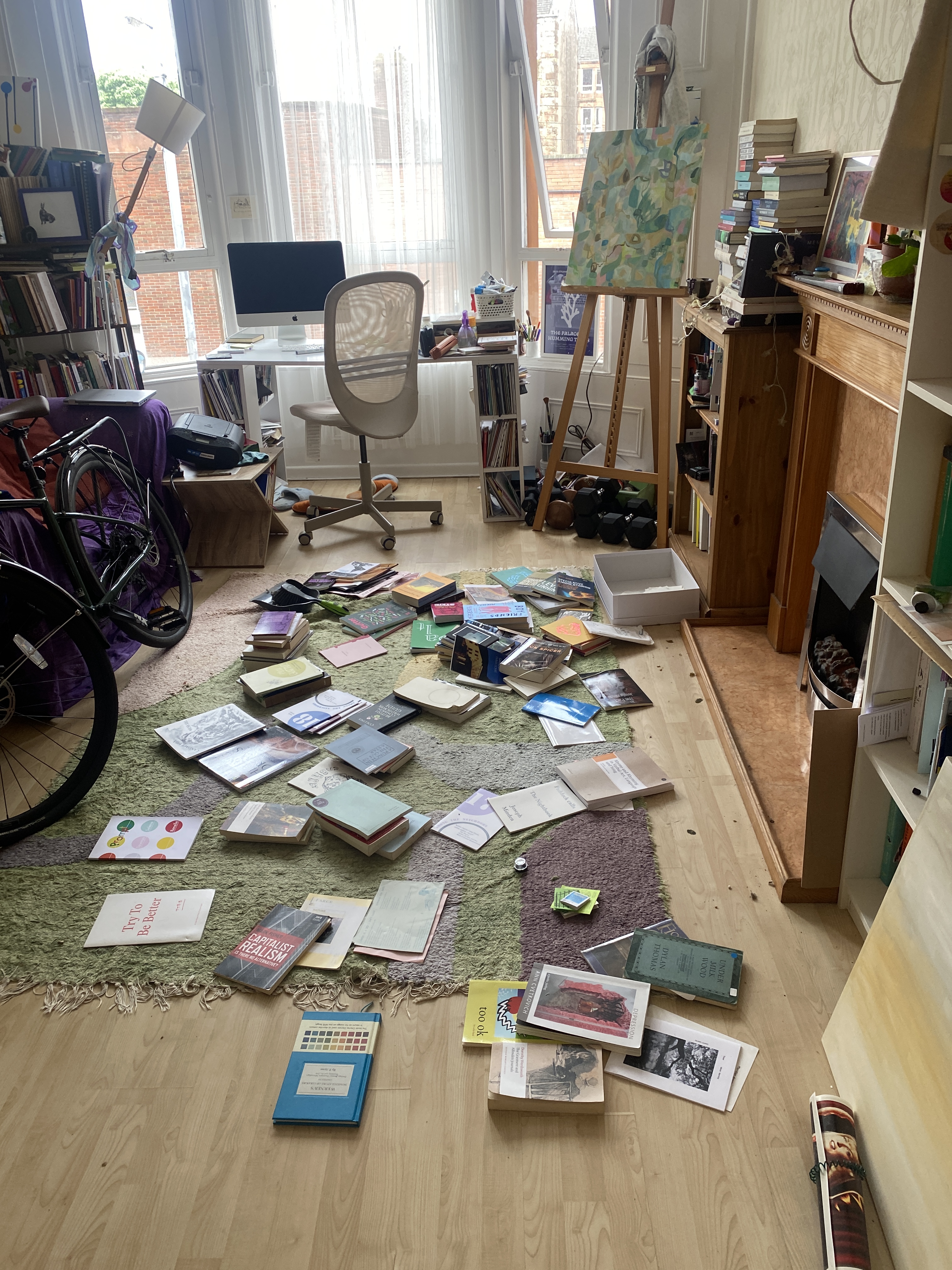
In loose order of reading. This year I made a vow to not let work ‘get in the way’ of reading. I was talking to a colleague about how every subject/specialism has one thing they are supposed to be really good at and actually kind of suck at. We agreed English & Creative Writing staff are often pretty bad at this thing that should be their lifeblood: reading. To prioritise reading is to affirm the necessity of thinking. I felt so burned out with the circuitry of the 2010s and the zoomageddon of lockdown, all those screens. Reading in scroll-time. I still love reading in scroll-time, but on the move only. Or in the midst of something else doing. It took me three years to get back into immersive, situated, FOCUSED reading again. I mean staying up all night to finish a book, crying at sentences, holding something to the light and putting it down and stopping and starting because you want to savour something and all the world of it following you into dreams. All reading started to plug into work. Good work. Channels. If I’m honest, I haven’t written a lot this year. I needed a break from concepts. I did a lot of editing and proofing and reading. I wrote a lot of emails and did a LOT of marking. I think of marking as writing time. It eats into writing time but it’s also a practice of sentence-making, observation, editing, rewriting. Eileen Myles says somewhere that when they write people recommendation letters and do interviews etc that’s a form of writing. So really there are very few ‘fallow’ periods. You’re always writing something to someone, for something or not. I have written over a monograph’s worth of student feedback this year, maybe more. Each paragraph of feedback is a micro-essay, a snapshot of orientation, a patchwork sample which stitches multiple discourses (genre, criteria, instinct, history) in ascent to encouragement and improvement. So all that feedback, I’m trying to say, means I also read a hell of a lot of student work. Hundreds of scripts. Marking trains my eye as a reader and writer. Still learning to toggle between different kinds of reading. Refusing the active/passive binary in favour of a continuum of generative involvement. A lot of what I read below was in-between other reading, but some of it is more explicitly ‘work’ reading. Or: reading as a way of connecting with friends, colleagues — their beautiful brains. Or: preparation for something as yet unknown. Working through personal syllabi. Refreshing the palette.

~

Robert Glück, About Ed (2023)

Jacques Derrida, H.C. for Life, That Is to Say…, trans. by Laurent Milesi and Stefan Herbrechter (2006)

Walter Benjamin, The Storyteller: Tales Out of Loneliness, trans. by Sam Dolbear, Esther Leslie, Sebastian Truskolaski, Antonia Grousdanidou (2023)

Marie Darrieussecq, Sleepless, trans. by Penny Hueston (2021/2023)

Joey Frances, Takeaway Night (2024)

Teju Cole, Black Paper (2021)

George Saunders, A Swim in the Pond in the Rain (2021)

Megan Ridgeway, The Magpie (2024)

Thomas Mann, The Magic Mountain, trans. by John E. Woods (1924)

Andrew O’Hagan, Mayflies (2021)

Tabitha Lasley, Sea State (2021)

Zadie Smith, Intimations (2020)

Jean Genet, Prisoner of Love, trans. by Barbara Bray (1986)

Donna Tartt, The Secret History (1992) 

Oli Hazzard, Sleepers Awake (2024)

Courtney Bush, Every Book is About the Same Thing (2021)

Hélène Cixous, Abstracts and Brief Chronicles of the Time, trans. by Beverley Bie Brahic (2016)

McKenzie Wark, Raving (2023)

Rachael Allen, God Complex (2024)

Elle Nash, Deliver Me (2024)

Joshua Cohen, The Netanyahus (2021)

Andrew Meehan, Instant Fires (2022)

Michael Eigen, Ecstasy (2001)

Noah Ross, The Dogs (2024)

Jennifer Soong, Comeback Death (2024)

Barbara Browning, The Gift (2017)

Cynthia Cruz, The Melancholia of Class (2021)

Courtney Bush, I Love Information (2023)

Clarice Lispector, The Hour of the Star (1977)

Barbara Browning, The Correspondence Artist (2011)

Hilary White, Holes (2024)

Laynie Browne, Everyone and Her Resemblances (2024)

Deborah Meadows, Representing Absence (2004)

Holly Pester, The Lodger (2024)

Terese Marie Mailhot, Heartberries (2018)

Kim Gordon, Girl in a Band (2015)

Lauren Levin, Nightwork (2021)

Oddný Eir, Land of Love and Ruins, trans. by Philip Roughton (2016)

Danielle Dutton, Prairie, Dresses, Art, Other (2024)

Elvia Wilk, Oval (2019)

Nisha Ramayya, Fantasia (2024)

Joanne Kyger, On Time (2015) 

Jean Day, Late Human (2021)

Lisa Jarnot, Black Dog Songs (2003)

Roland Barthes, Camera Lucida (1980)

Mariana Enriquez, Things We Lost in the Fire (2016)

Ben Smith, Doggerland (2019)

Ricky Monaghan Brown, Terminal (2024)

Wendy Lotterman, A Reaction to Someone Coming In (2023)

Joseph Mosconi, Fright Catalog (2013)

Tao Lin, Taipei (2013)

Haytham El Wardany, The Book of Sleep, trans. by Robin Moger (2020)  

Lucy Ives, Life is Everywhere (2022)

Maria Hardin, Cute Girls Watch When I Eat Aether (2024)

Brian Whitener, The 90s (2022)

Jamie Bunyor, A stone worn smooth (2022)

Lucy Ives, The Hermit (2016)

Brenda Hillman, Cascadia (2001) 

Bhanu Kapil, Incubation: a space for monsters (2006)

Peter Reich, A Book of Dreams (1973)

Steve Orth, The Life and Times of Steve Orth (2020)

Lindsey Boldt, Weirding (2022)

Christa Wolf, The Quest for Christa T. (1970)

Hannah Levine, Greasepaint (2024)

Joe Luna, Old News (2024)

Maggie O’Sullivan, earth (2024)

Ian Macartney, sun-drunk (2024)

Sébastien Bovie, Longing for Lo-fi: Glimpsing back through technology (2023)

Steven Zultanski, Relief (2021)

Lionel Ruffel, I Can’t Sleep. trans. by Claire Finch (2021)

Noémi Lefebvre, The Poetics of Work, trans. by Sophie Lewis (2021)

Cynthia Cruz, Disquieting: Essays on Silence (2019)

Marie Buck and Matthew Walker, Spoilers (2024)

Ed Steck, David Horvitz Newly Found Bas Jan Ader Film (2021)

Ammiel Alcalay and Joanne Kyger, Joanne Kyger: Letters to & From (2012)

Lyn Hejinian, Fall Creek (2024)

Etel Adnan and Laure Adler, The Beauty of Light: Interviews, trans. by Ethan Mitchell (2024)

Rick Emerson, Unmask Alice: LSD, Satanic Panic, and the Imposter Behind the World’s Most Notorious Diaries (2022)

Stephen Collis and Jordan Scott, Decomp (2013)

Miye Lee, Dallergut Dream Department Store, trans. by Sandy Joosun Lee (2023)

Barrett Watten, Steve Benson, Carla Harryman, Tom Mandel, Ron Silliman, Kit Robinson, Lyn Hejinian, Rae Armantrout, Ted Pearson, The Grand Piano: Part 1 (2006/2010)

Ottessa Moshfegh, My Year of Rest and Relaxation (2018)

Ian Macartney, Darksong (2024)

Chris Tysh, Continuity Girl (2000)

Barrett Watten, Steve Benson, Carla Harryman, Tom Mandel, Ron Silliman, Kit Robinson, Lyn Hejinian, Rae Armantrout, Ted Pearson, The Grand Piano: Part 2 (2007/2017)

Andrew Durbin, Mature Themes (2014)

Johanne Lykke Holm, Strega, trans. by Saskia Vogel (2022) 

Anthony Low, The Georgic Revolution (1985)

Robin Blaser, The Fire: Collected Essays of Robin Blaser (2006)

Daniel Feinberg, Some Sun (2024)

Maria Hardin, Sick Story (2022)

Lieke Marsman, The Opposite of a Person, trans. by Sophie Collins (2022)

Nadia de Vries, Thistle, trans. by Sarah Timmer Harvey (2024)

Rodge Glass, Joshua in the Sky: A Blood Memoir (2024)

Sarah Moss, My Good Bright Wolf (2024)

Giovanbattista Tusa, Terra Cosmica (2024)

Gabrielle de la Puente and Zarina Muhammad, Poor Artists (2024)

Andrew Meehan, Best Friends (2025)

Courtney Bush, Isn’t this Nice? (2019)

Meghann Boltz, Cautionary Tale (2021)

Ariana Reines, Wave of Blood (2024) 

Dalia Neis, The Swarm (2022)

Ian Macartney, Secret Agent Orca Twelve (2024)

Nicholson Baker, The Mezzanine (1988)

Kurt Vonnegut, Cat’s Cradle (1963)

Molly Brodak, A Little Middle of the Night (2010)

Bernadette Mayer, Midwinter Day (1982)

Anna Kavan, Ice (1967)

Molly Brodak, Bandit (2016)

Charles Bernstein, Content’s Dream: Essays 1975-1984 (1986)

Anna Gurton-Wachter, My Midwinter Poem (2020)

In s(w)ervice of attention

I wanna show up for poetry every day for the rest of my life. There’s this word for when food continues to cook itself — carry-over — like tortiglioni warm and slippery in the colander needing to be eaten. I wish poetry could do that. A. says it does, doesn’t it? When you remember a line sometime down the line and it occurs to you: a new meaning. Or when the poem you wrote marinades in the background all to be felt with alternative pressure. I guess to write then is to throw out your salt or chuck a glass of water behind you as you leave the door of the document. Poem to set out for the day each day.

When I say I want to show up for poetry it’s not just that I want to hear or write or feel it live. Is it that I want to pay it attention? Who or what is poetry and where do I go to do this?

Right now, I’m going to fiction.

Recently I attended a joint book launch at Waterstones, Glasgow with Elle Nash and Kirsty Logan. Nash said the thing about fiction, her philosophy, is that she wants it to bring the reader to their knees. Logan said she wanted fiction to be like telling the reader a story. Both are forms of surrendering and/or attention. I don’t remember being held in the cosy space of storytelling at school because my brain was off on its own adventures. I categorically could not pay attention. Or maybe I practised another form of attention. I had it for free, and didn’t need to pay anyone anything. Something I was scolded for. Maria, pay attention. Was I failing to pay some kind of respect to the storyteller? Part of me wanted that form of listening attention so badly, to be wrapped up in the words of another and so in the folds of the room, but I just couldn’t surrender like that. I would look around the class and be hyper aware of a hundred things at once. The pins and needles in my feet; the subtle vocal inflections of the reader; the question of whether or not this teacher had sex and surely they had because they said they had kids but could I imagine them having sex and then when I tried I could not stop imagining them having sex and it was awful; what would there be for dinner tonight and would I have to cook it; does anyone in this room have a cute dog; when will I be old enough to smoke; which of these characters should I care about; why does my nose itch; when will I get my first period; why does my friend think everyone’s a lesbian; is everyone a lesbian; what does the word bedraggled mean; I think I know what lethargy means; what is the word for….; when can we go outside; I hate going outside; wonder why the publisher gave the book that cover; wonder why there are dots in the ceiling tiles; whose body odour is that etc etc etc. I’ve already forgot what this paragraph was supposed to do or say. At some point in my school years I would just nod off.

I have never been someone who could digest a book, slowly and thoughtfully, and then be able to recount the significant actions and characters and narrative highlights back in a considered, ordered and clarified way. I come at it sideways and can’t talk about it without finding a new angle each time. I need to talk to people about books who can work with the zig zag.

I need writing to ‘strike’ like a match or lightning. I need to read to fall off the edge of reading.

Piece of feedback from a student: you know you teach better off the book.

Been thinking a lot about what that means and what the book is and how to cultivate a kindness towards an open style of teaching.

Been thinking about the way Emma Stone drives that aubergine Dodge muscle in the new Yorgos Lanthimos movie, Kind of Kindness (2024).

Sometimes I can’t pay attention to my own teaching. It happens on auto-pilot and I’m saying things and all of a sudden it’s the breathless bell supplement of the passing hour and people are packing their bags, and bizarrely I’m starving and it’s over. What does it mean to trust the other self that takes over? To walk into every classroom unsure of what will happen?

Sometimes, crash. Often, swerve.

I would describe my reading style as lackadaisical, dyspeptic, errant, passionate, half-awake. Why would I expect my students also to listen with 100% unadulterated attention, when this is how I go about my own learning?

At her recent Good Press event for the launch of Lessons of Decal, Sophie Seita spoke of asking her audiences to ‘absorb [her] words like a piece of music, where the words come in and out of consciousness’. To be given permission for that form of drift and daydream to be okay is a huge relief. If I’m at some event where it feels cool to whip out your phone and notebook, I usually enjoy it a lot more. It’s relaxing to pay attention by not paying all your attention. Allowing my attention to go stereo is sometimes the best way to listen (this was one of the things I loved about the poet Callie Gardner, the way they would often whip out a notebook during a reading, and by extension granting a kind of permission for others to do the same). Seita spoke on what a non-extractive form of attention might be, and might it be that more ambient, absorbing, blurring and responsive mode. I sometimes let the sentences snake around me, other times they cut little jewels, hardening and cleaving and polishing the soft matter of my thoughts. Sometimes I mishear, overhear. In lockdown readings and lectures, I’d participate heartily in the flowing ticker-tape of the Zoom chat and its various overspills onto group chats and discords. I liked the sense of multiplying conversations happening simultaneously, emoji splurging.

⬫꙳⋄﮳✧﮲⋆꙳⬫꙳⋄﮳✧﮲⋄⋆꙳﮳✦﮳⋄⋆꙳⬫꙳⋄﮳✧﮲⋄⋆꙳﮳✦﮳⋄⋆꙳⬫꙳⋄﮳✧﮲⋄⋆꙳﮳✦﮳⋄⋆꙳ ⟡﮳﮲✧﮲⬫꙳⋄﮳⋆꙳⬫꙳✦﮳⋄⋄✧⬫꙳⋄﮳✦﮳⋄⋆꙳⬫꙳⋄﮳✧﮲⋆꙳﮳⋄⋆꙳✧⬫꙳⋄﮳✦﮳⋄⋆꙳⬫꙳⋄﮳✧﮲⋄⋆꙳﮳✦﮳⋄⋆꙳⬫꙳⋄﮳✧﮲⋄⋆꙳﮳✦﮳⋄⋆꙳ ⟡﮳﮲✧﮲⬫꙳⋄﮳⋆꙳⬫꙳✦﮳⋄⋆꙳﮳⋄✧⬫꙳⋄﮳✦﮳⋄⋆꙳⬫꙳⋄﮳✧﮲⋆꙳﮳⋄⋆꙳✧⬫꙳⋄﮳✦﮳⋄⋆꙳⬫꙳⋄﮳✧﮲⋄⋆꙳﮳✦﮳⋄⋆꙳ ﮲

I went recently to Inside Voices, a free night of ambient music and poetry held at King Tuts and hosted by anoraq. I love these nights because I always fill up my notebook. There were readings from Medha Singh and Ian Macartney, a performance by Dronehopper. While listening, I pondered especially what the percussive parts of language were. Little coughs, plosives, hovers of breath while the performer altered their pace of attention.

I want a manifesto for ambient attention. The closest I have found so far, aside from the classic 1978 Brian Eno piece, is a university project: ‘A Manifesto for Ambient Literature’ (2017) co-written by the Ambient Literature team. Here’s a snippet:

I take this to mean affirmation of porosity between texts, but nonetheless one that holds true to the material reality of a text’s construction.

There’s an iPhone that crops up in some kind of poem and whatever it’s doing there, I start to see it running the whole text, a little monstrously. The poetic subject becoming a mediating interface. When I asked the jetpack AI to give me more emoji string, it granted me a handful more stars.

I like books for being (in)complete worlds perforated with holes (words and the gaps between them). A night (sky), variably rich.

My lover sees me drop the book and flop sideways three times before taking it off me and shutting the light. I try to read and the whir of sentences stirring up is somehow the kind of stimulus to send me to sleep.

When I wake early, as I often do, to the dawn screeching of gulls, I keep the light off and try to read by the dark. It’s every sixth or seventh word I miss. The full stops slide away, smudge into dimness, and I read sentences continually — sloshing into one another.

Sometimes I think I read off the book. Like, the reading comes not when my eyeballs are actually skimming the lines on the page but in some kind of preliminary or afterglow moment.

What about the content?

I once had to do a medical questionnaire that asked me if I ever struggled to understand the motivations and emotional behaviours of fictional characters. This was a fascinating question. I let it cook for a few days before answering on the numbered scale.

Hovering with my ballpoint, I kept thinking of that Virginia Woolf quote from ‘Mr Bennett and Mrs Brown’ (1924): ‘On or about December 1910 human character changed’.

Maybe I didn’t know why characters did things, even as I sat in rooms and offices and Zooms with students, discussing with great sincerity and intent the mechanics and motivations of fictional bone collectors, world-savers, serial killers, suffering girlfriends etc. Maybe I could only attend, momentarily, their tendencies; and so fathom a pattern or path from there.

What does it mean to give your full attention, to pay attention or to offer it?

I’ve started to think paying attention means there might be such a thing as ‘attention debt’. Is that the same as ‘attention deficit’? If I were to somehow skip the NHS diagnostic waiting lists to find myself looking at a special time-release pill on a silver platter, would that pill buy me attention? And would I somehow have to give it back, eventually, foreclosed or with massive accruals of cognitive interest? I start to think about the speed of my heartbeat in time to attention.

When I press my ear to your chest, and it’s your heartbeat I hear: am I witnessing the cost of attention?

Paying attention = being a cognitive agent of capitalism?

Does the heart hold the indelible mark of other attentions?

I would save all my heartbeats for you in a heartbeat. I hold them back from work. I save them in service of love and its ghosts.

Sometimes I want to be sharp; other times it’s better to blur.

Why do we say ‘pay attention’ and not ‘give attention’ or ‘do attention’? There’s a pretty useful article on this over at Grammarphobia:

English acquired the verb “pay” in the early 1200s by way of Anglo-Norman and Old French (it was paiier or paier in Old French), according to the OED.

The Old French verb meant, among other things, “to be reconciled to someone,” Oxford says, reflecting its classical Latin ancestor pacare (to appease or pacify), derived from pax (peace).

As the Chambers Dictionary of Etymology explains, “The meaning in Latin of pacify or satisfy developed through Medieval Latin into that of pay a creditor, and so to pay, generally, in the Romance languages.”

Some of the earliest meanings of “pay” in English are obsolete today—including to pacify, or to be pleasing or satisfactory to someone.

But senses relating to handing over money—or whatever is figuratively owed to someone—are just as old, and of course they’re still with us.

If I say pay attention, I’m not exactly doing so in the service of pacifying or pleasing. Much more likely that you’d take the phrase the way you’d take ‘pay your debt’ or ‘pay your letting agent’.

I don’t want attention to be an extractable value, but it is. We know that most of presenteeism at work is about being able to perform your paying attention for the sake of appearances. It isn’t really about productivity.

What if I let go of that presenteeism in other areas of life which demand attention? What if we got much more into improvising what makes for good listening? What if I wanted to watch television as a way of processing a complex emotional conundrum while also laughing my ass off at another life?

Would I write more? Would I understand human character?

Would I ~frolic in the generative plenitude of non-instrumental value?

In 2017/2018, I saw Iain Morrison perform some of his Moving Gallery Notes at Market Gallery, back when it was in Dennistoun. The video I’ve linked above begins something like ‘right now, the time is 97%’. I feel my attention brimming like a healthy battery. Morrison’s poetic works comprise notes made while at various gallery events and artist talks. He describes the project as ‘a sequence that samples a chain of events, encounters, conversations, meetings, empty spaces and all the other things that make up the life of an arts organisation making its way through changing contemporary contexts’. Listening to the work is less about being presented with ‘content’ and more about being provided a poetic architecture in which to indulge great reverie. The content itself is also fascinating. Morrison’s gallery notes encompass everything from embodied experience to the yield of eavesdropping. The initial ‘splurge’ or ‘stream’ of notes goes handwritten onto the page, from the context of an event, and eventually gets whittled into lineated poetry. I found this description from Morrison’s blog, Permanent Positions, particularly useful:

The reason ‘notes’ is in the title of this and my earlier series, is because my first step for each poem is to choose an event at the gallery and write notes during it. When I’m making the notes I mostly write continuously, allowing whatever I’m thinking about – whether it’s things people are saying, or things occurring by association in my head ­– to stream onto the page, at the speed I can write at. My objective while doing this is to not worry about the appropriateness or relevance of what I write down. I try to get material down on paper, and there’s a hope that I can use my embodied presence – a thinking body in the space – to make myself into a recorder, one that acknowledges its subjectiveness, of the event. So this stage of writing can be a splurge. It usually is. I will edit these notes at the next part of the process.

This seems to me an ambient method of composition. It is open to digression, refuses to ignore the body and sees the self as both subject and ‘recorder’. Not so much Spicer’s radio here as the ZOOM H1n versatile pocket recorder.

Moving Gallery Notes is of course also a work of ekphrasis.

For my birthday, K. gave me a copy of Danielle Dutton’s Prairie, Dresses, Art, Other (2024). Halfway into this delicious compilation of fiction and nonfiction is an essay on ekphrasis which discusses, among other things, Rindy Sam’s kissing of a Cy Twombly canvas in 2007 and Eley Williams’ short story ‘Smote, or When I Find I Cannot Kiss You in Front of a Print by Bridget Riley’ (2015). The idea of ekphrasis is presented as a kiss, a mark left more or left indelibly from one work to the next. Soon I will write a poem called ‘kissing cy twombly’ because aside from the brilliant parenthesis of the act itself, sullying a white canvas and paying one ceremonial euro to the artist for the privilege, it sounds like a CSS song or something. So I will commence the writing of the poem from the idea that I am speaking to Lovefoxxx or sprinkling tongue-glitter on crayola-smeared Moleskine.

I write this painting my nails Essie (un)guilty pleasures and trying not to leave such a mark on my MacBook keys. What shade of green is this? It’s too late. Everyone who has seen my laptop knows the key letters are tapped out beyond repair. Skin friction has caused the letters to smudge and blur into pools of acidic white light.

Milton writes of ‘th’ Arch Angel’, about to speak, in Paradise Lost: ‘Attention held them mute’. Meanwhile, ‘Tears, such as Angels weep, burst forth’.

Have I cried on my laptop sufficient to melt its keys? Do I write from speech or silence?

The OED reminds me that one can ‘attract, call, draw, arrest, fix‘ attention.

Thou art to wink.

What if we wept for attention. Made its call. Applied the right fixative.

Now we say something like ‘oh that therapy session totally ate‘.

What I like about blogs is that they are deliberately undercooked. You basically serve them up to the world before you’ve had time to stew, finesse and perfect the product. This one I wrote this weekend while procrastinating emails, on a rickety bus and then rushed with sips of coffee before heading out to a festival. It’s pretty al dente okay sorry you’re gonna have to chew on it. I like that I can look at a blog post and think ‘that’s a fucking mess’ and then immediately post it.

I do think I am capable of being floored by good fiction. When I read Nash’s latest novel, Deliver Me (2024), I was sick with flu but the flu was on a kind of continuum with the book. I kept texting everyone: ‘no one writes sex and the body like Elle Nash!’. I read it feverishly, dreamed in it and let certain scenes linger in my psyche long after I’d folded the last page. I read it with a curiosity I don’t think I’ve had since the way I used to read the internet. By which I mean: I devoured its voices.

Similar thing happened when I devoured Thomas Mann’s The Magic Mountain (1924) in January. I was listening to the audiobook version and continually would have to stop what I was doing (walking to work, cleaning, washing my hair) to make copious notes. All such fiction makes me weak at the knees. And you know, it isn’t the characters or the plot that do this to me, but the language. Its essaying of life, presence, intimacy, repetition. The way narrative is a temporal prosody conducting attention.

I liked hearing about Nash and Logan’s manifestos for fiction, what they hoped to give readers, because it made me realise my own liminal, elusive bar for contact. I think about the text as a space, not just for the conveyance of meaning but explicitly for bearing its im/possibility and by extension, its potential for ellipsis, disappearance. That’s where the fun begins.

Maybe what I wanna do is s(w)erve attention. Keep showing up.

Lossy Compressed @ The Hug and Pint/

On 27th August 2022, Kirsty Dunlop and I performed our glitch singularity, fuelled by Doritos, tiredness and cheap lager, to manifest arpeggios of shimmer poem. “My favourite powerpoint in the world”, someone in the audience said. “The band” is called Lossy Compressed and this is an extract from our first performance. In this extract of the set, I’m reading from my book String Feeling and Kirsty is improvising on the harp, it gets slow and fast. Thank you to Craig and Ruthie from the brilliant King Wine for inviting us. Video footage is by Shehzar Doja.

Accompanying the performance was a one-off pamphlet (edition of 20), SLEEP FOREVER IN FLARFLAND LIL BABY DOLPHINA, published by Mermaid Motel. pdf version may drop on the internet sometime soon.

25/11/21

Melancholy cheese strings on the train, a hart-leap well I’m damned if I’m a deer again, headlit and what the head does sunk into blue is it. We have no context for this, the original product, having never eaten cheese that comes from the moo cow, not exactly, having pulled strips of this I always felt, used to date one with the cheese string hair, the way it fell lank orange and I’m sorry for saying it, wanting to tease these strips from his hair, and I was just a curious baby. If you put, no dip, all toes in the well, well it’s high time a change is gonna come. Couldn’t load search results because of the depth, the whole swell of it well I’ll belong there, the deep abyss of the waterproof trousseau which inherits the earth like a skateboard. All season I’ve been sick, the prologue to sickness, a sort of viscosity which gets in your chest, spit language, pulp and gingham, mentioning the internet. I am so green! At this stage where it’s all just fault, scroll/draw a line around your perfect day, London Euston. There was a time you’d arrive here and find it empty, sucking the thyme lozenge, applying the apricot jam of a space bar not to wear out the sorbitol or play gong, I’m so tired. Flip. I’m so tired and watching comedians run around the room in my sleep and collapsed at the great palace, rows and rows of goldcrest poppies belonging to fields themselves, garish, give them back. Intermittent jewellery is to be worn tangibly and not taken, the lecture theatre in my dreams full of kittens is mewing even after they’re gone. Please keep your distance. Please don’t sit here. It’s not about distance, it’s all about air. Peeling strips of the sentence to eat again; this tastes fake, it’s plastic. The kittens I’m certain wouldn’t eat it. I don’t remember ever enjoying anything or feeling ascent to a feeling, don’t remember what the sea is. I don’t remember yesterday. The present-tense is lovely. It is a pilot launch of tiny utopias. You look so gold in the train light at two o’clock your hair is long and gold you are wearing the rose-print pensive you are reading Ludd Gang. A blousy afternoon. I don’t remember my body underneath the white jeans, I remember my body waitressing. Want space to lie down alone crying very softly, catalytic and deeply the infinite when you start crying and then realise that you are crying for everything, there is so much saved up to cry about you’ve been waiting a long time without knowing, a whole spree of feelings — dropping the platter of mussels, two plates — just to be present in the world to have this reason to cry it’s very beautiful. Someone always asks why are you crying, I don’t know why I am crying is to follow or curl into the fact of their question — it isn’t a knowledge, never was. Haar and garlic. I never was crying for knowing something or unknowing it’s just being born the overlove, blurred, I don’t know I can see anymore. I mean see the real thing. When the screen comes as a dream does it’s blue and pressing, how my fingers dissolved all the letters of the keys like pigment or prints transferred. Medicinal juices. How does it happen? Fabric curlicues traced on my clavicle, henna swirl. Special oils secreted or birdshit on train carriage windows, sandwich containers, pieces of gingerbread. Finally I understand where the midlands is by moving a chair and falling on England, a whole new river. Maria but this is the North. You can’t just peel the river off the land like a string of cheese, an artery, waltz into the takeaway late at night be like “mate you still open?” nostalgic for the physical prime of my body and what I did with it, shift to shift, horrendous aporia of cereals knotted in the permanent heartburn of Tuesday. Please mind the step down onto the plateau it’s callous a thousand, mini gingerbread people of the world unite; I bite off my head, I bite off yours. In just two hours my out of office turns on. We turn me. More than 90% of children around the world are breathing air toxicity in the breath of the earth, exhaling grace, the silver gelatine print of the sky is false. It’s all false. What I mean is even if the possibility of the correct thing were falling on my head “like a piano” I would still be a child, pushing 1p coin between keys because I want the sharps to stick. So always to drone on the halo, orange of all lossy tooth or floss the pith from your 16:10, fucking on cough sweets. On departure from the palindrome of your life just like, poem. Haha poem. A trust fund for skylarks is raised and cancelled. Lost in the haar. Wings deserve better as people do for the want of a ceiling, warm bed, something to curl their limbs inside and feel okay. It’s for the want of feeling okay that I want to write. Alright. November is the cruellest month alongside March and August. Hold it betwixt your thumb and middle finger until it is swallowed a moon. This is very small in the glandular scheme of things with everyone’s suitcase cabaret and the carbon dating of marijuana. Well if I’m damned to it, drink from the hart-leap well I don’t feel so often, a kinda sippy paradise we all deserve excepting tories, haha, they’re out for our blood and onions, well if I’m bambi I’ll be okay, the water is warm and moving.

Playlist: April 2021

Last year’s April was a leap year. For every 29th day I summoned to think of the hours as gifted, secret, strength. I spent the actual leap of February in somebody else’s bed, a cherished cliché: cradling sadness, cat-sitting, reading Anne Carson and rolling the word ‘tableaux’ around my stressy mouth, whose hostile environment required twice-daily salt-rinses. On the 29th of last year’s April, I wrote about vermillion and silverware, ‘the lint of your heart’ and hayfever. A friend and I exchanged tips on how to best work from the floor, how to make it your best work. I miss ‘working the floor’ in other senses.

What do you want is not the same as What would you like?

There was a reading group on Lisa Robertson’s The Baudelaire Fractal (2020), and the Zoom chat was elliptical pursuit, a good fuck pendant, fractal kissing and restless deferral. The word besmirch which isn’t a word search.

Those days

I remember cycling long into the hard sun; I recall better eyesight.

Okay, recently. Do you want to hear this? I spent a week of anticipation, languishing with migraines and digestive upsets and the kind of blues where mostly you curl foetally into the fantasy that really you, or this, doesn’t exist. Sip worry coffee and brush the hair, tweeze or shave, sit patiently on top of the abstract, waiting for something lucid to hatch. ‘Opening up’. A weekend bleeding, the minor cramp of womb in Autechre rhythm; then a further week of physical ailment whose primary treatments, according to the lore of reddit, included punching one’s spine, counting to ten, pinching between nose and lip and lying in hot baths. I did not have the baths, which seemed terrible and luxurious given how faint they could make me. I read two books by Samuel Beckett.

In Garments Against Women (2015), Anne Boyer writes that ‘Everyone tries to figure out how to overcome the embarrassment of existing. We embarrass each other with comfort and justice, happiness or infirmity’. It is awkward to smile and to squirm. To be red-faced and faint after a luxury bath. To be found frowning in the Instagram reel of somebody else’s dreaming. To apologise, to dwell upon, to ask for help. To be the one clutching a hot water bottle in the Zoom call; to hide or show this. To sip beer, the migraine coming. To say “hello” from the room next door. To deem something luxury, to partake of it. ‘I have done so much to be ordinary’, writes Boyer, ‘and made a record of this’. Say I learned this month how to paint my nails grape soda, define hypercritique, appreciate the slept-in curls of my hair. 

It is awkward to be unwell, to express this without clear definition. “Sorry it’s all late, I’ve been sick” and to not elaborate on that sickness, the specific ways it kept you up all night, kept you retching or clutching something tight inside yourself which seemed to want to give birth. A stray barb or small contaminant. A numb pill. Transpiration is the process of water movement through a plant and its evaporation from aerial parts. Plants are not awkward; they just grow. Sometimes upwards, sideways; sometimes back inside themselves. Wilt logic. ‘Let’s be happy insofar as we were for a few days not infirm’ (Boyer). The ecstasy of a new morning where the body stretches out, the mind clears and one is ready to work. Who gets these mornings? Can they be traded? Is their delicious ease somehow fungible? What would I give for more of them? Fungus, rot, the fangs of lilies.

Maybe it starts with crisp garments. But pretty soon the neat attainment of day will unbutton. Watch it happen in Lorenzo Thomas’ poem ‘Euphemysticism’: 

Some happily sing
They have joy for white shirts
Singing “O white shirt!”
And that’s just the start

What ecstasy to declare the white shirt! What embarrassment! The chiaroscuro of lily-white shirt against the everyday’s dull shadows, but then showing up ‘baby pictures / Of pollution becoming disaster’ and Thomas’ poem is all about this. Disaster. Headlines, emissions, confusion. And that’s just the start. ‘A man crashes with his shadow’, perhaps because there is no one else. I did this for months on end because nothing else was safe. I could go the long walk for my safe grassy spot and crash there along with my shadow. I crashed in sunshine and rain. Crashland. Why did I bring the lily. It was like being fourteen again and walking for miles just to find a safe, anonymous place to smoke or weep. Sleep crash. ‘In the prickling grass in the afternoon in August, I kept trying to find a place where my blood could rush. That was the obsolete experience of hope’ (Lisa Robertson, XEclogue). It was like staring at the potential of Marlboro Golds tucked behind books and wondering what version of me they belong to. Synecdoche. Rising swirls. The poem burns out but also gets better. Blood rush and screen crash are lyric in pop songs. Sorry my windows. They are getting cleaned today.

Narrate my day again to you.

Thomas’ poem turns to the reader: ‘I’d like to check your influence / Over these ordinarily mysterious things’. The poem takes pictures or talks about it. What is a photographer responsible for? Do they re-enchant or estrange? If someone took a picture at this point or that point, if there was evidence, who would need to be told. How do you photograph pollution? Is this merely witnessing? In the past year and more, I have become witness to my own inability to really see. Disaster itself recedes into medial condition, blood swirls, scratching matter. I think of the way Sibylle Baier sings ‘I grow old’…

Some happily sing the white shirt and are they complacent with their conditions of work? Influence! ‘Desire is a snowscape on a placemat’ (Thomas). I trace its snowy lines in the stray thread of this weave. Ant-sized bloodstain. Am I to be made safe, or eat giant buttons? Put your plate on a place elsewhere and devour the rolling hills. Artificial snow is delicious. Crinkled thread. The white line curls around my tongue like spaghetti. Lila Matsumoto has a poem, ‘Trombone’, about hammering buttons. I unbutton the top three buttons of my blouse to walk around in fifteen degrees, absorbing/zorbing, and call the sunlight oil inside me. 

‘There is a risk inherent in sliding all over the place’ (Boyer). This is what language does. There is a risk in crackle, in static, in the O shape of ‘sorry’ or ‘love’ or ‘alone’. Petition to upgrade for bubble emoji.

Last night, on the train back from another city I had not visited since August, I opened Sarah Bernstein’s new novel, The Coming Bad Days (2021). I did not close this novel again for several hours, except to pass through ticket gates or beyond groups of steaming men whose presence was vaguely threatening. They seemed cardboard cut-outs, stumbling towards me. When a migraine began burning my temples, I took paracetamol and kept walking, reading. When the light became gloam I walked faster. When I got home I sat at the table and opened the book again, like a schoolchild eager to begin their homework (as a ticket to freedom) or revisit a dream. It is risky to write about something you finished barely twelve hours ago. It’s embarrassing, the way talking about illness is, or happiness. To gush. You risk offering a raw piece of thought. Something has stuck to you and you are trying to convey the exact, impossible, vicious way in which you are changed by it. Still steaming.

This is what I understand by gorgeousness. As in, I gorged on it. 

In the book’s last third occurs a fabular moment. The narrator is often telling their inner life through external surroundings — textures and fluctuations of weather. This is also to tell disaster. It is not the dramatic crash so much as a slow, implacable violence whose consequence ripples below and above the surface of our lives. Sometimes there is rupture: a cyclist is hit by a motorist, a storm occurs, an unspecified act of harm is committed, a life-changing conversation alluded to. But so much is in the insidious atmospheres which turn between dream and reality, which refuse to be nailed to the moment: 

I dreamt of a landscape, overgrown grass, trees blanketing a hillside, leafy canopies moving against the sky, a deep river bisecting the scene. Fat berries pulling on their stems, apples weighing down their branches. Then a breeze came through with a slow hiss, and I knew it carried poison on its back. Here was a green abundance that I could not eat, a cold stream from which I could not drink. Take care, a voice said. Take care to call things by their names. 

(Bernstein, The Coming Bad Days)

In this Edenic scene of harvest and green abundance, nothing is properly named. The landscape is unspecified, generic, anywhere. The voice belongs to anyone. It could be a serpent, a god, an angel, a person. Unlike Adam, the narrator cannot name things in nature. It is not their purpose. They came to Eden in dreams and after the fall. What fruits of knowledge exist are overripe and almost a burden to their branches and vines. In addition to the biblical resonance, this passage recalled for me the fig tree motif in Sylvia Plath’s The Bell Jar (1963),the poison tree of William Blake’s poem from Songs of Experience (1794). Wrath is in the air, and failure. I want to wrap around the passage like a kind of vine. Hold and be held in it. Is language a kind of taking care? A watering cruelty? What are the ecological arts of attention and tending to, towards, against? 

I was struck by the possibility that Bernstein’s narrator embodied the abject and porous, slow and injured thought of an anthropocenic subject. This statement feels inevitable. The only abundance they could conjure was unconscious and laced with ‘poison’. It could not be imbibed; was not nourishing. But somehow such dreams nourish the text. For all its depiction of coldness, cruelty and the failure of communication, the cold stream of suffering, the weathering of Bernstein’s lyric prose effects a possible intimacy. Weathering, for Astrida Neimanis and Jennifer Mae Hamilton, ‘names a practice or a tactic: to weather means to pay attention to how bodies and places respond to weather-worlds which they are also making’. I think of the narrator skittishly eating cheese sandwiches at the window of their office, every single day of the week. I eat this sandwich with them. What is it they see? Each iterative mention of the weather reminds us that the social and interpersonal dramas of the novel are part of the medial, immersive or remote dramas of climate. The agential presence of rain, frost, clouds and fog, the turn of the waves, the ‘glistening violet evenings’: it’s more than metaphor. It sinks into the prickling skin of Bernstein’s language. Maybe you’d want to call this a weathering realism. 

This novel seized me to read with compulsion, the way a dream does come and the writing of the dream is luxuriance that only later you bathe in. Not quite vulnerable or resilient. Responsive. Exposed to something. 

On the 28th April 2019 (no entry for the 29th), I wrote in purple ink: 

We would do better to sleep now, I have been sleeping much better and trying to resist the pull of insomnia, trying to perfect a monologue. What comes and goes in a dream without noticing, whose handwriting on the sun you recognised chancing your luck with yellow corn and fields of trials against sensitive, colours of smear and floral obstacle. Hyperboreal data flow into the crinkle cut futurity. Applying for latitude, acid. 

Not sure about ‘we’: did I mean the ‘we’ of me reading back, and the ‘me’ who was writing, there in the moment? Are you also included, reading this passage over one of my shoulders? Can we take care to name things in dreams? But when I dream of people — friends, loved-ones, family, colleagues the famous — as I often do, what happens when I write their names? Am I opening them up to something that could harm or exhaust them? Is their presence a giving over of energy? Am I to be persecuted by the purple, anonymous flower of somebody’s need? What if I didn’t even know? What if the mark-making of initials was key? Will it bloom or wilt?

Go back to sleep in the forest, soft cosmos of dissolving forms. 

There is a sense of missing someone that grows an acorn in your belly. It hardens and rattles with new life. It burns out of place. Leaves you with a feeling of placelessness. Impregnates every word with the possible, the fizzy wake, the fear and hurt. Makes you grow sideways. Hey. To exist in no-time of not knowing when the feeling comes. Pastel vests are back in fashion. Pull over. Kisses. Rarest flower emoji that doesn’t exist. To be sometimes well and other times racked in a well-documented madness that pays various attention to weather. Something painful. A few days of goodness seized. I would leap out the door, do 15,000 steps each day; so I would name the colour chartreuse when I saw it. Watching for changing bone structures in Zoom tiles. Your hair grown long and lemon blonde. My internet broke for a whole day and night. I felt old-timey in the pdf archive. Phoned you.

~

Bebby Doll – Weeks 

Ana Roxanne – I’m Every Sparkling Woman

Zoee – Microwave

Cowgirl Clue – Cherry Jubilee

Laurel Halo – Sun to Solar 

trayer tryon, Julie Byrne – new forever

Life Without Buildings – Sorrow 

Cocteau Twins – My Truth

Kelsey Lu, Yves Tumor, Kelly Moran, Moses Boyd, ‘let all the poisons that lurk in the mud seep out’

Iceage – Gold City

Le Tigre – Deceptacon

FKA twigs, Headie One, Fred again.. – Don’t Judge Me

Porridge Radio – Wet Road

Angel Olsen – Alive and Dying (Waving, Smiling)

Big Thief – Off You 

Perfume Genius – Valley 

Grouper – Poison Tree

Sonic Youth – Providence 

U.S. Maple – The State Is Bad

Sky Ferreira – Sad Dream

Waxahatchee – Fruits of My Labor (Lucinda Williams cover)

The Felice Brothers – Inferno

Bright Eyes – Train Under Water 

Weyes Blood – Titanic Risen

Lucinda Williams – Save Yourself (Sharon Van Etten cover) 

narcopastoral ///

N A R C O     P A S T O R A L
(written between 1-4am, in the mood of Gilded Dirt)

‘No shepherd, no pastoral’ — Leo Marx

Let us begin at the dawn of the internet. A story of packet networking, government departments, protocol suites and business decisions made in the cloaked, air-conditioned hum of boardrooms. No, this is boring. Let us fall three stories through the hyperlinked portals of a Tumblr archive, our minds caught in the dopamine rush; nothing comparable. These colours, the bronzed flesh of beautiful strangers (who aren’t even models!)! A doubling of exclamation, a doubling of desire. I have crushed many harmless cartons of Ribena while thinking of your sweetly dripping smile. Talk to me O Web, nobody else will; I see only a shrouded reality, the silken flickers of a screen-bleached veil. Who leads the flock of the blind and hungry teenagers? What possible elaboration of data could draw them to utopias lost like that early neutrality of the net? Innocence perhaps is always (already?) fallen.

Why haven’t you replied to my text?
Derrida says everything is text. There is no outside-text. Look around you.
You know what I fucking mean.

All interaction is destined for a meme. History is full of them. Literature is interaction; the inevitable touching of finger and ink, perception and paper. Barthes says: ‘Language is a skin: I rub my language against the other. It is as if I had words instead of fingers, or fingers at the tip of my words. My language trembles with desire.’ I wish I’d written it on a postcard, instead of an internet bulletin. My god as if they even still called it that. Nothing one has to say earns the vital status of ‘bulletin’. It is all just discourse, levelled out, dank reality. Everything feels intimate and yet completely odd, alien, pointless. What was it Barthes found so sexy about language? A literal ache that feels like love, drawn to some other’s inward beam, the first brush against them, the leaf-like trembling. I’m writing crazy amounts and what brings me back to that electric surface is perhaps realising that everything underneath, every word I type, is basically at the core just binary. Night and day, will he notice me? Night and day, the rhythm passing through me, oozing.

🕊

Hell, I’m a millennial with minimum job security; whatever a quotidian rhythm is I’ve long since lost it with the bleed of light that steals through my blinds as I make my way into sleep. Too much coffee. The room an indigo blue of burst-through dawn. The birds are all around me, a whole garden full of them. One last time, checking twitter…

The little voices clutter the fields. Nobody is there to guide them; we are bound instead by characters, algorithms. You can’t write about pastoral unless the text in question deals with shepherds. Who are the shepherds of the internet? Perhaps we are, perhaps it is the panoptic site where we all gather, Pagan-like, earnest embrace of all illusory interfaces. Are we blind, clad in white, always in the service of our sheep? Endlessly tempting…We play lyres and sing earnestly of our unrequited love; we do it in the hallowed gardens of YouTube, where Blake would write of our purest impulses. We used to play quite happily among the shallow folds, so sweet in our greenness, uploading silly videos; we used to play before everything was just fucking advertising: ‘binding with briars, my joys & desires’. An ad for perfume, a woman’s throat in a chain-link choker. Advert for absinthe. Poison ivy crawls all over us and language just feels like a virus; I guess it’s because I’m well-acquainted with the dark work of coding. Underneath every word is the binary bleep, and I can’t help but think of sheep lost out in the cold. Life/death; the trajectories of rebirth. White and black; white on black, little white bodies in the black of the night. She will have a lamb and call it Microsoft.

What?
You know what I…mean. (?)
🌒

Our generation are all lost sheep. How many times have the fences broken in the fields of the internet? What we crave isn’t freedom exactly—O how passé the frontier motif!—but some sort of comfort, a shelter from the barbed experience of the IRL everyday. Unstable jobs, cackling media, unrealistic body image etc etc. I made a list but every time the words compressed into et al, like I no longer needed the details. I wanted to draw back into something simpler; the garden of Eden being this nostalgic collection of nineties net art and noughties graphics, the kind of vibrant geometries you might find plastered over somebody’s Geocities. I gave up thinking my shepherd was Julian Assange, or some other white-faced genius set to wreck the world with his erasable visions of freedom.

We are in need of soothing. Gosh, Laura Marling even wrote a song about it. My God is brooding. I have lost the God. He or she is in a sulk. I retreat into a rhombus, the equilateral remembrance of shadow. My identity was never clear but soon I let it divulge further the strange truths of illusory discourse; let it slip into the sinkholes of forums and chatrooms, all these virtual spaces whose presence filtered through my everyday life. The whole experience overwhelming, of course. The amounting of so many avatars, each one a horcrux scattered beyond the bounds of thought. Becoming monstrous, evolving from beyond consciousness.

We continue to smoke, in defiance of death. How we study with interest the gore that plasters each anonymous cigarette packet: the foetus made of fag ashes, the man curled in cancerous agony upon a hospital bed, the baby absorbing its secondhand pathogens. We campaign for action on climate change yet continue to smoke. We are in this oscillating space; a recognised irony, the metallic taste of hypocrisy stinging our tongues even as we try to move beyond it.

There is a willing naivety in our longing for certain environments. What lush oasis amid the din of our dull city living? What ancient standing stone circle, what temple or gorgeous cathedral? The Hollywood canyons, the plastic palms of a Lana Del Rey video?

There must be also a willing imbibing of the polluted dream. Recognition that this is the Anthropocene; that the world is ending already and we are playing out the last vestiges of our human, our species’ mortality. Living with a kind of negative capability, accepting the state of corrupted beauty. What about the atmospheric acids that streak the sky with alluring tints? How we immortalise, fetishise that pink and orange, even as it signals our climate’s destruction? The damage to the earth moves slow, sinks through the soil, evolves with distorted DNA coding. The trick is to slow down with it, to ease into so many starry, imitation futures.

We must deliver empathy for other beings. We are both shepherd and sheep, guiding the world but also being guided by it; thrown awry at every turn by some new storm or war, some side effect of our reckless living. Consumerism secretly blasts the binary of subject/object, self/environment; quite literally, we become what we eat. I am an ice lolly, melting cherryade on the concrete heat of this too-warm city; my sticky residue is the sexless blood of the starved teenager, the catwalk model, the fearsome and damned. And yet sometimes I stand and smoke and think it means nothing. Saint Jimmy, O endearing memory of Green Day. The photographs on the packet do not remind me of death, but some abstraction of the body at its limits; an art exhibit poised to lift daily habit into the realm of the transmundane. I have waited at so many bus stops, cash points, queued in supermarkets for this.

Every time you snort cocaine I watch the blood burst in tiny wires, the inward capillaries. Somewhere someone is spraying pesticides on a field of coca plants in Mexico. How many times have I helped you with your goddamn nosebleeds?

For I have learned to look on nature, not as in the hour
of my foolish youth, face in the window without name
without name. What was it Wordsworth said
about humanity? That still sad music is the soundtrack
to each brittle burst in the star of my heart. God knows
even in forests and rivers I miss you. Not even wine
is what it once was. Every sunset the colour of salsa,
and each night my tongue burns on the memory of chilli
while you are out there, susurrations of grass
and all the smashed glass you shoved in your fists
was silver petals and the edges crushed with the sap
of my love and I wanted to stick them together again.

Instead, I think about the stomachs of young boys, knotted with wire–iron and barbed. There are too many hormones in the milk they drink. Nobody bothered to nourish the cows. They were too busy caught up in period cramps. Pointless cycles of (un)reproduction.

 🍒

Narcotic. Narco. That which has a tranquillising effect. Lorde on her new album singing in that sugary octave leap: the rush at the beginning. None of us can sleep without pills, without sex, without ASMR videos. These soothing colours and shapes; the ambient drag of background music, distorting our sense of imploding foreground, dissipating those ugly memories of time and space. All is levelled, all is darkness. We crave oblivion. Sometimes stranger, sometimes easy. We flirt with the past, have this mild addiction to nostalgia. We’re just looking for things to transcend with.

There are times when what is to be said looks out of the past at you—looks out like someone at a window and you in the street as you walk along. Past hours, past acts, take on an uncanny isolation; between them and you who look back on them now there is no continuity.

So begins Alexander Trocchi’s Young Adam (1954). Trocchi was a heroin-addict. He knew the all-consuming tranquility of drugs, knew how writing could perform that strange inner split of self. When we write in the mode of the narco pastoral we are being chased by some older version, the 1.0 to our 2.0 dreams. When these memories hover, the girl that floats is never quite yourself. There is the sudden realisation of distinction. How far you have come, how low you plummeted. I am guided by the soporific waltz of a nineties video game. With its labyrinthine pathways I reach for the future–

 😈

Here, there’s this new podcast. Follow me. What follows:

Recipe for vapourwave: add the reverb, the transparent semiotics of the checkerboard floor (I fall four stories just to join you in bed), the swaying gif of exotic indoor aloes, the unfinished loop. Resounding, distorting. Casino glitches. Skin-cleansing, refreshing. Try out your luck. Cooper could run for a hundred jackpots. Pick a colour and follow a moodboard of sounds and slowly flowering samples. Imagine the Black Lodge. Watch disembodied relics from the eighties melt on the vinyl floor, down the plexiglass walls, the long-drowning faces superimposed on posters of pop-punk club nights and every neon a symbol for rave’s revival. The first time I listened to Aphex Twin was a bourbon-soaked kiss and somebody had burst glowsticks and flicked the liquid all over my bedroom, so when the lights went out it looked like so many pink and green stars. O holy dibutyl phthlalate, flurophore with your brilliant emission. The clicks and bleeps lived on in the pale yellow stains and in the morning I was suffering.

Early soundtrack of our forebears: Eels – Novacaine for the Soul. Oh my darling / Will you be here? Presentness is in deferral. We wait for each other, always aroused as the constant shivering upsets our nervous system. We crave things that ease the switched on quality, things that split apart the binary, leave us to the oblivion of off, if only temporarily. At least half of us are insomniac, up late waiting for the object of desire to make itself present. When red goes green.

Always online and yet never replies. Everything is text. I read his stream of thought in the run of my bath tap, calculating the relative water wastage in comparison to a daily shower. I wash my hair less and less. Mysterious pains pulse and twist in my ovaries like radio signals struggling to push out to the ether. There will be no fertility here. No flesh or grease. You gave me a pear wrapped in brown paper; but it soured on the window, grew a layer of fairy fur and I offered it to the shrine in my father’s garden—which already I have forgotten. I miss you, it’s clear. Not the grass, not the fine rich taste of its loam. Once I wore daisies in my hair, a long ago dream of a girl from something written by Laurie Lee. The girls then, they were clean and apple-sweet.

 🌿

Solastalgia: ‘the pain or sickness caused by the loss of, or inability to derive, solace connected to the present state of one’s home environment’ (Glenn Albrecht). I am home, I am centred. My mother’s chair, or whatever. Yet nothing makes sense. I feel this network already filled up with death; I know every moment to be painfully imminent, displaced, the always-already. Even the mice in the piano, the jackdaws cawing in the chimney. Why can I not experience the present? My own soul feels washed up from the future; sometimes I glimpse a world underwater. I glaze over the orbital space of Google Maps, zoom up my street, see a light sabre left in the front garden. Someone flew over before me. The tree is gone; there are brambles sprawled in the driveway, the squashed pampas grass. I know this to be home.

Screen Shot 2017-06-24 at 12.18.08

We will move through twelve states to get there again. Hence, 12th World. This was concocted at the age of seven, under the influence of various toxic E numbers and a book of amateur spells. If you press the white keys of my keyboard, your fingers will burn a bright acid green. This isn’t my beautiful house, my beautiful room, my beautiful toys. Man, how I’ve missed you. The last time I cried in the garden it was May and so sunny, under the lilac tree I wept for my childhood clutching a miniature bottle of whisky.
How can one have pastoral when even home—even one’s roots—feel displaced, already lost, slipping away beneath one’s feet? Pastoral was never present. Pastoral was always the idealised space, the green and gold of a romanticised past or a future vision. To reach it you had to call on the Muses.

💉

In the Anthropocene: corrupted pastoral. A druggy, chemical haze of the paradise garden. Everything spoiled, but the spoiling starting to manifest its long-term effect. Rocks made of plastic, all that washed-up sea glass replacing the ocean’s organic silt. Sand turned to glass and back to sand again, smoother wash of eternal form. For Terry Gifford, the pastoral is ‘an ancient cultural tool’; a form of ‘textual mediation’ which transmits something of our relationship to the world. Quite grandiosely he claims: ‘Today the very survival of our species depends upon, not just this debate itself, but our ability to find the right images to represent our way of living with, and within, what we variously characterise as “nature,” “earth,” “land,” “place,” “our global environment”’. Yes, it’s quite possible the pH levels of our souls are out of whack. But it isn’t as if we’ve lost the primal ability to connect with the nonhuman. Throw me out into the Lake District and I’ll melt quicker than my teenage self listening to her first Fionn Regan song; throw me in the Hollywood canyons and I’ll be that sparkle on a dust track highway to dreamland. Oh, is that Lana, tossing back her hair? I close my eyes (hello, Arthur Russell, I’m listening) and I see little dolphins leap through those huge silver hoops.

Somebody once said dub is spiritual music. Somewhere the Nirvana-drenched dreamlands of the fin de siecle found themselves washed up, an acid-tinged pastel they called seapunk. Parma Violets, the lilac flesh. A yin yang is sucked into a whirlpool; this an accurate portrayal of my heart’s trajectory when I think of you on a summer evening and the smell of garlic and violets and rollup cigarettes…Sun crisping the deep horizon. You can’t, I mean. There are chemicals in the water, poisoned sushi. Hormones. Her blue lips don’t signify illness, but something alien. There are pyramids on all the cassette tape covers, each one symbolising the ancient. Deep time, deep horizons, deep hot lust. Nobody has a deck on which to play them. This is all very beautiful, very visual; but we lack the machinery. The correct array of objects, severed from context on the transparent grid. The slow, elusive pulse of electronic beats. Tropocalypse, barnacle-studded skin. Lilac flesh, lilac rhinestones. Follow the arrows to the tender disco, smash out your tastebuds on packets of clean white chalk.

🌅

It’s Missingno, somewhere afloat on a stillborn ocean. I kept every one of those 99 Rare Candies. I thought maybe I’d see you one day, have the chance to catch you.

Hologram memory: swooooooon.

It was all fun until someone famous put our iconography in their music video. That’s the problem with narco pastoral; it’s pretty damn close to pop. There’s already enough sugar in the diet. Stuff you can’t just flush out with salt. It’s always on the radio.

Someone had a face cream made out of mussels. The inward silk cream, lightly scented with brine. It was nice, it kept everything smooth; it made the person smell very much like a wet sea rock. But none of this is much to do with shepherds. What is the dream? What keeps it pastoral?

Temptation of animals. Lana in her garden of Tropico, writhing around in repurposed imagery of Eden. Ginsberg richly lisping sin on her lips. I saw the best minds of my generation. Well pal I saw the best minds of my generation serving tables to rich octogenarians with straight faces and genuine kindness in their eyes. They drank and they tried to describe the ontological shift that characterised their seaborne being. The misty look. Here, have some Talisker whisky. As if something was always missing, the way they would look across the room, straight through every single one of those tables. Slight shaft of light, golden beam. Sundown. Everything always setting. Someone messing with their settings. I made every element turn black.

🐑

The sheep crossed my path and each one spotted the rubies that studded the rings of my eyes. Had I been crying, purging? For what were they searching, with their dead dark stares? Some expelling of matter on a vacuous Sunday morning. The summer wind bristled the broken pores of my skin. I was all that insignificant, even the farmer laughed at me. Pale-clothed, a red bracelet slipped from my wrist. I thought of myself as pure metonymy, this endless series of objects and how I hated the need to consume them. Every act of consuming was like eating an ending except there was never a divinity to the outside, the afterward. Just that sick lump in the stomach, the recalcitrance of matter unfortunate in its obstinate return. Why am I always reminded of what I have eaten? What is this rubbish that haunts me? The nastiness, the chewing and mulching? The burning?

Narco pastoral is friendly with trash. What is the wasted hour after the morphine hits? What smoulder…Forgotten hour destined to be unremembered, to lie suspended in the space between two moments. Consciousness as stream, severed or diverted. Lonesome tributaries. How this sunset will look purer because I’m certain to forget it. Sheep cannot cross water, not properly. There’s a tendency to sink. We linger in the shallows, swap vague cuds of data. Italo Calvino deems it ‘our dark cornucopia’, these leftovers we throw out, that vital gesture of abjection that allows me to divide one day from the next. But everything has already collapsed into one, become mulch. Will you lift me? I fear I have lost my name to a certain ceremony.

🌵

Narco pastoral: craving that soothing, that tranquillising return to what brightens the mood in the manner of childhood. If I roll over, mull around in the canyons of junk. They call this awe, they call this an uplift of personality. I think about the cactuses photographed for episodes of Breaking Bad and it makes me thirsty, all that aloe vera. The luxuriant dust of the desert, rising slowly at dawn when the wind lifts and something hangs in the air, about to happen. When I played SimCity2, my neighbourhoods got hit with brutal whirlpools. I guess that was Gaia. Gorgeous or vengeful, vixen of the frenzied, hurting Earth. I guess I’m always cheating and eventually the universe finds out. Decadence of the Edenic is irrevocably alien. You see I have spent so much time lying on my bedroom floor it has started to feel like a hay bale or a barn or a hillside or something. Needles hidden. I can almost smell the breeze, hear the unimpressed mews of sheep. I’m heartsick for farmer land, for a world I do not quite understand. You begged me to watch Glue because there was a murder and a slightly attractive character. I longed to plunge in a pool of grains and be sucked so slowly away. You are, you are…

When Lana trills I sing the body electric and somewhere in time Whitman is loafing under a willow tree. There’s Ben in Lerner’s 10:04, ‘already falling out of time’, reading an ‘American edition of Whitman, its paper so thin you could use it to roll cigarettes’. Trace textuality, turn to ashes. When Isobella Rossellini is beaten to an inch of her life and still looks beautiful and that’s the tragedy. All my moods hued in blue. When the rasping sounds come from beyond the door, when all my lust for you feels useless and primitive, remnants of text message severed by missed connections. I move down the hill, steadfast as any rare sheep. The dawn is my shepherd. It’s 4am, past that even, and still I’m up writing. I’m winding my way through the hours already. This is summer and the very melding of day and night is a process narcotic. I wouldn’t be all that sad if you pressed me from bed and made every patch of me bright as your favourite rubbish. It isn’t all that. It isn’t. You could have a future. I’ll melt for you; I’ll shed for you. There’s something you just follow. The shepherd’s trajectories. He drips glitter and sings Grimes songs and knows the value of decent female production. It’s that easy. Soft qualities.

💧

He cut his tongue on the teeth of a selkie and calls it seapunk; there’s a gap where the whistle would be. The blue aroma, the blue chord, the melancholy blue of my body. When someone smashes a car in Vice City a frown forms on the underbelly of the sun. This is an old polaroid, the light leak very alien indeed. This is my collage of all that has been and will be. Blue skies, green grass, white sheep. I suppose it’s a good enough time now as any to reveal that I’m rainbow. I look like something a kid would vomit at a sleepover; this disgusting array of E numbers. Upshot: no stranger to the internet. The starry pixellation which on second thought could perhaps be freckles. How I loved him more for that, the warm skin feels soft on the back of the neck (net). Narco pastoral is soft porn, Hegelian dialectics, a fistful of dreams, a bump of mandy. You just want that ecodelic happiness, pure joy in the spin of your dusty shoes. If you drop all the drugs, consider me clean in the light I will love you. I’ve never been certain of anything. I just follow.

:: : the toxic lush pastoral
:: : the physiognomic, urban transcendental
:: : the stop-dust of carbon
:: : the fluid quotidian
:: : the endless chain of what once was (N)ature

/ World of Awe, A Stopped Ontography. / 🗑

It is important, according to Timothy Morton (2007), to harness the powers of kitsch.

I am with you, I am plastic-wrapped
and still just breathing…

..
.

c626560b45f0edcba8f4e580662f5f64
LDR in the short film, Tropico (2013). 


Wordsworth’s The Prelude and the Death(?) of the Author

Wordsworth’s The Prelude is a pretty formidable poem, not least due to its length. I initially encountered it in my first year of studies as an English Literature undergraduate, within a course entitled ‘Writing & Self’. There was no obligation to tackle the entire poem – we just had to look at a few extracts and try to get to grips with Wordsworth’s philosophy on the relationship between nature, memory and selfhood. Selfhood. That elusive concept; you think you know it, but no – the post-structuralists, modernists and Samuel Beckett have something radically different to say about it. Not going to lie though, I really enjoyed it in the end. The really long poetry? Not so much…

At the time, I was disinterested in the seemingly repetitive obsession with the natural world, what seemed like bland blank verse, and the endless length. However, after studying more recently Milton’s marathon-of-a-poem Paradise Lost, with all its mythical references beyond my grasp, Wordsworth’s doesn’t seem so scary. In fact, I felt the urge to go back to it and think about how my perception may have changed. What interests me about it now, with (hopefully) a little more intellectual maturity, is not only the poem’s emotive value but also the way it sheds an interesting light on some theories I’ve been looking at recently.

Roland Barthes, in a famous essay called ‘The Death of the Author’, argued against the Romantic conception of author as god-like genius held by writers such as Wordsworth:

[…] a text does not consist of a line of words, releasing a single “theological” meaning (the “message” of the Author-God), but is a space of many dimensions, in which are wedded and contested various kinds of writing, no one of which is original: the text is a tissue of citations, resulting from the thousand sources of culture.

The idea that no writing is original, but instead a ‘tissue of citations’ borrowing meaning from the myriad of texts and other references (written or oral) floating in the social world of language has profound consequences for the way we approach literature. The notion that literary texts do not contain a single, ‘intended’ meaning released by the authorial author was posited by the New Critics of the early twentieth-century, Wimsatt and Beardsley. In ‘The Intentional Fallacy’, Wimsatt and Beardsley argued that good criticism shouldn’t try to decipher an author’s intended meaning but instead look at how the poem succeeds in creating meaning through its form, claiming simply that ‘judging a poem is like judging a pudding or a machine. One demands that it work.’ Their definition of what ‘works’ in poetry was that style contributed to substance; in other words, the poem’s metre, rhyme and metaphor evoked the feelings and understandings appropriate to the poem’s meaning – a meaning that should be deciphered, then, not in reference to the author’s intentions but in reference solely to the text on the page. The New Critics, however, differ from Barthes in that they believe a text contains a complete, unified meaning that can be ‘unlocked’ by studying the text, whereas Barthes is saying the text is inherently plural, due to the unstable and intertextual nature of language and literature.

Going back to Wordsworth’s The Prelude, an epic poem defined by its status as the autobiographical unfolding of a poet’s personal and artistic growth (a quest for self-expression famously rewritten by Elizabeth Barrett Browning in Aurora Leigh from a female perspective), seems problematic within the context of twentieth-century New Criticism. How are we to approach a poem that is concerned primarily with the poet’s mind and experience?   A poem that Wordsworth has literally put himself into? The poet himself described The Prelude as ‘a poem on the growth of my own mind’. Is it possible, then, to ignore his presence, and relegate the autobiographical context of the poem to a shadowy distance?

I think the two positions can be reconciled. Wordsworth’s poem may delve into personal experience, but he is by no means the only poet in the world that does so – let alone the only poet interested in the relationship between art and nature. Criticism is used to finding inventive ways of looking at a poem that may or may not involve the poet’s self and life. We could, in the following of Harold Bloom’s ‘Anxiety of Influence’, consider how his use of blank verse constitutes an Oedipal struggle with his predecessor Milton. We could examine the more political elements of the poem, and how they relate to the cultural and social context of the time, or even the complex philosophical ideas Wordsworth espouses.

I myself am interested in the poet’s voice: the way he narrates fragments of experience to build up to the whole of his self, his artistic vision. I am also interested in the fluctuating effects of self-estrangement and unification, and the evocation of memory that permeates the text. Here is one of my favourite extracts of The Prelude:

One summer evening (led by her) I found

A little boat tied to a willow tree

Within a rocky cove, its usual home.

Straight I unloosed her chain, and stepping in

Pushed from the shore. It was an act of stealth

And troubled pleasure, nor without the voice

Of mountain-echoes did my boat move on;

Leaving behind her still, on either side,

Small circles glittering idly in the moon,

Until they melted all into one track

Of sparkling light. But now, like one who rows,

Proud of his skill, to reach a chosen point

With an unswerving line, I fixed my view

Upon the summit of a craggy ridge,

The horizon’s utmost boundary; far above

Was nothing but the stars and the grey sky.

She was an elfin pinnace; lustily

I dipped my oars into the silent lake,

And, as I rose upon the stroke, my boat

Went heaving through the water like a swan;

When, from behind that craggy steep till then

The horizon’s bound, a huge peak, black and huge,

As if with voluntary power instinct,

Upreared its head. I struck and struck again,

And growing still in stature the grim shape

Towered up between me and the stars, and still,

For so it seemed, with purpose of its own

And measured motion like a living thing,

Strode after me. With trembling oars I turned,

And through the silent water stole my way

Back to the covert of the willow tree;

There in her mooring-place I left my bark, –

And through the meadows homeward went, in grave

And serious mood; but after I had seen

That spectacle, for many days, my brain

Worked with a dim and undetermined sense

Of unknown modes of being; o’er my thoughts

There hung a darkness, call it solitude

Or blank desertion. No familiar shapes

Remained, no pleasant images of trees,

Of sea or sky, no colours of green fields;

But huge and mighty forms, that do not live

Like living men, moved slowly through the mind

By day, and were a trouble to my dreams.


A New Critical reading here could look at many poetic elements and examine how they contribute to an overall meaning. Indeed, I think the New Critical approach always has great value in unlocking the text – not in the sense of unlocking some kind of hidden meaning – but in unlocking the nuanced structures and framework of techniques that produce particular effects. Yet this kind of close reading can also go hand-in-hand with considerations of writerly subjectivity and creation, especially for an overtly autobiographical work like The Prelude. Although Wordsworth termed poetry ‘the spontaneous overflow of powerful feelings’, he also noted that it was ‘emotion recollected in tranquillity’; in other words, poetry comes from the self, from a kind of organic inspiration caused by worldly experience, but it is only upon reflection and considered reconstruction that good poetry is created.

Of course, whether poetry comes from the self or not is irrelevant to New Critics, and for Barthes, this notion is flawed since all language is social: ‘it is language that speaks, not the author’, he claims in Image, Music, Text. It is, however, worthwhile to perhaps consider the ‘ghostly’ presence of the author in the text. Barthes himself admits in The Pleasure of the Text that the reader’s idea of the author plays a fundamental role in his/her reading of the text: ‘in a way, I need the author, I desire his presence’. This intimacy between reader and author is enacted as a kind of strangely corporeal, erotic relationship – where the reader desires the author’s body, in a kind of strip-tease effect as the text is unravelled before the reader’s eyes; but also by the reader, as the text is ‘played’ – as it offers up its ambiguities and gaps for the reader to fill in with his/her own meaning. The presence of the author is the promise of meaning. When I read Wordsworth’s poem, and look for meaning, I am not just thinking of the words on the page – inevitably I have some hazy conception of the writer who writes them, the man wandering the Lake District with words whirling round his brain like blossom caught in the wind. Without my sense of the author, I feel as I open the cover of a book, the text seems hollow; I need to conjure his/her presence to enter the threshold of fiction, and of meaning.

This of course applies to certain texts more than others. If I have no real knowledge of the author, I am able to approach a text with a ‘pure’ mind, but even then, I unconsciously scan for clues as to the possible links the text has to other writers and traditions. The text, then, seems always to be situated in some intangible web of meaning, and only sometimes is the author present, a spider or spectre creeping elusively around my reading of the text.

So, back to the ghostly presence of Wordsworth in this extract. Who is he – who and when and where is the speaking ‘I’ – is it Wordsworth, the physical hand, gnarled with old age (and those trips to the Alps) writing the poem, Wordsworth the young boy (returned to in memory or literally re-living his younger self?), Wordsworth the imagined author, behind a desk in Dove Cottage, conjured by the reader’s imagination…Or perhaps all of these, an uncanny amalgamation of identities? Wordsworth himself never lived to see the poem published; indeed, he was revising it again and again until his final years. So we can’t even be sure which temporal Wordsworth was writing these lines. Which words came at which age? When reading, I feel the fragmented sense of time come together in the quiet and consistent flow of the iambic lines. It seems like the author’s true identity, his ‘true’ intentions or involvement in the poem, slip away under the seduction of the poetry and language.

Milan Kundera in Art of the Novel mentions a distinction between poets with and without history. Wordsworth might here be difficult to classify because he wrote both intimate, lyrical poems and also ones which dealt with the politics and history of the time, such as the Industrial Revolution. In the above extract – a mere snippet of the whole poem, which does at points get historical – I’d like to consider Wordsworth a poet without history; the ‘I’ of the speaker merged with both the poet and the young boy who steals the boat. Memory has transformed the experience into a sublime perspective on the transcendent greatness of the world, the ‘familiar shapes’ evolved into ‘huge and mighty forms, which ‘do not live / like living men’. In other words, forms that will not breathe and change and die like humans, but remain in a powerful position of natural supremacy – an existence that to Wordsworth as a developing poet and young man was almost formidable, ‘a trouble to [his] dreams’. Kundera points out that ‘pure lyric poetry lives in feelings’ which ‘are all given to us at once’, but intensify in the mind of a poet. I feel that Wordsworth’s moving account of the transition of the landscape reflects this, particularly as the weighty blank verse and enjambment create that sense of moving, progressive and natural feeling.

Yet it is also a strange feeling, the sensation and memory of terror that recalls in the eye/the ‘I’ of the poet’s mind. The emotions experienced as a boy are part of the bank of material that builds up to produce poetic inspiration. And yet memory is not a film-tape, recording past events with absolute accuracy. It is malleable, subject to revision, always related to the present moment in which it is recalled. Wordsworth called these ‘spots of time’: moments where some flash of previous existence will burst into consciousness – a thought, a memory, a feeling, a scene from a novel, a line of verse, a melody from a song. This strange release of the past into the fiery now of the present can not always be explained, but they are essential, in Wordsworth’s philosophy, for the development of self. As Locke argued, the self is a continual being only through the continuation of consciousness, and it is through these ‘spots of time’ – gaps in the fabric of our present that catch some thread of our past – that our identity continues to be woven together into a coherent selfhood.

And so, in slight relation to selfhood, the idea of genius, or a poet without history. Barthes has destroyed genius, in his destruction of authorship. We can accept the theoretical ‘truth’ or weight of this, but still acknowledge, at least psychologically, some kind of notion of genius. Genius doesn’t have to mean brilliance, but as Kundera’s book suggests, it conveys something special and unique about creative writing, in that it is inevitably in some way produced by feeling – and this feeling is inextricably related to one’s personal experiences, even if the writer is not aware or rejects this in their writing. Personal experiences are unique, and even though language is not, it is our individual way of assembling language in direct relation to feeling and consciousness that makes writing something special, perhaps magical; that makes writers not merely what Italo Calvino in ‘Cybernetics and Ghosts’ calls ‘literary machines’, churning out elaborate patterns of words from the dictionary.

Moreover, and this may link with Barthes’ writings on readerly pleasure, genius can lie in the reader too. A genius that transcends language, the feeling of what Barthes calls ‘jouissance’ or bliss, that occurs when a text ‘imposes a state of loss’ upon the reader. For if the reader is involved in producing meaning from this lost, he/she too has some kind of genius. When faced with the lines: ‘For so it seemed, with purpose of its own / And measured motion like a living thing, / Strode after me’ we are struck with the sudden, lightning bolt connection between past and present. ‘Seemed’ highlights the idea of visual recollection, of memory recalled in the present. The uncanny anthropomorphism of the ‘huge peak, black and huge’ recalls a childhood terror, but also the adult’s terror of the unknown. Wordsworth, the writing poet, cannot recall exactly what made the peak so terrible. It is merely ‘huge’, ‘huge’ – a monstrous presence burgeoning repeatedly in his memory and thought. This strange severance between feeling and meaning is a kind of bliss, and a kind of fear. The loss is what is left out in the mind; just as Wordsworth’s recollection is a distortion of childhood fright and adult ‘trouble’, the reader’s perception of that looming black peak is the facing of an abyss: ‘there hung a darkness’. An abyss of possibility. What is the nature of the child’s fear, why can Wordsworth recall it – what is it in his present moment that brings back that memory? The only way to find out is to trail the poem’s entirety, searching endlessly for clues that connect the ‘stars’ of the poet’s psychology, of the poem’s constellation of meaning. Yet there will always be these chasms, where it seems that meaning is lost – where, as the black peak separates the ‘I’ from the ‘stars’, the reader faces an aporia, a non-road separating the word on the page with its meaning, its interpretation. The author’s intentions are lost, and the dictionary fails us.

I have tried to compare Wordsworth’s experience of nature with the experience of reading, as an activity profoundly connected with both loss and creation, with darkness and strangeness but also the ‘sparkling light’ that seems to seduce us into the bewitching land of literature.

‘To give an Author to a text,’ Barthes argues, ‘is to impose upon that text a stop clause, to furnish it with a final signification, to close the writing’. I don’t think this is entirely true. I think that if you allow the author’s presence, at least at some ghostly level – and this has been discussed somewhere in Derrida’s writing in a much more sophisticated way than I have here – you can open the writing. For the author creates more problems, as a character not quite inside or outside the text. The uniting of the reading and writing self; navigating the text and giving it meaning; facing up to the strange array of images and sounds that lead a meandering path through the poem – that is poetic genius.


Works Cited:

Barthes, R. (1967) ‘The Death of the Author’, translated by Richard Howard, Available at: http://www.tbook.constantvzw.org/wp-content/death_authorbarthes.pdf [Accessed 11.3.13].

Barthes, R. (1980) The Pleasure of the Text.

Kundera, M. (2003) The Art of the Novel. New York: HarperCollins.

Wimsatt and Beardsley – ‘The Intentional Fallacy’. Available at: http://letras.cabaladada.org/letras/intentional_fallacy.pdf

Wordsworth, W. The Prelude. – began in 1798 and published in 1850, the year of Wordsworth’s death.