Into the mist, the buildings recede. The capital is a liminal city, I catch it between seasons and then hardly. What is it I catch exactly. Skeletal trees made blossom of meadow then gold. There are so many reasons to draft excruciating messages, what lingers as a flicker, moth glow of the station. The soft, ersatz rills of bank adverts, faux sincerity, another piano warble that wants the drain. I stand in empty rooms without presence. Her voice fills the box which is lined with velvet. There is an immense sucking away, a vacuum of hours and days, leaving only the tarnished jewellery.
I am so nervous sometimes, the tips of my fingers are fire again. The pungent scent of truffle oil will always be late summer, hovering at a bar, asking questions with my eyes. Smacking my head off of marble. Are these boxes recyclable? These bleeding nights, where light is like having your eyelids prised, is infected television. What are you here for, the drunks want knowledge. Slats in the blinds you can’t blackout. My dreams grow vibrant, flower in narrative. They stole the chairs. And what we have is this whole psychic thing. I set alarms in the middle of the afternoon or evening, in case consciousness catches me otherwise. Time out of time. Envision those months, those hours, as monolith blocks of structure unsound. Pull out the fragments and I’ll give you a secret. There are graphics I haven’t learned to translate yet, files sunk down with encrypted names.
Sketching in bed, I can’t say much. Words are bleach, they erase the delicacy. There are so many songs I love with Ohio in the title. Nine minute jam version, scour YouTube comments for ethereal clues. Accidentally open on a page I like, it took a long time to pull away. Whose colour and noise?
This song reminds me of when I was we all were he was she was, the song is just there, it’s There, you know? When I was wee.
A twisting into. The colour black is pretty much perfect. It’s never the shade of the sky in a city.
The nauseous trypophobia of all these drawings. Sticky lineaments, filigree. Blonde. It’s Glenfiddich, it’s raining just slightly, it’s handing over the money saying This feels slightly mafia. Marfa. Judd’s boxes. A whole array of aluminium gleaming, and so instead walking the perimeter, and so instead dwelling upon reflection itself without reflection. Smoothness. A million healing frequencies, a night bus, a burst of starlings in the morning mist. I lose myself slightly, drifting home at six. Someone appears as pure apparition; double denim, listless. My ears still full of the roar.
Wanting to peel my own skin off. Metaphorically or not.
It strikes me that time is a liquid. If liquid could strike. I listen to the rain and it comes out my pores, the shimmery feeling. In the dream I am trying to pass through a kissing gate but the metal touches and electrifies me. I’m obsessed walking home, obsessed with the thought of walking home. It’s like walking to a place you call home but the dwelling is really the walking. The thought before. I still taste the salt. Cycling in rain till my skin is dripping. Yellow trousers peel off as sticky leaves. Summer is over. A close friend tells me her pining is done with, finally, but nothing feels like a new beginning. When they met IRL there were tears. To be more vocal. That is such an email album. Checking between beats. Rachel Goswell’s misty eyes in the 1990s, when television was always already wistful.
Caught the moonlight all eerie on the spire of that church. Have pulled some evil tendon.
Miss lushly abundant summers of yore. We stay up all night until morning matters. I grow yellow and luminous green inside, it’s like being arboreal and offered the light as wicked. Everything we’ve said since is canopy shyness.
You look so nice! You look so nice!
Tiny ember orange of an errant fire made down by the river. A fire the kids lit up in Yoker. I cycle to the ferry and back but there’s nothing to catch but the wind in my ears. A shout.
Ate a cereal bar, changed my sheets.
All pale light and song, golden hour I love you.
The chefs have filled the bowl with yokes: which seems obscene, counter-evolutionary.
Tom McCarthy is a Gemini.
Bed-time is regularly six am. Am here at six. Am slathering Thorntons brownies with 70p tubs of peanut butter. Am communing with other vagrant insomniacs, minds in the night that lack bodies. Green lights flicker between times, to click. Palm oil guilt.
He sends me these videos of crystals, turning them so the lovelier facets catch the light. He’s in a deep house bunker, lost in New York. Too wasted to drive home &c. I’m taking five pound notes off strangers and orchestrating the delivery of chips and pakora. I’m sinking further backwards where the sun can’t hit. I get the bends from the steam in the kitchen. I picture a five lane highway, looping a mobius strip of traffic. The glass washer rumbles like something undigested, deep beneath the slurring sea.
Is it yet time to insufflate those memories? Pop six pink paracetamol into his pocket.
We sat on the bridge among midges and listened to Fleet Foxes play at the bandstand. I’d never really felt so pastoral. Remembering pennies in the shrine for wishes. Meet you at the fountain in an hour.
I guess I’m still learning the art of surrendering.
He was taking tiles off the ceiling and rinsing them individually under the sink.
This is or isn’t fiction. I wish flexibility upon the bones.
All violence in the novel is just ornamental. There’s a spark I want, what dwells between the red and mustard and is all of our walk home hunger. The obscener white light of the takeaway where I point out a single, iconic tomato. The houses that collapse around us don’t matter. Everything afterwards is pure saturation.
Living room volleyball.
Rooms for living I’d not noticed before.
These rooms we once lived in, then miss as friends.
Leith Walk is endless, its illusory scent of the sea.
Whoever else is fleeing just slightly, now utterly craven and wasting.
There are blackberries when you come off the main road, shrivelled already.
Dole out the blackberries. The rose of my tongue is a thorn.
Containment of plastic.
I see signs now, I see them at night. This is a specific, special sort of sadness but it lacks boundaries.
It spreads into everything.
So it stands for adversity, so it’s a symbol.
Isn’t it fortuitous that we met on the train, sharing the value of green and gardens? The infinite forest a blueprint of youth. I wanna visit Sweden, it’s almost like I’ve been already.
She is always so hurt over something.
A cocktail of tequila and cold-brewed coffee. My mother’s birthday, the rain.
Remember before dawn, remember the rain. Remember what you said was a French hour because it was incredibly lonely without reason or meaning the word ennui maybe and I thought of the video for Jeff Buckley’s ‘Forget Her’ and that bluer version of Paris and twining phone cord round fingers in public toilets and wanting to be anywhere but a station. Don’t fool yourself. Drown in pdfs about the Anthropocene, stolen bread rolls, enthusiastic lovers of hip hop. Lay on anonymous floors. The hormonal fog is clearing. What she said of the fight in the dream, You were reluctantly laughing the whole time.
The man playing cello in a tunnel in Kreuzberg.
I hide where the till makes its interminable bleep, the red light demand of a rip.
A day you can fall through, fall for, filmed in super eight. My eyes become lakes when she says we’ll miss you. When she’s been one of several mothers to me.
O, Mazzy. Star of the sea.
The pleasure in being there. The pleasure in everything. I don’t think I’ve eaten a cherry all summer, but it’s been pretty sweet all things considered. Spit out the days as pips you’ve chewed.
Little miss midnight.
There are these hours that belong to a shift. Finish at four, back in at twelve; like everyone owed hours after work with which to wind down. Life behind bars, bar night. Back into what, reality? These amnesiac hours, shaved from our lives. I have no recollection of what happened between five and eight, why once again I did not sleep until after the dawn. The rest smoke on balconies, watch infinite game shows. I go back into work and it feels like the middle of the night. With every plate lifted, every circuit of the bar, there’s another unbalancing. Did I leave at all? Is this all just continuous?
When I talk too much and lose all my words.
The mist is all over, this turquoise reply is just a memory. Missing, misty.
There’s a lilt in the dark if you want it.
~
The Jesus and Mary Chain – April Skies
Sisters of Mercy – Lucretia My Reflection
The Twilight Sad – I Could Give You All That You Don’t Want
In a sense, April will always be exam season. It is a month of friction, one season rubbing against the next; only eventually the better qualities of spring bleeding through the residues of winter. April snow and April showers. April light, April gloam. It is perhaps the most poetic month, beautiful to say aloud, a little like peeling the sticker off an apple. April. It trills round to a crisp. April of anticipation, April of burgeoning knowledge. April is the sweetest, the cruelest month. Somewhere west of summer. There was a song from my childhood about a boy called Jack and a girl called Marie, young and sweet, this jangly song from the country about the city, tambourines and easy chords; a song about lovers who know one another so well, who fall asleep in wishing wells. It’s kind of simple but a strange song still, the chorus marking the passage of time and the sense that such love alters the landscape within you: ‘And the days will pass like falling rain / And the tide will turn both feeling strange’. Every good lyric contains a potential eternity. The song was ‘Flames’ by Roddy Hart and I burned it off a CD my mother bought at a festival, an early version of whatever the song would become on his debut album, Bookmarks. I always thought that song began in April, the skyline burning bright. April is the first month of that proper, bittersweet feeling that emanates from every street corner. The sense of memory, pungent and leaking through the pores of the city. Here is this place, here is that. Where we walked or kissed or did not. Where you stopped to buy cartons of mango Rubicon, lit a cigarette, slipped your fingers through the new baby leaves of the lindens. Fresh strains of pollen to catch in my eyes, my nose, the membranes of sight and scent. Where we turned over conversational stones that would build up our friendship, the lain-out exchange of opinions on class and politics and art that would form a foundation for seven years hence.
Yesterday, I hadn’t really slept for two days and was riding on a total sleep high until around 7pm. The dawn chorus accelerates a temporary insomnia. Neutral Milk Hotel: ‘How the notes all bend and reach above / The trees’. Sleep deprivation has a similar effect to many drugs: there is a delirium, a rush, a plunge, a sense of depersonalisation or detachment from the world around you. Dreams process all the nonsense of your unconscious and so when you don’t sleep, it just blurts out of you–the ramblings better saved for a diary or song. I have been bumping into things, bruising myself; I have been knocking over glasses of water. It is as though the arrangement of matter in the air around me is out of whack. It is somersaulting and shimmering clumsily into and against my body. It’s not an entirely unpleasant feeling, a sort of letting loose.
Last night, walking home from Yo La Tengo with the sky a violent Prussian blue, split yolklike to a pool of moon, I walked very fast and everything passed and blurred around me. That was the neon unremembered, the smearing of sense that refused all narrative. I passed a girl walking towards me, nearing home in a familiar neighbourhood. It was that thing were vaguely she looked like someone I’d know, I knew, but dressed kinda different. I glanced at her face as I passed and she glanced up at mine and our eyes met and that sort of threw me. Her eyes were intense and glittering, the same Prussian blue as the sky. They were fierce pools twinned by a feeling. When someone has their turbulence beaming through them, that was such a moment. As though someone wrenched a new crevasse inside me and all this new worry, pouring out like liquid gold. It will dry and crackle again in the sun, I’m sure.
This morning, fluttering in and out of treacly sleep, I dreamt I was serving tables at work except work was more like a train carriage, and I was stumbling around carrying trays and plates of food, trying to be nice. The layout of the floor at OM was superimposed upon this narrow train space. I served a table of two young girls and their mother. The girls were imploring their mother to take them to the aquarium. One of them had on a turquoise jumper spotted with tiny white clouds, a bit like the cover of Lisa Robertson’s The Weather, pressed in miniature. They were talking about the aquarium so I split in with my two cents, telling them about the one at Loch Lomond. The last viewing’s at four though, I said. You’ll maybe have to wait till the summer holidays. They didn’t seem perturbed by that. They started asking questions about the aquarium I could not answer, like Is there a tank of mermaids? Do they have sharks? Are there Nemo fish and what do they eat? Are there fish that eat other fish? Mindlessly, I brought to them three sticky toffee puddings meant for another table. They were talking about their summer, chattering away, the clouds moving brightly on Girl One’s jumper. I turned away, facing the other tables as I moved back along the carriage. I suddenly found myself weeping, those hot wet tears you know will take ages to shake. I was weeping for girlhood, for summers off school. Summers I’ll never get back. I felt sticky and silly; I cried in the kitchen and a hundred white checks swirled off the pass and sank down around me. I was too tired to lift a thing. I cried for summers I gave up for regiment, work and illness. I woke up pathetic on a true April morning, pale gold sun and the sound of someone in the distance, mowing their lawn. Everything else very still, a faint murmur of hard-drive hum, my body aching with the unspent sorrow of stupid dreams. Did I even give them the bill, in the end? What do I owe the company?
John James: ‘Looking for a new geological disposition’. I feel the deep, cramping pains of something within me changing, almost tectonic. I remember once a lump of moonstone, unpolished, ripe with numerous accessory minerals, making of its rainbows a plural extravagance. I snap pictures of the oil’s vibrant spectrality on the surface of grey city puddles. Good news arrives in emails. Little electricities go off within me. I soar for new mornings, longing to be smoothened from sleep. I walk around Stockbridge in the quiet hour of twilight, a thin moon eking over the sandstone buildings, the cobbled mews. This is a month of desperate turnings. I am always late, on some sort of overflow or else delay. I run for trains, backpack bumping against denim, catch my breath on the platform. The shops and houses are already thumping away into distance, as the train pulls out of the station. Drifting across the Central Belt’s perpetual rainfall, I am between two cities. Each hold a wonder I’m still trying to claw at, time after the fact. Hugging my knees. The city like a scratch-and-reveal picture, coming up multi-coloured when the carbon-black stuff flakes away, becomes merely the clastic textures of years forgotten. Some people use a penknife for greater accuracy, cutting apart the shapes of their lives. Prising. The black stuff ends up somewhere, lodges all constipated within us. I try not to think too much about Georges Bataille. The man who owns my restaurant shows off to his associates a pop art rendition of severed eyes, hung resplendently obscene among his art nouveau portraits of Burns’ adolescent lovers. He refers to the eye painting, quite obsequiously, as breathtaking. A little piece of me shrivels like a rose; I prise off a piece of cuticle and I know there are similar petals hidden all over this place, slowly rotting. Every eyelid a petal, peeled back and hidden. Someone in a pub somewhere is talking about bull fights. My mouth tastes like grapefruit and alcohol, souring.
There is the blood rush of filming a video in the cold. We spin each other round on shorelines, under subway tunnels, our yellow bags bump and clack in the dark. We run up Garnethill for the camera, we peer among the foliage of evergreen trees, needles sparkling darkness around us. The air is grey; it is thin and cirrussy, deprived of light. We are the only luminous colour, earth and fire and little ideas of pods in Tiree, black coffee, stop signs, cheese sandwiches imprecision of (!!!) that is elsewhere.
At once the blossoms appear. The white one outside my flat is luminous against the azure blue sky. I remember the endless pink blossoms of Maybole Road in Ayr, those bus stop mornings walking to Belmont, or to my father’s office, aged fourteen on my way to work experience. The lilac blossoms of my childhood garden, toasted Escherian limbs of the tree, the bluebells beneath; something beautiful I’ll never see again. Do lilacs even grow in the city? The cherry blossoms seem kind of tired this year; after all, it has been such a winter. They have pushed through snow and cold to get here, little withered blooms whose buds would drink the misty heat. Normal isn’t optional. I grow nostalgic for lunches of the past, eating apples on my break among the daffodils at Botanics. Feeling true sun on my skin, before retreating inside to a world without windows. The world of dust and vinegar.
I read W.S. Graham and make fortnightly pilgrimages to Greenock. I get off the train at Central and we wander Morrisons then back along the road for our workshops. This is a very peculiar Morrisons; it sells unnatural flowers, grafted in alien colours like the genetically-glitched foliage of Alex Garland’s Annihilation. In our workshop, we cover the theme ‘Journeys’. We learn new ways of listening; we map the skeins and twists of our lives, absorbing the lives of others. There are so many strains it’s like those skeins were severed along the way by numerous barbed wires. It hurts to get back on the train and be okay again, but then the late afternoon of sunshine in Glasgow takes our breath away. We are so alive and dazed. There are no scones in my pocket; not even almonds or acorns. I skim over maps of the land around Greenock, wondering about Loch Thom. As I wait for the train, the same time each week, I hear another train, parallel to ours being announced. It is the Ayr train, pulling away before us. I follow the straight road to the loch on the map, ‘stretching away across / Into the blue moors of Ayrshire’. We are surrounded by forest, then real forest. I am deepening by Galloway’s greens. I long like Graham, like ‘the man I made for land’, to somehow ‘Drown in the sudden sounding trees’. A greening comes over me, swallows me like sea.
I arrive at work with plastic-packaged slices of Pink Lady apple, holding them like a prize. Nobody takes up my offer, the crunch out of character, the taste of pesticides.
Buying a secondhand bike, I have started cycling again! It is a wonderful thing. I talk about it and listen to people’s cycling tales, their tidbits of advice; but mostly following the way their faces change when they talk about cycling, the smiles and the light in their eyes reminiscent of freedom. We share stories of bike-glimpsed sunsets, passing scenery, receding buildings, the wind off the Clyde alive in our hair. The wind off the Clyde a grey kind of blue, like the blue in my eyes, the blue that cried salt-licks of oceans. When I am cycling, my heart changing pace, I think less and I feel more free.
It is May tomorrow, and we are nearly in Gemini season. Season of air and light, of psychic twinship.
‘Sometimes all I need / Is the air that I breathe / And to love you’ (Simply Red)
‘And every breath that is in your lungs / Is a tiny little gift to me’ (The White Stripes)
For earnest asthmatic words I’m sorry.
Drawn from the eerie Louisiana marshland of True Detective to the hinterland gothic of Bates Motel to fading memories of the rain-sodden kirkyards bordering Amsterdam, I’m trying to look forward to burnished summer noons, the car that would drive us, the lavender pillow. Detail he remembered. I wear bright colours, then inexplicably black on Sundays. I stand up in gigs with an exhaustion that threatens to topple me, the music pulling my body onwards and backwards again like a tide, a forest susurration—‘Drown in the sudden sounding trees’. Mostly fantasies of falling asleep and waking up somewhere different. Taste the sesh. Everyone loosens in presence on Saturday, glazing the town on my way home with ice-sweet memory; hovering on the bridge to watch traffic lights pull fluoro taffy over the motorway. I listen to your voice recordings in the hour before dawn, darkness furling green and blue at the edges of dreams, a sonic mottling soothing to ambient forest. ASMR. An ecotone in which this quiet euphoric feeling meets flesh, sun-drenched song, rehearsal of sheltered Julys, been and gone. Elsewhere, he is coming off ket, listening to the new Grouper. Outside a same sky fills with similar shimmerings. Gifts of lemon-flavoured San Pellegrino, the aluminium pull that clicks out of sync. Meet or don’t meet your heroes. Nostalgia for dad-rock on a highway dragging you west where summer begins, a hot lump of sun in your throat.
Starts to melt, petals shed, a sugar glow…
~
Bjork – All is Full of Love
Junto Club – Shiviana
Oneohtrix Point Never – Black Snow
Grouper – Blouse
Porches – Country
Elvis Depressedly – Weird Honey
Vashti Bunyan – I’d Like to Walk Around in Your Mind
Broadcast – Valerie
Spring Onion – I Did My Taxes For Free Online
wished bone – reasons
The Pains of Being Pure At Heart – Simple and Sure
The Sundays – Here’s Where The Story Ends
Hope Sandoval and the Warm Inventions – Let Me Get There
[An essay on anorexia, femininity, adolescent pain & writing the body]
I distinctly remember the first time I watched someone apply liquid liner to their eyes. We stood in the Debenhams toilets before a sheet of unavoidable mirror. She emptied her rucksack of trinkets and tools, drew out a plastic wand with a fine-tip brush and skimmed the gooey ink skilfully over her lids, making curlicues of shimmering turquoise. Her irises were a kind of violent hazel, whose flecks of green seemed to swim against the paler blue. She was very tall and for a while, very thin. She had a nickname, a boyfriend and sometimes she shoplifted; in my head, she was the essence of teenage success. Only later, in the maelstrom of a drunken night out down the beach, do I discover she’s heavily bulimic.
A year or so passes since this first incident, watching my friend slick her eyes with electric blue. I have since learned to ink my own eyes, draw long Egyptian lines that imitate that slender almond shape I long for. My makeup is cheap and smudges. I have grown thinner and people are finally starting to notice.
My mother goes quiet when we do the shopping. She tells me to move out the aisle and I ask what’s wrong. People are staring, she says. I turn around and there they are by the stacks of cereal, mother and daughter, gesturing at my legs and whispering: stick insect, skeleton. A feel a flush of hot pride, akin to the day in primary school when I got everyone to sign my arms with permanent marker—this sudden etching of possession. I am glad I lack this conspiratorial relationship with my own mother, reserving comments on others for the page instead, for my skin. My pain and frustration are communicated bodily: I slink into the shadows, sleeping early, avoiding meals. When people stare, they imbue me with a visibility I desire to erase. I should like better to float around them intangibly, diaphanous, a veil of a name they can’t catch. Instead it rests on everyone’s tongue, thick and severe: anorexic.
It took a week for all the names to fade from my arms; it takes much longer to erase a single label.
In the television series Girls, Lena Dunham’s character reveals that she got tattoos as a teenager because she was putting on weight very quickly and wanted to feel in control of her own body, making fairytale scripture of her skin. In Roald Dahl’s short story, ‘Skin’, an old man gets a famous artist to tattoo the image of a gorgeous woman on his back, the rich pigment of ink like a lustrous ‘impasto’. Years later, art dealers discover his fleshly opus and proceed to barter, literally, on the price of his skin. The story reveals the synecdochical relations between the body, the pen and the value of art. Everything is a piece of something else, skin after skin after skin. In Skins, Cassie Ainsworth gazes into the camera: I hate my thighs. With black marker, she scrawls her name onto her palm; she’s got a smile that lights up, she’s in love. Everyone around her rolls cigarettes, swaps paper skins like scraps of poetry. It feels dirty, the chiaroscuro mood of sunshine and sorrow. Her whole narrative purpose is the spilling of secrets, of human hurt turned to vapour, smoke. Wow, lovely.
For a while, my name mattered less than my skin. There were levels of weight to lose, dress sizes which signified different planes of existence. Over and over, I would listen to ‘4 st. 7lbs’ by the Manic Street Preachers, Richey Edwards’ lyrics spat over a stomach-churning angst of guitar: ‘Self-worth scatters self-esteem’s a bore / I’ve long since moved to a higher plateau’. That summer, ten years ago now, I would walk for hours, the sun on my skin. All the fields stretched out before me like fresh pages of impossibility; my life was a mirage on the flickering sea. I thought of liquid turquoise ink, the friend in the mirror. I started to forget the details of her face, so she blurred into the impressionist portraits I wrote about in school.
Midsummer’s eve; I laid down in one of those fields. With bone-raw fingers, I counted the notches of my spine. Even in free-fall you never feel quite free.
I was obsessed with Richey’s ghost. He disappeared decades ago and they never found evidence of his body. I wanted to evaporate like that, leave my abstracted car somewhere along the motorway; step into the silence of anonymity. Richey wrote screeds of furious notes: ‘I feel like cutting the feet off a ballerina’. There it was: the dark evaporation of resentment and envy. Around this time, Bloc Party released A Weekend in the City, a record that uses Edwards’ lyric to express the racial frustration of being made Other by a racist society. I was acutely aware that the figure of a ballerina, the doll-like white girl, was a divisive source of symbolic desire. We inscribe such societal alignments on the female body, and shamefully I was more than ready to fall into place, to shed the necessary weight. But what I wanted was less the bloody violence of a crippled ballerina, and more the success of erasure.
In Zelda Fitzgerald’s only novel, Save Me the Waltz,the protagonist Alabama trains to be a ballerina late in her twenties, too late to ascend to any real career success. Here was ballet, the pre-adolescent world of waif-thin bodies and she was a mother, a woman—someone who once gave birth, who was strong in flesh. She reaches this frenzied state of beautiful prudence, honing her body to the point where every movement and thought is guided by the waltzing beat, the perfect arabesque: ‘David will bring me some chocolate ice cream and I will throw it up; it smells like a soda fountain, thrown-up, she thought’. I could attest to that. Ben and Jerry’s, swirls of it marbling the toilet bowl, clots of sweetness still clear in your throat. Fitzgerald’s sentences stream towards endless flourish. Alabama makes herself sick with the work, her desire is lustily bulimic. She gets blood poisoning, finds herself hospitalised with tubes in her body, drip-fed and cleansed by the system. I thought of how I wanted to photosynthesise, survive on nothing but air and light. Like a dancer, I was honing my new ascetic life.
Sometimes at night, the old ticker would slow to such a crawl and I thought it would stop in my sleep, sink like a stone. A girl I met on the internet sent me a red-beaded bracelet in the post and in class I’d twirl each plastic, pro-ana ruby, imagining the twist of my own bright sinew as later I’d stretch and click my bones.
I was small, I was sick. I used to write before bed, write a whole sermon’s worth of weight-loss imperatives; often I’d fall asleep mid-sentence and awake to a pool of dark ink, flowering its stain across my sheets. Nausea, of one sort or another, was more or less constant. Waves would dash against my brain, black spots clotting my vision. I moved from one plane or scale to another, reaching for another diuretic. I tried to keep within the lines, keep everything in shape.
Often, however, I thought about water, about things spilling; I drank so much and yet found myself endlessly thirsty. Esther Greenwood in Sylvia Plath’s The Bell Jar, trying to drown, being spat back out by the sea: I am I am I am.
I’m fine I’m fine I’m fine. The familiar litany.
Something buoyed up, started showing on the surface. People could read the wrongness in the colour of my skin, all that mottled and purpling blood like a contrast dye my body had been dipped in. Against my pallid aquatic hue, I used to envy the warm and luxurious glow of other people’s skin. I sat on a friend’s lap and he freaked out at the jut of my bones. Someone lifted me and we ran down the road laughing and they were like, My god you’re so light. The sycamores were out in full bloom and I realised with a pang it would nearly be autumn. Vaguely I knew soon I would fall like all those leaves.
Anorexia is an austerity of the self. To fast is to practice a refusal, to resist the ideological urge to consume. To swap wasteful packs of pads and tampons for flakeaway skin and hypoglycaemic dreams. Unlike with capitalism, with anorexia you know where everything goes.
The anorexic is constantly calculating. Her day is a series of trades and exchanges: X amount of exercise for X amount of food; how much dinner should I spread around the plate in lieu of eating? It was never enough; nothing ever quite added up. My space-time melted into a continuous present in which I constantly longed for sleep. The past and future had no bearing on me; my increasingly androgynous body wasn’t defined by the usual feminine cycles—life was just existing. This is one of the trickiest things to fix in recovery.
Dark ecologist Timothy Morton says of longing: it’s ‘like depression that melted […] the boundary between sadness and longing is undecidable. Dark and sweet, like good chocolate’. Longing is spiritual and physical; it’s a certain surrender to the beyond, even as it opens strange cavities in the daily. The anorexic’s default existential condition is longing: a condition that is paradoxically indulgent. Longing to be thin, longing for self, dying for both. The world blurs before her eyes, objects take on that auratic sheen of desire. Later, putting myself through meal plans that involved slabs of Green & Black’s, full-fat milk and actual carbs, the dark sweet ooze of depression’s embrace gradually replaced my disordered eating. I wondered if melancholia was something you could prise off, like a skin; I saw its mise-en-abyme in every mirror, a curious, cruel infinitude.
In Aliens and Anorexia, Chris Kraus asks: ‘shouldn’t it be possible to leave the body? Is it wrong to even try?’. What do you do when food is abstracted entirely from appetite? What happens when life becomes a question of pouring yourself, gloop by gloop, into other forms? What is lost in the process?
I started a diary. I wrote with a rich black Indian ink I bought from an art supplies store. The woman at the counter ID’d me, saying she’d recently had teenagers come in to buy the stuff for home tattooing, then tried to blame her later when they all got blood poisoning. Different kinds of ink polluted our blood; I felt an odd solidarity with those kids, remembering the words others had scored on my skin for years. Tattooing yourself, perhaps, was a way of taking those names back. In any case, there was a sense that the ink was like oil, a reserve of energy I was drawing from the deep.
Recovery was trying to breathe underwater; resisting the urge of the quickening tide, striving for an island I couldn’t yet see.
(…What I miss most, maybe, is the driftwood intricacy, the beauty of the sternum in its gaunt, tripart sculpturing. Thinned to the bone, the body becomes elegiac somehow, an artefact of ebbing beauty…)
I think about beef and milk and I think about the bodies of cows and the way the light drips gold on their fields sometimes and how I’d like to curl up in some mossy grove and forget that all of this is happening. Sometimes I worry that my body is capable of making milk, making babies; its design is set up for this nourishing. Hélène Cixous insists women write ‘in white ink’ but I don’t want to be that plump and ripe, that giving. I want scarification, darkness, markings. I want Julia Kristeva’s black sun, an abyss that negates the smudge of identity.
I try to find loveliness in femininity, but my hands are full with hair barrettes, pencils, laxatives, lipstick—just so much material.
As Isabelle Meuret puts it, ‘starving in a world of plenty is a daring challenge’. Anorexia has the highest mortality rate of any mental illness. Recently, I logged onto my Facebook to find an old friend, a girl I’d known vaguely through an online recovery community, had died in hospital. Her heart just gave up in the night. People left consolatory messages on her wall; she was being written already into another existence. Another girl I used to know posts regular photos from her inpatient treatment. She’s very pretty but paper-thin, almost transparent in the flash of a camera. Tubes up her nose like she’s woven into the fabric of the institution, a flower with its sepals fading, drip-fed through stems that aren’t her own. She’s supposed to be at university. I think of Zelda Fitzgerald, of broken ballerinas. A third girl from the recovery forum covers herself in tattoos, challenging you to unlock the myriad stories of symbol. Someone I know in real life gets an orca tattoo in memory of her sea-loving grandfather; she says it helped to externalise the pain. My own body is a pool of inky potential; I cannot fathom its beginning and ending. I wish I could distil my experience into stamps of narrative, the way the tattoo-lovers did. I am always drawing on my face, only to wash the traces away. I must strive for something more permanent.
Recovery, Marya Hornbacher writes in her memoir Wasted,
comes in bits and pieces, and you stitch them together wherever they fit, and when you are done you hold yourself up and there are holes and you are a rag doll, invented, imperfect.
And yet you are all that you have, so you must be enough. There is no other way.
Every meal, every morsel that passes the lips, we tell ourselves: You are okay. You deserve this. Must everything be so earned? Still there is this girl underneath: the one that screams for her meagre dreams, her beautiful form; her starlight and skeletons, her sticks of celery. I try to bury her behind sheet after sheet of glass, lose her in shopfronts, the windows of cars and bathrooms; I daily crush out the bloat of her starched hyperbole, keeping the lines plain and simple. Watching others around me, I try to work out other ways of feeling full, of being free. There is an entry from 2009, scratched in a hand I barely recognise in the final page of a diary: ‘Maybe we are only the sum total of all our reflections’. I wonder what kind of sixteen-year-old wrote this, whether she is happy now and if that matters at all.
To the best of my memory, I have only ever been on a sailing boat once. Or, I have only been happily in control of a sailing boat once (there was a time we had to try windsurfing in primary school, a time whose details have, thankfully, long been repressed). It was 2005, I was twelve years old, and had won a competition through the local youth club to go on a sailing trip to Oban. I don’t remember anything about what I must’ve learned regarding sailing, but I do recall a beautiful suite of seafaring terms: a special vocabulary which transformed previously mundane structural features into curious artefacts of mysterious potential: cleat, keel, stem, rudder, transform, tiller, clew, boom, shroud, telltale, jib, winch, deck and spreader. The man in charge was a hardened fisherman type; I don’t recall his name, but we called him the skipper. He was dismayed to learn I was a vegetarian, having packed little in the way of vegetables for our journey. I was happy to live off Ovaltine, jam rolls and digestives for the following days. It was such an odd combination of children—were we still children?—on that trip. No popular kids, but a few of the scarier misbehaviours (probably not okay to still call them neds), the freaks and geeks—then me, wherever I fit in. ‘Goth’, which in the case of my school was generally singular. Somehow, we all bonded rather than fought in the tiny space of that boat.
One boy, who would always be in fights, bullying and hunking his weight around, was so sweet to me. He saw I had eaten barely anything and gave me a whole bar of Cadbury Mint Chocolate, insisting I had all of it. It was such a kind gesture that I remember it still. Everyone was different at sea: softer, more honest. We were willing to admit our social vulnerabilities; there was no-one, no context, to perform for. A boy I’ll call L. opened up to me about his love for 2Pac, and when Coldplay came on the skipper’s stereo (it was their first truly mehhhh album, X&Y), we shared a little rant about how cheesy it was. We ate fruit out of tins, pulled scarves over our faces on deck and watched the coloured houses of Tobermory loom closer. The skipper let us all have a go at the tiller; he told us stories from previous trips, about how the weather had turned nasty and they’d had to pull themselves through miniature hurricanes. I found myself craving the wild mad weather, even as I was shivering in some inadequate waterproof jacket (I have a history of coming ill prepared to such outings). The skipper and I sort of oddly bonded, since I was usually the first one up in the group. He’d put the kettle on and we’d go out on deck to watch the sky. He’d point out things to look for in the cloud patterns, the colours that bloomed on the horizon. It’s this kind of practical knowledge that I thirst for. Chefs talking to me about how to sharpen knives, bake brownies; motorcyclists betraying the secrets to keeping your speed; engineers talking about formulas and team rivalries and how to build a bike wheel. I’m completely incapable of almost anything practical, so it’s always a magic alchemy to me. When people ask what I want to be when I grow up, I say shepherdess, even though I have little idea of what that entails, beyond reading the excellent The Shepherd’s Life by James Rebanks and occasionally listening to The Archers.I think I’d just be content to wander around hills.
Red sky at night, shepherd’s delight…
I awake to steady rainfall, first day of November. I have been thinking a lot about that sailing trip recently, mostly because I’ve been doing writing workshops in Greenock, and the nature of the place as a harbour town has everyone often turning back to boats and fishing topics. I talk to a chef at work about fishing, not because I’m all that interested in fish but because there’s something about its psychology that reminds me of times gone by. Once, I took myself out to Cardross on the train, following the road up to Ardmore to sit on the point which was a good spot for anglers. It was so quiet and still, the beaches strewn with lumps of quartz. I sat there for an hour or so, listening to the steady lap of the estuary, then slowly made my way home, tearing my skin on all the brambles. It had the feeling of a secret, overgrown place. A little out the way, a nest you could curl into: an almost island. I recall those tiny islands on the Swan Pond at Culzean Castle, where we used to leap across to. As a kid, I’d hide among the bamboos and rushes and feel entirely in my own little world. The pathways and grasses were lit with secret creatures, this 12th World I’d created—it was over a decade prior to Pokemon Go, but here I was in my augmented reality. I’d sit up on the top of the stairs reading for as late as possible, imagining that I was on top of a waterfall, and all before me was water cascading instead of carpet. I’d lie upside down and the ceiling became the first planes of a new universe. I’d wake up early and write it all down; but those pages are lost to whatever antique sale of the past stole my youth.
Now I am adult, less governed by diurnal rhythms. I find myself lost in the long bleed of night into day, up far too late in the bewildering recesses of the ocean online, the oceanic internet. Far corners where articles smudge their HEX numbers in true form down the page and I am rubbing my eyes to see beyond light. Time, perhaps, to rehash that old metaphor, surfing the web. Occasionally, some page would bring me crashing back down in the shallows; I’d wake up, ten minutes later, groggy on my keyboard. Press the refresh key. Instagram has me crossing continents at bewildering speed, lost in Moroccan markets, Mauritian beaches and Mexico City. In the depths of some nightclub then the heights of a Highland peak. So many fucking faces. Closeups of homemade cakes, delicious whisky. Memories. Oscillations I can hardly breathe in, watching my thumb make its onward scroll without my direction. The rhythms become flow, become repetition. I need an anchor. It’s been hours and hours and maybe I’m hungry.
On the boat, whose name I have sadly lost, we slept by gender in two separate cabin rooms. They were tiny, low-ceilinged, and we were just a handful of slugs pressed tight in our sleeping bags. It was better than a sleepover, because there was no pressure to stay up all night and we were all too exhausted from the sea air to talk much. I’d close my eyes and feel the steady rock of the boat’s hull as it bobbed on the water. There was a deep throb of something hitting against the walls outside, maybe a buoy or rope; it felt like a heartbeat. Sleeping in many strange places, the floors of friends’ flats and houses, in tents and on trains, I try to revisit that snug tight room where sleep was difficult to separate from consciousness itself. It was all of a darkness. Something Gaston Bachelard says in The Poetics of Space: ‘We comfort ourselves by reliving memories of protection. Something closed must retain our memories, while leaving them their original value as images.’ There was no mirror in that boat, so all I remember are smells and objects. No sign of my own pale and windswept face. Everything we ate was an old-fashioned brand; it made me think of rationing and traditional values. I wasn’t quite sure what that even meant.
I need an anchor. A place to dock in.
Governed by some primordial instinct, I go to make my dinner around the same time most nights—which happens to be one in the morning. The shipping forecast used to be the last thing on the radio, before a sea of white noise till dawn. When cutting veg, my fingers weak from another long day, I switch on the radio and there are the familiar intonations. I listen as I would a poem or a shopping list, a beautiful litany of place names, nouns, directives. I have no idea what any of it signifies. It’s been a double shift, perhaps, or an extreme stint in the library, a walk across the city. My mind is full of words and sounds, so many conversations. The debris of the day threatens to spill out as a siren’s cry, and how easily I could slump against the kitchen cupboards, wilt upon the floor. Make myself nothing but driftwood, no good turning till morning. But instead I chop veg, listen to the shipping forecast. It’s difficult to think you deserve food, even when your body’s burning for it and you haven’t eaten for hours. But there are so many other things to read or do! You need an anchor, a reason.
The general synopsis at midnight.
Many of my childhood lost afternoons, bleeding to evenings, were spent playing The Legend of Zelda: The Wind Waker on a GameCube I shared with my brother—avoiding the narrative quests and dungeons in favour of epic ventures across that cobalt ocean. What I wanted was that rousing sense of the wind’s spirit, the freedom to glide and find new islands. Whirlpools, tornados and Chtlulu-like creatures hurled me out to stranger lands. It was all so beautifully rendered, an expansive thalassic field of possibility; with each route I was fashioning some lovelorn story for my lonely hero. The ocean has always represented for me some point of erasure where reality dissolves into imagination. I think maybe it’s this perceptive meshing that we need to attune to in order to make sense of the vast scale effects of the Anthropocene. How else to grasp those resonant shockwaves of consequence, whose manifestations often transcend our human grasp of time and space?
Headache, Viking, southwesterly veering. The same refrain, moderate or good. When occasionally poor at times, do I picture the sailors with rain lashing their faces, rising through mist towards mainland? Is that even where they want to head? Rain at times, smooth or slight, variable 3 or 4. The dwelling conditionals; always between, never quite certain. The weather being this immense, elusive flux you can guess at, the way paint might guess at true colour. Cyclonic 4 or 5. In Fitzroy are there storms circling around the bay? Very few of these places could I point to on a map. I like the ambiguity, the fact of their being out there, starring the banks and shores and isles of Britain and beyond: Shannon, Fastnet, the Irish Sea. There’s a sense of being ancient, from Fair Isle to Faeroes.
I went to a talk last week for Sonica Fest where a girl from Fair Isle talked about climate change, how her home island would probably one day be swallowed by the sea. I can’t help picturing a Cocteau Twins song when she says it. She dropped handmade bronze chains in different oceans so you could see the divergent levels of oxidation, relative to saline content. It was beautiful, this abstract material rendering of elemental time. The world rusts differently; we are all objects, exposed to variant weathers. Her name was Vivian Ross-Smith and she talked about ‘islandness’, a project which connects contemporary art practise with locality and tradition. The term for me also conjured some sense of the world as all these archipelagos, whose land mass is slowly being ravaged by warming waters. The pollutants we put in. Islandness betrays our vulnerability, the way we were as 12-year-olds at the mercy of the tides, the weather and our gruff skipper. I had little conception of what climate change was, but even then I didn’t set a division between humankind and nature.
Back on the boat, I traced my own moods in the swirls of those mysterious currents, dipping my fingers in the freezing North Sea. Who are we before puberty, pure in our childish palette of pastel moods? When I think about how that sea spreads out to become the Atlantic, so vast and impossibly deep, I grow a bit nauseous. Maybe that’s the sublime; an endless concatenation of seasickness, feeling your own weakness and smallness in the face of great space, matter, disaster. How easy you too could become debris.
Increasingly, that waltzing Cocteau Twins song feels more like an elegy, haunted by the shrill of soprano, those shoegaze guitars resounding like notes through a cataract. A line from Wordsworth’s ‘Tintern Abbey’* I always remember, ‘The sounding cataract / Haunted me like a passion’. Interplay between feeling and form, sound and vision. The ocean warming, the beat steady and mesmerising. Are we sleepwalking into the Anthropocene, over and over again, a lurid repetition compulsion? Why we keep burning up fossil fuels, emitting our plumes of carbon, senseless in the face of a terrible sensorium? I crave solid objects that show up the archives of history, those plastiglomerates of Frankenstein geology, the warped materials of the Earth’s slow and drawn-out hurting. Liz Fraser’s operatic howls are maybe the mourning of the land itself, begging to be swallowed by the sea. A saving? If originally we came from water, hatched out of amniotic sacks or evolved from subaquatic origins, then maybe we return to its oceanic expanse, its blue screen of death. When I’m anxious and needing to write furiously, write against the tides of exhaustion or time, I listen to Drexciya—Detroit-based techno that harks back to Plato’s mythology of Atlantis, via Paul Gilroy’s Black Atlantic. There’s this crazed evocation of diaspora, drowning, a mysterious race of merpeople. What evolves below water, what is spawning in the recesses of subculture; what resists the mainstream, the violent currents of everyday life. This subterranean city is a ‘sonic third space’. I can’t help but think of my own other planet, that 12th World separate yet attached to daily reality; somewhere distant but still impossibly intimate. That resonant intensity that drives you from sleep and into midnight discos of the mind, all pulsation of lights, wonder, horror.
There’s a sense that sound itself can be physically embracing. This is maybe how it crosses over into sonic third space, where embedded mythologies flourish in resonant affect. Where sound becomes tangible, making vibrational inscriptions of code upon the body like transient hieroglyphs of an assemblage’s trellising energy. In Tom McCarthy’s novel C (2010), the protagonist Serge is obsessed with hacking the radio to tune into the ether. Alongside the obvious supernatural connotations, there’s a more pressing suggestion that Serge is able to make his entire being become channel for sound. He lays on a ship as I once lay on a boat, listening to the warm stirs, the conversational blips and signals of objects:
The engine noise sounds in his chest. It seems to carry conversations from other parts of the vessel: the deck, perhaps, or possibly the dining room, or maybe even those of its past passengers, still humming through its metal girders, resonating in the enclosed air of its corridors and cabins, shafts and vents. Their cadences rise and fall with the ship’s motion, with such synchronicity that it seems to Serge that he’s rising and falling not so much above the ocean per sea as on and into them: the cadences themselves, their peaks and troughs…
McCarthy’s lyrical clauses accumulate this notion of sound as spreading, seeping into words and orifices, surfaces. Presences, absence. A lilting simultaneity between the movements and pulses of objects. Sound becomes material; is spatialised as cadence, lapping the edge of Serge’s senses with lapidary, enticing effect—always tinged, perhaps, with a lisping hint of danger. The sounds, after all, also evoke the dead. There’s a radio drama by Jonathan Mitchell, where the protagonist has developed a device which allows you to extract sound from wood. There’s the idea that wooden surfaces absorb sounds from their surroundings, and the time and quality of storage depends on the type of wood. It’s a brilliant sci-fi exploration of what would happen ethically if we could extract auditory archives from material surroundings—the problems and possibilities of surveillance, anamnesis and so on. Consequences for human and nonhuman identity, the boundaries between life and death, silence and noise.
Do the walls hear everything? I think of rotting driftwood, how porous and light it is. How its every indent, line and scar marks some story of the tides, the stones and the sea. Robinson Crusoe, chipping the days away as notches on wood. I think of the hull of that boat, perhaps coated in plastic, sticky with flies and algae.
On the last day of our sailing trip, we were sitting round the table of the cabin, docked in Oban harbour, reading the papers and having a cup of tea. Our youth club leader got a text from a friend back home. She was informing us of the London 7/7 bombings. This was a time prior to having internet on our phones. We weren’t so wirelessly in tune with everything everywhere always. But that little signal, a couple words blipped through the ether, brought the sudden weight of the world crashing back down upon our maritime eden. I had family in London who escaped the attack by the skin of their teeth, a fortuitous decision to take that day a different route. How everything was at once the dread of hypotheticals. I did not understand the vast arterial networks of terror that governed the planet; these things happened in flashbulb moments, their ripple effects making what teachers called history. Somehow it didn’t seem real. Bombs went off all the time on tv; I grew up with the War in Iraq and Afghanistan. Those televised wars were the ambient backdrop to everything on the news. Later, my friends would wile away their teens shooting each other on Call of Duty. It was all logistics, statistics, the spectacle of bodies and explosions. Nobody explained it. We were distracted by MSN Messenger, then those boys with their controllers tuning in and out of conversation, signing online then drifting away into present-absence. X-Box (Live). Signifier: busy. It was good to be away from the telly in the relative quiet of the boat, startled instead by foghorns and seagulls. But even then, we remained connected.
⚓️
The Shipping Forecast has been issued, uninterrupted, since 1867. Its collation of meteorological data provides a map of sorts, a talismanic chart of patterns and movements, currents, pressures, temperatures—something that helps millions of sailors out at sea. I look at such visual charts and truly it boggles me. I prefer grasping such data as sound, delivered in the hypnotic lilt of that voice: its clear diction and poetic pace, calling me home. I think of the west coast, the bluish slate-grey of the sea. Becoming variable, then becoming southerly, rain or showers, moderate or good. Always between things’ becoming, becoming. There’s the pitch-black womb of a cabin again, the childlike promise of dreams and sleep, a genuine rest I’ve forgotten entirely. Listening makes it okay to be again, buoyed up halfway between where I am and where I’ve been. A constellation of elsewheres to placate insomnia’s paranoia; to be in winter’s dark heart or the long nights of summer, endlessly tuning to atmosphere, cyclonic later, slowly veering from the way. My present tense is always eluding, like ‘In Limbo’ with Thom Yorke’s seaward crooning, the morse code of emotion in whirlpool arpeggios, closing and bleeping and droning on a wave far away, the spiralling weather, the fantasy…Another message I can’t read.
*Full title, of course, being ‘Lines Composed a Few Miles above Tintern Abbey, on Revisiting the Banks of the Wye during a Tour, July 13, 1798’.
A crumpled local newspaper, ink bleeding in the rain, a tattoo of useless words on the Styrofoam takeaway. A case of stacked metaphors, every sentence weighted with the freight of muscle, plunge, pressing ahead. Snowflakes of unbreakable material make their way across bladderwrack pavements. Words like eateries and retail melt through the cracks and what’s left is the skeletal possibility of what could be, mulched in quicksand, the mall revamped with luscious funds and pumped to the brim with glass, tiles of parquet impression, leisure. The Kyle Centre mall, as understood in American English (O to cue Idlewild forever in the longing for that sensitive, Irvine drawl), once boasted a fountain where you tossed in your lucky pennies. There was a genuine, operating foodcourt. In the summer, tents would be erected upstairs for sale; a bouncy castle provided cheap joy for children and teenagers bored by another washout July. Many of us stole first kisses in the warm, polyester glow of those tents. We’d take caffeinated beverages and go browsing, the way you do now with the ease of a thumb and the screen, the virtual checkout. The semiology of colour in familiar high street stores, from Next to Topshop, functioned as landmarks in the crisscross abyss of ersatz environs, scaled to micro.
What comes next, next, next—a panoply of signage directs the flow of bodies. There were four entrances and exits, but only locals mastered the correct orientations. Kids drifted aimlessly up and down the escalators, shouting to friends who clustered on the floor below, sharing meal deals purloined from Superdrug, dropping fake grated cheese on the sallow floor. Medievals feeding their daily, carpeted fodder; a spin-cycle draining the pockets of millennials. All was amalgamation, consumerism in miniature. There was the looping belt of process that brought each person’s return on a Saturday afternoon. You might say bustling, even, if you were a journalist running out of words. You felt the bloat, the awkward accrual of bags, the jostle towards actual sunlight fizzled in the imminent night. Evening came quicker by the sea, shaded by islands and cloudy bars. Making impulse decisions, drawing back to the thing that comes without thinking.
To return ten years on is to witness the boom and bust cycle’s distilled effect. Scrunched out remnants of culture, expendable income bleached to regret. Towns throughout Britain, of course, lay waste to the whims of the market; but few as strong as this one. A smattering of bookies, charity shops, pawnbrokers and dingy discount stores spring up where cafés and clothes shops used to be. The supermarkets teem with the deranged ennui of the drifters. Old folks carry their bags to and fro, not gathering—not even picking the fruit of occasional Watt Brothers lipsticks. Their gums sink with cheap mints, the quality of the buskers slackens to fraught renditions of ‘All of Me’. As if the comprehensive self were still a myth to be chased. Pill poppers make the rounds quite openly, TKMaxx installs vein-resistant violet lighting in its bathrooms to stave off addicts. The establishment dwindles. Woolworths closed an age ago; they are slowly getting used to it.
As operational concept, the town brings out its humming despair. Gulls swoop in circles, waiting to descend on their carrion, the fag butts flicked into new oblivions. When dropped from a four-storey carpark, nutmeg stoned, you practise the art of temporal refusal—stepping literally into the upswept dust of the times. Trying out the bone-shattering acrobatics. Something glimpsed on telly. Creating a whirl of delusion which staves off the fear, if only for three hours with side effect headaches. You sit in the sticky dark of the Odeon, chewing peanuts, waiting for the arrival of those who won’t come. A shower runs on in the back of your mind; numeric paranoias flourish like dog daisies in June-green meadows. All of a sweetness, lingering aspartame. River Island being that literalised metaphor for outdoor fashion, something exotic in the lurid schemes. New tribes stranded on the traffic islands of their adolescent years, calling for help but only serving to prompt more crashes. The roadsides fill up with scrap metal, coke cans, broken dreams. Only the criminals pick litter and weeds. Somebody stops you on the street to ask about your pension, your PPI. In trackies you concoct some lie of an income. It feels better to exist beyond form, chewing a pack of mucilaginous candy, taming the jaw towards process. I run, I run, I run.
Practitioners of parkour and skaters clatter up the common walkways, alleys–backflipping normality. In that violent clack or fall of trainers, they emit fresh wavelengths on the general orbit. They are trying to avoid, like all of us, the inevitable, hullabaloo pull of the Kyle Centre, its middling void drawing us back to terrible origins. Returning after years, I found the mall to be almost utterly empty. The floor tiles coated with a fine layer of dust. I could almost hear the tinny echoes of Macintosh Plus resonate in the brain as I glided around, glancing into the charnel grounds of abandoned shop windows. Was this the mall of yesterday, snagged in its vividly bland, retro-futurity? Tacky goods, novelty toys and festive decorations were stacked up without sale, all in a jumble, asynchronic. There was an elegiac quality to the silence, the desolation, the click of my heels on the tiles. Usually, a curated selection of galling chart bangers would blast from some unseen stereo, but this has been replaced by a low-level, Lynchian electrical hum. There’s almost a sense that the whole setup could explode; something of J. G. Ballard’s comment that ‘reality itself’ feels like some kind of elaborate ‘stage set’, one that ‘could be dismantled at any moment’. Who would do the dismantling–and how violently? An irritated, private developer, snuffling the truffles of riches buried beneath crumbling plaster? When I touch shop signs, the tarnish comes apart in my fingers, along with all youthful glitz of faith. Consumerism comes here to evade its afterlife. I consider the rent rates of a gamble.
April 2017, a fresh visit. The only shop that appeared to be open—beyond a curious popup tent with a sunglass stand of neon hairbands—sold vapes in all sorts of flavours. Oddly appropriate that the vaporisation business flourished under recession. Ye olde Marx strikes again: ‘All that is solid melts into air’. The material basis of capital, of physical living–structures defined and hardened over years of labour relations–is eventually dissipated under the strain of its own regime. Our cloying desires rent free and exhaled as vapour, the flavours of youth recreated with chemical enhancements. Cookies and cream, strawberry sundae, cherry cola; all the treats once devoured in these hallowed walls provide now the scented mists of our caustic lungs. We choke on the smallness of the shrinking world, distracted by flickering images.
Quite satisfying, really, to find oneself wandering around in the new vacuity. Less sincerity than simple dwelling in abstraction, a reminder that such clear plexiglass canvases once held the false cheer of advertisements. Stalking the old trajectories, attempting to align memories of space, place, movement. By posing at the broken fruit machine, sticking post-its upon the locked bathroom doors, peering into grime-smeared windows, are we enacting a form of détournement, constructing a new milieu, hijacking a bland, capitalist reality? EAT ME/DISCOUNTS/SALES/NEW DEALS (Tony Blair’s Cheshire cat grin suspended in symptomatic darkness). The devouring logic of the overdraft reigns, gasps, struggles for land. We snap for Instagram, slathering everything with inevitable millennial humour, a soft irony tinged with longing. These washed-out, fluorine filters; do they augment the dreaminess or merely expose the inherently bland, detached, trifling logic of the fetish? For all love for material is only immaterial. What you trade on a wage, the price of petrol; a burnout dependence, the chalky velocity.
I once saw my friend play guitar here, his voice resonating with surprising boom in the faux-brick cavern. It was a Sunday, no-one around but other hoodies, pensioners, lovers on their way between worlds. More than ever, the c e n t r e becomes transit zone, the overlap of other non-places. Time exists perpetually at four o’clock, the imminent closing of the shops, the light spilling in so grey and serene from tiny windows. It could be any time, in dreichest summer or dimmest winter. With sloganeered t-shirts, devoid of irony (“I Love to Shop Til I Drop”), we depart from resistance and give ourselves freely to the tide of tabloid iconography. It sweeps us inside its beige dripping media, sickly vanilla, till we are left like baby in the corner, picking dirt from beneath our milky nails. Waiting. People stop buying us ice-creams, frappuccinos, smoothies. All sugar departs by the lore of the body’s exhaustion. The inner world of the subject meets its flux in the antique plasticity of a once blazing commercialism. The streets shriek with bird-shit, pollutant buses, football hooligans and irate teenagers. Always there is the sharp, iodine smell of the sea. Someone stuck their disposable fork in an apple, set rotten upon a statue, as if waiting to be struck by lightning, lottery, something. A bottle of vodka is thrown from the luminous heights of White City, the same old hood in its twilight sleep.
The new silver screen dream was deemed a ‘multiplex’, a grand unveiling with the rich promise of quick progress, an ambitious proposal; a snip off the cash boost economy, a successful investment. Two years on and the ghosts still roam the walls, the bleak clichés of everything must go. Go where? Capitalism, in the age of waste, strips us of former ideals for nowhere, elsewhere. We know all the junk floats back somehow; we’ve seen the debris, the bottles, the latex remains washed up on the shore. You can just about hear the dull roar of an old hairdryer, blasting away the years in what once was a trendy hair salon. Temporary beauty, a pencil full of noxious lead. Nobody leaves Yelp reviews for the dead. The eighties decor, the depression of spirit. We circle back round, take the westerly entrance out towards honey-drip sunsets. Nobody weeps for the high street store, nor sheds a penny for the sake of nostalgia. Soon all will be gone, sodium dissolved; as sure as your new emporium, the vapours coming in through the walls, coating each residue thing with virulent mists. For reminiscence, for seconds caught static in the gleam of the fountain, an imaginary power sweeps us northward, drawn to other versions of lost dreams, lost treats, the endless catacomb concrete.
December: I was sitting in Botanics and an old man started talking to me about ancient ash trees brought over from America. I went to Edinburgh for a day and collected my thoughts among the dead bracken and cracked seedpods in the Botanic Gardens. I carried a Christmas tree home over the bridge on Great Western Road, wrote thousands of words and lay on my floor listening to Bjork and dreaming of fairy lights, the superimposition of each glow and glare over imaginary cityscapes half-borrowed from mid-noughties video games. People gave me mixtapes for Christmas which I’ve cherished with care and reverence, loving even the tracks that skip. I carried enough plates to make my wrists hurt, spinning trays and polishing glasses to a proper sparkle. I threw glitter over things until they started to change, remembering the eyes staring back at me and the way the music would fall through the catacombs of darkness, all the while forgetting the beauty of that drunk feeling. Knee socks, lipstick, tequila, lost garlands. Wrapping things in holograms, I hope for another decent year with all these magic people.
Laura Marling – Soothing
Neutral Milk Hotel – The King of Carrot Flowers Pt. One
Hippo Campus – The Last Snowstorm of the Year
White Baer – The Tide in My Lungs
Sibylle Baier – Says Elliott
Fionn Regan – Lines Written in Winter
Bright Eyes – When the Curious Girl Realises She is under Glass
There Will Be Fireworks – Your House Was Aglow
Minor Victories – Scattered Ashes (Song for Richard)
salvia palth – i was all over her
Sufjan Stevens – Fourth of July
Kirsty MacColl – A New England
Max Richter, Ben Russell, Yuki Numata Resnick – Dream 3 (In the Midst Of My Life)
It’s not all about realising you can get 10% off at Topshop again (although my ID photo is so bad this year I’m no sure I can brandish it in public). I didn’t know what to expect, going back to uni after a year out. It all happened so fast. Working for over a year as a full time waitress, doing 35-55 hour weeks, I didn’t really give myself the headspace to prepare myself for what uni entails. Despite knowing for several months that I had secured my place, a Masters in MLitt Modernities at Glasgow Uni just seemed something far in the distance, the uncertain plane which I would embark upon after an endless summer.
No matter how it feels at the time, summer is never endless. August was a strange old month, and horrible, tragic things kept happening around me. Amidst all that, it didn’t seem real, making my way through the infernal labyrinth of MyCampus; applying for scholarships, spending inordinate time staring at screens again, making lists of things to be done. I found myself in a room up high in the Boyd Orr building, listening to the inimitable and infectiously enthusiastic Rob Maslen give a speech about the strange history of these hallowed walls; being introduced to the university as if it were the first time all over again.
It is weird going back to the same university after a year out, especially if you’ve not gone far. I walked up the hill listening to Tigermilk feeling blissfully like a total Glasgow cliché and it was like nothing had changed at all; it was my first seminar of the semester and I felt bright and hopeful. Glasgow gifted us with a particularly gorgeous autumn, trees bronzing languidly into darkening violet as twilight fell and I was still sitting by the fountain, making notes on poetry. I tried to take walks in Kelvingrove as often as possible. Quite quickly, however, the daylight ran out. Nights drew in. Still stuck in waitressing mode, such thing as a sleeping pattern proving an elusive remnant lost somewhere back in 2015, I found myself going to sleep at 5am every night, often staying in the library till everyone on the floor had left and the lights kept going out automatically. There I was, alone in the dark in front of a dull-glowing screen (though one must note the upgrade in PCs at Glasgow Uni Library, which are much preferable). It’s easy to spiral into that maddening routine, trying to do all the reading, make notes on everything. I’ve never been a meticulous note-taker, not by a long shot, but I like to handwrite things and have a tangible record of ideas and theorists and possible avenues for further study.
I would walk home at 2am, stumbling tired-eyed through Kelvinside, hoping for a glimpse of the river, some tangible reminder of nature. How long had it been since I’d seen the sea? During reading week, I allowed myself a cheeky day trip to Arran, which felt so unreal it was almost magic. The days passed and ideas started to percolate in my head. The power of procrastination unleashed itself again. I did more creative writing in the past three months than probably I’ve done all year. I guess the more you read, the more you want to write. I sat on level 11 and watched the sunset over Park Circus, making airy, vague notes about queer temporality and thing theory on a 60p sketchpad. I went to seminars and was reminded of how nice it is to listen to people share a subject, to listen to experts talk with passion about something they must have covered a thousand times before and yet still they can find fresh things to say about it. To actually talk to said experts about such interesting topics (instead of merely serving them glasses of wine and plates of fish, as the Oran Mor waitress will often do for GU academics). Although a bit scary at first (not least because I had a screenwriter and published author in one of my seminars!), it was nice to actually have proper formal discussions about books again. Often we veered slightly off-topic, with Trump becoming the proverbial wall against which we hit our heads in frustration, but everything felt prescient, useful. I went to visiting speaker seminars with the likes of Stephen Ross, Graeme Macdonald and Darren Anderson, who talked about all manner of interesting topics: Beckett’s invention of the teenager, petroculture and the politics of space and architecture. Having been at Glasgow Uni four and a half years now, I was still struggling to find half the rooms and buildings I needed to get to.
I went to a couple of nights at The Poetry Club in Finnieston and actually read poems aloud to real humans. Got a few wee things published here and there. Went to a ceilidh. Realised that I want to do lots and lots of creative writing and really try and learn from people. Started writing music reviews for RaveChild which has been really rewarding, not least because it’s encouraged me to broaden my musical horizons and go to more gigs. Started tweeting again. I managed to go to a few Creative Writing Society workshops, wrote a collaborative sonnet and played around with tarot cards. Went to Creative Conversations at the Chapel and saw very smart and fascinating people talk about writing: Amy Liptrot, Liz Lochhead, Mallachy Tallack, for example. Developed many creative crushes on various academics.
Necronaut: Tom McCarthy looking fit in flip flops. Image Source: Fitzcarraldo
My stress levels tend to rise in tandem with the library’s rising busyness and so I stopped going altogether about a month ago. I’ve more or less forgotten what sunlight is, except for the wee slant that comes through the window of the building in Professors’ Square where every Thursday we had our Modern Everyday seminar. I sit in bed everyday and try and write and write. I spent the first four weeks of this semester trying to read a section fromThe Derrida Wordbookeveryday, until my brain started to melt a bit too much and I was thinking in riddles. One day I was so tired I woke up at 10.46 for an 11am seminar but somehow still made it on time, looking like something the cat had dragged in. I tried to get my head round Blanchot, and even went to a reading group where we poured over The Space of Literature and maybe I came out with some sense of the link between writing and death. I wrote reflective journals for my core course seminars and every time came back to Tom McCarty references. The man and his ideas are just so seductive.
Coming to the end of my first semester as a postgrad student, I’m not sure how I feel. I didn’t wash my hair for nearly four weeks. On the one hand, my brain feels heavier, I’m exhausted, probably much less fit; I’ve lost contact with a few friends. On the other, I’ve got ideas all the time, I’m meeting new people, I can understand a little bit of Heidegger. I’m extremely lucky to be able to study at all, especially on such a well-run, exciting course like Modernities.
Cutlery: an everlasting source of inspiration
Things I miss about waitressing:
Being on my feet all day. Coming home feeling like an honest hard day’s work has been done, that I really earned that massive block of chocolate.
Gossip. Constant streams of salacious stories.
The visceral fuck-strewn quality of hospitality patter.
Unlimited access to coffee at the point of need.
Making strangers happy through simple acts of kindness.
Being with friends all day and plotting grand schemes.
Minor dramas.
Telling ghost stories to tourists.
Having a reason to put makeup on in the morning/having a reason to get up in the morning before 10.
Spontaneous drinking.
That amazing post-coffee rush feeling when you know your break is due and you’ve got a good book on you.
Finishing a shift and leaving it at the door for a Netflix binge.
Meeting new people more or less constantly.
Having actual muscles from plate carrying.
Playing the game of concocting life stories for strangers.
Teamwork! (which is sorely missed on an English Lit degree…)
Solving completely unsolvable problems, like trying to find and polish 50 champagne flutes in five minutes, or sourcing pathologically evasive salt shakers, or convincing the kitchen not to slaughter you because your table’s arrived 45 minutes late, just in time to clash with every other function in the building.
Unexpectedly deep conversations about love, life, literature, music, family, mental illness, travel, astrophysics, the ethics of illustration, Tumblr, queer theory, feminism, television, childhood memories and sleep deprivation all while polishing cutlery.
The thrill of days off.
Going part-time, I still get some of these fun things, and less of the bad things. Maybe that’s a nice balance. The Christmas period is always a test for our sanity and endurance. Still, hopefully the feeling of handing in my essays will get me through the rest of the season, and if not god knows I have enough books to read to escape into! Maybe I should tidy my room first.
“I guess it’s like, for the past seven months, I’ve felt like I don’t exist.”
A friend and I are standing down by the River Kelvin, watching the dark sloshy water unravel itself below us, the purplish October twilight settling around in the shadows and leaves. Part of our friendship has always been this: trying to fill in meaning and substance amongst the ghost-worlds of our lives. The drifting, disappearing act of routine. We agree that we are lone wolves; we pick apart the significance of things, every social occasion an attempt at just living. It isn’t easy. We write letters to each other with little drawings and pictures, sometimes forgetting to dot our i’s and cross the t’s. It doesn’t matter. The point is to communicate things, to write about the weather and the changing colour of the leaves and the way we are feeling. Relationships crumbling, people leaving. What stays the same is the insistence on memory. Remember this time. The walk we took out to Glasgow Green, sitting for hours in the glasshouse with the ripe spring sun so clear and gold on our skin, our talk of the future striving towards something tangibly positive. That night when the boy was sick and when the music was so loud it crashed in our ears for days afterwards; that night you dropped a pill and waited for the high to come, waited so long that you were outside of time, you were in a bubble with the world around you nebulous, distant, the high never coming and only that sense of being washed ashore, exhausted, after a long journey. I always sensed an ending and left the party early.
We write letters and they pile up in a shoebox in my bedroom, tacked together with coloured rubber-bands, as if candy-wrapped, waiting to be opened again after their first moment of preservation. Each one contains the microcosm of a whole moment, month, a jewellery case of feelings that glimmer in the arrangement of words, jotted down so simply but now rich with possibility. I can read this in your handwriting. I wonder if you do it too, if you like to trace the curls of my y’s and m’s. I am obsessed with materiality, as if it was the writing itself that keeps us being—making a record is insurance of existence, the future reassurance that I am alive, I did these things, I existed like this—once. I doubt anyone in the world cares so much about the little things as I do. It’s strange; I suppose it works against my exaggerations.
When you are sad, I say: keep a diary. It’s something I’ve done for years. Part of me truly believes there is no use in telling people certain things. I wonder, is this because I treasure secrets? Yes, I love to hoard. I keep jotters stuffed full of primary school scribblings, drawings of stick-figures falling from buildings. I keep clothes that no longer fit me, broken pencils, lipsticks long since soured but still heady with the smell of wintry, glittery evenings in bars I cannot visit again. There’s a box full of Game Boys, ancient crystals on the windowsill, fantasy novels whose worlds I feel cast out of forever, too old, too cynical.
Keep a diary. Is this my catchall advice for the lost and lonely? What is a diary? Why keep a diary…? Such questions are cast in the meaningless swirl of words; they float to one’s consciousness every time one sits down to write another entry. What is the point in this useless recording of words? Words, words, words. How hypnotic they are, how pointless! In keeping a diary, we make secrets. The secret lies behind every word. It is all decipherable possibilities that lead us back to the realm of the undecipherable. Hélène Cixous and Jacques Derrida, in their playful, lyrical essay, ‘A Silkworm of One’s Own’, draw attention to the slippage between secret and secretion. There is something decidably intimate, eremitic, perhaps insect-like, about the human will to autobiography. As a silkworm or a spider spins its gossamer web, as the Lady of Shalott sits in her tower weaving her tapestry of the world, the diarist retreats to her solitary lair and writes of the day—that which has happened, that which is yet to come.
Unlike the fictional novel, the diary is more or less necessarily bound by the clock and calendar, as opposed to narrative time which might follow the personal experience of time, a more Bergsonian sense of duration. For Henri Bergson, our sense of time is not a mishmash of broken moments, memories to be recalled at will as if accessed from some inner harddrive, but rather that of duration: the accumulation of the past in the present, a ceaseless flow of unbroken moments. ‘The truth is we change without ceasing,’ and duration itself is ‘the continuous progress of the past which gnaws into the future and which swells as it advances’ (Bergson 2013: 69-70). There is a sense of our personal time as being in flux, more fluid than the linear progression of calendar time would suggest. The diary form negotiates between this structuring of days and months and the impressionistic rendering of moments, which flow between past, present and future. We experience the present through the memories which populate our past and colour our senses. I walk through these streets, which are palimpsests of years gone by, a split screen of seasons, the autumn leaves and Christmas frost, the corner where we stopped…the desk by the window on level four of the library where I first cracked the notion of différance, the place by the pond where the bluebells grow, the shop which used to sell ribbons and now lies empty, gathering lumps of broken plaster and dust. This place has a bittersweetness, a depth of shadows, which it did not have the first time. A diary grows fatter by the year; as time goes by and I read back old entries, the words have acquired a weight they lacked when first written in all instancy and innocence.
The Britannica Encyclopaedia Online defines the diary as a
form of autobiographical writing, a regularly kept record of the diarist’s activities and reflections. Written primarily for the writer’s use alone, the diary has a frankness that is unlike writing done for publication. Its ancient lineage is indicated by the existence of the term in Latin, diarium, itself derived from dies (“day”).
This foregrounds the essential relation between the diary and dailyness. We write to contain the day, to compare our days, to express the day, to make sense of the day, to merely record the day. Not everyone writes on a daily basis; nor are all diaries structured in a daily sense. Sometimes, vague and impressionistic renderings of a summer, a month or week, might be jotted down as an amalgamation of sensations and feelings. The summer a loved one died, when it rained for weeks on end, when the news was full of insufferable political travesties. A patch of time defined less by rigid temporal boundaries and more by a general mood, which like watercolour paint bleeds into its edges.
Writers use various metaphoric images to make sense of time. In a diary entry from 22nd July 1926, Virginia Woolf writes, ‘[t]he summer hourglass is running out rapidly and rather sandily’, an image which coalesces the objective measure of time with the abstraction of a summer and its accompanying texture—sandily—giving some experiential hint as to the abrasive ‘feel’ of that particular passage of time, ‘[h]ere nothing but odds and ends’ (Woolf 2008: 216). In a single entry we might note a month of great personal achievement, rapturous words on the fulfilment of a new job or relationship or project. For me, this style of diary-writing falls more into the remit of a journal. A diary, for me, probably has to be associated somehow with the daily. This is what makes it interesting, since in recording the day, the writer has little chance to reflect with all the hindsight of distance upon the events of the day. They are more raw, honest; they contain the energies of the present moment as it is borne upon by the immediate, pressing past.
Maurice Blanchot usefully if not obtusely describes the everyday as that which escapes: it is ‘the residual life with which our trash cans and cemeteries are filled: scrap and refuse’; however, ‘this banality is also what is most important, if it brings us back to existence in its very spontaneity and as it is lived – in the moment when, lived, it escapes every speculative formulation, perhaps all coherence, all regularity’ (Blanchot 1987: 13). There is then a sense that it might be impossible to represent the everyday as the everyday. In our experience of dailyness, we are so blinded by habit, routine, ritual, that we cannot step back to discern what actually happens. There is a strangeness to the everyday, its mediation of spontaneity and routine, which seems to elude attempts at representing the exact experience of encountering it. All reports of the everyday, whether fictional or in the form of a diary or ethnographic report, seem to fall prey to retrospective narrative organisation of some form or another. The truth is that in our daily lives we experience a particular texture to the passing of time, the passing through space and place. It depends on our job, our friends and family, our use of leisure time, our responsibilities. Time is experiential as well as ‘objective’. The diary, to some extent, captures this, with its vague sense of immediacy (something Samuel Richardson cashes in especially in his novel Pamela (1740), where Pamela is literally writing ‘to the moment’, as he puts it). The gush of sitting down to write before bed: here, I must capture it all before it fades into memory. The diary is a willingness to preserve the past, a form of archive fever, a possibility of dumping or offloading memories to be dealt with later. It is often prescribed to those undergoing psychological difficulty for that very cathartic reason: the possibility of sorting out the chaos of one’s thoughts and experiences by simply writing them down, thinking them through.
Diaries abound in literature. I will never have time to talk of them all.
There is a queer slippage between presence and absence in the diary. Think of Tom Riddle’s diary in Harry Potter and the Chamber of Secrets, which Harry finds himself writing onto, into, watching ink dissolve and then materialise on the page after his own scrawled print, as if he were having some primitive MSN conversation with the realm of the dead. Riddle speaks through the diary, but it is a specific fragment of his character, the Riddle of the days when the diary was written. The diary is a puzzle to be solved; it is full of secrets (as the name Riddle suggests). We read a diary and we are confronted with a problem: it is chockfull of names, places, references that are never explained, since the person writing is writing not for an understanding readership but for herself alone. As readers we have to decipher the shorthand, the elliptical allusions to things that have happened, people who appear briefly but are then never mentioned again, though their unexplained presence haunts the diary like a ghost. You don’t have to justify your inclusion of certain characters when you’re accounting for a day. It’s just what happened. She did this, he had a go at me, the man that sits beside me at work, my favourite cafe, Mr. S and Mrs. C etc etc. We redact, unconsciously, as we write our lives (for reasons of repression perhaps but also brevity). The reader has to scour through page after page, trying to decode all the references. For what purpose, however? It’s not like in a novel, where you might be searching towards some argument, some overall notion of what the text is about. Doesn’t the diary elude this, in its very fragmentary nature, its resistance to the definition of closed art, its status as a kind of found object documenting a life (maybe even still living and thus not even closed off by death!), never intended to be published, let alone poured over by a curious reader or critic?
Perhaps, then, the diary is the perfect method through which to represent the unknowability of the everyday.
Img source: twi-ny.com // John Hurt in Krapp’s Last Tape (photo by Richard Termine)
Think of the tape ‘diaries’ of Samuel Beckett’s Krapp’s Last Tape (1958). Every year, on his birthday, Krapp indulges in the ritual of making a tape recording in which he accounts for the events of the year, his general impressions of life, hopes for the future and so on. Every year, on his birthday, Krapp also listens back to previous tapes. Some of the tapes thus constitute a dialogue between tapes, as the Krapp of the present or past tries to make sense of the Krapp of a more distant past. Much of this dialogue, this ‘reading’ of the tapes and their various temporal selves, is an encounter with moments of aporia, with references that don’t make sense anymore. Krapp scours his personal memory, but often the cognitive dissonance persists. The uncanniness of the diary is that it reminds us that we are always strangers to ourselves; there are things in our memory, buried subconsciously, that we cannot access or understand, and yet they are part of us. They are the other within us. As such, writing, as one form of what Derrida calls ‘originary technicity’, is a key technological mode which humans have used for thousands of years to generate and make sense of their being (there can be no outside text). Early humans recorded their memories and made sense of the world through cave paintings; later came language as such, the gramophone, the typewriter, the tape recorder (so far, so Friedrich Kittler). Memory and being, therefore, have always already been technical. The prevalence of the diary as discursive form throughout history attests to this.
The diary can be intimate and confessional, but also performative. Not performative in the sense of a memoir, which has the luxury of retrospective maturity to aid its arrangement and sculpturing of events (a diary has the rawness and disarray of immediate record), but performative in the sense that in language all attempts to express the self are inevitably cast into the play of difference and deferral. Let us make no mistake about the representative problems of writing. In writing, the self dissolves. This is the basic Lacanian assumption that when I identify myself in language, I also split myself as Other (‘I’ am no longer the ‘I’ of writing), just as when in the Mirror Stage, the child recognises their mirror image for the first time and sees herself as a coherent object—the initiation of the decentering of the human. It is perfectly possible to refer to ourselves in the third or second person, creating an even greater distancing effect (think back to our most emo of teenage diary entries: you’re so selfish, fat, useless, you might as well give up now and so on). So in writing, the self splits. It is referring back to itself from the position of another self. Blanchot attests writing as a kind of space of death:
The truth of the journal lies not in the interesting, literary remarks to be found there, but in the insignificant details which attach it to daily reality. The journal represents the series of reference points which a writer establishes in order to keep track of himself when he begins to suspect the dangerous metamorphosis to which he is exposed
(Blanchot 1982).
All year I’ve felt like I don’t exist. There is a sense in which writing a diary is a desperate attempt to pin down the self, to attest to your existence—here, look, see all the things I’ve done so far!—but in doing so, the self stays fluid, under the signifying movement of language. You can’t pin it down and then mount it like a butterfly. The writer’s self undergoes this ‘dangerous metamorphosis’ in the play of words, a transformation and dissolution that she indeed ‘suspect[s]’ even as she writes. A diary indeed, is partly a performance, even if you never intend another soul to read it. You can’t quite get the right words to come out. You’re striving towards an ideal expression of an experience or feeling or even just the sense of your own personality. Perhaps that’s why diaries are full of repetition. Dates, names, phrases. I’m always talking about how sound a person is, how lovely the leaves are at this time of year, how nice to sit in bed like this at three in the afternoon, listening to Arthur Russell albums. Sometimes the music changes, but the habit doesn’t, the phrases might modulate but they’re mostly the same.
Flicking back, painfully, through some diary entries from 2012-2014, I’m struck by how much I just write about the weather. Lyrical descriptions of rain, the promise of summer, the ephemeral beauty of daffodils. Maybe there’s a way in which diary writing is also a kind of phatic speech act, in Roman Jakobsen’s sense of a deliberate establishment of communication for communication’s sake. Communication to whom? The self of the future? Some entries seem to me reluctant; angry somehow, pissed that I’m even having to write this stupid thing at all. The phrase ‘But I will keep writing for the sake of writing’ comes up a lot…Why then do I keep writing? It’s like I’m trying to work through things. I spend sentence after sentence rambling on about the books I’m reading, formulating half-baked ideas which in retrospect often seem deliciously twee and naive. I exert grand claims for my continued writing: ‘I need to find purpose and order in things again, instead of being content with chaos’; claims that are ironically followed with the rambling chaos of self-deprecation and a rather banal outlining of my day, as if I had never made such grandiose assertions of existential realisation a few lines before. I think the diary attests to existence itself and memory more than it does to subjectivity and self-awareness. This is partly why reading one’s diary is always going to incur cognitive dissonance. Yes it’s good to write things down, to work them out, but often the world gets even more confusing in the process of writing.
It’s not a problem of empathy, it’s a problem related to the nature of subjectivity itself. Read back through old entries and yes the memory is stirred, you get a vague impressionistic matrix of sensations that to some extent recall the moment. But can you really remember what it was like to live it at that moment, with that particular naive frame of mind, untainted by everything that has happened since? I don’t think you can really. You get this sharp sense of empathy with the version of you in the diary, but in a way it isn’t really you. It’s quite sad actually. It forces us to deal with our own mortality, the irrevocable passage of time, that melancholy sense of the person we once were, the innocence we have lost. The diary is a record of traces of existence. They’re not necessarily mine. Maybe they’re filtered through dreams or literary narratives or imagined versions of what really happened. They’re attempts to make sense of the everyday, doomed always to fall back on the concrete detail which is its own story of surfaces over depth. As Jacques Lacan put it, the signified always slides under the signifier. The event always shifts under its representation in language. To make sense of one thing, you refer to another and so on, ad infinitum. There is an impossibility to the diary: is it bound to the self’s mortality? And yet it lives on, haunted with its revenants. The diary is always also a writing towards the future, a writing against death, a resistance to the ephemeral that extinguishes at the very level of the ephemeral. For in capturing a moment, perhaps you erase its elusive presentness…
In literature, the diary form is frequently used to make sense of the duality of personal time and clock time (which is itself historically, culturally and technologically relative). The metafictional chaos of Laurence Sterne’s The Life and Opinions of Tristram Shandy (1759) is a constant spillage of clock time, leaps between temporalities, anachronisms, the time of writing, the spanning of a lifetime, of a narrative. Its self-referentiality gives its time-space a maddening, recursive quality. One of the most famous encounters with the literary journal, Daniel Defoe’s Robinson Crusoe (1719), is partly a rendering of the need to record time and daily rituals in order to maintain order and stability in a world outside of society. On his desert island, Crusoe marks the days in notches on a makeshift cross of wood but also notes with Puritan precision the days and dates and changing seasons. A significant chunk of the narrative is constituted by Crusoe’s journal, as he relates:
And now it was that I began to keep a journal of every day’s employment; for, indeed, at first I was in too much hurry, and not only hurry as to labour, but in too much discomposure of mind; and my journal would have been full of many dull things; for example, I must have said thus: “30th.—After I had got to shore, and escaped drowning, instead of being thankful to God for my deliverance, having first vomited, with the great quantity of salt water which had got into my stomach, and recovering myself a little, I ran about the shore wringing my hands and beating my head and face, exclaiming at my misery, and crying out, ‘I was undone, undone!’ till, tired and faint, I was forced to lie down on the ground to repose, but durst not sleep for fear of being devoured.”
Some days after this, and after I had been on board the ship, and got all that I could out of her, yet I could not forbear getting up to the top of a little mountain and looking out to sea, in hopes of seeing a ship; then fancy at a vast distance I spied a sail, please myself with the hopes of it, and then after looking steadily, till I was almost blind, lose it quite, and sit down and weep like a child, and thus increase my misery by my folly.
But having gotten over these things in some measure, and having settled my household staff and habitation, made me a table and a chair, and all as handsome about me as I could, I began to keep my journal; of which I shall here give you the copy (though in it will be told all these particulars over again) as long as it lasted; for having no more ink, I was forced to leave it off.
(Defoe 2015)
I love this passage. You get the actual tangibility and physical limitations of the journal (he runs out of ink – another indication of writing’s material and temporal basis). Defoe provocatively renders Crusoe’s sense of real terror—‘fear of being devoured’—alongside his grand exaltations and little self-congratulations. There is a touch of pathos in his solitary situation, but also a self-aware sense of humour. Crusoe sometimes interrupts his journal to give over the ‘present’ narrative to philosophical and religious musings which connect the reflective mode of his present self with the self of the journal, encountering trials and tribulations of solitary island life firsthand. This interplay is what gives us a sense of Robinson Crusoe’s Protestant work ethic, a work ethic which Max Weber, in The Protestant Ethic and the Spirit of Capitalism (1905) defines as that of being thrifty, ordered, productive, rational, self-controlled.Crusoe is not only deeply religious and ascetic but also a rather zealous capitalist, a merchant tradesman who dabbles with various colonial trades, and the novel negotiates the ideological balancing of these two positions through its shift between journal and narrative reflection. As Thomas Kemple argues, ‘in spite of the boundlessness of nature, Crusoe budgets his time, rations his resources, and keeps a strict account of the tools he has been able to save from the shipwreck in a way that does not exemplify but only prefigures the logic of investment and savings which will later drive the expansion of capitalism’ (1995: 249). Part of this budgeting and rationing is conducted through the journal.
There is a sense in which keeping a diary or journal is a means of keeping the self in check. Disciplining the self in the Foucauldian manner of applying internalised beliefs and discourses of control to the self, which becomes an external product to be in a sense ‘worked upon’. Listing one’s eating habits, exercise, love interests and so on is a way of tying them to the day, making them concrete. There can be some things that are embarrassing to write about, and the diary forces us to moralise ourselves, to justify our actions in writing. This isn’t always pleasant and there is a sense in which keeping a diary reinforces our panopticon-like internalisation of morality, our self-surveillance on a daily basis. It is true that the wilder our lives get, the less we write in our diaries, and perhaps this isn’t just a practical issue of lacking the time, but a more evasive, psychoanalytic phenomenon. Crusoe is deeply reflective about his ‘journal self’ and by putting our own lives in writing, we are subjecting ourselves to a similar internal discipline. Think of how much Jane Eyre loves Pilgrim’s Progress, for example. Think of Pamela, in Richardson’s eponymous eighteenth-century novel, where the young servant protagonist writes both letters and a diary as an assertion of her virtue, a way of sorting out her emotions and assuring herself that she is not in the least tempted by the licentious advances of her master. Yet she must hide her papers delicately in her underwear, always on her person, raising the question as to whether we carry our secrets, our personal burdens, with us always. Even if our diaries are hidden under a mattress, at the back of a drawer or in some old box, they still speak of their very existence. Perhaps that’s why so many people burn them.
The diary then, has a deep connection to inner morality, to self-justification, to the secret. One diary that is seductively rich with secrets is The Diary of Laura Palmer (1990), written by Jennifer Lynch, daughter of David Lynch, co-creator of the early 1990s tv series Twin Peaks, from which Laura Palmer is drawn. Without delving into too many Twin Peaks spoilers, we can say that The Diary of Laura Palmer is compelling partly because it gives voice to a character whose absence defines much of the television show, far more than her presence. Laura’s death in the first episode overshadows the action of the Twin Peaks’ narrative; she is an object of memory and memorial far more than a subject in her own right: she’s the Homecoming Queen portrait; the beautifully still and glittering corpse, iconically wrapped in plastic; the name on everyone’s lips (I always think of that Bat for Lashes song, ‘Laura’, and the implications of the trace in the metonymic lyrics which attempt to grasp her presence as absence: ‘You’re the train that crashed my heart / You’re the glitter in the dark, oh, Laura / You’re more than a superstar / You’ll be famous for longer than them / Your name is tattooed on every boy’s skin’). In Lynch’s diary, we get access to Laura’s voice, which is a strange experience after knowing her only through the stories told by other characters. She gives detail and flesh to the entity known as ‘BOB’ and the psychological breakdown associated with her encounters with this torturing spirit. If you weren’t familiar with the tv series, you could probably read the diary as a standalone account of someone who suffered possibly schizophrenic tendencies, but with the weight of the show behind your reading, BOB is loaded with more sinister metaphysical and narrative implications and is certainly not just a psychological projection of Laura’s mind. Laura gets involved in all sort of sordid activities: lurid jaunts in the wood with a number of men, involvement with the local porno business (the creatively named Fleshworld magazine) and taking cocaine like it was cotton candy. What is haunting about Laura’s diary is that it troubles our easy narrative of corruption from small town innocence to debasement; the diary reveals that desire and its darkness were in Laura even as a child, as we see in her first entry:
Dear Diary, July 22, 1984
My name is Laura Palmer, and as of just three short minutes ago, I officially turned twelve years old! It is July 22, 1984, and I have had such a good day! You were the last gift I opened and I could hardly wait to come upstairs and start to tell you all about myself and my family. You shall be the one I confide in the most. I promise to tell you everything that happens, everything I feel, everything I desire. And, every single thing I think. There are some things I can’t tell anyone. I promise to tell these things to you.
(Lynch 2012: 1)
Lynch lets us into the taboo world of preteen sexuality which grows even more visceral as the diary progresses. Stylistically, we have the enthusiasm of someone very young, the peppered exclamation marks, the excitement, the promise. Towards the end of the diary, an entry from four years later, Laura remarks: ‘The girl who received this diary on her twelfth birthday has been dead for years, and I who took her place have done nothing but make a mockery of the dreams she once had’ (Lynch 2012: 167). This self-conscious sense of a fundamental splitting of self is not merely a moralising narrative about the loss of innocence, but is characteristic of our human condition as decentred subjects. With the archive fever of the diary (distinct from other forms of archivisation such as the blog or the social media profile by its privacy, its overt association with the intimate, ‘authentic’ self), we are forced to realise more vividly what we have gained and lost in the years, the sense of alienation that occurs when confronting the thoughts of our younger selves.
The secret is always a communication, even as it is concealed as such. You cannot have a secret without a hint of communication, otherwise it hardly exists. The promise of Laura’s diary entry is its seduction: ‘I promise to tell these things to you’. We are led to believe we are reading something intimate, never designed for public consumption. Yet as the diary progresses, we find that Laura is increasingly insistent on her narrative as narrative; she wants to write the diary to tell her story. When she realises she is in grave danger, she gives the diary to her friend Harold ‘for safekeeping’ (Lynch 2012: 184). She wants people to know how she ended up in such a twisted, seedy situation. Although Laura sometimes goes into detail about her trips into the woods with various shady characters, her dalliances in the Double R diner and hangouts with best pal Donna, the diary is often elliptical—especially elliptical in relation to Laura’s erotic fantasies: ‘ I went into a deep, drugged, happy, thoughtful, nasty, and still-innocent fantasy. I’ll have to tell more later…I feel so dreamy right now…’ (Lynch 2012: 120). The chain of adjectives is as bewildering as it is suggestive, the oxymoronic play between nasty/still-innocent disturbing our easy sense of the binary between good-girl and bad-girl. There is a sense of playful performance not unlike the deliberately seductive tone of someone selling phone sex, the elliptical gaps indicating that breathy space of erotic silence. Laura’s refusal, or inability, to disclose the details of her strange and alluring fantasy, seduce us with the promise of a secret. At some points in the diary, she lapses into poetry and what resembles a kind of displaced dramatic script, furthering the sense of the deferral of meaning, the weight of the secret and the struggle to articulate it which is the masochistic scene of both pain and play.
Indeed, some of the pages of the diary are noted by the editor as torn out, and often Laura alludes to something but never explains it fully. In a sense, this enables to maintain power over her secrets. As Jean Baudrillard says of the secret:
Everything that can be revealed lies outside the secret. For the latter is not a hidden signified, nor the key to something, but circulates through and transverses everything that can be said, just as seduction flows beneath the obscenity of speech. It is the opposite of communication, and yet it can be shared. The secret maintains its power only at the price of remaining unspoken, just as seduction operates only because never spoken nor intended.
(Baudrillard 1990: 79)
How unseductive it is to be explicitly seduced! Some cretinous man in a nightclub approaching you with his sloppily explicit sonnet of adoration. It is in the price of a glimpse, a smile or a chance, enigmatic word, that we are seduced. Seduction unravels in the realm of the clipped, the elusive and cryptic. Vladimir Nabokov’s famous novel, Lolita (1955), is written as a diary and its beautiful language is not the only thing that seduces the reader: its disturbing seduction is the uncertainty as to how much of the narrative is truth, how much the projection of Humbert Humbert’s zealous, harlequin imagination. Think also of Amy Dunne’s diary in Gillian Flynn’s thriller Gone Girl (2012), which provides a reflective counter narrative to her husband Nick’s present control of the story. Later, we learn that her diary entries were fabricated in order to incriminate Nick in her disappearance. The diary here becomes a tool of seduction, the private sphere designed to cause events in the public. Anita Loos’ Gentlemen Prefer Blondes is a comic novel disguised as a diary, satirising the cultural representation of the ‘dumb blonde’ stereotype by having her blonde protagonist, Lorelei Lee, cannily trick men into various racketing schemes (including buying her diamonds), at the same time as negotiating a trickstery language which shamelessly embraces its spelling errors and grammatical faults, and as such pokes fun at both the Patriarchal Laws of Discourse and the whimsical gendering and power performance of Lorelei Lee herself.
The diary, as I have already said, is actually a form of communication, whether we like it or not. As a text, there is the implicit potentiality of its exposure to the world; a frisson between public and private that worms its way into the diary and infects the way we read and write, encouraging us to hold back or expose more, constantly engaged in the game of the secret, its slippage between presence and absence, silence and revelation. Perhaps no clearer is this visible in Laura Palmer’s diary than in her final entry, which is noted (presumably by the ‘editor’) as one of the torn pages:
Dear Diary, Undated
I know who he is. I know exactly who and what BOB is, and I have to tell everyone. I have to tell someone and make them believe.
Someone has torn the pages out of my diary, pages that help me realise maybe…pages with my poems, pages of writing, private pages.
I’m so afraid of death.
I’m so afraid that no one will believe me until after I have taken the seat that I fear has been saved for me in the darkness. Please don’t hate me. I never meant to see the small hills and the fire. I never meant to see him or let him in.
Please, Diary, help me explain to everyone that I did not want what I have become. I did not want to have certain memories and realisations of him. I only did what any of us can do, in any situation…
My very best.
Love, Laura
(Lynch 2012: 184).
The fact that Laura does not reveal the true identity of BOB is compelling, because why should she? If this is a diary merely for herself, then there would be no need to recount the agony of his name in writing. She does not disclose the truth, but rather marks the pain of a burial. ‘I have to tell everyone. I have to tell someone and make them believe’: and yet we know she will never get to tell the secret, since, as the editor tells us, after this final entry Laura is found dead days later. This drive for knowledge which seduces us as readers, sends us scattering back over the text, searching for clues and codes as to the true nature of the entity that has tormented Laura for most of the entries. It is probably for this reason that the creators of Twin Peaks, Mark Frost and David Lynch, were so reluctant to reveal the identity of Laura’s killer halfway through season two, as their network pressured them to. What keeps us watching and reading is partly the seductive possibility of the secret; we don’t really even want to know, we just want the pleasure of trying to find out…
Still, while Laura’s diary was evidently written as an exploration into trauma and the problematic pleasure of voyeurism and secrecy, a similar teenage drug diary from the early 1970s raises questions about the ethics and polemic uses of the diary as a writerly form. Published by ‘Anonymous’ as Go Ask Alice (1971), but later discovered to be written by Beatrice Sparks; while initially marketed as nonfiction, it is now widely sold as fiction. There is some controversy over whether Sparks based the diary on the real diary of one of her patients, and the persistence of this controversy attests to our obsession with the slippery division between fiction and reality, a line that the diary form negotiates with only the most tender of distinctions. Like Laura Palmer, Alice is a young teenager who soon finds herself embroiled in a darkly muddled world of drugs (coke for Laura, LSD and heroin for Alice) and prostitution, made darker still by the hints of physical and sexual abuse incurred by both characters/diarists. There are striking similarities between the two diaries, but the crucial difference, to me, is that while Lynch wrote Laura’s diary to extend the thematic explorations of Twin Peaks, to give Laura a voice and deepen our knowledge of her character, Sparks wrote her diary novel with the didactic purpose of teaching an anti-drugs message to its avid teenage readers.
Img source: obviously Tumblr [screencap from Erik Skjoldbjaerg’s 2001 film adapation of Prozac Nation]
When I first devoured Go Ask Alice, a whole six years ago now, I found myself sucked into the sinister allure of Alice’s adventures, which were at once so far away and yet perilously close to my life in a rural Ayrshire community where many of us were bumming out on toxic legal highs purloined from the local sex shop. I found myself rather terrified of my edition of the book; after reading it I shoved it to the back of the shelf, behind my equally harrowing copy of Joyce’s Ulysses, and tried to forget about it. The cover has a picture of a skinny girl, face turned away from the camera, buried in her hand. It is all shadows; the title has ALICE and ANONYMOUS printed in harrowing block capitals. It reminds me of similar covers from the anorexic and depressive memoirs of Wasted (Marya Hornbacher) and Prozac Nation (Elizabeth Wurtzel). It cut a bit too close to the bone; I was worried that I’d get lost in the text somehow, the way I used to find myself lost in things that horrified yet seduced me.
Maybe part of this devouring was like Crusoe’s fear of being devoured: what scares him is the thought of being eaten alive by some unknown beast (think also of the Beast that haunts the boys in Lord of the Flies…). The fact that the corrupted fable of a contemporary Alice was meant to be anonymous probably made it scarier for me, because she was the everygirl, the possibility that anyone might be seduced by a life of self-destruction. Alice is the horror of the other within; the self-hating, monstrous self.
Img source: AbeBooks
Reading it back now, however, with my vaguely improved and university approved capacities at close reading, I can see the slippages where the text reveals its true author, the moralising American therapist who wanted to push her opinions on sexuality and drug abuse. Maybe as a teenager I was too close to the subject matter to think about the tone and style, the actual form of the diary. Some of it is pretty accurate: the in-depth reflections on diet and weight and self-image which prompt Alice’s first trip down the rabbit hole of self-harm and addiction. However, it’s obvious to me that it couldn’t be the authentic discourse of someone Alice’s age. There are so many points where you have to stop and think, would a teenage girl really say that? Like when she reflects on her mother’s youth and whether her mother got so hung up on boys as she did: ‘I wonder if boys were as oversexed in those days as they are now?’ (Sparks 1994: 9). ‘Oversexed’ reads like the kind of word that would crop up on Mumsnet if it was around in the 1970s. There’s a general tone to the novel, a kind of failed attempt to script the logic of a teenage mind through an emphasis on ‘cool’, that reminds me of those 1970s and 1980s sex ed documentaries they used to wheel out the telly for in Personal Social Education at school. You’d be so distracted by the bad haircuts and the terribly stunted dialogue that you forgot about what the documentary was supposed to be teaching you, even as the narrative hammered it home so overtly that you’d have to be asleep to miss it. The ‘editors’ of Go Ask Alice claim the book to be ‘based on the actual diary of a fifteen-year-old drug user’; ‘It is not a definitive statement on the middle-class, teenage drug world. It does not offer any solutions’. Nevertheless, the definitive statement that you can extract from Go Ask Alice is clearly: don’t do drugs. Don’t have casual sex. Don’t runaway from home. Alice does all these things and it only ends badly from her and occasionally, Robinson Crusoe-style, she chides herself with an almost religious morality for falling into such vices and immoral behaviours. Sometimes, Alice’s anxiety is rendered with such clunkiness it’s surprising the reading public didn’t pick up on the diary’s inauthenticity sooner:
I hadn’t thought about being pregnant before. Can it happen the first time? Will Bill marry me if I am or will he just think I’m an easy little dum-dum who makes it with everyone? Of course he won’t marry me, he’s only fifteen years old. I guess I’ll just have to have an abortion or something. I certainly couldn’t stand it if I had to leave school like_______did last year. The kids talked about absolutely nothing else for weeks. Oh God, please, please make me not pregnant!
(Sparks 1994: 30-31)
You could take those first few sentences as the cover quotes on leaflets from a vintage NHS ad on pregnancy and birth control advice. It’s so obviously contrived. There are other parts of the text where the slippage between teenage imagination and cringe-worthy adult representation is a bit more ambiguous; for example her description of sex with her drug dealer boyfriend, Richie, as ‘like lighting and rainbows and springtime’ (Sparks 1994: 43), which is naively refreshing at the same time as being a little too absurd for someone who is supposed to premise her existence on being a hyper-cool teenage dropout.
While Laura’s last diary entry is genuinely pretty harrowing, Alice’s is laced with a queasy sense of self-awareness that seems filtered through textbook rhetoric on adolescent mental health, as if the wiser voice of Sparks (therapist and Mormon youth counsellor) were speaking through her:
I used to think I would get another diary after you are filled, or even that I would keep a diary or journal through my whole life. But now I don’t really think I will. Diaries are great when you’re young. In fact, you saved my sanity a hundred, thousand, million times. But I think when a person gets older she should be able to discuss her problems and thoughts with other people, instead of just another part of herself as you have been to me. Don’t you agree? I hope so, for you are my dearest friend and I shall thank you always for sharing my tears and heartaches and my struggles and strifes, and my joys and happinesses. It’s all been good in its own special way, I guess.
See ya.
(Sparks 1994: 151-152)
Would a teenage girl really use the word ‘strifes’? Would she really, in the midst of a drug-addled breakdown, sound as lucid and lofty as to say ‘I think when a person gets older’? There is though some genuine pathos in the simple, casual ‘See ya’ followed by the overtly political and moralising register of the epilogue:
The subject of this book died three weeks after her decision not to keep another diary.
Her parents came home from a movie and found her dead. They called the police and the hospital but there was nothing anyone could do.
Was it an accidental overdose? A premeditated overdose? No one knows, and in some ways that question isn’t important. What must be of concern is that she died, and that she was only one of approximately 50,000 drug deaths in the United States that year.
(Sparks 1994: 153)
This overtly cold and clinical passage is obviously rendered as a contrast to the preceding philosophising from Alice herself, who is here transformed into the impersonal ‘subject’, whose identity is subsumed into a broader narrative about drug problems in the U.S. However, the canny reader should be suspicious of the way that Sparks clearly set up Alice’s ‘epiphany’ as the ironic precursor to her death, which was obviously meant to emphasise the tragedy of her wasted life, the cause of which is explicitly rooted in drug abuse. There’s that famous phrase of second wave feminists, the personal is political: it resonates throughout Go Ask Alice in the sense that Sparks is making a political statement on sexual morality through the denigrating circumstances that Alice finds herself in as a result of reckless, premarital sex—which in the diary’s narrative is almost always tied to drug abuse, to being irresponsibly stoned out your head. The familiar narrative of suburban girl gone bad appears as a microcosm for a wider point about the ‘50,000 drug deaths’ across the rest of the U.S that year. Thus the diary in literary fiction serves to blur the line between fiction and reality, the personal and political.
This blurring of the personal and political is also evident in the actual diaries of various authors. I take as my example Virginia Woolf, who wrote on the brink of World War II a vision of a perfect pastoral afternoon in the English countryside as a counterpoint to the ominous coming of war:
I stay out here, after bowls, to say – what? On this possibly last night of peace. Will the 9 o’clock bulletin end it all? – our lives, oh yes, and everything for the next fifty years? Everyone’s writing I suppose about this last day. I walked on the downs; lay under a cornstack and looked at the empty land and the pinkish clouds in a perfect blue summer afternoon sky. Not a sound. Workmen discussing war on the road – one for it, one against. For us its [sic] like being on a small island. Neither of us has any physical fear. Why should we? But there’s a vast calm cold gloom. And the strain. Like waiting a doctor’s verdict. And the young – young men smashed up. But the point is one is too numbed to think. Old Clive sitting on the terrace, says “I don’t want to live through it.” Explains that his life recedes. Has had the best. We privately are so content. Bliss day after day. So happy cooking dinner, reading, playing bowls. No feeling of patriotism. How to go on, through war? – that’s the question. Yes, its [sic] a lovely still summer evening; not a sound. A swallow came into the sitting room
(Woolf 2008: 459).
There is something rather uncanny about reading this passage, blessed and cursed as we are with retrospective knowledge of what was to come in the war, its atrocities, its rupturing of this simple, innocent life forever. Woolf is clearly already aware of what is to come; she has learned from the first war: ‘young men smashed up’, a ‘vast calm cold gloom’ – images which seem incongruous against the ‘perfect blue afternoon sky’. Woolf effectively evokes that awful limbo feeling of waiting for something terrible to happen. The diary form is especially suited to capturing such moments, the in-betweenness of present and future, the ‘strain’ of this waiting, writing as if to pass time. Woolf notes the futility of writing at such a time: ‘I stay out here, after bowls, to say – what?’, the dash emphasising that aporetic sense of meaninglessness in the face of the unknowable war to come. It is the granular details of everyday life that remain concrete, that seem to ground her, as they ground the reader against the shadowy abyss of war that hangs over our reading of this piece: ‘cooking dinner, reading, playing bowls’. The strange interruptions that mark a routine day: ‘A swallow came into the sitting room’. That Woolf flits indecisively between describing the beautiful pastoral scene and thinking ahead to the war suggests the struggle to capture the everyday, the struggle to pin down in language that elusive sense of momentary calm which is swept up in the grander historical events. I wonder, if I had kept a diary as far back as 9/11, would I have written much about the event itself? One of the few ‘flashbulb memory’ events from my lifetime that I remember vividly is the London 7/7 bombings. I was on a boat on the way to Tobermory and the youth worker who was looking after us got a text about it. I think she had the same Nokia 3220 phone as me. She mentioned the terrorist attack briefly but I have no recollection of how I felt about the event itself, whether I was stricken with grief or worry for London family members. I seem to remember more the fact that someone was playing 2Pac on a crackling ship radio; we were drinking watery Ovaltine and sharing a bar of Cadbury’s Mint Chocolate. I remember feeling very calm and safe, being rocked to sleep in the dark little cabin with the boat moored at some bay, the feel of the water sloshing up against the walls so comforting. Perhaps it’s only the tangible details we can cling to.
Woolf’s diary entry brings us to the question of the cultural function of the diary. The diary gives us a bottom-up, microcosmic insight into a specific experience in a specific time and place. Woolf: the middle-class writer’s view of the interwar years, told from the position of poetic eloquence and reflective precision. Then there’s perhaps the most famous of all ‘historical’ diaries: Anne Frank’s. Arguably, what draws people back to Frank’s account of living as a Jew in that perilous moment in German history is not the overall backdrop of historical and personal trauma but the focus on everyday detail. We want the tangible reality of how someone like Anne lived, survived and loved at a specific, dramatic moment in time. It’s the classic liberal humanist narrative of empathy. The Diary of Alice James (1934), sister of Henry and William James, is an interesting case as a ‘real life’ diary, not only because it was published after her death (and thus raises interesting ethical questions about whether one’s diary is up for grabs after one’s passing), but also because of its representation of illness. Alice’s struggle with physical illness plays out in the diary as a conflict of mind and body, will and impulse, power and impotence. She describes abandoning her body in order to preserve her mental sanity. It is a candid account of illness that shirks away the need for sympathy and never skirts around the difficult issues of assuming the ‘sickness’ identity. It is also rather funny in parts (as in Frank’s), delivering an array of scathing opinions on figures known to the James circle.
The diary form, then, has a clear lineage within ideas of trauma and authenticity, gender and genre. If the diary is associated with dailyness and immediacy, it seems the ideal form to express the experiential ‘reality’ of everyday life, which is at once the most obvious and most elusive aspect of our existence. Most of the texts I have discussed so far have been written by women, about women (including themselves). Dorothy Wordsworth wrote several beautiful journals rich with everyday description and nature writing, imagery which her brother William plucked scrupulously for his poetry.She talks about illness, frustration, the loveliness of her garden. While William’s poetry is hugely famous and taught in school curriculums, Dorothy’s journals remain a niche interest for Romanticists and academics. While William enters literary stardom, even into the twenty-first century (though Carol Ann Duffy seems to have overtaken him in the Higher English poetry stakes…), Dorothy remains cast aside as a kind of fragile, queer and weak Victorian woman.
I could reel off a list of other texts by women writers which use the diary to thematise and dramatise psychological and/or historical trauma: Charlotte Perkins Gilman’s ‘The Yellow Wallpaper’ (1892) and Alice Walker’s The Colour Purple (1982) being two strong examples. When we think of writing a diary, do we think of teenage Sylvia Plath wannabes (Kat Stratford from 10 Things I Hate About You), wearing all black and scribbling furiously, alone in a bedroom adorned with Cure posters and feminist slogans? Do we think of the innocent young woman, maintaining a diary to make sense of transitions in their life—Dodie Smith’s I Capture the Castle (1949), Marielle Heller’s 2015 film The Diary of a Teenage Girl? Why is the diary form traditionally associated with women? Perhaps it’s for the same reason that women are traditionally associated with the everyday as such. This is because, as Rita Felski (2000) has suggested, women (because of their biological ‘rhythms’ and link to domesticity) are connected with repetition, with tasks that repeat day after day; whereas men are associated with the dramas of the public sphere, the dynamism of war, work, politics and so on.
There is obviously a rich array of texts which fit into this gendering of the diary. When one tries to think of a masculine tradition of diary writing, one realises that diaries by male authors tend to be subsumed into the category of historical artefact, rather than the comparatively ‘feminine’, domesticated diary. Think of Samuel Pepys’ diary for instance, which was certainly focused on details of everyday domestic life as much as it was on the politics and social events of the time, but is largely considered as a loftily important historical document. Think of Jean-Paul Sartre’s Nausea (1938), which is modelled on the 18th-century fictional convention of presenting itself as a diary, but in fact is generally conceived of as a philosophical novel rather than a diary as such. There are far more texts to be discussed here and critical issues at stake, but clearly there is a lot to be said about the gendering of the diary as ‘genre’ (genre in the sense of form but also content, i.e. philosophy, everyday life, adventure, young adult etc).
…Admittedly some people live more than others. The excitement curve of a telephone operator, white-haired, lumpy as a pallid pudding with knots of blue arthritic veins for raisins, would no doubt be shallow = a slow undulation with a monotonous mechanical basis, heightened by a slight bump for a movie or dinner with the “girls.” But the life of a Willa Cather, a Lillian Helman, a Virginia Woolf – – – would it not be a series of rapid ascents and probing descents into shades and meanings – into more people, ideas and conceptions? Would it not be in colour, rather than black-and-white, or more grey? I think it would. And thus, I not being them, could try to be more like them: to listen, observe, and feel, and try to live most fully
(Plath 2011: 44).
As Sylvia Plath muses in her diary entry above, everyone has different ways of living, and in a sense, some people ‘live more than others’. Why do we (as the consumers, the reading public — to use a rather gross term) lust after the details of famous people’s lives, while leaving the case of ‘people like us’ to the ethnographers, to the experimental sociology of the Mass Observation project? Perhaps it is because of the magical realisation that such extraordinary people actually led ordinary lives: Virginia Woolf cooking her dinner, Sylvia Plath enjoying a couple of sherries before bed, Beyoncé perhaps clipping her toenails and settling down to an evening with Big Brother (okay, that last one is clearly fantasy – Beyoncé surely wouldn’t clip her own toenails?!). While Plath makes the point that some people have more colourful lives than others, she also usefully foregrounds the role of the diary as a way of rendering one’s life as more exotic, regardless of how famous or exciting one is. Plath refreshingly admits to ‘try[ing] to be more like them […] and try to live most fully’. Maybe there is a sense in which the impulse to record the daily occurrences of your life encourages you to live more fully, to embrace the moment, to linger over the good things and make their significance more concrete in writing, to start weaving a web of associations that will linger on in memory and perhaps provide the treasure of discovery for a future reader…
And even if nobody ever reads your diary, I still think it’s a useful form of self-expression. I’m pretty sure it’s done wonders for my own mental health, and also it means that nobody has to listen to me bang on about my problems for too long, because I’ve already sorted them out in writing, stashed them away at the back of a drawer. Decanted them, like Krapp, if only temporarily (the written has a habit of breaking out into the real, as anyone who has read Cornelia Funke’s Inkheart will attest). Anyway, sometimes it’s fun to have a casual flick through old diary entries. While it generally feels self-indulgent, there’s a certain pleasure in being reminded of wee embarrassing and maybe endearing details of your old life that you’d have totally forgotten otherwise. Like celebrating sixth year exam results with ‘Pimms in the West Kirk’ (Ayr’s finest…), like writing a poem called ‘The Sirens of Ibiza’, like having a weird addiction to sweet’n’salt popcorn, star jumps and Downtown Abbey, like ‘feeling nostalgic for Comic Sans’. Like the morsels of venom or wit I must’ve mustered in the flush of the moment, describing the ‘wankery South London yuppies who didn’t tip’ ; the silly wee quirky conversations you had with people: ‘I stopped at the bridge to gaze at the near-full moon and told Douglas it made me feel primal somehow so he told me when he was twelve he used to have a Ghostbusters calendar which told him to go outside and howl at the moon. I just adore Douglas’. It’s an opportunity to revisit your first impressions of people (who later become friends or enemies), albums, poems, novels, political events (the 2015 election and 2014 election gaining a particular amount of page coverage–Brexit being too depressing to even write about), travesties and celebrations. Sometimes, my diary makes absolutely no sense to me, often because I neglect the provision of context— ‘At the Burns party upstairs, I talked to people about brewing magic crystal meth, learning Japanese, and postcolonialism, among other things’—but I think I’m comfortable with the mystery. I like that there’s a part of myself that I might never know again; it’s like the relieving of some burden. Maybe that’s the beauty of the diary in general: its sense of controlling one’s life but also its possibility of escapism, paradoxically, through reality.
A Select Bibliography
Baudrillard, Jean, 1990. On Seduction, trans. by Brian Singer,(Montréal: New World Perspectives).
Bergson, Henri, 2013. ‘From Creative Evolution’, Modernism: An Anthology of Sources and Documents, ed. by Vassiliki Kolocotroni, Jane Goldman and Olga Taxidou, (Edinburgh: Edinburgh University Press), pp. 68-72.
Blanchot, Maurice, 1982. The Space of Literature (University of Nebraska Press).
Blanchot, Maurice, 1987. ‘Everyday Speech, Yale French Studies, Vol. 73, pp. 12-20.
Cixous, Hélène and Jacques Derrida, Veils, trans. by Geoffrey Bennington, (Stanford: Stanford University Press).
Suzanne Vega – ‘Marlene on the Wall’, Suzanne Vega (1985)
Partly to blame for my writerly obsession with long, m-beginning girls names (Meredith, Meredana, Marianne), this song was one of the first tracks that brought me to music – brought me to music in the sense of listening to it and discovering something new about the world through it. It’s a story of a dangerous and probably ill-advised love affair, told through an impression of symbols; the singer urges the listener to ‘observe the blood, the rose tattoo and the fingerprints on me from you’. The line between desire and violence blurs here and there’s something about Vega’s cool, whispering voice: an intimacy that is at once conversational but also steadfastly aloof, refusing the self-aestheticising of vibrato and instead fixing itself on the delivery of its sharply observational lyrics. In an age where big, operatic voices dominate the popular music scene (think Adele), Vega’s vocal style seems comparatively and indeed curiously fresh. When she returns, angrily, to the chorus, there’s a real, mesmerising venom to her delivery.
The song was on an acoustic compilation CD I’d nicked from my Mum’s car and I used to play it over and over again, my nine-year-old mind trying to make sense of the song’s darkness; its ‘danger zone’, the urgent guitar strums and insistence on silence – ‘don’t talk about it later’. By successfully striking the experience of ambiguity in desire, twisting pop’s conventional picture of love to one more sinister, Vega draws you in and in again to her characters. Who’s Marlene? What does she mean by the wall? Who are the soldiers, and the ‘things I cannot see’? I still have no idea.
2) Bloc Party – ‘I Still Remember’, A Weekend in the City (2007)
Like a Roald Dahl novel, rife with endearing surrealism, you sink into this story of young love with a queasy mix of confusion and warm familiarity. The guitar riff that kicks in with all its clarity is a comfort, even now, listening back almost ten (!) years later, and the song lilts between the energy and languidness of longing. The relief that comes when Kele Okereke breathily sings that first line, ‘I / I still remember / how you looked that afternoon / it was only you.’ It’s a love that touches on the unspokenness of queer desire, the possibility of falling for your best friend: ‘we left our trousers by the canal / and our fingers, they almost touched’. It’s almost Blakean in its very pure, stripped-back articulation of innocence: ‘you said “it’s just like a full moon” / blood beats faster in our veins’. It’s draped in childhood nostalgia: ‘and on that teachers’ training day / we wrote our names on every train’. With all these images, you can’t help but remember such experiences from your own youth, those simple days and strange feelings.
When the song builds up with the thrashing drums and the insistent refrain, ‘I still remember’, all the campouts and nights out and beach drinking and endless hanging out come flooding back. Okereke’s love exists now only as a metonymic collection of details, sentimental objects and memories: the playgrounds and rooftops, park benches, school ties. There’s a terrible bittersweetness to the song, its sense of regret, of unrealised, forlorn desire: ‘You should have asked me for it / I would have been brave’. Sure, the album came out in January 2007, but in a way it’s a song for autumn: the aftermath of summer holidays, the return to school, the always problematic sense of fresh beginnings, of leaving a certain era behind. The golden haze of nostalgia, and all its futile longing. The dissolution of that final shining chord.
In my head, it’s inextricably tied up not just with my own adolescence but with that even earlier exposure to frustrated love. I think of the ending to Phillip Pullman’s His Dark Materials trilogy, with Mary’s endless stories, the ‘quantum leap’ that is love’s realisation, her talk of negative capability and the unravelling of Proustian memory, decades deep from a piece of marzipan; then Lyra and Will, after so many adventures across several universes, admitting they love each other, their first kiss like the taste of the ‘little red fruit’ and then the devastating revelation that they love each other and yet can literally never exist in the same world and live. I remember vividly sitting on my bedroom floor on a Sunday night, picking flakes of paint from the floorboards, anxiously devouring the last of book of the fantasy trilogy that had consumed both my summer and winter and feeling this weird immenseness of sadness and relief all at once. I think it’s the expression that counts; the only overcoming of such feelings. That’s why Bloc Party’s song’s so good. It’s cathartic.
3) Belle & Sebastian – ‘Dress Up in You’, The Life Pursuit (2006)
For me, The Life Pursuit is one of Belle & Sebastian’s most obviously ‘chamber pop’ albums, it’s lush and glossy and upbeat, featuring vocal contributions from both male and female members of the band. Its production is shiny and the mood (for once?) is cheerful.
Probably not surprising that the song I picked is one of the album’s most melancholy, however. We can all relate to ‘Dress Up in You’, in a way. It’s a song about jealousy, about our problematic relationship with the friend that always dazzled, the one with a ‘beautiful face’, that was always destined for great things, while you were stuck back home, ‘knitting jumpers’ and ‘working after hours’. There’s a bitterness to the song’s tone but at the same time the relaxing cadence of the piano riff and the upliftingly sweet horn solo keep the sadness in check: ultimately, the song’s message is one of admiration. The ‘singer in the band’ paints a vision of her friend, the one who ‘got lucky’, who forgot about her, as a beautiful idol: ‘if I could have a second skin I’d probably dress up in you.’
We’ve all wanted to be someone else at some point. It’s probably part of the human condition that we’re mostly doomed to be dissatisfied with our own skin, to long for where the grass is greener, where there are airplanes and style and ‘the essence’. What I love about this song is its contradictions: the bitter lyrics and the sweet music, the sense of absolute friendship (deals signed in blood, understandings, love, the sense of missing someone so much they give you stomach pain) and jealousy/resentment, the contrast between stardom and failure. It carries them off perfectly and there’s a satisfying relief in the way the song closes with the rallentando leading into ‘they are hypocrites, forget them / so fuck them too’ and then all those carefree la la la la las, harmonised lovingly with the accompanying brass.
It’s a song that reminds me of sitting up till 5am on friends’ sofas, passing round the laptop and its weighty iTunes library, drinking the dregs from a bottle of gin and feeling a bit miserable for ourselves but also kind of paradoxically content with the feeling of discontent.
Notably, it’s also the song that plays over the credits to Stuart Murdoch’s film, God Help the Girl, and I like that the film’s ending is pretty open, just like the outcome of the song—does the friend become an actress? Is she a success or a failure?
4) Frightened Rabbit – ‘Poke’, The Midnight Organ Fight (2008)
2009 and 2010. Two winters so cold the roads and rivers froze over; so cold we wore coats in our classrooms, the heating system of our leaky-roofed Victorian school building packing in in tandem with the collapse in temperatures. These years all a blur of computer screens and studies, of long walks round town and into the hills with friends. I had tickets to see Frightened Rabbit at the Barrowlands in December; I was in school, reading Sylvia Plath for my English dissertation, when from the windows of the computer suite I saw the first flakes of snow, falling from the sky like a promise. They came thick and fast and soon everything was draped in white. Something inside me soared, even with the sad knowledge that the trains were cancelled. I couldn’t go to the gig.
At parties, we would mockingly sing the words to each other: ‘poke at my iris / why can’t I cry about this’. Sometimes we’d mishear the lyrics. We wanted a reaction from each other, perhaps, a way of making sense of that weird desire to be poked in the eye, to be stilted from our drunken reveries. Or maybe it meant something deeper, weirder. Maybe that was our own ‘brand new language’, a semiotics of stupid expressions and warbling voices, the way we’d brush up against each other’s hands as if we wanted to hold them.
‘Poke’. It’s an elegy of sorts; an elegy for the disintegration of a relationship, the frustration of striving for closure, caught between an animalistic need for freedom and that enduring residue of whatever was there before: ‘Why won’t our love keel over as it chokes on a bone? / And we can mourn its passing / And then bury it in snow’. It’s that wintery, rural Scottish numbness, the refusal or even inability to admit feeling – ‘Why can’t I cry about this?’. There’s the tender, Burns-like romanticism of this love – ‘it’s got lots to do with magnets and the pull of the moon’ – kicked viscerally in the teeth with all that suppressed violence that we bury in the darkest dullness of our relationships: ‘Or should we kick its cunt in / and watch as it dies from bleeding?’. Scott Hutchison’s poetic, sometimes growling croon is softened in this song, even as he refuses to hold back on the emotion, it unravels perfectly in the expression of paradox that governs the end of a relationship: ‘But I hate when I feel like this / And I never hated you’. The sudden severance of that connection that was almost familial, blood-strong in its longing. The interludes where Hutchison sings his Ooooohs with that perfect, withdrawn sorrow are like the movements of the sea over the steady rivulets of the guitar picking. I always wanted to be able to play this song on guitar. It sounded so simple and sad and pure.
5) Wild Nothing – ‘Paradise’, Nocturne (2012)
I used to do double shifts most Saturdays and Sundays and it was a grim affair without the aid of some good music to brighten the restaurant where I found myself pacing endlessly, lifting plates, taking orders, polishing glasses, picking litter and leaves off the floor, scraping candle wax off tables, dusting the gantry, moving zombie-like between tables with the same forced fresh, maybe fragile smile.
My friend Douglas would bring stacks of CDs in and leave them for me on the bar top while he was away working in his section. In the midst of sensory deprivation, I would pore over those CDs like they were exquisite treasures (which, fuck it, they were). For one, it was lovely to find someone else who shared my passion for the actual tangibility of the compact disc. The sleeve and the notes and the design printed on the disc itself. I liked the sheen of plastic, which felt solid in my hands. It was 2013 and Douglas had a music taste that ranged from the up-and-coming heroes of alt-pop (Grimes, Lana Del Rey) to the more left-field and experimental/electronic; looking over those CDs reminded me of the world I had missed while immersing myself in nothing but literary theory podcasts and James Joyce audiobooks for two years solid. Now there was Bjork, Angel Olsen, Poliça, Wild Nothing.
I asked to take a few home to borrow, mostly based on my attraction to the album artwork and the titles of songs. I’ve always been drawn to song titles and artwork, probably because I am literary-minded but also because I love it when artists actually pay attention to building up a particular aesthetic that’s appropriate to, or even spins a whole new meaning on, their music. I love thinking about how the title of a song changes everything. It’s weird because I find it really hard to title my own work, but I guess that’s a common problem…
Anyway, one of those lucky albums was Wild Nothing’s Nocturne, which is a blissful array of buttery, colourful dream pop songs which mould together as perfect as the lunar cycle. The standout track for me is ‘Paradise’, a five-and-a-half-minute ambient starry-eyed disco epic which, if the album is meant to sort of capture ‘a sleepless state of mind’ (hence the album’s title, Nocturne), is that moment when the endorphins kick in and you reach that precise state of euphoria that occurs when you have not slept for say 40 hours solid. Maybe you’re travelling, airborne to distant lands. Maybe you’ve been boozing through the night and morning. Maybe you’ve just been on your feet all day and are reaching the 11th hour of your shift…
For me, this is sort of The Cure drenched in pastel tones; the meticulous crafting of those dark synths and celestial reverb; Joy Division staring into the refracted galaxies of a crystal ball that would predict a brighter future. Jack Tatum’s voice here acquires a much stronger, more sonorous quality than on most other Wild Nothing tracks, and there are definitely Ian Curtis comparisons to be made here. The mood perfectly balances its bouncy drums, uplifting synths and twinkly 80s guitar riffs with a controlled and almost majestic lyrical delivery which is rather melancholy in theme, the refrain ‘love is paradise’ framing most of the song, as if striving to reach some sublime point where paradise would be reached. If you check out the extended version online, with Michelle Williams doing spoken word in an interlude section, there is a definite sort of Allen Ginsberg/Beat generation vibe to the lines, moving to a sort of transcendent rapture: ‘The past was folded up and in the twinkle of an eye / and everything had been changed / And made beautiful and good’.
The song overall feels like a spiritual and spatial journey; it fades and builds and comes to fade again. It never indulges in elaborate solos but instead maintains its vibrant rhythm that moves between liveliness and a kind of soporific haze of drums and sparkling guitar and synths. Listening to it at work, for those five-and-a-half-minutes I felt weightless, bodiless, up in the air; free from the cutlery and crockery and bells tolling endlessly from the kitchen…
A song that you carry with you somehow, that’s so engrained in your brain as to never leave you, each chord and lyric sedimented with years of memory. It’s a fragile song, sparse as a deciduous tree in winter. It’s a song about wandering, the dislocated sense of not exactly inhabiting the world, but somehow just drifting through. It’s a paean to solitude: ‘when everything is lonely I can be my own best friend / I get a coffee and a paper have my own conversations / with the sidewalk and the pigeons and my window reflection’. It explores the thinness of reality, the sheen of ‘polish’ that in the morning ‘looks like shit’, the false love sold in the evening, which by the morning ‘won’t exist’. It’s a candid admission of human frailty, the mercurial nature of our emotions. It’s a specifically metropolitan song: you have a sense of Conor Oberst’s warbling voice as he wanders the streets, lost protagonist in his solipsistic sadness. Yet the song spreads outwards, as a commentary on the human (or at least a generational) condition, a not-quite nihilistic exhaustion with the world – ‘we might die from medication but we sure killed all the pain’. We flit from one thing to another, our desires will oscillate as sure as the moon’s phases. Everything seems ‘so simple as the moonlight’ but no amount of incantation will render solid this refrain.
Thematically, the song is about addiction, depression, the everyday vacillations of sensation contained in a morning and evening. The random party at ‘some actor’s west side loft’ and the flask shared on the train, the person addressed who looks ‘skinny like a model’ and keeps escaping to the bathroom, ‘always say you’ll be right back’. In body, the people in the song waste away as easily as the time that contains them, surviving off coffee and moonlight and imaginary conversations.
Oberst, lyrically, is a genius at paradoxes and parallels and expresses them in a way that offers them as explanations or gestures of understanding which never quite satisfy but at least leave us pondering: ‘But what was normal in the evening by the morning seems insane’. The opening line, ‘I know that it is freezing but I think we have to walk’ so clearly establishes the tone of the song, the jar of realisation – we’re both forced upon this journey, nobody’s going to give us a ride – that it could be a line from a Wallace Stevens poem. It’s a cold song, whose play of end rhymes only half hit home – ‘walk/loft’ ‘off/gone’ – leaving us always longing for something more. No closure can be reached: the song can only end with the circular repetition of ‘so simple in the moonlight’, a childlike rehearsal of the beauty which cannot kill the complications of adult life, the self-destructive habits which inhabit the song’s lyrics.
In third year of high school, I used to listen to this every lunchtime, lying in the playground by the P.E block, feeling so light and empty, the world dissolving around me in a dull cacophony of kicked footballs, shrieking games and called-out names. It was a mysterious adult world, the one contained in that song, but I almost felt I was already there, dissolving what was left of matter.
[There’s a lovely version Oberst recorded with Gillian Welch for the album Dark Was the Night (2009) which gives it a flavour of melancholy Americana, a greater sense of dislocation, fusing the urban setting and Oberst’s minimalist delivery with Welch’s distinctly lilting, country voice and all its resonance of the prairie].
7) Muse – ‘Citizen Erased’, Origin of Symmetry (2001)
It seems insane to think that this album was released fifteen years ago, but maybe the timing was appropriate. There’s something uncanny about it: the paranoid, political and often surreal lyrics, howling soprano, bloated distortion of electric guitars, as if the music were forcing us to release the visceral eeriness and indeed grotesque weirdness of a reality that tried to cloak itself in the fairytales of gameshow tv and the financial greed offered by a fresh new century…
‘Citizen Erased’ is visceral, beautiful; at once tender and full of fury. It renders the experience of someone living in a fucked-up political state, the striving for freedom and confusion over what it means to be human, to be a person, at all. The thrashing drums give way to a thickly buzzing bass and the yearning swirls of screeching electric guitar solos. The song builds slowly and softly but the choruses are huge and operatic, with Bellamy’s distinctive wail crying out: ‘For one moment / I wish you would hold your stage / with no feelings at all / open minded / I’m sure I used to be, so free’.
The experience of this song is one of purification. You are exposed to music that is violent, lashing, angry, but like any good narrative, there is a turning point, a calming of the waves. The music becomes almost ambient. The key changes and Bellamy’s voice returns to its melodic, delicate expression, accompanied by ripples of piano and the fuzzy, spacey twanging of distorted guitars: ‘Wash me away / clean your body of me / erase all the memories / that will only bring us pain’. I’ve always felt purged somehow after listening to ‘Citizen Erased’. I think it chews you up a bit then leaves you, disembodied, drifting along the final tributaries of its current, back to a place of imaginary origin, more peaceful and pure than the harsh world it renders…

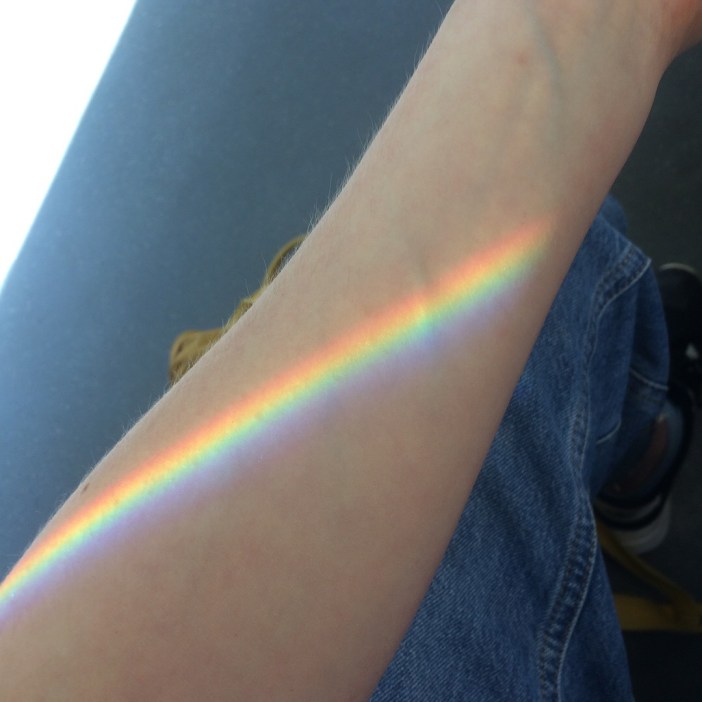

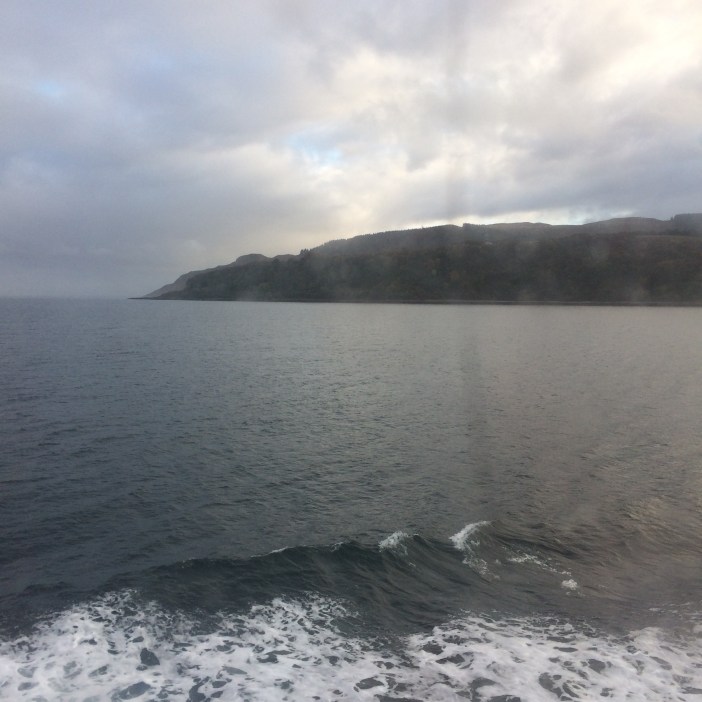

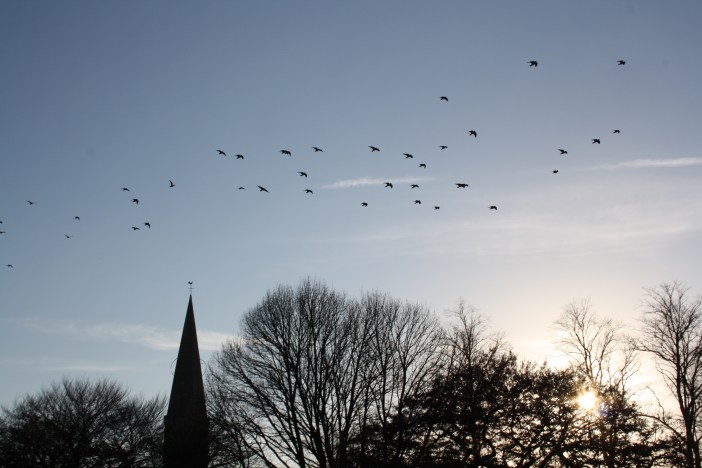
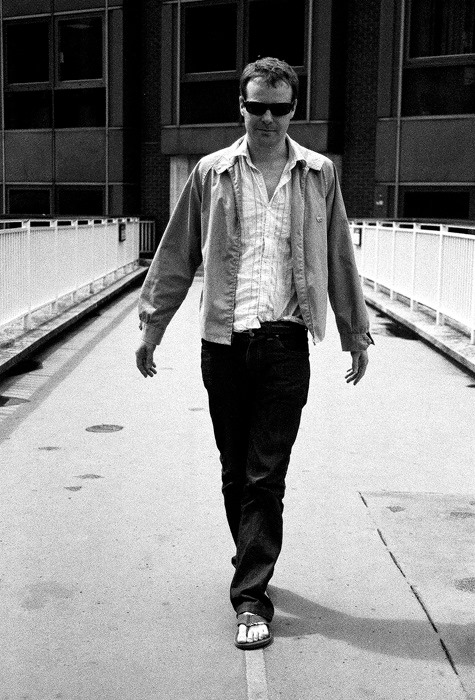
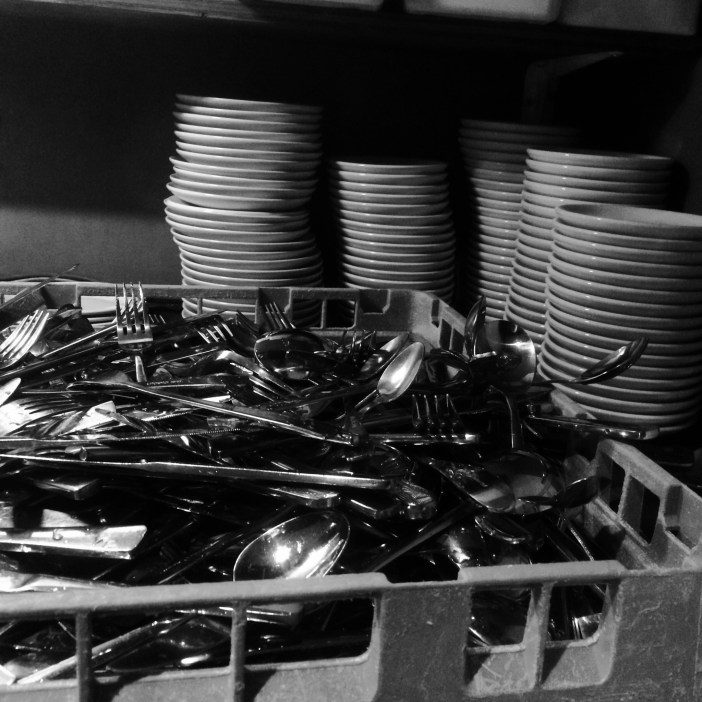




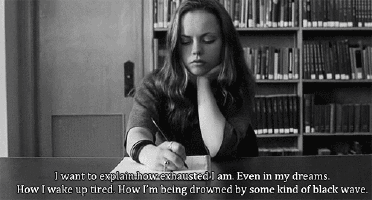
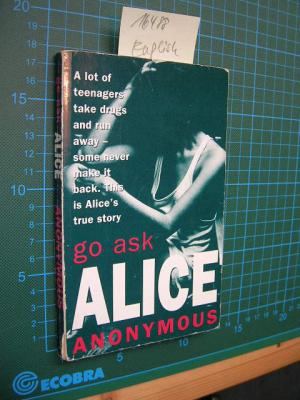
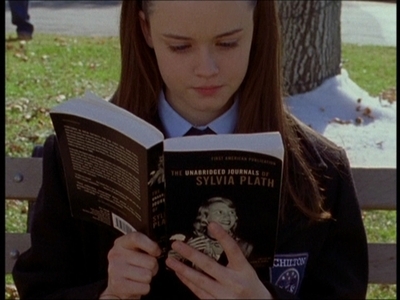
 mariaology