Reading the Eighteenth-Century

My degree programme requires you to take at least one ‘pre-1800’ course – i.e., anything that’s not Victorian or Modern, anything that stretches back into the depths of distant history. For some people, the prospect of reading up on Shakespeare or Medieval literature is a dream, but I chose a course which was dated 1660-1785 – the most modern dates I could get my hands on. I was at first pretty worried about studying the eighteenth-century, possibly sharing Esther Greenwood’s view in Sylvia Plath’s The Bell Jar: ‘I hated the very idea of the eighteenth century, with all those smug men writing tight little couplets and being so dead keen on reason’. When my copy of Samuel Richardson’s Pamela arrived, reading one paragraph of the heroine’s gushing account of her virtue left me exhausted. I looked at the fat Collected Works of Samuel Johnson and my heart sank. However, with some surprise, I soon found myself enjoying the books I was supposed to read. The truth is that the eighteenth-century has a lot more to offer than stuffy old men and their commitment to reason. Of course, it was the time of the Enlightenment, but it was also the time of radical social upheaval: of the expansion of empire, changing gender roles, political turbulence, religious opposition, the loosening of sexual mores and of course literary innovation. The renewed critical interest in eighteenth-century post-Reformation literature in recent decades has meant that the canon is no longer confined to Alexander Pope, Jonathan Swift and Samuel Johnson, as I feared it might be. I’ve had the chance to study more ‘obscure’ works by women novelists, parodies, life-writing, vicious epistles and pastoral poetry that does more than merely sentimentalise the countryside. ‘Tight little couplets’ neatly encapsulates the idea of formal restriction, but the eighteenth-century was actually a period of literary experimentation, facilitated by the shift from a system of patronage to individual publication, and the more general rise in literacy which meant there was a wider market for more writing. It produced the phenomenon of the ‘peasant poet’, as well as the likes of Lady Mary Wortley Montagu, an aristocrat and ‘woman of letters’; it saw the merchant Daniel Defoe becoming a successful novelist in his sixties after years of prolific journalism, and Jonathan Swift penning sharp satirical pamphlets that criticised government policy (suggesting that the problem of poverty in Ireland could be solved by fattening up the starving babies and feeding them to rich landowners…ah, never mind, just go read A Modest Proposal – but bear in mind the irony). So yeah, I’m going to give you a walking tour of what I’ve learned from studying literature in the eighteenth-century. It’s funny how much we already know about eighteenth-century literature, often without realising it. Reading Samuel Johnson’s Rasselas, for example, I was struck by how many of Johnson’s aphoristic statements have been absorbed into our general consciousness, such as that hardened phrase of pessimism: ‘Human life is everywhere a state in which much is to be endured, and little to be enjoyed’ or the wisdom of ‘do not suffer life to stagnate; it will grow muddy for want of motion’ (these terms acquired greater significance to me proportionate to the amount of time I was spending in the library, where life certainly grows muddy for want of motion). I was struck too by Alexander Pope, whose poetry is generally written in heroic couplets, which makes them snappy and easy to remember. So many couplets from An Essay on Criticism and An Essay on Man will strike most people as familiar:

‘Good-Nature and Good-Sense must ever join; | To err is human, to forgive, divine.’

‘True ease in writing comes from art, not chance, | As those move easiest who have learned to dance.’

‘Hope springs eternal in the human breast: | Man never is, but always to be blest.’

At first, Pope’s couplets do sound smug, especially in poems where he’s satirically tearing shreds from literary critics, other writers and the artifice of dress and manner which ‘ladies’ must shroud themselves with in ‘Epistle to a Lady’. But you start to get a feel for them, and the neat syntax and rhyme scheme quickly becomes pretty satisfying, especially in his Pastorals and Windsor Forest. Windsor Forest is an interesting poem because it’s a panegyric (a poem written to commemorate a public event) written to celebrate the Treaty of Utrecht (which was basically a deal allowing Britain freer access to the slave trade), but its attitude to slavery is ambivalent, and with his vivid images of animals being cruelly hunted, Pope via synecdoche (‘if small things we may with great compare’) invites us to compare the treatment of the pheasant to the foreign subject, the slave:

‘Short is his joy! he feels the fiery wound / Flutters in blood, and panting beats the ground’.

I’m quite happy I remember this quote from my exam. Anyway, it’s a fairly distressing image, with all the assonance of flutters and blood stirring up this sense of entrapment and terror, raising our sympathy for this humble piece of ‘game’. The poem is a good one to start with because you learn a lot about history from it, and the poetry itself is enjoyable to read. Pope definitely falls into pompous patriotism, especially towards the end, but because it’s framed through delicious images of silver and gold and rushing rivers, it’s hard to put the poem down purely because of it’s subject matter. And there’s always a sense of unease to Pope’s ideology, as it’s filtering through mythical allusions always adds an ambiguous, extra dimension to the meaning. This is the sort of thing you have to grapple with: not only ‘getting’ the mythical and historical references, but being able to trace their ambiguities through a poetic tradition you’re not quite familiar with.

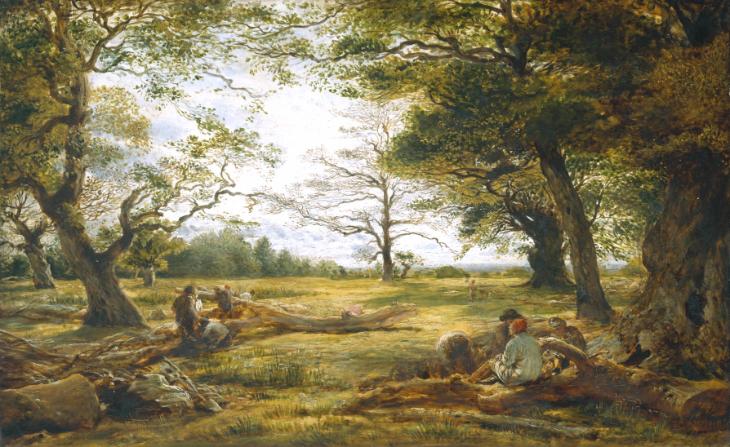
Windsor Forest ('Wood-Cutting in Windsor Forest') 1834-5, exhibited 1835 John Linnell 1792-1882 Presented by Robert Vernon 1847 http://www.tate.org.uk/art/work/N00438
Windsor Forest (‘Wood-Cutting in Windsor Forest’) 1834-5, exhibited 1835 John Linnell 1792-1882 Presented by Robert Vernon 1847 http://www.tate.org.uk/art/work/N00438

Then there’s Pamela, Samuel Richardson’s novel about a young servant girl who falls prey to her master’s endless and increasingly insistent attempts to seduce her, becoming more violent every time. While she does not suffer the terrible rape that Clarissa endures in Richardson’s much longer novel, Clarissa, Pamela goes through a lot and chronicles every scrap of it in her letters home to her parents. Pamela can seem a slog, especially with all those self-justifying lines about how pure she still is and virtuous in spite of everything. It’s frustrating that she never seems to do anything but weep and write and swoon. Still, there are some funny moments, like when she tries to escape but mistakes two innocent wee cows for scary bulls, adding a dab of Freudian psychodrama to the otherwise relatively static action. I guess the main thing we can take from this novel is its intense focus on the individual (something that wasn’t really available before in fiction, because romances were interested in characters as archetypes – princess, villain, hero – rather than real people), and the process of introspection, the attention to everyday detail. The same goes for Robinson Crusoe: part of what’s seductive about Defoe’s novel is not just the adventure and pirates, but all those long passages about how he sets up his little domestic fortress on the island; how he learns to cure raisins, build boats, grow corn. He goes into so much detail you think you’ll go mad, but when you go back and read it, there’s a certain satisfaction to it. You can imagine yourself in his position – Samuel Taylor Coleridge famously claimed that Robinson Crusoe’s success was that he represented human nature in general – and the novel becomes a sort of survival guide to living on a lonesome tropical island.

Crusoe, Friday & some goats. Source: www.nvcreview.com
Crusoe, Friday & some animals. Source: http://www.nvcreview.com

Incidentally, Crusoe’s story was loosely based on that of Alexander Selkirk, a Scottish man who ran away to sea to escape punishment for bad behaviour back home. When he got into an argument with the captain of his ship, he asked to leave and go ashore on one of the South Pacific islands they were close to. Selkirk thought some ship would come and find him soon enough, but instead he was stranded there for over four years. Crusoe, by contrast, is on his island for twenty eight years. Part of the wonder of the story is how sane he stays. Crusoe rediscovers religion and his spiritual devotion is essential to giving his life order and meaning on the island. It’s the little things that matter, that give him a sense of self: carving the days into a wooden cross, having dinner with his ‘family’ of animals and writing in his diary. The whole novel basically celebrates the power of human reason and endurance, as Crusoe notes that ‘by making the most rational judgments of things, every man may be in time master of every mechanic art’. I guess in this way it’s very typical of the Enlightenment attitude of the time, but there’s also a very strong capitalist motive for Crusoe’s actions and attitudes. As Ian Watt points out in The Rise of the Novel, many of Crusoe’s behaviours prefigure that of the canny venture capitalist: his restless travels for more trade, his saving of supplies and investing of crops, his careful planning of time and stock, and the mythological story of the individual’s capacity for survival. In fact, it could even be read as a kind of Puritan spiritual autobiography, because Crusoe has all his capital successes rewarded supposedly by ‘Providence’ as a blessing for his religious (re)awakening. It’s funny how a lot of eighteenth-century texts like Robinson Crusoe are perhaps best known for their adaptations into children’s literature (NOT as the rather awful film versions which insist on adding an irrelevant romance plot to everything). I suppose it’s because Defoe’s novel is also an adventure narrative, encountering pirates and ‘educating’ his ex-cannibal slave ‘Friday’ with Western values (another problematic but critically rich part of the story is Defoe’s relationship to ‘my man Friday’, which sheds light on the colonial context of the time). Another example of an eighteenth-century novel being famous as a children’s book is of course Gulliver’s Travels, by Jonathan Swift. The irony here is that Swift wrote this tale about fantastic worlds with tiny people, floating islands, people who could extract sunlight from cucumbers, giants and talking horses (Houyhnhnms) to deliver a harsh satire on the politics and Enlightenment culture of the period. Unless you have a canny eye or an edition rich with footnotes, you might miss all these references, and so revel along in Gulliver’s story and thus fall prey to the kind of naivety Swift critiques in Gulliver himself. Indeed, because the book was so cleverly prefaced and presented as a true account of a man’s travels, many people thought that the events and the strange places described were all true. In addition to lashing the follies of man’s claim to reason and pursuit of enlightened knowledge, Swift was attacking travel writing itself, albeit with lesser gall. He parodies the supposed objectivity of travel writing, and its attention to seemingly inane details. He gives very precise numbers, showing the reader how he cleverly carves up the worlds he encounters, noting ‘three hundred tailors’, ‘six of his majesty’s greatest scholars’ and so on. He also feels the need for self-justification, as when he describes how his excrement has to be taken away by two wheelbarrows by the tiny Lilliputians:

I would not have dwelt so long upon a Circumstance, that perhaps at first sight may appear not very Momentous; if I had not thought it necessary to justify my Character in Point of Cleanliness to the World, which I am told, some of my Maligners have been pleased on this and other Occasions, to call in Question.

Swift’s writings had been previously critiqued for their lewdness, as in A Tale of a Tub and ‘The Lady’s Dressing Room’, where the human body becomes a site of grotesque revelry and disgust. Swift, therefore, is here fashioning his own self-defence with thick layers of irony, inviting critics to judge him against his own self-protection, his free reign expression on matters abject and bodily. Travel writing was a big thing in the eighteenth-century, what with the growth of the British trade empire and the trend for the ‘Grand Tour’. While they didn’t have access to a railcard, undergraduate (men) would often take the Grand Tour of Europe, learning about refined French manners and Greek culture to more fully develop their education. This of course also involved a lot of drinking and probably visiting prostitutes, but then again, such matters were perhaps necessary to a gentleman’s education – he could ‘get it out of his system’ overseas and come back to Britain enlightened and satisfied and ready to be a ‘good’ citizen. Hm. One of my favourite pieces of travel writing is James Boswell and Samuel Johnson’s account of their journey to the Western isles of Scotland. Their approach was slightly different, as they each wrote separate accounts of the time. Boswell focused mainly on Johnson himself (as he tends to do in his writing!) whereas Johnson spent much time critiquing the dreariness of the scenery and observing the primitive lives of the locals with some disdain, though respect for their hospitality. You can read A Journey to the Western Isles of Scotland for free online via Project Gutenberg, and I think it’s worth a gander, if only to take a brief lunch-break holiday into the wilds of eighteenth-century Scotland. There is also a rather humorous article in The Telegraph detailing the author’s attempts to retrace the steps of Boswell and Johnson’s tour, though I am somewhat uncomfortable with his complaints about encountering a range of ethnicities rather than ‘native’ Scots on his tour…can Scottishness not finally now be defined as authentic through multiculturalism, as everywhere else in Britain, or must it still be hailed as a land of blood and soil nostalgia, pale skin and tartan…? just a wee grumble! I have only skimmed over the stuff we covered in our course on the eighteenth-century. Other things worth reading are the hilarious parodies of Pamela, which cast severe doubt on the veracity of Pamela’s ‘virtue’ and burlesque Richardson’s prose style – some good ones include Eliza Haywood’s Anti-Pamela and Henry Fielding’s Shamela. Also, Raymond Williams’ The Country and the City is a marvellous book which looks at how the countryside was often falsely represented in various examples of pastoral and Georgic poetry through the ages as an idealised contrast to the corruptions of the city. Millenium Hall by Sarah Scott is a very intriguing epistolary novel which has been dubbed a ‘feminotopia’, an early representation of a utopian community run by women on a country estate. I suppose what really strikes you about this period is the sheer diversity of works, and the strong political ties most of the literature displays. It was a time of experimentation, but because the novel in particular was still a nascent form, it’s possible to perceive all the strange incoherences, the little faults and cracks which allow us to reflect on the form in general and its relationship to ideology. Edward Said, after all, has argued that the novel is by definition born out of colonialism: it is ‘fundamentally tied to bourgeois society […] it accompanies and indeed is a part of the conquest of Western society […] the novel, as a cultural artefact of bourgeois society, and imperialism are unthinkable without each other’. The novel’s representation of social authority in the hands of the British, its focus often on middle-class life and relentless individualism are all part of this bourgeois basis of the novel. Whether we agree entirely with Said’s statement, it’s a compelling argument that challenges us to rethink how we consider what is probably the most popular form (other than celebrity biography) in the contemporary literary market. And I guess that’s one of the thing’s I enjoyed most about this course: returning to origins, understanding how modern literature came into being out of the cultural circumstances and experimentations of the long eighteenth-century. It is rather ironic that while Samuel Johnson characterised the typical novel reader as ‘the young, the ignorant and the idle’, reading novels is now one of those activities that mark you out as ‘cultured’, ‘educated’, perhaps even ‘bourgeois’. Not only in its form, but also in its critical reception, the novel has come a long way. Some extra info: 

Pope's Grotto.  Source: popesgrotto.org.uk
Pope’s Grotto.
Source: popesgrotto.org.uk

Alexander Pope was a dissenting Catholic during the time of Protestant monarchy, which meant he was barred from participating in many societal institutions, like university. In 1719, he retreated to Twickenham in the rural outskirts of London, building himself a villa and a grassplot garden whose verdant beauty was to imitate the Arcadian landscapes of much of his poetry. Pope’s residence is notable and pretty cool because he constructed a tunnel under the road connecting his garden to his villa. It led to the basement of his villa in which he fashioned his own grotto. He wrote a rather beautiful description of his delight in a letter to Edward Blount:

When you shut the Doors of this Grotto, it becomes on the instant, from a luminous Room, a Camera Obscura, on the walls of which all the objects of the River, Hills, Woods, and Boats, are forming a moving Picture…And when you have a mind to light it up, it affords you a very different Scene: it is finished with Shells interspersed with Pieces of Looking-glass in angular Forms…at which when a Lamp…is hung in the Middle, a thousand pointed Rays glitter and are reflected over the place.

You can visit Pope’s grotto at certain times of the year, and that area in Twickenham has been named after Pope’s Grove. More info can be found here: http://www.twickenham-museum.org.uk/detail.asp?ContentID=21

Cumbrae: A Fragment

Source: openroadscotland.com

I have this memory of being nestled in the cleft of a rock on the isle of Cumbrae, my bike propped up beside me as I sit watching the sea and eating fizzy laces (they were cola-flavoured, or maybe strawberry). I’m on the rugged side of the island, where yellow eyes and strange animal faces are painted onto cliff walls and sometimes if you stare hard enough at the ocean you can see seals. On the other side of the island, you have the little town of Millport, with all the white and pastel-coloured houses looking out onto the harbour. Everything is still, soft, crisp – the texture of sorbet – so that the only sounds you can hear are the steady lap of the waves sloshing against rocks, and the occasional cry of a wandering cormorant. The island to me is like the shyest of kisses: the kind that taste of rain and raise your spirits. Yes, I’m eleven years old and I feel invincible.

You see, I’m on a bike ride, travelling twelve miles right round the island. I’m wearing jeans with the bottoms rolled up and spattered with black oil from the chain; I’m gripping the handlebars so tight I can feel the blood burn and tingle in the tips of my fingers. I’m pedalling even faster than my sporty brother and my father and I know I’m going somewhere because the landscape changes the faster I go. Life rushes by like a montage peeling back luscious scenery. I pass other families on their bikes but they don’t see me; I’m caught on the drift of the wind that they’re battling and I’m going faster than they could imagine. The sun is on my back and I’m flushed and my hair tangles around me, caught in the straps of my rucksack. I want to get there first; I want to be the first one to reach the secret beach.

You can stand there in your bare feet and I remember the cockle-shell rocks, greenish with sea leeches and weeds. Nearer the sea the sand is velvety thick and oozes up between your toes. My child’s eye spots the starfish and sea anemones, and I wish I had a jar to take some home. I’m teasing my brother about something and he throws a stone into the ocean, watching it bounce five times over the waves. Sullenly I watch it. Then in my head I tell everyone I’m a mermaid and paddle in the shallows, looking out for the shoals of fish that swim by in miniature shimmers. We’d wander back up to the rocks and pick our seat; and that’s where I’m sitting, now, in this moment, looking out to the mainland without worrying about a thing. I’m just admiring the craggy shapes of the distant cliffs and the way the cloud looks like billows of cigarette smoke coating the landscape.

The worries would come later, in the dreamy space that opens before sleep. I’m trying to get at the dregs of this memory. The exact details of colour and light, the way that the April air felt and the shapes of circling time. You go right round the island and come back to the start. You paint the strokes of the green hilltops and the silver belt of the road. It’s nearing summer so the day drifts endlessly through night; it doesn’t get dark properly here, not really. Not until the depths of winter. A shower of rain that’s a spray of glitter. Maybe there’s a lighthouse shooting beams of white across the bay. Ships passing ghostlike in the night and you wouldn’t even know. I remember the cold blasts of wind you get on the ferry, with the horn of other boats and the marvelled awe of other children looking out towards the harbour. I call up all these things and wish for more.

Source: openroadscotland.com

Maybe all that remains of this memory are the sea-smoothed shards collected in a jar that sits on the sill of some window in my mind. You can remove the lid and pick the best colours, turn them over separately in your palm, but you can’t make them real again. Time has softened the sharpness of their edges, added layers of distortion to their rays of shifting colour. Hold one up to the light and you will see the bubbles that mark each year that’s passed, arranged in no order other than chaos.

Somewhere, there is the shimmering bleep of slot machines from the cheap casino room of a ferry. A man asking for tickets and a car stuck on the gangway. The taste of peanut butter sarnies gritted with sand, the crispness of silver foil in my hand. If I close my eyes, dizzy and thirsty, I am back there, my body nauseous with the pull of the sea, the boat rocking to and fro with the turn of the words that mutter on my tongue. My hair whips over my face and it smells of salt and seaweed and I can feel the island growing ever so closer to me as the ocean moves towards the setting sun. It’s not that I’m eleven again – nothing is the same twice over – but it’s the feeling of a memory that you can hold up to the light, watch it distorted, watch it glimmering bright.

A Wee Note for Burns Night

source: prweb.com
source: prweb.com

Growing up in Ayrshire – in fact, pretty much anywhere in Scotland – you will find that the poetry of Robert Burns is ingrained in your mind from a young age. A chance to make children reflect on both their literary heritage and the Scots language (that nowadays they often find themselves alienated from amidst the overwhelming discursive presence of Standard English), learning Burns’s poems is, I suppose, a great activity for a primary school child. But what about the likes of myself, Hertfordshire-born but Ayrshire-bred? As I grew up in a school just a few miles from Burns’s birthplace, I found myself trying to wrench and drill my sullen Southern accent into a lively Scottish dialect that just wouldn’t fit.

At primary school, I used to dread the month of January because it meant Burns recitals for our annual assembly. Each class would be given a poem to learn off by heart. Sure, there would be explanatory footnotes, but I still struggled over every syllable, my normally sharp reading abilities dulled against the quick wit of Burns’s verse. Every year my mum used to make me practice reading the poem aloud at home and every year I found my tongue tangled over the abrasive turns of impossible pronunciations. I can’t roll my r’s and I can’t make that rasping in my throat that seems to adorn every gruff recital of a Burns poem. I would watch the more dazzling of my classmates stand up and confidently perform the chosen poem, their voices catching all the jokes and lively intonations, and I would feel very stupid. I guess I just didn’t get it.

Until one year, when for no particular reason, it clicked. Oh, I’m sure my accent really was terrible (in fact, I cringe inside thinking of it now), but I decided that year to give as good as I could get. I think the poem we had been set was ‘The Sair Finger’, a relatively easy one, with the kind of rhymes that make sense and dialect words like ‘skelf’ (splinter) with which I was actually familiar. I practiced it over and over, determined not to suffer the humiliation of previous years when I was forced to stand up and read it out in class. Every year, the teacher had to pick someone to read their class’s poem aloud in our Burns Assembly. In our class, it was always the same two boys who were chosen every year (and deservedly to them too), but this year something was awry as the teacher quietly offered it to me. Probably, I think she only offered it to boost my confidence, but even if she genuinely was impressed by the improvement on my Scotticisms, I had to turn it down. The thought of standing up in front of my whole school in my mum’s ill-fitting tartan skirt, shakily twisting my vowels, was just too much.

I guess, in that sense, Burns and I didn’t get off on the best foot. But although I struggled with the linguistic detail of his poems, there was something about the mythology of ‘Tam o’Shanter’ that I’ve always been drawn to. The strange tale about Tam and his horse Maggie and the orgiastic goings-on in the old Alloway Kirk is a gorgeous example of Burns’s mastery of the interplay between dialect and Standard English. In a way, the chief pleasure of ‘’Tam o’Shanter’’ is in the mode of storytelling itself. We get the intimacy of the narrator’s shared perspective with Tam – his empathetic appreciation of Tam’s drunken debauchery – alongside incisive lines in Standard English which both emulate and mock the antiquarian tradition of collecting folktales. Burns’s attention to local detail really put Ayrshire on the literary map – even Wordsworth and Keats made a pilgrimage to so-called Burns Country to pay their respects to the influential poet. I should add here that my flatmate and I have a longstanding rivalry about what exactly constitutes ‘Burns Country’. My flatmate’s from Dumfries, and both Dumfries and Ayr like to milk the Burns Factor when it comes to upping their tourist game. Nobody really knows who has true claim to the title. Also, I should add that the Tam o’Shanter Experience in Ayr (the one before it got renovated) used to be the site of a lovely afternoon hot chocolate on Sundays after a stroll around Rozelle.

Anyway, another interesting point about ‘Tam o’Shanter’ is its weird ending. It isn’t Tam whose punished for voyeuristically dropping in on the Satanic revelries in the old kirk, but his poor horse, Maggie. While watching the dancing witches, Tam (in the only speech he has in the poem) cries out excitedly, “Weel done, Cutty Sark!”, which translates roughly to “Well done, mini skirt!” in modern day parlance. Tam finds himself chased by the vengeful witches over the bridge, but, as servants of the devil, they cannot pass the running water. So Cutty-Sark reaches out for Tam and instead grabs his horse’s tail, pulling it clean off to reveal a bloody stump. The narrator ends the tale (tail) with the strange moral:

No, wha this tale o’ truth shall read,

Ilk man and mother’s son take heed;

Whene’er to drink you are inclin’d,

Or cutty-sarks run in your mind,

Think! ye may buy joys o’er dear –

Remember Tam o’ Shanter’s mare.

So next time you decide to be a lecherous male, spying your pervy eye on a coven of witches, remember that your horse might lose its tail. I guess there’s phallic implications there, what can I say?

Painting of Tam o'Shanter by Alexander Goudie, source: south-ayrshire.gov.uk
Painting of Tam o’Shanter by Alexander Goudie, source: south-ayrshire.gov.uk

But ‘Tam o’Shanter’ isn’t just a poem of comic revelry and uncomfortable sexual punishment; it also contains some beautiful picturesque passages that establish their author as a definite early Romanticist, who went on to inspire the likes of the great Romantic Celebrities (Wordsworth and Keats being key players here):

But pleasures are like poppies spread,

You sieze the flower, its bloom is shed;

Or like the snow falls in the river,

A moment white–then melts for ever;

Or like the borealis race,

That flit ere you can point their place;

Or like the rainbow’s lovely form

Evanishing amid the storm.–

Here Burns blends his beautiful floral metaphors with the quiet violence of time’s transience, captured in the image of the fleeting rainbow. There is a simple spirituality here that connects the human world of consciousness and experience to that of the cosmic and natural worlds, and all condensed into a handful of lines. Although Burns, like William Blake, has often been left out of narratives of the Romantic movement – his work and style, laced as it is with literary and political ambiguities and tensions – I think it’s important to reclaim Burns within our conceptions of this exciting cultural period. While the likes of Wordsworth were in awe over the rugged sublimity of Scotland’s impressive landscapes, Burns was busy recording the authentic idiosyncrasies of its culture, humour and people. These days, when questions of what it means to be Scottish loom large over the rarely dull political skies, Burns remains as important as ever. While Sir Walter Scott (I’m sorry for making the sort of sweeping statements that rile the marker’s red pen in essays) added to the mythology of Scotland as a place of both legal, political, social and supernatural intrigue, Burns chipped in a great deal by immortalising Scots in the kind of deceptively simple but actually complex poetry that warrants his frequent comparisons to Blake.

So in a way, I’ve come full circle towards Burns appreciation. These days, I’m almost always wearing some kind of tartan (largely unconsciously, unlike the obligatory tartan headband I used to wear to school on the day of Burns Night), I work in a restaurant adorned with beautiful paintings of Burns and his myriad lovers, and I’ll be studying his work along with other Scottish Romanticists (indeed, the likes of Walter Scott) for my Romantic Lit course later this semester. Although today, on Burns Night, I forgot to buy whisky, and had toast instead of haggis for tea, I like to think this little article is a tribute of sorts from me.

Find out more!

http://www.rampantscotland.com/visit/bldev_visit_burns.htm

http://www.independent.co.uk/news/uk/burns-night-2015-what-is-it-and-how-is-it-celebrated-in-scotland-and-around-the-world-10001133.html

http://www.visitscotland.com/about/robert-burns/

Bus Travel: Why I’m Not a Fan

broken down bus
broken down bus

Getting the bus for most people isn’t a problem, in fact for many it is an inevitable stage of the everyday routine. Buses get people to work, school, holiday destinations – and, more importantly, buses get people home. Yet, for almost everyone who gets them, buses are frankly a right pain in the arse.

My relationship with the humble bus all started when I was fourteen and began travelling into town by myself and with friends, which necessitated a move away from the convenient but uncool parental taxi service towards less convenient but slightly more socially-acceptable public transportation. At first, the idea of being on a bus was exciting: leaning my head against the window feeling the roar of the wind outside as we rushed along, talking to strangers, listening to music as I watched the hills go by rather than being forced to listen to Steve Wright’s Sunday Love Song’s on Radio 2 (sorry Mum). Admittedly, trains were better suited to the wind-in-your-hair function, but back in the day, train times in Ayrshire were rather less frequent than the bus ones. And so, the greater half of my adolescent years was spent riding buses, or more likely waiting endlessly for them to arrive.

In fact, I’m sure I can blur much of my teenage years into an eternity of waiting in the rain at myriad bus stops. It is generally a standard principle that a bus is either five minutes early, and disappears before you get a chance to run like an idiot after it, or else it’s 45 minutes late and the driver and all passengers look grumpier than Nick Clegg.

It is also a standard principle that those waiting for a bus will generally unite at a bus stop with the social glue of the Great British Moan. Whilst this is a gloomy disposition that reflects our weather, it nevertheless provides a useful way of connecting disparate generations. Elderly people love to talk about buses. My nan, like many other people’s grandparents, has probably memorised her local bus timetable. She knows their numbers, she knows which ones are reliable and which ones to avoid. She likes to moan about the drivers and the rising prices. Well, I do too. Some of our best intergenerational bonding has stemmed from conversations complaining about buses.

Regardless of the positives that can come out of poor service, the sheer cost of travelling by bus in my opinion is rendering void any novelty value they might still retain. Buses are getting extortionate. The slogans about cheap travel for students plastered on the back of our local buses are a joke. To make the eight mile journey from Maybole to Ayr it would set me back almost £4 (for a single ticket), when I can get to Glasgow with my third-off young person’s railcard for just over £5 – a journey over five times the distance. Not to mention the substantial luxury of train travel in comparison to buses, where leg room is smaller and the chance of being flung violently into the person in front/beside/behind you is considerably higher.

On a train, I have access to lots of comforts. I might be able to charge my phone. I will be greeted on occasion by a friendly ticket officer, rather than a bus driver irate with the stresses of traffic and grumpy passengers. I have a little table if I want to drink my coffee, write or read a magazine (perhaps the complementary Metro). Late night train travel allows a snapshot into local nightlife, although sometimes it isn’t necessary to take the late train to see this, however. It is not unusual to see someone casually open a can of Tennents at ten in the morning, or to witness a band of rowdy men (on a stag-do, or on their way back/to a rugby/football match) cajoling the ticket conductor and singing rude songs. A hazard of both bus and train travel is the lonesome teenager playing awful dance tunes out loud through the tinny speakers on his/her phone. This was the mode through which I experienced my delightful first exposure to Carly Rae Jepsen’s ‘Call Me Maybe’. So, don’t get me wrong, train travel is by no means a leisurely experience. Anyone who has undergone the horror of taking the evening train back from Ayr to Glasgow on a hot day, will know this. Being packed into a tightly enclosed space with a load of highly-intoxicated, sunburned, tired and aggravated Glaswegians who have just spent a day by the beach is far from light pleasantry.

Yet while trains have their problems, at least they are generally reliable. By reliable, all I mean is that they tend to head from one place to another, stopping at fixed destinations on the way. Recently, commentator Caitlin Moran tweeted that:

Screen Shot 2013-06-27 at 15.25.21

To some people (particularly those who are drivers and rarely take public transport) this disruption to service might seem astonishing. To me, it’s comically familiar. Growing up, I used to regularly get the 361 bus to travel to my friend’s house in a tiny far-out village. It stopped in many different farm towns and villages, and was notorious for its lateness, tendency not to show up and the antics of its drivers. I loved that bus, although it was a bloody nightmare. It was the bus we had to get at nine in the morning after a rough night of partying, and journey along those endless winding roads, being thrown between seats, trying our best not to throw up. It was the bus whose driver has, on separate occasions, pulled up by the side of the road to get a chippy, to take a piss in a ditch and to buy a pack of cigarettes (which said driver proceeded to smoke outside of the bus while we waited patiently inside).

Caitlin Moran later added that everyone on the bus was being ‘very British’ and politely pretending that nothing was wrong. I would like to suggest that such awkward manners are less visible during bus travel in Scotland (well, I can’t speak for everywhere, but at least South West Scotland). As soon as the bus driver accidentally stalls, or refuses some twenty-year-old chancer a half, cue the cries of (and I quote) “ya fucking fanny” and “fuck you wee man”, and general laughter and goading from the other passengers. Well, some of us will try to turn our heads, but generally being on a bus seems to be a more raucous affair than it is down south

Raucous indeed; maybe even adventurous. The notorious 361 was also the bus that one day broke down in the middle of nowhere, while I was on it. Being a highly trained professional, the driver attempted to ring someone ‘in the know’, but succeeded only in engaging what sounded like an exchange of swear words and incomprehensible banter. It being the middle of nowhere, his phone signal then suddenly went and the call was cut off. Said driver left the bus and began angrily kicking at the wheels and inspecting the engine, before standing outside lighting cigarette after cigarette and turning his head around to admire the rural landscape. Meanwhile inside the vehicle, a group of middle aged women on the back seats had pulled out cans of fizzy juice and with conspiratorial giggles were proceeding to top them up from a bottle of vodka. Procuring paper cups from their Farmfoods bags, they offered their concoctions around the bus with much bravado, cursing the uselessness of the driver. As said drive returned to the bus after getting through presumably to his manager, rather than being calmly offered a refund and a possible replacement means of transport, we were told we would have to wait until they could get the sputtering vehicle itself repaired. My friend and I decided it would be miles quicker to walk to the nearest village, where she lived and could provide me with a lift home.

As we wandered the several miles, on a Friday night in July sunshine, quite content with this little drama, the 361 suddenly trundled past us. Arrogantly, it honked its horn  but did not stop to let us on board. We didn’t wave our fists, but just laughed incredulously and kept on walking. Service to rely on.

Following my initial recreational experience with buses as a means of getting into town to meet friends, during my latter means of school I learned what it was like for working people who had to get the bus everyday. I had taken subjects in a college and school in a different town which required several bus rides a day, so that I was hopping around from place to place and finding the majority of my week spent perched on the edge of my seat, trying to read while resisting the urge to vomit (whether said nausea was induced by the driver’s furious attack on bends or by the body odour of the man/woman in front of me I could never tell, probably it was both). I spent so many hours waiting in the frozen cold at bus stops with a bunch of old people wrapped up like Eskimos, or other college students standing catatonically puffing on cigarettes. How I longed to smoke in those days, just for something hot to travel fast to my lungs. Frequently I wore two pairs of gloves at once.

There was one day a week, a Thursday, when I had to get four buses a day, and that truly was hell. But it was also amusing, like the times nearing summer when for some reason the normal-sized bus was replaced with a monster of a holiday coach, which provided a bit of midweek excitement. Or when a woman, looking like she had dressed in my brother’s preteen sportswear wardrobe, got on lugging a titanic-sized flat screen television and proceeded to hug it to her seat like a warm fuzzy bear. Or witnessing the fights that broke out when some kid tried to get on as the bus was pulling away, and the driver exploded into fits of rage and cursing about the arrogance of youth.

Maybe I’m doing bus travel a disservice; maybe taking the bus isn’t what it was a few years ago. Maybe post-recession it’s all got a bit more efficient. I don’t know and maybe I won’t find out, because these days I do everything I can to boycott buses. Walking everywhere helps, and investing in a value-for-money railcard. At least I’m being green.

What I will say about buses is that they are, for good or for bad, a communal experience. Inevitably some ghost from primary school past will float on and treat you with a journey’s worth of gossip about old teachers, or a slightly ominous man in a tracksuit will strike up a fascinating conversation about his egg sandwich with you, or a pair in front of you will keep turning around to inform you each time the bus driver picks his nose and looks straight in his mirror. Maybe there isn’t that kind of intimacy on the train…unless, like the trains where I’m from, the train often has to stop for extended periods after hitting a cow on the line, and what unfolds is like something from a Martin McDonagh script: a gross and darkly hilarious suspension of regular social norms where conversations turn to graphic depictions of absurd animal violence, and people who would normally take a glimpse at one another and then look the other way are suddenly engaged in furious conversation like old mates. I guess waiting for some specialist to come and ‘remove the animal’ (read: scrape cow guts off the train) has its dramatic effects.

Coming to some kind of conclusion, I admit this article has been a bit of a rant, but I hope it is more a record of experiences than a whole-hearted attack on bus travel. After all, it will always have that nostalgic quality: the acrid smell of body odour, stale perfume and freshly-opened cheese and onion crisps; the thundering voices of the half-deaf passengers trying to speak on their brick-like mobile phones; the grimace of the bus driver as he realises he has to count your change from a tenner. Or maybe just the excitement of travelling to college for the first time, or going to a friend’s house and surreptitiously sipping vodka from a plastic coke bottle whilst discussing the forthcoming antics of the evening. When you take a bus, you definitely feel like you are going somewhere (I suppose it bloody well should considering the cost), and there is always the added fun of staring out at the scenery and batting away the wasps, flies and other natural paraphernalia that comes flying in the open windows.

Yes, the bus is certainly the most humble means of transport. Nevertheless, it has to be said that I’d rather walk.