[…This is a story that has undergone many drafts in the past 6 years. It originated as the first piece I wrote (after not writing anything creative for over two years) for my Advanced Higher English Creative Writing Portfolio, which was (to the great frustration of my English teacher), altered about 500 times and in the end we decided it wasn’t quite suitable for submitting. So yeah, it was left alone on some dusty corner of an old harddrive until 2013 when I tried on a whim to redraft it again. What started as a gothic, emo-inflected horror story about the loathing of one’s body was fleshed out with some more character development, an unnecessary amount of diegesis and detail. When the opportunity came to submit a ghost story for GUCW’s Halloween Short Story Competition, I decided to revisit this strange tale again. This time, I didn’t just add or cut, I wrote the whole thing out from scratch. In a way it’s completely different, but the plot is mostly the same, and it takes place over the course of one day. I like when stories do that, because time is quite a stressful thing. Let me know what you think…]
Siamese
Every morning, the sunrise grew stranger; sometimes it was difficult to tell it apart from sunset, the distinction between day and night dissolving altogether. Recently, whole hours had been disappearing, afternoons and mornings lost like cells melting in the bloodstream heat of a vein under pressure. Before getting dressed for school, Maya got up very early and stood at her bedroom window to watch the sunrise. There was something about the queer, flesh-like light, pink clouds streaked with red, which made her skin tingle weirdly. While she watched the colours change, the clouds pull apart as if exposing a wound, she sometimes forgot that she inhabited a body at all.
Often she wondered if she was actually alive; if there wasn’t some other reason for her walking across the cold tile floor at six in the morning, looking over her shoulder, pulling the scratchy woollen socks above her knees, flipping open the lid of her laptop to check her emails. Such a pointless task, the checking of one’s emails, and yet…
There it was again. The email from herself. MAYA. No surname given. At first, she had found one in the depths of her Spam folder, but now it had bounced back to her inbox. She had received one of these emails every day for the past week. It was foolish to open such a message, which she knew could be nothing but some cheap, automatised attempt at tricking her into activating a virus…And yet. The house was still dark, her mother asleep. Only flickers of yellow gold from the sunrise oozed on the floor of the kitchen where Maya sat with her laptop, the shiny varnished floor which seemed to guzzle the light, crave it. It wouldn’t bounce back its heat. Shivering, she opened the email.
***
At school, the people who were and were not her friends called her Mad Maya.Mad Maya, Mad Maya. Leaving her house, she took the familiar route through the ancient copse of fir trees and across the village green, every morning rehearsing the childish chorus, rucksack thumping heavy against her back. Sometimes she heard her classmates’ whispers in the rustlings of the trees, as if the world itself regarded her with equal harshness. Today, the voices were louder than ever. It was impossible to draw sense from that chaos of lashing language. There was a familiar tone beneath the rasping exterior, a familiar tone that jarred unpleasantly with Maya’s attempts to forget the words that swirled up around her in flurry after violent flurry. By the time she had pushed open the school gates, bumped cigarettes off Dodgy John with her lunch money and followed the ring of the school bell, she was physically shaking.
In science class, the teacher was trying to explain how blood gets pumped around the body. The girl sat beside Maya was mindlessly scribbling love hearts all over her jotter. The teacher mouthed the words at them, but no sound seemed to come out; everything had slowed down, as if underwater. Words materialised on the board: atrium, Vena cava, tricuspid, ventricle, pulmonary artery, semilunar, aorta…Lush, intangible, otherworldly words. Every time Maya tried to write them down, her hands shook uncontrollably and the pencil fell from her fingers, clattering conspicuously on the floor. The more she learned about human biology, the more foreign she felt in her own body, as if she were discovering some hideous secret from all those diagrams and lists of words.
If she lifted her book off the desk at the end—which she must have done, because somehow she got out that class with her things—she would have seen the graffiti underneath, a kind of ancient inscription in jagged letters: M A D M A Y A. She did not recognise the handwriting, but it sent a jolt through her. It was possible that she had seen this before.
***
She found herself home early. The house was silent and her mother was still out at work. There was no car in the drive, not a single dish piled in the sink. Sometimes Maya worried that her mother would disappear. How little she ate! Then there were the useless prayers she still eked out before bed, kneeling by the living room window, where on clear winter nights you could see the moon, flooding the carpet with silvery light.
O, wash me, cleanse me from this guilt. Let me be pure again…Restore to me the joy of your salvation.
Sometimes, the susurrations and mutters of her mother’s prayers haunted Maya’s dreams. There was a time when she stayed out later and later, wandering the streets, just to avoid them. If only she knew what single guilty thing her pious mother had done in her life; that central act of transgression that seemed to define her, irrevocably, as this fragile, selfless being. Often the act pressed itself so heavily on Maya’s mind, massive and burning like some elaborate tapestry set fire to by Satan, that she could almost unpick its outline and form. But it was possible that she would never discover the truth as to why her father left soon after she was born, why on a daily basis her mother clutched God’s cross so tight around her neck.
She tried to sit down and do her maths homework, focusing slowly on the sums, as if each one were a special code she needed to disentangle, to find the kernel of meaning, the way they did with poems in English, scanning words on a page and picking at them, as if each one was a stitch. The problem was, each time she held a few figures in her head, they were snatched away—it literally seemed as if some force were wrenching the numbers and crushing them into some dark part of her unconscious. Some day in the future, perhaps, she would again encounter those fractions, sets of ones and twos, sixes and sevens, come to divide and splice her mind. The lines and figures appeared shakily on the page. Suddenly, the phone rang.
“H-hello?”
“Yes dear, it’s me!”
“Oh, Gran. Hi.”
“I’m just checking up on you dearie, it’s been so long.”
“Yes.”
“Are you busy just now, fancy a chat?”
“Doing my homework.” It was such an effort to talk at all; the words felt garbled in Maya’s mouth, like hieroglyphs.
“Oh, I’m dreadfully sorry—I didn’t mean to disturb you. I’ll let you get on then, I—”
“It’s fine.”
“You sound sad my child. You go and get yourself a wee biscuit or something. The sugar will help. I hope it’s not too difficult, what you’re doing, I—”
“Bye, Gran.” Maya clicked off the phone before her grandmother could finish speaking. She did not replace it properly on its hook and the cord dangled obscenely from the wall.
With mechanical obedience, she opened the cupboard and pulled out a packet of digestives, holding them in her hand as if they were some foreign food and she did not know what to do with them. Her hands were shaking again. Slowly she took out a biscuit, and tentatively bit it. She could not hold it in her mouth, and she ran to the sink, gagging. Some alien sensation seized her and she knew she could not eat, though something like hunger ached vaguely in her stomach, spreading up to her chest, settling in the centre as some unwelcome glow of pain.
Perhaps it was heartburn. She poured herself a glass of milk from the fridge, remembering an old trick of her mother’s to cure it. She lifted the glass to her lips but suddenly stopped. On the surface of the milk was a thin, quivering skin. Bile rose in Maya’s throat. She thought of jellylike scabs, wobbling with pus and blood underneath. The smell was gross yet oddly familiar, primordial somehow, like the smell of a womb. The glass dropped from her hand and shattered on the tiles, the milk bursting everywhere, sour and white, spraying itself on Maya’s clothes and skin, where it clung like some viral, viscous substance.
She slumped to the floor, momentarily paralysed. The sound of the phone off the hook resounded throughout the house, a pulsing, crackling sound that came from somewhere else: please check and try again.
***
As usual, she had met him at lunch, by the neck of the woods where the sycamores draped over the river, the river that wound round the whole village like an elaborate, snaking artery. Every Wednesday and Friday they would skive class together and nobody had ever noticed. He was two years older. They walked into the woods together, not clasping hands until they were shrouded in darkness, and even then, it was not clear how it happened, who made the first move. At this time of year, the mid-afternoon light was very white, shining down in strange beams through the thick canopy of trees. They would find their secret place. Each time it felt new to Maya, though she suspected that the boy hardly cared. If she came here alone, she would never be able to find the place.
Gently, he unravelled her from her school clothes, her hair coming loose in his fingers, her tights scrunched to a ball on the forest floor, crumpled like a shed skin. Her body was lily-white in the cool forest light, her shoulders exposed to the shivers of the trees and the tear-like glimmers that clung to the needles. Each time, he would run his hand automatically up her stomach; he would trace the long scar that ran up her left side. He would trace it slowly, lovingly, as if he were following the seam of a secret. The mark of ruined flesh. They never spoke of it, but each time he would reach down to trace it, to read it like braille, even as they kissed. Once, the sensation had given her delicious shivers, but now it meant nothing at all. Before, it had even been slightly painful, the scar so tender under his touch. Now, she could hardly feel it at all.
“I had a transplant,” she told him, the first time he asked. That was all she knew. She had never bothered to learn more of her own body; the boy had taught her all she wanted to know.
His flesh was pale and silver, a latticework of pulsing, blueish veins, but even as he pulled her over his body, she could not feel him. He was light as air and her body was not her body.
It was as if she were watching herself from afar, a child crouching behind a tree, stricken with terror and curiosity. She felt sick afterwards, and in fact even retched a little. He passed her a cigarette. She could hear the trees whispering again, and this time it sounded as if they were calling her name. Mad Maya, Mad Maya.
***
Possibly it was nightfall, sunset, the house so quiet, her mother asleep. The email lay open on the screen, its contents splayed out and glaring their strange incandescence across Maya’s bedroom. A chorus of acid colours spilled liltingly, tauntingly through the window. The ache had deepened in her chest, so deep it felt like her own veins were strangling her heart. It was difficult to breathe, with the dust of the room and the air that filled her lungs like spider webs mushed to molasses.
There was the collage of her entire life: comically vicious stick-figure drawings from her primary school jotters, school reports, doctor reports, notes to friends, reams and reams of texts, the carefully-typed emails she had sent to the nurse, impassioned diary entries scrawled in that distinct thirteen-year-old hand. Traces of the white powder devoured at weekends, the imprints of the boy’s kisses on her shoulders and neck, captured uncannily, impossibly, as polaroid photos, the bruises glowing through the skin like ghosts. Nothing felt real anymore. Maya hitched the laptop closer on her lap and peered at the pictures. Each one was a palimpsest, layered below streams of lurid red typewritten print: Mad Maya;parasite; murderer; the wrong child; sinner and sinner and sinful and sin. She shivered and gasped. She felt the screen start to shimmer, the pixels elasticating, blurring, the LCD surface beginning to compress and open, like a portal.
For a moment, the power cut off. A reflection appeared in the darkness of the screen: there were two Mayas, conjoined at the waist and the chest, struggling for breath. As the light flickered back on, the bodies flashed negative as if under x-ray, and in that second it was possible to glimpse the single aorta, throbbing like a terrible eel, tangled between the two bodies.
The laptop’s screen had cracked, but it didn’t matter. A silver moon beamed its single slice of light, guillotine thin, upon the glass.
***
How beautiful the world is! In the mirror the girl ran her hands through her hair, she felt the lovely inky glossiness of it, the way her skin was so soft and milky. A finger ran up the length of the scar on the right side of her body; in its crosslinks of knotted collagen she could read a virginal history. She picked up a notebook from the bed and felt its pages skim beneath her fingertips, delicate and full of possibility. A whole life to be written on those lines. The girl found herself at the window, yanking open the glass with fresh young limbs. The night air was cool and ambrosial; the air smelled of wild pines and the coming snow. The heat around her heart started to liquefy, spreading a pleasant warmth through her blood. Yes.
On the desk, a phone buzzed with a text: Where are you, why can’t I reach you?
Dark Ecology and Haunted Technology in Stranger Things
(warning: this essay lacks coherence; think of it more as a wandering, a haunting of deranged, half-baked ideas)
***
In our time, the soul has been progressively more materialised. That the soul should now be thought to be, no longer purely immaterial, but constituted from a range of different forms of exotic or tenuous matter is a proof of the necessity of physics for any metaphysics
(Steven Connor, ‘Her Light Materials’).
In her book Phantasmagoria, Marina Warner explores the way in which, from the seventeenth century onwards, we have increasingly relied upon various forms of matter in order to discursively figure the soul: visual apparatuses, natural elements, shadows, reflections, wax and technology are just some of the material modes by which the soul is embodied in the ‘modern’ era. This emphasis on things and substances as they bear forth not only selfhood but also the spiritual manifestation of self is crucial to an ecological understanding of humanity’s vision of itself in a post-industrial age where such substances, through our own actions, have contaminated the earth: the Anthropocene means that our physical activities as humans are literally embedded, embodied and sedimented into the Earth’s geology, ecosystems, climate. In a sense, the human soul, its debris of thingness – whether vaporous or material – is already encrusted within what we can now only tenuously call the environment. For doesn’t an environment presuppose a foreground and background, a subject who inhabits the object(ive) world? What happens when we are the object world? How do we confront the sudden otherness of ourselves, the realisation that we are the earth, and not in some hippie-dippie holism (let’s all hold hands with the animals) but in a frighteningly confrontational reality of material coexistence?
What is striking about Netflix’s Stranger Things is exactly its emphasis on strange things. The suffix draws attention to what we mean by things: who or what are we comparing the stranger things to? Ourselves? The creatures we coexist with, the ones we have already charted, taxonomised, ordered and made familiar through Enlightenment science, zoology and philosophy? How many horror films have we seen where that which is monstrous is not other to us but somehow represents the other within us? As Virginia Woolf said of Henry James’ ghosts: ‘They have their origin within us. They are present whenever the significant overflows our powers of expressing it; whenever the ordinary appears ringed with the strange’ (1921). When what we take as given, as natural or normal–is revealed as inherently disturbed–the boundaries of meaning violently ruptured or haunted, there incurs a fundamental split in what we take to be reality itself. We are forced to question our place in the ‘world’ not just as a human but as a physical subject tout court.
Screencap: Netflix
The horror genre is notorious for its representation of creatures who challenge our definition of the natural. Timothy Morton says of John Carpenter’s film The Thing: ‘the supposedly horrific alien is none other than the reproductive, simulative process of nature itself’; the Thing is always shifting its guises, ‘destined never to be itself’ (182). This is the dark allure of the popular horror trope of the viral: that which is always shifting, transforming, responding ‘automatically’ (as in Darwinian) to the conditions of its environment. Think of zombie movies, then also the likes of 28 Days Later, I Am Legend and so on—all are obsessed with the idea of infection, the notion that apocalypse will come because the purity of the human soul and body will be corrupted by some alien force.
However, what terrifies about the virus is the realisation that it is inherent in ‘nature’; as Morton argues, what is ‘monstrous’ about evolution, about the growth of plants and other lifeforms, is that DNA itself is viral: [a]ll organisms are monsters insofar as they are chimeras, made from pieces of other creatures’ (2010: 66). Like Victor Frankenstein’s Creature in Mary Shelley’s novel, all lifeforms are hybridised, made from scraps of other beings; though here the product not of Frankenstein’s experiments in vitalism but of evolution’s functional contamination. As with Derrida’s revelation that language, meaning and being have no presence, but only Différance, Darwin’s theory of evolution, as Morton shows, is similarly predicated on slipperiness, fuzziness, contamination. At the core of existence is not essence, but différance, with all its implications of instability, aporia and fragile, mutually infected binaries. Mutation, in a strong sense, is inherent to ‘nature’ – and by no means are humans excluded from this ‘nature’. Not only do we enmesh with the object world in a corporeal sense (our bodies are not bounded but always escape, fragment – the dust of our skin and hair inhabits the atmosphere) but also in the discursive sense, in the way that Warner has traced: in the literary and aesthetic figuring of the soul as a material thing.
Episode Four of Stranger Things is appropriately named ‘The Body’. Looking down at the corpse of her missing child (Will), Joyce (played by that chimera of the Gothic heroine, Winona Ryder) screams, ‘I don’t know what you think that thing in there is, but that is not my son’. What she feels is not grief, but something ‘different’: she is rubbing up against the fragile boundaries of the symbolic order, feeling the metaphysical structures of the world quiver uncannily around her. Later in the episode, we see her other son, Jonathan, weeping in his room to Joy Division’s ‘Atmosphere’. The lyrics enact an uncanny duality of dialogue: the imperative to ‘walk in silence’ is retracted immediately with ‘don’t walk away, in silence’: the whole song, with its slow, shimmering synths and shuddering drums enacts a play between presence and absence, the corporeal and incorporeal: ‘Naked to see / Walking on air / Hunting by the rivers’. Like The Cure’s ‘A Forest’, there is a maddening sense of pursuit, the lost object dissolving into silence while the mournful subject can only wander through the song in his melancholia, pursuing ‘through the streets’ but only to abandon ‘every corner […] too soon’. There is no closure, only this ‘atmosphere’ of absence sprinkled with the ghostly possibilities of presence elusive.
With Will’s ersatz body we confront the indeterminate state between life and death, the physical remains which should suggest closure and yet speak of something silent, unsayable. What is this strange body cast up before her? Surely not the son, who she is sure is not dead yet, who she has heard calling for her through the telephone…Later, when Hopper, the police chief, takes a knife to the chest of the corpse, he sees it to be synthetic, stuffed like a pillow. Matter contained in matter; this time, not human matter, but simple object matter. We are suddenly pointed to a deeper conspiracy (the Department of Energy and the MK Ultra experiments), but at the same time the suspense of Hopper’s puncturing is playing upon our abject reaction to the corpse as that which contains within it both life and death. What disgusts us in the carving of cadavers is the fact that it is even possible; the tear of the body representing the tear of all we have taken for granted in our usual embodied lives as similar beings, wrapped up in what we thought was the same fabric of reality.
What is uncanny about a human corpse? It reminds us of the presence of death within everyday existence, it shows us, in visceral, stinking, mattering manner, ‘what I permanently thrust aside in order to live’ – it is ‘death infecting life’ (Kristeva 1982: 3). Stranger Things is obsessed with appearance and reality, with the hidden networks of existence which haunt the outward façade of daily life in small-town Indiana. As the title suggests, part of this interplay of appearance and reality is the necessary strangeness of things: not just the gory, pulp-horror monsters that haunt our nightmares but the strangeness of all we take for granted as normal—the family home, the general ‘good’ of the government’s intentions and the rule of the law; the clear boundary between life and death, presence and absence, self and other. We might think of Jeffrey Beaumont in Blue Velvet (1986), bending down in the lush green grass of a suburban garden to lift that grotesque, insect-swarmed severed ear from the ground: the sudden onrush of magnified sound that signals our entrance into the underworld, the seedy, violent and parallel reality which exists aside our everyday lives. This essay will attempt an exploration of sorts into Stranger Thing’s heart of darkness: its uncanny depiction of the interrelations between bodies, technologies and nature, the living and the dead.
My central focus will concern how ethereal, inter-worldly transmission is figured through technology and also how its representation of abjection and the viscous, sticky enmeshment of the Upside-Down contributes to a renewed understanding of what constitutessuch taken-for-granted things as nature, environment, world. I will argue that the show’s obsession with death as an ontological condition and its depiction of both communication and rupture is not just a parable of Cold War paranoia over the presence of the (Communist) Other within, but also challenges the ethics and poetics of how we approach the non-human Other in the context of late capitalism, i.e. ecological crisis and technological modernity.
One of the most terrifying aspects of the Monster/Creature/Demogorgon is its lack of a face; the fact that it cannot return the gaze of its onlookers, who can only look into the void of its flesh and see substance, reminding them that they too are substance—that the boundary between the human and monstrous is decidedly fragile. The Dementors in Harry Potter are similarly frightening because they lack eyes: where the eyes should be, the sockets are covered over with scabby, corpse-like skin. In Neil Gaiman’s children’s novella, Coraline, in the parallel, looking-glass world that Coraline finds ‘through the door’, her Other Mother and Other Father seem physically identical to their originals, except that their eyes have been replaced with black buttons. Freud famously outlined his theory of the uncanny through a close reading of E. T. A. Hoffman’s ‘The Sandman’ (1816), a dark Germanic fable about a creature who visits children and tears out their eyes. Freud very cleverly links the fear of blindness back to castration anxiety, but for my purposes, the uncanniness of losing one’s sight is partly due to perception itself. If our eyes are associated with discerning the real world of impressions around us, how can we without them tell if we are living in reality?
Moreover, when we encounter creatures without eyes, what are we to make of their consciousness? If eyes are ‘windows to the soul’ as the saying goes, can there be a soul without eyes? Coexistence can happen on an intelligible level if the animal can return our gaze: Derrida, in ‘The Animal That Therefore I Am (More to Follow)’, has written about his experience of being looked at and looking back at the animal, namely, his cat staring in confusion at his naked body; and we have all had a moment of silent exchange with a stranger’s pet, eyes meeting by chance perhaps but lingering…and in that lingering is the suggestion of an understanding between species, the troubling of notions of inside/outside, human/nonhuman.
Yet how do we interact with a creature who cannot return the gaze? A thing without facial features is ontologically unstable somehow, unable to establish presence through meaningful expression: ‘the phantasm is the sign of that visible incorporeality. The image I see returns as both the spectral figure of myself as other, and yet also it figures in its return the immanence of my disappearance’ (Dick and Wolfreys 2015: 139). Could we relate this ‘visible incorporeality’ to the Creature of Stranger Things? It is certainly figured as corporeal, as Nancy and Jonathan embark on a hunting mission to slay it like any old dragon or wildebeest, but then again, it is not of our world – it comes from the other place, the Upside-Down. Seeing the Creature, the characters are faced with its impossibility, which in turn incurs an ontological rupture whereby they themselves witness the flashing vanishing of matter. Barb’s sudden disappearance, for instance: the play of sensory impressions that distorts all sense of space and time in the woods.
Significantly, the Creature is not the only ‘monster’ that haunts Stranger Things. Throughout the show, El is in a sense a ‘monstrous’ figure. Her origins are unknown. Stripped of hair, with a boyish figure, she maintains an androgynous appearance; the boys’ attempts to prettify her with a wig and makeup enact a bizarre transformation which only serves to heighten her strangeness, as she appears more doll-like, the sudden deliberation of her actions running uncannily counter to her appearance, which would be that of an automaton if she were a living doll (or indeed, the escaped hospital patient possibility suggested by her bald scalp and hospital gown). Her fate, like Safie in Frankenstein (who provides a parallel figure of exile for the Creature, welcomed with hospitality while he is crudely expelled from the De Lacey home) seems inextricably tied up with that of the Creature: in the final episode, its vanishing at the command of her telekinesis simultaneously enacts her own vanishing from the concrete world of the boys and the classroom. It might’ve been interesting to make the Creature a more sympathetic life form, rather than a screaming reaction of base violence which actively preys on humans, just to give some extra ambiguity to the order of things; but even so, it’s still possible to have some sympathy for the Demogorgon (and not just because it seems the live manifestation of a beloved strategy game)—after all, it represents ‘nature’ in all its savage instincts, linking back to what I was saying earlier about monstrosity and evolution.
Screen cap: Netflix
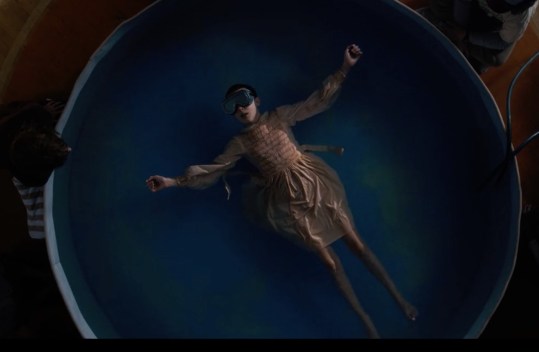
In order to defeat the Creature, to seek out Will in the Upside-Down, El has to recreate the sensory deprivation experiments which were conducted upon her in the Department of Energy lab. Floating in the water, she appears Christ-like, as if her soul must endure the rituals of crucifixion in order to bring back Will from the Upside-Down (symbolic immersion?). Like Nancy, she is deathly thin, her physical presence pale against the strong personalities of the male characters. Her corporeal existence is almost shimmering: she is slow at first, learning words and meanings, piecing things together. Not only does this emphasise the shock of her telekinetic powers, but also it sediments the show’s strange interplay between the ethereal and material.
Spilt blood…Screen cap: Netflix
Stranger Thing’s preoccupation with eating is one manifestation of this. It’s all very Freudian. Jonathan makes eggs for his mother and tries to get her to eat. Arguments occur round the family dinner table. In the Upside-Down, Nancy sees the Creature feeding on a deer and realises its attraction to spilt blood. The cadaverous El is always ravenous and is frequently seen eating. In fact, at one point she blithely steals frozen waffles from a supermarket and devours them in the woods. Food is a prominent symbol in fairytales. Food, of course, is closely related to abjection. Fundamentally, the digestion and excretion of food reminds us that we are part of an enmeshment of material things; unfortunately, we cannot transcend the flesh prison which sustains our beautiful souls…Kristeva’s description of the abject reaction of food disgust is worth quoting in full, as her sentences gather a certain pace that mimics the physical spasms of reaction, the desire to expel the self in the experience of disgust from the food object which reminds us that we too are bodies, layered and soft and mortal:
Food loathing is perhaps the most elementary and most archaic form of abjection. When the eyes see or the lips touch that skin on the surface of milk—harmless, thin as a sheet of cigarette paper, pitiful as a nail paring—I experience a gagging sensation and, still farther down, spasms in the stomach, the belly; and all the organs shrivel up the body, provoke tears and bile, increase heartbeat, cause forehead and hands to perspire. Along with sight-clouding dizziness, nausea makes me balk at that milk cream, separates me from the mother and father who proffer it. “I” want none of that element, sign of their desire; “I” do not want to listen, “I” do not assimilate it, “I” expel it. But since the food is not an “other” for “me,” who am only in their desire, I expel myself. I spit myself out, I abject myself within the same motion through which “I” claim to establish myself. That detail, perhaps an insignificant one, but one that they ferret out, emphasise, evaluate, that trifle turns me inside out, guts sprawling; it is thus that they see that “I” am in the process of becoming an other at the expense of my own death. During that course in which “I” become, I give birth to myself amid the violence of sobs, of vomit.
(Kristeva 1982: 2-3)
The inside-out unsheathing of the body and its skin (the skin of flesh, the flesh of food) mirrors the Upside-Down Alice in Wonderland reversal and parallel convergence of realities. There is always a reversal, another possible surface. The mutation. Nothing is stable but always in movement. The spasms here mirror the shrieking of the self in the grip of grief: in Twin Peaks, Laura Palmer’s mother shrieking in hysteria; in Stranger Things, Joyce Byers rattling with terror as she storms around her own home, trying to find her lost son. The psychosexual implications of Kristeva’s passage are also relevant to Stranger Things because, let’s face it, there is something womblike and vaginal about the viscous, flora-infested environment of the Upside-Down, its gross and mollusc-like mucus and glistening ectoplasm. It’s perhaps no coincidence that Nancy loses her virginity the same night that her best friend Barb is sucked into that orifice-like portal of the monstrous feminine, the gooey nether-zone where she will find herself woven into the lining, her body penetrated by the infestations of disgusting slug and snake-like creatures. Like Cinderella, Barb pricks her finger (though on a crunched beer can, not a spindle) and is doomed to some sort of eternal sleep.
Screen cap: Netflix
At one point in the show, one of the lab workers enters the portal in the Department of Energy and despite clinging to a rope, is irrevocably drawn into the depths, never to see the light of day again as the mouth of the portal closes. There’s the whole vagina dentata (religious myth of the toothed vagina) psychoanalytic strand here which would be interesting to pursue, especially as the implications of castration anxiety connect back to the Creature’s missing eyes/face. As in Twin Peaks, the portal to the other world (Black Lodge) will only open under certain conditions. With Kristeva’s passage on the skin of milk, we can think about how the entrance to the Upside-Down is itself an instance of abjection: the expelling of bodies and matter between worlds. The inside is clearly toxic as the lab workers don protective suits to enter; there is even a suggestion of the post-nuclear landscape in the way that an ash-like matter floats in the atmosphere, again fitting in with the monstrous nature/alien space theme.
Screen cap: Netflix
As Nancy tumbles out from the forest portal (housed inside a tree), sticky with all the weird stuff that comes off the world’s ‘lining’, she is quivering with terror in a manner reminiscent of Kristeva in the rejection of the milk. Freud theorised that young boys were scared of their mothers due to the fear she would castrate them, and maybe there’s a reading that the whole show is some phantasmagoric, dreamlike manifestation of the terror of the overbearing ‘hysteric’ mother (Joyce). The winding strands of plant-like matter, snake-like and strange, are reminiscent too of Medusa’s head. Freud has a whole essay, ‘Medusa’s Head’ (1922), on the possibility/implications of Medusa’s head taking ‘the place of a representation of female genitals, or rather if it isolates their horrifying effects from their pleasure-giving ones is familiar in other connections as an apotropaic act’—namely, the commitment of evil. Interesting how Stranger Things teases with the gendering here: the male-dominated U.S. Government vs. monstrous feminine nature – which is more evil? Science or the (super)natural? I think the Alien films are probably the most obvious Stranger Things intertext here, but the very fact that the show wears its myriad influences on its sleeve creates a web-like structure of inference that opens itself up to multiple readings that cut across the cultural timelines of the twentieth and twenty-first centuries, spreading out monstrously, contaminating discourses both pop cultural and scientific.
The show plays constantly with this weirdly distorted womb/plant/viscous/genitals imagery and I can’t help but think perhaps it represents some kind of monstrous mother nature, the vengeance of the earth against the interfering experiments with time-space enacted by the US Government and its Department of Energy…Hyperobjects like global warming, plutonium and oil slicks are defined partly by their viscosity: ‘the more you know about a hyperobject, the more entangled with it you realise you already are’ (Morton 2010a). The more we as viewers learn about the strange world of the Upside-Down, the more we see it in our own reality. Monstrous, oozing nature. Ourselves in the mirror: the strange stranger – the notion that the closer we get to other life forms, the weirder they become (Morton 2010b: 17).The constant recurrence of floods and hurricanes and melting ice caps, irrevocably now understood as the consequences of global warming: they acquire an almost anthropomorphised monstrosity.
At the end of the series, Will, restored to apparent ‘reality’ (signified by that most traditional of temporal markers, perhaps the most important date in the calendar, Christmas Day), coughs up a slug-like creature and once again glimpses the Upside-Down again, flashing through the palimpsest surface of the normal world, reminding us of the imprint of the ecological uncanny, the presence of the strange, nonhuman other, within ourselves. I am struck with a line from Coleridge’s poem, ‘The Rime of the Ancyent Marinere’ (1798), where, after facing the nightmare wrath of the storms following his shooting of the albatross (the fatal crime against ‘nature’), the mariner glimpses the gross multitudes of sea-snakes in the ocean below his boat, shimmering among the floating corpses of his fellow sailors, lost to the storm: ‘And they all dead did lie! / And a million million slimy things / Liv’d on – and so did I’. The mushy consonance of the l sounds here recreates the oozing viscosity of all those wriggling bodies, but there is a sense in which the mariner seems to revel in the sheer multitude of these ‘million million slimy things’, as the repetition suggests—their individuality as types of species is beyond his grasp and he can only face them as a kind of hyperobject, the sharp realisation following the caesura (-) indicating the revelation of coexistence, which is both wondrous and terrifying.
Indeed, there’s something about El’s telekinetic powers too, the way they can elasticate reality, bending objects and shattering matter, but at the expense of something inside her, the price of the blood that oozes from her nose each time, signifying her depleted energy. She is no robot, but material and mortal too: the recurrence of the blood and its spilling viscosity insists on this. El’s ‘magic’ enacts a disruption of foreground and background; we cannot just perceive it as magic, for we have witnessed its basis in a kind of scientific experiment within the labs. It comes out of the world, disrupts the subject. Stranger Things is rife with pathetic fallacy – storms and power blackouts – and this isn’t just a contribution to the horror mood but also an underlining of the show’s ecological context and monstrosity: the collapse of weather as mere background, stage-setting, into the narrative itself (the significance of electricity in the show is still to be traced) signals the impossibility of the world as such. ‘We have no world,’ as Morton so aptly puts it, ‘because the objects that functioned as invisible scenery have dissolved’ (2013: 104). What happens when you think through the world as the world, rather than from an anthropocentric viewpoint? Peter Watts has written a short story titled ‘The Things’ which reverses the perspective of Carpenter’s movie, this time telling the story from the virus’ point of view (note the plural things and think back to the mutational plurality/chains of the virus)—once again, disruption of subject/object ordering. What is an alien consciousness? What is nature’s consciousness? The only way we can find out is by recognising nature’s strangeness, and that strangeness is inherently within us too. In Stranger Things, the dissolution of objects is part of the show’s exploration of the uncanny (walls and doors shift, ooze, open and close) in relation to the monstrous (and this is rooted in other themes beyond the scope of my essay; for example, the nuclear family and adolescent sexuality), but also the monstrosity of nature enacting its gross and terrible vengeance against man’s interference: El, little pixie child of the forest as she becomes, is able to manipulate objects, thus denying their status as mere staging and indeed staging them as vitalist forces in themselves (so far, so Object Orientated Ontology?).
On the subject of ‘energy’ and electricity it isn’t just El’s psychic energy and the deceptive title of the ‘Department of Energy’ that resonates in Stranger Things. ‘Energy’ also points us to the vitalist elements of Stranger Things; namely, its interest in the networked relations between humans and technology, the way that communication and transmission rupture not only the fleshly interaction of humans but also the metaphysical boundaries between life and death. For starters, there’s the song played against the opening title: New Order’s ‘Elegia’. What first struck me about this track was the dissonant synths, the way they creep up on you in mesmerising waltz-time, the guitars, piano and synths enveloping one another in counterpoint melodies. NME tells me that the song was written as a tribute to Ian Curtis and it’s almost impossible to listen to the 18-minute track, whose elegiac status is inscribed in the very title, and not think of absence, death, the plunge into void, the journey through its swirling, miasma-like movements which render eerie and maybe even ‘inhuman’ our experience of temporality. Before this contextual note, however, I was weirdly reminded of ‘Lavender Town Syndrome’: the 1990s internet myth surrounding the music from Pokemon Red and Green. The MIDI track from this particular town is indeed extremely jarring, run on two channels so that the sound travels literally through one ear and out of the other and thus fusing in the brain to create a certain sonic effect. There were rumours that this effect caused suicides and seizures until the MIDI track was ‘tamed’ for the American version.
While the story was more or less sheer internet rumour, it’s still provocative and raises questions about the ghostliness (or, as Warner might put it, phantasmagoria) provoked by the phantasmic structures of media technology. Aphex Twin, for example, embedding a spectrograph image inside an audio file, the implications of such a shape upon sound: screeching, searing static. The sound of a ghost trapped in a glitch world? If the glitch is an accident, then what is a ghost? An accident of time and space, trapped in the in-between, reminding us of the fragility of time-space itself? Of being itself? Sound, after all, is temporal; a MIDI track is self-containing in its temporality. You can loop it, but it has a form and a shape, a beginning and ending. Does the ghost have a beginning and ending? When I listen to the original Lavender Town track, I can definitely feel a kind of fuzziness or vibration in my brain, as if the frequencies of my thought were suddenly being played upon, synapses twisted and twanged as if in electro-convulsive therapy; or like the sensory experiments upon the brain portrayed in Anthony Burgess’ A Clockwork Orange and indeed in Stranger Things, inspired by the psychedelic investigations of the 1960s and 70s, name-checked in the show as ‘MK Ultra’ – incidentally, also the title of one of Muse’s most politically paranoid songs. An early configuration of this could be the Romantic Aeolian harp, which represented the mutual ‘play’ of sound, expression, music, poetry and impressions between the world and the artistic mind (see Shelley’s ‘A Defence of Poetry’). What these aural effects again reinforce is the dissolving of subject/object, as sounds from the so-called ‘environment’ feed into our brains, penetrate the boundaries of the self and flesh and in doing so enact a kind of digital Heideggarian poeisis, wherein the arrangement of sound itself (like words on the page of a poem), causes something to actually happen, to come into being. What is this being? The experience of terror, a sudden rupture of consciousness as the soundwaves pulse through the brain? Sensation, in its flux, placing us under erasure, as we fall away from consciousness? Where are we now, reaching back for the material symbols of the soul that would save us from the sea of dissonant, consuming music? Stranger Things evokes a rich sonic atmosphere, full of grotesque, squelchy, pulsing, oozing, insect-esque sound effects which trickle the presence of monstrous nature, of the metaphysical strangeness of the Upside-Down and its plant-like materials, straight into our brain.
Jonathan’s photography. Screen cap: Netflix
Attached to the auditory is the technological unfolding of the visual. Throughout the series,photography plays a significant role in the identification of the beast/creature. Following the scopophilic power of the male gaze (and of course another Blue Velvet reference is inevitable here, Jeffrey peeking through the closet at the acts of domestic sexual violence), Jonathan sneaks into the woods to take photos of Steve’s party, snapping pictures of Nancy for whom he harbours a secret desire/teenage love. Yet what remains in the photos isn’t just the form of his beloved, but the strange shape of the beast, captured indelibly in the developed ink:
Photography is a mode of tekhnē– a making appear (technology “makes” something “appear” out of parts, raw materials; it is thus the truth of the physical world; we make, we cause to appear things, commodities, but what does photography make appear? Images made of shadows, light and dark – in this it causes to appear an event no longer there, no longer with us; it gives us to see what we cannot otherwise see.
(Dick and Wolfreys 260)
There is a sense in which photography is, like the New Order track, inherently elegiac—or at the very least, represents the flicker between presence and absence, since the material presence of the photograph is haunted by the absence of what it represents, the not-there, the once-happened. As in the play of light and dark, positive and negative space, the photograph captures the liminal position between presence and absence, matter and ethereality. It is thus, as Barthes shows in Camera Lucida ( 1980), a medium closely associated with death. The shape of the beast is barely distinguishable in the photograph, especially with the added layer of another camera, and the computer screen through which we stream the Netflix content of Stranger Things itself. The temporality of the photograph is thus strangely ephemeral, despite its suggestion of a ‘snapshot’, a reification or fixing of the moment. There is a ghostliness to the photo: ‘it bears witness where there is no witness’ (Dick and Wolfreys 2015: 261); it reduplicates the sense of presence as reading the image bears another kind of birth, the control of the eye/I at the focal point in another space of time which is always overtaken by the image and its embodiment of another time–the displacing and shifting incurring is a kind of haunting.
Laura Palmer’s homecoming photo from Twin Peaks
Think of Twin Peaks, another series whose entire plot hinges on absence, namely, the death of its main character, Laura Palmer, which occurs before the show’s diegetic action even begins. Laura’s absence is primarily signified by the presence of her prom queen portrait photograph, which occupies not only the mantelpiece of the Palmer home but also the end credits of every episode. Played over with the melancholy Angelo Badalamenti score, the picture serves to remind us of the presence of Laura as narrative phantasm, the way that the absent/dead Cathy and Heathcliff haunt Nelly’s recollected narrative in Wuthering Heights.
Ghosts, then, are not just the creaky ghouls of Gothic castles, but instead are inextricably linked to the replicating capacities of technology and indeed narrative itself as a medium of recalling some thing or person or event, thereby disruptively evoking the past in the present, disturbing presence itself. As Derrida puts it:
Contrary to what we might believe, the experience of ghosts is not tied to a bygone historical period, like the landscape of Scottish manors, etc., but … is accentuated, accelerated by modern technologies like film, television, the telephone. These technologies inhabit, as it were, a phantom structure…When the very first perception of an image is linked to a structure of reproduction, then we are dealing with the realm of phantoms.
(Derrida 1989: 61)
In addition to photography, electricity and telephone communication are prominent mediums through which the ghostly is figured in Stranger Things. Joyce starts to hear Will calling to her through electricity—through the lamps and electric lights strung up in her home. She answers the telephone and hears his voice through the ambient rasping, and we can hear glimpses of that gooey, squelching monster sound. She literally rips the telephone out the wall trying to get back to him, causing another spatial rupture in the material world which started with the ephemeral, the sound of the phone call. Her makeshift séance codex constructed out of letter posters and the flashing bulbs of fairy lights renders literally the evocation of the dead through writing, the Derridean play of presence and absence which dissolves subjectivity in the space between speech and writing. Here Will can only communicate by flashing the lights, so that his presence is available only through the transmission of a kind of Morse code. At the end of episode two, as Joyce tries to navigate the suddenly terrifying environment of her home, seeking the source of the noise and of Will’s possible voice, the soundtrack, heard by us and by Joyce through the walls, is the Clash’s ‘Should I Stay or Should I Go’ – a song which ironically renders the subject’s lingering on the threshold between going and staying, presence and absence. Joyce’s discovery of the song playing on the stereo as if by magic is uncanny because the familiar song becomes wrenched from its normal experience and is here recontextualised as extremely disturbing and perhaps even tragic, the flicker and stutter of its playback following the jilted rhythms of a voice, a soul, a subject, trying to pierce through some unseen border, to transmit signals to his mother.
Phantasmagoria…Screen cap: Netflix
At one point, Joyce gets so far as to catch a glimpse of her son through the wall which becomes a glass screen, but soon he vanishes, the wall returns to being a wall that is now smashed and the daylight is beaming through, reminder of the permeability of all borders, the fragile boundaries of the home. When the estranged husband, father of Will, comes to visit, he makes attempts to patch up the physical confines of the home, but this patriarchal intrusion of order and reparation of stability does little to stabilise the spirits of the house: the invasive Creature, which howls in the wall, and Will, who calls through the lights.
What we get is a sense of Joyce’s claustrophobic mania, her absolute loneliness as she desperately tries to seek out signs of her son’s presence. Jonathan makes attempts to help her, to make her breakfast and be strong for her, but he too prefers to retire to his room and listen to his new wave melancholia, eyes transfixed on the constant whorl of the tape spools. As Joyce fashions a codex for communication, I think back to the idea of writing itself as a kind of call. In writing, the self dissolves, is irrevocably split (so far, so Lacan), but the same is true of speech:
[…] we come to apprehend a ghostly structure at work, which informs the condition of being human, and with that all forms, instances, possibilities of communication between the self and the other, the host and the guest or ghost, the living and the dead. Even if no one has said anything to me, when I begin to write, or when I start talking – to give a lecture, or in a seminar – what I call “my” words, arrive as a response to some unheard, but nonetheless persistent call […]
(Dick and Wolfreys 2015: 28).
There is, then, an uncanny disruption of subjectivity within the voice itself, a spacing of difference and deferral. Whose words am I speaking? In the experience of hearing Will’s voice, we undergo the creepy realisation of his presence penetrating the possibilities of time/space (how can you speak from the realm of the dead?) at the same time of the technological reproduction of his voice adding another layer of ‘removal’, of phantasmagoric embodiment to Will’s ‘self’ or indeed ‘soul’.
I would argue that the show’s real obsession is not with Cold War governmental conspiracy, but with transmission and networks. I wrote my undergraduate dissertation on how Tom McCarthy’s novel C (2010) approaches the discourse networks of twenty-first century internet and wireless technology by representing the wireless networks of the early twentieth century’s radio communication, in doing so carving out a media archaeological approach to literature and theory that renders the always-already status of subjectivity and human communication as a form of transmission, indelibly connected to texts and technics. McCarthy’s protagonist, Serge, tunes into the radio frequently, but even as he listens to a gramophone, the unravelling distortions of his dead sister’s voice tune into his brain through a psychoanalytic panoply of incest, desire and technological anamnesis:
The cylinders and discs are still there. When he plays them now, her voice attaches itself, leech-like, to the ones recorded in them – tacitly, as though laid down in the wax and shellac underneath these voices, on a lower stratum: it flashes invisibly within these crackles, slithers through the hisses of their silence.
(McCarthy 2010: 78)
Here the material paraphernalia of the gramophone has the effect of a medium in the telekinetic sense of communing with the dead; only Serge never speaks back, he only listens. The leech-like imagery conjured here, with the slithery plurality of voices, the intrusion of external sounds (‘these crackles’) recalls the slimy imagery of Coleridge’s water-snakes and indeed the Upside-Down: these are parts of ‘the world’ of matter that cannot be elided, that flicker in the strange temporal space which technologically carves out (in its ‘archaeological’ and reproductive function) between life and death. Sophie, the dead sister, returns as material detritus, reminding us again of our enmeshment (here physical embedding) within the material world. As the ‘wax and shellac’ score ‘these voices’, Warner’s figuring of the phantasmagoria of the soul appears again: the soul is here literally materialised, but only as recollected fragments. This is an ecological point in the sense that it underscores our dependence on the matter of technics as an entry point into being, since memory is crucial for our sense of selfhood, its recollection the temporal play that brings a sense of presence—of duration and continuity, though predicated on movement and the spacing of image and sound, the material, sensory forms taken by memory. There is something in this inherently connecting the child and the technological machine. Perhaps it is because children are closely associated with futurity, and their death (living on only in memory fragments) uncannily disrupts our sense of the linear ‘order’ of things. Perhaps also because of the history of the technical media itself:
As the literary critic Laurence Rickels points out, the technical media first create these children – “create” in the sense of constituting them as modern subjects by inscribing them across their wax- and nitrate-plated surfaces, framing them within their boxed walls – then, once the children are dead, provide the mausoleums they inhabit. “Every point of contact between a body and its media extension,” he goes on to argue, “marks the site of some secret burial.
(McCarthy, Tom 2012)
Will’s friends try to reach out to him by playing with the Ham radio at school, eventually getting through to him from the Upside-Down and in the process exploding the equipment. Is this burst of flames the violent rupture of the Real, another signal that the boundaries of the symbolic and indeed metaphysical order are being ruptured? The revenge of physics against a narrative of possible mysticism? When El encounters the spooky Russian man upon one of her sensory deprivation trips, he is muttering random words which sound like a radio transmission. El herself is a transmitter. She is the explosive node in the network which opened up the gateway between the ‘real world’ and the Upside-Down. In a kind of re-imagining of Donnie Darko, the boys question their science teacher on the multiple worlds theorem, and I have tried to read up on the physics and relativity theory but my poor wee humanities brain can’t quite hold it all together. Still, the idea of multiple worlds implies being as becoming. There cannot be stable presence, singular origin of selfhood, when multiple possibilities can coexist…I think of the protagonist of Charlotte Perkins Gilman’s The Yellow Wallpaper (1892) tearing at the grotesque yellow wallpaper as if seeking for the opening, the wound in the fabric of reality, which would let out that terrible voice, the face that she sees in the multiplicities of arabesques, which perhaps are not that unlike the floral arabesques of the green, ivy-like winds of the Upside-Down’s ‘lining’, hungry as fly-eating succulents in the greenhouse of Hell…
There are times when the absent/spirit/representational world ruptures into reality. This is the terror of Lavender Town Syndrome. Pokémon Go literally makes a game out of it, by placing Pokémon to be caught within the cartographies of ‘real’ space. We are obsessed with this slippage of the real and the illusory as palimpsests, where sometimes elements of each world slip through to the next. Slender Man, which grew out of an internet myth, the placing of a ghostly trace figure within digitally-manipulated photographs, flowered as if by evolutionary monstrosity into an elaborate urban legend. Breaking the fourth wall, two 12-year-old girls from Wisconsin have been charged with first-degree attempted homicide for trying to stab their friend to death, citing the demands of Slender Man as the cause of their actions. The blur between fiction and fact stares us straight in the face of this real-world ‘tragedy’. Was Slender Man ‘real’ if the girls truly believed in him and acted on accord of his illusory voice? What are the ethical implications of this infiltration of myth narrative within our phenomenological experience of the world? Often, we see the characters seeing the Creature more than we see the Creature (for example, when Barb is attacked at the poolside), and could this relational depiction of terror be a way of drawing us in further to a shared ontological understanding of the pervasiveness of the monstrous, rather than merely a cheap horror movie trick aimed at suspense? Isn’t suspense itself a disruptive force, holding hostage the linear ideology of progress in favour of the rhythm of the ‘shock’ which loops back into the past and halts the present?
Facing the limits of space-time…Ashes to Ashes. Image source: jimcofer.com
In his book Haunted Media, Jeffrey Sconce eloquently explores how television came to be figured as uncanny, as the interconnecting medium between multiple worlds. The medium itself seemed to embody a hauntological structure, with the appearance of television ‘ghosts’, whereby wispy doubles of the actual figures onscreen cast a spectral aura around their ‘real’ counterparts: ‘not so much as shadows, but as disembodied echoes seemingly from another plane or dimension’ (Sconce 124). The combination of sound and image thus proliferates the ghostly possibilities of reproduction. The BBC series’ Life on Mars and its sequel, Ashes to Ashes take this to its logical extreme by exploring television as a medium for transmission across time and space. The central characters wake up in a parallel reality where they have a similar job only they have gone back in time by several decades, forced to work on police cases which will have ramifications for the future and indeed cases whose origins are the source-code for events already experienced in the characters’ present-moment temporalities. A whole other essay is required for analysing the complex play between technology, ontological instability, nostalgia and memory here (as well as comparative police culture!); but I can briefly say that, as in McCarthy’s novel, the exploration of past technologies is often used as a way of commenting on the present.
Moreover, the figuring of technology’s ‘ether’ connects to the metaphysics of the series itself, as we gradually discover more of the mechanics of time and space within Life on Mars and even more so on Ashes to Ashes. At the start of each episode of Life on Mars comes the refrain: ‘My name is Sam Tyler. I had an accident and woke up in 1973. Am I mad, in a coma, or back in time? Whatever’s happened, it’s like I’ve landed on a different planet.’ If the past seems like a ‘different planet’, then we are always-already inherently split: are our former selves and the lives we lead and have led fundamentally alien, as soon as they have happened? We gradually discover that the world inhabited by the ‘past’ characters (as opposed to the twenty-first century present) is a limbo of sorts, and this is revealed as characters start to glimpse aporetic fragments of starry ‘space’ towards the end of Ashes to Ashes. Like Joyce piercing through some dimension in her ripping holes in the wall, these characters uncover the stage-setting of the world around them. Space is figured as space in the physical sense (galaxies of matter) but also in the textual sense of rupture, pause, gaps in representation. No system is bounded or closed. There is a sense of the lost future, that which was snatched away from the dead, though lies still in its imminence. An elegiac sense of the stars, as often we perceive the dead as stars (which are themselves dead suns, and once again that idea of the flickering of light/shadow, presence/absence…). But also, the star spaces as portal/threshold, reminding us of the tangible and perhaps even elastic physical and ethereal spaces. What is it that calls us to open the door, to step forth? Upon what authority? Is it the voice within the self, irrevocably spilt as uncannily other? How does El vanish through the blackboard, along with the Creature? We are drawn to the liminal as we are drawn to the abject, precisely because there is a recognition of the enmeshment of things (Morton’s dark ecology) and the gaps in the web fascinate our sense of being as living species in relation to all other categories of being: the nonhuman, the (super)natural, the living and dead. In Life on Mars and indeed many other literary or dramatic representations of uncanny technology and its transmissions, these metaphysical hauntings are linked to the structural effects of television itself:
The introduction of electronic vision brought with it intriguing new ambiguities of space, time, and substance: the paradox of visible, seemingly material worlds trapped in a box in the living room and yet conjured out of nothing more than electricity and air. […] Unnervingly immediate and decidedly more tangible, the “electronic elsewhere” generated by television was thus more palpable and yet every bit as phantasmic the occult empires of previous media.’
(Jeffrey Sconce 2000: 126)
What is the effect of watching television in the perpetual present enabled by the internet? The browse-all, constantly-refreshed interface of Netflix? There is an added layer of immediacy which renders the nostalgic 1980s setting of shows like Ashes to Ashes (which isn’t on Netflix by the way, last time I checked) and Stranger Things even stranger, like we are reaching through a portal upon our return to their ontologically-distorted worlds. The representation of now-disused technologies as uncanny, their transmissions disturbing and problematic, prompts reflection on our contemporary digital condition. Elizabeth Bridges sums this up perfectly:
Stranger Things gets the fact that silence feels uncanny in 2016, that a lack of noise and flashing screens makes people anxious now, that it feels…. off, eerily desolate. The jolt of a ringing phone amidst a sea of silence seems jarring for us in a way that it would not have felt in 1983. Oddly normal moments in this series make us jump out of our skin.
(Bridges 2016)
Our present condition, the always-on, archiving-on-the-fly status of digital and portable media, renders the world of constantly disrupted communication even more strange. There is another level of disconnection, a rupture in the present, the shock of a telephone ringing. When was the last time your house phone went off when you were at home alone? The human voice recorded seems strangely anachronistic now, a product of lost time; I can’t recall the last time I made a voicemail message, or even listened to one. There’s something about the recorded voice, floating out there in the ether…the sound of the answer machine, the creepy litany, please hang up and try again, in crisply forgotten Queen’s English…
There looms, within abjection, one of those violent, dark revolts of being, directed against a threat that seems to emanate from an exorbitant outside or inside, ejected beyond the scope of the possible, the tolerable, the thinkable. It lies there, quite close, but it cannot be assimilated.
(Kristeva 1982: 1)
Perhaps it is not the conspiracy theories or the paranoid Cold War plots or the violence that frighten us. Perhaps it is the mediums of transmission themselves, carrying wave upon wave of voices, disembodied, from different times and dimensions, bearing the abject realities which render the folds in the fabric of our being, the slippages between past/future, self/other, subject/object and life and death itself…Perhaps all technological recordings mark a death of sorts, a vital split between the transmitting subject and the transmitted object. That is the technological uncanny, and its violation of foreground and background is what draws us back into the enmeshment of a dark ecological awareness, the sense of the importance of things—the understanding that we too, as humans, are things.
Bibliography
Barthes, Roland, 1980. Camera Lucida (Hill and Wang).
It’s funny how I still remember getting my first Game Boy. It was the original one, 8-bit in a lovely yellow colour, feeling heavy and smooth in your hand. My mum had bought it off my older cousin for about £10, and I remember feeling so surprised that she’d got me it for Christmas. I had a few games which were these wonderful plastic cartridges that you slotted into the back of your Game Boy, and you could hear the satisfying click when they were inserted properly. There was the sweet little noise it made as you switched it on, the Nintendo logo fizzling onto the screen, the red ‘on’ light glowing in the corner. The shimmering pixels and the chip tunes of game music.
I guess every generation grows up with some form of technological hardware that seems always exciting and new. Whether it’s a radio, gramophone or mobile phone, people born in the twentieth century have grown up with some newfangled machine that somehow adds to their daily life and experience of the world. I feel like my generation is an interesting one in this regard: we grew up with hardware but increasingly this hardware has shrunk like something from Alice in Wonderland, shrinking until it becomes something ethereal, intangible: a piece of code; a web of communication; a world available not only at your fingertips but at the swift movement of your iris. At primary school, we fiddled about trying to hand in homework on corrupted floppy disks. Now we have smartphones, iPods, Google Glass – and that funny thing, the Internet.
Recently I actually went into a shop and bought an album. That’s a statement that would seem pretty meaningless even five, six years ago. Who cares? Now, however, it’s an event. Why would I bother leaving the house when I could get the new music I wanted in an instant on iTunes? After all, that’s what I’ve often done before. I’m not sure why I decided to buy it in ‘hard copy’. It was the new Conor Oberst album, Upside Down Mountain. Being a longstanding fan of Oberst and his band Bright Eyes, I wanted to make buying his album seem more like an ‘event’, to get that kind of excitement I used to get as a teenager, spending endless Saturday afternoons browsing music shops and picking out intriguing album covers; or as a kid, when my dad would take my brother and I into HMV and let us each pick one album. I remember eleven-year-old me picking up The White Stripes’ Get Behind Me Satan and my dad looking at the cover and frowning, ‘that looks a bit too gothic Maria’; he bought it for me anyway.
So I happily purchased Upside Down Mountain from Fopp in Edinburgh and took it home on the train with a smile. It felt good to hold something physical in my hand; yet also strange that it was made not from the hard plastic casing I was used to but a kind of recyclable card. Times are changing. It didn’t have the same retro feel of a CD, something that would look nice all stacked up with the title showing, but it was still better than the paltry avatar of album art you get on a computer. Funny thing, I don’t own a CD player, so of course I had to put it into my computer anyway, to eventually burn onto my iPod. What I first noticed was the soft whirring sound as I inserted it into the disc drive. I’d forgotten all about that whirr; owning a MacBook, there’s very little computer noise at all and working with it normally feels like a more silent, smooth and hi-tech experience than it did with my old laptop that used to hiss and bleep and burn a hole in my lap. There was something lovingly nostalgic about that whirr. It got me thinking: how deep is our relationship to hardware?
As a kid, I had a sorbet yellow tape player with soft grey buttons and a handle that let you carry it about the house. One day I found my dad’s old collection of tapes: boxes of tapes that he’d copied, some original purchases with the artwork intact. The first ones I stole (with permission) were The Police and Manic Street Preachers. I used to listen to the radio with my beloved tape player; at night I’d sit in a den I’d made out of muslin and cushions in the corner of my bedroom, and I’d tape-record my favourite songs off of the radio, snippets from live lounges and interviews which later played back to me, mingled with a softly rasping static. I suppose these were my own (poor) attempts at making mixtapes, the songs cutting off midway through, fragments of old material appearing where I’d failed to tape over properly. I miss listening to music like this: a mix of rewinding and pausing, stopping and starting. I had audiobooks too: childhood stories filling my room, about pots and pans that came to life, and the bizarre sequel to Charlie and the Chocolate Factory. The excitement of silent sound space that came with the voice saying ‘End of Side One’ enacted a kind of participation in the story, as you had to manually extract the tape and flip it over before playing it again.
I feel lucky that someone has actually made me a mixtape before, and this was just before such an act became ‘hipster’ or mere ironic nostalgia.
My home town Maybole is pretty small and doesn’t boast much, but it did used to have a little video shop that my mum, my brother and I used to visit every Saturday night. We’d browse the aisles and argue about what film to pick, and it was always an excitement, knowing it was on loan only for one day and so we had to watch it. Afterwards we’d pop into Safeways across the road and buy snacks. Film watching was more of an event back then, a shared thing. Now, apart from a rare trip to the cinema, I only really watch films when I’m too exhausted to read after a shift at work, and even then it tends to be just me in front of a laptop sleepily watching whatever’s half-decent on BBC iPlayer. While now watching a film is easier to do in parts, before, you’d have to rewind and watch the funny people moving backwards, frustratedly searching out the point where you last left off. The ease in which we can slide between scenes on a DVD player or computer has probably added to our general sense of impatience; it’s too easy, perhaps, to skip over or lose concentration, knowing how easy it is to freeze and repeat.
Moving then from serial to random access memory, I entered my teens. When I was at secondary school, I was really into music and CDs – as much as I had once been into video games – and bought as many as I could with my birthday money. I had a cool silver-blue CD player from Argos that you could put three discs at once in, and it would shuffle songs from all of them at once (before it broke). I also miss the physical act of burning CDs onto a computer, one by one; back when they took ages to copy and almost without fail ended up crashing the family desktop. It was more of a reward when you finally built up a database of your physical music, and could sit and spend hours rearranging playlists whilst chatting to friends on MSN. Already, though, technology had given me the power of multi-tasking; it was just the slow internet connection and processing speed that tended to interrupt the flow (but I almost miss the bleeping symphony of a dialup connection).
I guess this article could be classed as another act of nostalgia, but I wrote it sort of to come to terms with where we are now. The Web has pretty much exploded, infested with advertising and weird material; an intricately layered network which is no longer just the facility through which I access Neopets but an intrinsic part of my daily life. Without it I couldn’t access course resources for uni, I’d struggle to contact my friends, I’d be limiting greatly the availability of information on hand to me. My laptop screen is now a perfect kind of mirror, an elaborate backlit LED technology which provides a window into the tunnel world of networks and code that make up our online lives. There is no longer that tangible, silvery translucence of the old LCD monitor displays which spread rainbow shimmers when you pressed your finger against them. The hardware of my childhood and adolescence – of tapes and CDs and Game Boys – has passed into the realm of the soft-world, the almost flawless efficiency of my MacBook Pro, through which everything is easily at hand. And you know what, I almost regret it.






 mariaology