Julia’s ghost note
~
I never learned what a lark would sound like
until too late it would be as it would
Be unlike our favoured motorways, dear
that could core the fleshy pulp muscle of
Forests as far as we’d see, there is light
where the prairie ekes off into this rain
And no other rain you could manage, exactly
as it is, the slur of pianos and pixels
I covet a reply to the question
shot in my neck, its curl at the top, full
Of petulant heroin. These songs were
not destined for the corolla of a sunflower
Nor were they minted from solo acousmatic
versions of rainbow, appearing over
Responsible as winter slips into this code
eluding a certain exigency
In place of gold, a solid heart will not
do anymore than look back at itself
In silken mirrors of the skin’s extinction
that throbs in time with the land, and so hurts
As pearls fall from succinct apparitions
and the sound is on my phone, like a call.
~
The word odyssey, like journey, is of course a literal and figurative force. We might have many journeys in our lives, real or imagined, actual or wished for, but how many attain the status of odyssey? What memories, eras and changes must pass for a thread of narrative to thicken as odyssey? Joyce, in Ulysses, showed us we can have an odyssey of everyday life. If you scale things close enough, the simple act of going out to buy a bar of soap is rich with the complexities and diversions and conflictions of odyssey. Wandering the city streets, akin to being lost at sea. Perhaps odyssey itself is more about a sustained act of noticing, looking backwards while intently in the present. Dwelling in memory’s rich oscillations; when we are aware of our lives having epic proportions, imbuing our actions with this freight of consequence. Maybe the more aware we are of our fragile world, or our fragile existence on this world — how proximate we are to a world without us! — even the simple life, so-called, seems massive, significant, difficult.
But I am not here to talk about the Anthropocene, which we are already passing through, wearing within our skin. Finding the label as though a sticker on an apple, formerly known as, familiar variety almost forgotten through ubiquity — well pressed on various surfaces, deferred. It was a Thursday, the day after Storm Ali wreaked havoc on Glasgow, tearing down trees and scattering leaves, stealing what green of summer was left of leaf and letting it blow forth upon roads of concrete — you might say free, if leaves have an internal stammer for separation, a need for self-definition. I’m not sure the beautiful, connected things do. A foliate thought unfinished. I guess I needed to be free as well, there was a lot of text, swimming around me all morning I couldn’t quite fathom. A thicket of text. Dwell upon ellipsis and offline symbols. So I slathered oil on my creaking bike chain, cycled along the Clyde and found myself at South Block studios for a new exhibition, An Orkney Odyssey, by the CAIM Collective. An Orkney Odyssey features the multi-disciplinary works of Ingrid Budge (photographer), Alastair Jackson (haiku), Moira Buchanan (handmade booklets) and John Cavanagh (sound installation). I recently returned from my first trip to Orkney and was eager to immerse myself in something of those islands again.
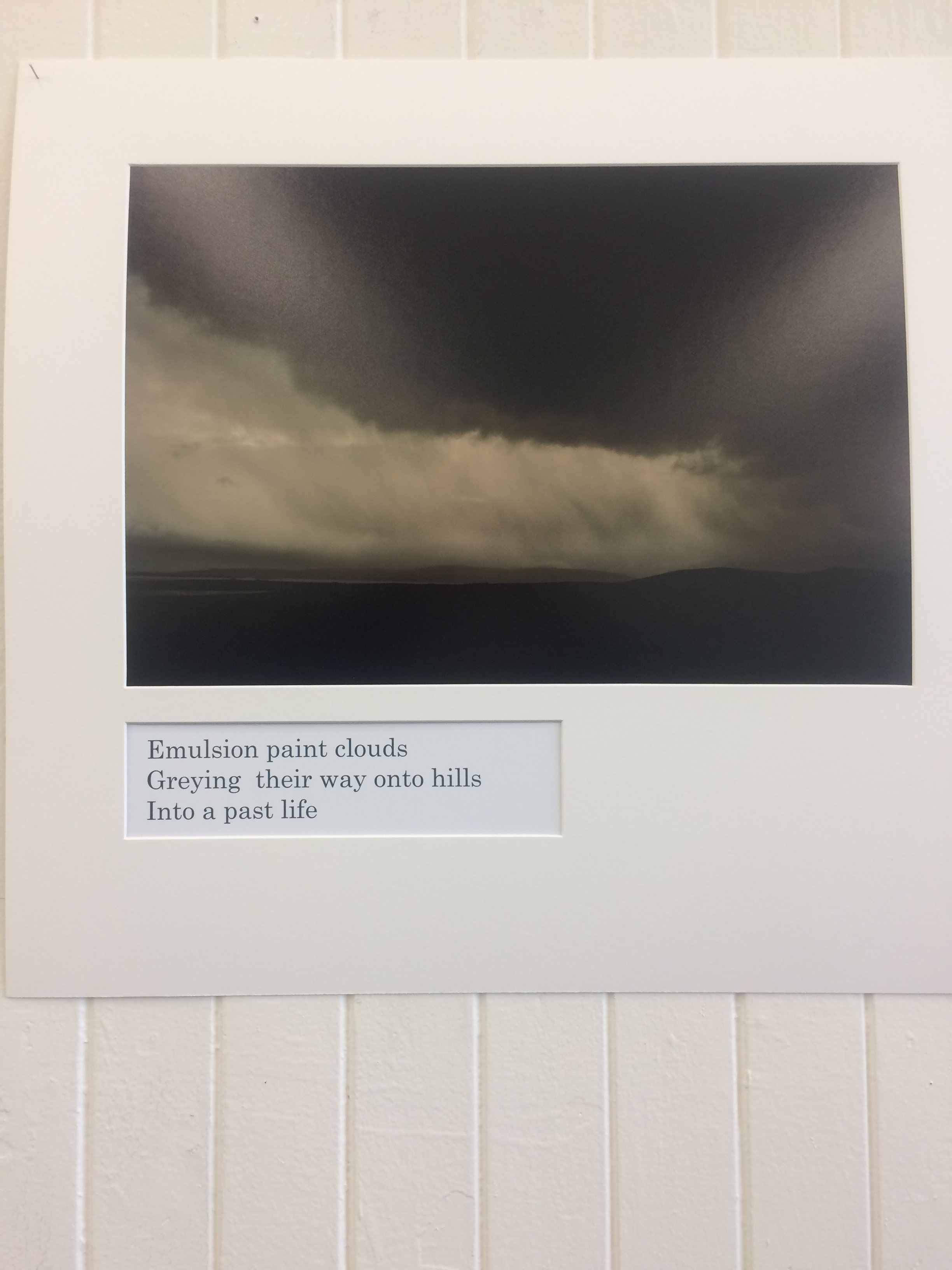
South Block studios is a white room, part café, a place smelling pleasantly of coffee. The rest stop between things, east of town. I’ve been here before with a friend, when we were discussing the early days of a new publication. It feels clean, airy, a place of potential. The exhibition consists mostly of Budge’s photographs, presented along the wall with Jackson’s poetic snippets beneath. I say snippets, because one gets the sense that all these impressions and snapshots are fragments of a broader story, a grander drama. My own time on the Orkney islands was limited to the mainland, but as the ferry curved round past Hoy, I sensed that to really experience life here, you have to think in archipelagos, rather than discriminate, bounded islands. A multiplicity of coastlines connected, reflected, glimpsed across these strips of tide. I experience each piece as both separate and connected: they resemble a sort of Instagram post, the supplementary clue to a world elsewhere, a stop beyond. The possible scroll, the anticipatory mirage of other places, beckoning like hyperlinks.
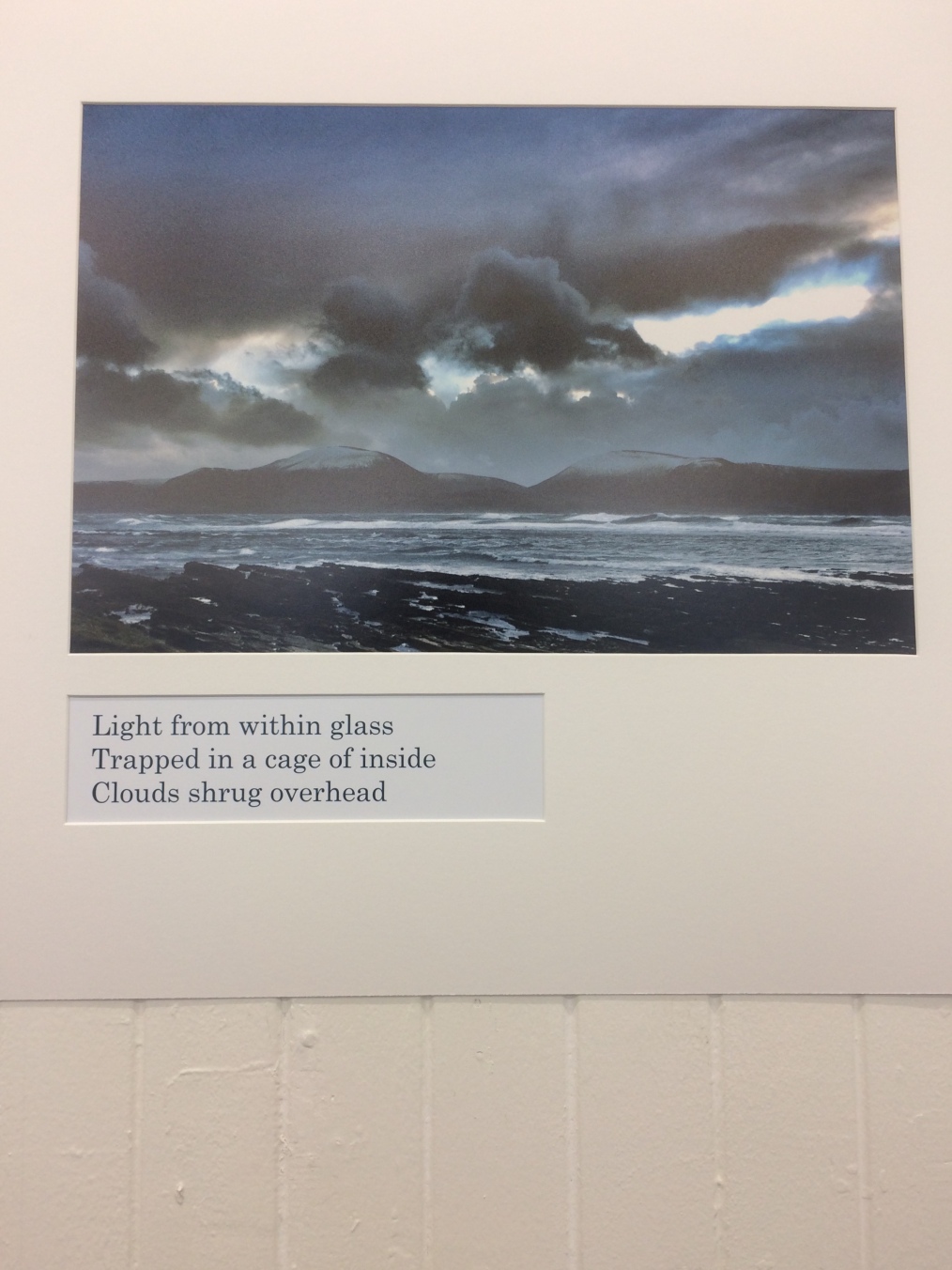
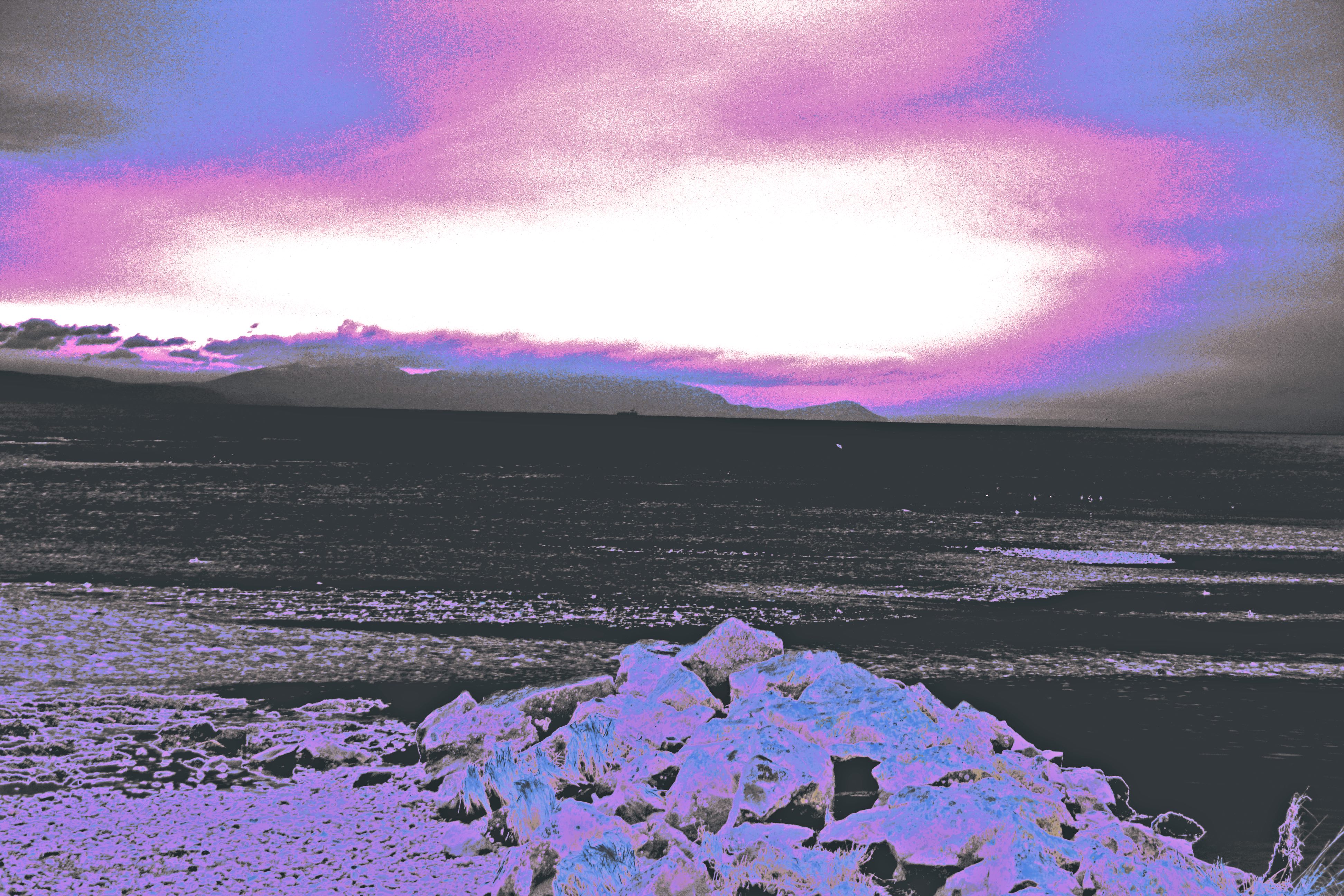
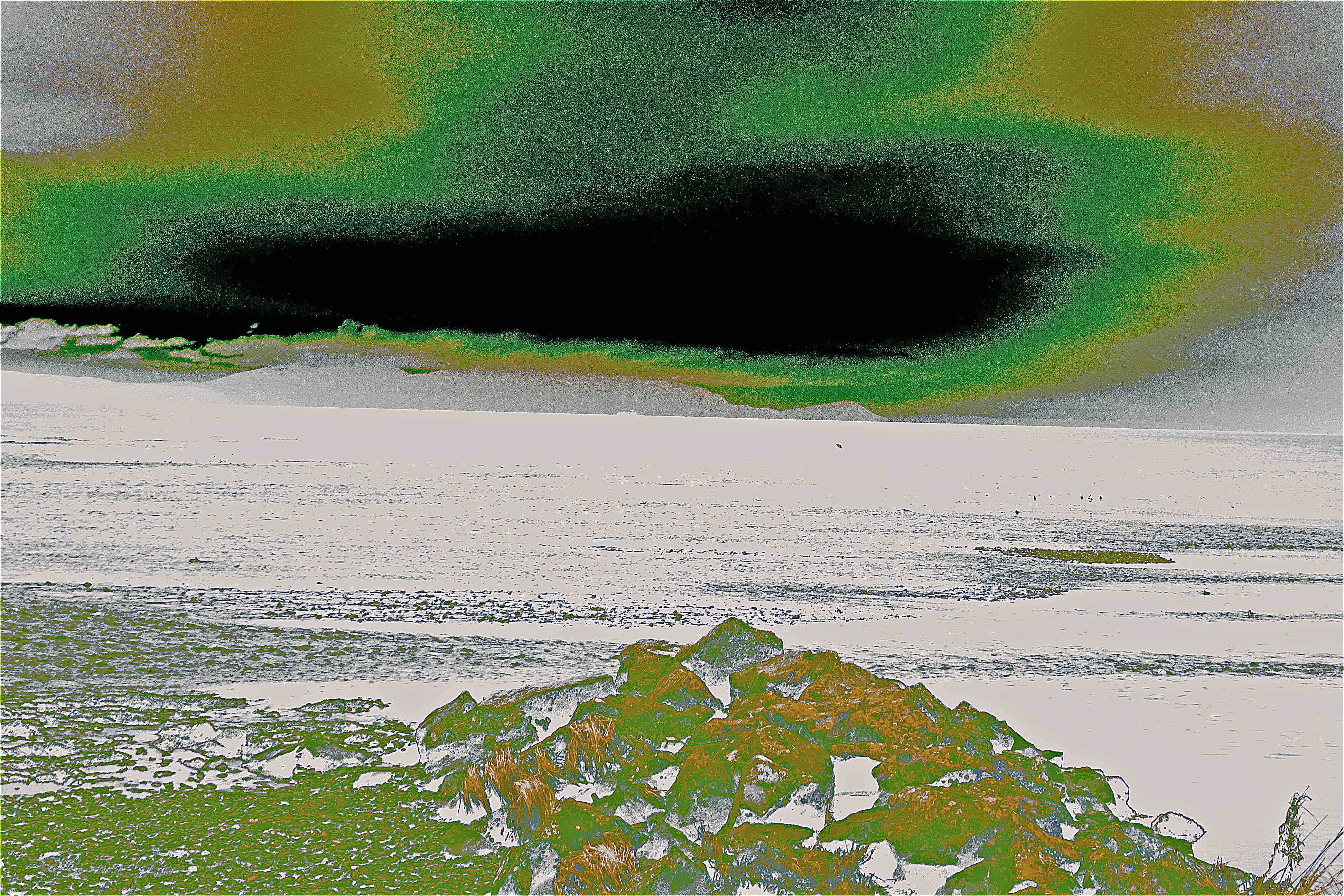
Looking at these images, I’m reminded of one of my favourite quotes from Susan Sontag’s On Photography: ‘to take a photograph is to participate in another person’s mortality, vulnerability, mutability. Precisely by slicing out this moment and freezing it, all photographs testify to time’s relentless melt’. Many of these photographs capture landscapes from a skewed perspective, a step away from anthropo-familiarity. We may be unsure where to place our gaze, looking for a horizon or coastline. Sometimes there is a blur, a smudge of cloud and beam of light; a looming mass of weather. An almost unnatural colouring. We are forced to think in terms of diurnal shifts, glitches in time, moments of elemental transition. They are nothing like the picturesque of the brightly saturated tourism brochure, the pamphlets I flicked through idly as I waited for the ferry to Stromness. These images are ghostly, strange, a little ‘off colour’. They challenge my own memories of the unique, misty and windswept atmospheres of Orkney. Budge experimented with different cameras — digital film, iPhone, pinhole — and various chemical processes to capture a sensuous, personal perspective on her native island. She exploited the apparitional potentials of lumen printing, in which objects are positioned on light-sensitive paper and exposed for hours, never quite fully developed. Rather than ‘capturing’ or stilling, rendering her subjects, Budge allows them to unfold in their own way, symbiotically in tune with their luminous environment: stealing its shadows, imprinting a smudge, a glow of time in process. It is almost as though, in taking those photos, she performs a material empathy with climatic change on the island: the shifts in light, all external markings of geologic time and the time of seasons. I am allowed to read into this, because the images abstract from subject, they ask us to find psychic states amid landscape, they do not fetishise the specifics of locality. They do not simply state: here is a field of sheep as we, as humans, see it. They challenge us to rethink perspective, authority, subject and photographic temporality.
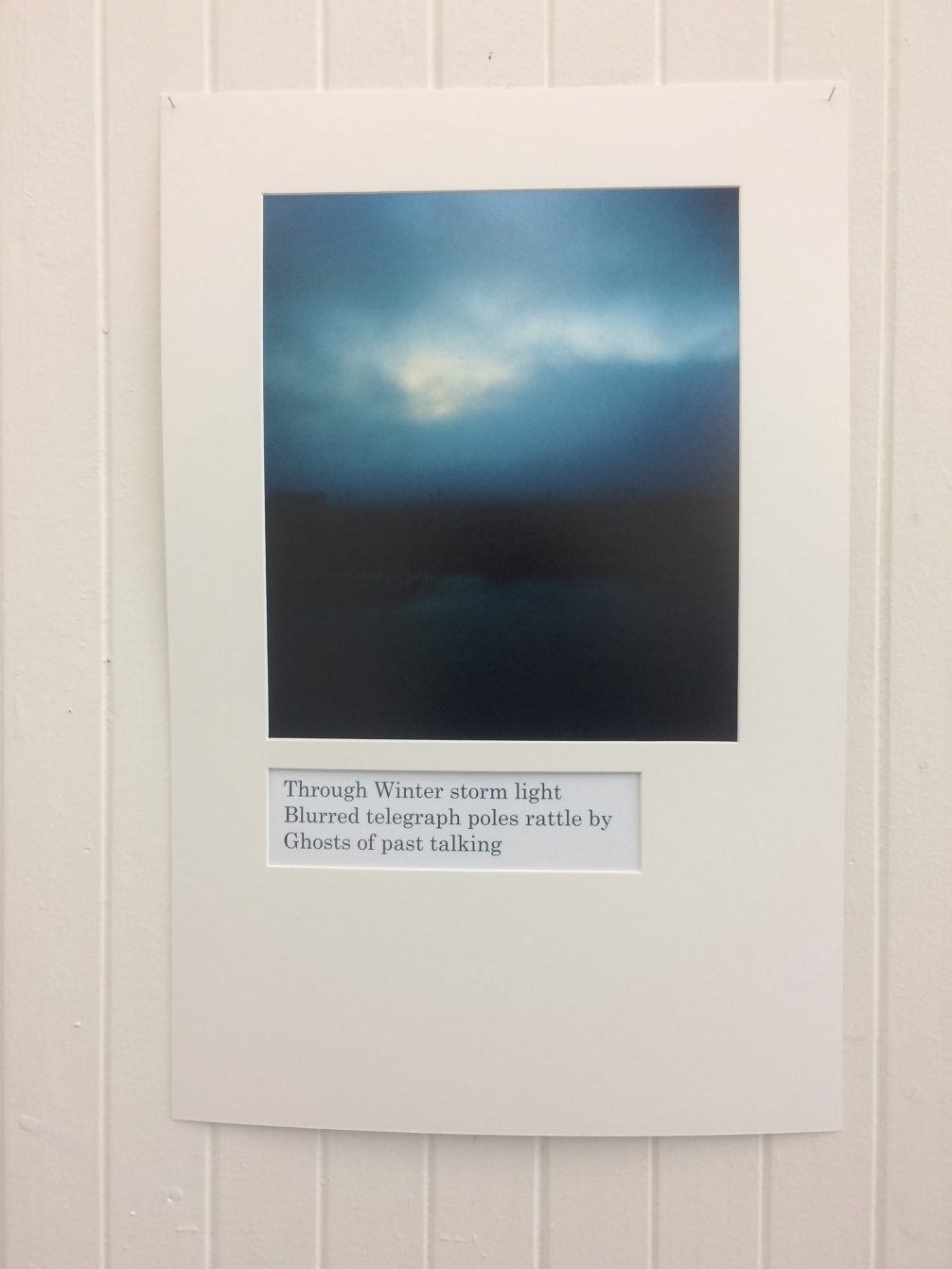
Jackson’s poems, which each accompany one of Budge’s images, really draw out this elemental drama of perspective, time and abstraction. Instances of familiar infrastructure become the tuning posts or sounding board for the dead, ‘Ghosts of past talking’ through telegraph poles. Attuned to the nuance of island soundscapes and landscapes, Jackson deftly parses the aesthetic reactions of one object to another, using anthropomorphism in the strategic way suggested by Jane Bennett in her book Vibrant Matter: ‘We need to cultivate,’ she argues, ‘a bit of anthropomorphism – the idea that human agency has some echoes in nonhuman nature – to counter the narcissism of humans in charge of the world’. Anthropomorphism can draw out the multiplicities of sensory experience, crossing the phenomenological ‘worlds’ or ‘zones’ of various enmeshed beings and species.
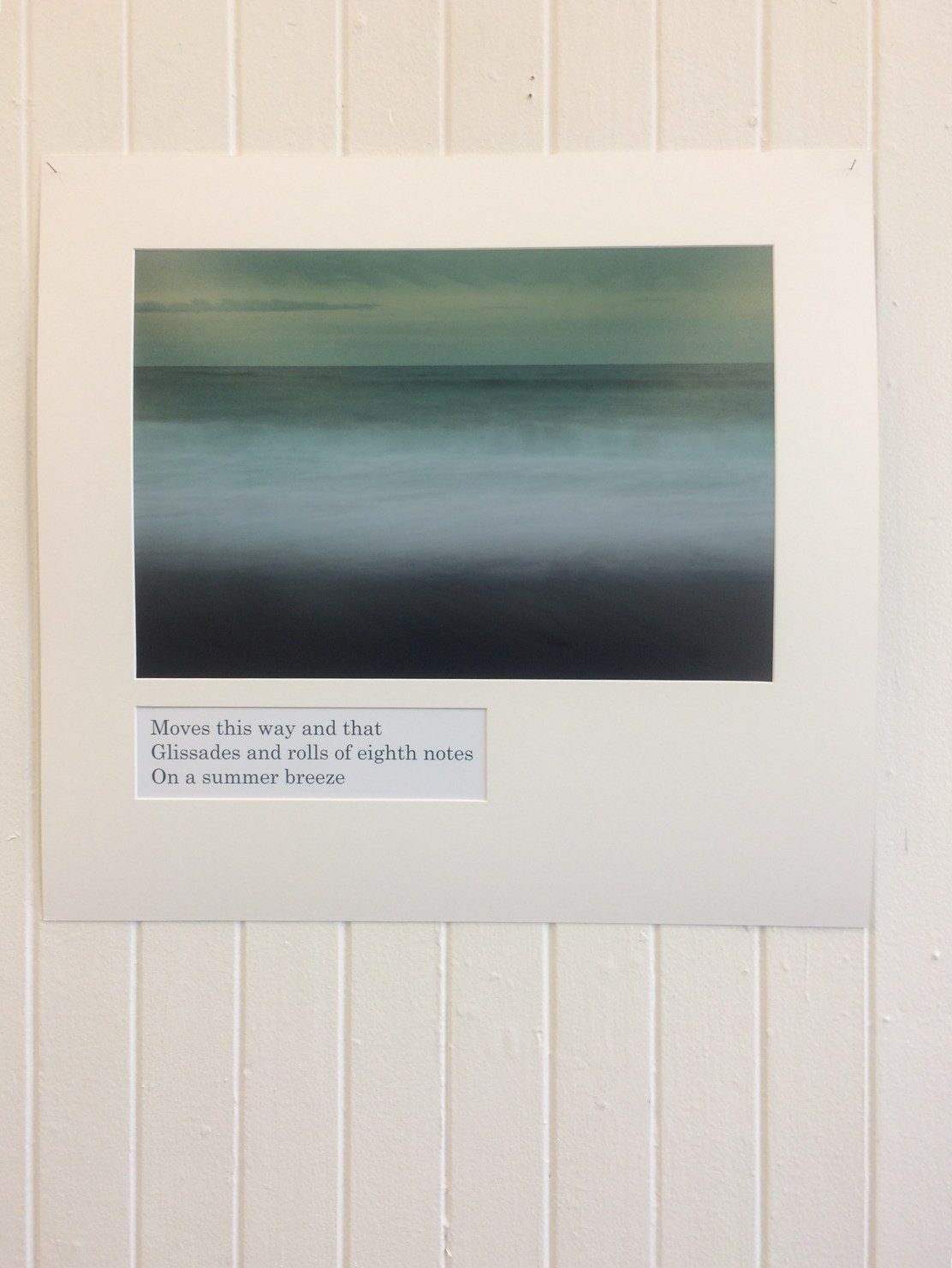
The haiku might be an appropriate form for ‘capturing’ the Anthropocene because it flickers into being like a sound-bite, it contains a certain authorial anonymity, less of the singular lyric ‘I’ than the lyric I’s environed chorus. Not to mention its traditional association with ‘nature’ as such. Presented like a sort of Instagram caption beneath these images, each haiku seems a transmission from elsewhere, sparking into presence. There are several kinds of aesthetic overlay, a synaesthetic experience of scenes: ‘Glissades and rolls of eighth notes / On a summer breeze’. The smooth legato of wind stuttering up into quavers, could this be birds or the stammering tide where it sloshes in breakwater, interrupts all smoothness of lunar rhythm? I’m reminded of Kathy Hinde’s 2008 work Bird Sequencer, where she worked with Ivan Franco to scan videos of birds resting on telegraph lines into music, after noticing how much the positioning of the birds on the lines resembled a musical score. Each bird would trigger a note or audio sample from a music box and prepared piano, in the manner of a modern step-sequencer: Hinde was literalising a form of nonhuman aesthetic attunement, surrendering compositional control to the whims of the birds themselves, their arts of arrangement. That Jackson’s poetic vision parses the elemental landscape through musical metaphors says something of our ecological inclinations towards attunement. As Timothy Morton puts it:
Since a thing can’t be known directly or totally, one can only attune to it, with greater or lesser degrees of intimacy. Nor is this attunement a “merely” aesthetic approach to a basically blank extensional substance. Since appearance can’t be peeled decisively from the reality of a thing, attunement is a living, dynamic relation with another being.
Since music is our strongest metaphoric apparatus for noticing strategies of ‘attunement’, its poetic invocation allows us to access those processes of intimacy, coexistence and agency at an aesthetic level. The aesthetic level where, as Morton puts it, causality happens: an operatic voice shatters a wine glass, a match smoulders and eats up a piece of paper, the BPA in plastic seeps into the water, alters its chemical makeup, affects the food chain.
This is a fairly minimalist exhibition, despite its multisensory components. It opens space. I can take almost whatever time I want in front of the plainly mounted images and text, the white card a sort of beach I can linger on, skirting the image. These are dark and striking scenes, mostly of nonhuman subjects. I get to share in ‘time’s relentless melt’ as it happens at the pliant, archipelagic scales of an island, stripped away from the carnivalesque rhythms of urban leisure, or capitalist imperative.
Crucial to all this, of course, is Cavanagh’s sound piece. Keen to avoid the bland oceanic ambience of New Age relaxation CDs, Cavanagh makes things weirder. This is the sea but not quite the sea, nature more than nature. Composing or rendering ecological soundscapes requires more imagination these days, a keen ear towards plurality: as every ocean is inflected with both danger and precarity, a poetics of toxicity thanks to our dumping of marine plastics, there has to be an affective current underneath, a mixing of human and nonhuman rhythms, forces, pleasures and tragedies. A force of both presence and loss. Place is no longer one thing, but stamped with the stains of elsewhere. ‘Here’, as Morton puts it, ‘is shot through with there’. Living in a time of hyperobjects means that we can’t think of, say, the seas around Orkney without thinking about the pollution that comes from mainland cities, the energy generated in these waters subject to political decision-making further south, the marine populations around these coastlines affected by agricultural, infrastructural and consumption processes going on elsewhere.
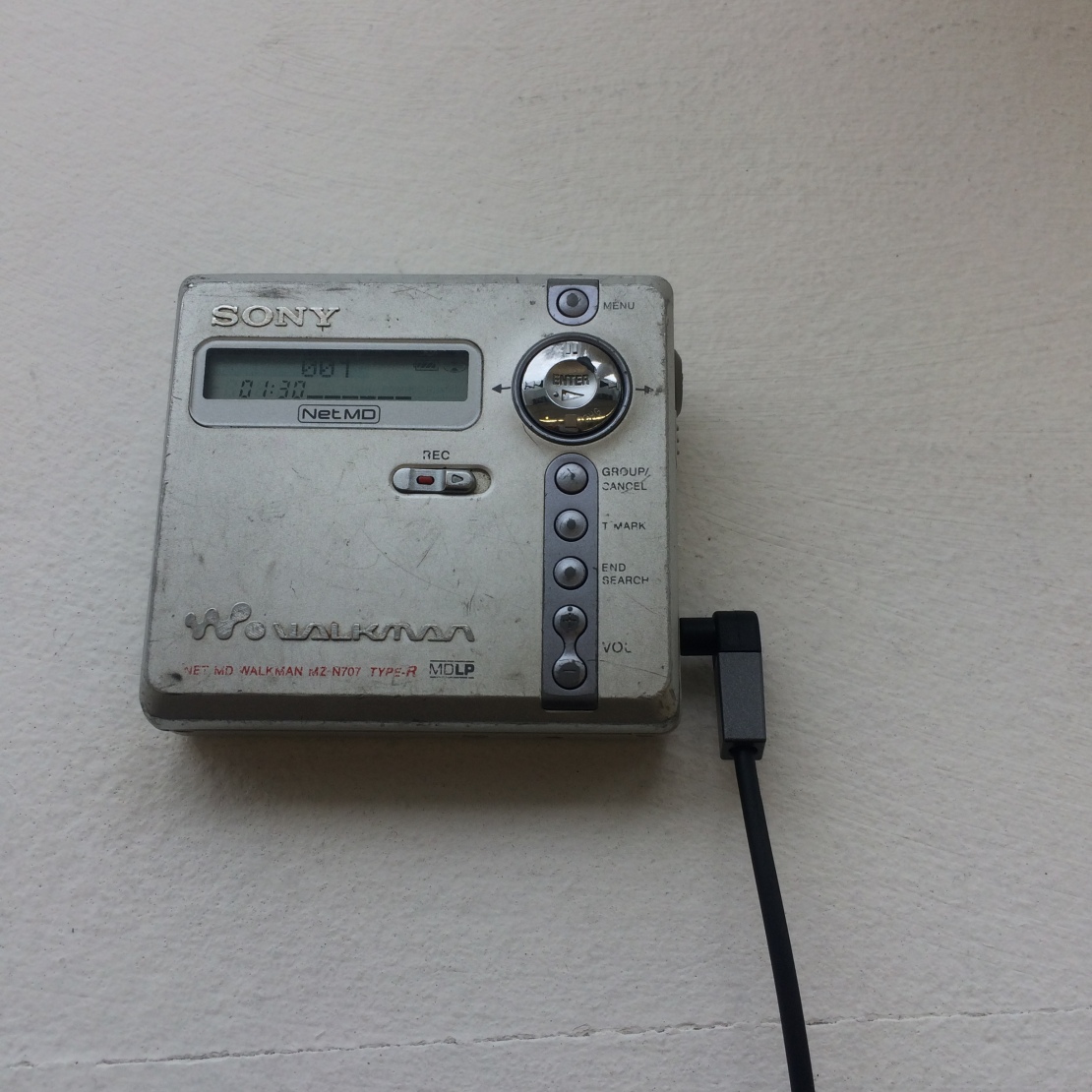
It would be easy to respond to this collision of times, spaces and places with a sort of abrasive, dystopian mix of disorder. Cavanagh, however, responds to the sonic challenge with degrees of beauty, humour and playfulness. His soundscapes swirl around the spoken words of Jackson’s poems, anchoring us vaguely to a sense of present as we pass round the room, viewing the images and poems. Sure, I can hear the waves, the howl of the wind, but these are mixed with a certain distortion akin to kitsch, electronic warp and reverie that glistens with past times, feels retro. This operative aesthetic is achieved with the piece’s main component, an EMS VCS3 synthesiser from 1973: a model familiar to fans of Pink Floyd, Brian Eno and Tangerine Dream. Cavanagh’s music literally ‘translates’ Jackson’s poems and Budge’s images, themselves translations of Orkney scenery, by plugging the syllabic layout of Jackson’s haiku and the locational map data accorded to Budge’s photographs into a patchbay which generates from number sequences a variety of different rhythms, instruments and delay effects. Cavanagh’s ‘authentic’ or ‘raw’ field recordings from Orkney’s landscapes are thus programmed around the audiovisual, semantic stimuli of Budge’s and Jackson’s work. The act of remixing nature in this way exposes nature’s very artifice, a cultural construction dependent upon our aesthetic representations. I think of a very beautiful line quoted in a recent Quietus review of Hiro Kone’s new album, ‘“Nature sounds without nature sounds”’. As a challenge to passive eco-nostalgia, there is an active pleasure in this exposure, in realising the multiplicity and material vibrancy of a term we once took for background and static, mere sonic wallpaper for mindfulness meditations.
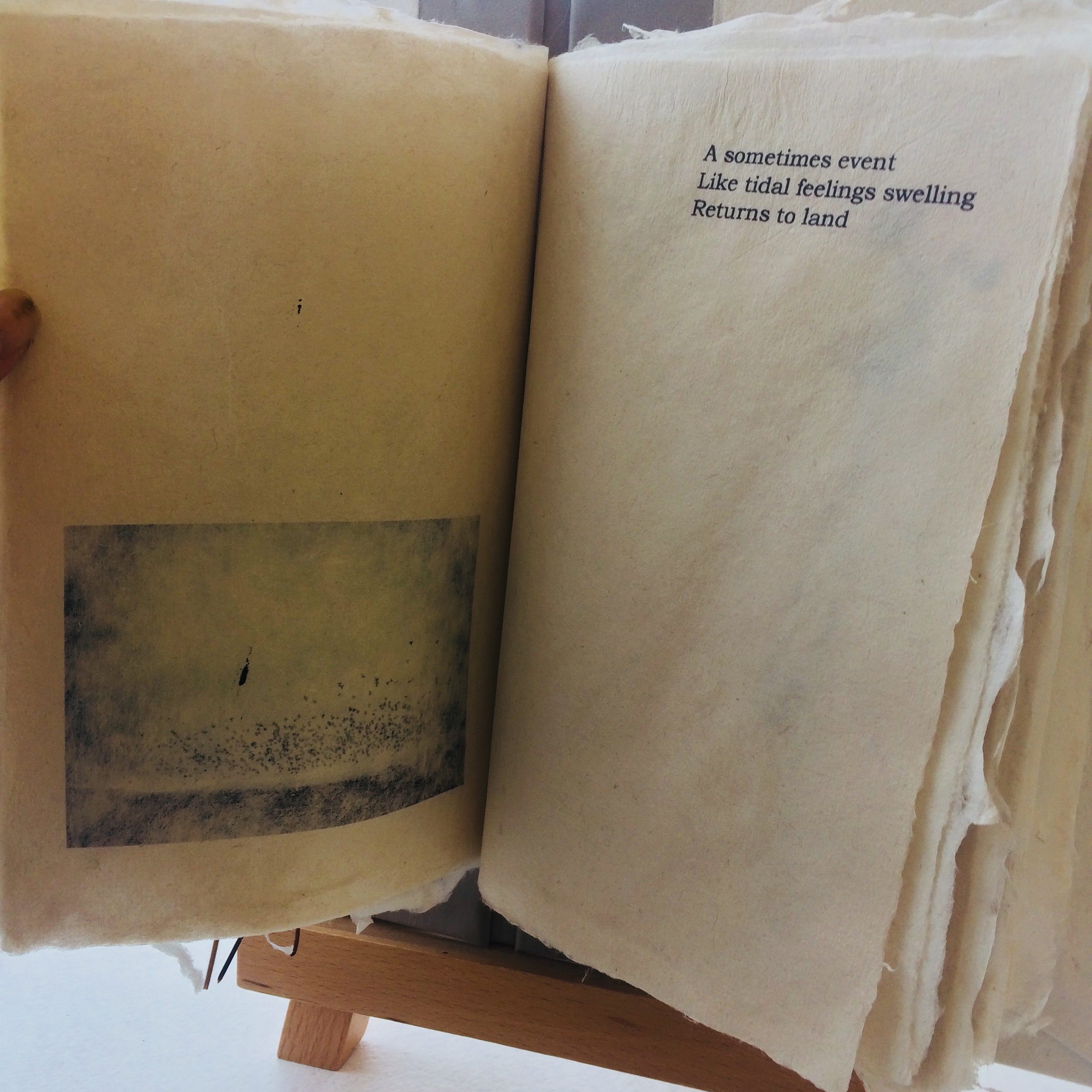
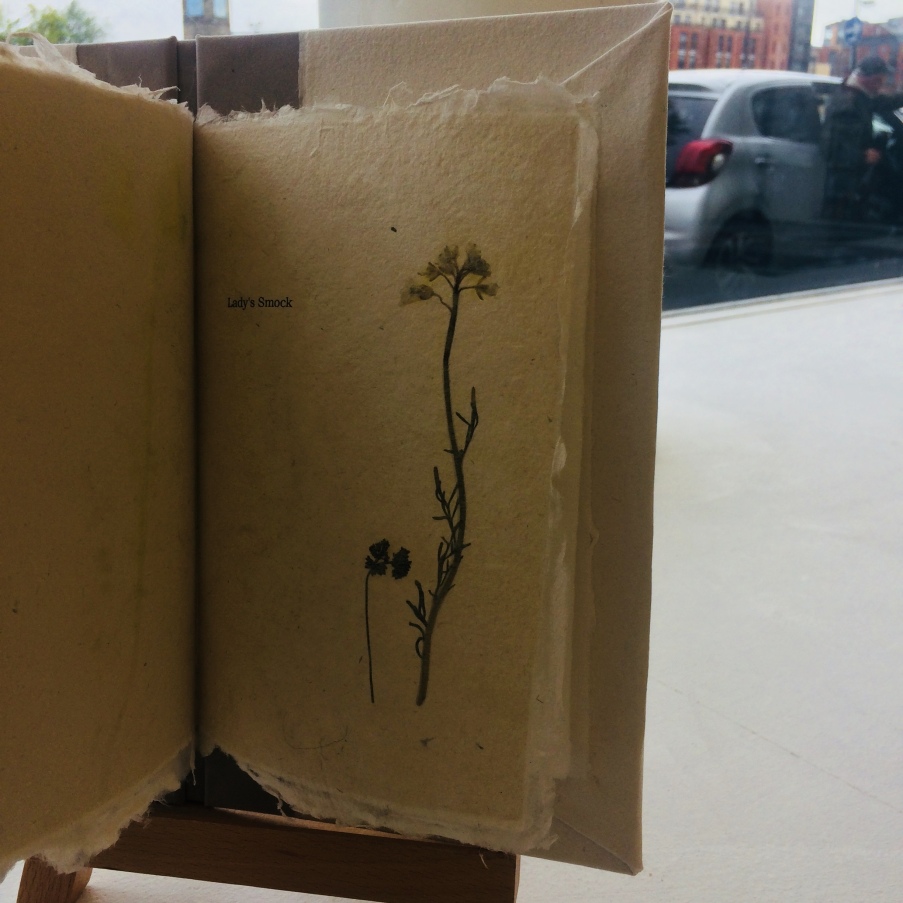
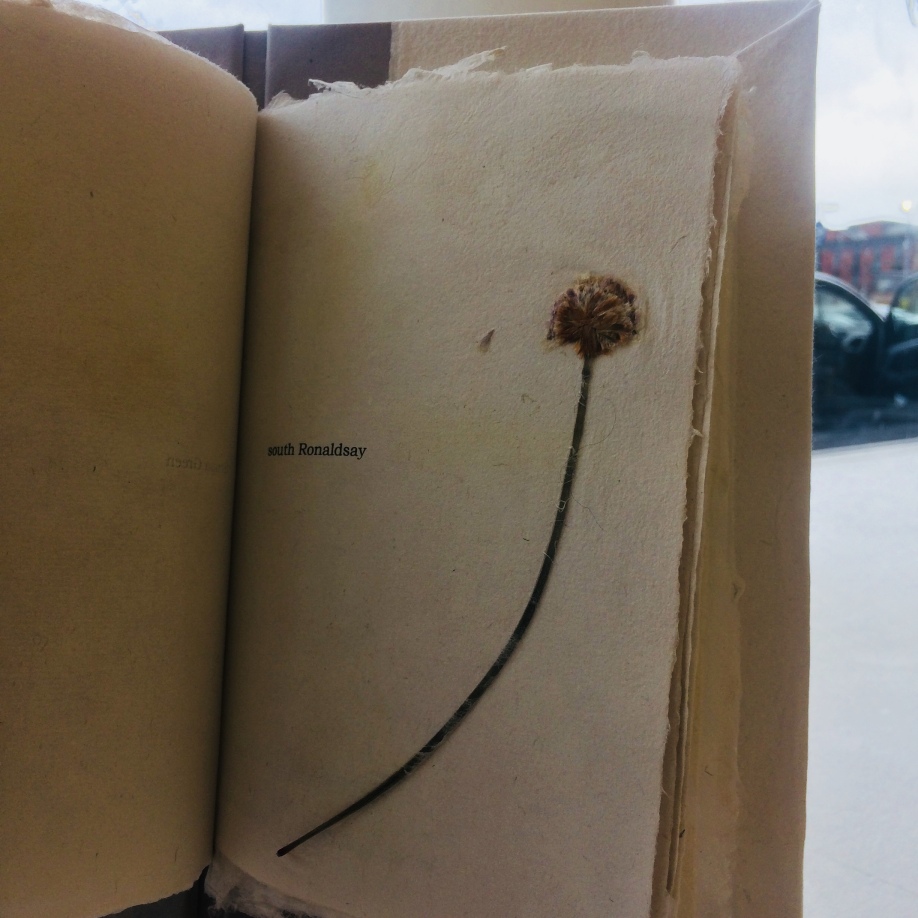
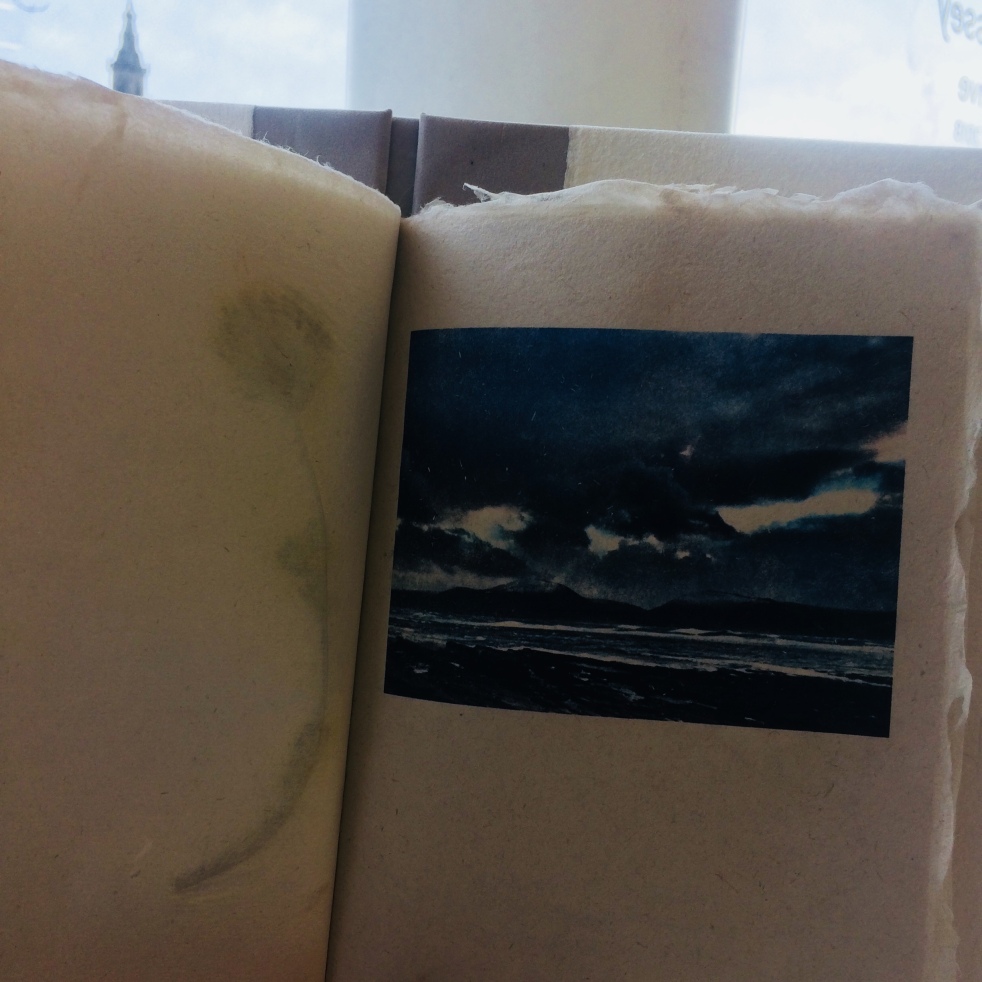
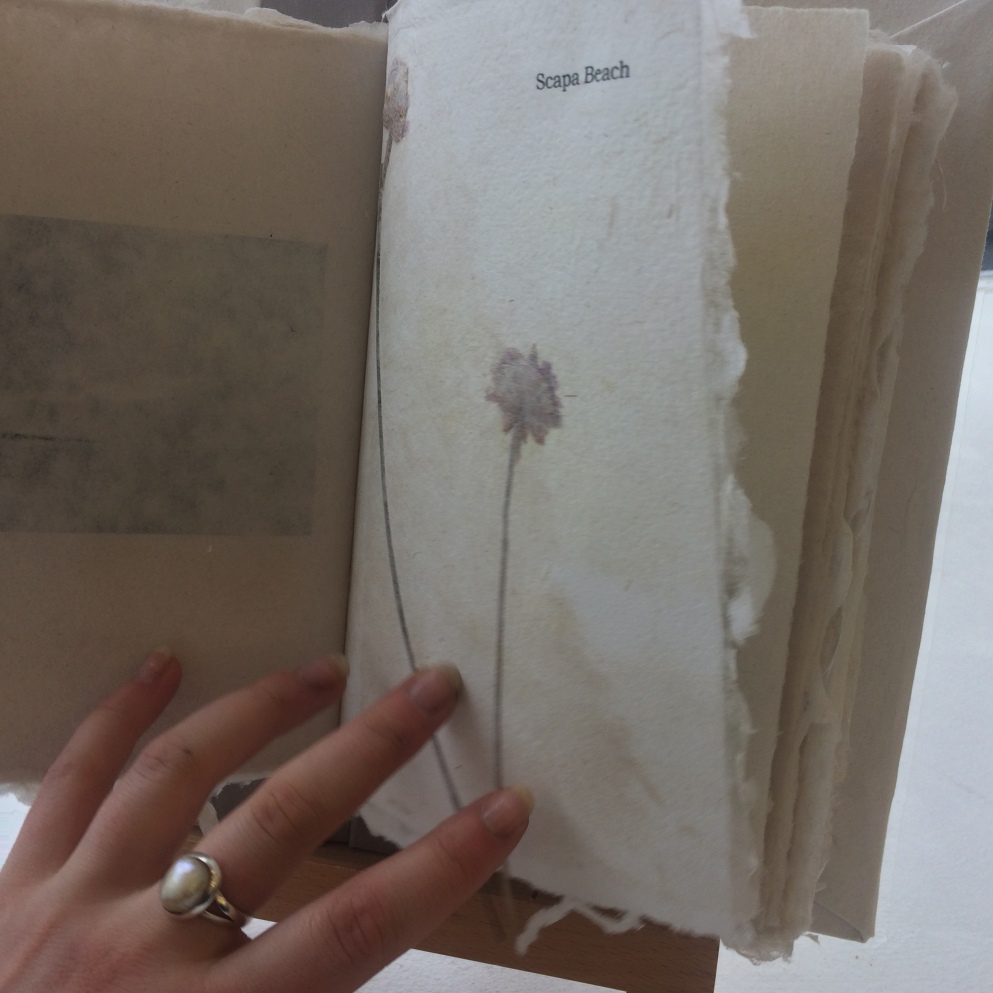
Faced with something as ineffable as the Anthropocene, we often respond, ironically, with lyric excess. The Anthropocene, it gets in edgeways, it knows we are porous. Whose odyssey is this anyway? Exhibitions like this are important because collaboration and innovation are vital means of tapping into the processes by which we, as human observers, might access nonhuman processes, glimpse the scales of time and place in a world where our significance dwindles into material trace. The fossils of future capital, always already fossils. What might a sonic fossil look like, sound like, a ghost trace of retroactive reverie, a broken sonogram, an elegiac bleep of machine or sea? An Orkney Odyssey, for all its portent towards the epic, is actually a rather humble exhibition. It offers the human perspective of memory and affect, holding wonder for these geographies and scenes, but there’s nothing too showy or sublime about it. And the micro focus is important too. Moira Buchanan’s handmade booklets draw us back to the beautiful details of wildlife around us, the simple pleasures in the act of binding and stitching the evidence of our everyday ecologies. She names in her booklets various species and places, prints poems and photos, mingles materials. There’s a real material enchantment here. Rather cutely, I wrote of these booklets before in a post on Buchanan’s 2016 exhibition, All Washed Up:
I think in today’s world, where global warming feels like something vast, incomprehensible, beyond our understanding, it’s so important to focus on the little things. The material details that remind us that we are part of this environment, that the ocean gives back what we put into it. There’s a feeling of salvage to the pieces, whose composition seems to perfectly balance the artful openness to chance at the same time as reflecting a careful attention to arrangement and applied form and texture.
I was still grappling with the Anthropocene with a sort of innocence then. I mean, I was still calling it global warming. The booklets in South Block catch the light of a late September afternoon, luminous in the window. Taking pictures of them, I can’t get the angle or the light right. I can’t quite translate, my iPhone proximate to its physical extinction, stubbornly refusing photographic clarity. During my trip to Munich this year, I was given a five-leaf clover picked from a lovely Bavarian meadow. I pressed it between the pages of Lisa Robertson’s The Weather. That, I suppose, was an act of salvage also. Symbolic recycling. A little token of some unspoken odyssey.
Unsure of the rest of the night, what to do, awaiting replies, I cycle through rush hour, heading south with only vague destination. Peddling hard, I cross the water as though crossing the sea. Later I will fall asleep with electronic sounds rasping my headphones, mixing with the wind outside which batters the window, until sleep becomes its own causality…
***
Exhibition Details:
Venue: South Block, 60-64 Osborne Street, Glasgow, G1 5QH
Exhibition Continues: 14th September – 5th October 2018 (Mon Fri 9-5).
~ https://thelongocean.bandcamp.com/album/the-long-ocean ~
There is a struggle, the suspension of hoar frost crusts time itself as it trickles over the sea. At first light we watch for an opening. Even in attics and city bedsits, the sea remains in our blood. We feel it cold as ice at the illness times: how darkly we sink into the sheets, hoping the pain in our skins will dissolve back to lucent matter, the night wisps of somebody else’s aura.
A voice enters soft and lo-fi, filling the interludes that swirl around haunted piano arpeggios, the silver streaks that spill on the ocean’s tides. I am afloat in muted clicks that keep me close to the surface, where the sound echoes in drips, as in a swimming pool. I listen for his voice as it mists the glass of the window. I inhabit that glass in the silence, waiting for some melody to sparkle with any dissonance sufficient to crack my crystal prison. Percussion is slightly hard, a clack, clacking. Crackle. Predictive appearance, seductive. “I’m under your spell / and I’m under under”. Subaquatic passion, staring at the world from beneath, behind, the film of its surface. See how everything shimmers. It’s quantum physics. You can’t peel off the surface of reality, its candy sprinkles, its gilt, to see what darkness and delight lies beneath; you’re already deep under, withdrawing, closing.
There’s the haunted aesthetic we find in Burial. Something more organic, elusive; the rural alternative to Burial’s empty midnight metropolis. On ‘Raindrops’ the muted sound of gulls weaves in and out of a DJ Shadow, Entroducing…..-era riff and the shimmering playful jazz of a brighter piano, a celeste of some sort…the sound of wind chimes through the minuscule ears of insects, so very high-pitched, so very sweet. You can imagine the tinkle of glass as you toast your favourite jellyfish, spirit animal that sucks its seven temporalities tentacular around it, moving them in sweeping undulations that rupture the cyclical moon-time of the waves. You open your flesh to the ocean, every salt crystal forming a bead in your pores. Desire is the fulfilling of absent substance, the spacing of the gap between lack and attainment. The passage of sailing, not knowing what darkness, what deep blue, you are setting off into, heart curved sharp by the cut of a crescent moon.
If Burial is, as Mark Fisher puts it, ‘London after the rave’, The Long Ocean is the abandoned nightclub pavilion, the sea’s dull roar mingling with those shadowy echoes of ecstasy. The slowed-down groans of a former generation’s momentary joy. Angels caught in the sand of an hour glass, being tipped, a largo mode of clock-ticking, grains of time slipping endlessly over the rasp of voices. I set this album to cassette tape, allowing the crackles to augment and mingle. I could be in the murmuring belly of a ship, hearing the rasps of a radio mix with this transcendent, nowhere music. It’s the sound of twilight set to reflections of quartz made bright momentarily by deepwater bioluminescence. What is that whine, that eerie peal? The sound of lost dolphins, the painful song of a lonesome whale? The whale is a heart’s darkness, a shadow-side of waking reality. You can lose yourself inside it, feel dreams close over you, prised from the wax, the oil-black skin.
Four Tet at his most otherworldly. Hypnotic loops, the soft distortion, the natural ambience. I am walking down an abandoned street, where weird green plants sprawl through the smashed-in windows of Brutalist buildings. Night birds chirp the tart remnants of forgotten songs. I am hooked on the wave-like rhythmic pulse of his words. My footsteps echo, down the street, down the passage, down the shallows to the deep where tarmac melts into oil-black sea.
There’s a sense of dark, spreading space, interpenetrated by twinkling scintillations; not unlike the plaza-like ambience of mallsoft and certain variations of vapourwave. Think: diamonds in the tarry pavement, stars reflected on the ebony surface of the midnight sea. A more crystalline James Ferraro, Marble Surf; The Long Ocean swaps those choir-like, ice-cream van speaker crackles for a more precise intricacy of lattice parameters, cross-rhythms of tinkling percussion and soaring, yet always subtle, beats. Think also of something like GOLDEN LIVING ROOM’s New Nostalgia, its eerie shimmers of late night lo-fi mixed with the bright sound files of near-future cyberspace, everything sounding slightly subterranean, that tinniness of dissonance. On The Long Ocean, however, instead of the glitch effects of hardware, the sounds chosen here are derived from natural materials and technics. The hollow click of driftwood, billows of cooling wind, cave-like echoes, the clinking of a necklace of shells with every percussive sprinkle (‘The Crest’). There’s a collector’s sense of amassed trinkets, effortlessly slinking along intricately simple bass-lines, hardened by industrial beats which burn in the weird space between background and foreground. What this music shares with vapourwave is a sense of slow, careful build towards the internal coherence of a detailed and evocative theme. The sadness and the beauty leaves its ghost stains on your brain, tugs at the blood which is full of the sea, makes you want to walk forever, or forever dream—rhythmic, contorted, returning serene.
Some of these tracks are totally devourable jams, the minimal intrusion of sampling giving way to those lusciously percussive beats, twists of lo-fi brass, crooning sexily over the building peal of mysterious beats (‘Gold Dust’). I’m reminded of a video game casino, an interlude space suspended in a three-dimensional, virtual world, where the colours and lights are all for our ersatz pleasure. On an island over an ocean we are sharing expensive littoral whiskies, toasting the way our skin glitters in its vitrics. Soon every vein will resurface, a curious craquelure marking time on the skin. Here we are, vacant, absent, deliciously distant.
Sometimes a roar of white noise, of wind rushing through a tunnel, subtly infiltrates a track (see the end of ‘The Crest’), reminding us that the space we’re inhabiting here is adorned by darkness and distance, is always deferring from itself. There’s definitely that Boards of Canada minimalism, the seamless weaving of samples in a way that seems hazy, reflective, a little haunted. A childlike naivety, a curious innocence; shadowed by the weight of a trembling void.
But there’s also a certain romance, even magic, to this record that I can’t quite pin to anything else. Not in the same way. Maybe it’s something to do with the celestial resonance of much of the track names, from ‘Star Light’ to ‘Gold Dust’ to closing beauty, ‘Stella Maris’. Latin for Star of the Sea, ‘Stella Maris’ is the feminine spirit, a protector who guides the soul at sea. This song is the album’s North Star, guiding us back through the waft and heft of its silvery, elusive currents. It sounds somehow out of time, built around the melancholy minimalism of a piano, sustaining its slow and careful path over the abyss of crackle, the tremors of the underworld, the ocean’s darkest depths. In the ‘Desecration Phrasebook’, a glossary collecting Anthropocene-related words, there’s a word, ‘shadow-time’, for ‘the sense of living in two or more orders of temporal scale simultaneously, an acknowledgement of the multiple out-of-jointnesses provoked by Anthropocene awareness’ (The Bureau of Linguistical Reality). We have to accept we are already living in the end of the world; it’s just that our sense of its time-scale is far beyond human comprehension. The fluid, amniotic ambience of ‘Stella Maris’, coupled with its fin-de-siecle, 1990s-style exploratory piano (think: Aphex Twin, DJ Shadow), creates this haunted sense of dual temporality, of always being on the cusp of something to-come at the same time as being homesick, nostalgic for a dreamland that came before but perhaps never was at all.
There’s something in the way this album romanticises the sea that suggests Glenn Albrecht’s word solastalgia: a form of existential distress caused by environmental change, global warming being the obvious example, as well as coastal erosion and the weather manifestations of climate change. Solastalgia derives from both ‘nostalgia’ and ‘solace’. Whereas nostalgia denotes a feeling of homesickness for a place and time we are no longer present in, solastalgia evokes that sense of distress caused by our home changing as we inhabit it, the affective impact of huge global shifts upon our individual, local experiences of landscape. The Long Ocean doesn’t leave us washed up at the end of the world, but suspended in the glittery salvation of its dark and strange and shimmering beauties. We come close to the weird and the terrifying, the dissonant samples of unrecognisable times, of creatures whose tremors rise up from the deep. Think of the pleasure and slight terror of binaural beats, the sublime understanding of our human insignificance as we gaze at the stars.
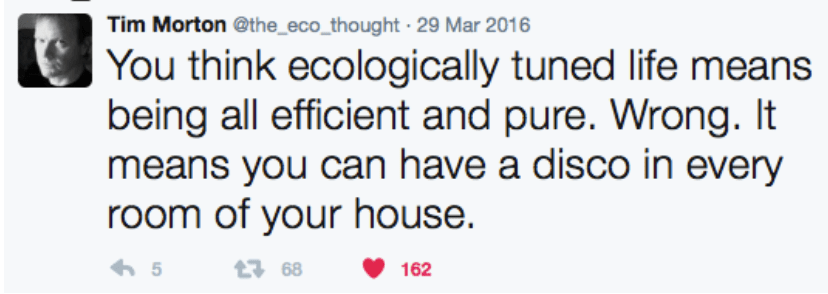
The beauty of an ecological thought is that it doesn’t have to be clogged with guilt, it can create something even lovelier before in its collective, technological and temporal possibilities. What would happen if you filled every room with solar panels, invited the creatures in, suspended your desire forever in those flickering, dancing refractions of light and sound and colour and life?
Out from a colourless tundra
comes the turning wind, the wind
that rattles the glass of a window
knife-thin,
willing outside the world within.
Down in the park the pathways flood,
so gurgling glugs
of chocolate water swirl and seep
and spill from the river,
like blood burst from an artery.
Across a sky of aching grey
the flock of blackbirds fly,
showering outwards in sparks of darkness—
a blink and they will fade.
Turn around in sparkling rain:
the glaze that clings to twigs and leaves,
saliva soft and silver glinting,
like water on a house’s eaves,
lushly splashing
the webs of spiders.
Behind the sway of hollow trees,
their million fingers twinkling,
there is a spread of endless green,
a distant summer—
the luxury, my own decision.
Here, out of the storm you now appear,
a tangle of whiteness: white scarf,
white floss of hair. Your sadness
lost to me now, a fragment
as the rain blinks on and off
and loses my vision.
 mariaology