These bias-cut days of diagonal action, mostly slow rise and decline, drift into restless though feathery sleep. ‘The dreamer in his corner wrote off the world in a detailed daydream that destroyed, one by one, all the objects in the world’. So goes Bachelard and my own sense of crawling, hovering, in the cracks between things. Letters, cups of tea, cutlery, brushes and pens, awakenings. I worry that making a fantasy means reality won’t happen. You can spend too much in your dreams. I pay my debts in daily wandering, lifting plates and cracking hard metal off the grinder to fill up the cylinder with further coffee. Speak standard grade French for ebullient tourists. A, petit pois! What was it he said? A vast divergence between work and vocation. What splits in you and hurts evermore like a skelf. I’m waiting at the bar for a check, looking miserable because elsewhere in my head.
The heat brings fights to the park. I seem unable to read in daylight.
Caffeine dissolves all sticky platitudes of self-surrendering, the negative web. Objects I love become loss, so I stop. Pull out the game. Everyone I know seems to be moving away. There are these Instagrammed images of shifting reality. I ‘like’ them as if to say…
So maybe I go home but not really. So maybe in my father’s car, passing the house I grew up in which now has a shiny white 4×4 in the driveway. There is a dj with the same name as a boy from my school who wore ill-fitting boots. Remember I told him I was pregnant with triplets. I know every road and house in this town. Nothing alters on the virtual maps.
Two miles south. There is this playground in the forest, pine-built tunnels that lead through the treetops. I shimmy my way through child spaces, accessing the world from a miniature angle. I chew away low-level anxiety. We sit in the park, rolling buttercup stems between our fingers. Think in yellow, and have no thorns to distance me. There is so much to discuss but this chat is symbolic only; mostly between, mostly hungry. I cycle around Govan in aimless circles, prolonging the river with industry. People sit on walls outside their houses, but they are not talking or rolling tobacco or playing chess.
Half of this month is a blue-dark nothing. No difference between eve and day but shades of blue. 4am my friend, our twilight spirals. I’m aching.
I spend a weekend in Munich and meet the illustrious Robert Macfarlane, who wears a mushroom pin badge and enthuses on Sebald. The Bavarian meadows are everything. I write condensed sentences in my notebook, sometimes unsure of source: ‘The painting asks the viewer to prefer shadows to sun’, ‘The brain’s sweet opening to calm and green’. I am travel tired, pleasantly so, and involuntary naps overlay with words—so images stir around me, lift from the page new worlds. I take photographs to mark a certain summer. Foxgloves, cash machines, the margarine tree; gorge of solstice which gives into poems.
We share wine outside. I lace my sangrias with a bottle of port, you’d call it darkling sunset, but not a good taste. How often this month have you woken to fog in your head?
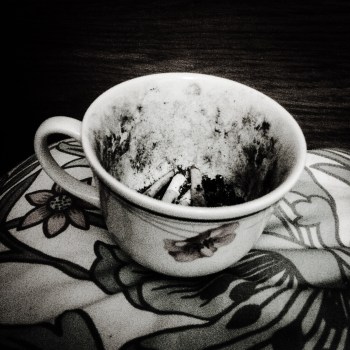
Black-and-white plate of burnt kale.
Is our depression competing? Compression.
Admissions of sickness, 39 likes, mustang. He only smokes when drinking.
Maybe we don’t need sleep at all!
What lore of virtual archipelagos? I think of each chat log itself as an island.
My brother came home on the last day of May. Now off to Israel he leaves in our flat a blue bag of avocados, three fillets of salmon which rot in the fridge.
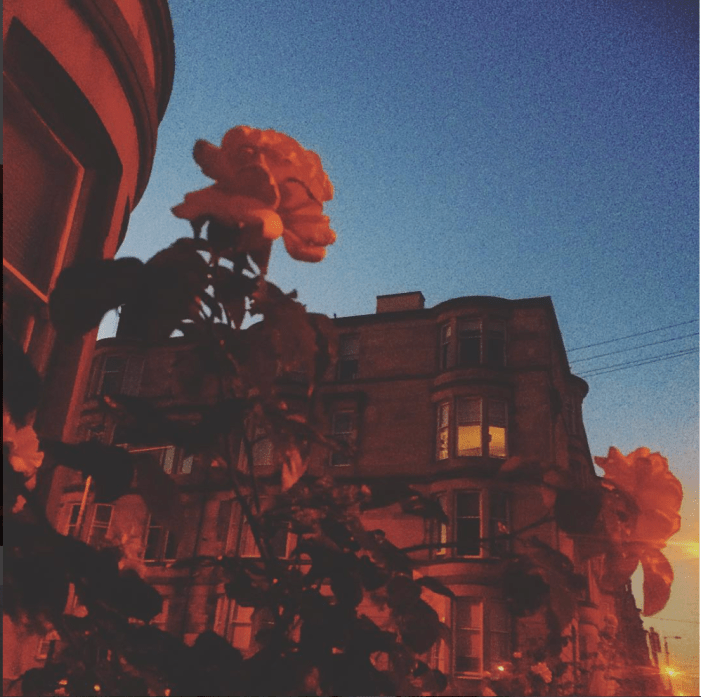
Sometimes time does me a favour. The way roses look at four in the morning, gilded with lamp light against husky sky, a faint azure. The hazy look of Lana roses, a vintage filter in always already.
The tenements were blood meridian. Sun moving west.
Scrunch salt to make curls in my hair. Post-chlorine shower feeling. Involuntary.
Wake to your messages, drop more before sleep. Two blue ticks. See everyone and then again everyone leaving. Homesick for dialect, yelling haneck. A mosher at heart requires eyeliner always. I keep some old stone beneath my pillow.
The lines around your eyes, a ring for every hour not slept.
Fall into chorus of gulls and whispered recordings. All of my gross human narcissism.
A birthday. Rose dress and fishnets, refusal of dancing. Middle-name. Tanqueray forever.
I resolve to make new—
Slim readings, okay so I swore and did not cry because I’m saving my hot bright tears for July. Cute motivational pastel skies. Line after line being temporary.
There’s a song but I just want everyone glowing around me.
When they played ‘Keep Yourself Warm’ in Sleazy’s.
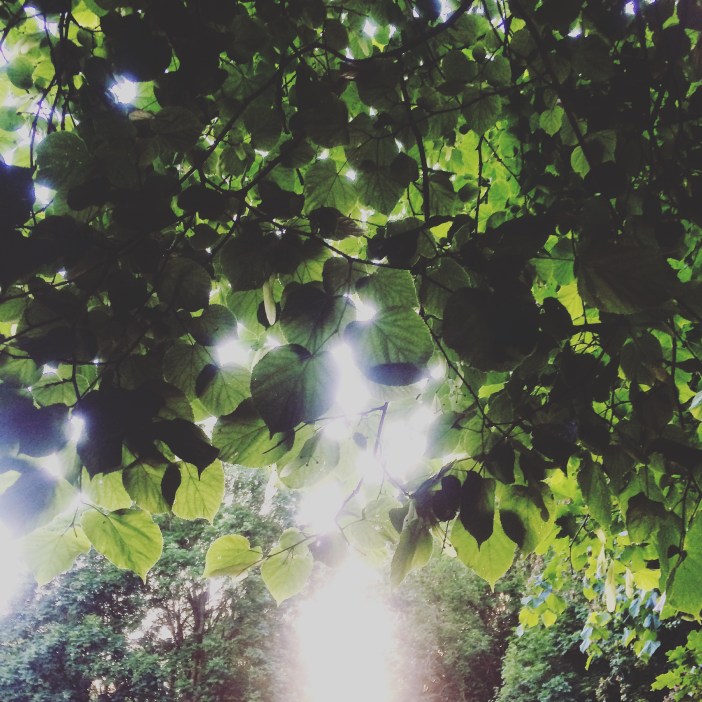
I would look up, intermittently, through a canopy of light-filled leaves. I’m sorry.
As if nothing happened, / I’m so busy, I’m so busy.
When it burned down we were in the street, all interlocked, we could see the embers. Blue and red. Helicopters overhead and my heart in my throat, something lisping the skin of my ribs.
The comedown just happens. I’m not the only one who’s numb.
Invitations to the Catty all weekend.
Work a whirlwind of smiles and graduations. Bottles of prosecco forgotten and balloons that go missing in minor scandal. I try to be better. Accessing all these families. There’s heat and light and a barbecue; ‘Some Velvet Morning’ dragging the scene to its sunburned, surreal conclusion.
I hope something pure happens, softens inside me. Precarious mentality preserved in blue.
Little sweet, cycloramic tweeting.
After that article, feeling wholly grateful for my vision. I mean she had scars on her irises.
Does anyone ever want pineapple juice?
Slimmer now, reflection in coffee shop windows then not. Near tears on the phone. It’s mostly viral, the body’s bright omens. Everything revolves or resolves around you.
An hour a day I actually feel adult.
Calum does my tarot again and this time there are mermaids, mountains, a perfect circle.
Rodefer, Rodefer, Rodefer:
‘Breeze, trembling trees, the night, the stars. And there you are, in a manner of speaking.’
Infinite ugly gas bills from winter.
Disclosing my name as if to say, the end is near. Everyone lovely is reading Remainder. So talk of football and residuals, the free cappuccinos. A system.
‘You two look intimidatingly cool.’
I start painting again but find it hard to mix colour. I want the authentic, luminous lime. There will be a triangle off-centre in the heart of this landscape. Is it even a landscape.
Bike through gushing rain to get back to the present. We dwell awhile in the darker mezzanine, listening to the passing trains, the motorway traffic like hard waves sloshed against a sea wall.
My excuse is, this is all just sketching.
Better for energy, blessedness! A very old episode of Grand Designs.
Somebody somewhere is square-going a seagull while you read this.
Jazz gigs & taxis.
Fear of swallowing moss is utterly irrational, totally a Virgo thing. Intelligent attention.
She is likely to put on a facade of indifference.
Feel bad as ever for bailing.
Slather myself in factor 50, go out to embrace the evening. It’s half past three and I wear white cotton, 30 degrees washed and then a whole new 30 degree heat. Times the right way you make ninety, then three, the year of my birth. Somehow survived a quarter century.
I drink black coffee and watch seven swans moving towards me slowly.
Back on the west coast, I want Lee Harwood to describe the sea. Thin haze of blue Arran and my childhood dreams.
Later.
Even managed to change the sheets. The electricians came without warning.
Late.
Walk 20k steps for the sake of a stranding. June is all over me.
Skewed in a sunburst pleat, I wear less and contain my reactions.
I’m walking home, stuck on a narrow pavement, hemmed in by parked cars. Two men are dawdling ahead of me, both of them huffing cigarettes. They’re dirty fags, definitely Marlboros, a stench that’ll take out your lungs like a morning bloom of toxic frost. I feel nauseous as the smoke blows back in my face and it’s a struggle to breathe; I’m striding fast to get ahead of them, not caring at this point whether it’s rude to push them aside. My heart-rate is up too much, the bodily reaction palpable.
I’m in a friend’s flat. It’s July and we’ve been awake all night and now it’s 4pm the following day, three of us watching videos, drinking rum with blackcurrant cordial in lieu of food. Somebody rolls every hour or so; two of us smoke out the window. It’s been raining for weeks but today the sky is blue and the daylight sparkling. A warm breeze comes through. I’m reminded of the night’s shimmery feeling, a glorious cocktail of chemicals and dropped sugar levels producing slow-release euphoria. The cigarettes are neatly rolled, thin and compact. They don’t take long to smoke, but the two of us—not being proper smokers—relish and linger the moment of supplementary respiration. They don’t taste of much at all, a very faint tobacco flavour that twirls down our throats, the thing we’ve been craving all night. We take turns to gaze at the street below, a couple of lush-leafed trees, passersby offering glimpses of the reality we’ve temporarily dropped out from. Everything has that vaguely pixellated feel of the virtual. Sideways glances at each other’s faces; at times like these you notice the colour of eyes, the shape of noses. We’re listening to dream pop, hip hop, lo-fi. We gossip to forget ourselves, spark grand discussions on topics ranging from astrology to engineering to ghosts. There’s a certain ambience we’ve made out of pure haze, a hilarity of mutual laughter meaning nothing in particular, resounding through abyssal chains of meaning. It’s one of the most blissful afternoons of my life. I go home, hours later, still tingling with nicotine. I lie on my sheets and let the scenes flicker by like beautiful lightning.
Like many people, my relationship to smoking is a little complicated. I’m a Gemini, my loathsome desire always cut into halves. I find myself disgusted by the dry sharp smell and residue taste, but somehow addicted to the presence of cigarettes in narrative, their signifying of time, their eking of transition between moments. It feels natural that such action should then manifest in real life: the disappearance outside after a talk or song or reading, buying yourself time to mull things over, return anew—snatch chance interactions with strangers. I know a friend who started smoking at university purely for the excuse to talk to girls outside nightclubs. I guess it worked well for him. The universal language of the tapped fag remaining a perpetual possibility, footsteps approaching the rosy garden of your smile and your smoke, your contemplative aura. Veils over nature. This is nothing but nothing; this is just the vapourisation of time and space. Smoke gets in your eyes and reality feels smoother. Less needs to be said; intrigue can be held. You add that plenitude of mystery in your walk, your dirty aroma of cyanide, carbon, tar and arsenic—an edge above the vaporous plumes of sweet-smelling e-cigs. With a fag in hand, there’s less impetus on you to talk. With a vape in hand, people want to know about your brand, juice, flavours.
A Smoker’s Playlist:
Mac DeMarco: Viceroy
The Doors: Soul Kitchen
Nick Drake: Been Smoking Too Long
Sharon Van Etten: A Crime
Simon & Garfunkel: America
Oasis: Cigarettes and Alcohol
Otis Redding: Cigarettes & Coffee
The White Stripes: Seven Nation Army
My Bloody Valentine: Cigarette In Your Bed
Tom Waits: Closing Time
Neil Young: Sugar Mountain
Smoking is an object-orientated approach to daily existence. A way of distilling the Bergsonian flow of time into its accumulative moments, paring apart the now from then in the spilling of ashes—slowing and building anticipation by the mere act of rolling. Appropriate that Bergson should use a rolling, snowballing metaphor for temporality. To roll a cigarette is to accumulate a fat tube of tobacco, to acquire something that smoulders, continues, then what? Flakes off as snow, delays. So you interrupt the flow, so you start again.
Denise Bonetti’s recent pamphlet, 20 Pack (2017), released via Sam Riviere’s If a Leaf Falls Press, explores the temporal and bodily effects of smoking. The title itself relates to a deck of cigarettes—twenty once being the glut of an addict’s indulgence, now the standard legal purchase—but of course you can’t help thinking of a deck of cards. Especially since the numbered poems are all out of order, starting with ‘20’, finishing at ‘1’; but by no means counting down in order in-between. I think of Pokemon cards, Tarot cards. We used to play at school and you’d always ask how many in your opponent’s deck, like “I’ve got a 20 deck, want a match?”. With Tarot, I don’t think we understood that only one person was supposed to have the cards in hand. We probably triggered some real bad luck, doing that. Bringing two realities, two predicted futures, into collision. Messing up the symbolic logic. I always flipped over the sun card, savouring the dry irony of Scottish weather and clinging to that vibrating possibility of future joy. We swapped velvet tablecloths for the scratchy asphalt of playgrounds. The older kids drifted on by the bike sheds, wielding cigarettes, watching us with scorn and suspicion.
Smoking has a lot of symbolic logic: ‘the faith in the liturgy the telling of a story / the pleasure of knowing what’s coming’. This is a whole poem from Bonetti’s collection: number ‘4’. A liturgy being a religious service but also a book. Cigarettes are made out of layered paper, scrolled possibility, something to become enslaved to. You just smoke your way through them, the way you might blaze through a novel, find yourself drifting on down a webpage. What thoughts roll round your mind in that moment, churning as soaked clothes in a launderette? You rinse them by the final intake, stubbing the line out and switching your mind like a refresh key. Take it off spin cycle and have a breather. Knowing what’s coming is that sweet anticipation, first cigarette of the morning, of the night or the shift. Remember what’s good for you. Physical relief disguised as imminent pleasure.
The poems of 20 Pack are quite wee poems, thin poems, poems with space inside them, milling and floating around the language. Punctuation is often erased to allow lingering where one pleases. These poems negotiate geometries of thought and situation, honing on imagistic visions which score upon memory: a seagull’s beak, swimming pool tiles, a gold leaf or ‘terrible sequin’, the sun and moon, ‘cyanic peas’. There’s the oscillations of desire, an almost mutual voyeurism that invites the reader within this intimacy, controlled as the cold celestials then warmed with a little wit. Each cigarette is tied to these ‘songs’, lamenting ‘the self- / replicating minutiae of days, / nights, encounters’; ‘An act of anachronism’. Every cigarette involves that mise-en-abyme of re-inhabiting each moment you once smoked in before, a concatenation of places and tastes starting to merge together with the first inhale. This is the seductive literariness of cigarettes. As Will Self characterises it, ‘it’s the way a smoking habit is constituted by innumerable such little incidents — or “scenes” — strung together along a lifeline, that makes the whole schmozzle so irresistible to the novelist’. Maybe also the poet. Easy to make necklacing narratives from the desire points instated by the gleam of a lit cig on a cool summer’s night. The worried observer or reader, clicking the beads together, watching with interest for events to slide into effect. The imminent possibility inherent within the duration of a smoke: what happens next? The loose stitches of a poem you pull apart for a better look, a glimpse of the future. Is all poetry a signal from tomorrow, that fragment of what comes next in the rolling tapestry of the present?
Simultaneous acts:
A tobacco impression between two movies,
Fingertips brushed in the exchange of a lighter,
Expendable tips,
The thick lisp of silver foil,
Dark cigar husk of Leonard Cohen’s voice,
Where we hid from the rain, making miniature glows.
In Ben Lerner’s 10:04 (2014), a novel set in New York, poised on the brink of various recent storms, streetlights provide a sort of talismanic portal into other dimensions. The text’s obsession with Back to the Future plays out the film’s time-travelling logic of multiple temporalities colliding, but it is light that figures this as fiction’s possibility. Embedded within 10:04 is a short story titled ‘The Golden Vanity’, in which the protagonist is struggling to write a novel, an echo of the narrative arc of Ben Lerner’s text. The protagonist pictures his protagonist standing at the same ‘gaslight’ beside which he stands in Ben’s (10:04’snarrator) fiction: ‘he imagined […] that the gaslight cut across worlds and not just years, that the author and the narrator, while they couldn’t face each other, could intuit each other’s presence by facing the same light’. The vicarious union of all these writerly characters, standing at the same gas lamp in different points of real and fictional time, enacts this sense of immanence contained in (re)iteration. The lamp embodies this externalised marker of being—resembling the narrative I that cuts across the novel’s page.
We might think of Virginia Woolf in A Room of One’s Own, describing the appearance of a shadow, a ‘straight dark bar, a shadow shaped something like the letter “I”’. It’s difficult not to think of the extra implications here: a straight dark bar is surely more than just a crudely drawn line on a page? Maybe also a heteronormative public space in which strangers meet under gloomy mood-lights, exchanging phone numbers and slurring words? There’s the association between the male voice and the act of smoking. How many times have you seen a male writer smoking onscreen, or in a novel? Is smoking an act of masculine dominance or, as Bonetti seems to suggest, a more fluid ‘act of negotiation’? Woolf writes: ‘One began dodging this way and that to catch a glimpse of the landscape behind it [the “I”]’. Like the emanating smoke of a cigarette, the literary I dominates context and setting with its insistent perspective, its rationalised display of determined personality. How can we see the fading moors, the elaborate trees, behind the I’s lament? What is it that recedes beyond the smoky planes of our everyday rhizomes, stories trailing over one another with a certain lust for narrative, precision, suspension—self-perpetuating molecules of thought? In poem no. ‘8’, Bonetti relays a ‘text from max: “i can’t stop picturing my first fag break splitting into a chain of identical fag breaks, each reiteration carrying a fainter trace of the initial reason”’. The pleasure of focus dwindles like a tiny dying seed, until all that’s left is this black, Saturnal kernel, reflecting outwards the rings of former moments.
Things people have spoken to me about in smoking situations:
Family problems,
Sex and relationships,
Hunger,
Literature,
Politics, Parties,
Mental illness,
Makeup,
The ethics of cheating,
Shared memories with deeper resonance beyond initial palpability.
Like some subtle, truth-telling elixir, cigarettes invite a space for confession. As Self argues, cigarettes are great for novelists. Not just because of their magic ability to garner stories from others, but because of their Proustian resonance. Gregor Hens, in his beautiful memoir essay Nicotine, describes the focus of smoking thus:
The chemical impulse initiates a phase of raised consciousness that makes way for a period of exhausted contentment. Immediately after the first drags an almost unshakable focus on what’s essential, on what’s cohesive and relatable sets in. I often have the impression that I can easily link together mental reactions to my environment that serendipitously arise from one and the same place in the cortical tissue during this phase. This results in associative and synaesthetic effects that help me to remember, along with the dreamlike logic that is the basis of my creativity.
The ebb and flow of a cigarette’s biochemical culmination prompts a certain rhythm of consciousness conducive to the rise and fall of creative impulse. Little flash-points of mental connection are made with each spark of a lighter; while joining the serotonin dots the nicotine rush soothes us into a mental state of dwelling, which allows those perceptions and expressions to take shape from the swirls of smoke. Consciousness lingers thirstily in the moment.
With an existentialist’s recalcitrant cool, Morvern Callar inhabits her eponymous novel by Alan Warner by describing the scenery around her, narrating her actions rather than inner feelings. Frequently she ‘use[s] the goldish lighter on a Silk Cut’—the phrase is repeated with little variation at least 30 times across the text. It’s a touchpoint of continuity in her turbulent world of suicide, secrets, solitude vs. claustrophobic community and most importantly the whirling raves of the 1990s in which you shed your identity. The rave scene itself ‘is just evolving on to the next thing like a disease that adapts’, as one of the ‘twitchy boys’ on her Spanish resort relates. Cigarettes are perhaps the little quotidian landmarks, the tasteful eccentricities that lend temporal solidity in a late-modern universe that warps and sprawls like some viral code, recalling the human ability to transmogrify base materials. Turn manufactured product to curls of paper, smouldering ash. Cruelly ironic, then, that they cause cancer—the terrible cells that twist, coagulate, balloon and elude.
Every cigarette recalls a former cigarette, the way you might look into the eyes of a lover and see the ghosts of all those who came before. That uncanny glimpse of deja vu that is human desire, the algorithmic infinitude of selfhood. Cue Laura Marling ‘Ghosts’ and sit weeping youthfully into your wine, or else think of it this way, as William Letford writes in his collection Dirt: ‘If you’re lucky you’ll find someone whose skin / is a canvas for the story of your life. / Write well. Take care of the heartbeat behind it’. You might never find a single soul whose skin provides the parchment for your ongoing sagas. Maybe you will. Maybe they smoke cigarettes and so you try to tell them to stop, thinking of their poor organs, struggling within that smoke-withered body. Maybe you’re single and lonely, writing as supplement for the love that’s trapped in your own ribcage like so much bright smoke waiting to be exhaled. There are many mouths you try out first. Poems to be extinguished in a crust of dust and lost extensions. Maybe you don’t think of it at all.
On average, romantic encounters triggered by a shared cigarette:
3/5
+ one arm wrestle,
a distant sunrise,
a song by Aphex Twin,
a bottle of gin,
a fag stubbed out drunk on the wrist.
We tend to think of cigarettes according to the logic of ‘first times’. Again that elusive search for origins, innocence. I remember doing a creative writing exercise long ago where we had to write, in pairs, each other’s first times. Others tackled drunkenness, kisses, flying, swimming. For whatever reason, the two of us (both nonsmokers) chose smoking. My partner recalled being at a festival, aged sixteen, being passed a rollup by her older sister. She remembered the smell of incense, coloured lights, the little choke in the crowd that signalled her broken smoker’s virginity. I slipped back into the dreary vistas of Ayr beachfront, sheltering from the sea wind with a couple of friends. This tall girl I looked up to in ways beyond the physical realm passed me what was probably a Lambert & Butler and I remembered being so pleased that I didn’t cough, but probably because I swallowed the smoke greedily and didn’t know how to inhale properly.
It took me a while to learn how to breathe altogether; when I was born I almost died. The first smoke feels like an initiation into identity and adulthood. It was like coming home from somewhere you never knew you were before. That little spark, a doorbell deep in the lungs. You purposefully harm yourself to establish a cause, a chain reaction. Realising the strange, acidic feeling flourishing in his stomach after smoking his first fag as a child, Hens suggests that ‘in this moment I perceived myself for the first time and that the inversion of perspective, this first stepping out from myself, shook me up and fascinated me at the same time’. It’s hard not to think of the bulimic’s first binge and purge, the instating of shame and pleasure whose release enacts this sweet dark part of the self, an identity at once secreted and secret. Feeling the little spluttering sparks or tingles within you, you realise there’s a thing in there to be nurtured or destroyed. As the bulimic’s purge renders gustatory consumption material, a thing beyond usual routine or forgotten habit of fuelling, the smoker daily encounters time in physical context, the actuality of habit, transition. From the perspective of his spliff-huffing protagonist in Leaving the Atocha Station (2011), Lerner puts it so eloquently:
the cigarette or spliff was an indispensable technology, a substitute for speech in social situations, a way to occupy the mouth and hands when alone, a deep breathing technique that rendered exhalation material, a way to measure and/or pass the time. […] The hardest part of quitting would be the loss of narrative function […] there would be no possible link between scenes, no way to circulate information or close distance […].
The cigarette is Jacques Derrida’s Rousseau-derived dangerous supplement, the elliptical essence of what is left absent but also implied. The three dots (…) or flakes of ash left on the skin from another’s cigarette. Are we adding to enrich or as extra—a thing from within or outside? Derrida describes the supplement as ‘maddening, because it is neither presence or absence’; ‘its place is assigned in the structure by the mark of an emptiness’. We find ourselves entangled; we smoke because we want to write, move, kiss, drink or eat but somehow in the moment can’t. Yet somehow those actions are imbued within the cigarette itself, the absent possibility making presence of that motion, the longest drag and the wistful exhale. Consciousness solidifies as embers and smoke: becomes thing; fully melds into the body even while remaining narratively somehow apart. The supplementary cigarette instates that split: even as smoking itself attempts a yielding, there is always a temporal logic of desirous cleaving. This is its process of transforming…the literal becomes figural—a frail, expendable ‘link between scenes’—the smoker dwindles in memory, stares into distance through a veil that is always there, then faintly dissipating…
The idea of melding with the body, melding bodies (O the erotics of skin-stuck ash), is compelling for smokers because there’s a sense that the cigarette becomes more than mere chemical extension. Like Derrida’s pharmakon, it’s both poison and cure: a release from the pain of nicotine deprivation, but also the poison that reinstates that dependence cycle within the blood. When smoking, you slip between worlds of the self, oscillate between freedom and need. All the old cigarette ads liked to tout smokers as self-ruling souls, lone wolves, Marlboro men who could conquer the world in the coolest solitude. The truth being really a crushing weakness: have you seen a smoker deprived of their vice? Tears and shivers abound, as if the body were really coming apart, the spirit melting. The cigarette becomes synecdochic mark for the smoker’s whole self. Think of Pulp’s ‘Anorexic Beauty’: ‘The girl / of my / nightmares / Brittle fingers / and thin cigarettes / so hard to tell apart’. Fingers and fags merge into one, when all that’s indulged is the un-substance of smoke.
I have certain friends who I could not imagine without their constant supply of paraphernalia; every interaction involves the punctuating rhythms of their trips outside, or desperate searches for lighters, filters, skins. I have seen them smoking far more times than I’ve seen them eating. The very nouns connote that sort of fleshly translucency; it’s a sense that these flakey tools really do mediate our experience of time, space and reality. There’s a horror in that, as well as a remarkable beauty. I have had many epiphanies, watching my friends smoke, the way they stylishly cross their knees or flip their hair out the way or cup their hands just so to protect that first and precious spark. There’s a sort of longing for that ease, that slinkiness; an ersatz naturalness of gesture which is itself a reiteration of every gesture that came before, the muscle memory of a million screenaging smokers always seeking that Marlon Brando original. The protagonist of Tom McCarthy’s Remainder (2005), lusting after the way Robert De Niro so effortlessly sparks up a fag, as if each motion was the freshest, the purest expression. Authentic. The compulsive abyss of the Droste effect in advertising, mentioned by the young Sally Draper in mid-century advertising drama Mad Men: ‘When I think about forever I get upset. Like the Land O’Lakes butter has that Indian girl, sitting holding a box, and it has a picture of her on it, holding a box, with a picture of her holding a box. Have you ever noticed that?’. To smoke is to wallow in that loop-work of fractals, feeling each replicated gesture slip past in the artful skeins of the next.
10:04’s protagonist, Ben, observes his lover Alena smoking a post-coital cigarette: ‘“Oh come on,” I said, referring to her cumulative, impossible cool, and she snorted a little when she laughed, then coughed smoke, becoming real’. There’s an uncanny sense of removal in that: the notion that in playing character, channeling gesture, Alena becomes real. Observing her smoke, Ben is able to achieve a more sensitive awareness of his material surroundings, his attuning to nonhuman objects. He also feels as though the smoking transmits a particle effect that draws his and Alena’s being closer together, as if those tiny motes of poison were causing a mingling of auras, a certain transcendental longing nonetheless grounded in the physical: ‘We chatted for the length of her cigarette […] most of my consciousness still overwhelmed by her physical proximity, every atom belonging to her as well belonged to me, all senses fused into a general supersensitivity, crushed glass sparkling in the asphalt below’. The little chimes of assonance betray that sense of mutual infusion, which can only ever be fictive possibility, the poetic conjuring of words themselves. Later, after feeling the disappointment of Alena’s ‘detachment’ towards him, Ben sends her a fragmentary, contextless text: ‘“The little shower of embers”’. While he regrets sending it, it speaks of our human need to talk desire in material metaphor, often enacting the trailing effects of synecdoche. Here is my (s)ext.: my breasts, my cunt, my limbs. Extensions or reifications, lost signals or elliptical read receipts betraying aporia…We offer a glimpse then withdraw our being. What remains is that transitory passion he cannot let go of, while she so easily finds it extinguished in the sweep of her day.
For Ben, ‘the little shower of embers’ lingers. It’s difficult not to think of the street-lights again, the punctuating markers of spatial trajectory across the grid of the city, twinkling in millioning appearance on 10:04’s book cover. I’m reminded of the street-light ‘Star Posts’ in early Sonic the Hedgehog games (we used to call them lollipops—appropriately enough, another supplement for oral fixation) which you had to leap through to save your place, so that if you lost a life you’d revert back to that position in the level. They’d make a satisfying twanging sorta noise when you crossed them, and sometimes if you had enough rings the Star Posts could open a portal into the ‘Special Stage’. Even the virtual contains its checkpoints of place, the long thin symbols of presence not unlike those Silk Cuts, the I, the anorexic fingers. A sense of these moments that flicker, the length of the cigarette marked as physical duration and spatial decay. A Deleuzian fold or cleave in time. In the new Twin Peaks, Diane is an entity stretched across dimensions. No surprise that she smokes like a chimney, and every time someone tells her to stop she yells fuck you! The implication is a laceration, quite literal. There’s a violence to that delicious rip, the cellophane pulled off the packet. Then there’s episode 8, where the universal smoker’s code—Gotta light?—acquires the bone-splitting currency of horror in the crackling mouth of the Woodsman.
Associative moments lost in time:
She gave up drinking and started smoking on the long flat dirty beaches;
People who burned bright & were extinguished young;
A neighbour whose house smelt so badly of stale fags we used to play in the garden instead;
His fingers shivering like leaves;
The reciprocity of this loose tobacco;
Taste of aniseed skins from Amsterdam, watching the film version of Remainder;
Broody Knausgaard in The Paris Review, admitting his continual addictions;
Smoking on the steps of my old flat saying everything will be okay—but what?
To smoke is perhaps to enact a kind of haunting, owing to the ghostly flavour of the former self performing the same action over. A poststructuralist elliptical supplement or sincere act of nostalgia. Masculine desire for luminous females, or the complicated politics of vice versa. A strange deja vu which mingles identity’s presence with absence. The fictive act of smoke and mirrors. In Safe Mode (2017), Sam Riviere’s ambient novel, the recurring character James recalls a phantom encounter, shrouded in imagined memory:
One summer at a garden party I danced with a girl in a green dress. I remembered her from high school, and built afterwards in my mind a certain mythology around the events of the evening…I discovered the next day that she had died a few months earlier. It seems I had been dancing with her sister. Almost any encounter can alter its configuration through the addition of detail or, more traditionally, a death.
In Safe Mode, problems may be troubleshooted as the brain or hard-drive enters a twilight zone of reduced consciousness, minimised process. The addition of detail: supplemented ornaments of thought, the drapery of memory or retrospective chain of events. What shatters through desire is the gape of that absence. A similar thing happens in 10:04, as Ben recalls his younger self falling in love with a girl he erroneously took to be his friends’ daughter: ‘She became a present absence, the phantom I measured the actual against while taking bong hits with my roommate; I thought I saw her in passing cars, disappearing around corners, walking down a jetway at the airport’. Always at the corner of his vision, she becomes an elliptical presence, diminished to the dotdotdot of memory attempting to make the leap. I think of binary code, the stabbed insistence of typewriter keys. In actuality, nobody else remembers who she is. Objects in the mirror are closer than they appear. What essence lies beyond or within that phantom appearance? What real need is channelled in the flimsy aesthetics of a lit cigarette, a girl in a memorable dress? We fashion narratives to make reality…what is this deep mode of operation; in what state of mind may we dispel rogue software, the signifying virus of niggling, unwitting desires? What jade-coloured jealousy of movement spins like an inception pin, stirring its quiet tornado of dreamy amnesia? How do we pick up our lost selves without cigarettes, what Self calls the usual rebirth of the ‘fag-wielding phoenix’?.
The mysterious ennui of Francoise Sagan’s chain-smoking heroines will always haunt me. Don Draper in the inaugural episode of Mad Men, ‘Smoke Gets in Your Eyes’, lingering over a Lucky Strike, will haunt me. Those moments of waiting for soulmates to finish cigarettes outside pubs will haunt me. Sitting by the sea on a picnic bench watching a friend smoke, talking of boys, will haunt me. The man who kept bugging us outside the 78 about ~The Truth~ will haunt me, even when I gave out a light to shut him up and tried to quote Keats—‘Beauty is truth, truth beauty’—losing his features to the veil of smoke as I myself drowned in chiasmus. Every teenage menthol enjoyed in clandestine fashion, on long walks up the Maybole crossroads, will haunt me. My clumsy inability to roll will haunt me. The cigarettes of stolen time behind the gym block at school will haunt me. The erotic proximity of those curled-up flakes, the crystal possibility of an ashtray haunts me. Frank O’Hara’s cheeky smoker’s insouciance haunts me. The way you stroll into newsagents and sheepishly ask for the cheapest fags will haunt me. Those dioramas of gore on each new packet will haunt me. The foggy spirals of facts and platitudes, health warnings and reassurances haunt me. The way you light up to kill time will haunt me. The dirty, morning-after coat of the tongue still haunts me. My own slow longing for breath will haunt me, I’m sure, in some other dimension where I start smoking and finally find the special addiction. For now, I choke behind strangers, stowing old packs in neglected handbags, writing as supplement for the first delicious drunken fag. Without that fixed, poetic, smouldering duration—Bonetti’s ‘comma between phrases’—I’m meandering through sentences, essaying in mist, waiting as ever for the next scene to begin.
Analysis/Review: Roddy Hart’s 17th Annual Gordon Lecture and the Contemporary American Lyric
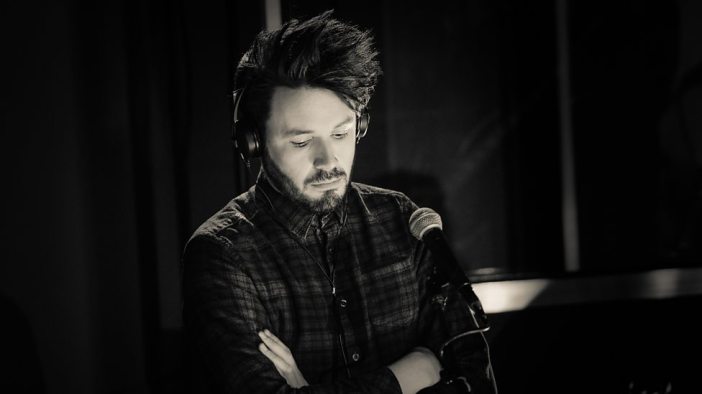
What a treat to listen to a lecture sprinkled with songs and stories, especially among the beautiful acoustics of Glasgow University’s chapel. After a rather spectacular introduction from Professor Simon Newman, singer-songwriter Roddy Hart gave the 17th Annual Gordon Lecture, organised by university’s Andrew Hook Centre for American Studies. Having collaborated with Kris Kristofferson, released an EP of Dylan covers and found success in the States with a stint on Craig Ferguson’s Late Late Show—not to mention running his own radio show for BBC Scotland and hosting Celtic Connections, the BBC Quay Sessions and the Roaming Roots Revue—Hart was well qualified to talk on this subject from a musician’s point of view.
Hart’s talk was a tribute to the great American lyric; to what makes it, in Hart’s words, particularly alluring, otherworldly and cool, especially to those who grew up outside of the United States. Admitting that he lacks an academic education in the history of American culture and music (actually, Hart has a law degree gleaned from within these very walls), Hart made up for this by sheer enthusiasm, celebrating the musical merits of songs from Woody Guthrie to Father John Misty and covering such topics as the journey motif, humour, darkness, nostalgia, politics and death. The talk took the form of a powerpoint, with Roddy speaking, singing snippets of songs and then commenting on their significance in a lucid, passionate way that kept everyone hooked for an hour and a half.
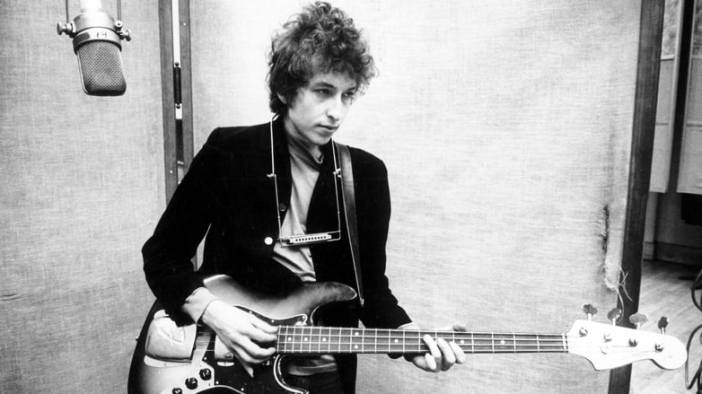
Bob Dylan / / Source: Rolling Stone
Hart began with the assertion that lyrics are not poetry, or indeed literature of any kind. Lyrics, he claimed, involve respect for structure, rhyme, metre and field (all definitions you could apply to poetry…), a certain knack for a hook, a streak of ingenuity and originality. Like poetry, a great lyric can reshape how we view the world we live in, send ripples through the fabric of reality and inspire us to take action, critically reflect or wallow in grief. The distinction Hart draws between poetry and the lyric prompted a desire to find out what exactly his thoughts are on Bob Dylan winning the Nobel Prize for Literature. My own thoughts on this issue have never rested on a single position, and I don’t really know enough about the prize’s history to comment on Dylan’s suitability. However, there have always been strong connections between lyricists and poets, from the likes of Langston Hughes writing jazz poems during the Harlem Renaissance to Kate Tempest releasing rap albums as well as a novel and poetry collections published by the likes of Picador and Bloomsbury, no less. Hell, what about Leonard Cohen? At the end of the day, all writing is a performance of sorts, regardless of how it’s delivered. I could talk about Roland Barthes here, mention ‘The Death of the Author’, how the reader ‘performs’ the text like a score of music etc etc, but I won’t digress. Basically: sometimes a poem seems built for performance; other times it rests more easily on the page, where the eye follows an intriguing visual form or dance of letters arranged on white space. While poetry can be a two-way street, I’m not sure how well Dylan’s verse works on the page. Admittedly, most of his songs tell interesting stories, but that deceptive simplicity often needs the nuance and expression of Dylan’s voice to draw out the subtler levels of irony, humour, derision or sorrow from straightforward-seeming lyrics. Just my two cents on the matter, though I still like to wallow in ambiguity when it comes to these distinctions.
Hart gives the proviso that his talk is meant to be a working definition of the American lyric, not a comprehensive history. He does, however, mention a few characteristic features. The prominent one, of course, is name-checking: all the best American lyrics will draw on the wealth of states, street names, famous bars and hotels. In doing so, they draw on a tradition, they write themselves into a history of locations, urban legends and folk tales. Hart illustrated this by starting with Paul Simon’s ‘America’, pointing out how the song documents a search for America itself; this idea that America will always be this endless signifier, sliding along the great highway of desire that stretches across desert, country and city, drawing across generations. On the way, the lovers in Simon’s song make the best of their adventure, cooking up stories from the characters on the Greyhound, honing in on material details. It’s this sense of taking the listener on a journey that’s one of the American lyric’s greatest seductions. As Simon sings, “it took me four days to hitchhike from Saginaw” the chords soar and there’s that sense of being lifted to somewhere radically elsewhere, an open field, road, desert. The sweet spot between freedom and sorrow, of missing something deep and mysterious, the impossible pursuit.
Hart traces such material details in songs by Kris Kristofferson and Dylan, this sense of a ‘quintessential American aesthetic’ which he quite eloquently describes as a ‘Moby Dick-esque hunt across America’. The whale, ironically, is America itself. The road narrative is central to the American lyric. It’s a romanticised, extravagant sprawl into the dust of the past and glitter of the future, marked by place names which glow with familiar warmth and legendary spirit. Hart argues that this is something specific to the American lyric; that a Scottish equivalent wouldn’t quite have that same epic effect. He even sings a made-up local spin on ‘America’ to prove it; a journey between Edinburgh and Dunoon falls pretty flat in comparison. Of course there’s something special about the land of the free, in all its bright mythology and promise, but it’s not as if Scottish bands haven’t tried it. There’s that famous line from The Proclaimers’ ‘500 Miles’ which immortalises an array of parochial towns ravished by Thatcher, deindustrialisation and eighties recession: “Bathgate no more. Linwood no more. Methil no more. Irvine no more”. Of course there isn’t the same expansive magic, but there is something epic about lyrically connecting the local to broader political discontent. Still, you can’t really compare the Proclaimers to Simon & Garfunkel…or can you?
Back to America. Hart describes Dylan as the nation’s great scene-setter, effortlessly drawing a sense of the times from the wisping drift of personal narrative, of stories about people and their lives. Details shuffled together like cards and strung along a line of verse. While some singers make their politics clear in the didactic manner of protest, Dylan sets these more intimate tales against the backdrop of cities and an impressionistically vivid sense of history. Hart plays possibly my favourite Dylan song, ‘Tangled Up in Blue’ from the 1975 album, Blood on the Tracks, spending time going over the lyrics to point out the singer’s knack for detail, the narrative journey which documents a succession of relationships, places and jobs. That famous philosophy: you’ve got to keep on keeping on. There’s something more raw here than the cosy, apple-pie fuelled comforts of Kerouac’s road narratives, which always depend on money from back home. You can hear it in the howl of Dylan’s voice, which becomes more a sultry croon in Hart’s version. What does he mean by blue? There’s the blues, there’s the blue of the sky and the ocean—symbols of infinitude. It’s a signifier that shifts as easily as Dylan’s character, from fisherman to cook, as he crosses over the West, learning to see things “from a different point / of view”. Surely this is one the basis for democracy, the meritocratic ideal of fairness upon which the USA was founded: empathy? The ability to openly shift your perspective, to never stay too long in your own shoes. That existential restlessness, set against the backdrop of a shaky political atmosphere, the dustbowl sense of losing one’s bearings in a maelstrom of uncertainty, characterises many of Dylan’s songs and indeed many road narratives throughout literature and American lyric.
You can’t talk about the American lyric without mentioning politics and Hart documents the history of the protest song, from Woody Guthrie’s ‘This Land is Your Land’ to Tracy Chapman’s ‘Talking About a Revolution’: songs that pose an equality of belonging, that document the quiet desperation and struggle that takes place beneath the surface of everyday life. Rather than tangling himself in the barbed reality of contemporary politics, Hart opts to situate his chosen songs in the context of more general themes: the failings of the American dream, social inequality and the oppression of working people, all set against the turning tides of the economic landscape. It’s notable that most of these singers are men, singing about working men, often with reference to some vulnerable lost girl who needs saved. But then you have the likes of Anaïs Mitchell, writing visceral songs of longing and misplaced identity. ‘Young Man in America’ opens with this mythological, sort of monstrous story of birth: “My mother gave a mighty shout / Opened her legs and let me out / Hungry as a prairie dog”. Images of industrial decline, capitalist opulence and landscapes both mythical and pastoral are woven by a voice whose identity is a mercurial slide between human, animal and disembodied call. Skin is shed, belonging is only a shifting possibility. It’s a complex song, with native percussion, brass; moments of towering climax and soft withdrawal. The music mirrors the strange undulations of the American journey from cradle to grave, its dark pitfalls and glittering peaks, the cyclical narratives of the lost and forgotten; the “bright money” and the “shadow on the mountaintop”, the fame of the “young man in America”, a universal identity disseminated across a range of experiences. For this is the myth of the American Everyman, and Mitchell deconstructs it beautifully.
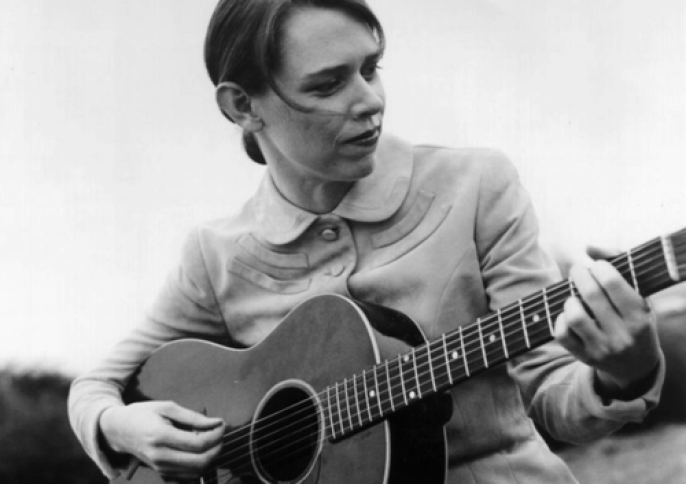
Gillian Welch / / Source: Born to Listen
On the subject of female songwriters, I was very pleased that Gillian Welch and Lucinda Williams got a mention in Hart’s talk. The self-destructive sentiment of Welch’s ‘Wrecking Ball’ reminds us that the experience of being ground down by the relentless demands of a marketised society isn’t confined to men alone. Welch’s ‘Everything is Free’, not mentioned in the talk though highly relevant, makes this clear. It’s a song about artists will go on making their art even if they won’t get paid, and the tale of how capitalism discovered this and cashed in on its fact: “Someone hit the big score, they figured it out / That we’re gonna do it anyway, even if it doesn’t pay”. Like Dylan, Welch finds herself winding up on the road, working in bars, working hard and regretting being enslaved to, well, The Man. ‘Everything is Free’ is a message of both despondency and hope, crafting this sense of the beauty of song itself as protest and freedom even as the structure closes in: “Every day I wake up, hummin’ a song / But I don’t need to run around, I just stay at home”.
Hart mentions how the American lyric provides an escape to those who find themselves trapped in the smallness of their lives. You might live in a nondescript town slap-bang in the middle of Scotland, where the musical climate favours chart music blasted from bus-stop ringtones, but then aged fourteen you discover Dylan or Springsteen and suddenly America opens up its vast, sparkly vista, from East Coast to West. This seems to be Hart’s trajectory, as his career—from the first tour with Kristofferson to his continued promotion of transatlantic connections—closely follows an American strain of songwriting. My mum used to listen to Welch’s Time (The Revelator) album over and over again on long car journeys, so the lyrics to all those road songs are burned in my brain like tracks in vinyl, superimposed with endless visions of the M8 stretching out before me… It was only a couple of years ago that I found out Time (The Revelator) was released in 2001; I’d always assumed this stuff was ancient, the seventies at least. Maybe because Welch just has this knack for writing timeless songs; songs about heartbreak, loneliness and restless desire that reach back into the comforts of the past even as the journey itself is long and hollow, the destination vague as the blurred sign on the front of a train.
I guess this raises a broader question which Hart’s talk touched upon: the politics and poetics of nostalgia. There weren’t opportunities for questions afterwards, but if there were I might have asked Hart whether nostalgia is a necessary condition for American self-reinvention. It’s a pretty relevant question right now, with much of Trump’s whole appeal based on the nostalgic vision of a vaguely industrial golden age of capitalism—a vision which is obviously the smokescreen for whatever chaotic ideologies are at work beneath the surface. The American lyric can set up this romanticised vision, only to break it apart; reveal its seedy underbelly, its failings, the disastrous gap between identified goals and actual means of attainment. Yet throughout the cynicism, there’s always that restless desire to continue, to keep on keeping on. Hart compares it to the green light in F. Scott Fitzgerald’s The Great Gatsby (1925), a novel significantly indebted to music (jazz, of course). The final line of that novel captures that past/present lyrical impulse so well: ‘so we beat on, boats against the current, borne back ceaselessly into the past’.
Which leads to the question: what about genre? Is the American lyric necessarily the domain of indie folk rockers? What about commercial music and pop? Can a pop artist deconstruct the American dream and earn a play in the lyrical family tree if they make money off their record and earn fame from MTV? Hart engages with Father John Misty as an example of how the American lyric can use humour to deconstruct the nation’s ideologies of progress and meritocracy, at the same time as retaining a post-postmodern self-awareness of identity politics, a meta-awareness of his own dabbling in ironic coolness. His very name evokes a sort of New Age gospel figure, a preacher for the times, whose stage is the television set or Twitter feed instead of the old-fashioned soapbox. Hart describes songs such as ‘I’m Writing a Novel’ and ‘Bored in the USA’ (obviously a riff on Springsteen’s classic) as depicting the ‘American dream for the millennials’. I’ve written about Misty extensively already on this blog (specifically, on his metamodernist tendencies), so I won’t go into detail here, but suffice to say I agree that FJM represents something special about contemporary cultural critique. It’s that blend of irony and sincerity, an exaggerated interrogation of the romanticism and the Gen X postmodernism of yore; the oscillation between raw subjective experience, political critique and the cool facade of self-deprecating wit. A constant juggling of ‘candour and self-mockery’, as Dorian Lynskey puts it. FJM notoriously got into a tiff during an interview with Radio 6 Music veterans, Radcliffe and Maconie. Aside from all the awkward sarcasm, what strikes me about this interview is the mentioning of kitsch merchandise objects: oven-gloves, jeggings. Hart explores a bit of kitsch lyric in the likes of Randy Newman, but I think FJM blends especially well that jaded sense of millennial despondence alongside tracks that can feel like rollicking simple narratives or epics of history on a 13-minute scale that gives Springsteen’s marathon tunes a run for their money. He pushes his stuff to the edge of the cheesy and cringe-worthy, exposing how all conviction has that shadow side of kitsch, even the most authentic lyrics—kitsch is somehow the cheap taste of someone else’s experience, the trick is to make it meaningful, and not just another imitation, a plastic model of the Empire State Building.
But Misty isn’t the only singer-songwriter deconstructing the American dream, exploring how both its poetic promise and jingoistic glory play out on a personal level. What about Ryan Adams, whose songs have that alt-country appeal of the restless bard? ‘New York, New York’, from his 2001 album Gold, opens with a Dylanesque lyric about shuffling “through the city on the 4th of July”, brandishing a “firecracker” that’ll break “like a rocket who was makin’ its way / To the cities of Mexico”. The clean rhymes and ballad-like lilt of guitar are also very Dylanesque. But at some point I’ve got to stop making comparisons to Dylan, because ultimately this is reductive; it’s cheap and lazy music journalism. I do think, however, the ease with which we make these comparisons reveals something interesting about our generic assumptions. Guy has a guitar, sings melancholy songs about America and his place within it, a smart knack for a lyrical twist, occasionally picks up a harmonica? Instant Dylan; their careers overshadowed by a giant. (Note: I guess a similar thing happens with very talented female folk singers—the likes of Laura Marling—being compared to Joni Mitchell). But even Dylan doesn’t monopolise the American lyric. He might have a Nobel Prize, but this doesn’t crown him King of the Lyric Alone (or maybe it does?); we’ve got to tease out what exactly we mean by this term and how relevant it is in the fragmentary scene of contemporary music. Think with Dylan, but beyond Dylan.
Conor Oberst, formerly of the band Bright Eyes, is an artist who’s been branded with Dylan comparisons throughout his career (an extensive career at that; the precocious Nebraskan recorded his first album, Water, aged just 13). Sasha Frere-Jones in the New Yorker condenses many of my own feelings on the Oberst/Dylan comparisons: ‘Dylan is armour-plated, even when singing about love; Oberst is permanently open to pain, wonder, and confusion.’ Oberst is in many ways a liminal figure: cutting it out on the folk and country circuit (Emmylou Harris and Gillian Welch appear on previous records) while hanging and collaborating with indie rock bands (The Felice Brothers, First Aid Kit, Dawes), flirting with punk (The Desaparecidos) and fitting with some comfort within the elastic nineties/noughties stratosphere of emo. Frere-Jones describes Oberst as a ‘poet-prince’, again opening debate on that binary between poetry and lyric that Hart sets up but that nonetheless remains slippery and problematic. Where Dylan espouse the solid wisdom of a sage or wandering bard, Oberst has a reticent, warbling quality that rises to epiphany but admits failure and the graceless fall into existential aporia. He wails like Dylan wails, but many of his songs have a fragility and surrealism that doesn’t quite match up with Dylan’s more assured narrative balladry. So in that sense, he’s a lyric poet in the more subdued, Keatsian manner, exploring the self in all its fragmentary, perplexing existence.
But he’s also very much an American lyricist. In his ‘mature’ career, Oberst hasn’t shied away from more directly tackling political themes alongside more personal songs. 2005’s ‘When the President Talks to God’ rips to shreds George W. Bush’s policies. Comprising a series of questions addressed to an audience, it more closely follows the form of a traditional protest song, laced with bitter satire: “When the president talks to God / Do they drink near beer and go play golf / While they pick which countries to invade / Which Muslim souls still can be saved?”. This is definitely a song to be performed, on a wide open stage or indeed to the even wider audience accessing broadcasts of The Tonight Show with Jay Leno, where he performed the song in 2005. Then there’s the angry, crunchy southern kick of ‘Roosevelt Room’, off Oberst’s solo record, Outer South (2009). Oberst’s later work isn’t as playfully weird and surreal as his early bedroom stuff, sure, but increasingly he masters the power of allusion that characterises American lyric, in Hart’s sense of the term: “Go ask Hunter Thompson / Go ask Hemingway’s ghost”. He’s addressing someone to be critiqued, wrenching them off their political pedestal: “Hope you haven’t got too lazy / I know you like your apple pie / Cause the working poor you’ve been pissing on / Are doing double shifts tonight”. There’s that apple pie again, symbol of steadfast Americana, fuel of the nation, the well-lighted place of a diner—a place of domesticity, stability and, let’s face it, commercial comfort. Oberst cynically dismisses the well-nourished white middle class politician, recalling a generalised story of poverty from material details: “And I’d like to write my congressman / But I can’t afford a stamp”.
Source: pinterest
Then there’s the frontier motif, the sense of America as a place of deep mystery as well as self-created landscape. Experiments with Eastern and Navajo cultures. Bright Eyes’ 2007 album, Cassadaga, with its album art requiring a spectral decoder to be fully appreciated, its envisioning of the singer as mystic or medium, channelling psychic forces through song. Cassadaga is very much a journey. The opening track, ‘Clairaudients (Kill or Be Killed)’ involves an extended spoken word sample of some kind of very American mystic who begins by setting us in the ‘centre of energy’, Cassadaga’s ‘wonderful grounds that have vortexes’, moving us through astral projections of a ‘new era and life’ that is changing, a message of hope, doubling back on the uncanny sense that ‘Cassadaga might be just a premonition of a place you’re going to visit’. Cassadaga is a real place, a spiritualist camp set somewhere between Daytona and Orlando, known as the ‘Psychic Capital of the World’. By naming his album Cassadaga, Oberst isn’t just name-dropping in typical hipster fashion, honouring local identity nor casting back nostalgically to a familiar place; he’s attempting to channel the energy of this location, interrogate its spirit, draw out its various psychic possibilities for the present. He sings of attempts to detoxify his life, of former affairs, of lost soul singers and the pursuit of a sense of belonging.
‘Lime Tree’ is one of the most beautiful songs Oberst has written. It’s a composite tracing of impressions drawn from various experiences, both personal or secondhand. While much of Cassadaga follows an upbeat, distinctly country sound in the manner of 2005’s I’m Wide Awake, It’s Morning, ‘Lime Tree’ closes the record with a dreamy, wistful serenity that recalls the likes of ‘Lua’, ‘Something Vague’ and ‘Easy/Lucky/Free’. Accompanied by angelic female vocals, ‘Lime Tree’ is ethereal, the guitar strumming minimal though following a certain continuous loop. Pale and lush strings contribute to the sense of being pulled downstream, giving yourself up to the languorous current. Ostensibly, it’s a song about abortion, about a struggling relationship: “Since the operation I heard you’re breathing just for one / Now everything’s imaginary, especially what you love”. But as in all good poetry, the beauty of the lyrics on ‘Lime Tree’ is their movement from specific experience to a vaguely spiritual voyage that gestures towards ending but instead finds the open plains of abyss, always suspended in paradox and ambiguity, the fault-lines between life/death, hope/despair, dream/reality: “So pleased with a daydream that now living is no good / I took off my shoes and walked into the woods / I felt lost and found with every step I took”. Home is a tidal wave, a churning wind, a shifting sand, a fragment.
Source: crystalinks
America’s great confessional poet, Sylvia Plath, also explored mysticism, and her writing is rich with strange imagery, not to mention all those Tarot allusions in Ariel. In The Bell Jar (1963), the fig tree is the novel’s dark and mysterious heart, this vivid image that sprawls its symbolism through the text, a figure for existential paralysis: ‘I saw my life branching out before me like the green fig tree in the story […] I saw myself sitting in the crotch of this fig tree, starving to death, just because I couldn’t make up my mind which of the figs I would choose’. We might think of the connection between the term ‘roots’ and ‘roots rock’, its rhizomatic sprawl of influence never quite settling on a home even as a sense of home and locality is supposedly the music’s grounding purpose. Roots, of course, are always growing. The lime tree is an image plucked from a dream, but its significance is less clear in Oberst’s song than the fig tree in Plath’s narrative. Perhaps more than most contemporary songwriters working within a lyric tradition, Oberst is content to write from a position of uncertainty, in gaps and pieces of affect and narrative. The sound of his voice suspended over those gentle strings and strums is enough to make tremors in your chest, as if the slow vortex of another world were opening its mouth like the parting of the sea in someone else’s biblical or drug-enhanced dream: “I can’t sleep next to a stranger when I’m coming down.” The way of the lyric; so often the way of the lonely. Even as ‘Lime Tree’ might be a love song, it opens itself towards ending, loss, death: “don’t be so amazing or I’ll miss you too much”; there can never be plenitude in the journey: “everything gets smaller now the further that I go”. Bittersweet doesn’t quite cut it. It’s too subtle for that, a softly shimmering lullaby goodbye to the world, a retreat and a return, just like Nick Carraway’s vision of beating on but back into the past. The passage of an everyday spiritual pilgrim, the way we all are in life, our faces fading in the ink-blot of photographs. We turn back to look at ourselves through others, through words, just as Dylan notes how the girl in the “topless bar” “studied the lines on my face”.
A voyage through nostalgia, a quest for identity, belonging, an escape from something and a return, a desiring pursuit without end, a lust for life and ease into death; a twist of humour, a narrative of hope, aspiration and the failures that draw us back into the dustbowl. The American lyric is all of these things and more; its boundaries perhaps are pliable as the nylon strings on somebody’s battered acoustic guitar. Maybe it all culminates in madness and absurdity. For every One Flew Over the Cuckoo’s Nest, you’ve got The Felice Brothers’ ‘Jack at the Asylum’, a rollicking satire on the madness of contemporary American life which trades in richly surreal and absurd imagery to render the accelerated pace of this madness, crossing history in the blink of a screen flicker: “And I’ve seen your pastures of green / The crack whores, the wars on the silver screen”. Pastoral America is always already contaminated by an originary violence. Maybe the best American lyric depicts such realisations through personal stories, the relationships and encounters set against and embedded within wider structural phenomena, the recessions and closures and urbanisations. The Felice Brothers remind us, however, that all of this is secondhand, aspirational narratives passed down to us through screen culture, advertising: “You give me dreams to dream / Popcorn memories and love”. Once again, there’s that fluctuation between an earnest love of country to an embittered sense of its very elusiveness, the distant static shimmer of success whose failed pursuit we watch ourselves experience through the mediating comforts of daily life—the popcorn pharmakon poisons and cures for (post)modern existence, as calorific as they are nutritionally empty.
But once again, genre. String off a handful of names from Hart’s Americana playlist and you’ll be pressed to find anything that falls outside the folk-rock camp, even as its boundaries remain pretty permeable. Yet what of hiphop? Isn’t hiphop, in a sense, the great alternative American folk lyric? Rap is it’s own kind of poetry, after all. You might think of someone like Kendrick Lamar as an American lyric writer, working from a different generic background from Hart’s examples, but nonetheless telling the story of contemporary USA from the streets to the level of the visionary, just like Dylan did. Lamar even has a track called ‘Good Morning America’: “we dusted off pulled the bullet out our heads / Left a permanent scar, for the whole world to recognise / California, economics, pay your taxes bitch”. Once again, that originary violence, the scar of identity. Lamar works back from the wounding.
Source: pinterest
My knowledge of hiphop is far too limited to discuss it in any detail, but thinking it through the idea of American lyric prompted me onto the figure of Lana Del Rey, who often uses hiphop production techniques, from trap beats to muted, stadium echoes. I hate to bang on about oor Lana again (see articles here & here), but irresistibly she’s a shining example of a mercurial musician, drawn to the sweet dark chocolate centre of American melancholy. LDR performs a kaleidoscopic array of identities, just as Dylan often wore a mask that veiled itself in the confessional sincerity of the beaten-down worker, drinker, lover, escaping to the Mid-West alone. Yet while America’s great bard more or less got away with it, Lana has been constantly lambasted for her artifice and supposed inauthenticity. Which begs the question: what do we even mean by authenticity? Is only the white male—your Princes, Bowies and Eminems—allowed to strut in the performative identity parade? Both LDR and Lady Gaga have been lambasted for their supposed fakeness. There are obviously complex questions of racial, class and gender identity which I don’t have time to cover here. Sometimes, a musician is lauded for their alter ego (and doesn’t alter ego itself imply a certain surrender to the patriarchal ideology of masculinity?)—take Beyoncé’s hugely successful Sasha Fierce—and other times, it takes the invisible tide of the internet to swell in support for those critiqued by other forms of media.
Source: YouTube
My friend Louise is always comparing LDR’s work to F. Scott Fitzgerald’s novelistic visions of 1920s America, and while this might seem a bit extravagant, there’s something to be said for the way Lana seamlessly evokes the spirit of the jazz age, the consumer paradise of the 1950s and the hipsterdom of millennial Brooklyn in the through the poetry of song. Is this just retroculture, in the sense of recycled kitsch and the twenty-first century urge towards nostalgia explored in Simon Reynolds’ excellent Retromania (2011)? Is there something pathological in Lana’s obsession with the past, a symptom of a broken psyche or worse, a broken generation? Perhaps. But there is something transformative and subversive about LDR’s retrovision, even as it may be critiqued for indulging in vintage gender roles as much as vintage styles (framing yourself as a sort of white-trash ‘gangster Nancy Sinatra’ is always gonna invite a certain feminist controversy, let’s face it).
One of Hart’s recent examples of the American lyric came from The National (even the band name evokes questions of what it means to be American), with their song ‘Sorrow’ from 2010’s dark and trembling High Violet. I’m interested in how this song apostrophises sorrow in the manner of a great Romantic lyric. We might think of Keats’ ‘Ode to Melancholy’ or Charlotte Smith’s Elegiac Sonnets, the eighteenth-century cult of sensibility remade for jaded and alienated millennials. Sorrow once again invokes that Platonic idea of the pharmakon as both poison and cure. We can wallow passively in sorrow, as The National sing: “I live in a city sorrow built / It’s in my honey, it’s in my milk”: it’s a trapped landscape, a petrified terrain in which the self can only slip deeper into isolation; but it’s also milk and honey, a kind of temporary nourishment to a darker psychic scar. As Smith so eloquently puts it in the final lines of 1785’s ‘Sonnet Xxxii: To Melancholy’: O Melancholy!–such thy magic power, / That to the soul these dreams are often sweet, / And soothe the pensive visionary mind!’. Sorrow provides a toxic tonic for the soul, a lubricant for paralysis that eventually leads us back towards the existential road. Life goes on.
Lana Del Rey is fixated on sorrow. Blue, she admits, is her favourite colour, her favourite “tone of song”. Her songs are always hyper aware of the transient beauty of life, even as they lust after death. On the soundtrack song she did for Baz Luhrmann’s adaptation of The Great Gatsby, she worries “Will you still love me when I’m no longer young and beautiful?” ‘Video Games’ is a melancholy ballad for the contemporary relationship, a lush, brooding expression of love in the time of Call of Duty. Roddy Hart even did a cover of it. Her songs have titles like ‘The Blackest Day’, ‘Cruel World’, Sad Girl’, ‘West Coast’, ‘Old Money’, ‘American’, ‘Gods & Monsters’ and ‘Summertime Sadness’. All these titles evoke the Daisy Buchanan sad girl trope at the same time as gesturing towards the broader existential melancholy of America itself in the manner of Springsteen; with sometimes the detached urban cool of Lou Reed, other times the genuine, trembling passion of Billie Holiday. The video for ‘National Anthem’ restyles Lana as a Jackie O type married to a young, good-looking black president, with 1950s iconography spliced among pastel-hazed footage of the pair lolling around in love, sniffing roses, smiling, looking good as a Vanity Fair shoot. The video begins with her character singing Marilyn Monroe’s famous ‘Happy Birthday Mr President’ routine. She re-envisions JFK’s assassination, with a spoken word piece on top. She’s imagining alternative political futures even as she casts back to the past. There’s that lyric sense of wonder and ambiguity, of being lost in time.
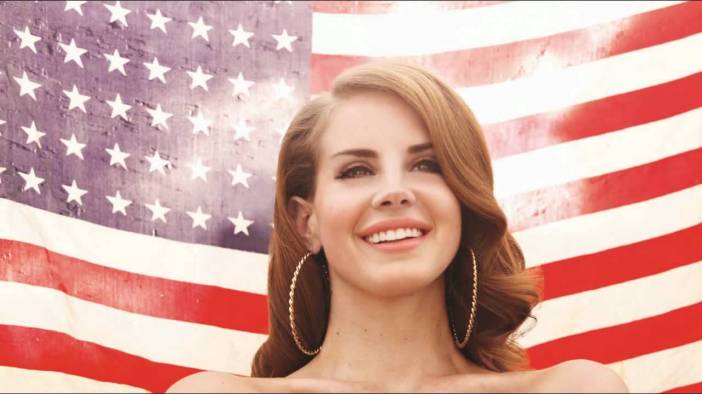
It’s this layering of styles, scenes and cultural iconography that makes Lana’s work way more complex than most of what else fills the charts. Sure, it’s great that a positive message of bodily empowerment (Beyoncé feminism) is doing the rounds just now, but that shouldn’t mean that those who fall outside this category are anti-feminist or ignorant to gender identity politics. When all the R&B pop stars are prancing around proclaiming their sexual freedom, dominating men in various flavours of BDSM allusion, getting all the looks in the club or whatever, LDR is crying diamond dust tears into her Pepsi cola, draped naked in an American flag. Her videos, songs and artwork engage with cinematic discourse, high fashion photography and cultural history in a manner that’s intellectual interesting as much as it is affective and aesthetically satisfying. In a sense, she’s meaningfully evoking the past in order to say something timeless about the American dream and the objectified position of the ‘white trash’ woman under its mast of starry glory. In another sense, she’s indulging in a postmodern recycling of historical styles: constantly name-dropping, from James Dean to Springsteen, Lolita—perhaps the great American road novel not written by an American—and David Lynch’s lush, dark suburban epic, Blue Velvet. Despite the performance and ventriloquy of figures and archetypes from twentieth-century cultural history, she retains a sincere expression of melancholy, heartbreak and longing that’s personal but also strives towards rendering the more universal experiences of womanhood in certain communities. All the controversy surrounding Lana in relation to racial politics, class politics and sexual politics exists because her work is provocative, problematic and complex, like any good American lyric.
One reason that Roddy Hart was such a good choice to deliver this lecture is that he’s had experience writing new melodies for Robert Burns poems for Homecoming Scotland. Why is this relevant to the American lyric? So much of the lyric tradition, in all its forms, is based on that sense of romanticism, visionary wonder, self-exploration; the rendering of universal experience through personal narratives, the subjective telling of a story, the trade in imagery and sound and careful arrangement. Burns was a sort of rock star poet of his times, and not just because he was a bit of a cheeky philanderer. He toured around, worked as a labourer and farmer; he talked to many people, opened himself to influence. It’s this diversity that continues to mark the American lyric in the twenty-first century; the way that Father John Misty can sing a very ironic and playful song on late-show tv, about a man checking social media on his death bed, with the conviction of a crooning Leonard Cohen; accompanied by a gospel choir whose voice raises Misty’s ballad to a level of epic, overly extravagant grandeur that still somehow works, remains genuinely compelling beyond the initial sarcasm. The way Detroit’s angelic avant-indie hero, Sufjan Stevens, can ambitiously and patriotically plan to write an album for every state in America, then turn on the project, calling it “such a joke“. The way that Suzanne Vega, in ‘Tom’s Diner’, sings about a familiar American institution, the fabled diner—or Well-Lighted Place, as Hemingway put it—with the simple verse structure of an Imagist poem made narrative, sketching brief impressions of the myriad people she encounters in a public space. It feels cinematic, with deep eighties bass, bursts of brass and string-like synths, but also has that emergent sense of a postmodern folk, looking at the world from the bottom-up, catching everyday lives and stories in song. Even when irony remains the chief aesthetic order of the day, the lyric doesn’t have to be sucked into self-referential abyss. The best singer-songwriters continue to channel the American lineage through a romantic strain as much as a humorous one, inflecting songs with sorrow, joy and vitally that lust for something more—sometimes beyond life itself, sometimes just the restless possibilities of the road. Singing alone in the Glasgow Uni chapel on a Thursday evening, Roddy Hart rekindled some love for all that.







 mariaology