Playlist: July 2019

IMG_7734.JPG

Ariana Reines has this poem called ‘Glasgow’ that features the lines: ‘We wanted life now / But not “real” life / We wanted the exact science / Fiction / We were living in / We didn’t want it’. I keep thinking that just living is so often this contradiction, or Eileen Myles declaring ‘a poem says I want’ and knowing how right they are, Ariana and Eileen, and where are we when we come to this knowing. I mean, why does such philosophising happen in a poem called ‘Glasgow’. It’s clearly set in Finnieston, I mean there’s ‘Berkeley Street’ and ‘the Sandyford / Hotel’. I wonder if Ariana knows the pawn shop is not really a pawn shop, or if she ever bought poppers or condoms or candy from the 24hr place near the Hidden Lane. Here I am with americanisms again. I mean I wonder if my idea of Ariana would bother nipping from her hotel room to replenish the tobacco she ran out of. Would she bauk at UK prices? Does she even smoke? My idea is always a she here and she likes to go into contingent nightclubs more than the store. It’s what we give away. Finnieston used to be not-expensive. I once wrote a poem called ‘Finnieston’, I was younger, it was kind of bad. It was about this release you get from finishing something, crossing a bridge. I used to go through the park to get to my friend’s house or the 78 and every other time the shops and bars along the strip would be different. A kind of fantasy district, reinventing itself coolly around me. Someone in the world is having the gentrification blues and listening to Courtney Barnett’s ‘Depreston’. Like sometimes I just sit and think, oh how about that whimsy! It’s hers, but you can borrow it with a jangle tone. Bottle it like Tango. And we shriek the world percolator into the dark, fizzing stars of etcetera. In the morning order lattes. Goodness sake is this what it is to write now, I love it.

Slowly, slowly. I measure out my life in Scotrail tickets. Walking around cities and trying to carve them into a poem, I mean that’s not what any of us are doing but it happens. Just comes, like orange. This month I spent a lot of time outside of my usual quadratic existence; I didn’t have to count the change in the leaves, there was already so much that was different. Things sped up. Once we live in it, do we not want it? Orange curls at the edge. That feels like a worded conundrum of someone who’s spent awhile on the streets, in some capacity. Not necessarily without home. I was counting the crisp packets from my perch on Uni Avenue, overlooking the construction works. Is it that nothing online is real as well, if you can have as real a nothing as the something of life? We don’t want this and yet it’s what we built, what we live in; we crave the ‘outside’ still, as though it were possible. It’s all in process. The station goes on a real bright tangent. 

I like to just say, Ariana Reines wrote a poem about Glasgow. I feel honoured on behalf of my adopted city. It ends ‘Way out’. This consideration of exits, secret passages under the Clyde, riding bridge-wise towards the April I had to trudge hungover from tea-room to tea-room, listening. Hey. I saw Ariana read last summer at the Poetry Club (thanks Colin!), I think she was wearing a white dress and she said she might menstruate at any minute, she said something beautiful about the sun and the moon, synchronicity, and it was exactly what we needed. I mean her sultry voice filling the room, release. I mean I felt validated in my cramps and misery.

Tiny red spots appear like a migraine painting my belly. 

There’s the rain now. The rain broke the heatwave. Is it Cetirizine causing my headache, this marathon pain like a marble rolling between my temples? When I go see Iceage play Broadcast, the room is sweltering. There’s a general jostling and adoration of bodies, like this guy is Scandinavian divine and just one lick of his sweat would cure your ills. The ills of a lack of a life. When we are living between. Catch It. I like to use the phrase ‘out west’ as a general euphemism for escape. Like sorry I gotta go, there’s a meeting out west, something happening out west, I’m owed time back west like the sky’s owed snow. A Sand Book (Reines, 2019). If you close it too fast the grains fall out. As though I could make of Kelvingrove the savanna that takes us out of my dreams. In the novella I wrote last year, there’s a whole childhood set there. It’s somewhere in America that you’d find in a song, but it crackles with violence and the fat-spitting fry ups of diners. Or does it at all. Who did she wait for.

Cherubic sleeping face.
Sketches of rooms.
Seafoam teal & mustard yellow.

There was a whole Monday morning in London I filled alone. It was strange to come close to a cacophony of accents you only usually heard on the telly, the city accenting its vowels to deliver things quickly. And yet we’d roll like beads in jelly, very slowly towards ourselves. I walked along Regent’s Canal with the flowers spilling out around me, cyclists slipping past and women smoking fags from canal boats, smiling their air of propriety. ‘Way out’ I could not go here. I knew if I stuck to the water it would all be fine, follow the line that was not the Tube. In London Field Park, someone had chalked XR slogans everywhere. ‘Rise Up’ was the order of the day in green and sorbet yellow. I tried to recount what had happened in a slim black notebook; I sat there on a bench for an hour and a half, just writing. A man asked me if he’d seen ‘a gaggle of unruly school kids’ come past. I answered in negative. There was only the other man on his phone, securing deals, pacing. Hot desking now meant you’d conduct interviews with iPads in parks, squinting against the light. I saw that also. I was at a gig where the band had a song about hot-desking. The drummer was also a vocalist, equalling my dilemma in the park: how to co-ordinate melody and rhythm. The runners ran past. Rucksack cutting into my shoulders. The air thickened black soot in my lungs but the buildings were lovely. I nearly left my orange socks behind. They weren’t even mine, originally. 

When the sun sets on Finnieston, you see it spill syrupy gold and pinks, dramatic skies up Argyll Street. 

Rise Up.   [?]

That tree was an ash, the other a sycamore. I found myself in St Pancras Old Churchyard, staring. Supposedly Mary and Percy Shelley would cavort here.

I could drink coffee and be utterly happy, in a New York poet kinda way. Better to be the one who’d been to New York. Just to say this happened, that happened, I like it or not. We live this. There is something we want to get out of. Taking the subway in endless circles. Glassware exotica rimmed with sugar-salt.

All the aloe vera on stage was infinite juice. 

Why the lack of seagulls here. Isn’t the Thames a tidal river?

People come to the gardens to make phone calls in London. Everyone exists in the cellular orbit of this extra life, the telephonic aura that follows them. Can you call my extension. She sits there with sushi on her lap. “Elaine’s not having IVF anymore.” I live off M&S egg and cress sandwiches for days, it’s good. Soon I would watch the land sweep back the sea from the train, heading north, east-coast. There was all this chewed-up rhubarb, but I sat there regardless. The birds were so tiny and tame, with their injured wings, polluted fashions. 

Casual nymph mode: Fairy Pools of Skye and a swim. The car ride singing Joni while the hills just spread their green; we are so deliciously far from Paris. I lie awake with the skylight, listening.

In Dumfries I eat vegan blueberry pie at the start of the month, we talk about American politics. I’d been watching that Years and Years programme and freaking out on a casual basis. When it’s the eve of 2029 and the grandmother makes a speech about the utopianism of thirty years prior, 1999, how we thought we’d sussed it. That got to me, because for the first time so clearly I saw my own lifespan as part of this history. I remember the millennium new year also, of course I do: my hair was crimped for the occasion, I ate pringles and kept my bunny close. Blonde self red-eyed pre-digital. I played Game Boy in lieu of karaoke; it was the latest I’d stayed up in my life. I had nothing to sing; soon I’d be seven. The exact science fiction of this scenario, Years and Years playing out the extension of what was already in motion, terrified because it was imminent, believable, situated here in front of us, the domestic reality of interconnection. But in a way, it felt very English and I realised that was different. Glasgow has its own science fiction and maybe it’s just this or better politics or something more solid that doesn’t result to a haze. I think of everyone jostling at the hothouse gigs. Something we can’t hold still, glass bottle of cider from your bag that might burst. I’m happy. That blueberry pie was so good. I didn’t even care about radiation.

In Sam Riviere’s poem ‘american heaven’ (Kim Kardashian’s Marriage, 2015), ‘the level of heaven we develop within us / is the level it was possible to imagine / of the assorted early 80s, on earth’. Keep reading these articles about local bands sporting eighties outfits, drinking in the same old man pub as the previous feature. A general vacuity coming on like a front, but what can we do, lacking the ‘facsimile architecture’ (Riviere) of a more american heaven? The pie was served without ice cream of course, that was the point. No dairy. I keep five different diaries this month, split across documents, notebooks, assortments of train tickets. Creamy excess of this prose. My purse empties a cascade of rectangular orange. I throw around terms like ‘post-vaporwave poetics’ and mean them sincerely. What if we had to incubate our own heaven first? Lana Del Rey: ‘You’re my religion / You’re how I’m living’ (Honeymoon, 2015). 2015 was a good year for heaven. We hadn’t had 2016 yet; we were almost teenage of a nation. Riot, right?

London is all facsimile architecture. There’s this slime in the canal that’s thicker than lawn turf, extra real. I can’t stop thinking about that. Algaeic esplanade trapping the fishes. Can’t stop listening to that King Gizzard song, the refrain that’s like ‘I’ve let them swum’ and maybe that’s minimal ethics for the anthropocene. You just perform a minor twist in grammar, you make that the way you live: 

Our human responsibility can therefore be described as a form of experiential, corporeal and affective “worlding” in which we produce (knowledge about) the world, seen as a set of relations and tasks. This may involve relating responsibly to other humans, but also to nonhuman beings and processes, including some extremely tiny and extremely complex or even abstract ones (microbes, clouds, climate, global warming). Taking responsibility for something we cannot see is not easy.

(Zylinska, Minimal Ethics for the Anthropocene, p. 97)

You could say the hypothetical fishies. We can fish for other things! Sentiment, care! Wholesome lyrics leading towards charismatic solos. Some kind of upbeat. Magikarp! so nothing happened. Things beneath the orange-green we cannot see. How are we supposed to care for slime? That song is a world, makes over the world. I think of powder and glow, contour, blend, gloss — a process of ‘make up’ or making up that structures Kim Kardashian’s Marriage (from ‘Primer’ to ‘Gloss’), that fashions a map of the face, the frontal location for ethical relations. In the library, the girl beside me writes about South Korean politics while listening to ASMR makeup videos. We all have our imminent fictions; not ‘real’ life, but it’s not always science.

Sometimes I want algaeic to fall into angelic, both pertaining to light. 

We didn’t want to live in the life we made to live in where we might want. 

To walk down the Royal Mile in the rain, bumping tourists, slowly crunching into an apple and letting your hair down into noise, a sort of soundcloud rap of near-distant, muted present. The apple was green and particularly sweet, low volume, like something discovered in the pockets of a pair of jeans you borrowed.

I’m awake at four am again. It doesn’t seem to matter so much. The gulls are morning/mocking. Later I’ll be at the kitchen table, chewing oatcakes with the window open. Reading Peter Sloterdijk’s Foams: Spheres Volume III. Is extinction one kind of what he calls ‘semantic antibodies’? Who is trying to excise that from the conversation? 

Mostly I dwell in vicarious haircuts.
There’s a thought after the thought.
Drink whisky in the park, read fiction.
Your pinstripes lack a fly but still.

We fall asleep five times watching this Will Smith documentary about the planet. We never finish an episode. It seemed to stage the incoherence of a Hollywood sublime set to reverie’s overdose, but only the scene where he’s playing with his dogs in the garden remains. Sepia, sleep better. I slept deeper than a rock at the bottom of everything. June still feels like a dream. 

I only want to get home to write the day. Every entry begins, another sweltering

That’s what…good is?


~


Slowdive – Sugar for the Pill (Avalon Emerson’s Gilded Escalation remix)

The 1975 — The 1975 feat. Greta Thunberg

Mark Hollis — The Daily Planet 

Grouper — Invisible

Laurel Halo — Out

Joni Mitchell — Rainy Night House

Devendra Banhart — Kantori Ongaku 

Joanna Sternberg — For You

RF Shannon — Angeline

Fionn Regan — Collar of Fur 

Thee Oh Sees — Moon Bog

King Gizzard & The Lizard Wizard — Fishing for Fishies

(Sandy) Alex G — Hope

Slow Hollows — Selling Flowers 

Frog — Bones

DIIV — Skin Game

Ibeyi — River 

Blood Orange, Tori y Moi — Dark & Handsome

Aisha Devi — The Favor of Fire 

How to Dress Well — Nonkilling 6 | Hunger

Organ Tapes — Springfield 

black midi — Western

Bon Iver — Faith

TOPS — Sleeptalker

Let’s Eat Grandma — Salt Lakes

Carla dal Forno — Took a Long Time
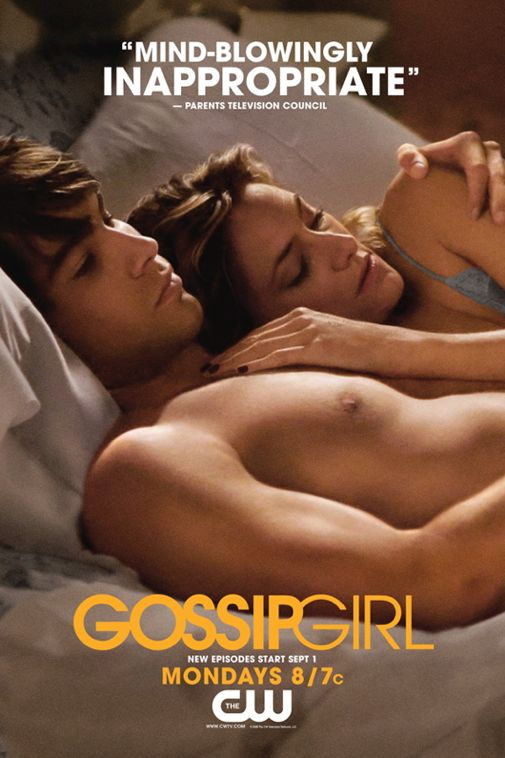


“World War III just broke out. And it’s wearing kneesocks”: Power, Privilege, Plotting and the Panopticon in Gossip Girl

Sex Sells?
Sex Sells?

‘Power floats like money, like language, like theory.’

(Baudrillard, Simulacra and Simulation)

Something happened to me recently and I found myself drifting into the glossy paradise of the Upper East Side; more specifically, that alluring tab on Netflix entitled ‘Gossip Girl’. It’s been a while. I used to watch the show when I was about fifteen, in its heyday. I guess it just slipped away from me and I kind of passed by the whole finale hype back in 2012, but something brought me back to it a few weeks ago. Maybe it was the absence of real-life summer and the promise of a sun-drenched pavement in Manhattan, or maybe it was just Dan Humphrey with his dark mop of curls and deceptively earnest eyes. Maybe it was the cracking soundtrack. Either way, I was struck again by how entrancing the show is, even while it’s kind of terrible.

Déjà vu? I’ve already written an article on Made in Chelsea.

***

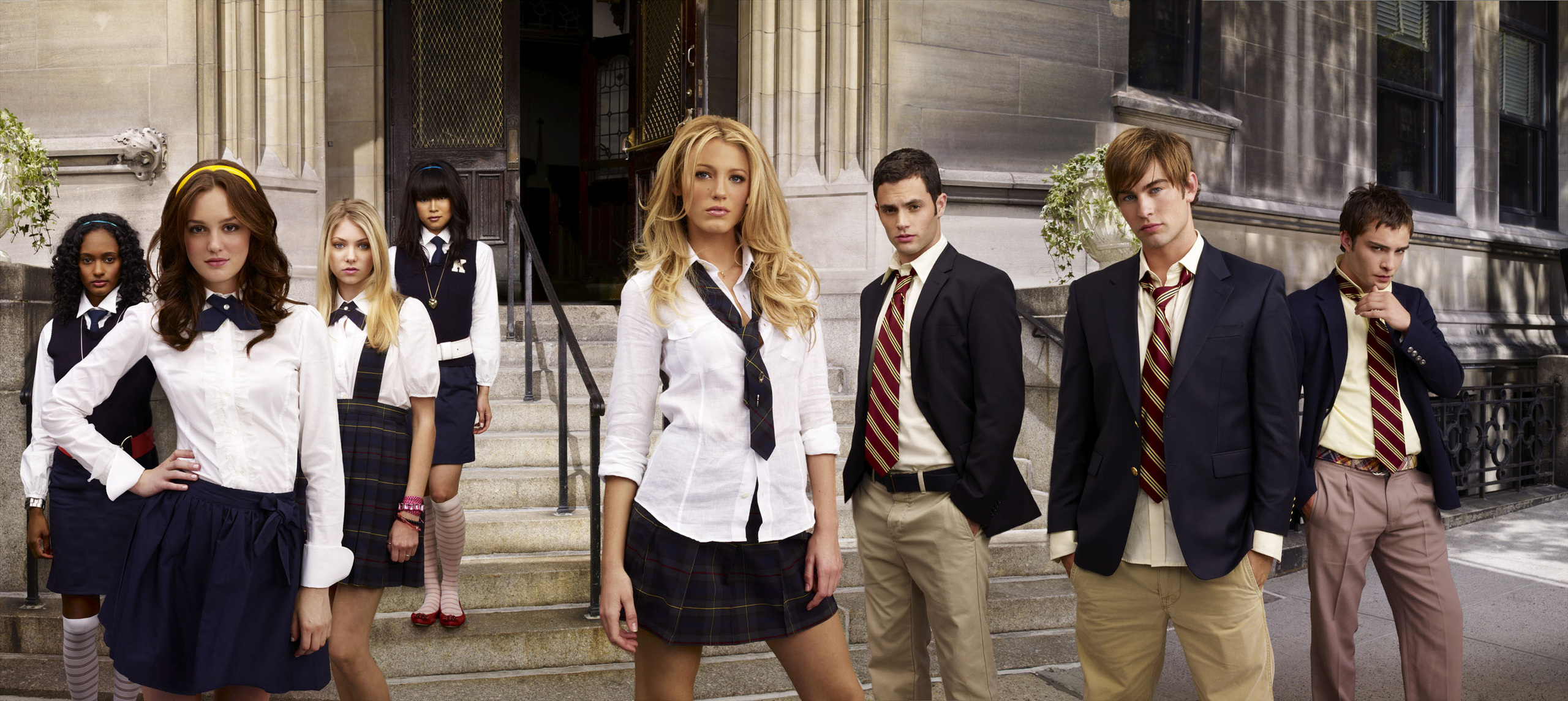
Gossip Girl: The Early Years. | Source: www.thatdesigirl.com
Gossip Girl: The Early Years. | Source: http://www.thatdesigirl.com

Gossip Girl is a show about power. It follows the privileged, glitzy lives of a group of Upper East Siders, from high school into the land of careers and more sophisticated scheming. There is a point round about the end of Season 2 which most critics concede to be the end of ‘good’ Gossip Girl; all subsequent seasons were just a bit daft. We’ve gone from credible high school bitching and scheming to absurdities on a Skins series 5 & 6 scale. How did we get from petty teen drama and pregnancy tests to Bart Bass falling from a roof and Chuck and Blair rushing themselves through a (gorgeously shot) emergency wedding? From Dan Humphrey as amateur school poet to successful penman of a Roman a clef exposing the ‘scandalous lives of Manhattan’s elite’, as Kristen Bell so enticingly describes it at the start of each episode. The link in all this chaos is power. Power and simulacra.

‘You’re nobody until you’re talked about’. That’s the mantra that seems to crop up again and again, haunting the minds of Gossip Girl’s characters like they’re stuck in some bizarre virtual reality where rumour precedes being, scandal precedes survival (see Sartre, ‘existence precedes essence’) – Mean Girls meets Black Mirror, if you will. What distinguishes Gossip Girl from other teen dramas (The O.C, 90210 and so on) is its centring around the concept of ‘Gossip Girl’. Like Foucault’s ‘panopticon’, Gossip Girl is a technology of power. The panopticon was a kind of prison design, created by Jeremy Bentham in the eighteenth century. It was intended to institute the force of surveillance not just on the individual but on society as a whole, so that in a prison each inmate is invisible to others, but visible to the guard station placed in the centre of the prison building. The point is that at any moment, the individual knows he or she is being watched, and will thus adjust their behaviour accordingly. A panoptic way of disciplining is one in which people are controlled through constant surveillance.

It seems pretty obvious that the outcome of Gossip Girl is constant surveillance. Every remotely meaningful action taken by the big-shot Upper East Siders (Serena, Blair, Chuck, Nate, their friends and family) is sent to the Gossip Girl server via anonymous reporters (anyone within or outside of the elite circle) and is then posted as a ‘blast’ which is then communicated straight to everyone’s phones. You know, if it wasn’t so familiar it would sound like something straight out a sci-fi novel. Throughout the show, Gossip Girl doesn’t just record and publish the intimate details of the characters’ lives (think dark secrets, slander and sex tapes) but indeed anticipates things that might happen. Sometimes, characters act a certain way because they are aware of the presence of Gossip Girl, of the probability that their actions will end up exposed through her blasts.

It doesn’t take much to link Gossip Girl to the Twitter generation. The Age of Snapchat, or WhatsApp, or whatever you want to call it. Created in 2007, the show suddenly tapped into a massive cultural shift among young people, whereby our entire lives become archived online, with or without our permission. Yet back in the mid-noughties, we were using Bebo and MySpace to spread gossip and create profiles of ourselves and others. These platforms were still relatively slow, especially as many of us still accessed them via a dialup connection, or by slyly hacking through content blockers at school while the teacher wasn’t looking. Gossip Girl anticipated the sort of instantaneous, life-shattering exchange of information that creates a panopticon effect on our lives. It’s a great plot device (the unravelling of a secret to everyone instigates some serious character crises) but now, in real life, it’s an uncomfortable truth that a nude selfie or a sneaky picture of say your neighbour doing cocaine can indeed be spread around with the ‘blast’ of a single Snapchat message, unravelling reputations in its wake. If, as Baudrillard argues, ‘power floats like money’ it does so because, like money, it is transferable, easily shifted, lost and dissolved. Instant, mass communication arguably makes power more diffused: in one minute it’s in Blair’s hands, then Serena’s and then HEY – Georgina Sparks steps in outta nowhere and suddenly it’s all gone wrong again. These days, you might say similar things about power and global politics.

Dan at his desk... Source: digitalspy.co.uk
Dan at his desk… Source: digitalspy.co.uk

But is it really diffused? Couldn’t you argue that although different people post in to Gossip Girl, ultimately it’s the Wizard of Oz, the soul behind the screen, that controls the gates – isn’t it that one person that has all the power? Just as Mark Zuckerberg ultimately frames all our communications via Facebook? In the end, we discover that (surprise surprise) Dan Humphrey, the main ‘author’ figure, is Gossip Girl. Dan Humphrey, the ‘impoverished’ outsider, exiled in his trendy Brooklyn loft, banished from full membership and relegated to the limbo world where messenger bags meet the glamour of Blair’s Marc Jacobs and Serena’s Prada. Dan started the Gossip Girl site as a way of literally writing himself into the closed world of the Upper East Siders, fashioning the role of ‘Lonely Boy’ within a fairy-tale, Fitzgerald-esque world of vicious scheming, stinking money and glittering mythology. In the end, Dan gets the girl: as the ‘5 Years Later’ epilogue of the final episode so indulgently shows, Dan marries Serena in a beautiful wedding (interestingly enough, his Brooklynite ex-rockstar father gets with – the actual – Lisa Loeb).

You could argue that there is something ‘queer’ about Gossip Girl. An almost Beckettian obsession with repetition and the endless possible combinations of relationships you can achieve within a group (OK, so maybe that’s more Made in Chelsea – or perhaps Sade?).  In a way, Gossip Girl is obsessed with binaries: good girl vs. bad girl; Golden Boy vs. Bad Boy; virgin vs. whore and, perhaps most importantly, truth vs. falsity/appearance vs. reality. Yet these binaries are never sustained, and in fact the show repeatedly reveals the inherent insecurity of these binaries. The innocent Little J is really just the protective adolescent cocoon from which raccoon-eyed rebel Jenny emerges (more dramatically in real life, with Taylor Momsen becoming a risqué rock princess). There is a whole convoluted storyline about Ivy Dickens, who impersonates Charlie Rhodes (Lily Bass’s niece?) who herself is acting as someone else – ‘Lola’. Ivy, now her ‘authentic’ self, enters a relationship with Lily’s husband Rufus, but little does he know that Ivy is actually sleeping with William Bass (Lily’s ex and Serena’s father) who, it turns out, is only in a relationship with Ivy to get (in a roundabout way) back to his ‘true love’ Lily and the kids. The storylines get so elaborate and implausible (Blair meeting and marrying the Prince of Monoco; Bart returning from the dead) that you lose track of what’s real and what’s really happening; you become dissociated from the notion that any of this is really part of ‘our’ world. Even Penn Badgley, the actor who plays Dan Humphrey, admitted that the revelation that Dan was Gossip Girl ‘doesn’t make sense at all’, but that’s kind of okay because (in his words) Gossip Girl doesn’t make sense!’ Sure, New York is always there, in those beautiful, sweeping shots of the city: embracing the characters in its warm glow, looking fantastic in summer, spring, autumn and winter; but the lives of the characters are as twisted, repetitive and as confusing as Samuel Beckett’s television play Quad.

[Imagine this as a symbolic representation of Gossip Girl’s plot. It’s the mesmerising that’s key, not the accurate rendering of reality.]

The queerness, then, (I’m using the term ‘queer’ tenuously, in a more generalised sense – the show can hardly be a banner for LGBT) is in Gossip Girl’s shameless disregard for certain old-school, heteronormative notions of ‘morality’, its distortion of conventional character arcs and its indulgence in various strange sexual affairs which often border on the incestuous (and then there’s that old problem of Serena and Dan and their parents being married for most of the show…). It’s in the fact that characters’ lives seem to follow more of a cyclical than linear path, as they repeat the mistakes of their parents, fall strangely in and out of love while maintaining they were in love the whole time they were also in hate. The whole Blair/Dan/Serena triangle.

Unlike some other shows which run for the length of Gossip Girl, Gossip Girl keeps more or less the same core cast throughout the six seasons, and in doing so transforms its characters into weirdly intangible signifiers rather than ‘real people’. So much of them is based on the need to manipulate the reportage of their lives that we can’t be sure how much we know of their ‘real’ selves. I would like to think that Baudrillard would approve of Gossip Girl much more than The Matrix, because in my opinion, the way Serena, Blair et al plan their lives around the panopticon of Gossip Girl fits pretty well with Baudrillard’s idea of the simulacra as the ‘map that precedes the territory’, the ‘reality’ dependent upon representation. Most of the characters’ actions are driven by and shaped around Gossip Girl: the virtual voice who ‘maps’ the lives of Manhattan’s elite.

There is a point in most TV shows where you are able to gage the protagonists’ motivations, but with several key players, Gossip Girl leaves us endlessly guessing, as some very weird choices leave you baffled about who or what is this person who you thought you knew from Season 1. Chuck, for example, is sometimes romantic softie, sometimes nonchalant alcoholic, sometimes downright psychopath. But that’s the fun of it, the not-knowing, the rollercoaster effect of plot after spiralling plot. A show about scheming; that could be another tagline.

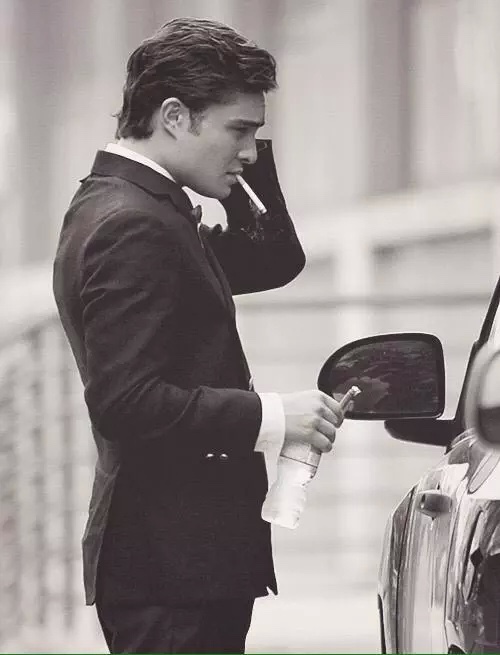
tumblr_nsqdc98osT1qmomweo1_500

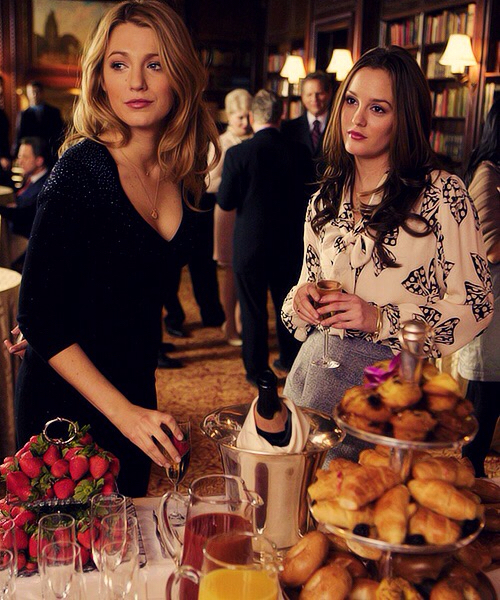
A love letter to New York; that could be another tagline. The city is so lovingly rendered throughout the show that even the actual New York mayor got involved with the set of its 100th episode, and declared January 26thGossip Girl Day’. I wonder how I can start incorporating that into my life…perhaps I’ll start with one of those glorious pastry and fruit-filled brunches and then spend all day sipping scotch a la Chuck, kissing boys in classy bars a la Serena and ending up at some expensive party where everything around me is basically the flashbulb remnant of a photograph…or maybe I’ll just live tweet my actual everyday Glasgow observations  – Spotted: Man with a Farmfoods Bag Disappears into the Bookies. It’s hardly Manhattan amidst golden, burnished fall, but it might just have to do.

***

In the final episode, Serena tries to defend Dan’s (pretty immoral) behaviour in acting as Gossip Girl by claiming that his salacious discourse amounts ultimately to a ‘love letter to all of us’. It’s true: all that reporting of all that scandal, all those razor-sharp character assassinations were a form of mythologising which we can recognise not just in celebrity culture, but now in our everyday online lives. Being mean doesn’t just keep ‘em keen, it creates drama, which is what makes any good slice of fiction. And what is life without fiction?  

For all its raciness, Gossip Girl falls into a pretty comfortable conclusion. Two weddings, a (very cute) baby, a potential political career for Nate; it’s all very white, upper-class and generally heterosexually perfect. But that’s what Gossip Girl’s always been shamelessly about: sure, there’s Blair’s ever-present maid, Derota, but she functions more as a Shakespearean comedy sidekick than as a serious addition to the plot. Gossip Girl has never claimed, unlike say Lena Dunham’s Girls, to be ‘the voice of a generation’; it has always zoomed in on the narrow world of a handful of privileged characters. This is its flaw as well as its strength: there is, sadly, little racial/sexual/religious diversity, but when it does touch on such matters, it does so with its own quirky ease, meaning that it doesn’t trip over itself trying to take everything too seriously. There are nuggets of genuine, ‘emotionally truthful’ storylines in there, and real teen issues like losing your virginity, finding yourself stuck in family feuds and trying to make friends are handled sometimes with poignancy, sometimes with juicily gratuitous melodrama. Blair Waldorf’s bulimia is, in a way, a symbolic symptom of the culture she finds herself in: endlessly consuming, lusting for more information, gossip, power, but simultaneously being unable to contain it, needing to purify, purge, rewind the cycle. Dan longs to be part of the world, but at the same time it repels him; he is part of that societal wastage, the baggage once used then left behind – but he uses his limbo position to his advantage. In a way, the American Dream in all its distorted glory is right there, at the heart of Gossip Girl her(him)self.

tumblr_nt01upQpP71t823i1o1_500

What’s great about Gossip Girl, then, is its ability to take us on a whirlwind of artifice, of phony drama for phony characters, but through the falsity it reveals some hideous truths about contemporary society. The network of New York, as a series of public spaces, of upper and lower ‘sides’, is an inverse parallel to the non-hierarchical communications enabled by the Web, where power ‘floats’ more easily as hackers and smart kids from Brooklyn find themselves running the system. There is, in real life, an economy of gossip, whereby what’s been said about you determines your whole place in the world, perhaps even more so than money (sometimes). It runs in the workplace, the playground, the spidery webs of social networks. There’s a line in the final song which plays at the end of the last episode (‘Kill Me’ by The Pretty Reckless, the band headed by Taylor Momsen, aka Jenny Humphrey): ‘someone get me outta the sun’. I read this not just as a statement of Momsen’s goth/vampire credentials, but as an appropriate nudge to The Sun newspaper and by extension the world of gossip, the sunlit limelight which holds the (un?)lucky few up to fame and fortune and ruin.

There will always be an outsider wanting to get inside, Bell narrates provocatively as the last scene drifts over a street of smartly-dressed school kids, the next generation of Gossip Girl victims. It’s classic Gossip Girl: reminding us that even within the cherry sweet containment of its happy ending, there’s a bitter worm still at work. We’re now in an age where you can never live free of the media, of surveillance and all it entails. An unequal age where even the rich in their isles of bliss are never quite free of the rest of us, the outsiders, the mass exiles of our bulimic society – drawn to the alluring world of the beautiful and damned and then expelled because we can’t afford to be there, we don’t belong. And if that’s the end of Gossip Girl’s rollercoaster, then it’s not just a fairground of pure escapism, but also a biting satire on our actual IRL society.

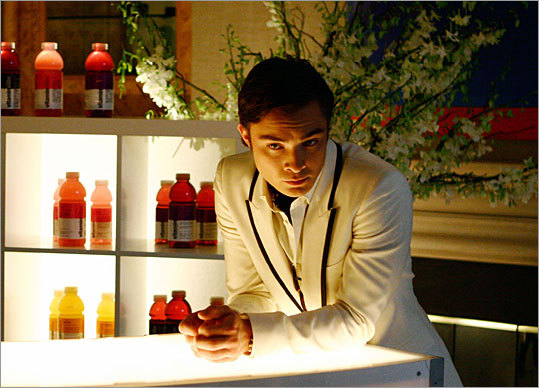
—A satire which, I might add, trickles right down to the shameless flaunting of product placement:

Chuck Bass and some Vitamin Water. Source www.boston.com
Chuck Bass and some Vitamin Water. Source http://www.boston.com

‘Be Right Back’… Charlie Brooker’s Black Mirror, Simulacra and the Uncanny

Source: blogs.independent.co.uk

Freud published his essay on the ‘uncanny’ in 1919, almost a hundred years before Brooker’s captivating TV series was created. The essay and its related concept’s influence on film, literature and psychoanalysis has been hugely important. But what exactly is ‘the uncanny’? It is a term inherently bound up with the ‘disturbance of the familiar’, with upsetting conventional definitions and perceptions of reality and truth, of feeling and thought. The creation of uncertainty, unease; the dissonant feeling of being simultaneously repelled and attracted to something. Freud defined the uncanny as a paradoxical sense of unfamiliarity growing out of the familiar; the term in German is ‘Das unheimliche’ – which literally translates to ‘the opposite of what is familiar’.

Black Mirror. Even the title is uncanny. How can a mirror be black, when the necessary function of a mirror is to reflect light, reflect a clear image? Black connotes darkness, murkiness, obscurity – hardly the silvery coating of a looking-glass, reflecting the airy features of a Victorian drawing room, or beaming back the blue sky and clouds from the gleaming ceiling of a city office block.

And yet: paradox. The mirror is subverted, turned away from reality into the black chasm we have created in our ultra-mediated lives. Brooker’s series presents a startlingly chilly vision of a near-future society, one where mirrors no longer reflect back on reality, but on representations of reality. The paradox of the real in Brooker’s dystopian vision is that feeling what is real depends more and more on images of the real, rather than experience itself. The most catastrophic events of the show – I’m thinking the bizarre terror of Episode 1, Series 1 where a Prime Minister is led into having intercourse with a farmyard animal, live on TV to the gawping nation – are caused by an overflow of media messages and images, which impact reality in a hyper-real way. In this world, where real events are simulated first in the media, and then permeate reality, reality itself has become its own obscurity; a mise-en-abyme or hall-of-mirrors effect where we are constantly recording, representing and replaying ourselves in the abyss of cyberspace and media technology. A disturbance of the familiar, certainly: a disturbance of the real.

Over thirty years ago, the French philosopher Jean Baudrillard made a similar point in his text Simulacra and Simulation. Baudrillard argued that reality was being dissolved into a simulacrum. In past ages, signs had a fixed referent to something real. Yet with the explosion of mass-produced goods, the commodity was born. This relates to Marx’s idea of the ‘commodity fetish’: as goods become mass-marketed, no longer are they bought for their ‘use-value’: when a material item, even something as mundane as a bottle of water, becomes a commodity, it ‘changes into a thing that transcends sensuousness’. Value becomes linked to the product itself, rather than the cost of its production. Sign-value replaces use-value. The value of a bottle of water is linked not to its use-function as a quencher of thirst but because of the shape of the bottle, the style of the branding, the allure of the image portrayed in advertising campaigns. In contemporary society, Baudrillard argues, this has escalated to the point whereby signs and reality have become blurred, replacing a relatively simple distinction between signs and signifieds (the advertisement and the real product, for example) with a ‘simulacrum’: ‘the truth that conceals that there is none’. In the entirety of our experience, meaning and reality have become usurped by a hyper-reality of symbols and signs, which point not to a real object, but to more signs – they conceal the relevance of reality to everyday experience. We are then truly living in an unreal world.

Brooker addresses this idea in the opening episode to Series 2, ‘Be Right Back’. It asks: what happens when the effect of reproduction is enacted upon humans? When the human body and individual personality itself is subjected to fetishism; when the self is fragmented into the myriad traces of text it has trailed in its online life? Jacques Derrida defined the trace as ‘the sign of the presence of an absence’: the uncanny occupation of a liminal position between the real and the imaginary, between the sign and the signified – a rift tearing up the easy system of metaphysics, of our knowledge of what exists, and how.

In Brooker’s fiction (fictional, or half-fictional? Genre itself eludes simple definition – the series lingers between dystopia, horror, realism…hyper-realism), it is possible for a woman to order a cyborg replica of her dead husband. At first, she interacts with an online version rather than a corporeal one. Through instant messenger and phone conversations, she literally contacts her dead husband. And yet it is not really her dead husband, or is it? An assemblage of all the data her social-media-obsessed husband left in traces online, his presence is itself a trace: an uncanny ghost voice constructed from dead voices.

This is the uncanny resonance of the title: ‘be right back’. It hauntingly resonates with the much-used phrase familiar to all users of instant messengers, the signal that one’s physical presence will briefly be absent, although they are not fully ‘gone’ – they haven’t logged offline. ‘Be right back’, you say, when you are going to make a cup of coffee, when you change your status; a signal that your face is no longer behind the screen. ‘Be right back’ is that queer sense of presence/absence that seems to rupture ordinary human interaction, where the interlocutors know each other as corporeal figures and not avatars. The avatar is always present, but it is the mark of an absence: the mark of the speaker’s physical absence. When we talk online, there is always a strangeness, a distance, a whiff of the hyper-real; as if we are playing a game, talking to someone who is quite but not quite the person they are.

Source: m.espn.go.com

When the protagonist takes the next step in ordering the robotic facsimile of her beloved deceased, the strangeness is taken to a whole new level. We have the signs of the commodity fetish: delivered in a box, complete with instruction manual and shiny robotic skin. The human body made perfect, made into product. This of course is not itself an innovation: countless sci-fi books and TV series and films have portrayed the human robot, the automaton. What is particularly intriguing is the reproduction of the dead husband’s personality from text. Not handwriting, not speech, but the representation of voice through text.

At times, the robot’s speech is stunted. He tries his best to say the things that ‘Ash’, the former husband, would say. Yet the robot cannot completely replicate the human. ‘Ash’, as the name suggests, is dust, a powdery scattering of human traces, shimmering in the protagonist’s memory, in the character’s online presence, elusive and ethereal. Perpetually present, but not fully there. The mechanical creation cannot assume the body of the deceased; it can only simulate the fragments of his words. The movement of his face, his eyes, or his synthetic limbs will never wholly replicate what once was there. Ash cannot be resurrected, Ash is ash.

The robot’s automatism is primarily recalled when there is a gap between the woman’s memory of her husband and the robot’s personality. The protagonist is painfully reminded of the fact that it is not a real, living thing – not the warm body she once loved, still loves – but a mechanical product. Watching the woman interact with her robotic husband, touching his flawless synthetic skin, listening to the replicated voice of the deceased – at one point even having sex with him – was a disturbing experience. I felt unsettled; certainly I was experiencing the uncanny. The most carnal of human experiences – actual physical contact – simulated by a robot, with another human, completely explodes all notions of the natural by opening up so many strange possibilities.

Yet, as the show reminds us, technology cannot fully replicate reality. It may attempt to deflect our attention from truth – from the truth of death – with its simulations, but there are always points of rupture, where the fabric of the virtual is torn. At one point, the protagonist experiences distress and asks the robot to leave the room when his words don’t match up to her memory: “Ash would have argued” she says.

This uncertainty about the human and the machine haunts throughout Brooker’s award-winning series. How much of our lives has become merely the voices we leave on answer-phones, in text-messages and Facebook statuses? As communication becomes increasingly mediated, do our personalities become more constructed, more performative? With the advantage of anonymity, or the avatar concealment of the face allowed by the internet, people have time to carefully construct their responses, to portray a certain self-image, to play with the unfamiliar. ‘Be Right Back’ highlights the inadequacy of technology to embody – literally – the highly complex, fractured and fluid nature of the human self. Living more and more online, Black Mirror suggests in general, we creep closer and closer to the edge that demarcates our fundamental perceptions – our notions of truth, reality, existence, humanity itself. Brooker says of his show:

Each episode has a different cast, a different setting, even a different reality. But they’re all about the way we live now – and the way we might be living in 10 minutes’ time if we’re clumsy.’

It is this notion of ‘difference’ that creates the uncanny effect. What is the difference between things? The series poses more questions, perhaps, than it answers. Another uncanny effect. Brooker provides multiple possible realities, and thus renders the future with an inherent sense of what Derrida would call ‘undecidability’. It is not like a conventional dystopia, presenting a single, glaring vision warning of the future; instead, it troubles our expectations, it presents numerous ideas of what the next decade, or tomorrow, may hold. The show holds up a mirror to our society, one that is black – foreboding, sinister – and, fundamentally, refracted into different possible outcomes. Yet it is also a void, in the sense that Black Mirror itself is a fiction, where we may lose our sense of the real – collapsing the ever-familiar world of technology portrayed onscreen with our present everyday lives. It is in this threshold between today and tomorrow, between reality and fiction, that Black Mirror lies. And it is in this threshold that we lose our subjectivity, in the overwhelming threat of our own behaviour and the ghostly online world that could collapse our sense of existence.

Works Cited/further reading:

Baudrillard, J. (2006) Simulacra and Simulation, translated by Sheila Faria Glaser, University of Michigan Press.

Bennett, A. and N. Royle (2004) ‘The Uncanny’ in An Introduction to Literature, Criticism and Theory (Harlow: Pearson Education), pp. 34-42.

Black Mirror – Be Right Back [Season 2, Episode 1] by Charlie Brooker.

Felluga, Dino. ‘Modules on Marx: On Fetishism.’ Introductory Guide to Critical Theory. Purdue University. Available at: http://www.purdue.edu/guidetotheory/marxism/modules/marxfetishism.html. Accessed 30/4/13.

The Guardian. (2011). Charlie Brooker: the dark side of our gadget addiction. Available: http://www.guardian.co.uk/technology/2011/dec/01/charlie-brooker-dark-side-gadget-addiction-black-mirror. Last accessed 30/04/13.

Reynolds, J. (2010) ‘Jacques Derrida’. Available at: http://www.iep.utm.edu/derrida/#SH3d. Last accessed 30/04/13.