To the Sea

424755_10201122283849634_1826470522_n

Watching the sea is like watching something in pieces continually striving to be whole
Imagine trying to pick up a piece of the sea and show it to a person

—Emily Berry

Richard Dawson’s ‘To the Sea’ opens with anxious strings, unearthly vocal drones and harmonised chants that carry across a darkening, eldritch bay. There’s a shiver in my heart and a sense of the waves chopping apart what constitutes the sea, the sea, the sea. How much sea do you need for it to be sea? Is every wave an incantation—and if so, whose? What if you took whole eons and chunks of the sea away, would you be left with puddles or rivers? That word that shudders: estuary. When does the sea become ocean? I feel it is to do with a feeling. To feel oceanic is different to feeling the sea. There’s an intimacy with the latter, its intimation of bitter-green waters, childhood memories, tidal flats on which you take off your shoes and wade towards the water. The sea is a mirror for our feelings, but they don’t stay still—you can’t just project them. They change like light; the water answers. The water has its own shanties, stirred up by night tides that lick at the edge of the land less like lovers than knives. A silver kiss of sharpness and silence, a tiredness. 

How many times have we apostrophised the sea? Built into it myth, folded our cavernous longing through song and let ourselves out into the blue. The sea is a monster, a tyrant, a Leviathan; the sea is feminine, rippling, birthing and giving. We can never decide. The sea is the unseen foetus of sound in a shell, little figure as portal, an unwhorling. Imagine how its voice would look on a sonogram, the whispers. The sea is a place to blow away cobwebs, to unravel your hair and blink into wilderness. In ‘On the Sea’, Keats urges ‘Oh ye! who have your eyeballs vexed and tired, / Feast them upon the wideness of the sea’. The sea is expanse, expansive, expanding. We can stand at the edge and be caressed by its urges; the catharsis in that. The elastic edges, islands and coastlands and cliffs that shift and zoom and shrink with parallax. We whisper and the wind carries forth our voices. It’s good to howl at the sea, alone on a beach.

Then there’s Charlotte Smith’s catchily titled, ‘Sonnet: On Being Cautioned Against Walking on an Headland Overlooking the Sea, Because It Was Frequented by a Lunatic’. The sublime in this poem is born less from the sea itself, the Sussex Cliffs Smith walked all her life, than the ‘giant horrors’ of the man’s madness. A madness glimpsed readily enough by the speaker, at a distance: ‘He seems (uncursed with reason) not to know / The depth or duration of his woe’. His mind is the unseen deep of the sea. If reason is a curse, this state of nature in which the man has found himself can’t be so bad. He can only plunge through his days in a kind of ‘moody sadness’ of unknowing, an eddying through time: his ‘hoarse, half-uttered lamentation, lies / Murmuring responses to the dashing surf’. This primal communion between man and sea is met with the sensation of legend, adorned with a sonnet’s rhythm and rhyme. 

But the sea, equally, is a haunted place for all of us. I remember being obsessed with this Los Campesinos! song at a time in my life when I was stuck in the city with unhealthy constancy, wanting to wail for the blue back home. There’s a burn in your chest, then indifference again. ‘The Sea is a Good Place to Think About the Future’ is a song about a broken girl, intimate with and yet distant to the singer, starving herself in response to grief. What could be a self-lacerating song, a depressing lament, is lifted by the strings, the joined-up shouts, the catharsis of those candid lyrics and the way they break into chorus, so loud:

And all you can hear is the sound of your own heart
And all you can feel is your lungs flood and the blood course
But oh I can see five hundred years dead set ahead of me
Five hundred behind, a thousand years in perfect symmetry

The song swirls with the clutter of contemporary culture, our fraught politics and virtual addictions; but it draws towards the deep time of the sea, the abyssal possibilities fringing Britain with mist and grey. What could be a desolate song of dwindling spirit, bursts into that thumping, rousing chorus and the release in that, the release so strong. Waves crashing ahead of you, the splash-backs spitting your face with salt tears so that just to stand there is to have a conversation with the sea, with what hurts in the Earth and might hurt forever in you, but that’s okay. An inhuman empathy; the human washed out of language.

Why is it we need the sea to look ‘just like the edge of the world’? Why is we need the horizon of apocalypse ahead of us? Does love always require the threat of the ending; does death have us thinking of forever beginnings? There is the question of translation. Are we all, like Charlotte Smith’s ‘lunatic’ (she must be forgiven for her eighteenth-century lack of political correctness) just muttering in our pain to the sea? Who will hear us? In Emily Berry’s poem, ‘Picnic’, communing with the sea is like the kinds of communication you do in therapy. Trying to pick out the pieces that make up the story of the sea, the pieces that make up the story of grief, then ‘polish’ those uncertain feelings before ‘a man in a room’, whose ahhs and mhms are perhaps no coherent than the whispers of the sea. Sometimes we just need someone—something—to listen. Sometimes we just need to listen. 

Susurrations of the tongue and throat, the vowel sound sweetening eeeee. Sea, sea, sea.

Screen Shot 2018-05-20 at 18.14.22.png

At the brink of most existential crises in my life, I revisit the sea. Summer 2016, I got a train to Cardross then walked a couple miles along a busy road, wildflowers growing in the verges past a cemetery, to Ardmore Point. The smell of the brine was like a drug: this vague area where the River Clyde becomes Firth and innumerable fragments of quartz are washed up on shore, residue of the sea’s mysterious industry. I looked across the water and I suppose I saw Greenock. There is so much of the jagged geography of westerly Scotland unfamiliar to me. The northness of names I have loved since childhood, the west coast forever of fishing villages, port towns, places of old time and tiny ruin: Luss, Arisaig, Applecross, Ullapool, Stornoway, Uist, Portree. A new indulgence in studying maps, mostly for a vague sense of where blue meets green. I have started to worry about sea levels. I keep a vague memory of my mother’s old home in Twickenham, where there are plaques to mark places where the river burst and flooded as high as the houses. The fields near my father’s house in Ayrshire become so easily sodden with water, a sunken valley where sheep sometimes drown. A favourite childhood memory is the single night we camped in Arisaig, and I’m sitting on a rock snapping fizzy laces between my teeth and watching a lurid strawberry sunset. Still I am filled with such sugary imaginings. The sand was so smooth, in the last light it seemed almost a mirror. It didn’t matter that we woke to torrential rain, with that sunset still within me. 

I open my sky-blue edition of W.S. Graham’s (Greenock-born) New Collected Poems and find ‘Falling into the Sea’: ‘Breathing water is easy / If you put your mind to it’. I think it is maybe a poem about dying, about the changes in the body, scary at first, a metamorphosis you adjust to: ‘Breathe / Deeply and you will go down / Blowing your silver worlds’. It is a plunge through new emotions, learning how to float in the bubbling eternity you have blown for yourself. Is this a dream? Is this a survival guide for the drowned? When you arrive on the ‘sea / Floor’, Graham suggests, you will encounter a ‘lady’ from ‘the Great Kelp Wood’ who offers you good British hospitality then ‘asks you / If you come here often’. How many times do we pretend we are mermaids as children, harbouring some hope of adoption by the elements. I spread my dreams on the sea like butter on a scone, the way they glimmer in the light then go. Are we recalling some anthropogenic trauma, deep embedded blue and sea green in our genes? In every deja vu there is a song, a half-remembered line with a context long forgotten: ‘Go down to the sea / And tell me what it is that you wanna be’ (Swim Deep). The sea is possibility, maybe; summertimes and sweet jangly, insouciant indie. Singing the greys, the blues, the self in crisis. The backdrop to so many of our deepest conversations, the murmurings melodic. The backdrop to perfect silence. When things went wrong in our house, we’d drive out and take long walks along Maybole Shore. We often didn’t talk; it was the wind in our ears and the kicking up sand and the smell of the salt that cleared the air, that did the work of unspoken feelings. There was the night two friends and I took vodka down Prestwick Beach and talked our lives out and embraced in the drunken rain, the spray of the water. It was so cold it burned the blood from our fingers, but we didn’t care. We were so fucking pure. 

Ten minutes listening to Drexciya in your living room and already I feel subaquatic again, 8am on a Sunday. Remember, we came from the sea. Our bodies are so much water and salt; we can hardly process any more of it. Crisping the lisp between here and there and what might drown. I was still a teenager when I sat by the harbour and twisted pink thrift into the plaits of my hair. I’d weave this space into a novel someday, the pain of the land sloshed up in geologic process; again the erosion, the sense of two worlds coming apart as a gaggle of teenagers stand lost in the waves, on the rocks and in water. It would all come to an end this way. I guess the bad techno thudded through every staccato chapter, the fault-lines of pointless dialogue. On a whim, I titled the whole thing West Coast Forever. Its universe was jagged, familiar and strange at once, self-destructive to the point of indulgence. I wrote it because I missed the sea, its harshness. I gave my twin protagonists eyes of green; two halves of what could be. I wanted to think about all the ways we are wild once, to try not to forget it. The sea is a lore we pass onto our children. The rocks we are not supposed to swim beyond, the orange buoys that mark the danger. The lives lost and loves found, the glitchy repetitions; the sand that thickens our mouths like overripe fruit, our words purpling and furring. 

Then there are gentler lagoons, bays which float out and away into grander blues. Clear and liquid lyrics, drizzling like moonlight or syrup over some wide and distant surface, the panoramic sea. The finger-plucked acoustic soothes and tells us what to do in its melancholic verse. Cat Power’s ‘Sea of Love’, Julie Byrne’s ‘Sea As It Glides’. I am obsessed with how these songs might sound, crackling and passed down to us over a ship radio, the edges worn away. The uncertain rasp of tuning in. I think of ‘Above the road (Skies of Blue)’ by Fionn Regan, or Johnny Flynn’s ‘Heart Sunk Hank’: antique and between times; recordings on a Voice-o-Graph; all white noise and sparseness, the yearning words. When I was twelve, I spent four days on a little fishing boat, bobbing up and down the Sound of Mull, between Oban and Tobermory. I lived off a Pepsi cup full of pick’n’mix sweets for the most of it, my sugar levels spiking like the rise and fall of the tide around us. Back then, I rarely noticed the wax or wane of silver and night, flesh and bone, blood and milk; I was only just learning to treat my body in cycles. There were very little times in the journey when we couldn’t see land, but Oh the loneliness when it went away.

When the mist came and there was only the greys. I used to play this game as a child, embracing my Pisces moon, thrashing through the waves and swimming out so far that someone on the sand would be shouting me back, roaring my name. I rarely cried; I dealt with my emotions that way. I liked that fort-da play of presence and absence, testing boundaries; the idea that I might disappear and become something other. The running against what resisted. I liked the way the waves licked my arms and thighs and stung me, the sand in my pores still flaking away later when I stood in the shower. The body catches a taste for the other world. It unravels. 

All weekend I’ve been listening to Frightened Rabbit, ‘Swim Until You Can’t See Land’, trying to heal the torn-apart strings of my heart. Ways we deal with loss, chasing the source. Some kinds of plunge are stilling, others sweep you up again and you’re back to before and the shock of it. You think you are okay but then again the sting behind your eyes, like somehow you let the sea in. This song will always feel new to me, a tune coming fresh out of hurt and to burst into something else altogether. There’s the rolling bass and energetic strums and the way the mood changes easy as weather between brilliant and bleak. I watch a YouTube video of Scott Hutchison singing an acoustic version in some courtyard; you can tell it’s spring from the two fire tulips that grow beside his bench. It’s spring like it is now, spring before the sunshine and colour felt wrong. There’s a helicopter flying overhead, so you know the world goes on and there are other bodies drifting into distance. And I miss him. I miss him. 

And the water is taller than me
And the land is a marker line
All I have is a body adrift in water, salt and sky 

Collapse again and again on the anaphora, the swirling, thirsty water. Who gets to wash up, who is vomiting their life and drying out on the sand and who presses a cool palm to their raging forehead? Why do we have these fantasies of saving someone from the sea? Is it a primitive fear: that we will lose everything we know that way; our life’s loves and possessions dragged away, river to firth to sound to sea. I flick through my Instagram stories this very morning, and my brother is filming the sea with his phone: an hour ago, ten seconds of grey-licking waves. He’s somewhere far away, I don’t remember—Bali, maybe. The sea is a trip-hop ballad, a rippling distance in which the ambient sounds don’t save me from thinking. The sea a great wash of the late 1990s, a millennial curve at the turn of distance. I think I think too much. Didn’t they worry, before 2000 came, that every system would collapse on zero? Didn’t Emily Berry describe the sea’s wee ripples as glitches? I long for the tidal flats and the drag of scavenging gulls in the skies above, howling some song that would save me. What are they hungry for, the circling birds? Arthur Russell is telling me to jump off the platform again; in the glimmer of that cello I can hear the echoes of a seascape blurred, pixelated to grey but alluring still. I plug myself in, deep in the chasms of sonic escape; here it is all wave and wave of shoegaze. The sea glows red before I sleep. 
IMG_4241

We need to break the waves, we need to break our minds. There’s a cleaving in there, hard as a diamond but liquid if you breathe deep enough the cold salt grey. It’s the saddest summer of my life and where was that aeroplane when I needed it, soft and sweet. Then neutral, oh so neutral; in all oceanic tang the lingering metallic taste. Do you miss me. I miss this. How blue the sea was from the air, so clear! One of maybe five songs I can play on guitar, the simple chord progression kills me still. How close his vocals are to the mic, that loudness an unabashed roar, a unified sound. My guitar strings are so old they sag like kelp strung across rocks deep below and in that looseness there’s a release, a new feeling. A lyric embrace which is the voice rising from platitude in earnest acrobatics and disappearing in a brass solo. The sway of the rhythm, I’m realising now, is a bit like the buoyed-up feeling of being on a boat, or watching the waves side-to-side from the land and finding your body a little seduced by the back and forth. Who is there on the shoreline, who waits? Before it gets dark, when we are still the sweet notes and the swaying trees. Little cross rhythms, a minor key and so far apart in our shadows and secrets. Ocean rain. I won’t say the name, I won’t say anything. 

The sea is a darkness we hold under our tongues. Sometimes when I think of it too much, I see myself as a siren. But Oh the cost of screaming in the night. Elizabeth Fraser in ‘Song to the Siren’, haunting and flawless: ‘Here I am / Here I am’. The way her voice curls and shimmers, like a whirlpool coming into itself upon shipless waters, swallowing those foolish enough to break their bodies on the sea—‘Oh my heart / Shies from the sorrow’. In what lick of tide may we assert ourselves. I flip up the lid of my laptop, see the screen, and all is a glorious ersatz blue. A whole thalassic core of thought. 

Berry again: ‘If a person standing still watched another person minutely moving would it / seem after a while as if they were watching the sea?’ How do we hold who we love in our vision, crawling at the brink of distance, disappearance? Why do they always become the sea? Why is there ever this scattering, and can that alone be the work of elegy—the between the between, the breezy, the needing?

Let go, for eternity
is too much with us
& not
with us yet. 

—Francesca Lisette


IMG_2973


Reading the Eighteenth-Century

My degree programme requires you to take at least one ‘pre-1800’ course – i.e., anything that’s not Victorian or Modern, anything that stretches back into the depths of distant history. For some people, the prospect of reading up on Shakespeare or Medieval literature is a dream, but I chose a course which was dated 1660-1785 – the most modern dates I could get my hands on. I was at first pretty worried about studying the eighteenth-century, possibly sharing Esther Greenwood’s view in Sylvia Plath’s The Bell Jar: ‘I hated the very idea of the eighteenth century, with all those smug men writing tight little couplets and being so dead keen on reason’. When my copy of Samuel Richardson’s Pamela arrived, reading one paragraph of the heroine’s gushing account of her virtue left me exhausted. I looked at the fat Collected Works of Samuel Johnson and my heart sank. However, with some surprise, I soon found myself enjoying the books I was supposed to read. The truth is that the eighteenth-century has a lot more to offer than stuffy old men and their commitment to reason. Of course, it was the time of the Enlightenment, but it was also the time of radical social upheaval: of the expansion of empire, changing gender roles, political turbulence, religious opposition, the loosening of sexual mores and of course literary innovation. The renewed critical interest in eighteenth-century post-Reformation literature in recent decades has meant that the canon is no longer confined to Alexander Pope, Jonathan Swift and Samuel Johnson, as I feared it might be. I’ve had the chance to study more ‘obscure’ works by women novelists, parodies, life-writing, vicious epistles and pastoral poetry that does more than merely sentimentalise the countryside. ‘Tight little couplets’ neatly encapsulates the idea of formal restriction, but the eighteenth-century was actually a period of literary experimentation, facilitated by the shift from a system of patronage to individual publication, and the more general rise in literacy which meant there was a wider market for more writing. It produced the phenomenon of the ‘peasant poet’, as well as the likes of Lady Mary Wortley Montagu, an aristocrat and ‘woman of letters’; it saw the merchant Daniel Defoe becoming a successful novelist in his sixties after years of prolific journalism, and Jonathan Swift penning sharp satirical pamphlets that criticised government policy (suggesting that the problem of poverty in Ireland could be solved by fattening up the starving babies and feeding them to rich landowners…ah, never mind, just go read A Modest Proposal – but bear in mind the irony). So yeah, I’m going to give you a walking tour of what I’ve learned from studying literature in the eighteenth-century. It’s funny how much we already know about eighteenth-century literature, often without realising it. Reading Samuel Johnson’s Rasselas, for example, I was struck by how many of Johnson’s aphoristic statements have been absorbed into our general consciousness, such as that hardened phrase of pessimism: ‘Human life is everywhere a state in which much is to be endured, and little to be enjoyed’ or the wisdom of ‘do not suffer life to stagnate; it will grow muddy for want of motion’ (these terms acquired greater significance to me proportionate to the amount of time I was spending in the library, where life certainly grows muddy for want of motion). I was struck too by Alexander Pope, whose poetry is generally written in heroic couplets, which makes them snappy and easy to remember. So many couplets from An Essay on Criticism and An Essay on Man will strike most people as familiar:

‘Good-Nature and Good-Sense must ever join; | To err is human, to forgive, divine.’

‘True ease in writing comes from art, not chance, | As those move easiest who have learned to dance.’

‘Hope springs eternal in the human breast: | Man never is, but always to be blest.’

At first, Pope’s couplets do sound smug, especially in poems where he’s satirically tearing shreds from literary critics, other writers and the artifice of dress and manner which ‘ladies’ must shroud themselves with in ‘Epistle to a Lady’. But you start to get a feel for them, and the neat syntax and rhyme scheme quickly becomes pretty satisfying, especially in his Pastorals and Windsor Forest. Windsor Forest is an interesting poem because it’s a panegyric (a poem written to commemorate a public event) written to celebrate the Treaty of Utrecht (which was basically a deal allowing Britain freer access to the slave trade), but its attitude to slavery is ambivalent, and with his vivid images of animals being cruelly hunted, Pope via synecdoche (‘if small things we may with great compare’) invites us to compare the treatment of the pheasant to the foreign subject, the slave:

‘Short is his joy! he feels the fiery wound / Flutters in blood, and panting beats the ground’.

I’m quite happy I remember this quote from my exam. Anyway, it’s a fairly distressing image, with all the assonance of flutters and blood stirring up this sense of entrapment and terror, raising our sympathy for this humble piece of ‘game’. The poem is a good one to start with because you learn a lot about history from it, and the poetry itself is enjoyable to read. Pope definitely falls into pompous patriotism, especially towards the end, but because it’s framed through delicious images of silver and gold and rushing rivers, it’s hard to put the poem down purely because of it’s subject matter. And there’s always a sense of unease to Pope’s ideology, as it’s filtering through mythical allusions always adds an ambiguous, extra dimension to the meaning. This is the sort of thing you have to grapple with: not only ‘getting’ the mythical and historical references, but being able to trace their ambiguities through a poetic tradition you’re not quite familiar with.

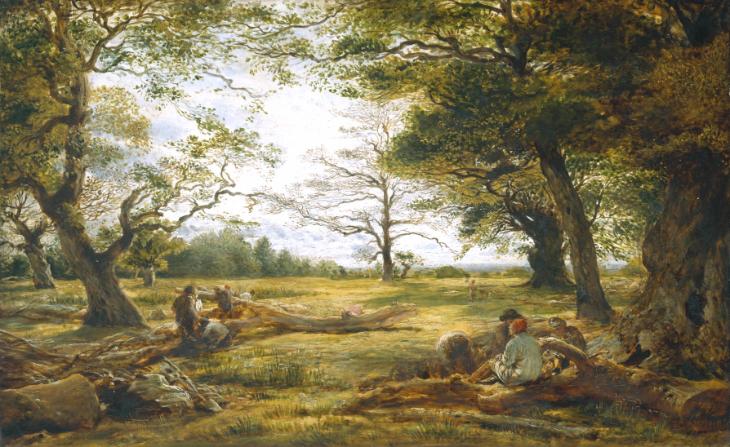
Windsor Forest ('Wood-Cutting in Windsor Forest') 1834-5, exhibited 1835 John Linnell 1792-1882 Presented by Robert Vernon 1847 http://www.tate.org.uk/art/work/N00438
Windsor Forest (‘Wood-Cutting in Windsor Forest’) 1834-5, exhibited 1835 John Linnell 1792-1882 Presented by Robert Vernon 1847 http://www.tate.org.uk/art/work/N00438

Then there’s Pamela, Samuel Richardson’s novel about a young servant girl who falls prey to her master’s endless and increasingly insistent attempts to seduce her, becoming more violent every time. While she does not suffer the terrible rape that Clarissa endures in Richardson’s much longer novel, Clarissa, Pamela goes through a lot and chronicles every scrap of it in her letters home to her parents. Pamela can seem a slog, especially with all those self-justifying lines about how pure she still is and virtuous in spite of everything. It’s frustrating that she never seems to do anything but weep and write and swoon. Still, there are some funny moments, like when she tries to escape but mistakes two innocent wee cows for scary bulls, adding a dab of Freudian psychodrama to the otherwise relatively static action. I guess the main thing we can take from this novel is its intense focus on the individual (something that wasn’t really available before in fiction, because romances were interested in characters as archetypes – princess, villain, hero – rather than real people), and the process of introspection, the attention to everyday detail. The same goes for Robinson Crusoe: part of what’s seductive about Defoe’s novel is not just the adventure and pirates, but all those long passages about how he sets up his little domestic fortress on the island; how he learns to cure raisins, build boats, grow corn. He goes into so much detail you think you’ll go mad, but when you go back and read it, there’s a certain satisfaction to it. You can imagine yourself in his position – Samuel Taylor Coleridge famously claimed that Robinson Crusoe’s success was that he represented human nature in general – and the novel becomes a sort of survival guide to living on a lonesome tropical island.

Crusoe, Friday & some goats. Source: www.nvcreview.com
Crusoe, Friday & some animals. Source: http://www.nvcreview.com

Incidentally, Crusoe’s story was loosely based on that of Alexander Selkirk, a Scottish man who ran away to sea to escape punishment for bad behaviour back home. When he got into an argument with the captain of his ship, he asked to leave and go ashore on one of the South Pacific islands they were close to. Selkirk thought some ship would come and find him soon enough, but instead he was stranded there for over four years. Crusoe, by contrast, is on his island for twenty eight years. Part of the wonder of the story is how sane he stays. Crusoe rediscovers religion and his spiritual devotion is essential to giving his life order and meaning on the island. It’s the little things that matter, that give him a sense of self: carving the days into a wooden cross, having dinner with his ‘family’ of animals and writing in his diary. The whole novel basically celebrates the power of human reason and endurance, as Crusoe notes that ‘by making the most rational judgments of things, every man may be in time master of every mechanic art’. I guess in this way it’s very typical of the Enlightenment attitude of the time, but there’s also a very strong capitalist motive for Crusoe’s actions and attitudes. As Ian Watt points out in The Rise of the Novel, many of Crusoe’s behaviours prefigure that of the canny venture capitalist: his restless travels for more trade, his saving of supplies and investing of crops, his careful planning of time and stock, and the mythological story of the individual’s capacity for survival. In fact, it could even be read as a kind of Puritan spiritual autobiography, because Crusoe has all his capital successes rewarded supposedly by ‘Providence’ as a blessing for his religious (re)awakening. It’s funny how a lot of eighteenth-century texts like Robinson Crusoe are perhaps best known for their adaptations into children’s literature (NOT as the rather awful film versions which insist on adding an irrelevant romance plot to everything). I suppose it’s because Defoe’s novel is also an adventure narrative, encountering pirates and ‘educating’ his ex-cannibal slave ‘Friday’ with Western values (another problematic but critically rich part of the story is Defoe’s relationship to ‘my man Friday’, which sheds light on the colonial context of the time). Another example of an eighteenth-century novel being famous as a children’s book is of course Gulliver’s Travels, by Jonathan Swift. The irony here is that Swift wrote this tale about fantastic worlds with tiny people, floating islands, people who could extract sunlight from cucumbers, giants and talking horses (Houyhnhnms) to deliver a harsh satire on the politics and Enlightenment culture of the period. Unless you have a canny eye or an edition rich with footnotes, you might miss all these references, and so revel along in Gulliver’s story and thus fall prey to the kind of naivety Swift critiques in Gulliver himself. Indeed, because the book was so cleverly prefaced and presented as a true account of a man’s travels, many people thought that the events and the strange places described were all true. In addition to lashing the follies of man’s claim to reason and pursuit of enlightened knowledge, Swift was attacking travel writing itself, albeit with lesser gall. He parodies the supposed objectivity of travel writing, and its attention to seemingly inane details. He gives very precise numbers, showing the reader how he cleverly carves up the worlds he encounters, noting ‘three hundred tailors’, ‘six of his majesty’s greatest scholars’ and so on. He also feels the need for self-justification, as when he describes how his excrement has to be taken away by two wheelbarrows by the tiny Lilliputians:

I would not have dwelt so long upon a Circumstance, that perhaps at first sight may appear not very Momentous; if I had not thought it necessary to justify my Character in Point of Cleanliness to the World, which I am told, some of my Maligners have been pleased on this and other Occasions, to call in Question.

Swift’s writings had been previously critiqued for their lewdness, as in A Tale of a Tub and ‘The Lady’s Dressing Room’, where the human body becomes a site of grotesque revelry and disgust. Swift, therefore, is here fashioning his own self-defence with thick layers of irony, inviting critics to judge him against his own self-protection, his free reign expression on matters abject and bodily. Travel writing was a big thing in the eighteenth-century, what with the growth of the British trade empire and the trend for the ‘Grand Tour’. While they didn’t have access to a railcard, undergraduate (men) would often take the Grand Tour of Europe, learning about refined French manners and Greek culture to more fully develop their education. This of course also involved a lot of drinking and probably visiting prostitutes, but then again, such matters were perhaps necessary to a gentleman’s education – he could ‘get it out of his system’ overseas and come back to Britain enlightened and satisfied and ready to be a ‘good’ citizen. Hm. One of my favourite pieces of travel writing is James Boswell and Samuel Johnson’s account of their journey to the Western isles of Scotland. Their approach was slightly different, as they each wrote separate accounts of the time. Boswell focused mainly on Johnson himself (as he tends to do in his writing!) whereas Johnson spent much time critiquing the dreariness of the scenery and observing the primitive lives of the locals with some disdain, though respect for their hospitality. You can read A Journey to the Western Isles of Scotland for free online via Project Gutenberg, and I think it’s worth a gander, if only to take a brief lunch-break holiday into the wilds of eighteenth-century Scotland. There is also a rather humorous article in The Telegraph detailing the author’s attempts to retrace the steps of Boswell and Johnson’s tour, though I am somewhat uncomfortable with his complaints about encountering a range of ethnicities rather than ‘native’ Scots on his tour…can Scottishness not finally now be defined as authentic through multiculturalism, as everywhere else in Britain, or must it still be hailed as a land of blood and soil nostalgia, pale skin and tartan…? just a wee grumble! I have only skimmed over the stuff we covered in our course on the eighteenth-century. Other things worth reading are the hilarious parodies of Pamela, which cast severe doubt on the veracity of Pamela’s ‘virtue’ and burlesque Richardson’s prose style – some good ones include Eliza Haywood’s Anti-Pamela and Henry Fielding’s Shamela. Also, Raymond Williams’ The Country and the City is a marvellous book which looks at how the countryside was often falsely represented in various examples of pastoral and Georgic poetry through the ages as an idealised contrast to the corruptions of the city. Millenium Hall by Sarah Scott is a very intriguing epistolary novel which has been dubbed a ‘feminotopia’, an early representation of a utopian community run by women on a country estate. I suppose what really strikes you about this period is the sheer diversity of works, and the strong political ties most of the literature displays. It was a time of experimentation, but because the novel in particular was still a nascent form, it’s possible to perceive all the strange incoherences, the little faults and cracks which allow us to reflect on the form in general and its relationship to ideology. Edward Said, after all, has argued that the novel is by definition born out of colonialism: it is ‘fundamentally tied to bourgeois society […] it accompanies and indeed is a part of the conquest of Western society […] the novel, as a cultural artefact of bourgeois society, and imperialism are unthinkable without each other’. The novel’s representation of social authority in the hands of the British, its focus often on middle-class life and relentless individualism are all part of this bourgeois basis of the novel. Whether we agree entirely with Said’s statement, it’s a compelling argument that challenges us to rethink how we consider what is probably the most popular form (other than celebrity biography) in the contemporary literary market. And I guess that’s one of the thing’s I enjoyed most about this course: returning to origins, understanding how modern literature came into being out of the cultural circumstances and experimentations of the long eighteenth-century. It is rather ironic that while Samuel Johnson characterised the typical novel reader as ‘the young, the ignorant and the idle’, reading novels is now one of those activities that mark you out as ‘cultured’, ‘educated’, perhaps even ‘bourgeois’. Not only in its form, but also in its critical reception, the novel has come a long way. Some extra info: 

Pope's Grotto.  Source: popesgrotto.org.uk
Pope’s Grotto.
Source: popesgrotto.org.uk

Alexander Pope was a dissenting Catholic during the time of Protestant monarchy, which meant he was barred from participating in many societal institutions, like university. In 1719, he retreated to Twickenham in the rural outskirts of London, building himself a villa and a grassplot garden whose verdant beauty was to imitate the Arcadian landscapes of much of his poetry. Pope’s residence is notable and pretty cool because he constructed a tunnel under the road connecting his garden to his villa. It led to the basement of his villa in which he fashioned his own grotto. He wrote a rather beautiful description of his delight in a letter to Edward Blount:

When you shut the Doors of this Grotto, it becomes on the instant, from a luminous Room, a Camera Obscura, on the walls of which all the objects of the River, Hills, Woods, and Boats, are forming a moving Picture…And when you have a mind to light it up, it affords you a very different Scene: it is finished with Shells interspersed with Pieces of Looking-glass in angular Forms…at which when a Lamp…is hung in the Middle, a thousand pointed Rays glitter and are reflected over the place.

You can visit Pope’s grotto at certain times of the year, and that area in Twickenham has been named after Pope’s Grove. More info can be found here: http://www.twickenham-museum.org.uk/detail.asp?ContentID=21