POVEMBER Week 1: HAIKU

img_2435

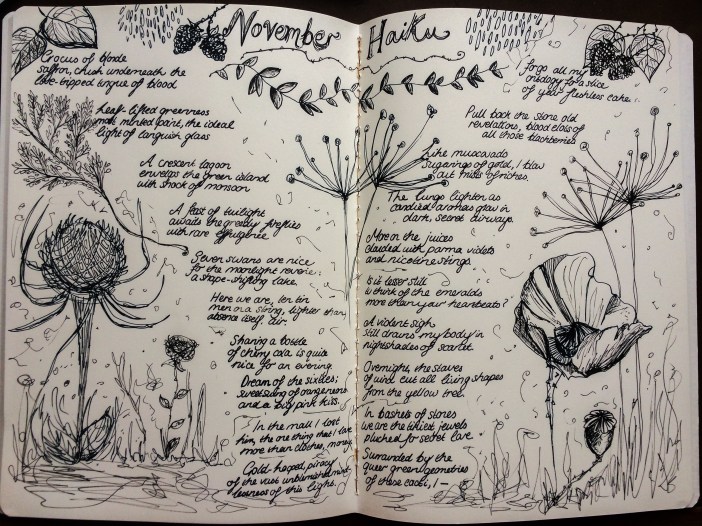
Every year the Glasgow University Creative Writing Society run a wee challenge called ‘POVEMBER’, the cleverly punned name really digging the whole poetic playfulness thing of course. Anyway, the basic point is to set guidelines or prompts to encourage you to up your poetry game during the month of November. Week 1 was Haiku, the Japanese form which is typically constructed as a 3 line poem with 5 / 7 / 5 syllables. Above I’ve written out a bunch of daily haiku which are all unedited and a bit messy and weird but were nevertheless fun to write. I like the idea of haiku having a cumulative effect and I’m not sure how well the above ones fit together but maybe they do something when thrown out on a page like that.

Anyway, it’s a fun process and super easy to have a crack at so encourage everyone to have a try!

You can check out more information on POVEMBER here. 

Pieces of You

IMG_0076.JPG

(Not the darkest thing that has happened today…)
Flash Fiction Challenge: Write a story in the form of a speech

On the bedspread, firstly you splayed out your brain. There were glitchy, silvery pieces which seemed to spark as I tried to touch them, startling me with static shocks. The wires were swelling, I could feel them still pulsing, every synapse snapping – even though you were dead. Dead as you needed to be, for what I was going to do.

You didn’t make a mess. There was a pureness to all your corporeal form; it did not expel itself, as it possibly should have. Like a clock out of joint, your heart still ticked, reaching its soft hissing snare as I clawed at the edges. I could have eaten your whole bloody heart. That was how it felt, the longing. I can hardly explain it.

Did you unravel, did you unshed yourself from your skin? This is the thing: in all the gore and clot of your muscles and blood, I could not find you. I scooped up the cells like caviar, kept them close to me in various unlabelled jars, but still I struggled for your essence. It seemed to elude the very materials, the particles that held it, bubbling and dancing but nonetheless should have held it. You tasted sour as iron, your skin became lurid and turquoise under the chandelier, whose diamond-like light picked up every pore. My longing was poisoned, this scarlet ore which poured from my body, making its frail emanations. Carefully, I pressed in the needles to preserve you. I saw my own skin, pink-fingered against your lovely pale cerulean. It was a crying shame; to have to touch you, to desecrate the grave where you clung to the world like gossamer caught on the winter-thin branch of a sycamore.

The air around us grew ambient. I say it like this: there were radio sounds, snatches from the ether, drowned-out voices lost at sea, the swirl and churn of arpeggios, piano notes scattered on a tidal swathe. I recalled a million conversations, little snippets of things that you’d said, speeches preserved in that nook of your head where nobody could reach but me, clawing and hungry for any debris. For how long had we lived inside one another? And now that hideous beauty, taken to its logical conclusion. I disentangled your veins, drew out the molluscs of your organs, pulled rust and pennies from your gut, scraped clean the bones of your ribcage—but always your soul slipped away. I left your heart to stew in the succulent juices of some noirish nectar, the dark spirit you had drank with unfailing alacrity.

Visitors passed in the following weeks, but nobody noticed. It was only I who heard those ethereal noises, sounds which slipped through my brain with a strange familiarity. Yet all the while I could not puzzle nor sew them together; they were nonsensical, constantly crackling, as unwanted as the seeds of raspberries curdled in jam. Your voice stuck in my teeth, so I could not speak.

And even if I took all your pieces, if I burned you bit by bit in the fire of my grate, would that actually destroy you? I suspect you’d live on, sparkling in the air of the apartment; your thoughts as slippery as the mysterious synths which the house spirits play in the fragments of glitter-tinged dust. God, how I wanted to just stick a fork in your flesh. How I longed for the scrawl of your hand, the curls and flourishes of lust. Now I have every perfect fragment, is it possible to believe that this is not love?

Walking Home with Angelo Badalamenti

FullSizeRender 8.jpg

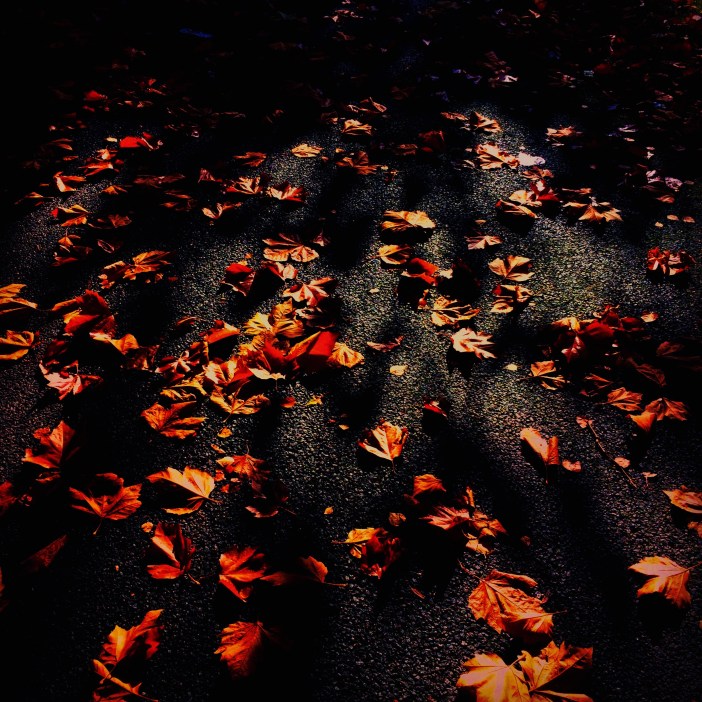
[a daily freewrite]

Sinister synths fill the bloodstream. It is very late, too late to be out walking like this down Kelvin Way which tonight is another planet, leaves falling slow like so many flakes of golden, sorrowful snow; not normal, not real, just swirling in loops and spirals, falling as if in slow motion—and my walking is the inversion, fast-paced as I cut through the piles of leaves, my legs making shapes against the air which is freezing.

I think: the spider at my window. It has lived here for months and is gradually fattening. Its web spreads daily like a tapestry; it lurches across its pretty stitches to devour some unsuspecting insect.

I think: it is too light to be dark. What is that spooky glow at the end of the road, why the blueish mist, the streetlamps the colour of mulberry?

In my ears like a virus the saxophone spreads, its screech rising to a terrible pitch; then falling, descending, counterpoint to that butter soft double bass…

The trees are too tall for a city. They are tall, sinewy trees – almost fully without leaves – which gather instead in great waves on the pavement swollen with the imminence of my kicking and scattering – they are so dry and crisp like just so much beautifully burnished scrap paper torn from centurial newspapers. I am very little, smaller than the fence posts, picking up the fattest five-pointed leaf, glossily gold and glazed with rain.

The familiar chords are placed in the air, like the liquorice laying of vinyl on a turntable. The air which would be so still if not for those billowing leaves, for the quiet display of traffic, which passes smoothly like a reassurance, like airwaves heard vaguely from beneath the sea of sleep. The sounds in my head sway as if I am rocking to sleep; I keep walking, walking…

Bars and cafes locking up for the evening, their emptiness betraying a certain extravagance of decor and objects. Why this painting? That mirror? What are you hiding? The screens of the evening are everywhere. One I may fall into, one I will crack and smash. I am pressed against the glass, watching the precisely symphonic arrangement of chairs and tables. I wonder which guest had moved the backs slightly, had pulled off the cloth, had spilt blackcurrant wine on the white linen like blood.

There is a screen in the distance, golden brown. An advert for Grouse whisky. The houses which look down on me are especially macabre, tenements of sandstone washed ashore from the bleakness of history. Ghosts are in the window, knowing the shadows of their past passing futures. I feel an affinity. These are curious ghosts. I am too warm. I shirk off my rucksack, my black leather jacket. I feel the air whip fast at my arms, bare. It is proper cold tonight, crisping and shrivelling the skin of my lips.

This sinuous, heavy, resonant bass. Is it in time to my quick footsteps? I feel myself slowing down, oozing in a scattering of atoms. I have lost my train of thought. Something about an essay, the impossible engorgement of several million objects. Just so much of Blanchot, of Stein’s poetry. I rub my eyes, reddened I guess; the lamplight too bright on the white bits. Such shadows! I am followed by my own tall, anorexic twin. She is Slenderman sized, long-limbed as a willow.

I feel like dark chocolate, like coffee. I feel quite decidedly empty.

The passing of strangers speaking into phones. They are all web-caught, a sequence of whispers. I hear them as if through the static of radio. There are cats screaming in distant alleyways; I imagine them mouthy, a jawfull of mice, ecstatic and tortured. A blackness comes over me again. The muscles slacken.

This is the lounge jazz of hell. This is the seductive coloratura twinkle of a mystical piano, the refusal of a chord to resolve itself, the slow-climbing bass, the way the xylophone draws us closer to a beautiful death. It is a shimmering, blood red pool. It is fire; it is lava, like noirish Irn Bru. The scarlet curtains part to reveal us. I think of the cave, of the spider, of the sapphire light. A bluegrass guitar severed, shredded in dissonance. The sweetest, purest soprano, worthy of Elizabeth Fraser, fair queen of Grangemouth…Here we are in the mountains, the laces of silver rivers, the dark pines, the water spilling over the ridges, the unfolding of clouds like a book of spells…Smell of woodsmoke clotting the tired red strands of my hair.

I am at a door. Is it the colour of midnight on a moonless night?

Still I am alone. The ghosts have departed, the album has finished. All is silence. I am home.

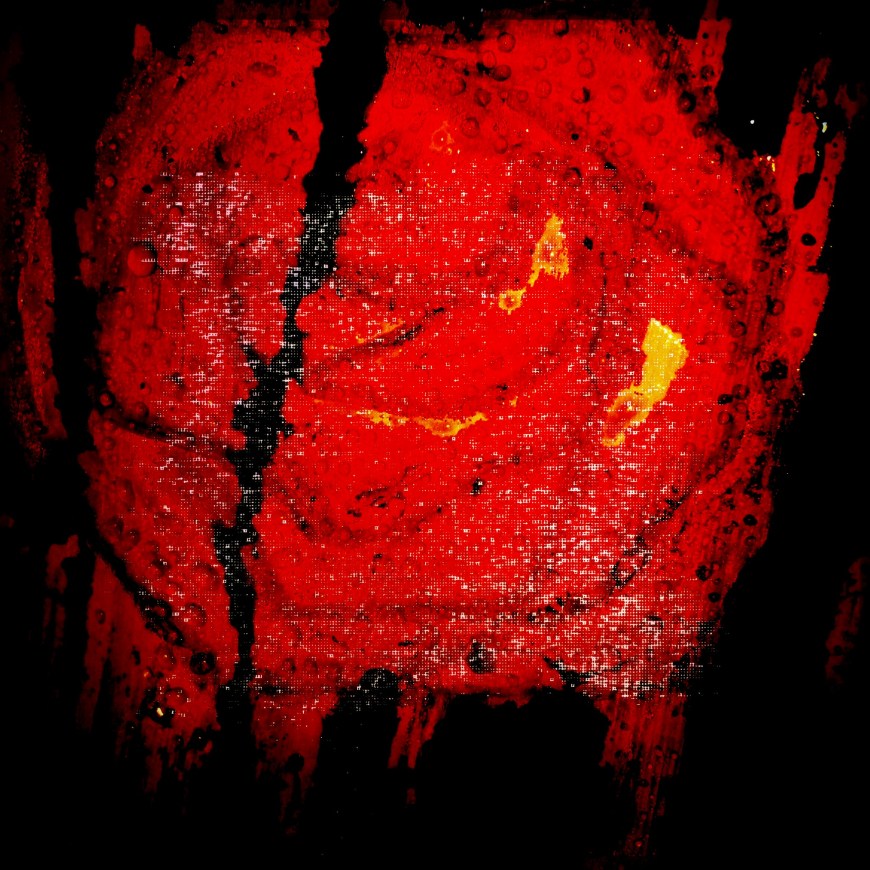
Postcard from the Desert of Reverie

fullsizerender6
Painting by the beautiful and talented Ella Calvert

(part of a series of poems written in response to Ella’s paintings)

Postcard from the Desert of Reverie

Dearest, the insects have quivered
long enough in the hole in my heart.
If you were here, you could press
your hand against the skin
where it beats, uselessly.

I have collected enough Mexican sunsets,
enough blood orange dreams
of distant cities, to know
that you are not coming home.

The spider scatters relax
only at night, settling into spasms
like the aftermath of a birth.

In the wee hours, the acids hiss
for a burst of their petulant green.
I have tried to hide my desire
for your eyes of lilac;
I have shined my skin
to the gleam of shellac.

Still it beats.
Time still turns
on the axis of thorns
which circle my chest.

I have tried to confine my thoughts
to shapes, like a rosary;
but the worry bleeds out,
erodes the coating
I have grown to protect
this fragile feeling.

Side by side, with or without,
I know you now
as the virus that spreads in my bones,
the words that swizzle and twist —
and in the darkness without colour,
mean nothing.

— July 2016

Strangers in a Bar

img_1796

We decided to meet in a bar, one where old men gathered for their daily brew and crepuscular women exchanged knitted secrets in the shadowy corners, around time-gnarled tables. I knew you instantly: the Celtic heritage of your red hair, unkempt even now; the cream-coloured Aran sweater, too warm for this time of year—though you were thinner perhaps and therefore colder. Half-way across the bar I could smell your cigarette smoke. I could feel the way it was before, in your fingers, stale and yellowing, chemical; the ash splintered deep beneath your nails, the black clot in your lungs which throbbed as you coughed. I remembered it, the way you would sit up in bed in the middle of the night as if struck by lightning, the thrust of it right up your spinal cord. I would bring you glasses of water; I would stroke your arm as if my fingers were falling leaves.

A pint of Guinness sat in front of you, barely sipped. You were reading a book, wearing glasses. I had never seen you wearing glasses. What was the book? I try to recall it. Frank O’Hara, perhaps, a handful of scattered street poems; maybe something by Whitman. You always had a thing for the Americans. It was part of your mythology, the dream of the road, the need to leave the homelands. You hated this city, but still you were here. You had returned.

I pulled up a barstool and for a moment you didn’t even notice me; didn’t blink once from your reading. I grabbed the glass and swilled some Guinness down me, the froth of it coating my lips. It came back to me, old friend: that black, hoppy, toffeeish stout. There were all those nights: the sticky surfaces of bars, voices that rung cacophonies, inane words snatched from strangers. Outside, the brisk March wind that billowed my hair in your face as you smoked and smoked. I tried to deny the way I loved your smoke. I could’ve sucked it in all day, like you were giving me wisps of your soul. Sometimes, when I pass a smoker in the street, I have to cross the road—the tarriness smarts my eyes.

I suppose I was hyperaware of everyone around us. What would they think? Would it seem strange now, to see this thinness of a figure stealing their way to a table and taking a man’s drink? Would they notice at all? We were always conspicuous: it was the black lines drawn thick beneath your eyes, the fox-coloured shock of your hair; my silence, my obvious adoration. The swirling limbs and all the dancing, the clubs we were thrown out of for being violent. You wouldn’t see it now. If someone took a picture of us, we would be two strangers in a bar. They’d have to pick out the way I turned towards you, hoping for your notice. The drink would seem my own, anonymous. How could they know of our entwinement on any number of sofas, the graffiti of our names we sketched on the tables of trains, the countless coffees and cokes and sticks of gum shared as if mouth-to-mouth in our indivisibility?

I watched your eyes follow left to right along the page, so engrossed; as if looking for treasure beneath the lines, behind the lines, at the end of the line, the final line. Maybe you were waiting to finish a chapter. I longed for you to acknowledge me, to make my interruption.

How could they know, the way we would meet every day, in bars like this, and our spirits were the same? The spirits we drank and sank and raised? How could they know?

Just then, you folded the corner of your page. You reached over the table and clasped my hand, the one that still touched the Guinness. I saw your lips raise a smile, the eyes the same, sea-green aglow.

You said: “Hello.”

Seven Songs from the Vault (1)

IMG_1691.jpg

~ Seven Songs from the Vault (Version 1) ~ 

  1. Suzanne Vega – ‘Marlene on the Wall’, Suzanne Vega (1985)

Partly to blame for my writerly obsession with long, m-beginning girls names (Meredith, Meredana, Marianne), this song was one of the first tracks that brought me to music – brought me to music in the sense of listening to it and discovering something new about the world through it. It’s a story of a dangerous and probably ill-advised love affair, told through an impression of symbols; the singer urges the listener to ‘observe the blood, the rose tattoo and the fingerprints on me from you’. The line between desire and violence blurs here and there’s something about Vega’s cool, whispering voice: an intimacy that is at once conversational but also steadfastly aloof, refusing the self-aestheticising of vibrato and instead fixing itself on the delivery of its sharply observational lyrics. In an age where big, operatic voices dominate the popular music scene (think Adele), Vega’s vocal style seems comparatively and indeed curiously fresh. When she returns, angrily, to the chorus, there’s a real, mesmerising venom to her delivery.

The song was on an acoustic compilation CD I’d nicked from my Mum’s car and I used to play it over and over again, my nine-year-old mind trying to make sense of the song’s darkness; its ‘danger zone’, the urgent guitar strums and insistence on silence – ‘don’t talk about it later’. By successfully striking the experience of ambiguity in desire, twisting pop’s conventional picture of love to one more sinister, Vega draws you in and in again to her characters. Who’s Marlene? What does she mean by the wall? Who are the soldiers, and the ‘things I cannot see’? I still have no idea.

2) Bloc Party – ‘I Still Remember’, A Weekend in the City (2007)

Like a Roald Dahl novel, rife with endearing surrealism, you sink into this story of young love with a queasy mix of confusion and warm familiarity. The guitar riff that kicks in with all its clarity is a comfort, even now, listening back almost ten (!) years later, and the song lilts between the energy and languidness of longing. The relief that comes when Kele Okereke breathily sings that first line, ‘I / I still remember / how you looked that afternoon / it was only you.’ It’s a love that touches on the unspokenness of queer desire, the possibility of falling for your best friend: ‘we left our trousers by the canal / and our fingers, they almost touched’. It’s almost Blakean in its very pure, stripped-back articulation of innocence: ‘you said “it’s just like a full moon” / blood beats faster in our veins’. It’s draped in childhood nostalgia: ‘and on that teachers’ training day / we wrote our names on every train’. With all these images, you can’t help but remember such experiences from your own youth, those simple days and strange feelings.

When the song builds up with the thrashing drums and the insistent refrain, ‘I still remember’, all the campouts and nights out and beach drinking and endless hanging out come flooding back. Okereke’s love exists now only as a metonymic collection of details, sentimental objects and memories: the playgrounds and rooftops, park benches, school ties. There’s a terrible bittersweetness to the song, its sense of regret, of unrealised, forlorn desire: ‘You should have asked me for it / I would have been brave’. Sure, the album came out in January 2007, but in a way it’s a song for autumn: the aftermath of summer holidays, the return to school, the always problematic sense of fresh beginnings, of leaving a certain era behind. The golden haze of nostalgia, and all its futile longing. The dissolution of that final shining chord.

In my head, it’s inextricably tied up not just with my own adolescence but with that even earlier exposure to frustrated love. I think of the ending to Phillip Pullman’s His Dark Materials trilogy, with Mary’s endless stories, the ‘quantum leap’ that is love’s realisation, her talk of negative capability and the unravelling of Proustian memory, decades deep from a piece of marzipan; then Lyra and Will, after so many adventures across several universes, admitting they love each other, their first kiss like the taste of the ‘little red fruit’ and then the devastating revelation that they love each other and yet can literally never exist in the same world and live. I remember vividly sitting on my bedroom floor on a Sunday night, picking flakes of paint from the floorboards, anxiously devouring the last of book of the fantasy trilogy that had consumed both my summer and winter and feeling this weird immenseness of sadness and relief all at once. I think it’s the expression that counts; the only overcoming of such feelings. That’s why Bloc Party’s song’s so good. It’s cathartic.

3) Belle & Sebastian – ‘Dress Up in You’, The Life Pursuit (2006)

For me, The Life Pursuit is one of Belle & Sebastian’s most obviously ‘chamber pop’ albums, it’s lush and glossy and upbeat, featuring vocal contributions from both male and female members of the band. Its production is shiny and the mood (for once?) is cheerful.

Probably not surprising that the song I picked is one of the album’s most melancholy, however. We can all relate to ‘Dress Up in You’, in a way. It’s a song about jealousy, about our problematic relationship with the friend that always dazzled,  the one with a ‘beautiful face’, that was always destined for great things, while you were stuck back home, ‘knitting jumpers’ and ‘working after hours’. There’s a bitterness to the song’s tone but at the same time the relaxing cadence of the piano riff and the upliftingly sweet horn solo keep the sadness in check: ultimately, the song’s message is one of admiration. The ‘singer in the band’ paints a vision of her friend, the one who ‘got lucky’, who forgot about her, as a beautiful idol: ‘if I could have a second skin I’d probably dress up in you.

We’ve all wanted to be someone else at some point. It’s probably part of the human condition that we’re mostly doomed to be dissatisfied with our own skin, to long for where the grass is greener, where there are airplanes and style and ‘the essence’. What I love about this song is its contradictions: the bitter lyrics and the sweet music, the sense of absolute friendship (deals signed in blood, understandings, love, the sense of missing someone so much they give you stomach pain) and jealousy/resentment, the contrast between stardom and failure. It carries them off perfectly and there’s a satisfying relief in the way the song closes with the rallentando leading into ‘they are hypocrites, forget them / so fuck them too’ and then all those carefree la la la la las, harmonised lovingly with the accompanying brass.

It’s a song that reminds me of sitting up till 5am on friends’ sofas, passing round the laptop and its weighty iTunes library, drinking the dregs from a bottle of gin and feeling a bit miserable for ourselves but also kind of paradoxically content with the feeling of discontent.

Notably, it’s also the song that plays over the credits to Stuart Murdoch’s film, God Help the Girl, and I like that the film’s ending is pretty open, just like the outcome of the song—does the friend become an actress? Is she a success or a failure? 

4) Frightened Rabbit – ‘Poke’, The Midnight Organ Fight (2008)

2009 and 2010. Two winters so cold the roads and rivers froze over; so cold we wore coats in our classrooms, the heating system of our leaky-roofed Victorian school building packing in in tandem with the collapse in temperatures. These years all a blur of computer screens and studies, of long walks round town and into the hills with friends. I had tickets to see Frightened Rabbit at the Barrowlands in December; I was in school, reading Sylvia Plath for my English dissertation, when from the windows of the computer suite I saw the first flakes of snow, falling from the sky like a promise. They came thick and fast and soon everything was draped in white. Something inside me soared, even with the sad knowledge that the trains were cancelled. I couldn’t go to the gig.

At parties, we would mockingly sing the words to each other: ‘poke at my iris / why can’t I cry about this’. Sometimes we’d mishear the lyrics. We wanted a reaction from each other, perhaps, a way of making sense of that weird desire to be poked in the eye, to be stilted from our drunken reveries. Or maybe it meant something deeper, weirder. Maybe that was our own ‘brand new language’, a semiotics of stupid expressions and warbling voices, the way we’d brush up against each other’s hands as if we wanted to hold them.

‘Poke’. It’s an elegy of sorts; an elegy for the disintegration of a relationship, the frustration of striving for closure, caught between an animalistic need for freedom and that enduring residue of whatever was there before: ‘Why won’t our love keel over as it chokes on a bone? / And we can mourn its passing / And then bury it in snow’. It’s that wintery, rural Scottish numbness, the refusal or even inability to admit feeling – ‘Why can’t I cry about this?’. There’s the tender, Burns-like romanticism of this love – ‘it’s got lots to do with magnets and the pull of the moon’ – kicked viscerally in the teeth with all that suppressed violence that we bury in the darkest dullness of our relationships: ‘Or should we kick its cunt in / and watch as it dies from bleeding?’. Scott Hutchison’s poetic, sometimes growling croon is softened in this song, even as he refuses to hold back on the emotion, it unravels perfectly in the expression of paradox that governs the end of a relationship: ‘But I hate when I feel like this / And I never hated you’. The sudden severance of that connection that was almost familial, blood-strong in its longing. The interludes where Hutchison sings his Ooooohs with that perfect, withdrawn sorrow are like the movements of the sea over the steady rivulets of the guitar picking. I always wanted to be able to play this song on guitar. It sounded so simple and sad and pure.

5) Wild Nothing – ‘Paradise’, Nocturne (2012)

I used to do double shifts most Saturdays and Sundays and it was a grim affair without the aid of some good music to brighten the restaurant where I found myself pacing endlessly, lifting plates, taking orders, polishing glasses, picking litter and leaves off the floor, scraping candle wax off tables, dusting the gantry, moving zombie-like between tables with the same forced fresh, maybe fragile smile.

My friend Douglas would bring stacks of CDs in and leave them for me on the bar top while he was away working in his section. In the midst of sensory deprivation, I would pore over those CDs like they were exquisite treasures (which, fuck it, they were). For one, it was lovely to find someone else who shared my passion for the actual tangibility of the compact disc. The sleeve and the notes and the design printed on the disc itself. I liked the sheen of plastic, which felt solid in my hands. It was 2013 and Douglas had a music taste that ranged from the up-and-coming heroes of alt-pop (Grimes, Lana Del Rey) to the more left-field and experimental/electronic; looking over those CDs reminded me of the world I had missed while immersing myself in nothing but literary theory podcasts and James Joyce audiobooks for two years solid. Now there was Bjork, Angel Olsen, Poliça, Wild Nothing.

I asked to take a few home to borrow, mostly based on my attraction to the album artwork and the titles of songs. I’ve always been drawn to song titles and artwork, probably because I am literary-minded but also because I love it when artists actually pay attention to building up a particular aesthetic that’s appropriate to, or even spins a whole new meaning on, their music. I love thinking about how the title of a song changes everything. It’s weird because I find it really hard to title my own work, but I guess that’s a common problem…

Anyway, one of those lucky albums was Wild Nothing’s Nocturne, which is a blissful array of buttery, colourful dream pop songs which mould together as perfect as the lunar cycle. The standout track for me is ‘Paradise’, a five-and-a-half-minute ambient starry-eyed disco epic which, if the album is meant to sort of capture ‘a sleepless state of mind’ (hence the album’s title, Nocturne), is that moment when the endorphins kick in and you reach that precise state of euphoria that occurs when you have not slept for say 40 hours solid. Maybe you’re travelling, airborne to distant lands. Maybe you’ve been boozing through the night and morning. Maybe you’ve just been on your feet all day and are reaching the 11th hour of your shift…

For me, this is sort of The Cure drenched in pastel tones; the meticulous crafting of those dark synths and celestial reverb; Joy Division staring into the refracted galaxies of a crystal ball that would predict a brighter future. Jack Tatum’s voice here acquires a much stronger, more sonorous quality than on most other Wild Nothing tracks, and there are definitely Ian Curtis comparisons to be made here. The mood perfectly balances its bouncy drums, uplifting synths and twinkly 80s guitar riffs with a controlled and almost majestic lyrical delivery which is rather melancholy in theme, the refrain ‘love is paradise’ framing most of the song, as if striving to reach some sublime point where paradise would be reached. If you check out the extended version online, with Michelle Williams doing spoken word in an interlude section, there is a definite sort of Allen Ginsberg/Beat generation vibe to the lines, moving to a sort of transcendent rapture: ‘The past was folded up and in the twinkle of an eye / and everything had been changed / And made beautiful and good’.

The song overall feels like a spiritual and spatial journey; it fades and builds and comes to fade again. It never indulges in elaborate solos but instead maintains its vibrant rhythm that moves between liveliness and a kind of soporific haze of drums and sparkling guitar and synths. Listening to it at work, for those five-and-a-half-minutes I felt weightless, bodiless, up in the air; free from the cutlery and crockery and bells tolling endlessly from the kitchen…

6) Bright Eyes – ‘Lua’, I’m Wide Awake, It’s Morning (2005)

A song that you carry with you somehow, that’s so engrained in your brain as to never leave you, each chord and lyric sedimented with years of memory. It’s a fragile song, sparse as a deciduous tree in winter. It’s a song about wandering, the dislocated sense of not exactly inhabiting the world, but somehow just drifting through. It’s a paean to solitude: ‘when everything is lonely I can be my own best friend / I get a coffee and a paper have my own conversations / with the sidewalk and the pigeons and my window reflection’. It explores the thinness of reality, the sheen of ‘polish’ that in the morning ‘looks like shit’, the false love sold in the evening, which by the morning ‘won’t exist’. It’s a candid admission of human frailty, the mercurial nature of our emotions. It’s a specifically metropolitan song: you have a sense of Conor Oberst’s warbling voice as he wanders the streets, lost protagonist in his solipsistic sadness. Yet the song spreads outwards, as a commentary on the human (or at least a generational) condition, a not-quite nihilistic exhaustion with the world – ‘we might die from medication but we sure killed all the pain’. We flit from one thing to another, our desires will oscillate as sure as the moon’s phases. Everything seems ‘so simple as the moonlight’ but no amount of incantation will render solid this refrain.

Thematically, the song is about addiction, depression, the everyday vacillations of sensation contained in a morning and evening. The random party at ‘some actor’s west side loft’ and the flask shared on the train, the person addressed who looks ‘skinny like a model’ and keeps escaping to the bathroom, ‘always say you’ll be right back’. In body, the people in the song waste away as easily as the time that contains them, surviving off coffee and moonlight and imaginary conversations.

Oberst, lyrically, is a genius at paradoxes and parallels and expresses them in a way that offers them as explanations or gestures of understanding which never quite satisfy but at least leave us pondering: ‘But what was normal in the evening by the morning seems insane’. The opening line, ‘I know that it is freezing but I think we have to walk’ so clearly establishes the tone of the song, the jar of realisation – we’re both forced upon this journey, nobody’s going to give us a ride – that it could be a line from a Wallace Stevens poem. It’s a cold song, whose play of end rhymes only half hit home – ‘walk/loft’ ‘off/gone’ – leaving us always  longing for something more. No closure can be reached: the song can only end with the circular repetition of ‘so simple in the moonlight’, a childlike rehearsal of the beauty which cannot kill the complications of adult life, the self-destructive habits which inhabit the song’s lyrics.

In third year of high school, I used to listen to this every lunchtime, lying in the playground by the P.E block, feeling so light and empty, the world dissolving around me in a dull cacophony of kicked footballs, shrieking games and called-out names. It was a mysterious adult world, the one contained in that song, but I almost felt I was already there, dissolving what was left of matter.

[There’s a lovely version Oberst recorded with Gillian Welch for the album Dark Was the Night (2009) which gives it a flavour of melancholy Americana, a greater sense of dislocation, fusing the urban setting and Oberst’s minimalist delivery with Welch’s distinctly lilting, country voice and all its resonance of the prairie].

7) Muse – ‘Citizen Erased’, Origin of Symmetry (2001)

It seems insane to think that this album was released fifteen years ago, but maybe the timing was appropriate. There’s something uncanny about it: the paranoid, political and often surreal lyrics, howling soprano, bloated distortion of electric guitars, as if the music were forcing us to release the visceral eeriness and indeed grotesque weirdness of a reality that tried to cloak itself in the fairytales of gameshow tv and the financial greed offered by a fresh new century…

‘Citizen Erased’ is visceral, beautiful; at once tender and full of fury. It renders the experience of someone living in a fucked-up political state, the striving for freedom and confusion over what it means to be human, to be a person, at all. The thrashing drums give way to a thickly buzzing bass and the yearning swirls of screeching electric guitar solos. The song builds slowly and softly but the choruses are huge and operatic, with Bellamy’s distinctive wail crying out: ‘For one moment / I wish you would hold your stage / with no feelings at all / open minded / I’m sure I used to be, so free’.

The experience of this song is one of purification. You are exposed to music that is violent, lashing, angry, but like any good narrative, there is a turning point, a calming of the waves. The music becomes almost ambient. The key changes and Bellamy’s voice returns to its melodic, delicate expression, accompanied by ripples of piano and the fuzzy, spacey twanging of distorted guitars: ‘Wash me away / clean your body of me / erase all the memories / that will only bring us pain’. I’ve always felt purged somehow after listening to ‘Citizen Erased’. I think it chews you up a bit then leaves you, disembodied, drifting along the final tributaries of its current, back to a place of imaginary origin, more peaceful and pure than the harsh world it renders…

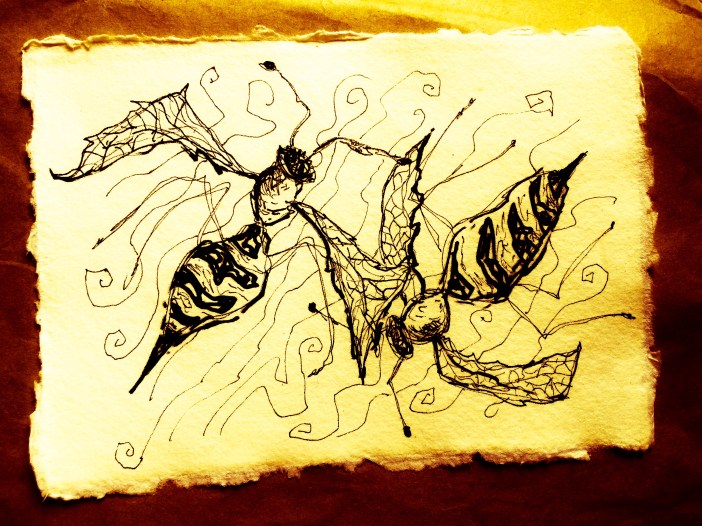
Wasps

IMG_1457.JPG

Wasps 

I heard a dull, sizzling thump and a wasp fell into my room. It fell through a crack at the top of my window and disappeared among the sunflowers, shivering, then stopped dead, seemingly. I was not bothered at first, because I thought the thump was merely a moth, or a postcard dropped off from the wall. Then the wasp appeared again. I saw it whizzing out of the flowers and it hovered round the glow of my computer. It was inches from my face.

Naturally, I panicked. I stepped back as if someone in front of me was holding a gun.

Seconds later, six more wasps swarmed at my window, pelting themselves against the glass. I could hear their angry buzzing humming in my ears, which were already ringing from a gig that night. Quickly I leapt up to shut the window, but another two got in somehow.

I ran out the room. Everywhere I looked, I could see things flitting around me. I don’t know if they were real or imagined. It was like standing in a forest, surrounded by the glitter motes of midges, only not half as pretty and in fact pretty freaky. I thought I was hallucinating. I could feel the flutter in my chest, like the insects themselves had gotten into my ribcage and were seething to get out. I was only a little bit drunk.

Gutted my flat for the fly spray. Thank god I found it.

They were crawling about in my lampshade when I tentatively opened the door. Three of them, glutted on light, their tiny bodies blown up to absurd proportion through the illuminated paper. I stood stock still and waited. They didn’t seem to want to leave; they’d found their paradise up their in that giant orb, lovers of sun that they are, like the elderly expats of Benidorm. So I pounced with the spray, gushing it upon them, tearing through the paper with all those solvent chemicals.

I thought how kids might sniff this stuff to get high.

I thought how I might kill the plants by accident.

How one wasp was still lingering, so close to a pot of aloe vera.

Then it joined the rest.

Could I smell the burning of their furless bodies?

They fizzled out, drunkenly, from the lampshade, stumbling through the air and dropping to the carpet, one by one. Brutally I crushed their writhing bodies with the bottom of a mug, mashing them into the pieces of notepad that covered my floor. The stains of their deaths would remain, irrevocably, tiny, upon those pages, like just so many slight smears of grease. Traces of vague terror, like a half-remembered dream.

Is it bad to kill animals? Even these pointless, evil creatures? Of course it is. I felt guilty, but there you are, survival of the fittest. 

My head swam from the smell of the fly spray, just so much butane and strong perfume.

I thought: why is it that we humans are so frightened by things so little? I was stung many times as a child, but you’d think I’d get over the fear, the same way I got over my terror of talking on the phone or eating olive oil or standing up in class to give a presentation. Maybe it’s like death, a fear you can’t shake off. I see a miniature demon in the matte black eyes of each of those wasps. It’s like they’re from another world, sent here to torture us. Whole lunchtimes at school we spent trying to slay the bastards, usually to no avail. They just descend on you in September and August, haunt the bins like a bad smell.

They came into my room, the three wasps, confronting me with their strangeness. How ugly they are, shrivelled and wispy and probably a bit crunchy if you dared eat one. Where do they come from? What mulch is chewed in the elaboration of their nests?

I had to scoop up the triptych of their carcasses from my carpet, toss them in with the compost.

Every prickle of skin, each brush of hair or fibre on my bare limbs, I thought was another one, crawling along my pores.

What does it feel like, to have your whole body shudder with the intoxication of pyrethrins? Odour of chrysanthemums. Surely they were only looking for the sun, diving for my window at 2am which was the only lit window in the block? Did my human habits deceive them, fools that they are, for an early sunrise, a portal to a new dawn? Did they want the delicious, golden sap of my desktop sunflowers? I hate them, I hate them. Is it so very bad to hate them?

Maybe somewhere there is a very pure and generous person, who nourishes wasps with banquets of aphids and caterpillars, who smiles at the yellow-black beasties and lets them inside. Who maybe even harvests their nests, provides comfort for the queens in winter, makes good use of the moulded warmth of a soft, unused loft. Who tries to welcome them to their city.

In another life, there’s a feral child of the forest or street, letting them creep up and down her arms; welcoming their buzzing, contrapuntal to her own sweet breathing. She’s not me.

I wouldn’t harm a fly, I wouldn’t touch a bee. Maybe I’d even feed it honey. My friend used to nurse them back to life when they were dying on the pavement.

Wasps though, wasps are something else entirely.

They can cling to the carrion of the suburbs and schoolyards all they like, enjoy the spoils of autumn’s decay, the fading of other insects among fallen leaves and shrunken bracken, the tattered remains of crisp packets. Still, if they come in my room again I will kill them with spray. I am that sincere in my cruelty, that human, that absolutely succumbed to stupid, distorted fear.

And will I ever open my window again; create that rectangle of air that forges its gateway to the morning rain, the telephone wires, the birdsong and greenery of the garden?

So Long, Marianne

So Long, Marianne

(a story I wrote back in April, after a friend gave me two prompts: ‘railcard’ and ‘lonely’).

She found the railcard lying in a puddle. It was the case that caught her eye: its plastic glitter coating blinded her momentarily as she waited to cross the road. A single beam of sunlight had caught that glitter and Amanda knew it was for a reason. She knelt down to pick it up, wiping it clean on her jeans. The man standing next to her on the pavement eyed her warily as she examined it. The name on the card was Marianne Holbrook, and the picture, slightly blurred, showed a girl of Amanda’s age, with cropped brown hair and eyes rimmed thick with kohl and shadow, lips a deep rich red. On the flip side of the case was another card: a student ID, whose expiry date was last year.

“You should hand that in you know,” the man beside her said, interrupting her reverie.

“Yes,” she replied.

Amanda did not hand it in. She took it home with her and tried to go about her evening as normal. She put it up high on her bookshelf, next to the little cat ornaments her grandmother had given her as a child. She put the radio on, to make the flat seem less quiet. She boiled the kettle. She stood in front of the mirror, brushing her long thick hair. The jangly pop music seemed only to ricochet off the silence, intensifying instead of subduing it. Amanda tugged and tugged at her hair but she could not get the knots out. Tears of frustration sprung to her eyes.

She felt pathetic for crying. Her arms crumbled to her sides and she threw down the brush. The kettle began to whistle. Amanda burnt her tongue on the first sip of tea. She checked her phone but there were no texts; there had been nothing, now, for three days.

The following morning, she went out on her lunch break and got a standby appointment with a hairdresser near her work.

“I want it very short,” she said carefully, fingering the long strands of hair that framed her face.

“How short?” The stylist asked, lifting clumps from the lengths of Amanda’s hair and letting them fall again, as if she were trying to gauge how much her tresses weighed.

“Oh, a crop. A pixie cut.”

“Bold, huh?”

“Like Laura Marling. Very short.”

“I don’t know who that is honey. You sure you have the features for something that short? I’m not saying you have a big nose or anything but wouldn’t you like to look at—”

“No,” Amanda said firmly, “I want a crop. Please. I don’t care about dainty features.”

“Okay, whatever you want.”

It took an hour. Great wads of hair fell away past her shoulders as the stylist attacked Amanda’s locks with her scissors. She cut away in steady, hungry snips until all that was left was a ruffled mess, short as a boy’s.

“Don’t worry,” the stylist assured her, “it’ll look weird until I’ve wetted it and done the layers.” Another half hour and it was done. The blow-dry took minutes. Amanda blinked in the mirror and tried to imagine what she would look like with heavier eye makeup. Marianne Holbrook. The girl in the railcard photo, blankly staring, mysterious.

“Thanks.”

“It does look rather amazing,” the stylist admitted, surprised.

Amanda went back to work and everyone was so shocked at what she had done that they all forgot to reprimand her for being late.

“Very sexy,” her boss said, biting his pencil. Amanda felt hollow inside as she sat down at her desk. The afternoon stretched before her, empty and dark as an elevator shaft. She couldn’t wait to get home; there were things to be done.

That night, she took the glitter wallet off the shelf and carefully pulled out the two cards inside. She took the student ID and held it over the bin as she snipped it into pieces. The girl in the photo looked very young: she had shoulder-length hair, blonde, a shock of fringe and a lurid shade of lipstick. It hardly seemed the same Marianne as the one in the railcard photo. Amanda turned the railcard over in her fingers. She had looked it up online and discovered that it granted the user unlimited free travel to any UK rail destination. It was a mystery as to how this girl obtained such a privilege, but Amanda realised that it had fallen into her hands for a reason. Without the obstruction of fares, the whole of Britain opened up for her like some elaborate flower, ready to ooze its precious nectar. She googled train routes across the rest of England, Wales and even, with some timidity, Scotland. The red patterns spiralled outwards, running their veins lusciously across the green countryside, alongside rivers, canals, forests and coastline. She looked up towns and cities, high speed connections and leisurely scenic routes. There was so much to see that soon enough, Amanda could hardly contain her excitement.

She would take time off work to live on  Britain’s trains. How difficult could it be? She would give herself up to the whims of timetables and route planners, to vague and uncertain destinations and journeys. There were some trains that ran through the night. There were stations with shelters that didn’t kick you out. If worst came to worst, she would tap into her savings and stay in hostels and cheap B&Bs. The whole while she would assume her new identity. She would be Marianne Holbrook. She would never be lonely.

She phoned up her work the following morning.

“Hello Gina,” she said, “can you tell Mr. Raymond that I’ll be gone for a few weeks?” Gina, the manager’s personal assistant, raised her voice to a shrill pitch.

“What do you mean, gone a few weeks?”

“Oh, I’m going away for awhile. My circumstances have…changed.”

“‘Manda—” She cleared her throat loudly. “I’m going to need a better explanation to give him…do you have a doctor’s note? Are you leaving? You’ll have to hand in your notice, there’s procedure—”

“Tell him I’ll just be gone awhile. He won’t mind. Have a nice day, Gina.” Amanda hung up. For once, she realised she did not care about procedure. She stuffed her phone back into the side pocket of her rucksack, and turned back to the window. It was partially open and a cool breeze rustled the bare skin of her neck, which felt deliciously naked without her long hair to cover it. April hadn’t brought many showers since it turned its first few leaves; in fact, the weather had been glorious. Outside the carriage window, the sky was a bright bright blue and the crumbling buildings that skirted the city gave way to fields which rolled over and over in verdant, romantic green. It took forty minutes before they were properly out of the city. Once the ticket inspector had checked her railcard, Amanda plugged in her headphones and listened to an old Cat Power album.

She had to change trains a few hours in. The whole process was far less stressful now that she had no fixed destination, no time constraints. Every hour was her own, and time itself did not matter. She sat on the cold station seats, trying to read a leaflet about a local whisky distillery that she had picked up by the ticket gates. People looked at her differently with her new hair. Girls glanced at her with lingering intrigue. Boys rarely noticed her, or else they had to do a double-take. Amanda wasn’t sure if these were good double-takes, or bad ones. She wasn’t even sure what the difference was.

As the station clock clicked to ten o’clock, Amanda checked her phone. Still no texts. And yet, why did she care? She had already told him it was over. 

She travelled up and down the whole of the UK. She spent a day in sunny Brighton, looking out to the limit points of this country she called home, at the sparkling lights at the end of the ocean. In the nightclub that evening, she found herself dancing to Eurotech, face gleaming with metallic makeup and sweat. A stranger slid his hand to the back of her neck and she let him kiss her amidst the flashing lights and thumping music. His mouth tasted chemical sweet. Outside, gasping for breath on the beach pebbles, she wondered whether this was something Marianne would do. Take things on impulse. Treat people like shadows, passing through your day, swelling, shrinking, disappearing. Somewhere in the darkness, the sea whispered its history of secrets. The city withheld its judgment.

Back up the country she travelled. She skirted round London, past the rolling hills of the South Downs; past Basingstoke, Luton, Milton Keynes. The changing accents haunted her with their shrill cacophony. She slept in a Travel Inn that night, washing her hair with the complimentary lemon shampoo that smelled good enough to eat. It was a very lonely motel: all the corridors were empty. Even the cleaners drifted along like ghosts, never looking up or smiling. She caught herself checking work emails on the WiFi and had to force herself to stop. She took a small vodka from the minibar.

What would Ruaridh say to all this?

Night after night, the meaningless names drifted through her mind. She had seen so many towns and cities now that she had lost her sense of what made each one distinct. England became unreal, this vast, impenetrable stretch of motorways, train tracks, telephone wires and suburbs. The crowds and the people and the buildings were different, but each time she felt the same. She did not feel real, floating aimlessly down street after street with no direction or purpose, nestling into the armchair of yet another Starbucks. Amanda told herself she was just exploring.

Sometimes she found herself wondering what Marianne had studied at uni, what she now did for a living. She imagined her, all cropped hair and smoky eyes, leaning over a desk at some sleek fashion magazine office. She pictured her in a court of law, sharp in a suit, scrawling notes. She saw her lifting weights at a gym after a hard day at the bank. She saw her serving tables at a classy restaurant, drinking martinis at some downtown bar. These were all possibilities. Marianne was made of possibilities.

On the train from Birmingham, disillusioned with cities and their grey array of indifferent buildings, Amanda managed to bump her way onto the first class carriage. This was something Marianne would do, sleek and easy like her hair. It was simple enough to turn tricks when you were less self-conscious. She brushed her fingers over the plush seats and nestled into her headrest. A skinny man dressed as a waiter came round with a trolley bar and every time he passed, Amanda ordered another Bloody Mary. She licked her lips as he stirred in the celery, the other passengers impatiently waiting.

Three drinks in and she kept dialling his number on her phone.

“Come on Ruaridh, pick up,” she hissed. People around her were staring. She was an odd sight on their carriage, with her little white belly poking out of her cut-out dress. She dialled again and again and of course he did not pick up. It was three months since they had last spoken, since she told him they could no longer be together; three months since the silence started, since she cut herself off from the world. And yet, a fortnight was all it took. Two weeks since her first outing as Marianne Holbrook.

“You never tell me what you want, how I can make things better for you.” Is that what he said to her, or did she say it to him? It hurt that now she could hardly remember; there was a time when she thought she had the words they exchanged engraved in her soul. Now it seemed, they slipped away, easy as the faces left melting on the platform as the train pulled out of the station…

She was in Leicester, Nottingham, Coventry. She found herself addicted to all the stations, their absolute sense of space devoid of place. In the stations, everyone could be anyone. She liked the dull parquet floors and the green painted railings and the matching uniforms, the logos and slogans, the slow and constant stream of announcements. People coming and going, bags and suitcases rolling along, teenagers moping around by the Burger Kings, waiting to be asked to move on. In so many ways, each station was the same. Aside from the stacks of leaflets advertising local attractions, it was easy to forget where you were. Each one was a kind of anywhere. Accents blended and clashed and Amanda felt like she was in some way everywhere in Britain at once: the stations were just another node in the network of cities, people and identities. The same chain stores brightened her view as she stepped off the train. She started buying the exact same things every time: the superfood salad from M&S, the Wrigley’s gum and magazines from WHSmith, the treat bag from Millie’s Cookies, the almond butter hand cream from The Body Shop that depleted so fast, what with the air conditioner on the trains drying out Amanda’s skin. It was so satisfying to follow a pattern.

“What’s your name?”

It was the day that somebody broke the pattern. She was hovering by the ticket gates at Preston station, clutching her railcard and hoping to catch the northbound train.

“Am-Marianne,” she found herself saying in reply. The stranger was an old man, laden with a heavy-looking rucksack.

“Ammarianne, it sounds Greek or something.” Amanda bit her lip.

“I’m Jim,” the man added. He wore an old tweed cap and had a vaguely Scottish accent. She did not know what to say, what he wanted from her. She thought about what Marianne would do, the possibilities that the interchange offered for experimenting.

“It’s actually Marianne,” she said.

“Hm?” he was checking the screens, squinting to see his train time.

“My name. Not Ammarianne.” She forced a smile.

“Where are you heading then?” He gestured towards the board of departures and arrivals.

“Well, somewhere up north I think,” she replied vaguely.

“Glad to hear it,” he said, “me too. I’m a fish out of water here. Scotland is a good place to go for the lonely.”

“Yes.” She hadn’t planned on heading that far north. Carlisle had been her limit point.

“Oh. Well,” he hauled his bag from the ground. “That’s my train. Better hurry.”

“Bye,” Amanda whispered, watching him stumble through the ticket gates. Just before disappearing around the corner of the platform, he turned and shouted out to her.

“So long, Marianne.” She could see that he was grinning and she did not understand the joke. What would come upon a person to make them approach a stranger like that, for no reason other than to say hello? It was so foreign to her, that kind of politeness, that pointless brand of interaction. Stepping on her own train, the thought of the man lingered in her mind. So easily he had broken the silent contract of anonymity which seemed to govern the stations. Was this something she could do too?

The thought of talking to strangers made Amanda feel powerful. She knew, then, that Marianne was the kind of girl who had no problem letting her guard down.

They had thrown her off the train where she sat in first class. She had drunk one too many Bloody Marys and was slurring nonsense at her fellow passengers, bits of celery still stuck in her teeth, tomato juice stinging her lips. It was difficult for her to recall now, but she had more than once broken the silent contract herself. She had not so subtlety propositioned a businessman, declared to everyone an undying love for her ex-boyfriend, blithely told a woman that she should eat less of those chocolate bars because they were making her fat.

“But don’t worry,” she had droned on, “look at the state of me too,” she pinched a roll of flesh that clung to the skin of her dress, “I’m gonna lay off the cookies too once I get off this ride, once all this stops…” She had promptly vomited all over the polished floor and the conductor had to clear it up while the train was still moving and his mop bucket sloshed and then at the next station he escorted her to the exit, while everyone eyed her with disdain. She threw up again on the platform and knew that night she could not stay at the station. The world had clocked her for who she truly was.

The thing was to keep moving. She got herself to Blackpool on the bus and won some money on the slots. There was such a pure satisfaction in the click and spin of the fruit symbols, turning and turning. The leap in her chest when they matched up: three bright sets of cherries. That night she watched the boats twinkle over the bay, the carnival music blaring wickedly from the Pleasure Beach. There were couples everywhere, locking lips as the blue lights shone down from the rides, as the waves slushed gently on the sand, as the breeze whistled in the cold dark air. Leaning over the pier, Amanda ate fish and chips drowned in vinegar, hoping to cure her hangover. Her phone bleeped with a message from her mother: Hope you’re OK honey. Guess who I bumped into in town today? xxxx

Amanda hardly wanted to know. It was probably an old school teacher, or some pal that Amanda hung out with in primary school.

Who? x The grease from the fish supper made thumb prints on her phone.

Ruaridh, of all people! and we thought he had gone away! 

Ruaridh?

I don’t know how long he’ll be here for. He was asking after you.

Not that he ever texted her back. Not that he ever really tried to touch base anymore. She flicked through her messages to him:

I’m sorry. Can we talk? 

Please can you answer the phone. I want to explain. 

I miss you. I’m faraway from home and I still miss you. 

Call me back. 

Please Ruaridh, call me back.

It had been so long since they had talked that he had started to appear to her only in the abstract, the name on her phone a source code that might unlock some pattern from the shards of memory resting useless in her brain.

And yet he had asked after her; he had spoken to her mother. Had he perhaps changed his number? Was his old phone lying, battery dead, at the bottom of the desk drawer where he kept his protein shakes, his condoms and badges and passport?

She thought of those texts, drifting on through the ether, directionless as she was. Town names and station signs blurred into one. Even the old-fashioned stations seemed the same, with their pretty red brickwork, their giant clocks and gleaming phone boxes. The whole journey she had been going nowhere, but all the while she longed for one destination. Was it him? Could it possibly just be him? The city she had lived in all these years seemed so distant. It felt impossible, the prospect of just going home. In the carriage with the tables, the ragged newspapers, the empty bottles and coffee cups, she was leaving her old life behind.

The train was so quiet. A little girl was licking crisp crumbs from her fingers, staring at Amanda across the table, eyes wide and oddly fearful.

What does she want, what does she want?

She was in Scotland now at last, passing by sparkling lochs and pine-covered mountains. She hadn’t planned on coming here. The train just kept going, rolling on slower and slower, and Amanda had lacked the energy to change her route at Carlisle. Scotland seemed like the end of the universe. It was easier to stay on the same train, easier to let the world direct her like this. This was the land of accents she could hardly understand. Silvery land of wilderness and silence. Everything enveloped in mist. Everything cold, mysterious, romantic. The train tracks wound dramatically round mountains, farmland, fields pregnant with the summer harvest. Sometimes the mist cleared and Amanda would glimpse patches of bright sky. In the past few weeks, the evenings had grown longer, so that now at half past eight the carriage was bathed in a soft yellow light. The grass that Amanda could see from the windows was a kind of supernatural green, so vivid it was difficult to look away. The fields stretched out into endless hills, lush with ferns and trees, fluffy white sheep and even the odd telephone line. Often they passed little cottages and farms, or villages speckled with lights that twinkled through chimney smoke. There were very few houses in the mountains; the train was disappearing into somewhere very remote. Surely by now they should be in Glasgow, or maybe Edinburgh? She couldn’t remember which one came first. All that surrounded her now were the mountains, snow-capped, rust-coloured, rocky, sometimes a deep and sinister green.

It struck Amanda that the mountains reminded her of her father, who used to take her up to the Lakes sometimes when she was young, forcing her to learn the maps even though the sight of all those squiggly lines and symbols made her dizzy, more disorientated than she was before. He made her traipse across acres of countryside, reciting his favourite segments from the guidebook, stretching out the hours with his constant narration. Reviving himself with cider at some farmer’s pub, where the locals would stare at them suspiciously as Amanda sipped her lemonade and the whole while her father never noticed. It was in the summertime, two years ago now, that he died.

Nobody talked about it. Amanda’s parents were halfway through a messy divorce when he discovered he had cancer. It had all happened so fast. The appointments, the vomiting, the weight loss – the transition into anonymity and sickness.

At rockbottom. Please call me, even just for a minute. 

She hated herself even as she typed the message. All I want is to hear your voice. The thought of all those pathetic unanswered texts piling up on his phone made her physically sick. The train churned on, its sluggish rhythm another source of her nausea. The only messages she’d been receiving were voicemails from work, telling her she’d missed deadlines, meetings; telling her they were disappointed, telling her not to bother coming back.

In the cracked glass mirror of the carriage toilet, her reflection looked strange somehow. There were new shadows etched under her eyes, greenish as some disease. Little flecks of red that veined the whiteness round her irises. She realised she hadn’t slept more than three hours a night for weeks.

She thought of her father, emaciated, pushing a supermarket trolley, his fingers gripping the bar so hard you could see the tendons round his knuckles. The smile he forced as she shoved bottles in the trolley was grotesque and strange: a Cheshire cat grin smeared upon those hollow cheeks. He was buying her vodka because she was going to a birthday party, because she was not yet eighteen – a clandestine mission concealed from her mother. She thought how he would appear then to a stranger, vodka rattling in the trolley, this gaunt figure swathed in scarf and overcoat, incongruous against the mildness of that May.

There were secrets in these hills, Amanda thought, that nobody knew. Such endless stretches of greenery, pure as the wool on a lamb’s back; stretches which no man had touched with his brick or chisel. In the hills, there was a sense of possibility; in the hills, you could be free.

This freedom was quite terrifying.

The train had slowed as it finally approached a new destination. Nervously, Amanda fingered the plastic coating of the railcard with Marianne’s face on it. She was tired of always playing a role. It drained you, the whole process of never revealing your true name, spinning webs of lies to perfect your anonymity. Brushing past strangers and missing out on meaningful conversation. Out of a picture she had fashioned an entire existence, but now this identity felt crude and shallow. She was tired of staring out of windows, tired of flirting with strangers. She found herself missing her mother, the 24-hour shop down the road, the memories that haunted her home in Bristol.

She disembarked from the train in some small town, the name of which she couldn’t even pronounce. Everything was tiny, shrunken somehow, like a toy sized version of reality. Standing outside the town’s single newsagent, Amanda checked her phone. There was no signal whatsoever. She walked round and round the village, but to no avail. She knew then that she had completely left civilisation behind.

This was probably the loneliest place she had ever visited. Her father had never taken her somewhere like this: his favourite destinations in the Lakes were the comparatively bustling towns of Ambleside and Windermere. Tourist hotspots with ferries and buses and trains. Here, all the pretty streets, with their flower baskets, their plant pots and cobbles, were empty. Only the humming bees provided company. It was, perhaps, a town that time had forgotten.

Amanda realised she was starving, that the pains in her stomach meant something. She came across a tiny shop which seemed to be the only amenity in the village. The sign in the window said: “No More Than Two Children At Any One Time”. She stepped inside and a bell tinkled. The woman behind the counter greeted her in a thick accent. It was not like the Scottish voices on the radio or telly. The shop was so small that Amanda had to duck her head the whole time as she looked around. There were only a handful of aisles, shelves half stocked with off-looking bread and chocolate bars and tin after tin after tin of beans. At the counter there were a few fresh rolls and some fruit. Amanda bought what she could and thanked the woman.

“What brings you to these parts?” she asked, noticing Amanda’s conspicuous Englishness, the Queen’s face on the £5 note she handed over.

“I don’t know,” Amanda admitted. “I guess I’m looking for something.”

“Well, you might find it here. Folk have found worse in this village.” She smiled wryly and the wrinkles of her face creased up like the sand folding in patterns left by the tide.

“Oh?” The woman handed Amanda her change but her lips remained shut tight. Outside the shop, the weather had changed ever so slightly. There was a faint breeze stirring in the surrounding trees. The village seemed to be in a valley, protected from the harsher elements. It was a miracle there was a train station at all here – probably it was some relic from the Victorian era. Maybe there was a coal mine here once, or maybe the roads were in such bad condition that even the buses couldn’t get out this far into the wilderness. Amanda had the vague sense that she was in the Highlands, but she couldn’t be sure. The air had a thick moisture to it, a soothing texture to every breath she took, to the smoke that rose from cottage chimneys, the clouds that curled round the snowy tops of mountains.

She wasn’t quite ready to eat yet, though she was very hungry. She wanted to explore every inch of the village first. There were a handful of tiny winding streets, windows in miniature, house after house with Gaelic names etched on the door. Wild cherry trees flowered with late blossom round a square, in the centre of which was a war monument. Amanda stood and read all the names of the deceased carefully. Everyone seemed to have the same names: John and William and James. She touched the thick grey stone and its coldness seemed to spread through her bones. All those people, whose minds and bodies were lost in the turmoil of something far larger than themselves. The memorial seemed the only thing, apart from the ancient railway line, that connected this place to the outside world.

Ruaridh was a soldier. His job was to fight in whatever war they sent him to, to follow commands with cold precision, to give himself up to the mechanisms of higher forces. He had been in Iraq when Amanda was still at school and Afghanistan when she took night classes in college, serving coffees in Starbucks during the day. This whole other life had washed over him, while she remained at home, slowly growing, mostly staying the same. He had seen things he could never explain to her.

I miss you. I’m far away from home and I still miss you. 

Perhaps his reticence was worse than hers. Perhaps he was the one who was truly unreachable, the one who could never match her in their silent exchanges beneath the sheets. She remembered the way he used to shake with nightmares, though denying them upon waking. It could’ve been his name, up there on a monument like this. Only no, because soldiers these days didn’t fight for glory, not like the old ways of valour and poetry and bravery. These days, even more they did not know what cause they were fighting for. They were just sent away, hardened with protein bars, coldly dished therapy and standardised training. She thought of the muscles in his neck, quivering as he spoke. Despite the strength of his body, it seemed all the time like it might snap, like the stem of a rose.

A photograph from the news: skinny, doe-eyed children, the reverberating dust of explosions, debris flying through a colourless sky. Soldiers in their khaki uniforms, praying for this world that they had not yet had time to properly love. For this world they might lose.

She remembered kissing him for the first time, in his mother’s living room, while they watched a black and white movie. The sound turned down, the whisper of their voices rustling the air. The walls would still contain those voices. Her fingers brushed the cold marble setting of the monument. Youth and innocence. Was that all that love was worth? And what about war?

Was loneliness the reward for all she had taken the guts to sever?

She thought of the scarring on his arms, the swellings of all those magenta welts which flowered outwards in jagged patterns, not unlike the etched textures of tree bark, both coarse and strangely smooth. The burns he had suffered were some price he had paid, his dues to the people he lived and fought for. Sometimes he would lie awake at night in pain while Amanda rubbed them with expensive oils and honey. She would watch his eyes close before the tears could leave them.

She turned away and the wind picked up and stirred the trees, shaking fistfuls of cherry blossoms from the branches, swirling them in the path with the shrivelled daffodils and the silver gravel. Some of the blossoms settled in Amanda’s hair. She walked away, past the church, following the tinkling sound of a river. She sat on its mossy bank and ate her apple, watching the midges rise above the water, spiralling in the gold light playing in the reflections of the pines in the river. Afterwards, her mouth felt sour as her soul. She wished she had cigarettes. She looked through her texts.

At rockbottom. 

At rockbottom. 

At rockbottom.

Three times she had sent it. Three times, and no reply.

She pictured herself, tied to the stir of the riverbed, pulled along by an unseen current. She would let it drag her where it willed, battering her on the sharp stones.

Somethings you just have to let go. Her father, whose ashes they scattered from Friar’s Crag, looking out upon a brilliant body of water, the light in the sky the colour of indigo as she watched her mother tearfully smile her final goodbye. The wind in the pines, the light on the lake.

Somewhere, Ruaridh would have stood among dust and chaos, a gun in his belt and his heart encased in a golden cage. In sparse Internet cafes, he would have written all those emails to her, sent her pictures of the crumbled houses and the desert. From this lush valley of greenery and quiet, it seemed another planet. She realised, then, that she was so many people. She wasn’t just the Amanda that maybe he had loved and grieved over and then ignored. She was the girl who would always mourn her father, who would long for summer afternoons in the Lakes; for the taste of ice lollies, for the breeze on her face. She was the lonely employee, biding her hours in her stuffy office. She was all these Amandas. But she was also Marianne: this monster who had burgeoned from a picture, larger than life, a figure of surface and depth, past her expiry date, readymade to inhabit. She had built this person from nothing but a picture, its plastic gloss the surface foundations. She knew, then, that she had the power to put herself back together.

I want to explain. 

The midges danced on the water. The clouds moved overhead, the gloaming settled its purple shadows around the pines.

She no longer needed him to remember. Probably he was broken too, broken beyond her control. He would be back for awhile, but the call to leave would always drag him along again. War was, in a way, another kind of travelling. She did not crave the same excitement, the same desperate thrills of horror and danger that lay in the army; but still it was the impulse for movement that drove them both. She saw that now. They were both trying to escape the same lonely feeling, the hollowness that gnawed out from the bones that once held them up, that once fused their connection to the land and earth. To each other.

She caught the last train out of the village, finishing the last of her picnic. She watched the river’s silent starlit glitter stretch along the valleys, turning round the hillsides. She waited for her phone to regain its signal. She knew when it did, she would text her mother back at last: Tell him I’m fine. 

And then she would delete his number from her phone.

And later, when she fell into sleep, she finally realised what the old man at Preston station had meant when he bade her goodbye. What it was he was quoting. The rich deep baritone of Leonard Cohen drifted into her mind and she remembered, she remembered. A song her father used to play on Sunday afternoons, smoking illicit cigarettes from the bedroom window while her mother was out getting the shopping.

I’m standing on a ledge and your fine spider web
is fastening my ankle to a stone. 

And the chorus came to her, easily as sleep did, easy as the loneliness that now she embraced, languid and happy; as easy as the slow tug of the train that would take her who knows where, that would link this life and this self to the next one and bring her always some fresh memory that was better than home:

Now so long, Marianne, it’s time that we began…

Homesick

Daisybank

Homesick

ONE need not be a chamber to be haunted,
One need not be a house;
The brain has corridors surpassing
Material place.

—Emily Dickinson

It seems silly to write about one’s love for a house. After all, houses are inanimate things; they can’t feel or think, can’t love you back. It’s a bit materialistic, a bit capitalist perhaps, to love one’s property. Still, houses aren’t just houses. We are brought up in this world to experience ourselves through things. Not only is this the sociological and psychological consequence of living in a world where we define ourselves through the symbolic order of possessions, but it is also the personal, lived experience of assigning meaning to that which surrounds us, the structures and spaces in which we spill our being. What’s more, the very act of dwelling is charged with the problem of desire. We constantly pursue ownership and control over that which we occupy; constantly assigning possession, marking territory. As Karl Marx said, ‘the felt need for a thing is the most obvious, irrefutable proof that the thing is part of my essence, that its being is for me and that its property is the property, the particular quality peculiar to my essence’: we are, through and through, the things that we own, desire, lose. Maybe it is our seemingly irrevocable need for things that dooms us to a certain emptiness, a loss that prevents the fulfilment of the self.

The old Lacanian equation of desire as relying on lack. Maybe we love things more when we lose them. We start to think if we ever really had them in the first place; we question the possibility of possession altogether. In the void we clasp at meaning, like a baby blindly seeking nourishment.

When I was just three years old, my parents, my brother and I left a cramped cottage in leafy, small-town Hertfordshire for a three-bedroom, two-garden semi-detached house in Ayrshire, Scotland. Land of agriculture, Burns, Buckfast and teenage pregnancy. My first day at school, a couple years later, and I did not understand why everyone kept saying aye, still thinking they were making bizarre expressions of the first person pronoun, rather than simply saying yes. Ken was another strange one. Scotland was foreign and I was even more foreign. I spent most of my childhood trying to grapple with my Englishness, working out who the hell I was and what’s more, who did I want to be? Toning things down to avoid being bullied…but really, deep down, did I want to be different from anyone else? Slowly, the older I got, I felt the bright Scots words trickle into my vocabulary: hanek, gads, glaikit, wee, Ned, jakey. When my cousins visited, I found myself wishing I had the purity of that sweet, Hampshire accent, instead of my own brand of weird hybridity. When friends at school made jokes about Scotland’s superiority, their hatred of the English, the need for their country’s freedom, I felt that wavering sense of otherness, an instinctive need to protect my ‘origins’. As a child, England meant family; it meant going home and being ‘free’. Days out in the summer holidays to the sun-sparkly cities of Brighton and London; the suburban beauty of Milton Keynes in autumn. I liked how I was the only one in my primary school class who wasn’t born in Irvine hospital. When you’re a kid, you kind of like to be special.

Maybe it’s terribly ironic that I would grow up to become a pretty staunch supporter of Scottish independence; someone who works in a whisky bar and identifies more with the social milieu of Kevin Bridges’ standup than that of Austen novels, who cut their teeth drinking Frosty Jacks instead of White Lightning, who fell in love with a wasted seaside town instead of London, and spent inordinate amounts of time listening to endearingly miserable Scottish folk bands over whatever was ‘hip’ in Hoxton. When did the change happen? At what point did I stop mourning my lost English childhood, with its (probably false) promise of sunny summers, middle-class comforts and extra bank holidays? It was long before I started to associate much of England with the heartlands of UKIP and Brexit, long before I realised that Scotland did things differently (socially and politically) to the rest of Britain, and that this was a very good thing.

I guess part of it was realising I didn’t really belong in England either. I couldn’t play the cool and demure English rose, not all the way. For one, with the lack of sun up north, my naturally blonde hair faded, and I’ve now settled on a Celtic shade of copper red. Back then family members would point out queer things I said, like when I relayed stories about folk ‘battering’ each other at school, or how it was ‘pishin’’ it down with rain, or my periodic and derisive expressions of ‘haneck’ whenever anything unfortunate happened. My brother and I would amp up our ‘Scottish’ banter whenever we were down south, cracking jokes and putting on our rough Ayrshire accents the same way any Brit does abroad. I started to realise that I sort of loved the strangeness of Scotland: the Ceilidh dancing we had to learn in P.E, the pervasive aura of folktales, of haggis and kelpies; bottles of Irn Bru that I was forbidden from drinking as a kid, the stern broad Scots of the man on the tape who announced the beginning of every French Listening paper. I wasn’t sure how well I fit in, but I liked it anyway. It started to feel like home.

IMG_2030
Home. The year before I left for uni.

***

In my hometown of Maybole, there is a strict policing of difference. The smoke plume of neds at every bus stop will be the adjudicators of any risqué fashion you choose to indulge in. If you wore black and a slick of thick eyeliner, for example, they were sure to enquire whether you ‘shagged deed folk’; if you wore a miniskirt you were a ‘wee hoore’; if you were a guy who had slightly long hair you were a ‘poof’; skinny jeans made you – perhaps the ultimate insult – ‘an emo’. In our school, there was the Mosher’s Corner, the Farmer’s Corner, the Smoker’s Corner, to name just a handful of territories whose policing often bordered on the militant. In first year, I witnessed a friend being shoved headfirst into a spiky hedge because he tried to ‘invade’ the Farmer’s Corner. At the Mosher’s Corner, which took a couple of years to gain full acceptance, you were pelted with stones by bored and angry first years, or scolded by irate P.E. teachers, who had to pass through the area and always liked to pull you up on inane details of uniform. Don’t tell me I can’t wear my stripy knee socks to school when that guy’s cutting about in a tracksuit.

In the midst of this battlefield of identities, is it any wonder I loved my house? The one place where I could be whatever I wanted? Whenever we had to write our address down at school, I relished scribbling down the house name, Daisybank, with all its pastoral resonance. Compared to all the places I have lived in Glasgow (room such and such, flat 1, 2, 3 etc), having a house name is a proper luxury. It was on the road to Turnberry Golf Course; ten minutes walk from the Ranch caravan park. I had a pal who owned a dairy farm nearby, and the woman a few doors down bred collie dogs. For some reason, we always seemed to live beside ministers. In a way, Maybole is the epitome of rural quaintness: it is famous mostly for its former glory as a cobbler’s paradise, for being the meeting place of Rabbie Burns’ parents, for having a relatively crap golf course, a sixteenth-century castle and once upon a time a couple of lemonade factories. You’re ten minutes drive from the sea and surrounded by vibrant green hills studded with pretty villages. The air is fresh and the water tastes great. There’s even a train line.

Still, it’s difficult to appreciate all that stuff as a teenager. I started to dream of Glasgow as this mythical solution to all my problems: a place of cosmopolitanism, where people read poetry, played in bands, and didn’t care what anyone thought of them.

It was only when I moved away from home, got a flat in the city, that I realised the extent of my weird sense of belonging to this silly wee town where technically I had no roots.

***

The last time I properly cried was the day I said goodbye to Daisybank and Maybole for the last time. I paced round the empty rooms, hearing the silent creak of the floorboards, memories passing by me as fleetingly as moths, leaving me with this overwhelming sense of grief. It was like saying goodbye to the entirety of childhood, the last eighteen years of my life, all at once. Unlike most people, we didn’t move around much and this was our home all that time, through thick and thin, good times and bad. I realised how protected I had felt by the presence of the house, its strong sandstone walls, the elaborate latticework of memories that had wove themselves into every structure, every smell and texture and object.

I sat on the train back to Glasgow, staring at the late summer scenery pass behind me, feeling like I had severed a limb.

I don’t know what it is that made me feel that way. Maybe it was the garden: the pond we made with water reeds and frogspawn pinched from the lake at Culzean (the pond in which at my sixteenth birthday party, my friend lost his Buckfast bottle), the faint scent of the lilac tree and its treasure trove of bluebells in May, the memories of bonfire nights, Easter egg hunts, performing original plays; the August weekend when a friend and I climbed the rowan tree and picked every red, gleaming berry – each one to our childish eyes as precious as a ruby. Maybe it was the peace sign my Mum’s ex-boyfriend mowed into the front lawn. The lingering whiff of failed baking experiments that still haunted the kitchen, popcorn burnt to the bottom of the pan, bowls dissolved in liquid heat, vague explosions in  the oven (the door of which had to be constantly propped open by a chair). The mice that lived in the piano, the washing machine that shook so violently we had to put a brick in it.

SAM_1412
Maybole Golf Course & The Memorial monument. Winter 2014.

The bike rides up into the Carrick hills; the hysterical impersonations of bleating sheep, chasing chickens and pheasants off the roads. Feeding lambs in spring, horse-riding and jumping off hay bales. Long walks with friends, where we deconstructed the universe as the sun bled its final light behind the Kildoon monument.

The summer we painted the wall of the den at the back of the garden, purple and orange, and I got black floor paint, thick as molasses, on my brother’s leg. He was about six and it didn’t come off for weeks. The concrete steps I fell down once and grazed my side so badly I could hardly move. The cities we drew with chalk on the patio, until the rain came the next day to wash them away again. The nights of mild teenage trauma, when I crawled into the space beneath my bed to calm myself down. All the people that came and went, who knocked on the back door or else rang the bell at the front. Afternoons alone in the corner of my room, hunched over chord sheets and trying to play Paramore songs on guitar. Parties with gin served in secondhand teacups, with contraband vodka smuggled in Coke bottles, with the perpetual background flicker of my frozen iTunes library, which everyone cracked a shot at.

Halloween parties with ersatz cobwebs strung from every surface, bowls of punch and fistfuls of body glitter; dubstep thundering from the upstairs study.

The secret room next door to the bathroom which we never discovered, because you had to knock the wall through. Sometimes, when I was lying in the bath, I liked to think about what was on the other side. What wild and weird stories I could fathom from that dark place of possibility? You could see the skylight in the garden and I thought maybe someone had died in there and the previous owners had decided to seal it in.

Previous owners. It’s strange, when you settle so deeply into a house, you think you are the only person to have ever lived there. I remember being about six years old and finding a little plastic doll under the gas fire once and thinking how disturbing it was to think of another young girl playing on the floor of the living room, as I was. The mere thought of her presence could only be a ghost to me, as transient and fantastical as the people on tv.

There was the man next-door who thought we were dirty hippies, but still gifted us with various vegetables grown in his greenhouse, and murmured a gruff hello when we were in the garden.

The long grass meadows out front across the road, where once we made snow angels in winter and walked the dog, where now there’s an estate of houses.

IMG_1253
My wee bro and I hanging out on the patio. Don’t think I have aged at all to be honest.

The home videos from when we first moved in: plastic toys scattering the grubby carpet, school friends garbed in 90s fashion (lilac or orange crop tops, white peddle pushers and velvet hairbands) draped over the ugly, velcro sofa. The dent in the wall from a misfired golf ball; the scorch mark on the carpet where someone dropped char from a shisha pipe. Places on my bedroom wall, behind the plaster, where I scrawled Green Day, then Cat Power lyrics; ‘star pupil’ and various Kerrang stickers that couldn’t be peeled off the wardrobe (also the Metal as Fuck sticker we stuck on the lamp, which I’m sure still lingers, irrevocably); the cupboard under the stairs with the camping gear, the old washing machine and the pervasive smell of must. As soon as you opened the door, you were simultaneously attacked by a falling hoover, a bag of tent pegs and a canopy of jackets.

Whole evenings and afternoons, lost to playing Sim City on the old computer. Waiting patiently for dialup to connect, doodling on wee notepads that my dad brought back from hotels on his business trips. Sifting through stacks of Standard Grade artwork, band posters, electric guitars, music stands, golf clubs, tennis rackets and folders of homework.

I could go on forever listing details. I guess it’s the nature of missing something that you link things together, this endless concatenation of memories. You think it would be claustrophobic, living in a small town, but one of the things I’ve always missed since moving out was the space. You could run up and down the stairs, pretend the floor was lava and jump from sofa to sofa in the living room, stare out the big bay windows not at a yard of bins and more buildings but at the rolling, sprawling countryside. Hear the jackdaws in the chimney, watch the butterflies flutter around the Buddleja, the sunflowers bloom in June after the dying of the tulips. Life had a rhythm; you paid more attention to nature: the creeping in of the spiders in September, the wasps in August that nested constantly outside my mother’s bedroom, to the point where her windowsill was a nasty holocaust of their dying bodies.

My childhood home was flawed. There was the icy drafts that blew in through the floorboards, the lack of a shower, the grit that sometimes spat out the taps, the sound of lorries trundling past, the toilet that struggled to flush, the kids out back that belted JLS songs as they bounced on their trampoline. Sometimes the roof leaked, we had to clean the gutters, the hot water stopped working, the carpet always slipped on the top step of the stairs. Somehow though, despite their irritation, these flaws were endearing. It’s different, I think, when you own a property compared to when you rent: when you own it, the flaws are just something you sort of live with, rather than demand your landlord to fix. When you explain them to guests, you’re only ever semi-apologetic. The embarrassing parts (the Alan Partridge lap dance postcard on the fridge, the broken oven, the cracks in the kitchen tiles which our friends and I used to take apart and reassemble like puzzle pieces, the precarious stability of the garden wall) become something you’re sort of proud of. It seems kind of absurd now to think that one time, in the middle of the night, our garden wall literally just collapsed, blasting bricks across the patio and shattering the wooden bench, sending its splinters as far afield as the neighbour’s garden.

Maybe it’s that shambolic charm that drew me again and again to Dodie Smith’s novel, I Capture the Castle, as a preteen. I wasn’t just obsessed with the lucidly beautiful voice of the young heroine, her story of unrequited love and the struggle to grow up amidst slightly meagre and crazy circumstances, but also her descriptions of the crumbling castle which her family called home. She describes her first impressions thus:

How strange and beautiful it looked in the late afternoon light! I can still recapture that first glimpse – see the sheer grey stone walls and towers against the pale yellow sky, the reflected castle stretching towards us on the brimming moat, the floating patch son emerald-green water-weed. No breath of wind ruffled the looking-glass water, no sound of any kind came to us. Our excited voices only made the castle seem more silent.

The image is imprinted on her memory, relayed back through her diary; as still as a flower pressed between the pages of a book, as the motionless water, a reflection of a very specific and idealised point in time, the fresh perception of this place that would become the crumbling though romantic ruin of a poverty-stricken home. It is clear that much of Cassandra’s descriptions of the castle are filtered through the discourse of fairytale, though in a knowing, reflexive way, that recognises the flaws of such fantasies. Her sister, Rose, will not be the perfect princess, English Rose though perfect she is; neither will she be the perfectly objective narrator. I just adore the scene when they are drinking outside the village pub: cherry brandy for Cassandra, bright green creme de menthe for Rose, to bring out the russet shades in her hair.

Sitting outside in the comparative paradise of my own garden, I enjoyed the traditional Scottish though equally vibrant liquor of Mad Dog 20/20 to season my youthful palette (unlike Rose, I don’t think my choice of tipple ever worked very well to seduce rich and handsome American suitors). I had the smell of woodsmoke in my hair, the wind coming in off the near-distant sea with a faint and familiar saltiness, the taste of health. There’s something so lovely about that nostalgia, when you can see yourself outside of yourself, picturesque in your childhood surroundings.

IMG_2728
The den beneath the sycamore tree and all its long-faded paint.

In a way, I guess I sort of thought as Daisybank as my castle. We didn’t have a mote, or a crumbling turret, but we had a garden of long grass and dog daisies and a steep drive that kept the floodwater out and the crazed night dwellers away (once, my mother parked the car on the road and some random jakes literally tipped it on its side, so she woke up in the morning to it pouring oil all down the street, like it was weeping sadness and blood). It’s hard to recreate that sense of absolute safety, of home — where all your memories have long seeped into the walls, where you first wept at a book, kissed a boy, got blackout drunk on whisky. All the birthday cakes and candles, the mean words said and the reparations. It’s like the house has witnessed the sweetest and darkest parts of ourselves and god knows it must be a burden to bear those secrets.

It’s kind of impossible for me to imagine the house with new people living in it. It’s even difficult to imagine Maybole without my family living there. You sort of stay in touch via Facebook pages, you have the odd dream about walking down the high street or buying a roll in the deli or sitting on the swings at Miller Park, but you can’t really imagine it just going on being. Like a kind of clockwork village, it stops in your mind when you’re no longer there; when your roots are sort of severed. When people I’d known a long time found out we’d sold the house, they talked about it with the almost the same level of sadness and compassion they would on discovering a close relative had died.

It was a bloody good house; I don’t think I’ll ever live somewhere as nice and homely again – or at least it’ll never be quite the same. There’s just something about the place you grow up in, a magical and elusive quality. I can start to describe it, the pink and orange light seen from the patio on winter mornings, the daffodils on the kitchen table, steam from the iron, the flicker of Sonic the Hedgehog games on the old television, the space under the desk where my dog used to hide on fireworks night; but then here I am again, slipping back into details. You can’t grasp it; it’s in all of these things. Like love. It’s supplementary, in the Derridean sense that it has no inherent presence or meaning: it’s just all the things you try to hold in place for a moment, the mesh of connections and space of interplay that forms, pliably, impermanently, when you try to grasp at the meaning.

IMG_2733

Houses are, perhaps, more than houses. Every writer, every intellectual discipline under the sun has spent centuries debating the meaning of ‘home’, but perhaps houses themselves are equally strange and uncanny. What does a house mean to us after we have vacated it, stripped it of all the stuff that made it personal to us? Can it still be a home? I must admit, I don’t imagine myself living in my old house anymore; I can only see it as it was before. I can recall myself standing in particular locations: the feeling of waking up in my bed, or standing at the sink, washing up on a Sunday evening, watching the birds out the window. Yet when I try to think about how it might be decorated now, what the people inside are doing, I draw a blank. You can’t picture it like in the the Sims; can’t just imagine the drama of the lives within.

Many authors have anthropomorphised the houses in their books. They become characters in themselves, or at least acquire some kind of emotional or physical sensitivity to what goes on in and around them. Toni Morrison, in Beloved, describes the house, from Denver’s perspective, as ‘a person rather than a structure. A person that wept, sighed, trembled and fell into fits’: the domestic space is as much a character as Denver herself, it takes on the qualities of and indeed reacts to the events which take place within it. You know that eerie sense of dust settling, of silence and weightiness that falls upon a house after an argument? There’s something to it. An ethereal feeling, a kind of knowingness; as if the house itself could somehow be conscious.

Perhaps the most famous instance of an anthropomorphised house is that of the Ramsay’s holiday home on the isle of Skye in Virginia Woolf’s novel, To the Lighthouse. Woolf takes a hefty chunk out of her narrative to describe the process of decay that unravels the household in the Ramsay’s absence. Significant family events, such as marriage, childbirth and death, are confined to parentheses, while intensely lyrical descriptions of the details of the changing conditions of the household are given centre stage:

[Prue Ramsay died that summer in some illness connected with childbirth, which was indeed a tragedy, people said, everything, they said, had promised so well.]

And now in the heat of summer the wind sent its spies about the house again. Flies wove a web in the sunny rooms; weeds that had grown close to the glass in the night tapped methodically at the window pane. When darkness fell, the stroke of the Lighthouse, which had laid itself with such authority upon the carpet in the darkness, tracing its pattern, came now in the softer light of spring mixed with moonlight gliding gently as if it laid its caress and lingered stealthily and looked and came lovingly again. But in the very lull of this loving caress, as the long stroke leant upon the bed, the rock was rent asunder; another fold of the shawl loosened; there it hung, and swayed. Through the short summer nights and the long summer days, when the empty rooms seemed to murmur with the echoes of the fields and the hum of flies, the long streamer waved gently, swayed aimlessly; while the sun so striped and barred the rooms and filled them with yellow haze that Mrs. McNab, when she broke in and lurched about, dusting, sweeping, looked like a tropical fish oaring its way through sun-lanced waters.

I just adore this passage for several reasons. It’s full of poetic devices which bring the house itself to life: all the personification which renders objects and shadows and light into living, breathing things. The recurring consonance of the l sound which leads us, liltingly, through all sensory encounters; as if we, occupying and flying through the sentences, were as light as air, a travelling dust mote, surveying the situation. L is a flickering kind of sound, fluttering, leading onwards, somehow soporific. A line like this sends tingles up your spine: ‘the stroke of the Lighthouse […] came now in the softer light of spring mixed with moonlight gliding gently as if it laid its caress and lingered stealthily and looked and came lovingly again’. The sentences and descriptions flit between movement and stasis: the loving caress and the sudden shift of a rock, followed by a hanging, a loosening, a suspension. Everything seems to be swinging, swaying; the material of the house unfolds and unravels like a shawl. The zanily surreal image of the housekeeper Mrs. McNab trying to control the chaos in the manner of a ‘tropical fish oaring its way through sun-lanced waters’ is deliciously both amusing and vivid, conjuring a sense of the beauty of this interplay of order and decay. It’s a clashing sort of image, the vibrancy juxtaposed with the dulling surroundings, but the effect is to exoticise, just ever so slightly, the whole scene. We are invited to look closer, as if peering through a fish tank. This is more than just a house laying to waste in its owners’ absence. Real empathy is stirred for the house itself: all the ghosts that inhabit the walls, the absence that tears at everything. Objects and noises, the vacant trails where once human footsteps made their passage. Mrs. McNab, in all her matronly cleanliness, is but a colourful fish, pulling itself fleetingly through the reeds. All our efforts to clean up the world, to annihilate its disorder, are perhaps similarly slightly futile.

Throughout Time Passes, Woolf contrasts and holds together opposites: day/night, abstract/specific, growth/decay, movement/stasis, beauty/waste, absence/presence and life/death, to name a few. At once we lament the abandoned house, while also marvelling at the ‘power’ of nature’s ‘fertility’ and ‘insensibility’: the way in which dahlias, giant artichokes, cabbages and carnations continue to flourish amongst the house’s decline. She might as well be describing the inconsistencies and tensions within the psyche of an actual human character. Time veers between eternities and instances; the sheer significance of a death (here, Prue’s) is passed by fleetingly, another stain upon the already well-blotched backdrop of war, a different trauma to the slow, inevitable decline of the house. The writing here is both photographic and cinematic: moving through the stillness of random snapshots to the build-up and unravelling of a time-lapse. Isn’t that like life, like memory itself?

***

‘Some days in late August at home are like this, the air thin and eager like this, with something in it sad and nostalgic and familiar’

— William Faulkner, The Sound and the Fury

Maybe home is all about the seductiveness of boredom, the comfort of merely occupying space. Maybe its familiarity is what contains an inherent sadness: a sense of loss stemming from that which we cannot regain, despite our close spatial proximity. Like someone you love but who has changed, irrevocably, drifted out far beyond your reach. Like lost innocence and joy, the way we were before we knew certain things; before life happened, in all its terrible narrative beauty. Quentin’s reflections in The Sound and the Fury have a degree of universal application. Late summer and early autumn; the turning of the seasons, the fading of the year. We spend more time indoors as the air thins to a coolness; we retreat into the safety of houses. Each year, we think back to blackberry picking in gardens, cooking soup on the stove, going back to school. One of my favourite (and pleasantly simple) opening lyrics, from Stornoway’s song ‘Zorbing’: ‘Conkers shining on the ground / the air is cooler / and I feel like I just started uni’. It’s details like that that send us home. Reminders that time moves in loops; that constantly we are living through our memories, mixing the strange and new with familiarity. You don’t necessarily need a specific physical location to be ‘home’. Maybe it’s more complex and slippery than that. Sure, I miss Daisybank like hell, but it’s the details I miss most, and like everything else, with age they acquire that golden, treacly glow of nostalgia. Maybe I don’t need to be Scottish or English or anything at all. I just need to find home. Then I can begin again.

Home is where one starts from. As we grow older
the world becomes stranger, the pattern more complicated
Of dead and living. Not the intense moment
Isolated, with no before and after,
But a lifetime burning in every moment
And not the lifetime of one man only
But of old stones that cannot be deciphered.
There is a time for the evening under starlight,
A time for the evening under lamplight
(The evening with the photograph album).
Love is most nearly itself
When here and now cease to matter.

— T. S. Eliot, Four Quartets

IMG_1252
My wee bro & what was probably my first bike in the kitchen, 1997.
IMG_1389
Christmas 2014 in the kitchen
IMG_1884
2011

Other Echoes Inhabit the Suburbs

Other Echoes Inhabit the Suburbs

The soup tasted pretty gross, but April kept right on eating it. For one thing, she couldn’t bear letting her grandma know that the heap of sugar she’d added ‘to bring out the flavour of the carrots’ had rendered the whole dish a form of cloying mush, as opposed to subtle teatime cuisine. Her grandma wasn’t all that good at subtlety. You only had to glance around the dining room, where they were sitting right at that minute, to know that Ms. Grainger (a return to her maiden name after the divorce) had a taste that lent itself to the gaudy and nostalgic, far more than the graceful and subtle. Along the mantelpiece, ugly china ornaments cluttered the marble surface (long overdue a good dusting); the wallpaper, a lurid shade of magenta, bore the same floral pattern it had done 30 years ago. As a child, April enjoyed peeling the corner of wallpaper behind the headboard of her bed, leaving a gape where the plaster underneath revealed itself like a blank and secret canvas. On that surface of plaster, April had written something special, eight years ago, when she first moved into her grandma’s home. The day after her parents died. It had been a long while since she’d checked if it was still there.

Despite her constant culinary failures, Ms. Grainger loved to entertain. She ran a competitive bridge club, who every Thursday traipsed through her door and gambled their pensions away round the dinner table. She still took great pride in her swimming pool, the envy of neighbours for decades now, even though she rarely (if ever) used it herself. Once upon a time, April had splashed around in that pool with her brother and sister, falling off her father’s shoulders as he waded her through the water, laughing. She had advertised her thirteenth birthday as a pool party, gathering all the kids from school round the kidney-shaped turquoise surface, drinking lemonade in the springtime sun. April was named after the month she was born in; when the kids used to tease her and ask her if that was why, she would nod, glumly, complicit in their derision of her mother. Her grandma always said it was a lovely name, but April herself was indifferent to its supposed charms. She realised that probably it was another ornament, a quaint and pretty reminder of a golden, bucolic past, when girls would flock round Maypoles in their white dresses. Maybe it hadn’t been her parents’ choice at all, but another idea cooked up by her grandma.

“Don’t you think it’s marvellous, how Jacob is doing?” Grandma Grainger piped up, pausing to look around the room for dramatic effect, though her only audience was April, along with old Marjorie from down the road. Marjorie, who was half deaf, took a good long minute to process the question before answering.

“Oh, what? Jacob, how is he doing?” Marjorie slurped a spoonful of soup, piercing her lips in mild disdain.

“He’s sailed through his third year of law school, that’s how he’s doing!” Grandma exclaimed, making no attempt to suppress her glee. “They say he got As all through his exams.”

“You must be so proud,” Marjorie said.

“Not only that, but he’s landed quite the internship, out in the city with a big firm.”

“Isn’t that wonderful,” Marjorie said, even more mechanically this time. She, like everyone else, had grown used to Grandma’s bragging, and had developed her own form of automatism to deal with it. April sipped her soup. She fixed her eyes on Marjorie, intent on registering every hint of discomfort that showed on her face. She too would be tasting, right at that moment, the same watery sugary sludge, the faint aroma of sage that cut brutally through the blandness of broccoli, potato, carrot. There was a pleasure in the knowledge that they shared this painful experience, dragging their spoons through the viscous excreta that Grandma Grainger had poured so obliviously into bowls for them.

“And how is Grace doing?” Marjorie asked, clearing the last of her bowl with one triumphant swallow. The question seemed even more forced than the act of putting soup in her mouth.

“Oh Gracey,” Grandma smiled, “she’s doing just fine. Very sensible girl.”

“Is she still wanting to…what was it, design buildings?”

“Yes Marjorie, she’s actually apprenticing as an architect right this minute, though I have high hopes for her and this man she’s living with. He works for a bank and is quite the charmer. I can see them settling down very soon.”

“Children, at her age?” Marjorie seemed mildly alarmed. She had never had kids, and though the subject was once taboo in the neighbourhood, she was now quite proud of the fact that the freedom had allowed her time alone to tinker with her paints, with trips to the seaside – to spend the evening consumed by soap operas instead of her husband’s ironing. Besides, some of the art shops in town had once bought her watercolours.

“Goodness, but wasn’t I firing them out at eighteen? Grace is 22 now, perfectly capable of handling a couple of youngsters.”

“Of course,” Marjorie murmured.

“A year younger than April, in fact,” Grandma found the need to point out, unnecessarily, as April stared glumly into her soup. There was no way of finishing the last of it. Already she felt a little sick. She swirled it round until patterns appeared about the sides, patterns which soon sunk back down as gravity sucked at the sludge.

“May I be excused?” she asked, having long ago perfected the strategic politeness of an obedient grandchild.

“Yes dear, what have you planned for the evening? I was wondering if you’d let Marjorie and I teach you bridge. You could whirl up quite the storm, with those maths skills of yours. I’d like to show you off on our Thursdays. I could do with some more winnings too, now that I think of it. Ethel really swiped us last week, eh?”

“I’m not sure you need maths skills to play bridge,” April said quietly.

“Will you listen to this? The girl really cannot take a compliment,” Grandma retorted. “I’m just trying to involve you dear.”

“I work most Thursdays.”

“Oh well. You spend far too much time alone, it’s not healthy for a young woman. You ought to be more like your sister.” The cutting line. “She’s always telling me – on the phone you know – how much fun she’s having.”

“I’m going out, Gran, I’m going out.” She scraped back her chair and wandered upstairs to her bedroom.

“At this time of night? She must be crazy,” Grandma muttered, out of her granddaughter’s earshot.

“Indeed,” came Marjorie’s reply.

The house was so dark, mostly lit by old-fashioned oil lamps that were stuck to the walls. It was an ex-council house, which Grandma Grainger had spent most of her life trying to make look bourgeois. Most of the houses in the surrounding suburb had been knocked down, upgraded into gleaming new builds, replete with fresh pine surfaces and huge double-glazed windows. Grandma, along with a small handful of fellow residents, had refused this development and by some miracle they were allowed to go on living in their humble hovels. It was a good thing they did, because the new builds had driven the local house prices up considerably, pushing out many of her old friends. It was home now mostly to young families, who relished the picket-fence dreams sold to them in American movies, who wanted to cocoon their kids from the dangers of ‘town’.

It wasn’t just town that was dangerous though. April knew well enough that this house itself could be ‘dangerous’. Many times she had fallen up those creaking stairs in the darkness, had found herself privy to some sordid phone conversation between her grandma and a mysterious third party:

“Oh, a terrible thing indeed!”

“He’s quite the scoundrel!”

“You’ll never believe what she told me she found in his sock-drawer!”

“I heard they’re getting the police involved. A terrible mess, for certain.”

One thing April hated was her grandma’s tone of mock horror, her incantations of scandal. She had perfected it for all the local housewives, proving herself a key player in the steady circulation of gossip upon which the suburb depended. It was worse than Facebook, the way news got around, the way her grandma would dissect every last detail of her neighbours’ lives around the dinner table, while April stared into uneaten soup or peas or sometimes, on Sundays as a treat, ice cream. April deleted her Facebook a long time ago. It provided too many links to her past, reminders of times that were happier, sadder, or at least more complicated. It hurt, to get bound up in all that again. She couldn’t be bothered hurting anymore. She couldn’t help thinking it would be nice to delete real conversation  as easily as she’d gotten rid of Facebook.

“Well I heard he lost his job at the call centre. Shocking, isn’t it?”

April couldn’t help thinking: if only her grandma had employed that tone, to deft effect, when her parents had died. If only she had talked to the in-laws, to April’s father’s family; if only she had been more understanding, less impatient with the lawyers. Maybe then, April would still have another family. As it was, Grandma Grainger was all she had. Jacob and Grace, in all their seeming perfection, were always too busy – out of reach, ploughing headlong into their respective futures.

April’s bedroom, like the rest of the house, hadn’t changed an awful lot since she’d moved in. In fact, her grandma’s kitten obsession had crept its way even in here, in the form of a cross-stitch concocted from a palette of lurid pastels, tacked to the wall by the window. It was a very small window. The carpet was a foul kind of jungle green colour, supposedly a fashionable compliment to the orange walls, though its chic shabbiness was no detraction from the massive stain where Grace (who shared the room with April as a teenager – they slept top-and-tail in the bed) had once spilled half a bottle of red wine. Despite sharing a room for those years before university, Grace and April were never all that close. Grace seemed to find April strange, asking her all sorts of weird questions, as if she were the big sister and not April. Have you ever let a boy touch you? Ever done drugs? Why don’t you ever text anyone, I never see you with your phone. Are you gay? In truth, April had never really understood her younger sister. Her life had always revolved around a carnival of minor dramas – breakups and hook-ups and clandestine phone-calls, which April would eavesdrop on at night, while she pretended to sleep – and the whole wanting-to-be-an-architect thing seemed nothing more than just another design for life that took its place among the rest. Grace had always had plans, always rattled on about some boy she liked, a handbag she was saving for, a class she was intending to drop or take up. They were as sure in her head as the bottles of alcohol she stashed beneath the bed, and as certain to disappear or deplete by the end of the week.

As for April, the whole concept of a ‘design for life’ seemed drastically elusive. She couldn’t quite grasp how some people were able to think into their futures, then spin out a ten-step plan about how they were getting there. She liked lying in her bedroom, listening to obscure classical music, staring at the ceiling, letting the percussion and the elaborate orchestration of instruments and melodies weave themselves into her brain. She had been to university, stuck at it for nearly a whole year, but it just wasn’t for her. The equations and quadratics came easy to her, but everything else had gotten her down. Halls were a drag, seminars were a drag, and getting out of bed in the morning was the biggest drag of all. Making friends seemed to require some impossible formula that nobody had bothered to teach her, and April had made herself content with loneliness.

The mirror in her bedroom always showed you as fatter than you really were. Grace had first pointed this out, aged fourteen, preening her face and frowning as she noticed the curves that she hadn’t noticed before in the old mirror of their parents’ house.

“You haven’t put on weight,” April had assured her, with careful sincerity. Puberty had been the elephant in the room for a couple of months now: April had filled out and sprung up like a runner bean, her feet had grown to an impossible shoe size, while Grace stayed skinny and small as a boy, as her grandma. She became very touchy about it, worrying about every pound she might put on, pinching at her stomach.

“Oh,” she sighed in reply, “yes, it’s just the mirror I think. See the way it stretches out like that? The glass is damaged or something.”

After that observation, neither of the girls bothered much to look in the mirror. For April at least, it was difficult to be narcissistic in a house where every surface, every detail or ornament, sucked your attention away. It was all too lurid, too extreme; there was no place to retreat into the bubble of yourself. You found yourself trapped, submerged even, in the things around you, their perpetual assault on the senses. It wasn’t beauty, because there was no seduction, no entrancement caused between the eye and the objects that absorbed it; it was more like the constant bombardment of sheer stasis. Realising that time hadn’t really changed. Feeling as if time itself were that sticky thing that stopped you from leaving and growing. Grandma herself was as preserved, as perfected, as she was thirty years ago. The hair remained the same dyed silver; the face was as powdered and smoothed as ever. It was only when she frowned or smiled that the wrinkles cracked out around her mouth; otherwise she seemed not much of a breath over sixty. Yes, it was the sense of timelessness that drew April away from the mirror, away from thoughts of the future, of what she would do with her life. The stasis sucked you in, like some kind of chemical in the air.

She had gotten out for nearly a year, but something drew her back. The phrase ‘Boomerang Generation’ meant nothing to April, because coming back to her teenage home wasn’t like bouncing backwards – it was more like sinking into a deep and dirty swamp. The familiar, suburban smells of petrol, musty cars and marijuana. The Sonic Youth CDs she’d drowned herself in as a teenager, losing whole afternoons to that wall of gritty, reverberating sound.

Yes, Grandma’s house was the shrinking bedroom, the endless, empty summers, the grating noise of Kim Gordon’s cool and impassive voice, filling April’s ears through her Walkman headphones.

There were never any pets, no familiar animal presence. When she lived with her parents, there was always a budgie or a hamster or even a goldfish, whose daily needs and eventual deaths provided a healthy sense of normality and temporality and responsibility: they had to be tended to, their deaths were milestones in the family calendar. They had no garden, so it would be a ceremonial trip to the local park, a gathering by some innocent tree for the symbolic burial, followed by a treat – chocolate ice creams and tea. No such markers of time or presence existed in Grandma Grainger’s abode. There weren’t even any family photos; just the kitten pictures, the cross-stitches and faded placards declaring various slogans on love and housekeeping that Grandma herself forgot to live by: Home is Where the Heart Is (did she even have a heart?), A Clean House is a House Well Managed (the dust that covered the placard said enough), and, April’s favourite, Love is All (what was love? what was all?).

Thin as a rake, Grandma was always cold and perpetually had the thermostat turned up full, so that sometimes it seemed as if the walls themselves were sweating. Sometimes, just before dawn, when April would come home from a shift at the petrol station, she would sit in the kitchen eating toast and staring at the wall. As the butter oozed on her plate, greasy and gleaming on her fingers, so too did the floral wallpaper. It was as if the stems were bleeding, dragging themselves down over the other flowers, drowning each other out or else entangling themselves in a choking collective suicide. After a sleep she would check again, much to Grandma’s bemusement, but the wallpaper was the same – tastefully gross but admittedly flawless, unchanged, after all those years.

In her bedroom, April struggled to yank open her window, only managing to open it a crack. It always got stuck. She rummaged in her sock drawer and drew out the little tobacco tin (her grandfather’s, found at the back of a kitchen cupboard) and prised it open carefully, so’s not to spill any of the precious weed on the carpet. She sat on her bed, still sweating, and rolled a joint. It was perhaps the one thing that she wasn’t clumsy at. She bought her weed off a kid she’d known at school, a boy who met her in the carpark by the mall, who wore baseball caps and communicated mostly in grunts and ‘likes’ and ‘mans’. He had a nickname, Rattata, acquired during an epic Pokemon battle he’d won in his first year of high school. Somehow, it had stuck; such was the timelessness of the suburbs.

She left out the back door, trying to attract a minimal amount of attention. Through the window, she could see in the gap between the filthy velvet curtains her grandma and Marjorie sitting round the table still. They would not wash the bowls up, probably not until the morning. Nor would they do something normal, like sit together and watch telly (Grandma prided herself on having never owned a telly, which probably explained her absolute indifference to current affairs and anything which might tenuously be defined as ‘culture’). Grandma would bring out the bottle of sherry from the dust-filled drinks cabinet and they would sip it all night, mostly in silence, punctuated only by Grandma’s vague and inane observations. She saved her best gossip for the neighbourhood mums, not for little old Marjorie. April knew the routine well. That was why she was gasping to escape it.

The night air was cool and sweet. It was funny how you could literally taste it, it was so much nicer than inside. The sprinklers were on in the back garden and their spray lilted across the darkness and snagged a few rainbows from the street lights which poured their light upon the grass. April hung out by the bins and smoked her spliff. The smell rose up, warm and fragrant, curling around the drainpipes, hovering dangerously by Grandma’s bedroom window. April loved the smell of marijuana: the stuff she bought had a kind of spice to it, reminding her of far away locations, exotic places she had only imagined, the lifestyles of those who made a career out of slacking – or, at the very least, a perfected mysticism. She liked the way it numbed and slowed her brain, how it allowed her to focus on single things; how it dissolved, momentarily, the pressure of Grandma’s house, which always loomed, monstrously, at the back of her mind.

She stood for a while, watching a snail slide slowly over the patio, trailing its glimmeringly malignant ooze. Grandma left slug pellets all over her garden, but the little molluscs had grown clever and cunning: they knew their way around her property, how to crawl inside the skirting boards and leave their silvery traces over the carpets, walls and cabinets – even the stacks of housekeeping magazines.

April started smoking weed aged seventeen, two years after her parents died. It was the highlight of her day, lighting up behind the bus station in town, prolonging the return to the suburban hinterlands, watching the sun fold itself neatly behind the high rise buildings. Relishing that lovely oblivion on the bus home, giggling at nothing.

It was the perfect evening for a walk. The streets were pristine, gleaming from the shower of afternoon rain that had now cleared into a late spell of twilight sunshine, that bounced off the white gloss paint of the picket fences and semi-detached houses. Just a few yards from her grandma’s home, April felt lighter already, as if each step was somehow melting her material connection to the world. Often she was gripped with such wonder for things. It made her heart sore, to see the yellow roses in the neighbour’s garden, speckled with raindrops, swaying against the fading sky of pastel blue. Her body no longer mattered. She could not taste the gross sweetness of the soup, nor the earthy residues of the spliff. She felt the houses around her (of which her grandma’s was the sole, grotty anomaly) blur into a white haze, as if they were a chalky plume of cloud, following her, swaddling her. It was lovely. On nights like this, she kept walking.

When she was younger, she walked a lot; mostly to escape Grace (when she had a boyfriend over), or Jacob, who would always ask if she was okay. Grandma didn’t count. She was just there, and then when April crossed the threshold through the door, she just wasn’t. The whole while, she always wanted to get lost. She knew these streets so well, it seemed as if she were walking through a film set, a well-trodden stage which never changed.

Her footsteps echoed on the clean concrete. No chewing gum, no cans or crisp wrappers, as there were scattered around downtown. A man was out mowing his lawn, the grass cuttings billowing up in slow motion behind him.

The light was turning, darkening. April hardly noticed: she was so intent on her walking, that to a passing stranger she might seem possessed by her thoughts – though in truth she thought of nothing at all. She passed through the copse of woods where she had smoked her first spliff, where Katie Willoughby had pushed her into the nettles all those years ago, where Grace (as she had confided, breathlessly) lost her virginity. She passed by the pastel-coloured sheds where people stored cars and gardening equipment, the allotments which sparkled strangely with birdsong, the pile of slates stacked outside the Cherry Tree mansions, the road that led towards her old school. All detail floated by her. Until she heard the screeching.

At first, April thought it was someone being attacked, maybe even raped. The sound was so shrill, so gasping and sharp, that it seemed the definite screech of a tortured human. There was, however, no human voice, no desperate breathing. Just that screech, that terrible wheezing. She tried to identify its source, peering over the tall hedges into people’s gardens, but there seemed to be no person around at all. It was only when she crouched to the ground that the sound got louder, and suddenly April stumbled upon the poor creature who was making the awful noise.

It was a fox, its flesh bearing a graze of barbed wire across its back, gaping and bleeding out onto the grass and concrete. The fox was smaller than April had ever thought foxes were. From her picture book imagination, she had always imagined them larger, perhaps the size of collie dogs, whereas this one was no bigger than the average alley cat, worn scrawny by its scrappy suburban diet. April knelt on the pavement and tried to place her hand on its little head, expecting it to snap at her. Instead, the fox’s body was seized by a great spasm; it jerked violently as if to vomit, but only gasped instead – the kind of breathless gasp that seems to suck a lifetime of oxygen.

“You poor, poor thing,” April whispered, stroking its soft ears as it lay there, whimpering. She had never owned a cat or a dog; she had only watched the blonde labrador that used to skip about the street by Grandma’s house, chased playfully by the kids that lived opposite. The screeching subdued, the fox settled into a kind of stasis. April glanced at the wounds on its back. She couldn’t think where there was barbed wire round here (the allotments, perhaps?), though she had to admit that she wasn’t exactly sure where she was now. Had she really managed to wander far enough to get lost? It was an exciting thought. She found herself dipping a finger into the pool of blood that had gathered on the concrete. It glistened under the lamplight. As if by instinct, she raised the finger to her face and painted two streaks of warpaint on each of her cheeks. The blood thinned to a graininess, mixed in with the dust and dirt of the pavement. A solid feeling of invincibility formed in her stomach, like a knot.

She waited a while in the silence of the evening, alone on this street which she could not name, among houses whose windows were no longer bright and golden. A hundred chintz curtains shut her in darkness.

The day the police phoned, she had been alone in the house: Grace was at choir practice, Jacob at debates club. She remembered the cold feel of the kitchen tiles on her bare feet as she ran through to pick up the receiver, the smell of the toast that she had just burned. What chance of luck had made her pick up? April never answered the phone, but that evening she had. The way the words spilled through the line, clumsy almost, like chunks of food being forced through a pipe; had they made any sense at all? Had she slumped against the wall, the way they did in films? She had experienced that cold certainty, the tingling clarity that got her onto the phone with her grandma, that got her to school to tell her siblings. There’s been an accident. Mum and Dad.

What horror had torn this fox to such misery? Had it chanced its luck in the carpark of some warehouse, raiding the bins for food?

“Poor, poor creature,” she crooned. The thing was quivering, shaking with some savage pain which shook April to the pit of her stomach. Its black glossy eyes were shrunken, yellowed at the corners as if strained by some disease. Only once before had she spotted a fox around the suburbs, but it had sprung away into the shadows of an alley. Making eye contact with this injured thing before her, April felt something dissolve inside of her, the knot unravelling. She curled up beside it, trying to keep the fox warm with the mere heat of her body. The pavement felt cool; the fox smelt of damp fur and trash and blood.

“Hello?” How much time had passed since she had first lain down beside the creature? April sat up with a fright, to meet the gaze of the man standing over her.

“Is everything okay?” he knelt beside her. She could see he was wearing a navy cable-knit jumper, like the ones her father used to wear. He smelled faintly of soap, as if he had just had a shower, and of something else that seemed vaguely familiar.

“It’s-it’s a fox,” April stammered, “I found him on the ground and he’s really sick.”

“Oh.” She moved out the way a little so he could see the animal. “Jesus.”

“What should we do?” It was strange how easy it felt, talking to a stranger. She expected him to unleash a flood of genius upon the situation, to take control, to tell her she’d be safer leaving it in his hands. Instead, he took a seat on the ground. She watched him feel among the matted fur, which was beginning to clump and congeal with dried blood, though a steady stream of fresh stuff still made its way out onto the pavement. There was a deftness to his touch, a gentle, clinical sense of knowing.

“We should phone a vet. They’ll come out to sort it out.”

“Sort it out?”

“Well, put the damn thing out its misery I suppose.”

“Just like that?”

“Just like that. You ever had a pet they put down?”

“Um, well, I guess they all just died naturally…”

“I’m a doctor,” he said, after a pause, “I guess I’m used to it.”

“What, death?”

“Mm.”

“It seems strange to say one is ‘used’ to death,” April pointed out. The doctor was surprised at the way she spoke: there was an old-fashioned, perhaps conscious naivety to her diction, reminiscent of some prim heroin of Jane Austen’s.

“Well, I wouldn’t say you ever get used to death,” the doctor replied. “Look, give me a sec, I’m just going to phone a vet. I have a number somewhere, a place that’s on-call 24 hours.”

Time itself suddenly occurred to April. 24 hours. Well, she supposed, it must be somewhere in the middle of the night by now; perhaps she had walked for hours. She listened to the doctor speak on the phone in a hushed yet urgent tone. She wanted to cling to the security of those words, whatever it was they were saying. She watched him click a button on his phone (a Blackberry, she noted), then slip it back into his pocket.

“They’ll be coming within the hour,” he said. “You don’t…you don’t have to wait.”

“It’s okay, I want to.”

“Better get comfy then eh?” a sudden boyish playfulness sprung into his face. “I have an idea. Be right back.”

“Oh, sure.” He hurried up the street again and disappeared round a corner. Those ten minutes while he was gone felt like an eternity. The fox seemed to be in even more pain now, slipping in and out of consciousness, its eyes flickering like the kid in math class who once took a seizure on the floor. April was increasingly feeling privy to some dark reality of the animal kingdom, a turn towards nature’s cruel lacerations. It was as if every minute she swallowed another gulp of the fox’s pain, the barbed wire gashing at her own throat.

The doctor returned, finally, with two bottles of beer. She realised that maybe she was just thirsty. He deftly opened the bottles with an opener attached to his keys. She took the first sip, murmuring thank you, tasting the sweetly bitter tang of the cheap hops. It was strange, the taste, because she had not drank alcohol since her months at university. It wasn’t really the drug of choice in the suburbs. Grandma liked her wine and sherry, but April had never been attracted to that sleepy retreat, the way it made you spill out truth after truth round dinner tables. She had seen enough people ravaged by alcohol, at teenage flat parties, where she stared at the walls while people around her pulled and played cards and were sick. She preferred marijuana, the way it scattered you into laughter, made you slink into sofas, soporific.

“Are you hungry?” she asked the doctor, after a brief pause. “I’ve got sweets.” She slipped a roll of fruit pastilles from her sleeve. Since starting her job at the petrol station several months ago, April had taken to sugar as a means of coping with the insomnia caused by the erratic night shifts, as a means of staying awake after ten hours staring catatonically at a cash desk.

“You’re getting fat,” Grandma told her, a few weeks in. Grandma, who didn’t own a car, had no concept of the world of the petrol station, its jelly-like liquefying of time. With her pinched appetite and terrible cooking, she could have no concept of the need to just gorge. She seemed quite surprised that April could put on weight so fast. She had no concept of coming home, drowsy and stoned at four in the morning, laden with packets of junk food. Of staring mindlessly at the flickers of a screen while stuffing all that salt and sugar in your face. No, she could have no concept of that at all; she was from a sensible generation, she knew the rules, the limits. She had dieted in the eighties, but only because it was fashionable.

April realised how rude it was to offer sweets to a doctor. Would he not warn her of the dangers of tooth decay, diabetes, heart disease? It astounded her that he simply took the first pastille of the roll (a black one) and slipped it between his lips. The alcohol had relaxed, almost instantly, the awkwardness between them.

“It’s been a while since I’ve had one of these,” he chuckled. April grew frustrated with his mildness. She decided to ask him about death again. It seemed so easy, pressing her questions upon the darkness, the distant sound of sirens that filled the streets. She wanted to fill that darkness with everything.

“You’re pretty morbid you are,” he replied to her query, chewing thoughtfully.

“Well isn’t death right here beside us?”

“I guess I can’t argue with that…”

“Have you ever killed a person? she asked brightly, after a pause.

“Of course not—have you?” The beer bottle was still partly wedged between his lips as he spoke, sending his voice into a strange consonance of echoes.

“Well no.” He took the bottle out his mouth.

“I’ve had a part to play. I’ve messed up enough times at work to know that sometimes I’m powerless against death. These dying patients, you realise that their whole lives are closing down. One by one they’re saying goodbye to their will, to their memory, to all those tangible things that kept them together. Personality blurs into a sort of serenity of acceptance, or else twists into violent denial. I’ve had folk scream at me at my practice, telling me I’m wrong. People are so sure that they’re fine sometimes. Then again, so am I. I’ve misdiagnosed before, of course. I thought a man in his mid-40s, non-smoker, vegetarian, track-runner, was fine. He came to me with stomach pains, problems with his digestion. I put it down to IBS, prescribed him some antacids and peppermint tea. A couple months later and he’d lost three stone and was passing blood. It was cancer of the bowels, and he only had three weeks to live. Hell, if I’d caught that sooner…he had a wife and two kids. It still haunts me, I’m telling you.”

“But doctors must make mistakes like that all the time,” April said carefully, “I mean, there are so many illnesses to choose from – it’s impossible to get it right for each person. You’re not a computer.”

“Man, human weakness is no excuse. I was lazy, I should’ve asked him more questions. Can I have another fruit pastille?”

“Sure.” She pushed out an orange one, the last of the packet – she’d wolfed the rest already. A residue of the sugar coating remained on her palm.

“Then there was this old lady,” he continued, after a while, “she had all these problems. Alzheimer’s, kidney problems, trouble breathing and eating – the lot. She just came to me constantly, every week, complaining about everything. Sometimes she collapsed and a neighbour would find her and rush her to A&E. There were never enough beds to keep her for long. She’d always come back to me, just her practice doctor, thinking I had the miracle of life or something. I should’ve referred her to a geriatric specialist. I thought I was being clever, taking on the challenge; I thought all she needed deep down was someone to talk to. These suburban types, sometimes they’ve been shut up all their life, silenced by housework and Vallies. It’s a wee cliche, but it’s kinda true – an army of hypochondriacs.”

“What happened to her?”

“One time she was at a coffee shop, you know the one by the park, Crow’s Cafe I think it’s called. She was just drinking tea and doing a crossword. Collapsed right there and then.”

“Wow.” For a sudden moment, the image of her own grandma flashed into April’s mind: she saw her standing over the sink, washing dishes, staring vacantly at the filthy windows. So transparent, she could be a ghost.

“It was fucking gruesome. Her spleen and all. Kidney failure. They never really told me what happened exactly, but I was heavily disciplined for not spotting the signs.” He added, bitterly: “I nearly took to drink, after that one.”

“You’re a little too young to talk like that, surely.” April sipped slowly on the last of her beer, savouring it, as though if she drank to the bottom of the bottle the conversation would end.

“How old do you think I am?”

“Um, maybe thirty…?” It occurred to April that she hadn’t the foggiest idea how old a doctor was supposed to be. All the ones she’d ever met were in their fifties – at the very least – and this man beside her wore a nice jumper and had nice skin and a smile you could fall for. He could be near enough fresh out of medical school.

He laughed, almost snorted at her suggestion.

“Put it this way…my fortieth birthday seems a long time ago now.” She was conscious that he didn’t ask for her age in return.

“Really?”

“Uh huh. Twenty years ago, near enough, that I told my first patient that she was pregnant, that I first prescribed a batch of sleeping pills, antidepressants. I don’t remember their faces. The woman sent me a card, after the baby was born. I think it was a boy.”

“That’s pretty cool. You have a hand in life and death.” He snorted.

“I wouldn’t say that. I just…notice things.” They were cut short by the sound of the fox wheezing again. Its body trembled, rustling the leaves of the hedge behind it.

“Come on now fella,” the doctor said, awkwardly, as if speaking to a person. April knelt close to it again, stroking it, making soft, soothing cooing noises.

“You have a way with animals,” he remarked, as the fox began to quieten again, “you’re like the fox whisperer.”

“Maybe it’s just cos I’m crap with humans,” April said.

“I guess we all think we’re crap with humans.”

“That’s probably true.” She scrunched the foil of the fruit pastilles wrapper in her hand.

“For some more than others, I can assure you. The benefits of hindsight and age.” She saw him wink at her in the darkness.

“The vet’s taking a long time,” she remarked.

“Oh, they have to come across town,” he said vaguely. “Anyway, what were you doing out this late, wandering around?” It was the unspoken mystery between them, the chance encounter, the dying fox beside them on the pavement, the press of the darkness like the sweet-smelling sheets of a stranger’s bed.

“I…I get sad. Sometimes I need to get out of my grandma’s house. I could feel the walls melting. It’s a nightmare. And you?”

“Believe it or not, I’m wearing pyjamas under this jumper.” He lifted the jumper to reveal a baggy, pinstripe shirt. She noticed a flash of his brownish belly underneath where the shirt rode up, the hint of a snail trail in wisps of hair that she could see even in the darkness. There was a slight paunch, perhaps the only suggestion of middle-age. “My…girlfriend, she’s a doctor too, at the hospital. Works crazy back shifts and nightshifts all the time. We catch each other for lunch, for dinner parties, in bed in the wee hours before dawn. I get lonely: sometimes I can’t sleep and I just get out of bed and walk. There’s never anyone around.” He put down his empty beer bottle, ran a hand through his hair, which was overdue a cut. “I don’t know why I’m telling you this.”

“It’s like,” April replied solemnly, “you sometimes just need the fresh air.”

“Yeah, that’s probably it.”

“I wasn’t even sure where I was, but I think I know now,” she said, “it’s not far from my old school.”

“Have you lived here all your life?”

“Well…since I was a teenager. Something happened to my parents and we had to move from our nice flat downtown to Grandma’s place in the ‘burbs.”

“I bet that was a shock and a half for you.”

“Yes, they died quite suddenly.”

“Oh, er, no I meant the move to the suburbs…I didn’t realise your parents had actually passed away. I’m so sorry.”

“No, it’s okay.” His sincerity made something physically ache inside of April. Who was this man, and what was he doing to her? She felt as if all the scrunched-up resentments of the past few years were slowly melting away, leaving her with a sense of going soft, of somehow opening. It was so easy to just…talk. She stroked the fox’s ears, following a comforting rhythm.

“Yeah, this street…I think I even walked down it to school sometimes. I used to buy sweets at some corner shop. It looks different at night.”

“Indeed.”

“It’s funny,” she said, “I think a boy tried to kiss me once, just over there on that corner.” She gestured to a spot where the pavement rose up to someone’s drive, drenched in amber lamplight. “I’m pretty sure he did it for a joke.”

“What makes you say that?”

She frowned. “Oh I dunno, the look in his eyes. He was popular and they all hated me. He literally asked me the question, stared at me, came up to me out of nowhere.”

“What did you do?” She was surprised to see he seemed genuinely curious. What business did a middle-aged man have caring about the (non)romantic history of a girl almost half his age?

“I told him no thanks.” He laughed.

“Brutal, truly brutal. I’m telling you, you probably broke his puny wee heart.”

“I sincerely doubt it.” There was something so uncanny in the way she said that, I sincerely doubt it: it seemed a thing an older woman would say, someone made weary with bitterness, cynicism; someone with experience under their belt. There was a sort of aged wisdom that sparkled in her eyes when she said it. In the darkness he could not see her blush; could not read in her face that at 24 years old, she had never kissed anyone before.

“Can I offer you a smoke?” he asked, after a pause.

“So you smoke too, do you? I’m beginning to lose my faith in doctors,” she replied wryly.

“Well, you must’ve had a shock, stumbling upon old Fantastic Mr Fox here.” She smiled at his Roald Dahl reference. “And a thing I like to prescribe to myself on such occasions is, well, what you might call the humble drug of the suburbs.” He slipped a tin from his pocket and prised the lid open. There was a baggie of what was unmistakably weed, some tobacco skins and filter tips, like tiny pieces of white candy. “Marijuana.” He winked once again his mischievous wink, and April felt a tingling in her stomach.

“Yes please,” she said without pause. She felt like a child at a restaurant, being offered some exotic food for the first time. She watched him deftly roll a joint, handling the paraphernalia with the ease and grace of someone who spends all day tinkering with syringes and stethoscopes and thermometers. He lit up and sucked in the first draw, his face alight in the orange glow. In that slight intensity of light, she noticed the tiny lines that crinkled in the corners of his eyes, the tiredness that cut shadows underneath them.

He passed her the spliff. It tasted very sweet, and she realised there were little strawberries printed all over the skin.

“Yeah…” the doctor said awkwardly, “I find it hard to deal with the feel of tobacco in my mouth, so I use flavoured skins, like some brazen wee hussy from an American high school movie.”

April drew a long deep lungful of smoke. The weed was very sharp and bitter, but the strawberry taste smoothed it out.

“You just used the word hussy,” she stated.

“I know, is that very awful?” the doctor lay back against the hedge and giggled like a schoolgirl.

“Probably,” April replied. She took a few more greedy draws then passed the spliff back to him. The stuff was evidently much better than what she procured from Rattata. Already she could feel something lifting in her stomach, her brain sort of crumpling, lightening, as if filling up with a strange, ascendant vapour.

“Do your colleagues know you smoke this?” she asked, in all sincerity.

“Oh, I suppose they have an inkling that I’m not quite…orthodox.”

“I always wondered how you were supposed to have fun, as a doctor. Like, golf and stuff. Red wine, because it has antioxidants?”

“Terribly boring, eh?” he smiled. She saw that his lips were quite dry and pale. “I guess there’re some teenage habits you just can’t give up. I only do it alone these days. My girlfriend would kill me if she knew.”

At this point, April was only half-listening. Her hand was on the belly of the fox, softly stroking the ruined fur, feeling the troubled rhythm of its breathing. A Sonic Youth song – one she hadn’t heard in years – was pulsing through her head:

Everybody’s talking bout the stormy weather

And what’s a man to do but work out whether it’s true?

Looking for a man with a focus and a temper

Who can open up a map and see between one and two

“I just realised something.” The doctor straightened himself up from his slumped position. “Is that blood caked in your cheeks?”

“What?” April had totally forgotten about the tribal marks she had smeared on her skin on some bizarre impulse. “Oh.”

“I thought it was just the shadows from the street lamp, but no, I can see it now.” Then he did something strange. He licked his finger and placed it on her cheek. He gently wiped away the marks. Then he put the finger in his mouth.

“Bitter,” he muttered.

April finished the last of the spliff, stubbing it out into the ground, well away from the fox. She remembered, then, what she had written, all those years ago, on the exposed plaster behind her bed: I Hate Everyone. 

It was only now that she experienced the vague realisation that maybe she didn’t.

“I think it’s so sad,” she began, “the way things can just die like this. Who knows what it went through? It’s like, why should an innocent creature be torn to shreds like that? For what? An accident? I don’t understand how easily death can just happen. It can just shake up the world for a second and then it goes on as normal. And so often we take for granted the difference – between life and death – like seeing death as this other realm, dressed up in old age and frailty and all this flowery symbolism, but actually, actually, it can happen at any time. It can be as part of your life as brushing your teeth in the morning. It hangs over you, as easily and constant as routine. You could die anywhere, you could stumble upon someone dying.” There was a pause of silence between them. April felt warm and content at her own eloquence. They listened to a trio of starlings in the tree behind them, presumably settling down to roost.

“I used to be suicidal,” he said suddenly, “as a teenager. I never told anyone. For six months of my life I thought about death everyday, and I never told anyone. I would write all my plans on scraps of my maths jotter: tonight I will take my mother’s pills; today I will hang myself. I won’t eat or drink anything, so that I can starve to death. It felt safe, having those notes on me all the time. Then one day – the day I decided to be a doctor I guess – I realised that what was the point in death? It wasn’t even giving up, it was making an effort for something that didn’t want you. Like unrequited love. I knew then that suicide required an act of will that I didn’t have. Since then, I’ve been a slave to anatomy. There’s something soothing about studying the body in this precise, objective way. You stop thinking about that abstract thing inside yourself that you want to kill. Eventually, it just sort of goes away.” He sighed deeply. “You don’t forget, but you can make it go away.”

“Do you think everything happens for a reason?” she asked.

“I don’t know,” he admitted, “I think everything just…happens. We make the reasons, maybe.”

“My parents were killed in a car crash when I was fifteen. It was no-one’s fault. Just two sets of people clashing on bad luck.”

“I’m so sorry,” he repeated the phrase from before, when she had first told him of her parents’ passing. His sincerity seemed genuine, and not the perfected sympathetic stare of the medical professionals April was used to dealing with in the immediate aftermath of their deaths.

“It’s okay,” she said, “it was a long time ago now. Nearly ten years…”

“Do you ever wonder about the future? I suppose you have a glittering career ahead of you, smart girl like you from the suburbs, living faithfully and chastely with her grandmother…”

“No, I can’t,” she said bluntly. She was struggling for the words, waiting to snatch them out of the air; she was so high now that she seemed to be speaking through fog, the words churning and swirling in her brain.

“The world is just day after day after day and will anything change or happen? I feel like I’ve been preserved in jelly, destined to play out the rest of my days in this stasis…but it seems impossible to imagine time not happening anymore, the world going on without you, consciousness itself dissolving. I can’t see what it’s like, not existing. It’s kind of exciting, more tangible maybe than any real change you could have in life. I feel like the death of my parents was the one shock, the thing that would decide the rest of my future. But what future? Nothing changes in the suburbs.”

She pictured the ripples of her years, spreading out from that central, dramatic node: the stone thrown in the water, the shrapnel left by two cars crashing.

“Things do happen,” the doctor whispered. And then she felt him lean in towards her, over the dying fox, his warm marijuana breath suddenly so close to hers. His hand slid into her hair and he pulled her close to him and kissed her on the mouth, softly at first, and she felt the press of his lips which were so light and almost papery dry and she was conscious of how wet her own felt, tasting of cannabis and fruit pastilles. She felt his tongue push through and dance around her own, slippery and not at all awkward as he led the way, their heads moving together just so. His stubble left a faint, grazing feeling on her cheeks. He pulled away, after what seemed a long, long time – this interlude in reality, strange and sweet.

April leant back against the hedge and looked up at the cherry tree in the garden opposite. She knew it would be bearing fruit now, little glossy cherries that would shrivel and fall off in autumn. She felt a lightness inside of her burst open, a kind of pale fire in her chest.

“I’m sorry,” he said.

Just then, a flurry of lights cascaded down the road as the vet’s van pulled round the corner. A single man got out the van. April noticed the pale toothpaste blue of his coat, the Converses he wore on his feet.

“Over here,” the doctor called out. The vet slammed his door and strode over to them with nothing in his hands.

“Oh dear,” he said, “what happened to it?”

“We don’t know,” the doctor replied firmly, “he was just here.” The vet knelt down and gently turned the fox over slightly.

“He’s a she,” he said.

“I found her,” April piped up, glancing at the doctor. “I think she got caught in barbed wire.”

“Well, the thing’s lost a lot of blood,” the vet observed blankly. He would never get used to these calls in the wee hours; his head was still swimming from the evening operation he’d performed on someone’s cat, back in the surgery.

“Are you going to…?” the doctor looked at the vet uncomfortably.

“Yes,” he replied. “I see no other way. Nobody owns foxes as pets so there’ll be no bother with that. There’s nothing else we can do for it I’m afraid.” April thought then what a sad thing to say, that in the end they could do what they wanted to the creature, because nobody owned it. She herself felt a strange propriety over the animal, as if she wanted to shelter it from its cruelly inevitable fate.

“I’ll foot the bill,” the doctor said quickly, “I don’t mind.” There was such gravity in those three words, I don’t mind, that he could be talking about paying the medical bills for his own child, never mind some stray fox who’d stumbled into a roadside accident. The vet seemed impatient.

“No, no, there are council fees I can claim for this…duty. Don’t worry.” He went back to his van and returned with a plastic box that matched the blue of his tunic. April noticed his fingers were shaking slightly as he fixed up two syringes with the solutions contained in little glass phials. The doctor held his phone out as a torch, while the vet fiddled around with his drugs. April stroked the fox’s ears. Its wheezing was growing more intense, more laboured. The blood had seeped right out onto the road.

“It’s okay,” she whispered, to no-one or nothing in particular. Somehow, saying it felt like taking control of the situation. She could feel the adrenaline start to rush round her stomach.

The vet searched the fox’s neck for a vein. April was told to step back as the doctor held its head and legs still. Sure enough, the fox mustered enough strength to snap at the vet’s arm, but the bite narrowly missed. The first injection, the vet explained, was a strong muscle relaxant. The second was the anaesthetic overdose. It took just a couple of minutes to shut the life out of this animal, this russet-coloured beauty of the streets who had once roamed and scoured and hunted for fun. What was left was this bloodied toy of a creature, which the vet so effortlessly scooped into his arms and took back to the van.

“What are you going to do with her?” April asked urgently. She noticed that the doctor was distracted by his phone.

“We can take the animal back to the surgery to be properly destroyed,” the vet explained, regaining the strength of his clinical tone, the relief that soon he could be home and in bed again. “You did the right thing. We put it out its misery.”

Once upon a time, Jacob had brought in a dying bird from the park where they used to play near their parents’ old flat. It was such a small thing, cradled in his palms.

“Probably got by a fox, or more likely a cat,” their father had said, laying the creature out on a paper towel on the kitchen table.

“Can we save it?” Jacob had asked, eyes wide in earnest. He was nine years old at the time, eager to exact a place for everything in the universe. He would not let his sisters anywhere near the bird, which had to be, irrevocably, his personal discovery.

“Best to put it out its misery.”

Had her father said it as coldly and triumphantly as that? April pictured him now, gaining power over the situation as he instructed the children to leave the room, then bent over the thing to wring its tiny neck. End the pain. The following evening they all traipsed down to the park to bury it in a shoebox, along with the hoards of other dead pets whose shallow graves had amassed over the years. Perhaps there was some law against burying your animals in a public place, but April’s parents seemed never to care a fig what anyone else thought, digging out their makeshift animal tombs with gardening trowels while the other parents looked on with a kind of supernatural horror.

“Well thanks.” The doctor shook the vet’s hand. The hand that had killed.

“It’s no problem. Er, do either of you need a lift home?”

“I live just up the road,” the doctor explained.

“I’m fine,” April said quickly. The last thing she wanted was a ride with that dispassionate harbinger of death. Already she could see hints of the sun coming up and a walk home through the pastel glow of dawn seemed the perfect way to gain some catharsis from this incident. She suddenly felt very numb.

“You’d better clean yourselves up when you get in, you look like you’ve been at the scene of a murder!” the vet joked as he opened the door of his van, where the fox’s body was already loaded. April glanced down and realised that sure enough, there were great bloodstains caked in her bare knees, all up her calves and along her arms. The van drove off. She looked at the doctor and he looked back at her and they both laughed. Maybe they were still high; maybe it was the adrenaline; maybe it was just the relief.

“Well,” he said, after they had regained control over their breath.

“I guess I better split,” April murmured. The doctor glanced at his phone.

“Yeah, Amy—er, my girlfriend’s— finished her shift. She’ll be back soon. I’m supposed to do the right thing and go home and make her grilled cheese.” He smiled wryly.

“It was nice meeting you.” She thrust out her hand, an awkward reaction to the ensuing silence. “I’m April.” Laughing again, he took it and shook it firmly.

“I’m Jonathan. April’s a lovely name.”

“T-thanks.”

“It was nice meeting you too,” he said, playing along with the sudden formality, “and I’m sorry, well, sorry for…”

“No,” she interrupted, “it’s totally cool, really. Thank you.”

“Right, well.” He noticed with a shock that her eyes were shining with unspilled tears. She kept looking down at her feet. In an awkward, fatherly gesture, he sort of rubbed and patted her shoulder, then drew away again. In that moment, she seemed as vulnerable and defeated as the fox that had lain at their feet.

“Um, maybe see you again sometime?”

“Y-yeah,” she said. She couldn’t hold in the sigh that then escaped her lips.

“What’s wrong?”

“Oh, I just…” she paused. “I just wished we could’ve done something to save it. The fox.” As soon as she said the word ‘fox’ she realised she meant something else also: the moment, perhaps, that handful of hours they had shared, alone in the suburban gloaming, with the orange lamplight and the greenish shadows of the hedges and cherry trees, the spray of sprinklers intermittently twinkling in the neighbouring gardens. All the words they had said: hardly any, but so precious to her now as she saw it all disappearing, as she clasped at this silence between them, trying to preserve it in memory. The taste of the doctor’s mouth, clean and dry with the faintest tartness of marijuana, the blackcurrant fruit pastilles.

“If there’s one thing you’ll learn in life kiddo,” the doctor said, “it’s that there’re some things you can’t control, you can’t save or change.” And then he added, mysteriously: “you’ve got to work with what you’ve got. Everything else is just…nature. The course of life.”

“S-sure…yes, I guess so.”

“Don’t worry about it, it’ll be okay. Take care.”

He watched as she turned away, denying him the twinge of her smile – as she began to amble back up the street. He watched her until the sliver of her silhouette – the swollen thighs squeezed into denim shorts – had turned the corner, then he made his way across the road, back into his own house, where the door closed tight on the last of the evening.

***

She was standing over the swimming pool in her grandma’s back garden, near-naked in the pallid morning light. It was that queer interlude between dawn and night, where the sky acquires a nacreous frailty, burst intermittently with the blue and yellow watercolours of a morning. The pool was variously still and rippled, buffeted occasionally by the slight blasts of wind which were picking up in the trees, shaking some of the leaves off their branches and onto the water. There was a slight coolness to the air that was almost autumnal, but something inside April felt warm and fiery. She realised she had sweated through all her clothes, and so took them off. Just like that: she pulled off her t-shirt and unzipped her skirt, thrust aside her shoes and socks. In the light she saw more clearly how they were covered in blood. It had seeped through to her skin, so that her feet too bore the dying essence of that fox. She didn’t spare a thought for the neighbours, who, if they had been awake, would most certainly have had full view of her bare white body through their windows. There were no secrets, not even in the gardens or the back lanes of this neighbourhood.

She found herself slipping into the water. The pool had been utterly disused for at least a year now, though the man still came twice a month to clean it of leaves and dead insects, to pump it with fresh water and scrub the grime that gathered around the sides, to pinch out the weeds that grew in the tile cracks. April had forgotten that feeling of absolute submersion. She tugged her hair out of its braids and dunked her head under the water. It was her brother who had first taught her how to swim. She saw now the ghost of those flexing muscles, the firm tanned arms scooping the water as easily as knives being drawn through butter.

She was seven years old, the holiday they took on the coast. The sea spray licked her neck; the cries of the gulls were a sadness her childish heart could not bear. She preferred the anxious, argumentative coos of the pigeons in the city. The jackdaws she could hear at night, nestling and rustling for fruit in the cherry trees.

She liked the look of her limbs in the water, fish-like and shimmering.

She started to swim in laps, gathering momentum to the breaststroke she had first learned all those years ago. There was a slightness of violence to each bending kick.

Sometimes she rolled over onto her back, letting the water, the slipstreams of her movement, buoy her body up for awhile. From above, her body would seem a pale sliver; from as high as an airplane, she could be just a piece of plastic litter.

She plunged through the water, again and again, her arms sluicing little currents around her. She felt the steadiness of the world slowing down, the sense that there could be nothing else except for the perfect emerald of the water, the white of the porch lights turned on like clockwork by her grandma’s timer, the soft ebullience of an uncertain sun. It seemed there could be nothing in the world so pure as the pool water. She felt light and clean and free, just swimming and swimming.

For a moment, she pictured the doctor in bed with his girlfriend. Would their bodies fold over each other, like koi fish caught up in the quivering swirls of their chiffony fins?

She thought of his tongue in her mouth, its lubricious, hungry press against her own.

It ached a little, to think of that. She plunged deep to the bottom of the pool, brushing the tiles with her hands. She pulled herself into contorted positions: front rolls and twists and hand stands. Underwater she felt lithe and elastic as a ballerina; her body was just this flexing and yielding of muscle. It was as if she didn’t even need to breathe.

She pictured the fox, tangled in barbed wire, making its final, bloodied struggle along the pavement. Had it tried to cross some boundary line, a manmade defence against that which would penetrate some inward purity? A children’s playground, a walled garden, a hospital?

She pictured the fox down some suburban back alley, skulking around for trash. She saw it murdering the starlings from the cherry trees, tearing them up in a scattering of cries and feathers. Not even bothering to finish them off.

Her mother and father in a car crash, all metal and flesh and seatbelt leather, the eerie screeching of brakes. The trailer clip of their deaths she had played over again and again, sleepless each night in the terror of waking dreams, until the weed had abated the awful addictiveness of that fantasy. Its hazy shroud, smoked daily, was the only escape. It was like inhaling the detritus of the earth, entering into a polluted communion with waste itself, rebelling against the aseptic surfaces of the suburbs, clawing deeper with every toke.

She climbed out of the water, finally exhausted.

In the glazed, cerulean surface, she saw herself: milk chocolate eyes wide as marbles. Its fluid reflection was as mercurial as the mirror in her bedroom, the shimmering, distorting wallpaper, the surfaces of wood, metal, plastic, glass and carpet which seemed to ooze and blend into one another. Inside the house, everything flowed and churned in static repetitions of temporality, of reality itself, whereas here there was a possibility of solidity. The tiles around the pool clung to her pale cold skin. It was so easy to just fold inwards, to just lie down, right there, in the sweet gold light…how easy to be that sliver of a thing, which the world would burn through in its indifference.

“April? April dear, is that you?” It was Grandma Grainger, leaning out the bathroom window which overlooked the back garden. Her voice echoed around the surrounding houses. She repeated herself when she saw no movement of registration from her granddaughter, who lay by the pool on her side, like a beached seal.

Grandma came running out into the garden, cradling a huge white towel that she’d grabbed from the linen cupboard, neatly folded.

“Oh darling!” she knelt over April’s wet body, her underwear soaked through and the skin of her fingers wrinkled slightly from the water, like long thin prunes. She realised that the skinny, teenage girl she had watched since her own daughter’s death had filled out with fleshy, swollen curves. She was there in front of her; she was substantial. As if in pain, April groaned a little, and her grandma breathed a sigh of relief, to see she was alive at least.

“You look so very pale,” she said, tutting with disapproval. “Sit up.” Unconsciously, April obeyed this instruction. She hugged her knees and let her grandmother wrap the towel around her shoulders, feeling like a child again, small and vulnerable. It was soft and almost warm. Another kind of shroud.

For a while, they sat like that in the quiet suburban garden, the only sound being the soft calls and song of awakening birds. So close they seemed, yet distant. The two women did not appear to be speaking to one another. They just sat together, as if they were static ornaments in the mise en scene of a film set: April enveloped in her white angelic veil, shuddering in the cold, Grandma Grainger folded in the cream-coloured silk of her nightgown. The garden was bathed in a queer blue glow that seemed to emanate from the pool.

Grandma did not comment on the bloodstained clothes, nor the fat, silvery tears which were suddenly pouring from April’s eyes, uncontrollable as the rain that came in a storm. There was something elemental and strange in that unexpected display of emotion. She did not think she’d ever seen her granddaughter weep, not even after her parents died, or when she came back from university, defeated.

“I wondered where you’d gone off to for so long,” she said quietly, picking at a tiny chip in her vermillion nail polish. In the ensuing silence, Grandma knew that she would never get an answer, not properly: April really was this unknown entity, an absolute other who she could do nothing for but care for unconditionally. It was a sorrowful burden, the love of this shivering thing beside her, an adult and yet a girl, almost an alien.

Fighting the paralysis that had overcome her in the cold, April dipped her toe back into the pool water. The ripples undulated outwards, as if she had just pierced some huge and molten jewel. All you had to do was find the weak point.

“Oh, what are we going to do with you?” Grandma sighed deeply, her voice a fragile croak, almost lost in the rustling roar of the poolside trees. The breeze would come and go; would rattle the branches then leave them in silence again.

“What are we going to do with you indeed,” Grandma repeated, as if for good measure. She was surprised when April opened her mouth to reply.

“I don’t know,” she said, teeth chattering, “but maybe we’ll figure it out tomorrow.” She wrapped the towel tighter round her shoulders, then stared back out at the water, at the spot where she had just dipped her blueish toe, the ripples spreading outwards still, stiller and still.