Dark Ecology and Haunted Technology in Stranger Things
Dark Ecology and Haunted Technology in Stranger Things

stranger-things-title-pic.jpg

(warning: this essay lacks coherence; think of it more as a wandering, a haunting of deranged, half-baked ideas)

***

In our time, the soul has been progressively more materialised. That the soul should now be thought to be, no longer purely immaterial, but constituted from a range of different forms of exotic or tenuous matter is a proof of the necessity of physics for any metaphysics

(Steven Connor, ‘Her Light Materials’).

In her book Phantasmagoria, Marina Warner explores the way in which, from the seventeenth century onwards, we have increasingly relied upon various forms of matter in order to discursively figure the soul: visual apparatuses, natural elements, shadows, reflections, wax and technology are just some of the material modes by which the soul is embodied in the ‘modern’ era. This emphasis on things and substances as they bear forth not only selfhood but also the spiritual manifestation of self is crucial to an ecological understanding of humanity’s vision of itself in a post-industrial age where such substances, through our own actions, have contaminated the earth: the Anthropocene means that our physical activities as humans are literally embedded, embodied and sedimented into the Earth’s geology, ecosystems, climate. In a sense, the human soul, its debris of thingness – whether vaporous or material – is already encrusted within what we can now only tenuously call the environment. For doesn’t an environment presuppose a foreground and background, a subject who inhabits the object(ive) world? What happens when we are the object world? How do we confront the sudden otherness of ourselves, the realisation that we are the earth, and not in some hippie-dippie holism (let’s all hold hands with the animals) but in a frighteningly confrontational reality of material coexistence?

What is striking about Netflix’s Stranger Things is exactly its emphasis on strange things. The suffix draws attention to what we mean by things: who or what are we comparing the stranger things to? Ourselves? The creatures we coexist with, the ones we have already charted, taxonomised, ordered and made familiar through Enlightenment science, zoology and philosophy? How many horror films have we seen where that which is monstrous is not other to us but somehow represents the other within us? As Virginia Woolf said of Henry James’ ghosts: ‘They have their origin within us. They are present whenever the significant overflows our powers of expressing it; whenever the ordinary appears ringed with the strange’ (1921). When what we take as given, as natural or normal–is revealed as inherently disturbed–the boundaries of meaning violently ruptured or haunted, there incurs a fundamental split in what we take to be reality itself. We are forced to question our place in the ‘world’ not just as a human but as a physical subject tout court.
Screen Shot 2016-10-08 at 02.29.52.png
Screencap: Netflix

The horror genre is notorious for its representation of creatures who challenge our definition of the natural. Timothy Morton says of John Carpenter’s film The Thing: ‘the supposedly horrific alien is none other than the reproductive, simulative process of nature itself’; the Thing is always shifting its guises, ‘destined never to be itself’ (182). This is the dark allure of the popular horror trope of the viral: that which is always shifting, transforming, responding ‘automatically’ (as in Darwinian) to the conditions of its environment. Think of zombie movies, then also the likes of 28 Days Later, I Am Legend and so on—all are obsessed with the idea of infection, the notion that apocalypse will come because the purity of the human soul and body will be corrupted by some alien force.

However, what terrifies about the virus is the realisation that it is inherent in ‘nature’; as Morton argues, what is ‘monstrous’ about evolution, about the growth of plants and other lifeforms, is that DNA itself is viral: [a]ll organisms are monsters insofar as they are chimeras, made from pieces of other creatures’ (2010: 66). Like Victor Frankenstein’s Creature in Mary Shelley’s novel, all lifeforms are hybridised, made from scraps of other beings; though here the product not of Frankenstein’s experiments in vitalism but of evolution’s functional contamination. As with Derrida’s revelation that language, meaning and being have no presence, but only Différance, Darwin’s theory of evolution, as Morton shows, is similarly predicated on slipperiness, fuzziness, contamination. At the core of existence is not essence, but différance, with all its implications of instability, aporia and fragile, mutually infected binaries. Mutation, in a strong sense, is inherent to ‘nature’ – and by no means are humans excluded from this ‘nature’. Not only do we enmesh with the object world in a corporeal sense (our bodies are not bounded but always escape, fragment – the dust of our skin and hair inhabits the atmosphere) but also in the discursive sense, in the way that Warner has traced: in the literary and aesthetic figuring of the soul as a material thing.

Episode Four of Stranger Things is appropriately named ‘The Body’. Looking down at the corpse of her missing child (Will), Joyce (played by that chimera of the Gothic heroine, Winona Ryder) screams, ‘I don’t know what you think that thing in there is, but that is not my son’. What she feels is not grief, but something ‘different’: she is rubbing up against the fragile boundaries of the symbolic order, feeling the metaphysical structures of the world quiver uncannily around her. Later in the episode, we see her other son, Jonathan, weeping in his room to Joy Division’s ‘Atmosphere’. The lyrics enact an uncanny duality of dialogue: the imperative to ‘walk in silence’ is retracted immediately with ‘don’t walk away, in silence’: the whole song, with its slow, shimmering synths and shuddering drums enacts a play between presence and absence, the corporeal and incorporeal: ‘Naked to see / Walking on air / Hunting by the rivers’. Like The Cure’s ‘A Forest’, there is a maddening sense of pursuit, the lost object dissolving into silence while the mournful subject can only wander through the song in his melancholia, pursuing ‘through the streets’ but only to abandon ‘every corner […] too soon’. There is no closure, only this ‘atmosphere’ of absence sprinkled with the ghostly possibilities of presence elusive.

With Will’s ersatz body we confront the indeterminate state between life and death, the physical remains which should suggest closure and yet speak of something silent, unsayable. What is this strange body cast up before her? Surely not the son, who she is sure is not dead yet, who she has heard calling for her through the telephone…Later, when Hopper, the police chief, takes a knife to the chest of the corpse, he sees it to be synthetic, stuffed like a pillow. Matter contained in matter; this time, not human matter, but simple object matter. We are suddenly pointed to a deeper conspiracy (the Department of Energy and the MK Ultra experiments), but at the same time the suspense of Hopper’s puncturing is playing upon our abject reaction to the corpse as that which contains within it both life and death. What disgusts us in the carving of cadavers is the fact that it is even possible; the tear of the body representing the tear of all we have taken for granted in our usual embodied lives as similar beings, wrapped up in what we thought was the same fabric of reality.

What is uncanny about a human corpse? It reminds us of the presence of death within everyday existence, it shows us, in visceral, stinking, mattering manner, ‘what I permanently thrust aside in order to live’ – it is ‘death infecting life’ (Kristeva 1982: 3). Stranger Things is obsessed with appearance and reality, with the hidden networks of existence which haunt the outward façade of daily life in small-town Indiana. As the title suggests, part of this interplay of appearance and reality is the necessary strangeness of things: not just the gory, pulp-horror monsters that haunt our nightmares but the strangeness of all we take for granted as normal—the family home, the general ‘good’ of the government’s intentions and the rule of the law; the clear boundary between life and death, presence and absence, self and other. We might think of Jeffrey Beaumont in Blue Velvet (1986), bending down in the lush green grass of a suburban garden to lift that grotesque, insect-swarmed severed ear from the ground: the sudden onrush of magnified sound that signals our entrance into the underworld, the seedy, violent and parallel reality which exists aside our everyday lives. This essay will attempt an exploration of sorts into Stranger Thing’s heart of darkness: its uncanny depiction of the interrelations between bodies, technologies and nature, the living and the dead.

My central focus will concern how ethereal, inter-worldly transmission is figured through technology and also how its representation of abjection and the viscous, sticky enmeshment of the Upside-Down contributes to a renewed understanding of what constitutes such taken-for-granted things as nature, environment, world. I will argue that the show’s obsession with death as an ontological condition and its depiction of both communication and rupture is not just a parable of Cold War paranoia over the presence of the (Communist) Other within, but also challenges the ethics and poetics of how we approach the non-human Other in the context of late capitalism, i.e. ecological crisis and technological modernity.

One of the most terrifying aspects of the Monster/Creature/Demogorgon is its lack of a face; the fact that it cannot return the gaze of its onlookers, who can only look into the void of its flesh and see substance, reminding them that they too are substance—that the boundary between the human and monstrous is decidedly fragile. The Dementors in Harry Potter are similarly frightening because they lack eyes: where the eyes should be, the sockets are covered over with scabby, corpse-like skin. In Neil Gaiman’s children’s novella, Coraline, in the parallel, looking-glass world that Coraline finds ‘through the door’, her Other Mother and Other Father seem physically identical to their originals, except that their eyes have been replaced with black buttons. Freud famously outlined his theory of the uncanny through a close reading of E. T. A. Hoffman’s ‘The Sandman’ (1816), a dark Germanic fable about a creature who visits children and tears out their eyes. Freud very cleverly links the fear of blindness back to castration anxiety, but for my purposes, the uncanniness of losing one’s sight is partly due to perception itself. If our eyes are associated with discerning the real world of impressions around us, how can we without them tell if we are living in reality?

Moreover, when we encounter creatures without eyes, what are we to make of their consciousness? If eyes are ‘windows to the soul’ as the saying goes, can there be a soul without eyes? Coexistence can happen on an intelligible level if the animal can return our gaze: Derrida, in ‘The Animal That Therefore I Am (More to Follow)’, has written about his experience of being looked at and looking back at the animal, namely, his cat staring in confusion at his naked body; and we have all had a moment of silent exchange with a stranger’s pet, eyes meeting by chance perhaps but lingering…and in that lingering is the suggestion of an understanding between species, the troubling of notions of inside/outside, human/nonhuman.

Yet how do we interact with a creature who cannot return the gaze? A thing without facial features is ontologically unstable somehow, unable to establish presence through meaningful expression: ‘the phantasm is the sign of that visible incorporeality. The image I see returns as both the spectral figure of myself as other, and yet also it figures in its return the immanence of my disappearance’ (Dick and Wolfreys 2015: 139). Could we relate this ‘visible incorporeality’ to the Creature of Stranger Things? It is certainly figured as corporeal, as Nancy and Jonathan embark on a hunting mission to slay it like any old dragon or wildebeest, but then again, it is not of our world – it comes from the other place, the Upside-Down. Seeing the Creature, the characters are faced with its impossibility, which in turn incurs an ontological rupture whereby they themselves witness the flashing vanishing of matter. Barb’s sudden disappearance, for instance: the play of sensory impressions that distorts all sense of space and time in the woods.

Significantly, the Creature is not the only ‘monster’ that haunts Stranger Things. Throughout the show, El is in a sense a ‘monstrous’ figure. Her origins are unknown. Stripped of hair, with a boyish figure, she maintains an androgynous appearance; the boys’ attempts to prettify her with a wig and makeup enact a bizarre transformation which only serves to heighten her strangeness, as she appears more doll-like, the sudden deliberation of her actions running uncannily counter to her appearance, which would be that of an automaton if she were a living doll (or indeed, the escaped hospital patient possibility suggested by her bald scalp and hospital gown). Her fate, like Safie in Frankenstein (who provides a parallel figure of exile for the Creature, welcomed with hospitality while he is crudely expelled from the De Lacey home) seems inextricably tied up with that of the Creature: in the final episode, its vanishing at the command of her telekinesis simultaneously enacts her own vanishing from the concrete world of the boys and the classroom. It might’ve been interesting to make the Creature a more sympathetic life form, rather than a screaming reaction of base violence which actively preys on humans, just to give some extra ambiguity to the order of things; but even so, it’s still possible to have some sympathy for the Demogorgon (and not just because it seems the live manifestation of a beloved strategy game)—after all, it represents ‘nature’ in all its savage instincts, linking back to what I was saying earlier about monstrosity and evolution.
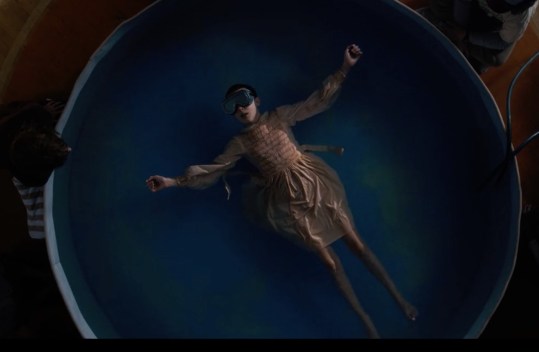
netflix
Screen cap: Netflix

In order to defeat the Creature, to seek out Will in the Upside-Down, El has to recreate the sensory deprivation experiments which were conducted upon her in the Department of Energy lab. Floating in the water, she appears Christ-like, as if her soul must endure the rituals of crucifixion in order to bring back Will from the Upside-Down (symbolic immersion?). Like Nancy, she is deathly thin, her physical presence pale against the strong personalities of the male characters. Her corporeal existence is almost shimmering: she is slow at first, learning words and meanings, piecing things together. Not only does this emphasise the shock of her telekinetic powers, but also it sediments the show’s strange interplay between the ethereal and material.
7.jpg
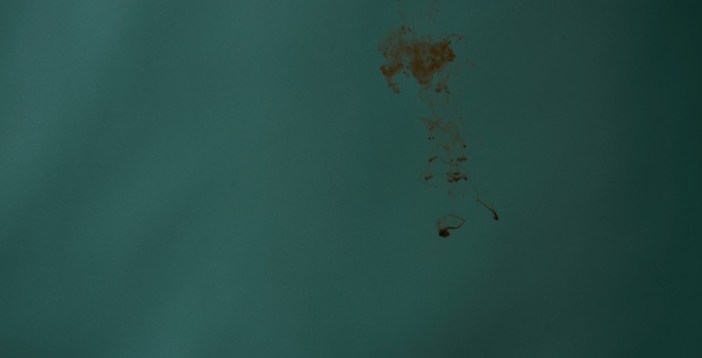
Spilt blood…Screen cap: Netflix

Stranger Thing’s preoccupation with eating is one manifestation of this. It’s all very Freudian. Jonathan makes eggs for his mother and tries to get her to eat. Arguments occur round the family dinner table. In the Upside-Down, Nancy sees the Creature feeding on a deer and realises its attraction to spilt blood. The cadaverous El is always ravenous and is frequently seen eating. In fact, at one point she blithely steals frozen waffles from a supermarket and devours them in the woods. Food is a prominent symbol in fairytales. Food, of course, is closely related to abjection. Fundamentally, the digestion and excretion of food reminds us that we are part of an enmeshment of material things; unfortunately, we cannot transcend the flesh prison which sustains our beautiful souls…Kristeva’s description of the abject reaction of food disgust is worth quoting in full, as her sentences gather a certain pace that mimics the physical spasms of reaction, the desire to expel the self in the experience of disgust from the food object which reminds us that we too are bodies, layered and soft and mortal:

Food loathing is perhaps the most elementary and most archaic form of abjection. When the eyes see or the lips touch that skin on the surface of milk—harmless, thin as a sheet of cigarette paper, pitiful as a nail paring—I experience a gagging sensation and, still farther down, spasms in the stomach, the belly; and all the organs shrivel up the body, provoke tears and bile, increase heartbeat, cause forehead and hands to perspire. Along with sight-clouding dizziness, nausea makes me balk at that milk cream, separates me from the mother and father who proffer it. “I” want none of that element, sign of their desire; “I” do not want to listen, “I” do not assimilate it, “I” expel it. But since the food is not an “other” for “me,” who am only in their desire, I expel myself. I spit myself out, I abject myself within the same motion through which “I” claim to establish myself. That detail, perhaps an insignificant one, but one that they ferret out, emphasise, evaluate, that trifle turns me inside out, guts sprawling; it is thus that they see that “I” am in the process of becoming an other at the expense of my own death. During that course in which “I” become, I give birth to myself amid the violence of sobs, of vomit.

(Kristeva 1982: 2-3)

The inside-out unsheathing of the body and its skin (the skin of flesh, the flesh of food) mirrors the Upside-Down Alice in Wonderland reversal and parallel convergence of realities. There is always a reversal, another possible surface. The mutation. Nothing is stable but always in movement. The spasms here mirror the shrieking of the self in the grip of grief: in Twin Peaks, Laura Palmer’s mother shrieking in hysteria; in Stranger Things, Joyce Byers rattling with terror as she storms around her own home, trying to find her lost son. The psychosexual implications of Kristeva’s passage are also relevant to Stranger Things because, let’s face it, there is something womblike and vaginal about the viscous, flora-infested environment of the Upside-Down, its gross and mollusc-like mucus and glistening ectoplasm. It’s perhaps no coincidence that Nancy loses her virginity the same night that her best friend Barb is sucked into that orifice-like portal of the monstrous feminine, the gooey nether-zone where she will find herself woven into the lining, her body penetrated by the infestations of disgusting slug and snake-like creatures. Like Cinderella, Barb pricks her finger (though on a crunched beer can, not a spindle) and is doomed to some sort of eternal sleep.

Netflix.jpg
Screen cap: Netflix

At one point in the show, one of the lab workers enters the portal in the Department of Energy and despite clinging to a rope, is irrevocably drawn into the depths, never to see the light of day again as the mouth of the portal closes. There’s the whole vagina dentata (religious myth of the toothed vagina) psychoanalytic strand here which would be interesting to pursue, especially as the implications of castration anxiety connect back to the Creature’s missing eyes/face. As in Twin Peaks, the portal to the other world (Black Lodge) will only open under certain conditions. With Kristeva’s passage on the skin of milk, we can think about how the entrance to the Upside-Down is itself an instance of abjection: the expelling of bodies and matter between worlds. The inside is clearly toxic as the lab workers don protective suits to enter; there is even a suggestion of the post-nuclear landscape in the way that an ash-like matter floats in the atmosphere, again fitting in with the monstrous nature/alien space theme.

Netflix.jpg
Screen cap: Netflix

As Nancy tumbles out from the forest portal (housed inside a tree), sticky with all the weird stuff that comes off the world’s ‘lining’, she is quivering with terror in a manner reminiscent of Kristeva in the rejection of the milk. Freud theorised that young boys were scared of their mothers due to the fear she would castrate them, and maybe there’s a reading that the whole show is some phantasmagoric, dreamlike manifestation of the terror of the overbearing ‘hysteric’ mother (Joyce). The winding strands of plant-like matter, snake-like and strange, are reminiscent too of Medusa’s head. Freud has a whole essay, ‘Medusa’s Head’ (1922), on the possibility/implications of Medusa’s head taking ‘the place of a representation of female genitals, or rather if it isolates their horrifying effects from their pleasure-giving ones is familiar in other connections as an apotropaic act’—namely, the commitment of evil. Interesting how Stranger Things teases with the gendering here: the male-dominated U.S. Government vs. monstrous feminine nature – which is more evil? Science or the (super)natural? I think the Alien films are probably the most obvious Stranger Things intertext here, but the very fact that the show wears its myriad influences on its sleeve creates a web-like structure of inference that opens itself up to multiple readings that cut across the cultural timelines of the twentieth and twenty-first centuries, spreading out monstrously, contaminating discourses both pop cultural and scientific.

The show plays constantly with this weirdly distorted womb/plant/viscous/genitals imagery and I can’t help but think perhaps it represents some kind of monstrous mother nature, the vengeance of the earth against the interfering experiments with time-space enacted by the US Government and its Department of Energy… Hyperobjects like global warming, plutonium and oil slicks are defined partly by their viscosity: ‘the more you know about a hyperobject, the more entangled with it you realise you already are’ (Morton 2010a). The more we as viewers learn about the strange world of the Upside-Down, the more we see it in our own reality. Monstrous, oozing nature. Ourselves in the mirror: the strange stranger – the notion that the closer we get to other life forms, the weirder they become (Morton 2010b: 17). The constant recurrence of floods and hurricanes and melting ice caps, irrevocably now understood as the consequences of global warming: they acquire an almost anthropomorphised monstrosity.

At the end of the series, Will, restored to apparent ‘reality’ (signified by that most traditional of temporal markers, perhaps the most important date in the calendar, Christmas Day), coughs up a slug-like creature and once again glimpses the Upside-Down again, flashing through the palimpsest surface of the normal world, reminding us of the imprint of the ecological uncanny, the presence of the strange, nonhuman other, within ourselves. I am struck with a line from Coleridge’s poem, ‘The Rime of the Ancyent Marinere’ (1798), where, after facing the nightmare wrath of the storms following his shooting of the albatross (the fatal crime against ‘nature’), the mariner glimpses the gross multitudes of sea-snakes in the ocean below his boat, shimmering among the floating corpses of his fellow sailors, lost to the storm: ‘And they all dead did lie! / And a million million slimy things / Liv’d on – and so did I’. The mushy consonance of the l sounds here recreates the oozing viscosity of all those wriggling bodies, but there is a sense in which the mariner seems to revel in the sheer multitude of these ‘million million slimy things’, as the repetition suggests—their individuality as types of species is beyond his grasp and he can only face them as a kind of hyperobject, the sharp realisation following the caesura (-) indicating the revelation of coexistence, which is both wondrous and terrifying.

Indeed, there’s something about El’s telekinetic powers too, the way they can elasticate reality, bending objects and shattering matter, but at the expense of something inside her, the price of the blood that oozes from her nose each time, signifying her depleted energy. She is no robot, but material and mortal too: the recurrence of the blood and its spilling viscosity insists on this. El’s ‘magic’ enacts a disruption of foreground and background; we cannot just perceive it as magic, for we have witnessed its basis in a kind of scientific experiment within the labs. It comes out of the world, disrupts the subject. Stranger Things is rife with pathetic fallacy – storms and power blackouts – and this isn’t just a contribution to the horror mood but also an underlining of the show’s ecological context and monstrosity: the collapse of weather as mere background, stage-setting, into the narrative itself (the significance of electricity in the show is still to be traced) signals the impossibility of the world as such. ‘We have no world,’ as Morton so aptly puts it, ‘because the objects that functioned as invisible scenery have dissolved’ (2013: 104). What happens when you think through the world as the world, rather than from an anthropocentric viewpoint? Peter Watts has written a short story titled ‘The Things’ which reverses the perspective of Carpenter’s movie, this time telling the story from the virus’ point of view (note the plural things and think back to the mutational plurality/chains of the virus)—once again, disruption of subject/object ordering. What is an alien consciousness? What is nature’s consciousness? The only way we can find out is by recognising nature’s strangeness, and that strangeness is inherently within us too. In Stranger Things, the dissolution of objects is part of the show’s exploration of the uncanny (walls and doors shift, ooze, open and close) in relation to the monstrous (and this is rooted in other themes beyond the scope of my essay; for example, the nuclear family and adolescent sexuality), but also the monstrosity of nature enacting its gross and terrible vengeance against man’s interference: El, little pixie child of the forest as she becomes, is able to manipulate objects, thus denying their status as mere staging and indeed staging them as vitalist forces in themselves (so far, so Object Orientated Ontology?).

On the subject of ‘energy’ and electricity it isn’t just El’s psychic energy and the deceptive title of the ‘Department of Energy’ that resonates in Stranger Things. ‘Energy’ also points us to the vitalist elements of Stranger Things; namely, its interest in the networked relations between humans and technology, the way that communication and transmission rupture not only the fleshly interaction of humans but also the metaphysical boundaries between life and death. For starters, there’s the song played against the opening title: New Order’s ‘Elegia’. What first struck me about this track was the dissonant synths, the way they creep up on you in mesmerising waltz-time, the guitars, piano and synths enveloping one another in counterpoint melodies. NME tells me that the song was written as a tribute to Ian Curtis and it’s almost impossible to listen to the 18-minute track, whose elegiac status is inscribed in the very title, and not think of absence, death, the plunge into void, the journey through its swirling, miasma-like movements which render eerie and maybe even ‘inhuman’ our experience of temporality. Before this contextual note, however, I was weirdly reminded of ‘Lavender Town Syndrome’: the 1990s internet myth surrounding the music from Pokemon Red and Green. The MIDI track from this particular town is indeed extremely jarring, run on two channels so that the sound travels literally through one ear and out of the other and thus fusing in the brain to create a certain sonic effect. There were rumours that this effect caused suicides and seizures until the MIDI track was ‘tamed’ for the American version.

While the story was more or less sheer internet rumour, it’s still provocative and raises questions about the ghostliness (or, as Warner might put it, phantasmagoria) provoked by the phantasmic structures of media technology. Aphex Twin, for example, embedding a spectrograph image inside an audio file, the implications of such a shape upon sound: screeching, searing static. The sound of a ghost trapped in a glitch world? If the glitch is an accident, then what is a ghost? An accident of time and space, trapped in the in-between, reminding us of the fragility of time-space itself? Of being itself? Sound, after all, is temporal; a MIDI track is self-containing in its temporality. You can loop it, but it has a form and a shape, a beginning and ending. Does the ghost have a beginning and ending? When I listen to the original Lavender Town track, I can definitely feel a kind of fuzziness or vibration in my brain, as if the frequencies of my thought were suddenly being played upon, synapses twisted and twanged as if in electro-convulsive therapy; or like the sensory experiments upon the brain portrayed in Anthony Burgess’ A Clockwork Orange and indeed in Stranger Things, inspired by the psychedelic investigations of the 1960s and 70s, name-checked in the show as ‘MK Ultra’ – incidentally, also the title of one of Muse’s most politically paranoid songs. An early configuration of this could be the Romantic Aeolian harp, which represented the mutual ‘play’ of sound, expression, music, poetry and impressions between the world and the artistic mind (see Shelley’s ‘A Defence of Poetry’). What these aural effects again reinforce is the dissolving of subject/object, as sounds from the so-called ‘environment’ feed into our brains, penetrate the boundaries of the self and flesh and in doing so enact a kind of digital Heideggarian poeisis, wherein the arrangement of sound itself (like words on the page of a poem), causes something to actually happen, to come into being. What is this being? The experience of terror, a sudden rupture of consciousness as the soundwaves pulse through the brain? Sensation, in its flux, placing us under erasure, as we fall away from consciousness? Where are we now, reaching back for the material symbols of the soul that would save us from the sea of dissonant, consuming music? Stranger Things evokes a rich sonic atmosphere, full of grotesque, squelchy, pulsing, oozing, insect-esque sound effects which trickle the presence of monstrous nature, of the metaphysical strangeness of the Upside-Down and its plant-like materials, straight into our brain.
Screen Shot 2016-10-08 at 02.44.51.png
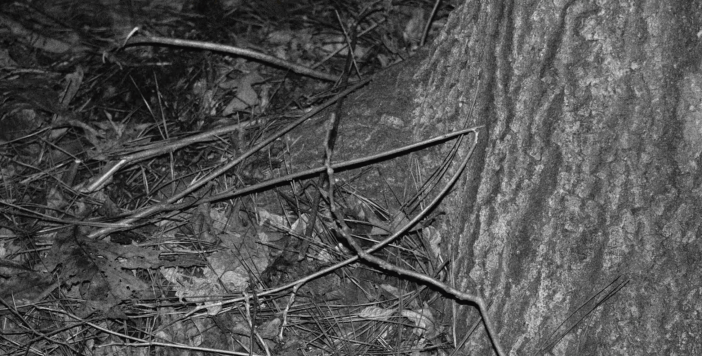
Jonathan’s photography. Screen cap: Netflix

Attached to the auditory is the technological unfolding of the visual. Throughout the series, photography plays a significant role in the identification of the beast/creature. Following the scopophilic power of the male gaze (and of course another Blue Velvet reference is inevitable here, Jeffrey peeking through the closet at the acts of domestic sexual violence), Jonathan sneaks into the woods to take photos of Steve’s party, snapping pictures of Nancy for whom he harbours a secret desire/teenage love. Yet what remains in the photos isn’t just the form of his beloved, but the strange shape of the beast, captured indelibly in the developed ink:

Photography is a mode of tekhnē – a making appear (technology “makes” something “appear” out of parts, raw materials; it is thus the truth of the physical world; we make, we cause to appear things, commodities, but what does photography make appear? Images made of shadows, light and dark – in this it causes to appear an event no longer there, no longer with us; it gives us to see what we cannot otherwise see.

(Dick and Wolfreys 260)

There is a sense in which photography is, like the New Order track, inherently elegiac—or at the very least, represents the flicker between presence and absence, since the material presence of the photograph is haunted by the absence of what it represents, the not-there, the once-happened. As in the play of light and dark, positive and negative space, the photograph captures the liminal position between presence and absence, matter and ethereality. It is thus, as Barthes shows in Camera Lucida ( 1980), a medium closely associated with death. The shape of the beast is barely distinguishable in the photograph, especially with the added layer of another camera, and the computer screen through which we stream the Netflix content of Stranger Things itself. The temporality of the photograph is thus strangely ephemeral, despite its suggestion of a ‘snapshot’, a reification or fixing of the moment. There is a ghostliness to the photo: ‘it bears witness where there is no witness’ (Dick and Wolfreys 2015: 261); it reduplicates the sense of presence as reading the image bears another kind of birth, the control of the eye/I at the focal point in another space of time which is always overtaken by the image and its embodiment of another time–the displacing and shifting incurring is a kind of haunting.
sheryl-lee-twin-peaks.jpg
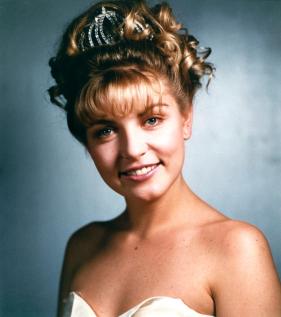
Laura Palmer’s homecoming photo from Twin Peaks

Think of Twin Peaks, another series whose entire plot hinges on absence, namely, the death of its main character, Laura Palmer, which occurs before the show’s diegetic action even begins. Laura’s absence is primarily signified by the presence of her prom queen portrait photograph, which occupies not only the mantelpiece of the Palmer home but also the end credits of every episode. Played over with the melancholy Angelo Badalamenti score, the picture serves to remind us of the presence of Laura as narrative phantasm, the way that the absent/dead Cathy and Heathcliff haunt Nelly’s recollected narrative in Wuthering Heights. 

Ghosts, then, are not just the creaky ghouls of Gothic castles, but instead are inextricably linked to the replicating capacities of technology and indeed narrative itself as a medium of recalling some thing or person or event, thereby disruptively evoking the past in the present, disturbing presence itself. As Derrida puts it:

Contrary to what we might believe, the experience of ghosts is not tied to a bygone historical period, like the landscape of Scottish manors, etc., but … is accentuated, accelerated by modern technologies like film, television, the telephone. These technologies inhabit, as it were, a phantom structure…When the very first perception of an image is linked to a structure of reproduction, then we are dealing with the realm of phantoms.

(Derrida 1989: 61)

In addition to photography, electricity and telephone communication are prominent mediums through which the ghostly is figured in Stranger Things. Joyce starts to hear Will calling to her through electricity—through the lamps and electric lights strung up in her home. She answers the telephone and hears his voice through the ambient rasping, and we can hear glimpses of that gooey, squelching monster sound. She literally rips the telephone out the wall trying to get back to him, causing another spatial rupture in the material world which started with the ephemeral, the sound of the phone call. Her makeshift séance codex constructed out of letter posters and the flashing bulbs of fairy lights renders literally the evocation of the dead through writing, the Derridean play of presence and absence which dissolves subjectivity in the space between speech and writing. Here Will can only communicate by flashing the lights, so that his presence is available only through the transmission of a kind of Morse code. At the end of episode two, as Joyce tries to navigate the suddenly terrifying environment of her home, seeking the source of the noise and of Will’s possible voice, the soundtrack, heard by us and by Joyce through the walls, is the Clash’s ‘Should I Stay or Should I Go’ – a song which ironically renders the subject’s lingering on the threshold between going and staying, presence and absence. Joyce’s discovery of the song playing on the stereo as if by magic is uncanny because the familiar song becomes wrenched from its normal experience and is here recontextualised as extremely disturbing and perhaps even tragic, the flicker and stutter of its playback following the jilted rhythms of a voice, a soul, a subject, trying to pierce through some unseen border, to transmit signals to his mother.

2.jpg
Phantasmagoria…Screen cap: Netflix

At one point, Joyce gets so far as to catch a glimpse of her son through the wall which becomes a glass screen, but soon he vanishes, the wall returns to being a wall that is now smashed and the daylight is beaming through, reminder of the permeability of all borders, the fragile boundaries of the home. When the estranged husband, father of Will, comes to visit, he makes attempts to patch up the physical confines of the home, but this patriarchal intrusion of order and reparation of stability does little to stabilise the spirits of the house: the invasive Creature, which howls in the wall, and Will, who calls through the lights.

What we get is a sense of Joyce’s claustrophobic mania, her absolute loneliness as she desperately tries to seek out signs of her son’s presence. Jonathan makes attempts to help her, to make her breakfast and be strong for her, but he too prefers to retire to his room and listen to his new wave melancholia, eyes transfixed on the constant whorl of the tape spools. As Joyce fashions a codex for communication, I think back to the idea of writing itself as a kind of call. In writing, the self dissolves, is irrevocably split (so far, so Lacan), but the same is true of speech:

[…] we come to apprehend a ghostly structure at work, which informs the condition of being human, and with that all forms, instances, possibilities of communication between the self and the other, the host and the guest or ghost, the living and the dead. Even if no one has said anything to me, when I begin to write, or when I start talking – to give a lecture, or in a seminar – what I call “my” words, arrive as a response to some unheard, but nonetheless persistent call […]

(Dick and Wolfreys 2015: 28).

There is, then, an uncanny disruption of subjectivity within the voice itself, a spacing of difference and deferral. Whose words am I speaking? In the experience of hearing Will’s voice, we undergo the creepy realisation of his presence penetrating the possibilities of time/space (how can you speak from the realm of the dead?) at the same time of the technological reproduction of his voice adding another layer of ‘removal’, of phantasmagoric embodiment to Will’s ‘self’ or indeed ‘soul’.

I would argue that the show’s real obsession is not with Cold War governmental conspiracy, but with transmission and networks. I wrote my undergraduate dissertation on how Tom McCarthy’s novel C (2010) approaches the discourse networks of twenty-first century internet and wireless technology by representing the wireless networks of the early twentieth century’s radio communication, in doing so carving out a media archaeological approach to literature and theory that renders the always-already status of subjectivity and human communication as a form of transmission, indelibly connected to texts and technics. McCarthy’s protagonist, Serge, tunes into the radio frequently, but even as he listens to a gramophone, the unravelling distortions of his dead sister’s voice tune into his brain through a psychoanalytic panoply of incest, desire and technological anamnesis:

The cylinders and discs are still there. When he plays them now, her voice attaches itself, leech-like, to the ones recorded in them – tacitly, as though laid down in the wax and shellac underneath these voices, on a lower stratum: it flashes invisibly within these crackles, slithers through the hisses of their silence.

(McCarthy 2010: 78)

Here the material paraphernalia of the gramophone has the effect of a medium in the telekinetic sense of communing with the dead; only Serge never speaks back, he only listens. The leech-like imagery conjured here, with the slithery plurality of voices, the intrusion of external sounds (‘these crackles’) recalls the slimy imagery of Coleridge’s water-snakes and indeed the Upside-Down: these are parts of ‘the world’ of matter that cannot be elided, that flicker in the strange temporal space which technologically carves out (in its ‘archaeological’ and reproductive function) between life and death. Sophie, the dead sister, returns as material detritus, reminding us again of our enmeshment (here physical embedding) within the material world. As the ‘wax and shellac’ score ‘these voices’, Warner’s figuring of the phantasmagoria of the soul appears again: the soul is here literally materialised, but only as recollected fragments. This is an ecological point in the sense that it underscores our dependence on the matter of technics as an entry point into being, since memory is crucial for our sense of selfhood, its recollection the temporal play that brings a sense of presence—of duration and continuity, though predicated on movement and the spacing of image and sound, the material, sensory forms taken by memory. There is something in this inherently connecting the child and the technological machine. Perhaps it is because children are closely associated with futurity, and their death (living on only in memory fragments) uncannily disrupts our sense of the linear ‘order’ of things. Perhaps also because of the history of the technical media itself:

As the literary critic Laurence Rickels points out, the technical media first create these children – “create” in the sense of constituting them as modern subjects by inscribing them across their wax- and nitrate-plated surfaces, framing them within their boxed walls – then, once the children are dead, provide the mausoleums they inhabit. “Every point of contact between a body and its media extension,” he goes on to argue, “marks the site of some secret burial.

(McCarthy, Tom 2012)

Will’s friends try to reach out to him by playing with the Ham radio at school, eventually getting through to him from the Upside-Down and in the process exploding the equipment. Is this burst of flames the violent rupture of the Real, another signal that the boundaries of the symbolic and indeed metaphysical order are being ruptured? The revenge of physics against a narrative of possible mysticism? When El encounters the spooky Russian man upon one of her sensory deprivation trips, he is muttering random words which sound like a radio transmission. El herself is a transmitter. She is the explosive node in the network which opened up the gateway between the ‘real world’ and the Upside-Down. In a kind of re-imagining of Donnie Darko, the boys question their science teacher on the multiple worlds theorem, and I have tried to read up on the physics and relativity theory but my poor wee humanities brain can’t quite hold it all together. Still, the idea of multiple worlds implies being as becoming. There cannot be stable presence, singular origin of selfhood, when multiple possibilities can coexist…I think of the protagonist of Charlotte Perkins Gilman’s The Yellow Wallpaper (1892) tearing at the grotesque yellow wallpaper as if seeking for the opening, the wound in the fabric of reality, which would let out that terrible voice, the face that she sees in the multiplicities of arabesques, which perhaps are not that unlike the floral arabesques of the green, ivy-like winds of the Upside-Down’s ‘lining’, hungry as fly-eating succulents in the greenhouse of Hell…

There are times when the absent/spirit/representational world ruptures into reality. This is the terror of Lavender Town Syndrome. Pokémon Go literally makes a game out of it, by placing Pokémon to be caught within the cartographies of ‘real’ space. We are obsessed with this slippage of the real and the illusory as palimpsests, where sometimes elements of each world slip through to the next. Slender Man, which grew out of an internet myth, the placing of a ghostly trace figure within digitally-manipulated photographs, flowered as if by evolutionary monstrosity into an elaborate urban legend. Breaking the fourth wall, two 12-year-old girls from Wisconsin have been charged with first-degree attempted homicide for trying to stab their friend to death, citing the demands of Slender Man as the cause of their actions. The blur between fiction and fact stares us straight in the face of this real-world ‘tragedy’. Was Slender Man ‘real’ if the girls truly believed in him and acted on accord of his illusory voice? What are the ethical implications of this infiltration of myth narrative within our phenomenological experience of the world? Often, we see the characters seeing the Creature more than we see the Creature (for example, when Barb is attacked at the poolside), and could this relational depiction of terror be a way of drawing us in further to a shared ontological understanding of the pervasiveness of the monstrous, rather than merely a cheap horror movie trick aimed at suspense? Isn’t suspense itself a disruptive force, holding hostage the linear ideology of progress in favour of the rhythm of the ‘shock’ which loops back into the past and halts the present?
img_1864
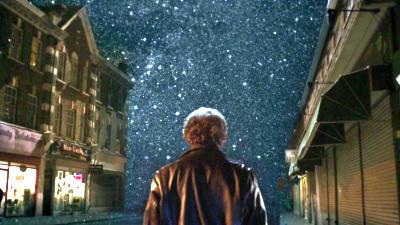
Facing the limits of space-time…Ashes to Ashes. Image source: jimcofer.com

In his book Haunted Media, Jeffrey Sconce eloquently explores how television came to be figured as uncanny, as the interconnecting medium between multiple worlds. The medium itself seemed to embody a hauntological structure, with the appearance of television ‘ghosts’, whereby wispy doubles of the actual figures onscreen cast a spectral aura around their ‘real’ counterparts: ‘not so much as shadows, but as disembodied echoes seemingly from another plane or dimension’ (Sconce 124). The combination of sound and image thus proliferates the ghostly possibilities of reproduction. The BBC series’ Life on Mars and its sequel, Ashes to Ashes take this to its logical extreme by exploring television as a medium for transmission across time and space. The central characters wake up in a parallel reality where they have a similar job only they have gone back in time by several decades, forced to work on police cases which will have ramifications for the future and indeed cases whose origins are the source-code for events already experienced in the characters’ present-moment temporalities. A whole other essay is required for analysing the complex play between technology, ontological instability, nostalgia and memory here (as well as comparative police culture!); but I can briefly say that, as in McCarthy’s novel, the exploration of past technologies is often used as a way of commenting on the present.

Moreover, the figuring of technology’s ‘ether’ connects to the metaphysics of the series itself, as we gradually discover more of the mechanics of time and space within Life on Mars and even more so on Ashes to Ashes. At the start of each episode of Life on Mars comes the refrain: ‘My name is Sam Tyler. I had an accident and woke up in 1973. Am I mad, in a coma, or back in time? Whatever’s happened, it’s like I’ve landed on a different planet.’ If the past seems like a ‘different planet’, then we are always-already inherently split: are our former selves and the lives we lead and have led fundamentally alien, as soon as they have happened? We gradually discover that the world inhabited by the ‘past’ characters (as opposed to the twenty-first century present) is a limbo of sorts, and this is revealed as characters start to glimpse aporetic fragments of starry ‘space’ towards the end of Ashes to Ashes. Like Joyce piercing through some dimension in her ripping holes in the wall, these characters uncover the stage-setting of the world around them. Space is figured as space in the physical sense (galaxies of matter) but also in the textual sense of rupture, pause, gaps in representation. No system is bounded or closed. There is a sense of the lost future, that which was snatched away from the dead, though lies still in its imminence. An elegiac sense of the stars, as often we perceive the dead as stars (which are themselves dead suns, and once again that idea of the flickering of light/shadow, presence/absence…). But also, the star spaces as portal/threshold, reminding us of the tangible and perhaps even elastic physical and ethereal spaces. What is it that calls us to open the door, to step forth? Upon what authority? Is it the voice within the self, irrevocably spilt as uncannily other? How does El vanish through the blackboard, along with the Creature? We are drawn to the liminal as we are drawn to the abject, precisely because there is a recognition of the enmeshment of things (Morton’s dark ecology) and the gaps in the web fascinate our sense of being as living species in relation to all other categories of being: the nonhuman, the (super)natural, the living and dead. In Life on Mars and indeed many other literary or dramatic representations of uncanny technology and its transmissions, these metaphysical hauntings are linked to the structural effects of television itself:

The introduction of electronic vision brought with it intriguing new ambiguities of space, time, and substance: the paradox of visible, seemingly material worlds trapped in a box in the living room and yet conjured out of nothing more than electricity and air. […] Unnervingly immediate and decidedly more tangible, the “electronic elsewhere” generated by television was thus more palpable and yet every bit as phantasmic the occult empires of previous media.’

 (Jeffrey Sconce 2000: 126)

What is the effect of watching television in the perpetual present enabled by the internet? The browse-all, constantly-refreshed interface of Netflix? There is an added layer of immediacy which renders the nostalgic 1980s setting of shows like Ashes to Ashes (which isn’t on Netflix by the way, last time I checked) and Stranger Things even stranger, like we are reaching through a portal upon our return to their ontologically-distorted worlds. The representation of now-disused technologies as uncanny, their transmissions disturbing and problematic, prompts reflection on our contemporary digital condition. Elizabeth Bridges sums this up perfectly:

Stranger Things gets the fact that silence feels uncanny in 2016, that a lack of noise and flashing screens makes people anxious now, that it feels…. off, eerily desolate. The jolt of a ringing phone amidst a sea of silence seems jarring for us in a way that it would not have felt in 1983. Oddly normal moments in this series make us jump out of our skin.

(Bridges 2016)

Our present condition, the always-on, archiving-on-the-fly status of digital and portable media, renders the world of constantly disrupted communication even more strange. There is another level of disconnection, a rupture in the present, the shock of a telephone ringing. When was the last time your house phone went off when you were at home alone? The human voice recorded seems strangely anachronistic now, a product of lost time; I can’t recall the last time I made a voicemail message, or even listened to one. There’s something about the recorded voice, floating out there in the ether…the sound of the answer machine, the creepy litany, please hang up and try again, in crisply forgotten Queen’s English…

There looms, within abjection, one of those violent, dark revolts of being, directed against a threat that seems to emanate from an exorbitant outside or inside, ejected beyond the scope of the possible, the tolerable, the thinkable. It lies there, quite close, but it cannot be assimilated.

 (Kristeva 1982: 1)

Perhaps it is not the conspiracy theories or the paranoid Cold War plots or the violence that frighten us. Perhaps it is the mediums of transmission themselves, carrying wave upon wave of voices, disembodied, from different times and dimensions, bearing the abject realities which render the folds in the fabric of our being, the slippages between past/future, self/other, subject/object and life and death itself…Perhaps all technological recordings mark a death of sorts, a vital split between the transmitting subject and the transmitted object. That is the technological uncanny, and its violation of foreground and background is what draws us back into the enmeshment of a dark ecological awareness, the sense of the importance of things—the understanding that we too, as humans, are things

Bibliography

Barthes, Roland, 1980. Camera Lucida (Hill and Wang).

Bridges, Elizabeth, 2016. ‘The Perils of Childhood – Stranger Things, Season 1’ <http://uncannyvalley.us/2016/07/stranger-things-season-1/&gt; [Accessed 11.10.16].

Coleridge, Samuel Taylor, 1798. The Rime of the Ancyent Marinere, in Seven Parts. <http://www.rc.umd.edu/sites/default/RCOldSite/www/rchs/reader/rime4.html> [Accessed 11.10.16].

Connor, Stephen, 2006. ‘Her Light Materials’ <http://stevenconnor.com/phantasmagoria.html&gt; [Accessed 11.10.16].

Creed, Barbara, 1993. The Monstrous-Feminine: Film, Feminism, Psychoanalysis (London: Routledge).

Derrida, Jacques, 1982. ‘Différance’ in Margins of Philosophy, trans. by Alan Bass (Chicago: University of Chicago Press), pp. 3-27.

Derrida, Jacques, 1989. The Ghost Dance: An Interview with Jacques Derrida by Mark Lewis and Andreas Payne, trans. by Jean-Luc Svoboda (Public, 2).

Derrida, Jacques, 2002. ‘The Animal That Therefore I Am (More to Follow), trans. by David Wills, in Critical Inquiry, Vol. 28, No. 2, pp. 369-418.

Dick, Maria-Daniella and Julian Wolfreys, 2015. The Derrida Wordbook (Edinburgh: Edinburgh University Press).

Kristeva, Julia, 1982. Powers of Horror: An Essay on Abjection, trans. by Leon S. Roudiez (New York: Columbia University Press).

McCarthy, Tom, 2010. C (London: Vintage).

McCarthy, Tom,  2012b. Transmission and the Individual Remix: How Literature Works, [Kindle edition; accessed: 23.8.14] (London: Vintage Digital).

Morton, Timothy, 2007. Ecology Without Nature: Rethinking Environmental Aesthetics

Morton, Timothy, 2010a. ‘Hyperobjects are Viscous’, Ecology Without Nature <http://ecologywithoutnature.blogspot.co.uk/2010/10/hyperobjects-are-viscous.html&gt; [Accessed 11.10.16].

Morton, Timothy, 2010b. The Ecological Thought (Cambridge: Harvard University Press).

Morton, Timothy, 2013. Hyperobjects: Philosophy and Ecology After the End of the World (Posthumanities) (University of Minnesota Press).

Sconce, Jeffrey, 2000. Haunted Media: Electronic presence from Telegraphy to Television (London: Duke University Press).

Shelley, Mary, 2009 [1818 edition]. Frankenstein (Oxford: Oxford World Classics).

Warner, Marina, 2006. Phantasmagoria: Spirit Visions, Metaphors and Media into the Twenty-First Century (Oxford: Oxford University Press).

Watts, Peter, ‘The Things’, Clarkesworld Magazine <http://clarkesworldmagazine.com/watts_01_10/> [Accessed 11.10.16].

Woolf, Virginia, 1921. ‘Henry James’ Ghost Stories’, The Times Literary Supplement, No. 1040, 22nd December, pp. 849-50.

S21.jpg
Screen cap: Netflix

The Dreamlike Nihilism of Bret Easton Ellis’ Less than Zero

IMG_3393

There’s something about Bret Easton Ellis. Whether it’s the alluring cool of a literary ‘Brat Pack’, the frisson implied by a 1980s enfant terrible or the fact that he published his first novel while still in college, aged 21 (the canny bastard), I find myself drawn to his presence both as a cultural persona and simply as a man of interesting writerly craft. I have been listening obsessively to his podcast for a few weeks now, engrossed in his attacks on the millennial ‘cult of likability’, on the pop cultural salivation over a tv ‘golden age’ and on the lack of context which accompanies the bandying around of quotes online (and the accompanying Twitterstorm). Part of it, I guess, is the perspective of a millennial (me) feeling they have something to learn from a Gen-Xer. Part of it is simply that Ellis does have his own particular brand of pop cultural and authorial genius. This article hopes to delve into this genius by looking at Ellis’ debut novel, Less than Zero, which I recently reread. 

5492920817_dda5b315ec_z
‘Fast Lane’ – Photo of Los Angeles by Neil Kremer

Turn up the TV. No one listening will suspect,
even your mother won’t detect it,
no your father won’t know.
They think that I’ve got no respect
but everything means less than zero

(Elvis Costello, ‘Less than Zero’).

See above the chorus from Elvis Costello’s song, ‘Less than Zero’, released in 1977 on the My Aim is True album. Costello has written that the song is about totalitarianism and fascism. What does it mean for Ellis to take this song as the title for his novel? – a novel which doesn’t exactly exude the anarchic spirit of 1970s punk, nor does it make any overt political critique. Nevertheless, Less than Zero is a political text on some level, in so far as it deals with the subject/self under late capitalism. Costello sings about something secret, an inner feeling that you can drown out with the static sound of television. What kind of secret is concealed here? The absolute flatness of existence, the alienating depression that creeps and inhabits your bones? I’ve got no respect. For what – the world? What do your parents matter in this life without boundaries, where morality thins to a flimsy image, where selfhood is nothing but the label on your trainers? This is a world of regression, degeneration, of falling from grace, redefining what the hell grace is. It’s the secret inner disgust for all that surrounds you. The sadness bursting in your brain, the endless lines of cocaine…

So goes the life of Clay, the protagonist from Bret Easton Ellis’ debut novel, Less than Zero. Published in 1985, it’s often lumped together with the likes of Tama Janowitz’s Slaves of New York and Jay McInerney’s Bright Lights, Big City as an exemplary work of the 1980s literary Brat Pack: writers who encapsulated the alienated experience of Generation X, often influenced by journalism and the movies as much as that elusive category of literature known as the Great American Novel. Less than Zero follows Clay’s return to his family home in Los Angeles after his first semester at college. Yes, it could be considered a Gen X Catcher in the Rye, where the apathetic perception of cultural phoniness plays out against a backdrop of sex, drugs and snuff films. However, while Salinger’s novel exposes the adult world as darkly sham and shallow, Ellis’ turns its attention to the synthetic lives of Clay and his fellow adolescents. Unlike a traditional bildungsroman, it lacks plot and narrative and that most perjured and celebrated of terms: humanist subjectivity. The question of character development in the novel is mostly a non-issue, as Clay ‘grows’ only in the sense of growing more detached from the world around him, more aware of his own indifference.

In a way, Clay is the perfect model of a disillusioned teenager, and Ellis nails the setting. Where better to lose all sense of self and reality than in LA, the city where dreams and visions are spun on film reel and everyone’s an actor, or at least the spawn of one. Clay and his friends live hollow lives, gorging themselves at the playgrounds of consumerism offered by the city: fancy bars and clubs, endless bottles of Perrier and expensive therapy. The novel more or less follows a repetitive structure, the narrative moving in a series of vignettes as Clay moves around, calls a friend from a payphone, drops by people’s houses, goes to a club, takes drugs, gets laid, hangs out by the pool, smokes a joint. Little else happens. It’s all in the accumulation.

I’m not saying this is an avant-garde novel, working through ‘accumulation and repetition’ in the way that Zadie Smith said of Tom McCarthy’s debut, Remainder (2005) in her famous NY Times essay, ‘Two Paths for the Novel’. Ellis is less interested in ripping apart the contemporary consumerist (and humanist) literary establishment than in using this establishment, its obsession with pulp (check out the noirish drug/snuff/pimp plot) and branding to unravel the vacuous experience of being young and glitteringly rich in the 1980s. Part of the novel’s point is questioning whether Clay ever really had a sense of selfhood or reality in the first place – whether such things exist at all. The wastefulness of contemporary culture trickles out of Ellis’ minimalist prose, which is just as effective as Joan Didion’s was in capturing the strange alienation of the mid-twentieth century. We are left longing for something more in the gaps between his sparse paragraphs, his dull and vacuous dialogue. This is all culture. This is all politics. Only, you wouldn’t know it from the novel itself.

No, the world of Less than Zero couldn’t be more insular. Its only connection to the world outside Los Angeles is through the brand names, the song lyrics and movie references which trail through the narrative as often as Clay’s car trails along the LA freeways. Yet if literature is about subjectivity, than the subjectivity explored in Less than Zero is irrevocably damaged, fractured and, if you’re a fan of Deleuze & Guattari, schizophrenic. It’s dispersed along the various signifiers that constitute culture. All of Clay’s perception is whittled down to tiny details: the catalogue of brand names, the repeated references to physical appearance (always tan, always blonde) and the drinks that people are cradling, the glamorous food pushed uselessly round a plate. It’s a highly cinematic narrative, which sometimes resembles a screenplay. Sections of prose often begin with brief indications of time and space, the opening words in bold to quickly situate the reader in a social setting, neglecting any poetic descriptions to set the scene in favour of blunt ‘headlines’: ‘It’s a Saturday night’; ‘At Kim’s new house’ ; ‘It’s Christmas morning’; My house lies on Mulholland’.

Perhaps, indeed, it’s not all that far (stylistically) from Made in Chelsea; except take away the tv show’s sparkling jouissance (its soaring indie pop and glorious Instagram-worthy visual filtering) and replace it with the endless merging of barren surfaces which make up Ellis’ novel. Replace the easily sweet pleasures of Made in Chelsea’s gin bars and contorted gossip and romance plots with sleazy LA mansions, snuff films, heroin and bodily dismemberment…While the lack of affect in Made in Chelsea contributes to a kind of narcotic addictiveness, in Ellis’ novel it creates a sheen of unsettling detachment.

brett

People are afraid to merge on freeways in Los Angeles.’ So goes the opening line of Less than Zero. It was only when I first picked up this book, about three years ago, that I realised the connection to Bloc Party’s ‘Song for Clay (Disappear Here)’. The song, an homage of sorts to Ellis’ novel, repeats several phrases, including ‘complete disdain’, ‘live the dream’ and ‘won’t save you’. It’s a song which builds slow and sparse and then suddenly thunders with a sharp guitar riff and pounding drums. It’s sort of the experience of reading Ellis’ novel: the headache, the endless migraine of details, the food and coke and insomniac joints in the early morning. People are afraid to emerge on freeways. What does it mean? Why does it repeat in the text like some fragment from a litany? I guess you could say it’s about the fear of opening yourself to someone else, of sharing problems, being personal and ‘genuine’. You know, take this interchange between Clay and his on/off girlfriend, Blair:

“Clay?” she whispers loudly.

I stop but don’t turn around. “Yeah?”

“Nothing.”

What the hell is genuine though? Even in the privacy of his narration, Clay struggles to admit any emotional depth. His focus is always on cool detail:

I’m sitting in the main room at Chasen’s with my parents and sisters and it’s late, nine-thirty or ten, on Christmas Eve. Instead of eating anything, I look down at my plate and move the fork across it, back and forth, and become totally fixated on the fork cutting a path between the peas. My father startles me by pouring some more champagne into my glass. My sisters look bored and tan and talk about anorexic friends and some Calvin Klein model and they look older than I remember them looking, even more so when they hold their glasses up by the stem and drink the champagne slowly; they tell me a couple of jokes that I don’t get and tell my father what they want for Christmas.

It’s the immediate present tense. It’s (in)tensely detailed. The sentences drag with repetition, long and slow, heavy and stoned. Clay replaces what would typically occur in such a scene with the mundane reality, pulling out the grotesque from the shiny film of appearance. Sure, to an outsider, Clay and his family would seem like any good looking LA clan out for a fancy meal. Yet it’s immediately clear that Clay feels very distant: not just from the image but from the family themselves. His fixation on cutting a path between his peas is a bit like the cars which won’t merge on the freeway: another symbol of separation, of dividing lines. The self in its shell, stunted. He splits the peas up into meaningless scattered matter. The novel is full of meaningless scattered matter, the endless push and pull of desire, ‘back and forth’. Anorexia is mentioned several times in the novel (Blair’s friend Muriel is hospitalised for it) and the consumption of food and drink is of course central to much of the action (settings; family lunches, dinners, expensive bars). Anorexia, you could argue, is the simultaneous consumption of culture (absorbing absolutely and indeed making literal the beauty of the image, thinness and surface) but also its rejection (literally refusing to consume, to accept the consuming impulse). It provides another symbol of the contradictory imperatives of postmodern culture.

So we have branding, so we have mental illness, disturbed appetites, boredom and beauty and the annual climax of consumerism: Christmas. So far so adolescent bildungsroman. Yet unlike Esther Greenwood in Sylvia Plath’s The Bell Jar (1963), Clay is quite content to sit around in a hullabaloo, watching the world swirl meaninglessly on by around him:  ‘No one talks about anything much and no one seems to mind, at least I don’t’. The fact that he has to qualify ‘no one’ to refer mainly to himself indicates how easily the micro reflects the macro, the self reflects the culture. Clay feels like his experience of boredom and alienation is pretty much endemic, therefore uninteresting. Ellis doesn’t exactly depict a special snowflake, a depressive uniquely at odds with his society. Sure, there are times where Clay feels particularly ill at ease with what goes on around him (he sometimes leaves the room when his friends’ sex games and suchlike get too unsavoury), but never makes an effort to stop what’s going on.

One way of looking at this aspect of Clay’s personality is by comparing him to Patrick Bateman, the serial-killer protagonist who narrates Ellis’ later novel, American Psycho. While Bateman is an active assailant, Clay is relatively passive. Stuff happens to him; he drifts through life. He never has much of an opinion, openly admits to not enjoying anything. Why does this make him interesting? Maybe he resonates the dullness of culture in such a way as to provide incisions that cut apart the surface sheen of everyday LA life…

Yet we cannot easily develop a ‘cool’ relation to Clay’s narration in the way that we can in American Psycho. The sheer volume of violence and repetition of brand names and daily routines that make up American Psycho’s narrative perhaps forces us to become desensitised to Bateman’s narrative, even to the point of distrusting its ‘veracity’. Is this an effect of Ellis’ intoxicating cataloguing or a defence mechanism to deal with the acts of extreme violence the narrator describes? Either way, there is a lacing of satire in American Psycho, a cynicism perhaps, which is far less, if at all present in Less than Zero. Indeed, amidst the bored, sparse descriptions of similar social encounters, there are moments of genuine poignancy which peek through the narrative. We get these mostly in the italicised ‘flashbacks’ where Clay relates stories about his childhood, about his holiday with Blair in Palm Springs; where he recalls these things with a flatness of affect, yet the sadness of these scenes sheds a kind of melancholy over the rest of the novel, which would otherwise mostly lack in emotion. About halfway through, Clay recalls a time when he thought he saw a child burning alive in a car crash, and how afterwards he started obsessively collecting newspaper clippings about violent accidents and crimes:

And I remember that at that time I started collecting all these newspaper clippings one about some twelve-year-old kid who accidentally shot his brother in Chino; another about a guy in Indio who nailed his kid to a wall, or a door, I can’t remember, and then shot him, point-blank in the face, and one about a fire at a home for the elderly that killed twenty and one about a housewife who while driving her children home from school flew off this eighty-foot embankment near San Diego, instantly killing herself and the three kids and one about a man who calmly and purposefully ran over his ex-wife somewhere near Reno, paralysing her below the neck. I collected a lot of clippings during that time because, I guess, there were a lot to be collected.

Clay’s involvement with the violent world of LA youth, then, has a root. It’s cultural, it’s endemic. Violence is rife in the media, spreading through the collective Gen X psyche. They grew up realising that they wouldn’t necessary be better off than their parents; that the economy did not owe them the same opportunities it did previous post-war generations. They grew up into a world of job insecurity, of decentred, fragmented wars. They grew up against the backdrop of the War on Drugs and the War on Terror, though perhaps millennials are more affected by the latter. In short, a globalised world of messy, liquid or late modernity (depending on whether you prefer your Bauman or your Giddens).

In the above passage, Ellis’ prose garners an almost incantatory sense of endless, meaningless violence being related through the media. All the place names he describes end in the same vowel sound (‘o’), creating an accumulating effect of repetition that desensitises us to the specificity of crime and instead forges a sense of its ubiquity. There is no emotional reaction which accompanies these stories; Clay merely describes them in a matter-of-fact tone. This emotional sparseness (characteristic of the entire novel) leaves an even more chilling sense of our culture’s paradoxical obsession with and indifference to violence. Ellis sums this up neatly with the tautological final sentence: ‘I collected a lot of clippings during that time because, I guess, there were a lot to be collected.’ No personal, subjective or cultural explanation is given for Clay’s interest in collecting the clippings; the habit becomes one of recursive, self-justifying meaninglessness. The explanation pans out onto Ellis’ novel as a whole, which also constitutes a kind of collection of clippings: vignettes from Clay’s brief stay back in LA, the cataloguing of brands, names, places; scenes of darkness and violence, the lack of a strong narrative thread to connect them.

Yet the kind of cultural and existential emptiness implied by such passages does not preclude the presence of some poignancy to Clay’s narrative. Sure, there’s a lot of violence, a lot of banality; but there are also moments which almost reach the level of personal reflection. We can compare this to American Psycho’s comparatively cold satire and lack of character ‘depth’ by looking at two very parallel scenes in each book. In these scenes, Clay and Bateman go to visit their mothers, who each ask them what they want for Christmas.

American Psycho: 

My mother and I are sitting in her private room at Sandstone, where she is now a permanent resident. Heavily sedated, she has her sunglasses on and keeps touching her hair and I keep looking at my hands, pretty sure that they’re shaking. She tries to smile when she asks what I want for Christmas. I’m not surprised at how much effort it takes to raise my head and look at her.

Less than Zero: 

My mother and I are sitting in a restaurant on Melrose, and she’s drinking white wine and still has her sunglasses on and she keeps touching her hair and I keep looking at my hands, pretty sure that they’re shaking. She tries to smile when she asks me what I want for Christmas. I’m surprised at how much effort it takes to raise my head up and look at her.

Aside from a few situational details (Bateman’s mother is in a residential home, Clay’s meets her son in a fancy LA restaurant), these passages are virtually identical. Except, perhaps, for one crucial line. In American Psycho, Bateman is not surprised by ‘how much effort it takes to raise my head and look at her [his mother]’, whereas in Less than Zero, Clay is ‘surprised’ by the effort. Thus while Bateman fits some kind of definition of psychopathy, utterly indifferent and lacking empathy for his mother, Clay is surprised at his own indifference, his struggle to display some kind of emotion or human connection. To merge on the familial freeway (to use a horrible phrase!). As readers, we can empathise with Clay far more than with Bateman, who locks us out with his construction of a cold and clinical world (see more about this here – an article I wrote a few years ago). Less than Zero is a novel more obviously filled with human pain, perhaps, than Ellis’ later novel, where the pain is certainly there, only more coded, buried inside violence, surface and image in an even more complex way.

Take, for example, the passages towards the end of the novel where Clay revisits his old school:

I used to pass the school often. Every time I drove my sisters to their school, I would always make sure to drive past and I would watch sight of small children getting onto yellow buses with black trim and teachers laughing to each other in the parking lot before classes. I don’t think that anyone else who went to the school drives by or gets out and looks around, since I’ve never seen anyone I remember. one day I saw a boy I had gone to the school with, maybe first grade, standing by the fence, alone, fingers gripping the steel wire and staring off into the distance and I told myself that the guy but live close by or something and that was why he was standing alone, like me.

We can imagine Clay glancing at this other boy, still trying to justify his presence there by means other than a shared moment of sentimentality. The only reason they have visited, Clay tries to say, is purely down to physical proximity. A meaningless walk. LA, then, is made up of intersections, connections and disconnections. Freeways that nobody merges on. You don’t just wander and end up somewhere significant, you drive places. The two could be friends, could’ve been friends, but Clay can only gaze at him from afar, as the boy too gazes on, seemingly at nothing. At distance. The core of the novel: absence. Always caught between meaning, between human connection, lost in the swamp of cultural signifiers that supersede any ‘deep’ emotion.

Clay’s attention to little fragments of visual memory here give us a sense of his warped nostalgia for childhood. His younger sisters are never described as having the innocence that Clay has lost: they steal his cocaine, idly watch porn and greedily snatch cheques from Daddy on Christmas Day. There’s the sweet yellow school bus, the laughing teachers, the familiarity of routine. Those rose-tinted things. You don’t get that kind of sentiment in American Psycho. It’s emotionally painful to read because this passage is sort of an interlude in the midst of the noir plot elements (Clay trying to get his money back from Julian, who is being brutally pimped; the rape of a pre-pubescent girl, foreshadowed by a horrible porno tape). It’s a burst of curious innocence amongst the ugly detritus of Gen X’s consumer lifestyle. Yet the classroom sweetness of yellow has become something altogether too bright, too painful for Clay to deal with. In an early scene in the novel, Clay describes the walls of a diner, Fatburger, as: ‘painted a very bright, almost painful yellow’. The colour of happy childhood has soured. It’s the colour of the Valium pills by his bedside. There’s the ‘grotesquely yellow’ moon that hangs ominously in the sky as Clay looks out over the business district, woozy from too many gin and tonics. As Clay returns to his former school, it soon becomes the yellowing of age, of moral decay:

I go to another bungalow and the door’s open and I walk in. The day’s homework is written on the blackboard and I read it carefully and then walk to the lockers but can’t find mine. I can’t remember which one it was. I go into the boy’s bathroom and squeeze a soap dispenser. I pick up a yellowed magazine in the auditorium and strike a few notes on a piano. I had played the piano, the same piano, at a Christmas recital in second grade and I strike a few more chords from the song I played and they ring out through the empty auditorium and echo. I panic for some reason and leave the room. Two boys are playing handball outside and leave the room. Two boys are playing handball outside. A game I forgot existed. I walk away from the school without looking back and get into my car and drive away.

Clay retraces his childhood steps, literally. He’s like a ghost, haunting the corridors of his youth, idly attempting to recreate the simple universe he once inhabited, squeezing the soap dispenser, reading the day’s homework from the blackboard. However he literally cannot locate/identify his former self, as he fails to find his old locker. Throughout the novel, we are given very little indication of Clay’s interests; he never even talks about what subject he studies out in New Hampshire. Yet here we have a snippet of something he once did: playing piano. There is something slightly uncanny about the older Clay standing at the same piano and striking a few notes, as if he were trying to summon up that younger self, the fragile doppelgänger. He even remembers the same chords. Funny how he remembers the music but not the game of handball. The fact that Clay panics is telling: he is literally allergic to his feelings, unable to deal with the sudden pain that comes from memory, from realising the loss brought on by time. His alienation is complete as he drives away, escaping his feelings as readily as all the times before, where he snorts coke to deal with a problematic or potentially emotional situation. The narrative also trails off, moving to another scene, another jump cut. There is nothing left to say, no coherence, no self-development.

This lack of narrative and self development or ‘growth’ is exemplified in Clay’s personal lack of futurity. Towards the novel’s end, Clay meets Blair for a drink and they skirt around the issue of their relationship. In a way, Blair sums up what we have come to learn of Clay: ‘You’re a beautiful boy, Clay, but that’s about it’. Yet we are left yearning for something more than beautiful surface. Sure, Clay as the narrator has given us many beautiful surfaces, but he has also exposed the rot beneath the surface, the absolute black nothing inside each person. Blair asks him up front: ‘“What do you care about? What makes you happy?”’ and his reply is explicitly telling: ‘“Nothing. Nothing makes me happy. I like nothing. […] I don’t want to care. If I care about things, it’ll just be worse, it’ll just be another thing to worry about. It’s less painful if I don’t care.”’ This is something we don’t really get in American Psycho. Clay actually admits his feelings, or lack of, and the way it’s expressed doesn’t come across as cold or psychopathic, but human and genuinely sad, a classic case of depression. We get this sort of emotional ‘revelation’ towards the end, after Ellis has carefully laid out the social context of Clay’s psychological and emotional numbness. Unable to think about the future, Clay seems to put off its existence, or anything that might change things as ‘another thing to worry about’. He cannot think positively, cannot be active in his likes or interests.

The question of futurity and passivity is also interesting in American Psycho, as an insight into what Bateman values in his killings. There’s a classically disturbing scene where seemingly at random Bateman fatally injures a young child at a zoo. His reflections follow thus:

Though I am satisfied at first by my actions, I’m suddenly jolted with a mournful despair at how useless, how extraordinarily painless, it is to take a child’s life. This thing before me, small and twisted and bloody, has no real history, no worthwhile past, nothing is really lost. It’s so much worse (and more pleasurable) taking the life of someone who has hit his or her prime, who has the beginnings of a full history, a spouse, a network of friends, a career, whose death will upset far more people whose capacity for grief is limitless than a child’s would, perhaps ruin many more lives than just the meaningless, puny death of this boy.

This view is obviously at odds with the overriding sentimentality and regret publicly voiced in the wake of a child’s death. We put great meaning on the futurity of the child, its association with a new life, with possibilities and an open future, a pure blank slate. Lee Edelman, in No Future: Queer Theory and the Death Drive, has written on how the child is held up as a glorified symbol of the future, of the onward march of heteronormative culture. We are ideologically forced to take the side of the child and the future because ‘the child remains the perpetual horizon of every acknowledged politics, the fantastic beneficiary of every political intervention.’ Edelman asks what it would mean not to be ‘fighting for the children’, and in a way, Ellis’ novel points towards this. Bateman doesn’t care about what the child stands for as a symbol of pure innocence and possibility to come, of what Edelman calls ‘reproductive futurism’. The queer, Edelman argues, is always pitted against this social conscience of reproductive futurism, as contrastingly selfish, narcissistic, antisocial and backward-looking – in short, the opposite of a collective drive towards development, progress and the future. Bateman, while hardly a queer hero by any means, interrupts the privileged ideology of futurity.

Indeed, he questions the value of the child because he lacks history. Without a record of decisions, mistakes, actions and memories, the child is reduced to pure matter, ‘small and twisted and bloody’ – he is animal, inhuman. This could obviously be taken as a moment of the novel’s token existentialism, the fact that, as Sartre put it, existence precedes essence: there is no inherent self, but only the values and meaning the human has created for herself through actions. It is also, however, a crucial component of the novel’s critique of various ideologies underpinning the yuppie world of consumerism which Bateman inhabits. Suddenly, a life can be described as worthless, ‘puny’. Bateman takes far greater pleasure in ravishing lives whose deaths entail a broader sweep of social impact. It’s as if he takes pleasure in destroying narratives, the networks of associations a person acquires through life. In doing so, he creates meaning: by destroying, Bateman has the pleasure of interrupting the consistency of social worlds, asserting his power. It’s the venture capitalist gone mad, staking his claim in all sorts of places, schemes and, well let’s face it, bodies.

So I guess I’d argue that part of Clay’s central pain is this disconnect with the future, his queer relationship to temporality. The sense that he’s drifting, which is pretty much now a ubiquitous social phenomenon among young adults, both from Gen X and millennials living in a post-recession world. When Clay’s friends ask each other what they’ve been up to, where they’ve been, the answers are always flat and vague: ‘“Not too much”’, ‘“I don’t know”’, ‘“Like hanging around”’, ‘“Shopping”’. Sometimes they simply repeat the question back to the questioner. One of the phrases that repeats a lot throughout the text is ‘Disappear Here’, which Clay reads off a roadside billboard. In a way, the phrase represents the limit point, the blind spot, the aporia into which meaning is deferred, the space of emotion where Clay cannot go. On a sunny Friday after Christmas, Clay hangs around the beach club, waiting for his friends: ‘I sit on a bench and wait for them, staring out at the expanse of sand that meets the water, where the land ends. Disappear here.’ It’s as if the phrase is dragged up in avoidance of interior reflection; its repetition supplements the kind of psychological detail that would appear in a classic realist or bildungsroman novel. The self has dissolved into the sign: the world of surfaces, of signs referring only to signs described by Baudrillard in Simulacra and Simulations, but also literally the billboard sign, the symbol of capitalism’s flattening of the self. Not unlike the billboard advertising Eckleberg’s eyes in The Great Gatsby. Disappear here: you pour your own meaning into the sign; sign after sign constitutes self. What is it that the eyes see?

And indeed there’s something uncanny about this. Clay’s repetition of disappear here throughout the novel only adds to its temporal sense of an unending present, with the run-on sentences and disjointed dialogue creating the impression of not only a stunted self, but also a stunted world. The more you repeat something, the more it becomes meaningless. The characters’ lives stop and start: plots about drugs and sex climax brutally then fizzle to nothing. As the narrative draws to an end, it doesn’t move towards closure, but leaves the reader with an empty feeling of being lost in the world of LA. Ellis really amps up the gothic elements which have been woven in and out of the text so far. Take, for example, Clay’s description of the Ellis Costello poster at the beginning:

It’s the promotional poster for an old Elvis Costello record. Elvis looks past me, with this wry, ironic smile on his lips, staring out the window. The word “Trust” hovering over his head, and his sunglasses, one lens red, the other blue, pushed down past the ridge of his nose so that you can see his eyes, which are slightly off centre. The eyes don’t look at me, though. They only look at whoever’s standing by the window[…].

The Costello poster substitutes for the spooky portrait which hangs traditionally in a gothic heroine’s bedroom. Presumably, Clay once had an interest in this poster, bought it for a reason – but now it seems eerie. The homely has become unhomely. Clay refers to the hypothetical subject ‘standing by the window’, the ghost who meets the gaze. Clay admits to being too exhausted to even be that subject, to even be the observed – ‘I’m too tired to get up and stand by the window’ – perhaps this is an early hint at his drive (conscious or otherwise) towards disappearing altogether. The elements of gothic which colour some of Clay’s narration give an expressionist tinge to his descriptions, externalising some of the inner fear and turmoil, the hollow sense of fear and emptiness at returning to a place that is no longer home, even when Clay gets his tan and starts to fit in. At a party in Malibu later on in the novel, Clay observes:

There are mostly young boys in the house and they seem to be in every room and they all look the same: thin, tan bodies, short blond hair, blank look in the blue eyes, same empty toneless voices, and then I start to wonder if I look exactly like them.

Is fitting in the same as disappearing? The boys appear strangely inhuman, little more than mannequins; uncannily voiced with the same dull monotone. It’s Clay’s sudden identification and self-realisation that startles here. Looking at the boys is like looking in the mirror and seeing many horrible doppelgängers surround you. There’s an opportunity for him to freak out about it, but instead he ‘tr[ies] to forget about it and get[s] a drink’. In short, he dissolves even deeper into the thick glaze of surfaces, spreads himself thinner as an image. When Clay first observes his bedroom poster, he’s feverish and ill, like the heroine in a gothic novel. We may not have the moors of Yorkshire, a la Wuthering Heights, but we do have the desert, the Hollywood hills and the accompanying coyotes.

As the novel starts to close, we get some spooky vignettes. Clay relates how his sister’s kitten disappears, leaving behind only ‘pieces of matted fur and dried blood’. He talks about the coyotes which sometimes come down from the hills:

On some nights when the moon’s full and the sky’s clear, I look outside and I can see shapes moving through the streets, through the canyons. I used to mistake them for large, misshaped dogs. It was only later I realised they were coyotes. On some nights, late, I’ve been driving across Mulholland and have had to swerve and stop suddenly and in the glare of the headlights I’ve seen coyotes running slowly through the fog with red rags in their mouths and it’s only when I come home that I realise that the red rag is a cat. It’s something one must live with if you live in the hills.

That final sentence almost seems un-Claylike in its resonating wisdom. It suggests the tone of a social commentator, reflecting on the environmental conditions of LA and lending a metaphorical weight to his words. The brutally devouring coyotes thrive on instinct; the youths of LA pursue physical gratification out of sheer boredom. How easily for the ‘red rag’ to become a slaughtered domestic pet. There is a surrealist vibe to this transformation of objects. In American Psycho, the transformation of the child into something ‘twisted and bloody’ is more classic horror, whereas there is a perhaps darker, eerier atmosphere to Less than Zero. The sense of emptiness, the canyons at night and the fog. Clay’s description has a slow-motion feel to it, drawing the reader into his stoned-out world. These frequent killings, we are reminded, keep happening against the backdrop of Clay’s friends, endlessly circling the freeways, making calls, popping corks, snorting coke.

7939193574_cf69153d46_z
Sunset over LA — photo by Neon Tommy

Clay himself, as I have already suggested, is a kind of ghost. He recalls the previous Christmas in Palm Springs, sweating in bed and struggling to sleep. The vaporous heat seems to cloy his mind, cloy the narrative. Think of the many references to the palms in Less than Zero: their shadows, their fragmented remains after storms and car crashes, their wildly shaking branches. It’s creepy and atmospheric in the way the swaying pines and Douglas Firs are in Twin Peaks. There’s the omnipresence of MTV, its serial carnival of flashing images, the humming numbness of Valium. Clay describing the ‘strange sounds and lights next door’, ‘visions of driving through town and feeling the hot winds on [his] shoulder and watching the heat rise up out of the desert’. In all the emphasis on Ellis’ interest in sex, drugs and violence, it’s easy to forget the importance of atmosphere. You can tell that the novel is influenced by film, self-consciously soundtracking itself (Squeeze, INXS, U2, the Psychedelic Furs), laying out scenes, drawing us in with its snippets of visual detail. The heat is stifling and everyone is sleepless, wired or stoned. The novel slowly moves towards Clay’s return to New Hampshire, like a fade to black at the end of a film: the final sections each start with some temporal marker in relation to his actual leaving: ‘The last week’, ‘Before I leave’, ‘Blair calls me the night before I leave’, ‘When I left’. In leaving, Clay seems to dissolve. His narrative closes with reference to a song called ‘Los Angeles’. A kind of montage of memories, of visual images stolen from another cultural source. Clay feeds on these images after leaving. The temporality is important. Has he broken into some other dimension, or is this a reference to how memory burns right through you (even memories that aren’t your own, memories from visual media – images and film)? My impression (and I have not yet read the sequel, Imperial Bedrooms), is that Clay is not moving into a new, open future; necessarily he still defines everything in relation to the past, to the dream world of LA, its perpetual, glittering, trashy present:

There was a song I heard when I was in Los Angeles by a local group. The song was called ‘Los Angeles’ and the words and images were so harsh and bitter that the song would reverberate in my mind for days. The images, I later found out, were personal and no one I knew shared them. The images I had were of people being driven mad by living in the city. Images of parents who were so hungry and unfulfilled that they ate their own children. Images of people, teenagers my own age, looking up from the asphalt and being blinded by the sun. These images stayed with me even after I left the city. Images so violent and malicious that they seemed to be my only point of reference for a long time afterwards. After I left.

After I left. After I left. The insistence on the posterior. The sense of grotesque sublimity, the reference point of LA contained in these almost unspeakable images of ‘people being driven mad by living in the city’. They ate their own children. Isn’t this the ultimate violation of linear temporality: literally consuming symbols of the future, one’s own legacy? Hypercapitalism, perhaps, creates its own kind of queerness.

On Words, Romanticism, Ramblings and Meanderings

I am coming to the end of the Glasgow Uni Creative Writing Society’s ‘Flash Fiction February’ Challenge. The aim is to write one piece of flash fiction a day, following prompts that are posted on the blog. The best thing I have probably achieved since I wrote my 10,000 word ‘The Quest’ story (complete with self-made Photoshop image and realistic fire effects) aged eleven is successfully averaging at least 700 words a day for a whole month (some days writing 700, other days moving upwards of 1300…). The reward is not just having a little portfolio of stories to go back and edit in the summer, but the habit of discipline that’s been earned. I have learned that I need the motivation of ‘completing something’, and that sharing one’s work and discussing it with others helps to feel better about writing. There is also the satisfaction of word count. If I averaged at least 700 a day, then that’s at least 19,600 for all of February. If I doubled my word count and did that for two months, I’d have a respectable 80,000 word novel. It’s an encouraging fact. Even if the content is sometimes pretty crap, I have something to work with! I just have to keep up the daily habit. It’s a bit like crack, only not so addictive, and cheaper. And, well, you have to work for its effects.

One of my fascinations is with the daily routines of successful writers. Not necessarily just literary authors, but philosophers, artists, journalists – even mathematicians. Anyone who gives up a significant chunk of their day to solitary writing, creating or just working. There is a fabulous blog called ‘Daily Routines’ which is the ultimate procrastination: putting off work by reading about how others work. It’s refreshing to see that not everyone needs a wee dram or French cocktail to get the imagination flowing, though it seems to be a recurring theme. As well as the time of day and the choice of stimulant, I’m a little bit obsessed with peoples’ medium: the effects of the pen, pencil or keyboard; how one’s writing implement impacts upon their style, speed and even argument.

Susan Sontag. Source: nymag.com

For instance, Susan Sontag on her writing routine:

I write with a felt-tip pen, or sometimes a pencil, on yellow or white legal pads, that fetish of American writers. I like the slowness of writing by hand. Then I type it up and scrawl all over that. And keep on retyping it, each time making corrections both by hand and directly on the typewriter, until I don’t see how to make it any better. Up to five years ago, that was it. Since then there is a computer in my life. After the second or third draft it goes into the computer, so I don’t retype the whole manuscript anymore, but continue to revise by hand on a succession of hard-copy drafts from the computer.

[…]

I write in spurts. I write when I have to because the pressure builds up and I feel enough confidence that something has matured in my head and I can write it down. But once something is really under way, I don’t want to do anything else. I don’t go out, much of the time I forget to eat, I sleep very little. It’s a very undisciplined way of working and makes me not very prolific. But I’m too interested in many other things.

One day I want to write a big essay looking at how writing style changes according to how you get the words on the page (I even bought a beautiful typewriter to test that out). I love the idea that Sontag uses layers and layers in her writing and editing: the process of writing on top of writing, of scrawling and scoring out like the palimpsest diary Cathy in Wuthering Heights creates on the margins of a bible. Like Heidegger with his under-erasure being.

I also find it fascinating how people can study and write with music playing around them. I used to be a lover of total silence: a pure space in which I find the need to fill up the void with words. Now I can sometimes do with a bit of ambient sound: coffee shop clattering, birdsong, falling rain and so on. It makes a difference whether you are in the actual space (writing in a real garden or a coffee shop, for instance) or in the hyperreal zone of generated sounds (there are excellent Youtube sources of ambient sound, from whale-song to fire crackling in a grate). One will distract me to write about immediate details, the other soothes you into a weird creative ‘roll’ where you can pour out your words or nonsense like code streaming out in hyperspace. OK, I’m being self-indulgent.

And indeed, there is a self-indulgent aestheticisim to all of this: the endless procrastination involved in selecting the correct font for a piece, the need to rearrange one’s desk or shuffle books or change your pen or whatever it is. Yet there is something more important here that relates to publishing itself and the way literature often gets sucked into a commercial vacuum (think of the likes of the Brownings’ letters or Shakespeare’s sonnets which get beautifully repackaged in time for Valentine’s Day) . The original text is beautified by the paratext, and what is left is perhaps more of a consumer object than a discourse of words and sentences. There is an emphasis on white space, the chic luxury of thick paper and the gaps between printed letters. James Fenton said that, ‘what happened to poetry in the twentieth century was that it began to be written for the page’. But what is this page? Is it the sublime landscape of print paper stretching out its possibilities of unblemished whiteness? Or perhaps the virtual page: the ever-changing Internet archive that risks the dreaded 404, this page is missing; that risks alteration and collaboration and manipulation – and is this not a good thing? It is poetry changing, in transition; undergoing the morphological process of the human into cyborg. An automated computer voice reading aloud, staggering over the dashes and tildas and sharps, the onomatopoeia and enjambment like a child having a crack at reading Derrida. Il n’ya pas hors text: there is nothing outside the text/there is no outside-text (he writes in Of Grammatology).  When somebody reads aloud I imagine the words before me, drawing out of the page like butterflies coming to life; I can’t help it, it’s the way I learned to play with poetry. The world I like is the enclosed, shy space between the black ink and the reader’s eyes, the moving lips so silent.

The Mariner's ship and the Albatross. Source: thestage.co.uk
The Mariner’s ship and the Albatross. Source: thestage.co.uk

Like the ‘fluttering stranger’ that Coleridge observes as a child at school in ‘Frost at Midnight’, words in poetry become strange: there is an uneasiness to them that we cannot quite place. Verbs, adjectives and nouns are not what our teachers told us. You cannot fix them to a blackboard, and anyway chalk crumbles. While butterflies might be pinned down and classified by their colours, words are dependent on each other for meaning. So signification sifts in swirls of dreamy reading, and the mind makes connections. The imagination stirs and sometimes forgets them. Footnotes adorn the margins and confuse us, as they perhaps do in Coleridge’s ‘The Rime of the Ancient Mariner’, where we are driven into warmer but often more perplexing territory, as Coleridge’s gloss is less an academic explanation, and more a multiplicity of voices. At once, he joins in the action, ‘Like vessel, like crew!’ – yes, ‘her skin was white as leprosy’ – and we too catch this virus, moving between microbes of words that open and mutate through the strangest imagery. We shift between and through things with Coleridge’s metonymy, as in the gloss: ‘[a]nd its ribs are seen as bars on the face of the setting sun’. What are we to make of this being, ‘a Death’: an embodied spirit whose translucency both stirs and disturbs and amuses us, all at once? Aesthetics and meaning all blur into one.

Mount Snowdon. Photo by by Scott Wylie. https://www.flickr.com/photos/scotbot

With Romanticism what we often get is the journey, the progression through space, selves and substance, and through visual experiences: the sublime, picturesque and the beautiful. Not to mention the ugliness of Frankenstein’s monster, mirrored in Mary Shelley’s own monstrously patchworked collation of tropes and terrors and texts (imagine being raised on Milton but growing up like Rousseau  – being both Satan and a noble savage – now that is Otherness embodied, surely?). We follow Wordsworth up Snowdon and along the Alps in his glorious Prelude, with the seamless switch between interior musings and the expansive, golden panoramic shot that reveals the gaping ice and mountains, the tracks the subject’s wandering thinness:

The unfettered clouds and region of the heavens,
Tumult and peace, the darkness and the light,
Were all like workings of one mind, the features
Of the same face, blossoms upon one tree,
Characters of the great Apocalypse,
The types and symbols of eternity,
Of first, and last, and midst, and without end.

(Wordsworth, Book VI of The Thirteen-book Prelude, lines 566-572).

Where nature itself merges into one terrifying being, where opposites uncannily forgo their differences to become ‘features | of the same face’ and still the sweet ‘blossoms upon one tree’, we are in a sublime landscape, and then in the pastoral garden. The subject stamps himself upon the mountains, as the mountains are stamped upon him; we recall, with the help of the OED, the varied meanings of the term ‘character’: as both noun (a literary figure of self/person; a sign or symbol used in writing, print, computing; a code; the properties of a substance) and verb (‘to distinguish by particular marks, signs, or features’). Wordsworth’s figure is the self encoded in the text, the lonesome Romantic imprinted in his white sublime of Snowdon, going deep into the very properties of the rock itself. All is viscous, melting subject into object. All is, as Timothy Morton so aptly puts it, a mesh: where there can be nothing ‘out there’, as we are all a set of strangenesses, part of an existence that is always coexistence; and yet we are not simply part of a holistic collective, but connected in our differences, in our mutations that separate, stick and undo us. There are those clouds which seem ‘unfettered’ and yet even they cannot rise above the poet’s vision, the tacky link of aesthetic projection that takes nature from unified cliché  to a space of wilderness in which things move between abstraction and reification, and humans move with them in the ambiguous space between – like those viruses that multiply and mutate, ‘first, and last, and midst, and without end’.

This dangerous, homogenised idea of ‘landscape’ can be undone by thinking of it textually: as a palimpsest too of sorts, where human language adds layers to our understanding, alters our relationship with nonhuman things of the living and non-living. In writing and reading ‘nature poetry’, we are reconfiguring our place in the mesh; just as a drop of colour upon a single Paint pixel shifts the impression of the whole picture.

While Romanticism takes us on these messy forays into psyches and space, in the twentieth century we have, as Fenton has suggested, the poem as object: the poem as visual play on the page. The attempt to make the poem an object, to get to the very basics of objects. Think of Ezra Pound’s Imagism: ‘The apparition of these faces in a crowd; | Petals on a wet, black bough’ (‘In a Station of the Metro’). Think of William Carlos Williams’s notorious modernist poem, ‘The Red Wheelbarrow’, in which Williams’s poetics bring the object into stark and colourful being, like an object being rendered on some kind of graphic design program. Assonance coats our visual impressions so that we can almost taste what we see, the wheelbarrow ‘glazed with rain’. On the page, the poem too is a spilling of rain, of long lines dripping into single words, of basic objects hardening, forming. The ‘red wheel | barrow’; the ‘white | chickens’.

The Yellow Book. Source: http://www.johncoulthart.com/feuilleton/tag/fin-de-siecle/

There is also the lovely aestheticism of the fin de siècle: the beautiful margins and separation of art and text in the The Yellow Book, and of course Husymans’s jewel-encrusted tortoise, which eventually dies from the weight of its ridiculous embellishments. Does a text too collapse under the weight of its stylistic ornamentation? The fashion for minimalism perhaps gives way to this assumption, and yet what about the explosive textuality of Finnegans Wake, Gravity’s Rainbow; anything by Henry James, or for that matter, Angela Carter? Art for art’s sake is not a dip into vacuity, but is necessarily a political statement, a textual position, after all. An attempt to escape the shading blinds of ideology. You might write a dissertation on the politics of purple prose; you might float buoyantly along the clear river of Wikipedia readings.

And now I have lost my place in the forest and cannot find the light again. Birds tweet shrilly and their song is like stars tinkling and various shades of darkness hang in blue drapes from the bowers of pine trees. If I look around I see the jewel of every dew drop glisten and I know that it is twilight. I am looking for something particular: that silent speck of a presence; that which evades me every time I turn over each new leaf. Only I know that I cannot see, cannot see the gathering of these particles; the light is fading and soon the day will close its drapes.

These are just words after all, and who would cling to them?

Some further words:

Derrida, Jacques, 1967. Of Grammatology.

Edgar, Simon, ‘Landscape as Story’, Available at: http://www.lucentgroup.co.uk/the-landscape-as-story.html

Morton, Timothy, 2010. The Ecological Thought.

Huysmans, J. K. 1884. À rebours.

Long Hair: A Love Story

A long time ago, far out in the constellations of mythology, Rapunzel let down her hair. And what lovely hair it was, a waterfall of gold, spilling from the window of her tower. Answering the call of her keeper or lover, she unravelled her braids to form a rope. Rapunzel’s hair, then, provided the connecting threshold, the thread that stitched together her turreted psyche and the world outside. It was also her downfall, allowing her to have illicitly a lover. Her keeper, Dame Gothel, became jealous and cut her hair, and left her to live a withered existence out in the desert. The tale takes us from the lush beauty of a ‘splendid garden’ to the arid desert, where eventually Rapunzel and her lover reunite and find happiness. It’s a peculiar tale of desire, entrapment, revenge, femininity; a tale which sets the scene for wider cultural mythologising of long hair. It’s a mythology that we’re still fascinated with, as the popularity of the Disney adaptation of Rapunzal’s tale, Tangled (2010), attests.

History and myth are glutted with references to the power of lengthy tresses. Take Samson, the Israelite leader who lost the source of his strength when his lover Delilah betrayed him and cut off his long hair. Or the Sif, the wife of Thor, whose wheat-coloured locks were cut off and stolen in her sleep by the malevolent god Loki. After Sif’s husband entered a threatening rage about the hair theft, Loki ordered dwarves to weave Sif a new mane of hair out of threads of gold, more long and beautiful than before. There’s also, of course, Medusa; the monstrous Greek guardian whose hair famously consisted of venomous snakes, and whose eyes turned their onlookers to stone. In his essay, ‘Medusa’s Head’ (1922), Freud suggests that her snaky mane is linked to the castration complex, the (male) fear of having one’s genitals effectively guillotined. Freud’s typically eyebrow-raising essay links Medusa’s head to the female genitals, and the supposed threat of castration a boy experiences if he catches sight of these genitals. Well, apparently, Medusa’s snakes also alleviate the terror of castration, since they provide supplementary figures for the penis, thus filling in the implied absence of castration. And of course, Freud throws in a cheeky sexual pun, as Medusa’s head makes her ‘spectator stiff with terror’, and thus not only turns him to stone but also arouses him: ‘[f]or becoming stiff means an erection. Thus in the original situation it offers consolation to the spectator: he is still in possession of a penis, and the stiffening reassures him of the fact’. Yes, quite.

http://www.google.co.uk/url?sa=i&amp;rct=j&amp;q=&amp;esrc=s&amp;source=images&amp;cd=&amp;ved=0CAcQjRw&amp;url=http%3A%2F%2Frap.genius.com%2F821579%2FAesop-rock-the-mayor-and-the-crook%2FThen-rock-like-medusa-glances&amp;ei=hgxSVMKiNZDwaN3qgMAI&amp;bvm=bv.78597519,d.d2s&amp;psig=AFQjCNEsGHzxRr7-50RvUoDaEL2wpaitkw&amp;ust=1414749689575329
Medusa.

Well, it’s undeniable that literature has tended to represent a woman’s long hair with desire, sexuality and beauty. Take this passage from Book IV of Ovid’s Metamorphoses:

Medusa was astonishingly fair;
She was desired and contended for–
So many jealous suitors hoped to win her.
Her form was graced by many splendors, yet
There was no other beauty she possessed
That could surpass the splendor of her hair–

Yet while her hair made her an object of desire, a thing to be ‘contended for’, the ‘splendor’ of her snake hair also symbolises her multiplicity. As the snakes are full of a life of their own, Medusa cannot be pinned down, her personality is multiple, endless. Her hair is its own being, extending in legend and through history. It is slippery, but also a symbol of her power. Indeed, Hélène Cixous reclaimed Freud’s psychoanalytic pinning of Medusa to advance her feminist call-to-arms for women to rethink their sexuality in relation to language. In ‘The Laugh of the Medusa’ (1975) Cixous critiques the way Freud’s castration complex reinforces the mythologising of Woman as hysterical, as the Unknowable, ’dark continent’. As weak, passive, mysterious. Through writing (extending the lines of multiplicity that we find in Medusa’s hair), women may reclaim themselves, reach out and produce their desires and being through writing. Just as Cixous herself reclaims the mythical figure of Medusa from Freud’s cigar-stained fingers: ‘she’s not deadly’, Cixous argues, ‘she’s beautiful and she’s laughing’.

There is something joyful and exuberant about long hair. Think of the connotations: a young girl skipping through a field of wheat, streaming behind her a cherry red ribbon. An Austen heroine waiting to be the belle of the ball, or the flame of The Little Mermaid’s rippling tresses. It is a distinctly youthful trait, too; a symbol of childish innocence. In Victorian society, only children tended to let their hair down in public; if a girl wished to be seen as a woman or ‘lady’, she must pin up her locks, dress them in ornaments and braids. Letting one’s hair loose as a woman was seen as a sign of wantonness. Thus, the artistic portrayal of woman with their tresses flowing free represented a kind of back-to-nature aesthetic, a fetishising of the body, the long locks relishing a kind of originary femininity and sensuality. Perhaps also a wildness, a breaking forth from repressive societal values – the kind of constructed femininity that kept women as the domestic ‘angels of the house’. Think of the young Cathy in Emily Brontë’s Wuthering Heights (1847), her hair streaming behind her as she gallantly trails the ‘savage’ Heathcliff over the hillsides, or the iconography of the ‘fallen woman’ as depicted in Dante Gabriel Rossetti’s Pre-Raphaelite paintings. Women who did not look in the mirror and reflect back the pale perfection of the chaste Victorian angel, but positively glowed with their own matter – their glorious hair – their sensuality. There is something in that: the glorious feeling of standing on a cliff edge, letting the wind whip your hair across your face and fill it with billowing energy. Just don’t try it when you’re trying to eat ice cream.

Rosetti's 'Lady Lillith'. Source: http://arts.brighton.ac.uk/study/english-literature-studies-brighton/brightonline/issue-number-two/the-fetishization-and-objectification-of-the-female-body-in-victorian-culture
Rosetti’s ‘Lady Lillith’. Source: http://arts.brighton.ac.uk/study/english-literature-studies-brighton/brightonline/issue-number-two/the-fetishization-and-objectification-of-the-female-body-in-victorian-culture

Today, like everything else long hair has been sucked into the commercial imperative. Perhaps that is why long hair has been associated with anti-capitalist and consumerist movements: the lengthy tresses of 1960s hippies, Marx with his wild white beard and mane, the fluffy mop of Che Guevara. Long hair (especially the unkempt dreads of the hippies) was never really a friend of the drone-like demands of the job market. A short sharp haircut symbolises ‘cool’, edginess, the new freedoms enabled by consumption (think of the bobbed Flappers of the 1920s). Advertising impels us to buy products, perfect your femininity, express yourself through a new style; a new cut, spray, or shampoo. ‘The latest hair trends’, the V05 website proclaims, ‘help you express yourself’. Every day is a decision about how one will adorn oneself, about one’s performance; hair becomes a web of possible signifiers, waiting to be decoded by an image-consuming public, or at least by that stranger across the street. Femininity is a performance, but the secrets of self lie in the hair. There is Kim Kardashian, that postmodern queen of the feminine, a patchwork of skin and plastic flesh, of shiny dye and hair extensions. Websites will spend considerable time and space unpicking the details of Kim’s hairstyles, as she shifts chameleon-like from blonde to black to ombre. It seems that still we read a women through the strands of her hair, as if they were lines of text.

authentic flappers!
authentic flappers!

In Greek mythology, the long-haired Sirens were alluring femme fatales who seduced sailors with their bewitching singing, leading them to perish and shipwreck on their islands. The beauty of these long-haired beings is thus inherently linked to danger, a threat to the freedom and power of masculinity. We might make a connection to the emasculating anxiety of becoming trapped in feminised domestic space. We might also make a connection to the contemporary use of the word siren in relation to (often long-haired) actresses: she’s a real screen siren, we say. Again, these sirens are beguiling, but often perilous in luring their spectators into the isolated islands of their cinematic fantasies.

Yet in addition to these chains of mythology, hair at its most basic component is protein: an element of our body which symbolises nurturance and life. Like our hair, we are always changing, growing. If we look after our bodies with sleep, good food and exercise, it shows in the glow of our hair. A quick flick through a photo album will reveal a history of hairstyles, which reflect not only on the (dodgy or not) cultural trends of the period, but also on ourselves. Who we are and were.

the mermaid in Splash. Source: http://mermaidinengland.files.wordpress.com/2012/10/mermaid-splash-darryl-hannah1.jpg

My own hair history is a fairly interesting one. I’ve always loved long hair, ever since (perhaps even before) I watched a rented VHS copy of Splash (1984) and decided I wanted to be a mermaid. Refusing my mother’s futile attempts to brush my hair, I went to school with a witchy mane which was only sometimes contained in double, Heidi-like braids. There’s a picture of me at my seventh birthday party, with it all crimped as I grin at the camera, wearing 90s-style Baby-Spice white leggings. It would’ve looked almost cute, if I didn’t have a full-fringe which took over half of my skull. Safe to say I’m not such a fan of primary school photos…

fierce crimping. source: pinterest

At least I earned the comparisons I (still) get to Hermione from Harry Potter (and not just through the geekery department). Kids at school would ask me if I ever bothered to straighten my hair (or at least brush it, one girl sighed) – this was back when everyone had to wear their hair poker-straight and smooth as if it had been recently ironed, Bridget Jones style. All that static flattened out; everyone a clone. You could almost smell the whiff of burnt heat spray as the other girls glided past. I wanted GHD straighteners for so long, that by the time I got them (a joint present for me and my brother, who was then going through his wee 12-year-old emo phase), I quite liked my hair a bit wavy or curly. I still have and use that same pair of trusty straighteners, incidentally.

Hair was always a contentious issue in my schooldays. The P.E. teacher would warn us every week that if we didn’t have it tied up in class, we’d be forced to wear rubber bands to pull it back. I’d always imagine the excruciating sensation of pulling a rubber band out a ponytail (along with half of my hair), every nerve searing with dread. By the time I was thirteen my hair was pretty long and for Halloween I bought some of that wonderful Stargazer semi-permanent dye and made a half-successful job of my hair. I think I got that sort of ethereal/faerie/cyborg look, as I dyed the top half pink and the bottom half blue, and my bad dyeing skills meant I actually got quite a cool ombre effect as the shades blended into each other. I wasn’t so good at clearing up the spattered mess of the bathroom, which resembled a mediocre Jackson Pollock painting by the time I was finished.

Me with pink hair for the Halloween Disco...and a Carrick Academy tie.
Me with pink hair for the Halloween Disco…and a Carrick Academy tie.

Oh, and with said blue dye I also did my brother’s hair once. My friend and I bought him some cheap permanent blonde stuff from Semi-Chem, thinking that because his hair was so naturally dark it would need a bleached out base. I didn’t think the blonde would do much at all, maybe only lighten the brown a bit. Somehow, however, it worked a treat and he had the most, um, skunk-like streaks of yellow in his hair. Diligently, we applied the blue dye, forbidding him to look in the mirror until it was finished. With everything all rinsed out, I suppose he looked more like Sonic the Hedgehog than the Billie Joe Armstrong look he was probably going for. It also didn’t help much that I also let my friend cut his hair in the Debenham’s family toilets (while I sipped warm wine mixed with whisky from a plastic sports bottle – classay!), leaving chunks of it over the floor like it was the detritus of some old, innocent self. After a few week’s of swimming lessons, the chlorine made the blue bleed out into a measly green, and he’ll probably never forgive me for that.

The best hair I ever had was platinum blonde. I loved it so much. I guess it was my failed scene-kid phase, when I wanted hair that was long and spiky and backcombed like a rat’s nest, a white canvas to set off my black liner and neon eyeshadow. The bleach process took over three hours for the hairdresser to do, and probably cost all my birthday money and a month or so’s worth of EMA, but it was worth it. I was born a bonnie wee blonde, but cursed with the family trait of having this fade. Having bright blonde hair makes you literally dazzle. Anita Loos was the first to say that ‘gentleman prefer blondes’, and it’s become an adage that blondes have more fun. I don’t know about all that, but you do feel like you’ve become some diamond in a sea of dull, radiating a new light. It fades though. The roots cut in like black leeches and the strands dry out like straw. You get bored. I let the blonde grow out and kept the tips as a kind of proto-ombre (I swear I got there before Alexa Chung et al), which remained as a kind of limp homage to my teen years pretty much until about a year ago, when I went the whole way with the brunette thing.

blonde tips!
blonde tips!
blonde tips again!
blonde tips again!
the blonde days...
on holiday in Italy…
looking blonde and melancholy
me all blonde and melancholy

And now I just wished I was ginger, or at least half ginger. That’s my plan now: gradually get more ginger. There’s something special about ginger hair; the way people try to hide it with lovely euphemisms – strawberry blonde – the way it’s linked to a fresh freckled face, or strange stereotypes (ginger people don’t have souls, I’ve been told). Its Celtic connotations. I want the amber and russet tones of Pre-Raphaelite tresses, that look gorgeous in autumn. It’s a sort of long term life plan, but probably achievable, although it’s one of the hardest colours to get right. You could end up with some cat-vomit orange, or a lustreless red, if you’re not precise with your dye. Yeah, I’ll do it gradually. It took me a while to get my hair as long and strong as it is now, so in spite of that saying ‘it’s hair: it’ll grow back’, I’m not risking my mane anytime soon.

Lily Cole in all her gorgeousness for Vogue Italia (source: pinterest)
The best hair colour and freckles ever. source: pinterest

Sure, I love the idea of hair makeovers. Get several inches lopped off and highlights put in and maybe an undercut. It looks cool on loads of people. But I’m definitely one of those strange souls who finds their hair a total comfort blanket, a scarf in the winter, something to chew on idly when I’m staring at a computer screen. I like being able to hide my face in awkward situations, or conceal the fact that I’ve made no effort with my makeup. It becomes a kind of signature, and people remember you by your hair. It would be hard to lose that, like shedding a self.

However, I’m not denying that long hair, rich with sensuous mythology though it is, isn’t a proper pain in the arse. The brushing, painful detangling, the half-hour plus hair-washing, the problem of it getting stuck in the door when you’re trying to clean the microwave. How to wear it for work; nobody wants a spaghetti strand of hair in their £18 steak. You do come up with a good routine though and it becomes manageable. I promise, it’s worth it.

Desire, jealousy, strength – all things long hair represents in myth. Sure, everyone has bad hair days, but maybe a bad hair day with long hair is more a ‘I just came out of the ocean’ look rather than ‘I just woke up’. Long live the mermaids.

meee 2014
meee 2014

Long hair-care tips:

  • Wash as little as possible. I wash about once a week with a teaspoon of shampoo and a heap of conditioner.
  • Good diet! Eat all your greens: kale, spinach, celery, avocado and broccoli are best.
  • Coconut oil: heat some up and slather your hair in it and leave overnight for a nourishing hot oil treatment.
  • Buy a tangle-teezer and make your life 50 x easier.
  • Try to sleep with it in a braid.
  • Wash it in the coldest water you can stand, and only start to blow dry it when it’s about 80% dry, so it’s getting less heat damage.
  • Soft scrunchies are better than harsh bands!
  • Give yourself or get someone else to give you regular almond oil scalp massages. A splash of peppermint oil mixed in also stimulates growth.
  • Regular trims will not make it grow longer (myth myth myth!) but obviously keep your ends in good shape.
  • Try using colour-depositing shampoos and conditioners as a less damaging colour upkeep as opposed to layering up permanent dye. Henna can also be good, although it doesn’t ever wash out, so be careful and do a strand test.
a drawing I did of 'scene hair' me. (oh god)
a drawing I did of ‘scene hair’ me. (oh god)