1993: the birth of the Web

Daily writing prompt
Share what you know about the year you were born.
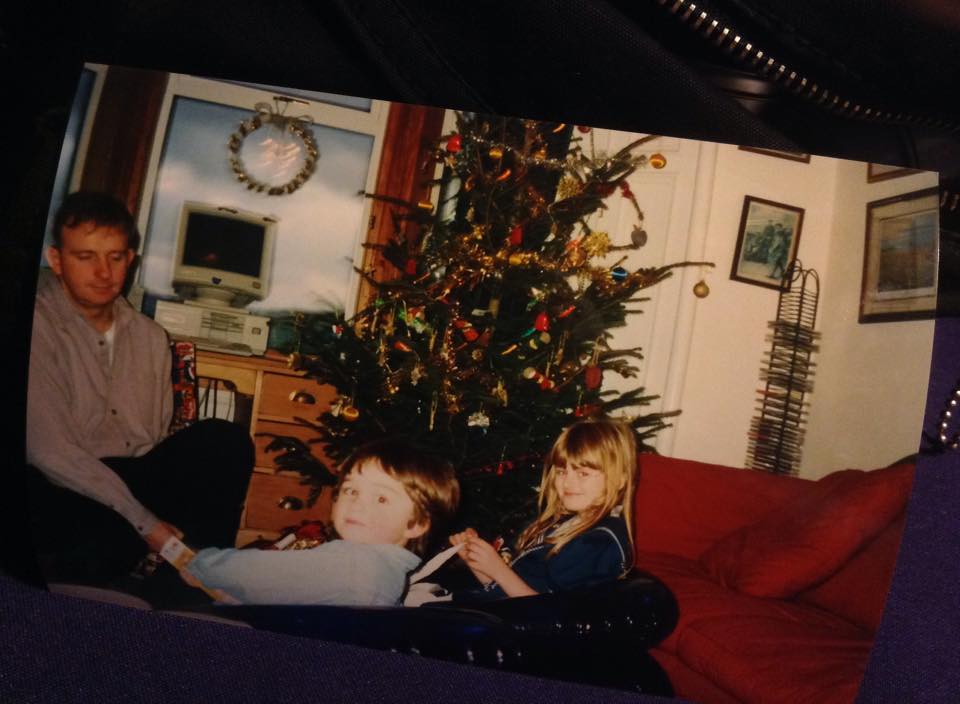
My dad, brother and I at home in the 1990s, overlooked by a magisterial PC

In 1993, the World Wide Web was released into the public domain. There are many histories of the internet and this one is pretty idiosyncratic. I like asking people when they got their first desktop computer. The internet of 1993 could be navigated through bright blue hyperlinks and you would drift between websites. You would type stuff into AskJeeves and have no idea what to expect. At school we had a ‘passport to the Web’ certificate that could be obtained by completing numerous training activities on a twee little software whose name I forgot. It was something like ‘CyberKids’ though surely that is a New York City raver subculture from a time not yet captured by the sleazification of all things indie 2000s. I imagine it was superior to the present Cyber Security Training on offer, in which actors pretend to discover pen drives in the street, gleefully insert them into work desktops only to find their screen literally blowing up in front of them. Nowadays, cyber security training is less about don’t talk to strangers and more about change your passwords regularly. I have a lot of floaty metaphors for the password changing which seem to all include underwear or car parts. Passwords though are pretty boring, clunky things but they’re also gauzy ephemera. Pieces of secret unlocking. Recently I spent an entire Sunday trying to unlock a 2011 MacBook. The password, when I found it again, accessing the deepest recesses of abstract memory, was unforgivably cherishable. I’ll keep it forever like a pet (I’ve already forgotten it).

I keep thinking about ressentiment as a sensation produced by the internet. I mean the internet’s failure. When I was a child, I adored the internet. Once we’d upgraded from dial-up, I would spend upwards of 12-14 hours almost nonstop on forums, games, LiveJournal, websites. I gravitated naturally from the virtual worlds of the Game Boy to the bigger screen of the laptop. Before I was even allowed internet access, I would simulate them by making endlessly complicated Powerpoints and Microsoft Publisher pages which connected to one another like a crude open world. I was beset by RAM crashes and Wi-Fi outages. We didn’t have broadband for a very very long time. My dad was one of the first in the village to have it. I would write letters to the broadband guy pretending to be my dad complaining about the speed of the internet. When I go back to the Shire now, I say things like ‘the internet here is ass’. I can’t get 4G at the semi-demolished and barely functioning station. We can’t find out if our train will come or not. We communicate as a brooding micro crowd, frowning and looking anxiously towards digitised screens whose flicker says only ‘delay’. There are no staff. The staff hide in a crisis. I can relate.

Ressentiment – deep hostility combined with powerlessness. The promise of an open world, a generous future, seems rotten. We hate it. It’s failed us. The sheen of that; it keeps nicking us like a pen knife writing sentences on the skin of our hard-worn feet. We can’t even quit the platforms, can we? The implied ‘we’ of a web community is now an absurdity. What have we seen of the Web in thirty years? Unimaginable horrors. Nevertheless, the perambulations continue.

Right now, I’m deeply interested in the dissonance between how we feel the internet ought to be structured, how it almost was, and what it’s become. The dream metaphors we might use for how it once felt to drift between websites, stumbling upon weirdness after weirdness, unlocking more zones of reality. This versus the algorithmic governmentality and corporate monopolies, ‘technofeudalism’ (Varoufakis) and the appification of it all. I think I got interested in poetry right around the time I fell out of love with the internet (2015). I would memorise passages of Charlotte Smith’s sonnets and learn to swoon over Keats. I felt there was something in the shifting stanzas, the intricacies of form, the dazzling surprises it produced and the infuriating difficulties of grasping the source code — a connection.

I still use the term ‘post-internet’ because I want to believe you can take what Tavi Gevinson in 2018 called ‘The utopian ideal of the internet’ and polish its ‘antiquated’ remains. You can still feel the affective charge of every Web-related signifier that has brushed your life. You can be desensitised to ‘internet discourse’ through the media proliferation of tales of digitality, its foreclosures of democracy, its moral flops, its proliferating conspiracies. But there are parts of you irrevocably brought alive by the internet. I am haunted by digital solastalgia. As a child who felt out of place, abjected from the beginning, I sought the Web as a place not for social belonging exactly but something more like beauty, information, elsewhere. I found little pockets of home all over the place. The web (I’ll stop capitalising now and step out of History) was an extension of the fictional landscapes I found in my dreams or when walking around, making up novels in my head which I did every day until I hit puberty and hormones ruined my brain forever (or whatever). I don’t really know where to find those places any more. They weren’t just artefacts and I know this because you can’t produce a screenshot of a website from 2003 and experience a sweet pleasing nostalgia in the way you could with say, a beanie baby. It was something about the world of it all, the navigation, the desire paths forged to get there. The post-internet, for me, is a lifelong quest in understanding that melancholia and homesickness of what comes after. What do I do with the feeling of ‘we can’t go back there, where do we go now?’. All this time, have I used the web itself as some elaborate metaphor for wanting more than a hostile, futile reality? It’s why I like infrastructure, databases, libraries: the promises of systems which take you somewhere. Which transit something. I also love loops, links and non-linearity.

What was the poetry that got me into poetry? It was Romantic in flavour, sometimes in era. Something between the locatedness and dislocatedness, the attention to daily life, the catapulting scale logic of the sublime, the dogged attempt to render the brain on Nature, the melancholy and mourning, the quiet adoringness, the slow accumulation of elements, the sense of quest, pilgrimage, the unexpected visitor at the door. The everpresence of something more mysterious than could easily be folded into waking life. The delicious fug of opium and promise of a language capable of killing pain. The shimmering excess. The imaginative extremities and morbid dullness of Romanticism were necessary supplements to what the web had done for my childhood.

I’ve been dwelling on this quote awhile, from a Spike article about ‘What’s after Post-Internet Art?’:

The technoromantic reimagines posting as liturgy, algorithms as messengers, and artists as saints. They reach into a glorified past for motifs and meaning that invoke the aura of life before memes.Their aesthetic flirtation with the materiality of technology is a double-edged sword, however, that blurs the lines between critique and commodity fetishization. The stakes for this ambivalence are high at a time when capitalist technology is threatening human dignity and agency. Do we really want to engender an emotional attachment to the internet?

Is the function of art to engender the emotional attachment or to transmute its energies into something other? In my day job, I spend almost a whole day a week dealing with academic misconduct cases relating to the plagiarism and hallucinations of Generative-AI. I am supposed to come up with ethical and interesting ways to engage new technology in the classroom, but I fantasise about whole server forms blowing up or quietly being sucked back into the toothpaste tube of Silicon Valley, as if none of this ever happened. At the same time, with two close family members currently undergoing heavy duty cancer treatment, I marvel at the wonders of modern medicine. I think about what Tracey Emin said when asked by Louis Theroux what she thought of AI, or whether there was room for AI art in the world. She says ‘thanks to robots […] that’s another reason why I’m still sitting here’ [presumably due to AI’s role in innovations in cancer treatment and her own recent experience of this]. She’s also like, ‘In terms of art, AI doesn’t really sit well with me, especially when I’m a compulsive, passionate, hot-blooded person who paints’. The contradictions of my feelings about machines get more extreme by the week. I feel born into this contradiction. It’s maybe why my former work twin Nigel would always leave old copies of Wired at my desk.

Does all poetry written after the ‘post-internet moment’ also risk the commodity fetishisation mentioned above? Insofar as it betrays its own lovingness towards the technology it otherwise seeks to critique? Do we want an archness of superior distance or can we do something else with that self-awareness? I think the affect touched upon by Kat Kitay’s piece in Spike is Romantic irony, you know when you realise the narrator is caught up in the situation being described. The Romantic poet speaker discovers they are also a character in the poem. There’s a kind of turn. Timothy Morton uses Blade Runner as a classic example of this, you know when Deckard realises he’s a replicant. Being asked the question, what do you know about the year you were born, for me is like being asked what do you know about what happened to the web? My life is a character in the web’s and the web is a character in my life. What’s the poem here? The continuous mess of everything enmeshed, written, performed, dialogued, deleted, drawn and coded in my lifetime. I have a hot-blooded relationship to the internet. It makes my fucking eyes twitch.

Is transmutation an alternative to merely engendering feeling? I like the word transmutation because I learned it from the great poet Will Alexander. It’s also used by Ariana Reines a lot. We’re thinking here about alchemical transformations in the realm of language, feeling, sensing. I want a poetry that is able to metabolise impossible feelings and in doing so, fuel its reader to think anew. Do I reassign the pain of childhood, the loss of some otherworldly dream, onto the external scapegoat of an enshitified internet? Is that okay? I think about all the times our art teacher made us sit at PCs unconnected to WiFi writing about the design of vintage radios and speaker technology. We had no access to books, the web or other resources to find out more about the designs displayed to us. So in lieu of history or context, we wrote acute, proliferating descriptions of what we saw. What it reminded us of. We found endless vocabularies for edges, colours, surfaces, affordances. This mind-numbing two hours a week was a little oasis from digital supplementarity. A cool, replenishing retreat from external stimulation. We sat on hard, tall stools and typed on clacky keyboards. A tiny little art factory. I had only my brain and the image. I didn’t know it at the time but I was learning that ekphrasis can have a communicative and transformative function. I wrote through the notion of writing about radios to escape the moment where I was supposed to be writing about radios. This did not prepare me for my Art & Design exam so much as it prepared me for poetry.

What do I do with my hatred of the internet? My yearning for it? I write poetry because poetry is a cheap form of that dream architecture I so longed for, all of my life, and I felt good making/using/playing. Marie Buck has a poem that says ‘The point of reading is asynchronous intimacy, and hopefully it works forever’. I said this to my colleague Rodge last week, when we were having one of our regular moments of private despair, and he prints it out and now it’s on the wall of my office. When I look at it I think about all the books out there and all the interesting things I’ve read on the internet and how connected I feel to other worlds. I just have to keep that connection going. I will never know what it’s like to have not been online.

In s(w)ervice of attention

I wanna show up for poetry every day for the rest of my life. There’s this word for when food continues to cook itself — carry-over — like tortiglioni warm and slippery in the colander needing to be eaten. I wish poetry could do that. A. says it does, doesn’t it? When you remember a line sometime down the line and it occurs to you: a new meaning. Or when the poem you wrote marinades in the background all to be felt with alternative pressure. I guess to write then is to throw out your salt or chuck a glass of water behind you as you leave the door of the document. Poem to set out for the day each day.

When I say I want to show up for poetry it’s not just that I want to hear or write or feel it live. Is it that I want to pay it attention? Who or what is poetry and where do I go to do this?

Right now, I’m going to fiction.

Recently I attended a joint book launch at Waterstones, Glasgow with Elle Nash and Kirsty Logan. Nash said the thing about fiction, her philosophy, is that she wants it to bring the reader to their knees. Logan said she wanted fiction to be like telling the reader a story. Both are forms of surrendering and/or attention. I don’t remember being held in the cosy space of storytelling at school because my brain was off on its own adventures. I categorically could not pay attention. Or maybe I practised another form of attention. I had it for free, and didn’t need to pay anyone anything. Something I was scolded for. Maria, pay attention. Was I failing to pay some kind of respect to the storyteller? Part of me wanted that form of listening attention so badly, to be wrapped up in the words of another and so in the folds of the room, but I just couldn’t surrender like that. I would look around the class and be hyper aware of a hundred things at once. The pins and needles in my feet; the subtle vocal inflections of the reader; the question of whether or not this teacher had sex and surely they had because they said they had kids but could I imagine them having sex and then when I tried I could not stop imagining them having sex and it was awful; what would there be for dinner tonight and would I have to cook it; does anyone in this room have a cute dog; when will I be old enough to smoke; which of these characters should I care about; why does my nose itch; when will I get my first period; why does my friend think everyone’s a lesbian; is everyone a lesbian; what does the word bedraggled mean; I think I know what lethargy means; what is the word for….; when can we go outside; I hate going outside; wonder why the publisher gave the book that cover; wonder why there are dots in the ceiling tiles; whose body odour is that etc etc etc. I’ve already forgot what this paragraph was supposed to do or say. At some point in my school years I would just nod off.

I have never been someone who could digest a book, slowly and thoughtfully, and then be able to recount the significant actions and characters and narrative highlights back in a considered, ordered and clarified way. I come at it sideways and can’t talk about it without finding a new angle each time. I need to talk to people about books who can work with the zig zag.

I need writing to ‘strike’ like a match or lightning. I need to read to fall off the edge of reading.

Piece of feedback from a student: you know you teach better off the book.

Been thinking a lot about what that means and what the book is and how to cultivate a kindness towards an open style of teaching.

Been thinking about the way Emma Stone drives that aubergine Dodge muscle in the new Yorgos Lanthimos movie, Kind of Kindness (2024).

Sometimes I can’t pay attention to my own teaching. It happens on auto-pilot and I’m saying things and all of a sudden it’s the breathless bell supplement of the passing hour and people are packing their bags, and bizarrely I’m starving and it’s over. What does it mean to trust the other self that takes over? To walk into every classroom unsure of what will happen?

Sometimes, crash. Often, swerve.

I would describe my reading style as lackadaisical, dyspeptic, errant, passionate, half-awake. Why would I expect my students also to listen with 100% unadulterated attention, when this is how I go about my own learning?

At her recent Good Press event for the launch of Lessons of Decal, Sophie Seita spoke of asking her audiences to ‘absorb [her] words like a piece of music, where the words come in and out of consciousness’. To be given permission for that form of drift and daydream to be okay is a huge relief. If I’m at some event where it feels cool to whip out your phone and notebook, I usually enjoy it a lot more. It’s relaxing to pay attention by not paying all your attention. Allowing my attention to go stereo is sometimes the best way to listen (this was one of the things I loved about the poet Callie Gardner, the way they would often whip out a notebook during a reading, and by extension granting a kind of permission for others to do the same). Seita spoke on what a non-extractive form of attention might be, and might it be that more ambient, absorbing, blurring and responsive mode. I sometimes let the sentences snake around me, other times they cut little jewels, hardening and cleaving and polishing the soft matter of my thoughts. Sometimes I mishear, overhear. In lockdown readings and lectures, I’d participate heartily in the flowing ticker-tape of the Zoom chat and its various overspills onto group chats and discords. I liked the sense of multiplying conversations happening simultaneously, emoji splurging.

⬫꙳⋄﮳✧﮲⋆꙳⬫꙳⋄﮳✧﮲⋄⋆꙳﮳✦﮳⋄⋆꙳⬫꙳⋄﮳✧﮲⋄⋆꙳﮳✦﮳⋄⋆꙳⬫꙳⋄﮳✧﮲⋄⋆꙳﮳✦﮳⋄⋆꙳ ⟡﮳﮲✧﮲⬫꙳⋄﮳⋆꙳⬫꙳✦﮳⋄⋄✧⬫꙳⋄﮳✦﮳⋄⋆꙳⬫꙳⋄﮳✧﮲⋆꙳﮳⋄⋆꙳✧⬫꙳⋄﮳✦﮳⋄⋆꙳⬫꙳⋄﮳✧﮲⋄⋆꙳﮳✦﮳⋄⋆꙳⬫꙳⋄﮳✧﮲⋄⋆꙳﮳✦﮳⋄⋆꙳ ⟡﮳﮲✧﮲⬫꙳⋄﮳⋆꙳⬫꙳✦﮳⋄⋆꙳﮳⋄✧⬫꙳⋄﮳✦﮳⋄⋆꙳⬫꙳⋄﮳✧﮲⋆꙳﮳⋄⋆꙳✧⬫꙳⋄﮳✦﮳⋄⋆꙳⬫꙳⋄﮳✧﮲⋄⋆꙳﮳✦﮳⋄⋆꙳ ﮲

I went recently to Inside Voices, a free night of ambient music and poetry held at King Tuts and hosted by anoraq. I love these nights because I always fill up my notebook. There were readings from Medha Singh and Ian Macartney, a performance by Dronehopper. While listening, I pondered especially what the percussive parts of language were. Little coughs, plosives, hovers of breath while the performer altered their pace of attention.

I want a manifesto for ambient attention. The closest I have found so far, aside from the classic 1978 Brian Eno piece, is a university project: ‘A Manifesto for Ambient Literature’ (2017) co-written by the Ambient Literature team. Here’s a snippet:

I take this to mean affirmation of porosity between texts, but nonetheless one that holds true to the material reality of a text’s construction.

There’s an iPhone that crops up in some kind of poem and whatever it’s doing there, I start to see it running the whole text, a little monstrously. The poetic subject becoming a mediating interface. When I asked the jetpack AI to give me more emoji string, it granted me a handful more stars.

I like books for being (in)complete worlds perforated with holes (words and the gaps between them). A night (sky), variably rich.

My lover sees me drop the book and flop sideways three times before taking it off me and shutting the light. I try to read and the whir of sentences stirring up is somehow the kind of stimulus to send me to sleep.

When I wake early, as I often do, to the dawn screeching of gulls, I keep the light off and try to read by the dark. It’s every sixth or seventh word I miss. The full stops slide away, smudge into dimness, and I read sentences continually — sloshing into one another.

Sometimes I think I read off the book. Like, the reading comes not when my eyeballs are actually skimming the lines on the page but in some kind of preliminary or afterglow moment.

What about the content?

I once had to do a medical questionnaire that asked me if I ever struggled to understand the motivations and emotional behaviours of fictional characters. This was a fascinating question. I let it cook for a few days before answering on the numbered scale.

Hovering with my ballpoint, I kept thinking of that Virginia Woolf quote from ‘Mr Bennett and Mrs Brown’ (1924): ‘On or about December 1910 human character changed’.

Maybe I didn’t know why characters did things, even as I sat in rooms and offices and Zooms with students, discussing with great sincerity and intent the mechanics and motivations of fictional bone collectors, world-savers, serial killers, suffering girlfriends etc. Maybe I could only attend, momentarily, their tendencies; and so fathom a pattern or path from there.

What does it mean to give your full attention, to pay attention or to offer it?

I’ve started to think paying attention means there might be such a thing as ‘attention debt’. Is that the same as ‘attention deficit’? If I were to somehow skip the NHS diagnostic waiting lists to find myself looking at a special time-release pill on a silver platter, would that pill buy me attention? And would I somehow have to give it back, eventually, foreclosed or with massive accruals of cognitive interest? I start to think about the speed of my heartbeat in time to attention.

When I press my ear to your chest, and it’s your heartbeat I hear: am I witnessing the cost of attention?

Paying attention = being a cognitive agent of capitalism?

Does the heart hold the indelible mark of other attentions?

I would save all my heartbeats for you in a heartbeat. I hold them back from work. I save them in service of love and its ghosts.

Sometimes I want to be sharp; other times it’s better to blur.

Why do we say ‘pay attention’ and not ‘give attention’ or ‘do attention’? There’s a pretty useful article on this over at Grammarphobia:

English acquired the verb “pay” in the early 1200s by way of Anglo-Norman and Old French (it was paiier or paier in Old French), according to the OED.

The Old French verb meant, among other things, “to be reconciled to someone,” Oxford says, reflecting its classical Latin ancestor pacare (to appease or pacify), derived from pax (peace).

As the Chambers Dictionary of Etymology explains, “The meaning in Latin of pacify or satisfy developed through Medieval Latin into that of pay a creditor, and so to pay, generally, in the Romance languages.”

Some of the earliest meanings of “pay” in English are obsolete today—including to pacify, or to be pleasing or satisfactory to someone.

But senses relating to handing over money—or whatever is figuratively owed to someone—are just as old, and of course they’re still with us.

If I say pay attention, I’m not exactly doing so in the service of pacifying or pleasing. Much more likely that you’d take the phrase the way you’d take ‘pay your debt’ or ‘pay your letting agent’.

I don’t want attention to be an extractable value, but it is. We know that most of presenteeism at work is about being able to perform your paying attention for the sake of appearances. It isn’t really about productivity.

What if I let go of that presenteeism in other areas of life which demand attention? What if we got much more into improvising what makes for good listening? What if I wanted to watch television as a way of processing a complex emotional conundrum while also laughing my ass off at another life?

Would I write more? Would I understand human character?

Would I ~frolic in the generative plenitude of non-instrumental value?

In 2017/2018, I saw Iain Morrison perform some of his Moving Gallery Notes at Market Gallery, back when it was in Dennistoun. The video I’ve linked above begins something like ‘right now, the time is 97%’. I feel my attention brimming like a healthy battery. Morrison’s poetic works comprise notes made while at various gallery events and artist talks. He describes the project as ‘a sequence that samples a chain of events, encounters, conversations, meetings, empty spaces and all the other things that make up the life of an arts organisation making its way through changing contemporary contexts’. Listening to the work is less about being presented with ‘content’ and more about being provided a poetic architecture in which to indulge great reverie. The content itself is also fascinating. Morrison’s gallery notes encompass everything from embodied experience to the yield of eavesdropping. The initial ‘splurge’ or ‘stream’ of notes goes handwritten onto the page, from the context of an event, and eventually gets whittled into lineated poetry. I found this description from Morrison’s blog, Permanent Positions, particularly useful:

The reason ‘notes’ is in the title of this and my earlier series, is because my first step for each poem is to choose an event at the gallery and write notes during it. When I’m making the notes I mostly write continuously, allowing whatever I’m thinking about – whether it’s things people are saying, or things occurring by association in my head ­– to stream onto the page, at the speed I can write at. My objective while doing this is to not worry about the appropriateness or relevance of what I write down. I try to get material down on paper, and there’s a hope that I can use my embodied presence – a thinking body in the space – to make myself into a recorder, one that acknowledges its subjectiveness, of the event. So this stage of writing can be a splurge. It usually is. I will edit these notes at the next part of the process.

This seems to me an ambient method of composition. It is open to digression, refuses to ignore the body and sees the self as both subject and ‘recorder’. Not so much Spicer’s radio here as the ZOOM H1n versatile pocket recorder.

Moving Gallery Notes is of course also a work of ekphrasis.

For my birthday, K. gave me a copy of Danielle Dutton’s Prairie, Dresses, Art, Other (2024). Halfway into this delicious compilation of fiction and nonfiction is an essay on ekphrasis which discusses, among other things, Rindy Sam’s kissing of a Cy Twombly canvas in 2007 and Eley Williams’ short story ‘Smote, or When I Find I Cannot Kiss You in Front of a Print by Bridget Riley’ (2015). The idea of ekphrasis is presented as a kiss, a mark left more or left indelibly from one work to the next. Soon I will write a poem called ‘kissing cy twombly’ because aside from the brilliant parenthesis of the act itself, sullying a white canvas and paying one ceremonial euro to the artist for the privilege, it sounds like a CSS song or something. So I will commence the writing of the poem from the idea that I am speaking to Lovefoxxx or sprinkling tongue-glitter on crayola-smeared Moleskine.

I write this painting my nails Essie (un)guilty pleasures and trying not to leave such a mark on my MacBook keys. What shade of green is this? It’s too late. Everyone who has seen my laptop knows the key letters are tapped out beyond repair. Skin friction has caused the letters to smudge and blur into pools of acidic white light.

Milton writes of ‘th’ Arch Angel’, about to speak, in Paradise Lost: ‘Attention held them mute’. Meanwhile, ‘Tears, such as Angels weep, burst forth’.

Have I cried on my laptop sufficient to melt its keys? Do I write from speech or silence?

The OED reminds me that one can ‘attract, call, draw, arrest, fix‘ attention.

Thou art to wink.

What if we wept for attention. Made its call. Applied the right fixative.

Now we say something like ‘oh that therapy session totally ate‘.

What I like about blogs is that they are deliberately undercooked. You basically serve them up to the world before you’ve had time to stew, finesse and perfect the product. This one I wrote this weekend while procrastinating emails, on a rickety bus and then rushed with sips of coffee before heading out to a festival. It’s pretty al dente okay sorry you’re gonna have to chew on it. I like that I can look at a blog post and think ‘that’s a fucking mess’ and then immediately post it.

I do think I am capable of being floored by good fiction. When I read Nash’s latest novel, Deliver Me (2024), I was sick with flu but the flu was on a kind of continuum with the book. I kept texting everyone: ‘no one writes sex and the body like Elle Nash!’. I read it feverishly, dreamed in it and let certain scenes linger in my psyche long after I’d folded the last page. I read it with a curiosity I don’t think I’ve had since the way I used to read the internet. By which I mean: I devoured its voices.

Similar thing happened when I devoured Thomas Mann’s The Magic Mountain (1924) in January. I was listening to the audiobook version and continually would have to stop what I was doing (walking to work, cleaning, washing my hair) to make copious notes. All such fiction makes me weak at the knees. And you know, it isn’t the characters or the plot that do this to me, but the language. Its essaying of life, presence, intimacy, repetition. The way narrative is a temporal prosody conducting attention.

I liked hearing about Nash and Logan’s manifestos for fiction, what they hoped to give readers, because it made me realise my own liminal, elusive bar for contact. I think about the text as a space, not just for the conveyance of meaning but explicitly for bearing its im/possibility and by extension, its potential for ellipsis, disappearance. That’s where the fun begins.

Maybe what I wanna do is s(w)erve attention. Keep showing up.

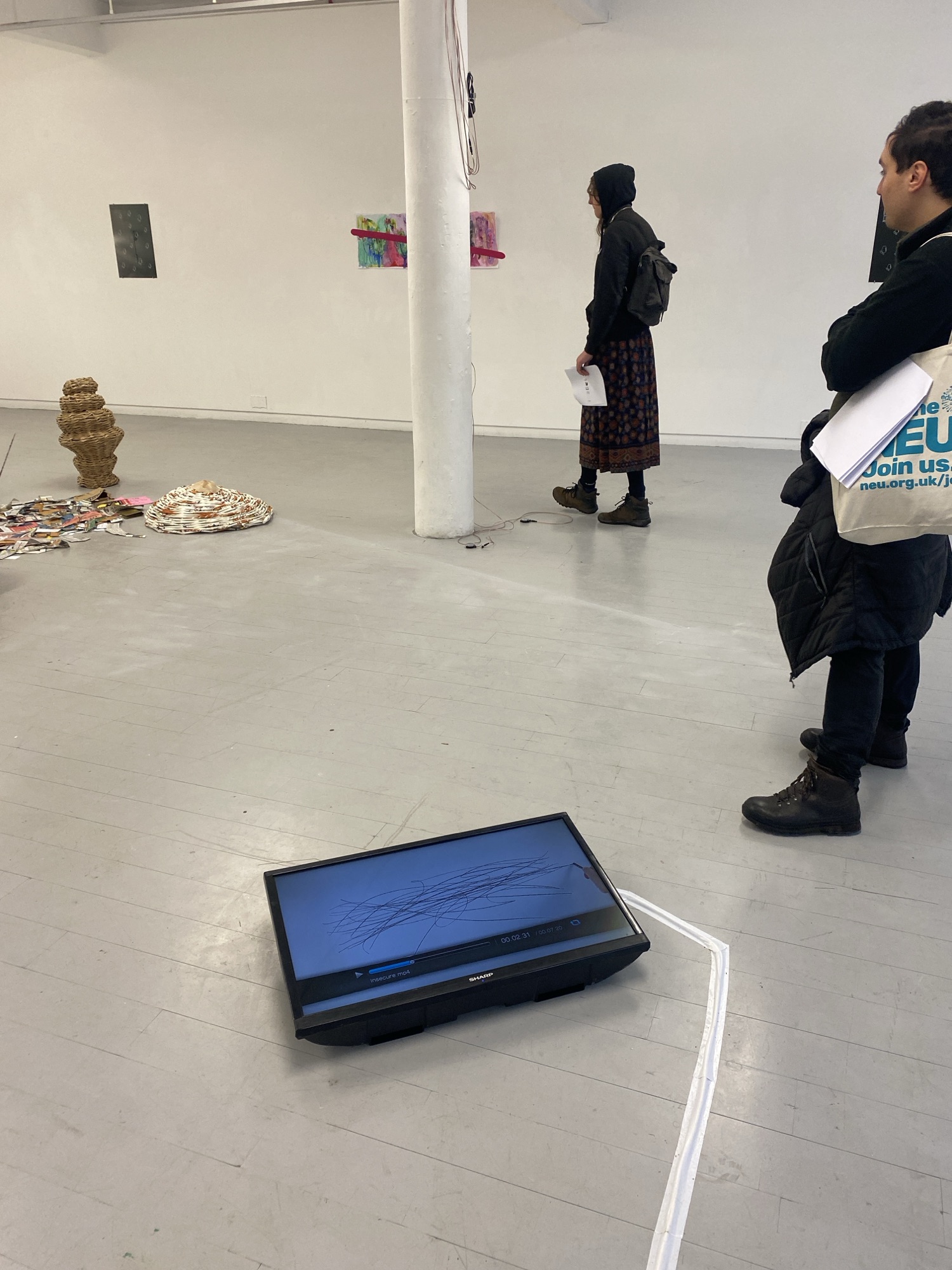
Notes on iNsEcurE exhibition

Che Go Eun, a hole in a boat and a deep hole (2024)

Dear pain,

That’s how the light gets in. Fractal emanations of screaming the dark is a luxury the dark the dark. I listen to the radio and a mother talks of her autistic child preferring the dark — thriving in it, coming to life.

We soft-light to protect the unsaid stories.

Our bodies twist in the dark and we make an inconsistent work of pain-pleasure. The mattress gives out: pools of blood, ink, sweat, coffee, sex. I feel better when the sun comes up and when the sun goes down, wine-dark. It’s what’s in-between that’s the problem.

I keep thinking about Fred Moten’s luminous correspondence, ostensibly between Andrea Geyer and Margaret Kelly:

My friend, I have discovered in the antagonism between my work and dead letter that the project returns as an amazing field and air of correspondence, a transgenerational lotion of breathing, a revue of breath, a general bouquet in the grace of your asking in friendship since the day we met, and our braiding and breathing of a correspondence that we are now and have been working together in the atmosphere of our comrades, that we literally breathe them as a kind of braiding, an insistence of revolt as garment, a tapestry for the touched wall of a spaceship we noticed on the way to school, that off dimensionality of the cloud from our perspective, which I want to say is real not graphed, which I want to say is both a function of, and still untainted by the terrible business of, the Dutch masters, so that it’s impossible to tell the top from the side, though there was some kind of emanation or emendation that we all saw as a smooth flatness, like a table the cloud prepared of its own accord, a spread platform for spreading our metastatic air, our beautiful, is ourreal.

Fred Moten, The Service Porch (2016)

To make a pain of you, stop being a pain, I’d form a cartography of the nerves so rich you’d never know I’d outmatched the major scale. A map does not function in service of security. Anyone who has seen me read (and attempt to follow) a map knows this.

What is so gorgeous about the Moten quote above is its ph(r)asal longing: an ongoingness open to improvisation and constant sentence desuetude. Language like you don’t even need it, breathing all the same beyond what’s essential. Take this key. Braiding and breathing a coital somnolence of the body, twice rung out in language / only us leaving voice notes for what clicks pearls together, minor, deep in the distance.

Emollient longing of writing between pith and pronoun, what is prepared by the passing between. Our breath, clouds; mattering.

‘•.¸♡ ♡¸.•’

I saw the spaceship too. Didn’t you?

Intimacy, I told someone recently, feels like the opposite to what capitalism wants of us. Intimacy is worldsharing, ourreal, a grammar of humours, kisses and shibboleths. You know my pain and I know yours. We make a joke of it. What escapes serious talk but our serious dreams. So when we’re all in the gallery, we switch to our senses to make language-sense of ourreal, cellular vibe spread. It’s a room replete with the sonic ecology that is feeling all my fucking feelings (Clémentine Coupau): aka hook me up to ‘electronic components, dimensions variable’. The little paper lantern is a miniature version of my own IKEA lampshade. The problem with my IKEA lampshade is that I had to tear it a bit to change the lightbulb. I have a torn lantern. Magic hands. That’s how the light gets in. Paper = skin. Creamy light.

Che Go Eun 최 고 은, a hole in a boat and a deep hole (2024)

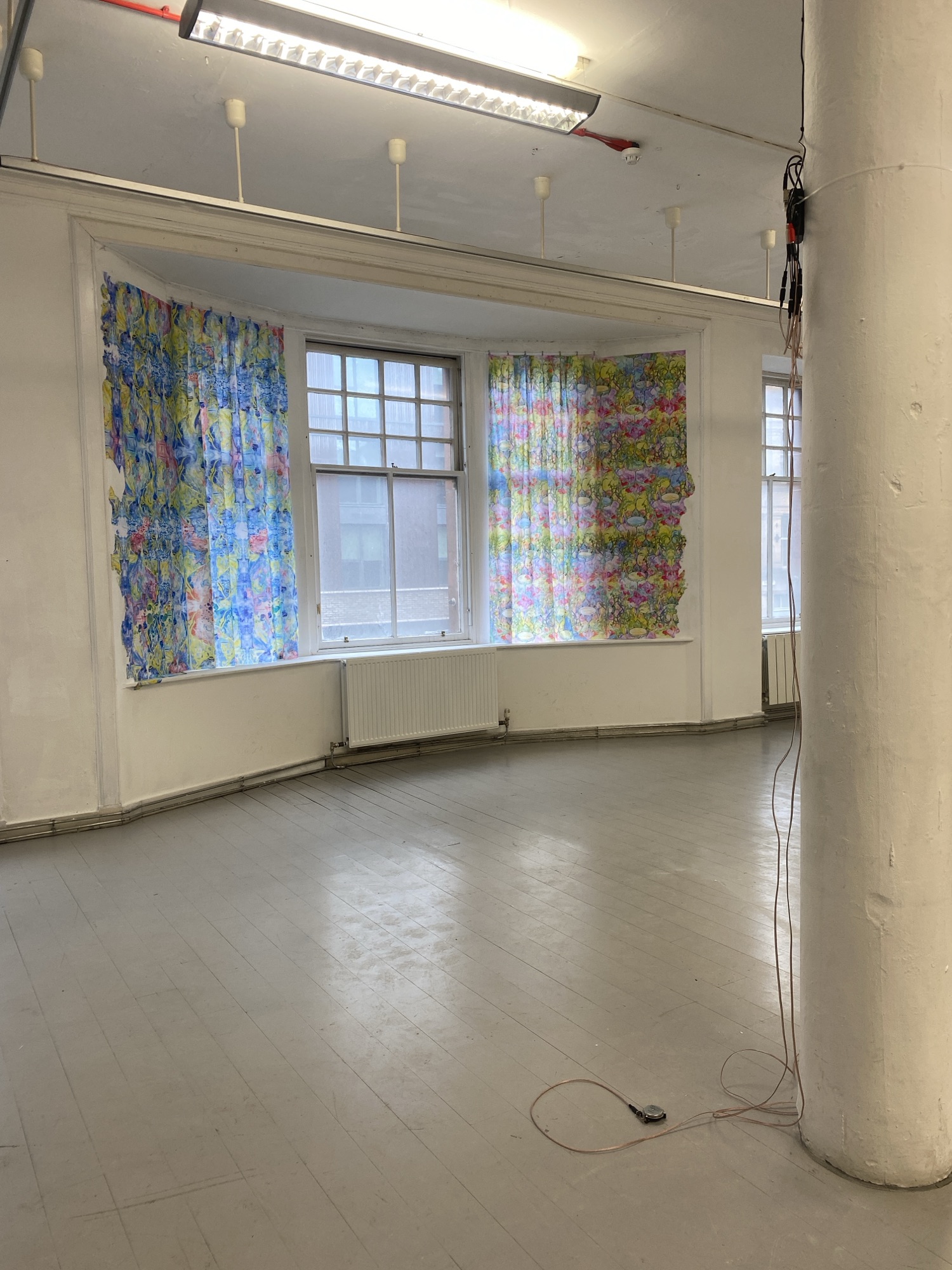
Aside from lanterns, the other homeware alluded to are curtains. Che Go Eun’s a hole in a boat and a deep hole is composed in collaboration with artificial intelligence. The artist inserted diary notes into an AI image generator which ‘transformed [their] intimate reflections and resulted in images’. Watercolour drawings were then made in response to those results, with the artist ‘reappropriating’ their ‘own feelings back from the AI’. This tension between creativity, data and predictive imaging results in a fascinating, speculative assemblage of arabesque, thorn and psychedelic colour. The nod to William Morris/Arts & Crafts reminds us of the collaborative handicraft that has gone into the piece’s imaginary and manifestation. Diary phrases such as ‘art nouveau’, ‘harder I am sinking’, ‘throw all my stress into the hole’ are woven into the fabric of these drapes which suggest both privacy and opening, light and shade. The work is gauzy. There’s a real street, a construction site behind it. Trongate: name as lozenge. What Moten says in the same letter-poem as quoted above, ‘a gauze of reckoning’. Threads, braids: stress, tension. I want to wrap the code-baroque of the fabric around my body like I’m a silkworm going in reverse, all the way back to its gross and sultry, larval conception. I keep hearing that the internet is just the unconscious. I see a bag of squishie candies in a vending machine and think: ugh, silkworms.

‘•.¸♡ ♡¸.•’

Back IRL, it’s raining with the pelting dreich that only a Glaschu April delivers, and I arrive at Trongate 103 having walked through Dennistoun listening to Elliott Smith. I’m not feeling morose; I’m just in touch with my feelings. As if they were tangible: animatronics, statuettes, pets. I’m still on a medication that holds such whimpering demands at just enough distance to be considered somehow ornamental — torrents no more. Once I would torrent my day in their favour. Let someone seed me. Now, I might choose to pick them up, put them back down, or smash them into oblivion. Let my soul have the architecture of a bleeding gate.

As I enter the exhibition, the invigilator says something about one of the objects we’re allowed to touch. I forget immediately what they say because I am greedy for colour and form, not meaning. So the whole time I am looking at the exhibits wondering: which of you may be touched? A finger trace of the curtains, time slider on video screen, glass surface of framing, kinesiology tape cut into bows and ribbons.

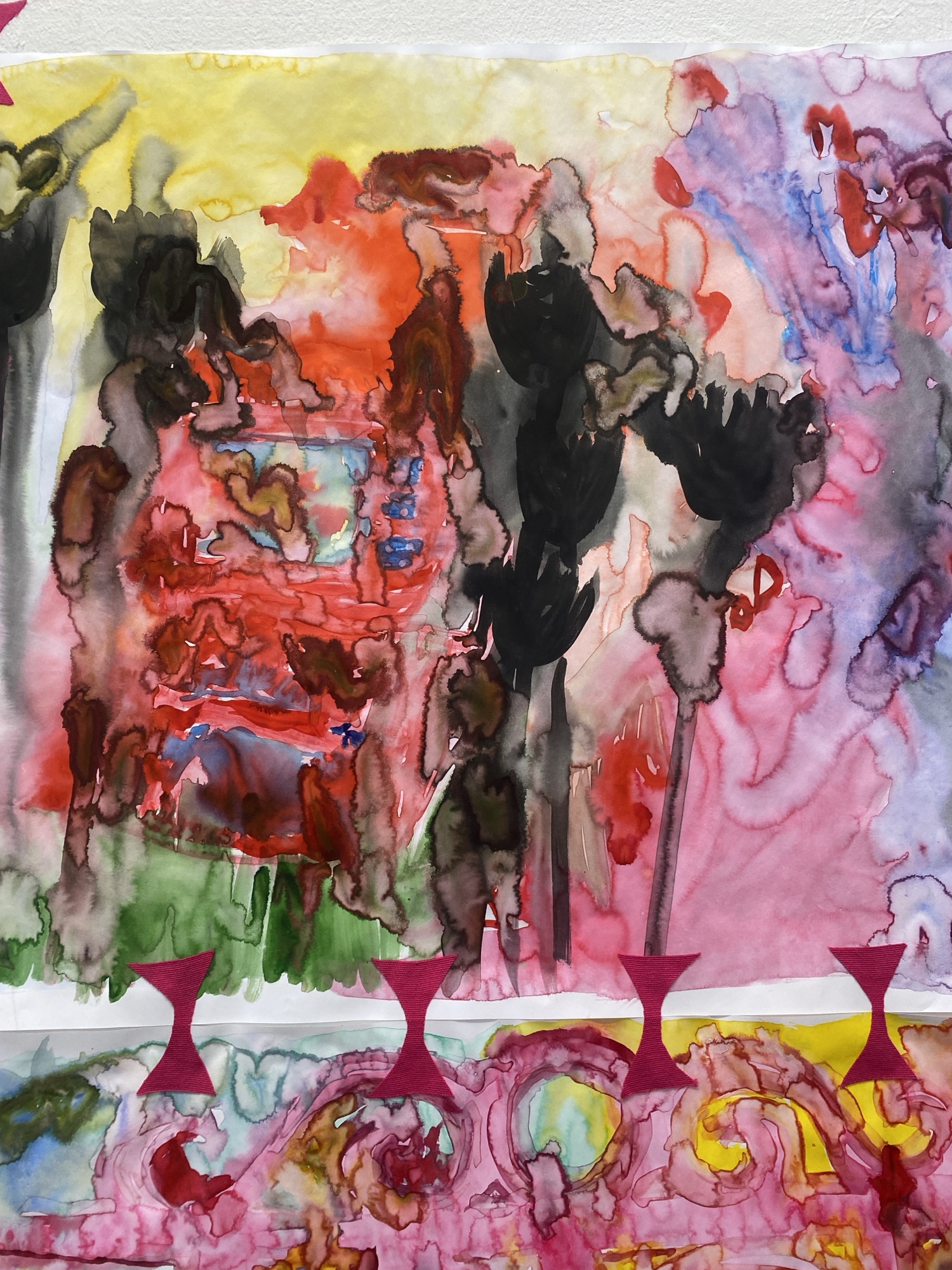
Daisy Lafarge, Gate Theory of Pain (III) (2024)

Touch is not in itself untainted. I am in love with Lafarge’s black tulips; their painful, precious tendrils.

‘•.¸♡ ♡¸.•’

Some people gave me advice
on how to do better: thirsty
in the flowerbed
for some aphids fed upon
200 ladybugs to eat/moult
more often than not they
would die as fast as any plant
blocked sunlight to pay
(dustfall / bonnie / smitten )
should the wind ever blow
you a raven

‘•.¸♡ ♡¸.•’

Mau and I try to diagnose the  Mandelbrot set-seemingness of Lafarge’s watercolour fractals. The sequence ‘remains bounded in absolute value’. This is a beautiful phrase I find on Wikipedia. ‘It is one of the best-known examples of mathematical visualisation, mathematical beauty’. I could watch the little fractal gif forever like giving birth to myself over and over as a starfish with 7000 eyes & infinite narcissism. As it stands, that boundedness is a gate: pink, the colour of doll-flesh. I think of tentacles, elliptical phone calls, inflammation. We agree that almost all the art in the room is art that could be done on the phone. It’s not just about doodlecore but the intimate, desultory gesture of the line itself, and what’s on either side of it.

Not to get kinda kinky but the other day we were explaining ‘lucky pierre’ in the pub (because of Frank O’Hara the poet we all love and love most of all to discuss in the pub). In his ‘Personism: A Manifesto’, O’Hara talks about the poem in supplementary relation to people. Intimacy again. Sure, he wrote it while ‘in love with […] a blond’, which makes it all the more true and golden:

I went back to work and wrote a poem for this person. While I was writing it I was realising that if I wanted to I could use the telephone instead of writing the poem, and so Personism was born. It’s a very exciting movement which will undoubtedly have lots of adherents. It puts the poem squarely between the poet and the person, Lucky Pierre style, and the poem is correspondingly gratified. The poem is at last between two persons instead of two pages.

Frank O’Hara, ‘Personism: A Manifesto’ (1959)

As Moten’s poem from The Service Porch is framed between two persons, so the epistolary heat is folded into Personism. It’s not letters but speech itself that gets electric. So what Mau and I mean by ‘this is art that could be done on the telephone’ is perhaps something about how the work takes place in correspondence between two or more bodies. Lafarge describes her paintings ‘as a means of pure distraction’, made during ‘episodes of severe chronic pain’, ‘remote NHS chronic pain sessions’ and ‘in phone queues and conversation with Adult Disability Payment (Social Security Scotland)’. The trembling of watercolour is an apt form for the bleeding edges that connect the power imbalance of someone trying to get support and the person with the power to connect them to it. It’s the art of turning away, seeking psychic space, without letting total go of the line.

How often do we find ourselves at the gate, with no end of wanting to both know and not-know what’s beyond it?

Wrought/not I.

‘•.¸♡ ♡¸.•’

I love gates. I love especially baroque ones with curlicues. I grew up with a broken gate which soon got removed. What did we have to keep in, or shut out? It was black and gold and the paint flaked off very beautifully. You might describe it as ‘tawdry’. I probably have false memories about this gate. Sometimes the screech of its opening hinges my dreams. Lafarge’s gate might be a homophonic pun on ‘gait’ (and so referencing the debilitating effects of chronic pain on one’s ability to walk freely). The painting, titled Gate Theory of Pain (III), no doubt references Ronald Melzack and Patrick Wall’s 1965 paper on ‘The Gate Theory of Pain’. In the words of Lorne M. Mendell:

The [Gate Theory of Pain] dealt explicitly with the apparent conflict in the 1960s between the paucity of sensory neurons that responded selectively to intense stimuli and the well-established finding that stimulation of the small fibres in peripheral nerves is required for the stimulus to be described as painful. It incorporated recently discovered mechanisms of presynaptic control of synaptic transmission from large and small sensory afferents which was suggested to “gate” incoming information depending on the balance between these inputs.

Lorne M. Mendell, ‘Constructing and Deconstructing the Gate Theory of Pain’ (2013)

The Gate Theory concerns sensory fibres, transmission cells and their respective levels of activity. The idea is that painless sensations can supplant and so quell sensations that are painful. The process involves a blocking (a closed gate) of input to transmission cells. When the gate is left open, the sensory input gets through to transmission cells and produces pain. An example of the therapeutic application of this theory is transcutaneous electrical nerve stimulation (TENS), massage, acupuncture, vibration and mindfulness-based pain management (MBPM). While gazing at Lafarge’s vivid watercolours, one senses that pain is not suspended in the art of painting so much as calibrated, channelled, short-circuited. We keep commenting on the bleeding edge.

Aniara Omann, Resting on an icy couch (mother, grandmother, grandfather, big brother, older sister, little sister) (2020-2024)

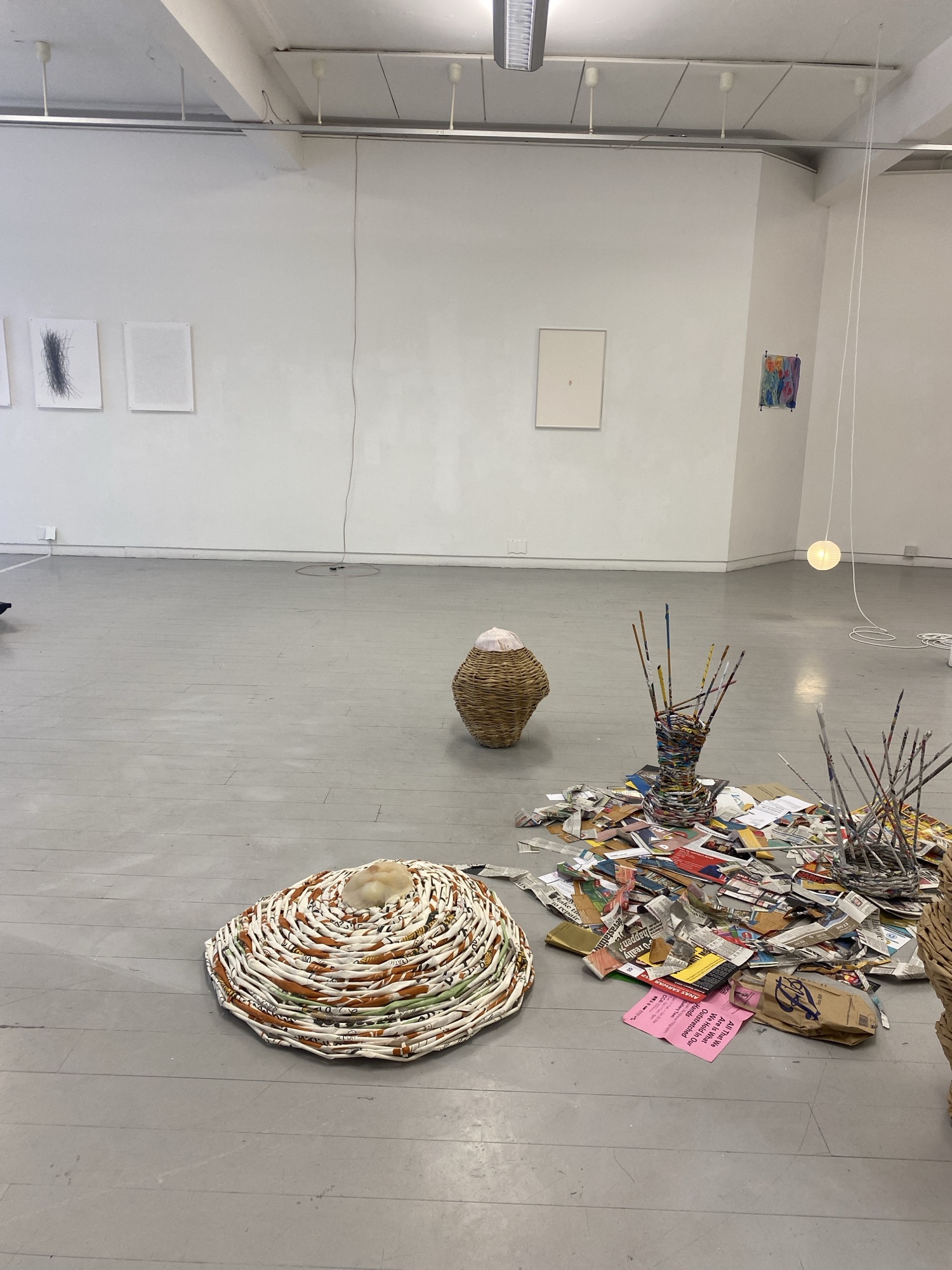
Elsewhere in the exhibition, ideas of feedback loop, intimacy, daily life and relationality are also manifest. Feronia Wennborg and Simon Weins’ soft tissue plays with sound transduction to install a ‘lo-fi sound system that lives at the periphery of perception’. This installation of contact-based sound production manifests the pair’s ‘long-distance collaboration’ in felt space. Aniara Omann’s haunting paper baskets, plugged by family faces, makes a ragged philosophy of grief and panic. The raggedness betrays a struggle for focus which is played out through the woundful (I meant to say wonderful, but this works better) arrangement of loose paper, woven baskets, the sense of things cut, twisted, recycled. Omann describes wearing the clothes of their sister, who died: ‘If anyone complimented me on a garment I had inherited from her, I would say it was a gift from a family member’. In that sense, we could think about the paper baskets as fragile amphora for an archival underworld. The baskets are not perfect, machine-made. They retain the expressive and painful grace of their making. They are a flammable structure, woven from newspaper clippings, election flyers, prescription papers, envelopes, bills. What is it to find a way of wearing something? Wrap your troubles in dreams. Shuffle for sources. The difference is a question of agencies; and yet either way the gesture remains. The gift: it has to be infinite.

Elísabet Brynhildardótti, The Lines- Hesitant line, Obediant line, Indecisive line, Decisive line (2023)

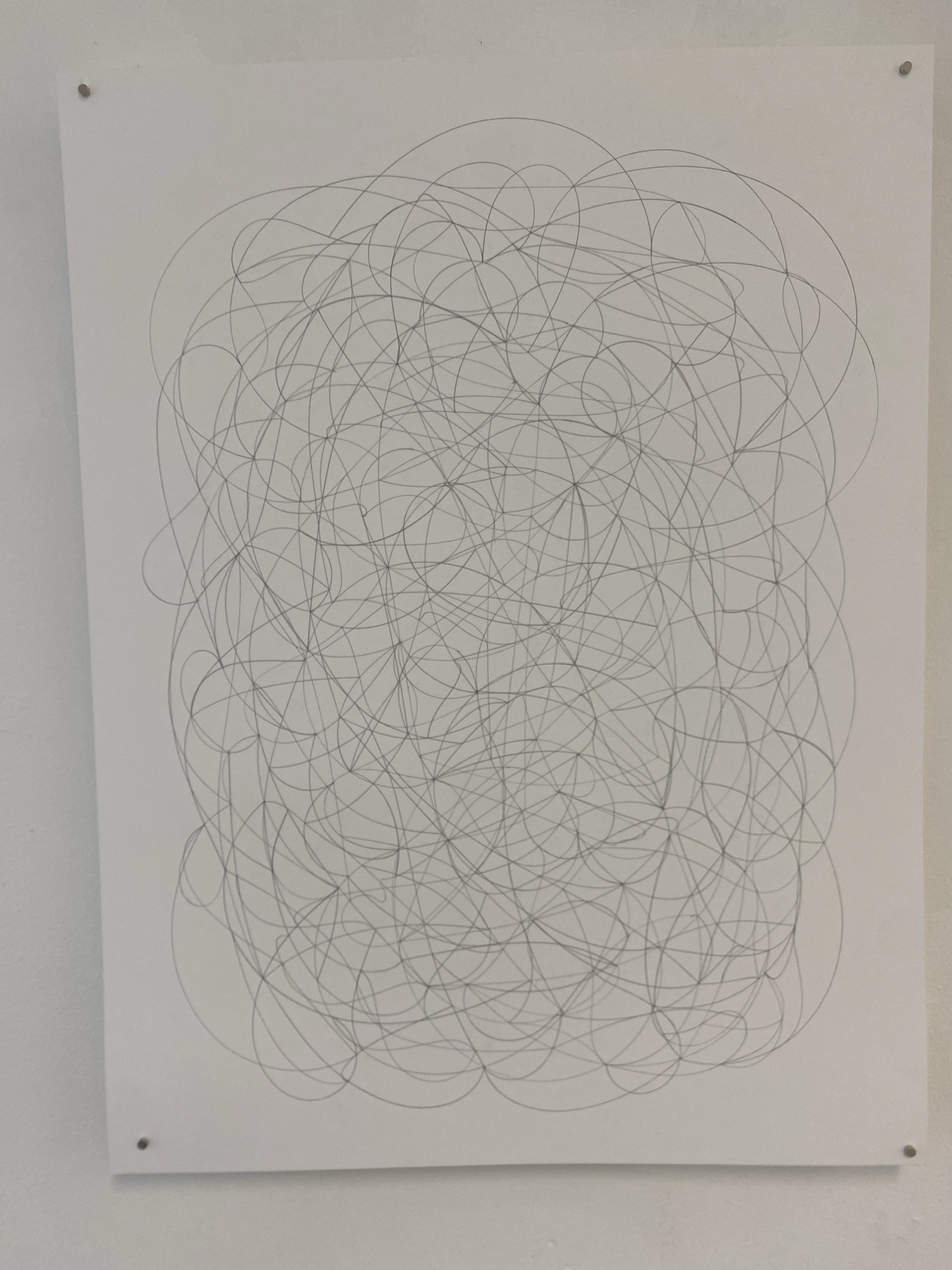
When someone says ‘hold the line’. Please hold the line. Please hold the handrail and take care on the stairs. Will you please hold? What’s at the end of that hold? I have been trying to get a medical appointment for weeks. They keep putting me on hold, hanging up. I phone up a doctor’s surgery which is based in a shopping mall at precisely 08:30, when the lines open, and immediately the lines (the queue) are full. How do I envision those lines? Swirling and spiralling around the postcode lottery of where we live, tangled and fizzing with people trying to find words for the pain they’re in. I think of my mum in lockdown, endlessly on the phone 500 miles away from the fact of trying to get prescriptions and medical treatment for my nan. It’s pretty mild for me, my current need to be on the line: among other things, fucked-up hearing, tinnitus, crackling I hear like static between the two sides of my skull. Sometimes a pleasurable hum in the morning, like ultrasound waves in the skeins of my pillow. On hold to the doctor’s office, you become a line. The hidden labour of the chronically ill is this beholden quality, the line with its insecurities. It’s getting thinner. There is no guarantee that the line will lead to something: its pulsing, throbbing insistence on being anything but spirogram music. The irony of disconnect. Give me a point; an appointment; a person at the other end.

Who would pick up the line would do so, of course, in the dead of night. In Stigmata: Escaping Texts, Helene Cixous writes:

It is the dead of night. I sense I am going to write. You, whom I accompany, you sense you are going to draw. Your night is waiting.

The figure which announces itself, which is going to make its appearance, the poet-of-drawings doesn’t see it. The model only appears to be outside. In truth it is invisible, but present, it lives inside the poet-of-drawings. You who pray with the pen, you feel it, hear it, dictate. Even if there is a landscape, a person, there outside—no, it’s from inside the body that the drawing-of-the-poet rises to the light of day. […] The drawing is without a stop.

Hélène Cixous, Stigmata: Escaping Texts, trans. by y Catherine A.F. MacGillivray (1998)

What I see in iNsEcurE (whose inconsistent casing recalls the long identifiers of medical-grade pharmaceuticals, the vowel-like howling insistence, the trembling name) are poets-of-drawings. The asemic work of line, layer and bleed is an avid supplement for writing itself. Who can write while in pain? Who’s afraid of the dark? Who’s afraid of the blank? It is in the night of writing, unnannounced. What is that invisible presence but pain itself? There is no ‘outside’ to pain, once you’re inside it. And yet the gate theory does imply a certain threshold. Relief bucks at the gate. Still, we draw from the well of it moving inside us. You can’t stop it. The appearance of the outside is only gauzy separation.

‘•.¸♡ ♡¸.•’

When I thought I had endometriosis and lived in the hormone torture of latent, duplicate pubescence, resulting from the long-durée of various quiet disorders, I wrote spiky little poems for a pamphlet called Cherry Nightshade. I didn’t yet know about the gate theory of pain but I saw all the poems in a dream_garden festering behind a gate. Well, more like a trellis. Ground cherries contain solanine and solanidine alkaloids: toxins which are lethal, and all the more lethal for their immaturity. Tart cherries have soporific qualities. I wanted sleep to envelop me in perfect velvet. My speaker was a jumping nerve, a shitty little internet silkworm.

What did I get from staring so long at the gate? I fell asleep on the line and the vine grew around me.

I love this exhibition for what it teaches us about art between bodies, how light interacts with feeling-colour, Moten’s ourreal in its total ambience, the drilling outside is part of that thrum in your skull, the way I love to look at my friends as they look at art, tulip mania, mourning vessels, the exquisite difference between red and pink, the meaning of panic touch, pain as the body’s great epistolary effort, fragility, attention’s relationship to healing, what it means to be gratified (if at all). I am grateful for the sharing of insecurity at the heart of the works, and for what they offer by way of being with pain. A bearing, a cloud platform, an intricacy. Standing at the gate.

‘•.¸♡ ♡¸.•’

Further notes:

  • medical filigree
  • acid yellowing
  • mau touches a sound magnet
  • ‘insecurity fuels consumerism’
  • light source
  • biofeedback
  • neon bandage
  • organelle ballet
  • tesselate attentions
  • the puzzle pieces do not technically touch
  • go into the hole
  • golden shovel
  • ’emoji repertoire’
  • give me a viable body
  • ‘cast latex, apple seeds, sawdust’
  • ‘I am still earning less than living wage through my art practice’

Becoming a line was catastrophic, but it was, still more unexpectedly (if that’s possible) prodigious. All of myself had to pass through that line. And through its horrible joltings. Metaphysics taken over by mechanics. Forced through the same path, my thoughts, and the vibration.

Henri Michaus, Miserable Miracle (2002) – quoted by Elísabet Brynhildardótti in the exhibition handout

iNsEcurE is open at Glasgow Project Room, Trongate 103, First Floor G51 5HD between 29th March-7th April. It is organised by Aniara Omann and supported by Creative Scotland and Hope Scott Trust.

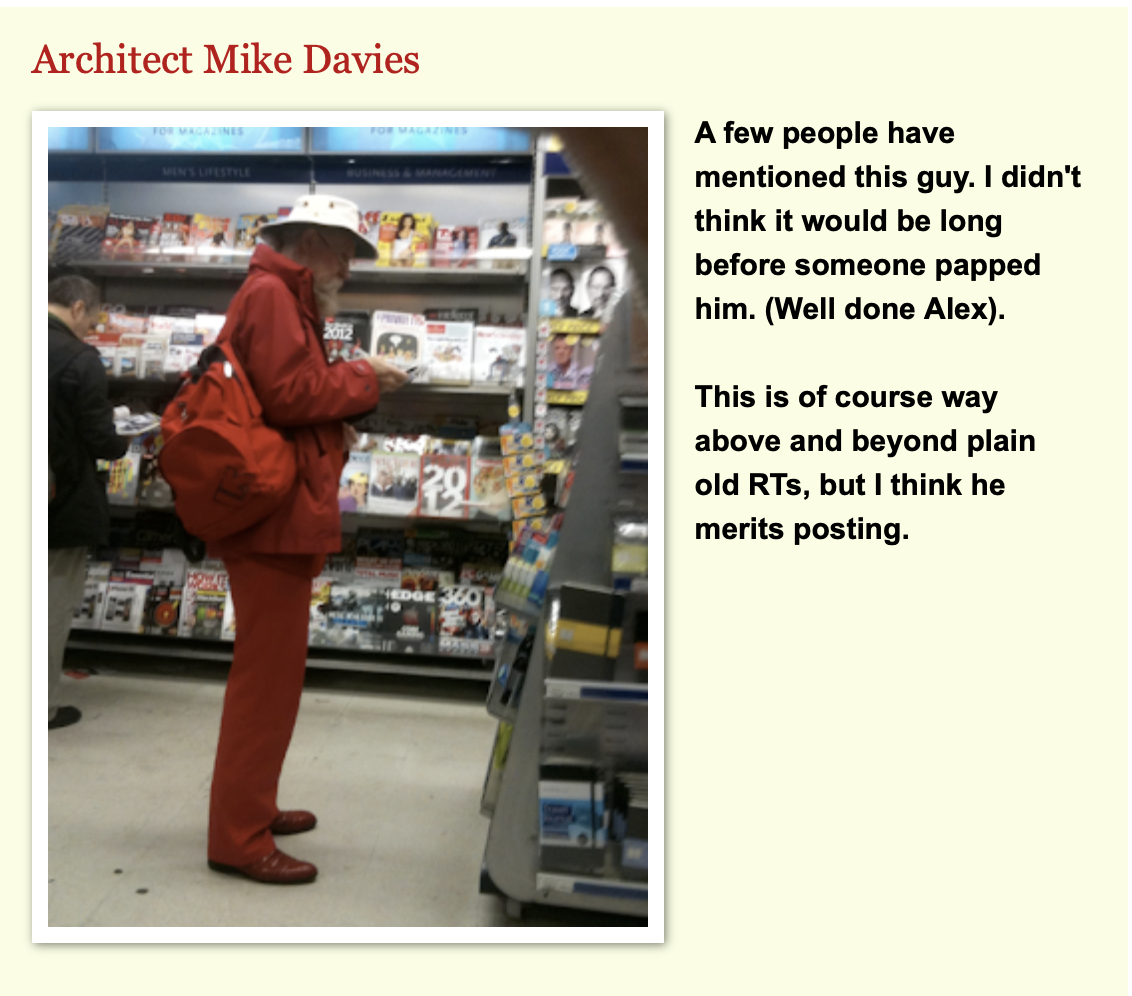
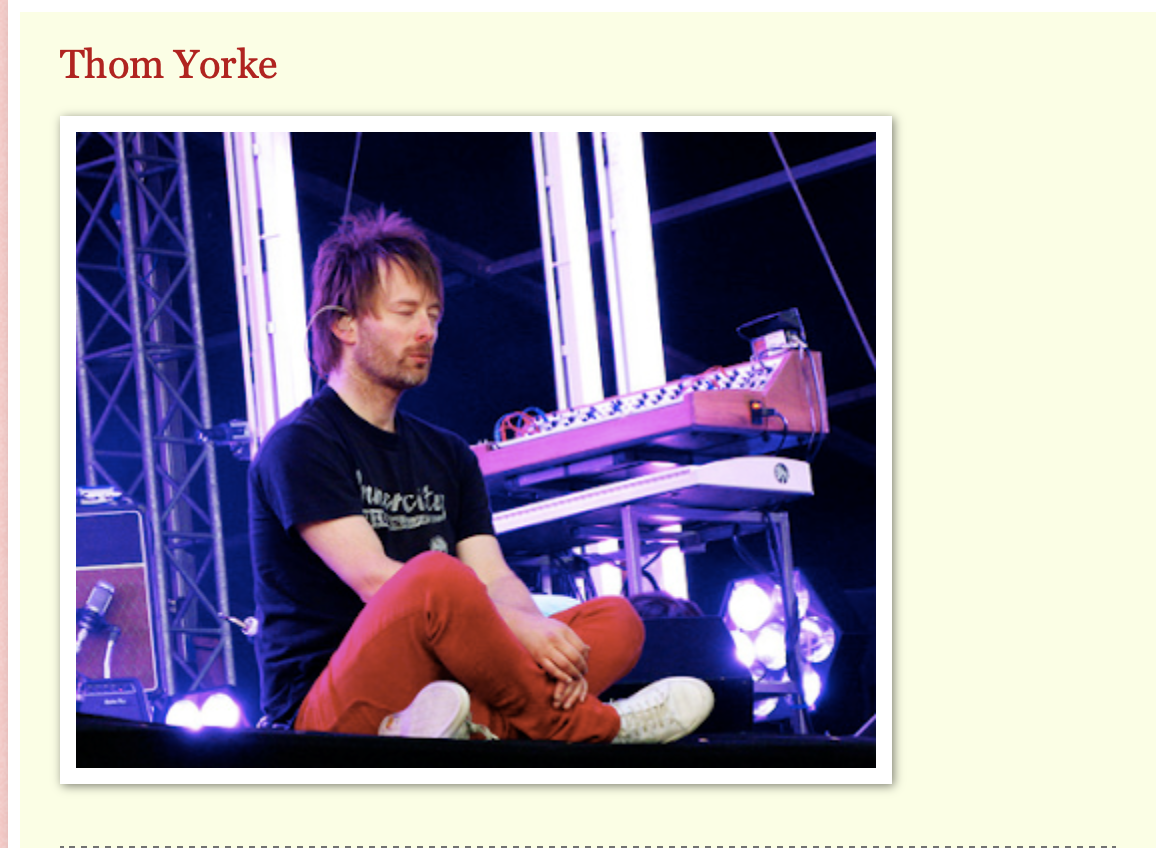
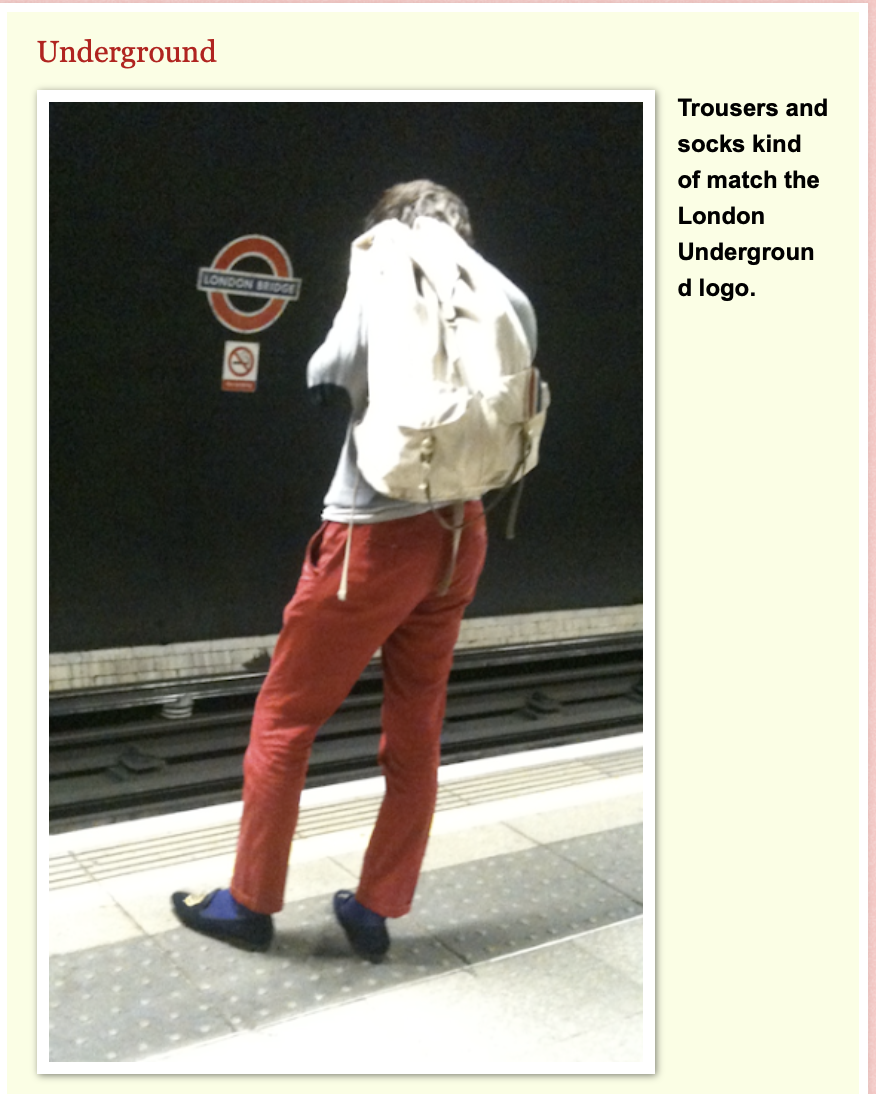
in praise of red trousers

A collection of photographs in celebration of the vibrant and burgeoning red-trousered communities of London and elsewhere.

Thanks for D.B. for the tip-off of this excellent archival gem.

http://lookatmyfuckingredtrousers.blogspot.com

Some highlights:

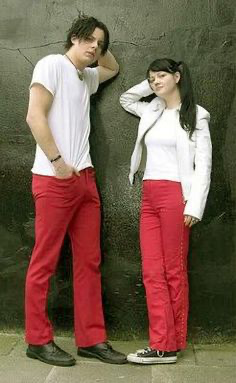
& finally it would be remiss to not bring Jack & Meg into this:

I myself am a fan of the red corduroy flare paired w/ white tee or ribbed tank.

Alex G, God Save the Animals in Glasgow

God Save the Animals is a classic phrase, haunted by punk royalty and the entropy of petrol leaks in the garden growing flowers. Keep saying god as a speech act for staying, something I’ve always wanted. Being watered by the idea of voice. Like to wake up and in the morning you’re still here, watching over me I’m sleeping in the magazine with the gloss on my face. Like I want pop to shoot me for ecstasy blanks, it’s just who I am. I love it. I love Alex G. Last night I saw him play with Momma at SWG3, Glasgow, and he rattled through the hits in this dancey elemental way of just seducing all of us. No fan heckling bs. Last time I saw him was with D. and S. back in February 2020, time of portent, a delicious and messy set at Saint Luke’s where I said something to N. about the Joker fan club and all the young dudes, I liked being them sort of going insane in the moment before getting really close to the mic and losing everything. I liked being an idiot for Alex’s music. Do good noise.

It gives me this lofi permission to love love songs. Like I’m always stretched out on the bed of that flat in Finnieston I don’t remember the names of clouds just a starfish oversized in my hair I passed around, the starfish, we kept saying the celebrities we looked like vaguely and we listened to 2016. It felt like I could drink all the mysteries and stay sober, purple-lipped in the mirror just excited to get back from washing my hands to talk. There was a big feeling about that gig that was matched by how everyone seemed in this swathe of guitar haze, choose today, watching the little plonk piano riffs kind of imagining the whole thing composed on Casio and you know the sense of it — thrill of what happens when the bedroom sensation is blown up, squared, riven with song. I kept wanting to see what he was doing.

There are rooms where I can’t hang my head
There are tears that I can’t cry
In the years you feel the most alone
You will build the walls I climb

                                                (Alex G, ‘After All’)

These impossible places and water that exists and time folded into them addressing this to god I don’t know but I feel it with angels like sentences themselves are messengers, hi. They have many eyes and the grammar of wings. I’m here, on my tip toes. The plea to save animals is like determined ‘the’ and over there but nevertheless I’m one of them, aren’t you? We’re cowardly and in love with music, so much we climb the walls of it. We’re stronger than water. We’re blood and bone. Climbing all over the walls of each other to say something. I wanted to hold hands through golden trellises ascent to innocence, no bitterness, we had all these years the same thing, it made us children. We grew sideways over the same secret, screaming falsetto.

Break miracles to gold dust and be again.

So much of the gig felt like thanks. Thanks to the named ones and thanks to the animals. Thanks for honesty. There was this weird proggy encore that sucked us back into the sky castles of the past. Earlier, I can’t remember which song it is, but there’s a piano stem that sounds like playing Sims to me. I said to J. “welcome to Pleasantview”. We were all listening to build something, what can I say, looking for tiles through which to place our confusions. I jumped into the Pitchfork review of God Save the Animals, with its red juicy 8.4, and was thrilled to see the article open with a reference to Derrida’s essay The Animal That Therefore I am (More to Follow) – that shower scene with the cat staring back at you. I kind of didn’t realise how many dogs haunt Alex G songs. Feel it all. Thanks to the dogs and cats. A BACKWARDS GOD. You’re cool man. 

I feel like the songs keep me safe. I listened to them lots last year wanting to believe in something over and over again like to remake domesticity in the image of ocean, everything deep below like texts swimming around in the sunlight zone of my dreams, afraid to go further down and darker. You can leave it to me. I crossed fields for you. I called you baby baby. I kept this diary. The fields were kelp and basalt and blessing. I wanted to be in a band where we could use gravity to please listen, gift refrains. Momma the support were ace too. They played Californian indie rock of feeling good and fuck it slacker. I liked the zillennial vibe with the irony and sincerity of quotation at work in the heavy guitars and crushy vocals of mirror fry, having a good time. I’m every virtual scenario. The three-minute frisson is perfect. Still shimmering hyper-economy of Alex’s piano which is movies you watch at three am to make them poem perfect, cast aslant and barely remembered. Right now baby I’m struggling, we’ll see.

I had a copy of Dana Ward’s first collection in my little Work is Over tote, still rain crinkled from weeks ago. The bouncer at SWG3 said he was a bookworm as he searched my bag and approved of the title of Dana’s book like it wholly explained the world. That felt a good omen. This Can’t Be Life! Well, what can it be! Let’s see!  

Notes on Lyric Solarity

‘Notes on Lyric Solarity’ at Summer in the Way, Birkbeck University of London, 9th July 2022.

Video of a creative-critical paper delivered over the weekend at Birkbeck, as part of an ongoing collaboration between the87press and the Contemporary Poetics Research Centre. Below is an extract from the first half of the paper. A lot of this thinking is developed more fully in a forthcoming academic article.

As flowers turn toward the sun, by dint of a secret heliotropism the past strives to turn toward that sun which is rising in the sky of history. 
– Walter Benjamin, Illuminations

Today, I’m going to move fluidly between poetry and essay to present some nascent thoughts on lyric solarity. I want to suggest lyric solarity is a poetics in which solar imaginaries are linguistically mediated and refracted through the close rhythms, affects, sensoria and arts of noticing associated with the focalised energies of lyric poetry. Lyric solarity enacts an embodied poetics of dissolve, exposure, surplus, saturation and excess/residue: it offers a way of turning towards the sun, while helping us make, in the words of Imre Szeman, ‘commitments to reshaping’ the ‘existing infrastructures’ which underpin access to and distribution of energy. While the anthropocene, a contested epoch defined by humankind’s ascendance as geological agent, is often understood as an issue of scale, attending to the solar helps us think about planetary crisis in terms of distribution and density of harm, resources and changes to climate or energy. I take energy to mean both the power derived from physical or chemical resources, the property of matter and radiation manifest as a capacity to perform work, but also in the sense of an organism’s energy – their metabolism, vitality, ongoingness within the world, and its working demands or desires. What follows is less of an argument than a set of propositions and possibilities, a selection of field notes in search of lyric solarity.

  1. Sans Soleil

In Chris Marker’s film Sans Soleil, often translated into English as sunless, we begin with a quote from T. S. Eliot’s ‘Ash-Wednesday’: ‘Because I know that time is always time / And place is always and only place’. It begins again with an image of three children in Iceland, ‘an image of happiness’ accompanied by black film leader. The voiceover suggests that if viewers can’t find happiness in the image of the children ‘at least they’ll see the black’. The film is itself a kind of lyric documentary on human memory, how memory is fragile and so our recall of personal and political histories – especially on a global or even planetary scale – is inflected or reworked in the present. In the spring of 2020, I approached the film as a kind of memory place. I had never seen such spring sun in Glasgow, but due to Covid I was locked down inside my own sunless temple, or tenement. What follows violates, perhaps, Eliot’s insistence on the essential containment of space and time. Eliot, I guess, never used the internet. 

I was messaging the poet fred spoliar, and suddenly it was the solstice and we wanted to mark it. We began this remote collaboration, not in response to Marker’s film so much as through it, or some residue within it, a blemish or shine. A bright spot, a blind spot, a kind of fleck on its vision. We wrote remotely, wrote ‘live’ and in those hours of shared writing, we existed in a solar time: where solarity was a quality of memory, its absence our absence, and yet also speculation towards something better – waiting for rays of arrival. In that sense, the poem is about the uses and abuses of pastoral; about an ‘elsewhere’ to be written around, glimpsed, squinted at, but never quite accessed. It’s also about the temporal alignment of two people writing together. Lyric as a thought device for telecommunicating something of a paraworld hidden in language. I’d fall asleep with our phrases like film credits flashing behind my eyes. We wrote between the summer and winter solstices of 2020, we split lines with sun-cloud emoji. Here’s some of the opening sequence of the poem:  

Ultraviolet rose us

spilled into formless

unration of atoms

and we spend ourselves back, the day

extends pause,

folding up

in luxe ellipsis 

hills and hills 

of recessional cloud, cast debt 

between us, rolling one-sided 

to release it, all of I’m rain 

cast thru fierce aureate

disquietude, to not say 

hope this finds you, or 

nearest the soft motif of yr hair 

bright spots around the antisolar point

balayage of except champagne 

never sets. In a forest image / I cannot touch you 

or notify through light that drowsy reminder 

we are many. Something 

decorative / in the cold soak of sylvanshine 

gives up its entrance, the long day 

composed of such stills is lying 

back from its voyage. To say 

all of the land escapes / an exorbitant teardrop 

a teardrop. I have these ambient hands. 

I wring the leaves…

2. Solar Apocalypse

In Etel Adnan’s poetry sequence, The Arab Apocalypse (1989), the sun is variously a shapeshifting trickster, a totalising energy, an authority, a marker of time, a blinding force, a monster, a pool of blood. Here are some of Adnan’s lines taken from across the book: 

I took the sun by the tail and threw it in the river. Explosion. BOOM…

the sun is contaminated by the city

the sun has eaten its children

a sun rotten and eaten by worms floats over Beirut       silence is sold by the pound

eat and vomit the sun eat and vomit the war hear an angel explode

The brain is a sun STOP the sun is an eye

the sun’s atoms are incarnating in my flesh     STOP          STOP

The sun is a kind of virus, pulsing and multiplying, changing form and colour, nourishing and deadly, making things grow or die; a kind of white noise in the context of war, a vulnerable body, a weapon, a machine of surveillance, a carnal threat. In the American Book Review, Barbara Harlow says of Adnan’s poem that it ‘invokes a mythic past […] to presage a present that resists narration’. To presage is to be a warning sign, a prediction, typically of something unpleasant; in archaic meaning, presage is an omen, a feeling of foreboding. In The Arab Apocalypse, Adnan writes back and forward to historical crises: as Aditi Machado points out in an essay for Jacket2, the poem was begun in January 1975 in Beirut, two months before the outbreak of the Lebanese Civil War. But there is also a generalised economy of violence, exposure and replenishment which speaks to the twentieth century at large and indeed to the explosions, contaminations and environmental atrophying of the twenty-first century. As Harlow identifies, the simultaneous, coagulating, geopolitical crises of the times, what we might call the ~Anthropocene, are often resistant to narrative. The recurrent, modulating figure of the sun has more of a lyric quality, beaming and seeping, punctuated by telegraphic lines and signals of stop, break, transition. Language garners a lyric intensity which is elemental, saturating, overspilling the traditional bounds of a human ‘I’. Impressive and god-sized dramas of the stars and planets play out in a mythopoetics of Beirut, of Gilgamesh, of ‘grass snakes hiding in the texture of TIME’ (Adnan, The Arab Apocalypse).

3. More sun to consider in lyric

Julia Kristeva’s Black Sun

The music of Sun Ra

Sean Bonney’s ‘solar cop’

The shine sprites in the video game, Super Mario Sunshine

Georges Bataille’s ‘solar love’

David Schwartzmann’s ‘solar communism’

Alli Warren’s Sun Dial

The photographic process of the ‘anthotype’

Björk’s song ‘Sun in My Mouth’

Catherine Wagner’s line ‘If everything is from the Sun why praise it’

Paul Klee, Castle and Sun (1929)
Etel Adnan, Untitled (2016) Source: White Cube.

4. Shimmer 

In Paul Klee’s painting, Castle and Sun (1929) the castle is line-drawn in myriad geometry: its surface is of different coloured shapes, set underneath a bright orange sun. In proximity, the colours shimmer and vibrate. If there was a patchwork made of Adnan’s poem, it might be this; or indeed one of Adnan’s own geometric, brightly-coloured abstractions. Shimmer is to shine with a soft, wavering light. It offers a coming-to-knowledge distinct from the Enlightenment regime of ‘shining a light’ on your subject; it is a way of making contact, of existing in non-linear, non-narrative – that is to say, lyric – timespace. In her 2018 book Surge, Adnan writes ‘We came to transmit the shimmering / from which we came’. In this shimmering tautology we yet cross a line, continue transmission. Shimmer is instrumental in what I call ‘hypercritique’: a poethical form of writing which orients not to the capture of time, meaning or ecological reality, but to a beyond

Blue Mould, Birds, A Deer, A Door

Walking to the supermarket today cost wild amounts of strength and energy, for which I am grateful to have spent now that I can eat nauseating Roquefort cheese in the hope of coaxing my numbed-out tastebuds to attention (so far semi-successful) with lathering of French mustard on wholewheat bagel. Semi permasick seemingly from something in the walls in me. MOULD. Watching the Easterheads peruse giant boxes with undersized, foil-wrapped eggs inside reminds me of a lecturer I had many years ago whose primary exam advice was to study always with such an egg by your side, because curved chocolate is ‘superior’. Trying to summon childhood memories of Easter and all I get is something hardboiled and glum, rainbow-painted free-rangers being rolled down the smashed-up concrete of Minnoch Crescent estate. What were you supposed to do next? Retrieve the egg. I forget. I roll over. I have to sleep on my side or something in my organs hurts; but I believe cats have healing powers and if a cat wants to sleep right on my chest, sure, I’ll sleep on my back and wake up better.

So I’ve been enjoying The Blindboy Podcast and recently the episode where he talks about the internet before it became, well, everything. The total bombardment. Blindboy has charming tales of what cultural scarcity was like before you could just shazam the shit out of any sonic phenomenon, google every micro-thought that comes into your head or find your brain rewired around the big-ass anxiety MMORPG that is Twitter. I’m geriatric millennial enough to remember this and especially tapes. I had a thing about tapes. I wrote about this already, way back in 2014, my thing for tapes. That was kind of before the indie tape revival (is it still going on?). Seriality in writing is irresistible to me. The backwards and forwardsness of it. Krapp’s spoolish jouissance. Bernadette Mayer’s tape recordings in Piece of Cake, Memory and Midwinter Day. The glossolalic Mr Tuttle in Don DeLillo’s The Body Artist.

Recently, editor, writer and absolute king [<3] in the poetry community, Aaron Kent, published a pocket-sized pamphlet called The Rise Of… (Broken Sleep Books, 2022). The back page features the familiar anatomy of tape reels encased in clear plastic. There’s a kind of Side One/Side Two vibe: a long essay-poem, ‘The Rise Of…’, which documents the process of coming to know what happened in the wake of a sexual assault; and a poem ‘Inkmist’ dedicated to ‘CRASAC group therapy; for saving me‘. This is a breathtaking work that doesn’t so much ‘confront’ its difficult subject as enter into a kind of ‘momentum’ capable of thawing the petrification of trauma. Of central concern to the speaker is the notion of hallucination, of letter-writing, of ‘difficulty’ itself. I opened it gently from the envelope as I once would a cassette from its casing, read the whole thing in one go and found myself at this point upside down on the sofa, blood rushed to my head, kind of too stunned to even cry. The fluidity and force of Kent’s words are such that all kinds of dormant synapses in my own brain began to take flight again. This is poetry which dials up exposure not exactly to ‘tell a story’ but to disclose the whole affect-storm of a writing that could approximate a traumatised consciousness — one that is at once deeply singular, embodied but also permeable within language itself. A writing that soaks up the residues of thinking’s trillions. It’s hypnagogic, syncopated, a rush; full of swerves, stops, broken clauses, syntactic mania. Forget punctuation. This is a book about the secret. About a wild undersong of constant, yet fluctuating pain. ‘I’m like a sponge i’m always shedding and if i don’t deal with it the pain won’t go away’. Anhedonia, itching, ‘something so simple and powerful’ about a scream. ‘There must be a word for losing melody’. In a blurb for the book, Day Mattar describes this not so much as ‘a stream of consciousness’ but ‘a flood’. There’s something mesmerising and unstoppable here. ‘I am the rapture!’ Buy this book.

When I was in London I also picked up Emily Berry’s new collection, Unexhausted Time (Faber, 2022), a book I’d hotly anticipated owing to Berry’s excellent previous titles Dear Boy (2013) and Stranger, Baby (2017) but also because the book cover perfectly matched the magenta of fred’s new iets frans tracksuit. I read this last weekend in a few turbulent, food coma type nights, marvelling at how my brain could just pick up a special Berry ellipsis, steal it for a dream and then awake to another suspension in the poem. This is a book full of ghosts and twisted souls, a kind of carefulness around utterance itself; spellbinding in the sense of a spine for holding together our weathering lives. A book bound by some kind of spell. You have the sense of a secret, and a holding back:

All statements purporting to be act
are true. Nothing goes away…
You carry it with you,
if not on your back, or in your arms,
then somewhere behind your eye…
So be careful…
See the ghost scratching at the door frame
for the note that will free her.
The past is parked next to me like a dirty van
with messages fingered in the grime…

(Emily Berry, Unexhausted Time)

These lines summon us but also disintegrate on the page as dust. I imagine the automatic typing of a super-intelligence gleaned from our messages. It feels intimate, uncanny. Where is this person speaking from? I want to take their advice seriously. There’s a lowkey lockdown hauntology, the house turned inside out by a kind of social toxicity. Anything natural is also sort of monstrous: ‘It always seemed to me a kind of madness, / the gardens all in flower year after year’. It’s sort of obscene to me that the blossoms are all out and I feel about as disconnected from them as if they existed purely as pixels. Is this disintegration of the senses a prefiguration to ageing? How do you stay involved with the big delicious ‘madness’ of the sensory world? The hyper-pitch of birdsong made audible by the lockdown of spring 2020 was lush, but also spooky. As if to be always in the dawn song of 5am, alone with the birdly chimeras — too piercing to surely be real? I miss it. The feeling of being wholly alive in waves. Write something to the ghost?

It always comes back.
And there are new messages…

(Berry)

The digital eeriness of felt presence. New messages. Poems in their seasonal palimpsests. I want that unexhausted time, a time we haven’t yet strung out, a time to be rechilded. A time for birds.

Dearest,
Happy pink moon!!!!!!!!!!!!!!!!!!

Lastly, the new Ludd Gang arrived. Mark Francis Johnson:

Those birds of passage
present as fists.

I think we fauns may learn
more from those birds than

half-hours by the sea
teach us.

In the summer the woodcutter
wanted to fell my home

and I let him.

(from The Faun Book)

You go stumbling, burned your pineal gland, phone mum. I keep the doors open in my dreams in case a deer walks in. ‘With my eye’, says Jesse Darling in the same issue, ‘I wanted to go / there, to the end of that road. With my whole body I wanted to go / there’.

Let the cold, curved chocolate fit the lip of my tongue, from the fridge.

Want also to melt.

Earlier I wrote something of our weathering lives. It’s the most beautiful and encompassing thing you can say to someone, becoming the spooky sweet hail in flux with sunbursts and mugs full of snow, a rainbow.

Something like an offering, snowballs of silver foil. Blossoms and more blossoms.

Again, from Ludd Gang (the last poem), Gloria Dawson writing for Callie Gardner:

hey, you were my weather
sometimes arriving at my door

<333

Sleep Felt Productive

cn: mention of bulimia; spoilers

It’s been a fair while since I posted. Struggling through Covid, another supercold (emerald phlegm forever), more transitions, finishing my thesis, April snow, more streaming of the body and ache, but here we are. It’s good to get words down. I can’t smell or taste anything at all right now (coffee is just…neutral earthiness, sweet potatoes are…mush of the orange variety, bread is…send help) — so the vicarious pleasure of language is all the more heightened. Sometimes it’s a barrier: why read about anything when your senses don’t respond? I’m drawn to the elliptical which doesn’t hold me for too long. I want to be let go or dissolve a bit. Like eking my reading through a fine mesh of muslin, a semi-permeable membrane of comprehension. Or pull it over my head, this paragraph, the whole fabric of the thing. I was gonna write about a month’s worth of reading: mostly while walking west to east along the polluted, outer commuter belt of the city; on trains between Glasgow, Inverness, London, Leeds; in frail, unwaking mornings; at the park, in that golden week, sitting in the grass with salad from Juicy and daffodils. Instead I wrote about sleep.

*

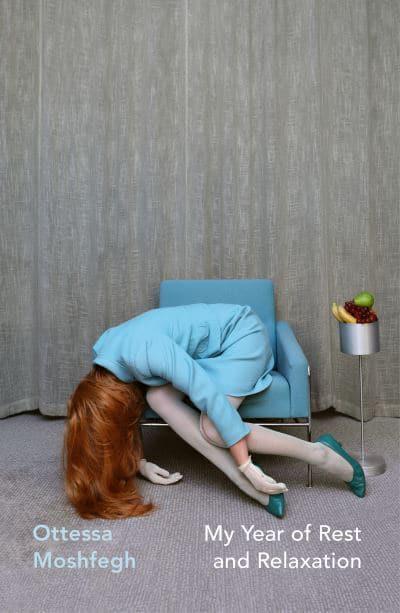
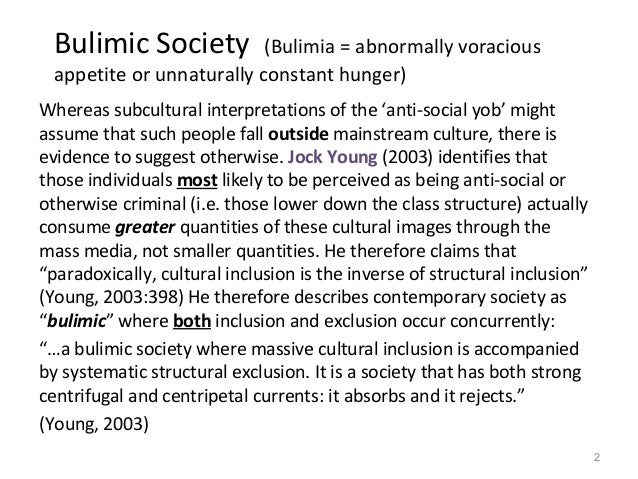
Finally I got round to reading Ottessa Moshfegh’s My Year of Rest and Relaxation (2018), a book I wanted to read especially because a trusted friend described the ending to me as ‘disappointing’. I love to glut myself on disappointment. For some reason the novel produced a similar effect on me as Tom McCarthy’s Remainder (2005), in that the pleasure was all in the premise. I would love to exist endlessly in the loop that is prolonged sleep or the reconstruction of a highly specific sensory memory. I want these novels to just go on and on like that. Of course, there has to be escalation, as per the rules of plot or ~human nature~. Is it true we can’t circle the mobius loop forever? That after a while the pleasure is desensitised, and we need to dialup on the extremity? McCarthy’s novel sort of preserves that perfect figure of eight in its set-piece ending, and you’re left with the image adrift to loop back on the primal, inciting moment of falling debris and trauma. I found the Moshfegh ending ‘cheap’ in that it seemed to cash in its bulimic character for a kind of tragedy whose fate was to fall. Bulimia, I can say, is generally an experience of permanent insolvency in the body, resulting in a loop time of binge and purge. You pay the debts of fasting by devouring; you pay the debts of eating by purging and fasting. Rinse, brush teeth, ouch, repeat. The sociologist Jock Young talks of ‘bulimic society’ as one where the poorest and most marginalised are often the most culturally enmeshed in the desperate iconography and desire economy of consumerism. The most excluded populations, according to this view, absorb images of what is apparently available under the veil of late-capitalism; but simultaneously they are rejected from accessing this culture themselves due to material inequality and class difference. As Young puts it: ‘a bulimic society where massive cultural inclusion is accompanied by systematic structural exclusion. It is a society that has both strong centrifugal and centripetal currents: it absorbs and it rejects’. But does capitalism spit us out or do we boak back? This is why I am scared to go on TikTok, like fear of lifestyle saturation to the point of nauseating breakdown.

Often powerpoint slides defining bulimia for this sociological context mention an ‘abnormally voracious appetite or unnaturally constant hunger’. In Moshfegh’s novel, the character Reva (an insurance broker) is constantly eating or constantly fasting; something our protagonist describes with pity or nonchalance. Reva is tragic because she wants too much what the protagonist effortlessly has by birth: beauty, thinness, style, money. Thinness is kind of the ur-sign for WASP privilege in the aftermath of the heroin chic fin de siècle. Reva is jealous of the protagonist’s weight loss, steals her pills. Both women are after control (or its relinquishing) in a world in freefall.

This is a period novel: set in the early 2000s, New York in the lead up to 9/11. It’s full of that inertia following the boom of the 1990s. The desire to just sleep in the unit of a single year is like a microcosm for not just an end of history, as per Fukuyama, but a refusal of history altogether as this thing that keeps growling, accumulating, disrupting sleep. I kind of buy into Reva’s bulimia as something about the consequence of being voraciously invested in a world that wants to expel you, sure. The sky’s big whitey’s the limit around Manhattan. Chewing on this feels productive. The violence of the novel is primarily in the gallery where the narrator starts out working. The gallery’s prized artist, a young man called Ping Xi, has these ‘dog pieces’: a ‘taxidermied […] variety of pure breeds’, which are rumoured to make their way into the artist’s exhibition via premature slaughter and industrial freezing. The work apparently ‘marked the end of the sacred in art’. The narrator is kind of offhand disgusted but eventually comes to identify with the young animals in the freezer, waiting to be thawed into art. Writing can be a bit like self-cannibalism; the denial of which leaves you stoked for a snack.

There are several kinds of hunger in the novel: primarily for sleep and food, but also for meaning, intimacy, loyalty. Love is a strange relation that moves uneasily between two girlfriends whose friendship is based on a premise of inequality and co-dependency. The hungers are sated by devouring emptiness. Sleep, junk food, fleeting talks. That bit in Melancholia where Justine screws her face up deliciously and says the meatloaf tastes like ashes. When I realised the same of my dinner, I didn’t even react. 

We look more peaceful when sleeping. It’s worth lauding, like Lana singing Pretty when I cryyyyyyyyyy………….

O, and the concept of the sad nap:

There was no work to do, nothing I had to counteract or compensate for because there was nothing at all, period. And yet I was aware of the nothingness. I was awake in the sleep somehow. I felt good. Almost happy.

     But coming out of that sleep was excruciating. My entire life flashed before my eyes in the worst way possible, my mind refilling itself with all my lame memories, every little thing that had brought me to where I was.

(Moshfegh, My Year of Rest and Relaxation)

The brutal awakening cashes in on the extra expenditure of napping. I’ve written in a poem somewhere, ‘I wish I could sleep forever’. It’s different from wanting to die. It’s more like, wanting to feel aware of the nothingness and calm in its premise. Nobody needs anything from you and you can’t give anything back. It’s restful or at least prolongs the promise of rest. Stay awake super late to relish the idea that you could go to bed. I don’t remember the last time I woke up feeling energised by sleep. </3 I remember listening to an interview with the editor of Dazed where he talks about sleep being his great reset. I remember thinking wow sick cool. Whatever mental health thing he’s going through, sleep will heal it. Sleep can otherwise be a kind of emulsion of depression. You’re in the weight of it spreading right through you. I carry sleep along even when I don’t ‘have’ it. 

I want you mostly in the morning
when my soul is weak from dreaming
(Weyes Blood, ‘Seven Words’)

I used to wake up extra early before school to steal back from sleep. I felt sleep would eat me alive. I used that time to browse the internet, write, read. Eat shitty muesli. Puke. 

I’d sleep in class. Teachers would bring it up at parent’s night. I just couldn’t understand why everyone else wasn’t regularly passing out over their schoolbooks.

The perma-arousal of bulimia is a counternarrative to the inorganic sleep cycles pursued by the novel’s main character. I got a similar vibe from watching Cheryl Dunn’s Moments Like This Never Last, a documentary snapshot of the pre- and post-9/11 world of New York’s underground, showcasing Dash Snow’s graffiti and outsider art. Dash is always cheating sleep to go tag, paint, take pictures. There’s a ton of cocaine and consequence. 9/11 had toppled right through all of that leaving a wound. You know by the law of entropy that it can’t be sustained, this life, writing on the walls and all that. Maybe tagging is also about a kind of hunger-purge. Colour’s aerosol vom marking time, presence, ideas. It’s permanent, but then someone can just go clean it up; the ultimate fuck you.

Whose space does this belong to? Remainder is a novel about gentrification, the white guy’s obsessive reorganising of London spaces as precursor for the gentrification of Brixton. A novel of the zombie flaneur, fuelled on flat whites, iPad swipes and vape juice, as Omer Fast’s 2016 movie adaptation brings into focus. Moshfegh’s novel is set around the same time, but her protagonist is decidedly not a flaneur, even if she carries that vibe of the waking dead. She barely leaves her apartment to get coffees from the local bodega, and when she does venture further it has all the amnesiac disaster of a night on the NY tiles with Meg Superstar Princess, furs and all. I find this zombie existence an irresistible metaphor for the numbing effect of late-capitalism: we are overstimulated and aroused to the point of just turning off. It’s banal to say that, sure. What’s great about the Meg Superstar Princess blog girl revival is the way the writing itself is charged with like, full off-kilter zaniness. The opposite of zombie. It’s like barhopping around A Thousand Plateaus — cheap wine in one hand, vintage Android in the other — to the tune of Charli XCX and it’s absolute chaos: ‘spitting e pillz out my mouth, trying to live normal, disco n apz’. You get smashed. You’re alive! I’ll have it in writing because I can’t really have it elsewhere rn, the same way I sleep but I can’t really sleep. Apps (f)or naps?

For all this tangent on (post)pandemic hedonism (let’s say post to mean, posting and not to signal some wholescale shift in era), it’s weird how history just hits you in the face at the end of Moshfegh’s novel. Falling debris, bits of glass. Words:

On September 11, I went out and bought a new TV/VCR at Best Buy so I could record the news coverage of the planes crashing into the Twin Towers. […] I watched the videotape over and over to soothe myself that day. And I continue to watch it, usually on a lonely afternoon, or any other time I doubt that life is worth living, or when I need courage, or when I am bored.

(Moshfegh, My Year of Rest and Relaxation)

Earlier in the novel, she’s frustrated when someone replaces her VCR player with a DVD player, even though she doesn’t have any DVDs. She kind of hates the concept of the DVD. She likes the process of rewind. Video tapes, with their seriality, make you confront duration; whereas DVDs allow easy random access to specific scenes. The over and overness of Moshfegh’s careful, clean, lethargic prose is at once soothing and disturbing. When the pandemic first hit, I couldn’t stream anything because the thought of having all that content at my fingertips seemed appalling. Like accessing a trillion orderly dreams of someone else at the very moment I couldn’t even touch another person. Maybe video tapes would’ve been different. The residue of wave matter at the edge. The analogue sense of fossilised images, decaying in visible time.

In a poem called ‘Along the Strand’, Eileen Myles is like,

The times of the day, the ones
with names, they are the 
stripes of sex unlike romance
who dreamlike is a continuous 
walker

I love the rhythmanalysis of daily life here. VHS stripes in descending order of luminance: white, yellow, cyan, green, magenta, red, blue and black. How the speaker clings to named moments of the day as like khora: receptacles unseen for adhesive feelings. ‘Vigorous twilight’, ‘noon’ you slip into, ‘Morning’ as ‘something / I could stay with’. The times of day are lovers. If romance is continuous walking, there’s not a lot of romance in My Year of Rest and Relaxation. So after reading the novel I’m sorta stuck on wanting the romance of sleep again. Exhalations as stripes of sex. Like when you have a new partner and after a few weeks of breathless sleeplessness suddenly the first thing you realise is how well you’re sleeping, like being beside them all night just fixed your life. And so to be in love you know noon tastes different, and twilight has a lilac halo. And you’re sharing this shiny sticky static in the air like asterisks, so much more to say.

*

Sleep. After a long walk, I remember circling South Norwood Lake and humming Elliott Smith’s ‘Twilight’, because of the time. You asked me to sing it. I had a low voice, a high voice. I was just waking up; the air was all lavender, leaves in fall. 

I don’t want to see the day when it’s dying.

notes on fake heiresses

‘I work for my success, I earn my accomplishments. […] Maybe you can learn to be smart like me. I doubt it, but you can dream’.

I would really like to exorcise Anna D*lvey from my present obsessions, having blitzed through the hyper-cringe miniseries and comparatively breezy podcast in barely a week, pursued a bunch of Instagrams and finally shut my eyes only to dream of that accent grinding through a void. 

Credit card, credit card, credit card
assspiration/respiration

I used to draw pictures of infinity pools and flick through brochures of luxury hotels for no other reason than my dad works in travel. 

In Anna’s story, to dream is compensatory for the actual accomplishment of success, and your dreams can be extracted by an app called Shadow…….and all that dream data you uploaded gets aggregated as part of general projects of self-optimisation, leading to what? 

I prefer my shadow-realm in dreaming device; what other people dream. You can listen to the stories of other people dreaming by pressing yourself to the groundwork of a landlord nation. So many people have pressed themselves to the skin of these floors and walls. Why the old hard rain or old hard road? It’s nice to stand outside in the rainy asylum of television.

There’s a loud buzzing in my flat like a fly the size of a building is stuck. It’s been going since Thursday.

Today at four o’clock a dark grey cloud. 

Everyone on the internet seems to criticise AD for not using conditioner but I like seeing out of context screenshots flash across google — prison is so exhausting, you wouldn’t know — and everyone asking where is she, what’s that bridge — boys with names like Hunter and Chase

Get off on development

Writing this adds to the AD economy, but I can’t help making notes. For a while now wondering what a dream is and wanting it always to be more than compensation for the struggle we’re put through — dreams are not opiates for mass depression — 
ineluctability. luxury. 

We are suffering a mass shortage of pleasures at least in the narrow world of these isles and especially what I imagine to be england……..who else watches this and thinks, I don’t even like champagne. I wanna be adored comes to mind………I find the soundtrack flashy and intrusive like TOO ON THE NOSE but perhaps being gauche is aesthetic necessity……if you are trying to do a satire on the people whose lives you incorporate fully by lassoing the loop holes of their own system — weakness, lust for novelty, a good story.

Court fashion. What it is to be well-heeled. Attentive to somebody’s daily post. I miss outfit posting thus Polyvore and lookbook but also, ouch. It’s all in posture? Like how you present the myriad proprioceptions of finance itself, plus conceptual finance & platonic finance. Get your eyebrows done. 

Obviously this whole show is about whiteness and how this is performed, tacitly stratified and constructed for actual material consequence, a f f l u e n c e.

What would you do with access to an app called Shadow? What invocation of the shadow realm does this offer? My eyesight is getting worse the singer is a blurred intimation of human blue on the stage. My dreams blur as with eyesight, so become less of narrative detail & character — more of feeling. I wake up with spillages of emotional pigment all over my chest, belly, brain. Sometimes it makes you wet too

which is to say, we read each other. 

Deeply? Every time I blink there are several billion more tweets in the world, you have to know that. Know it all the time like feeling your white blood cells come up. I have a bulimic consciousness I don’t want any more info, the words are burning my throat

for how long has acid been pouring upon them

Los Angeles in fall?

You can tell by the podcast voice. Someone says ‘scammer and scammer – a match made in heaven!’ 

spoiler alert for other fake vocal fry heiresses.

This one is the largest dream database in the world, it’s in her heart. You gave all the dreams by watching it, like & subscribe. Self-identity as Futurist means you floss everyday on the internet. I’ve been studying the little bits. 

Last night a tiny centipede crawled out of the spine of my copy of Susan Sontag’s As Consciousness is Harnessed to Flesh. I want to go to San Francisco. I want the noise to stop. 

AD = After Death. Anno Domini. Anna Delvey. Advertisement. Advantage. Analogue to Digital. 

Bin man outside is singing INXS. 

Dumb socialite lite lite extra cherry diet coke

‘I wanted to learn everything. So I could be anything’.

The Anna D*lvey aporia of February. 

Scam trends of 2022 as response to crypto? 

Tindering loneliness, paying for soap operas of algorithmic advantage, buying virtual real estate including the non-fungible artefact of a HEX number. 

I wonder who I spent a long time being real in. 

How much I paid a month to use all that purple. 

It’s so convenient to log into all the channels at all times, listen to other people talk of their dreams in computerised accents, dream exactly their dreams until you are what kind of god posting anyway, just to reblog them in the 24 hour window of the story

you feel accelerated then smoothed, depressed as in self-love

just to be in their world at the click of a button

I like her best in the lilac pantsuit and classy copper

abyssal sensation that some of this is really true, even the fashion. Slip diamanté talk of I love Dostoevsky accordant to telly

A book she says her father passed onto her, it’s all about struggle, and telling the psychiatrist, Look, that character who said he was going to america, “he shoots himself in the head” — you know what happens

resultant 

cesspools of debt 

“to girls like me”

precognitive data analysis [ crisis ]

augmented saturates of the dream economy 

surplus love 

love

plus size appliances 

Turns out, a scam, you can use right now for free 

taking out money the same as taking the bus to just get somewhere 

none of this is real

no land

forms a bubble

Particulate Matters

An unmade bed with mint green duvet showing an open notebook,hot water bottle and dressing gown

It was the morning I had decided to stop living as if dust wasn’t the primary community in which I sobbed and thrived, daily, towards dying. I spent Tuesday night in a frenzy trying to discern what particular dust or pollen (animal, vegetable, floral) had triggered my allergies anew, what baseline materiality had exploded in my small room its abysmal density. All recommended air filters had sold out online in the midst of other consumers’ presumably asthmatic dust panics; the highly desirable Vax filter seemed sold out across all channels, and I eyed up the pre-owneds of eBay with lust and suspicion, through a fug of beastly sneezes. A friend recommended the insufflation of water as a temporary remedy: ‘I drop some drops on my chopping board, get a straw and snort it up like a line of Colombian snow’, he texts me. I sneeze at the thought, but have to admit that the promise of clearing one’s nasal cavities with water is somewhat appealing. For isn’t water, like sneezing, a force in itself? Some kinds of sneeze come upon you as full-body seizures of will; so that to sneeze repeatedly you must surrender an hour or so, sometimes a full day, to the laconic state of being constantly taken over by this brute, unattractive rupture. ‘Sneezing’, writes Pascal, ‘takes up all the faculties of the soul’. My soul is in credit to the god dusts, who owe me good air. It’s why I am always writing poems (the word air meaning song/composition). But maybe I need good water, a wave of it. 

In Syncope: The Philosophy of Rapture (1990), the philosopher Catherine Clément characterises sneezing as an instance of ‘syncope’: a kind of ‘“cerebral eclipse,” so similar to death that it is also called “apparent death”; it resembles its model so closely that there is a risk of never recovering from it’. My muscles ache; I eclipse myself with blood, cellular juices and water. What kind of spiritual exhaustion results from being cast into eclipse repeatedly? Quite simply, one becomes ghost: blocked, momentarily or otherwise, from the light of consciousness. One becomes lunar and attached to the dark bright burn, the trembling red of their inflammation. Those who suffer respiratory allergies might better glimpse what Eugene Thacker calls ‘a world-without-us’. I sneeze myself to extinction. It is the hyperbole of a felt oblivion. I do this on random days of the year, at random times; it is beyond my control. But can I derive pleasure from it, as one does the other varieties of syncope (orgasm, swoon or dance)?

From Spirited Away (2001)

Let me admit, I have always had a fetish for those moments on television and film where a character is administered, or self-administers, an intravenous dose of painkill so sweet as to enunciate this ecstasy simply by falling to a sweet slump, their eyes rolled back accordantly. The premise of silencing the body’s arousal so completely to blissful inertia (suspending the currency of insomnia, hyperactivity, anxiety and attention deficit) is delicious. The calmness of snowfall, as if to swallow the durée of its full soft melt. From quarantine, I fantasise about having adequate boiler pressure as to run a bath and practice the khoratic hold of hot water’s suspension. This is not what I text my landlord. 

Recently, my partner spent several hours unpacking boxes from the attic of their parent’s house, in preparation for moving belongings to a new flat. The next day, I found myself suffused in the realm of allergy: unable to think clearly, or articulate more than three words without the domination of a sneeze. On such days, I am held on the tight leash of my own sensitivity: I tremble pathetically, my blood temperature rises; my nose glows reindeer and no amount of fresh air, hydration or sinus clearance will appease it. I am not ‘myself’. The body has enflamed itself upon contact with the ambient and barely visible. I feel an intimate, but non-consensual relation to the ghost trace, the dust trace, of all boxed things — finally been given the attention they so summoned or desired in dormancy. I mourn with objects the passage of time and neglect so betrayed on their surface; I never ask for this, but my body is summoned. Dust presses itself upon you, even as you produce it. I’m scared to touch things because of the dust. What is it but the atmospheric sloughing of something volatile, mortal — the grammatology of our darkest spoiler, telling the story of how bodies are not wholly our own, or forever. 

Sneezing disrupts and spoils nice things; it is an allergic response to both luxury and decay. Cheap glitter, rose spores, Yves Saint Laurent. Sneeze sneeze. ‘When a student comes to class wearing perfume’, admits Dodie Bellamy, ‘my nose runs, my eyes tear, I start sneezing; there’s nowhere to move to and I don’t know what to do. When the sick rule the world perfume will be outlawed’. Often I have this reaction too. It prompts a fury in me: Why can’t I have nice things, as I used to? During my undergraduate finals, I developed phantosmia: a condition in which you smell odours that aren’t actually there (olfactory hallucination). Phantosmia is typically triggered by a head injury or upper respiratory infection, inflamed sinuses, temporal lobe seizures, brain tumours or Parkinson’s disease. Often I have tried to conjure some originary trauma which would explain my condition: did some cupboard door viciously slam my head at work (possibly), did I fall over drunk (hm), was I subject to some terrible chest infection or vehement hayfever (often)? Luckily, my phantosmia was a relatively benign and consistent scent: that of an ersatz, fruity perfume. It recalled the pink-tinted Poundland scents I selected as a twelve-year-old to vanquish the horror of body odour raised by the spectre of Physical Education, before graduating to the exotic spices of Charlie Red. I was visited by this scent during intervals of increasing frequency as I served customers at work, cooked or studied; I trained myself to ignore them by pinging a rubber band on my wrist, or plunging my nose into scented oils I kept on my person. Years later they returned at moments of stressful intensity; the same cryptic, sickly smell. 

More recently, phantosmia, under the umbrella of a general ‘parosmia’ (abnormality in the sense of smell) is associated with Covid-19. Not long ago I realised I hadn’t been smelling properly for months, despite not testing positive until very recently. Had I, like many others, a ghost Covid that went undetected by symptom or test? Drifting around, deprived of olfactory sense, I felt solidarity with the masses of others in this flattened condition. I eat, but when was the last time I truly enjoyed food? My body doesn’t register hunger like other people’s; unless it is a ritualised mealtime summoned in company, I eat when I get a headache. Pacing around the flat, I plunge my nose again into jars of cinnamon, kimchi, mint tea bags, bulbs of garlic. Certain things cut through the fug: coffee, bleach, shit. I remember a friend, who was born without a sense of smell, telling me long ago that the absence of that sense made her a particularly spicy cook. Often she wouldn’t notice the over-firing of a chilli until her nose started running. What does scent protect us from? What does it proffer? Surely it is the unsung, primal gateway to corporeal desire itself: the gross and indescribable comfort of a lover’s sweaty t-shirt, the waft of woodsmoke from a nearby village, the coruscation of caramelised onion to whet your appetite. Scent is preliminary in the channel of want. Without it, I feel cast adrift into anhedonia. I begin chasing scent. Still, I sneeze.

Dust gathers. Is it yours or mine? Can we really, truly, smell our dust? How does dust manifest as material trace or evidence? In Sophie Collins’ poem ‘Bunny’, taken from the collection Who Is Mary Sue? (2018), the speaker interrogates an unknown woman on the subject of dust: 

Where did the dust come from 
and how much of it do you have? 
When and where did you first notice
the dust? Why didn’t you act sooner?
Why don’t you show me a sample.
Why don’t you have a sample?
Why don’t you take some responsibility? 
For yourself, the dust?

It would be perhaps an act of bad naturalisation to read the dust allegorically, or metonymically, as a figure for all kinds of evidence we are expected to produce as survivors of violence and harm. This evidence is to be quantified (‘how much’, ‘a sample’) and accounted for temporally in terms of cause, effect and responsible agency (‘first notice’, ‘act sooner’). The insistent repetition of dust produces a dust cloud: semantic saturation leaves us unable to discern the true ‘meaning’ of the dust. That anaphora of passive aggression, ‘Why don’t you’, coupled with the wherewhen and why of narrative, insists on a logical explanation for the dust that is apparently not possible. For anyone summoned to account for their trauma, the dust might be a sort of materialised psychic supplement: the particulate matters of cause and effect, unequally distributed and called for. It seems as though the speaker’s aggression, by negation wants to produce the dust while ardently disavowing the premise of its existence. The poem asks: is it possible to have authority over one’s experience when others require this authority to take the form of an account, a story, with appropriate physical corroboration?  The more I read the poem, the more ‘dust’ becomes Covid. But it could be many things; dust always is.

‘Bunny’ also reveals the process by which testimony is absorbed into a kind of white noise, a dust storm repugnant to those called upon to listen. As Sara Ahmed puts it in Complaint! (2021), ‘To be heard as complaining is not to be heard. To hear someone as complaining is an effective way of dismissing someone’. Collins’ poem performs the long, grim thread of being told to ‘forget’, bundling us into a claustrophobia whose essence, the speaker implores, is ‘your own / sense of guilt’. Does this not violently imply (from the speaker’s perspective): as producers of dust, we take responsibility, wholly, for what happens to our bodies? I take each question of the poem as a sneeze: it is the only answer I have. I feel compelled to listen.  

As she is asked, ‘Why don’t you take some responsibility? / For yourself, the dust?’, the addressee of the poem becomes conflated with the dust itself. I often think of this quote from Sylvia Plath’s The Bell Jar (1963), where erstwhile sweetheart Buddy Willard announces to budding poet Esther Greenwood, ‘a poem is […] A piece of dust’. Poems can be swept away; they are miniscule in the masculine programme of reality. They are stubborn, perhaps, but easily ignored by the strong and healthyy. In ‘Bunny’, the addressee’s own words are nothing but dust, ‘these words, Bunny’: the name ‘Bunny’ hailing something beyond the colloquial term, dust bunny — a ball of dust, fibre and fluff. The invocation of the name a kind of violent summons: you, the very named essence of you, are nothing but words and dust; there is no proof. The more I say the word ‘bunny’ aloud, the more I become aware of a warm and tender presence; this entity who has lived so long in the house of language — under the stairs, on the mantel’s sentence. Bunny, bunny, bunny. Clots in syntax. Dust can be obliquely revealed to all who notice; it coats the surface of everything. It is in the glow of wor(l)dly arrangement, the iterative and disavowed: a kind of ‘paralanguage’ Collins writes of in her nonfiction book small white monkeys (2017):

similar to ours but that is not ours […] when a writer manages — nearly, briefly — to access this paralanguage, we get a glimpse of what could be expressed if we were able to access this other, more frank (but likely bleak, likely barbaric) reality. 

Running parallel to, or beneath ‘Bunny’, is the addressee’s reply, or lack of: the dust of her permeable silence, or inability to speak. It catches as a dust bunny in the throat. So how do we speak or listen, when faced with the aporetic knots of a hidden, ‘barbaric’ reality that is glimpsed in various forms of testimony and written expression? ‘Citation too can be hearing’, writes Ahmed. The title of Collins’ poem cites implicitly Selima Hill’s collection Bunny (2001), which she writes of extensively in small white monkeys as a book ‘I am in love with’. This citation opens ‘Bunny’ through a portal to the household of trauma that is Bunny: documenting, as Hill’s back cover describes, ‘the haunted house of adolescence’ where ‘Appearances are always deceptive’ and the speaker is harassed by a ‘predatory lodger’. Attention (and reading between texts) offers us openings, exits, corridors of empathy, solidarity and recognition. Its running in the duration of a poem or conversation might very well relate to the ‘paralanguage’ of which Collins speaks, in the oikos of trauma, grief and counsel. If poems are dust, then to know them — to write them, read them aloud and listen — is to disturb the order of things, one secret speck at a time. But the sight of each speck belies the plume of many.

The morning I tested positive for Covid on a lateral flow, having assumed my respiratory problems were accountable to generalised allergies, I decided to blitz my one-bedroom flat of dust. In the hot panic of realising my cells were now fighting a virus, I vacuumed my carpet and brushed orange cloths over bookshelves. I was really getting into it. Then my hoover began making a petulant, rasping noise. I turned off the power and flipped it upside down. To my horror, in the maw of the hoover’s rotating brush, I saw what can only be described as dust anacondas: huge strings of dense grey matter attached to endless, chunky threads of hair. Urgently donning a face mask, I began teasing these nasty snakes out with a pencil, as clumps of dust emitted from the teeth of the hoover and gathered on my carpet, thickly. All this time I was crying hysterically at the fact of my having Covid less than two weeks before my PhD thesis was due, the hot viral feeling in my head, and of having to deal with the dust of my own flesh prison: the embarrassment, shame and fail of it all, presented illustriously before me. 

From My Neighbour Totoro (1988)

If only I could have purified my air! Forced to confront my body’s invasion (this time coronavirus, not just dust), I try to settle into the ‘load’. I make lists of the smells I miss, research perfumes online (aerosols glimpsed from the safe distance of text). I sneeze a lot, cry a lot, wheeze a lot; and then my sinuses go blank. Is this breathing? I imagine the cells of my body glowing new colours from the Omicron beasties. I re-watch one of my favourite Studio Ghibli movies, My Neighbour Totoro (1988), which features anthropomorphic dust bunnies known as susutarawi, or ‘soot sprites’ (which also appear in Spirited Away (2001)). The girls of Totoro, Noriko and Mei, initially encounter these adorable demon haecceities as ‘dust bunnies’, but later they are explained as ‘soot spreaders’ (as per Netflix’s Japanese-to-English translation). When the younger girl, Mei, gingerly prods her finger into a crack in the wall of the old house she has just moved into, a flurry of the creatures releases itself to the air. She catches one in her hands, and presents it proudly to Granny, a kind elderly neighbour who reassures her the soot sprites will leave if they find agreeable the new inhabitants of their house. When she opens her palms, the sprite is gone, leaving just a smudge.

An absent-presence in My Neighbour Totoro is Noriko and Mei’s mother, Yasuko, who is in hospital, recovering from an unexplained ‘illness in the chest’. Mei’s confrontation with the animated dust mites, or soot sprites, acts out the wound of her mother’s absence. With curiosity and panic, she and her sister delight in the particulate matters of the household, of more-than-human hospitality. What is abject about history then, or even the family, its hauntings, is evoked trans-corporeally through the trace materials of a powdery darkness, dark ecology (see Timothy Morton’s 2016 book of this name) that is spooky but sweet. (S)mothering in the multiple. My sense of smell now is consumed entirely by a kind of offbeat metallic ash; I’m nostalgic for cheap perfume. I’m not sure if this essay is a confession or who is speaking; it seems increasingly that I speak from a cloud of unknowing coronaviruses. And so where do I end or begin, hyperbolically, preparing my pen or straw? The ouroboros of my dust anacondas reminding me that I too was only here, alive and in this flat, by tenancy and to return from my current quarantine having prodded the household spirits for company, with nothing for show for it these days, except these, dust, my words.