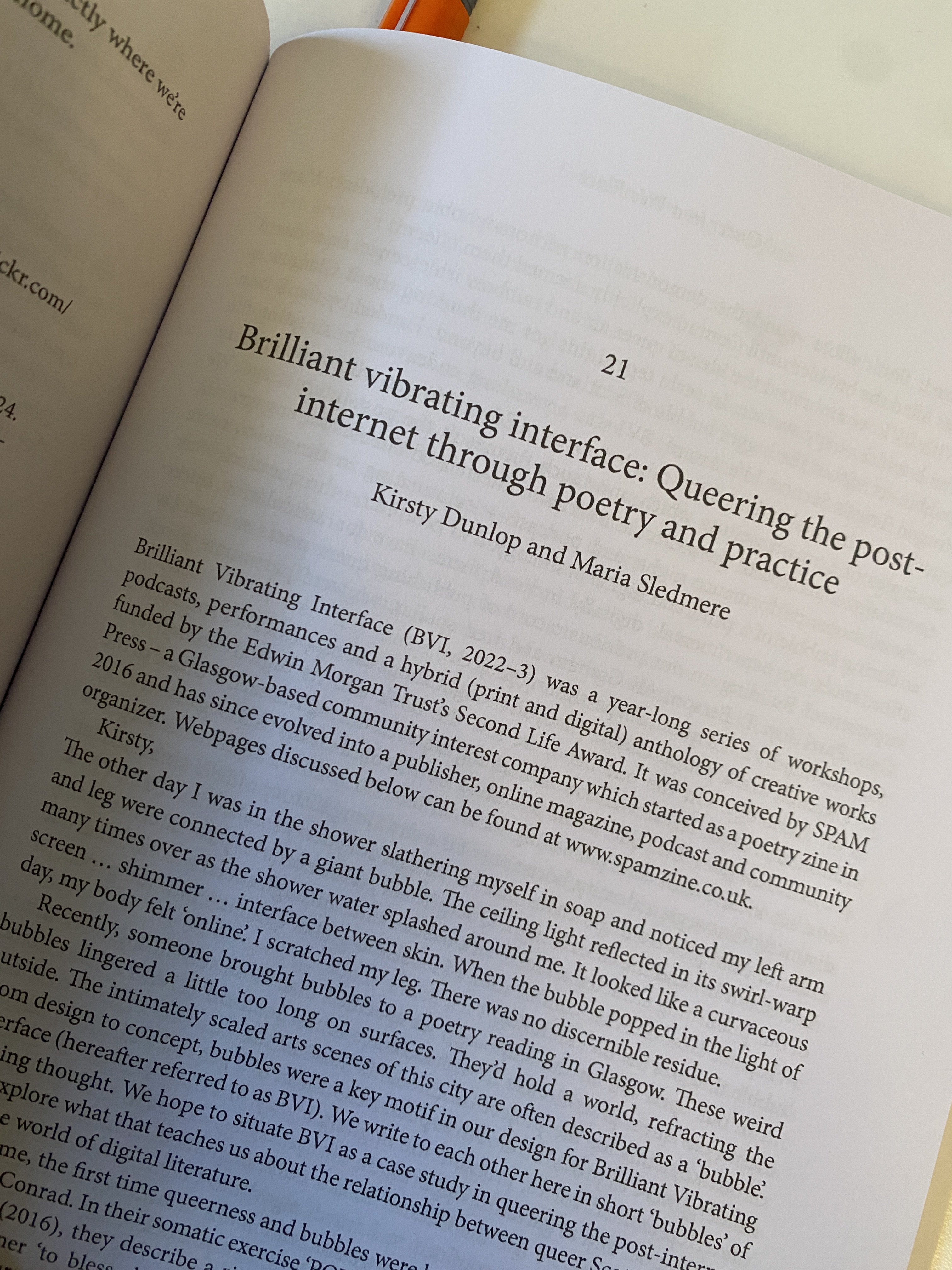
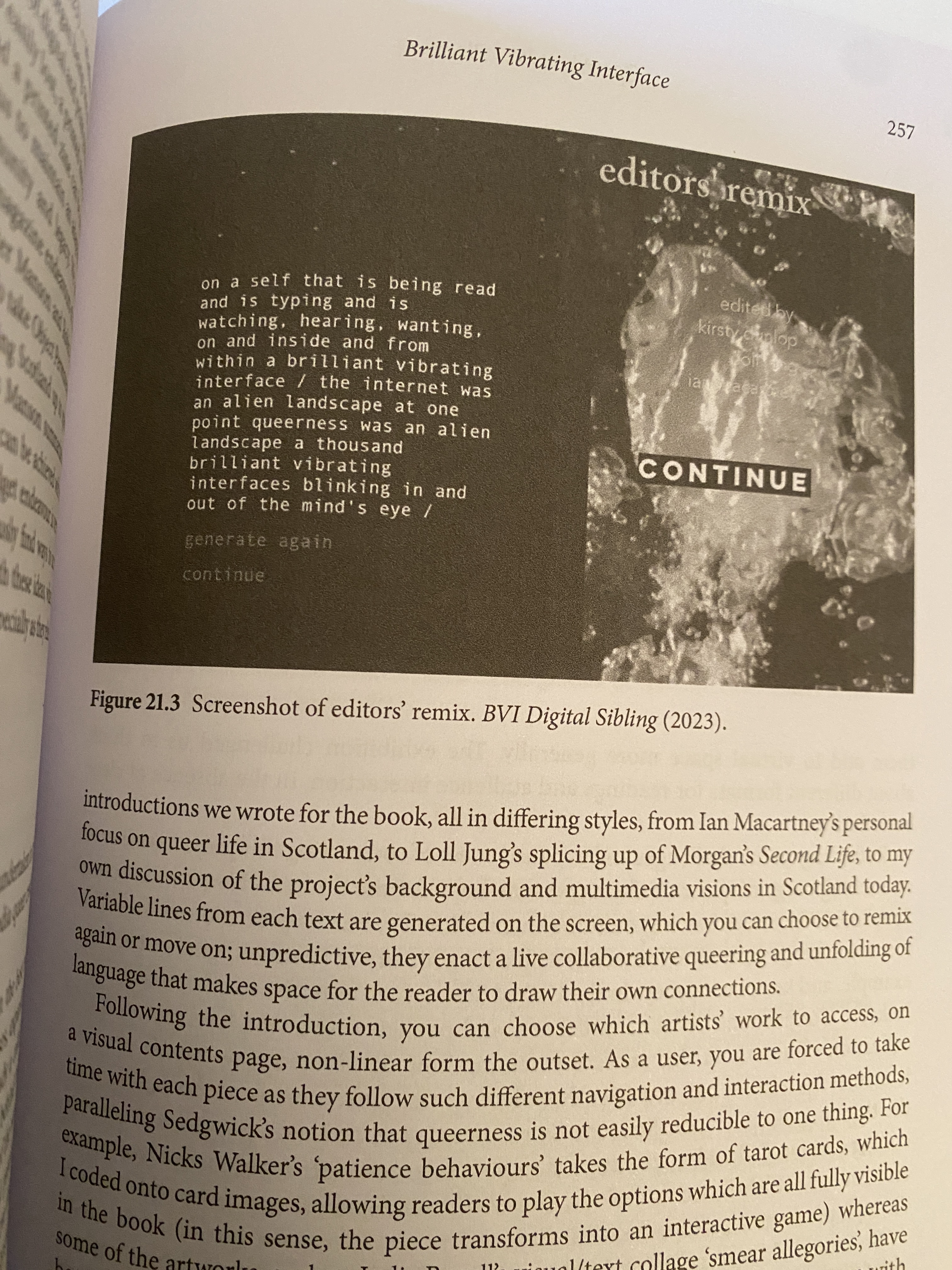
In 2022, SPAM Press obtained some funding from the Edwin Morgan Trust’s Second Life Award to run a year-long project titled Brilliant Vibrating Interface: Queering the Post-internet through Poetry and Practice. My co-investigators on the project were Kirsty Dunlop (SPAM’s current editor-in-chief), Alice Hill-Woods and Loll Jung, with Ian Macartney later joining to co-edit our print publication. We squeezed a lot of activity out of that money: community workshops online and in Glasgow, a few reading events, print publication, ‘digital sibling’ and physical installation, podcasts and an online magazine interview with contemporary sonneteers.
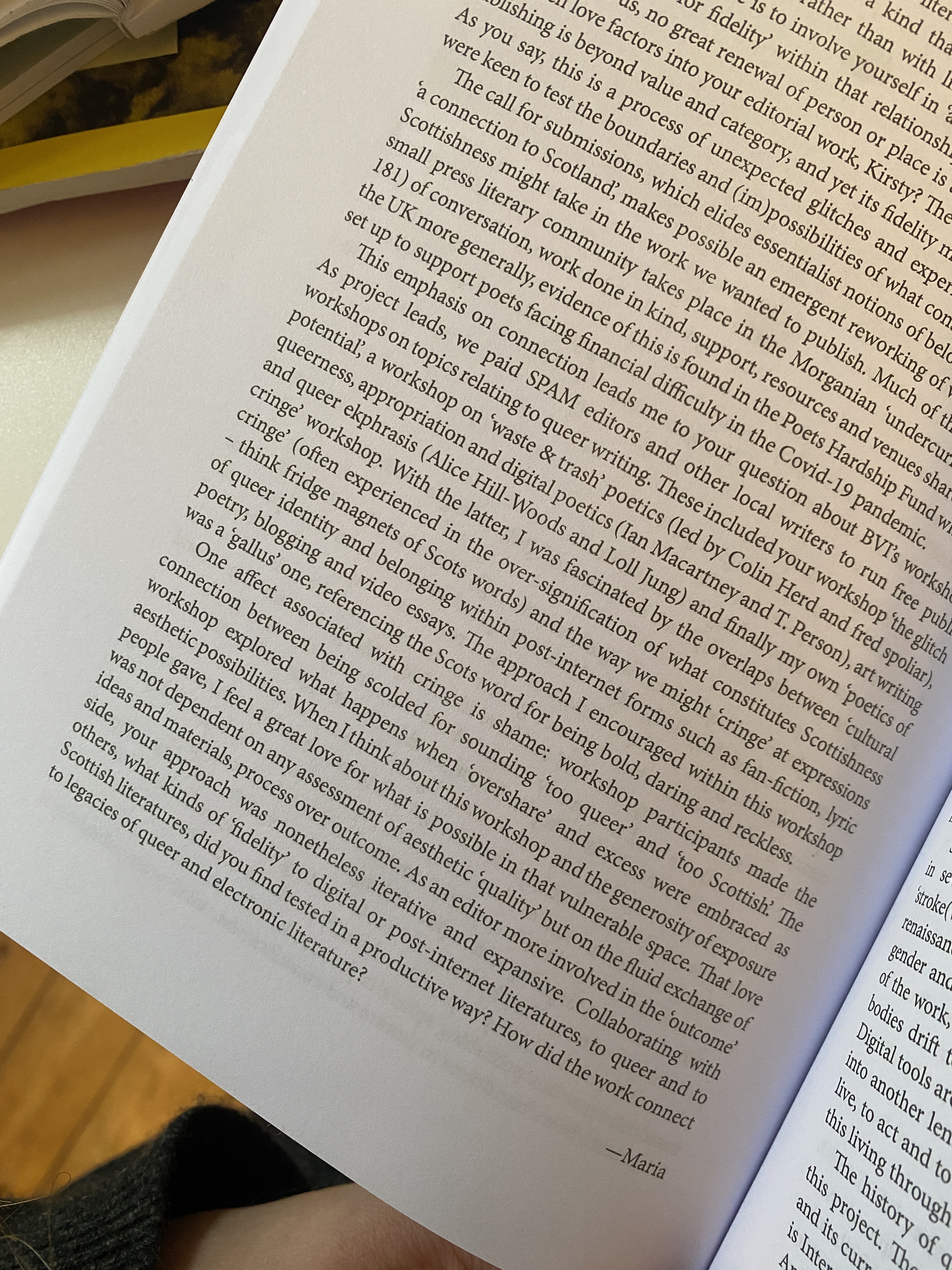
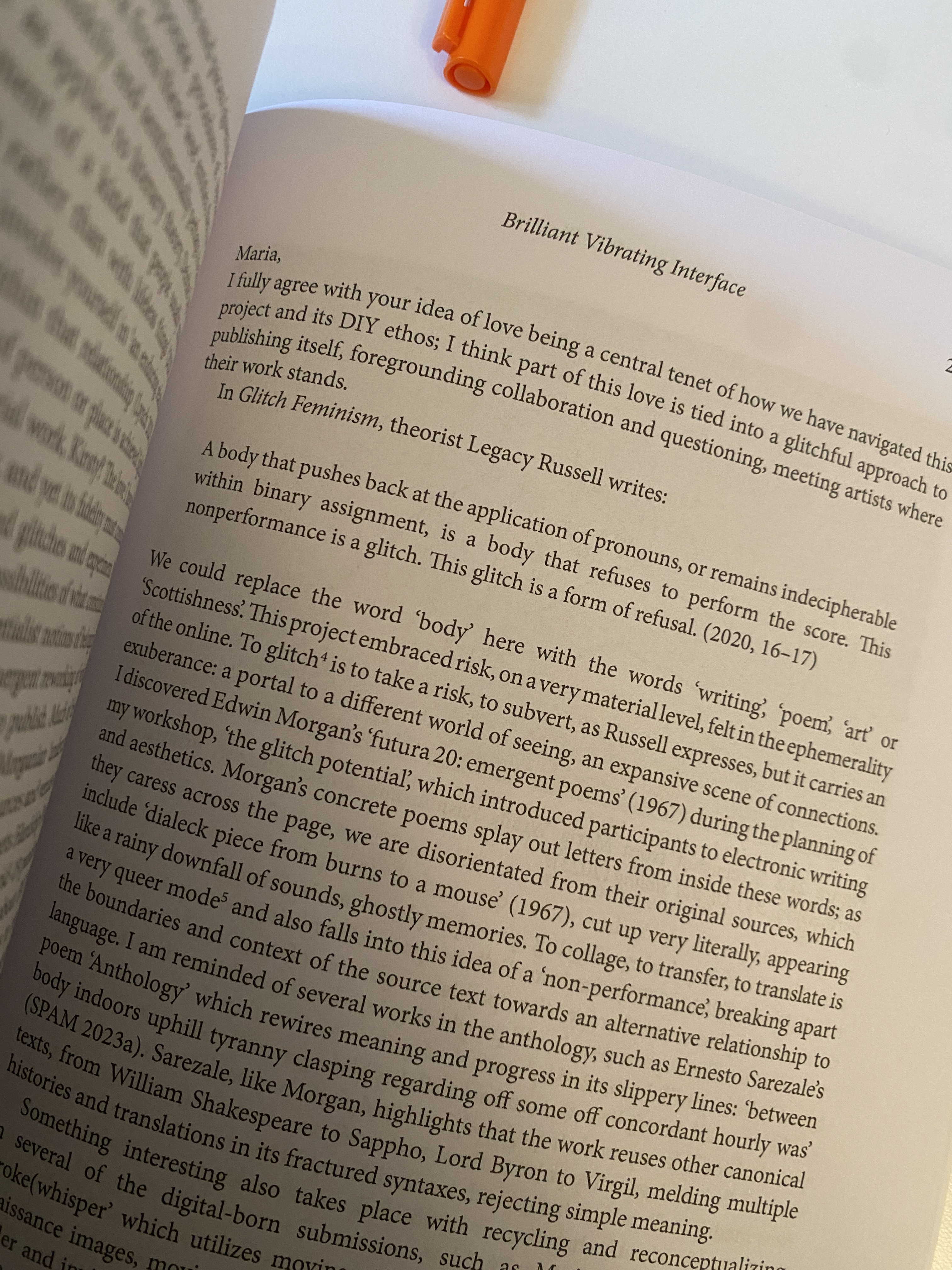
Recently, Kirsty and I wrote an epistolary chapter reflecting on the project and its significance in terms of identity, inequality, belonging, poetry scenes, queerness, Glasgow and the labour of love that is small press publishing. In our chapter we talk about the format of the project, Scottish literary scenes from the nineties to present day and the challenges and rewards of moving between print and digital (what we call SPAM’s ‘resolutely hybrid project’). We explore in more depth the poetry and visual art which found a home in our project and proffer up some poetics for how to think about queerness in the context of ‘small nations’ such as Scotland. This takes us everywhere from CAConrad’s bubbles to Legacy Russell’s glitch feminism to Edwin Morgan’s sumptuous strawberries.
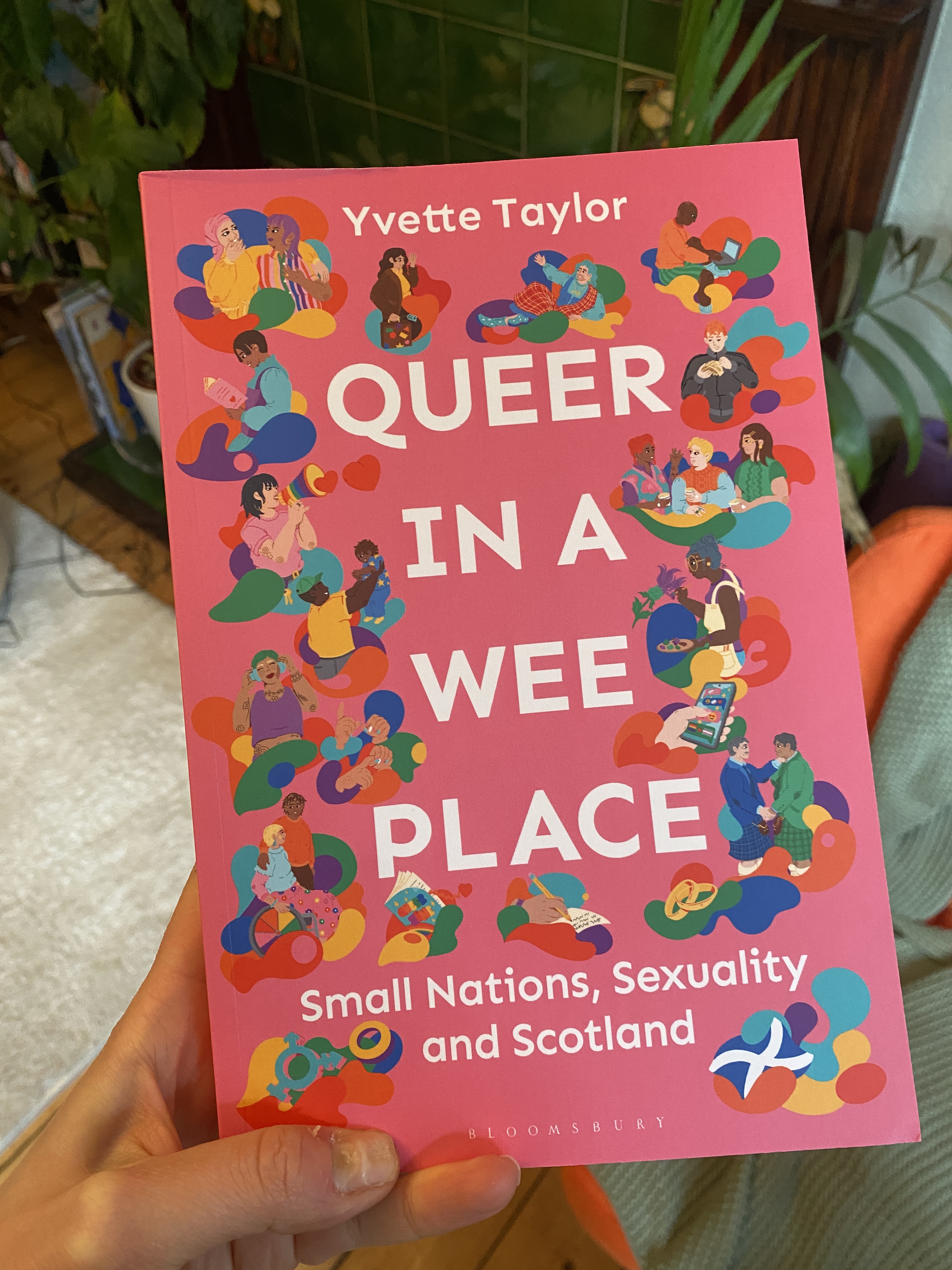
The chapter is out now as part of an anthology, Queer in a Wee Place: Small Nations, Sexuality & Scotland. To quote from the publisher’s website, the book ‘explores identity, inequality and belonging in animated conversations about how queerness moves through place – and how place, in turn, shapes queer lives’. Queer in a Wee Place contains chapters written by researchers of many disciplines and practices – from sociologists to poets – on subjects ranging from the utopic gaze on queer film to legacy and queer elders, disabled queer student experiences of higher education, Scotland’s menstrual landscape, hate crime and queer provincialisms.
The book is available in paperback form for what is a very reasonable price (for an academic book!) from Bloomsbury. You can ask your library to order it in for you 🙂
You can also read it for free via Bloomsbury’s Open Access service here.
Our archive of materials relating to Brilliant Vibrating Interface, including workshop handouts, podcast episodes, interviews and the online exhibition (what we called a ‘Digital Sibling’) can all be found at http://www.spamzine.co.uk and on the EMT website.
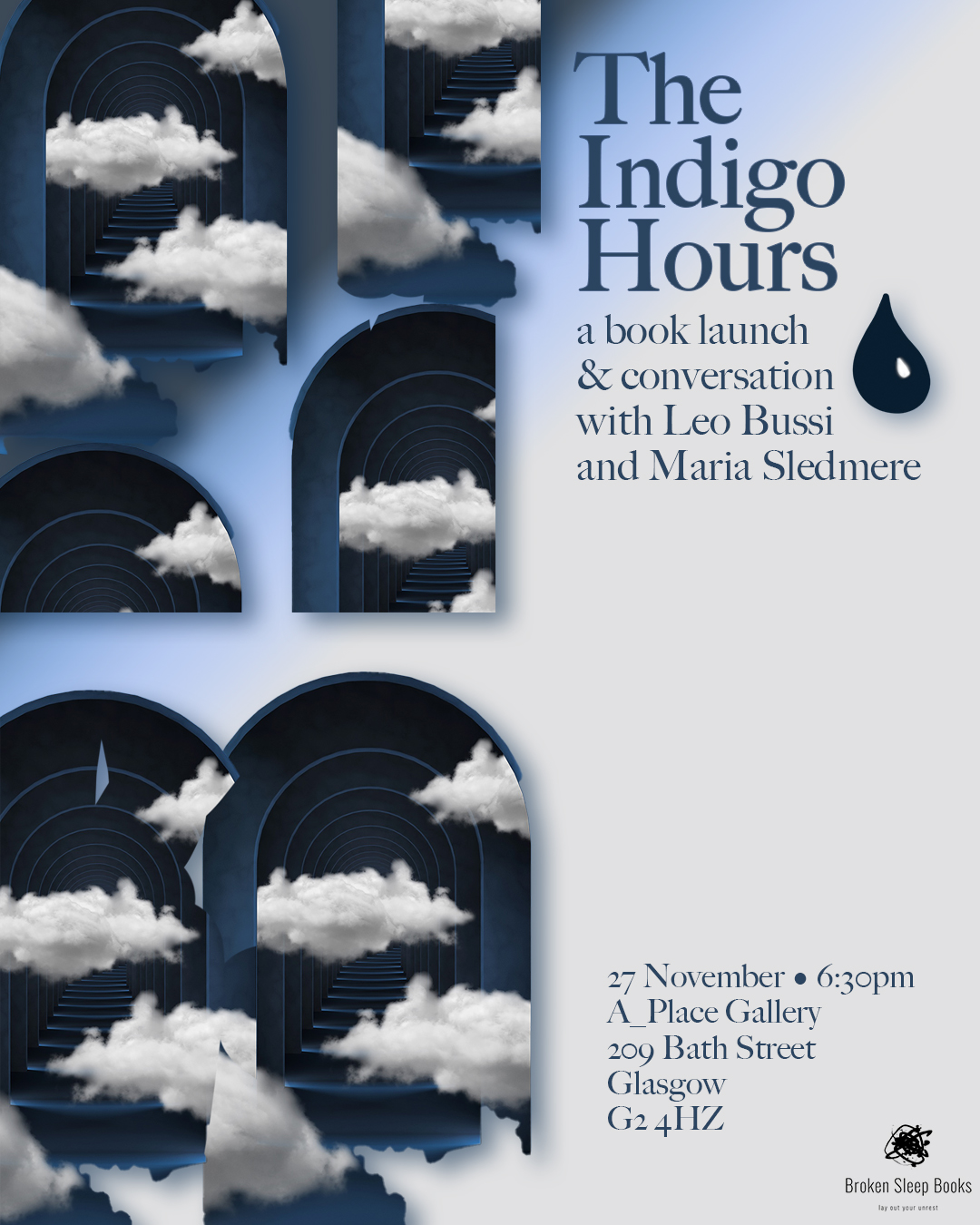
Glasgow friends! November is a busy month. See you there. I’m excited to be in conversation with the legendary Leo Bussi. Format is: readings from both of us (POETRY+PROSE) then a conversation and Q&A. Topics to discuss may include art & music writing, ambient literature, auto-theory/fiction, homage, love, everydayness, plotting the situationship and more. Books will be available from both authors.
Starts at 6:30pm sharpish. Venue: A_Place Gallery on Bath Street. Full details on the eventbrite:
Really excited to be a guest at Creative Conversations next Monday at the University of Glasgow. This is my alma mater (in fact, I ended up doing all three of my degrees there) and I’m grateful to be returning to talk about my work. I’ve been attending the series on and off for nearly a decade and have seen so many wonderful writers in the chapel. It’s free and open to the public. You can also join online. Hope to see some of you there 🙂
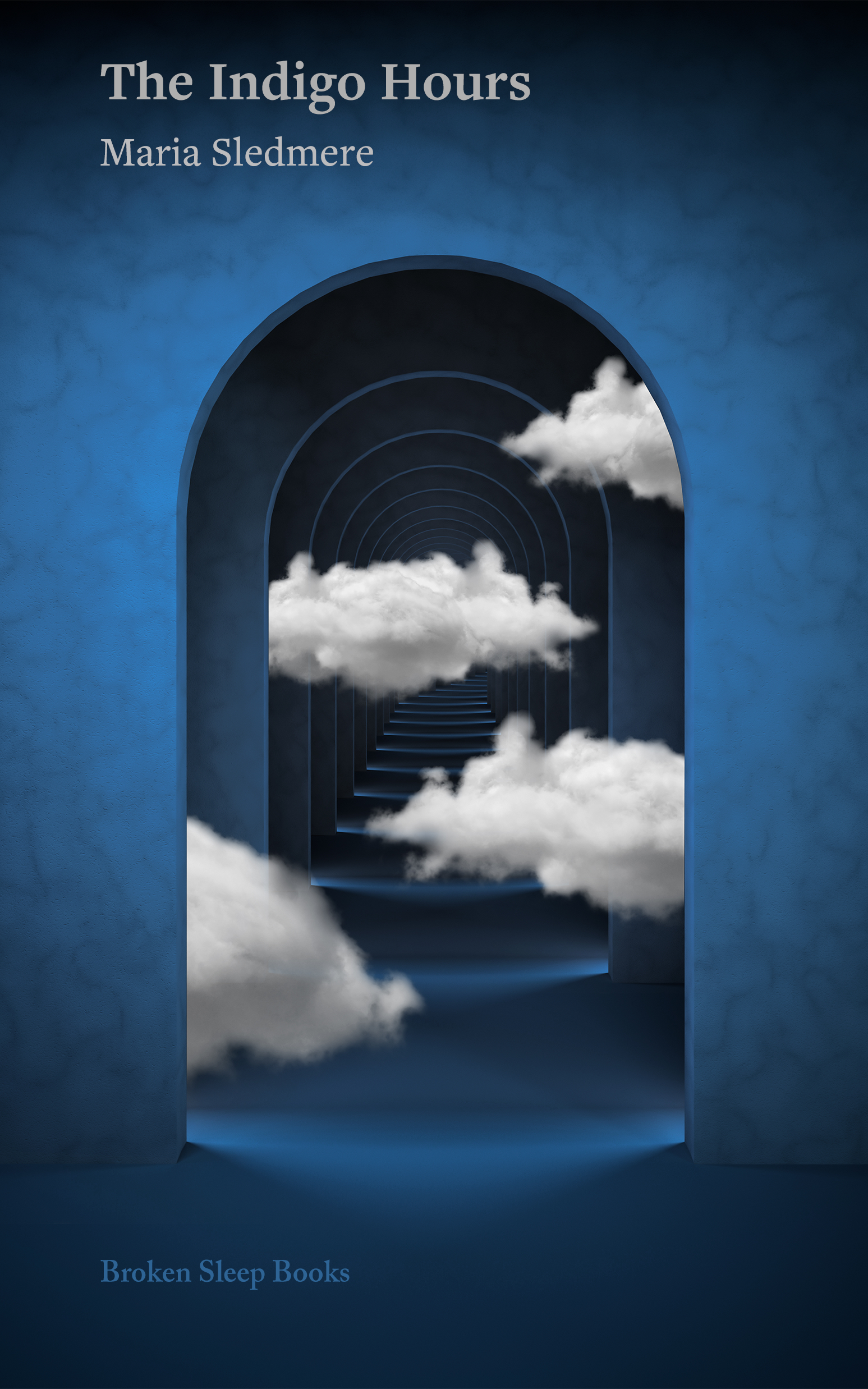
🦋🌫️🍋🟩The Indigo Hours…forthcoming with Broken Sleep Books
In 2018, I wrote a novella about erratic romance/Romance and the lyrical space-times of its (im)possibility. The fictional ~situationship at the heart of this work is stretched into, over and through various places — real and imagined — which the narrator digs into as pockets of presence and meaning. With its wandering, non-linear plot, I’d describe The Indigo Hours as ambient fiction. It’s a little eclipse of a book. It was ambiently written (leisurely, over one summer, as a dare) and may invite ambient reading. Which is to say, a textual experience more inclined to ‘going round’ a thing, attuning to its surrounds, getting lost, adjusting the frequency of (dis)interest. This is like dating a semi-transparent person. To adore the ghosts of both of you. How might love halo or envelope one’s personhood? How might love’s presence be felt ambiently in the objects and subjects of everyday life? The work tests love against memory, song, travel and friendship. I was interested in the phenomenon of blue — specifically indigo — as a desiring filter. Indigo as a singularity. Indigo as language of variable opacity. Denim wash (to go someplace). The supernatural inflection of indigo children (as a vocalised attempt at performing divergence of attention, durée and feeling). The book is full of aura, fleeting connections, music, art, intimacy and loss. It will be out on Hallowe’en, 31st October 2025.
Some nice things people have said:
The Indigo Hours’ lyrical prose, daubed from a free-associating palette of sensory psychedelia, becomes a portal into a ‘blossomy blossomy realm of the possible,’ where sadness is a sexuality, jealousies cause for celebration, and love a drunken texture. Painterly, tender, and spatially generous, this affecting novella rewards re-reading, like a magic eye that reveals a new image, and perhaps new self, with every glance.
— Poppy Cockburn
The Indigo Hours is watery fortification. Beneath li’l triads of asterisk constellations, Maria Sledmere tells a post-Romantic tale of moonlit precarity and passion among pools & thunderstorms & prairies & airports, where feeling wretched wandering midnight miles is a complex freedom, as exposure on cobalt-lit webcams, dozing/dosing to dub deep trap techno, bruises so Blühen. Yet under cosmic circumstances that augur heartbreak, Maria gifts us the deep assurance of ancient-blue auras and a languageful love pulsing constant. For insomniacs-or-otherwise against analgesia’s ‘“who cares”’, a most vital and tender-prone tonic.
Institute for Advanced Studies in the Humanities, 2 Hope Park Square Edinburgh EH8 9NW
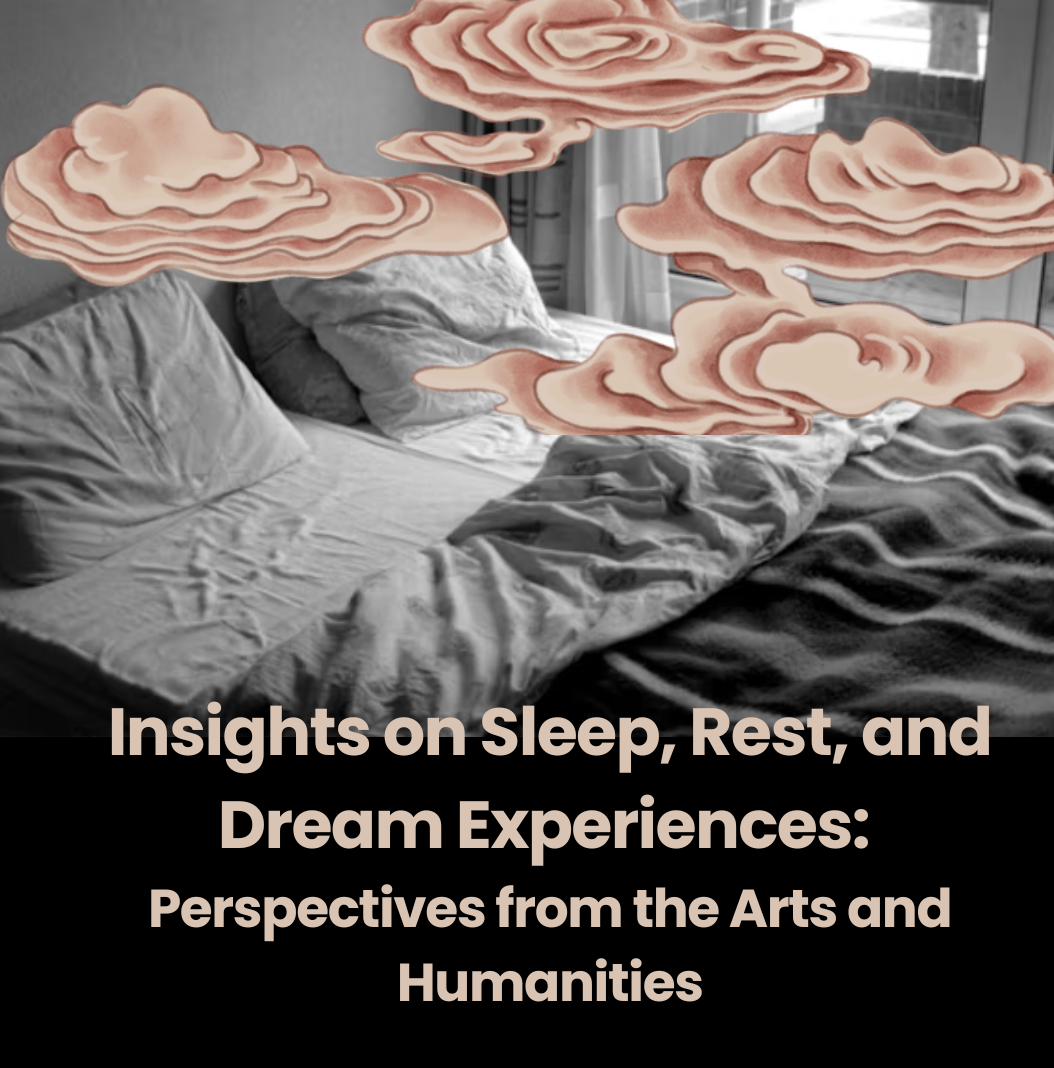
Broadly, our societal response towards sleep and rest is one of downgrading and devaluation. In our current capitalist society, sleep and rest are conceptualised as a time of passivity and inaction, and thus, as a period in which we are not producing or accomplishing. We tend to be jealous of those who can go about their days with fewer hours of sleep than ours, or praise those who can maximise their schedules, crammed with an endless series of activities and tasks. However, lack of sleep and rest time can lead to poorer health, both physical and mental. A good night of sleep can be one of our most restorative activities, and despite this fact, it tends to be neglected. Similarly, sleep and resting states allow for the occurrence of experiences that, if carefully attended, can provide us with a tool for self-exploration, such as dreaming and daydreaming.
The workshop intends to explore how these and related issues to our relationship to sleep and rest can be approached from the methods and perspectives of different disciplines within the arts and humanities. To that end, the workshop will consist of short presentations, panel discussions, and collaborative sessions for active participation. The workshop will be hosted both in-person and online.
DrMaria Sledmere(English & Creative Writing, University of Strathclyde)
Preliminary schedule:
11-11.25: Introduction and reflective activities:In this initial session, participants will be encouraged to share and write down their thoughts about their relationship to sleep and rest.
11.30-13: “Topics on dreaming, sleep experiences and transitory states” (Dr. Alcaraz-Sánchez, Dr. Bernini and Dr. Cowan). Short talks followed by a Q&A.
· Dr Marco Bernini (Durham University): “Dreams and Heightened Narrowed Immersivity: Combining Saturation, Permeability, Presentationality and Presence”.Are dreams (narrative) worlds? What similarities and differences are in play between our waking consciousness of the perceptual world and dream consciousness as quasi-perception? This paper posits that dreams exhibit a unique experiential mode called ‘Heightened Narrowed Immersivity’ (HNI)—a state characterized by intense presentational immediacy and severely restricted informational context. Combining frameworks and concepts from narrative theory and cognitive science while looking at dream reports, literature, lyrics, and movies, the paper shows how dreams and their artistic mediations reveal unstable ontological environments—low saturation in time, causality, identity, and space—while maintaining a high degree of immersive presence.
· Dr Robert Cowan (University of Glasgow). “Exotic and Ordinary Dreaming”.In this talk I consider two kinds of ‘exotic’ dreams. First, those that occur during episodes of REM sleep behaviour disorder where subjects allegedly ‘act out’ their dreams. Second, lucid dreams wherein subjects are apparently aware that they are dreaming while dreaming. My question: what do these exotic cases tell us about the nature of ordinary dreaming? My answer: very little and certainly less than others have thought.
· Dr Adriana Alcaraz Sánchez (University of Glasgow). Hacking the sleeping mind: the exploitation of the dreamspace.In dream research, the term ‘dream engineering’ has been adopted to describe techniques that manipulate, record and affect our dreams. Within the research context, dream engineering has become a useful tool for exploring the nature of dreaming as well as its potential for enhancing our waking lives. Yet, a couple of examples taken from outside scientific research might make us worry about the extent dream engineering practices should be conducted, especially when those are applied widely to the general public. Here, I consider some of the ethical implications of those practices outside the research realm, some of which put into question the value we attribute to sleep and dreaming.
13-14: Lunch Break:Vegetarian and Vegan catering for all participants
14-15: Panel discussion: Working title “The need for rest”(Dr Reeder, Dr Jones, and Dr Callard and Dr Sledmere): Our panellists will give a flash/provocation followed by a chaired discussion with questions from the audience.
15-15.15: Short break:Tea and coffee for all participants
15.15-17.00: Creative session.In this facilitated session, we will explore the role of dreaming/liminal states for creative purposes.
· Poetry reading and discussion by Dr Sledmere and Dr Hazzard.
· Haiku writing and Deep Listening activities
17.00-17.30: Discussion back to the rest of the workshop/final thoughts
From 17.30: Wine reception at IASH (Open to all participants)
This event is organised byAdriana Alcaraz-Sánchez(Postdoctoral Fellow in Philosophy, IASH, University of Edinburgh), Maria Sledmere (Artist and Lecturer in English & Creative Writing, University of Strathclyde) and Kevin Leomo (Artist and Community and Engagement Manager, University of Glasgow).
Accessibility: This event will take place at IASH, 2 Hope Park Square, Edinburgh, EH8 9NW. Please see a map here: https://www.iash.ed.ac.uk/location
The Seminar Room is on the first floor, and unfortunately IASH does not have a lift. If you have mobility issues and would like to discuss access, please contact iash@ed.ac.uk as soon as possible. Next to the Seminar Room, there are a couple of rooms that can be freely used in between the sessions/break time. If you require a quieter space at any point during the duration of the workshop, do reach out to the lead organiser (contact below) or let any of the organisers know on the day of the event. There’s also access to a microwave/small kitchen space if you require it.
Note to online participants: All sessions will be streamed, and online participants will be able to ask questions. However, note that due to the engaging nature of some of the sessions (i.e. creative session), we will not be able to provide tailored support or feedback to online participants. The sessions (including the talks) will not be recorded.
Note to in-person participants: Unfortunately, we are unable to cover travel and/or accommodation expenses for participants. Catering (including lunch and refreshments) will be provided to all.
Contact: For any questions or enquiries regarding the event, please get in touch with the lead organiser Adriana at Adriana.alcaraz.sa@gmail.com
The event is supported by the Susan Manning Workshop Fund from the Institute for Advanced Studies in the Humanities (IASH) and is jointly hosted by IASH and Project Somnolence.
In August 2022, which legitimately feels a whole fat wormhole ago, Ian Macartney and I found ourselves working in Edinburgh for part of the summer. We met up at after-hours cafes (more prevalent in the capital, what you playing at Glasgow?) and walked around the Botanical Gardens where the staff promised ~*’Instagram flowers’*~ and we talked about our hopes and dreams and struggles as booksellers and teachers. Part of the emergent narrative concerned utopian ideals of Scottish infrastructure, where one could zip to Lerwick in a hyperloop heartbeat (all élan, not El*n) or at the very least catch a local bus on time, or unlock a hidden realm below the loch of Linlithg(l)ow. Part of it was about friendship, love and pop music. We were listening nonstop to Caroline Polachek and feeling okay about it. Pretty good actually. There was her vocal flipping over the crags, at sunset. I remember purifying my heart with orange liquor. Wearing a lot of lilac. Bleeding ink into industrial bedsheets. We were thinking about pivotal points where our childhoods overlapped with culture. We wrote things in documents and met in the months ahead. I did a lot of chaos cycles, late, trying to meet Ian at say, the Mitchell Library to go over some edits. A lot of awful things happened in the months intervening but there was this document we could splash land into and like turn on the light. Poetry’s coy ambience zonked up to warp speed. I liked doing this project a lot. I’m glad it’s in the world.
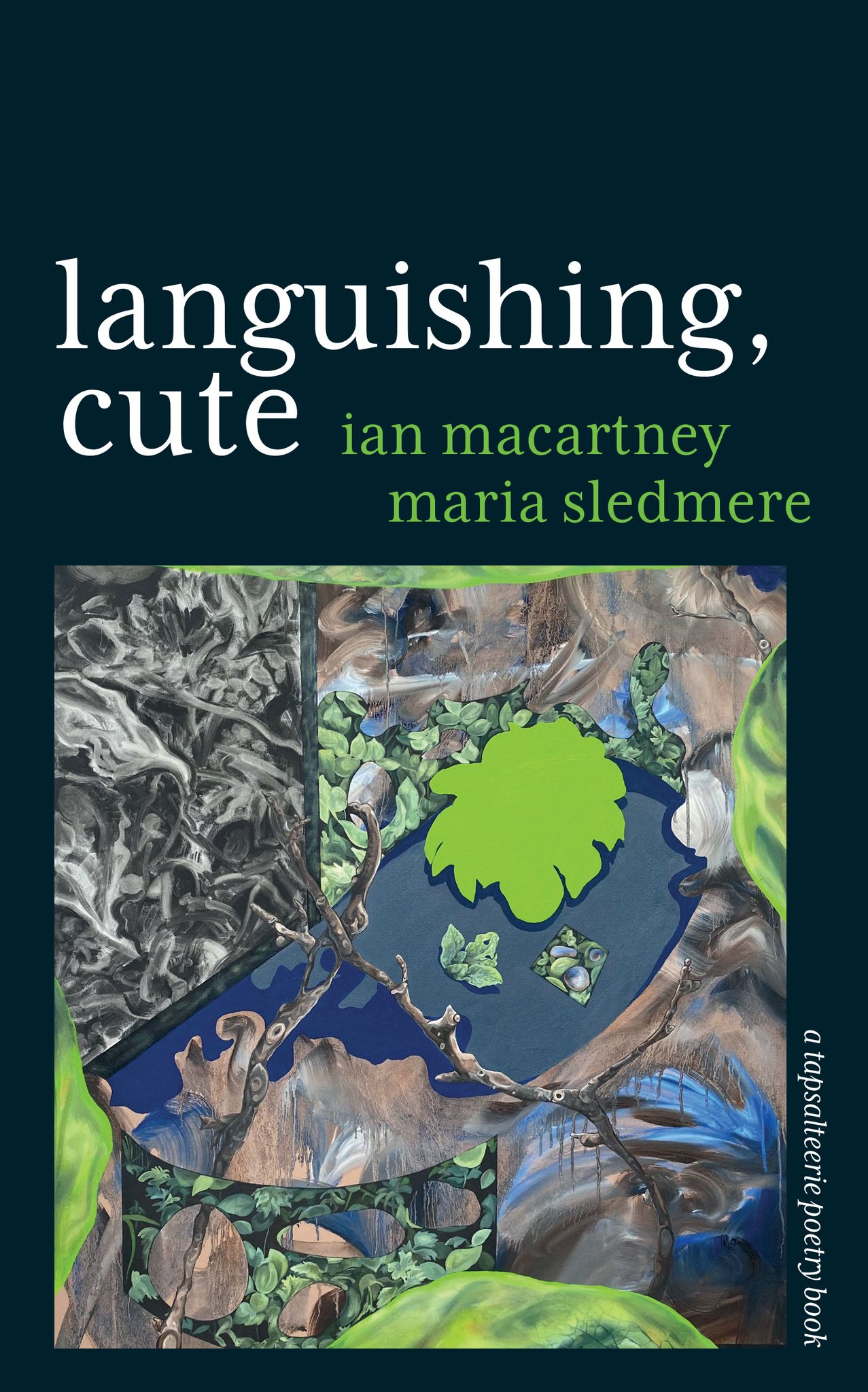
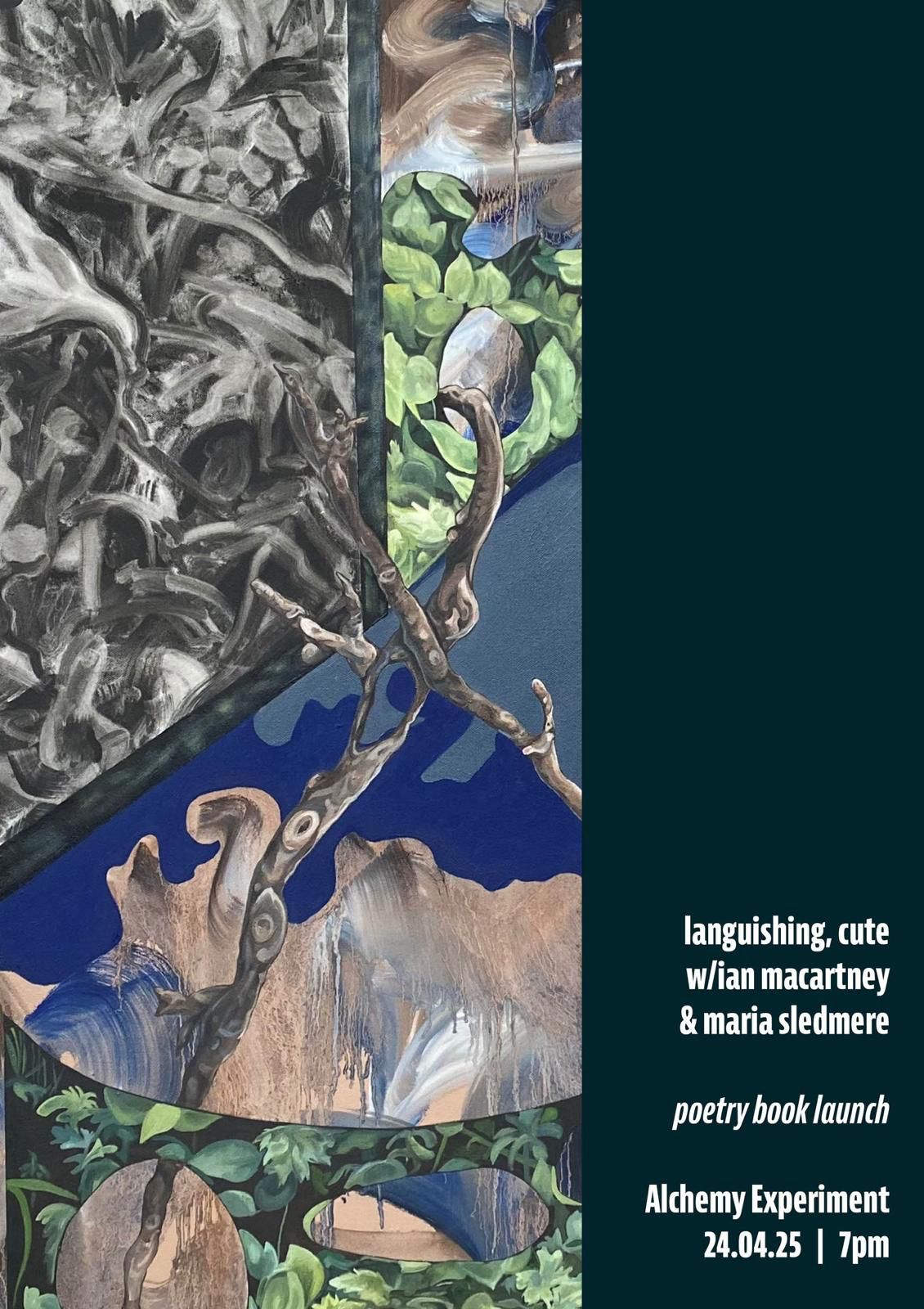
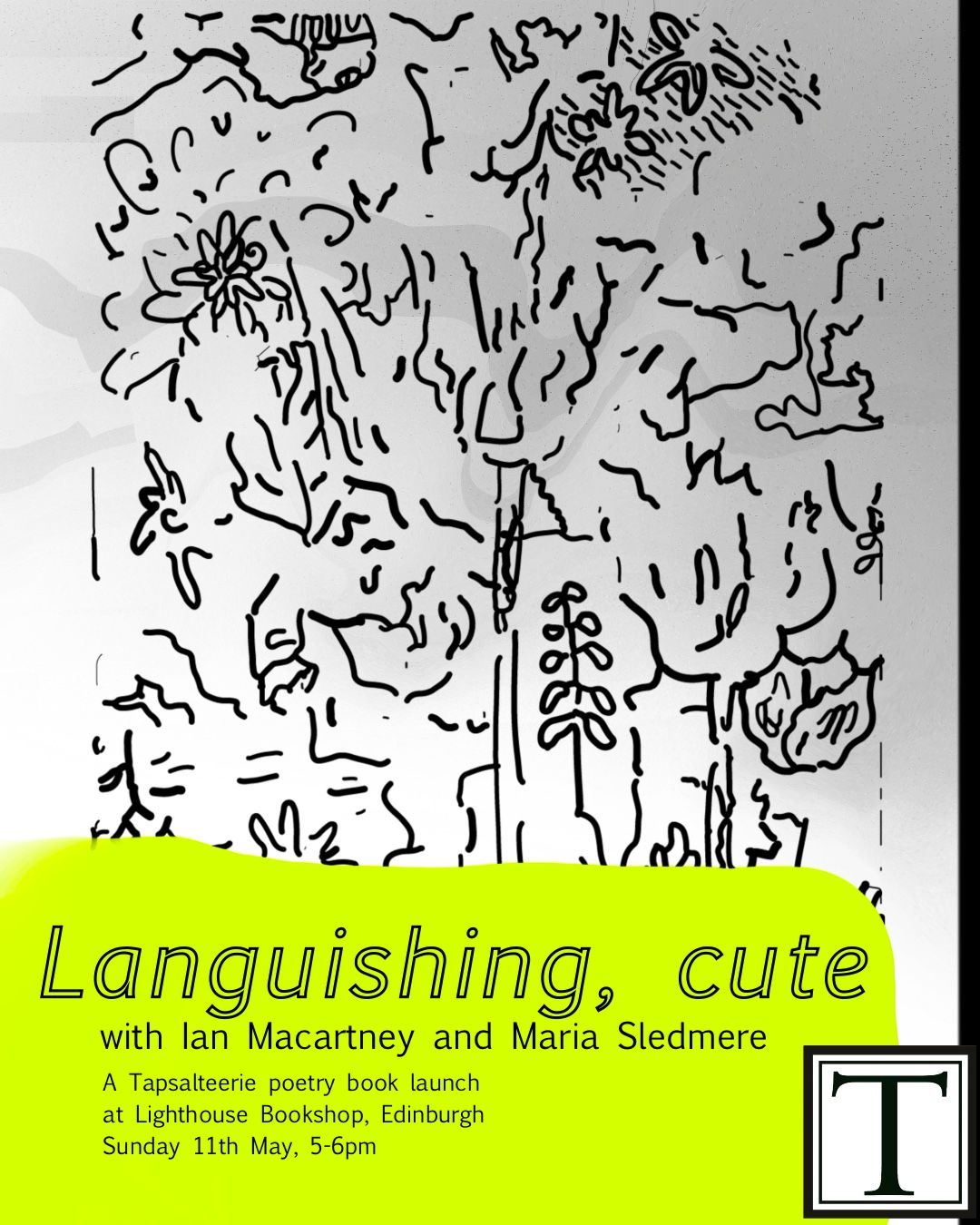
We’re publishing the full collection, Languishing, cute with the wonderful Tapsalteerie, an indie press based in rural Aberdeenshire. Ian’s worked with them before via their pamphlet imprint Stewed Rhubarb Press and they published some of my poems in the 2019 anthology, edited by Calum Rodger, titled makar/unmakar: twelve contemporary poets in Scotland. We’re big fans of Duncan Lockerbie, Tapsalteerie’s founder and editor, who does so much for Scottish poetry and beyond.
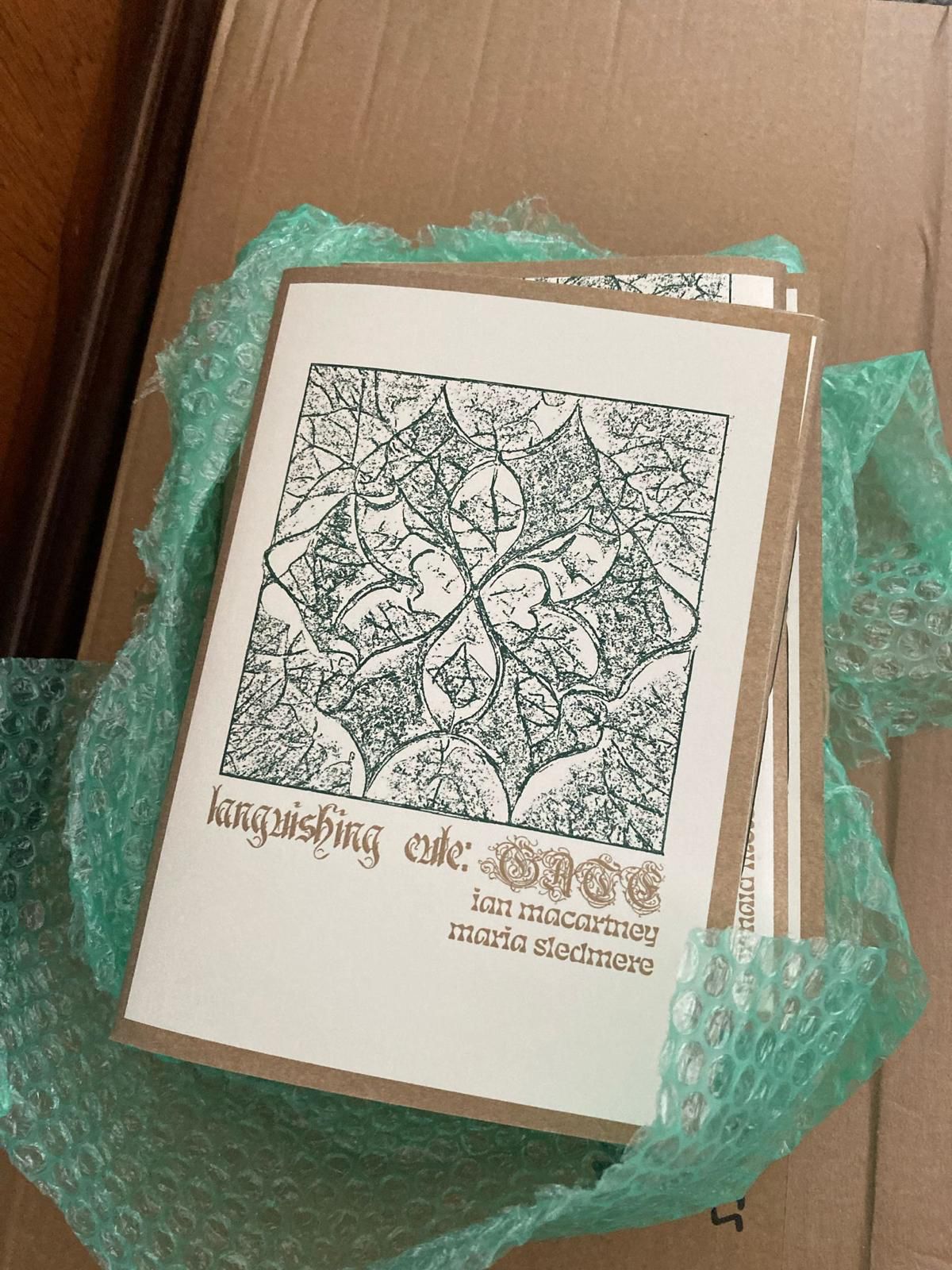
We’re also publishing, thanks to the exquisite printing of Earthbound Press, a separate riso pamphlet of b-sides titled The Gate. Look out for that at our launch events…
From the publisher
languishing, cutepresents a collection of jittery missives that propels the speculative Scottish canon of Morgan, Gray and Mitchison into a maximalist ‘high femme goth surrealism’ via hyperpop, Celtic futurism and digital culture. Here the poets tend towards e-pistolary contemplations of retro-adolescence, fizzy ecology and mercurial slippy gurlhood to complicate notions of Scottish identity, nationhood, ecology, nostalgia and more.
Nice things people have said:
languishing, cute is the opposite of a flyting — that traditional bare-knuckles fight between two poets. Rather, the two poets here offer their worlds to each other in the gift of friendship and they listen back: it’s not a duel, it’s a jewel. Where they meet is in a place of Anglophone avant-garde stimulants — locating codes include Francesca Lisette’s Teens, Edwin Morgan, Tim Atkins and Peter Manson — and the dancefloor has Bunny Is A Rider pumping out in up-melancholy and autotune. At times this is glitch-poetry, funny, para-kitsch and mesmeric. At other times there are the amplitudes of tenderness and self-effacement in a palette of citrus and greenest day-glo. What’s also fascinating is the pressing together of the virtual and its tics with its mineral and viscose underpin, all via the very human. It’s a leap from body/mind to capital/digital and back again, flickering, a visit to Silicon Brig-a-Doon you’ll want to be the first to Insta.
– Richard Price
[…] Messy as a teenage tumblr, flashy as a strobe light, this is two exceptionally generous poets bouncing off the walls of the backrooms with the energy of a thousand monster energies… here ~The Glitch~ is not a glitch but a stitch between windows, the glue between a b2b set, the rhythmic green hills of algorithmic infinity … and yet these re-mixes and e-mails traverse an internet of metal and cable, the business of poetry is conducted by staples through sheets of reconstituted tree::: there’s something old-school, decidedly analogue about all this. It feels like you could feel it. It feels like the push of a button, the caress of a bright cool screen. Actually no it feels warm and coarse, a cosy transmission rumbling, re-tuning itself like you’re flicking from station to radio station, flickering between noise & dialectical noise, patterns emerging in the static as the ether unknots itself, and the stuff of life comes spilling out […]
– Dan Power
Endless aureate refreshment from Maria Sledmere and Ian Macartney, languishing, cute is a collection with all its push notifications turned on that still finds headspace to pay attention on the DL to form and poetic inheritance. There’s Sledmere’s elliptical take on William Carlos Williams’ fridge raid (with Kylie Minogue R osé instead of plums), the odd sestina, and plentiful nods to that Scottish experimentalist Edwin Morgan range from embedded songs of the Loch Nes[s]presso Monster to Macartney’s predictive geographies in time-travelling poems indebted to Morgan’s Sonnets from Scotland.
With spins to further Scottish topographies from Maybole to Lerwick, Sledmere and Macartney are often found shuttling east and west ‘w/ eloquent glitches’ across Scotland’s central belt, heading increasingly into CAPITALS when Macartney’s voice announces us into Superedinburgh Vaporwaverley/Edenbruh/the London of Scotland.
The internet’s vertigo is never far away from poems presenting like listicles. Sadly for any wannabe monetised content, in languishing, cute these poets may be trading futures, but their hacked hypernature is funding nobody’s wellness retreat.
Tonight I’ll be reading a nauseated sestina dedicated to the old Glasgow subway for the launch of TANGERINE DREAM – an anthology collecting work from 24 glasgow-based poets and artists, responding to the 2024 retirement of the old glasgow subway carriages. You know how I love infrastructure.
The Waverley Bar, Edinburgh | Thursday, Jan 30, 2025 7:00 PM
I’ll be reading with the luminous Vik Shirley alongside open mic performances and music from The Self-Righteous Brothers. I’m told there is a raffle. Will bring some books to sell (have a few copies of Midsummer Song and a new batch of Cherry Nightshade).
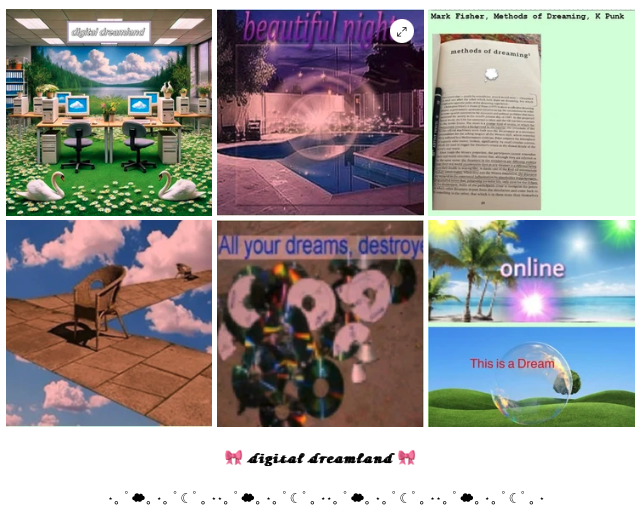
SPAM Plaza is reopening submissions for Digital Dreamland.
Ever had déjà vu, not knowing if something happened IRL, online or in your dreams? As screentime and sleep time increasingly clock similar hours of the day, we’re turning our attention to the acute relationship between dreams and the internet.
We invite critical work inspired by, but not limited to, any of the following topics:
☁︎ sleep procrastination and social media
☁︎ cloud hoarding
☁︎ the return of the (digital) repressed
☁︎ the memetic unconscious
☁︎ distraction as dream economy
☁︎ ghosting (and the metaphysics of digital presence)
☁︎ sleep texting
☁︎ hyperreal environments & nonspaces as dreamscapes
☁︎ online dream journaling communities
☁︎ targeted ads as unconscious desires
☁︎ chaos edits as dream realism
☁︎ artificial intelligence and dreaming
☁︎ interactive & lucid dreaming
☁︎ digitally-induced parasomnias
☁︎ dream imaginaries and political im/possibility
☁︎ neural net neurosis
☁︎ image spam and cyber garbage as psychic discharge
☁︎ oceanic feeling online
☁︎ dreams in augmented and virtual realities
☁︎ video game realities and dream framing
☁︎ online shopping and astral projection
☁︎ cognitive timelapse and digital intimacies
☁︎ corecore and collaging the cultural unconscious
☁︎ dream scanning as the next cyber frontier
☁︎ avatars, dreams and shadow selves
☁︎ (rip) twitter dream sharing
☁︎ movie and/or fictional representations of dreams and the internet
☁︎ typographic parapraxis (poetics of the typo as freudian slip)
For more inspiration, read the inaugural editorial for this series written by Maisie Florence Post. We always love to see work which engages these themes specifically in relation to poetry, but are open to work that touches on any aspect of texts, media and internet culture.
Submission guidelines:
We will be open for submissions between 15th January and 12th March 2025.
All submissions should be sent to spamzine.editors@gmail.com with subject line SUBMISSION: DIGITAL DREAMLAND.
Please add a brief note to your email explaining how your work fits into our theme.
We aim to respond to all submissions within four weeks and some people will hear back before the submission window closes as we will be publishing pieces on a rolling basis throughout 2025.
This is an open call for critical work. While we appreciate the line between creative and critical can be fluid, we are looking for work that fits overall a more critical angle.
Unfortunately neither the editors or contributors of this series will receive remuneration. Copyright remains with the author.
We don’t have capacity to give feedback on unsuccessful submissions and the editors’ decision remains final.
Please send submissions that are previously unpublished.
You can submit up to TWO pieces in any of the following categories:
Flash essays – 400-1000 words
Full essays – 1000-2500 words
Theory fictions – up to 2000 words
Verse essays – up to 100 lines (we have very limited formatting options however, so please get in touch if you’re not sure your work will be suitable)
Visual essays (photography, memes, illustrations etc – max limit of 15 images)
Audio or video essays (with text transcript provided – you must already have the link hosted elsewhere rather than send it as a file – we need to be able to embed it via a link)
ʚɞ
You can read the SPAM Plaza archive for free to get a feel for the stuff we like to publish.
In 2018, I started a Doctorate of Fine Arts in Creative Writing at the University of Glasgow. I also started a new diary. In October, the month it all started, I wrote about duplicate footsteps and permanent landfills. I wrote of lacking the energy to dance, being lost in the forest, looking for safety among swirling leaves. Can’t remember if the forest was real or metaphorical. I wrote seemingly in lieu of being able to actually venture beyond the confines of my working life. Over three years and three months, I went through multiple iterations of research focus. I looked at foam, clouds, technicity, glitter, quotidian measures, fire and cinders. I fell asleep on coaches circling lochan sunsets. I produced a list of figures for how we might conceptualise this project. It was a sort of Escherian dollshouse, a self-deconstruction of building this place to think. I thought about Bhanu Kapil dropping her book in the river. I thought about doing a writer’s residency within the confines of a square-shaped digital platform. I wrote of ‘An angel tossing her gunpowder sequins’ and ethical eating, ‘how so often you are so paralysed between two choices that you just don’t eat at all’. I wondered what kind of home this work would make for me. This was a material question: thanks to the Scottish Graduate School of Arts & Humanities, it was a funded period. It paid me through Covid-19.
These were my original research questions:
How can creative and critical writing interrogate and depict the apparent tensions between the Anthropocene’s deep-time and the quotidian context of our ecological orientations?
What hybrid critical-creative forms might open up possibilities for a future ecological art, one which builds productive ways of ‘tuning in’ to a non-anthropocentric experience, with reflexive attention to the artistic and technological media involved in this process?
How might ‘the everyday’ provide a temporal and formal mode through which to develop a critical, interdisciplinary Anthropocene aesthetics, negotiating ecological questions of affect, sensory relations, ethics and responsibility at scales both macro and micro, human and nonhuman?
It is up to the reader to decide how far the end result fulfilled or strayed from these lines of enquiry.
Six years on, having graduated from being a baby scholar-poet, I am really thrilled this project has found a dream home with No University Press, a new imprint from Tenement Press. The ‘no’ of refusal feels appropriate to this project, which very much concerns the affordances and limits of an academic and institutional mode when thinking through (im)possible questions of ecological thought and living on. Working with Benjamin Pickford and Dominic Jaeckle, editors at Tenement, I was able to bring the project’s creative detours and modalities to life in its final book form: Midsummer Song (Hypercritique). This is definitely the most ambitious work of my life. It’s 469 pages of critique, poetics, meadow work, illustration and elegy. I see the whole book as a big song, a study, an architectural attempt at making an ecological home in lyric.
Somewhere between an academic monograph and performative dreamwork, poetry and poetics, conceptualism and the commonplace.
You can order the book direct from Tenement here or from Asterism here.
You can read a full description of the book and access endorsements, sample poems and other materials here.
I will be touring the book at some upcoming dates in Glasgow, Edinburgh, Manchester and London:
09.11.24 Peter Barlow’s Cigarette / with Maria Sledmere, Harriet Tarlo & Lucy Wilkinson The Carlton Club, Whalley Range Manchester See here.
05.11.24 Midsummer Song / Readings & Discussion Maria Sledmere, David Farrier & Colin Herd Fruitmarket Gallery, Edinburgh See here.
26.10.24 Midsummer Song / Readings & Discussion Maria Sledmere, Chris McCabe Small Publishers Fair Conway Hall, London See here.
22.10.24 Midsummer Song / Readings & Discussion Maria Sledmere, Carl Lavery & Colin Herd Advanced Research Centre, University of Glasgow / (Online via Zoom) See here.
Featuring nearly thirty authors, our next issue takes a slomo plunge into the ocean in search of lost cities, cephalopods and that selkie we made friends with in ’93. The issue features poetry, fiction and essaying around themes of alien drift, andromeda, billionaire hubris, despairing jacuzzis and more.
From my editor’s introduction:
Our title, BERMUDA ▲ SADCORE, embodies the vibe theory of oceanic feeling. The word sad, in its Germanic origin, connotes ‘weighty, dense’, eventually replaced in Middle English with the sense of ‘steadfast, firm’ — later ‘sorrowful’. The ocean is at once weighty, dense and everchanging, temperamental. We love the doleful, consonant insistence of the ‘d’ in ‘sad’ and ‘bermuda’. In recent years, the ocean has been toxified by microplastics, literally set on fire, forced to house massive, heat-generating data centres and scraped for rare earth minerals. If anyone has the right to be sad, it’s the ocean. And the ocean, historically feminised as sailors did with their boats, might herself be the Anthropocenic siren in the night everafter. Our original home and eventual disaster. Stop me if this sounds like an emo lyric.
What would it mean to be sad forever? Or to be steadfast in sadness, like the great eighteenth-century poet Charlotte Smith: who would wander the cliffs of Beachy Head and later write her Elegiac Sonnets from a debtor’s prison. To be sad forever is to forever be facing the sea. The vibrant imaginaries of the poems, essays and fiction contained herein will transport you to bodies of water whose sumptuous power to surprise, query and upend our bodies of knowledge is remarkable. The only way in is through surrender. In the movie Triangle of Sadness (2022), the rich are punished for their attempts to control, own and influence everything. With virtuosic abjection, we are witness to them literally vomiting the poisoned fruit of the ocean.
The issue features the following contributors:
Adam Fraser Al Anderson Al Crow Alex Grafen Ali Graham Amy Grandvoinet Andrew Hykel Mears Carolyn Hashimoto Dan Power Daniel Ridley Fynn Kǒster Grace Marshall Iain Morrison India Bucknall James Andrews J.R. Carpenter John McCutcheon Kim Crowder Lauren Kalita Lizzy Yarwood Matt Pollock Mattea Gernentz Matthew Kinlin Rahul Santhanam Rose du Charme Ruby Eleftheriotis Sam Francis Victoria Brooks 1846975493
You can read the whole thing for free here or download a pdf here.
Thanks as ever to Douglas Pattison for co-editing, curating and designing the cover art.



 mariaology