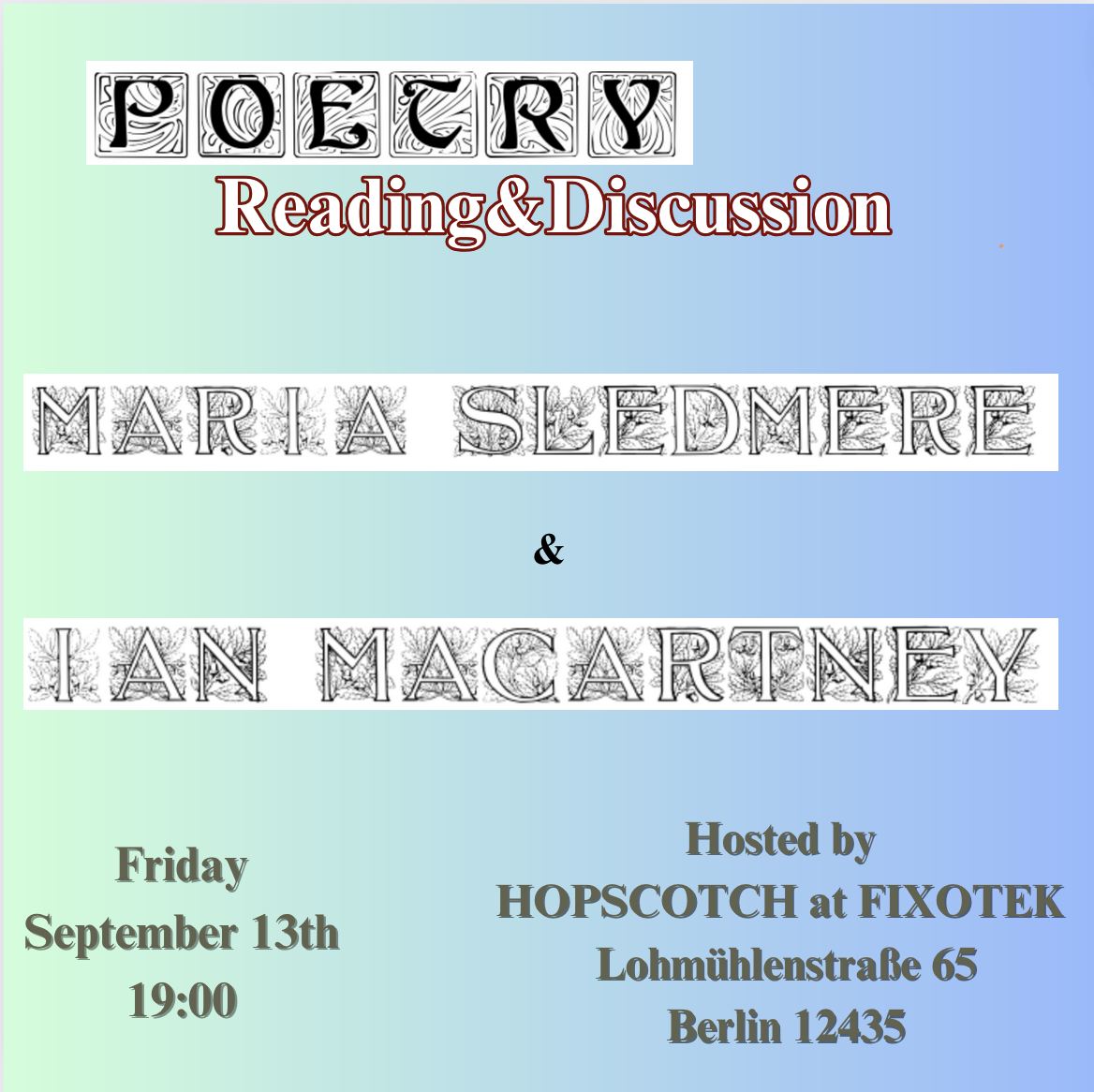
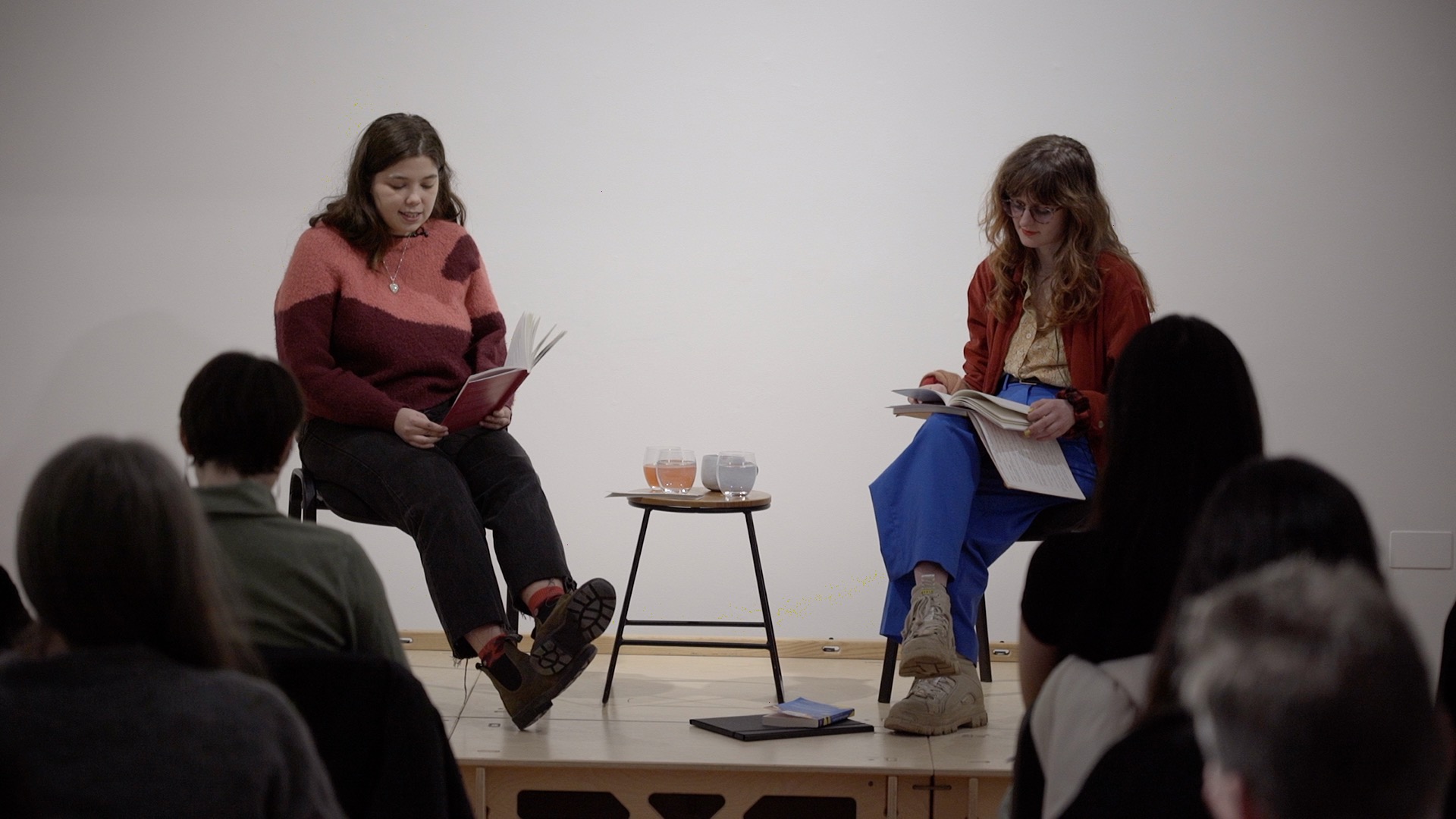
Cool news. Will be in Berlin weekend of 12-15th September doing two readings. It would be lovely to see some of you there!
Friday 13th September, 7pm POETRY: Reading & Discussion with Maria Sledmere & Ian Macartney 7pm, FIXOTEK, Lohmühlenstraße 65, Berlin, Germany 12435
Thanks to Hopscotch for hosting!
No tickets just show up.
&
Sunday 15th September 2024 1-3pm, ChertLüdde Potsdamer Straße, Berlin
Reading with Ian Macartney, Max Parnell and Ari Níelsson from 1-3 PM, followed by an open mic at 4pm. This performance event is part of Ali Eyal & David Horvitz’s exhibition, A new garden from old wounds, whose title is taken from a poem of mine, ‘Deciduous‘ which was recently published by berlin lit.
In their duo exhibition, A new garden from old wounds, artists Ali Eyal and David Horvitz explore geographical and conceptual distances, delve into the intricate boundaries of memories and emotions, and investigate how fragmentary elements can come together to form a new enduring presence. The exhibition brings together new and existing works that interconnect with each other as separate fragments of a single unit.
Opening Reception: 12 September 2024, 6 – 9 pm
11 September – 12 October 2024 ChertLüdde Potsdamer
Che Go Eun, a hole in a boat and a deep hole (2024)
Dear pain,
That’s how the light gets in. Fractal emanations of screaming the dark is a luxury the dark the dark. I listen to the radio and a mother talks of her autistic child preferring the dark — thriving in it, coming to life.
We soft-light to protect the unsaid stories.
Our bodies twist in the dark and we make an inconsistent work of pain-pleasure. The mattress gives out: pools of blood, ink, sweat, coffee, sex. I feel better when the sun comes up and when the sun goes down, wine-dark. It’s what’s in-between that’s the problem.
I keep thinking about Fred Moten’s luminous correspondence, ostensibly between Andrea Geyer and Margaret Kelly:
My friend, I have discovered in the antagonism between my work and dead letter that the project returns as an amazing field and air of correspondence, a transgenerational lotion of breathing, a revue of breath, a general bouquet in the grace of your asking in friendship since the day we met, and our braiding and breathing of a correspondence that we are now and have been working together in the atmosphere of our comrades, that we literally breathe them as a kind of braiding, an insistence of revolt as garment, a tapestry for the touched wall of a spaceship we noticed on the way to school, that off dimensionality of the cloud from our perspective, which I want to say is real not graphed, which I want to say is both a function of, and still untainted by the terrible business of, the Dutch masters, so that it’s impossible to tell the top from the side, though there was some kind of emanation or emendation that we all saw as a smooth flatness, like a table the cloud prepared of its own accord, a spread platform for spreading our metastatic air, our beautiful, is ourreal.
To make a pain of you, stop being a pain, I’d form a cartography of the nerves so rich you’d never know I’d outmatched the major scale. A map does not function in service of security. Anyone who has seen me read (and attempt to follow) a map knows this.
What is so gorgeous about the Moten quote above is its ph(r)asal longing: an ongoingness open to improvisation and constant sentence desuetude. Language like you don’t even need it, breathing all the same beyond what’s essential. Take this key. Braiding and breathing a coital somnolence of the body, twice rung out in language / only us leaving voice notes for what clicks pearls together, minor, deep in the distance.
Emollient longing of writing between pith and pronoun, what is prepared by the passing between. Our breath, clouds; mattering.
‘•.¸♡ ♡¸.•’
I saw the spaceship too. Didn’t you?
Intimacy, I told someone recently, feels like the opposite to what capitalism wants of us. Intimacy is worldsharing, ourreal, a grammar of humours, kisses and shibboleths. You know my pain and I know yours. We make a joke of it. What escapes serious talk but our serious dreams. So when we’re all in the gallery, we switch to our senses to make language-sense of ourreal, cellular vibe spread. It’s a room replete with the sonic ecology that is feeling all my fucking feelings (Clémentine Coupau): aka hook me up to ‘electronic components, dimensions variable’. The little paper lantern is a miniature version of my own IKEA lampshade. The problem with my IKEA lampshade is that I had to tear it a bit to change the lightbulb. I have a torn lantern. Magic hands. That’s how the light gets in. Paper = skin. Creamy light.
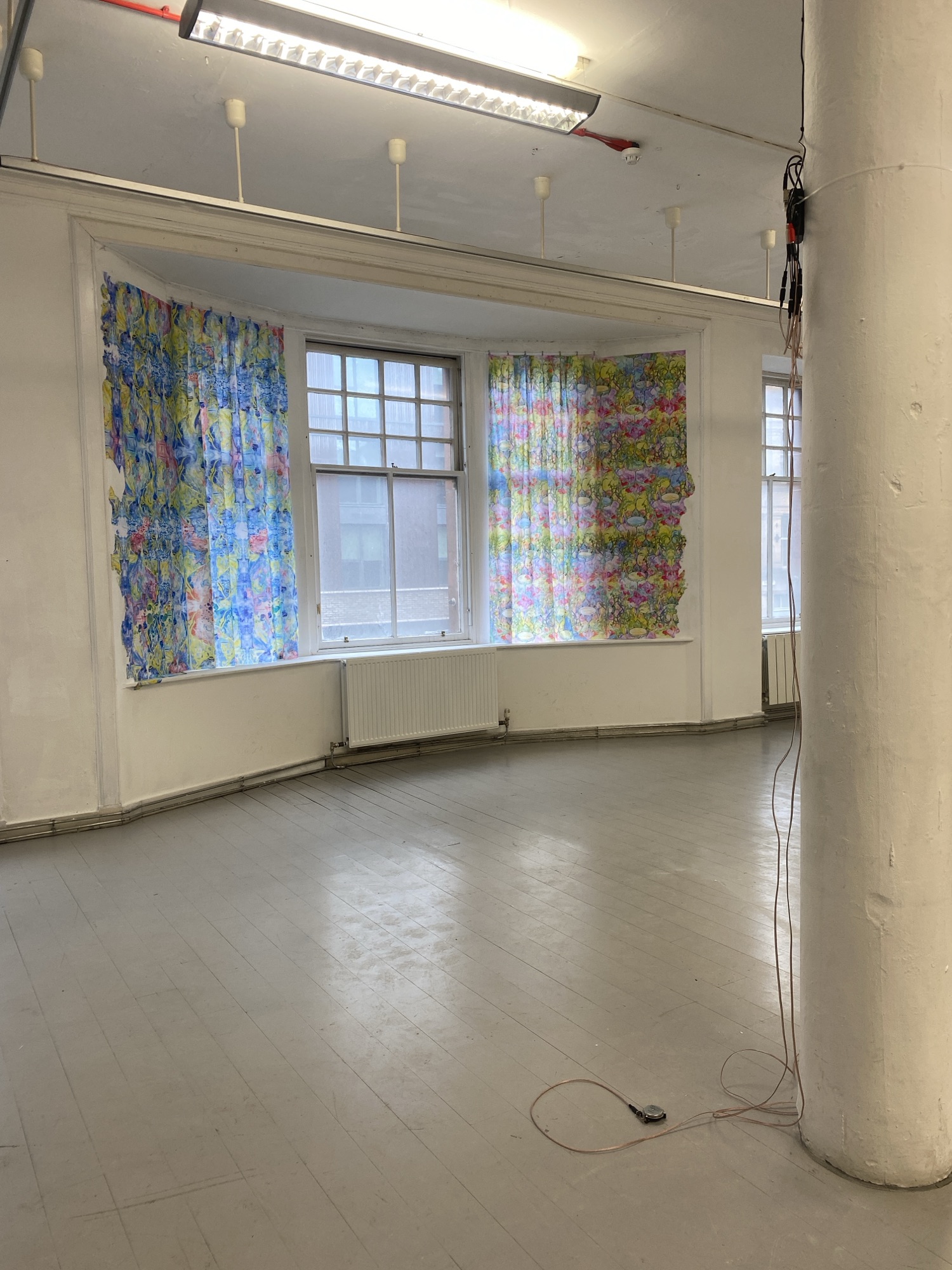
Che Go Eun 최 고 은, a hole in a boat and a deep hole (2024)
Aside from lanterns, the other homeware alluded to are curtains. Che Go Eun’s a hole in a boat and a deep hole is composed in collaboration with artificial intelligence. The artist inserted diary notes into an AI image generator which ‘transformed [their] intimate reflections and resulted in images’. Watercolour drawings were then made in response to those results, with the artist ‘reappropriating’ their ‘own feelings back from the AI’. This tension between creativity, data and predictive imaging results in a fascinating, speculative assemblage of arabesque, thorn and psychedelic colour. The nod to William Morris/Arts & Crafts reminds us of the collaborative handicraft that has gone into the piece’s imaginary and manifestation. Diary phrases such as ‘art nouveau’, ‘harder I am sinking’, ‘throw all my stress into the hole’ are woven into the fabric of these drapes which suggest both privacy and opening, light and shade. The work is gauzy. There’s a real street, a construction site behind it. Trongate: name as lozenge. What Moten says in the same letter-poem as quoted above, ‘a gauze of reckoning’. Threads, braids: stress, tension. I want to wrap the code-baroque of the fabric around my body like I’m a silkworm going in reverse, all the way back to its gross and sultry, larval conception. I keep hearing that the internet is just the unconscious. I see a bag of squishie candies in a vending machine and think: ugh, silkworms.
‘•.¸♡ ♡¸.•’
Back IRL, it’s raining with the pelting dreich that only a Glaschu April delivers, and I arrive at Trongate 103 having walked through Dennistoun listening to Elliott Smith. I’m not feeling morose; I’m just in touch with my feelings. As if they were tangible: animatronics, statuettes, pets. I’m still on a medication that holds such whimpering demands at just enough distance to be considered somehow ornamental — torrents no more. Once I would torrent my day in their favour. Let someone seed me. Now, I might choose to pick them up, put them back down, or smash them into oblivion. Let my soul have the architecture of a bleeding gate.
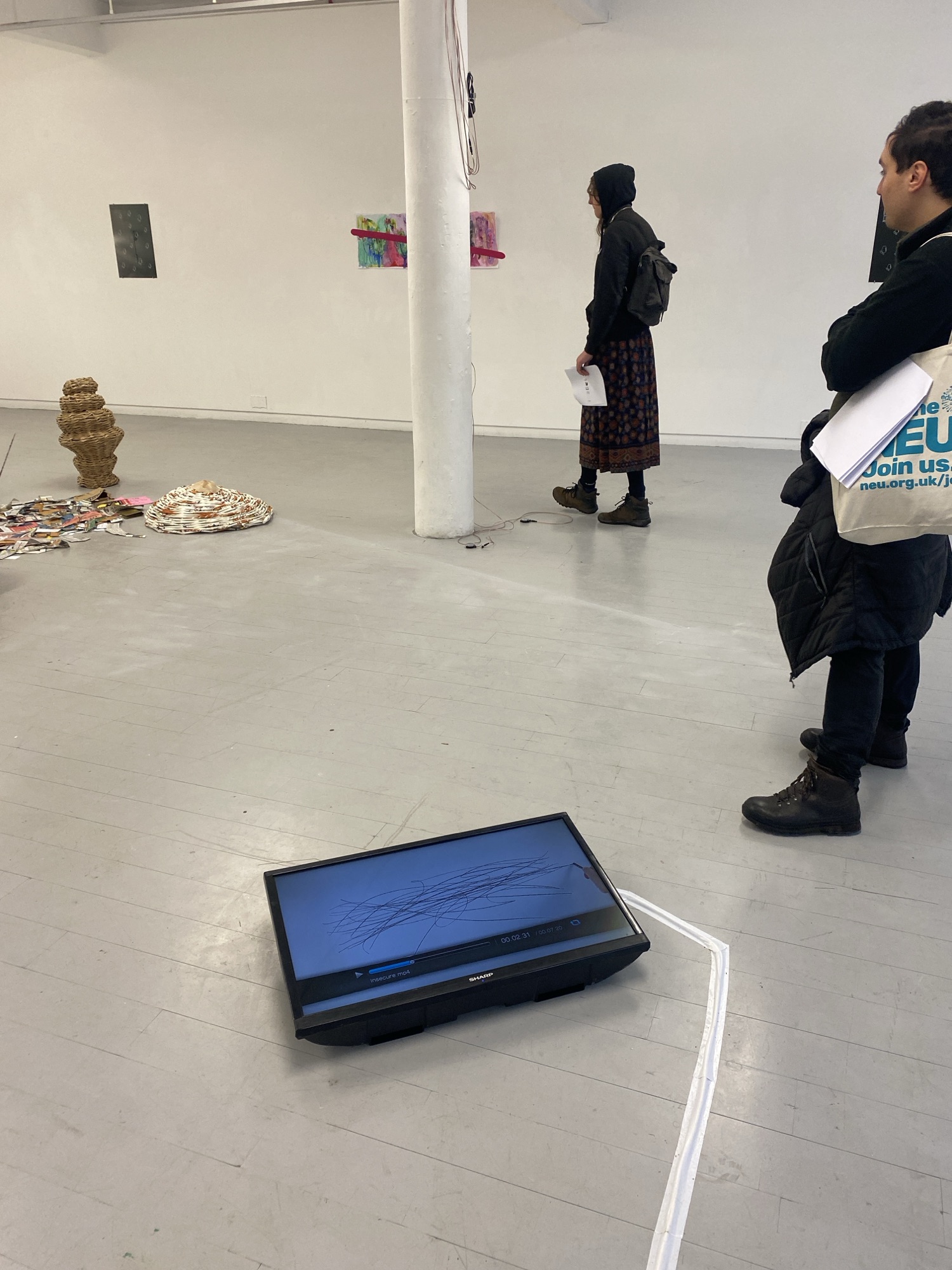
As I enter the exhibition, the invigilator says something about one of the objects we’re allowed to touch. I forget immediately what they say because I am greedy for colour and form, not meaning. So the whole time I am looking at the exhibits wondering: which of you may be touched? A finger trace of the curtains, time slider on video screen, glass surface of framing, kinesiology tape cut into bows and ribbons.
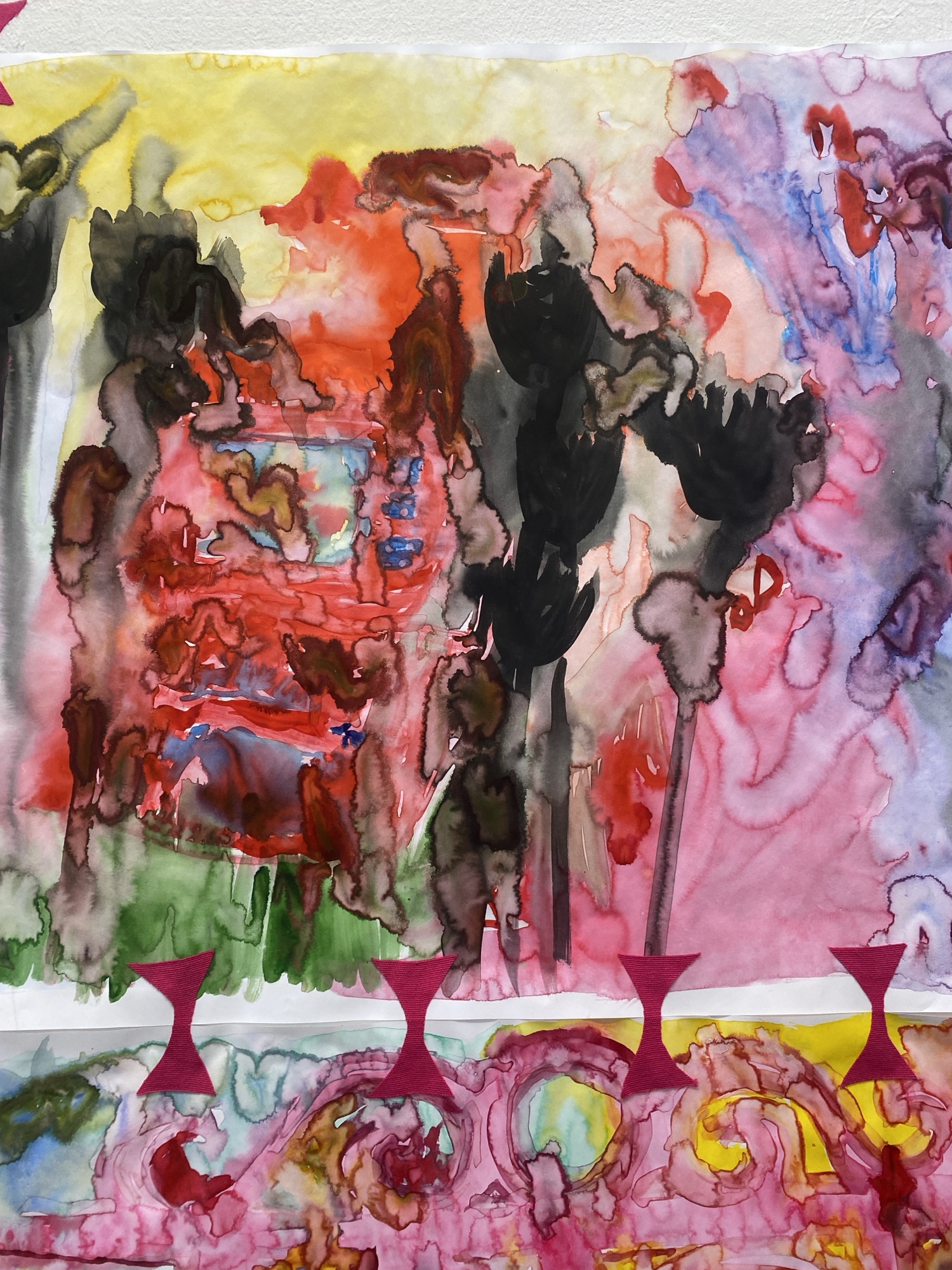
Daisy Lafarge, Gate Theory of Pain (III) (2024)
Touch is not in itself untainted. I am in love with Lafarge’s black tulips; their painful, precious tendrils.
‘•.¸♡ ♡¸.•’
Some people gave me advice on how to do better: thirsty in the flowerbed for some aphids fed upon 200 ladybugs to eat/moult more often than not they would die as fast as any plant blocked sunlight to pay (dustfall / bonnie / smitten ) should the wind ever blow you a raven
‘•.¸♡ ♡¸.•’
Mau and I try to diagnose the Mandelbrot set-seemingness of Lafarge’s watercolour fractals. The sequence ‘remains bounded in absolute value’. This is a beautiful phrase I find on Wikipedia. ‘It is one of the best-known examples of mathematical visualisation, mathematical beauty’. I could watch the little fractal gif forever like giving birth to myself over and over as a starfish with 7000 eyes & infinite narcissism. As it stands, that boundedness is a gate: pink, the colour of doll-flesh. I think of tentacles, elliptical phone calls, inflammation. We agree that almost all the art in the room is art that could be done on the phone. It’s not just about doodlecore but the intimate, desultory gesture of the line itself, and what’s on either side of it.
Not to get kinda kinky but the other day we were explaining ‘lucky pierre’ in the pub (because of Frank O’Hara the poet we all love and love most of all to discuss in the pub). In his ‘Personism: A Manifesto’, O’Hara talks about the poem in supplementary relation to people. Intimacy again. Sure, he wrote it while ‘in love with […] a blond’, which makes it all the more true and golden:
I went back to work and wrote a poem for this person. While I was writing it I was realising that if I wanted to I could use the telephone instead of writing the poem, and so Personism was born. It’s a very exciting movement which will undoubtedly have lots of adherents. It puts the poem squarely between the poet and the person, Lucky Pierre style, and the poem is correspondingly gratified. The poem is at last between two persons instead of two pages.
As Moten’s poem from The Service Porch is framed between two persons, so the epistolary heat is folded into Personism. It’s not letters but speech itself that gets electric. So what Mau and I mean by ‘this is art that could be done on the telephone’ is perhaps something about how the work takes place in correspondence between two or more bodies. Lafarge describes her paintings ‘as a means of pure distraction’, made during ‘episodes of severe chronic pain’, ‘remote NHS chronic pain sessions’ and ‘in phone queues and conversation with Adult Disability Payment (Social Security Scotland)’. The trembling of watercolour is an apt form for the bleeding edges that connect the power imbalance of someone trying to get support and the person with the power to connect them to it. It’s the art of turning away, seeking psychic space, without letting total go of the line.
How often do we find ourselves at the gate, with no end of wanting to both know and not-know what’s beyond it?
Wrought/not I.
‘•.¸♡ ♡¸.•’
I love gates. I love especially baroque ones with curlicues. I grew up with a broken gate which soon got removed. What did we have to keep in, or shut out? It was black and gold and the paint flaked off very beautifully. You might describe it as ‘tawdry’. I probably have false memories about this gate. Sometimes the screech of its opening hinges my dreams. Lafarge’s gate might be a homophonic pun on ‘gait’ (and so referencing the debilitating effects of chronic pain on one’s ability to walk freely). The painting, titled Gate Theory of Pain (III), no doubt references Ronald Melzack and Patrick Wall’s 1965 paper on ‘The Gate Theory of Pain’. In the words of Lorne M. Mendell:
The [Gate Theory of Pain] dealt explicitly with the apparent conflict in the 1960s between the paucity of sensory neurons that responded selectively to intense stimuli and the well-established finding that stimulation of the small fibres in peripheral nerves is required for the stimulus to be described as painful. It incorporated recently discovered mechanisms of presynaptic control of synaptic transmission from large and small sensory afferents which was suggested to “gate” incoming information depending on the balance between these inputs.
The Gate Theory concerns sensory fibres, transmission cells and their respective levels of activity. The idea is that painless sensations can supplant and so quell sensations that are painful. The process involves a blocking (a closed gate) of input to transmission cells. When the gate is left open, the sensory input gets through to transmission cells and produces pain. An example of the therapeutic application of this theory is transcutaneous electrical nerve stimulation (TENS), massage, acupuncture, vibration and mindfulness-based pain management (MBPM). While gazing at Lafarge’s vivid watercolours, one senses that pain is not suspended in the art of painting so much as calibrated, channelled, short-circuited. We keep commenting on the bleeding edge.
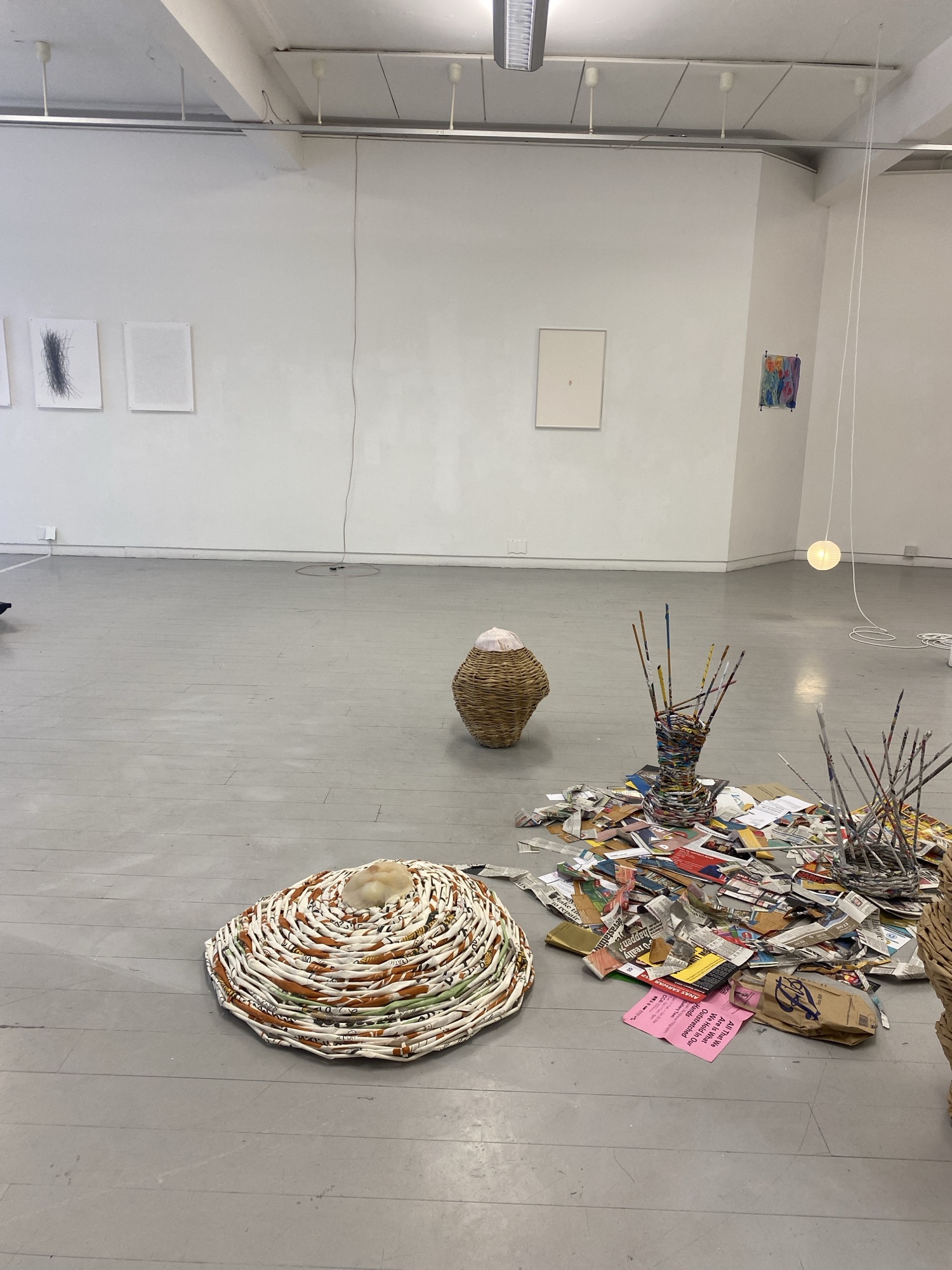
Aniara Omann, Resting on an icy couch (mother, grandmother, grandfather, big brother, older sister, little sister) (2020-2024)
Elsewhere in the exhibition, ideas of feedback loop, intimacy, daily life and relationality are also manifest. Feronia Wennborg and Simon Weins’ soft tissue plays with sound transduction to install a ‘lo-fi sound system that lives at the periphery of perception’. This installation of contact-based sound production manifests the pair’s ‘long-distance collaboration’ in felt space. Aniara Omann’s haunting paper baskets, plugged by family faces, makes a ragged philosophy of grief and panic. The raggedness betrays a struggle for focus which is played out through the woundful (I meant to say wonderful, but this works better) arrangement of loose paper, woven baskets, the sense of things cut, twisted, recycled. Omann describes wearing the clothes of their sister, who died: ‘If anyone complimented me on a garment I had inherited from her, I would say it was a gift from a family member’. In that sense, we could think about the paper baskets as fragile amphora for an archival underworld. The baskets are not perfect, machine-made. They retain the expressive and painful grace of their making. They are a flammable structure, woven from newspaper clippings, election flyers, prescription papers, envelopes, bills. What is it to find a way of wearing something? Wrap your troubles in dreams. Shuffle for sources. The difference is a question of agencies; and yet either way the gesture remains. The gift: it has to be infinite.
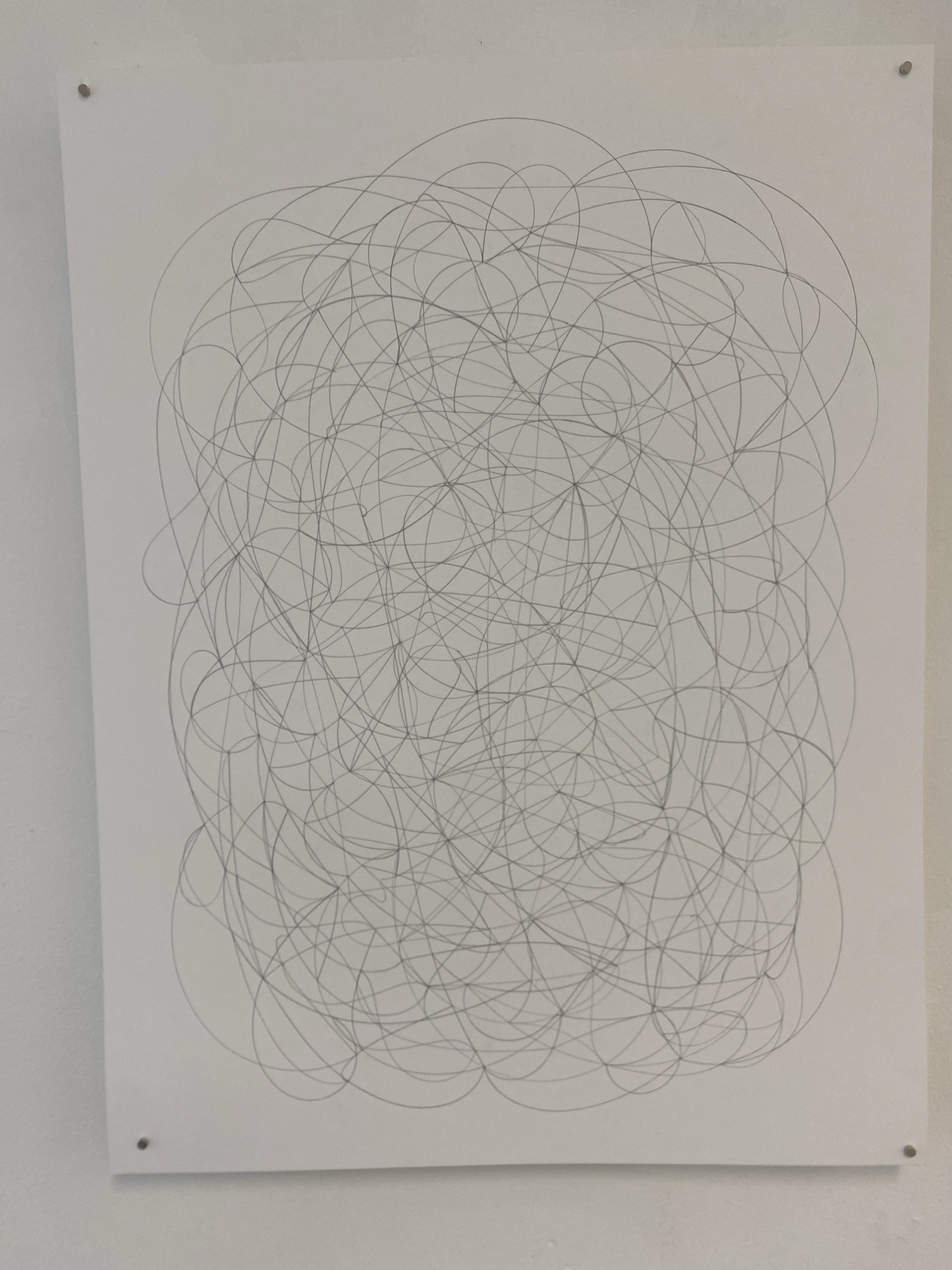
Elísabet Brynhildardótti, The Lines- Hesitant line, Obediant line, Indecisive line, Decisive line (2023)
When someone says ‘hold the line’. Please hold the line. Please hold the handrail and take care on the stairs. Will you please hold? What’s at the end of that hold? I have been trying to get a medical appointment for weeks. They keep putting me on hold, hanging up. I phone up a doctor’s surgery which is based in a shopping mall at precisely 08:30, when the lines open, and immediately the lines (the queue) are full. How do I envision those lines? Swirling and spiralling around the postcode lottery of where we live, tangled and fizzing with people trying to find words for the pain they’re in. I think of my mum in lockdown, endlessly on the phone 500 miles away from the fact of trying to get prescriptions and medical treatment for my nan. It’s pretty mild for me, my current need to be on the line: among other things, fucked-up hearing, tinnitus, crackling I hear like static between the two sides of my skull. Sometimes a pleasurable hum in the morning, like ultrasound waves in the skeins of my pillow. On hold to the doctor’s office, you become a line. The hidden labour of the chronically ill is this beholden quality, the line with its insecurities. It’s getting thinner. There is no guarantee that the line will lead to something: its pulsing, throbbing insistence on being anything but spirogram music. The irony of disconnect. Give me a point; an appointment; a person at the other end.
Who would pick up the line would do so, of course, in the dead of night. In Stigmata: Escaping Texts, Helene Cixous writes:
It is the dead of night. I sense I am going to write. You, whom I accompany, you sense you are going to draw. Your night is waiting.
The figure which announces itself, which is going to make its appearance, the poet-of-drawings doesn’t see it. The model only appears to be outside. In truth it is invisible, but present, it lives inside the poet-of-drawings. You who pray with the pen, you feel it, hear it, dictate. Even if there is a landscape, a person, there outside—no, it’s from inside the body that the drawing-of-the-poet rises to the light of day. […] The drawing is without a stop.
Hélène Cixous, Stigmata: Escaping Texts, trans. by y Catherine A.F. MacGillivray (1998)
What I see in iNsEcurE (whose inconsistent casing recalls the long identifiers of medical-grade pharmaceuticals, the vowel-like howling insistence, the trembling name) are poets-of-drawings. The asemic work of line, layer and bleed is an avid supplement for writing itself. Who can write while in pain? Who’s afraid of the dark? Who’s afraid of the blank? It is in the night of writing, unnannounced. What is that invisible presence but pain itself? There is no ‘outside’ to pain, once you’re inside it. And yet the gate theory does imply a certain threshold. Relief bucks at the gate. Still, we draw from the well of it moving inside us. You can’t stop it. The appearance of the outside is only gauzy separation.
‘•.¸♡ ♡¸.•’
When I thought I had endometriosis and lived in the hormone torture of latent, duplicate pubescence, resulting from the long-durée of various quiet disorders, I wrote spiky little poems for a pamphlet called Cherry Nightshade. I didn’t yet know about the gate theory of pain but I saw all the poems in a dream_garden festering behind a gate. Well, more like a trellis. Ground cherries contain solanine and solanidine alkaloids: toxins which are lethal, and all the more lethal for their immaturity. Tart cherries have soporific qualities. I wanted sleep to envelop me in perfect velvet. My speaker was a jumping nerve, a shitty little internet silkworm.
What did I get from staring so long at the gate? I fell asleep on the line and the vine grew around me.
I love this exhibition for what it teaches us about art between bodies, how light interacts with feeling-colour, Moten’s ourreal in its total ambience, the drilling outside is part of that thrum in your skull, the way I love to look at my friends as they look at art, tulip mania, mourning vessels, the exquisite difference between red and pink, the meaning of panic touch, pain as the body’s great epistolary effort, fragility, attention’s relationship to healing, what it means to be gratified (if at all). I am grateful for the sharing of insecurity at the heart of the works, and for what they offer by way of being with pain. A bearing, a cloud platform, an intricacy. Standing at the gate.
‘•.¸♡ ♡¸.•’
Further notes:
medical filigree
acid yellowing
mau touches a sound magnet
‘insecurity fuels consumerism’
light source
biofeedback
neon bandage
organelle ballet
tesselate attentions
the puzzle pieces do not technically touch
go into the hole
golden shovel
’emoji repertoire’
give me a viable body
‘cast latex, apple seeds, sawdust’
‘I am still earning less than living wage through my art practice’
Becoming a line was catastrophic, but it was, still more unexpectedly (if that’s possible) prodigious. All of myself had to pass through that line. And through its horrible joltings. Metaphysics taken over by mechanics. Forced through the same path, my thoughts, and the vibration.
Henri Michaus, Miserable Miracle (2002) – quoted by Elísabet Brynhildardótti in the exhibition handout
iNsEcurE is open at Glasgow Project Room, Trongate 103, First Floor G51 5HD between 29th March-7th April. It is organised by Aniara Omann and supported by Creative Scotland and Hope Scott Trust.
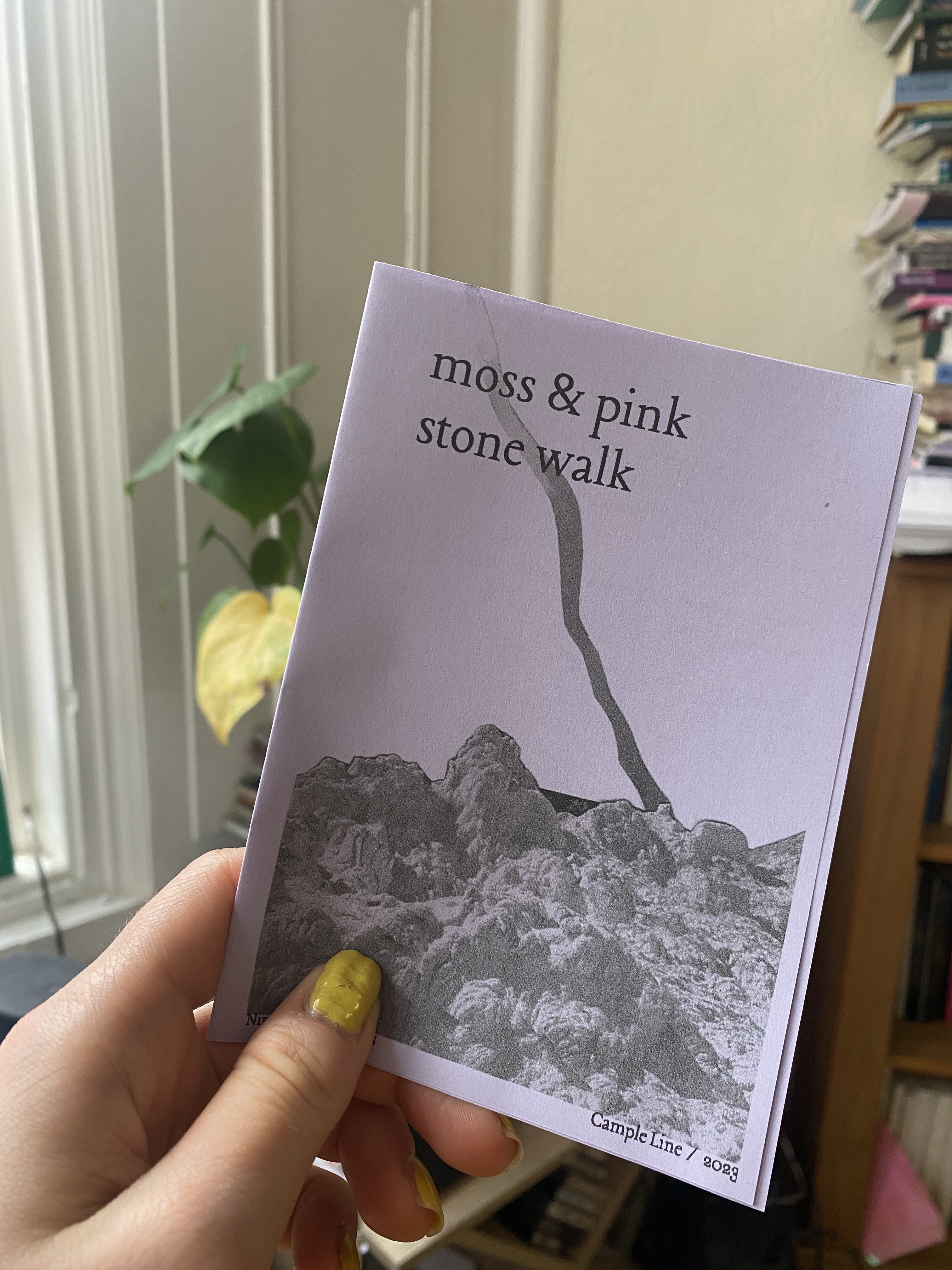
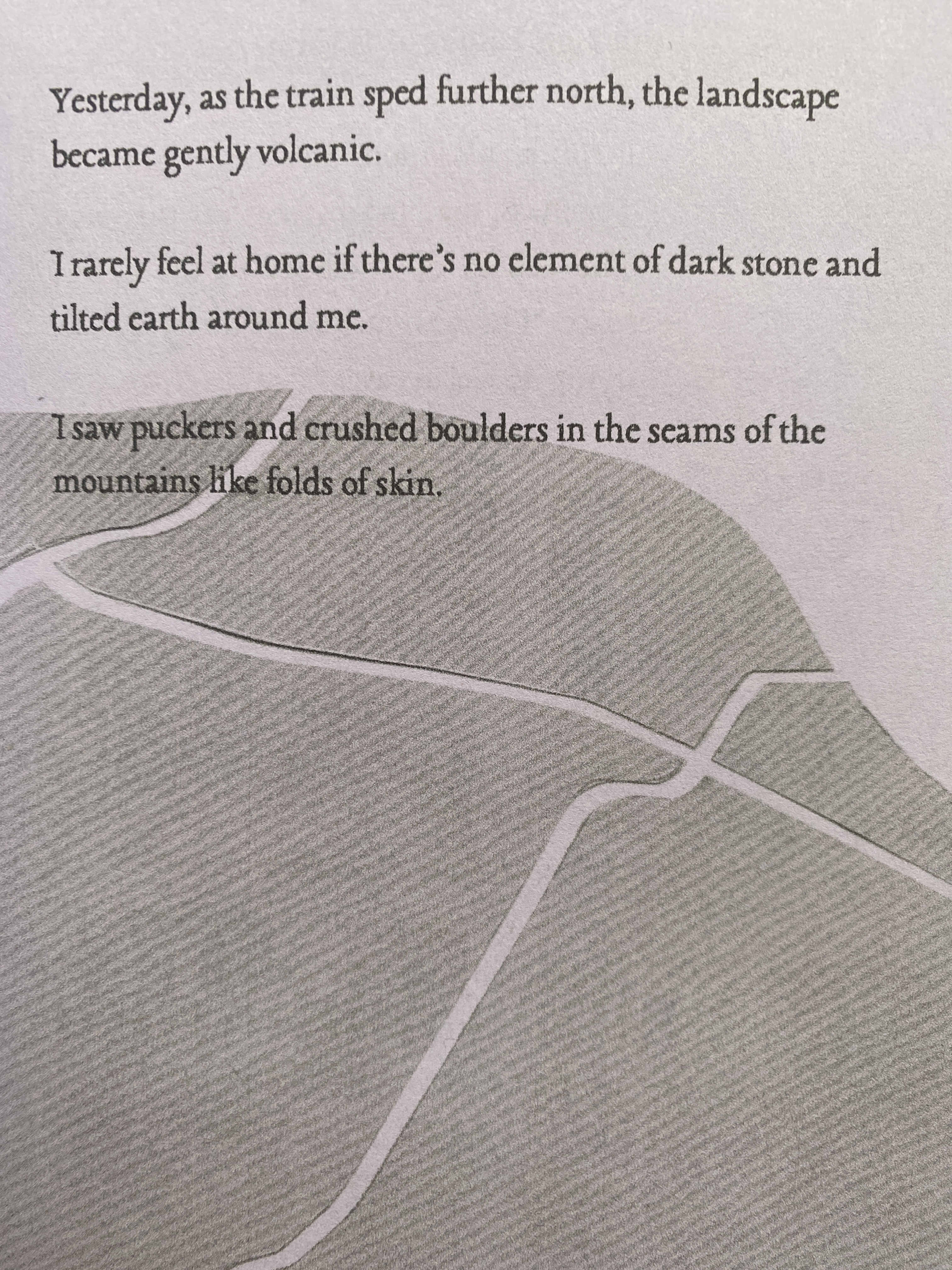
It was such a treat to get the train to Dumfries & Galloway last week for this conversation with Nina Mingya Powles, who was doing a residency at CAMPLE LINE gallery. We talk everything from zines to dreams, and all the bright colouring in-between. The zine above was made by Nina during her stay at the gallery and it’s a lilac accompaniment of the land I took home with me, leafletting through on the lonesome journey home. Thanks so much to Tina and Emma for looking after us, and for the amazing pineapple buns, and to Dave Borthwick for lunch talks and seeing the geese.
A few weekends ago marked a whole year since my exhibition with Jack O’Flynn, The Palace of Humming Trees, curated by Katie O’Grady. It was the height of summer, electrified by lightning storms and rain showers which sent the city streets flooding my ankle boots. I sat in the exhibition watching the auras of animals, drifting in and out of presence, doodling, planning short fiction I’d never write. The rain came down through the ceiling, just a little, and caught in a bucket. I texted in streams.
Something of the exhibition magicked itself into existence. We were all ’93 babies. Making things happen felt so easy. There were synchronicities and invincibilities. When Katie and I hung out at Phillies, we won the quiz. Jack and I wove this hyperplane of fantasy from the gestures of clay and line, whittling and glitter cast wide across floorboard and spiderweb. It was a strange time, the summer of 2021. I was also partially in the numb haze of grief. There was a delta wave but not like the deep sleep of the sea. People brought champagne and flowers to the opening. I wore a long white dress and wished the days were as long as they used to be. The Earth spins too fast.
Partly I wanted to write in the choral voice of many creatures speaking to one another. The process felt like a lyric surrender to this collective, their hyperintelligence of humming and stammer that spoke through pores, chitin, liquid. I don’t know where they learned all this. There was a sun virus in the emails we sent the summer before it. Time freckled on my arms. I could draw out the muscle ache from cycling more. It was possible then.
Anyway, about this experience of writing. A porous voice. Here’s an artist’s talk from a recent conference.
First delivered at Hear them speak: Voice in literature, culture, and the arts 10th June 2022
K Allado-McDowell, ‘And they showed me that their life was a pattern of hyperspace’
Who might be the ‘they’ in K Allado-McDowell’s statement? Taken from Pharmako-AI, published in 2021 and the first book to be co-authored with the neural network GPT-3, a system trained on extensive web data (from Google Books to Wikipedia), the quote suggests voice, presence and identity are questions of patterning, replication, weaving, plurality. Recurrent in Allado-McDowell’s book is the figure of the spider and its web, in a kind of constant movement like thought itself.
I was travelling north on a train when I began writing The Palace of Humming Trees, a book-length exhibition poem which forges energy fields of dreamy relation between many species of animal, mineral and element. Late spring and the fields I could forget about, texting myself more poem. The motion of the train according inverse to the downward scroll of the document. All the while seeing spiders in the corner of my vision, emitting great clots of silk. Commissioned by curator Katie O’Grady and made in collaboration with the artist Jack O’Flynn (both from Cork, Ireland), the exhibition was to offer something of a ‘hyperspace’ to its viewers: somewhere in which voices coalesced, formed new modalities of being and relation, new webs. In a Tank Magazine interview with K Allado-McDowell, Nora N. Khan notes that hyperspace ‘is an abstract space in which we perceive patterns of information and then shape them in language in order to communicate’. Having a big, serial and open field poem adjacent to visual work premised on bold, ecstatic colour and texture was to perform multiplicities of voice within an otherwise abstracted work. Inspired by Timothy Morton’s ideas of ‘dark ecology’, adrienne maree brown’s ‘pleasure activism’ and Ursula Le Guin’s ‘carrier bag theory of fiction’, I wanted to think about that communication as a form of attunement through which we gather, desire and coexist as ecological beings.
In The Palace of Humming Trees, the lyric voice is taken as that trembling spider silk assembling worlds. Spider silk is a protein fibre which embodies the inside of the spider woven on the outside for shelter, cocoon, courtship or the trapping of prey. It’s five times stronger than steel and is now being synthesised to make everything from body armour to surgical thread and parachutes. I began imagining the twangling of droplets on silk strands as the visualisation of a deep vibration, perhaps the wood wide web – something humming in and between trees. The world of the exhibition was inspired by the Irish folktale, The Hostel of the Rowan Trees, also known as Fairy Palace of the Quicken Trees. In the story, trees of scarlet fruit provide refuge, but the fruit itself (the quicken berries) are highly desirable to the point of despair. The rowan was brought from the land of promise, and its berries offer rejuvenation. With these symbolic undertones of danger and desire in mind, we wanted to explore a mythic ‘palace’ which merged the digitality of hyperspace with the organic textures of woodland and the chromatic intensity of dream, fantasy and ethical relation.
At the heart of our project was a notion of infinity. Hyperspace suggests that our ecological sense of world, surrounds, habitat, umwelt is always being reassembled. I wondered if infinity could somehow be voiced in a way that wasn’t just postmodern recursion or echo. What does it mean to be open to a state of infinity? To let many worlds pass through you all at once, making diamond-like instants and gossamer patterns of prosody?
Infinity became our figure for ambience. As spider silk is densely structured, and the neural net densely layered, so the notion of ambience captures, in Brian Eno’s words ‘many levels of listening attention’. To walk through the door of The Palace of Humming Trees was to enter a portal of multiplicity. You could take any route you liked around the room, moving between sculptures of hyperfoxes and sparklehorses, lichenous forms, ceramic butterflies of psychedelic hue and illustrated groves where trees shimmered green, orange, purple and blue. You could also scan a QR code and choose to listen to a recording of the poem, voiced by Jack, Katie and I and accompanied by Dalian Rynne’s sonic dreamscapes. To hear something ‘humming’ is to sense its presence, even if you can’t wholly understand it; humming implies electromagnetic vibration, birds and bees, a weather event or tectonic movement. We weren’t interested in translating the more-than-human voice so much as bringing it into the forcefield of lyric poetry, and through that expansive patterning achieve ‘infinity states’ of reassembled meaning, of felt experience that could not be crystallised into singularities of being. Visitors took pictures, sketched Jack’s sculptures, ran their fingers through the luminous plaster dust, placed to highlight the debris or excess of our clay animals. Something always in the process of creation or decay, incomplete. Corporeal, yet infinite.
One of the many voicings of this project was Letters from a Sun Virus, a correspondence between Jack and I that occurred over the first Covid lockdown, documented at the back of the exhibition book. While the email exchange had distinct senders and receivers, the you and I, over time in collaborating and sharing work between the visual and textual, our voices were beginning to mingle. Sometimes this co-voicing was painterly; other times musical, inflected with the characteristic intonation and energy of our respective speech patterns, moods, expressions. An entry from April 2020 reads: ‘…the wateriness of the poem. I had completely forgotten about all that blur. It’s like all the brush of the ocean and one which seems the idea to spill that way. Almost like a pressure, lines that go on and hair turning into the sea, each one of kinetic energy then finds all these points’. To assemble the correspondence for publication, I plugged it through text remixers, copying, pasting and rearranging phrases to enhance that sense of two voices repatterning one another. A ceaseless quest for points; for elements acting upon objects, emotions. Denise Riley has written of ‘inner speech’ as a strange oxymoron, where one hears voice at the moment of issuing voice inside us – a kind of running commentary that hums without actually humming. The letters suggest a kind of inner voice infected by the anticipated response of the other, rendering intimacies of collaboration which form a sticky substance, sentences and mobius formations holding time’s play and repeat – ‘Unending loop of my dream resins / not to complete the palace infinity of these trees’. Imagining the many of them speaking.
In Texts for Nothing, Samuel Beckett writes:
Whose voice, no one’s, there is no one, there’s a voice without a mouth, and somewhere a kind of hearing, something compelled to hear, and somewhere a hand, it calls that a hand, it wants to make a hand, or if not a hand something somewhere that can leave a trace, of what is made, of what is said, you can’t do with less, no, that’s romancing, more romancing, there is nothing but a voice murmuring a trace.
To ask whose voice in The Palace of Humming Trees is to hear sound bouncing as light, romancing, refracting in what Katie, the curator, calls a many-panelled ‘vivarium of humming thought’. To say ‘there is no one’ is to declare at once absence and the impossibility of presence as a singularity, there is no ONE. What if voice was infectious, modular, sporous, erotically charged, in common? Early in the project, I had this conversation with Jack where he told me that sometimes in the process of sculpture, he’ll try turning something upside down, or inside out, to revitalise the work. Make it strange or more-than. To sculpt by hand is to ‘leave a trace, of what is made’, and to write is to leave a trace ‘of what is said’. I wondered if the inner speech of the lyric ‘I’ could be turned inside out, to be exposed to the grain, the noise, the weather. A voice that touches is and is being touched, traced, smudged. I imagine this book as a glasshouse, somewhere between inside and outside, shelter and exposure; a chamber music of alchemical voicings, always repatterning, transforming each other. Sound and light. A place of invitation, ritual attention, metamorphosis. Many selves stuck to the web of a visual, expansive language.
Hyperfox – photo by Sean Patrick Campbell (French Street Studios, 2021)
‘Notes on Lyric Solarity’ at Summer in the Way, Birkbeck University of London, 9th July 2022.
Video of a creative-critical paper delivered over the weekend at Birkbeck, as part of an ongoing collaboration between the87press and the Contemporary Poetics Research Centre. Below is an extract from the first half of the paper. A lot of this thinking is developed more fully in a forthcoming academic article.
As flowers turn toward the sun, by dint of a secret heliotropism the past strives to turn toward that sun which is rising in the sky of history. – Walter Benjamin, Illuminations.
Today, I’m going to move fluidly between poetry and essay to present some nascent thoughts on lyric solarity. I want to suggest lyric solarity is a poetics in which solar imaginaries are linguistically mediated and refracted through the close rhythms, affects, sensoria and arts of noticing associated with the focalised energies of lyric poetry. Lyric solarity enacts an embodied poetics of dissolve, exposure, surplus, saturation and excess/residue: it offers a way of turning towards the sun, while helping us make, in the words of Imre Szeman, ‘commitments to reshaping’ the ‘existing infrastructures’ which underpin access to and distribution of energy. While the anthropocene, a contested epoch defined by humankind’s ascendance as geological agent, is often understood as an issue of scale, attending to the solar helps us think about planetary crisis in terms of distribution and density of harm, resources and changes to climate or energy. I take energy to mean both the power derived from physical or chemical resources, the property of matter and radiation manifest as a capacity to perform work, but also in the sense of an organism’s energy – their metabolism, vitality, ongoingness within the world, and its working demands or desires. What follows is less of an argument than a set of propositions and possibilities, a selection of field notes in search of lyric solarity.
Sans Soleil
In Chris Marker’s film Sans Soleil, often translated into English as sunless, we begin with a quote from T. S. Eliot’s ‘Ash-Wednesday’: ‘Because I know that time is always time / And place is always and only place’. It begins again with an image of three children in Iceland, ‘an image of happiness’ accompanied by black film leader. The voiceover suggests that if viewers can’t find happiness in the image of the children ‘at least they’ll see the black’. The film is itself a kind of lyric documentary on human memory, how memory is fragile and so our recall of personal and political histories – especially on a global or even planetary scale – is inflected or reworked in the present. In the spring of 2020, I approached the film as a kind of memory place. I had never seen such spring sun in Glasgow, but due to Covid I was locked down inside my own sunless temple, or tenement. What follows violates, perhaps, Eliot’s insistence on the essential containment of space and time. Eliot, I guess, never used the internet.
I was messaging the poet fred spoliar, and suddenly it was the solstice and we wanted to mark it. We began this remote collaboration, not in response to Marker’s film so much as through it, or some residue within it, a blemish or shine. A bright spot, a blind spot, a kind of fleck on its vision. We wrote remotely, wrote ‘live’ and in those hours of shared writing, we existed in a solar time: where solarity was a quality of memory, its absence our absence, and yet also speculation towards something better – waiting for rays of arrival. In that sense, the poem is about the uses and abuses of pastoral; about an ‘elsewhere’ to be written around, glimpsed, squinted at, but never quite accessed. It’s also about the temporal alignment of two people writing together. Lyric as a thought device for telecommunicating something of a paraworld hidden in language. I’d fall asleep with our phrases like film credits flashing behind my eyes. We wrote between the summer and winter solstices of 2020, we split lines with sun-cloud emoji. Here’s some of the opening sequence of the poem:
Ultraviolet rose us
spilled into formless
unration of atoms
and we spend ourselves back, the day
extends pause,
folding up
in luxe ellipsis
hills and hills
of recessional cloud, cast debt
between us, rolling one-sided
to release it, all of I’m rain
cast thru fierce aureate
disquietude, to not say
hope this finds you, or
nearest the soft motif of yr hair
bright spots around the antisolar point
balayage of except champagne
never sets. In a forest image / I cannot touch you
or notify through light that drowsy reminder
we are many. Something
decorative / in the cold soak of sylvanshine
gives up its entrance, the long day
composed of such stills is lying
back from its voyage. To say
all of the land escapes / an exorbitant teardrop
a teardrop. I have these ambient hands.
I wring the leaves…
2. Solar Apocalypse
In Etel Adnan’s poetry sequence, The Arab Apocalypse (1989), the sun is variously a shapeshifting trickster, a totalising energy, an authority, a marker of time, a blinding force, a monster, a pool of blood. Here are some of Adnan’s lines taken from across the book:
I took the sun by the tail and threw it in the river. Explosion. BOOM…
the sun is contaminated by the city
the sun has eaten its children
a sun rotten and eaten by worms floats over Beirut silence is sold by the pound
eat and vomit the sun eat and vomit the war hear an angel explode
The brain is a sun STOP the sun is an eye
the sun’s atoms are incarnating in my flesh STOP STOP
The sun is a kind of virus, pulsing and multiplying, changing form and colour, nourishing and deadly, making things grow or die; a kind of white noise in the context of war, a vulnerable body, a weapon, a machine of surveillance, a carnal threat. In the American Book Review, Barbara Harlow says of Adnan’s poem that it ‘invokes a mythic past […] to presage a present that resists narration’. To presage is to be a warning sign, a prediction, typically of something unpleasant; in archaic meaning, presage is an omen, a feeling of foreboding. In The Arab Apocalypse, Adnan writes back and forward to historical crises: as Aditi Machado points out in an essay for Jacket2, the poem was begun in January 1975 in Beirut, two months before the outbreak of the Lebanese Civil War. But there is also a generalised economy of violence, exposure and replenishment which speaks to the twentieth century at large and indeed to the explosions, contaminations and environmental atrophying of the twenty-first century. As Harlow identifies, the simultaneous, coagulating, geopolitical crises of the times, what we might call the ~Anthropocene, are often resistant to narrative. The recurrent, modulating figure of the sun has more of a lyric quality, beaming and seeping, punctuated by telegraphic lines and signals of stop, break, transition. Language garners a lyric intensity which is elemental, saturating, overspilling the traditional bounds of a human ‘I’. Impressive and god-sized dramas of the stars and planets play out in a mythopoetics of Beirut, of Gilgamesh, of ‘grass snakes hiding in the texture of TIME’ (Adnan, The Arab Apocalypse).
3. More sun to consider in lyric
Julia Kristeva’s Black Sun
The music of Sun Ra
Sean Bonney’s ‘solar cop’
The shine sprites in the video game, Super Mario Sunshine
Georges Bataille’s ‘solar love’
David Schwartzmann’s ‘solar communism’
Alli Warren’s Sun Dial
The photographic process of the ‘anthotype’
Björk’s song ‘Sun in My Mouth’
Catherine Wagner’s line ‘If everything is from the Sun why praise it’
In Paul Klee’s painting, Castle and Sun (1929) the castle is line-drawn in myriad geometry: its surface is of different coloured shapes, set underneath a bright orange sun. In proximity, the colours shimmer and vibrate. If there was a patchwork made of Adnan’s poem, it might be this; or indeed one of Adnan’s own geometric, brightly-coloured abstractions. Shimmer is to shine with a soft, wavering light. It offers a coming-to-knowledge distinct from the Enlightenment regime of ‘shining a light’ on your subject; it is a way of making contact, of existing in non-linear, non-narrative – that is to say, lyric – timespace. In her 2018 book Surge, Adnan writes ‘We came to transmit the shimmering / from which we came’. In this shimmering tautology we yet cross a line, continue transmission. Shimmer is instrumental in what I call ‘hypercritique’: a poethical form of writing which orients not to the capture of time, meaning or ecological reality, but to a beyond.






 mariaology