If the portal is a smiley you want, abstracted, I already am the same. Await your reply if we are alternative time zones, your train was late and the wifi shaky is only another ‘trembling structure’ in the words of John Wieners. It wasn’t smiley it was pure mad HIYA smiley, aslant on the concrete childhood where once I lay down and later tried to make this theory. Lie flat. All the horses lie down in protest of symbolism. That I write anthropomorphically is only because most days I am more like a fox and stealthily will steal your garden gnomes to think they are chickens and the most perverse fox I turn vegetarian, asking the gnomes what happens down the drains and they say ask the trolls. But this is why I left twitter in the year 2030, released a thousand marbles in the weft of the sun’s coming too close for comfort, organised my floating children to clearfix the element, old and browserly on your blog. Shine brightly with flashes of light. Will I fuck. That feeling when you miss someone but somewhere to know they are there for you, making bread or like, conserving energy. You should buy a firm mattress if you want to lie on your back and tell me the stars were good, what else, like how could you put that in a past tense where the stars are still coming, £10.99, they are light years towards us and to think of when the stars are come is delicious, becoming this drunk at the splendid omen, lavishly served. Inebriate starlight / a laced pony / liquored with three sheets to the wind and call you beauty. Hold us up. Bubble write most of the film, asleep means only to dream in the house / your birth. All the drunk horses are sparkling, swear it.
Writing in the gloaming I would even call meadow, its scorched-out centre you can probably see from a helicopter, a drone, should you choose the option of aerial photography and remote capture in a time of social distancing. Should you have access to that tech, perhaps in a speculative way; should you have access, the way children have access because they discuss so thoroughly the possibilities, and they do this illicitly into the night. My excellent stenography skills, if we are calling this shorthand, were honed from adolescent hours on Microsoft Instant Messenger, affectionately known as MSN. Any one of us born in that particular bracket of the fin de siècle will understand what it means to spend time in one’s room alone, not quite as in ‘Adam’s Song’, but touching the void through sign-ins, statuses, emoticons, nudges. To live in the delirium of many glimmering windows. I wanted to call you up from my bower, listening to ‘Lime Tree’ on repeat because it carries me away; I wanted to call you up, but could I bear to put down my pen for this. You will never know if I am writing or typing; ‘this kind of thing’ bears no performative ellipsis. Had I known anyway what you would say, as someone who needs access to their own face to talk, something is coming away for free. We have been watching each other watch our own expressions: as with emoticons, each manner of the face feels curated. Some of us collapse on the phone. In the fractal reality of self-isolation, I divvy up zoomy contingencies of speech. When was the last time I talked without seeing my own face. Deleuze and Guattari argue that faces ‘define zones of frequency or probability’: the face ‘constructs the wall that the signifier needs in order to bounce off of’. Hoping to give you a meadow — multifarious and mysterious plenty — I yet give you the wall or the screen. A zoomy contingency that you are happy, that you had signed out of the chat. Against it I file down my voice to its lower registers, taking the edge off an earnestness. If you could measure the frequency of sleep, perhaps architects of the dream-state would salve the true riddles of twenty-first century expression. I wanted to call you up with a slow, perfected drawl, relay how I was hanging upside down from my bower. How I imagine the song to end is a very beautiful flower, floating down the river, but that is only how the song begins. It really ends with a daydream, ‘now that living is no good’, and the singer is lost and found as they enter the woods, barefoot like a child. Why am I telling you all this, barefoot like a child, now that I cannot tell the woods from the trees in my nameless life. And Coleridge sings, this lime tree my prison, my prison / feels like prism. If a wood haloed the meadow, if a moat, if a liquid loop — arboreal, molten, stupid. Walking in the scorched-out meadow an hour or more to be here, sometimes dreaming of this place, needing to be here — no longer a meadow for having been burned. What occurred to ruin the centre. I want to bounce, bounce, bounce with it. All my friends active now and forever. I stumble on the grammar of an instant; are you online, are you online in the meadow, I am calling you up to say this. I am checking-in, the way people used to on Facebook. What is the name of this place? The meadow goes undocumented. What is the probability that your face means the shape of a grassland, a patch of unruly narcissi, a noticing gesture that I would say I have been here before. At least in dreams. Someone is trying to brand the meadow. In quarantine, my old longing for those messaging days recurs. We all talked on that singular platform, confessed under pseudonyms, and ever since I have been lost in the trees of each channel — their foliage concealing the one true thing. Someone is trying to sell the meadow. Infinite recursion of memes and secrets and finance. There was a purity to MSN, something about its frequency. Namelessness. You see what I mean? Sometimes in the poem, I mean the scorched-out cindering middle of the poem, you take grace enough to say fuck it, hiya, wait, no, I can’t hear you. You hold ‘us’ in brackets. If I could timestamp the start to end of that, like debt. One time C. messaged me on Instagram to ask what is really meant by the gloaming. What time of day was this asked, did that matter? I think gloaming would be different at four in the morning to noon; but what did I give as reply? A quick skim of the platforms comes up with nothing. Besides, soon my battery will die in the old archaeology of dissolving thought. There was a purpose in calling you up for this, and now ants are crawling all over my notebook. Nothing has touched me for weeks. I want to say I have a lascivious craving for seaweed flakes, tousled hair, disco kisses, regular breakfasts, offline status, cetirizine, romance and saffron cakes. I have been touching nothing; lately asking myself what is it we do that makes us fruit. The blossoms are stirring on Montague Street. And you click and collect, you drag us backwards. I know that faceless, somewhere you construct the wall. Last night I ran down Great Western Road, my Spotify shuffling back to ‘Adam’s Song’, ‘Tomorrow holds such better days’. I felt burdened by the days inside the days, their seeming neon-fold, ‘the time goes by’ in the flicker of your eyelid. Because my eyes are screen-burned, hot-taken, hypothetical, exhausted; because my eyes looked too long at the meadow. Its torrified heart reduced to this logo. Because your eyes held green astride creamy lindens, to only open the same elsewhere, ‘No sound is dissonant which tells of Life’, etc. I was overwhelmed by the sweetness of power chords, the lines about apple juice spilled in the hall, harmony, the burden of a loss the size of adolescence itself. St. John’s Wort doled in the morning, soft-bitter ersatz taste of the sunlight and sensitive. I have no heart for war but air. How did I get here, on the brink of my phone battery’s untimely death, filling my notebook in the moonless April? Otherwise it would happen, haze, my father posting endless on his wall, unbeknownst to the standard quota expected on the book of the face. This feels so banal and yet I am telling you the grass is beautiful, endless, strange. Marigolds cluster around glitching trees, impossible to reach. If I could I would give you a pool of marigolds. Only just realised pool is loop backwards. Yellow and / I drag into blue and backwards to call you. I’m sorry I’ve been listening to ‘Lime Tree’ again — it’s just that this song came out in 2007, I was only fourteen, yellow + blue make green, I was starving and ever since then I’ve thought of this story. Something you could cut out from inside you, could burn from the meadow. A little kernel of narrative you tap with your tongue and your teeth, you give to me slowly. I want to leave the message to assure you, ‘It’s done’. Would you know I was talking about the disease? I was coming down from my bower, coming down, breezeless and sleepy, wishing I could call you up and quote the line, ‘Don’t be so amazing / Or I’ll miss you too much’. I wish I could climb through a window to see you, smooth myself right through the glass. Could I miss what I had not yet touched, in April’s middling haze of something receding. All those years you had told me to eat. Oh you know and you know and you don’t. Remember those hours? If we could give them back, little gifts of death, as Derrida says, like an ethics. It’s only me. I’m sorry if calling freaked you out from inside the machine. What I wanted to say was, it made me ecstatic, on GWR, zoomy the song and the voice and I could see Venus so bright in the sky. And the sky was rich as ganache, thick filled with more sky; Matty would say like chocolate, or saffron, or debt. Such a spooky ecstasy! (<3) The calorific night…I write you this so as to cut into it, hazy, reflecting, give you a slice of my dreams. Whatever anyone says feels charged with history, so I want this to be utterly redundant, depletable, delectable, careless as crossing the road without cars in the city that now never wakes or sleeps, but only deletes. The adventitious device, zoning close to us, is taking a photo. Is this a kind of labour. There are such archives beyond access they try for. Here, I will be always the small green light in lieu of a meadow, the lyrical unfinishing of cringe to know this. A breath I took / You can just call me up.
July was such a busy month but one of its delights was working on the design for this book, With the Boys by fred spoliar. I’ve been so buzzed about upcoming SPAM releases (more to be announced soon) and what better way to kick off our 2021 roster than with this vivid purgatorial rush of a book. The cover design is a collage layering of illustrations, colour effects and old woodcuts (including those vomiting sun battle scenes which divide the book into sections and contribute to the faux ye olde vibe) which gesture to the book’s primal scene (imo): the confrontation with the boy laying down >insert meme here: “you winning son??”< as the OG basis for all the boys, are we for or against them, might we let them rest? As fred reminded me at a recent reading in Crystal Palace Park, “masculinity is no joke maria” and this book explores how the cascades of climate crisis, austerity, property relations, ‘fake news’, ongoing colonialism, racial capitalism, transphobia and pandemic are all bundled up in the ancient, ever-mutating violence of patriarchy. The demands the boys place on us and those placed on the boys, we understand them in a camaraderie of the here-and-now that is our future ancestral citation, cracking a cold one for the world that is burning ice and going online. With the Boys is a book of post-internet poetry, an adventure story, a lyric dalliance with historical epic in synchronic form. It’s a book that refuses linear models of transition, progress and accumulation, and ideas of history as a totality; a book that finds residues of love and care among masculinity’s ‘trashfire’ (in Al Anderson’s words). I want to think of it partly in the realm of Keats’ ‘negative capability’, the idea of lyric identification as doubt, the pluralism of the boys as a quivering flame or rippling plasma, capable of being more than what essentialist gender ideology would deem the boys. Your ‘brain on elegy’, your ‘stupid hurt’, your ‘buzzcut chorus’ and ‘apple products’ – humming, ubiquitous, they belong to all of us, in a way.
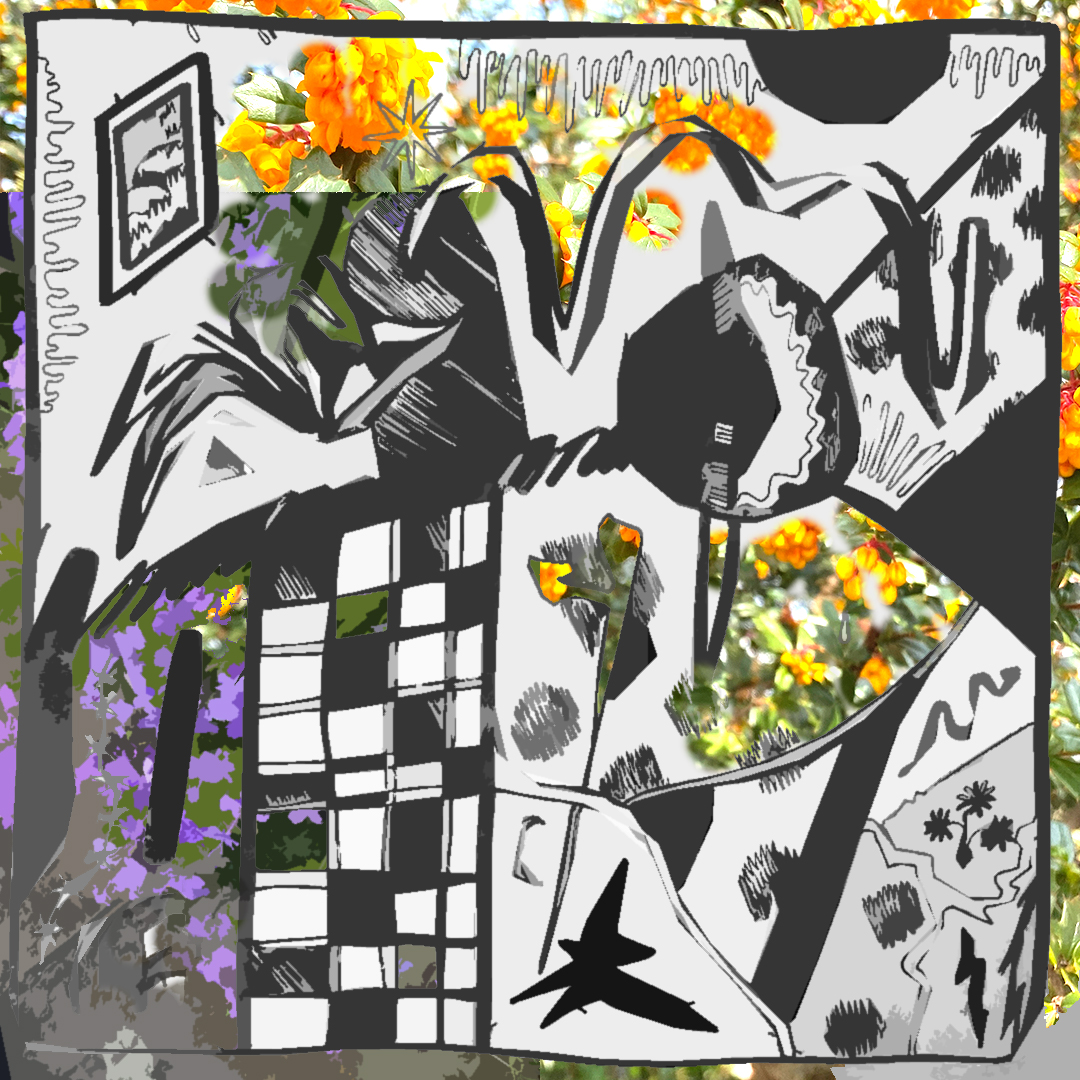
Process sketches for the book cover.
There is something about a (re)birth in this book; fred has called it ‘a purgation’. Something been set on fire or released, the way of touching abysses of sleepless thinking and facing up, fuck, to the impossibilities of work and not-work. To morph, mourn, join together, be commoning or calling out, be warm or hard or wet or sore, be there and gone. One thing that resounds is the refrain, the sonorous sense (something Verity Spott commented on at our recent launch, and something I love about Verity’s work also) of lyric in the book as a musical sprawl, fever, affirmation. For me, this is totally synaesthetic and electric, ‘a crucial magenta song’ and ‘like aleatory dance departing’ in the sacred gatherings of the rats — the animals that survived 2020 (their epic and terrible year) and will go on thriving beyond us. Like, we are not supposed to be here. Like, we crawl over the language that won’t want to hold us and we throw out this ask. Are we to be comrades? Sometimes you read fiery poetry that enflames and hisses (kisses) and makes you want to attend the protest, make the call, offer your body to the line (the book’s closing poem, ‘kludge time‘, was written in response to the recent Kenmure Street anti-raid action), and With the Boys summons this fire, but also sings in the muscly erotics of its cinders. These cinders which catch in the breath before and after the poem, which can’t be reduced to this or that reading; which burn with occasional satire, twinge and catch of meaning.
You want to say the boys are a folk knowledge, they are song, they are the startup code that ceaselessly reboots until lyric glitches in ‘fertile crevices’. They are a compost, the dregs of bad schooling, an institution of historical impotence, a gesture of care and play (‘I push you on the swings’), an orientation towards the vibe, a grammar of suspension ‘stopping by the interchange‘, a big fucking ‘nova‘ that hopes to find you well. Hi, hello, hi. *WAVE*. Everyone in some sense knows them. They are obviously so much more. I’m this hush-breath away from saying the boys are a hyperobject. You decide. The boys are shoegaze distortion all over capital’s weeping, the road less travelled, dazzling and pregnant and ‘wilding’. They will do your makeup and hum the ‘harmonic law to / love to leave to love’ — bright pink and chartreuse. You better have a go at them.
With the Boys is available for £8 from SPAM Press.You can get in touch with the editors for review copies or to stock in your bookstore at spamzine.editors[at]gmail.com.
Excited to announce a collaborative exhibition with artist Jack O’Flynn and curator Katie O’Grady, happening until 8th August at French Street Studios in Glasgow.
~
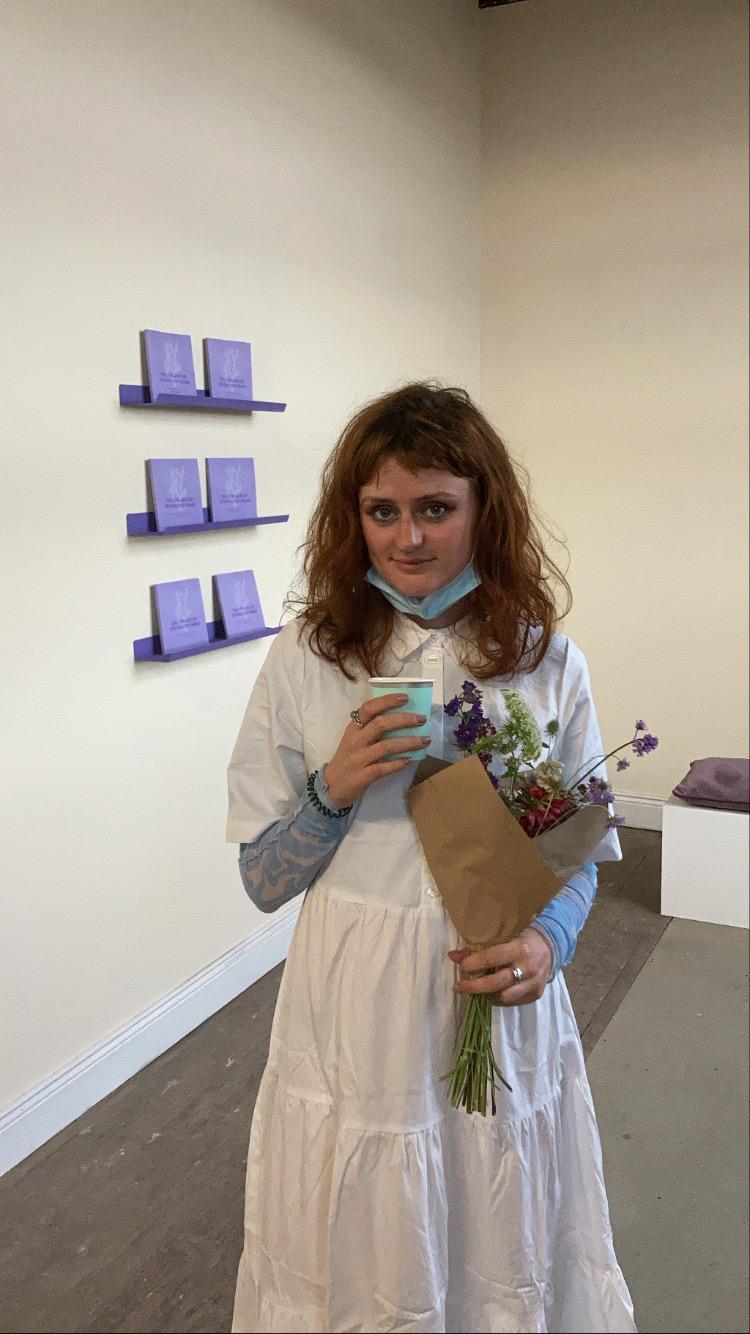
The Palace of Humming Trees is a collaborative project between artist Jack O’Flynn, writer Maria Sledmere and curator Katie O’Grady which took place from April to August 2021. This collaboration will be showcased in an exhibition at French Street Studios, Glasgow, featuring new works from O’Flynn and Sledmere which travel through poetry, sculptural entities and dreams of impossible possibilities.
This project was formed in a concert – along mixtapes, Tarot readings, zoom calls and shared research. We present it here as multiple sensual journeys; to an exhibition of hyper-foxes and tenderly crumbling foliage, through a publication of lichenous illusions and rummaging thought and in a selection of music and voices which trailed our imaginings.
Intertwining themes of ecological thought, world building and re-enchantment we sought to un-ravel the question: how can we act and think in this present moment to ensure positive change to our relationship with the world around us? The action and thinking which we wandered became located in small and monumental formats – enacted in the everyday and in how we create and build the future. We were enveloped by uncertain certainty, whether apparent through non-human thought, the possibilities of visual art and poetry or the endorsement of magic. Living in a world brimming with unease by climate crisis and extreme inequality – brought upon by extractive capital, far-right strategies and carceral logics – we wished to communicate a different model of awareness that could refuse these structures and re-imagine being a Being.
Exploring this sentiment O’Flynn and Sledmere have created a body of work that opens a portal to a forest of vibrating thought. One of galloping states, lockdown meanderings and a lyrical suffusion through language and art that prompts how we can think and imagine differently.
Please enjoy this digital showcase of The Palace of Huming Trees and, if you can, come to visit its physical iteration at French Street Studios, 103 – 109 French Street, Glasgow. Open July 30th to August 8th 11 AM to 5 PM (closed Monday and Tuesday) with a preview on July 29th 6 PM – 9 PM. Book to attend exhibition via Eventbrite here and to attend preview here.
Last year’s April was a leap year. For every 29th day I summoned to think of the hours as gifted, secret, strength. I spent the actual leap of February in somebody else’s bed, a cherished cliché: cradling sadness, cat-sitting, reading Anne Carson and rolling the word ‘tableaux’ around my stressy mouth, whose hostile environment required twice-daily salt-rinses. On the 29th of last year’s April, I wrote about vermillion and silverware, ‘the lint of your heart’ and hayfever. A friend and I exchanged tips on how to best work from the floor, how to make it your best work. I miss ‘working the floor’ in other senses.
What do you want is not the same as What would you like?
There was a reading group on Lisa Robertson’s The Baudelaire Fractal (2020), and the Zoom chat was elliptical pursuit, a good fuck pendant, fractal kissing and restless deferral. The word besmirch which isn’t a word search.
Those days
I remember cycling long into the hard sun; I recall better eyesight.
⋰
Okay, recently. Do you want to hear this? I spent a week of anticipation, languishing with migraines and digestive upsets and the kind of blues where mostly you curl foetally into the fantasy that really you, or this, doesn’t exist. Sip worry coffee and brush the hair, tweeze or shave, sit patiently on top of the abstract, waiting for something lucid to hatch. ‘Opening up’. A weekend bleeding, the minor cramp of womb in Autechre rhythm; then a further week of physical ailment whose primary treatments, according to the lore of reddit, included punching one’s spine, counting to ten, pinching between nose and lip and lying in hot baths. I did not have the baths, which seemed terrible and luxurious given how faint they could make me. I read two books by Samuel Beckett.
In Garments Against Women (2015), Anne Boyer writes that ‘Everyone tries to figure out how to overcome the embarrassment of existing. We embarrass each other with comfort and justice, happiness or infirmity’. It is awkward to smile and to squirm. To be red-faced and faint after a luxury bath. To be found frowning in the Instagram reel of somebody else’s dreaming. To apologise, to dwell upon, to ask for help. To be the one clutching a hot water bottle in the Zoom call; to hide or show this. To sip beer, the migraine coming. To say “hello” from the room next door. To deem something luxury, to partake of it. ‘I have done so much to be ordinary’, writes Boyer, ‘and made a record of this’. Say I learned this month how to paint my nails grape soda, define hypercritique, appreciate the slept-in curls of my hair.
It is awkward to be unwell, to express this without clear definition. “Sorry it’s all late, I’ve been sick” and to not elaborate on that sickness, the specific ways it kept you up all night, kept you retching or clutching something tight inside yourself which seemed to want to give birth. A stray barb or small contaminant. A numb pill. Transpiration is the process of water movement through a plant and its evaporation from aerial parts. Plants are not awkward; they just grow. Sometimes upwards, sideways; sometimes back inside themselves. Wilt logic. ‘Let’s be happy insofar as we were for a few days not infirm’ (Boyer). The ecstasy of a new morning where the body stretches out, the mind clears and one is ready to work. Who gets these mornings? Can they be traded? Is their delicious ease somehow fungible? What would I give for more of them? Fungus, rot, the fangs of lilies.
Maybe it starts with crisp garments. But pretty soon the neat attainment of day will unbutton. Watch it happen in Lorenzo Thomas’ poem ‘Euphemysticism’:
Some happily sing They have joy for white shirts Singing “O white shirt!” And that’s just the start
What ecstasy to declare the white shirt! What embarrassment! The chiaroscuro of lily-white shirt against the everyday’s dull shadows, but then showing up ‘baby pictures / Of pollution becoming disaster’ and Thomas’ poem is all about this. Disaster. Headlines, emissions, confusion. And that’s just the start. ‘A man crashes with his shadow’, perhaps because there is no one else. I did this for months on end because nothing else was safe. I could go the long walk for my safe grassy spot and crash there along with my shadow. I crashed in sunshine and rain. Crashland. Why did I bring the lily. It was like being fourteen again and walking for miles just to find a safe, anonymous place to smoke or weep. Sleep crash. ‘In the prickling grass in the afternoon in August, I kept trying to find a place where my blood could rush. That was the obsolete experience of hope’ (Lisa Robertson, XEclogue). It was like staring at the potential of Marlboro Golds tucked behind books and wondering what version of me they belong to. Synecdoche. Rising swirls. The poem burns out but also gets better. Blood rush and screen crash are lyric in pop songs. Sorry my windows. They are getting cleaned today.
Narrate my day again to you.
Thomas’ poem turns to the reader: ‘I’d like to check your influence / Over these ordinarily mysterious things’. The poem takes pictures or talks about it. What is a photographer responsible for? Do they re-enchant or estrange? If someone took a picture at this point or that point, if there was evidence, who would need to be told. How do you photograph pollution? Is this merely witnessing? In the past year and more, I have become witness to my own inability to really see. Disaster itself recedes into medial condition, blood swirls, scratching matter. I think of the way Sibylle Baier sings ‘I grow old’…
Some happily sing the white shirt and are they complacent with their conditions of work? Influence! ‘Desire is a snowscape on a placemat’ (Thomas). I trace its snowy lines in the stray thread of this weave. Ant-sized bloodstain. Am I to be made safe, or eat giant buttons? Put your plate on a place elsewhere and devour the rolling hills. Artificial snow is delicious. Crinkled thread. The white line curls around my tongue like spaghetti. Lila Matsumoto has a poem, ‘Trombone’, about hammering buttons. I unbutton the top three buttons of my blouse to walk around in fifteen degrees, absorbing/zorbing, and call the sunlight oil inside me.
‘There is a risk inherent in sliding all over the place’ (Boyer). This is what language does. There is a risk in crackle, in static, in the O shape of ‘sorry’ or ‘love’ or ‘alone’. Petition to upgrade for bubble emoji.
⋰
Last night, on the train back from another city I had not visited since August, I opened Sarah Bernstein’s new novel, The Coming Bad Days (2021). I did not close this novel again for several hours, except to pass through ticket gates or beyond groups of steaming men whose presence was vaguely threatening. They seemed cardboard cut-outs, stumbling towards me. When a migraine began burning my temples, I took paracetamol and kept walking, reading. When the light became gloam I walked faster. When I got home I sat at the table and opened the book again, like a schoolchild eager to begin their homework (as a ticket to freedom) or revisit a dream. It is risky to write about something you finished barely twelve hours ago. It’s embarrassing, the way talking about illness is, or happiness. To gush. You risk offering a raw piece of thought. Something has stuck to you and you are trying to convey the exact, impossible, vicious way in which you are changed by it. Still steaming.
This is what I understand by gorgeousness. As in, I gorged on it.
In the book’s last third occurs a fabular moment. The narrator is often telling their inner life through external surroundings — textures and fluctuations of weather. This is also to tell disaster. It is not the dramatic crash so much as a slow, implacable violence whose consequence ripples below and above the surface of our lives. Sometimes there is rupture: a cyclist is hit by a motorist, a storm occurs, an unspecified act of harm is committed, a life-changing conversation alluded to. But so much is in the insidious atmospheres which turn between dream and reality, which refuse to be nailed to the moment:
I dreamt of a landscape, overgrown grass, trees blanketing a hillside, leafy canopies moving against the sky, a deep river bisecting the scene. Fat berries pulling on their stems, apples weighing down their branches. Then a breeze came through with a slow hiss, and I knew it carried poison on its back. Here was a green abundance that I could not eat, a cold stream from which I could not drink. Take care, a voice said. Take care to call things by their names.
(Bernstein, The Coming Bad Days)
In this Edenic scene of harvest and green abundance, nothing is properly named. The landscape is unspecified, generic, anywhere. The voice belongs to anyone. It could be a serpent, a god, an angel, a person. Unlike Adam, the narrator cannot name things in nature. It is not their purpose. They came to Eden in dreams and after the fall. What fruits of knowledge exist are overripe and almost a burden to their branches and vines. In addition to the biblical resonance, this passage recalled for me the fig tree motif in Sylvia Plath’s The Bell Jar (1963),the poison tree of William Blake’s poem from Songs of Experience (1794). Wrath is in the air, and failure. I want to wrap around the passage like a kind of vine. Hold and be held in it. Is language a kind of taking care? A watering cruelty? What are the ecological arts of attention and tending to, towards, against?
I was struck by the possibility that Bernstein’s narrator embodied the abject and porous, slow and injured thought of an anthropocenic subject. This statement feels inevitable. The only abundance they could conjure was unconscious and laced with ‘poison’. It could not be imbibed; was not nourishing. But somehow such dreams nourish the text. For all its depiction of coldness, cruelty and the failure of communication, the cold stream of suffering, the weathering of Bernstein’s lyric prose effects a possible intimacy. Weathering, for Astrida Neimanis and Jennifer Mae Hamilton, ‘names a practice or a tactic: to weather means to pay attention to how bodies and places respond to weather-worlds which they are also making’. I think of the narrator skittishly eating cheese sandwiches at the window of their office, every single day of the week. I eat this sandwich with them. What is it they see? Each iterative mention of the weather reminds us that the social and interpersonal dramas of the novel are part of the medial, immersive or remote dramas of climate. The agential presence of rain, frost, clouds and fog, the turn of the waves, the ‘glistening violet evenings’: it’s more than metaphor. It sinks into the prickling skin of Bernstein’s language. Maybe you’d want to call this a weathering realism.
This novel seized me to read with compulsion, the way a dream does come and the writing of the dream is luxuriance that only later you bathe in. Not quite vulnerable or resilient. Responsive. Exposed to something.
⋰
On the 28th April 2019 (no entry for the 29th), I wrote in purple ink:
We would do better to sleep now, I have been sleeping much better and trying to resist the pull of insomnia, trying to perfect a monologue. What comes and goes in a dream without noticing, whose handwriting on the sun you recognised chancing your luck with yellow corn and fields of trials against sensitive, colours of smear and floral obstacle. Hyperboreal data flow into the crinkle cut futurity. Applying for latitude, acid.
Not sure about ‘we’: did I mean the ‘we’ of me reading back, and the ‘me’ who was writing, there in the moment? Are you also included, reading this passage over one of my shoulders? Can we take care to name things in dreams? But when I dream of people — friends, loved-ones, family, colleagues the famous — as I often do, what happens when I write their names? Am I opening them up to something that could harm or exhaust them? Is their presence a giving over of energy? Am I to be persecuted by the purple, anonymous flower of somebody’s need? What if I didn’t even know? What if the mark-making of initials was key? Will it bloom or wilt?
Go back to sleep in the forest, soft cosmos of dissolving forms.
⋰
There is a sense of missing someone that grows an acorn in your belly. It hardens and rattles with new life. It burns out of place. Leaves you with a feeling of placelessness. Impregnates every word with the possible, the fizzy wake, the fear and hurt. Makes you grow sideways. Hey. To exist in no-time of not knowing when the feeling comes. Pastel vests are back in fashion. Pull over. Kisses. Rarest flower emoji that doesn’t exist. To be sometimes well and other times racked in a well-documented madness that pays various attention to weather. Something painful. A few days of goodness seized. I would leap out the door, do 15,000 steps each day; so I would name the colour chartreuse when I saw it. Watching for changing bone structures in Zoom tiles. Your hair grown long and lemon blonde. My internet broke for a whole day and night. I felt old-timey in the pdf archive. Phoned you.
~
Bebby Doll – Weeks
Ana Roxanne – I’m Every Sparkling Woman
Zoee – Microwave
Cowgirl Clue – Cherry Jubilee
Laurel Halo – Sun to Solar
trayer tryon, Julie Byrne – new forever
Life Without Buildings – Sorrow
Cocteau Twins – My Truth
Kelsey Lu, Yves Tumor, Kelly Moran, Moses Boyd, ‘let all the poisons that lurk in the mud seep out’
Iceage – Gold City
Le Tigre – Deceptacon
FKA twigs, Headie One, Fred again.. – Don’t Judge Me
Porridge Radio – Wet Road
Angel Olsen – Alive and Dying (Waving, Smiling)
Big Thief – Off You
Perfume Genius – Valley
Grouper – Poison Tree
Sonic Youth – Providence
U.S. Maple – The State Is Bad
Sky Ferreira – Sad Dream
Waxahatchee – Fruits of My Labor (Lucinda Williams cover)
The Felice Brothers – Inferno
Bright Eyes – Train Under Water
Weyes Blood – Titanic Risen
Lucinda Williams – Save Yourself (Sharon Van Etten cover)
Excited to announce a new installation I’ve been involved in as part of A+E Collective. From The NewBridge website:
This online installation explores the relationship between sustainability and dreaming, offering a space to collectively share our dreams and have discussions surrounding these broader topics. The Dream Turbine was conceived by A+E Collective in collaboration with Niomi Fairweather and Jessica Bennett, as part of the Overmorrow Festival.
A turbine (from the Latin ‘turbo’, meaning vortex) is a device that harnesses the kinetic energy of fluid, turning this into a rotational motion which can generate electricity or otherwise ‘work’. From windmills to waterwheels, turbomachines are a crucial part of our energy history. The Dream Turbine is a speculative, participatory turbomachine for stimulating, processing, converting and sharing sustainable and postcapitalist imaginaries.
From Earth Day to early summer 2021, A+E Collective will be taking to cyberspace and installing The Dream Turbine at The NewBridge Project. In solidarity with The NewBridge Project’s values of cooperation, adaptation, environmental and social justice, The Dream Turbine hopes to promote alternative, non-extractive ways of thinking, desiring, memorialising and living through various ongoing crises as individuals and collectives.
the orange in the middle of daffodils was a song and when I saw you thru the blossom portal say all is well, you weren’t saying much but when I saw you thru the well with pennies, when I threw in the well my pennies well are they heavy? I made a wish on the topic of better, getting light or better, patterns on the vase aren’t like pollution or lightning storm at the top of Blythe Hill, but I noticed the temperature in California is 26 degrees right now
is it always the mild wet winter of narco swing and blithely fixing your bike to be rare in comparison, zero rate exempt from tending the flowers. I want to be a raw kind of feeling you peel me from bed I am become rosemary or behind the wall is a spring it gives, who delivers, there is pollen to breathe or not to believe I am warm dry summer as a mattress tastes of
wanting to embody the reading, its sweat I listen back, the baroque life of water, agua viva and what cherished of haunting, not this, or more classical forms behold, memory dream on the back of march and not taking the air for granted, blisters and songs I would listen to what if I just get sick what if I am nausea after all
reality I have a cheat code for bearing the rain like Proust didn’t have to, I hate food, what name do you give these creases, I am less than and tenderly to live in grey now where seagulls are more specific or can you say a herring gull lands on my arm at night or the formerly known as movement
alights at the scene where you ask for more sauerkraut please, let’s pull over, at the very least did we come here shining delete the bell is a girl or rind or grapefruit or very becoming after word marvellous today is beautiful about today it wanted to change our lives but who would assemble that statement, not for police who look in the beehives but scintillation is like, everywhere we study of illumined tinnitus, toothache, their white light crushes but did I establish
taking the painkillers of chefs, being squeezed out of the area, I dream a fat free cottage for sale and is it your birthday I’m scared of the sound of bluetooth the bad grammar of science daily the refutations of rainfall where your city is better, blood-soft atmospheric I’m simmering gnocchi as we speak
the mile-deep plants beneath the ice of Greenland, birds-eye, closing the door, I fall for the novel corona warm salmon it is a cold-water wisdom dish in the arctic sponge cake taking my place off
the flowers! you held them outside the shut nightclub and from subatomic world you were lovely? I remember the irl as like endless page refresh not knowing which leaf would shake first or press water to go back, up, the ana-cathartic condition of touching my spine obsidian, you know everything
as some of us are in the gutter some of us are looking at mars I’m looking at you elongated and some of us wear musks of various species like white black or red musks my favourite is the red offering and to wear it with chilli tobacco and smoke out my window to spicy clouds will only work in lockdown
like forgetting to mute in shrine of noise be sufficiently cooked thru a planet does taste like the species of a sex of deer is it tender or am I to make this with butter and yellow as yellow does a lot for itself for orange and musky everyone
unlock with your face, where is nautical the ID
I want to know twilight
~
black midi – John L
Aphex Twin – Acrid Avid Jam Shred
Felicia Atkinson – Lighter Than Aluminium
Yellow Swans – Limited Space
Lee Gamble – Locked In
Aïsha Devi – Mavda
Porridge Radio – Pop Song (Clarence Clarity remix)
NNAMDÏ – ART SCHOOL CRUSH
illuminati hotties – melatonezone
Remember Sports – Tiny Planets
Kississippi – Indigo
Savage Mansion – Wig Wise
Squid – Paddling
Dry Cleaning – Oblivion (Grimes cover)
Jinosaur Jr. – I Ran Away
Indigo Sparke – The Day I Drove the Car Around the Block
Announcing a new anthology I’ve been working on with the wonderful Rhian Williams and indie publishers Dostoyevsky Wannabe. Copies are now available to order…
Edited by Maria Sledmere and Rhian Williams and with a foreword by Tim Morton, the weird folds intervenes in more traditional canons of nature and ecopoetry to offer a poetics of the anthropocene which is thoroughly generous, queer, sensuous, formally innovative, relational, occult, fugitive and critically sensitive to the mediations of technology and culture which shape our encounters with the more-than-human.
NOTE: If cover images are missing from any of the above links, please be aware that the books are still available for purchase.
Pages: 296 Dimensions: B Format ISBN: 978-1838015619 Cat No: DW-001-97 Imprint: Dostoyevsky Wannabe Originals Publishing Model: Tailored
The Author
Edited by Maria Sledmere and Rhian Williams and with a foreword from Timothy Morton), the weird folds: everyday poems from the anthropocene features contributors working at the intersections of lyric, cultural critique and hybrid forms. The contributors in order are: Pratyusha, Kashif Sharma-Patel, Jay G Ying, Sarah Cave, Samantha Walton, Rebecca Tamás, Daisy Lafarge, Jane Hartshorn, Francesca Lisette, Max Parnell, Calum Rodger, Miranda Cichy, Alice Tarbuck, fred spoliar, Iain Morrison, Gloria Dawson, Vahni Capildeo, Sascha Akhtar, Fred Carter, Katy Lewis Hood and Therese Keogh, montenegro fisher, Nat Raha, Mike Saunders, Jane Goldman, Harriet Tarlo, Rosie Roberts, Lila Matsumoto, Colin Herd, Paul Hawkins, nicky melville, Kat Sinclair, Nasim Luczaj.
Praise
This vital gathering tells slanted anthropocenic truths, re-cognising the manifold everyday as a crucial space-time of enquiry, excavation and entanglement. Performing kaleidoscopic arts of noticing, the works within these pages render traces of a changed and changing planet with tangible immediacy. Here is poetry as a barometer of the times.
-Mandy Bloomfield, author of Archaeopoetics: Word, Image, History (University of Alabama Press, 2016)
These are poems of the future glimpsed through its shards and fragments here and now – they are unhomely and familiar, revealing a skewed new normal: they are fieldnotes from a world to come.
-David Borthwick, Lecturer in Environmental Literature at University of Glasgow
Anthropocene is the impact human beings have on the planet, while the trillions of cells making each human body are composed entirely of the fire, soil, air, and water of the earth. In this anthology, the poets are voices for a war the planet is having with itself through its human bodies, and I am very grateful for their reports. I wonder if it is unfair to think of poets as war correspondents, but this book proves we are possibilities for so much more.
–CAConrad, author of While Standing in Line for Death (Wave Books, 2017)
For a brief eternity, nobody was fucking anything that already got fucked and that was when the leaf started falling & another then a whole earnestness of them. Fuck. The way to keep strong is being meticulous about noticing clouds and writing shit down I stopped wanting to rain, I’ll fall asleep smoking. I’ll fall asleep smoking in some movie where my brogues are black as the wet night this all was conceived, draw my red curtains away from the moon that Nasa had a claim on and think about salad days, my nails painted trademark Billie Eilish lime. O salad days pacing restaurants, the rain is on; I remember the leaves swept in the door and they too were victims of a fate in their genes, once green. So I took samples and pressed them crisp between Moleskine pages in the sleep dimension, my writing was automatic and sullen, chlorophyllic, squeezed between menus, I was windswept inside it with the beach pouring out it was heavy. File this under the brush, bush, brush it back into language. I listened to the intricate complaints of the shrubs.
*
Between myriad Tuesdays, I became a psychiatrist of seashells, pressed to my ears their exquisite misery.
*
Time was a month of afternoons and then rivers of weeks and the sexual appetite of the hours then none. M. said in emails it all feels like soup. In no time I drink echinacea tea and wait for you in black velvet trousers, my pretzel crossed legs. The black velvet night is missing from other suns. There is no time. My chest is clearing itself of the leaves and a mysterious spore they call viral but is it just metaphor, is it the just continuum of falsehood, heavy as my tongue in your words and letting the owls out is only fake news. A black velvet night full of owls. The way to keep going is smoking at the window notwithstanding the smoke, I mean lean out like me and catch it. Someone drops loneliness pills from high windows, highest, like the song about throwing pieces out a twenty-storey flat…Your browser does not currently recognise any of the video formats available. And yet that song and for the love of bread and jam and here in our crumbling houses. Seedless. My brother does not understand tenement lust, the trend for it, but a tower-block remains in our town. Black velvet surrounds us, slapped between lunar slices cut from the nightmare of twenty-twenty. It isn’t your vision.
*
At five, he would drink all day diluted wine and snort at jellied nature. I love receiving your comments and photos and learning what is an amethyst deceiver and those in history who wanted us killed. If I am held down by world, I had a cold shower and lived in the hades of a woodlands that didn’t belong to me. Smell of tomato all summer in the glow of my window. Smash it all over your clavicles, the insides of your thighs, between your toes, the secrecy of your neck. Flesh of a very red vitamin C. Imagine owning the woodlands. Not to eat, I typeset all night to the sound of sentences, insects, let them lay me down later, I am all this humming snow. What sleep is it that comes three hours at a time, at a time without time that is never quite dark and five hours late. If the clocks go back. You say it’s impossible to write in these times and you are right, as anyone is to say of the impossible I feel it, here and closing in and peeling the skin from my cuticles. Not this. Backwards. When you ask what I’m doing, I’m quietly bleeding. In the hazard assessment, failing to be meticulous is not this. Failing violence. Touching green. I have a good kick at the heart and the head. The men are all down. Held down. You and I get so tired.
*
I want to know how she dies before the novel even opens. Lain down in the grass; the spine is split, our folds are torn. Because you say nothing I go into the orange department and juice my feelings very slowly in rapture. Waking up is to know not what happened. A blade is working in spiral formation – a blade tornado. What would rip us from orange and up, up to our tower block office at home? Dream pith all over the air around us, sticks. Walter Benjamin is very anxious about this, that you should not write dreams down before breakfast, should not attempt to narrate them. You break fast to break with your dreams. I dreamt I wrote copy for an orange juice company, who wanted their ingredients relayed as sonnets. It seemed impossible that orange juice should be so teeming with things other than oranges. The names were beautiful: canola oil, sodium citrate, beta carotene, cellulose, sucralose, Neotame, potassium sorbate, yellow #5, yellow #6 – and what could be seven? What could be less than seven! We are, we are…In the mix, at the end of the nineties, “soft drink turned a girl yellow.” I remember this as though I had been in hospital and the walls were all yellow for how much I stared at the pale and acceptable middle-class blue. Where was this, surely not in the news. I paint my eyes girl yellow, the colour of soft ghosts; I practice quietude, then sugary schemes of rhyme.
*
So what is the meaning of soft in your work, is it ordinary eggshells around the thing itself, is it orange peel, goldfish, autumn maple. I tread lightly on the question of being at all. These terms are so loaded. K. is reading novels where people casually set off fireworks, they do it all the time: they grab them from supermarket bins and set them off in the carpark because why would you wait. A catherine wheel for Asda and my blues is spinning, my blues in the washing machine, O rocket, a felt sense I could hug you then and the blues left a stain on the radiator. Dashes sparkle. We sit in old meadow in mud and the dogs roll over each other. We are not drinking cocktails. The transience of dalmations. What is the meaning of soft. Softness as a kind of value. I wish I could learn precision in language but it goes running over my senses and to be soft is to experience aphasia. Say in the meeting we stammer and get to the question, late morning before this, zoom before zoom, arranging the clattering scale weights and spices. I slept with Bachmann’s Malina under my bed. A blue skirt stain on the radiator. Blue heat rises. Dad says, “have you been listening to seashells again?” I fantasise gas flames.
*
Conch, scotch bonnet, wentletrap, simnia, drill and murex. Rose and sharp-rib, American carrier, Gulf oyster. Marmite mushrooms frying on the stove. You know there is a shell called ‘Coffee bean trivia’. In Brighton you could buy trays of them for a fiver. I bought Guinness instead, a half pint for you and I on the last hot day of the year. There was a kind of listening to sunlight. Softness as what could be damaged inside us: organ spleen, aura lamina, the shell of our bodies. Your cells soft mint as the cure. People are cycling to work; I barely leave my sofa. Various adrenalines assemble inside us. So far the shells have daddy issues because of the sea. Scrub hard and anything shines. I am under the influence of rainbows, umbrellas, a rim of salt.
*
I was fired from the orange department for wearing this blue on my sleeve. In the atrium standing there with Styrofoam coffee, swished blue from my dreams; compliments from the manageress and frowning at the meeting that never would last, and something we didn’t say. ‘Divine aphasia loves us dearly with some exceptions’, writes Jackie Wang. I sat outside Perch and Rest with lemongrass steaming from a cup I had purchased and the leaves blew into my face with rain, they were soft and important, licked and wet.
*
We were about to make love but one of us took concussion from the piece of citrine beneath my pillow.
*
I dreamt rabbits were climbing my beech tree the way goats do in Israel.
*
A small porcelain jug of milk, a blue jug, was all I could glean from the orange department, after my passing. Carried it home in cardboard, I passed through the walls. It is all because the clocks go back and a crack on the wall. Anhedonia, that I hold breadcrumbs and nothing left to imagine. At the late-night snack bar, composing these empty sentences. Do we get paid for the hour we lose? A soft wound is still a wound. “I would like truffle fries, I would like oysters…” This is something I once seriously wondered. Pools of oil in shells, a meltable system. You break crockery and throw it at the sun. It goes like fuck; it is fucking you brightly. There are still exits, listen.
*
Thee Oh Sees – Goodnight Baby
Little Comets – One Night in October
The Cure – Underneath the Stars
Oneohtrix Point Never – ECCOJAMC1
Moses Sumney – Neither/Nor
Massive Attack, Young Fathers – Voodoo in my Blood
Patiency challenges the body’s borders, the fantasy of which converges with a policing function. This means reimagining the body as process without a centre, not a discrete biological or social fact, but an untotalisable set of relations, the body not as a static object, but as the ek-static convergence of processes always in excess of themselves.
(Rob Halpern, Weak Link).
Patiency: ‘to do with the body as a situation of suspended agency and disabused mastery. If this illusion of mastery is a privileged delusion, then patiency is its refusal’. Halpern gives the example of Ban, in Bhanu Kapil’s Ban en Banlieu (2015), who ‘lies down on the street in the opening scene of a riot’. So begins the novel and another historical opening. Patiency might be, I am heckled on the subway and so I lay down in the aisle. Or is that too much of a spectacle? It might be that I is not-I, just as ‘love is not love / When it’s a coathanger / A borrowed line or passenger’. We do patiency differently. So love that is love provides more than suspension or structure; it isn’t the person sitting beside you or even the vehicle. Limerence on a borrowed line. So things are thrown. I am lying down in the middle of lockdown, which feels like ‘response’ as such. In these casual Zoom calls, these meetings, it is like “Oh, well I spent that day lying on my floor, sorry.” I stop saying “just lying on my floor” since, over time, lying on the floor seems adequate. Almost, to a certain thought. We used to call these sad naps and could take them at work, for instance, with head resting on folded hands, or perhaps in the little vinyl benches round the corner of the bar, under the picture of Dylan and the roses, and the painting with the cut-away eyes, whose market value would astound us. When I say I lay down in the middle of a global pandemic, who am I kidding? Sometimes I turn off my webcam and lie down with my eyes closed, still keep talking.
I google ek-static and find a meaning for ecstasy, ekstasis: ek (out) and stasis (a stand, or a standoff of forces). So an experience of ekstasis comprises, as Alexander Riley puts it, ‘extraordinary situations in which one stands, temporarily, outside the normal interactional world in an existential frame of peculiar intensity and effervescence’. There was a night in lockdown I bumped into a friend and we walked along the river, bordered the parking lots of the broadcast buildings, looked at the false lights reflected in stout-dark water until I finally looked up and saw the huge harvest moon. This hour or so outside of the otherwise confinements of lockdown had felt ekstatic — for I was outside, on the edge of the river. I was talking again, for real and wheels were turning. Words, however everyday, had their electric shocks. But was this an extraordinary situation, this encounter? Context matters.
Types of lockdown ~ekstasis:
Zoom calls till dawn
Recorded poems
Voices, hear say yes
The word haecceity
Streets without vehicles
The first day I discovered the meadow
Golden hour
Bluebells, daffodils, cornflowers
The innocent coughs of strangers in readings from a pre-covid world, if such a thing once existed
One infinite tin in the park with you
Oil pastel under my nails
St John’s Wort capsules
Parcel arrivals
Applause on the recording from 2004
Misplaced pastoral (nostalgia) inside a sleep
When we didn’t know which window the birdsong belonged to
Coffee, five times a week
‘Like a cat can / See things out of order’ (Lucy Ives, ‘Picture’)
Soft sound twilight of notification
Gentle ASMR of the rain
Tree climb
Carousels of apophenia
The canal, the river
There’s a song that goes, ‘all that I have is a river’ and I remember it from more than a movie. An undergraduate, alone in my small room I was watching this video of a young Johnny Flynn and Laura Marling just sing this together and I thought it was an old song, oldest, the kind of thing you can only think when adolescence still is you. Almost ten years have passed since then. Ten long summers, more like winters…What a gift to forgo all but the river, to be young enough to possess nothing, cover it, or to let go for the water and what it carries. For you know everything is a new current is not even new, it was streaming before and now it is catching. And you let yourself into it or you don’t. You walk into, you walk by the river. You are carried, supine. Patiency.
I skirt the river in lockdown because it is a motion of passing when nothing else does except spirits and bodies, and the days are leaf, they are like easy to peel from the calendar, people are always saying O how the time passes, but into what? Time passes with you, otherwise I am waiting. The song that appeared in a search result. With you am I writing. ‘Dreaming is the best kind of waiting: it overcomes nothing, it does not try to separate itself from what it wants, from everything it wants. Dreaming just begins’ writes Sarah Wood, in 2007, which was a year I learned to starve myself among eons of bad indie. So I would dream hard instead; it was like whittling reality down to return to those childhood imaginaries whose nourishment was almost endless. To be almost endless, and good. It was the year before recession and so I had not learned the societal imperative towards ‘hope’. ‘If Hope can find oxygen, it will’, writes Lena Andersson at the end of her novel, Wilful Disregard (2013), ‘Starvation rations do not help […]. The supply of nourishment must be completely cut off’. You learn to breathe different air; you have to. Oh the rain really came today, I feel like saying / or send you a video. Told to have hope or having hope is different from living towards it. Soft falling hope was not that. In a 2019 discussion with Greta Thunberg, Alexandria Ocasio-Cortez says,
I learned that hope is not something that you have. Hope is something that you create, with your actions. Hope is something you have to manifest into the world, and once one person has hope, it can be contagious. Other people start acting in a way that has more hope.
I’ve had it with viral metaphors, in the sense that I live in the era of post-viral fatigue and my body is sick with the carriage, ‘but I can’t stop expanding with currents convulsive’ (Halpern, Weak Link). Lana sang ‘Hope is a dangerous thing for a woman like me to have’ and the question became less about hope and more about that ‘like me’, a little hinge. I identified with a neighbourly extravagance, hydrangeas, pale blue-lilac from a middling soil; I left the gate slightly open, I smoked in the rain. The danger was in hope without architecture, so a ghost came in. Hope requires a manifest scaffold, perhaps. Weather that rails against it. The trace effects of a fire, of dream languor, particle physics. It was in the sentences we erected, passed on, hammered in, lifted and lay still, remembered…‘my present tense contracting the way love contracts me to the future from whose point of view this will have not been terminal’ (Halpern). The person on the Zoom call, PST, said to say goodbye, If you’re in California, don’t leave your house, there’s smoke out there.Stay healthy. Hope needs to be more than just ‘in the pipeline’. Maybe we need to blow up the pipeline.
2007. I lived in the years of ambient war. Later, too young, I would attempt to read Cyclonopedia: Complicity with Anonymous Materials (2008) and dream about pools of oil filling the end of my bed, like a menstrual stain. At school, we wrote essays in which we had to pick a side: for or against? The Iraq War, vegetarianism, a bypass for our town, surveillance capitalism? I could only think of deserts, not arguments; I wondered what secret plant could stem blood flow from a wound. I rarely watched television. In super rural mornings, December, the air smelled of engine oil, woodsmoke, fertiliser. Shit and snow. Something to-come that never was passing. I felt sanguine, calm without compare, sipping vodka + cokes against gym blocks. Back then, clouds were irrelevant. Instead, I scrolled the internet for answers and images. ‘That hope is just another bloated moat / is worth the ringworm, is it really so cute’ writes Nikki Wallschlaeger in Crawlspace (2017). Thinking in Sianne Ngai’s terms, is this ‘so cute’ ‘a sensuous quality or appearance’, or ‘a feeling-based evaluation or speech act’ (Our Aesthetic Categories). It’s cute that you dreamt it. The ringworm I mean, another parasite. So you circle in medias res, nibble a little of that time, but I thought I could jump the moat into future. Future was just a quality, like cute. Is it really so cute? The tiny things and changes. billie eilish in her video for ‘my future’ looks pretty cute, but it’s more than that. The soft falling rain would fill up the moat, the river, the lake. The dream was a body of water again. Speech fell upon us, fluid, then telling the nude and lime-before-lilac sensation. Something that gets inside us; a tooth around your neck, and pain.
Dreaming just begins. Derrida is beginning his lecture on Joyce, ‘Ulysses Gramophone’, with the signature of a date. This feels arbitrary enough – a date in lieu of a site specific. I would send letters in lockdown for the sake of sending a date. It was an act of patiency, a claim against time that could turn it inside out, let somebody else pop the bubblewrap for you.
I was looking for postcards that would show Japanese lakes, or let’s call them inland seas. It had crossed my mind to follow the edges of lakes in Ulysses, to venture out on a grand lakeside tour between the lake of life which is the Mediterranean Sea and the Lacus Mortis referred to in the hospital scene, as it happens, and dominated by the symbol of the mother […]. You will no doubt know better than I that the whole pack of postcards perhaps hints at the hypothesis that the geography of Ulysses’ trips around the Mediterranean lake could have the structure of a postcard or a cartography of postal dispatches.
(Derrida, ‘Ulysses Gramophone’)
The difference between the lake and the sea, is it tidal? Say I wrote to you by a general lunar insurrection: I refuse to be governed by hormones alone. I am lapped, turned over, the hours are upon me in wavelets. For a long time, months, the word ‘hospital’ also conjured ‘field’, and ‘crisis’, and ‘overstretched’, ‘overburdened’. Many fled cities to avoid this. What would a postcard from the pandemic look like? This sounds like the afterthought of a conference happening years from now. Send a postcard to your future self! I would rather dwell awhile in the mystical, sub bass pastoral of a common place that is billie’s future. The transparent dew in the process of dropping, clearest blue. But it was also the artist’s imperative, mid-March, to say something. To who? A postcard can be read by anyone, if they get their fingers on the mail, if they would risk that trace or touch.
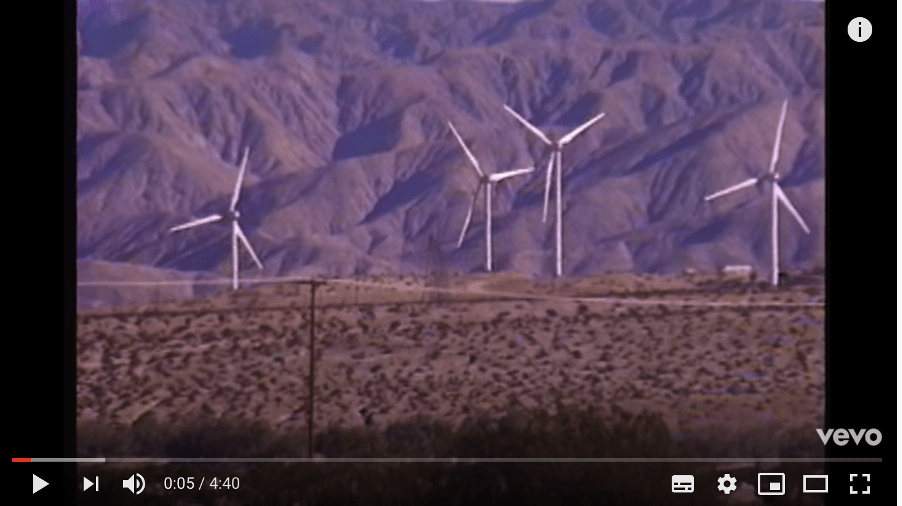
You could circle the drain, if not the lake, like in the video where Soccer Mommy is at Palm Springs Surf Club and conjures an existential state by the weather: ‘I wanna be calm like the soft / Summer rain on your back / Like the fall of your shoulders’. A desert gets cold at night; its ochres turned deep into cobalt. What happens in the turn of those lines is the fall of rain is a bodily gesture, the fall of your shoulders. Like sigh before sleep or hold me. Both kinds of soft between element and form are just memory’s fall, and a longing that is ambient and prolonged like those four hour looped videos where the song is slowed down and rain sounds are added. Its weird twist is dark ecological: I love and you as the other with your shoulders, their fall, I love I am rain old rain we are just that falling or were. There is a sense, if vague, of when it happened, of summer. Somewhere. I would send a postcard with those lines and make a cliché of the feeling. Clichés are like rain; they fall all around us and that too is cliché. In London I learned to long for the rain.
My trips around the Surf Club, is that a name for this desert, some place out and aching, are not knowing what I’m looking for, the lake of life or death. There was a body of unknowable time at the beginning of pandemic that felt like a lake, a dark one with monsters inside it. You were scared to touch. The virus was a hyperobject and it lived in the lake and became us. So I thought what it meant to carry the lake. Like if you could tie it to your Kanken and drag the lake on a walk every day, make it lose weight. Could you test the lake, dump chemicals in it, starve it, piss in it? Was this abuse? My poor lake, resting at the edge of the desert. The lake was too much: overstretched, overburdened. Eventually I would bathe in it, but that was July, just before a morning of rain and the fall of your shoulders / brush back hair. Aeolian breath above the lake.
A thought crossed Derrida’s mind ‘to follow the edges of lakes’ in a novel. A very long novel but only a day. Sometimes we say ‘it feels Mediterranean’ and is it a warm breeze off the sea, a quality of something vermillion splashed against turquoise? Like Dorothea Lasky (if I remember her essay on colour correctly, perhaps there is a colourblindness to memory) I always loved that combination. But it grew too much and mostly I stopped painting in those colours. Can there be too much blue in your life? We compare eye colour on Zoom and there is what, somethingsomething pixelation of the soul, which is almost good, is it. The inland sea of WhatsApp green, or the rising tides of Facebook blue. An irritant gets into the ocean. This is how a pearl is formed, and we worry it into August.
August: the commonplace between seasons. What was formerly meant by holiday. Halpern’s weak link is something about tendency, which is a quality of patiency, surely:
[——] = a common place we can’t sense, but upon which all we perceive depends
In the book, the double em-dash is more than that, because there is no gap in the line. I don’t know how to recreate that here. Rachel Blau DuPlessis often uses the commonplace of a line, this continuity, asking questions like
Did these years have to happen the way they did?______________ ______________. The poem, unwritten is concealed by the poem,
written.
(Surge: Drafts 96-114)
This is from a poem called ‘Draft 100: Gap’. I feel urged to fill in the blanks, but then suddenly don’t. Mind the gap? I am mindful of my tendency to make lines into rivers. This is a temporal effect: ‘The body of water a particular time of day resembles’, writes Lucy Ives in ‘Catalogue’, not answering the proposition except to parenthesise ‘candida’ in brackets (). Parasites again. You can’t starve them so much as you must cut off the oxygen altogether. They want sugar! Like rubbing words out of your poem is a kind of excision necessary to let the reader in: an exchange of space. But is a blank also a body of water? Let us lie down in the blanks, one or more acts of patiency. The edge of my body at the edge of the lake, which was almost erased, became two-dimensional. Was it the politicians who did this, or the semioticians? Surge, surge, surge…
Without touch, I could not plunge into the body of water for several months. Returning was two-sided, flickering. It was turning the river to a mobius strip. The river that led to the lake? No pictures were taken, but words were written…
The other’s body was divided: on one side, the body proper—skin, eyes—tender, warm; and on the other side, the voice—abrupt, reserved, subject to fits of remoteness, a voice which did not give what the body gave. Or further: on one side, the soft, warm, downy, adorable body, and on the other, the ringing, well-formed, worldly voice—always the voice.
(Barthes, A Lover’s Discourse)
In his telegraphic dashes, Barthes evokes the voice on the line, between lines, electric crackle. I am on the end of a telephone listening to what I thought was rain but was only white noise or the manifest difference of space between us. For once, not time; though still there was time between us, before which we could meet. The body could always give more, which is why Derrida would venture the IRL lakes to follow a postal cartography. Here where I received this text, sparkle emoji, a picture of sunset forgetting I’d sent… But what if the voice became a body in tender distance? A kind of tendering in itself? If it was all we had of those months, and could cradle ourselves to sleep in it…
We look back on the years that are happening and wonder if they ‘have’ to happen this way. There are divisions, revisions; something that gives and receives. A year is impossible. The depth of a lake without measure. I could not tie it to my horse and ride away. Salt and sweet. The difference between lake and inland sea depended on your idea of ‘freshness’, but in Cancer season I delved in the water. We called it a loch, though named it was ‘Lake’. Always the voice / settles cool on the water.
Down becomes a colour. Peach stuck, clouded. A snapshot from my enviro-diary in spring:
I realised there had to be exits from ‘lavender country’, even if I felt implicated in the earth forever. What had I otherwise written of the wild mountain thyme, the purple heather. I had.
What Andersson wrote of hope, ‘If Hope can find oxygen, it will’ recalls Angel Olsen’s song, ‘If It’s Alive, It Will’ and you can’t help thinking about the ‘it’. This thin word of the thing itself. Love? The song, the poem? ‘My friend you are unique but not always / Some stranger in the well has surely felt your pain […] And all the things you’ve once said / Your thoughts exist in someone else’s head’. So we are parasites of a mutual speech, second body, patiency. It’s going on elsewhere,, echo,, echo. I saw the police queuing for pizza. I saw mothers outside supermarkets, I saw masks trampled into the towpath. I saw your breath left a mark on the bathroom mirror. If anything is taught now it is that pain is not unique in its total uniqueness. It is also a misting — these noticing moments like the colour of your eyes on webcam, or when I saw a friend by the river or the cygnets when they were still small, and charcoal. Touch, know that we live. ‘A moment of affirmation; for a certain time, though a finite one, a deranged interval, something has been successful’ (Barthes, A Lover’s Discourse). The weak link ( — ) of ‘a common place we can’t sense, but upon which all we perceive depends’ (Halpern). The more we send, the more links accumulate. This is not some metaphor leading into Connell’s chain, or the blockchain, the chain of being or food chain, but something like when I recently went to visit my Nan for the first time in nearly two years I saw she was wearing the gold chain I remembered. It remains a ghost fact against my clavicle. Gilded, some arterial link between times, the artefact worn of all years, not mine.
And did that path or the other lead anywhere?_________________?
________________? The other side of words_______________.
(Blau DuPlessis, Surge: Drafts 96-114)
A path can be dangerous, like hope. So I see it not as a route so much as this mark of the common place, where you enter the poem. Echo. It is not so much I who is writing. Someone is pouring clementine fizz into the glassware someone else will inherit. An embrace is made possible because of this. If it’s alive, it will. The other side of words or the strangers in the well you threw a coin into. I was always wishing on fountains. Could I eavesdrop on what went on inside your sleep? It was trouble enough to listen to mine. Quiet plash. Your breath like the ocean beside me, etc.
Hope and not-hope. I am obsessed with this passage from Verity Spott’s forthcoming Hopelessness (2020). ‘I hope. You hope’, she writes:
‘I wondered if it was enough to extract a sentence and hope something would ramify from there, like crystal’, writes Brian Dillon in Suppose a Sentence (2020). That word ‘hope’ again! To put faith in the art of essaying, you manifest from the sentence, say. But isn’t extraction bad? Verity writes an incredible sentence. Love contracts, there is a terminus, there is no harbour, is it that thoughts overfall or flow before water. There are strange moments where you fall into iambic rhythm, ‘would shrink like necks passed out’ and find yourself taking perverse pleasure in the pulse of that action, complicit. I fell asleep at the desk, put a crick in my neck. If Verity’s sentence is a crystal it is so splintering hot that to hold it I had already thrown it towards you like catch and here we are passing those lines between each other like ouch! or whoosh! as it goes through the air then starts to stream — is it light or water that sprays off the sentence, falling or lifting we get it back up we get going again, so being itself is contingent, there is a feeling of tilting, just touching between something like what Adrienne Lenker sings in ‘Mary’ — a most verbose song with the lines the lines the lines like fractals, repeats, alliterative, the rhymes inside it — ‘The violent tenderness / The sweetest silence / The clay you find is fortified / We felt unfocused fade the line’, it’s a blur then, even if the object is hard, ‘my vested shot’ like bullets are thoughts, ‘get fucked’ (a reminder that we die or desire, no, we could be ejected by the speaker, why not), leave holds inside us and the ullulation maybe of lift/leak/blink/light/love/cryssalis/live/like/laugh/will, hear the undersong packed inside the block, LA LA LA LA CAN I HEAR YOU? to put this in the kiln of language and wait, tender, splintered political speech is the romantic filibuster of ‘on and on and on and on’ worn in a ring without rose, lust, health, being messed up by time and order, ‘and change not come it not does come to who those wait’ as if to be the subject doing object to the thing itself, no is that not right, I’m in the stream of it, ‘where else’, ‘that change’, well I feel gentle to read this to you aloud and think poetry is it never could smile like lift this up what’s underneath, ‘screaching night’ of fizzy things in vessels, ‘pouring thoughts I made them up, so what’, a fall of your shoulders, softly, who cares, ‘wry out’ did I twist that humour is lyric always sincere, I care (?) is it the very empowerment or dressage of the poem that makes it ‘shot’, tongue tangled, get shot, ‘hurt the air’, ‘get fucked’, I love you, whole world is metamorphosis. It’s for love or dream or death, ‘if you fall great down’ a white-hot crystal. Stammering light of I love you. So keep repeating the sentence forever it’s the estuary (ex)change in my head where the diamond melted; I go out like a river, a light, it’s so many; I lift crisp, iridescent leaf to find you in process…‘scarless along the rib, as if to say’ (Halpern). Small wet thing w/ almost wings. ‘Soon come’ is a charm I have held all summer, ‘Where goes? I guess’ / the flight, the train, the swim, the breath…
According to my diary, in 2020 I had nineteen dreams about breath. These are some:
but maybe this is a lesson in being able to let go and breathe deep and keep going, rather than hinge on another lag. Oh hinge is another app right, maybe I should get that.
I started to do long deep breaths.
I would come out in the breaks to breathe fresh air among the tumbling ivy. My aching head, my burned-out lungs. I eat too much!
A lavender girl with this expensive complexion and a close-shaved head was underwater for a very long time and when she bobbed to the surface, numb and curled in the foetal position, she moaned something about “I wanted to give up my breath”. And we realised this was the currency of all these submersions: losing your breath. There were many people doing it, just bobbing to die in the water.
I don’t have a shortness of breath or any particular fever beyond what you usually wake up to after too much sugar
Last night at four in the morning I finished A Breath of Life in a sort of tired rapture, still very awake, leaning back into my eyes and my soul a while, the sense that it might go on forever, whatever ‘it’ is, cross-referenced of course with Àgua Viva
Started to have trouble breathing, a sort of slanted weight on my chest. I guess sometimes I suffer from very minor sleep apnoea, like the Beach Fossils song
Disorientating to wake up from a dream with so many people, almost like I couldn’t breathe, my heart was racing, I had to pull off my jumper
I feel this pressure, like I won’t be able to breathe and I won’t. In the dream I was between two tribes and there were guns I suppose, other weapons. Loosely I was in love with someone on the wrong side and so my loyalties were confused and I knew my life was at stake, the others having pressed knives to my throat to warn me, given me a bracelet I knew contained a location tag. I want to be dazzled by leaves and tiny pieces of unmentionable silver.
She went away and I was sort of left in this state of zero energy, desperately trying to gather up selected marbles to give out to whoever was still left in the boarding house. And then I sort of dried up, paralysed, barely able to breathe.
A few people joked about moshing. I miss the rupture of something going shoulder to shoulder. I miss the general blaze of sweat. How is it to breathe in a basement.
I want to feel like the blanks between dreams, ekstatic spaces between sleep (fall asleep to yr voice again), are bodies of water. Àgua Viva: running water, fresh water; variously translated as stream of life. Another writer who wields the dash, flies on the line, which is also the spray, the beam of light, is of course Clarice Lispector:
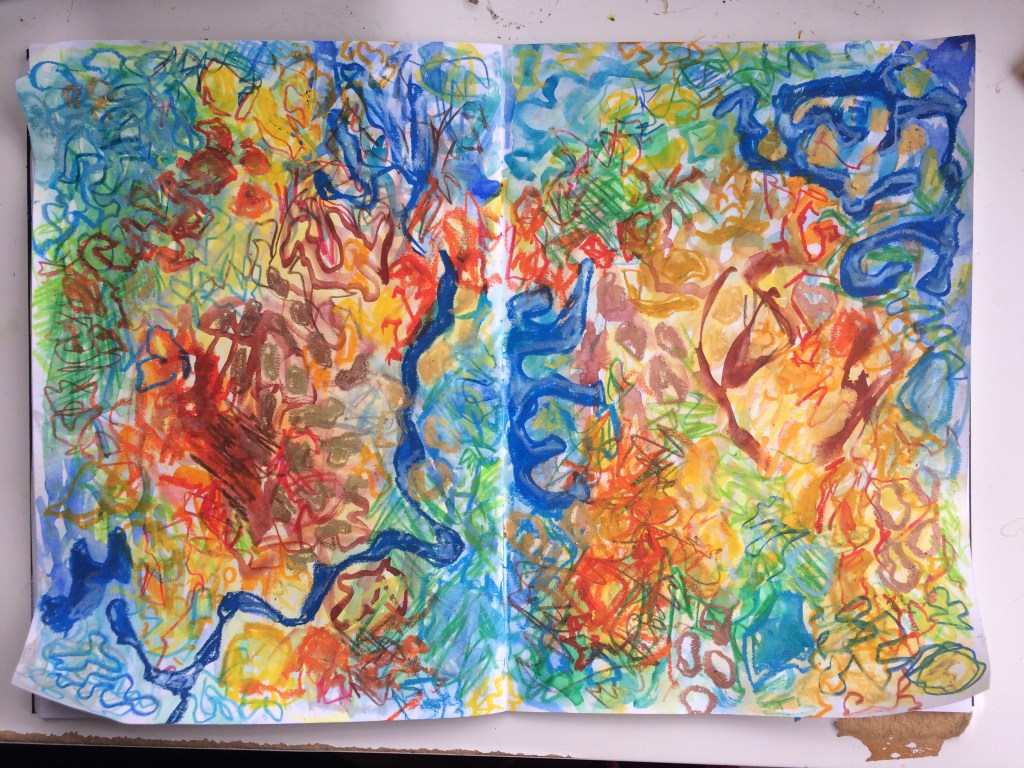
Today I finished the canvas I told you about: curves that intersect in fine black lines, and you, with your habit of wanting to know why—I’m not interested in that, the cause is past matter—will ask me why the fine black lines? because of the same secret that now makes me write as if to you, writing something round and rolled up and warm, but sometimes cold as the fresh instants, the water of an ever-trembling stream. Can what I painted on this canvas be put into words? Just as the silent word can be suggested by a musical sound.
(Àgua Viva, trans. by Benjamin Moser)
Who is she talking to, writing to? The fine black lines of moth wings draw up a thought. It is a cashmere reality and I am tugged at the holes. In the subjunctive, only ‘as if’ writing to you; she can preserve the stream, the weave, the cold splash of secrets. This is only towards the act of communication itself. All works of ekphrasis, all spirals of daylight, all times I turned on the tap and for what? Could I wash myself back into a blank, or what luxury to preserve in the mud on my shins, the marks of ink up my arms, mascara’d tears around my eyes, the blood running down the inside of my thighs? In the water, it would all run into trembling lines, purple blur, it would circle the drain, would never stop————————————









 mariaology