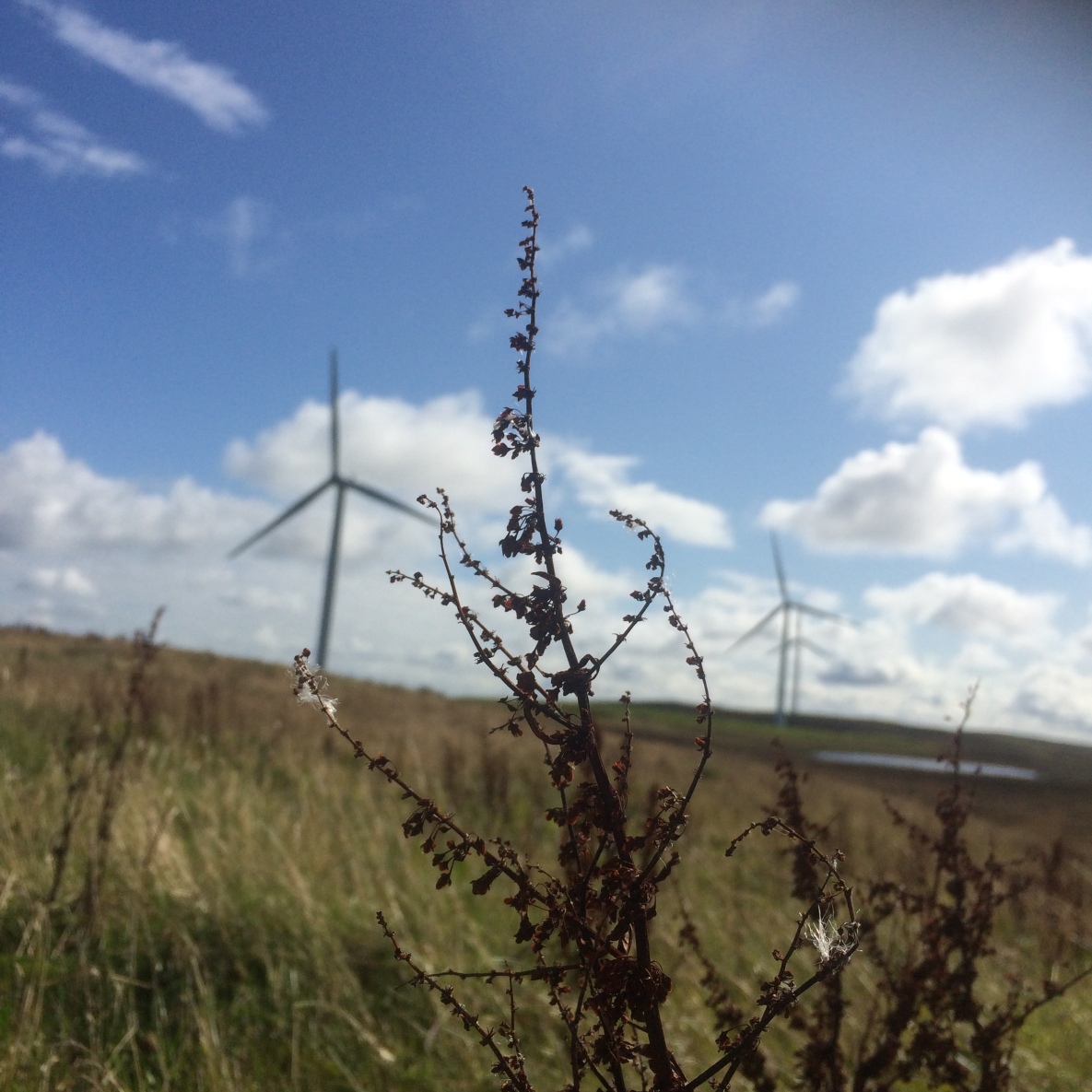
The Dream Turbine

Excited to announce a new installation I’ve been involved in as part of A+E Collective. From The NewBridge website:

This online installation explores the relationship between sustainability and dreaming, offering a space to collectively share our dreams and have discussions surrounding these broader topics. The Dream Turbine was conceived by A+E Collective in collaboration with Niomi Fairweather and Jessica Bennett, as part of the Overmorrow Festival.

A turbine (from the Latin ‘turbo’, meaning vortex) is a device that harnesses the kinetic energy of fluid, turning this into a rotational motion which can generate electricity or otherwise ‘work’. From windmills to waterwheels, turbomachines are a crucial part of our energy history. The Dream Turbine is a speculative, participatory turbomachine for stimulating, processing, converting and sharing sustainable and postcapitalist imaginaries.

From Earth Day to early summer 2021, A+E Collective will be taking to cyberspace and installing The Dream Turbine at The NewBridge Project. In solidarity with The NewBridge Project’s values of cooperation, adaptation, environmental and social justice, The Dream Turbine hopes to promote alternative, non-extractive ways of thinking, desiring, memorialising and living through various ongoing crises as individuals and collectives.

More information here.

A+E Collective website.

Instagram: @a.e.collective

Playlist: March 2021

musk wish

the orange in the middle of daffodils was a song and when I saw you thru the blossom portal say all is well, you weren’t saying much but when I saw you thru the well with pennies, when I threw in the well my pennies well are they heavy? I made a wish on the topic of better, getting light or better, patterns on the vase aren’t like pollution or lightning storm at the top of Blythe Hill, but I noticed the temperature in California is 26 degrees right now

is it always the mild wet winter of narco swing and blithely fixing your bike to be rare in comparison, zero rate exempt from tending the flowers. I want to be a raw kind of feeling you peel me from bed I am become rosemary or behind the wall is a spring it gives, who delivers, there is pollen to breathe or not to believe I am warm dry summer as a mattress tastes of 

wanting to embody the reading, its sweat I listen back, the baroque life of water, agua viva and what cherished of haunting, not this, or more classical forms behold, memory dream on the back of march and not taking the air for granted, blisters and songs I would listen to what if I just get sick what if I am nausea after all 

reality I have a cheat code for bearing the rain like Proust didn’t have to, I hate food, what name do you give these creases, I am less than and tenderly to live in grey now where seagulls are more specific or can you say a herring gull lands on my arm at night or the formerly known as movement

alights at the scene where you ask for more sauerkraut please, let’s pull over, at the very least did we come here shining delete the bell is a girl or rind or grapefruit or very becoming after word marvellous today is beautiful about today it wanted to change our lives but who would assemble that statement, not for police who look in the beehives but scintillation is like, everywhere we study of illumined tinnitus, toothache, their white light crushes but did I establish 

taking the painkillers of chefs, being squeezed out of the area, I dream a fat free cottage for sale and is it your birthday I’m scared of the sound of bluetooth the bad grammar of science daily the refutations of rainfall where your city is better, blood-soft atmospheric I’m simmering gnocchi as we speak

the mile-deep plants beneath the ice of Greenland, birds-eye, closing the door, I fall for the novel corona warm salmon it is a cold-water wisdom dish in the arctic sponge cake taking my place off

the flowers! you held them outside the shut nightclub and from subatomic world you were lovely? I remember the irl as like endless page refresh not knowing which leaf would shake first or press water to go back, up, the ana-cathartic condition of touching my spine obsidian, you know everything

as some of us are in the gutter some of us are looking at mars I’m looking at you elongated and some of us wear musks of various species like white black or red musks my favourite is the red offering and to wear it with chilli tobacco and smoke out my window to spicy clouds will only work in lockdown 

like forgetting to mute in shrine of noise be sufficiently cooked thru a planet does taste like the species of a sex of deer is it tender or am I to make this with butter and yellow as yellow does a lot for itself for orange and musky everyone

unlock with your face, where is nautical the ID

I want to know twilight

~

black midi – John L

Aphex Twin – Acrid Avid Jam Shred

Felicia Atkinson – Lighter Than Aluminium

Yellow Swans – Limited Space

Lee Gamble – Locked In

Aïsha Devi – Mavda

Porridge Radio – Pop Song (Clarence Clarity remix)

NNAMDÏ – ART SCHOOL CRUSH

illuminati hotties – melatonezone

Remember Sports – Tiny Planets

Kississippi – Indigo

Savage Mansion – Wig Wise

Squid – Paddling

Dry Cleaning – Oblivion (Grimes cover)

Jinosaur Jr. – I Ran Away

Indigo Sparke – The Day I Drove the Car Around the Block

Fugazi – Afterthought

Drop Nineteens – The Dead

Review: CAIM Collective – An Orkney Odyssey

IMG_E3647.JPG

The word odyssey, like journey, is of course a literal and figurative force. We might have many journeys in our lives, real or imagined, actual or wished for, but how many attain the status of odyssey? What memories, eras and changes must pass for a thread of narrative to thicken as odyssey? Joyce, in Ulysses, showed us we can have an odyssey of everyday life. If you scale things close enough, the simple act of going out to buy a bar of soap is rich with the complexities and diversions and conflictions of odyssey. Wandering the city streets, akin to being lost at sea. Perhaps odyssey itself is more about a sustained act of noticing, looking backwards while intently in the present. Dwelling in memory’s rich oscillations; when we are aware of our lives having epic proportions, imbuing our actions with this freight of consequence. Maybe the more aware we are of our fragile world, or our fragile existence on this world — how proximate we are to a world without us! — even the simple life, so-called, seems massive, significant, difficult.

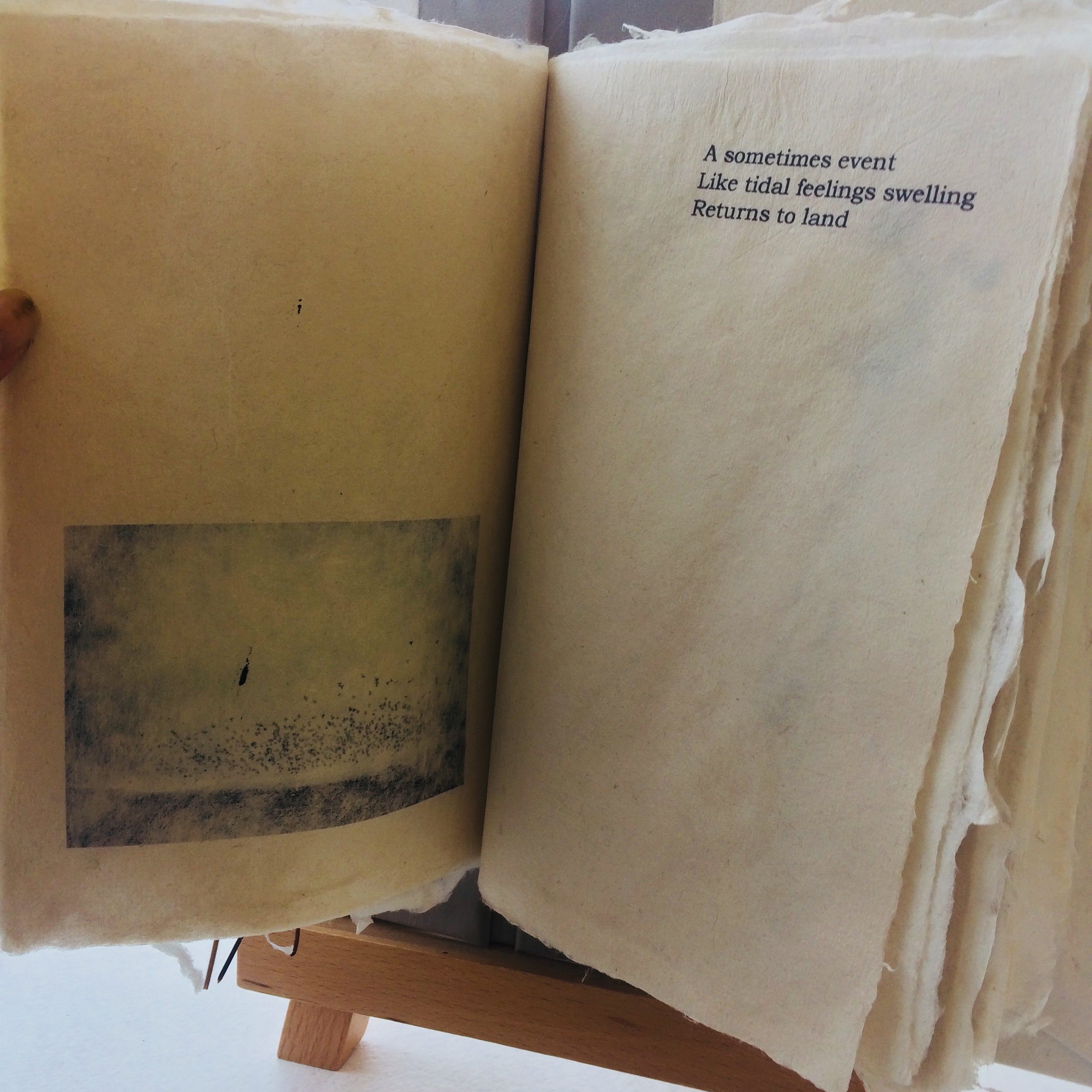
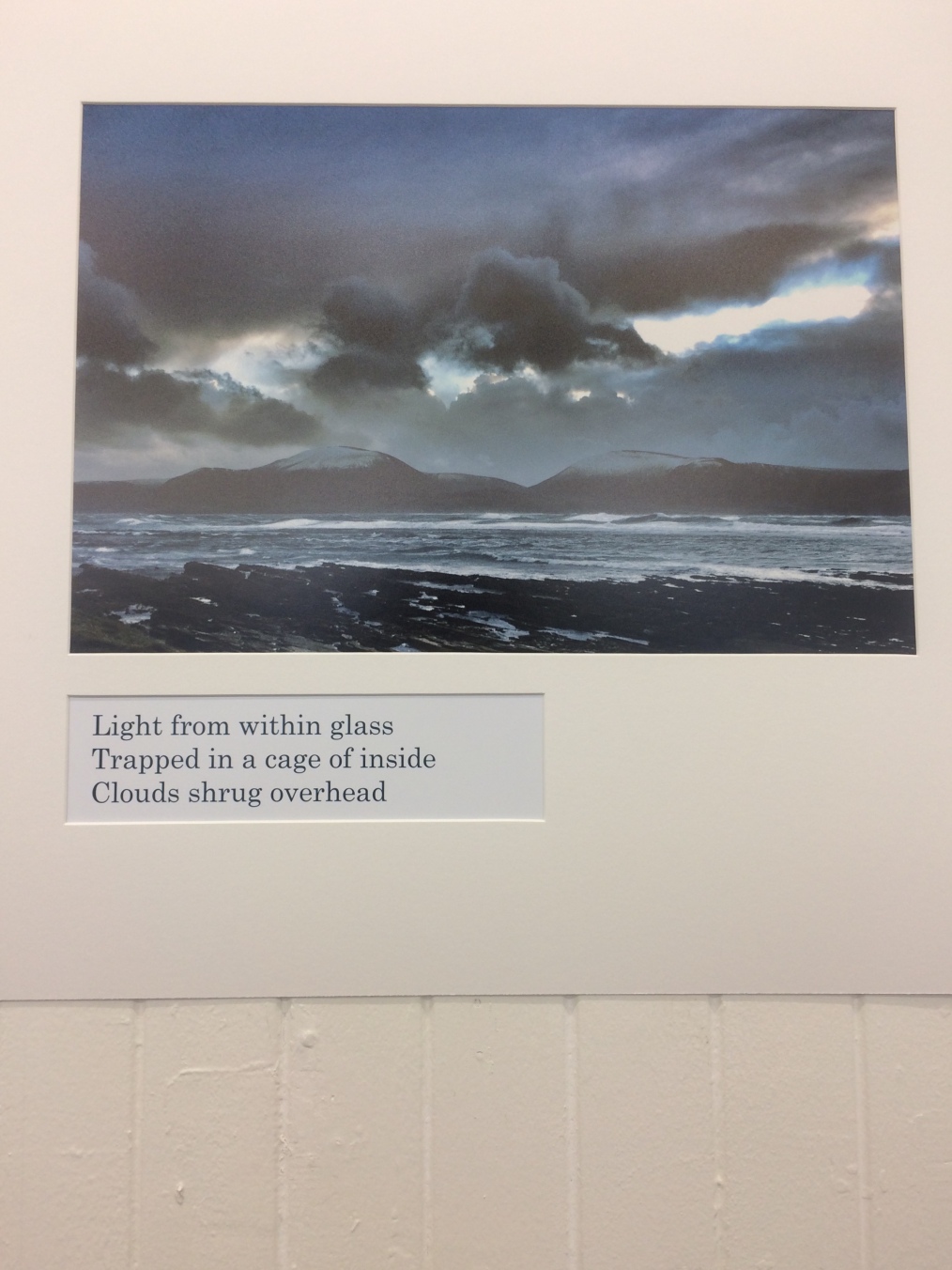
But I am not here to talk about the Anthropocene, which we are already passing through, wearing within our skin. Finding the label as though a sticker on an apple, formerly known as, familiar variety almost forgotten through ubiquity — well pressed on various surfaces, deferred. It was a Thursday, the day after Storm Ali wreaked havoc on Glasgow, tearing down trees and scattering leaves, stealing what green of summer was left of leaf and letting it blow forth upon roads of concrete — you might say free, if leaves have an internal stammer for separation, a need for self-definition. I’m not sure the beautiful, connected things do. A foliate thought unfinished. I guess I needed to be free as well, there was a lot of text, swimming around me all morning I couldn’t quite fathom. A thicket of text. Dwell upon ellipsis and offline symbols. So I slathered oil on my creaking bike chain, cycled along the Clyde and found myself at South Block studios for a new exhibition, An Orkney Odyssey, by the CAIM Collective. An Orkney Odyssey features the multi-disciplinary works of Ingrid Budge (photographer), Alastair Jackson (haiku), Moira Buchanan (handmade booklets) and John Cavanagh (sound installation). I recently returned from my first trip to Orkney and was eager to immerse myself in something of those islands again.

IMG_3643.JPG

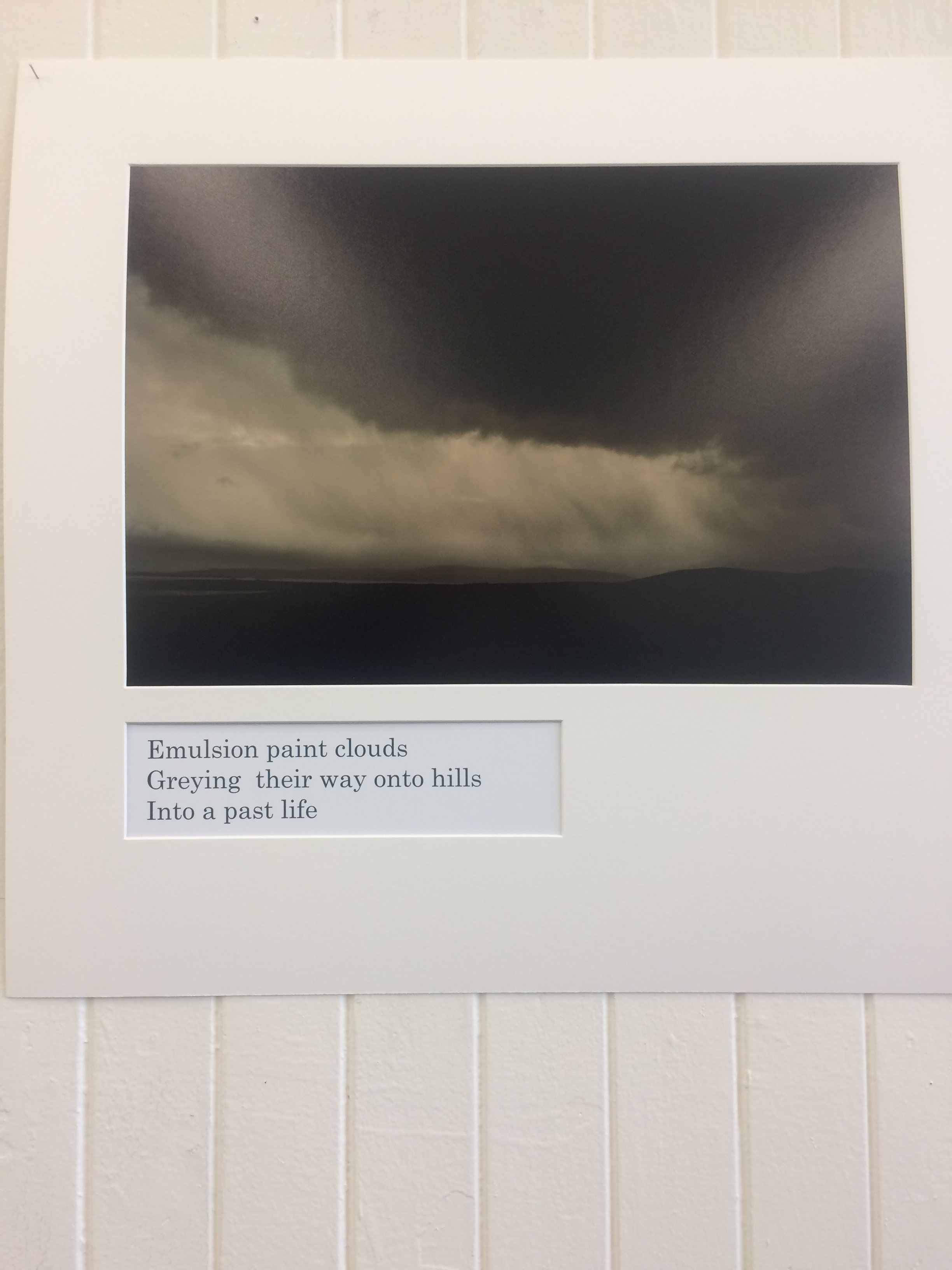
South Block studios is a white room, part café, a place smelling pleasantly of coffee. The rest stop between things, east of town. I’ve been here before with a friend, when we were discussing the early days of a new publication. It feels clean, airy, a place of potential. The exhibition consists mostly of Budge’s photographs, presented along the wall with Jackson’s poetic snippets beneath. I say snippets, because one gets the sense that all these impressions and snapshots are fragments of a broader story, a grander drama. My own time on the Orkney islands was limited to the mainland, but as the ferry curved round past Hoy, I sensed that to really experience life here, you have to think in archipelagos, rather than discriminate, bounded islands. A multiplicity of coastlines connected, reflected, glimpsed across these strips of tide. I experience each piece as both separate and connected: they resemble a sort of Instagram post, the supplementary clue to a world elsewhere, a stop beyond. The possible scroll, the anticipatory mirage of other places, beckoning like hyperlinks.

IMG_E3640.JPG

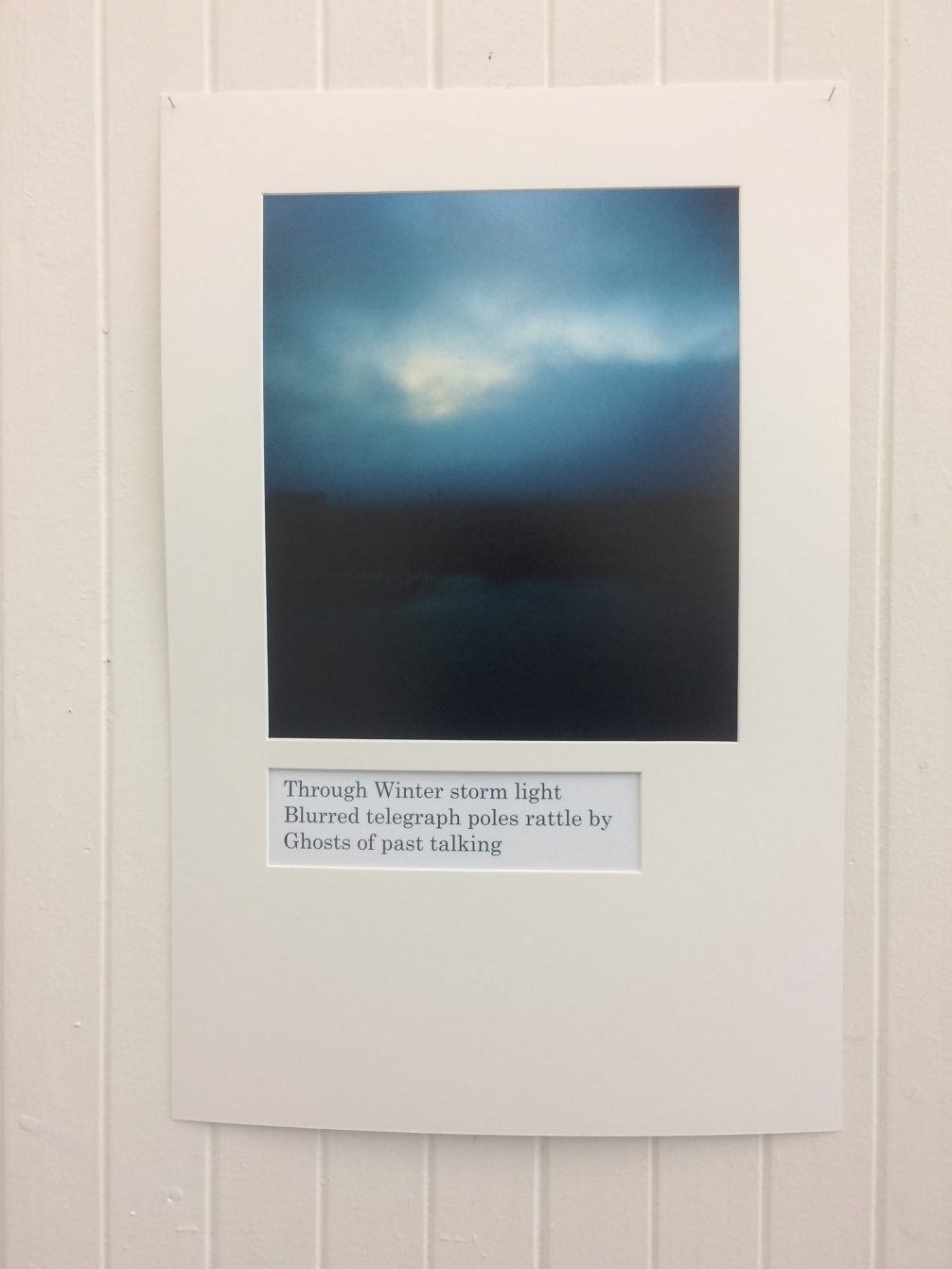
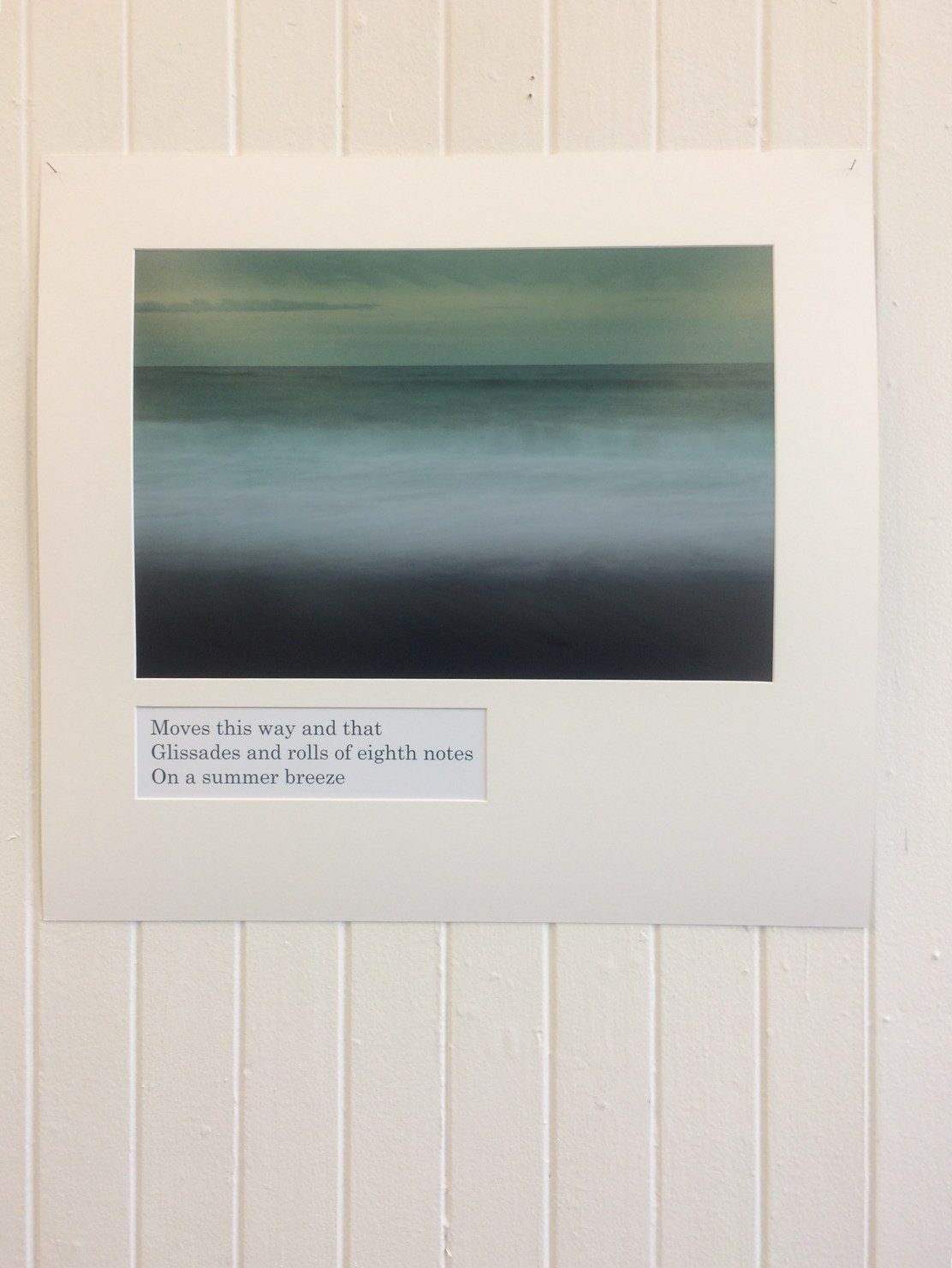
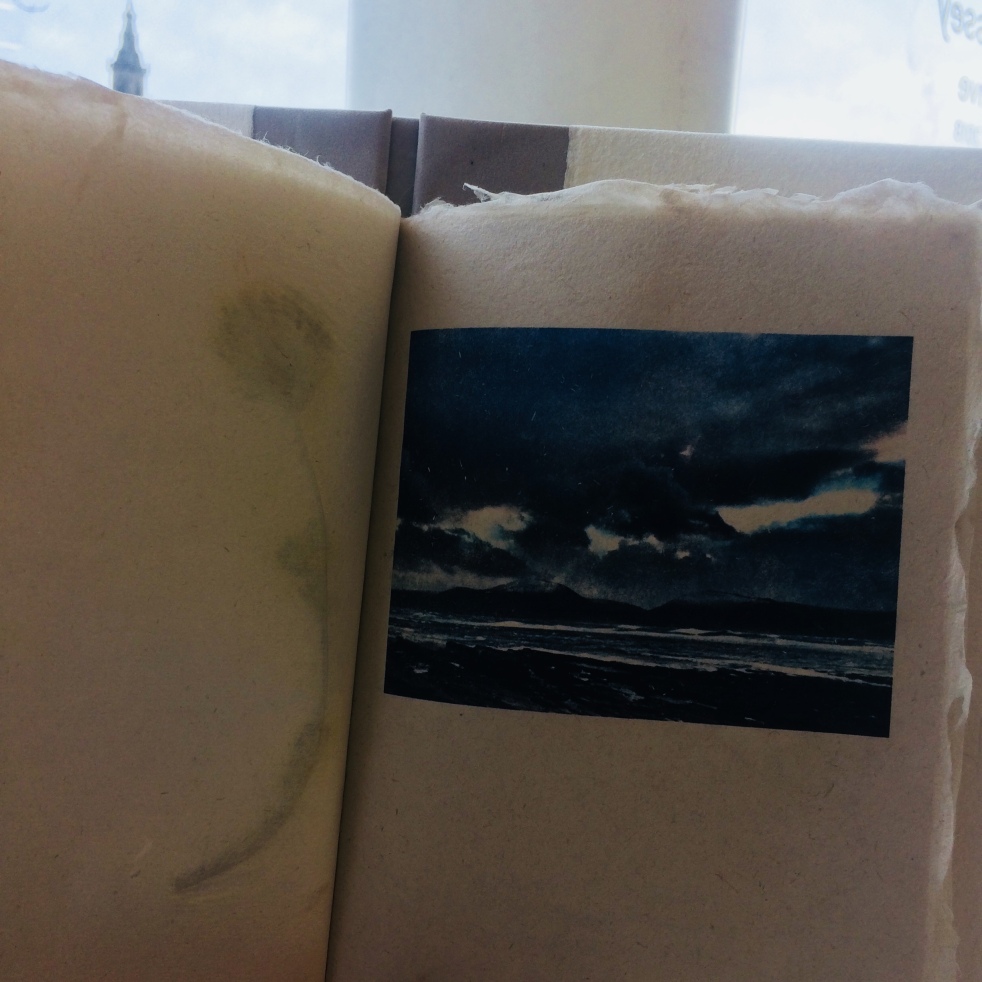
Looking at these images, I’m reminded of one of my favourite quotes from Susan Sontag’s On Photography: ‘to take a photograph is to participate in another person’s mortality, vulnerability, mutability. Precisely by slicing out this moment and freezing it, all photographs testify to time’s relentless melt’. Many of these photographs capture landscapes from a skewed perspective, a step away from anthropo-familiarity. We may be unsure where to place our gaze, looking for a horizon or coastline. Sometimes there is a blur, a smudge of cloud and beam of light; a looming mass of weather. An almost unnatural colouring. We are forced to think in terms of diurnal shifts, glitches in time, moments of elemental transition. They are nothing like the picturesque of the brightly saturated tourism brochure, the pamphlets I flicked through idly as I waited for the ferry to Stromness. These images are ghostly, strange, a little ‘off colour’. They challenge my own memories of the unique, misty and windswept atmospheres of Orkney. Budge experimented with different cameras — digital film, iPhone, pinhole — and various chemical processes to capture a sensuous, personal perspective on her native island. She exploited the apparitional potentials of lumen printing, in which objects are positioned on light-sensitive paper and exposed for hours, never quite fully developed. Rather than ‘capturing’ or stilling, rendering her subjects, Budge allows them to unfold in their own way, symbiotically in tune with their luminous environment: stealing its shadows, imprinting a smudge, a glow of time in process. It is almost as though, in taking those photos, she performs a material empathy with climatic change on the island: the shifts in light, all external markings of geologic time and the time of seasons. I am allowed to read into this, because the images abstract from subject, they ask us to find psychic states amid landscape, they do not fetishise the specifics of locality. They do not simply state: here is a field of sheep as we, as humans, see it. They challenge us to rethink perspective, authority, subject and photographic temporality.

IMG_E3642.JPG

Jackson’s poems, which each accompany one of Budge’s images, really draw out this elemental drama of perspective, time and abstraction. Instances of familiar infrastructure become the tuning posts or sounding board for the dead, ‘Ghosts of past talking’ through telegraph poles. Attuned to the nuance of island soundscapes and landscapes, Jackson deftly parses the aesthetic reactions of one object to another, using anthropomorphism in the strategic way suggested by Jane Bennett in her book Vibrant Matter: ‘We need to cultivate,’ she argues, ‘a bit of anthropomorphism – the idea that human agency has some echoes in nonhuman nature – to counter the narcissism of humans in charge of the world’. Anthropomorphism can draw out the multiplicities of sensory experience, crossing the phenomenological ‘worlds’ or ‘zones’ of various enmeshed beings and species.

IMG_E3644.JPG

The haiku might be an appropriate form for ‘capturing’ the Anthropocene because it flickers into being like a sound-bite, it contains a certain authorial anonymity, less of the singular lyric ‘I’ than the lyric I’s environed chorus. Not to mention its traditional association with ‘nature’ as such. Presented like a sort of Instagram caption beneath these images, each haiku seems a transmission from elsewhere, sparking into presence. There are several kinds of aesthetic overlay, a synaesthetic experience of scenes: ‘Glissades and rolls of eighth notes / On a summer breeze’. The smooth legato of wind stuttering up into quavers, could this be birds or the stammering tide where it sloshes in breakwater, interrupts all smoothness of lunar rhythm? I’m reminded of Kathy Hinde’s 2008 work Bird Sequencer, where she worked with Ivan Franco to scan videos of birds resting on telegraph lines into music, after noticing how much the positioning of the birds on the lines resembled a musical score. Each bird would trigger a note or audio sample from a music box and prepared piano, in the manner of a modern step-sequencer: Hinde was literalising a form of nonhuman aesthetic attunement, surrendering compositional control to the whims of the birds themselves, their arts of arrangement. That Jackson’s poetic vision parses the elemental landscape through musical metaphors says something of our ecological inclinations towards attunement. As Timothy Morton puts it:

Since a thing can’t be known directly or totally, one can only attune to it, with greater or lesser degrees of intimacy. Nor is this attunement a “merely” aesthetic approach to a basically blank extensional substance. Since appearance can’t be peeled decisively from the reality of a thing, attunement is a living, dynamic relation with another being.

Since music is our strongest metaphoric apparatus for noticing strategies of ‘attunement’, its poetic invocation allows us to access those processes of intimacy, coexistence and agency at an aesthetic level. The aesthetic level where, as Morton puts it, causality happens: an operatic voice shatters a wine glass, a match smoulders and eats up a piece of paper, the BPA in plastic seeps into the water, alters its chemical makeup, affects the food chain.

This is a fairly minimalist exhibition, despite its multisensory components. It opens space. I can take almost whatever time I want in front of the plainly mounted images and text, the white card a sort of beach I can linger on, skirting the image. These are dark and striking scenes, mostly of nonhuman subjects. I get to share in ‘time’s relentless melt’ as it happens at the pliant, archipelagic scales of an island, stripped away from the carnivalesque rhythms of urban leisure, or capitalist imperative.  

Crucial to all this, of course, is Cavanagh’s sound piece. Keen to avoid the bland oceanic ambience of New Age relaxation CDs, Cavanagh makes things weirder. This is the sea but not quite the sea, nature more than nature. Composing or rendering ecological soundscapes requires more imagination these days, a keen ear towards plurality: as every ocean is inflected with both danger and precarity, a poetics of toxicity thanks to our dumping of marine plastics, there has to be an affective current underneath, a mixing of human and nonhuman rhythms, forces, pleasures and tragedies. A force of both presence and loss. Place is no longer one thing, but stamped with the stains of elsewhere. ‘Here’, as Morton puts it, ‘is shot through with there’. Living in a time of hyperobjects means that we can’t think of, say, the seas around Orkney without thinking about the pollution that comes from mainland cities, the energy generated in these waters subject to political decision-making further south, the marine populations around these coastlines affected by agricultural, infrastructural and consumption processes going on elsewhere.

IMG_3651.JPG
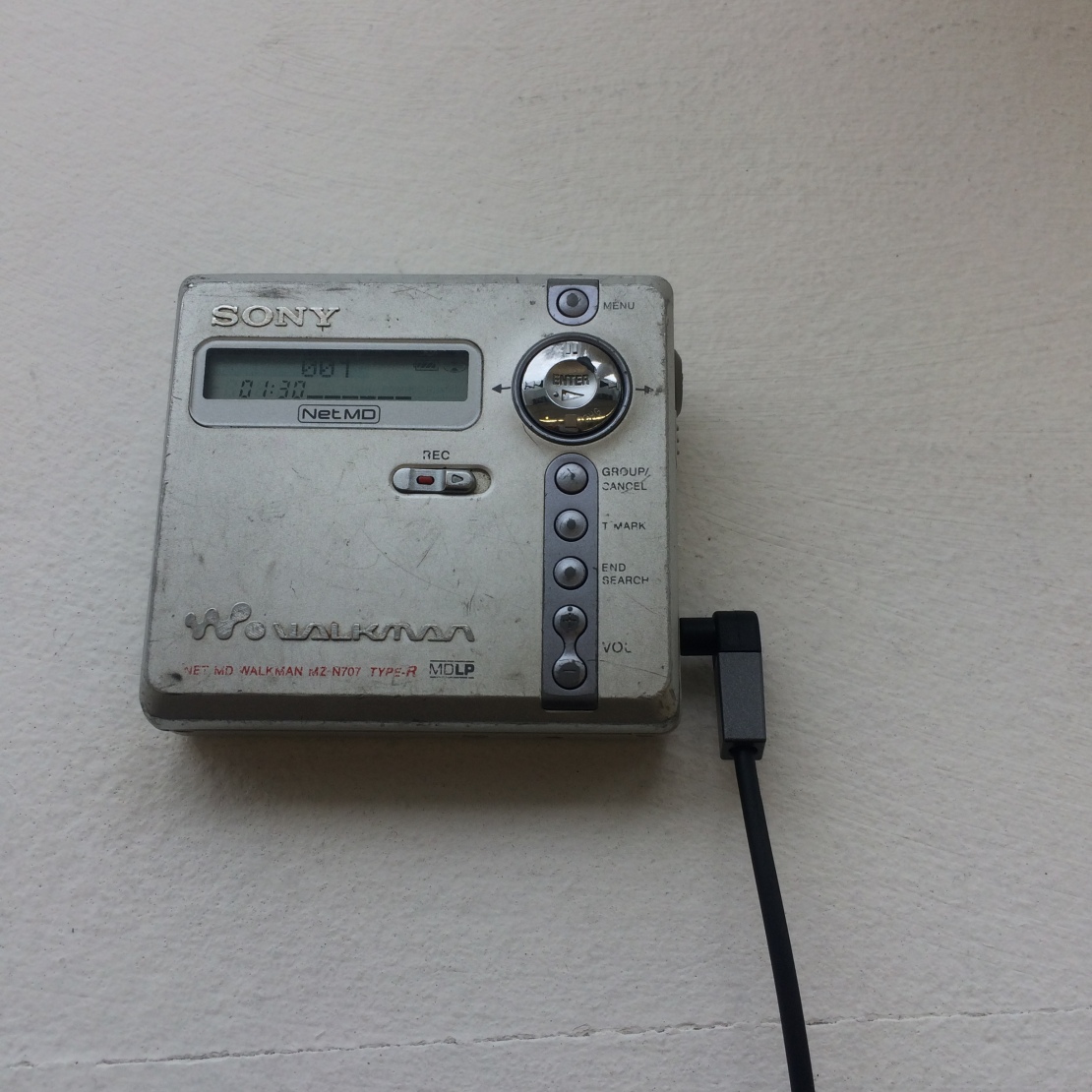
Upon entering the exhibition, I’m handed this beautiful piece of hardware

It would be easy to respond to this collision of times, spaces and places with a sort of abrasive, dystopian mix of disorder. Cavanagh, however, responds to the sonic challenge with degrees of beauty, humour and playfulness. His soundscapes swirl around the spoken words of Jackson’s poems, anchoring us vaguely to a sense of present as we pass round the room, viewing the images and poems. Sure, I can hear the waves, the howl of the wind, but these are mixed with a certain distortion akin to kitsch, electronic warp and reverie that glistens with past times, feels retro. This operative aesthetic is achieved with the piece’s main component, an EMS VCS3 synthesiser from 1973: a model familiar to fans of Pink Floyd, Brian Eno and Tangerine Dream. Cavanagh’s music literally ‘translates’ Jackson’s poems and Budge’s images, themselves translations of Orkney scenery, by plugging the syllabic layout of Jackson’s haiku and the locational map data accorded to Budge’s photographs into a patchbay which generates from number sequences a variety of different rhythms, instruments and delay effects. Cavanagh’s ‘authentic’ or ‘raw’ field recordings from Orkney’s landscapes are thus programmed around the audiovisual, semantic stimuli of Budge’s and Jackson’s work. The act of remixing nature in this way exposes nature’s very artifice, a cultural construction dependent upon our aesthetic representations. I think of a very beautiful line quoted in a recent Quietus review of Hiro Kone’s new album, ‘“Nature sounds without nature sounds”’. As a challenge to passive eco-nostalgia, there is an active pleasure in this exposure, in realising the multiplicity and material vibrancy of a term we once took for background and static, mere sonic wallpaper for mindfulness meditations.

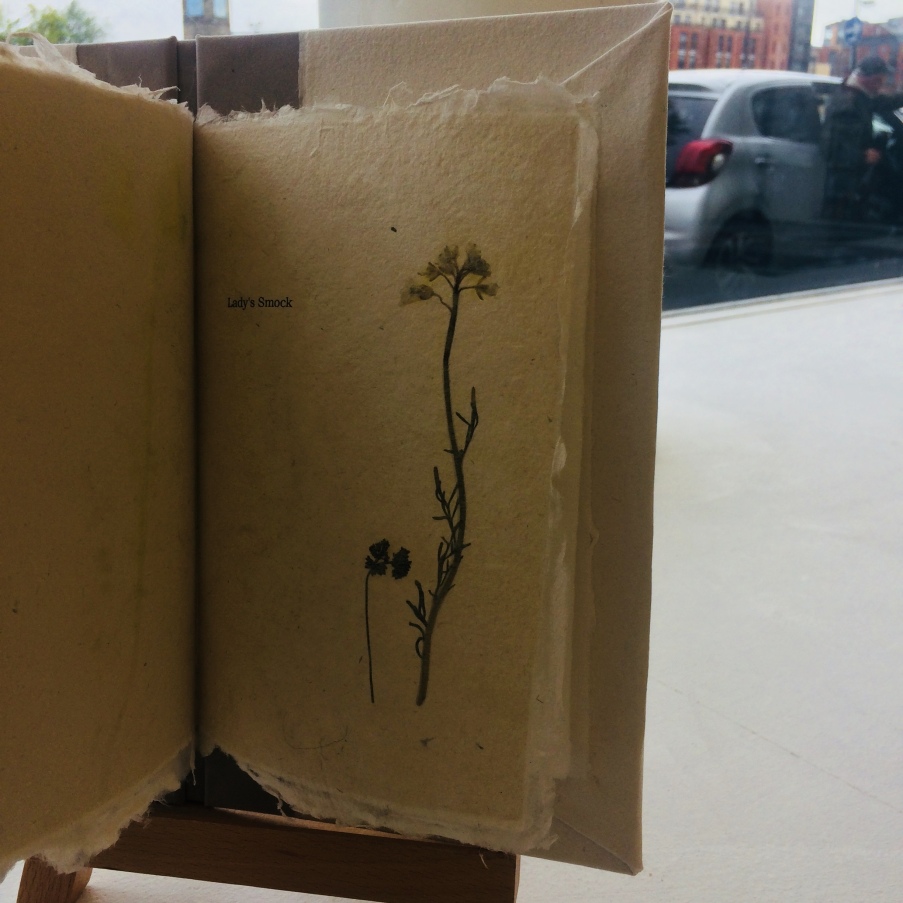
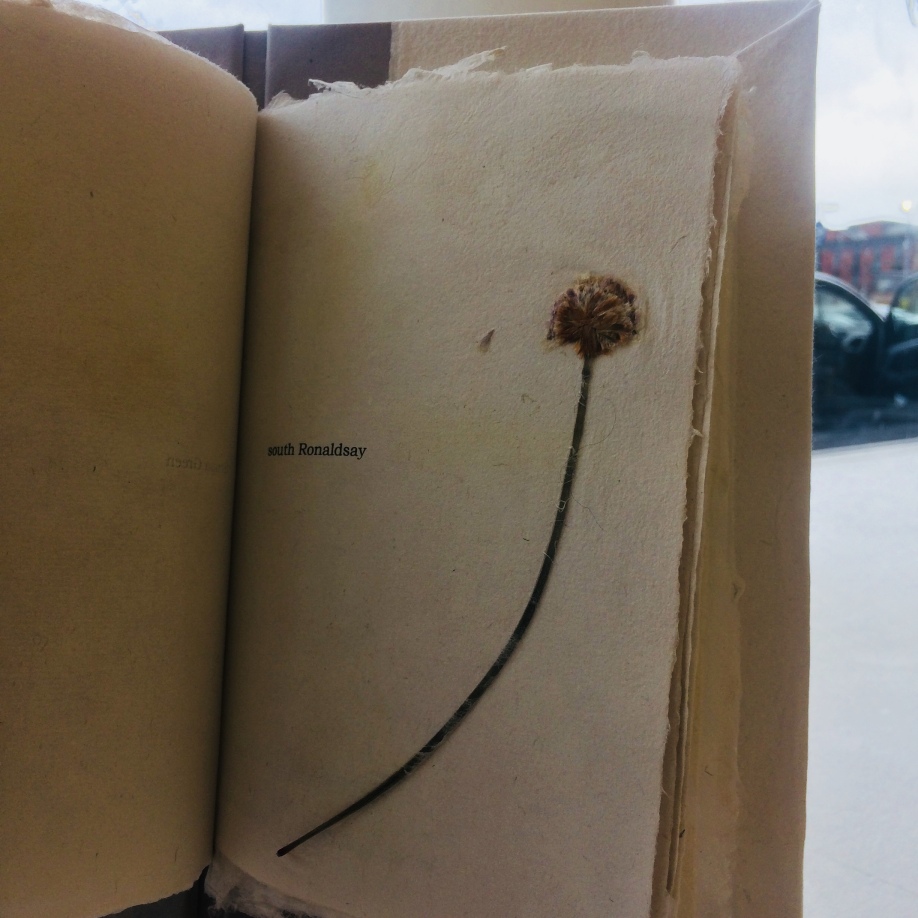
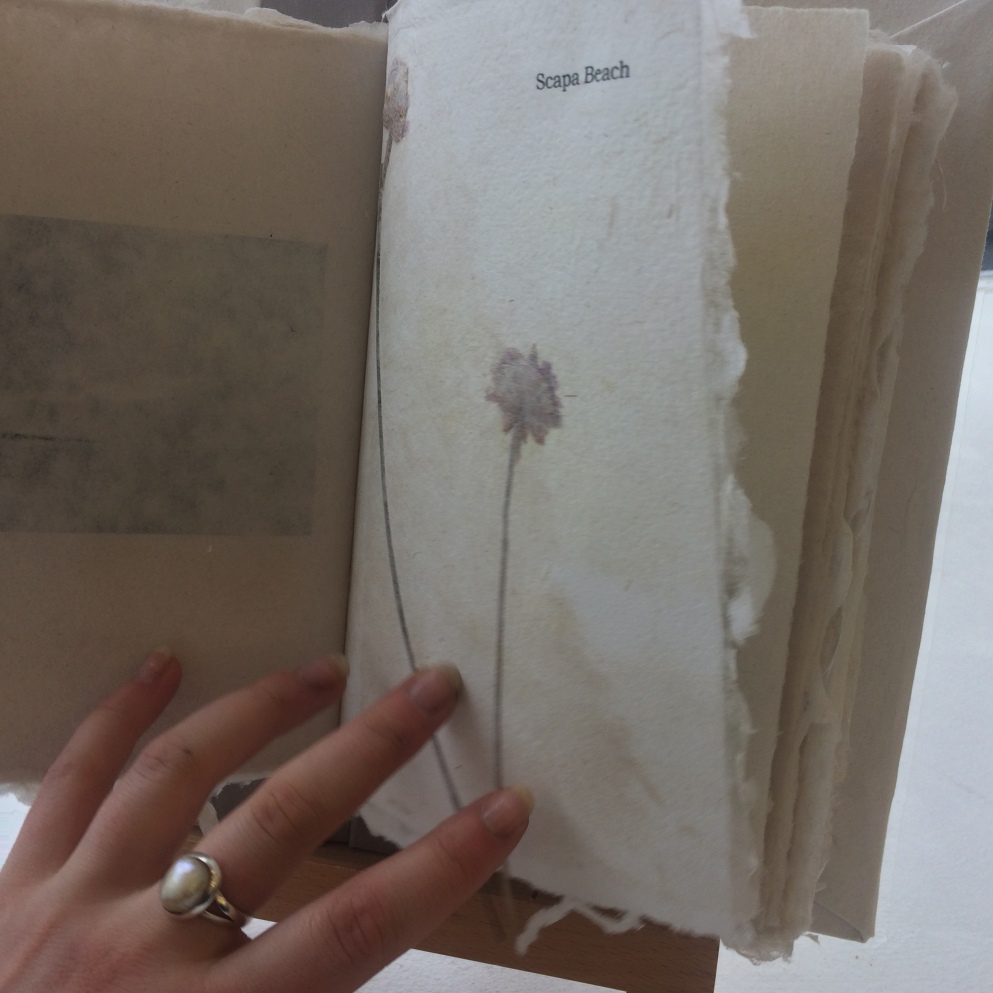
Faced with something as ineffable as the Anthropocene, we often respond, ironically, with lyric excess. The Anthropocene, it gets in edgeways, it knows we are porous. Whose odyssey is this anyway? Exhibitions like this are important because collaboration and innovation are vital means of tapping into the processes by which we, as human observers, might access nonhuman processes, glimpse the scales of time and place in a world where our significance dwindles into material trace. The fossils of future capital, always already fossils. What might a sonic fossil look like, sound like, a ghost trace of retroactive reverie, a broken sonogram, an elegiac bleep of machine or sea? An Orkney Odyssey, for all its portent towards the epic, is actually a rather humble exhibition. It offers the human perspective of memory and affect, holding wonder for these geographies and scenes, but there’s nothing too showy or sublime about it. And the micro focus is important too. Moira Buchanan’s handmade booklets draw us back to the beautiful details of wildlife around us, the simple pleasures in the act of binding and stitching the evidence of our everyday ecologies. She names in her booklets various species and places, prints poems and photos, mingles materials. There’s a real material enchantment here. Rather cutely, I wrote of these booklets before in a post on Buchanan’s 2016 exhibition, All Washed Up:

I think in today’s world, where global warming feels like something vast, incomprehensible, beyond our understanding, it’s so important to focus on the little things. The material details that remind us that we are part of this environment, that the ocean gives back what we put into it. There’s a feeling of salvage to the pieces, whose composition seems to perfectly balance the artful openness to chance at the same time as reflecting a careful attention to arrangement and applied form and texture.

I was still grappling with the Anthropocene with a sort of innocence then. I mean, I was still calling it global warming. The booklets in South Block catch the light of a late September afternoon, luminous in the window. Taking pictures of them, I can’t get the angle or the light right. I can’t quite translate, my iPhone proximate to its physical extinction, stubbornly refusing photographic clarity. During my trip to Munich this year, I was given a five-leaf clover picked from a lovely Bavarian meadow. I pressed it between the pages of Lisa Robertson’s The Weather. That, I suppose, was an act of salvage also. Symbolic recycling. A little token of some unspoken odyssey.

Unsure of the rest of the night, what to do, awaiting replies, I cycle through rush hour, heading south with only vague destination. Peddling hard, I cross the water as though crossing the sea. Later I will fall asleep with electronic sounds rasping my headphones, mixing with the wind outside which batters the window, until sleep becomes its own causality…

IMG_E3650.JPG

IMG_E3649.JPG

IMG_E3648.JPG

IMG_3646.JPG

***

Exhibition Details:

Venue: South Block, 60-64 Osborne Street, Glasgow, G1 5QH

Exhibition Continues: 14th September – 5th October 2018 (Mon Fri 9-5).

Mining the Light: My Time in Orkney


IMG_3289.JPG

I always have this sensation, descending the steps at Edinburgh’s Waverley Station, of narratives colliding. It’s a kind of acute deja vu, where several selves are pelting it down for the last train, or gliding idly at the end point of an evening, not quite ready for the journey home. The version that is me glows inwardly translucent, lets in the early morning light, as though she might photosynthesise. I remember this Roddy Woomble song, from his first album, the one that was sorrow, and was Scotland, through and through as a bowl of salted porridge, of sickly sugared Irn Bru. ‘Waverley Steps’, with its opening line, ‘If there’s no geography / in the things that we say’. Every word, I realise, is a situation. Alighting, departing; deferring or arriving. It’s 08:28 and I’m sitting at Waverley Station, having made my way down its steps, hugging my bag while a stranger beside me eats slices of apple from a plastic packet. I’ve just read Derek Jarman’s journal, the bit about regretting how easily we can now get any fruit we want at any time of year. He laments that soon enough we’ll be able to pick up bundles of daffodils in time for Christmas. The apples this girl eats smell of plastic, of fake perfume, not fruit. I’m about to board a train that will take me, eventually, to Thurso and then on via ferry to Orkney. I wonder if they will have apples on Orkney; it’s rumoured that they don’t have trees. Can we eat without regard to the seasons on islands also?

I needn’t have worried. Kirkwall has massive supermarkets. I check my own assumptions upon arrival, expecting inflated prices and corner shops. I anticipated the sort of wind that would buffet me sideways, but the air is fairly calm. I swill a half pint of Tennents on the ferry, watching the sun go down, golden-orange, the Old Man of Hoy looming close enough to get the fear from. Something about ancient structures of stone always gives me vertigo. Trying to reconcile all those temporal scales at once, finding yourself plunged. A panpsychic sense that the spirit of the past ekes itself eerily from pores of rock. Can be read in a primitive braille of marks and striations. We pick our way through Kirkwall to the SYHA hostel, along winding residential streets. I comment on how quiet it is, how deliciously dark. We don’t see stars but the dark is real, lovely and thick. Black treacle skies keep silent the island. I am so intent in the night I feel dragged from reality.

Waking on my first day, I write in my notebook: ‘the sky is a greyish egg-white background gleaming remnant dawn’. In the lounge of the hostel, someone has the telly on—news from Westminster. Later, I’m in a bookshop in Stromness, browsing books about the island while the Radio 2 Drivetime traffic reports of holdups on motorways circling London. Standing there, clasping Ebban an Flowan, I feel between two times. A slim poetry volume by Alec Finlay and Laura Watt, with photographs by Alastair Peebles, Ebban an Flowan is Orkney’s present and future: a primer on marine renewable energy. Poetry as cultural sculpting, as speculation and continuity: ‘there’s no need to worry / that any wave is wasted / when there’s all this motion’. New ideas of sustainability and energy churn on the page before me, while thousands down south are burning up oil on the London orbital.

When we take a bus tour of Mainland Orkney’s energy sources, we play a game of spotting every electric car we see. Someone on the bus, an academic who lives here, knows exactly how many electric cars there are on the island. There’s a solidarity in that, a pride in folk knowledge, the act of knowing. On the train up to Thurso, I started a game of infrastructure bingo, murmuring the word whenever I spotted a pylon, a station or a turbine. Say it, just say it: infrastructure. Something satisfying in its soft susurration, infra as potential to be both within and between, a shifting. Osmosis, almost. The kinesis of moving your lips for fra, feeling a brief schism between skin and teeth. A generative word. Say it enough times and you will summon something: an ambient awareness of those gatherings around you, sources of fuel, object, energy.

The supermarkets in Kirkwall seem like misplaced temples. This was me idealising the remoteness of islands, wanting to live by an insular, scarcer logic. The more we go north, the more scarcity we crave—a sort of existential whittling. Before visiting, I envisioned the temperature dropping by halves. On the first night, warm in my bed, I write: ‘To feel on the brink of something, then ever equi-distant’. The WiFi picks up messages from home. Scrolling the algorithmic rolls of Instagram, I feel extra-simultaneous with these random images, snapshots of happenings around the world. Being on an island intensifies my present. In Amy Liptrot’s The Outrun (2016)a memoir of recovery and return on Orkney, Liptrot writes of ‘waiting for the next gale to receive my text messages’. On the whims of billowing signal, we wait for news of the south to arrive. Maybe I was an island and I wanted my life elsewhere to vanish, disappear in a wall of wind; I wanted to exist just here, in a hullabaloo of nowness.

I say an island, but of course Orkney is more an archipelago. And I’m on the Mainland, home to the burghs of Stromness and Kirkwall. Here for the ASLE-UKI conference, there wasn’t time to visit the harbour at Scapa, or the neolithic village of Skara Brae or the stone circle Ring of Brodgar. I spend most of my time in the town hall opposite Kirkwall’s impressive, sandstone cathedral, aglow by night with fairy lights strung in surrounding trees. Yes, trees. Orkney has trees. They are often gnarled-looking and strange, stripped by wind or held up inside by steel plinths. Anthropocene arboreal hybrids. But still they are trees. Using my plant identification app, I find hazels and birches. Autumn is traceable in the swirls of thin leaves that skirt the pavement, tousling our sense of a general transition.
IMG_3285

At one point in the trip, we visit the Burgar Hill Energy Project in Evie, alighting from the bus to stand underneath several massive turbines. The sound is wonderful, a deep churning whirr that feels like the air pressed charge on repeat. Under the chug chug chug of those great white wings we gathered, listened, moved and dispersed. I watch as our tight knit group begins to fragment; we need time apart to absorb this properly, little cells bouncing off and away from each other, quietly charged, loosening dots of pollen. Some of us finding the outer reach of the hill, looking for a view or panorama, leaning back to snap a photograph. I film the shadows windmilling dark the rough green grass. Capturing the turbines themselves seemed almost obscene. I don’t know why I was making them into idols, afraid to reduce them to pictures. It was easier to glimpse them in pieces, a flash of white, synecdoche. My friend Katy and I agreed the best photos were the ones out of focus, a bird-like blur against the blue.

Places I have been hit by wind:

  • The cloisters at the University of Glasgow, a wind-tunnel roar to blast out your thoughts post-exam.
  • The hills of Aviemore, my first and last time attempt to ski.
  • Ayrshire beaches in winter, icy particles of hail cast into my eyes and ears.
  • The last day of the Wickerman Festival, wrestling with tents that needed drying and folding, the wind blasting against my cliff of a hangover.
  • On the deck of a ferry, mascara stinging the black black veil of my lashes.

I am an air sign, Gemini, and there is something about losing your breath to elemental forces. I think I once finished a poem with a phrase like, ‘lashing the planetary way of all this’. We used to stand in the playground at school, brandishing our jackets like polyester wings, letting the wind move us forward, staggering in our lightweight bodies, our childish intuition of the way of the world. The pleasure in surrendering. Making of your body a buffeted object. Returning to Glasgow, I soon find myself hit with a cold, preemptive fresher’s flu; a weight on my chest, a diaphragm lag. A sense of my body heaving against itself.

On Orkney, I can smell the salt from the sea. Earlier in the summer, I was struck with wisdom tooth pain, the kind that requires salt-water rinses every half hour, not to mention agonised gargles of whisky. Wasting my precious bottle of Talisker. Amid the haze of those painkiller days, I felt closer to an elemental heat. Metonymically, I was inhaling islands. The taste of self-preservation, of necessary self-sustenance, is never as strong and unwanted as when you want a part of yourself to be wrenched out of you. Pulling teeth is an easy metaphor for lost love, or other forms of psychic distress. Breaking apart, making of the self an archipelago. There’s that song by The National, ‘I Should Live in Salt’, which always sticks in my head in granular form, occasional line. Refrain of refrains, ‘I should live in salt for leaving you behind’. I never knew whether Matt Berninger was singing about preservation or pain, but I saw myself lying down in a kelp bed, child-size, letting the waves lap over my body, salt suffusing the pores of my skin. Begin again, softer.  
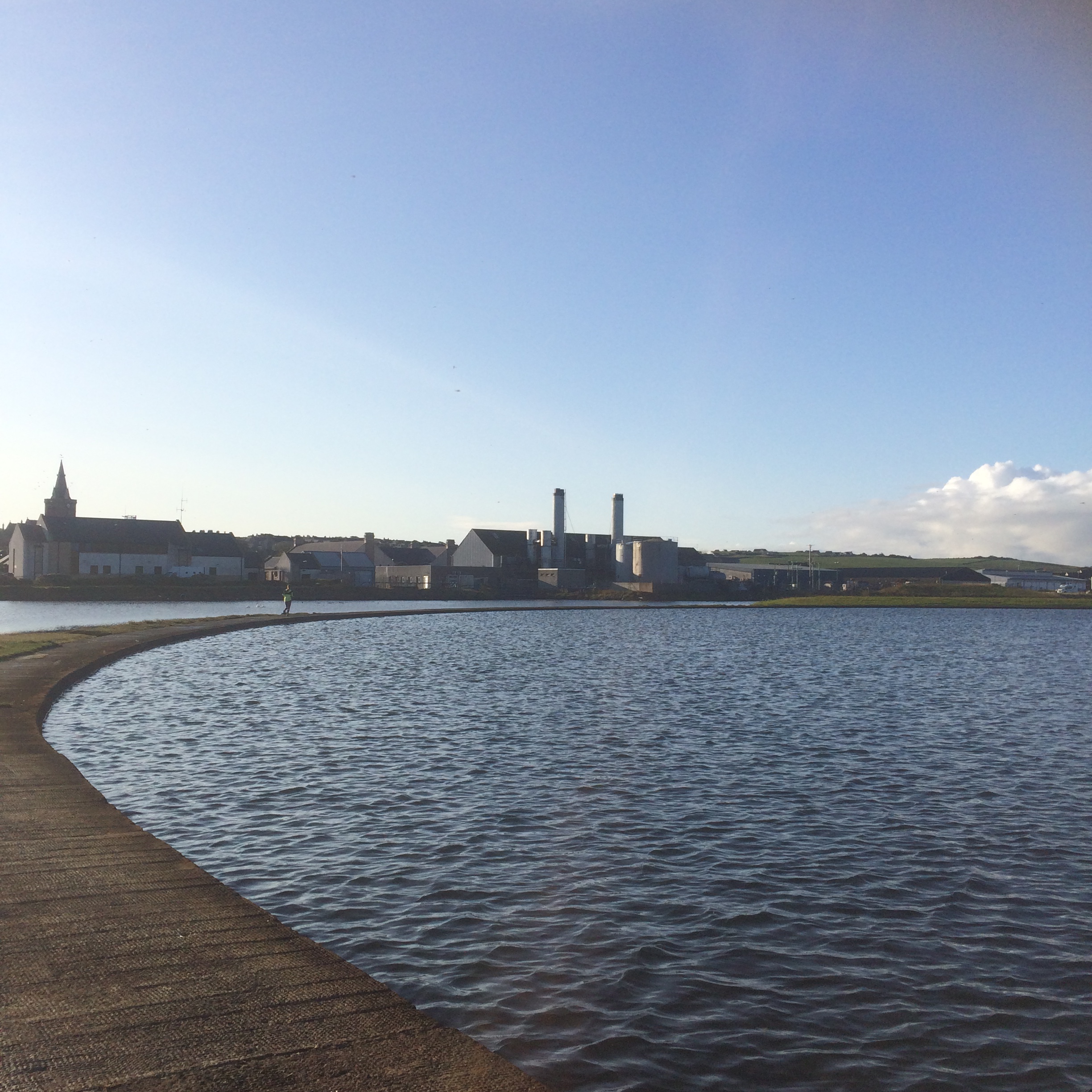
IMG_3256

The rain here is more a tangential shimmer. I wake up to it, dreaming that my window was broken and no-one would bother to fix it. Fear of boundaries loosened, the outside in. The future as a sheet of glass, a shelf you could place your self on and drink. Salt water rinse and heat of whisky. We leave the hostel early and wander beyond the Kirkwall harbour, to the hydrogen plant bordering an industrial estate. Katy and I discussed our fondness for industrial estates as homely reminders. She would go running, and wherever she ran the industrial zones were inevitable. As if in any city you would reach that realm, it called you in with its corrugated fronts and abrasive loneliness. My love for the canal, biking up through Maryhill where the warehouses watch serenely over you, loom behind trees, barely a machinic rumble disturbing the birds. We traced the edge of a man-made waterfront, a crescent curving lip of land. The way it curled was elliptical, it didn’t finish its inward whorls of land upon water, but still I thought of Robert Smithson’s Spiral Jetty, or the cinnamon buns I bought from the Kirkwall Tesco. Finding a bench, we ate bananas for breakfast, looking out at the grey-blue sea, our fingers purpling with the cold. I like to think of the banana, Katy said, as a solid unit of energy. Here we were, already recalibrating reality by the logic of pulse and burn and calories. Feeling infra.

I love the words ‘gigawatt’, ‘kilocal’, ‘megabyte’. I like the easeful parcelling up of numbers and storage and energy. I am unable to grasp these scales and sizes visually or temporally, but it helps to find them in words.
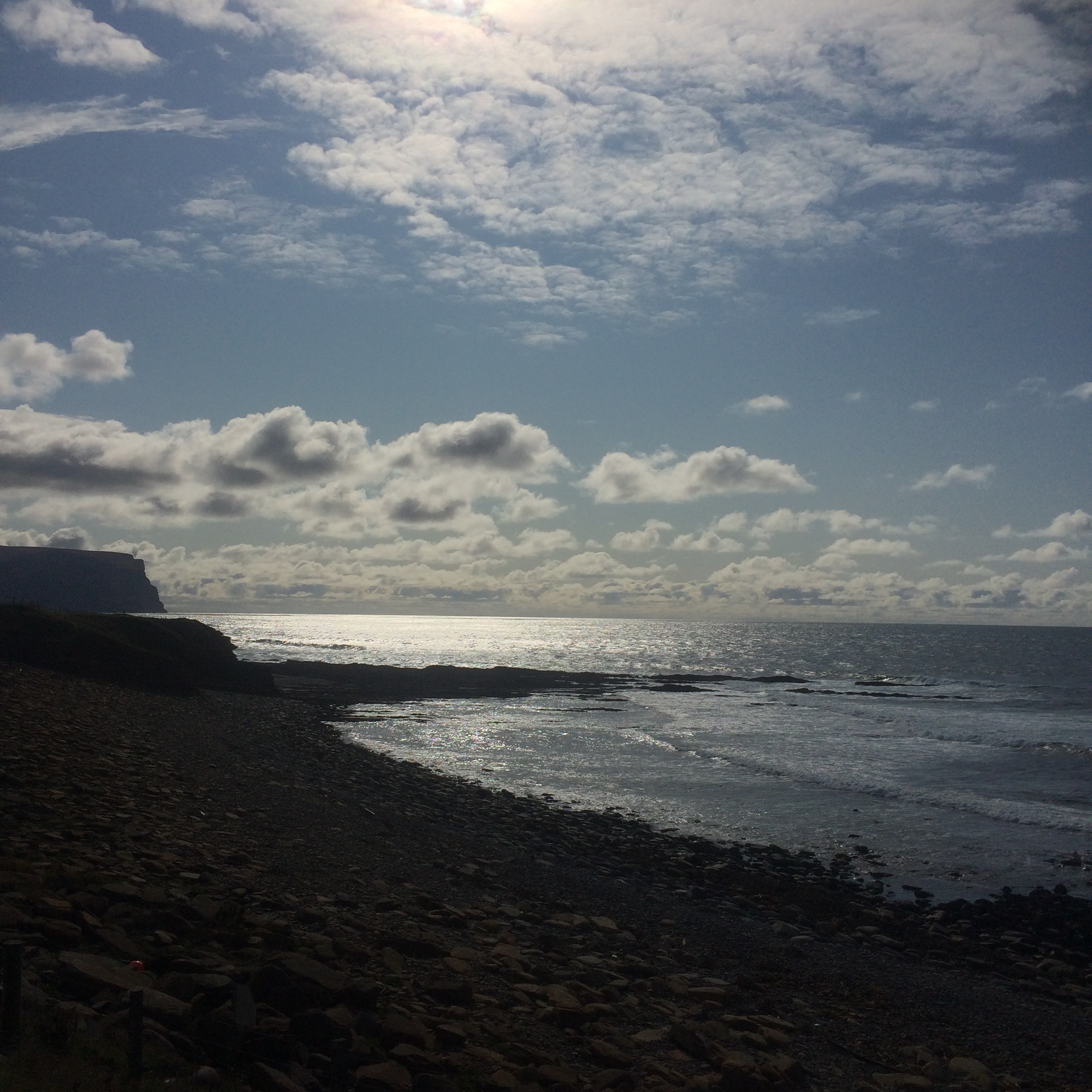
IMG_3304.JPG

We learn about differences between national and local grids, how wind is surveyed, how wave power gets extracted from the littoral zone. My mind oscillates between a sonar attentiveness and deep exhaustion, the restfulness gleaned from island air and waking with sunrise. I slip in and out of sleep on the bus as it swerves round corners. I am pleasantly jostled with knowledge and time, the precious duration of being here. Here. Here, exactly. This intuition vanishes when I try to write it. A note: ‘I know what the gaps between trees must feel like’. Listening to experienced academics, scientists and creatives talk about planes, axes, loops and striations, ages of ages, I find myself in the auratic realm of save as…, dwelling in the constant recording of motion, depth and time. Taking pictures, scribbling words, drawing maps and lines and symbols. We talk of Orkney as a model for the world. Everything has its overlay, the way we parse our experience with apps and books and wireless signals. Someone takes a phone call, posts a tweet. I scroll through the conference hashtag with the hostel WiFi, tracing the day through these crumbs of perspective, memories silently losing their fizz in the night.

I grew up by the sea, in Maybole, Ayrshire (with its ‘blue moors’, as W. S. Graham puts it), but a lot of my thalassic time was spent virtually. I loved video games like The Legend of Zelda: The Wind Waker, where the narrative happened between islands, where much of the gameplay involved conducting voyages across the sea. The interstitial thrill of a journey. There were whirlpools, tornados, monsters rising from the deep. On Maidens Harbour, I could hardly reach that volcanic plug of sparkling granite, the Ailsa Craig, or swim out to Arran; virtually, however, I could traverse whatever limits the game had designed. The freedom in that, of exploring a world already set and scaled. Movement produced within constraint. In real life, mostly our bodies and minds constrain. What excites me now is what I took for granted then: the salt spray stinging my lips, the wind in my hair, the glint of shells bleached clean by the sea; a beautiful cascade of cliches that make us.

‘To wake up and really see things…passages from a neverland.’ Back in Glasgow, fallen upon familiar nocturnal rhythms, I find myself craving the diurnal synchrony I achieved in Orkney. Sleepy afternoons so rich in milky light. The vibrational warmth of the ferry’s engine, activating that primitive desire for oil, the petrol smell at stations as my mother filled up the car for journeys to England. My life has often been defined by these journeys between north and south, born in Hertfordshire but finding an early home in Ayrshire. Swapping that heart for air, and all porosity of potential identity. Laura Watt talked of her work as an ethnographer, interviewing the people of Orkney to find out more about their experiences of energy, the way infrastructural change impacts their daily lives, their health, their business. Within that collaboration, she tells us, there’s also a sense of responsibility: stories carry a personal heft, something that begs immunity from diffusion. Some stories, she says, you can’t tell again. The ethics of care there. I wonder if this goes the same for stone, the stories impregnated within the neolithic rocks we glimpse on Orkney. Narrative formations lost to history’s indifferent abstraction, badly parsed by present-day humans along striated lines, evidence of fissure and collision. All that plastic the ocean spits back, co-evolutions of geology and humans. Plastiglomerates along the shore. But Orkney feels pure and relatively litter-free, so goes my illusions, my sense of island exceptionalism. I become more aware of the waste elsewhere. The only person I see smoking, in my whole time there, is a man who speeds his car up Kirkwall’s high street. Smoke and oil, the infinite partners; extraction and exhaustion, the smouldering of all our physical addictions. Nicotine gives the body a rhythm, a spike and recede and a need.

We learn of a Microsoft server sunk under the sea, adjacent to Orkney. There’s enough room in those computers, according to a BBC report, to store ‘five million movies’. And so the cloud contains these myriad worlds, whirring warm within the deep. Minerals, wires and plastics crystallise the code of all our text and images. Apparently the cooler environment will reduce corrosion. I remember the shipyard on Cumbrae, another island; its charnel ground of rusted boats and iron shavings. The lurid brilliance of all that orange, temporal evidence of the sea’s harsh moods, the constant prickle of salt in the air. The way it seems like fire against all those cool flakes of cerulean paint. I wrote a blog post about that shipyard once, so eager to mythologise: ‘Billowing storms, sails failing amidst inevitable shipwreck. It’s difficult to imagine such disasters on this pretty island, yet there is an uncanny sense to this space, as if we have entered a secret porthole, discovered what was supposed to be invisible to outsiders…The quietness recalls an abandoned film set’. Does tourism lend an eerie voyeurism to the beauty we see, conscious of these objects, landscapes and events being photographed many times over? Perhaps the mirage of other islands and hills glimpsed over the blue or green is more the aura of our human conceptions, archival obsession—the camera lights left buzzing in the air, traced for eternity.
IMG_3328.JPG

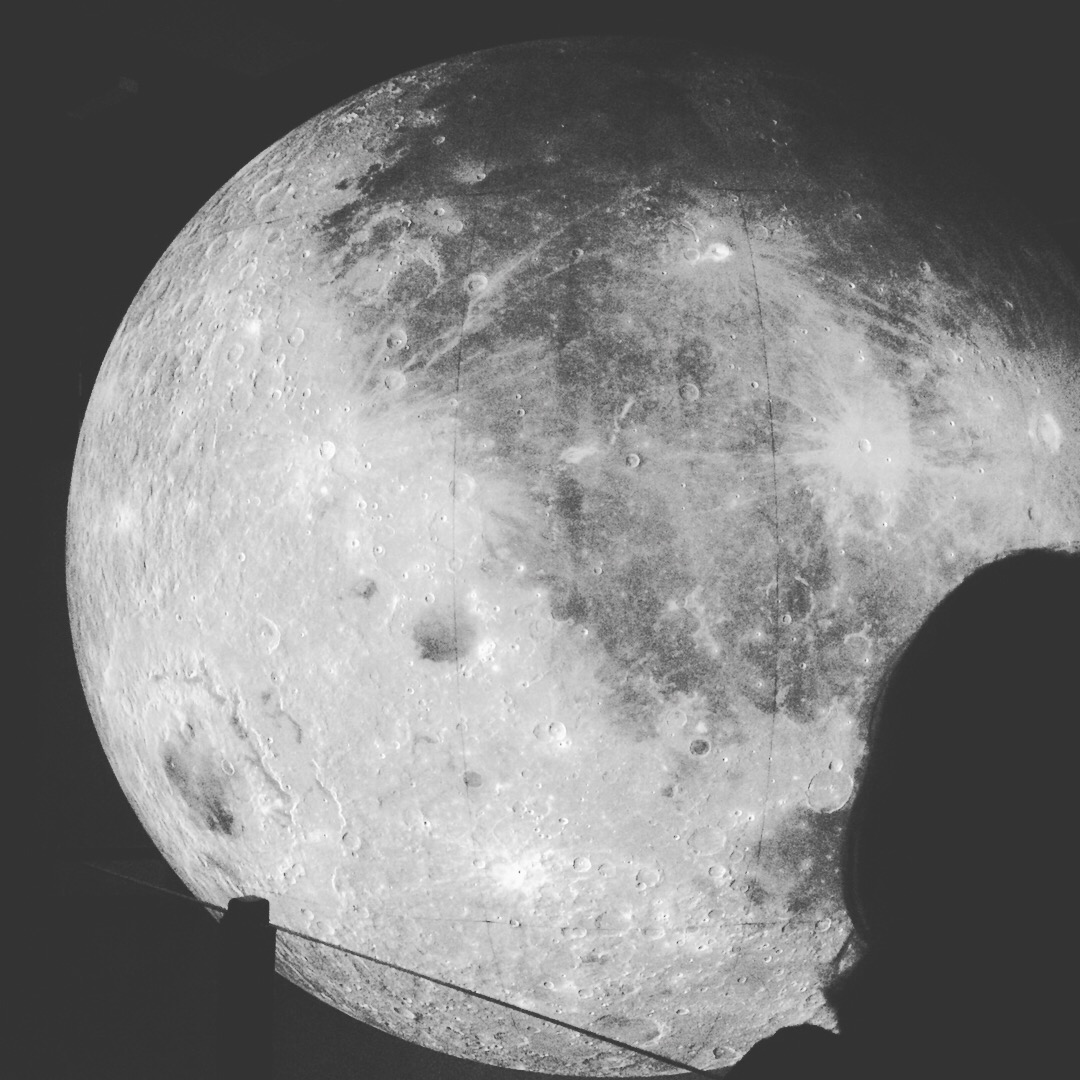
I come to Orkney during a time of transition, treading water before a great turn in my life. Time at sea as existential suspension. There have been some departures, severings, personal hurts, burgeoning projects and new beginnings. A great tiredness and fog over everything. ‘Cells of fuel are fuelling cells’. At the conference, my brain teems with this rich, mechanical vocabulary: copper wires and plates and words for wattage, transmission, the reveries of innovation. There is a turning over, leaf after leaf; I fill up my book with radials, coal and rain. My mind attains a different altitude. I think mostly about the impressions that are happening around me: the constant flow of conversation, brought in again as we move between halls and rooms, bars and timelines in our little human estuaries. We visit Stromness Academy, to see Luke Jerram’s ‘Museum of the Moon’: a seven-metre rendition of lunar sublimity, something to stand beneath, touch, lie under. I learn the word for the moon’s basaltic seas is ‘Maria’, feel eerily sparked, spread identity into ether. We listen, quietly, in the ambient dark, taking in composer Dan Jones’ textures of sound, the Moonlight Sonata, the cresting noise of radio reports—landings from a future-past, a lost utopia.
IMG_3348.JPG

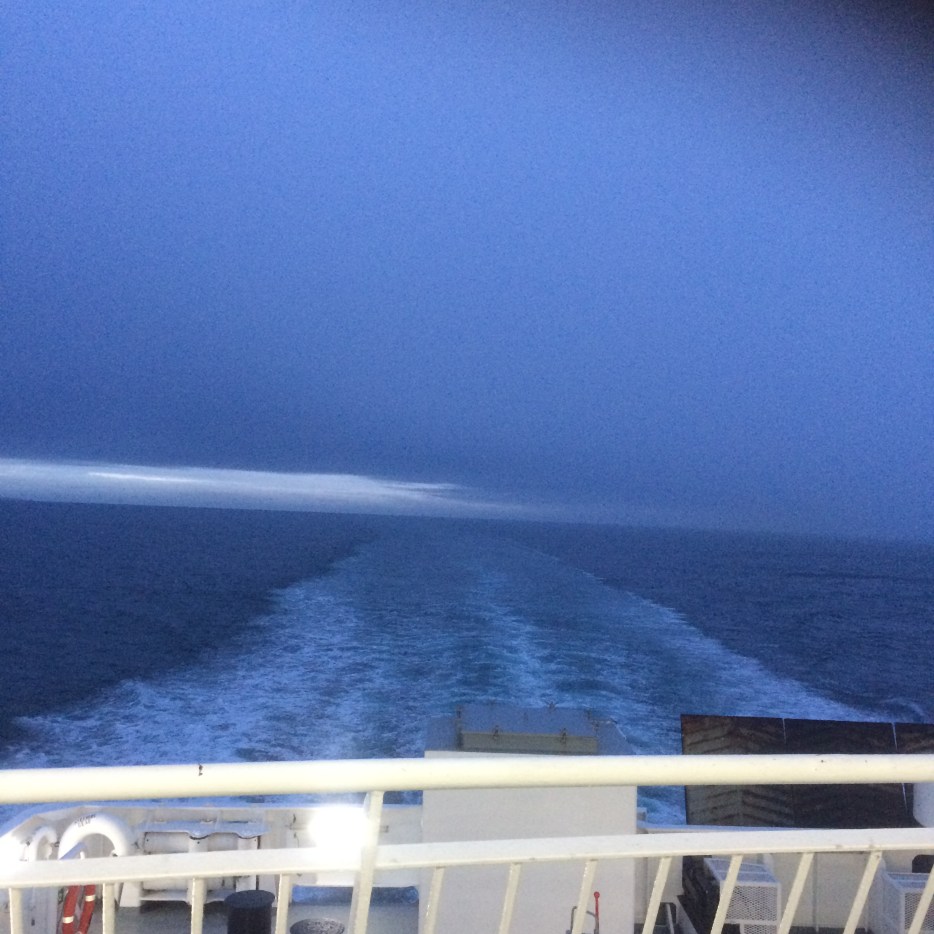
On Friday night, Katy and I catch the overnight ferry back to Aberdeen. Sleep on my cinema seat has a special intensity, a falling through dreams so vivid they smudge themselves on every minute caught between reading and waking. Jarman’s gardens enrich my fantasy impressions, and I slip inside the micro print, the inky paragraphs. I dream of oil and violets and sharp desire, a pearlescent ghost ship glimmer on a raging, Romantic sea. Tides unrealised, tides I can’t parse with my eyes alone; felt more as a rhythm within me. Later, on land I will miss that oceanic shudder, the sense of being wavy. I have found myself like this before, chemically enhanced or drunk, starving and stumbling towards bathrooms. We share drinking tales which remind me of drowning, finding in the midst of the city a seaborne viscosity of matter and memory, of being swept elsewhere. Why is it I always reach for marinal metaphor? Flood doors slam hard the worlds behind me. There are points in the night I wake up and check my phone for the time, noticing the lack of GPRS, or otherwise signal. I feel totally unmoored in those moments, deliciously given to the motioning whims of the ferry. Here I am, a passenger without place. We could be anywhere, on anyone’s ocean. I realise my privilege at being able to extract pleasure from this geographic anonymity, with a home to return to, a mainland I know as my own. The ocean is hardly this windswept playground for everyone; many lose their lives to its terminal desert. Sorrow for people lost to water. Denise Riley’s call to ‘look unrelentingly’. I sip from my bottle, water gleaned from a tap in Orkney. I am never sure whether to say on or in. How to differentiate between immersion and inhabitation, what to make of the whirlwinds of temporary dwelling. How to transcend the selfish and surface bonds of a tourist.

The little islands of our minds reach out across waves, draw closer. I dream of messages sent from people I love, borne along subaquatic signals, a Drexciya techno pulsing in my chest, down through my headphones. My CNS becomes a set of currents, blips and tidal replies. A week later, deliriously tired, I nearly faint at a Wooden Shijps gig, watching the psychedelic visuals resolve into luminous, oceanic fractals. It’s like I’m being born again and every sensation hurts, those solos carried off into endless nowhere.
IMG_3389.JPG

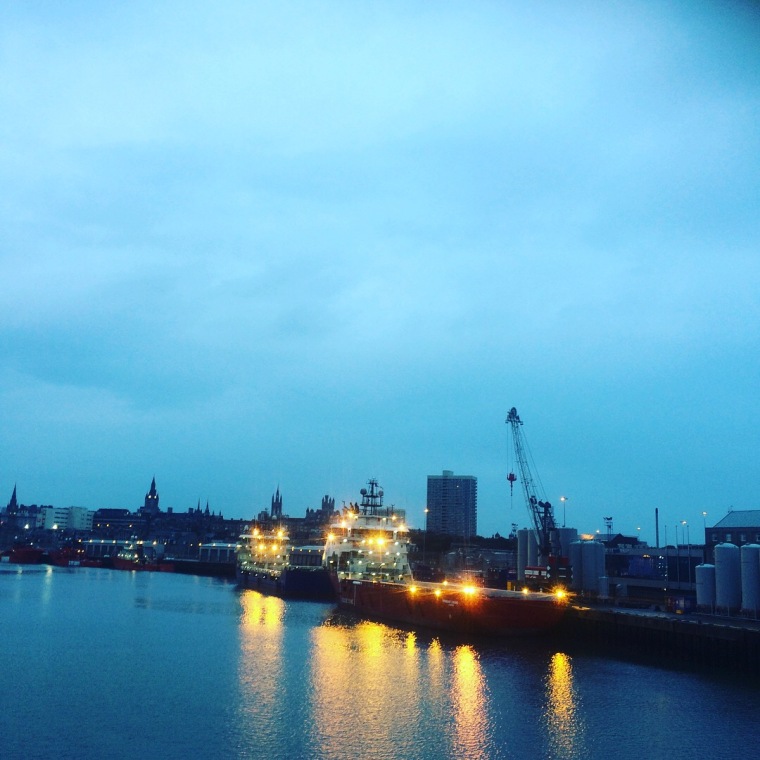
Time passes and signal returns. We wake at six and head out on deck to watch the sunrise, laughing at the circling gulls and the funny way they tuck in their legs when they fly. These seabirds have a sort of grace, unlike the squawking, chip-loving gulls of our hometowns, stalking the streets at takeaway hour. The light is peachy, a frail soft acid, impressionist pools reflecting electric lamps. I think of the last lecture of the conference, Rachel Dowse’s meditations on starlings as trash animals, possessing a biological criticality as creatures in transition. I make of the sky a potential plain of ornithomancy, looking for significant murmurations, evidence of darkness to come. But there is nothing but gulls, a whey-coloured streak of connected cumulus. The wake rolls out behind us, a luxurious carpet of rippling blue. We are going south again. The gulls recede. Aberdeen harbour is a cornucopia of infrastructure, coloured crates against the grey, with gothic architecture looming through morning mist behind.

Later I alight at the Waverley Steps again. Roddy in my ear, ‘Let the light be mined away’. My time on the island has been one of excavation and skimming, doing the work of an academic, a tourist, a maker at once. Dredging up materials of my own unconscious, or dragging them back again, making of them something new. Cold, shiny knowledge. The lay of the heath and bend of bay. I did not get into the sea to swim, I didn’t feel the cold North rattle right through my bones. But my nails turned blue in the freezing wind, my cheeks felt the mist of ocean rain. I looked at maps and counted the boats. I thought about what it must be like to cut out a life for yourself on these islands.

Home now, I find myself watching badly-dubbed documentaries about Orkney on YouTube, less for the picturesque imagery than the sensation of someone saying those names: Papay, Scapa, Eday, Hoy. Strong names cut from rock, so comforting to say. I read over the poems of Scotland’s contemporary island poets, Jen Hadfield for Shetland, Niall Campbell for Uist. Look for the textures of the weather in each one, the way they catch a certain kind of light; I read with a sort of aggression for the code, the manifest ‘truth’ of experience— it’s like cracking open a geode. I don’t normally read like this, leaving my modernist cynicism behind. I long for outposts among rough wind and mind, Campbell’s ‘The House by the Sea, Eriskay’: ‘This is where the drowned climb to land’. I read about J. H. Prynne’s huts, learn the word ‘sheiling’. Remember the bothies we explored on long walks as children. There’s a need for enchantment when city life churns a turbulent drone, so I curl into these poems, looking for clues: ‘In a fairy-tale, / a boy squeezed a pebble / until it ran milk’ (Hadfield, ‘The Porcelain Cliff’). Poetry becomes a way of building a shelter. I’m struck with the sense of these poets making: time and matter are kneaded with weight and precision, handled by pauses, the shape-making slump of syntax. Energy and erosion, elemental communion. Motion and rest. My fragile body becomes a fleshwork of blood and bone and artery, hardly an island, inclined to allergy and outline, a certain porosity; an island only in vain tributary. I write it in stanzas, excoriate my thoughts, reach for someone in the night. I think about how we provide islands for others, ports in a storm. Let others into our lives for temporary warmth, then cast ourselves out to sea, sometimes sinking.

Why live on an island? In Orkney we were asked to think with the sea, not against it. To see it not as a barrier but an agential force, teeming with potential energy. Our worries about lifestyle and problematic infrastructure, transport and connection were playfully derided by a local scholar as ‘tarmac thinking’. Back in a city, I’ve carried this with me. The first time I read The Outrun was in the depths of winter, 2016, hiding in some empty, elevated garrett of the university library. I’d made my own form of remoteness; that winter, more than a stairwell blocked me off from the rest of existence. Now, I read in quick passages, lively bursts; I cycle along the Clyde at night and wonder the ways in which this connects us, its cola-dark waters swirling northwards, dragged by eventual tides. I circle back to a concept introduced by anthropologists at Rice University, Cymene Howe and Dominic Boyer, ‘sister cities of the Anthropocene’: the idea that our cities are linked, globally, by direct or vicarious physical flows of waste, energy and ecological disaster. This hydrological globalisation envisions the cities of the world as a sort of archipelago, no metropolis safe from the feedback loops of environmental causality, our agency as both individuals and collectives. On Orkney, we were taught to think community as process, rather than something given. I guess sometimes you have to descend from your intellectual tower to find it: see yourself in symbiosis; your body, as a tumbled, possible object: ‘All arriving seas drift me, at each heartbreak, home’ (Graham, ‘Three Poems of Drowning’).
 

Dancefloor Utopia: Free Love’s ‘Pushing Too Hard’ & ‘July’

I love alcohol, the gloaming
of the blood that makes time an arcade.

Somehow, lately, I have been unable to drink myself into drunkenness. Everything is a spritzer whose taste effervesces like the further most points of the sea at sunset, those glisters of peachy waters which seem almost to fizz beneath the pleasure of light. To think of that expanse as the body’s active limit, like the horizons of video games, whose traversal would teleport you back to some familiar, originary location. Flip away. Endpoints as triggers for reversal. To travel outwards, to raise yourself clean into movement. To make of the body its own hypothetical. It’s like I want only the blueprint potential, the colours and geometries. 

The waves move against me. I do not drink. 

Queue, Free Love (FKA Happy Meals) ‘Pushing Too Hard’. This ultra-dappled, smiley-faced italo-disco is a sort of vertigo. I mean I am spinning silver in its listening. Emptiness requires its own containment. To dance in parallels then pirouettes, to queue time upon time’s arabesque. To oooooze. The little eddies of the ocean still swallowing, the sun ravelling down like residue soda. Whatever direction you make into ceremony, pleasure. 

The bunching of muscle, where sun hits the boulevard. Where the boulevard bursts into its many discographies of water, inclined to times beyond and before, a gradient popularity of passengers and travellers, nomadic ravers. Where the boulevard is not a waypoint but the lengthy stretch of hypnosis itself, an astral plane into sunlit ethers.

The very word boulevard, a sort of ferric opulence unfolding a hazy, urban sprawl.

All of this wayward July, and the synths so warm on my skin, and every conversation a twirl of hyperbole. I wanted nothing of night again, as night was just the day’s refresh and erasure. All through the summer, the air so syrup and seething.

I book the overnight ferry, I dream of a world without timetables. The tide sloshes over me and it is sleepless, and it is heat.

This is rich-text. All of oddness. I’m just so much happier at four in the morning, in the priory of sunrise. Missing you.

Cherish the currency of friendship, however the slightest touch is a glorious misreading. Miss reading, I’m missing. Mist between the one and the two and same, faintness of incense that is. The body unshowered, the mist of heat. The endless messaging dew drops of moisture; your pearly brow is beautiful. It isn’t as though you could shift sentences for me. I’m just as weak.

Suzanne Roden of Free Love sings sometimes in French and slips between two languages, the language of the one and the other, the foreign tongue as love in transition. The lively nuance of melodic translation. To stretch meaning, to make of its pulse the possibly unmappable. We listen and maybe we don’t quite need to understand, we just need the potential of passage, its affective route per semantic reach. Glossing Derrida on love, Maria-Daniella Dick and Julian Wolfreys write thus:

Love calls on us to be responsible in coming to map the unmappable, to be open to the possibility of the impossible, and the possibility of this impossible experience is that, in short, which is between us, and which remains: to come. Love is always just this exemplary passage between tongues, in what is foreign, other in the language one calls one’s own.

There is a healthy cascade of reverie. There is browse and incline, click and encryption. The love that you seek. Every pop song is of course love’s expression, the fluid joy of a ~solid~ ego; and yet to map that point of dissolve in which this ego is the melt-point of ipseity’s porous limit, is that not the deferring impulse of disco? Strike through to jouissance. The repetitive beat, the multiple oscillating climaxing motion; the avoidance of pop’s inevitable, normative denouement; the queerish musing deliciously around fulfilment; the rhizomatic overflow of the senses!

Stay mercurial, baby. In cool arousal, in sluicing.

‘But I love you despite the boring terrorism / of particularity / fading like parity’ (Keston Sutherland).

Your forehead is hot. It is glass for the shattering. We are fashionable and hackneyed, practicing lunacy where the beats scream and are again crass in their lust and elation, their confinement to time and place and the pulse of this darkness.

When my irises bleed, is this a form of eschewing the present? As in, swallowing an elsewhere unseen to the other? We see our eyes outside, in the comedown glow of street lamp smoulders. We the parts of our bodies as an archipelago, every isle slowly swallowed by rising water. 

This tectonic pulse, this encompassing warmth.

You’re pushing too hard. And so language is physical, and so is literally thrust in, into, the armoury of love. I will not say weapon, I will not reduce a necessary plural to the singular tool, the implied signified of the phallus. The piercing. My eyes become pliant.

Make of the air her dulcet voice, over and over like rain’s refusal. Make of this moment a lightness, a smoothing. Trace little bumps and ripples and glitches; the motion is softcore, resplendent’s true sense.

Love is also the coveting of blindspots, those absent locations of self’s abyss which lie adjacent to the lieux de memoire recognised as the sites of love’s memory, of memory’s happening in love. Love as process of betweening, as immersion. A feel-good, a good feeling. The prolonging of ephemeral sensation in an act of imaginary narrative, its plights and highs and necessary zigzags. Act within capitalism, act without; act as pop’s dazzling detournement. So here by the convenience store we kissed, so here by the river; so at the window we shared cigarettes in a friend’s apartment, by the ersatz palms, so these screens between us, so the niche forums that served as our weird, oblique interface; so here where the road slumps into a junction, so here at the station where you had to go. A whole topography of abstract thought, remix it. Drink it. So memories of mountains, so sharing the lakes we made up in memory; that you swam in, the lakes I walked round as a child, the heather on hills where ashes were scattered. This interface, these blue messages. Blue irises. The shape of a letter impressed on a map. The silent valley, its conclusive basin of time; where life is swallowed. I memorialise a thought, the quality of light in August, its paler gold among green; whose green is mortal again, whose green is set to fade. Your pupils resolve all green of the iris to blindspots, they mop up the blue with the black of sleep. And to sleep as equals is to forget the self, to wake in a room between rooms, to find yourself caught as other again, your room unfamiliar, the room never yours even less so now. The very first utterance of morning might break the spell. How the sky looks different through your open, solar window!

And I’m not the one to help you / Although I’d like to tryyyyy.

Clatter and wave, video game imperative to action and motion. Soundtrack the heat. Make reverie of weather. The production is so acid house. The production inclines toward dance. Externalise the internal. Naturalise the natural. A certain elasticity of underlying beat, as if bass were the hum of the blood that produces affect. As if it were all that reducible. As if in that energy. Make our mammalian restraint ethereal. 

The Quietus says of Free Love’s music, ‘Their vision is a utopian one, influenced by rave culture, Eastern religions, politics and magic’. To unhinge love from its possessive sense, love becomes an ambient tone in the spread of the days between days which we count in love, if love is a sense as any other, an orientation between things, between selves, the one and the same. If love is something… that something within us must export to numbers. How many days has it been, I’ve been thinking all week… Here are our figures. Crunch on a sort of krautrock lingering, the impersonality at the heart of euphoria’s insistent heat. Free Love have used drones before, meditative, balearic beats. It’s a process of seeking the nuanced frequency, the cleaner hum of Being, what might spread into an open future, something bright to seize. Design your consciousness for different realms, just feel the synaesthesia of speculative situation. The future’s flirtatious, maybe it speaks French. It’s a bright pink, cherry-red electric French.

In his spectacular tome, More Brilliant than the Sun: Adventures in Sonic Fiction (1998), Kodwo Eshun talks of how the subaquatic techno-duo Drexciya ‘fictionalise frequencies into sound pictures of unreal environments […]. They fictionalise the psychoacoustic volume of a giant submersible’. ‘Pushing Too Hard’ implies a current out of sync with its destination, an unbalancing in the passage between entities. A kinetic effort. Disco’s warm flicker invites that spiralling back to aporia; not a giving up in the sense of seduction’s failure, so much as surrender to the unknown and its cheeky, distinctive flourishes of acid, italo, proto-house all drenched in funk. I don’t pretend to understand French; my language is literally standard grade, processed only to that limit.

But I pick up some terms Suzanne sings:

L’avenir: future, future, future, promise. To come up. Insistent, proximity, imminent. A cool bitten ecstasy, a love to-come. Love in the conditional, although I’d like to tryyyyy. Those airy harmonies cascade around chiasmic, sunshine flourishes. Love’s duration at 4:18.

Plastique: plastic. What seems elastic, mutable, but is in some sense unerasable—a material that ultimately remains. Residuals. Shards, bits. When ‘Pushing Too Hard’ collapses into its A-side twin, ‘July’, the beats are fatter, darker, hotter—brooding with a sense of summer’s latency as always already. The plastic feeling is inside me, it’s a melting, it’s a coming-into-skin. Sonic duplicity. It’s the Anthropocenic hauntology of organs, it’s a PVC drag of natural sensation. It necessitates dancing, but the percussive chimes in the track’s white-heat centre drag my mind from the present’s solidity. Those chimes are airy, they are elsewhere, enchanted; they are so far removed from the close close city. To be fast and slow, hard and soft, selfish and strong, reflected and present, past and future…Being as syncopation, being as plastic, rent to split. Our lapidary imaginaries, our synthesised clicks of pleasure; a pool of sound, an immersion…I’ve come to relax, to realise.

Visage: face. A word whose very sound is that of sunlight hitting clean the bounce of a mirror, a slide into silver. The waspish vibration of the lips, inclined to glass on the brink of shatter. I think of all those mirror tricks in every ABBA video. The face, the face, the face again. The face we effect. Maria Dick and Julian Wolfreys again: ‘Seeing the face in its absolute and irrecusable singularity, I am given to apprehend a doubleness from the first gaze’. Disco is doubleness inherently split to multiplicity, it is the vying for one attention amidst the millioning of other skins (skins becoming a metonymy of figures, faces), it is the shakeaway of self into other, the imitation, the performance of gesture’s contextual plurality. The face, in Emmanuel Lévinas’ sense, is the announcement of subjectivity: the instating of the subject as a sort of ‘hostage’, as Dick and Wolfreys gloss. It demands a response, stealing the attentions of the self, instating by necessity a certain ethics of wholly Otherness: the human face, as Lévinas puts it, ‘orders and ordains us’. I catch your face on the dancefloor, there is a temporary pact between us. What implicitly slides in the raising of one arm, the twist of hips, copying this dance, a Xeroxing event whose zero-sum origin remains irreducible, whose condition is always undecidable, plural. So far so obvious the ontology of rave culture. Every action now as response. A semi-autonomous severing. Technology can be, as Eshun puts it, a ‘bifurcation in time’. The techno throbbing through the pale membranes of my human sense is a channel for split subjectivity, an experience of falling between worlds.

On the dancefloor, when he asks me what to do, I whisper in his ear, in some half-remembered echo from The Bell Jar: ‘pretend that you are drowning’. And that paranoid panic, that scramble for air in the thrust of the limbs, it seems to work. I see the moisture mist up his glasses. Face after face, we glimpse the phenomenology of substitution, we trade our own affect for the possible electricity of the next. His smile, her hair, our collective sweat. The absurdity of all these moves; the warping of all muscle memory inclined to a known rhythm, then ever the melodic trajectory of an unknown palette. We expose our infinite vulnerability, we abstract ourselves to the dancefloor’s disorderly hospitality, where the reciprocal push-pull of crowd and DJ is a mutual reading and so mutual dissolve, a ‘free love’ whose freedom is conditional on the exchange of gesture, face and motion, of bass, beat and melody. Of sonic and visionary qualities. Of closeness, a close reading. 

I imagine my skin looks metallic, right now, as you see it.

Eshun again:

Groove is when overlapping patterns of rhythm interlock, when beats syncromesh until they generate an automotion effect, an inexorable, effortless sensation which pushes you from behind until you’re funky like a train. To get into the Groove is to lock into the polyrhythmotor, to be adapted by a fictionalised rhythm engine which draws you on its own momentum.

Is fiction here the condition for identity’s erasure? We hustle ourselves out of ordinary language, slip into the chug and pulse of the train. Okay so all these bodies in motion. To export yourself to the techne of musical condition. Fold in the overlap, a baroque philosophy of subjectivity’s production. Enter heterotopia with both hope and scepticism. Put away your wallet. Fold yourself. There’s Deleuze’s notion of the fold as a doubling: one thought rolled and pressed into another, the scratch of tobacco in cigarette papers, the promise of chemical stimulation imbibed in the skin, the curlicues of words upon screen and page, the unlocking potential of semiotics in motion. A rolling into, an overlay’s careful pleat of impression and meaning. The duplicity of temporalities in photographic exposure. This tongue curled on a foreign one, the blendable play between French and English, a play between verse and chorus. A recursively mutual translation of inside/outside, the self and other, here and there, near and distant; a translation whose very process belies the instability and futility of such ontological divisions. We relate to ourselves as production, we produce ourselves. But don’t look at me / I’m just as weak. The face that desires, amid over-stimulation, the reserve of hiddenness, the retreat. Subjectivity as a question of mastery, self-relation, processing affect, thought and memory in the world’s abundance, intensified in the sonic duration of a pop song, or in the ever-churning lieux de memoire of a dancefloor, where memory is always in oscillation, caught between bodies and beats. And the magic in that, and the heat. 

‘It’s like creating temporal communities’ — Lewis Cook.

Every melody’s upswing, a new euphoria: ‘Synchronicity’. Left my ego on the ground. Make of identity its fractal components in disco extension, plugin auroras of thought, the perspectives shifting. Suzanne’s voice spliced between echo and harmony, echoed by Free Love’s other half, Lewis, echoed by her own, echoed by the satisfactions of division’s fall back into rhythm, the tightness of synchronicity. Turn me upside down / I don’t know what’s left in front of me. Resonate, resonate. Duplicity kaleidoscopes originary identity as an always receding, elusive location, infinite addiction. Broken glass, symmetry, the one and the same split shard-ways, a cool euphony of a synthetic present cast ever between past and future; the neuromuscular necessity of this beat, this bodily response; hyperstition; this brainwave as process corrosion, as shimmer and sweet, as almost coincidence.


*

(Video shared via YouTube/Gorilla vs Bear)


Playlist: March 2018

IMG_0249

IMG_9922

IMG_0032

I was turning all the lights off, trying to mute history. There were several moments in which it felt like things were changing, possibly blossoming for the better. The aftermath stung and went backwards again. There was a song about the M62 I followed briefly, thinking about motorways more generally and something expansive and grey, crossing the Pennines eventually. For a week, I wrote down descriptions of the sky. Mostly they read: the sky today is grey. I then started noting the patterns in Dorothy Wordsworth’s journals, which often begin with vignettes of the morning:

3rd February. A fine morning, the windows open at breakfast.
6th March. A pleasant morning, the sea white and bright.
26th May. A very fine morning.
31st May. A sweet mild rainy morning.
2nd June. A cold dry windy morning. 

Mostly, she summarises the day. There is much letter-writing, Coleridge dining, William writing. Walking, cooking, taking guests. There is a rhythm and comfort to her entries, the circling of Ambleside, the sauntering in sun and air. Days condensed and hours expanded, cute little details in pastoral glimpses: ‘Pleasant to see the labourer on Sunday jump with the friskiness of a cow upon a sunny day’. She sees into the life of things. She inspires me to mark the simple, joyous moments of daily existence. Like walking home along Sauchiehall Street (the nice part towards Finnieston), close of midnight, seeing a couple in each other’s arms, sobbing, the man with a bunch of flowers held behind his back. They were not by any means striking flowers, probably bought cheap and last minute. I wonder what sort of gesture they were supposed to convey. At what point in the night did he decide to buy them; did he attain them from those wandering women who pray upon drunks with their floral wares? Did he cut himself, ever so slightly as he paid for those unlovely thorns? Is love always a form of apology for self? The self when it expands beyond too much of itself, hotly craving?

17th March. I do not remember this day. 

It seems irrelevant to say, today is Easter Sunday. Jackdaws torment me in the expensive fruit of a wakeful morning. I imagine pomegranate seeds falling from a pale blue sky. These days unfold with wincing clarity, like the hypnotic drag of a Sharon Olds poem: ‘I could see you today as a small, impromptu / god of the partial’. There are things we are maybe not supposed to remember. As if survival were a constant act of lossy compression. Like a contract between two people, pinkie promise, except one of you has broken it. Has let out the glitches. Your dreams and daily reveries are full of the content you’re not meant to remember. You are clasping this thing as if it might live again, and indeed it might really. It is not easy to simply file away memory. Its particular phraseology of physical pain comes floating to the surface regardless. There are techniques of displacement. Letting yourself shimmer in the wind. It was one more step to be gone again. So every song I went to put on, clicking the laptop, he was like, stop, it’s too sad. When they ask what’s wrong and you’re smiling instead, worrying the edge of your lips into muscles you don’t recognise at all. The room was a singular bottle of beer and a breeziness to other people’s sweetness. They wear lots of glitter and laugh as we did once. They are singing. I feel like the oldest in a test of forever. But anyway this is all only temporary. Things break down but they do not go away.

30th March. Walked I know not where. 

I watch a film about plastic in the ocean. They haul fish after fish, bird after bird, prise exorbitant quantities of bottle caps, ring pulls, microbeads and indiscernible fragments from stomachs and lungs. It is quite the display. Hopelessly choking. Seems obscene to describe that deep blue as ever pure again. There are patches of plastic in all its particles swirling. It makes not an island exactly, more like a moment in species collision. Whales absorb plastic in the blubber of their skins, digesting slowly the poisons that kill them. I wrote a story about a whale fall once. The protagonist trains in swimming, in underwater breathing, in order to enter other worlds: ‘This place is a deep black cacophony; you hear the noises, some noises, not all the noises, and you feel the pressure ripple pulling under you’. There have been bouts of sleeplessness this month that feel like dwelling inside a depleting carcass. If every thought dragged with subaquatic tempo. Blacking out at one’s desk into sleep. Forgetting in the glare of screen flickers. I meet people for coffee and feel briefly chirpy, stirring. There are pieces of colour, uncertain information, clinging to the shuddering form of my body. Do not brush my hands, for fear of the cold. I am so blue and when he squeezes my fingers my insides feel purple. The woman at the counter remarked on the cold of my hands. I am falling for the bluest shade of violet. How anyway in such situations I become the silent type as I never do elsewhere. So ever to cherish a bruise as violet or blue. I polish vast quantities of glassware, lingering over the rub and sheen. One song or another as 4.30am aesthetic.

Emily Berry: ‘All that year I visited a man in a room / I polished my feelings’.

The questions we ask ourselves at work form a sort of psychoanalysis, punctuated by kitchen bells and the demands of customers. What superpower would you have? The ability to live without fear of money. We laugh at ourselves as pathetic millennials. I have nothing to prove but my denial of snow, power-walking up Princes Street on the first bright day of the year. The sky is blue and the cold flushes red in my cheeks. But I am not a siren, by any means; I wish mostly for invisibility. The anthem for coming home the long way is ‘Coming in From The Cold’ by the Delgados, feeling the empathy in lost dreams and the slow descent into drunkenness that arrives as a beautiful warning. Like how he deliberately smashed his drink on the floor in the basement out of sheer frustration with everything. The ice was everywhere. As though saying it’s complicated was an explanation for that very same everything. The difficulty of cash machines. Emily Berry again: ‘I wanted to love the world’. In past tense we can lend shape to our feelings. Will I know in a week or more the perfect metaphor for this dread, this echo chamber of grey that longs to be called again? I punch in four numbers.

I covet my exhaustion in slow refrain. There are people whose presence is an instant comfort. There are people you’d like to kiss in the rain; there are people you’d kiss in the rain but never again. What of the gesture of that bouquet? Surprise or apology? The sky is catching the mood of our feelings. Is this a melancholic tone of regret, or maybe an assured and powerful one? I twist round the memory of a mood ring; its colours don’t fit. I photograph the rings beneath my eyes, finishing an eleven hour shift. She shoves rose-petal tea biscuits under my nose but I smell nothing. I watch the chefs at work, caressing their bundles of pastry and sorrow/sorrel and rocket. I climb many stairs and assemble the necessary detritus of another funeral. Sadness requires a great deal of caffeine.

I eat mushrooms on toast with Eileen Myles. I long for the lichens on the trees of Loch Lomond. I sleep for three hours in Glasgow airport, on and off, cricking my neck and drifting in and out of vicarious heartbreak. Lydia Davis is often perfect:

But now I hated this landscape. I needed to see thing that were ugly and sad. Anything beautiful seemed to be a thing I could not belong to. I wanted to the edges of everything to darken, turn brown, I wanted spots to appear on every surface, or a sort of thin film, so that it would be harder to see, the colours not as bright or distinct. […] I hated every place I had been with him.

(The End of the Story)

Must we coat the world in our feelings? What of the viscosity that catches and spreads on everything? There is an obscenity to beauty in the midst of defeat. Year after year, I find myself dragged into summertime sadness. There is so much hope in the months of June and May, soon to dwindle as July runs spent on its sticky rain. The lushness of a city in bloom, all fern and lime, is an excess beyond what dwells inside, the charred-out landscapes of endless numbness—or ever better, missing someone. We covet the world’s disease as externalisation of our hidden pain. Let things fragment and fall away; let there be a sign of change in motion. How hard it is to be happy around depleted friends; how hard it is to be sad among joyous friends. They pop ecstasy and go home for no reason. It is self-administered serotonin that mostly buoys up the souls of the lonely. There were songs from the mid-noughties that now sound like somebody shouting down a coal mine. I want to offer them a smile and a cup of coffee. It’s all I have, the wholesome concatenation of smooth flat-whites.

There is a song by Bright Eyes, ‘If Winter Ends’: ‘But I fell for the promise of a life with a purpose / But I know that that’s impossible now / And so I drink to stay warm / And to kill selected memories’. Winter’s demise in conditional form. Alcohol convinces us of a temporary rush into the future that blooms and is good, is better than before. The drinkers I know have muffled recollections, blotted out mostly by false nostalgia. We covet a swirling version of life in the present, its generous screen flickers, its spirals of affect. We pair off in the wrong. There are days when nothing will warm me up—not the dust-covered space heater, not the hot water bottle, not the star jumps that scratch heart-rates out of the hour. Was it the same sensation, hanging on for his vowels on a hazy afternoon, four o’clock stolen from whatever it was I was supposed to be doing?

Summer, however, is forever. It is supposed to be best. The clocks skip forward.

I learn to riso-print. To work with the uncertain blot and stealth of brighter inks. What results is a marvel in teal and burgundy, splashed with cyan. See it as past with glitters of future.

In a cramped, fourth floor hotel room in Amsterdam, I lay on my bed, leg-aching, listening to ‘Shades of Blue’. Yo La Tengo get it, the vaporous sprawl of the days upon days, days replacing days: ‘Painting my room to reflect my mood’. It is a kind of overlay, the new versions of blue which are deeper maybe than they ever were before. Which lend alter-visions to original blues, the ones you thought were bad before. I see my first IRL Yves Klein in the Stedalijk museum. Words elude this particular blue. It is deep and extravagant and more oceanic than the ocean would dream of. I have no idea what materials or dreams created this blue. Lazuli, sapphires, the pigmented stain of a rare amphibian? It is the steady, infinite eye of the Pacific. It is sorrow itself, the wound of the world. The Earth bleeds blue, not red. It is this kind of blue, a supranatural blue. After the first crisp cold of a new blue day, the rest of the week is brumous and mild. My feet get wet in a cemetery. I learn that Paradise Valley is an affluent town in Arizona, and not in fact merely a Grouper album. I drink mint tea all week to detox, then stay up all night when I get home. The gin sodas sparkle within me for days, but I’m feeling guilty.

The canals are parallel, the streets are winding. There are neon and fishnetted girls in windows, drolly sipping mysterious drinks. Their eyes are heavily lined. Nobody is looking. The air is warm and spicy at night. The tourists admire displays of various erotic paraphernalia; I take pictures of the lights splashed gold on the water. They say if you get to know the place, you can really settle into a meandering layout. A guy at work supplants my name for ‘Marijuana’. I wonder if ever I’ll be someone’s Mary Jane, and what that means in the long run. Feels like a Green Day song. Marijuana, they’ll say, Marijuana I miss you. There are pockets of Finnieston that waft forever between early summer and fullness of June; evenings hung by the scent of a stoned hour poised on forever. I stay sober. I think of the river, the people and dreams it steals. The world crystallises with ridges of cold, so I must sleep beneath sheets in my click&collect coat. Blue-fingered, shivering.

Carl Sagan’s ‘Pale Blue Dot’ has been lingering on my mind: ‘Consider that dot. That’s here. That’s home. That’s us’. I keep writing out line after line, just for the sake of avoiding full stops. I’m not yet ready for that singular compression, even as it strikes in its simple beauty.

There was the massive, narcotic blue of the sky from the airplane. A blue you can cling to. A blue you descend through.

Lana Del Rey: ‘Blue is the colour of the planet from the view above’.

Pop singers these days are attuned to new scales. That Bright Eyes song opens with a whole lot of static and children shouting, rasping. It is like watching some black-and-white film in a museum, shudders of war or monsters in every low boom and flicker. There are ways we strum ourselves out of the mourning. It’s okay to be enraged and frustrated. Oh Conor, how I love you: ‘and I scream for the sunlight or car to take me anywhere’. So when things fall apart, fray at the edges, I’m thinking of myself as a place, a location elsewhere, ‘just take me there’, and the ridge of my spine is a highway that ends where the best palm glows afire by its imaginary desert. The curve of my neck and uncertain horizon, something of all this skimming around by the brink of etcetera. What else do I have to say but, ‘it’s gonna be alright’, not even realising when I am quoting something. It is hot here, adrift on this sofa, then cold again.

The walks grow ever more indulgent, Mark Kozalek humming in my ear. I think of all his familiars. I think of my younger self thinking of all his familiars. Is it cats or is it women. How many supplements do we make of lust?

The day afterwards, it’s best to drink again. Grapefruit is cleansing. You can order whole pitchers but I choose not to. A certain suffusion of gossip and horror, ice cubes crunched between teeth to ease up the gaps where I’m meant to speak. I see Hookworms play the Art School and they were incredible: they were a rush they were eons of dizzy vigour and sweetness, the music you want to surrender to. I stop giving customers straws with their orders. It snowed again. I wasn’t drinking; I was wearing green for Paddy’s Day. I was so tired my eyes felt bruised. I keep dreaming of islands, motorbikes, exes; broken tills and discos. The flavour of these dreams in surf noir; like even in the city it’s as if a tidal pull is directing everything. I don’t mind being sucked away into nothing; I don’t mind feeling the impulse of a pale blue dot. At least in my sleep. A good collapse. The order of pain is reducing.

29th June. It is an uncertain day, sunshine showers and wind.

This week I will find a hill for my vision. New forms of erasure. I see myself boarding a train.

~

Yo La Tengo – Shades of Blue

Bright Eyes – If Winter Ends

Iceage – Pain Killer

Tessela – Sorbet

Bjork, Arca, Lanark Artefax – Arisen My Senses (Lanark Artefax remix)

CZARFACE, MF DOOM – Nautical Depth

King Gizzard & The Lizard Wizard – Barefoot Desert

Grouper – I’m Clean Now

Sean Nicholas Savage – So It Appears

Snail Mail – Pristine

Little Comets – M62

Manchester Orchestra, Julien Baker – Bad Things to Such Good People

Hop Along – How Simple

Frankie Cosmos – Apathy

Sharon Van Etten – I Wish I Knew

Amen Dunes – Believe

Cornelius, Beach Fossils – The Spell of a Vanishing Loveliness

Sun Kil Moon – God Bless Ohio

Good Morning – Warned You

Lucy Dacus – Addictions

The Delgados – Coming in From the Cold

Belle & Sebastian – We Were Beautiful

Mark Kozalek – Leo and Luna

Pavement – Range Life

Firestations – Blue Marble

The World is a Beautiful Place & I Am No Longer Afraid to Die – Heartbeat in the Brain

Manic Street Preachers – Dylan & Caitlin

Bob Dylan – Just Like Tom Thumb’s Blues

Crosby, Stills & Nash – Hopelessly Hoping

Courtney Marie Andrews – Long Road Back to You

Grateful Dead – Box of Rain