


Recently found these on my google drive. The LATE NOUGHTIES // study leave.
Recently found these on my google drive. The LATE NOUGHTIES // study leave.

It’s terrifying to write about love as someone who’s grown up with extreme behaviors in relationships that would always send me on an emotional rush. The lyrics explain the anxiety of a relationship having no end point and thinking, ‘Oh my god, this might work out.’ I wanted to capture that feeling that I’m finally safe.
Jazmin Bean on ‘Terrified‘
Nursing their bleeding stars at the outskirts of asylum, Jazmin Bean plays nurse. Their bicycle is mint green and their hair is turquoise and they carry a box of medicine. When cleaning tables in my service job, I’d lip sync for real at the songs I’d play in my head to escape the music that was actually playing. When you fall in love it’s like bundling your stars into a bicycle and laying them all beside one another to clean them up, clean off the blood. Take them on a boat on the lake. Administer the painkiller to let them float back off to space. I listened to this song, Spotify tells me, more than any other in 2024.
The second song is ‘How to Rent a Room’ by Silver Jews. So when I’m listening reflectively to the Top Songs of 2024 in the linear unfold of a diary, the transition goes from three-minute perfect slice of zoomer britpop – Bean’s ‘I’m terrified / Sun in my eyes / I’m terrified / terrified’ – to Berman’s ‘I don’t really wanna die / I only wanna die in your eyes’ and the assonance of eyes/die/terrified collapses into the string section of mortal swoon. In ‘Terrified’, Bean sings about their first healthy relationship following a history of abuse and struggle in love. I’ve been following their work ever since Audrey Lindemann wrote about ‘Jazmin Bean’s Instagram’ for SPAM Cuts back in 2020. I kept thinking about that phrase ‘Imprisoned by Flesh’ as the locatedness of a room where men grasp at bedsheets and the elven blonde remains hugging their knees and grimacing. Lindemann described Bean’s aesthetic as ‘stradd[ling] a Butler-ian understanding of performativity and a Zoomer drive for authenticity’. The editorial implication of this piece is that we are reading Bean’s Instagram not just as art but also a kind of visual poetry. All of the gurlesque extremity channels into the emotional circuitboard through which I listen to ‘Terrified’. The transformation from this post-internet monsterkin to alt-pop star is pretty cool. The songs are bigger and more free. There’s space for the feeling to breathe.
Can we call this zoomer britpop? Atwood Magazine commented on the song’s ‘eruption of ’90s-era Britpop warmth’. I’ve been reassessing Britpop (capitalised here for History) with the Americans via the recent series of Bandsplain, where Yasi Salek and pals take on bands like the Happy Mondays, Blur and Oasis (and try valiantly to pronounce the various dialects associated with these bands). Britpop for me is the music that played as I nodded off in the back of my dad’s car, looking out the window or reading a book, looking for something else to do. Britpop, in its purest form, to me represents an emotional prototype for projecting personal excess and intensity. The actual lyrics should be fairly general and simple, with one striking detail. Your ‘wonderwall’ or ‘champagne supernova’, kind of like the novum of the song whose weirdness transforms all the ordinary detail like putting violet dye in an otherwise neutral lake. It also comes along with simple chord structures, homophony, melodic hooks, a compelling chorus or build towards it. EXUBERANCE (that is either swaggering or just a little unsure of itself). I am not trying to give a history of britpop I am just trying to get at how it currently resonates for me as a genre or perhaps more like a mode of music.
Another contemporary example of post-internet-leaning britpop for me was Grimes’ 2020 midi-acoustic elegy, ‘Delete Forever’ [‘I got super triggered when Lil’ Peep died’]. A song about addiction and dying that feels raw in comparison to the maximalism of Miss Anthropocene. I only just realised the line at the end of the chorus is ‘More lines on the mirror than a sonnet’. Sonnet = little song. Britpop anthems are sort of like little songs put through the maximalist ringer, or vice versa. When I walk through dawn listening to ‘Terrified’, what is it I’m feeling? Some proximity to that tunnel feeling of coming out the other side, coming into the light
and finding it utterly
fucking scary.
I had some news in 2023 which changed the way I felt about life. I found out that by a 50/50 draw, I hadn’t inherited a harmful gene mutation which greatly increases your risk of cancer. This gene variant is responsible for breast and ovarian cancer is multiple family members, some living and some not. I’m still learning how to write all about this and I find it easier to do so through song. What rips you to shreds but melody in some of these moments? But the ripping when cast to melody is more like a ribbon. And I tie it around my wrist and I get on with it. Is the ribbon pink? I don’t know / it is more like a mirror or mobius trip. When Bean writes about ‘Terrified’ as capturing ‘the anxiety of a relationship having no end point and thinking, “Oh my god, this might work out”‘ she hits the real heart nerve. I feel like this about my whole life. For various reasons, I didn’t think I’d live past fifteen, then I didn’t think I’d live past thirty. By ‘live’ I mean literally and figuratively. It was hard to imagine pushing past those milestones into further life, existence, going on. Then I was given this gift in the form of a medical letter. It trickled into everything. It was real in the moment but long-term really just a symbol or sign (I will get sick like everyone else, my stars will still bleed). At the start of 2024 I walked around listening to this perfect three-minute song because it was a homeopathic dose of the new scared-hope I was administering myself. A tiny infinity. I let a few of those stars back up. They’ll return for me.

I started watching this semi-excruciating flying movie with Gwyneth Paltrow as starry-eyed wannabe air hostess simply because I wanted to imagine being in the sky hard knowing it was the way to ugh you know it. My heart simply was a necessary flying. I didn’t want to claim its property, almost too light to hold kind of beating against a pale blue membrane. Every single version of ‘My Bonnie Lies Over the Ocean’ is correct. I went to bed and flew each night and woke up not having landed, not quite. Flit. Thinking my bonnie my bonnie my bed my boy my bonnie my bed.
There are these fistfuls of infinity berries that go like: because it’s true / we can afford them. Squishfruits fell out of my fridge from weeks ago.
I can’t remember my dreams any more. Did I give up their supplement to pay other attentions?
The carbon credit was to be discarded because I had really grown wings and could fly (more luridly than ever before).
Twas a lullaby we learned when young in our bones enough to know. I felt then the only thing that could do as was true must have been classical, dishevelled and charming in its way of upsetting the absolute. I knew nothing of where I was and only looked at those kids old enough to know their way out. Which is why I accepted their gentle gifts of Glen’s and cigarettes. One single grain of salt worth a beach. I took home from the autocorrect gone. Gone home. I’m gone. Home. Home and gone and away like the here/there sculpture of Berkeley that Sophia kindly explained to me.
Home could be in two big places. It was a compact piece of shell I once licked as a way to the heart. Having wanted to do this for days, like walking by Golden Sardine and thinking “do I want a glass of wine of my heart”
iridesce!
What did I scheme of that?
I partook in rose accelerants and knew
anhedonia be gone
fred said after the Bulb reading that they wanted to blurb my next book like “Maria is Tom Raworth for girlies” so I guess I need to have a next book pretty soon
I read that poem about ‘The Hungry Tree’ thanks to Laurie for telling me about that tree and for the aweful people of tripadvisor who gave forth their opining
“Sorry for being so lovesick at the residency”
We need to have more places to collect in public. They are a currency of summer. O look this berry. You missed a spot. The fact that you can acquire them here in winter is at considerable cost. Cloudberries. An idea. Coffee.
Add them to the celestial smoothie bowl. It’s our Californian version of the famous porridge. If you know you know. girl & boy variety of blueberries
Sydney would eat the whole world anything
Elliott Smith – sweet adeline.mp3
In my new lilac gingham notebook a gift from Sophie I want to write ONLY VISIONARY THINGS.
Magnesium supplements and chasteberry and a stranger recites the phrase lapis lazuli ~
There was everything new. I assembled a plain white table and chairs. My wrists hurt from screwing. I bought a new glitter shell plastic phone case because I had this new relationship to my phone: it was the ocean’s telecommunique, bearer of heart swells, bigger than it really was in my hand the size of an almost sexual distance
so amazed at how it had lifted
‘A kiss on the eyes—lifts sleeplessness.
I kiss your eyes.’ – Marina Tsvetaeva
speech acts for touch
the bubbles Claire said beware they are so sticky and she was right they had like a latex tendency to pop in your hair a trace viscosity sort of like synthesised insects
is this true fat or water fat? i pinch myself to stay alive
do you say hello to your demons?
that lady I saw on Buchanan Street with the midlands accent wearing lavender and the flop-haired boy texting from outside the station and the nerds with flirt rucksacks holding a kissingness close to their knees or their memes I kept taking the wrong direction
looking for nessie
how could I feel so light while carrying around this diamond!
wee boy on the bus poking a glowstick into his eye
decided the new subways are terribly designed. makes me feel sick ricochet. quiet, but where to put my my hands when I want to clutch the overhead and pretend I am flying
else
stoned and assembling furniture
I found myself adding spirulina to miso soup and eating smoked cheese and strawberries and this spirulina miso all the while listening to Anne Waldman read at the Poetry Project my little ears prick up when she says cinders
and also i like her phrase ‘elders of softer places’
can you please try to unzip this?
i am enamoured by what’s in my email
blessing misspelling
I need to go to Helensburgh
run along the beach with dogs
keep talking to me in the wrong direction
it’s not a poem it’s
a poem poem
the total surf
‘No daylight comet ever breaks
On so sweet an archipelago’ – W. S. Graham
∵∴∷ ∵∴∷ ∵∴∷ ∵∴∷ ∵∴∷ ∵∴∷ ∵∴∷ ∵∴∷
The new Cloud Nothings album, just enough screamo, did I put them in a poem once for their namesake seemingly when I was crying on the way to Los Angeles next to the tween who was obsessed with clouds, taking pictures of their pastel alacrity and even when the air hostess told her close the window blind she put it up again — just one more photo of the seraphic peach cobbler please miss!
I’ll go listen to pop. Diagnosed with variable tenses. The citational declarative we discussed in class like no single I love you is the same as before except decorated with echoes of the rest it might mean more?
(That pale blue-green exchange and the typing indicator) I kept clutching my phone to my breast in an ecstasy comparable to those eighteenth-century wenches in total novel love, why not
∵∴∷ ∵∴∷
After six years, A+E Collective are going on a soft dissolve. Ane, Finn and Lucy (and formerly Marie) have been my comrades in thinking ecologically all of this time and beyond. We have spent afternoons agonising at riso and lying on the heated floor of the Lighthouse easing cramps to make work, marathons in cold studios and performing,
performing,
the first time I did something for them was in 2018, that sound poem I composed with Vas and what they invited me to do was to think about all of this hot hot world anxiety at the level of the daily and so by design we’d gently invite others to do so, it was the year of the IPCC and my phd and the year I lost a lot of innocence it’s fine, hi Greta (Ane spotted her on the scotrail at COP26, eating a meal deal) the year after that something sweetened and I started to know what language was capable of being its only loving thing accordant to living but is that enough? for a while I lived on saltwater crushes
nothing planetary at all about that except
who would go on living?
People thought we meant the accident and emergency and in a way we would incubate the waiting room of our lives to make this work. Don’t be worried, I’d say, be a whirlfriend to someone. Once it was everyone. I learned so much from these artists about how to collaborate truthfully like in the service of radical listening to move things very intentionally around the page, to look at art, to show up for stuff because you never know how it might change you, or the conditions for who you are. We ventriloquised the fly agaric and made a film about the special Mull sand that was also found on Mars and we tried to make it all about the more-than-human but we couldn’t erase the little shadow of Marie in the reeds.
∵∴∷
keep thinking about the katie dey song and the refrain about losing specialness, specialness
I wanna go to victoria’s secret bombshell isle
saying it’s the bomb because I spent a week that way
chairs are beautiful even when we don’t sit on them
sorta miss working from bed
the load perfume of anomaly
now the air smells of sparkling pears
Bataille wrote ‘affirming that the universe resembles nothing and is only formless amounts to saying that the universe is something like a spider or a spit’. Losing the self in formlessness is ‘in common with erotic perversion’ and also ‘death’. I’ve always wondered what it felt like to have a galaxy embrace you. All the buried stars popping off underground where your meadow is a whole erogenous zone. Swish the mint wash around my mouth and spit. Blood. Sky stuff.
O how I’d love to swallow wholly and be done with something, star self, in its millions.
Bataille: ‘I propose to admit, as a law, that human beings are only united with each other through rents or wounds; this notion has, in itself, a certain logical force. If elements are put together to form a whole, this can easily happen when each one loses, through a rip in its integrity, a part of its own being, which goes to benefit the communal being’.
Open wide?
Our toothaches in sync and the sky gone down, its scroll won’t work. Clouds clot rain in our gums, I feel sorry for them.
What do I owe you?
Haven’t eaten anything crunchy and good for several weeks, I’ve lost count, there was that pizza at Little Italy that was the last good thing, dripping with goats cheese and artichokes. Formlessness. A gnarly tooth set back in your mouth, meaning something then the lack of it. We drank whisky where the doorman made me empty my huge bag and explain what Marxism was. I let alcohol numb my jaw and stumbled, I was upstairs, sleep weeping in lieu of sleep in a bed, in a travel lodge imagining myself like Sean said to be a larva in a honey colony.
Growing especially acquainted with mush again, less wisdom, I develop fresh desires for attachment. I’m baby for a while, wanting. Scrambled egg, porridge, cherry kefir, refried beans, applesauce, marmalade for no reason, chocolate ice cream, melted cheese, lentil soup, sweet potato, oat milk. Mush has sentience. In your mouth you have its true formlessness and you become one with it. Literally the last few days I’m scrambled, soupy, result of melt. I wanted to be licked thoroughly to nothingness, just this sweetness at the back of your throat.
Jealous of hard edges, hipbones, infrastructure.
Happy Cunny October.
Dentist with claws in my dreams, dentist with dog food in a bowl for me, dentist with a very tall pylon, dentist with a sabre the length of god.
Spider in my shower, spider tattooing itself to my nail, spider has form. Style. Spider in each of my eyes.
Redistribute anything of meat that remains. Bataille wrote of eruptions, necessary expenditures, ‘laceration’. No more content.
You must let the blood clot. No coffee for five days.
Poetics of mush: reduce itself down, a sauce made with the juices released from thought. Tasty essences and tastelessness itself. V Covidian feeling: the only taste is mould, garlic, capers. Salting my kale. You said something.
It hurts to smile!
~
Bataille, Georges, 1985. Visions of Excess: Selected Writings, 1927-1939, ed. by Allan Stoekl, trans. by Allan Stoekl, with Carl R. Lovitt and Donald M. Leslie, Jr., (Minneapolis: University of Minnesota Press).
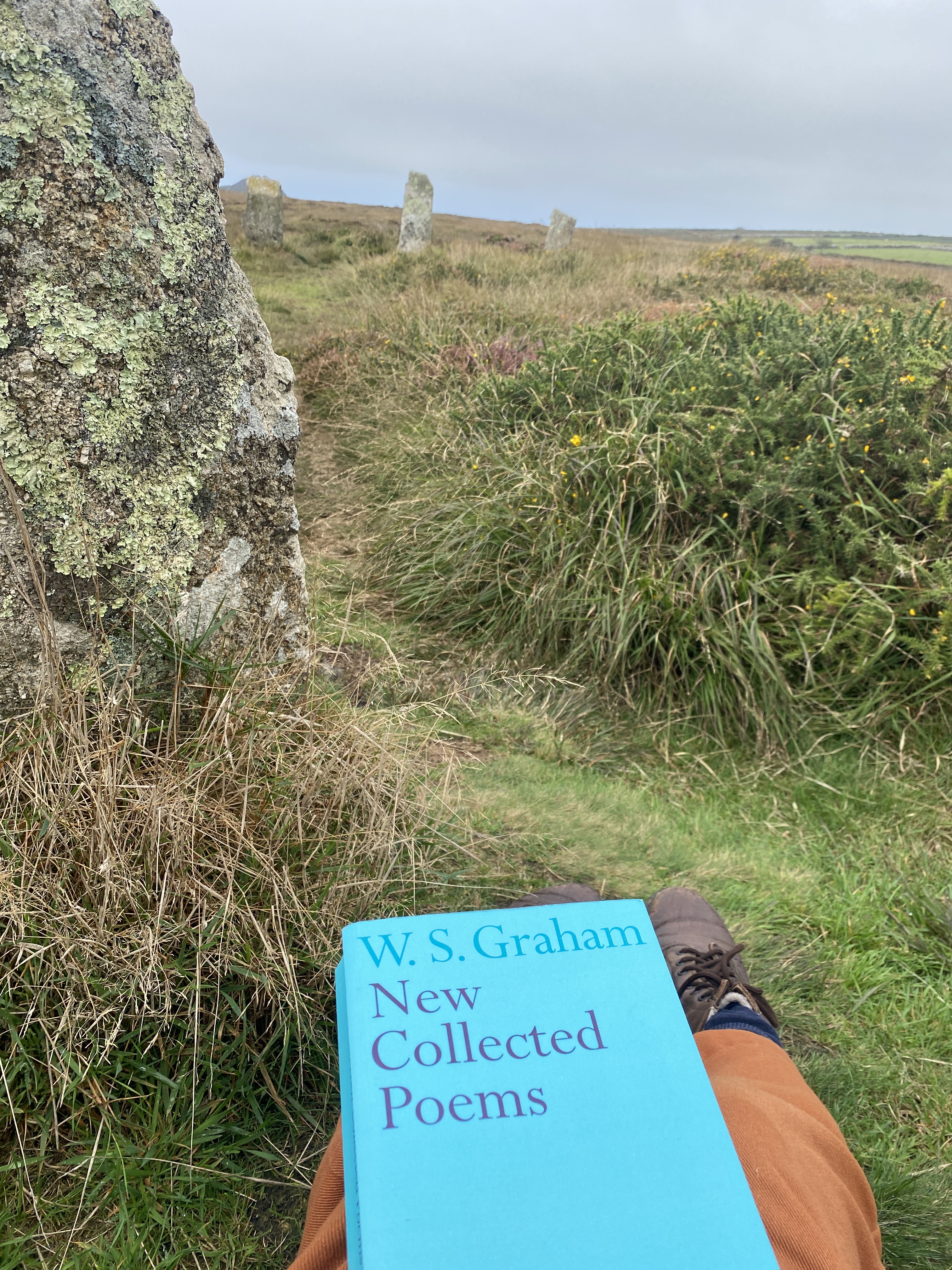
I’m on the twelve-hour CrossCountry from Penzance to Edinburgh. Penzance is the most westerly town in Cornwall and being this close to the edge of something calms me. I always sleep better by the sea. On my way here, on the Great Western Railway, a woman gifted me a glass sculpture with a rainbow inside it, as thanks for helping with her bags at Truro. ‘It’s for stirring your drinks’. For the past week, I’ve been writer in residence at The Grammarsow: a project which brings Scottish poets to Cornwall in the footsteps of WS Graham, who was born in Greenock but spent much of his life down here, making a home of Madron, of Zennor, of the moors. To say this has been a magical week is to say it changed me. I first came across Graham when the poet Dom Hale sent me a voice note of his elegy, ‘Dear Bryan Wynter’, out of the blue; I immediately went out and bought another bright blue, the Faber New Collected Poems. There was something about that foxglove on the wall and the hum of some memory in childhood, watching the bees.
Graham grew up in Greenock, on the Inverclyde estuary. A town where I used to teach writing workshops at the Inverclyde CHCP, taking weekly, then fortnightly trains with our chitty from Glasgow. That time in my life is a blur of shift work, seasonal overhaul, hopeless crushes. I’d get there early to look at the lurid flowers in Morrisons with Kirsty, my co-tutor, or visit the docks alone. Sometimes, I brought my little heartaches to the docks because the air felt smelted, or salt-rinsed, excoriating. The nature of these workshops was that people would share their life stories of such intensity we’d bear them home. I remember one woman writing a story about the moon, ‘we share the same moon’: the one thing connecting her, unconditionally, to her estranged daughter. Many people with stories of recovering from addiction through returning to childhood pursuits: the fishing taught by their fathers, the harbour walks, the musical grammar of language. Graham was trained as an engineer and spent some time on fishing boats, but dedicated most of his life full-time to poetry. The more I learn about this, the more I pine for the shabby romance of that clarity of pursuit. Not as a sacrifice but a great generosity from him, like a penniless rock star.
I’m sure it took a toll on his friends. Graham sent many a letter pleading neighbours and pen pals for the loan of a pound or a pair of boots, once thanking the artist Bryan Wynter for a pair of second-hand trousers. His letters are documents of a life lived in gleaning, bracing the elements, enjoying his wife Nessie’s lentil soup and of course, drinking. On a ‘bleak Spring day’ in 1978, by way of a quiet apology, he pleads with Don Brown, ‘I was flippant in the drink when you came with your news […]. Please let me still be your best friend’. He was often full of fire, a real zeal, taking poetry so seriously but life a strange lark, ‘speak[ing] out of a hole in my leg’. He wrote to his contemporaries — artists such as Ben Nicholson and Peter Lanyon, Edwin Morgan, along with family and friends — with bags of personality, a man self-fashioning in the long blue sea of ‘I miss yous’. As he wrote to Roger Hilton:
We are each, in our own respective ways, blessed or cursed with certain ingredients to help us for good or bad on our ways which we think are our ways. What’s buzzin couzzin? Love thou me? When the idea of the flood had abated a hare pussed in the shaking bell-flowers and prayed to the rainbow through the spider’s web. I have my real fire on. I am on.
The real fire may have been a woodburner, sure, but it’s something lit within him. The letter as a turning on, turning towards: we see this spirit of openness and address in the poems. The real commitment to Lyric. I love the hare that shakes in the flowers with its rainbow religion. I love the flush of arousal from walking uphill at speed. I saw many a spiderweb and two hares chasing each other on dawn of Thursday. On the train home texting many friends as if to have the rush of being held again, ‘Love thou me?’, could I be so vulnerable. A foxglove shook in the wind. The line as a tremble is lesser felt in the steady verse. Clearly, Graham wasn’t afraid of sincerity, though he always took pains to remind his addressees of his roots. ‘No harder man than me will you possibly encounter’, he assures Hilton; elsewhere, after the death of Wynter, he writes to his Canadian friend Robin Skelton of the coming funeral: ‘Give me a hug across the sea. […] I am not really sentimental. I am as hard as Greenock shipbuilding nails’. In a way, the infrastructure of space inflects the language as its face. I’m reminded of a quote by Wendy Mulford which Fred Carter shared at the recent ASLE-uki conference in Newcastle, where she talks about ‘attempting to work at the language-face’. I wear the face of the land, Graham seems to say, and the build of it. At West Penwith, we face the end of the land, literally Land’s End to our west. It is sometimes a silver gelatine, other times a bright blue, a fog grey thicker than thought. A granite-hard land that nonetheless sparkles. I recall a rock on the beaches of Culzean, in South Ayrshire, we’d come across as kids. Mum called it a ‘moonrock’ or a ‘wishrock’. It was a perfectly huge dinosaur egg of white granite. I find this particular rock showing up in my dreams, even now; as if having touched it, I become complicit in a deep time that doesn’t so much store the past as bear its promise. What could hatch from within a rock like that? What could move it, or hold it?
Graham had the idea of poetry’s ‘constructed space’, what I’d call a lyric architecture for reassembling something sensuous in memory or emergence. That this space isn’t just designed (as in my idea of architecture) but constructed points to that emphasis on building. What kinds of muscle, time, effort of spirit and will go into this? The poet Oli Hazzard writes that one of the effects of Graham’s poetry is ‘that I feel like it allows me—or, creates a space in which it becomes possible—to see or to hear myself’. Graham’s poem ‘The Constructed Space’ opens with the line ‘Meanwhile surely there must be something to say’. I always hear it in the lovely vowels of his Inverclyde accent, assuring. Like he’s sitting with you in the poetry bar, two pints between yous, and the poem gives this permission to talk or make space to listen. I think of Denise Riley’s ‘say something back’. My own need always to blurt, interrupt, muse out loud what mince is in my head. It continues:
[…] at least happy
In a sense here between us whoever
We are.
As I write this, light dances on the opposite wall of my tenement flat and it’s prettier than anything given to me by the window. Sometimes my love says I am harsh when they need delicacy, and so I soften the heather of my voice to listen. It’s true that I was happy while reading that poem, a happiness or lightness in the brain as precarious as the light is. Changeable and easily blown further west to let in what fog, or dimness. I don’t mind my brain when I’m in Graham’s poems. By which I mean, it’s no longer a drag to be conscious or sad; things move again, their metaphors in process. There’s a lightness to quietude, its intimate premise, that holds me. Nothing extreme is promised here, ‘whoever / We are’: lyric address sent through ether to find that ‘you’, held in the future’s new ‘us’. It’s better than a page refresh, reading the poem to think something Bergsonian of the self’s duration. I’m more snowball than the first maria who read this. It’s a kind of exhale, in a sense, like Kele Okereke singing ‘So Here We Are’ from an album named suitably Silent Alarm. Imagining my loves at the same time, out in Stirlingshire lying tripping by the loch, their eyes skyward, the high or low. I cherish that wish you were here / so here we are. I can look out from inside the constructed space of the poem. Wheeeeeeeeesht, you. You’ll find constructed spaces everywhere in Cornwall. The lashing blue skyscapes of Peter Lanyon, the abstract panoramas of Ben Nicholson, the ambient plenitude of Aphex Twin (especially ‘Aisatsana’ and most things from Drukqs). I want ambient or abstract art to give me the clouds in my head back to myself, with the light of it. Colours, gestures, fractals, lines.
~
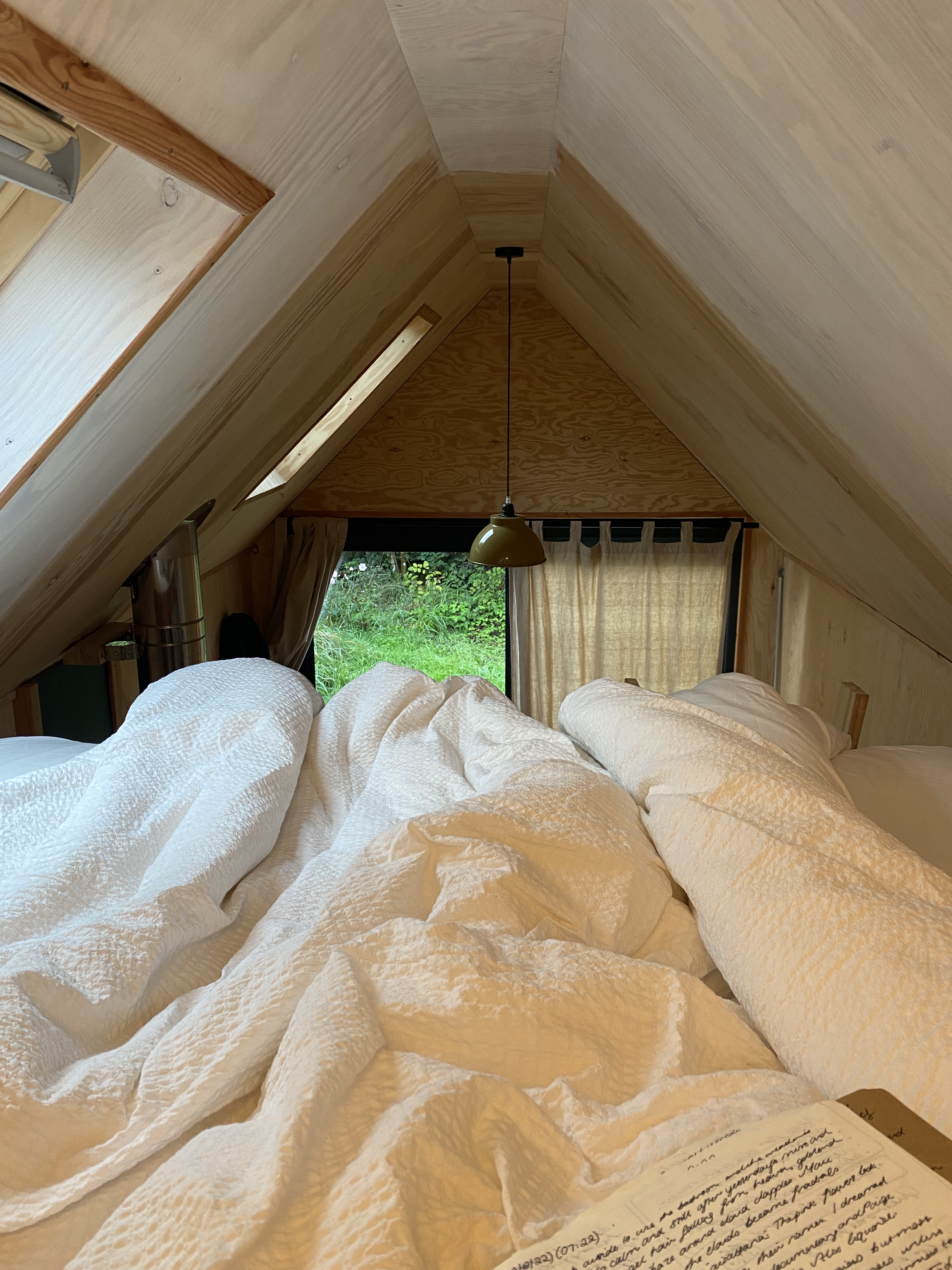
I’ve spent the past week schlepping around the moors and lanes, reading Sydney Graham’s poems and letters, cooking veg on my wee stove and eating simple marmite and butter sandwiches. I have this grandparent on my mum’s side who shared his name, who died of cancer before I was born. Sydney was the name Graham tended to go by, signing letters. It’s not that I’m looking for literary fathers but I stumble into their charismatic arms all the same. Is it guidance I look for, or perspective? I love the rolling enthusiasm, pedantry and chiding of his letters, as well as their cheekiness and charm. His dedication to writing and reading, his swaggering or boastful tendencies after an especially successful performance (coupled with an irresistible gentleness and warmth). His big sweet expressions ‘THE MILK OF HUMAN KINDNESS IS CONDENSED – TTBB)’, ‘IMPOSSIBLE TALK’. TTBB is the slogan of Grammarsow and a familiar exhortation in Grahamworld, meaning Try To Be Better (the title of an excellent anthology of Graham-inspired poems, edited by Sam Buchan-Watts and Lavinia Singer). I summon my voices, I try to be; used to be; want us to be.
There’s a quietude I love about the work, which suits the land and mind. After a summer of working three paid jobs, and two voluntary, I was ready for a gearshift into something relaxed and focused. I’d had enough of my own ‘impossible talk’. Being here was like being given permission to play and explore. Quickly I realised my time didn’t need to be ‘dedicated’. I lived by the cruising whim of the big sky, its scrolling clouds and moodswings. Saw the moon at two o’clock in the afternoon. I watched dragonflies dart between the lanes, listened to my neighbourly ravens at night. Watched big jenny long-legs make flickery silhouettes on the walls. Slept peacefully with spiders above me and the ravens being craven. I wanted all these things in my poemspace, and the poems themselves were initially scarce, then they began a familiar elongation that was comforting, with the swerves of a bus but also the tread of a walk. Some poems wanting to hide themselves between logs where I might later try and find them.
~
A grammarsow is the Cornish name for a woodlouse, or what we’d call in Scots a slater. I remember growing up and having this internal argument about language: was I to go with what my English mum said, or everyone at school? Aye or nay, yes or no. At some point I realised it wasn’t a question of scarcity and elimination, but abundance. The words became barnacle-stuck from all over the sloshes of life, swears and all, and I cherished their stubbornness. Even those gnarly, uncommon words and spicy portmanteau like ‘haneck’, ‘gadsafuck’, ‘blootered’ and ‘glaikit’. And yous: the juicy, plural form of you. Addressing the crowd, the swarm or many. A woodlouse is a terrestrial crustacean drawn to damp environments. I grew up with woodlice crawling out from under cracked kitchen tiles, unearthing raves of them hidden under rotten logs, finding them in tins of old paintbrushes or sometimes a bag of flour or sugar. I always liked the way their little legs seemed translucent, a little alien, and was especially seduced by their darling tendency to curl up into a ball, for protection, like Derrida’s idea of the poem as hedgehog.
Across the English language, there are many amazing names for the humble woodlouse, not limited to:
What is this penchant for lists I share with Graham? I want abundance from something other than products. I’m dumbly monolingual and lists are one of the few ways I can accumulate nuances of meaning. My attention-disordered brain collects lists as procrastination for the Thing itself, what is it I should be doing, always on the tip of some other event horizon bleeding through the last and first, so nothing is really finished. I like that in West Penwith, to look at the Atlantic you don’t see any islands, so there doesn’t have to be an end. You have the illusion that there can always be more time. The sea as this list of limitless light, colour shift, unbearable senses of depth. You are here.
~
The grammarsow crops up in Graham’s letters. In a missive to Robin Skelton, he muses:
And what are we now? Maybe better to have been an engine-driver in the steam-age. A sportsman a shaman a drummer a dancer rainmaker farmer smith dyer cooper charcoal-burner politician dog bunsen-burner minister assassin thug bird-watcher poet’s-wife queer painter alcoholic ologist solger sailer candlestick-maker composer madrigalist explorer invalid cowboy kittiwake graamersow slater flea sea-star angel dope dunce dunnick dotteral dafty prophesor genius monster slob starter sea-king prince earl the end.
Again the ‘steam-age’ of other infrastructures interfacing language. Better to have been a wave engineer in the renewable(s) era. I find myself somewhere between the ‘ologist’ and the ‘angel dope’, strung out on critique, measure and the promise of sensuous oblivion. Not sure if the dope is connected to the dunce or angel, but I’ll claim it spiritually as something good: an enhanced performance. As in, those are dope lines I’m reading. Do you want some? ‘And what are we now?’ not who, but what. A question I want always to ask — it’s almost Deleuzian — with someone in my arms or the sea swishing up to waist height, a sea-star clung to the hollows behind my knees. What’s possible when shame is gone. I love tenderly Graham’s list of possible existences and wonder how many I might retrain as (O genius monster), keeping in mind Bernadette Mayer’s old quip that all poets should really be carpenters. I love the raggedness of letters, which is why I love blogs (letters to the idea of being read). Who are they for? We’re so lucky to have these old ones, bound for us, evidence to the material conditions for our wild imaginaries.
~
In Cornwall, I love falling asleep. I love falling for new poems, stumbling a little on the rugged paths, falling for the air and water, for a little more mermaid’s ale or Bell’s, a blackcurrant kombucha or 100g of coconut mushrooms. In his essay for Poetry Foundation, ‘This Horizontal Position’, Oli Hazzard writes about a time Graham ‘went for a walk on Zennor Hill in Cornwall and fell into a bramble bush’. This falling was a repeat pattern: in 1950 he drunkenly fell off a roof and complained of his three-month hospital stay, ‘I hate this horizontal position’. In my DFA thesis I wrote extensively about lying down as a beginning for writing, the horizontal as a form of refusal when it comes to the upright requirements of an assertive ‘I’. It’s no secret that I prefer poetry in the mode of dreamtime, but that’s not to say I’m also a rambler. It’s a poetry of breath and of steps (of vigour!) I enjoy in Graham. Zigzagging and winding down well-trodden moor paths, stumbling upon bridleways that lead around the hills from holy shrines.
I was the lucky poet to first bless a new writer’s cabin that my host, Rebecca, built on some land near the Ding Dong Mine. From the garden, you can see right out over Mount Bay. The skies are huge here. I’ll say that a lot. I saw a seal down by one of the zawns on the north coast, felt the fear of losing the moon in you, let my lips chap on the telepathy of remote secrets. I try to be better, regardless. My poems become languorous obscurities. All of the land has hidden depths.
~
There was a summer before secondary school when we were gifted an unlimited pass to Historic Scotland, meaning our holidays involved camping across Dumfries and Galloway, the Trossachs, the Highlands, in search of abbeys, monasteries, castles and holy sites in various states of decay. I was turned off by leaflets documenting the actual details of history, emerging sleepy-eyed from the car where I’d been navigating the turgid sentences of fantasy novels or playing platform games like Super Mario. There’s a particular form of carsickness that produces electrolytic effects conducive to imaginative ventures. What I mean to say is, instead of vomiting I overlaid the real world with the promise of portals to elsewhere. In Penwith, I walk off my city sickness and sit by the standing stones, quoits and old ruins of industry. What do I imagine but a ‘news of no time’, still to come? Zennor Hill is both poem and place. The more I’m here, the more a sort of aura thickens.
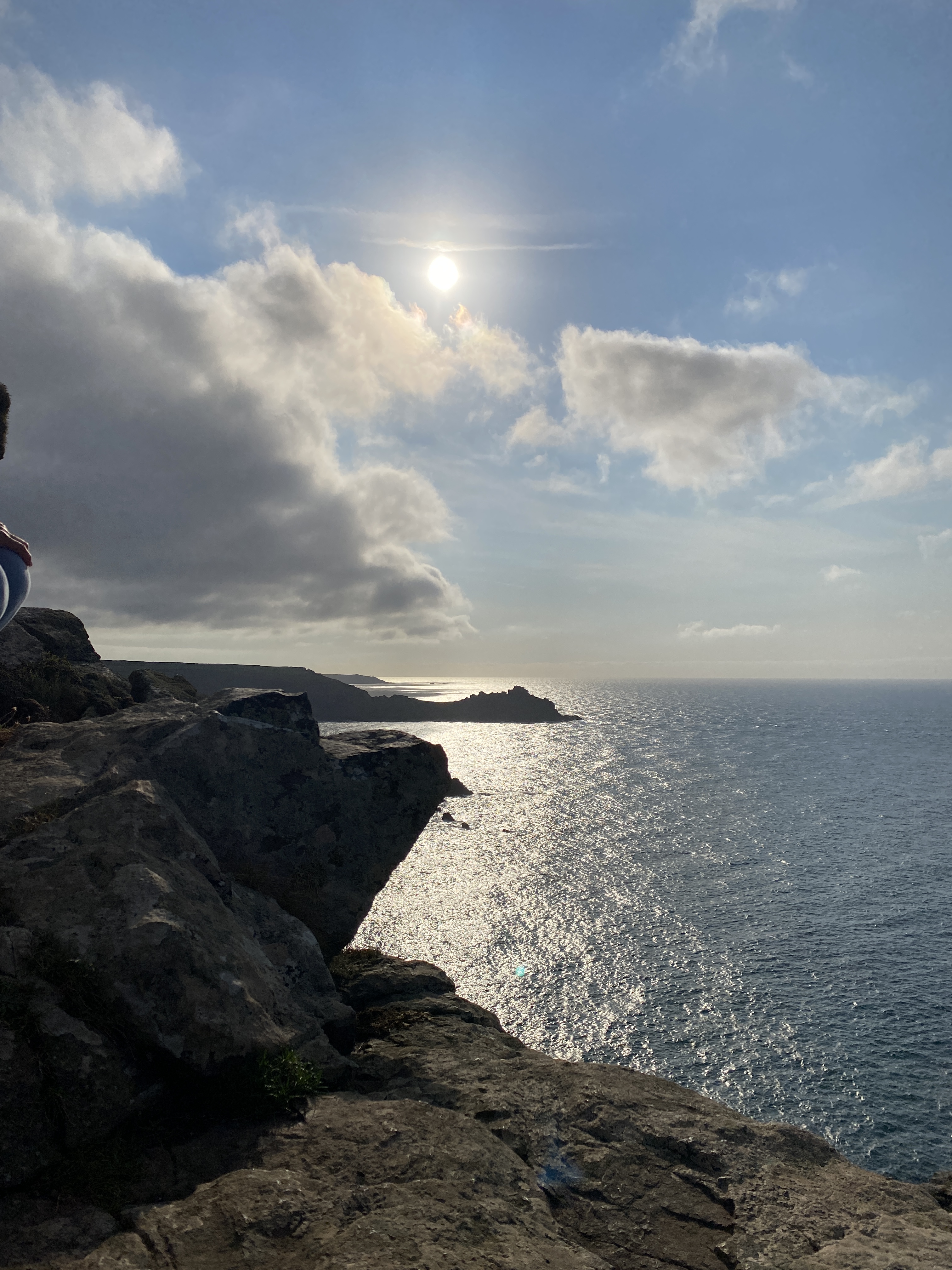
On my last morning, I wake to sunrise over the sea. Dew shimmers the rosehips. The air is earthsweet as ever and I don’t know how I’ll go home. Travelling is an experience of dislocation: here, I find home again in language, its caught habits, Graham’s words sluicing Clydewards. There’s a poise to his poetry, steadfastly composed as ‘verse’ and often by iambic measure. Making perfect prosody with the chug of the train. I was pleased to roll into Glasgow having bumped into my friend Kenny, the whisky god of the Hebrides, attuned to the flight-pulse of conversing again. Hungry, ‘putting this statement into this empty soup tin’ to say cheerio as Sydney would, lighting up poetry to finish it, the best thing of all, a warm scaffold to hold up how we missed each other. A quiet disintegration of cloud. What are we now?
With thanks to Andrew Fentham, David Devanny and Rebecca Althaus for kindness and hospitality. Long live The Grammarsow!

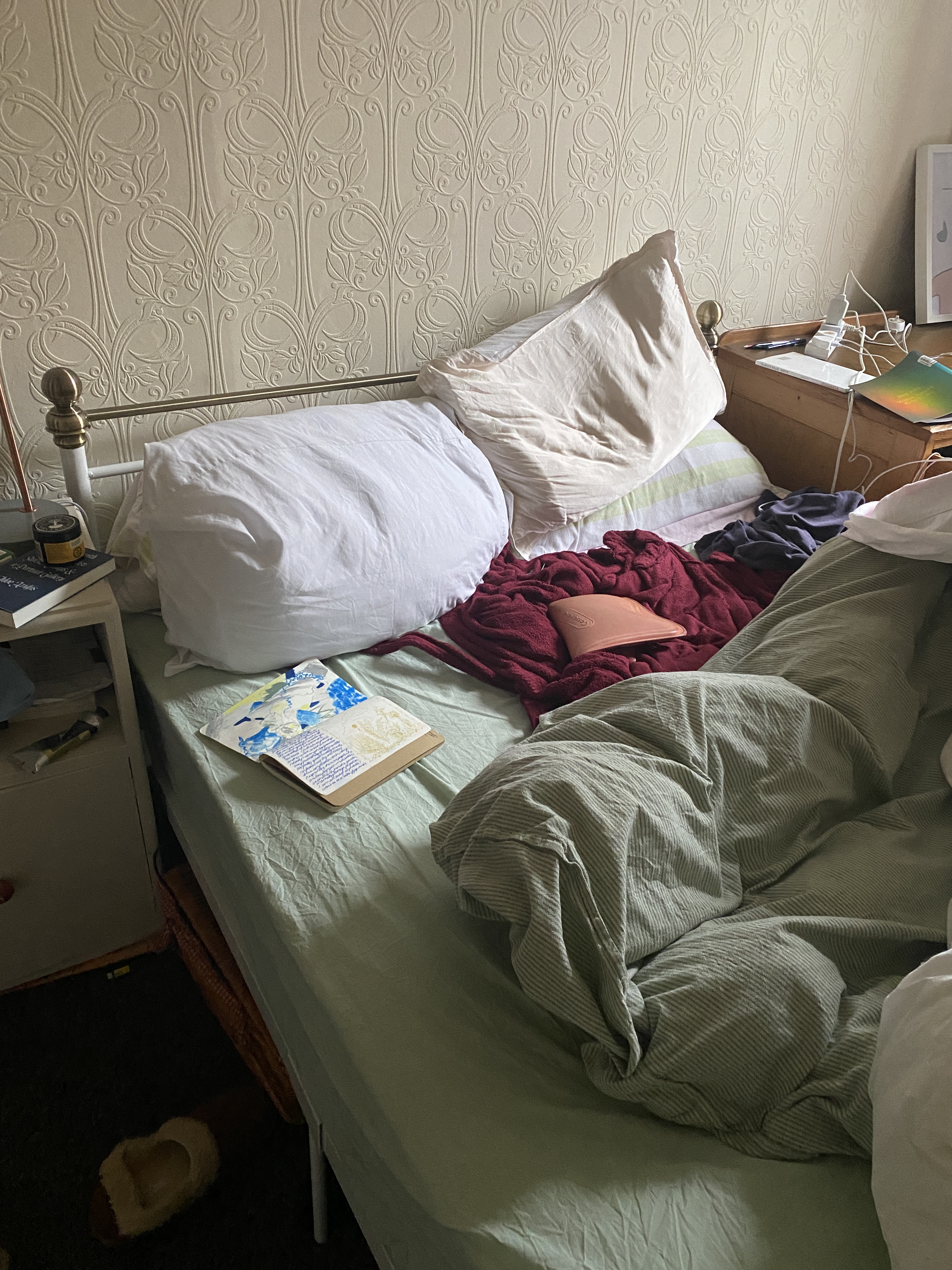
It was the morning I had decided to stop living as if dust wasn’t the primary community in which I sobbed and thrived, daily, towards dying. I spent Tuesday night in a frenzy trying to discern what particular dust or pollen (animal, vegetable, floral) had triggered my allergies anew, what baseline materiality had exploded in my small room its abysmal density. All recommended air filters had sold out online in the midst of other consumers’ presumably asthmatic dust panics; the highly desirable Vax filter seemed sold out across all channels, and I eyed up the pre-owneds of eBay with lust and suspicion, through a fug of beastly sneezes. A friend recommended the insufflation of water as a temporary remedy: ‘I drop some drops on my chopping board, get a straw and snort it up like a line of Colombian snow’, he texts me. I sneeze at the thought, but have to admit that the promise of clearing one’s nasal cavities with water is somewhat appealing. For isn’t water, like sneezing, a force in itself? Some kinds of sneeze come upon you as full-body seizures of will; so that to sneeze repeatedly you must surrender an hour or so, sometimes a full day, to the laconic state of being constantly taken over by this brute, unattractive rupture. ‘Sneezing’, writes Pascal, ‘takes up all the faculties of the soul’. My soul is in credit to the god dusts, who owe me good air. It’s why I am always writing poems (the word air meaning song/composition). But maybe I need good water, a wave of it.
In Syncope: The Philosophy of Rapture (1990), the philosopher Catherine Clément characterises sneezing as an instance of ‘syncope’: a kind of ‘“cerebral eclipse,” so similar to death that it is also called “apparent death”; it resembles its model so closely that there is a risk of never recovering from it’. My muscles ache; I eclipse myself with blood, cellular juices and water. What kind of spiritual exhaustion results from being cast into eclipse repeatedly? Quite simply, one becomes ghost: blocked, momentarily or otherwise, from the light of consciousness. One becomes lunar and attached to the dark bright burn, the trembling red of their inflammation. Those who suffer respiratory allergies might better glimpse what Eugene Thacker calls ‘a world-without-us’. I sneeze myself to extinction. It is the hyperbole of a felt oblivion. I do this on random days of the year, at random times; it is beyond my control. But can I derive pleasure from it, as one does the other varieties of syncope (orgasm, swoon or dance)?
Let me admit, I have always had a fetish for those moments on television and film where a character is administered, or self-administers, an intravenous dose of painkill so sweet as to enunciate this ecstasy simply by falling to a sweet slump, their eyes rolled back accordantly. The premise of silencing the body’s arousal so completely to blissful inertia (suspending the currency of insomnia, hyperactivity, anxiety and attention deficit) is delicious. The calmness of snowfall, as if to swallow the durée of its full soft melt. From quarantine, I fantasise about having adequate boiler pressure as to run a bath and practice the khoratic hold of hot water’s suspension. This is not what I text my landlord.
Recently, my partner spent several hours unpacking boxes from the attic of their parent’s house, in preparation for moving belongings to a new flat. The next day, I found myself suffused in the realm of allergy: unable to think clearly, or articulate more than three words without the domination of a sneeze. On such days, I am held on the tight leash of my own sensitivity: I tremble pathetically, my blood temperature rises; my nose glows reindeer and no amount of fresh air, hydration or sinus clearance will appease it. I am not ‘myself’. The body has enflamed itself upon contact with the ambient and barely visible. I feel an intimate, but non-consensual relation to the ghost trace, the dust trace, of all boxed things — finally been given the attention they so summoned or desired in dormancy. I mourn with objects the passage of time and neglect so betrayed on their surface; I never ask for this, but my body is summoned. Dust presses itself upon you, even as you produce it. I’m scared to touch things because of the dust. What is it but the atmospheric sloughing of something volatile, mortal — the grammatology of our darkest spoiler, telling the story of how bodies are not wholly our own, or forever.
Sneezing disrupts and spoils nice things; it is an allergic response to both luxury and decay. Cheap glitter, rose spores, Yves Saint Laurent. Sneeze sneeze. ‘When a student comes to class wearing perfume’, admits Dodie Bellamy, ‘my nose runs, my eyes tear, I start sneezing; there’s nowhere to move to and I don’t know what to do. When the sick rule the world perfume will be outlawed’. Often I have this reaction too. It prompts a fury in me: Why can’t I have nice things, as I used to? During my undergraduate finals, I developed phantosmia: a condition in which you smell odours that aren’t actually there (olfactory hallucination). Phantosmia is typically triggered by a head injury or upper respiratory infection, inflamed sinuses, temporal lobe seizures, brain tumours or Parkinson’s disease. Often I have tried to conjure some originary trauma which would explain my condition: did some cupboard door viciously slam my head at work (possibly), did I fall over drunk (hm), was I subject to some terrible chest infection or vehement hayfever (often)? Luckily, my phantosmia was a relatively benign and consistent scent: that of an ersatz, fruity perfume. It recalled the pink-tinted Poundland scents I selected as a twelve-year-old to vanquish the horror of body odour raised by the spectre of Physical Education, before graduating to the exotic spices of Charlie Red. I was visited by this scent during intervals of increasing frequency as I served customers at work, cooked or studied; I trained myself to ignore them by pinging a rubber band on my wrist, or plunging my nose into scented oils I kept on my person. Years later they returned at moments of stressful intensity; the same cryptic, sickly smell.
More recently, phantosmia, under the umbrella of a general ‘parosmia’ (abnormality in the sense of smell) is associated with Covid-19. Not long ago I realised I hadn’t been smelling properly for months, despite not testing positive until very recently. Had I, like many others, a ghost Covid that went undetected by symptom or test? Drifting around, deprived of olfactory sense, I felt solidarity with the masses of others in this flattened condition. I eat, but when was the last time I truly enjoyed food? My body doesn’t register hunger like other people’s; unless it is a ritualised mealtime summoned in company, I eat when I get a headache. Pacing around the flat, I plunge my nose again into jars of cinnamon, kimchi, mint tea bags, bulbs of garlic. Certain things cut through the fug: coffee, bleach, shit. I remember a friend, who was born without a sense of smell, telling me long ago that the absence of that sense made her a particularly spicy cook. Often she wouldn’t notice the over-firing of a chilli until her nose started running. What does scent protect us from? What does it proffer? Surely it is the unsung, primal gateway to corporeal desire itself: the gross and indescribable comfort of a lover’s sweaty t-shirt, the waft of woodsmoke from a nearby village, the coruscation of caramelised onion to whet your appetite. Scent is preliminary in the channel of want. Without it, I feel cast adrift into anhedonia. I begin chasing scent. Still, I sneeze.
Dust gathers. Is it yours or mine? Can we really, truly, smell our dust? How does dust manifest as material trace or evidence? In Sophie Collins’ poem ‘Bunny’, taken from the collection Who Is Mary Sue? (2018), the speaker interrogates an unknown woman on the subject of dust:
Where did the dust come from
and how much of it do you have?
When and where did you first notice
the dust? Why didn’t you act sooner?
Why don’t you show me a sample.
Why don’t you have a sample?
Why don’t you take some responsibility?
For yourself, the dust?
It would be perhaps an act of bad naturalisation to read the dust allegorically, or metonymically, as a figure for all kinds of evidence we are expected to produce as survivors of violence and harm. This evidence is to be quantified (‘how much’, ‘a sample’) and accounted for temporally in terms of cause, effect and responsible agency (‘first notice’, ‘act sooner’). The insistent repetition of dust produces a dust cloud: semantic saturation leaves us unable to discern the true ‘meaning’ of the dust. That anaphora of passive aggression, ‘Why don’t you’, coupled with the where, when and why of narrative, insists on a logical explanation for the dust that is apparently not possible. For anyone summoned to account for their trauma, the dust might be a sort of materialised psychic supplement: the particulate matters of cause and effect, unequally distributed and called for. It seems as though the speaker’s aggression, by negation wants to produce the dust while ardently disavowing the premise of its existence. The poem asks: is it possible to have authority over one’s experience when others require this authority to take the form of an account, a story, with appropriate physical corroboration? The more I read the poem, the more ‘dust’ becomes Covid. But it could be many things; dust always is.
‘Bunny’ also reveals the process by which testimony is absorbed into a kind of white noise, a dust storm repugnant to those called upon to listen. As Sara Ahmed puts it in Complaint! (2021), ‘To be heard as complaining is not to be heard. To hear someone as complaining is an effective way of dismissing someone’. Collins’ poem performs the long, grim thread of being told to ‘forget’, bundling us into a claustrophobia whose essence, the speaker implores, is ‘your own / sense of guilt’. Does this not violently imply (from the speaker’s perspective): as producers of dust, we take responsibility, wholly, for what happens to our bodies? I take each question of the poem as a sneeze: it is the only answer I have. I feel compelled to listen.
As she is asked, ‘Why don’t you take some responsibility? / For yourself, the dust?’, the addressee of the poem becomes conflated with the dust itself. I often think of this quote from Sylvia Plath’s The Bell Jar (1963), where erstwhile sweetheart Buddy Willard announces to budding poet Esther Greenwood, ‘a poem is […] A piece of dust’. Poems can be swept away; they are miniscule in the masculine programme of reality. They are stubborn, perhaps, but easily ignored by the strong and healthyy. In ‘Bunny’, the addressee’s own words are nothing but dust, ‘these words, Bunny’: the name ‘Bunny’ hailing something beyond the colloquial term, dust bunny — a ball of dust, fibre and fluff. The invocation of the name a kind of violent summons: you, the very named essence of you, are nothing but words and dust; there is no proof. The more I say the word ‘bunny’ aloud, the more I become aware of a warm and tender presence; this entity who has lived so long in the house of language — under the stairs, on the mantel’s sentence. Bunny, bunny, bunny. Clots in syntax. Dust can be obliquely revealed to all who notice; it coats the surface of everything. It is in the glow of wor(l)dly arrangement, the iterative and disavowed: a kind of ‘paralanguage’ Collins writes of in her nonfiction book small white monkeys (2017):
similar to ours but that is not ours […] when a writer manages — nearly, briefly — to access this paralanguage, we get a glimpse of what could be expressed if we were able to access this other, more frank (but likely bleak, likely barbaric) reality.
Running parallel to, or beneath ‘Bunny’, is the addressee’s reply, or lack of: the dust of her permeable silence, or inability to speak. It catches as a dust bunny in the throat. So how do we speak or listen, when faced with the aporetic knots of a hidden, ‘barbaric’ reality that is glimpsed in various forms of testimony and written expression? ‘Citation too can be hearing’, writes Ahmed. The title of Collins’ poem cites implicitly Selima Hill’s collection Bunny (2001), which she writes of extensively in small white monkeys as a book ‘I am in love with’. This citation opens ‘Bunny’ through a portal to the household of trauma that is Bunny: documenting, as Hill’s back cover describes, ‘the haunted house of adolescence’ where ‘Appearances are always deceptive’ and the speaker is harassed by a ‘predatory lodger’. Attention (and reading between texts) offers us openings, exits, corridors of empathy, solidarity and recognition. Its running in the duration of a poem or conversation might very well relate to the ‘paralanguage’ of which Collins speaks, in the oikos of trauma, grief and counsel. If poems are dust, then to know them — to write them, read them aloud and listen — is to disturb the order of things, one secret speck at a time. But the sight of each speck belies the plume of many.
The morning I tested positive for Covid on a lateral flow, having assumed my respiratory problems were accountable to generalised allergies, I decided to blitz my one-bedroom flat of dust. In the hot panic of realising my cells were now fighting a virus, I vacuumed my carpet and brushed orange cloths over bookshelves. I was really getting into it. Then my hoover began making a petulant, rasping noise. I turned off the power and flipped it upside down. To my horror, in the maw of the hoover’s rotating brush, I saw what can only be described as dust anacondas: huge strings of dense grey matter attached to endless, chunky threads of hair. Urgently donning a face mask, I began teasing these nasty snakes out with a pencil, as clumps of dust emitted from the teeth of the hoover and gathered on my carpet, thickly. All this time I was crying hysterically at the fact of my having Covid less than two weeks before my PhD thesis was due, the hot viral feeling in my head, and of having to deal with the dust of my own flesh prison: the embarrassment, shame and fail of it all, presented illustriously before me.
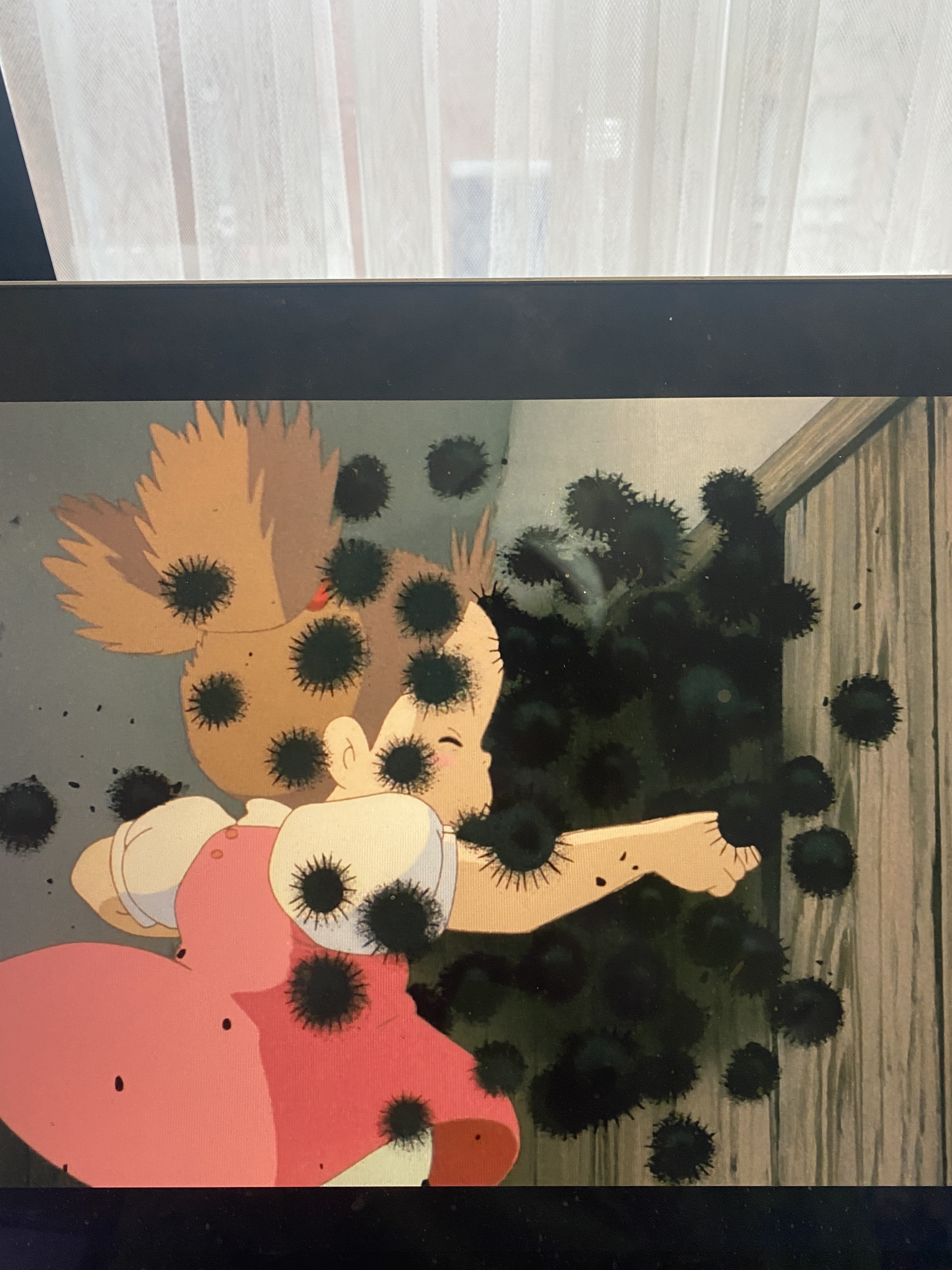
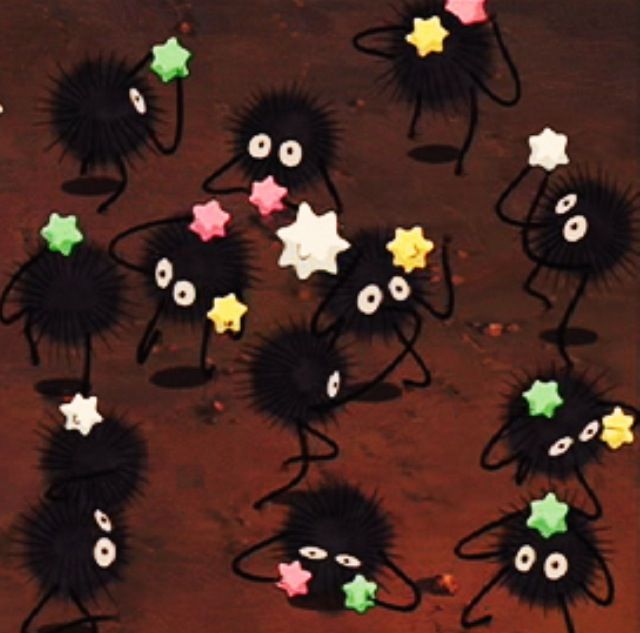
If only I could have purified my air! Forced to confront my body’s invasion (this time coronavirus, not just dust), I try to settle into the ‘load’. I make lists of the smells I miss, research perfumes online (aerosols glimpsed from the safe distance of text). I sneeze a lot, cry a lot, wheeze a lot; and then my sinuses go blank. Is this breathing? I imagine the cells of my body glowing new colours from the Omicron beasties. I re-watch one of my favourite Studio Ghibli movies, My Neighbour Totoro (1988), which features anthropomorphic dust bunnies known as susutarawi, or ‘soot sprites’ (which also appear in Spirited Away (2001)). The girls of Totoro, Noriko and Mei, initially encounter these adorable demon haecceities as ‘dust bunnies’, but later they are explained as ‘soot spreaders’ (as per Netflix’s Japanese-to-English translation). When the younger girl, Mei, gingerly prods her finger into a crack in the wall of the old house she has just moved into, a flurry of the creatures releases itself to the air. She catches one in her hands, and presents it proudly to Granny, a kind elderly neighbour who reassures her the soot sprites will leave if they find agreeable the new inhabitants of their house. When she opens her palms, the sprite is gone, leaving just a smudge.
An absent-presence in My Neighbour Totoro is Noriko and Mei’s mother, Yasuko, who is in hospital, recovering from an unexplained ‘illness in the chest’. Mei’s confrontation with the animated dust mites, or soot sprites, acts out the wound of her mother’s absence. With curiosity and panic, she and her sister delight in the particulate matters of the household, of more-than-human hospitality. What is abject about history then, or even the family, its hauntings, is evoked trans-corporeally through the trace materials of a powdery darkness, dark ecology (see Timothy Morton’s 2016 book of this name) that is spooky but sweet. (S)mothering in the multiple. My sense of smell now is consumed entirely by a kind of offbeat metallic ash; I’m nostalgic for cheap perfume. I’m not sure if this essay is a confession or who is speaking; it seems increasingly that I speak from a cloud of unknowing coronaviruses. And so where do I end or begin, hyperbolically, preparing my pen or straw? The ouroboros of my dust anacondas reminding me that I too was only here, alive and in this flat, by tenancy and to return from my current quarantine having prodded the household spirits for company, with nothing for show for it these days, except these, dust, my words.
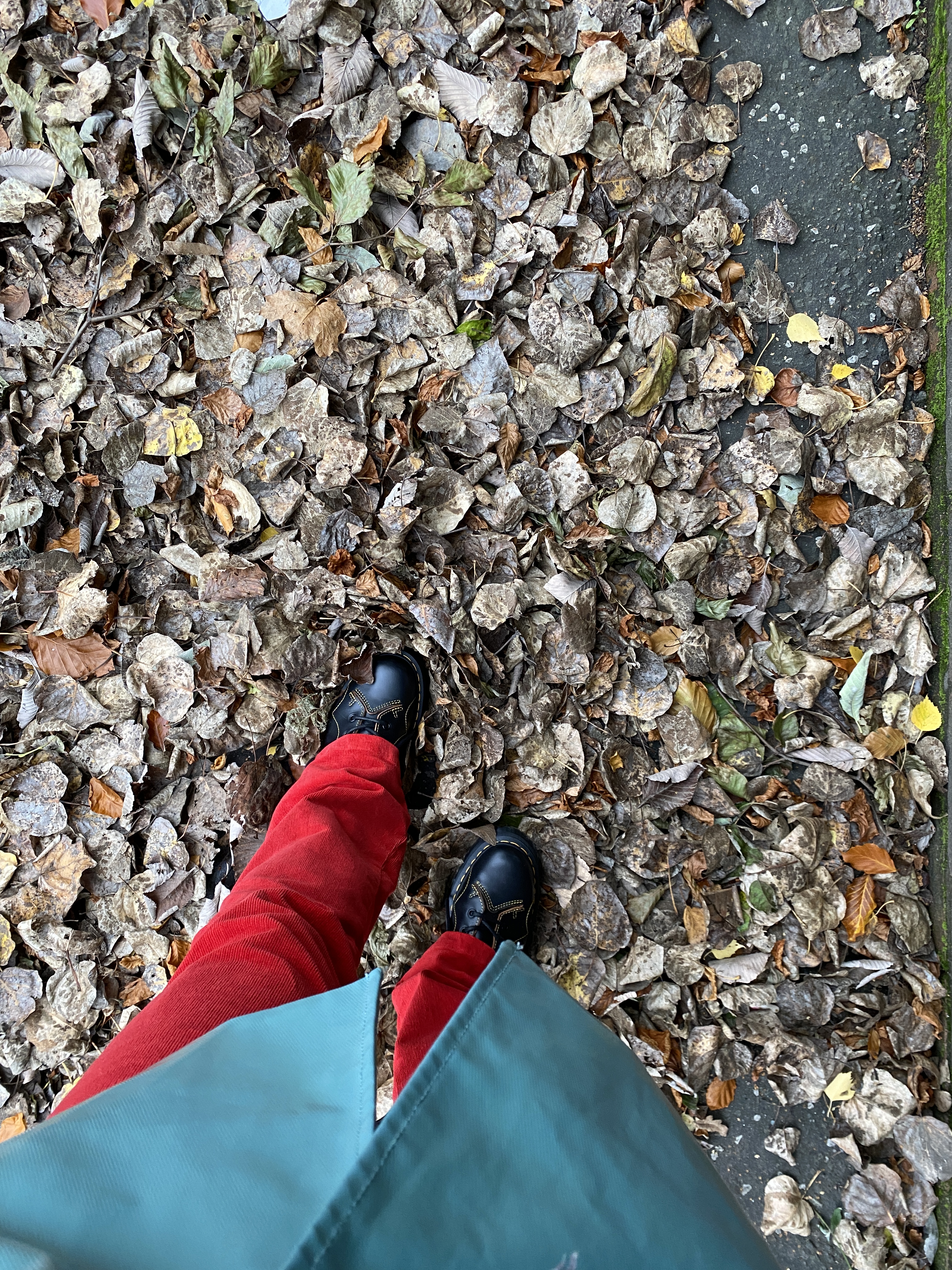
Wet-leaved, walking up hills with chain oil on my elbows, knuckles, knees. We are on the eve of the ‘big climate conference’, which is to say, to be a host city of preemptive closure: there will be no more roads so that nobody can block the roads without authority, no more bridges for your tiny feet. I imagine a commute that takes me north to Kirkintilloch and back along the canal, an extra hour and a half of leg power and stamina and to arrive like of a beetroot complexion to the moment when somebody speaks. These streets are mostly broken glassed, and I see nothing to sweep that; I see buildings go up, see extravagant plant life grow from abandoned houses. I dream about bike punctures from enormous shards of glass. A mushroom sprouts in the brutalist building. I should have planned to do something. More tired than words can.
Imagine awaking beautifully at 5am each day, to actual birdsong and car sounds, still going through the night to Edinburgh or the general east as they do. I miss the ocean, which I have not seen since May. Sometimes I forget that its quiet, rhythmic hush is always in my ears, a tinnitus with the switcher dimmed. All summer I swapped the ocean for industrial estates, teeming with buddleia. If I go to a club, it gets full bright. The hush. At 6am I make atomic coffee, await words, say rain. I could tell you about the new university building and how I will never find a space to work there, doomed to circle identikit floors like airports in a suspended time that nonetheless eats into my time of work, a starship, doomed to fill a cup of hot water and carry it up and down escalators only to be cast back outside with scalded hands, cried into blustering autumn. A hazmat suit to be a student, studying the microparticles of your love in blunder. If I could study on the floor, in the street, with the leaves stuck to me. But I am a sufferer of frostbite and poor circulation, owing to damp homes, an unfortunate experience in the snow and damaged nerves, fragile metabolism. I am not there anymore, in the place we have been
Canned words taste better with more salt on them. Fuck you. Sitting on the curb in the 1990s surprised us when a plane went by, it was carrying my childhood. Remember we used to put each other literally in bins, until that wasp stung your ass and I was sorry. We prise open tins for the juicy bits of the story like, what would it take to get the attention of a virulent benefactor? Should you become a red squirrel enthusiast, or take up the statuesque hobbies of sportsmen? What beneficent largesse would require it?
Imagine not living by the anticipatory hormone storm of a coming menstruation, or like, the cramping wildness of the night and morning or blood gushed trying to have coherent thought in the day when your mind is fog. I want to transcribe some of that fog to writing, to remember how it was when again I am in clearing, to be like this is the place, it’s never gone. I was held in it, the tearing itself to shreds sensation to write this at six in the morning before work. Plants don’t have to go through this; is it that they’re always ‘working’? How do trees feel when they shed their leaves? Is it like an annual period and do they miss them? Should I develop fondness for shreds of blood in the toilet, abject bits of me and not? I saw a leaf blush out of my mouth and into a leaflet. Smoking kills. I watch the men in high-vis sweep up the dead leaves, more like dying, into black bags by the side of the road. Someone around here is always burning rubber tyres in secret. It’s kind of erotic to watch people do something repetitive and with great concentration, as if no one else could possibly notice this. To do your work that way. O your beautiful butterfly shoulders. Missed opportunities.
For instance, I could have lived through this moment to learn another language, write a curriculum vitae for the purposes of waged employment, called you.
“It feels so good to walk in nature.”
Blood drop in the shape of sycamore.
Where is Canada?
The revenge fantasy is only that trees are flirtatious as hell, winking pollen so that you watery-eyed have to look up at the stars sometimes and beg, like take me. Let me out of the forest so I might see
(fantasies of committee,
the ground to tie
my own laces in figures of eights.)
Authenticity!
The figure of eight in Karla Black’s sculpture which is pink-smeared recalling everything I used to put on my face. The idea is to find a sort of peace with it. School bathrooms where a face was pressed against glass and cruelly examined. I dream of rooms filled entirely with blizzards of eighties-blue eyeshadow. Angel Olsen, 2014, Pitchfork Festival. Having lived with the spirit not for resale, traded on a stark memory of that colour where every remembrance seems to intensify blue, until all I have is the pigment itself, ultramarined into oblivion. To wake into that blue and not see beyond it. I put my sore arm through the right-hand loop of the eight and pulled this out for you.
In the dream we pass an armed convoy and into the bakery with coins allotted to us by authority figures, and we buy pastries adorned by sugar ice drawn in mobius curlicues, and the pastries flake away as we eat them, greedily on the street, so many flakes falling before the guards. And we are butter-mouthed in the face of conflict, war and summit. A kind of shout chokes the air but the golden morning goes on, the falling leaves. I have these cramps and double over in the falling leaves. Men come to sweep around me, where I have fallen. One of them bends down — he is so young to be working — and pats my head tenderly and I see a leaf fall behind him and I know that leaf to be us, so we embrace platonically for one moment, as though I were his long-lost twin, before the foreman calls his name, which I can’t recall—
No, not that at all — he touches the soft part of my ear, goes “are you not young to be leaving?”
In trash, the language of trash, the trash piled up against the highway of your declaration. The men stopped coming.
Azalea, camilla, plum blossom, hydrangea.
Rizla, tin foil, styrofoam, gum.
The noise of vehicles pulling up around the city, emitting fumes.
The petals shed and I sleep on them, dreaming my blue becomes turquoise
another morning where the sun won’t rise
until we are paid.
~
Painted Shrines, Woods – Gone
Au Revoir Simone – Stay Golden
Uffie – Cool
Margo Guryan – Something’s Wrong with the Morning
Green-House – Soft Meadow
Frankie Cosmos – Slide
Arthur Russell – A Little Lost
Grizzly Bear – Deep Sea Diver
Tricky – Makes Me Wanna Die
The Raveonettes – I Wanna Be Adored
Beach Fossils – Sleep Apnea
Lykke Li – I Never Learn
Cate Le Bon – Running Away
Vagabon, Courtney Barnett – Reason to Believe
Angel Olsen – Some things cosmic
Jason Molina – I’ll Be Here in the Morning
Cat Power – I Found A Reason

Literally every image link from one of my 2009 blogs now redirects to this; you can totally drop out of melancholy for a while but the cherry always finds you
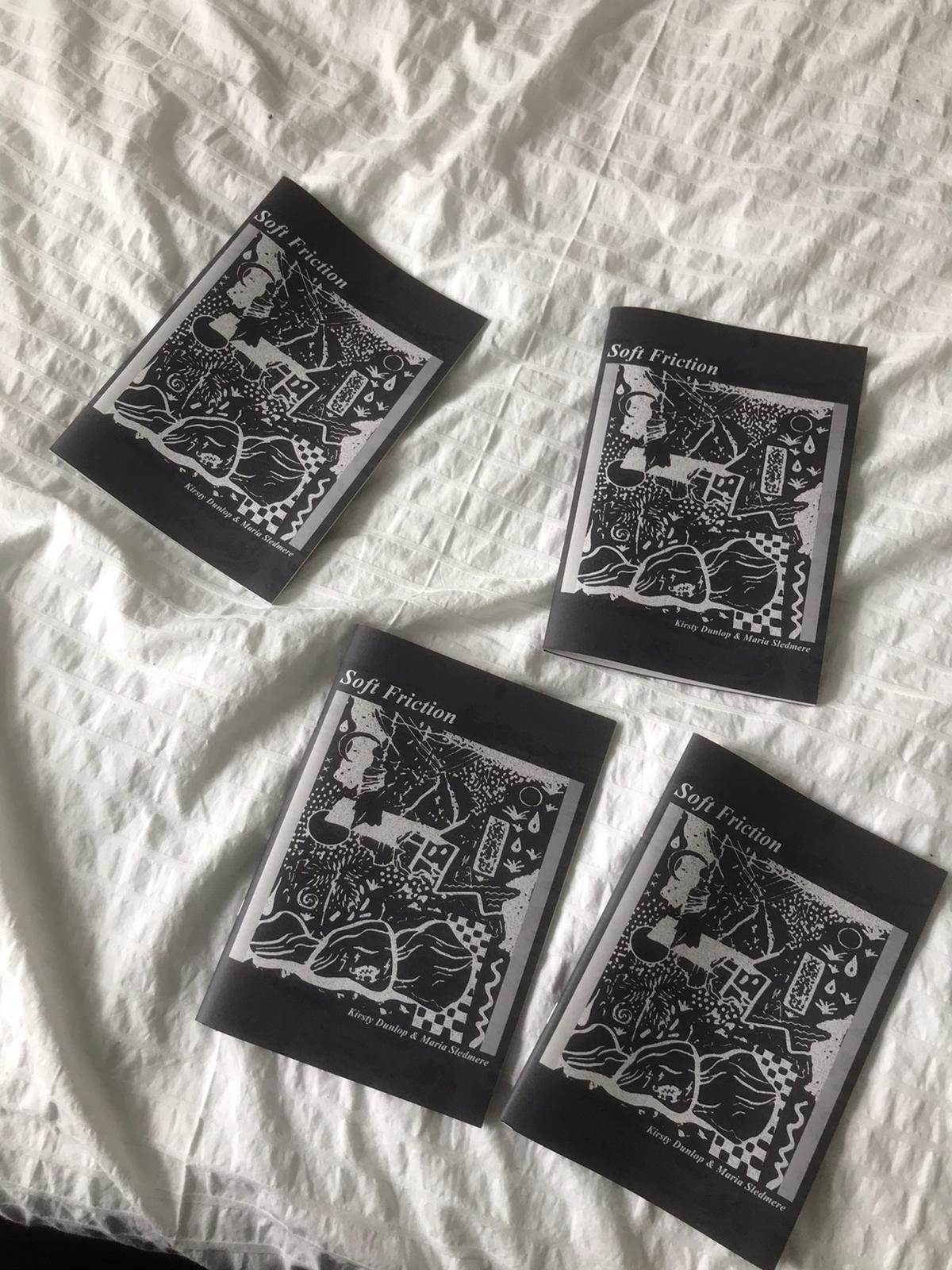
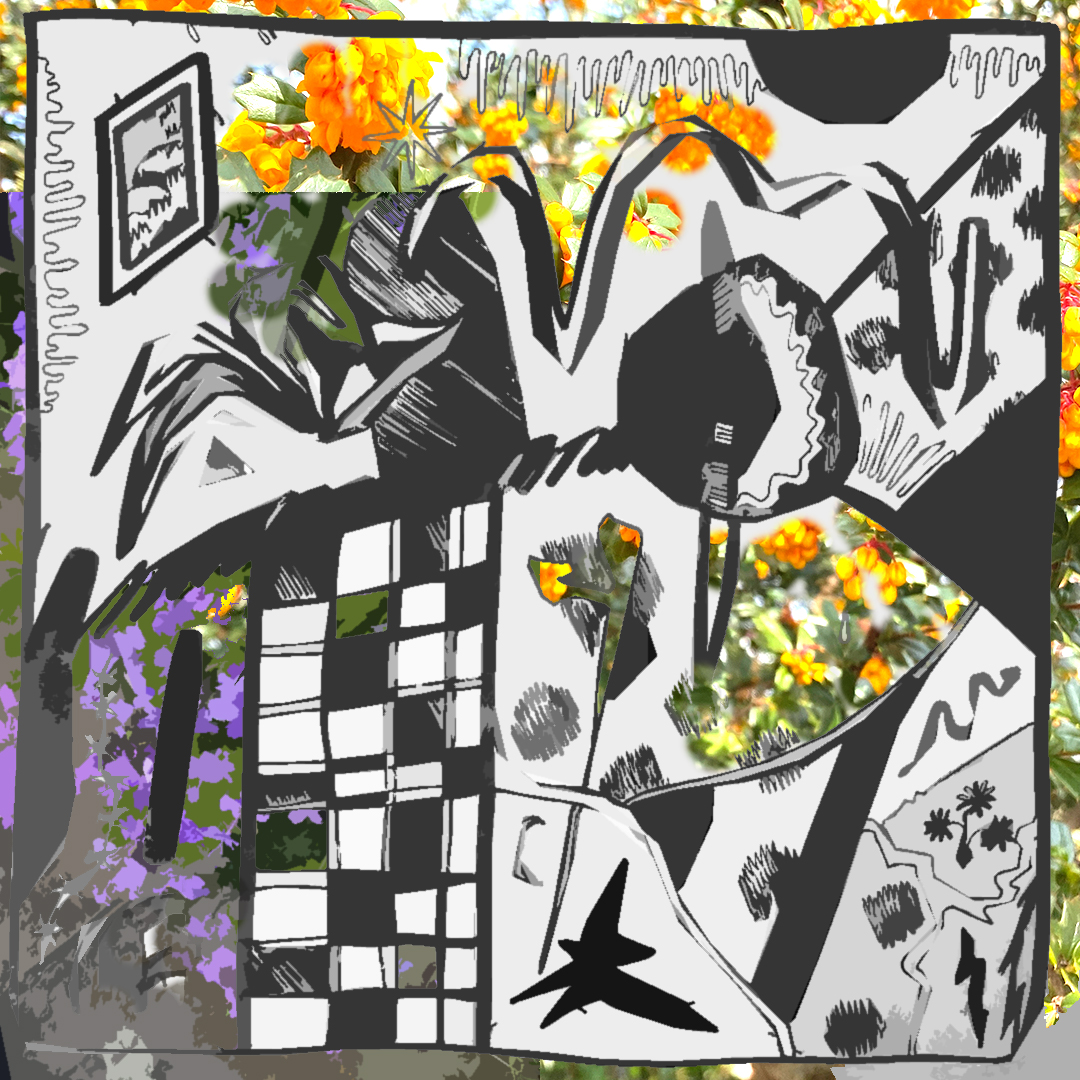
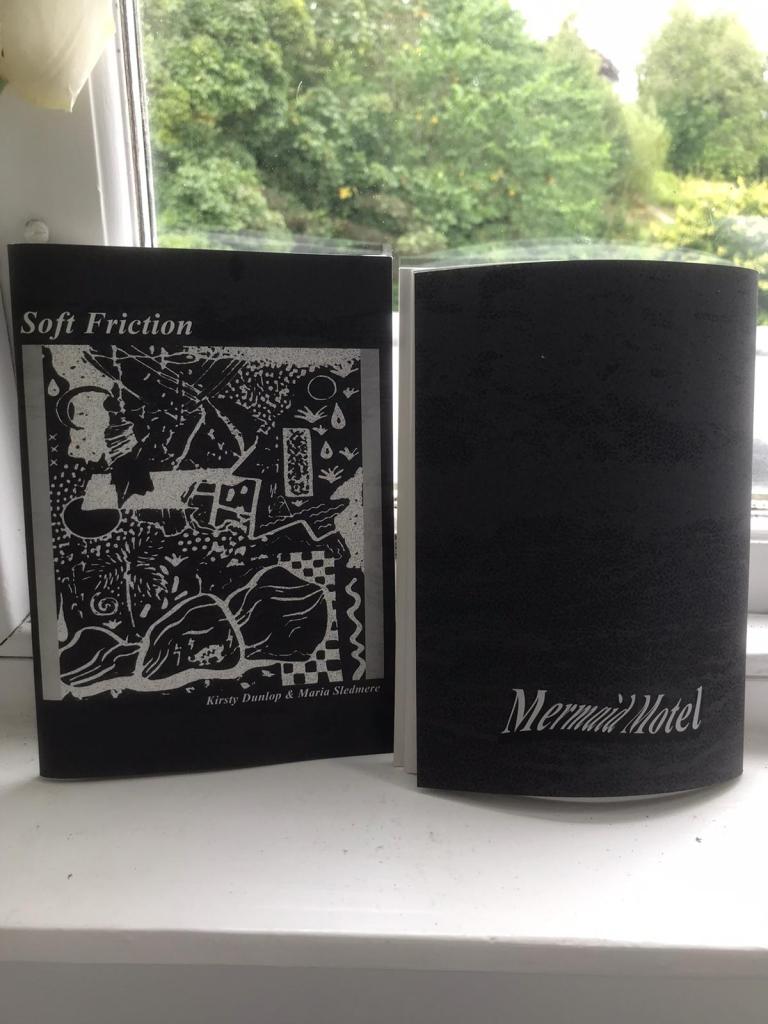
New publication: Soft Friction by Kirsty Dunlop and Maria Sledmere
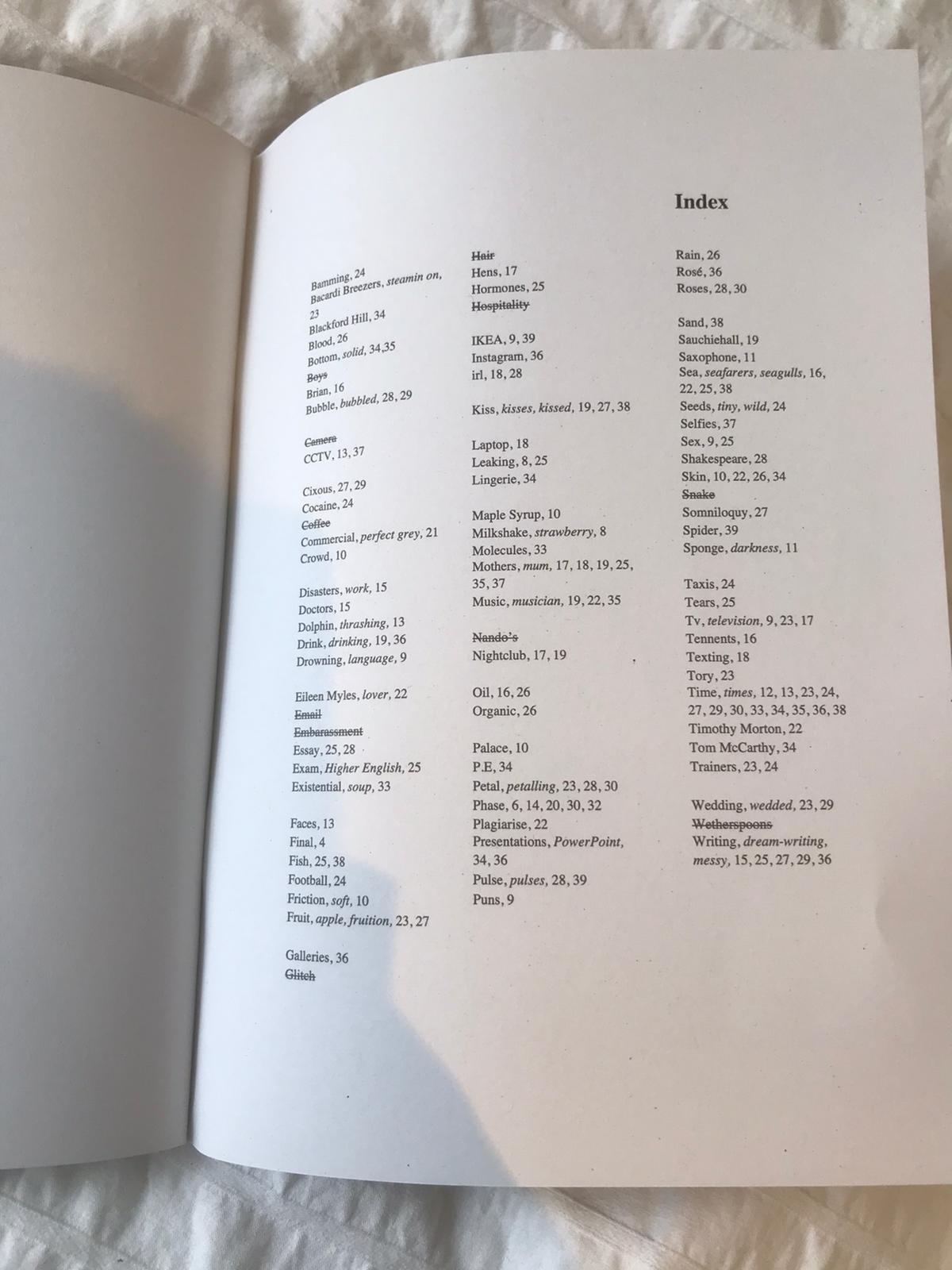
Here we present you a bundle of our dreams, wrapped in something like a rhythm, or did we mean a ribbon? Soft Friction is an intimate gathering of dreams from 2018, written during a summer of ‘existential soup’, fainting at gigs, pulling all-nighters and panic surrealism. Extracted from a longer diary, these fragments wear the sensuality and sass of an active dream life shared between two people getting high on each others’ brains. From dolphins thrashing in kitchens, to maths equations, celebrity encounters and shopping for underwear, the pamphlet runs through the four stages of sleep and wakes you with a cheeky tickle of incompleteness.
44pp (A5 B/W)
Printed on recycled natural paper 100gsm
Cover by Maria Sledmere
Published by Mermaid Motel
£5 inc. UK P+P
To order, email kirsty_dunlop[at]hotmail.co.uk or simply paypal £5 to this email with your postal address. For orders outside the UK drop Kirsty an email for postage.
Now available.
Last year’s April was a leap year. For every 29th day I summoned to think of the hours as gifted, secret, strength. I spent the actual leap of February in somebody else’s bed, a cherished cliché: cradling sadness, cat-sitting, reading Anne Carson and rolling the word ‘tableaux’ around my stressy mouth, whose hostile environment required twice-daily salt-rinses. On the 29th of last year’s April, I wrote about vermillion and silverware, ‘the lint of your heart’ and hayfever. A friend and I exchanged tips on how to best work from the floor, how to make it your best work. I miss ‘working the floor’ in other senses.
What do you want is not the same as What would you like?
There was a reading group on Lisa Robertson’s The Baudelaire Fractal (2020), and the Zoom chat was elliptical pursuit, a good fuck pendant, fractal kissing and restless deferral. The word besmirch which isn’t a word search.
Those days
I remember cycling long into the hard sun; I recall better eyesight.
⋰
Okay, recently. Do you want to hear this? I spent a week of anticipation, languishing with migraines and digestive upsets and the kind of blues where mostly you curl foetally into the fantasy that really you, or this, doesn’t exist. Sip worry coffee and brush the hair, tweeze or shave, sit patiently on top of the abstract, waiting for something lucid to hatch. ‘Opening up’. A weekend bleeding, the minor cramp of womb in Autechre rhythm; then a further week of physical ailment whose primary treatments, according to the lore of reddit, included punching one’s spine, counting to ten, pinching between nose and lip and lying in hot baths. I did not have the baths, which seemed terrible and luxurious given how faint they could make me. I read two books by Samuel Beckett.
In Garments Against Women (2015), Anne Boyer writes that ‘Everyone tries to figure out how to overcome the embarrassment of existing. We embarrass each other with comfort and justice, happiness or infirmity’. It is awkward to smile and to squirm. To be red-faced and faint after a luxury bath. To be found frowning in the Instagram reel of somebody else’s dreaming. To apologise, to dwell upon, to ask for help. To be the one clutching a hot water bottle in the Zoom call; to hide or show this. To sip beer, the migraine coming. To say “hello” from the room next door. To deem something luxury, to partake of it. ‘I have done so much to be ordinary’, writes Boyer, ‘and made a record of this’. Say I learned this month how to paint my nails grape soda, define hypercritique, appreciate the slept-in curls of my hair.
It is awkward to be unwell, to express this without clear definition. “Sorry it’s all late, I’ve been sick” and to not elaborate on that sickness, the specific ways it kept you up all night, kept you retching or clutching something tight inside yourself which seemed to want to give birth. A stray barb or small contaminant. A numb pill. Transpiration is the process of water movement through a plant and its evaporation from aerial parts. Plants are not awkward; they just grow. Sometimes upwards, sideways; sometimes back inside themselves. Wilt logic. ‘Let’s be happy insofar as we were for a few days not infirm’ (Boyer). The ecstasy of a new morning where the body stretches out, the mind clears and one is ready to work. Who gets these mornings? Can they be traded? Is their delicious ease somehow fungible? What would I give for more of them? Fungus, rot, the fangs of lilies.
Maybe it starts with crisp garments. But pretty soon the neat attainment of day will unbutton. Watch it happen in Lorenzo Thomas’ poem ‘Euphemysticism’:
Some happily sing
They have joy for white shirts
Singing “O white shirt!”
And that’s just the start
What ecstasy to declare the white shirt! What embarrassment! The chiaroscuro of lily-white shirt against the everyday’s dull shadows, but then showing up ‘baby pictures / Of pollution becoming disaster’ and Thomas’ poem is all about this. Disaster. Headlines, emissions, confusion. And that’s just the start. ‘A man crashes with his shadow’, perhaps because there is no one else. I did this for months on end because nothing else was safe. I could go the long walk for my safe grassy spot and crash there along with my shadow. I crashed in sunshine and rain. Crashland. Why did I bring the lily. It was like being fourteen again and walking for miles just to find a safe, anonymous place to smoke or weep. Sleep crash. ‘In the prickling grass in the afternoon in August, I kept trying to find a place where my blood could rush. That was the obsolete experience of hope’ (Lisa Robertson, XEclogue). It was like staring at the potential of Marlboro Golds tucked behind books and wondering what version of me they belong to. Synecdoche. Rising swirls. The poem burns out but also gets better. Blood rush and screen crash are lyric in pop songs. Sorry my windows. They are getting cleaned today.
Narrate my day again to you.
Thomas’ poem turns to the reader: ‘I’d like to check your influence / Over these ordinarily mysterious things’. The poem takes pictures or talks about it. What is a photographer responsible for? Do they re-enchant or estrange? If someone took a picture at this point or that point, if there was evidence, who would need to be told. How do you photograph pollution? Is this merely witnessing? In the past year and more, I have become witness to my own inability to really see. Disaster itself recedes into medial condition, blood swirls, scratching matter. I think of the way Sibylle Baier sings ‘I grow old’…
Some happily sing the white shirt and are they complacent with their conditions of work? Influence! ‘Desire is a snowscape on a placemat’ (Thomas). I trace its snowy lines in the stray thread of this weave. Ant-sized bloodstain. Am I to be made safe, or eat giant buttons? Put your plate on a place elsewhere and devour the rolling hills. Artificial snow is delicious. Crinkled thread. The white line curls around my tongue like spaghetti. Lila Matsumoto has a poem, ‘Trombone’, about hammering buttons. I unbutton the top three buttons of my blouse to walk around in fifteen degrees, absorbing/zorbing, and call the sunlight oil inside me.
‘There is a risk inherent in sliding all over the place’ (Boyer). This is what language does. There is a risk in crackle, in static, in the O shape of ‘sorry’ or ‘love’ or ‘alone’. Petition to upgrade for bubble emoji.
⋰
Last night, on the train back from another city I had not visited since August, I opened Sarah Bernstein’s new novel, The Coming Bad Days (2021). I did not close this novel again for several hours, except to pass through ticket gates or beyond groups of steaming men whose presence was vaguely threatening. They seemed cardboard cut-outs, stumbling towards me. When a migraine began burning my temples, I took paracetamol and kept walking, reading. When the light became gloam I walked faster. When I got home I sat at the table and opened the book again, like a schoolchild eager to begin their homework (as a ticket to freedom) or revisit a dream. It is risky to write about something you finished barely twelve hours ago. It’s embarrassing, the way talking about illness is, or happiness. To gush. You risk offering a raw piece of thought. Something has stuck to you and you are trying to convey the exact, impossible, vicious way in which you are changed by it. Still steaming.
This is what I understand by gorgeousness. As in, I gorged on it.
In the book’s last third occurs a fabular moment. The narrator is often telling their inner life through external surroundings — textures and fluctuations of weather. This is also to tell disaster. It is not the dramatic crash so much as a slow, implacable violence whose consequence ripples below and above the surface of our lives. Sometimes there is rupture: a cyclist is hit by a motorist, a storm occurs, an unspecified act of harm is committed, a life-changing conversation alluded to. But so much is in the insidious atmospheres which turn between dream and reality, which refuse to be nailed to the moment:
I dreamt of a landscape, overgrown grass, trees blanketing a hillside, leafy canopies moving against the sky, a deep river bisecting the scene. Fat berries pulling on their stems, apples weighing down their branches. Then a breeze came through with a slow hiss, and I knew it carried poison on its back. Here was a green abundance that I could not eat, a cold stream from which I could not drink. Take care, a voice said. Take care to call things by their names.
(Bernstein, The Coming Bad Days)
In this Edenic scene of harvest and green abundance, nothing is properly named. The landscape is unspecified, generic, anywhere. The voice belongs to anyone. It could be a serpent, a god, an angel, a person. Unlike Adam, the narrator cannot name things in nature. It is not their purpose. They came to Eden in dreams and after the fall. What fruits of knowledge exist are overripe and almost a burden to their branches and vines. In addition to the biblical resonance, this passage recalled for me the fig tree motif in Sylvia Plath’s The Bell Jar (1963),the poison tree of William Blake’s poem from Songs of Experience (1794). Wrath is in the air, and failure. I want to wrap around the passage like a kind of vine. Hold and be held in it. Is language a kind of taking care? A watering cruelty? What are the ecological arts of attention and tending to, towards, against?
I was struck by the possibility that Bernstein’s narrator embodied the abject and porous, slow and injured thought of an anthropocenic subject. This statement feels inevitable. The only abundance they could conjure was unconscious and laced with ‘poison’. It could not be imbibed; was not nourishing. But somehow such dreams nourish the text. For all its depiction of coldness, cruelty and the failure of communication, the cold stream of suffering, the weathering of Bernstein’s lyric prose effects a possible intimacy. Weathering, for Astrida Neimanis and Jennifer Mae Hamilton, ‘names a practice or a tactic: to weather means to pay attention to how bodies and places respond to weather-worlds which they are also making’. I think of the narrator skittishly eating cheese sandwiches at the window of their office, every single day of the week. I eat this sandwich with them. What is it they see? Each iterative mention of the weather reminds us that the social and interpersonal dramas of the novel are part of the medial, immersive or remote dramas of climate. The agential presence of rain, frost, clouds and fog, the turn of the waves, the ‘glistening violet evenings’: it’s more than metaphor. It sinks into the prickling skin of Bernstein’s language. Maybe you’d want to call this a weathering realism.
This novel seized me to read with compulsion, the way a dream does come and the writing of the dream is luxuriance that only later you bathe in. Not quite vulnerable or resilient. Responsive. Exposed to something.
⋰
On the 28th April 2019 (no entry for the 29th), I wrote in purple ink:
We would do better to sleep now, I have been sleeping much better and trying to resist the pull of insomnia, trying to perfect a monologue. What comes and goes in a dream without noticing, whose handwriting on the sun you recognised chancing your luck with yellow corn and fields of trials against sensitive, colours of smear and floral obstacle. Hyperboreal data flow into the crinkle cut futurity. Applying for latitude, acid.
Not sure about ‘we’: did I mean the ‘we’ of me reading back, and the ‘me’ who was writing, there in the moment? Are you also included, reading this passage over one of my shoulders? Can we take care to name things in dreams? But when I dream of people — friends, loved-ones, family, colleagues the famous — as I often do, what happens when I write their names? Am I opening them up to something that could harm or exhaust them? Is their presence a giving over of energy? Am I to be persecuted by the purple, anonymous flower of somebody’s need? What if I didn’t even know? What if the mark-making of initials was key? Will it bloom or wilt?
Go back to sleep in the forest, soft cosmos of dissolving forms.
⋰
There is a sense of missing someone that grows an acorn in your belly. It hardens and rattles with new life. It burns out of place. Leaves you with a feeling of placelessness. Impregnates every word with the possible, the fizzy wake, the fear and hurt. Makes you grow sideways. Hey. To exist in no-time of not knowing when the feeling comes. Pastel vests are back in fashion. Pull over. Kisses. Rarest flower emoji that doesn’t exist. To be sometimes well and other times racked in a well-documented madness that pays various attention to weather. Something painful. A few days of goodness seized. I would leap out the door, do 15,000 steps each day; so I would name the colour chartreuse when I saw it. Watching for changing bone structures in Zoom tiles. Your hair grown long and lemon blonde. My internet broke for a whole day and night. I felt old-timey in the pdf archive. Phoned you.
~
Bebby Doll – Weeks
Ana Roxanne – I’m Every Sparkling Woman
Zoee – Microwave
Cowgirl Clue – Cherry Jubilee
Laurel Halo – Sun to Solar
trayer tryon, Julie Byrne – new forever
Life Without Buildings – Sorrow
Cocteau Twins – My Truth
Kelsey Lu, Yves Tumor, Kelly Moran, Moses Boyd, ‘let all the poisons that lurk in the mud seep out’
Iceage – Gold City
Le Tigre – Deceptacon
FKA twigs, Headie One, Fred again.. – Don’t Judge Me
Porridge Radio – Wet Road
Angel Olsen – Alive and Dying (Waving, Smiling)
Big Thief – Off You
Perfume Genius – Valley
Grouper – Poison Tree
Sonic Youth – Providence
U.S. Maple – The State Is Bad
Sky Ferreira – Sad Dream
Waxahatchee – Fruits of My Labor (Lucinda Williams cover)
The Felice Brothers – Inferno
Bright Eyes – Train Under Water
Weyes Blood – Titanic Risen
Lucinda Williams – Save Yourself (Sharon Van Etten cover)

 mariaology