So I haven’t had time this year to do blurbs or cut down the list into a ‘top X’ kinda thing. This is just a list of the albums I listened to and liked a fair bit this year, in relative alphabetical order.
You can also check out my previous EOY lists for 2015, 2016, 2017.
If there’s anything I’ve missed you think I should hear, feel free to drop a message 🙂
Separation is something that passes through your body. It happens on scales that feel biological, because at once so intimate and distant, clear and mysterious. The vertigo sensation when you see a diagram of the heart, or someone’s face fading in the moving window of a train. When I learn the words for things I can’t articulate. When someone says Brexit or mentions faraway disasters, or power lines being laid deep under the sea. Scientific processes that I can’t reach. Separation, transmission, event repeating. A curiosity towards ominous energies. I’m not just talking about the endless, five o’clock stories, beamed through radio waves. Brexit is as Brexit does. Most analogue hour. How many of us woke up that Friday morning, after the fact, with stomach aches? The undigest of all our country, rent broad and familiar on all the news.
~
As history seems to be compressing, rapidly, in a chaotic present which seeks to smooth with legislative violence the rich diversity of our past, stories of migration and change become vital.
With vague direction, I walk over the motorway bridge twice to get back to Glasgow city centre. The trees in Kinning Park are singed with vermillion; it’s early October. I ascend the footbridge, just slightly hungover. The sight of the traffic fills me motion again, after a night of luxurious slosh and dark of stasis. Screen light and honeydew shoegaze. Cars are barely there, but they go places. They leave a carbon trail behind. Watching from the sun-drenched bridge, I carry my stories and see them swept up in lines I can’t manage. Later, I try to write. I am looking for a flow, a sense of circuitry. The sentences whir.
Then I step into the exhibition. There is the clarity of photography, more like a series of windows. Windows I see inside windows. The glass steams up in certain types of feeling, translated as light.
~
The themes of the recent Lightwaves exhibition at Street Level Photoworks, featuring the work of Mat Hay, Josée Pedneault, Bertrand Carrière, and Melanie Letoré, are moving histories: those of heritage, migration and the storytelling inherent within. I have a special familiarity with Letoré’s work and practice, having served as her hospitality comrade back in 2016 and since then having worked with her on a personal project: a weekly Google doc record of our lives and thoughts, sprawled in text, image (art & photographs), questions, lists, poetry, fiction and essays. The name of our project remains tendentiously secret, a bright hard candy. Keeping a ledger with someone who I tend only to encounter IRL on chance occasion (gliding bikewise down the motorway, drinking OJ in basement bars) feels a bit like an odyssey. An orbit of thought. Each week we find out more about each other’s pasts, our present fears and desires, our personalities. It’s a bit like trading journals at weekly sleepovers, except there’s the sense that each post on our shared document is less a private thought and more like something that needed airing, that needed figuring out in the shared forms of writing and visual expression. Writing as performative output, the act alone a delectation. I love the sense of sisterhood that comes with this kind of sharing, like when I was wee and my cousin and I would read each other’s palms and tarot, tell our futures.
I proposed the project to Melanie after many months of following her blog, Rectangledays, whose premise is the daily post of a fresh photograph. The blog goes back several years and serves as a sort of photo diary, a luminous archive of many little windows into moments in time. Some I recognise from the days we worked together at the restaurant: pictures of a decimated wedding cake, a lonesome chair in a stairwell, a bunch of crutches propped against the fence, another colleague’s bloodied toe, wadded with cotton. I love these photos as a testament to the physicality of hospitality, the importance of objects and tools (knives often feature) to our work, the endurance required: poor Shelby with the bloodied toe, acquired on a wild night out, would’ve hobbled along serving tables with her injury, no complaints, shift after shift.
It’s a total treat to see Melanie’s work in an exhibition context. Stories that maybe she’s written about in our ledger come to life in the distillation of pictures in a bright clean room. Privacy rents a very public space. The other photographers in the exhibition have their work blown up, pressed across the white, whereas Melanie’s are much smaller, identical in size, sitting parallel on a wall. The pictures are thick, giving the impression of little books, the three-dimensional aspect implying that the story is more complicated than the image allows. The image contains itself, and then the negative space of all these stories, quietly sporing. Much of her work is about shining a light on the intricacies of identity: Melanie’s grandparents migrated from North America to Europe in the 1950s, and she herself has moved from childhood Switzerland and found a home in Glasgow, as an adult. Her work feels like a dialogue with the everyday world around her, and maybe the people back home, the family who live their own lives many miles away. Photography as postcards without text on the back. Or maybe photography captioned with invisible ink, ink that only some people can see; others parsing their own specificity from the image. That’s the beauty of Melanie’s work: it’s tender and personal, but there’s a humanist impulse in there somewhere too, rent with a complexity that asks us to think about where people come from, how they live, where they touch the lives of others. Feelings, adventures, intimacies, routines, leisure and food.
A certain nourishment. I feel privileged to have access to some of the thoughts behind these images. Reading Melanie’s writing, I find myself adrift on all these planes of migration. The title of her exhibition, No You Without, comes from Rebecca Solnit’s A Field Guide to Getting Lost. When told of the Wintu in north-central California, who use the cardinal directions rather than the words left and right to capture their bodies, Solnit writes, ‘I was enraptured by this description of a language and behind it a cultural imagination in which the self only exists in reference to the rest of the world, no you without mountains, without sun, without sky’. With this perspective, we realise our own contingency in the context of a relatively stable world. Recently, I’ve been wondering about where the ‘you’ is situated in my own poetry, who exactly it is I’m addressing. Who is the ‘you’ in a photograph, what kinds of hailing occur when we look at a portrait, or perhaps a landscape. Where are we situated and within whose vision. There’s a piece in No You Without where a woman, I think in fact Melanie herself, has awkwardly levitated her body by propping it between two counters or surfaces. I’m struck with the fact of the body suspended so precisely this way, making a new morphology of her being. Like when you are a child and find ingenious ways to get across a room without touching the lava-strewn floor, or like lying upside down for too long and seeing how precarious your sense of space is. When you are forced to appreciate gravity, pressure, connections. The objects that make us by dint of negation.
In Melanie’s images, I seek fresh orientations. These are subjects which reflect process rather than point; they are a document in the quest for self in a sea of myriad reflections, a very real sea which threatens with its sweep. I see red ribs of meat, black curls through black curtains, a strand of hair overlooking an island, the pinching of elbow flesh, a rainbow, the gnarled remainders of landscape’s heap, two boys rolling around on the beach. Each image demands its own sense of scene, of identity in place. I have a sense of capturing, that one slight second that splits and releases: the clouds come in, the flesh smooths back, the rainbow ceases to be.
While the images do not document explicit ‘narrative’ as such, it’s clear there’s an intimacy threading between them. I wonder if we are encouraged to pick up the images and study them, the way you might lift family photos off the mantelpiece, stealing a look at the back for captions. In the exhibition notes, it’s suggested that the migration of Melanie’s grandparents to Europe, and all their associated trauma, comprises ‘another layer to her search for identity’. What we lose or leave behind. What we carry with us. A memory of blue, of sky, of something that represents the not-knowing, but nevertheless the feeling. That which comes, regardless of narrative or language. I planted a thought. Photography bears the visual seeds.
I’m reminded of a passage in Sophie Collins’ book small white monkeys, one that Melanie and I have discussed often:
Patterns of shame can of course be inherited, be broken, halted, but mostly they are carried on through, like mottos, or emotional heraldry.
Maybe we carry something of what our parents and grandparents taught us, or experienced. The learned behaviours, observational ticks of outburst or repression. Frequencies and cycles of confession or pain, the arguments which pixelate our childhood memories with varying degrees of trauma. A traumatic tartan, stitched to the furniture of our daily lives; a ravelled print of practices and patterns of thought and feeling.
We find ourselves reenacting the affects of others, those we are close to. Mostly, we don’t mean to. There are just these things we remember, ticking away in our brain and blood.
Such memory persists like a stick of brighton rock with the motto carried through, except you can break off the stick at any point, you can shatter the neat black letters. The rock of the shards tastes sweet and mint, is cleansing.
But it sticks to your teeth. Shame sticks also.
You can cut yourself on your own quick memory.
When I learn the words for things I can’t articulate. Surely ‘emotional heraldry’ captures this miasma of maybe incalculable feelings I might attribute to family experience? A coat of arms to bear, whose pattern is fading before me, or intensifying within me. Heraldry, inheritance. Jewishness on my mother’s side, ethnicity unrecognised, religious cycles and traumatic pasts; a kind of implicit migrancy that is only tangible in visiting. Stories my nan tells about ancestors whose names are like keys to dust-filled chests, mildewed letters, somewhere deep and distant. But then livable: a trip to Amsterdam, family graves and suddenly the pulses of history might glow in my veins. That heat is a shame. Peeling yourself from the easy determinism of ‘family’ and then finding family wherever you read. Recently I was struck hard by this essay by Daisy Lafarge on maternal approaches to poetics, or looking to whatever texts provide a sort of mothering supplement, rich with emotional truths. The wrestle with essentialism, with forms of belonging. I am someone’s daughter when I read a poem or look at a photograph. Sometimes I am otherwise lost. I am that altogether vulnerable.
I guess I’m an immigrant too of sorts. Moving from England to Scotland at a very young age, being acutely aware of my Englishness and thus playground shame because of the markers of accent, and yet proud at the difference, to be different. Melanie’s photos teach me to sympathise with other kinds of present, and presence. They are fleeting and insouciant, playful in one sense, but otherwise make me want to stockpile and archive with a kind of serious fever. I want to know everything about the people in these images, scour their diaries and ask them their names. But I also want to leave them alone, up on the shelf where their lives can be quiet and still, and yet somehow heard, in the seeing. Maybe an image is a kind of speech; it allows us to separate, and to parse our connections. To halt in the flow of feeling, to carry a place or a person; to illumine.
~
Lightwavesis on until 25th November at Street Level Photoworks, Glasgow.
The word odyssey, like journey, is of course a literal and figurative force. We might have many journeys in our lives, real or imagined, actual or wished for, but how many attain the status of odyssey? What memories, eras and changes must pass for a thread of narrative to thicken as odyssey? Joyce, in Ulysses, showed us we can have an odyssey of everyday life. If you scale things close enough, the simple act of going out to buy a bar of soap is rich with the complexities and diversions and conflictions of odyssey. Wandering the city streets, akin to being lost at sea. Perhaps odyssey itself is more about a sustained act of noticing, looking backwards while intently in the present. Dwelling in memory’s rich oscillations; when we are aware of our lives having epic proportions, imbuing our actions with this freight of consequence. Maybe the more aware we are of our fragile world, or our fragile existence on this world — how proximate we are to a world without us! — even the simple life, so-called, seems massive, significant, difficult.
But I am not here to talk about the Anthropocene, which we are already passing through, wearing within our skin. Finding the label as though a sticker on an apple, formerly known as, familiar variety almost forgotten through ubiquity — well pressed on various surfaces, deferred. It was a Thursday, the day after Storm Ali wreaked havoc on Glasgow, tearing down trees and scattering leaves, stealing what green of summer was left of leaf and letting it blow forth upon roads of concrete — you might say free, if leaves have an internal stammer for separation, a need for self-definition. I’m not sure the beautiful, connected things do. A foliate thought unfinished. I guess I needed to be free as well, there was a lot of text, swimming around me all morning I couldn’t quite fathom. A thicket of text. Dwell upon ellipsis and offline symbols. So I slathered oil on my creaking bike chain, cycled along the Clyde and found myself at South Block studios for a new exhibition, An Orkney Odyssey, by the CAIM Collective.An Orkney Odyssey features the multi-disciplinary works of Ingrid Budge (photographer), Alastair Jackson (haiku), Moira Buchanan (handmade booklets) and John Cavanagh (sound installation). I recently returned from my first trip to Orkney and was eager to immerse myself in something of those islands again.
South Block studios is a white room, part café, a place smelling pleasantly of coffee. The rest stop between things, east of town. I’ve been here before with a friend, when we were discussing the early days of a new publication. It feels clean, airy, a place of potential. The exhibition consists mostly of Budge’s photographs, presented along the wall with Jackson’s poetic snippets beneath. I say snippets, because one gets the sense that all these impressions and snapshots are fragments of a broader story, a grander drama. My own time on the Orkney islands was limited to the mainland, but as the ferry curved round past Hoy, I sensed that to really experience life here, you have to think in archipelagos, rather than discriminate, bounded islands. A multiplicity of coastlines connected, reflected, glimpsed across these strips of tide. I experience each piece as both separate and connected: they resemble a sort of Instagram post, the supplementary clue to a world elsewhere, a stop beyond. The possible scroll, the anticipatory mirage of other places, beckoning like hyperlinks.
Looking at these images, I’m reminded of one of my favourite quotes from Susan Sontag’s On Photography: ‘to take a photograph is to participate in another person’s mortality, vulnerability, mutability. Precisely by slicing out this moment and freezing it, all photographs testify to time’s relentless melt’. Many of these photographs capture landscapes from a skewed perspective, a step away from anthropo-familiarity. We may be unsure where to place our gaze, looking for a horizon or coastline. Sometimes there is a blur, a smudge of cloud and beam of light; a looming mass of weather. An almost unnatural colouring. We are forced to think in terms of diurnal shifts, glitches in time, moments of elemental transition. They are nothing like the picturesque of the brightly saturated tourism brochure, the pamphlets I flicked through idly as I waited for the ferry to Stromness. These images are ghostly, strange, a little ‘off colour’. They challenge my own memories of the unique, misty and windswept atmospheres of Orkney. Budge experimented with different cameras — digital film, iPhone, pinhole — and various chemical processes to capture a sensuous, personal perspective on her native island. She exploited the apparitional potentials of lumen printing, in which objects are positioned on light-sensitive paper and exposed for hours, never quite fully developed. Rather than ‘capturing’ or stilling, rendering her subjects, Budge allows them to unfold in their own way, symbiotically in tune with their luminous environment: stealing its shadows, imprinting a smudge, a glow of time in process. It is almost as though, in taking those photos, she performs a material empathy with climatic change on the island: the shifts in light, all external markings of geologic time and the time of seasons. I am allowed to read into this, because the images abstract from subject, they ask us to find psychic states amid landscape, they do not fetishise the specifics of locality. They do not simply state: here is a field of sheep as we, as humans, see it. They challenge us to rethink perspective, authority, subject and photographic temporality.
Jackson’s poems, which each accompany one of Budge’s images, really draw out this elemental drama of perspective, time and abstraction. Instances of familiar infrastructure become the tuning posts or sounding board for the dead, ‘Ghosts of past talking’ through telegraph poles. Attuned to the nuance of island soundscapes and landscapes, Jackson deftly parses the aesthetic reactions of one object to another, using anthropomorphism in the strategic way suggested by Jane Bennett in her book Vibrant Matter: ‘We need to cultivate,’ she argues, ‘a bit of anthropomorphism – the idea that human agency has some echoes in nonhuman nature – to counter the narcissism of humans in charge of the world’. Anthropomorphism can draw out the multiplicities of sensory experience, crossing the phenomenological ‘worlds’ or ‘zones’ of various enmeshed beings and species.
The haiku might be an appropriate form for ‘capturing’ the Anthropocene because it flickers into being like a sound-bite, it contains a certain authorial anonymity, less of the singular lyric ‘I’ than the lyric I’s environed chorus. Not to mention its traditional association with ‘nature’ as such. Presented like a sort of Instagram caption beneath these images, each haiku seems a transmission from elsewhere, sparking into presence. There are several kinds of aesthetic overlay, a synaesthetic experience of scenes: ‘Glissades and rolls of eighth notes / On a summer breeze’. The smooth legato of wind stuttering up into quavers, could this be birds or the stammering tide where it sloshes in breakwater, interrupts all smoothness of lunar rhythm? I’m reminded of Kathy Hinde’s 2008 work Bird Sequencer, where she worked with Ivan Franco to scan videos of birds resting on telegraph lines into music, after noticing how much the positioning of the birds on the lines resembled a musical score. Each bird would trigger a note or audio sample from a music box and prepared piano, in the manner of a modern step-sequencer: Hinde was literalising a form of nonhuman aesthetic attunement, surrendering compositional control to the whims of the birds themselves, their arts of arrangement. That Jackson’s poetic vision parses the elemental landscape through musical metaphors says something of our ecological inclinations towards attunement. As Timothy Morton puts it:
Since a thing can’t be known directly or totally, one can only attune to it, with greater or lesser degrees of intimacy. Nor is this attunement a “merely” aesthetic approach to a basically blank extensional substance. Since appearance can’t be peeled decisively from the reality of a thing, attunement is a living, dynamic relation with another being.
Since music is our strongest metaphoric apparatus for noticing strategies of ‘attunement’, its poetic invocation allows us to access those processes of intimacy, coexistence and agency at an aesthetic level. The aesthetic level where, as Morton puts it, causality happens: an operatic voice shatters a wine glass, a match smoulders and eats up a piece of paper, the BPA in plastic seeps into the water, alters its chemical makeup, affects the food chain.
This is a fairly minimalist exhibition, despite its multisensory components. It opens space. I can take almost whatever time I want in front of the plainly mounted images and text, the white card a sort of beach I can linger on, skirting the image. These are dark and striking scenes, mostly of nonhuman subjects. I get to share in ‘time’s relentless melt’ as it happens at the pliant, archipelagic scales of an island, stripped away from the carnivalesque rhythms of urban leisure, or capitalist imperative.
Crucial to all this, of course, is Cavanagh’s sound piece. Keen to avoid the bland oceanic ambience of New Age relaxation CDs, Cavanagh makes things weirder. This is the sea but not quite the sea, nature more than nature. Composing or rendering ecological soundscapes requires more imagination these days, a keen ear towards plurality: as every ocean is inflected with both danger and precarity, a poetics of toxicity thanks to our dumping of marine plastics, there has to be an affective current underneath, a mixing of human and nonhuman rhythms, forces, pleasures and tragedies. A force of both presence and loss. Place is no longer one thing, but stamped with the stains of elsewhere. ‘Here’, as Morton puts it, ‘is shot through with there’. Living in a time of hyperobjects means that we can’t think of, say, the seas around Orkney without thinking about the pollution that comes from mainland cities, the energy generated in these waters subject to political decision-making further south, the marine populations around these coastlines affected by agricultural, infrastructural and consumption processes going on elsewhere.
Upon entering the exhibition, I’m handed this beautiful piece of hardware
It would be easy to respond to this collision of times, spaces and places with a sort of abrasive, dystopian mix of disorder. Cavanagh, however, responds to the sonic challenge with degrees of beauty, humour and playfulness. His soundscapes swirl around the spoken words of Jackson’s poems, anchoring us vaguely to a sense of present as we pass round the room, viewing the images and poems. Sure, I can hear the waves, the howl of the wind, but these are mixed with a certain distortion akin to kitsch, electronic warp and reverie that glistens with past times, feels retro. This operative aesthetic is achieved with the piece’s main component, an EMS VCS3 synthesiser from 1973: a model familiar to fans of Pink Floyd, Brian Eno and Tangerine Dream. Cavanagh’s music literally ‘translates’ Jackson’s poems and Budge’s images, themselves translations of Orkney scenery, by plugging the syllabic layout of Jackson’s haiku and the locational map data accorded to Budge’s photographs into a patchbay which generates from number sequences a variety of different rhythms, instruments and delay effects. Cavanagh’s ‘authentic’ or ‘raw’ field recordings from Orkney’s landscapes are thus programmed around the audiovisual, semantic stimuli of Budge’s and Jackson’s work. The act of remixing nature in this way exposes nature’s very artifice, a cultural construction dependent upon our aesthetic representations. I think of a very beautiful line quoted in a recent Quietus review of Hiro Kone’s new album, ‘“Nature sounds without nature sounds”’. As a challenge to passive eco-nostalgia, there is an active pleasure in this exposure, in realising the multiplicity and material vibrancy of a term we once took for background and static, mere sonic wallpaper for mindfulness meditations.
Faced with something as ineffable as the Anthropocene, we often respond, ironically, with lyric excess. The Anthropocene, it gets in edgeways, it knows we are porous. Whose odyssey is this anyway? Exhibitions like this are important because collaboration and innovation are vital means of tapping into the processes by which we, as human observers, might access nonhuman processes, glimpse the scales of time and place in a world where our significance dwindles into material trace. The fossils of future capital, always already fossils. What might a sonic fossil look like, sound like, a ghost trace of retroactive reverie, a broken sonogram, an elegiac bleep of machine or sea? An Orkney Odyssey, for all its portent towards the epic, is actually a rather humble exhibition. It offers the human perspective of memory and affect, holding wonder for these geographies and scenes, but there’s nothing too showy or sublime about it. And the micro focus is important too. Moira Buchanan’s handmade booklets draw us back to the beautiful details of wildlife around us, the simple pleasures in the act of binding and stitching the evidence of our everyday ecologies. She names in her booklets various species and places, prints poems and photos, mingles materials. There’s a real material enchantment here. Rather cutely, I wrote of these booklets before in a post on Buchanan’s 2016 exhibition, All Washed Up:
I think in today’s world, where global warming feels like something vast, incomprehensible, beyond our understanding, it’s so important to focus on the little things. The material details that remind us that we are part of this environment, that the ocean gives back what we put into it. There’s a feeling of salvage to the pieces, whose composition seems to perfectly balance the artful openness to chance at the same time as reflecting a careful attention to arrangement and applied form and texture.
I was still grappling with the Anthropocene with a sort of innocence then. I mean, I was still calling it global warming. The booklets in South Block catch the light of a late September afternoon, luminous in the window. Taking pictures of them, I can’t get the angle or the light right. I can’t quite translate, my iPhone proximate to its physical extinction, stubbornly refusing photographic clarity. During my trip to Munich this year, I was given a five-leaf clover picked from a lovely Bavarian meadow. I pressed it between the pages of Lisa Robertson’s The Weather. That, I suppose, was an act of salvage also. Symbolic recycling. A little token of some unspoken odyssey.
Unsure of the rest of the night, what to do, awaiting replies, I cycle through rush hour, heading south with only vague destination. Peddling hard, I cross the water as though crossing the sea. Later I will fall asleep with electronic sounds rasping my headphones, mixing with the wind outside which batters the window, until sleep becomes its own causality…
***
Exhibition Details:
Venue: South Block, 60-64 Osborne Street, Glasgow, G1 5QH
Exhibition Continues: 14th September – 5th October 2018 (Mon Fri 9-5).
This year, I tried to be organised. I floated over to Fopp on my work breaks, spent endless insomniac hours trawling music blogs, Bandcamp and rabbit hole Subreddits. Each time a new record came out, I scribbled its name in the back of a notebook. The notebook filled up with to-do lists, scratches of poetry, drawings of flowers and mountains. The flowers and mountains became nothing but lines. I forgot the context in which first I drew them, late at night on some estranged floor of the library. The same purple docs I wore every day acquired more bumps and cracks, splitting where leather meets friction and time. I kicked a lot of yellow leaves. There were rustlings. My list of albums grew bigger.
I kept monthly playlists on Spotify, hurling each track that entered my orbit into one long and incoherent list. Every premiere written, every review or simple tweet, acquired archival significance. These are songs that mean something; if not to me, then to another person, shuffling their collection for inspiration. A significant portion of my summer was taken up by any music pertaining to Twin Peaks: The Return: whether the lurid allure of Chromatics’ hyper-saturated playlists, Au Revoir Simone’s sultry, lo-fi dreaminess, or Sharon Van Etten’s breathless ballad of devastation, ‘Tarifa’. The weird logic of Lynch’s universe started to rip shreds from normality; I was doing archive work and writing for The Absent Material Gateway project and falling through new age webpages, crystal collections, alien sound effects, subaquatic moans and blips.
In all this abyss of otherworldly intrusion, I started to realise that writing can be a technology for tuning to experience beyond the daily; that like music it doesn’t just tell a story but alters your sense of reality. Music becomes and exists as an object—a nexus of affect—glistering temporarily in air and lingering as memory and shapes of tones and vowels. Music causes things to happen, sensations to cling at the skin or the vision. There are so many feedback loops between skin and sound and vision, between the body and its organs—the world within and beyond collapsing.
I’ve been having a lot of conversations, recently, about the trickiness of an end-of-year list. I mean for starters, I haven’t even listened properly to Bjork’s new album yet. I fell into a lot of old music too, drowned out a dissertation summer with comforting nostalgia: Lou Reed, The Delgados, Jeff Buckley, Neutral Milk Hotel and Boards of Canada. But let’s try to keep it fresh. I did a top 15 in 2015, a top 16 in 2016; I guess I’ll keep going this way so that every year I’ve an excuse to write about more records. Lots of tasty, memory-making songs. This was supposed to be 17, but I ended up writing 18, because you’ve got to preserve the remainder.
There’s possibly a correlation between increasing nocturnalism and one’s music taste. Certain music I only listen to when the sky darkens, or when I’m small inside my room. Other tunes require movement; walking or dancing or doing yoga. My relationship to a record is about as mercurial as most of my memories, and as such changes its colour and feeling with every wax and wane of the moon. I like something and then I like it less, or maybe forget it. I’m emotional, then as ever so comfortably numb. Still, some records stick; they wedge themselves hard as candy in the blood. Add several pounds to the heart. I’ll try to write down which ones hit me the most, which ones were just bloody good. But also ones I haven’t written about much yet, which means I picked The Horrors, for example, over Sufjan Stevens, or Courney Barnett and Kurt Vile’s lovely transatlantic jewel, Lotta Sea Lice. There are some records I’ve missed out simply because I haven’t had time to process my thoughts beyond immediate bewildering yassss or wow or what? (Ho99o9, Out Lines, Richard Dawson, Fred Thomas—to name but a couple).
This list therefore, is inevitably limited; its generic reach small, its order somewhat arbitrary (in fact, I decided on alphabet rather than taste this time). But life is fleeting so it’s worth noting down what matters to me in this moment, maybe. I guess it’s just one ripple in the pool of them all.
*
TOP ALBUMS:
Bonobo Migration
It’s sometime around March and the semester is finally breaking up and I can breathe again. My friends have all got tickets for the BBC 6 Music Festival which, quite fortuitously, is in Glasgow this year. Hiding behind covers from spring’s lingering morning chill, I watch Bonobo’s set at the Barrowlands. I know my friends are there, but I can’t be, like some kind of disco taking place on Pluto. There’s an energy in the crowd, but also a certain hypnotism, distance.
Migration is a solid, complex, uplifting album. All the collaboration, the classicist exactitude, the yearning gesture towards open territory, startles me like a dream brought suddenly into sharp focus. This is less downtempo than Bonobo’s previous work; it’s not quite the deliciously sluggish, swirling subaquatic glitchwork of Black Sands, nor the slow-building euphoria of ‘Flashlight’.
There’s an ecological vibe stirring under these tracks, not just because of the cover, which depicts a tall char of flame in the centre of a prehistoric landscape, the orange contrasting with smouldering azure. ‘Migration’ is a loaded term in these times, when many of the world’s people find themselves displaced across borders and oceans. These are uncertain times, more so than most maybe, and there’s a restless energy to Bonobo’s record that conveys this well. It’s catchy, percussive, melodic sure; but such qualities lend themselves smoothly to a pensive weight. While Grains’ and ‘Break Apart’ build to reflective intensity, the sense of things disintegrating in painful slow-motion, ‘Second Sun’ and ‘7th Sevens’ are spacious and melancholy, something to drift to. ‘Kerala’ has an earworm club vibe, while ‘Outlier’ feels kinda Four Tet. ‘Ontario’, with its trip-step beat and twinkly cross-plucked strings and keys, has all the background drama of a stressful video game, made sublime by its rhythmic intricacy.
Overall, Migration is escapist, room-filling softcore electronica, but unlike many of its cheaper counterparts, it’s satisfying as well as soothing. There are moments of unsettling, of flight and swell. It’s music to think to, if thought were a circling, undulating, glistering sort of journey. Music to reach higher plains, maybe, but not quite climaxing—comforting instead.
Takeaway track: ‘Grains’
Conor Oberst, Salutations
Does it seem cheeky to include this, given that its sister album, Ruminations, was on my 2016 list? Nah. For me, there’s always room for good old Conor, his infinite bittersweet intimate wisdom which feels forever like coming home. While Ruminations was an act of hermitage, recorded in solitary Omaha during a period of personal doubt, frustration and strain (I imagine the snow rising in tandem with Conor’s blood alcohol content), Salutations feels defiantly social. A salutation, after all, is a form of greeting. Where Ruminations is decidedly introspective, viscerally raw and profoundly sad, Salutations casts these emotions outwards. These are songs you’d sing along to in public too, if this were America maybe and people sang songs other than mangled renditions of ‘Wonderwall’ or ‘500 Miles’ in pubs. Some of the songs are full-band re-workings of tracks off Ruminations, while others are totally new. You can take them as a dialogue between records, between points in your life, or take them simply as they come.
Throughout the album, Oberst inhabits and depicts many characters, those waifs and strays, those broken bodies at the brink of existence. There’s the restless soul with his broken marriage, his expensive penthouse, his drink and his whores (‘Too Late to Fixate’). There’s the dancehall of “sick folks”, the drunk waking up to abstracted reality. There’s the couple who find temporary solace in each other’s adulterous arms (‘Gossamer Thin’) and then the guy with his Old Fashioned, looking out to a wilderness of loss (‘Empty Hotel by the Sea’). At 17 tracks, this album is quite a lot of emotional meat to chew, a lot of references to alcohol to slosh on down like waves of thought. With the help of the Felice Brothers, accordions, electric guitars, choir harmonies and all, the acerbically sad reality checks (“when it’s over I’ll be talking to your grave / you might as well hear what I say”) have a sort of sonorous truth. There’s a lilt, a form of musical acceptance you might not call polished, you might call rising and free. You follow these old country cross-rhythms, follow Oberst’s earnest warble, his poetic talk of snowflakes dissolving on a vacant beach. It’s not the same painful self-extinction achieved on the minimalist, crackling production of early Bright Eyes; this is a resigned but still plaintive facing of the day. I’m not calling it middle-age, because it’s not quite that.
I’ve always been attracted to Oberst’s visual lyricism, but it feels particularly mature here, a kind of precision. He’s referencing Paul Gauguin, Frank Lloyd Wright, John Muir. I pace around a restaurant named after the latter author, rehearsing bright lines in my head while light comes in blurred through the clumsily coloured glass. I look at his eccentric, sorta corny portrait and sigh: “Tried to lose myself in the primitive / in Yosemite like John Muir did / but his eyes were blue / and mine are red and raw”. There’s a sense that maybe in all our blue-eyed dreams for wonder and freedom, we’re facing the torrefied remainders of our pasts instead. We’re finding ourselves trapped in singular hue. Maggie Nelson, in Bluets:
Life is a train of moods like a string of beads and as we pass through them they prove to be many-colored lenses which paint the world their own hue, and each shows only what lies in its focus. To find oneself trapped in any one bead, no matter what its hue, can be deadly.
The seduction of colour is its own danger. You’ve got to split what keeps you pent up in your singular sorrow: “Burn down the place where I belong.” Let the ashes roll on. Here’s Conor Oberst, a rollicking sort of Southern rock’n’roll track—‘Napalm’—with its cutting sarcasm, straight out of a sharp Desaparecidos punk lyric: “sometimes you need a vigilante / if you wanna get a just thing done”.
In all that bad nostalgia, that obsessive heartache, those country drawls and Georgian howls, roads to Omaha and highways to the sky, to New York city and the brainwashing lure of celebrity, it’s easy to get lost in the beautiful mess: “I’ve lost my true love.” Oberst stomps around, makes a lot of noise, lets raucous instrumentation do a lot of talking when he’s not delivering the witty lyrics. He’s never afraid to warble or strain against himself. It’s cathartic, it’s a touch punk, it’s kicking the cutlery draw on a Sunday afternoon because everything’s going wrong; it’s looking out to a Don DeLillo sunset, blitzed-out orange of the world’s toxic warming. It’s politicians filling their pockets, or tender-eyed friendships in the unspoken world of suffering, tvs flickering. It’s old bars, fat Americana in its thin-boned figurines, an all-embracing tapestry of the personal and political. It’s one big spit in the nihilist void, in the face of Trump; a celebration of all music can do in its coarsest, warmest, most ramshackle form. There’s the jam, the collaboration, the energy. These are songs that tell stories, that reflect, take time on their subjects.
The front cover depicts Oberst lying face-down in a pool, apparently out of it for good. But then lift the sleeve and he’s got the life-ring, he’s being saved, he’s breathing. There’s that ironic play on a recovery narrative, sure, but it’s hardly draped with insincerity. There’s still a weight, a weariness, a distance—as on ‘Till St. Dymphna Kicks Us Out’, where Oberst sings in second-person.
What gets me the most, however, is the genuine sense of revelation that sometimes unfurls on this album. It’s not surprise at the world’s change, it’s not the extravagant burden of the blues. It’s the traversals of everyday survival and human connection: “sometimes it’s the simple things that make it all okay”. It’s the tentative gesture towards solution, but also the careful refusal of solution’s possibility; a refusal that allows us to look to the future, while remaining okay with only a sketch, a blueprint for good in a world so fast, so materially precarious, it threatens to smudge all of us out before the end anyway: “I’m not content / but I’m feeling hesitant to build / something that’s sacred till the end”.
Takeaway track: ‘Mamah Borthwick (A Sketch)’
Father John Misty, Pure Comedy
Father John Misty is one act I did get to catch at the 6 Music Festival. Alone on stage with just guitar and piano, he cut quite the showman, wowing even a Glasgow crowd into 15-minute silence for showstopper ‘Leaving LA’. I want to hate FJM for being so damn smooth, I really do, but the sarcasm is proper magnetism.
A year or so ago, I wrote about FJM’s metamodernism, that knack for writing about serious subjects with a healthy dollup of irony. Where Misty’s previous two albums were often honed on the personal tales of narcissism and love, Pure Comedy feels societal, expansive. Whether he’s singing about Taylor Swift as some celestial, oracular sex figure, widespread iron deficiency, fluctuating gender roles or a social media troll checking Twitter on his death bed, Misty is ever irresistible. This record is maximalist and grandiose, with tracks stretching as long as 13:12 minutes (not to mention the Leonard Cohen-style endless accumulation of verse). His melodies are pitch-perfect, blending old school folk with that vague Everly Brothers rockabilly and that flawless sheen of a Bublé croon. Lyrically, things get bizarre but remain pretty sharp, surrealist.
It’s hard to work out what music to make in the age of social media, the age of Trump, the age of memes and clinical, cultural depression. How do we negotiate our predilections for cynicism and sarcasm alongside a burning need for some personal, not to mention aesthetic, sincerity? With an eye for quotidian detail and technology gone mad, the sweeping vision of a sage for the age (“Narcissus would’ve had a field day if he’d got online”), Misty has established himself as one of the slickest voices of a generation. His commentary would feel biblical, if not for its self-conscious absurdity. For Misty knows full well his own economic position in this strange churn of capital and madness. Pure Comedy is at once commercial pop at its most frank and tender, its most politically vicious and ambitious. Its most ridiculous. When your lyrics are as witty as Misty’s, who needs the hyperbole of punk—I’ll take an extravagant piano ballad, for once, over a 2-minute testosterone guitar romp.
Takeaway track: ‘So I’m Growing Old on Magic Mountain’
Feist, Pleasure
I was working one of those gross and sweaty, plate and pain-balancing shifts at work when a friend on the bar popped his head around the door and asked if I’d heard the new Feist album. Of course I went home that night and listened all the way through, sunlight still flooding rich amber through my window because it was early in the year and everything was flourishing and beautiful. There’s nothing better than someone recommending you music.
Pleasure effortlessly combines early Feist’s light-touch folk with splashes of saturation that feel almost cinematic in impact, yet never take away from the sparse and spacious production. This is a record you’re permitted to work into slowly, like being at a party full of relative strangers and trying to get a handle on little bright bursts of conversation, as everything echoes internally. A record in watercolours. Pleasure is a room full of voices, of memories resounding. Everyone around you is dazzling and interesting, but you’re trying to hold onto some very pure feelings. The result of this oscillation, this tuning between solitude and company, is a sort of flagrant euphoria—the kind you might get from tossing roses upon an empty motorway, or kissing someone wildly in the rain.
It’s always a delight to hear Jarvis Cocker cropping up somewhere unexpected and he’s no unwelcome stranger here. Those northern, caramel tones edgily complement Feist’s quirky feminine shrill on ‘Century’. What first made me think, somewhat warily, of Alain Badiou and overly-complicated philosophical metaphors, became foot-stomping and raucous, with its weird and floaty spoken-word interlude. I’m melting under Cocker’s breathy voice, “almost as long as one of those endless, dark nights of the soul”, descending into a whispered refrain: “the century / the century”. I look back at the 20th century, the meagre seven and a half years I lived in it, and despite all the culture and history I’ve swallowed on those times, they seem dim and mysterious in comparison to the luminous stories that haunt Feist’s album.
Whatever the affair of this record, it’s by no means an easy one. Feist documents the complicated dynamics of a crush or a love with unabashed honesty and vulnerability: “In the same city I hope you’re not / ‘Cause the town has shrunk to the size of my thoughts”. In a way, Pleasure is the beautiful result of time-wasting in the wake of a failed love; it’s the languid, wilting flower that Feist pours her tender vocal honey into, softening the pain with reverb, slowing down time. Making time for yourself, painting your own sunrises. With traditional Feist style and minimalist detail, she captures that bittersweetness on ‘Get Not High, Get Not Low’, and even nails that old-school, Sunday slowdown soul on ‘Young Up’, luring us back into a sweet-moaning organ nostalgia. I live for the soft twang of those acoustic solos, wind-chimes shimmering in the background.
The sparseness of accompaniment across the album—mostly just a few raw strums—sets the stage for that distinctive, airy voice and all its more corrosive breakdowns. Whether she’s singing of ‘The Wind’, of ‘Lost Dreams’, or leaving any party for the sake of bae, Feist is subtly precious and quietly heart-breaking. I feel fragile in the space of that album; it doesn’t exactly heal so much as it makes feeling brittle, then sparkle quite oddly. And maybe that’s not a bad thing, it’s beautiful after all.
Takeaway track: ‘I Wish I Didn’t Miss You’
Fleet Foxes, Crack-Up
I started getting into Fleet Foxes about a year too late; they’d pretty much already split by the time I was obsessively sound-tracking my summer with their verdant brand of chamber-pop pastoral. I’d decided that this was a band outside of the cultural present—surely—a band that had existed in some dimension and maybe even played gigs once upon a time, but ultimately their songs were from a place where reality smoothed into plashing fountains and anonymous fields of green. I guess that’s the effect of pastoral: its ability to resolve conflict, to press out present agonies with a certain nostalgia. What Fleet Foxes offered was a promise of total authenticity; there was little irony, it seemed, to their melodic, soulful, harmony-laden pop. It’s hard to remember that (ironically) the king of sarcasm, Father John Misty, was once their drummer.
Where Fleet Foxes swayed in its pensive dwelling, Helplessness Blues was a rush in the wind, a bit breathless and in love with a sense of presence in the earth. Crack-Up, a precious gift that came packaged in the lonely foliage of June, sees Fleet Foxes yoke their trademark sound to greater depths, richer complexities that find brief heights and shower like just so much blossom and seedpods and rain across billowing landscapes. The sound itself has grown vastly, acquired a new intricacy; whether in Pecknold’s vocal range, the textured instrumentation or truly orchestral scale of these songs. The vocals make garlands of uplifting chords, the sometime swell of an interlude drawing us irrevocably to stranger places where percussion thrums in like a sleety landslide. I’ve realised recently that listening to the record, I barely follow any of Pecknold’s words, except perhaps when he slows to a refrain. For me, they exist as performative instruments; not quite to the extent of Elizabeth Fraser’s mysterious, dadaist trills, but largely estranged from sense nonetheless. The general gist seems a more heavy, philosophical perspective; paranoid perhaps, tense and self-aware, though unafraid to burst into frustration or quiet, fleeting reflection. I don’t feel the need to linger on his lyrics the way I frankly wanted to on previous records, falling for repeated, visually abstracting lines like “Apples in the summer are golden sweet / Every day a passing complete”, as if I were reading Dylan Thomas or Yeats, my mouth full of lemon drops, sweetly devouring Cider with Rosie in all tart naivety of youth.
Crack-Up takes you far away from youth. There’s a sonorous maturity both musically and thematically, a refusal to placate you with pretty images—where meteorological grandeur—a climatic pause or crash or swell—is favoured over imagist detail. The record is eclectic, disarming; at times simply beautiful, at times frustrating and provoking in the way good solid music should be. Occasionally I’m alienated by the inscrutable references to classical mythology, other times utterly convinced by a plain meta-commentary on lyricism itself, with its careful, tender dissolve: “But all will fade / All I say / All I…”. It certainly feels like a passage, a slow ripple across a complicated tapestry of sense and sound. There’s all the filigrees of mythology which flicker below the surface, trellised among harps, Middle Eastern melodies, creeping bass, wavelets of piano, krautrock synths and clap rhythms that somehow work in tandem although maybe they shouldn’t. It’s the kind of record you need to give a lot of time too, to walk yourself through—linger and contemplate. Not everyone will want this and sometimes I don’t or can’t. I can’t give the attention it requires. Other times, it’s this very esoteric intricacy that utterly seduces. The range of moods is pretty stunning, from sweeping, time-shifting takes on regret (‘Fool’s Errand’), to introspective, soft-strummed and tightly-held ballads (‘If You Need To, Keep Time On Me’). The shifts in time signature or key across the album’s various suites have the feeling of a cycle.
There’s a sense that the standard 3 or 4-minute pop song is no longer capable of holding together the dissonant fragments of reality that Pecknold grasps at. I don’t know whether he named the album after F. Scott Fitzgerald’s 1936 Esquire story of the same name (‘The Crack-Up’), but the link does seem striking. Fitzgerald describes ‘all life’ as ‘a process of breaking down’, but there are special blows that come ‘from within’, blows ‘you don’t feel until it’s too late to do anything about it’. True intelligence, Fitzgerald relates, is the ability to hold simultaneously contradictory ideas. Maybe that’s the secret to dealing with these grandiose, existential fissures that leave us gaping at the past, thirsting at the retroactive possibilities of youth.
The multi-faceted, generous and sensuous complexity of Crack-Up seems to offer itself to the slow, reflective blow; the crisis that comes over us at a time in our lives when we don’t realise until it’s too late. And then all we can do is pick over what happened, sort the fragments as they make their way through us, internally, like water slowly stained with wine. We can try to fashion something elegant from these gossamer entrails of memory: the way Pecknold relishes with long notes his clipped lines in penultimate track, ‘I Should See Memphis’, over lush and flourishing strings. There’s something about that mournful delivery, “I miss the highway”, that ekes out a need for resolution’s possibility, over resolution itself. For ultimately, in all its self-reference, introspection and visionary sweep, Crack-Up is really about a journey—inwards and outwards, this Mobius pull of a weary and yet curious eternity, as complicated and displaced as ever the present should be.
Takeaway track: ‘Third of May / Odaigahara’
Four Tet, New Energy
Earliest Four Tet memory: curled up in the backseat of my mother’s car, listening to Rounds scrolled up to full volume on my iPod classic, trying to slip into a deeper sense of what happens in the glide between street-lights, letting thoughts ebb ever closer then slosh back down where I can’t find them, buried like sweets between velcro seats. Sometimes the world feels piecemeal, and perceiving it that way is a kind of sublime, where fragmentary ambience keeps me in sync with ethereal rhythm. I’d never heard anything quite so hypnotic before; where many teenage years involved traipsing the vacant crossroad fields surrounding my town, listening to Aphex Twin to avoid the squawk of the gulls, this was something less visceral, but somehow maybe more immersive in its accessibility. There was less imperative to intensity, so you could slip in and out of tune with those lush melodies, the finely-woven instrumentation, the sense of a seamless collage that re-animated musical styles I hadn’t even dreamed of before: Jungle, breakbeat, gamelan, garage, deconstructed hip hop.
Being a teenager in the mid-noughties meant coming up when dubstep was emerging as a thing: this spooky midnight genre with its traces of rave culture, its 2-step glimpse into wobbling, alien drum and bass simultaneous with the reggae I knew much better, already loved. Hell, how many girls my age didn’t for a moment want to be Effy Stonem, sneaking out her bedroom window and stuffing her pyjamas in the neighbour’s bin while disappearing to some warehouse with crimped hair, LSD and fishnets? While dubstep’s debt to garage is more potent than Four Tet’s psychedelic underpinnings, the attraction to strangeness that prompted my first forays into underground soundis the same attraction that led me to Kieran Hebden’s eclectic, downtempo records. Listening to Rounds, I’m taken to otherworldly places set within this very world. All those harp arpeggios on ‘My Angel Rocks Back on Forth’, prettily assembled over that industrial drum click, conjure a motorway bridge with a white-clad girl leaning over, counting the lines in the traffic. Her hair is blown back by an unseen breeze and I wonder whose angel she is. There’s the squelchy, metallic Aphex synth refractors on ‘As Serious As Your Life’, which genuinely lift my heartrate; make me check around the room to ensure no massive upheaval of material existence has occurred (sometimes disappointed when it hasn’t). When things lift and there are smatterings of jazz (‘And They All Look Broken Hearted’) or post-rock breakdowns (‘Slow Jam’), melancholy landscapes become rooms without walls, opening onto new plains of imagination.
I’ve always found a gorgeous sort of sentiment in Four Tet’s music, a certain warmth that’s different from the darker, eerier style peddled by many of his contemporaries. New Energy promises more of this, and there’s an almost Balearic euphoria on tracks like ‘Two Thousand and Seventeen’, with its dulcimer glissando dragging us soothingly through the future by way of history. Could you link this album to a sort of new age/ashram trend in electronic music (cf. Happy Meals, Full Ashram Devotional Ceremony) or a more general celestial turn? Regardless, New Energy is a vibrant and truly kaleidoscopic effort: tenderly evoking new phases of life in the somnolent rounds of ‘Daughter’, plunging us into suspended, Oneohtrix Point Never-style lagoons of eerie synths, throwing a nifty garage breakbeat on top and moving towards sumptuous, smooth deconstruction (SW9 9SL) and rounding off on something pulsing, aquatic, sparkling with sitar sounds and the anonymous chorus of female sirens, a la Burial (‘Planet’). It’s quite the spiritual passage, best enjoyed at sunrise with lashings of tequila or tropical light to further enhance that ideal, future-looking rapture of plaintive mind.
Takeaway track: ‘Lush’
The Horrors, V
The Horrors are a long way away now from how I first encountered them, aged 14, while scouring the glossy pages of the NME. Back then, the shaggy hair and goth aesthetic was enough to make up for the eerie and sexily vintage but somewhat lacklustre garage they were peddling with organs and analogue beats and all (mind you, ‘Sheena is a Parasite’ is still a hit). The Horrors have since been gathering an impressively mature back catalogue of glossier, cohesive rock albums that find themselves tinged with psychedelia, surrealism and pulsing drones (Primary Colours, Skying). V floods your veins like a slow and powerful drug, reaching its surges and then purging fully from your body like a glorious, pain-sucking comedown.
These are tracks glitched with squeaking synths, swathes of retro atmospherics, industrial technics worthy of Nine Inch Nails, scintillating guitar solos and pulsing, all-encompassing beats. It’s a record poised on destruction and creation, a sense of sheer power that forces you towards emotional limits. It’s nastier than the formal coherence of previous records; V is unafraid of breaking up the languid melodies and lending the production some grit. The basslines reach a hefty groove; the rhythms are clean and the compositions highly immersive, like a cleaned-up sorta shoegaze. ‘Machine’ is just huge. Lyrically, things get a twinge dystopian, but Faris Badwan’s sultry, understated vocal delivery has you hooked on the vapourised darkness. Closing track ‘Something to Remember Me By’ has a vernal sense of renewal, a crisply uplifting beat that descends into total emotional catharsis, like hurling your feelings off a cliff.
Something about the whole album carries this feeling of plunging from a plane, everything swept by at high octane, burning in and out of its shifts of perspectives. Urgent, broken geometries, sustained by artful synths and keys, by tightly held beats. Music to walk fast to, letting the wind rip innocence from your cheeks as you try not to cry. Music that feels cool and distant despite its emotion—planetary, even. Maybe that’s why it’s so good to feel upset to, with its recalibration of all perspectives.
A surprising thing happened when I switched on the radio recently and not only was Cerys Matthews interviewing one of my favourite writers, Robert Macfarlane, but following the interview was a track from Johnny Flynn’s latest album. Turns out Robert and Johnny like to walk along rivers together. It makes me endlessly happy when intellectual interests crossover with music, especially as directly as this. You might also be interested to know that one of the hardest bouncers at my work—an ex-New York stockbroker, a man who can twist you into an arm-lock in three seconds flat, especially if you withhold his access to homebaked goods—is also a Flynn fan.
Johnny Flynn has always flirted with the pastoral tradition, mixing classical references with everyday musings on landscape and love in the heartsick, windswept mode of the lonely wanderer. Think Laurie Lee, if Laurie Lee had gone to a posh school and learned Shakespeare and made his picturesque idylls with a guitar and piano instead of a pen. Where the likes of Country Mile and A Larum do not stray far from folk, Sillion feels more expansive somehow. Dare I even say theatrical (not mentioning Flynn’s dual career as an actor)? There’s a movement and energy to these songs that feels more urgent; not just emotionally but somehow also physically. Listening to Sillion, I’m travelling through time as much as I am through space. There’s death, mourning, darkness here; much more so than on previous records. I might point you to Macfarlane’s excellent Guardian essay on eerie Englishness.
Sillion: a rare word that means ‘the thick, voluminous, and shiny soil turned over by a plow’; a description worthy of any coruscating noun plucked from a Robert Macfarlane tweet or tome. There’s a sense that Flynn’s album excavates the past, as much as it turns over the earth and offers new grains to the sun. Toiling, tilling. I think of dust particles rising, seedpods and pollen catching gold in the late summer light, then eventually cracking. I think of a rasping radio, the shipping forecast pulling me onwards to elsewhere, the lure of the broadcaster’s syrupy tones. Westward, deathly, warnings of gales in force, visibility occasionally poor.
When Flynn sings the beginning of ‘Heart Sunk Hank’, it has the scratchy allure of a shanty ballad sung over an old, forgotten radio. A startling sense of the past’s eruption in the present, something you try and tether to on the sonorous choral of Flynn’s voice, its shifts between soft and coarse. There are proper haunting country ballads (‘The Landlord’) which feel very English, very folk (your southern longing to The Unthanks’ airy, northerly sagas). There’s some bold brass (‘In the Deepest’), and I can confirm, from his show at Saint Lukes, Flynn’s effortless ability to lift a trumpet to his lips mid vocal melody. Then there’s the eerie dirge of ‘Hard Road’; its poetry moody and timeless—‘fair thee well my love’—glinting with sprinkles of harp like pieces of quartz in asphalt or riverbank. It’s hard not to find yourself following that road, meeting your voice on its haunted harmony; finding yourself more than a little infatuated. The curse of the road is its endless recursion; the beauty being points where we meet as we do in the chorus, over and under, a promise of momentary, gorgeous presence.
Takeaway track: ‘Hard Road’
Julie Byrne, Not Even Happiness
This is a very special record, for a lot of reasons. Sometimes a singer’s voice just touches you as a form of pure enchantment, soulfully rising on a languid, westerly breeze. Listening over and over, you look towards the end of the day with comfort, not sorrow. Sometimes music feels like the weather, except somehow you trust its lilting pressure, its moments of suspension, its showers. Julie Byrne makes music as pure as a valley rainfall in the middle of summer, as a quartz crystal held up to sunlight, as rain on the rusted roof of a farmhouse. The songs on Not Even Happiness are earnest explorations of the self within, as much as they attend to the natural world that permeates, surrounds. The moods of the album fluctuate softly over warming harmonies, minimalist acoustics, delicate strums. All the while, everything is led by the wistful cadence of Byrne’s gorgeous voice, rich as milk chocolate yet also somehow haunting, hollowed out where emotion cuts to the bone. This is a nomadic record, the story of a restless soul and the clefts of existence in which she’s found beautiful, ephemeral comforts. Colours and clouds and remnants of wind-blown melody. The natural world is something that often resonates from within; Byrne draws its energies and in her voice they melt so irresistibly to any listener.
I have written an essay about Not Even Happiness already, having had the privilege to basically explain why this album deserved the position it got as GoldFlakePaint’s Album of the Year, why it’s important and frankly why I love it so much. I don’t want to repeat myself, but equally I want to set down in words how precious this album is. It’s a cycle, a trail across the land. I walk the same city routes, reimagining the pastoral scenes I’m missing so bad, the half-remembered hills and fields of my youth. Here in Glasgow it rains and rains, but sometimes there’s a day of blue, even though tinged with dicey frost, leaf-bitter browns. Listening to Julie Byrne, I slow right down. It’s like she says, feel for the beauty between things. I look for the blue, the verdant green that blooms from the rain, and maybe for a while it’s all okay.
Takeaway track: ‘Sleepwalker’
Lana Del Rey Lust for Life
With Lust for Life, Lana Del Rey declares a turn away from the solipsistic melancholy of yesteryear, towards something more collective, a gesturing to the future: “This is my commitment / My modern manifesto / I’m doing it for all of us / Who never got the chance”. I’ve struggled a lot with this album, ever since its first single ‘Love’ was released and then getting my hands on the full thing, 16 tracks and all. It’s a lot to digest; there are many collabs to stomach. When ‘Love’ came out I thought, my god has Lana just gone and written the sappiest most vapid ballad I’ve heard since John Legend’s ‘All of Me’? (Okay, I wasn’t actually that harsh). Then, after more careful listening, the song’s full thrust was upon me and I saw the complex messages encrypted within its deceptively simple lyrics. I’ve already written a hefty essay on ‘Love’ so I won’t bore you with too much here. Suffice to say, I think the song’s actually a startling, poignant address to millennial angst in the time of narcissism, Tinder and the end of the world—a probing of reality itself as much as the mundane rhythms of zero-hours existence.
As a whole, Lust for Life feels timely and indeed political in a way that no other LDR album has, other than her show-stopping debut, Born to Die. Of course, that cycle from death to life has its own satisfying trajectory, coming full circle to a sense of regeneration rather than total existential despair in the wake of Trump et al. Yet despite Born to Die’s general melancholia, the upshot is: “Try to have fun in the meantime”: Lou Reed’s ancient rock’n’roll adage to come walk on the wild side.
Lust for Life takes up that mantle of pleasure in the face of suffering and adds an ethic of care to the mix. You don’t need to listen closely to realise that ultimately this is a gesture of millennial empathy, a model for generational community. Sure, it’s a largely elite, white world, but Lana enlists her famed support (A$AP Rocky, Playboi Carty, The Weeknd, Stevie Nicks (!) and Sean Ono Lennon) for the ride. What’s more, she’s interested less in identity this time than the crowd. Lust for Life is less dreamy than Honeymoon, less the hard-edged, oft-sardonic introspection of Ultraviolence. Emerging fully-flushed in the midst of July, this record is a meta-commentary on festivals, road-trips, those long afternoons spent with friends killing time. While previously she’s garnered controversy from the likes of Francis Bean and Kim Gordon for fetishizing suicide and domestic violence, making a big deal of bedding the bad boys, this record feels—dare I say it—decidedly wholesome.
Even title track ‘Lust for Life’, featuring Canadian ‘King of Sex Pop’ The Weeknd, which should come across as a steamy duet, feels sort of Hollywood twee. The pair share a chorus, “Take off take off, take off all your clothes”, which seems less sexual than a little odd, estranging. Like, why repeat such an imperative, especially in the languid way she does? Del Rey fashions herself and The Weeknd as a sort of millennial Adam and Eve; this time with Eve in charge, swaying indulgently over fat trap beats. Their wispy, cloying falsettos come together like a sticky fantasy you don’t really want in your head. When The Weeknd sings “we’re the masters of our own fate”, you can’t help but wonder if this is a gesture towards self-empowerment in the age of political oppression and mass surveillance, or simply a cheeky imperative to jump into bed with him. With sparkly arpeggios falling away towards the song’s end, mention of love letters, there’s an electro-Disney vibe that seems to preserve its imperative for romance in the modern world.
Following the odd banality of ‘Lust for Life’ is the soaring, cinematic strings of ‘13 Beaches’. After crackling with a sample taken from 1962 horror film, Carnival of Souls, Del Rey’s distinctive symbolic lyrics take frontstage again, the song building with heavier beats as she hints at a breakdown in the flimsy paradise erected by the previous track’s saccharine lyrics: “Can I let go? And let your memory dance / In the ballroom of my mind / Across the county line”. There’s a sense throughout the album of coming up against these thresholds of self and other, now and forever. The ballad, as usual, is Del Rey’s preferred mode, but these aren’t simple declarations of loneliness and love. Rather, the ballad form contributes to the album’s overall themes of unity vs. fragmentation, public vs. private, self vs. collective: “I fall to pieces when I’m with you”; “it took 13 beaches / to find one empty / to find one that was mine”. She works in these juicy, mysterious symbols: “cherries and wine, rosemary and thyme”, “dripping peaches”. You don’t need to watch Tropico (2013) to realise Lana has a thing for the Garden of Eden in the age of hell and corruption, of caffeinated horror—Trump and his 12 Diet Cokes a day. Still, her fruits are exotic, her dialogue concrete or surreal or silly (“Fuck!” “bitch”) and a far cry from the innocent, gleaming apples of an English yesteryear.
There’s a sense throughout that Del Rey is dealing with the end of the world. I’ve just finished Roy Scranton’s compelling and slightly frightening Learning to Die in the Anthropocene, and I think there’s something interesting to be said about how LDR teaches you to die while nurturing that lust for life. She paints her honeydew glaze over things, while brushing up against horror and endings. In Ecocriticism on the Edge, Timothy Clark writes of our attempts to conceive of the Earth as planet as an exercise in aporetic (im)possibility:
Language about the sight of the Earth as a planet forms a singular kind of catachresis, that is, a knowingly inadequate simile or metaphor used to convey something for which no literal or as yet accepted term exists, stretching to breaking point language derived from the seeming coherence of the world of immediate consciousness.
In ‘Beautiful People, Beautiful Problems’, Del Rey’s attempt at a sort of Anthropocene piano ballad, she evokes an aestheticized reality of bewildering scales, at once beautiful and disturbing:
Blue is the color of the planet from the view above
Long live our reign, long live our love
Green is the planet from the eyes of a turtle dove
‘Til it runs red, runs red with blood
Blue and green, blue and green. You can trace references to blue throughout LDR’s back catalogue and maybe there’s a case for linking her melancholic imagery to a wider sense of planetary decline. Why is the turtle dove running red with blood? Is this mere symbolism for heartache, or a synecdochical hint at the world’s ecological decay? There’s something deranging and defamiliarising, as Clark argues, about conceiving of our world as object: a ball, a planet or globe. Del Rey isn’t afraid to mangle our sense of presence and being, to stir up a sultry love song that paces her feelings against the world’s intense and interminable hurt, a kind of unknowingness from within and without. And hm, isn’t that what love is too?
The Guardian describes Del Rey’s ‘political approach [as] rooted in escapism’, and certainly there’s a narcotic, trap beat pull to her tracks that finds comfort and a kind of serenity in the age of ever-bleeping phones and 24/7 headlines. You want to sway, swing and drift. In ‘Coachella – Woodstock in My Mind’, she performs a typical Del Rey retro move of superimposing the flower power memories of the sixties with the garlanded crowds of contemporary festivals. While in previous records, this might be an act of hauntological mourning, in Lust for Life it’s a sincere take on feminine solidarity amidst acts of global violence. She prays for their safety and it’s almost maternal, or at least big-sisterly, the way she admires all the young girls wearing flowers. If Sandi Thom feels cynical about the state of contemporary politics, longing to wear flowers in her hair and join the vintage revolution, “I was born too late / to a world that doesn’t care”, then what Lana does is make that statement to her fans: trust me, I care. I’m here in the present.
And you know, for all the album’s flaws, this is what matters. LDR is an artist who’s taken a lot of flak for her risqué aesthetic, and rebuilt herself into a model for hope, without losing her skill for alluring lyrics and irresistible dream pop hooks. She’s unashamedly writing yearning love songs for the famous (‘Groupie Love’, ‘White Mustang’) while committing herself with stadium pop grandeur to female power (‘God Bless America – And All the Beautiful Women In It’). She’s quoting from rock’n’roll history, borrowing John Lennon and Yoko Ono’s son for a Beatles-referencing track (‘Tomorrow Never Came’), demurely reflecting on how the world is just “crazy”. She’s showering herself in celestial images, astrological west coast futurity, alluding to Dylan and F. Scott Fitzgerald in one fell swoop: “Lay Lady Lay / On that side of paradise / In the Tropic of Cancer”. She’s got lyrical cross-references with Marilyn Manson, Morrissey, Elton John, Frank Sinatra. In short, there’s a lot to unpack in this record. Its maximalism is contained, beautifully, in relatively simple and smooth arrangements. The soft-sweet balladry gets its edge from the sort of stadium, trap production found throughout Born to Die.
Overall, Lust for Life is hopeful; it gestures towards a new sincerity even in its subtle irony (isn’t it silly to sing about the end of the world and our constant problems, but only from the POV of beautiful people—for this was Fitzgerald’s version of upper-class universalism, surely?). In all that joy, there’s still the broody, trademark sorrow. Lana can sing “there’s something in the wind / I can feel it blowing in”, but only with the backdrop of a mournful piano, moving reservedly around her voice. It’s this uncertainty, this careful preserving of self-awareness while tuning to the winds of change, that I’m ultimately drawn to—letting go of pretension, feeling a little more earnest and youthful.
Takeaway track: ‘White Mustang’
Laura Marling, Semper Femina
Like many others my age, I more or less grew up with Laura Marling’s music. Her commentary on life, self and love has long provided a neglected feminine perspective enriched with worldly maturity, something much needed when you’re eighteen, twenty-one, twenty-four and still don’t know what to do with yourself. While the late noughties saw the rise of other female singer-songwriters, no-one does emotional nuance and lyric precision quite like Laura Marling.
With each of her albums, Marling has honed new musical directions, timely outlooks on daily and deep existence from a perspective that has always felt feminine despite its universal reach. A femininity grounded in self-knowledge, emotion and expressive power as much as reserve, coyness and beauty. 2015’s Short Movie felt very Joni Mitchell, expressively rich yet somehow desperately lonely, an album with cinematic reach but at heart conveying the struggles of a soul alone in New York. Semper Femina is a return to tenderness, but its folky strains are by no means sweet or twee. This is a record, refreshingly, about friendship as much as love (often the slippery space between the two). There’s a sense that Marling’s communicating with her past through the various connections she’s made along the way. While this is no groundbreaking theme, the way in which she expresses her interwoven journeys through pared lyrics with mythological twinge (“the martyr who feels the fire / the child who knows his name”) is beautifully unique. If her previous record had a flavour of New York grit, electric guitars and all, Semper Femina feels like a distinct return to Englishness. The way she turns up her vowels, a little Dylanesque, emits a sort of sagely purity and wisdom. Maybe that’s where the L.A connection comes in: this mythological promise, an airy sheen that speaks of shape-shifting skies, a Californian sunrise.
Still, even with the spaciousness, the declarative power, there’s an intimacy to this record. Alongside her usual confessional lyrics, Marling uses the second-person quite frequently across Semper Femina. The effect is a kind of celebration of the other, a reaching out; a gesture of understanding rather than forcing of distance. You could approach these tracks as a series of letters, there’s a definite addressing in her words which has a mystical, summoning quality. The stories she paints are not, however, explicit narratives, but rather impressionistic, softened at the edges to emphasise emotion. She sings of that which we struggle to articulate: “there is something underneath / something shy and hard to see”. Her evocations of nature, those peculiar green trees, of everyday scenes like passing someone by, are quietly abstracted, allowing the listener to inhabit the album with their own narrative, their own emotions.
She may have taken the record title from Virgil’s Aeneid, but her evocations of femininity’ protean qualities, of psychology and classical reference, are plainspoken and accessible. The complexities of love and loss are rendered with a frankness and passion that is quietly measured, with a clear sense of distance: “Must every heart break / Like a wave on the bay.” She’s enlisted a lovely arsenal of strings and woodwind, with lots of pretty guitars, sorrowful arps and soothing, bluesy pizzicato. None of this feels intrusive; it’s simply the ornamentation that warms Marling’s high reserve, her angelic delivery. There’s a sense on this record that Marling is trying to solve problems, tease out the emotional knots that have swelled somewhat in recent years. She consoles herself with mantras, “At least I can say / That my debts have been paid”, but there’s a sense of dissatisfaction, a longing that lingers.
This is most vividly present, perhaps, on ‘Soothing’, the record’s dark and sensual opener, with Marling’s tightly held sorcerer’s trill entwined around thick and sinuous basslines. With its “creepy conjurer” and “strange discord” this is a song about power, secrecy and love, a song that never blossoms to proper narrative conclusion—and is all the better for this broody unease. For ages, I thought the line from the bridge was “I burnish you with love”, which lent this aching decadence; but I realise it’s actually banish. Are the implications even more striking? Love’s forceful, perilous luxury…
It’s tricky to pick a favourite track from a record that’s as softly eclectic as it is coherent. The songs blend into each other like a perfect narrative, but this doesn’t detract from the unique tone and textures of each one, matching in form the exploration of femininity’s changeability. For a while, my favourite was ‘Nothing, Not Nearly’, which had a sort of world-weary insouciance I loved for its country-song lilt, its invocation of time’s bright hinge, the ephemerality of everything: “I won’t forget the late September / Where we danced among the midnight embers / But it’s going like a half-remembered dream.” There is a sense throughout the record of something fading; the vivid immediacy of Short Movie is supplanted by a softening of focus, an abstracted dissolve of scene. Picture yourself passing through trees, amber lights of the town ebbing away behind you. Despite the musical nonchalance, the relaxed off-beats, ‘Nothing, Not Nearly’ is a very sincere love song, a song about what redeems in the depths of depression. That line, “The only thing I learnt in a year / Where I didn’t smile once, not really”, really sticks in its frank directness. What can you scrape away from experience, the day-to-day performance of normal, the blueness we cover to protect what’s left? Marling asks you to take a chance on the brilliant abyss underneath: “We’ve not got long, you know / To bask in the afterglow.”
Upon reflection, however, the track that endures for me is ‘The Valley’. A crystalline waltz that feels timeless and sublime in its rendering of lost connection, of being ghosted by someone whose mourning and loss lies unspoken, lies beyond—is something of a deep, mythological hurt. What’s ostensibly a song about losing a friend on a night out is spun as a dreamy musing on empathy, love and the fresh possibilities in time’s recycling of memory. I can’t help but hear echoes of Leonard Cohen in the line, “I love you in the morning”. There’s a prayer-like warmth and rapture, softened by Marling’s plush and gorgeous lines: “We love beauty ’cause it needs us to / It needs our brittle glaze / And innocence reminds us to / Cover our drooling gaze”. This brittle glaze is what we use to palate the world; make it possible to absorb all that uncertainty and pain; the mingling of transcendent joys and everyday pleasures. This is a record about desire, friendship and solitude; but also a reflection on how we reach these, feel these, as mere mortal selves with humanly fissures and memory’s stain.
Takeaway track: ‘The Valley’
LCD Soundsystem, American Dream
As ever, I was working last New Year’s Eve. We finished at midnight and after the persuasion of several tequilas, I found myself in the midst of a drunken Glasgow crowd just an hour into 2017. The DJ’s playlist was a familiar round of Bowie, disco favourites and, inevitably, ‘Come on Eileen’; until suddenly the pulsing synth beginning of LCD Soundsystem’s ‘Someone Great’ comes on, unmistakeable through the PA system. The mood shifts in a second. There’s just something about LCD, the way they universalise experience, bring a diverse crowd together in pure exhilaration. This song is connected with a local tragedy that happened in 2016, the loss of a life too young. It takes forever to build, takes a lifetime to build if you’re fully in the moment. But then the xylophone chimes come in, the melody kicks. It’s a song about someone you’ve lost, the butterfly flutters extinguished in an instinct. A whole relationship, a whole love gone. Listening to it at the start of the year was like falling through glass into the emptiest part of myself, and that was an honest euphoria. I don’t know if it’s about death or simple heartbreak. Nothing can prepare you for it. My friend was crying, tears like sequins on freckles, and I probably went outside. Cold air and first felt stars of January, drunks lighting cigarettes.
I was a bit conflicted about a new LCD album. Part of me wanted the mythology of greatness settled to rest, this era-defining, stadium-fat electronic rock that reminded me of Skins and feeling human things as new and the limitlessness of darkness on every night out walking home with the cold in your toes. A sense of massive, American grandeur. The melancholy afterwards; they would pick you up as much as they threw you into abyss. New York I love you, but you’re bringing me down. I was sceptical, suspicious of commercialism. But hell, I guess we didn’t have much to worry about. This is a glossy monster of an album, smooth and beautiful, crunchy and a bit funky, all electronic shreds and squelchy synths and quiet, deathly ambience. All its moods governed by slick beats and layers of sensitive production that feel as ripe for a club as they do for your earplugs, the resonant window-leak of music in streets. Okay, so it doesn’t totally lift; it might be better live, but there’s something here. A smoothness of beckoning mood…
Whether lamenting the death of Bowie (‘black screen’), exploring age and a sense of slipping relevancy (‘i used to’) or fluttering through paranoia with old-school LCD bass-crunching flamboyance (‘other voices’), thematically this record hails a new sincerity. If James Murphy was once the figurehead for Gen-Y hipsterism, on American Dream, he’s paying attention to genuine millennial grief and frustration. Okay, so not everyone had the same personal relationship with Bowie that Murphy had, but he manages to capture something simple, human and shared in his expression of personal grief: “You fell between a friend / and a father / I owe you dinner man / I owe you something.” We’re not all jaded fools, or maybe our jadedness is a justified reaction. There’s a sense of protectiveness (“you’re still a baby now”), built alongside personal vulnerability, the voice drowned out by moaning synth melodies. It’s a record that feels big, spacious; an obvious soundtrack to the end of summer, catastrophic political milestones swiftly approaching. To some degree, it rewards hard work—the committed listener’s attentiveness to emotional nuance—but mostly it’s just immediately accessible. This isn’t something to be sniffed at.
Despite a jagged experimentalism in places (‘pulse (v.1)’), and the more universal smash-hit vibes of ‘tonite’ or butter-wouldn’t-melt, eighties synth-shivering confessional love (‘oh baby’), American Dream does feel of the moment—its implicit politics looms beyond the obvious college-dorm bangers of previous records. ‘American dream’ is a disturbing waltz about the emptiness of everything, “find a place where you can be boring”. It’s maybe something you’d listen to walking home from a failed Tinder date, realising the world is in an infinitely worse state than you are just now: “this is someone else’s pain / so you feel drained.” There’s an admission here, also, that it’s okay to admit your suffering isn’t your own, that it’s maybe as much the media’s, the world’s.
Takeaway track: ‘oh baby’
Lee Gamble, Mnestic Pressure
Atmospheric, glitchy, precise in each beat to the point of beautiful binary, a shuffle of presence and aporia. There’s no way I’m qualified to talk in much detail about the underground background in which Gamble forged his musing computer sound, but I want to have a stab at describing his latest ironclad work of solid and hypnagogic affect.
The funny thing about Gamble’s music is that when you label it innovative, you’re not just making a banal remark about his knack for the mixing desk or sharp ear for a sample. You’re talking about the temporal orientation of this stuff too. It feels like tuning into different scales, the sonic environments of different objects. On first perusal, listening to Mnestic Pleasure with my headphones turned up full, I made an immediate comparison to Burial’s self-titled 2006 debut. Not so much in style as substance: these are records that each feel rooted to an urban environment, the eerie alleys, abandoned bars and smashed-in cars; places where stars melt in puddles of drug-lacquered rain, and posters for nightclubs slowly dissolve in their own acid neon.
But where Burial’s album is precisely the twenty-first century lament for such places, conjuring an elegy for the late eighties’ urban raves, Gamble’s fashions another world altogether. A world that is present without presence; that is infected and inflected by so many other moments, echoes, gestures towards the unsayable, unplayable. Mark Fisher talks of the ‘slow cancellation of the future’, that increasing inability of culture to think in terms of the to-come. Where we might look to Kraftwerk as emblematic musical futurists, few equivalents exist in contemporary times. How do we think the future when the present itself is delayed, deferred and collapsed in the flattened rhizomatics of social media? Is there, as Fisher asks, a ‘present to grasp and articulate any more’?
Mnestic Pressure v i b r a t e s. By which I mean, it literally shivers like something affective, sentient, sparkling. Something potentially nonhuman, and not just machinic. This isn’t science-fiction, steampunk or cyborg techno. I once had the pleasure of a brief exchange with Gamble on Twitter about Graham Harman’s metaphysics, and the basic principles of object-oriented ontology seem worth rehearsing here. We are all objects; there is some unique essence of reality to each object that cannot be accessed by other objects. Mnestic: relating to memory. The residue secrets we bear alone, yet access sometimes through the glimpse of a thing external to ourselves. There’s a potentially deliberate invocation of hauntology here, but Gamble doesn’t go in for utter nostalgia, nor does he paint a hollow, if seductive, Burial-style vision of his favourite city now cast to ruins. He doesn’t withdraw from the world; rather than performing an emptying out, a wallowing in hypnotic and deconstructed versions of retro, he takes a confrontational approach to the times.
With collaged soundscapes, subtle fragments of grimy bass, disorientating impressions of jungle and charged drumwork, there’s a sense of reality throughout Mnestic Pressure as tuned to hyper-pitch. Memory is pressurised, the dial turned up on thought till what occurs is a beautiful entropy of sonic debris. The thump and pulse, campy twists of 808 bass throbbing through sinuous snares. On tracks like ‘UE8’, haunted percussive space is brought to intensity through urgent beats that melt out in occasional interludes for breath. The rhythms are erratic at times, focused at others. Every time you think you’ve settled into something, a mad breakbeat or burst of subbass will throw you again off the scent. Listening to Mnestic Pressure is like being caught in a labyrinth, but one in which gravity behaves oddly and sometimes portals open into the future. What’s there? A lot of glistering industry, punishing darkness, but also insanely mesmerising electricity.
This is a record with room for nostalgia, sure. You’ve got moments of pause among the surge, moments where you could imagine a dry ice misting in and recalling in swirling melody (‘Locked In’, ‘A Tergo Real’) the importance of music as pleasure. For in the eerie soundscapes set up, Oneohtrix-style, in whirring effects and ghostly synths, the underlying arpeggios that flicker towards the surface in genuinely pretty melody, are total redeemable bliss. Take the night-train out west, if you will. Both abstracted and grounded in the concrete jungle of the club, this is a record for in-the-moment or else vicarious experience. I can see something blooming, strange and utopian, in the rearranged pixels of my screen. Maybe I’ve been sleep-deprived a little too long, but I’m totally sucked in by Gamble’s intensity, his artful balance of insistent twists and moments of floaty dissolve, mimicking memory’s mercurial fades and narrative curves.
With a clear nod to Autechre, whatever the technical intricacies of this album, to get lost in its grainy, glitching, melodic fold is by no means a bad thing. If someone made a sonic choreography of strobe. I’m finding my body again like a galaxy, full of all these strange and divergent energies—so expressive and then again recalcitrant. There’s both sweetness and dissonance; a sense of being welcomed but then made alien by sounds that seem to emit nonhuman effects: a digital intentionality that lusts after its internal composition, the complexities of circuitry given voice as a series of blips and whirrs, perfected underneath by lucid, moody synths. Objects unhinged from original source, given reign to flicker towards the future, which opens its sky like the howl of a sun, the neon of a club burning out on its own fly-ridden buzz. Dirty and pure, controlled and Dada-random, stressed and serene; it’s a record that manages many affective dualities with coordinated ease. I picture a map, a map of everything lain down in tiny, synthetic wires and beads; a map bigger than anything a human could ever lay down. A million lit metropolises seen through the heavenly skin of the Earth laid flat. Infinite glassy, crystalline to the touch, rippling with impress of noise, a bit epiphanic. It’s the city again, it’s the figurines of us once-dancing, it’s a place beyond scale we might never have seen.
Takeaway track: ‘A tergo Real’
Lorde, Melodrama
I have such gushing, unadulterated love for this album. Back in July, I was asked if I wanted to write a wee thing about it for GoldFlakePaint, and it ended up becoming the piece of writing I’m maybe most proud of this year. Masters dissertations are one thing, but you don’t get that emotional reach that you do from a piece that’s published online for hundreds of music fans. You don’t get that glow when someone tweets you to say they liked what you’ve written, that maybe it changed their whole view of the album.
The essay was called ‘Sweetheart Psychopathic Crush: On Lorde’s Melodrama and Pop’s New Maximalist Palette’ and you can still read it online, so I won’t write too much about it here. After binging on Melodrama all through the summer, I gave the record a break for a while and returned to it when winter was dragging me down and I needed something that felt fresh and dynamic, a vivacious kick-start for the senses. Melodrama is both party album and a soundtrack for the afterlife, the comedown: “Bet you wish you could touch our rush / But what will we do after the rush?”. With tracks like ‘Liability’, Lorde will pick you up in her sultry arms and give you the strength to feel whole and good and single again. With tracks like ‘Green Light’ and ‘Supercut’, she’ll have you flailing down a maddening highway of glitz and lights, dancing your way out of negative memory. With slick, glossy production, sharp riffs of brass, luscious synths, trap-inspired boom boom beats, crystalline eighties guitars and bright, breathy vocals, Lorde’s melodic pop never felt so extravagant.
This might be a breakup album, deeply personal in a lot of ways, but you can tell its mastermind is having a whale of a time. It’s the reflection of a young artist getting the creative control she deserves, pushing the boundaries of her genre and being totally flamboyant while staying cool. Lyrically, there’s this super cute earnestness that’s hard not to fall for; she uses words like ‘awesome’ with little irony. This is alongside occasional expressionist flashes of orgiastic violence: “We’ll end up painted on the road / Red and chrome / All the broken glass sparkling / I guess we’re partying”. The love story that runs its neon thread through Melodrama is one that falls apart in brilliant splinters, renews the self that bursts forth from the shattered ashes, shattered ash trays. It’s a heady record, a bit of a whirlwind, unashamedly sweet like a cola-cube flavoured cocktail flaming in some downtown bar where folk dance on tables and the jukebox is strictly r’n’b, pop and disco. Maybe not to everyone’s taste, but frankly I fucking love it. There’s a buzz from living vicariously in records.
Takeaway track: ‘The Louvre’
Moses Sumney, Aromanticism
I’m not exactly sure what age I was when I first broke through the false consciousness of heteronormative society, the compulsive ideology of forced romance etc. By which I mean, sitting in the back of the car on the way to the supermarket having to listen again to Steve Wright’s Sunday Love Songs. In my child’s head, I made some blistering connection to the refrain of chocolates and champagne and the cheap sort of saccharine, baby-talk love that was constantly peddled on the radio. Okay, so Steve had a few cute listeners on board, stories about 50-year romances, grannies holding hands and grand reunions. But then it would be some cheesy Motown or soul number crackling through the speakers and I pondered again that question of love. Pondered awhile then realised that if you hadn’t felt it yet—at least not this shiny, diamond-ring kind of love—this was all a bit pointless. I got quite sick of having it shoved down my throat.
A decade or more later and along comes Moses Sumney, redefining what it might mean to write a pop song for solitude. Not just because we’re in some social media-inflicted Age of Loneliness, but simply because some of us are okay to not lust constantly after company. The concept of ‘aromanticism’, Sumney’s own coinage, describes an absence of romantic feeling towards others: an alienation born not from loneliness but from the lack of romantic feeling itself. Most of us at some point have felt a longing to be in love, if not for love itself. But what happens when you realise this doesn’t matter to you all that much, that you’ve broken free of those amorous shackles? Making fresh territory, Sumney’s genre-bending album explores these questions and more.
With succulent falsetto, sensual beats and chordal sweeps, Aromanticism feels like a whirling journey of sorts. Romantic tropes dissolve into fleeting affect; pleasure is pleasure and nothing more, nothing lasting or overly complex. There’s a loveliness to this eremitic existence, even as sometimes the emotion comes up brittle—both melancholy and euphoric. Sumney’s universe is both abstract and intimate, an orbital chorus of jazz, soul, electronica and slickly-produced pop—as good for the club as perhaps the bedroom, whatever the hell you wanna do in it.
Takeaway track: ‘Lonely World’
Phoebe Bridgers Stranger in the Alps
I wrote quite extensively about this record back in July when I got to interview Bridgers for GoldFlakePaint, but I guess it’s good to reflect on how the album’s rooted its way through my life since then. And rooted it truly has; no matter how much I go off in different musical directions, I always find myself falling back into its cool emo glow on long walks home. There’s something about Bridgers’ voice, an incandescent sort of sorrow, that is pretty much irresistible. She’s Elliott Smith rolling over silver boulevards, less star-struck than bummed out on ubiquitous cultural melancholy. It’s millennial frustration at its most tender, it’s pure unadulterated sadness. You might think, god, not self-involved emo again; but this is something totally different.
Like Julien Baker, Pinegrove and others, Bridgers is taking emo’s emotional earnestness and re-articulating it in much more visceral, interesting and lyrical ways. Where the black-clad boy bands of the noughties were all about hating on girls who dumped them, whinging about the world in a storm of self-loathing, the new wave of emo is much more nuanced, empathetic and free. It speaks to wider generational ennui as much to personal conflicts; it wears melancholy on its sleeve not for the sake of teenage symbolic capital but rather as a genuine sense of this is how I am right now, how are you?
Stranger in the Alps is part diary, part pop, part deliberate emotional extremity. Listening to her lyrics, you’re pushed to places you might not want to: the funerals of friends, your brother’s sorrow, being stoned as uncomfortable numbness, reflecting on how things have changed and not always for the better. It’s full of haunted streets, bike bells and trains, burnout towns where the kids just get high and life closes in on a litany of problems, dwindling to total void: “You are anonymous / I am a concrete wall”. Most of these songs are slow, retain elements of the country ballad style which modelled Bridgers’ early work. They might relate speeding in cars through the night, but the pace of Stranger in the Alps is that of the bored flaneuse, jadedly pacing the same old streets of her youth. With lap steel and minimal drums, low pulsing bass, she narrates this atmospheric space where memory bleeds through the present—sometimes with comfort, sometimes pain. Maybe no surprise that I like this record best when I’m tired or hungover, too deadened of sensation to feel much other than this gaping space of what I’m supposed to do but can’t. Tenderly yet sinuously, Stranger in the Alps releases the feeling back in the blood, finds some way to thaw your anaesthetised reality.
The smudgy ghost that adorns the album’s cover is kind of a figure for identity itself, as much as it is for the phantoms that haunt these songs. Do you ever look at yourself in a shop window, the aluminal gleam of a passing car, and think god, who is that? Amid all the crisis and chaos, there’s a meditative precision to your early twenties, something you can attain maybe only midway through a party when almost everyone has left and you’re in the bathroom starting to sober up and staring at a crack in the wall, letting all these memories gush out and rearrange themselves in the strange geometries of the present (okay, so I’m ripping off Tom McCarthy’s Remainder again).
Whether empathising with serial killers, calling up old friends, prison boys and lovers, or nailing a devastating cover of Mark Kozelek’s ‘You Missed My Heart’, Phoebe Bridgers has released maybe the most cathartic debut of the year. It feels very American—Chelsea Hotel and all—but there’s a universalism to its sadness, its references to Bowie’s death, to missing someone so much you imagine them as a can on a string, to blacking out and finding yourself tucked up so small again on your childhood bed. Listening to Stranger in the Alps, it’s okay to feel sorry for yourself sometimes, but equally this is such a richly empathetic album—as much about a broken community of friends and lost connections as it is about the violence that strikes solely inside the self. A record for that time in your life when everyone you love seems to be moving away, moving on, and you just have to find some peace with yourself and where you’re at now, to fathom a sense that the here and now are okay too.
Takeaway track: ‘Smoke Signals’
Portico Quartet Art in the Age of Automation
It would be a shame to talk about the new Portico Quartet without mentioning Walter Benjamin. Author of The Arcades Project, an unfinished, 1000+ page collection of notes and writings on subjects which spilled from the Paris Arcades: fashion, advertising, interior design, Baudelaire, progress, boredom, surrealism and more. These fragments and sketches on notecards became a sort of dossier, the debris of which stands as a memorandum to the project Benjamin was never able to finish, killing himself to avoid being killed in the war as a Jew.
Benjamin also wrote an essay titled ‘The Work of Art in the Age of Mechanical Reproduction’, in which he argues that modernity’s technologies (film and photography) incur a loss of the artwork’s aura, due to its ease of mechanical reproduction. Benjamin’s aura is the originality and authenticity that shrouds a work of art: a painting or a musical performance. A photograph is an image of an image; a phonograph is a recorded replica of a recording. What’s more, Benjamin writes of how the capturing structure of technology can unlock unconscious desires within the viewer: for instance, new camera angles intervene in the assumed immediacy between object and vision, instating a rhythm, pace and structure of voyeuristic tendency.
Art in the Age of Automation taps into Benjamin’s ideas of the aura, of art’s sensory interventions and the possibilities of music as an operational interface of time and space: ‘During long periods of history, the mode of human sense perception changes with humanity’s entire mode of existence’. Where Benjamin wrote in the early to mid-twentieth century, a time of mechanical reproduction, Portico Quartet make music in the age of automation, the glossy screens that structure our seamless symbiosis of virtual (and) reality. This is the age of machines which perform everyday functional capacities (your self-service checkouts etc), but also make art. Not just auto-tune; literally machines can generate art through algorithms. Of course, this is not a new revelation: it’s something the L=A=N=G=U=A=G=E and concrete poets of the 70s and 80s (Bob Cobbing, Charles Bernstein and the like) have already tapped into. Concrete poetry stages itself as both materiality and Event: there’s a sense maybe of recalling the scene of composition as aesthetic and metaphysical rupture.
Portico Quartet are, loosely, well-practiced purveyors of jazztronica, combining electronic effects with ambient, nuanced production, super-melodic composition and jazz improv. Jazz, in a sense, embodies this play between automation, art and time. Improvised in the moment, a collaboration between tool and body (instrument and musician), it’s nevertheless framed by certain systems and limitations of scale, tone, key. There’s maybe a loose, Oulipo quality to it; while slapped frequently with the jazz label, Portico Quartet sound much more focused and polished than old school free-ranging jazz. Their music is about opening hypnotic time-spaces, swirling auratic through sound, while feeling technically slick, a satisfying grandeur that perfectly produces its alignments of mood. If Kraftwerk make robot electronica, Portico Quartet are what happens when you let the mystical back in.
This isn’t something Benjamin was afraid of. Ambience and aura are, inevitably, a question of myth and mystery. Woozy woodwind and brass glaze the album with a sense of the elsewhere, as with sparkles of harp, rising Boards of Canada bass and twinkling electronic percussion. There’s a richness to these compositions, a density of layer and texture. The songs slip between each other with effortless glide, weaving a complex trajectory of hypnotic recline against rise, the slow pull towards a glowing euphoria. Title track ‘Art in the Age of Automation’ nicely encapsulates all these elements found across the album, with its Balearic sunrise synths, sweetly-seething strings and aleatoric peter towards abyss. At times, there’s a sense of spaciousness to the production (‘S/2000S5’ and ‘Mercury Eyes’) that recalls even Oneohtrix Point Never’s otherworldly virtual environments. While saxophones splinter little riffs, there’s a sense of drifting around a bright-lit mall, everything of gloss and perfect surface.
Ending on upbeat ‘Lines Glow’, completing their geometric/HEX arc from ‘A Luminous Beam’ to ‘RGB’, it’s difficult to resist conjuring roving landscapes in your head. Clouds parting to madder pink stained tangerine sky, wisps of breeze to lift your hair, your senses. This is at once a skyward journey and a passage of excavation. This is a return to form, a traversal back to the earlier sound that made Portico Quartet’s name. It’s a polishing of influence, a metamodern sway between irony and sincerity, the serious and camp. Mixing ambience, worldbeat, techno and, most belovedly, experimental jazz, this is something fresh, something strange but pleasing to reawaken the senses. Conjure the aura at your own pleasure.
Takeaway track: ‘A Luminous Beam’
Slowdive Slowdive
This record is more of a totalled experience than anything I’ve ever listened to. By totalled I mean, completely abstracted from anything paratextual, anything extraneous like movement or genre or trend. I didn’t really know who Slowdive were until this was released and there was a bout of hype and so I found myself sliding into this mystical, spacious universe, devouring each back record whole before fully listening to Slowdive, the band’s first album in over twenty years.
Slowdive melds everything to love about shoegaze and dream pop with a sort of epic weight, braced on beautiful, soaring melodies. The landscapes of these songs are sweeping, glittering with distance. The intermingling of Neil Halstead and Rachel Goswell’s vocals, all masculine sonority with angelic, haunted femininity, raises the music to pure sublime—and this is just track one, ‘Slomo’. With lyrics that gesture towards a beyond, whose words are lost sometimes in the hoary, breathless ascent, this is a record of longing. Themes of love, dreams and maritime imagery—all shipwrecks, coasts and oceans—recall Cocteau Twins at their most dazed and elemental. You can’t help feel as though you were plunging through space and time, listening to this record. ‘Star Roving’ has a crisp, upbeat and energised pop atmosphere that opens the skies to something glossier and greater—a new direction for shoegaze, an injection of zeal within that body of longing. There’s a perfection here, a sheer reach towards euphoria: “Said she’s feeling love for everyone else tonight”.
A record of many moods, Slowdive has an internal meteorology of turbulence and harmony, holding its trials and tribulations in a manner impossibly smooth. A primitive mysticism, secret knowledge contained in the unknowable, buoyed up by comforting, skyward synths on tracks like ‘Don’t Know Why’, with its clustering, urgent drum-beat interludes and layered flails of electric guitar.
What I love most about Slowdive is its ability to simultaneously hold melancholy and joy, moods contained in the molten core of irresistible melodies, whose force draws from lyric simplicity as much as the aporetic implications of vast walls of guitar and thundering drums. I remember something esteemed dark ecologist Timothy Morton wrote in his book Hyperobjects, relating a Keatsian aesthetic experience (that famous chiasmus of beauty and death) to the pioneers of shoegaze, My Bloody Valentine:
When I listen to My Bloody Valentine, I do not reach out toward the sound—instead, I am assaulted from the inside by a pulsation that is also sound, a physical force that almost lifts me off the floor. Kevin Shields’s guitar sears into me like an x-ray, scanning me, strafing me. The chords lurch around one another sickeningly, gliding in and out of tune, amassing towers of harmonics through dissonance. Distortion pulps and fragments the sound into a welter of gravel and thick oil. Yet try as I might, I can’t tear my ears away. The music is so beautiful. I wonder how Odysseus felt, strapped to the mast as he heard the Sirens. I think I can hear singing, a quiet, wistful song. Inside the bubble is the pattering ooze of guitar distortion washed with cymbals. I think that this music could liquefy my internal organs, make my ears bleed (this has actually occurred), send me into seizures. Perhaps it could kill me. To be killed by intense beauty, what a Keatsian way to die.
When I listen to Slowdive, I feel caverns within me opening up, the swell and surge of synths brightening my organs to a shiver I don’t know is yours or mine. It’s the very unlocking of desire from without, then as I slip further I’m clasping for surface in the mire of sonic assault. I would like to hear these songs live, played with blistering intensity but then at times so tender it is as though the room’s very atmosphere is the skin of that sound, the soft repetitions, the longing refrains. Where My Bloody Valentine trade in hazy, ear-splitting riffs, Slowdive feels crisper, clearer. The songs are like grandiose sculptures, poised on the brink of their own dissolution; the production recalls something I might’ve cranked out on a tape-deck from the late nineties being transmogrified through some beautiful, clarifying futurity machine.
For a massive chunk of my autumn and summer, I walked around, circling the same old routes, listening to ‘Sugar for the Pill’ over and over. There’s an obsessive, Odyssean quality to this; a desire to return to presence that sustains itself on wave after wave of that painful absence, “all those nights / when you wanted so much more” (‘No Longer Making Time’). It was a song that felt like coming home, but wasn’t home itself. It was comforting in its sense of descent, its resignation; its shrinking that somehow bloomed on another horizon, cracked open the sunset elsewhere that I craved and needed. ‘Sugar for the Pill’ is a sultry ride, swaddling inside soft-sweet guitars which draw you ineluctably over steady, crunching bass, opening this space of ponderous sorrow—a dark slow melancholy you could only call love at its most elated, belated and infinitely strange. It makes you realise distance, the space between each existence; the people you miss and the pain of that missing: “Just a rollercoast / Our love has never known the way”. Not all lovers come home, not all feelings can meet as they might beyond a tiny splinter of time. A blushing, eerie quality of sentiment that carries the song is returned, periodically, to the comforting warmth of the chorus, its blissful synths and twinkling, sugary guitar. It’s a gesture towards coming home, but also a glimpse into the abyss of what that might mean, our deep and personal uncertainties.
A record to get lost in, certainly, but one also to be soothed to—by you or him or anyone, as ever the music.
Takeaway track: ‘Sugar for the Pill’
*
Top Tracks:
Alt-J – 3WW
Angel Olsen – ‘Special’
Arcade Fire ‘Creature Comfort’
Beck– ‘Up All Night’
Bjork – ‘Blissing Me’
Breakfast Muff – ‘Babyboomers’
Coma Cinema – ‘Loss Memory’
Courtney Barnett & Kurt Vile – ‘Over Everything’
Ellis May – ‘Father’
Fazerdaze – ‘Shoulders’
Ffion Regan – ‘The Meetings of the Waters’
Fufanu – ‘Sports’
Golden Teacher – ‘The Kazimier’
Good Good Blood – ‘Fallen Leaves’
Grizzly Bear – ‘Aquarian’
Ho99o9 – ‘Neighbourhood Watch’
Japanese Breakfast – ‘Machinist’
Jay Som – ‘For Light’
Julien Baker – ‘Appointments’
Kevin Morby – ‘City Music’
Kiran Leonard – ‘Could She Still Draw Back?’
Lanark Artefax – ‘Voices Near the Hypocentre’
Lomelda – ‘Interstate Vision’
Los Campensinos! ‘Renato Dall’Ara (2008)’
Martha Ffion – ‘We Make Do’
Mogwai – ‘Coolverine’
The National – ‘Dark Side of the Gym’
Nugget – ‘Watermelon’ (Human Bones cover)
Out Lines – ‘Our Beloved Dead’
Penguin Café – ‘Cantorum’
Perfume Genius – ‘Slip Away’
Pronto Mama – ‘Arabesque’
Roddy Woomble – ‘Jupiter’
Sacred Paws – ‘Strike a Match’
Saint Sister – ‘Causing Trouble’
Spinning Coin – ‘Raining on Hope Street’
Sufjan Stevens – ‘Tonya Harding’
Total Leatherette – ‘Faux Fox’
Wuh Oh – ‘Hairstyle’
The XX – ‘On Hold’
*
Top EPs:
Alice Glass – ‘Alice Glass’
Amber Arcades – ‘Cannonball’
The Bellybuttons – ‘Wires’
Bicep – ‘Glue’
Burial – ‘Subtemple’
Cate Le Bon – ‘Rock Pool’
CCFX – ‘CCFX’
Djrum – ‘Broken Glass Arch’
Death Grips – ‘Steroids (Crouching Tiger Hidden Gabber Megamix)’
Frightened Rabbit/Julien Baker – ‘Recorded Songs’
Half Waif – ‘form/a’
Hannah Lou Clark – ‘The Heart and All Its Sin’
Joy Orbison – ‘Toss Portal’
Lanark Artefax – ‘Whities 011’
Minor Science, ‘Whities 012’
Sega Bodega – ‘Ess B’
Withered Hand & A Singer of Songs – ‘Among Horses I’
*
Top Gigs:
Com Truise, Wuh Oh @ Stereo
Conor Oberst @ edinburgh & ABC
Happy Meals/Pictish Trail @ Edinburgh Caves
Johnny Flynn @ Saint Lukes
Julien Baker @ CCA
Laura Marling @ O2 ABC
Lana Del Rey @ Hydro
Lanark Artefax @ The Glue Factory
Lomond Campbell & Modern Studies, SOUNDING @ Stockbridge Church, Edinburgh
Martha Ffion, ULTRAS @ The Glad Café
Mull Historical Society, Roddy Hart & the Lonesome Fire @ Oran Mor West End Festival All-Dayer
Nick Cave & The Bad Seeds @ Hydro
Phoebe Bridgers @ Broadcast
Rachel Sermanni, Jolie Holland @ Mackintosh Church
Radiohead, Belle & Sebastian, The Vegan Leather, Wuh Oh @ TRNSMT
Roddy Woomble, Kathryn Joseph @ Mackintosh Church
SWANS @ Oran Mor
Tenement Trail (especially Spinning Coin & Savage Mansion)
Withered Hand / A Singer of Songs @ The Hug and Pint
*
Top Gig Moments:
Conor Oberst part 1) Mesmerising duet on ‘Lua’ with Phoebe Bridgers @ the Edinburgh gig.
Conor Oberst part 2) Surprising everyone by playing ‘Something Vague’ at the ABC, a deep part of my broken teenage soul swooning heavily.
Everyone singing the ‘la la la la’ parts to ‘Religious Songs’ at the Withered Hand gig & a warm fuzzy winter-coming-to-an-end feeling.
Laura Marling commanding everyone’s sorrow with ‘Once’ & making loss something you could melt in a melody.
Suzanne from Happy Meals doing her mad sexy yoga moves on the floor of The Caves.
Radiohead playing ‘Lucky’ as the second track in their set and from those desultory opening strums feeling like I was gonna burst in the lights & the moody memories.
Catching a ten-minute glimpse of Out Line’s stunning, magnetic set from the Gallery at Oran Mor.
Getting an unexpected night off work and ending up seeing Roddy Woomble playing ‘American English’ at the Mackintosh Church, my Idlewild heart bleeding dry.
Erin Rae thanking me onstage at the Hug and Pint in her beautiful country drawl for my GoldFlakePaint feature on her music.
The lovely sonorous duets between Kathryn Joseph and Fair Mothers with the Hug and Pint disco ball spinning silver and slow.
Having my sense of reality shattered apart with the emotional chaos and sheer sonic sublimity of Lanark Artefax’s scintillating Glasgow debut, glistering monolith & all.
Sylvia Plath wrote many of her Ariel poems in the wee hours before dawn, sucking in the cold and inverse crepuscular air, its colourations of sinister lilac and absent sleep. We have a cliché of the poet’s spontaneous overflow, but instead with Plath there’s a sharp intake, a suspension of air, of breath: ‘Stasis in darkness. / Then the substanceless blue / Pour of tor and distances.’ We have to think through the impossibility of a substanceless blue, as everything must be a component of something; we are all of a sort as perilous hybrids, weak in some place with the viral code of our own demise, shimmering within and outside us like a beautiful aura. The speaker paralyses herself on the brink of sublime, of suicide. Tor: a hill or rocky peak. Vertiginous depths to erase the scale of the self on earth. Tor: a free software project which protects your privacy online. Where history bounces back, is the elaborate sarcophagus that traps the foul air of your history. Think of layering, onions, peeling stench of purple flesh. Indulgent recipes for regret; the cloying addresses of cheap pornography, of midnight Amazon deliveries. Inside the deep centre a secret, liquid sweet as Timothy Morton’s chilli-dark core of chocolate ecology. Chilli, chilly; a shiver in the air that is freeze or fiery. I have been googling your name in my sleep. A shivering, unsettled enmeshment. The encryption an insufficient addition to the substance of memory, its thick brain mulch of skin and image. Such protocol stacks are hypothetical only, nested as the heavenly day that will not die. Wordsworth singles his day from a tangle of others, the onion clot and rot of forgettable hours. To dwell forever in that substanceless blue! To wear innocence on the sleeve of freedom! Plath’s line breaks are harsh and sharp, they flake off the page in their skinly abscission of sound and sense; the body is imposed on grander scales, made to stretch then wither in variable ‘dead stringencies’. All of a space, the thin poem shivering down a spacious page. All of this is so much of air. Take me to the edge, go on, it’s a dare.
An understudy is someone who learns another’s role in order to act at short notice in the person’s absence. You lurk in the background, an absent presence of possible flourishing. The poem as understudy: recipes perhaps in the absence of breathing. What we read when there is no air left to breathe. Poems in reserve for a gradual apocalypse. What exists as core substance, what complements the element whose insouciance charms the lungs without thought. Derrida’s maddening supplement: neither presence or absence, something added and something in place of. An understudy for air, a rehearsal of air’s function. Anthropocenic, tarry air, stung with coal and thickly textured.
Robert Macfarlane asks that we find a ‘thick speech’ for articulating life in the time of climate crisis. Enter Daisy Lafarge’s Understudies for Air (Sad Press, 2017). This is not a collection, ostensibly, about ecology or even the end of the world. It is a phantasmic scaffolding of words and lines for living, breathing, being. Its epigraph takes the axiom of the pre-Socratic philosopher, Anaximenes: ‘The source of all things is air.’ Air being then the ubiquitous neutral substance, something available for occasional roles in physical process. A reluctant but capable actant, developing itself or forced upon by other natural causes. Air’s principle shifts bring about the other main elements: flicker into fire through precious density, condense into wind or water, earth then stone. Anaximenes articulates this through a simple example: if you relax your mouth and blow on your hand, it’s hot; if you do so with pursed lips, the air is cold. So rarity correlates with heat, density with cold. A beautiful, quiet, material intimacy. Everyday action, for Anaximenes, here forms the source of a theory of matter, and yet ever with time this matter recedes. There’s a scarcity of air, something sparse and grasped for in the gelatinous enjambment of Lafarge’s lines.
Precision of form: shortness of breath. When we pause at caesura, pause to breathe, when we lilt our words over the ambiguous interval of a line-break, we are forced temporarily to think about air. I recall the little ticks my brass instructor would make on a sheet of music: remember to breathe. The ticks would supplement a conventional musical pause; I guess I just needed more time to breathe. Breathing is temporal, but also material. There’s a precision to Lafarge’s form, a negotiation of reflective lyric transposed through material effects and affects. In ‘sapling air’, a sense of childhood’s loss is articulated as nonhuman ailment, the ‘first outbreak’ which is a poisoning of the air or the bark of trees. At first I think ash dieback, but then we are taken somewhere more grandiose, planetary, magmatic. Lying in the liminal space between ‘child / and whatever came next’, the speaker is in the bath, ‘gazing up through the skylight / as a plane passed overhead’. This sense of temporary epic scale, its vanishing écriture of ‘vapour trail’, is a writing of fleeting sheen. I think of glassels: those stones which appear glossy beneath water (in river or sea) but when picked and brought home they revert to dispirited dullness. It is as if life has left them, where momentary they truly appeared as vibrant matter, appealing to the senses with electric connection. Is this the fate of the bath-varnished body? How beauty consists in the wounded part of a thing, a fragile glitch in the viral code—what makes death inevitable. Stones ground down by the sweat and chafe of salty water, the sky a landfill for carbon dreams, modernity streaked across substanceless blue.
The speaker glimpses the oscillating scales of panorama and miniature: the passing plane and the ‘passengers’ eyes’. She sees through the eyes of others; a vertiginous, fleeting sublime in which she is the one looking down and the one looked down upon. Humans become binary nodes in this networked communion of sound and sense: ‘the passengers’ eyes flickered on and off / with signal’. Air carries, air travels. Air miles, as both temporal noun and verb. I find myself tangled in the space between transitive/intransitive. Air signifies the dialectic flickers of presence/absence. Accumulates, billows. What the speaker notices is a peculiar distortion, a toxicity overlaid with her own poisoned body: ‘I looked down. the bath water / was the colour of porphyry and I could no longer breathe’.The excess of the skin flakes away as feldspar, silicate rich and igneous, carrying traces of radial or volcanic exposure, imperial purple or deposited copper. Containing within it divergent scales: wee matrix crystals and larger phenocrysts. The speaker experiences her body as this suddenly alien thing; the sight of the bathwater steals her breath. Is it the first glimpse of what the outside does to the inside, the staining within us we leave on the world in a permanent toxic chiasmus? But I can’t help think also of period blood, given the speaker’s interlude adolescence: something tricky to articulate that nonetheless clots in the mind as childhood’s instated loss of innocence, a condensation of excitement that clings then turns readily and stickily to red, to blood. That moves in turns, cycles as the waxing mist of the moon. What is this substance, this iron-rich bodily flood? Where matter confuses, we turn back to air.
She tries to express to her father a bewildered grief, ‘there’s something wrong with the air’, but her ‘words went through to dial tone’. There’s a delay, language meeting its buffer at difference: through what? Gender, generation, divergent points of vision? Her special melancholy is something that lingers down the line, seeps inside the passage of time. The poem closes: ‘I still wonder, how many months, years from now / he will listen to the message’. Throughout Understudies for Air, Lafarge uses this technique of unfurling: instead of saying simply, ‘how many years from now’, she adds in the months, practices a sort of delay or lag. I think of smoke billows, slowly dissipating. Of what it means to say, there was chemistry between us, an atmosphere in the room. The way voiced words vibrate momentarily in meaning then once again settle to silence, stasis. An almost electricity, crackling then out. Compare this to the written word’s more permanent, inevitable viscosity. Language sticks: you can tease it over and over, read the same thing till centuries down the line the ink wears off from the page. You can replicate. Speech is quite a bit more fleeting, unless you set it down on wax or tape, find new ways to materialise language’s spit, crackle, lilt. The forcing of sign and shape from sound.
Air in Lafarge’s collection is a sort of pharmakon, in Jacques Derrida’s sense of an undecidable fluctuation between poison and cure. It is a substance acted upon with the medical impetus of invasion: in ‘desecration air’, ‘brittle waves of grit’ are ‘growing, syringe-like / into the air, and in so doing suckle / and cleave the dunes around them’. There’s a sense of maternal genesis and geologic violence, an injection of force into air’s spaciousness. For air at once signifies space and density of matter at the brink of scattering, sparking, forging. I start typing what is air into my search bar and it suggests, where can it be found? I am suddenly struck by air’s mystery, the possibility of everyday deception as to its ‘nature’. What is taken for granted has elusive substance; after all, can we view air in the object-oriented sense of ‘object’, or even, at transcendently nonhuman scale, ‘hyperobject’? For air blends and bleeds, both substance and accident. The painting or glass had an airy quality, we talk of a room as light and airy. Does this mean more air, or air less dense, more receptive to breath and space and quiet? Air is rich with the silt of existence: dust being its materialised twin, these myriad phantasms of hair, fibre, textiles, minerals, meteorites, mostly skin. Air is nitrogen, oxygen, argon, carbon dioxide flavoured with traces of neon, methane, helium. We breathe air but also pass constantly through it, as our molecules swim in the vast bombardment of other molecules swirling. Ambient air is safe, we pass through it daily; but air can also spark, as fire’s immanent ingredient, awaiting some flagrant chance to burn. We talk of dry air, damp air, air that feels ‘close’. Air signifies both absence (space) and presence (elemental matter, tangible substance). Air is always potentially transformative.
There is a poem called ‘calque air’. Calque means loan translation: a word-for-word exchange of meaning across languages (examples include ‘fleamarket’ and ‘skyscraper’). In French it means literally ‘copy’, derived from calquer: to copy, base on, trace; derived again from Latin calcāre, to tread, press down. Thus in the abstracted xerox of translinguistic exchange, we meet a sense of material rubbing, the friction that exacts its inscription between two substances: stone on stone, wood on wood, paper on paper etched with lead. It’s a physicality that chills the spine. Yet tracing somehow also connotes residue, the excess material produced by this rubbing, the patterning stains set down by a tread, like footprints sunk deep in the sand and preserved semi-permanent by glitters of frost. Lafarge writes: ‘people / were finding messages / in their bodies they hadn’t / written’. Again this sense of material semaphore, whose translation is a phenomenological act of physical reality, a sudden otherness within us that requires an empathy, an excess, a confusion of words rubbing wrongly against one another: ‘it was decided the system was malapropic’. Language spiralling as if in the hands of the nonhuman, the air or machine or book.
Anthropomorphism reaches its textual extreme: ‘the book grew hair, organs, toes’, and so even ‘accurate translations’ become disputed, subjective, active and physical. What is it about air that somehow substantiates the symbiosis of language and matter, its aching and perilous leak? Here we are, tipped in the gaslit eve of twilight, where ‘the sky throbbed / sideways like a haemorrhage’. Matter acts upon us, causing a gulping or gaping as we churn through it, our bodies mucilaginous mulched into altered form, new affect. We can try to discern the nature of air, but in some way its inner essence remains recalcitrant, resistant to the interpretive instruments of other forms, including humans. Lafarge plays on the semiotic plurality of ‘forms’, poking fun at science’s ‘consent and feedback forms’, ethical necessities which prove useless upon the elusive air. This raises the question of how to extend a nonhuman ethics, what forms of consent are required when probing and monitoring their patterns of agency or behaviour? In ‘attempted diagnosis air’, Lafarge concludes: ‘in the end, / you left the forms in the airing cupboard / to let the air fill out itself; it acquiesced / in many hands of mould, dust and heat, / none of which you could hope to translate’. The air transmogrifies into purely itself, is available only as sensation in the perceptive ‘hands’ of other substances. It’s worth quoting Jane Bennett at length here:
Thing-power materialism figures materiality as a protean flow of matter-energy and figures the thing as a relatively composed form of that flow. It hazards an account of materiality even though materiality is both too alien and too close for humans to see clearly. It seeks to promote acknowledgment, respect, and sometimes fear of the materiality of the thing and to articulate ways in which human being and thinghood overlap. It emphasises those occasions in ordinary life when the us and the it slipslide into each other, for one moral of this materialist tale is that we are also nonhuman and that things too are vital players in the world.
Air is surely the channel for thinking through this vibrant materiality. Lafarge’s poetics, shifting through sparsity and density, perform this slippage between human and nonhuman at variable scales. Rooted in ordinary life, in personal memory, the poems of Understudies for Air root out these collected knots of ontological ‘torsion’, the ‘bunioned’ meanings that wash up like offerings then shut down all visible meaning—‘they closed in my hand / like eyes’. The lack of capitalised titles renders the poems’ drift into one another, in free-flow without the arche conventions of literary closure, of textual finality. A sense of fractured or wounded text, poems chipped out of a grander object, left now to change and drift. In ‘driftwood air’, driftwood makes a temporary semiology of the shore. Driftwood being perhaps the airiest form of wood, a text well-chewed by aquatic bacteria, lightened and smoothed by the tide; erosion performing its nonhuman act of calque: a copying of wave upon wood, the tiny treads of millioning microscopic appetites, like the imperfect press of a nonhuman telegram. With her spells of air, Lafarge conjures a vibrant ecology of non-anthropocentric process; evocative still as such effects take place through the decomposition of the lyric ‘I’, whose voice drifts out in nonhuman confusions, signals and distance. Human affect returns in glimpses like delicious flotsam, jetsam, moments of reflection gleaned from material debris.
The ‘I’ often shrinks or recedes, but sometimes floats over the ambient scene with declarative assertion: ‘the twin lines of naming and being / run parallel but never touch’. Such philosophic pronouncements then melt away in exploratory thought, lines closely attuned to trans-species process: the swell and lurch and pleat of water, plant, lichen or toxin. Once again we come to air as pharmakon, and so its process arises as a sort of pleasing monstrosity. The odd thing about plants is they just grow, often without purpose, foregoing teleology for an impersonal, gorgeous flourishing. In ‘asbestos air’, the speaker marvels:
lichen and moss
grooming your body;
it is a relief to watch
things grow without
difficulty
End-stopped punctuation is often foregone for free-flowing, morphological enjambment throughout Understudies for Air, so the inclusion of semicolon here is its own kind of force. I think of imagism’s stop-motion visual equivalencies: Pound’s apparitional faces in the metro and wet black petals. The ‘body’ in question could be human or nonhuman. There is a plain admiration of process and flow, the ease of growth that feels significant against the endless stuttering, knotted bolts of human maturity. And what about ‘asbestos’? More silicate minerals invading the air, released by abrasion and enacting a slow-release of symptoms, as deadly fibres clot in the lungs. Asbestos makes its own mark upon air. The speaker clearly craves that insulation, a felting of absence with ‘lichen and moss’ that comes as a ‘grooming’. Grooming being the softening and smoothing of matter, but also tinged with danger: to be groomed is to be seduced towards some form of invasive peril. Twin signals, twin materials; a chiasmus of death and sleep’s electricity. Sucking in air, we sleep towards death; slowly we rove over lines that enamour with deceptive simplicity. We can’t help but breathe in sleep; it’s just evolution. What’s more, nature isn’t mere positive growth, but might be compounded poison, cancerous swells. Tumours accumulating almost mycologically, darkly twisting and rising in the shadowy mulch of the organs, the undergrowth. Behind a benign appearance is the spectre of asbestos; for of course mosses and lichens are indicator species, material harbingers of polluted air. Air is the cure, the restorative; but air can also kill. It is both oxygen and carbon monoxide, its healthiness hinges on a delicate balance.
Air’s undecidability, perhaps, is a deconstructive motion of question and answer, a maddening circuitry of frazzled nerves and linguistic synapses. In Lafarge’s attempt to materialise air, to verbalise its form as supplementary poetics, writing does the work of metaphysics. Enter Maria-Daniella Dick and Julian Wolfreys in The Derrida Wordbook, glossing Derrida’s term undecidability:
If metaphysics teaches us how to read, and reading teaches us metaphysics, birthing each other in a twin maiuetics, then deconstruction also calls us to a reading. To read undecidability is to resist that other resistance which would efface it.
Air’s invisible toxins make themselves known with prickling, painful insistence at the miniature level of surface pollutants, scum left on water or stains on metal. A poet’s Keatsian eye would draw out this material tread of Anthropocene effect, illumine its slow evolution with the linguistic wit of a chemist. The irony of deep-time causation at the hands of humans, those obfuscations of cause and effect that place humankind as geologic agents. Reality, matter, climate change become undecidable. We are being taught, in these poems, the call to the earth that is really a subtle conversation within our own bodies—palimpsests of dangerous nature we tried to fashion but grew otherwise, anyway. Despite melting icecaps, the air grows colder in winter, it thickens.
Lafarge develops this viscous, hyperobjective symbiosis through her descriptions of air’s sticky contaminations. There are ornaments of scattered matter: bitumen, seed heads, the wildfire possibilities of ‘drying leaves’. There is a constant overlay of the biological, spatial and arboreal: ‘we soiled our mouths to mimic / the good fettle of root and seed’; those ‘dark thickets of lung’. I think of the word forest, then ‘for rest’. Places we go to shelter, to cleanse ourselves scented on pinewood air. We can’t see the woods for the trees, or was it the trees for the woods? Morton’s idea that we need a return to parts over wholes, this notion of subscendence: the whole is always less than the sum of its parts. A tree more important than a forest. Lafarge strains her ear to every little activity, the expressions of suffering that come from sources beyond the human: ‘on every corner a tree / articulates its script’. Tree language is material too, it is sound in the air unique, and seedlings glistering on rustling rhythms. It is the flail and droop of branches diseased, stung acid by rain or ravaged by leaking methane.
To put words in air implies a sense of declaring, but this is less the enlightened ejaculations of a singular genius and more a sensual symbiosis: ‘the words / identified me as carrier / and now along I go / sowing their imprint in air’. To sow, to plant seed, to let meaning take root and feed upon air and soil, sound and shape. By tuning to nonhuman forms of inscription, Lafarge attempts to answer the call of the absolute other. This is ecological poetry’s luminous tool, its potential ethics.
This is also, to a degree, Michael Marder’s ‘plant-thinking’: a thinking about plants, a thinking through plants, a symbiosis of human and vegetal thought at the level of form and content. Not discursive domination of subject but a perceptive, non-anthropocentric and multisensory modality of what Marder calls ‘transfigured thinking’. I cannot help think of a shadowy, cooperative alchemy in which the baroque foliage of language ravels round the utterances of the absolute other, those bladed shivers and flashes of light, that speak of time felt close in the skin of a cell. It is a metaphysical elixir that deconstructs its own postulated recipe. Metaphysics, for Marder, is unable to think coextensively ‘with the variegated acts of living’ that exist in plants; it seems to ‘affirm the quasi-divine life of the mind’, but actually ‘wields the power of negativity and death’. It risks becoming ‘a cancerous growth’, smothering the plants it attempts to draw ‘vitality’ from in knowledge and energy. I think of the chemical kill that Keats in Lamia implies is the effect of philosophy, which ‘will clip an angel’s wings / Conquer all mysteries by rule and line / Empty the haunted air, and gnomed mine’. Writing poetically, we must be tender, channel the lurid sounds that fill the sparkling air, nevertheless deathly polluted as a charnel ground. Embrace inexplicable oscillations between the living and dead; challenge binary conceptions of stasis and liveliness, animals and matter. Retrieve a kindred sense of mutual mystery, preserve the lingering aura of species-being. Plant-thinking must instead be ‘receptive’ to the ‘pole of darkness’ within botanical existence. There is a Keatsian sense of negative capability here, a chameleon dwelling in the infinite and multiple, the rhizomatic offshoots of unknown effects, undecidability. There’s a Deleuzo-Guattarian intermezzo too, as Marder puts it: ‘To live and to think in and from the middle, like a plant partaking of light and darkness, is not to be confined to the dialectical twilight […]. It is, rather, to refashion oneself […] into a bridge between divergent elements’, to allow that darkness to shine as much as the light of visible knowledge. Remain discursively flexible, morph through variant perspectives.
We have here an immersive rhizomatics, hinting also towards Graham Harman’s assertion of the object’s metaphysical withdrawal. Lafarge’s speaker certainly stands in this middle, exploring ‘a vernacular for pipelines, / circuitry, the fetid grids and systems’. She doesn’t penetrate essences. Stinking like soil mulch, our carbon economy is overlain with what we traditionally take to be ‘nature’: those lichens, mosses, leaves. We are reminded that cancerous growths, chemicals and shameful asbestos are as earthly as the daffodil or ash tree; each to each, irrevocably and intimately enmeshed, from the clinging of air to shared DNA. The speaker lets nonhuman forms speak through her: the shape of those gusts and shudders, those incremental growths and sudden ruptures, take effect in the passage of language. She brings us quietly, unassumingly, to aporetic conclusions, refusing to clasp meaning’s assertion from the lateral sprawl, preferring the precarious, seductive dissolve towards undecidability: ‘I still think of them, their clod eyes / roiled with fever, churning the peat / of a stagnant loop’. Clod: insensitive fool or chunk of mass. A clod of stone, an ignorant clod. An estrangement of nature, a closure of humanity to uncanny matter, churned in the loop of signature tautology—a metaphysics of presence that is ever an ‘argument’, a stagnant pool. How we must dwell, thickly, in these poems, these fleshy pools of blood and sap and dripping air. The declarative trochee like a stone thrown in a pond, ‘roiled with fever’; these shivers on the petrified skin with its fur of moss, toxin, mould. Conveyers of nonhuman temporality. The speaker licks such substances with lapidary language; the effects are circling, strange, recursive as a maddening philosophical problem. She dwells quite certain in uncertainty. Perhaps this makes her the perfect understudy, questioning but never at the point of egotistical revolt.
If all that is solid melts into air, then we know this now to entail less evaporation than transmutation. Solid objects arise elsewhere. What daily we flush, cough and excoriate from our bodies floats out in the hothouse biosphere, only to be reborn as fragrant waste, the fettered matter that is fetid at the point of being/becoming other. In the pamphlet’s final poem, the speaker passes a ‘high-rise’ and in the shrill of its alarm encounters an ‘elderly lady’, naked in her white towel like a terrible angel wrenched from the heavens to corrode on earth. The white signifies a kind of surrender to time and matter; the woman addresses the speaker thus: ‘one day I will know how it feels / to haul around a body of rotten flowers, to let memory / chew holes in my mind like maggots’. I’m reminded of a passage from Virginia Woolf’s Mrs. Dalloway, where Peter Walsh witnesses a vagrant woman, ‘opposite Regent’s Park Tube station’, her gurgling vowels speaking in a tongue he cannot understand. Is this a primitive ecofeminist figure from the future-past, her voice ‘bubbling up without direction, vigour, beginning or end, running weakly and shrilly and with an absence of all human meaning’? She speaks with ‘the voice of an ancient spring spouting from the earth’, channels somehow that geologic core, its rupturing pain. There’s Jonathan Bate’s insistence on poetry as ecological dwelling, in The Song of the Earth (2000). Woolf’s eerie, primeval wanderer stirs up the dead leaves from their settled grave, recalls an ancient song that aligns feminine suffering with planetary pain. I think again of Lafarge’s speaker, lying in the bath with a sense of her own body eking out a substance unfamiliar, the water stained a curious, feldspar colour. Poetry as monstrous giving-birth, poetry as vegetal thinking; poetry as lichenous growth or ambient eddy and flow.
There isn’t much pastoral about Understudies for Air, where things are scorched or ‘unspeakable’, full of porous holes and an inexplicable, surveilling gaze, those eyes which absorb and emit reality with cytoplasmic osmosis. There’s a dwelling in-between; a refusal of pastoral’s smoothed surface, its crudely soldered contradictions. Lafarge’s material history is thick, polluted, complex: irrevocably enmeshed with the speaker’s autobiography, a slow enclosure of tainted expiration; the result of some unreachable, originary trauma—the first infected inhalation. As the first poem opens: ‘difficult to pin the beginning / of the bad air’. In the Anthropocene, as with shame and trauma, it’s tricky to find causes, to trace singular beginnings. We have to face the impossibility of the transcendental signified, keep crossing over the same old tracks, tuning to peculiar scale effects in the dust and dirt, shaking the rain from our wilting manes, blades, branches, names. We can hack at the data, break the trees. In the end it is all just mutual suffering, the poem as supplement for what we can’t say, the horror of thought that is personal guilt and environmental blame. Yet somehow, Lafarge stirs sweetness from the wastelands of contamination, a little bit of the old Eliotic ‘breeding / lilacs out of the dead land’, or Morton’s molten, dark ecological chocolate. We move from depression to mystery to empathetic, mouth-melting sweetness. What you bury might come up lavender later; death still tainting, beautifully, the fullness of life. There is a shivering ethical suspension between the one and the other, cheating human text with the infiltrating voice of the strange stranger, where even the poet doubles back on herself, shrinks and fades, becomes alien against her own voice and song. Amidst all these ‘unspeakable things’, Lafarge reflects the coruscating absence, the flicker-to-effect of the dust in the air; motes of melancholy love, life and death, that cluster temporarily in poems and feel like a homecoming, yet always on the brink of becoming unsettled. Forever this ‘speech / impaired through contact / with the air’, the wrenching of justice from staunch aporia.
All this is so much of air. The words clot and float, they are pushed elsewhere as stacks of data, the coded reverie of software forgotten. Dwell in the dark web, a gossamer poetics that drips with the fringe-work of hackers, pirates, spiders. Once again: ‘homes / for unspeakable things’. Protection of privacy, pelt of fur, air that gluts on the temporary flesh of speech. A child’s ‘moonmilk / crusted round its mouth’. Language for future generations, raised on the logic of ‘selenography’; all human attempt to make sense of time beyond the body. There is a rhythm and a dwelling, a child’s bright cry in mica-flecked darkness. We all find overlays for our love or trauma—‘perhaps it was an early leak of the air / that conjured the image of his mother’—but instead of burial there is only entanglement, the sentencing ever excess of ‘a bad root / growing in every direction’. Trouble is, we can’t find it exactly; it grows and grows regardless. It shrouds us, auroral, auratic. Lafarge picks at flakes of flesh and star and paint, travels arterial between filament, taproot, wire, synapse and galaxy. Understudies for Air feels performative, a traversal of myriad sorts that folds back on itself, reflectively prone to spiralling dialogue, a postured void. For, as Steven Connor reminds us, the thing about air is ‘it encompasses its own negation […]. Take away the air, and the empty space you have left still seems to retain most of the qualities of air’. It’s in this multivariant, phenomenological pulse that Lafarge’s speaker dwells, sparked against the air’s vibrant matter as much as its ever conditional abyss. I read her words over and over, fragments of collected matter; conjuring in the cold winter light some other possible, nonhuman chorus. I’ll vapourise now, leave you trailing in the ‘fuzzy, fizzy logic of volumes rather than outlines’ (Connor), for it’s the sheer glut of language, coming in and out of phase with human perception and nonhuman form, that really matters. Matters. Connor again: ‘We earthlings, we one-foot-in-the-grave air-traffic-controllers, may have much to learn from the clamorous cooccupancies the air affords.’
Analysis/Review: Roddy Hart’s 17th Annual Gordon Lecture and the Contemporary American Lyric
What a treat to listen to a lecture sprinkled with songs and stories, especially among the beautiful acoustics of Glasgow University’s chapel. After a rather spectacular introduction from Professor Simon Newman, singer-songwriter Roddy Hart gave the 17th Annual Gordon Lecture, organised by university’s Andrew Hook Centre for American Studies. Having collaborated with Kris Kristofferson, released an EP of Dylan covers and found success in the States with a stint on Craig Ferguson’s Late Late Show—not to mention running his own radio show for BBC Scotland and hosting Celtic Connections, the BBC Quay Sessions and the Roaming Roots Revue—Hart was well qualified to talk on this subject from a musician’s point of view.
Hart’s talk was a tribute to the great American lyric; to what makes it, in Hart’s words, particularly alluring, otherworldly and cool, especially to those who grew up outside of the United States. Admitting that he lacks an academic education in the history of American culture and music (actually, Hart has a law degree gleaned from within these very walls), Hart made up for this by sheer enthusiasm, celebrating the musical merits of songs from Woody Guthrie to Father John Misty and covering such topics as the journey motif, humour, darkness, nostalgia, politics and death. The talk took the form of a powerpoint, with Roddy speaking, singing snippets of songs and then commenting on their significance in a lucid, passionate way that kept everyone hooked for an hour and a half.
Bob Dylan / / Source: Rolling Stone
Hart began with the assertion that lyrics are not poetry, or indeed literature of any kind. Lyrics, he claimed, involve respect for structure, rhyme, metre and field (all definitions you could apply to poetry…), a certain knack for a hook, a streak of ingenuity and originality. Like poetry, a great lyric can reshape how we view the world we live in, send ripples through the fabric of reality and inspire us to take action, critically reflect or wallow in grief. The distinction Hart draws between poetry and the lyric prompted a desire to find out what exactly his thoughts are on Bob Dylan winning the Nobel Prize for Literature. My own thoughts on this issue have never rested on a single position, and I don’t really know enough about the prize’s history to comment on Dylan’s suitability. However, there have always been strong connections between lyricists and poets, from the likes of Langston Hughes writing jazz poems during the Harlem Renaissance to Kate Tempest releasing rap albums as well as a novel and poetry collections published by the likes of Picador and Bloomsbury, no less. Hell, what about Leonard Cohen? At the end of the day, all writing is a performance of sorts, regardless of how it’s delivered. I could talk about Roland Barthes here, mention ‘The Death of the Author’, how the reader ‘performs’ the text like a score of music etc etc, but I won’t digress. Basically: sometimes a poem seems built for performance; other times it rests more easily on the page, where the eye follows an intriguing visual form or dance of letters arranged on white space. While poetry can be a two-way street, I’m not sure how well Dylan’s verse works on the page. Admittedly, most of his songs tell interesting stories, but that deceptive simplicity often needs the nuance and expression of Dylan’s voice to draw out the subtler levels of irony, humour, derision or sorrow from straightforward-seeming lyrics. Just my two cents on the matter, though I still like to wallow in ambiguity when it comes to these distinctions.
Hart gives the proviso that his talk is meant to be a working definition of the American lyric, not a comprehensive history. He does, however, mention a few characteristic features. The prominent one, of course, is name-checking: all the best American lyrics will draw on the wealth of states, street names, famous bars and hotels. In doing so, they draw on a tradition, they write themselves into a history of locations, urban legends and folk tales. Hart illustrated this by starting with Paul Simon’s ‘America’, pointing out how the song documents a search for America itself; this idea that America will always be this endless signifier, sliding along the great highway of desire that stretches across desert, country and city, drawing across generations. On the way, the lovers in Simon’s song make the best of their adventure, cooking up stories from the characters on the Greyhound, honing in on material details. It’s this sense of taking the listener on a journey that’s one of the American lyric’s greatest seductions. As Simon sings, “it took me four days to hitchhike from Saginaw” the chords soar and there’s that sense of being lifted to somewhere radically elsewhere, an open field, road, desert. The sweet spot between freedom and sorrow, of missing something deep and mysterious, the impossible pursuit.
Hart traces such material details in songs by Kris Kristofferson and Dylan, this sense of a ‘quintessential American aesthetic’ which he quite eloquently describes as a ‘Moby Dick-esque hunt across America’. The whale, ironically, is America itself. The road narrative is central to the American lyric. It’s a romanticised, extravagant sprawl into the dust of the past and glitter of the future, marked by place names which glow with familiar warmth and legendary spirit. Hart argues that this is something specific to the American lyric; that a Scottish equivalent wouldn’t quite have that same epic effect. He even sings a made-up local spin on ‘America’ to prove it; a journey between Edinburgh and Dunoon falls pretty flat in comparison. Of course there’s something special about the land of the free, in all its bright mythology and promise, but it’s not as if Scottish bands haven’t tried it. There’s that famous line from The Proclaimers’ ‘500 Miles’ which immortalises an array of parochial towns ravished by Thatcher, deindustrialisation and eighties recession: “Bathgate no more. Linwood no more. Methil no more. Irvine no more”. Of course there isn’t the same expansive magic, but there is something epic about lyrically connecting the local to broader political discontent. Still, you can’t really compare the Proclaimers to Simon & Garfunkel…or can you?
Back to America. Hart describes Dylan as the nation’s great scene-setter, effortlessly drawing a sense of the times from the wisping drift of personal narrative, of stories about people and their lives. Details shuffled together like cards and strung along a line of verse. While some singers make their politics clear in the didactic manner of protest, Dylan sets these more intimate tales against the backdrop of cities and an impressionistically vivid sense of history. Hart plays possibly my favourite Dylan song, ‘Tangled Up in Blue’ from the 1975 album, Blood on the Tracks, spending time going over the lyrics to point out the singer’s knack for detail, the narrative journey which documents a succession of relationships, places and jobs. That famous philosophy: you’ve got to keep on keeping on. There’s something more raw here than the cosy, apple-pie fuelled comforts of Kerouac’s road narratives, which always depend on money from back home. You can hear it in the howl of Dylan’s voice, which becomes more a sultry croon in Hart’s version. What does he mean by blue? There’s the blues, there’s the blue of the sky and the ocean—symbols of infinitude. It’s a signifier that shifts as easily as Dylan’s character, from fisherman to cook, as he crosses over the West, learning to see things “from a different point / of view”. Surely this is one the basis for democracy, the meritocratic ideal of fairness upon which the USA was founded: empathy? The ability to openly shift your perspective, to never stay too long in your own shoes. That existential restlessness, set against the backdrop of a shaky political atmosphere, the dustbowl sense of losing one’s bearings in a maelstrom of uncertainty, characterises many of Dylan’s songs and indeed many road narratives throughout literature and American lyric.
You can’t talk about the American lyric without mentioning politics and Hart documents the history of the protest song, from Woody Guthrie’s ‘This Land is Your Land’ to Tracy Chapman’s ‘Talking About a Revolution’: songs that pose an equality of belonging, that document the quiet desperation and struggle that takes place beneath the surface of everyday life. Rather than tangling himself in the barbed reality of contemporary politics, Hart opts to situate his chosen songs in the context of more general themes: the failings of the American dream, social inequality and the oppression of working people, all set against the turning tides of the economic landscape. It’s notable that most of these singers are men, singing about working men, often with reference to some vulnerable lost girl who needs saved. But then you have the likes of Anaïs Mitchell, writing visceral songs of longing and misplaced identity. ‘Young Man in America’ opens with this mythological, sort of monstrous story of birth: “My mother gave a mighty shout / Opened her legs and let me out / Hungry as a prairie dog”. Images of industrial decline, capitalist opulence and landscapes both mythical and pastoral are woven by a voice whose identity is a mercurial slide between human, animal and disembodied call. Skin is shed, belonging is only a shifting possibility. It’s a complex song, with native percussion, brass; moments of towering climax and soft withdrawal. The music mirrors the strange undulations of the American journey from cradle to grave, its dark pitfalls and glittering peaks, the cyclical narratives of the lost and forgotten; the “bright money” and the “shadow on the mountaintop”, the fame of the “young man in America”, a universal identity disseminated across a range of experiences. For this is the myth of the American Everyman, and Mitchell deconstructs it beautifully.
Gillian Welch / / Source: Born to Listen
On the subject of female songwriters, I was very pleased that Gillian Welch and Lucinda Williams got a mention in Hart’s talk. The self-destructive sentiment of Welch’s ‘Wrecking Ball’ reminds us that the experience of being ground down by the relentless demands of a marketised society isn’t confined to men alone. Welch’s ‘Everything is Free’, not mentioned in the talk though highly relevant, makes this clear. It’s a song about artists will go on making their art even if they won’t get paid, and the tale of how capitalism discovered this and cashed in on its fact: “Someone hit the big score, they figured it out / That we’re gonna do it anyway, even if it doesn’t pay”. Like Dylan, Welch finds herself winding up on the road, working in bars, working hard and regretting being enslaved to, well, The Man. ‘Everything is Free’ is a message of both despondency and hope, crafting this sense of the beauty of song itself as protest and freedom even as the structure closes in: “Every day I wake up, hummin’ a song / But I don’t need to run around, I just stay at home”.
Hart mentions how the American lyric provides an escape to those who find themselves trapped in the smallness of their lives. You might live in a nondescript town slap-bang in the middle of Scotland, where the musical climate favours chart music blasted from bus-stop ringtones, but then aged fourteen you discover Dylan or Springsteen and suddenly America opens up its vast, sparkly vista, from East Coast to West. This seems to be Hart’s trajectory, as his career—from the first tour with Kristofferson to his continued promotion of transatlantic connections—closely follows an American strain of songwriting. My mum used to listen to Welch’s Time (The Revelator) album over and over again on long car journeys, so the lyrics to all those road songs are burned in my brain like tracks in vinyl, superimposed with endless visions of the M8 stretching out before me… It was only a couple of years ago that I found out Time (The Revelator) was released in 2001; I’d always assumed this stuff was ancient, the seventies at least. Maybe because Welch just has this knack for writing timeless songs; songs about heartbreak, loneliness and restless desire that reach back into the comforts of the past even as the journey itself is long and hollow, the destination vague as the blurred sign on the front of a train.
I guess this raises a broader question which Hart’s talk touched upon: the politics and poetics of nostalgia. There weren’t opportunities for questions afterwards, but if there were I might have asked Hart whether nostalgia is a necessary condition for American self-reinvention. It’s a pretty relevant question right now, with much of Trump’s whole appeal based on the nostalgic vision of a vaguely industrial golden age of capitalism—a vision which is obviously the smokescreen for whatever chaotic ideologies are at work beneath the surface. The American lyric can set up this romanticised vision, only to break it apart; reveal its seedy underbelly, its failings, the disastrous gap between identified goals and actual means of attainment. Yet throughout the cynicism, there’s always that restless desire to continue, to keep on keeping on. Hart compares it to the green light in F. Scott Fitzgerald’s The Great Gatsby (1925), a novel significantly indebted to music (jazz, of course). The final line of that novel captures that past/present lyrical impulse so well: ‘so we beat on, boats against the current, borne back ceaselessly into the past’.
Which leads to the question: what about genre? Is the American lyric necessarily the domain of indie folk rockers? What about commercial music and pop? Can a pop artist deconstruct the American dream and earn a play in the lyrical family tree if they make money off their record and earn fame from MTV? Hart engages with Father John Misty as an example of how the American lyric can use humour to deconstruct the nation’s ideologies of progress and meritocracy, at the same time as retaining a post-postmodern self-awareness of identity politics, a meta-awareness of his own dabbling in ironic coolness. His very name evokes a sort of New Age gospel figure, a preacher for the times, whose stage is the television set or Twitter feed instead of the old-fashioned soapbox. Hart describes songs such as ‘I’m Writing a Novel’ and ‘Bored in the USA’ (obviously a riff on Springsteen’s classic) as depicting the ‘American dream for the millennials’. I’ve written about Misty extensively already on this blog (specifically, on his metamodernist tendencies), so I won’t go into detail here, but suffice to say I agree that FJM represents something special about contemporary cultural critique. It’s that blend of irony and sincerity, an exaggerated interrogation of the romanticism and the Gen X postmodernism of yore; the oscillation between raw subjective experience, political critique and the cool facade of self-deprecating wit. A constant juggling of ‘candour and self-mockery’, as Dorian Lynskey puts it. FJM notoriously got into a tiff during an interview with Radio 6 Music veterans, Radcliffe and Maconie. Aside from all the awkward sarcasm, what strikes me about this interview is the mentioning of kitsch merchandise objects: oven-gloves, jeggings. Hart explores a bit of kitsch lyric in the likes of Randy Newman, but I think FJM blends especially well that jaded sense of millennial despondence alongside tracks that can feel like rollicking simple narratives or epics of history on a 13-minute scale that gives Springsteen’s marathon tunes a run for their money. He pushes his stuff to the edge of the cheesy and cringe-worthy, exposing how all conviction has that shadow side of kitsch, even the most authentic lyrics—kitsch is somehow the cheap taste of someone else’s experience, the trick is to make it meaningful, and not just another imitation, a plastic model of the Empire State Building.
But Misty isn’t the only singer-songwriter deconstructing the American dream, exploring how both its poetic promise and jingoistic glory play out on a personal level. What about Ryan Adams, whose songs have that alt-country appeal of the restless bard? ‘New York, New York’, from his 2001 album Gold, opens with a Dylanesque lyric about shuffling “through the city on the 4th of July”, brandishing a “firecracker” that’ll break “like a rocket who was makin’ its way / To the cities of Mexico”. The clean rhymes and ballad-like lilt of guitar are also very Dylanesque. But at some point I’ve got to stop making comparisons to Dylan, because ultimately this is reductive; it’s cheap and lazy music journalism. I do think, however, the ease with which we make these comparisons reveals something interesting about our generic assumptions. Guy has a guitar, sings melancholy songs about America and his place within it, a smart knack for a lyrical twist, occasionally picks up a harmonica? Instant Dylan; their careers overshadowed by a giant. (Note: I guess a similar thing happens with very talented female folk singers—the likes of Laura Marling—being compared to Joni Mitchell). But even Dylan doesn’t monopolise the American lyric. He might have a Nobel Prize, but this doesn’t crown him King of the Lyric Alone (or maybe it does?); we’ve got to tease out what exactly we mean by this term and how relevant it is in the fragmentary scene of contemporary music. Think with Dylan, but beyond Dylan.
Conor Oberst, formerly of the band Bright Eyes, is an artist who’s been branded with Dylan comparisons throughout his career (an extensive career at that; the precocious Nebraskan recorded his first album, Water, aged just 13). Sasha Frere-Jones in the New Yorker condenses many of my own feelings on the Oberst/Dylan comparisons: ‘Dylan is armour-plated, even when singing about love; Oberst is permanently open to pain, wonder, and confusion.’ Oberst is in many ways a liminal figure: cutting it out on the folk and country circuit (Emmylou Harris and Gillian Welch appear on previous records) while hanging and collaborating with indie rock bands (The Felice Brothers, First Aid Kit, Dawes), flirting with punk (The Desaparecidos) and fitting with some comfort within the elastic nineties/noughties stratosphere of emo. Frere-Jones describes Oberst as a ‘poet-prince’, again opening debate on that binary between poetry and lyric that Hart sets up but that nonetheless remains slippery and problematic. Where Dylan espouse the solid wisdom of a sage or wandering bard, Oberst has a reticent, warbling quality that rises to epiphany but admits failure and the graceless fall into existential aporia. He wails like Dylan wails, but many of his songs have a fragility and surrealism that doesn’t quite match up with Dylan’s more assured narrative balladry. So in that sense, he’s a lyric poet in the more subdued, Keatsian manner, exploring the self in all its fragmentary, perplexing existence.
But he’s also very much an American lyricist. In his ‘mature’ career, Oberst hasn’t shied away from more directly tackling political themes alongside more personal songs. 2005’s ‘When the President Talks to God’ rips to shreds George W. Bush’s policies. Comprising a series of questions addressed to an audience, it more closely follows the form of a traditional protest song, laced with bitter satire: “When the president talks to God / Do they drink near beer and go play golf / While they pick which countries to invade / Which Muslim souls still can be saved?”. This is definitely a song to be performed, on a wide open stage or indeed to the even wider audience accessing broadcasts of The Tonight Show with Jay Leno, where he performed the song in 2005. Then there’s the angry, crunchy southern kick of ‘Roosevelt Room’, off Oberst’s solo record, Outer South (2009). Oberst’s later work isn’t as playfully weird and surreal as his early bedroom stuff, sure, but increasingly he masters the power of allusion that characterises American lyric, in Hart’s sense of the term: “Go ask Hunter Thompson / Go ask Hemingway’s ghost”. He’s addressing someone to be critiqued, wrenching them off their political pedestal: “Hope you haven’t got too lazy / I know you like your apple pie / Cause the working poor you’ve been pissing on / Are doing double shifts tonight”. There’s that apple pie again, symbol of steadfast Americana, fuel of the nation, the well-lighted place of a diner—a place of domesticity, stability and, let’s face it, commercial comfort. Oberst cynically dismisses the well-nourished white middle class politician, recalling a generalised story of poverty from material details: “And I’d like to write my congressman / But I can’t afford a stamp”.
Source: pinterest
Then there’s the frontier motif, the sense of America as a place of deep mystery as well as self-created landscape. Experiments with Eastern and Navajo cultures. Bright Eyes’ 2007 album, Cassadaga, with its album art requiring a spectral decoder to be fully appreciated, its envisioning of the singer as mystic or medium, channelling psychic forces through song. Cassadaga is very much a journey. The opening track, ‘Clairaudients (Kill or Be Killed)’ involves an extended spoken word sample of some kind of very American mystic who begins by setting us in the ‘centre of energy’, Cassadaga’s ‘wonderful grounds that have vortexes’, moving us through astral projections of a ‘new era and life’ that is changing, a message of hope, doubling back on the uncanny sense that ‘Cassadaga might be just a premonition of a place you’re going to visit’. Cassadaga is a real place, a spiritualist camp set somewhere between Daytona and Orlando, known as the ‘Psychic Capital of the World’. By naming his album Cassadaga, Oberst isn’t just name-dropping in typical hipster fashion, honouring local identity nor casting back nostalgically to a familiar place; he’s attempting to channel the energy of this location, interrogate its spirit, draw out its various psychic possibilities for the present. He sings of attempts to detoxify his life, of former affairs, of lost soul singers and the pursuit of a sense of belonging.
‘Lime Tree’ is one of the most beautiful songs Oberst has written. It’s a composite tracing of impressions drawn from various experiences, both personal or secondhand. While much of Cassadaga follows an upbeat, distinctly country sound in the manner of 2005’s I’m Wide Awake, It’s Morning, ‘Lime Tree’ closes the record with a dreamy, wistful serenity that recalls the likes of ‘Lua’, ‘Something Vague’ and ‘Easy/Lucky/Free’. Accompanied by angelic female vocals, ‘Lime Tree’ is ethereal, the guitar strumming minimal though following a certain continuous loop. Pale and lush strings contribute to the sense of being pulled downstream, giving yourself up to the languorous current. Ostensibly, it’s a song about abortion, about a struggling relationship: “Since the operation I heard you’re breathing just for one / Now everything’s imaginary, especially what you love”. But as in all good poetry, the beauty of the lyrics on ‘Lime Tree’ is their movement from specific experience to a vaguely spiritual voyage that gestures towards ending but instead finds the open plains of abyss, always suspended in paradox and ambiguity, the fault-lines between life/death, hope/despair, dream/reality: “So pleased with a daydream that now living is no good / I took off my shoes and walked into the woods / I felt lost and found with every step I took”. Home is a tidal wave, a churning wind, a shifting sand, a fragment.
Source: crystalinks
America’s great confessional poet, Sylvia Plath, also explored mysticism, and her writing is rich with strange imagery, not to mention all those Tarot allusions in Ariel. In The Bell Jar (1963), the fig tree is the novel’s dark and mysterious heart, this vivid image that sprawls its symbolism through the text, a figure for existential paralysis: ‘I saw my life branching out before me like the green fig tree in the story […] I saw myself sitting in the crotch of this fig tree, starving to death, just because I couldn’t make up my mind which of the figs I would choose’. We might think of the connection between the term ‘roots’ and ‘roots rock’, its rhizomatic sprawl of influence never quite settling on a home even as a sense of home and locality is supposedly the music’s grounding purpose. Roots, of course, are always growing. The lime tree is an image plucked from a dream, but its significance is less clear in Oberst’s song than the fig tree in Plath’s narrative. Perhaps more than most contemporary songwriters working within a lyric tradition, Oberst is content to write from a position of uncertainty, in gaps and pieces of affect and narrative. The sound of his voice suspended over those gentle strings and strums is enough to make tremors in your chest, as if the slow vortex of another world were opening its mouth like the parting of the sea in someone else’s biblical or drug-enhanced dream: “I can’t sleep next to a stranger when I’m coming down.” The way of the lyric; so often the way of the lonely. Even as ‘Lime Tree’ might be a love song, it opens itself towards ending, loss, death: “don’t be so amazing or I’ll miss you too much”; there can never be plenitude in the journey: “everything gets smaller now the further that I go”. Bittersweet doesn’t quite cut it. It’s too subtle for that, a softly shimmering lullaby goodbye to the world, a retreat and a return, just like Nick Carraway’s vision of beating on but back into the past. The passage of an everyday spiritual pilgrim, the way we all are in life, our faces fading in the ink-blot of photographs. We turn back to look at ourselves through others, through words, just as Dylan notes how the girl in the “topless bar” “studied the lines on my face”.
A voyage through nostalgia, a quest for identity, belonging, an escape from something and a return, a desiring pursuit without end, a lust for life and ease into death; a twist of humour, a narrative of hope, aspiration and the failures that draw us back into the dustbowl. The American lyric is all of these things and more; its boundaries perhaps are pliable as the nylon strings on somebody’s battered acoustic guitar. Maybe it all culminates in madness and absurdity. For every One Flew Over the Cuckoo’s Nest, you’ve got The Felice Brothers’ ‘Jack at the Asylum’, a rollicking satire on the madness of contemporary American life which trades in richly surreal and absurd imagery to render the accelerated pace of this madness, crossing history in the blink of a screen flicker: “And I’ve seen your pastures of green / The crack whores, the wars on the silver screen”. Pastoral America is always already contaminated by an originary violence. Maybe the best American lyric depicts such realisations through personal stories, the relationships and encounters set against and embedded within wider structural phenomena, the recessions and closures and urbanisations. The Felice Brothers remind us, however, that all of this is secondhand, aspirational narratives passed down to us through screen culture, advertising: “You give me dreams to dream / Popcorn memories and love”. Once again, there’s that fluctuation between an earnest love of country to an embittered sense of its very elusiveness, the distant static shimmer of success whose failed pursuit we watch ourselves experience through the mediating comforts of daily life—the popcorn pharmakon poisons and cures for (post)modern existence, as calorific as they are nutritionally empty.
But once again, genre. String off a handful of names from Hart’s Americana playlist and you’ll be pressed to find anything that falls outside the folk-rock camp, even as its boundaries remain pretty permeable. Yet what of hiphop? Isn’t hiphop, in a sense, the great alternative American folk lyric? Rap is it’s own kind of poetry, after all. You might think of someone like Kendrick Lamar as an American lyric writer, working from a different generic background from Hart’s examples, but nonetheless telling the story of contemporary USA from the streets to the level of the visionary, just like Dylan did. Lamar even has a track called ‘Good Morning America’: “we dusted off pulled the bullet out our heads / Left a permanent scar, for the whole world to recognise / California, economics, pay your taxes bitch”. Once again, that originary violence, the scar of identity. Lamar works back from the wounding.
Source: pinterest
My knowledge of hiphop is far too limited to discuss it in any detail, but thinking it through the idea of American lyric prompted me onto the figure of Lana Del Rey, who often uses hiphop production techniques, from trap beats to muted, stadium echoes. I hate to bang on about oor Lana again (see articles here & here), but irresistibly she’s a shining example of a mercurial musician, drawn to the sweet dark chocolate centre of American melancholy. LDR performs a kaleidoscopic array of identities, just as Dylan often wore a mask that veiled itself in the confessional sincerity of the beaten-down worker, drinker, lover, escaping to the Mid-West alone. Yet while America’s great bard more or less got away with it, Lana has been constantly lambasted for her artifice and supposed inauthenticity. Which begs the question: what do we even mean by authenticity? Is only the white male—your Princes, Bowies and Eminems—allowed to strut in the performative identity parade? Both LDR and Lady Gaga have been lambasted for their supposed fakeness. There are obviously complex questions of racial, class and gender identity which I don’t have time to cover here. Sometimes, a musician is lauded for their alter ego (and doesn’t alter ego itself imply a certain surrender to the patriarchal ideology of masculinity?)—take Beyoncé’s hugely successful Sasha Fierce—and other times, it takes the invisible tide of the internet to swell in support for those critiqued by other forms of media.
Source: YouTube
My friend Louise is always comparing LDR’s work to F. Scott Fitzgerald’s novelistic visions of 1920s America, and while this might seem a bit extravagant, there’s something to be said for the way Lana seamlessly evokes the spirit of the jazz age, the consumer paradise of the 1950s and the hipsterdom of millennial Brooklyn in the through the poetry of song. Is this just retroculture, in the sense of recycled kitsch and the twenty-first century urge towards nostalgia explored in Simon Reynolds’ excellent Retromania (2011)? Is there something pathological in Lana’s obsession with the past, a symptom of a broken psyche or worse, a broken generation? Perhaps. But there is something transformative and subversive about LDR’s retrovision, even as it may be critiqued for indulging in vintage gender roles as much as vintage styles (framing yourself as a sort of white-trash ‘gangster Nancy Sinatra’ is always gonna invite a certain feminist controversy, let’s face it).
One of Hart’s recent examples of the American lyric came from The National (even the band name evokes questions of what it means to be American), with their song ‘Sorrow’ from 2010’s dark and trembling High Violet. I’m interested in how this song apostrophises sorrow in the manner of a great Romantic lyric. We might think of Keats’ ‘Ode to Melancholy’ or Charlotte Smith’s Elegiac Sonnets, the eighteenth-century cult of sensibility remade for jaded and alienated millennials. Sorrow once again invokes that Platonic idea of the pharmakon as both poison and cure. We can wallow passively in sorrow, as The National sing: “I live in a city sorrow built / It’s in my honey, it’s in my milk”: it’s a trapped landscape, a petrified terrain in which the self can only slip deeper into isolation; but it’s also milk and honey, a kind of temporary nourishment to a darker psychic scar. As Smith so eloquently puts it in the final lines of 1785’s ‘Sonnet Xxxii: To Melancholy’: O Melancholy!–such thy magic power, / That to the soul these dreams are often sweet, / And soothe the pensive visionary mind!’. Sorrow provides a toxic tonic for the soul, a lubricant for paralysis that eventually leads us back towards the existential road. Life goes on.
Lana Del Rey is fixated on sorrow. Blue, she admits, is her favourite colour, her favourite “tone of song”. Her songs are always hyper aware of the transient beauty of life, even as they lust after death. On the soundtrack song she did for Baz Luhrmann’s adaptation of The Great Gatsby, she worries “Will you still love me when I’m no longer young and beautiful?” ‘Video Games’ is a melancholy ballad for the contemporary relationship, a lush, brooding expression of love in the time of Call of Duty. Roddy Hart even did a cover of it. Her songs have titles like ‘The Blackest Day’, ‘Cruel World’, Sad Girl’, ‘West Coast’, ‘Old Money’, ‘American’, ‘Gods & Monsters’ and ‘Summertime Sadness’. All these titles evoke the Daisy Buchanan sad girl trope at the same time as gesturing towards the broader existential melancholy of America itself in the manner of Springsteen; with sometimes the detached urban cool of Lou Reed, other times the genuine, trembling passion of Billie Holiday. The video for ‘National Anthem’ restyles Lana as a Jackie O type married to a young, good-looking black president, with 1950s iconography spliced among pastel-hazed footage of the pair lolling around in love, sniffing roses, smiling, looking good as a Vanity Fair shoot. The video begins with her character singing Marilyn Monroe’s famous ‘Happy Birthday Mr President’ routine. She re-envisions JFK’s assassination, with a spoken word piece on top. She’s imagining alternative political futures even as she casts back to the past. There’s that lyric sense of wonder and ambiguity, of being lost in time.
It’s this layering of styles, scenes and cultural iconography that makes Lana’s work way more complex than most of what else fills the charts. Sure, it’s great that a positive message of bodily empowerment (Beyoncé feminism) is doing the rounds just now, but that shouldn’t mean that those who fall outside this category are anti-feminist or ignorant to gender identity politics. When all the R&B pop stars are prancing around proclaiming their sexual freedom, dominating men in various flavours of BDSM allusion, getting all the looks in the club or whatever, LDR is crying diamond dust tears into her Pepsi cola, draped naked in an American flag. Her videos, songs and artwork engage with cinematic discourse, high fashion photography and cultural history in a manner that’s intellectual interesting as much as it is affective and aesthetically satisfying. In a sense, she’s meaningfully evoking the past in order to say something timeless about the American dream and the objectified position of the ‘white trash’ woman under its mast of starry glory. In another sense, she’s indulging in a postmodern recycling of historical styles: constantly name-dropping, from James Dean to Springsteen, Lolita—perhaps the great American road novel not written by an American—and David Lynch’s lush, dark suburban epic, Blue Velvet. Despite the performance and ventriloquy of figures and archetypes from twentieth-century cultural history, she retains a sincere expression of melancholy, heartbreak and longing that’s personal but also strives towards rendering the more universal experiences of womanhood in certain communities. All the controversy surrounding Lana in relation to racial politics, class politics and sexual politics exists because her work is provocative, problematic and complex, like any good American lyric.
One reason that Roddy Hart was such a good choice to deliver this lecture is that he’s had experience writing new melodies for Robert Burns poems for Homecoming Scotland. Why is this relevant to the American lyric? So much of the lyric tradition, in all its forms, is based on that sense of romanticism, visionary wonder, self-exploration; the rendering of universal experience through personal narratives, the subjective telling of a story, the trade in imagery and sound and careful arrangement. Burns was a sort of rock star poet of his times, and not just because he was a bit of a cheeky philanderer. He toured around, worked as a labourer and farmer; he talked to many people, opened himself to influence. It’s this diversity that continues to mark the American lyric in the twenty-first century; the way that Father John Misty can sing a very ironic and playful song on late-show tv, about a man checking social media on his death bed, with the conviction of a crooning Leonard Cohen; accompanied by a gospel choir whose voice raises Misty’s ballad to a level of epic, overly extravagant grandeur that still somehow works, remains genuinely compelling beyond the initial sarcasm. The way Detroit’s angelic avant-indie hero, Sufjan Stevens, can ambitiously and patriotically plan to write an album for every state in America, then turn on the project, calling it “such a joke“. The way that Suzanne Vega, in ‘Tom’s Diner’, sings about a familiar American institution, the fabled diner—or Well-Lighted Place, as Hemingway put it—with the simple verse structure of an Imagist poem made narrative, sketching brief impressions of the myriad people she encounters in a public space. It feels cinematic, with deep eighties bass, bursts of brass and string-like synths, but also has that emergent sense of a postmodern folk, looking at the world from the bottom-up, catching everyday lives and stories in song. Even when irony remains the chief aesthetic order of the day, the lyric doesn’t have to be sucked into self-referential abyss. The best singer-songwriters continue to channel the American lineage through a romantic strain as much as a humorous one, inflecting songs with sorrow, joy and vitally that lust for something more—sometimes beyond life itself, sometimes just the restless possibilities of the road. Singing alone in the Glasgow Uni chapel on a Thursday evening, Roddy Hart rekindled some love for all that.
Nostalgia for the Future: Lana Del Rey’s ‘Love’ and the Cultural Politics of Celestial Hauntology and Queer Temporality
[this essay arose out of Tumblr & IRL discussions with Scott Coubrough & Douglas Pattison; all images taken as screen-caps from the ‘Love’ video unless stated otherwise]
look at you kids with their vintage music
coming through satellites while cruising you’re part of the past
but now you’re the future
Lana Del Rey finally dropped a new song. Critics are calling it ‘uplifting’, ‘radiofriendly’, ‘an ode to allowing yourself to feel’. They aren’t wrong: on the surface, ‘Love’ does what it says on the tin. It’s a pop song dripping with sentiment, evoking that sense of yearning, the fragile desire of a typical Lana ballad, the kind of retro-culture sadcore found most prominently on Born to Die (e.g. ’Videogames’ and ‘Summertime Sadness’). However, as with all of Lana’s material, there’s more going on beneath the surface. This isn’t just a saccharine ballad about love. In fact, this is probably the most poignant address to millennial angst I’ve experienced in pop music so far.
In the video for ‘Love’, clad in a white dress, dark hair studded with sixties-style daisies, Lana’s figure fades into view out of blackness. The mood is monochrome, but the song and its video deal in more than one mood, one temporality. As Scott Coubrough puts it, ‘it totally depicts the experience of the cultural anachrony of now’ (citation: Tumblr chat). The black-and-white vintage Hollywood vibe is lingered over with sensuous closeups of smouldering cigarettes, dust swirling on a rain-streaked window, a handsome man pulling shapes from his vintage guitar. In the first half of the video, Lana’s performance is spliced around footage of kids living in a pastel-hazed Instagram version of the sixties, skateboarding and drifting in couples around graffitied streets. While most of these teenagers carry sixties iconography—huge plastic shades, cropped haircuts, Ginsberg-glasses—there are the odd anachronisms, the kind of hoodie-clad ambience of a Blink 182 video romanticised in slow-motion. Smartphones make an appearance only as cameras. It’s not a selfie that’s taken, but an old-fashioned snapshot of a friend. Why invoke this vintage idea of relationships, of summer afternoons wasted innocently without the distracting paraphernalia of everyday technology? Who are these kids, who have time to lean seductively over trucks, to laugh arm in arm in glorious LA sunlight?
This is all a deliberate exercise in nostalgia. The warm haze of an Insta-filter showers these moments in the warm glow of preservation, the stylised memorabilia we accumulate daily with our social media feeds. There’s a sense of the future anterior to everything that happens: such visual flickers of perfection, snapped as photos, remind us that youth is always about imminence: knowing that this won’t last forever, that soon it will slip away. We are always finding ways to preserve, to prolong it. Youth. Even as we’re living, we’re thinking of ways to capture the moment.
So far so ordinary. Nostalgia for lost youth and lost love isn’t exactly a new theme in pop music, from Van Morrison’s ‘Brown Eyed Girl’ to Del Rey’s own back-catalogue, notably her offering on The Great Gatsby soundtrack, ‘Young and Beautiful’: “will you still love me when I’m no longer young and beautiful?” What’s different about ‘Love’ is its relentless insistence on the temporal deferrals within presence. “To be young and in love” she sings over and over, a collective rallying cry to her fans that urges its utopian possibility through the infinitive, rather than present tense. There’s no actual sense that these kids are all in love, but Lana explores what that love really means. She references the confusion of modern dating, mired as it is in the conventions of various apps and different types of hookup (“signals crossing can get confusing”). She repeats the word “crazy” like she’s trying to conjure it into being from the word’s invocation of chaos. But other than that, ‘Love’ doesn’t explicitly explore what it means to be in a conventional relationship; there’s none of the vivid imagery of masochism and defeat, none of the apostrophised Brutish and Beautiful Men you might find scattered around previous albums. Instead, love figures on this song as a kind of energy, the channels of desire that seem to pull us out of our current reality and into nostalgic futures.
The problem is, this desire isn’t a simple longing for a lost object, the loved one who slipped from our grasp; it’s a kind of depression, the Freudian melancholia that lacks an identifiable source, that eats away at our sleep. Beneath the sugary imagery of couples sharing walks and drives together, there’s that restless unease. The dark pulse of Born to Die-era strings. The heart of the song is a sense of self-reflective stasis. The camera pulls outwards to reveal the teenagers in the ballroom, watching Lana perform with reverent awe in their faces. Already, the singer is reflecting on the cultural presence of her music as it spreads into the future through the track’s own duration. This is a song which never seems to build to obvious climax, which rejects that teleological impulse towards the goal of release and decline, the cycles of reproduction which compel us to consume more and more as we start again each time. Instead, ‘Love’ wallows in the shallows of its strange, haunted swing, mesmerising us with cinematic production, with delicately repeated refrains that twirl like spun sugar. Onstage, Lana is bathed in white light, this ethereal beacon from the past or future, existing in the timeless space of an auditorium. It’s like the set for a Beckett play, that dark space of absence and aporetic timelessness where anything might happen. Beckett, only with sex, beauty and audience adoration. We’re encouraged by a playful, irresistible wink to fall for this surreal and breathless dream.
The kids slowly sink into Lana’s music, lolling their heads in time, blinking in meditative motion as they stare at her swaying onstage. When we see the starlight reflected back through Lana’s eyes, the kids begin seeing the same celestial beauty. A huge moon rises above them, the walls of reality shattering as the ceiling becomes a super-imposed night sky. The truck starts spinning in space, a truly lost object, like the kind of anachronistic cultural products scattered across Back to the Future, divorced from their temporal ‘home’ and washed up elsewhere, the debris of a lost present. In space, the truck’s radio says ‘No Service’. We’ve entered Beth Orton’s ‘Galaxy of Emptiness’, the starry space where we’re detached from the everyday. “Back to work or the coffee shop”; these banal facts of daily life are usually excluded from the typical Lana song, which is more likely to feature gangsters and bad boys and probably a branded soft drink or declaration of deeply personal romantic sadness. This song feels more universal, generational, though nonetheless affective. The ordinariness of work and coffee (made more poignant by the obvious fact that many millennials combine the two as baristas, again reinforcing this idea of a dull labour cycle) infiltrating a LDR song? Woah. Her previous work explores the saturated hyper-dreams of consumer capitalism, with presidents dripping in gold chains, Lana herself resplendent in expensive pastel Jackie O suits, or riding across sunset highways against the vintage billboards advertising various American Dreams. The haunting quality of ‘Love’ is that it sort of rises above the glitz and glamour. Smartphones aren’t product placements but rather become anachronistic, incongruous relics, twirling out of time. The youth depicted in ‘Love’ are caught in a static reality, never growing old. By floating into space, they are cast adrift from capitalism’s materialised temporality.
“You get ready you get all dressed up / To go nowhere in particular”. With this line, I’m reminded of an endearing extras video from the Skins series, called ‘Cassie’s dark dates’. Cassie, the ethereal and bittersweet anorexic character, announces to her flatmates that she’s going on a date, slicks on lipstick and smiles nervously in the mirror. She sits in the park smoking in her mustard socks, hair blown back wispy in the wind, watching a red balloon caught in her tree, fragile as her own wee heart. She wanders the city alone till it gets dark, then finds an old man lying on the ground. Thinking he’s dead, she tries to talk to him, then lies down beside him after he says he’s ‘listening to the pavement’. The pair wander home and she helps him make beans and toast; they share a cigarette and some laughter. It’s a lovely depiction of two lost souls from different generations finding temporary peace in their lives. He falls asleep on her knees while she reads an old book. It’s wistfully delightful; watching it now reminds me that those teenagers we watched grow up grotesque and vivid onscreen are somewhere, someone else now. The girl I was ten years ago (literally, wow) is equally lost. Part of her thought she would return to Mars. But she didn’t (or did she?) and instead she faded through the years, through the ether.
Reality is a Stage Set/Baby the World’s Ending
J. G. Ballard famously said that ‘one of the things I took from my wartime experiences was that reality was a stage set’, whereby ‘the comfortable day-to-day life […] could be dismantled overnight’. I’m reminded of the closing scenes of Ashes to Ashes, where Daniel Mays’ devil-like character starts smashing up the office ‘stage set’ and revealing that this reality is really just a kind of limbo, suspended in starry space—all the characters, we suddenly realise, are already dead. This is a series that, as with Life on Mars, is constructed on the premise of a sort of techno-hauntology, where the characters find themselves cast back in time but connected to the present through various forms of twentieth-century media. Signals start crackling with uncanny resonance, spirits and voices carried across the ether.
In ‘Love’, the film’s stage set is revealed as suspended somehow in the rather grandiose setting of space. Seeing the truck spinning, I couldn’t help but be reminded of Gene Hunt’s Quattro, this retro object that acquires nostalgic significance for the contemporary viewer. Why is it hurtling, in Lana’s video, towards the smouldering sun? The faces of the young folk in the car are seen glowing amber as the sun approaches, but they look happy rather than frightened. Somehow the video ends with the cool kids frolicking in this strange environment which could be anywhere, any planet. There are several moons in the sky. There’s a diner in the middle of nowhere. It feels a bit like Mars, all red canyons and desert sands. But there’s the blue water. These sublime landscapes evoke a sense of both fear and wonder as all the characters, including Lana, stare up at the sky. Are they scared of what lies beyond? For a generation whose futures are likely to be less well-off than their parents, whose hopes and dreams are clouded with rent-markets, dead-end jobs, cycles of unemployment and crippling student debt, the world of phantasmagoria evoked by the planets and stars seems a welcome retreat.
Like Clay in Bret Easton Ellis’ Less than Zero, they spend endless time just floating. While Clay drives about on the LA freeways, these characters drive about in their trucks, then frolic in the wastelands of space. What Gen X and millennials have in common is that sense of suspension and boredom. Where millennials differ, perhaps, is in their urge towards something greater, a less jaded sense of existence. When pushed to the edge, where else to go but down into that abyss? Simon Reynolds explains this sense of suspended progress in the twenty-first century, where the problems Ellis’ characters faced in the eighties are even more accelerated within culture and social life:
our belief in progress itself has been shaken badly recently – by the resurgence of faith-based fundamentalisms, by global warming and toxic catastrophe in the Gulf of Mexico, by evidence that social and racial divisions are deteriorating rather than improving, by the financial crisis. In a destabilised world, ideas of durable tradition and folk memory start to appeal as a counterweight and a drag in the face of capitalism’s reckless and wrecking radicalism
(Reynolds 2011: 404).
It’s this drag that Lana’s languid beat creates. She assures us: “It doesn’t matter if I’m not enough / For the future or the things to come”. This is a bold statement in the goal-orientated universe we live in; a time when everything has to be justified, ticked in boxes, underlined with attaching transferable skills. ‘Love’ allows us to dwell on just being, on the non-instrumental connections we make with other humans. Like many LDR videos, ‘Love’ offers a form of escapism from reality, but unlike those other videos this is an escape we all live everyday. The anonymous teenagers/young adults featured in the video could be any of us; they are scaled down, their insignificance is made vivid by the appearance of huge celestial bodies. We literally transcend the Earth. So why not make it spiritual? After all, our planet is itself on the edge. We are living in the time of the Anthropocene. Isn’t it about time our pop-cultural heroine consulted the oracle and told us how best to look westwards?
From the ‘Born to Die’ video. Source: MetroLyricsFrom the ‘Born to Die’ video. Source: Billboard.
“Baby don’t worry”: Lost in the Chora
Take previous LDR videos. ‘Born to Die’: the American flag, the imperial palace, the denim shorts and red baseball sneakers, tattoos and stretched ears, tigers and headlights, a lost highway, vampy red nails, the virginal white dress, sex, silence, a crown of summer flowers. A glut of signifiers. Money, power, glory. Oh wait, that’s another Lana song. The point is, we’re used to this sort of postmodern meta-play of signifiers when we’re watching a Lana video or listening to a Lana song. Like Ariel Pink, she works with readymade styles, retro-fitted fashions, vintage imagery and iconography. While Pink tends to work with a lo-fi, rough-edged, VHS aesthetic, the juicily plastic styles of the eighties, Lana favours the melancholy Hollywood dreams of the sixties. Those dark lashes, irresistible grin, hair so perfect you could frame it. ‘Love’ is a cinematic video; its very cover art suggests an old-school Hollywood film more than a new single. It’s got grandeur, it rises to what might be called ‘an intergalactic space opera’, although that sounds more like something Muse would get up to. We’re watching shooting stars stream silvery blue over a pyramid. What is a shooting star? A wish? And aren’t wishes necessarily orientated towards the future?
In opposition to an easy play of signifiers, ‘Love’ favours the expansive space of the sensuous and strange. Space itself, understood as whatever that mass of stars and matter that exists beyond our planet, is a bit like Plato’s chora. Or at least, the way it functions in Lana’s video (hell, I’m no astrophysicist). The chora is a kind of ‘mobile receptacle of mixing, of contradiction and movement’ (Kristeva 1977: 57); it is a womblike space which drive flows of renewal and infinite multiplicity within and beyond the subject. Think of a space in perpetual motion, no stasis allowed in its play of atoms. There is always a shimmering, a flickering between being, self, other. The language we use to describe this deconstructive flickering is, as Timothy Morton reminds us, ‘highly accurate’ at ‘a quantum scale’ (2015: 71). ‘When a verb is intransitive,’ he continues, ‘like flicker is, does the fact that it has no direct object mean that it represents a state of being or does it mean that it represents a state of doing—and if so, doing what to what?’ (Morton 2015: 72-73). What if ‘love’, as it appears in Lana’s new single, is an intransitive verb. To be in love is different from saying, ‘I love you’, ‘I love chocolate’ or ‘I love sunsets on the hottest days of June’. You’re not attaching the state to an object. There’s a sense of transition, passage, deferral between expression and feeling, the manifestation of a signifier. The space we inhabit in Lana’s song is a kind of chora, always undergoing some kind of self-rupture.
‘The chora, as rupture and articulations (rhythm), precedes evidence, verisimilitude, spatiality, and temporality’ (Kristeva 2001: 2170). Phantasmagoria are necessarily virtual images, superimposed on reality; the flicker of a hologram, a light display, a shower of fireworks, a neon sign flashing in the darkness. The blur of street-lamps in rain, the light of your phone glowing through a pink gauze of candy-floss, shimmers of fairy lights in a stranger’s window. There’s a sense of being seduced by the other side, by the beyond of the looking glass; nearly getting through but not quite. The allure of the surface, its invitation of depth that mistakes perception for layers of mirrors. The cameras filming ‘Love’ rupture time and space as they burst between different scenes, different worlds. Staring up at the stars is an old-fashioned Romantic image, but it seems less like the humans are projecting themselves onto the landscape, declaring their love as Keats did to the stars: ‘Bright star, would I were steadfast as thou art—’. Rather, this is more an experience of the sublime: the camera’s focus is more on the characters’ eyes, which become reflective screens to the visual dramas unfolding. The world impresses itself upon us, we become but reflective surfaces in the endless refraction of this mysterious universe, its scintillations of colour and light, of divided time.
We view the subject in language as decentering the transcendental ego, cutting through it, and opening it up to a dialectic in which its syntactic and categorical understanding is merely the liminary moment of the process, which is itself always acted upon by the relation to the other dominated by the death drive and its productive reiteration of the “signifier”
(Kristeva 2001: 2175).
With the word ‘liminary’, I can’t help but think of luminary. Is light necessarily a transitive state between presence and darkness? Can one have presence in darkness? A luminary is someone who shines light, who inspires or influences others; but of course it is also a light-giving body, the sun and moon and stars. Lana, clad in white and seeming to emanate light from the stage, is easily the video’s luminary. I also can’t help but think of Walter Benjamin’s Angel of History, ‘turning away from the future to face the ruined landscape of the past’ (Love 2007: 5); she’s caught between past and future, deliberately shadowing the future with her turn to a retro-fitted past.
Liminary, on the other hand, is that which is placed at the beginning of the book; it is the instating moment of ‘the process’. ‘Love’ is the start of something new, even as it is grounded in retro culture. The mise-en-abyme of its central ballroom performance instates a rupture in discourse, the sensuous invitation to revel in its temporal infinitude, the possibility of abyss offered by sudden expansions of space-time, the spreading out into the galaxy. How do we relate to one another in this reconfigured universe, this endless opening of the book that leaves us stranded in the interval between what exists and future artistic possibility? The faces we encounter in the video are always Other, always slipping from our grasp as the camera gives us insufficient time to retain them. What is the signifier so constantly reiterated in ‘Love’? Why, love of course! And here, love is inseparable from death.
No Future: Rejecting Reproductive Futurity
The video’s inertia and the song’s refusal of the little death of musical climax enacts a kind of non-consumerist pleasure. Take a standard pop, rock or indie song. There’s the buildup, the verse/chorus repetitions, the climax (with its attendantly indulgent, masturbatory solo) and the middle eight, a swift denouement. It’s all over before you know it and there you are, gorged and glutted but ultimately empty as you were to begin with. It’s the standard model for masculine sexual desire, which is pretty much always ego-centred. You keep going back for more but the high lasts only as long as the song. ‘Love’ strains towards something more intangible, elastic; both evanescent and eternal, a sensuousness moving between bodies, minds, times—never entirely confined.
I think a clue to the video’s strange temporal dynamics is, perhaps, its conspicuous lack of non-heterosexual couples. If it’s a paean to love, it’s a very straight one. Why have her characters plunge into the fiery planet? Is this a heteronormative apocalypse?
Paul Klee’s ‘Angeles Novus’–the painting Benjamin used to explain the Angel of History. Source.
There is a sense that this video is ghosted by a queer temporality. This opens up questions about identity, sexuality but also a more epochal sense of where we are now in terms of our experience of being and time.
According to Walter Benjamin (1940), one of the hallmarks of the modern era is a constant movement through “homogenous, empty time,” as opposed to the hauntings and co-occurrences of premodern civilisations and religious times. Attention to queer temporality explodes the idea of such homogenous and empty time, indicating the public face of white, heterosexual Western normativity as its vanguard.
(Cho 2015: 49)
Another striking thing about ‘Love’ is its white-washing. There are a few mixed-race characters but overwhelmingly these kids are the white youth. Maybe not quite Made in Chelsea-level, but nevertheless the video is pretty white. Now, while there’s been some controversy about Lana’s performative stylisation of racial tropes (and that’s a whole other essay on the topic of cultural appropriation), I don’t think white-washing is an inherent problem with Lana herself; she’s worked with people of colour in previous videos and in her touring band. So this instance of whiteness seems potentially deliberate. It’s part of a more general invoking of this hegemonic bloc, the young folk who we expect to have a wild youth and then grow up and settle into settled, middle-class heteronormative, reproductive lives. But what happens instead? They end up in this performative limbo, this space of the sublime, which is by definition ‘limitless’: ‘the mind in the presence of the sublime, attempting to imagine what it cannot, has pain in the failure but pleasure in contemplating the immensity of the attempt’ (Kant, A Critique of Pure Reason). Lana offers us this impulse to strain beyond what the world, in all its narrow clarity, offers. She urges us to relish in the shadows, even as she emanates light and knowledge.
What are these shadows? Where are the queer and non-white hiding? As Lee Edelman (1998) points out, culture and society translate desire into temporality, into narrative; specifically, into the heteronormative teleological narrative of reproductive futurity. Fall in love so you can settle for a single partner, bind your desire in a capitalist social contract based on ideas of possession and commitment (marriage) and then help perpetuate the social order by having children and raising them to share your heteronormative ideologies. ‘Love’ unravels this teleological narrative of love. Those who fall out of the heterosexual camp are considered negative, ghostly, associated with the death drive since they do not reproduce. Lana, with her asynchronous depiction of sixties youth in the age of the smartphone, invokes a kind of time out of joint. As I’ve already said, these kids are trapped in stasis. The chora allows a sensuous, non-object related pleasure that goes beyond the consumer ethic or the typical romantic ethic of attachment. As they enter the waters of Mars (let’s just assume it’s Mars), they spread out from their initial couplings and form a collective of shared wonder. We’ve seen them plunge towards the fiery planet, the possible apocalypse that explodes instead into celestial beauty.
For Edelman, the project of queer theory is to embrace this association with the death drive:
Queer theory, then, should be viewed as a site at which a culturally repudiated irony, phobically displaced by the dominant culture onto the figure of the queer, is uncannily returned by those who propose to embrace such a figural identity within the figuralisation of identity itself.
(Edelman 1998: 27)
As discursive space, queer theory allows for ironically retaliating with an embrace of this phobic backwards queer. So imagery associating homosexuality with ghosts, vampires, absent figures and so on is vividly figured as an assertion of refusal, refusal to capitulate to reproductive futurity. In ‘Love’, the time of adolescence is transformed as these early models for future capitalism become ghosts, faces lit up in celestial white as they form a sort of playful colony on another planet. Their anonymous identities are held in stasis, prompting the audience to conjure for ourselves a narrative for their existence, their future.
By its very exclusion, the queer figure haunts Lana’s video. She reminds us that in Hollywood culture, rarely does a queer character get to share screen pleasure; but ultimately, the couples that do get together in ‘Love’ aren’t doing the old R’nB style dry hump in the back of a fancy car, but rather more innocently share in each other’s being. The moment of collectivity towards the video’s end when everyone looks up at the sky, just as before they looked at Lana, Angel of History, initiates a different kind of shared love. Friendship, perhaps, is just as important as romance. It’s all about a shared openness to the wonders around us. Maybe this is a sort of jouissance, that joy and bliss that cannot be pinned down simply to signifying object relations, ‘the sense of a violent passage beyond the circumscriptions inherent in meaning’ (Edelman 1998: 27). An experience of rupturing pleasure that can poke a hole in our normative sense of reality. However, as with most of Lana’s output, jouissance is inherently tied to the death drive, since by unravelling our symbolic reality, it also peels apart ‘the solidity of every object’, including the subject—making us painfully aware of our finitude, the void that stares back at us through the torn gauze of everyday signification (Edelman 1998: 27).
Source: Rooster Magazine.
The Loop of Depression
Often referred to as ‘Hollywood sadcore’, Lana’s music is always inflected with a tragic undertone, a flirting with death (notoriously, she claimed in a Guardian interview that, ‘I wish I was dead already’), an atmosphere of darkness and depression. Depression works often by a loop logic. As Timothy Morton points out, the problem with depression is that it restricts temporality ‘to a diameter of ten minutes’: five in the past and five in the future. This narrowing translates into a kind of loop where one’s inability to think long-term forgoes the possibility of interrupting and re-directing the cycle of negative thought. The beats on ‘Love’ are tensely held; the song rarely develops beyond its repetitive ah-ah-ahs and it’s refrain of young and in love; while on the surface it seems affirmative, really it operates by a loop logic which betrays its cultural claustrophobia, its haunting. As my friend Scott points out, ‘Love’ also has a sound effect ‘that sounds like a metal bolt being locked’ which ‘reinforces how trapped we are in this loop’. And what exactly is this depressive ontology in which we are caught? How does Lana make it so seductive, even as she deconstructs its sources in heteronormative futurity and the existential despair of our millennial generation?
Depressive ontology is dangerously seductive because, as the zombie twin of a certain philosophical wisdom, it is half true. As the depressive withdraws from the vacant confections of the lifeworld, he unwittingly finds himself in concordance with the human condition so painstakingly diagrammed by a philosopher like Spinoza: he sees himself as a serial consumer of empty simulations, a junky hooked on every kind of deadening high, a meat puppet of the passions.
(Mark Fisher 2013: 61)
Being depressed highlights how much of a serial, looped existence we live on a daily basis, regardless of our mental health. It’s just capitalism. Only, unlike their ‘healthier’ or ‘more adjusted’ comrades, the depressed are unable to pursue this consumption of ‘empty simulations’ with any exuberance, feigned or otherwise. What’s the point in washing our hair when we’ll only have to do it again, when we’re not even sure what this body is or who it belongs to or what the fuck it’s doing in the world. When you don’t give a fuck about looking like that girl in the Loreal advert? Sylvia Plath’s protagonist Esther Greenwood, falling into clinical depression, says:
I hadn’t washed my hair for three weeks, either.
I hadn’t slept for seven nights.
The reason I hadn’t washed my clothes or my hair was because it seemed so silly.
I saw the days of the year stretching ahead like a series of bright, white boxes, and separating one box from another was sleep, like a black shade. Only for me, the long perspective of shades that set off one box from the next had suddenly snapped up, and I could see day after day after day glaring ahead of me like a white, broad, infinitely desolate avenue.
It seemed silly to wash one day when I would only have to wash again the next.
It made me tired just to think of it.
I wanted to do everything once and for all and be through with it.
(Plath, The Bell Jar)
The way Plath’s sentences spill out like lines of a poem, of code or fragmentary diary entries, indicate this sense of a loop: Esther can’t think beyond the next five minutes, and when she tries, she sees the infinitude of a ‘desolate avenue’. This is the future of the depressive, an endless repetition of mundanity that has no release from its shade. Esther has lost a sense of purpose or instrumentality: she cannot buy into the ideologies of femininity or self-care that justify the washing of one’s hair. She is, in body and mind, utterly exhausted.
What’s the point in having any faith in television, love, novels—the everyday detritus, landscapes and people of life itself—when everything reveals its inner hollowness, its lack of presence. The depressed see the emptiness in everything, the way everything concatenates, leads back round to the false positive of consumer logic. Maybe it’s a bit like seeing the world through Derrida’s eyes, but without Derrida’s flourishing ability to express it. Being depressed is actually—aside from the myriad debilitating physical and serious mental side effects—about having a very incisive and mostly, sadly, accurate view of the world. The problem is that there are ways of thinking through this loop and creating an alternative, positive subjectivity from the surrounding ruins; but when you’re stuck five minutes into the future and five into the past, this is pretty difficult to achieve.
So in a sense, ‘Love’ fetishises not death per se, but a depressive ontology which overshadows its surface celebration of exuberant love and celestial futurity, the astrological symbolism of possibilities to-come—future predictions. As with Esther Greenwood’s white boxes and black shade, Lana works with a monochrome logic of feedback loops (the audience viewing the artwork which we as audience are presently viewing), the symbiotic, repeated exchange between black and white, presence and absence, past and future. We are gifted with her “vintage music”, with the siren song of the past spreading into the celestial bounds of tomorrow. The sixties were a decade of utopian promise, representing the hope of future freedoms being realised in the present through protest, communes, youth culture—putting new ways of living into practice. In ‘Love’, the stylised invocation of the sixties represents the lost futures which our generation has been outcast from by the structural logic of late capitalism, its favouring of those who came before us, its refusal to invest in the infrastructure of youth and its possibility. The sixties can only appear here in the cinematic vintage of nostalgia.
The sound that comes “through satellites while cruising” could refer to the satellites of the present, the ones that structure the global interconnectedness of the internet, of broadcast television, the possibility of a rhizomatic exchange of divergent (and, hopefully, ideologically and temporally subversive) dreams that goes beyond the one-way projection of Hollywood’s cinematic vision of heteronormative LOVE. The word ‘cruising’ evokes the sense of pointless drifting, the sensuous and pleasurable experience of sailing around without definition of purpose that we find in the chora; in the way the characters float without gravity in space, surrounded by the suspended debris of identity, with smartphones and skateboards. It also, however, connotes the act of wandering around in search of a (casual) sexual partner, a practice often associated with gay culture. Once again, the spectre of the non-heterosexual returns to haunt this vision of sensuous, anti-teleological pleasure. Casual hook-ups rupture the reproductive marriage logic of possession; they instate a consumer attitude of recycled desires. Yet Lana’s video, unlike many contemporary music videos, doesn’t portray a vacuous array of club meet-ups leading to casual sex. It moves towards something sensuous, visionary and strangely warm and beautiful. There’s genuine affect, as Lana smiles and sings her way through this weird journey. She celebrates a kind of jouissance which seems to exist outside of reproductive futurity, outside of capitalism, outside of the Earth as we know it. Is this where we Millennials are headed? Will only the choice, privileged few get to share in this utopia, as is apparent in the video? Whose vintage dream is this, anyway?
Further Reading
Cho, Alexander, 2015. ‘Queer Reverb: Tumblr, Affect, Time’, Networked Affect, ed. by Ken Hillis, Susanna Paasonen and Michael Petit, (London: MIT Press), pp. 43-59.
Fisher, Mark, 2013. Ghosts of My Life: Writings on Depression, Hauntology and Lost Futures (Alresford: Zero Books).
Freud, Sigmund, 1914-1916. ‘Mourning and Melancholia’, On the History of the Psycho-Analytic Movement: Papers on Metapsychology and Other Works, Vol. 14, trans. by James Strachey, (London: Hogarth Press), pp. 243-258.
Heather Love, 2007. Feeling Backward: Loss and the Politics of Queer History (London: Harvard University Press).
Morton, Timothy, 2015. ‘Sparkle Time Time Sparkle’, in Sophie Sleigh-Johnson, Chtonic Index (Southend: Focal Point Gallery), pp. 66-79.
Reynolds, Simon, 2011. Retromania: Pop Culture’s Addiction to Its Own Past (London: Faber and Faber).
Lindsheaven Virtual Plaza – Daily Night Euphoria. Source.
The resonance is a tinny vintage, anachronistic; tinselled with eighties synths and a vocal sample that never quite begins. That baggy voice, normally soft as milk, becomes jagged, inhuman. Creepily crystallised. Your aunty’s favourite easy-listening is stripped of all coherence and synthesis; the tacky detritus of Steve Wright’s Sunday Lovesongs repackaged for an ersatz world of sulphurous sunsets and crumbling metropolises imploding like the plastic dust of an Arizonan dead mall. Back to the dark desert highway, purple-skied and dripped in molten neon. This isn’t what you’d enjoy on a leisurely car trip to the drive through…Or is it?
Listen to : : :
death’s dynamic shroud.wmv // I’m at the point in the level where the road narrows, curves, swirls upside down. Death is imminent. You can see the gloved fingers slipping a compact disc into the slot of a monster, borrowed straight from the architectures of Digimon. I’m thinking: Elizabeth Fraser’s sweetly haunting soprano (imagine being ghosted by the purest aural distillation of beauty); the chilled techno-ambience resurrected from the nineties. There’s heartbreak ahead. If you jump too far—and you will, won’t you—the space around you will glitch. There you’ll be, suspended in the space twinkles. An empty swimming pool. Climb into the cracks. Why is everything so gleaming, so white? I’m obsessed with getting back to matter. The music restores the filth, the glitch. There’s a vast acceleration of beautiful colour. The soprano grows warped, the orb-like contortions are glowing off kilter, off rhythm. The seven lumps of Galaxy chocolate I’ve just eaten melt sticky bits of sugar in my mouth, refuse to dissolve. They’ll coat my teeth like that.
Vapourwave coats your teeth. God knows how or why you should define it. It’s like cheap candy, utterly sugary but filled with mysterious ingredients, mystic chemicals from another dimension. One minute I’m being instructed about the start of a sequence (it’s the eerie echoes of a sci-fi style video game)- – – loading loading loading – – – and then trap style beats come bouncing slowly in, delayed as if strained through some outpouring of weird gravity. There’s a purity to some of it, which feels more like an original composition; the ambient atmosphere of something along the lines of Aphex Twin’s Selected Ambient Works…There’s a sense of distortion, disorientation. Hyperreal landscapes lit in luminous pinks and purples. What’s that gleam, is it rain? Tokyo on a postcard, dipped in cross-processing chemicals, in violet acid. Then you’ve got a vague array of p a r a d i s e lighting up the screen. Palms and sand and cerulean sea.
As soon as you get attached to a sample, you’re away. Rarely does the beat resolve. You’re like, totally always stuck on the pre-beat. To the point that human expression becomes a technological fault, a beep, a burp. Sometimes it sounds like waves are being pulsed through your brain, blurred in a malfunction of some tacky machinery cooked up for a pulp movie of the nineties. Do scanners really look like that? Coated in rhinestones, bathed in pink. Some of it’s dreamier. Arpeggios of bell-scented keyboards (what do bells smell like? Not musty old church bells, but the sonorous chimes of noughties computers). Arpeggios climbing and climbing, dissolving, rising. A pop melody shining through. I’m in a rainforest of futurist skyscrapers, cloud-surrounded, everything drenched in pastel-hued pixels. It’s so serene.
Vapourwave. What a joke, an internet meme. Didn’t it die a couple of years ago?
I’m so confused. What is this monstrosity that’s eked itself into my life like a viral code luxuriating in my brain? At once disdainfully ironic, crass, tacky as hell; but also painfully sincere, nostalgic, full of a misplaced longing. The metamodern paradox of postmodern irony and modernist authenticity cooking up an endless loop of misplaced longing. I find myself thirsty for shopping malls from the seventies, for grotesque cups of Diet Pepsi, for the glossy pop of the eighties and the apocalyptic reveries of the nineties. I’m drifting through a city stripped of its glitz and left with patches of bright matte colour, refusing to reflect the glass through which dreams have appeared and got lost. I remember polishing a CD with the back of my sleeve, watching the lines of rainbows beam. Slotting it into a computer that hummed and whirred at my touch. I remember when technology felt somehow homely.
That comforting little Windows XP flourish, how friendly it was compared to the blasé boom of Apple’s triumphant C chord. Glitch, glitch, glitch. I pick the pixels out with my fingertips. The eerie keyed chords of MACINTOSH PLUS’ 地理 fill me with a sinister sense of urgency. It’s an entropic catastrophe of dissonance.
At the heart of vapourwave is a tension between the sweet and disturbing, between satisfyingly vacuous muzak and dissonant, deliberate glitching. This is related to its deterritorialising impulse, by which I mean (borrowing from Deleuze and Guattari lingo), the way it extracts and recontextualises some element of a thing, then placing it elsewhere in a different environment. Vapourwave is a sort of bulimic, abject, rhizomatic discourse. It gorges on the symbols of late capitalism (the glossy muzak and soft rock of the eighties, international brands like Nike or Microsoft, the aesthetics of corporate advertising and so on) and then expels them in a gross reinterpretation that seems to purge them of their original, seamless facade. It might be useful here to mention that sociologist/criminologist Jock Young (2007) once described late modernity as a ‘bulimic society’, where we are all (internationally) included in the dreamlike semiotics of the rich through the opulence and availability of global branding, advertising and popular culture, but increasingly we are structurally excluded from the means which would allow us to achieve such dizzying heights ourselves. This social anomie is jarringly rendered in vapourwave’s shameless embrace of corporate culture; at once poking fun at it but also monumentalising it in an ambiguous way. It’s by no means a didactic movement, but as Grafton Tanner tends to argue in his excellent book Babbling Corpse: Vapourwave and the Commodification of Ghosts (2016), it’s symptomatic of its times. The very poetics of vapourwave reflect the uneasy experience of being unable to escape the system, the uncanny effects of our perpetual cultural nostalgia—the celebration and denigration of late capitalist modernity and all its forms of post (post (post) post).
Outside of their usual contexts, corporate and commercial visuals (the vapourwave a e s t h e t i c) seem absurd, funny, strange, alienating. It hollows out the imagined ‘core’ of the brand and replaces it with a sort of free-floating lack of functionality, a disembodied eeriness. Chuck a logo in with a pastel-hued painting of palms and corny dolphins lifted from a SNES game and there you have it. Old Apple logos might be hovering over a pixellated ocean, waiting to plunge inexorably. Not only the aesthetics, but also the music itself, creates this sense of fragmented capitalism. Tanner talks briefly about the relevance of Derrida’s idea of hauntology to understanding the politics of vapourwave and this seems to me very astute. It’s the idea that the future is irrevocably haunted by the past; that culture and politics are also spooked with spectres from the past—from communism (Derrida’s book is called Spectres of Marx) to old technologies. It’s the idea that things are always-already obsolete, that there’s a sense of being itself as displaced and never quite fully present. It’s an ontology of difference, deferral, doubling, of objects which become ‘a little mad, weird, unsettled, “out of joint”’ (Derrida 1994). Derrida’s gloss on Marx’s analysis of the commodity-table gives us a sense on the ghostliness of consumer objects:
For example — and here is where the table comes on stage — the wood remains wooden when it is made into a table: it is then “an ordinary, sensuous thing [ein ordindäres, sinnliches Ding]”. It is quite different when it becomes a commodity, when the curtain goes up on the market and the table plays actor and character at the same time, when the commodity-table, says Marx, comes on stage (auftritt), begins to walk around and to put itself forward as a market value. Coup de theatre: the ordinary, sensuous thing is transfigured (verwandelt sich), it becomes someone, it assumes a figure. This woody and headstrong denseness is metamorphosed into a supernatural thing, a sensuous non-sensuous thing, sensuous but non-sensuous, sensuously supersensible (verwandelt er sich in ein sinnlich übersinnliches Ding). The ghostly schema now appears indispensable. The commodity is a “thing” without phenomenon, a thing in flight that surpasses the senses (it is invisible, intangible, inaudible, and odourless); but this transcendence is not altogether spiritual, it retains that bodiless body which we have recognised as making the difference between spectre and spirit. What surpasses the senses still passes before us in the silhouette of the sensuous body that it nevertheless lacks or that remains inaccessible to us.
(Derrida 1994)
Vapourwave, of course, exploits this ‘ghostly schema’ of consumer objects. ‘Woody and headstrong denseness’, the sheer materiality of the thing is ordinarily supplanted by its mystical, transcendent value as a commodified good or brand. When we think of Nike trainers, rarely do we care for their actual material structure; usually it is the symbolic resonance of the brand that captures us. In Vapourwave, materiality comes back, vicious and strange. Fredric Jameson laments the way that postmodernism presents us with a meaningless concatenation of cultural nostalgia, often without context—BuzzFeed’s noughties nostalgia lists perhaps being a case in point. Vapourwave takes this ‘out of context’ randomness and runs with it. Art objects, textures, corporate iconography and screen-saturated colours combine in a collage of irony and contrasts. The mishmash quality of the vapourwave aesthetic lends it to easy manipulation and re-creation. This is the DIY ethic of the movement, its impulse towards constant theft, the cut and paste fun of sampling, the wilful shredding of distortion which creates a contemporary rendering of William Burroughs’ literary cut-up method or the random-making ‘recipes’ of Dada poetry, as described by Tristan Tzara.
Vapourwave Collage (note the hashtags on the link). Source.
Now, the effects of this mixed-bag of internet treats aren’t just weird and humorous, but weird also in an unsettling way. The samples become points of focus in a manner that strips away the normal cultural values of the original song; the easy soft-rock of the eighties becomes haunted with lo-fi feedback and interruption, compression and echoes. It sounds like it’s being heard through a cave or the underwater atrium of an abandoned mall, after the apocalypse. One of vapourwave’s most prominent releases to this day remains Macintosh Plus’ Floral Shoppe (2011) and on this record the production warps its soul music with a surrealist synth-driven dreamscape, in which R&B beats become slow and trippy and human voices are dehumanised into drawls and robotic calls. Often a sample starts but never resolves its line, constantly stumbling over itself. Tempos are spliced and no song follows conventional structure, but instead runs on repetitions, overlaps, interruptions; completely jarring changes in rhythm and key with no transition. Funk and soul from the eighties are no longer smooth and satisfying radio filler, but are turned inside out, their inherent weirdness exposed. Some of the highlights include ‘It’s Your Move’ by Diana Ross and ‘You Need a Hero’ by Pages. The effect of listening to this album is sort of like pushing a shopping cart round a supermarket and gazing around in wonder at the saturated pastels, the pointless products, the detritus of cluttered consumer madness. Glitches, twinkles, the beats of unsteady feet. Random tannoy announcements like a call from some parallel universe, the underground, the flickers of the internet ether.
Tanner’s Babbling Corpse usefully makes a connection between the dehumanisation of human voices in vapourwave music and contemporary philosophical movements such as speculative realism and object-orientated ontology. Both movements share the fundamental rejection of correlationism (the dominant, anthropocentric idea in Western philosophy that views reality only in relation to and projection from the human perspective). Instead, they turn to the world experience of the nonhuman, the sentient and foreign perspective of matter and objects. They expose the contrived nature of our distinction between self and world, showing how we are world, entangled in a way that is inextricable and disturbing (Timothy Morton, for instance, points to the crustaceans that live in our eyelashes or the bacteria in our gut as examples of how we are the environment, rather than self-complete and separate beings). Vapourwave in some way manages to evoke this weird world of objects, at a level only barely accessible to humans. Its use of glitches and looped samples disrupts the ordering of people and things. As Tanner puts it,
Glitches interrupt our expectations while deceiving and annoying us. They undermine our notion of what the machine is supposed to do for us, not without us. In this way, our electronic machines take on lives of their own and appear capable of functioning perfectly well without humans – a complete transcendence into other-worldly sentience.
(2016: 11)
We might consider this in relation to Martin Heidegger’s (2008) idea that we only notice a tool as a thing when it stops working. A broken hammer suddenly becomes a strange entity in its own right, rather than just one chain link in the process of a means to an end. Chuck Persons Eccojams Vol. 1, for starters. The very name: Eccojams. It implies the jams are a product of this Other: the ecco, ecology, echo…The title derives from an old Sega Megadrive game called Ecco the Dolphin, an action adventure game which featured dreamy music and a very minimalist gameplay narrative. You made Ecco sing to attract and interact with other objects and cetaceans; you could evoke echolocation in order to unfold a map of your oceanic surroundings; you could call to special crystals (glyphs) which in various ways controlled Ecco’s access to different levels. There is a beautiful otherworldliness to this game, and not just because Ecco ends up at the City of Atlantis. It’s created its own mythology, and the emphasis on song (like The Legend of Zelda’s ocarina melodies, which initiate effects in the game) opens up the possibilities for a nonhuman conscious or logic. Music, perhaps more than language, has effects on nonhuman consciousness. At a certain pitch, it can shatter a glass, or cause buildings to rumble with bass. It opens up its own logic of cause and effect.
Hauntology, in a sense, is about being stuck on the loop of the end of history. Technology constantly dislocates our awareness of time and space, so that linearity is replaced with instancy, repetition and reiteration, the constant recycling of former styles and events. Repetition is uncanny partly because, as Freud argues in ‘The Uncanny’, it’s the structure of the unconscious. When we notice repetition, we notice how our whole psyches are built on the compulsion to repeat even that which is most traumatic to us. It also violates our sense of identity and experience as singular and unique (an idea that liberal democracy and consumer capitalism likes to perpetuate). Identical twins are uncanny for this reason, as is deja vu. We feel that the normal order of time and space has been distorted (this is of course made explicit in films like Donnie Darko, which deal with parallel universe theorems). Repetition is also uncanny because it suggests that things we thought were unique to a moment, imbued with their apparent transience, are actually lingering and potentially eternal. It’s unsettling to have the buried constantly disinterred and broken out into the open present. Tom McCarthy’s Remainder (2005) is a novel which explores the logic of repetition in relation to a trauma narrative in which the protagonist becomes obsessed with re-enacting events to the point of absurdity and violent conclusion. It’s that overlap of the real, where dreamlike remembrance meets actual performed repetition, that is the orgasmic satisfaction of the psyche.
Listening to vapourwave enacts this perfectly. We might start to recognise the songs from which these samples were drawn, but our recognition is distorted along with the samples themselves. The past floats uncannily into the future. Eccojams Vol. 1 drops its tinkling beats on a loop and the vocals from eighties ballads are stripped of their velvet and become mournful, minor, distorted. Inhuman, odd. There’s a sense in which our contemporary experience of reality in the face of apocalypse and pathological nostalgia is both dark and sweet. Morton’s branch of object-orientated ontology, dark ecology, perfectly captures this experience (in fact, in Dark Ecology (2016) he describes the process of dealing with this ‘grief’ as sharing the structure of a ‘dark ecological chocolate’). Vapourwave is at times incredibly saccharine, mapping itself through the cheerfully smooth loops of Muzak; but it is also jarring, dissonant, deeply unsettling. It takes dirty club techno, the complex tempos of intelligent dance music, and puts them through the cheap production of the GarageBand blender. Vocals echo like a broken tannoy machine. Vapourwave, as both visual and musical aesthetic, fundamentally opens an aural space in which past, present and future become a haunting echo chamber of one another. No longer is this the mere surface play of postmodern collage, but instead it’s the material manifestation of a specific cultural hauntology. As Tanner puts it, hauntology ‘is unlike Jameson’s pastiche in that it complicates the past (specifically, the past’s image of the future) in order to call attention to capitalism’s destructive nature as a subjugating force that only fools others into thinking it came to eradicate “history”’ (2016: 35-36). Capitalism is hollowed out, its signature brands become lost echoes in a vaguely recognisable, a hypnotically attractive yet alarming vision of our near-present future; blended with the figures of mall culture, the colours of early aughts internet webspaces and the abyssal possibilities of a Tumblr scroll.
I’m interested in how vapourwave re-enacts a different form of consciousness and how this might be ecological, even though the movement’s only obvious engagement with Nature as Such is through the proliferation of palms and potted plants that drift incongruously as consumer goods through some of its artwork. To get at its ecological sweetness, it’s like cracking open a crystal to see its lattice parameters (what a beautiful phrase), the places where the material cleaves (its lines of weakness), its cubic structure. The interplay between structure and embedded weakness is what motivates vapourwave; it contains its own failure, the undeveloped samples, the way a tiny snatch of a song is unfolded into a tranquil sequence of soporific, nonsensical sound. This is not music with a coherent logic. You look for lines and trends and vague traces of structure, but a song will become something more fluid and fragmented. Vapourwave’s material metaphors cannot be coherent; it’s at once free-floating, vaporous, seeping, gelatinous, oozing, splitting, cracking, choking, pulsing, dissolving. Hard matter, soft matter, chemical, vapour, waves and glitches and tiny explosions.
Sometimes, the structure is completely frustrating. On Person’s Eccojams Vol. 1, for example, the slowed-down, reverb-heavy sample from Gerry Rafferty’s ‘Baker Street’ repeats endlessly and never resolves itself into the next line: ‘another year and then we’ll be happy / just one more year and then we’ll be happy’. The twinkle signifies the glimpse of a transition and there’s a blip of the ‘b’ which should resolve into ‘but you’re crying, you’re crying now’ and yet here never does. Instead the song becomes an endless loop of implied futurity, the future conditional, ‘we’ll be happy’ that doesn’t get to complete itself but instead hangs. We’re taken out of time and left in this limbo. Here, the repetition isn’t soothing, it’s unsettling—mesmerising in a disturbing way. We question our longing for the song to resolve and before we have a chance it’s skipped to the next track. So we go back, search out the original version. Is it satisfying? Listening to Raferty’s original now feels weird in a way it didn’t before. It’s like this lost artefact from the past, spliced across the future ether rendered by Person’s eerie and hypnagogic album. While ‘Baker Street’ implies a specific place, now it’s thoroughly displaced, an effect of the internet’s rhizomatic possibilities.
As Morton puts it, ‘in order to have environmental awareness, one must be aware of space as more than just a vacuum. One must start taking note of, taking care of, one’s world’ (2002: 54). Ambient poetics disturb our assumed distinction between inside/outside, self/other; they show how we are entangled in a shared space of coexistence (Morton 2002: 54). Ambient music, in its sensuousness, its borrowing from the world—for example, by using samples of music concrète and field recordings from both nature and urban spaces—embeds us inside an environment in a way that is at once comforting and disturbing. It literally surrounds our senses. Brian Eno famously sets out a manifesto for ambient music by describing ambience as ‘an atmosphere, or a surrounding influence, a tint’, and ‘whereas conventional background music [i.e. Muzak] is produced by stripping away all sense of doubt and uncertainty […] from the music, Ambient Music retains these qualities. […] Ambient Music is intended to induce calm and a space to think’. As Morton puts it, ambient music as figured by Eno deconstructs the ‘opposition between foreground and background, or more precisely, between figure and ground’. In this sense, ‘ambience could be shown to resist the reification of space in capitalism’, ‘at once fill[ing] and overspill[ing] the ideological frame intended for it by the social structure in which it emerged’ (Morton 2001).
Think of it this way: could you get away with playing vapourwave in a mall or a supermarket or diner? Sure, it would ‘fill’ the space in one sense, but also exceed it, rendering all our cultural and material associations with this space uncanny and distorted. It would become a sci-fi space, a space displaced into the future. We would be inhabiting a doubled world, a doubled temporality. I tried playing Floral Shoppe in the restaurant where I work once (obviously when there were no customers) and the effect was actually very comforting. I felt like I wasn’t trapped in the familiar twenty-something existential limbo and instead inhabiting a plane of dreamlike contemplation, like the Rainbow Road level on MarioKart: Double Dash. I close my eyes and the scratched wooden floor spills out into a highway of colour; the tables I’m bumping against are bright yellow stars and fragments of unknown matter. I’m back in the supermarket, trolleys wheeling away from me and products falling off the shelf. I open my eyes and there’s the mirror and a reflection of someone that might be me, wearing a uniform, the chairs and tables flashing around me like holograms. I’m not exactly sure where that association sprung from (it’s been a long time since I’ve turned on the old GameCube), but I guess that’s the free associative impact of the music itself.
Like Jean-Jacques Rousseau’s Reveries of the Solitary Walker (1782), vapourwave is about an experience of travel and movement without necessarily describing that movement itself. Crucially, the emphasis is on slowing down, on dwelling in a moment; a moment which is looped, repeated, pondered over, exhausted, reflected on. ‘I undertook to subject my life to a severe examination that would order it for the rest of my days in such a way as I wished to find it at the time of my death’ (Rousseau 2011: 24). Vapourwave subjects the e v e r y t h i n g of capitalist late modernity to such self-reflexive inner scrutiny. This scrutiny enacts a slowing down of perception, a sense of looking around and absorbing one’s place in the environment. Through an uncanny distortion, doubling back and becoming the environment. Vapourwave allows us to adopt both a blasé and a highly perceptive attitude to the ad-saturated world in which we exist; the metropolis of the internet becoming some great labyrinth in which we linger at every turn, mesmerised by the neon palms swaying in time to the untimely music, to cans of diet coke and the universal resonance of that bold tick logo. Everything surrounds and coagulates, connects.
This aesthetic dwelling is crucial for ecology because it forces a recognition of the world which we are and in which we live, a recognition that notices patterns of interconnectedness and coexistence. For Gregory Bateson (2016), aesthetics means ‘responsiveness to the pattern which connects. The pattern which connects is a meta-pattern’; both cities and their parts form part of this pattern, of the patterned aesthetic of vapourwave. The metropolis, the mall, the fountain plaza, the computer screen, the window of a building, the burnished, pixellated sunset. All are the environs of sound and vision, the movement between figure and ground, the deconstruction of synecdoche. The part and the whole are constantly supplementing each other (the song, the sample; the symbolism, the surface aesthetic). It’s a bewildering, shape-shifting experience. It forces us to take notice of our world. There’s something about vapourwave which always suggests to me a sort of endless highway, where the vehicles move as if through some viscous substance that drags the experience of time and space. Our perception becomes blurred and starry, with blips of unconsciousness and moments of epiphanic reverie. Things around us fade or glow. The radio rumbles in the darkest cavity of our chest. Am I even breathing? I don’t feel human. Is this freedom?
Alongside this dwelling is a certain playfulness of a way unique to vapourwave. James Ferraro’s Far Side Virtual (2011) might be the classic here. It blends together the inane and cornily flourishing samples from Muzak with automated audio speech stolen from corporate contexts and sound effects from everyday tech life—the message-send swoop, a mouse click, laptop crashing sounds and start-up tunes. The result is something that might reflect Jean-Francois Lyotard’s famous definition of postmodernism as ‘eclecticism’, the ‘degree zero of contemporary general culture [where] one listens to reggae, watches Westerns, eats MacDonald’s for lunch and local cuisine for dinner, wears Paris perfume in Tokyo and retro clothing in Hong Kong; knowledge is a matter for TV games’ (2004: 76). This eclecticism is made playfully manifest in Ferraro’s lively, atmospheric and at times downright trippy record, where twinkles of commercially-drenched, techy synths give way to stuttering keyboards, ringtone effects and twirls of familiar message noises which become maddeningly synced with finger clicks and conversations between robotic voices. A CONUNDRUM article argues that ‘since vapourwave functions namely as commentary, it loops, pitch-shifts and “screws” the utopia of the virtual plaza, creating a harsh, grating sound in away that brings each muzak sample’s faults to the forefront of the track’. This is certainly true of Ferraro, but I’d also suggest that vapourwave is more than mere commentary; Ferraro especially revels in the silliness of corporate culture (check out ‘Pixarnia and the Future of Norman Rockwell’, with its drink slurping sound effects and jingly, kids tv-worthy melody), at the same time as revealing its peculiar utopian unreality, a world of shimmering sound and holograms. There’s a self-consciously affective and pleasurable aspect to the music. Sometimes it sounds like the demonstration music on an art channel, to the point where I’m expecting some beautiful, sellotaped creation to materialise with every musical flourish.
On the other hand, there’s the total weirdness of ‘Palm Trees, Wi-Fi and Dream Sushi’, which takes us through a scintillatingly bizarre encounter with a ‘touchscreen waiter’ who explains the ordering process at a sushi restaurant—apparently in Times Square, with Gordon Ramsay as chef—to the backdrop of exuberant synths and glitchy effects which sound like a Windows 95 laptop gone haywire, or merely said customer making her selections from the menu software. The result is to render a future where restaurants and coffeehouses are devoid of human interaction, becoming impersonal encounters with creepily enthusiastic machine waiters (creepy not just because they’d put me out of a job). The contrast between this manic happiness, this constant focus on choice, with the maddening music is to create a deep sense of unease, to reveal the artifice of such utopian tech constructions. Do we really have a choice? Is life being boiled down to a series of computer menus? Is the future bound to the unsettling intonations of such robotic encounters? I can’t help but escape into the absurdity of the music and try to forget this hauntological disaster is always-already constantly happening…
The comparatively meditative ‘Bags’ weaves its entrancing ambience from an early Windows startup theme, dipping into sonorous caverns of sparkling synths and lifting for air bubbles and irregular, incongruous finger clicks. I am reminded here of a beautiful essay by Steven Connor on the magic of objects, specifically here bags: ‘because they are in essence such fleshly or bodily things, bags enact as nothing else does our sense of the relation between inside and outside. We are creatures who find it easy and pleasurable to imagine living on the inside of another body’. There’s an amniotic vibe to Ferarro’s ‘Bags’; the swaying, dreamy pace that makes us feel as though we are inside those palms, or encased within a glossy plastic number, bouncing away against some glamorous knee. Just as humans have a sort of supplementary, life-giving association with bags, we also have this relationship with the plazas of capitalism and the affective world they render. Ferarro has said that he conceived of Far Side Virtual as a series of ringtones, a musical form which inherently suggests consumer transience, tackiness, kitsch, the whims of passing fashions (not least because the polyphonic presets change with each phone upgrade). He’s also said that he loves the idea of the album being ‘performed b a Philharmonic Orchestra […] Imagining an orchestra given X-Box controllers instead of mallets, iPhones instead of violins, ring tones instead of Tubular bells, Starbucks cups instead of cymbals. All streamed online, viewable on a megascreen in Times Square’. That’s what’s special about vapourwave: its commitment to the endurance of art and the a e s t h e t i c alongside an ambiguous relationship with the ephemerality of corporate kitsch. The artistic rearrangement of these samples, alongside their visual presentation and marketing as alt music through sites like Bandcamp, completely reterritorialises their original framework of meaning.
There’s a sense in which this music—with its self-conscious materiality, the recognisably tacky mattering of its samples, its embrace of the ambient disruption of foreground and background—is inherently committed to some kind of hauntological ecological project, the kind advocated by Tim Morton’s dark ecological poetics. As Ferarro himself says of his album, it’s a ‘rubbery plastic symphony for global warming, dedicated to the Great Pacific Garbage Patch’. Vapourwave recycles culture, proliferates both beauty and trash, endlessly parodies itself and its references. It renders explicitly what Marc Augé calls the ‘non-places’ of supermodernity: the anonymous malls, airports, offices and stations where cultures blend and collide and become foreign places of blank existence, of non-place, of disembodied temporality and physical and social experience. Places emptied out of cultural specificity. Places where one might eat Japanese sushi in a New York airport restaurant, concocted by a holographic rendition of a grumpy English chef and served by a robot developed and programmed by a Chinese tech company. Vapourwave is melancholy and strangely displaced. The frequent use of anonymity by many of its prominent artists (Xavier, for example, is responsible for more than just Macintosh Plus), alongside the Eastern characters for song titles, creates again a dehumanised, uncanny and culturally displaced understanding of identity. It weaves an almost Orientalist mystery through its art, so that we can’t quite geographically place the origins and players of this musical movement. It’s all about dissemination, reappropriation, the instancy of recycled production; but it’s also about slowing down to notice the flaws inherent in our everyday, consumer lives. The heavily sampled, rhizomatic nature of vapourwave forces you to become a more active consumer of both music and other forms of material pleasure, from picking your morning coffee to choosing your desktop screensaver. Perhaps it’s this recognition that gives vapourwave the vague trace of disruptive impulse; the way it strips away the uneasy pleasures and pink mist of the late capitalist plaza and replaces it with a mystique that haunts us back from the future. Objects and humans withdraw from our grasp and we are left with the surface detritus of crushed coke cans, defunct MacBooks, coffee cups and robot voices stuck on repeat, cleaning the floor of the mall to a vicious gleam that threatens to bounce back like a screen and remind us that we haven’t left the room at all – we’re still on the internet, chasing our dreams.
Freud, Sigmund, 2003. The Uncanny, trans. by David McLintock, (London: Penguin).
Heidegger, Martin, 2008. Being and Time, trans. by John Macquarrie and Edward Robinson, (New York: Harper Perennial).
Jameson, Fredric, 1991. Postmodernism: Or, the Cultural Logic of Late Capitalism (Durham: Duke University Press).
Lyotard, Jean-Francois, 2004. Postmodern Condition: A Report on Knowledge, trans. by Geoff Bennington and Brian Massumi,(Manchester: Manchester University Press).
It’s never easy to compile a list like this. Albums by their very nature are dynamic; like books, their significance shifts over time as we build up new associations from listening to them over and over. I know it’s corny but I can’t help but think of that quote from Emily Bronte’s Wuthering Heights: ‘I have dreamt in my life, dreams that have stayed with me ever after, and changed my ideas; they have gone through and through me, like wine through water, and altered the colour of my mind’. Well, you could say the same thing about records. Any good album stays with me a long time and it’s so interwoven with memory and place and emotion that I could no longer just glance at its cover in a shop and shrug, it’s a good album. Give me a copy of American Idiot and I’ll wax lyrical about my political awakening, aged eleven; when I first discovered what teenage angst meant, when I decided it was hot to wear eyeliner and complain about dead-end jobs. When I realised you could make stories with music and create characters from songs; in fact, a whole mythology.
It’s becoming increasingly important to me to keep track of what I listen to. Month by month I’ve started to save new stuff onto Spotify playlists, where once I would fall back on the same old iTunes favourites, playlists I’d made years ago. Relying on shuffle or rehashing albums I loved five years ago and never bothering to look out anything new. Having a year away from university gave me the time to focus on music again; I realised that it used to be this massive part of my life that I’d since abandoned in favour of obscure literary theory (now I know they don’t have to be mutually exclusive…). I’ve started to write reviews for RaveChild , which has sort of taught me to listen to a song the way I’d read a text. I want to find the hook, the arrangement, the way all the different parts work together to evoke something. I’m listening for detail, texture, weirdness. It’s fun and sometimes hard work, but always rewarding. Now, often an actual musician will read a thing I wrote and maybe they’ll retweet it or like it or in some way show their appreciation. For someone whose writing has always been a solitary thing – confined to notebooks and extinct LiveJournal and MySpace accounts and only more recently a grownup blog – I can’t tell you how nice it feels for my writing to be out there, being noticed somehow. It’s so lovely. I really appreciate the opportunity to have a new outlet, and to discover so much good music while I’m doing it!
Anyway, to mark the end of the year like I did last year, here are my top 16 albums of 2016. I’m going to try and do them in order this year, bearing in mind the fact that this ordering probably changes in my head on a weekly basis. Basically, the first 16 are pretty arbitrary; I love all of the stuff listed and know that as soon as I’ve written this I’ll want to shuffle it around again.
1) Radiohead – A Moon Shaped Pool
This is such a beautiful, highly-crafted album. For someone whose favourite Radiohead record is probably In Rainbows, but who also loves the jaggedelectronica of The King of Limbs as much as Jonny Greenwood’s cinematic compositions, A Moon Shaped Pool is a real treat. I remember when In Rainbows first came out and there was so much media controversy over its distribution method. I read about it constantly in NME magazine, without much sense of what the music was. Radiohead were a distant entity to me then, a kind of musical megalith that I wasn’t quite ready to approach. Well, a few years down the line I gave In Rainbows an actual proper listen (not just because ‘Nude’ was used in a Skins advert, I swear), and then fell in love. If you’re not properly acquainted with the band, you probably don’t realise how truly eclectic their music is.
A Moon Shaped Pool came as a surprise album to many, the prize release to all those who panicked over the band’s social media blackout. Still, the gimmick takes nothing away from the music. It’s so multi-layered, with orchestral textures and many lovely moments. It doesn’t reach the aggressive pitch as on some previous albums, and in turn feels more honest, stripped of the usual cynicism. A song like ‘Daydreaming’ feels like reaching a moment of nirvana-like sublimity, but it’s not an entirely happy state – its a kind of uneasy contentment, a bewildering dreaminess. ‘Burn the Witch’ is a fable for our times that provides a warning against falling back into what we so dismissively call the dark ages, when in fact 2016 bears the ugly imprint of small-minded times from history. ‘True Love Waits’ has been kicking around a long time now but I really love this mellow, slightly haunting yet effortlessly tender version.
I listened to this record all summer, walking home through the park after nights out, feeling the chords form soft over my inebriated senses. I began to crave Thom Yorke’s voice, the subtle croon and the way it bends so elastically over the high notes like rivulets in the tide. ‘The Numbers’ is a beautiful environmental song: ‘we are of the earth / to her we do return / the future is inside us / it’s not somewhere else’. Yet this is no hippie-dippy one world holism; there’s something unsettling about the future being inside us, about the world being up close, physically within us. The song’s rife with uncanny images, where anthropomorphism is reversed and where the boundedness of the human body is dissolved: ‘it holds us like a phantom / the touch is like a breeze’; ‘you may pour us away like soup’. Yorke forces us to confront these truths, but his tone is wistful rather than dramatic or didactic. You actually feel like you’re being carried away by that breeze as strings shimmer around you.
You can really fall into these songs, and they have a breadth (and breath!) that carries you away. The album feels loose, adrift, a little weary; but this refusal of tight structure and convoluted imagery is what grants A Moon Shaped Pool its sincerity. Pitchfork calls it ‘everyday enlightenment’, which seems fitting, since this album is less about cyborg dystopias and paranoid androids and more concerned with its humanist bent: whirlpools of emotion, the simple epiphanies reached in ordinary life. That’s not to say it’s lost its political freight; if anything, the themes of agency, government control, ecological disaster, technology and societal breakdown gather more strength for being more subtly disseminated.
Another album that more or less soundtracked my summer, or at least the tail-end of it. Olsen’s musical style really matures on this album but for me it was definitely a grower. I rather unusually fell first into ‘Heart-shaped Face’, a kind of quirky, languid ballad, sugar sweet even as it delivers something mournful. I love the album’s overall retro feel. ‘Shut Up Kiss Me’ is livelier than Olsen’s usual fare and is decidedly catchy and playful, with that haunting country voice doing its best gymnastics. ‘Intern’ feels a wee bit Lynchian, all atmospheric synths which satisfyingly never really build to a climax and instead dissolve into the jangly croons of ‘Never Be Mine’. It’s music to listen to while lying in a park, sure, or strutting down a preciously sun-drenched city street on your way to meet someone exciting. It’s also sophisticated enough to work really well live (Olsen had at least three guitars on her recent tour) and also to wrench your heart out in all the right places. Jewel in the crown track ‘Sister’ is a complete masterpiece. I might even go so far to say it’s my favourite song of the year. It builds up to this glorious solo and then the release that comes with the refrain all my life I thought I’d change is so cathartic, like doing something wild – plunging your head in freezing water to get over heartbreak. The video is glorious too – Olsen just has this devastatingly cute smile and the vibe is all cactuses, desert plains, pinkish skies and turquoise swimming pools. My Woman has a hint of psychedelia mixed in with its alt-country and indie folk, but ultimately it’s that beautiful warbling voice that really makes the record shine.
3) Kevin Morby – Singing Saw
I first came across Kevin Morby on recommendation from a friend, and the song that hooked me was ‘Slow Train’, a lonesome, leisurely track which is duly adorned by the smooth melancholy of Cate Le Bon’s vocals towards the end. Singing Saw sees Morby developing the craft of atmospheric singer/songwriter folk, mixed in with a distilled tinge of Americana. Morby’s songs have an old worldly vibe, devoid of contemporary references and shrouded in a kind of wilderness mythology. A lot of the songs on this album are more upbeat than previous offerings and ‘Dorothy’ is really fun, a pop nugget as much as it is a song about music and the road. There’s a more expansive sound and the bass feels nice and crunchy, the harmonies always on point. Morby’s voice always has a kind of haunting depth to it which shines through as he stretches his vowels, as he threads his hypnotic melody over the pulsating beat of ‘Singing Saw’. An album for listening to around a camp fire on a beach or rocky hillside; an album for toasting the end of summer to and glancing out towards the gathering darkness of winter.
4) Beth Orton – Kidsticks
This album, conversely, was perfect for kicking off summer. It’s bright, electronic; a little bit feisty, with plenty of pause for languid reflection. Orton has a way with surreal images, with unfolding a kernel of detail into an elaborated, looping song, as on ‘Petals’. Sometimes the album feels trippy, sometimes it feels very 1990s folk-tronica in the best way possible, all saturations of bass woven around Orton’s distinctly wispy voice. Still, the more focused commitment to synths feels properly contemporary, as on songs like ‘Falling’ which dabbles in a kind of bewitching minimalism. ‘1973’ feels super retro, while ‘Snow’ and ‘Moon’ are truly celestial super tracks, complete with super crunchy bass. It’s an album that you can listen to lightly, but also one that rewards more sensuous attention; its percussion and electronic elements are richly textured, with interesting effects. Overall, this album reminds me of all the sunshine we had in May, and all that time I sat lying in Botanics among the daffodils while on my break, looking forward to everything ahead.
A late-comer to the table, released less than a month ago, nevertheless Swithering managed to shoot its way up towards the top of my list. There’s something about Roddy Hart’s voice, its earnest attention to emotional inflections, its clarity which always sharpens and shines in whatever genre Hart applies himself to. Swithering is a really polished album, rife with loss and memories, with love and regret and empathy. The band have definitely benefited from Paul Savage’s input on production (see his previous work with, for example, Admiral Fallow), as the sound here feels more cohesive than on their debut. You can also tell that they’re growing more confident with expressing more traditional and indeed vernacular roots while having a bit of rock’n’roll fun, wearing their influences gleefully on their sleeve (everything from U2 to Aztec Camera and The National). This album got me through the difficult essay writing weeks when I needed something powerful to cut through the fog on long late night city walks.
Ah, good old Frightened Rabbit. I always think of them at this time of year, mainly because it brings back memories of December 2010 when I had a ticket to see them in Glasgow when I was still at school. All day I was looking forward to it, when during the last period I was sitting in the library and it started snowing. My librarian proceeded to gleefully torment me with the knowledge that all the trains would be cancelled, a fact she confirmed by duly consulting every available travel website and showing that trains between Ayr and Glasgow were having problems owing to the weather. I was so gutted that evening, watching the snow falling and wishing I was at that Frightened Rabbit gig. My friends and I sung ‘Poke’ at every party, deliberately mashing the words.
For a Frabbit fan, this album sort of has it all. As critics keep saying, it definitely sounds more polished; but there’s certainly the same old twist of raw Scottish melancholy. ‘Get Out’ feels powerful and cathartic, while ‘Die Like a Rich Boy’ moves close to old favourite ‘Poke’ and deserves pride of place in the Frightened Rabbit sad ballad cabinet. While the lyrics trawl familiar themes – alcohol, depression, heartache, existential anguish and urban boredom/depravity – there’s a renewed musical energy here which leaves a residue of hope to even the most despairing songs. I find myself yearning for the effortless way in which Scott Hutcheson’s vocals do acerbically emphatic social commentary, soothing harmonies and lyrical witticisms. Few bands could pull off a bitter reflection on the death drive of a broken class system and turn it into a poignant love song, as on ‘Die Like a Rich Boy’. Yes it’s grey-hued, Brutalist, a little bit miserable, but all of these things make sense through Frabbit’s zealously lyrical dissection.
7) Cate Le Bon – Crab Day
If ever there was a better, spikier, weirder art-pop album! Welsh songstress Cate Le Bon isn’t scared of being a bit out there. She compares herself to a ‘dirty attic’ and feels like geometry; her heart’s in her liver, she wants to be someone’s tenpin bowl, love is a coat-hanger. It’s like she’s inhaled a bunch of surrealist poems and swallowed some Cubist art and then vomited it all out in glorious rainbows, complete with very tasteful thumping drums and keyboard trills. Apparently, the album’s title is a reference to a fictional ‘Crab Day’ conjured up from the imagination of Le Bon’s young niece. This childlike playfulness runs through the album and gives it its flying spirit. If it makes sense, you could say that the songs are geometric: all jagged guitars, syncopation, weird angles, tessellating lyrics. The percussion is fun in a kind of skittish, school-practice-room way, all zany, trembling marimbas and thrashing drums. The electric guitars are clean and Le Bon’s voice pulls off a combination of artful dodgery, aphoristic declarations and crooning, cat-like mews. ‘Love Is Not Love’ provides a slice of relief from the stomping revelry and provides a languid ballad with curious little spikes of guitar and subtle brass. Overall, a record to have fun and enjoy your summer with.
8) Crystal Castles – Amnesty (I)
Woah, where to begin with reviewing a Crystal Castles album! I suppose the band had a lot to prove, having replaced iconic singer Alice Glass for a third party, Edith Francis. Nevertheless, Francis stepped up to the mark and it’s certainly possible to listen to this album and still appreciate it as authentically Crystal Castles. Not only are the band donating profits from record sales to Amnesty International, but they’re providing a much-needed blast of searing catharsis to shock us out of the apathetic slump that 2016 has brought upon much of us. Opening track ‘Femen’ develops its looping, rasping rhythms out of a haunting chorus of voices which dwindle and build like sound blowing back against the distant ceiling of a massive church. The heavy pulse of bloated synths is back on ‘Fleece’, and ‘Char’ shows off Francis’ vocals at their purest, reminiscent of the dreamy 80s vibes of disco-indie outfit Chromatics. ‘Enth’ makes you want to thrash your hair and limbs around wildly and fling glowstick fluid across the room. Final track ‘Their Kindness if Charade’ layers fragments of vocal samples over shimmering synths which reach a kind of clubland pulse over muted drumbeats, withdrawing again into the melancholy quietude of Francis’ stripped back rendering of impenetrable lyrics.
I picked this album because it’s such an ambitious piece of art in its musical range, yet manages to return always to its thematic focus on memory, dementia, heartache and lost connections. It’s got an orchestral expansiveness, Peel’s cut-glass voice, the twinkling music box, showers of synths and a dialogue between energetic pop songs and atmospherically experimental tracks like ‘Octavia’. Peel riffs constantly on Italo Calvino’s Invisible Cities and as such there’s a visionary element to her songs which maps the inner space of the mind onto fictional landscapes and metropoles. It reminds me of walking along the Clyde at night with the wind howling in my ears, a sort of mad feeling in the city as it bristles against the death of autumn and the coming of winter, the lights shimmering across the river.
Rather shamefully, I hadn’t heard of Johnny Lynch, aka Pictish Trail, until I opted to review his latest album, Future Echoes. In all honesty I picked the album because I liked the sound of the artist’s name; a customer at work once asked me if I was a pict. I’ve started telling the Mormons in the street that I’m a witch because I can’t be bothered being converted on my way to the shops. Anyway, Future Echoes. What an album! Johnny Lynch is a busy man; he runs Lost Map records which is based on the Isle of Eigg and houses an array of talent, including Randolph’s Leap, Kid Canaveral and Tuff Love. Still, he’s managed to find the time to put together an album which feels tight, exciting and something a little bit different.
It tackles time: history, futurity; things shifting, changing, preserving. It should be called pastoral psych-pop, because that is a generic label worthy of Pictish Trail’s particular brand of Scottish melancholy, based in a strong tradition of indie rock and inflected with ethereal dream pop vibes. Lynch has a distinct, sonorous voice which reaches some really heartfelt expressions amidst dramatic strings, pulsing synths and loops. There’s an honesty to the lyrics and a Twilight Sad atmosphere to many of the songs, but Future Echoes is also splashed with funk and disco. You could actually dance to it, especially on tracks like ‘Dead Connection’ and ‘After Life’. I thoroughly enjoyed dissecting this record for a review and the lesson I learned was to keep picking things I hadn’t heard of before because god knows there’s a lot of good stuff out there to discover.
I have to make another embarrassing musical confession and admit that this is the first Nick Cave album that I’ve really properly listened to all the way through. I once found some mp3s of his older stuff which my Mum’s friend had left on our computer, but I think I was too young at the time to appreciate that dark, resonant voice, the subtlety of Cave’s songs. This record has won me over. It’s rich and melancholic even in its sparsity. I’m detecting a trend this year with a move towards a sort of deep minimalism – think David Bowie’s Black Star and Leonard Cohen’s You Want It Darker – which nevertheless maintain sort of jazzy vibes even as the mood is enigmatic and slightly sinister.
This is a very serious album, not to be taken lightly. Cave lost his teenage son in a horrible accident last year, and I don’t think it’s cliché to say that grief seeps through every note, even though most of the lyrics were written before his son’s death. Nevertheless, Cave never loses control; it’s a sustained release of emotion which trickles its mournful truth across spacious and poignant tracks. He paints stark images with thick, vivid brushstrokes, which curl back on each other as the lister is multiply interpellated by the lyrics:
You’re an African doctor harvesting tear duct
You believe in God, but you get no special dispensation for this belief now
You’re an old man sitting by the fire, you’re the mist rolling off the sea
You’re a distant memory in the mind of your creator, don’t you see?
Death here isn’t just personal, it’s cultural, global. ‘Anthrocene’ is a riff on the term ‘Anthropocene’ which more or less refers to the current geological age initiated by the human interference in the structure of the earth (basically triggered by the industrial revolution and the extraction of fossil fuels). It’s one of the most unsettling and beautiful songs about climate change I’ve ever heard. Like much of the album, it makes use of loops and dissonant synthesisers. On ‘Jesus Alone’, there’s the repeated drone that sounds like the hurt cry of a glitching, dying bird. ‘Anthrocene’ is spooky and hazy, imagining the dissolution of the earth from the position of dark forces, of animals and plants and the lost people who inhabit this broken earth. It tackles the sense of strangeness that relates to our coming to terms with ecological disaster; which, as Timothy Morton would argue, is a necessary stage of grief, a process of mourning: ‘When you turn so long and lovely, it’s hard to believe / That we’re falling now in the name of the Anthrocene’. What sounds like an address to a woman, a beautiful dancer, probably refers to the turning of the earth, the passing of seasons which still exist, lingering, even as carbon emissions pollute the atmosphere. The song is structured around Cave’s measured vocal delivery and the sweetly sad, rising and falling harmonies. ‘Rings of Saturn’ kind of reminds me of R.E.M (‘E-Bow The Letter’) drenched in a black black oil.
I like music which breaks with conventional song structures and Skeleton Tree certainly does that. It’s mesmerising, atmospheric, strange. You have to listen to it many times.
12) Blood Orange – Freetown Sound
A far livelier offering, yes, but one no less struck with historical trauma. It deals with the ever-prescient issue of racial injustice, but also joyfully samples a vibrant array of black culture, including spoken-word poetry and retro R&B grooves. There’s a fantastic drum solo on ‘E.V.P’ which glides in among the chorus of voices. Hynes’ voice is divine throughout and there’s something so addictive about lots of his beats. It’s quite an eclectic album, ranging from instrumental to the jazzy ‘Love Ya’ to funk to the dreamy nostalgia of ‘Augustine’ and fat synths and male/female dialogue of ‘Best to You’. You could compare this album to something by Michael Jackson or other fresh offerings of contemporary R&B. My knowledge of the genre is so limited that I’m not going to attempt to make comparisons. Freetown Sound feels really unique, a bursting bag of colourful tricks and collaborators. It resonates deeper than most pop records on the charts these days. ‘Hadron Collider’ is a looping ballad which sucks you in with its pure vocals and shimmering piano. I first came across Dev Hynes in his incarnation as Lightspeed Champion and that kind of melancholy blend of humour and sadness is retained somewhat in Blood Orange’s project, only now the message is more cultural than purely personal. It’s an educative album as much as a fun one.
13) Conor Oberst – Ruminations
This album sort of came out the blue for me; I’m normally hyper-aware of any imminent Oberst recordings on the horizon, but it was a pleasant surprise to hear that not only could I get my hands on a ticket for a UK tour date but also that I could access some new material. Ruminations is old school Oberst mixed with a new, bittersweet maturity. Don’t be fooled by the harmonicas; while there is a political undertone to his lyrics (especially on ‘A Little Uncanny’), Oberst is here focused on introspection as opposed to outward-looking troubadour. The recordings feel a little bit strained and raw, but this is the kind of authentic frisson old-school Oberst fans crave. The sort of warbling attic recordings from the pre-I’m Wide Awake, It’s Morning era. As the title implies, these songs are all extended thoughts which extend the personal to the political. Despite the minimalism, Oberst doesn’t hold back on the visceral lyrics. Where songs seem to paint a vision of isolation, of wandering confusion, there’s always something powerful to hint at possible connection: ‘Tomorrow is shining like a razor blade / And anything’s possible if you feel the same’. In ‘Tachycardia’, thoughts hit ‘like cinder blocks’.
The passing of time is a major theme of this album but there’s a sense of timelessness to the songs, as if they open up the compositional space of the wee hours where all the dark thoughts pour. It’s quite hard to listen to these songs in daylight; not because of some gothic spirit but because out of the cover of darkness these songs make the real world seem a little too obscene – too cluttered, crowded, vibrant, excessive. While the narrator of Oberst’s songs notices sweet little everyday details – ‘the checkout girl has a thing for me’ – all these miniature epiphanies are swallowed up in a general apathy: ‘I just wanna get drunk before noon’. Still, Oberst’s analysis of modern life bears an honesty which transcends pure nihilism. In ‘Gossamer Thin’, his warbling voice recounts a clandestine relationship where two unexpected partners come together. The narrator admits, ‘it’s no business of mine / They can love more than one at a time’, but this open-mindedness is qualified by an acknowledgment of the thinness of our emotions in an age when we constantly push ourselves to the edge, wearing our identities down as we spread them freely across the world and the internet: ‘you are who you are and you are someone else’. Whenever Oberst brushes up against philosophy, he never seems to make a didactic point but rather leans into the yearning for transcendence: ‘’Cause the mind and the brain aren’t quite the same / But they both want out of this place’.
14) Cat’s Eyes – Treasure House
It’s been almost a decade since I last bought a copy of NME with Farris Rotter (aka Badwan) and the rest of The Horrors plastered extravagantly across the cover. I’ve always been slightly in love with his dark, seemingly careless yet somehow still tender voice, the beautiful, New Romantic hair, the hint of eyeliner. Cat’s Eyes are an alt-pop duo, combining Faris’ sultry croon with the ethereal soprano of Rachel Zeffira, an Italian-Canadian composer. Obvious comparisons include 1960s girl groups (The Ronettes), but there’s a haunting dissonance to Cat’s Eyes lulling, cinematic style. Tracks like ‘Be Careful Where You Park Your Car’ and ‘Drag’ epitomise this jangly sixties vibe, but then you’ve also got the celestial minimalism of ‘Everything Moves Towards the Sun’, a song which hinges on delicate xylophone arpeggios, Zeffira’s melodic voice and faint drumbeats. This album feels vintage, a little bit gold standard. I like to listen to it at nighttime, when the sky clears and if you get away from light pollution you can see the stars in the park. Treasure House gilds everything around me in a kind of grandeur. I bought this album after first hearing ‘Treasure House’ which sounds like opening a beautiful music box and melting into the taste of rich Belgian truffles, laced with a kind of muscle relaxant which makes reality slow down into a silken haze. It’s a real treat, a tender record that has its fizzy, upbeat moments as much as its mournfully reflective ones.
15) Palace – So Long Forever
I had the pleasure of catching Palace recently for a headline gig at King Tuts. While they’re a band who really come into their own onstage, all elasticated vocal harmonies and twinkly guitars, So Long Forever is a really solid debut album. It feels polished and atmospheric in the way that The Maccabees’ Marks to Prove It felt more expansive than its predecessors; here, however, Palace have skipped the cutesie twee-pop phase and delivered from the start a fresh kind of bluesy-indie. The record has a lot to offer. There’s the languidly jangly ‘Live Well’, the kind of song you want to listen to on the last day of summer, waiting for the sun to set with your school friends, nostalgia glowing on the distant horizon. Sweet and upbeat. Then there’s the looser ‘So Long Forever’ and the trembling urgency of ‘Break the Silence’. While Palace have an array of decent singles, they don’t crowd their album with them and instead give space to lots of new songs which melt together in a carefully detailed bluesy masterpiece. As you can say, I like the word bluesy, and keep using it because I feel it perfectly describes the loose, hazy feeling of the songs, the way they are tied to their lyrics and melodies like a boat on a complicated river. ‘Bitter’ is just perfect. It’s catchy in a strange way; you find yourself falling over the stretchy chorus, the bright guitar, the clean bass. Plus Leo Wyndham has such a lovely voice. Sometimes it sounds a bit like the lead singer of Little Comets; in fact when I first heard Palace I assumed they were also from Newcastle. There is less of the rush of a fast-paced London indie scene here; instead you have a refreshingly chilled collection of tracks which really take their time and pay attention to detail.
16) The 1975 – I Like It When You Sleep For You Are So Beautiful Yet So Unaware Of It
Please don’t judge me for choosing the pink-hued bombast of the 1975’s sophomore effort for my list. It’s more than just a guilty pleasure; for me, it represents a glint of hope within mainstream pop music. It shows there’s room to do something interesting beyond constant rehashes of what we now derisively call EDM, the auto-tuned formula perfected in Radio 1-loving R&B. I won’t rant anymore about that (you can hear much more eloquent rants on the subject from Laura Marling on her excellent podcast, Reversal of the Muse). The 1975 showcase an array of influences, from Bowie to INXS, but they don’t just flaunt their inspirations with a citational ironic sneer; rather, they recuperate 80s music, its pomp and flamboyance, to comment on the narcissism of the selfie-era, to make self-referential pop that actually seems intelligent but still deliciously fun and sugar-coated enough to become a chart darling.
From the Pete Wentz-worthy album title to lengthily indulgent instrumental tracks, this is an album which unashamedly revels in itself, in the album as an elastic art form. It’s definitely a love/hate thing, and somehow I’m drawn to it. It’s simultaneously painfully honest and ridiculously silly. The way Matthew Healey sounds so vulnerable on ‘Somebody Else’ and ‘Nana’, the pop crooning of ‘She’s American’ and the melancholy ‘A Change of Heart’. Then there’s ‘Love Me’, the extravagantly OTT and catchy lead single completed with twangy INXS guitars, cheesy 80s synth flourishes and a playful vocal delivery. It’s the kind of album that makes your teeth hurt, but there’s plenty of wee gems in there to savour.
And everything I couldn’t include but still loved dearly:
Agnes Obel – Citizen of Glass Biffy Clyro – Ellipsis Black Marble – It’s Immaterial Bloc Party – Hymns Bon Iver – 22 A Million C Duncan – The Midnight Sun Diiv – Is The Is Are DJ Shadow – The Mountain Will Fall Emma Pollock – In Search of Harperfield Fair Mothers – Through Them Fingers Yours and Mine GoGo Penguin – Man Made Object Honeyblood – Babes Never Die Jimmy Eat World – Integrity Blues King Creosote – Astronaut Meets Appleman Leonard Cohen – You Want it Darker Let’s Eat Grandma – I, Gemini Martha Ffion – Tripp (yes, it’s an EP and not an album but I’m gonna cheat with this one) Minor Victories – Minor Victories Modern Studies – Swell to Great Mogwai – Atomic Pinegrove – Cardinal Polica – United Crushers Randolph’s Leap – Cowardly Deeds Soft Hair – Soft Hair Sunflower Bean – Human Ceremony Teenage Fanclub – Here TeenCanteen – Say It All With A Kiss The Avalanches – Wildflower The Last Shadow Puppets – Everything You’ve Come to Expect Warpaint – Heads Up Wild Nothing – Life of Pause
Dark Ecology and Haunted Technology in Stranger Things
(warning: this essay lacks coherence; think of it more as a wandering, a haunting of deranged, half-baked ideas)
***
In our time, the soul has been progressively more materialised. That the soul should now be thought to be, no longer purely immaterial, but constituted from a range of different forms of exotic or tenuous matter is a proof of the necessity of physics for any metaphysics
(Steven Connor, ‘Her Light Materials’).
In her book Phantasmagoria, Marina Warner explores the way in which, from the seventeenth century onwards, we have increasingly relied upon various forms of matter in order to discursively figure the soul: visual apparatuses, natural elements, shadows, reflections, wax and technology are just some of the material modes by which the soul is embodied in the ‘modern’ era. This emphasis on things and substances as they bear forth not only selfhood but also the spiritual manifestation of self is crucial to an ecological understanding of humanity’s vision of itself in a post-industrial age where such substances, through our own actions, have contaminated the earth: the Anthropocene means that our physical activities as humans are literally embedded, embodied and sedimented into the Earth’s geology, ecosystems, climate. In a sense, the human soul, its debris of thingness – whether vaporous or material – is already encrusted within what we can now only tenuously call the environment. For doesn’t an environment presuppose a foreground and background, a subject who inhabits the object(ive) world? What happens when we are the object world? How do we confront the sudden otherness of ourselves, the realisation that we are the earth, and not in some hippie-dippie holism (let’s all hold hands with the animals) but in a frighteningly confrontational reality of material coexistence?
What is striking about Netflix’s Stranger Things is exactly its emphasis on strange things. The suffix draws attention to what we mean by things: who or what are we comparing the stranger things to? Ourselves? The creatures we coexist with, the ones we have already charted, taxonomised, ordered and made familiar through Enlightenment science, zoology and philosophy? How many horror films have we seen where that which is monstrous is not other to us but somehow represents the other within us? As Virginia Woolf said of Henry James’ ghosts: ‘They have their origin within us. They are present whenever the significant overflows our powers of expressing it; whenever the ordinary appears ringed with the strange’ (1921). When what we take as given, as natural or normal–is revealed as inherently disturbed–the boundaries of meaning violently ruptured or haunted, there incurs a fundamental split in what we take to be reality itself. We are forced to question our place in the ‘world’ not just as a human but as a physical subject tout court.
Screencap: Netflix
The horror genre is notorious for its representation of creatures who challenge our definition of the natural. Timothy Morton says of John Carpenter’s film The Thing: ‘the supposedly horrific alien is none other than the reproductive, simulative process of nature itself’; the Thing is always shifting its guises, ‘destined never to be itself’ (182). This is the dark allure of the popular horror trope of the viral: that which is always shifting, transforming, responding ‘automatically’ (as in Darwinian) to the conditions of its environment. Think of zombie movies, then also the likes of 28 Days Later, I Am Legend and so on—all are obsessed with the idea of infection, the notion that apocalypse will come because the purity of the human soul and body will be corrupted by some alien force.
However, what terrifies about the virus is the realisation that it is inherent in ‘nature’; as Morton argues, what is ‘monstrous’ about evolution, about the growth of plants and other lifeforms, is that DNA itself is viral: [a]ll organisms are monsters insofar as they are chimeras, made from pieces of other creatures’ (2010: 66). Like Victor Frankenstein’s Creature in Mary Shelley’s novel, all lifeforms are hybridised, made from scraps of other beings; though here the product not of Frankenstein’s experiments in vitalism but of evolution’s functional contamination. As with Derrida’s revelation that language, meaning and being have no presence, but only Différance, Darwin’s theory of evolution, as Morton shows, is similarly predicated on slipperiness, fuzziness, contamination. At the core of existence is not essence, but différance, with all its implications of instability, aporia and fragile, mutually infected binaries. Mutation, in a strong sense, is inherent to ‘nature’ – and by no means are humans excluded from this ‘nature’. Not only do we enmesh with the object world in a corporeal sense (our bodies are not bounded but always escape, fragment – the dust of our skin and hair inhabits the atmosphere) but also in the discursive sense, in the way that Warner has traced: in the literary and aesthetic figuring of the soul as a material thing.
Episode Four of Stranger Things is appropriately named ‘The Body’. Looking down at the corpse of her missing child (Will), Joyce (played by that chimera of the Gothic heroine, Winona Ryder) screams, ‘I don’t know what you think that thing in there is, but that is not my son’. What she feels is not grief, but something ‘different’: she is rubbing up against the fragile boundaries of the symbolic order, feeling the metaphysical structures of the world quiver uncannily around her. Later in the episode, we see her other son, Jonathan, weeping in his room to Joy Division’s ‘Atmosphere’. The lyrics enact an uncanny duality of dialogue: the imperative to ‘walk in silence’ is retracted immediately with ‘don’t walk away, in silence’: the whole song, with its slow, shimmering synths and shuddering drums enacts a play between presence and absence, the corporeal and incorporeal: ‘Naked to see / Walking on air / Hunting by the rivers’. Like The Cure’s ‘A Forest’, there is a maddening sense of pursuit, the lost object dissolving into silence while the mournful subject can only wander through the song in his melancholia, pursuing ‘through the streets’ but only to abandon ‘every corner […] too soon’. There is no closure, only this ‘atmosphere’ of absence sprinkled with the ghostly possibilities of presence elusive.
With Will’s ersatz body we confront the indeterminate state between life and death, the physical remains which should suggest closure and yet speak of something silent, unsayable. What is this strange body cast up before her? Surely not the son, who she is sure is not dead yet, who she has heard calling for her through the telephone…Later, when Hopper, the police chief, takes a knife to the chest of the corpse, he sees it to be synthetic, stuffed like a pillow. Matter contained in matter; this time, not human matter, but simple object matter. We are suddenly pointed to a deeper conspiracy (the Department of Energy and the MK Ultra experiments), but at the same time the suspense of Hopper’s puncturing is playing upon our abject reaction to the corpse as that which contains within it both life and death. What disgusts us in the carving of cadavers is the fact that it is even possible; the tear of the body representing the tear of all we have taken for granted in our usual embodied lives as similar beings, wrapped up in what we thought was the same fabric of reality.
What is uncanny about a human corpse? It reminds us of the presence of death within everyday existence, it shows us, in visceral, stinking, mattering manner, ‘what I permanently thrust aside in order to live’ – it is ‘death infecting life’ (Kristeva 1982: 3). Stranger Things is obsessed with appearance and reality, with the hidden networks of existence which haunt the outward façade of daily life in small-town Indiana. As the title suggests, part of this interplay of appearance and reality is the necessary strangeness of things: not just the gory, pulp-horror monsters that haunt our nightmares but the strangeness of all we take for granted as normal—the family home, the general ‘good’ of the government’s intentions and the rule of the law; the clear boundary between life and death, presence and absence, self and other. We might think of Jeffrey Beaumont in Blue Velvet (1986), bending down in the lush green grass of a suburban garden to lift that grotesque, insect-swarmed severed ear from the ground: the sudden onrush of magnified sound that signals our entrance into the underworld, the seedy, violent and parallel reality which exists aside our everyday lives. This essay will attempt an exploration of sorts into Stranger Thing’s heart of darkness: its uncanny depiction of the interrelations between bodies, technologies and nature, the living and the dead.
My central focus will concern how ethereal, inter-worldly transmission is figured through technology and also how its representation of abjection and the viscous, sticky enmeshment of the Upside-Down contributes to a renewed understanding of what constitutessuch taken-for-granted things as nature, environment, world. I will argue that the show’s obsession with death as an ontological condition and its depiction of both communication and rupture is not just a parable of Cold War paranoia over the presence of the (Communist) Other within, but also challenges the ethics and poetics of how we approach the non-human Other in the context of late capitalism, i.e. ecological crisis and technological modernity.
One of the most terrifying aspects of the Monster/Creature/Demogorgon is its lack of a face; the fact that it cannot return the gaze of its onlookers, who can only look into the void of its flesh and see substance, reminding them that they too are substance—that the boundary between the human and monstrous is decidedly fragile. The Dementors in Harry Potter are similarly frightening because they lack eyes: where the eyes should be, the sockets are covered over with scabby, corpse-like skin. In Neil Gaiman’s children’s novella, Coraline, in the parallel, looking-glass world that Coraline finds ‘through the door’, her Other Mother and Other Father seem physically identical to their originals, except that their eyes have been replaced with black buttons. Freud famously outlined his theory of the uncanny through a close reading of E. T. A. Hoffman’s ‘The Sandman’ (1816), a dark Germanic fable about a creature who visits children and tears out their eyes. Freud very cleverly links the fear of blindness back to castration anxiety, but for my purposes, the uncanniness of losing one’s sight is partly due to perception itself. If our eyes are associated with discerning the real world of impressions around us, how can we without them tell if we are living in reality?
Moreover, when we encounter creatures without eyes, what are we to make of their consciousness? If eyes are ‘windows to the soul’ as the saying goes, can there be a soul without eyes? Coexistence can happen on an intelligible level if the animal can return our gaze: Derrida, in ‘The Animal That Therefore I Am (More to Follow)’, has written about his experience of being looked at and looking back at the animal, namely, his cat staring in confusion at his naked body; and we have all had a moment of silent exchange with a stranger’s pet, eyes meeting by chance perhaps but lingering…and in that lingering is the suggestion of an understanding between species, the troubling of notions of inside/outside, human/nonhuman.
Yet how do we interact with a creature who cannot return the gaze? A thing without facial features is ontologically unstable somehow, unable to establish presence through meaningful expression: ‘the phantasm is the sign of that visible incorporeality. The image I see returns as both the spectral figure of myself as other, and yet also it figures in its return the immanence of my disappearance’ (Dick and Wolfreys 2015: 139). Could we relate this ‘visible incorporeality’ to the Creature of Stranger Things? It is certainly figured as corporeal, as Nancy and Jonathan embark on a hunting mission to slay it like any old dragon or wildebeest, but then again, it is not of our world – it comes from the other place, the Upside-Down. Seeing the Creature, the characters are faced with its impossibility, which in turn incurs an ontological rupture whereby they themselves witness the flashing vanishing of matter. Barb’s sudden disappearance, for instance: the play of sensory impressions that distorts all sense of space and time in the woods.
Significantly, the Creature is not the only ‘monster’ that haunts Stranger Things. Throughout the show, El is in a sense a ‘monstrous’ figure. Her origins are unknown. Stripped of hair, with a boyish figure, she maintains an androgynous appearance; the boys’ attempts to prettify her with a wig and makeup enact a bizarre transformation which only serves to heighten her strangeness, as she appears more doll-like, the sudden deliberation of her actions running uncannily counter to her appearance, which would be that of an automaton if she were a living doll (or indeed, the escaped hospital patient possibility suggested by her bald scalp and hospital gown). Her fate, like Safie in Frankenstein (who provides a parallel figure of exile for the Creature, welcomed with hospitality while he is crudely expelled from the De Lacey home) seems inextricably tied up with that of the Creature: in the final episode, its vanishing at the command of her telekinesis simultaneously enacts her own vanishing from the concrete world of the boys and the classroom. It might’ve been interesting to make the Creature a more sympathetic life form, rather than a screaming reaction of base violence which actively preys on humans, just to give some extra ambiguity to the order of things; but even so, it’s still possible to have some sympathy for the Demogorgon (and not just because it seems the live manifestation of a beloved strategy game)—after all, it represents ‘nature’ in all its savage instincts, linking back to what I was saying earlier about monstrosity and evolution.
Screen cap: Netflix
In order to defeat the Creature, to seek out Will in the Upside-Down, El has to recreate the sensory deprivation experiments which were conducted upon her in the Department of Energy lab. Floating in the water, she appears Christ-like, as if her soul must endure the rituals of crucifixion in order to bring back Will from the Upside-Down (symbolic immersion?). Like Nancy, she is deathly thin, her physical presence pale against the strong personalities of the male characters. Her corporeal existence is almost shimmering: she is slow at first, learning words and meanings, piecing things together. Not only does this emphasise the shock of her telekinetic powers, but also it sediments the show’s strange interplay between the ethereal and material.
Spilt blood…Screen cap: Netflix
Stranger Thing’s preoccupation with eating is one manifestation of this. It’s all very Freudian. Jonathan makes eggs for his mother and tries to get her to eat. Arguments occur round the family dinner table. In the Upside-Down, Nancy sees the Creature feeding on a deer and realises its attraction to spilt blood. The cadaverous El is always ravenous and is frequently seen eating. In fact, at one point she blithely steals frozen waffles from a supermarket and devours them in the woods. Food is a prominent symbol in fairytales. Food, of course, is closely related to abjection. Fundamentally, the digestion and excretion of food reminds us that we are part of an enmeshment of material things; unfortunately, we cannot transcend the flesh prison which sustains our beautiful souls…Kristeva’s description of the abject reaction of food disgust is worth quoting in full, as her sentences gather a certain pace that mimics the physical spasms of reaction, the desire to expel the self in the experience of disgust from the food object which reminds us that we too are bodies, layered and soft and mortal:
Food loathing is perhaps the most elementary and most archaic form of abjection. When the eyes see or the lips touch that skin on the surface of milk—harmless, thin as a sheet of cigarette paper, pitiful as a nail paring—I experience a gagging sensation and, still farther down, spasms in the stomach, the belly; and all the organs shrivel up the body, provoke tears and bile, increase heartbeat, cause forehead and hands to perspire. Along with sight-clouding dizziness, nausea makes me balk at that milk cream, separates me from the mother and father who proffer it. “I” want none of that element, sign of their desire; “I” do not want to listen, “I” do not assimilate it, “I” expel it. But since the food is not an “other” for “me,” who am only in their desire, I expel myself. I spit myself out, I abject myself within the same motion through which “I” claim to establish myself. That detail, perhaps an insignificant one, but one that they ferret out, emphasise, evaluate, that trifle turns me inside out, guts sprawling; it is thus that they see that “I” am in the process of becoming an other at the expense of my own death. During that course in which “I” become, I give birth to myself amid the violence of sobs, of vomit.
(Kristeva 1982: 2-3)
The inside-out unsheathing of the body and its skin (the skin of flesh, the flesh of food) mirrors the Upside-Down Alice in Wonderland reversal and parallel convergence of realities. There is always a reversal, another possible surface. The mutation. Nothing is stable but always in movement. The spasms here mirror the shrieking of the self in the grip of grief: in Twin Peaks, Laura Palmer’s mother shrieking in hysteria; in Stranger Things, Joyce Byers rattling with terror as she storms around her own home, trying to find her lost son. The psychosexual implications of Kristeva’s passage are also relevant to Stranger Things because, let’s face it, there is something womblike and vaginal about the viscous, flora-infested environment of the Upside-Down, its gross and mollusc-like mucus and glistening ectoplasm. It’s perhaps no coincidence that Nancy loses her virginity the same night that her best friend Barb is sucked into that orifice-like portal of the monstrous feminine, the gooey nether-zone where she will find herself woven into the lining, her body penetrated by the infestations of disgusting slug and snake-like creatures. Like Cinderella, Barb pricks her finger (though on a crunched beer can, not a spindle) and is doomed to some sort of eternal sleep.
Screen cap: Netflix
At one point in the show, one of the lab workers enters the portal in the Department of Energy and despite clinging to a rope, is irrevocably drawn into the depths, never to see the light of day again as the mouth of the portal closes. There’s the whole vagina dentata (religious myth of the toothed vagina) psychoanalytic strand here which would be interesting to pursue, especially as the implications of castration anxiety connect back to the Creature’s missing eyes/face. As in Twin Peaks, the portal to the other world (Black Lodge) will only open under certain conditions. With Kristeva’s passage on the skin of milk, we can think about how the entrance to the Upside-Down is itself an instance of abjection: the expelling of bodies and matter between worlds. The inside is clearly toxic as the lab workers don protective suits to enter; there is even a suggestion of the post-nuclear landscape in the way that an ash-like matter floats in the atmosphere, again fitting in with the monstrous nature/alien space theme.
Screen cap: Netflix
As Nancy tumbles out from the forest portal (housed inside a tree), sticky with all the weird stuff that comes off the world’s ‘lining’, she is quivering with terror in a manner reminiscent of Kristeva in the rejection of the milk. Freud theorised that young boys were scared of their mothers due to the fear she would castrate them, and maybe there’s a reading that the whole show is some phantasmagoric, dreamlike manifestation of the terror of the overbearing ‘hysteric’ mother (Joyce). The winding strands of plant-like matter, snake-like and strange, are reminiscent too of Medusa’s head. Freud has a whole essay, ‘Medusa’s Head’ (1922), on the possibility/implications of Medusa’s head taking ‘the place of a representation of female genitals, or rather if it isolates their horrifying effects from their pleasure-giving ones is familiar in other connections as an apotropaic act’—namely, the commitment of evil. Interesting how Stranger Things teases with the gendering here: the male-dominated U.S. Government vs. monstrous feminine nature – which is more evil? Science or the (super)natural? I think the Alien films are probably the most obvious Stranger Things intertext here, but the very fact that the show wears its myriad influences on its sleeve creates a web-like structure of inference that opens itself up to multiple readings that cut across the cultural timelines of the twentieth and twenty-first centuries, spreading out monstrously, contaminating discourses both pop cultural and scientific.
The show plays constantly with this weirdly distorted womb/plant/viscous/genitals imagery and I can’t help but think perhaps it represents some kind of monstrous mother nature, the vengeance of the earth against the interfering experiments with time-space enacted by the US Government and its Department of Energy…Hyperobjects like global warming, plutonium and oil slicks are defined partly by their viscosity: ‘the more you know about a hyperobject, the more entangled with it you realise you already are’ (Morton 2010a). The more we as viewers learn about the strange world of the Upside-Down, the more we see it in our own reality. Monstrous, oozing nature. Ourselves in the mirror: the strange stranger – the notion that the closer we get to other life forms, the weirder they become (Morton 2010b: 17).The constant recurrence of floods and hurricanes and melting ice caps, irrevocably now understood as the consequences of global warming: they acquire an almost anthropomorphised monstrosity.
At the end of the series, Will, restored to apparent ‘reality’ (signified by that most traditional of temporal markers, perhaps the most important date in the calendar, Christmas Day), coughs up a slug-like creature and once again glimpses the Upside-Down again, flashing through the palimpsest surface of the normal world, reminding us of the imprint of the ecological uncanny, the presence of the strange, nonhuman other, within ourselves. I am struck with a line from Coleridge’s poem, ‘The Rime of the Ancyent Marinere’ (1798), where, after facing the nightmare wrath of the storms following his shooting of the albatross (the fatal crime against ‘nature’), the mariner glimpses the gross multitudes of sea-snakes in the ocean below his boat, shimmering among the floating corpses of his fellow sailors, lost to the storm: ‘And they all dead did lie! / And a million million slimy things / Liv’d on – and so did I’. The mushy consonance of the l sounds here recreates the oozing viscosity of all those wriggling bodies, but there is a sense in which the mariner seems to revel in the sheer multitude of these ‘million million slimy things’, as the repetition suggests—their individuality as types of species is beyond his grasp and he can only face them as a kind of hyperobject, the sharp realisation following the caesura (-) indicating the revelation of coexistence, which is both wondrous and terrifying.
Indeed, there’s something about El’s telekinetic powers too, the way they can elasticate reality, bending objects and shattering matter, but at the expense of something inside her, the price of the blood that oozes from her nose each time, signifying her depleted energy. She is no robot, but material and mortal too: the recurrence of the blood and its spilling viscosity insists on this. El’s ‘magic’ enacts a disruption of foreground and background; we cannot just perceive it as magic, for we have witnessed its basis in a kind of scientific experiment within the labs. It comes out of the world, disrupts the subject. Stranger Things is rife with pathetic fallacy – storms and power blackouts – and this isn’t just a contribution to the horror mood but also an underlining of the show’s ecological context and monstrosity: the collapse of weather as mere background, stage-setting, into the narrative itself (the significance of electricity in the show is still to be traced) signals the impossibility of the world as such. ‘We have no world,’ as Morton so aptly puts it, ‘because the objects that functioned as invisible scenery have dissolved’ (2013: 104). What happens when you think through the world as the world, rather than from an anthropocentric viewpoint? Peter Watts has written a short story titled ‘The Things’ which reverses the perspective of Carpenter’s movie, this time telling the story from the virus’ point of view (note the plural things and think back to the mutational plurality/chains of the virus)—once again, disruption of subject/object ordering. What is an alien consciousness? What is nature’s consciousness? The only way we can find out is by recognising nature’s strangeness, and that strangeness is inherently within us too. In Stranger Things, the dissolution of objects is part of the show’s exploration of the uncanny (walls and doors shift, ooze, open and close) in relation to the monstrous (and this is rooted in other themes beyond the scope of my essay; for example, the nuclear family and adolescent sexuality), but also the monstrosity of nature enacting its gross and terrible vengeance against man’s interference: El, little pixie child of the forest as she becomes, is able to manipulate objects, thus denying their status as mere staging and indeed staging them as vitalist forces in themselves (so far, so Object Orientated Ontology?).
On the subject of ‘energy’ and electricity it isn’t just El’s psychic energy and the deceptive title of the ‘Department of Energy’ that resonates in Stranger Things. ‘Energy’ also points us to the vitalist elements of Stranger Things; namely, its interest in the networked relations between humans and technology, the way that communication and transmission rupture not only the fleshly interaction of humans but also the metaphysical boundaries between life and death. For starters, there’s the song played against the opening title: New Order’s ‘Elegia’. What first struck me about this track was the dissonant synths, the way they creep up on you in mesmerising waltz-time, the guitars, piano and synths enveloping one another in counterpoint melodies. NME tells me that the song was written as a tribute to Ian Curtis and it’s almost impossible to listen to the 18-minute track, whose elegiac status is inscribed in the very title, and not think of absence, death, the plunge into void, the journey through its swirling, miasma-like movements which render eerie and maybe even ‘inhuman’ our experience of temporality. Before this contextual note, however, I was weirdly reminded of ‘Lavender Town Syndrome’: the 1990s internet myth surrounding the music from Pokemon Red and Green. The MIDI track from this particular town is indeed extremely jarring, run on two channels so that the sound travels literally through one ear and out of the other and thus fusing in the brain to create a certain sonic effect. There were rumours that this effect caused suicides and seizures until the MIDI track was ‘tamed’ for the American version.
While the story was more or less sheer internet rumour, it’s still provocative and raises questions about the ghostliness (or, as Warner might put it, phantasmagoria) provoked by the phantasmic structures of media technology. Aphex Twin, for example, embedding a spectrograph image inside an audio file, the implications of such a shape upon sound: screeching, searing static. The sound of a ghost trapped in a glitch world? If the glitch is an accident, then what is a ghost? An accident of time and space, trapped in the in-between, reminding us of the fragility of time-space itself? Of being itself? Sound, after all, is temporal; a MIDI track is self-containing in its temporality. You can loop it, but it has a form and a shape, a beginning and ending. Does the ghost have a beginning and ending? When I listen to the original Lavender Town track, I can definitely feel a kind of fuzziness or vibration in my brain, as if the frequencies of my thought were suddenly being played upon, synapses twisted and twanged as if in electro-convulsive therapy; or like the sensory experiments upon the brain portrayed in Anthony Burgess’ A Clockwork Orange and indeed in Stranger Things, inspired by the psychedelic investigations of the 1960s and 70s, name-checked in the show as ‘MK Ultra’ – incidentally, also the title of one of Muse’s most politically paranoid songs. An early configuration of this could be the Romantic Aeolian harp, which represented the mutual ‘play’ of sound, expression, music, poetry and impressions between the world and the artistic mind (see Shelley’s ‘A Defence of Poetry’). What these aural effects again reinforce is the dissolving of subject/object, as sounds from the so-called ‘environment’ feed into our brains, penetrate the boundaries of the self and flesh and in doing so enact a kind of digital Heideggarian poeisis, wherein the arrangement of sound itself (like words on the page of a poem), causes something to actually happen, to come into being. What is this being? The experience of terror, a sudden rupture of consciousness as the soundwaves pulse through the brain? Sensation, in its flux, placing us under erasure, as we fall away from consciousness? Where are we now, reaching back for the material symbols of the soul that would save us from the sea of dissonant, consuming music? Stranger Things evokes a rich sonic atmosphere, full of grotesque, squelchy, pulsing, oozing, insect-esque sound effects which trickle the presence of monstrous nature, of the metaphysical strangeness of the Upside-Down and its plant-like materials, straight into our brain.
Jonathan’s photography. Screen cap: Netflix
Attached to the auditory is the technological unfolding of the visual. Throughout the series,photography plays a significant role in the identification of the beast/creature. Following the scopophilic power of the male gaze (and of course another Blue Velvet reference is inevitable here, Jeffrey peeking through the closet at the acts of domestic sexual violence), Jonathan sneaks into the woods to take photos of Steve’s party, snapping pictures of Nancy for whom he harbours a secret desire/teenage love. Yet what remains in the photos isn’t just the form of his beloved, but the strange shape of the beast, captured indelibly in the developed ink:
Photography is a mode of tekhnē– a making appear (technology “makes” something “appear” out of parts, raw materials; it is thus the truth of the physical world; we make, we cause to appear things, commodities, but what does photography make appear? Images made of shadows, light and dark – in this it causes to appear an event no longer there, no longer with us; it gives us to see what we cannot otherwise see.
(Dick and Wolfreys 260)
There is a sense in which photography is, like the New Order track, inherently elegiac—or at the very least, represents the flicker between presence and absence, since the material presence of the photograph is haunted by the absence of what it represents, the not-there, the once-happened. As in the play of light and dark, positive and negative space, the photograph captures the liminal position between presence and absence, matter and ethereality. It is thus, as Barthes shows in Camera Lucida ( 1980), a medium closely associated with death. The shape of the beast is barely distinguishable in the photograph, especially with the added layer of another camera, and the computer screen through which we stream the Netflix content of Stranger Things itself. The temporality of the photograph is thus strangely ephemeral, despite its suggestion of a ‘snapshot’, a reification or fixing of the moment. There is a ghostliness to the photo: ‘it bears witness where there is no witness’ (Dick and Wolfreys 2015: 261); it reduplicates the sense of presence as reading the image bears another kind of birth, the control of the eye/I at the focal point in another space of time which is always overtaken by the image and its embodiment of another time–the displacing and shifting incurring is a kind of haunting.
Laura Palmer’s homecoming photo from Twin Peaks
Think of Twin Peaks, another series whose entire plot hinges on absence, namely, the death of its main character, Laura Palmer, which occurs before the show’s diegetic action even begins. Laura’s absence is primarily signified by the presence of her prom queen portrait photograph, which occupies not only the mantelpiece of the Palmer home but also the end credits of every episode. Played over with the melancholy Angelo Badalamenti score, the picture serves to remind us of the presence of Laura as narrative phantasm, the way that the absent/dead Cathy and Heathcliff haunt Nelly’s recollected narrative in Wuthering Heights.
Ghosts, then, are not just the creaky ghouls of Gothic castles, but instead are inextricably linked to the replicating capacities of technology and indeed narrative itself as a medium of recalling some thing or person or event, thereby disruptively evoking the past in the present, disturbing presence itself. As Derrida puts it:
Contrary to what we might believe, the experience of ghosts is not tied to a bygone historical period, like the landscape of Scottish manors, etc., but … is accentuated, accelerated by modern technologies like film, television, the telephone. These technologies inhabit, as it were, a phantom structure…When the very first perception of an image is linked to a structure of reproduction, then we are dealing with the realm of phantoms.
(Derrida 1989: 61)
In addition to photography, electricity and telephone communication are prominent mediums through which the ghostly is figured in Stranger Things. Joyce starts to hear Will calling to her through electricity—through the lamps and electric lights strung up in her home. She answers the telephone and hears his voice through the ambient rasping, and we can hear glimpses of that gooey, squelching monster sound. She literally rips the telephone out the wall trying to get back to him, causing another spatial rupture in the material world which started with the ephemeral, the sound of the phone call. Her makeshift séance codex constructed out of letter posters and the flashing bulbs of fairy lights renders literally the evocation of the dead through writing, the Derridean play of presence and absence which dissolves subjectivity in the space between speech and writing. Here Will can only communicate by flashing the lights, so that his presence is available only through the transmission of a kind of Morse code. At the end of episode two, as Joyce tries to navigate the suddenly terrifying environment of her home, seeking the source of the noise and of Will’s possible voice, the soundtrack, heard by us and by Joyce through the walls, is the Clash’s ‘Should I Stay or Should I Go’ – a song which ironically renders the subject’s lingering on the threshold between going and staying, presence and absence. Joyce’s discovery of the song playing on the stereo as if by magic is uncanny because the familiar song becomes wrenched from its normal experience and is here recontextualised as extremely disturbing and perhaps even tragic, the flicker and stutter of its playback following the jilted rhythms of a voice, a soul, a subject, trying to pierce through some unseen border, to transmit signals to his mother.
Phantasmagoria…Screen cap: Netflix
At one point, Joyce gets so far as to catch a glimpse of her son through the wall which becomes a glass screen, but soon he vanishes, the wall returns to being a wall that is now smashed and the daylight is beaming through, reminder of the permeability of all borders, the fragile boundaries of the home. When the estranged husband, father of Will, comes to visit, he makes attempts to patch up the physical confines of the home, but this patriarchal intrusion of order and reparation of stability does little to stabilise the spirits of the house: the invasive Creature, which howls in the wall, and Will, who calls through the lights.
What we get is a sense of Joyce’s claustrophobic mania, her absolute loneliness as she desperately tries to seek out signs of her son’s presence. Jonathan makes attempts to help her, to make her breakfast and be strong for her, but he too prefers to retire to his room and listen to his new wave melancholia, eyes transfixed on the constant whorl of the tape spools. As Joyce fashions a codex for communication, I think back to the idea of writing itself as a kind of call. In writing, the self dissolves, is irrevocably split (so far, so Lacan), but the same is true of speech:
[…] we come to apprehend a ghostly structure at work, which informs the condition of being human, and with that all forms, instances, possibilities of communication between the self and the other, the host and the guest or ghost, the living and the dead. Even if no one has said anything to me, when I begin to write, or when I start talking – to give a lecture, or in a seminar – what I call “my” words, arrive as a response to some unheard, but nonetheless persistent call […]
(Dick and Wolfreys 2015: 28).
There is, then, an uncanny disruption of subjectivity within the voice itself, a spacing of difference and deferral. Whose words am I speaking? In the experience of hearing Will’s voice, we undergo the creepy realisation of his presence penetrating the possibilities of time/space (how can you speak from the realm of the dead?) at the same time of the technological reproduction of his voice adding another layer of ‘removal’, of phantasmagoric embodiment to Will’s ‘self’ or indeed ‘soul’.
I would argue that the show’s real obsession is not with Cold War governmental conspiracy, but with transmission and networks. I wrote my undergraduate dissertation on how Tom McCarthy’s novel C (2010) approaches the discourse networks of twenty-first century internet and wireless technology by representing the wireless networks of the early twentieth century’s radio communication, in doing so carving out a media archaeological approach to literature and theory that renders the always-already status of subjectivity and human communication as a form of transmission, indelibly connected to texts and technics. McCarthy’s protagonist, Serge, tunes into the radio frequently, but even as he listens to a gramophone, the unravelling distortions of his dead sister’s voice tune into his brain through a psychoanalytic panoply of incest, desire and technological anamnesis:
The cylinders and discs are still there. When he plays them now, her voice attaches itself, leech-like, to the ones recorded in them – tacitly, as though laid down in the wax and shellac underneath these voices, on a lower stratum: it flashes invisibly within these crackles, slithers through the hisses of their silence.
(McCarthy 2010: 78)
Here the material paraphernalia of the gramophone has the effect of a medium in the telekinetic sense of communing with the dead; only Serge never speaks back, he only listens. The leech-like imagery conjured here, with the slithery plurality of voices, the intrusion of external sounds (‘these crackles’) recalls the slimy imagery of Coleridge’s water-snakes and indeed the Upside-Down: these are parts of ‘the world’ of matter that cannot be elided, that flicker in the strange temporal space which technologically carves out (in its ‘archaeological’ and reproductive function) between life and death. Sophie, the dead sister, returns as material detritus, reminding us again of our enmeshment (here physical embedding) within the material world. As the ‘wax and shellac’ score ‘these voices’, Warner’s figuring of the phantasmagoria of the soul appears again: the soul is here literally materialised, but only as recollected fragments. This is an ecological point in the sense that it underscores our dependence on the matter of technics as an entry point into being, since memory is crucial for our sense of selfhood, its recollection the temporal play that brings a sense of presence—of duration and continuity, though predicated on movement and the spacing of image and sound, the material, sensory forms taken by memory. There is something in this inherently connecting the child and the technological machine. Perhaps it is because children are closely associated with futurity, and their death (living on only in memory fragments) uncannily disrupts our sense of the linear ‘order’ of things. Perhaps also because of the history of the technical media itself:
As the literary critic Laurence Rickels points out, the technical media first create these children – “create” in the sense of constituting them as modern subjects by inscribing them across their wax- and nitrate-plated surfaces, framing them within their boxed walls – then, once the children are dead, provide the mausoleums they inhabit. “Every point of contact between a body and its media extension,” he goes on to argue, “marks the site of some secret burial.
(McCarthy, Tom 2012)
Will’s friends try to reach out to him by playing with the Ham radio at school, eventually getting through to him from the Upside-Down and in the process exploding the equipment. Is this burst of flames the violent rupture of the Real, another signal that the boundaries of the symbolic and indeed metaphysical order are being ruptured? The revenge of physics against a narrative of possible mysticism? When El encounters the spooky Russian man upon one of her sensory deprivation trips, he is muttering random words which sound like a radio transmission. El herself is a transmitter. She is the explosive node in the network which opened up the gateway between the ‘real world’ and the Upside-Down. In a kind of re-imagining of Donnie Darko, the boys question their science teacher on the multiple worlds theorem, and I have tried to read up on the physics and relativity theory but my poor wee humanities brain can’t quite hold it all together. Still, the idea of multiple worlds implies being as becoming. There cannot be stable presence, singular origin of selfhood, when multiple possibilities can coexist…I think of the protagonist of Charlotte Perkins Gilman’s The Yellow Wallpaper (1892) tearing at the grotesque yellow wallpaper as if seeking for the opening, the wound in the fabric of reality, which would let out that terrible voice, the face that she sees in the multiplicities of arabesques, which perhaps are not that unlike the floral arabesques of the green, ivy-like winds of the Upside-Down’s ‘lining’, hungry as fly-eating succulents in the greenhouse of Hell…
There are times when the absent/spirit/representational world ruptures into reality. This is the terror of Lavender Town Syndrome. Pokémon Go literally makes a game out of it, by placing Pokémon to be caught within the cartographies of ‘real’ space. We are obsessed with this slippage of the real and the illusory as palimpsests, where sometimes elements of each world slip through to the next. Slender Man, which grew out of an internet myth, the placing of a ghostly trace figure within digitally-manipulated photographs, flowered as if by evolutionary monstrosity into an elaborate urban legend. Breaking the fourth wall, two 12-year-old girls from Wisconsin have been charged with first-degree attempted homicide for trying to stab their friend to death, citing the demands of Slender Man as the cause of their actions. The blur between fiction and fact stares us straight in the face of this real-world ‘tragedy’. Was Slender Man ‘real’ if the girls truly believed in him and acted on accord of his illusory voice? What are the ethical implications of this infiltration of myth narrative within our phenomenological experience of the world? Often, we see the characters seeing the Creature more than we see the Creature (for example, when Barb is attacked at the poolside), and could this relational depiction of terror be a way of drawing us in further to a shared ontological understanding of the pervasiveness of the monstrous, rather than merely a cheap horror movie trick aimed at suspense? Isn’t suspense itself a disruptive force, holding hostage the linear ideology of progress in favour of the rhythm of the ‘shock’ which loops back into the past and halts the present?
Facing the limits of space-time…Ashes to Ashes. Image source: jimcofer.com
In his book Haunted Media, Jeffrey Sconce eloquently explores how television came to be figured as uncanny, as the interconnecting medium between multiple worlds. The medium itself seemed to embody a hauntological structure, with the appearance of television ‘ghosts’, whereby wispy doubles of the actual figures onscreen cast a spectral aura around their ‘real’ counterparts: ‘not so much as shadows, but as disembodied echoes seemingly from another plane or dimension’ (Sconce 124). The combination of sound and image thus proliferates the ghostly possibilities of reproduction. The BBC series’ Life on Mars and its sequel, Ashes to Ashes take this to its logical extreme by exploring television as a medium for transmission across time and space. The central characters wake up in a parallel reality where they have a similar job only they have gone back in time by several decades, forced to work on police cases which will have ramifications for the future and indeed cases whose origins are the source-code for events already experienced in the characters’ present-moment temporalities. A whole other essay is required for analysing the complex play between technology, ontological instability, nostalgia and memory here (as well as comparative police culture!); but I can briefly say that, as in McCarthy’s novel, the exploration of past technologies is often used as a way of commenting on the present.
Moreover, the figuring of technology’s ‘ether’ connects to the metaphysics of the series itself, as we gradually discover more of the mechanics of time and space within Life on Mars and even more so on Ashes to Ashes. At the start of each episode of Life on Mars comes the refrain: ‘My name is Sam Tyler. I had an accident and woke up in 1973. Am I mad, in a coma, or back in time? Whatever’s happened, it’s like I’ve landed on a different planet.’ If the past seems like a ‘different planet’, then we are always-already inherently split: are our former selves and the lives we lead and have led fundamentally alien, as soon as they have happened? We gradually discover that the world inhabited by the ‘past’ characters (as opposed to the twenty-first century present) is a limbo of sorts, and this is revealed as characters start to glimpse aporetic fragments of starry ‘space’ towards the end of Ashes to Ashes. Like Joyce piercing through some dimension in her ripping holes in the wall, these characters uncover the stage-setting of the world around them. Space is figured as space in the physical sense (galaxies of matter) but also in the textual sense of rupture, pause, gaps in representation. No system is bounded or closed. There is a sense of the lost future, that which was snatched away from the dead, though lies still in its imminence. An elegiac sense of the stars, as often we perceive the dead as stars (which are themselves dead suns, and once again that idea of the flickering of light/shadow, presence/absence…). But also, the star spaces as portal/threshold, reminding us of the tangible and perhaps even elastic physical and ethereal spaces. What is it that calls us to open the door, to step forth? Upon what authority? Is it the voice within the self, irrevocably spilt as uncannily other? How does El vanish through the blackboard, along with the Creature? We are drawn to the liminal as we are drawn to the abject, precisely because there is a recognition of the enmeshment of things (Morton’s dark ecology) and the gaps in the web fascinate our sense of being as living species in relation to all other categories of being: the nonhuman, the (super)natural, the living and dead. In Life on Mars and indeed many other literary or dramatic representations of uncanny technology and its transmissions, these metaphysical hauntings are linked to the structural effects of television itself:
The introduction of electronic vision brought with it intriguing new ambiguities of space, time, and substance: the paradox of visible, seemingly material worlds trapped in a box in the living room and yet conjured out of nothing more than electricity and air. […] Unnervingly immediate and decidedly more tangible, the “electronic elsewhere” generated by television was thus more palpable and yet every bit as phantasmic the occult empires of previous media.’
(Jeffrey Sconce 2000: 126)
What is the effect of watching television in the perpetual present enabled by the internet? The browse-all, constantly-refreshed interface of Netflix? There is an added layer of immediacy which renders the nostalgic 1980s setting of shows like Ashes to Ashes (which isn’t on Netflix by the way, last time I checked) and Stranger Things even stranger, like we are reaching through a portal upon our return to their ontologically-distorted worlds. The representation of now-disused technologies as uncanny, their transmissions disturbing and problematic, prompts reflection on our contemporary digital condition. Elizabeth Bridges sums this up perfectly:
Stranger Things gets the fact that silence feels uncanny in 2016, that a lack of noise and flashing screens makes people anxious now, that it feels…. off, eerily desolate. The jolt of a ringing phone amidst a sea of silence seems jarring for us in a way that it would not have felt in 1983. Oddly normal moments in this series make us jump out of our skin.
(Bridges 2016)
Our present condition, the always-on, archiving-on-the-fly status of digital and portable media, renders the world of constantly disrupted communication even more strange. There is another level of disconnection, a rupture in the present, the shock of a telephone ringing. When was the last time your house phone went off when you were at home alone? The human voice recorded seems strangely anachronistic now, a product of lost time; I can’t recall the last time I made a voicemail message, or even listened to one. There’s something about the recorded voice, floating out there in the ether…the sound of the answer machine, the creepy litany, please hang up and try again, in crisply forgotten Queen’s English…
There looms, within abjection, one of those violent, dark revolts of being, directed against a threat that seems to emanate from an exorbitant outside or inside, ejected beyond the scope of the possible, the tolerable, the thinkable. It lies there, quite close, but it cannot be assimilated.
(Kristeva 1982: 1)
Perhaps it is not the conspiracy theories or the paranoid Cold War plots or the violence that frighten us. Perhaps it is the mediums of transmission themselves, carrying wave upon wave of voices, disembodied, from different times and dimensions, bearing the abject realities which render the folds in the fabric of our being, the slippages between past/future, self/other, subject/object and life and death itself…Perhaps all technological recordings mark a death of sorts, a vital split between the transmitting subject and the transmitted object. That is the technological uncanny, and its violation of foreground and background is what draws us back into the enmeshment of a dark ecological awareness, the sense of the importance of things—the understanding that we too, as humans, are things.
Bibliography
Barthes, Roland, 1980. Camera Lucida (Hill and Wang).

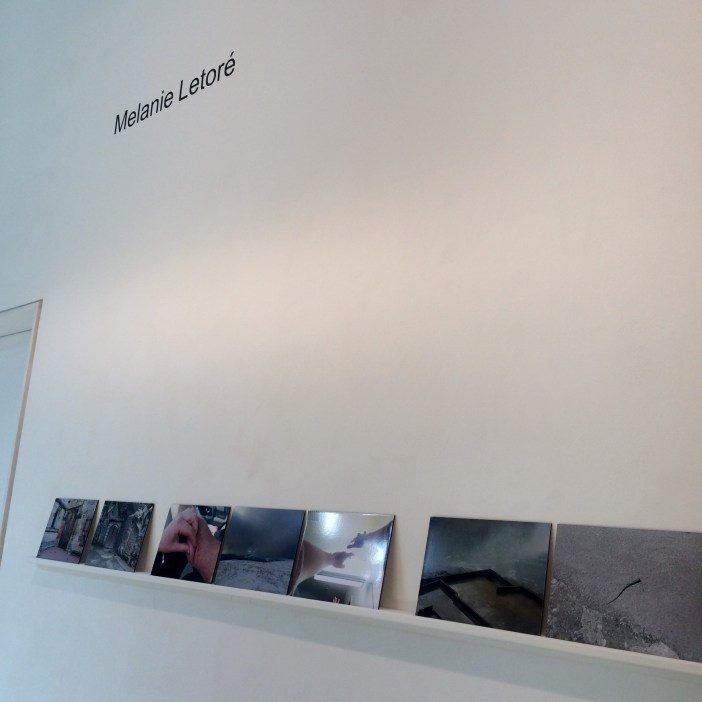

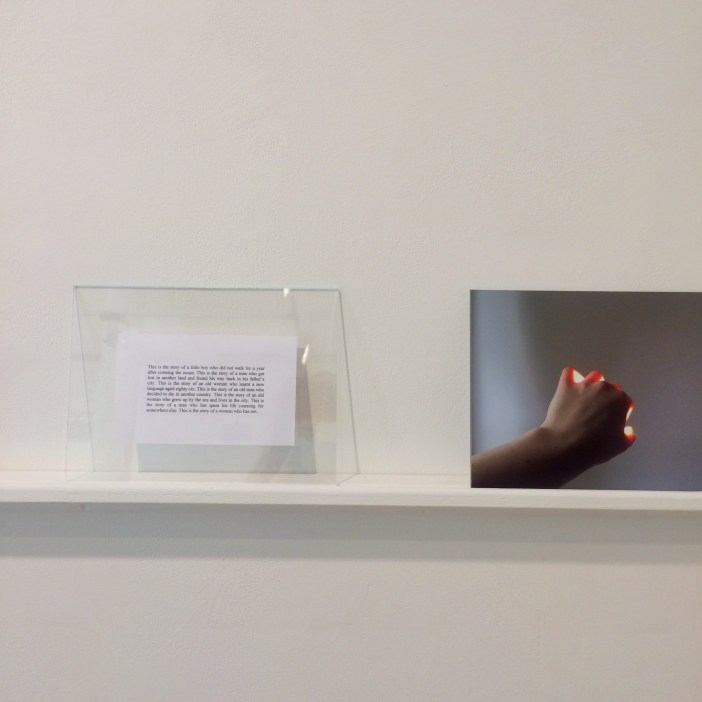
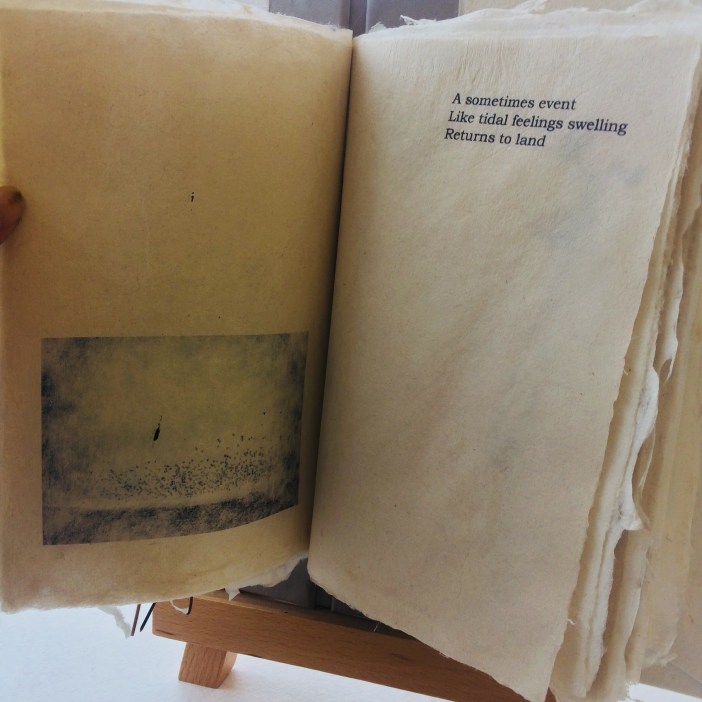
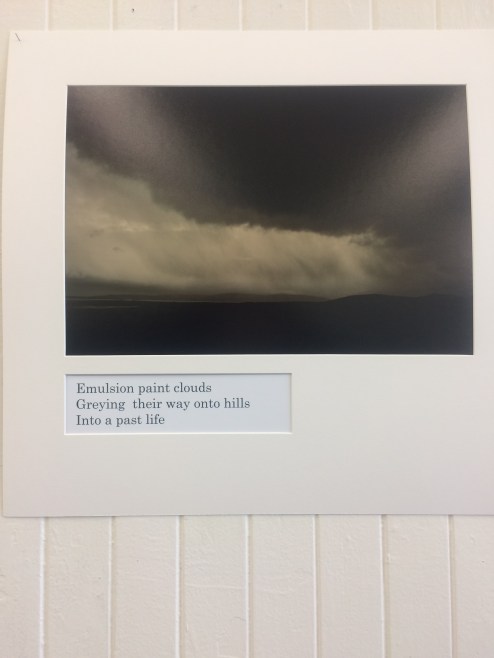
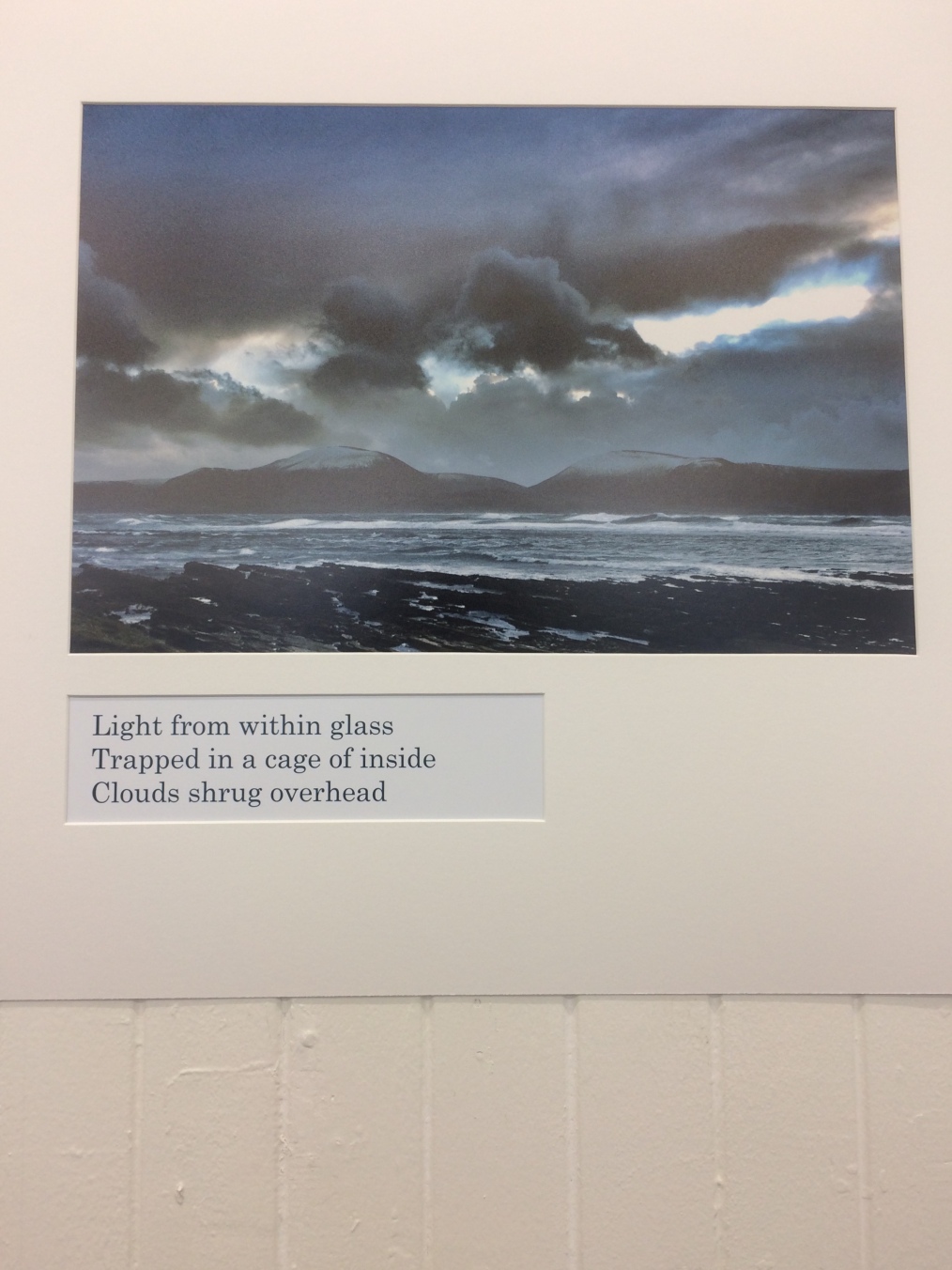
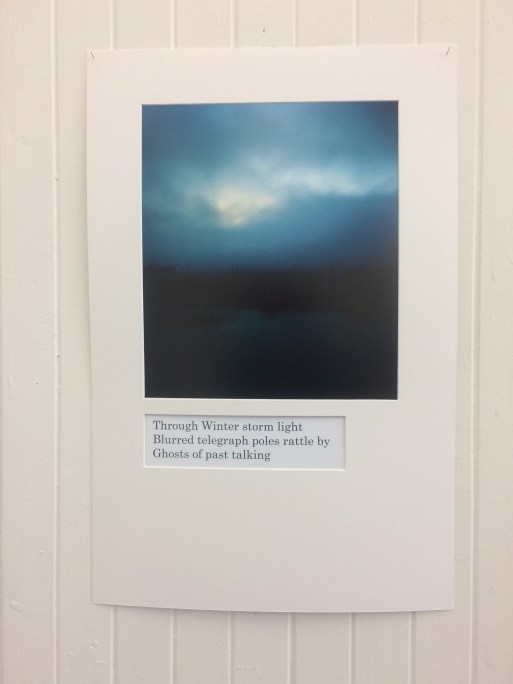
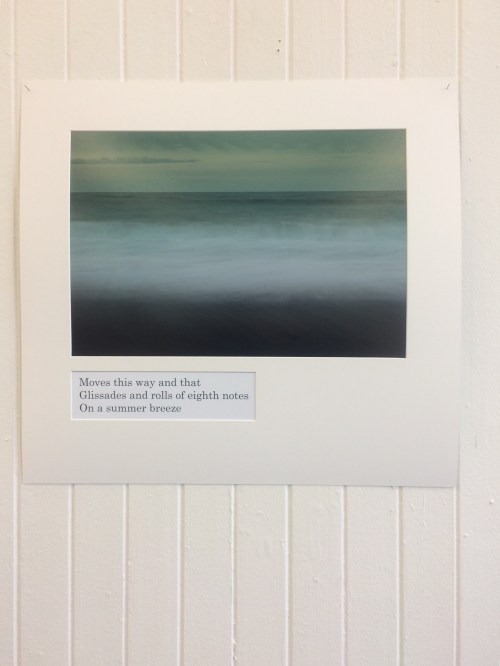
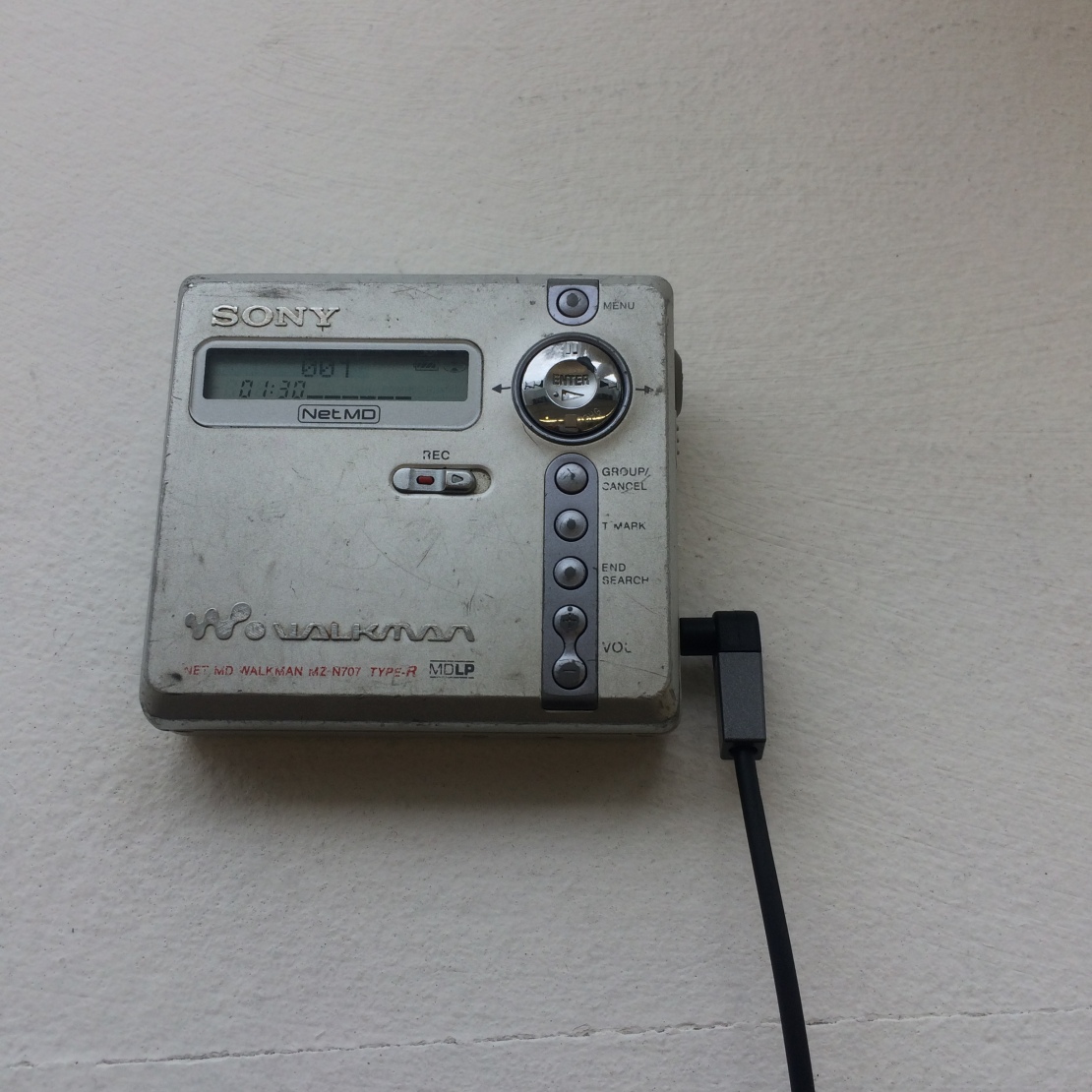
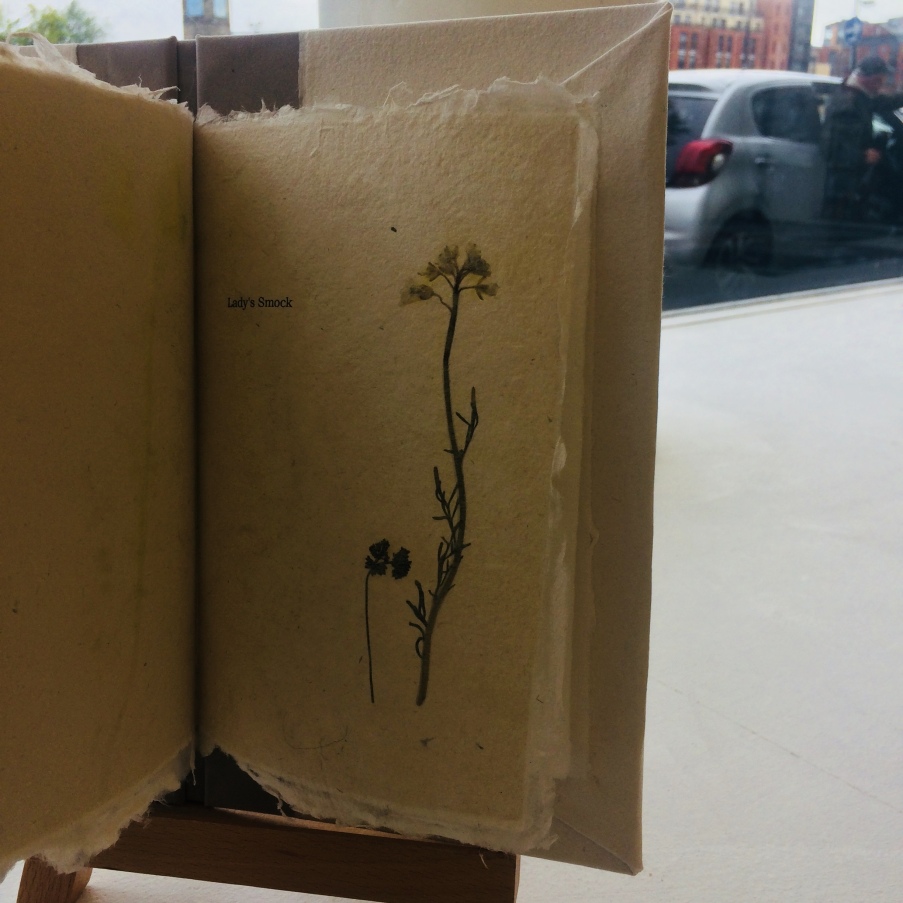
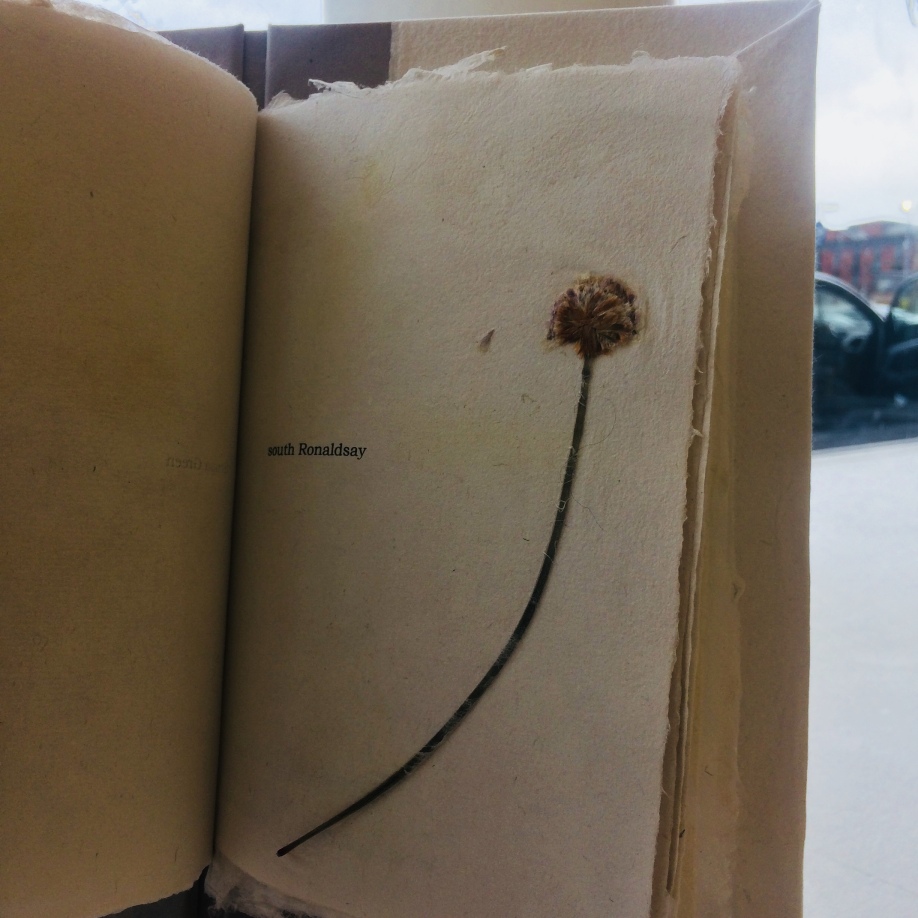
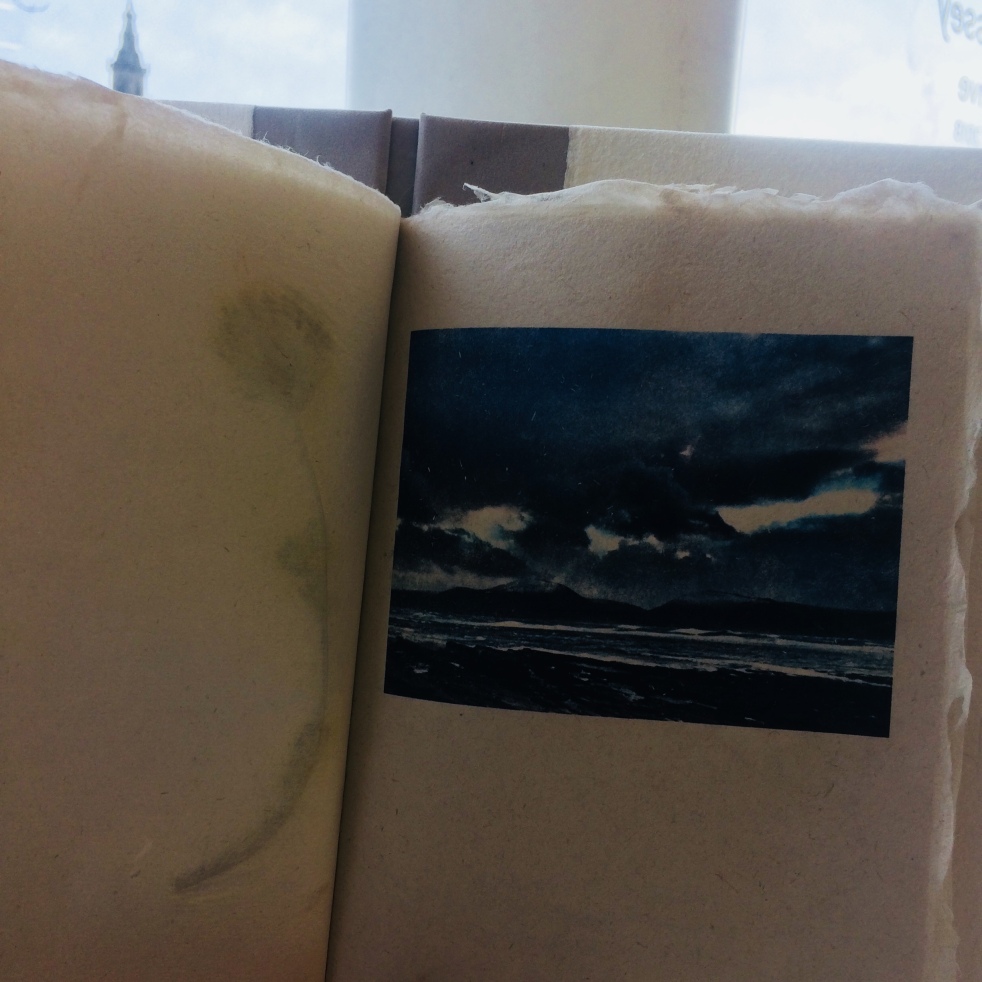
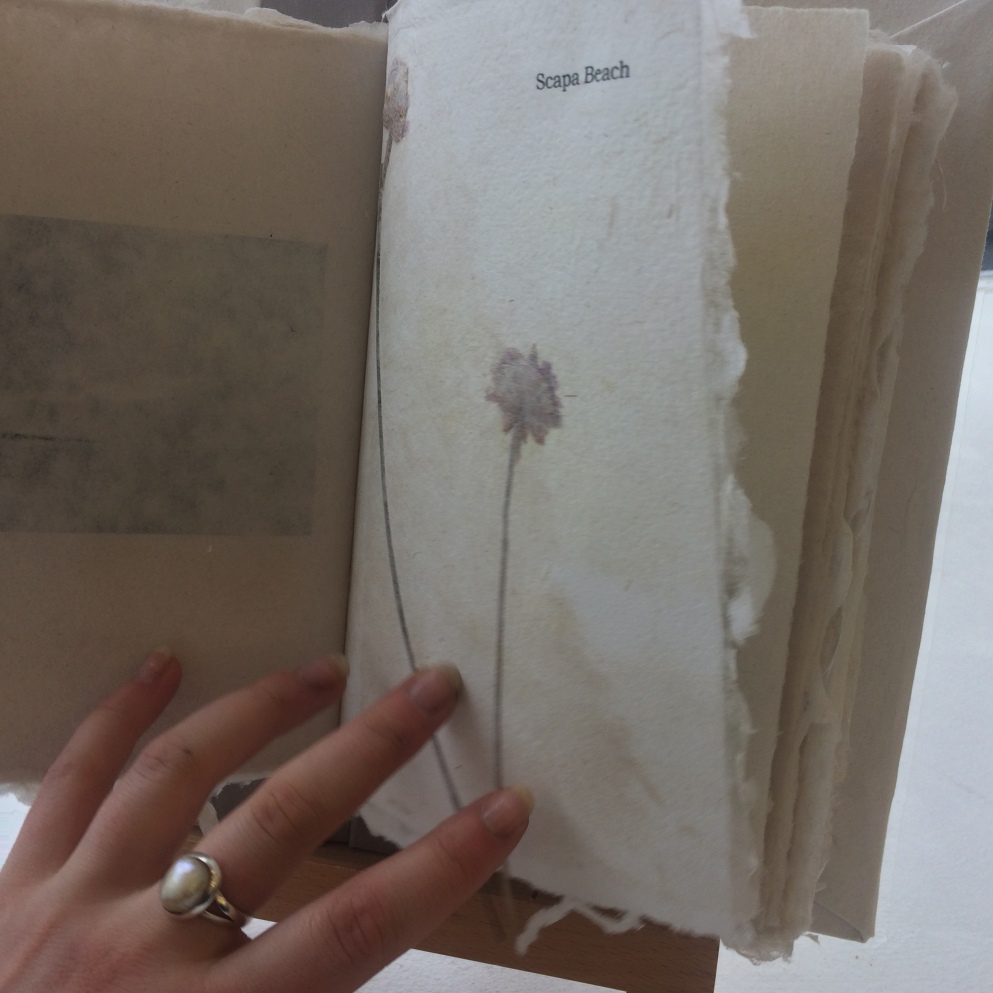





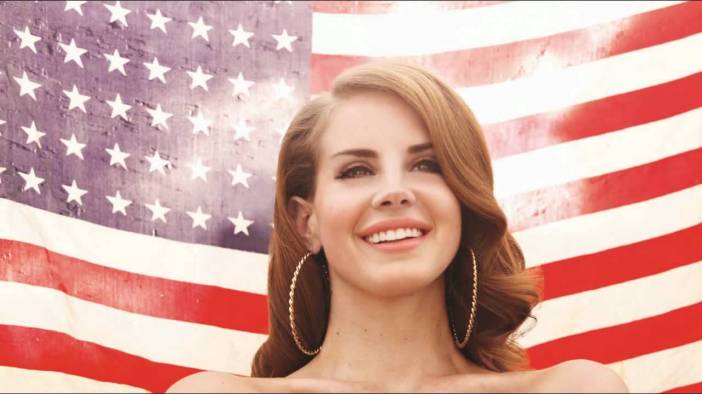





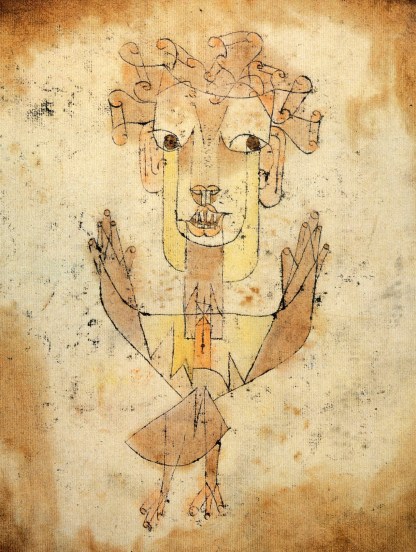


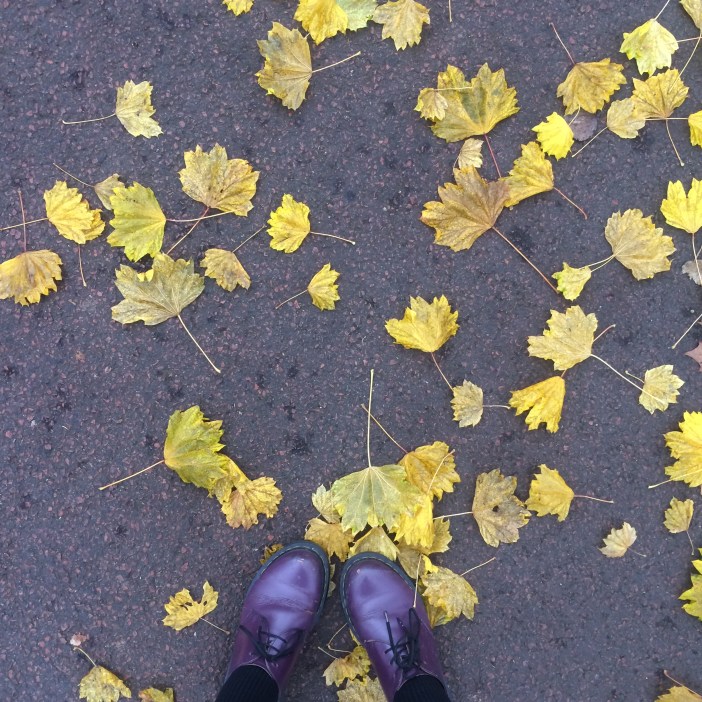


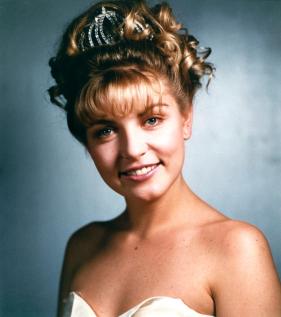


 mariaology