The glow of the oil lamp
melts through the misting dust
that coats the light in the kitchen,
all airy, greyish, mossy and ochre
as the painted walls
(…In the evenings and mornings there are the same
slants of sun or moon, geometries of the cosmic
playing games upon the carpet).
Two weeks ago, the gloom was cut
with a bunch of sunflowers, hacked clean with a knife;
their extravagant heads all smiles and brightness.
They lifted the mood when you entered the room,
skin acquiring that olivine hue
from the plants and the shadows;
reflection of the radio, whose channels
remain static, always, in lieu
of music, or a television crackling,
or a body that would clutch
you so tight in its sadness
as to suck away your own.
Crumbs from the dead hours
grow a fur of mould; the pages curl
on a stack of magazines,
whose gloss lacks immunity to dust,
which scuttles and settles
between the pages, closely closing
leaf after leaf, an army of tiny hermit creatures—
Frankenstein splices of insect shells, fragments of lashes,
fibre and skin.
To sweep it would be merely
to cast a new dance of twirling particles.
It is exhausting, keeping things clean;
exhausting
to warm the stove, to watch the hours
unfurling
through the clock on the wall.
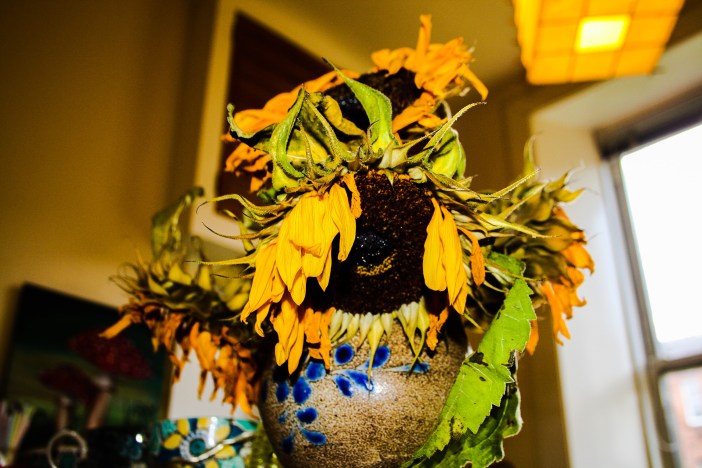
The sunflowers fade now; it is properly autumn,
bronze and darkening green.
Their time has been
and I collect the topaz petals, shrivelled slightly
as they catch on the carpet, the stacks of magazines.
September spreads its beautiful disease through the streets
as the leaves begin to fall, oozing soft fire,
the sweep sap of decay.
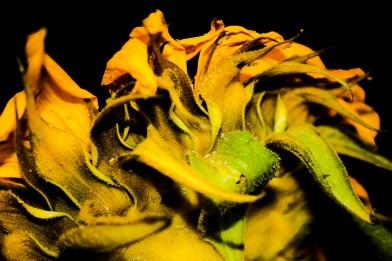
In the window, the sunflowers have lost their vigour.
They drop; their heads slump down,
defeated, as if shy at their deaths.
Their filaments wither, every yellow floret
sinks, crisp; a victim of gravity.
Every entrance to the room augments their sorrow.
We have forgotten the day we bought them,
or even where they were from.
There is just the slant of light, the green and ochre
smell of cooking, the smoke across the road,
and the knowing that probably
I will throw those flowers away tomorrow.
ONE need not be a chamber to be haunted,
One need not be a house;
The brain has corridors surpassing
Material place.
—Emily Dickinson
It seems silly to write about one’s love for a house. After all, houses are inanimate things; they can’t feel or think, can’t love you back. It’s a bit materialistic, a bit capitalist perhaps, to love one’s property. Still, houses aren’t just houses. We are brought up in this world to experience ourselves through things. Not only is this the sociological and psychological consequence of living in a world where we define ourselves through the symbolic order of possessions, but it is also the personal, lived experience of assigning meaning to that which surrounds us, the structures and spaces in which we spill our being. What’s more, the very act of dwelling is charged with the problem of desire. We constantly pursue ownership and control over that which we occupy; constantly assigning possession, marking territory. As Karl Marx said, ‘the felt need for a thing is the most obvious, irrefutable proof that the thing is part of my essence, that its being is for me and that its property is the property, the particular quality peculiar to my essence’: we are, through and through, the things that we own, desire, lose. Maybe it is our seemingly irrevocable need for things that dooms us to a certain emptiness, a loss that prevents the fulfilment of the self.
The old Lacanian equation of desire as relying on lack. Maybe we love things more when we lose them. We start to think if we ever really had them in the first place; we question the possibility of possession altogether. In the void we clasp at meaning, like a baby blindly seeking nourishment.
When I was just three years old, my parents, my brother and I left a cramped cottage in leafy, small-town Hertfordshire for a three-bedroom, two-garden semi-detached house in Ayrshire, Scotland. Land of agriculture, Burns, Buckfast and teenage pregnancy. My first day at school, a couple years later, and I did not understand why everyone kept saying aye, still thinking they were making bizarre expressions of the first person pronoun, rather than simply saying yes. Ken was another strange one. Scotland was foreign and I was even more foreign. I spent most of my childhood trying to grapple with my Englishness, working out who the hell I was and what’s more, who did I want to be? Toning things down to avoid being bullied…but really, deep down, did I want to be different from anyone else? Slowly, the older I got, I felt the bright Scots words trickle into my vocabulary: hanek, gads, glaikit, wee, Ned, jakey. When my cousins visited, I found myself wishing I had the purity of that sweet, Hampshire accent, instead of my own brand of weird hybridity. When friends at school made jokes about Scotland’s superiority, their hatred of the English, the need for their country’s freedom, I felt that wavering sense of otherness, an instinctive need to protect my ‘origins’. As a child, England meant family; it meant going home and being ‘free’. Days out in the summer holidays to the sun-sparkly cities of Brighton and London; the suburban beauty of Milton Keynes in autumn. I liked how I was the only one in my primary school class who wasn’t born in Irvine hospital. When you’re a kid, you kind of like to be special.
Maybe it’s terribly ironic that I would grow up to become a pretty staunch supporter of Scottish independence; someone who works in a whisky bar and identifies more with the social milieu of Kevin Bridges’ standup than that of Austen novels, who cut their teeth drinking Frosty Jacks instead of White Lightning, who fell in love with a wasted seaside town instead of London, and spent inordinate amounts of time listening to endearingly miserable Scottish folk bands over whatever was ‘hip’ in Hoxton. When did the change happen? At what point did I stop mourning my lost English childhood, with its (probably false) promise of sunny summers, middle-class comforts and extra bank holidays? It was long before I started to associate much of England with the heartlands of UKIP and Brexit, long before I realised that Scotland did things differently (socially and politically) to the rest of Britain, and that this was a very good thing.
I guess part of it was realising I didn’t really belong in England either. I couldn’t play the cool and demure English rose, not all the way. For one, with the lack of sun up north, my naturally blonde hair faded, and I’ve now settled on a Celtic shade of copper red. Back then family members would point out queer things I said, like when I relayed stories about folk ‘battering’ each other at school, or how it was ‘pishin’’ it down with rain, or my periodic and derisive expressions of ‘haneck’ whenever anything unfortunate happened. My brother and I would amp up our ‘Scottish’ banter whenever we were down south, cracking jokes and putting on our rough Ayrshire accents the same way any Brit does abroad. I started to realise that I sort of loved the strangeness of Scotland: the Ceilidh dancing we had to learn in P.E, the pervasive aura of folktales, of haggis and kelpies; bottles of Irn Bru that I was forbidden from drinking as a kid, the stern broad Scots of the man on the tape who announced the beginning of every French Listening paper. I wasn’t sure how well I fit in, but I liked it anyway. It started to feel like home.
Home. The year before I left for uni.
***
In my hometown of Maybole, there is a strict policing of difference. The smoke plume of neds at every bus stop will be the adjudicators of any risqué fashion you choose to indulge in. If you wore black and a slick of thick eyeliner, for example, they were sure to enquire whether you ‘shagged deed folk’; if you wore a miniskirt you were a ‘wee hoore’; if you were a guy who had slightly long hair you were a ‘poof’; skinny jeans made you – perhaps the ultimate insult – ‘an emo’. In our school, there was the Mosher’s Corner, the Farmer’s Corner, the Smoker’s Corner, to name just a handful of territories whose policing often bordered on the militant. In first year, I witnessed a friend being shoved headfirst into a spiky hedge because he tried to ‘invade’ the Farmer’s Corner. At the Mosher’s Corner, which took a couple of years to gain full acceptance, you were pelted with stones by bored and angry first years, or scolded by irate P.E. teachers, who had to pass through the area and always liked to pull you up on inane details of uniform. Don’t tell me I can’t wear my stripy knee socks to school when that guy’s cutting about in a tracksuit.
In the midst of this battlefield of identities, is it any wonder I loved my house? The one place where I could be whatever I wanted? Whenever we had to write our address down at school, I relished scribbling down the house name, Daisybank, with all its pastoral resonance. Compared to all the places I have lived in Glasgow (room such and such, flat 1, 2, 3 etc), having a house name is a proper luxury. It was on the road to Turnberry Golf Course; ten minutes walk from the Ranch caravan park. I had a pal who owned a dairy farm nearby, and the woman a few doors down bred collie dogs. For some reason, we always seemed to live beside ministers. In a way, Maybole is the epitome of rural quaintness: it is famous mostly for its former glory as a cobbler’s paradise, for being the meeting place of Rabbie Burns’ parents, for having a relatively crap golf course, a sixteenth-century castle and once upon a time a couple of lemonade factories. You’re ten minutes drive from the sea and surrounded by vibrant green hills studded with pretty villages. The air is fresh and the water tastes great. There’s even a train line.
Still, it’s difficult to appreciate all that stuff as a teenager. I started to dream of Glasgow as this mythical solution to all my problems: a place of cosmopolitanism, where people read poetry, played in bands, and didn’t care what anyone thought of them.
It was only when I moved away from home, got a flat in the city, that I realised the extent of my weird sense of belonging to this silly wee town where technically I had no roots.
***
The last time I properly cried was the day I said goodbye to Daisybank and Maybole for the last time. I paced round the empty rooms, hearing the silent creak of the floorboards, memories passing by me as fleetingly as moths, leaving me with this overwhelming sense of grief. It was like saying goodbye to the entirety of childhood, the last eighteen years of my life, all at once. Unlike most people, we didn’t move around much and this was our home all that time, through thick and thin, good times and bad. I realised how protected I had felt by the presence of the house, its strong sandstone walls, the elaborate latticework of memories that had wove themselves into every structure, every smell and texture and object.
I sat on the train back to Glasgow, staring at the late summer scenery pass behind me, feeling like I had severed a limb.
I don’t know what it is that made me feel that way. Maybe it was the garden: the pond we made with water reeds and frogspawn pinched from the lake at Culzean (the pond in which at my sixteenth birthday party, my friend lost his Buckfast bottle), the faint scent of the lilac tree and its treasure trove of bluebells in May, the memories of bonfire nights, Easter egg hunts, performing original plays; the August weekend when a friend and I climbed the rowan tree and picked every red, gleaming berry – each one to our childish eyes as precious as a ruby. Maybe it was the peace sign my Mum’s ex-boyfriend mowed into the front lawn. The lingering whiff of failed baking experiments that still haunted the kitchen, popcorn burnt to the bottom of the pan, bowls dissolved in liquid heat, vague explosions in the oven (the door of which had to be constantly propped open by a chair). The mice that lived in the piano, the washing machine that shook so violently we had to put a brick in it.
Maybole Golf Course & The Memorial monument. Winter 2014.
The bike rides up into the Carrick hills; the hysterical impersonations of bleating sheep, chasing chickens and pheasants off the roads. Feeding lambs in spring, horse-riding and jumping off hay bales. Long walks with friends, where we deconstructed the universe as the sun bled its final light behind the Kildoon monument.
The summer we painted the wall of the den at the back of the garden, purple and orange, and I got black floor paint, thick as molasses, on my brother’s leg. He was about six and it didn’t come off for weeks. The concrete steps I fell down once and grazed my side so badly I could hardly move. The cities we drew with chalk on the patio, until the rain came the next day to wash them away again. The nights of mild teenage trauma, when I crawled into the space beneath my bed to calm myself down. All the people that came and went, who knocked on the back door or else rang the bell at the front. Afternoons alone in the corner of my room, hunched over chord sheets and trying to play Paramore songs on guitar. Parties with gin served in secondhand teacups, with contraband vodka smuggled in Coke bottles, with the perpetual background flicker of my frozen iTunes library, which everyone cracked a shot at.
Halloween parties with ersatz cobwebs strung from every surface, bowls of punch and fistfuls of body glitter; dubstep thundering from the upstairs study.
The secret room next door to the bathroom which we never discovered, because you had to knock the wall through. Sometimes, when I was lying in the bath, I liked to think about what was on the other side. What wild and weird stories I could fathom from that dark place of possibility? You could see the skylight in the garden and I thought maybe someone had died in there and the previous owners had decided to seal it in.
Previous owners. It’s strange, when you settle so deeply into a house, you think you are the only person to have ever lived there. I remember being about six years old and finding a little plastic doll under the gas fire once and thinking how disturbing it was to think of another young girl playing on the floor of the living room, as I was. The mere thought of her presence could only be a ghost to me, as transient and fantastical as the people on tv.
There was the man next-door who thought we were dirty hippies, but still gifted us with various vegetables grown in his greenhouse, and murmured a gruff hello when we were in the garden.
The long grass meadows out front across the road, where once we made snow angels in winter and walked the dog, where now there’s an estate of houses.
My wee bro and I hanging out on the patio. Don’t think I have aged at all to be honest.
The home videos from when we first moved in: plastic toys scattering the grubby carpet, school friends garbed in 90s fashion (lilac or orange crop tops, white peddle pushers and velvet hairbands) draped over the ugly, velcro sofa. The dent in the wall from a misfired golf ball; the scorch mark on the carpet where someone dropped char from a shisha pipe. Places on my bedroom wall, behind the plaster, where I scrawled Green Day, then Cat Power lyrics; ‘star pupil’ and various Kerrang stickers that couldn’t be peeled off the wardrobe (also the Metal as Fuck sticker we stuck on the lamp, which I’m sure still lingers, irrevocably); the cupboard under the stairs with the camping gear, the old washing machine and the pervasive smell of must. As soon as you opened the door, you were simultaneously attacked by a falling hoover, a bag of tent pegs and a canopy of jackets.
Whole evenings and afternoons, lost to playing Sim City on the old computer. Waiting patiently for dialup to connect, doodling on wee notepads that my dad brought back from hotels on his business trips. Sifting through stacks of Standard Grade artwork, band posters, electric guitars, music stands, golf clubs, tennis rackets and folders of homework.
I could go on forever listing details. I guess it’s the nature of missing something that you link things together, this endless concatenation of memories. You think it would be claustrophobic, living in a small town, but one of the things I’ve always missed since moving out was the space. You could run up and down the stairs, pretend the floor was lava and jump from sofa to sofa in the living room, stare out the big bay windows not at a yard of bins and more buildings but at the rolling, sprawling countryside. Hear the jackdaws in the chimney, watch the butterflies flutter around the Buddleja, the sunflowers bloom in June after the dying of the tulips. Life had a rhythm; you paid more attention to nature: the creeping in of the spiders in September, the wasps in August that nested constantly outside my mother’s bedroom, to the point where her windowsill was a nasty holocaust of their dying bodies.
My childhood home was flawed. There was the icy drafts that blew in through the floorboards, the lack of a shower, the grit that sometimes spat out the taps, the sound of lorries trundling past, the toilet that struggled to flush, the kids out back that belted JLS songs as they bounced on their trampoline. Sometimes the roof leaked, we had to clean the gutters, the hot water stopped working, the carpet always slipped on the top step of the stairs. Somehow though, despite their irritation, these flaws were endearing. It’s different, I think, when you own a property compared to when you rent: when you own it, the flaws are just something you sort of live with, rather than demand your landlord to fix. When you explain them to guests, you’re only ever semi-apologetic. The embarrassing parts (the Alan Partridge lap dance postcard on the fridge, the broken oven, the cracks in the kitchen tiles which our friends and I used to take apart and reassemble like puzzle pieces, the precarious stability of the garden wall) become something you’re sort of proud of. It seems kind of absurd now to think that one time, in the middle of the night, our garden wall literally just collapsed, blasting bricks across the patio and shattering the wooden bench, sending its splinters as far afield as the neighbour’s garden.
Maybe it’s that shambolic charm that drew me again and again to Dodie Smith’s novel, I Capture the Castle, as a preteen. I wasn’t just obsessed with the lucidly beautiful voice of the young heroine, her story of unrequited love and the struggle to grow up amidst slightly meagre and crazy circumstances, but also her descriptions of the crumbling castle which her family called home. She describes her first impressions thus:
How strange and beautiful it looked in the late afternoon light! I can still recapture that first glimpse – see the sheer grey stone walls and towers against the pale yellow sky, the reflected castle stretching towards us on the brimming moat, the floating patch son emerald-green water-weed. No breath of wind ruffled the looking-glass water, no sound of any kind came to us. Our excited voices only made the castle seem more silent.
The image is imprinted on her memory, relayed back through her diary; as still as a flower pressed between the pages of a book, as the motionless water, a reflection of a very specific and idealised point in time, the fresh perception of this place that would become the crumbling though romantic ruin of a poverty-stricken home. It is clear that much of Cassandra’s descriptions of the castle are filtered through the discourse of fairytale, though in a knowing, reflexive way, that recognises the flaws of such fantasies. Her sister, Rose, will not be the perfect princess, English Rose though perfect she is; neither will she be the perfectly objective narrator. I just adore the scene when they are drinking outside the village pub: cherry brandy for Cassandra, bright green creme de menthe for Rose, to bring out the russet shades in her hair.
Sitting outside in the comparative paradise of my own garden, I enjoyed the traditional Scottish though equally vibrant liquor of Mad Dog 20/20 to season my youthful palette (unlike Rose, I don’t think my choice of tipple ever worked very well to seduce rich and handsome American suitors). I had the smell of woodsmoke in my hair, the wind coming in off the near-distant sea with a faint and familiar saltiness, the taste of health. There’s something so lovely about that nostalgia, when you can see yourself outside of yourself, picturesque in your childhood surroundings.
The den beneath the sycamore tree and all its long-faded paint.
In a way, I guess I sort of thought as Daisybank as my castle. We didn’t have a mote, or a crumbling turret, but we had a garden of long grass and dog daisies and a steep drive that kept the floodwater out and the crazed night dwellers away (once, my mother parked the car on the road and some random jakes literally tipped it on its side, so she woke up in the morning to it pouring oil all down the street, like it was weeping sadness and blood). It’s hard to recreate that sense of absolute safety, of home — where all your memories have long seeped into the walls, where you first wept at a book, kissed a boy, got blackout drunk on whisky. All the birthday cakes and candles, the mean words said and the reparations. It’s like the house has witnessed the sweetest and darkest parts of ourselves and god knows it must be a burden to bear those secrets.
It’s kind of impossible for me to imagine the house with new people living in it. It’s even difficult to imagine Maybole without my family living there. You sort of stay in touch via Facebook pages, you have the odd dream about walking down the high street or buying a roll in the deli or sitting on the swings at Miller Park, but you can’t really imagine it just going on being. Like a kind of clockwork village, it stops in your mind when you’re no longer there; when your roots are sort of severed. When people I’d known a long time found out we’d sold the house, they talked about it with the almost the same level of sadness and compassion they would on discovering a close relative had died.
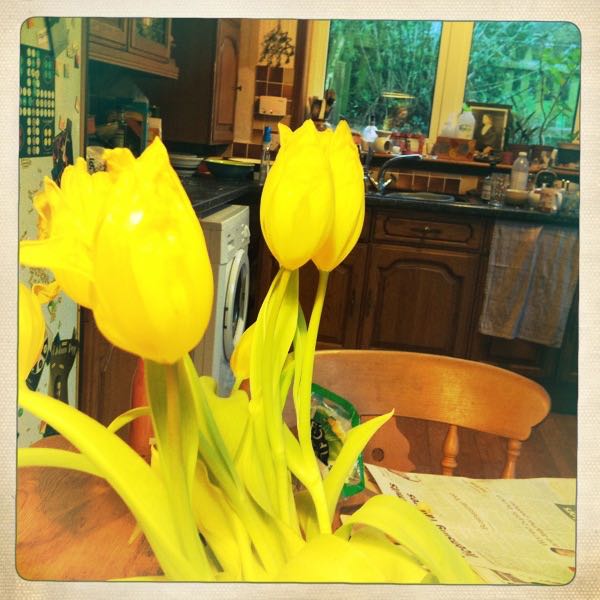
It was a bloody good house; I don’t think I’ll ever live somewhere as nice and homely again – or at least it’ll never be quite the same. There’s just something about the place you grow up in, a magical and elusive quality. I can start to describe it, the pink and orange light seen from the patio on winter mornings, the daffodils on the kitchen table, steam from the iron, the flicker of Sonic the Hedgehog games on the old television, the space under the desk where my dog used to hide on fireworks night; but then here I am again, slipping back into details. You can’t grasp it; it’s in all of these things. Like love. It’s supplementary, in the Derridean sense that it has no inherent presence or meaning: it’s just all the things you try to hold in place for a moment, the mesh of connections and space of interplay that forms, pliably, impermanently, when you try to grasp at the meaning.
Houses are, perhaps, more than houses. Every writer, every intellectual discipline under the sun has spent centuries debating the meaning of ‘home’, but perhaps houses themselves are equally strange and uncanny. What does a house mean to us after we have vacated it, stripped it of all the stuff that made it personal to us? Can it still be a home? I must admit, I don’t imagine myself living in my old house anymore; I can only see it as it was before. I can recall myself standing in particular locations: the feeling of waking up in my bed, or standing at the sink, washing up on a Sunday evening, watching the birds out the window. Yet when I try to think about how it might be decorated now, what the people inside are doing, I draw a blank. You can’t picture it like in the the Sims; can’t just imagine the drama of the lives within.
Many authors have anthropomorphised the houses in their books. They become characters in themselves, or at least acquire some kind of emotional or physical sensitivity to what goes on in and around them. Toni Morrison, in Beloved, describes the house, from Denver’s perspective, as ‘a person rather than a structure. A person that wept, sighed, trembled and fell into fits’: the domestic space is as much a character as Denver herself, it takes on the qualities of and indeed reacts to the events which take place within it. You know that eerie sense of dust settling, of silence and weightiness that falls upon a house after an argument? There’s something to it. An ethereal feeling, a kind of knowingness; as if the house itself could somehow be conscious.
Perhaps the most famous instance of an anthropomorphised house is that of the Ramsay’s holiday home on the isle of Skye in Virginia Woolf’s novel, To the Lighthouse. Woolf takes a hefty chunk out of her narrative to describe the process of decay that unravels the household in the Ramsay’s absence. Significant family events, such as marriage, childbirth and death, are confined to parentheses, while intensely lyrical descriptions of the details of the changing conditions of the household are given centre stage:
[Prue Ramsay died that summer in some illness connected with childbirth, which was indeed a tragedy, people said, everything, they said, had promised so well.]
And now in the heat of summer the wind sent its spies about the house again. Flies wove a web in the sunny rooms; weeds that had grown close to the glass in the night tapped methodically at the window pane. When darkness fell, the stroke of the Lighthouse, which had laid itself with such authority upon the carpet in the darkness, tracing its pattern, came now in the softer light of spring mixed with moonlight gliding gently as if it laid its caress and lingered stealthily and looked and came lovingly again. But in the very lull of this loving caress, as the long stroke leant upon the bed, the rock was rent asunder; another fold of the shawl loosened; there it hung, and swayed. Through the short summer nights and the long summer days, when the empty rooms seemed to murmur with the echoes of the fields and the hum of flies, the long streamer waved gently, swayed aimlessly; while the sun so striped and barred the rooms and filled them with yellow haze that Mrs. McNab, when she broke in and lurched about, dusting, sweeping, looked like a tropical fish oaring its way through sun-lanced waters.
I just adore this passage for several reasons. It’s full of poetic devices which bring the house itself to life: all the personification which renders objects and shadows and light into living, breathing things. The recurring consonance of the l sound which leads us, liltingly, through all sensory encounters; as if we, occupying and flying through the sentences, were as light as air, a travelling dust mote, surveying the situation. L is a flickering kind of sound, fluttering, leading onwards, somehow soporific. A line like this sends tingles up your spine: ‘the stroke of the Lighthouse […] came now in the softer light of spring mixed with moonlight gliding gently as if it laid its caress and lingered stealthily and looked and came lovingly again’. The sentences and descriptions flit between movement and stasis: the loving caress and the sudden shift of a rock, followed by a hanging, a loosening, a suspension. Everything seems to be swinging, swaying; the material of the house unfolds and unravels like a shawl. The zanily surreal image of the housekeeper Mrs. McNab trying to control the chaos in the manner of a ‘tropical fish oaring its way through sun-lanced waters’ is deliciously both amusing and vivid, conjuring a sense of the beauty of this interplay of order and decay. It’s a clashing sort of image, the vibrancy juxtaposed with the dulling surroundings, but the effect is to exoticise, just ever so slightly, the whole scene. We are invited to look closer, as if peering through a fish tank. This is more than just a house laying to waste in its owners’ absence. Real empathy is stirred for the house itself:all the ghosts that inhabit the walls, the absence that tears at everything. Objects and noises, the vacant trails where once human footsteps made their passage. Mrs. McNab, in all her matronly cleanliness, is but a colourful fish, pulling itself fleetingly through the reeds. All our efforts to clean up the world, to annihilate its disorder, are perhaps similarly slightly futile.
Throughout Time Passes, Woolf contrasts and holds together opposites: day/night, abstract/specific, growth/decay, movement/stasis, beauty/waste, absence/presence and life/death, to name a few. At once we lament the abandoned house, while also marvelling at the ‘power’ of nature’s ‘fertility’ and ‘insensibility’: the way in which dahlias, giant artichokes, cabbages and carnations continue to flourish amongst the house’s decline. She might as well be describing the inconsistencies and tensions within the psyche of an actual human character. Time veers between eternities and instances; the sheer significance of a death (here, Prue’s) is passed by fleetingly, another stain upon the already well-blotched backdrop of war, a different trauma to the slow, inevitable decline of the house. The writing here is both photographic and cinematic: moving through the stillness of random snapshots to the build-up and unravelling of a time-lapse. Isn’t that like life, like memory itself?
***
‘Some days in late August at home are like this, the air thin and eager like this, with something in it sad and nostalgic and familiar’
— William Faulkner, The Sound and the Fury
Maybe home is all about the seductiveness of boredom, the comfort of merely occupying space. Maybe its familiarity is what contains an inherent sadness: a sense of loss stemming from that which we cannot regain, despite our close spatial proximity. Like someone you love but who has changed, irrevocably, drifted out far beyond your reach. Like lost innocence and joy, the way we were before we knew certain things; before life happened, in all its terrible narrative beauty. Quentin’s reflections in The Sound and the Fury have a degree of universal application. Late summer and early autumn; the turning of the seasons, the fading of the year. We spend more time indoors as the air thins to a coolness; we retreat into the safety of houses. Each year, we think back to blackberry picking in gardens, cooking soup on the stove, going back to school. One of my favourite (and pleasantly simple) opening lyrics, from Stornoway’s song ‘Zorbing’: ‘Conkers shining on the ground / the air is cooler / and I feel like I just started uni’. It’s details like that that send us home. Reminders that time moves in loops; that constantly we are living through our memories, mixing the strange and new with familiarity. You don’t necessarily need a specific physical location to be ‘home’. Maybe it’s more complex and slippery than that. Sure, I miss Daisybank like hell, but it’s the details I miss most, and like everything else, with age they acquire that golden, treacly glow of nostalgia. Maybe I don’t need to be Scottish or English or anything at all. I just need to find home. Then I can begin again.
Home is where one starts from. As we grow older
the world becomes stranger, the pattern more complicated
Of dead and living. Not the intense moment
Isolated, with no before and after,
But a lifetime burning in every moment
And not the lifetime of one man only
But of old stones that cannot be deciphered.
There is a time for the evening under starlight,
A time for the evening under lamplight
(The evening with the photograph album).
Love is most nearly itself
When here and now cease to matter.
— T. S. Eliot, Four Quartets
My wee bro & what was probably my first bike in the kitchen, 1997.Christmas 2014 in the kitchen2011
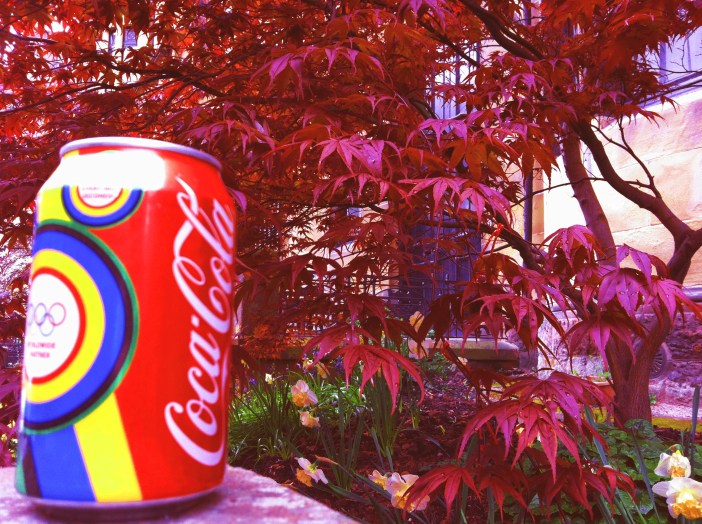
Springtime, 2012; first spring in the city. Living on Hillhead Street, with the cat, Miller, who used to mill around and curl his sleepy tail round your ankles at lunchtime, purring at the sun. It was sunny all through April and May. Early mornings in the library, level eight and nine with the light flooding the windows warming and pure, a dish of sun butter melting over sandstone buildings. The best seats, the computer screen a dull mist of unimportant philosophies. Walks along the Kelvin, tangles of fern and wild garlic and the solitaries who wander, sometimes stumbling, always clutching a spliff or a bottle of Bell’s or Buckfast. Coughing their pearls of greenish spit into the river. Summer of the Olympics, no care at all, sugar rush of coke and chocolate buttons and long evenings staring insomniac out of a tiny dorm window. The Decemberists, or Conor Oberst’s croon in the wanderings out to town, to the station or the Necropolis. Smell of cigarettes wafting from rooms below. So far, but not so far, from home. The red glow of the sun at dusk, the silhouettes of house plants, the sound of footsteps.
April, the sweetest candy of a pink-tinged sky blessing the late afternoon. Rebecca has sat in the garden for hours, watching the birds nibble from the feeder and splash around by the pond. This is her Grandpa’s garden, though he no longer enjoys it. They have him cooped upstairs on a dialysis machine, in a bedroom that smells of sweat and death. Rebecca is not allowed up there: the air, her mother says, is not fit for a young and blooming girl.
She misses her Grandpa. She remembers him mowing the lawn on Sunday afternoons, stooping with his bad back. She remembers him commending the shapes of his moon-faced daffodils. She remembers him singing Frank Sinatra in velvet baritone while pruning the roses.
The roses are now out of control. They cluster all over the flowerbeds along the path, dangling out with their swollen, sumptuous heads. They have grown so tall that they bend over, crippled with the excess weight, the stems stretching to breaking point. Grandpa would be so disappointed if he witnessed the state of his roses.
Sometimes, Rebecca liked to peel off a petal or two. It was hard to resist; once she took the first few, the others came off so easily and they just slid softly into her fingers. Vivid trails of pink and red petals are now strewn along the gravel path, where Rebecca has walked like a bridesmaid.
At the back of the garden is the apple orchard. In winter the trees are gnarled and bare silhouettes, and not a soul would dare enter the darkness between them. Now that spring has arrived they boast their pretty bows of white, flaky blossom. Every year, Grandpa used to send glossy photographs of the apple blossoms to Rebecca and her parents, who lived far away down in London and rarely made it up to visit. The sight of those lovely trees was always a dream to the young girl who yearned for the country.
“When can we go and see them for real?” Rebecca would sigh.
“Oh, sometime in summer. Maybe Christmas.” They were so often dismissive like this. They had waited too long to see him and now he was dying. Even Rebecca knew it.
She was growing quite bored now, in the garden with no-one to play with. She knew there would be supper soon: hot buttered crumpets with a dark smudge of Marmite melting inside them. Real Earl Grey (loose leaf) because that was the only tea Grandpa had in the cupboard. Rebecca thought it smelt a bit fusty, but you could read the tea leaves at the bottom of the cup afterwards. She thought she saw a bird in hers that morning.
Yes, she was quite bored. The hula hoop which she had brought up from London lay abandoned on the lawn. She had tossed away her tennis racket somewhere into a dense clump of shrubs, because it was no fun to play by yourself, hitting a ball against the shed wall. A bag of marbles had burst open on the patio, the little glass balls having long rolled away, to settle amongst their brethren of grass and gravel. Rebecca had no toys left and besides, she was so tired of them all.
Even the insects had bored her, with their slimy indifference to her existence, their urgent desire to escape her clasping girlish fingers. She couldn’t give a toss about snails and slugs, or even butterflies anymore.
It was in this moment of tedium that she spotted the boy through the hedge. She couldn’t believe she had never seen him before. It was a difficult thing not to be spotted, not to make a peep, but Rebecca crawled expertly into a gap and tried not to breathe as she watched him. He was lying on his front, kicking his long legs back and forth. From this angle, he looked about fourteen. His hair was sort of ginger but also sun-bleached, as if he had spent a long time outside in a streak of good weather that Rebecca must have missed. He looked like something the sun had offered as a blessing. She could see his freckles, the concentrated curl of his lips. He was drawing in a big sketchbook which was flipped open, so that sometimes the breeze rippled the pages. Rebecca felt her heart hum and flutter in the cage of her chest, like some swarm of insects had trapped itself deep within her. He was so beautiful.
She wanted to crawl right out of the hedge into the next-door garden, step into the other world where he existed. She wanted to talk to him, ask for his name. See what it was that he was drawing. She felt like the secrets of the world would unlock themselves once she had learned his name. The sapling of herself would unfurl and a bounty of happiness would overflow from her body like the golden leaves in autumn.
“Rebecca!” she froze. It was her mother calling. She had been searching all over the garden for her daughter and now here she was, discovered in the hawthorne with white blossoms caught in her hair and a strange smile on her lips. She saw there were tears in her mother’s eyes, clinging and spilling like rain from the knots of tree trunks. How could there be tears at a moment so pure, so lovely?
“It’s Gramps,” she gushed, “he’s, he’s gone!” And so her mother pulled her out of the hedge and clutched her in her arms, held her so tight Rebecca thought she would burst. It didn’t make sense: he’s gone, he’s gone. As her mother sobbed into her hair, she watched the apple blossoms being blown away by the gathering night wind. Next-door, the boy stretched out his long limbs, packed up his things and disappeared.
In the room of primary colours and paper
I stood up, small, to read my piece;
shaking like a frond of heather
caught on a hillside breeze, unable
to stop the bite of a lip, the sweat
spreading my skin with its heat.
The vowels didn’t come out right;
I failed to master the harsher diction,
the bouncing consonants, flying fricatives
and tongue rolled r’s luxurious.
Words were tangled in my mouth
like a lump of food I couldn’t eat.
I felt a hundred eyes feast on me.
From the depths of the gym hall,
they watched hungrily
for my stops and splutters, my hesitancy.
For I was different, not like the others.
My English accent rubbished the nuance,
missed the beat of every lilting iamb.
Still, I stumbled on,
falling off the lines like Tam himself,
drunken on his horse, ready to cross
that brig over black water,
taking a final leap from stanza to stanza.
Finished at last, I fiddled with my tartan headband,
lifted my head to slow applause,
felt at once a strange inclusion.
Later, in the playground, I stared out
at the Carrick hills, their mist of violet rain,
and for the first time
I knew a perfect moment,
the one that burns then goes forever,
quotes a song then comes again.
Picture the scene. You pass sea after sea of pines, their tall green points misted with a fine web of vapour, a greyness that stretches over, concealing the tips and the distance, and you are not sure whether it is fog or woodsmoke, the wisps of early morning or perhaps the smoulders of a landfill. Probably you’re somewhere deep in the moorlands, glens and peat bogs of the Highlands; or maybe not that far yet, maybe just the Trossachs. If you open the car window a tad, you can almost smell the midges, their damp, thirsty breath in the air. This is air so clean that its purity counts as a flavour, claimed by many who have flogged the native whisky or bottled water. You would leave the window open, indulge yourself, but there is a sharp cold breeze that tickles the fine hairs on your neck, waters your eyes. It is always windy here; or else deathly still, like a valley out of time. Mountains rise up around you, growing closer and grander as the car turns another corner. They seem monstrous, towering over your small car, and you feel like William Wordsworth (the boy version, out of The Prelude) plodding along in his stolen boat, gazing fearfully up at the mountain peak beyond the lake, the peak that gazes back like an animal: ‘a huge Cliff / As if with voluntary power instinct / Upreared its head’. You can’t help but stare at the streams which splash down from each hillside like silver belts, which glimmer in the pale light which makes it through the misted sky. They catch your eye, pull you in myriad directions. You know that rain is imminent; its scent is as clear as the water that runs on the burn alongside you.
There is always birdsong, even in the evening. You can hear the cacophony of many different species as the car rumbles on in the silent space between two tracks passing on the stereo. You and your friend spent a whole day curating the playlist for this trip. Curating. She said that word, jokingly; but even so, it makes you feel special. This isn’t just any trip. It isn’t like you get out like this all the time, free from the bustle and smoke of the city, the people lingering outside pubs, the strangers drifting through in street-lamp darkness.
You spent a childhood in the back of your mother’s car; the smell of her cigarettes always blowing straight back into your face, rolling down the window to snatch breathfuls of that sharp, fresh air – an escape. You scrambled alongside rivers which rolled on over gleaming boulders; you scrabbled together heaps of stones and logs and built dams, pools and waterways. You fell over, bruised your knees, skelfed your fingers on the pine branches. You watched the water for hours, while your mother smoked and your big brother showed off, scaling rock after rock, cliff after clifftop. You ate cheese and pickle sandwiches made soggy by the damp that seeps in everywhere, through the aluminium and glass, the plastic glovebox and the silver foil. Midges clung to your neck; constantly you felt their hot, sticky itch. Sometimes the car smelt of engine oil. The food made your cheeks flush afterwards, as you washed your lunch down with bottles of flat lemonade that had lingered on the backseat for days.
There was an innocence to those holidays which literally makes you ache to think of. You would do anything to be that small again, crouched by a river, dipping your toes into the freezing water while your brother splashed you from afar, shouting declarations of war. His always taunting words, his grand arrogance. The way your mother scrunched up the sandwich foil into tiny, crumpled balls, collected them in her purse. The day you found them all, still there, when you were digging for lunch money.
Fog coming in thick and deep from a distance. You saw it roll over the mountains like God’s own shroud. It was comforting, feeling the moisture prick in the air, seeing the landscape slowly disappear. When you retreated back into the car, packed up the camping gear, fought with your brother over the radio. He always wanted the sport – Five Live – and you wanted the songs, the music. The stereo pumped, crackling and loud, audible even through the walls of the car, drifting in and out of signal, static…
Her sadness, leaning against the bonnet, sipping from a flask of coffee, staring out into the distance. The tears that you couldn’t see – not from behind – but you always knew they were there.
And why are you going? Why set forth again into the world of fog, of deep enveloping glens and silver rivers? The soft moss and the heather, the greenness that haunts your sleep. Was there some mystery you thought you could solve? She said it would be cathartic, your friend, her name irrelevant. Anyway, it’s Eilidh. When you met her, you didn’t understand the silent letters.
The playlist comes from an iPod, the classic one with the spinning wheel and the white casing. You were going to sell it, after you lost your job and faced the end of things, but something pulled you back. Gone were the Nike trainers instead, and now you are here in the car with your best Sports Directs. What sounds pass through your head? There are many conversations you always wanted to have with Eilidh. You wanted to ask about her purple hair, the bright lilac colour of heather. What did it mean? You wanted to ask whether she was still seeing that guy she met at uni, the one who studied law and played cello for an orchestra; who spoke French in a way that defied the limits of his Edinburgh accent. But you had known her five years, and still you could not speak.
The songs were lovely, dark and deep. Miles were consumed by the roar and pulse of the engine, roadsides slipping away as easily as signs fading into hill fog. You were long gone from the city, its tall grey buildings a mere memory, the pillow of mist you sank into at night. Remember the times you shaved an inch from your life? The bus turning the corner, sharp; the tiny sliver of razor on the white bathroom china. The dark colours flowering out in water, as you watched your ex-girlfriend wash her paintbrushes in the sink. Shades of crimson, violet, blue and scarlet. You were slipping through all these images, the shock and the bruising; the little jolt to your heart as the car passed over a pothole. You were driving, then she was. It’s difficult to remember.
There’s a lot of Mogwai on this playlist. When you first hear ‘Heard About You Last Night’ it’s a bit like waking up for the first time, the blinking beat and slow entry of bass bringing into colour a brave new world of beauty and fear. So many people, you suppose, have died out on those mountains. Battles fought and lost and won. Rain that fell for so long, it seemed the whole landscape might be swallowed up in shadowy puddles. Then there’s the anxiety of ‘Hungry Face’, those infuriating repetitions which build up to the twinkling innocence of the xylophone against those quietly thundering drums. It gets in your head; you can’t help but think of ghost ships disappearing over the Clyde, a set of yellow eyes opening and closing, suspended in the dark, clouded air like the smile of a Cheshire cat. The sound of soft, steady bleeping. Eilidh says something funny about the sheep. They have an absurd look about them out here, she says, but then so do pretty much all sheep. They glance up at you, but instantly their expression fades into blasé. They have only two emotions: indifference and fear, the fear coming out when they jolt their necks back and scarper.
Soon you fall into the melancholy of ‘Cody’, so slow and serene you might as well be stoned, sinking away from your thoughts like being pulled out into a vast, shimmering ocean. The bass echoes slow through the car, its thick walls. You press your face against the glass, leaving steam marks which fog up the world outside, the tall green mountains now coated with your breath. Reality blurs with the material of sleep. And would you stop me? If I tried to stop you? You imagine this is what heroin feels like, plunging into a slow, majestic ecstasy, the kind that drags eons of time through your veins; and from all those hours draws out this kind of awesome mournfulness even as your whole body tingles with euphoria. You could sleep forever in blissful, evil dreams. When I drive alone at nights, I see the streetlights as fairgrounds / And I tried a hundred times to see the road signs as Day-Glo. So slow, the car turning corners. An elegy to a lost raver, stumbling through the darkness of some urban labyrinth, the upturned bins, old condoms and leaking glowsticks spilling out the wasted remainders of another good night, another goodbye to childhood. Would you care at all? Eilidh rests her hand on your leg.
“Stop crying,” she says. It’s a statement, not an instruction. You are still staring out the window.
Your mother used to listen to The Waterboys, maybe even Primal Scream in her more rebellious phase. She liked to dance around the living room doing the dusting to ‘Fisherman’s Blues’, all the dust motes swirling up in a maelstrom of childish untidiness and neglected housekeeping. Her voice would crack and she would laugh at herself, breathless, collapsing onto the sofa. Make me a cup of tea, eh boys?
You were at a house party once, at uni – not that long ago really – and this girl was playing a song that stirred something familiar in your memory. You knew that voice, its growl, the twists of electric guitars.
“What is this?” you asked, the joint smouldering between your fingers.
“Oh, it’s The Waterboys actually.” You resented her showiness, of course, but this was interesting. “I know, so lame right? I like it though. They put Yeats to music. You know the poet, W. B. Yeats? ‘The Lake Isle of Innisfree’. It’s a lovely poem.” She was drinking port, of all things – you remember that too.
You inherited, perhaps, a gloomier tradition of the nation’s music. There would be no Proclaimers on this playlist.
Arab Strap, the disco beats, spat poetry and everyday apathy. The sort of post-hardcore or drum-soaked indie that felt like having the rotten parts of your brain stripped out as you lay on a boat, slowly being drenched in dreich Scottish rain. You were always a fan of Frightened Rabbit, ever since you saw them at a festival once, danced yourself into a frenzied ceilidh of mud and tangled feet, even as the songs sung of sadness and bleakness and heartbreak. The endless drone, the refrain: it takes more than fucking someone to keep yourself warm. Teenage campouts in Loch Lomond, worried you would all die of the cold, of the rain and the midges. Drunk out your minds, desperate and scared of the river which burst its banks sometimes even in summer. The expectations of nothing but the prospect of falling into the same abyss as everyone else. Fag butts drifting by the edge of the river, the scorched remainders of a bonfire. Listening to it again now, well, you can’t help but think of how this seems to be coming true somehow. The same abyss. Even as the drums collapse over the screaming words, there’s a waterfall out there somewhere, maybe the one you floated in once, upside down on weird pills with the cold so deep in your bones that you didn’t feel the punches of your best friend who hated you because you kissed — no. That was another time. You are driving forward now, you are at the wheel.
Maybe there is something that you know that I don’t.
“We should stop soon, you look like you need a rest.” The world outside is almost darkness; it is twilight spinning webs of navy and sapphire gold around the edges of trees and mountains. Trees with their shimmering leaves. Clusters of stars emerge from the velvet blackness. You wouldn’t stop for anything.
Next: There Will Be Fireworks, ‘From ’84’. The simplicity, the sorrow which isn’t yours; for how could you feel so much nostalgia for a year, a thought, that came before your time? The not-belonging is what makes you feel lonelier, the minor chord, the rustle of Eilidh in her woollen tights turning the page of a cheap magazine. Just a kid, in his room / No-one hears him howling at the moon. But you have lost touch with friends too, you have felt the strange pain that comes from seeing people you love change, grow apart. You cannot hit the high notes; you cannot sing along. So we’ll put it down to fate or bad luck. The plain, bare strumming pattern haunts you, even after the song finishes and something new comes on. You’re thinking of another lyric – sad song in a minor key – and wondering how you ever heard of this band in the first place. Why is it you love them so? Whether they’re actually any good, or just another expression of bleak Scottish winters, the lack of sunlight, the endless, down-pouring rain…but isn’t that beautiful too?
Eilidh has, perhaps, more interesting taste. The next song is hers: Cocteau Twins of course. She mutters on about how their best album was Milk and Kisses, though everyone thinks it’s Heaven or Las Vegas. Elizabeth Fraser’s dreamy soprano takes you straight through the night and into the morning; you could both listen for hours and hours, not realising that the songs were changing or repeating, just drifting into the dissonant guitars and distorted lyrics, the hypnotic drum machine loops, better than sex. You would like to float, suspended in a disco somewhere, each song playing out the pattern of a strange, intense kiss. You suppose these are all the 1990s discos your mother would’ve went to (if she hadn’t had you). What does it matter now? The sky before you bursts through in pastel smudges, which break up the dark silhouettes of the Trossachs mountains. In the distance, through the windscreen, sparkles of sunlight play upon a pale blue pool, the first loch you have seen since yesterday. There is something about the shape of the peaks, the space of the valley. You have been here before.
The Twilight Sad come on the car stereo. There’s no mistaking the intensity of that voice, the thick accent and its distinctive rolls and howls. Each song with its own atmosphere, a haunted quality reminiscent of The Cure.
“Let’s stop here.”
The loch is so close now. You can feel something inside you, a tension breaking, the rapid increase of the beat from the heart that burns in your chest. Eilidh is humming along, though her voice crackles and breaks as easily as the gravel on the road below your tyres. When you climb out the car, cold air sucks your breath away as you slam the door. Suddenly, the signal floods back to your phone. Three missed calls from your brother, and you know what that means. Another night, another row of bottles slowly emptying, slowly being broken in a dive bar of old men, the black hole at the bottom of every street in every Scottish city. Once he was an eagle, soaring down those hillsides, ready to leap out and scale the lake with legs made strong by football, with arms that could reach out for anything they wanted. He couldn’t save her, any more than you could, weak and pathetic, wrapped up in all that suppressed panic. Hidden in your room, even when it happened. It rolls through you, the realisation. This loch, like a terrible mirror. This beautiful loch, the very one you all picnicked by, the year your brother finished high school, the year of your first kiss, the year she —
‘There’s a Girl in the Corner’ on the stereo, and Eilidh is speaking, but her words are muffled through the window, the pounding drums and resounding lyrics. She’s not coming back / And she’s not coming back again. Standing here, the cold wind at your neck, another summer nearly ending and here you are – you finally feel it.
(all embedded lyrics attributed to respective artists).
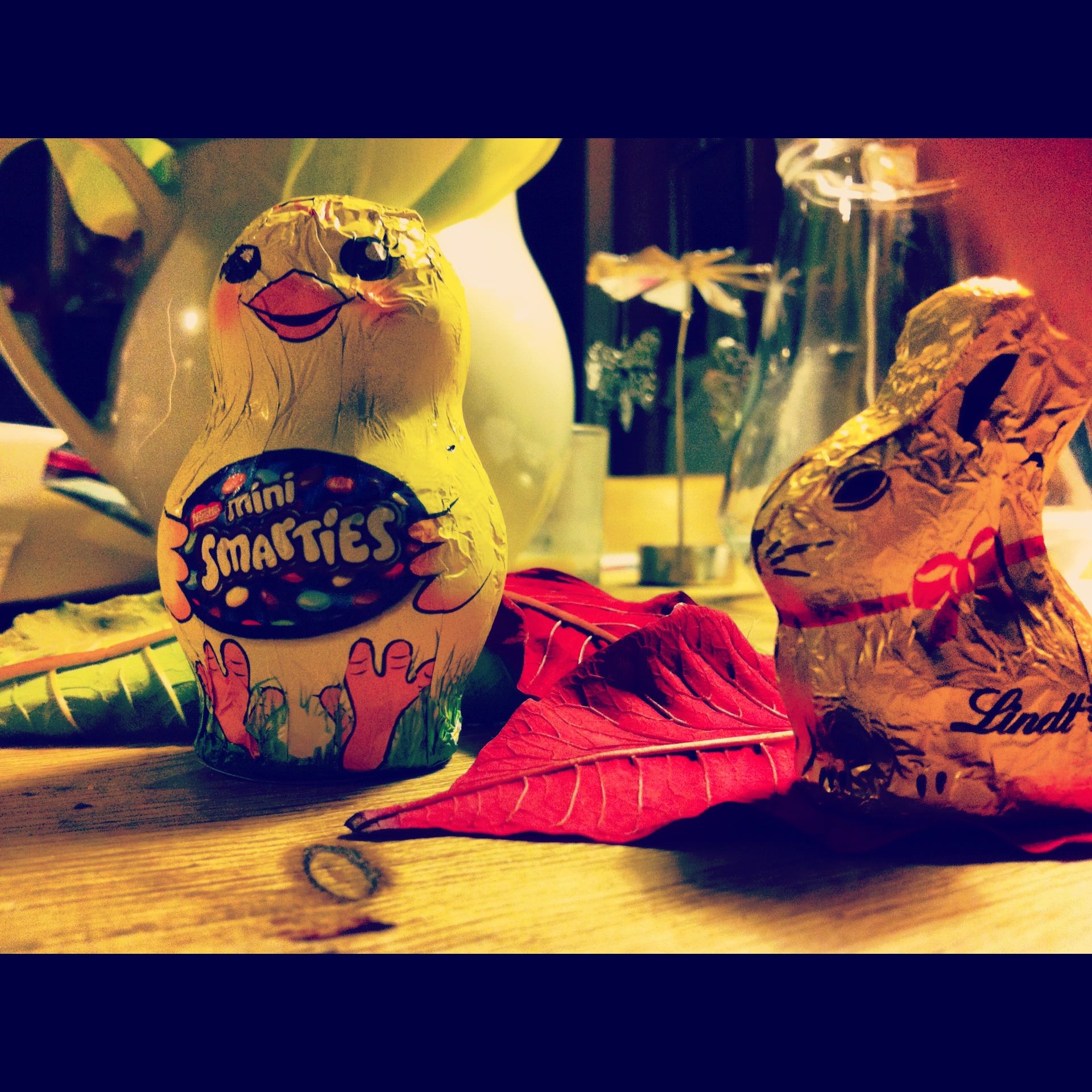
How old am I here? I’m somewhere in England, awake early as usual from sleeping on the floor, stripping away the remnants of another dream about chocolate. A dream about chocolate? Oh wait, it’s Easter. The very word Easter sounds confectionary; like ‘viscount’ – a name recalling the little minty biscuit I used to have in my packed lunches – Easter connotes the crack of a thick chocolate shell, a glut of pastel colours, the consuming of cuteness. Maybe I’m seven. My mum is away in Brighton for the day and comes back with two beanie babies: a fluffy yellow chick and a pale blue bunny. Maybe I’m seventeen, walking out to Kildoon monument just to see the lambs in the fields and hope for a happier existence. You know, that’s Easter too.
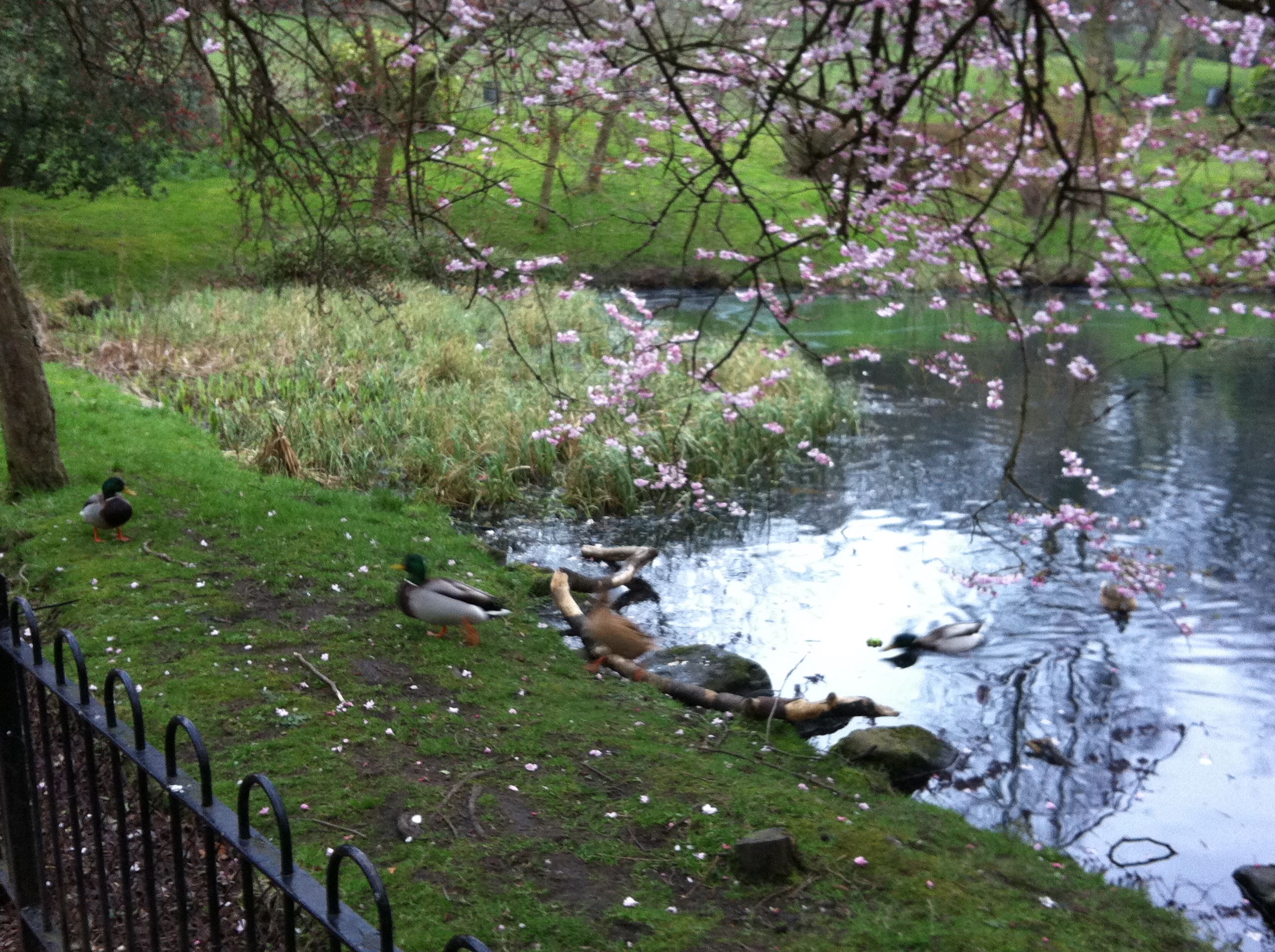
cherry blossoms at Kelvingrove
Those who condemn reckless consumerism bewail the fact that Easter has forgotten its true message: the sacrifice of Christ, the promise of rebirth. It is a solemn hope that perhaps may only be touched by those with faith; it bears the risk of becoming kitsch in the Easter Story worksheets we used to cut out at school with those zigzag scissors. You know, ‘assemble the story of Jesus and the tomb’, where pupils tended more to desecrate Christ with bunny ears more than celebrating his existence. I remember as a child going to church on Easter Sunday and falling into the soft ambience of everyone’s prayer and the familiar stories about The Stone that Rolled and Jesus’s last day and all the other things that have slipped from my brain. I remember being given a Creme Egg by the priest on the way out and thinking he had handed me something precious and holy – but later eating it anyway. Did I feel guilty, biting into this symbol of the blood and sweat and sacrifice of Christ? The problem is, consumerism is good at assuaging such guilt with feelings of pleasure. Everyone’s doing it; everybody’s merry. And after the church ceremony I remember late afternoons watching a certain family member fall asleep after a generous glass of sherry…
Is it wrong that we value booze and chocolate eggs more than the faith and the story? Perhaps…but there is a certain gratitude in the exchange of happiness, the sweet serotonin glow of too much chocolate and a long Sunday afternoon spent with one’s family.
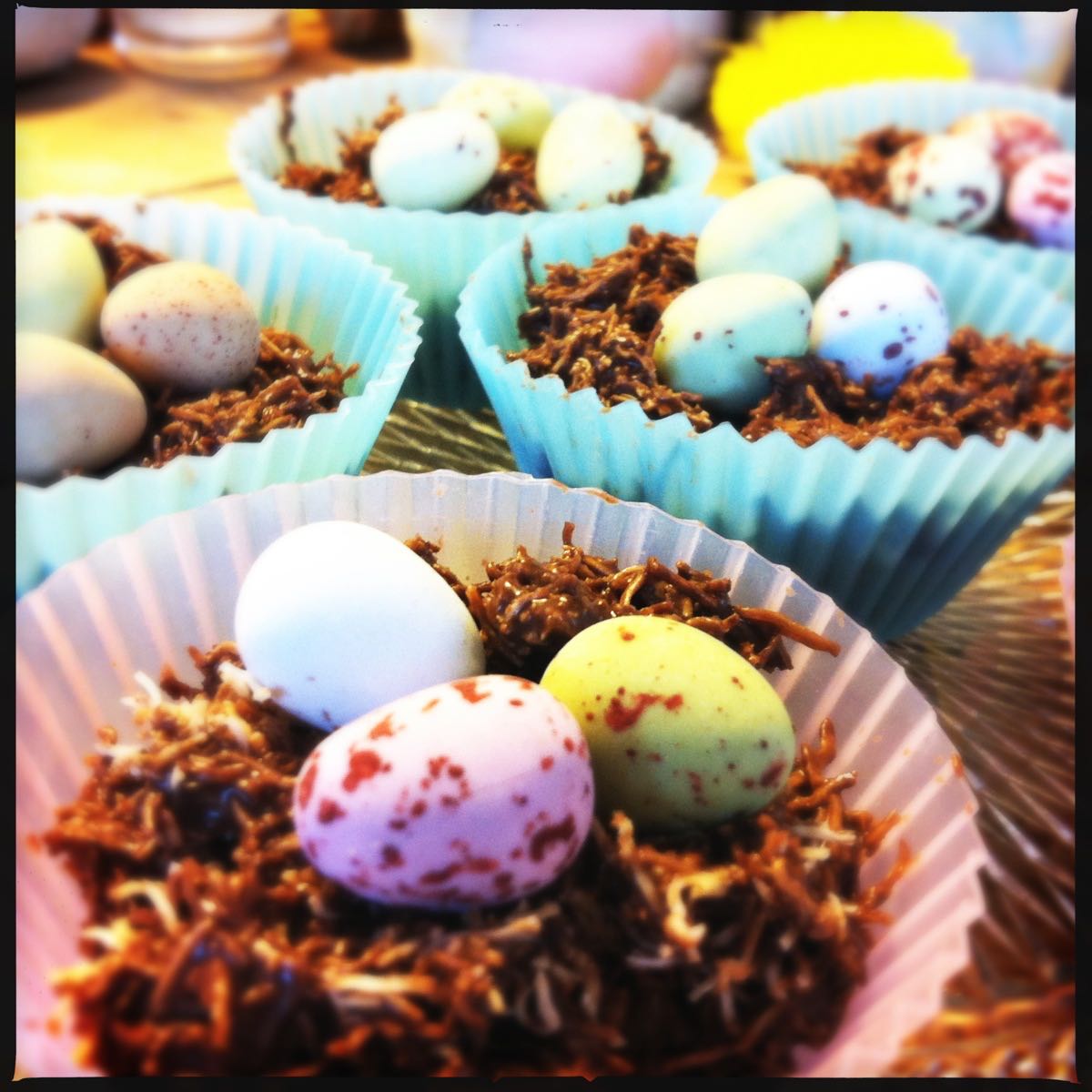
How did we used to spend our Easter Sundays? Painting boiled eggs and rolling them down the hill at Miller Park. Fighting with my brother over who got to lick the bowl of melted chocolate, leftover from making crispy cakes. A walk to another park, somewhere in Burgess Hill or Milton Keynes, watching our dog do long jumps over a river filled with old trollies and sofas. Munching fizzy belts and trying to do loop-the-loops on the swing, never feeling sick but still exhilarated (I wouldn’t mind doing all that now, but I’d probably vomit rainbows). These were the good old, carefree Easters.
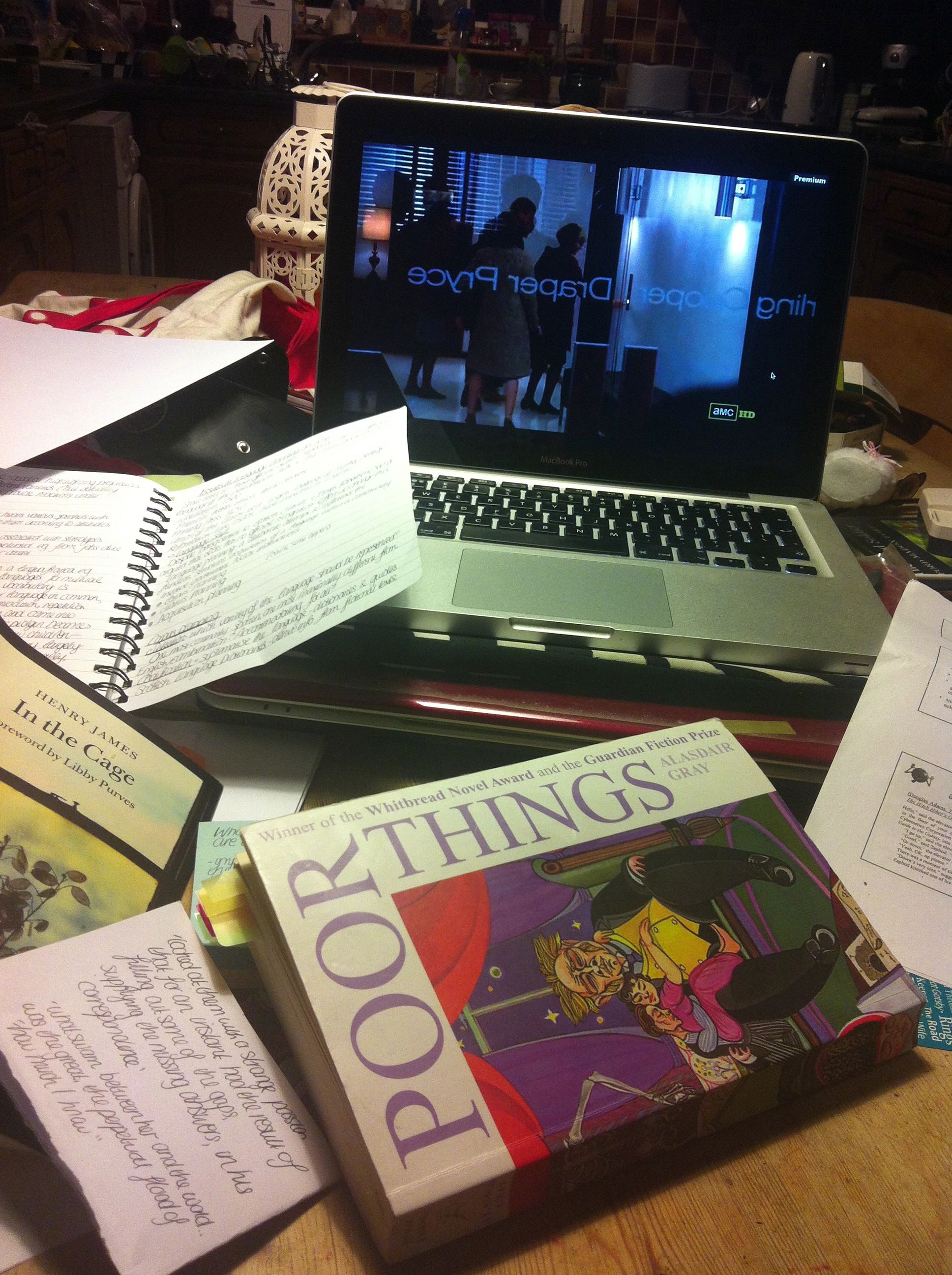
When you hit fifteen, suddenly the Easter holidays are all about studying (or they are in theory). The endless, six am days spent copying diagrams for Biology or churning out practice essays for Modern Studies, or falling asleep in the sun with a Computing textbook over my head. Cooking some complex casserole in the evening and doing the washing up afterwards while my brother messes about with his playlist of ‘doing dishes’ music (or maybe it was the other way round; I always had the better iPod). The Easter of first year where I had a weekend down in Suffolk for my Grandpa’s 90th birthday, and got so excited about staying in the countryside that I went for a walk every morning at 7am, just to glimpse the pretty English fields and flowers. Oh, and the postman I accidentally saw peeing in the river – but that’s another story. The Easter afternoon where I laboured over a terrible wee screenplay for Advanced Higher English; or the one I spent laid up watching crappy old films because I had the house to myself for a week and it seemed a waste to bother with ceremony. That was, incidentally, a very good week: I watched three series of Mad Men back to back and walked up a hill and got my hair dyed and wrote about twenty practice essays for my uni exams. There is great productivity to be had in solitude.
Productivity in action…
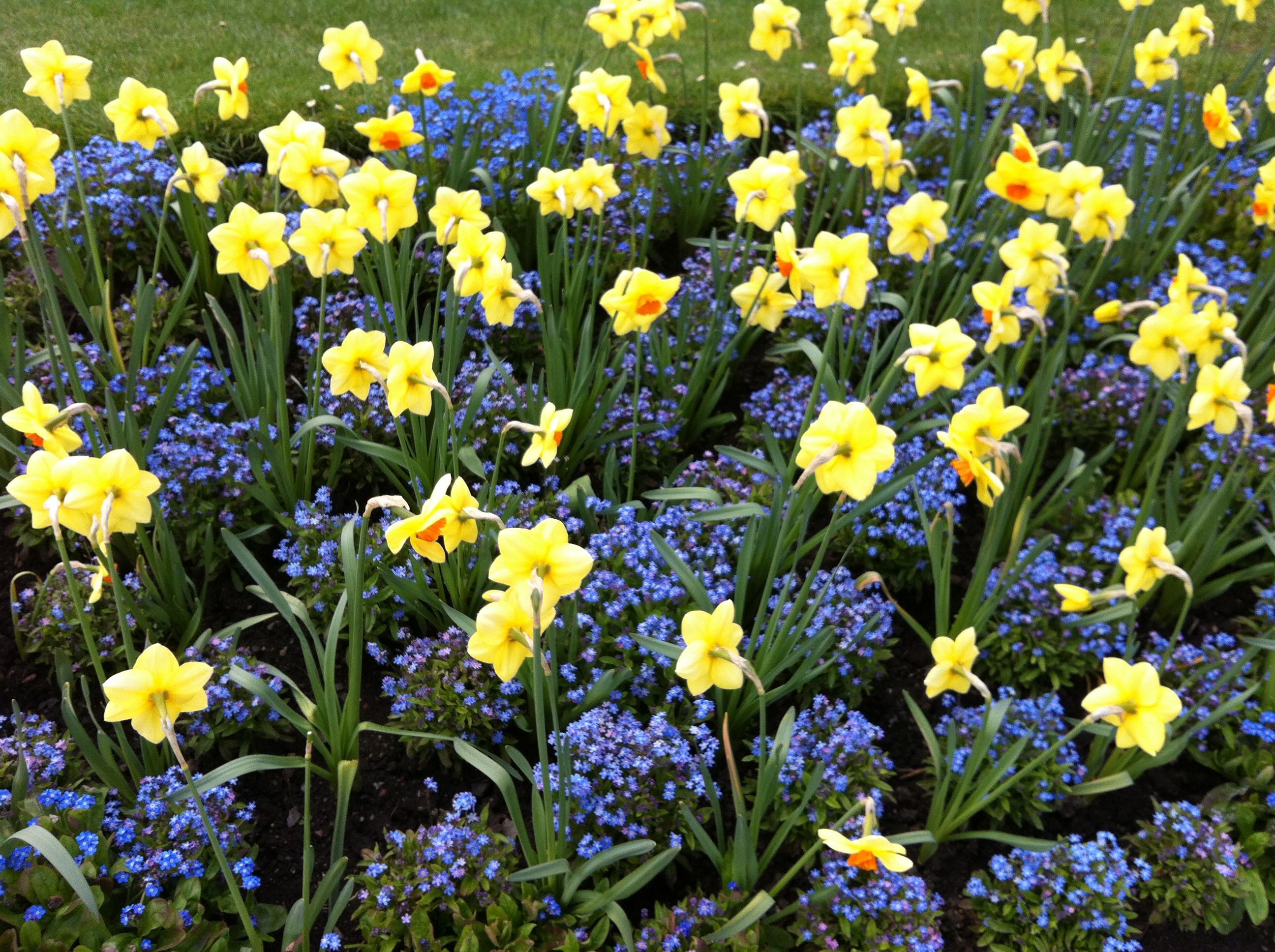
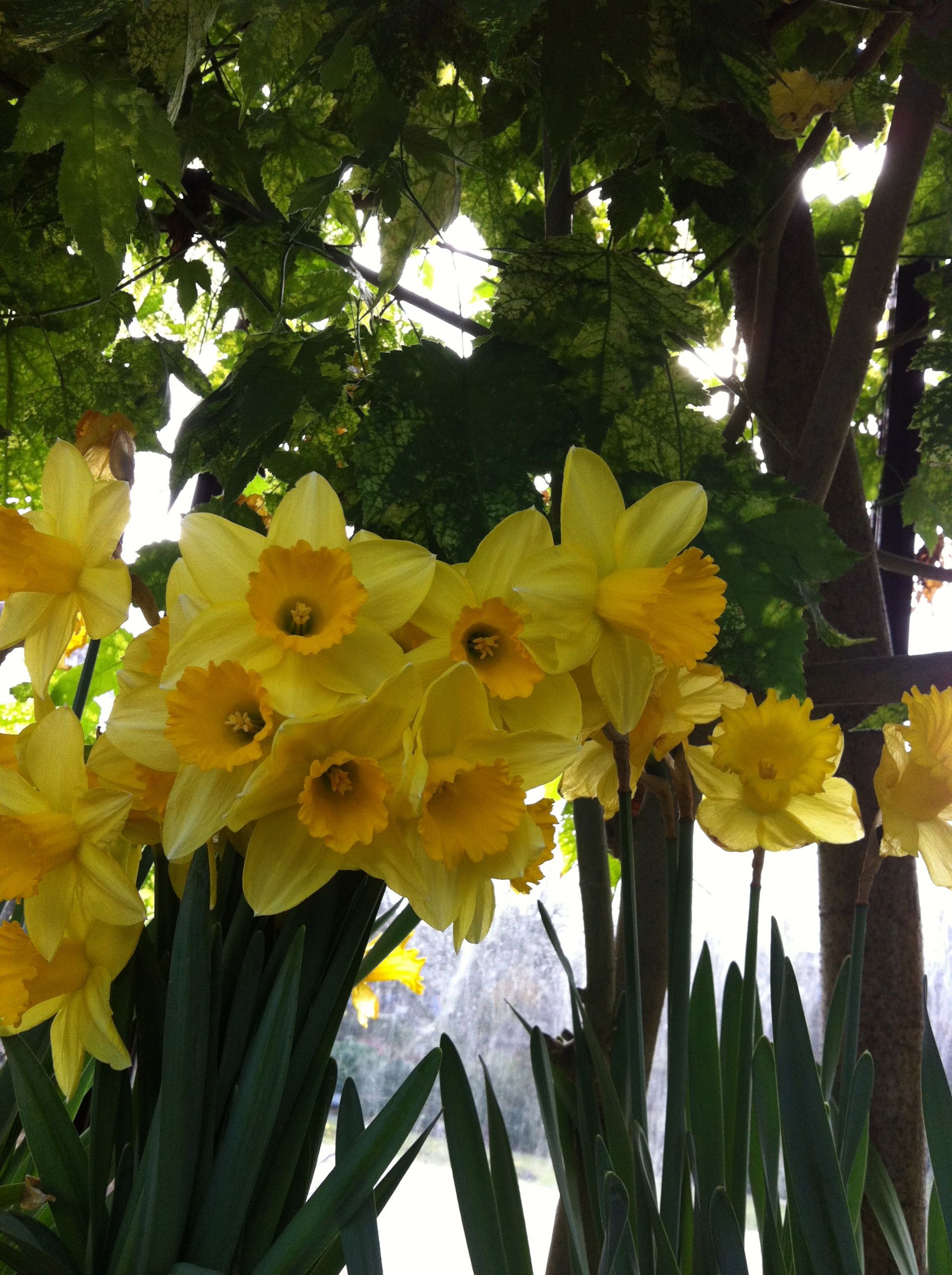
The things I love most about Easter are basically the things I love about spring. As all the songs and hymns might sing, there is a simple joy to seeing the first daffodils and blossoms and lambs in the fields. Seeing everything through the spectrum of pastel colours, wearing lavender jumpers and polishing my nails mint green. At uni, I was too stingy to buy Easter flowers, so I would walk all the way along the Kelvin (halfway to Milngavie) just to find loose daffodils to purloin from their ungraceful state, where they were scattered along the path by wayward children.
Back at school, Easter signalled the season of study leave; of long lunchtimes sitting on the hill gossiping while people were screaming at their football behind us. Bunnies are also very cool. I think I believed in the Easter Bunny more than I believed in Santa Clause. Maybe it’s the animal factor; there’s something creepy and alluring about anything anthropomorphic, reminding us of the fragility of our status as humans. The Easter Bunny, moreover, gets less visual representation than Santa in popular culture, leaving the onus on the child’s imagination to conjure what he (or maybe she; or should Easter Bunnies even have a gender?) looks like. One upon a time, my Easter Bunny was soft and probably adorned with buttons and ribbon, juggling a multitude of eggs with his paws and vanishing without trace at dawn (unlike Santa who takes his fill from a mince pie and carrot). Now, I can’t help but think of the horrifying rabbit, Frank, from Donnie Darko. The one that appears either as a schizophrenic vision or some weird spirit guide from the near-possible-present-future. Maybe that’s growing up; realising the terror in your favourite childhood memories. Pulling the latent darkness out of cultural myths and fairy tales. Still, there’s a pleasure in that too.
So yeah, today I won’t be doing much for Easter. I can hear the church bells ring for the morning service, and there are a few birds tentatively weaving their melody into the stiff Sunday silence. As far as I know, there aren’t any lambs in Glasgow, and that lovely lecturer who used to praise heavily the wonders of ‘curved chocolate’ is sadly retired. Today I will have to drag myself out of bed at some point to fall back into the world of studying, swapping festive joy for Johnson’s Rasselas, and juvenile pleasures for The Bell Jar. The only chocolate I have in the flat might be Tesco’s 30p Value, but secretly I’ll be celebrating Easter, if only in nostalgia.
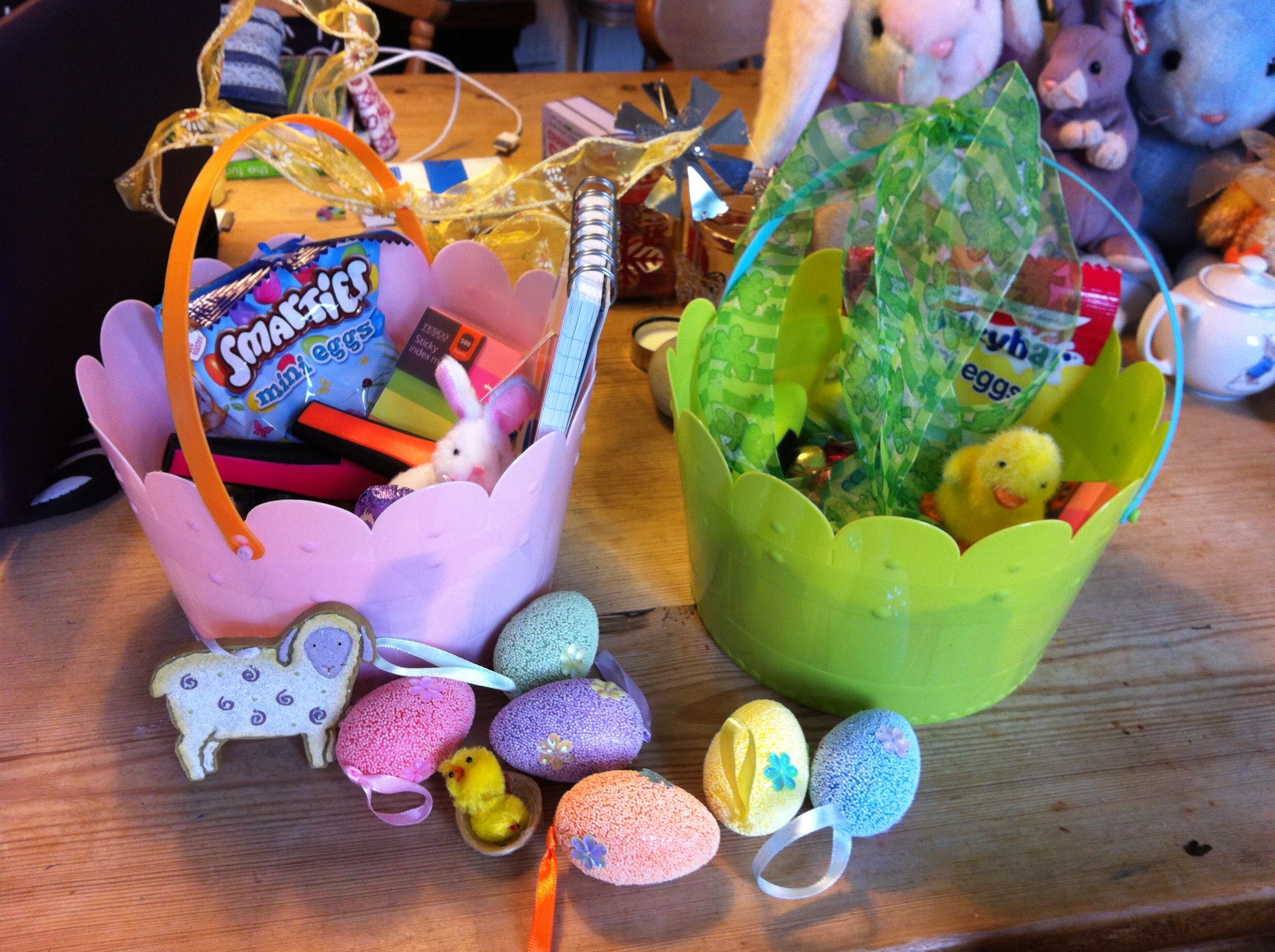
My Mum gets extra parent points for always making us Easter baskets




 mariaology