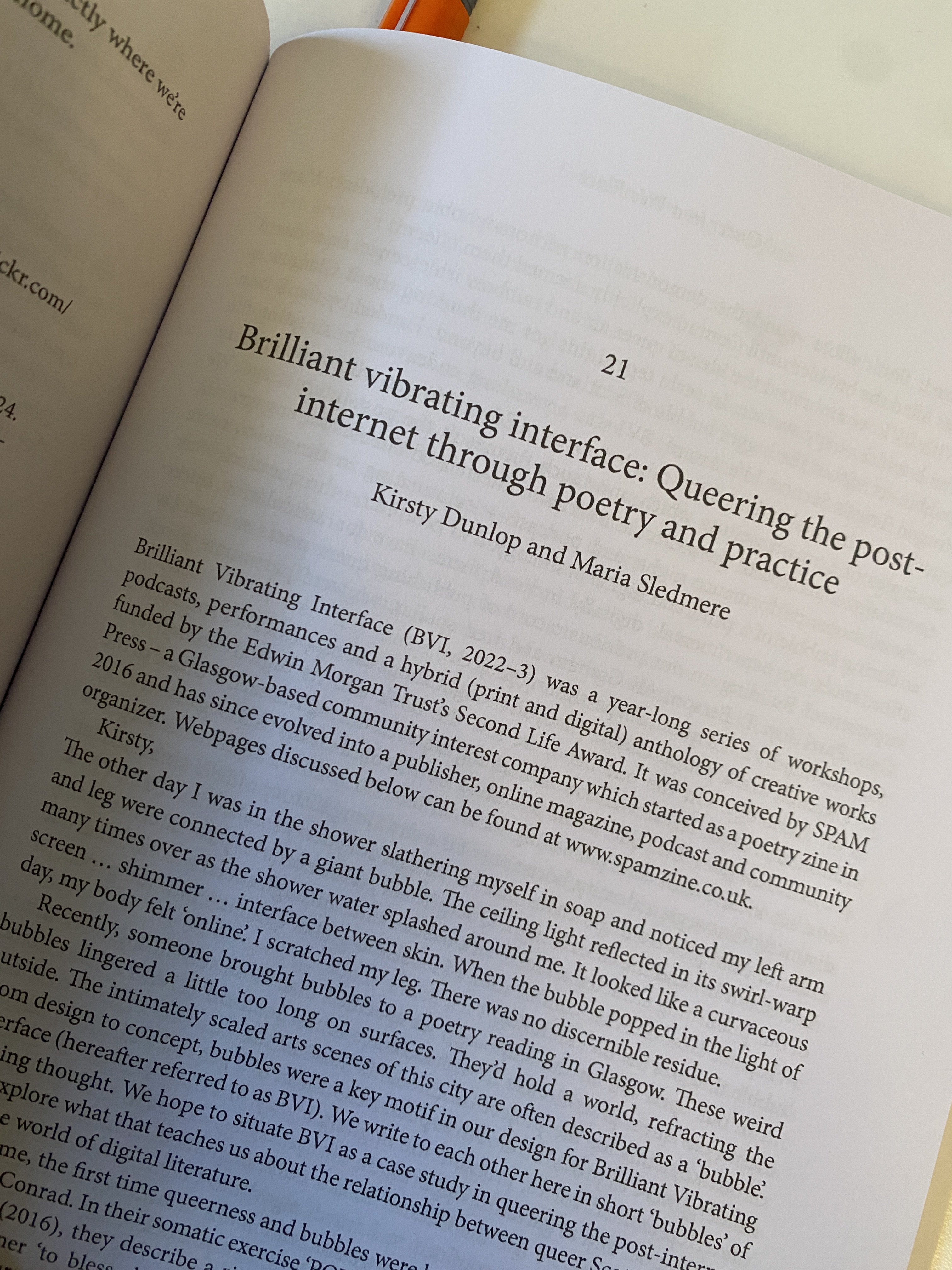
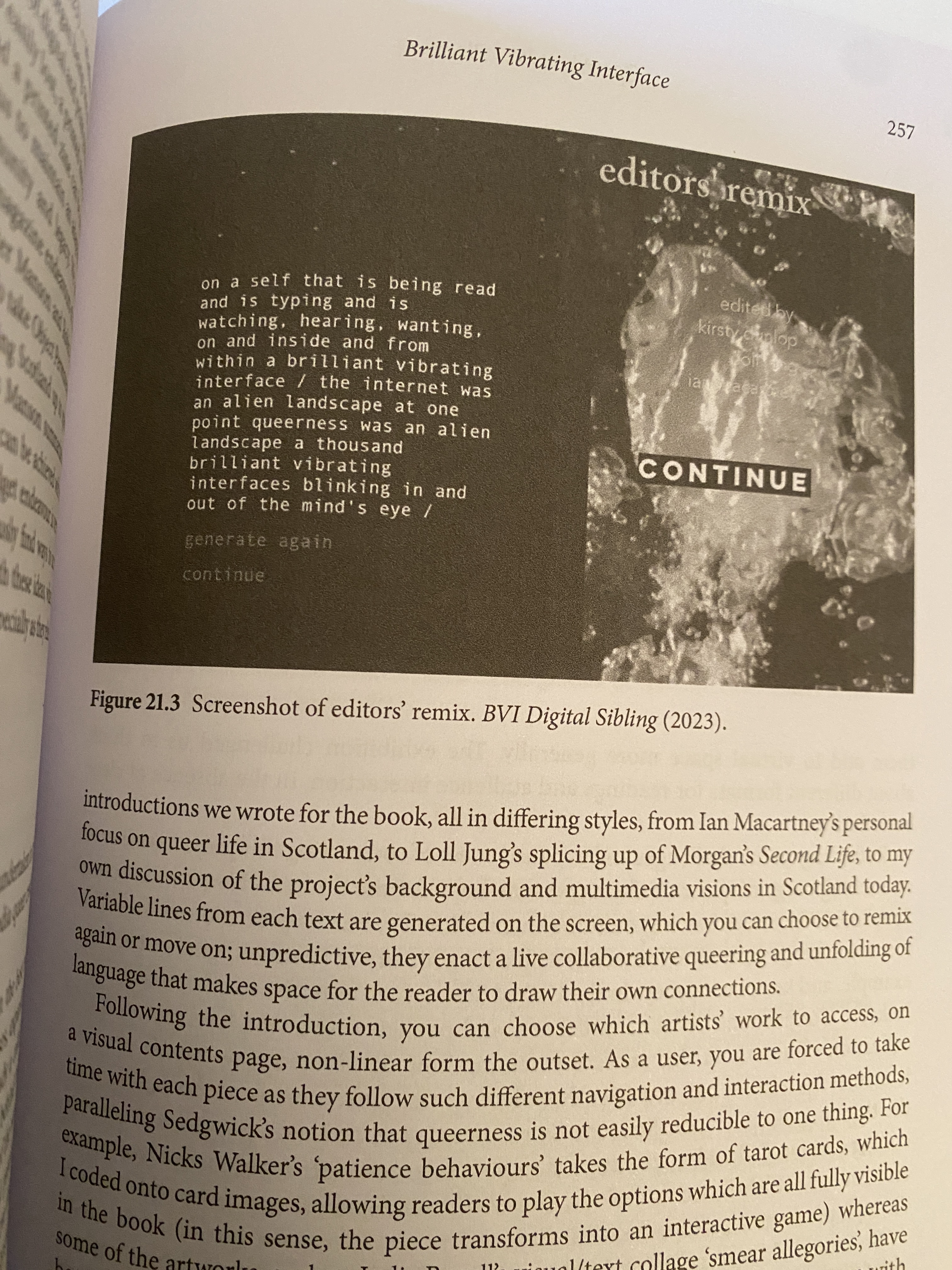
In 2022, SPAM Press obtained some funding from the Edwin Morgan Trust’s Second Life Award to run a year-long project titled Brilliant Vibrating Interface: Queering the Post-internet through Poetry and Practice. My co-investigators on the project were Kirsty Dunlop (SPAM’s current editor-in-chief), Alice Hill-Woods and Loll Jung, with Ian Macartney later joining to co-edit our print publication. We squeezed a lot of activity out of that money: community workshops online and in Glasgow, a few reading events, print publication, ‘digital sibling’ and physical installation, podcasts and an online magazine interview with contemporary sonneteers.
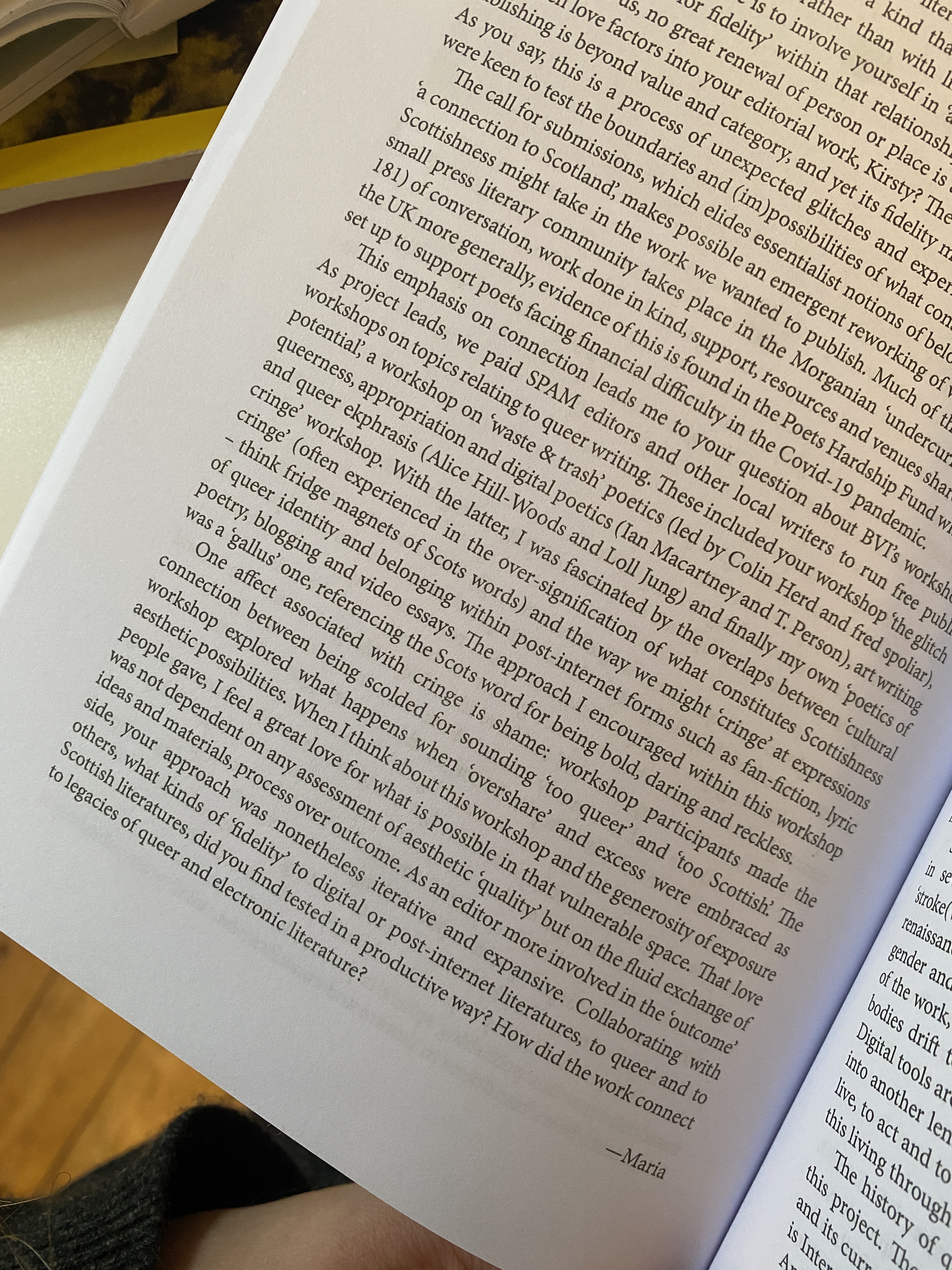
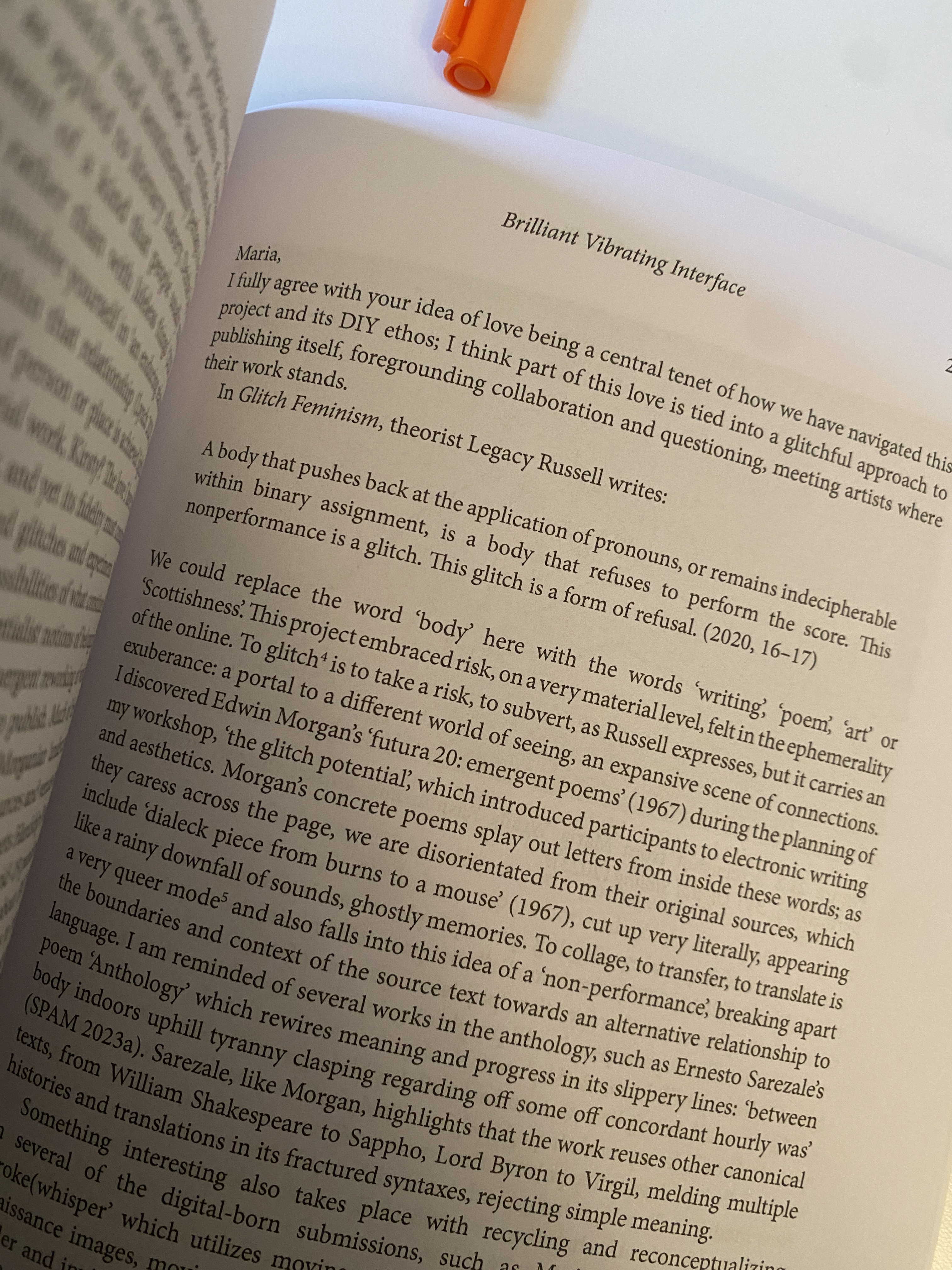
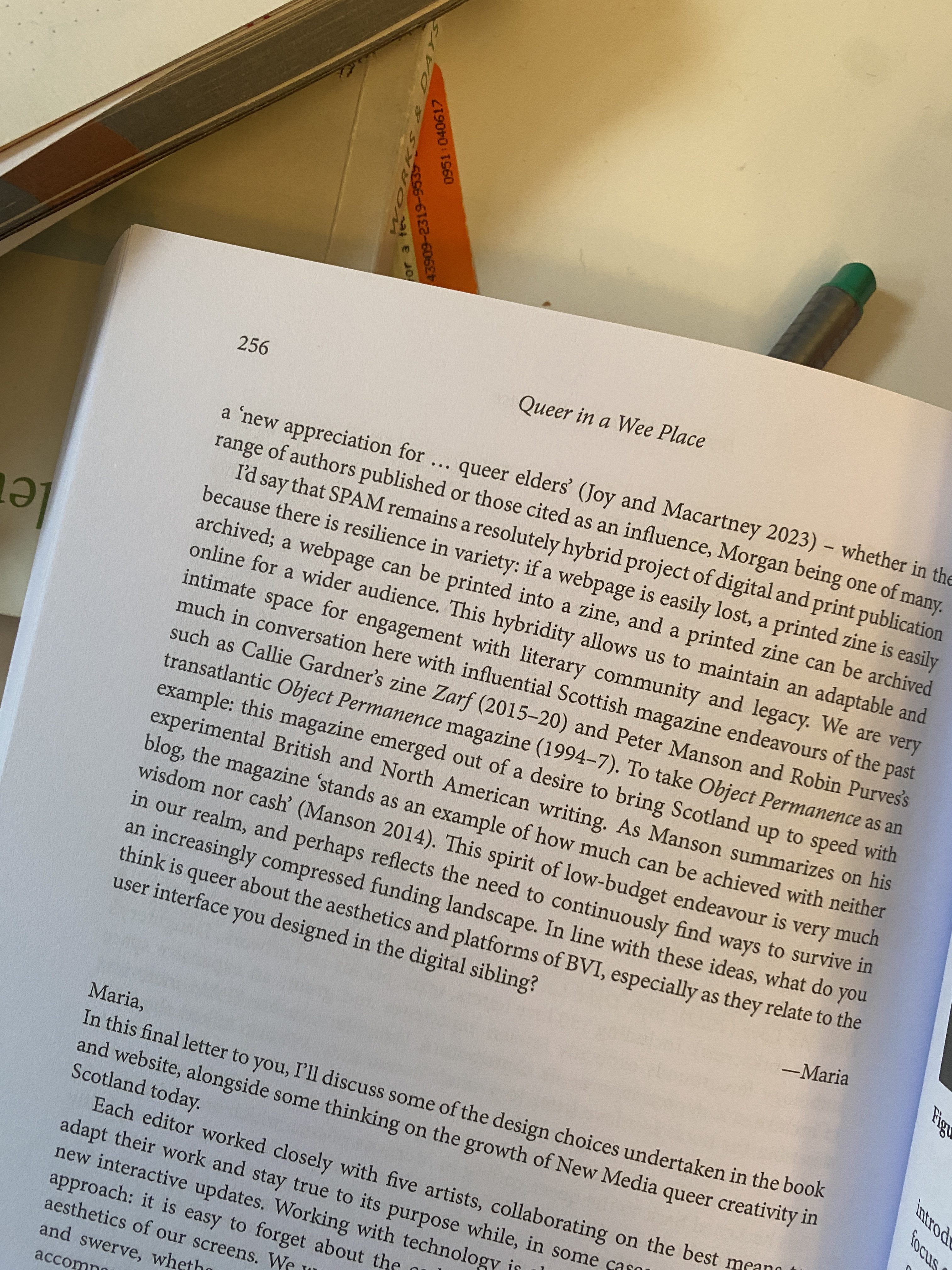
Recently, Kirsty and I wrote an epistolary chapter reflecting on the project and its significance in terms of identity, inequality, belonging, poetry scenes, queerness, Glasgow and the labour of love that is small press publishing. In our chapter we talk about the format of the project, Scottish literary scenes from the nineties to present day and the challenges and rewards of moving between print and digital (what we call SPAM’s ‘resolutely hybrid project’). We explore in more depth the poetry and visual art which found a home in our project and proffer up some poetics for how to think about queerness in the context of ‘small nations’ such as Scotland. This takes us everywhere from CAConrad’s bubbles to Legacy Russell’s glitch feminism to Edwin Morgan’s sumptuous strawberries.
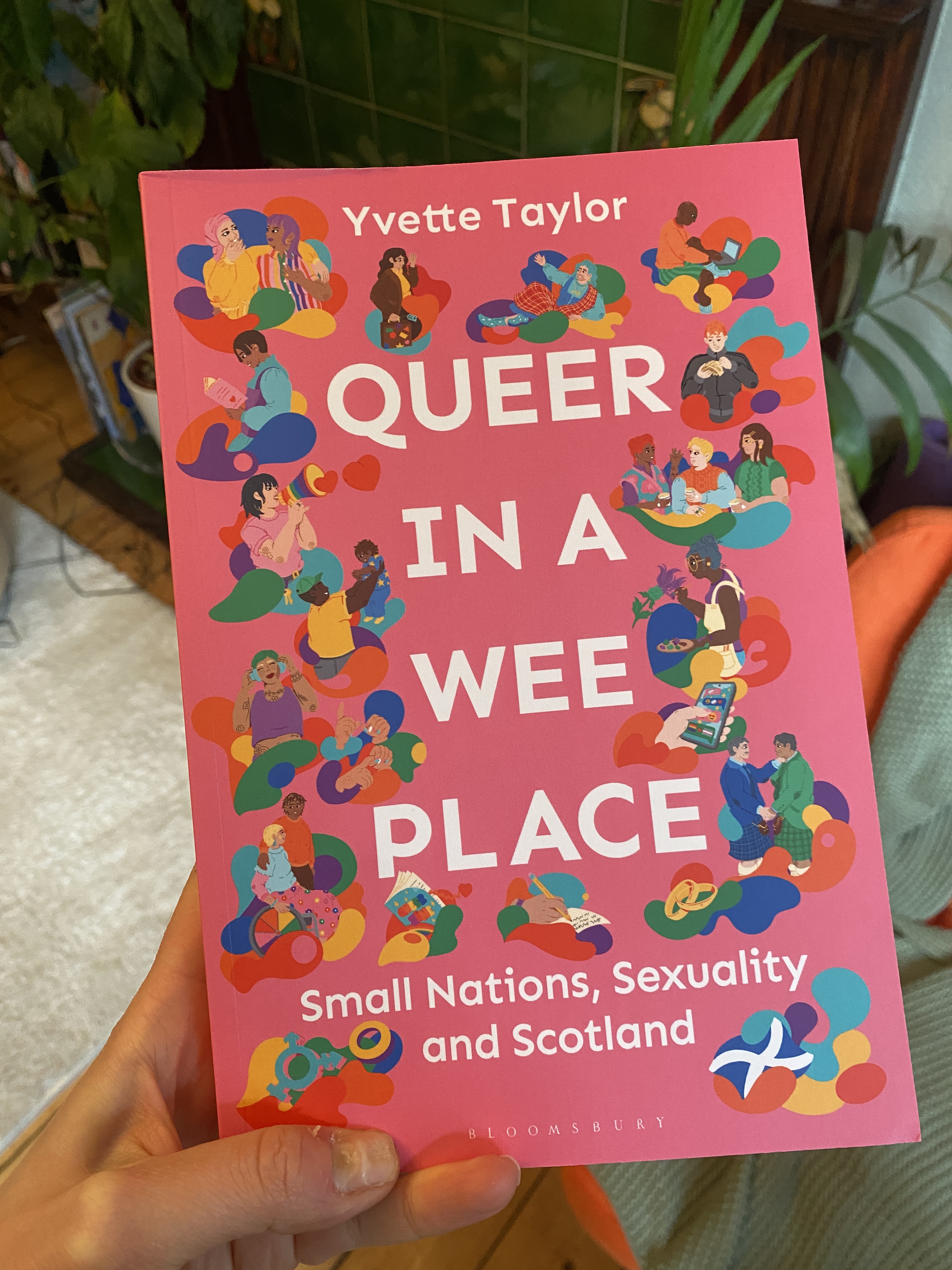
The chapter is out now as part of an anthology, Queer in a Wee Place: Small Nations, Sexuality & Scotland. To quote from the publisher’s website, the book ‘explores identity, inequality and belonging in animated conversations about how queerness moves through place – and how place, in turn, shapes queer lives’. Queer in a Wee Place contains chapters written by researchers of many disciplines and practices – from sociologists to poets – on subjects ranging from the utopic gaze on queer film to legacy and queer elders, disabled queer student experiences of higher education, Scotland’s menstrual landscape, hate crime and queer provincialisms.
The book is available in paperback form for what is a very reasonable price (for an academic book!) from Bloomsbury. You can ask your library to order it in for you 🙂
You can also read it for free via Bloomsbury’s Open Access service here.
Our archive of materials relating to Brilliant Vibrating Interface, including workshop handouts, podcast episodes, interviews and the online exhibition (what we called a ‘Digital Sibling’) can all be found at http://www.spamzine.co.uk and on the EMT website.
Leah Wilson (ed.), A Friday Night Lights Companion: Love, Loss, and Football in Dillon, Texas (2011)
Barrett Watten, Steve Benson, Carla Harryman, Tom Mandel, Ron Silliman, Kit Robinson, Lyn Hejinian, Rae Armantrout, Ted Pearson, The Grand Piano: Part 3 (2007)
Molly Brodak, Cipher (2020)
Jonathan Coe, The House of Sleep (1997)
Blake Butler, Molly (2023)
Alessandra Thom, Summer Hours (2025)
Clark Coolidge, The Crystal Text (1986)
Virginia Woolf, The Waves (1931)
David Lynch, Catching the Big Fish: Meditation, Consciousness, and Creativity (2006)
Tatiana Luboviski-Acosta, La Movida (2022)
Ted Rees, Thanksgiving (2020)
Laynie Browne, Intaglio Daughters (2023)
Laynie Browne, Acts of Levitation (2002)
Ida Marie Hede, Adorable trans. by Sherilyn Nicolette Hellberg (2017/2021)
Hélène Cixous, Hemlock, trans. by Beverley Bie Brahic (2008/2011)
Juliana Spahr, Ars Poeticas (2025)
Jameson Fitzpatrick, Pricks in the Tapestry (2020)
Lisa Fishman, Dear, Read (2002)
Julien Poirier, Out of Print (2016)
Juliana Spahr, This Connection of Everything with Lungs (2005)
Bianca Rae Messinger, pleasureis amiracle (2025)
Rachel Blau DuPlessis, Days and Works (2017)
Jennifer Soong, My Earliest Person (2025)
Barrett Watten, Steve Benson, Carla Harryman, Tom Mandel, Ron Silliman, Kit Robinson, Lyn Hejinian, Rae Armantrout, Ted Pearson, The Grand Piano: Part 4 (2007)
Duncan Hannah, 20th Century Boy: Notebooks of the Seventies (2018)
Ariana Reines, The Rose (2025)
Brenda Hillman, Death Tractates (1992)
Peter Gizzi, Fierce Elegy (2023)
Anne Vickery and John Hawke (eds), Poetry and the Trace (2013)
Emily Segal, Mercury in Retrograde (2020)
Michael Nardone, Convivialities (2025)
Steven Zultanski, Help (2025)
Ariel Goldberg, The Estrangement Principle (2016)
Danielle Vogel, A Library of Light (2022)
Fanny Howe, Selected Poems (2000)
Alice Notley, Early Works (2023)
Stephanie Anderson (ed.), Women in Independent Publishing: A History of Unsung Innovators 1953-1989 (2024)
Ariana Reines, Coeur de Lion (2007)
Yanyi, The Year of Blue Water (2019)
Lucy Ives, Human Events (2016)
Chloe García Roberts, Fire Eater: A Translator’s Theology (2024)
Charles Olson, The Maximus Poems (1960)
Alan Davies, Raw War (2012)
Rebecca Wolff, One Morning— (2015)
Alice Notley, The Descent of Alette (1996)
Sean Pierson, The Perfect Season (2024)
Dom Hale, First Nettles (2025)
Syd Staiti, Seldom Approaches (2022)
Gillian Rose, Love’s Work (1995)
Imogen Cassels, Mother; beautiful things (2017)
Hesse K. Disquiet Drive (2024)
Elisabeth Kübler-Ross and David Kessler, On Grief and Grieving (2005)
Louise Glück, Marigold and Rose (2022)
Tom Raworth, Cancer (2025)
Boaz Yosef Friedman, Born in a burning house (2025)
Ada Smailbegović, The Cloud Notebook (2023)
Marie de Quartrebarbes, The Vitals, trans. by Aiden Farrell (2025)
Vigdis Hjorth, Is Mother Dead: A Novel, trans. by Charlotte Barslund (2022)
Isaac Jarnot, Robert Duncan: The Ambassador from Venus (2012)
Lina Scheynius, Diary of an Ending, trans. by Saskia Vogel(2025)
Tom Byam Shaw, You Are Going to Regret This (2025)
Bruce Boone, My Walk with Bob (1979)
David Larsen, The Thorn (2005)
Joan Didion, The Year of Magical Thinking (2005)
Hélène Cixous, Hyperdream, trans. by Beverley Bie Brahic (2009)
Danny Hayward, Training Exercises (2024)
Matthew Goulish, Kingfisher (2024)
Suzanna Scanlon, Committed: On Meaning and Madwomen (2024)
Mark Frost, The Secret History of Twin Peaks (2024)
Alex Marsh, Holding Pattern (2025)
Robert Glück, Margery Kempe (1994)
Michael W. Clune, White Out: The Secret Life of Heroin (2013)
Madeline Cash, Earth Angel (2023)
Tom Crompton, Wishbone Valley (2024)
Maggie Nelson, Bluets (2009)
Courtney Bush, The Lamb with the Talking Scroll (2025)
Bruce Boone, Century of Clouds (1980)
Evan Dando, Rumours of My Demise (2025)
Juliana Spahr and David Buuck, An Army of Lovers (2013)
Kevin Davies, The Golden Age of Paraphernalia (2008)
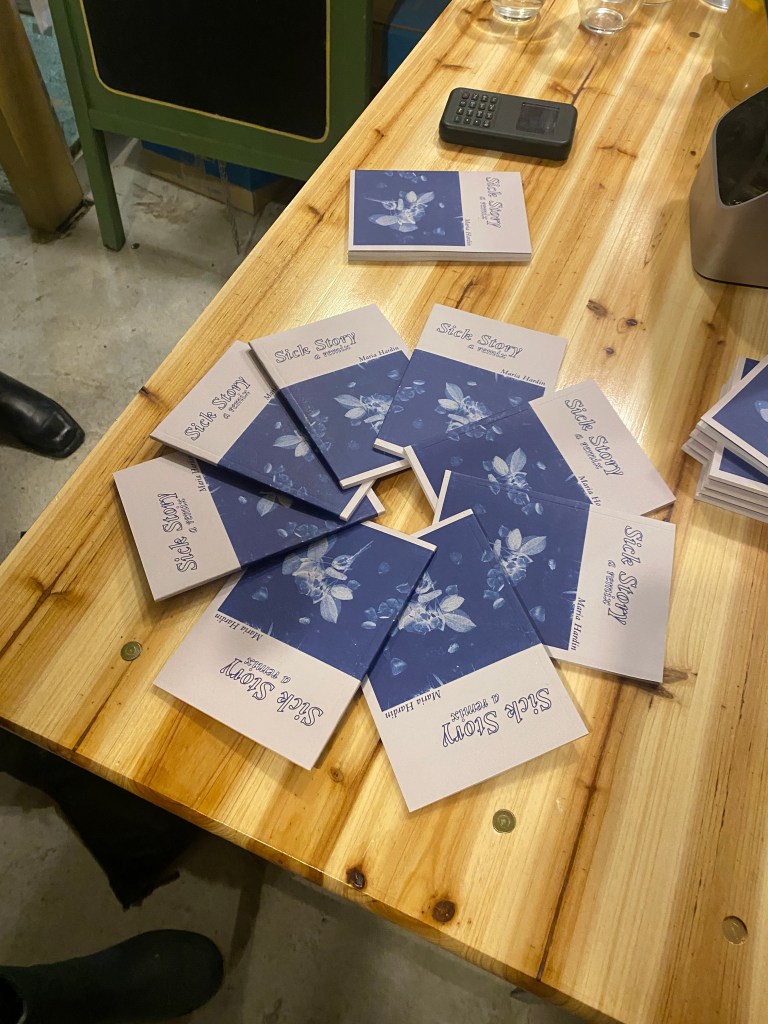
Last night SPAM Press hosted the wonderful Swedish-American poet Maria Hardin at Mount Florida Books, Glasgow, alongside readings from Kate Paul and Jane Hartshorn. Here is the intro I read for Maria.
I want to begin by reading a poem by the late Rhiannon Auriol, who was a kind, talented and sharp-minded poet. She had a voice that felt genuinely fresh and we were always excited to get something new from her in our inbox. We published her in the Plaza and our online magazine several times and when it came to putting the lineup for tonight together, both Kirsty and I had the thought: I wish we could invite Rhiannon to read with Maria. Rhiannon forever.
Here’s the poem, which was published in pif magazine back in 2021.
I drop into this poem and I am petalled. I have put my hand in the new burr grinder of how I am learning to read in grief. This self-petalling is a relief. I will soften! I will become rose water, distilled into essence! Energised by short lines! There is something ugly-beautiful about my becoming rose-water of the nominative. Yes I was born with the middle name ‘Rose’ and also the first name Maria. Rhiannon writes of ‘the moon particularly / at sea’. Maria and I share a name meaning ‘of the sea’. We found each other via the kismet of poetry, and her poem called ‘Mariaology’ which features ‘a cascade of every maria’ which I first received as an iPhone photo. Last week I was researching something and stumbled on the phrase from the website MindBodyGreen which said, perfectly: ‘caffeine can disrupt your hormonal cascade’. I don’t know what a hormonal cascade is but I know I have felt it in poetry. Yes, for you I’d drop everything.
By some miracle of the ether Maria is now here in Glasgow tonight and we are launching her pamphlet and I am CAFFEINATED. My being caffeinated will never truly replenish my energy. There is a tale here. Rest without respite. Sick Story. I like to think of this as a sister pamphlet to Maria’s earlier work Sick Sonnets and also a cellular cascade of the voltas played within them. We have dying bees and the premise if not promise of healing. In Maria’s sick sonnet ‘Glossolalia’ the Steinian rose becomes a rat becoming also a rose and the speaker reads ‘emotional responses to the end of nature’. I have always loved the general mood of melancholia in Maria’s work, the way a speaker can latch, mutate and render ornate a feeling, an image whose origins remain mysterious. One never feels quite settled; there is a rat-like restlessness. Is that it? But also the still, slow burgeoning and wilting of the rose. Of devotion. Hours of languishing. The void is decorated all the better to feel it. The void is remixed. If there could be endless Proustian bedtime there could also be a pain psalm and a ‘baited lamb’.
Sick Story looks for alternative narratives in its telling of chronic illness. It asks ‘what is the shape of a sick story?’, with an eye to Bernadette Mayer’s Story and Ursula Le Guin’s ‘carrier bag theory of fiction’ by way of explanation. For Le Guin, the carrier bag narrative is shaped like a bag, not the arrow of phallocentric linearity. Mayer’s Steinian Story bundles riddles, matter, anecdote, the stuff of ‘things’. Nothing feels pre-determined, destined for an ending; rather, all times rub their quantum shoulders in the bag. Have you ever rummaged in public for your medicine? Have you ever written notes on the back of your hand, worried the ballpoint would seep beneath your skin and stain something irrevocably navy? Have you ever shaken your life up so much you could almost smell its perfume?
Here is a snippet of Mayer’s Story:
Voices fall.
It may be seen feeding on this under one of those tropical things.
The time or place of starting.
He throws a hat on a seal’s head and a piece of his pack into a whale’s mouth, marking their characteristics.
Lamp, lucite and plastic.
I saw one once in a book, but I didn’t rip it to shreds, or even divide it, as I could
have (snap), but left it whole (shot), which it could never be unless it were left
that way.
Will that have anything to do with this? (67)
Mayer’s storied ingredients are packed upon each other like the storeys of a building. She disrupts the assumed causality of narrative with a prompt — that of the child’s or editor’s: ‘Will that have anything to do with this?’. I am at the soft mercy of every bedtime story. Once gathered into the bag, is everything relevant? And where does it take us. Details are listed like precious cues. Lamp, lucite and plastic. The pronoun ‘it’ bears wild liberty in its free-kicking materiality. I trample ‘it’ under the ‘perfect lucite heel’ to which the speaker of ‘Mariaology’ prays. I sub ‘it’ under light, lux, something solid and transparent — the supposed clarity of what I am trying to say, what does it all mean. What is the ‘time and place of starting’ when it comes to illness? From where do voices petal and fall? Are they, like rain, a kind of interference? Mayer asks ‘What did the rose do?’ after the word ‘History’. I think Maria is answering that question in her remix. We invent from adjacency some kind of story. Is the rose sick, is it guilty? How to place these scenes. I think of something Jane wrote in the same issue of SPAM magazine where we first published Maria: ‘Houses appear / where once there was marshland, a thin burn threading / between them.’ My imagination shrinks these houses to the size of pages and now I want to live in them. And you can too.
Here’s Maria Hardin, thanks everyone.
🌹
You can buy Sick Story from SPAM Press here. It is SUCH a cute edition (A6 pocket-sized) and the writing will stay with you a long time. Carry it with you!
You can buy Maria’s debut collection, Cute Girls Watch While I Eat Aether (2024) from Action Books here.
Here is a long essay I wrote about roses, via Idlewild/Stein/Lana Del Rey/Joyce et al, back in 2017.
Once there was an idea to make food. A pan was taken and a dark green plastic mixing bowl. Broken-up bits of cooking chocolate were added to the bowl and the pan was put on low heat. Blue flames licked the edges. What was forgotten was water. Whoever wanted water. Water to eat? No. The butter and sugar of the chocolate melted into the dark green of the plastic and that plastic became fluid and congealed into geological pools, hardened kind of bubbles in the silver pan. Black, acrid crackles. The scent was caramel and cancerous. This could not be edible.
Nor could the labour of scraping such a biohazard off the pan be edible.
The kitchen was evergreen and giving, until it couldn’t be.
There was something missing.
What was edible about listening for her car to pull up the drive, the lights to flash up, a heart leap, she’s home?
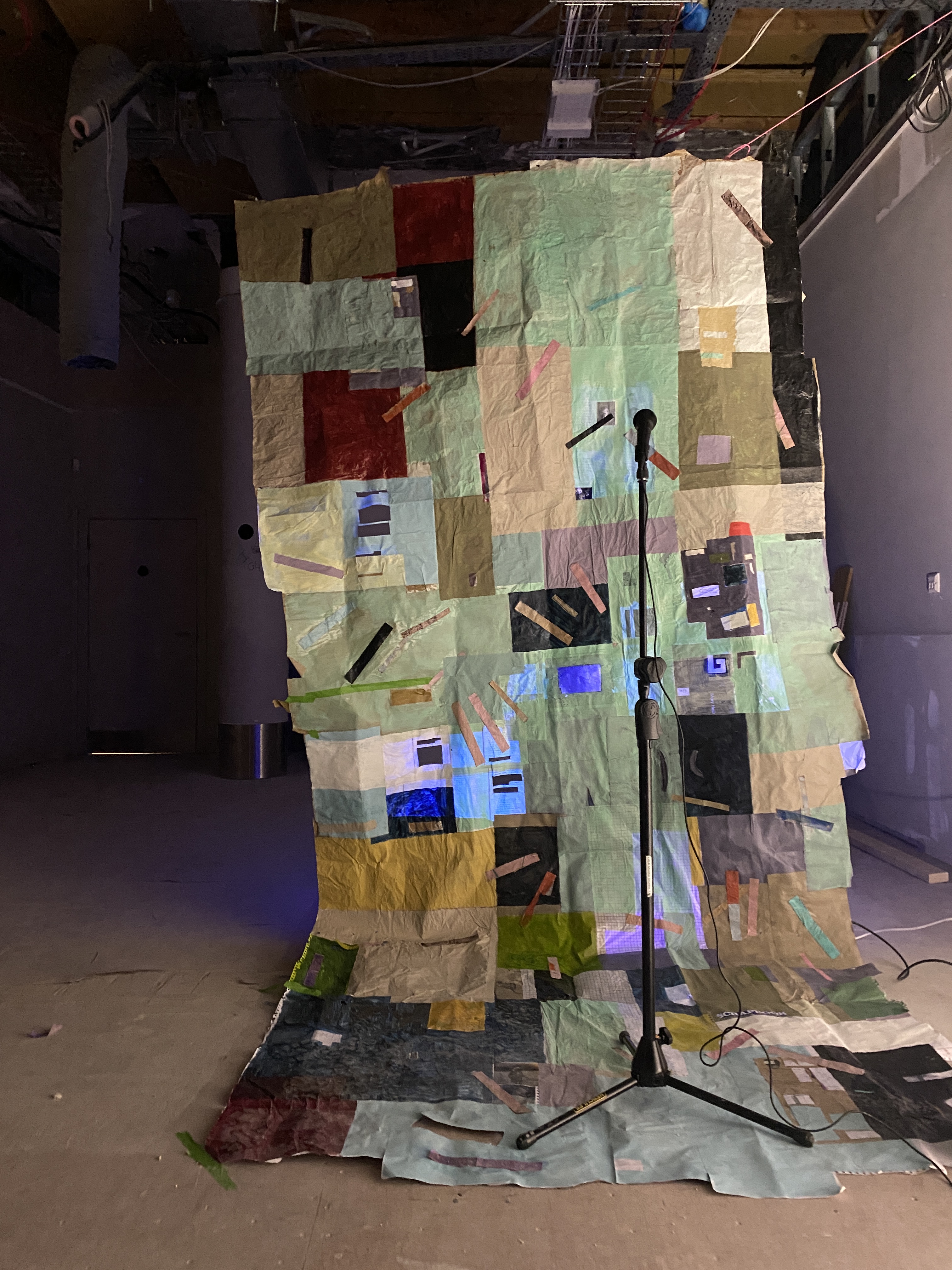
Painting by Gabriella Day, installed at 16 Nicholson Street (15th February 2025)
Snapfish was the app for picture-making with smile transistors of the print medium formerly digital doing it all in reverse. This was a theory fiction of sorts in that it referenced real-world Instagrams of the known in the room a knowing nod to the downtown of Glasgow housed as it was in Stories. What does it mean, Iphgenia Baal asks, for there to be a function called that, Stories. Our narrative sense is tabular and it’s no longer radical to put that logic to language and yet how else to express the compression effect of so much content in the 24hour window of when you wanted to say it. Say it with images and captions, the macrofication of everything somehow blowing up tiny moments a thought-unit could never be solar. The big sleep is a phrase she used and sensed somehow this was to come off Instagram and be as small as a baby in your own head you could seek relief in that, a gram of an instant like whatever the polaroid was supposed to. Develop immediacy in situ. Ravers must have had weddings according to the story and maybe to scroll past Sinead O’Connor clickbait and the manifest premise of Instagram mystics was to get at it: story. Children were political subtweets they didn’t consent to. I felt figural arrangements of the app hopping in negative space by which I mean, I was moved by the performance of app phenomenon / it’s giving ‘Home’. Who else is upset by the pivot to video and its attendant emphasis on the rectangle. I walked past a tree in the park and announced it looks like a television because it had a triangle kind of portal shape from where it had snapped in the storm and in my head in that instant a television could be a triangle. You could say ‘Snapfish’. Drew was like what’s the catch. Kirsty says three is her favourite number and Gabby says famously it is the magic one. Kirsty says it is all about triangles. At the end of Melancholia they sit in that triangle structure of sticks and wait for oblivion. What if there was an Instagram comprised of triangles always cutting the roundness of life off suitably into angles, spikes, slashes? I already feel so cubism. Gloria says she doesn’t like being in buildings that are in a state of decay. There are lovely metal bars draping like industrial stalactites and these kind of waffle insulations that give me trypophobia and the realisation that if I were to look at a waffle of any kind on an acid trip probably it would end badly — or worse, it would never end. Now thinking about endless waffle reproduction in fractal everafter it’s like I could float up to the ceiling and be a reverse maple syrup or ketchup bleeding upwards into the texture. That kind of schtick. Traditional reading is supplanted by ‘pure tapping’ because we all said so and Baal said in the story of many stories the tabs that indicate each one had shrunk to little dots since there were so many stories, barely room on screen to map them all. Oops an ellipsis. I remember the era where celebs having minor breakdowns in public would document them lavishly on the story function and the learning we did in that witnessing, as so-and-so saw and was never to be seen again at the bottom left for all the algorithm exchanged of your intimate pivotals. To come off the app, peel a tab; what’s it called almost a Berocca of presence I took densely to remember my friends. Let it melt fully into your gums before coming. Back in the room. Has anyone else had such random encounters on Hackney Road as the ones documented in Baal’s story of stories almost the same person with red curly hair running around in the rain trying to get home in some Covid Christmas, wedded to parasociality’s actual crisis. Too cold to undo my dirty-white jeans. We’d get stranded without narrative sugarcane to suck on and get over with. Afterwards, Leo says ‘I will never look at weddings the same’. fred spoliar in mesh reads a love poem inspired by the entwining of drunk ‘straight couples’ on the bus back from south side, implying all heterosexuals live north of the river and there is a conclusion to the poem’s occasion like ‘it’s love in its offensive modes I want’, striving for utopian couplets only to vivisect grace revealing all hope is a raindrop. Daisy says on Valentine’s Day a maggot fell on her hand, newly born, in front of the television. I said that’s a poem and sorry it will be so annoying to write it — the lovebug writes itself onto the nose. Warm hatching seems nice on a freezing Saturday. We are each to each our body heat. A real lentil would have been more wholesome. I hurt and was changed by the browser world. When fred said ‘yes I have hope’, the light in the room went out for real. Nell says there are two necessities (light, heat) but we can only have one. Well, to pretend iridesce I could take to the streets and try not to get hit by it. To walk around in these poems of memory another south of some city to would give up its public parks for spring and weedling trying to get at the same idea to fashion as intro. Weeds signify your lack of presence. Yes it’s baroque and if you don’t like it you can foil-wrap your heart and lob it politically. Playing the livestream in other locales as if to be thrice-selved only in poetry. When you conflate action with love, have you lost your love’s calibration in service of fucks? There is no cut-cookie of cautionary theory so much to break this in gently. Yes, the private property was and is a lie. This is why we squat in our art. I would feel better hanging upside down like the chrysalis I make of this endless chrysalis. Still, shareholders are why we can’t make the world we want and so fred reads the line ‘so frostwork adores a mitten on the fence’ or something to that effect. I pluck briefly that mitten to give to some kid / who will inherit my chilblains / their frazzled capillaries replace / this chrysalis. Sonnet we can’t be taped laboriously to a Hollywood applied rose blush of the dusk and blush drama of fervent childhood. Living situations fell apart like broken desultory Temu jewellery. We migrated the apps and tried not to fall in the Seine. Our sentences unfortunately were full of lead. Lillian Ross-Millard said ‘I make performance for video’ and there were the collected notes of chromophobia, fear of colour or a personal aversion to its manifest hues. The migraine dramaturgy of yellow and blue. Something felt pixelated like it genuinely lacked substance, could not outline itself for love nor money. Ross-Millard said the cold was felt in her solar plexus and I fell into that line ‘like getting your period and finding a wasp in the toilet bowl’ so much stinging in the sweet place. Like if you look at an object for long enough you can make of it Void. There was an account of the real life ballerinas catching fire during a performance of The Tempest. Real life ballerinas on fire I felt my sentences plié. I was replete with horror of what had been earlier told to me. This is sufficient fire for the world for now; meaning it’s time to perform it. Burn off the colour in everything / with the calories of a panic attack. When Myles Westman read, knelt down and softly, I wrote the phrase ‘unearth radio blood’, unsure of its origin. A loop played over the elegy and we circled the fateful day. Lines like fire licks. Systems, cataclysms. Lastly, Sam Keogh read about holes, butterflies, rorschachs. Said the word ‘rorschach’ several times as if making a rorschach of signification itself, sonic imprint: a little over then underflourished, quivering ink, accented. I thought of gross incidentals in industrial kitchens. For that to be a sort of lichen. Shipworms. Perils of them burrowing into silky poems. I wanted that honeycomb in the horrible waffle but not to stop. Waspish as a florid piss. Footnote telepathy. Parasite. Enamoured American soda. Fructose, cigarettes. Aluminium bonfire of remnant lager. Dogs. Squalor. Now I will go to the airport.
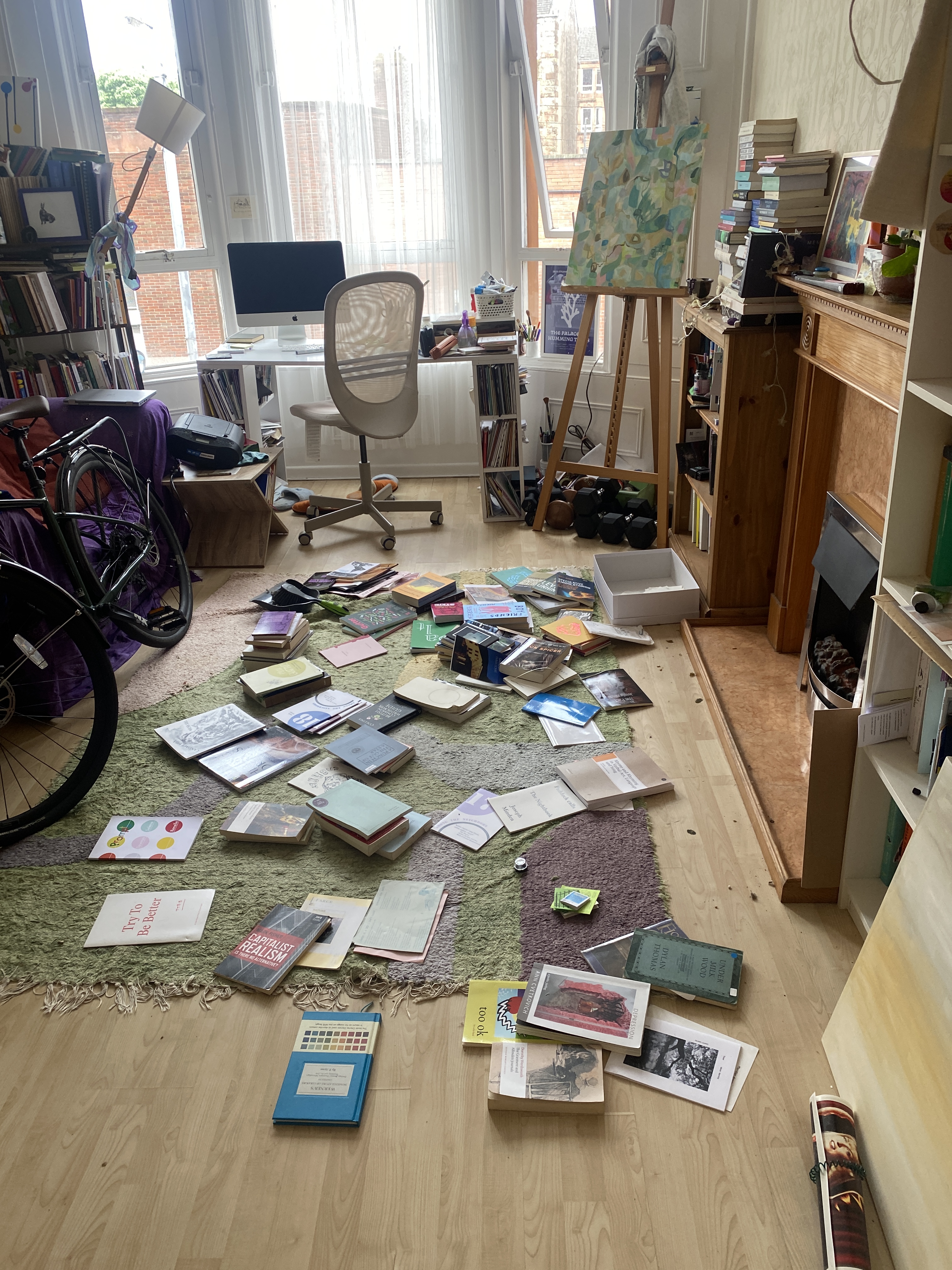
In loose order of reading. This year I made a vow to not let work ‘get in the way’ of reading. I was talking to a colleague about how every subject/specialism has one thing they are supposed to be really good at and actually kind of suck at. We agreed English & Creative Writing staff are often pretty bad at this thing that should be their lifeblood: reading. To prioritise reading is to affirm the necessity of thinking. I felt so burned out with the circuitry of the 2010s and the zoomageddon of lockdown, all those screens. Reading in scroll-time. I still love reading in scroll-time, but on the move only. Or in the midst of something else doing. It took me three years to get back into immersive, situated, FOCUSED reading again. I mean staying up all night to finish a book, crying at sentences, holding something to the light and putting it down and stopping and starting because you want to savour something and all the world of it following you into dreams. All reading started to plug into work. Good work. Channels. If I’m honest, I haven’t written a lot this year. I needed a break from concepts. I did a lot of editing and proofing and reading. I wrote a lot of emails and did a LOT of marking. I think of marking as writing time. It eats into writing time but it’s also a practice of sentence-making, observation, editing, rewriting. Eileen Myles says somewhere that when they write people recommendation letters and do interviews etc that’s a form of writing. So really there are very few ‘fallow’ periods. You’re always writing something to someone, for something or not. I have written over a monograph’s worth of student feedback this year, maybe more. Each paragraph of feedback is a micro-essay, a snapshot of orientation, a patchwork sample which stitches multiple discourses (genre, criteria, instinct, history) in ascent to encouragement and improvement. So all that feedback, I’m trying to say, means I also read a hell of a lot of student work. Hundreds of scripts. Marking trains my eye as a reader and writer. Still learning to toggle between different kinds of reading. Refusing the active/passive binary in favour of a continuum of generative involvement. A lot of what I read below was in-between other reading, but some of it is more explicitly ‘work’ reading. Or: reading as a way of connecting with friends, colleagues — their beautiful brains. Or: preparation for something as yet unknown. Working through personal syllabi. Refreshing the palette.
~
Robert Glück, About Ed (2023)
Jacques Derrida, H.C. for Life, That Is to Say…, trans. by Laurent Milesi and Stefan Herbrechter (2006)
Walter Benjamin, The Storyteller: Tales Out of Loneliness, trans. by Sam Dolbear, Esther Leslie, Sebastian Truskolaski, Antonia Grousdanidou (2023)
Marie Darrieussecq, Sleepless, trans. by Penny Hueston (2021/2023)
Joey Frances, Takeaway Night (2024)
Teju Cole, Black Paper (2021)
George Saunders, A Swim in the Pond in the Rain (2021)
Megan Ridgeway, The Magpie (2024)
Thomas Mann, The Magic Mountain, trans. by John E. Woods (1924)
Andrew O’Hagan, Mayflies (2021)
Tabitha Lasley, Sea State (2021)
Zadie Smith, Intimations (2020)
Jean Genet, Prisoner of Love, trans. by Barbara Bray(1986)
Donna Tartt, The Secret History (1992)
Oli Hazzard, Sleepers Awake (2024)
Courtney Bush, Every Book is About the Same Thing (2021)
Hélène Cixous, Abstracts and Brief Chronicles of the Time, trans. by Beverley Bie Brahic (2016)
McKenzie Wark, Raving (2023)
Rachael Allen, God Complex (2024)
Elle Nash, Deliver Me (2024)
Joshua Cohen, The Netanyahus (2021)
Andrew Meehan, Instant Fires (2022)
Michael Eigen, Ecstasy (2001)
Noah Ross, The Dogs (2024)
Jennifer Soong, Comeback Death (2024)
Barbara Browning, The Gift (2017)
Cynthia Cruz, The Melancholia of Class (2021)
Courtney Bush, I Love Information (2023)
Clarice Lispector, The Hour of the Star (1977)
Barbara Browning, The Correspondence Artist (2011)
Hilary White, Holes (2024)
Laynie Browne, Everyone and Her Resemblances (2024)
Deborah Meadows, Representing Absence (2004)
Holly Pester, The Lodger (2024)
Terese Marie Mailhot, Heartberries (2018)
Kim Gordon, Girl in a Band (2015)
Lauren Levin, Nightwork (2021)
Oddný Eir, Land of Love and Ruins, trans. by Philip Roughton (2016)
Danielle Dutton, Prairie, Dresses, Art, Other (2024)
Elvia Wilk, Oval (2019)
Nisha Ramayya, Fantasia (2024)
Joanne Kyger, On Time (2015)
Jean Day, Late Human (2021)
Lisa Jarnot, Black Dog Songs (2003)
Roland Barthes, Camera Lucida (1980)
Mariana Enriquez, Things We Lost in the Fire (2016)
Ben Smith, Doggerland (2019)
Ricky Monaghan Brown, Terminal (2024)
Wendy Lotterman, A Reaction to Someone Coming In (2023)
Joseph Mosconi, Fright Catalog (2013)
Tao Lin, Taipei (2013)
Haytham El Wardany, The Book of Sleep, trans. by Robin Moger (2020)
Lucy Ives, Life is Everywhere (2022)
Maria Hardin, Cute Girls Watch When I Eat Aether (2024)
Brian Whitener, The 90s (2022)
Jamie Bunyor, A stone worn smooth (2022)
Lucy Ives, The Hermit (2016)
Brenda Hillman, Cascadia (2001)
Bhanu Kapil, Incubation: a space for monsters (2006)
Peter Reich, A Book of Dreams (1973)
Steve Orth, The Life and Times of Steve Orth (2020)
Lindsey Boldt, Weirding (2022)
Christa Wolf, The Quest for Christa T. (1970)
Hannah Levine, Greasepaint (2024)
Joe Luna, Old News (2024)
Maggie O’Sullivan, earth (2024)
Ian Macartney, sun-drunk (2024)
Sébastien Bovie, Longing for Lo-fi: Glimpsing back through technology (2023)
Steven Zultanski, Relief (2021)
Lionel Ruffel, I Can’t Sleep. trans. by Claire Finch(2021)
Noémi Lefebvre, The Poetics of Work, trans. by Sophie Lewis (2021)
Cynthia Cruz, Disquieting: Essays on Silence (2019)
Marie Buck and Matthew Walker, Spoilers (2024)
Ed Steck, David Horvitz Newly Found Bas Jan Ader Film (2021)
Ammiel Alcalay and Joanne Kyger, Joanne Kyger: Letters to & From (2012)
Lyn Hejinian, Fall Creek (2024)
Etel Adnan and Laure Adler, The Beauty of Light: Interviews, trans. by Ethan Mitchell (2024)
Rick Emerson, Unmask Alice: LSD, Satanic Panic, and the Imposter Behind the World’s Most Notorious Diaries (2022)
Stephen Collis and Jordan Scott, Decomp (2013)
Miye Lee, Dallergut Dream Department Store, trans. by Sandy Joosun Lee (2023)
Barrett Watten, Steve Benson, Carla Harryman, Tom Mandel, Ron Silliman, Kit Robinson, Lyn Hejinian, Rae Armantrout, Ted Pearson, The Grand Piano: Part 1 (2006/2010)
Ottessa Moshfegh, My Year of Rest and Relaxation (2018)
Ian Macartney, Darksong (2024)
Chris Tysh, Continuity Girl (2000)
Barrett Watten, Steve Benson, Carla Harryman, Tom Mandel, Ron Silliman, Kit Robinson, Lyn Hejinian, Rae Armantrout, Ted Pearson, The Grand Piano: Part 2 (2007/2017)
Andrew Durbin, Mature Themes (2014)
Johanne Lykke Holm, Strega, trans. by Saskia Vogel (2022)
Anthony Low, The Georgic Revolution (1985)
Robin Blaser, The Fire: Collected Essays of Robin Blaser (2006)
Daniel Feinberg, Some Sun (2024)
Maria Hardin, Sick Story (2022)
Lieke Marsman, The Opposite of a Person, trans. by Sophie Collins (2022)
Nadia de Vries, Thistle, trans. by Sarah Timmer Harvey (2024)
Rodge Glass, Joshua in the Sky: A Blood Memoir (2024)
Sarah Moss, My Good Bright Wolf (2024)
Giovanbattista Tusa, Terra Cosmica (2024)
Gabrielle de la Puente and Zarina Muhammad, Poor Artists (2024)
Andrew Meehan, Best Friends (2025)
Courtney Bush, Isn’t this Nice? (2019)
Meghann Boltz, Cautionary Tale (2021)
Ariana Reines, Wave of Blood (2024)
Dalia Neis, The Swarm (2022)
Ian Macartney, Secret Agent Orca Twelve (2024)
Nicholson Baker, The Mezzanine (1988)
Kurt Vonnegut, Cat’s Cradle (1963)
Molly Brodak, A Little Middle of the Night (2010)
Bernadette Mayer, Midwinter Day (1982)
Anna Kavan, Ice (1967)
Molly Brodak, Bandit (2016)
Charles Bernstein, Content’s Dream: Essays 1975-1984 (1986)
Okay music this year was weird for me. I liked things where the lyrics were meltwater into guitars and my ~spotify wrapped was all obsessively listened same songs split geode feelings. Exclusively masculine guitar bands with the exception of Brat (top 5). I too am the virus. Maybe because it rained nonstop all year in Glasgow, even with my heart split with California it made so much sense to listen to The Natural Bridge on loop and felt that bridge would cross the ocean. It was the bridge in the song and the bridge of the ocean. I kept thinking about high-singing shoegaze sirens and lay in the mud during a Mogwai gig. Songs about blues and magic mountains and lucifer and love and sympathy and blood and fluoresce and dallas and golden days and dreams and strawberries and tiredness and june and miracles. Seriously I know 2024 was music gossip and humming cancellations and virality blown up to chromatic ontology but (here I want a line break) I just wanted to be stoned at the claire rousay gig forever. And that was my music.
<cue sparkly tambourine>
“Come talk to me about it outside”
Thought about taking a searing breath onstage and how long til it heals?
“Then there was this weird music video that popped up in my complaining featuring jelly sparkle heels and the message was about destroy your cloud with new CD-R storage capacities! and there was this song from the early 2000s and in the music video you could walk around with big yeti slippers
and this really horny barbie song set in a swimming pool which honestly just sounded like goats but was visually orgiastic & gauche
guess I blame the pseudoephedrine!”
Approximate seasonal index:
Winter – shoegaze, e-girl Spring – folk, emo, concrète Summer – jam bands, indie rock, hyperpop Autumn – alt, slowcore
~ NEW RELEASES ~
Jazmin Bean — Traumatic Livelihood
Kim Gordon — The Collective
DIIV — Frog in Boiling Water
Waxahatchee — Tigers Blood
Julia Holter — Something in the Room She Moves
The Lemon Twigs — A Dream Is All We Know
Bladee — Pyskos
Four Tet — Three +
Grace Cummings — Ramona
Vampire Weekend — Only God Was Above Us
Pearling — Lovelocket
claire rousay — sentiment
Billie Eilish — HIT ME HARD AND SOFT
Charli xcx — Brat
Dr. Dog — Dr. Dog
Clairo — Charm
Bella White — Five for Silver
Chanel Beads – Your Day Will Come
Loukeman — Baby You’re a Star
Phish — Evolve
Kelly Lee Owens — Dreamstate
SOPHIE — SOPHIE
LI YILEI — NONAGE
claire rousay — The Bloody Lady
Asher White — Home Constellation Study
Porridge Radio — Clouds in the Sky They Will Always Be There For Me

 mariaology