I wonder how much is a kind of alertness to being awake itself, posting as if to ward off the rain, posting as if to pop my wormy little head out of the earthsoil of silence and say “hai”.
We should leave the moon alone. I went to her once with a question. You don’t just go to the moon with a question, not anymore, but things were different then. The moon wanted an ardent debate on the topic of dust. What was it, whose was it, how can we lay blame for it. How can we monetise the dust. I lay the blame of dust in my bed and slept awhile. Like all of you, I felt super lame. There were academics emailing with the promise of a lunar economy and a cupboard slamming shut at gunpoint. Our father was desperate, who art in languor of sleepgolf in Middlesex said “where is my pill down the back of your throat”. It was a little fuzzy pink thing he popped with no water. The whole moon. The whole pill of her eaten to become annoying. Take a pill. I would pay a whole pill for the moon and back. That man wanted my oesophagus as a kind of liquid spear indicative of mental illness, or science fiction. How much would pay to go to the moon with the money you need? How much would you really swallow?
…satellite & loaf & mope & idle & waste & pine & languish & years ago & infatuate & party catharsis & killing…
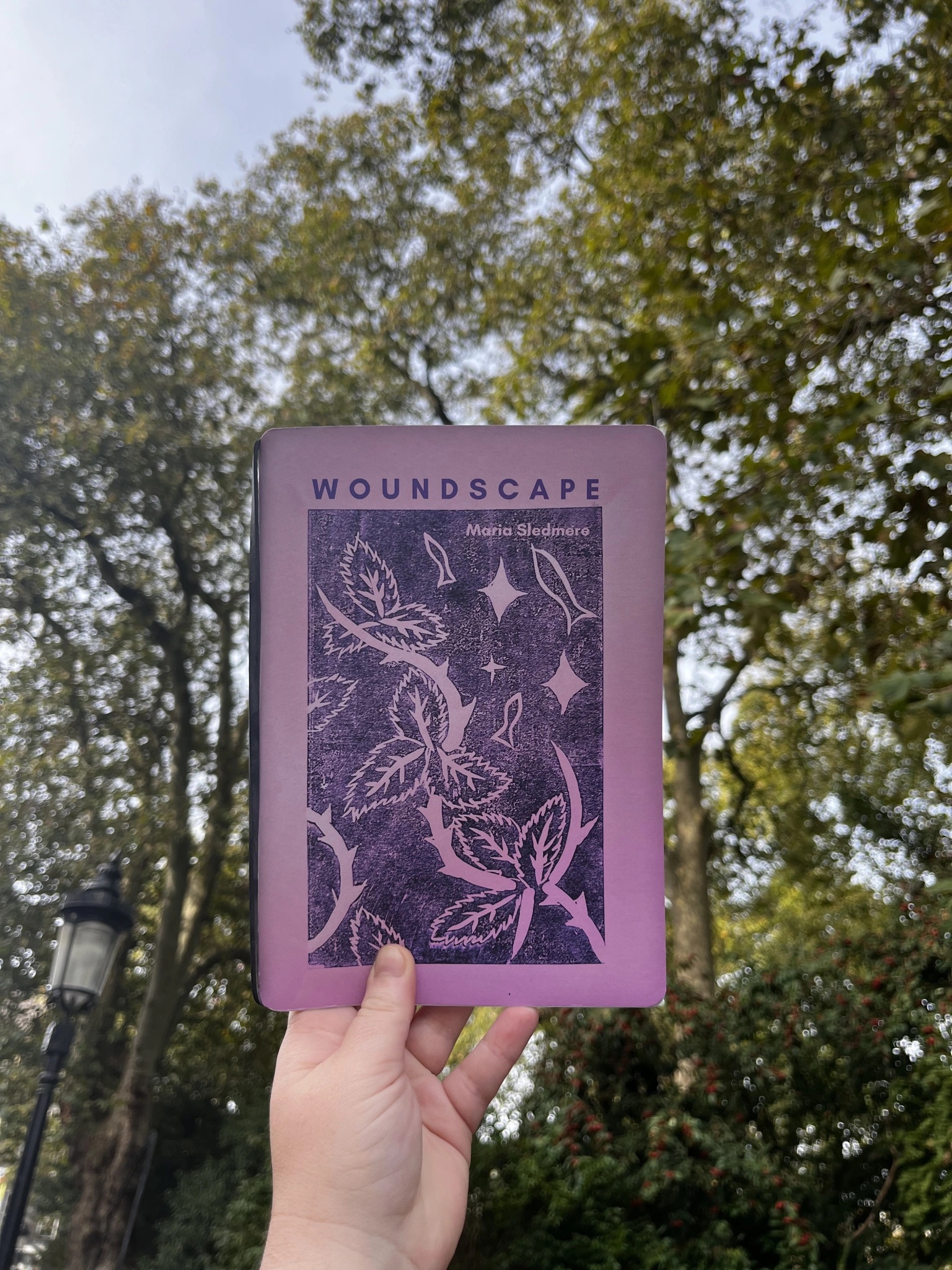
Woundscape is a creative response to Making Imagined Objects, the 2nd International Alasdair Gray Conference which happened in Glasgow, June 2022, commissioned by The Alasdair Gray Archive in partnership with Creative Writing at the University of Strathclyde. This pamphlet has been produced with support from the Scottish Poetry Library’s ‘Poetry Pamphlet Fund’.
Released 4th November 2023 Edition of 100 numbered copies. * ISBN: 978-1-3999-7021-1
“An introspective set of poetics that sews together the gathering discomfort of the human soul and stretches it out across the urban decay of our crumbling cities. Sledmere is an architect of the atmospheric, the surreal, but captures with a brilliant and delicate undercurrent that singularity of emotion that we can all relate to; the absurdity of our existence. This book is inimitable, a triumph of melancholy raining down upon our weathered streets, where hearts are imprisoned, and all doors are carefully barred.” (Stuart McPherson)
“Where does poetry go when ‘tomorrow becomes sorer and sorer’? I’d follow it here, to Maria Sledmere’s writing. These brilliant poems encounter familiar woundscapes, from Alasdair Gray on the heart, to the scaffolding and sanctuaries of a city, our civic agonies, and remake the stakes of poetry again. As they meet the ache of bodily enclosures and language, something emerges, like a condition: shared, real and moving, alive. A kind of love poetry perhaps, that knows in its lightness the costs. Fake, hungry and true. ‘To eat/like to read a poem’. Nothing more urgent and fresh than this, ‘going home in the prosody of being sold nothing’. Eat now, before it’s gone.” (Carol Watts)
“A work which is at once meaningfully drawn from Gray’s own Woundscape and very much her own, this response is full of all the vividity, sparky connectivity and sensitivity you’d expect from Maria Sledmere. Never a dull phrase, never a dead word, her Woundscape – ‘disciplined/in the disappearing city/of civic agonies’ – is urgent and arresting.” (Rodge Glass)
“What Maria Sledmere deftly does is extend her prose beyond Gray and the ‘Making Imagined Objects’ event, weaving into it personal interactions, responses to other creatives work (including Louise Bourgeois), digital wanderings and liminal spaces. The result is a layered dreamscape written with a human heart but embodying otherworldly wisdom.” (Sorcha Dallas, Custodian, The Alasdair Gray Archive)
We are launching the pamphlet in Glasgow, at The Alasdair Gray Archive, on 4th November at 2pm. There will also be readings from Robbie White, Scott Hay and Alasdair Watson. Tickets here.
Grating ginger from spoon feeling, lambent idea of no lucre to save, nothing at all, deposit of warmth – start using joy as a doing, you said I was joy, joying, unjoyed, a joyride ~ this belongs to you!
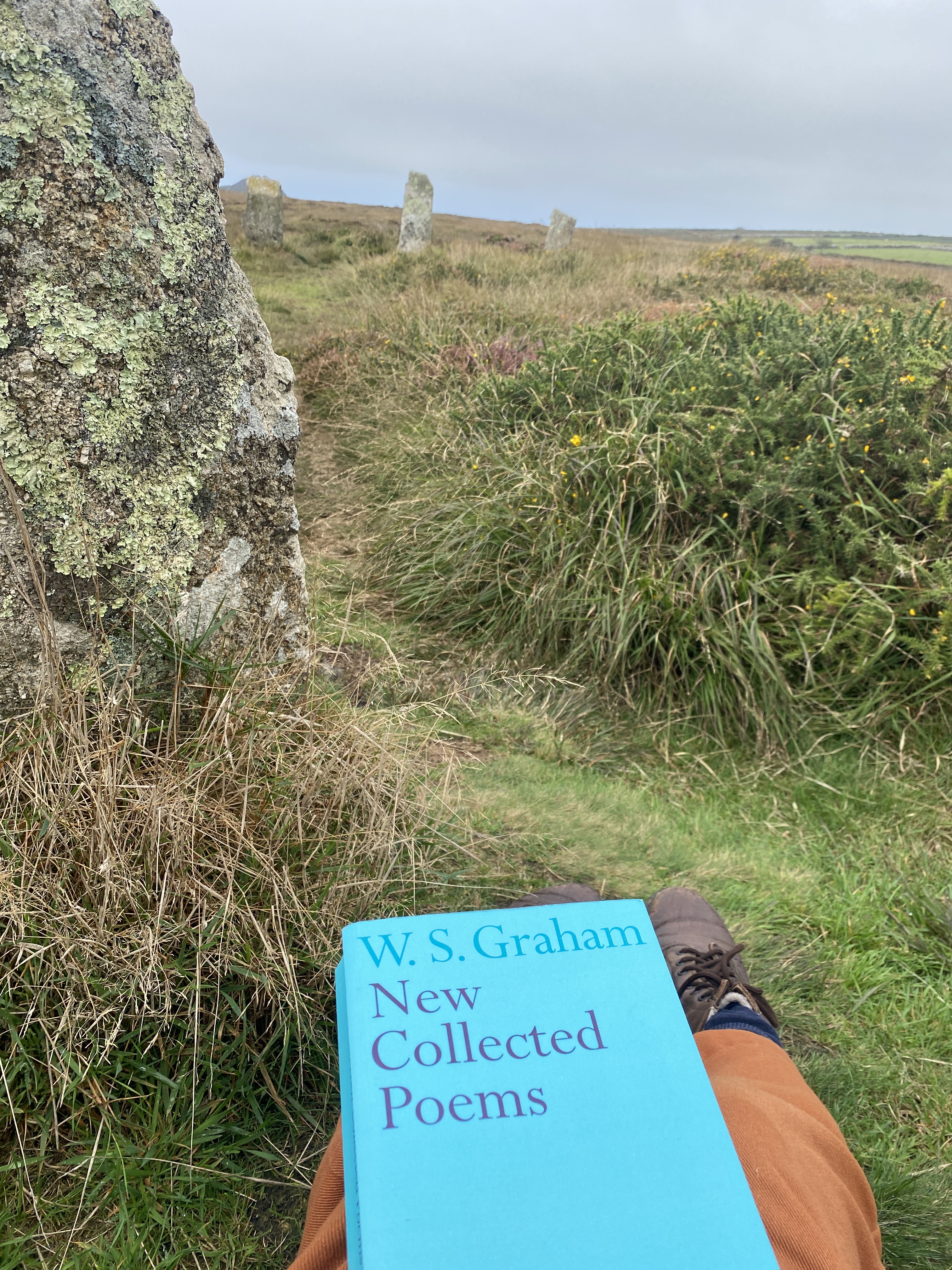
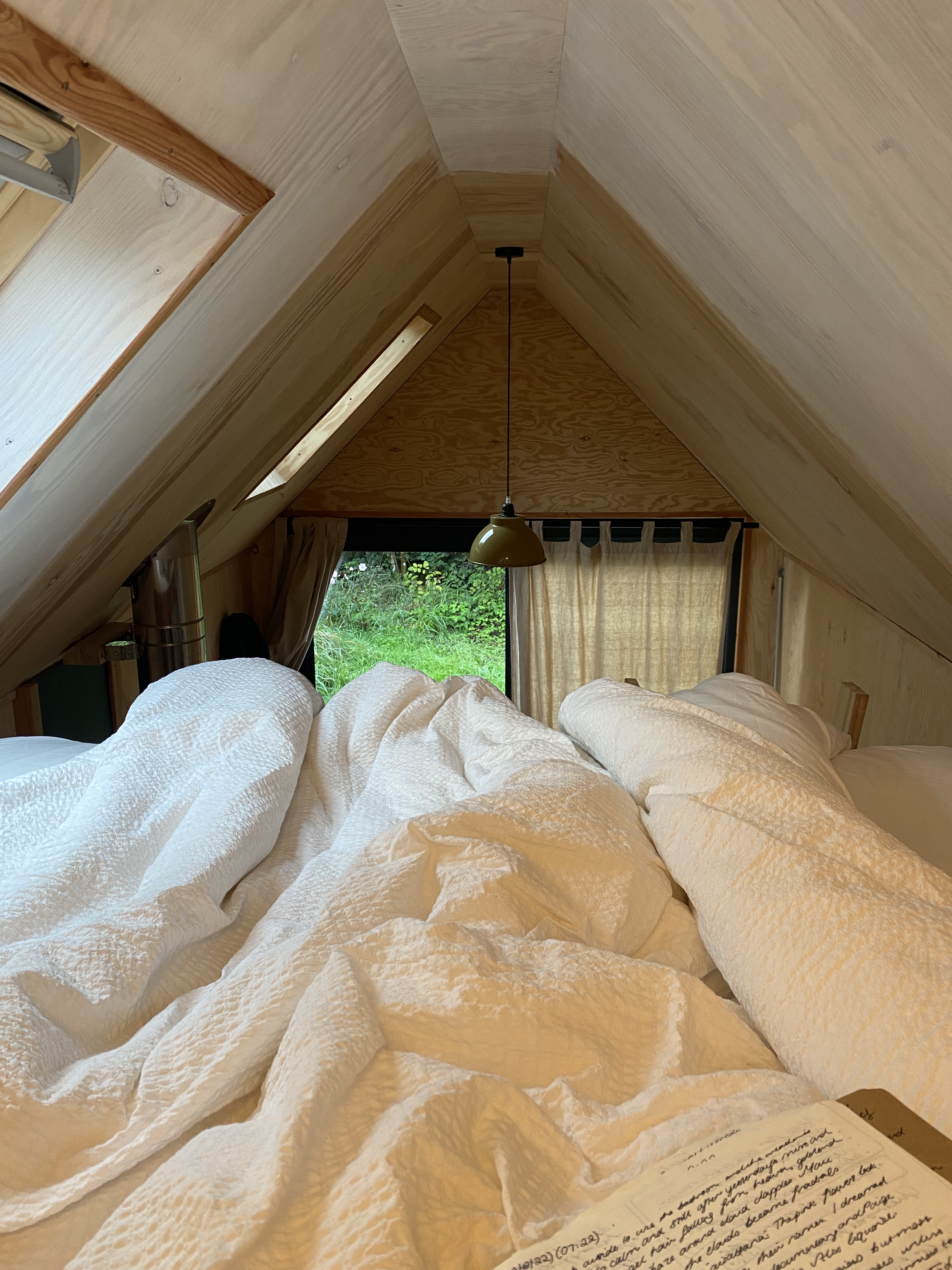
I’m on the twelve-hour CrossCountry from Penzance to Edinburgh. Penzance is the most westerly town in Cornwall and being this close to the edge of something calms me. I always sleep better by the sea. On my way here, on the Great Western Railway, a woman gifted me a glass sculpture with a rainbow inside it, as thanks for helping with her bags at Truro. ‘It’s for stirring your drinks’. For the past week, I’ve been writer in residence at The Grammarsow: a project which brings Scottish poets to Cornwall in the footsteps of WS Graham, who was born in Greenock but spent much of his life down here, making a home of Madron, of Zennor, of the moors. To say this has been a magical week is to say it changed me. I first came across Graham when the poet Dom Hale sent me a voice note of his elegy, ‘Dear Bryan Wynter’, out of the blue; I immediately went out and bought another bright blue, the Faber New Collected Poems. There was something about that foxglove on the wall and the hum of some memory in childhood, watching the bees.
Graham grew up in Greenock, on the Inverclyde estuary. A town where I used to teach writing workshops at the Inverclyde CHCP, taking weekly, then fortnightly trains with our chitty from Glasgow. That time in my life is a blur of shift work, seasonal overhaul, hopeless crushes. I’d get there early to look at the lurid flowers in Morrisons with Kirsty, my co-tutor, or visit the docks alone. Sometimes, I brought my little heartaches to the docks because the air felt smelted, or salt-rinsed, excoriating. The nature of these workshops was that people would share their life stories of such intensity we’d bear them home. I remember one woman writing a story about the moon, ‘we share the same moon’: the one thing connecting her, unconditionally, to her estranged daughter. Many people with stories of recovering from addiction through returning to childhood pursuits: the fishing taught by their fathers, the harbour walks, the musical grammar of language. Graham was trained as an engineer and spent some time on fishing boats, but dedicated most of his life full-time to poetry. The more I learn about this, the more I pine for the shabby romance of that clarity of pursuit. Not as a sacrifice but a great generosity from him, like a penniless rock star.
I’m sure it took a toll on his friends. Graham sent many a letter pleading neighbours and pen pals for the loan of a pound or a pair of boots, once thanking the artist Bryan Wynter for a pair of second-hand trousers. His letters are documents of a life lived in gleaning, bracing the elements, enjoying his wife Nessie’s lentil soup and of course, drinking. On a ‘bleak Spring day’ in 1978, by way of a quiet apology, he pleads with Don Brown, ‘I was flippant in the drink when you came with your news […]. Please let me still be your best friend’. He was often full of fire, a real zeal, taking poetry so seriously but life a strange lark, ‘speak[ing] out of a hole in my leg’. He wrote to his contemporaries — artists such as Ben Nicholson and Peter Lanyon, Edwin Morgan, along with family and friends — with bags of personality, a man self-fashioning in the long blue sea of ‘I miss yous’. As he wrote to Roger Hilton:
We are each, in our own respective ways, blessed or cursed with certain ingredients to help us for good or bad on our ways which we think are our ways. What’s buzzin couzzin? Love thou me? When the idea of the flood had abated a hare pussed in the shaking bell-flowers and prayed to the rainbow through the spider’s web. I have my real fire on. I am on.
The real fire may have been a woodburner, sure, but it’s something lit within him. The letter as a turning on, turning towards: we see this spirit of openness and address in the poems. The real commitment to Lyric. I love the hare that shakes in the flowers with its rainbow religion. I love the flush of arousal from walking uphill at speed. I saw many a spiderweb and two hares chasing each other on dawn of Thursday. On the train home texting many friends as if to have the rush of being held again, ‘Love thou me?’, could I be so vulnerable. A foxglove shook in the wind. The line as a tremble is lesser felt in the steady verse. Clearly, Graham wasn’t afraid of sincerity, though he always took pains to remind his addressees of his roots. ‘No harder man than me will you possibly encounter’, he assures Hilton; elsewhere, after the death of Wynter, he writes to his Canadian friend Robin Skelton of the coming funeral: ‘Give me a hug across the sea. […] I am not really sentimental. I am as hard as Greenock shipbuilding nails’. In a way, the infrastructure of space inflects the language as its face. I’m reminded of a quote by Wendy Mulford which Fred Carter shared at the recent ASLE-uki conference in Newcastle, where she talks about ‘attempting to work at the language-face’. I wear the face of the land, Graham seems to say, and the build of it. At West Penwith, we face the end of the land, literally Land’s End to our west. It is sometimes a silver gelatine, other times a bright blue, a fog grey thicker than thought. A granite-hard land that nonetheless sparkles. I recall a rock on the beaches of Culzean, in South Ayrshire, we’d come across as kids. Mum called it a ‘moonrock’ or a ‘wishrock’. It was a perfectly huge dinosaur egg of white granite. I find this particular rock showing up in my dreams, even now; as if having touched it, I become complicit in a deep time that doesn’t so much store the past as bear its promise. What could hatch from within a rock like that? What could move it, or hold it?
Graham had the idea of poetry’s ‘constructed space’, what I’d call a lyric architecture for reassembling something sensuous in memory or emergence. That this space isn’t just designed (as in my idea of architecture) but constructed points to that emphasis on building. What kinds of muscle, time, effort of spirit and will go into this? The poet Oli Hazzard writes that one of the effects of Graham’s poetry is ‘that I feel like it allows me—or, creates a space in which it becomes possible—to see or to hear myself’. Graham’s poem ‘The Constructed Space’ opens with the line ‘Meanwhile surely there must be something to say’. I always hear it in the lovely vowels of his Inverclyde accent, assuring. Like he’s sitting with you in the poetry bar, two pints between yous, and the poem gives this permission to talk or make space to listen. I think of Denise Riley’s ‘say something back’. My own need always to blurt, interrupt, muse out loud what mince is in my head. It continues:
[…] at least happy
In a sense here between us whoever We are.
As I write this, light dances on the opposite wall of my tenement flat and it’s prettier than anything given to me by the window. Sometimes my love says I am harsh when they need delicacy, and so I soften the heather of my voice to listen. It’s true that I was happy while reading that poem, a happiness or lightness in the brain as precarious as the light is. Changeable and easily blown further west to let in what fog, or dimness. I don’t mind my brain when I’m in Graham’s poems. By which I mean, it’s no longer a drag to be conscious or sad; things move again, their metaphors in process. There’s a lightness to quietude, its intimate premise, that holds me. Nothing extreme is promised here, ‘whoever / We are’: lyric address sent through ether to find that ‘you’, held in the future’s new ‘us’. It’s better than a page refresh, reading the poem to think something Bergsonian of the self’s duration. I’m more snowball than the first maria who read this. It’s a kind of exhale, in a sense, like Kele Okereke singing ‘So Here We Are’ from an album named suitably Silent Alarm. Imagining my loves at the same time, out in Stirlingshire lying tripping by the loch, their eyes skyward, the high or low. I cherish that wish you were here / so here we are. I can look out from inside the constructed space of the poem. Wheeeeeeeeesht, you. You’ll find constructed spaces everywhere in Cornwall. The lashing blue skyscapes of Peter Lanyon, the abstract panoramas of Ben Nicholson, the ambient plenitude of Aphex Twin (especially ‘Aisatsana’ and most things from Drukqs). I want ambient or abstract art to give me the clouds in my head back to myself, with the light of it. Colours, gestures, fractals, lines.
~
I’ve spent the past week schlepping around the moors and lanes, reading Sydney Graham’s poems and letters, cooking veg on my wee stove and eating simple marmite and butter sandwiches. I have this grandparent on my mum’s side who shared his name, who died of cancer before I was born. Sydney was the name Graham tended to go by, signing letters. It’s not that I’m looking for literary fathers but I stumble into their charismatic arms all the same. Is it guidance I look for, or perspective? I love the rolling enthusiasm, pedantry and chiding of his letters, as well as their cheekiness and charm. His dedication to writing and reading, his swaggering or boastful tendencies after an especially successful performance (coupled with an irresistible gentleness and warmth). His big sweet expressions ‘THE MILK OF HUMAN KINDNESS IS CONDENSED – TTBB)’, ‘IMPOSSIBLE TALK’. TTBB is the slogan of Grammarsow and a familiar exhortation in Grahamworld, meaning Try To Be Better (the title of an excellent anthology of Graham-inspired poems, edited by Sam Buchan-Watts and Lavinia Singer). I summon my voices, I try to be; used to be; want us to be.
There’s a quietude I love about the work, which suits the land and mind. After a summer of working three paid jobs, and two voluntary, I was ready for a gearshift into something relaxed and focused. I’d had enough of my own ‘impossible talk’. Being here was like being given permission to play and explore. Quickly I realised my time didn’t need to be ‘dedicated’. I lived by the cruising whim of the big sky, its scrolling clouds and moodswings. Saw the moon at two o’clock in the afternoon. I watched dragonflies dart between the lanes, listened to my neighbourly ravens at night. Watched big jenny long-legs make flickery silhouettes on the walls. Slept peacefully with spiders above me and the ravens being craven. I wanted all these things in my poemspace, and the poems themselves were initially scarce, then they began a familiar elongation that was comforting, with the swerves of a bus but also the tread of a walk. Some poems wanting to hide themselves between logs where I might later try and find them.
~
A grammarsow is the Cornish name for a woodlouse, or what we’d call in Scots a slater. I remember growing up and having this internal argument about language: was I to go with what my English mum said, or everyone at school? Aye or nay, yes or no. At some point I realised it wasn’t a question of scarcity and elimination, but abundance. The words became barnacle-stuck from all over the sloshes of life, swears and all, and I cherished their stubbornness. Even those gnarly, uncommon words and spicy portmanteau like ‘haneck’, ‘gadsafuck’, ‘blootered’ and ‘glaikit’. And yous: the juicy, plural form of you. Addressing the crowd, the swarm or many. A woodlouse is a terrestrial crustacean drawn to damp environments. I grew up with woodlice crawling out from under cracked kitchen tiles, unearthing raves of them hidden under rotten logs, finding them in tins of old paintbrushes or sometimes a bag of flour or sugar. I always liked the way their little legs seemed translucent, a little alien, and was especially seduced by their darling tendency to curl up into a ball, for protection, like Derrida’s idea of the poem as hedgehog.
Across the English language, there are many amazing names for the humble woodlouse, not limited to:
armadillo bug
billy button
carpet shrimp
charlie pig
cheeselog
chisel pig
doodlebug
hardback
hobby horse
hog-louse
jomit
menace
pea bug
pennysow
pill bug
roly-poly
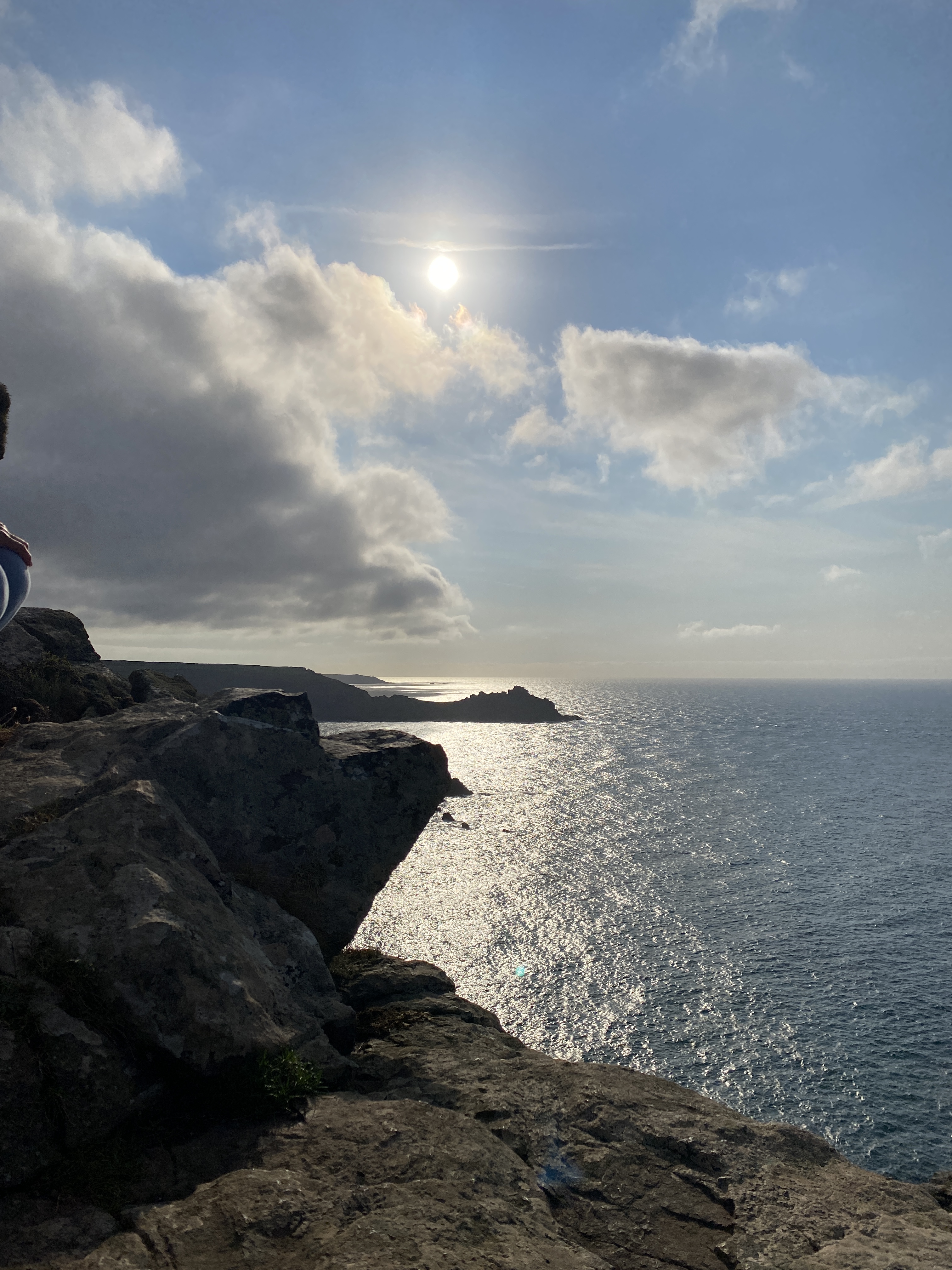
What is this penchant for lists I share with Graham? I want abundance from something other than products. I’m dumbly monolingual and lists are one of the few ways I can accumulate nuances of meaning. My attention-disordered brain collects lists as procrastination for the Thing itself, what is it I should be doing, always on the tip of some other event horizon bleeding through the last and first, so nothing is really finished. I like that in West Penwith, to look at the Atlantic you don’t see any islands, so there doesn’t have to be an end. You have the illusion that there can always be more time. The sea as this list of limitless light, colour shift, unbearable senses of depth. You are here.
~
The grammarsow crops up in Graham’s letters. In a missive to Robin Skelton, he muses:
And what are we now? Maybe better to have been an engine-driver in the steam-age. A sportsman a shaman a drummer a dancer rainmaker farmer smith dyer cooper charcoal-burner politician dog bunsen-burner minister assassin thug bird-watcher poet’s-wife queer painter alcoholic ologist solger sailer candlestick-maker composer madrigalist explorer invalid cowboy kittiwake graamersow slater flea sea-star angel dope dunce dunnick dotteral dafty prophesor genius monster slob starter sea-king prince earl the end.
Again the ‘steam-age’ of other infrastructures interfacing language. Better to have been a wave engineer in the renewable(s) era. I find myself somewhere between the ‘ologist’ and the ‘angel dope’, strung out on critique, measure and the promise of sensuous oblivion. Not sure if the dope is connected to the dunce or angel, but I’ll claim it spiritually as something good: an enhanced performance. As in, those are dope lines I’m reading. Do you want some? ‘And what are we now?’ not who, but what. A question I want always to ask — it’s almost Deleuzian — with someone in my arms or the sea swishing up to waist height, a sea-star clung to the hollows behind my knees. What’s possible when shame is gone. I love tenderly Graham’s list of possible existences and wonder how many I might retrain as (O genius monster), keeping in mind Bernadette Mayer’s old quip that all poets should really be carpenters. I love the raggedness of letters, which is why I love blogs (letters to the idea of being read). Who are they for? We’re so lucky to have these old ones, bound for us, evidence to the material conditions for our wild imaginaries.
~
In Cornwall, I love falling asleep. I love falling for new poems, stumbling a little on the rugged paths, falling for the air and water, for a little more mermaid’s ale or Bell’s, a blackcurrant kombucha or 100g of coconut mushrooms. In his essay for Poetry Foundation, ‘This Horizontal Position’, Oli Hazzard writes about a time Graham ‘went for a walk on Zennor Hill in Cornwall and fell into a bramble bush’. This falling was a repeat pattern: in 1950 he drunkenly fell off a roof and complained of his three-month hospital stay, ‘I hate this horizontal position’. In my DFA thesis I wrote extensively about lying down as a beginning for writing, the horizontal as a form of refusal when it comes to the upright requirements of an assertive ‘I’. It’s no secret that I prefer poetry in the mode of dreamtime, but that’s not to say I’m also a rambler. It’s a poetry of breath and of steps (of vigour!) I enjoy in Graham. Zigzagging and winding down well-trodden moor paths, stumbling upon bridleways that lead around the hills from holy shrines.
I was the lucky poet to first bless a new writer’s cabin that my host, Rebecca, built on some land near the Ding Dong Mine. From the garden, you can see right out over Mount Bay. The skies are huge here. I’ll say that a lot. I saw a seal down by one of the zawns on the north coast, felt the fear of losing the moon in you, let my lips chap on the telepathy of remote secrets. I try to be better, regardless. My poems become languorous obscurities. All of the land has hidden depths.
~
There was a summer before secondary school when we were gifted an unlimited pass to Historic Scotland, meaning our holidays involved camping across Dumfries and Galloway, the Trossachs, the Highlands, in search of abbeys, monasteries, castles and holy sites in various states of decay. I was turned off by leaflets documenting the actual details of history, emerging sleepy-eyed from the car where I’d been navigating the turgid sentences of fantasy novels or playing platform games like Super Mario. There’s a particular form of carsickness that produces electrolytic effects conducive to imaginative ventures. What I mean to say is, instead of vomiting I overlaid the real world with the promise of portals to elsewhere. In Penwith, I walk off my city sickness and sit by the standing stones, quoits and old ruins of industry. What do I imagine but a ‘news of no time’, still to come? Zennor Hill is both poem and place. The more I’m here, the more a sort of aura thickens.
Swap Zoom for the view from Zennor
On my last morning, I wake to sunrise over the sea. Dew shimmers the rosehips. The air is earthsweet as ever and I don’t know how I’ll go home. Travelling is an experience of dislocation: here, I find home again in language, its caught habits, Graham’s words sluicing Clydewards. There’s a poise to his poetry, steadfastly composed as ‘verse’ and often by iambic measure. Making perfect prosody with the chug of the train. I was pleased to roll into Glasgow having bumped into my friend Kenny, the whisky god of the Hebrides, attuned to the flight-pulse of conversing again. Hungry, ‘putting this statement into this empty soup tin’ to say cheerio as Sydney would, lighting up poetry to finish it, the best thing of all, a warm scaffold to hold up how we missed each other. A quiet disintegration of cloud. What are we now?
With thanks to Andrew Fentham, David Devanny and Rebecca Althaus for kindness and hospitality. Long live The Grammarsow!
A few weekends ago marked a whole year since my exhibition with Jack O’Flynn, The Palace of Humming Trees, curated by Katie O’Grady. It was the height of summer, electrified by lightning storms and rain showers which sent the city streets flooding my ankle boots. I sat in the exhibition watching the auras of animals, drifting in and out of presence, doodling, planning short fiction I’d never write. The rain came down through the ceiling, just a little, and caught in a bucket. I texted in streams.
Something of the exhibition magicked itself into existence. We were all ’93 babies. Making things happen felt so easy. There were synchronicities and invincibilities. When Katie and I hung out at Phillies, we won the quiz. Jack and I wove this hyperplane of fantasy from the gestures of clay and line, whittling and glitter cast wide across floorboard and spiderweb. It was a strange time, the summer of 2021. I was also partially in the numb haze of grief. There was a delta wave but not like the deep sleep of the sea. People brought champagne and flowers to the opening. I wore a long white dress and wished the days were as long as they used to be. The Earth spins too fast.
Partly I wanted to write in the choral voice of many creatures speaking to one another. The process felt like a lyric surrender to this collective, their hyperintelligence of humming and stammer that spoke through pores, chitin, liquid. I don’t know where they learned all this. There was a sun virus in the emails we sent the summer before it. Time freckled on my arms. I could draw out the muscle ache from cycling more. It was possible then.
Anyway, about this experience of writing. A porous voice. Here’s an artist’s talk from a recent conference.
First delivered at Hear them speak: Voice in literature, culture, and the arts 10th June 2022
K Allado-McDowell, ‘And they showed me that their life was a pattern of hyperspace’
Who might be the ‘they’ in K Allado-McDowell’s statement? Taken from Pharmako-AI, published in 2021 and the first book to be co-authored with the neural network GPT-3, a system trained on extensive web data (from Google Books to Wikipedia), the quote suggests voice, presence and identity are questions of patterning, replication, weaving, plurality. Recurrent in Allado-McDowell’s book is the figure of the spider and its web, in a kind of constant movement like thought itself.
I was travelling north on a train when I began writing The Palace of Humming Trees, a book-length exhibition poem which forges energy fields of dreamy relation between many species of animal, mineral and element. Late spring and the fields I could forget about, texting myself more poem. The motion of the train according inverse to the downward scroll of the document. All the while seeing spiders in the corner of my vision, emitting great clots of silk. Commissioned by curator Katie O’Grady and made in collaboration with the artist Jack O’Flynn (both from Cork, Ireland), the exhibition was to offer something of a ‘hyperspace’ to its viewers: somewhere in which voices coalesced, formed new modalities of being and relation, new webs. In a Tank Magazine interview with K Allado-McDowell, Nora N. Khan notes that hyperspace ‘is an abstract space in which we perceive patterns of information and then shape them in language in order to communicate’. Having a big, serial and open field poem adjacent to visual work premised on bold, ecstatic colour and texture was to perform multiplicities of voice within an otherwise abstracted work. Inspired by Timothy Morton’s ideas of ‘dark ecology’, adrienne maree brown’s ‘pleasure activism’ and Ursula Le Guin’s ‘carrier bag theory of fiction’, I wanted to think about that communication as a form of attunement through which we gather, desire and coexist as ecological beings.
In The Palace of Humming Trees, the lyric voice is taken as that trembling spider silk assembling worlds. Spider silk is a protein fibre which embodies the inside of the spider woven on the outside for shelter, cocoon, courtship or the trapping of prey. It’s five times stronger than steel and is now being synthesised to make everything from body armour to surgical thread and parachutes. I began imagining the twangling of droplets on silk strands as the visualisation of a deep vibration, perhaps the wood wide web – something humming in and between trees. The world of the exhibition was inspired by the Irish folktale, The Hostel of the Rowan Trees, also known as Fairy Palace of the Quicken Trees. In the story, trees of scarlet fruit provide refuge, but the fruit itself (the quicken berries) are highly desirable to the point of despair. The rowan was brought from the land of promise, and its berries offer rejuvenation. With these symbolic undertones of danger and desire in mind, we wanted to explore a mythic ‘palace’ which merged the digitality of hyperspace with the organic textures of woodland and the chromatic intensity of dream, fantasy and ethical relation.
At the heart of our project was a notion of infinity. Hyperspace suggests that our ecological sense of world, surrounds, habitat, umwelt is always being reassembled. I wondered if infinity could somehow be voiced in a way that wasn’t just postmodern recursion or echo. What does it mean to be open to a state of infinity? To let many worlds pass through you all at once, making diamond-like instants and gossamer patterns of prosody?
Infinity became our figure for ambience. As spider silk is densely structured, and the neural net densely layered, so the notion of ambience captures, in Brian Eno’s words ‘many levels of listening attention’. To walk through the door of The Palace of Humming Trees was to enter a portal of multiplicity. You could take any route you liked around the room, moving between sculptures of hyperfoxes and sparklehorses, lichenous forms, ceramic butterflies of psychedelic hue and illustrated groves where trees shimmered green, orange, purple and blue. You could also scan a QR code and choose to listen to a recording of the poem, voiced by Jack, Katie and I and accompanied by Dalian Rynne’s sonic dreamscapes. To hear something ‘humming’ is to sense its presence, even if you can’t wholly understand it; humming implies electromagnetic vibration, birds and bees, a weather event or tectonic movement. We weren’t interested in translating the more-than-human voice so much as bringing it into the forcefield of lyric poetry, and through that expansive patterning achieve ‘infinity states’ of reassembled meaning, of felt experience that could not be crystallised into singularities of being. Visitors took pictures, sketched Jack’s sculptures, ran their fingers through the luminous plaster dust, placed to highlight the debris or excess of our clay animals. Something always in the process of creation or decay, incomplete. Corporeal, yet infinite.
One of the many voicings of this project was Letters from a Sun Virus, a correspondence between Jack and I that occurred over the first Covid lockdown, documented at the back of the exhibition book. While the email exchange had distinct senders and receivers, the you and I, over time in collaborating and sharing work between the visual and textual, our voices were beginning to mingle. Sometimes this co-voicing was painterly; other times musical, inflected with the characteristic intonation and energy of our respective speech patterns, moods, expressions. An entry from April 2020 reads: ‘…the wateriness of the poem. I had completely forgotten about all that blur. It’s like all the brush of the ocean and one which seems the idea to spill that way. Almost like a pressure, lines that go on and hair turning into the sea, each one of kinetic energy then finds all these points’. To assemble the correspondence for publication, I plugged it through text remixers, copying, pasting and rearranging phrases to enhance that sense of two voices repatterning one another. A ceaseless quest for points; for elements acting upon objects, emotions. Denise Riley has written of ‘inner speech’ as a strange oxymoron, where one hears voice at the moment of issuing voice inside us – a kind of running commentary that hums without actually humming. The letters suggest a kind of inner voice infected by the anticipated response of the other, rendering intimacies of collaboration which form a sticky substance, sentences and mobius formations holding time’s play and repeat – ‘Unending loop of my dream resins / not to complete the palace infinity of these trees’. Imagining the many of them speaking.
In Texts for Nothing, Samuel Beckett writes:
Whose voice, no one’s, there is no one, there’s a voice without a mouth, and somewhere a kind of hearing, something compelled to hear, and somewhere a hand, it calls that a hand, it wants to make a hand, or if not a hand something somewhere that can leave a trace, of what is made, of what is said, you can’t do with less, no, that’s romancing, more romancing, there is nothing but a voice murmuring a trace.
To ask whose voice in The Palace of Humming Trees is to hear sound bouncing as light, romancing, refracting in what Katie, the curator, calls a many-panelled ‘vivarium of humming thought’. To say ‘there is no one’ is to declare at once absence and the impossibility of presence as a singularity, there is no ONE. What if voice was infectious, modular, sporous, erotically charged, in common? Early in the project, I had this conversation with Jack where he told me that sometimes in the process of sculpture, he’ll try turning something upside down, or inside out, to revitalise the work. Make it strange or more-than. To sculpt by hand is to ‘leave a trace, of what is made’, and to write is to leave a trace ‘of what is said’. I wondered if the inner speech of the lyric ‘I’ could be turned inside out, to be exposed to the grain, the noise, the weather. A voice that touches is and is being touched, traced, smudged. I imagine this book as a glasshouse, somewhere between inside and outside, shelter and exposure; a chamber music of alchemical voicings, always repatterning, transforming each other. Sound and light. A place of invitation, ritual attention, metamorphosis. Many selves stuck to the web of a visual, expansive language.
Hyperfox – photo by Sean Patrick Campbell (French Street Studios, 2021)