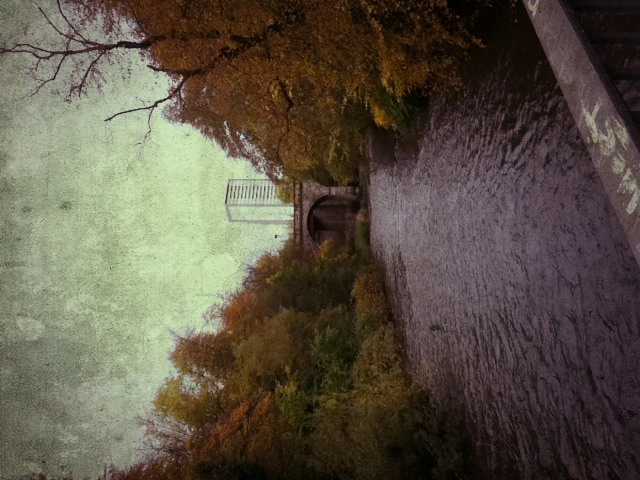
Autumn Reflections

IMG_1999

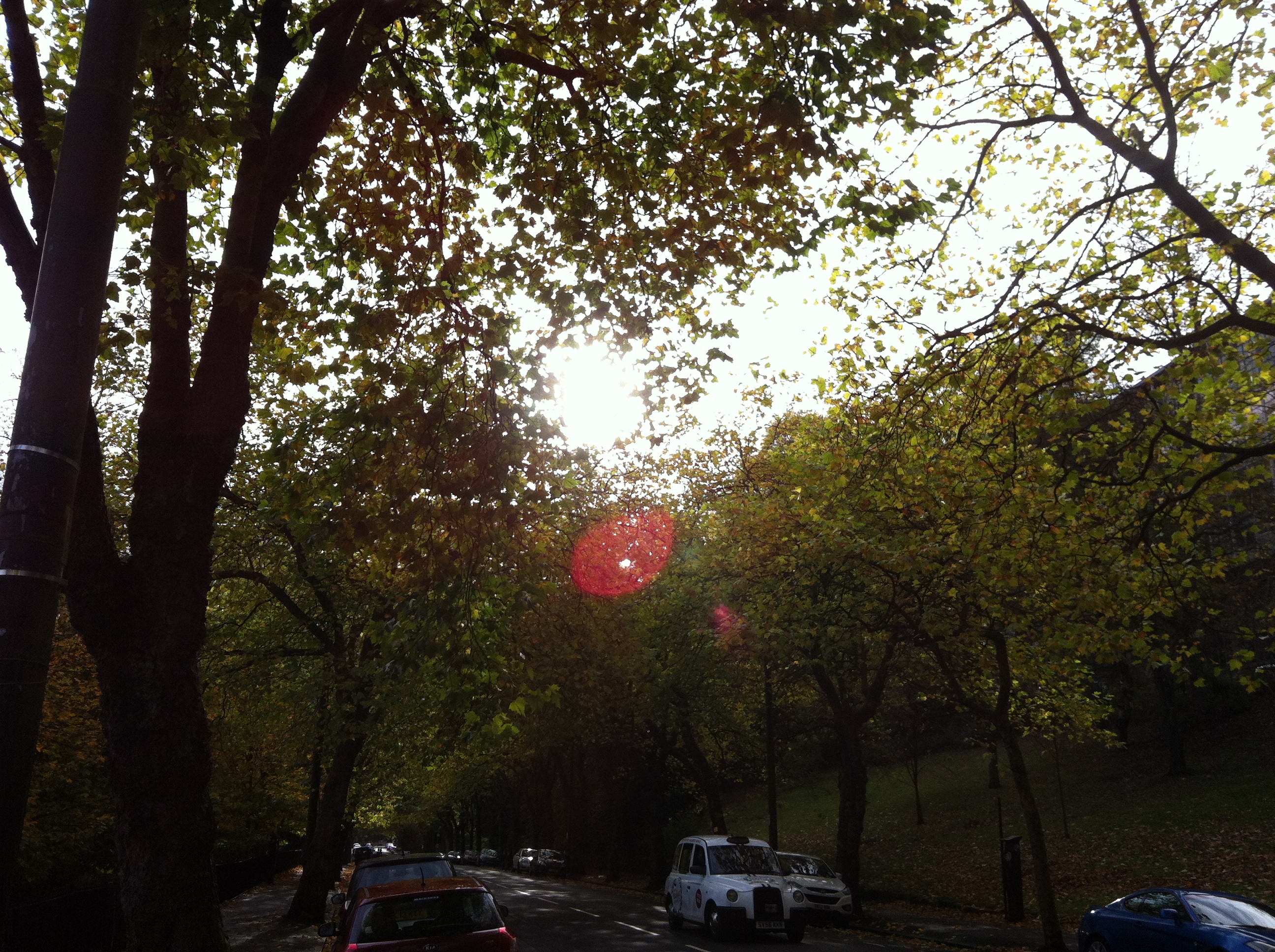
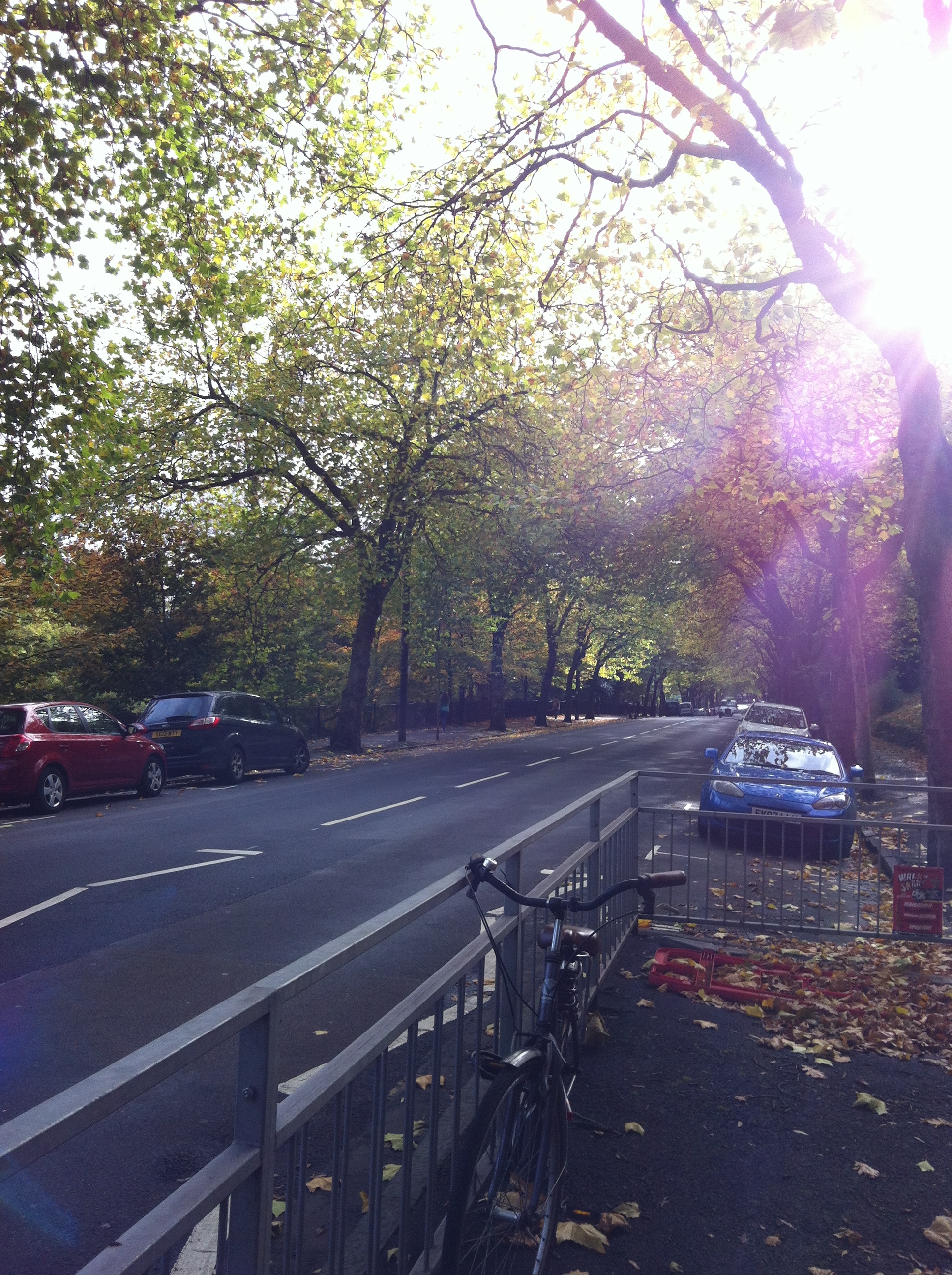
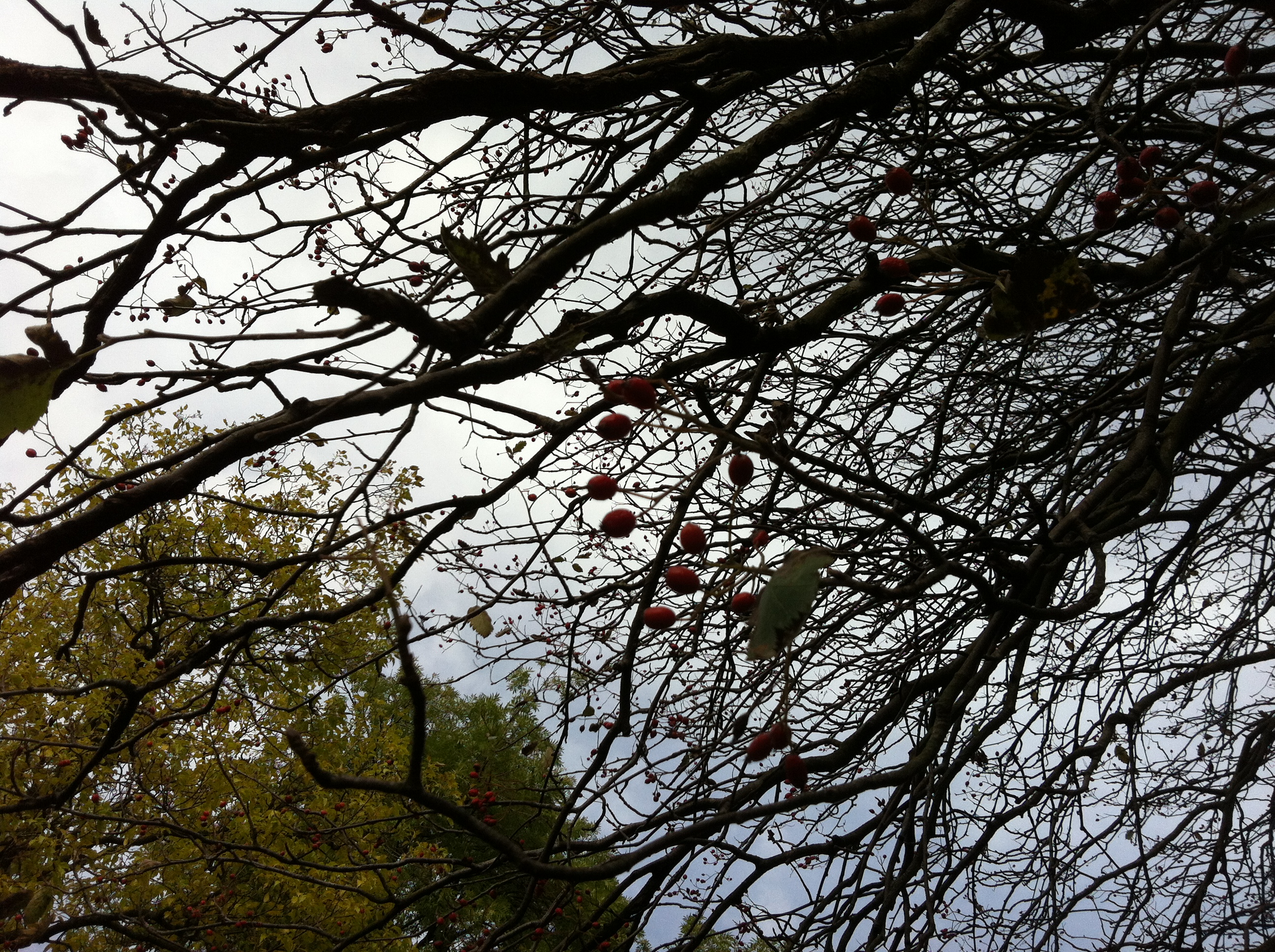
The dawn cracks open the sky like a chestnut, and gold light pours on the concrete and grass like showers of molten topaz. Somehow it’s October and I’m wondering how I got here. Where the summer has disappeared, along with the warm air and the billowing roses, with August and its hydrangeas; it seems time has elasticated itself, and snapped at the strangest of places. Everything may break free now. The world slows down, as trees shake themselves clean of another year. Leaves cascade on the ground, and as I walk I hear the susurrations of their skeletons, rustling like the sound of rain at night.

Autumn is a quiet season. We retreat inwards. Gone are the sparkles of summer voices, the throb of fashionable neon and jet planes soaring to boozy utopias. The Pimms is perhaps swapped for something richer, sweeter, warming. A good cider, red wine, some inventive cocktail combining Kahlua and caramel-flavoured tequila. You think of those people hanging out of balconies, their bare skin glowing in the cold air, the slivery iridescence of cigarette smoke curling from their nostrils. There are the box-sets, the television dinners. Going out is such an effort; it is the not knowing, the tentativeness of the weather. Things would be easier if the sky kept to its promises.

I wanted to go blackberry-picking this year. I found a place along the Kelvin where they sprawl out of the bramble-bushes, poking like fat sapphires through wire mesh fences. I need to find some leafy suburb for conkers. When I was little, we spent the October holidays at my Nan’s in Milton Keynes. There was a copse of horse-chestnut trees and every year we brought back a black bin-bag full of conkers, and I’d shine them up with vinegar and nail varnish before taking them into school. There’s something incredibly satisfying about the way they feel in your palm, solid and smooth, nourishing somehow. I didn’t quite make it in time for the blackberries, but I did the walk again all the same, sweeping my feet through the trails of leaves. Autumn had left its burnished light, a shimmer on the river. I love the feelings of these late afternoons, where darkness is like a comforting hug, handed through chasms of stars and amber.

IMG_1333

Once, we had a school project, to gather up all the fallen leaves we could find and press them into a picture behind glass. A lesson in natural materials, perhaps, in arranging colour. We were flattening the landscape, making art; in the veiny intricacies of each leaf lies a million hidden histories. We’ll never know, and they’ll fade and die eventually.

Autumn is always a time of nostalgia. It is that paradoxical time where death reveals itself through visceral beauty. The life forces of summer unfurl and wither and fall away, and yet there is a beautiful melancholy in the sad palette of reds and golds and browns, the snuffling of squirrels amongst tufts of bracken. Everything is scattered: the husks and roots and fragments. You find them in the strangest of places, tucked not only in forests but flowing out of drains, wedged in concrete and windowpanes. People spend their Sundays loafing with films and Scrabble and roast dinners. Or maybe they don’t anymore; but maybe they did once.

SAM_0240

By September, we’re back at school, back at uni. Fresh starts amidst the fall. Sharpened pencils, the smell of polished leather. The heating goes on for chilly mornings. Socks warmed up on radiators. That was before I had a flat of my own, and became too stingy. The wind, like some malicious spirit of winter, slips through my single-glazed windows, blasts the rose from my cheeks. I make do with the illusory effect of candles, the quick fix of hot water bottles. You can warm anything with the scent of nutmeg and cinnamon, a flash of cayenne pepper. Stodgy soups and slabs of bread. I watch the pumpkins fill up in the shops, imagining a sea of faces, waiting to be painted on. Or carved out. Stacks of apples to be bobbed, pubs to be terrorised by the horrid costumes adorned by students. Halloween is not quite what it was when I was younger. I miss the parties with the clouds of cobwebs and incense haunting the rooms of my house, fake spiders draped from the chandelier; the echoing sound of dub-step, and the taste of vodka and food colouring. Edible brains and blood-coloured fizzy laces. The sugar-rush; the hungover fall and slumber. Soon there’ll be fireworks, splintering pigments across the sky. As ever, I’ll watch them from the high-up floors of the library. Remember being in first year, where I sat on a Saturday night, my eyes blinking at a computer screen as I read Byron’s poem ‘Darkness’, for a seminar. The rockets flared and pinks, yellows and blues blossomed in flowers of light as I imagined his vision of desperate apocalypse.

That same semester of uni I sat in a cold lecture theatre, teeth chattering as I pressed my face into a perfumed scarf, the animated man standing on the podium in a tweed jacket reciting snatches of Shelley:

O wild West Wind, thou breath of Autumn’s being,
Thou, from whose unseen presence the leaves dead
Are driven, like ghosts from an enchanter fleeing,

Yellow, and black, and pale, and hectic red,
Pestilence-stricken multitudes […]

And I, feeling so small and new and ignorant in the world, was sucked in by the spirit of the wild West Wind, not knowing how it would take hold of me and make me fall in love with this city that I have now grown so used to. Fallen into, as one sinks into a favourite old sofa. The ‘hectic red’ is blood-like, beautiful, sinister. Isn’t it lovely, to imagine every leaf a little ghost, cast away from its tree into a journey of exploration and retreat? Wearing the plum-coloured lipstick, the thick mascara and black coat; could not I be one of the ‘pestilence-stricken multitudes’? For autumn is infectious; her colours allure like the striped warnings of insects, the ‘Smoking Kills’ labels on cigarettes…we cannot help but buy her palettes, absorb her force through woollen fabrics…

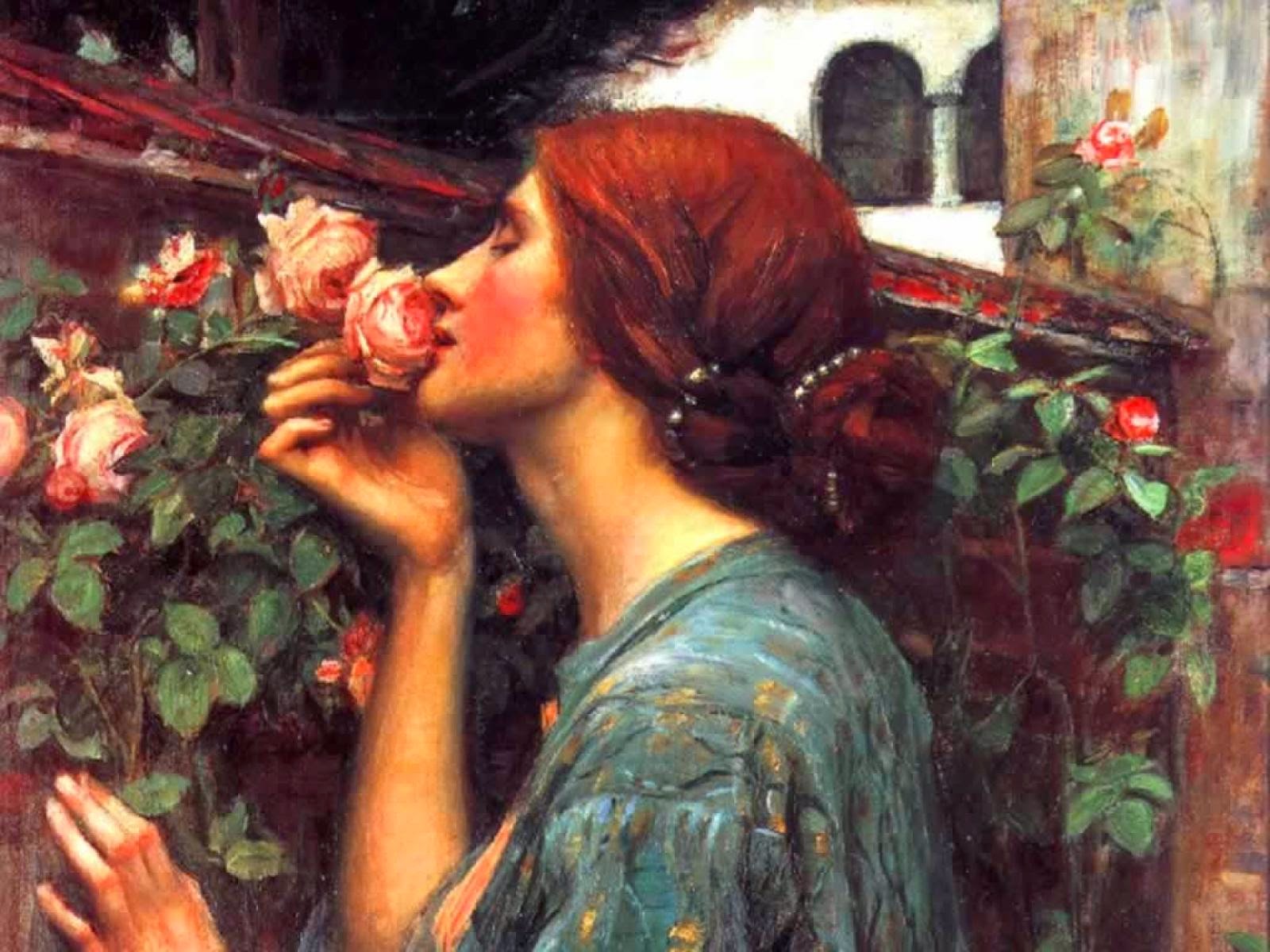
image source: ladyhollyshawblog.wordpress.com

Slowly, it would be nice to become more ginger, adding redness to my hair through soft washes of auburn. I would like to have hair the colour of leaves, as they enter that strangely vibrant stage of fading. From fire to fawn. Can you not imagine the smell of the roses as they wilt for winter, so luscious in the fat of their fragrance? There are roses, still, weathering the rainfall and cold. There are white ones on University Avenue, dripping with raindrops; their petals lie about them like the shredded remains of love notes.

By the time autumn has ended and entered the shrine-like stasis of winter, I will have forgotten my sorrows, finished my dissertation. This is all hope and relief; but isn’t that what autumn is: the sparkle of Christmas festivities on the horizon, the embracing of frugality and calm after a toxic summer? Apple pie, with ice cream and Amaretto, instead of beer and salad? An ethereal, rustic beauty that inspires fountains of poetry? For what better thing to do on a crisp autumn evening, than to sit at the window with a cup of tea, leafing the pages of a book and feeling purer – not just a hipster, defined by the vague fashions of everything around you – but a lost soul re-enacting the perfect scene of reading, as it plays out through the ages. For global warming might prolong the first fall of snow, but for now autumn will always be coming, and there is nothing quite like language to capture the tinctures of foliage, the crunch of acorns underfoot – the endless song of autumn’s calling. Right now it is raining – a luxurious, slow rain that pours through the one o’clock darkness – but next time the weather is good, I will go to Victoria Park and watch the swans, white against the scarlet leaves, the silver glass of the pond.

Unwearied still, lover by lover,
They paddle in the cold
Companionable streams or climb the air;
Their hearts have not grown old;
Passion or conquest, wander where they will,
Attend upon them still.

(W. B. Yeats, ‘The Wild Swans at Poole’).

Ten Things for Autumn: 

  1. Apple Pie Soup http://thesoupfairy.tumblr.com/post/19640840152/apple-pie-soup-literally-my-favourite-soup-ever
  2. Blackberry gin! http://www.deliciousmagazine.co.uk/recipes/blackberry-gin
  3. Burgundy lipstick http://www.cosmopolitan.com/style-beauty/beauty/how-to/a4900/rules-for-wearing-burgundy-lipstick/
  4. Dante Gabriel Rossetti, ‘Autumn Song’ http://poetry.about.com/od/poems/l/blrossettiautumn.htmhttp://poetry.about.com/od/poems/l/blrossettiautumn.htm
  5. Manic Street Preachers, ‘Autumn Song’ https://www.youtube.com/watch?v=Cw9tazfA3aY
  6. Go foraging for mushrooms and fruit, or just fairy-spotting
  7. Cinnamon-stick candle http://www.yankeecandle.co.uk/en/restofworld/shop-by-fragrance/cinnamon-stick/icat/cinnamonstick?setpagenum=
  8. Ginger tea http://www.ecogreenstore.co.uk/index.php?main_page=product_info&products_id=1372&gclid=CjwKEAjw2f2hBRCdg76qqNXfkCsSJABYAycPz_Ug8Seq2xidtaVJGBOBCdbZNqgIe2J0dfvrqB6pGBoCgTXw_wcB
  9. A tartan scarf
  10. The Alasdair Gray exhibition at Kelvingrove http://www.glasgowlife.org.uk/museums/kelvingrove/current-exhibition/Alasdair-Gray/Pages/default.aspx
IMG_0019
mushrooms in Greyfriar’s Kirkyard, Edinburgh

three haiku for tomorrow:

sky of fire opal
opens a new morning of
coldness and woodsmoke.

a new harvest moon:
I could take all these gold days
for some old solstice.

these trees shed apples
to sour in the turning ground
as those other hours.

Technology and Hardware: Some Sentimental Reflections

stock-photo-retro-ghetto-blaster-cassette-tape-recorder-on-table-in-front-mint-green-background-159525176

It’s funny how I still remember getting my first Game Boy. It was the original one, 8-bit in a lovely yellow colour, feeling heavy and smooth in your hand. My mum had bought it off my older cousin for about £10, and I remember feeling so surprised that she’d got me it for Christmas. I had a few games which were these wonderful plastic cartridges that you slotted into the back of your Game Boy, and you could hear the satisfying click when they were inserted properly. There was the sweet little noise it made as you switched it on, the Nintendo logo fizzling onto the screen, the red ‘on’ light glowing in the corner. The shimmering pixels and the chip tunes of game music.

I guess every generation grows up with some form of technological hardware that seems always exciting and new. Whether it’s a radio, gramophone or mobile phone, people born in the twentieth century have grown up with some newfangled machine that somehow adds to their daily life and experience of the world. I feel like my generation is an interesting one in this regard: we grew up with hardware but increasingly this hardware has shrunk like something from Alice in Wonderland, shrinking until it becomes something ethereal, intangible: a piece of code; a web of communication; a world available not only at your fingertips but at the swift movement of your iris. At primary school, we fiddled about trying to hand in homework on corrupted floppy disks. Now we have smartphones, iPods, Google Glass – and that funny thing, the Internet.

Recently I actually went into a shop and bought an album. That’s a statement that would seem pretty meaningless even five, six years ago. Who cares? Now, however, it’s an event. Why would I bother leaving the house when I could get the new music I wanted in an instant on iTunes? After all, that’s what I’ve often done before. I’m not sure why I decided to buy it in ‘hard copy’. It was the new Conor Oberst album, Upside Down Mountain. Being a longstanding fan of Oberst and his band Bright Eyes, I wanted to make buying his album seem more like an ‘event’, to get that kind of excitement I used to get as a teenager, spending endless Saturday afternoons browsing music shops and picking out intriguing album covers; or as a kid, when my dad would take my brother and I into HMV and let us each pick one album. I remember eleven-year-old me picking up The White Stripes’ Get Behind Me Satan and my dad looking at the cover and frowning, ‘that looks a bit too gothic Maria’; he bought it for me anyway.

So I happily purchased Upside Down Mountain from Fopp in Edinburgh and took it home on the train with a smile. It felt good to hold something physical in my hand; yet also strange that it was made not from the hard plastic casing I was used to but a kind of recyclable card. Times are changing. It didn’t have the same retro feel of a CD, something that would look nice all stacked up with the title showing, but it was still better than the paltry avatar of album art you get on a computer. Funny thing, I don’t own a CD player, so of course I had to put it into my computer anyway, to eventually burn onto my iPod. What I first noticed was the soft whirring sound as I inserted it into the disc drive. I’d forgotten all about that whirr; owning a MacBook, there’s very little computer noise at all and working with it normally feels like a more silent, smooth and hi-tech experience than it did with my old laptop that used to hiss and bleep and burn a hole in my lap. There was something lovingly nostalgic about that whirr. It got me thinking: how deep is our relationship to hardware?

As a kid, I had a sorbet yellow tape player with soft grey buttons and a handle that let you carry it about the house. One day I found my dad’s old collection of tapes: boxes of tapes that he’d copied, some original purchases with the artwork intact. The first ones I stole (with permission) were The Police and Manic Street Preachers. I used to listen to the radio with my beloved tape player; at night I’d sit in a den I’d made out of muslin and cushions in the corner of my bedroom, and I’d tape-record my favourite songs off of the radio, snippets from live lounges and interviews which later played back to me, mingled with a softly rasping static. I suppose these were my own (poor) attempts at making mixtapes, the songs cutting off midway through, fragments of old material appearing where I’d failed to tape over properly. I miss listening to music like this: a mix of rewinding and pausing, stopping and starting. I had audiobooks too: childhood stories filling my room, about pots and pans that came to life, and the bizarre sequel to Charlie and the Chocolate Factory. The excitement of silent sound space that came with the voice saying ‘End of Side One’ enacted a kind of participation in the story, as you had to manually extract the tape and flip it over before playing it again.

I feel lucky that someone has actually made me a mixtape before, and this was just before such an act became ‘hipster’ or mere ironic nostalgia.

My home town Maybole is pretty small and doesn’t boast much, but it did used to have a little video shop that my mum, my brother and I used to visit every Saturday night. We’d browse the aisles and argue about what film to pick, and it was always an excitement, knowing it was on loan only for one day and so we had to watch it. Afterwards we’d pop into Safeways across the road and buy snacks. Film watching was more of an event back then, a shared thing. Now, apart from a rare trip to the cinema, I only really watch films when I’m too exhausted to read after a shift at work, and even then it tends to be just me in front of a laptop sleepily watching whatever’s half-decent on BBC iPlayer. While now watching a film is easier to do in parts, before, you’d have to rewind and watch the funny people moving backwards, frustratedly searching out the point where you last left off. The ease in which we can slide between scenes on a DVD player or computer has probably added to our general sense of impatience; it’s too easy, perhaps, to skip over or lose concentration, knowing how easy it is to freeze and repeat.

Moving then from serial to random access memory, I entered my teens. When I was at secondary school, I was really into music and CDs – as much as I had once been into video games – and bought as many as I could with my birthday money. I had a cool silver-blue CD player from Argos that you could put three discs at once in, and it would shuffle songs from all of them at once (before it broke). I also miss the physical act of burning CDs onto a computer, one by one; back when they took ages to copy and almost without fail ended up crashing the family desktop. It was more of a reward when you finally built up a database of your physical music, and could sit and spend hours rearranging playlists whilst chatting to friends on MSN. Already, though, technology had given me the power of multi-tasking; it was just the slow internet connection and processing speed that tended to interrupt the flow (but I almost miss the bleeping symphony of a dialup connection).

I guess this article could be classed as another act of nostalgia, but I wrote it sort of to come to terms with where we are now. The Web has pretty much exploded, infested with advertising and weird material; an intricately layered network which is no longer just the facility through which I access Neopets but an intrinsic part of my daily life. Without it I couldn’t access course resources for uni, I’d struggle to contact my friends, I’d be limiting greatly the availability of information on hand to me. My laptop screen is now a perfect kind of mirror, an elaborate backlit LED technology which provides a window into the tunnel world of networks and code that make up our online lives. There is no longer that tangible, silvery translucence of the old LCD monitor displays which spread rainbow shimmers when you pressed your finger against them. The hardware of my childhood and adolescence – of tapes and CDs and Game Boys – has passed into the realm of the soft-world, the almost flawless efficiency of my MacBook Pro, through which everything is easily at hand. And you know what, I almost regret it.

Places of Memory

IMG_0794
Glasgow Uni spire seen from Kelvingrove Park

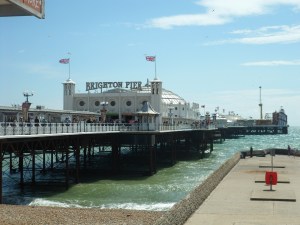
There is a sense in which selfhood is just a scattering of remembrances, remembrances dependent on places. Everywhere in which I have been encodes some trail, some trace of memory. As a child whenever we went on walks I would magic things into being, imagining worlds on top of worlds, layering enchanted spaces and creatures upon the reality of adolescent landscapes. I’d see fantastic beings darting in rocky streams, strange birds sweeping from forest canopies, a thousand intriguing microbes, exotic in colour, swirling on the ground amidst the paws of my (real-life) dog. And even as I grow older, shedding away these whimsical worlds, I keep the magic of perception, imbuing the places I visit with a mental significance. As some store their spatial memories in smartphones, clicking them into flattened snapshots, I try to inscribe them in my mind as networks of sentiment – of senses, thought and memory. There is this particular spot in Kelvingrove Park, with the perfect view of the Glasgow Uni spire and a quiet pool of sunlight that occurs in May at about 4 o’clock; the spot where after my first year exams I sat lazily making daisy chains and reading Laurie Lee’s nostalgically beautiful Cider With Rosie. There is that salt smell and clacking of pebbles, the quick breeze that is Brighton Beach and with it many far off summers, of paddling cold feet and minty sticks of rock. Weird innocence. There is that favourite place in Culzean, a small jutting of cliff that looks out to a glittering dusk-covered ocean and the eerie mound of the Ailsa Craig. So many times I have sat up there with various friends and family and each time I am a different person, bound together perhaps only by the chains of associations set off by this location. Although I was brought up in the country, my mind is also a sprawl of urban spaces: the wintry, bustling streets of Paris at New Year, the seagull strewn alleyways of Ayr, Glasgow’s gritty pavements and eclectic skyline of the modern and the gothic, Edinburgh with its panoramic view of hillside, castle, parliament and sea. What makes all these places somehow special is my relationship to them both cognitively and spatially – in other words, psychogeographically – a sense of pulsating interconnections based on walking, on exploring the world on foot.

SAM_0650

IMG_2920
Ailsa Craig

Someone who has written extensively on his psychogeographic travels is the author Will Self, who ambles everywhere, in the search for new perspectives of space – walking famously from his house in England to New York (albeit with the help of an aeroplane), exploring the curious border spaces between urban and rural, airport and field. Self worries that in the contemporary world of globalisation and machine transport, we are becoming increasingly confined to ‘micro-worlds’ which offer restricted, miniature universes of hotels, airports, clubs and bars that bear little difference from city to city, in the sense that they are being used for the same purpose, and we rarely escape them. The frequency with which tourists, travellers and the like will take a taxi cab, subway or train rather than exploring on foot results in a limited perspective of urban space. There is no chance to stand back and observe one’s situatedness in relation to the built environment, to gauge one’s relationship to north, to the cathedral, the river; to form the intricate networks of association and recollection that pattern themselves around street-walking. I want to make a plea for this street-walking, not just as a fitness alternative to the stuffy mundanity of the gym but as an exercise in perception, in self-formation. (Sometimes, sounding pretentious or perhaps overly poetic is worth getting my point across, especially if it’s a pretty simple point about the joys of that most archaic of sports: walking.)

SAM_0867
street in Dowanhill

I feel like I’m naturally bad at driving. I don’t like being in control of a dangerous vehicle; yes, that’s one reason, and a reason certainly more justified after delving into J. G. Ballard’s dystopian account of sex, violence and dangerous driving in Crash. The car, as a vehicle of speed charged with the excitement of modernity – see Marinetti’s ‘The Futurist Manifesto’ – is the antithesis of the slow pacing of walking. With a great driving instructor, I took lessons for over a year and while I enjoyed the freedom of leaving my small town and gliding (at my shy snail’s pace) along country roads, I don’t think I’m cut out to drive powerful vehicles. Even a bike I manage only at a push. I spend too long getting distracted by pretty sunsets, sheep, or the name of a passing cafe.

So I guess rather than machine-obsessed Marinetti, I’m more aligned with the modernism of the flâneur, the original ‘street-walker’ who spent his/her time sauntering the streets (usually of Paris) and losing his/herself in the crowd. Charles Baudelaire describes the flâneur in The Painter of Modern Life: 

The crowd is his element, as the air is that of birds and water of fishes. His passion and his profession are to become one flesh with the crowd. For the perfect flâneur, for the passionate spectator, it is an immense joy to set up house in the heart of the multitude, amid the ebb and flow of movement, in the midst of the fugitive and the infinite. To be away from home and yet to feel oneself everywhere at home.

There is something strangely ‘natural’ in becoming a liminal figure, between observation and participation, haunting the city streets and drinking the atmosphere of the crowd as if it were the very sustenance of life itself. Moreover, this sense of haunting can be literal, as stepping among a wealth of sensations recalls dreaded memories and fugue states of psychological wandering, as the narrator of Jean Rhys’ novel, Good Morning, Midnight suggests:

Twelve o’clock on a fine autumn day, and nothing to worry about. Some money to spend and nothing to worry about.
But careful, careful! Don’t get excited. You know what happens when you get excited and exalted, don’t you?….Yes….And then, you know how you collapse like a pricked balloon, don’t you ? Having no staying power….Yes, exactly….So, no excitement. This is going to be a quiet, sane fortnight. Not too much drinking, avoidance of certain cafes, of certain streets, of certain spots, and everything will go off beautifully. The thing is to have a programme, not to leave any thing to chance – no gaps. No trailing around aimlessly with cheap gramophone records starting up in your head, no ‘Here this happened, here that happened’. Above all, no crying in public, no crying at all if I can help it.
Thinking all this, I pass the exact place for my after dinner drink. It’s a cafe on the Avenue de l’Observatoire, which always seems to be empty. I remember it like this before.

The narrator, Sasha, speaks in ellipses, in the strange silences and drifting prose of a vagabond, losing her mind to the networks of memory that haunt and map out her present.

And while Rhys’ flaneur is at times made painfully aware of herself by her own solitude amidst the Parisian crowds, sometimes in the city, one actually craves the claustrophobia of people and buildings and even the nasty proliferation of pigeons. It is maybe a kind of sublime, where one forgets one’s self in the overwhelming hustle and bustle. I remember my first time walking into Glasgow city centre on foot via Argyle and St Vincent Street. Standing breathless at the crossing of the A804 I looked up to the massive glass-coated buildings, beaming off bright April sunlight. There’s a feeling there that I don’t think I’ll ever quite replicate, that of a young adult from a little town, now encountering for the first time alone the vastness and slightly daunting excitement of the metropolis. It is a vision of the city infinitely different from seeing the big buildings from the safety of the backseat of a car; a vision that seems much more urgent on foot, with the vehicles rushing around you and the commercial structures seeming so much grander from the pavement. And it is funny now, how I walk past these buildings so often and they seem diminished; I have adopted more of a blasé, Simmelian attitude to an urban environment that once appeared so compelling. The only solution to this, of course, is to explore new places, gain new perspectives.

It isn’t easy to explore new places when you are notoriously bad at navigation. I didn’t take Modern Studies over Geography for nothing; I genuinely find it a problem grasping my location through maps, to mentally situate myself. Instead of compass coordinates or street names, I tend to place myself in relation to strange landmarks: a telephone box with wild flowers sprouting out the side, an antique shop where the man sits outside polishing wood and making sandwiches, a crumbling wall or peculiar tree that grows by a river. My brain is more of a mesh of colours and markers than a standardised map of labelled coordinates; I know my space through unstable nodes of remembered landmarks which shift and change  and alter my spatial awareness. Perhaps this is why Glasgow (or even just the West End) no longer seems the same, huge place it once did when I first came to uni. Perhaps this is why I always tend to get lost in new places, because I can’t follow a steady route without getting distracted by the allure of a pretty residential estate or a path that detours miles along a canal.

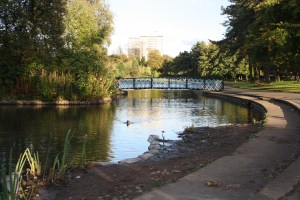
An example of this is my sense of Victoria Park. Victoria Park often comes up weirdly in Limmy’s Show as a place where the fences demand repainting, but that isn’t my only notion of it. Victoria Park is a strange place in its location: a kind of island of green surrounded by motorway. And it is quite difficult to get to, requiring knowledge of the underpass and the correct entrances. I’m better at it now, but before I used to set out for it, following the trail set out by my portable Google Map, and then get confused and lost, ending up wandering aimlessly around Whiteinch. I don’t really know why I forgot how to get there, after the first time I stumbled across it. It flashed in my mind only as a bizarre mirage, almost like Mirage Island from Pokemon Ruby & Sapphire, appearing to me only on certain days when the weather was right and I was in the proper frame of mind necessary for navigation. I actually had to search online for photos of the place, to make sure I really had been there, to make sure it existed at all. The seeming elusiveness of the Park gave it an ethereal quality that remains today, even though I have now memorised exactly the route to get there.  And it’s not that difficult at all, really. Barely thirty minutes from my flat. Yet arriving upon that still, wide silver pond with its hordes of swans, I feel like I have found a peaceful, otherworldly territory. And then I hear the Glaswegian accent of a fellow walker with his dog, and the illusion shatters somewhat.

IMG_2643
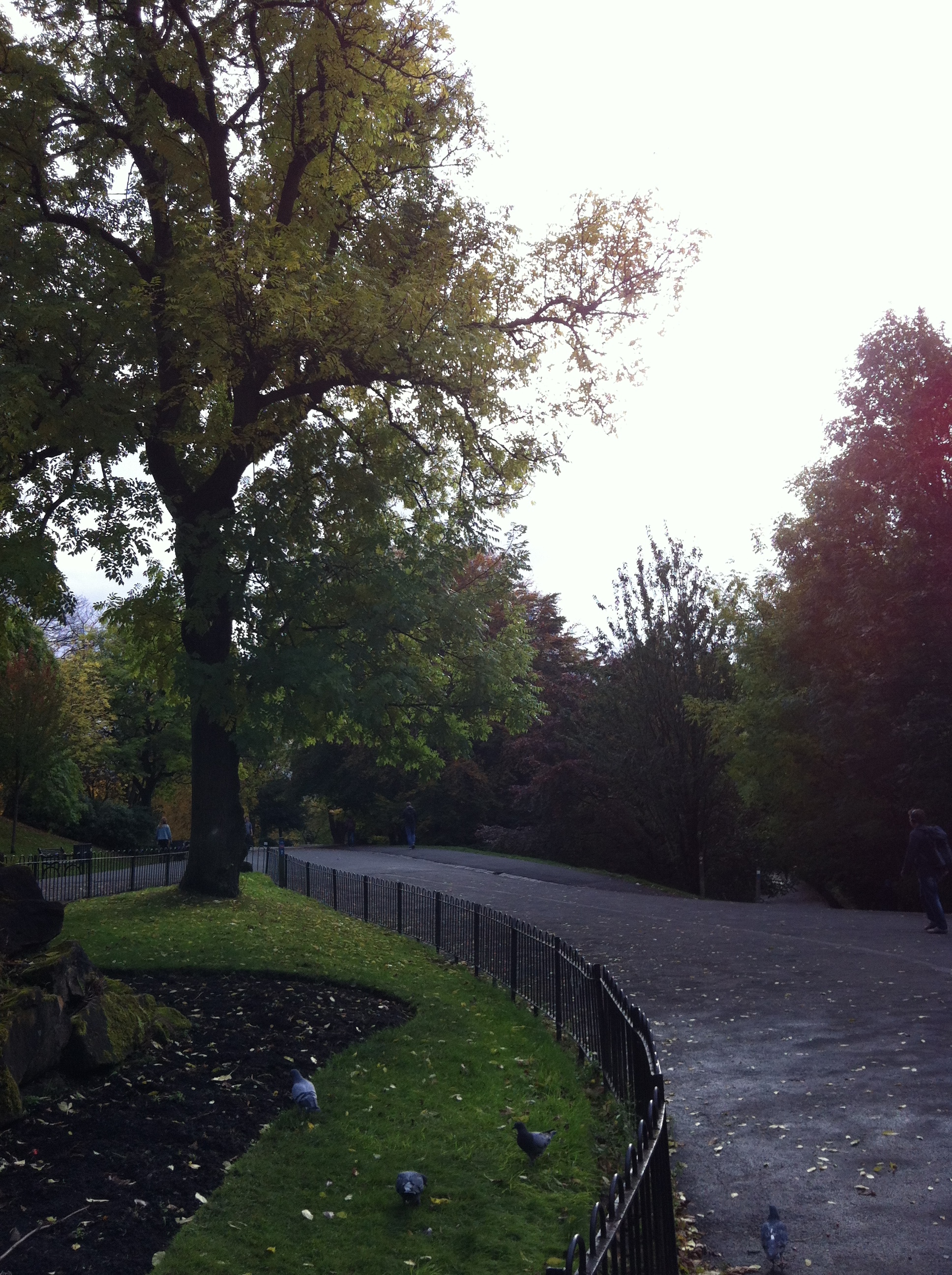
Victoria Park in autumn

Glasgow is peppered with these secret spaces, and as the old etymology goes, it is in a strong sense a ‘dear green place’. There are so many parks and walkways I have yet to discover. I have found canals and strolls along the river, where you could be anywhere – until you spot a stunning piece of architecture peeping through the trees. And like all the places of my childhood, I feel like Glasgow is now a part of me: I have a  hidden history that exists among the old buildings, the pretty parks and streets. I don’t think I’d have such a strong sense of rootedness if I hadn’t explored the city always on foot; if I’d always gotten the Clockwork Orange (the subway) rather than meandering through various roots to town, would I have stumbled upon Park Circus, or the spring blossom that lights up Great Western Road? Living in the country is lovely, but when you are in a city, all it takes is a walk out the door and down a few streets and suddenly you are part of a crowd; not just a crowd of people, but a crowd of forgotten memories and historic spirits, of buildings that bear the souls of all those who have set foot inside them. The city has a certain music to it, different from the birdsong and breeze and tractor groans of the country, lively and beautiful and ambient all the same. Personally, I believe that you can only experience this music in its pure form by using your good old legs and walking the  metropolis. I’d like to end with one of my favourite passages of psychogeography, from Joyce’s A Portrait of the Artist as a Young Man, where the young Stephen Dedalus is discovering Dublin for the first time:

Dublin was a new and complex sensation. […] In the beginning he contented himself with circling timidly round the neighbouring square or, at most, going half way down one of the side streets but when he had made a skeleton map of the city in his mind he followed boldly one of its central lines until he reached the customhouse. He passed unchallenged among the docks and along the quays wondering at the multitude of corks that lay bobbing on the surface of the water in a thick yellow scum, at the crowds of quay porters and the rumbling carts and the ill-dressed bearded policeman. The vastness and strangeness of the life suggested to him by the bales of merchandise stocked along the walls or swung aloft out of the holds of steamers wakened again in him theunrest which had sent him wandering in the evening from garden to garden in search of Mercedes. And amid this new bustling life he might have fancied himself in another Marseille but that hemissed the bright sky and the sum-warmed trellises of the wineshops.

Yes, I’ll leave you with that lovely, assonant image of sun-warmed trellises and bright skies and wineshops…because it’s always nice to imagine a sunnier world on top of the real one.

(all photos taken by me)

Hyperreal Lives: Made in Chelsea and The Seductive Politics of Boredom

There’s a certain uneasy, shifting quality at the centre of Made in Chelsea that reminds one of the later work of Samuel Beckett.

Martha Gill

For a show in which a character actually says “Charles Dickens wrote Winnie the Pooh. No, Pride and Prejudice,” you might be shocked at any comparison raised between Made in Chelsea and the world of literature. And yet, there is a sense of unease that haunts the famous Channel 4 show which documents the financially-flushed lives of trendy twenty-somethings partying and gossiping themselves around London. A sense of unease that is usually reserved for the realm of the literary text, specifically the postmodern literary text, which evades fixed meaning and narrative closure. That leaves us in some sort of existential crisis. And so what is this Beckettian quality that haunts the flashy world of ‘yahs’, of immaculate blow-dries and fancy cars? Is it the sheer vacuity, the absurdity, the meaningless and endlessly repetitive plot lines? The bizarre seduction of its pointlessness and dragged-out pacing, the lingering shot on a face of shaky acting that aims to convey some kind of deep significance, but instead trails us into nowhere?

There is something strangely seductive about Made in Chelsea. I thought maybe I’d struggle to write this article, given that I have only watched a handful of episodes from a show that has run for seven seasons. My mother watches it, my brother watches it. They don’t watch much else on telly, so there must be something in it that lures them in. That lures us all in. Indeed, maybe there are people out there who genuinely anticipate new episodes, as if there really was some plot development to look forward to. There must be some reason why Channel 4 bother advertising narrative ‘tensions’ in their new episode teasers. Yet I find it difficult to establish the significance of any story arc in Made in Chelsea: each episode rolls over with an intrigue that evaporates like the champagne sucked so readily from its characters’ glasses.

But wait, you may say: Made in Chelsea is not meant to be television drama, it is reality, albeit ‘structured reality’. We are, supposedly, watching a show about ‘real’ lives; these are ‘real’ people acting out things that have ‘really’ happened to them. Reality does not readily provide us with such arcs of climax and resolution that fictional scripts tend to yield up; reality is all about interweaving story-lines, little tensions that burst and dissipate under hushed storms of gossip – the sheer joy of calling someone an idiot behind their back. I suppose this is what Made in Chelsea really is: grownup children bitching and dissecting one another against the backdrop of glittering cocktail glasses and an effortlessly hip soundtrack.

Because of course, this is no ordinary ‘reality tv show’. The cast of Made in Chelsea are rarely seen smoking, vomiting, shagging. The ordinary things folk tend to do on reality tv shows; you know, Big Brother and the like. The world of Chelsea is one of perfected physicality: sculpted bodies, stylish clothes, the cool gaze of another blasé conversation, another stilted standoff between two characters. For this show is all surface, all talk. Not much changes, except for the setting: from beautiful London gardens with the perpetual tinkle of glasses to throbbing club scenes and the stunning backdrops of Venice and Versoix, from gleaming storefronts to pheasant shoots and country-club chic. We are invited to revel in the gorgeousness of panoramic camera shots, the afternoon light as it flickers from the sun between leaves to the glint of a wine glass. Perhaps we could watch this show on mute, with the characters becoming a kind of tableau vivant, and we may sate ourselves on the images of their flawless skin, their achingly white teeth. These are characters whose personalities shift with the wind of each new season, who perform themselves as they please.

And of course, there is the British obsession with class, particularly the surface forms which class may take. We have always loved observing the lives of the super-poor and hyper-rich, and from Dickens to Evelyn Waugh readers have been drawn in by artistic representations of both the struggling underclass and the excesses of the wealthy. Watching or reading about the extremes of poverty or richness makes us feel better: it allows us to reaffirm our own position, as somehow ‘normal’. We’re never that bad; we’re comfortably in-between. In a sense then, Made in Chelsea shares with shows like the BBC’s documentary-style show The Scheme its status as a form of class porn. Watching the ‘feckless’ lives of those in poverty makes people feel better; superior, even. Careful editing enhances the drama, adds turbulence to the characters’ lives and cuts out the ordinary hard work that may go on behind the scenes. Watching Made in Chelsea, I suggest, deflects the structural issues underpinning the status of the super-rich onto a series of mundane story-lines that focus almost exclusively around love interests. There is very little in the show to tell us how so-and-so got his or her fortune. And if the university degree, modelling career or entrepreneurship features at all, it is usually as a mere prologue to some form of romantic or consumerist intrigue. We are told to sit back and enjoy this form of lifestyle porn, without bearing a thought for the opportunities these people received to get where they are now.

Also, there is a certain pleasure in indulging in one’s prejudices. The cast of Made in Chelsea embody a certain form of gap yah privilege that many of us enjoy mocking in this day and age where the class divide is wider than ever. While watching shows about the ‘underclasses’ often makes uncomfortable viewing, documenting the frequently distressing scenes of life on the breadline, watching Made in Chelsea involves both succumbing to the passive pleasures of spectacle and an exercise in mockery at the dandified lives of its characters. We may poke fun at the absurdity of some of their dialogue: the accent, the ‘totes’, the ‘yeah boi’, the gestures that seem to separate these people from the rest of the human race. As the notorious Mark Francis quips, ‘I once knew someone who owned a sleeping bag’. Yes, quite: a sleeping bag; those cave animals from the world beyond, with their horribly proletariat existence. Indeed, these beautiful beings, the Chelsea Set, are not like the rest of human kind. Not like the rest of us watching, half allured and half bemused.

Onscreen we watch these glimmering cyborgs, as they fashion their real lives right before our eyes.

And yet, the Chelsea Set are not untouchable beings. They splash themselves over pop culture: doing photo shoots, exclusive interviews, making innocuous appearances as guest-star DJs in clubs. We are asked to see them in the flesh, as if we too can reach out – if only briefly – to touch their precious stash, the solid gold of their lifestyles.  We may look them up on Wikipedia to find out more; these characters are hypertexts, whose ‘real’ lives are perhaps preceded in a Baudrillardian sense by the simulations they portray onscreen. They have built up their empires of personality which branch out from the TV series to magazines and online articles documenting details of their fabulously elaborate yet ultimately vacuous existence. As Jon Dovey puts it: ‘reality TV is the ultimate expression of the simulacrum in which the insistence upon realism is in direct proportion to the disappearance and irrelevance of any referential value’. Yes, the disappearance of any worthwhile meaning; that sounds familiar. Are these ‘real’ people, or mere masks – postmodern burlesques of the generation of ‘bright young things’ which once lit up the 1920s Jazz Age, but now dissipate into the no-place of mundane conversation? The sexiness of Made in Chelsea is perhaps undermined by the sheer obviousness of its facade.

Yet when we watch these individuals perform their ‘selves’, do we passively absorb their world as if it were merely a stage-set, or can we pierce this world, burst the bubble on their champagne-scented version of reality? If there is an almost erotic allure in the mere spectacle of the lives of the rich, then allowing ourselves to be sucked into the simulacrum of this show constitutes a new, if slightly sickly, opium for the masses (or at least, those who bother watching). So, perhaps, let us covet the aura of affluence, of shimmering lives and expensive spaces, while at the same time reminding ourselves of the poverty and inequality that must exist to support the glamorous boredom of the rich and famous. Or maybe we could turn off the telly, and go camping instead.

Sources: 

John Dovey (2000). Freakshow 

Martha Gill, http://www.newstatesman.com/culture/2013/05/made-chelsea-totes-postmodern

Inception: Dreams and (Dis)illusion

source: http://oeaf.blogspot.co.uk/2012_05_01_archive.html

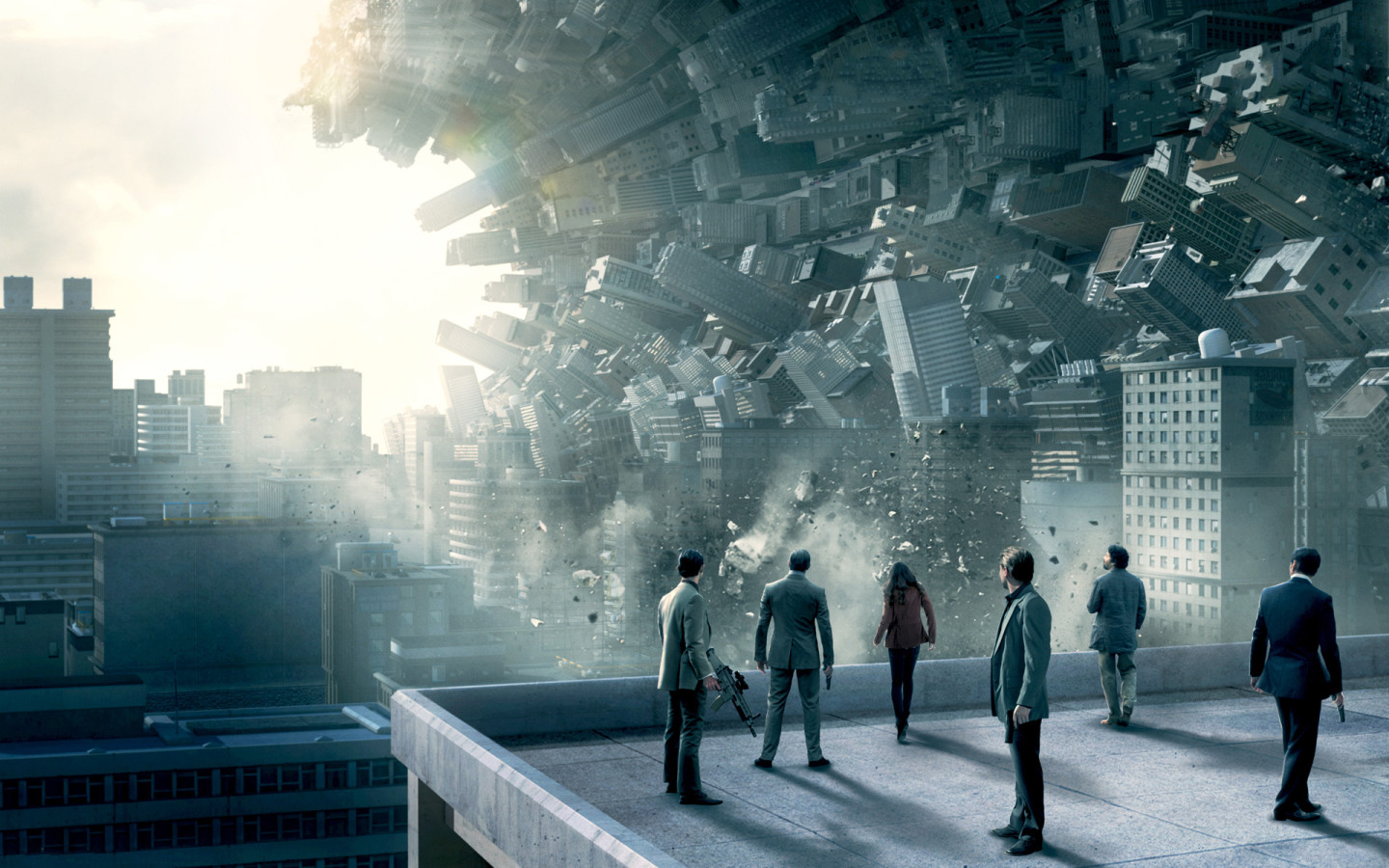
Inception is a film that begs itself to be watched twice. Following what appears to be a complex dual narrative of both emotional turmoil and psycho-political manipulation, Christopher Nolan’s blockbuster success turns on an exploration of the implications of the very personal act of dreaming being appropriated externally as a powerful means of mind-control. Yet whilst the film indulges in Hollywood-acknowledged action scenes – from a gravity-defying fight sequence in a surreal hotel corridor to a car tipping off a motorway bridge – it also diverges from the traditional narrative style of mainstream movies. With the seemingly complicated premise of dream-stealing intertwined with the intimate personal journey of the main character Cobb (played by DiCaprio), the film’s exposition is unravelled in an on-going fashion and so we are plunged straight into the action. The main storyline centres on a deal that Cobb strikes with Saito, a powerful global businessman who proposes that in order to use his influence to let Cobb return to the USA (Saito can eliminate false extradition charges held against Cobb), Cobb must perform the task of inception – a task that takes him and his colleagues deep within three dream-layers in order to manipulate another man’s mind. What is interesting about the film is not necessarily its deceptively confusing plot but the way it is told – the story itself – and the techniques the film employs by meshing the genres of sci-fi, psychological thriller, film noir and heist in order to raise questions about narrative seduction, dreams and the power of the unconscious.

While many heist films unveil their major technical premise at once, as a character explicates the details of the mission to his/her colleagues, Inception works in a fashion that Kristen Thompson calls ‘continous exposition’. In this sense, the aim of Cobb’s team of dream-thieves, as well as the physical laws that govern the practice of dream architecture and inception (the implanting of an idea into another’s mind so that they imagine it to be of their own creation), are revealed gradually throughout the film and during scenes of both explanation and action. The character Ariadne takes her name from the Greek heroine Ariadne, who falls in love with Athenian hero Theseus and helps guide him with a ball of string though the Cretan Labyrinth in order to assist him in locating and slaying the Minotaur. Similarly, Inception’s Ariadne plays a key role in not only helping Cobb to disentangle the repressed emotions regarding his dead wife which continue to haunt him and disrupt his dream work, but also as a pupil of the dream-workers she learns and responds to the workings of the dream-world, thus illuminating the film audience with the features, possibilities and ontology of dreaming through her character.

This gradual unravelling of exposition plays a fundamental role in the seductive quality of Inception’s narrative. Talking about the task of exposition, Nolan explains:

“Exposition is such a massive demand […] It’s something you have to just try and imbue in the relationships of the characters. You never want to find yourself in a scene where characters are passively receiving information in some way, because you don’t want the audience passively receiving information. You want them engaged with that dramatization.”

It is this engagement with understanding, this active involvement in working out the enigma, the puzzle, which makes the film so gripping. Rather than spoon-feeding the audience a fully-blown detailed account of the principles of mind-control, Nolan reveals slowly the inner workings of the machine of dreaming. Information seeps out of the action as characters exchange advice and teachings, and as things do or do not go to plan we are often left to extract our own conclusions about how the laws of dreaming work. This mode of exposition is thus fundamentally tied to the events of the film itself, rather than an intrinsic system of depth which can be quickly absorbed and applied to the film as a whole; the labyrinthine revealing of secrets and mysterious truths refracts from storylines and action across to the revelation of Cobb’s unconscious traumas, so that the audience find themselves caught in a play of possibility and information that moves as swiftly as the characters as they set out on their complicated mission.

I suggest this fast-moving, yet richly-layered form of narrative is highly seductive in its ability to lure viewers in to the depths of the film in a way that relies on the vivid exchange of surfaces, visuals and meaning. Seduction, as Baudrillard (2001) identifies, is fundamentally an ability ‘to deny things their truth and turn it into a game, the pure play of appearances’. One way in which a narrative can seduce, then, is by denying its audience fixed answers, a technique which enables the endless ‘play’ of possible meanings. This draws us in so that we play an active role in the ‘game’ of interpretation, a technique of seduction which seems very appropriate given the often vague and mysterious nature of dreams themselves.

In Inception, there are a lot of deliberate ambiguities, and things that are revealed to be not quite what they initially seemed to be. For example, the question of what is a dream and what is reality. This is a problem that we learn Cobb suffers with, and it is one that is well documented in literary and film history. Whether from overuse of psychadelic drugs, or some form of mental pathology, there have for decades been characters portrayed as losing their grip on the thin line that separates reality and fantasy, dream-world and actual experience. Examples that spring to mind are A Beautiful Mind and Black Swan, which both offer provoking depictions of schizophrenia. Psychosis is also a difficulty that Cobb’s deceased wife, Mal, has fought with. Mal and Cobb spent a great deal of time in ‘Limbo’, a world of endless pure subconscious creation that is formed in an on-going fashion by those that occupy it. It seems by definition to be an abyss of the mind, a place to be trapped in ceaseless possibility – lost in one’s own creative, expansive subconsciousness. You enter Limbo when your physical body is heavily sedated, and either you are killed in a dream or at a complex dream level (in the film, level 3) when you fall asleep. It’s a strange and vicious concept that has a dark allure to it – the suggestion that perhaps when people enter comas their minds are elsewhere, trapped, unable to get back to reality.

When Mal and Cobb finally make it out of Limbo, Mal soon loses the ability to distinguish this real world from the world they fashioned in their dreams. Eventually we learn that this is because Cobb only managed to get himself and Mal out of Limbo by planting through inception in Mal’s mind the idea that the world (at that point, Limbo) was not real – persuading them to commit suicide in order to be kicked out back to reality. Yet the idea that the world was not real grew like a parasite and tormented Mal until she could not accept even reality as reality. She thought she was still dreaming: that her children were just projections of her consciousness, that the physical environment was just a fabrication of memory and imagination. To remedy this perpetual state of insecurity, she decides to kill herself by jumping from their high-floor apartment into the abyss below.

I think this form of suicide poses interesting questions about the nature of consiousness and our self-awareness within the world. To what extent do we really know that this environment that seems so solid and familiar is in fact real and actual? We know what it feels like when we are dreaming: time is sped up, often fragmented (an issue dealt with in Inception, where there is a mathematical formula that encompasses the disjunction between time spent asleep and time in reality, where one can dream for 50 years but be asleep for merely three hours), we wake up when we die or when there is some sort of ‘kick’, which might be something like loud music or physical pain – a jolt that wakes us up. Yet although it seems easy to distinguish dreams and reality, how do we know that there is just one ‘reality’, or that our notion of reality is just an elaborately designed, prolonged dream? It’s a problem that was posed a long time ago by René Descartes, who suggested a form of radical scepticism about the nature of reality. Descartes proposed that all our conscious experience could merely be a dream-state, manipulated by an all-powerful and omniscient ‘Evil Demon’, who could control everything we do and everything around us. This is the famous ‘brain in a vat’ philosophical problem that has been explored in films like The Matrix, and becomes evermore salient as virtual reality and technology advances to provide evermore realistic and vividly detailed artificial environments. What it comes down to is the fact that we really cannot know (or can we?) the metaphysical nature of the world: our knowledge leads merely to a non-passé, or an abyss (like the one Mal plunges into), an endless recursion to the possibility of multiple imagined or experienced realities.

And who are we to judge that the world in the film is reality? What if Mal, in leaping from the metropolis to the dark void below, really did escape to a higher level of consciousness, a real world? The film cuts rapidly in and out of the different dream levels inhabited by the characters in their mission to conduct inception on Fischer, a businessman (to persuade him to break up his father’s monopolying empire – maybe someone should try and do this to a young Murdoch). This technique not only disorientates the audience and imbues the film with a surreal quality but it also highlights how our perception is fleeting, rapid, built up of impressions. Reality, then, is very subjective, and the distinction between psychological reality, the durational experience of time and physical reality with linear clock time. Nolan seems to want to emphasise this ambiguity of experience and reality with the ending, which closes on the image of the only anchor an individual possesses to reality – the totem: a small token whose unique, personalised weight, balance and appearance enables its owner to discover whether they are in their own waking/dreaming reality or another person’s dream – if they are in another’s dream the totem will feel strange. Cobb’s totem is a kind of spinning top, which is set to topple over if he is awake and to continue spinning if dreaming. At the ending, Nolan shows Cobb’s totem both spinning but also provocatively starting to topple. This means we do not know if the film closes with a conventional happy ending, with Cobb finally reunited with his children (mission accomplished) or whether he is simply dreaming about the event.

In the hope of drawing some line between dreams and reality, it is useful to consider the concept of the ‘kick’ featured in Inception. It’s interesting when real-life stimuli enter our dream-world: for example, in the film Cobb is thrown into a bath of water and in his dream water floods in through the windows. The ‘kick’ designed to withdraw the characters from the triple layers of dreams they are in is a piece of music, which resonates throughout each level like an uncanny scent or breath of memory – not just the physical stimuli of sound. I have had many dreams where I am drowning and can’t breathe – the pain physically sears up in my chest, but when I wake up I realise I’m somehow suffocating myself with my pillow! Not only is there some psychoanalytic value in studying what makes us wake up from dreams (hello, Freud), but the concept of the ‘kick’ raises intriguing questions about where mind and body collide, and how much of consciousness is interwoven with all those nerves and neurons to our physical form. Certainly this very phenomenon refutes the now very-dated but religiously popular form of Cartesian ‘dualism’ which proposed the mind and body were distinct forms of matter, so that when the body dies the soul remains and can go to heaven or hell. If mind and body are different materials, then how can they interact so intimately?

On the question of psychoanalysis, the film borrows heavily from Freudian ideas about the interplay between and the role and nature of dreams and the unconscious. The characters in Inception spend a great deal of their time lucidly fabricating dream-worlds and occupying the dream-worlds of others, as well as switching between dreams and reality, that it is no wonder that many of them suffer a mild psychosis whereby the distinction begins to break down. Freud himself deemed psychosis a ‘disturbance in the relation between the ego and the external world’.

In The Interpretation of Dreams, Freud posited that our dreams contained symbols transmitted from the underworld of our unconscious, symbols that represented repressed desires and wishes (usually sexual) that are too uncomfortable or psychologically painful (due to the effects of oppressive socialisation) for us to admit consciously. He says: ‘the interpretation of dreams is the royal road to a knowledge of the unconscious activities of the mind’. So a dream where you steal your dad’s hat could have awkward Oedipal consequnces, as Freud thought that hats were often representations of genetalia. The possibility that you have sexual feelings for a parent is painful to acknowledge consciously due to society’s incest taboo, so instead this desire reveals itself only in dreams.

The consequences of psychoanalysis seem quite profound in unsettling our conventional idea of reality. If so much of our perception of reality seems to be subconscious, this makes it difficult to assume that there is a clear, objective definition of a singular reality, since everyone is driven by multiple interlocking wishes. The central emotional plot of Inception is a psychoanalytic one, as well as a conventional Hollywood drama of a distraught father who misses his dead wife and would risk the life of himself and his team for a chance to see his children again. Dr. Stephen Diamond makes the interesting point that Cobb’s unresolved guilt and anxiety regarding his involvement in manipulating Mal’s psychological state and (somewhat inadvertedly) causing her suicide is projected symbolically in the form of Mal herself, as Cobb’s ‘negative anima’. Mal haunts many of the dreams Cobb creates and makes it difficult for him to do his job properly, as her shadow-like and disruptive figure keeps reappearing in times of crisis. Ariadne, ever the guiding light, at one point takes up the role of psychoanalyst and tells Cobb that the only way Mal is going to go away is if he lets her go – if he resolves his inner conflicts with his memory of Mal.

The ultimate goal of being reunited with his children flickers through the film in the recurring appearance of the boy and girl playing together on the grass with a beam of sunlight. Subtle differences in their appearance occur between the different shots, which suggests perhaps an alteration in Cobb’s memory of them, or the real process of aging they are experiencing – again, a blurring of reality, memory and dreams. In the end, when Cobb finally returns to his children but the camera finishes by focusing on the totem, we are left with the uncanny possiblity that the children may not be real, instead merely (as Mal feared) ghostly projections of Cobb’s unconscious. However, the warmth and joy we gain from seeing this satisfying ending feels real. Does it matter what really happens? I think Nolan employs the ambiguity here to self-reflexively acknowledge the strange status of film as often a vividly realisitc visual projection of reality, portraying visually and auditorily objective reality and also rendering the subjective inner life of individuals. Film can seem all too real, but it is often fictional, and like a dream it is a temporally-compressed representation of reality. When the credits roll and we are suddenly thrust back into our everyday environment, we realise that we have been intensely caught up in this other-world, its visual universe has been painted upon our eyes for the brief time that we have been watching. It has become part of our reality. We probably won’t forget it; we might even dream about it.

Baudrillard, J. (2010) Seduction, trans. by Brian Singer, (Montreal: CTheory Books), Available online: <http://free.art.pl/fotografie/baudrillard/seduction/BAUDRILLARD-SEDUCTION.html> [Accessed 25.01.13].

Descartes, R. (1641) Meditations on First Philosophy.

Diamond, S. (2010) http://www.psychologytoday.com/blog/evil-deeds/201008/inception-art-dream-and-reality

Freud, S. (1899) The Interpretation of Dreams.

Freud, S. (1924) Neurosis and Psychosis.

http://www.davidbordwell.net/blog/2010/08/12/revisiting-inception/

source: http://vegzetmernokei.blogspot.co.uk/2012_10_01_archive.html

The Contemporary Carnivalesque

file0001449796319

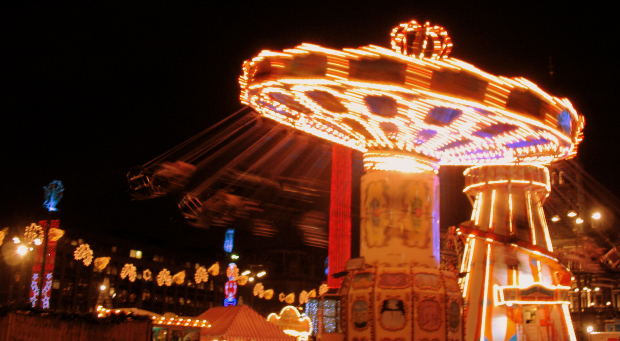
Picture a Saturday night high street. See the bare limbs, flesh glaring biscuit-orange under canopies of street lamps and the neon flashing of signs for pubs and clubs. All is bewildering, all is bright and vivid and searing. High heels and crumpled blazers, unbuttoned shirts and bodies stumbling all over the road, shrieking and laughing and throwing blind curses to the sky. There are people conversing in drunken slurs, echoes of animal-sounding noises, shadows of disaster thrown up the walls. At the weekend, with sun-down comes turmoil: the interruption of the normal.

Writing several decades ago, Mikhail Bakhtin coined the term ‘carnivalesque’ to refer to the nature of carnival, a time in which normal social regulations and restraints are temporarily suspended. This includes social hierarchies and associated cultural expectations and mores. Carnival is a brief period, an interruption of ordinary life that opens up a space outside of regular time, enabling freer, closer social interaction between those who would normally ignore one another (a peasant sharing a toast with a lord; a banker arm-in-arm, sharing a heartfelt singalong with a construction worker at a music festival), the acceptance of bizarre and outlandish behaviour which exposes the underbelly of humanity, the intermingling of opposites (the sacred and profane, high and low, young and old, classy and trashy) and finally carnival is a sacrilegious experience, devoid of holiness and instead a mockery of all things godly. Bakhtin suggests that the state of carnival is valuable in its ability to produce a social condition, however fleeting, of equality and freedom, a reversal of all the cultural norms that carefully structure everyday lives. In short, carnival means the ordinary world thoroughly shaken and flipped upside down:

Carnival is a pageant without footlights and without a division into performers and spectators. In carnival everyone is an active participant, everyone communes in the carnival act… The laws, prohibitions, and restrictions that determine the structure and order of ordinary, that is noncarnival, life are suspended during carnival: what is suspended first is hierarchical structure and all the forms of terror, reverence, piety, and etiquette connected with it… or any other form of inequality among people [From Problems of Dostoevsky’s Poetics, my emphasis added]

Think of the example Bakhtin provides: the medieval carnival. Lords and ladies would mingle with the peasantry, sharing rich feasts (think wild boar, think excess, think decadent berries, slabs of cheeses and intricate pastries – the burger stand and the Waitrose meal-deal of the Middle Ages), there would be grotesque entertainment, where jesters provided relief from the humdrum boredom of everyday labour. There would be wrestling, archery, hammer-throwing, dancing and general disorder, raucousness and debauchery. Think long wild spirals of medieval hair, clothing being ripped by trampling feet, misfired arrows, shouting, chaos, a sense of triumph and a sense of defeat. A state of pure pleasure and excitement and unity, where all sense of time and habits is lost. These activities aren’t policed; there are no authorities, just a rupturing occurrence of equality.

A key feature of carnival is the grotesque body. This refers to the human form made disgusting, abject, exposed. Inevitably, this involves the opening of bodily orifices, an exposure to shit and piss and sick and blood. Julia Kristeva, in her essay Powers of Horror argues that what these substances (and other triggers of revulsion such as the weird skin that forms on warm milk) is their exclusion from the ‘symbolic order’: being neither subject nor object, these abject fluids draw us ‘toward the place where meaning collapses’, and to put it simply, remind us that everything structured, everything familiar – ‘identity, system, order’ – can collapse, can momentarily be lost. The losing of these necessary familiarities causes discomfort because it reminds us not only of our own mortality (there is blood, we have blood, therefore we live and one day will die) but of the ‘fragility of the law’ that binds us within the symbolic order of social and metaphysical distinction. What is real, what is imagined, what can be touched, what can be lost – all thrown into confusion.

Considering the nature of medieval carnival then, where eating is loud, messy and public, manners are absent and bawdy humour is rife, it is easy to see how Kristeva’s theory of abjection links in with Bakhtin’s notion of the carnivalesque. The explicit exposure of grotesque, sweating, expanding bodies and their apertures (eaters, circus entertainers, fire-eaters, dancers, nudists and other performers) creates the collapse of social regulation, internalised politeness and cultural restrictions that preserve normality and define how we live, who we are, what place we occupy in the rigid hierarchies of the world.

The grotesquery of the carnivalesque haunts not just history but also contemporary life. What springs to mind for me are TV shows like Embarrassing Bodies, The Biggest Loser and Supersize vs. Superskinny revel in their exposure of grotesque bodies: bodies that upset the social order, that overspill, that violate expectations of the ideal self. Through their television screens mass audiences observe with fascination and horror the layers of flabby skin, the genital warts, the rashes and the hair loss and the gaping, hungry mouths. What is so compelling about these programs, which seem to delight in their own scatology? I would argue it is their exploration of the abject, their emphasis on the materiality of the human body and self, as well as the fluidity of this materiality – and not only its mortality but also its ability to change, to become thinner, fatter, more tanned, spottier. There is a similarity here to the public autopsies which literally dissected the nitty-gritty of human flesh before an entranced audience. When we watch Gillian McKeith in You Are What You Eat poking around examining someone’s shit, we are confronting our strange, precarious existence as physical entities, as Kristeva puts it: ‘These body fluids, this defilement, this shit are what life withstands, hardly and with difficulty, on the part of death. There, I am at the border of my condition as a living being.’

So the grotesque forces us to face up to the abyss of possible meaninglessness that besets our very existence. Carnival is a stage for celebration and freedom, but it is streaked with this dark note of the sinister limits of humanity (or could it be called unhumanity?).

I am led now to think back to debauched goings-on that characterise British nightlife. It is quite easy to compare, at least to some extent, the club scene and the music festival with the medieval carnival. Think of all the sweaty bodies thrown together: lawyer, banker, prostitute, mayor, all dancing outside of their normal clothes, their normal dispositions, their normal souls. Collapse of order. Entertainment has not evolved much in civility: one only has to take a trip to an inexpensive British-dominated seaside resort abroad to discover carnival wonders. Grotesque strippers whose very anatomies have been adorned with the alterations of plastic surgery; whose very bodies violate and confuse the (socially constructed?) definitions of human and inhuman, male and female, real and fakery; whose very bodies are abject in themselves, who violate all symbolic hierarchies. The ordinary citizen puts on a dress or a t-shirt and sheds temporarily their identity, dives into the sea of disruption and debauched, drunken catastrophe.

I think of so many human bodies scattered like ants, half-naked on the street. We dance, we dance, but together we fight, we spit, we are sick. Are we free? The rich snort cocaine in the toilets while the poor share their escapism in drink and junk food, and gradually the substances are passed down the food chain, and either way all normal reality is collapsed. Whether in the bar, the cinema, the club, the street. Yet always there is a going back – the freedom is only temporary.

Perhaps it is worse in these post-recession, cut-ridden times. Where to find relief from the mundane trawl of economic news, of job-hunting, of fitting one’s life into a monotonous form? The more human life is repressed into artificial structures and rigorous norms, the more the pressure builds to release, the more our indulgences become more disruptive, the more we binge and cause chaos and feast.

Can we find carnival at a rave?

Can we find carnival in the graffiti that sticks like smears of sick to the graves of urbanity? The need to upset borders, make violent, meaningless marks.

Is carnival an intrinsic part of our humanity?

Perhaps there is a carnal need for escape, for explosion.

Another example of carnival suggested by John Fiske in Understanding Popular Culture is that of the television game show. The presenter tries to assert domination by ridiculing contestants, but contestants respond by ridiculing the presenter. All hierarchies are upset, as money becomes not a currency of earning but something that can be won at the spin of a lottery, the opening of a mystery box. Jokes are rife, people often cry, music fills the atmosphere with a carnival sense of celebration and ridicule. Onlookers watch on with perverse fascination, anticipation, sometimes revulsion, sometimes boredom.

I was recently talking to a friend about the big Scottish music festival T in the Park, and he said that it was one of those things that ‘you kinda hate at the time, but love it afterwards’. I think this sums up the experience of carnival quite well, in some ways. The stress of the occurrence of carnival – the intensification of sensory pleasures and horrors (the live music, the colours, the portaloos, the mud that seeps in through your trainers) perhaps makes the carnival (festival, gig, club, drunken night at the pub/disco/park) hard to absorb at the time. Perhaps because you are too busy experiencing and participating. Too busy actually feeling exhausted, exhilarated, intensely confused and disorientated. But on reflection, the upset social norms can be ignored, and the experience is fitted snugly together by the reason-seeking mind. We remember the good bits, and the bad seem good, and everything is a great whirlwind of excitement and pleasure that sticks because up against normal life the value of the event cannot be measured.

There is also something in the fact that grotesque experiences provide a kind of social glue or bonding through stories. People go out to lose their inhibitions: to get roaring drunk and behave ‘appallingly’, or at least in ways that upset normality. But, fundamentally, they mostly forget. It’s up to their group of friends to get together and fill in the blanks, often chipping in with their own fictional missing pieces. Stories that live on and are retold and recycled and not only provide valuable conversation fodder but serve as a way of uniting and reinforcing friendships. It takes a night of disorder, disruption and eventual recovery (an adventure, a taste of the carnival) to enjoy normality again, to be reminded of who is there and who you are and how everyone relates to you.

In a world where the Chancellor of the Exchequer attempts to show he is a ‘man of the people’ by tweeting a picture of a burger and fries he intends to have for dinner, it is no wonder the world requires remedying through brief disruptions. As disillusionment filters through the everyday mist of reality, perhaps public craving for the carnivalesque has increased, as the thirst for the abject relates to our need to prove that there is a point, a borderline which enables the dissolution of meaning. Where everything seems more and more absurd, where money seems a mere plaything of gambling bankers, so easily borrowed and so easily lost; where our everyday lives are structured by euphemisms and business jargon and lies, it is no wonder we seek to obliterate social norms in alcohol, clubbing, violence and lust. And with the internet, who knows where the exhibitionist and border-crossing nature of carnival behaviour might end up?

Bibliography:

Bakhtin, M. (1929) Problems of Dostoevsky’s Poetics.

Bakhtin, M. (1941). Rabelais and his world

Fiske, John. (1989) Understanding Popular Culture.

Goulding, C., M. Saren, J. Follett (2003) ‘Consuming the Grotesque Body’ in European Advances in Consumer Research Vol. 6, pp. 115-119

Kristeva, J. (1982) Powers of Horror: An Essay on Abjection.

Bus Travel: Why I’m Not a Fan

broken down bus
broken down bus

Getting the bus for most people isn’t a problem, in fact for many it is an inevitable stage of the everyday routine. Buses get people to work, school, holiday destinations – and, more importantly, buses get people home. Yet, for almost everyone who gets them, buses are frankly a right pain in the arse.

My relationship with the humble bus all started when I was fourteen and began travelling into town by myself and with friends, which necessitated a move away from the convenient but uncool parental taxi service towards less convenient but slightly more socially-acceptable public transportation. At first, the idea of being on a bus was exciting: leaning my head against the window feeling the roar of the wind outside as we rushed along, talking to strangers, listening to music as I watched the hills go by rather than being forced to listen to Steve Wright’s Sunday Love Song’s on Radio 2 (sorry Mum). Admittedly, trains were better suited to the wind-in-your-hair function, but back in the day, train times in Ayrshire were rather less frequent than the bus ones. And so, the greater half of my adolescent years was spent riding buses, or more likely waiting endlessly for them to arrive.

In fact, I’m sure I can blur much of my teenage years into an eternity of waiting in the rain at myriad bus stops. It is generally a standard principle that a bus is either five minutes early, and disappears before you get a chance to run like an idiot after it, or else it’s 45 minutes late and the driver and all passengers look grumpier than Nick Clegg.

It is also a standard principle that those waiting for a bus will generally unite at a bus stop with the social glue of the Great British Moan. Whilst this is a gloomy disposition that reflects our weather, it nevertheless provides a useful way of connecting disparate generations. Elderly people love to talk about buses. My nan, like many other people’s grandparents, has probably memorised her local bus timetable. She knows their numbers, she knows which ones are reliable and which ones to avoid. She likes to moan about the drivers and the rising prices. Well, I do too. Some of our best intergenerational bonding has stemmed from conversations complaining about buses.

Regardless of the positives that can come out of poor service, the sheer cost of travelling by bus in my opinion is rendering void any novelty value they might still retain. Buses are getting extortionate. The slogans about cheap travel for students plastered on the back of our local buses are a joke. To make the eight mile journey from Maybole to Ayr it would set me back almost £4 (for a single ticket), when I can get to Glasgow with my third-off young person’s railcard for just over £5 – a journey over five times the distance. Not to mention the substantial luxury of train travel in comparison to buses, where leg room is smaller and the chance of being flung violently into the person in front/beside/behind you is considerably higher.

On a train, I have access to lots of comforts. I might be able to charge my phone. I will be greeted on occasion by a friendly ticket officer, rather than a bus driver irate with the stresses of traffic and grumpy passengers. I have a little table if I want to drink my coffee, write or read a magazine (perhaps the complementary Metro). Late night train travel allows a snapshot into local nightlife, although sometimes it isn’t necessary to take the late train to see this, however. It is not unusual to see someone casually open a can of Tennents at ten in the morning, or to witness a band of rowdy men (on a stag-do, or on their way back/to a rugby/football match) cajoling the ticket conductor and singing rude songs. A hazard of both bus and train travel is the lonesome teenager playing awful dance tunes out loud through the tinny speakers on his/her phone. This was the mode through which I experienced my delightful first exposure to Carly Rae Jepsen’s ‘Call Me Maybe’. So, don’t get me wrong, train travel is by no means a leisurely experience. Anyone who has undergone the horror of taking the evening train back from Ayr to Glasgow on a hot day, will know this. Being packed into a tightly enclosed space with a load of highly-intoxicated, sunburned, tired and aggravated Glaswegians who have just spent a day by the beach is far from light pleasantry.

Yet while trains have their problems, at least they are generally reliable. By reliable, all I mean is that they tend to head from one place to another, stopping at fixed destinations on the way. Recently, commentator Caitlin Moran tweeted that:

Screen Shot 2013-06-27 at 15.25.21

To some people (particularly those who are drivers and rarely take public transport) this disruption to service might seem astonishing. To me, it’s comically familiar. Growing up, I used to regularly get the 361 bus to travel to my friend’s house in a tiny far-out village. It stopped in many different farm towns and villages, and was notorious for its lateness, tendency not to show up and the antics of its drivers. I loved that bus, although it was a bloody nightmare. It was the bus we had to get at nine in the morning after a rough night of partying, and journey along those endless winding roads, being thrown between seats, trying our best not to throw up. It was the bus whose driver has, on separate occasions, pulled up by the side of the road to get a chippy, to take a piss in a ditch and to buy a pack of cigarettes (which said driver proceeded to smoke outside of the bus while we waited patiently inside).

Caitlin Moran later added that everyone on the bus was being ‘very British’ and politely pretending that nothing was wrong. I would like to suggest that such awkward manners are less visible during bus travel in Scotland (well, I can’t speak for everywhere, but at least South West Scotland). As soon as the bus driver accidentally stalls, or refuses some twenty-year-old chancer a half, cue the cries of (and I quote) “ya fucking fanny” and “fuck you wee man”, and general laughter and goading from the other passengers. Well, some of us will try to turn our heads, but generally being on a bus seems to be a more raucous affair than it is down south

Raucous indeed; maybe even adventurous. The notorious 361 was also the bus that one day broke down in the middle of nowhere, while I was on it. Being a highly trained professional, the driver attempted to ring someone ‘in the know’, but succeeded only in engaging what sounded like an exchange of swear words and incomprehensible banter. It being the middle of nowhere, his phone signal then suddenly went and the call was cut off. Said driver left the bus and began angrily kicking at the wheels and inspecting the engine, before standing outside lighting cigarette after cigarette and turning his head around to admire the rural landscape. Meanwhile inside the vehicle, a group of middle aged women on the back seats had pulled out cans of fizzy juice and with conspiratorial giggles were proceeding to top them up from a bottle of vodka. Procuring paper cups from their Farmfoods bags, they offered their concoctions around the bus with much bravado, cursing the uselessness of the driver. As said drive returned to the bus after getting through presumably to his manager, rather than being calmly offered a refund and a possible replacement means of transport, we were told we would have to wait until they could get the sputtering vehicle itself repaired. My friend and I decided it would be miles quicker to walk to the nearest village, where she lived and could provide me with a lift home.

As we wandered the several miles, on a Friday night in July sunshine, quite content with this little drama, the 361 suddenly trundled past us. Arrogantly, it honked its horn  but did not stop to let us on board. We didn’t wave our fists, but just laughed incredulously and kept on walking. Service to rely on.

Following my initial recreational experience with buses as a means of getting into town to meet friends, during my latter means of school I learned what it was like for working people who had to get the bus everyday. I had taken subjects in a college and school in a different town which required several bus rides a day, so that I was hopping around from place to place and finding the majority of my week spent perched on the edge of my seat, trying to read while resisting the urge to vomit (whether said nausea was induced by the driver’s furious attack on bends or by the body odour of the man/woman in front of me I could never tell, probably it was both). I spent so many hours waiting in the frozen cold at bus stops with a bunch of old people wrapped up like Eskimos, or other college students standing catatonically puffing on cigarettes. How I longed to smoke in those days, just for something hot to travel fast to my lungs. Frequently I wore two pairs of gloves at once.

There was one day a week, a Thursday, when I had to get four buses a day, and that truly was hell. But it was also amusing, like the times nearing summer when for some reason the normal-sized bus was replaced with a monster of a holiday coach, which provided a bit of midweek excitement. Or when a woman, looking like she had dressed in my brother’s preteen sportswear wardrobe, got on lugging a titanic-sized flat screen television and proceeded to hug it to her seat like a warm fuzzy bear. Or witnessing the fights that broke out when some kid tried to get on as the bus was pulling away, and the driver exploded into fits of rage and cursing about the arrogance of youth.

Maybe I’m doing bus travel a disservice; maybe taking the bus isn’t what it was a few years ago. Maybe post-recession it’s all got a bit more efficient. I don’t know and maybe I won’t find out, because these days I do everything I can to boycott buses. Walking everywhere helps, and investing in a value-for-money railcard. At least I’m being green.

What I will say about buses is that they are, for good or for bad, a communal experience. Inevitably some ghost from primary school past will float on and treat you with a journey’s worth of gossip about old teachers, or a slightly ominous man in a tracksuit will strike up a fascinating conversation about his egg sandwich with you, or a pair in front of you will keep turning around to inform you each time the bus driver picks his nose and looks straight in his mirror. Maybe there isn’t that kind of intimacy on the train…unless, like the trains where I’m from, the train often has to stop for extended periods after hitting a cow on the line, and what unfolds is like something from a Martin McDonagh script: a gross and darkly hilarious suspension of regular social norms where conversations turn to graphic depictions of absurd animal violence, and people who would normally take a glimpse at one another and then look the other way are suddenly engaged in furious conversation like old mates. I guess waiting for some specialist to come and ‘remove the animal’ (read: scrape cow guts off the train) has its dramatic effects.

Coming to some kind of conclusion, I admit this article has been a bit of a rant, but I hope it is more a record of experiences than a whole-hearted attack on bus travel. After all, it will always have that nostalgic quality: the acrid smell of body odour, stale perfume and freshly-opened cheese and onion crisps; the thundering voices of the half-deaf passengers trying to speak on their brick-like mobile phones; the grimace of the bus driver as he realises he has to count your change from a tenner. Or maybe just the excitement of travelling to college for the first time, or going to a friend’s house and surreptitiously sipping vodka from a plastic coke bottle whilst discussing the forthcoming antics of the evening. When you take a bus, you definitely feel like you are going somewhere (I suppose it bloody well should considering the cost), and there is always the added fun of staring out at the scenery and batting away the wasps, flies and other natural paraphernalia that comes flying in the open windows.

Yes, the bus is certainly the most humble means of transport. Nevertheless, it has to be said that I’d rather walk.

American Psycho: Sex, Violence, Technology and Society

Image source: http://images6.fanpop.com/image/photos/33100000/Fit-In-american-psycho-33196259-600-889.png

I have just read a book that has all at once captivated, disgusted and intrigued me; a book that has left me strangely both emotionally drained and intellectually stimulated. Bret Easton Ellis’ American Psycho plunges the reader into a world of late 1980s ‘yuppie-ism’: the world of Wall Street, hyper-consumption, misogyny, racism, inane pop culture, television, sex…and violence. Written from the first person perspective of its protagonist (although somehow I find the term protagonist with its heroic connotations inadequate), Patrick Bateman, the novel has an unusual cyclical structure that plays out as a repetitive narrative of visits to classy restaurants, mundane descriptions of the latest consumer goods, chapters that read like music reviews and then the most controversial element: the horrifically graphic scenes of sexual violence and psychopathic slaughtering that got the book banned by its initially intended publishers.

Yet I don’t believe that Ellis includes these gruesome chapters just as a twisted indulgence, a pornography of violence. As I will discuss, they play a part in Ellis’ searing, often satirical portrayal of the Reagan era in America: a critique of neo-liberal values, consumerism and technology that is arguably more pertinent today than it was twenty years ago. The heartlessness, depravity and monotony of this culture and the novel itself is summed up in the opening line: ‘abandon all hope ye who enter here’, which is ‘scrawled in blood red lettering’ on the side of a building. This quote is an intertextual reference to Dante, who in his Divine Comedy suggested that this was the written passage that appeared in the entrance to Hell. When you pick up American Psycho and read the first lines, which immerse the reader immediately in the divided cityscape of 1980s New York – a world of graffiti, advertisements and pop culture – you cross over a threshold, you cross over into a tightly-confined mind that experiences its own corruption in a fictional universe that is all too like our own. What is interesting about the novel is on the one hand its hypothetical exploration of the thoughts of a psychopath, but also its trenchant critique of a society obsessed with surfaces, purchases and the perpetual presence of the flickering flow of television; a society plummeting towards absurdity and the eradication of all meaning – at all levels from the individual mind to the collective conscience.

Despite being the novel’s narrator, Bateman reveals little about himself other than his routines, his clothes and his opinionated taste in music. He indulges in lengthy passages detailing his workouts, his use of face masks, his appearance, eating habits, sexual interests; but the novel provides little in the way of solid character description. The narrative is therefore intensely claustrophobic, as we are restricted to Bateman’s narrow, white, narcissistic upper-class view. Moreover we know nothing of the Bateman behind the suit and Ray-Bans; we don’t know about his childhood, his relationship with his parents is only briefly suggested in a single flash of a chapter, and although it is the source of so much expendable income, we never find out what he actually does at work, other than order his secretary to make him dinner reservations. This latter point is especially interesting within the context of contemporary culture, where people are becoming ever-more critical of what these high-flying guys in banking and finance actually do; as bonuses and salaries remain sky-high in spite of the recession, there is increasing concern with regards tothe elaborate and obscure games that these ‘yuppies’ spend their time with – playing with money, justifying their existence. Ellis clearly does not seek to redeem the Wall Street yuppie, but instead caricatures his position and the career in general – which for me culminates most humorously in a chapter where Bateman and his coworkers engage in a highly-charged comparison of the stylishness of their respective business cards, that reads like a competition between prehistoric men flexing their muscles or showing off their hunting skills.

This leads into the question of masculinity and self in the novel. In a world where the most socially-esteemed jobs require what might be considered traditionally ‘emasculated’ behaviour – Bateman, it seems, is a proto-metrosexual – how do men assert their masculine identities, especially with the increasing challenge of the rising status of women? Bateman’s gendered self is ambiguous: on the one hand he is obsessed with his physical appearance – going for regular manicures, massages, constantly working out and asking if his hair looks good – and on the other asserting patriarchal dominance by literally killing, and in some cases torturing, those that either threaten his position (e.g. his colleague Paul Owen who has the superior business card) or those that he is different from and wishes to demonstrate are beneath him: women (especially models and prostitutes), beggars and homosexuals. This creates a bizarre, twisted sense of capitalism gone mad, of the ‘dog-eat-dog’ ideology of everyman for himself, of free market competition gone out of control. The individual, in his quest for success, seeks a greedy taste of the ‘Swordfish meatloaf with kiwi mustard’; that is, the excess and the addictiveness of the American Dream.

The novel thus remains engaged with material inequality, even though its focus is on one end of the scale – the high-flying lifestyle of yuppie clubs and restaurants. Throughout the book, Bateman and his friends taunt the plethora of beggars that haunt the streets of New York, holding out bills of money only to snatch them away in front of their starving eyes. At one point, Bateman even shoots a busker, just because he can; because he has the urge to kill and feels the man’s life is worthless. Yet there is an ironic discrepancy between Bateman’s behaviour and the outward image he projects of someone in tune with social problems. Early in the novel, Bateman delivers a speech that reads like the words of a politician: ‘we have to end apartheid for one. And slow down the nuclear arms race, stop terrorism and world hunger…strengthen laws to crack down on crime and illegal drugs’. All this from a man who personally terrorises the poor and vulnerable, regularly takes cocaine and is quite happy to waste money on often-uneaten restaurant food whilst trampling all over street beggars. Perhaps, therefore, Ellis meant to parody the hypocrisy of governments that proclaim their acknowledgement of socioeconomic problems but do nothing or little to actually tackle them. The irony of Bateman’s ‘identity’, then, is the way in which his words do not distinguish him but blur him further into convention, as he constructs his self by appropriating the words and values of others – particularly his hero Donald Trump (which says a lot about yuppie conscience). Indeed, this is humorously parodied in the fact that all food and tastes are judged not by individual experience but by reviews characters have read in glossy magazines.

So in spite of Bateman’s carefully constructed external self as a socially-conscious businessman, his identity remains a space of vacuum. Everything around him – his friends, his values, his lifestyle – is utterly superficial, and it turns out that he is too:

‘…there is an idea of a Patrick Bateman, some kind of abstraction, but there is no real me, only an entity, something illusory, and though I can hide my cold gaze and you can shake my hand and feel flesh gripping yours and maybe you can even sense our lifestyles are probably comparable: I simply am not there […] My self is fabricated, an aberration. I am a non-contingent human being. My personality is sketchy and unformed, my heartlessness goes deep and is persistent.’

When it was first published in 1991, American Psycho was accused, among many things, of being a poorly-written, immoral book, but I believe these early critiques were based on strong misreadings. The above passage, with its incisive insight into the thoughts of someone staring into the abyss of his own personality, its chillingly controlled and intoxicating prose, shatters any accusation that Bret Easton Ellis is a bad writer. It opens up the concern of many ‘Generation X’ writers: the paradox of identity in the late twentieth century. In a world where identities become more important, as each person seeks to distinguish themselves within the ocean of material things, selfhood in fact seems to dissolve, fragment, disintegrate under the weight of excessive choice and infinite expectations. Bateman reflects that ‘there is no real me’ in spite of the solid flesh, the personality moulded out of a particular consumer lifestyle, the ‘illusory’ mask of self presented in the fashionable clothes, the haircut, the voguish business card. American Psycho challenges many conventions of the novel, and one is character development: Bateman may become more reflective as the narrative ‘progresses’ but he does not undergo transformation or redemption. He remains all surface, with no core sense of morality and self beneath the veneer of his existential acts – he ‘simply [is] not there’.

This reminded me of Oscar Wilde’s The Picture of Dorian Gray, written a hundred years before American Psycho at the fin-de-siècle of the nineteenth-century. Like the ‘yuppies’ of Wall Street, Dorian and his friend Henry Wotton not only challenge traditional masculinity, as appearance-obsessed ‘dandies’ (the late Victorian metrosexual), but they are also excessively idle and spend their privileged lives like Bateman and his colleagues, indulging in sensual pleasures, conspicuous consumption and attending the finest venues of society. Narcissism and art are thematically central, just as narcissism and pop culture are to American Psycho. The fable-like plot of Dorian Gray turns on a Faustian bargain Dorian makes with the devil, whereby he barters his soul in exchange for eternal youth, so that his portrait grows old and twisted while he remains all surface, forever flawless and smooth. Dorian’s narcissism and pursuit of pleasure leads him into a spiral of moral corruption, visits to opium dens, murder and sexual depravities which, while completely removed from the Ellis’ gore, were nonetheless shocking at the time.

Each novel has lengthy passages cataloguing the material objects that consume the lives of its protagonist, emphasising the vacuity of their identities beneath the sheen of their flawless appearance. Yet Wilde, unlike Ellis, gives his novel closure: he provides some moral consequence to this hedonistic lifestyle, rather than as Ellis does allowing the reigning continuity of surface he gives some ethical depth. While American Psycho’s plot is an endless repetition of music reviews, restaurant, concert and club visits and violence, from which emerges no character development or moral conclusion, Dorian Gray traces the deterioration of a character whose initial purity is corrupted by a range of identifiable sources including art (notably, a ‘poisonous book’ thought to be J. K. Husyman’s A Rebours) and the influence of those around him. Dorian Gray ends with final punishment as Dorian tries to destroy the painting but in doing so reverses the mysterious spell, so that he acquires all the ugliness of his sins and the picture is restored to its original purity. Perhaps this structural difference can be attributed to the distinctive literary contexts of each book: while Wilde was writing in and to some extent subverting Victorian realism, Ellis is embedded within a more postmodern tradition that is sceptical about there being a moral centre to which texts can turn to, and is instead interested in showing how the boundaries of morality and self are not only fluid but at times seemingly invisible.

Indeed, what is particularly intriguing about Bateman’s monologue is the statement: ‘my self is fabricated, an aberration’ (my emphasis). Bateman spends his entire time striving to fabricate a self that fits in with the expected and respected norm embodied by the clone-like yuppies (indeed, because of their similar clothes and haircut they often mistake each others’ identities and this largely goes unquestioned in the narrative) and yet Bateman himself is an ‘aberration’ of this mundane normality. He’s an anomaly, defined by his psychopathic serial killer tendencies. Yet by linking the two – conformity and deviance – the text suggests that perhaps Bateman’s psychopathy is a product of society; it is not just a personal pathology but deeply embedded within the frustrating, depthless culture in which he finds himself skidding along with no hope of even drowning in. There is no way of drowning in a postmodern, or what Baudrillard calls a ‘hyper-real’ world where everything is interchangeable and signs refer to nothing but an endless stream of more signs – a choking bombardment of advertisements, appearances and vacuous conversation. Murder, rape and drugs provide some alternate reality, something real and solid and potent, that produce actual effects and allow Bateman to distinguish himself in some dark, significant way, even just as an ‘aberration’. It’s a chilling thought.

Although the novel never punishes its serial killer – Bateman is never caught, even though he drags a body-bag through the street, is helicopter-searched by police and leaves rotten body parts stewing in his apartment – the absence of a moral framework actually adds to the richness of the text. In his essay ‘From Work to Text’ Roland Barthes argues that the ‘writerly’ text offers up a plurality of readings rather than containing a single concrete meaning. It is in a sense an ‘event’, a surface (particularly relevant to American Psycho!) which engages the reader in a ‘practical collaboration’. This is achieved by the proliferate meanings offered up by the text: the intertextual references (abundant in Ellis’ novel, from Dante to Satre to Whitney Houston) and the elaborate web of signification spun in the writing, which encourages the reader to weave a fabric of meaning from the complexity of clues scattered throughout the prose. The pleasure of the text is our freedom to skip over passages, and to pay more attention to others. To endlessly reread and gain new insight, to create new meaning from. I find myself skim-reading the endless monologues about the latest technology, and often skipping entirely the really graphic parts; but this is not necessarily a bad thing, it merely prompts me to reflect on my role as reader in playing a role in constructing meaning in the text. It isn’t just there, but I actively make it depending on what I want to get from it.

Ellis also engages the reader in the ‘free play’ of meaning by leaving significant gaps in his text; the most notable of these gaps is the question of the unreliable narrator. Wayne C. Booth defines the narrator as ‘reliable when he speaks for or acts in accordance with the norms of the work (which is to say, the implied author’s norms, unreliable when he does not’. The subtle but at times overt irony that plays out in American Psycho, from Bateman’s extreme sexual and violent conquests and the ease in which he gets away with them to the literary language itself, is essential to raising questions about Bateman’s reliability. The tone he uses to describe the monotony of having to make reservations and his matter-of-fact description of his gym is the same tone used in his description of the scenes of grotesque and sadistic torture, necrophilia and cannibalism. Not only does this suggest that Bateman has been desensitized to pornography and violence but it also blends the normal and the abnormal together into a disturbingly hyperreal narrative of contemporary life. A life where rape and murder deserve no more expressive prose than a trip to ‘return some video tapes’. The prosaic language used to describe these scenes evacuates all possibility of the erotic or suspense that characterises porn or horror and instead foregrounds the acts themselves as real, painful and distorted occurrences – which in turn leave us with a sickening sense of our own voyeurism, raising wider questions about society’s enjoyment of such explicit forms of cultural entertainment. This notion of voyeurism is also highlighted by the repeated occurrence of such scenes (often signified by the foreboding chapter heading ‘Girls’ which I came to dread), creating a circular narrative which emphasises the text’s sense of claustrophobia and entrapment and recreating the inescapability of the distastefully explicit within modern culture.

Moreover, in relation to unreliable narration, the absurdity of Bateman’s rampant and seemingly meaningless killing sprees raises the question of whether what Bateman does is actually occurring, or whether it is an extended fantasy he projects as a way of indulging in his feeling of vacuity and ‘heartlessness’ within a featureless life of mind-numbing consumption. Is he merely fabricating his own alter-existence that plays out just like the pornographic films he rents from the video-store? The text provides little evidence to confirm or deny Bateman’s reliability, and this is what is so seductive about American Psycho: the fact that we as readers are left to judge the veracity of Bateman’s narration, which in turn leaves us within a complex moral vacuum. Unlike other books about serial killers, American Psycho doesn’t contain a detailed narrative explaining the root causes of Bateman’s pathology – abuse in childhood, a defined psychiatric condition etc. Bateman pops valium, Halcion and various other ‘pop’ drugs but he is not on medication for paranoid schizophrenia, multiple personality disorder or the like; the blame for his condition is thus found within a complexity of societal factors rather than an easy psychological diagnosis. The exact cause is left for the reader to decide: we have to map out Bateman’s life – his pleasures, his friends, his behaviour – in order to make judgements about the myriad origins of his psychopathy.

Another area of contemporary society which Ellis explores critically in American Psycho is technology; specifically, television and the telephone. The telephone was invented to improve communication, but in the novel it is the site of communication breakdown. For example, when Bateman and his coworkers make a conference call to decide their evening plans, the conversation breaks down into meaningless and often disconnected statements. There is nothing efficient about this communication. Moreover, the telephone presents an uncanny means of correspondence, since it removes the face and replaces it with the voice. This makes the person at the end of the line both familiar and unfamiliar, which raises interesting questions in terms of the fluidity and fragmentation of self depicted in American Psycho. At what could be argued is the novel’s most intense point, whereby Bateman has been on a killing spree, is chased by police and is now hiding in his office, he makes a call to his lawyer and leaves a message detailing all the murders he is committed. Yet when he meets his lawyer the next day, the lawyer not only refuses to believe the answer-phone message but he actually thinks Bateman is someone else – he thinks that the message was a joke played by someone else at Bateman’s expense. Telephone technology has not increased the potential for meaningful and intimate human interaction but merely created further distance, and in doing so distorted what is real and disconnected the ‘I’ that is speaking.

In terms of television, the book is rich with critical analysis. The debate about TV images and their influence on human behaviour goes all the way back to Plato. In The Republic, Plato puts forward the analogy of a cave in which prisoners have been chained since childhood so that all they can do is stare at the shadows on the wall which create shapes and sound; this is the only reality they know of, yet it is a reality constituted merely by the shadows of things, not the things themselves. If one prisoner escapes and sees REALITY itself, it will seem less real than the shadows. Like the prisoners of the cave, most people in contemporary society are in a sense ‘chained’ to the all-pervasive presence of television, which has become the source of much of our knowledge: the ‘shadow’ images of television are used to shape our morality, ideals, values etc – our whole perception of the world. Television, moreover, provides a perpetual ‘flow’ of time, squashing the past and present together in an ‘extended present’, which gives a rhythm and routine to our daily lives. Bateman’s life is partially constructed around his watching of the morning The Patty Winters Show, Late Night With David Letterman and endlessly re-watched video tapes such as the thriller Body Double in which a girl is murdered by a handheld drill.

When television images are extreme ones of hardcore pornography or violence, questions are raised about how far they can be blamed for real life violent behaviour. Perhaps Bateman can so easily murder without remorse because his acts of violence seem less real than the highly stylised images he consumes on a daily basis. This is a real life concern: the murder of James Bulger by two young boys in 1993 was blamed by some on the film Child’s Play 3, leading to calls for a ban on the film. Anthony Burgess’ novel also explores this link between video images and violence in A Clockwork Orange, where classical Pavlovian conditioning is used to re-calibrate the protagonists’ perception of violence: Alex is strapped to a chair, injected with a nausea-inducing drug and forced to watch violent films so that he learns to associate cruelty with sickness. Yet eventually, this ‘Ludovico technique’ is reversed and once again he is back to the same old daydreams of bloodlust; it is only through a process of experience and growing up that Alex comes to leave his days of brutality behind. Thus rather than allowing for a simple causal effect between images and action, Burgess overall complicates the relationship between television and violence.

A more recent play by Martin McDonagh, The Pillowman, is also a useful text for grappling with the link between art and violence. The play’s storyteller, Katurian, claims that ‘the only duty of a storyteller is to tell a story’, yet his stories become implicated in criminality as they have influenced others to commit crimes that copy the sinister plots of his fables (which involve swallowing apple-men containing razor blades and child crucifixion). It’s an infinitely dark and at times sorrowful play, but also it’s very funny: it raises a myriad of questions about authorial responsibility but rather than answering them The Pillowman blasts all moral closure with nihilistic conclusions, green pigs and its at times absurd, circular dialogue. It is a very clever, layered, metafictional commentary on the relationship between art, suffering and violence and I highly recommend it.

So to what extent is Bateman’s behaviour the product of the films he watches, or the TV shows which range in topics from ‘Toddler Murderers’ to ‘a man who set his daughter on fire while she was giving birth’? Again, the text offers no straightforward answers, and indeed it is possible that the orgiastic violence he indulges in isn’t real at all but merely fantasies extended from the flickering images he sees on television. This is an intriguing idea, especially going back to Plato’s notion that the man who leaves the cave will find reality less real than the shadows; the text leaves the question of what is ‘real’ in the novel, and even – what are the implications for the violence of American Psycho itself? It may be classified as fiction, but feminist group NOW attacked the novel upon publication as ‘a how-to novel on the torture and dismemberment of women’. Will some readers read Ellis’ text naively? Can it be blamed for furthering society’s desensitizing towards violence through its graphic scenes?

I think what redeems American Psycho in this respect is its self-conscious irony. Yes, it is horrifically graphic, but it does so for a purpose: to deconstruct and expose the way in which slasher movies, porn and the like have become part of popular culture, and to restore a shocking element to these forms of entertainment which have become so stylised and normalised. Additionally, like The Pillowman, Ellis’ book is also inherently funny. There are random standout lines such as the comment ‘”I bet Bono has a small dick,”’’ when Bateman and his friends go to a U2 concert, and also the narrative contains many running jokes, such as Bateman’s compulsive need to ‘return some video tapes’, and several repeated miscommunications such as when Bateman says he works in ‘murders and executions’ but this is interpreted as ‘mergers and acquisitions’, thus blending together ironically Bateman’s mundane day-job with his vicious night-job. There are also surprising parts of the book which seem human, such as when Bateman visits his mother in her care-home and all he can do is look at himself vainly in the mirror that he’s ‘insisted’ on having there and think about are the expensive things she’s wearing (bought by him). When Bateman asks his mother what she wants, her reply: ‘“I don’t know. I just want to have a nice Christmas”’ is tearfully poignant in that it summarises the inability of consumption to fill the gap in their relationship, to fulfill the mother’s spiritual need to enjoy Christmas, a traditionally family-orientated event. The maternal relationship is hinted as strained and distant as all mother and son can say to one another is ‘“you look unhappy”’ and talk ‘“uselessly”’ of a recent party. This breakdown in communication is actually full of pathos and presents a refreshing break in the text, but one that opens up another possible, yet unexplored, avenue of explanation for Bateman’s insanity.

In sum, the text offers no answers. Bateman’s violence we must explain ourselves by piecing together the various sources in the text – from television to consumerism to a societal crisis of masculinity. Ellis doesn’t pretend to moralise, and his book ends with the ambiguous reference to Sartre’s play No Exit, as Bateman stares at a red-lettered sign on the door of a bar saying ‘this is not an exit’. The text thus begins and ends with a textual allusion to hell, but hell itself is not contained within the novel – the end is not an exit from the tortuously mundane, unequal and cruel world Bateman exists in – it is firmly our own world, from which there is no exit. This is an unsettling and nihilistic vision, but one in which unfortunately resonates as violence, consumption, immoral bankers, social inequality, identity crises and televisual domination are all swarming features of life in the twenty-first century; perhaps even more so than back in the late 1980s where the novel is set. The musical backdrop may have changed, but largely, the culture has not. And this relevance factor is why I recommend American Psycho.


Bibliography

Barthes, R. ‘From Work to Text’.

Burgess, A. A Clockwork Orange.

Dante, A. Divine Comedy.

Ellis, B. E. American Psycho.

McDonagh, M. The Pillowman.

Plato, The Republic.

Satre, J. P. No Exit.

Wilde, O. The Picture of Dorian Gray.

http://www.nytimes.com/1990/12/06/books/now-chapter-seeks-boycott-of-psycho-novel.html

http://theater.nytimes.com/2005/05/06/theater/newsandfeatures/06note.html?position=&_r=0&adxnnl=1&pagewanted=print&adxnnlx=1370079884-9qmE05+JL/NXsusA29JsyA


My Difficulty(ies) with Sex and the City 2

Image
Image source: fanpop.com

I really don’t know what convinced me to watch Sex and the City 2. I suppose it was a case of finding something that wouldn’t require much brain power; some easy viewing for after exams. Little did I know the film would prompt some serious feminist and post-colonial rage.

Sex and the City 2 is, like the show that ran from 1998-2004, a romantic comedy. It follows Carrie, Samantha, Charlotte and Miranda as they travel abroad to a holiday in Dubai. Like the show, the film engages with the issues of being a woman in a ‘post feminist’ age, but also involves itself in questions of cultural difference and orientalism. Sex and the City 2 was released in 2010, in the midst of the turbulent relations between the West and East defined by the on-going war in Afghanistan.

Firstly, the question of feminism. Sex and the City 2 is a salient example of a ‘post feminist’ film. According to Angela McRobbie, in her work ‘Post Feminism and Popular Culture’, popular culture of the 1990s reflects a turn away from the gains made in the second wave feminist movement, through an exhibition of what McRobbie calls ‘post feminism’. Post feminism, for McRobbie, entails the notion that contemporary culture relies on the achievements of second wave feminism. Indeed, it takes these achievements – equal rights, liberated sexuality, economic independence etc – for granted, takes them as socially ‘obvious’ and in existence without need for critical reflection. The widespread assumption that women are sexually, economically and socially ‘liberated’ allows popular culture to represent female characters who embody an autonomous, self-reliant and empowered lifestyle: this includes having high-flying career women, sexually-liberated women; women with choice, education, power. It doesn’t take much effort to see that Sex and the City is a prime example of this: there’s Samantha the PR businesswomen, Carrie the writer, Miranda the lawyer.

Nevertheless, the empowered women portrayed in popular culture do not fit the aims of feminism, even though on the surface they appear strong and ‘free’. These women are presented as self-made, fully in control of their own destinies, fully unshackled from the chains of patriarchy and power and also the feminist movement itself. Their achievements are represented as examples of personal triumphs rather than identified as part of wider shifts in female employment and gender roles enabled by the feminist movement and its transformation of the systems of power and social mores which formerly would have constrained them. Since these women are depicted as independent and disengaged from feminism, their representation contributes nothing to the political ambitions of feminism, and also undermines the need for any contemporary feminist movement. Indeed, many popular renderings of the modern, empowered women (the post feminist female subject) in fact not only detract from the political weight of feminism but they also associate this new freedom with certain practices which actually restore traditional gender roles – the gendered behaviours that feminism set out to radically change.

In Sex and the City, both the show and the films, female liberation and empowerment is predominantly expressed through sex and consumption. Yet it is debatable as to whether these practices actually enable the women to free themselves from conventional gender norms or whether they in fact throw the characters back into the cycle of cultural constraints that rigidly define ‘women’ and ‘feminine behaviour’. Samantha, for example, is frequently depicted as the most sexually voracious of the four women. She enjoys the kind of sexuality – one night stands and the like – that men have been enjoying for centuries; she offers no apologies for her behaviour; it is, at least from the two films I have seen, seemingly morally accepted. Moreover, as a successful businesswoman, Samantha enjoys an economic independence which allows her to splurge on clothes, holidays and anti-aging products. It isn’t difficult to see where post feminism fits in here: while Samantha does have an assertive sexuality and personality, her empowerment is presented chiefly through consumption. Rather than making any significant political statement about female power or positioning, the show and films seem to reaffirm the status quo by confirming consumption as not only the vital source of contemporary identity but also the glittering route to status and power; yet a route that leads continually to traditional female objectification, with the body becoming a cultural mannequin, dressed up with the latest dresses, shoes and anti-aging potions to create the perfect sexualised subject. Of course, there is an inherent ambiguity about whether the woman is in control of herself, as she travels down this route of credit cards and department stores, or whether she is pressured by the powers of female-directed advertising and capitalism.

In any case, Sex and the City may appear feminist but it certainly contributes very little to the political movement of feminism. The girls may spout their girl power in a karaoke session singing second-wave feminism’s theme song ‘I Am Woman’, but their empowerment is arguably a superficial concealment of how they are trapped by the mind-numbing machines of advertising and the fashion and beauty industry which continue to pressurise and mould women’s sense of self, perpetuating gendered regimes and practices. Samantha, the only unmarried character, uses her economic power in ways that confirm her adherence to standards of femininity that are perpetuated by the beauty industry in order to exploit and extend female insecurities. She enhances her libido in the wake of menopause through guzzling handfuls of pills, to ‘trick [her] body into thinking it’s younger’, to which Miranda adds: ‘I’ve tricked my body into thinking it’s thinner – Spanx!’. While feminism as a movement attempted to open up new kinds of beauty, which included those who were not young, white and skinny, the characters are depicted as mindlessly striving towards and approving the stereotype, rather than in any sense shattering it. As Hadley Freeman of The Guardian astutely describes this scene: ‘it’s like being lobotomised with a pink teaspoon’.

Well this is all fair enough: perhaps you could argue that she is making the conscious choice to do so. Other characters have different means of empowering themselves, after all. There’s Miranda, the lawyer, and Carrie, the fashion-crazed newspaper columnist. Yet all these women are privileged: rich, often from affluent backgrounds or have wealthy husbands. They are friends for one thing because they have a shared class position. Their empowerment through shiny New York careers and the shopping is more of a class privilege than a political statement about girl power, and in this sense I would argue that the show is highly problematic in its potential to be cast as ‘feminist’.

While the issue of feminism and Sex and the City is ambiguous, I would argue the sequel film leaves little ambiguity about the issue of racism; or, more specifically, orientalism. The film follows the four girl’s holiday escapades in Abu Dhabi, the second biggest city of the United Arab Emirates. Hadley Freeman contrasts the ‘smart, funny, warm and wise’ TV show with the ‘pink-fringed, cliché-ridden, materialistic, misogynistic, borderline racist’ film; while the show ‘had genuine emotional truth’, the films are all about the ‘sex and shopping’.  I’ve never watched the shows, so cannot make a judgement other than my impression of the films. And my judgement is that their vision of women, homosexuality and ‘the East’ is distinctively narrow, shallow and hollow.

With Carrie, Samantha, Miranda and Charlotte sent off to Abu Dhabi, the film immerses itself in a world of blatant, unapologetic orientalism. Edward Said in his book Orientalism described orientalism as a concept which encompasses the binary distinction often made between West/East. This distinction comes with other stereotyped and hierarchical binary pairings such as civilised/uncivilised, us/them. Charting the history of colonisation, Said suggests that Europeans have for many years set up Eastern countries as ‘oriental’, as exotic Others by which they may define themselves against. For Europeans, whatever the Orientals were defined as, they (the occidents) were not. This allowed the West to position themselves as an inherently superior ‘race’, which in turn provided the justification for colonisation by using the ‘white man’s burden’ of civilising the ‘uncivilised’ world to legitimise their imperial domination of Eastern countries. As with most stereotyping and binary oppositioning (think man/woman), this process involved enormous cultural and social simplifications and generalisations which shaped prejudices against the ‘orient’ commonly held in the West. You only have to take a glimpse at today’s papers, with the generalisations about Islam and terrorism, to see how Orientalism still operates. Indeed, the USA in particular has frequently justified its occupation and invasion of Iraq and Afghanistan in terms of tackling the women’s rights records of these countries; but it is possible that this constitutes an imposition of Western norms on different cultures, and moreover, the USA’s record for women’s rights is itself questionable, as it is one of the few countries that has refused to ratify CEDAW, the UN’s Convention to Eliminate All Forms of Discrimination Against Women. This is just one contemporary example of how the West stereotypes Eastern cultures in opposition to its own cultural model, and reflects a complex entanglement of neo-imperialism, orientalism and feminist issues.

Back to Sex and the City 2. The representation of the Middle East is highly stereotypical, and makes a great effort to exoticise Middle Eastern men and women into characters which perpetuate traditional oriental images of the East found in films like Arabian Nights. The men are presented with a glamorous strangeness: with the mundane, clichéd dialogue and the glittering, stereotypical oriental music that accompanies their appearance. Upon arrival, the American women are treated like queens, each getting their own taxi and personal man-servant who stays up all hours to service their every petty whim. This sets up a kind of neo-colonial relationship where the ‘respectable’ Eastern characters are represented as intrinsically deferential to their Western ‘superiors’.

Additionally, the cultural status of sex is clear-cut into a binary issue, with Western liberation contrasted with a complete repression in the East – Samantha’s kissing on the beach is met with armed response and a permanent criminal record. Rather than acknowledging the nuances that characterise how sex is accepted and perceived in different contexts, the film forces the issue once again into stereotypical binaries.

Perhaps most significantly, the film also cashes in on stereotypes of the mysterious veiled Muslim women. Carrie and co ruminate over the sartorial restrictions of wearing a veil, and watch in awe as one eats her chips underneath the burqa. The Muslim woman is thus shown as an object of curiosity, and we viewers are forced to voyeuristically observe her eating chips as if she is some strange, voiceless creature. By minimising the actual interaction between the American women and the Middle Eastern women, the film negates any possibility for exploring the unique subjectivity of Muslim women and their experience of wearing a burqa as well as their religious beliefs. Instead, they remain Oriental objects of Western curiosity. Rather than respected for having their own minds, they remain quite obviously in this film, to borrow Chandra Mohanty’s phrase, under western eyes.

And indeed the moment that really struck me was when the Muslim women were given a voice. After helping the four girls escape a mob of angry Arab men (who Samantha has offended by spilling condoms all over the floor and announcing loudly that ‘yes, [she] does have sex!’, so yes – another stereotype about all Arabian men as women-haters) a group of Muslim women shed their niqabs to reveal they are wearing the latest New York runway collection. Delighted, the four American women laugh and praise their fashionable style. This is so obviously patronising that even after a film peppered with references to magic carpets and other Middle Eastern myths I was shocked. Being the primary scene where the main characters actually interact with Muslim women, it states, quite clearly, that Western and Eastern integration can only occur through consumption. Moreover, Muslim women can only be liberated from the ‘shackles’ of their own culture and religion (defined in the film by the recurrent veil image) by conforming to Western stereotypes of beauty and fashion. It’s a sickening simplification of the complexities of female identity within different cultural contexts, and seems to send out the message that globalisation (or rather, Westernisation) can only be a good thing because it is spreading a ‘liberated’ (or rather, shackled to consumerism) Western femininity to the poor, silenced Muslim women, who live in a culture that remains ‘backwards’. In doing so, it leaves out other more critical consequences of globalisation that could be explored, such as migrant labour in the Gulf, which is only skimmed over in Carrie’s conversation with her Indian servant Gaurav – who she benevolently bestows her money upon, as if this single lavish expenditure makes up for the capitalist restructuring which has necessitated Guarav’s move abroad away from his wife in the first place. Another example is in the nightclub where ironically the girls play karaoke and sing ‘I Am Woman’ while at the same time they are probably in the company of trafficked sex workers. Charlotte asks why the club’s belly dancers are allowed to show lots of flesh while every other woman in the East seems to cover up, and Miranda provides the pathetic response that there is a ‘nightclub loophole’. Many of the single women in Emirati nightclubs are indeed trafficked sex workers, but the film completely glosses over the possibility of critically engaging with this.
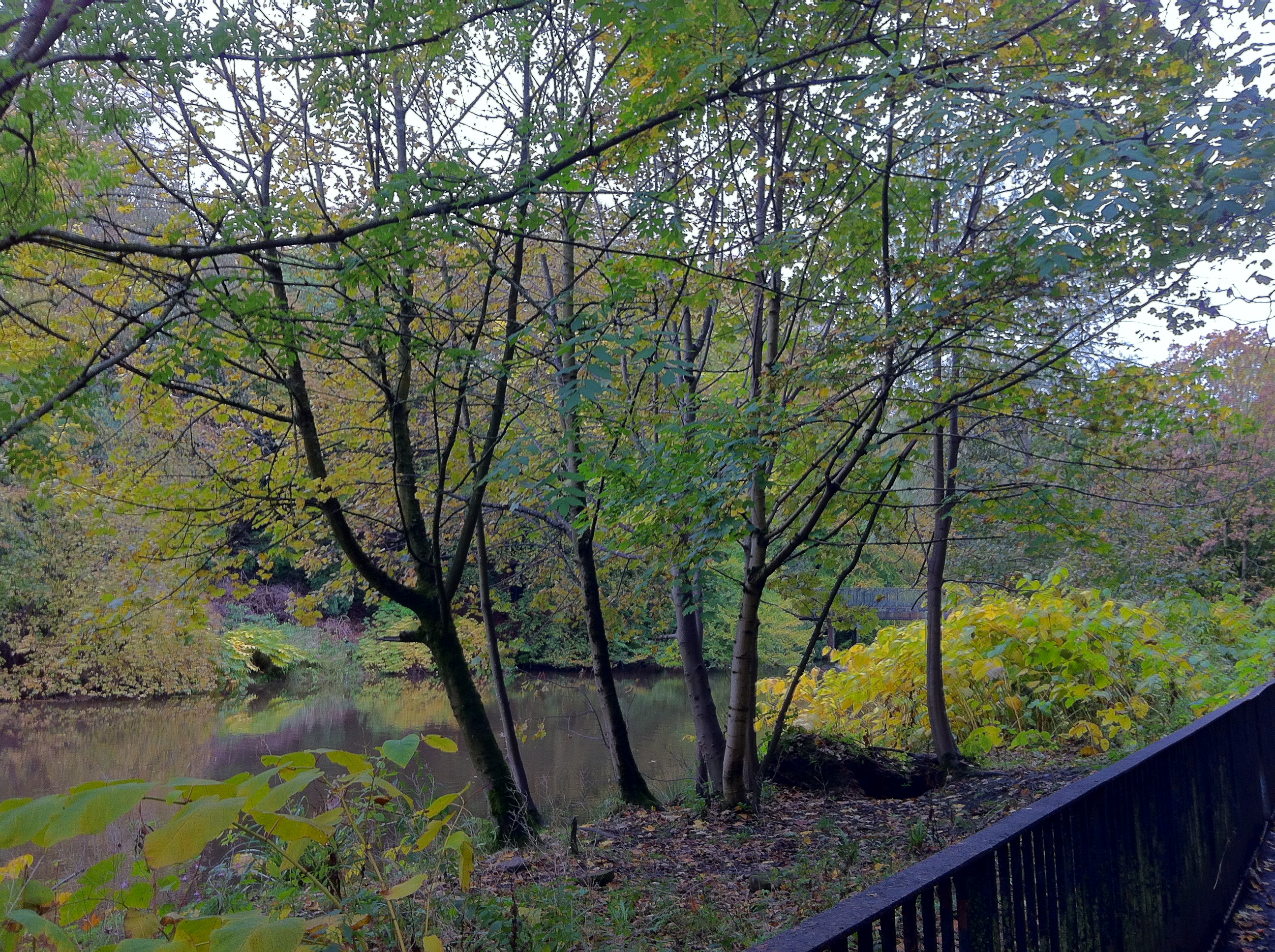
Finally, the wedding opens with another obvious stereotype that should’ve prepared me for the cliché trail that characterises the rest of the film. The wedding of two gay characters involves many stereotypes attached to homosexuality – infidelity, flamboyance, the pomp of a completely OTT ceremony, complete with boy choir and Liza Minnelli performing ‘Single Ladies’. It’s utterly cringeworthy and I had to temporarily mute the film so that my flatmate didn’t have to wonder what the hell I was watching. A fitting beginning to a film rife with caricature, condescension and cartoonish representation.

I can’t, however, completely make my mind up how I feel about the representation of women in this film. While there are many simplifications and the fact that the women conform to gender stereotypes through shopping, there are some moments where the difficulties of trying to ‘have/do it all’ are reflected. It is possible to look upon Samantha with pity, as a character who isn’t liberated but sucked too far in to the rigid, gendered standards of the beauty industry, and perhaps the patriarchal expectations of the area she works in – PR – which is based so much on appearance. Another example is the scene where Charlotte cries in the cupboard, hiding from her screeching children in a moment of genuine motherly breakdown. Nevertheless, these remain very limited representations, in that Charlotte’s troubles are the troubles of a privileged housewife. She’s crying because she worries about her husband having an affair with the nanny (an idea bizarrely stemming from the fact that the nanny doesn’t wear a bra) and because her daughter messed up her designer jeans. Not because she doesn’t know where her children’s next meal is going to come from, or because she’s overworked with three jobs to make ends meet.


So while the film touches on feminist issues, its dealing with class and ethnic difference is shockingly narrow. I couldn’t even enjoy it as a slice of indulgent consumerist fantasising, because the racial, sexual and cultural stereotypes, and the flat script and conventional female behaviour ascribed to many of the characters were so obvious and unsettling. It almost makes you feel guilty to watch. Of course, it all ends happily, with Charlotte’s nanny turning out to be a lesbian and thus in no danger of seducing Charlotte’s husband, and with Samantha finally consummating her passion for the Danish guy she got arrested for kissing in Abu Dhabi. Well, of course, the film suggests, everything happens correct and best in the West. Yet I’m not sure that all’s well that end’s well: the film prompts more questions about the implication of its depictions of women, homosexuals and the Middle East than it answers.

Bibliography:

McRobbie, A. (2004) ‘Post Feminism and Popular Culture’ in Feminist Media Studies, vol. 4, no. 3 , pp. 255–264.

Said, E. (1977) Orientalism. 

Sex and the City 2: Orientalist Boogaloo

http://www.guardian.co.uk/film/2010/may/23/sex-and-the-city-film-terrible

http://feministing.com/2010/06/03/sex-and-the-citys-women-of-color-problem/

Image

Explorations in Nostalgia: Midnight in Paris

file000675462020

Why is there a certain nostalgic quality to rain? Rain can be beautiful to imagine: the quietly rushing sound it stirs as it starts to fall, the peaceful pattering it makes on roofs and windowpanes, the tingle of droplets on your skin, the way it clings in watery beads to your lashes, the sweet earthy scent it trails as it vanishes from the vapory air. Thinking of rain conjures images of afternoons hiding indoors with a good book, of splashing in puddles as a child, of running makeup, of the high romance of kissing outside in a storm, and the satisfaction of coming home, changing into dry clothes and getting warm.

Most people living in Glasgow would be less lyrical about the drizzle that bursts ever too frequently upon the city. Rain can be a pain. Rain can mean struggling with a broken umbrella, feeling cold droplets drip down your back; it can mean delayed tennis matches, ruined picnics and cancelled plans. Yet rain is also one vein through which we are transported smoothly to some heart of our past; often our recollection of events and people is framed by weather, and rain can add a cinematic backdrop to memory that reflects the misted quality of nostalgia. It has a certain sense of deja vu, of transient confusion. I remember being here before, and it was raining. Like this…or was it somewhere else?

Yet rain is perhaps, like memory, never as lovely as we imagine or remember it to be. It is part of our wistful fantasies.

Woody Allen’s film Midnight in Paris opens with a beautiful montage of Paris in the rain, accompanied by accordion music. The shots slip effortlessly between postcard highlights of the city and panoramas of people in the street with umbrellas. It sets the scene for the film’s at times poignant but mostly witty and lighthearted exploration of nostalgia.

I first went to see Midnight in Paris at the kooky little Grosvenor Cinema on Ashton Lane in Glasgow’s West End. An appropriate venue, seeing as it is modeled on an old-fashioned picture-house, with red carpeting, plush seats, vintage interior design, glamour and the availability of wine.

Midnight in Paris is a pastiche of genres, styles, characters and references. Not only does it include an array of (slightly caricatured) figures from the 1920s creative scene in Paris, but it also welds together flashes of political satire with Hollywood rom-com and magical realism.

The film’s protagonist Gil is a Hollywood script-writer discontented with his sell-out job and longing to produce something creative in his writing. Perhaps there is a certain irony here: a search for authenticity staged within a film that is playfully anything but ‘original’. A trip to Paris with his fiancé and her parents, Gil hopes, will provide the spark of enchantment. The first conversation of the film sets up the juxtaposition between the romantic Gil and his pragmatic wife, who appropriately later has an affair with the ‘pedantic’ ‘pseudo-intellectual’ Paul:

 Gil: Can you picture how drop dead gorgeous this city is in the rain? Imagine this town in the ’20s. Paris in the ’20s, in the rain. The artists and writers!

Inez: Why does every city have to be in the rain? What’s wonderful about getting wet?

Already we get the sense that Gil wanders a little too much into his imagination, particularly his imagination of the past – of Paris in the 1920s. Gil’s first actual delve into the past occurs one evening when after the stroke of midnight a strange black cab stops to pick him up, full of revelers drinking wine and champagne. Through this mysterious portal, he is transported back in time to Paris in the 1920s. The film handles the visuals sparklingly well, with stunning 20s costumes, cocktails and the lovely decor of the bars and clubs. It’s all quite magical and dazzling, and we experience the wonder Gil must feel as he is teleported into his favourite fantasy. It certainly got me excited for Baz Luhrmann’s soon-to-be-released The Great Gatsby.

Except unlike us, the audience, Gil becomes a participant in his fantasy, not merely a spectator. Among his adventures, Gil encounters a plethora of characters from the 1920s literary and arts scene, including Hemingway, Dali, the Fitzgeralds, Picasso and Gertrude Stein. There is definitely an element of caricature here, which reflects the play of irony and pastiche characteristic of the post-modern: the film reminds us that these characters are just representations of real figures, who themselves were in a sense self-styled personas, who we knew predominantly through their art. From Dali’s raving about rhinoceroses, to Hemingway’s speeches about war and truth and sincerity, Allen plays with exaggeration to enrich the sense of fantasy and nostalgia. There is a scene where Zelda Fitzgerald is trying to commit suicide because she thinks her husband does not love her and Gil, trying to stop her jumping, tells her that he ‘knows’ that F. Scott Fitzgerald really does love her. Why? she asks. How can Gil possibly know? He’s read all the books and biographies about and by Scott, of course. I think the film here raises an interesting question about subjectivity and literature: what is the real version of events? What is the truth behind the writing? It seems that there isn’t one: instead there are all the fragmented perspectives of those involved, and those who write the books. Right now I’m reading Zelda’s novel Save Me the Waltz, which critics say is Zelda’s version of the semi-autobiographical events of Scott’s Tender is the Night, both depicting the breakdown of minds and marriages, but from the different perspectives of wife and husband. Gil’s attempts to claim that he can know better than the woman involved only underline the absurdity of any narrative which claims ultimate objectivity.

Gil’s encounters with the resurrected ghosts of the 1920s stage a playful juxtaposition of past and present. His quotative use of ‘like’ and his mundane discussions about his relationship to Inez contrast heavily with the stylish and hyper-surreal world he finds himself in. For example, his conversation with Adriana (Allen’s fictional amalgamated embodiment of Picasso’s lovers) about his engagement to Inez highlights the time and culture gap, but also the disparity between reality and fantasy. He realises that there is in fact very little he and Inez have in common, which perhaps suggests that his engagement itself was built on a fantasy. Gil admits that they have a ‘little bit of a disconnect with the big things’ but at least they agree on the little things:

Gil: I will say that we both like Indian food, not all Indian food, but the pita bread, we both like pita bread, I guess it’s called naan.

The likelihood of the super-stylish flapper Adriana knowing what pita bread is, let alone having eaten it, is pretty slim. In addition to this, Gil’s comic response to Hemingway’s question as to whether he’d ever been hunting – “only for bargains” – presents the playful irony of the film’s exploration of past and present, and the discrepancy between the dramatic, larger-than-life lives led by the characters of a by-gone age and the inane realities of the present.

Another funny encounter between past and present occurs when Gil gets into a cab driven by T.S. Eliot and exclaims:

Gil: Thomas Stearns Eliot? T.S. Eliot? T.S. Eliot? Prufrock is like my mantra.

The comedy here is that this reflects how many of us would behave – awkwardly unrestrained – if we were thrust into a world where we could meet our long-dead heroes. There is the hilarious sense that Gil is behaving as a teenage girl would if they encountered Justin Beiber. And yet he is not meeting the teeny-bopper Beiber, but one of the twentieth century’s finest poets (with all the linguistic prestige that entails). The film collapses the language of the present incongruously with the literary visage of the past.

Gil’s general obsession with the literature of the 20s is reflected in his view that Eliot’s poem ‘The Love Song of J. Alfred Prufrock’ is his ‘mantra’. This itself is an interesting mise-en-abyme of intertextuality, as Prufrock itself is a thoroughly intertextual poem, referring for example to Dante. It is also a difficult poem, an internal monologue that follows a complex and fragmented pattern of thoughts which seem to have no definite direction and nor indeed association. Yet its line, ‘Let us go then, you and I’ creates an evocation that resonates throughout Midnight in Paris. It is a speech act, an announcement: let us go. The film itself is built on such a contract of ‘let us go’, asking the audience to suspend their disbelief with regards to the unexplained time travel and enjoy the magic, follow the journey and watch as it restores reality only to thrust us back into fantasy.

Let us go’ seems to suggest an address to time itself – come with me, time, follow my fantasy – but also of linking arms or minds with someone and going someplace else. Time travel can be a solitary or a joint affair. Gil travels back in time to the fin de siecle with Picasso’s lover Adriana, because this Golden Age is Adriana’s fantasy. Here he realises that there is no Golden Age, the Golden Age myth is just a nostalgic longing to escape one’s present: ‘that’s what the present is. It’s a little unsatisfying because life is unsatisfying.’ We tend to travel when we are unsatisfied with where we are right now.

The spellbinding world that Gil occupies by night is by far the best part of the film, and Allen frustrates audiences by delaying these ventures with the mundanity of the film’s present narrative. Gil has to follow his spoilt-brat fiancé around shopping for furniture, have dinner with her ultra-conservative parents and trail around with Inez’s ‘pedantic’ lecturer friend Paul. There are slightly tedious scenes about lost earrings, relationship breakdowns and dinner-table conversations which leave us irritated with the twenty-first century rom-com drama, and desperate, like Gil, for the exciting narrative in the past. These temporal fluxes from past to present serve to delay and prolong the audience’s desire to go back into the past, and so highlight the unsatisfactory nature of the present in comparison with rose-tinted history.

Despite the occasional bore of the present, there are some gems slipped in by Allen amongst the rom-com rubble. These include the parodic representation of Inez’s conservative snobbery and naivety – ‘Inez: You always take the side of the help. That’s why Daddy says you’re a communist’. Also, Gil’s mocking of the Tea Party movement, calling them ‘crypto-fascist airhead zombies’. The film is not entirely an adventure into the past but also an aping of the absurdities of the present – from politics to romantic relationships.

And so back to memory. In the film there is the repeated question of ‘is nostalgia denial?’ Denial of the present, denial of reality, denial of the irretrievability of the past. Nostalgia can relate to more fantastic recollections of a past, a past that was only accessible in the first place through mediation such as literature, film and art – the very instruments of romanticism and fantasy. This is definitely the kind of nostalgia Gil suffers or experiences, but there is another kind of nostalgia that is more personal. This kind of nostalgia was famously articulated by Marcel Proust in his book In Search of Lost Time, in a scene where the narrator experiences an involuntary trigger of memory caused by a tea-soaked cake:

An exquisite pleasure had invaded my senses, something isolated, detached, with no suggestion of its origin. And at once the vicissitudes of life had become indifferent to me, its disasters innocuous, its brevity illusory—this new sensation having on me the effect which love has of filling me with a precious essence; or rather this essence was not in me it was me. I had ceased now to feel mediocre, contingent, mortal. Whence could it have come to me, this all-powerful joy? I sensed that it was connected with the taste of the tea and the cake, but that it infinitely transcended those savors, could not, indeed, be of the same nature.” (Marcel Proust, “The Cookie” from In Search of Lost Time).

This kind of nostalgia is one most of us can identify with: the slightly uncanny sparking of a past personal memory from some kind of sensory trigger. That is how perfume gains its emotional quality, through the way its scent weaves swirls of associations between our past loves, lives and histories, and stirs these up again for us from one whiff in the present. Each time I put on my Body Shop Japanese Cherry Blossom, I fondly and wistfully remember (and long for) my holiday in Rome. As Proust describes it, the unintended evocation of a past memory makes us feel as if we transcend time and morality, collapses our identity ‘this essence was not in me it was me’ and produces an ‘all-powerful joy’. Food is nostalgic because it combines different senses: taste, smell, touch, sight. From your granny’s best soup to those warm chewy cookies they used to make at school, our gustatory pleasures are a minefield of nostalgic resonances.

The point here is that nostalgia is not just an affliction, a slightly unhealthy yearning to escape the present and return to a past that has been forever forlorn in the timeline of history. Nostalgia can be pleasurable, even if the pleasure is a little bittersweet – that feeling of longing and sadness for the person you once were or once loved when you hear the opening bars of an old song. Gil’s nostalgia perhaps goes too far: his novel is set in a nostalgia shop, and he spends his real life dreaming of forgotten times. His fiance accuses him of having a ‘brain tumour’ when he begins talking about the past as if it were real. This is an interesting image, as it suggests something psychologically corrupting about the past: it seeps into the present inevitably and transforms the way we experience the here and now. It is a kind of everyday madness.

Yet Midnight in Paris leaves us with a vision of nostalgia that encapsulates its positive effects. Gil’s decision to break up with his ill-suited fiance, and the final scene where he walks into the rainy Parisian night culminates in a strange blurring of his reality and fantasy. He has finally made grown-up, significant choices, but he has also walked into the sweet allure of a romance that reverberates with his early fantasies of Paris in the rain. It is an elusive, probably unrealistic ending, but this is the magic of the movie. Woody Allen gives us the happy, fulfilled ending we’ve been hoping for – it’s not quite the kissing in the rain at the end of Breakfast at Tiffany’s but the rain still provides an amorous atmosphere – and this ending, quite nostalgically, recalls all the dreams Gil has at the beginning of the film, and all the familiar romance films of bygone times that end similarly. So this is nostalgia: the little dab of illusion to soften the edges of reality.

Further reading:

Nostalgia: Sweet Remembrance. Available at: http://www.psychologytoday.com/articles/200605/nostalgia-sweet-remembrance

Proust, M. 1913-1927. In Search of Lost Time. 

file0001794106155