Explorations in Nostalgia: Midnight in Paris

file000675462020

Why is there a certain nostalgic quality to rain? Rain can be beautiful to imagine: the quietly rushing sound it stirs as it starts to fall, the peaceful pattering it makes on roofs and windowpanes, the tingle of droplets on your skin, the way it clings in watery beads to your lashes, the sweet earthy scent it trails as it vanishes from the vapory air. Thinking of rain conjures images of afternoons hiding indoors with a good book, of splashing in puddles as a child, of running makeup, of the high romance of kissing outside in a storm, and the satisfaction of coming home, changing into dry clothes and getting warm.

Most people living in Glasgow would be less lyrical about the drizzle that bursts ever too frequently upon the city. Rain can be a pain. Rain can mean struggling with a broken umbrella, feeling cold droplets drip down your back; it can mean delayed tennis matches, ruined picnics and cancelled plans. Yet rain is also one vein through which we are transported smoothly to some heart of our past; often our recollection of events and people is framed by weather, and rain can add a cinematic backdrop to memory that reflects the misted quality of nostalgia. It has a certain sense of deja vu, of transient confusion. I remember being here before, and it was raining. Like this…or was it somewhere else?

Yet rain is perhaps, like memory, never as lovely as we imagine or remember it to be. It is part of our wistful fantasies.

Woody Allen’s film Midnight in Paris opens with a beautiful montage of Paris in the rain, accompanied by accordion music. The shots slip effortlessly between postcard highlights of the city and panoramas of people in the street with umbrellas. It sets the scene for the film’s at times poignant but mostly witty and lighthearted exploration of nostalgia.

I first went to see Midnight in Paris at the kooky little Grosvenor Cinema on Ashton Lane in Glasgow’s West End. An appropriate venue, seeing as it is modeled on an old-fashioned picture-house, with red carpeting, plush seats, vintage interior design, glamour and the availability of wine.

Midnight in Paris is a pastiche of genres, styles, characters and references. Not only does it include an array of (slightly caricatured) figures from the 1920s creative scene in Paris, but it also welds together flashes of political satire with Hollywood rom-com and magical realism.

The film’s protagonist Gil is a Hollywood script-writer discontented with his sell-out job and longing to produce something creative in his writing. Perhaps there is a certain irony here: a search for authenticity staged within a film that is playfully anything but ‘original’. A trip to Paris with his fiancé and her parents, Gil hopes, will provide the spark of enchantment. The first conversation of the film sets up the juxtaposition between the romantic Gil and his pragmatic wife, who appropriately later has an affair with the ‘pedantic’ ‘pseudo-intellectual’ Paul:

 Gil: Can you picture how drop dead gorgeous this city is in the rain? Imagine this town in the ’20s. Paris in the ’20s, in the rain. The artists and writers!

Inez: Why does every city have to be in the rain? What’s wonderful about getting wet?

Already we get the sense that Gil wanders a little too much into his imagination, particularly his imagination of the past – of Paris in the 1920s. Gil’s first actual delve into the past occurs one evening when after the stroke of midnight a strange black cab stops to pick him up, full of revelers drinking wine and champagne. Through this mysterious portal, he is transported back in time to Paris in the 1920s. The film handles the visuals sparklingly well, with stunning 20s costumes, cocktails and the lovely decor of the bars and clubs. It’s all quite magical and dazzling, and we experience the wonder Gil must feel as he is teleported into his favourite fantasy. It certainly got me excited for Baz Luhrmann’s soon-to-be-released The Great Gatsby.

Except unlike us, the audience, Gil becomes a participant in his fantasy, not merely a spectator. Among his adventures, Gil encounters a plethora of characters from the 1920s literary and arts scene, including Hemingway, Dali, the Fitzgeralds, Picasso and Gertrude Stein. There is definitely an element of caricature here, which reflects the play of irony and pastiche characteristic of the post-modern: the film reminds us that these characters are just representations of real figures, who themselves were in a sense self-styled personas, who we knew predominantly through their art. From Dali’s raving about rhinoceroses, to Hemingway’s speeches about war and truth and sincerity, Allen plays with exaggeration to enrich the sense of fantasy and nostalgia. There is a scene where Zelda Fitzgerald is trying to commit suicide because she thinks her husband does not love her and Gil, trying to stop her jumping, tells her that he ‘knows’ that F. Scott Fitzgerald really does love her. Why? she asks. How can Gil possibly know? He’s read all the books and biographies about and by Scott, of course. I think the film here raises an interesting question about subjectivity and literature: what is the real version of events? What is the truth behind the writing? It seems that there isn’t one: instead there are all the fragmented perspectives of those involved, and those who write the books. Right now I’m reading Zelda’s novel Save Me the Waltz, which critics say is Zelda’s version of the semi-autobiographical events of Scott’s Tender is the Night, both depicting the breakdown of minds and marriages, but from the different perspectives of wife and husband. Gil’s attempts to claim that he can know better than the woman involved only underline the absurdity of any narrative which claims ultimate objectivity.

Gil’s encounters with the resurrected ghosts of the 1920s stage a playful juxtaposition of past and present. His quotative use of ‘like’ and his mundane discussions about his relationship to Inez contrast heavily with the stylish and hyper-surreal world he finds himself in. For example, his conversation with Adriana (Allen’s fictional amalgamated embodiment of Picasso’s lovers) about his engagement to Inez highlights the time and culture gap, but also the disparity between reality and fantasy. He realises that there is in fact very little he and Inez have in common, which perhaps suggests that his engagement itself was built on a fantasy. Gil admits that they have a ‘little bit of a disconnect with the big things’ but at least they agree on the little things:

Gil: I will say that we both like Indian food, not all Indian food, but the pita bread, we both like pita bread, I guess it’s called naan.

The likelihood of the super-stylish flapper Adriana knowing what pita bread is, let alone having eaten it, is pretty slim. In addition to this, Gil’s comic response to Hemingway’s question as to whether he’d ever been hunting – “only for bargains” – presents the playful irony of the film’s exploration of past and present, and the discrepancy between the dramatic, larger-than-life lives led by the characters of a by-gone age and the inane realities of the present.

Another funny encounter between past and present occurs when Gil gets into a cab driven by T.S. Eliot and exclaims:

Gil: Thomas Stearns Eliot? T.S. Eliot? T.S. Eliot? Prufrock is like my mantra.

The comedy here is that this reflects how many of us would behave – awkwardly unrestrained – if we were thrust into a world where we could meet our long-dead heroes. There is the hilarious sense that Gil is behaving as a teenage girl would if they encountered Justin Beiber. And yet he is not meeting the teeny-bopper Beiber, but one of the twentieth century’s finest poets (with all the linguistic prestige that entails). The film collapses the language of the present incongruously with the literary visage of the past.

Gil’s general obsession with the literature of the 20s is reflected in his view that Eliot’s poem ‘The Love Song of J. Alfred Prufrock’ is his ‘mantra’. This itself is an interesting mise-en-abyme of intertextuality, as Prufrock itself is a thoroughly intertextual poem, referring for example to Dante. It is also a difficult poem, an internal monologue that follows a complex and fragmented pattern of thoughts which seem to have no definite direction and nor indeed association. Yet its line, ‘Let us go then, you and I’ creates an evocation that resonates throughout Midnight in Paris. It is a speech act, an announcement: let us go. The film itself is built on such a contract of ‘let us go’, asking the audience to suspend their disbelief with regards to the unexplained time travel and enjoy the magic, follow the journey and watch as it restores reality only to thrust us back into fantasy.

Let us go’ seems to suggest an address to time itself – come with me, time, follow my fantasy – but also of linking arms or minds with someone and going someplace else. Time travel can be a solitary or a joint affair. Gil travels back in time to the fin de siecle with Picasso’s lover Adriana, because this Golden Age is Adriana’s fantasy. Here he realises that there is no Golden Age, the Golden Age myth is just a nostalgic longing to escape one’s present: ‘that’s what the present is. It’s a little unsatisfying because life is unsatisfying.’ We tend to travel when we are unsatisfied with where we are right now.

The spellbinding world that Gil occupies by night is by far the best part of the film, and Allen frustrates audiences by delaying these ventures with the mundanity of the film’s present narrative. Gil has to follow his spoilt-brat fiancé around shopping for furniture, have dinner with her ultra-conservative parents and trail around with Inez’s ‘pedantic’ lecturer friend Paul. There are slightly tedious scenes about lost earrings, relationship breakdowns and dinner-table conversations which leave us irritated with the twenty-first century rom-com drama, and desperate, like Gil, for the exciting narrative in the past. These temporal fluxes from past to present serve to delay and prolong the audience’s desire to go back into the past, and so highlight the unsatisfactory nature of the present in comparison with rose-tinted history.

Despite the occasional bore of the present, there are some gems slipped in by Allen amongst the rom-com rubble. These include the parodic representation of Inez’s conservative snobbery and naivety – ‘Inez: You always take the side of the help. That’s why Daddy says you’re a communist’. Also, Gil’s mocking of the Tea Party movement, calling them ‘crypto-fascist airhead zombies’. The film is not entirely an adventure into the past but also an aping of the absurdities of the present – from politics to romantic relationships.

And so back to memory. In the film there is the repeated question of ‘is nostalgia denial?’ Denial of the present, denial of reality, denial of the irretrievability of the past. Nostalgia can relate to more fantastic recollections of a past, a past that was only accessible in the first place through mediation such as literature, film and art – the very instruments of romanticism and fantasy. This is definitely the kind of nostalgia Gil suffers or experiences, but there is another kind of nostalgia that is more personal. This kind of nostalgia was famously articulated by Marcel Proust in his book In Search of Lost Time, in a scene where the narrator experiences an involuntary trigger of memory caused by a tea-soaked cake:

An exquisite pleasure had invaded my senses, something isolated, detached, with no suggestion of its origin. And at once the vicissitudes of life had become indifferent to me, its disasters innocuous, its brevity illusory—this new sensation having on me the effect which love has of filling me with a precious essence; or rather this essence was not in me it was me. I had ceased now to feel mediocre, contingent, mortal. Whence could it have come to me, this all-powerful joy? I sensed that it was connected with the taste of the tea and the cake, but that it infinitely transcended those savors, could not, indeed, be of the same nature.” (Marcel Proust, “The Cookie” from In Search of Lost Time).

This kind of nostalgia is one most of us can identify with: the slightly uncanny sparking of a past personal memory from some kind of sensory trigger. That is how perfume gains its emotional quality, through the way its scent weaves swirls of associations between our past loves, lives and histories, and stirs these up again for us from one whiff in the present. Each time I put on my Body Shop Japanese Cherry Blossom, I fondly and wistfully remember (and long for) my holiday in Rome. As Proust describes it, the unintended evocation of a past memory makes us feel as if we transcend time and morality, collapses our identity ‘this essence was not in me it was me’ and produces an ‘all-powerful joy’. Food is nostalgic because it combines different senses: taste, smell, touch, sight. From your granny’s best soup to those warm chewy cookies they used to make at school, our gustatory pleasures are a minefield of nostalgic resonances.

The point here is that nostalgia is not just an affliction, a slightly unhealthy yearning to escape the present and return to a past that has been forever forlorn in the timeline of history. Nostalgia can be pleasurable, even if the pleasure is a little bittersweet – that feeling of longing and sadness for the person you once were or once loved when you hear the opening bars of an old song. Gil’s nostalgia perhaps goes too far: his novel is set in a nostalgia shop, and he spends his real life dreaming of forgotten times. His fiance accuses him of having a ‘brain tumour’ when he begins talking about the past as if it were real. This is an interesting image, as it suggests something psychologically corrupting about the past: it seeps into the present inevitably and transforms the way we experience the here and now. It is a kind of everyday madness.

Yet Midnight in Paris leaves us with a vision of nostalgia that encapsulates its positive effects. Gil’s decision to break up with his ill-suited fiance, and the final scene where he walks into the rainy Parisian night culminates in a strange blurring of his reality and fantasy. He has finally made grown-up, significant choices, but he has also walked into the sweet allure of a romance that reverberates with his early fantasies of Paris in the rain. It is an elusive, probably unrealistic ending, but this is the magic of the movie. Woody Allen gives us the happy, fulfilled ending we’ve been hoping for – it’s not quite the kissing in the rain at the end of Breakfast at Tiffany’s but the rain still provides an amorous atmosphere – and this ending, quite nostalgically, recalls all the dreams Gil has at the beginning of the film, and all the familiar romance films of bygone times that end similarly. So this is nostalgia: the little dab of illusion to soften the edges of reality.

Further reading:

Nostalgia: Sweet Remembrance. Available at: http://www.psychologytoday.com/articles/200605/nostalgia-sweet-remembrance

Proust, M. 1913-1927. In Search of Lost Time. 

file0001794106155

Media, Memory and Identity

‘Technological advances’, Andrew Hoskins claims, ‘have provoked a re-evaluation of the relationship between media and consciousness’. This statement seems significant, and indeed it captures the whole uneasy feeling many of us have when we reflect on the impact technology has not only on our lives, but possibly also on our minds. My everyday routine, my memory and my relationships now seem to be inextricably related to and even structured by the digital technologies I use – and I’m not even a fully-fledged techno-addict.

In this article, I want to talk about the relationship between media, memory and identity. It’s something I’ve been looking at for my sociology revision and finding increasingly engaging as I make connections between the notes I’m reading and the reality of the shifts that seem to be occurring around me in our tech-suffused society.

Firstly, memory. How do we conceive of memory? Often the metaphor is a film-reel, storing a long roll of images that go all the way back to childhood, as if our whole past is wound up in a spool that can be unravelled at will in order to access a particular memory. However, this model has for a while now been discredited by psychologists. Memory is in no way a permanent storage: it is not fixed and unchanging. Instead, our memories are dynamic, imaginative, shifting: always constructed in the present, taking on a new shape according to the context of the here-and-now. My memory of what I did last weekend is contingent on the related thoughts I am having today. We find memories are triggered by association, but to what extent do they become distorted in the process – and what role do the media play in this?

An interesting and well-known phenomenon which accounts for the relationship between media and memory is ‘flashbulb memory’, a term coined by psychologists Brown and Kulik in 1977. Flashbulb memory refers to those highly vivid recollections which have a distinctly visual, often photographic quality. They can be personal or shared. For example, a personal flashbulb memory for me would be perhaps moments when I was told a loved one was dying – those strange unaccountable memories of sitting at the kitchen table, distinctly remembering the maths homework I was doing, are such flashbulb moments, retained for their strong emotive value. My memories of exams also take on a flashbulb quality, probably because exams are significant to my life as a (conscientious) student. Yet these memories aren’t always first-person: often I see myself objectively, writing away sweaty-palmed at a wobbly desk, which is an indication of the malleable nature of memory, as obviously I didn’t experience the event in camera-eye-view.

By comparison to individual memories, a shared flashbulb memory is one held and accorded significance to by a whole community. There are lots of examples of these: the assassinations of President Kennedy and Martin Luther King, the fall of the Berlin wall, and perhaps most obviously in recent times the terrorist attacks of 9/11.

Unlike personal memories, what all of these ‘shared memories’ have in common is their highly mediatised quality. The latest episode of Mad Men depicted public and private reactions to the assassination of Martin Luther King in 1968, and the show also examines the reactionary context to the J.F.K shooting in a previous series. What is notable about both representations is their emphasis in the role of TV in broadcasting the present as an event which accords meaningful significance to the whole community, bringing together a nation or collective. There are many shots of characters staring in fear and sadness at their tiny 1960s television screens, of characters weeping and switching the telly off, unable to bear the perpetual presence of the news. As watchers of the fictional series, we become spectators of spectators, a mise-en-abyme effect which conveys the emptiness of representation, the impossibility of the visual at reaching the event itself. Our present and the 1960s past coalesce in a fusing of fictional and historical time and representation. Again, this occurs all on television – it is all contained in the visual. The show thus highlights how vividly images construct our past in the present.

Indeed, many people if asked in an empirical study will say that they have a distinctly visual recollection of such events. One study found that those interviewed retained the original memory of the J.F.K. shooting by referring back to the video of him actually being shot, yet it turned out that this wasn’t broadcast until five years after the event. This indicates that our memories are reconstructed by the media. In my sociology tutorial, someone said that their flashbulb memory of 9/11 was being at after-school club and watching it on TV. Later, he reflected, he realised that there weren’t any televisions at the club, and so his visual recollection of the towers coming down must have come from subsequent viewings. The impact of television news, especially 24-hour news reels, Hoskins (2004) argues, is a ‘collapse of memory’, where the past becomes a perpetual present. Television is ‘always on’, and takes on an ‘ambient quality’. We have the news on in the background while we do the ironing, while we study. It’s on at the gym. Perhaps it’s on where you work, and even at the pub. This creates a sense of the all-pervasiveness of the present-as-past, especially as recent events are immediately constructed through the past by television news.

This works through what Jenny Kitzinger calls ‘media templates’. These are frameworks adopted by journalists to represent a current event, using tropes, headlines, images and other signs drawn from past events. The consequence of this is to make a semantic connection between the two events and draw them under the umbrella of an overall message. This can occur even when there are stark dissimilarities between the events in question. For example, Hoskins and O’Loughlin in their book War and Media draw attention to the media representation of the London 7/7 bombings in 2005, which used the ‘Blitz spirit’ template in an attempt to show collective unity against the ‘enemy’ terrorists. These included The Sun headlines: ‘Worst since Blitz’ and an interview with an actual Blitz survivor still living in London who said: ‘the Germans couldn’t destroy us. Neither will these terrorists’. The presentation of a familiar ‘us and them’ mentality, and the idea of banding together and getting on with daily life in spite of trauma was created by linking together a past and present event. Yet the everyday reality of London in the aftermath of the bombings was a far cry from the determined persistence of the city during the Blitz: at the same time as linking the two events, the media also detail how shops were closed and the streets were empty following the attack.

It seems, then, that the media play a key role in taking control of the public consciousness in times of crisis. Not only do they provide the instantaneous visual material which gives us a sense of the iconic elements of an event, relegating them to an on-going past, but the media also frames these events in familiar narratives by drawing upon previous events and stories. In doing so, the media provides a kind of (albeit artificial, as many of these events may be different in key ways) historical continuity. A continuity which seems to blur the past and present in a diffused mediation of the present through the past. This is a possibility accelerated by the advances in technology which allow the media to provide more immediate frameworks in their real-time broadcasting of events. What we think are our personal recollections may in fact just be a build-up of visual and aural data transmitted to the media.

So much for memory and television. What about the internet – that most elusive and colossal of interactive archives? It is the internet which is transforming our psychological relationship to technology. The internet provides a forum for contested representations of key events: people can challenge the dominant view of current news provided through TV by posting comments on online newspaper articles, and so-called ‘citizen journalism’ in independent blogs, news sites and a variety of other canny uses of social media.

Yet the internet’s involvement with current events is also coupled with its collapsing of present and past. Web-pages are not static: they can easily be edited, added to, or taken down when their owner runs out of bandwidth. Concerns grow everyday about the power of hackers to tap into the ‘official’ social media accounts of organisations like the BBC and broadcast strange messages. Messages which can then be deleted, but will live on in other people’s computer archives and internet history, the screen shots they snapped and saved for future amusement or reflection.

While this bears profound consequences for how we conceive of wider social knowledge, it also impacts on our self. The internet as readily-accessible archive has changed our memory. In a pre-internet age, our sense of self also depended somewhat on our ability to forget. How could we move on from those awkward teenage years or that failed relationship, if we couldn’t put the Goth makeup, yellow skinny jeans, photographs and letters away in a box to be forgotten? With the internet, our past and present are diffused, as our selves are scattered in so many fragments of fleeting words we leave online. Geoffrey Bowker calls this presence of self our ‘paraconscious’: ‘the massive sets of traces of my past that I have randomly accessible to me’. Random access, a term I recall from Higher Computing (oh the joys), is the ability to access something instantly, without having to rewind like a tape through everything to reach it. With a quick Google search, I may invoke and revisit the undead graveyards of my past, all those myriad blog comments, Piczo accounts, my Myspace account; hell, even my Neopets account. And what will I find? A lot of things I probably won’t even recall saying. Language and text – the embarrassingly overused ‘=]’ smiley, the all-pervasive ‘lol’ – that no longer characterise how I write. This ‘cognitive dissonance’ threatens to undermine the stability of our self-concept. It’s like reading an old diary entry and realising your thoughts have changed radically since then, or recognising the strange handwriting with an uncanny feeling that it is not your own. Yet while a diary is an object that can be stowed away, relegated to the past, with the internet, your old self remains, hauntingly, as a perpetual presence. Just as your ex-partner remains, dormant, as a Facebook presence, waiting for you to go back to and resurrect with immediacy the past.

Databases sort our identities out for us. They organise our lives according to tags and categories of names and places. They suggest networks or groups we should join which accord with our apparent interests. I upload a photo and tag its location with ‘Glasgow’ and I start getting invitations to ‘local’ networks or online websites for restaurants, clubs, shops. Databases direct us to new things we should buy with ‘targeted ads’. Our whole selves are assembled online in a way never before possible. And so we ourselves begin obsessively to record every element of our lives: photographing gigs, snapping our meals and uploading them with the delight of vintage filter to Instagram, confessing our rants and sins on Facebook statuses, documenting a running commentary of TV shows on Twitter.

What drives this compulsive archiving? For one, it is the sheer ease at which everything can be uploaded with today’s portable technology. Yet it also goes back to a psychological phenomenon, a paradoxical negotiation between the Freudian concepts of the death drive and the pleasure principle. In Archive Fever, Derrida claims that in archiving, one is driven to conserving the present from eradication (the pleasure principle), and the other is a drive to destruction and forgetfulness (the death drive). We simultaneously put things online because we want to preserve a thought, feeling or event, but also because we want to consign it to the past, as if it will eradicate our need to monumentalise something. Rather than constructing a narrative, the stuff uploaded on the net can also be scattered: images appreciated as beautiful or meaningful in themselves rather than linked to a particular event, images that seem to destroy their initial meaning even as they create a new possibility for interpretation. I see this in Tumblr, where images are endlessly reblogged and given new captions and interpretations by different users as they are presented within the paratextual surroundings of various user ‘themes’. An image of a young woman in a dress can take on different meanings when it is placed in a personal journal, fashion or pro-ana blog.

And so where does this strange archival technology leave us – in the hinterlands of the internet, what exactly is the past, and what the present? I would argue, as Hoskins does, that memory has in the wake of new media ‘collapsed’, in the sense that everything from the past can instantly be re-deployed in the present, transforming the past at the same time as shaping the present through the past. This applies not just to key historical events, but to the everyday cultural images and personal confessions, the vortex of text and pictures circulated around the web which can be copied and pasted, re-blogged, re-visited in the present. The internet has an immediate sense of presence, in its very nature as a fluid, hypertextual network, where old pages – the dregs of individual, organisational or cultural history – are available through random access hyperlinks and web searches.

Furthermore, since we are now ‘always on’, carrying the web in our pocket with smartphones, this state has accelerated to the point that we are continually constructing our past in a perpetual transmission of expression through social media. We have instant access to any information we need, so that our memory is always being transformed as we leap back and forth between the archive and the present, creating an on-going knowledge and construction of history as present. As Geoffrey Bowker so astutely puts it: ‘it is so easy to leave and to assemble traces that we are developing a kind of universal prosthetic memory’. And I wonder, is this a good thing, allowing us to foster a more fluid sense of time, space and self, or are we merely becoming data-fixated cyborgs?

Works Cited/Further Reading:

Bowker, G. (2007) ‘The Past and the Internet’ in Structures of Participation in Digital Culture, ed. by Joe Karaganis, New York: Social Science Research Council, pp. 20-38.

Derrida, J. (1998) Archive Fever: A Freudian Impression, Chicago: University of Chicago Press.

Andrew Hoskins has an extensive amount of writing on the subject of media and memory, but some of the articles/books I’ve referred to include: ‘‘The Digital Distribution of Memory: Memory on-the-fly’, ‘Television and the Collapse of Memory’ and his book with Ben O’Loughlin, War and Media (2010).

Kitzinger, J. (2000) ‘Media templates: patterns of association and the (re)construction of meaning over time’ in Media Culture Society, Vol. 22 (1), pp. 61-84

Law, B. M. (2011) ‘Seared in our memories’, Available at: http://www.apa.org/monitor/2011/09/memories.aspx

Living with Chilblains

IMG_1872 IMG_1722

Seven years ago, I was a fresh-faced pre-teen on my first (and only) residential school trip. We went to Aviemore, a town in the north of Scotland renowned for its snowy mountains. We had a great weekend at the hotel, living off pick’n’mix (the hotel food was a case of cold, mushy macaroni cheese or going hungry), drinking J20s, gossiping, room-swapping, snowball-fighting and generally behaving like a pack of twelve-year-olds left to make their own amusement.

Ironically, the worst part of the ski trip was the skiing. The novelty of going up in a cable car was removed by the feeling of being packed like sardines up against big scary people in serious gear, with formidable looking metal poles and goggle-glasses that made them look like bugs. And when we finally got up on the mountains, the conditions were so awful, with blizzards and ice, that I couldn’t feel my brain from the whipping wind, I couldn’t stand for two seconds without falling and more to the point couldn’t see two metres ahead of me. It didn’t help that our instructor was useless, failing to teach us how to stop, turn direction, or even stand without falling. We were all indignant about our lack of pole provision. How were we supposed to maintain any sense of balance? If one of us went down, we grabbed whoever was closest, resulting in a domino-descent of bundling bodies, laughter, crying and billowing snow. Safe to say I came home blue with bruises.

About an hour in, I had given up trying to ski, and was more focused on trying to block out the sense of seething cold that was gnawing into me. The skiing instructor rolled her eyes when I showed her my blue little fingertips. My own fault, of course, for not bringing proper gloves. Instead of heavy-duty snow gloves I’d opted for the pretty sequinned woolly ones from Accessorize. They were fingerless.

Our teacher had apparently been handing out ski gloves at breakfast to the poor souls who didn’t have any, but I think I must have been focused on surreptitiously putting salt in my friend’s drink or something and missed out.

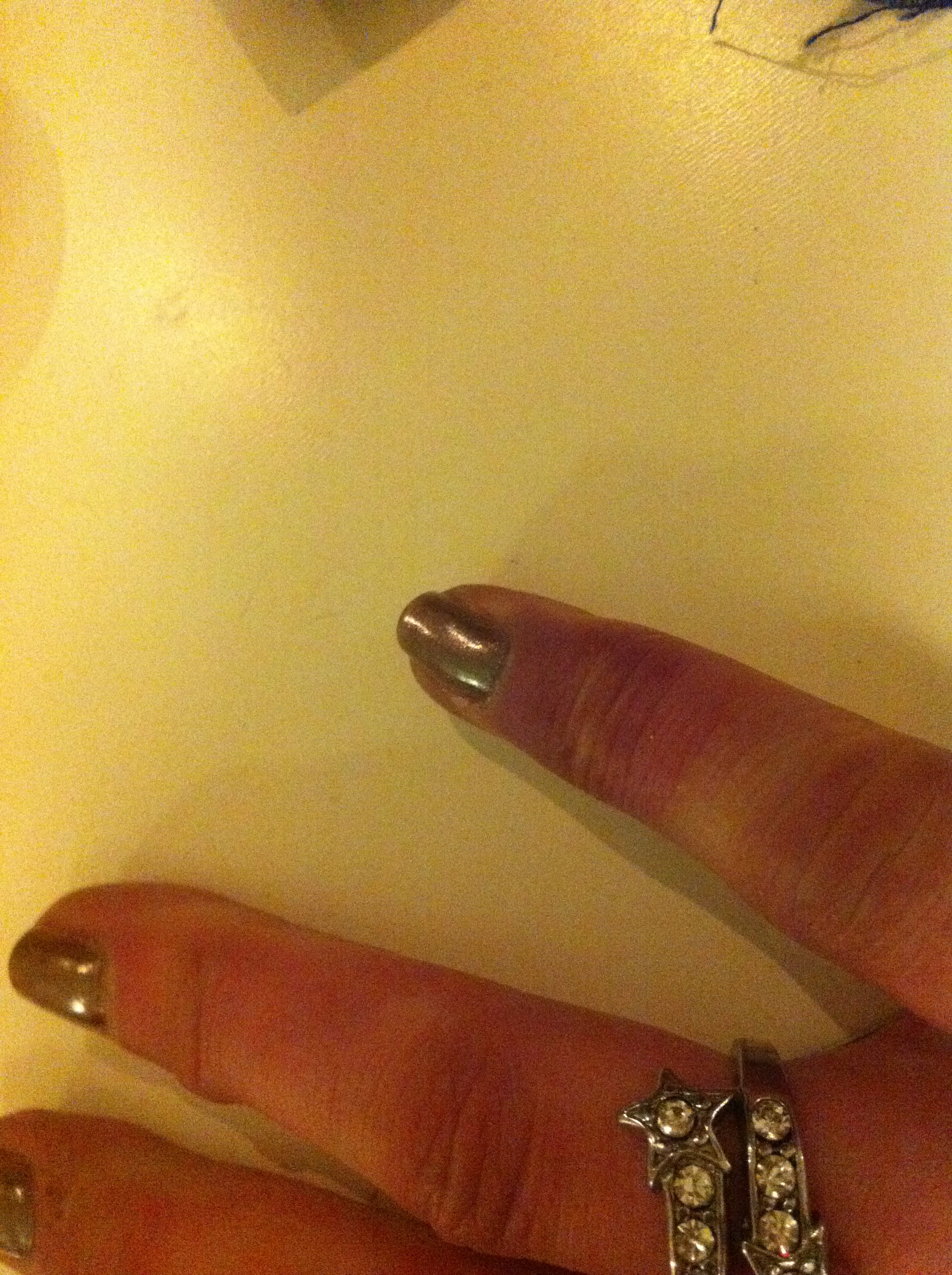
Well, I’ve suffered for that mistake. Since that fateful trip, I’ve been plagued with chilblains. I can deal with the toes – many people get them in their toes. You don’t have to do much with your toes. The fingers, however, are a whole other league of pain. Every year, at the threshold of winter, the dreaded chilblains creep back, like so many electric currents stinging my fingers. Sometimes they’re even there in summer, with the icy threat of air conditioning, or more likely the bitter bite of a Scottish ‘breeze’.

It’s like this: your fingers at first feel deathly numb, and maybe they’ll go bright white, yellow or purple. If you touch them, you can watch the colour burst and fade in a sphere of strange pressure. When they start to warm up again, after some brisk handshaking or running them under luke-warm water, they surge and swell painfully, often going bright red. It’s just this burning that travels relentlessly up and down your nerves. Sometimes I look in the mirror and it’s funny because they’re a completely different colour from the rest of my body, as if I’ve dipped them in paint.

Well, often they stay swollen for weeks, and that’s the worst part. Not only do you have horrible, fat, stumpy fingers, but also you have fingers that struggle to write and type. And then the itchiness. Like so many nerves tingling and writhing beneath your skin, simultaneously so awfully hot and then once again breathlessly cold. I have the hands of death: touching my fingers is like touching ice.

So yes, I’m still wearing gloves in May, and might have to through June and beyond. I apply hand-cream every five minutes to stop my skin cracking, I walk as much as I can and do star-jumps in my room, because they say that boosting circulation and keeping warm is all you can do.

And well, it seems that there is a pretty simple moral to this story: function over fashion. I should’ve listened to my mother and taken the ugly grey ski-gloves over the pretty but useless ones. Ah, but what self-respecting twelve-year-old with an eye for style would have done that? Also, it’s possible that I’d have gotten chilblains anyway. ‘Reynaud’s syndrome’ – which is probably what I’ve developed, checking the symptoms, although I’ve never been diagnosed – is most common among young woman, and usually occurs in the late teens. Check, check – that’s me. So perhaps I’m just unlucky, just dreadfully fated, to suffer the bane and pain of these chilblains. I’m guessing the Aviemore semi-frostbite I experienced didn’t help (permanent nerve damage never does), but I refuse to take all the blame for my condition. I also blame genes – my Mum and my Nan both get chilblains, albeit in their feet.

Reynaud’s doesn’t really have a cure, so I don’t have much option except keeping up the star-jumps, drinking ginger tea and making sure I don’t smoke (nicotine contracts nerve muscles). Let this be a warning to all those who want to go skiing, but also a message to help you appreciate having lovely, slender, warm and normal-coloured fingers! I am a girl with serious hand envy.

Wordsworth’s The Prelude and the Death(?) of the Author

Wordsworth’s The Prelude is a pretty formidable poem, not least due to its length. I initially encountered it in my first year of studies as an English Literature undergraduate, within a course entitled ‘Writing & Self’. There was no obligation to tackle the entire poem – we just had to look at a few extracts and try to get to grips with Wordsworth’s philosophy on the relationship between nature, memory and selfhood. Selfhood. That elusive concept; you think you know it, but no – the post-structuralists, modernists and Samuel Beckett have something radically different to say about it. Not going to lie though, I really enjoyed it in the end. The really long poetry? Not so much…

At the time, I was disinterested in the seemingly repetitive obsession with the natural world, what seemed like bland blank verse, and the endless length. However, after studying more recently Milton’s marathon-of-a-poem Paradise Lost, with all its mythical references beyond my grasp, Wordsworth’s doesn’t seem so scary. In fact, I felt the urge to go back to it and think about how my perception may have changed. What interests me about it now, with (hopefully) a little more intellectual maturity, is not only the poem’s emotive value but also the way it sheds an interesting light on some theories I’ve been looking at recently.

Roland Barthes, in a famous essay called ‘The Death of the Author’, argued against the Romantic conception of author as god-like genius held by writers such as Wordsworth:

[…] a text does not consist of a line of words, releasing a single “theological” meaning (the “message” of the Author-God), but is a space of many dimensions, in which are wedded and contested various kinds of writing, no one of which is original: the text is a tissue of citations, resulting from the thousand sources of culture.

The idea that no writing is original, but instead a ‘tissue of citations’ borrowing meaning from the myriad of texts and other references (written or oral) floating in the social world of language has profound consequences for the way we approach literature. The notion that literary texts do not contain a single, ‘intended’ meaning released by the authorial author was posited by the New Critics of the early twentieth-century, Wimsatt and Beardsley. In ‘The Intentional Fallacy’, Wimsatt and Beardsley argued that good criticism shouldn’t try to decipher an author’s intended meaning but instead look at how the poem succeeds in creating meaning through its form, claiming simply that ‘judging a poem is like judging a pudding or a machine. One demands that it work.’ Their definition of what ‘works’ in poetry was that style contributed to substance; in other words, the poem’s metre, rhyme and metaphor evoked the feelings and understandings appropriate to the poem’s meaning – a meaning that should be deciphered, then, not in reference to the author’s intentions but in reference solely to the text on the page. The New Critics, however, differ from Barthes in that they believe a text contains a complete, unified meaning that can be ‘unlocked’ by studying the text, whereas Barthes is saying the text is inherently plural, due to the unstable and intertextual nature of language and literature.

Going back to Wordsworth’s The Prelude, an epic poem defined by its status as the autobiographical unfolding of a poet’s personal and artistic growth (a quest for self-expression famously rewritten by Elizabeth Barrett Browning in Aurora Leigh from a female perspective), seems problematic within the context of twentieth-century New Criticism. How are we to approach a poem that is concerned primarily with the poet’s mind and experience?   A poem that Wordsworth has literally put himself into? The poet himself described The Prelude as ‘a poem on the growth of my own mind’. Is it possible, then, to ignore his presence, and relegate the autobiographical context of the poem to a shadowy distance?

I think the two positions can be reconciled. Wordsworth’s poem may delve into personal experience, but he is by no means the only poet in the world that does so – let alone the only poet interested in the relationship between art and nature. Criticism is used to finding inventive ways of looking at a poem that may or may not involve the poet’s self and life. We could, in the following of Harold Bloom’s ‘Anxiety of Influence’, consider how his use of blank verse constitutes an Oedipal struggle with his predecessor Milton. We could examine the more political elements of the poem, and how they relate to the cultural and social context of the time, or even the complex philosophical ideas Wordsworth espouses.

I myself am interested in the poet’s voice: the way he narrates fragments of experience to build up to the whole of his self, his artistic vision. I am also interested in the fluctuating effects of self-estrangement and unification, and the evocation of memory that permeates the text. Here is one of my favourite extracts of The Prelude:

One summer evening (led by her) I found

A little boat tied to a willow tree

Within a rocky cove, its usual home.

Straight I unloosed her chain, and stepping in

Pushed from the shore. It was an act of stealth

And troubled pleasure, nor without the voice

Of mountain-echoes did my boat move on;

Leaving behind her still, on either side,

Small circles glittering idly in the moon,

Until they melted all into one track

Of sparkling light. But now, like one who rows,

Proud of his skill, to reach a chosen point

With an unswerving line, I fixed my view

Upon the summit of a craggy ridge,

The horizon’s utmost boundary; far above

Was nothing but the stars and the grey sky.

She was an elfin pinnace; lustily

I dipped my oars into the silent lake,

And, as I rose upon the stroke, my boat

Went heaving through the water like a swan;

When, from behind that craggy steep till then

The horizon’s bound, a huge peak, black and huge,

As if with voluntary power instinct,

Upreared its head. I struck and struck again,

And growing still in stature the grim shape

Towered up between me and the stars, and still,

For so it seemed, with purpose of its own

And measured motion like a living thing,

Strode after me. With trembling oars I turned,

And through the silent water stole my way

Back to the covert of the willow tree;

There in her mooring-place I left my bark, –

And through the meadows homeward went, in grave

And serious mood; but after I had seen

That spectacle, for many days, my brain

Worked with a dim and undetermined sense

Of unknown modes of being; o’er my thoughts

There hung a darkness, call it solitude

Or blank desertion. No familiar shapes

Remained, no pleasant images of trees,

Of sea or sky, no colours of green fields;

But huge and mighty forms, that do not live

Like living men, moved slowly through the mind

By day, and were a trouble to my dreams.


A New Critical reading here could look at many poetic elements and examine how they contribute to an overall meaning. Indeed, I think the New Critical approach always has great value in unlocking the text – not in the sense of unlocking some kind of hidden meaning – but in unlocking the nuanced structures and framework of techniques that produce particular effects. Yet this kind of close reading can also go hand-in-hand with considerations of writerly subjectivity and creation, especially for an overtly autobiographical work like The Prelude. Although Wordsworth termed poetry ‘the spontaneous overflow of powerful feelings’, he also noted that it was ‘emotion recollected in tranquillity’; in other words, poetry comes from the self, from a kind of organic inspiration caused by worldly experience, but it is only upon reflection and considered reconstruction that good poetry is created.

Of course, whether poetry comes from the self or not is irrelevant to New Critics, and for Barthes, this notion is flawed since all language is social: ‘it is language that speaks, not the author’, he claims in Image, Music, Text. It is, however, worthwhile to perhaps consider the ‘ghostly’ presence of the author in the text. Barthes himself admits in The Pleasure of the Text that the reader’s idea of the author plays a fundamental role in his/her reading of the text: ‘in a way, I need the author, I desire his presence’. This intimacy between reader and author is enacted as a kind of strangely corporeal, erotic relationship – where the reader desires the author’s body, in a kind of strip-tease effect as the text is unravelled before the reader’s eyes; but also by the reader, as the text is ‘played’ – as it offers up its ambiguities and gaps for the reader to fill in with his/her own meaning. The presence of the author is the promise of meaning. When I read Wordsworth’s poem, and look for meaning, I am not just thinking of the words on the page – inevitably I have some hazy conception of the writer who writes them, the man wandering the Lake District with words whirling round his brain like blossom caught in the wind. Without my sense of the author, I feel as I open the cover of a book, the text seems hollow; I need to conjure his/her presence to enter the threshold of fiction, and of meaning.

This of course applies to certain texts more than others. If I have no real knowledge of the author, I am able to approach a text with a ‘pure’ mind, but even then, I unconsciously scan for clues as to the possible links the text has to other writers and traditions. The text, then, seems always to be situated in some intangible web of meaning, and only sometimes is the author present, a spider or spectre creeping elusively around my reading of the text.

So, back to the ghostly presence of Wordsworth in this extract. Who is he – who and when and where is the speaking ‘I’ – is it Wordsworth, the physical hand, gnarled with old age (and those trips to the Alps) writing the poem, Wordsworth the young boy (returned to in memory or literally re-living his younger self?), Wordsworth the imagined author, behind a desk in Dove Cottage, conjured by the reader’s imagination…Or perhaps all of these, an uncanny amalgamation of identities? Wordsworth himself never lived to see the poem published; indeed, he was revising it again and again until his final years. So we can’t even be sure which temporal Wordsworth was writing these lines. Which words came at which age? When reading, I feel the fragmented sense of time come together in the quiet and consistent flow of the iambic lines. It seems like the author’s true identity, his ‘true’ intentions or involvement in the poem, slip away under the seduction of the poetry and language.

Milan Kundera in Art of the Novel mentions a distinction between poets with and without history. Wordsworth might here be difficult to classify because he wrote both intimate, lyrical poems and also ones which dealt with the politics and history of the time, such as the Industrial Revolution. In the above extract – a mere snippet of the whole poem, which does at points get historical – I’d like to consider Wordsworth a poet without history; the ‘I’ of the speaker merged with both the poet and the young boy who steals the boat. Memory has transformed the experience into a sublime perspective on the transcendent greatness of the world, the ‘familiar shapes’ evolved into ‘huge and mighty forms, which ‘do not live / like living men’. In other words, forms that will not breathe and change and die like humans, but remain in a powerful position of natural supremacy – an existence that to Wordsworth as a developing poet and young man was almost formidable, ‘a trouble to [his] dreams’. Kundera points out that ‘pure lyric poetry lives in feelings’ which ‘are all given to us at once’, but intensify in the mind of a poet. I feel that Wordsworth’s moving account of the transition of the landscape reflects this, particularly as the weighty blank verse and enjambment create that sense of moving, progressive and natural feeling.

Yet it is also a strange feeling, the sensation and memory of terror that recalls in the eye/the ‘I’ of the poet’s mind. The emotions experienced as a boy are part of the bank of material that builds up to produce poetic inspiration. And yet memory is not a film-tape, recording past events with absolute accuracy. It is malleable, subject to revision, always related to the present moment in which it is recalled. Wordsworth called these ‘spots of time’: moments where some flash of previous existence will burst into consciousness – a thought, a memory, a feeling, a scene from a novel, a line of verse, a melody from a song. This strange release of the past into the fiery now of the present can not always be explained, but they are essential, in Wordsworth’s philosophy, for the development of self. As Locke argued, the self is a continual being only through the continuation of consciousness, and it is through these ‘spots of time’ – gaps in the fabric of our present that catch some thread of our past – that our identity continues to be woven together into a coherent selfhood.

And so, in slight relation to selfhood, the idea of genius, or a poet without history. Barthes has destroyed genius, in his destruction of authorship. We can accept the theoretical ‘truth’ or weight of this, but still acknowledge, at least psychologically, some kind of notion of genius. Genius doesn’t have to mean brilliance, but as Kundera’s book suggests, it conveys something special and unique about creative writing, in that it is inevitably in some way produced by feeling – and this feeling is inextricably related to one’s personal experiences, even if the writer is not aware or rejects this in their writing. Personal experiences are unique, and even though language is not, it is our individual way of assembling language in direct relation to feeling and consciousness that makes writing something special, perhaps magical; that makes writers not merely what Italo Calvino in ‘Cybernetics and Ghosts’ calls ‘literary machines’, churning out elaborate patterns of words from the dictionary.

Moreover, and this may link with Barthes’ writings on readerly pleasure, genius can lie in the reader too. A genius that transcends language, the feeling of what Barthes calls ‘jouissance’ or bliss, that occurs when a text ‘imposes a state of loss’ upon the reader. For if the reader is involved in producing meaning from this lost, he/she too has some kind of genius. When faced with the lines: ‘For so it seemed, with purpose of its own / And measured motion like a living thing, / Strode after me’ we are struck with the sudden, lightning bolt connection between past and present. ‘Seemed’ highlights the idea of visual recollection, of memory recalled in the present. The uncanny anthropomorphism of the ‘huge peak, black and huge’ recalls a childhood terror, but also the adult’s terror of the unknown. Wordsworth, the writing poet, cannot recall exactly what made the peak so terrible. It is merely ‘huge’, ‘huge’ – a monstrous presence burgeoning repeatedly in his memory and thought. This strange severance between feeling and meaning is a kind of bliss, and a kind of fear. The loss is what is left out in the mind; just as Wordsworth’s recollection is a distortion of childhood fright and adult ‘trouble’, the reader’s perception of that looming black peak is the facing of an abyss: ‘there hung a darkness’. An abyss of possibility. What is the nature of the child’s fear, why can Wordsworth recall it – what is it in his present moment that brings back that memory? The only way to find out is to trail the poem’s entirety, searching endlessly for clues that connect the ‘stars’ of the poet’s psychology, of the poem’s constellation of meaning. Yet there will always be these chasms, where it seems that meaning is lost – where, as the black peak separates the ‘I’ from the ‘stars’, the reader faces an aporia, a non-road separating the word on the page with its meaning, its interpretation. The author’s intentions are lost, and the dictionary fails us.

I have tried to compare Wordsworth’s experience of nature with the experience of reading, as an activity profoundly connected with both loss and creation, with darkness and strangeness but also the ‘sparkling light’ that seems to seduce us into the bewitching land of literature.

‘To give an Author to a text,’ Barthes argues, ‘is to impose upon that text a stop clause, to furnish it with a final signification, to close the writing’. I don’t think this is entirely true. I think that if you allow the author’s presence, at least at some ghostly level – and this has been discussed somewhere in Derrida’s writing in a much more sophisticated way than I have here – you can open the writing. For the author creates more problems, as a character not quite inside or outside the text. The uniting of the reading and writing self; navigating the text and giving it meaning; facing up to the strange array of images and sounds that lead a meandering path through the poem – that is poetic genius.


Works Cited:

Barthes, R. (1967) ‘The Death of the Author’, translated by Richard Howard, Available at: http://www.tbook.constantvzw.org/wp-content/death_authorbarthes.pdf [Accessed 11.3.13].

Barthes, R. (1980) The Pleasure of the Text.

Kundera, M. (2003) The Art of the Novel. New York: HarperCollins.

Wimsatt and Beardsley – ‘The Intentional Fallacy’. Available at: http://letras.cabaladada.org/letras/intentional_fallacy.pdf

Wordsworth, W. The Prelude. – began in 1798 and published in 1850, the year of Wordsworth’s death.


‘Be Right Back’… Charlie Brooker’s Black Mirror, Simulacra and the Uncanny

Source: blogs.independent.co.uk

Freud published his essay on the ‘uncanny’ in 1919, almost a hundred years before Brooker’s captivating TV series was created. The essay and its related concept’s influence on film, literature and psychoanalysis has been hugely important. But what exactly is ‘the uncanny’? It is a term inherently bound up with the ‘disturbance of the familiar’, with upsetting conventional definitions and perceptions of reality and truth, of feeling and thought. The creation of uncertainty, unease; the dissonant feeling of being simultaneously repelled and attracted to something. Freud defined the uncanny as a paradoxical sense of unfamiliarity growing out of the familiar; the term in German is ‘Das unheimliche’ – which literally translates to ‘the opposite of what is familiar’.

Black Mirror. Even the title is uncanny. How can a mirror be black, when the necessary function of a mirror is to reflect light, reflect a clear image? Black connotes darkness, murkiness, obscurity – hardly the silvery coating of a looking-glass, reflecting the airy features of a Victorian drawing room, or beaming back the blue sky and clouds from the gleaming ceiling of a city office block.

And yet: paradox. The mirror is subverted, turned away from reality into the black chasm we have created in our ultra-mediated lives. Brooker’s series presents a startlingly chilly vision of a near-future society, one where mirrors no longer reflect back on reality, but on representations of reality. The paradox of the real in Brooker’s dystopian vision is that feeling what is real depends more and more on images of the real, rather than experience itself. The most catastrophic events of the show – I’m thinking the bizarre terror of Episode 1, Series 1 where a Prime Minister is led into having intercourse with a farmyard animal, live on TV to the gawping nation – are caused by an overflow of media messages and images, which impact reality in a hyper-real way. In this world, where real events are simulated first in the media, and then permeate reality, reality itself has become its own obscurity; a mise-en-abyme or hall-of-mirrors effect where we are constantly recording, representing and replaying ourselves in the abyss of cyberspace and media technology. A disturbance of the familiar, certainly: a disturbance of the real.

Over thirty years ago, the French philosopher Jean Baudrillard made a similar point in his text Simulacra and Simulation. Baudrillard argued that reality was being dissolved into a simulacrum. In past ages, signs had a fixed referent to something real. Yet with the explosion of mass-produced goods, the commodity was born. This relates to Marx’s idea of the ‘commodity fetish’: as goods become mass-marketed, no longer are they bought for their ‘use-value’: when a material item, even something as mundane as a bottle of water, becomes a commodity, it ‘changes into a thing that transcends sensuousness’. Value becomes linked to the product itself, rather than the cost of its production. Sign-value replaces use-value. The value of a bottle of water is linked not to its use-function as a quencher of thirst but because of the shape of the bottle, the style of the branding, the allure of the image portrayed in advertising campaigns. In contemporary society, Baudrillard argues, this has escalated to the point whereby signs and reality have become blurred, replacing a relatively simple distinction between signs and signifieds (the advertisement and the real product, for example) with a ‘simulacrum’: ‘the truth that conceals that there is none’. In the entirety of our experience, meaning and reality have become usurped by a hyper-reality of symbols and signs, which point not to a real object, but to more signs – they conceal the relevance of reality to everyday experience. We are then truly living in an unreal world.

Brooker addresses this idea in the opening episode to Series 2, ‘Be Right Back’. It asks: what happens when the effect of reproduction is enacted upon humans? When the human body and individual personality itself is subjected to fetishism; when the self is fragmented into the myriad traces of text it has trailed in its online life? Jacques Derrida defined the trace as ‘the sign of the presence of an absence’: the uncanny occupation of a liminal position between the real and the imaginary, between the sign and the signified – a rift tearing up the easy system of metaphysics, of our knowledge of what exists, and how.

In Brooker’s fiction (fictional, or half-fictional? Genre itself eludes simple definition – the series lingers between dystopia, horror, realism…hyper-realism), it is possible for a woman to order a cyborg replica of her dead husband. At first, she interacts with an online version rather than a corporeal one. Through instant messenger and phone conversations, she literally contacts her dead husband. And yet it is not really her dead husband, or is it? An assemblage of all the data her social-media-obsessed husband left in traces online, his presence is itself a trace: an uncanny ghost voice constructed from dead voices.

This is the uncanny resonance of the title: ‘be right back’. It hauntingly resonates with the much-used phrase familiar to all users of instant messengers, the signal that one’s physical presence will briefly be absent, although they are not fully ‘gone’ – they haven’t logged offline. ‘Be right back’, you say, when you are going to make a cup of coffee, when you change your status; a signal that your face is no longer behind the screen. ‘Be right back’ is that queer sense of presence/absence that seems to rupture ordinary human interaction, where the interlocutors know each other as corporeal figures and not avatars. The avatar is always present, but it is the mark of an absence: the mark of the speaker’s physical absence. When we talk online, there is always a strangeness, a distance, a whiff of the hyper-real; as if we are playing a game, talking to someone who is quite but not quite the person they are.

Source: m.espn.go.com

When the protagonist takes the next step in ordering the robotic facsimile of her beloved deceased, the strangeness is taken to a whole new level. We have the signs of the commodity fetish: delivered in a box, complete with instruction manual and shiny robotic skin. The human body made perfect, made into product. This of course is not itself an innovation: countless sci-fi books and TV series and films have portrayed the human robot, the automaton. What is particularly intriguing is the reproduction of the dead husband’s personality from text. Not handwriting, not speech, but the representation of voice through text.

At times, the robot’s speech is stunted. He tries his best to say the things that ‘Ash’, the former husband, would say. Yet the robot cannot completely replicate the human. ‘Ash’, as the name suggests, is dust, a powdery scattering of human traces, shimmering in the protagonist’s memory, in the character’s online presence, elusive and ethereal. Perpetually present, but not fully there. The mechanical creation cannot assume the body of the deceased; it can only simulate the fragments of his words. The movement of his face, his eyes, or his synthetic limbs will never wholly replicate what once was there. Ash cannot be resurrected, Ash is ash.

The robot’s automatism is primarily recalled when there is a gap between the woman’s memory of her husband and the robot’s personality. The protagonist is painfully reminded of the fact that it is not a real, living thing – not the warm body she once loved, still loves – but a mechanical product. Watching the woman interact with her robotic husband, touching his flawless synthetic skin, listening to the replicated voice of the deceased – at one point even having sex with him – was a disturbing experience. I felt unsettled; certainly I was experiencing the uncanny. The most carnal of human experiences – actual physical contact – simulated by a robot, with another human, completely explodes all notions of the natural by opening up so many strange possibilities.

Yet, as the show reminds us, technology cannot fully replicate reality. It may attempt to deflect our attention from truth – from the truth of death – with its simulations, but there are always points of rupture, where the fabric of the virtual is torn. At one point, the protagonist experiences distress and asks the robot to leave the room when his words don’t match up to her memory: “Ash would have argued” she says.

This uncertainty about the human and the machine haunts throughout Brooker’s award-winning series. How much of our lives has become merely the voices we leave on answer-phones, in text-messages and Facebook statuses? As communication becomes increasingly mediated, do our personalities become more constructed, more performative? With the advantage of anonymity, or the avatar concealment of the face allowed by the internet, people have time to carefully construct their responses, to portray a certain self-image, to play with the unfamiliar. ‘Be Right Back’ highlights the inadequacy of technology to embody – literally – the highly complex, fractured and fluid nature of the human self. Living more and more online, Black Mirror suggests in general, we creep closer and closer to the edge that demarcates our fundamental perceptions – our notions of truth, reality, existence, humanity itself. Brooker says of his show:

Each episode has a different cast, a different setting, even a different reality. But they’re all about the way we live now – and the way we might be living in 10 minutes’ time if we’re clumsy.’

It is this notion of ‘difference’ that creates the uncanny effect. What is the difference between things? The series poses more questions, perhaps, than it answers. Another uncanny effect. Brooker provides multiple possible realities, and thus renders the future with an inherent sense of what Derrida would call ‘undecidability’. It is not like a conventional dystopia, presenting a single, glaring vision warning of the future; instead, it troubles our expectations, it presents numerous ideas of what the next decade, or tomorrow, may hold. The show holds up a mirror to our society, one that is black – foreboding, sinister – and, fundamentally, refracted into different possible outcomes. Yet it is also a void, in the sense that Black Mirror itself is a fiction, where we may lose our sense of the real – collapsing the ever-familiar world of technology portrayed onscreen with our present everyday lives. It is in this threshold between today and tomorrow, between reality and fiction, that Black Mirror lies. And it is in this threshold that we lose our subjectivity, in the overwhelming threat of our own behaviour and the ghostly online world that could collapse our sense of existence.

Works Cited/further reading:

Baudrillard, J. (2006) Simulacra and Simulation, translated by Sheila Faria Glaser, University of Michigan Press.

Bennett, A. and N. Royle (2004) ‘The Uncanny’ in An Introduction to Literature, Criticism and Theory (Harlow: Pearson Education), pp. 34-42.

Black Mirror – Be Right Back [Season 2, Episode 1] by Charlie Brooker.

Felluga, Dino. ‘Modules on Marx: On Fetishism.’ Introductory Guide to Critical Theory. Purdue University. Available at: http://www.purdue.edu/guidetotheory/marxism/modules/marxfetishism.html. Accessed 30/4/13.

The Guardian. (2011). Charlie Brooker: the dark side of our gadget addiction. Available: http://www.guardian.co.uk/technology/2011/dec/01/charlie-brooker-dark-side-gadget-addiction-black-mirror. Last accessed 30/04/13.

Reynolds, J. (2010) ‘Jacques Derrida’. Available at: http://www.iep.utm.edu/derrida/#SH3d. Last accessed 30/04/13.

Gaming Gender

Feminism and video games are not two concepts often linked together. However, after reading recently about the shifting representations of Lara Croft and her potential as a ‘feminist icon’ I was inspired to reflect on my own experience as a gamer while growing up.

I was never one for playing hard-hitting action games like Tomb Raider; I was more of a Nintendo – and sometimes Sega – girl myself. My childhood was a fusion of Mario and Sonic the Hedgehog, and then as I got older games that demanded more of my time, games that immersed you in their alternative worlds. The ones that spring most vividly to mind are Animal Crossing and Harvest Moon. Finally, a preteen, I dabbled in the exciting Playstation 2 games that my brother owned – Grand Theft Auto and a number of car-racing games which I cannot recall the name of.

It’s an interesting thing, thinking back to all those virtual scenes you encountered in childhood, and trying to recount the representation of gender within them. The really retro games played on brick-like black-and-white Game Boys become submerged by the pastiche of all the newer, technicolour versions, with 3D characters that had realistic clothes, voices, breasts.

Yet when I do think of it, I realise just how gendered my whole video-gaming experience was. Certainly, there was a dearth of what might be (cringingly) called feminist heroines. Even the very early Mario games, which involved navigating a barely perceptible pixel man over a flat world of fatal drops and question-mark boxes, bore out the signs of gender stereotypes within their very narrative. Rescue the princess. I remember the motivation for getting to the next level was the little cut-scene where Princess Daisy (or was it Peach) would proclaim helplessly ‘Oh Mario!’ and transform shockingly into a spider-like creature, hopping away as if cursed to a land to be later rescued. This story is hardly surprising, given the perpetual presence of damsel-in-distress narratives within our culture, and I’ll admit that throwing an Italian plumber rather than handsome prince into the works is a little subversive – but Mario is always a good place to start.

Maybe Sonic is a little more interesting. Although the characters are weird, anthropomorphised talking hedgehogs, echidnas and the like, they still carry conventional gender distinctions. Well first there’s Amy Rose (strangely enough, that was almost my name), the pink-haired hedgehog with the obnoxious girly voice who is desperately in love with Sonic, the hyper-cool protagonist who frequently shirks her advances with an air of embarrassed affront. The game thus dramatises a kind of courtly love, but in parody, with Amy represented as silly, indeed somewhat ridiculous, in her affections for Sonic – who is evidently so totally out of her league. The unequal power balance reinforces ideas about female irrationality, and the deprivation of agency in the face of love. I won’t go too far with this though; after all, I didn’t play all the games, or watch the TV show. Maybe Sega threw a bit of kick-ass feminism into Amy’s character somewhere down the line?

They did have one character, at least in my favourite game, Sonic Adventure 2 Battle, that could give Lara Croft a run for her money. Rouge was a lipsticked bat with knee-length leather boots, a sassy, femme fatale always teasing Knuckles – the dread-locked echidna always punching the air and grunting to show his strength. Although she had her shortcomings, being on the dark-side of the game’s narrative, Rouge was perhaps one of the first feminist video game characters I encountered.

Following my Sonic and Mario phases, there was a period where Harvest Moon took over much of my Friday nights. I loved this game; it had a slightly surreal, old-fashioned atmosphere, with its sweet music and appealing graphics, but reflecting back the gender question is pretty damning. You played a young man who ran a farm, and got to grow your own crops, milk your own cows and keep the village tramp, Murray, out of your food-stash. Moreover, one of the central aims of the game was to choose and court a wife. There were three options, each embodying female stereotypes of a sort. First there is Celia, the warm-hearted farm-girl who can be easily wooed by presenting her with flowers. She is a bit pathetic; she wasn’t even offended when I gave her a bit of ragwort. Then there was Muffy, the blonde barmaid in a red-dress with a ‘fun’ personality. I don’t think I have to elaborate much further there. Lastly, Nami, a kind of New Age type with vivid red hair, who was a bit more interesting – a wandering traveller. The whole ‘wooing’ process, looking back, is a bit farcical – not just quaint but pretty hilarious – but I realise that maybe for the young children to whom this game was designed, playing a game that trains you to court a wife by giving her flowers is probably not the healthiest of socialisation processes. On that note, there was a Harvest Moon game where you got to play a girl, but I couldn’t comment as I have never played it.

A similar style of game to Harvest Moon is Animal Crossing, where you owned a house in a village of charismatic animals. The chief aim of the game was to pay off your mortgage, a fact that you were constantly reminded of by the maddening presence of Tom Nook, the local entrepreneur who you are forever in debt to. Animal Crossing lets you play either a boy or girl protagonist, and I would argue is a little bit more deconstructive in its representation of gender roles. At least, it gives you a lot more power over your character. Gender is less prominent – although the villagers occasionally make stereotypical comments, Tom Nook is patronising to your character whether you are a boy or a girl and the hair salon allows you to experiment with an array of bizarre hairstyles which undercut traditional gendered appearances. Playing Animal Crossing allows you to feel in control, to experiment. You can even design your own t-shirts, and decorate your home with a myriad of furniture (at a cost). No, I think this game would be better read from a Marxist perspective (Tom Nook as evil petit-bourgeois tyrant).

This leads me finally on to the more obviously problematic gender representations in games like Grand Theft Auto and all the racing titles. Women are stereotypical, red-dressed, often voiceless prostitutes (indeed, ‘picking up’ is often part of the storyline), or else draped over flash cars, offered as rewards for race-winning but never racing themselves. Indeed, I’m sure there was one game where the amount of money you had from winning races determined the kind of ‘girlfriend’ you could have. Persistently, women are absent from the action except as hyper-sexualised commodities. 

What seems consistent in the very different games that I played throughout my childhood is both their underrepresentation of women and their portrayal of women as objects. In Mario, the princess is the goal object, spurring the player onto the next level. In Harvest Moon, women are presented merely as potential brides, whose courting is in itself a ‘level’ to be achieved. In the more violent (and should I say 18+) games, women are basically sexual commodities to be bought and abandoned at the player’s will. In Sonic, female characters have more autonomy, but still fall back into stereotypical roles: helpless, childish lover-girl and femme fatale. Perhaps only Animal Crossing offered a bit of transgression of rigid gender binaries, with its largely asexual characters and emphasis on player choice in terms of outfits and style.

My readings, I’ll admit, are of course narrow, and perhaps all of the games have now not only changed with the times (it’s been a good few years since I’ve picked up a game console) but even the ones I played may have had exceptions to the gendered rule. The point of this article is to flag up the more obvious problems video-games present for feminism, in reproducing highly-conventional stereotypes in their representation of female characters. Achieving gender equality is difficult when children and adults are like are literally immersed in virtual realities where characterisations mirror all too vividly the limited representations of gender that have for decades pervaded society. Art and life are always going to bounce off one another, and this is why, reflecting back now with the maturity of a critical mind, I am able to realise the stereotypes I was exposed to – stereotypes which back then probably seemed normal and natural. I am sure there are numerous games which dissolve stereotypes in their representation of gender, and maybe Lara Croft could be a postmodern feminist icon. I won’t know until I play.

Read more:

http://www.independent.co.uk/voices/comment/art-imitating-life-how-sexism-in-video-games-mirrors-reallife-gender-imbalance-8381426.html

Why Don’t We Just Cull Humans?

DSC_2614Why Don’t We Just Cull Humans?

Picture the wild deer: all elegant neck, soft fur, tawny eyes staring back at you like butter wouldn’t melt. The stag too: a rare glimpse of those striking antlers flashing through forest leaves or the wire mesh of a fence, gazing gallantly over the hillside – a little like a proud lord, a patriarch admiring his land. There is something quite British about the graceful deer; something evocative of country outings, of heritage and sprawling estates, of heads rather unceremoniously stuck on pub walls.

Today, there are more deer in the UK than in any time since the last Ice Age[1]. It seems poetry is the wrong way to go about this; deer have become a real issue.

On the radio this morning I heard reports proclaiming new figures representing an excess in numbers of British deer. Deer, it is argued, in their proliferation, are posing a serious threat to British biodiversity. The overspill of deer will lead to more traffic accidents, more damage to crops and a drain on natural resources. With estimates of the current deer population positing 1.5 million, new research has suggested it will be necessary to kill off 50% to 60% of the animals to fully address the problem[2].

The above arguments may seem persuasive reasons for tackling ‘The Deer Problem’, but I would like to step back and question these fundamental justifications given for widespread slaughtering. I want to question the idea that the – let’s face it, unintentional – disruption of food-chains by deer warrants their culling.

My objection to culling derives not from an inherent concern with the ethics of killing animals – the morality of the practice of culling is another difficult issue – but from the premises given to defend culling by appeals to the negative consequences of an excessive deer population.

The problem I have with culling can be understood by considering a convincing argument offered by Australian philosopher and rights activist Peter Singer. Singer declares, somewhat radically, that ‘all animals are equal’[3]. Yet this statement is not as controversial as it appears. By ‘equal’, he means not that we should treat all animals the same – Singer is not justifying giving rabbits the right to vote or freedom of speech to chickens – but that we should give equal interest to all creatures, regardless of species. Singer points out that any claim asserting the superiority of human beings over other animals is arbitrary, speciesist.

Speciesist? Why?

Consider the reason we typically give for justifying the accordance of moral supremacy to humans:

1) Humans are rational creatures, or at least significantly more rational than other animals, and this makes our lives intrinsically more valuable.

Singer’s problem with this is that not all humans are rational. What about a child with Downs Syndrome, or a person in a coma? What makes them more superior to say a highly-intelligent primate if they lack rationality? Consequently, Singer states, any attempt to argue for human rights over animals is going to run into the problem of speciesism, since there can be no universal claim for the rationality of all humans. Speciesism is just like racism or sexism, in that it appeals to untenable claims about the essentially superior ‘nature’ of a particular race or sex which gloss over the reality that not every person within a race, sex or species shares these characteristics. If the sexist argues that men should be paid more because all men are more intelligent than women, his argument is rendered invalid by the stark fact that this is a sweeping, fallacious generalisation. Likewise, the speciesist cannot justify exploiting animals for human need by claiming humans are intrinsically superior because all humans are more rational than animals.

Therefore, for example, an argument justifying animal vivisection to support the more-valuable lives of humans (by exploring cures for cancer) will have to concede that this argument also, logically, licenses vivisection on non-rational humans. And I think most people would agree this seems a little distasteful.

Singer’s argument is compelling: the only relevant consideration that unites all humans, then, is sentience – the experience of pain and pleasure. An experience inherent to the lives of most animals and all humans.

Back to deer then.

The justification for culls is primarily their threat to the food-chain: too many deer means too much consumption of natural resources, too much disruption to the natural environment which other animals are dependent on. Deer, munching and treading and stomping all over our country’s flora and fauna, are threatening other wildlife. All very well.

But what about us? Aren’t we a threat to wildlife? What about our fossil fuel omissions, waste disposal, annihilation of forestry for paper, our excessive industry, infrastructure? Our pollution of lakes and rivers? Surely all this amounts to much more destruction than an overabundance of deer trampling on the landscape and eating too many acorns?

Well, it may be argued that we are humans; we are entitled to do these things because they fuel our rational progress towards more enriching lives. What gives us the right to think the world is ours to destroy, but not that of the deer? I would argue that our threat to the food-chain is significantly greater than that of our deer population, and yet I hear of no ecological experts advocating human culling.

Let’s be clear: I am not advocating human culling. But think about it: are we morally justified in killing deer because too many of them destroy the environment, when we wouldn’t do the same to humans, whose excessive population is also consuming too much of Mother Nature’s milk, and tainting it with acid rain in the process? If there is no relevant moral distinction between humans and animals, I find arguments which devalue animal life in favour of maintaining human interest deeply problematic. And after all, this isn’t just about preserving nature for nature’s sake, this is about preserving nature for people – for farmers, ramblers and future generations.

I acknowledge that there may be other reasons why culling might be justified – I am no environmental expert. Reducing deer numbers may work in the favour of their species, as too many deer means many will starve due to lack of resources. It is obvious how this can be turned around to humans: again, most people would object to human-culling because there isn’t enough bread to go round. Therefore, if there is no plausible moral distinction between humans and animals, then culling is difficult to morally justify, even if it produces certain good consequences.

It’s a thorny issue, and one that people often don’t consider; culling doesn’t seem to raise the same controversy as animal testing, hunting or meat-eating, because it is seen as a largely benevolent, if a little unpleasant, way of improving conditions for people and wildlife. I believe, however, that we should be concerned – at the very least, philosophically – with the flawed argument that lies at the heart of culling practices.