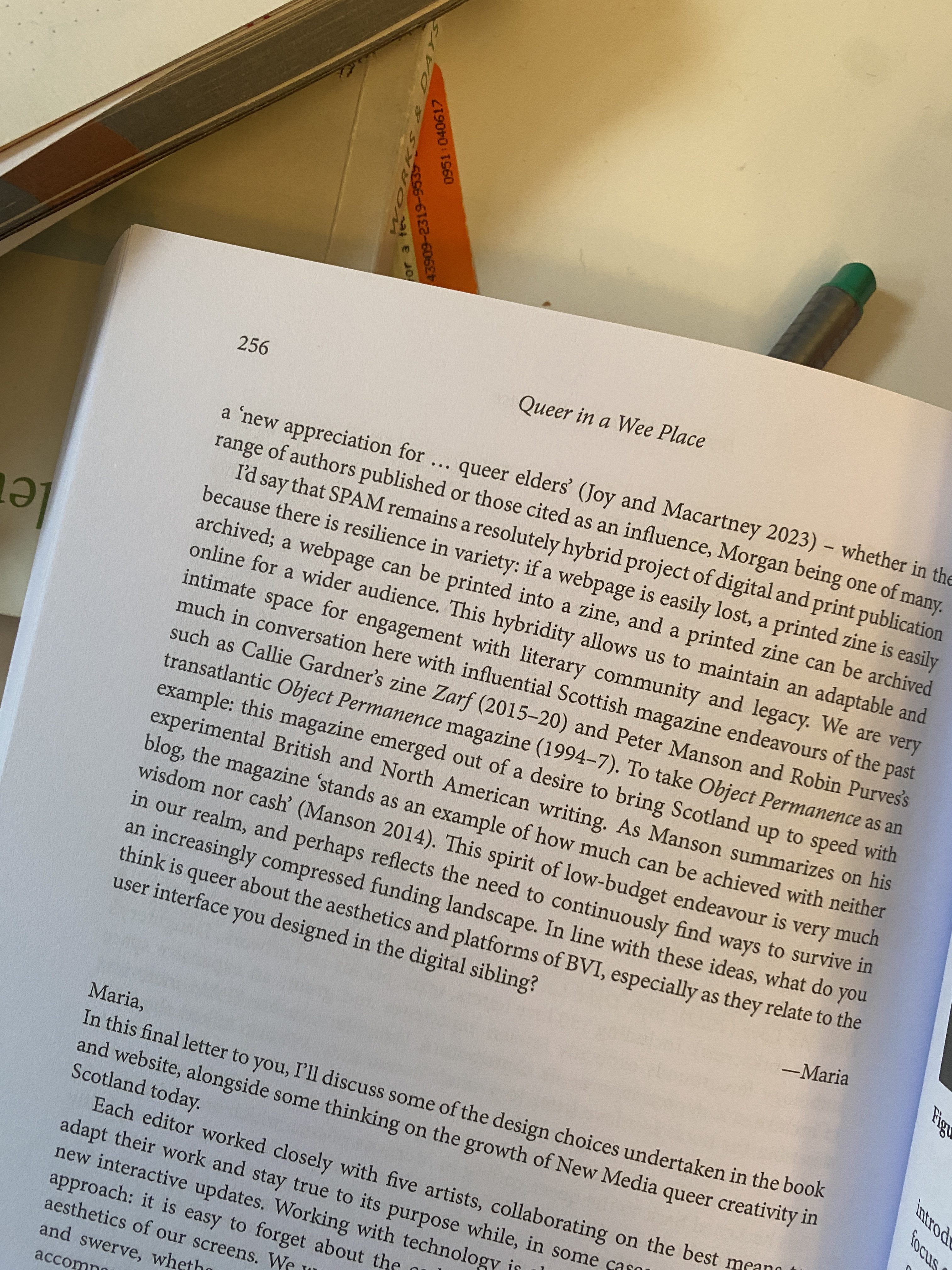
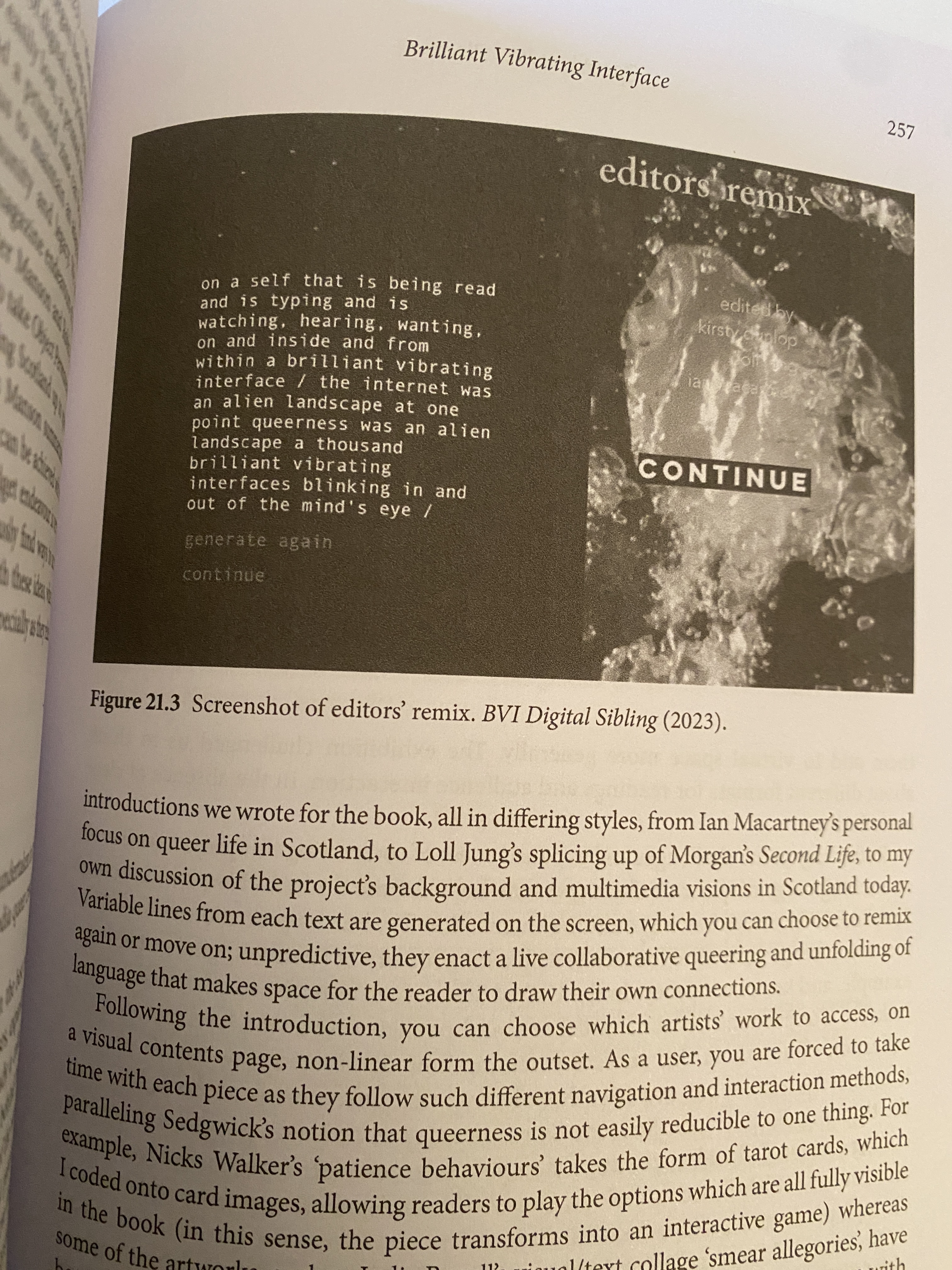
In 2022, SPAM Press obtained some funding from the Edwin Morgan Trust’s Second Life Award to run a year-long project titled Brilliant Vibrating Interface: Queering the Post-internet through Poetry and Practice. My co-investigators on the project were Kirsty Dunlop (SPAM’s current editor-in-chief), Alice Hill-Woods and Loll Jung, with Ian Macartney later joining to co-edit our print publication. We squeezed a lot of activity out of that money: community workshops online and in Glasgow, a few reading events, print publication, ‘digital sibling’ and physical installation, podcasts and an online magazine interview with contemporary sonneteers.
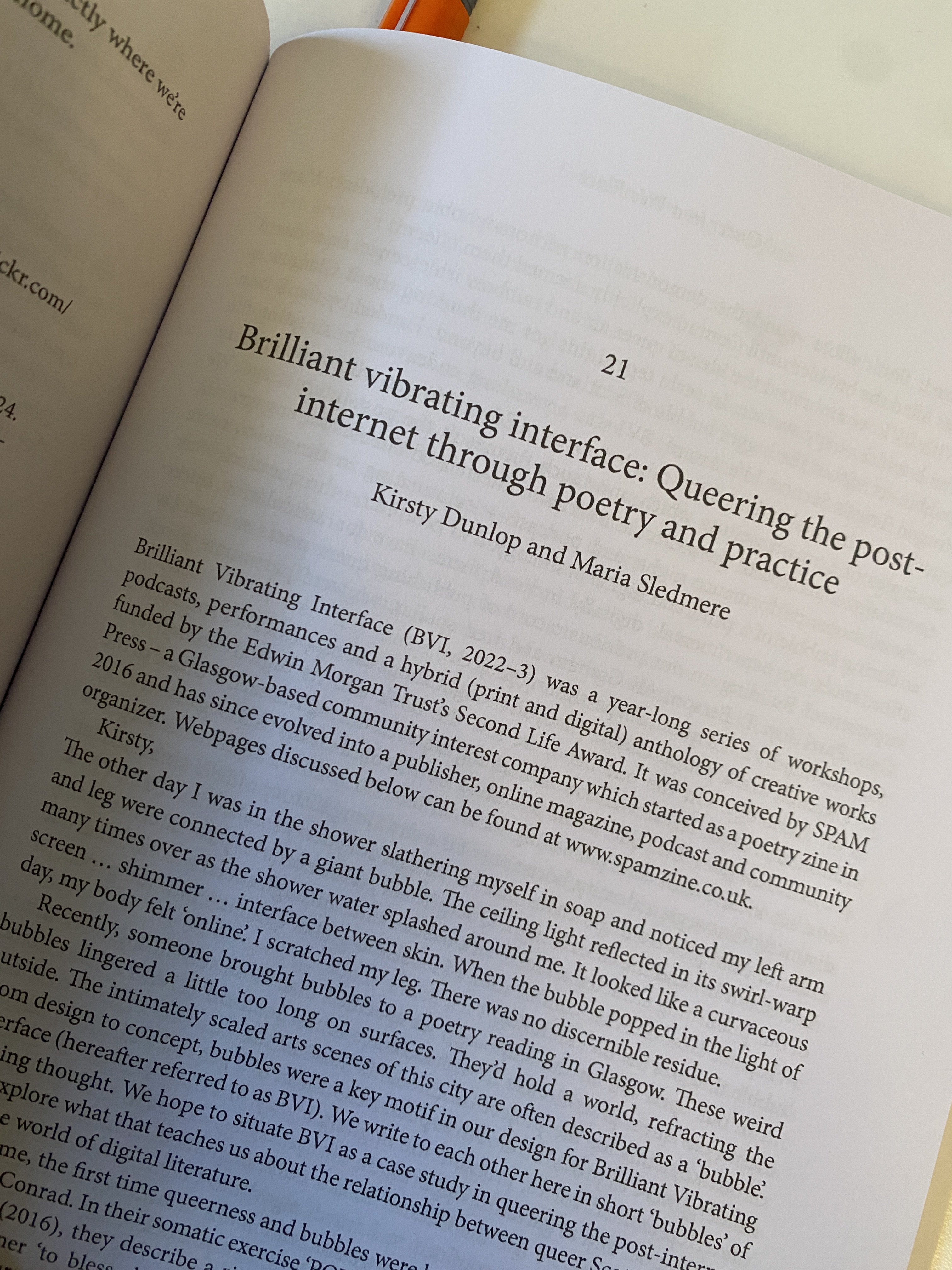
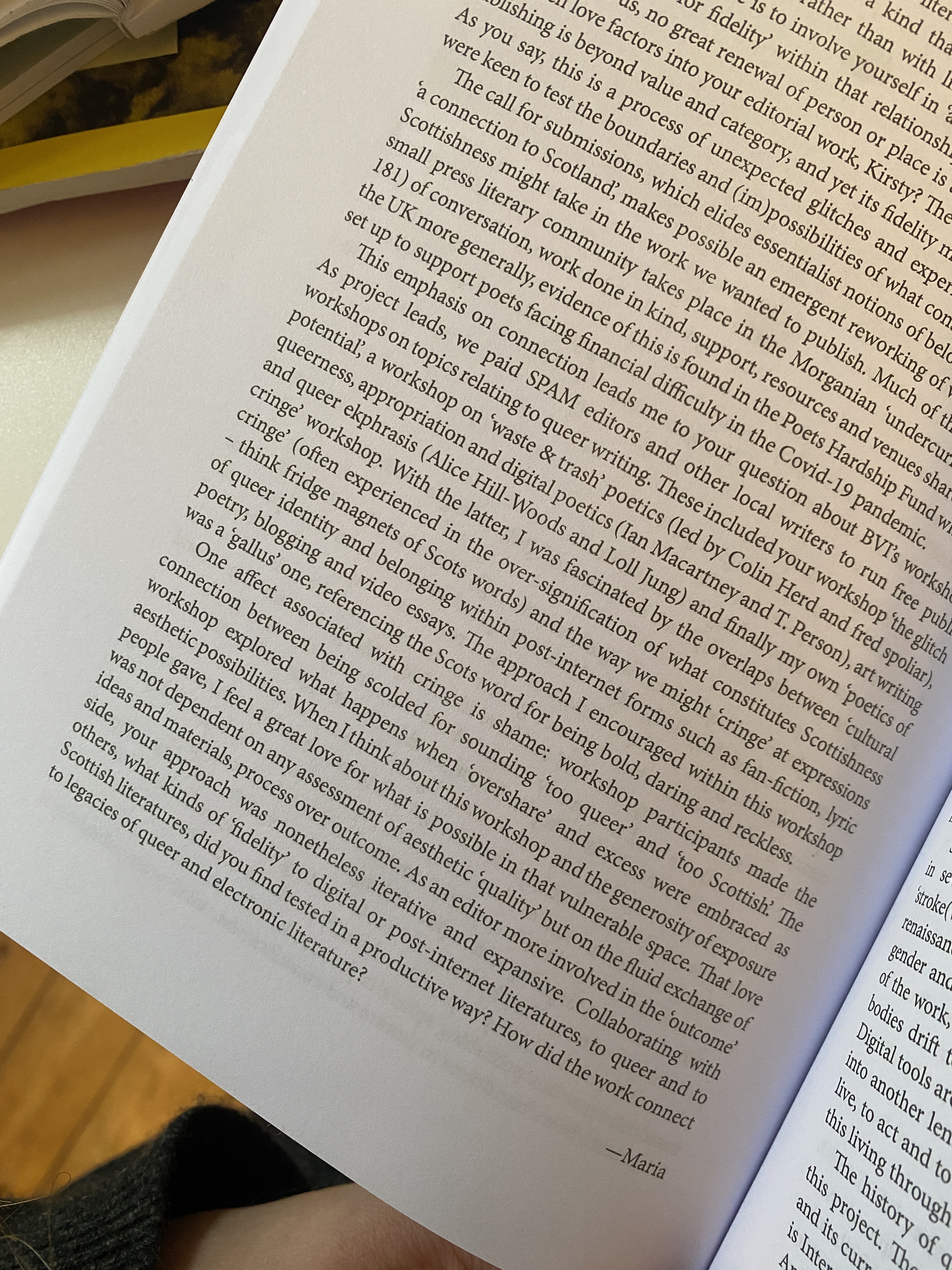
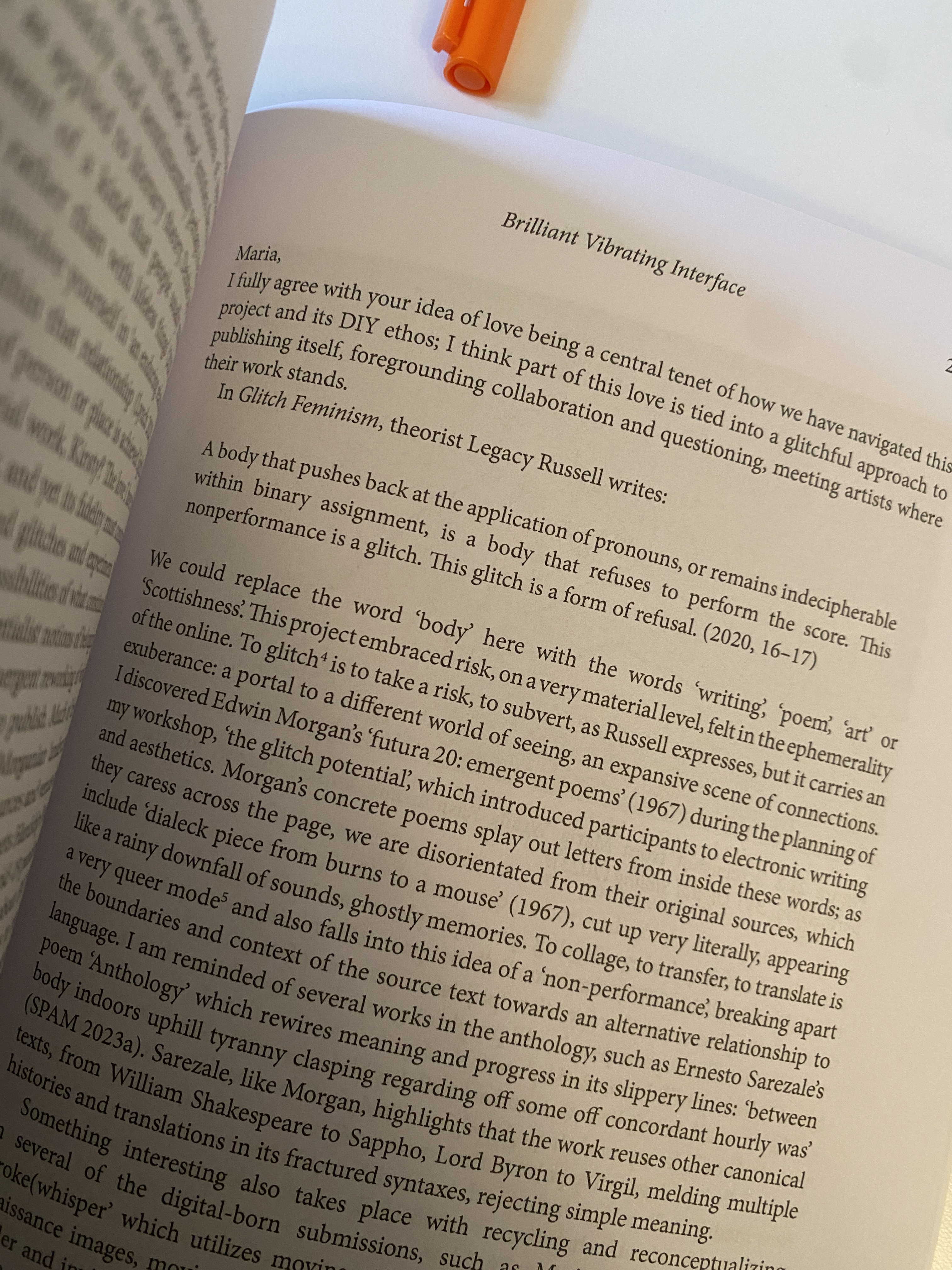
Recently, Kirsty and I wrote an epistolary chapter reflecting on the project and its significance in terms of identity, inequality, belonging, poetry scenes, queerness, Glasgow and the labour of love that is small press publishing. In our chapter we talk about the format of the project, Scottish literary scenes from the nineties to present day and the challenges and rewards of moving between print and digital (what we call SPAM’s ‘resolutely hybrid project’). We explore in more depth the poetry and visual art which found a home in our project and proffer up some poetics for how to think about queerness in the context of ‘small nations’ such as Scotland. This takes us everywhere from CAConrad’s bubbles to Legacy Russell’s glitch feminism to Edwin Morgan’s sumptuous strawberries.
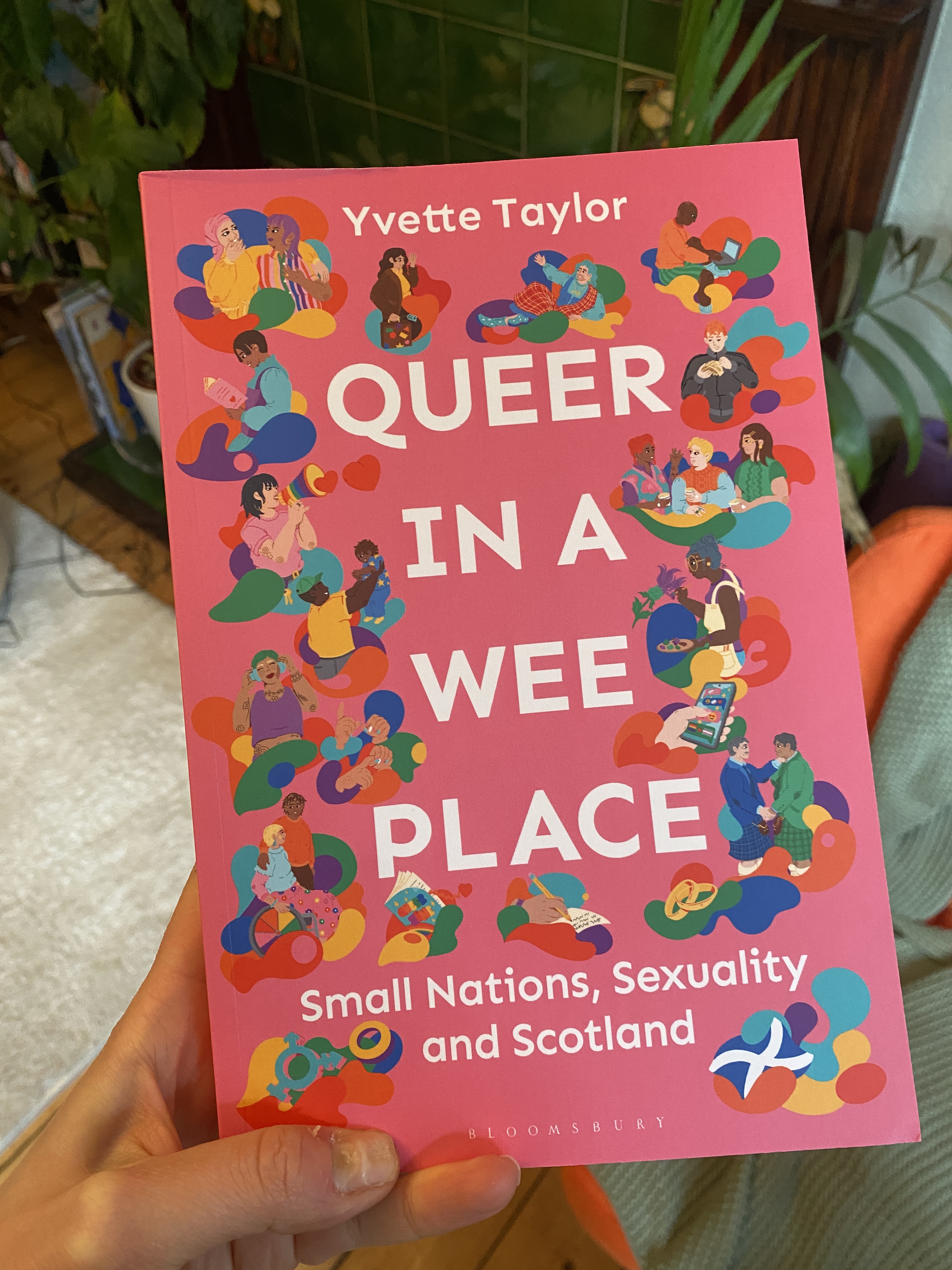
The chapter is out now as part of an anthology, Queer in a Wee Place: Small Nations, Sexuality & Scotland. To quote from the publisher’s website, the book ‘explores identity, inequality and belonging in animated conversations about how queerness moves through place – and how place, in turn, shapes queer lives’. Queer in a Wee Place contains chapters written by researchers of many disciplines and practices – from sociologists to poets – on subjects ranging from the utopic gaze on queer film to legacy and queer elders, disabled queer student experiences of higher education, Scotland’s menstrual landscape, hate crime and queer provincialisms.
The book is available in paperback form for what is a very reasonable price (for an academic book!) from Bloomsbury. You can ask your library to order it in for you 🙂
You can also read it for free via Bloomsbury’s Open Access service here.
Our archive of materials relating to Brilliant Vibrating Interface, including workshop handouts, podcast episodes, interviews and the online exhibition (what we called a ‘Digital Sibling’) can all be found at http://www.spamzine.co.uk and on the EMT website.
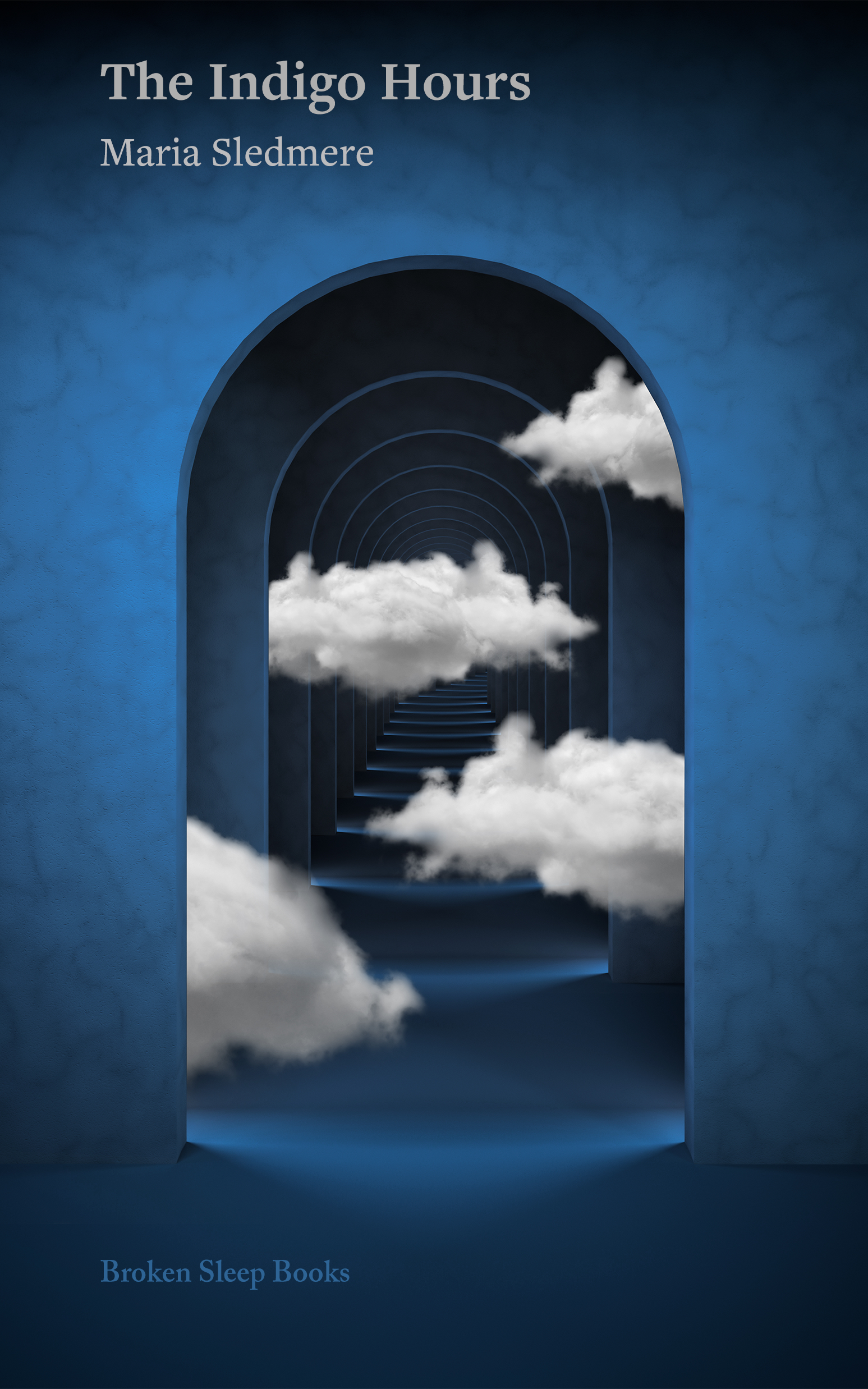
🦋🌫️🍋🟩The Indigo Hours…forthcoming with Broken Sleep Books
In 2018, I wrote a novella about erratic romance/Romance and the lyrical space-times of its (im)possibility. The fictional ~situationship at the heart of this work is stretched into, over and through various places — real and imagined — which the narrator digs into as pockets of presence and meaning. With its wandering, non-linear plot, I’d describe The Indigo Hours as ambient fiction. It’s a little eclipse of a book. It was ambiently written (leisurely, over one summer, as a dare) and may invite ambient reading. Which is to say, a textual experience more inclined to ‘going round’ a thing, attuning to its surrounds, getting lost, adjusting the frequency of (dis)interest. This is like dating a semi-transparent person. To adore the ghosts of both of you. How might love halo or envelope one’s personhood? How might love’s presence be felt ambiently in the objects and subjects of everyday life? The work tests love against memory, song, travel and friendship. I was interested in the phenomenon of blue — specifically indigo — as a desiring filter. Indigo as a singularity. Indigo as language of variable opacity. Denim wash (to go someplace). The supernatural inflection of indigo children (as a vocalised attempt at performing divergence of attention, durée and feeling). The book is full of aura, fleeting connections, music, art, intimacy and loss. It will be out on Hallowe’en, 31st October 2025.
Some nice things people have said:
The Indigo Hours’ lyrical prose, daubed from a free-associating palette of sensory psychedelia, becomes a portal into a ‘blossomy blossomy realm of the possible,’ where sadness is a sexuality, jealousies cause for celebration, and love a drunken texture. Painterly, tender, and spatially generous, this affecting novella rewards re-reading, like a magic eye that reveals a new image, and perhaps new self, with every glance.
— Poppy Cockburn
The Indigo Hours is watery fortification. Beneath li’l triads of asterisk constellations, Maria Sledmere tells a post-Romantic tale of moonlit precarity and passion among pools & thunderstorms & prairies & airports, where feeling wretched wandering midnight miles is a complex freedom, as exposure on cobalt-lit webcams, dozing/dosing to dub deep trap techno, bruises so Blühen. Yet under cosmic circumstances that augur heartbreak, Maria gifts us the deep assurance of ancient-blue auras and a languageful love pulsing constant. For insomniacs-or-otherwise against analgesia’s ‘“who cares”’, a most vital and tender-prone tonic.
Institute for Advanced Studies in the Humanities, 2 Hope Park Square Edinburgh EH8 9NW
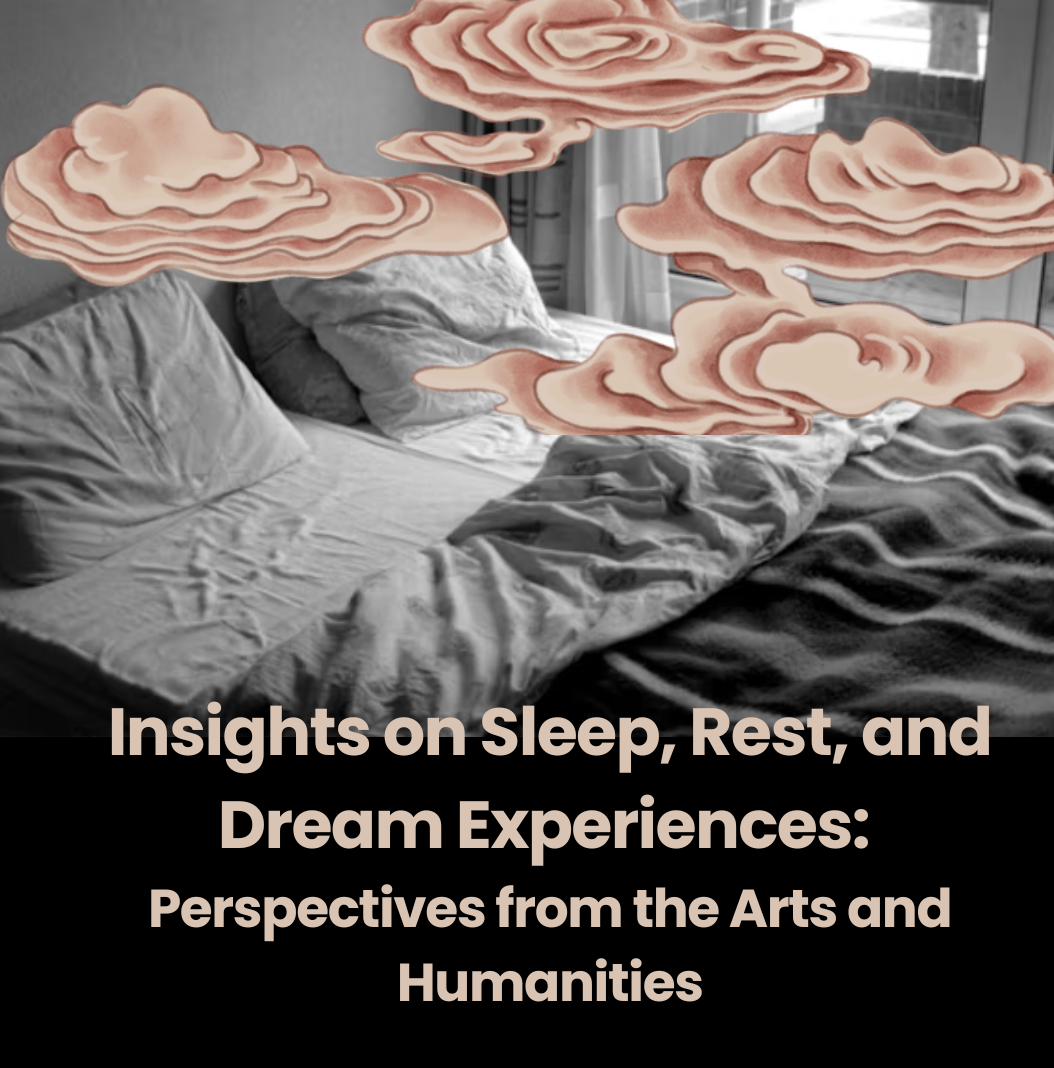
Broadly, our societal response towards sleep and rest is one of downgrading and devaluation. In our current capitalist society, sleep and rest are conceptualised as a time of passivity and inaction, and thus, as a period in which we are not producing or accomplishing. We tend to be jealous of those who can go about their days with fewer hours of sleep than ours, or praise those who can maximise their schedules, crammed with an endless series of activities and tasks. However, lack of sleep and rest time can lead to poorer health, both physical and mental. A good night of sleep can be one of our most restorative activities, and despite this fact, it tends to be neglected. Similarly, sleep and resting states allow for the occurrence of experiences that, if carefully attended, can provide us with a tool for self-exploration, such as dreaming and daydreaming.
The workshop intends to explore how these and related issues to our relationship to sleep and rest can be approached from the methods and perspectives of different disciplines within the arts and humanities. To that end, the workshop will consist of short presentations, panel discussions, and collaborative sessions for active participation. The workshop will be hosted both in-person and online.
DrMaria Sledmere(English & Creative Writing, University of Strathclyde)
Preliminary schedule:
11-11.25: Introduction and reflective activities:In this initial session, participants will be encouraged to share and write down their thoughts about their relationship to sleep and rest.
11.30-13: “Topics on dreaming, sleep experiences and transitory states” (Dr. Alcaraz-Sánchez, Dr. Bernini and Dr. Cowan). Short talks followed by a Q&A.
· Dr Marco Bernini (Durham University): “Dreams and Heightened Narrowed Immersivity: Combining Saturation, Permeability, Presentationality and Presence”.Are dreams (narrative) worlds? What similarities and differences are in play between our waking consciousness of the perceptual world and dream consciousness as quasi-perception? This paper posits that dreams exhibit a unique experiential mode called ‘Heightened Narrowed Immersivity’ (HNI)—a state characterized by intense presentational immediacy and severely restricted informational context. Combining frameworks and concepts from narrative theory and cognitive science while looking at dream reports, literature, lyrics, and movies, the paper shows how dreams and their artistic mediations reveal unstable ontological environments—low saturation in time, causality, identity, and space—while maintaining a high degree of immersive presence.
· Dr Robert Cowan (University of Glasgow). “Exotic and Ordinary Dreaming”.In this talk I consider two kinds of ‘exotic’ dreams. First, those that occur during episodes of REM sleep behaviour disorder where subjects allegedly ‘act out’ their dreams. Second, lucid dreams wherein subjects are apparently aware that they are dreaming while dreaming. My question: what do these exotic cases tell us about the nature of ordinary dreaming? My answer: very little and certainly less than others have thought.
· Dr Adriana Alcaraz Sánchez (University of Glasgow). Hacking the sleeping mind: the exploitation of the dreamspace.In dream research, the term ‘dream engineering’ has been adopted to describe techniques that manipulate, record and affect our dreams. Within the research context, dream engineering has become a useful tool for exploring the nature of dreaming as well as its potential for enhancing our waking lives. Yet, a couple of examples taken from outside scientific research might make us worry about the extent dream engineering practices should be conducted, especially when those are applied widely to the general public. Here, I consider some of the ethical implications of those practices outside the research realm, some of which put into question the value we attribute to sleep and dreaming.
13-14: Lunch Break:Vegetarian and Vegan catering for all participants
14-15: Panel discussion: Working title “The need for rest”(Dr Reeder, Dr Jones, and Dr Callard and Dr Sledmere): Our panellists will give a flash/provocation followed by a chaired discussion with questions from the audience.
15-15.15: Short break:Tea and coffee for all participants
15.15-17.00: Creative session.In this facilitated session, we will explore the role of dreaming/liminal states for creative purposes.
· Poetry reading and discussion by Dr Sledmere and Dr Hazzard.
· Haiku writing and Deep Listening activities
17.00-17.30: Discussion back to the rest of the workshop/final thoughts
From 17.30: Wine reception at IASH (Open to all participants)
This event is organised byAdriana Alcaraz-Sánchez(Postdoctoral Fellow in Philosophy, IASH, University of Edinburgh), Maria Sledmere (Artist and Lecturer in English & Creative Writing, University of Strathclyde) and Kevin Leomo (Artist and Community and Engagement Manager, University of Glasgow).
Accessibility: This event will take place at IASH, 2 Hope Park Square, Edinburgh, EH8 9NW. Please see a map here: https://www.iash.ed.ac.uk/location
The Seminar Room is on the first floor, and unfortunately IASH does not have a lift. If you have mobility issues and would like to discuss access, please contact iash@ed.ac.uk as soon as possible. Next to the Seminar Room, there are a couple of rooms that can be freely used in between the sessions/break time. If you require a quieter space at any point during the duration of the workshop, do reach out to the lead organiser (contact below) or let any of the organisers know on the day of the event. There’s also access to a microwave/small kitchen space if you require it.
Note to online participants: All sessions will be streamed, and online participants will be able to ask questions. However, note that due to the engaging nature of some of the sessions (i.e. creative session), we will not be able to provide tailored support or feedback to online participants. The sessions (including the talks) will not be recorded.
Note to in-person participants: Unfortunately, we are unable to cover travel and/or accommodation expenses for participants. Catering (including lunch and refreshments) will be provided to all.
Contact: For any questions or enquiries regarding the event, please get in touch with the lead organiser Adriana at Adriana.alcaraz.sa@gmail.com
The event is supported by the Susan Manning Workshop Fund from the Institute for Advanced Studies in the Humanities (IASH) and is jointly hosted by IASH and Project Somnolence.
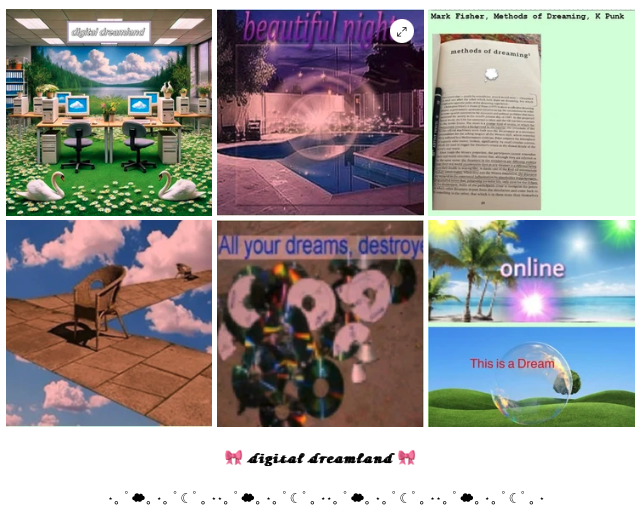
SPAM Plaza is reopening submissions for Digital Dreamland.
Ever had déjà vu, not knowing if something happened IRL, online or in your dreams? As screentime and sleep time increasingly clock similar hours of the day, we’re turning our attention to the acute relationship between dreams and the internet.
We invite critical work inspired by, but not limited to, any of the following topics:
☁︎ sleep procrastination and social media
☁︎ cloud hoarding
☁︎ the return of the (digital) repressed
☁︎ the memetic unconscious
☁︎ distraction as dream economy
☁︎ ghosting (and the metaphysics of digital presence)
☁︎ sleep texting
☁︎ hyperreal environments & nonspaces as dreamscapes
☁︎ online dream journaling communities
☁︎ targeted ads as unconscious desires
☁︎ chaos edits as dream realism
☁︎ artificial intelligence and dreaming
☁︎ interactive & lucid dreaming
☁︎ digitally-induced parasomnias
☁︎ dream imaginaries and political im/possibility
☁︎ neural net neurosis
☁︎ image spam and cyber garbage as psychic discharge
☁︎ oceanic feeling online
☁︎ dreams in augmented and virtual realities
☁︎ video game realities and dream framing
☁︎ online shopping and astral projection
☁︎ cognitive timelapse and digital intimacies
☁︎ corecore and collaging the cultural unconscious
☁︎ dream scanning as the next cyber frontier
☁︎ avatars, dreams and shadow selves
☁︎ (rip) twitter dream sharing
☁︎ movie and/or fictional representations of dreams and the internet
☁︎ typographic parapraxis (poetics of the typo as freudian slip)
For more inspiration, read the inaugural editorial for this series written by Maisie Florence Post. We always love to see work which engages these themes specifically in relation to poetry, but are open to work that touches on any aspect of texts, media and internet culture.
Submission guidelines:
We will be open for submissions between 15th January and 12th March 2025.
All submissions should be sent to spamzine.editors@gmail.com with subject line SUBMISSION: DIGITAL DREAMLAND.
Please add a brief note to your email explaining how your work fits into our theme.
We aim to respond to all submissions within four weeks and some people will hear back before the submission window closes as we will be publishing pieces on a rolling basis throughout 2025.
This is an open call for critical work. While we appreciate the line between creative and critical can be fluid, we are looking for work that fits overall a more critical angle.
Unfortunately neither the editors or contributors of this series will receive remuneration. Copyright remains with the author.
We don’t have capacity to give feedback on unsuccessful submissions and the editors’ decision remains final.
Please send submissions that are previously unpublished.
You can submit up to TWO pieces in any of the following categories:
Flash essays – 400-1000 words
Full essays – 1000-2500 words
Theory fictions – up to 2000 words
Verse essays – up to 100 lines (we have very limited formatting options however, so please get in touch if you’re not sure your work will be suitable)
Visual essays (photography, memes, illustrations etc – max limit of 15 images)
Audio or video essays (with text transcript provided – you must already have the link hosted elsewhere rather than send it as a file – we need to be able to embed it via a link)
ʚɞ
You can read the SPAM Plaza archive for free to get a feel for the stuff we like to publish.
In 2018, I started a Doctorate of Fine Arts in Creative Writing at the University of Glasgow. I also started a new diary. In October, the month it all started, I wrote about duplicate footsteps and permanent landfills. I wrote of lacking the energy to dance, being lost in the forest, looking for safety among swirling leaves. Can’t remember if the forest was real or metaphorical. I wrote seemingly in lieu of being able to actually venture beyond the confines of my working life. Over three years and three months, I went through multiple iterations of research focus. I looked at foam, clouds, technicity, glitter, quotidian measures, fire and cinders. I fell asleep on coaches circling lochan sunsets. I produced a list of figures for how we might conceptualise this project. It was a sort of Escherian dollshouse, a self-deconstruction of building this place to think. I thought about Bhanu Kapil dropping her book in the river. I thought about doing a writer’s residency within the confines of a square-shaped digital platform. I wrote of ‘An angel tossing her gunpowder sequins’ and ethical eating, ‘how so often you are so paralysed between two choices that you just don’t eat at all’. I wondered what kind of home this work would make for me. This was a material question: thanks to the Scottish Graduate School of Arts & Humanities, it was a funded period. It paid me through Covid-19.
These were my original research questions:
How can creative and critical writing interrogate and depict the apparent tensions between the Anthropocene’s deep-time and the quotidian context of our ecological orientations?
What hybrid critical-creative forms might open up possibilities for a future ecological art, one which builds productive ways of ‘tuning in’ to a non-anthropocentric experience, with reflexive attention to the artistic and technological media involved in this process?
How might ‘the everyday’ provide a temporal and formal mode through which to develop a critical, interdisciplinary Anthropocene aesthetics, negotiating ecological questions of affect, sensory relations, ethics and responsibility at scales both macro and micro, human and nonhuman?
It is up to the reader to decide how far the end result fulfilled or strayed from these lines of enquiry.
Six years on, having graduated from being a baby scholar-poet, I am really thrilled this project has found a dream home with No University Press, a new imprint from Tenement Press. The ‘no’ of refusal feels appropriate to this project, which very much concerns the affordances and limits of an academic and institutional mode when thinking through (im)possible questions of ecological thought and living on. Working with Benjamin Pickford and Dominic Jaeckle, editors at Tenement, I was able to bring the project’s creative detours and modalities to life in its final book form: Midsummer Song (Hypercritique). This is definitely the most ambitious work of my life. It’s 469 pages of critique, poetics, meadow work, illustration and elegy. I see the whole book as a big song, a study, an architectural attempt at making an ecological home in lyric.
Somewhere between an academic monograph and performative dreamwork, poetry and poetics, conceptualism and the commonplace.
You can order the book direct from Tenement here or from Asterism here.
You can read a full description of the book and access endorsements, sample poems and other materials here.
I will be touring the book at some upcoming dates in Glasgow, Edinburgh, Manchester and London:
09.11.24 Peter Barlow’s Cigarette / with Maria Sledmere, Harriet Tarlo & Lucy Wilkinson The Carlton Club, Whalley Range Manchester See here.
05.11.24 Midsummer Song / Readings & Discussion Maria Sledmere, David Farrier & Colin Herd Fruitmarket Gallery, Edinburgh See here.
26.10.24 Midsummer Song / Readings & Discussion Maria Sledmere, Chris McCabe Small Publishers Fair Conway Hall, London See here.
22.10.24 Midsummer Song / Readings & Discussion Maria Sledmere, Carl Lavery & Colin Herd Advanced Research Centre, University of Glasgow / (Online via Zoom) See here.
I’m thrilled to be reading at the launch of Stacy Skolnik’s The Ginny Suite this Saturday at Burning House Books. The novel is one of my favourites in a long time — a pearlescent, speculative many splintered tale of mystery, hysteria and the world fuckery of technology evermore. I savoured it and reread certain pages with a dreamy clarity because deja vu was the narrative logic that I could most accurately access. When I finished it, nestled at the airport waiting lounge, I immediately wanted to read it again but I’m almost afraid to. I talked with Courtney over email and we agreed that the book lodged in our brains. That might be the most proper description. It crystallised the eerie fourth space feeling of proximate and synthesised intelligence. It was strange and razor-edged and a glut of forms and genres stitched up in this thing called the novel. My favourite thing about the novel is when it can serve as a kind of nervous container of multiple ideas and concepts playing out in time. The book itself is experiential prosthesis.
More info:
‘Information didn’t need to be remembered; it remembered her…’
A mysterious global syndrome is affecting women, causing symptoms of submissiveness and aphasia. While the number of sufferers grows, so does our protagonist’s paranoia—of the media, her doctors, and her husband. In the age of misinformation, AI, and surveillance technology, The Ginny Suite asks how much—and who—we’re willing to sacrifice in the name of progress.
Born in Belfast on Valentine’s Day, Suki Hollywood is a writer and poet. Her work has been featured in Gutter, Deleuzine, SPAM, Water Wings and more. Her debut novel ‘Jesus Freaks – a queer thriller – is available now via wwww.sukihollywood.com.
Maria Sledmere’s latest collection is ‘Cinders’ with Krupskaya Books, 2024. She is managing editor of SPAM Press and a Lecturer in English & Creative Writing at the University of Strathclyde. With Kevin Leomo, she is one half of Project Somnolence: a portable lab for exploring speculative approaches to sleep across art, literature and daily life. Her next book, ‘Midsummer Song (Hypercritique)’ is forthcoming with NoUP Press in 2024.
Stacy Skolnik is the author of the poetry collection mrsblueeyes123.com (self-released, 2019), the chapbook Sparrows (Belladonna* Collaborative, 2023), the workbook From the Punitive to the Ludic: Prompts for Writing Public Apologies (with Thomas Laprade for Montez Press Radio, KAJE, 2022), and the chapbook Rat Park (with Katie Della-Valle, Montez Press, 2018). She is a co-founder and co-director of Montez Press Radio, the Lower East Side-based broadcast and performance platform. The Ginny Suite is her debut novel.
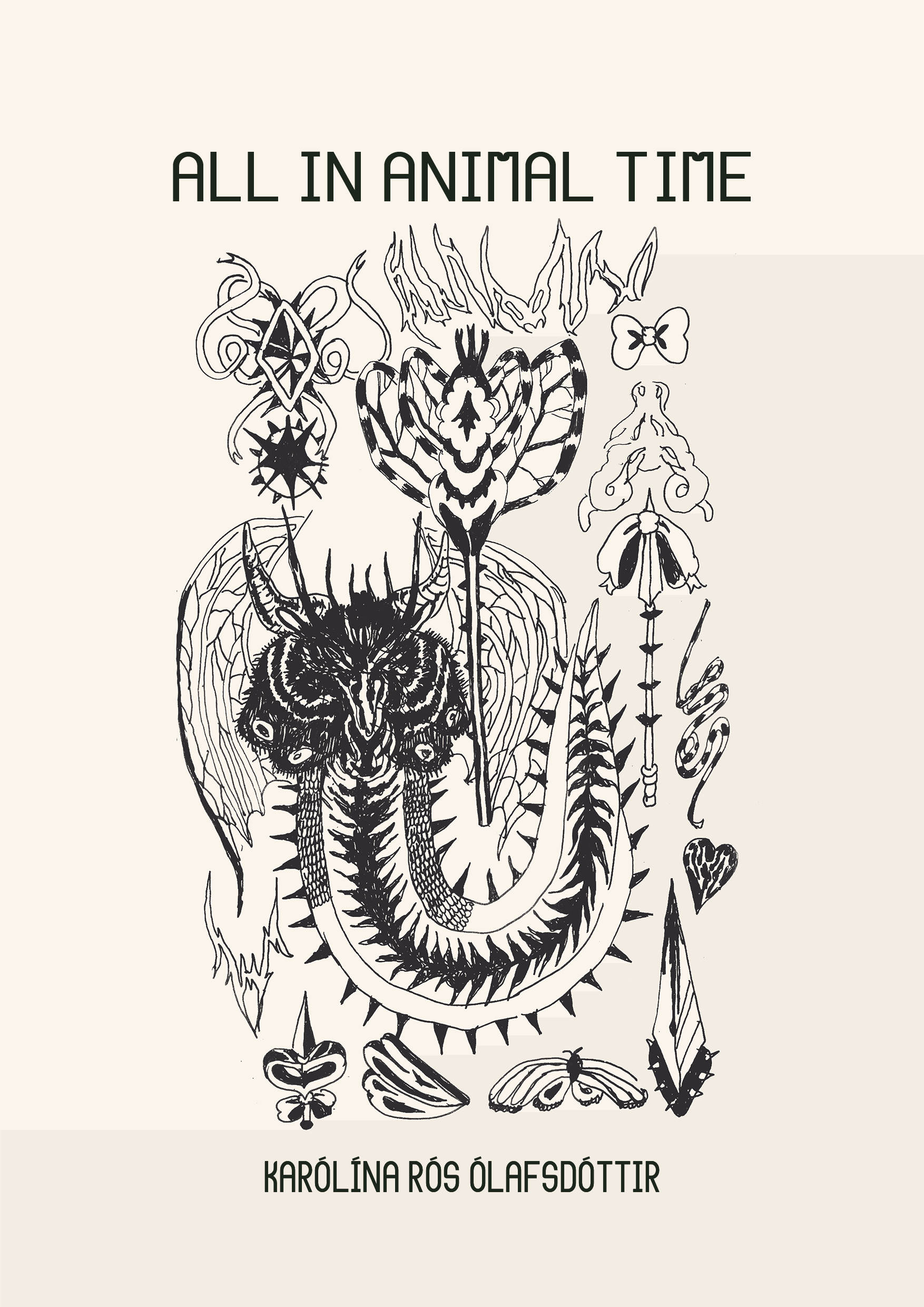
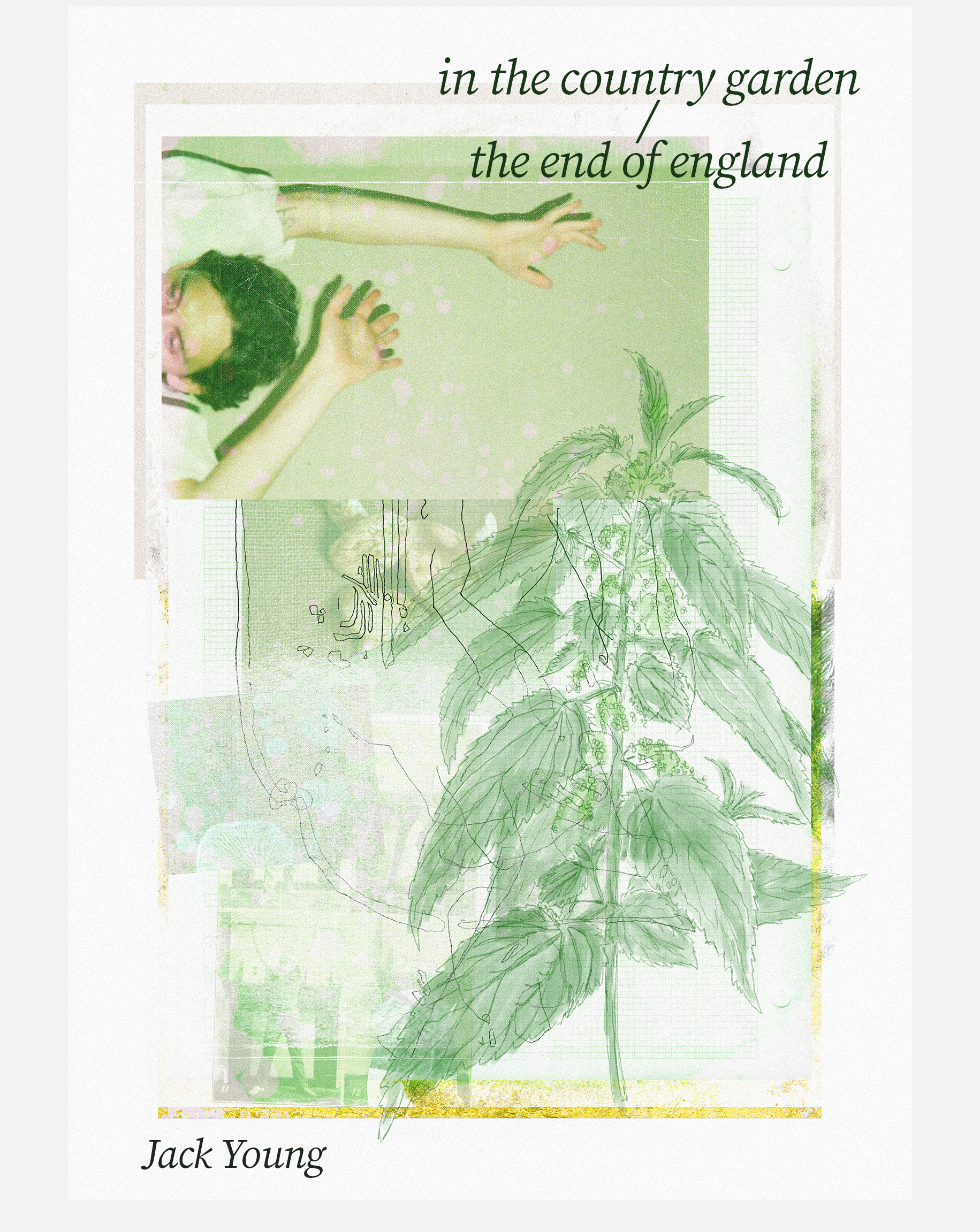
Over the past few months I’ve had the pleasure of working with two excellent poets, Jack Young and Karólína Rós Ólafsdóttir, on bringing to life their pamphlets in the country garden /the end of england and All in Animal Time. It’s been a fair few months since SPAM published anything physical (our most recent print publication was Cocoa and Nothing back in February) and coordinating everything for season 7 reminded me why I love doing this in the first place. There is something magical and alchemical that happens in the process of getting something from email to book in a series of whirlwind zoom(ies) and frantic whatsapps and editorial ping pong and delicious in-depth reading. I love figuring out solutions to a design problem, shunting things around, letting things bleed into the edges or splash into place, phone calls about word choice and line breaks. Generous margins and snaky wee texts / embarking upon font quests.
We got to know our authors, who are based in Bristol and Iceland, variously over the pandemic through Zoom workshops and the great poetry boulevard that is gmail. You can read one of Jack’s poems in SPAM005 and one of Karó’s in SPAM004. The SPAM editors are big fans of their work and we were delighted that both authors had pamphlets that kind of grew out of the poems in the magazine. This season has a lil rainbow-shrouded eco flavour: poems of the anthropocene everyday, poems of queer pastoral, poems in animal time (as per David Berman’s advice). J&K are poets with a real interest in the scholarly work of poetry as much as the playful. These are really thoughtful works which traverse everything from decolonising botany to Commander Keen, the dietary needs of black holes and the sonnets of rats and punctuation marks. Ugh I really love them! Thinking about these pamphlets is like coming up on coffee with sunlight pouring through the morning and having adequate sleep and remembering why the little things really fucking matter. It’s like the libido of the knotweed exerting pressure to break concrete and escape the walled garden which is like beautiful open source software. I am so lucky to have worked with these poets and also to have collabed with my co-editors Mau Baiocco, Kirsty Dunlop and Ian Macartney in bringing them to fruition. Long live SPAM!
Coordinating this pamphlet series also reminded me that publishing is an act of worldbuilding, brick by paper brick, pixel by pixel. It’s like: how do we give birth constantly to the word-pearls of what you wanted by accident of so many factors to have an idea for ~ ~ it’s like……a gift, a life-changing conversation, a journal entry for the language of flowers, a frolic through girl city’s sugar cubes and the delicious lumpencoal of the poem. Stop to admire the ‘four-star review sycamore’ (KRO) while you’re at it.
We worked with two v talented artists, Maura Sappilo and Sam Williams on cover design. Thank you Jack and Maura!!!
If you’re in Glasgow, please come along to our launch on the 10th November, where we’ll also have a reading from Edinburgh poet Murid L. Keshtmand and there will be many a pamphlet on sale and a lil wine & snack to be had.
PEOPLE OF THE PRESS! If you’d like to review the book, interview one of the authors, have them on your podcast or stock copies of the pamphlets in your store, please email spamzine.editors@gmail.com.
You can preorder the books at inflation-resistant prices => spamzine.co.uk/shop.
You can watch two Instagram live sessions with Jack and Karó here, where we talk about the thinking behind the pamphlets, inspirations and the craft of writing.
Announcing a 2-part weekend workshop ‘The Poetry of Somnolence’ with Beyond Form Creative Writing.
Take this workshop to explore the radical, rhythmic & world-traversing poetics of sleep, whatever your creative practice!
Saturday and Sunday November 11th and 12th
1-4pm (GMT) via Zoom
😴
This 2 part series of afternoon workshops prioritise the relationship between writing and sleep. Exploring cross-genre writing, visual and sonic art, we will look at how daily writing practice can recentre our circadian rhythms. From hypnagogic poetics to dream writing, nocturnal missives, dawn songs and notes on twilight, we’ll consider experimental approaches to writing somnolence. All creatives welcome.
Workshop format will combine reading, writing, listening, optional discussion and two nap breaks. Reading will be provided in digital format (pdf or weblinks) ahead of the session.
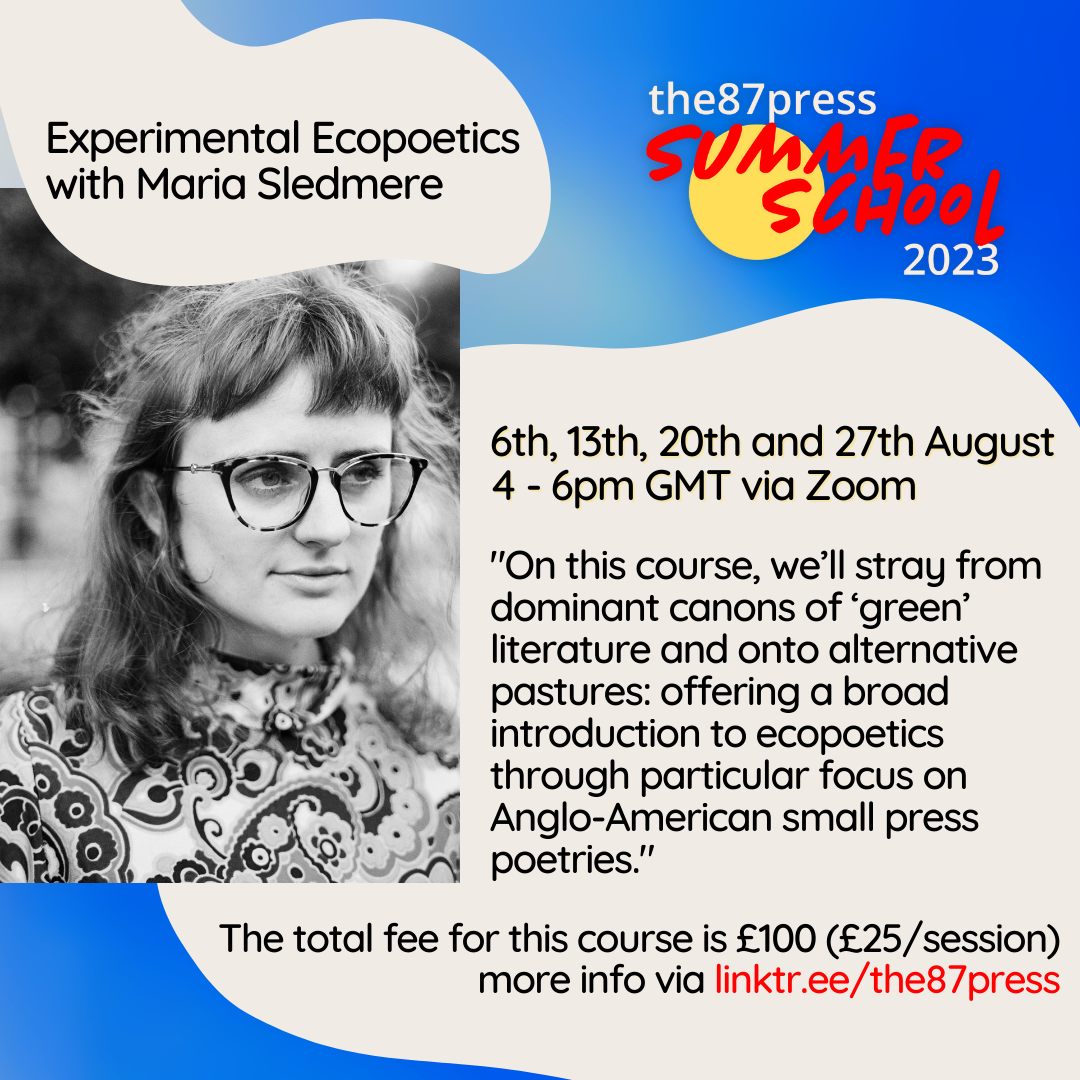
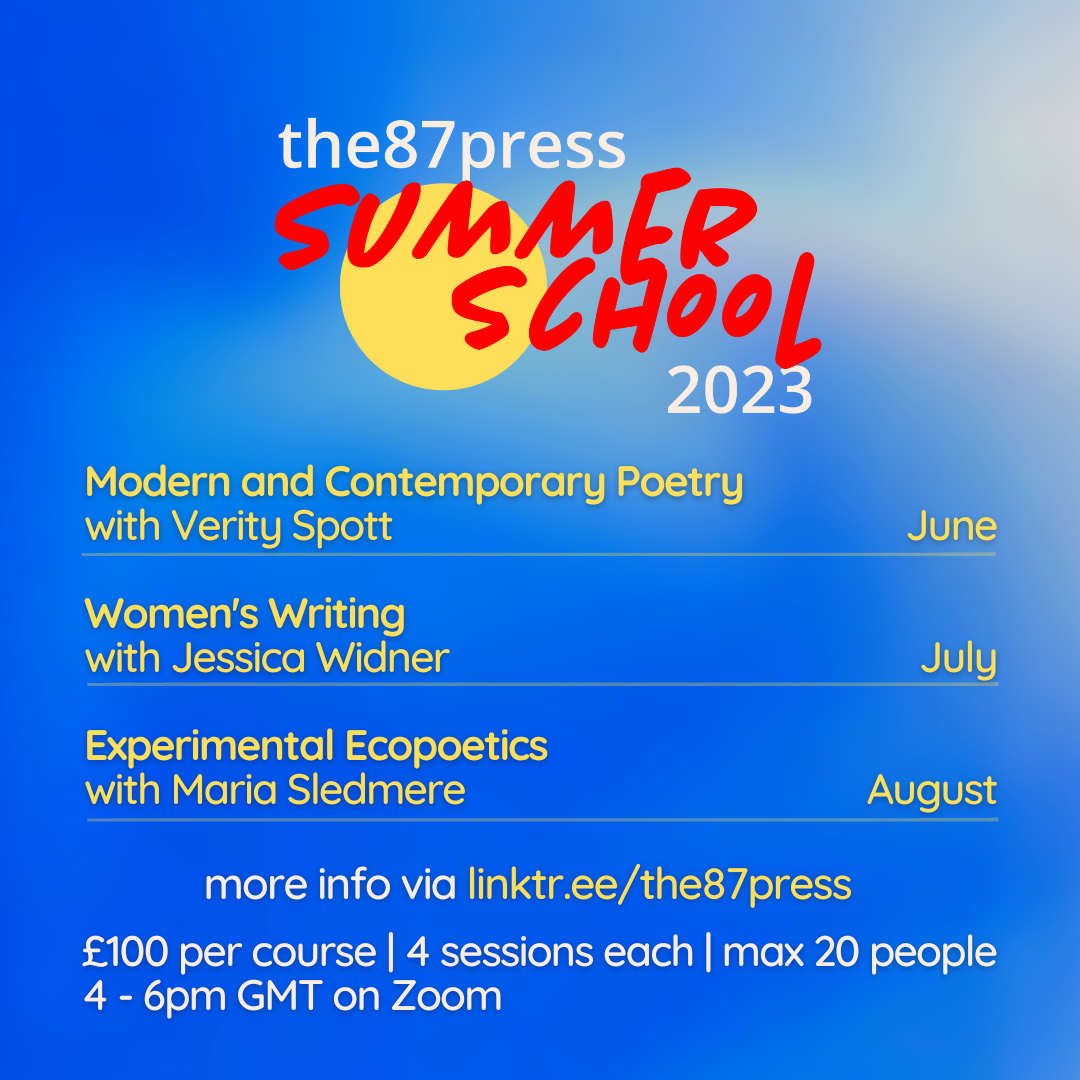
Excited to deliver this four-part workshop series in August for the87press, alongside two other courses by the brilliant Verity Spott and Jessica Widner. These will be cosy sessions on Zoom and feature a range of small press poetries, which we will read, write from and discuss in two hour workshops.
About the Course
Ecopoetics is a capacious term, meaning something like ‘the incorporation of an ecological or environmental perspective into the study of poetics’ (Kate Rigby). As both a creative and critical practice, ecopoetics explores the relationship between literature and the more-than-human world, often in curious, radical and transformative ways. Ecopoetics offers a fieldwork, site of experiment and a tool for (un)dwelling: tuning into ideas of environmentalism, activism, climate crisis, landscape, documentation, dreamwork and lyric. Ecopoetics is not just witnessing; it is an active engagement with habitats, affects, sensing, solidarity and politics — including questions of gender, race, sexuality, land rights and embodiment. On this course, we’ll stray from dominant canons of ‘green’ literature and onto alternative pastures: offering a broad introduction to ecopoetics through particular focus on Anglo-American small press poetries. Each session, structured as a combination of seminar and workshop, will involve reading, discussion and writing activity around themes such as everyday life, elemental thinking, dream and radical ecologies. We’ll investigate key terms such as animality, weather, nature, landscape, energy, the body, time and coexistence through works that expand our notion of who or what speaks in a poem, and where or what is ‘Nature’. Open to anyone with an interest in poetry and ecology, the sessions presume no prior experience with writing workshops, and sharing work in class is not required. A core reading list will be provided freely in the form of electronic extracts, with further suggested reading also listed.
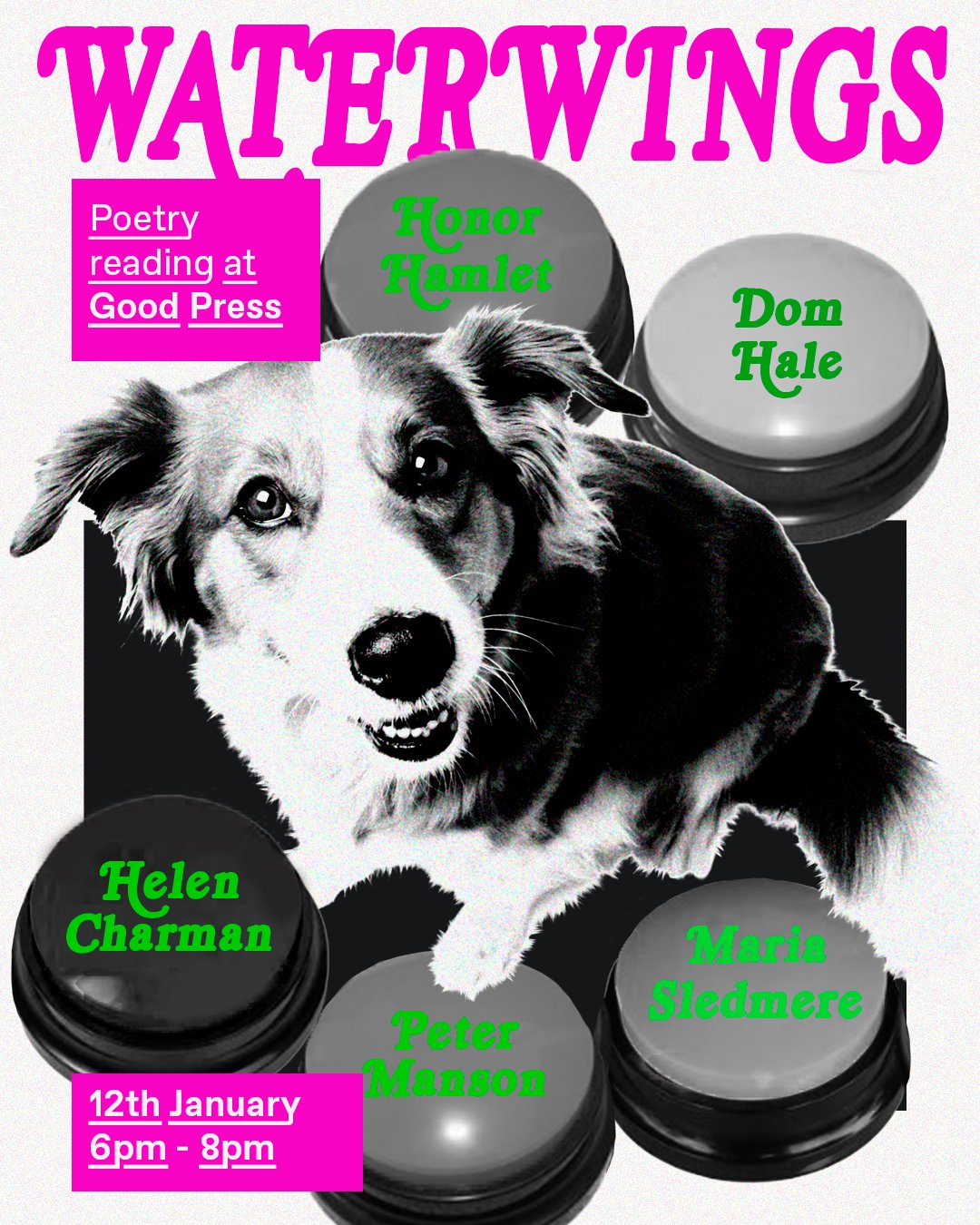
Glasgow folks! I’m doing my first reading of the year next week.
A reading on Thursday 12th January 2023, 6pm-8pm at Good Press, with Honor Hamlet, Dom Hale, Helen Charman, Peter Manson and me. Thanks to Leo Bussi for organising. Poster by Elisa de la Serna.



 mariaology