Dark Chocolate Auras and Strange Ecologies: Daisy Lafarge’s Understudies for Air 

IMG_7965.JPG

Sylvia Plath wrote many of her Ariel poems in the wee hours before dawn, sucking in the cold and inverse crepuscular air, its colourations of sinister lilac and absent sleep. We have a cliché of the poet’s spontaneous overflow, but instead with Plath there’s a sharp intake, a suspension of air, of breath: ‘Stasis in darkness. / Then the substanceless blue / Pour of tor and distances.’ We have to think through the impossibility of a substanceless blue, as everything must be a component of something; we are all of a sort as perilous hybrids, weak in some place with the viral code of our own demise, shimmering within and outside us like a beautiful aura. The speaker paralyses herself on the brink of sublime, of suicide. Tor: a hill or rocky peak. Vertiginous depths to erase the scale of the self on earth. Tor: a free software project which protects your privacy online. Where history bounces back, is the elaborate sarcophagus that traps the foul air of your history. Think of layering, onions, peeling stench of purple flesh. Indulgent recipes for regret; the cloying addresses of cheap pornography, of midnight Amazon deliveries. Inside the deep centre a secret, liquid sweet as Timothy Morton’s chilli-dark core of chocolate ecology. Chilli, chilly; a shiver in the air that is freeze or fiery. I have been googling your name in my sleep. A shivering, unsettled enmeshment. The encryption an insufficient addition to the substance of memory, its thick brain mulch of skin and image. Such protocol stacks are hypothetical only, nested as the heavenly day that will not die. Wordsworth singles his day from a tangle of others, the onion clot and rot of forgettable hours. To dwell forever in that substanceless blue! To wear innocence on the sleeve of freedom! Plath’s line breaks are harsh and sharp, they flake off the page in their skinly abscission of sound and sense; the body is imposed on grander scales, made to stretch then wither in variable ‘dead stringencies’. All of a space, the thin poem shivering down a spacious page. All of this is so much of air. Take me to the edge, go on, it’s a dare.

An understudy is someone who learns another’s role in order to act at short notice in the person’s absence. You lurk in the background, an absent presence of possible flourishing. The poem as understudy: recipes perhaps in the absence of breathing. What we read when there is no air left to breathe. Poems in reserve for a gradual apocalypse. What exists as core substance, what complements the element whose insouciance charms the lungs without thought. Derrida’s maddening supplement: neither presence or absence, something added and something in place of. An understudy for air, a rehearsal of air’s function. Anthropocenic, tarry air, stung with coal and thickly textured.

Robert Macfarlane asks that we find a ‘thick speech’ for articulating life in the time of climate crisis. Enter Daisy Lafarge’s Understudies for Air (Sad Press, 2017). This is not a collection, ostensibly, about ecology or even the end of the world. It is a phantasmic scaffolding of words and lines for living, breathing, being. Its epigraph takes the axiom of the pre-Socratic philosopher, Anaximenes: ‘The source of all things is air.’ Air being then the ubiquitous neutral substance, something available for occasional roles in physical process. A reluctant but capable actant, developing itself or forced upon by other natural causes. Air’s principle shifts bring about the other main elements: flicker into fire through precious density, condense into wind or water, earth then stone. Anaximenes articulates this through a simple example: if you relax your mouth and blow on your hand, it’s hot; if you do so with pursed lips, the air is cold. So rarity correlates with heat, density with cold. A beautiful, quiet, material intimacy. Everyday action, for Anaximenes, here forms the source of a theory of matter, and yet ever with time this matter recedes. There’s a scarcity of air, something sparse and grasped for in the gelatinous enjambment of Lafarge’s lines.

Precision of form: shortness of breath. When we pause at caesura, pause to breathe, when we lilt our words over the ambiguous interval of a line-break, we are forced temporarily to think about air. I recall the little ticks my brass instructor would make on a sheet of music: remember to breathe. The ticks would supplement a conventional musical pause; I guess I just needed more time to breathe. Breathing is temporal, but also material. There’s a precision to Lafarge’s form, a negotiation of reflective lyric transposed through material effects and affects. In ‘sapling air’, a sense of childhood’s loss is articulated as nonhuman ailment, the ‘first outbreak’ which is a poisoning of the air or the bark of trees. At first I think ash dieback, but then we are taken somewhere more grandiose, planetary, magmatic. Lying in the liminal space between ‘child / and whatever came next’, the speaker is in the bath, ‘gazing up through the skylight / as a plane passed overhead’. This sense of temporary epic scale, its vanishing écriture of ‘vapour trail’, is a writing of fleeting sheen. I think of glassels: those stones which appear glossy beneath water (in river or sea) but when picked and brought home they revert to dispirited dullness. It is as if life has left them, where momentary they truly appeared as vibrant matter, appealing to the senses with electric connection. Is this the fate of the bath-varnished body? How beauty consists in the wounded part of a thing, a fragile glitch in the viral code—what makes death inevitable. Stones ground down by the sweat and chafe of salty water, the sky a landfill for carbon dreams, modernity streaked across substanceless blue.

The speaker glimpses the oscillating scales of panorama and miniature: the passing plane and the ‘passengers’ eyes’. She sees through the eyes of others; a vertiginous, fleeting sublime in which she is the one looking down and the one looked down upon. Humans become binary nodes in this networked communion of sound and sense: ‘the passengers’ eyes flickered on and off / with signal’. Air carries, air travels. Air miles, as both temporal noun and verb. I find myself tangled in the space between transitive/intransitive. Air signifies the dialectic flickers of presence/absence. Accumulates, billows. What the speaker notices is a peculiar distortion, a toxicity overlaid with her own poisoned body: ‘I looked down. the bath water / was the colour of porphyry and I could no longer breathe’. The excess of the skin flakes away as feldspar, silicate rich and igneous, carrying traces of radial or volcanic exposure, imperial purple or deposited copper. Containing within it divergent scales: wee matrix crystals and larger phenocrysts. The speaker experiences her body as this suddenly alien thing; the sight of the bathwater steals her breath. Is it the first glimpse of what the outside does to the inside, the staining within us we leave on the world in a permanent toxic chiasmus? But I can’t help think also of period blood, given the speaker’s interlude adolescence: something tricky to articulate that nonetheless clots in the mind as childhood’s instated loss of innocence, a condensation of excitement that clings then turns readily and stickily to red, to blood. That moves in turns, cycles as the waxing mist of the moon. What is this substance, this iron-rich bodily flood? Where matter confuses, we turn back to air.

She tries to express to her father a bewildered grief, ‘there’s something wrong with the air’, but her ‘words went through to dial tone’. There’s a delay, language meeting its buffer at difference: through what? Gender, generation, divergent points of vision? Her special melancholy is something that lingers down the line, seeps inside the passage of time. The poem closes: ‘I still wonder, how many months, years from now / he will listen to the message’. Throughout Understudies for Air, Lafarge uses this technique of unfurling: instead of saying simply, ‘how many years from now’, she adds in the months, practices a sort of delay or lag. I think of smoke billows, slowly dissipating. Of what it means to say, there was chemistry between us, an atmosphere in the room. The way voiced words vibrate momentarily in meaning then once again settle to silence, stasis. An almost electricity, crackling then out. Compare this to the written word’s more permanent, inevitable viscosity. Language sticks: you can tease it over and over, read the same thing till centuries down the line the ink wears off from the page. You can replicate. Speech is quite a bit more fleeting, unless you set it down on wax or tape, find new ways to materialise language’s spit, crackle, lilt. The forcing of sign and shape from sound.

Air in Lafarge’s collection is a sort of pharmakon, in Jacques Derrida’s sense of an undecidable fluctuation between poison and cure. It is a substance acted upon with the medical impetus of invasion: in ‘desecration air’, ‘brittle waves of grit’ are ‘growing, syringe-like / into the air, and in so doing suckle / and cleave the dunes around them’. There’s a sense of maternal genesis and geologic violence, an injection of force into air’s spaciousness. For air at once signifies space and density of matter at the brink of scattering, sparking, forging. I start typing what is air into my search bar and it suggests, where can it be found? I am suddenly struck by air’s mystery, the possibility of everyday deception as to its ‘nature’. What is taken for granted has elusive substance; after all, can we view air in the object-oriented sense of ‘object’, or even, at transcendently nonhuman scale, ‘hyperobject’? For air blends and bleeds, both substance and accident. The painting or glass had an airy quality, we talk of a room as light and airy. Does this mean more air, or air less dense, more receptive to breath and space and quiet? Air is rich with the silt of existence: dust being its materialised twin, these myriad phantasms of hair, fibre, textiles, minerals, meteorites, mostly skin. Air is nitrogen, oxygen, argon, carbon dioxide flavoured with traces of neon, methane, helium. We breathe air but also pass constantly through it, as our molecules swim in the vast bombardment of other molecules swirling. Ambient air is safe, we pass through it daily; but air can also spark, as fire’s immanent ingredient, awaiting some flagrant chance to burn. We talk of dry air, damp air, air that feels ‘close’. Air signifies both absence (space) and presence (elemental matter, tangible substance). Air is always potentially transformative.

There is a poem called ‘calque air’. Calque means loan translation: a word-for-word exchange of meaning across languages (examples include ‘fleamarket’ and ‘skyscraper’). In French it means literally ‘copy’, derived from calquer: to copy, base on, trace; derived again from Latin calcāre, to tread, press down. Thus in the abstracted xerox of translinguistic exchange, we meet a sense of material rubbing, the friction that exacts its inscription between two substances: stone on stone, wood on wood, paper on paper etched with lead. It’s a physicality that chills the spine. Yet tracing somehow also connotes residue, the excess material produced by this rubbing, the patterning stains set down by a tread, like footprints sunk deep in the sand and preserved semi-permanent by glitters of frost. Lafarge writes: ‘people / were finding messages / in their bodies they hadn’t / written’. Again this sense of material semaphore, whose translation is a phenomenological act of physical reality, a sudden otherness within us that requires an empathy, an excess, a confusion of words rubbing wrongly against one another: ‘it was decided the system was malapropic’. Language spiralling as if in the hands of the nonhuman, the air or machine or book.

Anthropomorphism reaches its textual extreme: ‘the book grew hair, organs, toes’, and so even ‘accurate translations’ become disputed, subjective, active and physical. What is it about air that somehow substantiates the symbiosis of language and matter, its aching and perilous leak? Here we are, tipped in the gaslit eve of twilight, where ‘the sky throbbed / sideways like a haemorrhage’. Matter acts upon us, causing a gulping or gaping as we churn through it, our bodies mucilaginous mulched into altered form, new affect. We can try to discern the nature of air, but in some way its inner essence remains recalcitrant, resistant to the interpretive instruments of other forms, including humans. Lafarge plays on the semiotic plurality of ‘forms’, poking fun at science’s ‘consent and feedback forms’, ethical necessities which prove useless upon the elusive air. This raises the question of how to extend a nonhuman ethics, what forms of consent are required when probing and monitoring their patterns of agency or behaviour? In ‘attempted diagnosis air’, Lafarge concludes: ‘in the end, / you left the forms in the airing cupboard / to let the air fill out itself; it acquiesced / in many hands of mould, dust and heat, / none of which you could hope to translate’. The air transmogrifies into purely itself, is available only as sensation in the perceptive ‘hands’ of other substances. It’s worth quoting Jane Bennett at length here:

 Thing-power materialism figures materiality as a protean flow of matter-energy and figures the thing as a relatively composed form of that flow. It hazards an account of materiality even though materiality is both too alien and too close for humans to see clearly. It seeks to promote acknowledgment, respect, and sometimes fear of the materiality of the thing and to articulate ways in which human being and thinghood overlap. It emphasises those occasions in ordinary life when the us and the it slipslide into each other, for one moral of this materialist tale is that we are also nonhuman and that things too are vital players in the world.

Air is surely the channel for thinking through this vibrant materiality. Lafarge’s poetics, shifting through sparsity and density, perform this slippage between human and nonhuman at variable scales. Rooted in ordinary life, in personal memory, the poems of Understudies for Air root out these collected knots of ontological ‘torsion’, the ‘bunioned’ meanings that wash up like offerings then shut down all visible meaning—‘they closed in my hand / like eyes’. The lack of capitalised titles renders the poems’ drift into one another, in free-flow without the arche conventions of literary closure, of textual finality. A sense of fractured or wounded text, poems chipped out of a grander object, left now to change and drift. In ‘driftwood air’, driftwood makes a temporary semiology of the shore. Driftwood being perhaps the airiest form of wood, a text well-chewed by aquatic bacteria, lightened and smoothed by the tide; erosion performing its nonhuman act of calque: a copying of wave upon wood, the tiny treads of millioning microscopic appetites, like the imperfect press of a nonhuman telegram. With her spells of air, Lafarge conjures a vibrant ecology of non-anthropocentric process; evocative still as such effects take place through the decomposition of the lyric ‘I’, whose voice drifts out in nonhuman confusions, signals and distance. Human affect returns in glimpses like delicious flotsam, jetsam, moments of reflection gleaned from material debris.

The ‘I’ often shrinks or recedes, but sometimes floats over the ambient scene with declarative assertion: ‘the twin lines of naming and being / run parallel but never touch’. Such philosophic pronouncements then melt away in exploratory thought, lines closely attuned to trans-species process: the swell and lurch and pleat of water, plant, lichen or toxin. Once again we come to air as pharmakon, and so its process arises as a sort of pleasing monstrosity. The odd thing about plants is they just grow, often without purpose, foregoing teleology for an impersonal, gorgeous flourishing. In ‘asbestos air’, the speaker marvels:

lichen and moss
grooming your body;
it is a relief to watch
things grow without
difficulty

End-stopped punctuation is often foregone for free-flowing, morphological enjambment throughout Understudies for Air, so the inclusion of semicolon here is its own kind of force. I think of imagism’s stop-motion visual equivalencies: Pound’s apparitional faces in the metro and wet black petals. The ‘body’ in question could be human or nonhuman. There is a plain admiration of process and flow, the ease of growth that feels significant against the endless stuttering, knotted bolts of human maturity. And what about ‘asbestos’? More silicate minerals invading the air, released by abrasion and enacting a slow-release of symptoms, as deadly fibres clot in the lungs. Asbestos makes its own mark upon air. The speaker clearly craves that insulation, a felting of absence with ‘lichen and moss’ that comes as a ‘grooming’. Grooming being the softening and smoothing of matter, but also tinged with danger: to be groomed is to be seduced towards some form of invasive peril. Twin signals, twin materials; a chiasmus of death and sleep’s electricity. Sucking in air, we sleep towards death; slowly we rove over lines that enamour with deceptive simplicity. We can’t help but breathe in sleep; it’s just evolution. What’s more, nature isn’t mere positive growth, but might be compounded poison, cancerous swells. Tumours accumulating almost mycologically, darkly twisting and rising in the shadowy mulch of the organs, the undergrowth. Behind a benign appearance is the spectre of asbestos; for of course mosses and lichens are indicator species, material harbingers of polluted air. Air is the cure, the restorative; but air can also kill. It is both oxygen and carbon monoxide, its healthiness hinges on a delicate balance.

Air’s undecidability, perhaps, is a deconstructive motion of question and answer, a maddening circuitry of frazzled nerves and linguistic synapses. In Lafarge’s attempt to materialise air, to verbalise its form as supplementary poetics, writing does the work of metaphysics. Enter Maria-Daniella Dick and Julian Wolfreys in The Derrida Wordbook, glossing Derrida’s term undecidability:

If metaphysics teaches us how to read, and reading teaches us metaphysics, birthing each other in a twin maiuetics, then deconstruction also calls us to a reading. To read undecidability is to resist that other resistance which would efface it.

Air’s invisible toxins make themselves known with prickling, painful insistence at the miniature level of surface pollutants, scum left on water or stains on metal. A poet’s Keatsian eye would draw out this material tread of Anthropocene effect, illumine its slow evolution with the linguistic wit of a chemist. The irony of deep-time causation at the hands of humans, those obfuscations of cause and effect that place humankind as geologic agents. Reality, matter, climate change become undecidable. We are being taught, in these poems, the call to the earth that is really a subtle conversation within our own bodies—palimpsests of dangerous nature we tried to fashion but grew otherwise, anyway. Despite melting icecaps, the air grows colder in winter, it thickens.

Lafarge develops this viscous, hyperobjective symbiosis through her descriptions of air’s sticky contaminations. There are ornaments of scattered matter: bitumen, seed heads, the wildfire possibilities of ‘drying leaves’. There is a constant overlay of the biological, spatial and arboreal: ‘we soiled our mouths to mimic / the good fettle of root and seed’; those ‘dark thickets of lung’. I think of the word forest, then ‘for rest’. Places we go to shelter, to cleanse ourselves scented on pinewood air. We can’t see the woods for the trees, or was it the trees for the woods? Morton’s idea that we need a return to parts over wholes, this notion of subscendence: the whole is always less than the sum of its parts. A tree more important than a forest. Lafarge strains her ear to every little activity, the expressions of suffering that come from sources beyond the human: ‘on every corner a tree / articulates its script’. Tree language is material too, it is sound in the air unique, and seedlings glistering on rustling rhythms. It is the flail and droop of branches diseased, stung acid by rain or ravaged by leaking methane.

To put words in air implies a sense of declaring, but this is less the enlightened ejaculations of a singular genius and more a sensual symbiosis: ‘the words / identified me as carrier / and now along I go / sowing their imprint in air’. To sow, to plant seed, to let meaning take root and feed upon air and soil, sound and shape. By tuning to nonhuman forms of inscription, Lafarge attempts to answer the call of the absolute other. This is ecological poetry’s luminous tool, its potential ethics.

This is also, to a degree, Michael Marder’s ‘plant-thinking’: a thinking about plants, a thinking through plants, a symbiosis of human and vegetal thought at the level of form and content. Not discursive domination of subject but a perceptive, non-anthropocentric and multisensory modality of what Marder calls ‘transfigured thinking’. I cannot help think of a shadowy, cooperative alchemy in which the baroque foliage of language ravels round the utterances of the absolute other, those bladed shivers and flashes of light, that speak of time felt close in the skin of a cell. It is a metaphysical elixir that deconstructs its own postulated recipe. Metaphysics, for Marder, is unable to think coextensively ‘with the variegated acts of living’ that exist in plants; it seems to ‘affirm the quasi-divine life of the mind’, but actually ‘wields the power of negativity and death’. It risks becoming ‘a cancerous growth’, smothering the plants it attempts to draw ‘vitality’ from in knowledge and energy. I think of the chemical kill that Keats in Lamia implies is the effect of philosophy, which ‘will clip an angel’s wings / Conquer all mysteries by rule and line / Empty the haunted air, and gnomed mine’. Writing poetically, we must be tender, channel the lurid sounds that fill the sparkling air, nevertheless deathly polluted as a charnel ground. Embrace inexplicable oscillations between the living and dead; challenge binary conceptions of stasis and liveliness, animals and matter. Retrieve a kindred sense of mutual mystery, preserve the lingering aura of species-being. Plant-thinking must instead be ‘receptive’ to the ‘pole of darkness’ within botanical existence. There is a Keatsian sense of negative capability here, a chameleon dwelling in the infinite and multiple, the rhizomatic offshoots of unknown effects, undecidability. There’s a Deleuzo-Guattarian intermezzo too, as Marder puts it: ‘To live and to think in and from the middle, like a plant partaking of light and darkness, is not to be confined to the dialectical twilight […]. It is, rather, to refashion oneself […] into a bridge between divergent elements’, to allow that darkness to shine as much as the light of visible knowledge. Remain discursively flexible, morph through variant perspectives.

We have here an immersive rhizomatics, hinting also towards Graham Harman’s assertion of the object’s metaphysical withdrawal. Lafarge’s speaker certainly stands in this middle, exploring ‘a vernacular for pipelines, / circuitry, the fetid grids and systems’. She doesn’t penetrate essences. Stinking like soil mulch, our carbon economy is overlain with what we traditionally take to be ‘nature’: those lichens, mosses, leaves. We are reminded that cancerous growths, chemicals and shameful asbestos are as earthly as the daffodil or ash tree; each to each, irrevocably and intimately enmeshed, from the clinging of air to shared DNA. The speaker lets nonhuman forms speak through her: the shape of those gusts and shudders, those incremental growths and sudden ruptures, take effect in the passage of language. She brings us quietly, unassumingly, to aporetic conclusions, refusing to clasp meaning’s assertion from the lateral sprawl, preferring the precarious, seductive dissolve towards undecidability: ‘I still think of them, their clod eyes / roiled with fever, churning the peat / of a stagnant loop’. Clod: insensitive fool or chunk of mass. A clod of stone, an ignorant clod. An estrangement of nature, a closure of humanity to uncanny matter, churned in the loop of signature tautology—a metaphysics of presence that is ever an ‘argument’, a stagnant pool. How we must dwell, thickly, in these poems, these fleshy pools of blood and sap and dripping air. The declarative trochee like a stone thrown in a pond, ‘roiled with fever’; these shivers on the petrified skin with its fur of moss, toxin, mould. Conveyers of nonhuman temporality. The speaker licks such substances with lapidary language; the effects are circling, strange, recursive as a maddening philosophical problem. She dwells quite certain in uncertainty. Perhaps this makes her the perfect understudy, questioning but never at the point of egotistical revolt.

If all that is solid melts into air, then we know this now to entail less evaporation than transmutation. Solid objects arise elsewhere. What daily we flush, cough and excoriate from our bodies floats out in the hothouse biosphere, only to be reborn as fragrant waste, the fettered matter that is fetid at the point of being/becoming other. In the pamphlet’s final poem, the speaker passes a ‘high-rise’ and in the shrill of its alarm encounters an ‘elderly lady’, naked in her white towel like a terrible angel wrenched from the heavens to corrode on earth. The white signifies a kind of surrender to time and matter; the woman addresses the speaker thus: ‘one day I will know how it feels / to haul around a body of rotten flowers, to let memory / chew holes in my mind like maggots’. I’m reminded of a passage from Virginia Woolf’s Mrs. Dalloway, where Peter Walsh witnesses a vagrant woman, ‘opposite Regent’s Park Tube station’, her gurgling vowels speaking in a tongue he cannot understand. Is this a primitive ecofeminist figure from the future-past, her voice ‘bubbling up without direction, vigour, beginning or end, running weakly and shrilly and with an absence of all human meaning’?  She speaks with ‘the voice of an ancient spring spouting from the earth’, channels somehow that geologic core, its rupturing pain. There’s Jonathan Bate’s insistence on poetry as ecological dwelling, in The Song of the Earth (2000). Woolf’s eerie, primeval wanderer stirs up the dead leaves from their settled grave, recalls an ancient song that aligns feminine suffering with planetary pain. I think again of Lafarge’s speaker, lying in the bath with a sense of her own body eking out a substance unfamiliar, the water stained a curious, feldspar colour. Poetry as monstrous giving-birth, poetry as vegetal thinking; poetry as lichenous growth or ambient eddy and flow.

There isn’t much pastoral about Understudies for Air, where things are scorched or ‘unspeakable’, full of porous holes and an inexplicable, surveilling gaze, those eyes which absorb and emit reality with cytoplasmic osmosis. There’s a dwelling in-between; a refusal of pastoral’s smoothed surface, its crudely soldered contradictions. Lafarge’s material history is thick, polluted, complex: irrevocably enmeshed with the speaker’s autobiography, a slow enclosure of tainted expiration; the result of some unreachable, originary trauma—the first infected inhalation. As the first poem opens: ‘difficult to pin the beginning / of the bad air’. In the Anthropocene, as with shame and trauma, it’s tricky to find causes, to trace singular beginnings. We have to face the impossibility of the transcendental signified, keep crossing over the same old tracks, tuning to peculiar scale effects in the dust and dirt, shaking the rain from our wilting manes, blades, branches, names. We can hack at the data, break the trees. In the end it is all just mutual suffering, the poem as supplement for what we can’t say, the horror of thought that is personal guilt and environmental blame. Yet somehow, Lafarge stirs sweetness from the wastelands of contamination, a little bit of the old Eliotic ‘breeding / lilacs out of the dead land’, or Morton’s molten, dark ecological chocolate. We move from depression to mystery to empathetic, mouth-melting sweetness. What you bury might come up lavender later; death still tainting, beautifully, the fullness of life. There is a shivering ethical suspension between the one and the other, cheating human text with the infiltrating voice of the strange stranger, where even the poet doubles back on herself, shrinks and fades, becomes alien against her own voice and song. Amidst all these ‘unspeakable things’, Lafarge reflects the coruscating absence, the flicker-to-effect of the dust in the air; motes of melancholy love, life and death, that cluster temporarily in poems and feel like a homecoming, yet always on the brink of becoming unsettled. Forever this ‘speech / impaired through contact / with the air’, the wrenching of justice from staunch aporia.

All this is so much of air. The words clot and float, they are pushed elsewhere as stacks of data, the coded reverie of software forgotten. Dwell in the dark web, a gossamer poetics that drips with the fringe-work of hackers, pirates, spiders. Once again: ‘homes / for unspeakable things’. Protection of privacy, pelt of fur, air that gluts on the temporary flesh of speech. A child’s ‘moonmilk / crusted round its mouth’. Language for future generations, raised on the logic of ‘selenography’; all human attempt to make sense of time beyond the body. There is a rhythm and a dwelling, a child’s bright cry in mica-flecked darkness. We all find overlays for our love or trauma—‘perhaps it was an early leak of the air / that conjured the image of his mother’—but instead of burial there is only entanglement, the sentencing ever excess of ‘a bad root / growing in every direction’. Trouble is, we can’t find it exactly; it grows and grows regardless. It shrouds us, auroral, auratic. Lafarge picks at flakes of flesh and star and paint, travels arterial between filament, taproot, wire, synapse and galaxy. Understudies for Air feels performative, a traversal of myriad sorts that folds back on itself, reflectively prone to spiralling dialogue, a postured void. For, as Steven Connor reminds us, the thing about air is ‘it encompasses its own negation […]. Take away the air, and the empty space you have left still seems to retain most of the qualities of air’. It’s in this multivariant, phenomenological pulse that Lafarge’s speaker dwells, sparked against the air’s vibrant matter as much as its ever conditional abyss. I read her words over and over, fragments of collected matter; conjuring in the cold winter light some other possible, nonhuman chorus. I’ll vapourise now, leave you trailing in the ‘fuzzy, fizzy logic of volumes rather than outlines’ (Connor), for it’s the sheer glut of language, coming in and out of phase with human perception and nonhuman form, that really matters. Matters. Connor again: ‘We earthlings, we one-foot-in-the-grave air-traffic-controllers, may have much to learn from the clamorous cooccupancies the air affords.’
The General Synopsis at Midnight

IMG_2009.jpg

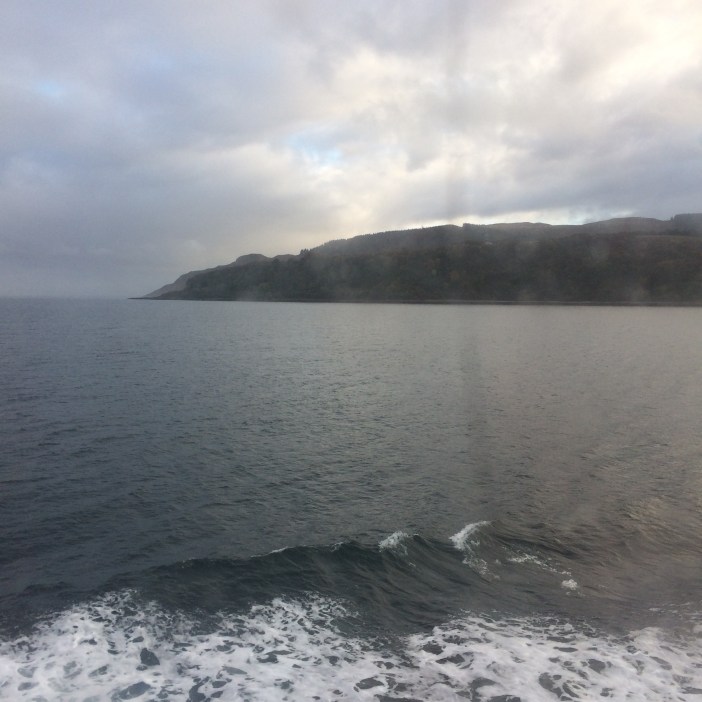
To the best of my memory, I have only ever been on a sailing boat once. Or, I have only been happily in control of a sailing boat once (there was a time we had to try windsurfing in primary school, a time whose details have, thankfully, long been repressed).  It was 2005, I was twelve years old, and had won a competition through the local youth club to go on a sailing trip to Oban. I don’t remember anything about what I must’ve learned regarding sailing, but I do recall a beautiful suite of seafaring terms: a special vocabulary which transformed previously mundane structural features into curious artefacts of mysterious potential: cleat, keel, stem, rudder, transform, tiller, clew, boom, shroud, telltale, jib, winch, deck and spreader. The man in charge was a hardened fisherman type; I don’t recall his name, but we called him the skipper. He was dismayed to learn I was a vegetarian, having packed little in the way of vegetables for our journey. I was happy to live off Ovaltine, jam rolls and digestives for the following days. It was such an odd combination of children—were we still children?—on that trip. No popular kids, but a few of the scarier misbehaviours (probably not okay to still call them neds), the freaks and geeks—then me, wherever I fit in. ‘Goth’, which in the case of my school was generally singular. Somehow, we all bonded rather than fought in the tiny space of that boat.

One boy, who would always be in fights, bullying and hunking his weight around, was so sweet to me. He saw I had eaten barely anything and gave me a whole bar of Cadbury Mint Chocolate, insisting I had all of it. It was such a kind gesture that I remember it still. Everyone was different at sea: softer, more honest. We were willing to admit our social vulnerabilities; there was no-one, no context, to perform for. A boy I’ll call L. opened up to me about his love for 2Pac, and when Coldplay came on the skipper’s stereo (it was their first truly mehhhh album, X&Y), we shared a little rant about how cheesy it was. We ate fruit out of tins, pulled scarves over our faces on deck and watched the coloured houses of Tobermory loom closer. The skipper let us all have a go at the tiller; he told us stories from previous trips, about how the weather had turned nasty and they’d had to pull themselves through miniature hurricanes. I found myself craving the wild mad weather, even as I was shivering in some inadequate waterproof jacket (I have a history of coming ill prepared to such outings). The skipper and I sort of oddly bonded, since I was usually the first one up in the group. He’d put the kettle on and we’d go out on deck to watch the sky. He’d point out things to look for in the cloud patterns, the colours that bloomed on the horizon. It’s this kind of practical knowledge that I thirst for. Chefs talking to me about how to sharpen knives, bake brownies; motorcyclists betraying the secrets to keeping your speed; engineers talking about formulas and team rivalries and how to build a bike wheel. I’m completely incapable of almost anything practical, so it’s always a magic alchemy to me. When people ask what I want to be when I grow up, I say shepherdess, even though I have little idea of what that entails, beyond reading the excellent The Shepherd’s Life by James Rebanks and occasionally listening to The Archers. I think I’d just be content to wander around hills.

Red sky at night, shepherd’s delight…

I awake to steady rainfall, first day of November. I have been thinking a lot about that sailing trip recently, mostly because I’ve been doing writing workshops in Greenock, and the nature of the place as a harbour town has everyone often turning back to boats and fishing topics. I talk to a chef at work about fishing, not because I’m all that interested in fish but because there’s something about its psychology that reminds me of times gone by. Once, I took myself out to Cardross on the train, following the road up to Ardmore to sit on the point which was a good spot for anglers. It was so quiet and still, the beaches strewn with lumps of quartz. I sat there for an hour or so, listening to the steady lap of the estuary, then slowly made my way home, tearing my skin on all the brambles. It had the feeling of a secret, overgrown place. A little out the way, a nest you could curl into: an almost island. I recall those tiny islands on the Swan Pond at Culzean Castle, where we used to leap across to. As a kid, I’d hide among the bamboos and rushes and feel entirely in my own little world. The pathways and grasses were lit with secret creatures, this 12th World I’d created—it was over a decade prior to Pokemon Go, but here I was in my augmented reality. I’d sit up on the top of the stairs reading for as late as possible, imagining that I was on top of a waterfall, and all before me was water cascading instead of carpet. I’d lie upside down and the ceiling became the first planes of a new universe. I’d wake up early and write it all down; but those pages are lost to whatever antique sale of the past stole my youth.

Now I am adult, less governed by diurnal rhythms. I find myself lost in the long bleed of night into day, up far too late in the bewildering recesses of the ocean online, the oceanic internet. Far corners where articles smudge their HEX numbers in true form down the page and I am rubbing my eyes to see beyond light. Time, perhaps, to rehash that old metaphor, surfing the web. Occasionally, some page would bring me crashing back down in the shallows; I’d wake up, ten minutes later, groggy on my keyboard. Press the refresh key. Instagram has me crossing continents at bewildering speed, lost in Moroccan markets, Mauritian beaches and Mexico City. In the depths of some nightclub then the heights of a Highland peak. So many fucking faces. Closeups of homemade cakes, delicious whisky. Memories. Oscillations I can hardly breathe in, watching my thumb make its onward scroll without my direction. The rhythms become flow, become repetition. I need an anchor. It’s been hours and hours and maybe I’m hungry.

On the boat, whose name I have sadly lost, we slept by gender in two separate cabin rooms. They were tiny, low-ceilinged, and we were just a handful of slugs pressed tight in our sleeping bags. It was better than a sleepover, because there was no pressure to stay up all night and we were all too exhausted from the sea air to talk much. I’d close my eyes and feel the steady rock of the boat’s hull as it bobbed on the water. There was a deep throb of something hitting against the walls outside, maybe a buoy or rope; it felt like a heartbeat. Sleeping in many strange places, the floors of friends’ flats and houses, in tents and on trains, I try to revisit that snug tight room where sleep was difficult to separate from consciousness itself. It was all of a darkness. Something Gaston Bachelard says in The Poetics of Space:  ‘We comfort ourselves by reliving memories of protection. Something closed must retain our memories, while leaving them their original value as images.’ There was no mirror in that boat, so all I remember are smells and objects. No sign of my own pale and windswept face. Everything we ate was an old-fashioned brand; it made me think of rationing and traditional values. I wasn’t quite sure what that even meant.

I need an anchor. A place to dock in.

Governed by some primordial instinct, I go to make my dinner around the same time most nights—which happens to be one in the morning. The shipping forecast used to be the last thing on the radio, before a sea of white noise till dawn. When cutting veg, my fingers weak from another long day, I switch on the radio and there are the familiar intonations. I listen as I would a poem or a shopping list, a beautiful litany of place names, nouns, directives. I have no idea what any of it signifies. It’s been a double shift, perhaps, or an extreme stint in the library, a walk across the city. My mind is full of words and sounds, so many conversations. The debris of the day threatens to spill out as a siren’s cry, and how easily I could slump against the kitchen cupboards, wilt upon the floor. Make myself nothing but driftwood, no good turning till morning. But instead I chop veg, listen to the shipping forecast. It’s difficult to think you deserve food, even when your body’s burning for it and you haven’t eaten for hours. But there are so many other things to read or do! You need an anchor, a reason.

The general synopsis at midnight.

Many of my childhood lost afternoons, bleeding to evenings, were spent playing The Legend of Zelda: The Wind Waker on a GameCube I shared with my brother—avoiding the narrative quests and dungeons in favour of epic ventures across that cobalt ocean. What I wanted was that rousing sense of the wind’s spirit, the freedom to glide and find new islands. Whirlpools, tornados and Chtlulu-like creatures hurled me out to stranger lands. It was all so beautifully rendered, an expansive thalassic field of possibility; with each route I was fashioning some lovelorn story for my lonely hero. The ocean has always represented for me some point of erasure where reality dissolves into imagination. I think maybe it’s this perceptive meshing that we need to attune to in order to make sense of the vast scale effects of the Anthropocene. How else to grasp those resonant shockwaves of consequence, whose manifestations often transcend our human grasp of time and space?

Headache, Viking, southwesterly veering. The same refrain, moderate or good. When occasionally poor at times, do I picture the sailors with rain lashing their faces, rising through mist towards mainland? Is that even where they want to head? Rain at times, smooth or slight, variable 3 or 4. The dwelling conditionals; always between, never quite certain. The weather being this immense, elusive flux you can guess at, the way paint might guess at true colour. Cyclonic 4 or 5. In Fitzroy are there storms circling around the bay? Very few of these places could I point to on a map. I like the ambiguity, the fact of their being out there, starring the banks and shores and isles of Britain and beyond: Shannon, Fastnet, the Irish Sea. There’s a sense of being ancient, from Fair Isle to Faeroes.

I went to a talk last week for Sonica Fest where a girl from Fair Isle talked about climate change, how her home island would probably one day be swallowed by the sea. I can’t help picturing a Cocteau Twins song when she says it. She dropped handmade bronze chains in different oceans so you could see the divergent levels of oxidation, relative to saline content. It was beautiful, this abstract material rendering of elemental time. The world rusts differently; we are all objects, exposed to variant weathers. Her name was Vivian Ross-Smith and she talked about ‘islandness’, a project which connects contemporary art practise with locality and tradition. The term for me also conjured some sense of the world as all these archipelagos, whose land mass is slowly being ravaged by warming waters. The pollutants we put in. Islandness betrays our vulnerability, the way we were as 12-year-olds at the mercy of the tides, the weather and our gruff skipper. I had little conception of what climate change was, but even then I didn’t set a division between humankind and nature.

Back on the boat, I traced my own moods in the swirls of those mysterious currents, dipping my fingers in the freezing North Sea. Who are we before puberty, pure in our childish palette of pastel moods? When I think about how that sea spreads out to become the Atlantic, so vast and impossibly deep, I grow a bit nauseous. Maybe that’s the sublime; an endless concatenation of seasickness, feeling your own weakness and smallness in the face of great space, matter, disaster. How easy you too could become debris.

Increasingly, that waltzing Cocteau Twins song feels more like an elegy, haunted by the shrill of soprano, those shoegaze guitars resounding like notes through a cataract. A line from Wordsworth’s  ‘Tintern Abbey’* I always remember, ‘The sounding cataract / Haunted me like a passion’. Interplay between feeling and form, sound and vision. The ocean warming, the beat steady and mesmerising. Are we sleepwalking into the Anthropocene, over and over again, a lurid repetition compulsion? Why we keep burning up fossil fuels, emitting our plumes of carbon, senseless in the face of a terrible sensorium? I crave solid objects that show up the archives of history, those plastiglomerates of Frankenstein geology, the warped materials of the Earth’s slow and drawn-out hurting. Liz Fraser’s operatic howls are maybe the mourning of the land itself, begging to be swallowed by the sea. A saving? If originally we came from water, hatched out of amniotic sacks or evolved from subaquatic origins, then maybe we return to its oceanic expanse, its blue screen of death. When I’m anxious and needing to write furiously, write against the tides of exhaustion or time, I listen to Drexciya—Detroit-based techno that harks back to Plato’s mythology of Atlantis, via Paul Gilroy’s Black Atlantic. There’s this crazed evocation of diaspora, drowning, a mysterious race of merpeople. What evolves below water, what is spawning in the recesses of subculture; what resists the mainstream, the violent currents of everyday life. This subterranean city is a ‘sonic third space’. I can’t help but think of my own other planet, that 12th World separate yet attached to daily reality; somewhere distant but still impossibly intimate. That resonant intensity that drives you from sleep and into midnight discos of the mind, all pulsation of lights, wonder, horror.

There’s a sense that sound itself can be physically embracing. This is maybe how it crosses over into sonic third space, where embedded mythologies flourish in resonant affect. Where sound becomes tangible, making vibrational inscriptions of code upon the body like transient hieroglyphs of an assemblage’s trellising energy. In Tom McCarthy’s novel C (2010), the protagonist Serge is obsessed with hacking the radio to tune into the ether. Alongside the obvious supernatural connotations, there’s a more pressing suggestion that Serge is able to make his entire being become channel for sound. He lays on a ship as I once lay on a boat, listening to the warm stirs, the conversational blips and signals of objects:

The engine noise sounds in his chest. It seems to carry conversations from other parts of the vessel: the deck, perhaps, or possibly the dining room, or maybe even those of its past passengers, still humming through its metal girders, resonating in the enclosed air of its corridors and cabins, shafts and vents. Their cadences rise and fall with the ship’s motion, with such synchronicity that it seems to Serge that he’s rising and falling not so much above the ocean per sea as on and into them: the cadences themselves, their peaks and troughs…

McCarthy’s lyrical clauses accumulate this notion of sound as spreading, seeping into words and orifices, surfaces. Presences, absence. A lilting simultaneity between the movements and pulses of objects. Sound becomes material; is spatialised as cadence, lapping the edge of Serge’s senses with lapidary, enticing effect—always tinged, perhaps, with a lisping hint of danger. The sounds, after all, also evoke the dead. There’s a radio drama by Jonathan Mitchell, where the protagonist has developed a device which allows you to extract sound from wood. There’s the idea that wooden surfaces absorb sounds from their surroundings, and the time and quality of storage depends on the type of wood. It’s a brilliant sci-fi exploration of what would happen ethically if we could extract auditory archives from material surroundings—the problems and possibilities of surveillance, anamnesis and so on. Consequences for human and nonhuman identity, the boundaries between life and death, silence and noise.

https://soundcloud.com/jonathan-mitchell-1/the-extractor

Do the walls hear everything? I think of rotting driftwood, how porous and light it is. How its every indent, line and scar marks some story of the tides, the stones and the sea. Robinson Crusoe, chipping the days away as notches on wood. I think of the hull of that boat, perhaps coated in plastic, sticky with flies and algae.

On the last day of our sailing trip, we were sitting round the table of the cabin, docked in Oban harbour, reading the papers and having a cup of tea. Our youth club leader got a text from a friend back home. She was informing us of the London 7/7 bombings. This was a time prior to having internet on our phones. We weren’t so wirelessly in tune with everything everywhere always. But that little signal, a couple words blipped through the ether, brought the sudden weight of the world crashing back down upon our maritime eden. I had family in London who escaped the attack by the skin of their teeth, a fortuitous decision to take that day a different route. How everything was at once the dread of hypotheticals. I did not understand the vast arterial networks of terror that governed the planet; these things happened in flashbulb moments, their ripple effects making what teachers called history. Somehow it didn’t seem real. Bombs went off all the time on tv; I grew up with the War in Iraq and Afghanistan. Those televised wars were the ambient backdrop to everything on the news. Later, my friends would wile away their teens shooting each other on Call of Duty. It was all logistics, statistics, the spectacle of bodies and explosions. Nobody explained it. We were distracted by MSN Messenger, then those boys with their controllers tuning in and out of conversation, signing online then drifting away into present-absence. X-Box (Live). Signifier: busy. It was good to be away from the telly in the relative quiet of the boat, startled instead by foghorns and seagulls. But even then, we remained connected.

⚓️

The Shipping Forecast has been issued, uninterrupted, since 1867. Its collation of meteorological data provides a map of sorts, a talismanic chart of patterns and movements, currents, pressures, temperatures—something that helps millions of sailors out at sea. I look at such visual charts and truly it boggles me. I prefer grasping such data as sound, delivered in the hypnotic lilt of that voice: its clear diction and poetic pace, calling me home. I think of the west coast, the bluish slate-grey of the sea. Becoming variable, then becoming southerly, rain or showers, moderate or good. Always between things’ becoming, becoming. There’s the pitch-black womb of a cabin again, the childlike promise of dreams and sleep, a genuine rest I’ve forgotten entirely. Listening makes it okay to be again, buoyed up halfway between where I am and where I’ve been. A constellation of elsewheres to placate insomnia’s paranoia; to be in winter’s dark heart or the long nights of summer, endlessly tuning to atmosphere, cyclonic later, slowly veering from the way. My present tense is always eluding, like ‘In Limbo’ with Thom Yorke’s seaward crooning, the morse code of emotion in whirlpool arpeggios, closing and bleeping and droning on a wave far away, the spiralling weather, the fantasy…Another message I can’t read.

*Full title, of course, being ‘Lines Composed a Few Miles above Tintern Abbey, on Revisiting the Banks of the Wye during a Tour, July 13, 1798’.

IMG_2735.jpg

Record Ekphrasis: The Long Ocean

IMG_34162IMG_341611

~ https://thelongocean.bandcamp.com/album/the-long-ocean

There is a struggle, the suspension of hoar frost crusts time itself as it trickles over the sea. At first light we watch for an opening. Even in attics and city bedsits, the sea remains in our blood. We feel it cold as ice at the illness times: how darkly we sink into the sheets, hoping the pain in our skins will dissolve back to lucent matter, the night wisps of somebody else’s aura.

A voice enters soft and lo-fi, filling the interludes that swirl around haunted piano arpeggios, the silver streaks that spill on the ocean’s tides. I am afloat in muted clicks that keep me close to the surface, where the sound echoes in drips, as in a swimming pool. I listen for his voice as it mists the glass of the window. I inhabit that glass in the silence, waiting for some melody to sparkle with any dissonance sufficient to crack my crystal prison. Percussion is slightly hard, a clack, clacking. Crackle. Predictive appearance, seductive. “I’m under your spell / and I’m under under”. Subaquatic passion, staring at the world from beneath, behind, the film of its surface. See how everything shimmers. It’s quantum physics. You can’t peel off the surface of reality, its candy sprinkles, its gilt, to see what darkness and delight lies beneath; you’re already deep under, withdrawing, closing.

There’s the haunted aesthetic we find in Burial. Something more organic, elusive; the rural alternative to Burial’s empty midnight metropolis. On ‘Raindrops’ the muted sound of gulls weaves in and out of a DJ Shadow, Entroducing…..-era riff and the shimmering playful jazz of a brighter piano, a celeste of some sort…the sound of wind chimes through the minuscule ears of insects, so very high-pitched, so very sweet. You can imagine the tinkle of glass as you toast your favourite jellyfish, spirit animal that sucks its seven temporalities tentacular around it, moving them in sweeping undulations that rupture the cyclical moon-time of the waves. You open your flesh to the ocean, every salt crystal forming a bead in your pores. Desire is the fulfilling of absent substance, the spacing of the gap between lack and attainment. The passage of sailing, not knowing what darkness, what deep blue, you are setting off into, heart curved sharp by the cut of a crescent moon.

If Burial is, as Mark Fisher puts it, ‘London after the rave’, The Long Ocean is the abandoned nightclub pavilion, the sea’s dull roar mingling with those shadowy echoes of ecstasy. The slowed-down groans of a former generation’s momentary joy. Angels caught in the sand of an hour glass, being tipped, a largo mode of clock-ticking, grains of time slipping endlessly over the rasp of voices. I set this album to cassette tape, allowing the crackles to augment and mingle. I could be in the murmuring belly of a ship, hearing the rasps of a radio mix with this transcendent, nowhere music. It’s the sound of twilight set to reflections of quartz made bright momentarily by deepwater bioluminescence. What is that whine, that eerie peal? The sound of lost dolphins, the painful song of a lonesome whale? The whale is a heart’s darkness, a shadow-side of waking reality. You can lose yourself inside it, feel dreams close over you, prised from the wax, the oil-black skin.

Four Tet at his most otherworldly. Hypnotic loops, the soft distortion, the natural ambience. I am walking down an abandoned street, where weird green plants sprawl through the smashed-in windows of Brutalist buildings. Night birds chirp the tart remnants of forgotten songs. I am hooked on the wave-like rhythmic pulse of his words. My footsteps echo, down the street, down the passage, down the shallows to the deep where tarmac melts into oil-black sea.

There’s a sense of dark, spreading space, interpenetrated by twinkling scintillations; not unlike the plaza-like ambience of mallsoft and certain variations of vapourwave. Think: diamonds in the tarry pavement, stars reflected on the ebony surface of the midnight sea. A more crystalline James Ferraro, Marble Surf; The Long Ocean swaps those choir-like, ice-cream van speaker crackles for a more precise intricacy of lattice parameters, cross-rhythms of tinkling percussion and soaring, yet always subtle, beats. Think also of something like GOLDEN LIVING ROOM’s New Nostalgia, its eerie shimmers of late night lo-fi mixed with the bright sound files of near-future cyberspace, everything sounding slightly subterranean, that tinniness of dissonance. On The Long Ocean, however, instead of the glitch effects of hardware, the sounds chosen here are derived from natural materials and technics. The hollow click of driftwood, billows of cooling wind, cave-like echoes, the clinking of a necklace of shells with every percussive sprinkle (‘The Crest’). There’s a collector’s sense of amassed trinkets, effortlessly slinking along intricately simple bass-lines, hardened by industrial beats which burn in the weird space between background and foreground. What this music shares with vapourwave is a sense of slow, careful build towards the internal coherence of a detailed and evocative theme. The sadness and the beauty leaves its ghost stains on your brain, tugs at the blood which is full of the sea, makes you want to walk forever, or forever dream—rhythmic, contorted, returning serene.

Some of these tracks are totally devourable jams, the minimal intrusion of sampling giving way to those lusciously percussive beats, twists of lo-fi brass, crooning sexily over the building peal of mysterious beats (‘Gold Dust’). I’m reminded of a video game casino, an interlude space suspended in a three-dimensional, virtual world, where the colours and lights are all for our ersatz pleasure. On an island over an ocean we are sharing expensive littoral whiskies, toasting the way our skin glitters in its vitrics. Soon every vein will resurface, a curious craquelure marking time on the skin. Here we are, vacant, absent, deliciously distant.

Sometimes a roar of white noise, of wind rushing through a tunnel, subtly infiltrates a track (see the end of ‘The Crest’), reminding us that the space we’re inhabiting here is adorned by darkness and distance, is always deferring from itself. There’s definitely that Boards of Canada minimalism, the seamless weaving of samples in a way that seems hazy, reflective, a little haunted. A childlike naivety, a curious innocence; shadowed by the weight of a trembling void.

But there’s also a certain romance, even magic, to this record that I can’t quite pin to anything else. Not in the same way. Maybe it’s something to do with the celestial resonance of much of the track names, from ‘Star Light’ to ‘Gold Dust’ to closing beauty, ‘Stella Maris’. Latin for Star of the Sea, ‘Stella Maris’ is the feminine spirit, a protector who guides the soul at sea. This song is the album’s North Star, guiding us back through the waft and heft of its silvery, elusive currents. It sounds somehow out of time, built around the melancholy minimalism of a piano, sustaining its slow and careful path over the abyss of crackle, the tremors of the underworld, the ocean’s darkest depths. In the ‘Desecration Phrasebook’, a glossary collecting Anthropocene-related words, there’s a word, ‘shadow-time’, for ‘the sense of living in two or more orders of temporal scale simultaneously, an acknowledgement of the multiple out-of-jointnesses provoked by Anthropocene awareness’ (The Bureau of Linguistical Reality). We have to accept we are already living in the end of the world; it’s just that our sense of its time-scale is far beyond human comprehension. The fluid, amniotic ambience of ‘Stella Maris’, coupled with its fin-de-siecle, 1990s-style exploratory piano (think: Aphex Twin, DJ Shadow), creates this haunted sense of dual temporality, of always being on the cusp of something to-come at the same time as being homesick, nostalgic for a dreamland that came before but perhaps never was at all.

There’s something in the way this album romanticises the sea that suggests Glenn Albrecht’s word solastalgia: a form of existential distress caused by environmental change, global warming being the obvious example, as well as coastal erosion and the weather manifestations of climate change. Solastalgia derives from both ‘nostalgia’ and ‘solace’. Whereas nostalgia denotes a feeling of homesickness for a place and time we are no longer present in, solastalgia evokes that sense of distress caused by our home changing as we inhabit it, the affective impact of huge global shifts upon our individual, local experiences of landscape. The Long Ocean doesn’t leave us washed up at the end of the world, but suspended in the glittery salvation of its dark and strange and shimmering beauties. We come close to the weird and the terrifying, the dissonant samples of unrecognisable times, of creatures whose tremors rise up from the deep. Think of the pleasure and slight terror of binaural beats, the sublime understanding of our human insignificance as we gaze at the stars.

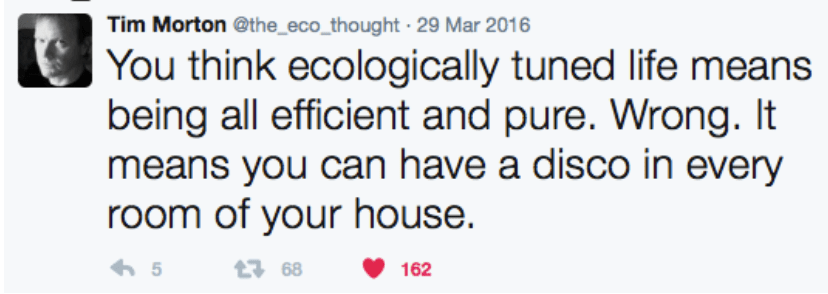
The beauty of an ecological thought is that it doesn’t have to be clogged with guilt, it can create something even lovelier before in its collective, technological and temporal possibilities. What would happen if you filled every room with solar panels, invited the creatures in, suspended your desire forever in those flickering, dancing refractions of light and sound and colour and life?

Screen Shot 2017-04-07 at 13.14.21.png

Green Shoots

tree.jpg

For the third day in a row, Brian looked down while brushing his teeth and saw a tiny green shoot sprouting out of the drain. Only last night, at 2am no less, he had pulled the little fucker out and thrown it down the toilet.

“Miriam!” he shouted to his wife, who no doubt was still curled in bed. “The tree’s back!”

“Mhmh?” Cursing at her lack of interest, he spat out toothpaste and watched how the white foam flecked the two bright leaves of the shoot. Remnants of raisins and granola showered like rubble around it. He turned on both taps and washed it away, but the shoot remained.

On his commute to work, he noticed something was on fire at the side of the motorway. The flames were big, apocalyptic, and when he opened the passenger window the black stench of burning rubber filled his car. There wasn’t a scrapyard round here; there were no reasons to be burning rubber. This was the fucking countryside, not some rustbelt wasteland.

At the office, he turned in the financial reports that were due at 10am. He sat through a meeting which featured the usual pantomime antics of his boss, the kind of man whose entire career is based on imitating the flamboyance of a Disney character while necking enough coffee and bourbon to seem manically on form at every performance.

“What we are building up to,” he announced, “is the ultimate synergy.” His arms flailed back in grand gesture, nearly knocking over the pie chart drawing his assistant had etched on the flip chart. “Capital merging with capital, a clean abstraction, the upward surge of profit. Think of this as MarioKart. How many of you have played MarioKart?” His eyes narrowed as he surveyed his colleagues round the table.

There was much quivering, as only a handful of people raised their hands.

“Well, the chosen few will know what I mean by the Rainbow Road,” he continued. “We’re on that motherfucking Rainbow Road. One veer off and we plunge into space, the black void, and that’s that. So I can’t afford a single mishap, I don’t care what happens. We need to synthesise, synergise, synchronise. You hear me?”

Every week, the boss delivered a near-identical speech; the only thing that changed was the arbitrary cultural reference he dragged up, presumably from the stacks of CDs and video-games in his son’s bedroom.

At this point, the assistant stood up hastily. She was young for the job, a high achiever, reaching for those virtual stars in a pair of vicious heels.

“What we mean,” she said, trying to clarify, “is it’s important not to underestimate green shoots. Those little signs of growth. Shares in petroleum, in plastic, are rising nicely. Not to mention South American superfood angiosperms, part of a wider move towards elite organic harvests. While the economy flounders around us, clinging to the small things is what will help us reach that upward surge.”

“Thank you, Heidi.” The boss shot her an appreciative leer. “Now what the fuck is an angiosperm?”

On his lunch-break, Brian ate a sad desk sandwich with a fellow number-cruncher. The two of them were the runts of the litter, the ones that never got invited to the cloying, marathon lunches the boss often dragged the office out on. This meant they were never in line for promotion, but bore the advantage of letting them avoid the poisonous oysters and chardonnay which often left their colleagues retching all afternoon.

“You know Liam,” Brian mused, “I found a green shoot in my sink the other day. It’s still there, even though I thought I pulled it out.”

“What?” Liam was dim-witted and this was maybe why he never got called out to lunch.

“Like, an actual green shoot. I think it’s getting taller.”

“Maybe God’s trying to tell you something,” Liam said ominously.

Back home that evening, Brian found that the shoot had gotten much taller indeed. So tall that various branches curled out thirstily, wrapping themselves round the taps. Brian shrugged and didn’t bother brushing his teeth that night. He pressed himself into Miriam’s back but realised she was already asleep. It was what, nine o’clock?

He got up very early and left the flat straight away to get to work. The accounts were flying off his desk that morning.

“Good work Ben,” his boss said, floating past the desk, collecting his documents.

“I’m on the upward surge,” Brian nodded.

On his way out the door that night he gave Heidi a contrived and lustful glance. She looked at him with eyebrows raised, but this could mean anything. He decided to drive out to the spot where yesterday he’d seen the flames. It was a pit in the ground, a charred patch of grass gone black. He fancied there was some resemblance to a pie chart, the way the different shades of burnt matter lay, wedge-like, in the circle. He did some rearranging, moving shrivelled plastic and ash and wood chips around until they met satisfactory dimensions.

When he came home with soot all over his hands and face, Miriam said he looked beautiful. She was a Leo and had a thing for fire. He looked into her eyes for the first time in weeks. Her whole body seemed to pause, to start melting right in front of him. The light from the kitchen window made her skin so pale, except for a flash of orange across her face. He was about to kiss her, to fall into the molten mass of her body, when she reached straight for his belt buckle. This was a first.

Afterwards, he went into the bathroom to wash his face. The tree had taken over the entire bathroom. In just a few hours, the little green stems had become proper woven wooden branches. He had to climb over and around them just to take a piss. What came out of him was yellow, dark. The flames were inside him now, and the leaves of the tree shimmered around his body, bathing him in luxurious gold.

“Honey,” he heard Miriam’s voice at the door, glistening with the shrapnel of Heidi’s lisp. He realised he was still clutching his limp penis. “D’you think the world’s ending?”