The Greatest Loss: Lana Del Rey’s Anthropocene Softcore 

Screenshot 2019-09-08 at 11.26.09.png

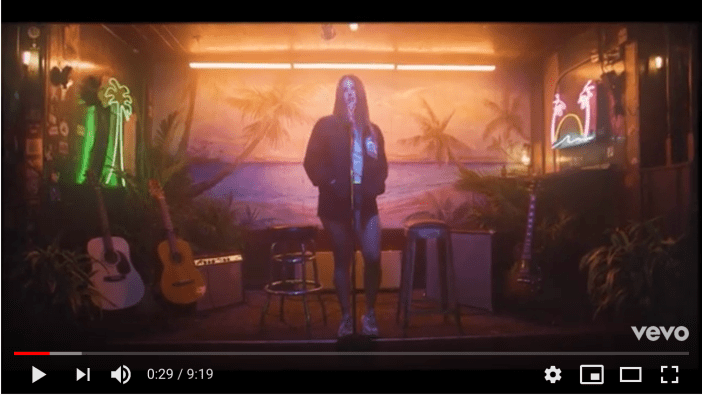
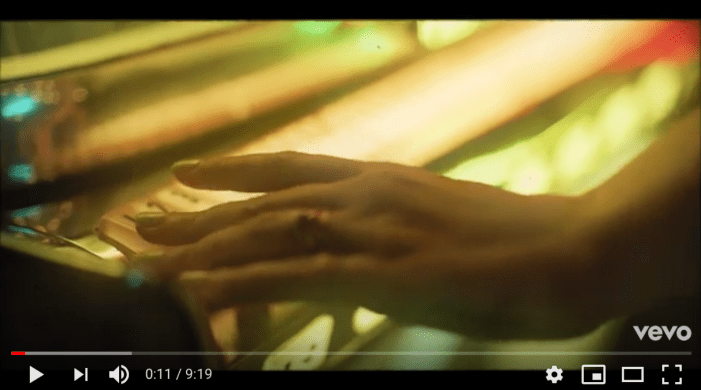
There is a scenario in which the jukebox is equivalent to the poet and some elaborate analogy is to be made between intertextuality and the limited catalogue whose selectional form produces play. The scenario only survives in video. It needs this urge of duration, not to mention the tenderness of a touch. Where fingers brush keys like notes, there is something to add to the story. A social space in demand of ambience; on flickering alongside off. When Lana is alone on stage, hands stuffed into a bomber jacket, singing ‘Fuck it, I love you’, swaying almost nervously, I want to think about what she is doing there and who she is speaking to and from where she is speaking. She is not really speaking but singing. The lone girl on the stage is the open mic dreamer, with nothing but lines. She is scattered across june-dreams of multiple personality: ‘The I which speaks out from only one place is simultaneously everyone’s everywhere; it’s the linguistic mother of rarity but is always also aggressively democratic’ (Riley 2000: 57-58). We mother our solipsism with words but in doing so there’s an opening. So to say fuck it and state the interruption with syncope, sincerity. Lana Del Rey was born on the cusp of Gemini and Cancer season, which more than explains that statement: ‘Fuck it, I love you’. With her sails to the wind. To say it over and smooth into plural refrain, you could even say chorus. For a chorus wants to be shared. It is a commodious mother, fed by the keys of the jukebox baby. There is a constant reversal of nourishing; the democracy of lyric utterance, the milky feed that streams.

Denise Riley argues that any ‘initial “I love you” is barely possible to enunciate without its implicit—however unwilled—claim for reciprocation’ (2000: 23). But what is reciprocation in a song? Is it just the urge to be sung with? And this ‘fuck it’, the pervasive millennial injunction to just be, to move on, as the tag which erases the expectant price of the utterance? Riley argues that I love you ‘must at once circulate as coinage within the relentless economy of utterance as exchange’ (2000: 24), but in a pop song it bears the leaden weight of so many prior expressions. The irony is that to cut through that with a simple fuck it, Lana can attain something like sincerity in the very pop mode whose lineage of commercialised love would surely undermine her feeling. Fuck it, in spite of saying I love you I really do. The pop song becomes this space for the staged epiphany of repeated assurance, I really do. It is a softcore admission of the self in its burning limit. 
Screenshot 2019-09-08 at 11.26.37.png

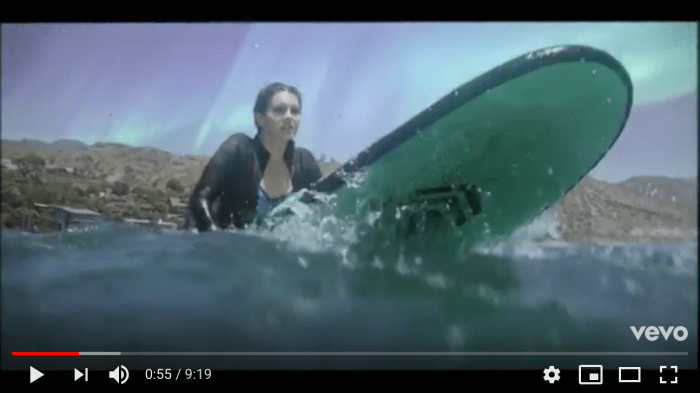
‘Fuck it I love you’ is soaked in lights, but they’re fading. ‘I like to see everything in neon’, is the line that opens the song. To see everything in neon is to fluoresce what is haunted and gone. I think of Sia dragging rainbow dust down her tearful cheeks in the video for ‘The Greatest’ — tragedy’s shimmer as fugitive mark on the body. Lana offers herself up as sugar dust, cliché in honour of Doris Day: ‘Dream a little dream of me / Make me into something sweet’; she acknowledges ‘dancing to a pop song’, but it’s not clear if this is her or the character or the one she loves. ‘Turn the radio on’ could be a reflection or an imperative. The reader is hailed between these positions of love and the loved and the effect is saturating, warm, delirious. Separation is that ‘it’, the spacing. In the video, we watch Lana painting and then suddenly she’s surfing with the aurora borealis in the background. She’s on a swing, her jean shorts caressed by the camera, she’s the sexualised pop icon again. She’s on a surfboard, green-screened, young. She’s choosing a shade of yellow from the palette, singing ‘Killing me slowly’. What is this ‘it’, killing her slowly: 

I’ll return to the unknown part of myself and when I am born shall speak of “he” or “she.” For now, what sustains me is the “that” that is an “it.” To create a being out of oneself is very serious. I am creating myself. And walking in complete darkness in search of ourselves is what we do. It hurts. […] a thing is born that is. Is itself. It is hard as a dry stone. But the core is soft and alive, perishable, perilous it. Life of elementary matter.

(Lispector 2014: 39)

I want slyly to argue that this is a kind of anthropocene existentialism. Recognition of the self as this ‘hard’, ‘dry stone’ thing of geologic mattering, reflexive species. This is what it is to be ‘Human’ right now. And yet the agential spark within, the ‘core’ that is being alive in a world where we have deposited those sedimentary layers. Creating ourselves in the stone, often with the tarnish of the very products we chose and developed to beautify, excoriate and cleanse ourselves, to remain forever young. So there is this oscillating temporality at work between desired infinity and the trace of our fugitive place on earth. The very earth minerals that would ruin humanity, mine our bodies of endless labour. But to go back to the song, with its idea of a gradual dying. I want to call this something like anthropocene softcore: the unnamed presence of species being within Lispector’s slender novel from the early seventies, or the Mamas and the Papas brand of late-sixties ‘sunshine pop’ whose solarity derives from the perishability of that energy, utopian commons, cascade of flowers — that serotonin glow of selves in streams and streams. 

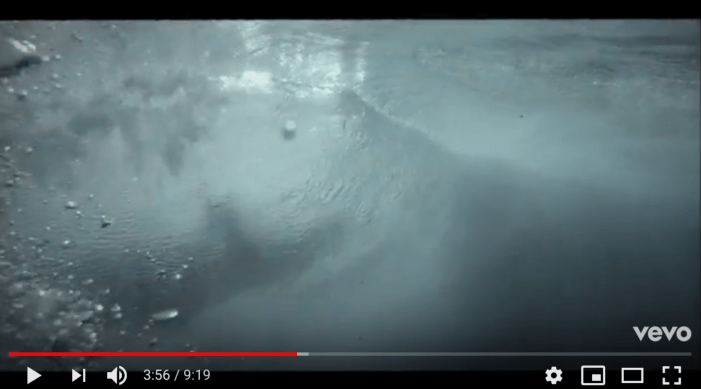
Lana’s anthropocene poetics are not of the hardline, direct call to action. You would not say of her cultural presence, eco-warrior or nature goddess. You would not brand her Miss Anthropocene in a kind of demonic marketing gimmick. You would say most often she is a siren, per se, leisurely supplicating us towards death on the rocks. Desirous flow. This is anthropocene softcore. This is what it is to challenge the act of self-description itself, and in doing so questioning those generalisations that arise from the ‘we’ of humankind, not to mention the ‘I’ of pop’s delectable, mainstream lyric. Alchemically, Clarice Lispector and Lana make of these malleable pronouns the ‘perilous it’. The it, the feeling, the speaking self which is nothing much more than a bundle of affects, sensations, atoms. To be cast over and crested by the wave. Significant that ‘Fuck it I love you’ ends with the rising bubbles of this wave, the one that spills us through the fourth wall and into the studio. This song slams together pop’s saccharine mythos of California as dreamland, a late-summer song as the former was written, surely, for autumn. California: ‘it’s just a state of mind’. She could be talking about the self or the state, or the state of the self. 
Screenshot 2019-09-09 at 20.44.25.png

What happens next? The shot drifts over the cliffs, the coast, to a strip of palms and a distant view of the LA skyline. That shining love in the previous track is replaced by a minor key, a glimpse of the jukebox whose songs include The Eagles, Bon Iver, The National. Artists whose Americana is the melancholy of generations moved from political despair to something like the glitch of the times as a basic fact of intimacy. One of the Bon Iver songs shown in the video is ‘22 (OVER S∞∞N)’, and if that title was not rife with implicit apocalypse, what is, what is. A stammering into language, pitch-shifting the fragile space of utterance. There’s a spiritual glimpse to the sky and the infinite quality of the stars: 

There I find you marked in constellation (two, two)
There isn’t ceiling in our garden
And then I draw an ear on you
So I can speak into the silence
It might be over soon (two, do, two, do, two)

(Bon Iver, ‘22 (OVER S∞∞N)’)

I don’t know what the maths is doing. I don’t want to know that the song ‘was inspired in part by Bon Iver mainman Justin Vernon’s unsuccessful attempt to find himself during a vacation’. I am however interested in the hubris within this term ‘vacation’ at all. Do we now live in a world where you can take ‘time out’? There is nothing of the world we know that could be switched off. There is no ‘away’ of complete erasure or original presence. Deconstruction caught up with our living. Vernon describing this song as a gesture towards what might end of his emptiness could just as easily be flipped: its relief is equal to a mortal sense of loss. The impending erasures. It ‘does’ or acts the accretional event of extinction that is speaking into the silence, to those who could not speak back. 

Fragments and snatches: the neon green lining Lana’s eyes, the aurora borealis, the neon green palm in the club where she sings alone. A season by yourself. The love of the couple together surfing is cardboard, Hollywood. It is a trembling symbol. It is almost ridicule.
Screenshot 2019-09-08 at 10.27.46.png

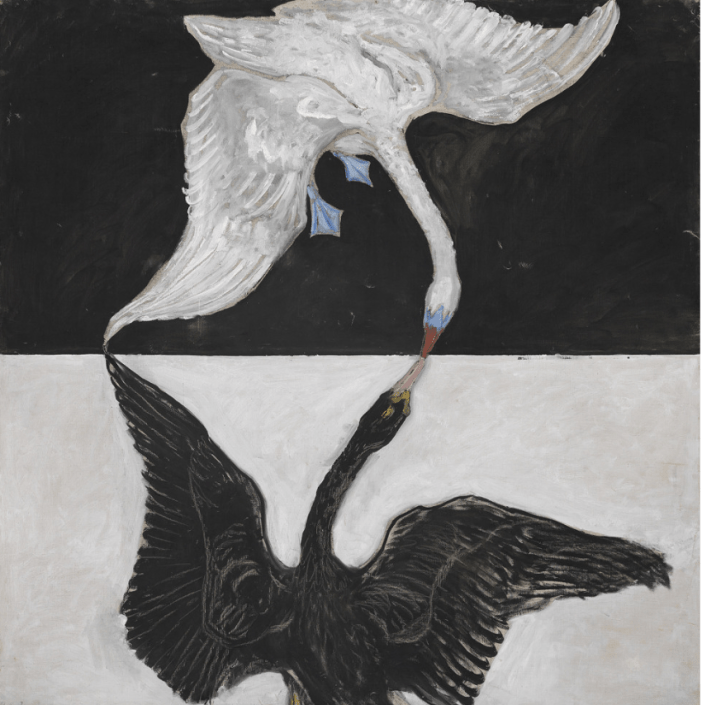
What is Justin Vernon looking for in the constellation? When he sings ‘two two’ I think of Hilma af Klint’s nose-touching swans, or the hours of the day chipped at the edge — two of them stolen by tragic event. I think of a mic check, two, two, ch, ch. Click. Near-enough-presence of speech. A white swan on black background; a black swan on white background. Flip. The swans are geometry, signets of signature, they move towards abstraction. Growth. I love them. Fuck it I love them. The way they are just it. Inversions of colour and a monochrome mood splashed with cornflower blue, the tiny excess we can treasure. It is the cornflower blue, the little webbed feet, which make the swan in question unique. So we can care for it, figuratively as it swells through grey-white waters of memory. The swans we have lost in our shit. Royal iterations freed from belonging. This painting is from af Klint’s series Paintings for the Temple, works derived from spiritual communication. The abstraction of the swan / renders us stark in frame / for we were Lana or Leda / before we were animal. Sufjan Stevens’ ‘Seven Swans’: ‘All of the trees were in light’, ‘a sign in the sky’; ‘My father burned into coal’. And all of our sadness was carbon neutral before this. We plunge into whatever remains of the water, its plasticky thickness.

I keep pausing the video as it transitions. ‘Fuck it I love you’ twinned with ‘The greatest’. When The National sing It’s a terrible love and I’m walking with spiders, what exactly is the ‘quiet company’ of the ‘it’? It could just as well be spiders. Maybe it’s the web itself, the web between the human and the more than human, the gossamer moment where metaphoric articulation becomes more than feeling and gleams material. ‘It’s a terrible love that I’m walking with spiders’ — what is the grammatical transition done by that ‘that’ and who is to blame. Walking with spiders might just be that love. Transitional, subject/object logic is reversed in this song: ‘Wait til the past?’ is sung, then ‘It takes an ocean not to break’ when surely the ocean itself would break you. Soon the ‘terrible love’ is a substance, something ‘I’m walking in’ — to feel it is an act of immersion. It is to let that wave crest over, the ‘lyric auto-explosion’ (Moten 2017: 3) of the wave that would break you. 

In ‘The Greatest’, Cat Power sings of former ambition now cast to nostalgic regret. There is a sense of time slowing to delay, laconic strings, relaxed drums, the balladic sleep of a once-held fault. It is a parade slowing down in the rain. To say ‘Once I wanted to be’ is to hold this question of ‘the greatest’ as a generalised desire itself. The hunger we lose in time, whose primary colours soften. I hold to that precious, cornflower blue of a swan’s foot. ‘Two fists of solid rock / With brains that could explain / Any feeling’. This solid rock that would box you into the future, that would harden the edges of self. A thing is born, as Clarice puts it, ‘hard as as dry stone’. This is the thing born ‘that is’. To exist is to be this hard thing, protein ligament, to kick out in lines; but then in time there is the plasmatic self inside that, like some fatty animal byproduct, sticks to the others it loves, it needs, it leaks. Gelatinous, softly sticky love. The ‘it’ that needs saving. Anthropocene softcore; soapy inside of all geologic agency. Who we are and what we regret. The turning of the outside-in, the inside-out. Kathleen Jamie, in Sightlines, asks: ‘What is it that we’re just not seeing?’ (2012: 37). 

A sightline is a hypothetical line, from someone’s eye to what is seen. Is it clear or blurred, bad or good? Anthropos recedes in its very own scene as the ocean continues and we howl in the dark like a lossy-compressed version of species. We are the sirens and wolves. We are at the great concert of the Earth. We have to resist what Bernard Stiegler calls the ‘proletarianization of the senses’ (2017); we have to find longform ballads of what’s happening, pass them down the line, resist the short-circuiting of thought that occurs between screens and machines. We have to send letters back to our consciousness, our elders and children. This is the work of lyric. It could be the work of dance. I think of Zelda Fitzgerald’s protagonist, Alabama, learning to be a ballerina too late in her life: ‘Her body was so full of static from the constant whip of her work that she could get no clear communication with herself. She said to herself that human beings have no right to fail’ (2001: 180). Alabama barely eats; her energy is all the zeal of will. The dance of lyric as reduction, lack, as static and chased success whose collapse lands as Alabama will eventually do on the event of inevitable break. Grapefruit squeezed on the gritty turmeric shot of the future. And a brake, a screech. And yet we write, we cast out limbs and materials, we work towards this loss; we imbibe it. 

This is an ugly type of writing in which the outside is always imagined from the inside. Horizons are fictional and buildings are barred. I have no sightlines. I’m fucking cutting the corners of someone else’s desire. All paths are the continuation of a pre-existing line. This is a city from which I send myself postcards wherein I wish I was here. Flying letters. Words stolen from myself. I refuse to recognise that I have not composed them unintentionally

(Bolland 2019: 78).

The videos for Lana’s ‘Fuck it I love you’ and ‘The greatest’ swerve between inside and outside. We find ourselves in rooms we don’t remember entering. Writing the anthropocene has an ugly, masturbatory quality of fucking yourself with the rush of elaborate doom. Okay, so. Constructing fortresses of lines which would make a valiant destination. When I listen to Lana, I’m accessing shortcuts to ‘someone else’s desire’ which is the opening up of presence. ‘This is a city’; ‘I wish I was here’. I have never been to LA. We plagiarise our very own diaries to get back that sense of the once-intentional, the greatest declaration on Earth. That we were here, and we loved. She wrote that lit, forgot. The papers curled up and rolled away in a sultry air that was summer, 2012. The year of failed apocalypse, the year Lana released her debut album, Born to Die. We saw her campaign of fashion smoking through plexiglass bus shelters. Remember all ‘horizons are fictional’: they tell a narrative, they bleed and tilt and set like ice. Towards them we stupidly drift: the lived throb of our softcore skins, our hungers and rhythms.
Screenshot 2019-09-09 at 20.44.50.png

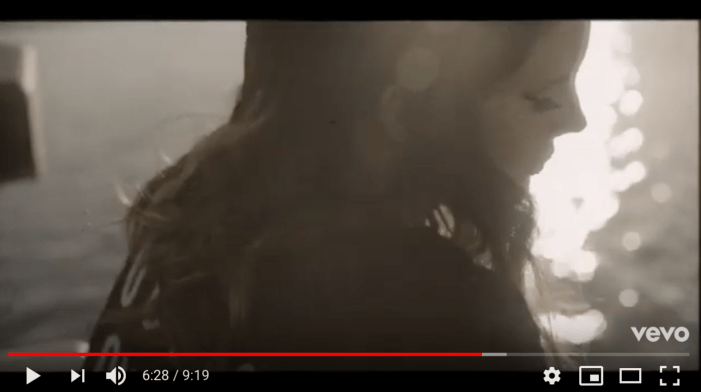
Drifting in colour like H.D.’s Leda, the rape of the land and the body and bodies engendering bodies. Worlds ending around us. And so I could say, but this is just one song, a phrase, a white woman of fame lamenting her world. But this self-conscious cinematics is a gesture towards the western world itself as this haunted, tragic protagonist: ‘The culture is lit and if this is it, I had a ball / I guess that I’m burned out after all’ (‘The greatest’). So you could say, anthropocene softcore speaks to the lyric I in its state of orphaned exception, which in turn is the loss felt by us all unequally. If we make of Lana a sort of anthropocenic siren, we must recognise the distinctions within our longing. For we all lose worlds differently; harm is striated along lines of class, gender, race, ethnicity, geographical distribution — of course. That wave that closes the video could elsewhere be a tsunami. I like to think its place on the edge is a deliberated hint to what could or is even already happening here or elsewhere. And maybe the colour, the aurora, is this streak of need for an excess beyond static blank, ‘human’ planet, standardised canvas; the need to splash something more of blur and blue. Flood the structure. 

When we say something is ‘lit’, we mean it is hot, on fire. We mean it is turned on, ignited, intoxicated, drunk, excellent. Lit is the past simple and past participle of light. Isn’t that line alone just lit? Maybe we are in the twilight of a former Enlightenment, recognising our species hubris as this alien green that tinges every familiar horizon, upsets the normalised green of pastoral. Is it toxicity, the elsewhere within ourselves? It is a radar showing who we are and where we have been. Those material metaphors cook on a smoulder, and this is the softcore coming to knowledge about what is happening.
Screenshot 2019-09-08 at 11.27.08.png

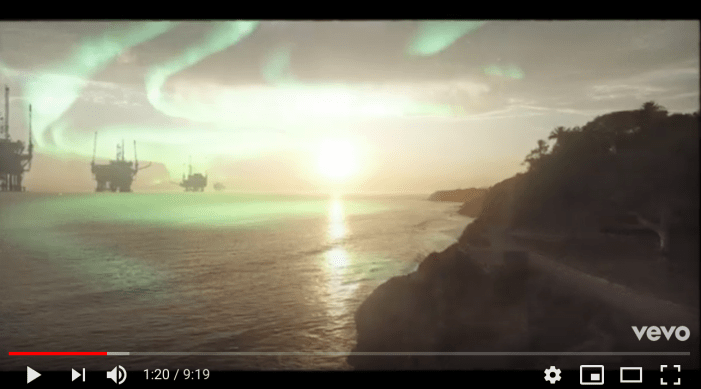
What does it mean to sing: ‘I’m facing the greatest / The greatest loss of them all’. To sing this on the brink of a hyperreal sunset, to chase a solar excess among loss. This loss could be a love but it is more like a culture; it is more like a voice and the condition from which to speak or sing it. The loss of lyric, its possibilities of address, and the loss or deferral or ruination of place itself. Maybe this is Lana’s lyric maturity, a generational acceptance that ‘young and beautiful’ is no longer the apex state of what we should strive for. Absence tenders complexity. Is this, as Roy Scranton puts it, Learning to Die in the Anthropocene? This question of mutability, the green-winged eye that sees a darkening world, a lack of birds along the bay, an edge. In the video for ‘The greatest’, Lana’s jacket reads LOCALS ONLY on the back. I google the phrase and find a hipster restaurant in Toronto with the slogan, LET’s PRETEND THIS NEVER HAPPENED. There’s a kind of parochial nihilism that glisters like the light on the sea, but the sea can never be local only. There’s a boat in the video whose name is WIPEOUT. It’s all happening; the signals are obvious. How we are practicing the absent-presence of the name’s erasure. My tongue gets twisted when I say anthropos; I want to say mess, I fall into ‘guest’ and ‘gesture’. With its glaring cinematics, LA offers the hospitality of light. But it is an exclusionary light. For now, only some of us get lit, get to the mic.
Screenshot 2019-09-09 at 20.46.01.png
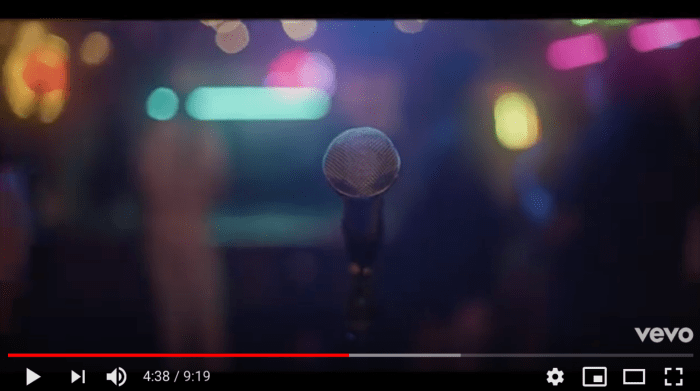
Lana sings from within the metallic architectures of LA’s coastal infrastructure, the port. In the bar, she throws a dart and misses her target by a nonchalant smidge, knocks the 8-ball towards its pocket. I keep thinking about exports and imports, what we put out, take in and trade. Economies of luck and depth and surface. Maybe Lana is a hydrofeminist, her soaring lyric gesture recalling a hauntology of America as that dreamscape of what lies beyond or in the deep. And now we know it is further extinction, precarity, hardened borders. What do we do with that looming closure? Lana has shrugged off her jacket now, she’s smoking in the kitchen where the lid slides off the pan to let the steam out. I’m not saying we’re sitting on a pressure cooker here. There’s simply work to do, mouths to feed, ears to fill. This is a ballad, a paean to the transient, fragile beauty of everything. The songs shown again on the jukebox are songs of a type of blues specific to oceanic or cosmic consciousness, to hunger, the time of lost summer or that of a broken love:

Janis Joplin — ‘Kozmic Blues’

Dennis Wilson — ‘Pacific Ocean Blue’

Sublime — ‘Doin’ Time’ 

David Bowie — ‘Ashes to Ashes’

Jeff Buckley — ‘Last Goodbye’

Leonard Cohen — ‘Chelsea Hotel #2’

I’ve spoken before of what ‘anthropocene sadcore’ might look like in poetry. I’m still working through that. It comes from the common phrase used to describe Lana’s music, ‘Hollywood sadcore’. I’m interested in how that emphasis on mediation, transmission and cinema plays out in our understanding of ecological emergency, but more generally the existential condition of the anthropocene, which places us as geologic agents under the generalised, gendered rubric of Man. Maybe Anna Tsing’s feminist work on the ‘patchy Anthropocene’ could be applied to the cut scenes of a glossy Los Angeles caught on video. A patch is also a software update, where comprised code is ‘patched’ into the code of an executable program. Maybe the patchy anthropocene involves this kind of cultural patchwork: the lament to a love or a culture is patched to include this bug of ecological consciousness — the patch is a kind of coded pharmakon, poison and cure for apocalypse blues. But Lana paints in shades of yellow too. Blue and yellow making aurora borealis green. A cosmic gesture to what lies beyond thought. And what of those oil rigs in the distance, glistening. They form an audience to the siren’s lament; they are part of this story, and we are mutually complicit. Where the magnetism of the male gaze is often part of Lana’s canon, here it is mostly replaced by oil rigs — supplementary Man as the infrastructure of anthropos, looking back at its melancholic, warning siren. Softcore is less affective than sadcore; it is the ambient hum of climax coming. Its cousin is the slowcore, luminous melancholia of a band like Red House Painters, perhaps: Purple nights and yellow days / Neon signs and silver lakes / LA took a part of me / LA gave this gift to me’. 
Screenshot 2019-09-09 at 20.43.42.png

In Bluets (2009), Maggie Nelson writes of a restaurant she used to work in, where the walls were ‘incredibly orange’. After each shift, collapsing exhausted in her own home, ‘the dining room’ of the restaurant ‘reappeared in my dreams as pale blue’:

For quite some time I thought this was luck, or wish fulfilment— naturally my dreams would convert everything to blue, because of my love for the colour. But now I realise that it was more likely the result of spending ten hours or more staring at saturated orange, blue’s spectral opposite. 

(Nelson 2009: 43)

Orange and blue, water and flame. The mind’s alchemical transformations reveal the way colour works chiastically upon us. I think of Freud’s mystic writing pad, the waxen surface of memories allowing for palimpsest versions of stories that trace and erase. ‘This is a simple story’, Nelson writes, ‘but it spooks me, insofar as it reminds me that the eye is simply a recorder, with or without our will. Perhaps the same could be said of the heart’ (2009: 43). ‘Fuck it I love you’, sung to the blue-orange wall until something comes off that surface like a static or fizz. Irn bru, ironed blue. There is quinine in my dreams of hungover labour. Surely there is a violence to this particular love, that is staring, necessary. The love of what must be limitless hurts.

Screenshot 2019-09-08 at 11.27.23.png

Janis Joplin’s ‘Kozmic Blues’ rises to a swell, a jostling of guitar licks and urgent, assured vocals. A sonic thickening. ‘So mastered by the brute blood of the air’, H.D. writes in ‘Leda and the Swan’. Held in that vascular shudder that acclimatises to a manmade world, what happens next is a loosening, a shimmer, a shrug of the garment. In the poem or song, in the painting or film, in the collapse of that wave into a bluer future. To incur a kind of erosion and yet live on in those terminals. ‘There’s a fire inside of everyone of us’, Joplin sings, and I think not of flames but of cinders. ‘At what temperature do words burst into flame?’, asks Ned Lukacher in the introduction to Derrida’s Cinders (1987), ‘Is language itself what remains of a burning? Is language the effect of an inner vibration, an effect of light and heat upon certain kinds of matter?’ (Lukacher 1987: 3). I know if I did not write I would smoke. These acts of temporality in its material extinguishing. What makes the remembered restaurant blue, not orange, is something of this transmogrified smoulder — an inversion akin to af Klint’s swans, demanding that splash of blue. When I write, am I pursuing the absent space of that skyward blue?Blue is the colour of the planet from the view above, Lana swoons in a song (‘Beautiful People Beautiful Problems’) from her previous album, Lust for Life (2017). But in Norman Fucking Rockwell, Lana’s California album for 2019, it’s less of this ‘above’ we see. We are held within the infrastructure, cinema, the end of summer. The dreamlike logic of How did she get on that boat? When did she enter that room? Who put that song on the jukebox, baby?

I want to say:

It takes an ocean not to break a planet.
It takes not a planet to break a species. 

Lana’s voice grows wispier as she sings of that burnout. There’s this imperative that okay we could enjoy this with American flags, we could pour communal Jack and go down in flames. We could riff the history of our culture in archives of song, gestures and nods of reference. Ladies of the Canyon, Cinnamon Girl, Norman Fucking Rockwell. We could keep laughing or dancing while the world is or was at war. Lana is both behind and at the bar, the sightline of where we go to be ‘served’. Intoxication is the order of the day and we call it ‘fun’ to put the fucking of other people’s desires under erasure, strikeout, as Bolland does.

If this is it, I’m signing off
Miss doing nothing, the most of all
Oh I just missed a fireball
L.A. is in flames, it’s getting hot
Kanye West is blond and gone
“Life on Mars” ain’t just a song
Oh, the lifestream’s almost on

(Lana Del Rey, ‘The greatest’)

Miss doing nothing’: post-recessional ennui becomes the paradoxical happiness of living in static, not working as a kind of work that resists the future as set out by capitalist horizons of accumulation. We used to just ‘hang out’ and several other dreams of youthful nostalgia. Kids of today can’t even touch that innocence. We know so much; maybe or probably they know more. We are all variously entranced by the softcore unfold of this happening; we are all variously called upon to be complicit, to recycle, act, resist. To speak or not-speak. To be in one of many different levels of rising heat. The conditional state of being’s value, ‘If this is it’, in the anthropocene raises its pitch to a charge. To sign off is a form of surrender that gives up the name for the blur of species. I think of Lars von Trier’s Melancholia, the planet that would smash us and yet somehow Lana dodges it, that

The audience in the bar where she sings are mostly men, but their gaze is not sexual, as in much of Lana’s prior visual oeuvre. Rather, their longing gaze, often filtered through further glass, is something like the profound melancholy of a multi-generational sense of this loss. These old men have lost the planet, the one they grew up with, just like Lana’s siren, come from some other time, a life ahead of her steered by the changing climate, the hurt and vengeful seas. The camera holds close ups on their staring faces. The song holds the long durée of a loss that spans generations, damages and is damaged by elders, sparks in the present-tense of cultural tendency. In Lana these men look to a future hurt whose cause was partly theirs, as inheritors of industry: she is both victim and heroine, singing and swinging. The shot opens out to reveal her smiling with younger friends, her own generation. These intimacies are what we have left. The next shot shows some kind of factory or refinery leaking smog into a cloudy, overcast skyline, sulphured yellow. Once again the boat appears with its title, WIPEOUT. Lana is supine on the bow at sunset. She is golden, angelic, silhouette. It’s like she missed the fireball but melted it, cooked it up for tea, apocalypse syrup. Things are going down around us. She hugs her arms, later standing, laughing with a dreamlike intimation of imagined elsewhere, closing her eyes. Be hospitable to yourself and others. The reel of the jukebox keeps ever turning: this is our ever faith in culture. We have to take care of what’s left in whatever space we can make of song, duration. 

But the mainstream disciples and idols of Hollywood are failing, Kanye West is ‘gone’. Surely a reference to Elon Musk’s plans to save us by colonising Mars, ‘“Life on Mars” ain’t just a song’ is sung with a melancholy matter-of-factness, a kind of sigh which implies the banality of techno-utopia in a time of extinction. The thrill of such dreams is lost now. We lost our faith in Hollywood, lost our faith in the movies and the scale of those solutions. In a world without books, we’d be ‘bound to that summer’, addicted to one of many narcissistic ‘counterfeit[s]’ to make love to nightly in futile repetition — that would be, as Weyes Blood sings, the ‘Movies’. 
Screenshot 2019-09-08 at 16.56.01.png

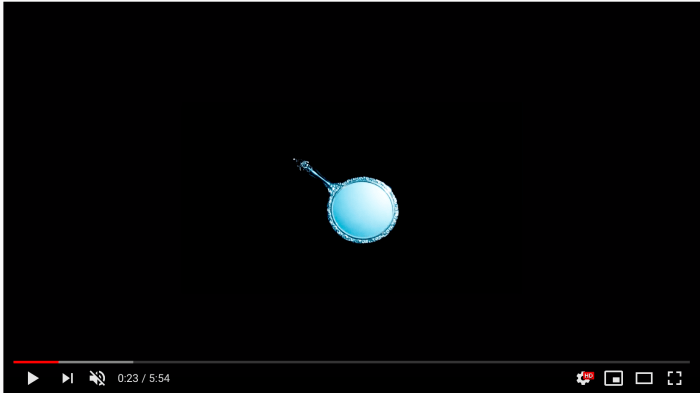
What we look back with: 

The trauma is not, in the Freudian lexicon, this or that violation from the world (such as war), but the ill and trauma of this originary installation of “the cave”—what could properly be called the cin-anthropocene epoch, particularly given that the era of modern cinema is to be regarded merely as an episode: that of the machinal exteriorization of the cinematic apparatus, given that it coincides with the era of oil (artefacted “light”), given that its arc coincides with that hyperconsumptive acceleration leading to mass extinction events, ecocide, and an emerging politics of (managed) extinction

(Cohen 2017: 246)

The trauma of greatness as such is this accelerated promise of the dream, the event, capitalist growth, the movie itself — whose imperative is towards scene, closure, episodic narrative in demand of the next. But the drinks in this video are barely drunk; they are more like props. Everyone is aware of their place in the tableau vivant of the anthropocene, even in its softcore, consumerist pop expression: the iconography of oil rigs, downbeat affect and intergenerational longing. Not a violation from the world so much as the stream, and where its accumulative logic would eventually come to crisis, even as corporations beyond our imagining were already plotting that logic of a break within archival excess: the feverish incineration of the present, the smoulder and melt that smogs and spreads and streams. 

Fire is there or it is not there. […] But surely there is a word for that moment when a fire log, beneath its bark, has become one immanent ember, winking like a City or a circuit board; for that moment when you know only the desire, no, the need to stir it up. What is on fire, you ask yourself, staring into that waiting. What is that moment. What is that word. 

(Lennon 2003: 434)

The nights ‘on fire’ that Lana sings of are those of the Beach Boys, reprieve of the sixties; the bar on Long Beach that served as a ‘last stop’ before the tiny island retreat of Kokomo. Frank O’Hara died on Fire Island. Fire is presence or absence, but there is a moment before it is both. A slippage between the extinct and extinguished. And the world was lit up as before. I wonder if the word Brian Lennon looks for is simply ‘sleep’, the title of his essay which I first read in John D’Agata’s anthology, The Next American Essay — with intimations of that Lana song, ‘The Next Best American Record’. What is with America and the positioning of the next. A constant state of pressurised imminence that streams and streams: ‘We lost track of space / We lost track of time’ (‘The Next Best American Record’). We sleep into death or spirit. My first legal drink was a fireball whisky, in a pub by the sea they built in a church. That moment when you know only the ‘need to stir it up’, fanning the flames. That impulse towards blitz feels extra political in these contexts. We need something of relief that would stream, and in that flow be more than a question. Something of cinders, drifting. 

In Lana’s song, I’m interested in this word ‘lifestream’, which seems like a slippage from the more familiar internet-lingo, the ‘livestream’: the coming live that seems provisional to digital retro-future, the promise of satellites beaming the present, simultaneously. Lifestream, instead, is a vascular imaginary of bodies flowing together. ‘LifeStream’ is actually the name of a blood bank serving the Inland Empire and its surrounding areas. Lifestreaming is, Wikipedia tells me, ‘the act of documenting and sharing aspects of one’s daily social experiences online’. It is the flow of the timeline, akin to the wall, the blogroll, the feed. But here, at the end of the song, the promise of information’s overflow is in a liminal state — ‘almost on’. Extinction’s monetised data cast as the simultaneity of thick presence spread by millioning participants. We are here and we said something, our words were atoms, splashes of blue. We stream towards a life, cut ourselves short on the fragments of others’ desires. Mortality’s softcore contingent. The fear of missing out is assuaged by the narcotising work of cinema. And if this is it, Lana has already signed off. It’s something more like her spirit that’s here for us, the stream of an echo, fold of a song that we could replay, continue voicing. Hope lies in the circadian rhythm, the lived time of a pause in the anthropocene’s ceaseless, cinematic duration — that which we see and drown our hearts in. As Jean Rhys’ drunken, depressed protagonist of Good Morning, Midnight (1939 – the year WWII began) muses, ‘Well, sometimes it’s a fine day, isn’t it? Sometimes the skies are blue. Sometimes the air is light, easy to breathe. And there is always tomorrow….’ (Rhys 2000: 121). And what if tomorrow was the greatest loss of them all? 

~

Screenshot 2019-09-08 at 11.56.26.png

All screen grabs taken from here (Director: Rich Lee) and here (Director: Natalie Mering). 

~

Works Cited: 

Bolland, Emma, 2019. Over, In, and Under (Manchester: Dostoyevsky Wannabe). 

Cohen, Tom, 2017. ‘Arche-Cinema and the Politics of Extinction’, boundary 2, Vol. 44, No. 1, pp. 239-265.

Fitzgerald, Zelda, 2001. Save Me the Waltz (London: Vintage). 

Jamie, Kathleen, 2012. Sightlines (London: Sort of Books). 

Lennon, Brian, 2003. ‘Sleep’, The Next American Essay, ed. by John D’Agata, (Minneapolis: Gray Wolf Press), pp. 427-234.

Lispector, Clarice, 2014. Agua Viva (London: Penguin). 

Lukacher, Ned, 1987. ‘Introduction: Mourning Becomes Telepathy’, Cinders, trans. by Ned Lukacher, (Lincoln: University of Nebraska Press), pp. 1-18. 

Moten, Fred, 2017. Black and Blur (consent not to be a single being) (Durham: Duke University Press). 

Nelson, Maggie, 2009. Bluets (Seattle: Wave Books). 

Rhys, Jean, 2000. Good Morning, Midnight (London: Penguin). 

Riley, Denise, 2000. The Words of Selves: Identification: Solidarity, Irony (Stanford: Stanford University Press). 

Scranton, Roy, 2015. Learning to Die in the Anthropocene: Reflections on the End of a Civilisation (San Francisco: City Lights Books).

Stiegler, Bernard, 2017. ‘The Proletarianization of Sensibility’, boundary 2, Vol. 44, No,. 1, pp. 5-18. 

 

Roseability

Disclaimer: my middle name is Rose. This means nothing, as far as I’m aware. I have never received roses for Valentines (as far as I’m aware). What follows comprises an essay on what a rose is a song is a word is a rose(?), feat. the likes of Gertrude Stein, Idlewild, Oscar Wilde, Joyce, Yeats, the French Symbolists and Lana Del Rey…

🌹🌹🌹

Despite having two degrees in literary studies, a lot of my more convincing intellectual references were first encountered through music, not books. The Manic Street Preachers’ Holy Bible album introduced me to Foucault, Plath, Ballard, Nietzsche, Mailer and Pinter in one fell, aggressive swoop of a Richey Edwards lyric barked over the guttural shudder of Nicky Wire’s bass-lines. Gertrude Stein, the awkward goddess of modernism, first came to me via an Idlewild song—deep in some distant vestige of the noughties, when I still bought CDs. She’s mentioned in ‘Roseability’, the last single to be taken from the band’s 2000 breakthrough, 100 Broken Windows. It’s a typically angsty track, reflecting on the futility of being dissatisfied with the present and finding pathetic solace in the past: “stop looking through scrapbooks and photograph albums / because I know they won’t teach you what you don’t already know”. Say it and already you know, right? ‘Roseability’, like ‘Idlewild’, is a compound word, a mashing of nouns that seems to promise deep meaning as its very premise. But where is it pointing us? What of Stein and what of her roses?

Stein’s famous quote on roses, ‘Rose is a rose is a rose is a rose’, seems to do two things. Firstly, it indicates an essentialist perspective on semantics—circularity conveying the uselessness of further description. Secondly, it enacts a qualitative echo chamber by which the reader must question what constitutes this essence, this roseness which is the rose’s identity. The repetition suggests the elusiveness of this essence, deferring with dreamy assertion—the kind of beautiful aphorism you might coin on an acid trip, completely sure of your own new logic. There’s a sense, with every ‘rose’, of meaning’s possibility blooming. You want to wrap the sentence in a circle (as Stein did, selling the phrase on plates) and close a precious loop, devoid of full stops and fixed meanings. Is a rose a rose or the space between a rose and what a rose is? Swap Saussurian triangles for sweet hips and sepals, a new rose budding in the roots. Lose all fixity for the chance trellising of structure, turn attention to sunlight, rainfall, temperature and other environmental conditions. Acquire tautologies and promise of spring. A rose is a whorl, a loop; a delicate head so heady with beauty. Humans like roses share beds sometimes. Look too long into the corolla and maybe you’ll lose your mind.

Idlewild: the secluded meeting place in L. M. Montgomery’s 1908 novel, Anne of Green Gables
Idlewild: the original name of John F. Kennedy International Airport in NYC
Idlewild: to idle wildly; to wildly idle; to idly go wilding.

You’ll always be, dissatisfied.” Perhaps the mere act of flicking through memories is a form of idle wilding. Making a wilderness of memory’s stasis. Depart only at airports; dwell between continental impressions of kisses.

100 Broken Windows marks a turn in Idlewild’s direction: from their 1990s brit-pop/punk roots to a more spacious, ambitious sound, influenced by the likes of The Smiths, The Wedding Present and R.E.M. When I first started listening to Idlewild, 12 or more years ago in those tender, pre-adolescent times, I sort of filed them as the Scottish version of Ash: they had that punk sensibility coloured by stadium choruses and a cheeky pop strain that balanced the anxious lamenting aspects. All sincerity, sure, but the lyrics were sharp enough to lift them from the sentimental pitfalls of subsequent contemporaries—the end of alt. history that was ‘Hey There Delilah’. Here we move into screaming emo or post-hardcore as inherent hauntology of the fuzzy rock club: the bourbon and sweat, the greasy hair, the frank, shuffling indifference of stoner punters. There were words that smouldered, sparked, then extinguished in the wind; but Idlewild had something different, a primitive attunement to human sorrow that cut through the gum-snapping cool of postmodern irony games, even as its affect blew up in a drumbeat or solo, the loquacious, Michael Stipe angst of Roddy Woomble’s voice. Think sonorous violins and a solid rock chorus, all the energy and wit being typically Scottish. Like the Manics before them, Idlewild did punk and guitar pop, did the stylised mosh and generic fusion, did the political and personal. The millennial malaise in their songs was very much of the times even as it seemed already tired of them:

It’s a better way to feel
When you’re not real, you’re postmodern (It’s not that one
dimensional, it’s not the only thought)

Cut out all feeling, except wait. There’s more. We don’t have to languish in the paralysing grunge of the nineties. The drama of strings would grace each melody electric and maybe you’ll find historic truth in this plugged-in homage to folk turned  on its head. If postmodernism is a Mobius strip of self-referentiality, that recursive collapse of linear progress (figured as a Scalextric set in the video for Idlewild’s ‘These Wooden Ideas’), then how to find meaning again, to find sense at all? Stand in a doorway and find yourself blasted with void fill, flick grapes in a wastebasket, count up your demons for the old stoned longing. Shrivel like raisins. The turn of the century has already happened, but maybe if you surrender to the chorus you’ll feel less jaded. There’s a reassurance. The thing about choruses, after all, is that they repeat.

As it does with choruses, algorithms and perennial blooms, repetition happens a lot in Tender Buttons, Stein’s infamously cluttered collection of prose poetics. With repetition and modulation, a queering of standard grammar, everyday objects become less the tools which underpin human existence, and instead things in themselves—the wasteful artefacts in excess of definition. Paratactical, concatenating assemblages which entangle like vines or else accumulate. Grapes on the carpet, styrofoam littering the floor, a word or two oozing through the backdoor…Am I far too close to the things I mistrust? Maybe there is always a stammering, a stilted stilling. I buy roses for the restaurant in which I work and the very act drags me into heteronormative time: the time of expensive dates, birthdays, weddings, funerals, candlelit dinners. What preference for the deep, luxurious, elusive bloom? Must lovers cut their tongues on thorns? I wonder, do those erect stems contribute their strange teleology…to what, to what…are roses always in excess of themselves—showering petals, shedding, being ever so much just roses?

I stopped and waited for progress”. Back in the day (2005), the NME rated Idlewild ‘a stolid group of trad guitar manglers’, whose new single ‘Roseability’ served ‘both as a rabbit-punch to the head of agnostics and a celebratory three-and-a-half minutes of safe, predictable, wholly generic, utterly brilliant rock ‘n’ roll.’ It makes me dewy-eyed to remember the magazine’s honest, scathing days. That insouciant, throwaway cool. Music criticism was pretty brutal when I grew up, and you basically had to tick every indie rock’n’roll formula (hello Alex Turner: snake-hips, haircut etc) to get consistently decent reviews. Or you could nail the attention on some eccentricity (The Horrors), or perhaps mediocre throwback to rock’n’roll times gone by (need I name every white boy indie suspect circa 2007). ‘Roseability’ is how it feels to be in your twenties, surrounded by people looking backwards; not quite in anger, but in nostalgia. It’s been a long time since I’ve considered something new as ‘utterly brilliant rock ’n’ roll’ in the transcendent sort of way Idlewild pull off—hardcore guitars, thrashing drums, literary references and all. Sweetness and thorns. Uneasy noise secretion. Tip your hat at tradition and then blast through the chorus, scatter your petals to cover the seams. What words in ‘Sacred Emily’ follow the roses? ‘Loveliness extreme’. I miss the NME, I miss being young enough to get lost this easily.

To veer into Idlewild itself, let’s wallow in passages from Anne of Green Gables:

You know that little piece of land across the brook that runs up between our farm and Mr. Barry’s. It belongs to Mr. William Bell, and right in the corner there is a little ring of white birch trees–the most romantic spot, Marilla. Diana and I have our playhouse there. We call it Idlewild. Isn’t that a poetical name? I assure you it took me some time to think it out. I stayed awake nearly a whole night before I invented it. Then, just as I was dropping off to sleep, it came like an inspiration. Diana was enraptured when she heard it. We have got our house fixed up elegantly. You must come and see it, Marilla–won’t you? We have great big stones, all covered with moss, for seats, and boards from tree to tree for shelves. And we have all our dishes on them. Of course, they’re all broken but it’s the easiest thing in the world to imagine that they are whole.

That endearing, childish hyperbole, the absolute thrill of invention. The special grove in a ring of white birch trees, heart of the circle, the rose’s secret pistil. Place of germination. Fragments congeal as expansive imaginings, disappointment evaporates in hope.

Gertrude Stein said that’s enough”. I’m not quite sure how Roddy Woomble, Idlewild’s lead singer, intended the Stein namedrop, but I take it as a reference to her poems’ weird loops of recursion. In the video for ‘Roseability’, Stein’s portraits are hung up all over the room; her face is even on the front of the kick drum, looking all knowing and stately. The video’s aesthetic has the feel of a 90s television set, all pop art circles whose colour has faded, sharp swivelling camera angles and hair swishes. The pop iconography of teenagers flooding the room with their plastic bracelets, braided hair and awkward moshing. It would be totally American if not painfully, most Britishly sincere—I mean just look at how the guitarist crushes into his own instrument, how Woomble wipes sweat off his face, paces around with the mic so close it could feel his breath. Loveliness extreme. When this was released, I wasn’t even a teenager. When I finally see him live, it’s in a church hall in Maryhill 2k17 and it’s utterly beautiful: how generous the set-list, how gracious a frontman with his small-talk and nods to the band, his thank yous. Watching the kids in the ‘Roseability’ video recreates that weird oscillation between feeling old and seeing in their faces the bizarreness of MTV ennui: the ghost of what I would temporarily become at thirteen, fourteen; cladding myself in discount Tammy girl, then Topshop, dying my hair pink and donning studded collars. With the hormones, you lose that ecstatic childhood imaginary hope; desire is amorphous and endlessly droning. You close your eyes and it seems the world has already ended. Sometimes it comes back, sometimes not. Maybe roseability simply means innocence.

‘Mrs. Dalloway said she would buy the flowers herself’ (Woolf). But customers rarely do. It’s up to me to ornament a room, to flourish a mood, to mark some milestone in another life that’s not mine, whose linearity’s not mine.

My mother bought rose-coloured roses for my eighteenth birthday, blush pink. Red when I turned twenty-one. I stopped acting sweet and rosy, dyed my hair red too. Fell through the whorls, the plush abyss.

‘Roseability’: the ability to be of roses, for roses to exist? Sensibility is, according to my laptop’s built-in dictionary, ‘the quality of being able to appreciate and respond to complex emotional or aesthetic influences; sensitivity’. Does roseability denote a similar sensitivity? When we think of roses we think often of Englishness: that angelic Laura Marling figure, a garlanded Bronte heroin, Paul Weller’s ‘English Rose’. We think tenderness, pastoral, a certain enclosure (marriage, gardens?) and guaranteed loveliness. She who coils golden hair round her porcelain finger, who knows how to talk to sheepdogs, who paints watercolours of the dawn. We think Shakespeare—‘a rose by any name would smell as sweet’. But we also think north of the border, a little bit of the visceral made kitsch: Robert Burns’ ‘my love is like a red, red rose’, whose unfortunate fate is to garnish every dishtowel bought on your granny’s last visit to Alloway (Roddy Woomble, perhaps not incidentally, is also an Ayrshire lad). The faint rose scent in a golden cologne, mingled with tobacco; the glistering sweetness of a youthful, drugstore perfume. Roses are roses, but roses are so many things, are poised on the lips of also…

The rose is a complex flower, a perennial whose species number over 100. Roses are typically ornamental, grown by those who know what cultivation means and spend their Septembers clipping away the thorny remains. An old man round the corner from my flat is out in all weathers among soil and stem: grafting, trimming, tilling for his roses. Perhaps he loves them more than his children. In summer, walking home on warm evenings you can smell them in the pale ambrosial air, a delicate bounty. If properly cared for, roses can live a long time, perhaps over and over, perhaps forever…what exactly does perennial mean?

The appropriately named Bloom, in James Joyce’s Ulysses, stands on Cumberland Street and opens a letter from Martha Clifford—a woman who responded to his newspaper ad requesting a typist. The Dublin postal system facilitates a sort of illicit exchange between them. Half-rhyme, consonance: petal/letter. The delicate thrill of letterly infidelity. She wants to know ‘what kind of perfume does your wife use’; the animal possession of scent. She attaches to her letter a flower, slightly crushed:

He tore the flower gravely from its pinhold smelt its almost no smell and placed it in his heart pocket. […] walking slowly forward he read the letter again, murmuring here and there a word. Angry tulips with you darling manflower punish your cactus if you don’t please poor forgetmenot how I long violets to dear roses when we soon anemone meet all naughty nightstalk wife Martha’s perfume. […] Fingering still the letter in his pocket he drew the pin out of it. […] Out of her clothes somewhere: pinned together. Queer the number of pins they always have. No roses without thorns.

So many compound words, clustering in the mouth like so many attaché petals peeled off from a dress. He plucks them away, fingers the soft excitement of words: ‘naughty nightstalk wife’ with the luridly alliterative twist of fantasy. Libido vs. loss of life. What slips away with the pin? What does the pin pin together? Folds and creases, sleepless. Spike of cactus, nasty, phallic. Prick. Tulip. Coiled anemone: wild flower or tentacular sea creature? Connotations of slip. In her slip. Slippery. Freud in The Interpretation of Dreams, waxing lyrical about female genitalia:

I thought of what seemed to me a venturesome explanation of the hidden meaning of the apparently quite asexual word violets by an unconscious relation to the French viol. But to my surprise the dreamer’s association was the English word violate. The accidental phonetic similarity of the two words violet and violate is utilised by the dream to express in ‘the language of flowers’ the idea of the violence of defloration (another word which makes use of flowersymbolism), and perhaps also to give expression to a masochistic tendency on the part of the girl. — An excellent example of the word bridges across which run the paths to the unconscious.

Dear roses dear romance; violets are pale taste of childhood’s sweet naivety. Violets are blue and so are you. Things you can take away. Lines of flight, tangled stems and botanical echoes. Semantics. Lingering taste. The burgeoning rhizomes of the greedy unconscious. Lana Del Rey: “there are roses in between my thighs / and a fire that surrounds you”. The Metro calls it a ‘shocking new track’, but I’ve never heard anything so languid and dreamy and in love. Hungry. Sugar is sweet and…

a9870a00b4965e682c4e3a3a89f4e6b8
Source: Pinterest

Angela Carter’s roses bite, don’t you? In ‘The Lady of the House of Love’, the self-starving somnambulist—the ‘beautiful queen of the vampires’—is a figure for desire’s recursive, self-destructive appetite. Manifest as addiction, or withdrawal; the flesh-shedding lust of anorexia, its resistance to growth and fuel. ‘She herself is a cave full of echoes, she is a system of repetitions, she is a closed circuit’. Her dialogue billows round and round into absence. Like Stein’s rose, she is bound to the noun and the grammar of herself—the flickering inward structures of mind, matter. The Algorithmic Beauty of Plants. Clustering rootlets, trapped yearnings for impossible perfection. No rose can be the perfect rose; except perhaps Stein’s rose: the virtual rose at the end of the looping rainbow. Loopy, lupin, lupine, luminal. Devouring, emanating, alluring. The virtual rose, perfect by its very impossibility, like Mallarmé’s Book. So many leaves and words. The stain of ink and rain, imprinted teeth. Carter again: ‘I leave you as a souvenir the dark, fanged rose I plucked from between my thighs, like a flower laid on a grave’. Those intoxicating roses, like Carter’s baroque, coruscating prose, cascade across the page, the white snow, the grave. La petit mort. In every petal the promise of a word, a breath.

Roseability. Faith in the unknowingness that is adulthood’s full blooming. Desire’s maturity bound in nostalgia, that noxious plague of your twenties; the ‘sense sublime’ of Wordsworth, five years later, experiencing ‘something far more deeply interfused’. Like the rose’s corolla, time rolls both round and onwards. It’s nauseating, an almost vortex. You’re always chasing that inward spirit, the thing that burns regardless: “They won’t teach you / what you don’t already know”—don’t Idlewild know it?

There is no roseability.” Enduring, complicated, hungry and sweet, it’s no surprise that roses are symbols for romantic love. Oh hallowed, protected cliché. Expensive hotels strew red roses on white bedsheets, a look that is oddly funereal. Share the ephemeral with melting chocolates. Reminiscent of menses, the blot of a clot in time. He got shot. She bled freely. Blood is like iron, a sharp metallic taste. What do roses taste of? What kinds of symbolic immersion might get at the essence? A bathtub of roses, a bedspread, a bouquet exploding for wedding celebration. Petals of confetti; a blossoming, artificial effect. White roses can be purity, lightness and marriage; or maybe undying love in death, restoration of innocence. I love you as the snowfall that closes Joyce’s ‘The Dead’. Sitting on the languid banks of a river in June, desecrating a rose with your sorrow: one petal, he likes me, two petals, he likes me not. Enough petals to fill a river, all the world’s worth of unrequited love. Red upon red upon blue. Flowing, felt in the blood. But no river is ever twice the same, no rose identical, no inflorescence—despite the algorithmic genius of plants—symmetrical. The beauty of roses comprises their subtly unique detail. ‘Lesser’ flowers, mere ornaments to weeds, clutter up close in mutual similarity. Maybe’s Gatsby’s Daisy could be anybody—she just had to be sweet and blonde, smelling of the damp rich old world, ersatz fresh, ready to decorate. The colourful shirts were mere petals for the true dark rose of his longing. Did Gatsby have blue eyes? I can’t remember.

I did a hard-drive search for the phrase ‘blue rose’ and found an old flash fiction piece I wrote years ago, called ‘Watercolours’. An extract:

The garden fills with new light; conscious light, collecting a clarity not quite recognised. The roses have left their earthly bodies, and the worms burrow up through the untilled soil. The roses’ spirits lift the leaves from the trees and scatter them like sloughing flakes of a giant’s skin. A sigh escapes the sultry violets, the ones he captured once by mixing blue and red. The red poppy is a pretty thing, but she is unborn yet. A mulch of memory overturns as day decides to end.

Isn’t it strange, the seduction of fairy tale ecomimesis? Nature’s ekphrasis surrendering effortlessly to the same saccharine motifs; the kitsch aesthetic containing within its insistence a certain artifice, then the theatrical mists of deliberate illusion. I think of watercolours and I think of everything blurring. Colours decay in the rain, or do they saturate? And again, the roses and violets, whores and madonnas? What of the feminising of botany’s blushing ornaments, ‘captured’ by a (male) artistic vision? But time is ever more flowing, desire afloat, liquid and trembling as rain. What would it mean to anthropomorphise roses, to imbue them with certain abilities? Roseability. These would be the most precious roses, the memorialising and future-making symbols. The blue ones.

I also found a piece from 2013 titled ‘Blue Roses’ It’s about a botanical garden famous for its sky-coloured flowers. The narrator’s lover, Richard, laments the death of his mother and talks about what it would be like to be a carnivore plant. The narrator says: ‘“Those long, slow deaths would suck out your soul.”’ Was I reading Carter at the time? Nature (always capitalise to denaturalise) in this story is narcissistic, strange, devouring: stars are ‘aware of themselves’, the twilight forms deliberate ‘geometric patterns’, the rain ‘spilled out in oozing puddles that clogged the scum of the pavement’. Security patrol the blue roses in the glasshouses. It isn’t entirely clear what they mean in the story. Symbols for what? Eliding natural selection, these monstrous flowers blur into nothing but blueness—the exotic quantity, intangible mystery, possible infinitude. Despite the wholesomeness of the tale, I couldn’t help but think of the weird erotic undertones of its spooky botany. Blue rose, blue movie.

So yes, the very phrase ‘blue rose’ denotes something exceptional in Nature (in Twin Peaks, a ‘blue rose’ case is one which involves supernatural elements). In Tennessee Williams’ play, The Glass Menagerie, Laura (a character based on Williams’ mentally ill sister, the aptly named Rose) is nicknamed ‘Blue Roses’ on account of her fragility, her spiritual affinity with that which transcends the ordinary (and a childhoood attack of pleurosis). Laura dwells in a surreal version of reality; her very nickname harks back to André Breton’s ‘First Surrealist Manifesto’: ‘Cet été les roses sont bleues’ (this summer the roses are blue). Things have reversed and in their delirium remain quite beautiful. Roses, blue or not, are associated with a certain precious wavering between worlds both spiritual and physical; worlds crossed only by rare occurrences of romance, imagination, memory. He loves me, he loves me not…Laura is obsessed with a little glass unicorn, symbol of mythology, virginity. Preservations of the body for another world, or from another world? I go into the woods and find fairy rings made from small white flowers (I think of the inverse fable of extreme depression, the harp-sparkling Manics’ track, ‘Small Black Flowers That Grow in the Sky’). While there is a lovely joy to the common daisy or meadow flower—an ethereal quality that recalls our initiating buttercup crushes—the deep lust of Romance must be associated with the scarlet plumage of the rose. Love is calculated on decadence, exception.

Is a rose as shatterable as glass, as a heart?

IMG_0500

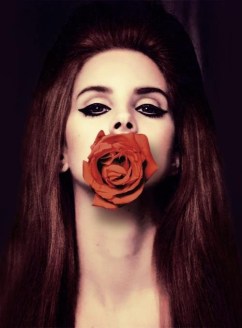
I used to live in a house called ‘Daisybank’, but my friends always teased because there were roses painted onto the window, not daisies. What weird reverse supplement? The fat white dog daisies would spring up on the front lawn in summer, but they were always overlooked by those glassy roses. There’s a certain authority, majesty even, to the rose. You associate it with tragedy and great beauty: Lana Del Rey with her lips stuffed full with a rose, playing the calamitous heroine. Snow-White and Rose-Red. Shakespeare’s ‘a rose by any name would smell as sweet’ is taken from Romeo and Juliet, in which Juliet convinces Romeo that it matters not that his name, Montague, is her family’s rival house. A rose is a rose; regardless of name it will always come up smelling of roses. Having graduated from Daisybank, I now find myself living on Montague Street…

‘Who dreamed that beauty passes like a dream?’ This is W. B. Yeats, probably writing to a woman he loved, Maud Gonne. He seems to set up beauty as life’s eternal opposite; where human existence is fleeting, beauty remains archetypal, enduring. Think of Keats’ ‘beauty is truth, truth beauty’. There’s a universality, a mythological underpinning to this beauty. In Yeats’ poem, the loved one embodies wistful figures of glory: Helen of Troy and Usna of ancient Irish history. Surely she slips between the shadows of comparison? Whether Yeats scorns the idea that beauty ‘passes like a dream’, or whether he ultimately reveals its truth, is unclear.

For Immanuel Kant (see, Critique of Judgement), the experience of beauty hinges on a paradox: since it seems that beauty is a property of the object—indeed, emanates from it—you’d think beauty itself was universal. Everyone should fall in love with that painting, that colour, that song. But not everyone does find the same things beautiful. It feels like a betrayal of reality when I play Radiohead’s ‘True Love Waits’ (where roses are swapped for “lollipops and crisps”) to a friend and their reaction is a casual ‘meh’ and a shrug, while all sorts of biochemical reactions of wonder and euphoria are swirling around inside me. Beauty, for Kant, is largely nonconceptual: that is, there’s an unspeakable quality to it, a thing you can’t put your finger on. In Realist Magic, Timothy Morton describes it as beauty’s ‘je ne sais quoi’. Being unable to pin down what it is that makes a thing beautiful is part of its beauty. You take a rose. You could describe its petals, its inward swirling whorls, its scarlet colour, the slenderness of its stem; but in doing so, you lose the rose itself. As ever in synecdochically applauding a woman you lose the woman. The love object. The love? Recall Shakespeare’s ‘Sonnet 116’? ‘Love is not love’; it’s what it is and it isn’t, and what’s left over as forever. 4Eva/4Real. Personally, I prefer Cate Le Bon’s take: “Love is not love / When it’s a coat hanger / A borrowed line or passenger”.  But isn’t everything stolen and temporary, in transit? How do you claw back the rose when the rose, maybe, is just this epic symbol for love? What moves in the static eternity?

I used to draw roses all the time; I’d always start in the centre, finding my way outwards with liquid ink. You see I had no conception of the rose’s shape, I was just following the shaky trajectories of layering lines. Important not to excise too sharply the arrangement of beauty, to impart onto nonhuman forms a reified taste. Eroticism preserved by ellipsis, meditation contained in the mysterious code of the senses. What was it Wordsworth said so long ago, in his famous tract against book knowledge: ‘Sweet is the lore which Nature brings; / Our meddling intellect / Mis-shapes the beauteous forms of things:— / We murder to dissect’. Wordsworth would prefer you to go out and encounter the objects themselves rather than try to ‘dissect’ them through rapturous, scrutinising poesy. Being one of the great Romantic poets, distracted by words even when in Nature, Wordsworth is of course a filthy, (forgivable) hypocrite—up to his knees in Kant’s paradoxical beauty as much as the rest of us.

Making words of roses involves cutting their heads off, losing the essence, letting the adjectival rose oil leak into language’s dripping pores. Binding the immortal to time. That seepage is ink, is tense’s durational flow, is poetry’s cruelty. This is perhaps what Mallarmé means when he says: ‘Je dis un fleur, et le fleur est parti’—‘I say a flower, and the flower is cut/split/gone’ (translation: Tom McCarthy). To break the object of beauty down in writing is to incur a violence; as McCarthy glosses, ‘Things must disappear as things in order to appear symbolically’. What is perhaps most seductive is the remaining qualities, the deconstructionist’s milk and honey, the semiotic residue that clings between things. Spiderwebs, woven by first light, acquire a serene and gossamer gleam; but what is most seductive perhaps is the spaces between the lines, the way up close the lacing makes new frames for the real, the scenery behind and through.

Then we have Derrida’s ‘maddening’ supplement. For all roses refer to other roses, to every iteration of the word ‘rose’ throughout literary history. What a rose means can only lie in the space between these occurrences, and even then the meaning is temporary, contextual—there is no outside text, no place in which to hurl your roses to semantic abyss. We might hope for Love as some manifestation of the Lacanial Real, a pre-symbolic realm of pure emotion; but love too (as Roland Barthes reminds us) is discourse, perennial and yet bound to the fluctuations within language. ‘Rose’ is a noun, but it is also qualia: the subjective quality of something that cannot be objectively measured. Her cheeks were rosy, the rose-coloured sand (of the dream sequence in Michelangelo Antonioni’s film, Red Desert), a rosiness to the air that spoke of July. By scaling tone, we might get a general sense of what ‘rose’ is (a quality defined by difference rather than identity), but we’d never get to see rose through someone else’s experience. What is ‘rose’ to one poet might be ‘pale and bloody’ to another. Rimbaud writes, ‘The star has wept rose-colour in the heart of your ears’. Abstraction meets the concrete which itself is a spill through synecdoche. What music seeps, weeping, into the beloved’s ‘ears’? ‘Rose-colour’ becomes that synaesthetic property, the oozing, effulgent thing that cannot be pinned. For colour, like music, is perceptively subjective. What prompts a sudden spasm of imagining in you might send me to sleep; could we call both actions reactions to beauty?

‘It’s hard to stay mad when there’s so much beauty in the world’. So goes the line in American Beauty, Sam Mendes’ 1999 suburban modern classic—a film about midlife crisis, inappropriate lust, neurotic materialism and the nuclear family under late capitalism. Where Ricky, the visionary, weed-smoking teenager, sees a sort of sublimity in waste, videoing a plastic bag’s leaf-like billows in the wind, Lester falls for his daughter’s cheerleader friend, Angela. The particular Gen X fatigue over cultural trash and consumer excess is recycled as a pared-back appreciation for symbolic indications of the world’s decay—little quotidian details which offer momentary redemption as beauty in tragedy. The old Kantian adage of beauty’s je ne sais quoi. Lester’s misplaced infatuation for Angela is represented by motifs of lurid red roses, flowering outwards like bloody snowstorms of feminine intensity. The chase falls cold when they kiss IRL, and he realises she is just an insecure teenage girl. Tell me I’m beautiful. Interpreting the film is as tricky as trying to clasp onto any one of those whirling petals, to kiss a single tear on an eyelash, a dew-drop clung to the flesh of a rose. Joni Mitchell, in ‘Roses Blue’: “I think of tears, I think of rain on shingles / I think of rain, I think of roses blue”. A lyricist’s ability to make pearls of emotion. Superhydrophonic. Is this another symbol, listless, transient, glistening?

The Symbolists were mostly French poets of the fin-de-siècle, the likes of Rimbaud and Baudelaire (whose flowers were assuredly evil), who probably drank quantities of absinthe and wrote symbols that emblematised reality itself, rather than merely inward feeling. All that absinthe had to come out somewhere, idly wilding in the streets of Paris (pronounce it the French way). Where abstraction reigns often in the world of emotion, meaning accumulates through the repetition, modulation and pattering of these symbols. While Mallarmé’s poetry indulged in dreams and visions, it’s a certain patterning of associative power that provides the stitching behind his fashion for aleatory. The poetics of chance may still have a structure of sorts, something you can trace like the veiny trellises within a leaf. W. B. Yeats, the Irish Symbolist, loved a good rose: just see ‘The Rose of the World’ and ‘The Rose of Battle’. In his essay, ‘The Symbolism of Poetry’, Yeats makes frequent comparisons between symbols and music, describing the ‘musical relation’ of sound, colour and form as constitutive of symbol.

At a workshop I’ve been running with homeless people, a girl who shares her name with Stein’s favourite flower reads out a piece she’s written in ten minutes flat. It’s a typically tragic tale of abuse, of a family torn apart by pain, drugs, death and violence—written from the perspective of a ten-year-old girl, perhaps her daughter. She reads it with a stilted west coast accent that picks up its confidence and lilt as the sentences run on. Somehow in those sad and wilting lines, strewn with the accidental detritus of truth, there’s hope. It blooms so unexpectedly in all the despair. A ten-year-old girl sees the world very clearly and pure. I can only paraphrase, of course. I’m sad that I don’t get to see my mother, but she says that it’s okay because if I look at the moon I know that she’s looking at it too. This part struck me harder than any other—it seemed an echo from elsewhere. The whole piece became suddenly a buildup to that single, simple, irresistible image. When Yeats presents Burns’ ‘perfectly symbolical’ song of the moon and time, he misquotes him. Translation falters to glitch, like with lossy compression. The moon as a symbol, as something to be shared, a white chocolate button broken in two. Except you can’t split the moon. You can only imagine what the other person is seeing. I wonder what they were looking up to.

Where metaphors ‘are not profound enough to be moving’, symbols move in both senses of the word: they act through motion, the accumulative or associative arrangement of sound and meaning (as opposed to metaphor, which acquires meaning through more static, straightforward comparison), and they prompt affect in the reader. Such affect is not just the temporary indulgence of an artwork’s emotional value, but can indeed alter how the world is discursively understood. The rosy words thrown upon some poetic zephyr recalibrate reality as we know it. As Yeats puts it:

Because an emotion does not exist, or does not become perceptible and active among us, till it has found its expression, in colour or in sound or in form, or in all of these, and because no two modulations or arrangements of these evoke the same emotion, poets and painters and musicians, and in a less degree because their effects are momentary, day and night and cloud and shadow, are continually making and unmaking mankind.

The construction of feeling through symbols, then, institutes the substance and gaps that structure how we relate to ourselves, others and nonhuman objects. A very delicate, precise, imagist poem like William Carlos Williams’ ‘The Red Wheelbarrow’ has effectively changed how we relate to both the colour red and wheelbarrows more generally (never mind the ‘white / chickens’). Symbols can charge our perception with fresh emotional channels. Music relates a bit differently, of course, but only because it literalises Yeats’ musical relation metaphor—there’s a more physical intensity, maybe. Like a river (you can never dip your finger twice in the same river), a piece of music cannot be played the exact same way again—a truism owing to the arbitrary dynamics of individual players, environments, acoustics or subtle interruptions of duration. A breath or a sneeze, a chance sigh in the background, a trumpeter who can never quite pace her crescendo. You experience the opera differently from me, even though we watch the same one (I have never been to the opera). My hearing is slightly muted, along with my interest in self-congratulatory coloratura; while you have perfect pitch, ears that ring with pleasure as the high notes hit. Though the same in one sense, comprising a shared duration, our encounters are completely different. Music’s durational function is made explicit with the likes of John Cage’s music concrète, composed of sounds rather than notes and thus retaining elements of chance within a certain duration. The process becomes more about selection, sampling and curation, rather than composition according to tones, melody, chords.

If anyone idled wildly, it was the notoriously languorous aesthete, Oscar Wilde. The decadence of roses is also associated with a certain concretisation of language, a making material of words, a honing of time and world. Consider the opening line of The Picture of Dorian Gray: ‘The studio was filled with the rich odour of roses’. The way assonance works, subtly wafting its chiming vowels through ‘filled’/‘rich’ and ‘odour’/‘roses’, creates that musical relation that Yeats so fetishised. Poetic techniques such as alliteration and assonance abound in Wilde’s novel, where prose becomes musical, lilting, exactly honed upon sensory detail, the vivid relation of objects. Roses that fill a studio, that pungently glow with lavish scent. There is a heady, ambient quality to much of Wilde’s descriptions, giving off the impression that we are perhaps perceiving how objects seem to one another, filtered through the opium vapours that so penetrated Dorian’s accelerating decadence: ‘In the slanting beams that streamed through the open doorway the dust danced and was golden. The heavy scent of the roses seemed to brood over everything.’ Objects are at once anthropomorphised and ornamental; that play between movement and stasis, however, cuts across binaries between human and nonhuman. The world of Dorian Gray is sprawling, random, a chase through meshes of entangled desire. A straightforward death drive is diverted by all sorts of sensory encounters, plastic morality, visionary beauty. And words? Words in Wilde are the petals that swell and unfurl into Yeatsian symbols:

Music had stirred him like that. Music had troubled him many times. But music was not articulate. It was not a new world, but rather another chaos, that it created in us. Words! Mere words! How terrible they were! How clear, and vivid, and cruel! One could not escape from them. And yet what a subtle magic there was in them! They seemed to be able to give a plastic form to formless things, and to have a music of their own as sweet as that of viol or of lute. Mere words! Was there anything so real as words?

Words have (re)active potential. Each one shivers with the weight of its every use, alive with subtle magic. Be careful what you write.

Gertrude Stein said that’s enough (I know that that’s not enough now)”. Gertrude Stein said a rose is a rose is a rose is a rose. She said it first in ‘Sacred Emily’ (1913), and later wrote, in ‘Poetry and Grammar’:

When I said.
A rose is a rose is a rose is a rose.
And then later made that into a ring I made poetry and what did I do I caressed completely caressed and addressed a noun.

What do we swap for tautologies? Love is tautological; love justifies itself. It means everything and nothing. There’s isn’t any escaping the reifying loop, the ring with its symbolism of marriage. That which encapsulates and closes. The hermeneutic circle. Stein makes us linger, ponder the grammar of each rose. Ring-a-ring-‘o-roses. What does it mean to ‘caress’ a noun? To render the erotic potential of language by gesture of touch, extend into physical… Idlewild: a word whose internal rhymes fold together, whose l sounds caress the roof of the mouth.

Gertrude Stein said that’s enough.

Lana Del Rey: “You always buy me roses like a creep.
Also Lana Del Rey: “And then you buy me roses and it’s fine.

There’s a surfeit of petals and sex, a gluttonous economy of symbols which Stein stamps out with the simple carousel of her musical roses. Sing it slowly. Tell me what you mean.

Luce Irigaray, from This Sex Which Is Not One:

Your body expresses yesterday in what it wants today. If you think: yesterday I was, tomorrow I shall be, you are thinking: I have died a little. Be what you are becoming, without clinging to what you might have been, what you might yet be. Never settle. Leave definitiveness to the undecided; we don’t need it.

Lana Del Rey, reading from T. S. Eliot’s Four Quartets:

Footfalls echo in the memory
Down the passage which we did not take
Towards the door we never opened
Into the rose-garden.

I pass between worlds and names and symbols. Every lipstick stain is another iteration, each kiss the palimpsest of the first, and even photographs fade in the sun, faces dissolving like planes behind clouds. Of ‘cappuccino pink ranunculus’—not roses—Colin Herd writes: ‘They’re at their most ravishing and / ethereal the day before they expire’. I imagine a white corridor imprinted with all your flickering dreams. Between realms, the soft wilt allures more even than it does in bloom. Images become sentences: long thorny stems of sentences, stretching and snarling a confusion of brambles and briars. The more you write, the more you grow your beautiful garden. I tear my wrists and fingers, trying to get to it: ‘There is a forcible affect of language which courses like blood through its speakers. Language is impersonal; its working through and across us is indifferent to us, yet in the same blow it constitutes the fibre of the personal’ (Denise Riley). This garden I make is not really mine and daily it grows stranger. The roses offer their pretty heads, then droop in winter. I hear their beautiful words in arterial melodies, sprawling among shadow, platitude, the skeins of a letter letting loose through my pores.

Roseability: the quality of forever chasing roseability. File under qualia, noun/rock, the poetics of etcetera.

tumblr_o34tbyABi21qfqngko1_1280.gif
gif. credit: : : Douglas Pattison