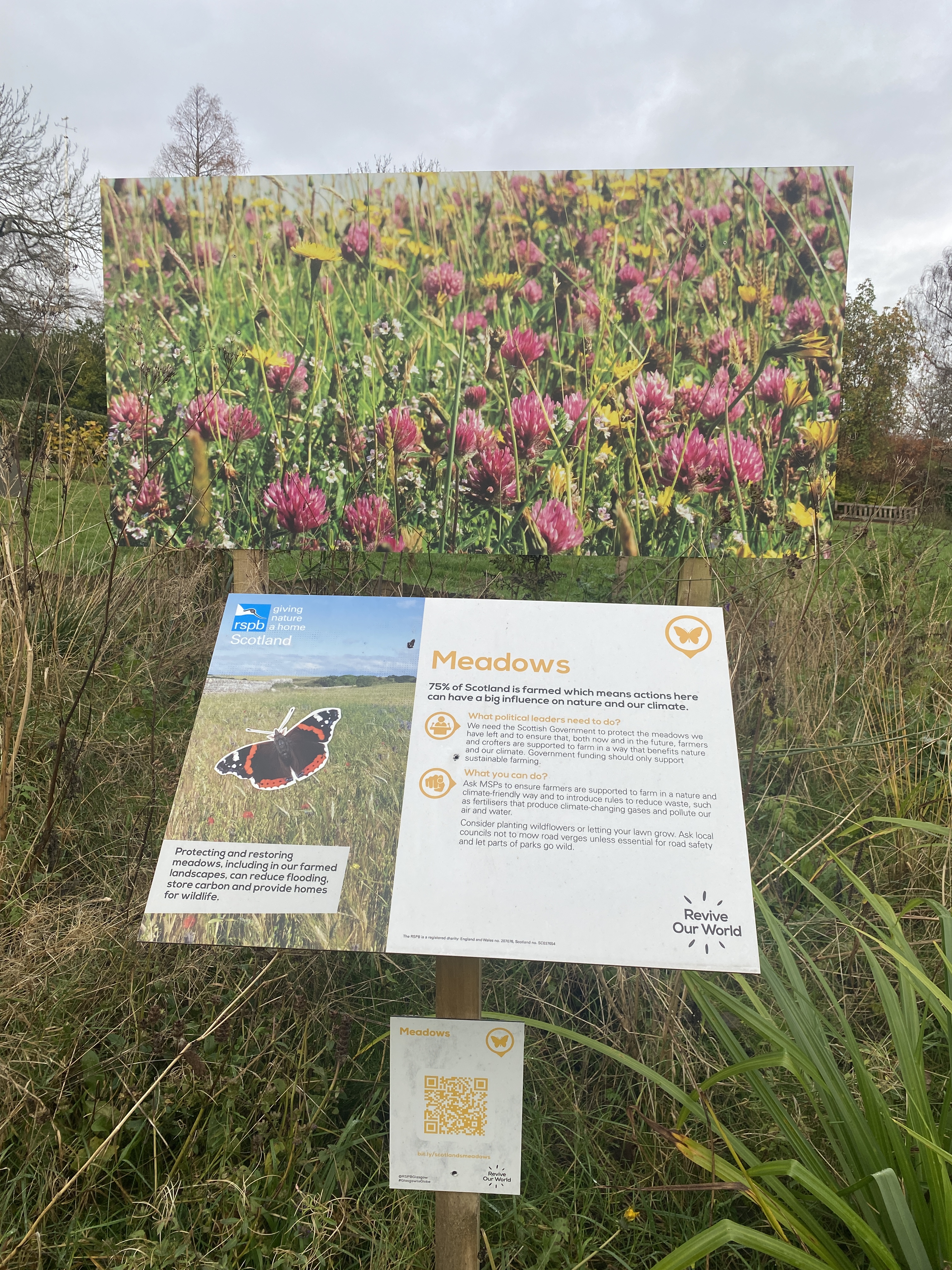
This is a talk about meadows. A meadow is a place of expanse and exposure, where Man shoots the mother deer in the Disney classic Bambi (1942). It is a site of slag heaps, fly-tipping, wild and opportunistic overgrowth; the edge land between industrial estates sprung up with buddleia against the odds. Ambling between creative and critical approaches, this talk makes a case for the gerund meadowing as a conceptual and methodological imperative for porous and cross-pollinating consciousness. The excesses of meadows suggest how we might glean forms of abundance and ongoingness from the discards of capitalist efficiency. We will take seriously the imperative ‘go touch grass’, not as pastoral consolation or escape but rather as a cultivating logic of regeneration. The aesthetic tendencies of meadowing — dense citation practise, polyrhythmia, borrowing from the im/possibilities of dream — are entwined with an ecological ethic of entanglement and suspension.
Tomorrow I’m giving a paper on Caspar Heinemann, Sophia Dahlin and Callie Gardner at ‘Imagining Queer Ecologies’, a one-day online symposium hosted by the British Society for Literature and Science and the University of Oxford. [online]
Here’s the abstract:
‘In contrast to biodiversity’, argues Karlheinz A. Geißler, ‘“chronodiversity” is terra incognita’. This paper takes up the challenge to explore chronodiversity (the extent to which individuals have differing experiences of temporality) in a queer ecological context. Following Catriona Sandilands’ call for queer ecology to stress ‘an articulatory practice in which sex and nature are understood in light of multiple trajectories of power and matter’, I will look at contemporary poets whose negotiation of pastoral and lyrical modes offers a temporal experience of embodied difference. I am concerned with how queer poetry intervenes in modes of temporalisation which bind existence to a standardised temporal logic of consumption, expenditure, reproduction and labour. While pastoral is often associated with nostalgic and reactionary structures of feeling, I consider poets whose engagement with pastoral tendencies constitutes an ‘allergic’ aesthetic/ethic. Given that ‘allergy’ is rooted in both allos (‘other, different, or strange’) and ergon (‘activity’), it is fruitful to examine how poets reactivate pastoral modes through a queer and critical reimagining of desire and time. Reading poems by Sophia Dahlin, Callie Gardner and Caspar Heinemann, I consider formal strategies such as complex sentences, lists, imagery, lyrical present tense, citation and space, to dramatise the emotional and temporal conundrums of queer pastoral. I argue that these poets explore the possibilities of ‘queer asynchronies’ (Elizabeth Freeman, Time Binds) to rethink environmental consciousness in terms of (allergic) pastoral erotics which variously reflect and refuse the organising logics of heterocapitalist chrononormativity.
Our home is on fire and our houses unmade. When climate change is also (as Margaret Atwood puts it) ‘everything change’, how might poetry reckon with the far-reaching implications and existential contradictions of environmental crisis? In this panel discussion, we ask what tools exist for poetry to retune our senses, coexist with multiple species, tell stories of deep time while envisioning resilient and resistant communities. Our three poets will explore key strands into a climate-responsive poetics: elemental, collaborative, mindful, wild. With close attention to form and language, we discuss practical, ethical and poetic interventions in ecological thought.
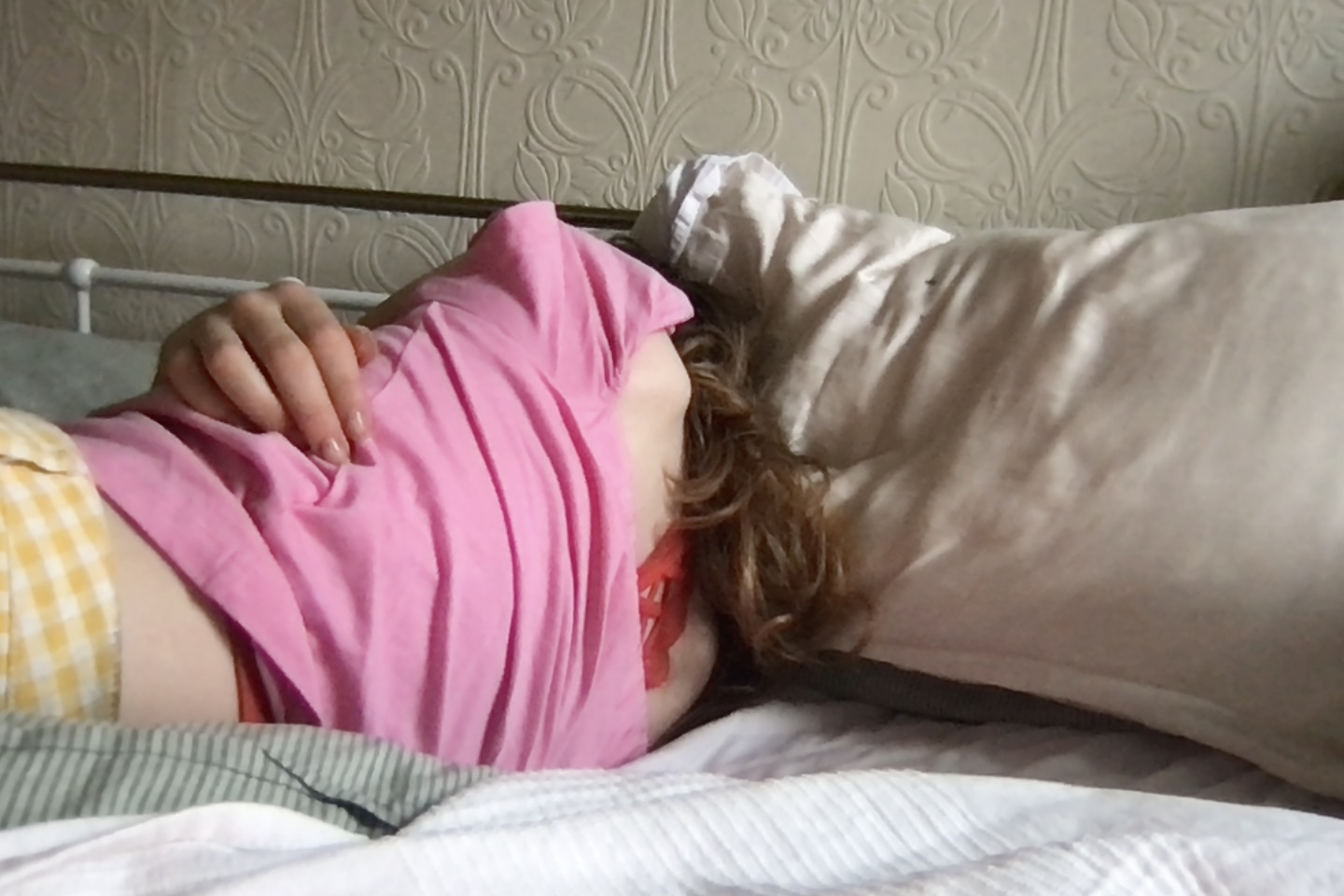
This performance lecture takes flight from the shape of a question: what is the relationship between poetic language, sleep and dream in the anthropocene? Combining poetry, journaling and critical inquiry towards the ecologies of sleep, I will consider how dreams may be the site of impossibility, drift and low-carbon pleasure in a time of ’24/7′ where, in the words of Jonathan Crary, our ability to ‘daydream’ is blocked by a constant barrage of the internet’s attention economy, the demands of late capitalist labour and ongoing crisis. Taking this as a serious political disempowerment, I look to writers whose work alters the ‘operating speed’ of daily life to make room for dreaming otherwise. Exploring the formal interventions of writers within feminist, New York and Language schools, I focus on how these works tend the unruly future garden through daily reclamations of dreamtime. If many of us are at surge capacity, how might poetry attune to various kinds of ‘slow violence’ (Crary) which often go hidden in mainstream narratives of extinction and climate crisis? How might poets borrow from the logic, content and impulse of dream to offer alternative visions of coexistence, commoning, time and compassion for other species?
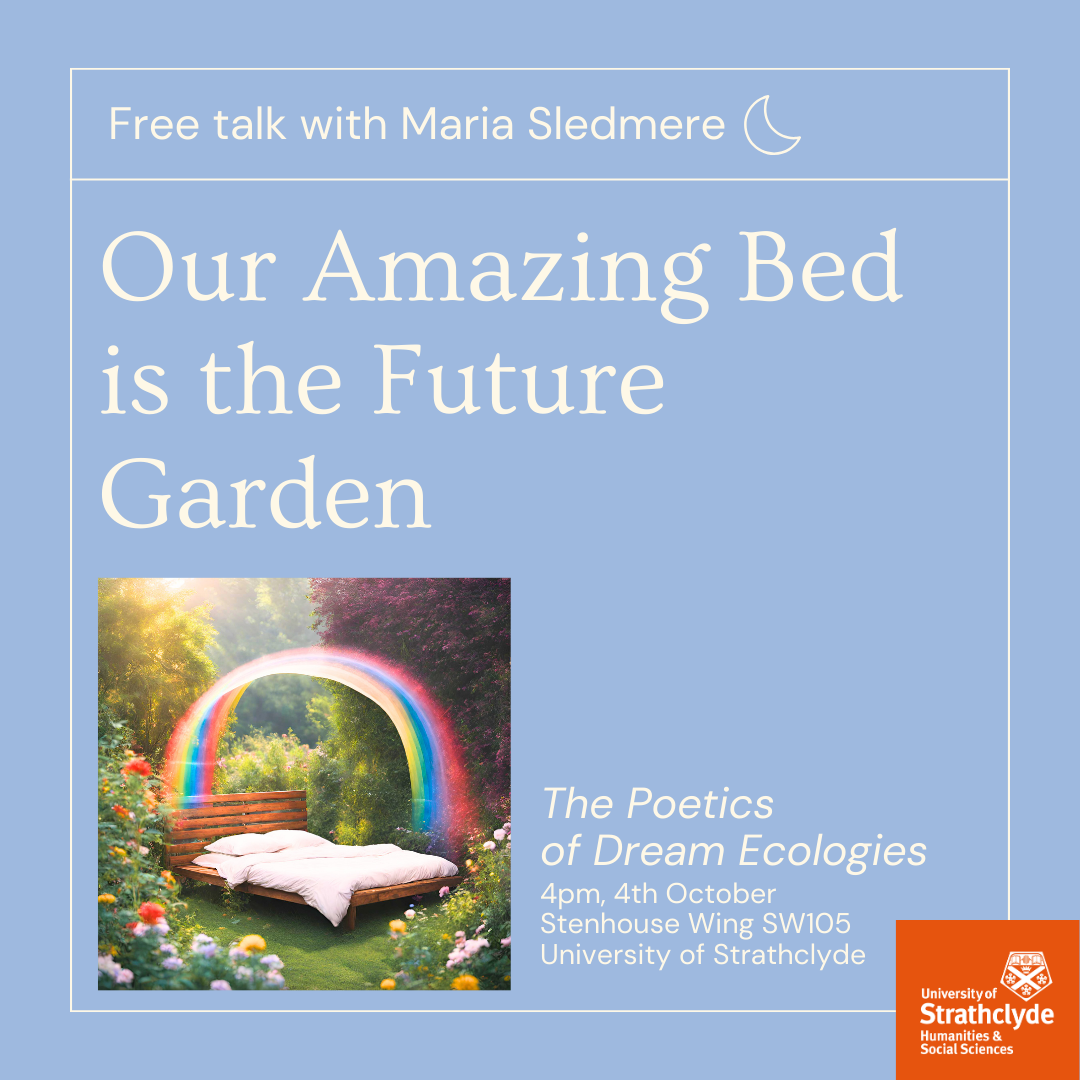
Recorded at the University of Strathclyde’s Department of Humanities Seminar Series, hosted by Charles Pigott and Hannah Proctor, 4th October 2023.
My research currently centres on sleep as a nexus for thinking about energy transition, low carbon pleasure and chronodiversity (the way our circadian rhythms differ).
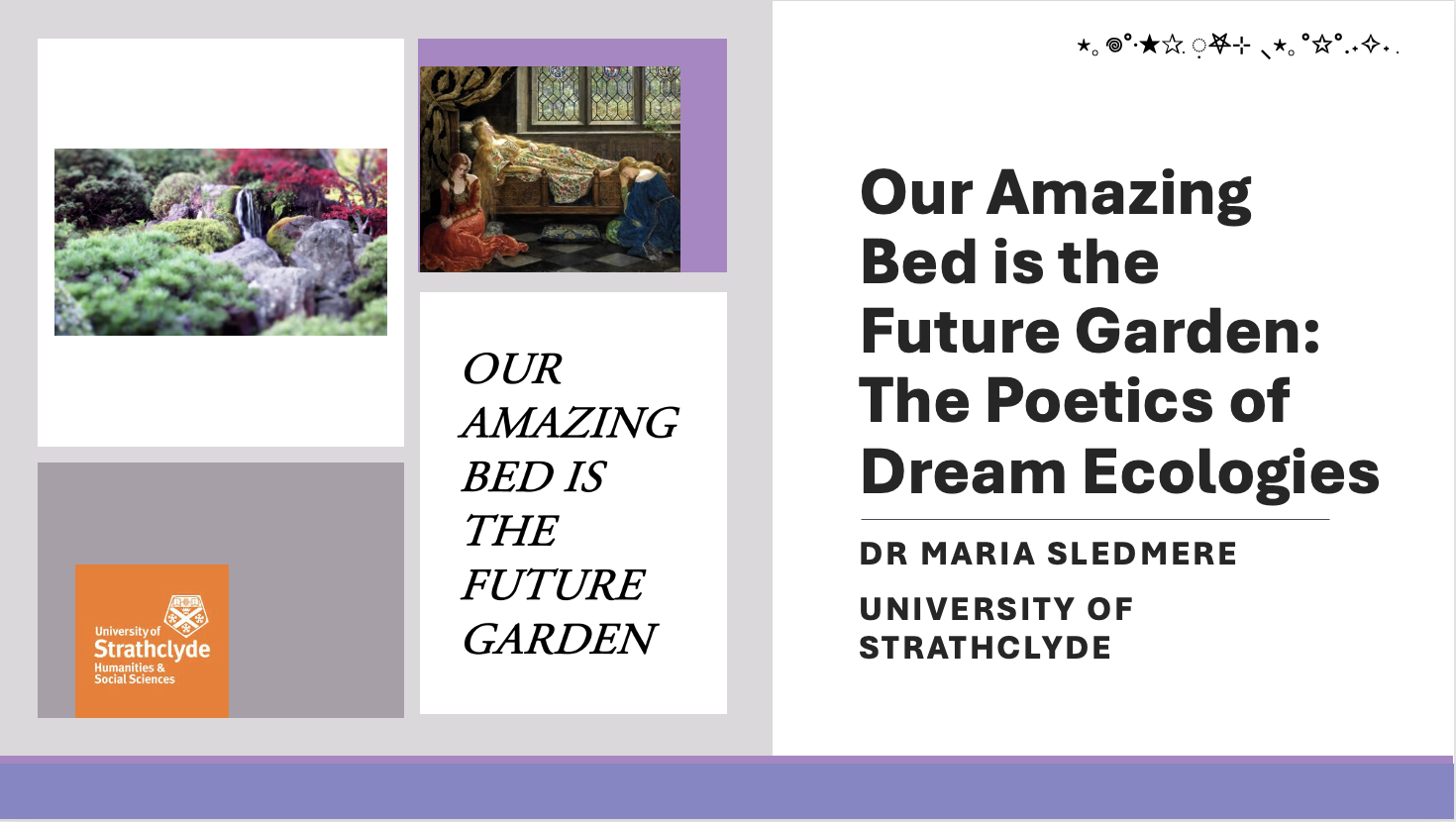
Tomorrow I’m giving a talk titled Our Amazing Bed Is the Future Garden: The Poetics of Dream Ecologies. It emerges from a chapter in my DFA thesis which will form part of a book forthcoming with NoUP Press next year. If you would like a Zoom link please drop me an email at maria.sledmere[at]strath.ac.uk.
This autumn I’ve got three upcoming workshops, two of them with the brilliant experimental composer Kevin Leomo.
Civil Twilight: Carving Dreamtime – workshop with Kevin Leomo and Maria Sledmere 14th October at 5:30pm, Civic House, Glasgow
Get your brain sticky in the pumpkin meat of the circadian and join Kevin Leomo and Maria Sledmere in carving dreamtime as an expression of creativity and low carbon pleasure. As the nights draw in and the clocks go back, we’ll be thinking about how darkness affects mood and slumber. Civil twilight is the brightest of the three twilight phases, where stars and planets might be seen in the sky as the sun dips just below the horizon. By attending to the ‘nocturne’ as a form in poetry and music, we’ll dwell in the possibilities of liminal experience for cultivating ecological imaginaries. Please bring: Preferred writing materials, If you have one, a reusable coffee cup, headphones and phone. Tickets are offered on a slide scale: £15 / £10 / £5. Part of Civic Harvest at Civic House – an Autumn themed day of family friendly activities, workshops and market stalls with lunch from Parveen’s and seasonal cocktails at Civic House Bar! Tickets
😴
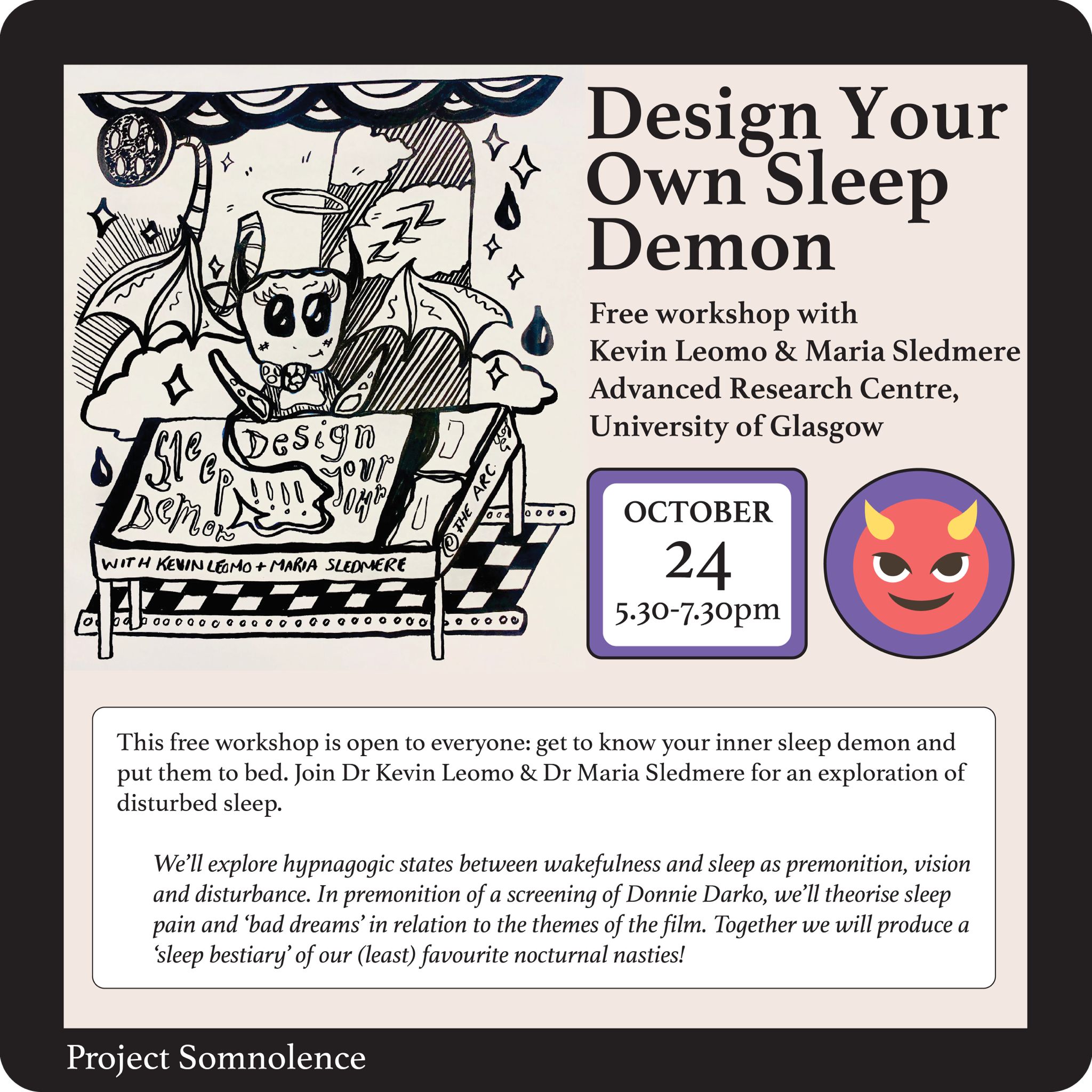
Design your own sleep demon – workshop with Kevin Leomo and Maria Sledmere 24th October at 5:30pm, Advanced Research Centre, University of Glasgow While sleep is a source of rest and recovery, many of us wrestle with disturbed sleep. If you’ve ever had nightmares or found yourself sleepwalking, you’ve encountered oneirodynia. The word comes from the Greek oneiros, meaning ‘dream’ and odyne, meaning pain. Sleep disturbance may be caused by a number of factors: from stress to stimulants, environment, illness and temperature. The eponymous protagonist of Donnie Darko is often found sleepwalking or experiencing some kind of nocturnal anguish. In this workshop, which serves as a primer for the film’s upcoming CinemARC debut, we’ll explore hypnagogic states between wakefulness and sleep as premonition, vision and disturbance. Together we will produce a ‘sleep bestiary’ of our (least) favourite nocturnal nasties, and present our findings before the screening on Friday.
The Poetry of Somnolence – weekend double workshop with Maria Sledmere and Beyond Form Creative Writing 11th and 12th November at 1-4pm (GMT), Zoom
This 2 part series of afternoon workshops prioritise the relationship between writing and sleep. Exploring cross-genre writing, visual and sonic art, we will look at how daily writing practice can recentre our circadian rhythms. From hypnagogic poetics to dream writing, nocturnal missives, dawn songs and notes on twilight, we’ll consider experimental approaches to writing somnolence. All creatives welcome.
Workshop format will combine reading, writing, listening, optional discussion and two nap breaks.
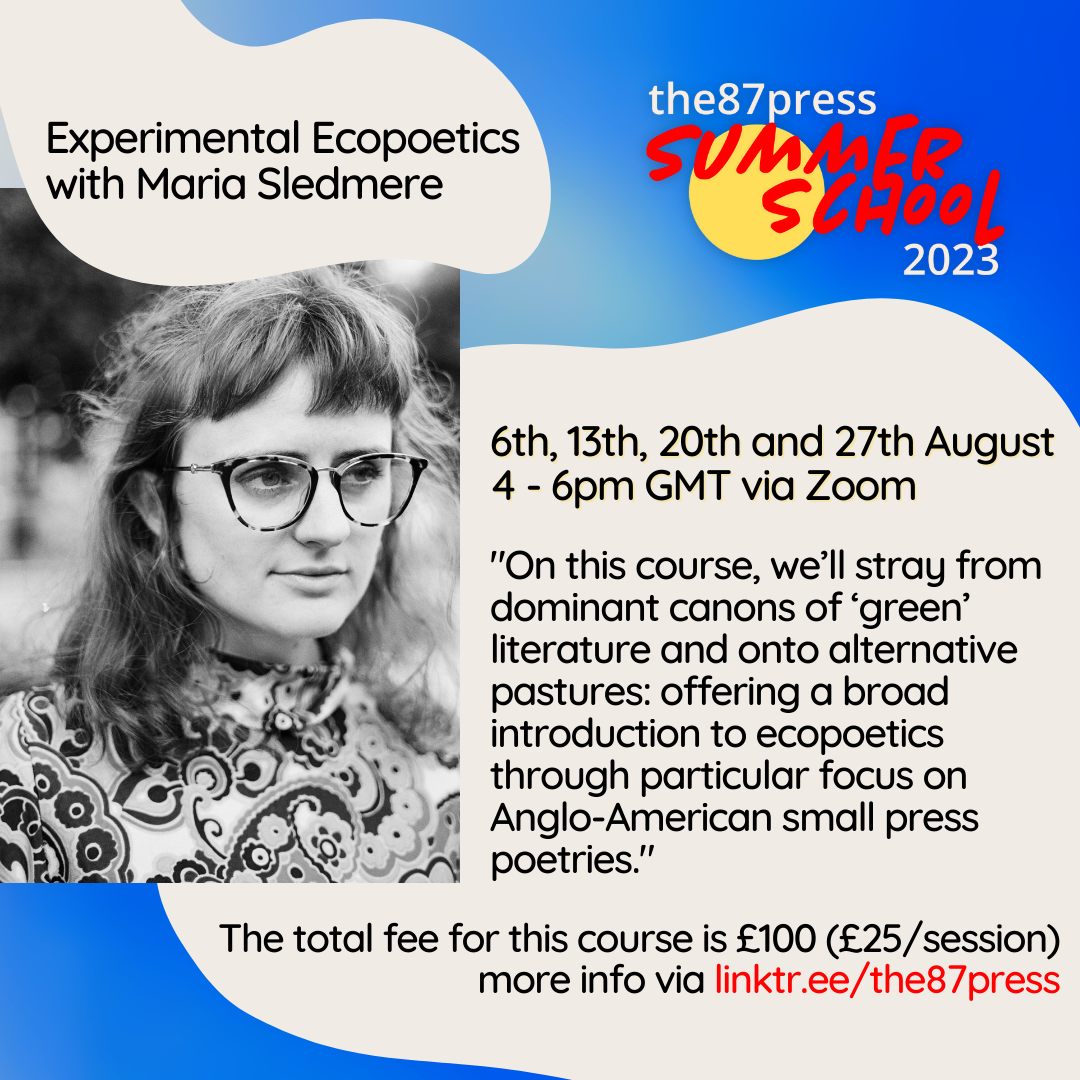
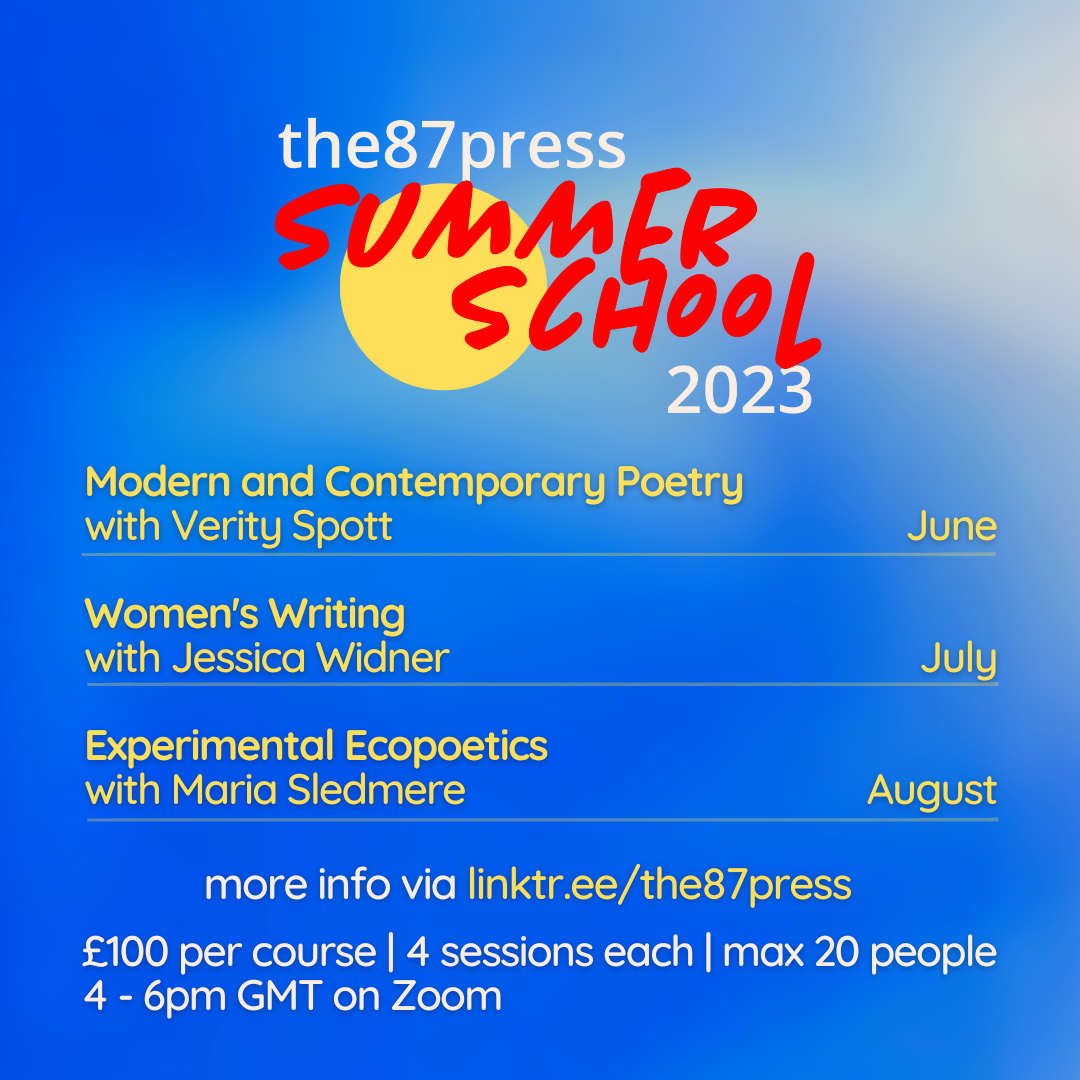
Excited to deliver this four-part workshop series in August for the87press, alongside two other courses by the brilliant Verity Spott and Jessica Widner. These will be cosy sessions on Zoom and feature a range of small press poetries, which we will read, write from and discuss in two hour workshops.
About the Course
Ecopoetics is a capacious term, meaning something like ‘the incorporation of an ecological or environmental perspective into the study of poetics’ (Kate Rigby). As both a creative and critical practice, ecopoetics explores the relationship between literature and the more-than-human world, often in curious, radical and transformative ways. Ecopoetics offers a fieldwork, site of experiment and a tool for (un)dwelling: tuning into ideas of environmentalism, activism, climate crisis, landscape, documentation, dreamwork and lyric. Ecopoetics is not just witnessing; it is an active engagement with habitats, affects, sensing, solidarity and politics — including questions of gender, race, sexuality, land rights and embodiment. On this course, we’ll stray from dominant canons of ‘green’ literature and onto alternative pastures: offering a broad introduction to ecopoetics through particular focus on Anglo-American small press poetries. Each session, structured as a combination of seminar and workshop, will involve reading, discussion and writing activity around themes such as everyday life, elemental thinking, dream and radical ecologies. We’ll investigate key terms such as animality, weather, nature, landscape, energy, the body, time and coexistence through works that expand our notion of who or what speaks in a poem, and where or what is ‘Nature’. Open to anyone with an interest in poetry and ecology, the sessions presume no prior experience with writing workshops, and sharing work in class is not required. A core reading list will be provided freely in the form of electronic extracts, with further suggested reading also listed.
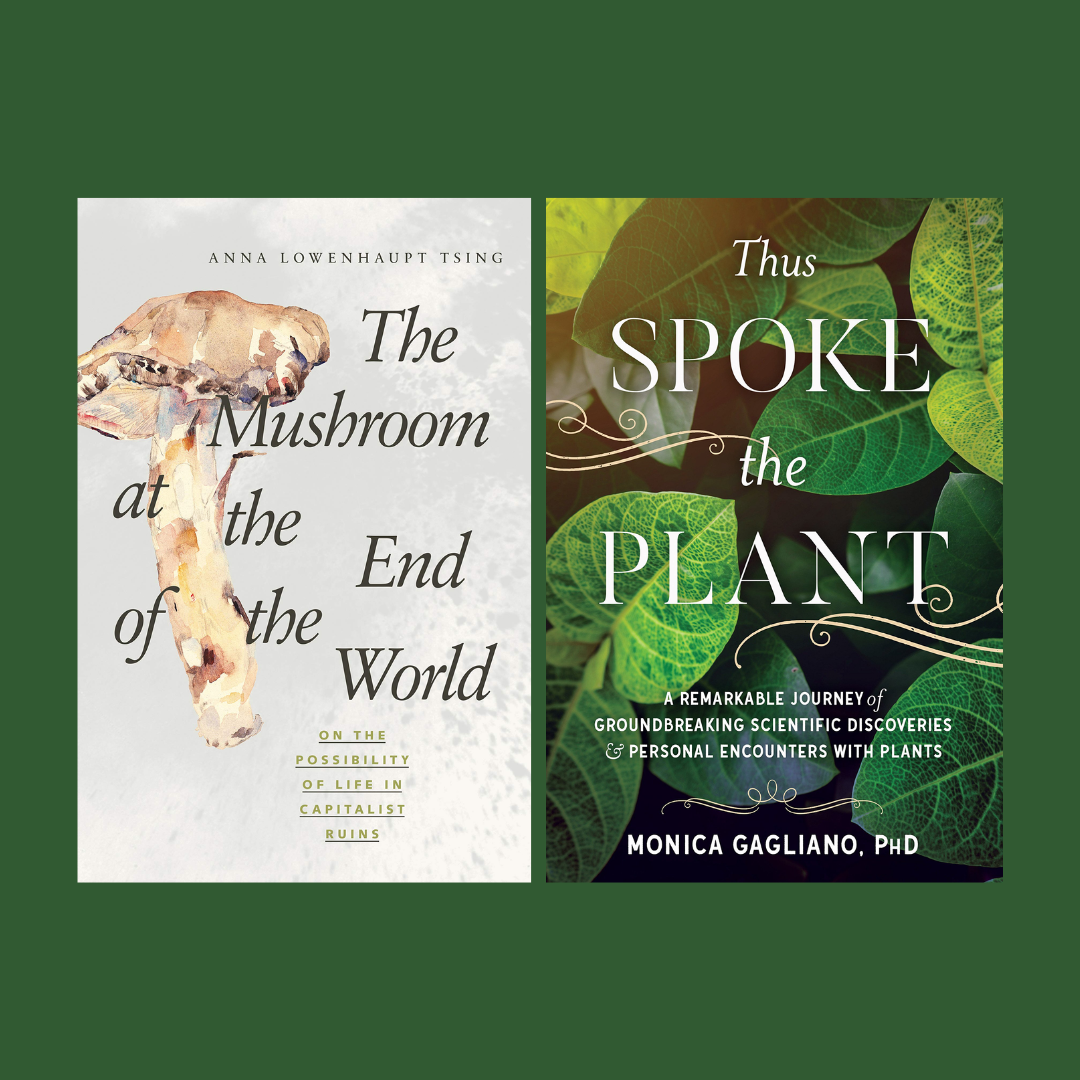
Pleased to be running two reading groups as part of the #ARCSpringFling 2023 at University of Glasgow. Open to anyone with an interest with plant ecologies, mushrooms and creative-critical approaches to environmental thinking, please sign up and come along with your questions, threads of thought and other entanglements!
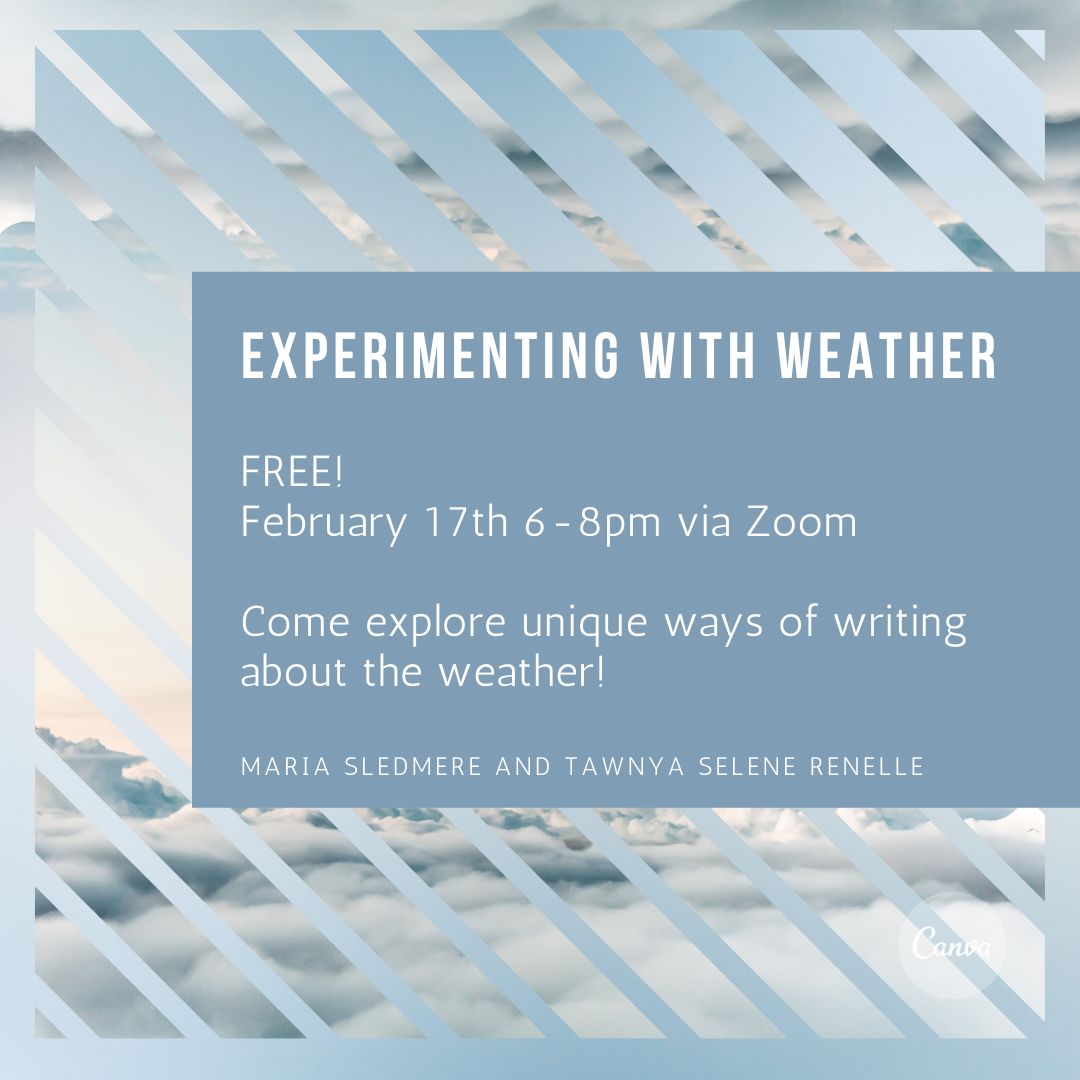
Experimenting with Weather A workshop with me and Tawnya Selene Renelle
(Online and free)
Thursday February 17th
6-8:00pm (GMT) via Zoom
Join us for this free workshop. Maria Sledmere will be our guest as she gets you ready for her new course Writing the Everyday which will begin on February 24th.
We will be deep diving into all the ways we can experiment with weather and thinking about the ways that weather can shape both the content and structure of our writing. We will be thinking about the influence of weather and how something simple might be woven into experimental writing.
Suited to all genres, skill levels, and artists of any medium.
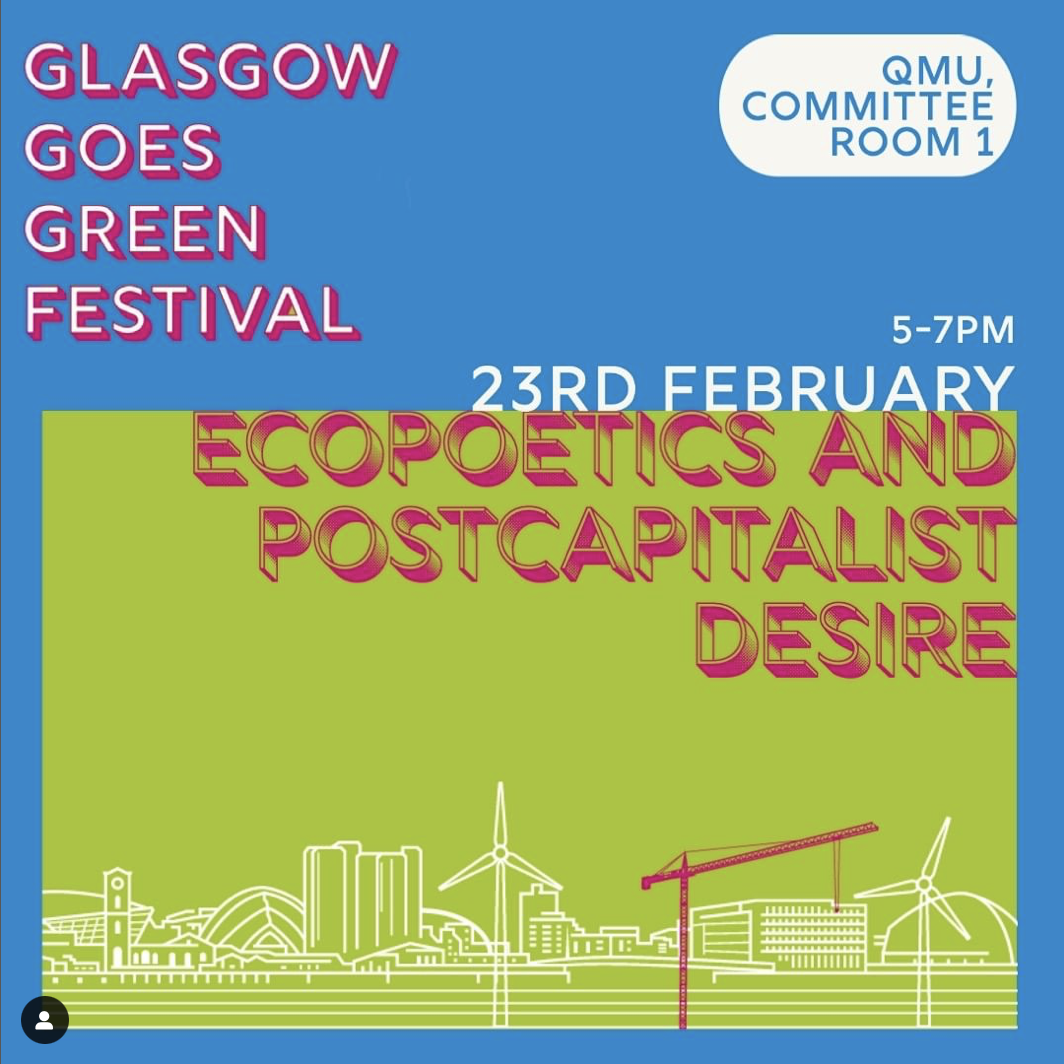
Ecopoetics and Postcapitalist Desire As part of Glasgow Goes Green Festival (QMU, University of Glasgow)
(in-person, 5pm on 23rd February)
In his 2012 essay, ‘Post-Capitalist Desire’ Mark Fisher recalls protestors at the Occupy London Stock Exchange critiqued in the press for having iPhones and buying Starbucks coffee. In many mainstream framings of environmental activism, to be ecological is to be solemnly ‘pure’ and somehow entirely free of the taint of consumerism’s impulse. How do questions of energy, desire and expression come into artistic and activist responses to the climate crisis? Can we complicate the binary of ascetism and pleasure when it comes to ecology? This workshop asks: what does it mean to be ecological in and beyond capitalist society? Looking at various works of contemporary poetry, we will locate ecological thought within complex expressions of excess, hedonism and despair; works which intersect ecology with queer joy and critiques of racialised capital; works which negotiate ecological politics and ethics within everyday life and its games of recognition.
After a short introduction to ecopoetics, we’ll read some poems (distributed as pdf handouts), explore writing activities and have discussion.
Open to anyone interested in reading and writing poetry.
Location: this workshop will take place in Committee Room 1 of the QMU. Enter through the front door of the building and take the stairs or the lift ahead to the third floor. A member of staff will be present to direct you to the workshop.
Please bring your own preferred writing materials.









 mariaology