My research currently centres on sleep as a nexus for thinking about energy transition, low carbon pleasure and chronodiversity (the way our circadian rhythms differ).
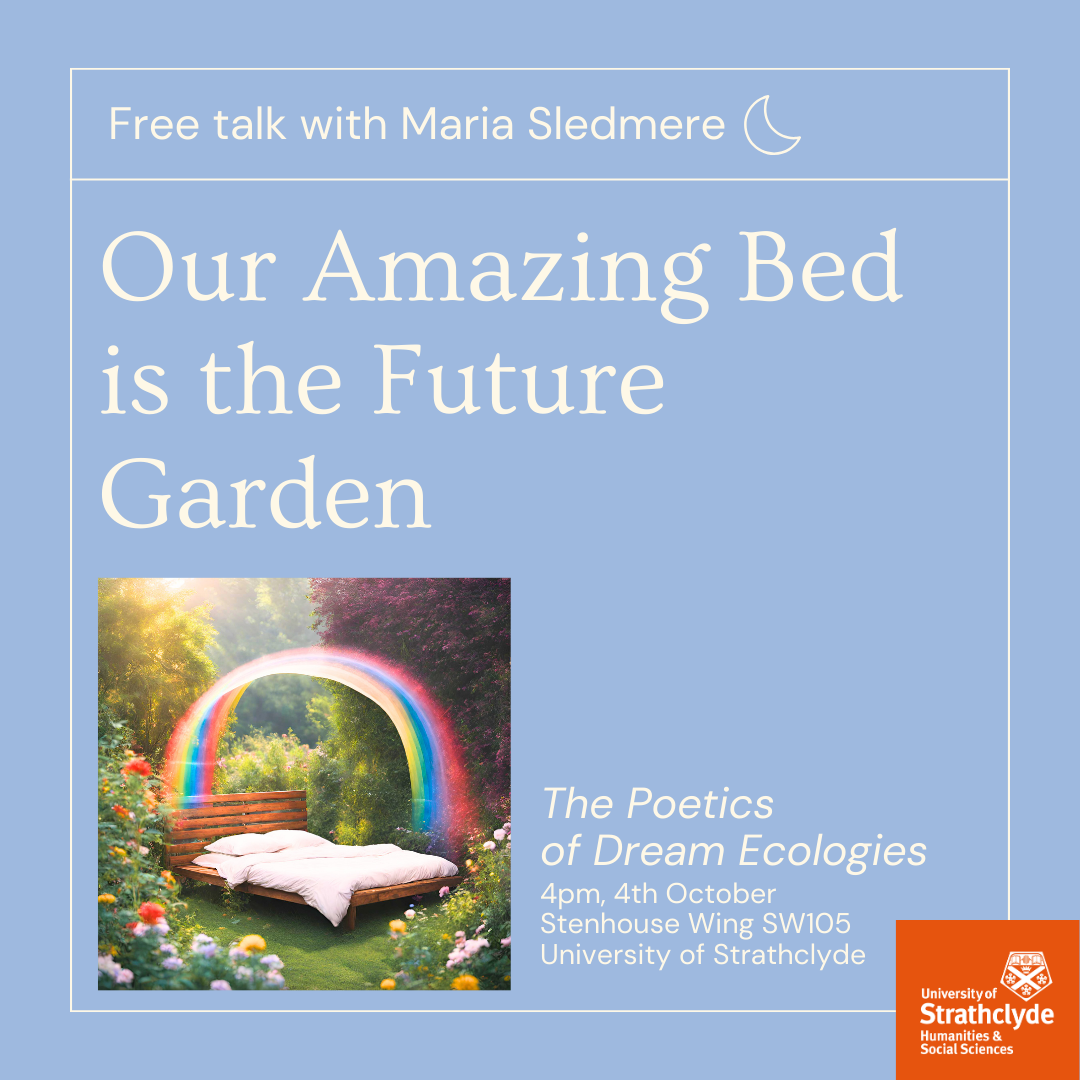
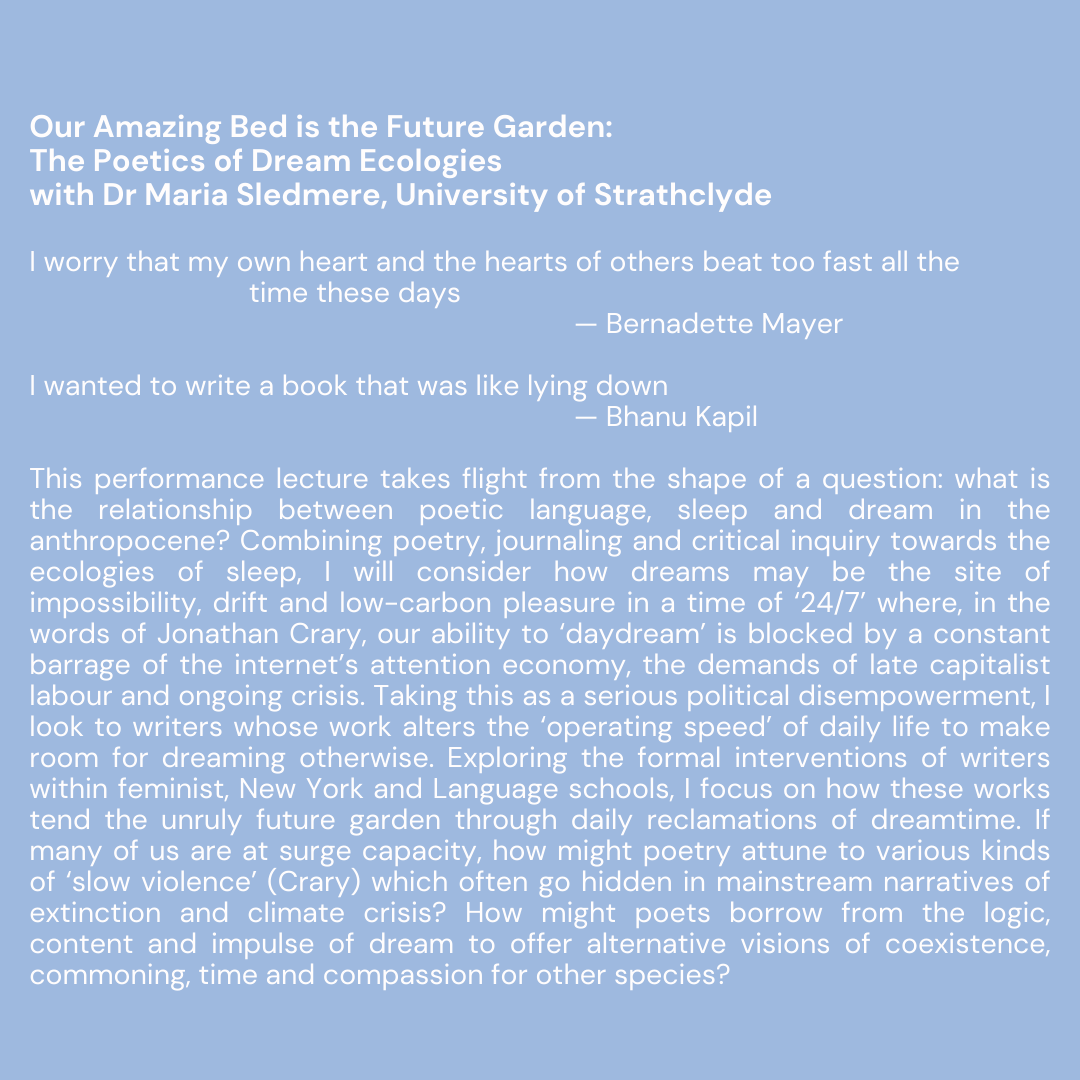
Tomorrow I’m giving a talk titled Our Amazing Bed Is the Future Garden: The Poetics of Dream Ecologies. It emerges from a chapter in my DFA thesis which will form part of a book forthcoming with NoUP Press next year. If you would like a Zoom link please drop me an email at maria.sledmere[at]strath.ac.uk.
This autumn I’ve got three upcoming workshops, two of them with the brilliant experimental composer Kevin Leomo.
Civil Twilight: Carving Dreamtime – workshop with Kevin Leomo and Maria Sledmere 14th October at 5:30pm, Civic House, Glasgow
Get your brain sticky in the pumpkin meat of the circadian and join Kevin Leomo and Maria Sledmere in carving dreamtime as an expression of creativity and low carbon pleasure. As the nights draw in and the clocks go back, we’ll be thinking about how darkness affects mood and slumber. Civil twilight is the brightest of the three twilight phases, where stars and planets might be seen in the sky as the sun dips just below the horizon. By attending to the ‘nocturne’ as a form in poetry and music, we’ll dwell in the possibilities of liminal experience for cultivating ecological imaginaries. Please bring: Preferred writing materials, If you have one, a reusable coffee cup, headphones and phone. Tickets are offered on a slide scale: £15 / £10 / £5. Part of Civic Harvest at Civic House – an Autumn themed day of family friendly activities, workshops and market stalls with lunch from Parveen’s and seasonal cocktails at Civic House Bar! Tickets
😴
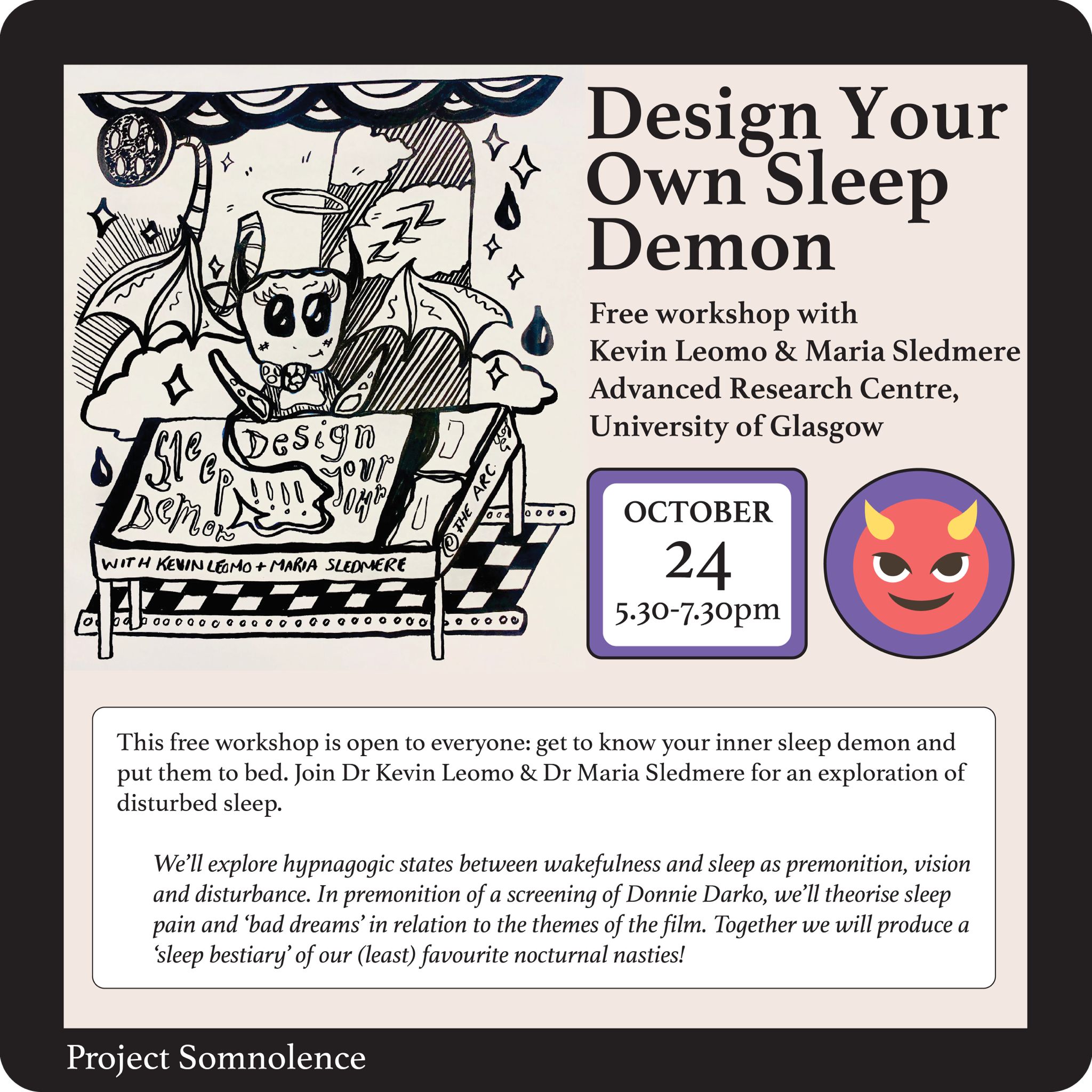
Design your own sleep demon – workshop with Kevin Leomo and Maria Sledmere 24th October at 5:30pm, Advanced Research Centre, University of Glasgow While sleep is a source of rest and recovery, many of us wrestle with disturbed sleep. If you’ve ever had nightmares or found yourself sleepwalking, you’ve encountered oneirodynia. The word comes from the Greek oneiros, meaning ‘dream’ and odyne, meaning pain. Sleep disturbance may be caused by a number of factors: from stress to stimulants, environment, illness and temperature. The eponymous protagonist of Donnie Darko is often found sleepwalking or experiencing some kind of nocturnal anguish. In this workshop, which serves as a primer for the film’s upcoming CinemARC debut, we’ll explore hypnagogic states between wakefulness and sleep as premonition, vision and disturbance. Together we will produce a ‘sleep bestiary’ of our (least) favourite nocturnal nasties, and present our findings before the screening on Friday.
The Poetry of Somnolence – weekend double workshop with Maria Sledmere and Beyond Form Creative Writing 11th and 12th November at 1-4pm (GMT), Zoom
This 2 part series of afternoon workshops prioritise the relationship between writing and sleep. Exploring cross-genre writing, visual and sonic art, we will look at how daily writing practice can recentre our circadian rhythms. From hypnagogic poetics to dream writing, nocturnal missives, dawn songs and notes on twilight, we’ll consider experimental approaches to writing somnolence. All creatives welcome.
Workshop format will combine reading, writing, listening, optional discussion and two nap breaks.
It’s not all about realising you can get 10% off at Topshop again (although my ID photo is so bad this year I’m no sure I can brandish it in public). I didn’t know what to expect, going back to uni after a year out. It all happened so fast. Working for over a year as a full time waitress, doing 35-55 hour weeks, I didn’t really give myself the headspace to prepare myself for what uni entails. Despite knowing for several months that I had secured my place, a Masters in MLitt Modernities at Glasgow Uni just seemed something far in the distance, the uncertain plane which I would embark upon after an endless summer.
No matter how it feels at the time, summer is never endless. August was a strange old month, and horrible, tragic things kept happening around me. Amidst all that, it didn’t seem real, making my way through the infernal labyrinth of MyCampus; applying for scholarships, spending inordinate time staring at screens again, making lists of things to be done. I found myself in a room up high in the Boyd Orr building, listening to the inimitable and infectiously enthusiastic Rob Maslen give a speech about the strange history of these hallowed walls; being introduced to the university as if it were the first time all over again.
It is weird going back to the same university after a year out, especially if you’ve not gone far. I walked up the hill listening to Tigermilk feeling blissfully like a total Glasgow cliché and it was like nothing had changed at all; it was my first seminar of the semester and I felt bright and hopeful. Glasgow gifted us with a particularly gorgeous autumn, trees bronzing languidly into darkening violet as twilight fell and I was still sitting by the fountain, making notes on poetry. I tried to take walks in Kelvingrove as often as possible. Quite quickly, however, the daylight ran out. Nights drew in. Still stuck in waitressing mode, such thing as a sleeping pattern proving an elusive remnant lost somewhere back in 2015, I found myself going to sleep at 5am every night, often staying in the library till everyone on the floor had left and the lights kept going out automatically. There I was, alone in the dark in front of a dull-glowing screen (though one must note the upgrade in PCs at Glasgow Uni Library, which are much preferable). It’s easy to spiral into that maddening routine, trying to do all the reading, make notes on everything. I’ve never been a meticulous note-taker, not by a long shot, but I like to handwrite things and have a tangible record of ideas and theorists and possible avenues for further study.
I would walk home at 2am, stumbling tired-eyed through Kelvinside, hoping for a glimpse of the river, some tangible reminder of nature. How long had it been since I’d seen the sea? During reading week, I allowed myself a cheeky day trip to Arran, which felt so unreal it was almost magic. The days passed and ideas started to percolate in my head. The power of procrastination unleashed itself again. I did more creative writing in the past three months than probably I’ve done all year. I guess the more you read, the more you want to write. I sat on level 11 and watched the sunset over Park Circus, making airy, vague notes about queer temporality and thing theory on a 60p sketchpad. I went to seminars and was reminded of how nice it is to listen to people share a subject, to listen to experts talk with passion about something they must have covered a thousand times before and yet still they can find fresh things to say about it. To actually talk to said experts about such interesting topics (instead of merely serving them glasses of wine and plates of fish, as the Oran Mor waitress will often do for GU academics). Although a bit scary at first (not least because I had a screenwriter and published author in one of my seminars!), it was nice to actually have proper formal discussions about books again. Often we veered slightly off-topic, with Trump becoming the proverbial wall against which we hit our heads in frustration, but everything felt prescient, useful. I went to visiting speaker seminars with the likes of Stephen Ross, Graeme Macdonald and Darren Anderson, who talked about all manner of interesting topics: Beckett’s invention of the teenager, petroculture and the politics of space and architecture. Having been at Glasgow Uni four and a half years now, I was still struggling to find half the rooms and buildings I needed to get to.
I went to a couple of nights at The Poetry Club in Finnieston and actually read poems aloud to real humans. Got a few wee things published here and there. Went to a ceilidh. Realised that I want to do lots and lots of creative writing and really try and learn from people. Started writing music reviews for RaveChild which has been really rewarding, not least because it’s encouraged me to broaden my musical horizons and go to more gigs. Started tweeting again. I managed to go to a few Creative Writing Society workshops, wrote a collaborative sonnet and played around with tarot cards. Went to Creative Conversations at the Chapel and saw very smart and fascinating people talk about writing: Amy Liptrot, Liz Lochhead, Mallachy Tallack, for example. Developed many creative crushes on various academics.
Necronaut: Tom McCarthy looking fit in flip flops. Image Source: Fitzcarraldo
My stress levels tend to rise in tandem with the library’s rising busyness and so I stopped going altogether about a month ago. I’ve more or less forgotten what sunlight is, except for the wee slant that comes through the window of the building in Professors’ Square where every Thursday we had our Modern Everyday seminar. I sit in bed everyday and try and write and write. I spent the first four weeks of this semester trying to read a section fromThe Derrida Wordbookeveryday, until my brain started to melt a bit too much and I was thinking in riddles. One day I was so tired I woke up at 10.46 for an 11am seminar but somehow still made it on time, looking like something the cat had dragged in. I tried to get my head round Blanchot, and even went to a reading group where we poured over The Space of Literature and maybe I came out with some sense of the link between writing and death. I wrote reflective journals for my core course seminars and every time came back to Tom McCarty references. The man and his ideas are just so seductive.
Coming to the end of my first semester as a postgrad student, I’m not sure how I feel. I didn’t wash my hair for nearly four weeks. On the one hand, my brain feels heavier, I’m exhausted, probably much less fit; I’ve lost contact with a few friends. On the other, I’ve got ideas all the time, I’m meeting new people, I can understand a little bit of Heidegger. I’m extremely lucky to be able to study at all, especially on such a well-run, exciting course like Modernities.
Cutlery: an everlasting source of inspiration
Things I miss about waitressing:
Being on my feet all day. Coming home feeling like an honest hard day’s work has been done, that I really earned that massive block of chocolate.
Gossip. Constant streams of salacious stories.
The visceral fuck-strewn quality of hospitality patter.
Unlimited access to coffee at the point of need.
Making strangers happy through simple acts of kindness.
Being with friends all day and plotting grand schemes.
Minor dramas.
Telling ghost stories to tourists.
Having a reason to put makeup on in the morning/having a reason to get up in the morning before 10.
Spontaneous drinking.
That amazing post-coffee rush feeling when you know your break is due and you’ve got a good book on you.
Finishing a shift and leaving it at the door for a Netflix binge.
Meeting new people more or less constantly.
Having actual muscles from plate carrying.
Playing the game of concocting life stories for strangers.
Teamwork! (which is sorely missed on an English Lit degree…)
Solving completely unsolvable problems, like trying to find and polish 50 champagne flutes in five minutes, or sourcing pathologically evasive salt shakers, or convincing the kitchen not to slaughter you because your table’s arrived 45 minutes late, just in time to clash with every other function in the building.
Unexpectedly deep conversations about love, life, literature, music, family, mental illness, travel, astrophysics, the ethics of illustration, Tumblr, queer theory, feminism, television, childhood memories and sleep deprivation all while polishing cutlery.
The thrill of days off.
Going part-time, I still get some of these fun things, and less of the bad things. Maybe that’s a nice balance. The Christmas period is always a test for our sanity and endurance. Still, hopefully the feeling of handing in my essays will get me through the rest of the season, and if not god knows I have enough books to read to escape into! Maybe I should tidy my room first.
Well yesterday I handed in my final essays: the last pieces of coursework ever in my undergraduate degree. I expected to feel triumphant but instead I felt a little empty and sad and probably nostalgic. After all those years and sleepless nights and thousands of words painstakingly wrought out on laptop screens, it all boils down to two more essays and three exams. And then it’s over.
Photo from Fresher’s Week!
It’s difficult to know where to begin with reflecting about my university experience. Everything is usually divided between academic and social life. Employers and scholars, politicians and journalists all frequently debate which of the two is most useful for getting a job. Any careers event you attend will churn out the hackneyed refrain that ‘university isn’t just about academia’. They encourage you to get involved in societies, sports clubs, volunteering, student media. And all this is great, but we mustn’t completely neglect the whole reason we’re at university – some of us paying thousands of pounds a year to do so – to learn. And this learning isn’t all about getting a job (not for me at least), but about learning for education’s sake – for widening your perspective on the world.
The first essay I had to write was on Descartes for Level 1 philosophy. I believe the question was something like ‘Should we be worried by Descartes’ scepticism?’. This kind of question was a whole new ball-game for me. I was used to plain old terminology like ‘Discuss’, ‘to what extent’ and ‘examine/evaluate’. Not should we be worried? Should we? Are philosophical thought experiments really that important? Of course, the essay question was roundly subjected to confusion and piss-take amongst my fellow first year students, but I suppose it was a good way into a career in philosophy. You know, it was the kind of question that makes you think, that challenges your assumptions about what an essay should do. It’s easy to say that now, but at the time I was pulling my hair out. I remember maybe the worst library session I’ve ever had was one rainy Saturday afternoon, where I stared at a blank screen for four hours straight, glancing from book to book and desperately Google searching everything I meticulously typed up, in case it was similar to something else that had been written.
First years are constantly subjected to sermons on the sins of plagiarism. Whilst this is of course a vital academic lesson, it also makes essay-writing for the paranoid nigh on impossible. I remember for my English Literature essay, I decided to scour the internet for every form of critical interpretation available on my primary texts, just to check that I wasn’t repeating the same arguments as everyone else. I had still to learn that plagiarism is more about intellectual integrity, about learning to reference properly and using existing sources in an original way, than coming up with something that is wholly unique. One thing you learn from English Literature – in fact, probably any arts subject – is that the notion of pure originality is somewhat a myth. And that’s actually liberating, because it takes away the equation of creative genius; you’re suddenly allowed to see how authors frequently influence/borrow/steal/subvert one another’s ideas, and you no longer have to imagine essay-writing as an outpouring of wonderful, effortless analysis. It’s allowed to be a difficult process, built up from hours of reading, planning and collated note-taking. Not just something you fire out in an hour at the back of a high school English class.
To the eighteen-year-old me, that Saturday in the library, I wasn’t quite acquainted with all this. I was sitting next to a boy who was typing away furiously, producing what looked like three essays in the space of a few hours (the time it took me to write one paragraph that I eventually cut from the essay).
Philosophy, to be fair, is a subject notoriously confusing when it comes to essays. It shouldn’t be; it’s just that a philosophy essay is distinct from other kinds of critical analysis that I was familiar with through my hitherto social-sciency background. That tutorial we had, waiting to get our essays back, was really hellish. Everyone was telling each other how badly their friends in other tutorials had done. How harsh the marking was. Nobody knew what a philosophy essay was meant to be. We all expected D’s.
When my tutor read out my student number and I went up to collect my essay, I have never been so pleasantly surprised at a grade. An A3! I can tell you, that was the first and hardest earned A3 I have ever received at university.
The end of first year
Looking back, I think I probably spent most of my first two years at university in a vague state of panic. The thing is, most of the time you have no idea what you’re doing and what’s expected at you (I still don’t, but that’s now a good thing – again, liberating). There are rarely any rigid guidelines, especially in a subject like English Literature, and initially that seems terrifying. You are suddenly surrounded with all these people who went to better schools, all these people who’ve read The Complete Works of Shakespeare and can quote Byron and Shelley off the top of their heads. I would spend whole days in my little dorm room trying to get my head around basic terminology like iambic pentameter, chiasmus, ode, Ottava Rima, trochees, lyrics. I’m still terrible at counting metre in poetry, even though I have a background in music and am perfectly capable of keeping time when there are notes and staves involved. But I like to think that I’ve finally found some kind of ‘footing’ in the mountainous landscape of centuries of literature that I was first confronted with that sunny September in 2011.
As with anything, a big part of university is trial and error. You are going to do better under the guidance of some tutors more than others. You are going to write essays that you aren’t very sure of, and sometimes this will pay off, and sometimes it won’t. There are essays that you feel genuinely proud of, not even for the grade but because you know that all the research that went into them widened your intellectual horizons, and all that editing really did pay off in terms of style. It’s nice when you can read back an essay and not cringe at your choice of phrasing, or all those hiccups in grammar and punctuation. There are going to be nights in the library where you get the fright of your life from the tannoid telling you the reception desk is closing. There are going to be times when the library makes you sick, stressed, exhausted. Like when I had to sit next to a man who was eating raw, mud-covered mushrooms straight from the punnet and dipping them in hummus; or the time when the only computer I could find was next to someone who was licking and slurping the oily remains of his spaghetti from the bottom of a massive plastic tub. Times when there are tears involved; either yours or someone else’s. Fights witnessed and blows exchanged; where else but in the sleep-deprived environment of a university library would two people start brawling over a grubby old Dell with a greasy keyboard?
But then there are the best times, the late nights and early mornings and holidays when the library is lovely and quiet. You are free to roam the endless shelves and pick the desk on level 11 that looks out over a beautiful city view. When you finish an essay and print it and the paper is still warm in your hands as you leave to hand it in. When you stumble across a book that you weren’t exactly looking for, but it’s on long-term loan and looks very interesting.
I guess the semesters go so quickly that you hardly notice the time slipping. Sometimes, they seem like little footnotes to a long and formidable summer, with nothing to do but work and plough through the reading list and wish you had more money. If I could go back and do one thing I guess it would be making more use of my time. But then, I don’t regret all the evenings I spent immersed in journal articles and books, because that’s what’s shaped my mind. Sure, I might not have a degree with immediate career prospects beyond journalism or teaching, but I wouldn’t swap my education for the world. And I’d recommend Glasgow Uni English Lit to anyone, especially because it’s so steeped in critical perspectives and literature beyond the obvious canon. Where else would you start off a second-year semester reading Martin McDonagh’s gruesome play The Pillowman, or have a fourth-year seminar on Gone Girl and a course on Urban Spaces which divides its programme under mysterious headings like ‘Airport’ and ‘Shopping Mall’ rather than the tired titles you see across typical course Moodles. My degree (well, let’s hope I actually get it!) hasn’t just been about Shakespeare and Dickens and Austen, though they have all quite rightly featured. It’s about expanding the canon, and helping you sharpen as well as complicate and reflexively challenge your critical approach to all literature.
Last year’s exam revision
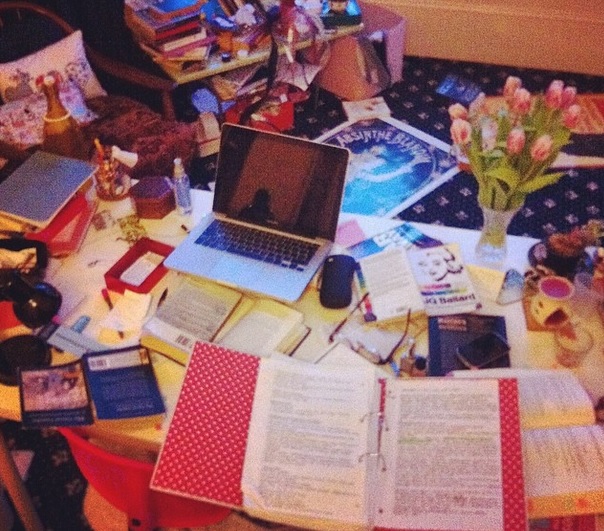
If anything, I’ve learned to keep a slightly tidier desk.
On Tuesday morning, it was spring all of a sudden. I walked to campus feeling warm and happy, remembering the first spring I spent in the city. All those daffodils and the cherry blossoms around Hillhead, and the cheerful experience of the semester ending, everyone gathering for picnics at Botanic Gardens. Optimistically sleeveless, I sat on a stone by the Kelvin River reading Keats, feeling like this is what university is best at. The kind of magical experience unfortunately made cliché by campus films. When you’re in the sunshine reading poetry and you’re about to go in for one of your last tutorials. Sure, I still have three nasty exams to get through, but once they’re over, I’ll hopefully come out a little bit smarter, a little bit happier and a tad more employable. University, both at the academic, social and creative level, has definitely been the best experience of my life. I swear I won’t get sentimental; I’ll come back and do a Masters instead. (Let’s hope; if only).







 mariaology