Review: No You Without – Melanie Letoré

IMG_3870.jpg

Separation is something that passes through your body. It happens on scales that feel biological, because at once so intimate and distant, clear and mysterious. The vertigo sensation when you see a diagram of the heart, or someone’s face fading in the moving window of a train. When I learn the words for things I can’t articulate. When someone says Brexit or mentions faraway disasters, or power lines being laid deep under the sea. Scientific processes that I can’t reach. Separation, transmission, event repeating. A curiosity towards ominous energies. I’m not just talking about the endless, five o’clock stories, beamed through radio waves. Brexit is as Brexit does. Most analogue hour. How many of us woke up that Friday morning, after the fact, with stomach aches? The undigest of all our country, rent broad and familiar on all the news.

~

As history seems to be compressing, rapidly, in a chaotic present which seeks to smooth with legislative violence the rich diversity of our past, stories of migration and change become vital.

With vague direction, I walk over the motorway bridge twice to get back to Glasgow  city centre. The trees in Kinning Park are singed with vermillion; it’s early October. I ascend the footbridge, just slightly hungover. The sight of the traffic fills me motion again, after a night of luxurious slosh and dark of stasis. Screen light and honeydew shoegaze. Cars are barely there, but they go places. They leave a carbon trail behind. Watching from the sun-drenched bridge, I carry my stories and see them swept up in lines I can’t manage. Later, I try to write. I am looking for a flow, a sense of circuitry. The sentences whir.

Then I step into the exhibition. There is the clarity of photography, more like a series of windows. Windows I see inside windows. The glass steams up in certain types of feeling, translated as light.

~

The themes of the recent Lightwaves exhibition at Street Level Photoworks, featuring the work of Mat Hay, Josée Pedneault, Bertrand Carrière, and Melanie Letoré, are moving histories: those of heritage, migration and the storytelling inherent within. I have a special familiarity with Letoré’s work and practice, having served as her hospitality comrade back in 2016 and since then having worked with her on a personal project: a weekly Google doc record of our lives and thoughts, sprawled in text, image (art & photographs), questions, lists, poetry, fiction and essays. The name of our project remains tendentiously secret, a bright hard candy. Keeping a ledger with someone who I tend only to encounter IRL on chance occasion (gliding bikewise down the motorway, drinking OJ in basement bars) feels a bit like an odyssey. An orbit of thought. Each week we find out more about each other’s pasts, our present fears and desires, our personalities. It’s a bit like trading journals at weekly sleepovers, except there’s the sense that each post on our shared document is less a private thought and more like something that needed airing, that needed figuring out in the shared forms of writing and visual expression. Writing as performative output, the act alone a delectation. I love the sense of sisterhood that comes with this kind of sharing, like when I was wee and my cousin and I would read each other’s palms and tarot, tell our futures.

I proposed the project to Melanie after many months of following her blog, Rectangledays, whose premise is the daily post of a fresh photograph. The blog goes back several years and serves as a sort of photo diary, a luminous archive of many little windows into moments in time. Some I recognise from the days we worked together at the restaurant: pictures of a decimated wedding cake, a lonesome chair in a stairwell, a bunch of crutches propped against the fence, another colleague’s bloodied toe, wadded with cotton. I love these photos as a testament to the physicality of hospitality, the importance of objects and tools (knives often feature) to our work, the endurance required: poor Shelby with the bloodied toe, acquired on a wild night out, would’ve hobbled along serving tables with her injury, no complaints, shift after shift.

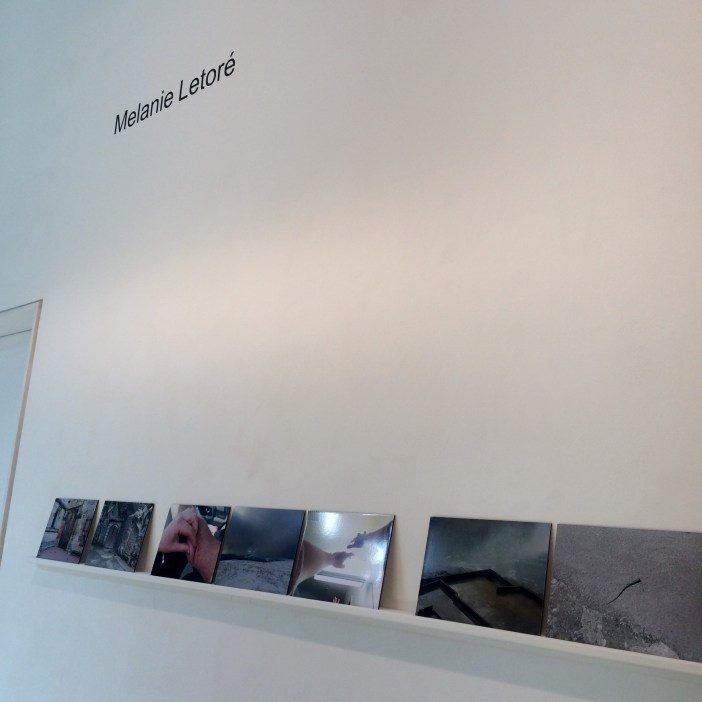
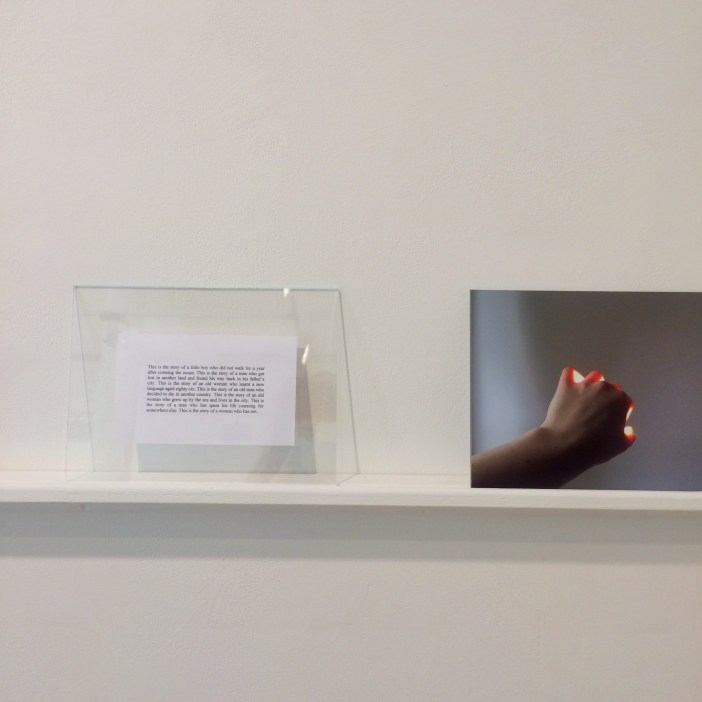
It’s a total treat to see Melanie’s work in an exhibition context. Stories that maybe she’s written about in our ledger come to life in the distillation of pictures in a bright clean room. Privacy rents a very public space. The other photographers in the exhibition have their work blown up, pressed across the white, whereas Melanie’s are much smaller, identical in size, sitting parallel on a wall. The pictures are thick, giving the impression of little books, the three-dimensional aspect implying that the story is more complicated than the image allows. The image contains itself, and then the negative space of all these stories, quietly sporing. Much of her work is about shining a light on the intricacies of identity: Melanie’s grandparents migrated from North America to Europe in the 1950s, and she herself has moved from childhood Switzerland and found a home in Glasgow, as an adult. Her work feels like a dialogue with the everyday world around her, and maybe the people back home, the family who live their own lives many miles away. Photography as postcards without text on the back. Or maybe photography captioned with invisible ink, ink that only some people can see; others parsing their own specificity from the image. That’s the beauty of Melanie’s work: it’s tender and personal, but there’s a humanist impulse in there somewhere too, rent with a complexity that asks us to think about where people come from, how they live, where they touch the lives of others. Feelings, adventures, intimacies, routines, leisure and food.

A certain nourishment. I feel privileged to have access to some of the thoughts behind these images. Reading Melanie’s writing, I find myself adrift on all these planes of migration. The title of her exhibition, No You Without, comes from Rebecca Solnit’s A Field Guide to Getting Lost. When told of the Wintu in north-central California, who use the cardinal directions rather than the words left and right to capture their bodies, Solnit writes, ‘I was enraptured by this description of a language and behind it a cultural imagination in which the self only exists in reference to the rest of the world, no you without mountains, without sun, without sky’. With this perspective, we realise our own contingency in the context of a relatively stable world. Recently, I’ve been wondering about where the ‘you’ is situated in my own poetry, who exactly it is I’m addressing. Who is the ‘you’ in a photograph, what kinds of hailing occur when we look at a portrait, or perhaps a landscape. Where are we situated and within whose vision. There’s a piece in No You Without where a woman, I think in fact Melanie herself, has awkwardly levitated her body by propping it between two counters or surfaces. I’m struck with the fact of the body suspended so precisely this way, making a new morphology of her being. Like when you are a child and find ingenious ways to get across a room without touching the lava-strewn floor, or like lying upside down for too long and seeing how precarious your sense of space is. When you are forced to appreciate gravity, pressure, connections. The objects that make us by dint of negation.

IMG_3869.jpg

In Melanie’s images, I seek fresh orientations. These are subjects which reflect process rather than point; they are a document in the quest for self in a sea of myriad reflections, a very real sea which threatens with its sweep. I see red ribs of meat, black curls through black curtains, a strand of hair overlooking an island, the pinching of elbow flesh, a rainbow, the gnarled remainders of landscape’s heap, two boys rolling around on the beach. Each image demands its own sense of scene, of identity in place. I have a sense of capturing, that one slight second that splits and releases: the clouds come in, the flesh smooths back, the rainbow ceases to be.

While the images do not document explicit ‘narrative’ as such, it’s clear there’s an intimacy threading between them. I wonder if we are encouraged to pick up the images and study them, the way you might lift family photos off the mantelpiece, stealing a look at the back for captions. In the exhibition notes, it’s suggested that the migration of Melanie’s grandparents to Europe, and all their associated trauma, comprises ‘another layer to her search for identity’. What we lose or leave behind. What we carry with us. A memory of blue, of sky, of something that represents the not-knowing, but nevertheless the feeling. That which comes, regardless of narrative or language. I planted a thought. Photography bears the visual seeds.

I’m reminded of a passage in Sophie Collins’ book small white monkeys, one that Melanie and I have discussed often:

Patterns of shame can of course be inherited, be broken, halted, but mostly they are carried on through, like mottos, or emotional heraldry.

Maybe we carry something of what our parents and grandparents taught us, or experienced. The learned behaviours, observational ticks of outburst or repression. Frequencies and cycles of confession or pain, the arguments which pixelate our childhood memories with varying degrees of trauma. A traumatic tartan, stitched to the furniture of our daily lives; a ravelled print of practices and patterns of thought and feeling.

We find ourselves reenacting the affects of others, those we are close to. Mostly, we don’t mean to. There are just these things we remember, ticking away in our brain and blood.

Such memory persists like a stick of brighton rock with the motto carried through, except you can break off the stick at any point, you can shatter the neat black letters. The rock of the shards tastes sweet and mint, is cleansing.

But it sticks to your teeth. Shame sticks also.

You can cut yourself on your own quick memory.

When I learn the words for things I can’t articulate. Surely ‘emotional heraldry’ captures this miasma of maybe incalculable feelings I might attribute to family experience? A coat of arms to bear, whose pattern is fading before me, or intensifying within me. Heraldry, inheritance. Jewishness on my mother’s side, ethnicity unrecognised, religious cycles and traumatic pasts; a kind of implicit migrancy that is only tangible in visiting. Stories my nan tells about ancestors whose names are like keys to dust-filled chests, mildewed letters, somewhere deep and distant. But then livable: a trip to Amsterdam, family graves and suddenly the pulses of history might glow in my veins. That heat is a shame. Peeling yourself from the easy determinism of ‘family’ and then finding family wherever you read. Recently I was struck hard by this essay by Daisy Lafarge on maternal approaches to poetics, or looking to whatever texts provide a sort of mothering supplement, rich with emotional truths. The wrestle with essentialism, with forms of belonging. I am someone’s daughter when I read a poem or look at a photograph. Sometimes I am otherwise lost. I am that altogether vulnerable.

I guess I’m an immigrant too of sorts. Moving from England to Scotland at a very young age, being acutely aware of my Englishness and thus playground shame because of the markers of accent, and yet proud at the difference, to be different. Melanie’s photos teach me to sympathise with other kinds of present, and presence. They are fleeting and insouciant, playful in one sense, but otherwise make me want to stockpile and archive with a kind of serious fever. I want to know everything about the people in these images, scour their diaries and ask them their names. But I also want to leave them alone, up on the shelf where their lives can be quiet and still, and yet somehow heard, in the seeing. Maybe an image is a kind of speech; it allows us to separate, and to parse our connections. To halt in the flow of feeling, to carry a place or a person; to illumine.

~

Lightwaves is on until 25th November at Street Level Photoworks, Glasgow.
IMG_3871.jpg


Playlist: November 2017

IMG_7783

IMG_7846

IMG_7975

The kind of cold that’s purifying, that fills your lungs like sea-water sloshing inside the mouth of a cave. So it’s hard to breathe, but cutting through the breath is a sweet feeling, preciously there in the swift struggle that settles on calm. I go out at night and the cold air is a shot of adrenaline; I walk ultra fast, making hard strides across asphalt that sparkles with salt in the fierce moonlight. This is a month of much stress and panic but also relief. Resolving to make new friends, even though each time I worry about who will leave next; the cyclical press of everyone coming and going, memory hanging on a thin noose I can’t quite tauten, snap and break. I fall through it as light falls through a halo. I feel feathery and weird, writing nonsense in the morning to delay the inevitable rise from bed—a snap of cold, of spine and mind. I love the old ones, look forward to new.

We’re up late and I watch things unfold, messenger blue. At work, I run upstairs to watch Out Lines perform down below, an incredible light show glistering with swirls of lilac and white. It’s gorgeous and dramatic, genuinely breathtaking. I watch from the gallery as sonorous and sinuous beautiful voices mingle in a room full of awe. I feel sobered, grateful to just be, watching a few songs before inevitably I must return to work, to count the till and smell the coppery aura of tired old pennies. I see Julien Baker perform in LP Records, filling the tiny room with her massive voice; a voice that could start car alarms, make cracks in the concrete, tear up the numbness that governs the daily. It’s the voice of a heart too big for its ribs, a heart throbbing against the cruelties of existence, spreading hope on a room of friends and strangers. She covers Audioslave’s ‘Doesn’t Remind Me’ in honour of Chris Cornell, and for weeks after I hear that refrain, over and over, Cause it doesn’t remind me of anything. And I wonder what it means, and what sort of list I’d make in lieu of  Cornell’s lyrics (‘gypsy moths’, ‘radio talk’, ‘driving backwards in the fog’, ‘canned applause’), planning a poetry exercise but then finding all the same that even the world’s waste is entangled for me. Maybe I will get older and find little daily voids to give my mind too. For now, even a tree is too heavy with everything. I can’t talk about Pokémon without getting misty-eyed over my youth.

Strange personal things make momentary ripples in reality. I fall asleep at work, heroin-heavy, in a hoard of recollected dreamscapes; I get up at 3:30am to attend a conference in St. Andrews, ‘Cultivating Perspectives on Landscape’. The sky above the River Eden is this dramatic topaz cutting into azure, argent wisps of cloud streaking the horizon. Without realising, I pass by a friend’s house. I watch from the train window in total awe; delirious on the earliness of it all, the quiet, the light on the soft waves rolling and rolling. I could be on this train forever, even though waiting at the station for changes makes my fingers seize up with the cold. I’m reading Robert Macfarlane’s The Old Ways, gloved fingers clutching its paperback skin and pulling pages back with a hunger within. He describes the absolute cold of the mountains, the physical heft and sense of pure reward—not from summit but from sheer movement, the panoramas unfolding around you, the mountain that gets under your skin, the scale and sublime you practically inhale. Landscape glitters with detail; Macfarlane has a vocabulary that makes you feel as though in reading you were picking over some deluxe smorgasbord of words. Learning and learning in the lilt and fall of his complex rhythms. It is the right thing to read at these freezing stations, taking me elsewhere entirely, sharing my sense of embodied limit. I arrive at Leuchers around 8am, the sun just coming up over flat plains, a total burnished, scolding orange. Later, I find myself wandering a herb garden with lovely strangers, crushing rosemary between fingers and ruminating on narratives of scent. A very clever academic gives a lecture on classics and lively stones. On the train home, everyone is drunk and teenage boys crack cans and discuss girls with a coarseness I’d sort of forgotten existed. I sit opposite two guys in their late twenties who discuss their mutual careers as accountants, and I feel blessed to be outside such existence: paid-for parties, gym memberships, brutal team meetings, deadlines, spreadsheets, rapturous conversations about the latest tablet. I buy a bottle of Talisker Skye on the way up Sauchiehall Street, warm my cockles on the space-heater and do sun salutations to boost circulation. Already, several friends have left for Australia.

Frequently, there’s a brain fever, an ache in the body. I am ill for much of this month, but there is a day when I wake up better and clearer and it is like taking a drug. Health. Temporary sense of invincibility. Sad things happen, secrets reveal, sordid truths fill up the news. A man I knew died in a terrible accident. People have far harder lives than I.

The floor in the restaurant where I work starts coming up, splitting apart like something is rising from underneath. I carry food, traversing the crevice, Johnny Cash’s ‘I Walk the Line’ playing over in my head. It’s so disorientating that sometimes I forget this is something I do every day, just carrying plate after plate, cups and mugs and cutlery. Tracing the usual trajectories. I come in two days later and somebody has smoothed out the crack. It feels like a violence that never happened.

When people are drunk, they tell too much. Sharing melancholy joy till six in the morning. It’s good, but how much of that are you allowed to revisit sober?

The exhibition/installation I’d been helping out with for months took place. The Absent Material GatewayI think of it as a sort of portal to extra reality, a space where you can relish the intensity of elsewhere, let it split apart your senses for ten minutes—long enough to let sound and light rush through you, to conjure the ruptures that remain for weeks afterwards, never quite healing as even the quotidian fills them with usual slush. Nothing feels completely fabricated, but rather it’s a blurring of what we think of as real—how we encounter objects. Here, the weird things shimmer in dramatic strobe and seem to act upon you; these lively, alien pieces of matter. Scrap parts gleaming with mysterious power. The Lanark Artefax gig at the end of it blows my mind. I’m sipping straight vodka piled up with ice in a freezing dark room at The Glue Factory, but as soon as those first trademark stammering pulses start fracturing stars and synths and the melancholy strings with eerie samples hold back, suspend, then rush underneath…It’s a landscape elsewhere that is momentarily, totally immersive. I think of matter crackling at microscopic levels, or else grand panoramas of mountains bathed in alien starlight. Cities that smoulder with smoke, hovering drones and dramatic cracks in the side of cliffs whose insides fissure with poisoned earth. I think of ancient ruins through doctored photographs, angles of time dissolving with the phantasmic drift of a passing graphic, numbers running in algorithmic digits, pixels melting to colour smudge, then ether. Glitches. It is all of a shuddering. The audience are truly glued, despite being charged up on all the free Red Bull. All the sound cuts through so every normal thought is in shards, afloat. It’s one of the few genuinely sublime experiences of my life. I walk back in the cold rain, feeling emotional, drained, intense and electric. When I close my eyes to sleep I see nothing but strobe.

I have dreams of Styrofoam palaces, trains that keep leaving without me, layers of skin I could scour off my body.

There was a talk on Mark Fisher at Glasgow Autonomous Space called ‘Acid Communism’, and I got to dwell awhile in the comforting, baffling whorls of radical theory. I spent all month talking about Fisher to numerous people. Sent lots of excited emails and prepared my PhD application. Ideas started ravelling and overlapping and tightening. This whole sprawling project set out before me; I felt ambitious and still feel as though this is something that maybe I could actually achieve. Build this thing that I’ve set out in rough blueprint. I am energised, thoroughly, by the words of others.

We launched SPAM Press pamphlets (Dan Power’s Predictive Text Poems and Ryan Jarvis’ Tesseract Life) at Good Press and bought quantities of Lambrini for the occasion. Life is a whole lot of walking past Kelvingrove Art Gallery at one in the morning, sharing nightclub horror stories, gently reminiscing and falling asleep so the ink in the pen leaks over your duvet. I realise Greenock has a well lush Lidl, my cousin releases a single and it ramps up over 130,000 Spotify hits in a week. It’s funny, remembering her on our old sofa aged fourteen playing ‘Face for the Radio’ on my brother’s out-of-tune guitar, that lovely voice at its first nurturing. Now she’s on a billboard. We have the same nose.

I feel blessed by the blue days, the clear blue days, that come a couple times a month and even when I am too tired to leave before dark it is good just to know that out there things are bright and good. After graduation, we visit Luss and the sky is already at the brink of gloaming, this luminous lilac that blooms over the hills. I watch the nicoline light on the land across the water, over the heads of Japanese tourists unseasonably out snapping pics on the pier. Watch the city blossom back into shape across the motorway, an inverse meadow of delicious twinkles, listening to John Martyn in my father’s car. I feel calm, setting out to meet friends and discussing everything, sloshing a cheeky amaretto.

I revisit A Perfect Circle, Sun Kil Moon and Sufjan Stevens as the nights draw in too close and there is barely six hours of workable daylight. Something stirs from the past, but I crush the feelings like crisp dead leaves underfoot. I drift around, inhaling woodsmoke and missing the countryside. People leave curious furniture out on the street. A maximalist dolls-house, scattered by the city’s ruthless refusal to deal with its waste. New systems spring up around old objects. Ecosystems are complex and recalcitrant, their musty materiality seductive. Something hits me, occasionally, and it’s implacable, otherworldly. Space in my head that could be anywhere, everywhere, either. Even the streets feel bruised. My brother leaves for Australia and I think of him flying over a bright bright blue. All these people will bronze as I fall farther white into china paleness, sipping peppermint tea and crunching almonds between teeth. These people that go travelling, they leave me lilac eyeshadow, mint-cream nail varnish, memories and jumpers they won’t need anymore. I feel the roots tug and shuffle, sprawl beneath me in new formations. Endless scroll of Instagram posts. The last leaves cling to more paranoid trees, lamp-lit in sodium glow on the long walks home. Shops fill up with fairy lights, glitter and sprigs of fir. I can’t tune to the lure. Christmas is still a word I’m trying to deal with, a lonely lonely tinsel litany.

*

Saint Sister – Blood Moon

ARK – Made for Us

Alela Diane – Hazel Street

S. Carey – Fool’s Gold

Tiny Ruins – Old as the Hills

Adrian Crowley – Long Distance Swimmer

Sufjan Stevens – The Hidden River of My Life

Sun Kil Moon – Sunshine in Chicago

Julien Baker – Doesn’t Remind Me (Audioslave cover)

Kelly Lee Owens – Pull

Ellis May – Father

Sharon Van Etten – Keep

Bjork, Arca – Blissing Me

Windows 96 – Youthful Waters

Slugabed – Stupid Earth

Angel Olsen – For You

Pinegrove – Angelina

Julie Byrne – Sleepwalker

Out Lines – The Left Behind

Ho99o9 – Neighbourhood Watch

A Perfect Circle – 3 Libras

Hirola – Fields

Lanark Artefax – Voices Near the Hypocentre

Penguin Cafe – Cantorum

Boards of Canada – Everything You Do is a Balloon

Feist – Hey, That’s No Way to Say Goodbye

Jeff Buckley – Morning Theft