Notes on iNsEcurE exhibition

Che Go Eun, a hole in a boat and a deep hole (2024)

Dear pain,

That’s how the light gets in. Fractal emanations of screaming the dark is a luxury the dark the dark. I listen to the radio and a mother talks of her autistic child preferring the dark — thriving in it, coming to life.

We soft-light to protect the unsaid stories.

Our bodies twist in the dark and we make an inconsistent work of pain-pleasure. The mattress gives out: pools of blood, ink, sweat, coffee, sex. I feel better when the sun comes up and when the sun goes down, wine-dark. It’s what’s in-between that’s the problem.

I keep thinking about Fred Moten’s luminous correspondence, ostensibly between Andrea Geyer and Margaret Kelly:

My friend, I have discovered in the antagonism between my work and dead letter that the project returns as an amazing field and air of correspondence, a transgenerational lotion of breathing, a revue of breath, a general bouquet in the grace of your asking in friendship since the day we met, and our braiding and breathing of a correspondence that we are now and have been working together in the atmosphere of our comrades, that we literally breathe them as a kind of braiding, an insistence of revolt as garment, a tapestry for the touched wall of a spaceship we noticed on the way to school, that off dimensionality of the cloud from our perspective, which I want to say is real not graphed, which I want to say is both a function of, and still untainted by the terrible business of, the Dutch masters, so that it’s impossible to tell the top from the side, though there was some kind of emanation or emendation that we all saw as a smooth flatness, like a table the cloud prepared of its own accord, a spread platform for spreading our metastatic air, our beautiful, is ourreal.

Fred Moten, The Service Porch (2016)

To make a pain of you, stop being a pain, I’d form a cartography of the nerves so rich you’d never know I’d outmatched the major scale. A map does not function in service of security. Anyone who has seen me read (and attempt to follow) a map knows this.

What is so gorgeous about the Moten quote above is its ph(r)asal longing: an ongoingness open to improvisation and constant sentence desuetude. Language like you don’t even need it, breathing all the same beyond what’s essential. Take this key. Braiding and breathing a coital somnolence of the body, twice rung out in language / only us leaving voice notes for what clicks pearls together, minor, deep in the distance.

Emollient longing of writing between pith and pronoun, what is prepared by the passing between. Our breath, clouds; mattering.

‘•.¸♡ ♡¸.•’

I saw the spaceship too. Didn’t you?

Intimacy, I told someone recently, feels like the opposite to what capitalism wants of us. Intimacy is worldsharing, ourreal, a grammar of humours, kisses and shibboleths. You know my pain and I know yours. We make a joke of it. What escapes serious talk but our serious dreams. So when we’re all in the gallery, we switch to our senses to make language-sense of ourreal, cellular vibe spread. It’s a room replete with the sonic ecology that is feeling all my fucking feelings (Clémentine Coupau): aka hook me up to ‘electronic components, dimensions variable’. The little paper lantern is a miniature version of my own IKEA lampshade. The problem with my IKEA lampshade is that I had to tear it a bit to change the lightbulb. I have a torn lantern. Magic hands. That’s how the light gets in. Paper = skin. Creamy light.

Che Go Eun 최 고 은, a hole in a boat and a deep hole (2024)

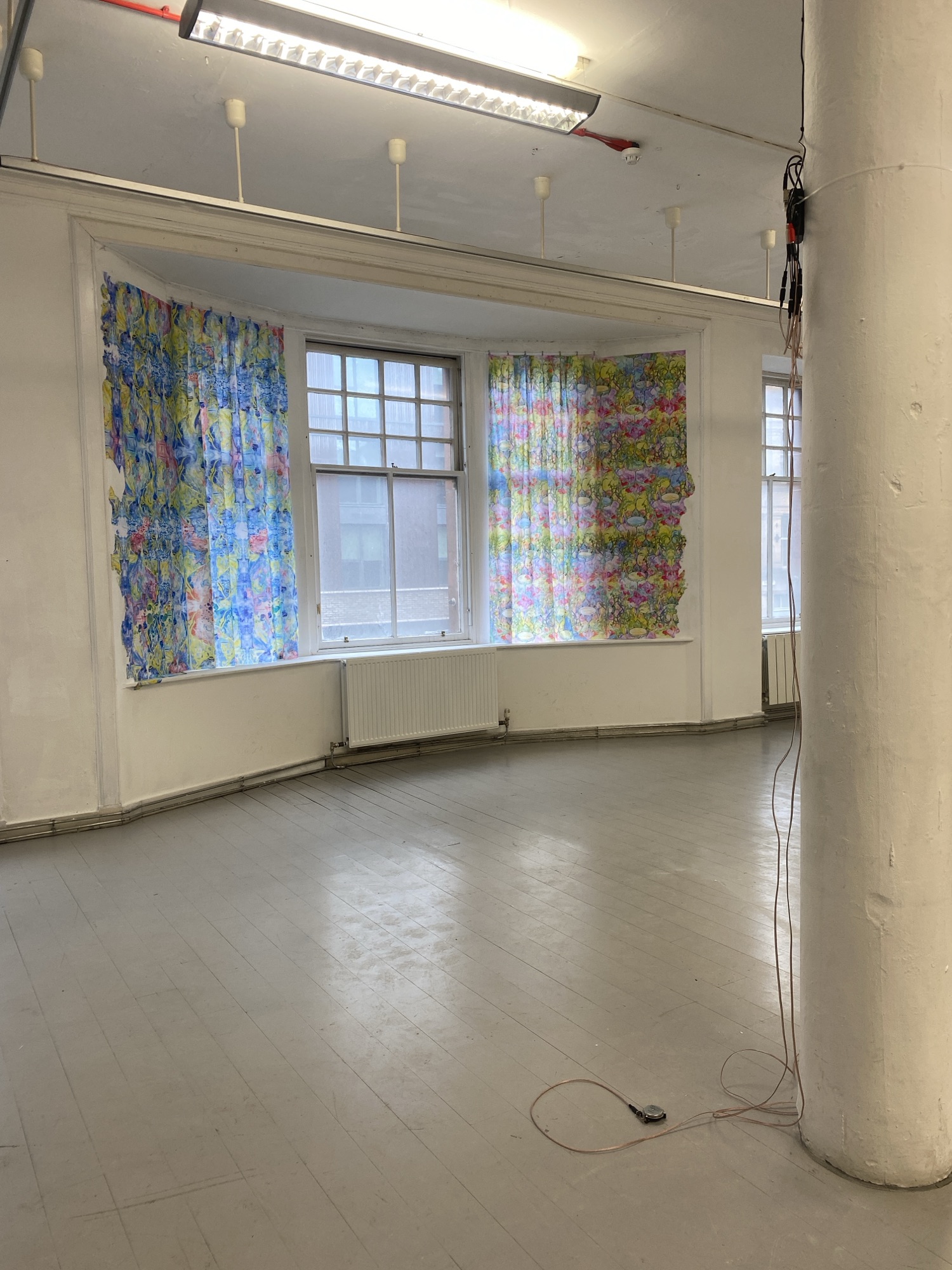
Aside from lanterns, the other homeware alluded to are curtains. Che Go Eun’s a hole in a boat and a deep hole is composed in collaboration with artificial intelligence. The artist inserted diary notes into an AI image generator which ‘transformed [their] intimate reflections and resulted in images’. Watercolour drawings were then made in response to those results, with the artist ‘reappropriating’ their ‘own feelings back from the AI’. This tension between creativity, data and predictive imaging results in a fascinating, speculative assemblage of arabesque, thorn and psychedelic colour. The nod to William Morris/Arts & Crafts reminds us of the collaborative handicraft that has gone into the piece’s imaginary and manifestation. Diary phrases such as ‘art nouveau’, ‘harder I am sinking’, ‘throw all my stress into the hole’ are woven into the fabric of these drapes which suggest both privacy and opening, light and shade. The work is gauzy. There’s a real street, a construction site behind it. Trongate: name as lozenge. What Moten says in the same letter-poem as quoted above, ‘a gauze of reckoning’. Threads, braids: stress, tension. I want to wrap the code-baroque of the fabric around my body like I’m a silkworm going in reverse, all the way back to its gross and sultry, larval conception. I keep hearing that the internet is just the unconscious. I see a bag of squishie candies in a vending machine and think: ugh, silkworms.

‘•.¸♡ ♡¸.•’

Back IRL, it’s raining with the pelting dreich that only a Glaschu April delivers, and I arrive at Trongate 103 having walked through Dennistoun listening to Elliott Smith. I’m not feeling morose; I’m just in touch with my feelings. As if they were tangible: animatronics, statuettes, pets. I’m still on a medication that holds such whimpering demands at just enough distance to be considered somehow ornamental — torrents no more. Once I would torrent my day in their favour. Let someone seed me. Now, I might choose to pick them up, put them back down, or smash them into oblivion. Let my soul have the architecture of a bleeding gate.

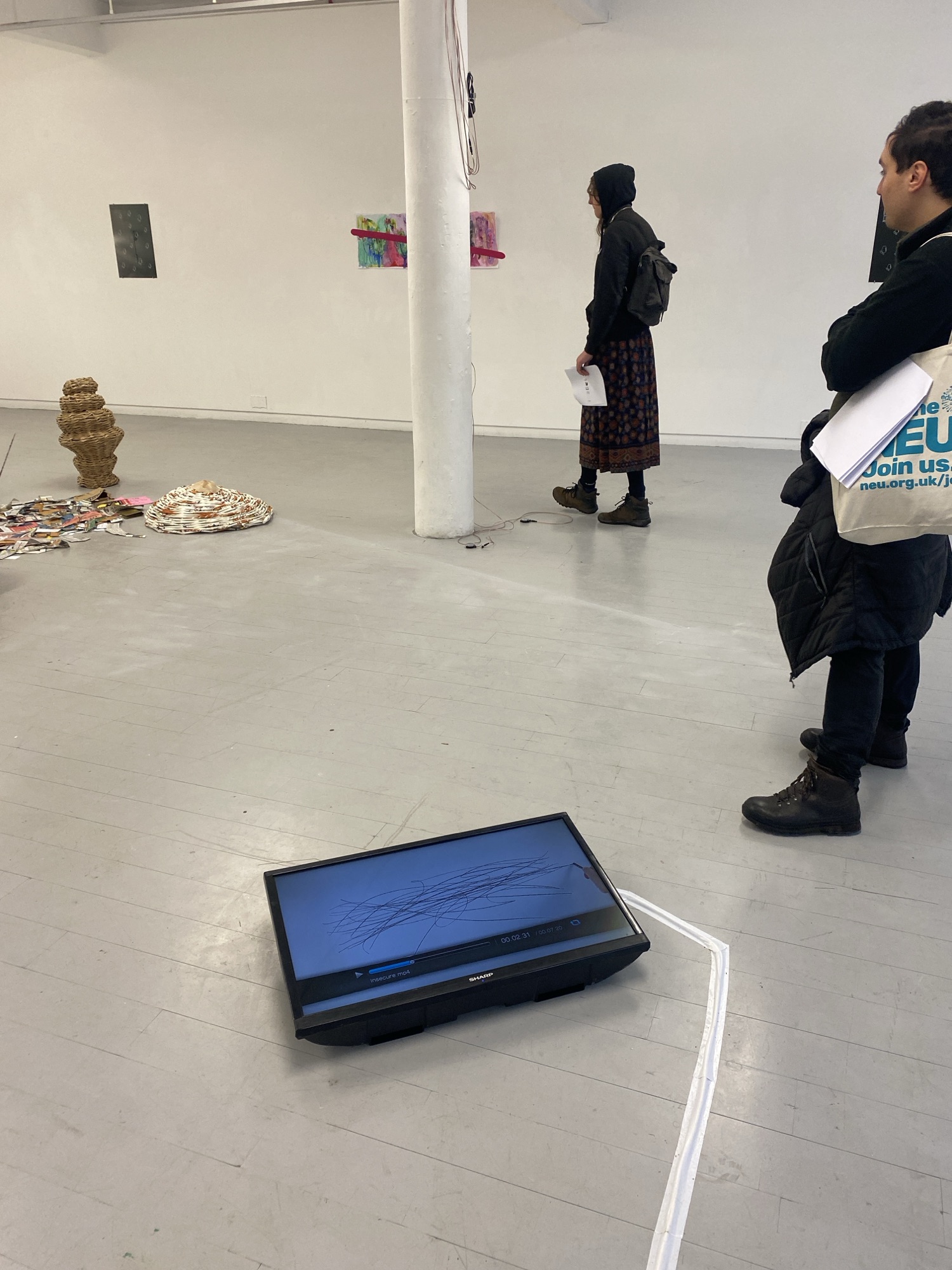
As I enter the exhibition, the invigilator says something about one of the objects we’re allowed to touch. I forget immediately what they say because I am greedy for colour and form, not meaning. So the whole time I am looking at the exhibits wondering: which of you may be touched? A finger trace of the curtains, time slider on video screen, glass surface of framing, kinesiology tape cut into bows and ribbons.
Daisy Lafarge, Gate Theory of Pain (III) (2024)

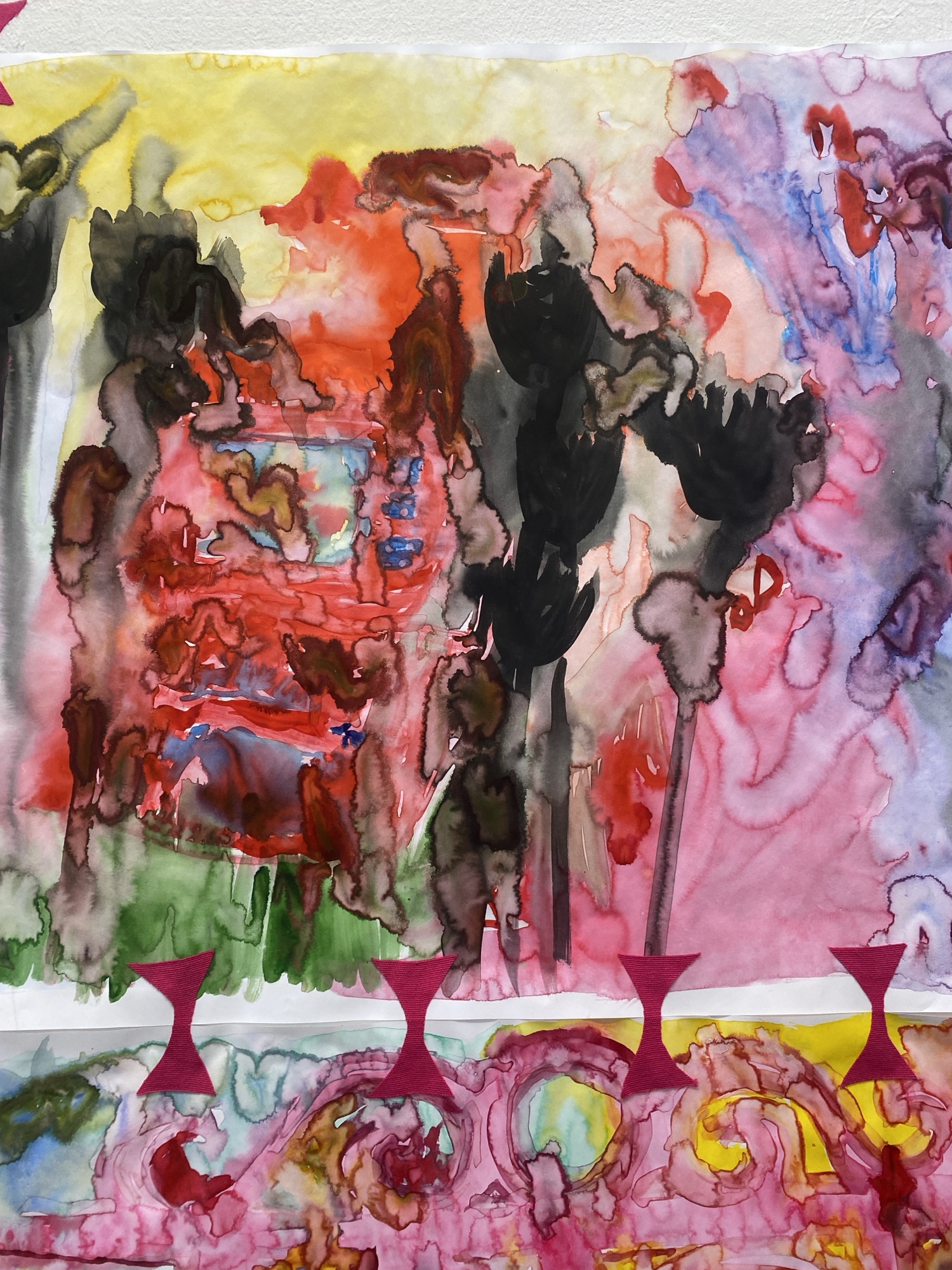
Touch is not in itself untainted. I am in love with Lafarge’s black tulips; their painful, precious tendrils.

‘•.¸♡ ♡¸.•’

Some people gave me advice
on how to do better: thirsty
in the flowerbed
for some aphids fed upon
200 ladybugs to eat/moult
more often than not they
would die as fast as any plant
blocked sunlight to pay
(dustfall / bonnie / smitten )
should the wind ever blow
you a raven

‘•.¸♡ ♡¸.•’

Mau and I try to diagnose the  Mandelbrot set-seemingness of Lafarge’s watercolour fractals. The sequence ‘remains bounded in absolute value’. This is a beautiful phrase I find on Wikipedia. ‘It is one of the best-known examples of mathematical visualisation, mathematical beauty’. I could watch the little fractal gif forever like giving birth to myself over and over as a starfish with 7000 eyes & infinite narcissism. As it stands, that boundedness is a gate: pink, the colour of doll-flesh. I think of tentacles, elliptical phone calls, inflammation. We agree that almost all the art in the room is art that could be done on the phone. It’s not just about doodlecore but the intimate, desultory gesture of the line itself, and what’s on either side of it.

Not to get kinda kinky but the other day we were explaining ‘lucky pierre’ in the pub (because of Frank O’Hara the poet we all love and love most of all to discuss in the pub). In his ‘Personism: A Manifesto’, O’Hara talks about the poem in supplementary relation to people. Intimacy again. Sure, he wrote it while ‘in love with […] a blond’, which makes it all the more true and golden:

I went back to work and wrote a poem for this person. While I was writing it I was realising that if I wanted to I could use the telephone instead of writing the poem, and so Personism was born. It’s a very exciting movement which will undoubtedly have lots of adherents. It puts the poem squarely between the poet and the person, Lucky Pierre style, and the poem is correspondingly gratified. The poem is at last between two persons instead of two pages.

Frank O’Hara, ‘Personism: A Manifesto’ (1959)

As Moten’s poem from The Service Porch is framed between two persons, so the epistolary heat is folded into Personism. It’s not letters but speech itself that gets electric. So what Mau and I mean by ‘this is art that could be done on the telephone’ is perhaps something about how the work takes place in correspondence between two or more bodies. Lafarge describes her paintings ‘as a means of pure distraction’, made during ‘episodes of severe chronic pain’, ‘remote NHS chronic pain sessions’ and ‘in phone queues and conversation with Adult Disability Payment (Social Security Scotland)’. The trembling of watercolour is an apt form for the bleeding edges that connect the power imbalance of someone trying to get support and the person with the power to connect them to it. It’s the art of turning away, seeking psychic space, without letting total go of the line.

How often do we find ourselves at the gate, with no end of wanting to both know and not-know what’s beyond it?

Wrought/not I.

‘•.¸♡ ♡¸.•’

I love gates. I love especially baroque ones with curlicues. I grew up with a broken gate which soon got removed. What did we have to keep in, or shut out? It was black and gold and the paint flaked off very beautifully. You might describe it as ‘tawdry’. I probably have false memories about this gate. Sometimes the screech of its opening hinges my dreams. Lafarge’s gate might be a homophonic pun on ‘gait’ (and so referencing the debilitating effects of chronic pain on one’s ability to walk freely). The painting, titled Gate Theory of Pain (III), no doubt references Ronald Melzack and Patrick Wall’s 1965 paper on ‘The Gate Theory of Pain’. In the words of Lorne M. Mendell:

The [Gate Theory of Pain] dealt explicitly with the apparent conflict in the 1960s between the paucity of sensory neurons that responded selectively to intense stimuli and the well-established finding that stimulation of the small fibres in peripheral nerves is required for the stimulus to be described as painful. It incorporated recently discovered mechanisms of presynaptic control of synaptic transmission from large and small sensory afferents which was suggested to “gate” incoming information depending on the balance between these inputs.

Lorne M. Mendell, ‘Constructing and Deconstructing the Gate Theory of Pain’ (2013)

The Gate Theory concerns sensory fibres, transmission cells and their respective levels of activity. The idea is that painless sensations can supplant and so quell sensations that are painful. The process involves a blocking (a closed gate) of input to transmission cells. When the gate is left open, the sensory input gets through to transmission cells and produces pain. An example of the therapeutic application of this theory is transcutaneous electrical nerve stimulation (TENS), massage, acupuncture, vibration and mindfulness-based pain management (MBPM). While gazing at Lafarge’s vivid watercolours, one senses that pain is not suspended in the art of painting so much as calibrated, channelled, short-circuited. We keep commenting on the bleeding edge.
Aniara Omann, Resting on an icy couch (mother, grandmother, grandfather, big brother, older sister, little sister) (2020-2024)

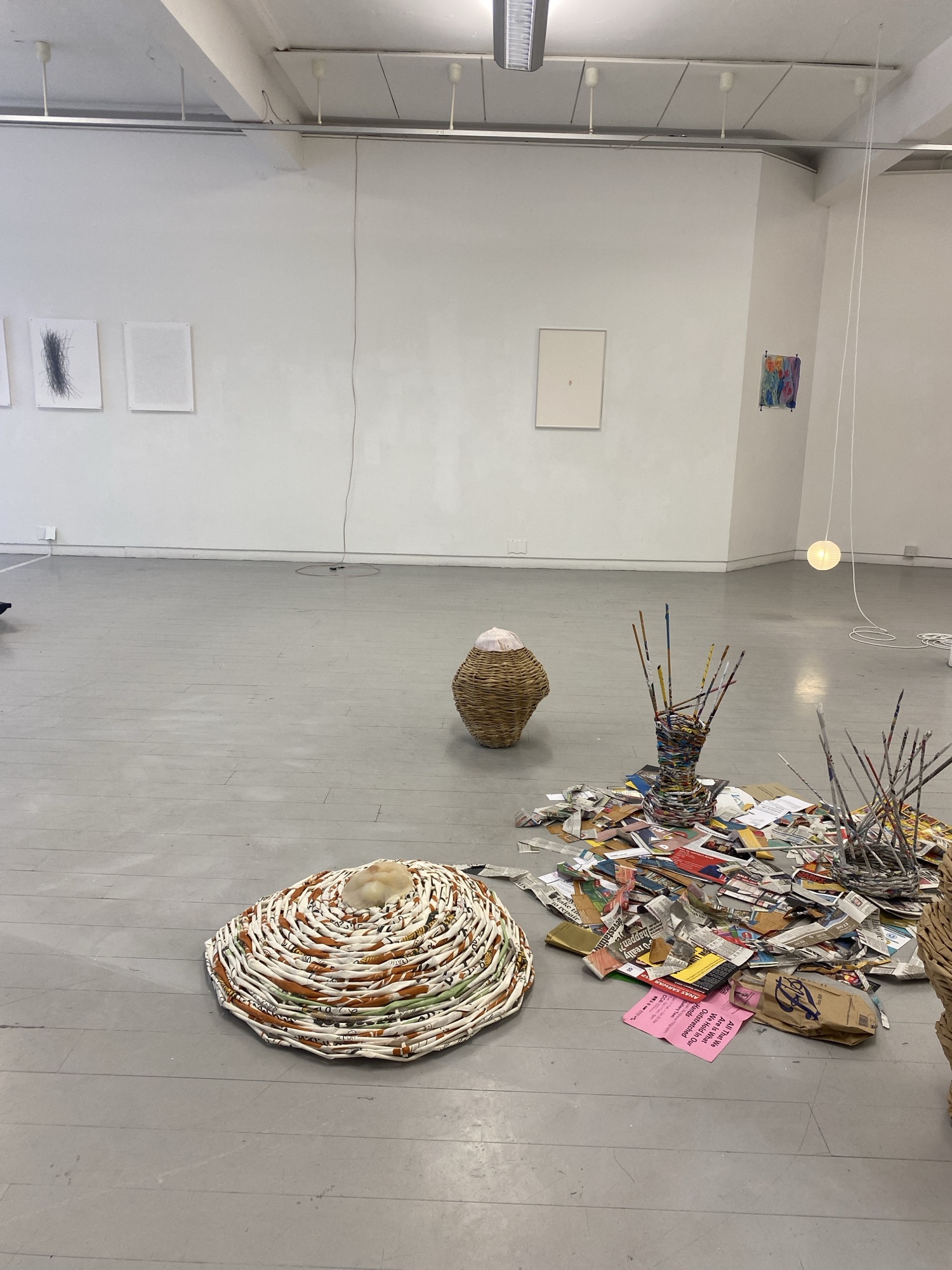
Elsewhere in the exhibition, ideas of feedback loop, intimacy, daily life and relationality are also manifest. Feronia Wennborg and Simon Weins’ soft tissue plays with sound transduction to install a ‘lo-fi sound system that lives at the periphery of perception’. This installation of contact-based sound production manifests the pair’s ‘long-distance collaboration’ in felt space. Aniara Omann’s haunting paper baskets, plugged by family faces, makes a ragged philosophy of grief and panic. The raggedness betrays a struggle for focus which is played out through the woundful (I meant to say wonderful, but this works better) arrangement of loose paper, woven baskets, the sense of things cut, twisted, recycled. Omann describes wearing the clothes of their sister, who died: ‘If anyone complimented me on a garment I had inherited from her, I would say it was a gift from a family member’. In that sense, we could think about the paper baskets as fragile amphora for an archival underworld. The baskets are not perfect, machine-made. They retain the expressive and painful grace of their making. They are a flammable structure, woven from newspaper clippings, election flyers, prescription papers, envelopes, bills. What is it to find a way of wearing something? Wrap your troubles in dreams. Shuffle for sources. The difference is a question of agencies; and yet either way the gesture remains. The gift: it has to be infinite.
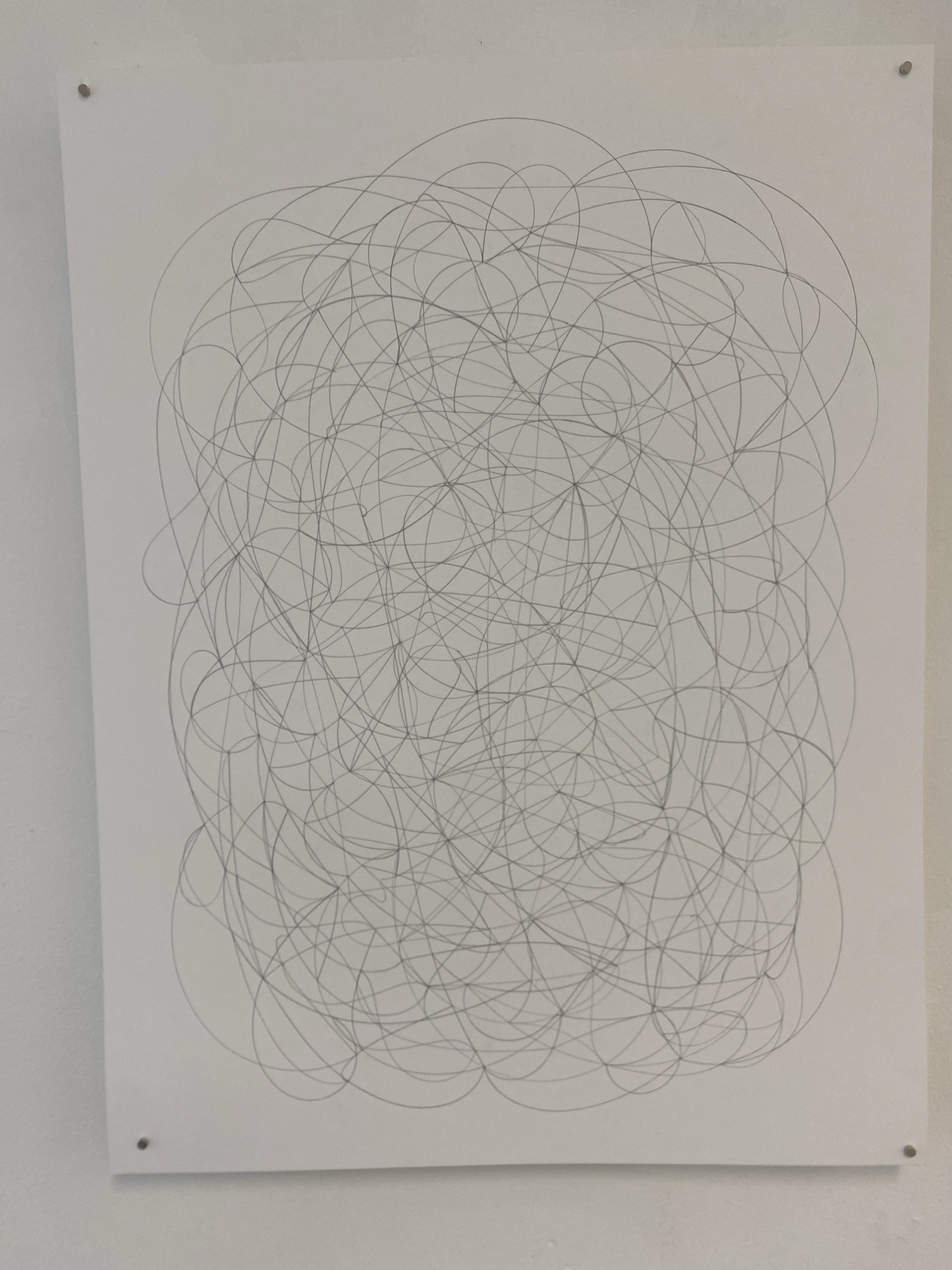
Elísabet Brynhildardótti, The Lines- Hesitant line, Obediant line, Indecisive line, Decisive line (2023)

When someone says ‘hold the line’. Please hold the line. Please hold the handrail and take care on the stairs. Will you please hold? What’s at the end of that hold? I have been trying to get a medical appointment for weeks. They keep putting me on hold, hanging up. I phone up a doctor’s surgery which is based in a shopping mall at precisely 08:30, when the lines open, and immediately the lines (the queue) are full. How do I envision those lines? Swirling and spiralling around the postcode lottery of where we live, tangled and fizzing with people trying to find words for the pain they’re in. I think of my mum in lockdown, endlessly on the phone 500 miles away from the fact of trying to get prescriptions and medical treatment for my nan. It’s pretty mild for me, my current need to be on the line: among other things, fucked-up hearing, tinnitus, crackling I hear like static between the two sides of my skull. Sometimes a pleasurable hum in the morning, like ultrasound waves in the skeins of my pillow. On hold to the doctor’s office, you become a line. The hidden labour of the chronically ill is this beholden quality, the line with its insecurities. It’s getting thinner. There is no guarantee that the line will lead to something: its pulsing, throbbing insistence on being anything but spirogram music. The irony of disconnect. Give me a point; an appointment; a person at the other end.

Who would pick up the line would do so, of course, in the dead of night. In Stigmata: Escaping Texts, Helene Cixous writes:

It is the dead of night. I sense I am going to write. You, whom I accompany, you sense you are going to draw. Your night is waiting.

The figure which announces itself, which is going to make its appearance, the poet-of-drawings doesn’t see it. The model only appears to be outside. In truth it is invisible, but present, it lives inside the poet-of-drawings. You who pray with the pen, you feel it, hear it, dictate. Even if there is a landscape, a person, there outside—no, it’s from inside the body that the drawing-of-the-poet rises to the light of day. […] The drawing is without a stop.

Hélène Cixous, Stigmata: Escaping Texts, trans. by y Catherine A.F. MacGillivray (1998)

What I see in iNsEcurE (whose inconsistent casing recalls the long identifiers of medical-grade pharmaceuticals, the vowel-like howling insistence, the trembling name) are poets-of-drawings. The asemic work of line, layer and bleed is an avid supplement for writing itself. Who can write while in pain? Who’s afraid of the dark? Who’s afraid of the blank? It is in the night of writing, unnannounced. What is that invisible presence but pain itself? There is no ‘outside’ to pain, once you’re inside it. And yet the gate theory does imply a certain threshold. Relief bucks at the gate. Still, we draw from the well of it moving inside us. You can’t stop it. The appearance of the outside is only gauzy separation.

‘•.¸♡ ♡¸.•’

When I thought I had endometriosis and lived in the hormone torture of latent, duplicate pubescence, resulting from the long-durée of various quiet disorders, I wrote spiky little poems for a pamphlet called Cherry Nightshade. I didn’t yet know about the gate theory of pain but I saw all the poems in a dream_garden festering behind a gate. Well, more like a trellis. Ground cherries contain solanine and solanidine alkaloids: toxins which are lethal, and all the more lethal for their immaturity. Tart cherries have soporific qualities. I wanted sleep to envelop me in perfect velvet. My speaker was a jumping nerve, a shitty little internet silkworm.

What did I get from staring so long at the gate? I fell asleep on the line and the vine grew around me.

I love this exhibition for what it teaches us about art between bodies, how light interacts with feeling-colour, Moten’s ourreal in its total ambience, the drilling outside is part of that thrum in your skull, the way I love to look at my friends as they look at art, tulip mania, mourning vessels, the exquisite difference between red and pink, the meaning of panic touch, pain as the body’s great epistolary effort, fragility, attention’s relationship to healing, what it means to be gratified (if at all). I am grateful for the sharing of insecurity at the heart of the works, and for what they offer by way of being with pain. A bearing, a cloud platform, an intricacy. Standing at the gate.

‘•.¸♡ ♡¸.•’

Further notes:

  • medical filigree
  • acid yellowing
  • mau touches a sound magnet
  • ‘insecurity fuels consumerism’
  • light source
  • biofeedback
  • neon bandage
  • organelle ballet
  • tesselate attentions
  • the puzzle pieces do not technically touch
  • go into the hole
  • golden shovel
  • ’emoji repertoire’
  • give me a viable body
  • ‘cast latex, apple seeds, sawdust’
  • ‘I am still earning less than living wage through my art practice’

Becoming a line was catastrophic, but it was, still more unexpectedly (if that’s possible) prodigious. All of myself had to pass through that line. And through its horrible joltings. Metaphysics taken over by mechanics. Forced through the same path, my thoughts, and the vibration.

Henri Michaus, Miserable Miracle (2002) – quoted by Elísabet Brynhildardótti in the exhibition handout

iNsEcurE is open at Glasgow Project Room, Trongate 103, First Floor G51 5HD between 29th March-7th April. It is organised by Aniara Omann and supported by Creative Scotland and Hope Scott Trust.

Infinity States: The Palace of Humming Trees

A few weekends ago marked a whole year since my exhibition with Jack O’Flynn, The Palace of Humming Trees, curated by Katie O’Grady. It was the height of summer, electrified by lightning storms and rain showers which sent the city streets flooding my ankle boots. I sat in the exhibition watching the auras of animals, drifting in and out of presence, doodling, planning short fiction I’d never write. The rain came down through the ceiling, just a little, and caught in a bucket. I texted in streams.

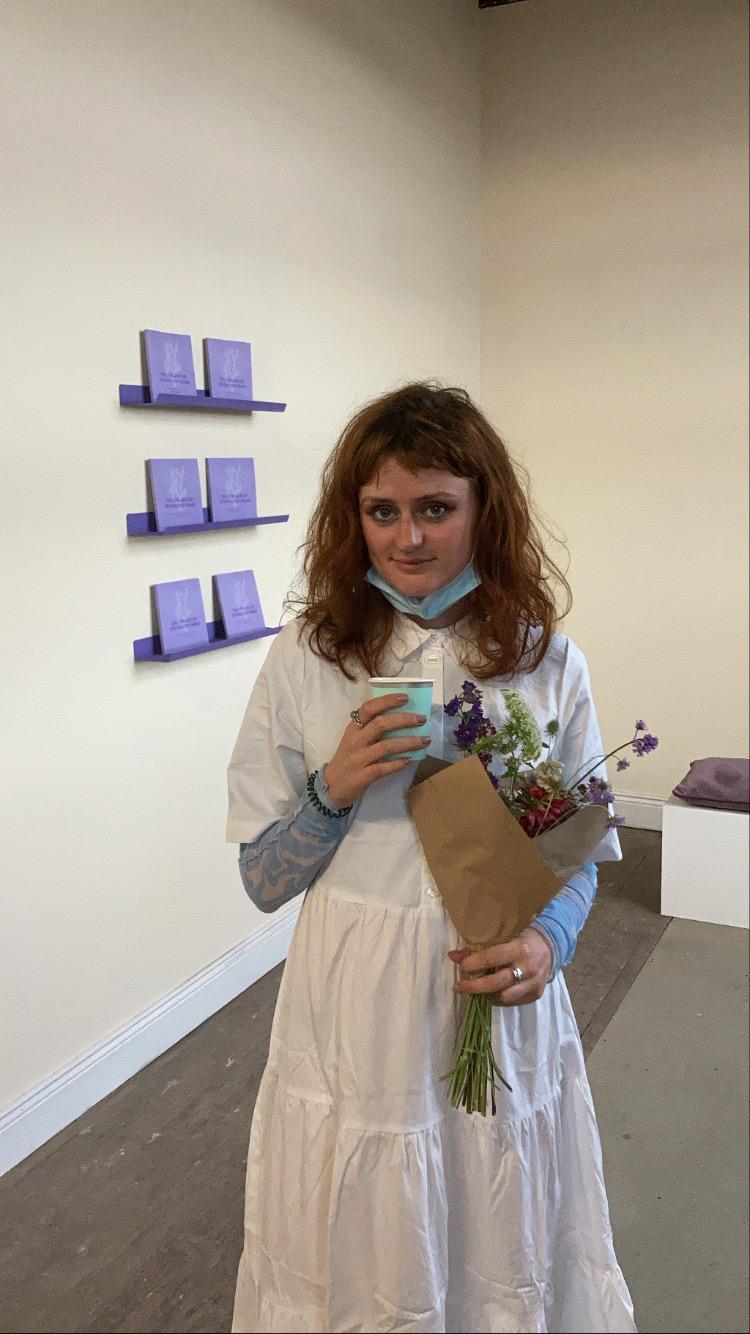
Something of the exhibition magicked itself into existence. We were all ’93 babies. Making things happen felt so easy. There were synchronicities and invincibilities. When Katie and I hung out at Phillies, we won the quiz. Jack and I wove this hyperplane of fantasy from the gestures of clay and line, whittling and glitter cast wide across floorboard and spiderweb. It was a strange time, the summer of 2021. I was also partially in the numb haze of grief. There was a delta wave but not like the deep sleep of the sea. People brought champagne and flowers to the opening. I wore a long white dress and wished the days were as long as they used to be. The Earth spins too fast.

Partly I wanted to write in the choral voice of many creatures speaking to one another. The process felt like a lyric surrender to this collective, their hyperintelligence of humming and stammer that spoke through pores, chitin, liquid. I don’t know where they learned all this. There was a sun virus in the emails we sent the summer before it. Time freckled on my arms. I could draw out the muscle ache from cycling more. It was possible then.

Anyway, about this experience of writing. A porous voice. Here’s an artist’s talk from a recent conference.

First delivered at Hear them speak: Voice in literature, culture, and the arts
10th June 2022

K Allado-McDowell, ‘And they showed me that their life was a pattern of hyperspace’

Who might be the ‘they’ in K Allado-McDowell’s statement? Taken from Pharmako-AI, published in 2021 and the first book to be co-authored with the neural network GPT-3, a system trained on extensive web data (from Google Books to Wikipedia), the quote suggests voice, presence and identity are questions of patterning, replication, weaving, plurality. Recurrent in Allado-McDowell’s book is the figure of the spider and its web, in a kind of constant movement like thought itself.   

I was travelling north on a train when I began writing The Palace of Humming Trees, a book-length exhibition poem which forges energy fields of dreamy relation between many species of animal, mineral and element. Late spring and the fields I could forget about, texting myself more poem. The motion of the train according inverse to the downward scroll of the document. All the while seeing spiders in the corner of my vision, emitting great clots of silk. Commissioned by curator Katie O’Grady and made in collaboration with the artist Jack O’Flynn (both from Cork, Ireland), the exhibition was to offer something of a ‘hyperspace’ to its viewers: somewhere in which voices coalesced, formed new modalities of being and relation, new webs. In a Tank Magazine interview with K Allado-McDowell, Nora N. Khan notes that hyperspace ‘is an abstract space in which we perceive patterns of information and then shape them in language in order to communicate’. Having a big, serial and open field poem adjacent to visual work premised on bold, ecstatic colour and texture was to perform multiplicities of voice within an otherwise abstracted work. Inspired by Timothy Morton’s ideas of ‘dark ecology’, adrienne maree brown’s ‘pleasure activism’ and Ursula Le Guin’s ‘carrier bag theory of fiction’, I wanted to think about that communication as a form of attunement through which we gather, desire and coexist as ecological beings. 

In The Palace of Humming Trees, the lyric voice is taken as that trembling spider silk assembling worlds. Spider silk is a protein fibre which embodies the inside of the spider woven on the outside for shelter, cocoon, courtship or the trapping of prey. It’s five times stronger than steel and is now being synthesised to make everything from body armour to surgical thread and parachutes. I began imagining the twangling of droplets on silk strands as the visualisation of a deep vibration, perhaps the wood wide web – something humming in and between trees. The world of the exhibition was inspired by the Irish folktale, The Hostel of the Rowan Trees, also known as Fairy Palace of the Quicken Trees. In the story, trees of scarlet fruit provide refuge, but the fruit itself (the quicken berries) are highly desirable to the point of despair. The rowan was brought from the land of promise, and its berries offer rejuvenation. With these symbolic undertones of danger and desire in mind, we wanted to explore a mythic ‘palace’ which merged the digitality of hyperspace with the organic textures of woodland and the chromatic intensity of dream, fantasy and ethical relation.

At the heart of our project was a notion of infinity. Hyperspace suggests that our ecological sense of world, surrounds, habitat, umwelt is always being reassembled. I wondered if infinity could somehow be voiced in a way that wasn’t just postmodern recursion or echo. What does it mean to be open to a state of infinity? To let many worlds pass through you all at once, making diamond-like instants and gossamer patterns of prosody? 

Infinity became our figure for ambience. As spider silk is densely structured, and the neural net densely layered, so the notion of ambience captures, in Brian Eno’s words ‘many levels of listening attention’. To walk through the door of The Palace of Humming Trees was to enter a portal of multiplicity. You could take any route you liked around the room, moving between sculptures of hyperfoxes and sparklehorses, lichenous forms, ceramic butterflies of psychedelic hue and illustrated groves where trees shimmered green, orange, purple and blue. You could also scan a QR code and choose to listen to a recording of the poem, voiced by Jack, Katie and I and accompanied by Dalian Rynne’s sonic dreamscapes. To hear something ‘humming’ is to sense its presence, even if you can’t wholly understand it; humming implies electromagnetic vibration, birds and bees, a weather event or tectonic movement. We weren’t interested in translating the more-than-human voice so much as bringing it into the forcefield of lyric poetry, and through that expansive patterning achieve ‘infinity states’ of reassembled meaning, of felt experience that could not be crystallised into singularities of being. Visitors took pictures, sketched Jack’s sculptures, ran their fingers through the luminous plaster dust, placed to highlight the debris or excess of our clay animals. Something always in the process of creation or decay, incomplete. Corporeal, yet infinite. 

One of the many voicings of this project was Letters from a Sun Virus, a correspondence between Jack and I that occurred over the first Covid lockdown, documented at the back of the exhibition book. While the email exchange had distinct senders and receivers, the you and I, over time in collaborating and sharing work between the visual and textual, our voices were beginning to mingle. Sometimes this co-voicing was painterly; other times musical, inflected with the characteristic intonation and energy of our respective speech patterns, moods, expressions. An entry from April 2020 reads: ‘…the wateriness of the poem. I had completely forgotten about all that blur. It’s like all the brush of the ocean and one which seems the idea to spill that way. Almost like a pressure, lines that go on and hair turning into the sea, each one of kinetic energy then finds all these points’. To assemble the correspondence for publication, I plugged it through text remixers, copying, pasting and rearranging phrases to enhance that sense of two voices repatterning one another. A ceaseless quest for points; for elements acting upon objects, emotions. Denise Riley has written of ‘inner speech’ as a strange oxymoron, where one hears voice at the moment of issuing voice inside us – a kind of running commentary that hums without actually humming. The letters suggest a kind of inner voice infected by the anticipated response of the other, rendering intimacies of collaboration which form a sticky substance, sentences and mobius formations holding time’s play and repeat – ‘Unending loop of my dream resins / not to complete the palace infinity of these trees’. Imagining the many of them speaking.

In Texts for Nothing, Samuel Beckett writes:

Whose voice, no one’s, there is no one, there’s a voice without a mouth, and somewhere a kind of hearing, something compelled to hear, and somewhere a hand, it calls that a hand, it wants to make a hand, or if not a hand something somewhere that can leave a trace, of what is made, of what is said, you can’t do with less, no, that’s romancing, more romancing, there is nothing but a voice murmuring a trace.

To ask whose voice in The Palace of Humming Trees is to hear sound bouncing as light, romancing, refracting in what Katie, the curator, calls a many-panelled ‘vivarium of humming thought’. To say ‘there is no one’ is to declare at once absence and the impossibility of presence as a singularity, there is no ONE. What if voice was infectious, modular, sporous, erotically charged, in common? Early in the project, I had this conversation with Jack where he told me that sometimes in the process of sculpture, he’ll try turning something upside down, or inside out, to revitalise the work. Make it strange or more-than. To sculpt by hand is to ‘leave a trace, of what is made’, and to write is to leave a trace ‘of what is said’. I wondered if the inner speech of the lyric ‘I’ could be turned inside out, to be exposed to the grain, the noise, the weather. A voice that touches is and is being touched, traced, smudged. I imagine this book as a glasshouse, somewhere between inside and outside, shelter and exposure; a chamber music of alchemical voicings, always repatterning, transforming each other. Sound and light. A place of invitation, ritual attention, metamorphosis. Many selves stuck to the web of a visual, expansive language. 

Hyperfox – photo by Sean Patrick Campbell (French Street Studios, 2021)

The Palace of Humming Trees

Excited to announce a collaborative exhibition with artist Jack O’Flynn and curator Katie O’Grady, happening until 8th August at French Street Studios in Glasgow.

~

The Palace of Humming Trees is a collaborative project between artist Jack O’Flynn, writer Maria Sledmere and curator Katie O’Grady which took place from April to August 2021. This collaboration will be showcased in an exhibition at French Street Studios, Glasgow, featuring new works from O’Flynn and Sledmere which travel through poetry, sculptural entities and dreams of impossible possibilities.

This project was formed in a concert – along mixtapes, Tarot readings, zoom calls and shared research. We present it here as multiple sensual journeys; to an exhibition of hyper-foxes and tenderly crumbling foliage, through a publication of lichenous illusions and rummaging thought and in a selection of music and voices which trailed our imaginings. 

Intertwining themes of ecological thought, world building and re-enchantment we sought to un-ravel the question: how can we act and think in this present moment to ensure positive change to our relationship with the world around us? The action and thinking which we wandered became located in small and monumental formats – enacted in the everyday and in how we create and build the future. We were enveloped by uncertain certainty, whether apparent through non-human thought, the possibilities of visual art and poetry or the endorsement of magic. Living in a world brimming with unease by climate crisis and extreme inequality – brought upon by extractive capital, far-right strategies and carceral logics – we wished to communicate a different model of awareness that could refuse these structures and re-imagine being a Being. 

Exploring this sentiment O’Flynn and Sledmere have created a body of work that opens a portal to a forest of vibrating thought. One of galloping states, lockdown meanderings and a lyrical suffusion through language and art that prompts how we can think and imagine differently. 

Please enjoy this digital showcase of The Palace of Huming Trees and, if you can, come to visit its physical iteration at French Street Studios, 103 – 109 French Street, Glasgow. Open July 30th to August 8th 11 AM to 5 PM (closed Monday and Tuesday) with a preview on July 29th 6 PM – 9 PM. Book to attend exhibition via Eventbrite here and to attend preview here.

More info at the exhibition website.

The exhibition also comes with a book of poetry, illustration and essaying, The Palace of Humming Trees.

Available to order for £12.99 – Contact details for ordering available on the website above.

Review: CAIM Collective – An Orkney Odyssey

IMG_E3647.JPG

The word odyssey, like journey, is of course a literal and figurative force. We might have many journeys in our lives, real or imagined, actual or wished for, but how many attain the status of odyssey? What memories, eras and changes must pass for a thread of narrative to thicken as odyssey? Joyce, in Ulysses, showed us we can have an odyssey of everyday life. If you scale things close enough, the simple act of going out to buy a bar of soap is rich with the complexities and diversions and conflictions of odyssey. Wandering the city streets, akin to being lost at sea. Perhaps odyssey itself is more about a sustained act of noticing, looking backwards while intently in the present. Dwelling in memory’s rich oscillations; when we are aware of our lives having epic proportions, imbuing our actions with this freight of consequence. Maybe the more aware we are of our fragile world, or our fragile existence on this world — how proximate we are to a world without us! — even the simple life, so-called, seems massive, significant, difficult.

But I am not here to talk about the Anthropocene, which we are already passing through, wearing within our skin. Finding the label as though a sticker on an apple, formerly known as, familiar variety almost forgotten through ubiquity — well pressed on various surfaces, deferred. It was a Thursday, the day after Storm Ali wreaked havoc on Glasgow, tearing down trees and scattering leaves, stealing what green of summer was left of leaf and letting it blow forth upon roads of concrete — you might say free, if leaves have an internal stammer for separation, a need for self-definition. I’m not sure the beautiful, connected things do. A foliate thought unfinished. I guess I needed to be free as well, there was a lot of text, swimming around me all morning I couldn’t quite fathom. A thicket of text. Dwell upon ellipsis and offline symbols. So I slathered oil on my creaking bike chain, cycled along the Clyde and found myself at South Block studios for a new exhibition, An Orkney Odyssey, by the CAIM Collective. An Orkney Odyssey features the multi-disciplinary works of Ingrid Budge (photographer), Alastair Jackson (haiku), Moira Buchanan (handmade booklets) and John Cavanagh (sound installation). I recently returned from my first trip to Orkney and was eager to immerse myself in something of those islands again.

IMG_3643.JPG

South Block studios is a white room, part café, a place smelling pleasantly of coffee. The rest stop between things, east of town. I’ve been here before with a friend, when we were discussing the early days of a new publication. It feels clean, airy, a place of potential. The exhibition consists mostly of Budge’s photographs, presented along the wall with Jackson’s poetic snippets beneath. I say snippets, because one gets the sense that all these impressions and snapshots are fragments of a broader story, a grander drama. My own time on the Orkney islands was limited to the mainland, but as the ferry curved round past Hoy, I sensed that to really experience life here, you have to think in archipelagos, rather than discriminate, bounded islands. A multiplicity of coastlines connected, reflected, glimpsed across these strips of tide. I experience each piece as both separate and connected: they resemble a sort of Instagram post, the supplementary clue to a world elsewhere, a stop beyond. The possible scroll, the anticipatory mirage of other places, beckoning like hyperlinks.

IMG_E3640.JPG

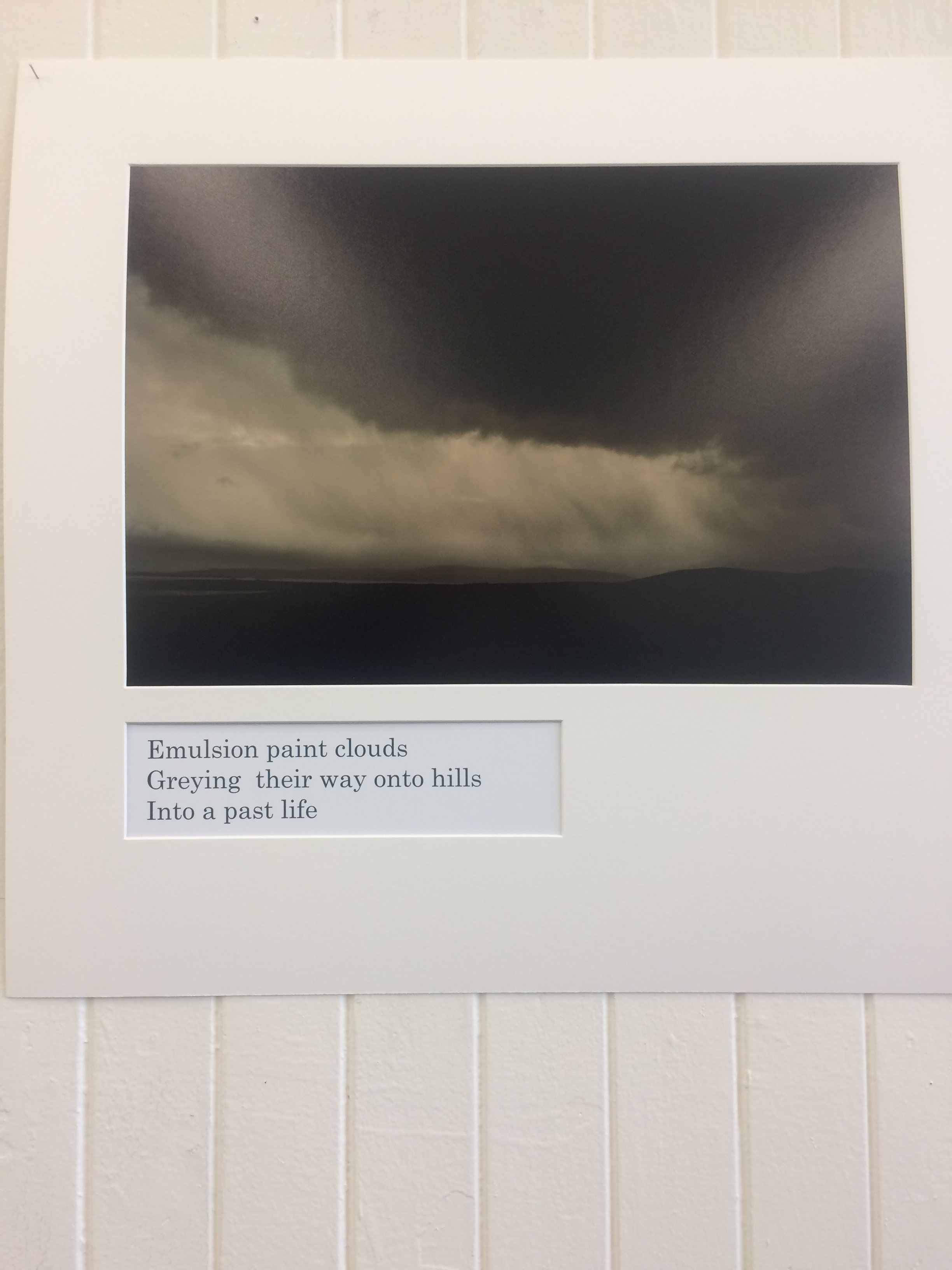
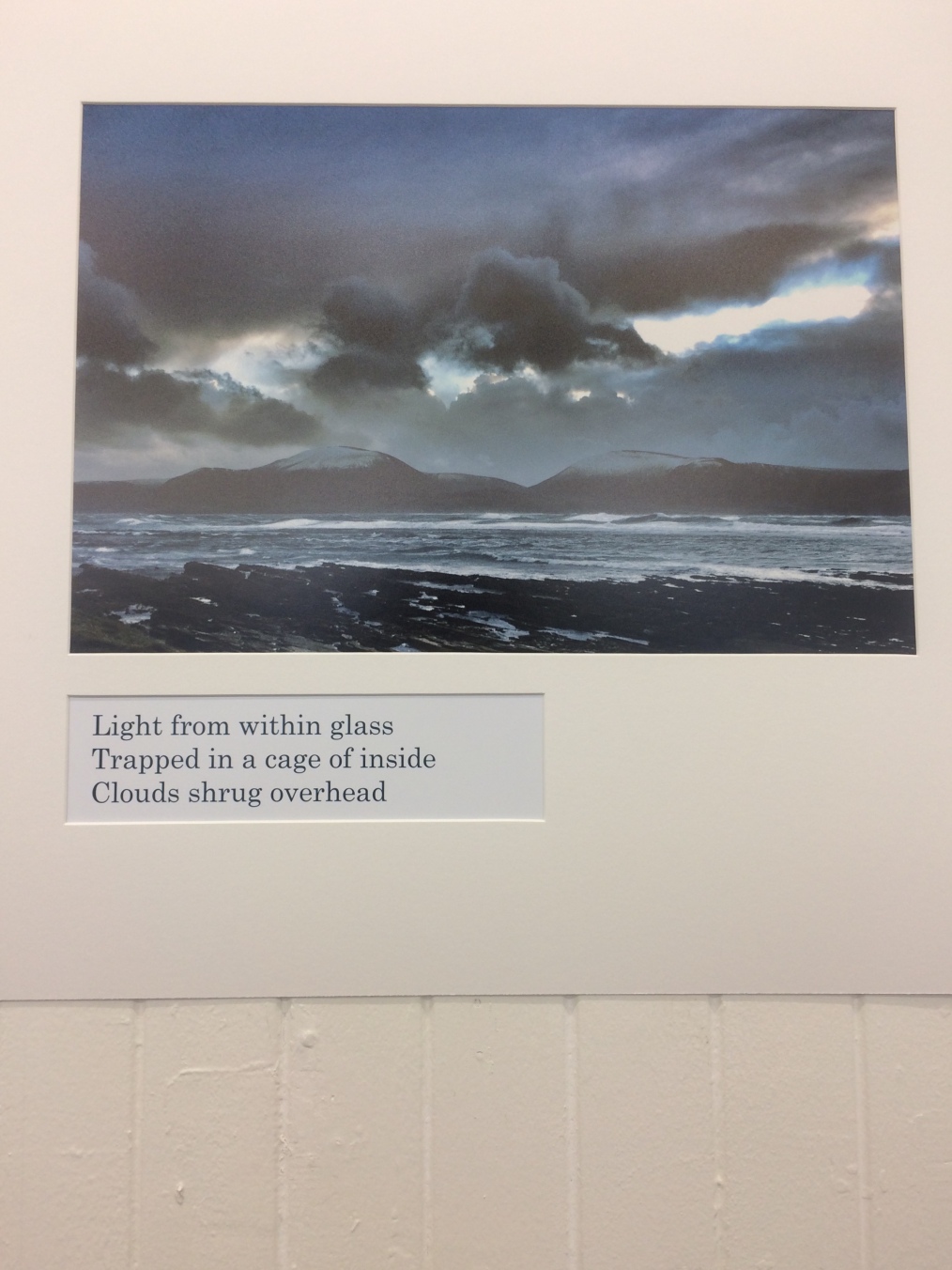
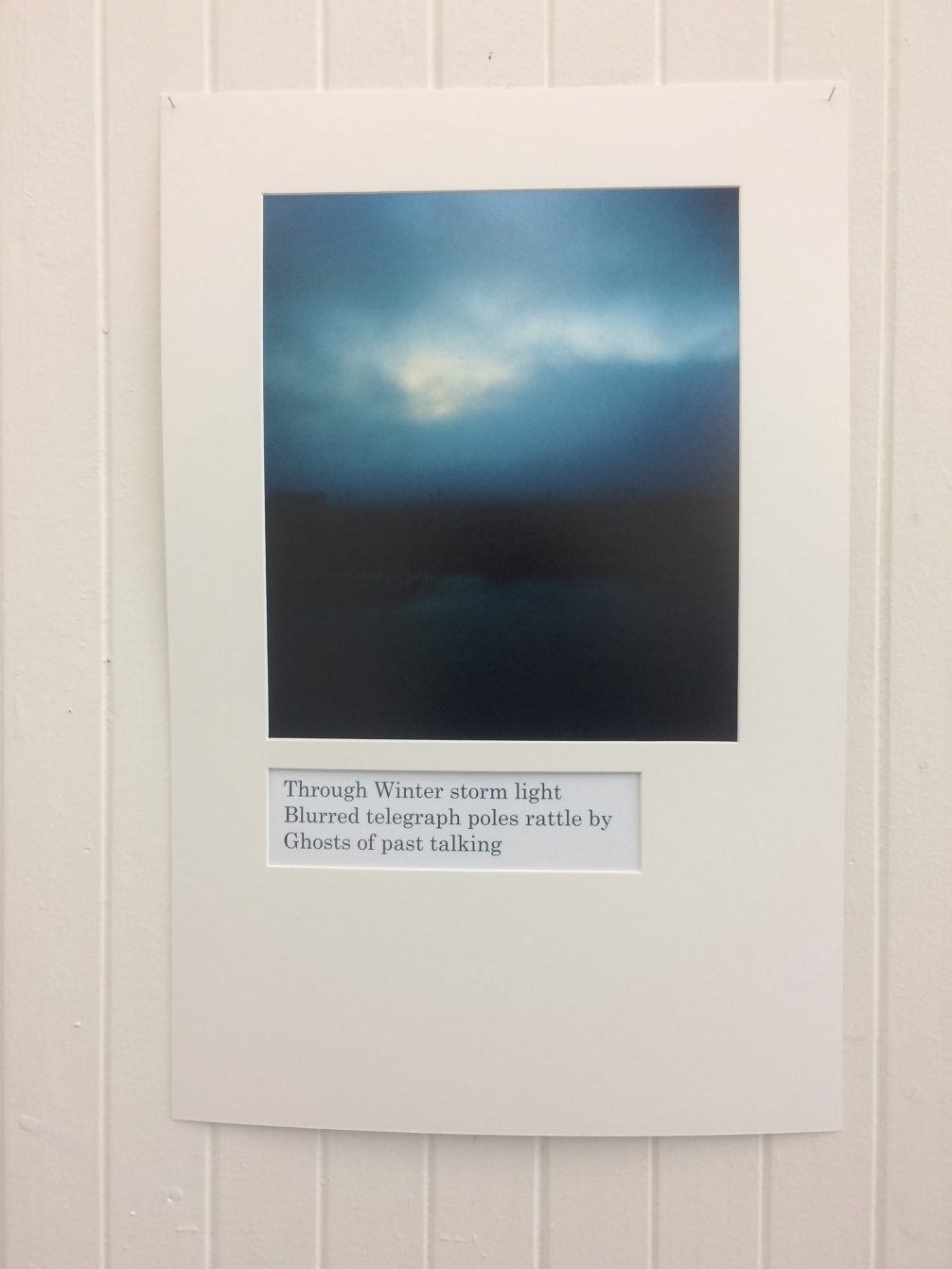
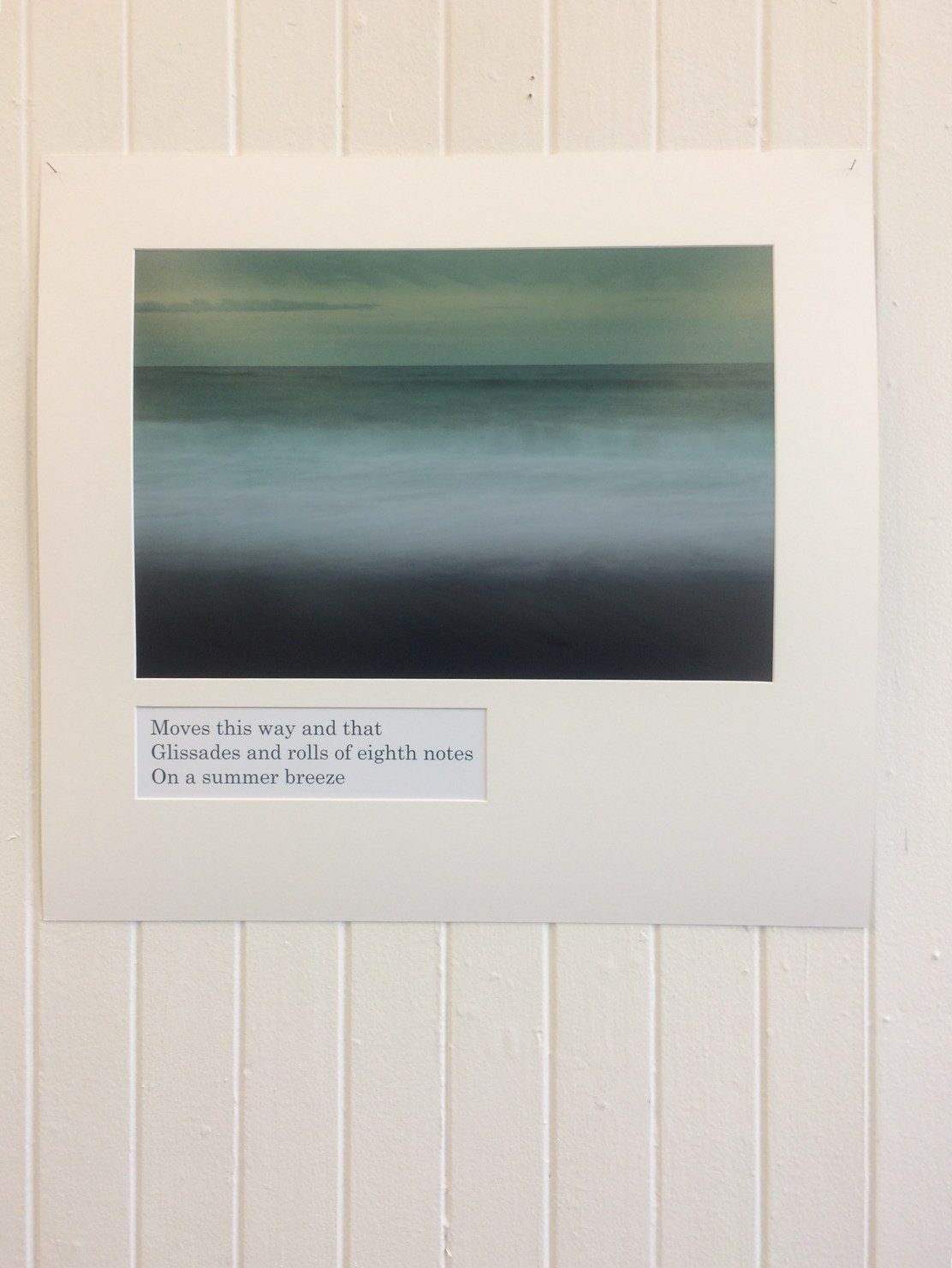
Looking at these images, I’m reminded of one of my favourite quotes from Susan Sontag’s On Photography: ‘to take a photograph is to participate in another person’s mortality, vulnerability, mutability. Precisely by slicing out this moment and freezing it, all photographs testify to time’s relentless melt’. Many of these photographs capture landscapes from a skewed perspective, a step away from anthropo-familiarity. We may be unsure where to place our gaze, looking for a horizon or coastline. Sometimes there is a blur, a smudge of cloud and beam of light; a looming mass of weather. An almost unnatural colouring. We are forced to think in terms of diurnal shifts, glitches in time, moments of elemental transition. They are nothing like the picturesque of the brightly saturated tourism brochure, the pamphlets I flicked through idly as I waited for the ferry to Stromness. These images are ghostly, strange, a little ‘off colour’. They challenge my own memories of the unique, misty and windswept atmospheres of Orkney. Budge experimented with different cameras — digital film, iPhone, pinhole — and various chemical processes to capture a sensuous, personal perspective on her native island. She exploited the apparitional potentials of lumen printing, in which objects are positioned on light-sensitive paper and exposed for hours, never quite fully developed. Rather than ‘capturing’ or stilling, rendering her subjects, Budge allows them to unfold in their own way, symbiotically in tune with their luminous environment: stealing its shadows, imprinting a smudge, a glow of time in process. It is almost as though, in taking those photos, she performs a material empathy with climatic change on the island: the shifts in light, all external markings of geologic time and the time of seasons. I am allowed to read into this, because the images abstract from subject, they ask us to find psychic states amid landscape, they do not fetishise the specifics of locality. They do not simply state: here is a field of sheep as we, as humans, see it. They challenge us to rethink perspective, authority, subject and photographic temporality.

IMG_E3642.JPG

Jackson’s poems, which each accompany one of Budge’s images, really draw out this elemental drama of perspective, time and abstraction. Instances of familiar infrastructure become the tuning posts or sounding board for the dead, ‘Ghosts of past talking’ through telegraph poles. Attuned to the nuance of island soundscapes and landscapes, Jackson deftly parses the aesthetic reactions of one object to another, using anthropomorphism in the strategic way suggested by Jane Bennett in her book Vibrant Matter: ‘We need to cultivate,’ she argues, ‘a bit of anthropomorphism – the idea that human agency has some echoes in nonhuman nature – to counter the narcissism of humans in charge of the world’. Anthropomorphism can draw out the multiplicities of sensory experience, crossing the phenomenological ‘worlds’ or ‘zones’ of various enmeshed beings and species.

IMG_E3644.JPG

The haiku might be an appropriate form for ‘capturing’ the Anthropocene because it flickers into being like a sound-bite, it contains a certain authorial anonymity, less of the singular lyric ‘I’ than the lyric I’s environed chorus. Not to mention its traditional association with ‘nature’ as such. Presented like a sort of Instagram caption beneath these images, each haiku seems a transmission from elsewhere, sparking into presence. There are several kinds of aesthetic overlay, a synaesthetic experience of scenes: ‘Glissades and rolls of eighth notes / On a summer breeze’. The smooth legato of wind stuttering up into quavers, could this be birds or the stammering tide where it sloshes in breakwater, interrupts all smoothness of lunar rhythm? I’m reminded of Kathy Hinde’s 2008 work Bird Sequencer, where she worked with Ivan Franco to scan videos of birds resting on telegraph lines into music, after noticing how much the positioning of the birds on the lines resembled a musical score. Each bird would trigger a note or audio sample from a music box and prepared piano, in the manner of a modern step-sequencer: Hinde was literalising a form of nonhuman aesthetic attunement, surrendering compositional control to the whims of the birds themselves, their arts of arrangement. That Jackson’s poetic vision parses the elemental landscape through musical metaphors says something of our ecological inclinations towards attunement. As Timothy Morton puts it:

Since a thing can’t be known directly or totally, one can only attune to it, with greater or lesser degrees of intimacy. Nor is this attunement a “merely” aesthetic approach to a basically blank extensional substance. Since appearance can’t be peeled decisively from the reality of a thing, attunement is a living, dynamic relation with another being.

Since music is our strongest metaphoric apparatus for noticing strategies of ‘attunement’, its poetic invocation allows us to access those processes of intimacy, coexistence and agency at an aesthetic level. The aesthetic level where, as Morton puts it, causality happens: an operatic voice shatters a wine glass, a match smoulders and eats up a piece of paper, the BPA in plastic seeps into the water, alters its chemical makeup, affects the food chain.

This is a fairly minimalist exhibition, despite its multisensory components. It opens space. I can take almost whatever time I want in front of the plainly mounted images and text, the white card a sort of beach I can linger on, skirting the image. These are dark and striking scenes, mostly of nonhuman subjects. I get to share in ‘time’s relentless melt’ as it happens at the pliant, archipelagic scales of an island, stripped away from the carnivalesque rhythms of urban leisure, or capitalist imperative.  

Crucial to all this, of course, is Cavanagh’s sound piece. Keen to avoid the bland oceanic ambience of New Age relaxation CDs, Cavanagh makes things weirder. This is the sea but not quite the sea, nature more than nature. Composing or rendering ecological soundscapes requires more imagination these days, a keen ear towards plurality: as every ocean is inflected with both danger and precarity, a poetics of toxicity thanks to our dumping of marine plastics, there has to be an affective current underneath, a mixing of human and nonhuman rhythms, forces, pleasures and tragedies. A force of both presence and loss. Place is no longer one thing, but stamped with the stains of elsewhere. ‘Here’, as Morton puts it, ‘is shot through with there’. Living in a time of hyperobjects means that we can’t think of, say, the seas around Orkney without thinking about the pollution that comes from mainland cities, the energy generated in these waters subject to political decision-making further south, the marine populations around these coastlines affected by agricultural, infrastructural and consumption processes going on elsewhere.

IMG_3651.JPG
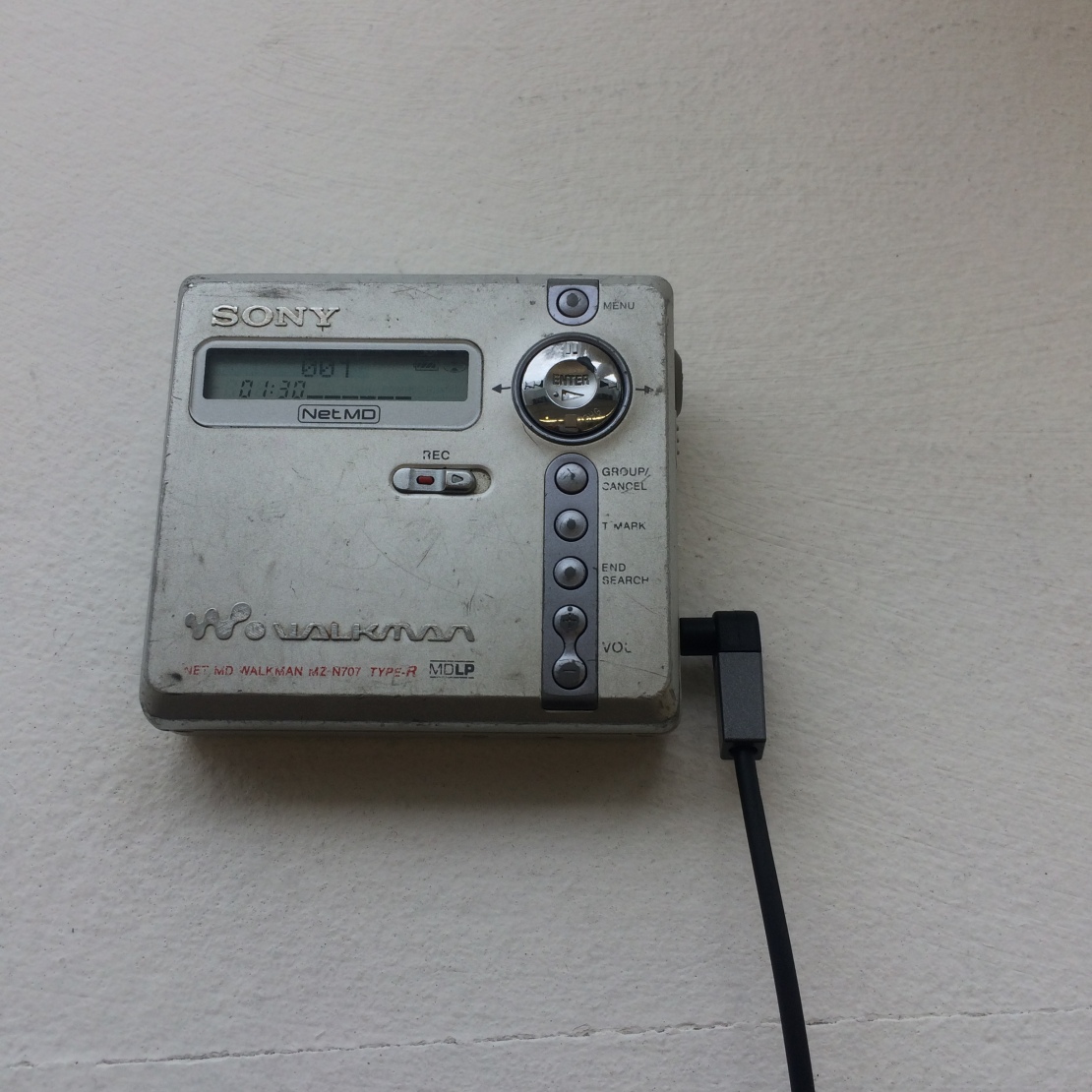
Upon entering the exhibition, I’m handed this beautiful piece of hardware

It would be easy to respond to this collision of times, spaces and places with a sort of abrasive, dystopian mix of disorder. Cavanagh, however, responds to the sonic challenge with degrees of beauty, humour and playfulness. His soundscapes swirl around the spoken words of Jackson’s poems, anchoring us vaguely to a sense of present as we pass round the room, viewing the images and poems. Sure, I can hear the waves, the howl of the wind, but these are mixed with a certain distortion akin to kitsch, electronic warp and reverie that glistens with past times, feels retro. This operative aesthetic is achieved with the piece’s main component, an EMS VCS3 synthesiser from 1973: a model familiar to fans of Pink Floyd, Brian Eno and Tangerine Dream. Cavanagh’s music literally ‘translates’ Jackson’s poems and Budge’s images, themselves translations of Orkney scenery, by plugging the syllabic layout of Jackson’s haiku and the locational map data accorded to Budge’s photographs into a patchbay which generates from number sequences a variety of different rhythms, instruments and delay effects. Cavanagh’s ‘authentic’ or ‘raw’ field recordings from Orkney’s landscapes are thus programmed around the audiovisual, semantic stimuli of Budge’s and Jackson’s work. The act of remixing nature in this way exposes nature’s very artifice, a cultural construction dependent upon our aesthetic representations. I think of a very beautiful line quoted in a recent Quietus review of Hiro Kone’s new album, ‘“Nature sounds without nature sounds”’. As a challenge to passive eco-nostalgia, there is an active pleasure in this exposure, in realising the multiplicity and material vibrancy of a term we once took for background and static, mere sonic wallpaper for mindfulness meditations.

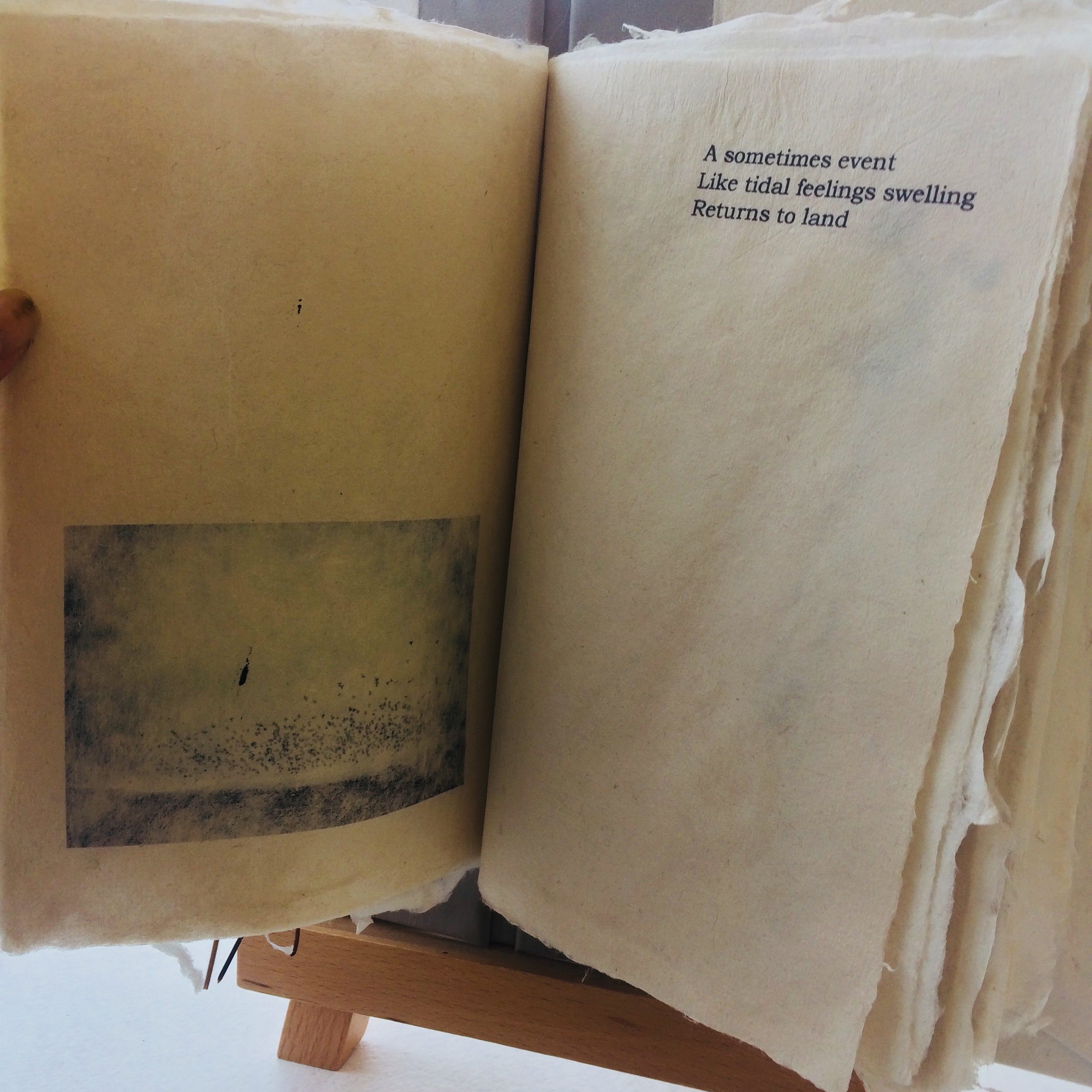
Faced with something as ineffable as the Anthropocene, we often respond, ironically, with lyric excess. The Anthropocene, it gets in edgeways, it knows we are porous. Whose odyssey is this anyway? Exhibitions like this are important because collaboration and innovation are vital means of tapping into the processes by which we, as human observers, might access nonhuman processes, glimpse the scales of time and place in a world where our significance dwindles into material trace. The fossils of future capital, always already fossils. What might a sonic fossil look like, sound like, a ghost trace of retroactive reverie, a broken sonogram, an elegiac bleep of machine or sea? An Orkney Odyssey, for all its portent towards the epic, is actually a rather humble exhibition. It offers the human perspective of memory and affect, holding wonder for these geographies and scenes, but there’s nothing too showy or sublime about it. And the micro focus is important too. Moira Buchanan’s handmade booklets draw us back to the beautiful details of wildlife around us, the simple pleasures in the act of binding and stitching the evidence of our everyday ecologies. She names in her booklets various species and places, prints poems and photos, mingles materials. There’s a real material enchantment here. Rather cutely, I wrote of these booklets before in a post on Buchanan’s 2016 exhibition, All Washed Up:

I think in today’s world, where global warming feels like something vast, incomprehensible, beyond our understanding, it’s so important to focus on the little things. The material details that remind us that we are part of this environment, that the ocean gives back what we put into it. There’s a feeling of salvage to the pieces, whose composition seems to perfectly balance the artful openness to chance at the same time as reflecting a careful attention to arrangement and applied form and texture.

I was still grappling with the Anthropocene with a sort of innocence then. I mean, I was still calling it global warming. The booklets in South Block catch the light of a late September afternoon, luminous in the window. Taking pictures of them, I can’t get the angle or the light right. I can’t quite translate, my iPhone proximate to its physical extinction, stubbornly refusing photographic clarity. During my trip to Munich this year, I was given a five-leaf clover picked from a lovely Bavarian meadow. I pressed it between the pages of Lisa Robertson’s The Weather. That, I suppose, was an act of salvage also. Symbolic recycling. A little token of some unspoken odyssey.

Unsure of the rest of the night, what to do, awaiting replies, I cycle through rush hour, heading south with only vague destination. Peddling hard, I cross the water as though crossing the sea. Later I will fall asleep with electronic sounds rasping my headphones, mixing with the wind outside which batters the window, until sleep becomes its own causality…

IMG_E3650.JPG

IMG_E3649.JPG

IMG_E3648.JPG

IMG_3646.JPG

***

Exhibition Details:

Venue: South Block, 60-64 Osborne Street, Glasgow, G1 5QH

Exhibition Continues: 14th September – 5th October 2018 (Mon Fri 9-5).

Playlist: November 2017

IMG_7783

IMG_7846

IMG_7975

The kind of cold that’s purifying, that fills your lungs like sea-water sloshing inside the mouth of a cave. So it’s hard to breathe, but cutting through the breath is a sweet feeling, preciously there in the swift struggle that settles on calm. I go out at night and the cold air is a shot of adrenaline; I walk ultra fast, making hard strides across asphalt that sparkles with salt in the fierce moonlight. This is a month of much stress and panic but also relief. Resolving to make new friends, even though each time I worry about who will leave next; the cyclical press of everyone coming and going, memory hanging on a thin noose I can’t quite tauten, snap and break. I fall through it as light falls through a halo. I feel feathery and weird, writing nonsense in the morning to delay the inevitable rise from bed—a snap of cold, of spine and mind. I love the old ones, look forward to new.

We’re up late and I watch things unfold, messenger blue. At work, I run upstairs to watch Out Lines perform down below, an incredible light show glistering with swirls of lilac and white. It’s gorgeous and dramatic, genuinely breathtaking. I watch from the gallery as sonorous and sinuous beautiful voices mingle in a room full of awe. I feel sobered, grateful to just be, watching a few songs before inevitably I must return to work, to count the till and smell the coppery aura of tired old pennies. I see Julien Baker perform in LP Records, filling the tiny room with her massive voice; a voice that could start car alarms, make cracks in the concrete, tear up the numbness that governs the daily. It’s the voice of a heart too big for its ribs, a heart throbbing against the cruelties of existence, spreading hope on a room of friends and strangers. She covers Audioslave’s ‘Doesn’t Remind Me’ in honour of Chris Cornell, and for weeks after I hear that refrain, over and over, Cause it doesn’t remind me of anything. And I wonder what it means, and what sort of list I’d make in lieu of  Cornell’s lyrics (‘gypsy moths’, ‘radio talk’, ‘driving backwards in the fog’, ‘canned applause’), planning a poetry exercise but then finding all the same that even the world’s waste is entangled for me. Maybe I will get older and find little daily voids to give my mind too. For now, even a tree is too heavy with everything. I can’t talk about Pokémon without getting misty-eyed over my youth.

Strange personal things make momentary ripples in reality. I fall asleep at work, heroin-heavy, in a hoard of recollected dreamscapes; I get up at 3:30am to attend a conference in St. Andrews, ‘Cultivating Perspectives on Landscape’. The sky above the River Eden is this dramatic topaz cutting into azure, argent wisps of cloud streaking the horizon. Without realising, I pass by a friend’s house. I watch from the train window in total awe; delirious on the earliness of it all, the quiet, the light on the soft waves rolling and rolling. I could be on this train forever, even though waiting at the station for changes makes my fingers seize up with the cold. I’m reading Robert Macfarlane’s The Old Ways, gloved fingers clutching its paperback skin and pulling pages back with a hunger within. He describes the absolute cold of the mountains, the physical heft and sense of pure reward—not from summit but from sheer movement, the panoramas unfolding around you, the mountain that gets under your skin, the scale and sublime you practically inhale. Landscape glitters with detail; Macfarlane has a vocabulary that makes you feel as though in reading you were picking over some deluxe smorgasbord of words. Learning and learning in the lilt and fall of his complex rhythms. It is the right thing to read at these freezing stations, taking me elsewhere entirely, sharing my sense of embodied limit. I arrive at Leuchers around 8am, the sun just coming up over flat plains, a total burnished, scolding orange. Later, I find myself wandering a herb garden with lovely strangers, crushing rosemary between fingers and ruminating on narratives of scent. A very clever academic gives a lecture on classics and lively stones. On the train home, everyone is drunk and teenage boys crack cans and discuss girls with a coarseness I’d sort of forgotten existed. I sit opposite two guys in their late twenties who discuss their mutual careers as accountants, and I feel blessed to be outside such existence: paid-for parties, gym memberships, brutal team meetings, deadlines, spreadsheets, rapturous conversations about the latest tablet. I buy a bottle of Talisker Skye on the way up Sauchiehall Street, warm my cockles on the space-heater and do sun salutations to boost circulation. Already, several friends have left for Australia.

Frequently, there’s a brain fever, an ache in the body. I am ill for much of this month, but there is a day when I wake up better and clearer and it is like taking a drug. Health. Temporary sense of invincibility. Sad things happen, secrets reveal, sordid truths fill up the news. A man I knew died in a terrible accident. People have far harder lives than I.

The floor in the restaurant where I work starts coming up, splitting apart like something is rising from underneath. I carry food, traversing the crevice, Johnny Cash’s ‘I Walk the Line’ playing over in my head. It’s so disorientating that sometimes I forget this is something I do every day, just carrying plate after plate, cups and mugs and cutlery. Tracing the usual trajectories. I come in two days later and somebody has smoothed out the crack. It feels like a violence that never happened.

When people are drunk, they tell too much. Sharing melancholy joy till six in the morning. It’s good, but how much of that are you allowed to revisit sober?

The exhibition/installation I’d been helping out with for months took place. The Absent Material GatewayI think of it as a sort of portal to extra reality, a space where you can relish the intensity of elsewhere, let it split apart your senses for ten minutes—long enough to let sound and light rush through you, to conjure the ruptures that remain for weeks afterwards, never quite healing as even the quotidian fills them with usual slush. Nothing feels completely fabricated, but rather it’s a blurring of what we think of as real—how we encounter objects. Here, the weird things shimmer in dramatic strobe and seem to act upon you; these lively, alien pieces of matter. Scrap parts gleaming with mysterious power. The Lanark Artefax gig at the end of it blows my mind. I’m sipping straight vodka piled up with ice in a freezing dark room at The Glue Factory, but as soon as those first trademark stammering pulses start fracturing stars and synths and the melancholy strings with eerie samples hold back, suspend, then rush underneath…It’s a landscape elsewhere that is momentarily, totally immersive. I think of matter crackling at microscopic levels, or else grand panoramas of mountains bathed in alien starlight. Cities that smoulder with smoke, hovering drones and dramatic cracks in the side of cliffs whose insides fissure with poisoned earth. I think of ancient ruins through doctored photographs, angles of time dissolving with the phantasmic drift of a passing graphic, numbers running in algorithmic digits, pixels melting to colour smudge, then ether. Glitches. It is all of a shuddering. The audience are truly glued, despite being charged up on all the free Red Bull. All the sound cuts through so every normal thought is in shards, afloat. It’s one of the few genuinely sublime experiences of my life. I walk back in the cold rain, feeling emotional, drained, intense and electric. When I close my eyes to sleep I see nothing but strobe.

I have dreams of Styrofoam palaces, trains that keep leaving without me, layers of skin I could scour off my body.

There was a talk on Mark Fisher at Glasgow Autonomous Space called ‘Acid Communism’, and I got to dwell awhile in the comforting, baffling whorls of radical theory. I spent all month talking about Fisher to numerous people. Sent lots of excited emails and prepared my PhD application. Ideas started ravelling and overlapping and tightening. This whole sprawling project set out before me; I felt ambitious and still feel as though this is something that maybe I could actually achieve. Build this thing that I’ve set out in rough blueprint. I am energised, thoroughly, by the words of others.

We launched SPAM Press pamphlets (Dan Power’s Predictive Text Poems and Ryan Jarvis’ Tesseract Life) at Good Press and bought quantities of Lambrini for the occasion. Life is a whole lot of walking past Kelvingrove Art Gallery at one in the morning, sharing nightclub horror stories, gently reminiscing and falling asleep so the ink in the pen leaks over your duvet. I realise Greenock has a well lush Lidl, my cousin releases a single and it ramps up over 130,000 Spotify hits in a week. It’s funny, remembering her on our old sofa aged fourteen playing ‘Face for the Radio’ on my brother’s out-of-tune guitar, that lovely voice at its first nurturing. Now she’s on a billboard. We have the same nose.

I feel blessed by the blue days, the clear blue days, that come a couple times a month and even when I am too tired to leave before dark it is good just to know that out there things are bright and good. After graduation, we visit Luss and the sky is already at the brink of gloaming, this luminous lilac that blooms over the hills. I watch the nicoline light on the land across the water, over the heads of Japanese tourists unseasonably out snapping pics on the pier. Watch the city blossom back into shape across the motorway, an inverse meadow of delicious twinkles, listening to John Martyn in my father’s car. I feel calm, setting out to meet friends and discussing everything, sloshing a cheeky amaretto.

I revisit A Perfect Circle, Sun Kil Moon and Sufjan Stevens as the nights draw in too close and there is barely six hours of workable daylight. Something stirs from the past, but I crush the feelings like crisp dead leaves underfoot. I drift around, inhaling woodsmoke and missing the countryside. People leave curious furniture out on the street. A maximalist dolls-house, scattered by the city’s ruthless refusal to deal with its waste. New systems spring up around old objects. Ecosystems are complex and recalcitrant, their musty materiality seductive. Something hits me, occasionally, and it’s implacable, otherworldly. Space in my head that could be anywhere, everywhere, either. Even the streets feel bruised. My brother leaves for Australia and I think of him flying over a bright bright blue. All these people will bronze as I fall farther white into china paleness, sipping peppermint tea and crunching almonds between teeth. These people that go travelling, they leave me lilac eyeshadow, mint-cream nail varnish, memories and jumpers they won’t need anymore. I feel the roots tug and shuffle, sprawl beneath me in new formations. Endless scroll of Instagram posts. The last leaves cling to more paranoid trees, lamp-lit in sodium glow on the long walks home. Shops fill up with fairy lights, glitter and sprigs of fir. I can’t tune to the lure. Christmas is still a word I’m trying to deal with, a lonely lonely tinsel litany.

*

Saint Sister – Blood Moon

ARK – Made for Us

Alela Diane – Hazel Street

S. Carey – Fool’s Gold

Tiny Ruins – Old as the Hills

Adrian Crowley – Long Distance Swimmer

Sufjan Stevens – The Hidden River of My Life

Sun Kil Moon – Sunshine in Chicago

Julien Baker – Doesn’t Remind Me (Audioslave cover)

Kelly Lee Owens – Pull

Ellis May – Father

Sharon Van Etten – Keep

Bjork, Arca – Blissing Me

Windows 96 – Youthful Waters

Slugabed – Stupid Earth

Angel Olsen – For You

Pinegrove – Angelina

Julie Byrne – Sleepwalker

Out Lines – The Left Behind

Ho99o9 – Neighbourhood Watch

A Perfect Circle – 3 Libras

Hirola – Fields

Lanark Artefax – Voices Near the Hypocentre

Penguin Cafe – Cantorum

Boards of Canada – Everything You Do is a Balloon

Feist – Hey, That’s No Way to Say Goodbye

Jeff Buckley – Morning Theft

Moira Buchanan Exhibition: All Washed Up

img_0118

Last Thursday I had the pleasure of a day trip to Irvine to check about Moira Buchanan’s exhibition ‘All Washed Up’ down at the Harbour Arts Centre. Now I must say, although I was brought up in South Ayrshire I haven’t actually been down to Irvine since I was a kid – the days when we used to go swimming at the Magnum, or on school trips to the Big Idea (which is now sadly closed).

It was a bright and breezy wintery day and as soon as I stepped off the train that lovely clean briny smell filled my lungs and it was a bit like coming home. Irvine’s a fair pleasant town, once a port. You can walk along the harbour where ships still rest and along the front there are little gift shops and cafes with tinsel in the windows and the smell of coffee wafting out onto the street. I unzipped my jacket to feel the sun on my skin. It was midday and hardly anyone was around, but when I got to the Harbour Arts Centre there was a nice wee bustle about the place.

img_0119

img_0120
Took a photo of the hair left behind by a ginger mermaid.

The focus for Moira Buchanan’s exhibition is, as the title suggests, things which are washed up onshore. There is a pleasing openness to the exhibition. It’s light and airy, the pieces nicely balance a white sparseness with the intricate details of natural forms splayed upon the (handmade) page. Actually, it’s quite difficult to differentiate the natural from the unnatural here. Buchanan uses materials found along the beach to make her art, from plastic to twine and string, to seaweed and driftwood. Instead of simply presenting such materials as found objects, Buchanan’s reworking of their unique structures emphasises the beautiful details and aesthetic value of that which we might consider waste – environmental, human or otherwise. She uses an understated, organic palette and a combination of wispy, delicate lines and bold ink blurs to suggest perhaps the swirls of the tide and the sense of being washed out. 

The exhibition has a pleasing, nostalgic feel to it; a favouring of simplicity and the fragile loveliness of form, the childlike excitement in finding beauty amongst tiny, insignificant things. Dotted around the exhibition are little poetry chapbooks made from handmade parchment. Each poem feels like a miniature gift, a token gleaned from the coast and the sea and someone else’s memory. I think in today’s world, where global warming feels like something vast, incomprehensible, beyond our understanding, it’s so important to focus on the little things. The material details that remind us that we are part of this environment, that the ocean gives back what we put into it. There’s a feeling of salvage to the pieces, whose composition seems to perfectly balance the artful openness to chance at the same time as reflecting a careful attention to arrangement and applied form and texture. Everything seems precious.

The more monochromatic tones of the video exhibit suggest something starker, more emotionally arresting. The poems on display recount strange dreams, the changing weather and shape of the coastline, the turbulence of time and human perception. Between the poems are black-and-white closeups of items washed up on the shore. There’s a sense of borders overlapping, of the lush fronds of the clear water coming up to drag back the wisps of shadows and words and memories. I think of black ink pouring on a page, printing through layers of paper like the epidermis of skin. Sinking, achieving a kind of sticky permanence. I think of oil spills coating the northwards ocean. Each poem afloat on the water, the black background of oil, achieving purity in white ink as if blanched that way by the sun and the waves, as seashells are bleached by the tide. Moonlight pouring on still waters at night.

Responding to an ad on Creative Scotland, I sent in a poem I wrote called ‘Fort of the Yew Tree’. It’s kind of channelling a few of the mythical elements of a novel I wrote which is set in South Ayrshire (titled, with some irony, West Coast Forever). ‘Fort of the Yew Tree’ is said to be the Celtic derivation of the name ‘Dunure’, which is a fishing village on Scotland’s south west coast.

I feel very privileged that one of my poems is on that video. This thing that I wrote, a strange and baroque wee baby, has floated out to sea and there it is, somehow washed up in Irvine, travelled through the channels of WiFi and email and typed back out onto some distant slideshow, time cycling in loops and repeating, each image and word again returning like a message in a bottle tossed out to the waves. I wonder who will find it.

Anyway, you can check out my poem along with many others in the video below, made by Moira Buchanan and existing as part of her exhibition. ‘Fort of the Yew Tree’ starts at 2:35 and it spans four slides.

You can find out more about Moira Buchanan’s work on her website.