Forgetting the crinkled skin, it was enough to sip coffee outside on a windy morning and pretend that the cocoa on one’s cappuccino was sufficient medicine to glut a lifetime of unpaid mortgages and debts to friends. The seductive dust formed its fine layer upon his lips and the next person to kiss him, god forbid, would taste that faint dark chocolate. The cravings sometimes were all-consuming.
“What a beautiful girl you are,” he said, to the waitress who came to collect the empty cup. “Straight out of Connemara.”
Of course, she would not know where even Galway was. She scowled and clucked her tongue like the rest of them. But he liked her freckles. That was it: you could pick out a story from every one.
For the third day in a row, Brian looked down while brushing his teeth and saw a tiny green shoot sprouting out of the drain. Only last night, at 2am no less, he had pulled the little fucker out and thrown it down the toilet.
“Miriam!” he shouted to his wife, who no doubt was still curled in bed. “The tree’s back!”
“Mhmh?” Cursing at her lack of interest, he spat out toothpaste and watched how the white foam flecked the two bright leaves of the shoot. Remnants of raisins and granola showered like rubble around it. He turned on both taps and washed it away, but the shoot remained.
On his commute to work, he noticed something was on fire at the side of the motorway. The flames were big, apocalyptic, and when he opened the passenger window the black stench of burning rubber filled his car. There wasn’t a scrapyard round here; there were no reasons to be burning rubber. This was the fucking countryside, not some rustbelt wasteland.
At the office, he turned in the financial reports that were due at 10am. He sat through a meeting which featured the usual pantomime antics of his boss, the kind of man whose entire career is based on imitating the flamboyance of a Disney character while necking enough coffee and bourbon to seem manically on form at every performance.
“What we are building up to,” he announced, “is the ultimate synergy.” His arms flailed back in grand gesture, nearly knocking over the pie chart drawing his assistant had etched on the flip chart. “Capital merging with capital, a clean abstraction, the upward surge of profit. Think of this as MarioKart. How many of you have played MarioKart?” His eyes narrowed as he surveyed his colleagues round the table.
There was much quivering, as only a handful of people raised their hands.
“Well, the chosen few will know what I mean by the Rainbow Road,” he continued. “We’re on that motherfucking Rainbow Road. One veer off and we plunge into space, the black void, and that’s that. So I can’t afford a single mishap, I don’t care what happens. We need to synthesise, synergise, synchronise. You hear me?”
Every week, the boss delivered a near-identical speech; the only thing that changed was the arbitrary cultural reference he dragged up, presumably from the stacks of CDs and video-games in his son’s bedroom.
At this point, the assistant stood up hastily. She was young for the job, a high achiever, reaching for those virtual stars in a pair of vicious heels.
“What we mean,” she said, trying to clarify, “is it’s important not to underestimate green shoots. Those little signs of growth. Shares in petroleum, in plastic, are rising nicely. Not to mention South American superfood angiosperms, part of a wider move towards elite organic harvests. While the economy flounders around us, clinging to the small things is what will help us reach that upward surge.”
“Thank you, Heidi.” The boss shot her an appreciative leer. “Now what the fuck is an angiosperm?”
On his lunch-break, Brian ate a sad desk sandwich with a fellow number-cruncher. The two of them were the runts of the litter, the ones that never got invited to the cloying, marathon lunches the boss often dragged the office out on. This meant they were never in line for promotion, but bore the advantage of letting them avoid the poisonous oysters and chardonnay which often left their colleagues retching all afternoon.
“You know Liam,” Brian mused, “I found a green shoot in my sink the other day. It’s still there, even though I thought I pulled it out.”
“What?” Liam was dim-witted and this was maybe why he never got called out to lunch.
“Like, an actual green shoot. I think it’s getting taller.”
“Maybe God’s trying to tell you something,” Liam said ominously.
Back home that evening, Brian found that the shoot had gotten much taller indeed. So tall that various branches curled out thirstily, wrapping themselves round the taps. Brian shrugged and didn’t bother brushing his teeth that night. He pressed himself into Miriam’s back but realised she was already asleep. It was what, nine o’clock?
He got up very early and left the flat straight away to get to work. The accounts were flying off his desk that morning.
“Good work Ben,” his boss said, floating past the desk, collecting his documents.
“I’m on the upward surge,” Brian nodded.
On his way out the door that night he gave Heidi a contrived and lustful glance. She looked at him with eyebrows raised, but this could mean anything. He decided to drive out to the spot where yesterday he’d seen the flames. It was a pit in the ground, a charred patch of grass gone black. He fancied there was some resemblance to a pie chart, the way the different shades of burnt matter lay, wedge-like, in the circle. He did some rearranging, moving shrivelled plastic and ash and wood chips around until they met satisfactory dimensions.
When he came home with soot all over his hands and face, Miriam said he looked beautiful. She was a Leo and had a thing for fire. He looked into her eyes for the first time in weeks. Her whole body seemed to pause, to start melting right in front of him. The light from the kitchen window made her skin so pale, except for a flash of orange across her face. He was about to kiss her, to fall into the molten mass of her body, when she reached straight for his belt buckle. This was a first.
Afterwards, he went into the bathroom to wash his face. The tree had taken over the entire bathroom. In just a few hours, the little green stems had become proper woven wooden branches. He had to climb over and around them just to take a piss. What came out of him was yellow, dark. The flames were inside him now, and the leaves of the tree shimmered around his body, bathing him in luxurious gold.
“Honey,” he heard Miriam’s voice at the door, glistening with the shrapnel of Heidi’s lisp. He realised he was still clutching his limp penis. “D’you think the world’s ending?”
I woke up and the skin was peeling in the webbed bits round the fingers. Last night I’d soaked it in coconut oil from his ma’s spice cupboard but in the morning it made the pores feel all empty like they’d lost something. Still, the smell was nice. I just lay there and started scratching the wee red dots he gets on his arms from too much drinking, then he opened his eyes all red too like and says, You smell of summer. Sun-tan. Something.
His room is painted the colour of grass when it burns. It’s the blinds and that crap paint you get in Pound shops. I always look up and meet the eyes of Kurt Cobain on the wall and we share the feeling of being hurt; just for a second, the time it takes to yawn, then I roll over to kiss him but he’s sour-tasting on account of the whisky or something. A film on my tongue like when glue goes hard on your skin and you flake it off. His tongue feels furry too.
I reach to roll the first cigarette and tobacco gets on the bed and I know it makes him mad so I stop; my limbs unfold from the sheets and the cold rush clings to their bareness.
He makes this sound all like mhmheeh but I get up anyway and roll the cigarette sitting on the windowsill looking outside. The rain is coming on again and the glass is all stained like when you rub your eyes too hard and it’s all these lava lamp patterns swimming in your brain and nothing gets clear for a good full minute.
It’s February 23rd, just so you know. I keep thinking about that bit in Twin Peaks when the handsome detective is like reading a page torn from Laura Palmer’s diary and it says on that date, ‘Tonight is the night that I die’. Makes me feel a bit nauseous, especially after the phone call. The one from last night. When I get downstairs, softly-stepping so’s not to wake him, the phone is still off the hook where I dropped it and you can hear the woman saying please hang up and try again like she’s trying to make it into a techno song. There’s a loud ring when I slam it back on the receiver.
He finds me an hour later on the floor by the washing machine greeting even though I’m trying not to but he stands there and he runs his hand through his hair which I want to live in the way you could live in a meadow of long sweet grass in summer and he’s saying something like, You’re unravelling, Lara. I can’t help the puffiness and my face burns up when he leans down and I don’t want him to touch me. In fact I kick in protest but my foot gets cut on a broken floor tile that comes flying out in a bad joke. He laughs as the blood gels and already I’m thinking how good it will feel to peel off the scab like lichen from a tree.
Get up will you, he says. It’s in my chest rattling now; I’ve got it all hollow. Come on, get up.
There’s his guitar there’s the song about us there’s the yummy smell of coconut. It would be funny to eat your own fingers. He finds the mustard jumper wraps it round the shoulders pulls me up all bare as Eve and there’s the key in the lock his ma coming home too early.
The weather turns, ineluctable as that mist that mysteriously fogs up my glasses (Footnote: Why do I wear glasses? Something a man once said about parallax and the need for clarity of distance, the reassurance of one’s own substance). The city is a haze of something else today, foreign as a postcard marred with scratches of time and travel. Must I always be up to my neck in vapour, in unfinished melodies? They always catch: grooves on a record, gum on the pavement, hair snagged in a glue binding, specific as a bookmark; melody after melody. The notation would be very messy. I’m picturing spaghetti-tangles of quavers, misplaced on the staves with no home of their own. What of this note? oOoOooooooooOOOooOooaaAAAaaaaaAaoo……. Does it belong in the sonic realm of an F#? The problem is, I picture my life in A minor, every time. The soaring long echo of a siren call; so sad, so sad. Picture this, pretty fake glass vase, all containers of vapour, elaborated with black-printed Celtic patterns, impenetrable as ersatz ~internet~ Japanese.
One attempt at pottery is quite the attained luxury. I think I will try out something new. The raising of a blue hand in order to trace the pulse of purple veins. Not too bad for a hologram. This is sweet and clear and maybe okay. Like walking past the graveyard of pines. Must I call it that? Too long it has been since I’ve trailed through a cemetery. A habit picked up from my grandmother, I glance at the old headstones, my brain knotting in each line and crack and crumble. I forget dates; they fall away. When you realise that you are walking a few feet above the bodies of dead people, your heart does a turn and slips to your stomach. The ground is so soft and mossy. Flesh is a good fertiliser, it spreads lush bright vitamins to the soil. In fact, it might be quite nice to lie down in and dream.
If I slept in a graveyard, would I have reveries that channel the dead? It’s a distinct possibility, the amount of fragmentary matter that must float in the air like electricity. The hormone we release when we die: dimethyltryptamine, DMT. They say it makes us see fairies, elves and tunnels of light. Lost soulmates dwindling in the twining of shining limbs. Silver rings in a stranger’s nose. Near death, the liminal weirdness of the world crosses its own boundary. No wonder I have always loved the word psychotropic, its connotations of a spliced brain opening out like a Polly Pocket to uncover an island of swaying purple palms, a guava pink sea, an assortment of oozing neon beads. This great, gritty, sparkling geode. Would a brain like that bleed? Do brains in general even bleed? The lavish quality of this vision is undoubtedly a product of sugar cravings. The dangerous dip, the faint-headedness. Our bodies being an assortment of chemicals, it’s only natural that the synapses of our minds produce very queer imaginings indeed.
Pineal gland: essence of palm. The oil extract no longer lucrative in worldwide trade, though popular, cheap and downright nasty. Spread it on bread like honey and sweeten. It makes things swell, tighten.
Things to desire: serotonin, colour, daylight. There was a time where I substituted existence for an array of colours, the kind that come straight out the packet. The need for something pure and vivid, so vivid as to seem utterly distilled of all trace matter, was completely upon me. Splat after splat after splat. I could have squirted that colour on my tongue and hoped for the same result of a manic acid trip. I wanted to see the gravestones melt, the names shimmer and vaguely disappear, leaving scraps and lingerings of unfinished letters. Is it possible, really, that some expert kneeled in the moss and carved those names so beautifully?
Crack open the sky over the sea and tell me what you see. The bold aroma of a rainbow comes quickly and glows like some other sun is ripening behind it. A pale blue sun, perhaps, stolen from Mercury. Planets out there, swapping their radiations of time. Down below, the ocean groans under globules of oil, fat black spills which ooze and spread. Each secretion has its location hidden; sometimes gushing, sometimes slowly swirling. I think of butter melting into chocolate, ink being marbled in gelatinous jam. The favourite taste, all bonfires of strawberry. Some god is spinning the water with a cocktail stick, languid and bored like a hungry person in a bar, waiting for love. We hallucinate, don’t you see? There is a complete quality to what comes next, the fiery upturning of all this trace matter. Waste. Be flamboyant as an artwork. You pinch the thin skin of each of my fingers and the lightning shoots right through me.
Things to desire: rock pools of igneous glass, starfish, the dying white rose at the side of a grave.
I hear the knell from far away. Such tocsins call me back from the realm of the dead, though I am happy here, my body breaking down into succulent little pieces. The woman opposite me mutters litanies to herself; stickily, as if each word were cheaply enthroned in lipstick. Is there work still to be done? These days, I mix the colours. I like to see the vibrancy break down, meld into subtler hues, details you see only up close. The paint sticks in my brushes, the glitter of light in my lashes. It’s not mystifying anymore. The greyish haze is my outpourings of smoke, enough to cover the whole skyline, swallowing up what good is left of tomorrow. I inhale matter in wholes and halves. Like yesterday, it will be black (the city, that is): gilded, ink-ridden, brilliantly viscous. A whole ocean will roll from the distance and its golden ore will cover us, just so many bubbles of oil pasting our brains. For now, it rains.
(Not the darkest thing that has happened today…) Flash Fiction Challenge: Write a story in the form of a speech
On the bedspread, firstly you splayed out your brain. There were glitchy, silvery pieces which seemed to spark as I tried to touch them, startling me with static shocks. The wires were swelling, I could feel them still pulsing, every synapse snapping – even though you were dead. Dead as you needed to be, for what I was going to do.
You didn’t make a mess. There was a pureness to all your corporeal form; it did not expel itself, as it possibly should have. Like a clock out of joint, your heart still ticked, reaching its soft hissing snare as I clawed at the edges. I could have eaten your whole bloody heart. That was how it felt, the longing. I can hardly explain it.
Did you unravel, did you unshed yourself from your skin? This is the thing: in all the gore and clot of your muscles and blood, I could not find you. I scooped up the cells like caviar, kept them close to me in various unlabelled jars, but still I struggled for your essence. It seemed to elude the very materials, the particles that held it, bubbling and dancing but nonetheless should have held it. You tasted sour as iron, your skin became lurid and turquoise under the chandelier, whose diamond-like light picked up every pore. My longing was poisoned, this scarlet ore which poured from my body, making its frail emanations. Carefully, I pressed in the needles to preserve you. I saw my own skin, pink-fingered against your lovely pale cerulean. It was a crying shame; to have to touch you, to desecrate the grave where you clung to the world like gossamer caught on the winter-thin branch of a sycamore.
The air around us grew ambient. I say it like this: there were radio sounds, snatches from the ether, drowned-out voices lost at sea, the swirl and churn of arpeggios, piano notes scattered on a tidal swathe. I recalled a million conversations, little snippets of things that you’d said, speeches preserved in that nook of your head where nobody could reach but me, clawing and hungry for any debris. For how long had we lived inside one another? And now that hideous beauty, taken to its logical conclusion. I disentangled your veins, drew out the molluscs of your organs, pulled rust and pennies from your gut, scraped clean the bones of your ribcage—but always your soul slipped away. I left your heart to stew in the succulent juices of some noirish nectar, the dark spirit you had drank with unfailing alacrity.
Visitors passed in the following weeks, but nobody noticed. It was only I who heard those ethereal noises, sounds which slipped through my brain with a strange familiarity. Yet all the while I could not puzzle nor sew them together; they were nonsensical, constantly crackling, as unwanted as the seeds of raspberries curdled in jam. Your voice stuck in my teeth, so I could not speak.
And even if I took all your pieces, if I burned you bit by bit in the fire of my grate, would that actually destroy you? I suspect you’d live on, sparkling in the air of the apartment; your thoughts as slippery as the mysterious synths which the house spirits play in the fragments of glitter-tinged dust. God, how I wanted to just stick a fork in your flesh. How I longed for the scrawl of your hand, the curls and flourishes of lust. Now I have every perfect fragment, is it possible to believe that this is not love?
Sinister synths fill the bloodstream. It is very late, too late to be out walking like this down Kelvin Way which tonight is another planet, leaves falling slow like so many flakes of golden, sorrowful snow; not normal, not real, just swirling in loops and spirals, falling as if in slow motion—and my walking is the inversion, fast-paced as I cut through the piles of leaves, my legs making shapes against the air which is freezing.
I think: the spider at my window. It has lived here for months and is gradually fattening. Its web spreads daily like a tapestry; it lurches across its pretty stitches to devour some unsuspecting insect.
I think: it is too light to be dark. What is that spooky glow at the end of the road, why the blueish mist, the streetlamps the colour of mulberry?
In my ears like a virus the saxophone spreads, its screech rising to a terrible pitch; then falling, descending, counterpoint to that butter soft double bass…
The trees are too tall for a city. They are tall, sinewy trees – almost fully without leaves – which gather instead in great waves on the pavement swollen with the imminence of my kicking and scattering – they are so dry and crisp like just so much beautifully burnished scrap paper torn from centurial newspapers. I am very little, smaller than the fence posts, picking up the fattest five-pointed leaf, glossily gold and glazed with rain.
The familiar chords are placed in the air, like the liquorice laying of vinyl on a turntable. The air which would be so still if not for those billowing leaves, for the quiet display of traffic, which passes smoothly like a reassurance, like airwaves heard vaguely from beneath the sea of sleep. The sounds in my head sway as if I am rocking to sleep; I keep walking, walking…
Bars and cafes locking up for the evening, their emptiness betraying a certain extravagance of decor and objects. Why this painting? That mirror? What are you hiding? The screens of the evening are everywhere. One I may fall into, one I will crack and smash. I am pressed against the glass, watching the precisely symphonic arrangement of chairs and tables. I wonder which guest had moved the backs slightly, had pulled off the cloth, had spilt blackcurrant wine on the white linen like blood.
There is a screen in the distance, golden brown. An advert for Grouse whisky. The houses which look down on me are especially macabre, tenements of sandstone washed ashore from the bleakness of history. Ghosts are in the window, knowing the shadows of their past passing futures. I feel an affinity. These are curious ghosts. I am too warm. I shirk off my rucksack, my black leather jacket. I feel the air whip fast at my arms, bare. It is proper cold tonight, crisping and shrivelling the skin of my lips.
This sinuous, heavy, resonant bass. Is it in time to my quick footsteps? I feel myself slowing down, oozing in a scattering of atoms. I have lost my train of thought. Something about an essay, the impossible engorgement of several million objects. Just so much of Blanchot, of Stein’s poetry. I rub my eyes, reddened I guess; the lamplight too bright on the white bits. Such shadows! I am followed by my own tall, anorexic twin. She is Slenderman sized, long-limbed as a willow.
I feel like dark chocolate, like coffee. I feel quite decidedly empty.
The passing of strangers speaking into phones. They are all web-caught, a sequence of whispers. I hear them as if through the static of radio. There are cats screaming in distant alleyways; I imagine them mouthy, a jawfull of mice, ecstatic and tortured. A blackness comes over me again. The muscles slacken.
This is the lounge jazz of hell. This is the seductive coloratura twinkle of a mystical piano, the refusal of a chord to resolve itself, the slow-climbing bass, the way the xylophone draws us closer to a beautiful death. It is a shimmering, blood red pool. It is fire; it is lava, like noirish Irn Bru. The scarlet curtains part to reveal us. I think of the cave, of the spider, of the sapphire light. A bluegrass guitar severed, shredded in dissonance. The sweetest, purest soprano, worthy of Elizabeth Fraser, fair queen of Grangemouth…Here we are in the mountains, the laces of silver rivers, the dark pines, the water spilling over the ridges, the unfolding of clouds like a book of spells…Smell of woodsmoke clotting the tired red strands of my hair.
I am at a door. Is it the colour of midnight on a moonless night?
Still I am alone. The ghosts have departed, the album has finished. All is silence. I am home.
We decided to meet in a bar, one where old men gathered for their daily brew and crepuscular women exchanged knitted secrets in the shadowy corners, around time-gnarled tables. I knew you instantly: the Celtic heritage of your red hair, unkempt even now; the cream-coloured Aran sweater, too warm for this time of year—though you were thinner perhaps and therefore colder. Half-way across the bar I could smell your cigarette smoke. I could feel the way it was before, in your fingers, stale and yellowing, chemical; the ash splintered deep beneath your nails, the black clot in your lungs which throbbed as you coughed. I remembered it, the way you would sit up in bed in the middle of the night as if struck by lightning, the thrust of it right up your spinal cord. I would bring you glasses of water; I would stroke your arm as if my fingers were falling leaves.
A pint of Guinness sat in front of you, barely sipped. You were reading a book, wearing glasses. I had never seen you wearing glasses. What was the book? I try to recall it. Frank O’Hara, perhaps, a handful of scattered street poems; maybe something by Whitman. You always had a thing for the Americans. It was part of your mythology, the dream of the road, the need to leave the homelands. You hated this city, but still you were here. You had returned.
I pulled up a barstool and for a moment you didn’t even notice me; didn’t blink once from your reading. I grabbed the glass and swilled some Guinness down me, the froth of it coating my lips. It came back to me, old friend: that black, hoppy, toffeeish stout. There were all those nights: the sticky surfaces of bars, voices that rung cacophonies, inane words snatched from strangers. Outside, the brisk March wind that billowed my hair in your face as you smoked and smoked. I tried to deny the way I loved your smoke. I could’ve sucked it in all day, like you were giving me wisps of your soul. Sometimes, when I pass a smoker in the street, I have to cross the road—the tarriness smarts my eyes.
I suppose I was hyperaware of everyone around us. What would they think? Would it seem strange now, to see this thinness of a figure stealing their way to a table and taking a man’s drink? Would they notice at all? We were always conspicuous: it was the black lines drawn thick beneath your eyes, the fox-coloured shock of your hair; my silence, my obvious adoration. The swirling limbs and all the dancing, the clubs we were thrown out of for being violent. You wouldn’t see it now. If someone took a picture of us, we would be two strangers in a bar. They’d have to pick out the way I turned towards you, hoping for your notice. The drink would seem my own, anonymous. How could they know of our entwinement on any number of sofas, the graffiti of our names we sketched on the tables of trains, the countless coffees and cokes and sticks of gum shared as if mouth-to-mouth in our indivisibility?
I watched your eyes follow left to right along the page, so engrossed; as if looking for treasure beneath the lines, behind the lines, at the end of the line, the final line. Maybe you were waiting to finish a chapter. I longed for you to acknowledge me, to make my interruption.
How could they know, the way we would meet every day, in bars like this, and our spirits were the same? The spirits we drank and sank and raised? How could they know?
Just then, you folded the corner of your page. You reached over the table and clasped my hand, the one that still touched the Guinness. I saw your lips raise a smile, the eyes the same, sea-green aglow.
It was the summer of being totally numb. I woke up every morning with the sensation of being dragged down some strong gulf stream, warm and foggy and going nowhere.
I smoked cigarettes leaning over the harbour wall, watching the waves curl over the lisp of the sand, gathering in little billows. I worked a job at one of the out of town supermarkets, driving my car around in the day, stacking shelves at night. I worked from midnight till dawn, driving home as the birds sang and the junkies collapsed into their hellhole flats. I sort of enjoyed the boredom, the routine sense of drifting; the way the hours and days just dissolved away. I had a vague sense that something had to happen by the end of the summer, but never paid much attention to prospects of the future.
The doctor put me on these antidepressants, you see. I don’t know what they were supposed to be doing, but they made me very numb. I felt weightless, as if my skin wasn’t my own. There was an agitation, a twitchiness to my existence. I couldn’t help scratching, shivering. I worried the sores that rose in welts on my arms. Every time I tried to eat, I felt nauseous. Only the cigarettes helped.
I was getting through thirty a day, a pack and a half, that summer.
Then I met Oliver. I used to know him, years ago, at primary school. I was standing outside a club, watching the thin blue moon disappear into dark clouds, watching some sixteen-year-old kid throw up on the pavement across the road. Oliver came out of nowhere, wearing this flamboyant shirt, a shark-tooth necklace, his hair wiry and long. I don’t know how he recognised me; I barely recognised him. I wanted to melt into the wall.
But then we started talking about childhood. I guess it seemed like forever ago, this whole other world of messy innocence. The games we used to play, running over the fields, throwing clumps of hay at each other. Days out with the school, teasing one another over the contents of our packed lunches. We walked around town all night, waiting for the sun to come up, sitting shivering underneath a slide at the park, sharing a half bottle of vodka.
He gave me his number, refused the cigarettes I offered. Said we should talk again, but he had to go to work.
I never did text him. I went straight home, teeth chattering on the bus, then lay in bed all day, staring at the ceiling. I couldn’t sleep. I kept thinking about the person who used to run around those fields, laughing and shrieking, throwing wads of hay and falling back into the soft long grass. I smoked so much my room was a grey, tarry haze. At some point I must’ve slept.
I woke up and the world was brighter, clearer. The smoke was gone. I drove to work and the strip lights of the supermarket glowed in my brain, the colours of all the signs and products seeming ultra saturated, a pleasure to stare at. Everything felt so intense, so real. I guess I was feeling again. It was a joy to just touch things, finger the labels of tins and packets, brush my feet over the vinyl floor.
I’m not even sure I took down the right number. I never did text him.
It was a joy to stand over the bridge on my break, watching the cars pass on the dual carriageway, biting into something sweet, maybe a donut, maybe a piece of carrot cake. I didn’t think about falling over that bridge, about smoking a cigarette. I thought of Oliver, of the little girl asleep in the backseat, going nowhere through the night. Falling asleep on someone’s shoulder. That sense of safety. I don’t remember much else about how I felt, but I know that something had changed, even though in the end I didn’t text him.
I guess it was just that in those 24 hours, I’d forgotten to take my antidepressants. For once, it felt good to go nowhere.
I am coming to the end of the Glasgow Uni Creative Writing Society’s ‘Flash Fiction February’ Challenge. The aim is to write one piece of flash fiction a day, following prompts that are posted on the blog. The best thing I have probably achieved since I wrote my 10,000 word ‘The Quest’ story (complete with self-made Photoshop image and realistic fire effects) aged eleven is successfully averaging at least 700 words a day for a whole month (some days writing 700, other days moving upwards of 1300…). The reward is not just having a little portfolio of stories to go back and edit in the summer, but the habit of discipline that’s been earned. I have learned that I need the motivation of ‘completing something’, and that sharing one’s work and discussing it with others helps to feel better about writing. There is also the satisfaction of word count. If I averaged at least 700 a day, then that’s at least 19,600 for all of February. If I doubled my word count and did that for two months, I’d have a respectable 80,000 word novel. It’s an encouraging fact. Even if the content is sometimes pretty crap, I have something to work with! I just have to keep up the daily habit. It’s a bit like crack, only not so addictive, and cheaper. And, well, you have to work for its effects.
One of my fascinations is with the daily routines of successful writers. Not necessarily just literary authors, but philosophers, artists, journalists – even mathematicians. Anyone who gives up a significant chunk of their day to solitary writing, creating or just working. There is a fabulous blog called ‘Daily Routines’ which is the ultimate procrastination: putting off work by reading about how others work. It’s refreshing to see that not everyone needs a wee dram or French cocktail to get the imagination flowing, though it seems to be a recurring theme. As well as the time of day and the choice of stimulant, I’m a little bit obsessed with peoples’ medium: the effects of the pen, pencil or keyboard; how one’s writing implement impacts upon their style, speed and even argument.
I write with a felt-tip pen, or sometimes a pencil, on yellow or white legal pads, that fetish of American writers. I like the slowness of writing by hand. Then I type it up and scrawl all over that. And keep on retyping it, each time making corrections both by hand and directly on the typewriter, until I don’t see how to make it any better. Up to five years ago, that was it. Since then there is a computer in my life. After the second or third draft it goes into the computer, so I don’t retype the whole manuscript anymore, but continue to revise by hand on a succession of hard-copy drafts from the computer.
[…]
I write in spurts. I write when I have to because the pressure builds up and I feel enough confidence that something has matured in my head and I can write it down. But once something is really under way, I don’t want to do anything else. I don’t go out, much of the time I forget to eat, I sleep very little. It’s a very undisciplined way of working and makes me not very prolific. But I’m too interested in many other things.
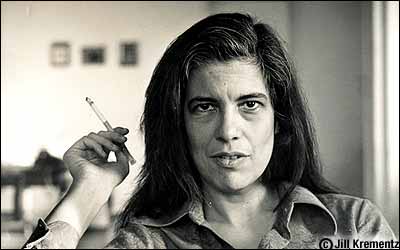
One day I want to write a big essay looking at how writing style changes according to how you get the words on the page (I even bought a beautiful typewriter to test that out). I love the idea that Sontag uses layers and layers in her writing and editing: the process of writing on top of writing, of scrawling and scoring out like the palimpsest diary Cathy in Wuthering Heights creates on the margins of a bible. Like Heidegger with his under-erasure being.
I also find it fascinating how people can study and write with music playing around them. I used to be a lover of total silence: a pure space in which I find the need to fill up the void with words. Now I can sometimes do with a bit of ambient sound: coffee shop clattering, birdsong, falling rain and so on. It makes a difference whether you are in the actual space (writing in a real garden or a coffee shop, for instance) or in the hyperreal zone of generated sounds (there are excellent Youtube sources of ambient sound, from whale-song to fire crackling in a grate). One will distract me to write about immediate details, the other soothes you into a weird creative ‘roll’ where you can pour out your words or nonsense like code streaming out in hyperspace. OK, I’m being self-indulgent.
And indeed, there is a self-indulgent aestheticisim to all of this: the endless procrastination involved in selecting the correct font for a piece, the need to rearrange one’s desk or shuffle books or change your pen or whatever it is. Yet there is something more important here that relates to publishing itself and the way literature often gets sucked into a commercial vacuum (think of the likes of the Brownings’ letters or Shakespeare’s sonnets which get beautifully repackaged in time for Valentine’s Day) . The original text is beautified by the paratext, and what is left is perhaps more of a consumer object than a discourse of words and sentences. There is an emphasis on white space, the chic luxury of thick paper and the gaps between printed letters. James Fenton said that, ‘what happened to poetry in the twentieth century was that it began to be written for the page’. But what is this page? Is it the sublime landscape of print paper stretching out its possibilities of unblemished whiteness? Or perhaps the virtual page: the ever-changing Internet archive that risks the dreaded 404, this page is missing; that risks alteration and collaboration and manipulation – and is this not a good thing? It is poetry changing, in transition; undergoing the morphological process of the human into cyborg. An automated computer voice reading aloud, staggering over the dashes and tildas and sharps, the onomatopoeia and enjambment like a child having a crack at reading Derrida. Il n’ya pas hors text: there is nothing outside the text/there is no outside-text (he writes in Of Grammatology). When somebody reads aloud I imagine the words before me, drawing out of the page like butterflies coming to life; I can’t help it, it’s the way I learned to play with poetry. The world I like is the enclosed, shy space between the black ink and the reader’s eyes, the moving lips so silent.
The Mariner’s ship and the Albatross. Source: thestage.co.uk
Like the ‘fluttering stranger’ that Coleridge observes as a child at school in ‘Frost at Midnight’, words in poetry become strange: there is an uneasiness to them that we cannot quite place. Verbs, adjectives and nouns are not what our teachers told us. You cannot fix them to a blackboard, and anyway chalk crumbles. While butterflies might be pinned down and classified by their colours, words are dependent on each other for meaning. So signification sifts in swirls of dreamy reading, and the mind makes connections. The imagination stirs and sometimes forgets them. Footnotes adorn the margins and confuse us, as they perhaps do in Coleridge’s ‘The Rime of the Ancient Mariner’, where we are driven into warmer but often more perplexing territory, as Coleridge’s gloss is less an academic explanation, and more a multiplicity of voices. At once, he joins in the action, ‘Like vessel, like crew!’ – yes, ‘her skin was white as leprosy’ – and we too catch this virus, moving between microbes of words that open and mutate through the strangest imagery. We shift between and through things with Coleridge’s metonymy, as in the gloss: ‘[a]nd its ribs are seen as bars on the face of the setting sun’. What are we to make of this being, ‘a Death’: an embodied spirit whose translucency both stirs and disturbs and amuses us, all at once? Aesthetics and meaning all blur into one.
With Romanticism what we often get is the journey, the progression through space, selves and substance, and through visual experiences: the sublime, picturesque and the beautiful. Not to mention the ugliness of Frankenstein’s monster, mirrored in Mary Shelley’s own monstrously patchworked collation of tropes and terrors and texts (imagine being raised on Milton but growing up like Rousseau – being both Satan and a noble savage – now that is Otherness embodied, surely?). We follow Wordsworth up Snowdon and along the Alps in his glorious Prelude, with the seamless switch between interior musings and the expansive, golden panoramic shot that reveals the gaping ice and mountains, the tracks the subject’s wandering thinness:
The unfettered clouds and region of the heavens,
Tumult and peace, the darkness and the light,
Were all like workings of one mind, the features
Of the same face, blossoms upon one tree,
Characters of the great Apocalypse,
The types and symbols of eternity,
Of first, and last, and midst, and without end.
(Wordsworth, Book VI of The Thirteen-book Prelude, lines 566-572).
Where nature itself merges into one terrifying being, where opposites uncannily forgo their differences to become ‘features | of the same face’ and still the sweet ‘blossoms upon one tree’, we are in a sublime landscape, and then in the pastoral garden. The subject stamps himself upon the mountains, as the mountains are stamped upon him; we recall, with the help of the OED, the varied meanings of the term ‘character’: as both noun (a literary figure of self/person; a sign or symbol used in writing, print, computing; a code; the properties of a substance) and verb (‘to distinguish by particular marks, signs, or features’). Wordsworth’s figure is the self encoded in the text, the lonesome Romantic imprinted in his white sublime of Snowdon, going deep into the very properties of the rock itself. All is viscous, melting subject into object. All is, as Timothy Morton so aptly puts it, a mesh: where there can be nothing ‘out there’, as we are all a set of strangenesses, part of an existence that is always coexistence; and yet we are not simply part of a holistic collective, but connected in our differences, in our mutations that separate, stick and undo us. There are those clouds which seem ‘unfettered’ and yet even they cannot rise above the poet’s vision, the tacky link of aesthetic projection that takes nature from unified cliché to a space of wilderness in which things move between abstraction and reification, and humans move with them in the ambiguous space between – like those viruses that multiply and mutate, ‘first, and last, and midst, and without end’.
This dangerous, homogenised idea of ‘landscape’ can be undone by thinking of it textually: as a palimpsest too of sorts, where human language adds layers to our understanding, alters our relationship with nonhuman things of the living and non-living. In writing and reading ‘nature poetry’, we are reconfiguring our place in the mesh; just as a drop of colour upon a single Paint pixel shifts the impression of the whole picture.
While Romanticism takes us on these messy forays into psyches and space, in the twentieth century we have, as Fenton has suggested, the poem as object: the poem as visual play on the page. The attempt to make the poem an object, to get to the very basics of objects. Think of Ezra Pound’s Imagism: ‘The apparition of these faces in a crowd; | Petals on a wet, black bough’ (‘In a Station of the Metro’). Think of William Carlos Williams’s notorious modernist poem, ‘The Red Wheelbarrow’, in which Williams’s poetics bring the object into stark and colourful being, like an object being rendered on some kind of graphic design program. Assonance coats our visual impressions so that we can almost taste what we see, the wheelbarrow ‘glazed with rain’. On the page, the poem too is a spilling of rain, of long lines dripping into single words, of basic objects hardening, forming. The ‘red wheel | barrow’; the ‘white | chickens’.
There is also the lovely aestheticism of the fin de siècle: the beautiful margins and separation of art and text in the The Yellow Book, and of course Husymans’s jewel-encrusted tortoise, which eventually dies from the weight of its ridiculous embellishments. Does a text too collapse under the weight of its stylistic ornamentation? The fashion for minimalism perhaps gives way to this assumption, and yet what about the explosive textuality of Finnegans Wake, Gravity’s Rainbow; anything by Henry James, or for that matter, Angela Carter? Art for art’s sake is not a dip into vacuity, but is necessarily a political statement, a textual position, after all. An attempt to escape the shading blinds of ideology. You might write a dissertation on the politics of purple prose; you might float buoyantly along the clear river of Wikipedia readings.
And now I have lost my place in the forest and cannot find the light again. Birds tweet shrilly and their song is like stars tinkling and various shades of darkness hang in blue drapes from the bowers of pine trees. If I look around I see the jewel of every dew drop glisten and I know that it is twilight. I am looking for something particular: that silent speck of a presence; that which evades me every time I turn over each new leaf. Only I know that I cannot see, cannot see the gathering of these particles; the light is fading and soon the day will close its drapes.
These are just words after all, and who would cling to them?
So just thought I’d explain why I’ve not posted a single thing here in a few weeks – I’ve been working hard with uni projects but also the Creative Writing society that I’m part of runs an event in February where you work towards writing a daily flash fiction piece. So all my energy has been taken up with writing a new piece daily, and so far I’ve managed to meet the target. If you want to check out any of mine or the other members’ work it’s at http://gucreativewriting.wordpress.com – just keep scrolling down as there’s quite a few to look at!
Will be back to the blogging here in March hopefully!




 mariaology