
And so stripped back to a ballad, the waves makeover their casual gyre. Time passes, it just does. Time is learning to think at new angles, the rules of the slots. There’s a reason we rotate, we go aerial. Her videos started with the road, all flesh and metal. Oil was the ever-hidden well of jouissance; but even in presence it was already filtered, the rutilant skeins of a Hollywood movie, its flickering scenery.
And she’s cigarette breath, smoke-eyed, bronzed and burning a brilliant white.
‘Love’ was notable for its speculative community of lovers at play in lunar waters. Now we have ocean, we have a sea without people; an image presented in clean abstraction. This is not just emotion applied to landscape. The image churns with a white flecked affect, a semiotic excess expressed in waves. Life’s complication a cool hard block; this song is simple. No birds visit here. Close enough to touch again, but then again lifting. Must we ever be heavily-shadowed here?
I break at the rock in search of quartz. To hold out for solar in her wide hoop earrings, glinting gold. It’s so cold in this house, so I look to America.
Articulate feeling in the life of insects. Tiny moths are especially beautiful. W.S. Graham writes close, coming home to his wife, ‘My dear, I take / a moth kiss from your breath’. My best crepuscular species. Release with lyric on-screen, participatory invite. The monochrome softens the present to memory, so every trope is another refusal, ‘no candle in the wind’. I am not telling a story. I am playing a part. There is a hesitancy, a deep breath, a slow glance west. She is so aware of her former effulgence.
Then all of this infrastructure, the wire-mesh fencing concealing our fuckups. Dwell at the edge zone where communities meet. A little light lets in, a sort of high voltage. Our communion is no longer electricity; it flows without fault, but listens for glitches.
(…A woman in the bathroom at work last night cornered me, post-shift with her stories. She told me she was bipolar; she taught me the proper way to breathe. There was an involuntary quality: make of your diaphragm a quiver. She said there was a time when she was the only bipolar person on the island. She screamed out in the shop, buying bread. She told me I was young enough to still go swimming. People kept opening the door on my face. She said she needed a transplant, but I didn’t ask for details.)
The sky is an essay, skimmed of originary silence. The grey clouds clutter a daylight milking.
‘And who I’ve been is with you on these beaches.’
Albert Camus’ narrator in The Stranger, savouring littoral pleasuring:
Marie taught me a new game. The idea was, while one swam, to suck in the spray off the waves and, when one’s mouth was full of foam, to lie on one’s back and spout it out against the sky. It made a sort of frothy haze that melted into the air or fell back in a warm shower on one’s cheeks. But very soon my mouth was smarting with all the salt I’d drawn in; then Marie came up and hugged me in the water, and pressed her mouth to mine. Her tongue cooled my lips, and we let the waves roll us about for a minute or two before swimming back to the beach.
When we had finished dressing, Marie looked hard at me. Her eyes were sparkling. I kissed her; after that neither of us spoke for quite a while. I pressed her to my side as we scrambled up the foreshore. Both of us were in a hurry to catch the bus, get back to my place, and tumble on to the bed. I’d left my window open, and it was pleasant to feel the cool night air flowing over our sunburned bodies.
Desire is a chasing game, the coolness and heat; how proximate it is to lethargy! A gamble we make to enjoy these landscapes, the overlay between beach and body.
‘At four o’clock the sun wasn’t too hot, but the water was pleasantly tepid, and small, languid ripples were creeping up the sand’.
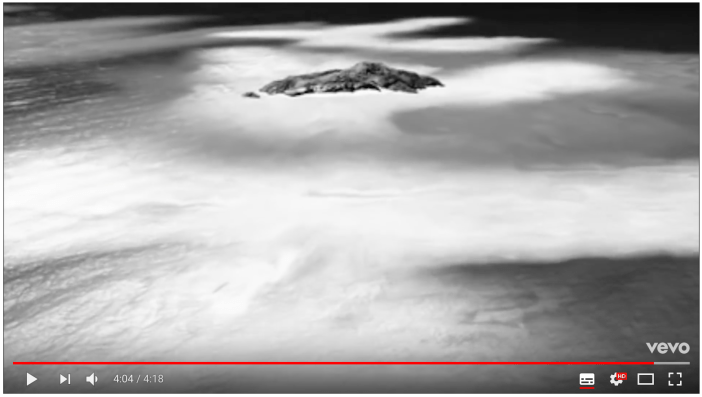
Lana’s last album was lauded as her happiest, transitioning ever from black to blue. But still there were songs about heroin, elegy, the lonely enigma of ‘13 Beaches’. And the closing song so proximate to ‘Creep’ is hardly unshackling. A song first heard on the pro-ana forum, ‘you float like a feather / in a beautiful world’—where delicacy persists distasteful. Precious chord progression matches the rarity, harmonises one of several sighs, the rainbows receding: ‘Their arches are illusions / solid at first glance / but then you try to touch them / there’s nothing to hold onto’. All that is solid, the luminous infrastructure of late capitalism, dissolves. ‘M’ for McDonald’s, drowned in a tidal reply, the yellow suffused in blue. The waves move over the rock again. From this angle, in monochrome, the rocks look like a hunk of meat, a severed heart lost at sea. When the waves calm to a whiteout, silken ocean, they become a selkie skin. A pile of kelp, a remnant piece of PVC, peripheral. All we leave behind in metamorphic identity.
A starlet mythology never settles. They are dressed like children, all ripped jeans and t-shirts. Enid Blyton’s evolving addiction, innocence loses quick on the brink. We know too much already of everything, it gloops like sambuca inside us. Nobody bothers to finish the mystery.
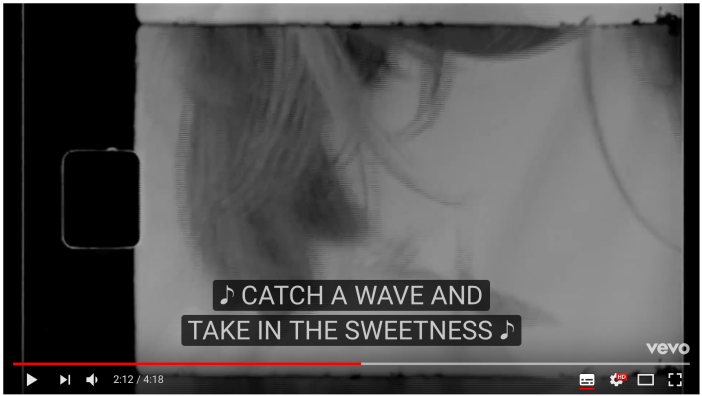
The ambiguous sweetness is oily, narcotic. It falls in fat drops like piano notes, takes our ‘sadness out of context’. My brother in the next room, obsesses in metallic trap beats. Why someone asks me, at ten in the morning of a Saturday, how important is spirituality to you? Waves of pleasure and reward; all over the coast, an opioid crisis. Lacing our dreams with extinction. I feel heavy, although I feel slightly—
They set up the room, my fellow millennials, polishing glassware carefully for the bourgeoisie, while I am in the office, counting other people’s money. We listen to Gillian Welch’s ‘Everything is Free’, completely out of sync with the skin of this weekend. Only some of us have touched a straight job. We wear out the concept, til it flakes like rain, softening every abrasive material.
Soulfully she sings, ‘I’m your man’. Urge for identity, bodily merging, no need for horizons: ‘Don’t look too far, right where you are, that’s where I am’. After spending her career chasing this man, longing for him in the blue-dark, a starry placeholder, looking down highways immune to an ending, LDR becomes the object of her desire. In lieu of cheap thrills, this shift is one of quiet empowerment. I think of the mobius identities of Mulholland Drive. A recognition of the textuality of thresholds; step into the membrane, make cool with the heat of your distance, colourless. Warmth in the icy, fire-churned wildness. The water looks like Pepsi Cola. And did she not once sing ‘My pussy tastes like Pepsi Cola’; and was this not womanly body cast consumer synecdoche, sparkling with chemicals, the cynical poetics of delicious? Diamonds for eyes will never break, except…
We start to think geologically now. Just be, just be. These faltering wedges of mass temporality. Earthquakes happen and so do we. Soft drinks whose flavour will never expire. Rocks that erode in derisive time zones, no longer immune from human acts or experience; species of moth that survive millennia. Butterflies and hurricanes; an ugly shred of progressive metal, scored in the multiplied spike that somebody else deemed gold, a scientist’s quibble. The woman in the bathroom, her shrunken organs; her failed heart lost to impenetrable histories, a ravaged desert of smoker’s complexion.
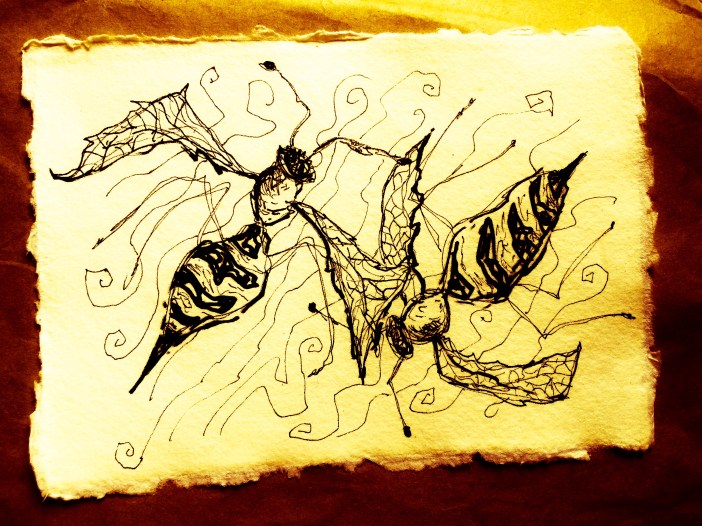
Here is the rock out at sea, an open direction. Here are the girls and their insects. A tiny wonder.

They play with the lepidoptera by the road; this is a petro-pastoral. Cars pass as LDR sings of her lover lost at sea. Fossils are the song’s ambient economy: the rocks beneath, the fuel in those vehicles. The black water, oily in sunlight, the sweetness.
The rainbow will ghost anything monochrome, oil on water. To kiss in the last light of summer is lucky. Give me your harbour.
Material ipseity swirls, ‘All the things that make me who I am’. Highway adjacency, human and natural history’s collision. A water-wave in unicode. Lana Del Rey in the Anthropocene. Her name is an ever-(re)invention; formerly known as, universal/personal. Lost adrift on the always already. Stuttering within smoothed out to a sweetness, make lyric glitter from shattered rocks and melting ice. Matter. Make it matter. The matter of mattering; be the man, as the man-made only, as merely threshold for desire’s discerning in the crest of everything’s vibrant liveliness. Thrashing waves, lost capital, penultimate travel. Dwell awhile slow in apartment complex, who we are as we are as sailors—lives lived here are intensely temporary, and isn’t that a matter of life on Earth, or life in movies?
Anthropocene evokes numberless chiasmic defence formations and programmable aesthetic relapses to come — easy to cash in with and easy to cash out. What is perhaps more difficult is to remember what it meant and bear it. Engineered as distraction or not, it remains stuck in the world gullet, a limit term, a virtual-war word, evoking an ultimate intersectionality whose historical tractor beam iconically continues to fail. What the hyper-anthropocene breaks open is the historicist principle that nothing matters so much that that thing is the only thing that matters. The hyper-anthropocene quakes this idea, and then falls in line.
🌊
*all stills taken from ‘Mariners Apartment Complex’, directed by Chuck Grant. Song written by Lana Del Rey and produced by Jack Antonoff.
 mariaology