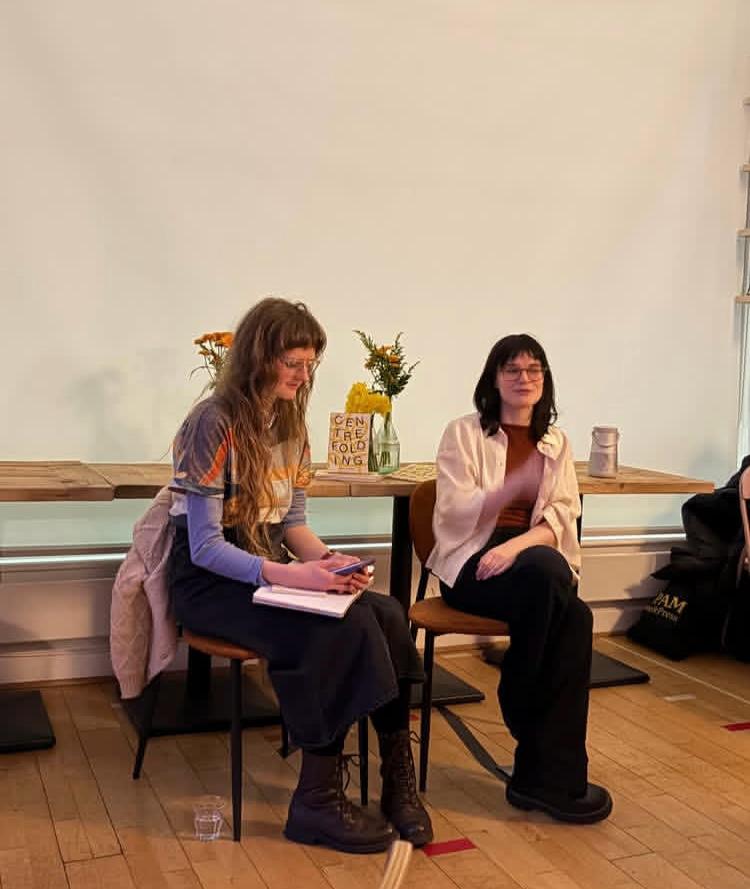
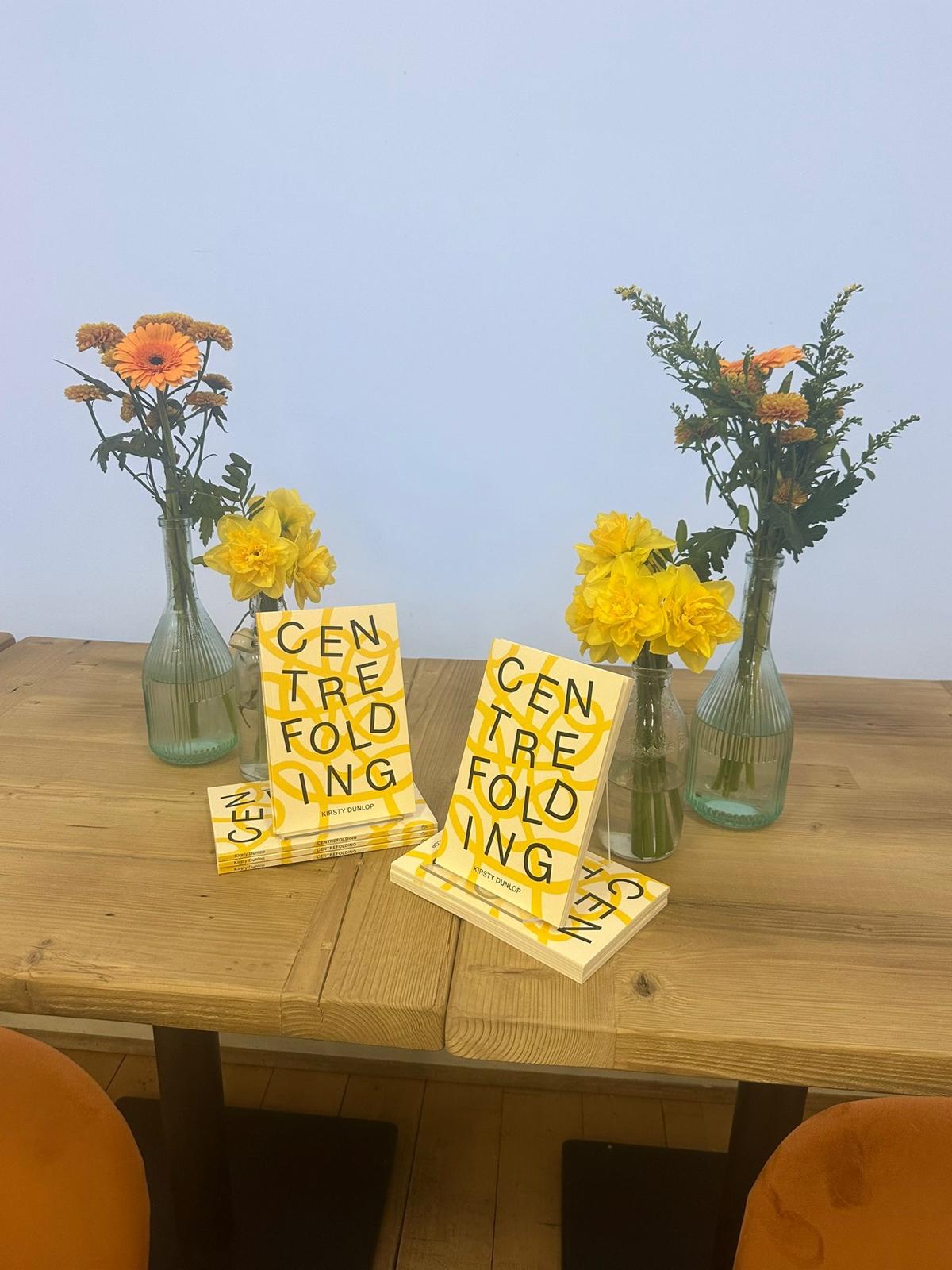
This is my introduction to the Edinburgh launch of Kirsty Dunlop’s Centrefolding (sincere corkscrew, 2026) taking place at Argonaut Books on 23 March 2026. Below you’ll find the audio recording.
First fold: picture the scene. You walk into a large building with metallic cladding and an enticing revolving door. Everything is atrium: echo, wide-panelled windows, open ceilings, flickering screens, a sense of upward levelling gesturing towards the reflective light of infinity. The acoustics are such that a phone call 30 metres away is audible, mixed in with the whirr of unnecessary AC, obnoxious public Zoom calls and the sound of bio-engineers cutting business deals over limp sandwiches. You sit down at a table because there are many tables, arranged with no discernible logic i.e. skew-whiff, chaos on wheels. You observe an apple core oxidising in the airless afternoon. Outside, another building is being constructed. Cladding going up, men in neon orange operating a crane, authentic cherry blossoms swaying beneath them. You split open the spine of a svelte yellow book that has been abandoned, seductively, beside the apple core. Against a black screen in the book’s near-centre, you see the universal sign for buffering, a loading terminal of found language. Certain words present themselves luminously over others: ‘chemically’, ‘error message’, ‘quadrupling’, ‘loitering’, ‘squeezing’, ‘piss’, ‘rose’, ‘ecstatic’, ‘kissing’, ‘a thrum continues’. A narrator levitates mysteriously from the spread before you. Was it this the voice who ate the apple? Such thought is interrupted by a man nearby, addressing something unseen on his laptop: ‘when you see the standard feedback field, what exactly do you mean?’ and then ‘in a sense what you are doing is a quantum stochastic unravelling’.
Welcome, everyone, to the Centre. ‘The dispersed rhythm of a wandering’, writes Lisa Robertson in Nilling, ‘— musical and conceptual — is what its folds conduct’.
This overhearing of the feedback field, the quantum stochastic unravelling, is the perfect threshold, the perfect fold, from which your encounter with this book commences.
Imagine this from the outside, seen at night, as our narrator describes it: ‘the Centre, glowing like an alien presence’.
What we are launching tonight is a remarkable achievement, a provocation, a satire, a first novella, a tenacious experiment, an alien escaped from the lab of Scottish fiction, a flight of fancy so daring its completion depended on a dare set by a senior employee of the actual Centre. Also known as: a stochastic unravelling of theory, praxis and IRL experience. Tonight, we are launching Kirsty Dunlop’s Centrefolding, published by the sincere corkscrew, a Glasgow-based small press founded in 2021.
A little about the author:
Dr Kirsty Dunlop is a multimedia writer, editor, researcher and musician based in Glasgow. She recently completed her Doctorate of Fine Arts in Creative Writing at the University of Glasgow, entitled ‘Emergent Gameplay, Emergent Essaying’ which explored the possibilities of hybrid New Media writing through a digital-born collection. She is Editor-in-Chief of SPAM Press.
Reading this novella is like slipping in and out of a wild stream of fantasies crowdsourced during a conference hosted by the Department of Emotions. And yet the world is so clearly that of our inimitable narrator, so wholly seen through their distinctive, sign-hungry imaginary.
Like the king of poststructuralism, Jacques Derrida, Kirsty Dunlop’s sign is in Cancer. And Cancers are known for their strong emotions. But the astrological isn’t the only sign we’re focusing on here. In his critique of the sign, Derrida sent any notion of the ‘centre’ into a chain of ceaseless deferral and free play. It is in this cascade of signification that Kirsty’s prose takes flight. Takes flight under the shimmering sign of Ali Smith’s sentences, Muriel Spark’s intentional loitering, the crush poetics of Geraldine Snell’s overlove and satirical flair of campus novels and workplace fiction in general — one thinks of Emily Segal’s Mercury in Retrograde, an autofictive account of working at a trend-forecasting startup, or Joshua Ferris’ Then We Came to the End, a tale of white-collar workers at an ad agency, dreading the fate of unemployment during an economic downturn.
Tonight we are Centrefolding. Kirsty has written what Daisy Lafarge aptly calls a ‘future cult classic’, a line I can’t help but hear in Charli XCX’s voice in the way she sings ‘club classics’ and three times again for good measure. It had me snorting with laughter on the subway and choking on the apple of knowledge exchange and sin. I’m so excited to be here with you in the wonderful Argonaut Books to discuss the novella that captures economic precarity, friendship, solidarity, loitering and the neoliberalisation of the academy like nothing else. First up we’re going to have a performance from the amazing Kevin Leomo in collaboration with Kirsty and…the Centre itself! Then we’ll have a reading from Kirsty followed by some questions from me. We’ll open up the floor to your questions and finish on a final reading.
I’ll just introduce Kevin now.
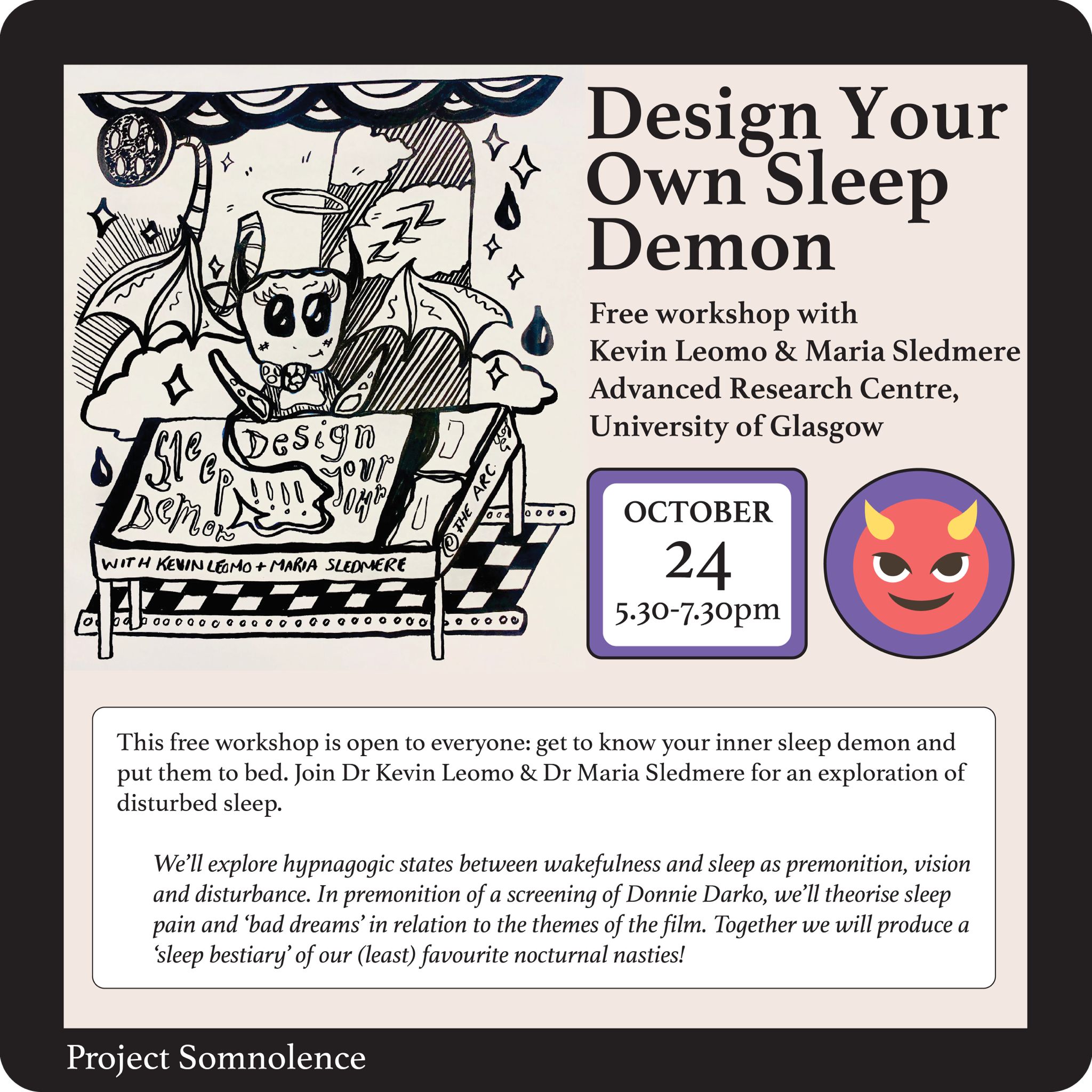
Kevin Leomo is a Scottish-Filipino sound artist, researcher, and curator. He directs the sound artist collective Sound Thought and is one half of Project Somnolence with Maria Sledmere. He is a board member for the Scottish Music Centre and the Anti-Racism Observatory for Scotland. Kevin works as the Community and Engagement Manager for the College of Arts & Humanities at the University of Glasgow and Co-Director of the Creatives of Colour Festival.
Order a copy of Centrefolding here.
~
Recording: Andrew Kenower
Photos: Adeel Ali and Maria Sledmere