Dancefloor Utopia: Free Love’s ‘Pushing Too Hard’ & ‘July’

I love alcohol, the gloaming
of the blood that makes time an arcade.

Somehow, lately, I have been unable to drink myself into drunkenness. Everything is a spritzer whose taste effervesces like the further most points of the sea at sunset, those glisters of peachy waters which seem almost to fizz beneath the pleasure of light. To think of that expanse as the body’s active limit, like the horizons of video games, whose traversal would teleport you back to some familiar, originary location. Flip away. Endpoints as triggers for reversal. To travel outwards, to raise yourself clean into movement. To make of the body its own hypothetical. It’s like I want only the blueprint potential, the colours and geometries. 

The waves move against me. I do not drink. 

Queue, Free Love (FKA Happy Meals) ‘Pushing Too Hard’. This ultra-dappled, smiley-faced italo-disco is a sort of vertigo. I mean I am spinning silver in its listening. Emptiness requires its own containment. To dance in parallels then pirouettes, to queue time upon time’s arabesque. To oooooze. The little eddies of the ocean still swallowing, the sun ravelling down like residue soda. Whatever direction you make into ceremony, pleasure. 

The bunching of muscle, where sun hits the boulevard. Where the boulevard bursts into its many discographies of water, inclined to times beyond and before, a gradient popularity of passengers and travellers, nomadic ravers. Where the boulevard is not a waypoint but the lengthy stretch of hypnosis itself, an astral plane into sunlit ethers.

The very word boulevard, a sort of ferric opulence unfolding a hazy, urban sprawl.

All of this wayward July, and the synths so warm on my skin, and every conversation a twirl of hyperbole. I wanted nothing of night again, as night was just the day’s refresh and erasure. All through the summer, the air so syrup and seething.

I book the overnight ferry, I dream of a world without timetables. The tide sloshes over me and it is sleepless, and it is heat.

This is rich-text. All of oddness. I’m just so much happier at four in the morning, in the priory of sunrise. Missing you.

Cherish the currency of friendship, however the slightest touch is a glorious misreading. Miss reading, I’m missing. Mist between the one and the two and same, faintness of incense that is. The body unshowered, the mist of heat. The endless messaging dew drops of moisture; your pearly brow is beautiful. It isn’t as though you could shift sentences for me. I’m just as weak.

Suzanne Roden of Free Love sings sometimes in French and slips between two languages, the language of the one and the other, the foreign tongue as love in transition. The lively nuance of melodic translation. To stretch meaning, to make of its pulse the possibly unmappable. We listen and maybe we don’t quite need to understand, we just need the potential of passage, its affective route per semantic reach. Glossing Derrida on love, Maria-Daniella Dick and Julian Wolfreys write thus:

Love calls on us to be responsible in coming to map the unmappable, to be open to the possibility of the impossible, and the possibility of this impossible experience is that, in short, which is between us, and which remains: to come. Love is always just this exemplary passage between tongues, in what is foreign, other in the language one calls one’s own.

There is a healthy cascade of reverie. There is browse and incline, click and encryption. The love that you seek. Every pop song is of course love’s expression, the fluid joy of a ~solid~ ego; and yet to map that point of dissolve in which this ego is the melt-point of ipseity’s porous limit, is that not the deferring impulse of disco? Strike through to jouissance. The repetitive beat, the multiple oscillating climaxing motion; the avoidance of pop’s inevitable, normative denouement; the queerish musing deliciously around fulfilment; the rhizomatic overflow of the senses!

Stay mercurial, baby. In cool arousal, in sluicing.

‘But I love you despite the boring terrorism / of particularity / fading like parity’ (Keston Sutherland).

Your forehead is hot. It is glass for the shattering. We are fashionable and hackneyed, practicing lunacy where the beats scream and are again crass in their lust and elation, their confinement to time and place and the pulse of this darkness.

When my irises bleed, is this a form of eschewing the present? As in, swallowing an elsewhere unseen to the other? We see our eyes outside, in the comedown glow of street lamp smoulders. We the parts of our bodies as an archipelago, every isle slowly swallowed by rising water. 

This tectonic pulse, this encompassing warmth.

You’re pushing too hard. And so language is physical, and so is literally thrust in, into, the armoury of love. I will not say weapon, I will not reduce a necessary plural to the singular tool, the implied signified of the phallus. The piercing. My eyes become pliant.

Make of the air her dulcet voice, over and over like rain’s refusal. Make of this moment a lightness, a smoothing. Trace little bumps and ripples and glitches; the motion is softcore, resplendent’s true sense.

Love is also the coveting of blindspots, those absent locations of self’s abyss which lie adjacent to the lieux de memoire recognised as the sites of love’s memory, of memory’s happening in love. Love as process of betweening, as immersion. A feel-good, a good feeling. The prolonging of ephemeral sensation in an act of imaginary narrative, its plights and highs and necessary zigzags. Act within capitalism, act without; act as pop’s dazzling detournement. So here by the convenience store we kissed, so here by the river; so at the window we shared cigarettes in a friend’s apartment, by the ersatz palms, so these screens between us, so the niche forums that served as our weird, oblique interface; so here where the road slumps into a junction, so here at the station where you had to go. A whole topography of abstract thought, remix it. Drink it. So memories of mountains, so sharing the lakes we made up in memory; that you swam in, the lakes I walked round as a child, the heather on hills where ashes were scattered. This interface, these blue messages. Blue irises. The shape of a letter impressed on a map. The silent valley, its conclusive basin of time; where life is swallowed. I memorialise a thought, the quality of light in August, its paler gold among green; whose green is mortal again, whose green is set to fade. Your pupils resolve all green of the iris to blindspots, they mop up the blue with the black of sleep. And to sleep as equals is to forget the self, to wake in a room between rooms, to find yourself caught as other again, your room unfamiliar, the room never yours even less so now. The very first utterance of morning might break the spell. How the sky looks different through your open, solar window!

And I’m not the one to help you / Although I’d like to tryyyyy.

Clatter and wave, video game imperative to action and motion. Soundtrack the heat. Make reverie of weather. The production is so acid house. The production inclines toward dance. Externalise the internal. Naturalise the natural. A certain elasticity of underlying beat, as if bass were the hum of the blood that produces affect. As if it were all that reducible. As if in that energy. Make our mammalian restraint ethereal. 

The Quietus says of Free Love’s music, ‘Their vision is a utopian one, influenced by rave culture, Eastern religions, politics and magic’. To unhinge love from its possessive sense, love becomes an ambient tone in the spread of the days between days which we count in love, if love is a sense as any other, an orientation between things, between selves, the one and the same. If love is something… that something within us must export to numbers. How many days has it been, I’ve been thinking all week… Here are our figures. Crunch on a sort of krautrock lingering, the impersonality at the heart of euphoria’s insistent heat. Free Love have used drones before, meditative, balearic beats. It’s a process of seeking the nuanced frequency, the cleaner hum of Being, what might spread into an open future, something bright to seize. Design your consciousness for different realms, just feel the synaesthesia of speculative situation. The future’s flirtatious, maybe it speaks French. It’s a bright pink, cherry-red electric French.

In his spectacular tome, More Brilliant than the Sun: Adventures in Sonic Fiction (1998), Kodwo Eshun talks of how the subaquatic techno-duo Drexciya ‘fictionalise frequencies into sound pictures of unreal environments […]. They fictionalise the psychoacoustic volume of a giant submersible’. ‘Pushing Too Hard’ implies a current out of sync with its destination, an unbalancing in the passage between entities. A kinetic effort. Disco’s warm flicker invites that spiralling back to aporia; not a giving up in the sense of seduction’s failure, so much as surrender to the unknown and its cheeky, distinctive flourishes of acid, italo, proto-house all drenched in funk. I don’t pretend to understand French; my language is literally standard grade, processed only to that limit.

But I pick up some terms Suzanne sings:

L’avenir: future, future, future, promise. To come up. Insistent, proximity, imminent. A cool bitten ecstasy, a love to-come. Love in the conditional, although I’d like to tryyyyy. Those airy harmonies cascade around chiasmic, sunshine flourishes. Love’s duration at 4:18.

Plastique: plastic. What seems elastic, mutable, but is in some sense unerasable—a material that ultimately remains. Residuals. Shards, bits. When ‘Pushing Too Hard’ collapses into its A-side twin, ‘July’, the beats are fatter, darker, hotter—brooding with a sense of summer’s latency as always already. The plastic feeling is inside me, it’s a melting, it’s a coming-into-skin. Sonic duplicity. It’s the Anthropocenic hauntology of organs, it’s a PVC drag of natural sensation. It necessitates dancing, but the percussive chimes in the track’s white-heat centre drag my mind from the present’s solidity. Those chimes are airy, they are elsewhere, enchanted; they are so far removed from the close close city. To be fast and slow, hard and soft, selfish and strong, reflected and present, past and future…Being as syncopation, being as plastic, rent to split. Our lapidary imaginaries, our synthesised clicks of pleasure; a pool of sound, an immersion…I’ve come to relax, to realise.

Visage: face. A word whose very sound is that of sunlight hitting clean the bounce of a mirror, a slide into silver. The waspish vibration of the lips, inclined to glass on the brink of shatter. I think of all those mirror tricks in every ABBA video. The face, the face, the face again. The face we effect. Maria Dick and Julian Wolfreys again: ‘Seeing the face in its absolute and irrecusable singularity, I am given to apprehend a doubleness from the first gaze’. Disco is doubleness inherently split to multiplicity, it is the vying for one attention amidst the millioning of other skins (skins becoming a metonymy of figures, faces), it is the shakeaway of self into other, the imitation, the performance of gesture’s contextual plurality. The face, in Emmanuel Lévinas’ sense, is the announcement of subjectivity: the instating of the subject as a sort of ‘hostage’, as Dick and Wolfreys gloss. It demands a response, stealing the attentions of the self, instating by necessity a certain ethics of wholly Otherness: the human face, as Lévinas puts it, ‘orders and ordains us’. I catch your face on the dancefloor, there is a temporary pact between us. What implicitly slides in the raising of one arm, the twist of hips, copying this dance, a Xeroxing event whose zero-sum origin remains irreducible, whose condition is always undecidable, plural. So far so obvious the ontology of rave culture. Every action now as response. A semi-autonomous severing. Technology can be, as Eshun puts it, a ‘bifurcation in time’. The techno throbbing through the pale membranes of my human sense is a channel for split subjectivity, an experience of falling between worlds.

On the dancefloor, when he asks me what to do, I whisper in his ear, in some half-remembered echo from The Bell Jar: ‘pretend that you are drowning’. And that paranoid panic, that scramble for air in the thrust of the limbs, it seems to work. I see the moisture mist up his glasses. Face after face, we glimpse the phenomenology of substitution, we trade our own affect for the possible electricity of the next. His smile, her hair, our collective sweat. The absurdity of all these moves; the warping of all muscle memory inclined to a known rhythm, then ever the melodic trajectory of an unknown palette. We expose our infinite vulnerability, we abstract ourselves to the dancefloor’s disorderly hospitality, where the reciprocal push-pull of crowd and DJ is a mutual reading and so mutual dissolve, a ‘free love’ whose freedom is conditional on the exchange of gesture, face and motion, of bass, beat and melody. Of sonic and visionary qualities. Of closeness, a close reading. 

I imagine my skin looks metallic, right now, as you see it.

Eshun again:

Groove is when overlapping patterns of rhythm interlock, when beats syncromesh until they generate an automotion effect, an inexorable, effortless sensation which pushes you from behind until you’re funky like a train. To get into the Groove is to lock into the polyrhythmotor, to be adapted by a fictionalised rhythm engine which draws you on its own momentum.

Is fiction here the condition for identity’s erasure? We hustle ourselves out of ordinary language, slip into the chug and pulse of the train. Okay so all these bodies in motion. To export yourself to the techne of musical condition. Fold in the overlap, a baroque philosophy of subjectivity’s production. Enter heterotopia with both hope and scepticism. Put away your wallet. Fold yourself. There’s Deleuze’s notion of the fold as a doubling: one thought rolled and pressed into another, the scratch of tobacco in cigarette papers, the promise of chemical stimulation imbibed in the skin, the curlicues of words upon screen and page, the unlocking potential of semiotics in motion. A rolling into, an overlay’s careful pleat of impression and meaning. The duplicity of temporalities in photographic exposure. This tongue curled on a foreign one, the blendable play between French and English, a play between verse and chorus. A recursively mutual translation of inside/outside, the self and other, here and there, near and distant; a translation whose very process belies the instability and futility of such ontological divisions. We relate to ourselves as production, we produce ourselves. But don’t look at me / I’m just as weak. The face that desires, amid over-stimulation, the reserve of hiddenness, the retreat. Subjectivity as a question of mastery, self-relation, processing affect, thought and memory in the world’s abundance, intensified in the sonic duration of a pop song, or in the ever-churning lieux de memoire of a dancefloor, where memory is always in oscillation, caught between bodies and beats. And the magic in that, and the heat. 

‘It’s like creating temporal communities’ — Lewis Cook.

Every melody’s upswing, a new euphoria: ‘Synchronicity’. Left my ego on the ground. Make of identity its fractal components in disco extension, plugin auroras of thought, the perspectives shifting. Suzanne’s voice spliced between echo and harmony, echoed by Free Love’s other half, Lewis, echoed by her own, echoed by the satisfactions of division’s fall back into rhythm, the tightness of synchronicity. Turn me upside down / I don’t know what’s left in front of me. Resonate, resonate. Duplicity kaleidoscopes originary identity as an always receding, elusive location, infinite addiction. Broken glass, symmetry, the one and the same split shard-ways, a cool euphony of a synthetic present cast ever between past and future; the neuromuscular necessity of this beat, this bodily response; hyperstition; this brainwave as process corrosion, as shimmer and sweet, as almost coincidence.


*

(Video shared via YouTube/Gorilla vs Bear)


Dark Chocolate Auras and Strange Ecologies: Daisy Lafarge’s Understudies for Air 

IMG_7965.JPG

Sylvia Plath wrote many of her Ariel poems in the wee hours before dawn, sucking in the cold and inverse crepuscular air, its colourations of sinister lilac and absent sleep. We have a cliché of the poet’s spontaneous overflow, but instead with Plath there’s a sharp intake, a suspension of air, of breath: ‘Stasis in darkness. / Then the substanceless blue / Pour of tor and distances.’ We have to think through the impossibility of a substanceless blue, as everything must be a component of something; we are all of a sort as perilous hybrids, weak in some place with the viral code of our own demise, shimmering within and outside us like a beautiful aura. The speaker paralyses herself on the brink of sublime, of suicide. Tor: a hill or rocky peak. Vertiginous depths to erase the scale of the self on earth. Tor: a free software project which protects your privacy online. Where history bounces back, is the elaborate sarcophagus that traps the foul air of your history. Think of layering, onions, peeling stench of purple flesh. Indulgent recipes for regret; the cloying addresses of cheap pornography, of midnight Amazon deliveries. Inside the deep centre a secret, liquid sweet as Timothy Morton’s chilli-dark core of chocolate ecology. Chilli, chilly; a shiver in the air that is freeze or fiery. I have been googling your name in my sleep. A shivering, unsettled enmeshment. The encryption an insufficient addition to the substance of memory, its thick brain mulch of skin and image. Such protocol stacks are hypothetical only, nested as the heavenly day that will not die. Wordsworth singles his day from a tangle of others, the onion clot and rot of forgettable hours. To dwell forever in that substanceless blue! To wear innocence on the sleeve of freedom! Plath’s line breaks are harsh and sharp, they flake off the page in their skinly abscission of sound and sense; the body is imposed on grander scales, made to stretch then wither in variable ‘dead stringencies’. All of a space, the thin poem shivering down a spacious page. All of this is so much of air. Take me to the edge, go on, it’s a dare.

An understudy is someone who learns another’s role in order to act at short notice in the person’s absence. You lurk in the background, an absent presence of possible flourishing. The poem as understudy: recipes perhaps in the absence of breathing. What we read when there is no air left to breathe. Poems in reserve for a gradual apocalypse. What exists as core substance, what complements the element whose insouciance charms the lungs without thought. Derrida’s maddening supplement: neither presence or absence, something added and something in place of. An understudy for air, a rehearsal of air’s function. Anthropocenic, tarry air, stung with coal and thickly textured.

Robert Macfarlane asks that we find a ‘thick speech’ for articulating life in the time of climate crisis. Enter Daisy Lafarge’s Understudies for Air (Sad Press, 2017). This is not a collection, ostensibly, about ecology or even the end of the world. It is a phantasmic scaffolding of words and lines for living, breathing, being. Its epigraph takes the axiom of the pre-Socratic philosopher, Anaximenes: ‘The source of all things is air.’ Air being then the ubiquitous neutral substance, something available for occasional roles in physical process. A reluctant but capable actant, developing itself or forced upon by other natural causes. Air’s principle shifts bring about the other main elements: flicker into fire through precious density, condense into wind or water, earth then stone. Anaximenes articulates this through a simple example: if you relax your mouth and blow on your hand, it’s hot; if you do so with pursed lips, the air is cold. So rarity correlates with heat, density with cold. A beautiful, quiet, material intimacy. Everyday action, for Anaximenes, here forms the source of a theory of matter, and yet ever with time this matter recedes. There’s a scarcity of air, something sparse and grasped for in the gelatinous enjambment of Lafarge’s lines.

Precision of form: shortness of breath. When we pause at caesura, pause to breathe, when we lilt our words over the ambiguous interval of a line-break, we are forced temporarily to think about air. I recall the little ticks my brass instructor would make on a sheet of music: remember to breathe. The ticks would supplement a conventional musical pause; I guess I just needed more time to breathe. Breathing is temporal, but also material. There’s a precision to Lafarge’s form, a negotiation of reflective lyric transposed through material effects and affects. In ‘sapling air’, a sense of childhood’s loss is articulated as nonhuman ailment, the ‘first outbreak’ which is a poisoning of the air or the bark of trees. At first I think ash dieback, but then we are taken somewhere more grandiose, planetary, magmatic. Lying in the liminal space between ‘child / and whatever came next’, the speaker is in the bath, ‘gazing up through the skylight / as a plane passed overhead’. This sense of temporary epic scale, its vanishing écriture of ‘vapour trail’, is a writing of fleeting sheen. I think of glassels: those stones which appear glossy beneath water (in river or sea) but when picked and brought home they revert to dispirited dullness. It is as if life has left them, where momentary they truly appeared as vibrant matter, appealing to the senses with electric connection. Is this the fate of the bath-varnished body? How beauty consists in the wounded part of a thing, a fragile glitch in the viral code—what makes death inevitable. Stones ground down by the sweat and chafe of salty water, the sky a landfill for carbon dreams, modernity streaked across substanceless blue.

The speaker glimpses the oscillating scales of panorama and miniature: the passing plane and the ‘passengers’ eyes’. She sees through the eyes of others; a vertiginous, fleeting sublime in which she is the one looking down and the one looked down upon. Humans become binary nodes in this networked communion of sound and sense: ‘the passengers’ eyes flickered on and off / with signal’. Air carries, air travels. Air miles, as both temporal noun and verb. I find myself tangled in the space between transitive/intransitive. Air signifies the dialectic flickers of presence/absence. Accumulates, billows. What the speaker notices is a peculiar distortion, a toxicity overlaid with her own poisoned body: ‘I looked down. the bath water / was the colour of porphyry and I could no longer breathe’. The excess of the skin flakes away as feldspar, silicate rich and igneous, carrying traces of radial or volcanic exposure, imperial purple or deposited copper. Containing within it divergent scales: wee matrix crystals and larger phenocrysts. The speaker experiences her body as this suddenly alien thing; the sight of the bathwater steals her breath. Is it the first glimpse of what the outside does to the inside, the staining within us we leave on the world in a permanent toxic chiasmus? But I can’t help think also of period blood, given the speaker’s interlude adolescence: something tricky to articulate that nonetheless clots in the mind as childhood’s instated loss of innocence, a condensation of excitement that clings then turns readily and stickily to red, to blood. That moves in turns, cycles as the waxing mist of the moon. What is this substance, this iron-rich bodily flood? Where matter confuses, we turn back to air.

She tries to express to her father a bewildered grief, ‘there’s something wrong with the air’, but her ‘words went through to dial tone’. There’s a delay, language meeting its buffer at difference: through what? Gender, generation, divergent points of vision? Her special melancholy is something that lingers down the line, seeps inside the passage of time. The poem closes: ‘I still wonder, how many months, years from now / he will listen to the message’. Throughout Understudies for Air, Lafarge uses this technique of unfurling: instead of saying simply, ‘how many years from now’, she adds in the months, practices a sort of delay or lag. I think of smoke billows, slowly dissipating. Of what it means to say, there was chemistry between us, an atmosphere in the room. The way voiced words vibrate momentarily in meaning then once again settle to silence, stasis. An almost electricity, crackling then out. Compare this to the written word’s more permanent, inevitable viscosity. Language sticks: you can tease it over and over, read the same thing till centuries down the line the ink wears off from the page. You can replicate. Speech is quite a bit more fleeting, unless you set it down on wax or tape, find new ways to materialise language’s spit, crackle, lilt. The forcing of sign and shape from sound.

Air in Lafarge’s collection is a sort of pharmakon, in Jacques Derrida’s sense of an undecidable fluctuation between poison and cure. It is a substance acted upon with the medical impetus of invasion: in ‘desecration air’, ‘brittle waves of grit’ are ‘growing, syringe-like / into the air, and in so doing suckle / and cleave the dunes around them’. There’s a sense of maternal genesis and geologic violence, an injection of force into air’s spaciousness. For air at once signifies space and density of matter at the brink of scattering, sparking, forging. I start typing what is air into my search bar and it suggests, where can it be found? I am suddenly struck by air’s mystery, the possibility of everyday deception as to its ‘nature’. What is taken for granted has elusive substance; after all, can we view air in the object-oriented sense of ‘object’, or even, at transcendently nonhuman scale, ‘hyperobject’? For air blends and bleeds, both substance and accident. The painting or glass had an airy quality, we talk of a room as light and airy. Does this mean more air, or air less dense, more receptive to breath and space and quiet? Air is rich with the silt of existence: dust being its materialised twin, these myriad phantasms of hair, fibre, textiles, minerals, meteorites, mostly skin. Air is nitrogen, oxygen, argon, carbon dioxide flavoured with traces of neon, methane, helium. We breathe air but also pass constantly through it, as our molecules swim in the vast bombardment of other molecules swirling. Ambient air is safe, we pass through it daily; but air can also spark, as fire’s immanent ingredient, awaiting some flagrant chance to burn. We talk of dry air, damp air, air that feels ‘close’. Air signifies both absence (space) and presence (elemental matter, tangible substance). Air is always potentially transformative.

There is a poem called ‘calque air’. Calque means loan translation: a word-for-word exchange of meaning across languages (examples include ‘fleamarket’ and ‘skyscraper’). In French it means literally ‘copy’, derived from calquer: to copy, base on, trace; derived again from Latin calcāre, to tread, press down. Thus in the abstracted xerox of translinguistic exchange, we meet a sense of material rubbing, the friction that exacts its inscription between two substances: stone on stone, wood on wood, paper on paper etched with lead. It’s a physicality that chills the spine. Yet tracing somehow also connotes residue, the excess material produced by this rubbing, the patterning stains set down by a tread, like footprints sunk deep in the sand and preserved semi-permanent by glitters of frost. Lafarge writes: ‘people / were finding messages / in their bodies they hadn’t / written’. Again this sense of material semaphore, whose translation is a phenomenological act of physical reality, a sudden otherness within us that requires an empathy, an excess, a confusion of words rubbing wrongly against one another: ‘it was decided the system was malapropic’. Language spiralling as if in the hands of the nonhuman, the air or machine or book.

Anthropomorphism reaches its textual extreme: ‘the book grew hair, organs, toes’, and so even ‘accurate translations’ become disputed, subjective, active and physical. What is it about air that somehow substantiates the symbiosis of language and matter, its aching and perilous leak? Here we are, tipped in the gaslit eve of twilight, where ‘the sky throbbed / sideways like a haemorrhage’. Matter acts upon us, causing a gulping or gaping as we churn through it, our bodies mucilaginous mulched into altered form, new affect. We can try to discern the nature of air, but in some way its inner essence remains recalcitrant, resistant to the interpretive instruments of other forms, including humans. Lafarge plays on the semiotic plurality of ‘forms’, poking fun at science’s ‘consent and feedback forms’, ethical necessities which prove useless upon the elusive air. This raises the question of how to extend a nonhuman ethics, what forms of consent are required when probing and monitoring their patterns of agency or behaviour? In ‘attempted diagnosis air’, Lafarge concludes: ‘in the end, / you left the forms in the airing cupboard / to let the air fill out itself; it acquiesced / in many hands of mould, dust and heat, / none of which you could hope to translate’. The air transmogrifies into purely itself, is available only as sensation in the perceptive ‘hands’ of other substances. It’s worth quoting Jane Bennett at length here:

 Thing-power materialism figures materiality as a protean flow of matter-energy and figures the thing as a relatively composed form of that flow. It hazards an account of materiality even though materiality is both too alien and too close for humans to see clearly. It seeks to promote acknowledgment, respect, and sometimes fear of the materiality of the thing and to articulate ways in which human being and thinghood overlap. It emphasises those occasions in ordinary life when the us and the it slipslide into each other, for one moral of this materialist tale is that we are also nonhuman and that things too are vital players in the world.

Air is surely the channel for thinking through this vibrant materiality. Lafarge’s poetics, shifting through sparsity and density, perform this slippage between human and nonhuman at variable scales. Rooted in ordinary life, in personal memory, the poems of Understudies for Air root out these collected knots of ontological ‘torsion’, the ‘bunioned’ meanings that wash up like offerings then shut down all visible meaning—‘they closed in my hand / like eyes’. The lack of capitalised titles renders the poems’ drift into one another, in free-flow without the arche conventions of literary closure, of textual finality. A sense of fractured or wounded text, poems chipped out of a grander object, left now to change and drift. In ‘driftwood air’, driftwood makes a temporary semiology of the shore. Driftwood being perhaps the airiest form of wood, a text well-chewed by aquatic bacteria, lightened and smoothed by the tide; erosion performing its nonhuman act of calque: a copying of wave upon wood, the tiny treads of millioning microscopic appetites, like the imperfect press of a nonhuman telegram. With her spells of air, Lafarge conjures a vibrant ecology of non-anthropocentric process; evocative still as such effects take place through the decomposition of the lyric ‘I’, whose voice drifts out in nonhuman confusions, signals and distance. Human affect returns in glimpses like delicious flotsam, jetsam, moments of reflection gleaned from material debris.

The ‘I’ often shrinks or recedes, but sometimes floats over the ambient scene with declarative assertion: ‘the twin lines of naming and being / run parallel but never touch’. Such philosophic pronouncements then melt away in exploratory thought, lines closely attuned to trans-species process: the swell and lurch and pleat of water, plant, lichen or toxin. Once again we come to air as pharmakon, and so its process arises as a sort of pleasing monstrosity. The odd thing about plants is they just grow, often without purpose, foregoing teleology for an impersonal, gorgeous flourishing. In ‘asbestos air’, the speaker marvels:

lichen and moss
grooming your body;
it is a relief to watch
things grow without
difficulty

End-stopped punctuation is often foregone for free-flowing, morphological enjambment throughout Understudies for Air, so the inclusion of semicolon here is its own kind of force. I think of imagism’s stop-motion visual equivalencies: Pound’s apparitional faces in the metro and wet black petals. The ‘body’ in question could be human or nonhuman. There is a plain admiration of process and flow, the ease of growth that feels significant against the endless stuttering, knotted bolts of human maturity. And what about ‘asbestos’? More silicate minerals invading the air, released by abrasion and enacting a slow-release of symptoms, as deadly fibres clot in the lungs. Asbestos makes its own mark upon air. The speaker clearly craves that insulation, a felting of absence with ‘lichen and moss’ that comes as a ‘grooming’. Grooming being the softening and smoothing of matter, but also tinged with danger: to be groomed is to be seduced towards some form of invasive peril. Twin signals, twin materials; a chiasmus of death and sleep’s electricity. Sucking in air, we sleep towards death; slowly we rove over lines that enamour with deceptive simplicity. We can’t help but breathe in sleep; it’s just evolution. What’s more, nature isn’t mere positive growth, but might be compounded poison, cancerous swells. Tumours accumulating almost mycologically, darkly twisting and rising in the shadowy mulch of the organs, the undergrowth. Behind a benign appearance is the spectre of asbestos; for of course mosses and lichens are indicator species, material harbingers of polluted air. Air is the cure, the restorative; but air can also kill. It is both oxygen and carbon monoxide, its healthiness hinges on a delicate balance.

Air’s undecidability, perhaps, is a deconstructive motion of question and answer, a maddening circuitry of frazzled nerves and linguistic synapses. In Lafarge’s attempt to materialise air, to verbalise its form as supplementary poetics, writing does the work of metaphysics. Enter Maria-Daniella Dick and Julian Wolfreys in The Derrida Wordbook, glossing Derrida’s term undecidability:

If metaphysics teaches us how to read, and reading teaches us metaphysics, birthing each other in a twin maiuetics, then deconstruction also calls us to a reading. To read undecidability is to resist that other resistance which would efface it.

Air’s invisible toxins make themselves known with prickling, painful insistence at the miniature level of surface pollutants, scum left on water or stains on metal. A poet’s Keatsian eye would draw out this material tread of Anthropocene effect, illumine its slow evolution with the linguistic wit of a chemist. The irony of deep-time causation at the hands of humans, those obfuscations of cause and effect that place humankind as geologic agents. Reality, matter, climate change become undecidable. We are being taught, in these poems, the call to the earth that is really a subtle conversation within our own bodies—palimpsests of dangerous nature we tried to fashion but grew otherwise, anyway. Despite melting icecaps, the air grows colder in winter, it thickens.

Lafarge develops this viscous, hyperobjective symbiosis through her descriptions of air’s sticky contaminations. There are ornaments of scattered matter: bitumen, seed heads, the wildfire possibilities of ‘drying leaves’. There is a constant overlay of the biological, spatial and arboreal: ‘we soiled our mouths to mimic / the good fettle of root and seed’; those ‘dark thickets of lung’. I think of the word forest, then ‘for rest’. Places we go to shelter, to cleanse ourselves scented on pinewood air. We can’t see the woods for the trees, or was it the trees for the woods? Morton’s idea that we need a return to parts over wholes, this notion of subscendence: the whole is always less than the sum of its parts. A tree more important than a forest. Lafarge strains her ear to every little activity, the expressions of suffering that come from sources beyond the human: ‘on every corner a tree / articulates its script’. Tree language is material too, it is sound in the air unique, and seedlings glistering on rustling rhythms. It is the flail and droop of branches diseased, stung acid by rain or ravaged by leaking methane.

To put words in air implies a sense of declaring, but this is less the enlightened ejaculations of a singular genius and more a sensual symbiosis: ‘the words / identified me as carrier / and now along I go / sowing their imprint in air’. To sow, to plant seed, to let meaning take root and feed upon air and soil, sound and shape. By tuning to nonhuman forms of inscription, Lafarge attempts to answer the call of the absolute other. This is ecological poetry’s luminous tool, its potential ethics.

This is also, to a degree, Michael Marder’s ‘plant-thinking’: a thinking about plants, a thinking through plants, a symbiosis of human and vegetal thought at the level of form and content. Not discursive domination of subject but a perceptive, non-anthropocentric and multisensory modality of what Marder calls ‘transfigured thinking’. I cannot help think of a shadowy, cooperative alchemy in which the baroque foliage of language ravels round the utterances of the absolute other, those bladed shivers and flashes of light, that speak of time felt close in the skin of a cell. It is a metaphysical elixir that deconstructs its own postulated recipe. Metaphysics, for Marder, is unable to think coextensively ‘with the variegated acts of living’ that exist in plants; it seems to ‘affirm the quasi-divine life of the mind’, but actually ‘wields the power of negativity and death’. It risks becoming ‘a cancerous growth’, smothering the plants it attempts to draw ‘vitality’ from in knowledge and energy. I think of the chemical kill that Keats in Lamia implies is the effect of philosophy, which ‘will clip an angel’s wings / Conquer all mysteries by rule and line / Empty the haunted air, and gnomed mine’. Writing poetically, we must be tender, channel the lurid sounds that fill the sparkling air, nevertheless deathly polluted as a charnel ground. Embrace inexplicable oscillations between the living and dead; challenge binary conceptions of stasis and liveliness, animals and matter. Retrieve a kindred sense of mutual mystery, preserve the lingering aura of species-being. Plant-thinking must instead be ‘receptive’ to the ‘pole of darkness’ within botanical existence. There is a Keatsian sense of negative capability here, a chameleon dwelling in the infinite and multiple, the rhizomatic offshoots of unknown effects, undecidability. There’s a Deleuzo-Guattarian intermezzo too, as Marder puts it: ‘To live and to think in and from the middle, like a plant partaking of light and darkness, is not to be confined to the dialectical twilight […]. It is, rather, to refashion oneself […] into a bridge between divergent elements’, to allow that darkness to shine as much as the light of visible knowledge. Remain discursively flexible, morph through variant perspectives.

We have here an immersive rhizomatics, hinting also towards Graham Harman’s assertion of the object’s metaphysical withdrawal. Lafarge’s speaker certainly stands in this middle, exploring ‘a vernacular for pipelines, / circuitry, the fetid grids and systems’. She doesn’t penetrate essences. Stinking like soil mulch, our carbon economy is overlain with what we traditionally take to be ‘nature’: those lichens, mosses, leaves. We are reminded that cancerous growths, chemicals and shameful asbestos are as earthly as the daffodil or ash tree; each to each, irrevocably and intimately enmeshed, from the clinging of air to shared DNA. The speaker lets nonhuman forms speak through her: the shape of those gusts and shudders, those incremental growths and sudden ruptures, take effect in the passage of language. She brings us quietly, unassumingly, to aporetic conclusions, refusing to clasp meaning’s assertion from the lateral sprawl, preferring the precarious, seductive dissolve towards undecidability: ‘I still think of them, their clod eyes / roiled with fever, churning the peat / of a stagnant loop’. Clod: insensitive fool or chunk of mass. A clod of stone, an ignorant clod. An estrangement of nature, a closure of humanity to uncanny matter, churned in the loop of signature tautology—a metaphysics of presence that is ever an ‘argument’, a stagnant pool. How we must dwell, thickly, in these poems, these fleshy pools of blood and sap and dripping air. The declarative trochee like a stone thrown in a pond, ‘roiled with fever’; these shivers on the petrified skin with its fur of moss, toxin, mould. Conveyers of nonhuman temporality. The speaker licks such substances with lapidary language; the effects are circling, strange, recursive as a maddening philosophical problem. She dwells quite certain in uncertainty. Perhaps this makes her the perfect understudy, questioning but never at the point of egotistical revolt.

If all that is solid melts into air, then we know this now to entail less evaporation than transmutation. Solid objects arise elsewhere. What daily we flush, cough and excoriate from our bodies floats out in the hothouse biosphere, only to be reborn as fragrant waste, the fettered matter that is fetid at the point of being/becoming other. In the pamphlet’s final poem, the speaker passes a ‘high-rise’ and in the shrill of its alarm encounters an ‘elderly lady’, naked in her white towel like a terrible angel wrenched from the heavens to corrode on earth. The white signifies a kind of surrender to time and matter; the woman addresses the speaker thus: ‘one day I will know how it feels / to haul around a body of rotten flowers, to let memory / chew holes in my mind like maggots’. I’m reminded of a passage from Virginia Woolf’s Mrs. Dalloway, where Peter Walsh witnesses a vagrant woman, ‘opposite Regent’s Park Tube station’, her gurgling vowels speaking in a tongue he cannot understand. Is this a primitive ecofeminist figure from the future-past, her voice ‘bubbling up without direction, vigour, beginning or end, running weakly and shrilly and with an absence of all human meaning’?  She speaks with ‘the voice of an ancient spring spouting from the earth’, channels somehow that geologic core, its rupturing pain. There’s Jonathan Bate’s insistence on poetry as ecological dwelling, in The Song of the Earth (2000). Woolf’s eerie, primeval wanderer stirs up the dead leaves from their settled grave, recalls an ancient song that aligns feminine suffering with planetary pain. I think again of Lafarge’s speaker, lying in the bath with a sense of her own body eking out a substance unfamiliar, the water stained a curious, feldspar colour. Poetry as monstrous giving-birth, poetry as vegetal thinking; poetry as lichenous growth or ambient eddy and flow.

There isn’t much pastoral about Understudies for Air, where things are scorched or ‘unspeakable’, full of porous holes and an inexplicable, surveilling gaze, those eyes which absorb and emit reality with cytoplasmic osmosis. There’s a dwelling in-between; a refusal of pastoral’s smoothed surface, its crudely soldered contradictions. Lafarge’s material history is thick, polluted, complex: irrevocably enmeshed with the speaker’s autobiography, a slow enclosure of tainted expiration; the result of some unreachable, originary trauma—the first infected inhalation. As the first poem opens: ‘difficult to pin the beginning / of the bad air’. In the Anthropocene, as with shame and trauma, it’s tricky to find causes, to trace singular beginnings. We have to face the impossibility of the transcendental signified, keep crossing over the same old tracks, tuning to peculiar scale effects in the dust and dirt, shaking the rain from our wilting manes, blades, branches, names. We can hack at the data, break the trees. In the end it is all just mutual suffering, the poem as supplement for what we can’t say, the horror of thought that is personal guilt and environmental blame. Yet somehow, Lafarge stirs sweetness from the wastelands of contamination, a little bit of the old Eliotic ‘breeding / lilacs out of the dead land’, or Morton’s molten, dark ecological chocolate. We move from depression to mystery to empathetic, mouth-melting sweetness. What you bury might come up lavender later; death still tainting, beautifully, the fullness of life. There is a shivering ethical suspension between the one and the other, cheating human text with the infiltrating voice of the strange stranger, where even the poet doubles back on herself, shrinks and fades, becomes alien against her own voice and song. Amidst all these ‘unspeakable things’, Lafarge reflects the coruscating absence, the flicker-to-effect of the dust in the air; motes of melancholy love, life and death, that cluster temporarily in poems and feel like a homecoming, yet always on the brink of becoming unsettled. Forever this ‘speech / impaired through contact / with the air’, the wrenching of justice from staunch aporia.

All this is so much of air. The words clot and float, they are pushed elsewhere as stacks of data, the coded reverie of software forgotten. Dwell in the dark web, a gossamer poetics that drips with the fringe-work of hackers, pirates, spiders. Once again: ‘homes / for unspeakable things’. Protection of privacy, pelt of fur, air that gluts on the temporary flesh of speech. A child’s ‘moonmilk / crusted round its mouth’. Language for future generations, raised on the logic of ‘selenography’; all human attempt to make sense of time beyond the body. There is a rhythm and a dwelling, a child’s bright cry in mica-flecked darkness. We all find overlays for our love or trauma—‘perhaps it was an early leak of the air / that conjured the image of his mother’—but instead of burial there is only entanglement, the sentencing ever excess of ‘a bad root / growing in every direction’. Trouble is, we can’t find it exactly; it grows and grows regardless. It shrouds us, auroral, auratic. Lafarge picks at flakes of flesh and star and paint, travels arterial between filament, taproot, wire, synapse and galaxy. Understudies for Air feels performative, a traversal of myriad sorts that folds back on itself, reflectively prone to spiralling dialogue, a postured void. For, as Steven Connor reminds us, the thing about air is ‘it encompasses its own negation […]. Take away the air, and the empty space you have left still seems to retain most of the qualities of air’. It’s in this multivariant, phenomenological pulse that Lafarge’s speaker dwells, sparked against the air’s vibrant matter as much as its ever conditional abyss. I read her words over and over, fragments of collected matter; conjuring in the cold winter light some other possible, nonhuman chorus. I’ll vapourise now, leave you trailing in the ‘fuzzy, fizzy logic of volumes rather than outlines’ (Connor), for it’s the sheer glut of language, coming in and out of phase with human perception and nonhuman form, that really matters. Matters. Connor again: ‘We earthlings, we one-foot-in-the-grave air-traffic-controllers, may have much to learn from the clamorous cooccupancies the air affords.’

The Subversive Spatiality of Pokémon Go

pokemon-hope-street
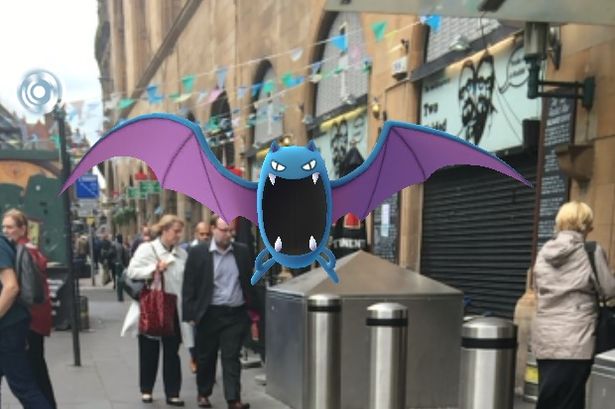
Zubat on Hope Street. Image Source: Glasgow Live

I scroll down my Facebook timeline, and there is a photograph of a pavement – on a real street which I recognise – and on that pavement is a Pidgey. You know, the wee brownish flying thing from first generation Pokémon? I scroll down a bit more and folk have been out and about all over the place: there’s a Weedle on the gingham tablecloth in a cafe, a wee purple-grey Nidoran on a hay bale, a Magikarp bouncing around by the Kelvin. This is, if you haven’t guessed already, people sharing their spoils from Pokémon Go, an augmented reality game which allows you to catch Pokémon in the wild, a.k.a real life. There was a glorious month in the summer when you could go for a walk and see clusters of people milling around with their phones in the air, as if trying to channel some ethereal spirit that was wafting in the atmosphere. They were out catching Pokémon. All of a sudden, people were going for walks again, leaving the house and the cosy glow of the television to catch invisible beasties who lived in trees and parks, museums and street corners.

safari
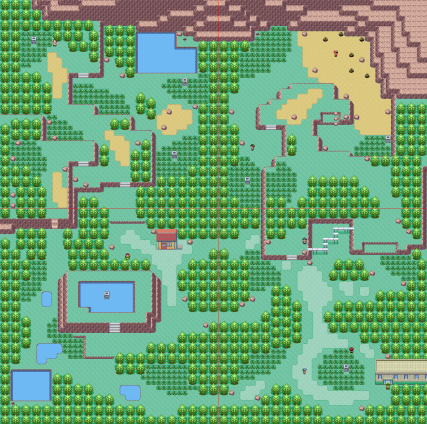
Safari Zone Map from Pokémon Ruby/Sapphire. Image Source: PsyPoke

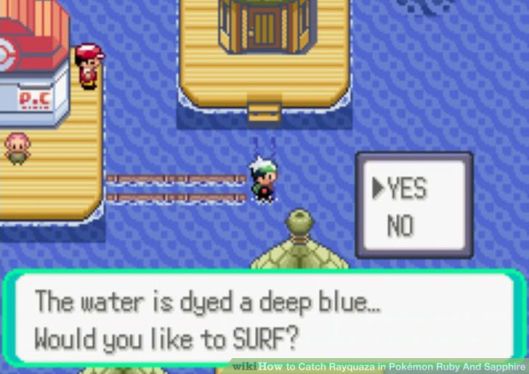
As a kid, I was an avid Pokémon fan. I missed the boat for Red and Blue but had Yellow, Ruby, Sapphire, Leaf Green for my Game Boy Colour and Advance and played them all to death. What I loved more than the battles was the wandering part. So much of your time is taken up pushing your way through long grass, cycling along seaside promenades, bobbing along the ocean, taking shortcuts through forests, crossing through dungeons, traversing the plains of mountains and deserts. You’re constantly interrupted by Pokémon encounters; so much so that often you double back in confusion, any instrumental pathway you’re trying to take disrupted by the screen switch to a battle. The towns often had such picturesque names as ‘Petalburg City’, ‘Sootopolis City’, ‘Lilycove City’ and ‘Mossdeep City’. Then there’s Meteor Falls, the Sunken Ship and Sky Pillar – these are just from Ruby/Sapphire alone. Yes, the game has a final purpose: you’re supposed to beat the gym leaders of every town and follow some convoluted let’s beat Team Rocket narrative, but often its trajectory is beautifully non-linear. You can explore, catch Pokémon in your own time, find side quests to achieve, people who need help. Acquire potions, level up your Pokémon, learn intriguing stories from local mythology.

aid2204909-728px-catch-rayquaza-in-pokemon-ruby-and-sapphire-step-3
Screen Cap from Ruby/Sapphire. Image Source: WikiHow

There is an obsessiveness to Pokémon, a desire to always repeat. As much as possible, you find yourself returning to previous towns and locations, either to seek out more Pokémon known to appear in the area or simply to explore, to see what you’ve missed. Invariably, you do nothing new, and manage to enjoy that process of wandering again. You fight the same Pokémon, hoping they will flee but secretly enjoying taking them down in one shot with your level 40 team, where once you’d have to fight tooth and nail with a goddamn Zubat. To some extent, Pokémon is a rhizomatic game: once you get to a certain stage, the world is yours to explore and you can map out your own routes and lines of flight as you see fit, flying and sailing and seeking locations of your choosing. However, you are still governed with the impulse of narrative, which spurs you onto particular places: sometimes you can’t move on till you’ve beaten the gym leader of that town, for example. You can regress, but not progress. There’s that sort of macho narrative of levelling up which you’re impelled to follow. It’s only when you’ve completed the game that you can reap the rewards of complete exploring.

Pokémon Go changes that. By transferring Pokémon to real life, you are as free to explore its terrain as you are to wander the streets of your local town or city, or indeed the plains of the countryside. Real life is transformed by augmented reality, the imposition of Pokémon on material space. Creatures that only the player, holding up her phone, can see. This is already getting very Black Mirror, but wait. It’s a competitive game, yes, but there aren’t the drastic consequences of social exclusion and alienation experienced by many of Black Mirror’s tech addicts. There is a lovely playfulness to Pokémon Go which somehow has generally avoided becoming cutthroat competition. For a while, everyone was playing it. It was a form of camaraderie (folk would go out in packs to hunt for Pokémon, or indeed organise mass hunting expeditions via Facebook). More time was being spent on the Pokémon Go app than on Snapchat, Twitter and Whatsapp. I’d go into the kitchen at work and the chefs would gleefully show off their Pokédex; which was glorious, seeing all those familiar creatures again in this new and surprising context. And since chefs have hardly a moment’s time when they’re not in the same place, working 14 hour shifts at a time, I can only imagine the extent to which people in other walks of life played it.

Pokémon Go is a strange way of making people notice their surroundings, particularly in the sense of urban space. Sure, most of the time their faces are glued to the maps on their phone screens, but in placing themselves in the world, they are forced to confront physical structures, obstacles, windows, private property and so on. It becomes even more of a game when you have to work out how to attain Pokémon in  elusive locations. I’ve heard stories about folk knocking on your door asking if they could come in because they’ve noticed you’ve got a rare Pokémon in your house. It sounds pretty sinister, but it shows the level of commitment the game inspires.

125345.jpg
Animal Crossing Town Map. Image Source: Neoseeker Forums

Think of it this way: why is it so addictive? Like Tinder, it’s a form of locative media which uses your GPS to determine who or what will appear in your surroundings. Pokémon Go also uses your phone clock, as different types of Pokémon appear at different times of day. I’m reminded here of one of my favourite games, Animal Crossing, where you could go fishing and bug-catching but what was out there was determined by the ‘real time’ of your Game Boy’s internal clock. It followed the real time of a 24 hour day, of the seasons and so on, so that in December there’d be snow and falling leaves in autumn. It was very beautiful and the real time aspect has an addictive quality. I think it’s because the game becomes less a form of escapism and more a parallel to reality, to everyday life. You know it’s reached that status when The Mirror runs a how-to guide, eh?

What’s so cool about Pokémon Go is how it adds meaning to real space. A school, town hall, park or pub becomes a Pokémon Gym and everyone wants to visit. I swear business at my work improved for a month as we quickly realised we were a Pokémon Gym and groups of sullen young adults would gather silently at bar tables, trying to battle other trainers at the gym and hoping to win Pokécoins. A guy I work with would heavily protest when he saw someone playing the game because he was currently gym champion and got surly at the prospect of newcomers taking his title. If I was late bringing someone a coffee, nervous they’d be grumpy with me, often they were so distracted by the game that they’d not even noticed the time. In a sense then, Pokémon Go transforms both time and space. Everything is flattened into a map, where flashing nodes indicating Pokémon are the symbols of desire, the objects of pursuit.

In a compelling, complex and challenging article on Facebook as a ‘desire-network’, Maria-Daniella Dick and Robbie McLaughlin argue that ‘Facebook effects a mutation in desire and thus in capitalism’, and in tandem with this, a ‘historical shift inn the relationship between psychoanalysis and capitalism’ (Dick and McLaughlin 2013). With Facebook, ‘desire remains impossible to satiate, but it is now without object’ (Dick and McLaughlin 2013). They suggest that Facebook is situated within the Lacanian Imaginary order (which constitutes the intrinsic narcissism through which the human subject constructs fantasy images of both herself and her object of desire). According to Lacan, desire (unlike need) is always unfulfilled; we are always moving towards a lack, the anxiety prompted by something lost (as in the child’s original sense of wholeness before discovering the fragmentation of her parts, the split between her body and world and mother, in the mirror). The Imaginary is that which we create to attempt to fill that fundamental gap, the fantasies of the ‘ideal ego’ which compensate for an originary loss. Facebook is basically the ultimate web of the Imaginary: all our time is spent scrawling through pictures and statuses and shared media which all in various ways represent fragments of the ideal selves we project online. Yet our browsing is ultimately without end, it is ceaselessly rhizomatic, decentralised; we end up on one place, a restaurant page or old friend’s profile, without really knowing how we got there. Our passage through the network is governed by algorithms which attempt to map our desires; algorithms which are self-sustained by users’ input data, the patterns of usage recorded with every click. While this may seem revolutionary, a democratic decentering of the system, Dick and McLaughlin are highly sceptical of Facebook’s subversive potential at the scale of the political.

While the likes of Facebook were integral in the organising of such glocalised (global/local) revolutionary events as the Arab Spring or the Occupy Movement, ultimately ‘[s]ocial networking completely embodies and facilitates these phenomena in which the masses are now able to organise efficiently but without being unified by a radical ideological alternative’ (Dick and McLaughlin 2013). The fragmentary pathways of Facebook map out the lines of insidious liberal democracy, and as engrained as they are in corporate culture (the corporation itself becoming the medium for mass communication) offer little opportunity for imagining visionary alternatives to liberal capitalism. Crucially, Facebook (with all its user-directed interfaces based on algorithms of taste and so on) perpetuates the myth of the liberal individual, who curates her profile, her tastes, conducts a life of many choices. As Dick and McLaughlin (2013) put it: ‘[t]he so-called 99% are already conditioned by a liberal democracy in which they have the self-identical sovereignty of an individualistic ideology that places the subject at the centre of the world’. To really offer a vision for an alternative future, we have to actually come up with a plan. Recognise that we are always-already networked individuals, whose subjectivities are hardly unique and instead constituted through structures of discourse and power, and use this in a positive way, to undermine the liberal justifications for free-market capitalism.

thumbnail.jpeg
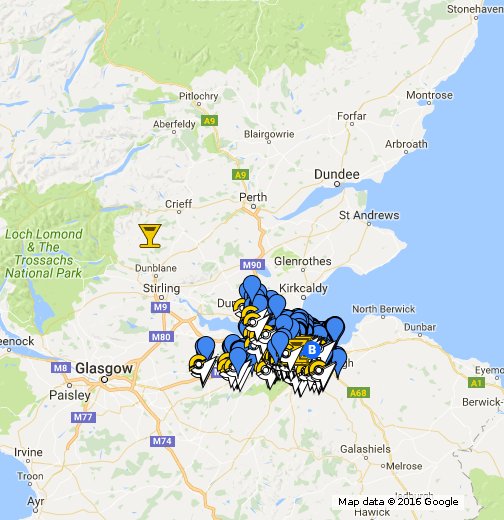
Pokémon in Edinburgh. Image Source: Google

What does all this have to do with Pokémon Go? The thing is, Pokémon Go seems like innocent child’s play, but it’s bound up in the politics of space. It’s fundamentally structured by GPS software and urban space, and let’s face it, urban space is always ideological. Whether it’s homeless spikes, shiny new glass-fronted apartments built where Brutalist high-rises used to be, gated communities, the psychotic disarray of London’s property market, the genuine promotion of American Psycho-style yuppie-targeting ads or simply the denigration of social housing as ‘slum housing’, space and architecture is always somehow political. In a recent talk given at the University of Glasgow titled ‘Remembering the Future: The Politics of Space and Architecture’, Darran Anderson argued that the current failure of the Left is a failure to put forward a vision of the future that is compelling and actually positive; if we don’t act soon then someone else will determine the future for us. One way Anderson proposes we can intervene in the social order is through architecture, by building sustainable forms of urban space, housing and energy production that take into account the fact that we are living in the Anthropocene. We need to accept the imminence of ecological disasters, which are indeed already happening. We need to rethink our fantasy imagery of the city; it needs to become a network of playful imagination, of empowerment, rather than just passive defeat, or the kind of share-lite politics, browsing, blasé escapism and distraction offered by Facebook.

What is interesting about Pokémon Go is that it restores to some extent the object of desire, which Facebook, in its endless networks of people, places, photos and check-ins, displaces. ‘With Facebook’, Dick and McLaughlin (2013) argue, ‘people no longer live the present as present; it exists only insofar as it is exists to be recorded and later uploaded to Facebook’. This temporal displacement shifts with Pokemon Go, which insists on the present as present. Pokémon only appear for a limited amount of time so the imperative is to catch them in the game space of the now. The impulse of shopping or clubbing to buy buy buy or drink drink drink is gleefully interrupted by the appearance of Pokémon, who are quickly snapped up and snapped, shared online. The allure of ‘cool’ or the aura of dreamlike consumption attached to consumption-based social places is disrupted by the childlike logic of the game. And there’s nothing the companies can really do about it, since technically Pokémon isn’t intruding on reality, it’s only intruding on maps of reality. Now I’m thinking of that Jorge Luis Borges story, ‘On Exactitude in Science’ (1946), and getting very confused about reality itself. In the story, Borges imagines an empire where cartography has become so exact that its map of the empire must match in size and detail the empire itself—after which, what’s the difference between the map and the original? Do you need the map anymore, or can you use real space to map out real (map?) space?

There is almost something a tad Situationist about Pokémon Go. It offers no restrictions on movement, the way the Game Boy games do, according to a linear narrative. If you want that elusive Vulpix or Meowth, perhaps you will have to explore territories previously uncharted in your running app or Instagram places map. You might end up in the strange end of town. And what will you find when you get there? Traversing space this way leads to opportunities of surprise and discovery. The fact that so many people are posting photos of their Pokémon Go encounters online adds a new palimpsest of meaning to our understanding of place. The appearance of Pokémon disrupts the order of cities; it adds new points of desire to the map.  Sure, most gyms are in tourist hotspots, but that doesn’t mean you don’t have to explore the more unseemly areas of town to catch ‘em all. In wandering out your comfort zone, you’re enacting a sort of De Certeauian ‘tactic’, resisting the signage and flows of capital which generally direct your movement in urban space (i.e. according to the circuit-like lure of the shops, the home or workplace). Ironically, you’re doing this at the inspiration of a global corporation (the folks who own the Pokémon Go app), but in this case, it doesn’t necessarily mean your actions and movements aren’t subversive. Nevertheless, the transgression of space according to augmented reality is unfortunately still bound by societal racism, highlighting the fact that we experience space differently according to who we are—despite its best intentions and possibilities, a game like Pokémon Go can hardly overthrow the prejudices of the Repressive State Apparatus…

Since Pokémon Go is based mostly on algorithms of mapped information, there is an element of chance which escapes the systems of data (could we call this glitch a Lacanian intrusion of the Real?). Pokémon crop up in controversial places. Since ghost Pokémon are attracted to graveyards and places of mourning (think: the original Lavender Town), they have been appearing in places like the Holocaust Memorial or Ground Zero. The incongruity of the playful critters in these places of silence and solemnity is startling and forces us to rethink our expectations of memorialising space. In a sense then, for better and worse, Pokémon Go has a reterritorialising impulse. Sure, you can report inappropriate places and instigate a process for removing them from the Pokémon Go map, but that initial appearance, based on some kind of algorithmic randomness, has already violated the implicit expectations of such places in terms of silent respect and mourning. There is in a sense an overflow of the gaming impulse, where the augmented reality becomes more distracting than reality itself (even when you are in such a compelling and startling location as the Holocaust Memorial…).

remainder_-_h_2015-690x388
Houses that crumble…Screen cap from Omer Fast’s 2015 adaptation of Remainder, starring Tom Sturridge. Source: Belfast Film Festival

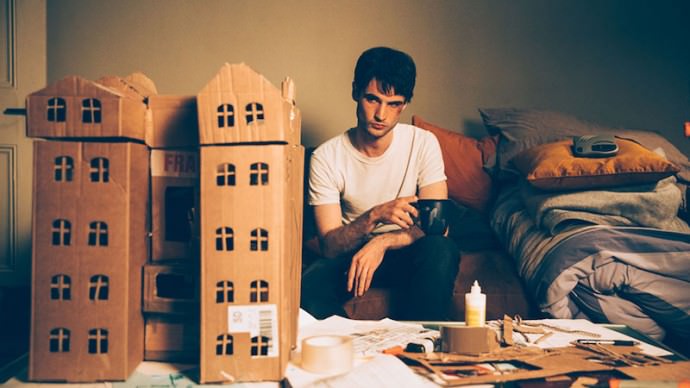
Perhaps this is the danger then, of supplanting a fictional reality (the map) for the territory itself. I’m thinking of the protagonist in Tom McCarthy’s novel Remainder (2005), whose response to trauma is to assemble a detailed map of a very specific retrieved memory, based in a house where there was a very specific synaesthetic symphony of liver-frying, cats on roofs, piano playing and motorbike clanging. Eventually this map is transferred to the ‘real’ as the protagonist recreates mimetically the details of this spatial memory. Yet pursuit of the real is addictive; the protagonist soon begins recreating more extreme and harrowing memories he’s encountered: traffic accidents, bank robberies. What intrudes, eventually, is the remainder: the real itself which spills out of the recreated event. As McKenzie Wark writes in the preface to McCarthy’s novel, ‘[t]he simulation is never perfect, always in excess of the thing itself. It always leaves a remainder. The most troubling remainder is himself [the protagonist]. He is a leftover God, a God as debris of creation’ (Wark 2015: xi).

In a way, Pokémon Go represents a God-like desire to reconfigure reality, to impose the Imaginary space of the simulated game upon the ‘game’ of ordinary existence. Is this a postmodern statement of irony, a pastiche of 1990s nostalgia in the age of the smartphone? Yes, and no. There’s something kind of modernist and sincere about it too, a sense of genuine interest in creating the Big Project, a utopian potential for gaming to bring people together. While Pokémon Go is partly about earning currency (Pokécoins) to buy more materials which help level up Pokémon or revive them during battle, its general impulse is towards exploration. Conquering, yes, to an extent; but mostly exploration. What happens when you’ve captured every Pidgey in your neighbourhood? You travel farther, maybe even beyond your hometown or city. Of course there comes a point where most of us get bored and stop playing, but there was a moment when the game genuinely seemed to interrupt reality in a way that felt genuinely liberating. The fact that so many people deemed it silly, a waste of time and completely illogical only highlights the ways in which the game resists the general instrumentalism of capitalism (i.e. every minute should be spent doing something useful, like finding ways of accumulating money and furthering one’s career). The time wasting aspect, the fact that so many people love its paean to repetition (you can walk the same route every day and still get different Pokémon appearing), is a queer sort of logic; it goes against capitalism’s futurity, the linear progression of temporality, in favour of a kind of maddening impulse of looping, overlapping desire. We accumulate the same Pokémon several times and this is part of the internal logic of the game, compelling us to traverse the various spaces again and again. It represents at once the immateriality of twenty-first capitalism (as based on flows of ‘invisible’ capital and immaterial goods, symbols of status) and the potential for subverting the logic of accumulation to one that is both bizarre and based on the ethics of play rather than success.

Sure, a great deal of the game might be about levelling up and being the best, but you can also play it with general disregard to those impulses. Collecting, in a sense, transforms the use-value of goods by placing them in a new circuit of information, taking them from the marketplace to the geeky world of the collector, whose interest in based on details and aesthetics, often more than financial worth. Just look at what happens when someone tries to make money off becoming a hire-out Pokémon Go trainer: they are threatened with being banned from the game, since it violates their code of ethics/terms of service. Play, rather than capital, is at the heart of the game’s map of trajectories. It brings people together – even adults – in a space of play. I’m not saying it’s changed the world by any means, and indeed it has its slightly absurd but very real dangers, as people blithely ignore the potential perils of the real landscape in pursuit of the desired (simulated) object, like Icarus flying too close to the sun…However, there’s something genuinely refreshing about how Pokémon Go forces us to reconfigure our sense of reality, space and the routing of our desires and movement. While world-views are shrinking and narrowing in post-Brexit times, Pokémon Go reminds us of the value of expanding our horizons and getting up to just go and wander, maybe aimlessly.

There will always be moral panics over deaths from selfie-taking, planking and cavorting in dangerous places, but will there be anything quite like Pokémon Go?

Bibliography
(other references are hyperlinked in the text)

Anderson, Darran, 2016. ‘Remembering the Future: The Politics of Space and Architecture’, Lilybank House Seminar Room, University of Glasgow, 15th November 2016.

De Certeau, Michel, 2011. The Practice of Everyday Life (Berkeley: University of California Press).

Dick, Maria-Daniella, and Robbie McLaughlin, 2013. ‘The Desire Network’, Theory Beyond the Codes, [Available at: http://www.ctheory.net/articles.aspx?id=727] Accessed 21/11/16.

Wark, McKenzie, 2015. ‘Preface’, in Remainder by Tom McCarthy, (Richmond: Alma Books), pp. vii-xii.