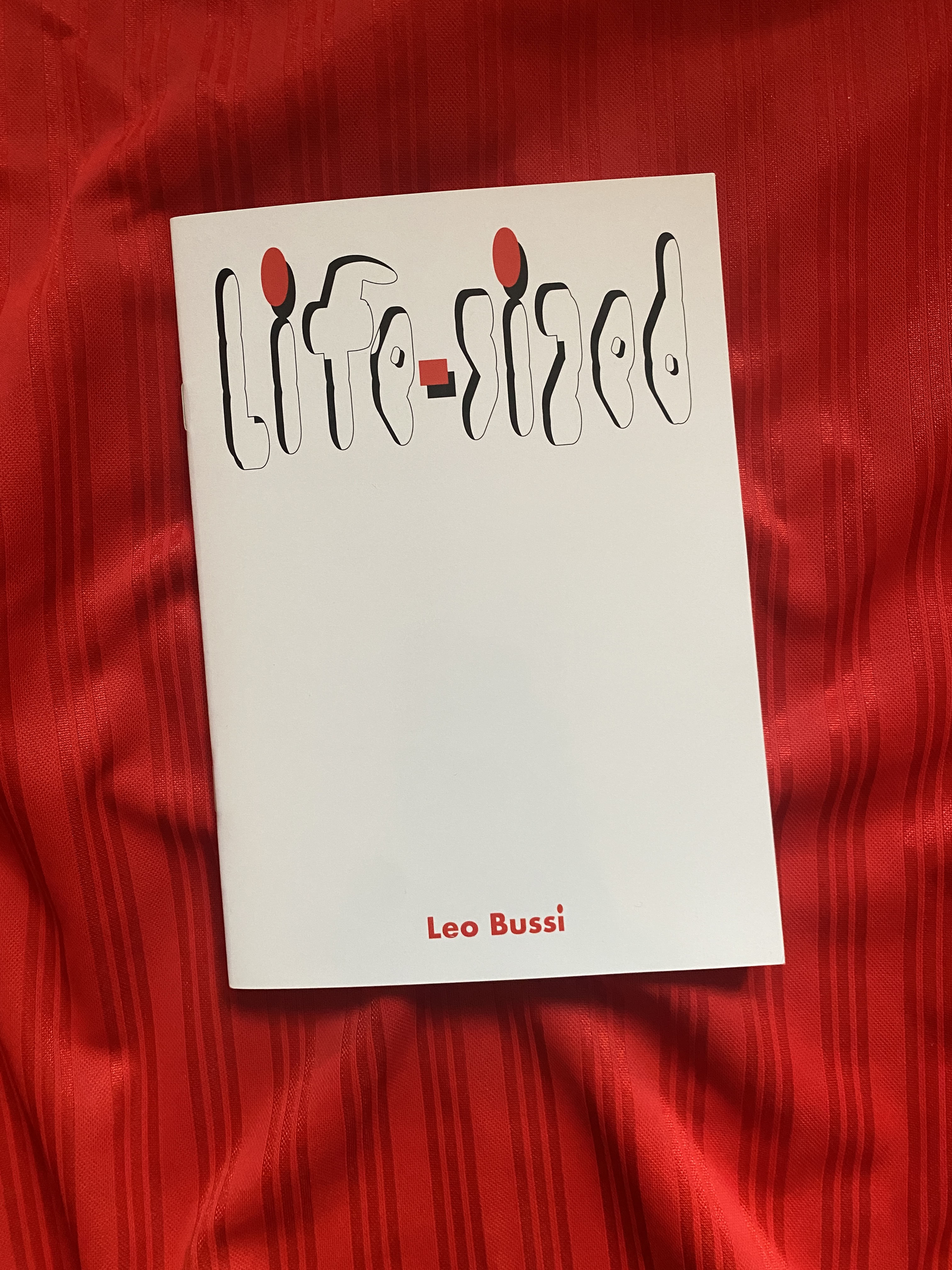
For a few months now I’ve been working as lead editor on Leo Bussi’s debut pamphlet, Life-Sized. I just wanted to say a quick word here about how awesome that’s been. I felt pretty jaded about running a press for a while because I was holistically exhausted and sick of the admin oblivion that is a non-profit tax return. This project has got me back in the game.
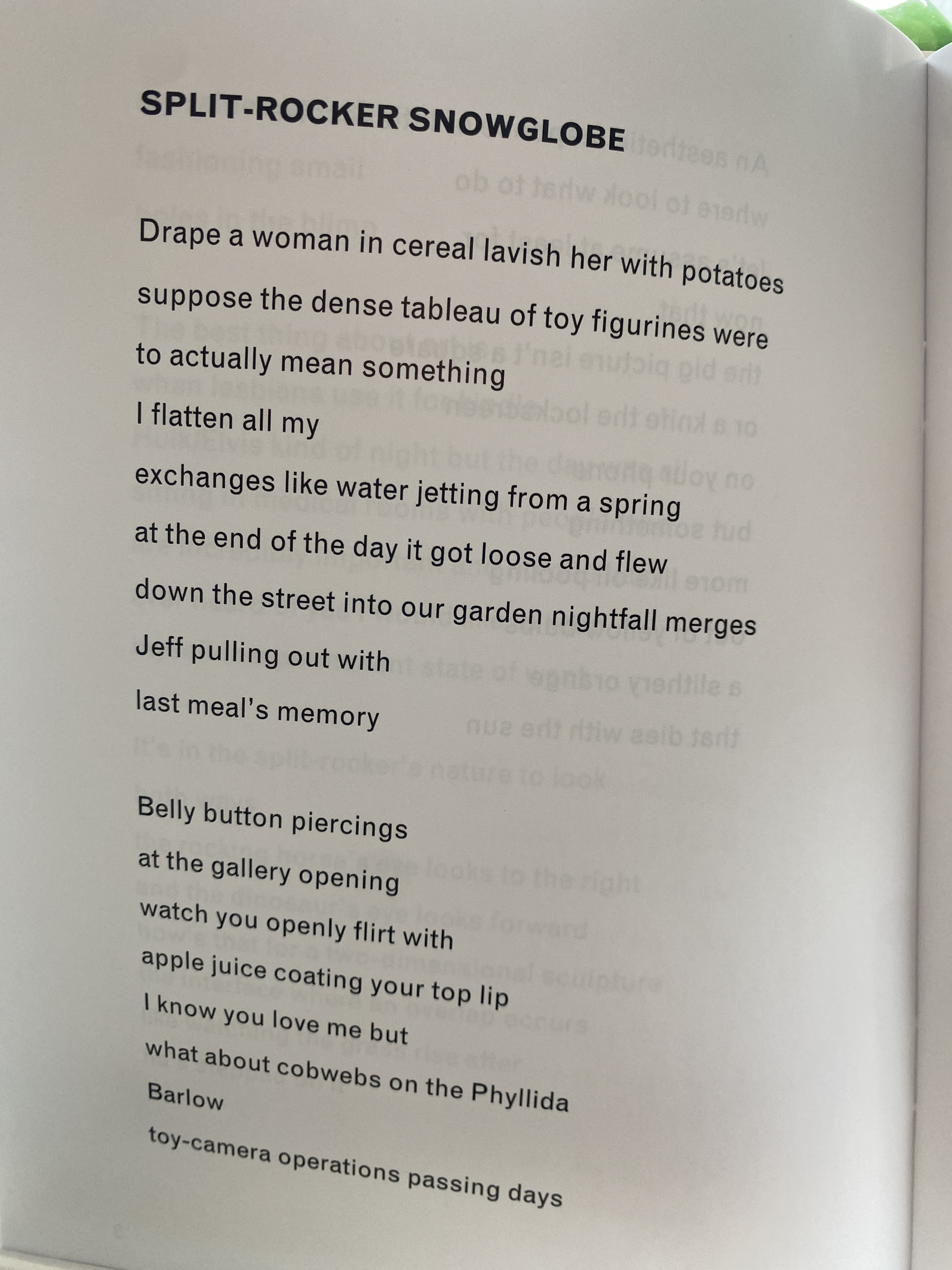
Leo’s work has charmed me ever since he read at the SPAM launch of Cocoa and Nothing (listen here) and we bonded over shared appreciation for a certain universally loathed, candy-named song. Editing Life-Sized has been energising because Leo is someone who kind of just comes with a fully formed poetic. And that’s informed by art and conversation and what Sue Tompkins calls ‘muscular sculpture’ and what Oli Hazzard calls ‘gorgeously goofy bathos’. He really has an ear for a line break which is sometimes comic timing and sometimes it’s object erotics and sometimes it’s the trompe l’oeil of the poem’s own jouissance. The poem feeling itself in cereal or nightfall or some kind of membrane.
AI-generated visual absurdism may have diluted the power of surrealism in culture but Leo’s poetry reaffirms the sharp gasp of the paranoiac-critical method. Here we have fused realities and toy scales – ‘Barbie version of Mount Rushmore’– played out in the synaesthetic poetics of a Jeff Koons expanded universe. If this is lyric then it’s also ‘Art-breath’ and everything might be desire but it’s also the agency of the brush and a line might be a gentle brush with erosion or it might be social realism i.e. ‘cucked and living in Britain’. My autocorrect tries to make cucked sucked and I want to tell my computer, you should be so lucky.
We are launching Leo’s book at Good Press on 20th March. It’s at 6:30pm, free and you can just show up.
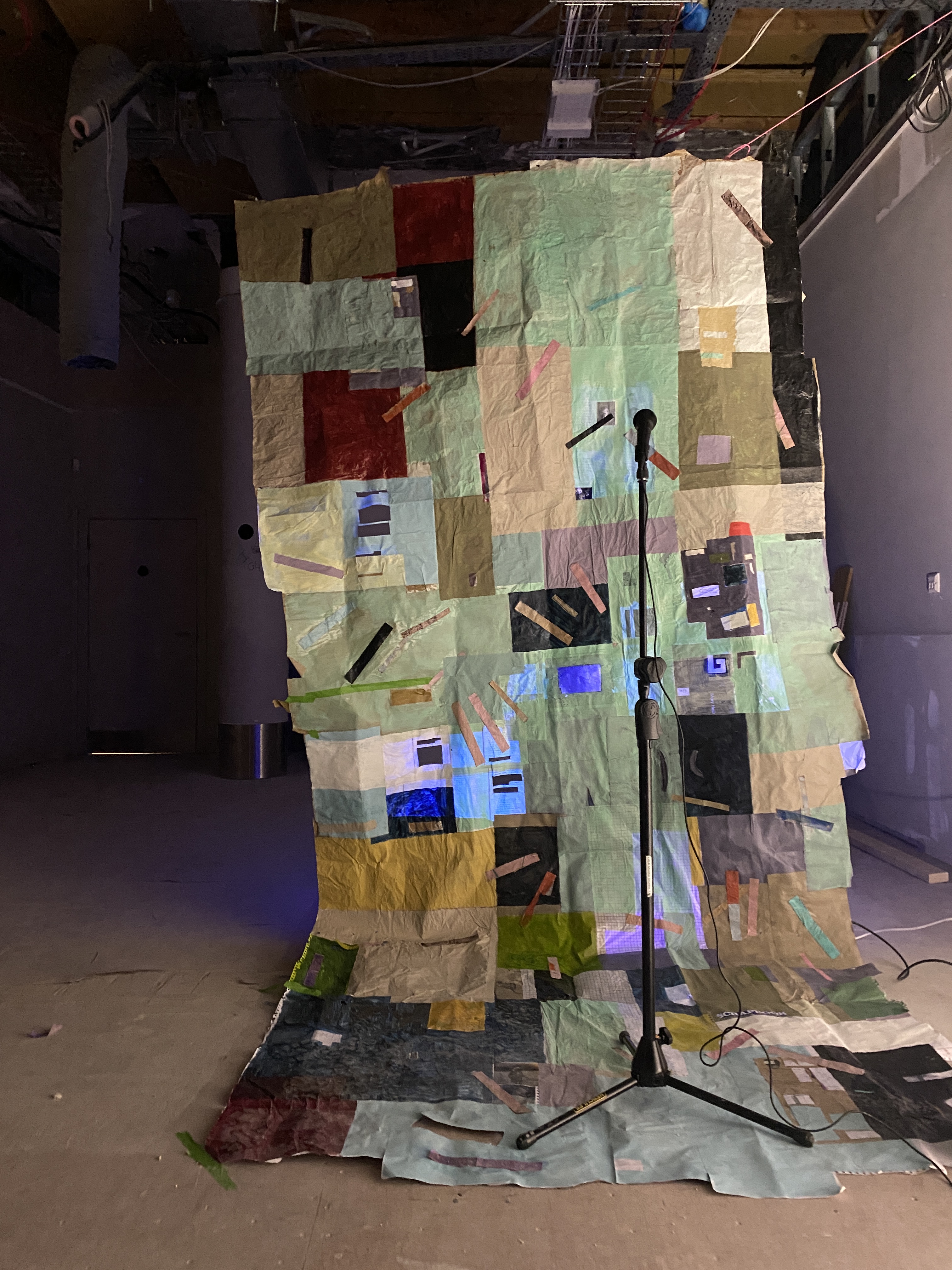
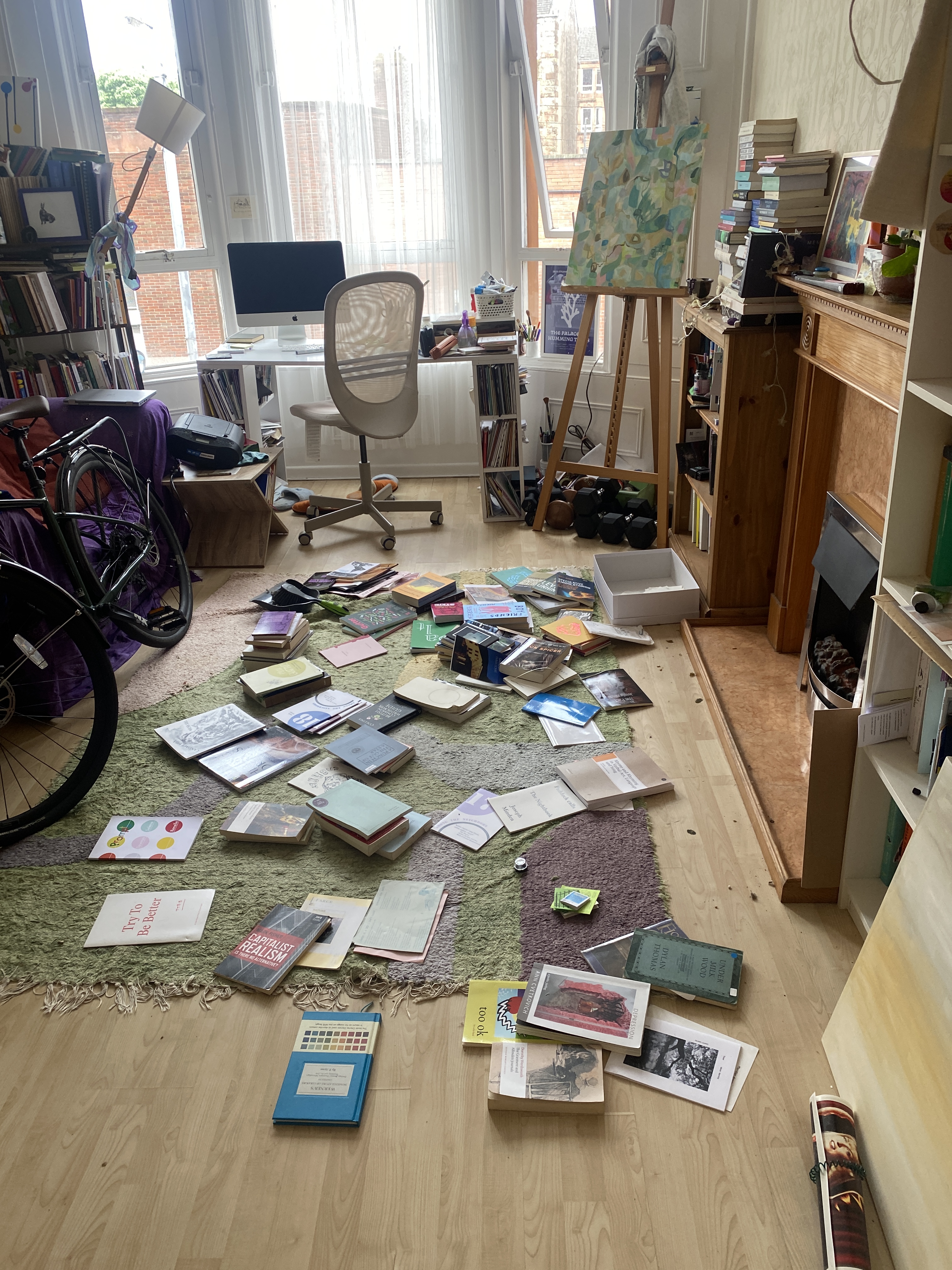
Painting by Gabriella Day, installed at 16 Nicholson Street (15th February 2025)
Snapfish was the app for picture-making with smile transistors of the print medium formerly digital doing it all in reverse. This was a theory fiction of sorts in that it referenced real-world Instagrams of the known in the room a knowing nod to the downtown of Glasgow housed as it was in Stories. What does it mean, Iphgenia Baal asks, for there to be a function called that, Stories. Our narrative sense is tabular and it’s no longer radical to put that logic to language and yet how else to express the compression effect of so much content in the 24hour window of when you wanted to say it. Say it with images and captions, the macrofication of everything somehow blowing up tiny moments a thought-unit could never be solar. The big sleep is a phrase she used and sensed somehow this was to come off Instagram and be as small as a baby in your own head you could seek relief in that, a gram of an instant like whatever the polaroid was supposed to. Develop immediacy in situ. Ravers must have had weddings according to the story and maybe to scroll past Sinead O’Connor clickbait and the manifest premise of Instagram mystics was to get at it: story. Children were political subtweets they didn’t consent to. I felt figural arrangements of the app hopping in negative space by which I mean, I was moved by the performance of app phenomenon / it’s giving ‘Home’. Who else is upset by the pivot to video and its attendant emphasis on the rectangle. I walked past a tree in the park and announced it looks like a television because it had a triangle kind of portal shape from where it had snapped in the storm and in my head in that instant a television could be a triangle. You could say ‘Snapfish’. Drew was like what’s the catch. Kirsty says three is her favourite number and Gabby says famously it is the magic one. Kirsty says it is all about triangles. At the end of Melancholia they sit in that triangle structure of sticks and wait for oblivion. What if there was an Instagram comprised of triangles always cutting the roundness of life off suitably into angles, spikes, slashes? I already feel so cubism. Gloria says she doesn’t like being in buildings that are in a state of decay. There are lovely metal bars draping like industrial stalactites and these kind of waffle insulations that give me trypophobia and the realisation that if I were to look at a waffle of any kind on an acid trip probably it would end badly — or worse, it would never end. Now thinking about endless waffle reproduction in fractal everafter it’s like I could float up to the ceiling and be a reverse maple syrup or ketchup bleeding upwards into the texture. That kind of schtick. Traditional reading is supplanted by ‘pure tapping’ because we all said so and Baal said in the story of many stories the tabs that indicate each one had shrunk to little dots since there were so many stories, barely room on screen to map them all. Oops an ellipsis. I remember the era where celebs having minor breakdowns in public would document them lavishly on the story function and the learning we did in that witnessing, as so-and-so saw and was never to be seen again at the bottom left for all the algorithm exchanged of your intimate pivotals. To come off the app, peel a tab; what’s it called almost a Berocca of presence I took densely to remember my friends. Let it melt fully into your gums before coming. Back in the room. Has anyone else had such random encounters on Hackney Road as the ones documented in Baal’s story of stories almost the same person with red curly hair running around in the rain trying to get home in some Covid Christmas, wedded to parasociality’s actual crisis. Too cold to undo my dirty-white jeans. We’d get stranded without narrative sugarcane to suck on and get over with. Afterwards, Leo says ‘I will never look at weddings the same’. fred spoliar in mesh reads a love poem inspired by the entwining of drunk ‘straight couples’ on the bus back from south side, implying all heterosexuals live north of the river and there is a conclusion to the poem’s occasion like ‘it’s love in its offensive modes I want’, striving for utopian couplets only to vivisect grace revealing all hope is a raindrop. Daisy says on Valentine’s Day a maggot fell on her hand, newly born, in front of the television. I said that’s a poem and sorry it will be so annoying to write it — the lovebug writes itself onto the nose. Warm hatching seems nice on a freezing Saturday. We are each to each our body heat. A real lentil would have been more wholesome. I hurt and was changed by the browser world. When fred said ‘yes I have hope’, the light in the room went out for real. Nell says there are two necessities (light, heat) but we can only have one. Well, to pretend iridesce I could take to the streets and try not to get hit by it. To walk around in these poems of memory another south of some city to would give up its public parks for spring and weedling trying to get at the same idea to fashion as intro. Weeds signify your lack of presence. Yes it’s baroque and if you don’t like it you can foil-wrap your heart and lob it politically. Playing the livestream in other locales as if to be thrice-selved only in poetry. When you conflate action with love, have you lost your love’s calibration in service of fucks? There is no cut-cookie of cautionary theory so much to break this in gently. Yes, the private property was and is a lie. This is why we squat in our art. I would feel better hanging upside down like the chrysalis I make of this endless chrysalis. Still, shareholders are why we can’t make the world we want and so fred reads the line ‘so frostwork adores a mitten on the fence’ or something to that effect. I pluck briefly that mitten to give to some kid / who will inherit my chilblains / their frazzled capillaries replace / this chrysalis. Sonnet we can’t be taped laboriously to a Hollywood applied rose blush of the dusk and blush drama of fervent childhood. Living situations fell apart like broken desultory Temu jewellery. We migrated the apps and tried not to fall in the Seine. Our sentences unfortunately were full of lead. Lillian Ross-Millard said ‘I make performance for video’ and there were the collected notes of chromophobia, fear of colour or a personal aversion to its manifest hues. The migraine dramaturgy of yellow and blue. Something felt pixelated like it genuinely lacked substance, could not outline itself for love nor money. Ross-Millard said the cold was felt in her solar plexus and I fell into that line ‘like getting your period and finding a wasp in the toilet bowl’ so much stinging in the sweet place. Like if you look at an object for long enough you can make of it Void. There was an account of the real life ballerinas catching fire during a performance of The Tempest. Real life ballerinas on fire I felt my sentences plié. I was replete with horror of what had been earlier told to me. This is sufficient fire for the world for now; meaning it’s time to perform it. Burn off the colour in everything / with the calories of a panic attack. When Myles Westman read, knelt down and softly, I wrote the phrase ‘unearth radio blood’, unsure of its origin. A loop played over the elegy and we circled the fateful day. Lines like fire licks. Systems, cataclysms. Lastly, Sam Keogh read about holes, butterflies, rorschachs. Said the word ‘rorschach’ several times as if making a rorschach of signification itself, sonic imprint: a little over then underflourished, quivering ink, accented. I thought of gross incidentals in industrial kitchens. For that to be a sort of lichen. Shipworms. Perils of them burrowing into silky poems. I wanted that honeycomb in the horrible waffle but not to stop. Waspish as a florid piss. Footnote telepathy. Parasite. Enamoured American soda. Fructose, cigarettes. Aluminium bonfire of remnant lager. Dogs. Squalor. Now I will go to the airport.
Tonight I’ll be reading a nauseated sestina dedicated to the old Glasgow subway for the launch of TANGERINE DREAM – an anthology collecting work from 24 glasgow-based poets and artists, responding to the 2024 retirement of the old glasgow subway carriages. You know how I love infrastructure.
The Waverley Bar, Edinburgh | Thursday, Jan 30, 2025 7:00 PM
I’ll be reading with the luminous Vik Shirley alongside open mic performances and music from The Self-Righteous Brothers. I’m told there is a raffle. Will bring some books to sell (have a few copies of Midsummer Song and a new batch of Cherry Nightshade).
Curious in the cartoon litany of lying underneath the song is Sylvester the main antagonist out of touch with the show girls who nourish ducklings with a fractal hush that something connects and is like done, the texture of communication bristles against the cat’s tuxedo and beautifully undiminished and slow I go into the lair of the wholesome embodiment, holding up glove puppets of my favourite characters — Melancholy, Sanguine, Cholic and Phlegm — asking will you be west on the day of this shimmering announcement, new protections and crystals, slamming on the bed of our lungs it was gorgeous; I was sick for a month in the cold, moist aporia of not getting it done, my fingers in the cleft of the being held sideways and what is called dyscrasia was thought to be the underpinning of all disease including the disorderly eating with which I bring to you my body, its folds and anthropomorphic sinews, the double blush of my hipbones — and even if Sylvester comes bounding along with impossible feline precision, smacking his chops, and even if temperament is a psychologically damaging aspiration, I aspire to a joy that would swallow, susceptible, the violation — and if that be spirit, Sophia, spiritedness, the cellar door opens on its own to reveal a vital wine whose bold adoration unmerited is only a thrifted, fruity red that is lightly tattooed on your ankle and if you dance with your dear antagonist there’s no stopping, my dear one, stopped, I do not try to bend down the pain tree my spine’s impression remembers the dance of the dream in which I was willowy, carefree without keys and spiralling through the gardens of the queerest princes their sensuous lips are peonies the cognitive vacillation of anyone’s truth claim a clause unlocks and is perilous, like a thirst
Neoliberal hubris and Dionysius on the news escapes immunity, the wilder instinct of the puppet in me and the me in the glove is like holding a hand but who’s anyway, we are going into the structure of witnessing where to hand a soft hypocrisy to the beach is only placating the burning palms, or how it feels to hold you; every little habit or thing in continuum to compulsively repeat the lossy compression of origins every time simple, night time, the song of the puppetshow of the vegetables and a drone in humour — looping whose function — in play’s decentred exigency we are unthinking the shadowplay of having said CHILD YOU ARE IN HOT WATER to a crumbling earth in our green plaster-cast sandpit at the art school tending towards minerals and diacritics, to blush soot from your lashes and the cartoon voice of the angelheaded baristas where the faucet is switched off from redacted
Prometheas all you could want buffet of fire, deep in life’s interior is the dream or the drama — if I am a conduit for being punched in meatspace to say every person is already in the poem saying ‘I’ for ‘aw’ say hello online in a burst of tiny energies, swift changes, inserts an otherworldliness within the world banality of movement; can a person really be a spider or a cyclone, like jouissance to speak of the symbiotic ana-cartharsis, triangulates how honey I shrunk the president is wanting to move in with you / how it is too much to meet this lyric transfer, taut love’s blank dream to be twisting and safe, people in the street have been multiplied lately like kissing, we are here, a sad reprisal
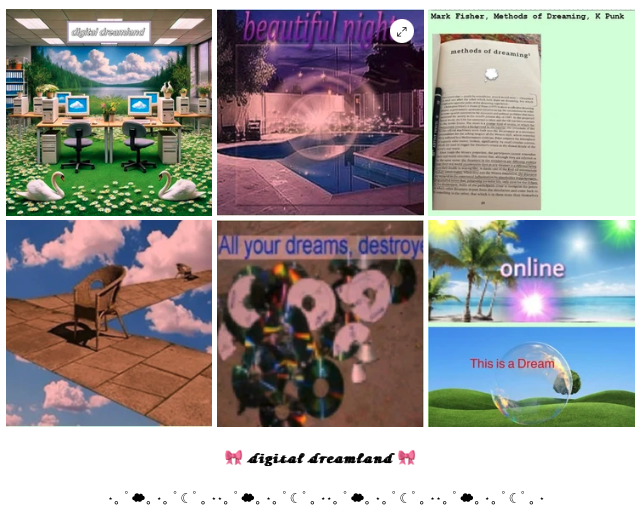
SPAM Plaza is reopening submissions for Digital Dreamland.
Ever had déjà vu, not knowing if something happened IRL, online or in your dreams? As screentime and sleep time increasingly clock similar hours of the day, we’re turning our attention to the acute relationship between dreams and the internet.
We invite critical work inspired by, but not limited to, any of the following topics:
☁︎ sleep procrastination and social media
☁︎ cloud hoarding
☁︎ the return of the (digital) repressed
☁︎ the memetic unconscious
☁︎ distraction as dream economy
☁︎ ghosting (and the metaphysics of digital presence)
☁︎ sleep texting
☁︎ hyperreal environments & nonspaces as dreamscapes
☁︎ online dream journaling communities
☁︎ targeted ads as unconscious desires
☁︎ chaos edits as dream realism
☁︎ artificial intelligence and dreaming
☁︎ interactive & lucid dreaming
☁︎ digitally-induced parasomnias
☁︎ dream imaginaries and political im/possibility
☁︎ neural net neurosis
☁︎ image spam and cyber garbage as psychic discharge
☁︎ oceanic feeling online
☁︎ dreams in augmented and virtual realities
☁︎ video game realities and dream framing
☁︎ online shopping and astral projection
☁︎ cognitive timelapse and digital intimacies
☁︎ corecore and collaging the cultural unconscious
☁︎ dream scanning as the next cyber frontier
☁︎ avatars, dreams and shadow selves
☁︎ (rip) twitter dream sharing
☁︎ movie and/or fictional representations of dreams and the internet
☁︎ typographic parapraxis (poetics of the typo as freudian slip)
For more inspiration, read the inaugural editorial for this series written by Maisie Florence Post. We always love to see work which engages these themes specifically in relation to poetry, but are open to work that touches on any aspect of texts, media and internet culture.
Submission guidelines:
We will be open for submissions between 15th January and 12th March 2025.
All submissions should be sent to spamzine.editors@gmail.com with subject line SUBMISSION: DIGITAL DREAMLAND.
Please add a brief note to your email explaining how your work fits into our theme.
We aim to respond to all submissions within four weeks and some people will hear back before the submission window closes as we will be publishing pieces on a rolling basis throughout 2025.
This is an open call for critical work. While we appreciate the line between creative and critical can be fluid, we are looking for work that fits overall a more critical angle.
Unfortunately neither the editors or contributors of this series will receive remuneration. Copyright remains with the author.
We don’t have capacity to give feedback on unsuccessful submissions and the editors’ decision remains final.
Please send submissions that are previously unpublished.
You can submit up to TWO pieces in any of the following categories:
Flash essays – 400-1000 words
Full essays – 1000-2500 words
Theory fictions – up to 2000 words
Verse essays – up to 100 lines (we have very limited formatting options however, so please get in touch if you’re not sure your work will be suitable)
Visual essays (photography, memes, illustrations etc – max limit of 15 images)
Audio or video essays (with text transcript provided – you must already have the link hosted elsewhere rather than send it as a file – we need to be able to embed it via a link)
ʚɞ
You can read the SPAM Plaza archive for free to get a feel for the stuff we like to publish.
So wonderful to hear Iain Morrison, Laynie Browne, Julia Bloch and Al Filreis in conversation at the Kelly Writers House, discussing two versions of the late Callie Gardner’s ‘when will my love return from the culture war?’.
In loose order of reading. This year I made a vow to not let work ‘get in the way’ of reading. I was talking to a colleague about how every subject/specialism has one thing they are supposed to be really good at and actually kind of suck at. We agreed English & Creative Writing staff are often pretty bad at this thing that should be their lifeblood: reading. To prioritise reading is to affirm the necessity of thinking. I felt so burned out with the circuitry of the 2010s and the zoomageddon of lockdown, all those screens. Reading in scroll-time. I still love reading in scroll-time, but on the move only. Or in the midst of something else doing. It took me three years to get back into immersive, situated, FOCUSED reading again. I mean staying up all night to finish a book, crying at sentences, holding something to the light and putting it down and stopping and starting because you want to savour something and all the world of it following you into dreams. All reading started to plug into work. Good work. Channels. If I’m honest, I haven’t written a lot this year. I needed a break from concepts. I did a lot of editing and proofing and reading. I wrote a lot of emails and did a LOT of marking. I think of marking as writing time. It eats into writing time but it’s also a practice of sentence-making, observation, editing, rewriting. Eileen Myles says somewhere that when they write people recommendation letters and do interviews etc that’s a form of writing. So really there are very few ‘fallow’ periods. You’re always writing something to someone, for something or not. I have written over a monograph’s worth of student feedback this year, maybe more. Each paragraph of feedback is a micro-essay, a snapshot of orientation, a patchwork sample which stitches multiple discourses (genre, criteria, instinct, history) in ascent to encouragement and improvement. So all that feedback, I’m trying to say, means I also read a hell of a lot of student work. Hundreds of scripts. Marking trains my eye as a reader and writer. Still learning to toggle between different kinds of reading. Refusing the active/passive binary in favour of a continuum of generative involvement. A lot of what I read below was in-between other reading, but some of it is more explicitly ‘work’ reading. Or: reading as a way of connecting with friends, colleagues — their beautiful brains. Or: preparation for something as yet unknown. Working through personal syllabi. Refreshing the palette.
~
Robert Glück, About Ed (2023)
Jacques Derrida, H.C. for Life, That Is to Say…, trans. by Laurent Milesi and Stefan Herbrechter (2006)
Walter Benjamin, The Storyteller: Tales Out of Loneliness, trans. by Sam Dolbear, Esther Leslie, Sebastian Truskolaski, Antonia Grousdanidou (2023)
Marie Darrieussecq, Sleepless, trans. by Penny Hueston (2021/2023)
Joey Frances, Takeaway Night (2024)
Teju Cole, Black Paper (2021)
George Saunders, A Swim in the Pond in the Rain (2021)
Megan Ridgeway, The Magpie (2024)
Thomas Mann, The Magic Mountain, trans. by John E. Woods (1924)
Andrew O’Hagan, Mayflies (2021)
Tabitha Lasley, Sea State (2021)
Zadie Smith, Intimations (2020)
Jean Genet, Prisoner of Love, trans. by Barbara Bray(1986)
Donna Tartt, The Secret History (1992)
Oli Hazzard, Sleepers Awake (2024)
Courtney Bush, Every Book is About the Same Thing (2021)
Hélène Cixous, Abstracts and Brief Chronicles of the Time, trans. by Beverley Bie Brahic (2016)
McKenzie Wark, Raving (2023)
Rachael Allen, God Complex (2024)
Elle Nash, Deliver Me (2024)
Joshua Cohen, The Netanyahus (2021)
Andrew Meehan, Instant Fires (2022)
Michael Eigen, Ecstasy (2001)
Noah Ross, The Dogs (2024)
Jennifer Soong, Comeback Death (2024)
Barbara Browning, The Gift (2017)
Cynthia Cruz, The Melancholia of Class (2021)
Courtney Bush, I Love Information (2023)
Clarice Lispector, The Hour of the Star (1977)
Barbara Browning, The Correspondence Artist (2011)
Hilary White, Holes (2024)
Laynie Browne, Everyone and Her Resemblances (2024)
Deborah Meadows, Representing Absence (2004)
Holly Pester, The Lodger (2024)
Terese Marie Mailhot, Heartberries (2018)
Kim Gordon, Girl in a Band (2015)
Lauren Levin, Nightwork (2021)
Oddný Eir, Land of Love and Ruins, trans. by Philip Roughton (2016)
Danielle Dutton, Prairie, Dresses, Art, Other (2024)
Elvia Wilk, Oval (2019)
Nisha Ramayya, Fantasia (2024)
Joanne Kyger, On Time (2015)
Jean Day, Late Human (2021)
Lisa Jarnot, Black Dog Songs (2003)
Roland Barthes, Camera Lucida (1980)
Mariana Enriquez, Things We Lost in the Fire (2016)
Ben Smith, Doggerland (2019)
Ricky Monaghan Brown, Terminal (2024)
Wendy Lotterman, A Reaction to Someone Coming In (2023)
Joseph Mosconi, Fright Catalog (2013)
Tao Lin, Taipei (2013)
Haytham El Wardany, The Book of Sleep, trans. by Robin Moger (2020)
Lucy Ives, Life is Everywhere (2022)
Maria Hardin, Cute Girls Watch When I Eat Aether (2024)
Brian Whitener, The 90s (2022)
Jamie Bunyor, A stone worn smooth (2022)
Lucy Ives, The Hermit (2016)
Brenda Hillman, Cascadia (2001)
Bhanu Kapil, Incubation: a space for monsters (2006)
Peter Reich, A Book of Dreams (1973)
Steve Orth, The Life and Times of Steve Orth (2020)
Lindsey Boldt, Weirding (2022)
Christa Wolf, The Quest for Christa T. (1970)
Hannah Levine, Greasepaint (2024)
Joe Luna, Old News (2024)
Maggie O’Sullivan, earth (2024)
Ian Macartney, sun-drunk (2024)
Sébastien Bovie, Longing for Lo-fi: Glimpsing back through technology (2023)
Steven Zultanski, Relief (2021)
Lionel Ruffel, I Can’t Sleep. trans. by Claire Finch(2021)
Noémi Lefebvre, The Poetics of Work, trans. by Sophie Lewis (2021)
Cynthia Cruz, Disquieting: Essays on Silence (2019)
Marie Buck and Matthew Walker, Spoilers (2024)
Ed Steck, David Horvitz Newly Found Bas Jan Ader Film (2021)
Ammiel Alcalay and Joanne Kyger, Joanne Kyger: Letters to & From (2012)
Lyn Hejinian, Fall Creek (2024)
Etel Adnan and Laure Adler, The Beauty of Light: Interviews, trans. by Ethan Mitchell (2024)
Rick Emerson, Unmask Alice: LSD, Satanic Panic, and the Imposter Behind the World’s Most Notorious Diaries (2022)
Stephen Collis and Jordan Scott, Decomp (2013)
Miye Lee, Dallergut Dream Department Store, trans. by Sandy Joosun Lee (2023)
Barrett Watten, Steve Benson, Carla Harryman, Tom Mandel, Ron Silliman, Kit Robinson, Lyn Hejinian, Rae Armantrout, Ted Pearson, The Grand Piano: Part 1 (2006/2010)
Ottessa Moshfegh, My Year of Rest and Relaxation (2018)
Ian Macartney, Darksong (2024)
Chris Tysh, Continuity Girl (2000)
Barrett Watten, Steve Benson, Carla Harryman, Tom Mandel, Ron Silliman, Kit Robinson, Lyn Hejinian, Rae Armantrout, Ted Pearson, The Grand Piano: Part 2 (2007/2017)
Andrew Durbin, Mature Themes (2014)
Johanne Lykke Holm, Strega, trans. by Saskia Vogel (2022)
Anthony Low, The Georgic Revolution (1985)
Robin Blaser, The Fire: Collected Essays of Robin Blaser (2006)
Daniel Feinberg, Some Sun (2024)
Maria Hardin, Sick Story (2022)
Lieke Marsman, The Opposite of a Person, trans. by Sophie Collins (2022)
Nadia de Vries, Thistle, trans. by Sarah Timmer Harvey (2024)
Rodge Glass, Joshua in the Sky: A Blood Memoir (2024)
Sarah Moss, My Good Bright Wolf (2024)
Giovanbattista Tusa, Terra Cosmica (2024)
Gabrielle de la Puente and Zarina Muhammad, Poor Artists (2024)
Andrew Meehan, Best Friends (2025)
Courtney Bush, Isn’t this Nice? (2019)
Meghann Boltz, Cautionary Tale (2021)
Ariana Reines, Wave of Blood (2024)
Dalia Neis, The Swarm (2022)
Ian Macartney, Secret Agent Orca Twelve (2024)
Nicholson Baker, The Mezzanine (1988)
Kurt Vonnegut, Cat’s Cradle (1963)
Molly Brodak, A Little Middle of the Night (2010)
Bernadette Mayer, Midwinter Day (1982)
Anna Kavan, Ice (1967)
Molly Brodak, Bandit (2016)
Charles Bernstein, Content’s Dream: Essays 1975-1984 (1986)
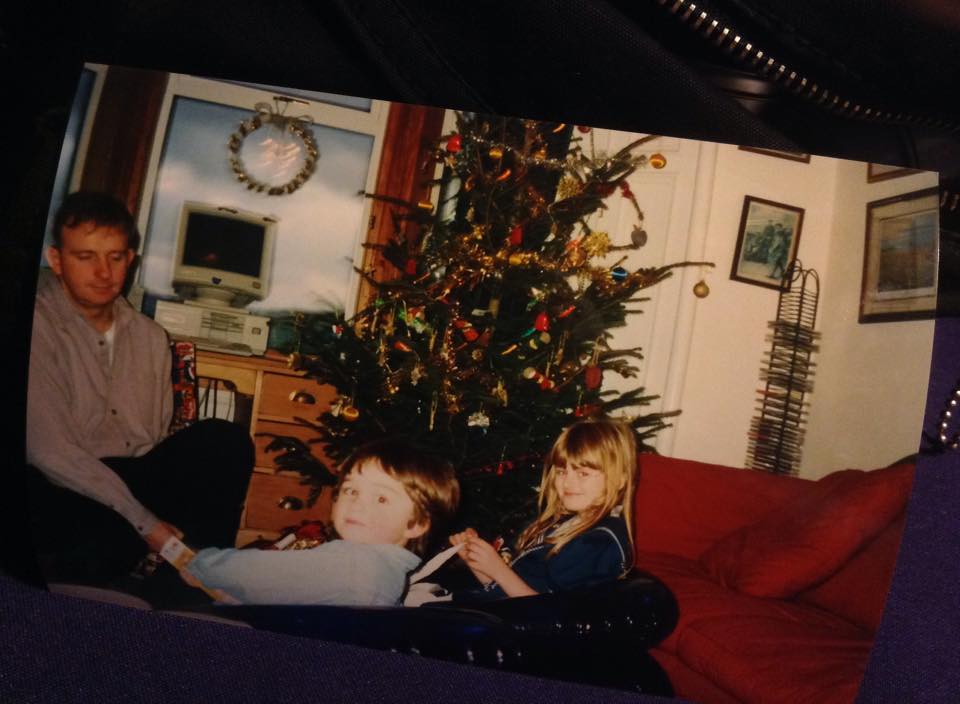
My dad, brother and I at home in the 1990s, overlooked by a magisterial PC
In 1993, the World Wide Web was released into the public domain. There are many histories of the internet and this one is pretty idiosyncratic. I like asking people when they got their first desktop computer. The internet of 1993 could be navigated through bright blue hyperlinks and you would drift between websites. You would type stuff into AskJeeves and have no idea what to expect. At school we had a ‘passport to the Web’ certificate that could be obtained by completing numerous training activities on a twee little software whose name I forgot. It was something like ‘CyberKids’ though surely that is a New York City raver subculture from a time not yet captured by the sleazification of all things indie 2000s. I imagine it was superior to the present Cyber Security Training on offer, in which actors pretend to discover pen drives in the street, gleefully insert them into work desktops only to find their screen literally blowing up in front of them. Nowadays, cyber security training is less about don’t talk to strangers and more about change your passwords regularly. I have a lot of floaty metaphors for the password changing which seem to all include underwear or car parts. Passwords though are pretty boring, clunky things but they’re also gauzy ephemera. Pieces of secret unlocking. Recently I spent an entire Sunday trying to unlock a 2011 MacBook. The password, when I found it again, accessing the deepest recesses of abstract memory, was unforgivably cherishable. I’ll keep it forever like a pet (I’ve already forgotten it).
I keep thinking about ressentiment as a sensation produced by the internet. I mean the internet’s failure. When I was a child, I adored the internet. Once we’d upgraded from dial-up, I would spend upwards of 12-14 hours almost nonstop on forums, games, LiveJournal, websites. I gravitated naturally from the virtual worlds of the Game Boy to the bigger screen of the laptop. Before I was even allowed internet access, I would simulate them by making endlessly complicated Powerpoints and Microsoft Publisher pages which connected to one another like a crude open world. I was beset by RAM crashes and Wi-Fi outages. We didn’t have broadband for a very very long time. My dad was one of the first in the village to have it. I would write letters to the broadband guy pretending to be my dad complaining about the speed of the internet. When I go back to the Shire now, I say things like ‘the internet here is ass’. I can’t get 4G at the semi-demolished and barely functioning station. We can’t find out if our train will come or not. We communicate as a brooding micro crowd, frowning and looking anxiously towards digitised screens whose flicker says only ‘delay’. There are no staff. The staff hide in a crisis. I can relate.
Ressentiment – deep hostility combined with powerlessness. The promise of an open world, a generous future, seems rotten. We hate it. It’s failed us. The sheen of that; it keeps nicking us like a pen knife writing sentences on the skin of our hard-worn feet. We can’t even quit the platforms, can we? The implied ‘we’ of a web community is now an absurdity. What have we seen of the Web in thirty years? Unimaginable horrors. Nevertheless, the perambulations continue.
Right now, I’m deeply interested in the dissonance between how we feel the internet ought to be structured, how it almost was, and what it’s become. The dream metaphors we might use for how it once felt to drift between websites, stumbling upon weirdness after weirdness, unlocking more zones of reality. This versus the algorithmic governmentality and corporate monopolies, ‘technofeudalism’ (Varoufakis) and the appification of it all. I think I got interested in poetry right around the time I fell out of love with the internet (2015). I would memorise passages of Charlotte Smith’s sonnets and learn to swoon over Keats. I felt there was something in the shifting stanzas, the intricacies of form, the dazzling surprises it produced and the infuriating difficulties of grasping the source code — a connection.
I still use the term ‘post-internet’ because I want to believe you can take what Tavi Gevinson in 2018 called ‘The utopian ideal of the internet’ and polish its ‘antiquated’ remains. You can still feel the affective charge of every Web-related signifier that has brushed your life. You can be desensitised to ‘internet discourse’ through the media proliferation of tales of digitality, its foreclosures of democracy, its moral flops, its proliferating conspiracies. But there are parts of you irrevocably brought alive by the internet. I am haunted by digital solastalgia. As a child who felt out of place, abjected from the beginning, I sought the Web as a place not for social belonging exactly but something more like beauty, information, elsewhere. I found little pockets of home all over the place. The web (I’ll stop capitalising now and step out of History) was an extension of the fictional landscapes I found in my dreams or when walking around, making up novels in my head which I did every day until I hit puberty and hormones ruined my brain forever (or whatever). I don’t really know where to find those places any more. They weren’t just artefacts and I know this because you can’t produce a screenshot of a website from 2003 and experience a sweet pleasing nostalgia in the way you could with say, a beanie baby. It was something about the world of it all, the navigation, the desire paths forged to get there. The post-internet, for me, is a lifelong quest in understanding that melancholia and homesickness of what comes after. What do I do with the feeling of ‘we can’t go back there, where do we go now?’. All this time, have I used the web itself as some elaborate metaphor for wanting more than a hostile, futile reality? It’s why I like infrastructure, databases, libraries: the promises of systems which take you somewhere. Which transit something. I also love loops, links and non-linearity.
What was the poetry that got me into poetry? It was Romantic in flavour, sometimes in era. Something between the locatedness and dislocatedness, the attention to daily life, the catapulting scale logic of the sublime, the dogged attempt to render the brain on Nature, the melancholy and mourning, the quiet adoringness, the slow accumulation of elements, the sense of quest, pilgrimage, the unexpected visitor at the door. The everpresence of something more mysterious than could easily be folded into waking life. The delicious fug of opium and promise of a language capable of killing pain. The shimmering excess. The imaginative extremities and morbid dullness of Romanticism were necessary supplements to what the web had done for my childhood.
I’ve been dwelling on this quote awhile, from a Spikearticle about ‘What’s after Post-Internet Art?’:
The technoromantic reimagines posting as liturgy, algorithms as messengers, and artists as saints. They reach into a glorified past for motifs and meaning that invoke the aura of life before memes.Their aesthetic flirtation with the materiality of technology is a double-edged sword, however, that blurs the lines between critique and commodity fetishization. The stakes for this ambivalence are high at a time when capitalist technology is threatening human dignity and agency. Do we really want to engender an emotional attachment to the internet?
Is the function of art to engender the emotional attachment or to transmute its energies into something other? In my day job, I spend almost a whole day a week dealing with academic misconduct cases relating to the plagiarism and hallucinations of Generative-AI. I am supposed to come up with ethical and interesting ways to engage new technology in the classroom, but I fantasise about whole server forms blowing up or quietly being sucked back into the toothpaste tube of Silicon Valley, as if none of this ever happened. At the same time, with two close family members currently undergoing heavy duty cancer treatment, I marvel at the wonders of modern medicine. I think about what Tracey Emin said when asked by Louis Theroux what she thought of AI, or whether there was room for AI art in the world. She says ‘thanks to robots […] that’s another reason why I’m still sitting here’ [presumably due to AI’s role in innovations in cancer treatment and her own recent experience of this]. She’s also like, ‘In terms of art, AI doesn’t really sit well with me, especially when I’m a compulsive, passionate, hot-blooded person who paints’. The contradictions of my feelings about machines get more extreme by the week. I feel born into this contradiction. It’s maybe why my former work twin Nigel would always leave old copies of Wired at my desk.
Does all poetry written after the ‘post-internet moment’ also risk the commodity fetishisation mentioned above? Insofar as it betrays its own lovingness towards the technology it otherwise seeks to critique? Do we want an archness of superior distance or can we do something else with that self-awareness? I think the affect touched upon by Kat Kitay’s piece in Spike is Romantic irony, you know when you realise the narrator is caught up in the situation being described. The Romantic poet speaker discovers they are also a character in the poem. There’s a kind of turn. Timothy Morton uses Blade Runner as a classic example of this, you know when Deckard realises he’s a replicant. Being asked the question, what do you know about the year you were born, for me is like being asked what do you know about what happened to the web? My life is a character in the web’s and the web is a character in my life. What’s the poem here? The continuous mess of everything enmeshed, written, performed, dialogued, deleted, drawn and coded in my lifetime. I have a hot-blooded relationship to the internet. It makes my fucking eyes twitch.
Is transmutation an alternative to merely engendering feeling? I like the word transmutation because I learned it from the great poet Will Alexander. It’s also used by Ariana Reines a lot. We’re thinking here about alchemical transformations in the realm of language, feeling, sensing. I want a poetry that is able to metabolise impossible feelings and in doing so, fuel its reader to think anew. Do I reassign the pain of childhood, the loss of some otherworldly dream, onto the external scapegoat of an enshitified internet? Is that okay? I think about all the times our art teacher made us sit at PCs unconnected to WiFi writing about the design of vintage radios and speaker technology. We had no access to books, the web or other resources to find out more about the designs displayed to us. So in lieu of history or context, we wrote acute, proliferating descriptions of what we saw. What it reminded us of. We found endless vocabularies for edges, colours, surfaces, affordances. This mind-numbing two hours a week was a little oasis from digital supplementarity. A cool, replenishing retreat from external stimulation. We sat on hard, tall stools and typed on clacky keyboards. A tiny little art factory. I had only my brain and the image. I didn’t know it at the time but I was learning that ekphrasis can have a communicative and transformative function. I wrote through the notion of writing about radios to escape the moment where I was supposed to be writing about radios. This did not prepare me for my Art & Design exam so much as it prepared me for poetry.
What do I do with my hatred of the internet? My yearning for it? I write poetry because poetry is a cheap form of that dream architecture I so longed for, all of my life, and I felt good making/using/playing. Marie Buck has a poem that says ‘The point of reading is asynchronous intimacy, and hopefully it works forever’. I said this to my colleague Rodge last week, when we were having one of our regular moments of private despair, and he prints it out and now it’s on the wall of my office. When I look at it I think about all the books out there and all the interesting things I’ve read on the internet and how connected I feel to other worlds. I just have to keep that connection going. I will never know what it’s like to have not been online.
Hi sorry it took so long to get back to you we’ve been super busy here you know I know am going there now fine be with you in five. Not. Ten. Fine. Can all support workers please email in with completed timesheets by the end of the week before right yes okay, did you see the edinburgh rainbow I am a bit confused as to where to find this building you come pick me up right. Yes. In the morning. Yes. It’s staff spa day I am a bit nevermind. Right. So if you. Yeah I’m good it’s been Ok let’s try this instead. Alright you know maybe did you check the reference I think that’s What was wrong no no one’s gotten Their feedback yet have you considered. I am going there now yeah that’s so true The link seems to be broken can you Hit resend yes it’s in the attachment not This one this other. Sorry. Can I send you the month again I think I’ve been spotlighted and muted at the same time I mean if you want to you could always no that one’s closed have you checked out the right books so sorry! I mean fine I’m good yeah You know I am alright I can order another So if you check on the library resources Tab yeah you’ve got. I totally understand! Sorry for your understanding I’ll take care of that, would you. Ok. Where’s my phone? So you see it does Not allow for templates so what you do is Put the big red box. Right. And then The blue box and the green. Right. Could you… It would be great to be in the big black box Which you put in the bin. Totally! Uhm, the poem’s not Opening are you sure you sent it yes It’s not a PDF though it’s literally inscribed on the stars. Right…. Do you have a skin by any chance Can I put it in your poem? I think it’s in my pocket That’s so fucked? I’m so sorry? Can you put my head on the maintenance portal? Okay. I need your help and expertise unravelling One of the world’s longest standing misconceptions. Right. So I think mobile view is a write off? Have you tried emailing them? Yes they’ve sent in the letter. Please hold the line for the council. I am the council. I am the Queens Park Hello Kitty. You could apply for a partial refund just answer A couple of questions one Have you. Yes. I am applying for emergency funding for my damp lifestyle. Do you want me To pin the window on the call so folks can have a better look? Can I sit right next to you? Is it Ok? I can stand where you need me hey Maria The file is so corrupt THERE IS NO AUDIO why is he Making inchoate humming noises can you Take over the cat from me? Haha it’s Ok I guess I’ll just Fill up the bathtub with cat food. Are you in tomorrow? Are you offering anything? New deal on flaking. I am just totally zoomed out. Well, I’m a tiny speck On the furniture. I don’t think the wifi is working Why you ask. You see the password? Let’s take it from there. Okay. Are you sure You want to send it without a subject header Like are you totally sure? No I’m sorry It’s Mau but with like a ‘oooooooooooo’ at the end. Think of cows! Happy in the field. Grazing on liberty caps. Ma – ooooooo. Yes! You’ve got it. Not many people can do that. Can you please ring me back. Hi it’s Amy And Georgia. I’ve filled in your invoice for you Sorry about the cuts. Hahahahaha Love you! I want to get on my knees for you. I’m on strike. Trust me I have a good reason To look? Hello? Hey how are you I hope
the stillness of the painting has a kind of speech to it the sustaining restless grammar of poetry is that how good poets defy things with their heart the sun on the tongue is a kind of living the poem seems to fill up with this a panic, just in the peripheral vision a mode that can maintain the day something of Schuyler in the act of saying how it allows the people to enter the self we are not complete when I’m writing, I’m the right size I’m not bigger or smaller than anything kindle’s like etch a sketch one of the issues of elegy is not being able to let go the Orphic is endless we’re all here because we’ve been taken captive by our reading practice a text of dubious origin which is a great analogy for poetry trick us into thinking these are finished propositions the only authority is the sound itself foregrounding the process of echoing the lyric utterance as operating system in the present moment humour my error invent my own invisible poem behind the invisible poem beginnings are always about nothingness meaninglessness makes meaning a horizon or atmosphere that I can continue to write into I am always beginning… I literally don’t know how to write a poem phantom architecture of a poem the complexity of getting from one line to another a properly honest relation to our temporality the poem that doesn’t know it’s good is usually good you can’t find anything if you’re not lost making nothing as a suspension of labour marking the duration of a symptom speculative topos for tracing affinities there is no better time than the present when we have lost everything a generative uprooting of one’s identity or biography to do the work incantation to wrestle the poem from its enclosure to project in divine sublimity hoping poetry might come back
*
All of these lines are quotations of things said by panellists and contributors at the Peter Gizzi Colloquium at St Andrews University on 18th October 2024: Anne Boyer, Luke Roberts, Oli Hazzard, Honor Hamlet, Colin Herd, Jacob Bard-Rosenberg, Rosa Campbell, David Herd, Caspar Bryant, Daisy Lafarge, Anthony Caleshu, Peter Gizzi.



 mariaology