To the best of my memory, I have only ever been on a sailing boat once. Or, I have only been happily in control of a sailing boat once (there was a time we had to try windsurfing in primary school, a time whose details have, thankfully, long been repressed). It was 2005, I was twelve years old, and had won a competition through the local youth club to go on a sailing trip to Oban. I don’t remember anything about what I must’ve learned regarding sailing, but I do recall a beautiful suite of seafaring terms: a special vocabulary which transformed previously mundane structural features into curious artefacts of mysterious potential: cleat, keel, stem, rudder, transform, tiller, clew, boom, shroud, telltale, jib, winch, deck and spreader. The man in charge was a hardened fisherman type; I don’t recall his name, but we called him the skipper. He was dismayed to learn I was a vegetarian, having packed little in the way of vegetables for our journey. I was happy to live off Ovaltine, jam rolls and digestives for the following days. It was such an odd combination of children—were we still children?—on that trip. No popular kids, but a few of the scarier misbehaviours (probably not okay to still call them neds), the freaks and geeks—then me, wherever I fit in. ‘Goth’, which in the case of my school was generally singular. Somehow, we all bonded rather than fought in the tiny space of that boat.
One boy, who would always be in fights, bullying and hunking his weight around, was so sweet to me. He saw I had eaten barely anything and gave me a whole bar of Cadbury Mint Chocolate, insisting I had all of it. It was such a kind gesture that I remember it still. Everyone was different at sea: softer, more honest. We were willing to admit our social vulnerabilities; there was no-one, no context, to perform for. A boy I’ll call L. opened up to me about his love for 2Pac, and when Coldplay came on the skipper’s stereo (it was their first truly mehhhh album, X&Y), we shared a little rant about how cheesy it was. We ate fruit out of tins, pulled scarves over our faces on deck and watched the coloured houses of Tobermory loom closer. The skipper let us all have a go at the tiller; he told us stories from previous trips, about how the weather had turned nasty and they’d had to pull themselves through miniature hurricanes. I found myself craving the wild mad weather, even as I was shivering in some inadequate waterproof jacket (I have a history of coming ill prepared to such outings). The skipper and I sort of oddly bonded, since I was usually the first one up in the group. He’d put the kettle on and we’d go out on deck to watch the sky. He’d point out things to look for in the cloud patterns, the colours that bloomed on the horizon. It’s this kind of practical knowledge that I thirst for. Chefs talking to me about how to sharpen knives, bake brownies; motorcyclists betraying the secrets to keeping your speed; engineers talking about formulas and team rivalries and how to build a bike wheel. I’m completely incapable of almost anything practical, so it’s always a magic alchemy to me. When people ask what I want to be when I grow up, I say shepherdess, even though I have little idea of what that entails, beyond reading the excellent The Shepherd’s Life by James Rebanks and occasionally listening to The Archers.I think I’d just be content to wander around hills.
Red sky at night, shepherd’s delight…
I awake to steady rainfall, first day of November. I have been thinking a lot about that sailing trip recently, mostly because I’ve been doing writing workshops in Greenock, and the nature of the place as a harbour town has everyone often turning back to boats and fishing topics. I talk to a chef at work about fishing, not because I’m all that interested in fish but because there’s something about its psychology that reminds me of times gone by. Once, I took myself out to Cardross on the train, following the road up to Ardmore to sit on the point which was a good spot for anglers. It was so quiet and still, the beaches strewn with lumps of quartz. I sat there for an hour or so, listening to the steady lap of the estuary, then slowly made my way home, tearing my skin on all the brambles. It had the feeling of a secret, overgrown place. A little out the way, a nest you could curl into: an almost island. I recall those tiny islands on the Swan Pond at Culzean Castle, where we used to leap across to. As a kid, I’d hide among the bamboos and rushes and feel entirely in my own little world. The pathways and grasses were lit with secret creatures, this 12th World I’d created—it was over a decade prior to Pokemon Go, but here I was in my augmented reality. I’d sit up on the top of the stairs reading for as late as possible, imagining that I was on top of a waterfall, and all before me was water cascading instead of carpet. I’d lie upside down and the ceiling became the first planes of a new universe. I’d wake up early and write it all down; but those pages are lost to whatever antique sale of the past stole my youth.
Now I am adult, less governed by diurnal rhythms. I find myself lost in the long bleed of night into day, up far too late in the bewildering recesses of the ocean online, the oceanic internet. Far corners where articles smudge their HEX numbers in true form down the page and I am rubbing my eyes to see beyond light. Time, perhaps, to rehash that old metaphor, surfing the web. Occasionally, some page would bring me crashing back down in the shallows; I’d wake up, ten minutes later, groggy on my keyboard. Press the refresh key. Instagram has me crossing continents at bewildering speed, lost in Moroccan markets, Mauritian beaches and Mexico City. In the depths of some nightclub then the heights of a Highland peak. So many fucking faces. Closeups of homemade cakes, delicious whisky. Memories. Oscillations I can hardly breathe in, watching my thumb make its onward scroll without my direction. The rhythms become flow, become repetition. I need an anchor. It’s been hours and hours and maybe I’m hungry.
On the boat, whose name I have sadly lost, we slept by gender in two separate cabin rooms. They were tiny, low-ceilinged, and we were just a handful of slugs pressed tight in our sleeping bags. It was better than a sleepover, because there was no pressure to stay up all night and we were all too exhausted from the sea air to talk much. I’d close my eyes and feel the steady rock of the boat’s hull as it bobbed on the water. There was a deep throb of something hitting against the walls outside, maybe a buoy or rope; it felt like a heartbeat. Sleeping in many strange places, the floors of friends’ flats and houses, in tents and on trains, I try to revisit that snug tight room where sleep was difficult to separate from consciousness itself. It was all of a darkness. Something Gaston Bachelard says in The Poetics of Space: ‘We comfort ourselves by reliving memories of protection. Something closed must retain our memories, while leaving them their original value as images.’ There was no mirror in that boat, so all I remember are smells and objects. No sign of my own pale and windswept face. Everything we ate was an old-fashioned brand; it made me think of rationing and traditional values. I wasn’t quite sure what that even meant.
I need an anchor. A place to dock in.
Governed by some primordial instinct, I go to make my dinner around the same time most nights—which happens to be one in the morning. The shipping forecast used to be the last thing on the radio, before a sea of white noise till dawn. When cutting veg, my fingers weak from another long day, I switch on the radio and there are the familiar intonations. I listen as I would a poem or a shopping list, a beautiful litany of place names, nouns, directives. I have no idea what any of it signifies. It’s been a double shift, perhaps, or an extreme stint in the library, a walk across the city. My mind is full of words and sounds, so many conversations. The debris of the day threatens to spill out as a siren’s cry, and how easily I could slump against the kitchen cupboards, wilt upon the floor. Make myself nothing but driftwood, no good turning till morning. But instead I chop veg, listen to the shipping forecast. It’s difficult to think you deserve food, even when your body’s burning for it and you haven’t eaten for hours. But there are so many other things to read or do! You need an anchor, a reason.
The general synopsis at midnight.
Many of my childhood lost afternoons, bleeding to evenings, were spent playing The Legend of Zelda: The Wind Waker on a GameCube I shared with my brother—avoiding the narrative quests and dungeons in favour of epic ventures across that cobalt ocean. What I wanted was that rousing sense of the wind’s spirit, the freedom to glide and find new islands. Whirlpools, tornados and Chtlulu-like creatures hurled me out to stranger lands. It was all so beautifully rendered, an expansive thalassic field of possibility; with each route I was fashioning some lovelorn story for my lonely hero. The ocean has always represented for me some point of erasure where reality dissolves into imagination. I think maybe it’s this perceptive meshing that we need to attune to in order to make sense of the vast scale effects of the Anthropocene. How else to grasp those resonant shockwaves of consequence, whose manifestations often transcend our human grasp of time and space?
Headache, Viking, southwesterly veering. The same refrain, moderate or good. When occasionally poor at times, do I picture the sailors with rain lashing their faces, rising through mist towards mainland? Is that even where they want to head? Rain at times, smooth or slight, variable 3 or 4. The dwelling conditionals; always between, never quite certain. The weather being this immense, elusive flux you can guess at, the way paint might guess at true colour. Cyclonic 4 or 5. In Fitzroy are there storms circling around the bay? Very few of these places could I point to on a map. I like the ambiguity, the fact of their being out there, starring the banks and shores and isles of Britain and beyond: Shannon, Fastnet, the Irish Sea. There’s a sense of being ancient, from Fair Isle to Faeroes.
I went to a talk last week for Sonica Fest where a girl from Fair Isle talked about climate change, how her home island would probably one day be swallowed by the sea. I can’t help picturing a Cocteau Twins song when she says it. She dropped handmade bronze chains in different oceans so you could see the divergent levels of oxidation, relative to saline content. It was beautiful, this abstract material rendering of elemental time. The world rusts differently; we are all objects, exposed to variant weathers. Her name was Vivian Ross-Smith and she talked about ‘islandness’, a project which connects contemporary art practise with locality and tradition. The term for me also conjured some sense of the world as all these archipelagos, whose land mass is slowly being ravaged by warming waters. The pollutants we put in. Islandness betrays our vulnerability, the way we were as 12-year-olds at the mercy of the tides, the weather and our gruff skipper. I had little conception of what climate change was, but even then I didn’t set a division between humankind and nature.
Back on the boat, I traced my own moods in the swirls of those mysterious currents, dipping my fingers in the freezing North Sea. Who are we before puberty, pure in our childish palette of pastel moods? When I think about how that sea spreads out to become the Atlantic, so vast and impossibly deep, I grow a bit nauseous. Maybe that’s the sublime; an endless concatenation of seasickness, feeling your own weakness and smallness in the face of great space, matter, disaster. How easy you too could become debris.
Increasingly, that waltzing Cocteau Twins song feels more like an elegy, haunted by the shrill of soprano, those shoegaze guitars resounding like notes through a cataract. A line from Wordsworth’s ‘Tintern Abbey’* I always remember, ‘The sounding cataract / Haunted me like a passion’. Interplay between feeling and form, sound and vision. The ocean warming, the beat steady and mesmerising. Are we sleepwalking into the Anthropocene, over and over again, a lurid repetition compulsion? Why we keep burning up fossil fuels, emitting our plumes of carbon, senseless in the face of a terrible sensorium? I crave solid objects that show up the archives of history, those plastiglomerates of Frankenstein geology, the warped materials of the Earth’s slow and drawn-out hurting. Liz Fraser’s operatic howls are maybe the mourning of the land itself, begging to be swallowed by the sea. A saving? If originally we came from water, hatched out of amniotic sacks or evolved from subaquatic origins, then maybe we return to its oceanic expanse, its blue screen of death. When I’m anxious and needing to write furiously, write against the tides of exhaustion or time, I listen to Drexciya—Detroit-based techno that harks back to Plato’s mythology of Atlantis, via Paul Gilroy’s Black Atlantic. There’s this crazed evocation of diaspora, drowning, a mysterious race of merpeople. What evolves below water, what is spawning in the recesses of subculture; what resists the mainstream, the violent currents of everyday life. This subterranean city is a ‘sonic third space’. I can’t help but think of my own other planet, that 12th World separate yet attached to daily reality; somewhere distant but still impossibly intimate. That resonant intensity that drives you from sleep and into midnight discos of the mind, all pulsation of lights, wonder, horror.
There’s a sense that sound itself can be physically embracing. This is maybe how it crosses over into sonic third space, where embedded mythologies flourish in resonant affect. Where sound becomes tangible, making vibrational inscriptions of code upon the body like transient hieroglyphs of an assemblage’s trellising energy. In Tom McCarthy’s novel C (2010), the protagonist Serge is obsessed with hacking the radio to tune into the ether. Alongside the obvious supernatural connotations, there’s a more pressing suggestion that Serge is able to make his entire being become channel for sound. He lays on a ship as I once lay on a boat, listening to the warm stirs, the conversational blips and signals of objects:
The engine noise sounds in his chest. It seems to carry conversations from other parts of the vessel: the deck, perhaps, or possibly the dining room, or maybe even those of its past passengers, still humming through its metal girders, resonating in the enclosed air of its corridors and cabins, shafts and vents. Their cadences rise and fall with the ship’s motion, with such synchronicity that it seems to Serge that he’s rising and falling not so much above the ocean per sea as on and into them: the cadences themselves, their peaks and troughs…
McCarthy’s lyrical clauses accumulate this notion of sound as spreading, seeping into words and orifices, surfaces. Presences, absence. A lilting simultaneity between the movements and pulses of objects. Sound becomes material; is spatialised as cadence, lapping the edge of Serge’s senses with lapidary, enticing effect—always tinged, perhaps, with a lisping hint of danger. The sounds, after all, also evoke the dead. There’s a radio drama by Jonathan Mitchell, where the protagonist has developed a device which allows you to extract sound from wood. There’s the idea that wooden surfaces absorb sounds from their surroundings, and the time and quality of storage depends on the type of wood. It’s a brilliant sci-fi exploration of what would happen ethically if we could extract auditory archives from material surroundings—the problems and possibilities of surveillance, anamnesis and so on. Consequences for human and nonhuman identity, the boundaries between life and death, silence and noise.
Do the walls hear everything? I think of rotting driftwood, how porous and light it is. How its every indent, line and scar marks some story of the tides, the stones and the sea. Robinson Crusoe, chipping the days away as notches on wood. I think of the hull of that boat, perhaps coated in plastic, sticky with flies and algae.
On the last day of our sailing trip, we were sitting round the table of the cabin, docked in Oban harbour, reading the papers and having a cup of tea. Our youth club leader got a text from a friend back home. She was informing us of the London 7/7 bombings. This was a time prior to having internet on our phones. We weren’t so wirelessly in tune with everything everywhere always. But that little signal, a couple words blipped through the ether, brought the sudden weight of the world crashing back down upon our maritime eden. I had family in London who escaped the attack by the skin of their teeth, a fortuitous decision to take that day a different route. How everything was at once the dread of hypotheticals. I did not understand the vast arterial networks of terror that governed the planet; these things happened in flashbulb moments, their ripple effects making what teachers called history. Somehow it didn’t seem real. Bombs went off all the time on tv; I grew up with the War in Iraq and Afghanistan. Those televised wars were the ambient backdrop to everything on the news. Later, my friends would wile away their teens shooting each other on Call of Duty. It was all logistics, statistics, the spectacle of bodies and explosions. Nobody explained it. We were distracted by MSN Messenger, then those boys with their controllers tuning in and out of conversation, signing online then drifting away into present-absence. X-Box (Live). Signifier: busy. It was good to be away from the telly in the relative quiet of the boat, startled instead by foghorns and seagulls. But even then, we remained connected.
⚓️
The Shipping Forecast has been issued, uninterrupted, since 1867. Its collation of meteorological data provides a map of sorts, a talismanic chart of patterns and movements, currents, pressures, temperatures—something that helps millions of sailors out at sea. I look at such visual charts and truly it boggles me. I prefer grasping such data as sound, delivered in the hypnotic lilt of that voice: its clear diction and poetic pace, calling me home. I think of the west coast, the bluish slate-grey of the sea. Becoming variable, then becoming southerly, rain or showers, moderate or good. Always between things’ becoming, becoming. There’s the pitch-black womb of a cabin again, the childlike promise of dreams and sleep, a genuine rest I’ve forgotten entirely. Listening makes it okay to be again, buoyed up halfway between where I am and where I’ve been. A constellation of elsewheres to placate insomnia’s paranoia; to be in winter’s dark heart or the long nights of summer, endlessly tuning to atmosphere, cyclonic later, slowly veering from the way. My present tense is always eluding, like ‘In Limbo’ with Thom Yorke’s seaward crooning, the morse code of emotion in whirlpool arpeggios, closing and bleeping and droning on a wave far away, the spiralling weather, the fantasy…Another message I can’t read.
*Full title, of course, being ‘Lines Composed a Few Miles above Tintern Abbey, on Revisiting the Banks of the Wye during a Tour, July 13, 1798’.
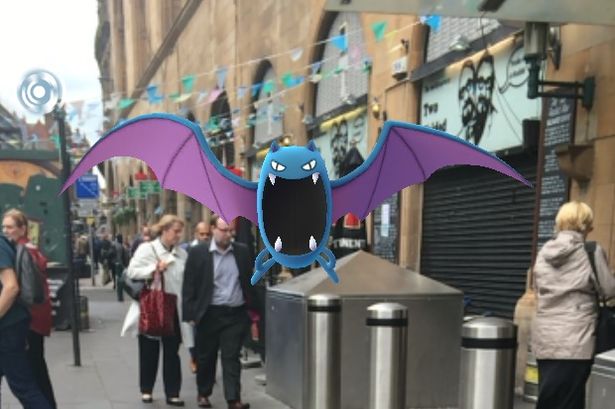
I scroll down my Facebook timeline, and there is a photograph of a pavement – on a real street which I recognise – and on that pavement is a Pidgey. You know, the wee brownish flying thing from first generation Pokémon? I scroll down a bit more and folk have been out and about all over the place: there’s a Weedle on the gingham tablecloth in a cafe, a wee purple-grey Nidoran on a hay bale, a Magikarp bouncing around by the Kelvin. This is, if you haven’t guessed already, people sharing their spoils from Pokémon Go, an augmented reality game which allows you to catch Pokémon in the wild, a.k.a real life. There was a glorious month in the summer when you could go for a walk and see clusters of people milling around with their phones in the air, as if trying to channel some ethereal spirit that was wafting in the atmosphere. They were out catching Pokémon. All of a sudden, people were going for walks again, leaving the house and the cosy glow of the television to catch invisible beasties who lived in trees and parks, museums and street corners.
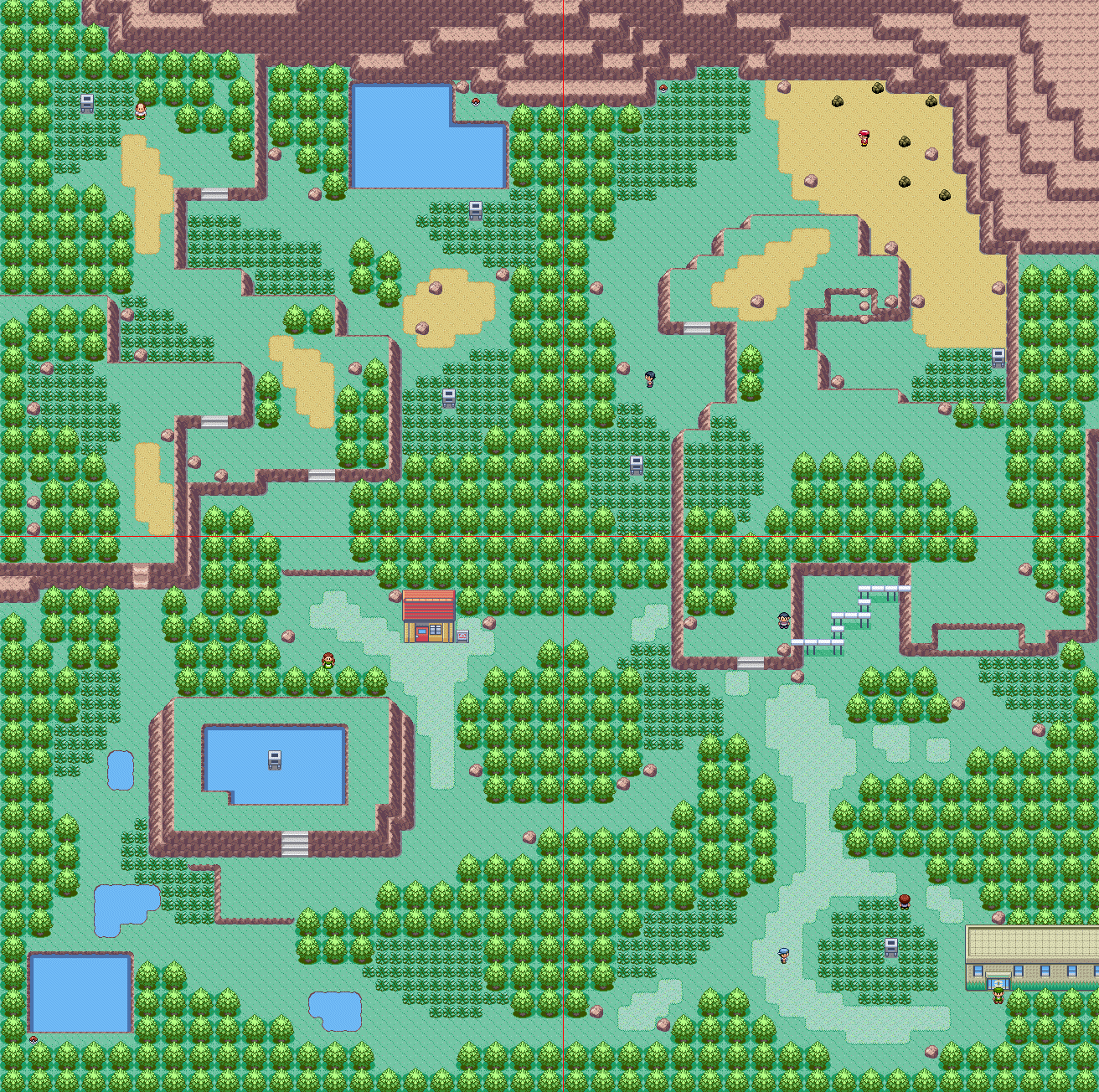
Safari Zone Map from Pokémon Ruby/Sapphire. Image Source: PsyPoke
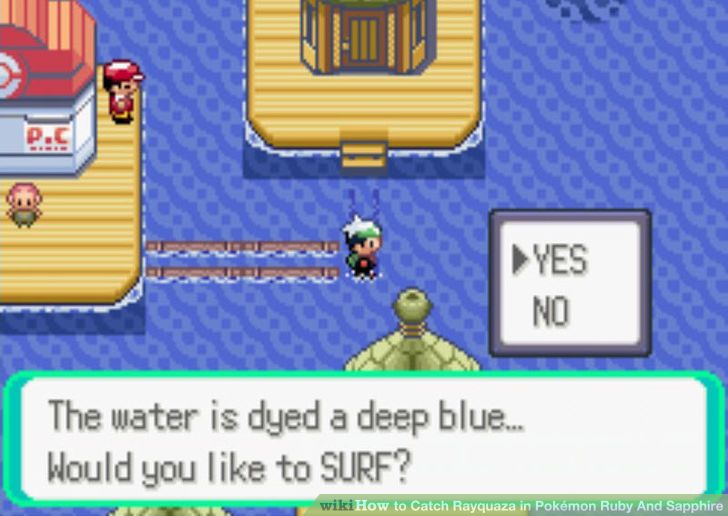
As a kid, I was an avid Pokémon fan. I missed the boat for Red and Blue but had Yellow, Ruby, Sapphire, Leaf Green for my Game Boy Colour and Advance and played them all to death. What I loved more than the battles was the wandering part. So much of your time is taken up pushing your way through long grass, cycling along seaside promenades, bobbing along the ocean, taking shortcuts through forests, crossing through dungeons, traversing the plains of mountains and deserts. You’re constantly interrupted by Pokémon encounters; so much so that often you double back in confusion, any instrumental pathway you’re trying to take disrupted by the screen switch to a battle. The towns often had such picturesque names as ‘Petalburg City’, ‘Sootopolis City’, ‘Lilycove City’ and ‘Mossdeep City’. Then there’s Meteor Falls, the Sunken Ship and Sky Pillar – these are just from Ruby/Sapphire alone. Yes, the game has a final purpose: you’re supposed to beat the gym leaders of every town and follow some convoluted let’s beat Team Rocket narrative, but often its trajectory is beautifully non-linear. You can explore, catch Pokémon in your own time, find side quests to achieve, people who need help. Acquire potions, level up your Pokémon, learn intriguing stories from local mythology.
Screen Cap from Ruby/Sapphire. Image Source: WikiHow
There is an obsessiveness to Pokémon, a desire to always repeat. As much as possible, you find yourself returning to previous towns and locations, either to seek out more Pokémon known to appear in the area or simply to explore, to see what you’ve missed. Invariably, you do nothing new, and manage to enjoy that process of wandering again. You fight the same Pokémon, hoping they will flee but secretly enjoying taking them down in one shot with your level 40 team, where once you’d have to fight tooth and nail with a goddamn Zubat. To some extent, Pokémon is a rhizomatic game: once you get to a certain stage, the world is yours to explore and you can map out your own routes and lines of flight as you see fit, flying and sailing and seeking locations of your choosing. However, you are still governed with the impulse of narrative, which spurs you onto particular places: sometimes you can’t move on till you’ve beaten the gym leader of that town, for example. You can regress, but not progress. There’s that sort of macho narrative of levelling up which you’re impelled to follow. It’s only when you’ve completed the game that you can reap the rewards of complete exploring.
Pokémon Go changes that. By transferring Pokémon to real life, you are as free to explore its terrain as you are to wander the streets of your local town or city, or indeed the plains of the countryside. Real life is transformed by augmented reality, the imposition of Pokémon on material space. Creatures that only the player, holding up her phone, can see. This is already getting very Black Mirror, but wait. It’s a competitive game, yes, but there aren’t the drastic consequences of social exclusion and alienation experienced by many of Black Mirror’s tech addicts. There is a lovely playfulness to Pokémon Go which somehow has generally avoided becoming cutthroat competition. For a while, everyone was playing it. It was a form of camaraderie (folk would go out in packs to hunt for Pokémon, or indeed organise mass hunting expeditions via Facebook). More time was being spent on the Pokémon Go app than on Snapchat, Twitter and Whatsapp. I’d go into the kitchen at work and the chefs would gleefully show off their Pokédex; which was glorious, seeing all those familiar creatures again in this new and surprising context. And since chefs have hardly a moment’s time when they’re not in the same place, working 14 hour shifts at a time, I can only imagine the extent to which people in other walks of life played it.
Pokémon Go is a strange way of making people notice their surroundings, particularly in the sense of urban space. Sure, most of the time their faces are glued to the maps on their phone screens, but in placing themselves in the world, they are forced to confront physical structures, obstacles, windows, private property and so on. It becomes even more of a game when you have to work out how to attain Pokémon in elusive locations. I’ve heard stories about folk knocking on your door asking if they could come in because they’ve noticed you’ve got a rare Pokémon in your house. It sounds pretty sinister, but it shows the level of commitment the game inspires.
Think of it this way: why is it so addictive? Like Tinder, it’s a form of locative media which uses your GPS to determine who or what will appear in your surroundings. Pokémon Go also uses your phone clock, as different types of Pokémon appear at different times of day. I’m reminded here of one of my favourite games, Animal Crossing,where you could go fishing and bug-catching but what was out there was determined by the ‘real time’ of your Game Boy’s internal clock. It followed the real time of a 24 hour day, of the seasons and so on, so that in December there’d be snow and falling leaves in autumn. It was very beautiful and the real time aspect has an addictive quality. I think it’s because the game becomes less a form of escapism and more a parallel to reality, to everyday life. You know it’s reached that status when The Mirror runs a how-to guide, eh?
What’s so cool about Pokémon Go is how it adds meaning to real space. A school, town hall, park or pub becomes a Pokémon Gym and everyone wants to visit. I swear business at my work improved for a month as we quickly realised we were a Pokémon Gym and groups of sullen young adults would gather silently at bar tables, trying to battle other trainers at the gym and hoping to win Pokécoins. A guy I work with would heavily protest when he saw someone playing the game because he was currently gym champion and got surly at the prospect of newcomers taking his title. If I was late bringing someone a coffee, nervous they’d be grumpy with me, often they were so distracted by the game that they’d not even noticed the time. In a sense then, Pokémon Go transforms both time and space. Everything is flattened into a map, where flashing nodes indicating Pokémon are the symbols of desire, the objects of pursuit.
In a compelling, complex and challenging article on Facebook as a ‘desire-network’, Maria-Daniella Dick and Robbie McLaughlin argue that ‘Facebook effects a mutation in desire and thus in capitalism’, and in tandem with this, a ‘historical shift inn the relationship between psychoanalysis and capitalism’ (Dick and McLaughlin 2013). With Facebook, ‘desire remains impossible to satiate, but it is now without object’ (Dick and McLaughlin 2013). They suggest that Facebook is situated within the Lacanian Imaginary order (which constitutes the intrinsic narcissism through which the human subject constructs fantasy images of both herself and her object of desire). According to Lacan, desire (unlike need) is always unfulfilled; we are always moving towards a lack, the anxiety prompted by something lost (as in the child’s original sense of wholeness before discovering the fragmentation of her parts, the split between her body and world and mother, in the mirror). The Imaginary is that which we create to attempt to fill that fundamental gap, the fantasies of the ‘ideal ego’ which compensate for an originary loss. Facebook is basically the ultimate web of the Imaginary: all our time is spent scrawling through pictures and statuses and shared media which all in various ways represent fragments of the ideal selves we project online. Yet our browsing is ultimately without end, it is ceaselessly rhizomatic, decentralised; we end up on one place, a restaurant page or old friend’s profile, without really knowing how we got there. Our passage through the network is governed by algorithms which attempt to map our desires; algorithms which are self-sustained by users’ input data, the patterns of usage recorded with every click. While this may seem revolutionary, a democratic decentering of the system, Dick and McLaughlin are highly sceptical of Facebook’s subversive potential at the scale of the political.
While the likes of Facebook were integral in the organising of such glocalised (global/local) revolutionary events as the Arab Spring or the Occupy Movement, ultimately ‘[s]ocial networking completely embodies and facilitates these phenomena in which the masses are now able to organise efficiently but without being unified by a radical ideological alternative’ (Dick and McLaughlin 2013). The fragmentary pathways of Facebook map out the lines of insidious liberal democracy, and as engrained as they are in corporate culture (the corporation itself becoming the medium for mass communication) offer little opportunity for imagining visionary alternatives to liberal capitalism. Crucially, Facebook (with all its user-directed interfaces based on algorithms of taste and so on) perpetuates the myth of the liberal individual, who curates her profile, her tastes, conducts a life of many choices. As Dick and McLaughlin (2013) put it: ‘[t]he so-called 99% are already conditioned by a liberal democracy in which they have the self-identical sovereignty of an individualistic ideology that places the subject at the centre of the world’. To really offer a vision for an alternative future, we have to actually come up with a plan. Recognise that we are always-already networked individuals, whose subjectivities are hardly unique and instead constituted through structures of discourse and power, and use this in a positive way, to undermine the liberal justifications for free-market capitalism.
What does all this have to do with Pokémon Go? The thing is, Pokémon Go seems like innocent child’s play, but it’s bound up in the politics of space. It’s fundamentally structured by GPS software and urban space, and let’s face it, urban space is always ideological. Whether it’s homeless spikes, shiny new glass-fronted apartments built where Brutalist high-rises used to be, gated communities, the psychotic disarray of London’s property market, the genuine promotion of American Psycho-style yuppie-targeting ads or simply the denigration of social housing as ‘slum housing’, space and architecture is always somehow political. In a recent talk given at the University of Glasgow titled ‘Remembering the Future: The Politics of Space and Architecture’, Darran Anderson argued that the current failure of the Left is a failure to put forward a vision of the future that is compelling and actually positive; if we don’t act soon then someone else will determine the future for us. One way Anderson proposes we can intervene in the social order is through architecture, by building sustainable forms of urban space, housing and energy production that take into account the fact that we are living in the Anthropocene. We need to accept the imminence of ecological disasters, which are indeed already happening. We need to rethink our fantasy imagery of the city; it needs to become a network of playful imagination, of empowerment, rather than just passive defeat, or the kind of share-lite politics, browsing, blasé escapism and distraction offered by Facebook.
What is interesting about Pokémon Go is that it restores to some extent the object of desire, which Facebook, in its endless networks of people, places, photos and check-ins, displaces. ‘With Facebook’, Dick and McLaughlin (2013) argue, ‘people no longer live the present as present; it exists only insofar as it is exists to be recorded and later uploaded to Facebook’. This temporal displacement shifts with Pokemon Go, which insists on the present as present. Pokémon only appear for a limited amount of time so the imperative is to catch them in the game space of the now. The impulse of shopping or clubbing to buy buy buy or drink drink drink is gleefully interrupted by the appearance of Pokémon, who are quickly snapped up and snapped, shared online. The allure of ‘cool’ or the aura of dreamlike consumption attached to consumption-based social places is disrupted by the childlike logic of the game. And there’s nothing the companies can really do about it, since technically Pokémon isn’t intruding on reality, it’s only intruding on maps of reality. Now I’m thinking of that Jorge Luis Borges story, ‘On Exactitude in Science’ (1946), and getting very confused about reality itself. In the story, Borges imagines an empire where cartography has become so exact that its map of the empire must match in size and detail the empire itself—after which, what’s the difference between the map and the original? Do you need the map anymore, or can you use real space to map out real (map?) space?
There is almost something a tad Situationist about Pokémon Go. It offers no restrictions on movement, the way the Game Boy games do, according to a linear narrative. If you want that elusive Vulpix or Meowth, perhaps you will have to explore territories previously uncharted in your running app or Instagram places map. You might end up in the strange end of town. And what will you find when you get there? Traversing space this way leads to opportunities of surprise and discovery. The fact that so many people are posting photos of their Pokémon Go encounters online adds a new palimpsest of meaning to our understanding of place. The appearance of Pokémon disrupts the order of cities; it adds new points of desire to the map. Sure, most gyms are in tourist hotspots, but that doesn’t mean you don’t have to explore the more unseemly areas of town to catch ‘em all. In wandering out your comfort zone, you’re enacting a sort of De Certeauian ‘tactic’, resisting the signage and flows of capital which generally direct your movement in urban space (i.e. according to the circuit-like lure of the shops, the home or workplace). Ironically, you’re doing this at the inspiration of a global corporation (the folks who own the Pokémon Go app), but in this case, it doesn’t necessarily mean your actions and movements aren’t subversive. Nevertheless, the transgression of space according to augmented reality is unfortunately still bound by societal racism, highlighting the fact that we experience space differently according to who we are—despite its best intentions and possibilities, a game like Pokémon Go can hardly overthrow the prejudices of the Repressive State Apparatus…
Since Pokémon Go is based mostly on algorithms of mapped information, there is an element of chance which escapes the systems of data (could we call this glitch a Lacanian intrusion of the Real?). Pokémon crop up in controversial places. Since ghost Pokémon are attracted to graveyards and places of mourning (think: the original Lavender Town), they have been appearing in places like the Holocaust Memorial or Ground Zero. The incongruity of the playful critters in these places of silence and solemnity is startling and forces us to rethink our expectations of memorialising space. In a sense then, for better and worse, Pokémon Go has a reterritorialising impulse. Sure, you can report inappropriate places and instigate a process for removing them from the Pokémon Go map, but that initial appearance, based on some kind of algorithmic randomness, has already violated the implicit expectations of such places in terms of silent respect and mourning. There is in a sense an overflow of the gaming impulse, where the augmented reality becomes more distracting than reality itself (even when you are in such a compelling and startling location as the Holocaust Memorial…).
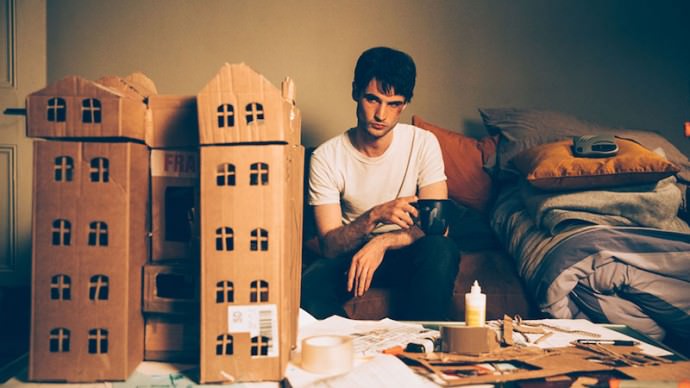
Houses that crumble…Screen cap from Omer Fast’s 2015 adaptation of Remainder, starring Tom Sturridge. Source: Belfast Film Festival
Perhaps this is the danger then, of supplanting a fictional reality (the map) for the territory itself. I’m thinking of the protagonist in Tom McCarthy’s novel Remainder (2005), whose response to trauma is to assemble a detailed map of a very specific retrieved memory, based in a house where there was a very specific synaesthetic symphony of liver-frying, cats on roofs, piano playing and motorbike clanging. Eventually this map is transferred to the ‘real’ as the protagonist recreates mimetically the details of this spatial memory. Yet pursuit of the real is addictive; the protagonist soon begins recreating more extreme and harrowing memories he’s encountered: traffic accidents, bank robberies. What intrudes, eventually, is the remainder: the real itself which spills out of the recreated event. As McKenzie Wark writes in the preface to McCarthy’s novel, ‘[t]he simulation is never perfect, always in excess of the thing itself. It always leaves a remainder. The most troubling remainder is himself [the protagonist]. He is a leftover God, a God as debris of creation’ (Wark 2015: xi).
In a way, Pokémon Go represents a God-like desire to reconfigure reality, to impose the Imaginary space of the simulated game upon the ‘game’ of ordinary existence. Is this a postmodern statement of irony, a pastiche of 1990s nostalgia in the age of the smartphone? Yes, and no. There’s something kind of modernist and sincere about it too, a sense of genuine interest in creating the Big Project, a utopian potential for gaming to bring people together. While Pokémon Go is partly about earning currency (Pokécoins) to buy more materials which help level up Pokémon or revive them during battle, its general impulse is towards exploration. Conquering, yes, to an extent; but mostly exploration. What happens when you’ve captured every Pidgey in your neighbourhood? You travel farther, maybe even beyond your hometown or city. Of course there comes a point where most of us get bored and stop playing, but there was a moment when the game genuinely seemed to interrupt reality in a way that felt genuinely liberating. The fact that so many people deemed it silly, a waste of time and completely illogical only highlights the ways in which the game resists the general instrumentalism of capitalism (i.e. every minute should be spent doing something useful, like finding ways of accumulating money and furthering one’s career). The time wasting aspect, the fact that so many people love its paean to repetition (you can walk the same route every day and still get different Pokémon appearing), is a queer sort of logic; it goes against capitalism’s futurity, the linear progression of temporality, in favour of a kind of maddening impulse of looping, overlapping desire. We accumulate the same Pokémon several times and this is part of the internal logic of the game, compelling us to traverse the various spaces again and again. It represents at once the immateriality of twenty-first capitalism (as based on flows of ‘invisible’ capital and immaterial goods, symbols of status) and the potential for subverting the logic of accumulation to one that is both bizarre and based on the ethics of play rather than success.
Sure, a great deal of the game might be about levelling up and being the best, but you can also play it with general disregard to those impulses. Collecting, in a sense, transforms the use-value of goods by placing them in a new circuit of information, taking them from the marketplace to the geeky world of the collector, whose interest in based on details and aesthetics, often more than financial worth. Just look at what happens when someone tries to make money off becoming a hire-out Pokémon Go trainer: they are threatened with being banned from the game, since it violates their code of ethics/terms of service. Play, rather than capital, is at the heart of the game’s map of trajectories. It brings people together – even adults – in a space of play. I’m not saying it’s changed the world by any means, and indeed it has its slightly absurd but very real dangers, as people blithely ignore the potential perils of the real landscape in pursuit of the desired (simulated) object, like Icarus flying too close to the sun…However, there’s something genuinely refreshing about how Pokémon Go forces us to reconfigure our sense of reality, space and the routing of our desires and movement. While world-views are shrinking and narrowing in post-Brexit times, Pokémon Go reminds us of the value of expanding our horizons and getting up to just go and wander, maybe aimlessly.
There will always be moral panics over deaths from selfie-taking, planking and cavorting in dangerous places, but will there be anything quite like Pokémon Go?
Bibliography
(other references are hyperlinked in the text)
Anderson, Darran, 2016. ‘Remembering the Future: The Politics of Space and Architecture’, Lilybank House Seminar Room, University of Glasgow, 15th November 2016.
De Certeau, Michel, 2011. The Practice of Everyday Life (Berkeley: University of California Press).
Dick, Maria-Daniella, and Robbie McLaughlin, 2013. ‘The Desire Network’, Theory Beyond the Codes, [Available at: http://www.ctheory.net/articles.aspx?id=727] Accessed 21/11/16.
Wark, McKenzie, 2015. ‘Preface’, in Remainder by Tom McCarthy, (Richmond: Alma Books), pp. vii-xii.
My experience of watching Black Mirror: White Christmas was a sharp departure from the usual mindless festive telly fare. Like a lingering nightmare, it will hover over the dreamy limbos of television’s ‘Christmas Special’ tradition for years to come. Black Mirror (while we can certainly argue that some episodes are better than others) has successfully created a lethal concoction of technological speculation, sharp drama and black humour that stands out amidst the genres of science fiction, reality tv or documentary which tend to be employed to convey the themes explored in Black Mirror’s fictional anthology series. Themes like the impact of technology on our everyday lives, relationships, desires, minds.
On Twitter, the show’s writer, king of cynicism Charlie Brooker, promised that his Christmas offering wouldn’t be anything darker than what writers at the BBC had in store for the residents of Albert Square, but having only read a handful of bemused Facebook statuses to account for said Eastenders episode, I don’t feel fit to judge between the two programmes. Black Mirror delves into the future that hangs over us like an Apple update that keeps stalling our computers. The future that is five minutes (or, if your MacBook is as slow as mine, five hours) away. Drew Grant of The New York Observer has aptly described Black Mirror’s episodes as ‘self-contained parables about the modern condition’. The parable is a good description of Brooker’s show because it highlights the importance of the moral conclusions and dilemmas which entangle every episode. In this one-off Christmas Special, Brooker weaves three tales together through a darkly layered story of love, loss, crime, voyeurism, punishment, seduction and of course technology. What comes out at the end is a Beckettian acceptance of the futility of time; a sense of the fragility of everything in the face of time’s endurance. Watching Brooker’s characters recount the bittersweet and painful tales of their lives, against the sinister backdrop of technology and the ironic happiness of Christmas, I was reminded of Beckett’s play Krapp’s Last Tape. The protagonist Krapp stares into and sometimes physically leans over a tape recorder, which plays back the tapes he has made himself, voices recalling distant and familiar memories. There is the same sense of alienation and poignancy, the same mechanical desire that intermingles in the softness of human despondency.
What drew attention to this particular episode was its casting of Jon Hamm as a lead character. Hamm has become something of an icon for his role as the womanising advertising director Don Draper in Matthew Weiner’s period series Mad Men, but in this feature-length Black Mirror episode he proves his talents lie beyond smoking, nipping bourbon, cheating and delivering great advertising speeches. Hamm isn’t known for playing sinister figures, but then Brooker is never so simple as to create any such ‘simple’ characters. In Black Mirror, the basic components of the technology presented (often already recognisable in our daily lives) are underpinned by an endless constellation of questions and implications. Everything is always layered, complex, ethically challenging – from the ontological questions about what is really real in our hyper-mediated modern lives, to how new technology plays out in more concrete areas like the justice system. This is not a one-dimensional view of the future, but a conversation woven with logical gaps, technical and ethical problems, which invites the audience’s participation. We create our own fates; Brooker doesn’t dictate the determinism of technological evolution, but reveals our own often regrettable involvement in our dystopian downfall.
The show begins in a remote cottage where a man named Joe (Rafe Spall) awakens to the sound of familiar Christmas music. He looks gloomily in the mirror and touches a photograph of a girl that’s stuck there. He walks into the kitchen to discover what appears to be his roommate, Matt (played by Hamm), whipping up Christmas dinner. The tale then unfolds as the two sit down, and the charismatic Matt persuades Joe to be a bit sociable for once and enjoy some conversation over lunch with him. It’s uncertain what the relationship between these two men really is. The story proceeds through a series of flashbacks, as Matt tells Joe all about his past. The story is meant to explain why he is here, since Matt is looking for Joe to tell him why he is here. This central setting for the story that frames the narrative from start to finish harks back to that old tradition of framing devices that is often used in what we might call ‘ghost’ stories of sorts. Journeys to the dark heart of human nature: think of Marlow, travelling up the Thames in Joseph Conrad’s Heart of Darkness as he recounts his tale of colonial horror along the Congo in Africa; think of the epistolary narrative of Mary Shelley’s Frankenstein; think of Wuthering Heights, where much of the story comes to the reader through the yarn woven by Nelly Dean the housekeeper as she sits knitting and talking to our primary narrator, Lockwood. In all these texts, characters are not so much human beings as they are shadows of discourse, and maybe you could say the same about the state of people in the digital age…
Such framing and meta-awareness of storytelling is of course prominent in cinema too, although often for different purposes beyond the sense of alienation and epistemological confusion evoked by such literary techniques. The likes of Martin McDonagh, in his stage dramas and screenplays, employs this technique or trope to reflect on – among other things – the problem of mediated reality in a so-called ‘postmodern’ era. In Black Mirror, Brooker goes beyond the televisual technologies which defined the era of high postmodernism to incorporate a future of duplicating, haptic and intensely interactive technologies. It is hard to shoehorn this programme into ‘science fiction’ or ‘crime fiction’ or merely ‘dark drama’. Everything is ambiguous, just like White Christmas’ central location. The audience doesn’t know what or where here is, other than a snow-coated cottage in the middle of nowhere. There’s a flickering fire and sense of impending disaster. Matt jokes that the cottage was only meant to include essentials, but weirdly that included a string of red tinsel. You can’t get away from Christmas, as Joe’s unfortunate avatar finds out in the episode’s end. In the three parts, we shift between the stories of Matt and Joe, as well as a broader story about the systemic use (and abuse) of technology, and the interwoven stories of the characters whose lives connect with our protagonists’.
You see, this is Black Mirror; things are never straightforward or linear. Matt used to be some kind of romance coach who provides dating advice to men by talking to them internally like an inner voice. Taken out of context, the person in question would look like they were talking to imaginary voices, like a caricatured schizophrenic. Implanted technology allows Matt to witness every action taken by the other man, Harry, through Harry’s own eyes. What kind of panopticon effect would this have on our consciousness, if we knew that everything we saw was being seen in directly the same manner by someone else? I’m immediately thinking of Google Glass here: technology that interacts with the optical function, that projects information between the eye, the world and the brain. Our own perception is shared through wireless communication, in ways that maybe we can no longer control. There are sinister consequences here, as Matt’s advice inadvertently leads the other man, Harry, to successfully seduce a rather unstable woman who is convinced that since they both hear voices they should pass to the ‘next stage’. The next stage being death; not just quitting her job, it turns out. She feeds him poison and he dies right there on screen, for Matt and his audience to see. It turns out that Matt helps shy and lonely men seduce women as a hobby, and in turn shares the footage of these encounters with other men, in what seems to be a sinister extension of contemporary internet ‘live-cam’ pornography. Only, the woman and man in question don’t know the extent to which their actions are being viewed and exploited. It doesn’t seem too far off from the hacking scandals that plagued the likes of Jennifer Lawrence’s iCloud only this summer. The story deals with these issues of consent and broadcast communication on the one hand, but also the ease with which Harry succeeds in seducing women with Matt’s tricks is a little chilling (not merely just unconvincing). In the context of a wider narrative on mediation, it makes us reflect on how much human attraction is based on pre-scripted ideas that are encoded in our brains from so much exposure to romantic discourse – from the old technics of writing and literature to computer games and cinema.
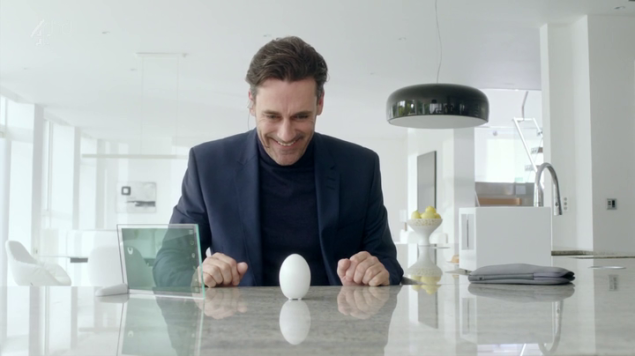
The poison scene weirdly reminded me of a corrupted version of Shakespeare’s Hamlet, where Hamlet’s father is killed by having poison fed into his ear. An untimely revenge; perhaps the consequences of inauthenticity. The ghost of Hamlet’s father reappears in the play, and even when he is not present, the spectre of his wish haunts Hamlet’s frustrated consciousness. White Christmas is also concerned with ghosts. We might even consider the title an ironic reference to Bing Crosby’s ‘White Christmas’: ‘I’m dreaming of a white Christmas / Just like the ones I used to know’. Well, these lyrics seem pretty sinister in the context of this episode, where what’s white is the symbolically smothering snow and the egg-shaped ‘cookie’ device that connects to an implant in people’s brains. An implant that duplicates the self into a ‘cookie’, a cookie which is externalised and given a simulated body. A body that might not be real, but is certainly sentient.
If we used to know Christmas as pure and white, all love and peace and Sainsbury’s-spouted Christmas truces and freedom from suffering, Black Mirror throws this day of spirited possibility into suspicion. The twist of the tale reveals a moral dilemma that haunts the use of such duplicating technology that takes us towards the realm of cloning; but, as in episode Be Right Back, keeps it close enough to the present state of technological reality to really disturb. Is it wrong to harm things that aren’t real, but still feel pain? Can we keep our simulated extra-selves as slaves to enhance our lives, even if it forces them into a lifetime of torture? What does it do to our personal identity to be physically conscious of doing harm to some simulated duplication of ourselves?
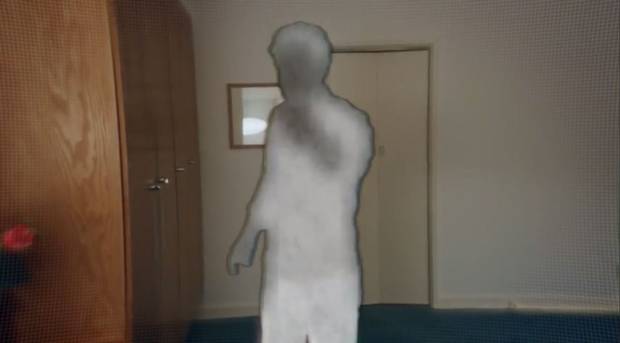
As with Hamlet, the theme of retribution runs rife through the episode. Partners punish one another through ‘blocking’: a way of cancelling out an entire person – as you may do on Twitter and Facebook – only in real life. The person in question becomes a pixellated greyish blur, like a glitch from a computer game that you can never quite get close to properly, even though they could still do you physical violence. Weirdly enough, the blocked figures in White Christmas reminded me of Pokemon Red and Blue’s ‘Missingno’, which appeared as an odd remainder of scrambled code that never quite got fixed in the games’ final cut. A Pokemon that appeared mysteriously without indexical recognition; an unknown creature. The name ‘Missingno’ also seems somehow relevant here, as it stands for ‘missing number’, as if the human in question was stripped of his/her name and personality, and left only as the grey matter of their brains, the bureaucratic residue of a ‘missing number’, 1984 style.
Only, unlike the geometric shape of Missingno (oddly resembling a missing puzzle piece), in Black Mirror you still see the human outline of the person you block. The fluid movement of their head and limbs. Their speech roars at you like a radio out of tune and communication will never ultimately travel as you want it to. Even in photographs, the blocked person dissolves from view. An absence cut permanently from your life; or at least until they unblock you. With great precision and a balance between steely analytic satire on contemporary social media and emotional humanity, Black Mirror explores the human consequences of such technologies: heartbreak, misunderstanding, new forms of enduring punishment. Matt is ultimately punished for his role in inadvertently causing Harry’s murder by being universally blocked, so that all humans are to him blobbed and distorted like a sea of Missingnos, and to everyone else, Matt becomes a red blur. We might think back to the days of MSN Messenger, where if we blocked someone from talking to us, on their Contact List we would forever appear as the red ‘Appear Offline’ icons. Always within reach but never fully present or within contact, we would linger elusively on their list of contacts but every message they tried to send would be lost in the ether. Technology, from the beginning, is a story of both absence and presence, communication and severance. It is all too easy to talk to someone across the globe, to love them truly even though they may be a stranger; it is equally all too easy to cut someone out of your life seemingly forever at the click of a button, given how much time we devote to living online.
Being blocked. Source: theindependent.co.uk
I think it’s appropriate that such an episode is aired at Christmas time; the time when everyone finds themselves worshipping at the circuitboard altar of a new tablet or phone or smart-watch. It issues a kind of warning, at the same time as being dramatically gripping and comedically entertaining. We live in an age of Sony hacks, Gamergate, iCloud leaks, attempted murders committed by children under the influence of online Creepypasta mythologies, Twitter abuse storms and the rife availability of online child pornography, smartphone apps which track your every dietary intake and calorie burned, as if you were some cookie of yourself trained and disciplined by the ethereal whims of your own idealised higher being. Technology is clearly something we frequently use to abuse ourselves and one another as human beings; it brings out whatever darkness is already in our nature and provides the platform for exhibiting this darkness more effectively. If we lose ourselves to this ease of abuse, where will we be in five, ten, twenty years time? Maybe only Charlie Brooker knows.
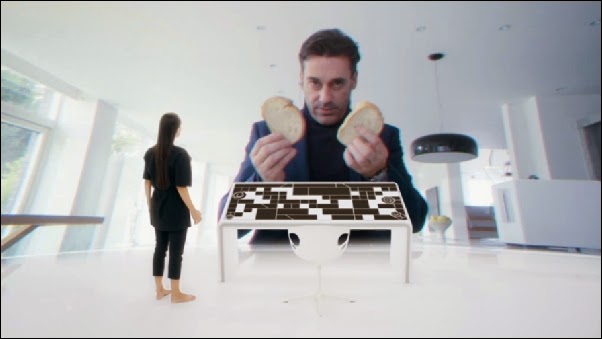
If Back to the Future got some things right about 2015 (pollution, nostalgic 1980s cultural revival), and others pretty wrong (hover-boards and flying cars) it’s difficult to say how much Black Mirror gets right about our future. The most chilling aspect of all Brooker’s episodes is perhaps how much they touch on a prosthetic logic whereby we lose ourselves to the tools we employ to help us that is already in operation today. A prosthetic logic that only needs a few more steps in Santa’s workshop to become Brooker’s nightmare vision of reality. There is nothing wrong with the technology itself per se, the show suggests, but the way we lose our humanity by giving ourselves up fully to the wonders of its operation. Surely the best metaphor for this is Oona Chaplin’s character, who literally forges a double of herself (called a cookie) and enslaves this poor spirit animal to a life of making toast and adjusting the volume of ambient music, simply for the benefit of a more efficient and technically-enhanced lifestyle. If we surrender all morality and consciousness to the endless improvement of this so-called ‘lifestyle’, aren’t we forgetting the things that make life worth living? White Christmas ends with Matt drifting out into the ultimate alienation of universal blocking, and Joe in a hysterical condition in his prison cell whilst his cookie lives in an infinite torture of Wizzard’s ‘I Wish it Could be Christmas Every Day’ being played on repeat while he exists forever trapped in the isolated kitchen. This manic but also slightly funny conclusion reveals the show’s unique blend of human sympathy and nightmare desolation. No matter how many times he tries to smash the radio, the song keeps playing. It’s like that time Celebrity Big Brother decided to lock Basshunter in a room for six hours with his song ‘All I Ever Wanted’ playing on repeat really loudly. Sure, Brooker’s ending is a bleak reminder that Christmas isn’t always great for everyone; but it’s also a reminder that you should be careful what you wish for. After all, it’s easy enough to become slaves to the technology that enchants us, but not so easy to sever ourselves from this technology, once we’ve realised that it’s usurped our humanity, and maybe even our sanity.
Christmas begins with a different ritual for everyone. For some people, it’s when the radio stations start playing familiar Christmas hits from the 80s. For others, it’s the first bite of a mince pie crumbling its buttery sticky sweetness in your fingers. For most supermarkets, it’s the day after Halloween, when the shelves are quickly stocked with tins of Roses and Quality Street and Celebrations and a Christmas tree is rather humbly erected in every store’s entrance. For me, it used to be when we started making cut-out paper snowflakes at school; when they would play Christmas songs on the old stereo system that crackled when anyone walked near it, as if it were possessed somehow. Or a trip to a pound shop to buy our dog an artfully tacky sparkly collar and/or chew toy and/or basket of treats. These days I’m involved in buying sparkly socks more than dog collars, but the sentiment is still there.
Some people are super keen for Christmas and have their trees up right from the first of December. In the library during exam period the festive jumpers are out in full swing, as are the seasonal lattes (Praline and Pumpkin Spice) retrieved from the Byres Road Starbucks. In our house, the tree usually doesn’t get put up until Christmas Eve; since our cousins from England would sometimes come up to us, we would wait for their arrival to decorate it, late in the evening, before leaving out a carrot, mince pie and brandy for Rudolph and Santa.
Traditions, however, change just like people. At school, Christmas came with the baggage of P.E. becoming training for social dancing throughout December. No Scottish child has been exempt from the painful awkwardness of having to choose a sweaty-palmed partner and learning to dance often incredibly complex steps (I’m looking at you, Strip the Willow) to the amusement of all their peers. And that’s if they’re lucky enough not to be left last and paired with a teacher. Of course, the older you get, the less embarrassment tends to dominate your entire consciousness, so dancing becomes more fun. You know, I would even go to a ceilidh of my own free will now, although back then I thought it was a form of torture cooked up to torment children out of enjoying their Christmas. It didn’t help that the school dance also involved the necessity of buying a compulsory sequined party dress (not a fun enterprise when you are a ten-year-old tomboy that hates shopping) and a dinner whose only option for vegetarians was salt and vinegar crisps (I swear I’m not really complaining). Still, the brutally hilarious fights over ‘he wiz dancin with ma girlfriend’ that you could witness outside afterwards while waiting to be picked up made the night somewhat worth it.
At secondary school, playing in the brass band forged new festive traditions. There were the rehearsal days for the Christmas concert, where you got to take a whole morning out of class, carrying your instrument down to the tinselled town hall and sit for hours munching snacks from the local Spar and watching everybody else perform. Then there were the primary school tours, where we would pile into a mini van and play in the surrounding school assemblies for the generous payment of a box of chocolates that were swiftly devoured before lunch. You felt so important, playing up there on a stage and being praised by your old teachers while all the little kids watched you with wide-eyed wonder and you remembered that you were in that crowd only a few years ago, hoping that someday you could be the big kid on stage with the shiny instrument adorned with tinsel.
When Glasgow’s shoppers’ wonderland, the aptly-named Silverburn, opened its doors, a new tradition was created. Picking me up after a hard day at college, Mum would drive me up to the shopping centre and we would do the last bits of our Christmas shopping. There’s a certain magic to the indoor consumer paradise, with all the lights and the giant snowglobe for kids to get pictures in and the seductive glow of expensive shop windows. Everything was warm and clean and once we’d done our shopping we’d go for a mince pie at Starbucks, where we could look out over all the people dressed in reindeer jumpers and laden with glossy shopping bags. These days, traditional Christmas has become more fashionable and you can go to see the Christmas markets in pretty much every British city. It all has a German and Scandinavian flavour which still feels a bit refreshing. We used to always go up to see the lights at George Square, a tradition that seems very sad and innocent now after yesterday’s heartbreaking incident, but nevertheless retains importance in my memory – and many people’s memories, I should imagine. There’s also the lovely, extravagant decor of traditional department stores which resonates the Christmas magic of the early twentieth century: I’m thinking Princes Mall and House of Fraser in Glasgow, then Jenners and Harvey Nichols in Edinburgh. I’m sure London too has much to offer, although sadly I only get to experience that through my half-hearted attempts to join my family in watching the terrible Christmas specials of Made in Chelsea.
George Square
It used to be that we’d go to Culzean to collect twigs and fir cones and sprigs of holly for decorating the house. We’d spray them with gold and dip them in glitter. Sometimes we still do that, as if living out the old ritual of making Christmas cards that Mum made us do every year when we were at primary school. I love crafting and firmly believe that it’s one of the most relaxing things you can do. A few years ago I went through a phase of making loads of candle holders out of glass jars which I painted with acrylics. At school there was always the last few days of term where people wandered about not doing much and hardly going to class. Teachers would wave us away with a ‘Merry Christmas’ instead of teaching us and we’d sit and watch Meet the Fockers on repeat (at least in primary school we had the enterprise to bring in board games) and wish we’d decided to skive. Often I retreated to the art department where we could make snowflakes and paint bottles and pretend we were little again.
At uni, the last classes are a bit more exciting. For one thing, mulled wine often factors in. Also, the fear (in first and second year at least) of Christmas exams. I used to hate how university decided to give us exams in December, with only a week to study for them. It was incredibly stressful, but in the long run I suppose it was a good thing because we didn’t have to study much over Christmas, as we did with the January prelims for Highers and Advanced Highers. Sometimes, the fear makes Christmas all the more sweeter. I remember in my first year at uni, I’d just gone with a friend to an impromptu gig at Brel on Ashton Lane. It was Rachel Sermanni and the singer from Admiral Fallow who were playing acoustic sets and it felt very wintry and magical. And when I left, to go back to my flat to cook chilli bean soup and study, it began to snow as I walked up Great George Street. It was one of those enchanting moments when you feel everything swell up and really seem to mean something. Like you’re in a movie. I was finally so happy to be in Glasgow and a student, even with three exams that week. It’s hard to not love your university and city when it looks like this:
After exams (and more recently, essay and dissertation hand-ins) comes all the comforting Christmas rituals that I love so well. Buying sparkly nail polish and the December edition of Vogue which weaves a fantasy of luxury office Christmas parties thats nowadays I have the (privilege?) of serving if not just imagining. Seeing fairy lights being put up in the restaurant where I work and all the Black Friday and Christmas bookings looming before us. Decorating the Christmas tree at home each year with new decorations got in our stockings. I missed out on decorating the Christmas tree at school, but came back from Belmont one day to see that we’d managed to procure one for the sixth year common room, and someone had decorated it artfully with ornaments worthy of any John Lewis special collection: a load of empty crisp packets.
My flat at Christmas time, 2012
Still, sometimes makeshift Christmasses can be fun, or at least interesting. My brother and friend Jack randomly phoning in and singing ‘Last Christmas’ live on BBC Asian Network radio. Stringing a half-hearted bit of tinsel and some Poundland fairy lights over my bookshelf. In first year at uni, we had a festive dinner party in halls, but seeing as I’ve always prioritised exams and studying over pretty much everything else, I ended up cooking my own vegetarian option which was incidentally the only thing I had in the fridge: a fried courgette. Even so, the party poopers (obviously I was included) were the ones who had to scrape all the meat scratchings and grease off the dirty pans like a band of Cinderellas until one in the morning while everyone else was having a good time at the QMU’s Cheesy Pop. Still, it was a lesson in the underside of hospitality…
My Mum’s nutroast
Arguing about who will do the washing up is a regular feature of our household at Christmas, as it probably is pretty much everywhere. It’s not so bad when you do it together. That’s the festive spirit, anyway. Then on Boxing Day we tend to go for a nice long walk – one year it was along Ayr Beach and through Belleisle, another through Maidens and Culzean, in past years it will have been places in England. Christmas Day used to be an early dinner and then sitting in the hallway stuffing myself with Quality Street and playing the new Pokemon on my Game Boy Advance while everyone else watched the Queen’s Speech and boxsets of Only Fools and Horses. We still retain the tradition of eating bagels for breakfast (I wonder is this some kind of strange nod to our Jewish ancestry?), but nowadays it’s more a cheeky Amaretto or some Bucksfizz (maybe it should adapt and be Buckfast) and a lovely walk up to Maybole monument through the golf course and dinner at about eight when the crappy oven we have at home has finally decided to roast the parsnips. Both have their magic. The best part is still the waking up early to open my stocking. This year, I’ll be working Christmas Day, so I’ll have my Christmas on Boxing Day. But that’s okay, because Christmas is what you make it.
A typical Christmas scene…Bella worn out from opening her many presents…



 mariaology