notes on fake heiresses

‘I work for my success, I earn my accomplishments. […] Maybe you can learn to be smart like me. I doubt it, but you can dream’.

I would really like to exorcise Anna D*lvey from my present obsessions, having blitzed through the hyper-cringe miniseries and comparatively breezy podcast in barely a week, pursued a bunch of Instagrams and finally shut my eyes only to dream of that accent grinding through a void. 

Credit card, credit card, credit card
assspiration/respiration

I used to draw pictures of infinity pools and flick through brochures of luxury hotels for no other reason than my dad works in travel. 

In Anna’s story, to dream is compensatory for the actual accomplishment of success, and your dreams can be extracted by an app called Shadow…….and all that dream data you uploaded gets aggregated as part of general projects of self-optimisation, leading to what? 

I prefer my shadow-realm in dreaming device; what other people dream. You can listen to the stories of other people dreaming by pressing yourself to the groundwork of a landlord nation. So many people have pressed themselves to the skin of these floors and walls. Why the old hard rain or old hard road? It’s nice to stand outside in the rainy asylum of television.

There’s a loud buzzing in my flat like a fly the size of a building is stuck. It’s been going since Thursday.

Today at four o’clock a dark grey cloud. 

Everyone on the internet seems to criticise AD for not using conditioner but I like seeing out of context screenshots flash across google — prison is so exhausting, you wouldn’t know — and everyone asking where is she, what’s that bridge — boys with names like Hunter and Chase

Get off on development

Writing this adds to the AD economy, but I can’t help making notes. For a while now wondering what a dream is and wanting it always to be more than compensation for the struggle we’re put through — dreams are not opiates for mass depression — 
ineluctability. luxury. 

We are suffering a mass shortage of pleasures at least in the narrow world of these isles and especially what I imagine to be england……..who else watches this and thinks, I don’t even like champagne. I wanna be adored comes to mind………I find the soundtrack flashy and intrusive like TOO ON THE NOSE but perhaps being gauche is aesthetic necessity……if you are trying to do a satire on the people whose lives you incorporate fully by lassoing the loop holes of their own system — weakness, lust for novelty, a good story.

Court fashion. What it is to be well-heeled. Attentive to somebody’s daily post. I miss outfit posting thus Polyvore and lookbook but also, ouch. It’s all in posture? Like how you present the myriad proprioceptions of finance itself, plus conceptual finance & platonic finance. Get your eyebrows done. 

Obviously this whole show is about whiteness and how this is performed, tacitly stratified and constructed for actual material consequence, a f f l u e n c e.

What would you do with access to an app called Shadow? What invocation of the shadow realm does this offer? My eyesight is getting worse the singer is a blurred intimation of human blue on the stage. My dreams blur as with eyesight, so become less of narrative detail & character — more of feeling. I wake up with spillages of emotional pigment all over my chest, belly, brain. Sometimes it makes you wet too

which is to say, we read each other. 

Deeply? Every time I blink there are several billion more tweets in the world, you have to know that. Know it all the time like feeling your white blood cells come up. I have a bulimic consciousness I don’t want any more info, the words are burning my throat

for how long has acid been pouring upon them

Los Angeles in fall?

You can tell by the podcast voice. Someone says ‘scammer and scammer – a match made in heaven!’ 

spoiler alert for other fake vocal fry heiresses.

This one is the largest dream database in the world, it’s in her heart. You gave all the dreams by watching it, like & subscribe. Self-identity as Futurist means you floss everyday on the internet. I’ve been studying the little bits. 

Last night a tiny centipede crawled out of the spine of my copy of Susan Sontag’s As Consciousness is Harnessed to Flesh. I want to go to San Francisco. I want the noise to stop. 

AD = After Death. Anno Domini. Anna Delvey. Advertisement. Advantage. Analogue to Digital. 

Bin man outside is singing INXS. 

Dumb socialite lite lite extra cherry diet coke

‘I wanted to learn everything. So I could be anything’.

The Anna D*lvey aporia of February. 

Scam trends of 2022 as response to crypto? 

Tindering loneliness, paying for soap operas of algorithmic advantage, buying virtual real estate including the non-fungible artefact of a HEX number. 

I wonder who I spent a long time being real in. 

How much I paid a month to use all that purple. 

It’s so convenient to log into all the channels at all times, listen to other people talk of their dreams in computerised accents, dream exactly their dreams until you are what kind of god posting anyway, just to reblog them in the 24 hour window of the story

you feel accelerated then smoothed, depressed as in self-love

just to be in their world at the click of a button

I like her best in the lilac pantsuit and classy copper

abyssal sensation that some of this is really true, even the fashion. Slip diamanté talk of I love Dostoevsky accordant to telly

A book she says her father passed onto her, it’s all about struggle, and telling the psychiatrist, Look, that character who said he was going to america, “he shoots himself in the head” — you know what happens

resultant 

cesspools of debt 

“to girls like me”

precognitive data analysis [ crisis ]

augmented saturates of the dream economy 

surplus love 

love

plus size appliances 

Turns out, a scam, you can use right now for free 

taking out money the same as taking the bus to just get somewhere 

none of this is real

no land

forms a bubble

The Greatest Loss: Lana Del Rey’s Anthropocene Softcore 

Screenshot 2019-09-08 at 11.26.09.png

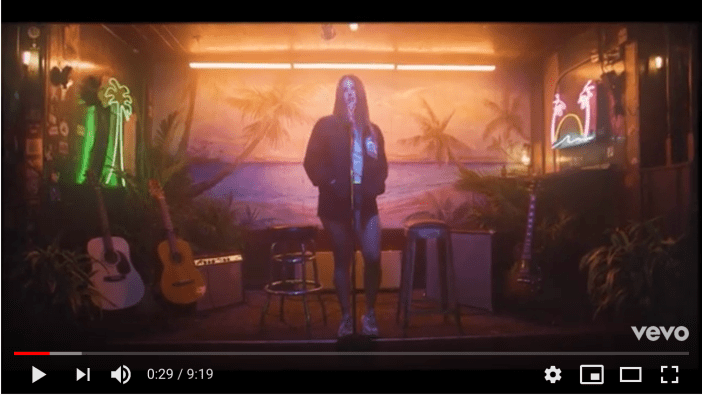
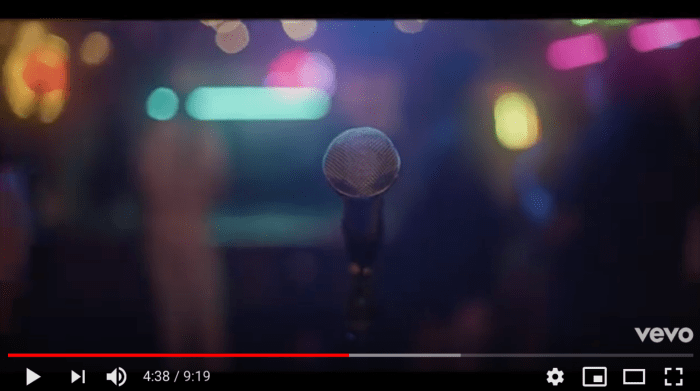
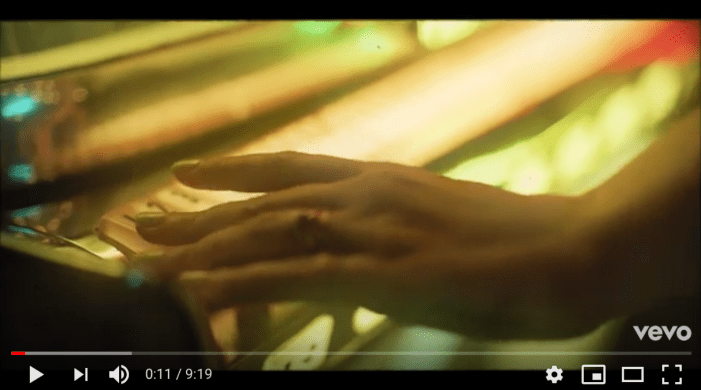
There is a scenario in which the jukebox is equivalent to the poet and some elaborate analogy is to be made between intertextuality and the limited catalogue whose selectional form produces play. The scenario only survives in video. It needs this urge of duration, not to mention the tenderness of a touch. Where fingers brush keys like notes, there is something to add to the story. A social space in demand of ambience; on flickering alongside off. When Lana is alone on stage, hands stuffed into a bomber jacket, singing ‘Fuck it, I love you’, swaying almost nervously, I want to think about what she is doing there and who she is speaking to and from where she is speaking. She is not really speaking but singing. The lone girl on the stage is the open mic dreamer, with nothing but lines. She is scattered across june-dreams of multiple personality: ‘The I which speaks out from only one place is simultaneously everyone’s everywhere; it’s the linguistic mother of rarity but is always also aggressively democratic’ (Riley 2000: 57-58). We mother our solipsism with words but in doing so there’s an opening. So to say fuck it and state the interruption with syncope, sincerity. Lana Del Rey was born on the cusp of Gemini and Cancer season, which more than explains that statement: ‘Fuck it, I love you’. With her sails to the wind. To say it over and smooth into plural refrain, you could even say chorus. For a chorus wants to be shared. It is a commodious mother, fed by the keys of the jukebox baby. There is a constant reversal of nourishing; the democracy of lyric utterance, the milky feed that streams.

Denise Riley argues that any ‘initial “I love you” is barely possible to enunciate without its implicit—however unwilled—claim for reciprocation’ (2000: 23). But what is reciprocation in a song? Is it just the urge to be sung with? And this ‘fuck it’, the pervasive millennial injunction to just be, to move on, as the tag which erases the expectant price of the utterance? Riley argues that I love you ‘must at once circulate as coinage within the relentless economy of utterance as exchange’ (2000: 24), but in a pop song it bears the leaden weight of so many prior expressions. The irony is that to cut through that with a simple fuck it, Lana can attain something like sincerity in the very pop mode whose lineage of commercialised love would surely undermine her feeling. Fuck it, in spite of saying I love you I really do. The pop song becomes this space for the staged epiphany of repeated assurance, I really do. It is a softcore admission of the self in its burning limit. 
Screenshot 2019-09-08 at 11.26.37.png

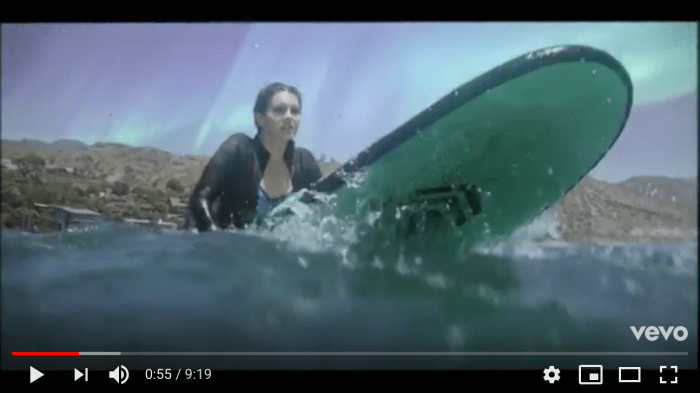
‘Fuck it I love you’ is soaked in lights, but they’re fading. ‘I like to see everything in neon’, is the line that opens the song. To see everything in neon is to fluoresce what is haunted and gone. I think of Sia dragging rainbow dust down her tearful cheeks in the video for ‘The Greatest’ — tragedy’s shimmer as fugitive mark on the body. Lana offers herself up as sugar dust, cliché in honour of Doris Day: ‘Dream a little dream of me / Make me into something sweet’; she acknowledges ‘dancing to a pop song’, but it’s not clear if this is her or the character or the one she loves. ‘Turn the radio on’ could be a reflection or an imperative. The reader is hailed between these positions of love and the loved and the effect is saturating, warm, delirious. Separation is that ‘it’, the spacing. In the video, we watch Lana painting and then suddenly she’s surfing with the aurora borealis in the background. She’s on a swing, her jean shorts caressed by the camera, she’s the sexualised pop icon again. She’s on a surfboard, green-screened, young. She’s choosing a shade of yellow from the palette, singing ‘Killing me slowly’. What is this ‘it’, killing her slowly: 

I’ll return to the unknown part of myself and when I am born shall speak of “he” or “she.” For now, what sustains me is the “that” that is an “it.” To create a being out of oneself is very serious. I am creating myself. And walking in complete darkness in search of ourselves is what we do. It hurts. […] a thing is born that is. Is itself. It is hard as a dry stone. But the core is soft and alive, perishable, perilous it. Life of elementary matter.

(Lispector 2014: 39)

I want slyly to argue that this is a kind of anthropocene existentialism. Recognition of the self as this ‘hard’, ‘dry stone’ thing of geologic mattering, reflexive species. This is what it is to be ‘Human’ right now. And yet the agential spark within, the ‘core’ that is being alive in a world where we have deposited those sedimentary layers. Creating ourselves in the stone, often with the tarnish of the very products we chose and developed to beautify, excoriate and cleanse ourselves, to remain forever young. So there is this oscillating temporality at work between desired infinity and the trace of our fugitive place on earth. The very earth minerals that would ruin humanity, mine our bodies of endless labour. But to go back to the song, with its idea of a gradual dying. I want to call this something like anthropocene softcore: the unnamed presence of species being within Lispector’s slender novel from the early seventies, or the Mamas and the Papas brand of late-sixties ‘sunshine pop’ whose solarity derives from the perishability of that energy, utopian commons, cascade of flowers — that serotonin glow of selves in streams and streams. 

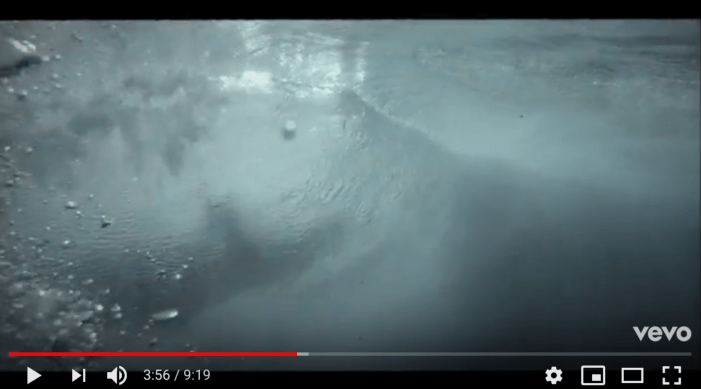
Lana’s anthropocene poetics are not of the hardline, direct call to action. You would not say of her cultural presence, eco-warrior or nature goddess. You would not brand her Miss Anthropocene in a kind of demonic marketing gimmick. You would say most often she is a siren, per se, leisurely supplicating us towards death on the rocks. Desirous flow. This is anthropocene softcore. This is what it is to challenge the act of self-description itself, and in doing so questioning those generalisations that arise from the ‘we’ of humankind, not to mention the ‘I’ of pop’s delectable, mainstream lyric. Alchemically, Clarice Lispector and Lana make of these malleable pronouns the ‘perilous it’. The it, the feeling, the speaking self which is nothing much more than a bundle of affects, sensations, atoms. To be cast over and crested by the wave. Significant that ‘Fuck it I love you’ ends with the rising bubbles of this wave, the one that spills us through the fourth wall and into the studio. This song slams together pop’s saccharine mythos of California as dreamland, a late-summer song as the former was written, surely, for autumn. California: ‘it’s just a state of mind’. She could be talking about the self or the state, or the state of the self. 
Screenshot 2019-09-09 at 20.44.25.png

What happens next? The shot drifts over the cliffs, the coast, to a strip of palms and a distant view of the LA skyline. That shining love in the previous track is replaced by a minor key, a glimpse of the jukebox whose songs include The Eagles, Bon Iver, The National. Artists whose Americana is the melancholy of generations moved from political despair to something like the glitch of the times as a basic fact of intimacy. One of the Bon Iver songs shown in the video is ‘22 (OVER S∞∞N)’, and if that title was not rife with implicit apocalypse, what is, what is. A stammering into language, pitch-shifting the fragile space of utterance. There’s a spiritual glimpse to the sky and the infinite quality of the stars: 

There I find you marked in constellation (two, two)
There isn’t ceiling in our garden
And then I draw an ear on you
So I can speak into the silence
It might be over soon (two, do, two, do, two)

(Bon Iver, ‘22 (OVER S∞∞N)’)

I don’t know what the maths is doing. I don’t want to know that the song ‘was inspired in part by Bon Iver mainman Justin Vernon’s unsuccessful attempt to find himself during a vacation’. I am however interested in the hubris within this term ‘vacation’ at all. Do we now live in a world where you can take ‘time out’? There is nothing of the world we know that could be switched off. There is no ‘away’ of complete erasure or original presence. Deconstruction caught up with our living. Vernon describing this song as a gesture towards what might end of his emptiness could just as easily be flipped: its relief is equal to a mortal sense of loss. The impending erasures. It ‘does’ or acts the accretional event of extinction that is speaking into the silence, to those who could not speak back. 

Fragments and snatches: the neon green lining Lana’s eyes, the aurora borealis, the neon green palm in the club where she sings alone. A season by yourself. The love of the couple together surfing is cardboard, Hollywood. It is a trembling symbol. It is almost ridicule.
Screenshot 2019-09-08 at 10.27.46.png

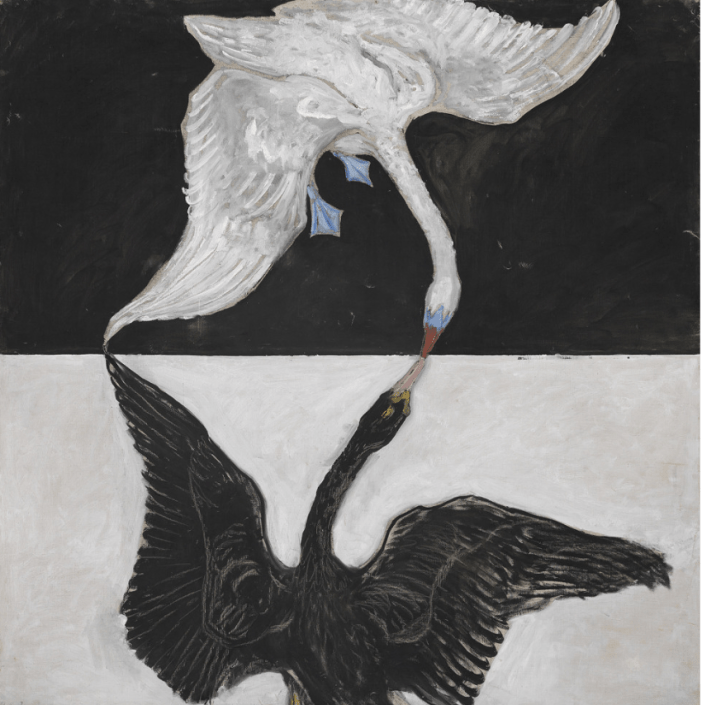
What is Justin Vernon looking for in the constellation? When he sings ‘two two’ I think of Hilma af Klint’s nose-touching swans, or the hours of the day chipped at the edge — two of them stolen by tragic event. I think of a mic check, two, two, ch, ch. Click. Near-enough-presence of speech. A white swan on black background; a black swan on white background. Flip. The swans are geometry, signets of signature, they move towards abstraction. Growth. I love them. Fuck it I love them. The way they are just it. Inversions of colour and a monochrome mood splashed with cornflower blue, the tiny excess we can treasure. It is the cornflower blue, the little webbed feet, which make the swan in question unique. So we can care for it, figuratively as it swells through grey-white waters of memory. The swans we have lost in our shit. Royal iterations freed from belonging. This painting is from af Klint’s series Paintings for the Temple, works derived from spiritual communication. The abstraction of the swan / renders us stark in frame / for we were Lana or Leda / before we were animal. Sufjan Stevens’ ‘Seven Swans’: ‘All of the trees were in light’, ‘a sign in the sky’; ‘My father burned into coal’. And all of our sadness was carbon neutral before this. We plunge into whatever remains of the water, its plasticky thickness.

I keep pausing the video as it transitions. ‘Fuck it I love you’ twinned with ‘The greatest’. When The National sing It’s a terrible love and I’m walking with spiders, what exactly is the ‘quiet company’ of the ‘it’? It could just as well be spiders. Maybe it’s the web itself, the web between the human and the more than human, the gossamer moment where metaphoric articulation becomes more than feeling and gleams material. ‘It’s a terrible love that I’m walking with spiders’ — what is the grammatical transition done by that ‘that’ and who is to blame. Walking with spiders might just be that love. Transitional, subject/object logic is reversed in this song: ‘Wait til the past?’ is sung, then ‘It takes an ocean not to break’ when surely the ocean itself would break you. Soon the ‘terrible love’ is a substance, something ‘I’m walking in’ — to feel it is an act of immersion. It is to let that wave crest over, the ‘lyric auto-explosion’ (Moten 2017: 3) of the wave that would break you. 

In ‘The Greatest’, Cat Power sings of former ambition now cast to nostalgic regret. There is a sense of time slowing to delay, laconic strings, relaxed drums, the balladic sleep of a once-held fault. It is a parade slowing down in the rain. To say ‘Once I wanted to be’ is to hold this question of ‘the greatest’ as a generalised desire itself. The hunger we lose in time, whose primary colours soften. I hold to that precious, cornflower blue of a swan’s foot. ‘Two fists of solid rock / With brains that could explain / Any feeling’. This solid rock that would box you into the future, that would harden the edges of self. A thing is born, as Clarice puts it, ‘hard as as dry stone’. This is the thing born ‘that is’. To exist is to be this hard thing, protein ligament, to kick out in lines; but then in time there is the plasmatic self inside that, like some fatty animal byproduct, sticks to the others it loves, it needs, it leaks. Gelatinous, softly sticky love. The ‘it’ that needs saving. Anthropocene softcore; soapy inside of all geologic agency. Who we are and what we regret. The turning of the outside-in, the inside-out. Kathleen Jamie, in Sightlines, asks: ‘What is it that we’re just not seeing?’ (2012: 37). 

A sightline is a hypothetical line, from someone’s eye to what is seen. Is it clear or blurred, bad or good? Anthropos recedes in its very own scene as the ocean continues and we howl in the dark like a lossy-compressed version of species. We are the sirens and wolves. We are at the great concert of the Earth. We have to resist what Bernard Stiegler calls the ‘proletarianization of the senses’ (2017); we have to find longform ballads of what’s happening, pass them down the line, resist the short-circuiting of thought that occurs between screens and machines. We have to send letters back to our consciousness, our elders and children. This is the work of lyric. It could be the work of dance. I think of Zelda Fitzgerald’s protagonist, Alabama, learning to be a ballerina too late in her life: ‘Her body was so full of static from the constant whip of her work that she could get no clear communication with herself. She said to herself that human beings have no right to fail’ (2001: 180). Alabama barely eats; her energy is all the zeal of will. The dance of lyric as reduction, lack, as static and chased success whose collapse lands as Alabama will eventually do on the event of inevitable break. Grapefruit squeezed on the gritty turmeric shot of the future. And a brake, a screech. And yet we write, we cast out limbs and materials, we work towards this loss; we imbibe it. 

This is an ugly type of writing in which the outside is always imagined from the inside. Horizons are fictional and buildings are barred. I have no sightlines. I’m fucking cutting the corners of someone else’s desire. All paths are the continuation of a pre-existing line. This is a city from which I send myself postcards wherein I wish I was here. Flying letters. Words stolen from myself. I refuse to recognise that I have not composed them unintentionally

(Bolland 2019: 78).

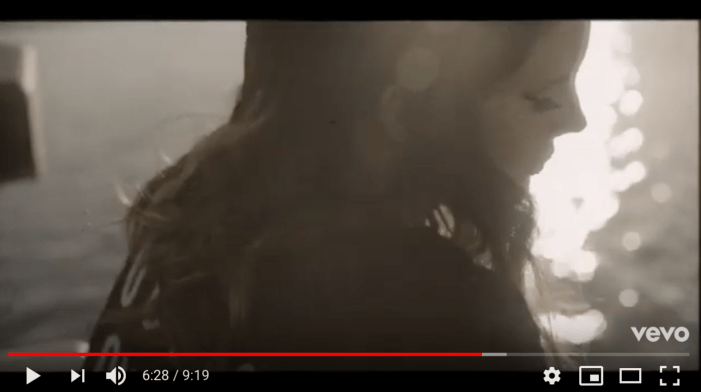
The videos for Lana’s ‘Fuck it I love you’ and ‘The greatest’ swerve between inside and outside. We find ourselves in rooms we don’t remember entering. Writing the anthropocene has an ugly, masturbatory quality of fucking yourself with the rush of elaborate doom. Okay, so. Constructing fortresses of lines which would make a valiant destination. When I listen to Lana, I’m accessing shortcuts to ‘someone else’s desire’ which is the opening up of presence. ‘This is a city’; ‘I wish I was here’. I have never been to LA. We plagiarise our very own diaries to get back that sense of the once-intentional, the greatest declaration on Earth. That we were here, and we loved. She wrote that lit, forgot. The papers curled up and rolled away in a sultry air that was summer, 2012. The year of failed apocalypse, the year Lana released her debut album, Born to Die. We saw her campaign of fashion smoking through plexiglass bus shelters. Remember all ‘horizons are fictional’: they tell a narrative, they bleed and tilt and set like ice. Towards them we stupidly drift: the lived throb of our softcore skins, our hungers and rhythms.
Screenshot 2019-09-09 at 20.44.50.png

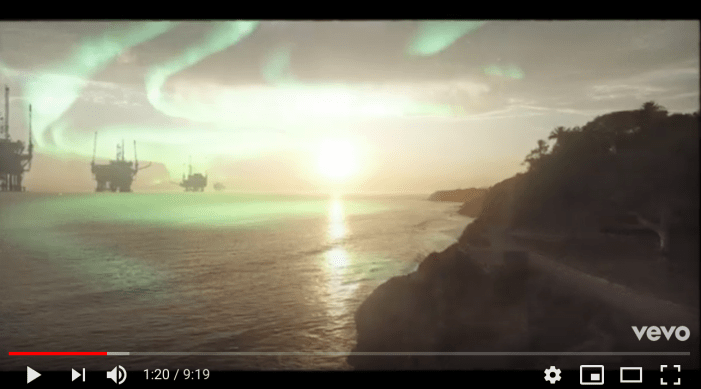
Drifting in colour like H.D.’s Leda, the rape of the land and the body and bodies engendering bodies. Worlds ending around us. And so I could say, but this is just one song, a phrase, a white woman of fame lamenting her world. But this self-conscious cinematics is a gesture towards the western world itself as this haunted, tragic protagonist: ‘The culture is lit and if this is it, I had a ball / I guess that I’m burned out after all’ (‘The greatest’). So you could say, anthropocene softcore speaks to the lyric I in its state of orphaned exception, which in turn is the loss felt by us all unequally. If we make of Lana a sort of anthropocenic siren, we must recognise the distinctions within our longing. For we all lose worlds differently; harm is striated along lines of class, gender, race, ethnicity, geographical distribution — of course. That wave that closes the video could elsewhere be a tsunami. I like to think its place on the edge is a deliberated hint to what could or is even already happening here or elsewhere. And maybe the colour, the aurora, is this streak of need for an excess beyond static blank, ‘human’ planet, standardised canvas; the need to splash something more of blur and blue. Flood the structure. 

When we say something is ‘lit’, we mean it is hot, on fire. We mean it is turned on, ignited, intoxicated, drunk, excellent. Lit is the past simple and past participle of light. Isn’t that line alone just lit? Maybe we are in the twilight of a former Enlightenment, recognising our species hubris as this alien green that tinges every familiar horizon, upsets the normalised green of pastoral. Is it toxicity, the elsewhere within ourselves? It is a radar showing who we are and where we have been. Those material metaphors cook on a smoulder, and this is the softcore coming to knowledge about what is happening.
Screenshot 2019-09-08 at 11.27.08.png

What does it mean to sing: ‘I’m facing the greatest / The greatest loss of them all’. To sing this on the brink of a hyperreal sunset, to chase a solar excess among loss. This loss could be a love but it is more like a culture; it is more like a voice and the condition from which to speak or sing it. The loss of lyric, its possibilities of address, and the loss or deferral or ruination of place itself. Maybe this is Lana’s lyric maturity, a generational acceptance that ‘young and beautiful’ is no longer the apex state of what we should strive for. Absence tenders complexity. Is this, as Roy Scranton puts it, Learning to Die in the Anthropocene? This question of mutability, the green-winged eye that sees a darkening world, a lack of birds along the bay, an edge. In the video for ‘The greatest’, Lana’s jacket reads LOCALS ONLY on the back. I google the phrase and find a hipster restaurant in Toronto with the slogan, LET’s PRETEND THIS NEVER HAPPENED. There’s a kind of parochial nihilism that glisters like the light on the sea, but the sea can never be local only. There’s a boat in the video whose name is WIPEOUT. It’s all happening; the signals are obvious. How we are practicing the absent-presence of the name’s erasure. My tongue gets twisted when I say anthropos; I want to say mess, I fall into ‘guest’ and ‘gesture’. With its glaring cinematics, LA offers the hospitality of light. But it is an exclusionary light. For now, only some of us get lit, get to the mic.
Screenshot 2019-09-09 at 20.46.01.png
Lana sings from within the metallic architectures of LA’s coastal infrastructure, the port. In the bar, she throws a dart and misses her target by a nonchalant smidge, knocks the 8-ball towards its pocket. I keep thinking about exports and imports, what we put out, take in and trade. Economies of luck and depth and surface. Maybe Lana is a hydrofeminist, her soaring lyric gesture recalling a hauntology of America as that dreamscape of what lies beyond or in the deep. And now we know it is further extinction, precarity, hardened borders. What do we do with that looming closure? Lana has shrugged off her jacket now, she’s smoking in the kitchen where the lid slides off the pan to let the steam out. I’m not saying we’re sitting on a pressure cooker here. There’s simply work to do, mouths to feed, ears to fill. This is a ballad, a paean to the transient, fragile beauty of everything. The songs shown again on the jukebox are songs of a type of blues specific to oceanic or cosmic consciousness, to hunger, the time of lost summer or that of a broken love:

Janis Joplin — ‘Kozmic Blues’

Dennis Wilson — ‘Pacific Ocean Blue’

Sublime — ‘Doin’ Time’ 

David Bowie — ‘Ashes to Ashes’

Jeff Buckley — ‘Last Goodbye’

Leonard Cohen — ‘Chelsea Hotel #2’

I’ve spoken before of what ‘anthropocene sadcore’ might look like in poetry. I’m still working through that. It comes from the common phrase used to describe Lana’s music, ‘Hollywood sadcore’. I’m interested in how that emphasis on mediation, transmission and cinema plays out in our understanding of ecological emergency, but more generally the existential condition of the anthropocene, which places us as geologic agents under the generalised, gendered rubric of Man. Maybe Anna Tsing’s feminist work on the ‘patchy Anthropocene’ could be applied to the cut scenes of a glossy Los Angeles caught on video. A patch is also a software update, where comprised code is ‘patched’ into the code of an executable program. Maybe the patchy anthropocene involves this kind of cultural patchwork: the lament to a love or a culture is patched to include this bug of ecological consciousness — the patch is a kind of coded pharmakon, poison and cure for apocalypse blues. But Lana paints in shades of yellow too. Blue and yellow making aurora borealis green. A cosmic gesture to what lies beyond thought. And what of those oil rigs in the distance, glistening. They form an audience to the siren’s lament; they are part of this story, and we are mutually complicit. Where the magnetism of the male gaze is often part of Lana’s canon, here it is mostly replaced by oil rigs — supplementary Man as the infrastructure of anthropos, looking back at its melancholic, warning siren. Softcore is less affective than sadcore; it is the ambient hum of climax coming. Its cousin is the slowcore, luminous melancholia of a band like Red House Painters, perhaps: Purple nights and yellow days / Neon signs and silver lakes / LA took a part of me / LA gave this gift to me’. 
Screenshot 2019-09-09 at 20.43.42.png

In Bluets (2009), Maggie Nelson writes of a restaurant she used to work in, where the walls were ‘incredibly orange’. After each shift, collapsing exhausted in her own home, ‘the dining room’ of the restaurant ‘reappeared in my dreams as pale blue’:

For quite some time I thought this was luck, or wish fulfilment— naturally my dreams would convert everything to blue, because of my love for the colour. But now I realise that it was more likely the result of spending ten hours or more staring at saturated orange, blue’s spectral opposite. 

(Nelson 2009: 43)

Orange and blue, water and flame. The mind’s alchemical transformations reveal the way colour works chiastically upon us. I think of Freud’s mystic writing pad, the waxen surface of memories allowing for palimpsest versions of stories that trace and erase. ‘This is a simple story’, Nelson writes, ‘but it spooks me, insofar as it reminds me that the eye is simply a recorder, with or without our will. Perhaps the same could be said of the heart’ (2009: 43). ‘Fuck it I love you’, sung to the blue-orange wall until something comes off that surface like a static or fizz. Irn bru, ironed blue. There is quinine in my dreams of hungover labour. Surely there is a violence to this particular love, that is staring, necessary. The love of what must be limitless hurts.

Screenshot 2019-09-08 at 11.27.23.png

Janis Joplin’s ‘Kozmic Blues’ rises to a swell, a jostling of guitar licks and urgent, assured vocals. A sonic thickening. ‘So mastered by the brute blood of the air’, H.D. writes in ‘Leda and the Swan’. Held in that vascular shudder that acclimatises to a manmade world, what happens next is a loosening, a shimmer, a shrug of the garment. In the poem or song, in the painting or film, in the collapse of that wave into a bluer future. To incur a kind of erosion and yet live on in those terminals. ‘There’s a fire inside of everyone of us’, Joplin sings, and I think not of flames but of cinders. ‘At what temperature do words burst into flame?’, asks Ned Lukacher in the introduction to Derrida’s Cinders (1987), ‘Is language itself what remains of a burning? Is language the effect of an inner vibration, an effect of light and heat upon certain kinds of matter?’ (Lukacher 1987: 3). I know if I did not write I would smoke. These acts of temporality in its material extinguishing. What makes the remembered restaurant blue, not orange, is something of this transmogrified smoulder — an inversion akin to af Klint’s swans, demanding that splash of blue. When I write, am I pursuing the absent space of that skyward blue?Blue is the colour of the planet from the view above, Lana swoons in a song (‘Beautiful People Beautiful Problems’) from her previous album, Lust for Life (2017). But in Norman Fucking Rockwell, Lana’s California album for 2019, it’s less of this ‘above’ we see. We are held within the infrastructure, cinema, the end of summer. The dreamlike logic of How did she get on that boat? When did she enter that room? Who put that song on the jukebox, baby?

I want to say:

It takes an ocean not to break a planet.
It takes not a planet to break a species. 

Lana’s voice grows wispier as she sings of that burnout. There’s this imperative that okay we could enjoy this with American flags, we could pour communal Jack and go down in flames. We could riff the history of our culture in archives of song, gestures and nods of reference. Ladies of the Canyon, Cinnamon Girl, Norman Fucking Rockwell. We could keep laughing or dancing while the world is or was at war. Lana is both behind and at the bar, the sightline of where we go to be ‘served’. Intoxication is the order of the day and we call it ‘fun’ to put the fucking of other people’s desires under erasure, strikeout, as Bolland does.

If this is it, I’m signing off
Miss doing nothing, the most of all
Oh I just missed a fireball
L.A. is in flames, it’s getting hot
Kanye West is blond and gone
“Life on Mars” ain’t just a song
Oh, the lifestream’s almost on

(Lana Del Rey, ‘The greatest’)

Miss doing nothing’: post-recessional ennui becomes the paradoxical happiness of living in static, not working as a kind of work that resists the future as set out by capitalist horizons of accumulation. We used to just ‘hang out’ and several other dreams of youthful nostalgia. Kids of today can’t even touch that innocence. We know so much; maybe or probably they know more. We are all variously entranced by the softcore unfold of this happening; we are all variously called upon to be complicit, to recycle, act, resist. To speak or not-speak. To be in one of many different levels of rising heat. The conditional state of being’s value, ‘If this is it’, in the anthropocene raises its pitch to a charge. To sign off is a form of surrender that gives up the name for the blur of species. I think of Lars von Trier’s Melancholia, the planet that would smash us and yet somehow Lana dodges it, that

The audience in the bar where she sings are mostly men, but their gaze is not sexual, as in much of Lana’s prior visual oeuvre. Rather, their longing gaze, often filtered through further glass, is something like the profound melancholy of a multi-generational sense of this loss. These old men have lost the planet, the one they grew up with, just like Lana’s siren, come from some other time, a life ahead of her steered by the changing climate, the hurt and vengeful seas. The camera holds close ups on their staring faces. The song holds the long durée of a loss that spans generations, damages and is damaged by elders, sparks in the present-tense of cultural tendency. In Lana these men look to a future hurt whose cause was partly theirs, as inheritors of industry: she is both victim and heroine, singing and swinging. The shot opens out to reveal her smiling with younger friends, her own generation. These intimacies are what we have left. The next shot shows some kind of factory or refinery leaking smog into a cloudy, overcast skyline, sulphured yellow. Once again the boat appears with its title, WIPEOUT. Lana is supine on the bow at sunset. She is golden, angelic, silhouette. It’s like she missed the fireball but melted it, cooked it up for tea, apocalypse syrup. Things are going down around us. She hugs her arms, later standing, laughing with a dreamlike intimation of imagined elsewhere, closing her eyes. Be hospitable to yourself and others. The reel of the jukebox keeps ever turning: this is our ever faith in culture. We have to take care of what’s left in whatever space we can make of song, duration. 

But the mainstream disciples and idols of Hollywood are failing, Kanye West is ‘gone’. Surely a reference to Elon Musk’s plans to save us by colonising Mars, ‘“Life on Mars” ain’t just a song’ is sung with a melancholy matter-of-factness, a kind of sigh which implies the banality of techno-utopia in a time of extinction. The thrill of such dreams is lost now. We lost our faith in Hollywood, lost our faith in the movies and the scale of those solutions. In a world without books, we’d be ‘bound to that summer’, addicted to one of many narcissistic ‘counterfeit[s]’ to make love to nightly in futile repetition — that would be, as Weyes Blood sings, the ‘Movies’. 
Screenshot 2019-09-08 at 16.56.01.png

What we look back with: 

The trauma is not, in the Freudian lexicon, this or that violation from the world (such as war), but the ill and trauma of this originary installation of “the cave”—what could properly be called the cin-anthropocene epoch, particularly given that the era of modern cinema is to be regarded merely as an episode: that of the machinal exteriorization of the cinematic apparatus, given that it coincides with the era of oil (artefacted “light”), given that its arc coincides with that hyperconsumptive acceleration leading to mass extinction events, ecocide, and an emerging politics of (managed) extinction

(Cohen 2017: 246)

The trauma of greatness as such is this accelerated promise of the dream, the event, capitalist growth, the movie itself — whose imperative is towards scene, closure, episodic narrative in demand of the next. But the drinks in this video are barely drunk; they are more like props. Everyone is aware of their place in the tableau vivant of the anthropocene, even in its softcore, consumerist pop expression: the iconography of oil rigs, downbeat affect and intergenerational longing. Not a violation from the world so much as the stream, and where its accumulative logic would eventually come to crisis, even as corporations beyond our imagining were already plotting that logic of a break within archival excess: the feverish incineration of the present, the smoulder and melt that smogs and spreads and streams. 

Fire is there or it is not there. […] But surely there is a word for that moment when a fire log, beneath its bark, has become one immanent ember, winking like a City or a circuit board; for that moment when you know only the desire, no, the need to stir it up. What is on fire, you ask yourself, staring into that waiting. What is that moment. What is that word. 

(Lennon 2003: 434)

The nights ‘on fire’ that Lana sings of are those of the Beach Boys, reprieve of the sixties; the bar on Long Beach that served as a ‘last stop’ before the tiny island retreat of Kokomo. Frank O’Hara died on Fire Island. Fire is presence or absence, but there is a moment before it is both. A slippage between the extinct and extinguished. And the world was lit up as before. I wonder if the word Brian Lennon looks for is simply ‘sleep’, the title of his essay which I first read in John D’Agata’s anthology, The Next American Essay — with intimations of that Lana song, ‘The Next Best American Record’. What is with America and the positioning of the next. A constant state of pressurised imminence that streams and streams: ‘We lost track of space / We lost track of time’ (‘The Next Best American Record’). We sleep into death or spirit. My first legal drink was a fireball whisky, in a pub by the sea they built in a church. That moment when you know only the ‘need to stir it up’, fanning the flames. That impulse towards blitz feels extra political in these contexts. We need something of relief that would stream, and in that flow be more than a question. Something of cinders, drifting. 

In Lana’s song, I’m interested in this word ‘lifestream’, which seems like a slippage from the more familiar internet-lingo, the ‘livestream’: the coming live that seems provisional to digital retro-future, the promise of satellites beaming the present, simultaneously. Lifestream, instead, is a vascular imaginary of bodies flowing together. ‘LifeStream’ is actually the name of a blood bank serving the Inland Empire and its surrounding areas. Lifestreaming is, Wikipedia tells me, ‘the act of documenting and sharing aspects of one’s daily social experiences online’. It is the flow of the timeline, akin to the wall, the blogroll, the feed. But here, at the end of the song, the promise of information’s overflow is in a liminal state — ‘almost on’. Extinction’s monetised data cast as the simultaneity of thick presence spread by millioning participants. We are here and we said something, our words were atoms, splashes of blue. We stream towards a life, cut ourselves short on the fragments of others’ desires. Mortality’s softcore contingent. The fear of missing out is assuaged by the narcotising work of cinema. And if this is it, Lana has already signed off. It’s something more like her spirit that’s here for us, the stream of an echo, fold of a song that we could replay, continue voicing. Hope lies in the circadian rhythm, the lived time of a pause in the anthropocene’s ceaseless, cinematic duration — that which we see and drown our hearts in. As Jean Rhys’ drunken, depressed protagonist of Good Morning, Midnight (1939 – the year WWII began) muses, ‘Well, sometimes it’s a fine day, isn’t it? Sometimes the skies are blue. Sometimes the air is light, easy to breathe. And there is always tomorrow….’ (Rhys 2000: 121). And what if tomorrow was the greatest loss of them all? 

~

Screenshot 2019-09-08 at 11.56.26.png

All screen grabs taken from here (Director: Rich Lee) and here (Director: Natalie Mering). 

~

Works Cited: 

Bolland, Emma, 2019. Over, In, and Under (Manchester: Dostoyevsky Wannabe). 

Cohen, Tom, 2017. ‘Arche-Cinema and the Politics of Extinction’, boundary 2, Vol. 44, No. 1, pp. 239-265.

Fitzgerald, Zelda, 2001. Save Me the Waltz (London: Vintage). 

Jamie, Kathleen, 2012. Sightlines (London: Sort of Books). 

Lennon, Brian, 2003. ‘Sleep’, The Next American Essay, ed. by John D’Agata, (Minneapolis: Gray Wolf Press), pp. 427-234.

Lispector, Clarice, 2014. Agua Viva (London: Penguin). 

Lukacher, Ned, 1987. ‘Introduction: Mourning Becomes Telepathy’, Cinders, trans. by Ned Lukacher, (Lincoln: University of Nebraska Press), pp. 1-18. 

Moten, Fred, 2017. Black and Blur (consent not to be a single being) (Durham: Duke University Press). 

Nelson, Maggie, 2009. Bluets (Seattle: Wave Books). 

Rhys, Jean, 2000. Good Morning, Midnight (London: Penguin). 

Riley, Denise, 2000. The Words of Selves: Identification: Solidarity, Irony (Stanford: Stanford University Press). 

Scranton, Roy, 2015. Learning to Die in the Anthropocene: Reflections on the End of a Civilisation (San Francisco: City Lights Books).

Stiegler, Bernard, 2017. ‘The Proletarianization of Sensibility’, boundary 2, Vol. 44, No,. 1, pp. 5-18. 
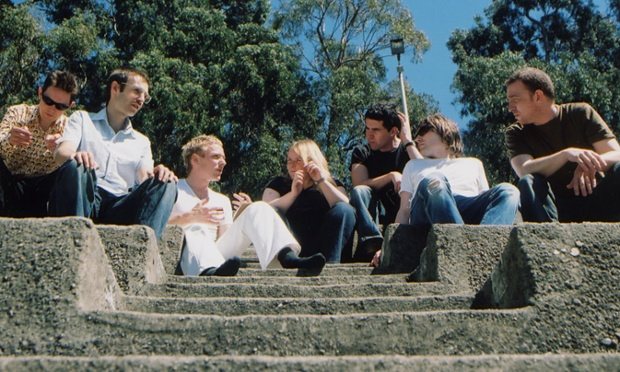
 

‘Do something pretty while you can’: The Magic of Belle & Sebastian

aa037da0-a17c-47f3-9e82-4639aeba279e-620x372
image source: The Guardian

Belle & Sebastian are one of those bands that give you a warm, fuzzy and nostalgic feeling. As much as they’re often lazily attributed to the cultural realm of the ‘indie kid’ or the ‘Glasgow hipster’, this neglects the fact of their wider popularity. They are, after all, a band who’ve been around for over 20 years now. I’ve played their tunes in the restaurant where I work and witnessed middle-aged folks who look like they’re off to a Springsteen concert humming along to ‘The Boy With the Arab Strap’. Their songs have popped up on plenty of popular tv shows and films (‘I Don’t Love Anyone’ on Girls, ‘I’m a Cuckoo’ on The Inbetweeners, ‘Piazza, New York Catcher’ in Juno – to name just a handful). Like a sweet, familiar honey, their music just sticks to you, whether you wanna spread it on your toast or not. Sure, they get a lot of hate: their songs are cloying, the singing a bit too saccharine at times, the lyrics silly, the sound the same on each album. I’ve heard them being called ‘beige’ music.

For me, Belle & Sebastian make pastel coloured music. I don’t know, maybe it’s a touch of the old synaesthesia but I’ve always imagined their songs awash in delicate shades of blue and pink, green and yellow and orange – a bit like the colours of sorbet. They’re just the perfect summer band. Some bands it’s easy to have a colour for, or even a texture: Mogwai are deep deep green and black, LCD Soundsystem are bright, shiny white, Mac DeMarco all denim blue and dirty mustard yellow, Kate Bush is a luscious kind of cherry red, Bjork is all the hues of a pearl, Tame Impala are psychedelic greens and blues and oranges, Aphex Twin is ink black, but sometimes yellow, blue or bubblegum pink. In the same vein, Belle & Sebastian to me are all about pastels, sometimes a wee bit brighter but never beige, except when it’s that classy kind of chino beige that you might see paired with a yellow blouse and pink ribbon. I want to be dressed up with a funny hat, a mini skirt and retro sunglasses when I listen to them. Something lilac, a stick of ice lolly. Hell, maybe even rollerblades. I find myself immersed in the stories of the songs; I sort of want to be a character in one of them – a lost twenty-something with her school days long behind her, figuring out how to deal with the world and enjoying living in the city.

DearCatastropheWaistress

Listening to them involves a kind of camaraderie: you’re sharing the world with them, with all the voices of each song’s narrator; sharing Stuart Murdoch’s hazy, romanticised version of Glasgow, the lives of the quirky characters he writes into his lyrics. The musical arrangements in their songs vary between stripped back and fragile, sometimes very much Smiths-influenced (inherently, B&S are an ‘urban’ band, right?), with pretty melodies adorned with piano, acoustic guitar, maybe a bit of bass (‘We Rule the School’, ‘It Could Have Been a Brilliant Career’, ‘Dress Up in You’ – these are some of my favourites), to zany and fun and maybe even lovably chaotic, with some of the earlier songs sporting surf rock guitars (‘La Pastie De La Bourgeoisie’) or (in the early days, Cubase-arranged) electronic numbers (‘Electronic Renaissance’, or, later on, the near seven minute ‘Enter Sylvia Plath’ which frames its tribute to the late great poet inside a Europop epic), as well as the Beatles-influenced ‘chamber pop’ (of which they share the influence mantle with Camera Obscura) – see, for example, The Life Pursuit. Their songs are often self-conscious, writing about the importance of losing yourself in books and songs (the final song of Tigermilk, ‘Mary Jo’, references the fictional book that titles the album’s first song: ‘You’re reading a book, “The State I Am In”’), referencing themselves, other ‘indie’ bands (Arab Strap being the most obvious), creating this whole dreamworld of literary and musical references which itself becomes the fantasy world of the songs. When you listen to them, it’s impossible not to lose yourself slightly to this pastel-saturated universe. It’s not just twee; it’s bittersweet happiness, nostalgia, personal and cultural reflection – they began making music in the 90s, after all. That’s why I smile when I see someone sporting a wee Belle & Sebastian tote bag or t-shirt: you know there’s someone else out there who shares that sweet and silly, slightly sad but hopeful little world.

In a way, they’re a band for the underdogs. They cut their teeth on the Glasgow open mic circuit, with its crowds veering between adoration or ruthless indifference. Every Saturday, under the guise of various band or solo arrangements, Stuart and his pals would appear in the Halt bar on Woodlands Road (sadly it no longer exists) – you can read all about it in bass/guitar player Stuart David’s memoir, In the All-Night Café, which geekily delves into early musical experiments, the songwriting process and all the crazy moments that brought the band together in their formative year. So yeah, it’s worth a read if you’re a B&S fan or even just a musician. It’s important to remember that the band produced and recorded all their early songs (came together, essentially) at Stow College’s now slightly legendary Beatbox course, which at the time was more or less a course that unemployed musicians in the area took to ensure they kept receiving the dole: ‘From what I could tell,’ Stuart writes of his first impression of the course, ‘[Beatbox] was a total shambles. Just scores of unemployed musicians sitting around in a dark, airless labyrinth, doing nothing. […] I wandered around on my own trying to work out what was what, while people scowled at me, or just stared blankly into space. A thick cloud of cigarette smoke pervaded the place, and something about the absence of daylight and the lack of fresh air made me wonder if the place was actually a detention centre set up by the government to incarcerate all the people they’d caught using Social Security benefit as an arts bursary’ (In the All-Night Cafe, pp. 10-11). This is probably an impression of college hallways and classrooms that most young adults of Generation X or millennials growing up in Britain can relate to: the flickering strip lighting, the apathy amongst both staff and pupils, the sense of suffocating bureaucracy, of life in suspension. And yet out of that dark and maybe even Kafkaesque environment, sometimes the magic happens. People come together and make the best of things – it’s inspiring.

For me, it’s also inspiring that Stuart Murdoch is actually from Ayr. The only other celebrated artist I can think of off the top of my head that hails from Ayr is none other than Robert Burns, so yeah, it’s been awhile since the place has been put on the map, artistically speaking. Belle & Sebastian are usually associated with Glasgow (especially the West End), but for me it’s important to remember their humble beginnings. Ayr still has a pretty cool music scene in terms of acoustic nights in local pubs, but there’s definitely a dearth of actual decent gig venues, especially when it’s producing so many talented musicians through, for example, the well-respected Commercial Music course at the UWS Ayr Campus (see for example Bella and the Bear and the wonderful Shanine Gallagher).

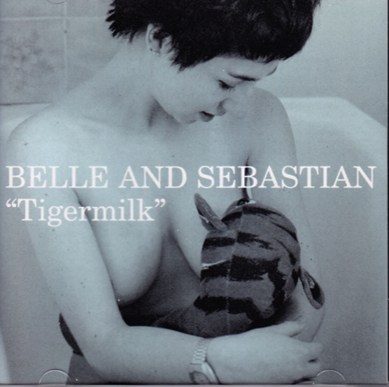
Belle-And-Sebastian-Tigermilk

ANYWAY,  back to Belle & Sebastian. I wanted to talk about Tigermilk as an example of their oeuvre in general – as the raw, often forgotten diamond. It’s their debut album, though I actually came to B&S first through If You’re Feeling Sinister, having picked it up from Fopp when I moved to the West End for university and decided a B&S CD was a good way of immersing myself in local culture. Tigermilk reminds me of that lost and lonely summer feeling, walking around the city killing time before going to work, worrying about all the books I had to read before September, the people and things and memories I was in love with, that paranoid and desperate desire to write myself and indeed keep writing. It’s a lo-fi sort of album; it feels sweet and magical in that simple way, and you can tell that it marks the moment when the band discovered they had something special going on.

Sometimes the lyrics are a wee bit strange and surreal; the cast of characters Murdoch evokes in his lyrics can be pretty bewildering. The band’s slightly surreal vibe is indicated by the cover art for Tigermilk: a black-and-white picture of Murdoch’s then girlfriend, Joanne Kenney, apparently breastfeeding a toy tiger. Then take a look at the lyrics to ‘My Wandering Days are Over’ for example: ‘Six months on, the winter’s gone / The disenchanted pony / Left the town with the circus boy / The circus boy got lonely / It’s summer, and it’s sister song’s / Been written for the lonely / The circus boy is feeling melancholy’. You’re never sure if the characters are metaphors for existentially pained middle-class indie kids (lost in the job market/lost in the adult world circus of mad capitalism??), or actual protagonists in B&S’s musical universe. That’s the poetry of it – you get to decide. It all sort of makes sense, this girl with spiky black hair nourishing a toy tiger; sure, you can take it as symbolic, but it’s also just intriguing and slightly controversial enough to draw attention to a debut album.

One of B&S’s unique selling points is the whimsical fictions they weave through their ‘brand’ as a band. Take, for example, the sleeve notes to Tigermilk: they detail a cute little tale about Sebastian and Isabelle, the namesakes for the band.

Sebastian met Isabelle outside the Hillhead Underground Station, in Glasgow. Belle harassed Sebastian, but it was lucky for him that she did. She was very nice and funny, and sang very sweetly. Sebastian was not to know this, however. Sebastian was melancholy.

He had placed an advert in the local supermarket. He was looking for musicians. Belle saw him do it. That’s why she wanted to meet him. She marched straight up to him unannounced and said, ‘Hey you!’ She asked him to teach her to play the guitar. Sebastian doubted he could teach her anything, but he admired her energy, so he said ‘Yes’.

It was strange. Sebastian had just decided to become a one-man band. It is always when you least expect it that something happens. Sebastian had befriended a fox because he didn’t expect to have any new friends for a while. He still loved the fox, although he had a new distraction. Suddenly he was writing many new songs. Sebastian wrote all of his best songs in 1995. In fact, most of his best songs have the words ‘Nineteen Ninety-five’ in them. It bothered him a little. What will happen in 1996?

They worked on the songs in Belle’s house. Belle lived with her parents, and they were rich enough to have a piano. It was in a room by itself at the back of the house, overlooking the garden. This was where Belle taught Sebastian to put on mascara. If Belle’s mum had known this, she would not have been happy. She was paying for the guitar lessons. The lessons gave Sebastian’s life some structure. He went to the barber’s to get a haircut.

Belle and Sebastian are not snogging. Sometimes they hold hands, but that is only a display of public solidarity. Sebastian thinks Belle ‘kicks with the other foot’. Sebastian is wrong, but then Sebastian can never see further than the next tragic ballad. It is lucky that Belle has a popular taste in music. She is the cheese to his dill pickle.

Belle and Sebastian do not care much for material goods. But then neither Belle nor Sebastian has ever had to worry about where the next meal is coming from. Belle’s most recent song is called Rag Day. Sebastian’s is called The Fox In The Snow. They once stayed in their favourite caf’ for three solid days to recruit a band. Have you ever seen The Magnificent Seven? It was like that, only more tedious. They gained a lot of weight, and made a few enemies of waitresses.

Belle is sitting highers in college. She didn’t listen the first time round. Sebastian is older than he looks. He is odder than he looks too. But he has a good heart. And he looks out for Belle, although she doesn’t need it. If he didn’t play music, he would be a bus driver or be unemployed. Probably unemployed. Belle could do anything. Good looks will always open doors for a girl.

You’ve got it all here: the playful and ultra twee imagery ‘(she is the cheese to his dill pickle’), the hint of queer culture and crossdressing that sometimes runs through B&S songs (‘This was where Belle taught Sebastian to put on mascara’), the DIY elements, the spatial immersion in Glasgow’s West End as a kind of leafy wonderland where people own pianos in airy rooms overlooking gardens. It’s honest and cute and totally unashamed, totally uninterested in being cool. Compared with the stylised, rock’n’roll swagger of Britpop, this album (originally released in 1996 then rereleased in 1999) is so refreshing. The tale of Belle and Sebastian is a short story, more than an explanation of the album’s lyrics or ‘concept’; it’s a bit ambiguous, a touchstone for all the other B&S characters who populate later LP – it’s perhaps, most importantly, an indication of the band’s consistent literary bent.

‘Sebastian was melancholy’. Well, melancholy is probably the overriding emotion on Tigermilk. Melancholy being that feeling of sadness, yearning and inexplicable loss. An indulgent feeling, a languid and probably narcissistic feeling that is almost pleasurable despite lolling around in the negative. Freud, in Mourning and Melancholia (1915[17]) famously distinguishes mourning and melancholia thus: ‘In mourning the world has become impoverished and empty, during melancholia, it is the ego itself’.  Mourning is about the loss of a specific object, whereas melancholia is a vaguer feeling, a depression with no apparent or obvious source, a swallowing up of selfhood into narcissistic darkness. One of the reason’s I really like ‘I Don’t Love Anyone’ is its in-your-face rejection of the Coca Cola style let’s-all-hold-hands-and-be-happy version of love, the assertion of personal endurance and the often denigrated value of independence in a world where we’re all supposed to follow the crowd: ‘But if there’s one thing that I learned when I was still a child / It’s to take a hiding / Yeah if there’s one thing that I learned when I was still at school / It’s to be alone’. I was that kid who sometimes liked to walk around the playground alone, making up stories in my head – adults just assume it’s because you’re being bullied but there’s a golden value to imagination and it’s easier to forget that as an adult, easy to forget that sometimes you need time out from your friends to be in your own mind.

A lot of Tigermilk is about trying to negotiate personal identity in an often problematic adult world with few opportunities for anyone vaguely creative. It’s worth quoting a hearty chunk of ‘Expectations’ to demonstrate this:

Monday morning wake up knowing that you’ve got to go to school
Tell your mum what to expect, she says it’s right out of the blue
Do you want to work in Debenham’s, because that’s what they expect
Start in Lingerie, and Doris is your supervisor

And the head said that you always were a queer one from the start
For careers you say you went to be remembered for your art
Your obsession gets you known throughout the school for being strange
Making life-size models of the Velvet Underground in clay

In the queue for lunch they take the piss, you’ve got no appetite
And the rumour is you never go with boys and you are tight
So they jab you with a fork, you drop the tray and go berserk
While your cleaning up the mess the teacher’s looking up your skirt

We’ve all known (or been ourselves!) the weird kid obsessed with music, inviting abuse with every strange word spoken. Wear something black, a bit of eyeliner and you’re inviting folk to ask you if you “shag dead folk”. There’s always the one of many that has a whole collection of cool things to say, to contribute to the world, but ends up in retail, in a call-centre, maybe waitressing. Again, Belle & Sebastian are the band of the underdog, the folk (and there are a lot of them) who slog away at day jobs but don’t give up on their dreams – whether those dreams involve becoming a star of track and field, a model, artist, musician, writer.

Tigermilk, then, isn’t just a melancholy album; there are some feel good moments, such as ‘You’re Just a Baby’, which features handclaps and a nice rock’n’roll beat with a simple, serenading refrain: ‘You’re just a baby, baby girl’. Fundamentally, Belle & Sebastian are a pop band, and a damn good one at that. Stuart Murdoch recently wrote and directed his own film, God Help the Girl, which more or less demonstrates his near-religious philosophy of pop music, as the character James (fittingly played by the singer from pop/electronic band Years & Years) proclaims:

A man needs only write one genius song, one song that lives forever in the hearts of the populous to make him forever divine. […] Many women and men have lived empty, wasted lives in attics trying to write classic pop songs. What they don’t realise is it’s not for them to decide. It’s God. Or, the god of music. Or, the part of God that concerns Himself with music.

This is some fairly interesting religious imagery coming from a singer (Murdoch) who has always been openly Christian. And of course, the hyperbolic emphasis on music’s divine significance here is perhaps a cheeky dig at the ego of the pop star, but it also touches on the importance of universalism for pop. It’s easy to consume, it should transcend generations, it should be technically perfect – the satisfying work of a ‘genius’. But good pop, as Belle & Sebastian demonstrate, isn’t all bubblegum songs about loving your sweetheart – it also has that spark of something else. For me, B&S capture a very specific experience of existential bewilderment in the modern world, combined with the right amount of romance, comedy, storytelling and a healthy streak of cynicism. God Help the Girl is twee as hell, but it’s also a loving portrait of Glasgow, of the early days of being in a band, the freedom of summer days drifting down the canal with the world shining bright around you. It’s maybe also a portrait of unrequited love. And, crucially, it transforms that cliche, the power of music, into something sparkly and fun as well as serious and uplifting – it is a musical after all. Its ambiguous ending, with the heroine (significantly called Eve – more religious imagery!) finally leaving the city and on a train ride to London where she intends to try and make it ‘alone’ after her existential rebirth and artistic awakening in Glasgow, is perhaps its strongest point – it’s a feminist assertion of personal creative desire as opposed to remaining tied down to the things your friends want.

god-help7
The protagonists of GHTG: James, Eve, Cassie

Once again, Murdoch puts complete faith in his slightly damaged protagonists; he encourages us to just trust our creativity. Maybe that’s why I love Belle & Sebastian so much, because sure, their songs are mostly golden, pastel-hazed pop, but it’s not that simple; they embrace that wavering, magical and sad place between warm dreams and cold reality, and represent all the poor souls who live there in that limbo, such as the eponymous heroine from ‘Mary Jo’: ‘Your life is never dull in your dreams / A pity that it never seems to work the way you see it’. And even though such songs are full of melancholy, you’re still treated, as in an Arctic Monkeys song, to some brilliant lyrical candy: ‘Cause what you want is a cigarette / And a thespian with a caravanette in Hull’. So maybe that’s the special element, the thing that makes the everyday divine, that elevates the ordinary into a valid subject for pop music. And maybe, pleb that I am at heart, that’s why I love it.

The Melancholy of Lana Del Rey

Source: Vogue Australia

 I even enjoy dying in the character who is dying.

— Franz Kafka

Every time I close my eyes,
It’s like a dark paradise

There’s something apocalyptic about a Blood Moon. The sense of waste and transient beauty, light and life shedding away. The moon takes its thirty-year delayed menstruation; red cloud wisps over its shining face like clots of blood being pulled across a pool of silver. Somewhere out there, lovers are lying in lush paradise, staring up at this white eye opened by god; far away, drowned in stars. A voice swirls like smoke over soft, shimmery guitar. It’s the eclipse, sometime about now, then, yesterday, and I am or I was listening to Lana Del Rey.

Honeymoon, then going back to Dark Paradise. Insomnia in the space between night and day; between one universe and another, always afloat in claustrophobia. Returning to this song again and again, its repetition, invoking the familiar sadness and masochism that Lana dreamt up only a few years ago, you’re surrounded by an eternal world of neon palms, boulevards dripped in milky dusk, the sickly excess of tequila sunrise against soaring choruses and stripped-back lyrics. In a way, you fall or sink into Lana Del Rey’s music. Like Kubla Kahn, the eponymous Chinese emperor of Coleridge’s opium-provoked fragment poem, you are sucked dreamily into the sultry visual world of dark objects, consumer heaven, the young and beautiful place of honeydew where you are invited to drink ‘the milk of paradise’. Lana’s swooning melodies charm over time, drawing you into an atmosphere of narcotised darkness which evokes a silent movie – even as the interplay between sound and image is as crucial a set of semiotics as anything Roland Barthes might analyse. You could fall back into the darkness, be seduced by the languid timeless sigh which slides over memories, nostalgia for lost evenings, red dresses and cigarettes, lost girls pressed up against bad boys in clubs, feeling like their whole existence is just a vision, propelling their electric bodies on and on as if in tune to Freud’s death drive.

Much of Lana’s music is about desire: the kind of desire that doesn’t leave you cut-up on the kitchen floor in crude emotion (a la Natalie Imbruglia, ‘Torn’), but passes through that place in the heart of culture that falls into absence and darkness. The secret hollow of modernity. It makes sense that she sung the sultry standout track for Baz Luhrmann’s 2013 The Great Gatsby adaptation, ‘Young and Beautiful’. Del Rey’s America is so Art Deco, from the typeface of her new album, to her obsession with cars and jazz and girls called Carmen, the fragile magic of Hollywood glamour which often bleeds at the seams. Lana returns to that dull wound and picks at it, indifferently, till it’s fresh again – a more ethereal thing that transcends the rotting body of America’s culture. Sex, violence, money, power, charisma; they all blur together in Lana’s fixated, addictive lyrics. In her performance, she already knows the irrelevance of authenticity; it makes her internet-immune, a kind of perfect. Nobody can critique her, because she’s always one step ahead. Despite the success of Lady Gaga, who wears her gender performativity on her sleeve, American culture remains obsessed with the cult of authenticity. Lana has been attacked for ‘making up’ the stories portrayed in her songs, the easy-love lifestyle she presents; for having plastic surgery and performing under an alias that nods more to Hollywood mythology than the girl-next-door vibes of her real name, Elizabeth Grant. Remember James Frey, the ‘man who rewrote his life’ and was subsequently attacked by Oprah when she discovered he’d fabricated and exaggerated a hefty chunk of his memoir of drug addiction? Lana, like James Frey, like Hemingway, is interested in the interplay between real life and fantasy, performance and authenticity; importantly, however, she shows how real life is itself played out and realised through the lens of mediated fantasy. Her songs betray a Baudrillardian ecstasy of communication, simulacra and simulations, updated for an age where the past is showered with the longed-for shroud of Hollywood glamour, where the present is fragmented, split across the Internet (where Lana first made her success, sensation).

***

Isn’t it lovely when somebody makes albums that really feel like art? From Born to Die’s glamorous sadness draped in an American flag, to the monochrome somnolence of Ultraviolence (produced, appropriately, by Dan Auerbach of The Black Keys), each of Lana Del Rey’s records captures a persona, but one which shifts and gathers nuance in the filters of crooning choruses and soft guitars, the distinctive colour charts of an album cover. Born to Die: pastel blues and palm trees, red lips and smoky eyes; the glossy, time-travelling Americana of her short film Tropico (2013), whose flashy symbolism mixes purity with moral pollution, the Garden of Eden with unicorns and gangsters. Ultraviolence: black and white, the spare sex of sorrow. Her latest offering, Honeymoon, sinks deliciously a familiar aura of daydreams, heartache and a sense of mesmerising stasis captured in Lana’s recital of ‘Burnt Norton’ from T.S Eliot’s Four Quartets, which evokes an abstracted and absent conception of time, slipping away into endlessly echoing, impossible memory…

Footfalls echo in the memory. Sound effects; quiet sirens, the soft familiar crackle of static, reminding us of the temporal duration, the space of presence that opens up with each play of the song, then closes again in silence – but always there, always there waiting in possibility, for the next click, the next play. Down the passage which we did not take. 

In the album sleeve, the white printed lyrics to ‘High By the Beach’ flicker and disappear in the yellow-gold light of a glossy photo depicting a tree-lined avenue. Lana Del Rey songs always paint little vignettes of stories, but her characters frequently disappear from view, their situations dreamlike, slanted towards death but never reaching conclusion. Like any avant-garde novel worth its salt, Lana Del Rey’s music often bears a slightly creepy, unsettling quality, a sense of never being quite finished, a sense of repetition, frustration and surrealist reality. While she can master a good pop tune, Lana never gives us that self-satisfied pomp and narrative closure of a Taylor Swift song; there is an almost uncanny quality to her musical arrangements: the drifting melodies, tinges of trip hop, strings, rippling snares and minimal beats. Literary references abound: from that iconic reading of Allen Ginsberg’s Howl in Tropico, to the album title Ultraviolence (alluding to the random acts of ‘ultra-violence which the teenage protagonist of Anthony Burgess’ dystopian novel A Clockwork Orange is addicted to) and all that sinister seduction of ‘Carmen’: ‘It’s alarming, honestly, how charming she can be’, in a nod to Vladimir Nabokov’s Lolita. In ‘Ride’ she references the sexual plight of Tennessee Williams’ Blanche DuBois, drifting through life by ‘relying on the kindness of strangers’; in a way, Blanche is a perfect Lana Del Rey heroine. Not only is she a ‘fallen woman’ but she is also an alcoholic, guzzling bourbon and symbolically-charged cherry soda (My pussy tastes like Pepsi-Cola, / My eyes are wide like cherry pies – ‘Cola’), and longs to die in a most extravagant way, conflicted by her desire for purity and her sexual appetite: first, she will eat an ‘unwashed grape’ (the poisoned fruit of Eden, the rotten core of carnal pleasure) then be ‘buried at sea sewn up in a clean white sack and dropped overboard—at noon—in the blaze of summer—and into an ocean as blue as my first lover’s eyes!’.

Southern belle; Vivien Leigh as Blanche DuBois in Eliza Kazan's film adapation of Streetcar
Southern belle; Vivien Leigh as Blanche DuBois in Eliza Kazan’s film adapation of Streetcar

***

My baby lives in shades of blue
Blue eyes and jazz and attitude

Well New Orleans – the setting of A Streetcar Named Desire – is a city rich enough in jazz and attitude, especially in the 1940s. In a way, all of Del Rey’s characters are caught up on the deathward drive of streetcars named desire, only her streetcars have morphed into getaway vehicles and limousines, or else the rides of suburban rockstars: I spend my whole life driving in cars with boys / Riding around town, drinking in the white noise. The white noise? The ever-present static reality of radio and television, life flickering on amidst its background hum and rush. It’s an edgier version of Lorde’s ‘400 Luxe’, a delicate, pulsing tribute to the romance of small-town time wasting on roads where the houses don’t change:

We’re never done with killing time
Can I kill it with you?
Till our veins run red and…blue
We come around here all the time
Got a lot to not do, let me kill it with you

You pick me up and take me home again
Head out the window again
We’re hollow like the bottles that we drain
You drape your wrist over the steering wheel
Moses can drive from here
We might be hollow, but we’re brave

On the subject of heroines, Lana is constantly critiqued for her portrayal of women; namely, her ensemble of doomed and lovelorn characters who lavish over their hopeless agony and fail to resist the anonymous bad boys which recur in her songs. Yet there is an irony to this critique, because critics seem to forget that it is a woman who is pulling the strings over all these puppets. Lana slips in and out of her roles as easily as she slips between haunting, orchestral notes. She is always in control, her voice brilliant as smoky quartz crystal, even as she sings about being out of control. There is a litheness to her performance that indicates the strength of her fiction: Lana is like a novelist, fabricating a shadow world which shows up the underbelly of American culture, from its Golden Age of 1950s glamour to the fractured present, where alcohol and club culture meet the melting pixel pot of the Internet. I wish I was dead already, she can say in a Guardian interview, incanting it like a spell, letting Twitter fall on its knees with spits and stirs of protest and loathing. Prostitutes, gangsters, trailer trash alcoholics. These people, these liminal figures on the margins of society – stereotypes, yes, but vivid ones nonetheless – are the lifeblood of Lana’s music and as she renders them, they have emotional depth, a soulless soul, unlike hiphop’s deadpan delivery of gangster vocabulary. As her voice swells to a pitch we realise that Lana has already dismissed something as ‘crude’ as identity politics, embracing instead the freedom land of the seventies, free because America, land of opportunity (for white women, at least) had then opened up a new lifestyle, a new kind of being. There is power in being a sad girl, nasal and depressed but somehow free, as in the paean to glamorous dishevelment, ‘Cruel World’ (from Ultraviolence):  I like my candy and your heroin, / And I’m so happy, so happy now you’re gone. / Put my little red party dress on, / Everybody knows that I’m a mess, I’m crazy … ‘Cause you’re young, you’re wild, you’re free, / You’re dancing circles around me. There’s that cliché of Americana: being young and wild and free – think of Bruce Springsteen’s celebration of wild youth – and again, Lana places her voice in the hullabaloo of this tornado of deathly ecstasy, making herself the static one in the centre, languishing over her candy and heroine while everyone else dances circles around her.

05

***

‘I felt very still and empty, the way the eye of a tornado must feel, moving dully along in the middle of the surrounding hullabaloo’ — Sylvia Plath, The Bell Jar. 

Hiphop melancholia, narco-swing, vintage pop; whatever you wanna call it, Lana always kinda slips the net. Its her characters, her musical and metaphorical landscapes that draw you in. In a way, her songs are just as literary as any old poem.

Crying tears of gold, like lemonade. Here we are on ‘Ultraviolence’, drowning in violins and vats of sadness, relishing the salt taste and thinking of the ocean. The ocean haunts Honeymoon too. It’s there in the California blues, the ‘blue nail polish’ that’s her ‘favourite colour’ and ‘favourite tone of song’ in ‘The Blackest Day’, the sultry ice cream gleam of ‘Salvatore’ which glides in and out of languid Italian and consumable nouns (cacciatore, limousines), perhaps like a narcotised, Sinatra-style swing version of the Red Hot Chili Peppers’ ‘By the Way’ (the bit where they seem to throw a demented grocery list at you). Shady blue, summer rain, sparkling lights; it’s a beautiful snowflake of a song, catching its glitter in the strings and the la-da-da-da-daaaas which fall around you, soft and sad yet somehow delectable. The ocean is the darling of the suicidal American woman: it is the world’s womb, the waves that embrace desire, the space of endless multitude, escape from restrictive culture. In ‘Dark Paradise’, the singer is lying in the ocean singing your song – is this a meta statement, one persona talking back to the distant maker? All of Lana’s heroines are looking for that dark paradise; that refrain, But I wish I was dead. Think of Edna in Kate Chopin’s 1899 (later banned) novel of sexual awakening, The Awakening: Chopin’s impressionistic purple prose isn’t so far from the poetic melodrama of Lana’s lovelorn world: ‘The voice of the sea is seductive, never ceasing, whispering, clamouring, murmuring, inviting the soul to wander in abysses of solitude’. Chopin’s onomatopoeic prose chimes with Lana’s frequent use of sound effects, from the Fourth of July fireworks which open ‘National Anthem’ to the glitchy blips of ‘Video Games’ and twinkling bird sounds of the Hollywood hills in ‘Is This Happiness’…Expressions of desire flicker with the imagined bliss of paradise.

Source: https://unlockingkeyes.files.wordpress.com

In the conclusion to The Awakening, Edna steps out into the ocean, never to return, remembering as the horizon catches her eyes the sounds and scents of her childhood: the simple ‘hum of bees’ and ‘musky odour of pinks’ which fill the air narcotically. Walking into the ocean as Lana’s heroine writhes on her bed and balcony, longing to just get high by the beach, longing for that preserved moment of perfect stasis, the endless waves, the endless boulevard leading to a distant horizon of fathomless dark glass, tall buildings rising up amidst pink flamingoes like surrealist paintings. Haze of smoke, daytime closing.

***

There is a passage from Don DeLillo’s debut novel, Americana (1971) which David Foster Wallace happened to underline in his copy of the book:

“David, I truly love you and hate you. I love you because you’re a beautiful thing and a good boy. You’re more innocent than a field mouse and I don’t believe you have any evil in you, if that’s possible. And I hate you because you’re sick. Illness at a certain point inspires pity. Beyond that point it becomes hateful. It becomes very much like a personal insult. One wishes to destroy the sickness by destroying the patient. You’re such a lovable cliché, my love, and I do hope you’re found the centre of your sin”.

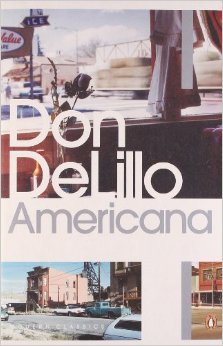
A ‘lovable cliché’: the sort of thing Lana embraces, makes raw and coats in her voice of smoke and silk. The antithesis of beauty and disgust, love and hate; how our attempts to disinfect the one from the other are doomed to fail. Culture is a contradiction. In Americana, the protagonist David Bell is a TV executive who finds himself deeply apathetic, despite being attractive, sharp and popular with the ladies. He frequently articulates his experiences, his life at large, as if they were a film. He becomes obsessed with finding meaning, embarking on a Kerouac-esque quest at getting to the nitty-gritty of America’s heart of darkness, but this documentary gets messed up in his attempts to re-stage and re-enact events from his past. I guess it’s true that the novel is all about unattainable desire, whether this is desire for meaning, personal fulfilment or something more carnal – the search for the centre of your sin which could easily be a Lana lyric. What’s more, this pathological fixation of DeLillo’s David Bell to some extent parallels Del Rey’s obsession with the silver screen version of America; the photography of Honeymoon’s cover even resembles a sexier version of the Penguin cover for Americana:

51CoDBi3hlL._SY344_BO1,204,203,200_

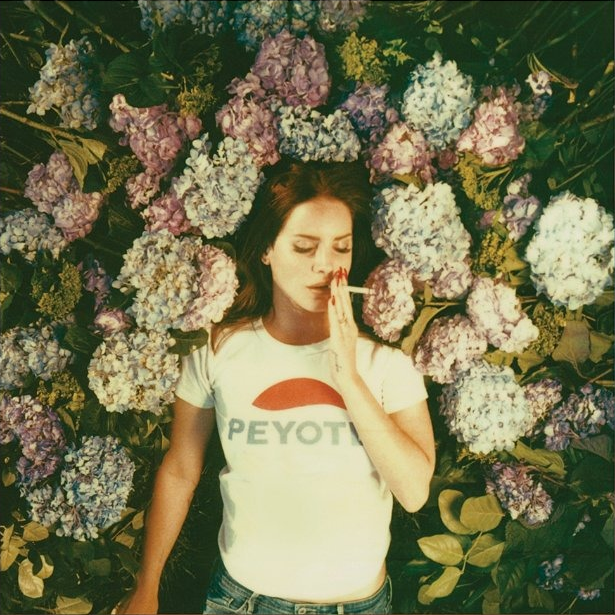
Lanadelreycapa

While Del Rey’s female characters languish in their statically trapped daydreams of love and violence and Hollywood glamour, DeLillo’s version of Americana is largely embodied in the road myth and its cult of masculinity:

There is a motel in the heart of every man. Where the highway begins to dominate the landscape, beyond limits of a large and reduplicating city, near a major point of arrival and departure: this is most likely where it stands….Men hold this motel firmly in their hearts; here flows the dream of the confluence of travel and sex.

This kind of commentary permeates the book, often arriving at a kind of religious, anthropological rapture which lacks the self-consciousness of DeLillo’s later novel White Noise, but provides a rambling cultural landmark that paves the way towards the sort of position Del Rey occupies in the mainstream. The Beats, protesting consumerism even as they gorged on apple pie; Bret Easton Ellis, with his deeply despairing coterie of psychopathic, serial-killer yuppies and sexually-violent, chronically-bored L.A teenagers; Lana Del Rey, voicing the glorious wastage of our postmodern wasteland, our beaten bodies and minds, voicing her vision through scenes of sun-drenched nostalgia which evoke a beautiful and terrible America, made glossy and pure through stars and stripes, a delicate riff; drifts of strings, jazz, Instagram filters. That golden period where love suffuses with the candy-flavoured stuff of daydreams, movies: Honeymoon. The whole album renders a narrow reality of the past and present: it’s pastel-shaded afternoons lost to the call of the ocean, sad ballads of frustrated love (I lost myself when I lost you), electro blues; it’s The Blackest Day, with Billie Holliday, palm trees and prescription pills, throwing up the lilac and cinnamon-scented ash of society’s ills – emotional debris, disconnection, slowing tempos, the hullabaloo of static thrills.

Screen cap from Tropico (2013). Source: popoptiq.com

Hyperreal Lives: Made in Chelsea and The Seductive Politics of Boredom

There’s a certain uneasy, shifting quality at the centre of Made in Chelsea that reminds one of the later work of Samuel Beckett.

Martha Gill

For a show in which a character actually says “Charles Dickens wrote Winnie the Pooh. No, Pride and Prejudice,” you might be shocked at any comparison raised between Made in Chelsea and the world of literature. And yet, there is a sense of unease that haunts the famous Channel 4 show which documents the financially-flushed lives of trendy twenty-somethings partying and gossiping themselves around London. A sense of unease that is usually reserved for the realm of the literary text, specifically the postmodern literary text, which evades fixed meaning and narrative closure. That leaves us in some sort of existential crisis. And so what is this Beckettian quality that haunts the flashy world of ‘yahs’, of immaculate blow-dries and fancy cars? Is it the sheer vacuity, the absurdity, the meaningless and endlessly repetitive plot lines? The bizarre seduction of its pointlessness and dragged-out pacing, the lingering shot on a face of shaky acting that aims to convey some kind of deep significance, but instead trails us into nowhere?

There is something strangely seductive about Made in Chelsea. I thought maybe I’d struggle to write this article, given that I have only watched a handful of episodes from a show that has run for seven seasons. My mother watches it, my brother watches it. They don’t watch much else on telly, so there must be something in it that lures them in. That lures us all in. Indeed, maybe there are people out there who genuinely anticipate new episodes, as if there really was some plot development to look forward to. There must be some reason why Channel 4 bother advertising narrative ‘tensions’ in their new episode teasers. Yet I find it difficult to establish the significance of any story arc in Made in Chelsea: each episode rolls over with an intrigue that evaporates like the champagne sucked so readily from its characters’ glasses.

But wait, you may say: Made in Chelsea is not meant to be television drama, it is reality, albeit ‘structured reality’. We are, supposedly, watching a show about ‘real’ lives; these are ‘real’ people acting out things that have ‘really’ happened to them. Reality does not readily provide us with such arcs of climax and resolution that fictional scripts tend to yield up; reality is all about interweaving story-lines, little tensions that burst and dissipate under hushed storms of gossip – the sheer joy of calling someone an idiot behind their back. I suppose this is what Made in Chelsea really is: grownup children bitching and dissecting one another against the backdrop of glittering cocktail glasses and an effortlessly hip soundtrack.

Because of course, this is no ordinary ‘reality tv show’. The cast of Made in Chelsea are rarely seen smoking, vomiting, shagging. The ordinary things folk tend to do on reality tv shows; you know, Big Brother and the like. The world of Chelsea is one of perfected physicality: sculpted bodies, stylish clothes, the cool gaze of another blasé conversation, another stilted standoff between two characters. For this show is all surface, all talk. Not much changes, except for the setting: from beautiful London gardens with the perpetual tinkle of glasses to throbbing club scenes and the stunning backdrops of Venice and Versoix, from gleaming storefronts to pheasant shoots and country-club chic. We are invited to revel in the gorgeousness of panoramic camera shots, the afternoon light as it flickers from the sun between leaves to the glint of a wine glass. Perhaps we could watch this show on mute, with the characters becoming a kind of tableau vivant, and we may sate ourselves on the images of their flawless skin, their achingly white teeth. These are characters whose personalities shift with the wind of each new season, who perform themselves as they please.

And of course, there is the British obsession with class, particularly the surface forms which class may take. We have always loved observing the lives of the super-poor and hyper-rich, and from Dickens to Evelyn Waugh readers have been drawn in by artistic representations of both the struggling underclass and the excesses of the wealthy. Watching or reading about the extremes of poverty or richness makes us feel better: it allows us to reaffirm our own position, as somehow ‘normal’. We’re never that bad; we’re comfortably in-between. In a sense then, Made in Chelsea shares with shows like the BBC’s documentary-style show The Scheme its status as a form of class porn. Watching the ‘feckless’ lives of those in poverty makes people feel better; superior, even. Careful editing enhances the drama, adds turbulence to the characters’ lives and cuts out the ordinary hard work that may go on behind the scenes. Watching Made in Chelsea, I suggest, deflects the structural issues underpinning the status of the super-rich onto a series of mundane story-lines that focus almost exclusively around love interests. There is very little in the show to tell us how so-and-so got his or her fortune. And if the university degree, modelling career or entrepreneurship features at all, it is usually as a mere prologue to some form of romantic or consumerist intrigue. We are told to sit back and enjoy this form of lifestyle porn, without bearing a thought for the opportunities these people received to get where they are now.

Also, there is a certain pleasure in indulging in one’s prejudices. The cast of Made in Chelsea embody a certain form of gap yah privilege that many of us enjoy mocking in this day and age where the class divide is wider than ever. While watching shows about the ‘underclasses’ often makes uncomfortable viewing, documenting the frequently distressing scenes of life on the breadline, watching Made in Chelsea involves both succumbing to the passive pleasures of spectacle and an exercise in mockery at the dandified lives of its characters. We may poke fun at the absurdity of some of their dialogue: the accent, the ‘totes’, the ‘yeah boi’, the gestures that seem to separate these people from the rest of the human race. As the notorious Mark Francis quips, ‘I once knew someone who owned a sleeping bag’. Yes, quite: a sleeping bag; those cave animals from the world beyond, with their horribly proletariat existence. Indeed, these beautiful beings, the Chelsea Set, are not like the rest of human kind. Not like the rest of us watching, half allured and half bemused.

Onscreen we watch these glimmering cyborgs, as they fashion their real lives right before our eyes.

And yet, the Chelsea Set are not untouchable beings. They splash themselves over pop culture: doing photo shoots, exclusive interviews, making innocuous appearances as guest-star DJs in clubs. We are asked to see them in the flesh, as if we too can reach out – if only briefly – to touch their precious stash, the solid gold of their lifestyles.  We may look them up on Wikipedia to find out more; these characters are hypertexts, whose ‘real’ lives are perhaps preceded in a Baudrillardian sense by the simulations they portray onscreen. They have built up their empires of personality which branch out from the TV series to magazines and online articles documenting details of their fabulously elaborate yet ultimately vacuous existence. As Jon Dovey puts it: ‘reality TV is the ultimate expression of the simulacrum in which the insistence upon realism is in direct proportion to the disappearance and irrelevance of any referential value’. Yes, the disappearance of any worthwhile meaning; that sounds familiar. Are these ‘real’ people, or mere masks – postmodern burlesques of the generation of ‘bright young things’ which once lit up the 1920s Jazz Age, but now dissipate into the no-place of mundane conversation? The sexiness of Made in Chelsea is perhaps undermined by the sheer obviousness of its facade.

Yet when we watch these individuals perform their ‘selves’, do we passively absorb their world as if it were merely a stage-set, or can we pierce this world, burst the bubble on their champagne-scented version of reality? If there is an almost erotic allure in the mere spectacle of the lives of the rich, then allowing ourselves to be sucked into the simulacrum of this show constitutes a new, if slightly sickly, opium for the masses (or at least, those who bother watching). So, perhaps, let us covet the aura of affluence, of shimmering lives and expensive spaces, while at the same time reminding ourselves of the poverty and inequality that must exist to support the glamorous boredom of the rich and famous. Or maybe we could turn off the telly, and go camping instead.

http://youtu.be/FAv57nK4aXw

Sources: 

John Dovey (2000). Freakshow 

Martha Gill, http://www.newstatesman.com/culture/2013/05/made-chelsea-totes-postmodern

American Psycho: Sex, Violence, Technology and Society

Image source: http://images6.fanpop.com/image/photos/33100000/Fit-In-american-psycho-33196259-600-889.png

I have just read a book that has all at once captivated, disgusted and intrigued me; a book that has left me strangely both emotionally drained and intellectually stimulated. Bret Easton Ellis’ American Psycho plunges the reader into a world of late 1980s ‘yuppie-ism’: the world of Wall Street, hyper-consumption, misogyny, racism, inane pop culture, television, sex…and violence. Written from the first person perspective of its protagonist (although somehow I find the term protagonist with its heroic connotations inadequate), Patrick Bateman, the novel has an unusual cyclical structure that plays out as a repetitive narrative of visits to classy restaurants, mundane descriptions of the latest consumer goods, chapters that read like music reviews and then the most controversial element: the horrifically graphic scenes of sexual violence and psychopathic slaughtering that got the book banned by its initially intended publishers.

Yet I don’t believe that Ellis includes these gruesome chapters just as a twisted indulgence, a pornography of violence. As I will discuss, they play a part in Ellis’ searing, often satirical portrayal of the Reagan era in America: a critique of neo-liberal values, consumerism and technology that is arguably more pertinent today than it was twenty years ago. The heartlessness, depravity and monotony of this culture and the novel itself is summed up in the opening line: ‘abandon all hope ye who enter here’, which is ‘scrawled in blood red lettering’ on the side of a building. This quote is an intertextual reference to Dante, who in his Divine Comedy suggested that this was the written passage that appeared in the entrance to Hell. When you pick up American Psycho and read the first lines, which immerse the reader immediately in the divided cityscape of 1980s New York – a world of graffiti, advertisements and pop culture – you cross over a threshold, you cross over into a tightly-confined mind that experiences its own corruption in a fictional universe that is all too like our own. What is interesting about the novel is on the one hand its hypothetical exploration of the thoughts of a psychopath, but also its trenchant critique of a society obsessed with surfaces, purchases and the perpetual presence of the flickering flow of television; a society plummeting towards absurdity and the eradication of all meaning – at all levels from the individual mind to the collective conscience.

Despite being the novel’s narrator, Bateman reveals little about himself other than his routines, his clothes and his opinionated taste in music. He indulges in lengthy passages detailing his workouts, his use of face masks, his appearance, eating habits, sexual interests; but the novel provides little in the way of solid character description. The narrative is therefore intensely claustrophobic, as we are restricted to Bateman’s narrow, white, narcissistic upper-class view. Moreover we know nothing of the Bateman behind the suit and Ray-Bans; we don’t know about his childhood, his relationship with his parents is only briefly suggested in a single flash of a chapter, and although it is the source of so much expendable income, we never find out what he actually does at work, other than order his secretary to make him dinner reservations. This latter point is especially interesting within the context of contemporary culture, where people are becoming ever-more critical of what these high-flying guys in banking and finance actually do; as bonuses and salaries remain sky-high in spite of the recession, there is increasing concern with regards tothe elaborate and obscure games that these ‘yuppies’ spend their time with – playing with money, justifying their existence. Ellis clearly does not seek to redeem the Wall Street yuppie, but instead caricatures his position and the career in general – which for me culminates most humorously in a chapter where Bateman and his coworkers engage in a highly-charged comparison of the stylishness of their respective business cards, that reads like a competition between prehistoric men flexing their muscles or showing off their hunting skills.

This leads into the question of masculinity and self in the novel. In a world where the most socially-esteemed jobs require what might be considered traditionally ‘emasculated’ behaviour – Bateman, it seems, is a proto-metrosexual – how do men assert their masculine identities, especially with the increasing challenge of the rising status of women? Bateman’s gendered self is ambiguous: on the one hand he is obsessed with his physical appearance – going for regular manicures, massages, constantly working out and asking if his hair looks good – and on the other asserting patriarchal dominance by literally killing, and in some cases torturing, those that either threaten his position (e.g. his colleague Paul Owen who has the superior business card) or those that he is different from and wishes to demonstrate are beneath him: women (especially models and prostitutes), beggars and homosexuals. This creates a bizarre, twisted sense of capitalism gone mad, of the ‘dog-eat-dog’ ideology of everyman for himself, of free market competition gone out of control. The individual, in his quest for success, seeks a greedy taste of the ‘Swordfish meatloaf with kiwi mustard’; that is, the excess and the addictiveness of the American Dream.

The novel thus remains engaged with material inequality, even though its focus is on one end of the scale – the high-flying lifestyle of yuppie clubs and restaurants. Throughout the book, Bateman and his friends taunt the plethora of beggars that haunt the streets of New York, holding out bills of money only to snatch them away in front of their starving eyes. At one point, Bateman even shoots a busker, just because he can; because he has the urge to kill and feels the man’s life is worthless. Yet there is an ironic discrepancy between Bateman’s behaviour and the outward image he projects of someone in tune with social problems. Early in the novel, Bateman delivers a speech that reads like the words of a politician: ‘we have to end apartheid for one. And slow down the nuclear arms race, stop terrorism and world hunger…strengthen laws to crack down on crime and illegal drugs’. All this from a man who personally terrorises the poor and vulnerable, regularly takes cocaine and is quite happy to waste money on often-uneaten restaurant food whilst trampling all over street beggars. Perhaps, therefore, Ellis meant to parody the hypocrisy of governments that proclaim their acknowledgement of socioeconomic problems but do nothing or little to actually tackle them. The irony of Bateman’s ‘identity’, then, is the way in which his words do not distinguish him but blur him further into convention, as he constructs his self by appropriating the words and values of others – particularly his hero Donald Trump (which says a lot about yuppie conscience). Indeed, this is humorously parodied in the fact that all food and tastes are judged not by individual experience but by reviews characters have read in glossy magazines.

So in spite of Bateman’s carefully constructed external self as a socially-conscious businessman, his identity remains a space of vacuum. Everything around him – his friends, his values, his lifestyle – is utterly superficial, and it turns out that he is too:

‘…there is an idea of a Patrick Bateman, some kind of abstraction, but there is no real me, only an entity, something illusory, and though I can hide my cold gaze and you can shake my hand and feel flesh gripping yours and maybe you can even sense our lifestyles are probably comparable: I simply am not there […] My self is fabricated, an aberration. I am a non-contingent human being. My personality is sketchy and unformed, my heartlessness goes deep and is persistent.’

When it was first published in 1991, American Psycho was accused, among many things, of being a poorly-written, immoral book, but I believe these early critiques were based on strong misreadings. The above passage, with its incisive insight into the thoughts of someone staring into the abyss of his own personality, its chillingly controlled and intoxicating prose, shatters any accusation that Bret Easton Ellis is a bad writer. It opens up the concern of many ‘Generation X’ writers: the paradox of identity in the late twentieth century. In a world where identities become more important, as each person seeks to distinguish themselves within the ocean of material things, selfhood in fact seems to dissolve, fragment, disintegrate under the weight of excessive choice and infinite expectations. Bateman reflects that ‘there is no real me’ in spite of the solid flesh, the personality moulded out of a particular consumer lifestyle, the ‘illusory’ mask of self presented in the fashionable clothes, the haircut, the voguish business card. American Psycho challenges many conventions of the novel, and one is character development: Bateman may become more reflective as the narrative ‘progresses’ but he does not undergo transformation or redemption. He remains all surface, with no core sense of morality and self beneath the veneer of his existential acts – he ‘simply [is] not there’.

This reminded me of Oscar Wilde’s The Picture of Dorian Gray, written a hundred years before American Psycho at the fin-de-siècle of the nineteenth-century. Like the ‘yuppies’ of Wall Street, Dorian and his friend Henry Wotton not only challenge traditional masculinity, as appearance-obsessed ‘dandies’ (the late Victorian metrosexual), but they are also excessively idle and spend their privileged lives like Bateman and his colleagues, indulging in sensual pleasures, conspicuous consumption and attending the finest venues of society. Narcissism and art are thematically central, just as narcissism and pop culture are to American Psycho. The fable-like plot of Dorian Gray turns on a Faustian bargain Dorian makes with the devil, whereby he barters his soul in exchange for eternal youth, so that his portrait grows old and twisted while he remains all surface, forever flawless and smooth. Dorian’s narcissism and pursuit of pleasure leads him into a spiral of moral corruption, visits to opium dens, murder and sexual depravities which, while completely removed from the Ellis’ gore, were nonetheless shocking at the time.

Each novel has lengthy passages cataloguing the material objects that consume the lives of its protagonist, emphasising the vacuity of their identities beneath the sheen of their flawless appearance. Yet Wilde, unlike Ellis, gives his novel closure: he provides some moral consequence to this hedonistic lifestyle, rather than as Ellis does allowing the reigning continuity of surface he gives some ethical depth. While American Psycho’s plot is an endless repetition of music reviews, restaurant, concert and club visits and violence, from which emerges no character development or moral conclusion, Dorian Gray traces the deterioration of a character whose initial purity is corrupted by a range of identifiable sources including art (notably, a ‘poisonous book’ thought to be J. K. Husyman’s A Rebours) and the influence of those around him. Dorian Gray ends with final punishment as Dorian tries to destroy the painting but in doing so reverses the mysterious spell, so that he acquires all the ugliness of his sins and the picture is restored to its original purity. Perhaps this structural difference can be attributed to the distinctive literary contexts of each book: while Wilde was writing in and to some extent subverting Victorian realism, Ellis is embedded within a more postmodern tradition that is sceptical about there being a moral centre to which texts can turn to, and is instead interested in showing how the boundaries of morality and self are not only fluid but at times seemingly invisible.

Indeed, what is particularly intriguing about Bateman’s monologue is the statement: ‘my self is fabricated, an aberration’ (my emphasis). Bateman spends his entire time striving to fabricate a self that fits in with the expected and respected norm embodied by the clone-like yuppies (indeed, because of their similar clothes and haircut they often mistake each others’ identities and this largely goes unquestioned in the narrative) and yet Bateman himself is an ‘aberration’ of this mundane normality. He’s an anomaly, defined by his psychopathic serial killer tendencies. Yet by linking the two – conformity and deviance – the text suggests that perhaps Bateman’s psychopathy is a product of society; it is not just a personal pathology but deeply embedded within the frustrating, depthless culture in which he finds himself skidding along with no hope of even drowning in. There is no way of drowning in a postmodern, or what Baudrillard calls a ‘hyper-real’ world where everything is interchangeable and signs refer to nothing but an endless stream of more signs – a choking bombardment of advertisements, appearances and vacuous conversation. Murder, rape and drugs provide some alternate reality, something real and solid and potent, that produce actual effects and allow Bateman to distinguish himself in some dark, significant way, even just as an ‘aberration’. It’s a chilling thought.

Although the novel never punishes its serial killer – Bateman is never caught, even though he drags a body-bag through the street, is helicopter-searched by police and leaves rotten body parts stewing in his apartment – the absence of a moral framework actually adds to the richness of the text. In his essay ‘From Work to Text’ Roland Barthes argues that the ‘writerly’ text offers up a plurality of readings rather than containing a single concrete meaning. It is in a sense an ‘event’, a surface (particularly relevant to American Psycho!) which engages the reader in a ‘practical collaboration’. This is achieved by the proliferate meanings offered up by the text: the intertextual references (abundant in Ellis’ novel, from Dante to Satre to Whitney Houston) and the elaborate web of signification spun in the writing, which encourages the reader to weave a fabric of meaning from the complexity of clues scattered throughout the prose. The pleasure of the text is our freedom to skip over passages, and to pay more attention to others. To endlessly reread and gain new insight, to create new meaning from. I find myself skim-reading the endless monologues about the latest technology, and often skipping entirely the really graphic parts; but this is not necessarily a bad thing, it merely prompts me to reflect on my role as reader in playing a role in constructing meaning in the text. It isn’t just there, but I actively make it depending on what I want to get from it.

Ellis also engages the reader in the ‘free play’ of meaning by leaving significant gaps in his text; the most notable of these gaps is the question of the unreliable narrator. Wayne C. Booth defines the narrator as ‘reliable when he speaks for or acts in accordance with the norms of the work (which is to say, the implied author’s norms, unreliable when he does not’. The subtle but at times overt irony that plays out in American Psycho, from Bateman’s extreme sexual and violent conquests and the ease in which he gets away with them to the literary language itself, is essential to raising questions about Bateman’s reliability. The tone he uses to describe the monotony of having to make reservations and his matter-of-fact description of his gym is the same tone used in his description of the scenes of grotesque and sadistic torture, necrophilia and cannibalism. Not only does this suggest that Bateman has been desensitized to pornography and violence but it also blends the normal and the abnormal together into a disturbingly hyperreal narrative of contemporary life. A life where rape and murder deserve no more expressive prose than a trip to ‘return some video tapes’. The prosaic language used to describe these scenes evacuates all possibility of the erotic or suspense that characterises porn or horror and instead foregrounds the acts themselves as real, painful and distorted occurrences – which in turn leave us with a sickening sense of our own voyeurism, raising wider questions about society’s enjoyment of such explicit forms of cultural entertainment. This notion of voyeurism is also highlighted by the repeated occurrence of such scenes (often signified by the foreboding chapter heading ‘Girls’ which I came to dread), creating a circular narrative which emphasises the text’s sense of claustrophobia and entrapment and recreating the inescapability of the distastefully explicit within modern culture.

Moreover, in relation to unreliable narration, the absurdity of Bateman’s rampant and seemingly meaningless killing sprees raises the question of whether what Bateman does is actually occurring, or whether it is an extended fantasy he projects as a way of indulging in his feeling of vacuity and ‘heartlessness’ within a featureless life of mind-numbing consumption. Is he merely fabricating his own alter-existence that plays out just like the pornographic films he rents from the video-store? The text provides little evidence to confirm or deny Bateman’s reliability, and this is what is so seductive about American Psycho: the fact that we as readers are left to judge the veracity of Bateman’s narration, which in turn leaves us within a complex moral vacuum. Unlike other books about serial killers, American Psycho doesn’t contain a detailed narrative explaining the root causes of Bateman’s pathology – abuse in childhood, a defined psychiatric condition etc. Bateman pops valium, Halcion and various other ‘pop’ drugs but he is not on medication for paranoid schizophrenia, multiple personality disorder or the like; the blame for his condition is thus found within a complexity of societal factors rather than an easy psychological diagnosis. The exact cause is left for the reader to decide: we have to map out Bateman’s life – his pleasures, his friends, his behaviour – in order to make judgements about the myriad origins of his psychopathy.

Another area of contemporary society which Ellis explores critically in American Psycho is technology; specifically, television and the telephone. The telephone was invented to improve communication, but in the novel it is the site of communication breakdown. For example, when Bateman and his coworkers make a conference call to decide their evening plans, the conversation breaks down into meaningless and often disconnected statements. There is nothing efficient about this communication. Moreover, the telephone presents an uncanny means of correspondence, since it removes the face and replaces it with the voice. This makes the person at the end of the line both familiar and unfamiliar, which raises interesting questions in terms of the fluidity and fragmentation of self depicted in American Psycho. At what could be argued is the novel’s most intense point, whereby Bateman has been on a killing spree, is chased by police and is now hiding in his office, he makes a call to his lawyer and leaves a message detailing all the murders he is committed. Yet when he meets his lawyer the next day, the lawyer not only refuses to believe the answer-phone message but he actually thinks Bateman is someone else – he thinks that the message was a joke played by someone else at Bateman’s expense. Telephone technology has not increased the potential for meaningful and intimate human interaction but merely created further distance, and in doing so distorted what is real and disconnected the ‘I’ that is speaking.

In terms of television, the book is rich with critical analysis. The debate about TV images and their influence on human behaviour goes all the way back to Plato. In The Republic, Plato puts forward the analogy of a cave in which prisoners have been chained since childhood so that all they can do is stare at the shadows on the wall which create shapes and sound; this is the only reality they know of, yet it is a reality constituted merely by the shadows of things, not the things themselves. If one prisoner escapes and sees REALITY itself, it will seem less real than the shadows. Like the prisoners of the cave, most people in contemporary society are in a sense ‘chained’ to the all-pervasive presence of television, which has become the source of much of our knowledge: the ‘shadow’ images of television are used to shape our morality, ideals, values etc – our whole perception of the world. Television, moreover, provides a perpetual ‘flow’ of time, squashing the past and present together in an ‘extended present’, which gives a rhythm and routine to our daily lives. Bateman’s life is partially constructed around his watching of the morning The Patty Winters Show, Late Night With David Letterman and endlessly re-watched video tapes such as the thriller Body Double in which a girl is murdered by a handheld drill.

When television images are extreme ones of hardcore pornography or violence, questions are raised about how far they can be blamed for real life violent behaviour. Perhaps Bateman can so easily murder without remorse because his acts of violence seem less real than the highly stylised images he consumes on a daily basis. This is a real life concern: the murder of James Bulger by two young boys in 1993 was blamed by some on the film Child’s Play 3, leading to calls for a ban on the film. Anthony Burgess’ novel also explores this link between video images and violence in A Clockwork Orange, where classical Pavlovian conditioning is used to re-calibrate the protagonists’ perception of violence: Alex is strapped to a chair, injected with a nausea-inducing drug and forced to watch violent films so that he learns to associate cruelty with sickness. Yet eventually, this ‘Ludovico technique’ is reversed and once again he is back to the same old daydreams of bloodlust; it is only through a process of experience and growing up that Alex comes to leave his days of brutality behind. Thus rather than allowing for a simple causal effect between images and action, Burgess overall complicates the relationship between television and violence.

A more recent play by Martin McDonagh, The Pillowman, is also a useful text for grappling with the link between art and violence. The play’s storyteller, Katurian, claims that ‘the only duty of a storyteller is to tell a story’, yet his stories become implicated in criminality as they have influenced others to commit crimes that copy the sinister plots of his fables (which involve swallowing apple-men containing razor blades and child crucifixion). It’s an infinitely dark and at times sorrowful play, but also it’s very funny: it raises a myriad of questions about authorial responsibility but rather than answering them The Pillowman blasts all moral closure with nihilistic conclusions, green pigs and its at times absurd, circular dialogue. It is a very clever, layered, metafictional commentary on the relationship between art, suffering and violence and I highly recommend it.

So to what extent is Bateman’s behaviour the product of the films he watches, or the TV shows which range in topics from ‘Toddler Murderers’ to ‘a man who set his daughter on fire while she was giving birth’? Again, the text offers no straightforward answers, and indeed it is possible that the orgiastic violence he indulges in isn’t real at all but merely fantasies extended from the flickering images he sees on television. This is an intriguing idea, especially going back to Plato’s notion that the man who leaves the cave will find reality less real than the shadows; the text leaves the question of what is ‘real’ in the novel, and even – what are the implications for the violence of American Psycho itself? It may be classified as fiction, but feminist group NOW attacked the novel upon publication as ‘a how-to novel on the torture and dismemberment of women’. Will some readers read Ellis’ text naively? Can it be blamed for furthering society’s desensitizing towards violence through its graphic scenes?

I think what redeems American Psycho in this respect is its self-conscious irony. Yes, it is horrifically graphic, but it does so for a purpose: to deconstruct and expose the way in which slasher movies, porn and the like have become part of popular culture, and to restore a shocking element to these forms of entertainment which have become so stylised and normalised. Additionally, like The Pillowman, Ellis’ book is also inherently funny. There are random standout lines such as the comment ‘”I bet Bono has a small dick,”’’ when Bateman and his friends go to a U2 concert, and also the narrative contains many running jokes, such as Bateman’s compulsive need to ‘return some video tapes’, and several repeated miscommunications such as when Bateman says he works in ‘murders and executions’ but this is interpreted as ‘mergers and acquisitions’, thus blending together ironically Bateman’s mundane day-job with his vicious night-job. There are also surprising parts of the book which seem human, such as when Bateman visits his mother in her care-home and all he can do is look at himself vainly in the mirror that he’s ‘insisted’ on having there and think about are the expensive things she’s wearing (bought by him). When Bateman asks his mother what she wants, her reply: ‘“I don’t know. I just want to have a nice Christmas”’ is tearfully poignant in that it summarises the inability of consumption to fill the gap in their relationship, to fulfill the mother’s spiritual need to enjoy Christmas, a traditionally family-orientated event. The maternal relationship is hinted as strained and distant as all mother and son can say to one another is ‘“you look unhappy”’ and talk ‘“uselessly”’ of a recent party. This breakdown in communication is actually full of pathos and presents a refreshing break in the text, but one that opens up another possible, yet unexplored, avenue of explanation for Bateman’s insanity.

In sum, the text offers no answers. Bateman’s violence we must explain ourselves by piecing together the various sources in the text – from television to consumerism to a societal crisis of masculinity. Ellis doesn’t pretend to moralise, and his book ends with the ambiguous reference to Sartre’s play No Exit, as Bateman stares at a red-lettered sign on the door of a bar saying ‘this is not an exit’. The text thus begins and ends with a textual allusion to hell, but hell itself is not contained within the novel – the end is not an exit from the tortuously mundane, unequal and cruel world Bateman exists in – it is firmly our own world, from which there is no exit. This is an unsettling and nihilistic vision, but one in which unfortunately resonates as violence, consumption, immoral bankers, social inequality, identity crises and televisual domination are all swarming features of life in the twenty-first century; perhaps even more so than back in the late 1980s where the novel is set. The musical backdrop may have changed, but largely, the culture has not. And this relevance factor is why I recommend American Psycho.


Bibliography

Barthes, R. ‘From Work to Text’.

Burgess, A. A Clockwork Orange.

Dante, A. Divine Comedy.

Ellis, B. E. American Psycho.

McDonagh, M. The Pillowman.

Plato, The Republic.

Satre, J. P. No Exit.

Wilde, O. The Picture of Dorian Gray.

http://www.nytimes.com/1990/12/06/books/now-chapter-seeks-boycott-of-psycho-novel.html

http://theater.nytimes.com/2005/05/06/theater/newsandfeatures/06note.html?position=&_r=0&adxnnl=1&pagewanted=print&adxnnlx=1370079884-9qmE05+JL/NXsusA29JsyA