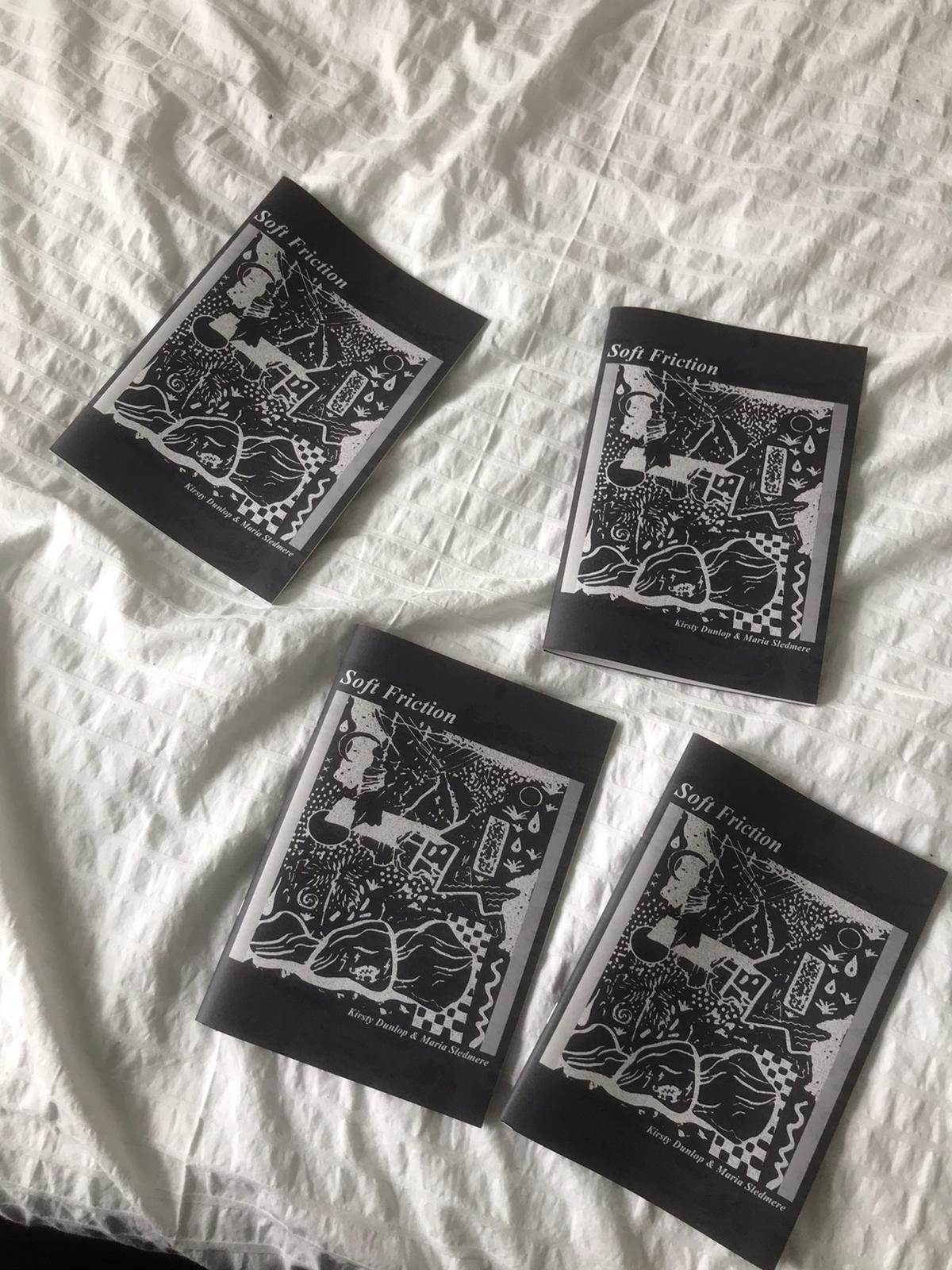
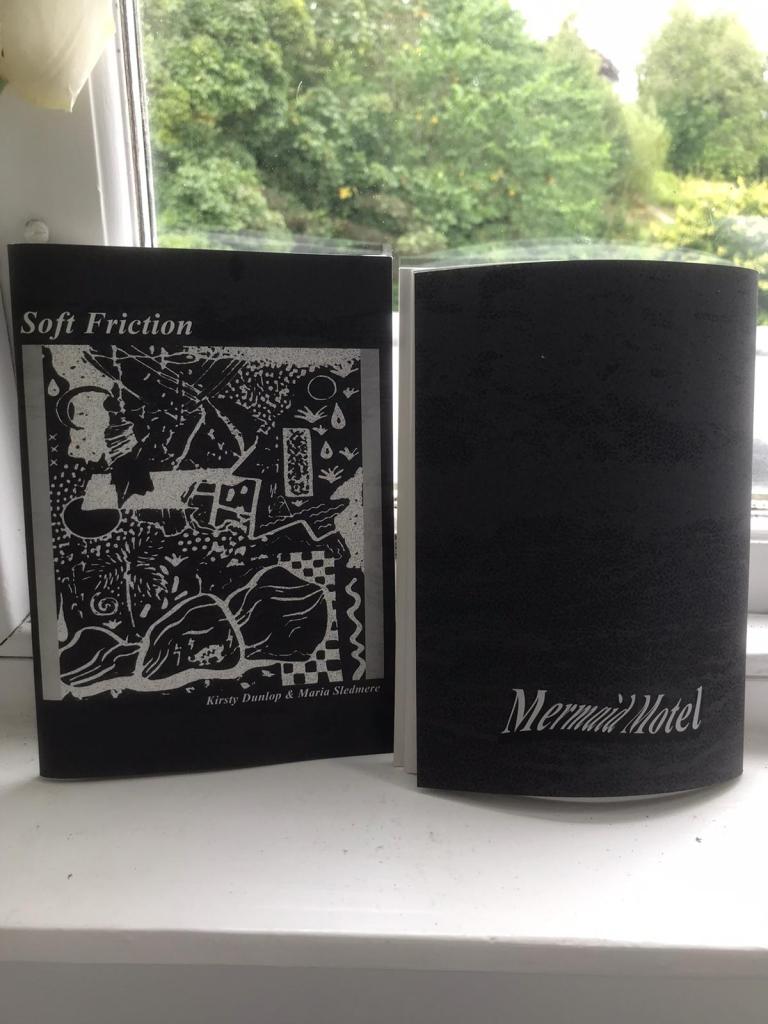
New publication: Soft Friction by Kirsty Dunlop and Maria Sledmere
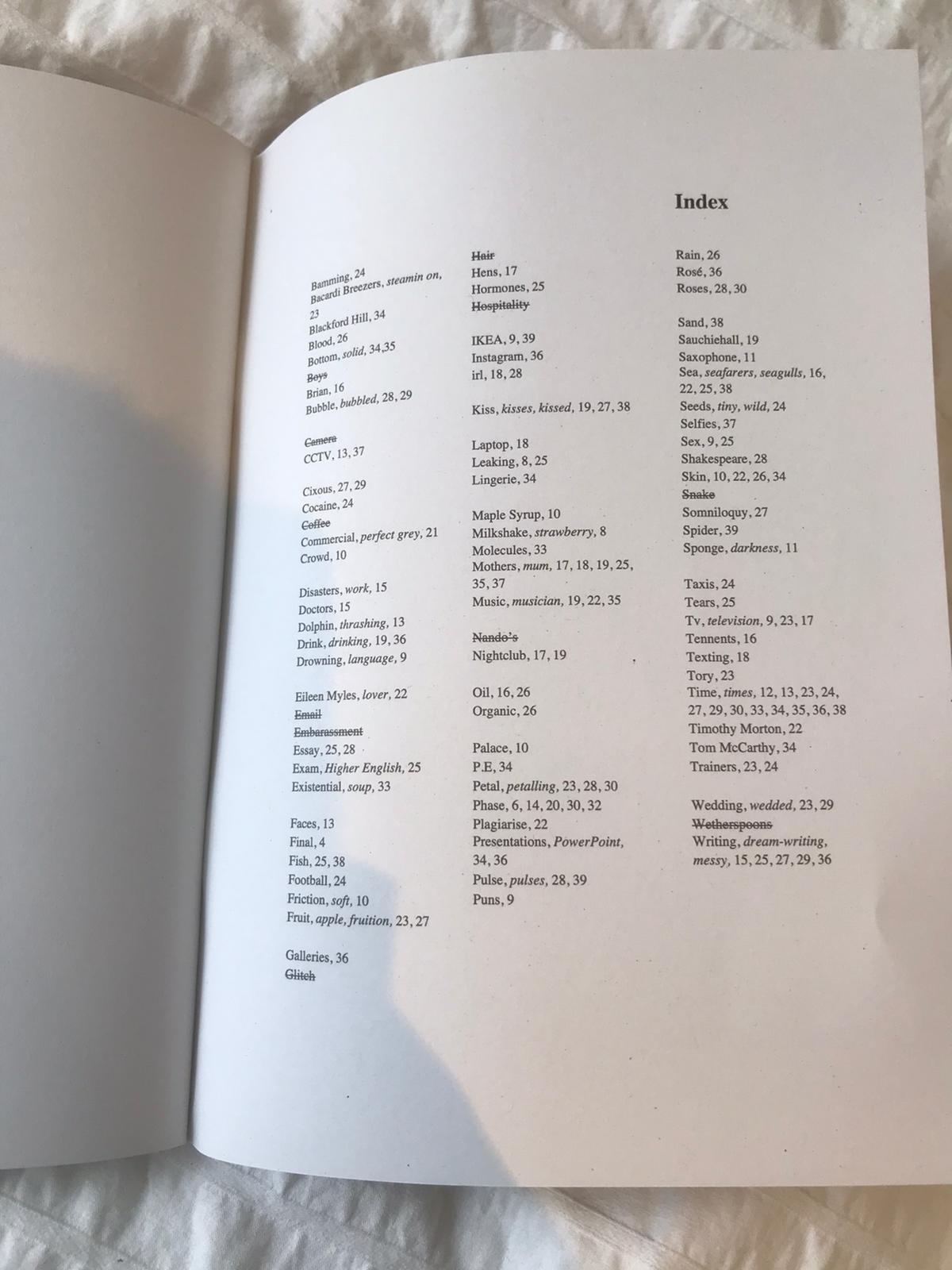
Here we present you a bundle of our dreams, wrapped in something like a rhythm, or did we mean a ribbon? Soft Friction is an intimate gathering of dreams from 2018, written during a summer of ‘existential soup’, fainting at gigs, pulling all-nighters and panic surrealism. Extracted from a longer diary, these fragments wear the sensuality and sass of an active dream life shared between two people getting high on each others’ brains. From dolphins thrashing in kitchens, to maths equations, celebrity encounters and shopping for underwear, the pamphlet runs through the four stages of sleep and wakes you with a cheeky tickle of incompleteness.
44pp (A5 B/W) Printed on recycled natural paper 100gsm Cover by Maria Sledmere Published by Mermaid Motel £5 inc. UK P+P
To order, email kirsty_dunlop[at]hotmail.co.uk or simply paypal £5 to this email with your postal address. For orders outside the UK drop Kirsty an email for postage.
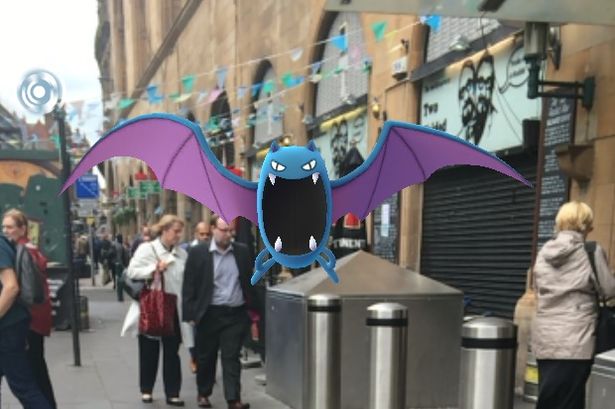
I scroll down my Facebook timeline, and there is a photograph of a pavement – on a real street which I recognise – and on that pavement is a Pidgey. You know, the wee brownish flying thing from first generation Pokémon? I scroll down a bit more and folk have been out and about all over the place: there’s a Weedle on the gingham tablecloth in a cafe, a wee purple-grey Nidoran on a hay bale, a Magikarp bouncing around by the Kelvin. This is, if you haven’t guessed already, people sharing their spoils from Pokémon Go, an augmented reality game which allows you to catch Pokémon in the wild, a.k.a real life. There was a glorious month in the summer when you could go for a walk and see clusters of people milling around with their phones in the air, as if trying to channel some ethereal spirit that was wafting in the atmosphere. They were out catching Pokémon. All of a sudden, people were going for walks again, leaving the house and the cosy glow of the television to catch invisible beasties who lived in trees and parks, museums and street corners.
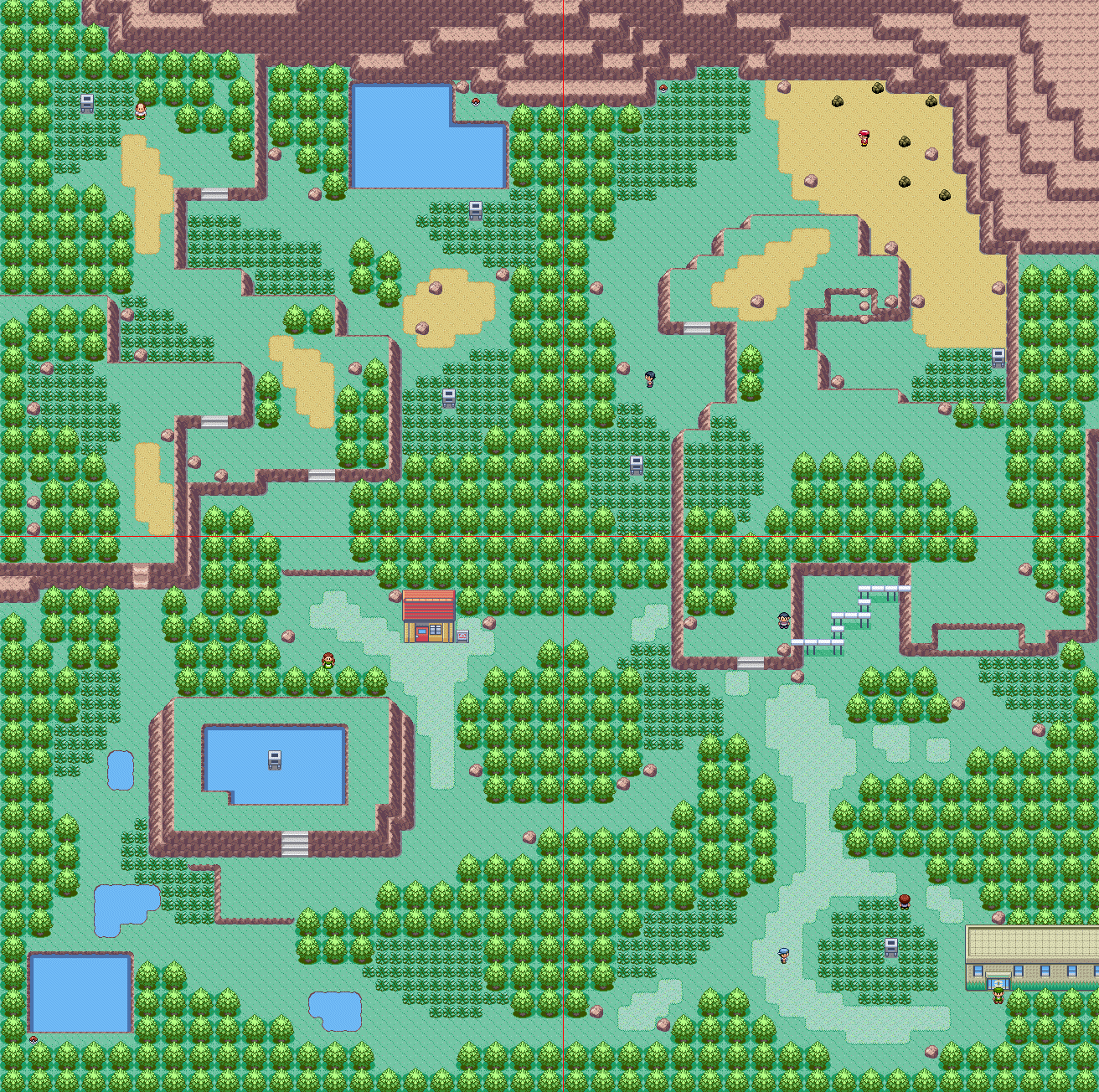
Safari Zone Map from Pokémon Ruby/Sapphire. Image Source: PsyPoke
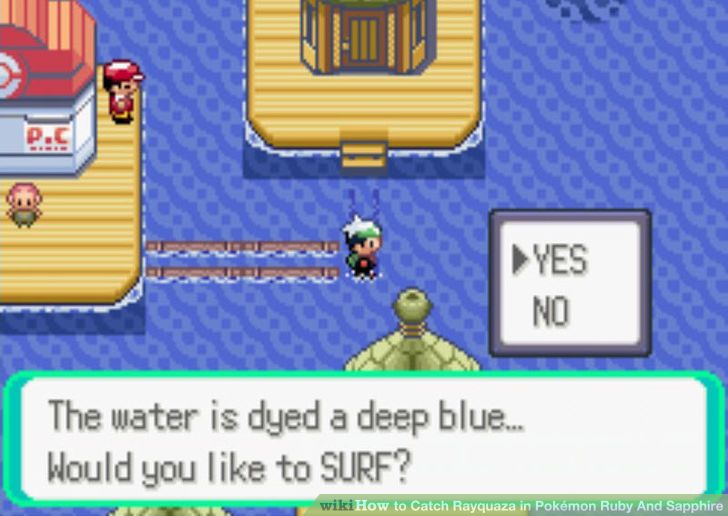
As a kid, I was an avid Pokémon fan. I missed the boat for Red and Blue but had Yellow, Ruby, Sapphire, Leaf Green for my Game Boy Colour and Advance and played them all to death. What I loved more than the battles was the wandering part. So much of your time is taken up pushing your way through long grass, cycling along seaside promenades, bobbing along the ocean, taking shortcuts through forests, crossing through dungeons, traversing the plains of mountains and deserts. You’re constantly interrupted by Pokémon encounters; so much so that often you double back in confusion, any instrumental pathway you’re trying to take disrupted by the screen switch to a battle. The towns often had such picturesque names as ‘Petalburg City’, ‘Sootopolis City’, ‘Lilycove City’ and ‘Mossdeep City’. Then there’s Meteor Falls, the Sunken Ship and Sky Pillar – these are just from Ruby/Sapphire alone. Yes, the game has a final purpose: you’re supposed to beat the gym leaders of every town and follow some convoluted let’s beat Team Rocket narrative, but often its trajectory is beautifully non-linear. You can explore, catch Pokémon in your own time, find side quests to achieve, people who need help. Acquire potions, level up your Pokémon, learn intriguing stories from local mythology.
Screen Cap from Ruby/Sapphire. Image Source: WikiHow
There is an obsessiveness to Pokémon, a desire to always repeat. As much as possible, you find yourself returning to previous towns and locations, either to seek out more Pokémon known to appear in the area or simply to explore, to see what you’ve missed. Invariably, you do nothing new, and manage to enjoy that process of wandering again. You fight the same Pokémon, hoping they will flee but secretly enjoying taking them down in one shot with your level 40 team, where once you’d have to fight tooth and nail with a goddamn Zubat. To some extent, Pokémon is a rhizomatic game: once you get to a certain stage, the world is yours to explore and you can map out your own routes and lines of flight as you see fit, flying and sailing and seeking locations of your choosing. However, you are still governed with the impulse of narrative, which spurs you onto particular places: sometimes you can’t move on till you’ve beaten the gym leader of that town, for example. You can regress, but not progress. There’s that sort of macho narrative of levelling up which you’re impelled to follow. It’s only when you’ve completed the game that you can reap the rewards of complete exploring.
Pokémon Go changes that. By transferring Pokémon to real life, you are as free to explore its terrain as you are to wander the streets of your local town or city, or indeed the plains of the countryside. Real life is transformed by augmented reality, the imposition of Pokémon on material space. Creatures that only the player, holding up her phone, can see. This is already getting very Black Mirror, but wait. It’s a competitive game, yes, but there aren’t the drastic consequences of social exclusion and alienation experienced by many of Black Mirror’s tech addicts. There is a lovely playfulness to Pokémon Go which somehow has generally avoided becoming cutthroat competition. For a while, everyone was playing it. It was a form of camaraderie (folk would go out in packs to hunt for Pokémon, or indeed organise mass hunting expeditions via Facebook). More time was being spent on the Pokémon Go app than on Snapchat, Twitter and Whatsapp. I’d go into the kitchen at work and the chefs would gleefully show off their Pokédex; which was glorious, seeing all those familiar creatures again in this new and surprising context. And since chefs have hardly a moment’s time when they’re not in the same place, working 14 hour shifts at a time, I can only imagine the extent to which people in other walks of life played it.
Pokémon Go is a strange way of making people notice their surroundings, particularly in the sense of urban space. Sure, most of the time their faces are glued to the maps on their phone screens, but in placing themselves in the world, they are forced to confront physical structures, obstacles, windows, private property and so on. It becomes even more of a game when you have to work out how to attain Pokémon in elusive locations. I’ve heard stories about folk knocking on your door asking if they could come in because they’ve noticed you’ve got a rare Pokémon in your house. It sounds pretty sinister, but it shows the level of commitment the game inspires.
Think of it this way: why is it so addictive? Like Tinder, it’s a form of locative media which uses your GPS to determine who or what will appear in your surroundings. Pokémon Go also uses your phone clock, as different types of Pokémon appear at different times of day. I’m reminded here of one of my favourite games, Animal Crossing,where you could go fishing and bug-catching but what was out there was determined by the ‘real time’ of your Game Boy’s internal clock. It followed the real time of a 24 hour day, of the seasons and so on, so that in December there’d be snow and falling leaves in autumn. It was very beautiful and the real time aspect has an addictive quality. I think it’s because the game becomes less a form of escapism and more a parallel to reality, to everyday life. You know it’s reached that status when The Mirror runs a how-to guide, eh?
What’s so cool about Pokémon Go is how it adds meaning to real space. A school, town hall, park or pub becomes a Pokémon Gym and everyone wants to visit. I swear business at my work improved for a month as we quickly realised we were a Pokémon Gym and groups of sullen young adults would gather silently at bar tables, trying to battle other trainers at the gym and hoping to win Pokécoins. A guy I work with would heavily protest when he saw someone playing the game because he was currently gym champion and got surly at the prospect of newcomers taking his title. If I was late bringing someone a coffee, nervous they’d be grumpy with me, often they were so distracted by the game that they’d not even noticed the time. In a sense then, Pokémon Go transforms both time and space. Everything is flattened into a map, where flashing nodes indicating Pokémon are the symbols of desire, the objects of pursuit.
In a compelling, complex and challenging article on Facebook as a ‘desire-network’, Maria-Daniella Dick and Robbie McLaughlin argue that ‘Facebook effects a mutation in desire and thus in capitalism’, and in tandem with this, a ‘historical shift inn the relationship between psychoanalysis and capitalism’ (Dick and McLaughlin 2013). With Facebook, ‘desire remains impossible to satiate, but it is now without object’ (Dick and McLaughlin 2013). They suggest that Facebook is situated within the Lacanian Imaginary order (which constitutes the intrinsic narcissism through which the human subject constructs fantasy images of both herself and her object of desire). According to Lacan, desire (unlike need) is always unfulfilled; we are always moving towards a lack, the anxiety prompted by something lost (as in the child’s original sense of wholeness before discovering the fragmentation of her parts, the split between her body and world and mother, in the mirror). The Imaginary is that which we create to attempt to fill that fundamental gap, the fantasies of the ‘ideal ego’ which compensate for an originary loss. Facebook is basically the ultimate web of the Imaginary: all our time is spent scrawling through pictures and statuses and shared media which all in various ways represent fragments of the ideal selves we project online. Yet our browsing is ultimately without end, it is ceaselessly rhizomatic, decentralised; we end up on one place, a restaurant page or old friend’s profile, without really knowing how we got there. Our passage through the network is governed by algorithms which attempt to map our desires; algorithms which are self-sustained by users’ input data, the patterns of usage recorded with every click. While this may seem revolutionary, a democratic decentering of the system, Dick and McLaughlin are highly sceptical of Facebook’s subversive potential at the scale of the political.
While the likes of Facebook were integral in the organising of such glocalised (global/local) revolutionary events as the Arab Spring or the Occupy Movement, ultimately ‘[s]ocial networking completely embodies and facilitates these phenomena in which the masses are now able to organise efficiently but without being unified by a radical ideological alternative’ (Dick and McLaughlin 2013). The fragmentary pathways of Facebook map out the lines of insidious liberal democracy, and as engrained as they are in corporate culture (the corporation itself becoming the medium for mass communication) offer little opportunity for imagining visionary alternatives to liberal capitalism. Crucially, Facebook (with all its user-directed interfaces based on algorithms of taste and so on) perpetuates the myth of the liberal individual, who curates her profile, her tastes, conducts a life of many choices. As Dick and McLaughlin (2013) put it: ‘[t]he so-called 99% are already conditioned by a liberal democracy in which they have the self-identical sovereignty of an individualistic ideology that places the subject at the centre of the world’. To really offer a vision for an alternative future, we have to actually come up with a plan. Recognise that we are always-already networked individuals, whose subjectivities are hardly unique and instead constituted through structures of discourse and power, and use this in a positive way, to undermine the liberal justifications for free-market capitalism.
What does all this have to do with Pokémon Go? The thing is, Pokémon Go seems like innocent child’s play, but it’s bound up in the politics of space. It’s fundamentally structured by GPS software and urban space, and let’s face it, urban space is always ideological. Whether it’s homeless spikes, shiny new glass-fronted apartments built where Brutalist high-rises used to be, gated communities, the psychotic disarray of London’s property market, the genuine promotion of American Psycho-style yuppie-targeting ads or simply the denigration of social housing as ‘slum housing’, space and architecture is always somehow political. In a recent talk given at the University of Glasgow titled ‘Remembering the Future: The Politics of Space and Architecture’, Darran Anderson argued that the current failure of the Left is a failure to put forward a vision of the future that is compelling and actually positive; if we don’t act soon then someone else will determine the future for us. One way Anderson proposes we can intervene in the social order is through architecture, by building sustainable forms of urban space, housing and energy production that take into account the fact that we are living in the Anthropocene. We need to accept the imminence of ecological disasters, which are indeed already happening. We need to rethink our fantasy imagery of the city; it needs to become a network of playful imagination, of empowerment, rather than just passive defeat, or the kind of share-lite politics, browsing, blasé escapism and distraction offered by Facebook.
What is interesting about Pokémon Go is that it restores to some extent the object of desire, which Facebook, in its endless networks of people, places, photos and check-ins, displaces. ‘With Facebook’, Dick and McLaughlin (2013) argue, ‘people no longer live the present as present; it exists only insofar as it is exists to be recorded and later uploaded to Facebook’. This temporal displacement shifts with Pokemon Go, which insists on the present as present. Pokémon only appear for a limited amount of time so the imperative is to catch them in the game space of the now. The impulse of shopping or clubbing to buy buy buy or drink drink drink is gleefully interrupted by the appearance of Pokémon, who are quickly snapped up and snapped, shared online. The allure of ‘cool’ or the aura of dreamlike consumption attached to consumption-based social places is disrupted by the childlike logic of the game. And there’s nothing the companies can really do about it, since technically Pokémon isn’t intruding on reality, it’s only intruding on maps of reality. Now I’m thinking of that Jorge Luis Borges story, ‘On Exactitude in Science’ (1946), and getting very confused about reality itself. In the story, Borges imagines an empire where cartography has become so exact that its map of the empire must match in size and detail the empire itself—after which, what’s the difference between the map and the original? Do you need the map anymore, or can you use real space to map out real (map?) space?
There is almost something a tad Situationist about Pokémon Go. It offers no restrictions on movement, the way the Game Boy games do, according to a linear narrative. If you want that elusive Vulpix or Meowth, perhaps you will have to explore territories previously uncharted in your running app or Instagram places map. You might end up in the strange end of town. And what will you find when you get there? Traversing space this way leads to opportunities of surprise and discovery. The fact that so many people are posting photos of their Pokémon Go encounters online adds a new palimpsest of meaning to our understanding of place. The appearance of Pokémon disrupts the order of cities; it adds new points of desire to the map. Sure, most gyms are in tourist hotspots, but that doesn’t mean you don’t have to explore the more unseemly areas of town to catch ‘em all. In wandering out your comfort zone, you’re enacting a sort of De Certeauian ‘tactic’, resisting the signage and flows of capital which generally direct your movement in urban space (i.e. according to the circuit-like lure of the shops, the home or workplace). Ironically, you’re doing this at the inspiration of a global corporation (the folks who own the Pokémon Go app), but in this case, it doesn’t necessarily mean your actions and movements aren’t subversive. Nevertheless, the transgression of space according to augmented reality is unfortunately still bound by societal racism, highlighting the fact that we experience space differently according to who we are—despite its best intentions and possibilities, a game like Pokémon Go can hardly overthrow the prejudices of the Repressive State Apparatus…
Since Pokémon Go is based mostly on algorithms of mapped information, there is an element of chance which escapes the systems of data (could we call this glitch a Lacanian intrusion of the Real?). Pokémon crop up in controversial places. Since ghost Pokémon are attracted to graveyards and places of mourning (think: the original Lavender Town), they have been appearing in places like the Holocaust Memorial or Ground Zero. The incongruity of the playful critters in these places of silence and solemnity is startling and forces us to rethink our expectations of memorialising space. In a sense then, for better and worse, Pokémon Go has a reterritorialising impulse. Sure, you can report inappropriate places and instigate a process for removing them from the Pokémon Go map, but that initial appearance, based on some kind of algorithmic randomness, has already violated the implicit expectations of such places in terms of silent respect and mourning. There is in a sense an overflow of the gaming impulse, where the augmented reality becomes more distracting than reality itself (even when you are in such a compelling and startling location as the Holocaust Memorial…).
Houses that crumble…Screen cap from Omer Fast’s 2015 adaptation of Remainder, starring Tom Sturridge. Source: Belfast Film Festival
Perhaps this is the danger then, of supplanting a fictional reality (the map) for the territory itself. I’m thinking of the protagonist in Tom McCarthy’s novel Remainder (2005), whose response to trauma is to assemble a detailed map of a very specific retrieved memory, based in a house where there was a very specific synaesthetic symphony of liver-frying, cats on roofs, piano playing and motorbike clanging. Eventually this map is transferred to the ‘real’ as the protagonist recreates mimetically the details of this spatial memory. Yet pursuit of the real is addictive; the protagonist soon begins recreating more extreme and harrowing memories he’s encountered: traffic accidents, bank robberies. What intrudes, eventually, is the remainder: the real itself which spills out of the recreated event. As McKenzie Wark writes in the preface to McCarthy’s novel, ‘[t]he simulation is never perfect, always in excess of the thing itself. It always leaves a remainder. The most troubling remainder is himself [the protagonist]. He is a leftover God, a God as debris of creation’ (Wark 2015: xi).
In a way, Pokémon Go represents a God-like desire to reconfigure reality, to impose the Imaginary space of the simulated game upon the ‘game’ of ordinary existence. Is this a postmodern statement of irony, a pastiche of 1990s nostalgia in the age of the smartphone? Yes, and no. There’s something kind of modernist and sincere about it too, a sense of genuine interest in creating the Big Project, a utopian potential for gaming to bring people together. While Pokémon Go is partly about earning currency (Pokécoins) to buy more materials which help level up Pokémon or revive them during battle, its general impulse is towards exploration. Conquering, yes, to an extent; but mostly exploration. What happens when you’ve captured every Pidgey in your neighbourhood? You travel farther, maybe even beyond your hometown or city. Of course there comes a point where most of us get bored and stop playing, but there was a moment when the game genuinely seemed to interrupt reality in a way that felt genuinely liberating. The fact that so many people deemed it silly, a waste of time and completely illogical only highlights the ways in which the game resists the general instrumentalism of capitalism (i.e. every minute should be spent doing something useful, like finding ways of accumulating money and furthering one’s career). The time wasting aspect, the fact that so many people love its paean to repetition (you can walk the same route every day and still get different Pokémon appearing), is a queer sort of logic; it goes against capitalism’s futurity, the linear progression of temporality, in favour of a kind of maddening impulse of looping, overlapping desire. We accumulate the same Pokémon several times and this is part of the internal logic of the game, compelling us to traverse the various spaces again and again. It represents at once the immateriality of twenty-first capitalism (as based on flows of ‘invisible’ capital and immaterial goods, symbols of status) and the potential for subverting the logic of accumulation to one that is both bizarre and based on the ethics of play rather than success.
Sure, a great deal of the game might be about levelling up and being the best, but you can also play it with general disregard to those impulses. Collecting, in a sense, transforms the use-value of goods by placing them in a new circuit of information, taking them from the marketplace to the geeky world of the collector, whose interest in based on details and aesthetics, often more than financial worth. Just look at what happens when someone tries to make money off becoming a hire-out Pokémon Go trainer: they are threatened with being banned from the game, since it violates their code of ethics/terms of service. Play, rather than capital, is at the heart of the game’s map of trajectories. It brings people together – even adults – in a space of play. I’m not saying it’s changed the world by any means, and indeed it has its slightly absurd but very real dangers, as people blithely ignore the potential perils of the real landscape in pursuit of the desired (simulated) object, like Icarus flying too close to the sun…However, there’s something genuinely refreshing about how Pokémon Go forces us to reconfigure our sense of reality, space and the routing of our desires and movement. While world-views are shrinking and narrowing in post-Brexit times, Pokémon Go reminds us of the value of expanding our horizons and getting up to just go and wander, maybe aimlessly.
There will always be moral panics over deaths from selfie-taking, planking and cavorting in dangerous places, but will there be anything quite like Pokémon Go?
Bibliography
(other references are hyperlinked in the text)
Anderson, Darran, 2016. ‘Remembering the Future: The Politics of Space and Architecture’, Lilybank House Seminar Room, University of Glasgow, 15th November 2016.
De Certeau, Michel, 2011. The Practice of Everyday Life (Berkeley: University of California Press).
Dick, Maria-Daniella, and Robbie McLaughlin, 2013. ‘The Desire Network’, Theory Beyond the Codes, [Available at: http://www.ctheory.net/articles.aspx?id=727] Accessed 21/11/16.
Wark, McKenzie, 2015. ‘Preface’, in Remainder by Tom McCarthy, (Richmond: Alma Books), pp. vii-xii.
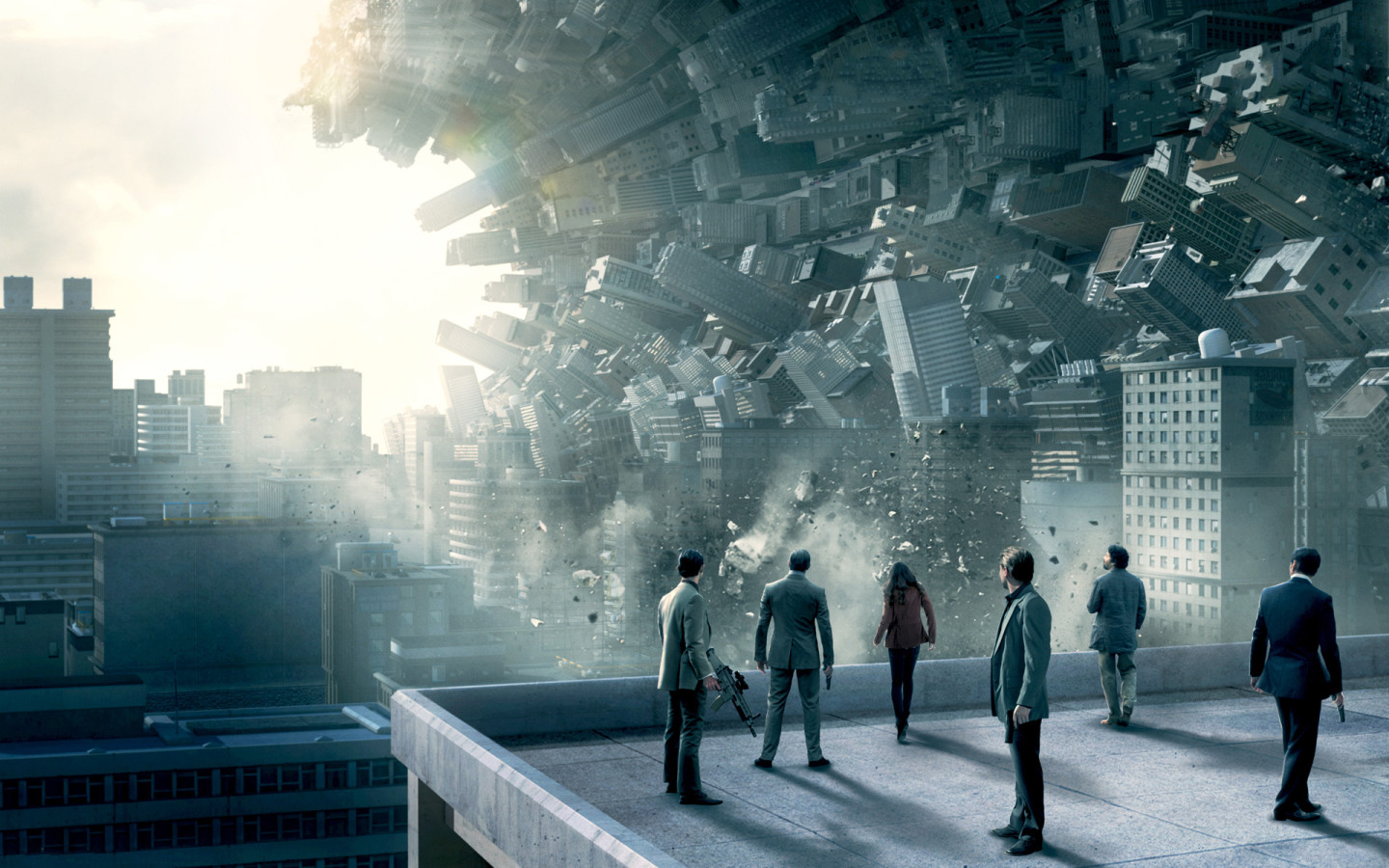
Inception is a film that begs itself to be watched twice. Following what appears to be a complex dual narrative of both emotional turmoil and psycho-political manipulation, Christopher Nolan’s blockbuster success turns on an exploration of the implications of the very personal act of dreaming being appropriated externally as a powerful means of mind-control. Yet whilst the film indulges in Hollywood-acknowledged action scenes – from a gravity-defying fight sequence in a surreal hotel corridor to a car tipping off a motorway bridge – it also diverges from the traditional narrative style of mainstream movies. With the seemingly complicated premise of dream-stealing intertwined with the intimate personal journey of the main character Cobb (played by DiCaprio), the film’s exposition is unravelled in an on-going fashion and so we are plunged straight into the action. The main storyline centres on a deal that Cobb strikes with Saito, a powerful global businessman who proposes that in order to use his influence to let Cobb return to the USA (Saito can eliminate false extradition charges held against Cobb), Cobb must perform the task of inception – a task that takes him and his colleagues deep within three dream-layers in order to manipulate another man’s mind. What is interesting about the film is not necessarily its deceptively confusing plot but the way it is told – the story itself – and the techniques the film employs by meshing the genres of sci-fi, psychological thriller, film noir and heist in order to raise questions about narrative seduction, dreams and the power of the unconscious.
While many heist films unveil their major technical premise at once, as a character explicates the details of the mission to his/her colleagues, Inception works in a fashion that Kristen Thompson calls ‘continous exposition’. In this sense, the aim of Cobb’s team of dream-thieves, as well as the physical laws that govern the practice of dream architecture and inception (the implanting of an idea into another’s mind so that they imagine it to be of their own creation), are revealed gradually throughout the film and during scenes of both explanation and action. The character Ariadne takes her name from the Greek heroine Ariadne, who falls in love with Athenian hero Theseus and helps guide him with a ball of string though the Cretan Labyrinth in order to assist him in locating and slaying the Minotaur. Similarly, Inception’s Ariadne plays a key role in not only helping Cobb to disentangle the repressed emotions regarding his dead wife which continue to haunt him and disrupt his dream work, but also as a pupil of the dream-workers she learns and responds to the workings of the dream-world, thus illuminating the film audience with the features, possibilities and ontology of dreaming through her character.
This gradual unravelling of exposition plays a fundamental role in the seductive quality of Inception’s narrative. Talking about the task of exposition, Nolan explains:
“Exposition is such a massive demand […] It’s something you have to just try and imbue in the relationships of the characters. You never want to find yourself in a scene where characters are passively receiving information in some way, because you don’t want the audience passively receiving information. You want them engaged with that dramatization.”
It is this engagement with understanding, this active involvement in working out the enigma, the puzzle, which makes the film so gripping. Rather than spoon-feeding the audience a fully-blown detailed account of the principles of mind-control, Nolan reveals slowly the inner workings of the machine of dreaming. Information seeps out of the action as characters exchange advice and teachings, and as things do or do not go to plan we are often left to extract our own conclusions about how the laws of dreaming work. This mode of exposition is thus fundamentally tied to the events of the film itself, rather than an intrinsic system of depth which can be quickly absorbed and applied to the film as a whole; the labyrinthine revealing of secrets and mysterious truths refracts from storylines and action across to the revelation of Cobb’s unconscious traumas, so that the audience find themselves caught in a play of possibility and information that moves as swiftly as the characters as they set out on their complicated mission.
I suggest this fast-moving, yet richly-layered form of narrative is highly seductive in its ability to lure viewers in to the depths of the film in a way that relies on the vivid exchange of surfaces, visuals and meaning. Seduction, as Baudrillard (2001) identifies, is fundamentally an ability ‘to deny things their truth and turn it into a game, the pure play of appearances’. One way in which a narrative can seduce, then, is by denying its audience fixed answers, a technique which enables the endless ‘play’ of possible meanings. This draws us in so that we play an active role in the ‘game’ of interpretation, a technique of seduction which seems very appropriate given the often vague and mysterious nature of dreams themselves.
In Inception, there are a lot of deliberate ambiguities, and things that are revealed to be not quite what they initially seemed to be. For example, the question of what is a dream and what is reality. This is a problem that we learn Cobb suffers with, and it is one that is well documented in literary and film history. Whether from overuse of psychadelic drugs, or some form of mental pathology, there have for decades been characters portrayed as losing their grip on the thin line that separates reality and fantasy, dream-world and actual experience. Examples that spring to mind are A Beautiful Mind and Black Swan, which both offer provoking depictions of schizophrenia. Psychosis is also a difficulty that Cobb’s deceased wife, Mal, has fought with. Mal and Cobb spent a great deal of time in ‘Limbo’, a world of endless pure subconscious creation that is formed in an on-going fashion by those that occupy it. It seems by definition to be an abyss of the mind, a place to be trapped in ceaseless possibility – lost in one’s own creative, expansive subconsciousness. You enter Limbo when your physical body is heavily sedated, and either you are killed in a dream or at a complex dream level (in the film, level 3) when you fall asleep. It’s a strange and vicious concept that has a dark allure to it – the suggestion that perhaps when people enter comas their minds are elsewhere, trapped, unable to get back to reality.
When Mal and Cobb finally make it out of Limbo, Mal soon loses the ability to distinguish this real world from the world they fashioned in their dreams. Eventually we learn that this is because Cobb only managed to get himself and Mal out of Limbo by planting through inception in Mal’s mind the idea that the world (at that point, Limbo) was not real – persuading them to commit suicide in order to be kicked out back to reality. Yet the idea that the world was not real grew like a parasite and tormented Mal until she could not accept even reality as reality. She thought she was still dreaming: that her children were just projections of her consciousness, that the physical environment was just a fabrication of memory and imagination. To remedy this perpetual state of insecurity, she decides to kill herself by jumping from their high-floor apartment into the abyss below.
I think this form of suicide poses interesting questions about the nature of consiousness and our self-awareness within the world. To what extent do we really know that this environment that seems so solid and familiar is in fact real and actual? We know what it feels like when we are dreaming: time is sped up, often fragmented (an issue dealt with in Inception, where there is a mathematical formula that encompasses the disjunction between time spent asleep and time in reality, where one can dream for 50 years but be asleep for merely three hours), we wake up when we die or when there is some sort of ‘kick’, which might be something like loud music or physical pain – a jolt that wakes us up. Yet although it seems easy to distinguish dreams and reality, how do we know that there is just one ‘reality’, or that our notion of reality is just an elaborately designed, prolonged dream? It’s a problem that was posed a long time ago by René Descartes, who suggested a form of radical scepticism about the nature of reality. Descartes proposed that all our conscious experience could merely be a dream-state, manipulated by an all-powerful and omniscient ‘Evil Demon’, who could control everything we do and everything around us. This is the famous ‘brain in a vat’ philosophical problem that has been explored in films like The Matrix, and becomes evermore salient as virtual reality and technology advances to provide evermore realistic and vividly detailed artificial environments. What it comes down to is the fact that we really cannot know (or can we?) the metaphysical nature of the world: our knowledge leads merely to a non-passé, or an abyss (like the one Mal plunges into), an endless recursion to the possibility of multiple imagined or experienced realities.
And who are we to judge that the world in the film is reality? What if Mal, in leaping from the metropolis to the dark void below, really did escape to a higher level of consciousness, a real world? The film cuts rapidly in and out of the different dream levels inhabited by the characters in their mission to conduct inception on Fischer, a businessman (to persuade him to break up his father’s monopolying empire – maybe someone should try and do this to a young Murdoch). This technique not only disorientates the audience and imbues the film with a surreal quality but it also highlights how our perception is fleeting, rapid, built up of impressions. Reality, then, is very subjective, and the distinction between psychological reality, the durational experience of time and physical reality with linear clock time. Nolan seems to want to emphasise this ambiguity of experience and reality with the ending, which closes on the image of the only anchor an individual possesses to reality – the totem: a small token whose unique, personalised weight, balance and appearance enables its owner to discover whether they are in their own waking/dreaming reality or another person’s dream – if they are in another’s dream the totem will feel strange. Cobb’s totem is a kind of spinning top, which is set to topple over if he is awake and to continue spinning if dreaming. At the ending, Nolan shows Cobb’s totem both spinning but also provocatively starting to topple. This means we do not know if the film closes with a conventional happy ending, with Cobb finally reunited with his children (mission accomplished) or whether he is simply dreaming about the event.
In the hope of drawing some line between dreams and reality, it is useful to consider the concept of the ‘kick’ featured in Inception. It’s interesting when real-life stimuli enter our dream-world: for example, in the film Cobb is thrown into a bath of water and in his dream water floods in through the windows. The ‘kick’ designed to withdraw the characters from the triple layers of dreams they are in is a piece of music, which resonates throughout each level like an uncanny scent or breath of memory – not just the physical stimuli of sound. I have had many dreams where I am drowning and can’t breathe – the pain physically sears up in my chest, but when I wake up I realise I’m somehow suffocating myself with my pillow! Not only is there some psychoanalytic value in studying what makes us wake up from dreams (hello, Freud), but the concept of the ‘kick’ raises intriguing questions about where mind and body collide, and how much of consciousness is interwoven with all those nerves and neurons to our physical form. Certainly this very phenomenon refutes the now very-dated but religiously popular form of Cartesian ‘dualism’ which proposed the mind and body were distinct forms of matter, so that when the body dies the soul remains and can go to heaven or hell. If mind and body are different materials, then how can they interact so intimately?
On the question of psychoanalysis, the film borrows heavily from Freudian ideas about the interplay between and the role and nature of dreams and the unconscious. The characters in Inception spend a great deal of their time lucidly fabricating dream-worlds and occupying the dream-worlds of others, as well as switching between dreams and reality, that it is no wonder that many of them suffer a mild psychosis whereby the distinction begins to break down. Freud himself deemed psychosis a ‘disturbance in the relation between the ego and the external world’.
In The Interpretation of Dreams, Freud posited that our dreams contained symbols transmitted from the underworld of our unconscious, symbols that represented repressed desires and wishes (usually sexual) that are too uncomfortable or psychologically painful (due to the effects of oppressive socialisation) for us to admit consciously. He says: ‘the interpretation of dreams is the royal road to a knowledge of the unconscious activities of the mind’. So a dream where you steal your dad’s hat could have awkward Oedipal consequnces, as Freud thought that hats were often representations of genetalia. The possibility that you have sexual feelings for a parent is painful to acknowledge consciously due to society’s incest taboo, so instead this desire reveals itself only in dreams.
The consequences of psychoanalysis seem quite profound in unsettling our conventional idea of reality. If so much of our perception of reality seems to be subconscious, this makes it difficult to assume that there is a clear, objective definition of a singular reality, since everyone is driven by multiple interlocking wishes. The central emotional plot of Inception is a psychoanalytic one, as well as a conventional Hollywood drama of a distraught father who misses his dead wife and would risk the life of himself and his team for a chance to see his children again. Dr. Stephen Diamond makes the interesting point that Cobb’s unresolved guilt and anxiety regarding his involvement in manipulating Mal’s psychological state and (somewhat inadvertedly) causing her suicide is projected symbolically in the form of Mal herself, as Cobb’s ‘negative anima’. Mal haunts many of the dreams Cobb creates and makes it difficult for him to do his job properly, as her shadow-like and disruptive figure keeps reappearing in times of crisis. Ariadne, ever the guiding light, at one point takes up the role of psychoanalyst and tells Cobb that the only way Mal is going to go away is if he lets her go – if he resolves his inner conflicts with his memory of Mal.
The ultimate goal of being reunited with his children flickers through the film in the recurring appearance of the boy and girl playing together on the grass with a beam of sunlight. Subtle differences in their appearance occur between the different shots, which suggests perhaps an alteration in Cobb’s memory of them, or the real process of aging they are experiencing – again, a blurring of reality, memory and dreams. In the end, when Cobb finally returns to his children but the camera finishes by focusing on the totem, we are left with the uncanny possiblity that the children may not be real, instead merely (as Mal feared) ghostly projections of Cobb’s unconscious. However, the warmth and joy we gain from seeing this satisfying ending feels real. Does it matter what really happens? I think Nolan employs the ambiguity here to self-reflexively acknowledge the strange status of film as often a vividly realisitc visual projection of reality, portraying visually and auditorily objective reality and also rendering the subjective inner life of individuals. Film can seem all too real, but it is often fictional, and like a dream it is a temporally-compressed representation of reality. When the credits roll and we are suddenly thrust back into our everyday environment, we realise that we have been intensely caught up in this other-world, its visual universe has been painted upon our eyes for the brief time that we have been watching. It has become part of our reality. We probably won’t forget it; we might even dream about it.



 mariaology