Roseability

Disclaimer: my middle name is Rose. This means nothing, as far as I’m aware. I have never received roses for Valentines (as far as I’m aware). What follows comprises an essay on what a rose is a song is a word is a rose(?), feat. the likes of Gertrude Stein, Idlewild, Oscar Wilde, Joyce, Yeats, the French Symbolists and Lana Del Rey…

🌹🌹🌹

Despite having two degrees in literary studies, a lot of my more convincing intellectual references were first encountered through music, not books. The Manic Street Preachers’ Holy Bible album introduced me to Foucault, Plath, Ballard, Nietzsche, Mailer and Pinter in one fell, aggressive swoop of a Richey Edwards lyric barked over the guttural shudder of Nicky Wire’s bass-lines. Gertrude Stein, the awkward goddess of modernism, first came to me via an Idlewild song—deep in some distant vestige of the noughties, when I still bought CDs. She’s mentioned in ‘Roseability’, the last single to be taken from the band’s 2000 breakthrough, 100 Broken Windows. It’s a typically angsty track, reflecting on the futility of being dissatisfied with the present and finding pathetic solace in the past: “stop looking through scrapbooks and photograph albums / because I know they won’t teach you what you don’t already know”. Say it and already you know, right? ‘Roseability’, like ‘Idlewild’, is a compound word, a mashing of nouns that seems to promise deep meaning as its very premise. But where is it pointing us? What of Stein and what of her roses?

Stein’s famous quote on roses, ‘Rose is a rose is a rose is a rose’, seems to do two things. Firstly, it indicates an essentialist perspective on semantics—circularity conveying the uselessness of further description. Secondly, it enacts a qualitative echo chamber by which the reader must question what constitutes this essence, this roseness which is the rose’s identity. The repetition suggests the elusiveness of this essence, deferring with dreamy assertion—the kind of beautiful aphorism you might coin on an acid trip, completely sure of your own new logic. There’s a sense, with every ‘rose’, of meaning’s possibility blooming. You want to wrap the sentence in a circle (as Stein did, selling the phrase on plates) and close a precious loop, devoid of full stops and fixed meanings. Is a rose a rose or the space between a rose and what a rose is? Swap Saussurian triangles for sweet hips and sepals, a new rose budding in the roots. Lose all fixity for the chance trellising of structure, turn attention to sunlight, rainfall, temperature and other environmental conditions. Acquire tautologies and promise of spring. A rose is a whorl, a loop; a delicate head so heady with beauty. Humans like roses share beds sometimes. Look too long into the corolla and maybe you’ll lose your mind.

Idlewild: the secluded meeting place in L. M. Montgomery’s 1908 novel, Anne of Green Gables
Idlewild: the original name of John F. Kennedy International Airport in NYC
Idlewild: to idle wildly; to wildly idle; to idly go wilding.

You’ll always be, dissatisfied.” Perhaps the mere act of flicking through memories is a form of idle wilding. Making a wilderness of memory’s stasis. Depart only at airports; dwell between continental impressions of kisses.

100 Broken Windows marks a turn in Idlewild’s direction: from their 1990s brit-pop/punk roots to a more spacious, ambitious sound, influenced by the likes of The Smiths, The Wedding Present and R.E.M. When I first started listening to Idlewild, 12 or more years ago in those tender, pre-adolescent times, I sort of filed them as the Scottish version of Ash: they had that punk sensibility coloured by stadium choruses and a cheeky pop strain that balanced the anxious lamenting aspects. All sincerity, sure, but the lyrics were sharp enough to lift them from the sentimental pitfalls of subsequent contemporaries—the end of alt. history that was ‘Hey There Delilah’. Here we move into screaming emo or post-hardcore as inherent hauntology of the fuzzy rock club: the bourbon and sweat, the greasy hair, the frank, shuffling indifference of stoner punters. There were words that smouldered, sparked, then extinguished in the wind; but Idlewild had something different, a primitive attunement to human sorrow that cut through the gum-snapping cool of postmodern irony games, even as its affect blew up in a drumbeat or solo, the loquacious, Michael Stipe angst of Roddy Woomble’s voice. Think sonorous violins and a solid rock chorus, all the energy and wit being typically Scottish. Like the Manics before them, Idlewild did punk and guitar pop, did the stylised mosh and generic fusion, did the political and personal. The millennial malaise in their songs was very much of the times even as it seemed already tired of them:

It’s a better way to feel
When you’re not real, you’re postmodern (It’s not that one
dimensional, it’s not the only thought)

Cut out all feeling, except wait. There’s more. We don’t have to languish in the paralysing grunge of the nineties. The drama of strings would grace each melody electric and maybe you’ll find historic truth in this plugged-in homage to folk turned  on its head. If postmodernism is a Mobius strip of self-referentiality, that recursive collapse of linear progress (figured as a Scalextric set in the video for Idlewild’s ‘These Wooden Ideas’), then how to find meaning again, to find sense at all? Stand in a doorway and find yourself blasted with void fill, flick grapes in a wastebasket, count up your demons for the old stoned longing. Shrivel like raisins. The turn of the century has already happened, but maybe if you surrender to the chorus you’ll feel less jaded. There’s a reassurance. The thing about choruses, after all, is that they repeat.

As it does with choruses, algorithms and perennial blooms, repetition happens a lot in Tender Buttons, Stein’s infamously cluttered collection of prose poetics. With repetition and modulation, a queering of standard grammar, everyday objects become less the tools which underpin human existence, and instead things in themselves—the wasteful artefacts in excess of definition. Paratactical, concatenating assemblages which entangle like vines or else accumulate. Grapes on the carpet, styrofoam littering the floor, a word or two oozing through the backdoor…Am I far too close to the things I mistrust? Maybe there is always a stammering, a stilted stilling. I buy roses for the restaurant in which I work and the very act drags me into heteronormative time: the time of expensive dates, birthdays, weddings, funerals, candlelit dinners. What preference for the deep, luxurious, elusive bloom? Must lovers cut their tongues on thorns? I wonder, do those erect stems contribute their strange teleology…to what, to what…are roses always in excess of themselves—showering petals, shedding, being ever so much just roses?

I stopped and waited for progress”. Back in the day (2005), the NME rated Idlewild ‘a stolid group of trad guitar manglers’, whose new single ‘Roseability’ served ‘both as a rabbit-punch to the head of agnostics and a celebratory three-and-a-half minutes of safe, predictable, wholly generic, utterly brilliant rock ‘n’ roll.’ It makes me dewy-eyed to remember the magazine’s honest, scathing days. That insouciant, throwaway cool. Music criticism was pretty brutal when I grew up, and you basically had to tick every indie rock’n’roll formula (hello Alex Turner: snake-hips, haircut etc) to get consistently decent reviews. Or you could nail the attention on some eccentricity (The Horrors), or perhaps mediocre throwback to rock’n’roll times gone by (need I name every white boy indie suspect circa 2007). ‘Roseability’ is how it feels to be in your twenties, surrounded by people looking backwards; not quite in anger, but in nostalgia. It’s been a long time since I’ve considered something new as ‘utterly brilliant rock ’n’ roll’ in the transcendent sort of way Idlewild pull off—hardcore guitars, thrashing drums, literary references and all. Sweetness and thorns. Uneasy noise secretion. Tip your hat at tradition and then blast through the chorus, scatter your petals to cover the seams. What words in ‘Sacred Emily’ follow the roses? ‘Loveliness extreme’. I miss the NME, I miss being young enough to get lost this easily.

To veer into Idlewild itself, let’s wallow in passages from Anne of Green Gables:

You know that little piece of land across the brook that runs up between our farm and Mr. Barry’s. It belongs to Mr. William Bell, and right in the corner there is a little ring of white birch trees–the most romantic spot, Marilla. Diana and I have our playhouse there. We call it Idlewild. Isn’t that a poetical name? I assure you it took me some time to think it out. I stayed awake nearly a whole night before I invented it. Then, just as I was dropping off to sleep, it came like an inspiration. Diana was enraptured when she heard it. We have got our house fixed up elegantly. You must come and see it, Marilla–won’t you? We have great big stones, all covered with moss, for seats, and boards from tree to tree for shelves. And we have all our dishes on them. Of course, they’re all broken but it’s the easiest thing in the world to imagine that they are whole.

That endearing, childish hyperbole, the absolute thrill of invention. The special grove in a ring of white birch trees, heart of the circle, the rose’s secret pistil. Place of germination. Fragments congeal as expansive imaginings, disappointment evaporates in hope.

Gertrude Stein said that’s enough”. I’m not quite sure how Roddy Woomble, Idlewild’s lead singer, intended the Stein namedrop, but I take it as a reference to her poems’ weird loops of recursion. In the video for ‘Roseability’, Stein’s portraits are hung up all over the room; her face is even on the front of the kick drum, looking all knowing and stately. The video’s aesthetic has the feel of a 90s television set, all pop art circles whose colour has faded, sharp swivelling camera angles and hair swishes. The pop iconography of teenagers flooding the room with their plastic bracelets, braided hair and awkward moshing. It would be totally American if not painfully, most Britishly sincere—I mean just look at how the guitarist crushes into his own instrument, how Woomble wipes sweat off his face, paces around with the mic so close it could feel his breath. Loveliness extreme. When this was released, I wasn’t even a teenager. When I finally see him live, it’s in a church hall in Maryhill 2k17 and it’s utterly beautiful: how generous the set-list, how gracious a frontman with his small-talk and nods to the band, his thank yous. Watching the kids in the ‘Roseability’ video recreates that weird oscillation between feeling old and seeing in their faces the bizarreness of MTV ennui: the ghost of what I would temporarily become at thirteen, fourteen; cladding myself in discount Tammy girl, then Topshop, dying my hair pink and donning studded collars. With the hormones, you lose that ecstatic childhood imaginary hope; desire is amorphous and endlessly droning. You close your eyes and it seems the world has already ended. Sometimes it comes back, sometimes not. Maybe roseability simply means innocence.

‘Mrs. Dalloway said she would buy the flowers herself’ (Woolf). But customers rarely do. It’s up to me to ornament a room, to flourish a mood, to mark some milestone in another life that’s not mine, whose linearity’s not mine.

My mother bought rose-coloured roses for my eighteenth birthday, blush pink. Red when I turned twenty-one. I stopped acting sweet and rosy, dyed my hair red too. Fell through the whorls, the plush abyss.

‘Roseability’: the ability to be of roses, for roses to exist? Sensibility is, according to my laptop’s built-in dictionary, ‘the quality of being able to appreciate and respond to complex emotional or aesthetic influences; sensitivity’. Does roseability denote a similar sensitivity? When we think of roses we think often of Englishness: that angelic Laura Marling figure, a garlanded Bronte heroin, Paul Weller’s ‘English Rose’. We think tenderness, pastoral, a certain enclosure (marriage, gardens?) and guaranteed loveliness. She who coils golden hair round her porcelain finger, who knows how to talk to sheepdogs, who paints watercolours of the dawn. We think Shakespeare—‘a rose by any name would smell as sweet’. But we also think north of the border, a little bit of the visceral made kitsch: Robert Burns’ ‘my love is like a red, red rose’, whose unfortunate fate is to garnish every dishtowel bought on your granny’s last visit to Alloway (Roddy Woomble, perhaps not incidentally, is also an Ayrshire lad). The faint rose scent in a golden cologne, mingled with tobacco; the glistering sweetness of a youthful, drugstore perfume. Roses are roses, but roses are so many things, are poised on the lips of also…

The rose is a complex flower, a perennial whose species number over 100. Roses are typically ornamental, grown by those who know what cultivation means and spend their Septembers clipping away the thorny remains. An old man round the corner from my flat is out in all weathers among soil and stem: grafting, trimming, tilling for his roses. Perhaps he loves them more than his children. In summer, walking home on warm evenings you can smell them in the pale ambrosial air, a delicate bounty. If properly cared for, roses can live a long time, perhaps over and over, perhaps forever…what exactly does perennial mean?

The appropriately named Bloom, in James Joyce’s Ulysses, stands on Cumberland Street and opens a letter from Martha Clifford—a woman who responded to his newspaper ad requesting a typist. The Dublin postal system facilitates a sort of illicit exchange between them. Half-rhyme, consonance: petal/letter. The delicate thrill of letterly infidelity. She wants to know ‘what kind of perfume does your wife use’; the animal possession of scent. She attaches to her letter a flower, slightly crushed:

He tore the flower gravely from its pinhold smelt its almost no smell and placed it in his heart pocket. […] walking slowly forward he read the letter again, murmuring here and there a word. Angry tulips with you darling manflower punish your cactus if you don’t please poor forgetmenot how I long violets to dear roses when we soon anemone meet all naughty nightstalk wife Martha’s perfume. […] Fingering still the letter in his pocket he drew the pin out of it. […] Out of her clothes somewhere: pinned together. Queer the number of pins they always have. No roses without thorns.

So many compound words, clustering in the mouth like so many attaché petals peeled off from a dress. He plucks them away, fingers the soft excitement of words: ‘naughty nightstalk wife’ with the luridly alliterative twist of fantasy. Libido vs. loss of life. What slips away with the pin? What does the pin pin together? Folds and creases, sleepless. Spike of cactus, nasty, phallic. Prick. Tulip. Coiled anemone: wild flower or tentacular sea creature? Connotations of slip. In her slip. Slippery. Freud in The Interpretation of Dreams, waxing lyrical about female genitalia:

I thought of what seemed to me a venturesome explanation of the hidden meaning of the apparently quite asexual word violets by an unconscious relation to the French viol. But to my surprise the dreamer’s association was the English word violate. The accidental phonetic similarity of the two words violet and violate is utilised by the dream to express in ‘the language of flowers’ the idea of the violence of defloration (another word which makes use of flowersymbolism), and perhaps also to give expression to a masochistic tendency on the part of the girl. — An excellent example of the word bridges across which run the paths to the unconscious.

Dear roses dear romance; violets are pale taste of childhood’s sweet naivety. Violets are blue and so are you. Things you can take away. Lines of flight, tangled stems and botanical echoes. Semantics. Lingering taste. The burgeoning rhizomes of the greedy unconscious. Lana Del Rey: “there are roses in between my thighs / and a fire that surrounds you”. The Metro calls it a ‘shocking new track’, but I’ve never heard anything so languid and dreamy and in love. Hungry. Sugar is sweet and…
a9870a00b4965e682c4e3a3a89f4e6b8
Source: Pinterest

Angela Carter’s roses bite, don’t you? In ‘The Lady of the House of Love’, the self-starving somnambulist—the ‘beautiful queen of the vampires’—is a figure for desire’s recursive, self-destructive appetite. Manifest as addiction, or withdrawal; the flesh-shedding lust of anorexia, its resistance to growth and fuel. ‘She herself is a cave full of echoes, she is a system of repetitions, she is a closed circuit’. Her dialogue billows round and round into absence. Like Stein’s rose, she is bound to the noun and the grammar of herself—the flickering inward structures of mind, matter. The Algorithmic Beauty of Plants. Clustering rootlets, trapped yearnings for impossible perfection. No rose can be the perfect rose; except perhaps Stein’s rose: the virtual rose at the end of the looping rainbow. Loopy, lupin, lupine, luminal. Devouring, emanating, alluring. The virtual rose, perfect by its very impossibility, like Mallarmé’s Book. So many leaves and words. The stain of ink and rain, imprinted teeth. Carter again: ‘I leave you as a souvenir the dark, fanged rose I plucked from between my thighs, like a flower laid on a grave’. Those intoxicating roses, like Carter’s baroque, coruscating prose, cascade across the page, the white snow, the grave. La petit mort. In every petal the promise of a word, a breath.

Roseability. Faith in the unknowingness that is adulthood’s full blooming. Desire’s maturity bound in nostalgia, that noxious plague of your twenties; the ‘sense sublime’ of Wordsworth, five years later, experiencing ‘something far more deeply interfused’. Like the rose’s corolla, time rolls both round and onwards. It’s nauseating, an almost vortex. You’re always chasing that inward spirit, the thing that burns regardless: “They won’t teach you / what you don’t already know”—don’t Idlewild know it?

There is no roseability.” Enduring, complicated, hungry and sweet, it’s no surprise that roses are symbols for romantic love. Oh hallowed, protected cliché. Expensive hotels strew red roses on white bedsheets, a look that is oddly funereal. Share the ephemeral with melting chocolates. Reminiscent of menses, the blot of a clot in time. He got shot. She bled freely. Blood is like iron, a sharp metallic taste. What do roses taste of? What kinds of symbolic immersion might get at the essence? A bathtub of roses, a bedspread, a bouquet exploding for wedding celebration. Petals of confetti; a blossoming, artificial effect. White roses can be purity, lightness and marriage; or maybe undying love in death, restoration of innocence. I love you as the snowfall that closes Joyce’s ‘The Dead’. Sitting on the languid banks of a river in June, desecrating a rose with your sorrow: one petal, he likes me, two petals, he likes me not. Enough petals to fill a river, all the world’s worth of unrequited love. Red upon red upon blue. Flowing, felt in the blood. But no river is ever twice the same, no rose identical, no inflorescence—despite the algorithmic genius of plants—symmetrical. The beauty of roses comprises their subtly unique detail. ‘Lesser’ flowers, mere ornaments to weeds, clutter up close in mutual similarity. Maybe’s Gatsby’s Daisy could be anybody—she just had to be sweet and blonde, smelling of the damp rich old world, ersatz fresh, ready to decorate. The colourful shirts were mere petals for the true dark rose of his longing. Did Gatsby have blue eyes? I can’t remember.

I did a hard-drive search for the phrase ‘blue rose’ and found an old flash fiction piece I wrote years ago, called ‘Watercolours’. An extract:

The garden fills with new light; conscious light, collecting a clarity not quite recognised. The roses have left their earthly bodies, and the worms burrow up through the untilled soil. The roses’ spirits lift the leaves from the trees and scatter them like sloughing flakes of a giant’s skin. A sigh escapes the sultry violets, the ones he captured once by mixing blue and red. The red poppy is a pretty thing, but she is unborn yet. A mulch of memory overturns as day decides to end.

Isn’t it strange, the seduction of fairy tale ecomimesis? Nature’s ekphrasis surrendering effortlessly to the same saccharine motifs; the kitsch aesthetic containing within its insistence a certain artifice, then the theatrical mists of deliberate illusion. I think of watercolours and I think of everything blurring. Colours decay in the rain, or do they saturate? And again, the roses and violets, whores and madonnas? What of the feminising of botany’s blushing ornaments, ‘captured’ by a (male) artistic vision? But time is ever more flowing, desire afloat, liquid and trembling as rain. What would it mean to anthropomorphise roses, to imbue them with certain abilities? Roseability. These would be the most precious roses, the memorialising and future-making symbols. The blue ones.

I also found a piece from 2013 titled ‘Blue Roses’ It’s about a botanical garden famous for its sky-coloured flowers. The narrator’s lover, Richard, laments the death of his mother and talks about what it would be like to be a carnivore plant. The narrator says: ‘“Those long, slow deaths would suck out your soul.”’ Was I reading Carter at the time? Nature (always capitalise to denaturalise) in this story is narcissistic, strange, devouring: stars are ‘aware of themselves’, the twilight forms deliberate ‘geometric patterns’, the rain ‘spilled out in oozing puddles that clogged the scum of the pavement’. Security patrol the blue roses in the glasshouses. It isn’t entirely clear what they mean in the story. Symbols for what? Eliding natural selection, these monstrous flowers blur into nothing but blueness—the exotic quantity, intangible mystery, possible infinitude. Despite the wholesomeness of the tale, I couldn’t help but think of the weird erotic undertones of its spooky botany. Blue rose, blue movie.

So yes, the very phrase ‘blue rose’ denotes something exceptional in Nature (in Twin Peaks, a ‘blue rose’ case is one which involves supernatural elements). In Tennessee Williams’ play, The Glass Menagerie, Laura (a character based on Williams’ mentally ill sister, the aptly named Rose) is nicknamed ‘Blue Roses’ on account of her fragility, her spiritual affinity with that which transcends the ordinary (and a childhoood attack of pleurosis). Laura dwells in a surreal version of reality; her very nickname harks back to André Breton’s ‘First Surrealist Manifesto’: ‘Cet été les roses sont bleues’ (this summer the roses are blue). Things have reversed and in their delirium remain quite beautiful. Roses, blue or not, are associated with a certain precious wavering between worlds both spiritual and physical; worlds crossed only by rare occurrences of romance, imagination, memory. He loves me, he loves me not…Laura is obsessed with a little glass unicorn, symbol of mythology, virginity. Preservations of the body for another world, or from another world? I go into the woods and find fairy rings made from small white flowers (I think of the inverse fable of extreme depression, the harp-sparkling Manics’ track, ‘Small Black Flowers That Grow in the Sky’). While there is a lovely joy to the common daisy or meadow flower—an ethereal quality that recalls our initiating buttercup crushes—the deep lust of Romance must be associated with the scarlet plumage of the rose. Love is calculated on decadence, exception.

Is a rose as shatterable as glass, as a heart?
IMG_0500

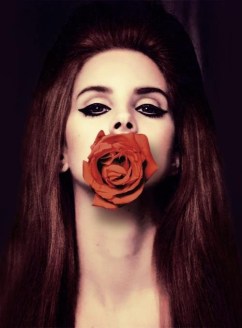
I used to live in a house called ‘Daisybank’, but my friends always teased because there were roses painted onto the window, not daisies. What weird reverse supplement? The fat white dog daisies would spring up on the front lawn in summer, but they were always overlooked by those glassy roses. There’s a certain authority, majesty even, to the rose. You associate it with tragedy and great beauty: Lana Del Rey with her lips stuffed full with a rose, playing the calamitous heroine. Snow-White and Rose-Red. Shakespeare’s ‘a rose by any name would smell as sweet’ is taken from Romeo and Juliet, in which Juliet convinces Romeo that it matters not that his name, Montague, is her family’s rival house. A rose is a rose; regardless of name it will always come up smelling of roses. Having graduated from Daisybank, I now find myself living on Montague Street…

‘Who dreamed that beauty passes like a dream?’ This is W. B. Yeats, probably writing to a woman he loved, Maud Gonne. He seems to set up beauty as life’s eternal opposite; where human existence is fleeting, beauty remains archetypal, enduring. Think of Keats’ ‘beauty is truth, truth beauty’. There’s a universality, a mythological underpinning to this beauty. In Yeats’ poem, the loved one embodies wistful figures of glory: Helen of Troy and Usna of ancient Irish history. Surely she slips between the shadows of comparison? Whether Yeats scorns the idea that beauty ‘passes like a dream’, or whether he ultimately reveals its truth, is unclear.

For Immanuel Kant (see, Critique of Judgement), the experience of beauty hinges on a paradox: since it seems that beauty is a property of the object—indeed, emanates from it—you’d think beauty itself was universal. Everyone should fall in love with that painting, that colour, that song. But not everyone does find the same things beautiful. It feels like a betrayal of reality when I play Radiohead’s ‘True Love Waits’ (where roses are swapped for “lollipops and crisps”) to a friend and their reaction is a casual ‘meh’ and a shrug, while all sorts of biochemical reactions of wonder and euphoria are swirling around inside me. Beauty, for Kant, is largely nonconceptual: that is, there’s an unspeakable quality to it, a thing you can’t put your finger on. In Realist Magic, Timothy Morton describes it as beauty’s ‘je ne sais quoi’. Being unable to pin down what it is that makes a thing beautiful is part of its beauty. You take a rose. You could describe its petals, its inward swirling whorls, its scarlet colour, the slenderness of its stem; but in doing so, you lose the rose itself. As ever in synecdochically applauding a woman you lose the woman. The love object. The love? Recall Shakespeare’s ‘Sonnet 116’? ‘Love is not love’; it’s what it is and it isn’t, and what’s left over as forever. 4Eva/4Real. Personally, I prefer Cate Le Bon’s take: “Love is not love / When it’s a coat hanger / A borrowed line or passenger”.  But isn’t everything stolen and temporary, in transit? How do you claw back the rose when the rose, maybe, is just this epic symbol for love? What moves in the static eternity?

I used to draw roses all the time; I’d always start in the centre, finding my way outwards with liquid ink. You see I had no conception of the rose’s shape, I was just following the shaky trajectories of layering lines. Important not to excise too sharply the arrangement of beauty, to impart onto nonhuman forms a reified taste. Eroticism preserved by ellipsis, meditation contained in the mysterious code of the senses. What was it Wordsworth said so long ago, in his famous tract against book knowledge: ‘Sweet is the lore which Nature brings; / Our meddling intellect / Mis-shapes the beauteous forms of things:— / We murder to dissect’. Wordsworth would prefer you to go out and encounter the objects themselves rather than try to ‘dissect’ them through rapturous, scrutinising poesy. Being one of the great Romantic poets, distracted by words even when in Nature, Wordsworth is of course a filthy, (forgivable) hypocrite—up to his knees in Kant’s paradoxical beauty as much as the rest of us.

Making words of roses involves cutting their heads off, losing the essence, letting the adjectival rose oil leak into language’s dripping pores. Binding the immortal to time. That seepage is ink, is tense’s durational flow, is poetry’s cruelty. This is perhaps what Mallarmé means when he says: ‘Je dis un fleur, et le fleur est parti’—‘I say a flower, and the flower is cut/split/gone’ (translation: Tom McCarthy). To break the object of beauty down in writing is to incur a violence; as McCarthy glosses, ‘Things must disappear as things in order to appear symbolically’. What is perhaps most seductive is the remaining qualities, the deconstructionist’s milk and honey, the semiotic residue that clings between things. Spiderwebs, woven by first light, acquire a serene and gossamer gleam; but what is most seductive perhaps is the spaces between the lines, the way up close the lacing makes new frames for the real, the scenery behind and through.

Then we have Derrida’s ‘maddening’ supplement. For all roses refer to other roses, to every iteration of the word ‘rose’ throughout literary history. What a rose means can only lie in the space between these occurrences, and even then the meaning is temporary, contextual—there is no outside text, no place in which to hurl your roses to semantic abyss. We might hope for Love as some manifestation of the Lacanial Real, a pre-symbolic realm of pure emotion; but love too (as Roland Barthes reminds us) is discourse, perennial and yet bound to the fluctuations within language. ‘Rose’ is a noun, but it is also qualia: the subjective quality of something that cannot be objectively measured. Her cheeks were rosy, the rose-coloured sand (of the dream sequence in Michelangelo Antonioni’s film, Red Desert), a rosiness to the air that spoke of July. By scaling tone, we might get a general sense of what ‘rose’ is (a quality defined by difference rather than identity), but we’d never get to see rose through someone else’s experience. What is ‘rose’ to one poet might be ‘pale and bloody’ to another. Rimbaud writes, ‘The star has wept rose-colour in the heart of your ears’. Abstraction meets the concrete which itself is a spill through synecdoche. What music seeps, weeping, into the beloved’s ‘ears’? ‘Rose-colour’ becomes that synaesthetic property, the oozing, effulgent thing that cannot be pinned. For colour, like music, is perceptively subjective. What prompts a sudden spasm of imagining in you might send me to sleep; could we call both actions reactions to beauty?

‘It’s hard to stay mad when there’s so much beauty in the world’. So goes the line in American Beauty, Sam Mendes’ 1999 suburban modern classic—a film about midlife crisis, inappropriate lust, neurotic materialism and the nuclear family under late capitalism. Where Ricky, the visionary, weed-smoking teenager, sees a sort of sublimity in waste, videoing a plastic bag’s leaf-like billows in the wind, Lester falls for his daughter’s cheerleader friend, Angela. The particular Gen X fatigue over cultural trash and consumer excess is recycled as a pared-back appreciation for symbolic indications of the world’s decay—little quotidian details which offer momentary redemption as beauty in tragedy. The old Kantian adage of beauty’s je ne sais quoi. Lester’s misplaced infatuation for Angela is represented by motifs of lurid red roses, flowering outwards like bloody snowstorms of feminine intensity. The chase falls cold when they kiss IRL, and he realises she is just an insecure teenage girl. Tell me I’m beautiful. Interpreting the film is as tricky as trying to clasp onto any one of those whirling petals, to kiss a single tear on an eyelash, a dew-drop clung to the flesh of a rose. Joni Mitchell, in ‘Roses Blue’: “I think of tears, I think of rain on shingles / I think of rain, I think of roses blue”. A lyricist’s ability to make pearls of emotion. Superhydrophonic. Is this another symbol, listless, transient, glistening?

The Symbolists were mostly French poets of the fin-de-siècle, the likes of Rimbaud and Baudelaire (whose flowers were assuredly evil), who probably drank quantities of absinthe and wrote symbols that emblematised reality itself, rather than merely inward feeling. All that absinthe had to come out somewhere, idly wilding in the streets of Paris (pronounce it the French way). Where abstraction reigns often in the world of emotion, meaning accumulates through the repetition, modulation and pattering of these symbols. While Mallarmé’s poetry indulged in dreams and visions, it’s a certain patterning of associative power that provides the stitching behind his fashion for aleatory. The poetics of chance may still have a structure of sorts, something you can trace like the veiny trellises within a leaf. W. B. Yeats, the Irish Symbolist, loved a good rose: just see ‘The Rose of the World’ and ‘The Rose of Battle’. In his essay, ‘The Symbolism of Poetry’, Yeats makes frequent comparisons between symbols and music, describing the ‘musical relation’ of sound, colour and form as constitutive of symbol.

At a workshop I’ve been running with homeless people, a girl who shares her name with Stein’s favourite flower reads out a piece she’s written in ten minutes flat. It’s a typically tragic tale of abuse, of a family torn apart by pain, drugs, death and violence—written from the perspective of a ten-year-old girl, perhaps her daughter. She reads it with a stilted west coast accent that picks up its confidence and lilt as the sentences run on. Somehow in those sad and wilting lines, strewn with the accidental detritus of truth, there’s hope. It blooms so unexpectedly in all the despair. A ten-year-old girl sees the world very clearly and pure. I can only paraphrase, of course. I’m sad that I don’t get to see my mother, but she says that it’s okay because if I look at the moon I know that she’s looking at it too. This part struck me harder than any other—it seemed an echo from elsewhere. The whole piece became suddenly a buildup to that single, simple, irresistible image. When Yeats presents Burns’ ‘perfectly symbolical’ song of the moon and time, he misquotes him. Translation falters to glitch, like with lossy compression. The moon as a symbol, as something to be shared, a white chocolate button broken in two. Except you can’t split the moon. You can only imagine what the other person is seeing. I wonder what they were looking up to.

Where metaphors ‘are not profound enough to be moving’, symbols move in both senses of the word: they act through motion, the accumulative or associative arrangement of sound and meaning (as opposed to metaphor, which acquires meaning through more static, straightforward comparison), and they prompt affect in the reader. Such affect is not just the temporary indulgence of an artwork’s emotional value, but can indeed alter how the world is discursively understood. The rosy words thrown upon some poetic zephyr recalibrate reality as we know it. As Yeats puts it:

Because an emotion does not exist, or does not become perceptible and active among us, till it has found its expression, in colour or in sound or in form, or in all of these, and because no two modulations or arrangements of these evoke the same emotion, poets and painters and musicians, and in a less degree because their effects are momentary, day and night and cloud and shadow, are continually making and unmaking mankind.

The construction of feeling through symbols, then, institutes the substance and gaps that structure how we relate to ourselves, others and nonhuman objects. A very delicate, precise, imagist poem like William Carlos Williams’ ‘The Red Wheelbarrow’ has effectively changed how we relate to both the colour red and wheelbarrows more generally (never mind the ‘white / chickens’). Symbols can charge our perception with fresh emotional channels. Music relates a bit differently, of course, but only because it literalises Yeats’ musical relation metaphor—there’s a more physical intensity, maybe. Like a river (you can never dip your finger twice in the same river), a piece of music cannot be played the exact same way again—a truism owing to the arbitrary dynamics of individual players, environments, acoustics or subtle interruptions of duration. A breath or a sneeze, a chance sigh in the background, a trumpeter who can never quite pace her crescendo. You experience the opera differently from me, even though we watch the same one (I have never been to the opera). My hearing is slightly muted, along with my interest in self-congratulatory coloratura; while you have perfect pitch, ears that ring with pleasure as the high notes hit. Though the same in one sense, comprising a shared duration, our encounters are completely different. Music’s durational function is made explicit with the likes of John Cage’s music concrète, composed of sounds rather than notes and thus retaining elements of chance within a certain duration. The process becomes more about selection, sampling and curation, rather than composition according to tones, melody, chords.

If anyone idled wildly, it was the notoriously languorous aesthete, Oscar Wilde. The decadence of roses is also associated with a certain concretisation of language, a making material of words, a honing of time and world. Consider the opening line of The Picture of Dorian Gray: ‘The studio was filled with the rich odour of roses’. The way assonance works, subtly wafting its chiming vowels through ‘filled’/‘rich’ and ‘odour’/‘roses’, creates that musical relation that Yeats so fetishised. Poetic techniques such as alliteration and assonance abound in Wilde’s novel, where prose becomes musical, lilting, exactly honed upon sensory detail, the vivid relation of objects. Roses that fill a studio, that pungently glow with lavish scent. There is a heady, ambient quality to much of Wilde’s descriptions, giving off the impression that we are perhaps perceiving how objects seem to one another, filtered through the opium vapours that so penetrated Dorian’s accelerating decadence: ‘In the slanting beams that streamed through the open doorway the dust danced and was golden. The heavy scent of the roses seemed to brood over everything.’ Objects are at once anthropomorphised and ornamental; that play between movement and stasis, however, cuts across binaries between human and nonhuman. The world of Dorian Gray is sprawling, random, a chase through meshes of entangled desire. A straightforward death drive is diverted by all sorts of sensory encounters, plastic morality, visionary beauty. And words? Words in Wilde are the petals that swell and unfurl into Yeatsian symbols:

Music had stirred him like that. Music had troubled him many times. But music was not articulate. It was not a new world, but rather another chaos, that it created in us. Words! Mere words! How terrible they were! How clear, and vivid, and cruel! One could not escape from them. And yet what a subtle magic there was in them! They seemed to be able to give a plastic form to formless things, and to have a music of their own as sweet as that of viol or of lute. Mere words! Was there anything so real as words?

Words have (re)active potential. Each one shivers with the weight of its every use, alive with subtle magic. Be careful what you write.

Gertrude Stein said that’s enough (I know that that’s not enough now)”. Gertrude Stein said a rose is a rose is a rose is a rose. She said it first in ‘Sacred Emily’ (1913), and later wrote, in ‘Poetry and Grammar’:

When I said.
A rose is a rose is a rose is a rose.
And then later made that into a ring I made poetry and what did I do I caressed completely caressed and addressed a noun.

What do we swap for tautologies? Love is tautological; love justifies itself. It means everything and nothing. There’s isn’t any escaping the reifying loop, the ring with its symbolism of marriage. That which encapsulates and closes. The hermeneutic circle. Stein makes us linger, ponder the grammar of each rose. Ring-a-ring-‘o-roses. What does it mean to ‘caress’ a noun? To render the erotic potential of language by gesture of touch, extend into physical… Idlewild: a word whose internal rhymes fold together, whose l sounds caress the roof of the mouth.

Gertrude Stein said that’s enough.

Lana Del Rey: “You always buy me roses like a creep.
Also Lana Del Rey: “And then you buy me roses and it’s fine.

There’s a surfeit of petals and sex, a gluttonous economy of symbols which Stein stamps out with the simple carousel of her musical roses. Sing it slowly. Tell me what you mean.

Luce Irigaray, from This Sex Which Is Not One:

Your body expresses yesterday in what it wants today. If you think: yesterday I was, tomorrow I shall be, you are thinking: I have died a little. Be what you are becoming, without clinging to what you might have been, what you might yet be. Never settle. Leave definitiveness to the undecided; we don’t need it.

Lana Del Rey, reading from T. S. Eliot’s Four Quartets:

Footfalls echo in the memory
Down the passage which we did not take
Towards the door we never opened
Into the rose-garden.

I pass between worlds and names and symbols. Every lipstick stain is another iteration, each kiss the palimpsest of the first, and even photographs fade in the sun, faces dissolving like planes behind clouds. Of ‘cappuccino pink ranunculus’—not roses—Colin Herd writes: ‘They’re at their most ravishing and / ethereal the day before they expire’. I imagine a white corridor imprinted with all your flickering dreams. Between realms, the soft wilt allures more even than it does in bloom. Images become sentences: long thorny stems of sentences, stretching and snarling a confusion of brambles and briars. The more you write, the more you grow your beautiful garden. I tear my wrists and fingers, trying to get to it: ‘There is a forcible affect of language which courses like blood through its speakers. Language is impersonal; its working through and across us is indifferent to us, yet in the same blow it constitutes the fibre of the personal’ (Denise Riley). This garden I make is not really mine and daily it grows stranger. The roses offer their pretty heads, then droop in winter. I hear their beautiful words in arterial melodies, sprawling among shadow, platitude, the skeins of a letter letting loose through my pores.

Roseability: the quality of forever chasing roseability. File under qualia, noun/rock, the poetics of etcetera.

tumblr_o34tbyABi21qfqngko1_1280.gif
gif. credit: : : Douglas Pattison

Playlist: August 2017

IMG_7006.JPG

Start with the kernel of something. The year’s first fallen acorn I have not seen yet, though pinecones have been thrown in the direction of whoever. Hypothetically, my life as a typewriter, the body punctuated with the same mechanical violence. Clattering impression of symbol. A certain attention to gardens, as if in longing for confinement, safety. Time spent in Cambridge. Willows sweeping the skin of the river, an endless wandering the result of what. Hard work, long mornings in bed with the warm aluminal form of a laptop. White glow, silence. Someone mowing their lawn too early. Being what it is to be lonely not letting the light in except with broken blinds it comes fractured, skewed, something. The early fears abated, return to trust the body. Sun beaming through unfinished paint, the colour of mauve roses, faded hydrangeas. There is a hyperspace in which the dreams become apartments with balconies folding to abyss, you lean out singing it felt like a kiss the crystal taste which is what a violent text a certain whisky with peculiar salt with the flavour of drowning. Shades of cool. Allergic to punctuation after so much editing. Late night taste of Mogwai, Aphex Twin in the long long mornings. The perfect cupid’s bow of her lips. A geometry of light on the living room carpet. Sit in me, wheat-coloured pool of Vitamin D. The gunshot pulse of the stuttering track. I close my eyes for the White Lodge, the shrouding. Mountains come up and when we are at work we hum the Song of Healing while customers come and go in a panoply, in circuits; the moon too close like a lump of cheese with a million calories like terrible space debris coming. There’s an underpass where the dank canal flows thick as a black black oil, as molasses. Closer, the exact texture of fishnets. Something of your composition, a fear. The cold and lovely brass legato. Confessions in brown paper-bags. These are penny sweets, many regrets, many ice-coloured touch of the tongue that flickers its absence. A pleasant stasis, curled fingers which wait for the rise of the chest and the breath that is chemical alone, that is Tennents at seven in the morning on a lino floor. Berryish, bitten. Making no sense of Four Quartets but embracing the paganism, looking equinox ready with a garland of wilted daisies as if August never happened. The goddess in flesh, Lana Del Rey with her seamless fragility that adds joy to melancholy, etc. You know it. Conor Oberst telling stories about Woodie Guthrie and another life-changing duet on Lua. Voices as clear and pure as expensive vodka, distilled through a mountain stream in the elusive valleys of sadness. Somewhere south of America. I see a desert. There are plants needing repotting in my room. A 39-minute album. A mixed-up connotation, lumps of quartz from a beach near Cardross. I wonder about the temperature of water. Last year’s gatherings, the same melancholy. The absolute cool refreshment of this late-summer’s day. Remembering Lilt as a Thing! Train rides, shudderings, altered temperatures. So much goddamn analysis. Saying it like a litany, my goodness my goodness my goodness. Enacting mythology of objects surrounding. The glass of ice cubes precisely polished, a sequence of droplets. Clotted spectrums. The time it takes between ordering and serving, circling like ravens or trying to negate the game of waiting. Complaints. August being the flourishing stammer of a potentially bad dissertation. Potentially not. Sometimes salt and vinegar just tastes good. Wake up to the sting of your own tongue. Passing creepy, sapphire hot-tubs at four in the morning while old-school Coldplay floats on by mysteriously. Bones sinking like stones. Floating on home at 9am past phalanxes of school children and furious mothers. With all these roadworks, the pavement is but a treacherous ridge between spaces. Samuel Johnson kicking a stone to prove something. Philosophical brutality. Voyage to the capital for Tom McCarthy. Sunlight and absurd erotic fiction displayed in cardboard boxes. The boiling point of all these projects. Nectarines. How everything these days just feels like browsing. Are we yet ready for nostalgia and autumn, and whichever comes before the other? I keep re-watching the same old episodes.

~

LCD Soundsystem – tonite

Kiran Leonard – Could She Still Draw Back?

Big Thief – Masterpiece

Conor Oberst – Napalm

Girl Ray – Trouble

John Maus – Hey Moon

Clarence Clarity – Naysayer Godslayer

Four Tet – SW9 9SL

Oneohtrix Point Never – Music for Steamed Rocks

Mogwai – Coolverine

Lana Del Rey – Shades of Cool

Au Revoir Simone – Lark

Lomond Campbell – Father is a Craftsman (Modern Studies cover)

Julie Byrne – Morning Dove


Haunting the Capitalist Plaza: Making Sense of Vapourwave

16d
Lindsheaven Virtual Plaza – Daily Night Euphoria. Source.

The resonance is a tinny vintage, anachronistic; tinselled with eighties synths and a vocal sample that never quite begins. That baggy voice, normally soft as milk, becomes jagged, inhuman. Creepily crystallised. Your aunty’s favourite easy-listening is stripped of all coherence and synthesis; the tacky detritus of Steve Wright’s Sunday Lovesongs repackaged for an ersatz world of sulphurous sunsets and crumbling metropolises imploding like the plastic dust of an Arizonan dead mall. Back to the dark desert highway, purple-skied and dripped in molten neon. This isn’t what you’d enjoy on a leisurely car trip to the drive through…Or is it?

Listen to : : :

death’s dynamic shroud.wmv // I’m at the point in the level where the road narrows, curves, swirls upside down. Death is imminent. You can see the gloved fingers slipping a compact disc into the slot of a monster, borrowed straight from the architectures of Digimon. I’m thinking: Elizabeth Fraser’s sweetly haunting soprano (imagine being ghosted by the purest aural distillation of beauty); the chilled techno-ambience resurrected from the nineties. There’s heartbreak ahead. If you jump too far—and you will, won’t you—the space around you will glitch. There you’ll be, suspended in the space twinkles. An empty swimming pool. Climb into the cracks. Why is everything so gleaming, so white? I’m obsessed with getting back to matter. The music restores the filth, the glitch. There’s a vast acceleration of beautiful colour. The soprano grows warped, the orb-like contortions are glowing off kilter, off rhythm. The seven lumps of Galaxy chocolate I’ve just eaten melt sticky bits of sugar in my mouth, refuse to dissolve. They’ll coat my teeth like that.

Vapourwave coats your teeth. God knows how or why you should define it. It’s like cheap candy, utterly sugary but filled with mysterious ingredients, mystic chemicals from another dimension. One minute I’m being instructed about the start of a sequence (it’s the eerie echoes of a sci-fi style video game)- – – loading loading loading  – –  – and then trap style beats come bouncing slowly in, delayed as if strained through some outpouring of weird gravity. There’s a purity to some of it, which feels more like an original composition; the ambient atmosphere of something along the lines of Aphex Twin’s Selected Ambient Works…There’s a sense of distortion, disorientation. Hyperreal landscapes lit in luminous pinks and purples. What’s that gleam, is it rain? Tokyo on a postcard, dipped in cross-processing chemicals, in violet acid. Then you’ve got a vague array of p a r a d i s e lighting up the screen. Palms and sand and cerulean sea.

ddeb386ad43001484a6221559eec0d94
Source

As soon as you get attached to a sample, you’re away. Rarely does the beat resolve. You’re like, totally always stuck on the pre-beat. To the point that human expression becomes a technological fault, a beep, a burp. Sometimes it sounds like waves are being pulsed through your brain, blurred in a malfunction of some tacky machinery cooked up for a pulp movie of the nineties. Do scanners really look like that? Coated in rhinestones, bathed in pink. Some of it’s dreamier. Arpeggios of bell-scented keyboards (what do bells smell like? Not musty old church bells, but the sonorous chimes of noughties computers). Arpeggios climbing and climbing, dissolving, rising. A pop melody shining through. I’m in a rainforest of futurist skyscrapers, cloud-surrounded, everything drenched in pastel-hued pixels. It’s so serene. 

Vapourwave. What a joke, an internet meme. Didn’t it die a couple of years ago?

I’m so confused. What is this monstrosity that’s eked itself into my life like a viral code luxuriating in my brain? At once disdainfully ironic, crass, tacky as hell; but also painfully sincere, nostalgic, full of a misplaced longing. The metamodern paradox of postmodern irony and modernist authenticity cooking up an endless loop of misplaced longing. I find myself thirsty for shopping malls from the seventies, for grotesque cups of Diet Pepsi, for the glossy pop of the eighties and the apocalyptic reveries of the nineties. I’m drifting through a city stripped of its glitz and left with patches of bright matte colour, refusing to reflect the glass through which dreams have appeared and got lost. I remember polishing a CD with the back of my sleeve, watching the lines of rainbows beam. Slotting it into a computer that hummed and whirred at my touch. I remember when technology felt somehow homely. 

a0279566532_10.jpg
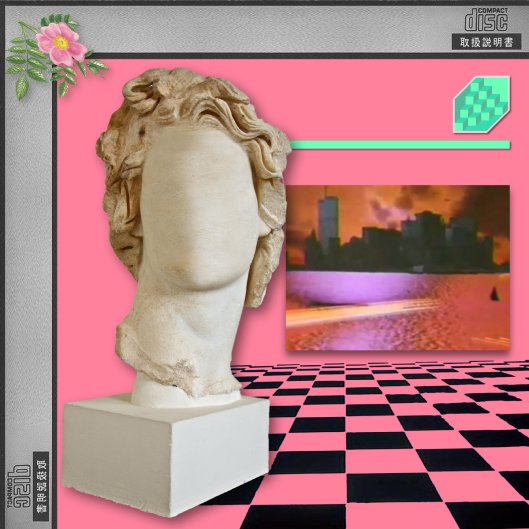
Macintosh Plus – Floral Shoppe. Source.

That comforting little Windows XP flourish, how friendly it was compared to the blasé boom of Apple’s triumphant C chord. Glitch, glitch, glitch. I pick the pixels out with my fingertips. The eerie keyed chords of MACINTOSH PLUS’ 地理 fill me with a sinister sense of urgency. It’s an entropic catastrophe of dissonance.

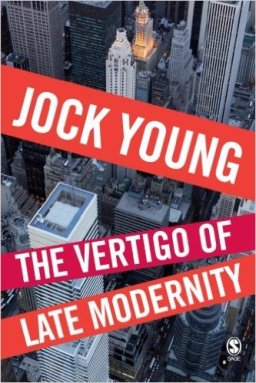
At the heart of vapourwave is a tension between the sweet and disturbing, between satisfyingly vacuous muzak and dissonant, deliberate glitching. This is related to its deterritorialising impulse, by which I mean (borrowing from Deleuze and Guattari lingo), the way it extracts and recontextualises some element of a thing, then placing it elsewhere in a different environment. Vapourwave is a sort of bulimic, abject, rhizomatic discourse. It gorges on the symbols of late capitalism (the glossy muzak and soft rock of the eighties, international brands like Nike or Microsoft, the aesthetics of corporate advertising and so on) and then expels them in a gross reinterpretation that seems to purge them of their original, seamless facade. It might be useful here to mention that sociologist/criminologist Jock Young (2007) once described late modernity as a ‘bulimic society’, where we are all (internationally) included in the dreamlike semiotics of the rich through the opulence and availability of global branding, advertising and popular culture, but increasingly we are structurally excluded from the means which would allow us to achieve such dizzying heights ourselves. This social anomie is jarringly rendered in vapourwave’s shameless embrace of corporate culture; at once poking fun at it but also monumentalising it in an ambiguous way. It’s by no means a didactic movement, but as Grafton Tanner tends to argue in his excellent book Babbling Corpse: Vapourwave and the Commodification of Ghosts (2016), it’s symptomatic of its times. The very poetics of vapourwave reflect the uneasy experience of being unable to escape the system, the uncanny effects of our perpetual cultural nostalgia—the celebration and denigration of late capitalist modernity and all its forms of post (post (post) post).

51jlr4xfsml-_sx331_bo1204203200_
Source.

Outside of their usual contexts, corporate and commercial visuals (the vapourwave a e s t h e t i c) seem absurd, funny, strange, alienating. It hollows out the imagined ‘core’ of the brand and replaces it with a sort of free-floating lack of functionality, a disembodied eeriness. Chuck a logo in with a pastel-hued painting of palms and corny dolphins lifted from a SNES game and there you have it. Old Apple logos might be hovering over a pixellated ocean, waiting to plunge inexorably. Not only the aesthetics, but also the music itself, creates this sense of fragmented capitalism. Tanner talks briefly about the relevance of Derrida’s idea of hauntology to understanding the politics of vapourwave and this seems to me very astute. It’s the idea that the future is irrevocably haunted by the past; that culture and politics are also spooked with spectres from the past—from communism (Derrida’s book is called Spectres of Marx) to old technologies. It’s the idea that things are always-already obsolete, that there’s a sense of being itself as displaced and never quite fully present. It’s an ontology of difference, deferral, doubling, of objects which become ‘a little mad, weird, unsettled, “out of joint”’ (Derrida 1994). Derrida’s gloss on Marx’s analysis of the commodity-table gives us a sense on the ghostliness of consumer objects:

For example — and here is where the table comes on stage — the wood remains wooden when it is made into a table: it is then “an ordinary, sensuous thing [ein ordindäres, sinnliches Ding]”. It is quite different when it becomes a commodity, when the curtain goes up on the market and the table plays actor and character at the same time, when the commodity-table, says Marx, comes on stage (auftritt), begins to walk around and to put itself forward as a market value. Coup de theatre: the ordinary, sensuous thing is transfigured (verwandelt sich), it becomes someone, it assumes a figure. This woody and headstrong denseness is metamorphosed into a supernatural thing, a sensuous non-sensuous thing, sensuous but non-sensuous, sensuously supersensible (verwandelt er sich in ein sinnlich übersinnliches Ding). The ghostly schema now appears indispensable. The commodity is a “thing” without phenomenon, a thing in flight that surpasses the senses (it is invisible, intangible, inaudible, and odourless); but this transcendence is not altogether spiritual, it retains that bodiless body which we have recognised as making the difference between spectre and spirit. What surpasses the senses still passes before us in the silhouette of the sensuous body that it nevertheless lacks or that remains inaccessible to us.

(Derrida 1994)

Vapourwave, of course, exploits this ‘ghostly schema’ of consumer objects. ‘Woody and headstrong denseness’, the sheer materiality of the thing is ordinarily supplanted by its mystical, transcendent value as a commodified good or brand. When we think of Nike trainers, rarely do we care for their actual material structure; usually it is the symbolic resonance of the brand that captures us. In Vapourwave, materiality comes back, vicious and strange. Fredric Jameson laments the way that postmodernism presents us with a meaningless concatenation of cultural nostalgia, often without context—BuzzFeed’s noughties nostalgia lists perhaps being a case in point. Vapourwave takes this ‘out of context’ randomness and runs with it. Art objects, textures, corporate iconography and screen-saturated colours combine in a collage of irony and contrasts. The mishmash quality of the vapourwave aesthetic lends it to easy manipulation and re-creation. This is the DIY ethic of the movement, its impulse towards constant theft, the cut and paste fun of sampling, the wilful shredding of distortion which creates a contemporary rendering of William Burroughs’ literary cut-up method or the random-making ‘recipes’ of Dada poetry, as described by Tristan Tzara.

13422823_261081637591822_2099392307_n
Vapourwave Collage (note the hashtags on the link). Source.

Now, the effects of this mixed-bag of internet treats aren’t just weird and humorous, but weird also in an unsettling way. The samples become points of focus in a manner that strips away the normal cultural values of the original song; the easy soft-rock of the eighties becomes haunted with lo-fi feedback and interruption, compression and echoes. It sounds like it’s being heard through a cave or the underwater atrium of an abandoned mall, after the apocalypse. One of vapourwave’s most prominent releases to this day remains Macintosh Plus’ Floral Shoppe (2011) and on this record the production warps its soul music with a surrealist synth-driven dreamscape, in which R&B beats become slow and trippy and human voices are dehumanised into drawls and robotic calls. Often a sample starts but never resolves its line, constantly stumbling over itself. Tempos are spliced and no song follows conventional structure, but instead runs on repetitions, overlaps, interruptions; completely jarring changes in rhythm and key with no transition. Funk and soul from the eighties are no longer smooth and satisfying radio filler, but are turned inside out, their inherent weirdness exposed. Some of the highlights include ‘It’s Your Move’ by Diana Ross and ‘You Need a Hero’ by Pages. The effect of listening to this album is sort of like pushing a shopping cart round a supermarket and gazing around in wonder at the saturated pastels, the pointless products, the detritus of cluttered consumer madness. Glitches, twinkles, the beats of unsteady feet. Random tannoy announcements like a call from some parallel universe, the underground, the flickers of the internet ether.

Tanner’s Babbling Corpse usefully makes a connection between the dehumanisation of human voices in vapourwave music and contemporary philosophical movements such as speculative realism and object-orientated ontology. Both movements share the fundamental rejection of correlationism (the dominant, anthropocentric idea in Western philosophy that views reality only in relation to and projection from the human perspective). Instead, they turn to the world experience of the nonhuman, the sentient and foreign perspective of matter and objects. They expose the contrived nature of our distinction between self and world, showing how we are world, entangled in a way that is inextricable and disturbing (Timothy Morton, for instance, points to the crustaceans that live in our eyelashes or the bacteria in our gut as examples of how we are the environment, rather than self-complete and separate beings). Vapourwave in some way manages to evoke this weird world of objects, at a level only barely accessible to humans. Its use of glitches and looped samples disrupts the ordering of people and things. As Tanner puts it,

Glitches interrupt our expectations while deceiving and annoying us. They undermine our notion of what the machine is supposed to do for us, not without us. In this way, our electronic machines take on lives of their own and appear capable of functioning perfectly well without humans – a complete transcendence into other-worldly sentience.

 (2016: 11)

We might consider this in relation to Martin Heidegger’s (2008) idea that we only notice a tool as a thing when it stops working. A broken hammer suddenly becomes a strange entity in its own right, rather than just one chain link in the process of a means to an end. Chuck Persons Eccojams Vol. 1, for starters. The very name: Eccojams. It implies the jams are a product of this Other: the ecco, ecology, echo…The title derives from an old Sega Megadrive game called Ecco the Dolphin, an action adventure game which featured dreamy music and a very minimalist gameplay narrative. You made Ecco sing to attract and interact with other objects and cetaceans; you could evoke echolocation in order to unfold a map of your oceanic surroundings; you could call to special crystals (glyphs) which in various ways controlled Ecco’s access to different levels. There is a beautiful otherworldliness to this game, and not just because Ecco ends up at the City of Atlantis. It’s created its own mythology, and the emphasis on song (like The Legend of Zelda’s ocarina melodies, which initiate effects in the game) opens up the possibilities for a nonhuman conscious or logic. Music, perhaps more than language, has effects on nonhuman consciousness. At a certain pitch, it can shatter a glass, or cause buildings to rumble with bass. It opens up its own logic of cause and effect.

maxresdefault.jpg
Source.

Hauntology, in a sense, is about being stuck on the loop of the end of history.  Technology constantly dislocates our awareness of time and space, so that linearity is replaced with instancy, repetition and reiteration, the constant recycling of former styles and events. Repetition is uncanny partly because, as Freud argues in ‘The Uncanny’, it’s the structure of the unconscious. When we notice repetition, we notice how our whole psyches are built on the compulsion to repeat even that which is most traumatic to us. It also violates our sense of identity and experience as singular and unique (an idea that liberal democracy and consumer capitalism likes to perpetuate). Identical twins are uncanny for this reason, as is deja vu. We feel that the normal order of time and space has been distorted (this is of course made explicit in films like Donnie Darko, which deal with parallel universe theorems). Repetition is also uncanny because it suggests that things we thought were unique to a moment, imbued with their apparent transience, are actually lingering and potentially eternal. It’s unsettling to have the buried constantly disinterred and broken out into the open present. Tom McCarthy’s Remainder (2005) is a novel which explores the logic of repetition in relation to a trauma narrative in which the protagonist becomes obsessed with re-enacting events to the point of absurdity and violent conclusion. It’s that overlap of the real, where dreamlike remembrance meets actual performed repetition, that is the orgasmic satisfaction of the psyche.

Listening to vapourwave enacts this perfectly. We might start to recognise the songs from which these samples were drawn, but our recognition is distorted along with the samples themselves. The past floats uncannily into the future. Eccojams Vol. 1 drops its tinkling beats on a loop and the vocals from eighties ballads are stripped of their velvet and become mournful, minor, distorted. Inhuman, odd. There’s a sense in which our contemporary experience of reality in the face of apocalypse and pathological nostalgia is both dark and sweet. Morton’s branch of object-orientated ontology, dark ecology, perfectly captures this experience (in fact, in Dark Ecology (2016) he describes the process of dealing with this ‘grief’ as sharing the structure of a ‘dark ecological chocolate’). Vapourwave is at times incredibly saccharine, mapping itself through the cheerfully smooth loops of Muzak; but it is also jarring, dissonant, deeply unsettling. It takes dirty club techno, the complex tempos of intelligent dance music, and puts them through the cheap production of the GarageBand blender. Vocals echo like a broken tannoy machine. Vapourwave, as both visual and musical aesthetic, fundamentally opens an aural space in which past, present and future become a haunting echo chamber of one another. No longer is this the mere surface play of postmodern collage, but instead it’s the material manifestation of a specific cultural hauntology. As Tanner puts it, hauntology ‘is unlike Jameson’s pastiche in that it complicates the past (specifically, the past’s image of the future) in order to call attention to capitalism’s destructive nature as a subjugating force that only fools others into thinking it came to eradicate “history”’ (2016: 35-36). Capitalism is hollowed out, its signature brands become lost echoes in a vaguely recognisable, a hypnotically attractive yet alarming vision of our near-present future; blended with the figures of mall culture, the colours of early aughts internet webspaces and the abyssal possibilities of a Tumblr scroll.

I’m interested in how vapourwave re-enacts a different form of consciousness and how this might be ecological, even though the movement’s only obvious engagement with Nature as Such is through the proliferation of palms and potted plants that drift incongruously as consumer goods through some of its artwork. To get at its ecological sweetness, it’s like cracking open a crystal to see its lattice parameters (what a beautiful phrase), the places where the material cleaves (its lines of weakness), its cubic structure. The interplay between structure and embedded weakness is what motivates vapourwave; it contains its own failure, the undeveloped samples, the way a tiny snatch of a song is unfolded into a tranquil sequence of soporific, nonsensical sound. This is not music with a coherent logic. You look for lines and trends and vague traces of structure, but a song will become something more fluid and fragmented. Vapourwave’s material metaphors cannot be coherent; it’s at once free-floating, vaporous, seeping, gelatinous, oozing, splitting, cracking, choking, pulsing, dissolving. Hard matter, soft matter, chemical, vapour, waves and glitches and tiny explosions.

Sometimes, the structure is completely frustrating. On Person’s Eccojams Vol. 1, for example, the slowed-down, reverb-heavy sample from Gerry Rafferty’s ‘Baker Street’ repeats endlessly and never resolves itself into the next line: ‘another year and then we’ll be happy / just one more year and then we’ll be happy’. The twinkle signifies the glimpse of a transition and there’s a blip of the ‘b’ which should resolve into ‘but you’re crying, you’re crying now’ and yet here never does. Instead the song becomes an endless loop of implied futurity, the future conditional, ‘we’ll be happy’ that doesn’t get to complete itself but instead hangs. We’re taken out of time and left in this limbo. Here, the repetition isn’t soothing, it’s unsettling—mesmerising in a disturbing way. We question our longing for the song to resolve and before we have a chance it’s skipped to the next track. So we go back, search out the original version. Is it satisfying? Listening to Raferty’s original now feels weird in a way it didn’t before. It’s like this lost artefact from the past, spliced across the future ether rendered by Person’s eerie and hypnagogic album. While ‘Baker Street’ implies a specific place, now it’s thoroughly displaced, an effect of the internet’s rhizomatic possibilities.

As Morton puts it, ‘in order to have environmental awareness, one must be aware of space as more than just a vacuum. One must start taking note of, taking care of, one’s world’ (2002: 54). Ambient poetics disturb our assumed distinction between inside/outside, self/other; they show how we are entangled in a shared space of coexistence (Morton 2002: 54). Ambient music, in its sensuousness, its borrowing from the world—for example, by using samples of music concrète and field recordings from both nature and urban spaces—embeds us inside an environment in a way that is at once comforting and disturbing. It literally surrounds our senses. Brian Eno famously sets out a manifesto for ambient music by describing ambience as ‘an atmosphere, or a surrounding influence, a tint’, and ‘whereas conventional background music [i.e. Muzak] is produced by stripping away all sense of doubt and uncertainty […] from the music, Ambient Music retains these qualities. […] Ambient Music is intended to induce calm and a space to think’. As Morton puts it, ambient music as figured by Eno deconstructs the ‘opposition between foreground and background, or more precisely, between figure and ground’. In this sense, ‘ambience could be shown to resist the reification of space in capitalism’, ‘at once fill[ing] and overspill[ing] the ideological frame intended for it by the social structure in which it emerged’ (Morton 2001).

hqdefault-2
Abandoned mall / / Source.

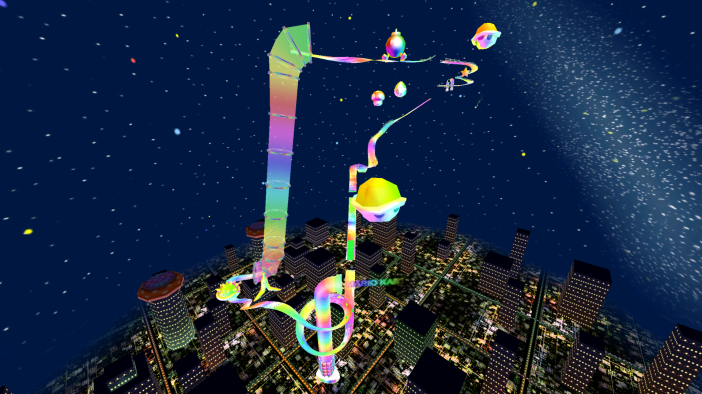
Think of it this way: could you get away with playing vapourwave in a mall or a supermarket or diner? Sure, it would ‘fill’ the space in one sense, but also exceed it, rendering all our cultural and material associations with this space uncanny and distorted. It would become a sci-fi space, a space displaced into the future. We would be inhabiting a doubled world, a doubled temporality. I tried playing Floral Shoppe in the restaurant where I work once (obviously when there were no customers) and the effect was actually very comforting. I felt like I wasn’t trapped in the familiar twenty-something existential limbo and instead inhabiting a plane of dreamlike contemplation, like the Rainbow Road level on MarioKart: Double Dash. I close my eyes and the scratched wooden floor spills out into a highway of colour; the tables I’m bumping against are bright yellow stars and fragments of unknown matter. I’m back in the supermarket, trolleys wheeling away from me and products falling off the shelf. I open my eyes and there’s the mirror and a reflection of someone that might be me, wearing a uniform, the chairs and tables flashing around me like holograms. I’m not exactly sure where that association sprung from (it’s been a long time since I’ve turned on the old GameCube), but I guess that’s the free associative impact of the music itself.

Double_Dash_Rainbow_Road.png
Rainbow Road / / Source.

Like Jean-Jacques Rousseau’s Reveries of the Solitary Walker (1782), vapourwave is about an experience of travel and movement without necessarily describing that movement itself. Crucially, the emphasis is on slowing down, on dwelling in a moment; a moment which is looped, repeated, pondered over, exhausted, reflected on. ‘I undertook to subject my life to a severe examination that would order it for the rest of my days in such a way as I wished to find it at the time of my death’ (Rousseau 2011: 24). Vapourwave subjects the e v e r y t h i n g of capitalist late modernity to such self-reflexive inner scrutiny. This scrutiny enacts a slowing down of perception, a sense of looking around and absorbing one’s place in the environment. Through an uncanny distortion, doubling back and becoming the environment. Vapourwave allows us to adopt both a blasé and a highly perceptive attitude to the ad-saturated world in which we exist; the metropolis of the internet becoming some great labyrinth in which we linger at every turn, mesmerised by the neon palms swaying in time to the untimely music, to cans of diet coke and the universal resonance of that bold tick logo. Everything surrounds and coagulates, connects.

This aesthetic dwelling is crucial for ecology because it forces a recognition of the world which we are and in which we live, a recognition that notices patterns of interconnectedness and coexistence. For Gregory Bateson (2016), aesthetics means ‘responsiveness to the pattern which connects. The pattern which connects is a meta-pattern’; both cities and their parts form part of this pattern, of the patterned aesthetic of vapourwave. The metropolis, the mall, the fountain plaza, the computer screen, the window of a building, the burnished, pixellated sunset. All are the environs of sound and vision, the movement between figure and ground, the deconstruction of synecdoche. The part and the whole are constantly supplementing each other (the song, the sample; the symbolism, the surface aesthetic). It’s a bewildering, shape-shifting experience. It forces us to take notice of our world. There’s something about vapourwave which always suggests to me a sort of endless highway, where the vehicles move as if through some viscous substance that drags the experience of time and space. Our perception becomes blurred and starry, with blips of unconsciousness and moments of epiphanic reverie. Things around us fade or glow. The radio rumbles in the darkest cavity of our chest. Am I even breathing? I don’t feel human. Is this freedom?

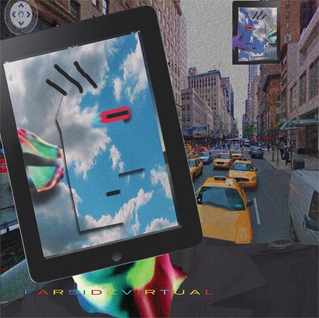
homepage_large-be7a4fbb
Source.

Alongside this dwelling is a certain playfulness of a way unique to vapourwave. James Ferraro’s Far Side Virtual (2011) might be the classic here. It blends together the inane and cornily flourishing samples from Muzak with automated audio speech stolen from corporate contexts and sound effects from everyday tech life—the message-send swoop, a mouse click, laptop crashing sounds and start-up tunes. The result is something that might reflect Jean-Francois Lyotard’s famous definition of postmodernism as ‘eclecticism’, the ‘degree zero of contemporary general culture [where] one listens to reggae, watches Westerns, eats MacDonald’s for lunch and local cuisine for dinner, wears Paris perfume in Tokyo and retro clothing in Hong Kong; knowledge is a matter for TV games’ (2004: 76). This eclecticism is made playfully manifest in Ferraro’s lively, atmospheric and at times downright trippy record, where twinkles of commercially-drenched, techy synths give way to stuttering keyboards, ringtone effects and twirls of familiar message noises which become maddeningly synced with finger clicks and conversations between robotic voices. A CONUNDRUM article argues that ‘since vapourwave functions namely as commentary, it loops, pitch-shifts and “screws” the utopia of the virtual plaza, creating a harsh, grating sound in away that brings each muzak sample’s faults to the forefront of the track’. This is certainly true of Ferraro, but I’d also suggest that vapourwave is more than mere commentary; Ferraro especially revels in the silliness of corporate culture (check out ‘Pixarnia and the Future of Norman Rockwell’, with its drink slurping sound effects and jingly, kids tv-worthy melody), at the same time as revealing its peculiar utopian unreality, a world of shimmering sound and holograms. There’s a self-consciously affective and pleasurable aspect to the music. Sometimes it sounds like the demonstration music on an art channel, to the point where I’m expecting some beautiful, sellotaped creation to materialise with every musical flourish.

On the other hand, there’s the total weirdness of ‘Palm Trees, Wi-Fi and Dream Sushi’, which takes us through a scintillatingly bizarre encounter with a ‘touchscreen waiter’ who explains the ordering process at a sushi restaurant—apparently in Times Square, with Gordon Ramsay as chef—to the backdrop of exuberant synths and glitchy effects which sound like a Windows 95 laptop gone haywire, or merely said customer making her selections from the menu software. The result is to render a future where restaurants and coffeehouses are devoid of human interaction, becoming impersonal encounters with creepily enthusiastic machine waiters (creepy not just because they’d put me out of a job). The contrast between this manic happiness, this constant focus on choice, with the maddening music is to create a deep sense of unease, to reveal the artifice of such utopian tech constructions. Do we really have a choice? Is life being boiled down to a series of computer menus? Is the future bound to the unsettling intonations of such robotic encounters? I can’t help but escape into the absurdity of the music and try to forget this hauntological disaster is always-already constantly happening…

The comparatively meditative ‘Bags’ weaves its entrancing ambience from an early Windows startup theme, dipping into sonorous caverns of sparkling synths and lifting for air bubbles and irregular, incongruous finger clicks. I am reminded here of a beautiful essay by Steven Connor on the magic of objects, specifically here bags: ‘because they are in essence such fleshly or bodily things, bags enact as nothing else does our sense of the relation between inside and outside. We are creatures who find it easy and pleasurable to imagine living on the inside of another body’. There’s an amniotic vibe to Ferarro’s ‘Bags’; the swaying, dreamy pace that makes us feel as though we are inside those palms, or encased within a glossy plastic number, bouncing away against some glamorous knee. Just as humans have a sort of supplementary, life-giving association with bags, we also have this relationship with the plazas of capitalism and the affective world they render. Ferarro has said that he conceived of Far Side Virtual as a series of ringtones, a musical form which inherently suggests consumer transience, tackiness, kitsch, the whims of passing fashions (not least because the polyphonic presets change with each phone upgrade). He’s also said that he loves the idea of the album being ‘performed b a Philharmonic Orchestra […] Imagining an orchestra given X-Box controllers instead of mallets, iPhones instead of violins, ring tones instead of Tubular bells, Starbucks cups instead of cymbals. All streamed online, viewable on a megascreen in Times Square’. That’s what’s special about vapourwave: its commitment to the endurance of art and the a e s t h e t i c alongside an ambiguous relationship with the ephemerality of corporate kitsch. The artistic rearrangement of these samples, alongside their visual presentation and marketing as alt music through sites like Bandcamp, completely reterritorialises their original framework of meaning.

There’s a sense in which this music—with its self-conscious materiality, the recognisably tacky mattering of its samples, its embrace of the ambient disruption of foreground and background—is inherently committed to some kind of hauntological ecological project, the kind advocated by Tim Morton’s dark ecological poetics. As Ferarro himself says of his album, it’s a ‘rubbery plastic symphony for global warming, dedicated to the Great Pacific Garbage Patch’. Vapourwave recycles culture, proliferates both beauty and trash, endlessly parodies itself and its references. It renders explicitly what Marc Augé calls the ‘non-places’ of supermodernity: the anonymous malls, airports, offices and stations where cultures blend and collide and become foreign places of blank existence, of non-place, of disembodied temporality and physical and social experience. Places emptied out of cultural specificity. Places where one might eat Japanese sushi in a New York airport restaurant, concocted by a holographic rendition of a grumpy English chef and served by a robot developed and programmed by a Chinese tech company. Vapourwave is melancholy and strangely displaced. The frequent use of anonymity by many of its prominent artists (Xavier, for example, is responsible for more than just Macintosh Plus), alongside the Eastern characters for song titles, creates again a dehumanised, uncanny and culturally displaced understanding of identity. It weaves an almost Orientalist mystery through its art, so that we can’t quite geographically place the origins and players of this musical movement. It’s all about dissemination, reappropriation, the instancy of recycled production; but it’s also about slowing down to notice the flaws inherent in our everyday, consumer lives. The heavily sampled, rhizomatic nature of vapourwave forces you to become a more active consumer of both music and other forms of material pleasure, from picking your morning coffee to choosing your desktop screensaver. Perhaps it’s this recognition that gives vapourwave the vague trace of disruptive impulse; the way it strips away the uneasy pleasures and pink mist of the late capitalist plaza and replaces it with a mystique that haunts us back from the future. Objects and humans withdraw from our grasp and we are left with the surface detritus of crushed coke cans, defunct MacBooks, coffee cups and robot voices stuck on repeat, cleaning the floor of the mall to a vicious gleam that threatens to bounce back like a screen and remind us that we haven’t left the room at all – we’re still on the internet, chasing our dreams.

tumblr_mysm59oylp1t5u0gko1_250
#existentialwave / / Source.

Bibliography

Augé, Marc, 2009. Non-places: Introduction to an Anthropology of Supermodernity (London: Verso).

Bateson, Gregory, 2016. Mind and Nature: A Necessary Unity. Available at: http://www.oikos.org/mind&nature.htm. [Accessed 22.1.17].

Derrida, Jacques, 1994. Spectres of Marx. Extracts available at: https://www.marxists.org/reference/subject/philosophy/works/fr/derrida2.htm [Accessed 22.1.17].

Eno, Brian, 1978. ’Music for Airports liner notes’. Available at: http://music.hyperreal.org/artists/brian_eno/MFA-txt.html [Accessed 22.1.17].

Freud, Sigmund, 2003. The Uncanny, trans. by David McLintock, (London: Penguin).

Heidegger, Martin, 2008. Being and Time, trans. by John Macquarrie and Edward Robinson, (New York: Harper Perennial).

Jameson, Fredric, 1991. Postmodernism: Or, the Cultural Logic of Late Capitalism (Durham: Duke University Press).

Lyotard, Jean-Francois, 2004. Postmodern Condition: A Report on Knowledge, trans. by Geoff Bennington and Brian Massumi, (Manchester: Manchester University Press).

Morton, Timothy, 2001. ‘“Twinkle, Twinkle, Little Star” as an Ambient Poem; a Study of a Dialectical Image; with Some Remarks on Coleridge and Wordsworth’, https://www.rc.umd.edu/praxis/ecology/morton/morton.html

Morton, Timothy, 2002. ‘Why Ambient Poetics? Outline for a Depthless Ecology’, The Wordsworth Circle, Vol. 33, No. 1, pp. 52-56.

Morton, Timothy, 2016. Dark Ecology: For a Logic of Future Coexistence (New York: Columbia University Press).

Rousseau, Jean-Jacques 2011. Reveries of the Solitary Walker, trans. by Russell Goulbourne, (Oxford: Oxford World’s Classics).

Tanner, Grafton, 2016. Babbling Corpse: Vapourwave and the Commodification of Ghosts (Winchester: Zero Books).

Young, Jock, 2007. The Vertigo of Late Modernity (London: SAGE).

Time present and time past are both perhaps present in time future: A Year in Review

10350989_10152268098521309_5656240328826622387_n

How are you meant to review a year when the year itself isn’t quite over? You try and think of it as a block of time: a chunk of events lumped together to form some kind of history. You’re always reaching out for connections, trying to box things and label them as such. This was the year I got divorced and found my freedom; the year I graduated and stepped onto my career path to success; the year I lost someone dear to me and found solace in a new hobby. The movies have it all mapped out for us, the way we’re supposed to review the events in our lives. Facebook, Flickr and other social networks that we rely on help us with this theatre of memory, by archiving everything together in chains of photograph albums and status updates. Events are strung together in relation to chronology and names and computer-configured faces; what happened to who, who was tagged where, who liked this and who got married and who had a baby and who got promoted. Every element of time is rendered orderly, linear. Compartmentalised to make us all competitive, individual, empathetic, jealous. We’re moving on a straight line towards goals, achievements – more notches to add to our timeline.

But what end are we moving to? A timeline cannot flow on indefinitely; or can it? Surely it’s meant to document an A to B, a fixed period in time with all the events this period contains (contained). Life, as we commonly think of it, is a series of events strung together only by their relationship to the future, to development and change. We hate stasis; we love drama. Really, as Freud put it, what we desire is death.

Desire, however, isn’t quite as simple as this. Freud, as Deleuze and Guattari argued, ignores the basic tenants of capitalism. The need for more, more, more which arises not solely out of some psychoanalytic lack, but out of production itself. The act of purchase, the mesmerising experience of lifting up some pretty snow globe and spinning it in one’s hand and thinking I would like to buy that. The flicker of a giggle as we take it home, imagining how our new product is going to enhance the life that fills our fragile hours. Fill a room and create new topographies of mental space. For everything we see disrupts our schemas of reality, even if only slightly. The snow swirls up and covers the landscape and for that moment we are free from the chaos around us.

What we are looking for is T. S. Eliot’s ‘still point in the turning world’: that perfect moment where we are at peace with ourselves, where we see through to the present itself amidst all the churning miasma of the world we exist in. The wars and media images, the headlines and celebrity photographs and radio crackle and dance music beating and phones ringing and Blackberries bleeping and all the million signals that flicker in our brain as we gaze into a computer screen. For we are multiple, divided, networked creatures, always-already caught up in swarms of information. Time is not a static archive, but a rhizome of interconnected possibilities that flash and shift and click in our minds.

And what’s more, events in time always come back. The logic of the return. Write a sentence and press the Enter key. We aren’t just running forward into the bright light at the end of some metaphorical tunnel. We follow our lives in a loop. Spilling over and retracing our steps. Think, for example, of a book: meaning is made not from a linear plot, but from the intricate play of signifiers and motifs which weave a melody of meaning throughout the narrative, linking the past and present with a possible production of future. That old New Critical interplay between Fabula and syuzhet.

Real life too. Wars return and people die in the same way, as if re-enacting the past in some big-budget film, tracing archives of pain that carve out a bitterness in history. We stand in the mirror at roughly the same times each morning and perform the same routine. Routine, like it or not, structures our whole mentalities. That’s why culture is formed on the basis of habit and ritual. Religion falls in here too. Are we always waiting, as Yeats suggested, for the Second Coming? The ‘revelation’ that is always ‘at hand’, ‘surely’? Let’s circle back to the start – of the twentieth century, to be specific. Freud says our personalities are determined by the first few years of our lives. Our anxieties now repeat the biological functioning of our infant bodies. Are we so caught up in ourselves that we cannot think beyond our bodies?

***

What does it mean to be in simultaneous temporalities? I write this sitting by my newly-decorated Christmas tree, in the living room where I spent almost every Christmas of my life since the age of three. The smell of pine and the reflection of fairy lights through the window lighting up the pampas grass in the garden. Everything wondrous and dark. Remembering lying on the floor after a day in town drinking Jack Daniels and shivering cold on the bus and listening to Muse’s ‘Butterflies and Hurricanes’ and dreaming of another night so unlike this. The frozen park in November with the roundabout and fireworks and the tall black shadows of the distant trees. Now the steady showering of rain at the window, spraying like glitter under the orange lamp light. Once there were family members sitting where I sit now, all laughing and ripping open presents and drinking sherry. My dog Bella climbing over everything, whining and wreaking havoc with the whip of her tail. I slip through all these memories until they feed my present. I cannot focus on one thing alone. I feel like I am several people at once. I am no longer singular. No longer a statistical person.

What happens when you are no longer one person? There is a politics to this. There are the people that believe in return and repetition. People whose whole religion is based around recurrent events and cyclical time. The solstices of Paganism, then the spiritual systems of the Mayans and Aztecs. This contrasts with the Judaeo-Christian vision of linear time, which starts with Creation and ends with the Second Coming. But what if this Second Coming was always coming? To come? Since the present is contaminated with the future (unconsciously or not, the things we think and do are always shadowed somehow by some possibility to-come), doesn’t this render the idea of ‘the present’ almost impossible? Do we slip into the spirals of Yeats’ gyre and Derrida’s spectrality?

Are we on a road or an ocean? A stream or a snowball?

Capitalism and heteronormativity set out a life plan for us. Find a mate, get married, reproduce, recreate the system. Work, earn money, pay your way. Consume. These are all instrumental processes which work towards goals. Inside these events we make our own histories, certainly, and there is a degree of creativity and fulfillment. We aren’t just pawns. But this isn’t the whole story. Here comes in Judith Halberstam’s queer temporality. What happens to the temporal experience of those who do not follow this conventional route to eventual death? Who fill their lives with more entangled possibilities which are fraught with uncertainties and questions rather than fixed narratives and clear answers…

Remembering his lover’s death from AIDS, Mark Doty says: ‘all my life I’ve lived with a future which constantly diminishes but never vanishes’. The looming possibility of a non-future, a future without hope or action or life, shifts the focus back to the present. Gone are the regular goals of ‘making a living’, ‘providing for the future’, ‘putting something away’ for one’s children. The next generation are often invoked in political discourse. Global warming is dangerous because it will spoil the world for the children of the future. Non-heterosexual relationships are supposedly dangerous because they don’t follow the capitalist ethic of (re)production in the strict sense. Atheists threaten the idea of progression because they do not believe in a future beyond. The list goes on. Sometimes we are unaware of how important time is to politics. If we ‘queer’ time by questioning the validity of its conventional Western linear conception, what kinds of lives can we live in our present political realities? How can we change – perhaps even revolutionise – the system. There’s the old doctrine of Hedonism – live out your pleasures in the present with a general disregard for others and the future. But the present isn’t inherently selfish. It’s a place where people can come together and change things, without being bound to the very isolated narratives of old age and death.

Drugs, jobs, relationships and illness all alter our experience of time: slowing it down, speeding it up, blurring it, erasing memory, making us fearful for the future. As these things become less stable and more unpredictable, how will this affect the future?

Will we have a future, or will it be a series of presents? Can we really look to the future?

Maybe the answer is in science fiction.Think of Ursula K. Le Guin’s The Dispossessed (1974), which explores the concept of anarchist politics through ideas of simultaneous temporality and cyclical return. Revolution and repetition are in operation at the level of both form and content: story and narrative, narrative and story. Time revolves in curious ways around and between two planets, just as a moon revolves around the Earth…but what does the Earth do when you are on the moon? Einstein’s relativity comes to disrupt the easy narrative of linear time, even at the level of science…

Maybe the answer is also in our own experience. Think of a memory. Any memory you have: the first time you rode your bike, the time you fell over while dancing drunkenly on a beach in the freezing winter, the time you lost your first pet to the grovelling paws of death. All these memories do not stand alone in our minds like a physical photograph stuck and labelled in an album; but are rather bloated and blurred with the original anticipation of the event itself, and of the aftermath – the events which have happened since and in turn coloured the original. Repetition is not static but transformative. Moreover, human beings revel in repetition. The simple pleasures of revisiting an event, even if just to experience the same emotions again as they recur in a faded form like a polaroid misted by the breath of time. Maybe that’s why people have children, so they can do the things they miss doing as a kid. And as Fredric Jameson points out, in the postmodern condition of consumer capitalism, nostalgia becomes an industry itself, shaping culture from advertising to film and literature. As our lives get more complicated, faster, information-saturated – we return to an idealised, rosy history that is often removed from any genuine meaning.

***

I always find Henri Bergon’s work fascinating, when I can get my head around it. He was writing around the same time as William James, the psychologist that first coined the term ‘stream of consciousness’, which is still widely used today to describe the workings of our minds but also how these workings are depicted in certain kinds of literature. Yet a stream has linear connotations, assuming that our mind is always ‘in flow’ – moving forwards and never stopping or growing, just streaming onwards. Bergson, however, figured consciousness as an experience of ‘duration’. Think of any moment, any moment as it happens. As soon as you think of it, with a milli-gasp of a second, it’s gone again. Time is always shifting and never static or complete. While science might attempt to chart time in a linear, measured fashion with clocks and calendars and equations, in our psychological experience; time does not easily fix itself to such points. It can only be grasped by imaginative intuition; it is always fallible and contingent, never the same as each moment reconfigures the last, endlessly shifting our experience of the world and ourselves: ‘my mental state’, as Bergon puts it, ‘as it advances on the road of time, is continually swelling with the duration which it accumulates: it goes on increasing – rolling upon itself, as a snowball on the snow’. And so where does that lead us, if not to the icy abyss of our certain deaths?

Well, for one thing, it actually confirms that we are not mechanical beings, destined to follow the path that time lies out for us. Sure, we will probably all die. But importantly, if Bergson’s theory works, we have free will; imagination plays a significant role in determining our relationship to the past and future. The moment is always an evolution, and this gives us a kind of freedom.

There are, of course, a multiplicity of links between return, recurrence, rupture and revolution. The breaking free of history as history is understood in a linear manner, read from front to back like a traditional book.

Literature has a long history of delving into irregular conceptions of time. An example might include Tom McCarthy’s Remainder (2005), in which an unnamed protagonist decides to reconstruct a series of memories after coming into a large sum of money following a mysterious accident. These reconstructions are performed down to the smallest of details: the expression on an old lady’s face as she takes out the bin, the cats that prowl the rooftops, a crack in the wall, the pattern of floor tiles, the sound of liver frying in the flat below. What follows is a topography of static memory, caught in the narrator’s imaginative present. Time loses its linear quality as the past plays out in ‘real time’ with the narrator switching his memory scape into ‘on mode’, hiring ‘re-enactors’ to perform the roles of the people in his memory. And yet an amnesia and aporia haunts the narrative, as we are never quite sure where these memories originally came from; whether they even belong to the narrator. With a book like this, we lose the certainties of the traditional realist novel and the linear movement which often ended so finally with the closure of marriage or death – the first promising reproduction and progression, the latter an ultimate extinction that ends the line. There is something about the novel form in general that links it irrevocably to time; it is not contained in a performative moment like poetry, but must be read over a series of hours or days or even weeks. We physically must turn the page. Days pass in the novel, or maybe they don’t, as in the one-day novels of Woolf and Joyce (Mrs. Dalloway and Ulysses). Novels often concern themselves with memory and futurity; the sheer arrangement of sentences on a page, moreover, takes us through time. Time flows as we read. We make connections and go back again; we are at once linear and circular as we exist as minds in a novel.

But we are now in the era of the great hypertext, which denies all paths to origin in its networks of complex code and multiple nodes. The Internet exists largely in a state of simultaneity, connecting various presents from around the globe. And yet, like Bergsonian duration, it resists a static conception of time; everything about a webpage is always changing as new file paths are forged, different visitors leave their online traces, new links and reposts alter the original location. Life is a labyrinth, but we would do well to forget thinking about what lies at the end. Maybe we should focus on the here and now, and give ourselves the freedom to transform the present.

***

And this year? Well, this year started with a parting: losing my most beloved pet to death. All life is a natural cycle though, as the year ended with two new births in our family. On New Years Day 2014, I went for a walk to refresh my head from working the night before. A man stepped out of the 24 hour newsagent with a bottle of Mad Dog 20/20 and cracked open the screw top to a dream of futurity that ended in drunken oblivion. I feel this is somehow fitting.

Most of my months passed in the library with the seductive glow of the computer stopping me from doing much other than reading and essay writing. I fulfilled both of my somewhat humble resolutions to a) do more creative writing and b) grow my hair down to my hips. I passed my exams and spent my 21st birthday hanging upside down at the park. Went to Dublin and even got a bit tanned and kind of liked Guinness. Saw Little Comets twice, first at Cabaret Voltaire and then Liquid Rooms in Edinburgh. Spent quite a bit of free time in Edinburgh actually; explored the Botanic Gardens and the beach at Portobello and went for walks at Dean Village. Listened to lots of Belle & Sebastien, Manic Street Preachers, the new Bright Eyes album and a heap of other stuff. Bagged an iPod classic before Apple stopped doing them. Had one of my best Wickerman Festivals and ate coffee granules for the first time. In August I went down to England to see family and ended up at Stepney Green, going ‘back to the ancestors’. Drank a lot of ginger tea and did some yoga. Went to Loch Lomond. Averaged about a kilo of chocolate a week, mostly Dairy Milk. Got a blog article put up on WordPress’ Freshly Pressed which was lovely. Went through the referendum and came out a little deflated but unscathed. Also enjoyed the spirit of the Commonwealth Games, even if I couldn’t really give a toss about sport. Saw an amazing sunset on Ayr beach, all alcopop pinks and oranges burning and sinking into the silver sea. Wrote three times my dissertation then another proper word-count-conscious dissertation and didn’t go completely insane. Served Alasdair Gray some brandy and a few months later . Started playing trombone again. Enjoyed one sip of red wine and dyed my hair strawberry copper. Went to a conference call to Peter Singer. Changed my favourite study space in the library…

Yep, as you can probably tell, my 2014 hasn’t been exciting by most people’s standards. But you know, it was a very good year overall. God knows where I’ll be a year from now, having graduated and moved out and hopefully made some provisions for the future. But even if I haven’t, even if it seems that not much has changed, what does it matter when everything dissolves in a series of moments? 😉

10489865_10152315313756309_3620620074657700141_n

Some Reading:

Deleuze, Gilles, and Felix Guattari, Anti-Oedipus: Capitalism and Schizophrenia.

Bergson, Henri. Creative Evolution.

Eliot, T. S. Four Quartets.

McCarthy, Tom, Remainder.

Halberstam, Judith, In a Queer Time and Place: Transgender Bodies, Subcultural Lives.