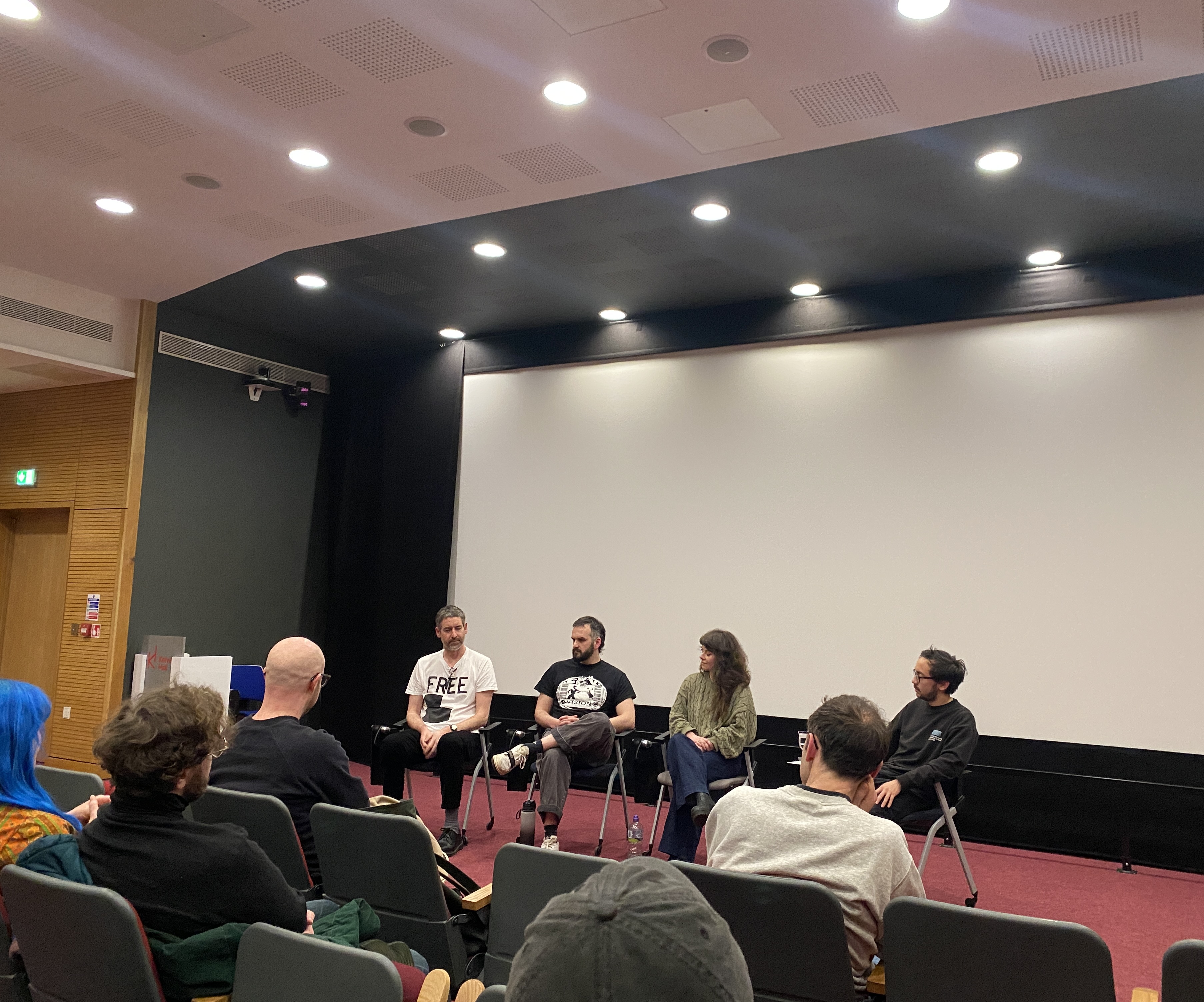
Last night I went to the Thinking Culture event: ‘I Dream of Wires – Film Screening and Panel Discussion’. It’s this film about modular synthesisers and the people who build, use and ultimately love them. Some people collect dozens of these instruments and get scared to record. The studio assemblages are like hyperobjects. It goes from being a musical thing to a techy thing, or this sublime encounter with wires. Some of the talking heads did say they were more like engineers, or more into hardware or just playing around. I found the film inspiring and charming. It was so great to hear from unabashed enthusiasts, some of whom comically shit-talked the digital in a way that was deeply satisfying. Anyone from Trent Reznor to Gary Newman, Legowelt, Doepfer and Modcan. You start seeing the tech itself as this circuitboard for attuning people globally who love something niche in a powerful way. That attunement is also to possibility. The circuitboard after all is an instrument. I loved watching guys hot wire stuff, or whatever it’s called, kind of moving around intricate cables, sparks, connections. It’s one of my favourite things, to let people go off on something they adore in this totally nerdy way. For the love of technicality. The way that the modular synths are more than vintage revivals.
Afterwards, there was a panel chaired by Kevin Leomo with artist Scott Myles and musicians Suzi Cook and Lewis Cook of the band Free Love, who now run Glasgow Library of Synthesized Sound (GLOSS), the UK’s first electronic musical instrument library. Myles has this exhibition, Head in a Bell, finishing up at GoMA right now, containing the Instrument for the People of Glasgow, a social sculpture made up of donations he blagged from Eurorack synthesiser manufacturers across the world. One of the things that struck me again and again in the film and the discussion was this notion of the social, especially in terms of the civic — that which relates to the duties or activities of folks living in a particular locale. Obviously much of this is urban, but I’m curious about the rural life of the synth (remote cabin studios notwithstanding).
One thread of the discussion I latched onto was around what is creativity and why does this question matter in the age of AI. Pretty soon, Lewis said, we’re going to have software that can simulate very well a track that sounds like it was recorded on tape in say, 1984. So why bother to make the track. What is the ‘worth’ in that labour, everyone ponders. Lewis, and I’m paraphrasing here, said he likes to come at instruments more as a wilful amateur than from a position of mastery. He talked about ‘approaching an instrument with a kind of naivety’. It would kind of get in the way if he knew everything an instrument does with that technical oversight. I was thinking about the relationship between creativity, play and amateurism (or what we might call newly coming to the thing, being a dabbler, a devotee etc) in terms of the vernacular possibilities of the modular synth. This is all very raw and speculative thinking, as a blog befits. Towards the end of I Dream of Wires, we have a lovely slowed-down shot of children interacting with a modular synthesiser which is placed outside. The effect is almost pastoral: sunlight on young faces, their curiosity blatant, the different colours of their little outfits standing brightly against the cool palette of the tech. The idea being: what would it be like to come at this as children? As well as: what will the musicians of tomorrow do with this tech?
This idea of the vernacular is one I nab from poetry. In Nilling (2012), Lisa Robertson writes:
a vernacular loosely gathers whatever singular words and cadences move a given situation, a given meeting, as it is being lived by its speakers. Characterised […] by wit, excess, plasticity, admixture, surge, caesura, the wildness of a newly turned metaphor, polylinguality and inappropriateness, the vernacular is the name for the native complexity of each beginner as she quickens.
What does it mean to ‘meet’ the technology of the past in the present? We could swap ‘singular words and cadences’ for samples, patches, presets and think about how improvisation turns a kind of ‘wildness’ into the surprise of new genres. Confronting the interface of a modular synthesiser is intimidating but also freeing because it is a machine that gives. And it will make a sound if you physically interact with it. And you keep building on that. In the film, social connection was mentioned again and again. Whether in shots of happy clubbers dancing away, the hands-on interactions of the Superbooth trade fair or in the social hub of Schneidersladen, a legendary synth store in Berlin, the film circles back to the idea that while there is a collector’s market for this stuff, it’s not always locked away. Even the hoarders like to come out and play sometimes, swap tricks or demonstrate. I like Robertson’s phrase ‘the native complexity of each beginner as she quickens’ as a description for what it means to come at an instrument, face on, learning through doing. Quickening.
The opening question for the panel was ‘When did you first get into electronic music?’ and the answers were a delightful mix of classical training, chance and play. I remember being fourteen trying to play Enter Shikari songs on my friend’s microKORG and this particular instrument being legendary in her self-mythology, like something that landed out of the sky. I remember raucous chiptune gigs, energy drinks, GBX anthems, nineties industrial and the explosive synths of happy hardcore with their Koonsian sheen and total west coast of Scotland Id. I remember how all of this was mediated through hardware: specifically, the Sony Ericsson phone, crackling home computer speakers or the way things sounded IRL massive so much to ring in our ears for days.
When we think about the transitional moment we are living through, with the accelerated capacities and tentacular reach of artificial intelligence, we should consider what we as human beings want from our creativity. This was a resounding proposition from the panel. The importance of social connection, spontaneity: how just being here at this event was also making me think and write again. The kinds of energy, power, connection you get from being in the room. Scott talked beautifully about how the modular synth was a way of ‘shaping electricity’; that could also form the plasticity of a certain musical vernacular. I thought about whether presets could serve as chronotopes hailing us back and forth in deterritorialised place and time. Again, remaking the vernacular. How creativity doesn’t always need efficiency. Lewis said something interesting about convergence of divergent thought. How you work with the practical and the abstract, sometimes needing a bit of one to go into the other. Efficiency can get in the way of meaning and feeling. You have auto-generated the perfect 2010s Eurobeat song. Now what? Slowing down the process can also quicken the senses. It’s how we get excited. Figuring it out. Connecting.
Lewis mentioned that some of the guys on the film had a ‘model railway’ vibe about them, the way they collected and connected synths and narrated that practice. It made me think about how that model railway art of making these insular sonic worlds allows for imagination and mind-wandering play, but you then have to actually connect it to the social to get the extra utopian jolt. This can sometimes be intimate and personal: the ‘ecstatic companionship’ (Scott) of listening to drone music. It could also be energising and collective. The music could stay boutique in the studio or it could be this charge, this conduit to reaching others. I like to think about everyone listening to drone in their bedrooms as tuning into some field of collective frequencies, the oceanic feeling of being apart, together.
Lewis said that one of the goals of GLOSS was to think through how to make a ‘luxury instrument’ available in a wider context, especially in such a divided city as Glasgow. When asked what piece of advice might you give to people interested in making their own electronic music, this is what the panel said (again, paraphrasing):
Suzi: celebrate your changing self and don’t be afraid of warping and letting that shape your practice
Lewis: don’t take yourself too seriously
Scott: always be doing, making sound and music, do it and don’t always try to understand it; keep making stuff and also redoing the thing; don’t be intimidated
Someone, I think Suzi, said ‘part of the balance is bringing in the chaos’. So I will go about my day with that Robertsonian wildness and celebrate indeterminacy, chance encounters, happy accidents.
~
This event was hosted by Thinking Culture. There will be a related gig at QMU in April.

 mariaology