Vegetarian Weather

IMG_3958

Short story written over the past three days in a bout of illness, in-between working Christmas shifts that veered between the hectic and dead, drinking quantities of whisky and waking up to sunlight and ice-beams.

The waves here are not like other waves, on other shores. They seem to billow backwards, suck lines of bright froth back into themselves. This town is bordered by a self-consuming ocean, so there’s no other way to go. A bulimic rhythm of prolonged fulfilment; nourishment interrupted. You try to look out but the horizon devours what darkness might lie beyond as within. Everything is overcast. Even in summer, people lick pastel ice-creams to a backdrop of failed, VHS-flicker grey. The sky shivers and glitches with rain. I was on a train once and a drunk man had slept through the changeover and there were no more trains to the city till morning. He asked how to get back from the port, what time the last bus was, was there still time to get a cab from my town, and I said there was no time here. No time at all.

People have been stringing up lights for weeks, but now we are used to the change it’s as if they’ve been here forever. Blue and red, mostly, like sirens; like morse code blinking in darkness. When I was a kid, I used to lean against the harbour wall and watch the lights, spotting a pattern that made sense. I’d write out words with sticks in the sand, trying to parse the lights. Now I see the decorations, the decorative function, and it’s more or less fully tasteless. I have seen how the city looks at this time of year, the city where silver and gold are everywhere. Then there is the town, the red and blue; the spent fire and the melancholy.

Mother washes dishes until her skin blisters. I have bought her gloves for Christmas, year after year, but she refuses to use them. She enjoys some sort of searing, primitive contact with soap and water. They say she is the best kitchen porter the hotel has ever known, and even when there was a corporate takeover, they let her keep her job. She sings festive carols to piss off the chefs, who love her so much they say nothing. Every year, a bottle of ginger wine for a bonus. She hates ginger wine, but accepts graciously. I’ll admit, I inherited little from my mother.

I am guilty of staring at the sign on the church: CHRIST DIED FOR YOUR SINS. One time the minister caught me and he tried to hold my wrist and look up with me, like we were having A Moment of Glory. I remember his stories from school, trite morality tales about betrayal and friendship. Blood trumps all. My mother once had him for tea, and I mean this pretty much literally. She ate him up with her eyes while my father supped lentil soup in silence. She wanted him to say, I suppose, you are all good people. But the minister merely thanked her, politely, letting breadcrumbs sift through his fingers into the soup, like this was a perfectly normal thing to do. I don’t suppose it’s right to crave forgiveness or bliss from a minister. At least my sins are pure, like the sharp silver of restaurant cutlery.

When people pass each other on the street, they nod. Sometimes, a thrusting remark about the weather, a painful stab at some petulant vegetable. The chat doesn’t stick. But still in its smallness I polish it.

The grocery store is selling handmade Christmas wreaths, which smell of true pine. I don’t know what truck brought them in from the forest, came west with the logs and the spindling needles, the twigs of fir and gauze of twine. It’s maybe a job I’d want when I’m older. The driven coastline, the smell of the pine. For now, I gather up trash from the beach, all the stuff people forget about. I glue it together, leave sculptures in the community arts centre for the children to prise apart with sticky fingers. Father once mumbled something about college but never mentioned it again. Sometimes I can sell them, in tourist season. You lay down a blanket and drunk people will come talk to you, like you’re some sort of guru. I imagine my tacky statuettes in homes across the district, mournful little symbols of emotional debris. Luke used to walk along with me, picking up odd bits. We shared a vision, which is more than you can say about most brothers and sisters. I hope people smash them, my sculptures, in the middle of arguments; I hope they instate a sort of catharsis.

Sin. Waves. Sky. Signs. I used to work in a café serving Battenberg cake to gossiping pensioners, whose tongues would loll out like soft bits of dough, even when they were catatonic and staring at the lashing waves, crumbling onto their laps the pink and yellow. The town devours itself, sloshed and watered by endless tea. Scandal is rare and thin, mostly a case of mystery fire, a missing dog or crooked insurers. Once, two men moved in together as lovers but that was diffused by the presence of their pekinese, who used to come snuffling into the café so even the old folks were won over, nursing their social phobias for other occasions. All these dogs kept coming from nowhere.

I feel the presence of others as generally tepid, unwanted. I went to school a couple towns away, got that bus every morning or walked out before it had even reached my door. I’ve never needed eduction to remind me of a world beyond. I only had to look in the weathered face of my father as he returned each time from fishing, the crinkles in his eyes like a tiny clam had nestled in each pupil and was sucking the skin in for energy. Anemone. The way he plodded in the door with such reluctance, trailing sand and silt in his wake, interrupting my mother’s ordered domesticity with the thick, ineluctable lore of the sea.

“Heavy waves out west,” he’d say mysteriously, chewing a lump of bread as if in each crusted pore was the bloom of an oracle. Mother would shuffle a deck of cards, clink the dishes. Oh baby don’t make me cry. She attended bridge nights on Wednesdays at the Schooner, she kept herself busy. Our tiny bungalow was always polished to a sparkle, as if she was afraid the deceased grandparents could tell whether there was tarnish to the silverware. Father doesn’t talk much, doesn’t touch our lives. He helped assemble the tree with usual obligatory gruffness, then retired to his almanack and chewing tobacco. When Luke died, he didn’t say a word for months. He disappeared on trips that got longer and longer, as if trying to make his reckoning with the sea. If I drain you, will revenge be complete? Do fishermen respect the sea? Great shivering nets of metallic shoals looped in and deported up north, a great operation exchanged between strangers with a fetish for the slivery, salty heaps of lamé. He used to keep a logbook of all the good stuff he’d caught, would bring home glistering samples of mussels and carp for tea, but now he throws it all back, unless it’s for work. Does the minimum necessary, but still brushes with death. Don’t we all…

I sometimes think, god if I went away would I miss this place? I picture myself stepping off the train with the arrogant smile of the rest that leave for places east, for the city. Coming home in summer wearing neat tight suits and smart-person glasses. How small the town would seem, a dolls house of trivial troubles compared to the vast expanse of the city, where I’d make my fortune studying law or medicine or working in some department store where all the women wear Chanel and talk as if talk were merely unfettering. The delicate unravelling of a silken scarf, the spritz of expensive everything. In contrast to such gauzy dreams, the town, I fear, is inscribed with too much of me; I need to keep an eye on it. The sedimentary deposits of my human existence, time made language. All the rocks with my name scratched deep by shards of flint and granite. If I came back, this would all seem impossibly empty. The cave where I gave my first handjob, to a boy who smelt of liquor and mint. I still remember how slowly his breath synchronised with the rhythmic lisp of the sea, quickening with the gulls that squawked and circled ever closer, concealing each blood-warming grunt.

I stopped eating meat after Luke died. The smell of fish near enough killed me, so I slept in deliberately each day to avoid the hour when the men came onto the docks with their morning haul. I burned so much incense in my room that Mother was concerned I was having a religious awakening. I grew what they call lithe and thin; I honed my time to a solitary point. Luke used to run along the beach at dusk, but he’d always bang the sand out of his trainers before stepping in the house. He shared Mother’s sense of boundaries, territory. He used to talk about the nesting patterns of gulls. Recursion, he said, was the order of birds. They knew to come home, and when. There was something magnetic, a tiny program inside their skulls.

We still don’t have his body. It never washed up; the sea hasn’t returned it, the police packed in the case a year ago now. The other boys talk solemnly and seriously about moving away: getting out of it all, the mess and the memories. I’ve drank with them down the Schooner many a time, matching them pint for pint as we flick peanuts across the table and wish we were children again, reminiscing our games on the lips of the bay. When Adam kissed me in the freezing sea mist of six in the morning, clutching me like a piece of driftwood that had wound up on his porch, I felt as though I were pressing into the deepest history, its secret flesh. I felt that final capsize, that upsurge of tide. I was glimpsing what I had missed, the darkest moment of shock and extinction. He pinned back my hair, deftly, when I vomited onto his mother’s petunias. He said ‘good girl’ after we slept together, and I was a waif in his tangle of sheets, hardly the siren I supposed myself to be. He said ‘good girl’ but he was only two years older. It was like none of us knew what to do anymore. When I asked him what the last thing Luke said was, Adam couldn’t tell me. He said they were quiet, they were fishing—that was all. They didn’t talk much at sea, like that was unlucky. The focus was always upon the catch. I stopped visiting that house on the border of town, stopped going anywhere beyond my room. I was folding myself inward, like the waves that brushed the skin of the shore. I pictured twenty black pills like black bits of bladderwrack and swallowing my mother’s precious tonic. Every day felt like a new kind of bruising. I’m not there yet. 

I still remember my first lobster. How I had slipped apart the lock of the cage, the lobster pot, to see this gangrenous thing with terrible black eyes that twitched erratically from side to side. Mother used to tell me the chef at her work would go around clacking lobster pincers near all the waitresses’ bums, until one day a woman called Meggie, the old restaurant manager, thumped him in the face and he had to finish service with his nose bleeding into the sauce. “Be more like Meggie,” she’d say sometimes, scrubbing a wine stain out of Father’s trousers, like that was lust itself. You have to twist off the legs, the claws, break at the joints, scoop out the meat from each fat claw. Iron-rich. I watched the blood-red thing die a death in boiling water, could hear a sharp hiss that sounded like more than steam. What else you had to scoop out: the long dark intestinal tract, its tangled, bedraggled remains of a life. An Escheresque recursion, a spiralling fold into self. I wonder what lobster hunger feels like, the in-suck of clams and asterisk starfish. How it feels to enter that deep, freezer sleep, among the ice cubes and packets of plastic-wrapped, soldered meat? Father clapped me on the back when I held out the shell; when later, tactfully, I stuck my fork in, needling around for the richest flesh. My body knew appetite, knew what to look for. It tasted good and strong. Now I see those orange buoys and I wonder what starving thing is perishing underneath, ready for consumption. I reset my computer because the internet never works. We are out at sea here, lost in our mutual devouring. Nobody comes to fix the signal. Nobody questions my diet at all.

My breath still sours on the windowpanes of strangers. There is no time in this town, not even at Christmas where the hours bleed together like the masses of plastic that gather along the shore. I pass the minister, who quips about the weather. Overcast as the darkness that meets us all. He doesn’t understand the patterns, the names of the clouds.

Sometimes I still see Adam. He stripped me till I was thin as cirrus, in smoky entrails of evening light. Boxing Day and I looked out with the blankets scratching my shoulders, the horizon grey and wasted. I could see Father’s boat trailing in at the dock, the shape of his cap against the grey. My skin looked grey. Something a teacher explained once, glassels: those stones that look shiny and lovely under the water, but dry a dull, disappointing matte on land. I was back in the house on the border of town. I left a little ornament, a piece with old speakers, all copper wires twanged into ersatz smiles. It’s the creepiest thing I ever made, maybe. Luke would’ve hated it; would’ve snapped it apart, made food for the waves. Sometimes we go backwards, return to the place. I think of him most when splitting vegetables, drinking Mother’s ginger wine, scrolling through Facebook on delayed connections. It’s different, now that you’re not around. I grow fragile with anaemia, spend time trying to name your fate. There’s a toast to be made to the absent, a manner of feedback; but all of that pain was already in the weather. You just had to notice.


The General Synopsis at Midnight

IMG_2009.jpg

To the best of my memory, I have only ever been on a sailing boat once. Or, I have only been happily in control of a sailing boat once (there was a time we had to try windsurfing in primary school, a time whose details have, thankfully, long been repressed).  It was 2005, I was twelve years old, and had won a competition through the local youth club to go on a sailing trip to Oban. I don’t remember anything about what I must’ve learned regarding sailing, but I do recall a beautiful suite of seafaring terms: a special vocabulary which transformed previously mundane structural features into curious artefacts of mysterious potential: cleat, keel, stem, rudder, transform, tiller, clew, boom, shroud, telltale, jib, winch, deck and spreader. The man in charge was a hardened fisherman type; I don’t recall his name, but we called him the skipper. He was dismayed to learn I was a vegetarian, having packed little in the way of vegetables for our journey. I was happy to live off Ovaltine, jam rolls and digestives for the following days. It was such an odd combination of children—were we still children?—on that trip. No popular kids, but a few of the scarier misbehaviours (probably not okay to still call them neds), the freaks and geeks—then me, wherever I fit in. ‘Goth’, which in the case of my school was generally singular. Somehow, we all bonded rather than fought in the tiny space of that boat.

One boy, who would always be in fights, bullying and hunking his weight around, was so sweet to me. He saw I had eaten barely anything and gave me a whole bar of Cadbury Mint Chocolate, insisting I had all of it. It was such a kind gesture that I remember it still. Everyone was different at sea: softer, more honest. We were willing to admit our social vulnerabilities; there was no-one, no context, to perform for. A boy I’ll call L. opened up to me about his love for 2Pac, and when Coldplay came on the skipper’s stereo (it was their first truly mehhhh album, X&Y), we shared a little rant about how cheesy it was. We ate fruit out of tins, pulled scarves over our faces on deck and watched the coloured houses of Tobermory loom closer. The skipper let us all have a go at the tiller; he told us stories from previous trips, about how the weather had turned nasty and they’d had to pull themselves through miniature hurricanes. I found myself craving the wild mad weather, even as I was shivering in some inadequate waterproof jacket (I have a history of coming ill prepared to such outings). The skipper and I sort of oddly bonded, since I was usually the first one up in the group. He’d put the kettle on and we’d go out on deck to watch the sky. He’d point out things to look for in the cloud patterns, the colours that bloomed on the horizon. It’s this kind of practical knowledge that I thirst for. Chefs talking to me about how to sharpen knives, bake brownies; motorcyclists betraying the secrets to keeping your speed; engineers talking about formulas and team rivalries and how to build a bike wheel. I’m completely incapable of almost anything practical, so it’s always a magic alchemy to me. When people ask what I want to be when I grow up, I say shepherdess, even though I have little idea of what that entails, beyond reading the excellent The Shepherd’s Life by James Rebanks and occasionally listening to The Archers. I think I’d just be content to wander around hills.

Red sky at night, shepherd’s delight…

I awake to steady rainfall, first day of November. I have been thinking a lot about that sailing trip recently, mostly because I’ve been doing writing workshops in Greenock, and the nature of the place as a harbour town has everyone often turning back to boats and fishing topics. I talk to a chef at work about fishing, not because I’m all that interested in fish but because there’s something about its psychology that reminds me of times gone by. Once, I took myself out to Cardross on the train, following the road up to Ardmore to sit on the point which was a good spot for anglers. It was so quiet and still, the beaches strewn with lumps of quartz. I sat there for an hour or so, listening to the steady lap of the estuary, then slowly made my way home, tearing my skin on all the brambles. It had the feeling of a secret, overgrown place. A little out the way, a nest you could curl into: an almost island. I recall those tiny islands on the Swan Pond at Culzean Castle, where we used to leap across to. As a kid, I’d hide among the bamboos and rushes and feel entirely in my own little world. The pathways and grasses were lit with secret creatures, this 12th World I’d created—it was over a decade prior to Pokemon Go, but here I was in my augmented reality. I’d sit up on the top of the stairs reading for as late as possible, imagining that I was on top of a waterfall, and all before me was water cascading instead of carpet. I’d lie upside down and the ceiling became the first planes of a new universe. I’d wake up early and write it all down; but those pages are lost to whatever antique sale of the past stole my youth.

Now I am adult, less governed by diurnal rhythms. I find myself lost in the long bleed of night into day, up far too late in the bewildering recesses of the ocean online, the oceanic internet. Far corners where articles smudge their HEX numbers in true form down the page and I am rubbing my eyes to see beyond light. Time, perhaps, to rehash that old metaphor, surfing the web. Occasionally, some page would bring me crashing back down in the shallows; I’d wake up, ten minutes later, groggy on my keyboard. Press the refresh key. Instagram has me crossing continents at bewildering speed, lost in Moroccan markets, Mauritian beaches and Mexico City. In the depths of some nightclub then the heights of a Highland peak. So many fucking faces. Closeups of homemade cakes, delicious whisky. Memories. Oscillations I can hardly breathe in, watching my thumb make its onward scroll without my direction. The rhythms become flow, become repetition. I need an anchor. It’s been hours and hours and maybe I’m hungry.

On the boat, whose name I have sadly lost, we slept by gender in two separate cabin rooms. They were tiny, low-ceilinged, and we were just a handful of slugs pressed tight in our sleeping bags. It was better than a sleepover, because there was no pressure to stay up all night and we were all too exhausted from the sea air to talk much. I’d close my eyes and feel the steady rock of the boat’s hull as it bobbed on the water. There was a deep throb of something hitting against the walls outside, maybe a buoy or rope; it felt like a heartbeat. Sleeping in many strange places, the floors of friends’ flats and houses, in tents and on trains, I try to revisit that snug tight room where sleep was difficult to separate from consciousness itself. It was all of a darkness. Something Gaston Bachelard says in The Poetics of Space:  ‘We comfort ourselves by reliving memories of protection. Something closed must retain our memories, while leaving them their original value as images.’ There was no mirror in that boat, so all I remember are smells and objects. No sign of my own pale and windswept face. Everything we ate was an old-fashioned brand; it made me think of rationing and traditional values. I wasn’t quite sure what that even meant.

I need an anchor. A place to dock in.

Governed by some primordial instinct, I go to make my dinner around the same time most nights—which happens to be one in the morning. The shipping forecast used to be the last thing on the radio, before a sea of white noise till dawn. When cutting veg, my fingers weak from another long day, I switch on the radio and there are the familiar intonations. I listen as I would a poem or a shopping list, a beautiful litany of place names, nouns, directives. I have no idea what any of it signifies. It’s been a double shift, perhaps, or an extreme stint in the library, a walk across the city. My mind is full of words and sounds, so many conversations. The debris of the day threatens to spill out as a siren’s cry, and how easily I could slump against the kitchen cupboards, wilt upon the floor. Make myself nothing but driftwood, no good turning till morning. But instead I chop veg, listen to the shipping forecast. It’s difficult to think you deserve food, even when your body’s burning for it and you haven’t eaten for hours. But there are so many other things to read or do! You need an anchor, a reason.

The general synopsis at midnight.

Many of my childhood lost afternoons, bleeding to evenings, were spent playing The Legend of Zelda: The Wind Waker on a GameCube I shared with my brother—avoiding the narrative quests and dungeons in favour of epic ventures across that cobalt ocean. What I wanted was that rousing sense of the wind’s spirit, the freedom to glide and find new islands. Whirlpools, tornados and Chtlulu-like creatures hurled me out to stranger lands. It was all so beautifully rendered, an expansive thalassic field of possibility; with each route I was fashioning some lovelorn story for my lonely hero. The ocean has always represented for me some point of erasure where reality dissolves into imagination. I think maybe it’s this perceptive meshing that we need to attune to in order to make sense of the vast scale effects of the Anthropocene. How else to grasp those resonant shockwaves of consequence, whose manifestations often transcend our human grasp of time and space?

Headache, Viking, southwesterly veering. The same refrain, moderate or good. When occasionally poor at times, do I picture the sailors with rain lashing their faces, rising through mist towards mainland? Is that even where they want to head? Rain at times, smooth or slight, variable 3 or 4. The dwelling conditionals; always between, never quite certain. The weather being this immense, elusive flux you can guess at, the way paint might guess at true colour. Cyclonic 4 or 5. In Fitzroy are there storms circling around the bay? Very few of these places could I point to on a map. I like the ambiguity, the fact of their being out there, starring the banks and shores and isles of Britain and beyond: Shannon, Fastnet, the Irish Sea. There’s a sense of being ancient, from Fair Isle to Faeroes.

I went to a talk last week for Sonica Fest where a girl from Fair Isle talked about climate change, how her home island would probably one day be swallowed by the sea. I can’t help picturing a Cocteau Twins song when she says it. She dropped handmade bronze chains in different oceans so you could see the divergent levels of oxidation, relative to saline content. It was beautiful, this abstract material rendering of elemental time. The world rusts differently; we are all objects, exposed to variant weathers. Her name was Vivian Ross-Smith and she talked about ‘islandness’, a project which connects contemporary art practise with locality and tradition. The term for me also conjured some sense of the world as all these archipelagos, whose land mass is slowly being ravaged by warming waters. The pollutants we put in. Islandness betrays our vulnerability, the way we were as 12-year-olds at the mercy of the tides, the weather and our gruff skipper. I had little conception of what climate change was, but even then I didn’t set a division between humankind and nature.

Back on the boat, I traced my own moods in the swirls of those mysterious currents, dipping my fingers in the freezing North Sea. Who are we before puberty, pure in our childish palette of pastel moods? When I think about how that sea spreads out to become the Atlantic, so vast and impossibly deep, I grow a bit nauseous. Maybe that’s the sublime; an endless concatenation of seasickness, feeling your own weakness and smallness in the face of great space, matter, disaster. How easy you too could become debris.

Increasingly, that waltzing Cocteau Twins song feels more like an elegy, haunted by the shrill of soprano, those shoegaze guitars resounding like notes through a cataract. A line from Wordsworth’s  ‘Tintern Abbey’* I always remember, ‘The sounding cataract / Haunted me like a passion’. Interplay between feeling and form, sound and vision. The ocean warming, the beat steady and mesmerising. Are we sleepwalking into the Anthropocene, over and over again, a lurid repetition compulsion? Why we keep burning up fossil fuels, emitting our plumes of carbon, senseless in the face of a terrible sensorium? I crave solid objects that show up the archives of history, those plastiglomerates of Frankenstein geology, the warped materials of the Earth’s slow and drawn-out hurting. Liz Fraser’s operatic howls are maybe the mourning of the land itself, begging to be swallowed by the sea. A saving? If originally we came from water, hatched out of amniotic sacks or evolved from subaquatic origins, then maybe we return to its oceanic expanse, its blue screen of death. When I’m anxious and needing to write furiously, write against the tides of exhaustion or time, I listen to Drexciya—Detroit-based techno that harks back to Plato’s mythology of Atlantis, via Paul Gilroy’s Black Atlantic. There’s this crazed evocation of diaspora, drowning, a mysterious race of merpeople. What evolves below water, what is spawning in the recesses of subculture; what resists the mainstream, the violent currents of everyday life. This subterranean city is a ‘sonic third space’. I can’t help but think of my own other planet, that 12th World separate yet attached to daily reality; somewhere distant but still impossibly intimate. That resonant intensity that drives you from sleep and into midnight discos of the mind, all pulsation of lights, wonder, horror.

There’s a sense that sound itself can be physically embracing. This is maybe how it crosses over into sonic third space, where embedded mythologies flourish in resonant affect. Where sound becomes tangible, making vibrational inscriptions of code upon the body like transient hieroglyphs of an assemblage’s trellising energy. In Tom McCarthy’s novel C (2010), the protagonist Serge is obsessed with hacking the radio to tune into the ether. Alongside the obvious supernatural connotations, there’s a more pressing suggestion that Serge is able to make his entire being become channel for sound. He lays on a ship as I once lay on a boat, listening to the warm stirs, the conversational blips and signals of objects:

The engine noise sounds in his chest. It seems to carry conversations from other parts of the vessel: the deck, perhaps, or possibly the dining room, or maybe even those of its past passengers, still humming through its metal girders, resonating in the enclosed air of its corridors and cabins, shafts and vents. Their cadences rise and fall with the ship’s motion, with such synchronicity that it seems to Serge that he’s rising and falling not so much above the ocean per sea as on and into them: the cadences themselves, their peaks and troughs…

McCarthy’s lyrical clauses accumulate this notion of sound as spreading, seeping into words and orifices, surfaces. Presences, absence. A lilting simultaneity between the movements and pulses of objects. Sound becomes material; is spatialised as cadence, lapping the edge of Serge’s senses with lapidary, enticing effect—always tinged, perhaps, with a lisping hint of danger. The sounds, after all, also evoke the dead. There’s a radio drama by Jonathan Mitchell, where the protagonist has developed a device which allows you to extract sound from wood. There’s the idea that wooden surfaces absorb sounds from their surroundings, and the time and quality of storage depends on the type of wood. It’s a brilliant sci-fi exploration of what would happen ethically if we could extract auditory archives from material surroundings—the problems and possibilities of surveillance, anamnesis and so on. Consequences for human and nonhuman identity, the boundaries between life and death, silence and noise.

https://soundcloud.com/jonathan-mitchell-1/the-extractor

Do the walls hear everything? I think of rotting driftwood, how porous and light it is. How its every indent, line and scar marks some story of the tides, the stones and the sea. Robinson Crusoe, chipping the days away as notches on wood. I think of the hull of that boat, perhaps coated in plastic, sticky with flies and algae.

On the last day of our sailing trip, we were sitting round the table of the cabin, docked in Oban harbour, reading the papers and having a cup of tea. Our youth club leader got a text from a friend back home. She was informing us of the London 7/7 bombings. This was a time prior to having internet on our phones. We weren’t so wirelessly in tune with everything everywhere always. But that little signal, a couple words blipped through the ether, brought the sudden weight of the world crashing back down upon our maritime eden. I had family in London who escaped the attack by the skin of their teeth, a fortuitous decision to take that day a different route. How everything was at once the dread of hypotheticals. I did not understand the vast arterial networks of terror that governed the planet; these things happened in flashbulb moments, their ripple effects making what teachers called history. Somehow it didn’t seem real. Bombs went off all the time on tv; I grew up with the War in Iraq and Afghanistan. Those televised wars were the ambient backdrop to everything on the news. Later, my friends would wile away their teens shooting each other on Call of Duty. It was all logistics, statistics, the spectacle of bodies and explosions. Nobody explained it. We were distracted by MSN Messenger, then those boys with their controllers tuning in and out of conversation, signing online then drifting away into present-absence. X-Box (Live). Signifier: busy. It was good to be away from the telly in the relative quiet of the boat, startled instead by foghorns and seagulls. But even then, we remained connected.

⚓️

The Shipping Forecast has been issued, uninterrupted, since 1867. Its collation of meteorological data provides a map of sorts, a talismanic chart of patterns and movements, currents, pressures, temperatures—something that helps millions of sailors out at sea. I look at such visual charts and truly it boggles me. I prefer grasping such data as sound, delivered in the hypnotic lilt of that voice: its clear diction and poetic pace, calling me home. I think of the west coast, the bluish slate-grey of the sea. Becoming variable, then becoming southerly, rain or showers, moderate or good. Always between things’ becoming, becoming. There’s the pitch-black womb of a cabin again, the childlike promise of dreams and sleep, a genuine rest I’ve forgotten entirely. Listening makes it okay to be again, buoyed up halfway between where I am and where I’ve been. A constellation of elsewheres to placate insomnia’s paranoia; to be in winter’s dark heart or the long nights of summer, endlessly tuning to atmosphere, cyclonic later, slowly veering from the way. My present tense is always eluding, like ‘In Limbo’ with Thom Yorke’s seaward crooning, the morse code of emotion in whirlpool arpeggios, closing and bleeping and droning on a wave far away, the spiralling weather, the fantasy…Another message I can’t read.

*Full title, of course, being ‘Lines Composed a Few Miles above Tintern Abbey, on Revisiting the Banks of the Wye during a Tour, July 13, 1798’.

IMG_2735.jpg

Short Story: Selkie

(A short story I wrote back in March, knee-deep in Tom McCarthy’s Satin Island, handfuls of Romanticism and longing for the sea. It’s about an oil spill, a young boy’s strange obsessions and his very indulgent Daedalian poetry)

Selkie

IMG_5743IMG_57431

He’s become obsessed with making lists of optical properties. Qualities of light quantified on a complex scale he devised at midnight, drunk on a month of insomnia.

His father is very concerned. He comes home and pours amber from the bottle, watching his son pore over homework. Sometimes a storm shatters the sky through the window and they are both oblivious; the father is a terrible farmer. He keeps just a small herd of cows. A local girl comes to do the milking because he is incapable sometimes, and he won lots of money on the races which pays for her wages. He’s grown sick of the jelly-pink udders.

The boy draws lines, draws a series of overlapping ellipses. This is his expression of despair in the face of algebraic equations. He has grown quite fond of receiving those sweet red Fs.

The community is idyllic as any island could be. The school is offshore, on the main island. Every morning, he gets the ferry with the rest of them. They move as one great shoal of fish. Sometimes he watches it happen from afar, the torrent of school uniforms dissolving through the mouth of the big white ship. On such mornings he turns away and walks further inland, hoping to find comfort in the hills.

He never does. It is only the sea he loves.

[…]

Once, the milking girl tried to make a move on him. She used to wear her hair in braids stitched together across her skull, but that day she came in with it long and loose and wavy.

“Will ye not get it in the muck?” the father asked, secretly admiring her golden tresses. She smiled at him. She waited for the boy to come down from his room, eking out time with every pull of the milk. He saw her bent over like that, the hair dripping over her shoulders. He was holding a tattered textbook.

“I love that you read,” she murmured, to no one. The sound was drowned by the cow’s impatient grunt.

“Easy girl,” she said, thwacking its flanks. The boy stood there watching and she mistook that for desire. She turned to look him in the eye, letting the left strap of her top slip down her arm. That one white breast would haunt him forever, like an immature moon. He averted his gaze.

“What do you want?” she asked.

“I don’t know,” he admitted. He sat in the straw, slumped to the floor, and wept. She had never seen someone so pathetic.

He would stand in the shallows of the sea and feel this ache that was deeper than any pain he had ever experienced. It wasn’t pain exactly, but it was a thing that gnawed at his chest, so much sometimes he could hardly breathe. The grey green waters would shlock around his ankles. In the distance they darkened to purple, to wine. His soul was scorched by sunsets. He picked up shells and held them to his ear, listening for the ocean’s distant, groaning radio.

The old woman in the village store told him she sensed his misaligned chakras. She had a bracelet for that, studded with seven power gems.

“You should wear it day and night,” she warned him.

“I have no money.” He studied the trinket with interest. The citrine and carnelian were pretty, but it was the clear quartz and amethyst he liked best. The tiny crackles inside reminded him of waves, preserved in time.

He hung it back up on the stand, alongside the crystal pendants and the celtic knots they sold to tourists.

“I’ll have a postcard instead.”

“A postcard? Who on earth do you have to write to?”

He sat on one of the picnic benches by the shore. The wind kept threatening to blow everything away so he had to pin the card down as he wrote. It was a picture of some white boats against a flaming sundown. Utterly cliché.

Dear mother, he began. What else was there to say?

Sometimes he would walk for an hour right round to the other side of the island. There was a cleft in the rocks you could find for safety at high tide; it was sufficiently above ground to protect one from the flailing salty waters. He would nestle in that cleft and compose lines:

The vitreous lustre of the sea turning starboard
in tidal cycles, an errant moon
throwing zephyrs across the still bright sound. 

Oh mariner, how you have travelled
so deep in the blood of the world! I miss
the sense of your stories, sharp as whisky

in bars where the girls did sing: how lovely
is the newborn day! There are precious
few elements as vast as you, I should

dream only of your strange motifs,
a darkening glass against turquoise air.
In the morning I plot 

my passage to the mainland, sullied
with the effluvia of island living,
drunk on the salt and the still bright rain. 

He would never show his words to a soul. He rolled the thick pages, torn from his father’s ledger, and stuffed them in the empty tubes that once held his teenage posters. The woman in the café served him strong black coffee, and never once asked him why he wasn’t at school. He left her a £1 tip, excess change gleaned from not eating lunch.

Sometimes he would stand on the edge of some cliff and let the wind buffet his body so hard it was perfectly possible that he’d be torn from his mount and hurled to the sea below, stirred up and strangled in its milky swirls.

A week after the milk girl quit, there was a terrible oil spill. Nobody was quite sure who was to blame. People skipped school and work to go down the shore and watch the slow undulations of the oil on the water. It reminded the boy of something oozing in his dreams, a black thick sweat that covered everything. He wrapped his father’s jacket tight around his shoulders. Flecks spattered the silt and shingle the way ink sprayed from a burst pen. They were waiting for experts to arrive.

Some of the islanders wore oilskins or workmen’s gear and went down the next morning to help clean up. The boy had spent half the night on the safety of his favourite rock, watching the oil thicken and coagulate in the shallows. A few birds washed up, unidentifiable. They looked like lumps of hematite, shining in the new full moon. Sometimes the sight of that black shining oil was so much that the boy could hardly breathe.

It was a job that went on for weeks. The oil just kept coming and coming. People from the news arrived with fancy cameras and started interviewing the locals. They said it was one of the worst offshore spillages in a generation. Old folks tutted and blamed the greed of the mainland.

“They might as well have fountains in shopping centres, spraying this stuff around, for all they abuse it.”

The boy kept a diary of the oil. He tried to write about it purely aesthetically. He wanted a thousand words for black, thick, inky, viscous.

Screen Shot 2017-05-30 at 13.45.45.png

The words brought temporary distraction but deep down they sickened him. He longed to put his bare feet in the sea again. His father scorned him for not helping with the clean-up. He had to do double-shifts with the cows, now that the milk girl had quit.

“You lost your chance there my son.”

The boy started stealing his father whisky. He knew where the weak point was in the distillery warehouse. His father left him alone after that, asked no questions.

The boy noticed that the light on the island had changed with the coming of the oil. Before, it was all stained glass, watercolour: bright and airy. Greens and blues refracted through each other, sparkling. Now the oil cast strange shadows; there were colours on the beach that the boy could not name. He tried to make sense of them with numerical scales to measure the gradients and shades. He kept his notes in a new journal, whose edges were already curled with dried rain, spattered with sea oil.

The sea reveals its fleshly skin of jade,
the green that makes flickers of the water
shiver among those darkling fish, to fade
inexorably among its daughters,

the girls of the dawn with their wet sea fur.
Five generations have known such deep love
as to carve loud bones from the ocean’s whir,
still spinning the buoys at their broken hulls. 

We wait on the rocks for the siren’s call,
laying our bodies to waste on the sound
while the immature moon makes fools of all
who believe in the beautiful, who drowned

Easy as sailors on a summer’s day,
Bloated with salt, time’s lustful decay.

Sometimes his language was so cloying he literally fell violently ill. It was as if he were at sea on a ship, rocked back and forth by a bullying tide. His father found him curled over the toilet.

“Have you been at the whisky my boy?”

“No father. I’m sick at heart.”

“You’re in love?”

“No. It’s the oil.”

He could not eat. He could not sleep. Night melted into day, the hours sat atop one another with the stagnant sense of that oil on the water.

Once, walking along the shore at night, he fancied he saw the milk girl. She walked naked across the sand, her body waxen white, as if carved from the moon. He felt so dreadfully solid in her company. The gooseflesh prickled his neck. She was singing an old song they had learned at school.

From the old things to the new
Keep me traveling along with you

He’d once hated the song, finding it a trite and gooey hymn, but the way she sang it made his heart sting. He realised then that he was no longer a child, that he’d no longer have the innocent luxury of hating something the way he used to hate that song. He thought of the days when he played in the sea until the sun sank behind it, spilling its fiery peach light across the water. How he used to come home with jellyfish stings, salt in his pores, sunburn from the hottest June afternoons.

There was the flaking, turquoise paint on the hulls of abandoned ships. The colour of rust, the old iron chains that oxidised fast in the saline air. The abandoned, unravelled feel of the old yard where the dead ships waited to be repaired. The salt sped everything up, made objects fade eons before they should.

The sea howled. Storms came in quicker than they usually did at this time of year. There was a brief shortage of food as the boats struggled to get offshore, beyond the oil. People were irritable and the cows yielded badly. The boy found a beautiful starfish washed up in a cove. It was jet black, encrusted with oil. It looked like some kind of exotic ornament, worn by a rich lady in a Bond film. He kept it on his windowsill, admired it as the minutes ticked long and slow on the clock.

When the seals started washing up, choked and black and dead as bin-bags, things got serious. Their mouths were bloodied and dry and choked, splayed open as if caught in a final howl. Did seals howl? Could they?

Specialists from the mainland arrived in helicopters to help with the cleanup. There was talk of the island receiving huge subsidies and pay-offs from the petrol company responsible for the spill. Teenagers snapped pictures on their phones and posted them online, tagging them with things like: #shocking #awful #evil #gross #capitalism #darkaesthetic.

The boy realised his peers were wiser than he thought. But they did not know the real damage, the agony he felt sloshing in his chest every time he lay down. There was the sea. It was always there, but once it had been a brilliant cerulean, mottled with orange and heather, grey and jade. Everything smelled of dull and stinking petrol. He wrote in his journal:

It is our world’s first beautiful disturbance. All disasters must entice the eye. 

He thought of 9/11, watching the replays on the television screen while his father drank steadily on the sofa beside him.

“There’s evil out there, my boy.”

“But what about the evil in here?” The boy pointed to his own chest. His father laughed.

“I don’t think you’re going to take down buildings any time soon.” Clumsily, he helped his son with his tie. “Now get yourself to school.”

That isn’t what I meant; it isn’t what I meant at all. 

Sometimes on the rocky plateaus the remnants of oil ghosted the overflow of water, left swirling patterns of rainbows. He checked the internet and saw that people at school were posting lots of photos again. A girl in his class said she was doing her art project on the oil spill. He wanted to tell her to stop, to tell her she knew nothing about the changing colours and the way time was caught in the turgid undulations.

“Father, when will you tell me about mother?”

“What is there to tell? She left when you were still a babe.”

“But—”

“There’s things you won’t understand til you’re older. Now go and play.”

He had not played for five years. He was old now, he was wiser than anyone thought.

He lugged empty bottles across the road to the dumpsters. He now knew the clinking was conspicuous; he could feel the eyes on his back as he smashed each one through the hole.

Once, he dreamt of the milk girl, lying on one of the hillside fields inland, her hair plaited with cowslips. She was humming a tune because it was his birthday. She drank from a bottle of cherryade, the miniature Barr ones you got from the island store. He saw how her tongue was staining red. He woke up feeling very ashamed.

The raven-dark sea made a fool of me,
those tides of black crashing waves in the night
against the harbour wall. I miss the green
abstracted aqua light, playing so bright

amid those blues, those waters clear as glass
who sheltered the glossy ribbons of fish
to swim in the shimmers, burnished with brass
by an old sun that loves life like a wish. 

And now, if I were but a lonesome child
making his way to the soar of the sound
would my young mind find soon such passions wild
inside lagoons, whirlpools, tide patterns bound?

Son to the slippy, cerulean sea,
I rise forward in time to what will be.

When he saw the oil-stained peat of the rocks, the blackened beach, he kept thinking of those towers collapsing. It was like someone had the bright idea of symbolising how everything was falling apart with one fell swoop of a global, terroristic stunt. He asked his teacher if the sea could go on fire, now that it was coated with oil.

“Some folks say that’s the best way to deal with it,” she told him.

“So why haven’t they?”

“I’m sure they have their reasons.” But the boy was sick of not having answers. There were so many creatures out there, wailing with pain beneath the surface, and no one was listening. The ships went out but all they seemed to do was swirl the oil round and round, gathering it thicker. Nothing disappeared. Nothing. 

One day, he came home from school to find his father rifling through his papers. While his files were normally organised, shut tight in a drawer, now they were scattered all over his bedroom floor. His father had let a glass of wine spill on the carpet and now a horrid red stain accompanied the places where cigarettes had been stubbed, where coffee had seeped into a forest of fibres.

“What are you doing?” he demanded.

“This stuff, son, what does it all mean?” his father looked at him with tears in his eyes, a sight which struck fear in the boy’s heart. His father only wept on Sabbath days, and even then, only in the early morning when he thought the boy was still asleep. But of course the boy heard him through the walls.

“It means nothing,” the boy said, furious, “absolutely nothing.” He swept up all the papers and slammed the door in his father’s face. That night he would burn the lot, then take a bath in the masses of ashes.

Dear mother, he wrote. He was in the island café and his tea had gone cold. It was three o’clock—the dead time—and the waitress hummed a lonesome song as she swept clean all the tables. He was writing on the back of another postcard. It showed the standing stones, the ones in the centre of the island. He’d only been there a few times.

I don’t know where you are or what happened to you. How many times is it now that I’ve written to you? I wonder if somehow your spirit catches these words from the ether, even as your body is absent from their possibility. I hate myself, I hate my words. 

He scribbled out the last line.

I want to get back to you. Father is worse. He drinks like a fish, a seasick sailor. I think he misses the sea more than I do. I think maybe he hates being a farmer, hates the land. Its demands. The sea demands nothing. It doesn’t need fed. But now we’ve fucked up so bad. We’ve poisoned the sea. And maybe you’re out there somewhere watching all of this on TV. The birds are so sticky with oil they lie down without flight and never get up. Some drown. Imagine that, drowning in the black black oil? The feel of it choking in your throat, sickly as molasses. I can’t help feeling it’s somehow my fault. My blood feels poisoned as the sea. Everything is slow and sluggish and heavy. I hardly want to get out of bed. I can hardly breathe. 

His handwriting grew increasingly minuscule, so that a passing glance would reveal more a black block of tiny, pressing shapes than actual words. There was something satisfying about seeing all that ink crushed together; it was a bit like the oil itself, taking over the whiteness of the page.

The boy left the café just as it was closing, as the dusk was settling into the sky over the sea. He took the winding path down to the beach, stones crunching beneath his feet. He took a detour to pass by the recycling bins at the end of the street. The café stood alone, its lonesome sign buffeted in high winds and often hurled across the beach, but it wasn’t far from houses. Each one painted a different shade of pastel, to hide the despair of the residents within. The bottle bank, as always, was overflowing. The boy chose a slender, clear bottle, labelled for gin. He picked up a lid from among the street rubble and luckily it fit. Down by the shoreline, he rolled his postcard tight into a tube and posted it through the bottle’s neck. Screwed the cap. Hurled it far out into the waves, where it bobbed for a moment, before the gathering night tides stole it from sight, swirling into darkness, distance.

Her milk-sweet cheeks…

He scratched that one.

 The open lungs of the still-breathing sea…

Trackings of light from west to east:
Time co-ordinates; forgotten detritus
Blended mermaid’s purses, lemoning
pale and lovely skeins of flesh
in the gloaming, a moon’s first milk
making cream of an evening,
the curdled settlements of a westerly tide. 

My mother, my mother.
Your presence vectoring the harsher
veins of the waves in clearer photons
which press their coastal scars on the canvased
skin of a virtual reality, electromagnetic
stirring of the heart. 

There is a scattering, a donut-shaped diagram
shedding the chintz of its skull off
in dullish flakes, blueish as fish food. 

(…What are you writing son?
Nothing.
It does pains to lie; come on, show me.
I can’t.
You’re always so far away when you write.
Like mother.
Yes, I suppose…)

I ask father, could the sea go on fire? Like,
if you struck a match to the black black oil?
He said the water was alcoholic, sloshing
with secret poisons, a formula
for ending its own incantatory eloquence
that spreads in the waves such messages
as to embrocate the flow of blood
diseased in the world’s great spleen.

He said nothing of the sort; he was cold
and mean. The tumorous lumps
puffed at the pores of his torso, unfurling
like chanterelles, yellowing the gorse
and scrub of a forest. I knew then
that his pain was utterly edible.

A molten pot of onyx, a knot
shaped like a pretzel, the twisted
wire that snarls in the dark
of his heart. Father,
he was a sailor once,
a man of the deep
black waves.

He remembered the milk girl used to sing to the cows. She cooed at them, sickly sweet, then struck up some old folk melody he recognised from the songs they sang in primary school. Songs about the changing seasons, the inevitable cycles of nature. She knew how to keep the animals still, to tame them to her softening will.

Once, he made eye contact with a seal. He was sitting on a rock on the island’s easterly side, hoping for shelter from the autumn wind. The black shape had rose, dark and smooth, from the choppy grey waves. Its eyes had flashed back at him, uncannily human, green as his own. Green as the sea in the sweetest shallows, made greener still by heaps of seaweed. His fingers brushed the briny rubber, popping the sacs of air. Is it time yet?

In the café again, he was listening to the old waitress as she stood by his table, hands beating powdery flour on her apron. Her accent had thickened over the years, congealing into the island’s broad dialect like salt crystals fattening in the cracks of a cliff.

“They say half the men on this island lost their hearts to the beasts of the sea. I could tell you many stories.”

“My father?”

“Torn asunder, you could say.”

“By whom? A childhood sweetheart?”

(and if the candied dawn brings tastes luxurious…)

“Yer mother, stupid.”

“He still loves her.”

“She found her skin elsewhere. A better fit.”

“Liquid.”

“Yes.” She rolled up her sleeve. He saw how her arms were covered with an elaborate craquelure of scars and burns and etched-in scratches, as if the flesh were readying itself for sloughing off, the mottled pattern of a snakeskin.

Of all the animals in the marble menagerie
I choose you, silvery moon wisps of limestone
streaking the fault-lines
of my sparkling heart, its sacred burial
beneath the midnight billows. Funereal,
sweetening the crumbling aura,
you see underwater, sharp as a seal’s
dilated vision. 

The love notes meant nothing, were for no one. Sometimes, he forgot the original purpose of everything. He kept quantitive records of the weather, the changing seasonal light, the pathways of the lighthouse beam as it cut across the bay, endlessly searching. He missed the special quality of innocence that the place had lost after the oil spill. Even with the cleanup, traces of the disaster remained. The sea birds had quit the agonised sea and even the crabs were shrivelled carcasses, washed up on litter-streaked beaches. The council had all but given up, now that corporate control was hardening its narratives of the wreckage.

What if the gin bottle remained, bobbing in one place, the current thickening around it, enriched by the stasis of oil?

the shadowy slosh of gelatinous babble /
like molasses i stretch long and sweet in your mouth /
i imagine the darkness inside you, a sable
annihilating the spill of me /
your gluey skin sticks to me with the tarry promise
of future absence / a terrible,
sickening lubricant

Sometimes, he wrote what he considered to be filthy, erotic poetry, forgetting to dot his i’s.

Everything he wrote brought him closer to the water. He felt his words surrounding him like cloying blots of oil, swimming in his sleep and spreading out through daily reality. His grades plummeted and his soul found solace only at twilight, bearing cold feet to the dusky waters.

He knew the milk girl came out sometimes to watch him. He saw her emanations from across the bay.

The cows were milking very badly. They grunted with inhuman fury whenever the boy’s father tried to draw from those shrunken teats. The boy ate very little and the father even less, chomping his way through stub after stub of cheap cigarettes.

“My gums are sore,” the boy complained.

“Lack of nutrition,” his father replied. He asked for a slice of lemon in his tea at the café. The waitress said fruit was scarce; she’d have to knock on 50p to his bill.

“That’s okay.”

A few nights later, he woke up to a pillow covered in crusted blood. His mouth was the same, darkened with black clots. A gap in his gums. The lost tooth reappeared beneath the sheets, a little white stump of ivory, knotted at its roots with a tangle of red, seaweed sinew.

“Goodness son,” the father said when he saw what had happened. “That’s one of your molars.”

Terrified he would lose the rest of his teeth, the boy ate only liquids, or else the slippery fish they served sometimes as specials at the café, depending on what the men could bring back from the boats, delicate in silver lamé. Sometimes the fish tasted of petrol, but nobody voiced this opinion.

The boy placed his tooth in an old spice jar and hurled it out to sea, an offering. Sometimes he felt the wind whistle through the gap it had left in his mouth.

The rock pools were finally back to a greener colour. Good healthy emerald sea lettuce, the tawny rust of cystaphora, tangles of Neptune’s necklace. Salt crusts formed round the edges. The boy dipped his fingers in to feel the warming water. Was spring coming?

There was the milk girl, ghostly in a tangle of cowslips.

“How are you, it’s been so long?”

I love the seals and the way their skin
is a rippling film of oil, the wrinkles
like sexy black outfits on tv
stretching and spreading for the flesh
of human hungriness. 

“These diagrams,” he told her, “chart the changing luminescence of the dying ocean. Tide patterns spread the moon to buttery swirls in different directions. See where this ellipsis meets the horizon’s curve?” But she had no interest in his geometries, his Venn, his equations. She wanted to talk about the people at school, the films you could see on the mainland cinema, the new dress she had made from an old white silk.

“Do you believe in mermaids?” she asked.

“No.”

“Why not?”

“Women are not so callous.”

“If you come to the field I can show you my skin.”

“The strawberries will be out soon, a bed-sheet studded with dewdrops of blood.”

“My skin is white. I am white as the moon.”

“I believe sometimes people breathe underwater.”

“You’re so mysterious. You speak like somebody much older. I had an uncle once…”

“I’m not sure I love you.”

“That’s okay.”

He might have gone with her, might have watched as she shed the magnificent white dress, cast it into a crumple like the cape of an angel. He followed the trajectories of her limbs, watching the shadows move in rhythmic repetition against the pale grass, felt vaguely the rubbing of skin like the way it feels to walk barefoot through fresh, juicy mounds of seaweed.

“Do you miss her?”

“Well enough. I know she’s out there somewhere.”

“Is that really enough?”

“Sometimes it’s all there is.”

The island was gifted a grant as compensation for the oil spill. The village was cleaned up and the shopfronts repainted. The rusting boats in the old dock were going to be towed away to make room for new ones.

The boy and the milk girl started playing a game. They would jump off the harbour wall, hand in hand, utterly naked at the darkest point in the night. In the cold black water they would scrabble down as far as they could, holding their breath, waiting for the exhilaration to rush through their blood. They tried to prolong the time before resurfacing, scrabbling for weeds and stones to tug them downwards. Soon, however, the tide buoyed them upwards and they were gasping for air in the midst of pure darkness. A single light from someone’s cottage spilled gold on the water’s surface. The girl’s hair was blonde and the light was gold; everything else was blackness.

Our bodies slippery as bladderwrack
beating the tide in the stillborn black,
a bolt of cold struck deep in the veins
where poisons gather their listless death. 

Everything he wrote was awful now. Soured by the thing that had come between him and the milk girl. He slept all day, wrote by twilight, cast his notes to the wind on his least favourite side of the island. The place with the graves, the place where the air was warmly rich with spirits. It unsettled him.

“You’re missing a tooth,” she said once, poking her fingers round his mouth, where the gums were soft and rubbery.

“Yes.” He clamped down hard on her fingers and she yelped, playfully, like a pup. They went back up to the farm and helped out with the milking, so that it was done in triple time and the three of them could have a meal together, big cups of cider and a shared loaf of bread. She sung into the twilight and the men listened in silence.

The boy took down all his diagrams because the milk girl told him they were freaking her out. He wanted her to sleep in his bed but every night she insisted on going down to the harbour. What with the daytime milking and the nighttime swimming, the boy was growing very exhausted.

“What are we trying to prove?” he asked, folding her shining body to his in the moonlight.

“I want to know, I mean, I need to know.”

“Know what?”

“Can we be creatures of the sea?” He thought then of the seal who had stared at him long and hard, like it had known him forever. He shivered.

“Maybe it’s better not to. Then we can just pretend.”

“You miss her, don’t you?”

“Who?”

“Your mother.”

There are different types of orphans. Some are split irrevocably from their origins, by death or neglect. Others are tied to this primal region of their life by a gossamer thread of dreams. The milk girl seemed to have hatched from the sky, on a pure and cloudless night.

One time, they were night-diving down by the harbour and she disappeared. One minute, they were together, tangled in the gruesome depths of the harbour; the next, he could not feel her body at all. All was rock and weed and jellyfish. The tide was high, it had come sloshing up the walls and with it all manner of ocean debris. As the elders always said, the sea hurls back what gets hurled into it.

After swimming around in the churning currents, trying to make out a slender white shape, the boy gave up. He climbed the rusted ladder and promptly vomited onto the concrete, mouthfuls of seawater and silt and evening coffee. Shaking a little, he stood on the edge of the wall, looking for the gold-blonde head of his little seal. Maybe she just swam away from him, following some milky highway of moonlight back to her nebulous origins. But he could not help but think of how she had just vanished, torn away by some invisible current, her body ensnared by terrible kelp.

She never returned, and he realised that nobody noticed that she was gone. When he asked his father about the milk girl’s parents, he said something vaguely ominous and strange about how she was an outsider, “an immigrant to the island’s soil, born from luminous loins.”

Enough of the hoary midnight mist
that tricks me into feeling.
I am old as the sand, a grain
of the past, and I
am willing to die for that.

He found the dead starfish in his room, still crusted black with oil, as if it were a strange piece of jet or coral. He took it down to the beach one evening, when his bones were aching from all the walking he had done lately, scouring the cliffs for signs of the girl. The starfish looked so vulnerable, but in its black outfit seemed completely strange, a being from another world, resplendent in PVC. He returned it to the dark waters, slipping it under the shallow waves, waiting for it to be pulled asunder. He realised then what a fool he had been, to think he could take something from the deep of the sea, even to hold it and love it. The oil had gone and so had the sea’s suspension, now released into a churning, awful hunger, the cycling time and crazy waves that kept the boy awake—night after night, day after day.

Record Ekphrasis: The Long Ocean

IMG_34162IMG_341611

~ https://thelongocean.bandcamp.com/album/the-long-ocean

There is a struggle, the suspension of hoar frost crusts time itself as it trickles over the sea. At first light we watch for an opening. Even in attics and city bedsits, the sea remains in our blood. We feel it cold as ice at the illness times: how darkly we sink into the sheets, hoping the pain in our skins will dissolve back to lucent matter, the night wisps of somebody else’s aura.

A voice enters soft and lo-fi, filling the interludes that swirl around haunted piano arpeggios, the silver streaks that spill on the ocean’s tides. I am afloat in muted clicks that keep me close to the surface, where the sound echoes in drips, as in a swimming pool. I listen for his voice as it mists the glass of the window. I inhabit that glass in the silence, waiting for some melody to sparkle with any dissonance sufficient to crack my crystal prison. Percussion is slightly hard, a clack, clacking. Crackle. Predictive appearance, seductive. “I’m under your spell / and I’m under under”. Subaquatic passion, staring at the world from beneath, behind, the film of its surface. See how everything shimmers. It’s quantum physics. You can’t peel off the surface of reality, its candy sprinkles, its gilt, to see what darkness and delight lies beneath; you’re already deep under, withdrawing, closing.

There’s the haunted aesthetic we find in Burial. Something more organic, elusive; the rural alternative to Burial’s empty midnight metropolis. On ‘Raindrops’ the muted sound of gulls weaves in and out of a DJ Shadow, Entroducing…..-era riff and the shimmering playful jazz of a brighter piano, a celeste of some sort…the sound of wind chimes through the minuscule ears of insects, so very high-pitched, so very sweet. You can imagine the tinkle of glass as you toast your favourite jellyfish, spirit animal that sucks its seven temporalities tentacular around it, moving them in sweeping undulations that rupture the cyclical moon-time of the waves. You open your flesh to the ocean, every salt crystal forming a bead in your pores. Desire is the fulfilling of absent substance, the spacing of the gap between lack and attainment. The passage of sailing, not knowing what darkness, what deep blue, you are setting off into, heart curved sharp by the cut of a crescent moon.

If Burial is, as Mark Fisher puts it, ‘London after the rave’, The Long Ocean is the abandoned nightclub pavilion, the sea’s dull roar mingling with those shadowy echoes of ecstasy. The slowed-down groans of a former generation’s momentary joy. Angels caught in the sand of an hour glass, being tipped, a largo mode of clock-ticking, grains of time slipping endlessly over the rasp of voices. I set this album to cassette tape, allowing the crackles to augment and mingle. I could be in the murmuring belly of a ship, hearing the rasps of a radio mix with this transcendent, nowhere music. It’s the sound of twilight set to reflections of quartz made bright momentarily by deepwater bioluminescence. What is that whine, that eerie peal? The sound of lost dolphins, the painful song of a lonesome whale? The whale is a heart’s darkness, a shadow-side of waking reality. You can lose yourself inside it, feel dreams close over you, prised from the wax, the oil-black skin.

Four Tet at his most otherworldly. Hypnotic loops, the soft distortion, the natural ambience. I am walking down an abandoned street, where weird green plants sprawl through the smashed-in windows of Brutalist buildings. Night birds chirp the tart remnants of forgotten songs. I am hooked on the wave-like rhythmic pulse of his words. My footsteps echo, down the street, down the passage, down the shallows to the deep where tarmac melts into oil-black sea.

There’s a sense of dark, spreading space, interpenetrated by twinkling scintillations; not unlike the plaza-like ambience of mallsoft and certain variations of vapourwave. Think: diamonds in the tarry pavement, stars reflected on the ebony surface of the midnight sea. A more crystalline James Ferraro, Marble Surf; The Long Ocean swaps those choir-like, ice-cream van speaker crackles for a more precise intricacy of lattice parameters, cross-rhythms of tinkling percussion and soaring, yet always subtle, beats. Think also of something like GOLDEN LIVING ROOM’s New Nostalgia, its eerie shimmers of late night lo-fi mixed with the bright sound files of near-future cyberspace, everything sounding slightly subterranean, that tinniness of dissonance. On The Long Ocean, however, instead of the glitch effects of hardware, the sounds chosen here are derived from natural materials and technics. The hollow click of driftwood, billows of cooling wind, cave-like echoes, the clinking of a necklace of shells with every percussive sprinkle (‘The Crest’). There’s a collector’s sense of amassed trinkets, effortlessly slinking along intricately simple bass-lines, hardened by industrial beats which burn in the weird space between background and foreground. What this music shares with vapourwave is a sense of slow, careful build towards the internal coherence of a detailed and evocative theme. The sadness and the beauty leaves its ghost stains on your brain, tugs at the blood which is full of the sea, makes you want to walk forever, or forever dream—rhythmic, contorted, returning serene.

Some of these tracks are totally devourable jams, the minimal intrusion of sampling giving way to those lusciously percussive beats, twists of lo-fi brass, crooning sexily over the building peal of mysterious beats (‘Gold Dust’). I’m reminded of a video game casino, an interlude space suspended in a three-dimensional, virtual world, where the colours and lights are all for our ersatz pleasure. On an island over an ocean we are sharing expensive littoral whiskies, toasting the way our skin glitters in its vitrics. Soon every vein will resurface, a curious craquelure marking time on the skin. Here we are, vacant, absent, deliciously distant.

Sometimes a roar of white noise, of wind rushing through a tunnel, subtly infiltrates a track (see the end of ‘The Crest’), reminding us that the space we’re inhabiting here is adorned by darkness and distance, is always deferring from itself. There’s definitely that Boards of Canada minimalism, the seamless weaving of samples in a way that seems hazy, reflective, a little haunted. A childlike naivety, a curious innocence; shadowed by the weight of a trembling void.

But there’s also a certain romance, even magic, to this record that I can’t quite pin to anything else. Not in the same way. Maybe it’s something to do with the celestial resonance of much of the track names, from ‘Star Light’ to ‘Gold Dust’ to closing beauty, ‘Stella Maris’. Latin for Star of the Sea, ‘Stella Maris’ is the feminine spirit, a protector who guides the soul at sea. This song is the album’s North Star, guiding us back through the waft and heft of its silvery, elusive currents. It sounds somehow out of time, built around the melancholy minimalism of a piano, sustaining its slow and careful path over the abyss of crackle, the tremors of the underworld, the ocean’s darkest depths. In the ‘Desecration Phrasebook’, a glossary collecting Anthropocene-related words, there’s a word, ‘shadow-time’, for ‘the sense of living in two or more orders of temporal scale simultaneously, an acknowledgement of the multiple out-of-jointnesses provoked by Anthropocene awareness’ (The Bureau of Linguistical Reality). We have to accept we are already living in the end of the world; it’s just that our sense of its time-scale is far beyond human comprehension. The fluid, amniotic ambience of ‘Stella Maris’, coupled with its fin-de-siecle, 1990s-style exploratory piano (think: Aphex Twin, DJ Shadow), creates this haunted sense of dual temporality, of always being on the cusp of something to-come at the same time as being homesick, nostalgic for a dreamland that came before but perhaps never was at all.

There’s something in the way this album romanticises the sea that suggests Glenn Albrecht’s word solastalgia: a form of existential distress caused by environmental change, global warming being the obvious example, as well as coastal erosion and the weather manifestations of climate change. Solastalgia derives from both ‘nostalgia’ and ‘solace’. Whereas nostalgia denotes a feeling of homesickness for a place and time we are no longer present in, solastalgia evokes that sense of distress caused by our home changing as we inhabit it, the affective impact of huge global shifts upon our individual, local experiences of landscape. The Long Ocean doesn’t leave us washed up at the end of the world, but suspended in the glittery salvation of its dark and strange and shimmering beauties. We come close to the weird and the terrifying, the dissonant samples of unrecognisable times, of creatures whose tremors rise up from the deep. Think of the pleasure and slight terror of binaural beats, the sublime understanding of our human insignificance as we gaze at the stars.

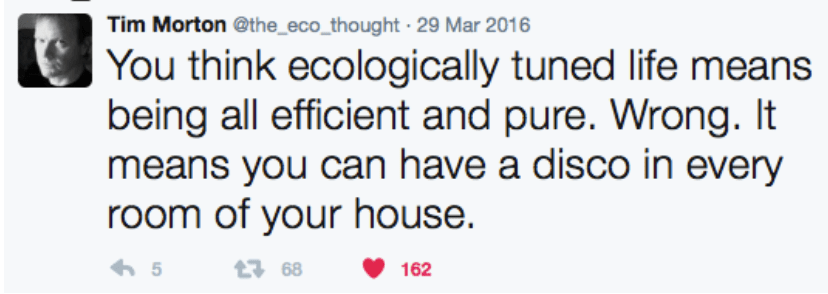
The beauty of an ecological thought is that it doesn’t have to be clogged with guilt, it can create something even lovelier before in its collective, technological and temporal possibilities. What would happen if you filled every room with solar panels, invited the creatures in, suspended your desire forever in those flickering, dancing refractions of light and sound and colour and life?

Screen Shot 2017-04-07 at 13.14.21.png

The Bog Girl’s Dark Ecology

red-desert-43
Red Desert ~ Source

My body was braille

for the creeping influences:

Seamus Heaney, ‘The Bog Queen’ (1975)

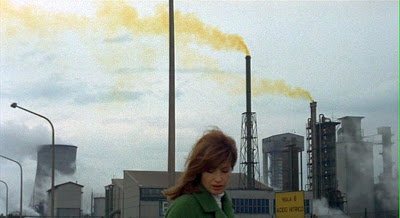
In Michelangelo Antonioni’s 1964 film Red Desert, loosely inspired by Rachel Carson’s groundbreaking ecological text, Silent Spring (1962), one of the characters complains that he was at a restaurant and the ‘eel tasted of petroleum’. This is a film landscaped by oil rigs, the persistent murmur of a dull grey dying sea, industrial structures whirring with eerie electricity. While there is a distinct sense of disconnection between characters, between humans and their environment, one connection that persists is between excess, waste and the body. While nowadays fish change genders due to oestrogen from the Pill being excreted and pumped from sewage into rivers, in Antonioni’s film, haunted by the apocalyptic backdrop of the Cold War, the characters worry about their food getting cloaked in some essence of what gets dumped and yet is also extracted from the sea. A perverse cycle of waste, energy, wasted energy.

plate08.jpg
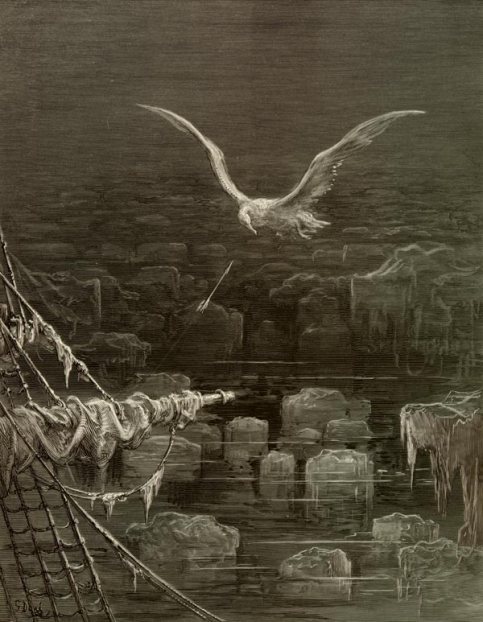
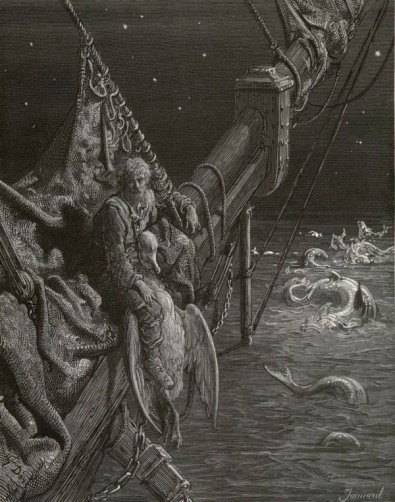
The mariner shoots the albatross, plate by Gustave Doré


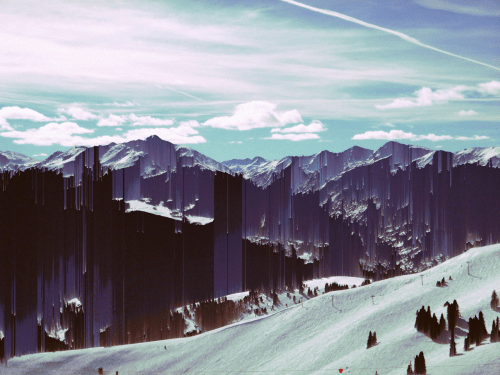
This early expression of ecological disaster as embedded in a fear of contamination, of sliminess mixing with toxic sliminess, has its roots even further back, in Samuel Taylor Coleridge’s poem The Rime of the Ancient Mariner (1798). After shooting the albatross and overcoming a terrible, supernatural (super as in extra nature, nature made unnatural by being its full strong self) storm, the mariner finds himself suspended in the aftermath, ‘as idle as a painted ship / Upon a painted ocean’ (Coleridge 2015). This sense of time frozen, of the environment refusing to yield to human command, is uncanny, a reminder that the land isn’t just something we can divide and conquer. The image of idleness and a ‘painted ocean’ recalls the experience of a crashed computer screen, hung or ‘frozen’ as the mariner is in the sheets of ice ‘green as emerald’ (Coleridge 2015). Think of a typical glitch, that which overlaps colour, blends unrelated materials together in a random, patchwork image. The ice is the colour of grass, yet still we are in the ocean. This is an environment without location, an ‘anywhere’ of strange displacement. This is the place of the ecological glitch.

tumblr_npqtors3nr1r6a43wo1_500
glitched landscape ~ Source

Rosa Menkman describes a glitch as ‘a (actual and/or simulated) break from an expected or conventional flow of information or meaning within (digital) communication systems that results in a perceived accident (2011: 9). While we are dealing in poems like Coleridge’s with a ‘natural’ system as opposed to a digital one, the strange effect of ‘accident’ persists. ‘Nature’ is never as it seems, never ‘natural’ but always unexpected, strange. Systems follow patterns which glitch; the patterns themselves, like evolution, proceed often by a logic of chance, randomness. The weather in The Ancient Mariner is not just climate, a conventional flow of data to be charted and forecasted; but it is positively weird. Weird in the etymological sense identified by Timothy Morton as ‘a turn or twist or loop, a turn of events’, the ‘flickers [of] a dark pathway between causality and the aesthetic dimension, between doing and appearing’ (2016: 5). We question whether the crime of shooting the albatross instigates this ecological horror, which culminates in the monstrous appearance of ‘a million million slimy things’ which the mariner sees surrounding the ship. Like Antonioni’s petroleum eels, these slimy things are stuck with the human character, they have by proximity or digestion become enmeshed, to borrow another term from Morton, the idea that ‘nothing exists by itself, and so nothing is fully “itself”’ (2010: 15). The mariner realises his own surprising mortality, just as the slimy things ‘liv’d on – so did I’. His attempt to lump the slimy things as one gelatinous mass of gross matter leaves him realising that he can’t distance himself from the ugly parts of nature, because he himself is part of the mass, that mesh of beings.

windeby_5
Source

We might now describe Coleridge’s flirtation with the supernatural as a kind of magical realism, and the trend of using such weird elements to render ecological themes continues in a short story written by Karen Russell and published in the New Yorker in 2016. ‘The Bog Girl’ tells the story of a fifteen-year-old boy, Cillian, who works as a turf-cutter in the peatlands of some ambiguous ‘green island off the coast of northern Europe’, inflected with hints of Heaney’s hardy Irish pastoralism. Cillian falls in love with a young girl pulled from the bog; she is ‘whole and intact, cocooned in peat, curled like a sleeping child’ with ‘lustrous hair’ dyed ‘wild red-orange’ by the ‘bog acids’ (Russell 2016a). Crucially, there is a noose round her neck. She is young in appearance but probably 2000 years old; her flame-haired  and gaunt appearance recalls Celtic/Pictish origins as well as a ragged Pre-Raphaelitism, which hints at Cillian’s weird fetishisation of her beauty. The story that unfolds can be read as a love story, a tale of caution against projecting your ideal fantasies onto ‘the mask of another person’s face’ (Russell 2016b); but here I will read it as a tale of ecological horror that warns of the dangers of industry and celebrates the sensuous mysteries of the peatlands as something that deserves preserving.

Our current era, the Anthropocene, is one of distorted scale, where constantly we deposit chemicals into the atmosphere and earth whose afterlife beyond our own we can barely even gauge as mortal humans. Russell’s story explores this (im)possible meeting of temporalities through an encounter with strangeness which allows us to mull upon our relationship with the earth, to realise our absolute enmeshment with the environment. No matter the narratives we construct through history and science, all human theory is at best the ‘most speculative fiction’; while improvements in science (‘radiocarbon dating, DNA testing’) allow us to trace the ‘material fragments’ as ‘clues’ about our ancestors’ experience, ‘their inner lives remain true blanks’ (Russell 2016b). At one point, Cillian decides it’s time he met the Bog Girl’s family, so he takes a ferry from the island to a museum. He scans the museum’s labels, which attempt to give context to the ‘pickled bodies from the Iron Age’, but is unsatisfied by these attempts to ‘surmise’ details about the ancestors’ lives based on material detail alone (Russell 2016:a). Their bodies are ‘fetally scrolled’ (Russell 2016a), suggesting that screeds more of history are inscribed on their skin like ink upon scrolls, a literal blending of flesh and text. The inadequacy of the museum labels allows Cillian to continue his fantasy that the Bog Girl appeared for him alone, that she ‘was an alien from a planet that nobody alive could visit—the planet Earth, in the first century A.D.’ (Russell 2016a); none of the other ancestors stir the same emotion as the Bog Girl. Love becomes a token, a talisman of magical power: ‘He told no one his theory but polished it inside his mind like an amulet: it was his love that was protecting her’ (Russell 2016a).

Russell’s narrative sustains this fantasy, resisting the natural outcome which would be the Bog Girl’s rapid decomposition upon exposure to air. This commitment to a magical realist effect allows her to explore problems of intimacy and otherness, which relate deeply to ecological issues. Take the bog itself. Russell describes it as a primitive hole, the ‘watery mires where the earth yawns open’, a place where time is suspended by a ‘spell of chemical protection’ which prevents the decomposition of matter: ‘Growth is impossible, and death cannot complete her lean work’ (2016a). Her rendering of the bog is crucial to the story for its associations with the suspended temporality embodied in the Bog Girl. We are told that much of the peat is cut away to turf, a key energy source still used by the islanders, and ‘nobody gives much thought to the fuel’s mortuary origins’ (Russell 2016a). Death, a haunting presence seemingly without telos, lingers in the earth, in the home; the Bog Girl weirdly embodies our paradoxical relationship to natural fuel sources: we consume them to produce energy, but our consuming instigates the loop of destruction—de-energising the earth—pumping poisons and coagulating into new forms of deadly matter. The peat bogs are a kind of charnel ground, already containing the detritus of bodies and time in a ‘disturbing intimacy […] that exists beyond being and non-being’ (Morton 2009: 76). The bogs are both ‘shit’ and ‘fuel’ (Russell 2016a), embodying the waste we must expel to maintain presence and order; but also refusing this separation, stickily gluing us through interdependence (the islanders need it for fuel) just like those slimy things reminding the mariner of mortality.

Moreover, the introduction to the bog includes the narrator’s address to the reader, the only such address in the story. The narrator remarks of the island, ‘it’s unlikely that you’ve ever visited. It’s not really on the circuit’. This seemingly throwaway comment interpellates  (in Althusser’s sense of the word as a ‘hailing’ of subjectivity within ideology) the reader as a global consumer, whose ‘circuit’ references a sort of capitalist freeway (the places we drift through for pleasure) as much as it slyly hints at the cycles of life/death which are interrupted in the text. From the start, we are made to feel as outsiders in this community, which is self-consciously established as a wasteland of sorts, off the circuit, the beaten track; a charnel ground for exploring the mystical possibilities of strangeness and ecological intimacy.

What’s more, her association with primitivism and death links the Bog Girl to the past in a way that is queer, that disrupts the reproductive logic of heteronormative capitalism, a disruption that Cillian welcomes. Cillian ‘imagined, with a strange joy, the narrow life’ he and the Bog Girl ‘would lead. No children, no sex, no messy nights vomiting outside bars, no unintended pregnancies […] no promises’ (Russell 2016a). Note again that word, ‘strange’. The Bog Girl’s body is bounded; she will never consume nor produce waste, will never reproduce to bring more consumers upon the earth; with her, Cillian shrugs off the lusty masculinity of the ‘mouth-breathers’ (Russell 2016a) who help dig up the Bog Girl, he deviates from the established gender norms. Indeed, Cillian’s docility, his placid detachment from the rugged rural manliness of those who surround him (personified most perfectly in his uncle, who refers to the Bog Girl as a ‘cougar’ and has ‘a thousand beers’ laid out for himself at dinner) renders Cillian a queer figure, ‘so kind, so intelligent, so unusual, so sensitive—such an outlier in the Eddowis family that his aunts had paid him the modern compliment of assuming that he was gay’ (Russell 2016a).

Yet while the Bog Girl embodies a queer backwardness, more specifically she offers an openness of temporality, a strange oscillation between past and future rather than an obsessional projection towards the future. Derrida (1994) explains the promise as bound up in the logic of messianism, the guarantee of the future to-come of some saving force that would sweep up history. Remember the religious breathlessness which narrates Cillian’s discovery of the Bog Girl: ‘The bog had confessed her’ (Russell 2016a), as if she were a message passed on from a Neolithic age. Yet Cillian is oblivious to the fact that his love is itself the promise of an (unspeakable) secret, a promise of a present without future, a seamless overlapping of present and a past that can never again be as time demands its rupture, the Event of her eventual, unexpected awakening. The silence between them, the Bog Girl’s inability to speak, indicates his sense that love can be their pre-linguistic communication, an avowal without trace; but this originary language is impossible:

Invented for the genealogy of what has not happened and the event of which will have been absent, leaving only negative traces of itself in what makes history, such a pre-originary language does not exist. It is not even a preface, a foreword, a lost language of origin. It can only be a language of arrival or rather of the future (une langue d’arrivée ou plutôt d’avenir), a promised sentence, a language of the other, again, but entirely other than the language of the other as language of master or coloniser [and now I emphasise], although the two of them can sometimes announce between them, keeping them in secret or holding them in reserve, so many troubling resemblances.

(Derrida 1998: 61)

This ‘language of the other’ breaks down the classically patriarchal imposition of telos and closure upon the Bog Girl: she will be his forever faithful silent Angel in the House; that is, until she starts speaking. Cillian’s aphasia, ‘a stutter that had been corrected at the state’s expense’ (Russell 2016a), hints at his own problematised presence in the text, since commonly we associate speech with presence. He lacks the authoritative Word, is himself described as a queerish glitch in (human) nature, a ‘thin, strange boy’, ‘once a bug-eyed toddler’, whose grownup, ‘celery-green eyes’ (Russell 2016a) bely an inherent connection to both land and water—there’s a suggestion of his slightness, his precarious and translucent appearance in the world. The mutuality of recognised love he comprehends with the Bog Girl is this ‘secret’ which excludes his mother and friends, which makes others jealous; and yet it is also a source of troubling disruption, the threat that emerges in the master/servant dynamic symbolised by the noose round the Bog Girl’s neck, which Cillian tightens as his ‘fantasy life’ grows deeper (Russell 2016a). And what is ‘the language of arrival’? It is the Bog Girl’s coming-to-life, her messianic resurrection into present existence.

The irony of the story is that Cillian and indeed all the human characters in the story failed to predict this resurrection. The Bog Girl is adored or feared precisely because she skims with death; the body-conscious girls at Cillian’s school are ‘jealous of how little she ate’, the vice-principal sees her as shedding ‘an exciting new perspective on our modern life’ through her contrasting connection to the past (at this moment, the Bog Girl ‘had slumped into his aloe planter’), the fear among Cillian’s mother and aunts is that she will drag him away from the safety net of respectable surveillance: ‘“I’m afraid,”’ Gillian, the mother, confesses, ‘“if I put her out of the house, he’ll leave with her”’ (Russell 2016a). There is no suggestion of the Bog Girl’s autonomy here; rather, she is seen as embodying a terrifying strangeness that might contaminate ‘innocent’ Cillian. But then she wakes up. Her ‘radish-red’ lashes are vegetable (in the sense of passivity and organic matter) companions to Cillian’s ‘celery-green eyes’ (Russell 2016a); she too is an earthling, bound to the bog in an inexplicably deep, mournful way. Her awakening is erotic, marked by ‘a blush of primal satisfaction’; it is only at this point that their relationship emerges fully into what Donna Haraway calls that of companion species, whose interdependence is based on mutuality, in ‘forbidden conversation’ (Haraway 2008: 16). Haraway says of her relationship to her canine friend:

I’m sure our genomes are more alike than they should be. Some molecular record of our touch in the codes of living will surely leave traces in the world, no matter that we are each reproductively silenced females, one by age and choice, one by surgery without consultation. […] We have had forbidden conversation; we have had oral intercourse; we are bound in telling story on story with nothing but the facts. We are training each other in acts of communication we barely understand. We are, constitutively, companion species. We make each other up, in the flesh. Significantly other to each other, in specific difference, we signify in the flesh a nasty developmental infection called love. This love is a historical aberration and a naturalcultural legacy

(Haraway 2008: 16).

It is only when the Bog Girl awakens that the relationship becomes properly ‘in the flesh’; she has learned the communion of erotic love, is ‘tugging at his boxers’, but at this point Cillian is tipped into the abyss of signifying rupture: ‘something truly terrifying had happened: she loved him back’ (Russell 2016a). The nasty developmental infection called love’ rips apart his perfect communion of static silence. The Bog Girl’s language ‘was no longer spoken anywhere on earth’, it is a primitive cry from the depths of the peatlands, which Cillian cannot answer because he is indifferent to the Other as anything more than his own anthropocentric projection: ‘The past, with its monstrous depth and span, reached toward him, demanding an understanding that he simply could not give’ (Russell 2016a). We might think of the title from Jonathan Bate’s crucial ecological polemic, The Song of the Earth (2000), or a strange, aberrant passage from Virginia Woolf’s Mrs Dalloway (1925), where a vagrant woman whose ‘rude’ mouth is a ‘rusty pump’ (signifying, perhaps, the decay of industry, its material crudeness) singing a song of ‘love which has lasted a million years’ (Woolf 2004: 70-71). The idea of song suggests an ambient music that stretches onwards without climax and fall, echoing past and future in its rasping cry. The eerie, anthropomorphic crackles, growls, roars and howls that come from the ice in The Ancient Mariner. What would the earth sound like, speaking back? Surely it would be our own cry, endlessly deferred; the echolalia of life forms caught in this experience together, entangled in the rendering of a dark and dying world.

296287094_7aa36bf57c_b.jpg
Source

In many ways, the Bog Girl is animal, Other; she is not quite human. Better then to think of her as someone who embodies the terrifying intimacy of all life-forms, which brush up against one another, bearing their various sensations and temporalities. While the mariner comes to admire those gross ‘slimy things’, noting their ‘rich attire’ and blessing them with a whiff of Romantic kitsch as ‘happy living things!’ (Coleridge 2015), Cillian finds himself caught between the Bog Girl’s world and his own, ‘struggling to pay attention to his droning contemporaries in the cramped classroom’ (Russell 2016a). Referring to his classmates as ‘contemporaries’ reinforces their association with the present; juxtaposing with Cillian’s mournful retracing of steps, back ‘to the lip of the bog’ (Russell 2016a), the word ‘lip’ suggesting both spatial liminality and the erotic possibility of the temporal and primordial lacuna that lies within. We can think of the Bog Girl as what Morton (2010: 41) calls the ‘strange stranger’, a word for all life-forms which encapsulates the way that even those closest to us are inherently weird, because they remind us that we are not wholly ourselves, that we too are composites of life-forms, viral code, enmeshments of DNA.

Although the Bog Girl always seems close—we get vivid details of her ‘rhinestone barettes’, her ‘face which was void of all judgement’ (Russell 2016a))—indeed she becomes a vital component of Cillian’s life, ultimately he is forced to realise her absolute strangeness. Unlike the mariner he is unable to overcome that gap of Otherness and make peace with the uncanny experience of the ecological mesh. He goes down, enticed by the ‘lip’ of the bog, listening for the ‘primitive eloquence’ of ‘the air-galloping insects continu[ing] to speak the million syllables of [the Bog Girl’s] name’ (Russell 2016a). At the end, the narrative becomes ambient, with a distortion of inside/outside, self/other:

“Ma! Ma! Ma!” That night, Cillian came roaring out of the dark, pistoning his knees as he ran for the light, for his home at the edge of the boglands. “Who was that?”

(Russell 2016a)

My immediate assumption here is that Cillian is calling “Ma!” for his mother, a riff on the Irish references of the piece which are probably a nod to Seamus Heaney’s Bog Poems (1975). However, it’s not clear; elsewhere she is usually referred to with the Americanism, “Mom”. Cillian himself has adopted a primitive roar, which rips through the resonant chorus of insects as if refusing their incantations of the Bog Girl’s presence. The call for the mother seems vaguely directed, a generalised cry for help rising from pure terror as he runs for the light. ‘“Who was that?”’, embedded in the same line, seems to come from Cillian, but equally it could come from his mother back home, or even the boglands themselves, watching this skinny boy run off from the darkness. A mutual sharing of strangeness. This is an affective, fleshly and sensuous experience of horror that the written texts, the museum labels, cannot document. There is always a possible slippage, which Russell literalises in the Bog Girls’ figure. Nature has betrayed its accident, the glitched intrusion of the prehistoric past upon a modern present. While Red Desert more overtly projects the ecological breakdown of the external world through the increasingly disordered mind of its female protagonist, ‘The Bog Girl’ leaves us with an unsettling vision of lingering presence: the insects singing the elegy of her name, a name which tremors, sends nightmares to Cillian, which resonates with the bog, itself a microcosm of a wasting, gurgling, plundered world. Is this a haunted logic for future coexistence? We’ll have to take the plunge to find out…it’s going to be dark, sticky and maybe dangerous…

mariner_watersnakes.jpg
I looked upon the rotting sea, and drew my eyes away ~ Gustave Doré.

Bibliography

Bennington, Geoffrey, 2004. Other Analyses: Reading Philosophy (Bennington Books).

Coleridge, Samuel Taylor, 2015. The Rime of the Ancient Mariner. Available at: <http://www.bartleby.com/101/549.html> [Accessed 1/3/17].

Derrida, Jacques, 1994. Spectres of Marx: The State of the Debt, the Work of Mourning, & the New International, trans. by Peggy Kamuf, (London: Routledge).

Derrida, Jacques, 1996. Le monolinguisme de l’autre ou le prothèse d’origine (Paris: Galilée). [The translations I use from this text are Geoffrey Bennington, cited in Bennington, 2004.

Haraway, Donna J., 2008. When Species Meet (Minneapolis: University of Minnesota Press).

Menkman, Rosa, 2011. The Glitch Moment(um) (Amsterdam: Institute of Network Cultures).

Morton, Timothy, 2010. The Ecological Thought (London: Harvard University Press).

Morton, Timothy, 2013. ‘Thinking the Charnel Ground (The Charnel Ground Thinking): Auto-Commentary and Death in Esoteric Buddhism’, Glossator, Vol. 7, pp. 73-94.

Morton, Timothy, 2016. Dark Ecology: For a Logic of Future Coexistence (New York: Columbia University Press).

Red Desert, 1963. Directed by Michelangelo Antonioni [Film] (Milan: Rizzoli).

Russell, Karen, 2016a. ‘The Bog Girl, The New Yorker. Available at: <http://www.newyorker.com/magazine/2016/06/20/bog-girl-by-karen-russell> [Accessed 1/3/17].

Russell, Karen, 2016b. ‘This Week in Fiction: Karen Russell on Balancing Humour and Horror’, Interview by Willing Davidson in The New Yorker. Available at: <http://www.newyorker.com/books/page-turner/fiction-this-week-karen-russell-2016-06-20> [Accessed 1/3/17].

Woolf, Virginia, 2004. Mrs Dalloway (London: Vintage).

Moira Buchanan Exhibition: All Washed Up

img_0118

Last Thursday I had the pleasure of a day trip to Irvine to check about Moira Buchanan’s exhibition ‘All Washed Up’ down at the Harbour Arts Centre. Now I must say, although I was brought up in South Ayrshire I haven’t actually been down to Irvine since I was a kid – the days when we used to go swimming at the Magnum, or on school trips to the Big Idea (which is now sadly closed).

It was a bright and breezy wintery day and as soon as I stepped off the train that lovely clean briny smell filled my lungs and it was a bit like coming home. Irvine’s a fair pleasant town, once a port. You can walk along the harbour where ships still rest and along the front there are little gift shops and cafes with tinsel in the windows and the smell of coffee wafting out onto the street. I unzipped my jacket to feel the sun on my skin. It was midday and hardly anyone was around, but when I got to the Harbour Arts Centre there was a nice wee bustle about the place.

img_0119

img_0120
Took a photo of the hair left behind by a ginger mermaid.

The focus for Moira Buchanan’s exhibition is, as the title suggests, things which are washed up onshore. There is a pleasing openness to the exhibition. It’s light and airy, the pieces nicely balance a white sparseness with the intricate details of natural forms splayed upon the (handmade) page. Actually, it’s quite difficult to differentiate the natural from the unnatural here. Buchanan uses materials found along the beach to make her art, from plastic to twine and string, to seaweed and driftwood. Instead of simply presenting such materials as found objects, Buchanan’s reworking of their unique structures emphasises the beautiful details and aesthetic value of that which we might consider waste – environmental, human or otherwise. She uses an understated, organic palette and a combination of wispy, delicate lines and bold ink blurs to suggest perhaps the swirls of the tide and the sense of being washed out. 

The exhibition has a pleasing, nostalgic feel to it; a favouring of simplicity and the fragile loveliness of form, the childlike excitement in finding beauty amongst tiny, insignificant things. Dotted around the exhibition are little poetry chapbooks made from handmade parchment. Each poem feels like a miniature gift, a token gleaned from the coast and the sea and someone else’s memory. I think in today’s world, where global warming feels like something vast, incomprehensible, beyond our understanding, it’s so important to focus on the little things. The material details that remind us that we are part of this environment, that the ocean gives back what we put into it. There’s a feeling of salvage to the pieces, whose composition seems to perfectly balance the artful openness to chance at the same time as reflecting a careful attention to arrangement and applied form and texture. Everything seems precious.

The more monochromatic tones of the video exhibit suggest something starker, more emotionally arresting. The poems on display recount strange dreams, the changing weather and shape of the coastline, the turbulence of time and human perception. Between the poems are black-and-white closeups of items washed up on the shore. There’s a sense of borders overlapping, of the lush fronds of the clear water coming up to drag back the wisps of shadows and words and memories. I think of black ink pouring on a page, printing through layers of paper like the epidermis of skin. Sinking, achieving a kind of sticky permanence. I think of oil spills coating the northwards ocean. Each poem afloat on the water, the black background of oil, achieving purity in white ink as if blanched that way by the sun and the waves, as seashells are bleached by the tide. Moonlight pouring on still waters at night.

Responding to an ad on Creative Scotland, I sent in a poem I wrote called ‘Fort of the Yew Tree’. It’s kind of channelling a few of the mythical elements of a novel I wrote which is set in South Ayrshire (titled, with some irony, West Coast Forever). ‘Fort of the Yew Tree’ is said to be the Celtic derivation of the name ‘Dunure’, which is a fishing village on Scotland’s south west coast.

I feel very privileged that one of my poems is on that video. This thing that I wrote, a strange and baroque wee baby, has floated out to sea and there it is, somehow washed up in Irvine, travelled through the channels of WiFi and email and typed back out onto some distant slideshow, time cycling in loops and repeating, each image and word again returning like a message in a bottle tossed out to the waves. I wonder who will find it.

Anyway, you can check out my poem along with many others in the video below, made by Moira Buchanan and existing as part of her exhibition. ‘Fort of the Yew Tree’ starts at 2:35 and it spans four slides.

You can find out more about Moira Buchanan’s work on her website.

The Wisdom of 18-year-old Sylvia

On a relatively unfrequented, stony beach there is a great rock which juts out over the sea. After a climb, an ascent from one jagged foothold to another, a natural shelf is reached where one person can stretch at length, and stare down into the tide rising and falling below, or beyond to the bay, where sails catch light, then shadow, then light, as they tack far out near the horizon. The sun has burned these rocks, and the great continuous ebb and flow of the tide has crumbled the boulders, battered them, worn them down to the smooth sun-scalded stones on the beach which rattle and shift underfoot as one walks over them. A serene sense of the slow inevitability of the gradual changes in the earth’s crust comes over me; a consuming love, not of a god, but of the clean unbroken sense that the rocks, which are nameless, the waves which are nameless, the ragged grass, which is nameless, are all defined momentarily through the consciousness of the being who observes them. With the sun burning into rock and flesh, and the wind ruffling grass and hair, there is an awareness that the blind immense unconscious impersonal and neutral forces will endure, and that the fragile, miraculously knit organism which interprets them, endows them with meaning, will move about for a little, then falter, fail, and decompose at last into the anonymous soil, voiceless, faceless, without identity.

From this experience I emerged whole and clean, bitten to the bone by sun, washed pure by the icy sharpness of salt water, dried and bleached to the smooth tranquillity that comes from dwelling among primal things.

From this experience also, a faith arises to carry back to a human world of small lusts and deceitful pettiness. A faith, naïve and child like perhaps, born as it is from the infinite simplicity of nature. It is a feeling that no matter what the ideas or conduct of others, there is a unique rightness and beauty to life which can be shared in openness, in wind and sunlight, with a fellow human being who believes in the same basic principles.

This is taken from Sylvia Plath’s journals. She wrote this just before she turned 19. I love the way she transitions from natural details out into meditations on time and life and love,  the way her words have a flow or rhythm which sort of mirrors that rippling wind, the clean and constant wash of tidal water, and then the serenity of the standstill moment.

24 Hours

IMG_35076

It was the summer of being totally numb. I woke up every morning with the sensation of being dragged down some strong gulf stream, warm and foggy and going nowhere.

I smoked cigarettes leaning over the harbour wall, watching the waves curl over the lisp of the sand, gathering in little billows. I worked a job at one of the out of town supermarkets, driving my car around in the day, stacking shelves at night. I worked from midnight till dawn, driving home as the birds sang and the junkies collapsed into their hellhole flats. I sort of enjoyed the boredom, the routine sense of drifting; the way the hours and days just dissolved away. I had a vague sense that something had to happen by the end of the summer, but never paid much attention to prospects of the future.

The doctor put me on these antidepressants, you see. I don’t know what they were supposed to be doing, but they made me very numb. I felt weightless, as if my skin wasn’t my own. There was an agitation, a twitchiness to my existence. I couldn’t help scratching, shivering. I worried the sores that rose in welts on my arms. Every time I tried to eat, I felt nauseous. Only the cigarettes helped.

I was getting through thirty a day, a pack and a half, that summer.

Then I met Oliver. I used to know him, years ago, at primary school. I was standing outside a club, watching the thin blue moon disappear into dark clouds, watching some sixteen-year-old kid throw up on the pavement across the road. Oliver came out of nowhere, wearing this flamboyant shirt, a shark-tooth necklace, his hair wiry and long. I don’t know how he recognised me; I barely recognised him. I wanted to melt into the wall.

But then we started talking about childhood. I guess it seemed like forever ago, this whole other world of messy innocence. The games we used to play, running over the fields, throwing clumps of hay at each other. Days out with the school, teasing one another over the contents of our packed lunches. We walked around town all night, waiting for the sun to come up, sitting shivering underneath a slide at the park, sharing a half bottle of vodka.

He gave me his number, refused the cigarettes I offered. Said we should talk again, but he had to go to work.

I never did text him. I went straight home, teeth chattering on the bus, then lay in bed all day, staring at the ceiling. I couldn’t sleep. I kept thinking about the person who used to run around those fields, laughing and shrieking, throwing wads of hay and falling back into the soft long grass. I smoked so much my room was a grey, tarry haze. At some point I must’ve slept.

I woke up and the world was brighter, clearer. The smoke was gone. I drove to work and the strip lights of the supermarket glowed in my brain, the colours of all the signs and products seeming ultra saturated, a pleasure to stare at. Everything felt so intense, so real. I guess I was feeling again. It was a joy to just touch things, finger the labels of tins and packets, brush my feet over the vinyl floor.

I’m not even sure I took down the right number. I never did text him.

It was a joy to stand over the bridge on my break, watching the cars pass on the dual carriageway, biting into something sweet, maybe a donut, maybe a piece of carrot cake. I didn’t think about falling over that bridge, about smoking a cigarette. I thought of Oliver, of the little girl asleep in the backseat, going nowhere through the night. Falling asleep on someone’s shoulder. That sense of safety. I don’t remember much else about how I felt, but I know that something had changed, even though in the end I didn’t text him.

I guess it was just that in those 24 hours, I’d forgotten to take my antidepressants. For once, it felt good to go nowhere.

***

(Flash Fiction February prompts: ‘nowhere’)

Land of Boats & Rust & Sunset Metal

Eerie stillness, the still point of the stillest day. All of the western isles are supposed to be windswept, breezy, cold and white. The sky is never quite white, more a milky, ashen grey. An ink-stained clearness of upside-down water.

We’ve walked along the beach, along the shorefront of the town with its screaming islander kids on the green. The ice-cream diners lain quiet by winter. Daffodils swaying in terracotta pots, cats lounging on garden walls. Shop fronts of Easter displays, gold blue postcards and tall jars of sweets. We’ve walked ourselves back out of civilisation.

It’s so quiet here. The edge of the beach. You focus on the absolute intensities of nature, and that’s it.

The gulls, endlessly circling, squawking, cawing. The cry of a gull is always an echo.

The lapping of waves. A glassy, perfect, trickling sound. Clicking of our cameras. Metallic sound of rusted nails, grating against rocks as we walk upon them, crunching down matter. In the distance, dusk comes in colour, like someone cracked open a lump of cryolite, spilling its yellow fluorescence over the world.

A boy circles the road on his bike. We do not see his face; he is hooded, a messiah or a ghost. Later, he appears again on the ferry, then the train. Earlier in the day, we saw him meditating out on a rock, alone. He starts to embody some kind of fear, an omen. Like teenagers, we giggle.

You can drag your hand through the cold wet shingle and scoop out its shining treasures. We gather orange shells and red bricks which rub dusty colour onto the black of our jackets. Some shells are broken, yet still pearlescent. Nasty beasties quiver and squirm when we lift big rocks. We lift and scavenge and pillage, and then walk on. We are growing closer to the still place, the stillest place of the island.

An abandoned shipyard of sorts. Some of the boats are still in use: there are ‘For Sale’ signs and various parts of ship rigging, scattered haphazardly around. Lobster plots, lonely buoys, a trail of broken forks. A slipway coated in green sea slime. Some of the boats grow a strange, alien rust. It comes apart in circles, flakes away at the edges like millions of wrinkling eyes. A brilliant, ginger bronze. Piles of thick iron chains succumbing to the slow process of oxidisation, stung by exposure to the harsh salt air, harsh salt water. To drag a finger along a single link is to be cut with visions of a ship at sea. Billowing storms, sails failing amidst inevitable shipwreck. It’s difficult to imagine such disasters on this pretty island, yet there is an uncanny sense to this space, as if we have entered a secret porthole, discovered what was supposed to be invisible to outsiders…

The quietness recalls an abandoned filmset. Some unidentified source strikes the repeated sound of a gong, mixing with the steadily lapping waves. We wander this place for nearly an hour. We return to the quiet gloaming, the silver mist rising over the sea. The mainland is there to meet us, its blue shadows of mountain studded with lights. For awhile it seemed so far, but of course it isn’t. We find ourselves in Largs, then on the train back home to Glasgow.

IMG_3374

IMG_3347

IMG_3353

IMG_3352

IMG_3369

Tropical

IMG_012301

Tropical

You used to worry about the palms: there was something wrong,
you said,
if the palms weren’t sighing.

You relished the soft peel of the wind through those palms,
the ones by the hotel garden.
We’ve been here every year
since Dad died.

The white beach sand is a mouthful of moonlight.
We sit up late drinking crushed fruit
and you say strange things, as you always do—
have you ever eaten a mango in the bath?
You would live your life like that,
all the time you said, eating mangoes in the bath.

All that pulp and mess, all that flesh.
Dad died in the spring, when blossoms
of soft pink cherry gathered on my lawn.
The baby lolled around in it like April snow
and we watched her giggle, ribbon
flying out from her hair. He would’ve loved that,
seeing her there.

The cancer took the green out his eyes,
ate the skin of his face.
Even when they pumped him full of fat and creamy vitamins,
the bones kept poking, pointing.
His face was a mask of something;
I couldn’t let the baby near it.

I imagine you prefer it here
to back home. You like the ooze
of the days, the way the maids make the beds;
the emerald green of the parakeet,
early mornings where the tide sparkles. Still,
you saw signs in everything.

Dad used to come visit during monsoon season.
He wrote reams of prose,
lapping up slushfuls of rain. He wrote
in the small hours, when he wasn’t working.

We lost the notes.
We’ve only the stuff on his business trips,
lost code on his laptop.
We haven’t a sense
of what to him was sharp or clear, what it was
that brought him over.
Just the whispering palms, the sleepy tense—
one day I’ll take the baby here.